| School Information System |
 | Sponsorships | Sponsorships |
|
|
Two seats on the eight-member board are opening up. In both races, opponents of the proposed charter school, which is being championed by the Urban League of Madison as a way to target the long-standing achievement gap between white and minority students, are pitted against supporters of the plan.Related: 1.25.2012 Madison School Board Candidate DCCPA Event Audio.Arlene Silveira, an incumbent who voted against Madison Prep, is being challenged by Nichelle Nichols, the vice president of learning for the Urban League. Similarly, in an open seat that Madison Prep supporter Lucy Mathiak is vacating, Mary Burke, a wealthy philanthropist (and former state secretary of Commerce) who pledged $2.5 million to the Madison Prep project, is running against Michael Flores, a firefighter with union backing.
John Matthews, president of Madison Teachers Inc, says his union is planning to be very active in support of Silveira and Flores. In not-so-subtle terms, he challenged Burke's ability to understand the challenges that the Madison middle class and poor face in the school system.
"She's a one percenter," he said, invoking the language of the Occupy Wall Street movement. "She's a very nice person, a very well-intentioned person but you want somebody who understands what it's like to be a parent and understands the needs of parents to be involved."
Seat 1 Candidates:
Nichele Nichols
www.nichols4schoolboard.org
email: nnichols4mmsd@gmail.com
Arlene Silveira (incumbent)
www.arleneforschoolboard.com
email: arlene_Silveira@yahoo.com
Seat 2 Candidates:
Mary Burke
www.maryburkeforschoolboard.net
email: maryburkewi@gmail.com
Michael Flores
www.floresforschoolboard.org
email: floresm1977@gmail.com
Much more on the proposed Madison Preparatory IB charter school, here.
Arlene Silveira & Michael Flores Madison Teachers, Inc. Candidate Q & A.
Newsletter signup | Send us your ideas
Madison school superintendent Dan Nerad unveiled his long awaited, and much anticipated plan (mp3 audio) to close the district's more than 40-year-old racial achievement gap Monday night before the full school board and around 75 citizens who packed into a room inside the Fitchburg library.Ideally, substantive program review in necessities such as reading and math would occur prior to the addition of new spending.The 109-page plan, titled "Building Our Future: The Preliminary Plan for Eliminating Gaps in MMSD Student Achievement," makes about 40 recommendations at a cost of $60.3 million over the next five years.
Several recommendations called for building on existing programs, like AVID/TOPS, an acclaimed program that focuses on students in the academic middle.
Others, like a "parent university," a model school for culturally relevant teaching, career academies within the high schools and a student-run youth court, would be new to the district.
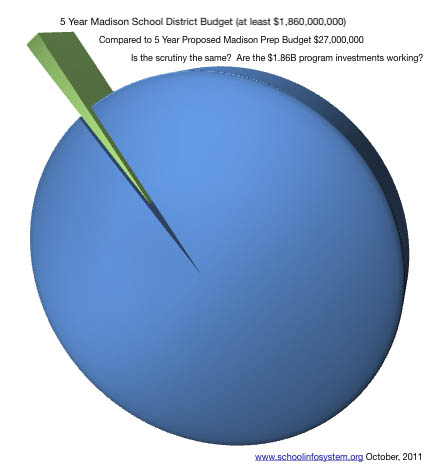
Matthew DeFour helpfully puts dollars ($105,600,000 over 5 years, about 5.6% of the roughly $1,860,000,000 that the District will spend over the same period) to the proposal. How does that compare with current programs and the proposed the proposed Madison Preparatory IB charter school?
Newsletter signup | Send us your ideas
Altogether, Nerad makes about 40 recommendations in six categories -- instruction, college and career readiness, culturally relevant practices, school environment, family engagement and staff diversity.Related:"The plan is based on the view that there isn't one thing alone the school district can do to eliminate achievement gaps," Nerad said. "We're attempting to be comprehensive with the proposal."
The plan's projected cost for next year is $12.4 million, which Nerad is recommending come from the district's untapped property taxing authority under state-imposed limits. The amount includes adding about 67.5 positions, including behavioral support staff, reading specialists and parent liaisons.
Some recommendations wouldn't take effect until future years. The district estimates they will cost $20.9 million in 2013-14 and $26.6 million by 2016-17. The district doesn't have the authority to raise property taxes by that amount, though Nerad said part of the discussion in coming months will involve whether the private and nonprofit sectors can help fund the strategies.
"We're going to have to struggle through the conversation of how to get it done," Nerad said.
Newsletter signup | Send us your ideas
Kaleem Caire, via email:
February 6, 2011
Greetings Community Member.
This evening, at 6pm at the Fitchburg Library, Madison Metropolitan School District Superintendent Daniel Nerad will present his plan for eliminating the racial achievement gap in our public schools to the Board of Education. We anticipate there will be many citizens in the audience listening in.
While we are pleased that our advocacy over the last 19 months has resulted in the District developing a plan to address the gap, we are also mindful of history. Our organization has pushed hard for our public school system to embrace change, address the gap and expand educational opportunity many times before.
In the 1960s, Madison learned that a wide gap existed between black and white students in reading, math and high school completion in Madison's public schools. In the 1970s, the Urban League of Greater Madison reported that just 60% of black students were graduating from the city's public high schools. In the 1980s, ULGM released a widely reported study that found the average GPA for a black high school student attending the city's public high schools was 1.58 on a 4.00 scale, with 61% scoring below a 2.0 GPA. It also found that a disproportionate number of black students were enrolled in remedial math and science classes, and that black students were significantly over-represented in special education and school suspensions. Then, in the 1990s, the Wisconsin Policy Research Institute issued a report that stated there were two school districts in MMSD, one that poorly served black children and one that served everyone else.
Today, just 48% of black and 56% of Latino students are graduating from high school. Just 1% of black and 7% of Latino high school seniors are academically ready for college. Nearly 40% of all black boys in middle school are enrolled in special education, and more than 60% of black and 50% of Latino high school students earn below a 2.0 GPA.
Over the years, several district-wide efforts have been tried. Unfortunately, many of these efforts have either been discontinued, unevenly implemented, ineffective, lacked the support of parents/community/teachers, or failed to go far enough to address the myriad needs of students, families, teachers and schools. Madison also has a well-documented history of not heeding the advice of leaders and educators of color or educational experts, and not investing in efforts to codify and replicate successful strategies employed by its most effective educators. MMSD also has not acted fast enough to address its challenges and rarely looks beyond its borders for strategies that have proven effective elsewhere in the country.
The stakes are higher now; too high to continue on our present course of incrementalism rooted in our fear of the unknown, fear of significant change, and fear of admitting that our view of Madison being the utopic experience of the Midwest and #1 city in the U.S. doesn't apply to everyone who lives here. We no longer have the luxury of time to figure out how to address the gap. We cannot afford to lose nearly 300 black, 200 Latino and an untold number of Southeast Asian and underprivileged white students each year from our public schools. And we cannot afford to see hundreds of students leave our school system each year for public and private schools outside of the Madison Metropolitan School District.
We must embrace strategies that work. We must also behave differently than we have in the past, and can no longer afford to be afraid of addressing intersection or race and poverty, and how they are playing out in our schools, social relationships and community, and impacting the educational success of our kids.
Furthermore, we need all hands on deck. Everyone in our community must play a role in shaping the self-image, expectations and outcomes of our children - in school, in the community and at home. Some children have parents who spend more quality time with their career and coworkers than with their family. Some children have a parent or relative who struggles to raise them alone. Some have parents who are out of work, under stress and struggling to find a job to provide for their family. And unfortunately, some children have parents who make bad decisions and/or don't care about their well-being. Regardless of the situation, we cannot allow the lack of quality parenting to be the excuse why we don't reach, teach, or hold children accountable and prepare them for the future.
As we prepare to review the Superintendent's plan, we have developed a rubric that will allow for an objective review of his proposal(s). The attached rubric, which you can access by clicking here, was developed and informed by members of the staff and Board of Director of ULGM, business and community leaders, and teachers and leading experts in the field of K-12 and higher education. The tool will be used by an independent Community Review Panel, organized by the Urban League. pver the next several weeks to vet the plan. The intent of this review is to ensure MMSD has an optimal plan for ensuring that all of the children it serves succeed academically and graduate from high school prepared for college and work.
Specifically, our reasons for establishing this rubric and a Community Review Panel are four-fold:We have high expectations of the Superintendent's plan. We hope for a bold, transformational, aggressive and concise plan, and stand ready to assist the Superintendent and his team in any way we can. We hope you will be standing their with us, with your arms outstretched and ready to uplift or babies - the next generation.
- Develop an objective and comprehensive understanding of the plan and its many elements;
- Objectively review the efficacy of the plan, its goals and objectives, and desired outcomes;
- Formally communicate thoughts, concerns and ideas for supporting and/or improving the plan; and
- Effectively engage the Madison community in supporting and strengthening its public schools.
All Hands on Deck!
Onward.
Team Urban League of Greater Madison
Phone: 608-729-1200
Fax: 608-729-1205
www.ulgm.org
www.madison-prep.org
Urban League of Greater Madison 2012 Agenda
Newsletter signup | Send us your ideas
via email:
Below is a letter from Dr. Daniel Nerad, Superintendent of the Madison Metropolitan School District. Please show up on Monday, February 6 to learn about his plan and register to participate in an input session. We need you to exercise your voice, share your view and speak to our children's needs. In the words of Dr. Martin Luther King, Jr.:
We will have to repent in this generation not merely for the hateful words and actions of the bad people but for the appalling silence of the good people.
-- "Letter from Birmingham Jail," April 16, 1963
February 2, 2012RE: Invitation to attend Board of Education meeting on Monday, February 6, 2012
Dear Community Leader:
As you may know, this Monday, February 6, 2012, we are poised to present to the Board of Education a significant and system-wide plan to close the achievement gaps in the Madison Metropolitan School District.
Building Our Future: A Plan for Eliminating Gaps in MMSD Student Achievement
We invite you to attend Monday's Board of Education workshop at the Fitchburg Public Library, 5530 Lacy Road in Fitchburg beginning at 6:00 p.m. This workshop is for presentation purposes only. Members of the public will not have the opportunity to speak. However, Monday's workshop marks the beginning of a two-month, community-wide engagement process. We invite parents, students, and residents concerned about the future of our children to join one or more of the many sessions held throughout Madison to learn about the achievement gaps in the MMSD and discuss and provide input into the plan.
I have greatly appreciated your concern, commitment, and willingness to challenge us to provide the kind of education that every child deserves and is due. Together, we must eliminate our achievement gaps.
The Board of Education workshop on Monday, February 6th is just the beginning. Please consider participating in one of the upcoming information and input sessions. To register for a session, go to: www.mmsd.org/inputsession
Beginning Tuesday, February 7, go to: www.mmsd.org/thefuture to read more about the Plan.
Sincerely,
Daniel A. Nerad
Superintendent of Schools
Reprinted from a letter sent to community leaders today by Superintendent Nerad. We are sharing this to inform you and help the Madison Metropolitan School District get the word out. We have not yet seen the plan and therefore, this email should not viewed as an endorsement of it. We will reserve judgment until after the plan is released, we have had a chance to review it, and the public has responded.
Newsletter signup | Send us your ideas
lot is riding on Madison Superintendent Dan Nerad's upcoming plan for improving low-income, minority student achievement.Much more on the proposed Madison Preparatory IB charter school, here.The plan is billed as a blueprint for addressing an intractable, divisive issue in Madison, and it could also factor into the upcoming School Board discussion of Nerad's future in Madison.
The United Way of Dane County has made closing the achievement gap one of its primary issues for more than 15 years through the Schools of Hope tutoring program. But president Leslie Howard said the recent debate over the proposed Madison Prepatory Academy charter school has drawn more public attention to the issue than ever before.
"I don't want to say something so grandiose that everything's at stake, but in some ways it feels like that," Howard said.
Related links:
"They're all rich, white kids and they'll do just fine" -- NOT!
Newsletter signup | Send us your ideas
The Milwaukee School Board is once again ignoring Superintendent Gregory Thornton's request to explore privatizing a portion of the school lunch program. And that's just another sign that the board is more concerned with saving union food service jobs than with saving money that could be better spent on educating kids.The board and Thornton have been down this road before. In his latest proposal, Thornton asked the board to approve the establishment of a leased commissary. The board voted down the proposal, 5-4, in favor of a central kitchen run by district staff. They would not even consider the possibility of looking at other options to see if those would be more cost effective.
In a cash-strapped district, this makes absolutely no sense.
"I was just talking about privatizing a piece of it," a frustrated Thornton said. "I was not talking about how to transport the food or service the food."
The board appears to be against exploring any food service options that would eliminate union jobs. Currently, the food service workforce includes 48 temporary employees and more than 100 part-time employees. Administrators say they have had a hard time filling food service jobs.
Newsletter signup | Send us your ideas
Madison School District BoardBoth Madison School Board races are contested this year.
Seat 1: Arlene Silveira Website / Facebook
Seat 2: Michael Flores Website / FacebookNow we have to make sure they get elected! That takes money (some) and work (lots).
The money part is easy--come to the Progressive Dane Campaign Fund-raiser
Sunday February 12, 5-7 pm
Cardinal Bar, 418 E Wilson St
(Potluck food, Cash Bar, Family Friendly)Meet the candidates, hear about Madison School District and Dane County issues, pick some to work on this year!
Seat 1 Candidates:
Nichele Nichols
www.nichols4schoolboard.org
email: nnichols4mmsd@gmail.com
Arlene Silveira (incumbent)
www.arleneforschoolboard.com
email: arlene_Silveira@yahoo.com
Seat 2 Candidates:
Mary Burke
www.maryburkeforschoolboard.net
email: maryburkewi@gmail.com
Michael Flores
www.floresforschoolboard.org
email: floresm1977@gmail.com
 Newsletter signup | Send us your ideas
Seat 1 Candidates:
Nichele Nichols
www.nichols4schoolboard.org
email: nnichols4mmsd@gmail.com
Arlene Silveira (incumbent)
www.arleneforschoolboard.com
email: arlene_Silveira@yahoo.com
Seat 2 Candidates:
Mary Burke
www.maryburkeforschoolboard.net
email: maryburkewi@gmail.com
Michael Flores
www.floresforschoolboard.org
email: floresm1977@gmail.com
via a kind reader. It is great to see competitive races.
Newsletter signup | Send us your ideas
Laurie Rogers, via a kind email:
Last week, I went to a Spokane Public Schools math presentation at Indian Trail Elementary School. It was billed as a forum in the school newsletter and on the reader board outside of the school. It was not, in any way, a forum. It was a tightly controlled 20-minute presentation that offered no data, little information, allowed for no parent input and was patronizing in tone.Related: Math Forum audio & video.At one point, parents were asked to define math to the person next to us. (The principal said he would not offer his definition.) We also were told to describe to our neighbor a math experience we'd had. These conversations ended right there, thus being pointless. We watched a video of several small children talking about the importance of math. The kids were cute, but the video was long. It was made clear to us that math is hard, parents don't get it (see slide 7 of the presentation), "traditional math" is no longer useful, and math is intimidating to all. Printed materials reinforced the idea of parent incompetence, with students supposedly "taking the lead" and teaching their parents.
Parents were warned to stay positive about math, however, despite our supposed fear and lack of skill, and we also were told what a "balanced" program looks like - as if that's what Spokane actually has.
Newsletter signup | Send us your ideas
I see a lot of support among the District leadership for clear job descriptions and duties for everyone in the District - everyone, that is, except the District leadership. Each Board member will acknowledge that the Board has the duty to enforce policy yet no Board member will allow that duty to be explicitly stated in any document. It does not appear in the newly adopted Series 1000 Policies. It does not appear in the policy that describes the duties of the Board. It does not appear in the policy on governance. Now the Board is going to adopt two more elements of Board policy that should mention this duty yet fail to do so.The board policy preamble on the Board meeting agenda this week is an ideal place for it, but instead the preamble makes reference to it only vaguely and euphemistically as "governance tools". It says that policies can be used by the superintendent to hold staff accountable but it neglects to say that they can be used by the Board to hold the superintendent accountable.
Newsletter signup | Send us your ideas
Just when all signs indicated that supporters of Madison Preparatory Academy were abandoning hope of joining forces with the Madison school district, they've decided to give it one more shot. They're seeking another vote on the controversial charter-school proposal in late February.Much more on the proposed Madison Preparatory IB charter school, here.Urban League of Greater Madison CEO and president Kaleem Caire says Madison Prep will open this fall as a private entity, but hopes it will transition into the district in 2013, once the district's union contract expires.
Board members who voted against the charter school in December expressed concerns that it would put the district in breach of its contract with Madison Teachers Inc., due to a provision requiring district schools to hire union staff.
School board president James Howard, who voted for Madison Prep, says the board may not have time to address the proposal in February.
Whether the Urban League -- which proposed Madison Prep as an ambitious step toward closing the district's decades-old achievement gap -- can recapture its earlier momentum is uncertain, considering that Superintendent Dan Nerad and school board members seem particularly excited about their own plans to address the issue.
"We're going at it from so many different angles right now," says board member Beth Moss. "I can't see how we can't make some improvement."
Fascinating.
Newsletter signup | Send us your ideas
When asked why he didn't second Ed Hughes' motion at the Dec. 19 meeting to delay the schools' opening until 2013, Howard replied, "We had not discussed the implications of what that means. I think we have time if we're talking about 2013, to make sure we do it correctly, because we don't know what the rules of the game will be in 2013."Much more on the proposed Madison Preparatory IB charter school, here.Superintendent Dan Nerad said, "Whether it will move forward I don't know. That depends on whether the motion gets on the floor. I don't have a read on it at this point."
Others aren't as diplomatic. "This is a waste of time and money for all involved," said TJ Mertz, an Edgewood College professor and district watchdog who is among Madison Prep's most ardent critics.
"The votes are not there and will not be there," he continued. "It distracts from the essential work of addressing the real issues of the district, including issues of achievement for students in poverty."
Newsletter signup | Send us your ideas
Kaleem Caire, via email:
MEDIA ADVISORYMuch more on the proposed Madison Preparatory IB charter school, here.For immediate release: January 12, 2012
Contact: Laura DeRoche-Perez
Director of School Development
Urban League of Greater Madison
2222 S. Park St., Suite 200
Madison, WI 53713
Lderoche@ulgm.org
608-729-1230 (office)
608-556-2066 (cell)
Urban League and Madison Prep Boards to Hold Press Conference
Will announce their plans to seek a new vote on authorizing the opening of Madison Prep for 2013WHAT: Madison Preparatory Academy and the Urban League of Greater Madison will announce their intentions to seek a February 2012 vote by the Madison Metropolitan School District Board of Education to authorize Madison Prep to open in the fall of 2013. Three MMSD Board of Education members have already shared their support of the motion.
WHEN: 3:30 pm CST, Friday, January 13
WHERE: Urban League of Greater Madison, 2222 S. Park St., Madison, WI 53713
WHO: Madison Preparatory Academy Board of Directors
Urban League of Greater Madison
OthersFor more information, contact Laura DeRoche-Perez, Director of School Development, Urban League of Greater Madison, at lderoche@ulgm.org or 608-729-1230.
Newsletter signup | Send us your ideas
That Kaleem Caire, the charismatic champion of the Madison Preparatory Academy, is frustrated by the proposal's defeat before the Madison School Board last month should surprise no one.Much more on the proposed Madison Preparatory IB charter school, here.But the prospect that resentment over the defeat of the proposal runs so deep that it could poison the initiative's future prospects as a private school or public charter -- that's a distressing possibility whose existence is just now emerging.
The proposal for the school by the Urban League of Greater Madison has won many supporters because of the embarrassingly persistent achievement gap between whites and minorities in the Madison School District, but when Caire spoke Monday to Communities United, a community group dedicated to social justice, his passionate appeal to go beyond the district's existing model was laced with anger towards the School Board members who voted down the plan.
Much of the discussion Monday between Caire and a handful of staffers from the Urban League -- where he is president and CEO -- and those at the Communities United meeting centered around the ultra-sensitive topics of race and racism.
Even in that friendly environment (the informal, nonpartisan coalition was already on record in favor of the school), Caire's accusations against school officials were rejected as political spin by a Madison City Council member on hand and criticized as more of the "race card" by an African-American activist who has skirmished with Caire before over Madison Prep. But a Latina parent and activist greeted his words as an apt assessment of the situation in Madison schools.
Newsletter signup | Send us your ideas
New York Times news service, via a kind reader:
In Madison, the influx of poor people from Chicago is testing the city's historical liberalism. About one-quarter of the 3,300 Madison families receiving welfare are former Illinois residents.my correspondent notes:Even Mayor Paul Soglin, who earned his liberal stripes in the anti-establishment politics of the 1960s as a Vietnam War protester, now talks of "finite limits of resources" for the poor.
"We're like a lifeboat that holds 12 people comfortably," Mr. Soglin said. "We've got about 16 in it now, and there's a dozen more waiting in the water. Since we're already in danger of going under, what can our community be expected to do?"
A vibrant economy in Wisconsin accounts for much of the migration among poor people, most of them looking for jobs. The state's unemployment rate has dipped below 4 percent while that in Illinois is 4.4 percent.
Here is an interesting article from 1995. Worth revisiting with Soglin back in office (just because he is the mayor quoted at the time), but mostly as it pertains to our discussions around Madison Prep. What are the unique attributes and qualities that make up both our white population and our minority population?
Newsletter signup | Send us your ideas
MMSD has now posted the videos from the December 19, 2011 meeting at which the Board of Education voted on the proposed Madison Preparatory Charter School. The first video contains the public appearances statements; the second contains the board comments, vote, etc., through the vote to adjourn.
The versions that are now posted are much improved - the video that was originally posted had issues with sound quality and ended abruptly during board statements. The new videos have terrific sound quality and contain the full meeting. (Thanks to MMSD staff for the work that went into this.)
Newsletter signup | Send us your ideas
Nichols said though she disagreed with Silveira's vote, "This is bigger than Madison Prep.""My motivation comes from listening to a lot of the community dialogue over the last year and hearing the voices of community members who want greater accountability, who want more diversity in the decision-making and just a call for change," Nichols said.
Silveira did not return a call for comment Friday.
Two candidates have announced plans to run for the other School Board seat up for election next spring, which is being vacated by Lucy Mathiak. They are Mary Burke, a former state commerce secretary and Trek Bicycle executive, and Michael Flores, a Madison firefighter, parent and East High graduate.
Newsletter signup | Send us your ideas
The whole agonizing conflict over Madison Preparatory Academy did not end on Monday night, when the school board voted 5-2 against allowing the African American charter school to open next fall. Now comes the lawsuit.But first, our community faces two immediate tasks: healing the wounds that were ripped open during the Madison Prep controversy, and getting something done about the urgent problem the charter school was developed to address -- Madison's disgraceful achievement gap for African American children.
Monday night's six hours of emotional testimony mostly highlighted the first of those two problems. In front of the packed auditorium at Memorial High School, Urban League president and Madison Prep founder Kaleem Caire read "What happens to a dream deferred?" to the school board. Nichelle Nichols, the Urban League's vice president of learning, read a poem that placed the blame for her own children's spoiled futures squarely on Madison Metropolitan School District officials: "My kids are in the gap, a chasm so dark.... I ask, Mr. Superintendent, what happened to my sons...?"
The sense that Madison has mistreated children of color was a powerful theme. White business leader and former teacher Jan O'Neil pointed out the "huge amount of capital in this room," all focused on solving the historic educational inequality for African American kids. A "no" vote, she warned the board, might be hopelessly polarizing.
Newsletter signup | Send us your ideas
Madison School Board Member Ed Hughes:
I can't shake the feeling that something important was going on at our School Board meeting last Monday night to consider the Madison Prep charter school proposal, and that the actual School Board vote wasn't it.Much more on the proposed Madison Preparatory IB charter school, here.The bare-bone facts are that, after about 90 public speakers, the Board voted 2-5 to reject the Madison Prep proposal. I reluctantly voted against the motion because I was unwilling to violate the terms of our collective bargaining agreement with our teachers.
After the motion failed, I moved that the Board approve Madison Prep, but delay its opening until the fall of 2013. My motion failed for lack of a second. (And no, I don't have an explanation for why neither James Howard nor Lucy Mathiak, who voted in favor of the first motion, was willing to second my motion.)
Probably like most who attended Monday night's meeting, I have thought a lot about it since. People who know I voted against the proposal have come up to me and congratulated me for what they say was the right decision. I have felt like shaking them and saying, "No, you don't understand. We blew it Monday night, we blew it big time. I just hope that we only crippled Madison Prep and didn't kill it."
I appreciate that that's an odd and surprising place for me to have ended up. To echo the Talking Heads, "Well, how did I get here?" I'll try to explain.
Newsletter signup | Send us your ideas
The most straightforward, clear and dispassionate vote taken on the Madison Preparatory Academy charter school proposal at last Monday's Madison Metropolitan School District Board meeting didn't even count. It was the advisory vote cast by the student representative, Philippo Bulgarelli.Much more on the proposed Madison Preparatory IB charter school, here.The School Board turned down the controversial proposal on a 5-2 vote, and after nearly five hours of public testimony, all the school board members gave speeches explaining how they arrived at their decisions. In addition to being the most succinct, Bulgarelli's statement penetrated all of the intense emotions and wildly divergent interpretations of data and personal anecdotes used to argue both for and against the proposal. Bulgarelli said that the students for whom he speaks did not have enough information to make a reasonably good decision, so he voted to abstain.
Newsletter signup | Send us your ideas
Changes to policies and procedures over the handling of funds will ensure that nothing like the theft of more than $300,000 from Fort High should occur again, the Rainy River District School Board said following the sentencing last Thursday of former FFHS secretary Fawn Lindberg."Obviously, there were some shortcomings in terms of oversight, both at the school and right through the board office--and those things hopefully have now all been corrected," noted board chair Michael Lewis.
A press release issued by the board called the theft a "systemic failure from the top down."
While Lindberg didn't have the authority to authorize or sign cheques, it was noted during last Thursday's court proceedings that a practice had developed whereby blank cheques would be signed in advance by the principal and vice-principal, who did have signing authority.
From June, 2005 to October, 2007, Lindberg fed a gambling addiction by stealing $312,426.45, using some 146 cheques she had made out in her name or to "cash."
The theft came to light in the fall of 2007 after a deficit of more than $175,000 was noticed by board administration and investigated.
Newsletter signup | Send us your ideas
The school would have offered a longer school day and year, higher standards and expectations, uniforms, mandatory extracurricular activities, same-sex classrooms, more minority teachers as role models, and stepped-up pressure on parents to get involved in their children's education.Much more on the proposed Madison Preparatory IB charter school, here.Madison Prep represented a huge opportunity -- with unprecedented community support, including millions in private donations -- to attack the stubborn achievement gap for low-income and minority students.
But a majority of the School Board rejected Madison Prep, citing excuses that include a disputed clause in its teachers union contract and a supposed lack of accountability.
Newsletter signup | Send us your ideas
Madison Urban League President Kaleem Caire fought hard to win approval of his Madison Prep project. But the Madison School Board ultimately rejected a plan that would have steered tens of millions of taxpayer dollars into a project that board members felt lacked sufficient oversight and accountability.Much more on the proposed Madison Preparatory IB charter school, here.The response of Caire and his fellow Madison Prep advocates was to suggest a variety of moves: the filing of a complaint with the U.S. Department of Justice, or perhaps a request for state intervention to allow the project to go forward without state approval.
We would suggest another approach.
Caire has succeeded in garnering a good deal of support for Madison Prep. He could capitalize on that support and make a run for the School Board.
Changing the school board would either require: patience (just two of seven seats: Lucy Mathiak, who is not running after two terms and Arlene Silveira, who apparently is seeking a third term) are up in April, 2012 or a more radical approach via the current Wisconsin method (and Oakland): recalls. Winning the two seats may not be sufficient to change the Board, given the 5-2 no vote. Perhaps the "momentum", if realized, might sway a vote or two?
Perhaps the TAG complaint illustrates another approach, via the courts and/or different government agencies.
Newsletter signup | Send us your ideas
Kaleem Caire, via email
For Immediate Release: December 21, 2011Much more on the proposed Madison Preparatory IB charter school, here.Contact: Laura DeRoche-Perez
Director of School Development
Urban League of Greater Madison
2222 S. Park St., Suite 200
Madison, WI 53713
Lderoche@ulgm.org
608-729-1230 (office)
608-556-2066 (cell)
Madison, WI - This morning, the Board of Directors of Madison Preparatory Academy unanimously decided to pursue a set of actions that will assist with eliminating the racial achievement gap in the Madison Metropolitan School District (MMSD). These actions are consistent with the objectives of the Urban League of Greater Madison.
Specifically, Madison Prep's Board has committed to partnering with the Urban League of Greater Madison to:
Work with the Madison Metropolitan School District to ensure MMSD has a bold and effective plan for eliminating the racial achievement gap that embraces innovation, best practices and community engagement as core strategies.
Evaluate legal options that will ensure MMSD affirmatively and immediately addresses the racial achievement gap.
Establish Madison Preparatory Academy as an independent school within the boundaries of the Madison Metropolitan School District in August 2012 as a model of whole school reform and a necessary education option for disadvantaged children and families.
David Cagigal, Chair of Madison Prep's Board, shared that "Madison Prep is a necessary strategy to show how our community can eliminate the achievement gap and prepare our most vulnerable students for college. MMSD's rejection of our proposal does not change this fact."
Cagigal further stated that, "We look forward to engaging the Greater Madison community in addressing the racial achievement gap in Madison's public schools and supporting the establishment of Madison Prep next fall."
For more information, contact Laura DeRoche Perez, Director of School Development, Urban League of Greater Madison, at Lderoche@ulgm.org or 608-729-1230.
Forward email
This email was sent to jim@schoolinfosystem.org by kcaire@ulgm.org |
Update Profile/Email Address | Instant removal with SafeUnsubscribe™ | Privacy Policy.
Urban League of Greater Madison | 2222 S. Park Street | Suite 200 | Madison | WI | 53713
Newsletter signup | Send us your ideas
I am ambivalent. My state, Tennessee, is the first state that has implemented the annual teacher and principal evaluations as required by Race to the Top (RTT). In 2010, I was involved with writing Tennessee's successful RTT application, especially the section on "great teachers and leaders." In my state role, I celebrated the RTT requirement for annual teacher and principal evaluations based substantially on student growth as one of the most important levers to accelerate student achievement.Now, in 2011, I am at the local level watching the fall-out. Although I still support annual teacher evaluations that include student achievement growth and regular teacher observation scores, it is clear that the initiative is off to a rocky start. And this has implications for more than just the educators and students in Tennessee. As noted in Education Week, many policymakers are concerned that the rocky implementation of Tennessee's new teacher evaluation system may hinder efforts in other states.
Newsletter signup | Send us your ideas
Supporters of a controversial charter school proposal geared toward low-income, minority students said Tuesday they will continue to fight to establish it next fall -- including possibly as a private school.Much more on the proposed Madison Preparatory IB charter school, here.Their comments came Tuesday after the Madison School Board voted 5-2 early that day to reject a proposal for Madison Preparatory Academy, which would offer single-sex classrooms and a college preparatory curriculum.
The board didn't vote on an alternate proposal to approve the school but delay its opening until 2013.
David Cagigal, president of the Madison Prep board, said a private school would be expensive because the school's target low-income population wouldn't be able to afford tuition. Instead, the board would ask private donors to replace the roughly $9,300 per pupil it had sought from the School District.
"Maybe money is not the issue if we want to go ahead and prove our point," Cagigal said. "I can assure you we will persist with this idea of closing the achievement gap."
Newsletter signup | Send us your ideas
Mitch Henck, Lucy Mathiak & John Roach (mp3 audio): Much more on the proposed Madison Preparatory IB charter school, here.
Newsletter signup | Send us your ideas
Kaleem Caire, via email:
Dear Madison Prep,Much more on the proposed Madison Preparatory IB charter school, here.First, thank you to all of you who have supported the Madison Prep effort to this point. Your volunteer hours, work on Design Teams, attendance at meetings, letters to the district and media, and many other acts of support have not gone unnoticed by the Urban League and Madison Prep.
In earlier morning hours today, the MMSD Board of Education voted 5-2 AGAINST Madison Prep. This outcome came after hours of testimony by members of the public, with Madison Prep supporters outnumbering opponents 2:1. Lucy Mathiak and James Howard voted YES for Madison Prep; Ed Hughes, Arlene Silviera, Beth Moss, Maya Cole, and Marj Passman voted NO. After the vote was taken, Ed Hughes made an amendment to the motion to establish Madison Prep in 2013 (rather than 2012) in order to avoid what some see as a conflict between Madison Prep and the teachers' union contract. Mr. Hughes' motion was not seconded; therefore there was no vote on establishing Madison Prep one year later.
While the Urban League and Madison Prep are shocked by last night's outcome, both organizations are committed to ensuring that Madison Prep becomes a reality for children in Madison. We will continue to press for change and innovation in the Madison Metropolitan School District and Dane County to ensure that the racial achievement gap is eliminated and that all children receive a high quality education that adequately prepares them for their future.
We will advance a number of next steps:
1.We will pursue different avenues, both public and private, to launch Madison Prep. We are still hopeful for an opening in 2012. There will be much the community will learn from Madison Prep and our children need this option now.
2.We will continue to coordinate community support and action to ensure that the Madison Metropolitan School District is accountable for eliminating the racial achievement gap. We will consider several strategies, such as implementing a Citizen Review Board that will hold the school board and district administration accountable for good governance, planning, implementation, execution, community engagement and student achievement results. We will also consider legal avenues to ensure MMSD understands and responds to the community's sense of urgency to address the sizable and decades-long failure rates of Black and Latino children.
3.We must also address the leadership vacuum in K-12 education in Madison. Because of this, we will ensure that parents, students and community members are informed of their rights and responsibilities, and have a better understanding of promising educational strategies to close the achievement gap. We will also work to ensure that they have opportunities to be fully engaged in planning, working and deciding what's best for the children educated in our public schools.
4.We will continue to work in collaboration with MMSD through our existing partnerships, and hope to grow these partnerships in the future.
Thank you for everything you have done and continue to do to ensure that children in our schools and families in our community have hope, inspiration, support and opportunity to manifest their dreams and make a difference in their own lives and the lives of others.
Onward.
Kaleem
Newsletter signup | Send us your ideas
As expected, the Madison Metropolitan School Board voted 5 -2 last night against authorizing the Madison Prep charter school. Only two board members overseeing a school district with an African-American graduation rate below 50% saw fit to support a new approachMuch more on the proposed Madison Preparatory IB charter school, here.Those voting against the school did offer reasons. Board member Beth Moss told the Wisconsin State Journal she voted no because of concerns about the school's ability to serve students needing more than one year of remedial education. Board member Ed Hughes said he could not support the school until after the Madison teachers union contract expires in 2013.
But no worries, Superintendent Dan Nerad told the Wisconsin State Journal he has a plan:
Newsletter signup | Send us your ideas
Proponents of the Madison Preparatory Academy said they're looking to take legal action against the Madison Metropolitan School District after the school board voted against the proposed charter school.Much more on the proposed Madison Preparatory IB charter school, here.The Madison Board of Education put an end to the Madison Prep proposal with a 5-2 vote early Tuesday morning, and reaction was swift.
"Because (the school board members) don't take us seriously -- they will sit right up here and look in our face and not even know they're insulting us with the things that they say," said Kaleem Caire, president of the Urban League Of Greater Madison President, shortly after the vote. "We are going to turn our attention immediately, immediately, to address this legally."
Newsletter signup | Send us your ideas
For the last 17 months, I have followed the commentary and misinformation shared about our organization's proposal to establish Madison Preparatory Academy.Much more on the proposed Madison Preparatory IB charter school, here.Some who have written and commented about our proposal have been very supportive; others don't think Madison Prep should exist. With less than 24 hours until the Madison School Board votes on the school, we would like to bring the public back to the central reasons why we proposed Madison Prep in August 2010.
First, hundreds of black and Latino children are failing to complete high school each year. In 2009, the Madison School District reported that 59 percent of black and 61 percent of Latino students graduated. In 2010, the percentage of graduates dropped to 48 percent for Black and 56 percent for Latino students. This not only has an adverse impact on our young people, their families and our community, it results in millions in lost revenue to the Madison district every year.
Second, in 2010, just 20 percent of the 387 black and 37 percent of the 191 Latino seniors enrolled in the district completed the ACT college entrance exam. The ACT is required for admission by all public colleges and universities in Wisconsin. Unfortunately, just 7 percent of black and 18 percent of Latino student who completed the ACT were "ready for college." This means that only 5 of 387 black and 13 of 191 Latino students were academically ready for college.
Newsletter signup | Send us your ideas
No matter where the votes fall Monday when the Madison School Board decides whether to OK a charter school proposal for the controversial Madison Preparatory Academy, the idea of a buttoned-down, no-nonsense alternative to the city's public schools already has entered the local popular culture. It is not only a beacon of hope in efforts to end a lingering race-based academic achievement gap, but also has become an emblematic stick to nudge underperforming kids into line.Much more on the proposed Madison Preparatory IB charter school, here.As high school senior Adaeze Okoli tells it, when her little brother isn't working up to his potential, her mom jokingly threatens to send him to Madison Prep.
That anecdote says a lot about how distinct a presence the proposed school already has become in local communities of color. It makes me wonder how kids would feel about attending a school that is boys-only or girls-only and requires uniforms, longer school days, a longer school year and greater parental involvement.
Put the kids first for a change, Urban League of Greater Madison president Kaleem Caire, the architect and unflagging advocate of the school plan, chided school district administrators after they declared that his proposal would violate the district's union contract with its teachers and provide inadequate accountability to the School Board. But for all the analysis and debate about the Madison Prep plan, I haven't heard much from young people about how they would like to go to such a school, and how they think the strict rules would influence learning.
To sound out some students, I turned to the Simpson St
Newsletter signup | Send us your ideas
Superintendent Dan Nerad acknowledged last week that existing Madison School District programs aimed at boosting minority achievement "are not having the impact we need for our kids.""The data is telling us we need to do different things," Nerad added.
And the Urban League of Greater Madison's proposal for an unusual public charter school catering to low-income blacks and Latinos "has elevated the conversation, and I appreciate that," the superintendent said.
"I'm not raising any concerns about the programming side of it," he told the State Journal editorial board.
It sounded like a windup to endorsing the Madison Preparatory Academy, which faces a final vote by the Madison School Board on Monday night.
Instead, Nerad is recommending the School Board reject the academy, primarily because of complicated contract language.
That shouldn't happen.
Newsletter signup | Send us your ideas
Greater Madison Chamber of Commerce:
The Greater Madison Chamber of Commerce Board of Directors met on December 15, 2011, and adopted the following resolution:Much more on the proposed Madison Preparatory IB charter school, here.
Motion: The Board of Directors encourages a comprehensive approach to eliminate the student achievement gap currently present in Madison schools.The Board strongly endorses the advancement of the Urban League of Greater Madison's proposed Madison Preparatory Academy. The Board also acknowledges and endorses the continued investment in successful strategies already employed by the Madison Metropolitan School District and the United Way of Dane County.
Comments:
The Chamber Board recognizes that there is no panacea or singular solution to eliminating the student racial achievement gap. Rather, a comprehensive approach should be employed utilizing multiple strategies to address this problem.
The Chamber Board acknowledges the work of community and school leaders who have worked tirelessly on this issue. In particular, the United Way of Dane County has demonstrated tremendous leadership to ensure all struggling students achieve better results. The GMCC is a partner in Schools of Hope, a collaborative community initiative aimed at reducing the achievement gap. In addition, the United Way is committing more than $2 million over the next year for programs to address this issue.
Newsletter signup | Send us your ideas
One of the last remaining opportunities for a locally-elected government body to stop the increasing spread of the entitlement society and the dumbing down of education will occur Monday when the Madison School Board, together with their highly paid educational professionals, will determine the fate of Madison Prep Academy.Much more on the proposed Madison Preparatory IB charter school, here.Based on news reports, the local teachers union and its always pushy head, John Matthews, oppose the venture. Why? Because the proposal advocates flexibility by hiring non-union teachers at a cost savings of millions!
To Matthews and MTI, your argument that "it's all about the kids" rings hollow and empty again.
Even though I am not a member of a minority and I dislike paying more real estate taxes for unnecessary projects, this non-union driven proposal by Kaleem Caire deserves approval for the future benefit of Madison's kids and residents.
Newsletter signup | Send us your ideas
It's ironic that John Matthews, executive director for Madison Teachers Inc., writes in a State Journal guest column that Madison Prep charter school could be implemented only if it was more like Nuestro Mundo.Much more on the proposed Madison Preparatory IB charter school, here.In 2004, when Nuestro Mundo applied, Matthews didn't support the formation of a charter school. He opposed the charter despite the fact that Nuestro Mundo wanted teachers to remain in the collective bargaining agreement as members of MTI.
If the Madison School Board had listened to Matthews back in 2004, there would not be a Nuestro Mundo charter school.
Nuestro Mundo came into existence through the work of members of the community and the efforts of three Madison School District board members, Ruth Robarts, Ray Allen and Juan Jose Lopez. In spite of the many legal and economic questions, they found a way to make Nuestro Mundo a reality.
Matthews has not assisted in the formation of charter schools. Don't look to him for a balanced opinion -- he's anti-charter.
-- Peter Joyce, Madison
Newsletter signup | Send us your ideas
Don Severson, via a kind email:
The Madison Metropolitan School District Board of Education will vote December 19, 2011, on the Madison Preparatory Academy proposal for non-instrumentality charter school authorization. Active Citizens for Education endorses and supports the approval of the proposal.Much more on the proposed Madison Preparatory IB charter school, here.In addition to the rationale and data cited by the Urban League of Greater Madison, and significant others throughout the Madison community, supporting the curricular, instructional, parental and behavioral strategies and rigor of the school, ACE cites the following financial and accountability support for approval of the Academy as a non-instrumentality charter school.
The MMSD Board of Education is urged to approve the proposed Madison Preparatory Academy non-instrumentality charter school proposal; thereby, relieving the bondage which grips students and sentences them to a future lifetime of under-performance and lack of opportunities. Thank you.
- Financial: Should the Board deny approval of the proposal as a non-instrumentality the District stands to lose significant means of financial support from state aids and property tax revenue. The District is allowed $10,538.54 per student enrolled in the District the 2011-12 school year. With the possibility of Madison Prep becoming a private school if denied charter school status, the 120 boys and girls would not be enrolled in MMSD; therefore the District would not be the beneficiary of the state and local revenue. The following chart shows the cumulative affect of this reduction using current dollars:
2012-2013 6th grade 120 students @10,538.54 = $1,264,624.80
2013-2014 2 grades 240 students @10,538.54 = $2.529,249.60
2014-2015 3 grades 360 students @10,538.54 = $3,793,874.40
2015-2016 4 grades 480 students @10,538.54 = $5,058,499.20
2016-2017 5 grades 600 students @10,538.54 = $6.323.124.00
2017-2018 6 grades 720 students @10,538.54 = $7,587,748.80
2018-2019 7 grades 840 students @10,538.54 = $8,852,373.60
This lost revenue does not include increases in revenue that would be generated from improved completion/graduation rates (currently in the 50% range) of Black and Hispanic students resulting from enrollees in a charter school arrangement.- Accountability: The MMSD Administration and Board have been demonstrating a misunderstanding of the terms 'accountability' and 'control'. The State charter school law allows for the creation of charter schools to provide learning experiences for identified student groups with innovative and results-oriented strategies, exempt from the encumbrances of many existing state and local school rules, policies and practices. Charter schools are authorized and designed to operate without the 'controls' which are the very smothering conditions causing many of the problems in our public schools. The resulting different charter school environment has been proven to provide improved academic and personal development growth for learners from the traditional school environment. Decreasing impediments and controls inhibiting learning increases the requirements for 'accountability' to achieve improved learner outcomes on the part of the charter school. Should the charter school not meet its stated and measurable goals, objectives and results then it is not accountable and therefore should be dissolved. This is the 'control' for which the Board of Education has the authority to hold a charter school accountable.
Let us describe an analogy. Private for-profit business and not-for-profit organizations are established to provide a product and/or service to customers, members and the public. The accountability of the business or organization for its continued existence depends on providing a quality product/services that customers/members want or need. If, for whatever reasons, the business or organization does not provide the quality and service expected and the customer/member does not obtain the results/satisfaction expected, the very existence of the business/organization is jeopardized and may ultimately go 'out of business'. This scenario is also absolutely true with a charter school. It appears that the significant fears for the MMSD Administration and Board of Education to overcome for the approval of the proposed non-instrumentality Madison Prep charter school are: 1) the fear of loss of 'control' instead of accepting responsibility for 'accountability', and 2) the fear that 'some other organization' will be successful with solutions and results for a problem not addressed by themselves.
Contact: Don Severson, President, 608 577-0851, donleader@aol.com
Newsletter signup | Send us your ideas
Don Severson, via a kind email:
(Madison, WI) The Madison Metropolitan School District Board of Education will make a decision at its regular meeting December 19th regarding the Urban League of Greater Madison (ULGM) proposal for a non-instrumentality charter school. Active Citizens for Education (ACE) has discussed several issues related to the proposal with the Board of Education, administration and with ULGM.The Board of Education, in its deliberations, must weigh several implications and consequences for the schools, students, parents and the taxpaying public.
In its public statement, ACE will announce its position on the
financial implications of the proposal for future MMSD budgets and the taxpayers; how the issues of "control" and "accountability" relate to the authority of the Board of Education regarding approval or non-approval of the charter school proposal; and Madison Preparatory Academy over-all proposal.The media conference will be held
December 15, 2011 (Thursday)
12:30 PM, Conference Room
Genesis Enterprise Center (GEC)
313 West Beltline Highway (off Rimrock Road to the west)Mr. Severson will be available for questions and comments following the media conference.
Newsletter signup | Send us your ideas
Madison School Board Member Ed Hughes:
Here's a quote from an on-line comment of a Madison Prep opponent responding to one of the several op-ed pieces posted in the Cap Times in recent days: "There are barriers to students with special education needs, barriers to students with behavioral needs, and barriers to kids who rely on public transportation. These children are simply not the 'right fit'. It is Madison Prep's proposal to leave these kids in their neighborhood schools."Much more on the proposed Madison Preparatory IB charter school, here.The notion seems to be that Madison Prep may not be welcoming for students from all points along the spectrum of educational needs, even though our neighborhood schools are obligated to serve everyone.
I think the self-selection process for Madison Prep should be taken into account in assessing how its students perform. But it does not trouble me that the school is not designed to meet the needs of all our students. No one need apply to attend and no student will be denied current services or programs if Madison Prep is authorized.
Newsletter signup | Send us your ideas
Lucy Mathiak:
The Urban League's proposal to create a Madison Preparatory charter school is, at its heart, a proposal about public education in our community. Although the discussions often boil down to overly simplistic assertions about whether one position or the other is supportive of or hostile toward public education, it is not that simple. What we are facing is a larger and more fundamental question about our values when it comes to the purpose of public education and who it is supposed to serve.Also posted at the Capital Times.I am voting "yes" because I believe that strong public education for all is the foundation for a strong society. While our schools do a very good job with many students who are white and/or living above the poverty line, the same cannot be said for students of color and/or students living in poverty. The record is most dismal for African American students.
The Madison Prep proposal is born of over 40 years of advocacy for schools that engage and hold high academic expectations for African American and other students of color. That advocacy has produced minor changes in rhetoric without changes in culture, practice, or outcome. Yes, some African American students are succeeding. But for the overwhelming majority, there are two Madison public school systems. The one where the students have a great experience and go on to top colleges, and the one that graduates only 48% of African American males.
The individual stories are heartbreaking, but the numbers underscore that individual cases add up to data that is not in keeping with our self-image as a cutting edge modern community. We ALL play a role in the problem, and we ALL must be part creating a sound, systemic, solution to our failure to educate ALL of our public school students. In the meantime, the African American community cannot wait, and the Madison Prep proposal came from that urgent, dire, need.
Our track record with students and families of color is not improving and, in some cases, is going backward rather than forward as we create more plans and PR campaigns designed to dismiss concerns about academic equality as misunderstandings. To be sure, there are excellent principals, teachers, and staff who do make a difference every day; some African American students excel each year. But overall, when presented with opportunities to change and to find the academic potential in each student, the district has failed to act and has been allowed to do so by the complicit silence of board members and the community at large.A few turning points from the past year alone:
The single most serious issue this year, however, came in May when MMSD administration was informed that we are a District Identified for Improvement (DIFI) due to test scores for African American students along with students from low income families and those with learning disabilities. This puts Madison on an elite list with Madison (Milwaukee?) and Racine. The superintendent mentioned DIFI status in passing to the board, and the WI State Journal reported on the possible sanctions without using the term DIFI.
- The Urban League - not MMSD administration or the board - pointed out the dismal graduation rates for African American students (48% for males)
- Less than 5% of African American students are college ready.
- AVID/TOPs does a terrific job with underrepresented students IF they can get in. AVID/TOPs serves 134 (2.6%) of MMSD's 4,977 African American secondary students.
- The number of African American students entering AVID/TOPs is lower this year after MMSD administration changed the criteria for participation away from the original focus on students of color, low income, and first generation college students.
- Of almost 300 teachers hired in 2011-12, less than 10 are African American. There are fewer African American teachers in MMSD today than there were five years ago.
- Over 50 African Americans applied for custodian positions since January 1, 2011. 1 was hired; close to 30 custodians were hired in that time.
- 4K - which is presented as a means to address the achievement gap - is predominantly attended by students who are not African American or low-income.
- In June, the board approved a Parent Engagement Coordinator to help the district improve its relations with African American families. That position remains unfilled. The district has engagement coordinators working with Hmong and Latino families.
Whether one agrees or disagrees with NCLB, DIFI status is a serious matter because of the ladder of increasing sanctions that come with poor performance. In an ideal world, the district would have articulated the improvement plan required by DPI over the summer for implementation on the first day of school. Such a plan would include clear action steps, goals, and timelines to improve African American achievement. Such a plan does not exist as of mid-December 2011, and in the most recent discussion it was asserted that the improvement plan is "just paper that doesn't mean much." I would argue that, to the African American community, such a plan would mean a great deal if it was sincerely formulated and implemented.
At the same time, we have been able to come up with task forces and reports - with goals and timelines - that are devoted to Talented and Gifted Programing, Direct Language Instruction, Fine Arts Programing, and Mathematics Education to name a few.Under the circumstances, it is hard to see why the African American community would believe that the outcomes will improve if they are 'just patient' and 'work within the existing public school structures to make things better.' Perhaps more accurately, I cannot look people in the face and ask them to hope that we will do a better job if they just give up on the vision of a school structure that does what the MMSD has failed to do for the African American community since the advocacy began some 40 years ago.
Newsletter signup | Send us your ideas
750K PDF - Kaleem Caire, via email
December 11, 2011Related: Who Runs the Madison Schools?Mr. Ed Hughes
Board of Education
Madison Metropolitan School District 545 West Dayton Street
Madison, WI 53713
Dear Mr. Hughes:This letter is intended to respond to your December 4, 2011 blog post regarding the Madison Preparatory Academy initiative. Specifically, this letter is intended to address what you referred as "a fairly half-hearted argument [advanced by the Urban League] that the state statute authorizing school districts to enter into contracts for non-instrumentality charter schools trumps or pre-empts any language in collective bargaining agreements that restricts school districts along these lines." Continuing on, you wrote the following:
I say the argument is half-hearted because no authority is cited in support and itjust isn't much ofan argument. School districts aren't required to authorize non-instrumentality charter schools, and so there is no conflict with state statutesfor a school district to, in effect, agree that it would not do so. Without that kind of a direct conflict, there is no basis for arguing that the CBA language is somehow pre-empted.We respectfully disagree with your assessment. The intent of this letter is to provide you with the authority for this position and to more fully explain the nature of our concern regarding a contract provision that appears to be illegal in this situation and in direct conflict with public policy.Background
As you are aware, the collective bargaining agreement (the "CBA") between MMSD and MTI Iprovides "that instructional duties where the Wisconsin Department of Public Instruction requires that such be performed by a certificated teacher, shall be performed only by 'teachers."' See Article I, Section B.3.a. In addition, "the term 'teacher' refers to anyone in the collective bargaining unit." See Article I, Section B.2. You have previously suggested that "all teachers in MMSD schools-- including non-instrumentality charter schools- must be members of the MTI bargaining unit." As we indicated in our December 3, 2011 correspondence to you, under a non-instrumentality charter, the school board may not be the employer of the charter school's staff. See§ 118.40(7)(a).
Under Wisconsin's charter school law, the MMSD School Board (the "Board") has the exclusive authority to determine whether a school is an instrumentality or not an instrumentality of the school district. See§ 118.40(7)(a). That decisio n is an important decision reserved to the Board alone. The effect of that decision drives whether teachers and staff must be, or cannot be, employees of the Board. The language of the CBA deprives the Board ofthe decision reserved to it under the statute and that language cannot be harmonized to give effect to both the statute and the CBA. Alternatively, the CBA language creates a situation whereby the Board may exercise its statutory authority to approve a non- instrumentality charter, but it must staff the school with school district employees, a result clearly prohibited under the statute. For reasons that will be explained below, in our view, the law trumps the CBA in either of these situations.Analysis
Under Wisconsin law, "[a]labor contract may not violate the law." Glendale Professional Policeman's Ass'n v. City ofGlendale, 83 Wis. 2d 90, 102 (Wis. 1978). City ofGlendale addressed the tension that can arise between bargained for provisions in a collective bargaining agreement and statutory language. In City of Glendale, the City argued that a provision dealing with job promotions was unenforceable because it could not be harmonized with statutory language. Specifically, the agreement in question set forth parameters for promoting employees and stated in part that openings "shall be filled by the applicant with the greatest department seniority..." City of Glendale, 83 Wis. 2d at 94. Wisconsin law provided the following:
The chiefs shall appoint subordinates subject to approval by the board. Such appointments shall be made by promotion when this can be done with advantage, otherwise from an eligible list provided by examination and approval by the board and kept on file with the clerk.Wis. Stat.§ 62.13(4)(a).The City contended that "the contract term governing promotions is void and unenforceable because it is contrary to sec. 62.13(4)(a), Stats." City ofGlendale, 83 Wis. 2d at 98. Ultimately, the court ruled against the City based on the following rationale:
Although sec. 62.13(4)(a), Stats., requires all subordinates to be appointed by the chief with the approval of the board, it does not, at least expressly, prohibit the chief or the board from exercising the power of promotion of a qualified person according to a set of rules for selecting one among several qualified applicants.The factual scenario in City ofGlendale differs significantly from the present situation. In City of Glendale, the terms of the agreement did not remove the ability of the chief, with the approval of the board, to make promotions. They could still carry out their statutory duties. The agreement language simply set forth parameters that had to be followed when making promotions. Accordingly, the discretion of the chief was limited, but not eliminated. In the present scenario, the discretion of the Board to decide whether a charter school should be an instrumentality or a non-instrumentality has been effectively eliminated by the CBA language.There is nothing in the CBA that explicitly prohibits the Board from voting for a non-instrumentality charter school. This discretion clearly lies with the Board. Pursuant to state law, instrumentality charter schools are staffed by District teachers. However, non-instrumentality charter schools cannot be staffed by District teachers. See Wis. Stat.§ 118.40. Based on your recent comments, you have taken the position that the Board cannot vote for a non-instrumentality charter school because this would conflict with the work preservation clause of the CBA. Specifically, you wrote that "given the CBA complications, I don't see how the school board can authorize a non-instrumentality Madison Prep to open its doors next fall, and I say that as one who has come to be sympathetic to the proposal." While we appreciate your sympathy, what we would like is your support. Additionally, this position creates at least two direct conflicts with the law.
First, under Wisconsin law, "the school board of the school district in which a charter school is located shall determine whether or not the charter school is an instrumentality of the school district." Wis. Stat. § 118.40(7)(a) (emphasis added.) The Board is required to make this determination. If the Board is precluded from making this decision on December 19"' based on an agreement previously reached with MTI, the Board will be unable to comply with the law. Effectively, the instrumentality/non- instrumentality decision will have been made by the Board and MTI pursuant to the terms and conditions of the CBA. However, MTI has no authority to make this determination, which creates a direct conflict with the law. Furthermore, the Board will be unable to comply with its statutory obligation due to the CBA. Based on your stated concerns regarding the alleged inability to vote for a non-instrumentality charter school, it appears highly unlikely that the Board ever intentionally ceded this level ofauthority to MTI.
Second, if the Board chose to exercise its statutorily granted authority on December 19th and voted for a non-instrumentality charter school, this would not be a violation of the CBA. Nothing in the CBA explicitly prohibits the Board from voting for a non-instrumentality charter school. At that point, to the extent that MTI chose to challenge that decision, and remember that MTI would have to choose to grieve or litigate this issue, MTI would have to try to attack the law, not the decision made by the Board. Pursuant to the law, "[i] f the school board determines that the charter school is not an instrumentality of the school district, the school board may not employ any personnel for the charter school." Wis. Stat.§ 118.40(7)(a) (emphasis added). While it has been suggested that the Board could choose to avoid the legal impasse by voting down the non-instrumentality proposal, doing so would not cure this conflict. This is particularly true if some Board members were to vote against a non-instrumentality option solely based on the CBA. In such a case, the particular Board Member's obligation to make this decision is essentially blocked. Making a decision consistent with an illegal contract provision for the purposes of minimizing the conflict does not make the provision any less illegal. "A labor contract term whereby parties agree to violate the law is void." WERC v. Teamsters Local No. 563, 75 Wis. 2d 602, 612 (Wis. 1977) (citation omitted).
Conclusion
In Wisconsin, "a labor contract term that violates public policy or a statute is void as a matter of law." Board of Education v. WERC, 52 Wis. 2d 625, 635 (Wis. 1971). Wisconsin law demonstrates that there is a public policy that promotes the creation of charter schools. Within that public policy, there is an additional public policy that promotes case-by-case decision making by a school board regarding whether a charter school will be an instrumentality or a non-instrumentality. The work preservation clause in the CBA cannot be harmonized with these underlying public policies and should not stop the creation of Madison Preparatory Academy.The Madison Prep initiative has put between a rock and a hard place. Instrumentality status lost support because of the costs associated with employing members of MTI. Yet, we are being told that non-instrumentality status will be in conflict with the CBA and therefore cannot be approved. As discussed above, the work preservation clause is irreconcilable with Wisconsin law, and would likely be found void by acourt of law.
Accordingly, I call on you, and the rest of the Board to vote for non- instrumentality status on December 19th. In the words of Langston Hughes, "a dream deferred is a dream denied." Too many children in this district have been denied for far too long. On behalf of Madison children, families and the Boards of the Urban League and Madison Prep, I respectfully request your support.
Respectfully,
Kaleem Caire
President & CEOcc: Dan Nerad, Superintendent
Dylan Pauly, Legal Counsel
MMSD Board ofEducation Members
ULGMand Madison Prep Board Members and Staff
Godfrey & Kahn, S.C.
Howard Blume: New teacher contract could shut down school choice program
As schools across California bemoan increasing class sizes, the Alliance Technology and Math Science High School has boosted class size -- on purpose -- to an astonishing 48. The students work at computers most of the school day.Next door in an identical building containing a different school, digital imaging -- in the form of animation, short films and graphics -- is used for class projects in English, math and science.
At a third school on the same Glassell Park campus, long known as Taylor Yards, high-schoolers get hands-on experience with a working solar panel.
These schools and two others coexist at the Sotomayor Learning Academies, which opened this fall under a Los Angeles school district policy called Public School Choice. The 2009 initiative, the first of its kind in the nation, has allowed groups from inside and outside the Los Angeles Unified School District to compete for the right to run dozens of new or low-performing schools.
Much more on the proposed Madison Preparatory Academy IB Charter School, here.
Newsletter signup | Send us your ideas
Kaleem Caire, via email:
December 10, 2011Much more on the proposed Madison Preparatory Academy IB charter school, here.
Dear Friends & Colleagues.
For the last 16 months, we have been on an arduous journey to develop a public school that would effectively address the educational needs of children who have under-performed or failed to succeed in Madison's public schools for at least the last 40 years. If you have followed the news stories, it's not hard to see how many mountains have been erected in our way during the process.
Some days, it has felt like we're desperately looking at our children standing dangerously close to the edge of a cliff, some already fallen over while others dangling by their thumbs waiting to be rescued; but before we can get close enough to save them, we have to walk across one million razor blades and through thousands of rose bushes with our bare feet. As we make our way to them and get closer, the razor blades get sharper and the rose bushes grow more dense.
Fortunately, our Board members and team at the Urban League and Madison Preparatory Academy, and the scores of supporters who've been plowing through the fields with us for the last year believe that our children's education, their emotional, social and personal development, and their futures are far more important than any pain we might endure.
Our proposal for Madison Prep has certainly touched a nerve in Madison. But why? When we launched our efforts on the steps of West High School on August 29, 2010, we thought Madison and its school officials would heartily embrace Madison Prep.We thought they would see the school as:
(1) a promising solution to the racial achievement gap that has persisted in our city for at least 40 years;(2) a learning laboratory for teachers and administrators who admittedly need new strategies for addressing the growing rate of underachievement, poverty and parental disengagement in our schools, and
(3) a clear sign to communities of color and the broader Greater Madison community that it was prepared to do whatever it takes to help move children forward - children for whom failure has become too commonplace and tolerated in our capital city.
Initially, the majority of Board of Education members told us they liked the idea and at the time, had no problems with us establishing Madison Prep as a non-instrumentality - and therefore, non-union, public school. At the same time, all of them asked us for help and advice on how to eliminate the achievement gap, more effectively engage parents and stimulate parent involvement, and better serve children and families of color.
Then, over the next several months as the political climate and collective bargaining in the state changed and opponents to charter schools and Madison Prep ramped up their misinformation and personal attack campaign, the focus on Madison Prep got mired in these issues.
The concern of whether or not a single-gender school would be legal under state and federal law was raised. We answered that both with a legal briefing and by modifying our proposal to establish a common girls school now rather than two years from now.
The concern of budget was raised and how much the school would cost the school district. We answered that through a $2.5 million private gift to lower the per pupil request to the district and by modifying our budget proposal to ensure Madison Prep would be as close to cost-neutral as possible. The District Administration first said they would support the school if it didn't cost the District more than $5 million above what it initially said it could spend; Madison Prep will only cost them $2.7 million.
Board of Education members also asked in March 2011 if we would consider establishing Madison Prep as an instrumentality of MMSD, where all of the staff would be employed by the district and be members of the teacher's union. We decided to work towards doing this, so long as Madison Prep could retain autonomy of governance, management and budget. Significant progress was made until the last day of negotiations when MMSD's administration informed us that they would present a counter-budget to ours in their analysis of our proposal that factored in personnel costs for an existing school versus establishing a modest budget more common to new charter schools.
We expressed our disagreement with the administration and requested that they stick with our budget for teacher salaries, which was set using MMSD's teacher salary scale for a teacher with 7 years experience and a masters degree and bench-marked against several successful charter schools. Nevertheless, MMSD argued that they were going to use the average years of experience of teachers in the district, which is 14 years with a master's degree. This drove up the costs significantly, taking teacher salaries from $47,000 to $80,000 per year and benefits from $13,500 to $25,000 per year per teacher. The administration's budget plan therefore made starting Madison Prep as an instrumentality impossible.
To resolve the issue, the Urban League and Board of Madison Prep met in November to consider the options. In doing so, we consulted with every member of MMSD's Board of Education. We also talked with parents, stakeholders and other community members as well. It was then decided that we would pursue Madison Prep as a non-instrumentality of the school district because we simply believe that our children cannot and should not have to wait.
Now, Board of Education members are saying that Madison Prep should be implemented in "a more familiar, Madison Way", as a "private school", and that we should not have autonomy even though state laws and MMSD's own charter school policy expressly allow for non-instrumentality schools to exist. There are presently more than 20 such schools in Wisconsin.
What Next?
As the mountains keep growing, the goal posts keep moving, and the razor blades and rose bushes are replenished with each step we take, we are forced to ask the question: Why has this effort, which has been more inclusive, transparent and well-planned, been made so complicated? Why have the barriers been erected when our proposal is specifically focused on what Madison needs, a school designed to eliminate the achievement gap, increase parent engagement and prepare young people for college who might not otherwise get there? Why does liberal Madison, which prides itself on racial tolerance and opposition to bigotry, have such a difficult time empowering and including people of color, particularly African Americans?
As the member of a Black family that has been in Madison since 1908, I wonder aloud why there are fewer black-owned businesses in Madison today than there were 25 years ago? There are only two known black-owned businesses with 10 or more employees in Dane County. Two!
Why can I walk into 90 percent of businesses in Madison in 2011 and struggle to find Black professionals, managers and executives or look at the boards of local companies and not see anyone who looks like me?
How should we respond when Board of Education members tell us they can't vote for Madison Prep while knowing that they have no other solutions in place to address the issues our children face? How can they say they have the answers and develop plans for our children without consulting and including us in the process? How can they have 51 black applicants for teaching positions and hire only one, and then claim that they can't find any black people to apply for jobs? How can they say, "We need more conversations" about the education of our children when we've been talking for four decades?
I have to ask the question, as uncomfortable as it may be for some to hear, "Would we have to work this hard and endure so much resistance if just 48% of white children in Madison's public schools were graduating, only 1% of white high school seniors were academically ready for college, and nearly 50% of white males between the ages of 25-29 were incarcerated, on probation or under some form of court supervision?
Is this 2011 or 1960? Should the black community, which has been in Madison for more than 100 years, not expect more?
How will the Board of Education's vote on December 19th help our children move forward? How will their decision impact systemic reform and seed strategies that show promise in improving on the following?
Half of Black and Latino children are not completing high school. Just 59% of Black and 61% of Latino students graduated on-time in 2008-09. One year later, in 2009-10, the graduation rate declined to 48% of Black and 56% of Latino students compared to 89% of white students. We are going backwards, not forwards. (Source: MMSD 2010, 2011)
Black and Latino children are not ready for college. According to makers of the ACT college entrance exam, just 20% of Madison's 378 Black seniors and 37% of 191 Latino seniors in MMSD in 2009-10 completed the ACT. Only 7% of Black and 18% of Latino seniors completing test showed they had the knowledge and skills necessary to be "ready for college". Among all MMSD seniors (those completing and not completing the test), just 1% of Black and 7% of Latino seniors were college ready
Too few Black and Latino graduates are planning to go to college. Of the 159 Latino and 288 Black students that actually graduated and received their diplomas in 2009-10, just 28% of Black and 21% of Latino students planned to attend a four-year college compared to 53% of White students. While another 25% of Black and 33% of graduates planned to attend a two-year college or vocation program (compared to 17% of White students), almost half of all of all Black and Latino graduates had no plans for continuing their education beyond high school compared to 27% of White students. (Source: DPI 2011)
Half of Black males in their formative adult years are a part of the criminal justice system. Dane County has the highest incarceration rate among young Black men in the United States: 47% between the ages of 25-29 are incarcerated, on probation or under some form of court supervision. The incarceration phenomena starts early. In 2009-10, Black youth comprised 62% of all young people held in Wisconsin's correctional system. Of the 437 total inmates held, 89% were between the ages of 15-17. In Dane County, in which Madison is situated, 49% of 549 young people held in detention by the County in 2010 were Black males, 26% were white males, 12% were black females, 6% were white females and 6% were Latino males and the average age of young people detained was 15. Additionally, Black youth comprised 54% of all 888 young people referred to the Juvenile Court System. White students comprised 31% of all referrals and Latino comprised 6%.
More importantly, will the Board of Education demonstrate the type of courage it took our elders and ancestors to challenge and change laws and contracts that enabled Jim Crow, prohibited civil rights, fair employment and Women's right to vote, and made it hard for some groups to escape the permanence of America's underclass? We know this is not an easy vote, and we appreciate their struggle, but there is a difference between what is right and what is politically convenient.
Will the Board have the courage to look in the faces of Black and Latino families in the audience, who have been waiting for solutions for so long, and tell them with their vote that they must wait that much longer?
We hope our Board of Education members recognize and utilize the tremendous power they have to give our children a hand-up. We hope they hear the collective force and harmony of our pleas, engage with our pain and optimism, and do whatever it takes to ensure that the proposal we have put before them, which comes with exceptional input and widespread support, is approved on December 19, 2011.
Madison Prep is a solution we can learn from and will benefit the hundreds of young men and women who will eventually attend.
If not Madison Prep, then what? If not now, then when?
JOIN US
SCHOOL BOARD VOTE ON MADISON PREP
Monday, December 19, 2011 at 5:00pm
Madison Metropolitan School District
Doyle Administration Building Auditorium
545 West Dayton Street
Madison, WI 53703
Contact: Laura DeRoche Perez, Lderoche@ulgm.org
Phone: 608-729-1230
CLICK HERE TO RSVP: TELL US YOU'LL BE THERE
Write the School Board and Tell Them to "Say 'Yes', to Madison Prep!"
Madison Prep 2012!
Onward!
Kaleem Caire
President & CEO
Urban League of Greater Madison
Phone: 608-729-1200
Fax: 608-729-1205
www.ulgm.org
OUR RESPONSE TO MMSD'S NEW CONCERNS
Autonomy: MMSD now says they are concerned that Madison Prep will not be accountable to the public for the education it provides students and the resources it receives. Yet, they don't specify what they mean by "accountability." We would like to know how accountability works in MMSD and how this is producing high achievement among the children it serves. Further, we would like to know why Madison Prep is being treated differently than the 30 early childhood centers that are participating in the district's 4 year old kindergarten program. They all operate similar to non-instrumentality schools, have their own governing boards, operate via a renewable contract, can hire their own teachers "at their discretion" and make their own policy decisions, and have little to no oversight by the MMSD Board of Education. All 30 do not employ union teachers. Accountability in the case of 4K sites is governed by "the contract." MMSD Board members should be aware that, as with their approval of Badger Rock Middle School, the contract is supposed to be developed "after" the concept is approved on December 19. In essence, this conversation is occurring to soon, if we keep with current district practices.
Collective Bargaining Agreement (CBA): MMSD and Madison Teachers, Incorporated have rejected our attorney's reading of ACT 65, which could provide a path to approval of Madison Prep without violating the CBA. Also, MTI and MMSD could approve Madison Prep per state law and decide not to pursue litigation, if they so desired. There are still avenues to pursue here and we hope MMSD's Board of Education will consider all of them before making their final decision.
Newsletter signup | Send us your ideas
Kaleem Caire, via email:
Fails to address core issues impacting racial achievement gap and middle class flightRelated: "They're all rich, white kids and they'll do just fine" -- NOT!.WHAT: The Urban League of Greater Madison and the founding Board of Madison Preparatory Academy will share their response to the Madison Metropolitan School District Administration's recommendation that the Board of Education not Support Madison Prep, and will call for immediate and wider education reforms within the Madison Metropolitan School District to address the racial achievement gap and middle-class flight and crises.
WHEN: 12:00 pm, Thursday, December 8, 2011
WHERE: Urban League of Greater Madison, 2222 S. Park St., Suite 200, Madison, WI 53713
WHO: Kaleem Caire, Urban League President & CEO Urban League of Greater Madison Board of Directors Madison Preparatory Academy Board of Directors Community Leaders and Parents
For more information, contact Laura DeRoche Perez, Director of School Development, Urban League of Greater Madison, at lderoche@ulgm.org or 608-729-1235.
Much more on the proposed Madison Preparatory Academy IB charter school, here.
Newsletter signup | Send us your ideas
Chris Cronas, Principal, Wedgwood Elementary
Prior to the Thanksgiving break, we administered a survey asking for feedback from families about their knowledge and thoughts on the changes we are making to the curriculum delivery model at Wedgwood. Thank you to the 259 families who responded to the survey. We have 449 students currently enrolled at Wedgwood, 185 of whom are siblings. If respondents only completed one survey per family, as requested, our sample is quite accurate.Charlie Mas has more:Overall, families want more information about what cluster grouping is. This was expressed in a variety of ways by families of general education, spectrum and special education students. I will attempt to clarify what it is here and how Wedgwood staff is using this information to move forward.
For those who do not know, cluster grouping is a method of grouping gifted students (gifted being identified as students who score in the 98th - 99th percentile on a cognitive ability test) into clusters of 6 students in one classroom that also include high achievers and above average students. The remaining students would be clustered so that the highest achieving students and lowest achieving students are not in the same classroom. With that as a guide, Wedgwood is developing plans to move from having self-contained spectrum classrooms to integrated classrooms using an interpretation of this model. We are already doing this in 1st grade, albeit more heterogeneously than what the research we based our 1st grade model on suggests.
Are you confused about what Wedgwood is doing with their Spectrum program? Join the club. Everyone is confused about what Wedgwood is doing with their Spectrum program. The president of the confusion club appears to be the school's principal, Chris Cronas.
Newsletter signup | Send us your ideas
Kaleem Caire, via email
December 2, 2011PDF letter:Greetings Madison Prep.
Tomorrow afternoon, we are expecting to learn that MMSD's Administration will inform the Madison Metropolitan School District Board of Education that Madison Prep should not be approved. A possible reason we expect will be MMSD's concern that the current collective bargaining agreement between the District and Madison Teachers Inc. (MTI) has a "work preservation clause" which the teacher's union advocated for long ago to ensure that it was the only game in town to represent public school teachers in Madison.
Below, is the cover note that I forwarded to Ed Hughes of the Board of Education and copied to a number of others, who had asked a thoughtful question about our proposal to establish Madison Prep as a non-instrumentality charter school, we hope, in fall 2012. Also see the letter attached to this email.
---------------------------------------- --------------------------------------------------------------------------
December 2, 2011Greetings Ed.
Attached, please find a letter that contains the answer to your question referenced in your email below. The letter contains the explanation of a path to which Madison Prep could be established as a non-instrumentality public charter school, under Wisconsin law, and in a way that would not violate the current collective bargaining agreement between MMSD and Madison Teachers Inc.
We look forward to answering any questions you or other members of the Board of Education may have.
Thank you so much and Many blessings to you and your family this holiday season.
Onward.
cc: Daniel Nerad, MMSD Superintendent
Dylan Pauly, MMSD Legal Counsel
MMSD Board of Education Members
ULGM Board of Directors
Madison Prep Board of Directors
Godfrey & Kahn, S.C.
Steve Goldberg, CUNA Mutual Foundation
This letter is intended to respond to your November 78,207I email and to suggest that there is a viable option for moving forward with Urban League's proposal for the Madison Preparatory Academy ("Madison Prep") that: [i) will reduce cost; and (ii) will not sacrifice the union security provisions of the Collective Bargaining Agreement "Agreement" or "Contract") between the Madison Metropolitan School District ("MMSD" or "District") and Madison Teachers, Inc. ("MTI").Much more on the proposed Madison Preparatory IB charter school, here.Your email asks for a response to a question concerning how the school district could authorize Madison Prep as a non-instrumentality charter without thereby violating the terms of the District's Agreement with MTI. Your email references a provision in the MTI Agreement that provides "that instructional duties where the Wisconsin Department of Public Instruction requires that such be performed by a certifìcated teacher, shall be performed only by'teachers."' .See Article I, Section 8.3.a. In addition you note that "the term 'teacher' refers to anyone in the collective bargaining unit." See Article I, Section 8.2. You conclude your email by stating that "it appears that all teachers in MMSD schools -- including non-instrumentality charter schools - must be members of the MTI bargaining unit."
The Urban League is aware of the Agreement's language and concedes that the language, if enforceable, poses an obstacle as we look for School Board approval of the plan to open and operate a "non-instrumentality" school. Under an instrumentality charter, the employees of the charter school must be employed by the school board. Under a non-instrumentality charter, the school board may not be the employer of the charter school's staff. See S 118.40(7)(a). Thus, the statement in your email that all teachers, including those in a non-instrumentality charter school - "must be members of the MTI bargaining unit" and, presumably, employed by the school board is not permitted under Wisconsin law.
Under Wisconsin's charter school law the School Board has the exclusive authority to determine whether a school is an instrumentality or not an instrumentality of the school district. .See S 118.40(7)(a). That decision is an important decision reserved to the School Board alone. The effect of that decision drives whether teachers and staff must be, or cannot be, employees of the School Board. The language of the Contract deprives the School Board of the decision reserved to it under the statute and that language cannot be harmonized to give effect to both the statute and the Agreement. Alternatively the Contract language creates a situation whereby the School Board may exercise its statutory authority to approve a non-instrumentality charter but it must staff the school with school district employees, a result clearly prohibited under the statute. In our view the law trumps the Contract in either of these situations.
The situation described above could likely only be resolved in a court of law. The Contract includes a "savings clause" that contemplates that where a court invalidates a provision in the Agreement, the invalid provision is deleted and the remainder of the contract remains intact. See Article VIII, Section E.
The Urban League is, however, mindful that litigation is both expensive and time consuming. Moreover it is clear that the Contract language will become a prohibited subject of bargaining in the near future when the current Agreement expires. Unfortunately, the children we seek to serve, do not have the time to wait for that day.
Our second purpose in writing is to make you aware of a possible solution to a major obstacle here. One of the major obstacles in moving forward has been the cost associated with an instrumentality school coupled with MTI's reluctance to work with the District in modifying the Contract to reduce costs associated with staffing and certain essential features of Madison Prep, like an extended school day, As we understand it MTI does not want to modify the Contract because such a modification would result in an earlier application of 2077 Wisconsin Act L0 to the District, members of the bargaining unit and to MTI itself.
We understand MTI's reluctance to do anything that would hasten the application of Act 10 in the school district, With the passage of 2011. Wisconsin Act 65, that concern is no longer an obstacle.
Act 65 allows the parties to a collective bargaining agreement to enter into a memorandum of understanding that would run for the remaining term of the collective bargaining agreement, for the purpose of reducing the cost of compensation or fringe benefits in the collective bargaining agreement,
The Act also provides that entering into such a memorandum would not be considered a "modification" of the collective bargaining agreement for the purposes of Act 10. Act 65 was published on November 23,2077 and took effect the following day. The law allows the parties to a collective bargaining agreement to enter into such a memorandum no later than 90 days after the effective date of the law.
The Urban League believes that Act 65 gives the Board and MTI the opportunity to make changes that will facilitate cost reductions, based in compensation and fringe benefits, to help Madison Prep move forward. And, the law allows the parties to do so in a way that does not adversely impact the teachers represented by MTI or the union security provisions of the Collective Bargaining Agreement.
For example, the parties could agree to reduce the staffing costs for Madison Prep, The parties could also agree that a longer school day would not have to cost more. And, the parties could agree that the work preservation clause referenced in the first part of this letter does not apply where the School Board has determined a charter school willbe a non-instrumentality of the District, a move that would also most certainly reduce costs. These changes would not be forced upon any existing MTI represented teacher as teachers would apply for vacancies in the school.
We hope that the School Board will give serious consideration to the opportunity presented by Act 65. 0n behalf of the Urban League of Greater Madison and Madison Preparatory Academy, we thank you for your support of Madison Prep.
Newsletter signup | Send us your ideas
The Urban League of Greater Madison:
Response to P4-5 of the Admin Analysis (No College Going Culture) [Page 23 of BP][Response] MMSD and the Boys & Girls Club have done an excellent job implementing the AVID/TOPS program in MMSD's four high schools. While AVID is beginning to build a college going culture among the students it serves (students with 2.0 - 3.5 GPAs), more than 60% of African American high school students in MMSD, for example, have GPAs below a 2.0 and therefore do not qualify for AVID. At 380 students, AVID serves just 10% of all students of color enrolled in MMSD high schools.Related: Madison School District Administrative Analysis of the Proposed Madison Preparatory Academy IB Charter School; WKCE Rhetoric.While the Urban League believes AVID/TOPS should continue to grow to serve more students, it also believes MMSD must invest more resources in programs like Schools of Hope, MSCR, Aspira/Juventud, ACT Prep, Culturally Relevant Teaching and Commonwealth's middle school careers program.
It must also invest in a system-wide, whole school reform agenda that addresses not only educational skill-building among students, but establishes a college going culture in all of
its schools for all students while addressing curriculum quality, instructional and school innovation, teacher effectiveness, diversity hiring and parent engagement at the same time. ULGM is ready to help MMSD accomplish these goals.Response to P6 of the Admin Analysis (NO COLLEGE GOING CULTURE) [Page 23 of BP]
[Response] While MMSD offers advanced placement classes, very few African American and Latino students enroll in or successfully complete AP classes by the end of their senior year (see page 5 of the Madison Prep Business Plan). Nearly half of African American and Latino males don't make it to senior year. Additionally, MMSD states that its students "opt to participate," meaning, they have a choice of whether or not to take such classes. At Madison Prep, all students will be required to take rigorous, college preparatory courses and all Madison Prep seniors will complete all IB examinations by the end of their senior years, which are very rigorous assessments.E. Response to questions from P7 of Admin Analysis (STUDENT PERFORMANCE MEASURES) [Page 29 of BP]
[Response] The Urban League acknowledges that WKCE scores of proficient are not adequate to predict success for college and career readiness. In the Madison Prep business plan, WKCE is not mentioned; instead, ULGM mentions "Wisconsin's state assessment system." It is ULGM's understanding that by the time Madison Prep reaches the fifth and final year of its first charter school contract, Wisconsin will have implemented all of the new standards and assessments affiliated with the Common Core State Standards that it adopted last year. ULGM anticipates that these assessments will be more rigorous and will have an appropriate measurement for "proficiency" that is consistent with the knowledge and skills needed to succeed in college and work. Additionally, Madison Prep will provide several supports to assist students below proficiency. These strategies are explained in Madison Prep's business and education plans.F. Response to Recommendation on P7 of Admin Analysis (STUDENT PERFORMANCE MEASURES) [Page 29 of BP]
[Response] Madison Prep will adjust its goals in its charter school contract to be commensurate with existing state and district accountability standards. However, to move a school whose student body will likely have a sizeable number of young people who are significantly behind academically to 100% proficiency in one academic year will require a miracle sent from heaven.
Newsletter signup | Send us your ideas
Late last week I got an email from Kaleem Caire, Urban League CEO and champion of the Madison Preparatory Academy charter school proposal.I wonder if other Madison School District programs, many spending far larger sums, receive similar substantive scrutiny compared with the proposed Madison Preparatory Academy IB charter school? The District's math (related math task force) and reading programs come to mind.Caire was unhappy with the way I had characterized the latest version of the charter school proposal.
In a blog post following the Madison Prep board's decision late Wednesday to develop the proposed school as what's known as a "non-instrumentality" of the school district, I described this type of school as being "free from district oversight."
While it's true that the entire point of establishing a non-instrumentality charter school is to give the organization maximum freedom and flexibility in the way it operates on a day-to-day basis, I agree it would be more accurate to describe it as "largely free of district oversight," or "free of routine oversight by the School Board."
In his message, Caire asked me, and my fellow reporter, Matt DeFour from the Wisconsin State Journal, to correct our descriptions of the proposed school, which will be approved or denied by the Madison School Board in the coming weeks.
In his message, Caire writes, "Madison Prep will be governed by MMSD's Board of Education. In your stories today, you (or the quotes you provide) say we will not be. This continues to be a subject of public conversation and it is just not true."
Ideally, the local media might dig into curricular performance across the spectrum, over time along with related expenditures and staffing.
From a governance perspective, it is clear that other regions and states have set the bar much higher.
In my view, the widely used (at least around the world) IB approach is a good start for Madison Prep.
Newsletter signup | Send us your ideas
The Urban League of Madison, via a kind Kaleem Caire email:
November 17, 2011Much more on the proposed Madison Preparatory IB charter school, here.
Madison, Wis. - Last night, by unanimous vote, the Board of Directors of Madison Preparatory Academy announced they would request that the Madison Metropolitan School District's Board of Education approve their proposal to establish its all-boys and all-girls schools as non-instrumentality public charter schools. This means that Madison Preparatory Academy would employ all staff at both schools instead of MMSD, and that Madison Prep's staff would not be members of the district's collective bargaining units.
If approved, the Board of Education would retain oversight of both schools and likely require Madison Prep to submit to annual progress reviews and a five year performance review, both of which would determine if the school should be allowed to continue operating beyond its first five-year contract.
"We have worked for six months to reach agreement with MMSD's administration and Madison Teachers Incorporated on how Madison Prep could operate as a part of the school district and its collective bargaining units while retaining the core elements of its program design and remain cost effective," said Board Chair David Cagigal.
Cagigal further stated, "From the beginning, we were willing to change several aspects of our school design in order to find common ground with MMSD and MTI to operate Madison Prep as a school whose staff would be employed by the district. We achieved agreement on most positions being represented by local unions, including teachers, counselors, custodial staff and food service workers. However, we were not willing to compromise key elements of Madison Prep that were uniquely designed to meet the educational needs of our most at-risk students and close the achievement gap."
During negotiations, MMSD, MTI and the Boards of Madison Prep and the Urban League were informed that Act 10, the state's new law pertaining to collective bargaining, would prohibit MMSD and MTI from providing the flexibility and autonomy Madison Prep would need to effectively implement its model. This included, among other things:
Changing or excluding Madison Prep's strategies for hiring, evaluating and rewarding its principals, faculty and staff for a job well done;
Excluding Madison Prep's plans to contract with multiple providers of psychological and social work services to ensure students and their families receive culturally competent counseling and support, which is not sufficiently available through MMSD; and
Eliminating the school's ability to offer a longer school day and year, which Madison Prep recently learned would prove to be too costly as an MMSD charter school.
On November 1, 2011, after Madison Prep's proposal was submitted to the Board of Education, MMSD shared that operating under staffing and salary provisions listed in the district's existing collective bargaining agreement would cost $13.1 million more in salaries and benefits over five years, as compared to the budget created by the Urban League for Madison Prep's budget.
Cagigal shared, "The week after we submitted our business plan to the Board of Education for consideration, MMSD's administration informed us that they were going to use district averages for salaries, wages and benefits in existing MMSD schools rather than our budget for a new start-up school to determine how much personnel would cost at both Madison Prep schools."
Both MMSD and the Urban League used the same district salary schedule to write their budgets. However, MMSD budgets using salaries of district teachers with 14 years teaching experience and a master's degree while the Urban League budgeted using salaries of teachers with 7 years' experience and a master's degree.
Gloria Ladson Billings, Vice Chair of Madison Prep's Board and the Kellner Professor of Urban Education at the University of Wisconsin-Madison stated that, "It has been clear to all parties involved that the Urban League is committed to offering comparable and competitive salaries to its teachers but that with limited resources as a new school, it would have to set salaries and wages at a level that would likely attract educators with less teaching experience than the average MMSD teacher. At the budget level we set, we believe we can accomplish our goal of hiring effective educators and provide them a fair wage for their level of experience."
Madison Prep is also committed to offering bonuses to its entire staff, on top of their salaries, in recognition of their effort and success, as well as the success of their students. This also was not allowed under the current collective bargaining agreement.
Summarizing the decision of Madison Prep's Board, Reverend Richard Jones, Pastor of Mount Zion Baptist Church and Madison Prep Board member shared, "Our Board has thought deep and hard about additional ways to compromise around the limitations that Act 10 places on our ability to partner with our teachers' union. However, after consulting parents, community partners and the MMSD Board of Education, we ultimately decided that our children need what Madison Prep will offer, and they need it now. A dream deferred is a dream denied, and we must put the needs of our children first and get Madison Prep going right away. That said, we remain committed to finding creative ways to partner with MMSD and the teachers' union, including having the superintendent of MMSD, or his designee, serve on the Board of Madison Prep so innovation and learning can be shared immediately."
Cagigal further stated that, "It is important for the public to understand that our focus from the beginning has been improving the educational and life outcomes of our most vulnerable students. Forty-eight percent high school graduation and 47 percent incarceration rates are just not acceptable; not for one more day. It is unconscionable that only 1% of Black and 7% of Latino high school seniors are ready for college. We must break from the status quo and take bold steps to close the achievement gap, and be ready and willing to share our success and key learning with MMSD and other school districts so that we can positively impact the lives of all of our children."
The Urban League has informed MMSD's administration and Board of Education that it will share with them an updated version of its business plan this evening. The updated plan will request non-instrumentality status for Madison Prep and address key questions posed in MMSD's administrative analysis of the plan that was shared publicly last week.
The Board of Education is expected to vote on the Madison Prep proposal in December 2011.
Copies of the updated plan will be available on the Urban League (www.ulgm.org) and Madison Prep (www.madison-prep) websites after 9pm CST this evening.
For more information, contact Laura DeRoche Perez at Lderoche@ulgm.org or 608.729.1230.
A Madison School Board vote to approve Madison Preparatory Academy has been delayed until at least December after the proposed charter school's board decided to amend its proposal to use nonunion employees.The Madison Prep board voted Wednesday night after an analysis by the school district found the pair of single-sex charter schools, geared toward low-income minority students, would cost $10.4 million more than previously estimated if it were to use union staff.
Superintendent Dan Nerad said the district would have to update its analysis based on the new proposal, which means a vote will not happen Nov. 28. A new time line for approval has not been established.
In announcing Wednesday's decision, the Madison Prep board said the state's new collective bargaining law made the school district and teachers union inflexible about how to pay for employing teachers for longer school days and a longer school year, among other issues.
Newsletter signup | Send us your ideas
Backers of the Madison Preparatory Academy are now recommending establishing the proposed single-sex public charter school as what's known as a "non-instrumentality" of the district.Related: Madison School Board Member Ed Hughes provides his perspective on the proposed Madison Preparatory IB charter school.Ultimately, that means the school's staff would be non-union, and the Urban League-backed charter school would have an unprecedented degree of autonomy in its operations, free from district oversight.
With the recommendation, made at a meeting Wednesday, Madison Prep supporters, the school district and the local School Board wade into uncharted waters.
Because of the change, school officials will need to revise their administrative analysis of the charter school proposal in advance of a School Board vote on whether to approve the Madison Prep plan.
Much more on Madison Prep, here.
Newsletter signup | Send us your ideas
A new analysis (PDF) by the Madison school district shows that the budget submitted by the Urban League of Greater Madison for a pair of sex-segregated charter schools could potentially cost the district an additional $13 million over the schools' first five years.Much more on the proposed Madison Preparatory IB charter school, here.The new numbers came as a shock to Urban League president Kaleem Caire, who says that Madison Prep may pull out of a tentative agreement with Madison Teachers, Inc., that would require Madison Prep to hire mostly union staff.
"It's become clear to us that the most reasonable path to ensure the success of these kids is as a non-instrumentality," says Caire. "Others on our board want to look at a couple of other options, so we're looking at those before we make that final determination."
One of those options would be to scale back the program, including the proposed longer school days and extended school year.
Newsletter signup | Send us your ideas
Madison Superintendent Dan Nerad:
Critique of the District (MMSD)
Page # 23: MPA - No College Going Culture among Madison's New Student Population
The data on student performance and course-taking patterns among students in MMSD paint a clear picture. There is not a prevalent college going culture among Black, Hispanic and some Asian student populations enrolled in MMSD. In fact, the opposite appears to be true. The majority of these students are failing to complete a rigorous curriculum that would adequately prepare them for college and 21st century jobs. Far too many are also failing to complete college requirements, such as the ACT, or failing to graduate from high school.Page # 23: No College Going Culture among Madison's New Student Population -
MMSD Response
MMSD has taken many steps towards ensuring college attendance eligibility and readiness for our students of color. Efforts include:AVID/TOPS
East High School became the first MMSD school to implement AVID in the 2007-2008 school year. Teens of Promise or TOPS became synonymous with AVID as the Boys and Girls Club committed to an active partnership to support our program. AVID/TOPS students are defined as:
"AVID targets students in the academic middle - B, C, and even D students - who have the desire to go to college and the willingness to work hard. These are students who are capable of completing rigorous curriculum but are falling short of their
potential. Typically, they will be the first in their families to attend college, and many are from low-income or minority families. AVID pulls these students out of their unchallenging courses and puts them on the college track: acceleration instead of remediation."Source: http://www.avid.org/abo_whatisavid.html
The MMSD has 491 students currently enrolled in AVID/TOPS. Of that total, 380 or 77% of students are minority students (27% African-American, 30% Latino, 10% Asian, 10% Multiracial). 67% of MMSD AVID/TOPS students qualify for free and reduced lunch. The 2010- 2011 school year marked an important step in the District's implementation of AVID/TOPS. East High School celebrated its first cohort of AVID/TOPS graduates. East Highs AVID/TOPS class of 2011 had a 100% graduation rate and all of the students are enrolled in a 2-year or 4- year college. East High is also in the beginning stages of planning to become a national demonstration site based on the success of their program. This distinction, determined by the AVID regional site team, would allow high schools from around the country to visit East High School and learn how to plan and implement AVID programs in their schools.
MMSD has a partnership with the Wisconsin Center for the Advancement of Postsecondary Education (WISCAPE) and they are conducting a controlled study of the effects of AVID/TOPS students when compared to a comparison groups of students. Early analysis of the study reveals positive gains in nearly every category studied.
AVID pilot studies are underway at two MMSD middle schools and support staff has been allocated in all eleven middle schools to begin building capacity towards a 2012-2013 AVID Middle School experience. The program design is still underway and will take form this summer when school based site teams participate in the AVID Summer Institute training.
I found this commentary on the oft criticized WKCE exams fascinating (one day, wkce results are useful, another day - this document - WKCE's low benchmark is a problem)" (page 7):
Page # 28: MPA - Student Performance Measures:
85% of Madison Prep's Scholars will score at proficient or advanced levels in reading, math, and science on criterion referenced achievement tests after three years of enrollment.90% of Scholars will graduate on time.
100% of students will complete the SAT and ACT assessments before graduation with 75% achieving a composite score of 22 or higher on the ACT and 1100 on the SAT (composite verbal and math).
100% of students will complete a Destination Plan before graduation.
100% of graduates will qualify for admissions to a four-year college after graduation.
100% of graduates will enroll in postsecondary education after graduation.Page # 28: Student Performance Measures - MMSD Response:
WKCE scores of proficient are not adequate to predict success for college and career readiness. Cut scores equated with advanced are needed due to the low benchmark of Wisconsin's current state assessment system. What specific steps or actions will be provided for students that are far below proficiency and/or require specialized support services to meet the rigorous requirements of IB?Recommendation:
No Child Left Behind requires 100% proficiency by 2014. Madison Prep must be held to the same accountability standards as MMSD.
Much more on the proposed Madison Preparatory Academy IB charter school, here.
Madison School District links & notes on Madison Prep.
TJ Mertz comments, here.
Newsletter signup | Send us your ideas
Related: Madison School District Identified for Improvement (DIFI); Documentation for the Wisconsin DPI
1. Develop or Revise a District Improvement PlanPerhaps the No Child Left Behind requirement waivers that Education Secretary Duncan has discussed remove the urgency to address these issues. Of course, the benchmark used to measure student progress is the oft-criticized WKCE "Wisconsin, Mississippi Have "Easy State K-12 Exams" - NY Times".Address the fundamental teaching and learning needs of schools in the Local Education Agency (LEA), especially the academic problems o f low-achieving students.
MMSD has been identified by the State of Wisconsin as a District Identified for Improvement, or DIFI. We entered into this status based on District WKCE assessment scores. The data indicates that sub-groups of students-African American students, English Language Learner Students with Disabilities or Economically Disadvantaged -did not score high enough on the WKCE in one or more areas of reading, math or test participation to meet state criteria.
Under No Child Left Behind, 100% of students are expected to achieve proficient or advanced on the WKCE in four areas by 2014. Student performance goals have been raised every year on a regular schedule since 2001, making targets more and more difficult to reach each year. In addition to the curriculum changes being implemented, the following assessments are also new or being implemented during the 2011-12 school year (see Attachment 1):
Related: Comparing Wisconsin & Texas: Updating the 2009 Scholastic Bowl Longhorns 17 - Badgers 1; Thrive's "Advance Now Competitive Assessment Report".
Newsletter signup | Send us your ideas
Charter schools--public schools of choice that are operated autonomously, outside the direct control of local school districts--have become more prevalent over the past two decades. There is no consensus about whether, on average, charter schools are doing better or worse than conventional public schools at promoting the achievement of their students. Nonetheless, one research finding is clear: Effects vary widely among different charter schools. Many educators, policymakers, and funders are interested in ways to identify and replicate successful charter schools and help other public schools adopt effective charter school practices.Andrew Rotherham comments on the study.Charter-school management organizations (CMOs), which establish and operate multiple charter schools, represent one prominent attempt to bring high performance to scale. Many CMOs were created in order to replicate educational approaches that appeared to be effective, particularly among disadvantaged students. Attracting substantial philanthropic support, CMO schools have grown rapidly from encompassing about 6 percent of all charter schools in 2000 to about 17 percent of a much larger number of charter schools by 2009 (Miron 2010). Some of these organizations have received laudatory attention through anecdotal reports of dramatic achievement results.
Newsletter signup | Send us your ideas
A much-heralded cap on property taxes championed by Gov. Andrew M. Cuomo is encountering resistance as some communities across New York chafe at what amounts to a restriction on their spending and seek to exempt themselves from the new limits.The communities, which include affluent New York City suburbs and rural communities near the border with Canada, are declaring that they cannot restrain the growth of property taxes and still comply with a variety of state-mandated programs and provide the services residents expect. And now dozens of town and county boards are overriding, or proposing to override, the cap.
"We should be able to dictate our own financial future," said Lee V. A. Roberts, the supervisor in the Westchester County town of Bedford, where the Town Board has already voted to grant itself a waiver from the cap.
The Legislature approved the tax cap in late June, an effort to limit the annual growth of local property taxes to 2 percent or the rate of inflation. After that measure passed, Mr. Cuomo vowed that it would "provide much-needed relief" from rising taxes, and he was so proud of the law that he signed it six times, once in his office and five times on the front lawns of houses in high-tax communities.
The Madison School Board unanimously adopted the 2011-12 district budget and tax levy on Monday, saving the average Madison homeowner $2.74 over their 2010-11 property tax bill.Ally Boutelle:The $372 million budget requires the district to levy slightly more than $245 million in taxes, down 0.03 percent, or about $62,000, from last year's levy.
The district gets more than $40 million in state funding and more than $10 million in federal funding. The rest of the budget gap is filled by student fees, special education funding and small-class-size funding, said Assistant Superintendent for Business Services Erik Kass.
Superintendent Dan Nerad's $3.5 million spending recommendations were amended into the adopted budget, but Kass said $2.5 million of that amount was reallocated money that already was built into June's preliminary budget.
Madison Metropolitan School District Superintendent Dan Nerad has proposed about $3.5 million in additional spending on top of the school district's current budget for 2012.Matthew DeFour:MMSD spokesperson Ken Syke said about $2.5 million of that money will come from sources previously unaccounted for, but income taxes in the City of Madison may need to be upped to cover the remaining additions.
"$1.6 million of that [money] became available because of debt defeasance, and $937,000 of it is coming from revenue from a Medicaid time study," he said.
In addition to the newly available $2.5 million, the district has introduced a recommendation for a total of $1,034,935 in additional funding for school maintenance programs, a statement issued by the district said.
The Madison School Board is considering about $3.5 million in additional spending proposals before it sets its 2011-12 budget and property tax levy Monday night.The new spending proposed by Superintendent Dan Nerad would come on top of the $369 million budget approved in June.
For an average Madison home valued at $239,239, the new spending would mean $28.71 more than what the board approved in June, for a December bill of $2,665.12. The school tax bill on the average home still would decline $2.74.
Nerad proposed the new spending because of additional revenue identified by the district since the board voted in June. The net result of the new spending and revenue would be a property tax levy that is about the same as the 2010-11 school year.
Much more on the Madison School District's 2011-2012 $372,000,000 budget, here.
Newsletter signup | Send us your ideas

2011-2012 Revised Budget 1.3MB PDF (Budget amendments document). District spending remains largely flat at $369,394,753, yet "Fund Equity", or the District's reserves, has increased to $48,324,862 from $22,769,831 in 2007 (page 24). The District's property tax "underlevy" (increases allowed under Wisconsin school revenue limits which are based on student population changes, successful referendums along with carve-outs such as Fund 80, among others) will be $13,084,310. It also appears that property taxes will be flat (page 19) after a significant 9% increase last year. Interestingly, MSCR spending is up 7.97% (page 28).
2011-2012 enrollment is 24,861. $369,394,753 planned expenditures results in per student spending of $14,858.40.
I welcome clarifications and updates to these numbers, which are interesting. We've seen a doubling of District reserves over the past few years while spending has remained relatively flat as has enrollment.
Finally, this is worth reading in light of the District's 2011-2012 numbers: Madison Superintendent Dan Nerad Advocates Additional Federal Tax Dollar Spending & Borrowing via President Obama's Proposed Jobs Bill.
Newsletter signup | Send us your ideas
Lucy Mathiak, via a kind email:
Dear Friends,I am appreciative of Lucy's tireless and often thankless work on behalf of our students.I am writing to thank you for your encouragement and support in my decision to seek election to the MMSD Board of Education in late fall 2005. Your help in getting elected, your support during tough times, and your help in finding solutions to problems, have made a great difference to my service on the board.
I am writing to let you know that I will not seek re-election in 2012. I continue to believe that the Board of Education is one of the most important elected positions for our community and its schools, and encourage others to step forward to serve in this capacity. MMSD is facing significant challenges, and it is more important than ever that thoughtful citizens engage in the work that will be needed to preserve the traditional strengths of our public schools while helping those schools to change in keeping with the times and the families that they serve.
At the same time, I do not view school board service as a career, and believe that turnover in membership is healthy for the organization and for the district. I have been fortunate to have had an opportunity to serve on this board, and to work with many fine community organizations in that capacity. For that I am grateful.
Again, thank you for your interest, support, and collegiality.
Lucy J. Mathiak
716 Orton Ct.
Madison, WI 53703Madison School Board
Seat #2
Every organization - public or private, deteriorates. It is often easier to spend more (raise taxes), raise fees on consumers - or a "rate base", reduce curricular quality and in general go along and get along than to seek substantive improvements. Change is hard.
Citizens who seek facts, ask difficult and uncomfortable questions are essential for strong institutions - public or private. Progress requires conflict.
Yet, very few of us are willing to step into the theatre, spend time, dig deep and raise such questions. I am thankful for those, like Lucy, who do.
Her years of activism and governance have touched numerous issues, from the lack of Superintendent oversight (related: Ruth Robarts) (that's what a board does), the District's $372M+ budget priorities and transparency to substantive questions about Math, reading and the endless battle for increased rigor in the Madison Schools.
In closing, I had an opportunity to hear Peter Schneider speak during a recent Madison visit. Schneider discussed cultural differences and similarities between America and Germany. He specifically discussed the recent financial crisis. I paraphrase: "If I do not understand a financial vehicle, I buy it". "I create a financial product that no one, including me, understands, I sell it". This is "collective ignorance".
Schneider's talk reminded me of a wonderful Madison teacher's comments some years ago: "if we are doing such a great job, why do so few people vote and/or understand civic and business issues"?
What, then, is the payoff of increased rigor and the pursuit of high standards throughout an organization? Opportunity.
I recently met a technical professional who works throughout the United States from a suburban Madison home. This person is the product of a very poor single parent household. Yet, high parental standards and rigorous academic opportunities at a somewhat rural Wisconsin high school and UW-Madison led to an advanced degree and professional opportunities.
It also led to a successful citizen and taxpayer. The alternative, as discussed in my recent conversation with Madison Mayor Paul Soglin is growth in those who don't contribute, but rather increase costs on society.
Lucy will be missed.
Newsletter signup | Send us your ideas
Don Severson, via email:
DATE: October 3, 2011PDF Version.
TO: MMSD Board of Education
FROM: Don Severson, President, 577-0851, donleader@aol.com RE: Madison Preparatory Academy Hearing
Notes: For public appearanceThe actions of the past few days are stunning, but not necessarily surprising ULGM (Madison Prep) and MTI have made working 'arrangements' regarding employment of teachers and staff and working conditions, the details of which have yet to be made public.
Major issue: 'negotiations/arrangements' have been made between MP & MTI without MMSD BOE nor administration at the table--both observed and verified by parties not involved.
In other words, MTI is the de facto negotiator for the Board and NOT the elected BOE, nor specified as its representative
ACE has publicly stated its support of MP. We must now withhold affirmation of that support until and unless major, systemic changes occur in how the proposal process and plans (both academic and business) play out.By design, default, benign neglect or/and collusion the BOE has abdicated the authority vested in it by law and the electorate of the District with regards to its fiduciary irresponsibility and lack of control for policy-making.
Lest you are OK with your past and current operating methods; have forgotten how you are demonstrating your operating methods; or don't care, you have been elected to be the leader and be in charge of this District, not MTI.
By whatever BOE action or in-action has thus far been demonstrated, the proposed operational direction of MP has been reduced to appearing and acting in the mirror image of the District. This is inappropriate to say the least. The entire purpose of a charter school is to be different and to get different results.
How is forcing MP to operate in essentially the same fashion as the District and at a cost of more money....any different from....operating the District's nearly 30 current alternative/innovative programs and services for 800 students, at millions of dollars, taking away from other students in the District? And, you can't even produce data to show what differences, if any, are being made with these students.
This current Board, and past Boards of Education have proven over and over again that spending more money and doing essentially the same things, don't get different results (speaking here essentially about the 'achievement gap' issue)
Continuing to speak bluntly, the Board's financial and academic philosophies, policies and actions are inconsistent, phony and discriminatory.Let us be clear...
The process for consideration of the Madison Prep charter school proposal must
- be open and public
- be under the leadership of the BOE
- be accountable to the BOE and the public
- have ALL stakeholders at the same table at ALL times
Thank you.
Much more on the proposed Madison Preparatory IB charter school, here.
Newsletter signup | Send us your ideas
Big news over the weekend in the Madison Preparatory Academy saga. There has been significant and positive movement on four issues by the Urban League of Greater Madison (ULGM). First, they have changed their request from non-instrumentality to instrumentality, increasing control by and accountability to the district. Second, they have agreed to be staffed by teachers and other educators represented by Madison Teachers Incorporated (MTI) and follow the existing contract between MTI and the Madison Metropolitan School District (the memo on these two items and more is here). ULGM has also morphed their vision from a district-wide charter to a geographic/attendance area charter. Last, their current budget projections no longer require outrageous transfers of funds from other district schools. Many issues and questions remain but these move the proposal from an obvious red light to the "proceed with caution" yellow. It is far from being a green light.Before identifying some of the remaining questions and issues, I think it is important to point out that this movement on the part on the Urban League came because people raised issues and asked questions. Throughout the controversies there has been a tendency to present Madison Prep as initially proposed as "THE PLAN" and dismiss any questioning of that proposal as evidence that the questioners don't care about the academic achievement of minorities and children of poverty. This has been absurd and offensive. Remember this started at $28,000 per/pupil. Well, ULGM has moved this far because people didn't treat their proposal as if it had been brought down from Mount Sinai by Moses; if the proposal is eventually approved, MMSD and likely Madison Prep will be better because these changes have been made. As this process enters the next phases, I hope everyone keeps that in mind.
Newsletter signup | Send us your ideas
Since January 2007, I've attempted repeatedly and in myriad ways to persuade Spokane Public Schools' leadership to provide teachers with good math materials so that our children will gain sufficient basic math skills. It's an effort you'd think would be welcome, respected, and relatively painless. Alas.In 2008, after repeated failed efforts to get a conversation going with the district or with the daily newspaper, I decided to take that conversation public. Thus was born my blog, Betrayed. Shortly after that, I began writing my book, Betrayed: How the Education Establishment Has Betrayed America and What You Can Do about it. The book was published in January 2011, and shortly thereafter, I worked with two professionals to hold public forums in Spokane and talk directly with the people. The district leadership does not appear to appreciate my efforts to inform the people and try to get the children the mathematics they need.
A school district's activities should be an open book to the community that pays for them. My blog, book and advocacy all required thorough and accurate information. Therefore, over these nearly five years of effort, I've had to file public records requests with the district in order to obtain pertinent information that wasn't available in any other venue. For records other than internal district communications, my searches usually went like this:
Newsletter signup | Send us your ideas
Ed Hughes has a problem.Like most of his fellow school board members and practically everyone else in Madison, he was bowled over by Urban League president Kaleem Caire's vision for Madison Prep, a charter school that would aggressively tackle the school district's entrenched minority achievement gap.
"The longer day, the instructional focus, and the 'no excuses' approach appealed to me," Hughes says.
But as he looked into the details, Hughes became more and more concerned about the cost of the school and "whether there is a good match between the problem we are trying to address and the solution that's being proposed."
Expressing those doubts in his blog has turned the soft-spoken Hughes into a heretic.
Caire is a superstar who has galvanized the community to get behind his charter school. At school board hearings, only a handful of speakers express any reservations about the idea, while an overwhelming number speak passionately about the need to break the school-to-prison pipeline, and about Madison's moral obligation to do something for the kids who are not being served.
Hughes listens respectfully. But, he says, "for Madison Prep to be the answer, we'd need to know that the students it was serving would otherwise fall through the cracks."
.....
But Hughes' big problem with the Urban League's draft proposal, submitted to the district last February, is cost. The total cost to the school district of $27 million over five years is just too much, he says.
Madison School Board Member Ed Hughes:
I don't know if the Urban League's plans for Madison Prep will come to fruition. If they do, I predict here and now that the school will have a higher graduation rate than the Madison school district as a whole for African-American students and probably for other groups of students as well. I also predict that all or nearly all of its graduates will apply to and be admitted to college. What is impossible to predict is what difference, if any, this will make in overall educational outcomes for Madison students.Of course charter schools like Madison Prep will have higher graduation rates than their home school districts as a whole. Students enrolled in charter schools are privileged in one clear way over students not enrolled. Each student has a parent or other caregiver sufficiently involved in the child's education to successfully navigate the process to get the student into the charter school. Not all students in our traditional neighborhood schools have that advantage. Other things equal, students with more involved parents/caregivers will be more likely to graduate from high school. So, one would expect that charter schools will have higher graduation rates.
Newsletter signup | Send us your ideas
The Madison School District now has another justification for killing a charter school aimed at doing what the district hasn't: consistently educate minority students.TJ Mertz:Last week, the state Department of Public Instruction said the first half of a planning grant for Madison Preparatory Academy would be released. Madison Prep would focus on low-income minority students and was originally just for boys but has since been revamped to include girls in separate classrooms.
But DPI had a catch: In order to get the rest of the grant, the school must provide scientific research that single-gender education is effective. If you're going to discriminate by gender, DPI is saying, at least have a good reason for it.
I can't help but wonder: Is this the best DPI can do?
I don't know much more than what I've read in this newspaper about how Madison Prep would organize itself, what kinds of educational approaches it would use or how capable its sponsor, the Urban League of Greater Madison, would be.
ewsletter (as of this writing PD has not taken a position on the Madison Prep proposal). I've only changed minimally for posting here; one thing I have added is some hyperlinks (but I did not link as thoroughly as I usually do), another is a small "For Further Reading" set of links at the end," and of course the song. This is intended to be a broad overview and introduction to what I think are some of the most important issues concerning the decision on the Madison Preparatory Academy presented in the context of related national issues. Issues raised in this post have been and will be treated in more depth -- and with hyperlinks -- in other posts]Much more on the proposed Madison Preparatory Academy IB Charter School, here.For decades free market advocates such as the Bradley Foundation, the Walton Foundation and the Koch brothers have a waged a multi-front campaign against the public sector and the idea of the common good. Public education has been one of the key battlegrounds. In the coming weeks the Madison Metropolitan School District Board of Education will decide whether to approve a proposal for the Madison Prep Charter School. This proposal and the chief advocate for it - Kaleem Caire of the Urban League of Greater Madison - have their roots in the Bradley/Walton/Koch movement, and like much of that movement they offer false promises of educational progress in order to obscure the damage being done to every child in our public schools.
A Public Hearing on the Madison Prep proposal has been scheduled for Monday October 3, at 6:00 PM in the Doyle Building Auditorium; The Madison Prep proposal is on the agenda of the PD General Membership Meeting (Wed , 9/28 , 6:00 p.m, Hawthorne Branch Library, guests welcome).
Newsletter signup | Send us your ideas
In the coming weeks, Madison police dogs will be able to sniff through the halls, bathrooms and parking lots of the city's middle and high schools if school principals suspect there may be illegal drugs there.The School Board voted 5-1 Monday to allow the sweeps, which school officials say will help eliminate drug use and trafficking in schools and decrease violence. Annual evaluations will be conducted to assess the program's effectiveness.
Supporters, including Madison Police Chief Noble Wray, said it could be an effective and color-blind tool as part of a strategy to keep schools safe. The dogs would search for marijuana, heroin and cocaine.
Luis Yudice, coordinator of safety and security for the school district, said one statistic that led officials to consider these searches was the 60 percent increase in student code-of-conduct violations since 2007 occurring because of drugs.
Newsletter signup | Send us your ideas
Madison Preparatory Academy will receive the first half of a $225,000 state planning grant after the Madison School Board determined Thursday that the revised proposal for the charter school addresses legal concerns about gender equality.Madison School Board Member Ed HughesMadison Schools Superintendent Dan Nerad announced the decision following a closed School Board meeting.
Questions still remain about the cost of the proposal by the Urban League of Greater Madison, which calls for a school for 60 male and 60 female sixth-graders geared toward low-income minorities that would open next year.
"I understand the heartfelt needs for this program," Nerad said, but "there are other needs we need to address."
The school district does not have a lot of spare money lying around that it can devote to Madison Prep. Speaking for myself, I am not willing to cut educational opportunities for other students in order to fund Madison Prep. If it turns out that entering into a five-year contract with Madison Prep would impose a net cost of millions of dollars on the school district, then, for me, we'd have to be willing to raise property taxes by that same millions of dollars in order to cover the cost.TJ Mertz:It is not at all clear that we'd be able to do this even if we wanted to. Like all school districts in the state, MMSD labors under the restrictions of the state-imposed revenue caps. The law places a limit on how much school districts can spend. The legislature determines how that limit changes from year to year. In the best of times, the increase in revenues that Wisconsin school districts have been allowed have tended to be less than their annual increases in costs. This has led to the budget-slashing exercises that the school districts endure annually.
In this environment, it is extremely difficult to see how we could justify taking on the kind of multi-million dollar obligation that entering into a five-year contract with Madison Prep would entail. Indeed, given the projected budget numbers and revenue limits, it seems inevitable that signing on to the Madison Prep proposal would obligate the school district to millions of dollars in cuts to the services we provide to our students who would not attend Madison Prep.
A sense of the magnitude of these cuts can be gleaned by taking one year as an example. Since Madison Prep would be adding classes for seven years, let's look at year four, the 2015-16 school year, which falls smack dab in the middle.
Last night I (TJ) was asked to leave the meeting on African American issues in the Madison Metropolitan School District (MMSD) advertised as being facilitated by the Department of Justice Community Relations Service (DOJ CRS) and hosted or convened by the Urban League of Greater Madison (ULGM) with the consent and participation of MMSD. I was told that if I did not leave, the meeting would be canceled. The reason given was that I write a blog (see here for some background on the exclusion of the media and bloggers and here for Matt DeFour's report from outside the meeting).The Milwaukee Journal-Sentinel:I gave my word that I would not write about the meeting, but that did not alter the request. I argued that as a parent and as someone who has labored for years to address inequities in public education, I had both a legitimate interest in being there and the potential to contribute to the proceedings. This was acknowledged and I was still asked to leave and told again that the meeting would not proceed if I did not leave. I asked to speak to the DOJ CRS representatives in order to confirm that this was the case and this request was repeatedly refused by Kaleem Caire of the ULGM.
An idea hatched in Madison aims to give parents with boys in Wisconsin's second-largest city another positive option for their children. It's an idea that ought to be channeled to Milwaukee.Rebecca Kemble:Madison Preparatory Academy for Young Men would feature the rigorous International Baccalaureate program, longer days, a longer school year and lofty expectations for dress and behavior for boys in sixth grade through high school. And while it would accept all comers, clearly it is designed to focus on low-income boys of color. Backers hope to open a year from now.
One of the primary movers behind Madison Prep is Kaleem Caire, the head of the Urban League of Madison, who grew up in the city and attended Madison West High School in 1980s, Alan J. Borsuk explained in a column last Sunday. Caire later worked in Washington, D.C., as an education advocate before returning to Madison.
Caire saw too many young black men wash out and end up either dead or in jail, reported Borsuk, a senior fellow in law and public policy at Marquette University Law School. And Caire now is worried, as are we, about the atrocious statistics that place young black boys so far behind their white peers.
The Department of Justice official explained the shadowy, confidential nature of the Community Relations Service to the audience by describing the kinds of situations it intervenes in, mostly having to do with hate crimes and rioting. He said in no uncertain terms, "We are not here to do an investigation," and even asked for the audience members to repeat the sentence with him. He then went on to ask for people to respect the confidentiality of those raising issues, and laid out the structure of the meeting: 30 minutes for listing problems relating to the achievement gap and 45 minutes generating solutions.I will respect the confidentiality of the content of the meeting by not repeating it. However, I will say that what was said in that room was no different that what has been said at countless other open, public meetings with the School District and in community groups on the same topic, the only difference being that there were far fewer parents in the room and few if any teachers.
It turned out that the Department of Justice secretive meeting was a convenient way to pack the house with a captive audience for yet another infomercial about Madison Prep. Kaleem Caire adjourned the one meeting and immediately convened an Urban League meeting where he gave his Madison Prep sales pitch yet again. About 1/3 of the audience left at that point.
Newsletter signup | Send us your ideas
The threat of possible litigation has roiled the already turbulent waters surrounding the proposal for a single-sex Urban League charter school.Much more on the proposed Madison Preparatory Academy IB Charter school, here.Madison school officials began feeling skittish over recommending a $225,000 planning grant for the Madison Preparatory Academy for Young Men after the state Department of Public Instruction raised concerns recently that the school doesn't meet state and federal requirements to provide gender-equal education.
Now, a new legal threat has emerged, this one from Madison Teachers Inc. Together, the two issues could cause the board to pull back from supporting the planning grant, possibly as early as Thursday.
First, some background: After DPI put the planning grant on hold, the Urban League of Greater Madison last week submitted a new proposal to simultaneously establish a separate campus for girls. Kaleem Caire, Urban League president and a driving force behind Madison Prep, wants to see the schools open next year, initially with 60 sixth-grade girls and 60 sixth-grade boys. The proposal calls for adding 120 additional sixth-graders in each of the four subsequent years. Because the proposal now envisions 600 students rather 480 as originally planned, it would require more funding from the Madison Metropolitan School District than originally planned.
Newsletter signup | Send us your ideas
Attorneys for all of the sides in the schools consolidation court case have a Friday, Aug. 12, deadline that will set the stage for the next crucial part of the landmark court case.What does a new countywide school board look like and when is there a transition to that school board?
Federal Judge Hardy Mays ruled Monday that the county school system controls the move toward consolidation of Memphis City Schools and Shelby County Schools, which Mays ruled, will take place in August 2013. But he also ruled the county school board districts, which do not include the city of Memphis, are unconstitutional and have to be redrawn or changed in some way.
He gave the attorneys on all sides through Friday to suggest remedies. And his 146-page ruling left some clues about how he will judge the ideas.
Newsletter signup | Send us your ideas
Coming out of negotiations this spring, Verona School District teachers and staff felt hopeful. In the face of unprecedented cuts in state aid to public schools, they were encouraged by the words of their administrators and School Board members about the value of shared sacrifice and the importance of pulling together to ensure a quality education for the district's students.Then, last week, the School Board gave district Superintendent Dean Gorrell a more than 7 percent raise.
Now many Verona teachers and support staff -- education aides, cooks and custodians, among others -- feel betrayed, both by their School Board and their administration. They say it's not the additional money -- just under $9,500 -- that Gorrell will receive on top of his $130,000 annual salary, but the principle involved.
"It's not the dollar figure," insists Jennifer Murphy, a high school math teacher who is president of the Verona Area Education Association, the union representing the teachers.
Newsletter signup | Send us your ideas
Your views on this will guide you as you vote. As the only elected officials in our school district, board directors should be accountable and transparent to the people. They approve expenditures of taxpayer dollars, and they oversee the education of our children. There should be very little about their work that’s closed to public view. When the district pushes something the community doesn’t want, the board should pay attention and be inclined to support the electorate.
- Is the role of a board director accountability and responsiveness to the district -- or to voters?
- Should directors work to support the superintendent and staff? Or, should they work to hold the district accountable for fiscal responsibility and academic outcomes?
- If the district and the voters disagree on what should happen with taxpayer money and our children, to whom should the board listen?
That’s why, on July 27, I asked Spokane board directors to allow the people to vote on whether the district should spend several million tax dollars on a proposed new data system, and on the new federal vision for public education. As directors contemplate these multi-million-dollar expenditures on (unproved) products – they're also contemplating cutting people and programs that parents actually want. So, at the July 27 board meeting, I asked the directors to put the proposed expenditures on a ballot. They were silent. They looked at each other. Then, they went on with their meeting.
Newsletter signup | Send us your ideas
State-mandated unification and consolidation of school districts in the past has not fared well with wary Arizona voters.School districts have been concerned about losing local control, teachers and their identities if merged with each other.
A committee of school officials, board members and politicians are tackling the issue again, this time with the goal of offering Arizona's 227 school districts options to explore.
Newsletter signup | Send us your ideas
Madison School Board Member Ed Hughes:
As is becoming increasingly common these days however, mine turned out to be a minority view. Other Board members took turns identifying parts of the revision that they did not like, raising some concerns that they had previously expressed and some that were new. The general tenor of the comments was that the current format of the Code was fine but that Code should be stricter and that more violations should lead to mandatory recommendations for expulsion.About an hour into the meeting, I expressed some frustration with the proceedings (since I'm just figuring this stuff out, this video starts with eight seconds of black) :
Eventually Board members settled on deep-sixing the Work Group's proposal but adopting some (but not all) of the substantive changes reflected in the revision. For example, the aggravated theft offense was added. The change to the unintentional use of force against a staff member violation was adopted (a very good move, btw), but the change to the possession and distribution of drugs or alcohol violation was not (I think). Another change boosted the potential consequences imposed for non-physical acts of bullying or harassment.
Also on our agenda Monday night was the creation of a new Board Ad Hoc Committee on Student Discipline, Conduct and Intervention, to be chaired by Lucy Mathiak. Some Board members suggested that the revisions recommended by the Work Group and rejected by the Board might be re-considered by the members of this committee in some fashion.
I found the Board's rejection of the proposed revisions and ad hoc amending of the existing Code an unfortunate turn of events and criticized what I described as our legislating on the fly right before the vote:
Newsletter signup | Send us your ideas
Kentucky is seeking to become the first state in the nation to use its statewide accountability system to determine whether schools are meeting the requirements of the federal No Child Left Behind law.Gov. Steve Beshear sent a letter to U.S. Secretary of Education Arne Duncan on Monday, asking for a waiver that would allow Kentucky to replace the current method for determining if schools are making adequate yearly progress under the federal law with a new measuring stick that state officials are still developing.
That would allow Kentucky more control over determining whether schools are making sufficient academic progress each year.
"I believe that federal law should set high expectations for education goals, but grant power and judgment to states and districts with regard to the means of achieving those goals," Beshear said in a statement Monday.
There's a lot at stake for Kentucky schools.
Newsletter signup | Send us your ideas
Here is the presentation from today's Work Session on the Strategic Plan with survey results.Download the Seattle Strategic Plan update, here.
Highlights:
- 5905 responses - 64% family member, 26% teacher or school staff, 1% principals, 5% community, 4% Central Office
- By zip code - looks like a somewhat even distribution with NE - 98115 with 528 responses, SE - 98118 with 221 responses, SW - 98136 with 118 responses, West Seattle - 98116 with 182 responses and NW - 98117 with 433 responses. (There were more zip codes than those.)
- page 8 has a breakdown of coaches and costs - overall it costs $6.4M for 65.6 coaches (the salary swings are interesting)
- Professional development in math, science and reading helping teachers and students - the big answer was .... no opinion. And, out of the nearly 6,000 responses, only 3443 people answered this question. Effective/somewhat effective (families-27%/teachers-51%). Ineffective/somewhat ineffective (families-22%/teachers-28%)
- MAP test results effectiveness. Effective/Somewhat Effective (families-41%/teachers-33%). Somewhat effective/ineffective (families-45%/teachers50%). Out of 6k responses, only 3682 respondents answered.
- MAP- how many times a year should it be used? 3x- families-30%, teachers-23%, principals-40%. Hmm, looks like principals like it more than teachers. 2x -families-29%,teachers-30%, principals, 40%. That's a lot closer. And hey, they ARE reducing MAP to two times a year for 2011-2013 (winter and spring)
- NSAP. More efficient/somewhat more - families-42%/teachers 23%/principals 55%. Somewhat less/less efficient - families-27%/teachers-29%/principals-31%.
Newsletter signup | Send us your ideas
In response, Superintendent Nerad directed West to start providing honors courses in the fall of 2010. West staff protested, however, and Nerad retracted the directive.Much more on the Madison parents complaint to the Wisconsin DPI, here.Community members sent another petition in July, 2010-this time signed by 188 supporters-again calling for multiple measures of identification and advanced levels of core courses for 9th and 10th graders at West. This time there was no response but silence.
In the meantime, Greater Madison Urban League President Kaleem Caire told us: "The law is there for a reason. Use it."
So, after years of trying to work with the system, we filed a formal complaint with the DPI in September, 2010. Little did we know what upheaval the next months would bring. In October, the district administration rolled out its College and Career Readiness Plan; teachers at West agitated, and students staged a sit-in. In February, our new governor issued his reform proposal; protesters massed at the Capitol, and school was called off for four days.
In the meantime, the DPI conducted its investigation. Though our complaint had targeted West for its chronic, blatant, willful violations, the DPI extended its audit to the entire Madison School District.
Newsletter signup | Send us your ideas
In 2008, MMSD received a 5.3 million dollar grant Smaller Learning Communities Grant from the federal government. This grant is known locally as Relationships, Engagement, and Learning (REaL). Work to date has focused on developing teacher capacity, aligning curriculum, improving instructional practice all for the end goal of improving student achievement. During the 2010-11 school year, MMSD unveiled a comprehensive process plan for aligning curriculum PrK-12 with specific focus on the four high schools. The attached report serves as a status update on the MMSD High School Curriculum Alignment Process.
Newsletter signup | Send us your ideas
Daniel A. Nerad, Superintendent:
In Winter 2011, the Center for Applied Linguistics conducted a comprehensive evaluation of the dual language immersion (DLI) programs in the Madison Metropolitan School District, including a charter school with DLI implemented K-5, three elementary schools just beginning implementation, and one middle school site with DLI in sixth grade. The goal of the evaluation was to gather sufficient information for strategic planning to adjust any program components that are in need of improvement, and to strengthen those areas of the programs that are already in alignment with best practices. This report provides feedback on student outcomes, things that are going well, and recommendations for the short-, mid-, and long-term.
Newsletter signup | Send us your ideas
The pressure is off of district administrators and the school board here in Sun Prairie, because of the shocking cajones of the DeForest Board of Education and DeForest Area School District Administrators.While we're getting worked up --and justifiably so--- about our own district administration on the cusp of getting 1.6% increases in the midst of tight times, the DeForest Administration Team ---with the support of the Board of Education-- awarded themselves titannic raises under the guise of "Dane County Market Equity" adjustments. The raises are retroactive to January 1, 2011. For appearances sake--you just KNOW they'll spin this in budget documents--- their salaries are being frozen for 2011-12. Geeeee whiz! With those increases, they should be frozen permanently.
Newsletter signup | Send us your ideas
Hundreds of teachers packed the Madison School Board meeting Monday night to protest changes in their contract next year related to planning time for elementary school teachers.Some speakers reminded the board that elementary school planning time was a key issue in the 1976 teachers strike that closed school for two weeks. Tension among teachers is already heightened because of state initiatives to curtail collective bargaining and reduce education funding.
"Compensation has been reduced, morale is low, stress is high," Lowell Elementary teacher Bob Arnold said. "Respect and support us by preserving our already inadequate planning time."
Newsletter signup | Send us your ideas
I picked a bad week to start doing "On the Agenda" posts on the Madison Metropolitan School District Board of Education doings. Too much going on. Given the amount to cover, I'm going to try to keep the comments and context minimal. I should also note that I haven't yet decided how regularly I will do these again.The details for all of the meetings are here. Here is the rundown.
Newsletter signup | Send us your ideas
Madison School Board Member Ed Hughes:
I am in favor of a less adversarial and more collaborative and forward-looking relationship between the school district and MTI. I think it is unfortunate that the union seems to perceive that it is in its best interests to portray the school district administration as hostile to teachers. I would like to see a world where the union views itself less in an adversarial role as a bulwark against the administration's exploitation of teachers and more collaboratively as partners with the district in figuring out better ways to improve student learning.Much more, here.From my perspective, my proposal - which, if adopted, would only have amounted to a gesture - wasn't intended to help persuade teachers to abandon their union. Instead, I'd hope that it may convey the message that, even when the administration and School Board disagree with teachers' positions and adopt policies that make their jobs harder, we are not the enemy. We want to work together collaboratively in pursuit of better results for our students.
Newsletter signup | Send us your ideas
We urge the Board of Education to approve and implement the initiatives and budget proposed for the school-wide literacy program [Public Appearance Remarks]. It is deplorable that heretofore there has been no systematic plan to address the reading and writing shortcomings of the District. These shortcomings are the most fundamental causative factor contributing to the poor achievement performance of our students. The proposed design of systemic changes to the curriculum, instructional strategies, engagement of teachers, support staff, students and parents/other adults and the realignment of financial and other resources will result in measurable student growth. Board adoption of the $650,000.00 2011-12 budget considerations is an absolute necessity of the very highest priority.
Our thanks and compliments to the Board and the administration for undertaking the assessment of literacy in the District. However, the Board must take a greatly increased leadership role in demanding the vigorous evaluation and assessment all programs, services and personnel throughout the District. There must be demonstrable commitment and evidence of the systematic implementation of the strategic objective of the five-year District Strategic Plan to address the woefully inadequate and insufficient data upon which to make decisions about curriculum, instruction and performance of students and staff.
The Board must not give any support for an increase in property taxes in finalizing the 2011-12 budget. Nor, is there any justification for using any amount of "under-levy carry-over" if such authorization should be re-instated by the state. There is no evidence to support an increase in taxes. We must be able to prioritize the expenditure of revenues available within the limits established. The Board has already demonstrated it cannot effectively manage its allocations to areas of highest need to strengthen the impact on curriculum, instruction and performance affecting student learning. Until and unless the Board can demonstrate a higher and more effective level of leadership with its decisions and priorities it cannot be trusted with more money that will only get the same results.
We support an increase in allocations for maintenance and electrical infrastructure up-grades conditional upon 1) re-allocation of existing funds to these areas; 2) clear and enumerated priorities, established in advance, for maintenance projects that are specifically related to safety issues; and 3) electrical infrastructure up-grades specifically related to priorities established for improvements and expansion of technology as identified in the Technology Plan for use in student learning, instruction, business services and communications with the public.
The Board must not give approval to the proposed amendment for providing staff with year-end bonuses. This is absolutely the wrong message, for the wrong reasons at the wrong time. It cannot be justified in 'rewarding' those staff who wrongfully abdicated their responsibilities in the classroom to the students; by insulting those staff who did attempt to fulfill their responsibilities; as well as insulting the parents and students harmed by those detrimental actions. It would be far better to allocate the 'savings funds' to resources actively and directly impacting student learning. The Board must make a commitment to providing leadership toward academic improvements and to creating a working culture of mutual trust and collaboration with employees and taxpayers.
For further information contact: Don Severson, donleader@aol.com 577-0851
Newsletter signup | Send us your ideas
Hughes is making the proposal [56K PDF Ed Hughes Amendment] as an amendment to the district's budget.Jay Sorgi:Funding would come from the $1.3 million windfall the district will get from docking the pay of 1,769 teachers who were absent without an excuse on one or more days between Feb. 16-18 and 21.
The district closed school during those four days because of the high number of staff members who called in sick to attend protests over Gov. Scott Walker's proposed changes to public sector collective bargaining.
"Under the circumstances it seemed to me the school district shouldn't necessarily profit from that, because the teachers agreed to make up the time in a way that took away planning time for them," said Hughes, who is considering a run for school board president when new officers are elected Monday.
Hughes is also proposing increasing the district's proposed property tax levy for next year by about $2 million to pay for maintenance and technology projects and any costs associated with the district's implementation of a state-imposed talented-and-gifted education plan.
"It seems goofy that we give away $1 million and then raise property taxes [50K PDF Ed Hughes Amendment]," board member Lucy Mathiak said.
If a school board member in Madison gets his way, the district would used money it saved when teachers forced schools to shut down during the budget debate to award end of the year bonuses to teachers.Additional links:WTMJ partner station WIBA Radio in Madison says that teachers in Madison would receive $200 gift cards as year-end bonuses.
"Whenever we can, we need to show some kind of tangible appreciation for the extremely hard work our teachers and staff do," said Ed Hughes, a member of the Madison school board.
"They've had a particularly tough year as you know, given that they kind of became political footballs in the legislature. We're ending up slashing their take home pay by a substantial amount, pretty much because we have to."
Newsletter signup | Send us your ideas
Responding to an increase in violence, drugs and gang activity in and around schools, the Madison School District is considering a broad effort to improve building security, including the use of drug-sniffing dogs in high schools next year.The district also is proposing to lock the main entrances of middle school buildings during the day. Other recommendations include redesigning main entrances at West and Memorial high schools and adding surveillance cameras to all elementary and middle schools, district security coordinator Luis Yudice said.
"We are not doing this because we believe we have severe problems in our schools (or) because we experienced a tragedy in our schools," Yudice said. "We don't want to wait until there's a crisis. We want to get ahead of the game."
Newsletter signup | Send us your ideas
Madison students are slated to get a double dose of standardized tests in the coming years as the state redesigns its annual series of exams while school districts seek better ways to measure learning.Related Links:For years, district students in grades three through eight and grade 10 have taken the Wisconsin Knowledge and Concepts Examination (WKCE), a series of state-mandated tests that measure school accountability.
Last month, in addition to the state tests, eighth- and ninth-graders took one of three different tests the district plans to introduce in grades three through 10. Compared with the WKCE, the tests are supposed to more accurately assess whether students are learning at, above or below grade level. Teachers also will get the results more quickly.
"Right now we have a vacuum of appropriate assessment tools," said Tim Peterson, Madison's assistant director of curriculum and assessment. "The standards have changed, but the measurement tool that we're required by law to use -- the WKCE -- is not connected."
Newsletter signup | Send us your ideas
Madison School Board Member Ed Hughes:
In an article about teacher retirements in the State Journal a couple of weeks ago, Madison Teachers Inc. Executive Director John Matthews had some harsh comments about the Madison school district and school board. Referring to the Teacher Emeritus Retirement Program, or TERP, Matthews said, "The evidence of the ill will of the board of education and superintendent speaks for itself as to why we have grave concern over the benefit continuing. . . . They tore things from the MTI contract, which they and their predecessors had agreed for years were in the best interest of the district and its employees."In an article in Isthmus last week, Lynn Welch followed up with Matthews. Matthews comes out swinging against the school district in this article as well, asserting, "The bargaining didn't have to [involve] so much animosity. . . . If they wanted to make revisions, all they had to do is talk with us and we could have worked through something that would be acceptable to both sides. But they didn't bother to talk about it. You don't buy good will this way." While the contract includes very significant economic concessions on the part of the teachers, Matthews expressed unhappiness with the non-economic changes as well, labeling them "inhumane."
In the Isthmus article, Matthews asserts that the changes in the collective bargaining agreement "show how Walker's proposed legislation (still tied up in court) has already produced an imbalance of power forcing unions to make concessions they don't want to achieve a contract deal."
.........
The collective bargaining process is useful because it provides an established framework for hammering out issues of mutual concern between the school district and its employees and for conflict resolution. However, if the collective bargaining agreement were to disappear, the school district wouldn't immediately resort to a management equivalent of pillaging the countryside. Instead, the district would seek out alternative ways of achieving the ends currently served by the collective bargaining process, because the district, like nearly all employers, values its employees and understands the benefits of being perceived as a good place to work.
But when employers aren't interested in running sweat-shops, organizations set up to prevent sweat-shop conditions aren't all that necessary. It may be that John Matthews' ramped-up rhetoric is best understood not as a protest against school district over-reaching in bargaining, since that did not happen, but as a cry against the possibility of his own impending irrelevance.
Newsletter signup | Send us your ideas
A dispute has developed between Madison teachers and the school district over changes to contracts secured during quickie negotiations in March. John Matthews, executive director of Madison Teachers Inc., is upset about what he calls an "unfair and unreasonable" process."The bargaining didn't have to [involve] so much animosity," says Matthews. "If they wanted to make revisions, all they had to do is talk with us and we could have worked through something that would be acceptable to both sides. But they didn't bother to talk about it. You don't buy good will this way."
Elsewhere, in an interview with the Wisconsin State Journal, Matthews referred darkly to "the ill will of the board of education and superintendent" toward his members, as shown in these contract talks.
But school board members and district administrators take a different view, saying Matthews and his staff were at the bargaining table and agreed to all changes made to the contracts during an all-night negotiation that ended March 12; MTI members ratified the deal the next day. School Board President Maya Cole suggests that Matthews now has "buyer's remorse."
Newsletter signup | Send us your ideas
I'm thinking of making a web site called "Change the Board" in which I - and others - would advocate for the replacement of the school board majority elected in 2007. The site would have a general argument for replacing the board majority in general and would also have specific arguments for replacing each of the four individual board members.The web site would be just one part of a whole campaign. There would be other parts than just the web site. It would include press efforts, rallies, truth-squads (to critically examine board campaign claims), online ads, and maybe even some yard signs. I'm thinking that we could promote "Change the Board" as an independent effort separate from each of the individual challenger campaigns. I'd like to try to build some momentum behind "Change the Board" that could support all challengers.
The costs on something like this could be pretty minimal.
Newsletter signup | Send us your ideas
It came down to one interview.Christina School District teachers at two of the state's lowest-achieving schools had 20 minutes to prove their worth.
Each was asked the same questions by a panel that included fellow teachers, district administrators and one state Department of Education official. Their answers were the only factors that determined whether each teacher would remain at Glasgow High School or Stubbs Elementary as part of the district's Race to the Top reforms.
Nineteen were not asked to stay. They will get a job at another district school.
Newsletter signup | Send us your ideas
Madison School District 450K PDF and the DPI Preliminary Audit, via a kind reader's email:
I. Introduction A.Title/topic-Talented and Gifted ComplianceMuch more on the Wisconsin DPI Parent Talented & Gifted complaint.B. Presenter/contact person -Sue Abplanalp, Jennifer Allen, Pam Nash and Dylan Pauly
Background information- On March 24,2011, MMSD received DPI's initial findings in the matter ofthe TAG complaint. DPI found MMSD to be noncompliant on all four counts. The Board has forty-five days from the date of receipt ofthe initial findings to petition the state superintendent for a public hearing. If the Board does not request such a hearing, the findings will become final. Once the findings are final, regardless of whether a hearing is held, if there is a finding of noncompliance, the state superintendent may develop with the Board a plan for compliance. The plan must contain a time line for achievement of compliance that cannot exceed ninety days. An extension of the time period may be requested if extenuating or mitigating circumstances exist.II. Summary of Current Information:
Current Status: Currently, DPI has made an initial finding of noncompliance against MMSD. While the Board is entitled to request a public hearing on the issue of compliance, the administration does not recommend this course of action. Consequently, at this time, the administration is working toward the development ofa response to DPI's findings, which will focus on remedial steps to insure compliance.Proposal: Staff are working on a response to the preliminary findings which we will present to the Board when completed. It is the administration's hope that this response will serve as the foundation to the compliance plan that will be developed once the DPI findings are final. The response will include input from the TAG Advisory Committee, the District's TAG professionals -- our Coordinator and staff. A meeting to begin work one the proposed response is currently scheduled for April28, 2011 from 4:00 p.m.-5:00pm. Subsequent meetings will follow.
Watch Monday evening's Madison School Board discussion of the DPI Talented & Gifted complaint, here (starts at 128:37). and here.
Newsletter signup | Send us your ideas
The new state law, held up pending a legal challenge, forbids most public worker unions from negotiating salary schedules, benefits and workplace rules with employers. It still allows bargaining over inflationary increases in "total base wages," but generally makes it harder for unions to operate.It also means school administrators would be able to make major changes to pay scales, school calendars and work rules without consulting teachers.
Mary Bell, president of the Wisconsin Education Association Council, the state's largest teachers union, said that while teachers won't necessarily obstruct changes, they are less likely to offer new ideas themselves if they are not covered by a union contract.
"Innovation takes risk," Bell said. "Risk in an environment where your protection is gone is a much different proposition."
Just days before Walker announced his changes to collective bargaining, WEAC had announced support for a statewide teacher evaluation system and performance-based pay. That overture, however, has been largely overshadowed by the union controversy.
Newsletter signup | Send us your ideas
Madison School Board & Superintendent Dan Nerad, via a kind reader's email (160K PDF):
Page 25, a New goal, the District's budget:Related: the District's response to my February, 2011 request for the most recent Superintendent review 372K PDF.Proposed Organization Goal Goal Area: Development of 2011 - 12 District Budget.
STATUS: NewEvidence of Need / Baseline Data: There is a need to implement a budget process and develop a proposed budget consistent with the Governor's proposed budget and the reduction of aid.
Target Date for Completion: June, 2011.
Objective: To provide leadership, supervision, and direction to MMSD staff in a budget planning exercise that anticipates and prepares for reduction in state aid for 2011-12.
Results: (For each objective, state the progress.) This goal will be assessed through the implementation of a budget process (budget timeline) and by the development of a proposed 2011-2012 District budget plan.Action Plan: (Steps to be taken) 1. Implement the five-year budget model forecast to identify the impact of budget scenarios under consideration.
2. At the earliest date after the Governor releases his budget, work with department leaders to identify potential efficiencies and/or savings, taking into account Board priorities and District needs.
3. Use staff recommendations to develop a list of possible cuts for Board review no later than April 1, 2011. Said list must be reviewed and vetted to address mathematical and other errors before it is provided to the press, the Board, or MMSD staff. Said list must be vetted to remove any items that administration would not or could not implement before it is given to the Board for consideration.
4. Work to ensure that all spending for new programs with cumulative costs over $50,000 in property tax revenue be incorporated into the proposed budget and presented to the Board before it votes to approve the preliminary budget.
5. Identify the users of unexpended or unencumbered revenue, by source, as part of the budget materials presented to the Board.Summary and Next Steps:
360 Degree Feedback:Leadership Development Goal Goal Area: 360 Degree Feedback Reflection: What are my strengths?
STATUS: Completed
My strengths are in providing strategic, collaborative and participative leadership within the organization. Additional strengths include facilitation skills, communication skills, leading change, working with complex and difficult issues, multi-tasking, addressing diversity and resolving conflicts. Leadership practices inventory indicate strengths in the areas of inspiring a shared vision and modeling the way. My strengths remain stable over time.Leadership Self-Development Goal: In what area(s) do I need to "grow"? To focus on encouraging the heart in others and challenging the process. Areas
needing developing remain stable over time. Kouzes and Posner profile used for this assessmentObjectives: What are the desired end results? (How will my leadership look different in the future? What building level changes, interventions would occur?)
To further develop skills and practice in encouraging the heart in others and challenging the process.
End of the Year Results: For each objective, state the progress.
This goal will be assessed by the completion of the 360 degree feedback tool and a review of the perceptions of others related to my personal skills in encouraging the heart in others and challenging the process.
Personal Development Plan: What will I do? (Steps to be taken, including focused reading, study group membership, conference attendance, peer partnerships, reflective journaling, other.)1. Continue to read and learn about leadership in contemporary organizations.
2. Attend workshops/conferences consistent with needed leadership development areas.
3. Practice skills developed through various learning experiences.Summary and Next Steps:
Recent readings about leadership in contemporary organizations include How Leaders Learn (Gordon A. Donaldson, Jr., The School Leaders Our Children Deserve; George Theoharis, Instructional Rounds in Education (Elizabeth A. City, Richard F. Elmore, Sarah E. Fiarman and Lee Teitel). I have not recently attended workshops/conferences consistent with the need to develop additional skills in encouraging the heart and challenging the process. Given this assessment, I see a need to continue to specifically work on skills related to challenging the process. Specific skills needing to be worked on include searching for opportunities to seek innovative ways to change and experimenting and taking risks. I believe I have made improvements in my skills related to encouraging the heart by recognizing the contributions of others. We are also in the process of identifying a 360 degree feedback tool for all administrators that will be completed prior to my summative performance evaluation in January.
There is a need to finalize the 360 degree tool for all administrators including me. This work is being developed by the Human Resources Department.
Newsletter signup | Send us your ideas
The Watertown School Committee Monday night voted down the long-negotiated teachers' union contract in front of a standing-room only audience, citing the dire financial situation the schools face next year.The 5-3 vote means negotiators will have to go back to the bargaining table after teachers thought they had an agreement with the School Committee that came only after 18 months of negotiations and the involvement of a mediator.
"We recommended in good faith that our members ratify the agreement...Our members trusted us and voted to ratify the agreement," said Watertown Educators Association president Debra King at Monday's meeting. "We expected the School Committee team would also act in good faith and ratify the agreement. But then came the disturbing turn of events that have led us to tonight."
Newsletter signup | Send us your ideas
A Massachusetts school committee has petitioned their legislature to opt out of Federal education standards which most states have adopted in attempt to get federal funding during lean budget times.The Tantasqua Regional School Committee, the equivalent of our local Board of Education, is working with their state legislature to allow them to opt out of the Common Core State Standards Initiative.
School Committee Chairman Kathleen Neal told the Gazette committee members are concerned with the cost of implementing the program as well as the way the standards were adopted with little public input last year.
The Massachusetts Core initiative was adopted during the summer and Neal said the committee had no idea it was being discussed until after the vote was passed with almost no notice to the general public. "If you are going to change the way you do assessments you should bring the people who are invested in it to the table." She expressed frustration at state officials lack of asking the local districts for solutions.
Newsletter signup | Send us your ideas
Madison School Board Member Ed Hughes:
The Madison School Board's recent consideration of the Urban League's application for a planning grant from DPI for the Madison Preparatory Academy for Young Men prompted me to dig deeper into the issues the charter school proposal raises. I have several concerns - some old and some new - that are described below.Much more on the proposed IB Charter school: Madison Preparatory Academy, here.I apologize for the length of this post. It kind of turned into a data dump of all things Madison Prep.
Here are the seven areas of concern I have today about the Madison school district agreeing to sponsor Madison Prep as a non-instrumentality charter school.
1. The Expense.
As I have written, it looks like the roughly $14,500 per student that Madison Prep is seeking from the school district for its first year of operations is per nearly twice the per-student funding that other independent and non-instrumentality charter schools in the state now receive.
Independent charter schools, for example, receive $7,750 per-student annually in state funding and nothing from the local school district. As far as I can tell, non-instrumentality charter schools tend to receive less than $7,750 from their sponsoring school districts.
It seems that the Madison Prep proposal seeks to pioneer a whole new approach to charter schools in this state. The Urban League is requesting a much higher than typical per-student payment from the school district in the service of an ambitious undertaking that could develop into what amounts to a shadow Madison school district that operates at least a couple of schools, one for boys and one for girls. (If the Urban League eventually operates a girl's school of the same size as projected for Madison Prep, it would be responsible for a total of 840 students, which is a larger total enrollment than about 180 school districts in Wisconsin can claim.)What about the argument that Madison Prep does not propose to spend any more on a per-student basis than the Madison school district already spends? There are a couple of responses. First, MMSD does not spend $14,500 per student on in-school operations - i.e., teachers, classroom support, instructional materials. The figure is more like $11,000. But this is not the appropriate comparison.
Newsletter signup | Send us your ideas
Madison Urban League President Kaleem Caire 13mb .mp3 audio file. Notes and links on the Urban League's proposed IB Charter school: Madison Preparatory Academy. Caire spoke in favor of SB 22.
Madison School District Superintendent Dan Nerad 5mb .mp3 audio file. Nerad spoke in opposition to SB 22.
Madison School Board Member Marj Passman 5mb .mp3 audio file. Passman spoke in opposition to SB 22.
Much more on SB 22 here.
Well worth listening to. Watch the hearing here.
Newsletter signup | Send us your ideas
Latest tests show voucher scores about same or worse in math and reading.Susan Troller:Students in Milwaukee's school choice program performed worse than or about the same as students in Milwaukee Public Schools in math and reading on the latest statewide test, according to results released Tuesday that provided the first apples-to-apples achievement comparison between public and individual voucher schools.
The scores released by the state Department of Public Instruction cast a shadow on the overall quality of the 21-year-old Milwaukee Parental Choice Program, which was intended to improve results for poor city children in failing public schools by allowing them to attend higher-performing private schools with publicly funded vouchers. The scores also raise concerns about Gov. Scott Walker's proposal to roll back the mandate that voucher schools participate in the current state test.
Voucher-school advocates counter that legislation that required administration of the state test should have been applied only once the new version of the test that's in the works was rolled out. They also say that the latest test scores are an incomplete measure of voucher-school performance because they don't show the progress those schools are making with a difficult population of students over time.
Statewide, results from the Wisconsin Knowledge and Concepts Exam show that scores didn't vary much from last year. The percentage of students who scored proficient or better was higher in reading, science and social studies but lower in mathematics and language arts from the year before.
Great. Now Milwaukee has TWO failing taxpayer-financed school systems when it comes to educating low income kids (and that's 89 per cent of the total population of Milwaukee Public Schools).Matthew DeFour:Statewide test results released Tuesday by the Wisconsin Department of Public Instruction include for the first time performance data from the Milwaukee Parental Choice Program, which involves about 110 schools serving around 10,000 students. There's a total population of around 80,000 students in Milwaukee's school district.
The numbers for the voucher schools don't look good. But the numbers for the conventional public schools in Milwaukee are very poor, as well.
In a bit of good news, around the rest of the state student test scores in every demographic group have improved over the last six years, and the achievment gap is narrowing.
But the picture in Milwaukee remains bleak.
The test results show the percentage of students participating in the Milwaukee Parental Choice Program who scored proficient or advanced was 34.4 percent for math and 55.2 percent for reading.Only DeFour's article noted that voucher schools spend roughly half the amount per student compared to traditional public schools. Per student spending was discussed extensively during last evening's planning grant approval (The vote was 6-1 with Marj Passman voting No while Maya Cole, James Howard, Ed Hughes, Lucy Mathiak, Beth Moss and Arlene Silveira voted yes) for the Urban League's proposed Charter IB School: The Madison Preparatory Academy.Among Milwaukee Public Schools students, it was 47.8 percent in math and 59 percent in reading. Among Milwaukee Public Schools students coming from families making 185 percent of the federal poverty level -- a slightly better comparison because voucher students come from families making no more than 175 percent -- it was 43.9 percent in math and 55.3 percent in reading.
Statewide, the figures were 77.2 percent in math and 83 percent in reading. Among all low-income students in the state, it was 63.2 percent in math and 71.7 percent in reading.
Democrats said the results are evidence that the voucher program is not working. Rep. Sondy Pope-Roberts, D-Middleton, the top Democrat on the Assembly Education Committee, said voucher students, parents and taxpayers are being "bamboozled."
"The fact that we've spent well over $1 billion on a failed experiment leads me to believe we have no business spending $22 million to expand it with these kinds of results," Pope-Roberts said. "It's irresponsible use of taxpayer dollars and a disservice to Milwaukee students."
Rep. Robin Vos, R-Rochester, who is developing a proposal to expand the voucher program to other cities, took a more optimistic view of the results.
"Obviously opponents see the glass half-empty," Vos said. "I see the glass half-full. Children in the school choice program do the same as the children in public school but at half the cost."
The Wisconsin Knowledge & Concepts Examination (WKCE) has long been criticized for its lack of rigor. Wisconsin DPI WKCE data.
Yin and Yang: Jay Bullock and Christian D'Andrea.
Newsletter signup | Send us your ideas
Kaleem Caire, via email:
March 28, 2011Much more on the proposed Madison Preparatory Academy Charter school.
Dear Friends & Colleagues,
In 30 minutes, our team and the public supporting us will stand before the Madison Metropolitan School District Board of Education to learn if they will support our efforts to secure a charter planning grant from the Wisconsin Department of Public Instruction for Madison Preparatory Academy for Young Men.
For those who still do not believe that Madison Preparatory Academy for Young Men is a cause worthy of investment, let's look at some reasons why it is. The following data was provided by the Madison Metropolitan School District to the Urban League of Greater Madison in September 2010.Lowest Graduation Rates:
Lowest Reading Proficiency:
- In 2009, just 52% of Black males and 52% of Latino males graduated on-time from the Madison Metropolitan School District (MMSD) compared to 81% of Asian males and 88% of White males.
Largest ACT Performance Gap:
- In 2010, just 45% of Black, 49% of Hispanic, and 59% of Asian males in 10th grade in the MMSD were proficient in reading compared to 87% of White males.
Children Grossly Underprepared for College:
- Just 7% of Black and 18% of Latino seniors in the MMSD who completed the ACT college entrance exam were "college ready" according to the test maker. Put another way, a staggering 93% of Black and 82% of Latino seniors were identified as "not ready" for college. Wisconsin persistently has the largest gap in ACT performance between Black and White students in the nation every year.
Not Enrolled or Succeeding in College Preparatory Courses:
- Of the 76 Black seniors enrolled in MMSD in 2010 who completed the ACT college entrance exam required by Wisconsin public universities for admission consideration, just 5 students (7%) were truly ready for college. Of the 71 Latino students who completed the ACT, just 13 students (18%) were ready for college compared to 403 White seniors who were ready.
- Looking at it another way, in 2010, there were 378 Black 12th graders enrolled in MMSD high schools. Just 20% of Black seniors and completed the ACT and only 5 were determined to be college ready as state above. So overall, assuming completion of the ACT is a sign of students' intention and readiness to attend college, only 1.3% of Black 12th graders were ready for college compared to 36% of White 12th graders.
Extraordinarily High Special Education Placements:
- High percentages of Black high school students are completing algebra in the 9th grade but only half are succeeding with a grade of C or better. In 2009-10, 82% of Black 9th graders attending MMSD's four comprehensive high schools took algebra; 42% of those taking the class received a C or better compared to 55% of Latino and 74% of White students.
- Just 7% of Black and 17% of Latino 10th graders attending MMSD's four comprehensive high schools who completed geometry in 10th grade earned a grade of C or better compared to 35% of Asian and 56% of White students.
- Just 13% of Black and 20% of Latino 12th graders in the class of 2010 completed at least two or more Advanced Literature courses with a grade of C or better compared to 40% of White and 43% of Asian students.
- Just 18% of Black and 26% of Latino 12th graders in the class of 2010 completed at least two or more Advanced Writing courses with a grade of C or better compared to 45% of White and 59% of Asian students.
- Just 20% of Black 12th graders in the class of 2010 completed 2 or more credits of a Single Foreign Language with a grade of C or better compared to 34% of Latino, 69% of White and 59% of Asian students.
- Just 33% of Black students took Honors, Advanced and/or AP courses in 2009-10 compared to and 46% of Latino, 72% of White and 70% of Asian students.
- Just 25% of Black students who took Honors, Advanced and/or AP courses earned a C or better grade in 2009-10 compared to 38% of Latino, 68% of White and 64% of Asian students.
Black students are Disproportionately Subjected to School Discipline:
- Black students are grossly over-represented in special education in the MMSD. In 2009-10, Black students made up just 24% of the school system student enrollment but were referred to special education at twice that rate.
- Among young men attending MMSD's 11 middle schools in 2009-10, 39% of Black males were assigned to special education compared to 18% of Hispanic, 12% of Asian and 17% of White males. MMSD has been cited by the Wisconsin Department of Public Instruction for disparities in assigning African American males to special education. The full chart is attached.
- Of all students being treated for Autism in MMSD, 14% are Black and 70% are White. Of all Black students labeled autistic, 77% are males.
- Of all students labeled cognitively disabled, 46% are Black and 35% are White. Of all Black students labeled CD, 53% are males.
- Of all students labeled emotionally disabled, 55% are Black and 35% are White. Of the Black students labeled ED, 70% are males.
- Of all students labeled learning disabled, 49% are Black and 35% are White. Of the Black students labeled LD, 57% are males.
Black students make up a disproportionate percentage of students who are suspended from school. Only Black students are over represented among suspension cases. In 2009-10, MMSD levied 2,754 suspensions against Black students: 920 to Black girls and 1,834 to Black boys. While Black students made up 24% of the total student enrollment (n=5,370), they accounted for 72% of suspensions district-wide. Suspension rates among Black children in MMSD have barely changed in nearly 20 years. In 1992-93, MMSD levied 1,959 suspensions against a total of 3,325 Black students. This equaled 58.9% of the total black enrollment in the district compared to 1,877 suspensions against a total of 18,346 (or 10.2%) white students [Dual Education in the Madison Metropolitan School District, Wisconsin Policy Research Institute, February 1994, Vol. 7, No. 2]. Black males were missed a total of 2,709 days of school during the 2009-10 school year due to suspension. Additionally, 20 Black students were expelled from the MMSD in 2009-10 compared to 8 White students in the same year.The Urban League of Greater Madison his offering MMSD a viable solution to better prepare young men of color for college and beyond. We look forward to making this solution a reality in the next 18 months.
Madison Preparatory Academy for Young Men 2012!
Onward!
Kaleem Caire
President & CEO
Urban League of Greater Madison
Main: 608-729-1200
Assistant: 608-729-1249
Fax: 608-729-1205
Website: www.ulgm.org
Newsletter signup | Send us your ideas
Terry Mazany, interim chief of Chicago Public Schools, was like a baseball manager beckoning a star relief pitcher an inning early to hold a lead. Rather than Mariano Rivera, he waved in Kate Maehr to last week's Board of Education meeting.He had opened an ultimately melancholy session dominated by budget woes by suddenly and without explanation defending the Breakfast in the Classroom program, quietly pushed through in January.
The defense was due partly to an earlier mention in this column that generated lots of "Huh, are they serious?" responses among parents and others, according to board officials. The program mandates that the first instructional class open with pupils having breakfast at their desks, even at schools already offering pre-class breakfast.
Newsletter signup | Send us your ideas

March 25, 2011
Dear Friends & Colleagues,
On Monday evening, March 28, 2011 at 6pm, the Madison Metropolitan School District's (MMSD) Board of Education will meet to vote on whether or not to support the Urban League's submission of a $225,000 charter school planning grant to the Wisconsin Department of Public Instruction. This grant is essential to the development of Madison Preparatory Academy for Young Men, an all-male 6th - 12th grade public charter school.
Given the promise of our proposal, the magnitude of longstanding achievement gaps in MMSD, and the need for adequate time to prepare our final proposal for Madison Prep, we have requested full support from the school board.
Monday's Board meeting will take place at the Doyle Administration Building (545 West Dayton Street) next to the Kohl Center. We hope you will come out to support Madison Prep as this will be a critical vote to keep the Madison Prep proposal moving forward. Please let us know if you'll be attending by clicking here. If you wish to speak, please arrive at 5:45pm to register.
Prior to you attending, we want to clarify misconceptions about the costs of Madison Prep.
The REAL Costs versus the Perceived Costs of Madison Prep
Recent headlines in the Wisconsin State Journal (WSJ) reported that Madison Prep is "less likely" to be approved because of the size of the school's projected budget. The article implied that Madison Prep will somehow cost the district more than it currently spends to educate children. This, in fact, is not accurate. We are requesting $14,476 per student for Madison Prep's first year of operation, 2012-2013, which is less than the $14,802 per pupil that MMSD informed us it spends now. During its fifth year of operation, Madison Prep's requested payment from MMSD drops to $13,395, which is $1,500 less per student than what the district says it spends now. Madison Prep will likely be even more of a savings to the school district by the fifth year of operation given that the district's spending increases every year.
A March 14, 2011 memo prepared by MMSD Superintendent Daniel Nerad and submitted to the Board reflects the Urban League's funding requests noted above. This memo also shows that the administration would transfer just $5,541 per student - $664,925 in total for all 120 students - to Madison Prep in 2012-2013, despite the fact that the district is currently spending $14,802 per pupil. Even though it will not be educating the 120 young men Madison Prep will serve, MMSD is proposing that it needs to keep $8,935 per Madison Prep student.
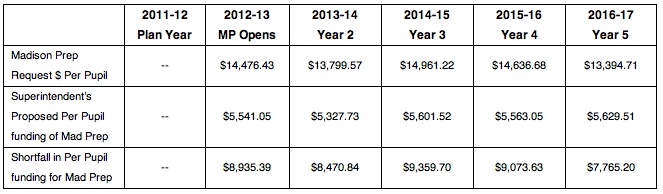
Therefore, the Urban League stands by its request for equitable and fair funding of $14,476 per student, which is less than the $14,802 MMSD's administration have told us they spend on each student now. As Madison Prep achieves economies of scale, reaches its full enrollment of 420 sixth through twelfth graders, and graduates its first class of seniors in 2017-18, it will cost MMSD much less than what it spends now. A cost comparison between Madison Prep, which will enroll both middle and high school students at full enrollment, and MMSD's Toki Middle School illustrates this point. 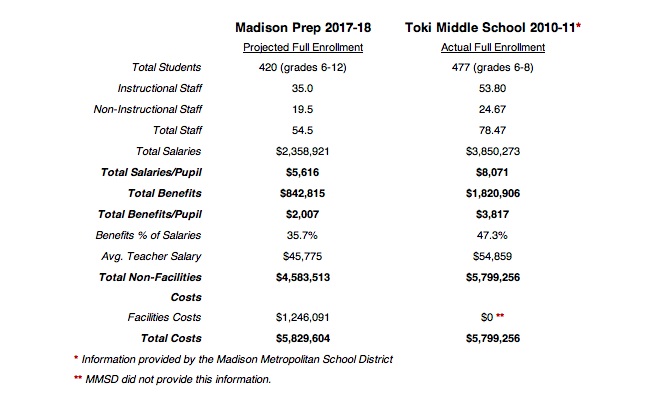
We have also attached four one-page documents that we prepared for the Board of Education. These documents summarize key points on several issues about which they have expressed questions.
We look forward to seeing you!
Onward!
Kaleem Caire
President & CEO
Urban League of Greater Madison
Main: 608-729-1200
Assistant: 608-729-1249
Fax: 608-729-1205
Website: www.ulgm.org


Kaleem Caire, via email.
Madison Preparatory Academy Brochure (PDF): English & Spanish.
DPI Planning Grant Application: Key Points and Modifications.
Update: Madison School Board Member Ed Hughes: What To Do About Madison Prep:
In order to maintain Madison Prep, the school district would have to find these amounts somewhere in our budget or else raise property taxes to cover the expenditures. I am not willing to take money away from our other schools in order to fund Madison Prep. I have been willing to consider raising property taxes to come up with the requested amounts, if that seemed to be the will of the community. However, the draconian spending limits the governor seeks to impose on school districts through the budget bill may render that approach impossible. Even if we wanted to, we likely would be barred from increasing property taxes in order to raise an amount equal to the net cost to the school district of the Madison Prep proposal.Mr. Hughes largely references redistributed state tax dollars for charter/virtual schools - a portion of total District per student spending - the total (including property taxes) that Madison Prep's request mentions. I find Madison Prep's fully loaded school based cost comparisons useful. Ideally, all public schools would publish their individual budgets along with total District spending.This certainly wouldn't be the first time that budgetary considerations prevent us from investing in promising approaches to increasing student achievement. For example, one component of the Madison Prep proposal is a longer school year. I'm in favor. One way the school district has pursued this concept has been by looking at our summer school model and considering improvements. A good, promising plan has been developed. Sadly, we likely will not be in a position to implement its recommendations because they cost money we don't have and can't raise under the Governor's budget proposal.
Similarly, Madison Prep proposes matching students with mentors from the community who will help the students dream bigger dreams. Effective use of mentors is also a key component of the AVID program, which is now in all our high schools. We would very much like to expand the program to our middle schools, but again we do not have the funds to do so.
Newsletter signup | Send us your ideas
The District is preparing a "Strategic Plan Refresh". They will review the Strategic Plan and decide which projects to continue, alter, defer, or remove. The refresh will have to include goals, timelines, status, and budgets for each of the projects.I spoke with Mark Teoh last night and asked if he could include two items in the Refresh program:
1) A record of the various projects in the Strategic Plan, including those that were originally in it, those that were added, those that were completed, and those that were simply dropped without notice. Remember how there was supposed to be an APP Review in the plan? Remember how there was going to be an alternative education review? These projects just silently faded away. At the same time, Capacity Management and World Language curricular alignment, which were not part of the original plan, have been added.
2) A review of the community engagement protocols and some table that shows which of the projects are meeting the requirements of the protocol (it's easy - none of them).
Newsletter signup | Send us your ideas
At the recent School Board Retreat, the Board discussed a Governance and Oversight Policy that would define the Board's job.On page 18 of this 21 page document, is a section titled "Board-Superintendent Communications". Under this section is this set of guidelines for communication between the Board and the superintendent:
Communications between the Board and the Superintendent will be governed by the following practices:
a. Exercise honesty in all written and interpersonal interaction, avoiding misleading information
b. Demonstrate respect for the opinions and comments of each other
c. Focus on issues rather than on personalities
d. Maintain focus on common goals
e. Communicate with each other in a timely manner to avoid surprises
f. Criticize privately, praise publicly
g. Maintain appropriate confidentiality
h. Openly share personal concerns, information knowledge and agendas
i. Make every reasonable effort to protect the integrity and promote the positive image of the district and each other
j. Respond in a timely manner to request and inquired from each other.
Newsletter signup | Send us your ideas
Gov. Scott Walker says the changes he has rammed through the Legislature will give school districts and local governments "the tools" they need to withstand the severe cuts in state aid his budget will deliver. What he doesn't get into is how the tensions caused by his agenda will divide the members of these bodies, as they have the state as a whole.Somewhat related: Jason Shepherd: Going to the mat for WPSOne example of this is the Madison school board, where disagreements over the impact of Walker's actions have spurned an ugly exchange, in which school board member Lucy Mathiak lobbed an F-bomb at a fellow board member, Marj Passman.
The exchange happened yesterday, March 14. Passman was contacted by a Madison school teacher who felt Mathiak had been dismissive of the teacher's concerns, urging her to "get over yourself." Passman, who allows that board members have been deluged with angry emails, says she expressed to Mathiak that she agreed this response was a little harsh.
Suzanne Fatupaito, a nurse's assistant in Madison schools, is fed up with Wisconsin Physicians Service, the preferred health insurance provider of Madison Teachers Inc.Lucy has been a long time friend and I have long appreciated her activism on behalf of students, the schools and our community."MTI uses scare tactics" to maintain teacher support for WPS, Fatupaito recently wrote to the school board. "If members knew that another insurance [plan] would offer similar services to WPS and was less expensive - it would be a no-brainer."
WPS, with a monthly price tag of $1,720 for family coverage, is one of two health coverage options available to the district's teachers. The other is Group Health Cooperative, costing $920 monthly for a family plan.
During the past year, the Madison school board has reached agreements with other employee groups to switch from WPS to HMO plans, with most of the savings going to boost pay.
In December, the board held a secret vote in closed session to give up its right to seek health insurance changes should negotiations on the 2007-09 teachers contract go into binding arbitration. (The board can seek voluntary insurance changes during negotations.)
Newsletter signup | Send us your ideas
The Madison School District has reached a tentative agreement with all of its unions for an extension of their collective bargaining agreement through mid-2013.Channel3000:Superintendent Dan Nerad said the agreement includes a 50 percent employee contribution to the pension plan. It also includes a five percentage point increase in employees' health insurance premiums, and the elimination of a more expensive health insurance option in the second year.
Salaries would be frozen at current levels, though employees could still receive raises for longevity and educational credits.
The district said the deal results in savings of about $23 million for the district over the two-year contract.
The agreement includes no amnesty or pay for teachers who missed four days last month protesting Gov. Scott Walker's proposal to strip public employee collective bargaining rights. Walker's signing of the bill Friday prompted the district and MTI to reach an agreement quickly
A two-year tentative contract agreement has been reached between the Madison Metropolitan School District and the Madison Teachers Union for five bargaining units: teachers, substitute teachers, educational and special educational assistants, supportive educational employees and school security assistants.David BlaskaDistrict administrators, with the guidance of the Board of Education, and Madison Teacher Inc. reps negotiated from 9 a.m. Friday until 3 a.m. Saturday when the tentative agreements were completed.
Under details of the contract, workers would contribute 50 percent of the total money that's being contribution to pension plans. That figure according to district officials, is believed to be very close to the 12 percent overall contribution that the budget repair bill was calling for. The overall savings to the district would be $11 million.
I present Blaska's Red Badge of Courage award to the Madison Area Technical College Board. Its part-time teachers union would rather sue than settle until Gov. Scott Walker acted. Then it withdrew the lawsuit and asked the board for terms. No dice. "Times have changed," said MATC's attorney.NBC 15The Madison school board showed a rudimentary backbone when it settled a contract, rather hastily, with a newly nervous Madison teachers union.
The school board got $23 million of concessions over the next two years. Wages are frozen at current levels. Of course, the automatic pay track system remains, which rewards longevity.
The Madison Metropolitan School District and Madison Teachers, Inc. have reached tentative contract agreements for five bargaining units: teachers, substitute teachers, educational and special educational assistants, supportive educational employees, and school security assistants.District administrators, with the guidance of the Board of Education, and MTI reps negotiated from 9:00 a.m. Friday until 3:00 a.m. Saturday when the tentative agreements were completed.
The Board of Education held a Special Meeting today at 2:00 p.m. and ratified the five collective bargaining agreements. The five MTI units must also ratify before the contracts take effect.
Summary of the agreements:
Newsletter signup | Send us your ideas
Madison School Board Member Ed Hughes:
Thursday, March 10 was an eventful day. With the approval by the state Assembly of legislation stripping public employees of nearly all collective bargaining rights, it appears that our school district has about a day to negotiate with our teachers and other bargaining units represented by MTI about an extension of our current collective bargaining agreement, which expires at the end of June. (We have already agreed to extensions for our two bargaining units represented by AFSCME and for our trades workers.)The Madison School Board apparently is going to meet tomorrow @ 2:00p.m. to discuss extending the teacher contracts, though I don't see notice on their website.Board members have received hundreds of emails from our teachers and others requesting that we extend their contracts and that we do it quickly. Here is the response I sent to as many of the emails as I could on Thursday night. I apologize to those to whose messages I simply didn't have time to respond.
Thanks for contacting me to urge the School Board to extend the contract for our teachers and other represented employees.This is a difficult situation for all of us and one that all of us would have preferred to have avoided. However, it is here now and we have to deal with it.
Like all our Board members, I respect, value and like our teachers. I want to do whatever I can to ease the stress and uncertainty that we're all feeling, but I'm also required to act in the best interest of the school district and all of our students.
The situation before us is that if we do not extend the contract with our teachers, then, once the legislation approved today goes into effect, collective bargaining will effectively come to an end.
The School Board met tonight to discuss the terms of a contract that we could responsibly enter into for the next two years, given the uncertainty we face. We agreed on a proposal, which we submitted to MTI this evening. Like our previous settlements with other bargaining units, the proposed contract gives us the flexibility we need to adapt to the requirements imposed on us by the new state law, as well as the reduced spending limits and reduction in state aid that are parts of the proposed budget bill.
The proposed contract is written so that it gives the District discretion over changes in salary and in contributions to retirement accounts and to the cost of health insurance. I recognize that you can feel uncomfortable about the extent of the discretion that our proposal reserves for the school district. We have to write the contract this way, because any change in the contract - like re-opening the contract to adjust its terms - triggers application of the new state law that abolishes nearly all collective bargaining. So we have to draft the contract in a way that any adjustment in its economic terms does not amount to an amendment or change to the contract, and providing the school district with discretion to make such changes seems like the only way to do this.
The Madison School Board scheduled a meeting for 2 p.m. Saturday to approve a deal with its unions before a Republican law to strip collective bargaining takes effect.Don Severson: Considerations Proposed for the Madison School District 2011-2012 Budget 300K PDF, via email:The vote is scheduled less than 48 hours after the School District and Madison Teachers Inc. exchanged initial proposals Thursday night at a hastily called School Board meeting.
The two proposals, released by the district Friday afternoon, called for extending contracts until June 30, 2013, and freezing wages, but differed on benefit concessions and other details.
MTI asked that teachers be granted amnesty and given full pay for four days missed last month. Hundreds of teachers called in sick on Feb. 16, 17, 18 and 21 to protest Gov. Scott Walker's proposal to limit collective bargaining. Walker signed the bill Friday after the Legislature approve it Wednesday and Thursday.
MTI also asked for the missed days to be made up by adding 8 to 15 minutes to the end of every school day through the rest of the year. That would fulfill a state requirement for instructional time.
The MTI proposal did not include any employee contributions to pension and health insurance premiums over the next two years, something other unions around the state seeking contract extensions proposed to their school boards.
The district's proposal called for allowing it to set pension contributions, change its health insurance carrier and employees' share of premiums, set class sizes, and increase or decrease wages at its discretion, among other things. The district faces a $16 million reduction in funding under Walker's 2011-13 budget proposal.
The legislative passage of the bill to limit collective bargaining for public employees provides significant opportunities for Wisconsin school districts to make major improvements in how they deliver instructional, business and other services. Instead of playing the "ain't it awful' game the districts can make 'systemic' changes to address such challenges as evaluating programs, services and personnel; setting priorities for the allocation and re-allocation of available resources; closing "the achievement gap"; and reading and mathematics proficiency, to name a 'short list'. The Madison Metropolitan School District can and should conduct their responsibilities in different ways to attain more effective and efficient results--and, they can do this without cutting teacher positions and without raising taxes. Following are some actions the District must take to accomplish desirable, attainable, sustainable, cost effective and accountable results.
Newsletter signup | Send us your ideas
Elementary School Level DLI: Proposal to plan and implement DLI programs at Stephens, Thoreau, and Hawthorne Elementary Schools for the 2011-2012 School year. Given the ongoing increase in the number of Spanish-speaking English language learners, MMSD needs to implement bilingual education programming in order to meet legal requirements imposed by the state statutes. It is recommended we start planning at these three sites during the 2011-2012 school year for program implementation during the 2012-2013 school year starting with a Kindergarten cohort.Additional language options, particularly for elementary students will be good news. Nearby Verona launched a Mandarin immersion charter school recently.La Follette High School Dual Language Immersion Program Proposal Update: A committee has been formed to start developing a proposal to bring to the BOE for a high school DLI continuation program. The committee is made up of representatives from the district ESLIBE/DLI Division as well as administrators and staff from La Follette High School. The committee meets biweekly. This high school DLI program would
serve the needs of students in the Sennett DLI program. The students are scheduled to start their high school programming during the 2013-2014 school year. A proposal is scheduled to be presented to the BOE in May of 2011 .
Newsletter signup | Send us your ideas
he housing bubble and subsequent Wall Street collapse wreaked havoc on the nation's retirement savings, as many pension funds and 401(k) plans suffered losses of 30% or more. State and local governments are now facing huge unfunded pension liabilities, prompting policymakers to scramble for ways to close the gap without slashing payrolls and services. But a new report from the Little Hoover Commission in Sacramento makes a more troubling point: Many state and local government employees have been promised pensions that the public couldn't have afforded even had there been no crash.The commission's analysis of the problem is hotly disputed by union leaders, who contend that the financial woes of pension funds have been overblown. The commission's recommendations are equally controversial: Among other things, it urges state lawmakers to roll back the future benefits that current public employees can accrue, raise the retirement age and require employees to cover more pension costs. Given that state courts have rejected previous attempts to alter the pensions already promised to current workers, the commission's recommendation amounts to a Hail Mary pass. Yet it's one worth throwing.
A bipartisan, independent agency that promotes efficiency in government, the Little Hoover Commission studied the public pension issue for 10 months before issuing its findings Thursday. Much of the 90-page report is devoted to making the case that, to use the commission's blunt words, "pension costs will crush government." Without a "miraculous" improvement in the funds' investments, the commission states, "few government entities -- especially at the local level -- will be able to absorb the blow without severe cuts to services."
Newsletter signup | Send us your ideas
Madison School Board Member Ed Hughes:
Here's an idea for resolving the state's budget repair bill crisis. Governor Walker's budget repair bill is designed to eviscerate public employee unions. But with a few changes it could actually lead to an innovative and productive way of addressing the legitimate concerns with the collective bargaining process, while preserving the most important rights of teachers and other public employees.Through a variety of circumstances, I've had an opportunity to recently visit with several Dane County (and Madison) businesses with significant blue collar manufacturing/distribution employment. In all cases, these firms face global price/cost challenges, things that affect their compensation & benefits. Likely reductions in redistributed State of Wisconsin tax dollars could lead to significantly higher property taxes during challenging economic times, if that's the route our local school boards take.Background: A Tale of Two Unions
First, some background that highlights the two sides of the issue for me as a member of the Madison School Board. Early on Friday morning, February 25, our board approved a contract extension with our AFSCME bargaining units, which include our custodians and food service workers. The agreement equips the school district with the flexibility to require the AFSCME workers to make the contributions toward their retirement accounts and any additional contributions toward their health care costs that are required by the budget repair bill, and also does not provide for any raises. But the agreement does preserve the other collective bargaining terms that we have arrived at over the years and that have generally worked well for us.
AFSCME has stated that its opposition to the Governor's bill is not about the money, and our AFSCME bargaining units have walked that talk.
Our recent dealings with MTI, the union representing our teachers and some other bargaining units, have been less satisfying. Because of teacher walk outs, we have to make up the equivalent of four days of school. An obvious way to get started on this task would be to declare Friday, February 25, which has been scheduled as a no-instruction day so that teachers can attend the Southern Wisconsin Educational Inservice Organization (SWEIO) convention, as a regular school day.
Newsletter signup | Send us your ideas
Let's face it: Teachers union president John Matthews decides when to open and when to close Madison schools; the superintendent can't even get a court order to stop him. East High teachers marched half the student body up East Washington Avenue Tuesday last week. Indoctrination, anyone?This Tuesday, those students began their first day back in class with the rhyming cadences of professional protester Jesse Jackson, fresh from exhorting unionists at the Capitol, blaring over the school's loudspeakers. Indoctrination, anyone?
Madison Teachers Inc. has been behind every local referendum to blow apart spending restraints. Resist, as did elected school board member Ruth Robarts, and Matthews will brand you "Public Enemy Number One."
When then-school board member Juan Jose Lopez would not feed out of the union's hand, Matthews sent picketers to his place of business, which happened to be Briarpatch, a haven for troubled kids. Cross that line, kid!
The teachers union is the playground bully of state government. Wisconsin Education Association Council spent $1.5 million lobbying the Legislature in 2009, more than any other entity and three times the amount spent by WMC, the business lobby.
Under Gov. Doyle, teachers were allowed to blow apart measures to restrain spending and legislate the union message into the curriculum. Student test scores could be used to determine teacher pay -- but only if the unions agreed.
The most liberal president since FDR came to a school in Madison to announce "Race to the Top" grants for education reform. How many millions of dollars did we lose when the statewide teachers union sandbagged the state's application?
Newsletter signup | Send us your ideas
The fight to bring a little private-sector discipline to America's public sector has begun at lastELECTIONS, Barack Obama once said, have consequences. The Republicans' triumph in last year's mid-terms was seen by many as an instruction from the electorate to hack away at America's sprawling government. In Washington, DC, that debate has gone nowhere. Both Mr Obama and his foes have produced fantastical budgets, full of illusory savings and ignoring the huge entitlement programmes. A government shutdown is looming. But look beyond the Beltway and something rather more promising is under way.
Unlike the federal government, which can borrow money to plug its budgetary gap, almost all the states are required to balance their budgets. Their revenues have been slashed by the recession; the stimulus funds that saw them through 2009 and 2010 have expired; medical costs are soaring. Tax rises remain unpopular, and so are deep cuts to important state-provided services like schools and the police. So governors are finally confronting the privileges that public-sector employees have managed to negotiate for themselves in recent decades.
Newsletter signup | Send us your ideas
Madison School Board Member Ed Hughes, via email:
It's been a non-quiet week here in Madison. Everyone has his or her own take on the events. Since I'm a member of the Madison School Board, mine is necessarily a management perspective. Here's what the week's been like for me.Nearly as soon as the governor's budget repair bill was released last Friday, I had a chance to look at a summary and saw what it did to collective bargaining rights. Basically, the bill is designed to gut public employee unions, including teacher unions. While it does not outlaw such unions outright, it eliminates just about all their functions.
Our collective bargaining agreement with MTI is currently about 165 pages, which I think is way too long. If the bill passes, our next collective bargaining agreement can be one paragraph -- way, way, way too short.
On Monday, Board members collaborated on a statement condemning the legislation and the rush to push it through. All Board members signed the statement on Monday evening and it was distributed to all MMSD staff on Tuesday.
Newsletter signup | Send us your ideas
Milwaukee Public Schools is closed Monday for Presidents Day, according to a statement on the home page of the district's website.Superintendent Gregory Thornton said in the statement he wants to "assure families that we intend to have classes on Tuesday as scheduled."
The home page also includes a "fact sheet for families" about the demonstrations in Madison. It says MPS closed schools Friday because more than 1,000 MPS teachers attended the demonstrations. Another day of school will be added to make up for Friday, and teachers who were absent without leave face possible disciplinary action ranging from pay deductions to termination, according the fact sheet.
Members of the Milwaukee Teachers' Education Association union plan to participate in demonstrations in Madison on Monday.
The Madison Metropolitan School District, which was scheduled to be open for Presidents Day, will close because of "substantial concerns about significant staff absences," according to a statement issues Sunday evening by the district.
However, classes are scheduled to resume Tuesday because the district "received assurances" that teachers would return then, the statement said.
Newsletter signup | Send us your ideas
1. Intensify reading instruction in Kindergarten in order to ensure all No additional costs. Professional development provided by central students are proficient in oral reading and comprehension as office and building-based literacy staff must focus on Kindergarten. measured by valid and reliable assessments by 2011-2012. Instruction and assessment will be bench marked to ensure Kindergarten proficiency is at readinQ levels 3-7 {PLAA, 2009).Related:2. Fully implement Balanced Literacy in 2011-12 using clearly defined, Comprehensive Literacy Model (Linda Dorn), the MMSD Primary Literacy Notebook and the MMSD 3-5 Literacy Notebook.
a. Explore research-based reading curricula using the Board of Education Evaluation of Learning Materials Policy 3611 with particular focus on targeted and explicit instruction, to develop readers in Kindergarten.
b. Pilot the new reading curricula in volunteer schools during 2011-12.
c. Analyze Kindergarten reading proficiency scores from Kindergarten students in fully implemented Balanced Literacy schools and Kindergarten students in the volunteer schools piloting the new reading curricula incorporated into a
Balanced Literacy framework to inform next steps.
d. Continue pilot in volunteer schools in Grade 1 during 2012-13 and Grade 2 durino 2013-14. 2011-12 Budget Addition Request $250,0003. Incorporate explicit reading instruction and literacy curricula into 6th grade instruction.
.....
3. Review previous Reading Recovery recommendations, with Additional Reading considerations to:
Additional Reading Recovery and/or Interventionist FTE costs. 1 FTE-$79,915 (average rate when teacher is re-assigned). 1 new FTE-$61,180 (displaced rate when new teacher is hired).
- Place Reading Recovery Teachers in buildings as needed to (displaced rate when new teacher is hired).reflect the needs of 20% of our District's lowest performing first graders, regardless of what elementary school they may attend;
- Analyze the other instructional assignments given to Reading Recovery teachers in order to maximize their expertise as highly skilled reading interventionists
- Ensure standard case load for each Reading Recovery teacher at National Reading Recovery standards and guidelines (e.g. 8 students/year).
- Place interventionists in buildings without Reading Recovery. Interventionists would receive professional development to lift the quality of interventions for students who need additional support in literacy.
Newsletter signup | Send us your ideas
Madison School District superintendent Dan Nerad called on teachers late Thursday to end their protest and return to the classroom.Related: Judge denies Madison School District request to stop teacher sick-out and "Who Runs the Madison Schools?""These job actions need to end," Nerad said in an e-mail to families of students. "I want to assure you that we continue to examine our options to more quickly move back to normal school days."
Madison schools are closed Friday for a third straight day. Nerad also apologized for the closures.
On Thursday, state and Madison teachers union leaders urged their members to report to the Capitol on Friday and Saturday for continued protests against Gov. Scott Walker's collective bargaining proposal.
"Even though the Madison School District can only react to the group decisions of our teachers, I apologize to you for not being able to provide learning for the last three days to your students," Nerad said.
Newsletter signup | Send us your ideas
Don Severson, via email:
Attached is the Active Citizens for Education statement regarding the MMSD Board of Education and Administration actions related to the Governor's Budget Repair Bill.Much more, here.Here is the link to the video of the MMSD Board meeting on 02/14/11
http://mediaprodweb.madison.k12.wi.us/node/601 go to the 9:50 minute mark for Marj Passman.
Letters from the Board and Superintendent to Governor Walker are accessible from the home page of the MMSD website.
Glaringly, there is no leadership from the Madison Metropolitan School District Board of Education nor administration for the overall good of the community, teachers nor students as evidenced by their actions the past few days. Individual Board members and the Board as a whole, as well as the administration, are complicit in the job action taken by teachers and their union. The Board clearly stepped out of line. Beginning Monday night at its Board meeting, Board member Marj Passman took advantage of signing up for a 'public appearance' statement as a private citizen. She was allowed to make her statement from her seat at the Board table instead of at the public podium--totally inappropriate. Her statement explicitly gave support to the teachers who she believed were under attack from the Walker proposed budget repair bill; that she was totally in support of the teachers; and encouraged teachers to take their protests to the Capital. Can you imagine any other employer encouraging their employees to protest against them to maintain or increase their own compensation in order to help assure bankruptcy for the organization or to fire them as employees? All Board members subsequently signed a letter to Governor Walker calling his proposals "radical and punitive' to the bargaining process. With its actions, including cancellation of classes for Wednesday, the Board has abdicated and abrogated its fiduciary responsibility for public trust. The Board threw their responsibility away as elected officials and representatives of the citizens and taxpayers for the education of the children of the District and as employers of the teachers and staff. The Board cannot lead nor govern when it abdicates its statutory responsibilities and essentially acts as one with employees and their union. Under these circumstances, it is obvious they have made the choice not to exercise their responsibilities for identifying solutions to the obvious financial challenges they face. The Board will not recognize the opportunities, nor tools, in front of them to make equitable, fair and educationally and financially sound decisions of benefit to all stakeholders in the education of our young people.Don Severson
President, ACE
Newsletter signup | Send us your ideas
Douglas County, a swath of subdivisions just south of here that is one of the nation's wealthiest, is something of a public school paradise.Related: A School Board Thinks Differently About Delivering Education, and spends less.The K-12 district, with 60,000 students, boasts high test scores and a strong graduation rate. Surveys show that 90% of its parents are satisfied with their children's schools.
That makes the Douglas County School District an unlikely frontier in the latest battle over school vouchers.
But a new, conservative school board is exploring a voucher system to give parents -- regardless of income -- taxpayer money to pay for their children to attend private schools that agree to abide by district regulations. If it's implemented, parents could receive more than $4,000 per child.
The proposal's supporters argue that competition can only improve already-high-performing schools.
Colorado's Douglas County School District spends $8512.74 per student ($476,977,336 for 56,031 students in 2009). Madison spent $15,241 per student in 2009, a whopping $6,728.26, 79% more than the "wealthy Denver suburbs".
Newsletter signup | Send us your ideas
In his recent "State of our Schools" presentation, the Rochester schools Superintendent Jean-Claude Brizard showed that three years into his tenure, Rochester's schools have had slow, but measureable progress in elementary and middle school achievement levels, fewer suspensions and more students graduating high school.Rochester, NY 2011 State of the Schools PDF Presentation and Scorecard Strategy Map. Rochester's 2010-2011 budget is $694,515,866 for 32,000 students. $21,703.62 per student. View Rochester's 2010-2011 budget presentation document here.Still, Rochester continues to struggle with many challenges common for large urban communities in the state and throughout the country - challenges that will take much longer than three years to significantly improve.
While Rochester's school superintendents come and go, one district fixture remains: Adam Urbanski, the long-time head of the Rochester Teachers Association. He recently wrote in this newspaper that Rochester schools are "worse off" in the last three years, a period which happens to coincide with the Brizard's tenure.
Related: The 2011 State of the Madison School District reports $379,058,945 in planned 2010-2011 spending for 24,471 students. Madison's per student spending this year is $15,490.13.
Newsletter signup | Send us your ideas
The Madison School Board approved a one-year extension of Superintendent Dan Nerad's contract on a 5-2 vote Monday.Board members Lucy Mathiak and Arlene Silveira voted against the extension. Maya Cole, Beth Moss, Ed Hughes, Marj Passman and James Howard voted to extend the contract through June 30, 2013.
Only Mathiak and Hughes spoke during the meeting. The board has been discussing Nerad's contract in multiple closed-door meetings.
Mathiak didn't address why she voted against the extension but said that she had reviewed board minutes, e-mails, notes of conversations and newspaper articles as she completed an evaluation that she received in December.
Newsletter signup | Send us your ideas
Four members of a suburban school board are being targeted in a recall effort over their support for a middle-school language program funded by the Chinese government, one of the members said Friday.Hacienda La Puente Unified School Board President Jay Chen said he and the three other members of the five-member panel were being served with notices of intent to circulate recall petitions, each signed by 12 residents of Hacienda Heights in east Los Angeles County.
Chen, along with board members Norman Hsu, Joseph Chang and Anita Perez, voted last year to approve the agreement with China's international language-teaching agency to cooperate on the so-called Confucius Classroom Mandarin program.
Newsletter signup | Send us your ideas
Urban Leage of Greater Madison:
The Urban League of Greater Madison (ULGM) is submitting this budget narrative to the Madison Metropolitan School District Board of Education as a companion to its line‐item budget for Madison Preparatory Academy for Young Men (Madison Prep). The budget was prepared in partnership with MMSD's Business Services office. The narrative provides context for the line items presented in the budget.Additional documents: budget details and Madison Prep's Wisconsin DPI application.Madison Prep's budget was prepared by a team that included Kaleem Caire, President & CEO of ULGM; Tami Holmquist, Business Manager at Edgewood High School; Laura DeRoche‐Perez, ULGM Charter School Development Consultant; and Jim Horn, ULGM Director of Finance. Representative of ULGM and MMSD met weekly during the development of the Madison Prep budget. These meetings included including Erik Kass, Assistant Superintendent for Business Services and Donna Williams, Director of Budget & Planning. The budget was also informed by ULGM's charter school design teams and was structured in the same manner as start‐up, non‐instrumentality public charter school budgets submitted to the District of Columbia Public Charter School Board in Washington, DC. DCPCSB is widely regarded as one of the most effective authorizers of charter schools in the nation.
In addition, Madison Prep's Facilities Design Team is led by Dennis Haefer, Vice President of Commercial Banking with Johnson Bank and Darren Noak, President of Commercial Building with Tri‐North Builders. Mr. Noak is also the Treasurer of ULGM's Board of Directors. This team is responsible for identifying Madison Prep's school site and planning for related construction, renovation and financing needs.
......
Budget Highlights
A. Cost of EducationIn 2008‐09, the Madison Metropolitan School District received $14,432 in revenue per student from a combination of local, federal and state government and local property taxes. The largest portion of revenue came from property taxes, $9,049 (62.7%), followed by $3,364 in state aid (23.3%), $1,260 in federal aid (8.7%) and $759 in other local revenue (5.3%). That same year, MMSD spent $13,881 per student on educational, transportation, facility and food service costs for 25,011 students for a total of $347,177,691 in spending.
In 2010‐11, MMSD's Board of Education is operating with an amended budget of $360,131,948, a decrease of $10,155,522 (‐2.74%) from 2009‐10. MMSD projects spending $323,536,051 in its general education fund, $10,069,701 on food service and $8,598,118 on debt service for a total of $342,203,870. Considering the total of only these three spending categories, and dividing the total by the official 2010‐11 enrollment count of 24,471 students, MMSD projects to spend $13,984 per student.3 This is the amount per pupil that ULGM used as a baseline for considering what Madison Prep's baseline per pupil revenue should be in its budget for SY2011‐12. ULGM then determined the possibility of additional cutbacks in MMSD revenue for SY2011‐12 and reduced its base per pupil revenue projection to $13,600 per student. It then added a 1% increase to it's per pupil base spending amount for each academic year through SY2016‐17.
ULGM recognizes that per pupil funding is an average of total costs to educate 24,471 children enrolled in MMSD schools, and that distinctions are not made between the costs of running elementary, middle and high schools. ULGM also understands that the operating costs between all three levels of schooling are different. Middle schools costs more to operate than elementary schools and high schools costs more than middle schools.Reviewing expense projections for middle and high schools in MMSD's SY2010‐11 Amended Preliminary Budget, ULGM decided to weight per pupil spending in middle school at 1.03% and 1.16% in high school. Thus, in SY2012‐13 when Madison Prep opens, ULGM projects a need to spend $14,148 per student, not including additional costs for serving English language learners and students with special needs, or the costs of Madison Prep's third semester (summer).
B. Cost Comparisons between Madison Prep and MMSD
Staffing Costs
In 2010‐11, MMSD projected it would spend $67,133,692 on salaries (and benefits) on 825.63 staff in its secondary (middle and high) schools for an average salary of $81,312. This includes teachers, principals and in‐school support staff. In its first year of operation (SY2012‐13), ULGM projects Madison Prep it will spend $1,559,454 in salaries and benefits on 23 staff for an average of $67,802 in salary, including salaries for teachers, the Head of School (principal) and support staff. In its fifth year of operation, Madison Prep is projected to spend $3,560,746 in salaries and benefits on 52 staff for an average of $68,476 per staff person. In both years, Madison Prep will spend significantly less on salaries and benefits per staff member than MMSD.Additionally, MMSD spends an average of $78,277 on salaries and benefits for staff in its middle schools and $79,827 on its staff in its high schools.
The high cost results from the likelihood that Madison Prep will serve more low-income, non-English speaking and special education students, said Kaleem Caire, president of the Urban League of Greater Madison, which is developing the charter school. The school also plans to have a longer school year, school day and require students to participate in volunteer and extracurricular activities."What we're asking for is based on the fact that we're going to serve a high-needs population of kids," Caire said. "We don't know yet if what we're projecting is out of line."
Caire said the proposal will likely change as potential state and federal revenues are assessed.
A Republican charter school bill circulated in the Legislature this week could also alter the landscape. The bill would allow charter schools to receive approval from a state board, rather than a local school board, and those that don't use district employees, like Madison Prep, would be able to access the state retirement and health care systems.
Much more on the proposed Madison Preparatory Academy IB Charter school, here.
Newsletter signup | Send us your ideas
After 2½ years as Madison schools superintendent, Dan Nerad is still finding his footing.For Nerad and his supporters, that's more of a statement about Madison's slippery and sometimes treacherous political terrain.
But among critics there is frustration that Nerad hasn't risen to the task, particularly given the high expectations for the former social worker and Green Bay superintendent.
The two views among Madison School Board members and others in the community are circulating as the board weighs whether to extend Nerad's contract beyond June 2012.
Supporters point to a long list of accomplishments so far despite severe obstacles -- implementation of 4-year-old kindergarten after decades of discussion, development of a strategic plan that brought in dozens of community voices and expansion of dual-language immersion programs.
Newsletter signup | Send us your ideas
The two public high schools, 21/2 miles apart in Northwest Washington, serve vastly different student populations. And they do it with vastly different levels of financial support, according to an analysis of school spending by a District advocacy group.Locally, the Madison School District's 2010-2011 budget, according to the "State of the Madison School District Report" is $379,058,945. Enrollment is 24,471 which yields per student spending of $15,490.12.School Without Walls accepts only the city's most accomplished students after a competitive application process that requires interviews with prospective parents as well. More than 700 students are vying for 120 spots in next year's ninth-grade class. Those who are admitted will attend classes in a freshly renovated vintage building on the George Washington University campus. District funds per student: $10,257.
Cardozo, near 13th Street and Florida Avenue, is a neighborhood high school that takes all comers in an attendance area that includes about a dozen group homes and homeless shelters. Parole officers and social workers are sometimes the only adults who appear at the school on students' behalf. The wiring in the cavernous 1916 building was so bad a couple of years ago that when all of the computers were turned on, power in half of the school would go out, said Principal Gwendolyn Grant.
District funds per student: $7,453.
Newsletter signup | Send us your ideas
The simplest of conversations, the most important of facts. And yet nearly six years after those images were discovered by the Madison School District, Nelson was a superintendent and had to be caught allegedly trying to solicit sex from what he thought was a 15-year-old boy online before the bizzaro world of public school human resources stood up and took notice.Rickert deserves props for contacting former Madison Superintendent Art Rainwater (who now is employed - along with others from the Madison School District - at the UW-Madison School of Education) on this matter.I am assuming (safely, I really, really hope) that had my imagined exchange occurred, Nelson's public schools career would have been over. There also does not appear to have been anything contractually or legally to prevent it from occurring.
Madison human resources director Bob Nadler said Nelson had an oral agreement -- "not a contract" -- under which, in exchange for Nelson's resignation, the district would disclose nothing more than his dates of employment, position and salary.
These kinds of agreements happened with some frequency, according to Art Rainwater, the superintendent in Madison at the time Nelson was nabbed for porn. As to the exact circumstances surrounding how Nelson was lucky enough to get one and who it was with, well, "I honestly don't remember," Rainwater told me.
Not only could Madison have dropped the dime on its very own pervert; state law provides some liability protection for doing so. Employers who act in "good faith" when providing a reference are protected unless they knowingly lie or provide a reference maliciously or violate the state's blacklisting statute, according to Marquette University Law School Associate Professor Paul Secunda.
Newsletter signup | Send us your ideas
The Madison Board of Education:
2. Evaluation of the Superintendent pursuant to Wis. Stat §19.85(1)(c)Much more on Madison Superintendent Dan Nerad, here.
This search reveals that there have been six closed session meetings since August, 2010 on the Superintendent evaluation. I wonder how this frequency conflicts with the public's right to know?
Newsletter signup | Send us your ideas
Craig Howley, Jerry Johnson, and Jennifer Petrie:
Arguments for consolidation, which merges schools or districts and centralizes their management, rest primarily on two presumed benefits: (1) fiscal efficiency and (2) higher educational quality. The extent of consolidation varies across states due to their considerable differences in history, geography, population density, and politics. Because economic crises often provoke calls for consolidation as a means of increasing government efficiency, the contemporary interest in consolidation is not surprising.However, the review of research evidence detailed in this brief suggests that a century of consolidation has already produced most of the efficiencies obtainable. Indeed, in the largest jurisdictions, efficiencies have likely been exceeded--that is, some consolidation has produced diseconomies of scale that reduce efficiency. In such cases, deconsolidation is more likely to yield benefits than consolidation. Moreover, contemporary research does not support claims about the widespread benefits of consolidation. The assumptions behind such claims are most often dangerous oversimplifications. For example, policymakers may believe "We'll save money if we reduce the number of superintendents by consolidating districts;" however, larger districts need--and usually hire--more mid-level administrators. Research also suggests that impoverished regions in particular often benefit from smaller schools and districts, and they can suffer irreversible damage if consolidation occurs.
For these reasons, decisions to deconsolidate or consolidate districts are best made on a case-by-case basis. While state-level consolidation proposals may serve a public relations purpose in times of crisis, they are unlikely to be a reliable way to obtain substantive fiscal or educational improvement.
Newsletter signup | Send us your ideas
This is to provide clarity, transparency and direction in improving our high school curriculum and instruction, with ongoing communication.Lots of related links:(As presented to the MMSD Board of Education on January 6, 2011)
The following guiding principles were discussed:
- We will be aligning to the ACT Cateer and College Readiness Standards and the Common Core Standards
- This will be a comprehensive Pre K-12 process, to build continuity across all grade levels
- We will be implementing aligned assessments, including the Educational Planning & Assessment System (EPAS)
- The high school alignment will focus on grades 9 and 10 in the four core content areas
- We will establish common understandings, knowledge and skills using Universal Designs for Learning (UDL)
Newsletter signup | Send us your ideas
Superintendent Dan Nerad: Year two action plans.
Much more on Madison's strategic planning process here.
Newsletter signup | Send us your ideas
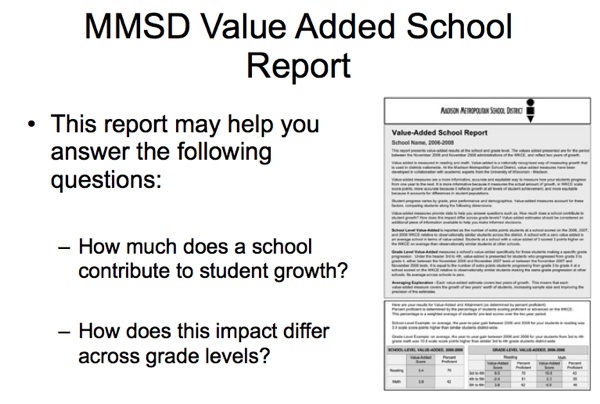
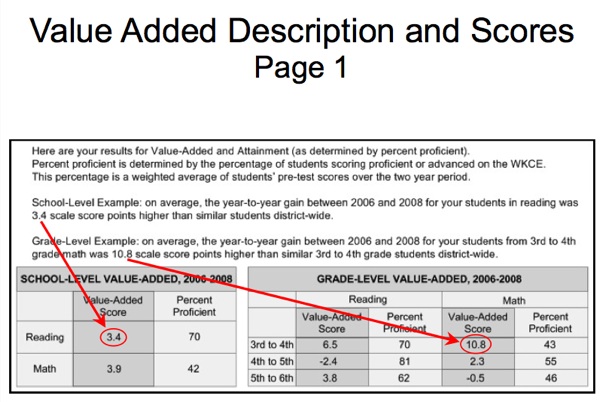
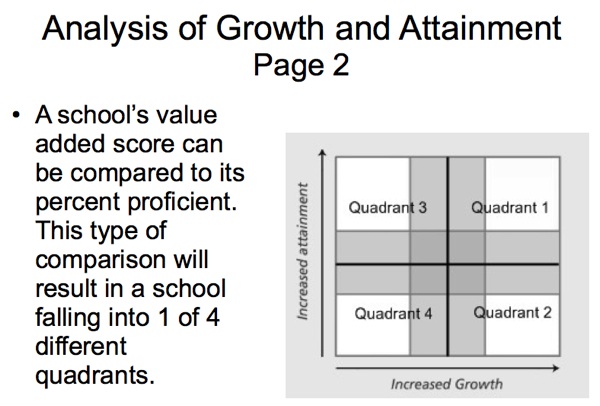
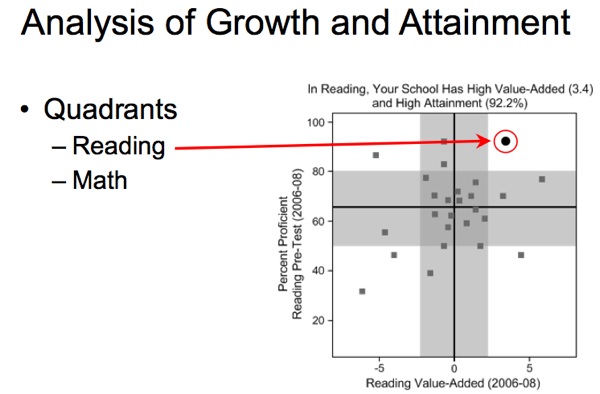
Value Added Resource Center @ Wisconsin Center for Education Research
Complete report 1.4MB
Summary.
Much more on value added assessment here.
Madison's value added assessment program is based on the oft-criticized wkce.
Newsletter signup | Send us your ideas
The controversy at West High School continues about the Madison School District's new talented and gifted program. Students, parents and teachers decry the plan, pointing to the likelihood of a "tracking" system and increasingly segregated classes.Lots of related links:While I am in agreement with them here, I must differ when they mistakenly point to the current "embedded honors" system as a preferable method for dealing with TAG students.
The idea itself should immediately raise red flags. Teaching two classes at the same time is impossible to do well, if at all. Forcing teachers to create twice the amount of curriculum and attempt to teach both within a single context is unrealistic and stressful for the educators.
The system creates problems for students as well. There is very little regulation in the execution of these "embedded honors" classes, creating widely varying experiences among students. By trying to teach to two different levels within one classroom, "embedded honors" divides teachers' attention and ultimately impairs the educational experiences of both groups of students.
While the concerns raised about Superintendent Dan Nerad's plan are legitimate, "embedded honors" as a solution is not.
Newsletter signup | Send us your ideas
Expect to hear the phrase "school choice" more than usual in the coming days. The fourth week of January is National School Choice Week, and advocates for educational freedom across the country will be highlighting its effectiveness for children.Why school choice? Economist Milton Friedman best stated the philosophy behind it: "You can subsidize the producer or you can subsidize the consumer. In education, we subsidize the producer; we subsidize the school. If you subsidize the student instead, you would have competition. The student could choose which school he would go to, and that would force the schools to improve and to meet the tastes of their students."
But you don't have to get philosophical. Just ask the kids.
Newsletter signup | Send us your ideas
The Madison School District: 2.6MB PDF
The Report1.5MB complete report.
The 2011 State of the District Report brings into focus the great strengths and challenges of the Madison Metropolitan School District, and sheds light on our strategies, plans and priorities for keeping all of the community's children on a secure path toward learning and healthy development.Mission Critical
The mission statement of the Madison Metropolitan School District focuses on our commitment to ensuring that our students develop a love of learning, and the necessary citizenship skills that will allow them to function effectively in an evermore complex world and be of assistance to the communities in which they reside.MMSD In Context
Students:
The MMSD is the second largest school district in Wisconsin with 24,796 students. This is the 3rd Friday of September 2010 count and includes pre-kindergarten through 12th grade.Student Population by Race/Ethnicity:
White 47%
African-American 24%
Hispanic 17%
Asian 10%
Multiracial 6%
Native American 1%
- 49% Free and Reduced Price Lunch Students (37% State Avg.)
- 17% English Language Learners (6% State Avg.)
- 70 different languages spoken as the primary language in the homes of MMSD students
- 15% Students with Disabilities (14.1% State Avg.)
Employees FTEs*
Total 6,286 3,853.4
Some employee groups:
Teachers 2,626 2,500.61
Substitutes 729 N/A
Educational Assistants 625 480.55
Custodians 211 211.0* Full-time equivalent; 1.0 FTE = a full-time position
Financial Status:
With the 2009-10 fiscal year ending June 30, 2010, the Madison Metropolitan School District's General Fund (10) expenditures were less than budgeted, allowing the district to increase fund balance over last year by $5.15 million, to $40.49 million.The adopted 2010-11 budget continues to put resources where they are most needed - in the classrooms. The budgeted spending for all funds is a total of $379,058,945 which is an increase of $8,771,475 or 2.37% over 2009- 10.
The total property tax levy increased by $10,823,758 or 4.62%, with a mill rate increase of $0.88 or 8.65%. The following graph shows the breakdown of 2009-10 Actual Revenue by four major categories.
Newsletter signup | Send us your ideas
The Center for American Progress, via a kind reader's email:
The Wisconsin school systems of Oshkosh and Eau Claire are about the same size and serve similar student populations. They also get largely similar results on state exams-but Eau Claire spends an extra $8 million to run its school systemMadison's results can be seen here. I asked Superintendent Dan Nerad what benefits citizens, students and parents received from Madison's greater per student spending, then, for example, his former Green Bay school district in this recent interview.This report is the culmination of a yearlong effort to study the efficiency of the nation's public education system and includes the first-ever attempt to evaluate the productivity of almost every major school district in the country. In the business world, the notion of productivity describes the benefit received in exchange for effort or money expended. Our project measures the academic achievement a school district produces relative to its educational spending, while controlling for factors outside a district's control, such as cost of living and students in poverty.
Our nation's school system has for too long failed to ensure that education funding consistently promotes strong student achievement. After adjusting for inflation, education spending per student has nearly tripled over the past four decades. But while some states and districts have spent their additional dollars wisely--and thus shown significant increases in student outcomes--overall student achievement has largely remained flat. And besides Luxembourg, the United States spends more per student than any of the 65 countries that participated in a recent international reading assessment, and while Estonia and Poland scored at the same level as the United States on the exam, the United States spent roughly $60,000 more to educate each student to age 15 than either nation.
Our aims for this project, then, are threefold. First, we hope to kick-start a national conversation about educational productivity. Second, we want to identify districts that generate higher-than-average achievement per dollar spent, demonstrate how productivity varies widely within states, and encourage efforts to study highly productive districts. Third--and most important--we want to encourage states and districts to embrace approaches that make it easier to create and sustain educational efficiencies.
This report comes at a pivotal time for schools and districts. Sagging revenues have forced more than 30 states to cut education spending since the recession began. The fiscal situation is likely to get worse before it gets better because the full impact of the housing market collapse has yet to hit many state and local budgets. At a time when states are projecting more than $100 billion in budget shortfalls, educators need to be able to show that education dollars produce significant outcomes or taxpayers might begin to see schools as a weak investment. If schools don't deliver maximum results for the dollar, public trust in education could erode and taxpayers may fund schools less generously.
While some forward-thinking education leaders have taken steps to promote better educational efficiency, most states and districts have not done nearly enough to measure or produce the productivity gains our education system so desperately needs. Some fear that a focus on efficiency might inspire policymakers to reduce already limited education budgets and further increase the inequitable distribution of school dollars. To be sure, our nation's system of financing schools is unfair. Low-income and minority students are far more likely to attend schools that don't receive their fair share of federal, state, and local dollars. But while the issue of fairness must be central to any conversation about education finance, efficiency should not be sacrificed on the altar of equity. Our nation must aspire to have a school system that's both fair and productive.
Our emphasis on productivity does not mean we endorse unfettered market-based reforms, such as vouchers allowing parents to direct public funds to private schools. Nor do we argue that policymakers should spend less on education. Indeed, we believe neither of these approaches can solve the nation's pressing education challenges. Transforming our schools will demand both real resources and real reform. As Education Secretary Arne Duncan recently said: "It's time to stop treating the problem of educational productivity as a grinding, eat-your-broccoli exercise. It's time to start treating it as an opportunity for innovation and accelerating progress."
Madison spent $15,241 per student according to the 2009-2010 Citizen's Budget. I've not seen a 2010-2011 version.
Newsletter signup | Send us your ideas
South Dakota public schools spent only 1.4 percent more per student in 2009-10 than they did the year before, and some of the leanest districts again are near Sioux Falls.Madison spent $15,241 per student in 2009-2010, according to the most recent Citizen's Budget.The average district spent $7,958 per student last school year on its general, special education and pension funds, up from $7,850 the year before, according to the South Dakota Department of Education.
Sioux Falls came in at $7,288 per student, which ranks 124th among 154 districts. At $6,018, Chester Area spent the least. Superintendent Mark Greguson said that with 345 students - not counting its online high school for those in Hutterites colonies - Chester is able to maximize its teaching staff.
Newsletter signup | Send us your ideas
The Washington region has many school districts. Each has a school board, more or less. (The District's board is going through a neutered phase.) Each board has many members. Each member is being reminded this month, as meetings resume after the holidays, that his job is to endure boredom and verbal blows from the public.Related: Who Runs the Madison Schools? - School Board Member Ruth Robarts September, 2004.School boards are also chided by the superintendents they hire, although usually not to their faces. Superintendents save their criticisms for off-the-record conversations with journalists like me, toward the end of a nice lunch. There, they feel better questioning the values and habits of the elected amateurs who could fire them immediately, if they wished.
The 21st century has not been good to school boards. Their political squabbles are often blamed for disorganized schools and low student achievement. In several cities, including the District, boards have been pushed aside in favor of mayoral control. The mayors in turn have stumbled, but few voters seem to want the school boards back in charge.
Like dinosaurs, school boards are dying fast. There were more than 80,000 in 1950. Now there are fewer than 14,000. One leading critic, former IBM chief executive Louis V. Gerstner Jr., said we don't need more than 70 - one for each state and one for each of the 20 largest districts.
But after combing through the data for and against this battered and bleeding symbol of local democracy, Gene I. Maeroff, a senior fellow at Teachers College at Columbia University, has concluded that "there is scant evidence that school systems would be better served if school boards did not exist."
To write his insightful new book, "School Boards in America: A Flawed Exercise in Democracy," Maeroff, a former New York Times reporter, made the sacrifice of getting himself elected to the school board in Edison, N.J. He is still there, enduring soporific meetings and nasty e-mails, convinced that despite its faults, the school board as an American institution will survive.
Newsletter signup | Send us your ideas
Madison School Board Member Ed Hughes:
As to the first point, I wish people were a bit less concerned about what will inconvenience or irritate our teachers and a bit more concerned about what's best for our students. I think it is absolutely correct that the alignment plan will reduce the autonomy of teachers. Classes will have to be designed and taught against an overriding structure of curricular standards that will need to be addressed. I think that is a good thing.It will be interesting to see how the course options play out. I suspect this will be a marathon, as it has been since the grant driven small learning community initiative and the launch of English 10 some years ago.We'd all like the freedom and autonomy to be able to define our own job responsibilities so that we could spend our time exclusively on the parts of our jobs that we particularly like and are good at, but that is certainly not the way that effective organizations work. I believe that teachers need to be held accountable for covering a specific, consistent, coherent and rigorous curriculum, because that is what's best for their students. I don't see how holding teachers to curriculum standards should inhibit their skills, creativity or engagement in the classroom.
The second point concerns 9th and 10th grade accelerated class options and the accusation that this will result in "segregation." This line of argument has consistently bothered me.
We don't hear much from African-American parents who are upset about the possibility of accelerated classes because, as the open letter puts it, they will result in "more segregation." On the contrary, we on the Board have heard a number of times from middle class African-American parents who are dissatisfied, sometimes to the point of pulling their kids from our schools, because their kids regularly experience situations where well-meaning teachers and staff assume that because the kids are African-American, they'll need special help or won't be able to keep up with advanced class work. I think that frustration with this essentially patronizing attitude has contributed to community support for the Madison Prep proposal. It seems to me that the open letter suggests the same attitude.
I very much appreciate Ed's comments, including this "a bit more concerned about what's best for our students".
Lots of related links:
Newsletter signup | Send us your ideas
15MB mp3 audio file. Much more on 4k, here.
Newsletter signup | Send us your ideas
The issues are the failure of the MMSD Administration to follow basic practices of open inclusive governance and the implementation of segregative policies.Below (and here) [70K PDF] is an open letter drafted and signed by 18 West High parents on Friday 1/7/2010. Understanding the letter requires some background and context. The background -- along with the latest news and some final thoughts -follows.
Lots of related links:
Newsletter signup | Send us your ideas
In an effort to be transparent in the district's budget transactions, the Wichita Public Schools launched its District Checkbook on its website. Superintendent John Allison made the announcement during the South Central Legislative Delegation meeting at Wichita State University on January 6.Wichita spends $12,631 per student (50,033 students) via a 632,000,000 budget. Madison spent $15,241 per student in 2009-2010."Many community members ask questions about school budgets, and this is a way to allow taxpayers to review transactions by month for the fiscal year, to see which fund is used, and the function for that transaction," said Superintendent Allison.
The District Checkbook shows every item the district purchases and what the purchases were for including instruction, support and bond construction. The items are reported by the categories defined by the State of Kansas and the categories are consistent throughout Kansas' school districts.
Newsletter signup | Send us your ideas
Luis Yudice, Safety/Security Coordinator Madison School District:
The Madison Metropolitan School District has the responsibility to provide a safe and secure learning environment for students and staff. To this end, the district periodically conducts assessments of its facilities and reviews its operating practices to ensure that all that can be done is being done to ensure the safety of our schools.Background
Following a school shooting in the Weston School District in Cazenovia, Wisconsin in 2006, Superintendent Art Rainwater issued security reminders that included the following:
- Ensure that building security and door locking procedures are followed.
- Ensure that all non-employees in a building are identified and registered in the office.
- Ensure that communication systems, radios and PA's are functioning.
- Have employees visibly display their MMSD identification badges.
- Be aware of the school's security plan and of their role in security procedures.
- Communicate with and listen to students.
- Remind students that they should always communicate with staff and share information regarding any threats to the school or to other persons.
- Ensure that the school's crisis team is in place.
Newsletter signup | Send us your ideas
On Oct. 28, Tom Frank, chair of Anne Arundel County's Countywide Citizen Advisory Committee, resigned."I was under the impression that the role of the CAC was to meet with a representative of each school, other interested parents and citizens, and to bring their educational concerns to the school board and the superintendent,'' he explained. ''I have been told that I essentially have this backwards and the CAC is supposed to only bring items to the parents that the school board determines are important."
In a certified letter, board of education President Patricia Nalley had written to Frank that the CAC must restrict its agenda to board-approved issues and would not be allowed to convene any type of candidates' forum. Frank also was told he'd have to cancel the CAC candidates forum, which was to include the four board members on the ballot for November's election.
It became apparent the CAC regulations had become a fantasy document. The democratic vision contained in these regulations had been greatly diluted over the decades and many surviving democratic provisions had long since stopped being consistently enforced.
Newsletter signup | Send us your ideas
Wisconsin Center for Education Research, via email:
Until now, no one has tried to estimate the costs of educational adequacy across all 50 states using a common method applied in a consistent manner. UW-Madison education professor Allan Odden and colleagues have realized that goal.Locally, the Madison School District spent $370, 287,471 during the 2009-2010 school year, according to the Citizen's Budget. for 24,295 students ($15,241/student). I have not seen a Citizen's Budget for the 2010-2011 period. Madison School District budget information.In a recent report, Odden, Lawrence Picus, and Michael Goetz provide state-by-state estimates of the cost of the evidence-based model. The evidence-based model relies primarily on research evidence when making programmatic recommendations. The evidence-based approach starts with a set of recommendations based on a distillation of research and best practices. As implementation unfolds, teams of state policymakers, education leaders, and practitioners review, modify, and tailor those core recommendations to the context of their state's situation. Odden's report compares those estimates to each state's current spending.
Allan Odden and colleagues have developed the first state-level analysis of education finance spending using a model with consistent assumptions across all 50 states plus the District of Columbia.
Odden and colleagues studied districts and schools that have made substantial gains in student performance. They identified the strategies used, then compared those strategies to the recommendations of the evidence-based model. The research found a strong alignment between the strategies and the resources in the evidence-based model and those strategies used by districts and schools that have seen dramatic increase in student learning.The Evidence-Based Model and Adequacy
When experts discuss education finance, they sometimes use the term "adequacy." Odden offers this definition: "Providing a level of resources to schools that will enable them to make substantial improvements in student performance over the next 4 to 6 years, as progress toward ensuring that all, or almost all, students meet their state's performance standards in the longer term."
"Substantial improvement in student performance" means that, where possible, the proportion of students meeting a proficiency goal will increase substantially in the short- to medium term. Specific targets might vary, depending on the state and a school's current performance. Yet this goal could be interpreted as raising the percentage of students who meet a state's student proficiency level from 35% to 70%, or from 70% to something approaching 90% and, in both examples, to increase the percentage of students meeting advanced proficiency standards. There are several approaches to estimating adequacy. They include cost functions, professional judgment, successful schools and districts, and the evidence-based approach.
............
Using the national average compensation figures, the weighted per pupil estimated costs for adequacy using the evidence-based model is $9,641, an average increase of $566 per student on a national basis. In 30 of the 50 states, additional revenues are needed to reach the estimated cost level. In the remaining 20 states and Washington, D.C., current funding levels are more than enough.
If all states were to receive funding at the estimated level of the evidence-based model, the total cost would be $27.0 billion, or a 6.2% increase. However, the politically feasible approach would not allow using the "excess funds" from the states currently spending more than that level. Given that, the total cost rises to $47.2 billion (a 10.9% increase) to fully fund the model's estimates.
Nor does this research address how the funds should be allocated once they are sent to school districts. This is an important point, Odden says, because some states currently spend more than identified in this model, yet do not appear to show the gains in student performance the model suggests are possible.
Newsletter signup | Send us your ideas
After years of watching escalating health insurance costs eat up and even surpass the savings provided by early retirements, some public school districts are getting tough in contract negotiations to reduce benefit levels.Health care cost growth has also been an issue locally.The Hartland-Lakeside School Board and its teachers union went to arbitration in mid-December as district officials sought to cap insurance benefits and lower a stipend given to retiring teachers.
The Waukesha School Board has gone even further, denying almost all early retirement requests by teachers for the past two years as it advances toward arbitration in contract negotiations.
Newsletter signup | Send us your ideas
Matthew Bell:
Matthew W. Bell, Legal Counsel
Attached please find a proposed intergovernmental agreement with the Middleton/Cross Plains Area School District. The proposed agreement with Middleton/Cross Plains Area School District (MCPASD) allows the District to establish a 4k site in a nursery school (Orchard Ridge Nursery School) that lies within the MCPASD's border. The rationale for the District's desire to do so is the fact that Orchard Ridge is within 1/4 mile of MMSD's boundary and it serves primarily (70-80%) Madison residents. The agreement would also allow the District to serve MCPASD 4k students who chose to enroll at Orchard Ridge in exchange for direct non-resident tuition reimbursement by MCPASD to Orchard Ridge. Conversely, MCPASD will be allowed to establish 4k sites at two centers (LaPetite and Middleton Preschool) that are within MMSD's border. MCPASD's rational for wanting to contract with those sites is identical to MMSD's desire to contract with Orchard Ridge (i.e. proximity and demographics of children already at the center). MCPASD would also serve MMSD residents who chose to attend those sites in exchange for MMSD directly reimbursing LaPetite and Middleton Preschool. The agreement with MCPASD is attached for your review and action.Much more on Madison's planned 4K program here.
Newsletter signup | Send us your ideas
Complete Report: 1.5MB PDF FileValue added is the use of statistical technique to identify the effects of schooling on measured student performance. The value added model uses what data are available about students--past test scores and student demographics in particular--to control for prior student knowledge, home and community environment, and other relevant factors to better measure the effects of schools on student achievement. In practice, value added focuses on student improvement on an assessment from one year to the next.
This report presents value-added results for Madison Metropolitan School District (MMSD) for the two-year period between November 2007 to November 2009, measuring student improvement on the November test administrations of the Wisconsin Knowledge and Concepts Examination (WKCE) in grades three through eight. Also presented are results for the two-year period between November 2005 to November 2007, as well as the two-year period between November 2006 to November 2008. This allows for some context from the past, presenting value added over time as a two-year moving average.
Changes to the Value Added Model
Some of the details of the value-added system have changed in 2010. The two most substantial changes are the the inclusion of differential-effects value-added results and the addition to the set of control variables of full-academic-year (FAY) attendance.
Differential Effects
In additional to overall school- and grade-level value-added measures, this year's value-added results also include value-added measures for student subgroups within schools. The subgroups included in this year's value-added results are students with disabilities, English language learners, black students, Hispanic students, and students who receive free or reduced-price lunches. The results measure the growth of students in these subgroups at a school. For example, if a school has a value added of +5 for students with disabilities, then students with disabilities at this school gained 5 more points on the WKCE relative to observationally similar students across MMSD.
The subgroup results are designed to measure differences across schools in the performance of students in that subgroup relative to the overall performance of students in that subgroup across MMSD. Any overall, district-wide effect of (for example) disability is controlled for in the value-added model and is not included in the subgroup results. The subgroup results reflect relative differences across schools in the growth of students in that subgroup.Much more on "Value Added Assessment", here.
Newsletter signup | Send us your ideas
School officials across the country are revisiting "zero-tolerance" disciplinary policies under which children are sometimes arrested for profanity, talking back to teachers or adolescent behavior that once would have been resolved in meetings with parents. The reappraisals are all to the good given that those who get suspended or arrested are more likely to drop out and become entangled in the criminal justice system permanently.The New York City Council clearly had this link in mind when it passed a new law earlier this week that will bring long overdue transparency to the school disciplinary process. Under the Student Safety Act, which takes effect in 90 days, the New York Police Department's school security division will be required to provide clear and comprehensive data that show how many students are arrested or issued summonses at school and why. School officials will also have to provide similarly detailed information on suspensions.
Newsletter signup | Send us your ideas
Shelby County suburban mayors are exploring options to escape the prospect of Memphis City and Shelby County schools consolidation."People are very clearly concerned about the integrity of the public schools that their children attend in Germantown," said Mayor Sharon Goldsworthy.
She and a few other mayors are considering creating independent school systems in their cities. Goldsworthy said they'd have to overcome a state prohibition on Tennessee municipalities starting school systems.
"Everything needs to be examined," Goldsworthy said. "... There are an enormous number of questions and very few answers at the moment about any of this. Our responsibility as elected officials is to get those answers as quickly as possible so we can identify the best course of action for our community."
Newsletter signup | Send us your ideas
One recent night, Mackenzie Stassel was cramming for a quiz in her advanced math course in Montgomery County. Her review of the complicated topics followed hours of other homework. Eventually she started to nod off at the table.Related: Math Forum and Madison's Math Task Force.It was 11:15 p.m. Mackenzie is a sixth-grader.
There will be fewer such nights in the future for many Montgomery students.
Last month, Maryland's largest school system announced that it would significantly curtail its practice of pushing large numbers of elementary and middle school students to skip grade levels in math. Parents had questioned the payoff of acceleration; teachers had said students in even the most advanced classes were missing some basics.
Newsletter signup | Send us your ideas
There sure are a lot of words used at Seattle Public Schools that have a special or specific meaning within the context of public K-12 education. The jargon of education. The professionals often use this jargon among themselves to speak precisely. At Seattle Public Schools the professionals often use this jargon to confuse or intimidate the public. The staff of Seattle Public Schools particularly like to MIS-use this jargon to confuse the public, or to tempt the public into mis-using the jargon to make them appear ignorant.Of late, this trick has been practiced more by Dr. Cathy Thompson and Kathleen Vasquez than any other member of the staff.
Newsletter signup | Send us your ideas
This fall, work demands have put a serious crimp in my school meeting schedule -- and (to be honest) in my willingness to bang my head against the wall known as "public engagement" at Seattle Public Schools. But last Monday I decided it was time to get back into the ring -- or at least into the loop -- so after dinner (and a prophylactic rum cocktail) I headed down to South Lake High School to hear what Southeast Director Michael Tolley had to say about the District's recently released School Reports.These reports represent the District's effort to track each school's progress on a variety of measures, from test scores to student absences to the teachers' feelings about their school's leadership. The schools have had annual reports before -- they're available online going back to 1998 -- but these new ones go into considerably more detail. They also include a one-page Improvement Plan for each school -- goals to raise achievement, or attendance, or whatever -- and a description of what the school is doing in order to reach those goals: instructional coaches, individual tutoring, more collaborative staff time, and so on. And every school has now been ranked on a five-point scale based on overall student performance and improvement on standardized tests, and the achievement gap between poor kids (those who qualify for free and reduced-price lunches) and everyone else.
Newsletter signup | Send us your ideas
An Eden Prairie school board vote on attendance zones may have broad impact on desegregation and neighborhood schools.When Eden Prairie's seven school board members convene Tuesday night, the controversial decision they are set to make about redrawing school boundary lines will be of keen interest throughout the metro area.
Will they back a plan that will move 1,100 elementary students next fall to new schools, largely to reduce segregation in schools? Or will they scale back in response to a huge parental outcry and make fewer changes or nix the plan altogether?
Bloomington and other metro-area suburban school districts, which also face increasingly diverse student demographics, are watching Eden Prairie's move. Bloomington's school board chair attended Eden Prairie meetings to watch how feedback was handled.
Newsletter signup | Send us your ideas
By late Friday, Patrice Robinson's favorite technology was Caller ID, a thin bit of insulation between her and dozens of arm-twisters wanting her ear."I've been inundated with e-mail and phone calls from high-ranking people on both sides," said the Memphis City Schools board member. "I am still deliberating.
"People keep calling with new information, then I'm over here. Then I get another call and I'm over there."
Robinson is one of three board members who said late last week that she was still undecided on whether to join four others committed to voting tonight for a resolution that would ask city voters if they want to surrender the MCS charter.
Newsletter signup | Send us your ideas
In past years the Madison School District might have expelled more than a dozen students in the first quarter.Watch a Madison School Board discussion of the Phoenix program, here (begins about 10 minutes into the video).This year the number of expulsions in the first quarter -- zero.
The sharp reduction is the result of the district's new Phoenix program, an alternative to expulsion that district officials hope will allow students to focus on academics and improved behavior, rather than spend as long as a year-and-a-half falling behind their peers while disconnected from school services.
As of last week, 17 students who have committed expellable offenses were enrolled in the program. Rather than face an expulsion hearing, each has been given a second chance to continue learning in a classroom away from their peers. The district has expelled between 33 and 64 students a year in the last decade.
Newsletter signup | Send us your ideas
Superintendent Daniel Nerad School Board President Maya Cole School Board Members Ed Hughes, James Howard, Lucy Matthiak,Clusty Search: Chris Ahmuty.
Beth Moss, Marjorie Passman & Arlene Silveira, and
Student Representative Wyeth Jackson
Madison Metropolitan School District
545 W Dayton St
Madison WI 53703-1967RE: Opposition to Single Sex Charter School
Dear Superintendent Nerad, President Cole, and School Board Members:
We are writing on behalf of the ACLU of Wisconsin to oppose the proposal for an all-male charter school in Madison. Single sex education is inadvisable as a policy matter, and it also raises significant legal concerns.
The performance problems for children of color in Madison public schools cross gender lines: it is not only African-American and Latino boys who are being failed by the system. Many students of color and low income students - girls as well as boys - are losing out. Further, there is no proof that separating girls from boys results in better-educated children. What's more, perpetuating gender stereotypes can do nothing more than short-change our children, limiting options for boys and girls alike. For these reasons, the ACLU of Wisconsin opposes the effort to open a single-sex, publicly-funded charter school in Madison.
To be clear: the ACLU does not oppose the idea of providing a public charter school with a rigorous academic program and supplemental resources as an alternative to existing school programs in the Madison district. And we strongly encourage efforts to ensure that programming is available to children in underserved communities. Were this an effort to provide an International Baccalaureate program to both boys and girls in Madison - such as the highly- rated, coeducational Rufus King High School in Milwaukee, whose students are predominantly low-income children of color - we would likely be applauding it.
Much more on the proposed IB Charter School Madison Preparatory Academy, here.
Newsletter signup | Send us your ideas
There's been plenty of buzz -- much of it positive -- surrounding a proposed single sex charter school aimed at improving the academic performance of Madison minority students. Yet a closer look at the financing projections for the Madison Preparatory Academy, starting with the $300,000 the proposal notes is coming from the Madison Community Foundation, raises some questions,Much more on the proposed Madison Preparatory Academy, here."I have no idea where they got that figure," says Kathleen Woit, president of the foundation, when asked about the funding. "No, we have not committed to that. We'll have to get this straightened out."
The preliminary proposal, presented to the Madison School Board's Planning and Development Committee Dec. 6, also notes that $1.35 million would be available in six grants of $225,000 through the state Department of Public Instruction's charter school federal start-up fund. That's more than twice what is allowable for a school of Madison Prep's size, and suggests the school would be receiving both implementation and planning grants in two of the four years the school is eligible for start-up money.
"It looks like they are double counting," says Robert Soldner, director of School Management Services for the Department of Public Instruction. Soldner says that DPI typically helps charters get up and running with several years of funding, starting with a planning grant the first year, an implementation grant the second year and extensions of the implementation grants possible in the next couple of years of operation. Charter schools are not eligible for planning and implementation grants at the same time.
Newsletter signup | Send us your ideas
The Chronicle had an interesting story in yesterday's paper (print-only until Tuesday) about the brain drain in the Oakland school district after the fifth grade.According to this analysis by the Oakland school district, 28 percent of all fifth-graders -- and 40 percent of those who scored "advanced" on this year's reading test -- dispersed to non-OUSD middle schools this year.
At Lincoln Elementary School in Chinatown, the city's first public, non-charter school to win a National Blue Ribbon Award from the U.S. Department of Education, a staggering 77 percent of last year's fifth-graders left the district, up from 57 percent a few years ago.
Superintendent Tony Smith told Chronicle reporter Jill Tucker, whose son goes to Peralta Elementary in Rockridge (a school with the fifth-highest "leaving rate" in OUSD - 44 percent), that the loss of top students was one explanation for the drop-off in district test scores at the middle and high school level.
Newsletter signup | Send us your ideas
Middleton Cross Plains School District 60K PDF, via a kind reader:
In a more concerted effort to enhance the manner in which our students are taught to become contributing members of a global society, we would like our schools to emphasize:It is our hope that all students are touched by this initiative, in all courses and at all levels of our curriculum. We appreciate any innovation that can be brought to our students to achieve this goal.
- The interconnectedness of the world's cultures, politics, and economics.
- Recognizing, analyzing, and evaluating trends in global relationships.
- Creative problem solving, critical thinking, and innovative thought processes.
- Understanding issues from cultural perspectives other than our own.
- Encouraging study and travel abroad.
- Technical competence and the critical impact that technology has had in our world.
- Technological innovation that can expand curriculum, opportunity, and our students' world view.
- Outreach to the community for resources and expertise to further global awareness.
- The role of world languages in preparing students for an international environment. Consideration of Chinese as a new curricular offering.
Newsletter signup | Send us your ideas
new one-of-a-kind charter school in the city of Madison could soon become a reality, but an error in crunching numbers may mean more of a burden for city taxpayers.The error was found just a few weeks ago, and it could put taxpayers on the hook for an additional $380,000 over the next five years.
But proponents of the proposed Badger Rock charter school have been scrambling to find ways to trim costs. And despite the bigger budget numbers, they said they hope the Madison School Board sees the bigger picture and not just dollar signs.
The year-round, agriculture- and green-based school on Madison's southwest side would start with 50 students in sixth grade. The school would add grades seven and eight in the following two years, for a total of 150 students.
Support for the school has been great until what's being called a "hiccup" two weeks ago.
As part of the conditions that passed, the board must execute a contract with the school no later than April 1 to operate it for a five-year period. Board member Lucy Mathiak added a sentence saying the contract shall define the district's financial obligations for each of the five years and shall contain language limiting the district's financial liability. Mathiak's amendment passed 6-1.Much more on Badger Rock here.
It would be interesting to see how the funding/review/political model compares with the ill-fated Studio School proposal and, how current public schools might fare as a "startup" today.
Newsletter signup | Send us your ideas
No sagging pants and grungy T-shirts will be allowed at this new Houston school.Related: The Proposed IB Charter Madison Preparatory Academy.Neither will bad attitudes.
And neither will girls.
This school, approved by the Houston board of trustees Thursday, will open next fall with only male students. The campus will start with sixth- and ninth-graders, who will have to apply to attend, and will grow annually to become a full middle and high school.
The boys at this new school in Houston's Fifth Ward will have to wear blazers and ties. They will take advanced courses, learn a foreign language and- the biggest expectation -- go on to earn a college degree.
This will be the first all-boys school started directly by the Houston Independent School District, which last month announced plans to open an all-girls campus next year. The district has two other all-boys schools, but they are run by contractors and one is leaving HISD's umbrella to become a state charter school.
Newsletter signup | Send us your ideas
For months, there was nothing but enthusiastic buzz surrounding the proposal to start a green charter school in Madison. The organizers of Badger Rock Middle School have broad support throughout the community and have meticulously done their homework. The school district administration was enthusiastic about the school's focus on urban agriculture, and School Board members, who have the ultimate vote, were too.Much more on Dan Nerad, here. Watch a recent video interview.Then, just days before the board was expected to give its final approval, the school district released new figures showing it would likely cost hundreds of thousands of dollars a year to staff and operate the new school. This was a reversal from earlier projections that showed Badger Rock would bring no extra costs to the district.
In the current era of pinched budgets and dreary financial prospects, this revelation threw a monkey wrench into the process and caused the board to delay final consideration of the project until later this month.
"I had planned to come in here tonight to vote for this most innovative project," board member Marj Passman said during the Nov. 29 meeting. "But at the last minute the Badger Rock people and the board were both hit broadside with new information that raises a lot of last-minute questions."
Newsletter signup | Send us your ideas
880K PDF via a Kaleem Caire email..
Much more on the proposed IB Charter Madison Preparatory Academy and Kaleem Caire.
Newsletter signup | Send us your ideas
Local attorney and former Wisconsin State Bar Association president Michelle Behnke spoke in favor of Madison Prep, saying both she and her now grown children attended Edgewood High School in preference over Madison public schools. "I am not a gambler," Behnke, who is black, said during her three minute appearance before the board. She noted that the statistics regarding academic success for minority students in Madison were so bleak that neither she nor her parents felt they could risk a public school education.Much more on the proposed IB Charter Madison Preparatory Academy and Kaleem Caire.Steve Goldberg, representing CUNA Mutual, also testified in favor of the school, saying his organization was looking forward to being involved and supportive of Madison Prep.
According to Caire, extreme measures are needed to deal with the extreme problems facing area black and latino youth in public school settings, claiming that conventional efforts have not yielded significant results. Both the achievement gap and the incarceration rate for black males in Dane County are at the bottom of national statistics.
Caire believes Madison Prep could be an experimental laboratory for change, and that if successful it could be replicated across the Madison district and elsewhere.
"We've been trying various approaches for 30 or 40 years and it's still not working," he says.
Newsletter signup | Send us your ideas
Wisconsin State Journal Editorial
The Urban League of Greater Madison's dramatic proposal for an all-male public charter school deserves open minds and fair consideration from the Madison School Board.Much more on the proposed IB Charter Madison Preparatory Academy and Kaleem Caire.Don't dismiss this intriguing initiative just because the teachers union is automatically opposed. A new approach to helping more young black men get to college is justified, given the district's stark numbers:
- Only 7 percent of black students who took the latest ACT college preparation test were ready for college.
- Barely half of black students in Madison schools graduated in 2009.
- Almost three-quarters of the 3,828 suspensions last school year were black students, who make up less than a quarter of the student body
Newsletter signup | Send us your ideas
Madison School District Administration
The last Talented and Gifted (TAG) Education Plan was adopted by the MMSD Board of Education in 1991. With state statute and policy reform, alignment with current District strategic planning, and a desire to utilize research in exemplary practice, approval of a comprehensive Talented and Gifted Plan has become a District priority.This document is meant to be a guide as the Division aims to achieve its mission in alignment with the MMSD Strategic Plan, the State of Wisconsin statutes and administrative rules for gifted and talented education, and the National Association for Gifted Children standards.
There will be a review of the Plan, with status reports issued to the Board of Education, in January and June 2010. Adjustments to the Plan will be documented at that time.
Wisconsin State Statute 121.02(1) (t), and Administrative Rule PI 8.01(2)(t).2 require school districts to identify those students who give evidence of high performance capability as talented and gifted and provide those students with access to appropriate systematic and continuous instruction. The National Association for Gifted Children (NAGC) standards complements the Wisconsin framework and provides a guide for quality educational programming.
The Plan below identifies the following categories as areas in need of improvement in MMSD Talented and Gifted Programming. The primary focus in developing this Plan has been in the areas of identification, programming, and professional development.
Newsletter signup | Send us your ideas
The Madison School District Administration
On June 14, 2010, the Board was presented with a Document entitled Disciplinary Alternatives: Phoenix Program.That Document outlined the foundation for the current Phoenix Program, an alternative to expulsion that allows a student's expulsion recommendation to be held in abeyance while the student participates in a half-day program tailored to the student's academic, emotional and behavioral needs. At the time of presentation, the Board voted to implement the Phoenix Program.
The June 14, 2010 document did not provide all the details related to the Phoenix Program and contemplated that further details would be provided to the Board as the Program was implemented. This memo is intended to advise the Board of the current state of the Phoenix Program, provide further details of its operation and advise the Board of changes to prior practices that have been made in the process of implementing the Phoenix Program.
For ease of reference, this Update will follow the structure of the June 14, 2010 Document. Also for !he Board's reference the following documents are attached to this Update: Phoenix Program Participation Agreement, the "Knowledge" analysis form, and a chart that compares and contrasts the old practices versus the new practices.
IntroductionAs the Board will recall, the Phoenix Program was recommended and adopted in order to provide an alternative toexpulsionforstudentswhocommittedcertainexpellableoffenses. Theintentoftheprogramistoprovide academic, social and emotional interventions to students who engage in certain behavior in order for students to remain connected to the school environment and improve their prosocial skills and not repeat the same or similar behavior.
Newsletter signup | Send us your ideas
What are Charter Schools?Read the initial proposal, here.
- Charter schools are public schools that have more freedom to innovate because they are exempt from many (but not all) policies that govern traditional public schools. There are more than 200 public charter schools in Wisconsin and two in Madison.
- Charter schools employ fully qualified teachers and participate in statewide testing programs just like traditional public schools do.
- Wisconsin has two kinds of charter schools: instrumentality (staff employed by a school district) and non-instrumentality (staff not employed by a school district, but by a nonprofit organization).
Newsletter signup | Send us your ideas
1.1MB PDF; via a Kaleem Caire email:
Based on current education and social conditions, the fate of boys of color is uncertain.Links: Madison Preparatory Academy and Kaleem Caire (interview).African American and Latino boys are grossly over-represented among youth failing to achieve academic success, are at grave risk of dropping out of school before they reach 10th grade, are disproportionately represented among adjudicated and incarcerated youth, and are far less likely than their peers in other subgroups to achieve to their dreams and aspirations. Likewise, boys in general lag behind girls in most indicators of student achievement.
Research indicates that although boys of color have high aspirations for academic and career success, their underperformance in school and lack of educational attainment undermine their career pursuits and the success they desire. This misalignment of aspirations and achievement is fueled by and perpetuates a set of social conditions wherein men of color find themselves disproportionately represented among the unemployed and incarcerated. Without meaningful, targeted, and sustainable interventions and support systems, hundreds of thousands of young men of color will never realize their true potential and the cycle of high unemployment, fatherless homes, overcrowded jails, incarcerated talent, deferred dreams, and high rates of school failure will continue.
Madison Preparatory Academy for Young Men (Madison Prep) will be established to serve as a catalyst for change and opportunity among young men, particularly young men of color and those who desire a nurturing educational experience for young men.
Madison Prep's founders understand that poverty, isolation, structural discrimination, lack of access to positive male role models and achievement-oriented peer groups, limited exposure to opportunity and culture outside their neighborhood or city, and a general lack of understanding - and in some cases fear - of Black and Latino boys among adults are major contributing factors to why so many young men are failing to achieve to their full potential. However, the Urban League of Greater Madison - the "founders" of Madison Prep - also understand that these issues can be addressed by directly countering each issue with a positive, exciting, engaging, enriching, challenging, affirming and structured learning community designed to exclusively benefit boys.
Madison Prep will be a non-instrumentality charter school - authorized by the Madison Metropolitan School District Board of Education - that serves an all-male student body in grades 6-12. It will be open to all males residing in Dane County who apply, regardless of previous academic performance. The school will provide a world class secondary education for young men that prepares them for leadership, service, and success at a four-year college or university.
Madison Prep will employ seven Educational Strategies to achieve this mission: an all-male student body, the International Baccalaureate curriculum, a College Preparatory educational program, Harkness Teaching, an extended school day and year, mentoring and community support, and the "Prep Year."
Madison Prep will also use four key Operational Strategies in order to support the educational strategies: adequate staffing, target student population, appropriate facilities/location, and sufficient funding.
Eight Core Values and Four Leadership Dimensions will additionally serve as underpinnings for the success of Madison Prep and Madison Prep students. These Core Values - Excellence & Achievement, Accountability, Teamwork, Innovation, Global Perspective, Perseverance, Leading with Purpose, and Serving Others - will also root Madison Prep in the Educational Framework of the Madison Metropolitan School District. The Four Leadership Dimensions - Personal, Team, Thought, and Results Leadership - will serve as criteria for student and staff evaluations.
Madison Prep's educational program will be bolstered by partnerships with businesses, government agencies, professional and membership associations, colleges and universities, and scholarship-providing organizations that have the capacity to bring talent, expertise and resources into the school community to benefit Madison Prep students, faculty, staff, and parents. Madison Prep will also host special activities to engage parents, family members, and the community in the education of their young men. Invitations will be extended to parents, community leaders, and experts to join young men at the Harkness Table to add to their learning and to learn with them.
Seed funding for the establishment of Madison Prep will come from public and private sources, including planning and implementation grants from charter school investment funds, charitable foundations, government agencies, and individuals. Ideally, Madison Prep will be located in a business or higher education environment with access to quality classroom, athletic and laboratory facilities or the ability to create such facilities.
The Urban League of Greater Madison (ULGM or Urban League) will submit a Detailed Proposal for Madison Prep in 2011 to the Madison Metropolitan School District (MMSD) Board of Education to receive approval to open the school in 2012. If approved, the school will open in August 2012 serving 90 boys in grades 6 and 7. The school will grow by one grade level each year until it offers a full complement of secondary grades (6 -12). At maturity, Madison Prep will serve 315 students and graduate its first class of seniors in 2017-18.
This plan will be presented at the 12/6/2010 Madison School Board meeting.
In many ways, the outcome of this initiative will be a defining moment for our local public schools, particularly in terms of diffused governance, choice, a different curricular approach (potentially a movement away from the one size fits all model), economics and community engagement. If it does not happen in Madison, I suspect it will with a neighboring district.
Page 45:
The Madison Prep Difference
Although it is clear that Madison Prep can and will support MMSD objectives, there is no doubt that Madison Prep will be unique. Madison Prep will be the only all-male public school option in Dane County serving young men when it opens in 2012. Furthermore, the school will be the only IB school in the city offering the full continuum of the IB Programme at the secondary level. Young men enrolled in Madison Prep in 6th grade will begin their education in the IB Middle Years Programme and continue in the curriculum until they move into the rigorous two- year Diploma Programme beginning in 11th grade, thereby increasing their likeliness of success. Finally, while MMSD offers after school activities and care, no school in the district offers a significant amount of additional instructional time through an extended school day and extended school year, as Madison Prep will.
Newsletter signup | Send us your ideas
Kaleem Caire, via email: Chris Rickert:
At some point in the next couple months, members of the Madison School Board are almost certain to be in the unlucky position of having to decide whether to admit what is most fairly characterized as a colossal failure.Amber Walker:Approving a charter for Urban League of Greater Madison President Kaleem Caire's all-boy, mostly black, non-union Madison Preparatory Academy will make it clear that, when it comes to many black schoolchildren, teachers have failed to teach, parents have failed to parent, and the rest of us have failed to do anything about either.
Reject the charter and risk the false hope that comes from thinking that all these children need is another program and more "outreach." A tweak here and a tweak there and we can all just keep on keeping on. Never mind that the approach hasn't seemed to work so far, and that if past is prologue, we already know this story's end.
Caire's model would be a radical departure for Madison. The district's two existing charter schools -- Wright Middle School and Nuestro Mundo -- don't exactly trample on hallowed educational ground. They employ union teachers and have the same number of school days and teaching hours as any other non-charter and "broadly follow our district policies in the vast majority of ways," said district spokesman Ken Syke.
I want to thank Kaleem Caire for coming home to Madison and making positive changes. If anyone can make an all-male charter school happen here, he can. The statistics in the article may be alarming to some, but not as alarming to the students and parents who are living these statistics.Sally Martyniak:I support integration, but how can it be true integration when the education gaps are so large? Who is benefiting? In my eyes, true integration in the school system would support the same quality of education, the same achievement expectations, the same disciplinary measures and so on.
Numbers don't lie, and what they tell us is that we need to go another route to ensure educational success for black males. If that means opening a charter school to intervene, then let's do it!
Instead of the headline "All-male charter school a tough sell," imagine this one, "Loss to society: Madison schools graduated only 52 percent of black male students in 2009." Then the reaction to the Urban League's plan to start a charter school intended to boost minority achievement might have been different.Marshall Smith:Reaction in the article discussed all the reasons why people will or should oppose the idea of an all-male charter school, despite its benefits. Let's not talk about why we should be aghast at the cultural performance disparities in Madison's schools. And let's not talk about what we lose as a society when almost half of all black males attending Madison schools fail to graduate.
The comments of John Matthews, head of the Madison teachers union, on charter schools are hyperbole. Saying that the Madison School Board will have no control is a cover for the union not having control.Douglas Alexander:We can't argue the importance of good teachers. But the idea that a degree in education, and a union membership, make you the only one capable of performing this role is specious. All of us are teachers, or have been taught meaningfully by individuals with teaching skills. Are we going to let successful teachers teach, or are we going to let their union dictate?
According to Carlo D'Este's book "Warlord: A Life of Winston Churchill at War," Churchill, during a lull in his career, learned bricklaying. Hearing this, the British Trade Union Council, in a public relations gesture, offered him a Master's card.
Madison Urban League President Kaleem Caire applied for a charter school for males because only 52 percent of black males graduate in Madison schools, while black males are suspended significantly more than the majority white students.Much more on the proposed IB Charter school: Madison Preparatory Academy.Before anyone responds, they should answer two questions:
- Are you concerned about these statistics?
- What are you doing about it?
Newsletter signup | Send us your ideas
The Innovative and Alternative Program Committee is charged with identifying alternative education and program needs and developing a plan to expand alternative programs and educational options. This will allow the district to articulate a direction and a plan for these types of programs which will be presentedto the Board of Education.An open approach to alternative education models - an area Madison lags - is a good thing. A simple first step would be to address Janet Mertz's longstanding quest Credit for Non Madison School District Courses.
Related: A School Board Thinks Differently About Delivering Education, and spends less.
Newsletter signup | Send us your ideas
It will be a year-round middle school. And an urban farm. And a cafe with indoor and outdoor seating. And a neighborhood center. And an office space. And a home for small business.Much more on the proposed Badger Rock Middle School herePlanners of the Resilience Research Center development have firmed up their vision and timeline for the nearly 4-acre parcel planned to start taking shape in January on the South Side, near the intersection of East Badger and Rimrock roads.
Now they're working with the city on a somewhat complicated task: Zone this!
"I don't know of many other projects that have this type of mix with commercial uses and a school on one site," said Heather Stouder of the city's planning division.
Complete 6.3MB Badger Rock Proposal.
Newsletter signup | Send us your ideas
Kaleem Caire, via email:
The initial proposal for Madison Preparatory Academy for Young Men will be presented to the Madison Metropolitan School District Board of Education's Planning and Development Committee on MONDAY, DECEMBER 6, 2010 at 6:00pm in the McDaniels Auditorium of the Doyle Administration Building (545 West Dayton St., Madison 53703). The committee is chaired by Ms. Arlene Silveira (asilveira@madison.k12.wi.us). The Madison Prep proposal is the first agenda item for that evening's committee meeting so please be there at 6pm sharp. If you plan to provide public comment, please show up 15 minutes early (5:45pm) to sign-up!Related: an interview with Kaleem Caire.
Please show your support for Madison Prep by attending this meeting. Your presence in the audience is vital to demonstrating to the Board of Education the broad community support for Madison Prep. We look forward to you joining us for the very important milestone in Madison history!
The Mission
Madison Prep will provide a world class secondary education for young men that prepares them to think critically, communicate effectively, identify their purpose, and succeed in college, 21st century careers, leadership and life. For more information, see the attachments or contact Ms. Laura DeRoche at lderoche@ulgm.org.
Get Involved with Madison Prep
- Curriculum & Instruction Team. This design team will develop a thorough understanding of the IB curriculum and define the curriculum of the school, including the core and non-core curriculum. They will also develop a thorough understanding of the Harkness teaching method, outline instructional best practices, and address teacher expectations and evaluation. Both teams will address special education and English Language Learners (ELL).
- Governance, Leadership & Operation Team. This design team will help develop the school's operations plan, define the governing structure, and address the characteristics and expectations of the schools Head of School.
- Facility Team. This team will be responsible for identify, planning, and securing a suitable facility for Madison Prep.
- Budget, Finance & Fundraising Team. This team will be involved with developing Madison Prep's budget and fundraising plans, and will explore financing options for start-up, implementation, and the first four years of the school's operation."
- Community Engagement & Support Team. This team will develop strategies and work to establish broad community support for Madison Prep, develop criteria for partnering with others, and establish partnerships that support teaching, learning, leadership, and community engagement.
Madison Preparatory Academy Overview 600K PDF and executive summary.
Newsletter signup | Send us your ideas
"It would be completely crazy to roll out this 4K plan that is supposed to really, fundamentally be about preparing children, especially underprivileged, and not have the centers in the neighborhoods that most need the service," School Board member Lucy Mathiak said.Much more on Madison's proposed 4K program, here. The District has a number of irons in the fire, as it were, including high school curricular changes, challenging reading results and 4K, among many others. Can 4K lift off effectively (both in terms of academics and costs)?Deputy superintendent Sue Abplanalp, who is coordinating implementation of the program, acknowledged some students will have to travel outside their school attendance areas to attend the nearest 4K program, "but it's not a long drive, especially if they're in contiguous areas."
"We will make it work," Abplanalp said. "We're very creative."
The school district is conducting its own analysis of how the distribution of day care providers and existing elementary school space will mesh under the new program. Some alternative programs may have to move to other schools to make room, but no final decisions have been made, Abplanalp said.
Detailed information has not been shared with the Madison School Board and is not expected to be ready before the board votes Monday on granting final funding approval for the program. The approval must happen then because the district plans to share information with the public in December before enrollment starts in February, Abplanalp said.
Newsletter signup | Send us your ideas
Kristina Torres and Heather Vogell
Atlanta schools Superintendent Beverly Hall's announcement that she will step aside when her contract ends June 30 comes at a time when the district is facing uncertainty on multiple fronts.Feuding among city school board members, in which one faction of the board has sued the other over leadership changes, has caused the system's accrediting agency to say the board's capacity to govern is "in serious jeopardy."
The two sides have a court date Tuesday.
The system also faces two inquiries -- one by federal prosecutors, the other by special investigators appointed by Gov. Sonny Perdue -- into test cheating allegations that could bring criminal charges against school officials.
As the result of a related investigation, local officials reported more than 100 city educators to the state teacher certification body, although their cases are on hold until state investigators wrap up their work. That is expected to happen early next year.
Newsletter signup | Send us your ideas
It is not always pretty. It may resemble a beauty pageant or a paintball contest more than a government exercise to determine how to go about educating a generation of children. But despite the unusual secrecy surrounding New York City's recent search for a convention-defying schools chancellor, other cities have managed to get unorthodox results through more orthodox means.San Diego chose a retired Navy admiral to head its schools after putting him and two other finalists on television to talk about their vision. Pittsburgh picked a former Massachusetts legislator, and Denver selected a former telecommunications executive and political adviser in Hong Kong -- after putting them through a very public hazing.
"Going through a process like this did not create any major concerns for me," Bill Kowba, the retired Navy admiral, said Friday. "As we came up through the ranks in the Navy, there was a very strong embedded tradition of leadership and accountability and the public calling for responsibility for your actions."
Newsletter signup | Send us your ideas
Madison School Board Member Ed Hughes
In an earlier post, I provided my understanding of the background of the protest at West High about the proposal for changes in the District's high school curriculum. I explained how the proposal was an outgrowth of the work that has gone on at the high schools for the last few years under the auspices of a federal grant, known as the REaL grant (for Relationships, Engagement and Learning).Lots of related links:That proposal, which will affect all four of the District's comprehensive high schools and is now known as the High School Career and College Readiness Plan, has since evolved somewhat, partially in response to the feedback that has been received and partially as a consequence of thinking the proposals through a bit more.
Here is where things currently stand.
The high school proposal should start a conversation that could last for a few years regarding a long-term, systematic review of our curriculum and the way it is delivered to serve the interests of all learners. What's currently on the table is more limited in scope, though it is intended to serve as the foundation for later work.
The principal problem the proposal is meant to address is that we currently don't have any district-defined academic standards at the high school level. There is no established set of expectations for what skills students should be learning in each subject area each year. Since we don't have any basic expectations, we also don't have any specific and consistent goals for accelerated learning. A corollary of this is that we really don't have many ways to hold a teacher accountable for the level of learning that goes on in his or her classroom. Also, we lack a system of assessments that would let us know how our students are progressing through high school.
Newsletter signup | Send us your ideas
David Blaska on the recent Community Conversation on Education:
Caire was one of four main presenters, the others being Madison schools superintendent Dan Nerad, the dean of the UW-Madison School of Education, and -- sure enough -- Madison Teachers Inc. union president Mike Lipp.Related links: The Madison School District = General Motors; Ripon Superintendent Richard Zimman:Nerad was o.k. He got off a good line: "Children are the future but we are our children's future." He even quoted Sitting Bull but on first reference made certain to use his actual Native American name. This IS Madison, after all.
UW Education Dean Julie Underwood was atrocious -- a firm defender of the status quo denouncing the "slashing" of school budgets, "negative ads," and demanding that the community become "public school advocates." I.E., the whole liberal litany.
Say, Dean Julie, how about the community become advocates for teaching children -- in other words, the goal -- instead of a one-size-fits-all, government-ordained delivery mechanism? Isn't competition the American way?
Union apologist Mike Lipp reminded me of Welcome Back Kotter -- looks and mien. He could be humorous (I am certain he is a good teacher) but he spent his allotted time on the glories of that holy grail of education: the union's collective bargaining agreement. I expected an ethereal light beam to shine down on this holy writ, which Lipp lamented that he did not bring with him. His other purpose was to defuse the powerhouse documentary, "Waiting for Superman."
Indeed, it was that indictment of public education's "failure factories" and the hidebound me-first teachers unions that prompted Tuesday evening's "conversation." I wrote about it, and Kaleem Caire, here.
When Lipp was finished he returned to his table next to union hired gun John Matthews. No sense in sitting with parents and taxpayers.
When it came time for the participants to respond, one parent said of the four presenters that only Kaleem Caire took to heart the evening's admonition to "keep students as the focus." I think that was a little unfair to Nerad, who deserves credit for opening this can of worms, but otherwise right on target.
Caire reported that only 7% of African-American students tested as college-ready on the ACT test. For Latinos, the percentage is 14. Those are 2010 statistics -- for Madison schools. In these schools, 2,800 suspensions were handed down to black students -- of a total black enrollment of 5,300 students!
"Beware of legacy practices (most of what we do every day is the maintenance of the status quo), @12:40 minutes into the talk - the very public institutions intended for student learning has become focused instead on adult employment. I say that as an employee. Adult practices and attitudes have become embedded in organizational culture governed by strict regulations and union contracts that dictate most of what occurs inside schools today. Any impetus to change direction or structure is met with swift and stiff resistance. It's as if we are stuck in a time warp keeping a 19th century school model on life support in an attempt to meet 21st century demands." Zimman went on to discuss the Wisconsin DPI's vigorous enforcement of teacher licensing practices and provided some unfortunate math & science teacher examples (including the "impossibility" of meeting the demand for such teachers (about 14 minutes)). He further cited exploding teacher salary, benefit and retiree costs eating instructional dollars ("Similar to GM"; "worry" about the children given this situation).An interview with Kaleem Caire.
Newsletter signup | Send us your ideas
Hundreds of teachers, parents and students came together Tuesday night to discuss strategies -- which the Madison School District hopes to eventually act on -- to ensure quality education for all students.Key ideas included hiring top teachers, encouraging parent involvement and meeting the needs of an increasingly diverse classroom.
"We are our children's future," said Superintendent Dan Nerad, adding strong children are essential for a strong community.
School officials who organized the event hoped the release of "Waiting for Superman," a documentary that examines the state of U.S. public education, would help spark conversation about improving the way students learn in Madison. Attendees were seated in small groups to brainstorm the successes and challenges of public education as well as improvements that need to be made.
Newsletter signup | Send us your ideas
Gary W. Phillips, Ph.D., via a Richard Askey email
It is worth looking at the data to see how Wisconsin compares with some other states. Here is the mathematics comparison with Minnesota.The "state" results are the percent of students ranked as proficient on the state test with the current cut scores being used. The international percent was obtained by using the state results on NAEP (National Assessment of Educational Progress) and this was mapped by comparing levels of problems to the level on TIMSS, (Trends in Mathematics and Science Study).
Grade 4 Mathematics Percent proficient
State International
Wisconsin 74 45
Minnesota 68 55
Massachusetts 49 63Grade 8 Mathematics
Wisconsin 73 33
Minnesota 56 41
Massachusetts 46 52No, the Massachusetts scores were not reversed here. Their cut score levels are set higher than the TIMSS levels.
It is time for the Wisconsin Department of Public Instruction to redo the cut score levels to make them realistic. Parents in Wisconsin are mature enough to be told the truth about how well their children are doing.
Newsletter signup | Send us your ideas
Enclosed is an update report regarding the High School Career and College Readiness Plan. This plan is written as a complement to the first document entitled "Dual Pathways to Post-Secondary Success". The original document was intended to outline both a possible structure for organizing accelerated and preparatory courses for high school students. The original document was also intended to serve as an internal document outlining a planning process. Since, the dissemination of the "Dual Pathways to Post-Secondary Success" many questions and concerns have been expressed by a variety of stakeholders. Through feedback and questions brought forth by teachers, students, community members and the Board of Education it is understood that our original plan did not effectively communicate the rationale, scope, scale, and end outcomes as intended. The conversations that occurred as a result of the dissemination of the "Dual Pathways to Post-Secondary Success" have been at times difficult but they have also been the right conversations for us to have in order to move forward as a district. These conversations have highlighted the interconnectedness ofall grade levels, calling on us to proceed with a k-12 district wide curricular alignmentprocessinwhichhighschoolisembedded. hlordertomoreaccuratelycapturetheintentofouroriginal work we have renamed the plan High School Career and College Readiness to accurately reflect the intended goal; for all MMSD graduates will become self-determined learners able to access a wide array ofpost-secondary options. For these reasons, we have not included the original "Dual Pathways to Post-Secondary Success" plan in this report. Rather we have created this document to serve as bridge that more clearly articulates the history, rationale, data, work to date and next steps that are outlined in the original plan. Our Theory of Action, process
and end goals have not changed, but how we articulate this work has become more explicit, transparent and responsive. Weare in process ofcreating a more comprehensive plan to be shared with a broad range ofaudiences. We will share that plan with the Board of Education when finalized. We will also share periodic updates with the Board of Education. ill the meantime, the enclosed report serves to answer questions, concerns received to date and provide more detailed and accurate iuformation. Attached is the original document, unchanged.
Newsletter signup | Send us your ideas
New Jersey Star Ledger Editorial Board
First, get the data right. Then, hand it over to parents.As soon as standardized evaluations become available for teachers in New Jersey, they should be made public -- with teacher names attached. That will force districts to make a priority of teacher quality.
Elsewhere, newspapers have filed Freedom of Information requests to get this data released. They're following in the footsteps of the Los Angeles Times, which recently published the names and "value-added" scores of about 6,000 L.A. teachers.
Newsletter signup | Send us your ideas
The Watertown Unified School District Board of Education approved a plan to spend a portion of federal funds given to the district this fall through the JOBS Bill during a regular monthly meeting Monday night at the Educational Service Center.In August Congress passed the Education Jobs Funding Bill, which gave Wisconsin just under $180 million to be used in school districts across the state. The Watertown school district received $895,000 in federal money that is available to the district to spend over the next two years. These funds come with specific mandates on how and when it can be used. It cannot be used to supplement the district's budget and is specifically meant to employ people. Administrators have spent the past couple months deciding how to address key needs in the district while staying within the parameters of the funding regulations. The board approved the first phase of the funds totaling $408,130 during Monday night's meeting.
Newsletter signup | Send us your ideas
Four citizens spoke at Monday evening's school board meeting regarding the proposed "high school redesign".There are many links in that post.Superintendent Art Rainwater's powerpoint presentation and followup board discussion
Newsletter signup | Send us your ideas
Superintendent Daniel A. Nerad
It has been requested of Administration to put together possible scenarios for funding four year old kindergarten (4-k) through the use of Education Jobs Bill funding, Equity Reserves, Property Taxes, and any other sources of funding.Much more on Madison's planned 4K program here.What you will find below are three distinct scenarios looking at how we may fund 4-k over the first 4 years. The focus is on the first 4 years, because the original projections put together by administration and subsequently by PMA through the forecasting model looked at the program beginning in the 2010-11 school year as year one, so we consequently only have projections going through the 2014-15 school year.
These projections will be updated as part of our work with the 5 year budget model ad hoc committee of the Board in the coming months.
All of the following scenarios we believe to be very conservative in terms of the number of students to be enrolled, and especially on projections for funding from the State of Wisconsin. These original projections from earlier this year, assumed MMSD would be losing 15% funding from the State of Wisconsin for the 2010-11, 2011-12, and 2012-13 budget years. As we have seen recently, we have lost less than the maximum state law allows (2010-11 reduction of approximately 8.4%). The funding scenarios are as follows:
Newsletter signup | Send us your ideas
The Madison School District 2.2MB PDF. The document proposes an 8.8% increase in this winter's property taxes.
Another document references the Administration's proposed use of increased State of Wisconsin tax dollars, despite growth in the Badger State's deficit.
Finally, the document includes a statement on "fund equity", or the District's reserves (39,163,174.09 on June 30, 2010):
Statement on Fund EquityMuch more on the 2010-2011 budget here.
In 1993 when the revenue cap law was enacted, the District budgeted funding to continue to increase the District's equity (fund balance) at the same proportion as the budget increase. The actual budget was constructed based on worst case assumptions for many of the non-controllable expenses. Using worst case budget assumptions allowed some room for unexpected increased expenditures above those projected without causing the expenditures to exceed revenues. Before the enactment of revenue caps this approach did not affect the District's ability to cpntinue to provide programming at the same levels as before. This was very sound budget practice and placed the District in an outstanding fiscal position.
After the revenue cap was enacted and until 1998 the District continued the same budgeting strategy. During these early years, continuing the increase in equity and using worse case budget assumptions was possible. It did not jeopardize the District's instructional programs because sufficient budget reductions were possible through increased operating efficiencies.
In 1998 it became clear that to continue to budget using the same assumptions would necessitate even larger budget cuts to programs than would be necessary if a more narrow approach to budgeting was used. The effect of using a realistic but best case set of budget assumptions for non-controllable expenses was to delay making reductions of critical District educational support programs for several years. However, it also placed the District in a position to have expenditures exceed revenues if the assumptions proved to be inaccurate and the projections were exceeded.
The District's SUbstantial equity made this approach possible without endangering the District's excellent fiscal position. The viability of the strategy has been borne out by our Aa1 bond rating from Moody's Rating Service and the continued excellence of our educational program.
As indicated in the annual audited financial report provided each year to the Board of Education, the District's expenditures exceeded revenue during the fiscal years 2002 through 2006. Our desire is always to balance the revenues and expenditures on a yearly basis. However, the excess expenses over revenues in those five years resulted solely from specific budgeted expenditures and revenues not meeting assumptions and projections used at the time of budget preparation. We did not add expenditures or staff. The district maintained its fiscal health. The equity was used as it was intended - to maintain the District's quality through difficult financial times.
We reached the point where the district's equity position could no longer support the aggressive approach. We rnanaged the 2008-09 and 2009-10 budget more aggressively, which resulted in an increase in equity. We also prepared the 2010-11 budget more conservatively, which will result in a positive affect to the District's equity at the end of this year.
Donna Williams Director of Budget, Planning & Accounting Services
Newsletter signup | Send us your ideas
With its accreditation under review, its former superintendent under indictment and many of its schools underperforming, DeKalb County is at a crossroads. The school board will face many challenges next year, including hiring a new superintendent to lead the system back to stability. School board candidates in the Nov. 2 general election tell us how they would deal with these challenges.1. What qualities should the next superintendent of schools have?
2. How would you involve the communities in the school redistricting and closings process?
3. With the indictments of two top school officials and the current questions from the Southern Association of Colleges and Schools about leadership of the district, what will you do to help restore credibility and confidence?
Newsletter signup | Send us your ideas
Monona Grove teachers receive the best post-retirement benefit package in Dane County, according to the Wisconsin Association of School Boards. Qualifying teachers may retire at 55 and receive district-covered health and dental insurance until age 70. They also receive a payout over three years based on their Social Security allowance.Depending on projected health care costs, a 2009 retiree earning the maximum benefit would receive $281,000 to $421,000 in benefits, school boards association attorney Bob Butler said.
To retain those benefits over the years, the union has conceded short-term compensation increases, putting their salaries in the middle-to-bottom range compared with neighboring districts, Wollerman said. Gerlach said the healthy benefit package was put in place years ago to encourage retirements and attract new teachers.
The School District's contentious proposal breaks teachers into three groups: those 10 years away from retirement, new hires and everyone in between. The first group wouldn't be affected by the major changes. New teachers would receive $1,300 a year while employed toward a Health Reimbursement Account and no post-retirement payout. Teachers in the district that are more than 10 years from retirement would have their district health and dental benefits capped at retirement levels, lose coverage once eligible for Medicare and have their stipend capped at $50,000 total.
Newsletter signup | Send us your ideas
Madison School Board (6/21/2010 consensus vote):
A useful, succinct one page set of priorities.
- We need an improved, ongoing process to develop a five-year budget plan that focuses on key issues and considers worst-case possibilities. Encourage more participation of teachers & staff in decision-making.
- We need to study post-secondary outcomes of all our students. Determine successful practices for meeting the needs of struggling students, high- achieving students, and students with special needs. Determine better student assessments and retaining more families. Study the approach at Shabazz (reaching students) especially when looking at transitions.
Improve the MMSD diversity situation. MMSD should recruit locally or within midwestern region. Success is measured by relationship to eLF data. White men should always help develop this goal.- Board and administration need to build a culture of accuracy and accountability. The board relies on administration for accurate information to make decisions. Board needs to make clear, respectful and timely requestsandexpectresults. Administrationneedstoacknowledge,clarify intent, check for accuracy, and respond with accurate, appropriate, complete datal information.
- Program and Services Evaluations
Need to develop sound methods for evaluating programs and business services and implement plans to improve professional performance, evaluations could be external. Those evaluations should yield information and data that can be used to make decisions.
Newsletter signup | Send us your ideas
two mp3 audio files, via a kind reader's email: 30mb. The open enrollment conversation begins at about 19:40 in this first mp3 file and continues in the second (33mb) mp3 file.
Much more on outbound open enrollment here.
Newsletter signup | Send us your ideas
The Houston school board plans to vote Thursday on a stricter conflict of interest policy that would apply to all employees, rather than just higher-paid administrative staff. The proposal would forbid all employees from accepting any "gift, favor, loan, service, entertainment or anything of more than token value" from any HISD vendor or someone seeking to do business with the district. Allowed are coffee mugs, key chains, caps and other "trinkets."Employees also are prohibited from accepting meals exceeding $100 in a year from any vendor or prospective vendor. Employees must report meals that exceed $50 per year. In addition, employees must report to the district any personal financial or business interests that "in any way creates a substantial conflict with the proper discharge of assigned duties and responsibilities or that creates a conflict with the best of the District."
HISD's current conflict of interest policy is similar except that it applies only to administrative employees above pay grade 14. (I'm checking with the district on that salary amount.) Ann Best, the district's chief human resources officer, told the school board Monday that the change was designed to ensure "that we're holding every single person accountable to the same standard."
Newsletter signup | Send us your ideas
15.8MB mp3 audio file, via a kind reader.
Related:
Newsletter signup | Send us your ideas
City of Madison PDF, via a kind reader's email:
Update: Gang-Related IssuesUpdate: Safe Routes to School Discussion:
Easement Around Chavez Elementary School
Newsletter signup | Send us your ideas
Fascinating: I don't think this will help. The Madison School District 55K PDF:
WASB Policy Modifications Related to Open Enrollment Recommended changes to the current WASB resolution on open enrollment (Policy 3.77):Related: Madison School Board Discussion: Private/Parochial, Open Enrollment Leave, Open Enrollment Enter, Home Based Parent Surveys.Current f.: The options for the districts to limit the number of students leaving the school district under the open enrollment program, if the school board believes that number is large enough to threaten the viability of the district.
Proposed f.: The option for the districts to limit the number of students leaving the school district under the open enrollment program, if the school board believes the fiscal stability of the district is threatened.
Rationale - As school districts are confronted by a combination of revenue limits and declining state aid, fiscal issues are overriding attention paid to the educational programs offered to our children. The law originally limited open enrollment transfers to 3% of a district's total enrollment and was designed to provide parents with enrollment options for their students.
Now, districts lack the flexibility or capacity to adjust to large scale student population shifts. Districts already fiscally weakened by nearly two decades of revenue limits, and more recently, cuts to general state aids - particularly in small, rural districts - are left with the options of dissolving the district, or Draconian cuts to the educational program.
**********Current i.: The WASB supports a clarification in state statutes to limit the number of students enrolling in nonreSident school districts to 10 percent of the resident district membership.
Proposed i.: The WASB supports limiting the number of students enrolling in nonresident school districts to 3 percent of the resident district membership.
Rationale - The law originally capped open enrollment to 3% of a district's total enrollment. This change returns control of open enrollment transfers to locally elected school board members. If districts choose to limit open enrollment transfers to less than 3%, correspondingly, a district would have to use the same method/policy for accepting students through open enrollment. **********
Proposed i: The WASB supports a fiscally neutral exchange of state dollars in open enrollment transfers.
Rationale - Current law requires that a sending district pay the receiving school district approximately $6,500. The $6,500 payment is the estimated statewide cost of educating a student; however, in practice this amount doesn't really reflect the costs of educating a student in the receiving district, or takes into account the loss of revenue to the sending district.
The law could be changed by lowering the dollar amount to $5,000, or the amount of state aid per pupil received by the sending district in the prior year, whichever is less.
While the WASB supports public school open enrollment, participation in the program should not be a fiscal hardship. The current state/nation fiscal climate and local economic circumstances confronted by school districts, has dramatically changed the fiscal equation and requires modifications to the state's open enrollment law.Approved by the School Board of: Madison Metropolitan School District Date: 9/13/10
kt:4tf,s;:.C~ Signed: (Board President)
Newsletter signup | Send us your ideas
Wisconsin State Senator Mike Ellis:
Recently, school districts across the state learned they were set to receive millions of dollars in federal funds to retain, rehire or hire new educational support staff. While this infusion of cash may seem appealing to districts that have had to lay off employees, the requirements on how this money can be used contain a potential trap that can ensnare district budgets in lingering deficits for years to come.Locally, the Madison School District's 2010-2011 budget will raise property taxes by about 10%.Specifically, the federal guidelines state that these one-time funds must be used to cover on-going expenditures - they can only be used for compensation, benefits and related expenses for school employees. That's exactly how structural deficits are built. To understand the potential pitfalls for schools, just look at the state's recent budget history.
A History of Deficits
State government has been mired in bad budgets for a decade now. It is a bipartisan problem that has been practiced by Democratic and Republican governors and legislatures alike.
Throughout the 1990s, the economy was strong and revenues consistently grew faster than had been projected when the budgets were put together. Budget surpluses were a regular occurrence. Politicians got complacent, creating costly new programs, confident that revenues would grow enough to cover their excess. There were always a few legislators, however, who warned that the day would come when the revenues stopped flowing as wildly as they were and the surpluses would vanish. The surpluses were one-time revenues that should never be used to pay for ongoing expenditures.
....
School Districts Beware
Now school districts across Wisconsin could fall into the same trap if they're not careful. Those federal dollars look promising now, but don't count on them being there again next year. Every employee that is rehired, every new employee hired with these federal dollars, faces the very real prospect of losing that job next year when the money runs out.
The state is broke. In our current budget, state support of schools was cut by more than $300 million and we still face a $1.2 billion deficit in 2011, so don't look for state government to fill the hole. The only other recourse is the property tax and in this economy when people all over Wisconsin are struggling to stay in their homes, that would be folly.
The history of state budgeting in the last decade should be a valuable history lesson for school boards and administrators all across Wisconsin - one-time money can never sustain ongoing spending. It will only lead to digging an ever-increasing hole of deficit year after year. It's time for government - and that includes school districts - to do what hard-working families across the state have already done. Face the facts. Make do with less.
Newsletter signup | Send us your ideas
The group, including the presidents of the L.A. Area Chamber of Commerce and United Way of Greater L.A., urges the use of student test score data and more access to information about instructors for families.A group of business and civic leaders is urging the Los Angeles school district and teachers union to quickly develop a new evaluation system that incorporates student test score data and gives families more access to information about instructors.
"This system should be transparent and the results of the teacher evaluations should be made available to parents," said a letter signed by former U.S. Secretary of State Warren Christopher, as well as the presidents of both the L.A. Area Chamber of Commerce and United Way of Greater L.A., and 18 other people.
The civic group also endorsed including value-added analysis -- a statistical method that links student test scores to their teachers -- in teacher performance reviews and cited a Times series on the subject as one reason they decided to weigh in.
Newsletter signup | Send us your ideas
"In Madison, I can point to a long history of failure when it comes to educating African-American boys," says Caire, a Madison native and a graduate of West High School. He is blunt about the problems of many black students in Madison.Fabulous."We have one of the worst achievement gaps in the entire country. I'm not seeing a concrete plan to address that fact, even in a district that prides itself on innovative education. Well, here's a plan that's innovative, and that has elements that have been very successful elsewhere. I'd like to see it have a chance to change kids' lives here," says Caire, who is African-American and has extensive experience working on alternative educational models, particularly in Washington, D.C.
One of the most vexing problems in American education is the difference in how well minority students, especially African-American children, perform academically in comparison to their white peers. With standardized test scores for black children in Wisconsin trailing those from almost every other state in the nation, addressing the achievement gap is a top priority for educators in the Badger State. Although black students in Madison do slightly better academically than their counterparts in, say, Milwaukee, the comparison to their white peers locally creates a Madison achievement gap that is, as Caire points out, at the bottom of national rankings.
He's become a fan of same-sex education because it "eliminates a lot of distractions" and he says a supportive environment of high expectations has proven to be especially helpful for improving the academic performance of African-American boys.
Caire intends to bring the proposal for the boys-only charter prep school before the Madison School Board in October or November, then will seek a planning grant for the school from the state Department of Public Instruction in April, and if all goes according to the ambitious business plan, Madison Prep would open its doors in 2012 with 80 boys in grades 6 and 7.
Forty more sixth-graders would be accepted at the school in each subsequent year until all grades through senior high school are filled, with a total proposed enrollment of 280 students. A similar, same-sex school for girls would promptly follow, Caire says, opening in 2013.
Five things would make Madison Prep unique, Caire says, and he believes these options will intrigue parents and motivate students.
It will be interesting to see how independent (from a governance and staffing perspective) this proposal is from the current Madison charter models. The more the better.
Clusty Search: Madison Preparatory Academy.
Newsletter signup | Send us your ideas
TJ Mertz makes a great point here:
Last up, is "Next Steps for Future Board Development Meetings and Topics.' Board development is good and important, but with only 2/3 of the term left I hate to see too much time and energy devoted to Board Development.Charlie Mas continues to chronicle, in a similar manner to TJ, the Seattle School Board's activities.I keep coming back to this. Every year about 1/3 of the time and energy is devoted to budget matters, that leaves 2/3 to try to make things better. Put it another way; it is September, budget season starts in January. Past time to get to work.
This just leaves the closed meeting on the Superintendent evaluation. Not much to add to what I wrote here. My big point is that almost all of this process should be public. I will repost the links to things that are public:
In my view, the Madison School Board might spend time on:
Update: I received the draft Madison School Board ethics documents via a Barbara Lehman email (thanks):
Presently we do not have a policy that describes expectations regarding the performance of School Board members. The Committee developed this list on the basis of similar policies adopted by other Boards as well as our own discussion of what our expectations are for each other. The Committee members were able to reach consensus on these expectations fairly quickly.How might Number 10 affect an elected Board member's ability to disagree with District policies or activities?Expectation No.4 refers to information requests. We realize that current MMSD Policy 1515 also refers to information requests, but our thinking was that the existing policy addresses the obligation of the superintendent to respond to information requests. We do not currently have a policy that addresses a Board member's obligation to exercise judgment in submitting information requests.
Expectation No. 10 is meant to convey that School Board members hold their positions 24-hours a day and have a responsibility to the Board always to avoid behavior that would cast the Board or the District in a poor light.
These paragraphs are a modification from existing language. Although the overall intent appears to remain similar to existing policy, I recommend the existing language because I think it does a better job of expressly recognizing the competing interests between the "beliefstatements" and a Board Member's likely right, as an individual citizen (and perhaps as a candidate for office while simultaneously serving on the Board) to accept PAC contributions and or to make a statement regarding a candidate. Perhaps the langnage could make clear that no Board Member may purport to, or attempt to imply, that they are speaking for the School Board when making a statement in regard to a candidate for office. That is, they should be express that they are speaking in the individual capacity.
The Board functions most effectively when individual Board Members adhere to acceptable professional behavior. To promote acceptable conduct of the Board, Board Members should:
Newsletter signup | Send us your ideas
Now that Collier County schools Superintendent Dennis Thompson's contract isn't getting renewed, the nine Collier School Board candidates have to think about what the next superintendent will be like.Locally, the Madison School Board has held three meetings during the past two months on the Superintendent's (Dan Nerad) evaluation:After all, three of them will be involved in the selection of the next superintendent, which current board members agreed shouldn't start until after the November election.
The primary election is Tuesday.
While the candidates believe a search should start and include community input, they differ on the approach to that search.
District 5 candidate Mary Ellen Cash was the only candidate to recommend saving the money from a nationwide search by hiring from within the district or area.
"We have a lot of home-grown people with a lot of talent," she said.
6/29 Superintendent Evaluation, 7/12 Evaluation of the Superintendent, 8/9 Evaluation of the Superintendent.
The lack of Superintendent oversight was in issue in school board races a few years ago.
Steve Gallon (more) was a candidate for the Madison position in 2008, along with Jim McIntyre.
2008 Madison Superintendent candidate appearances: Steve Gallon, Jim McIntyre and Dan Nerad.
Newsletter signup | Send us your ideas
The Board of Directors of Seattle Public Schools has four primary functions... and they fail to fulfill each of them.The Board, first and foremost, are the elected representatives of the public, but this Board doesn't represent the public at all. This Board doesn't raise the public's concerns, doesn't relay the public's wishes, and doesn't voice the public perspective. I almost never hear the Board members talk about the public or their constituents saying "People are concerned about.." or "People want..." or "People see it this way...".
The Board doesn't voice the public perspective and certainly doesn't advocate for it. Worse, the Board doesn't advocate for the public to have a voice for themselves. The Board is no champion of community engagement. The Board regularly approves motions with inadequate community engagement and regularly approves motions with NO community engagement. The Board hasn't demanded improved engagement from anyone and hasn't even demanded that the staff provide the community engagement that they promised to do. The Board's own community engagement is just about the worst of any workgroup in the District. Their primary community engagement practice is testimony at Board meetings and they never respond to the people who come and speak to them there.
Newsletter signup | Send us your ideas
Hillsborough School Board members rated superintendent MaryEllen Elia's overall performance this past school year as "above satisfactory.''In their annual review of the district leader, board members gave Elia high marks for her leadership, policy-making, organization, management, values and ethics.
Her total score was 282, just two points shy of outstanding and the same score as the previous school year.
Board members applauded Elia's efforts in landing a $100 million grant from the Bill & Melinda Gates Foundation.
Board members also said Elia was "much more open minded to suggestions ... '' while adding, "she needs to listen more.''
Newsletter signup | Send us your ideas
Madison School Board Member Ed Hughes:
Susan Troller had a typically good and very substantive article in the Capital Times this week about merit pay for teachers and other dimensions of teacher evaluations.Merit pay is an issue that highlights the culture clash between the new breed of educational reformers and the traditional education establishment that finds its foundation in teachers and their unions.
Educational reformers nowadays frequently come to education as an avocation after successful business careers. These reformers, like Bill Gates and Eli Broad, believe that our approach to education can be improved if we import the sort of approaches to quality and innovation that have proved effective in the business world.
So, for example, let's figure out what's the single most important school-based variable in determining student achievement. Research indicates that it's the quality of the teacher. Well then, let's evaluate teachers in a way that lets us assess that quality, let's put in place professional development that will allow our teachers to enhance that quality, and let's have compensation systems that allow us to reward that quality.
Newsletter signup | Send us your ideas
Badger Rock Middle School Planning Committee 1.8mb PDF:
Superintendent Nerad, President Cole and Members of the Board,Please accept this detailed proposal for Badger Rock Middle School, a project based charter school proposed for South Madison, which focuses on cultural and environmental sustainability. As you know, our charter school concept is part of the larger Resilience Research Center project spearheaded by the Madison based Center for Resilient Cities (CRC), bringing urban agriculture, community wellness,sustainability and alternative energy education to South Madison and the MMSD community.
We are proud of the work we have been able to accomplish to date and the extraordinary encouragement and support we have gotten from the neighborhood, business and non-profit community, local and national funders, and MMSD staff and Board. We are confident that Badger Rock Middle School, with its small class size, collaborative approach, stewardship and civic engagement model, will increase student achievement, strengthen relationships and learning outcomes for all students who attend, while also offering unparalleled opportunities for all MMSD students and faculty to make use of the resources, curriculum and facility.
Our stellar team of educators, community supporters, funders and business leaders continues to expand. Our curriculum team has created models for best practices with new templates for core curriculum areas. Our building and design team has been working collaboratively with architects Hoffman LLC, the Center for Resilient Cities and MMSD staff on building and site plans. In addition, outreach teams have been working with neighborhood leaders and community members, and our governance team has been actively recruiting a terrific team for the governing board and our fundraising team has been working hard to bring local and national donors to the project. In short, we've got great momentum and have only begun to scratch the surface of what this school and project could become.
We are submitting the proposal with a budget neutral scenario for MMSD and also want to assure you that we are raising funds to cover any contingencies that might arise so that additional monies from MMSD will not be needed. Our planning grant from DP! has recently been approved, seeding the school $175,000 in planning grant monies immediately, with another $175, 000 to arrive before the school opens in August 2011.
We ask for your full support of this proposal and the creation of Badger Rock Middle School. BRMS will surely be a centerpiece and shining star of MMSD for years to come.
Thanks for your consideration.Sincerely,
Badger Rock Middle School Planning Committee
Newsletter signup | Send us your ideas
It's another sign of private money shaking up public education in the District: A $5.5 million gift will dramatically help expand a network of high-performing charter schools in the city, with a goal of more than doubling the number of students enrolled by 2015.The grant by Venture Philanthropy Partners, a nonprofit organization using the principles of venture-capital investment to help children from low-income families in the Washington region, will fund Knowledge Is Power Program (KIPP) schools. The grant is to be announced Monday.
"VPP recognized our ability to impact not just the students we have, but the students throughout D.C.," said Allison Fansler, president and chief operating officer of KIPP DC. "We want to set a high bar for what's possible."
Newsletter signup | Send us your ideas
I read with great interest Laura V. Berthiaume's July 25 Local Opinions commentary, "Who really controls the Montgomery schools," about the Montgomery County Board of Education's relationship with its superintendent and staff. While there are many differences between our systems, Ms. Berthiaume succinctly captured a core shared tension when she wrote: "In the balance of power between the board of education and the bureaucracy, the superintendent and his staff hold all the cards. They outwit, outlast and outplay."
Newsletter signup | Send us your ideas
Susan Troller:
Hey Madison parents, teachers and students, get ready for some changes.Gena Kittner has more.I wrote about a letter sent to teachers several weeks ago, but snags in transporation had the plan still tentative until today.
Now it's official: A plan for teacher collaboration at the Madison middle and high school levels beginning this fall will alter daily and weekly schedules for all eleven local middle schools and four high schools.
The most immediate change will be early release most Wednesdays for both high school and middle school students; middle school classes (except at Wright Middle School) will end on Wednesdays at 1:37 p.m. School will end at Wright at 2:15 p.m.
Newsletter signup | Send us your ideas
Respondents focus their brief on arguing that no reasonable school board would adopt "inquiry-based" high school mathematics textbooks instead of "direct instruction" textbooks. There are "dueling experts" and other conflicting evidence regarding the best available material for teaching high school math, and the Seattle School Board ("the Board") gave due consideration to both sides of the debate before reaching its quasi legislative decision to adopt the Discovering series and other textbooks on a 4-3 vote.Much more on the successful citizen lawsuit overturning the Seattle School District's use of Discovery Math, here. http://seattlemathgroup.blogspot.com/. Clusty Search: Discovery Math.The trial court erred by substituting its judgment for the Board's in determining how much weight to place on the conflicting evidence. Several of the "facts" alleged in the Brief of Respondents ("BR") are inaccurate, misleading, or lack any citation to the record in violation of RAP l0.3(a)(4). The Court should have an accurate view of the facts in the record to decide the important legal issues in this case. The Board is, therefore, compelled to correct any misimpressions that could arise from an unwary reading of respondents' characterization of the facts.
Local links: Math Task Force, Math Forum Audio/Video and West High School Math Teachers letter to Isthmus.
Newsletter signup | Send us your ideas
via a Dan Dempsey email, 7/25/2010 483K PDF
The first finding of the Audit Report is "The Seattle School District did not comply with state law on recording meeting minutes and making them available to the public". Id., p. 6. The auditor found: "We determined the Board did not record minutes at retreats and workshops in the 2008 - 2009 school year. Id. These retreats and workshops were held to discuss the budget, student assignment boundaries, school closures and strategic planning". [Emphasis Supplied] Id., p. 6. The school board's decisions regarding student assignment boundaries and school closures are the subject of the Commissioner's ruling denying review in the Briggs and Ovalles discretionary review proceedings and in this original action.Related: Recall drive for 5 of 7 Seattle School Board members.The Auditor described the effect of these violations to be: "When minutes of special meetings are not promptly recorded, information on Board discussions is not made available to the public". Id., p. 6. The Auditor recommended "the District establish procedures to ensure that meeting minutes are promptly recorded and made available to the public." Id., p. 6. The District's response was: "The District concurs with the finding and the requirement under OPMA that any meeting of the quorum of the board members to discuss district business is to be treated as a special or regular meeting of the OPMA." Id. p. 6. Thus, the school board admits the Transcripts of Evidence in the Ovalles and Briggs appeals contains no minutes of the discussions relating to student assignments and school closures, even though the law required otherwise. Additionally, there is no indication of what evidence the school board actually considered with regard to the school closures and the new student assignment plan at retreats and workshops devoted to these specific decisions.
The fifth finding of the Auditor's Report was: "5. The School Board and District Management have not implemented sufficient policies and controls to ensure the District complies with state laws, its own policies, or addresses concerns raised in prior audits". Id., p. 25. In a section entitled "description of the condition" the report states: "In all the
areas we examined we found lax or non-existent controls in District operations. ..." Id., p. 25. With regard to the Open Meetings Act the Auditor noted continuing violations of state law and that "the District did not develop policies and procedures to adequately address prior audit recommendations." Id, at p. 27.
Newsletter signup | Send us your ideas
On Thursday at 10:30 AM an appeal of the Superintendent's one-year contract extension to June 30, 2013 will be filed at the King County Courthouse.Related: Governance, or Potted Plant? Seattle School Board To Become More Involved In District Operations and a view from Madison.At 1:30 PM filings initiating the recall and discharge of each of five Seattle School Directors will be filed at the King County Elections Office. Directors Sundquist, Maier, Martin-Morris, Carr, and DeBell are the subjects of these five recalls. Directors Smith-Blum and Patu are not subjects of recall.
Each of these filings rely heavily on the Washington State Auditor's Audit issued on July 6, 2010 for evidence. See Seattle Weekly's coverage of the audit here.
If you wish to volunteer to collect signatures...
please contact: .. dempsey_dan@yahoo.com
using the subject line "RECALL".We expect to receive authorization to begin collecting signatures within 30 days of initial filing. Signatures will be gathered from voters registered in the City of Seattle. We hope that most voters will choose to sign all 5 petitions. Approximately 32,000 valid signatures will be needed for each director to bring about a recall election. A 180 day maximum for signature gathering is allowed and the election is scheduled 45 to 60 days after the required number of signatures has been submitted and verified.
Newsletter signup | Send us your ideas
Patricia Wasley and Stephanie Hirsch:
BUDGETS across the state and nation are being slashed, forcing education leaders to confront economic shortfalls unseen in recent memory and make do with less.There has been an increasing emphasis on "adult to adult" expenditures within our public schools, as Ripon Superintendent Richard Zimman noted last summer.One area especially hard hit by the cuts is professional development -- the process by which we ensure our educators are well equipped to meet constantly evolving demands of helping students succeed. Often overlooked, high-quality professional learning is indispensable in generating the outcomes -- like better test scores and higher graduation rates -- that should be expected of our schools.
Absent high-quality professional learning and support for professional growth, the ability of teachers to meet new challenges becomes compromised and their practices habitual. This makes it more difficult to achieve higher outcomes and is not what we want for our teachers or students.
Newsletter signup | Send us your ideas
A proposed sex education program that teaches fifth graders the different ways people have intercourse and first graders about gay love has infuriated parents and forced the school board to take a closer look at the issue.Helena school trustees were swamped Tuesday night at a hearing that left many of the hundreds of parents in attendance standing outside a packed board room. They urged the school board in this city nestled in the Rocky Mountains to take the sex education program back to the drawing board.
The proposed 62-page document covers a broad health and nutrition education program and took two years to draft. But it is the small portion dealing with sexual education that has drawn the ire of many in the community who feel it is being pushed forward despite its obvious controversial nature.
Newsletter signup | Send us your ideas
The Washington State Auditor told the district this week it has problems managing its money. They're the same problems he's told them about before. The school board oversees the district. And auditors for the state say it's time for board members to get more involved.Washington State Auditor's Office:Carr: "To the State Auditors' point, we have work to do. And they're right: we do."
Sherry Carr chairs the audit and finance committee of the Seattle School Board. She says the board needs to do more to make sure problems that are found in audits don't pop up again.
Carr: "We haven't always had the check in prior to the start of the next audit. So, I think that's the key."
The Washington State Auditor's Office released an audit report this week about the Seattle School District's accountability with public resources, laws and regulations.Documents:
We found the School Board and the District's executive management:* Must improve oversight of District operations.
* Are not as familiar with state and federal law as the public would expect.We identified instances of misappropriation and areas that are susceptible to misappropriation. We also found the School Board delegated authority to the Superintendent to create specific procedures to govern day-to-day District operations.
The Board does not evaluate these procedures to determine if they are effective and appropriate. Consequently, we identified 12 findings in this report and in our federal single audit and financial statement report.
Seattle Public Schools establishes rigorous process for addressing financial year 2008-09 audit findings.As part of the Washington State Auditor's Office annual audit process, an Accountability Audit of Seattle Public Schools was issued on July 6, 2010. The audit's emphasis on the need for continued improvement of internal controls and District policies for accountability is consistent with multi-year efforts under way at Seattle Public Schools to strengthen financial management.
"Because we are deeply committed to being good stewards of the public's resources, we take the information in this audit very seriously," said Superintendent Maria L. Goodloe-Johnson, Ph.D. "We acknowledge the need to take specific corrective actions noted in the report. It is a key priority to implement appropriate control and accountability measures, with specific consequences, for situations in which policies are not followed."
The School Board will work closely with the Superintendent to ensure corrections are made. "We understand and accept the State Auditor's findings," said School Board Director Sherry Carr, chair of the Board's Audit and Finance Committee. "We accept responsibility to ensure needed internal controls are established to improve accountability in Seattle Public Schools, and we will hold ourselves accountable to the public as the work progresses."
After reading this item, I sent this email to Madison Board of Education members a few days ago:
I hope this message finds you well.I received the following from Lucy Mathiak:The Seattle School Board is going to become more involved in District operations due to "problems managing its money".
http://kuow.org/program.php?id=20741
I'm going to post something on this in the next few days.
I recall a BOE discussion where Ed argued that there are things that should be left to the Administration (inferring limits on the BOE's oversight and ability to ask questions). I am writing to obtain your thoughts on this, particularly in light of:
a) ongoing budget and accounting issues (how many years has this been discussed?), and
b) the lack of substantive program review to date (is 6 years really appropriate, given reading and math requirements of many Madison students?).
I'd like to post your responses, particularly in light of the proposed Administrative re-org and how that may or may not address these and other matters.
A GENERAL NOTE: There is a cottage industry ginning up books and articles on board "best practices." The current wisdom, mostly generated by retired superintendents, is that boards should not trouble themselves with little things like financial management, human resources, or operations. Rather, they should focus on "student achievement." But what that means, and the assumption that financial, HR, and other decisions have NO impact on achievement, remain highly problematical.Ed Hughes:At the end of the day, much of the "best practices" looks a lot like the role proposed for the Milwaukee School Board when the state proposed mayoral control last year. Under that scenario, the board would focus on public relations and, a distant second, expulsions. But that would be a violation of state statute on the roles and responsibilities of boards of education.
There are some resources that have interesting info on national trends in school board training here:
http://www.asbj.com/MainMenuCategory/Archive/2010/July/The-Importance-of-School-Board-Training.aspxI tend to take my guidance from board policy, which refers back to state statute without providing details; I am a detail person so went back to the full text. When we are sworn into office, we swear to uphold these policies and statutes:
Board policy:
"The BOARD shall have the possession, care, control, and management of the property and affairs of the school district with the responsibilities and duties as detailed in Wisconsin Statutes 118.001, 120.12, 120.13, 120.14, 120.15, 120.16, 120.17, 120.18, 120.21, 120.40, 120.41, 120.42, 120.43, and 120.44."
Because board policy does not elaborate what is IN those statutes, the details can be lost unless one takes a look at "the rules." Here are some of the more interesting (to me) sections from WI Statute 120:120.12 School board duties.
The school board of a common or union high school district shall:
(1)MANAGEMENT OF SCHOOL DISTRICT.
Subject to the authority vested in the annual meeting and to the authority and possession specifically given to other school district officers, have thepossession, care, control and management of the property andaffairs of the school district, except for property of the school dis-trict used for public library purposes under s. 43.52.(2)GENERAL SUPERVISION. Visit and examine the schools ofthe school district, advise the school teachers and administrative staff regarding the instruction, government and progress of the pupils and exercise general supervision over such schools.
(3)TAX FOR OPERATION AND MAINTENANCE.
(a) On or before November 1, determine the amount necessary to be raised to operate and maintain the schools of the school district and public library facilities operated by the school district under s. 43.52, if the annual meeting has not voted a tax sufficient for such purposes for the school year.
(5)REPAIR OF SCHOOL BUILDINGS.
Keep the school buildings and grounds in good repair, suitably equipped and in safe and sanitary condition at all times. The school board shall establish an annual building maintenance schedule.(14)COURSE OF STUDY.
Determine the school course of study.(17)UNIVERSITY OF WISCONSIN SYSTEM TUITION.
Pay the tuition of any pupil enrolled in the school district and attending an institution within the University of Wisconsin System if the pupil is not participating in the program under s. 118.55, the course the pupil is attending at the university is not offered in the school district and the pupil will receive high school credit for the course.
Thanks for contacting us. Can you be a bit more specific about what you are looking for? A general statement about the appropriate line between administration and Board responsibilities? Something more specific about budgeting and accounting, or specific program reviews? And if so, what? I confess that I haven't followed whatever is going on with the Seatte school board.My followup:
I am looking for your views on BOE responsibilities vis a vis the Administration, staff and the community.Marj Passman:Two timely specifics, certainly are:
a) ongoing budget problems, such as the maintenance referendum spending, and
b) curricular matters such as reading programs, which, despite decades of annual multi-million dollar expenditures have failed to "move the needle".
The Seattle District's "problems managing its money" matter apparently prompted more Board involvement.
Finally, I do recall a BOE discussion where you argued in favor of limits on Administrative oversight. Does my memory serve?
Best wishes,
Jim
Here is the answer to your question on Evaluation which also touches on the Board's ultimate role as the final arbiter on District Policy.Part of the Strategic Plan, and, one of the Superintendants goals that he gave the Board last year, was the need to develop a "District Evaluation Protocol". The Board actually initiated this by asking for a Study of our Reading Program last February. This protocol was sent to the Board this week and seems to be a timely and much needed document.
Each curricular area would rotate through a seven year cycle of examination. In addition, the Board of Education would review annually a list of proposed evaluations. There will be routine reports and updates to the Board while the process continues and, of course, a final report. At any time the Board can make suggestions as to what should be evaluated and can make changes in the process as they see fit. In other words, the Board will certainly be working within its powers as Overseer of MMSD.
This Protocol should be on the MMSD web site and I recommend reading it in
depth.I am particularly pleased with the inclusion of "perception" - interviews, surveys with parents and teachers. I have been leery of just masses of data analysis predetermining the success or failure of children. Our children must not be reduced to dots on a chart. Tests must be given but many of our students are succeeding in spite of their test scores.
I have a problem with a 7 year cycle and would prefer a shorter one. We need to know sooner rather than later if a program is working or failing. I will bring this up at Monday's Board meeting.
I will be voting for this Protocol but will spend more time this weekend studying it before my final vote.
Marj
Newsletter signup | Send us your ideas
Madison School Board. The Board of Education will evaluate Superintendent Dan Nerad Monday evening, during a closed session according to the online agenda.
Dan was hired in 2008, after a long tenure as Superintendent of the Green Bay public schools.
Newsletter signup | Send us your ideas
Erik Kass, Assistant Superintendent for Business Services 6.5mb pdf:
This project began when the Board of Education approved the contract with Durrant Engineering in April of2009. Durrant was hired to provide a full condition assessment of all school district buildings to identify long and short-term repair needs.Bold added.The vision of this project was to deliver to the school district a living database that would aid in the budgeting and planning process into the future.
The study focused primarily on all engineering systems and equipment, but also included an in-depth study of the Americans with Disabilities Act (ADA) issues our school district faces. The study didn't include roofing projects, as that work has already been completed and is continually updated on an annual basis. For the assessment, trained professional engineers visited every site within the school district, evaluating systems and conditions, while also taking actual photographs to integrate into the report. This work transitioned into a grading system that has become part of the database delivered to the school district for future planning.
All of the information gathered and organized into the database format provides a lot of functionality for the school district moving forward.
Each item has actual digital photos attached for reference, cost ranges are summarized for each item, and the ability to sort the information in various ways are examples o f the functionality of the database.
Four individuals from Durrant Engineering will be present to provide a more in-depth review of the work that was completed. This presentation will also include a demonstration ofthe database that was created to show the functionality provided to the district with this tool.
D. Describe the action requested of the BOE - Administration is looking for the Board of Education to accept the maintenance project study with the database which is the planning tool to be used for future maintenance projects.
......
Next Steps - It is the intent of Administration to work toward creating a multi-year project plan, along with projected funds necessary to implement this plan each year. This work will begin upon approval by the Board ofthe information and data within the database, and will become important work of the new Director for the division of Building Services. Our goal is to return to the Board in May/June 2011 to present this multi-year plan with projected sources of funding.
The District has apparently been unable to account for $23,000,000 spent via the 2005 "maintenance referendum". Additional commentary here. Notes and links on the 2005 maintenance referendum (two out of three MMSD questions failed).
Newsletter signup | Send us your ideas
The preliminary budget for the 2010-11 school year was passed without any discussion by the Somerset Board of Education at its June 21 meeting.In a discussion with District Administrator Randy Rosburg following the meeting, he said the board has good intentions with its next budget.
The preliminary budget that was passed included a tax levy that would increase from $8.049 million to $8.097 million, an increase of six-tenths of a percent. Rosburg said it is the board's intent to keep working on the budget.
"We should be able to go forward and maintain the same mil rate and same budget," Rosburg said.
There are several variables that have not been set yet that make it impossible for the board and administration to be more firm with their numbers.
The first of those unknowns is enrollment. State funding is based on each school district's enrollment on the third Friday in September.
Newsletter signup | Send us your ideas
School committee members across the state will now also have to attend six hours of training each year on how to perform their community responsibilities.An obvious next step, given the growing "adult to adult" expenditures of our K-12 public schools, while, simultaneously, reducing "adult to child" time. Wow.Bill sponsor Sen. Hanna M. Gallo, D-Cranston, said the legislation's genesis came from "a lot of people expressing concern that not all school committee members are aware of all the [educational] issues they should."
Issues, such as how schools are financed, labor relations, teacher-performance evaluations, strategic planning and opening meetings laws that require members do their business in public, will be addressed.
"They need to be educated," said Gallo. "It's a big responsibility being on the school committee. It's our children, our students and our future, and we have to make sure we do the job to the best of our ability."
The school committee members will attend a program at Rhode Island College offered by the state Department of Elementary and Secondary education in cooperation with the Rhode Island Association of School Committees.
Related: Ripon Superintendent Richard Zimman:
"Beware of legacy practices (most of what we do every day is the maintenance of the status quo), @12:40 minutes into the talk - the very public institutions intended for student learning has become focused instead on adult employment. I say that as an employee. Adult practices and attitudes have become embedded in organizational culture governed by strict regulations and union contracts that dictate most of what occurs inside schools today. Any impetus to change direction or structure is met with swift and stiff resistance. It's as if we are stuck in a time warp keeping a 19th century school model on life support in an attempt to meet 21st century demands." Zimman went on to discuss the Wisconsin DPI's vigorous enforcement of teacher licensing practices and provided some unfortunate math & science teacher examples (including the "impossibility" of meeting the demand for such teachers (about 14 minutes)). He further cited exploding teacher salary, benefit and retiree costs eating instructional dollars ("Similar to GM"; "worry" about the children given this situation).
Newsletter signup | Send us your ideas
School Superintendent Carol R. Johnson will tap a charter school management organization to run one of the district's low-achieving middle schools, a first for the state, under a plan she will present tonight to the Boston School Committee.Johnson has not decided which middle school would be overseen by Unlocking Potential Inc., a new Boston nonprofit management organization founded by a former charter school principal.
A key part of the proposal calls for converting the middle school into an in-district charter school, which would enable the management organization to operate under greater freedom from the teacher union's contract as it overhauls programs, dismisses teachers, and makes other changes.
Newsletter signup | Send us your ideas
25mb mp3 audio file. Much more on the increased adult to adult expenditures and staff time in the Madison School District here.
Newsletter signup | Send us your ideas
Name-calling going on in the city belies reality that education budgets being slashed across Western CanadaFor weeks now there has been an entertaining fight going on between the Vancouver School Board and the B.C. Education Ministry. It has often devolved into petty name-calling. There have been public tears, accusations and counter-accusations.
The public doesn't quite know who to believe.
Boards in B.C. have to balance their budgets by law. The Vancouver board says it has a $17-million shortfall, mostly because the province doesn't give it enough money to operate. Balancing its budget will mean closing schools, the board chair has said, which will be a blow to many parents and their children.
The government blames the problem on the incompetence of the board. It remains to be seen just how long Education Minister Margaret MacDiarmid will allow the current group of trustees to continue running the show.
Such drama.
Newsletter signup | Send us your ideas
What's one sure-fire way to stress out parents? Shorten the school day.This expenditure appears to continue the trend of increased adult to adult expenditures, which, in this case, is at the expense of classroom (adult to student) time.And that's exactly what the Madison school district is proposing, starting next year, for grades six to 12. According to a letter recently sent to middle school staff by Pam Nash, the district's assistant superintendent of secondary schools, ending school early on Wednesdays would allow time for teachers to meet to discuss professional practices and share ideas for helping students succeed in school.
"I am pleased to announce that as a result of your hard work, investment and commitment, as well as the support of central administration and Metro busing, together we will implement Professional Collaboration Time for the 10-11 school year!" Nash wrote enthusiastically.
Despite Nash's letter, district administrators appeared to backpedal on Monday on whether the plan is actually a done deal. Thus far there has not been public discussion of the proposal, and some teachers are expressing reservations.
Some middle school teachers, however, who also happen to be parents in the district, say they have some serious concerns about shortening the day for sixth-, seventh- and eighth-graders. Not only will there be less time spent on academics each week, they say, but the additional unsupervised hours will pose a problem for parents already struggling to keep tabs on their adolescent kids.
Related: Ripon Superintendent Richard Zimman:
"Beware of legacy practices (most of what we do every day is the maintenance of the status quo), @12:40 minutes into the talk - the very public institutions intended for student learning has become focused instead on adult employment. I say that as an employee. Adult practices and attitudes have become embedded in organizational culture governed by strict regulations and union contracts that dictate most of what occurs inside schools today. Any impetus to change direction or structure is met with swift and stiff resistance. It's as if we are stuck in a time warp keeping a 19th century school model on life support in an attempt to meet 21st century demands." Zimman went on to discuss the Wisconsin DPI's vigorous enforcement of teacher licensing practices and provided some unfortunate math & science teacher examples (including the "impossibility" of meeting the demand for such teachers (about 14 minutes)). He further cited exploding teacher salary, benefit and retiree costs eating instructional dollars ("Similar to GM"; "worry" about the children given this situation).
Newsletter signup | Send us your ideas
I plan to write in more detail about why I dislike the tradition of explaining property tax levy changes in terms of the impact on the owner of a house assessed at a value of $250,000. The editorial in this morning's State Journal is evidence of how reliance on the $250,000 house trope can lead to mischief.Blog address: http://edhughesschoolblog.wordpress.com/, RSS Feed.Here are the third and fourth paragraphs of the editorial:
"The Madison School Board just agreed to a preliminary budget that will increase the district's tax on a $250,000 home by about 9 percent to $2,770. The board was dealt a difficult hand by the state. But it didn't do nearly enough to trim spending.
"Madison Area Technical College is similarly poised to jack up its tax bite by about 8 percent to $348. MATC is at least dealing with higher enrollment. But the 8 percent jump follows a similar increase last year. And MATC is now laying the groundwork for a big building referendum."
I'm glad Ed is writing online. Two Madison School Board seats are open during the spring, 2011 election: the two currently occupied by Ed and Marj Passman.
Newsletter signup | Send us your ideas
In the you-can't-make-up-this-stuff category:Otis Mathis, the president of the Detroit Board of Education, was accused of fondling himself for 20 minutes in a meeting with the system's superintendent and quit right after the incident, but now is seeking to take back his resignation, the Detroit Free Press reports.
In this article, the newspaper says that board Vice President Anthony Adams plans to move ahead and post the vacancy.
Superintendent Teresa N. Gueyser filed a detailed complaint addressed to Adams about Mathis, saying he used a handkerchief while masturbating in front of her the entire time she was speaking.
Her complaint says that she has witnessed other unacceptable acts by Mathis and that she had informed him some time ago to have no physical contact with her, including handshaking.
Newsletter signup | Send us your ideas
School officials in Mounds View will decide next week whether to get rid of class rank for graduating seniors. If they do, they'll join a handful of other public school districts who have made the switch in recent years, and who say it might help some students get into college.More than 400 seniors from Mounds View High School got their diplomas last week during commencement ceremonies. The school doesn't list a valedictorian -- but rather reconizes the top 10 ranking graduates during the ceremony.
That part of commencement might be gone next year, if the Mounds View School Board votes next Tuesday to ditch class rank. Class rank compares one student's grade point average with that of his or her classmates.
Principal Julie Wikelius says the top of each class at Mounds View is compacted. Plenty of students earn good grades in honors and advanced classes, which creates a tight battle for the top-ranking GPA.
Newsletter signup | Send us your ideas
312K PDFHISD is working to develop a long-term strategic plan for the district that will build upon the Declaration of Beliefs and Visions and provide a road map for our future. The purpose of this strategic direction is to provide clarity around our priorities of Placing an Effective Teacher in Every Classroom, Supporting the Principal as the CEO, Developing Central Standards, Ensuring Accountability, and Cultivating Stakeholder Commitment. We believe these key, overarching strategies will help HISD achieve its goals and become the best school district in America.
To develop our long-term Strategic Direction, we are working with a in a six-month effort that started in February, 2010 and will culminate in August with the release of the final plan. The first step involved a diagnostic research effort to understand the current state of the district across a number of critical dimensions such as student achievement and organizational effectiveness. It also included analyzing other transformation efforts within HISD and across the country to ensure that the best ideas are being considered in our planning process. We have also started to gather input from members of Team HISD and we will continue to do so over the next several months. Click here to view the preliminary findings (.pdf)
True transformation does not happen overnight and cannot happen without the participation of every member of Team HISD. For this process to be authentic and meaningful, HISD needs all of you -parents, teachers, principals, students, the business community, nonprofit partners, and broader community members- to be fully engaged.
Ericka Mellon: Only 15 percent of HISD freshmen graduate college.
Related: Notes and links on Madison's Strategic Planning Process. More here.
Newsletter signup | Send us your ideas
A maintenance referendum may well be a tougher sell this time around than it was when back-to-back, five-year maintenance referendums were approved in 1999 and 2005. Not only do voters feel pinched by the ongoing recession, but taxpayers are facing a likely $225 hike in property taxes this year as part of the effort to balance the Madison schools budget, which took a heavy hit in reduced state aid.Much more on the 2005 referendum and the District's 2010-2011 budget (including what appears to be a 10% property tax increase here.Community support could also be compromised because a growing number of Madison School Board members have become frustrated by what they say is the district's reluctance to adequately account for how maintenance dollars have been spent.
As chair of the School Board's finance and operations committee, Lucy Mathiak has persistently asked for a complete accounting of maintenance jobs funded through the 2005 referendum. The minutes from a March 2009 committee meeting confirm that district administrators said they were working on such a report but Mathiak says the information she's received so far has been less than clear.
"Trying to get this information through two administrations, and then trying to figure it out, is exhausting. The whole thing is a mess. I'm not, by any means, the first board member to ask these kind of questions regarding accountability," Mathiak says. "You ask for straightforward documentation and you don't get it, or when it comes it's a data dump that's almost impossible to understand."
That lack of transparency might make it more difficult for other School Board members to get on board with another referendum.
"We have a responsibility to provide an accurate record of what happened with the funding," says board member Arlene Silveira, who has supported all other school referendums. "I think people understand that other projects may come up and there may be changes from the original plan, but you do need to tell them what was done and what wasn't done and why. It affects (the district's) credibility in the community."
Related: "Accountability is important, now more than ever".
Newsletter signup | Send us your ideas
J. H. Snider, via a kind reader:
Consider just a few of the questions whose answers might help a community's leaders and citizens make better decisions about how to improve their schools:Well worth reading.Parents, teachers, administrators, and taxpayers have legitimate reasons to ask questions like these. But it has been incredibly hard for them to do so. One reason is that much public information remains locked in the file cabinets of America's more than 14,000 school districts. Another is that even if the information is posted to school websites, it may be posted in ways, such as a scanned document, that Internet search engines cannot read. Public information that should be available instantaneously and at no cost, like so much other information now available via search engines, instead takes hundreds of work-lifetimes and a fortune to gather--if it can be gathered at all.
- What has been said and written about school start times in districts with comparable demographics and financial resources, but better student test scores?
- What is the relationship between student test scores and systems for electing school board members in comparable school districts?
- How do superintendent contracts vary in comparable districts?
Newsletter signup | Send us your ideas
More than 160 teachers in Houston ISD's under-performing middle and high schools weren't offered jobs at those campuses next year, the district announced Friday evening. The decision affects staffing at nine schools targeted in Superintendent Terry Grier's "Apollo 20" reform plan.Of the 600 teachers at those schools last year, 358 -- or 60 percent -- learned on Friday that the district wants them to return to help with the improvement efforts. But the district is forcing 162 teachers, or 27 percent of the staff, out of those schools. The administration made the decisions based on "an exhaustive data-driven evaluation" of the teachers, according to the news release, which didn't specify what data were used.
An additional 80 teachers at the targeted schools previously had decided to retire, resign or transfer to other campuses, according to HISD. "In some cases, teachers opted not to stay due to a personal conflict with the longer school year and longer school day schedules of the Apollo schools," the news release said.
Newsletter signup | Send us your ideas
Madison School District Administration 2.8MB PDF:
I. IntroductionEvaluating the effectiveness of Madison School District expenditures on curriculum (such as math and reading recovery) along with professional development (adult to adult programs) has long been discussed by some Board and community members.
A. Title or topic - District Evaluation Protocol - The presentation is in response to the need to provide timely and prioritized information to the Board of Education around programs and interventions used within the District. The report describes a recommended approach to formalizing the program evaluation process within the District.B. Presenters
Kurt Kiefer - Chief Information Office/Director of Research and Evaluation
Lisa Wachtel- Executive Director of Teaching & Learning
Steve Hartley - Chief of StaffC. Background information - As part of the strategic plan it was determined that priority must be given to systematically collect data around programs and services provided within the district. The purposes for such information vary from determining program and intervention effectiveness for specific student outcomes, to customer satisfaction, to cost effectiveness analyses. In addition, at the December 2009 Board meeting the issue of conducting program evaluation in specific curricular areas was discussed. This report provides specific recommendations on how to coordinate such investigations and studies.
D. Action requested - The administration is requesting that the Board approve this protocol such that it becomes the model by which priority is established for conducting curricular, program, and intervention evaluations into the future.
II. Summary of Current Information
A. Synthesis of the topic· School districts are expected to continuously improve student achievement and ensure the effective use of resources. Evaluation is the means by which school systems determine the degree to which schools, programs, departments, and staff meet their goals as defined by their roles and responsibilities. It involves the collection of data that is then transformed into useful results to inform decisions. In particular, program evaluation is commonly defined as the systematic assessment of the operation and/or outcomes of a program, compared to a set of explicit or implicit standards as a means of contributing to the improvement of the program.
Program evaluation is a process. The first step to evaluating a program is to have a clear understanding of why the evaluation is being conducted in the first place. Focusing the evaluation helps an evaluator identify the most crucial questions and how those questions can be realistically answered given the context of the program and resources available. With a firm understanding of programs and/or activities that might be evaluated, evaluators consider who is affected by the program (stakeholders) and who might receive and or use information resulting from the evaluation (audiences). It is critical that the administration work with the
Newsletter signup | Send us your ideas
Maya Cole, Board President & Beth Moss Board Vice-President, Via email:
The 2009-10 school year is over, and the Board is wrapping up a very busy spring 2010. After several months of hard work, the Board finalized the preliminary 2010-11 budget on June 1. For the second year in a row, the state legislature decreased the amount of per pupil state aid by 15%. This decrease in revenue, coupled with a decrease in property values in the Madison Metropolitan School District, created a much larger than usual budget shortfall. This year is different because unlike previous years when the Board of Education was not allowed to raise property taxes to cover the shortfall, this year the state gave the Board the authority to raise taxes by an extreme amount. The Board and administration have worked hard to mitigate the tax impact while preserving programs in our schools.2010-11 Budget Details:
The Board approved a preliminary budget of $360,131,948 after creating savings of over $13 million across all departments in the district. This budget represents a decrease of over $10 million from 2009-10. The final tax impact on a home of average value ($250k) is $225. The Board made reductions that did not directly affect instruction in the classroom, avoiding mass teacher lay-offs as experienced by many districts around the country and state.
Other State action:
The School Age Guarantee for Education (SAGE) Act was changed from funding K-3 class sizes of 15:1 to 18:1. The Board is considering how to handle this change in state funding.
Race to the Top is a competitive grant program run through the federal government. The state of Wisconsin applied for Race to the Top funding in round 1 and was denied. The Board approved the application for the second round of funding. Federal money will be awarded to states that qualify and the MMSD could receive $8,239,396.
Board of Education Election:
Thank you for 6 years of service and good luck to Johnny Winston, Jr. Taking his seat is James Howard, an economist with the Forest Service and MMSD parent. New Board officers are Maya Cole, president, Beth Moss, vice president, Ed Hughes, clerk, and James Howard, treasurer.
Sarah Maslin, our student representative from West High School, will be off to Yale University in the fall. Thank you for your service and good luck, Sarah! Congratulations to Wyeth Jackson, also from West, who won the election for student representative to the Board of Education. Jessica Brooke from La Follette will return as Student Senate president and alternate to the BOE Student Representative.
Other news:
In April the board received the following reports:
The Facility Assessment Report, a compilation of district maintenance needs over the next 5 years.
The Board of Education/Superintendent Communication Plan, providing a template for reports to the Board.
The District Reorganization Plan, a plan to restructure the administration and professional development department of the district.
The Board held a public hearing on the proposed budget at UW Space Place. In addition, the School Food Initiative Committee and the 4-K Advisory Committee met.
In May the Strategic Planning Steering Committee met. Stakeholders reviewed accomplishments achieved thus far and discussed and reprioritized action steps for the next year. A second public hearing on the budget was also held in May.
In June the Board finalized the Preliminary Budget after a statutory public hearing. During committee meetings on June 7, the ReAL grant team presented action plans for each of the large high schools and gave the Board an update on the ReAL grant and the Wallace grant. The four high schools have collaborated for the past two years to improve engagement and achievement at our high schools. The Student Services and Code of Conduct/Expulsions Committee presented a proposal for a new code of conduct and abeyance, with an emphasis on restorative justice.
Congratulations and good luck to all graduates! Have a safe and restful summer break.
Newsletter signup | Send us your ideas
Technical Services has planned to replace our Eudora student email system since 2008 and identified this as Activity 50 in the June 2010 Technology Plan, approved by the Board of Education. Consideration has also been given to replacing our GroupWise staff email system since instability of the web version ofthis system became a problem beginning in October 2009. Demands on our staff email system have always been greater due to our need for highly secure, robust and reliable local and remote access, shared calendaring, and integration with an archival system allowing for a seven year retention. This has been a complicated system and is core to many critical business and legal functions ofthe District.Related: Yale delays switch to Gmail and Oregon educational system offers Google Apps.An request for proposals (RFP) for alternatives to replace our student email, with the caveat that our staff email might be considered as well, was released in fall 2009, generating responses from nine vendors, representing 11 products. Both Microsoft's Live@edu and Google's Gmail have been final contenders for student email and following product reviews in March by 13 teachers, six technical staffand four administrators, consensus built around migrating both student and staff email to Gmail. In addition to email, Google Apps for Education includes access to a wide variety ofGoogle tools including Docs (word processing, spreadsheets, presentations, fonus) and Google calendar.
Financial considerations:
- Moving to Gmail for both students and staff will enable free email account hosting and cost $67,320/yr for the use ofPostini for staff email archiving. We will continue to use Novell's ZenWorks for desktop application maintenance, at a cost of $28,000/yr through the 2010-2011 fiscal year. This approach would cost $95,320/yr. Discussion around creating and maintaining Gmail accounts from Infinite Campus and Lawson, as well as migrating staff calendars and live email accounts has not concluded whether consulting help will be required, although discussions with other school districts suggest we may not need external assistance. Should technical assistance be required we would hire consulting support on a time and materials basis, for this help.
- If instead, the District stayed with GroupWise bundled with ZenWorks, Novell's annual maintenance would be $54,378/yr. Continuing use our current staff email archive product would cost $29,300/yr. This approach would cost $83,678/yr, an annual savings ofless than $12,000. However, this approach will continue to require growth in data storage and requires an estimated 0.5 FTE allocation to maintain.
Newsletter signup | Send us your ideas
In response to the questions raised at the June 7 meeting of the Performance and Achievement Committee, the following information is shared in hopes ofclarifying proposed changes to the Student Code of Conduct:Will there be a more specific definition ofbullying than the one that currently exists in the Explanation of Conduct Rules and Terms?
The following definition comes from the draft Anti-Bullying & Anti-Harassment Protocol and it, or a similar definition, will be brought forward with the version of the revised Code for which Board approval will be sought in July:
Bullying is the intentional action by an individual or group of individuals to infiict physical, emotional or mental suffering on another individual or group of individuals when there is an imbalance of real or perceived power. Harassing and bullying behavior includes any electronic, written, verbal or physical act or conduct toward an individual which creates an objectively hostile or offensive environment that meets one or more of the following conditions:
Places the individual in reasonable fear of harm to one self or one's property
Has a detrimental effect on the individual's personal, physical or mental health
Has a detrimental effect on the individual's academic performance
Has the effect of interfering with the individual's ability to participate in or benefit from any curricular, extracurricular, recreational, or any other activity provided by the school
Has the intent to intimidate, annoy or alarm another individual in a manner likely to cause annoyance or harm without legitimate purpose
Has personal contact with another individual with the intent to threaten, intimidate or alarm that individual without legitimate purpose
Newsletter signup | Send us your ideas
The Board has two work sessions scheduled for this month.The first, today, Thursday June 10 from 6:00pm to 8:00pm, will be on Math. No agenda details are available but there is sure to be a powerpoint and it is sure to appear on the District web site soon. I have to believe that the Board is looking for a report on the implementation of the curricular alignment, the implementation of the Theory of Action from the High School textbook adoption, and some update on student academic progress in math.
Next week, on Wednesday, June 16, from 4:00pm to 5:30pm, will be a Board Work Session on Advanced Learning. I honestly cannot imagine what the District staff will have to report
Newsletter signup | Send us your ideas
2.2MB PDF. Estimated 2009-2010 spending is $416,060,561, up from 2008-2009's 408,558,511.
The Teaching & Learning Department's budget (page 10) is up 6% from 7,895,226 in 2008-2009 to 8,379,130 in the current 2009-2010 budget.
The Superintendent's budget (page 12) is up 25% from 14,520,867 in 2008-2009 to 18,218,072 in 2009-2010.
Newsletter signup | Send us your ideas
A consortium of school districts including: Belleville, Middelton Cross Plains, Mt. Horeb, Oregon, McFarland, Verona Area, Madison and Wisconsin Heights are actively and energetically seeking partnerships with business, academic and manufacturing sectors in the Dane County region in an effort to create and staff what is referred to as The Global Academy. The Global Academy will be a hybrid secondary / post-secondary learning environment designed primarily for high school juniors and seniors from the consortium districts. The Global Academy will provide specialized and advanced training in the following areas that culminate in two year or four year degrees: Architecture and Construction, HealthScience, InformationTechnology, Science, Technology, Engineering and MathematicsRationale:
Regional, national and global need for specialized and advanced skills, along with growing competition for jobs that require those skills from advanced and developing countries is changing the curriculum landscape for high schools in the United States. In Wisconsin, public high schools are making valiant efforts to respond to this need, but struggle to do so given revenue caps and shrinking budgets. Neighboring school districts produce similar programs that are barely sustainable and represent an inefficient duplication of programs and services. A consortium of school districts providing specialized and advanced programs, pooling resources, talent and students is a much more viable and sustainable method ofproviding educational programs that prepare students for 21st Century career opportunities. Additionally, partnering with business, manufacturing and academic sectors will add expertise, latest trend information and greatly increased opportunities for obtaining certifications, advanced standing and credits in institutions of higher learning.
Newsletter signup | Send us your ideas
The district has developed over time a very detailed Student Code of Conduct that clearly outlines student misbehavior and prescribes suspension and expulsion as the specific responses for some misbehavior. While the current code is clear regarding which misbehaviors require suspension and a recommendation for expulsion, it does not offer administrators a sufficient array of options that can be used to intervene in order to support behavior change in students when suspension and expulsion are not an appropriate consequence.Related: Disciplinary Alternatives: Abeyance Option Phoenix Program:Current research shows that a reactive model in the absence of positive, proactive strategies is ineffective. As an evidence-based national model that has recently been adopted at the state level in Wisconsin, Positive Behavior Supports (PBS) provides the mechanism for schools to shift to data driven decision making and practices grounded in a tiered approach that emphasizes teaching, modeling and reinforcing pro-social skills and behavior. Many districts across the country are developing Codes of Conduct that align with the PBS Model.
As all elementary, middle and high schools move toward full implementation of Positive Behavior Supports (PBS), it is important that the Code of Conduct is aligned with the PBS model which is grounded in teaching appropriate behaviors to students and acknowledging students for learning and exhibiting positive behavior. PBS provides a framework for defining and teaching in positive terms what is expected from students as behavior expectations that are defined only by
Appendix LLL-12-11 June 14,2010
III.
rules and "what not to do" provide an inadequate understanding for students and families.
The proposed Code o f Conduct represents a step toward improved alignment with the PBS model and reflects a shift in thinking from an approach that relies heavily on rules, consequences and reactive practices to an approach that provides a multi-tiered, progressive continuum of interventions to address a wide range of student behavior. While the current code is used primarily by administrators to determine which misbehaviors are appropriate for suspension and expulsion, the proposed code would also be used by teachers and other staff to determine which behaviors they are expected to handle in the classroom and which behaviors should be referred to the administrator or designee. It will provide all staff with multiple options in three (3) categories of intervention: Education, Restoration and Restriction (see details in attached chart). In addition, the proposed code presented in 'chart form' would be used as a teaching tool to give students a visual picture o f the increasing severity o f behaviors and the increasing intensity of interventions and consequences that result from engaging in inappropriate behaviors.
The District has developed overtime, an extensive and very clear expulsion process, that is compliant with state and federal law, that focuses on procedure and is based on zero tolerance for some behaviors, In the 2007/08 school year, 198 students were recommended for expulsion with 64 actually being expelled. In the 2008/09, 182 students were recommended for expulsion with 44 actually being expelled.Students are expelled from two to three semesters depending on the violation with an option to apply for early readmission after one semester if conditions are met. Approximately 72% of the students meet early readmission conditions and retum after one semester. Currently, no services are provided to regular education students who are expelled, Expelled special education students are entitled to receive Disciplinary Free Appropriate Public Education services.
Concems have been raised by members of the Board of Education, MMSD staff and community about the zero tolerance model, lack of services to expelled students and the significant disruption caused in the lives of these students, families and neighborhoods when students are expelled.
Approval is being sought for the implementation of an abeyance option, the Phoenix Program, including the budget, to be implemented at the beginning of the 2010/11 school year,
Newsletter signup | Send us your ideas
Madison School District [4.6MB PDF]:
District administration, along with school leadership and school staff; have examined the research that shows thatfundamental change in education can only be accomplished by creating the opportunity for teachers to talk with one another regarding their instructional practice. The central theme and approach for REaL has heen to improve and enhance instructional practice through collaboration in order to increase student achievement. Special attention has been paid to ensure the work is done in a cross - district, interdepartmental and collaborative manner. Central to the work, are district and school based discussions focused on what skills and knowledge students need to know and be able to do, in order to be prepared for post-secondary education and work. Systemized discussions regarding curriculum aligmnent, course offerings, assessment systems, behavioral expectations and 21 st century skills are occurring across all four high schools and at the district level.Related: Small Learning Community and English 10.Collaborative professional development has been established to ensure that the work capitalizes on the expertise of current staff, furthers best practices that are already occurring within the MMSD high school classrooms, and enhances the skills of individuals at all levels from administration to classroom teachers needed. Our work to date has laid the foundation for further and more in-depth work to occur.
Since March of 2010, MMSD district and school staff has completed the following work to move the goals of the REaL Grant forward. Specific accomplishments aligning to REaL grant goals are listed below.
REaL Grant Goal 1: Improve Student Achievement for all students
- Accomplishment I: Completed year 2 of professional development for Department Chairpersons to become instructional leaders. The work will continue this summer with the first ever Department Chairperson and Assistant Principal Summer Institute to focus on leading and fostering teacher collaboration in order to improve student achievement.
- Accomplishment 2: Continued with planning for implementing the ACT Career and College Readiness Standards and the EP AS system. Visited with area districts to see the
impact of effective implementation the EP AS system in order to ensure successful implementation within MMSD.- Accomplishment 3: Piloted the implementation of the EXPLORE test at Memorial, Sherman and with 9th grade AVID students at all four comprehensive high schools.
- Accomplishment 4: This summer, in partnership with Monona Grove High School and Association of Wisconsin School Administrators (AWSA), MMSD will host the Aligned by Design: Aligning High School and Middle School English, Science, Math and Social Studies Courses to College/Career Readiness Skills. To be attended by teams of MMSD high school and middle school staff in July of 2010.
- Accomplishment 5: Continued focused planning and development of a master communication system for the possible implementation of early release Professional Collaboration Time at MMSD High Schools. Schools have developed plans for effective teaming structures and accountability measures.
- Accomplishment 6: District English leadership team developed recommendations for essential understandings in the areas of reading, writing, speaking and listening for 9th and 10th grades. Following this successful model, similar work will occur in Math, Science and Social studies.
Bruce King, who evaluated the West High's English 9 (one English class for all students) approach offers observations on the REal program beginning on page 20 of the PDF file.
Newsletter signup | Send us your ideas
Daniel A. Domenech arrived in Fairfax County 13 years ago as the new schools superintendent.He was a former elementary school teacher with a reputation for raising achievement for low-income students. But he had to prove himself, fast, in difficult circumstances. Many Fairfax schools, particularly in the Route 1 corridor, were doing worse than the county average in math and reading, and many parents did not want to hear about it.
Domenech launched Project Excel, identifying 20 elementary schools as low-performing and giving them more class time and money to improve. But at community forums, people asked him why he was stigmatizing schools full of good people trying their best. Domenech shook his head. "If you are satisfied with the education your kids are getting, this is fine," he said. "But I'm not."
When he left seven years later, many Excel schools had turned around, and Domenech was a national figure, eventually becoming executive director of the American Association of School Administrators. Now his successor, School Superintendent Jack D. Dale, faces his own crisis: deep budget cuts that have ended the Excel program that made Domenech's reputation. I asked the former superintendent how he felt about that.
Newsletter signup | Send us your ideas
Madison's public school budget process is lurching to a preliminary close tonight -- final numbers will be available in October after the state revenue picture is clear and district enrollment will be set. Tonight there's a public meeting at 5 p.m. at the Doyle Building for last minute pleas and entreaties, 545 West Dayton St., followed by a School Board workshop session, which is likely to include some additional budget amendments from board members. Current projections suggest there will be an increase of about $225 property tax increase on the average $250,000 home.Related: Madison Schools' 2010-2011 Budget Amendments: Task Force Spending Moratorium, Increase consulting, travel and Professional Development Spending.It's been a particularly painful process this time around, as illustrated by a recent e-mail I got. It came from one of my favorite teachers and said that due to some of the recent budget amendments, the Madison school district's elementary school health offices would no longer be able to provide band-aids for teachers to use in their classrooms. Instead, children would be required to bring them from home with other supplies, like tissues or crayons.
Much more on the 2010-2011 Madison School District Budget here.
The Madison School District = General Motors?:
Ripon Superintendent Richard Zimman spoke to the Madison Rotary Club on "What Wisconsin's Public Education Model Needs to Learn from General Motors Before it is too late." 7MB mp3 audio (the audio quality is not great, but you can hear the talk if you turn up the volume!).Zimman's talk ranged far and wide. He discussed Wisconsin's K-12 funding formula (it is important to remember that school spending increases annually (from 1987 to 2005, spending grew by 5.10% annually in Wisconsin and 5.25% in the Madison School District), though perhaps not in areas some would prefer.
"Beware of legacy practices (most of what we do every day is the maintenance of the status quo), @12:40 minutes into the talk - the very public institutions intended for student learning has become focused instead on adult employment. I say that as an employee. Adult practices and attitudes have become embedded in organizational culture governed by strict regulations and union contracts that dictate most of what occurs inside schools today. Any impetus to change direction or structure is met with swift and stiff resistance. It's as if we are stuck in a time warp keeping a 19th century school model on life support in an attempt to meet 21st century demands." Zimman went on to discuss the Wisconsin DPI's vigorous enforcement of teacher licensing practices and provided some unfortunate math & science teacher examples (including the "impossibility" of meeting the demand for such teachers (about 14 minutes)). He further cited exploding teacher salary, benefit and retiree costs eating instructional dollars ("Similar to GM"; "worry" about the children given this situation).
Zimman noted that the most recent State of Wisconsin Budget removed the requirement that arbitrators take into consideration revenue limits (a district's financial condition @17:30) when considering a District's ability to afford union negotiated compensation packages. The budget also added the amount of teacher preparation time to the list of items that must be negotiated..... "we need to breakthrough the concept that public schools are an expense, not an investment" and at the same time, we must stop looking at schools as a place for adults to work and start treating schools as a place for children to learn."
Newsletter signup | Send us your ideas
The Madison School Board meets Tuesday evening, June 1, 2010 to discuss the 2010-2011 budget. A few proposed budget amendments were posted recently:
I recommend that we place a moratorium on all funding for implementation of task force recommendations, with two exceptions:
1) Funding for middle school teachers to take UW-Madison courses designed to provide algebraic concepts, reasoning, and other content for middle school math teachers who are not proficient in upper level mathematics content. (up to $67,000) [Math Task Force]
2) Funding for fine arts teachers to work over the summer to develop a curriculum guide that is aligned to the recommendations of the Fine Arts Task Force and with state standards. (up to $20,000).....
This is just one example. The recent correspondence from teachers and community members regarding the difficulties in producing a quality fine arts curriculum guide point to similar issues in that curricular area. It is impossible to produce change in an organization that is not willing to change. As such, it is hard to rationalize continued funding for initiatives with little or no relationship to the task forces' findings and recommendations at a time when resources are scarce.
The board decreased Administrative Professional Development (Conference Travel) to a total of $25,000 ($10,000 Elementary, $10,000 Secondary and $5,000 Doyle-based staff). This amendment would increase this dollar amount by $87,350 to a total of $112,351.
. Newsletter signup | Send us your ideas
Are you worried that we are passing our debt on to future generations? Well, you need not worry.Locally, the Madison School Board meets Tuesday evening, 6/1 to discuss the 2010-2011 budget, which looks like it will raise property taxes at least 10%. A number of issues have arisen around the District's numbers, including expenditures from the 2005 maintenance referendum.Before this recession it appeared that absent action, the government's long-term commitments would become a problem in a few decades. I believe the government response to the recession has created budgetary stress sufficient to bring about the crisis much sooner. Our generation -- not our grandchildren's -- will have to deal with the consequences.
According to the Bank for International Settlements, the United States' structural deficit -- the amount of our deficit adjusted for the economic cycle -- has increased from 3.1 percent of gross domestic product in 2007 to 9.2 percent in 2010. This does not take into account the very large liabilities the government has taken on by socializing losses in the housing market. We have not seen the bills for bailing out Fannie Mae and Freddie Mac and even more so the Federal Housing Administration, which is issuing government-guaranteed loans to non-creditworthy borrowers on terms easier than anything offered during the housing bubble. Government accounting is done on a cash basis, so promises to pay in the future -- whether Social Security benefits or loan guarantees -- do not count in the budget until the money goes out the door.
A good percentage of the structural increase in the deficit is because last year's "stimulus" was not stimulus in the traditional sense. Rather than a one-time injection of spending to replace a cyclical reduction in private demand, the vast majority of the stimulus has been a permanent increase in the base level of government spending -- including spending on federal jobs. How different is the government today from what General Motors was a decade ago? Government employees are expensive and difficult to fire. Bloomberg News reported that from the last peak businesses have let go 8.5 million people, or 7.4 percent of the work force, while local governments have cut only 141,000 workers, or less than 1 percent.
I've not seen any updates on Susan Troller's April, 12, 2010 question: "Where did the money go?" It would seem that proper resolution of this matter would inform the public with respect to future spending and tax increases.
Newsletter signup | Send us your ideas
These two documents [1MB .txt or 2MB PDF] include some email messages sent to "comments@madison.k12.wi.us" from 1/1/2009 through September, 2009.
I requested the messages via an open records request out of concerns expressed to me that public communications to this email address were not always making their way to our elected representatives on the Madison Board of Education. Another email address has since been created for direct public communication to the Board of education: board@madison.k12.wi.us
There has been extensive back and forth on the scope of the District's response along with the time, effort and expense required to comply with this request. I am thankful for the extensive assistance I received with this request.
I finally am appreciative of Attorney Dan Mallin's fulfillment (a few items remain to be vetted) and response, included below:
As we last discussed, attached are several hundreds of pages of e-mails (with non-MMSD emails shortened for privacy purposes) that:It would be good public policy to post all communications sent to the District. Such a simple effort may answer many questions and provide a useful look at our K-12 environment.(1) Are not SPAM / commercial solicitations / organizational messages directed to "school districts" generally
(2) Are not Pupil Records
(3) Are not auto-generated system messages (out of office; undeliverable, etc.)
(4) Are not inquiries from MMSD employees about how to access their work email via the web when the web site changed (which e-mails typically contained their home email address)
(5) Are not technical web-site related inquiries (e.g., this link is broken, etc.)
(6) Are not random employment inquiries / applications from people who didn't know to contact the Human Resources department and instead used the comments address (e.g., I'm a teacher and will be moving to Madison, what job's are open?).
(7) Are not geneology-related inquiries about relatives and/or long-lost friends/teachers/etc.
(8) Are not messages that seek basic and routine information that would be handled clerically(e.g., please tell me where I can find this form; how do I get a flyer approved for distribution; what school is ____ address assigned to; when is summer school enrollment, etc.)
Some of the above may have still slipped in, but the goal was to keep copying costs as low as possible. Once all of the e-mails within your original request were read to determine content, it took over 2 hours to isolate the attached messages electronically from the larger pool that also included obvious pupil records, but you've been more than patient with this process and you have made reasonable concessions that saved time for the District in other ways, and there will be no additional copying charge assessed.
I am indebted to Chan Stroman Roll for her never ending assistance on this and other matters.
Related: Vivek Wadhwa: The Open Gov Initiative: Enabling Techies to Solve Government Problems
Read more: http://techcrunch.com/2010/05/22/the-open-government-initiative-enabling-techies-to-solve-problems/?utm_source=feedburner&utm_medium=feed&utm_campaign=Feed%3A+Techcrunch+%28TechCrunch%29#ixzz0ohshEHIG
While grandma flips through photo albums on her sleek iPad, government agencies (and most corporations) process mission-critical transactions on cumbersome web-based front ends that function by tricking mainframes into thinking that they are connected to CRT terminals. These systems are written in computer languages like Assembler and COBOL, and cost a fortune to maintain. I've written about California's legacy systems and the billions of dollars that are wasted on maintaining these. Given the short tenure of government officials, lobbying by entrenched government contractors, and slow pace of change in the enterprise-computing world, I'm not optimistic that much will change - even in the next decade. But there is hope on another front: the Open Government Initiative. This provides entrepreneurs with the data and with the APIs they need to solve problems themselves. They don't need to wait for the government to modernize its legacy systems; they can simply build their own apps.
Newsletter signup | Send us your ideas
There are many reasons that public education institutions face credibility challenges, including:The need to succeed at teaching children is at the basic core of everything we do in Madison schools.
So why did the very society that depends on us to educate their most precious beings, their children, come to be so apprehensive about us? How did this happen? When did our state Legislature and many of our fellow citizens decide that an increase and/or a change in public financing of education was not in their interest?
Perhaps we all need to calm down and ask ourselves the very basic question of why we have public schools. The following tenets are a good start:
1. To provide universal access to free education.
2. To guarantee equal opportunities for all children.
3. To unify a diverse population.
4. To prepare people for citizenship in a democratic society.
5. To prepare people to become economically self-sufficient.
6. To improve social conditions.
7. To pass knowledge from one generation to the next.
8. To share the accumulated wisdom of the ages.
9. To instill in our young people a love for a lifetime of learning.
10. To bring a richness and depth to life.
Many Americans have either forgotten, disregard, or no longer view public schools as needed to achieve the above. Some, not all, view the public schools in a much more narrow and self-indulgent way -- "What are the public schools going to do for me and my child?" -- and do not look at what the schools so richly provide for everyone in a democratic society.
Madison taxpayers have long supported spending policies far above those of many other communities. The current economic situation requires a hard look at all expenditures, particularly those that cannot be seen as effective for the core school mission: educating our children. Reading scores would be a great place to start.
The two Madison School Board seats occupied by Marj Passman and Ed Hughes are up for election in April, 2011. Interested parties should contact the Madison City Clerk's office for nomination paper deadlines.
Newsletter signup | Send us your ideas
Monday evening's Madison School Board meeting included a shifting of the chairs as Maya Cole succeeds Arlene Silveira as President and Beth Moss steps in for Lucy Mathiak as Vice President. Best wishes.
Newsletter signup | Send us your ideas
Three-year contract likely to be accepted for $1,800 raise in first year.Anchorage Education Association.The contract raises the school district's wage and benefit costs by:
• $12.7 million, or 4.1 percent, the first year.
• $10.4 million, or 3.2 percent, the second year.
• $11.7 million, or 3.4 percent, the third year.
The School District plans to decrease its budget next year by about 5 percent to $789 million and is expected to make more cuts the year after that.
Approving the contract gives the School District a better ability to budget for the next three years, Comeau said.
Newsletter signup | Send us your ideas
The district faced a $3 million revenue shortfall for the coming fiscal year when it began. The board elected to cover the shortage by taking $2 million out of the district's $5.5 million fund balance and the remaining $1 million through spending cuts."Every decision at this point is tougher than the last," superintendent Paul Durand told the board as it began weighing the fate of historically popular and successful programs and student activities.
Most of the cuts came $2,000 or $3,000 at a time from a list of programs prepared by district administrators.
Challenged to find a way to reduce the music budget without doing away with fourth-grade orchestra, music department staff and district principals managed to trim more than $13,000 by cutting travel and other expenses from the marching and pep band programs. The savings still put the marching bands on the street for local parades and the Minnesota State Fair and puts the pep band in the stands for sporting events.
Newsletter signup | Send us your ideas
The owner of a $250,000 Madison home would pay $224.46 more in school property taxes next winter under a budget still under discussion by the Madison School Board.A Madison home assessed at $257,000 paid 2186.35 in Madison School District taxes last year. A $224.46 increase is about 10%......In what many -- including three board members -- thought would be a wrap-up Tuesday night of the board's two-month process to close an initial $30 million budget gap, the board voted to save most of the district jobs still on the chopping block, largely with the help of $794,491 in employee health insurance savings.
But it left several items on the table until a final vote on the preliminary budget June 1, including:
Much more on the 2010-2011 budget here.
The next school board election is in April, 2011, when the seats currently occupied by Ed Hughes and Marj Passman will be on the ballot.
November, 2010 elections that affect K-12 taxes & spending include the governor and assembly races.
Newsletter signup | Send us your ideas
At $2,000 to $3,000 to replace a single toilet, and the same to repair a leaky faucet, it's no surprise some Madison School Board members are suffering sticker shock when it comes to a new facility report on short- and long-term maintenance needs for Madison's public schools.Related: Madison School Board member may seek audit of how 2005 maintenance referendum dollars were spent.In fact, Lucy Mathiak, board vice president, wonders if the numbers can even be trusted. "It makes me feel like I'm channeling Bill Proxmire when he challenged the costs on Pentagon toilets," she says, referring to the late U.S. senator from Wisconsin. "Frankly, getting this information cost us a lot of money and, to say the least, I'm underwhelmed with the product."
The estimates, though, might not be entirely out of whack with commercial repairs.
While swapping out an old toilet or sink at home could cost $500 or less, such a repair in an institutional or industrial setting might run upward of a couple thousand dollars, particularly if there were hazardous materials involved, or extensive tile or plumbing rework, experts say.
Newsletter signup | Send us your ideas
Madison School Board members used a secret straw poll, conducted via e-mail, to guide their deliberations over how to close a nearly $30 million budget hole for next year.The move has raised questions about whether the board violated the state open meetings law by coming to agreement on decisions before taking a public vote.
"In my opinion it violates the spirit of the open-meeting procedures, if not the exact letter," said Peter Fox, executive director of the Wisconsin Newspaper Association.
But board president Arlene Silveira defended the process, saying the board sought to make its handling of the 2010-11 budget as transparent as possible. With more than 200 potential budget cuts proposed by district administrators, the board needed a way to streamline the process of reviewing the cuts, she said.
Newsletter signup | Send us your ideas
With Monday's actions, the board still has about $5.6 million to deal with - either through cuts, property tax increases, or a combination of the two - when it meets again next week to finalize the district's preliminary budget for 2010-11. So far, the board has made about $10.6 million in cuts and approved a levy increase of $12.7 million, a tax hike of $141.76 for the owner of a $250,000 Madison home.Related: 60% to 42%: Madison School District's Reading Recovery Effectiveness Lags "National Average": Administration seeks to continue its use.In an evening of cost shifting, the board voted to apply $1,437,820 in overestimated health care insurance costs to save 17.8 positions for Reading Recovery teachers, who focus on the district's lowest-performing readers. That measure passed 5-2, with board members Maya Cole and Lucy Mathiak voting no. The district is undergoing a review of its reading programs and Cole questioned whether it makes sense to retain Reading Recovery, which she said has a 42 percent success rate.
Surprising, in light of the ongoing poor low income reading scores here and around Wisconsin. How many more children will leave our schools with poor reading skills?
The Wisconsin State Journal advocates a teacher compensation freeze (annual increase plus the "step" increases).
Newsletter signup | Send us your ideas
Well worth reading, particularly Maya Cole's suggestions on Reading Recovery (60% to 42%: Madison School District's Reading Recovery Effectiveness Lags "National Average": Administration seeks to continue its use) spending, Administrative compensation comparison, a proposal to eliminate the District's public information position, Ed Hughes suggestion to eliminate the District's lobbyist (Madison is the only District in the state with a lobbyist), trade salary increases for jobs, Lucy Mathiak's recommendations vis a vis Teaching & Learning, the elimination of the "expulsion navigator position", reduction of Administrative travel to fund Instructional Resource Teachers, Arlene Silveira's recommendation to reduce supply spending in an effort to fund elementary school coaches and a $200,000 reduction in consultant spending. Details via the following links:
Maya Cole: 36K PDF
Ed Hughes: 127K PDF
Lucy Mathiak: 114K PDF
Beth Moss: 10K PDF
Arlene Silveira: 114K PDF
The Madison School District Administration responded in the following pdf documents:
Newsletter signup | Send us your ideas
Reorgnanization Budget 180K PDF
February, 2010 background memo from Superintendent Dan Nerad.
I spoke with the Superintendent Friday regarding the proposed reorganization. The conversation occurred subsequent to an email I sent to the School Board regarding Administrative cost growth and the proposed reduction in Superintendent direct reports.
I inquired about the reduction in direct reports, the addition of a Chief Learning Officer, or Deputy Superintendent and the apparent increased costs of this change. Mr. Nerad said that he would email updated budget numbers Monday (he said Friday that there would be cost savings). With respect to the change in direct reports, he said that the District surveyed other large Wisconsin Schools and found that those Superintendents typically had 6 to 8, maybe 9 direct reports. He also reminded me that the District formerly had a Deputy Superintendent. Art Rainwater served in that position prior to his boss, Cheryl Wilhoyte's demise. He discussed a number of reasons for the proposed changes, largely to eliminate management silos and support the District's strategic plan. He also referenced a proposed reduction in Teaching & Learning staff.
I mentioned Administrative costs vis a vis the current financial climate.
I will post the budget numbers and any related information upon receipt.
Finally, I ran into a wonderful MMSD teacher this weekend. I mentioned my recent conversation with the Superintendent. This teacher asked if I "set him straight" on the "dumbing down of the Madison School District"?
That's a good question. This teacher believes that we should be learning from Geoffrey Canada's efforts with respect to the achievement gap, particularly his high expectations. Much more on the Harlem Children's Zone here.
Finally, TJ Mertz offers a bit of commentary on Monday evening's Madison School Board meeting.
Newsletter signup | Send us your ideas
"We still have the big stuff ahead, some of the harder discussions," School Board President Arlene Silveira said. "So it's good to get some of these items off the table."Much more on the 2010-2011 budget here.Superintendent Dan Nerad started the budget discussion Monday with the news that more than nine full-time jobs for bilingual resource specialists had been double-counted in budget estimates, allowing the board to remove $632,670 in expenses for those duplicate positions.
Also, the rise in employee health insurance costs for the 2010-11 school year had been overestimated, resulting in costs that are $1.4 million less than projected, Nerad said.
Newsletter signup | Send us your ideas
Minnesota was hoping for $330 million in grants, which go to states deemed innovative in their school policies. In the next round, Minnesota can't get more than $175 million.Related: An Email to Madison Superintendent Dan Nerad on Math Teacher Hiring Criteria by Janet Mertz:Pawlenty wants more latitude to let experts become teachers without going through traditional routes, to reassign teachers based on effectiveness and to more closely link teacher pay to student performance.
Democratic state Rep. Mindy Greiling said the alternative licensure proposal has a better shot than the others.
Part of our disagreement centers around differing views regarding the math content knowledge one needs to be a highly-qualified middle school math teacher. As a scientist married to a mathematician, I don't believe that taking a couple of math ed courses on how to teach the content of middle school mathematics provides sufficient knowledge of mathematics to be a truly effective teacher of the subject. Our middle school foreign language teachers didn't simply take a couple of ed courses in how to teach their subject at the middle school level; rather, most of them also MAJORED or, at least, minored in the subject in college. Why aren't we requiring the same breathe and depth of content knowledge for our middle school mathematics teachers? Do you really believe mastery of the middle school mathematics curriculum and how to teach it is sufficient content knowledge for teachers teaching math? What happens when students ask questions that aren't answered in the teachers' manual? What happens when students desire to know how the material they are studying relates to higher-level mathematics and other subjects such as science and engineering?The MMSD has been waiting a long time already to have math-qualified teachers teaching mathematics in our middle schools. Many countries around the world whose students outperform US students in mathematics only hire teachers who majored in the subject to teach it. Other school districts in the US are taking advantage of the current recession with high unemployment to hire and train people who know and love mathematics, but don't yet know how to teach it to others.
Newsletter signup | Send us your ideas
Watch a recent Madison School Board Candidate Forum here. The spring election is tomorrow, April 6, 2010.
Newsletter signup | Send us your ideas
Much more on the 2010-2011 Madison School District budget here.
Newsletter signup | Send us your ideas
Madison School District Administration [2.3MB PDF]:
The 2010 Facility Assessment identifies $85,753,506 of immediate maintenance needs. It does not address items that have been traditionally handled through our work order system and the annual operating budget. This includes items such as floor tile, carpeting, casework, ceilings tile, painting, wall treatments, minor fencing projects, grounds maintenance and window treatments. The Facility Assessment includes projects divided into specific areasIn previous years, all projects were prioritized in order to insure life safety items took precedence over other items like parking lots. It is now necessary to spread funding over multiple trade areas in order to prevent one area from becoming excessively deteriorated. The 2010 Facility Assessment recommends funding all areas offacility needs annually, at varying levels, according to the condition assigned.
- Mechanical, Electrical, Plumbing, Building Envelope, gym floors, interior doors, high school athletic fields.
- Roofing
- Pavement
- Playgrounds
Newsletter signup | Send us your ideas
Madison School District: [1.5MB PDF]
Professional development is the manner with which we all learn and grow in our profession. The needs of our students continue to grow and change. The expectations of teachers continue to develop. Larry Wilson once said, "Our options are to learn the new game, the rules, the roles of the participants, and how the rewards are distributed, or to continue practicing our present skills and become the best players in a game that is no longer being played." Just as we expect doctors, lawyers, and other professions to be current on the latest research and methods, our teachers need to continue developing their skills through professional development.Fascinating.
- "Professional development is the key to the success of a school." (Holler, Callender & Skinner, 2007)
- "One of the most cost-effective methods for making significant gains in student performance on standardized tests is providing teachers with better content knowledge and instructional methods to enhance the curriculum." (Holler, Callender & Skinner, 2007)
- "In the history of education, no improvement effort has ever succeeded in the absence of thoughtfully planned and well-implemented professional development." (Guskey & Yoon, 2009)
- 'A school culture that invites deep and sustained professional learning will have a powerful impact on student achievement." (Brandt, 2003)
- According to research, high-quality teaching has about five times more statistical effect than most feasible reductions in class size (Greenwald, Hedges, & Laine as cited in Frank & Miles, 2007).
- "We have a rich, untapped pool oftalent in the millions ofmediocre teachers that are currently in the classroom. Rather than dismiss them, we need to help them grow. If we could move two million teachers from 'mediocre talent' to even 'mediocre- strong', it would have an incredible effect on student outcomes... Rather than focusing on punishing bad schools and teachers, we need to develop a culture of development and growth." (Scott, 2010.)
Clusty search: "Instructional Resource Teacher". Madison School District Instructional Resource Teacher Search.
Newsletter signup | Send us your ideas
In it, Catbert, the Evil Human Resources Director, explains that leadership is the art of trading imaginary things in the future for real things today.This is precisely the art of leadership practiced by Seattle Public Schools. Think of all of the imaginary future things they have promised in exchange for real things in the present. Then remember how few (if any) of the imaginary future things ever materialized.
When dealing with the public, the real thing they want in the present is usually your willingness to accept a change that is unacceptable and the imaginary thing in the future is some action that will mitigate the damage done by the change.
For example, if the APP community won't kick up too much of a fuss over the split of the program, then the District will deliver an aligned, written, taught and tested curriculum concurrent with the split. The APP community didn't oppose the split, but the District never delivered - and now clearly never will deliver - the promised curriculum.
Newsletter signup | Send us your ideas
In an effort to save money and save face, the Madison School Board has nixed its plans to launch a "positive branding" effort for the school district.Board members voted unanimously earlier this month to shelve the idea of hiring a marketing firm to help sing the district's praises at a budgeted cost of $43,000 per year for two years. The vote took place during a discusssion of the district's looming budget deficit for the 2010-11 school year, at the time estimated at close to $30 million.
"If we're looking at as many millions of dollars in cuts as we are, it's a little much to ask the community to pay more property tax so that we can publicize our school district," School Board member Marj Passman said during the meeting.
Newsletter signup | Send us your ideas
Madison School District, via a kind reader's email:
Video Answers to Budget QuestionsMuch more on the 2010-2011 budget here.
Answers from Superintendent Dan Nerad and Asst. Supt. for Business Services Erik Kass
Recorded on March 24At their meeting on March 22, the Board of Education took actions related to the 2010-11 budget. What did they do regarding their use of taxing authority?
Tangentially related with respect to ongoing tax & spending growth during the "Great Recession": What Does Greece Mean to You by John Mauldin.
Newsletter signup | Send us your ideas
With all of this talk about Performance Management I thought it would be a good time to review the Performance of the Board Directors and the Board as a whole. I know that the Board does their own self-assessment, but I can't find it. Besides, it is impossible for anyone to hold themselves accountable. I simply have no faith in self-policing.For accountability purposes we need some objectively measurable outcomes for the Board job.
The Board job, as I have often written, has three components.
First is to serve as the elected representatives of the public. This includes:
Newsletter signup | Send us your ideas
Across decades of interviewing candidates for the Madison School Board, the members of The Capital Times editorial board have talked with dozens of able contenders -- and a few not-so-able ones.Wisconsin State Journal:We have endorsed liberals and conservatives, friends and foes of the teachers union, veteran board members and newcomers -- always in response to a basic question: Which candidate would make the most valuable contribution to the seven-member board that sets the direction for what has been, is and we hope will always remain one of the finest urban school districts in the nation?
With this history providing a sense of perspective, we can say without a doubt that we have rarely if ever encountered a first-time candidate as impressive as James Howard.
James Howard is best prepared for the challenging job of serving on the Madison School Board.Voters should support him in the April 6 election.
Howard, 56, a research economist, says he's trained and committed to analyzing data before making decisions. He'll bring that strong trait to a School Board that has sometimes let emotion get the best of it.
A good example is the difficult issue of consolidating schools with low enrollments to save money during tight times. The School Board backed down from its smart vote in 2007 to consolidate elementary schools on the Near East Side.
Newsletter signup | Send us your ideas
School Board Vice President Lucy Mathiak:
So what does this mean? Well, assuming that the board will use its levying authority under the referendum and the state funding formula, the gap is smaller than the reported (and internalized) $30 million. It is probably more like the $17 million in state aid cuts plus the $1.2 million in budget items for which there is no funding source. Or, by higher math, c. $18.2 million BEFORE the board makes its budget adjustments and amendments. (This process will take place between now and the final vote on May 4, and will likely involve a combination of cuts recommended by administration and cuts proposed by the board.)This means that the draconian school closings and massive staff layoffs reported earlier are unlikely to happen. Indeed, the board added one cut to the list at Monday's meeting when it voted to cut $43,000 in funding budgeted to produce a communication plan.
Newsletter signup | Send us your ideas
In his 2010 State of the Schools address, Houston Independent School District Superintendent Terry Grier commented on the district's relationship with the public charter schools we founded more than a decade ago, YES Prep and KIPP. Grier referred to the relationship as a partnership as well as a competition, stating that HISD is ready to "get busy" in order to ensure parents are not leaving failing HISD schools to attend YES Prep, KIPP or other high-performing charters in Houston. We could not be more pleased to hear these comments from Grier. In fact, we've been hoping for many years that our existence would indeed result in this type of relationship with HISD and a superintendent ready to "get busy" and compete. The recent changes that Grier and the board have implemented regarding a longer calendar and focus on human capital show that they are committed to this idea.YES Prep and KIPP were both born inside HISD in the mid-1990s when we were both classroom teachers in underserved communities in search of a better way to educate our students. We had a number of theories we wanted to test about what it would take to educate our students in a way that would allow them to compete with students from our city's very best schools. What we learned in those early years was that for us to have the freedom to be experimental, nimble and fleet-footed, for us to be able to make sometimes unorthodox decisions in the best interest of our students, we would need to leave HISD's political bureaucracy to operate as independent public charter schools.
Newsletter signup | Send us your ideas
California has fewer people in its workforce today than it did in 1999. For Alabama and Indiana, 1993 is the last time the employment ranks were so thin. And for Michigan -- unquestionably the nation's hardest-hit state in terms of unemployment -- 4.1 million people have jobs today. That's the smallest total since August of 1987, when Ronald Reagan was president.
Those grim statistics from the U.S. Department of Labor are highlighted by The Christian Science Monitor in a notable item today (March 11) that takes a long-term look at the national unemployment crisis. In all, 12 states now have a smaller total workforce than they did a decade ago, The Monitor reports.
Newsletter signup | Send us your ideas
The Kansas City Board of Education voted Wednesday night to close almost half of the city's public schools, accepting a sweeping and contentious plan to shrink the system in the face of dwindling enrollment, budget cuts and a $50 million deficit.In a 5-to-4 vote, the members endorsed the Right-Size plan, proposed by the schools superintendent, John Covington, to close 28 of the city's 61 schools and cut 700 of 3,000 jobs, including those of 285 teachers. The closings are expected to save $50 million, erasing the deficit from the $300 million budget.
"We must make sacrifices," said board member Joel Pelofsky, speaking in favor of the plan before the vote. "Unite in favor of our children."
Newsletter signup | Send us your ideas
Today we received notice of the Seattle School District's decision to appeal the Decision of Judge Spector which required the SPS board to reconsider its high school math text adoption vote.I am deeply disappointed that SPS will funnel more resources into this appeal, which, I suspect, will be more costly than following the judge's instruction to reconsider.
Our attorney tells me: ".... I'll put in a notice of appearance, and then we wait for the District to complete the record by having the documents and transcripts transmitted to the Court of Appeals. They write the first brief, due 45 days after the record is complete.
Newsletter signup | Send us your ideas
President Barack Obama's budget will lead to deficits averaging nearly $1 trillion over the next decade, the CBO estimated Friday.Susan Troller:The Congressional Budget Office (CBO) said President Barack Obama's budget would lead to annual deficits averaging nearly $1 trillion for the next decade.
The estimates are for larger deficits than the budget shortfalls expected by the White House.
Annual deficits under Obama's budget plan would be about $976 billion from 2011 through 2020, according to a CBO analysis of Obama's plan released Friday.
Madison school 'budget gap' really a tax gapThe Madison School District has yet to release consistent total spending numbers for the current 2009/2010 budget or a total budget number for 2010-2011. Continuing to look at and emphasize in terms of public relations, only one part of the puzzle: property taxes seems ill advised.Try "tax gap" or "revenue problem." These are terms that Superintendent Dan Nerad -- who is slated to offer his budget recommendations to the School Board on March 8 -- and other school district players are starting to use to describe the financial troubles the district is facing.
What's commonly been defined as the district's budget gap in the past -- the difference between the cost to continue existing programs and salaries and what the district is allowed to tax under state revenue caps -- is actually $1.2 million. That's the amount the district would still have to cut if the board were willing to tax to the maximum amount allowed under the state revenue limits. (And in past years, Madison and almost every other district in the state have taxed to the limit.) But if you add in the drop in revenue from the state -- about $17 million for the 2010-2011 budget -- the gap grows to $18.2 million.
It's fair to ask then, what makes up the other $11.6 million that the administration calls the $29.8 million 2010-2011 budget gap? In a rather unorthodox manner, Nerad and company are including two other figures: $4 million in levying authority the district was granted through the 2008 referendum and $7.6 million in levying authority within the revenue limit formula.
Confused? You're not alone. It's got many folks scratching their heads. But the bottom line is this: Although the district has the authority to raise property taxes up to $312 on an average $250,000 home, it's unlikely the board would want to reap that amount of revenue ($11.6 million) from increased taxes. Large property tax hikes -- never popular -- are particularly painful in the current economy.
The Madison School District Administration has posted 2010-2011 "Budget Gap" notes and links here, largely related to the property tax, again. only one part of the picture. For reference, here's a link to the now defunct 2007-2008 Citizen's Budget.
Madison school administrators laid out a grim list of possible cuts big and small Friday that School Board members can use as a starting point to solve a nearly $30 million hole in next year's budget.The options range from the politically painless -- restructuring debt, cutting postage costs -- to the always explosive teacher layoffs and school closings.
But the school-closing option, which would close Lake View, Lindbergh and Mendota elementary schools on the city's North Side as part of a consolidation plan, already appears to be a nonstarter. A majority of board members said they won't go there.
"It's dead in the water for me," said Lucy Mathiak, board vice president.
President Arlene Silveira said the option is not on the table for her, either. Ditto for board members Marj Passman and Maya Cole, who said she immediately crossed out the option with a red pen.
Board members could decide to raise taxes enough to cover almost all of the $30 million, or they could opt to not raise taxes at all and cut $30 million. Neither option is considered palatable to board members or most residents, so some combination of the two is expected.
Newsletter signup | Send us your ideas
Introduction and Overview
1. Background and Overview Daniel A. Nerad, Superintendent of SchoolsPrior to the fall of 2008, MMSD high schools functioned as four separate autonomous high schools, with minimal focus on working collaboratively across the district to address student educational needs.
In 2008 MMSD received a Federal Smaller Learning Communities for $5.3 million dollars over a five year period. The purpose of that grant is to support the large changes necessary to:
District administration, along with school leadership and school staff, have examined the research that shows that fundamental change in education can only be accomplished by creating the opportunity for teachers to talk with one another regarding their instructional practice. The central theme and approach for REaL has been to improve and enhance instructional practice through collaboration in order to increase stndent achievement. Special attention has been paid to ensure the work is done in a cross - district, interdepartmental and collaborative manner. Central to the work, are district and school based discussions focused on what skills and knowledge students need to know and be able to do, in order to be prepared for post-secondary education and work. Systemized discussions regarding curriculum aligll1nent, course offerings, assessment systems, behavioral expectations and 21 st century skills are occurring across all four high schools and at the district level.
- Increase student achievement for all students.
- Increase and improve student to student relationships and student to adult relationships.
- Improve post-secondary outcomes for all students.
Collaborative professional development has been established to ensure that the work capitalizes on the expertise of current staff, furthers best practices that are already occurring within the MMSD high school classrooms, and enhances the skills of individuals at all levels from administration to classroom teachers needed. Our work to date has laid the foundation for further and more in-depth work to occur.
While we are at the formative stages of our work, evidence shows that success is occurring at the school level. Feedback from principals indicates that district meetings, school buildings and classrooms are feeling more collaborative and positive, there is increased participation by teachers in school based decisions, and school climate has improved as evidenced by a significant reduction in behavior referrals.
This report provides a summary of the REaL Grant since fall of2008 and includes:
1. Work completed across all four high schools.
2. School specific work completed.
3. District work completed.
4. REaL evaluation
5. Future implicationsIn addition the following attachments are included:
1. Individual REaL School Action Plans for 09-10
2. REaL District Action for 09-10
3. ACT EP AS Overview and Implementation Plan
4. AVID Overview
5. Templates used for curriculum and course alignment
6. Individual Learning Plan summary and implementation plan
7. National Student Clearninghouse StudentTracker System
8. Student Action Research example questions2. Presenters
3. Action requested of the BOE
- Pam Nash, Assistant Superintendent of Secondary Schools
- Darwin Hernandez, East High School AVID Student
- Jaquise Gardner, La Follette High School AVID Student
- Mary Kelley, East High School
- Joe Gothard, La Follette High School
- Bruce Dahmen, Memorial High School
- Ed Holmes, West High School
- Melody Marpohl, West High School ESL Teacher
The report is an update, providing information on progress of MMSD High Schools and district initiatives in meeting grant goals and outlines future directions for MMSD High schools and district initiatives based on work completed to date.
MMSD has contracted with an outside evaluator, Bruce King, UW-Madison. Below are the initial observations submitted by Mr. King:Related:The REaL evaluation will ultimately report on the extent of progress toward the three main grant goals. Yearly work focuses on major REaL activities at or across the high schools through both qualitative and quantitative methods and provides schools and the district with formative evaluation and feedback. During the first two years ofthe project, the evaluation is also collecting baseline data to inform summative reports in later years of the grant. We can make several observations about implementation ofthe grant goals across the district.
These include:
Observation 1: Professional development experiences have been goal oriented and focused. On a recent survey of the staff at the four high schools, 80% of responding teachers reported that their professional development experiences in 2009-10 were closely connected to the schools' improvement plans. In addition, the focus of these efforts is similar to the kinds of experiences that have led to changes in student achievement at other highly successful schools (e.g., Universal Design, instructional leadership, and literacy across the curriculum).
Observation 2: Teacher collaboration is a focal point for REaL grant professional development. However, teachers don't have enough time to meet together, and Professional Collaboration Time (PCT) will be an important structure to help sustain professional development over time.
Observation 3: School and district facilitators have increased their capacity to lead collaborative, site-based professional development. In order for teachers to collaborate better, skills in facilitation and group processes should continue to be enhanced.
Observation 4: Implementing EP AS is a positive step for increasing post-secondary access and creating a common assessment program for all students.
Observation 5: There has been improved attention to and focus on key initiatives. Over two- thirds ofteachers completing the survey believed that the focus of their current initiatives addresses the needs of students in their classroom. At the same time, a persisting dilemma is prioritizing and doing a few things well rather than implementing too many initiatives at once.
Observation 6: One of the important focus areas is building capacity for instructional leadership, work carried out in conjunction with the Wallace project's UW Educational Leadership faculty. Progress on this front has varied across the four schools.
Observation 7: District offices are working together more collaboratively than in the past, both with each other and the high schools, in support of the grant goals.
Is it likely that the four high schools will be significantly different in four more years?
Given the focus on cultivating teacher leadership that has guided the grant from the outset, the likelihood is strong that staff will embrace the work energetically as their capacity increases. At the same time, the ultimate success ofthe grant will depend on whether teachers, administrators, anddistrict personnel continue to focus on improving instruction and assessment practices to deliver a rigorous core curriculum for all and on nurturing truly smaller environments where students are known well.
Newsletter signup | Send us your ideas
Superintendent Dan Nerad, via an Arlene Silveira email 1.4MB PDF:
Processes of the AdministrationThe following administrative processes are currently being utilized to provide administrative leadership within the district:
- Superintendent's Management Team Comprised of the Superintendent and department administrators, this team meets weekly and serves as the major decision making body of the administration.
- Strategic Plan Monitoring and Support
The Superintendent meets monthly with administrators with lead responsibility for the five priority strategies within the Strategic Plan.- Superintendents-Assistant Superintendents, Chief of Staff and Executive Director, Human Resources
The Superintendent meets weekly with the Assistant Superintendents, Chief of Staff and Executive Director of Human Resources to discuss key operational issues.- Board Liaison Team
The Board Liaison Team, consisting of designated administrators, meets three times a month to coordinate Board agenda planning and preparation. District Learning Council The District Learning Council consists of curriculum, instruction and assessment related administrators and teacher leaders. This council meets bi-weekly to discuss major instructional issues in the district and provides coordination across related departments.- Department Meetings Administrators assigned to each department meet as needed.
- Principal Meetings Assistant Superintendents meet minimally one time per month with all principals
- Committee Meetings
There are numerous administrative/staff committees that meet as specific tasks require.General Strengths of the Current Administrative Structure
The strengths of the current administrative structure within the district are as follows:
- The basic structure of our district has been in place for many years. As a result, the current department structure is known by many and has predictable ways of operating.
There exist needed checks and balances within the current system, given the relative equal status of the departments, with each department leader along with the Assistant Superintendents and Chief of Staff directly reporting to the Superintendent of Schools.
General Weaknesses of the Current Administrative Structure
The weaknesses of the current administrative structure within the district are as follows:Organizational Principles
- The degree to which the mission-work of the district, teaching and learning, is central to the function of administration is of concern especially in the way professional development is addressed without a departmental focus.
- Traditional organizational structures, while having a degree of predictability, can become bureaucratically laden and can lack inventiveness and the means to encourage participation in decision making.
In addition to the mission, belief statements and parameters, the following organizational principles serve as a guide for reviewing and defining the administrative structure and administrative processes within the district.Leadership Needs
- The district will be organized in a manner to best serve the mission of the district .and to support key district strategies to accomplish the mission.
- Leadership decisions will be filtered through the lens of our mission.
- Central service functions will be organized to support teaching and learning at the schools and should foster supportive relationships between schools and central service functions.
- The district's organizational structure must have coherence on a preK-12 basis and must address the successful transition of students within the district.
- The district will be structured to maximize inter-division and intra-division collaboration and cooperation.
- The district's organizational structure must have an orientation toward being of service to stakeholders, internally and externally.
- The district must be organized in a manner that allows for ongoing public engagement
and stakeholder input.- To meet the district's mission, the district will embrace the principles of learning organizations, effective schools, participative and distributive leadership and teamwork.
- The district will make better use of data for decision making, analyzing issues, improving district operations, developing improvement plans and evaluating district efforts.
- The need for continuous improvement will be emphasized in our leadership work.
- Ongoing development and annual evaluation of district leaders is essential.
Given these organizational principles, as well as a review of the current administrative structure and administrative processes within the district, the following needs exist. In addition, in the development of this plan, input was sought from all administrators during the annual leadership retreat, individual Management Team members and individual members of the Board of Education. These needs were specifically referenced in identifying the recommended changes in our administrative structure and related administrative processes that are found in this report.In addition, as this plan was constructed there was a focus on ensuring, over the next couple of years, that the plan was sustainable from a financial point of view.
- There is a need to better align the administrative structure to the district's mission and Strategic Plan and to place greater priority on the mission-work of our organization (improved achievement for all students and the elimination of achievement gaps).
- From an administrative perspective, the mission-work of our district is mainly delivered through teaching and learning and leadership work being done in our schools. Central service functions must act in support of this work. In addition, central service functions are needed to ensure constancy of focus and direction for the district.
- New processes are needed to allow for stakeholder engagement and input and to create greater inter-department and division collaboration and cooperation
- The mission of the district must be central to decisions made in the district.
- The organizational structure must support PreK -12 articulation and coordination needs within the district.
- Leadership work must embody principles of contemporary learning organizations, effective school practices, participative and distributive leadership and teamwork. Included in this will be a focus on the purposeful use ofteacher leadership, support for our schools and a focus on positive culture within the district.
- There must be an enhanced focus on the use of data in our improvement and related accountability efforts.
- There is a need to unifonnly implement school and department improvement plans and to change administrative supervision and evaluation plans based on research in the field and on the need for continuous improvement of all schools, departments and all individual administrators.
Newsletter signup | Send us your ideas
Madison School Board member Ed Hughes sent me an e-mail pointing out another vexing problem with Wisconsin's school funding system and how it penalizes the Madison district, which I've written about in the past. Hughes notes in his e-mail "This particular wrinkle of the state school financing system is truly nuts."The complete text of Ed Hughes letter to Senator Risser:
Hughes is incensed that the IQ Academy, a virtual school operated by the Waukesha district, gets over $6000 in state aid for poaching students from the Madison district while total state aid for educating a student in a real school here at home is $3400. Waukesha makes a profit of about $500 per student at the expense of taxpayers here, Hughes says. And that's including profits going to the national corporate IQ Academy that supplies the school's programming.
Sen. Risser:Amy Hetzner noted this post on her blog:As if we needed one, here is another reason to be outraged by our state school financing system:
This week's issue of Isthmus carries a full page ad on page 2. It is sponsored by "IQ Academy Wisconsin," which is described as a "tuition-free, online middle and high school program of the School District of Waukesha, WI." The ad invites our Madison students to open-enroll in their "thriving learning community."
What's in it for Waukesha? A report on virtual charter schools by the State Fiscal Bureau, released this week, sheds some light on this. The Madison school district gets a little more than $2,000 in general state aid for each of our students. If you include categorical aids and everything else from the state, the amount goes up to about $3,400/student.
However, if Waukesha (or any other school district) is successful in poaching one of our students, it will qualify for an additional $6,007 in state aid. (That was actually the amount for the 2007-08 school year, that last year for which data was available for the Fiscal Bureau report.) As it was explained to me by the author of the Fiscal Bureau report, this $6,007 figure is made up of some combination of additional state aid and a transfer of property taxes paid by our district residents to Waukesha.So the state financing system will provide nearly double the amount of aid to a virtual charter school associated with another school district to educate a Madison student than it will provide to the Madison school district to educate the same student in an actual school, with you know, bricks and mortar and a gym and cafeteria and the rest.
The report also states that the Waukesha virtual school spends about $5,500 per student. So for each additional student it enrolls, the Waukesha district makes at least a $500 profit. (It's actually more than that, since the incremental cost of educating one additional student is less than the average cost for the district.) This does not count the profit earned by the private corporation that sells the on-line programming to Waukesha.
The legislature has created a system that sets up very strong incentives for a school district to contract with some corporate on-line operation, open up a virtual charter school, and set about trying to poach other districts' students. Grantsburg, for example, has a virtual charter school that serves not a single resident of the Grantsburg school district. What a great policy.
By the way, Waukesha claims in its Isthmus ad that "Since 2004, IQ Academy Wisconsin students have consistently out-performed state-wide and district averages on the WKCE and ACT tests." I didn't check the WKCE scores, but last year 29.3% of the IQ Academy 12th graders took the ACT test and had an average composite score of 22.9. In the Madison school district, 56.6% of 12th graders took the test and the district average composite score was 24.0.
I understand that you are probably tired of hearing from local school board members complaining about the state's school funding system. But the enormous disparity between what the state will provide to a virtual charter school for enrolling a student living in Madison, as compared to what it will provide the Madison school district to educate the same student, is so utterly wrong-headed as to be almost beyond belief.
Ed HughesMadison School Board
An interesting side note: the Madison Metropolitan School District's current business manager, Erik Kass, was instrumental to helping to keep Waukesha's virtual high school open and collecting a surplus when he was the business manager for that district.I found the following comments interesting:
An interesting note is that the complainers never talked about which system more effectively taught students.Madison is spending $418,415,780 to educate 24,295 students ($17,222 each).Then again, it has never really been about the students.
Related: Madison School District 2010-2011 Budget: Comments in a Vacuum? and a few comments on the recent "State of the Madison School District" presentation.
The "Great Recession" has pushed many organizations to seek more effective methods of accomplishing their goals. It would seem that virtual learning and cooperation with nearby higher education institutions would be ideal methods to provide more adult to student services at reduced cost, rather than emphasizing growing adult to adult spending.
Finally Richard Zimman's recent Madison Rotary talk is well worth revisiting with respect to the K-12 focus on adult employment.
Fascinating.
Newsletter signup | Send us your ideas
Here is an open letter which I sent last night to Edie Harding, Executive Director of the State Board of Education. Under the letter I have paraphrased her reply; below that is my response to her.I am responding to your comment today in the Seattle Times:
' "It's long been established that in our state, the local board is always the prime decision-maker on curriculum." ....the Seattle decision was "a surprise, and if I were the Seattle School Board, I would -- well, I might take issue with the judge," she added.'
Having been one of the plaintiffs in the recent textbook appeal in Seattle, I'm well aware that School Boards make curriculum decisions. However, Ms. Harding, what recourse do you suggest to parents when School Boards abdicate their decision making power - refusing to consider voluminous, compelling, evidence from parents and community members, and instead give school administrators carte blanch to turn math education in directions that are unacceptable to informed parents and community members?
Newsletter signup | Send us your ideas
Gayle Worland, via a kind reader's email:
The Madison School District is facing a $30 million budget hole for 2010-11, a dilemma that could force school board members this spring to order massive cuts in programs, dramatically raise property taxes, or impose a combination of both.I'm not sure where the $360 million number came from. Board member Ed Hughes mentioned a $432,764,707 2010-2011 budget number. The 2009-2010 budget, according to a an October, 2009 District document was $418,415,780. The last "Citizen's budget" number was $339,685,844 in 2007-2008 and $333,101,865 in 2006-2007.District officials will unveil a list of possible cuts -- which could include layoffs -- next month, with public hearings to follow.
"This is a big number," School Board President Arlene Silveira said. "So we have to look at how we do business, we have to look at efficiencies, we have to look at our overall budget, and we are going to have to make hard decisions. We are in a horrible situation right now, and we do have to look at all options."
Even with the maximum hike in school property taxes -- $28.6 million, or a jump of $312.50 for the owner of a $250,000 Madison home -- the district would have to close a $1.2 million budget gap, thanks in part to a 15 percent drop in state aid it had to swallow in 2009-10 and expects again for 2010-11.
The district, with a current budget of about $360 million, expects to receive $43.7 million from the state for 2010-11, which would be the lowest sum in 13 years, according to the Legislative Fiscal Bureau, and down from a high of $60.7 million in 2008-09. The district is receiving $51.5 million from the state for the current school year.
The budget numbers remind me of current Madison School Board member Ed Hughes' very useful 2005 quote:
This points up one of the frustrating aspects of trying to follow school issues in Madison: the recurring feeling that a quoted speaker - and it can be someone from the administration, or MTI, or the occasional school board member - believes that the audience for an assertion is composed entirely of idiots.Related: Madison School District & Madison Teachers Union Reach Tentative Agreement: 3.93% Increase Year 1, 3.99% Year 2; Base Rate $33,242 Year 1, $33,575 Year 2: Requires 50% MTI 4K Members and will "Review the content and frequency of report cards" and "Budget comments in a vacuum?"
Newsletter signup | Send us your ideas
Susan Troller, via a Chris Murphy email:
When teachers Bryan Grau and Debora Gil R. Casado pitched an idea in 2002 to start a charter school in Madison that would teach classes in both English and Spanish, they ran into resistance from school administrators and their own union. Grau and his cohorts were asked to come up with a detailed budget for their proposal, but he says they got little help with that complex task. He recalls one meeting in particular with Roger Price, the district's director of financial services.Related: the now dead proposed Madison Studio Charter and Badger Rock Middle School."We asked for general help. He said he would provide answers to our specific questions. We asked where to begin and again he said he would answer our specific questions. That's the way it went."
Ruth Robarts, who was on the Madison School Board at the time, confirms that there was strong resistance from officials under the former administration to the creation of Nuestro Mundo, which finally got the green light and is now a successful program that is being replicated in schools around the district.
"First they would explain how the existing programs offered through the district were already doing a better job than this proposal, and then they would show how the proposal could never work," says Robarts. "There seemed to be a defensiveness towards these innovative ideas, as if they meant the district programs were somehow lacking."
The Madison School District "has historically been one of the most hostile environments in the state for charter schools, especially under Superintendent Rainwater," adds John Gee, executive director of the Wisconsin Association of Charter Schools.
Madison continues to lag other Districts in terms of innovative opportunities, such as Verona's new Chinese Mandarin immersion charter school.
Newsletter signup | Send us your ideas
Newsletter signup | Send us your ideas
On February 4th, King County Superior Court Judge Julie Spector ruled that last year's Seattle School board decision to adopt the Discovering high school textbook series was arbitrary and capricious. Judge Spector's ruling was heard and hailed across the country by private citizens and math education advocacy groups.This unprecedented finding shows school boards and district administration that they need to consider evidence when making decisions. The voice of the community has been upheld by law, but the Seattle School district indicated they plan to appeal, demonstrating the typical arrogant, wasteful practices which necessitated the lawsuit in the first place.
Concerned individuals in Seattle and across the country need to speak up now, and let Seattle administration know that it's time to move forward and refocus on the students, rather than defend a past mistake.
The ruling states:
"The court finds, based upon a review of the entire administrative record, that there is insufficient evidence for any reasonable Board member to approve the selection of the Discovering Series."
Newsletter signup | Send us your ideas
Decision favors plaintiffs in court challenge of Seattle math text adoptionStatement from Laurie Rogers:
Last year, Seattle Public Schools adopted the Discovering math series despite valiant opposition from parents and math professionals, despite poor assessments of the Discovering series' rigor and adherence to the new state math standards, and despite the fact that OSPI did NOT ultimately recommend the Discovering math series.
In response, three people filed a lawsuit, saying that Seattle didn't have sufficient supporting evidence for its adoption, and also that the Discovering series was associated with an INCREASE in achievement gaps.Recently, a judge agreed with the plaintiffs and - while stopping short of telling Seattle to cease and desist in their adoption - told Seattle to revisit its adoption. The district can continue to use the Discovering series, and Seattle administrators have stated their clear intention to do so.
Nevertheless, the court decision is momentous. It sets a precedent for districts across the country. When board members can't justify their adoption decisions, the people now have legal recourse.
Newsletter signup | Send us your ideas
In an action that's likely to be repeated across the state, the West Bend School District is preparing to take contract negotiations with its teachers to arbitration, potentially among the first districts to do so since the Legislature removed teacher salary controls that held sway in Wisconsin for 16 years.Related: Madison School District & Madison Teachers Union Reach Tentative Agreement: 3.93% Increase Year 1, 3.99% Year 2; Base Rate $33,242 Year 1, $33,575 Year 2: Requires 50% MTI 4K Members and will "Review the content and frequency of report cards".District negotiators and representatives for the West Bend Education Association have their first mediation session scheduled for next week, the first step they need to take before they can proceed to binding arbitration.
Administrators say they would prefer being able to resolve their issues with the teachers union by settling a contract through the mediation process. But they also say they are willing to go to arbitration if needed.
"We're not afraid of it," said Bill Bracken, labor relations coordinator for Davis & Kuelthau, which is representing the school district.
Other districts apparently aren't afraid either. At least a couple of school districts outside southeastern Wisconsin are getting ready to certify their final offers after already going through the mediation process, indicating binding arbitration is probable, said Scott Mikesh, a staff attorney with the Wisconsin Association of School Boards.
On Friday, the Elmbrook School District and its teachers union announced they were filing for mediation help in their contract negotiations, although Assistant Superintendent Christine Hedstrom said the two sides were not filing for help with the state and won't automatically go to arbitration if they reach deadlock.
It would be interesting to compare contracts/proposals among similarly sized Districts.
Newsletter signup | Send us your ideas
Judge Julie Spector's decision [69K PDF], via Martha McLaren:
THIS MATTER having come on for hearing, and the Court having considered the pleadings, administrative record, and argument in this matter, the Court hereby enters the following Findings of Fact, Conclusions of Law, and Order:Melissa Westbrook has more.FINDINGS OF FACT
1. On May 6, 2009, in a 4-3 vote, the Seattle School District Board of Directors chose the Discovering Series as the District's high school basic math materials.a. A recommendation from the District's Selection Committee;
b. A January, 2009 report from the Washington State Office of Public Instruction ranking High School math textbooks, listing a series by the Holt Company as number one, and the Discovering Series as number two;
c. A March 11, 2009, report from the Washington State Board of Education finding that the Discovering Series was "mathematically unsound";
d. An April 8, 2009 School Board Action Report authored by the Superintendent;
e. The May 6, 2009 recommendation of the OSPI recommending only the Holt Series, and not recommending the Discovering Series;
f. WASL scores showing an achievement gap between racial groups;
g. WASL scores from an experiment with a different inquiry-based math text at Cleveland and Garfield High Schools, showing that W ASL scores overall declined using the inquiry-based math texts, and dropped significantly for English Language Learners, including a 0% pass rate at one high school;
h. The National Math Achievement Panel (NMAP) Report;
1. Citizen comments and expert reports criticizing the effectiveness of inquiry-based math and the Discovering Series;
J. Parent reports of difficulty teaching their children using the Discovering Series and inquiry-based math;
k. Other evidence in the Administrative Record;
I. One Board member also considered the ability of her own child to learn math using the Discovering Series.
3. The court finds that the Discovering Series IS an inquiry-based math program.
4. The court finds, based upon a review of the entire administrative record, that there IS insufficient evidence for any reasonable Board member to approve the selection of the Discovering Series.CONCLUSIONS OF LAW
I. The court has jurisdiction under RCW 28A.645.010 to evaluate the Board's decision for whether it is arbitrary, capricious, or contrary to law;2. The Board's selection of the Discovering Series was arbitrary;
3. The Board's selection of the Discovering Series was capricious;
4. This court has the authority to remand the Board's decision for further review;
5. Any Conclusion of Law which is more appropriately characterized as a
Finding of Fact is adopted as such, and any Finding of Fact more appropriately
characterized as a Conclusion of Law is adopted as such.ORDER
IT IS HEREBY ORDERED:
The decision of the Board to adopt the Discovering Series is remanded for further proceedings consistent with this opinion.Dated this 4th day of February, 2010.
Seattle Math Group Press Release:
Judge Julie Spector today announced her finding of "arbitrary and capricious" in the Seattle School Board's May 6 vote to adopt the Discovering Math series of high school texts despite insufficient evidence of the series' effectiveness.Judge Spector's decision states, "The court finds, based upon a review of the entire administrative record, that there is insufficient evidence for any reasonable Board member to approve the selection of the Discovering series."
Plaintiffs DaZanne Porter, an African American and mother of a 9th-grade student in Seattle Public Schools, Martha McLaren, retired Seattle math teacher and grandparent of a Seattle Public Schools fifth grader, and Cliff Mass, professor of atmospheric science at the University of Washington, had filed their appeal of the Board's controversial decision on June 5th, 2009. The hearing was held on Tuesday, January 26th, 2010
Newsletter signup | Send us your ideas
TJ Mertz comments on Monday evening's Madison School Board 2010-2011 budget discussion (video - the budget discussion begins about 170 minutes into the meeting). The discussion largely covered potential property tax increases. However and unfortunately, I've not seen a document that includes total revenue projections for 2010-2011.
The District's Administration's last public total 2009-2010 revenue disclosure ($418,415,780) was in October 2009.
Property tax revenue is one part of the MMSD's budget picture. State and Federal redistributed tax dollars are another big part. The now dead "citizens budget" was a useful effort to provide more transparency to the public. I hope that the Board pushes for a complete picture before any further substantive budget discussions. Finally, the Administration promised program reviews as part of the "Strategic Planning Process" and the recent referendum ("breathing room"). The documents released to date do not include any substantive program review budget items.
Ed Hughes (about 190 minutes): "it is worth noting that evening if we taxed to the max and I don't think we'll do that, the total expenditures for the school District will be less than we were projecting during the referendum". The documents published, as far as I can tell, on the school board's website do not reflect 2010-2011 total spending.
Links to Madison School District spending since 2007 (the referendum Ed mentioned was in 2008)
Further, the recent "State of the District" document [566K PDF] includes only the "instructional" portion of the District's budget. There are no references to the $418,415,780 total budget number provided in the October 26, 2009 "Budget Amendment and Tax Levy Adoption document [1.1MB PDF]. Given the organization's mission and the fact that it is a taxpayer supported and governed entity, the document should include a simple "citizen's budget" financial summary. The budget numbers remind me of current Madison School Board member Ed Hughes' very useful 2005 quote:
This points up one of the frustrating aspects of trying to follow school issues in Madison: the recurring feeling that a quoted speaker - and it can be someone from the administration, or MTI, or the occasional school board member - believes that the audience for an assertion is composed entirely of idiots.In my view, while some things within our local public schools have become a bit more transparent (open enrollment, fine arts, math, TAG), others, unfortunately, like the budget, have become much less. This is not good.
Ed, Lucy and Arlene thankfully mentioned that the Board needs to have the full picture before proceeding.
Newsletter signup | Send us your ideas
Kurt Kiefer & Lisa Wachtel [1.4MB PDF]:
This report summarizes data on the use of Infinite Campus teacher tools and the Parent and Student Portal. Data come from a survey conducted among all teachers responsible for students within the Infinite Campus system and an analysis of the Infinite Campus data base. Below are highlights from the report.Much more on Infinite Campus and the Madison School District here.Follow up is planned during January 2010 with staff on how we can address some of the issues related to enhancing the use olthese tools among staff, parents, and stUdents. This report is scheduled to be provided to the Board of Education in February 2010.
- About half of all middle and high school teachers responsible for providing grades to students are using the grade book tool.
- Grade book use has declined over the past year at the middle school level due to the introduction of standards- based grading. In addition to the change in grading approach, the grade book tool in Infinite Campus does not handle standards-based grading as efficiently as traditional grading.
- Lesson Planner and Grade book use is most common among World Languages, Physical Education, and Science teachers and less common among fine arts and language arts/reading teachers.
- Grade book and other tool use is most common among teachers with less than three years of teaching experience.
- Seventy percent of teachers responding to the survey within these years of experience category report using the tools compared with about half of all other experience categories.
- Most of the other teacher tools within Infinite Campus, e.g., Messenger, Newsletters, reports, etc., are not being used due to a lack o!familiarity with them.
- Many teachers expressed interest in learning about how they can use other digital tools such as the Moodie leaming management system, blogs, wikis, and Drupal web pages.
- About one third of parents with high school stUdents use the Infinite Campus Parent Portal. Slightly less than 30 percent of parents of middle school students use the Portal. Having just been introduced to elementary schools this fall, slightly more that ten percent of parents of students at this level use the Portal.
- Parents of white students are more likely to use the Portal than are parents of students within other racial/ethnic subgroups.
- About half of all high school students have used the Portal at one time this school year. About one in five middle school students have used the Portal this year.
- Variation in student portal use is wide across the middle and high schools.
Newsletter signup | Send us your ideas
Beth Moss (running for re-election unopposed) 311K PDF.
James Howard (running against Tom Farley) 432K PDF.
Newsletter signup | Send us your ideas
39MB mp3 audio. I recorded this from Monday evening's video stream. Unfortunately, the sound level was quite low. Notes and links on the 2010 State of the Madison School District here.
566K State of the District PDF.
Newsletter signup | Send us your ideas
Madison School District Superintendent Dan Nerad will present the "State of the Madison School District 2010" tomorrow night @ 5:30p.m. CST.
The timing and content are interesting, from my perspective because:
History is moving rather fast in South Africa. In June the country hosts football's World Cup, as if in ultimate endorsement of its post-apartheid progress. Yet on February 2 1990, when the recently inaugurated state President de Klerk stood up to deliver the annual opening address to the white-dominated parliament, such a prospect was unthinkable. The townships were in ferment; many apartheid laws were still on the books; and expectations of the balding, supposedly cautious Afrikaner were low.I sense that the Madison School Board and the Community are ready for new, substantive adult to student initiatives, while eliminating those that simply consume cash in the District's $418,415,780 2009-2010 budget ($17,222 per student).How wrong conventional wisdom was. De Klerk's address drew a line under 350 years of white rule in Africa, a narrative that began in the 17th century with the arrival of the first settlers in the Cape. Yet only a handful of senior party members knew of his intentions.
This points up one of the frustrating aspects of trying to follow school issues in Madison: the recurring feeling that a quoted speaker - and it can be someone from the administration, or MTI, or the occasional school board member - believes that the audience for an assertion is composed entirely of idiots.In my view, while some things within our local public schools have become a bit more transparent (open enrollment, fine arts, math, TAG), others, unfortunately, like the budget, have become much less. This is not good.
In summary, I'm hoping for a "de Klerk" moment Monday evening. What are the odds?
Newsletter signup | Send us your ideas
588K PDF, Dan Nerad, Superintendent:
Dear Members of Our Community, The mission of the Madison Metropolitan School District is as follows:This report will be presented at Monday evening's Madison School Board meeting.Our mission is to cultivate the potential in every student to thrive as a global citizen by inspiring a love of learning and civic engagement, by challenging and supporting every student to achieve academic excellence, and by embracing the full richness and diversity of our community.A year ago, a group of community and school staff members committed time to develop a revised Strategic Plan for the school district. As part of this, our mission statement was revised. This plan was approved by the Board of Education in September 2009 and will be reviewed and updated annually. For the foreseeable future, the plan will serve as our road map to know if we are making a difference relative to important student learning outcomes and to the future of our community. To make the most difference, we must continue to partner with you, our community. We are indeed very fortunate to be able to educate our children in a very supportive, caring community.As a school district, our highest priority must be on our work related to teaching and learning. For our students and the community's children to become proficient learners and caring and contributing members of society, we must remain steadfast in this commitment.
Related to our mission, we have also identified the following belief statements as a district:
Purpose of this report
- We believe that excellent public education is necessary for ensuring a democratic society.
- Webelieveintheabilitiesofeveryindividualinourcommunityandthevalueof their life experiences.
- We believe in an inclusive community in which all have the right to contribute.
- Webelievewehaveacollectiveresponsibilitytocreateandsustainasafe environment that is respectful, engaging, vibrant and culturally responsive.
- Webelievethateveryindividualcanlearnandwillgrowasalearner.
- We believe in continuous improvement in formed by critical evaluation and reflection.
- We believe that resources are critical to education and we are responsible for their equitable and effective use.
- Webelieveinculturallyrelevanteducationthatprovidestheknowledgeandskills to meet the global challenges and opportunities of the 21st Century.
The purpose of this State of the District Report is to provide important information about our District to our community and to share future priorities.
Newsletter signup | Send us your ideas
Smart and timely. The Verona School Board will vote on the proposed Chinese immersion charter school Monday evening, 1/18/2010 - via a kind reader.
Documents:
Newsletter signup | Send us your ideas
Wisconsin State Journal Editorial, via a kind reader's email:
Bold plans for a new kind of middle school in Madison deserve encouragement and strong consideration.The proposed Badger Rock Middle School on the South Side would run year-round with green-themed lessons in hands-on gardens and orchards.
The unusual school would still teach core subjects such as English and math. But about 120 students would learn amid a working farm, local business and neighborhood sustainability center.
Money is tight in this difficult economy. And the Madison School Board just committed to launching an expensive 4-year-old kindergarten program in 2011.
But organizers say Badger Rock wouldn't cost the district additional dollars because private donors will pay for the school facility.
Newsletter signup | Send us your ideas
via a kind reader's email:
A State of the District presentation will be made by Superintendent
Daniel Nerad to the community at a Board of Education meeting on Monday, January 25 at 5:30 p.m. in the library of Wright Middle School, 1717 Fish Hatchery Rd. The presentation will be the meeting's sole agenda item.All community members are welcome to attend.
The presentation will provide an overview of important information and data regarding the Madison School District - including student achievement - and future areas of focus.
The visually-supported talk will be followed by a short period for questions from those in attendance.
The speech and Q&A period will be televised live on MMSD-TV Cable Channels 96/993 and streaming live on the web at www.mmsd.tv. It will
also be available for replay the following day at the same web site.For more information, contact:
Ken Syke, 663-1903 or ksyke@madison.k12.wi.us , or
Joe Quick, 663-1902 or jquick@madison.k12.wi.usKen Syke
Public Information
Madison School District
voice 608 663 1903; cell 608 575 6682; fax 608 204 0342
Newsletter signup | Send us your ideas
Click to listen or download this 27MB mp3 audio file. Much more on the Madison School District's 4K plans here.
Newsletter signup | Send us your ideas
19MB mp3 audio file. TJ Mertz spoke in favor of a .01 increase in the state sales tax, dedicated to schools. There were also a number of pointed parent comments on the District's Talented and Gifted program.
Newsletter signup | Send us your ideas
Listen to the Madison School Board Discussion via this 32MB mp3 audio file (and via a kind reader's email).
Financing this initiative remains unsettled.
I recommend getting out of the curriculum creation business via the elimination of Teaching & Learning and using those proceeds to begin 4K - assuming the community and Board are convinced that it will be effective and can be managed successfully by the Administration.
I would also like to see the Administration's much discussed "program/curricular review" implemented prior to adding 4K.
Finally, I think it is likely that redistributed state tax programs to K-12 will decrease, given the State's spending growth and deficit problems. The financial crunch is an opportunity to rethink spending and determine where the dollars are best used for our children. I recommend a reduction in money spent for "adults to talk with other adults".
Board member Beth Moss proposed that 4K begin in 2010. This motion was supported by Marj Passman and Ed Hughes (Ed's spouse, Ann Brickson is on the Board of the Goodman Center, a possible 4K partner). Maya Cole, Lucy Mathiak and Arlene Silveira voted no on a 2010 start. The Board then voted 5-1 (with Ed Hughes voting no) for a 2011 launch pending further discussions on paying for it. Retiring Board member Johnny Winston, Jr. was absent.
I appreciate the thoughtful discussion on this topic, particularly the concern over how it will be financed. Our Federal Government, and perhaps, the State, would simply plow ahead and let our grandchildren continue to pay the growing bill.
Links:
"I'm going to say it's the hardest decision I've made on the board," said board member Marj Passman, who along with board members Beth Moss and Ed Hughes voted to implement four-year-old kindergarten in 2010. "To me this is extremely difficult. We have to have 4K. I want it. The question is when."But board president Arlene Silveira argued the district's finances were too unclear to implement four-year-old kindergarten -- estimated to serve 1,573 students with a free, half-day educational program -- this fall.
"I'm very supportive of four-year-old kindergarten," she said. "It's the financing that gives me the most unrest."
Silveira voted against implementation in the fall, as did Lucy Mathiak and Maya Cole. Board member Johnny Winston, Jr. was absent.
On a second vote the board voted 5-1 to approve 4K for 2011-12. Hughes voted against starting the program in 2011-12, saying it should begin as soon as possible.
The plan will begin in September 2011. Initially, the board considered a measure to start in 2010, but a vote on that plan was deadlocked 3-3. A second motion to postpone the beginning until the 2011-2012 school year passed by a 5-1 vote.The board didn't outline any of the financing as yet. District spokesman Ken Syke said that they're working on 2010 budget first before planning for the 2011 one.
The board's decision could have a large impact on the district and taxpayers as the new program would bring in federal funds.
This is the first real commitment from MMSD to establish comprehensive early childhood education.What they don't have yet is a plan to pay for it.
It would've cost about $12.2 million to start 4k this fall, according to Eric Kass, assistant superintendent for business services.
About $4.5 million would come from existing educational service funds, $4.2 million from a loan, and about $3.5 million would be generated thru a property tax increase.
Some board members said they were uncomfortable approving a funding plan for 4k, because there are still a lot of unanswered questions about the district's budget as a whole.
Members first deadlocked in a three-to-three tie on whether to start 4-K this fall, then voted five-to-one to implement it the following year.The cost this year would have been more than $12 million. The decision to delay implementation is due to serious budget problems facing the Madison District.
Nearly 1600 4-year-old students are expected to participate in the half-day kindergarten program.
The Board of Education is urged to vote NO on the proposal to implement 4-year old Kindergarten in the foreseeable future. In behalf of the public, we cite the following support for taking this action of reject the proposal:The Board and Administration Has failed to conduct complete due diligence with respect to recognizing the community delivery of programs and services. There are existing bona fide entities, and potential future entities, with capacities to conduct these programs
Is not recognizing that the Constitution and Statutes of the State of Wisconsin authorizes the provision of public education for grades K-12, not including pre-K or 4-year old kindergarten
Has not demonstrated the district capacity, or the responsibility, to manage effectively the funding support that it has been getting for existing K-12 programs and services. The district does not meet existing K-12 needs and it cannot get different results by continuing to do business as usual, with the 'same service' budget year-after-year-after-year
Newsletter signup | Send us your ideas
After two terms on the Madison School Board, Johnny Winston Jr. is moving on -- but you'll still see him involved in groups such as 100 Black Men of Madison and his annual Streetball and Block Party at Penn Park. Another goal for the father of three (No. 4 is due in May): Helping out in the classroom of daughter Jasmine, 6.Why did you decide not to run?
I've been there six years. As a School Board member, I feel I've done what I can. I feel I still have a lot to contribute to this community, but at this time what I'd like to do is take a step back, focus on my professional career as an employee of the city of Madison Fire Department, and then look at any other political opportunities that might come up in the future.
Newsletter signup | Send us your ideas
DATE: January 11, 2010
TO: MMSD Board of Education
FROM: Active Citizens for Education
RE: 4-year old Kindergarten
Race to the Top
I am Don Severson representing Active Citizens for Education.
The Board of Education is urged to vote NO on the proposal to implement 4-year old Kindergarten in the foreseeable future. In behalf of the public, we cite the following support for taking this action of reject the proposal:
The Board of Education is urged to vote NO to signing the Memorandum of Understanding (MOU) with the State of Wisconsin as part of an application for funding through the U.S. Department of Education ACT "Race to the Top" (RttT).
In behalf of the public we cite the following support for taking this action to reject the signing the RttT MOU: The Board and Administration
Newsletter signup | Send us your ideas
My plan to attend the first public hearing on the controversial mayoral takeover plan for Milwaukee Public Schools was both simple and practical.Get there late after all the speech-making and political posturing was over.
The hearing at MPS' central office at 5225 W. Vliet was scheduled to start at 10 a.m. Tuesday. As a veteran of countless public hearings during my career, I knew even if the room was packed with citizens, there would likely be a series of preliminary statements by various politicians and bureaucrats before members of the public got the chance at the microphone.
I figured arriving about an hour after the scheduled start would work just fine.
As it turned out, this was the kind of public hearing where most of the public had to wait for all of the elected officials in the room to have their say first.
Newsletter signup | Send us your ideas
Rochester's teachers won't receive cost-of-living raises for two years but can still receive pay bumps for experience and continuing their education, under a two-year contract approved Tuesday.Related: Madison School District & Madison Teachers Union Reach Tentative Agreement: 3.93% Increase Year 1, 3.99% Year 2; Base Rate $33,242 Year 1, $33,575 Year 2: Requires 50% MTI 4K Members and will "Review the content and frequency of report cards".The Rochester School Board ratified the 2009-2011 teachers contract Tuesday night. Nearly 60 percent of Rochester's 1,160 teachers approved the deal on Monday. The deal freezes the teacher's salary schedule for two years.
Rochester Education Association President Kit Hawkins said the teacher's union didn't want to approve raises, only to watch budget cuts take away more of their peers and more programming. The school district will need to cut $4.5 million next year, and the soft freeze will save the district some money compared to projections.
Rochester public schools cut more than $9 million last year.
"We need to feed our families and pay our bills like everyone else, but we also understand we're in a recession and the district is in grave financial (condition)," Hawkins said.
Newsletter signup | Send us your ideas
Wisconsin School Board power may change, due to legislation under consideration at the Capitol.Three uncontested candidates will run for three-year terms on the Madison school board in April.
Incumbents Beth Moss and Maya Cole are running for school board Seats 3 and 5, respectively. James Howard is running for Seat 4, currently held by Johnny Winston, Jr., who announced in November that he would not seek a third term.
Thomas Farley, director of the nonprofit Chris Farley Foundation and an expected candidate for Seat 4, filed two of the three necessary documents to get his name on the ballot, said Adam Gallagher, deputy clerk for the City Clerk's office. However, candidates also must file a minimum of 100 signatures of electors who reside in the Madison school district, and only 94 of signatures gathered by Farley by Tuesday's 5 p.m. deadline met that criteria, Gallagher said.
Newsletter signup | Send us your ideas
via a kind reader's email 180K PDF:
Milwaukee Public Schools Reading & Math Proficiency 15K PDF.
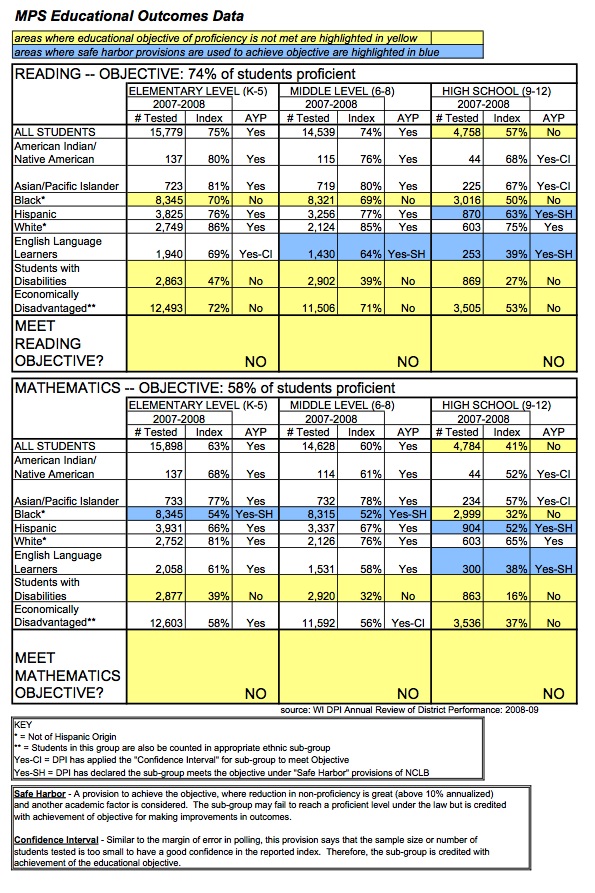 Newsletter signup | Send us your ideas
Madison School District Superintendent Dan Nerad 650K PDF:
The Board ofEducation over the past two months has received information relative to the programdesignofa4-kprogramandsomebudgetscenariosrelativetothe4-kprogram. The budget scenarios showed the Community Model Option where the community providers provided to the district the amount necessary to support their programs and two concepts for allowing this fee to decrease.Over the past month, administration and the community providers have met to discuss the amount to be brought forward as a fee per child for the community early childhood centers. The amount within your packet reflects that amount the early childhood community has asked ofthe district.
Information Contained in your packet: Budget Impact:
The budget impact sheet is reflective of all costs associated with the operation ofa community based model for four-year-old kindergarten. This model reflects the latest numbers proposed by the community for the per child reimbursement, along with an escalator of 3% each year. The model also reflects the latest information from the DPI, that shows we are currently not likely to be eligible to receive the 4-k startup grants with the State of Wisconsin budget. These numbers show a negative budget balance of $4,188,069 in year 1 and a negative budget balance of $243,046in year two, for a total two year negative balanceof $4,431,115. This becomes the target for further information within your packet relative to "Financing Options" for 4-k.
Newsletter signup | Send us your ideas
Identification Criteria - Several action steps within Goal 1 are based on the need for a clearly defined criteria and process to identify students as talented and gifted. The Talented and Gifted (TAG) Division staff has established and confirmed identification criteria including: 1) consideration of students' levels of academic performance; 2) grade level performance data employing the historical two-year above grade level as a marker; and 3) consideration of several student data sources, including input and information from teachers and family. Work will continue into the spring semester to incorporate these data sources to create a student profile and, pending individual student performance level indicators, a Differentiated Education Plan (DEP) for students.Monitoring Model - TAG staff continues work with the Research and Evaluation Department to create a model for student data analysis to aid in identification. These models will be research- based and provide the information needed to make identification, programming, and additional diagnostic decisions pertaining to individual students. It has been determined that the Student Intervention Monitoring System (SIMS) can be used as the tracking and reporting system. It currently containing much of the student information needed, including assessment and other data from Infinite Campus, that will make up the student profile component of a TAG student report. T AG staff will use SIMS in the current form to develop student profiles and Differentiated Education Plans (DEPs). Next steps include customizing reports in SIMS to meet future documentation/Plan development needs=
Newsletter signup | Send us your ideas
Why would Milwaukee Mayor Tom Barrett, running for governor, continue an apparently losing fight on a controversial local issue that doesn't gain him any votes statewide while tearing apart his political base at home?Barrett's attempt to seize control of Milwaukee Public Schools from the elected School Board failed to muster enough support in the Legislature recently to even bring up the issue after Gov. Jim Doyle called a special session. The Legislature adjourned without discussing mayoral control.
Meanwhile, the Milwaukee School Board, under the leadership of President Michael Bonds, has narrowed its national search for a new superintendent down to three finalists -- two African-Americans and a Latino -- all with experience in urban school districts.
Extending an olive branch, Bonds invited Barrett to personally interview the three finalists and make a recommendation to the board.
He also named Barrett to a community panel advising the board on the selection. The diverse committee includes Alphonso Thurman, University of Wisconsin-Milwaukee dean of education, state Rep. Annette Polly Williams, former Mayor Marvin Pratt, private philanthropist Julia Uihlein and prominent Latino, Hmong, American Indian and union leaders.
Newsletter signup | Send us your ideas
Madison School Board Vice President Lucy Mathiak:
On Monday, the Board of Education will have a presentation by the planning group that is proposing an environmentally-focused project-based charter middle school. The Badger Rock Middle School is the first charter proposal to come before the board since the Studio School debacle a few years back. From what we are hearing in the community, it is not likely to be the last (more on that later).Proposed Charter: Badger Rock Middle School
What we will be deciding now: The board will be asked to approve the group's initial proposal, which will form the basis of a planning grant application to the Department of Public Instruction. If the planning grant is awarded, the group will carry out additional work necessary to develop and design the charter school in greater detail, and develop a proposal that would come before the board requesting approval of the creation of the school and its charter.
Newsletter signup | Send us your ideas
US Department of Education, Institute of Education Sciences, via a kind reader's email:
No studies of Reading Recovery® that fall within the scope of the English Language Learners (ELL) review protocol meet What Works Clearinghouse (WWC) evidence standards. The lack of studies meeting WWC evidence standards means that, at this time, the WWC is unable to draw any conclusions based on research about the effectiveness or ineffectiveness of Reading Recovery® on ELL.Related: 60% to 42%: Madison School District's Reading Recovery Effectiveness Lags "National Average": Administration seeks to continue its use.Reading Recovery® is a short-term tutoring intervention designed to serve the lowest-achieving (bottom 20%) first-grade students. The goals of Reading Recovery® include: promoting literacy skills; reducing the number of first-grade students who are struggling to read; and preventing long-term reading difficulties. Reading Recovery® supplements classroom teaching with one-to-one tutoring sessions, generally conducted as pull-out sessions during the school day. The tutoring, which is conducted by trained Reading Recovery® teachers, takes place for 30 minutes a day over a period of 12 to 20 weeks.
Newsletter signup | Send us your ideas
My former Post colleague Tracy Thompson has two daughters in a Washington area school district. I promised not to say which one. It doesn't matter, because the issue she raises involves all high-tech schools, of which we have many.Related Infinite Campus and the Madison School District. Read the Middle School Report Card Report, which includes information on the District's use of Infinite Campus.People aren't using the new Web features designed to help families. Is it because parents like me are technophobes? Not entirely. The reluctant participants who concern Thompson are teachers.
Both of Thompson's kids have attention-deficit hyperactivity disorder. They have trouble getting their work done. Her school district, like several in the area, has Web sites on which parents can see their children's assignments. That way, they cannot be fooled by sly evasions when they ask their children, sitting in front of the TV, whether they have any homework.
Thompson was delighted to discover the Web homework schedules when her older daughter was a sixth-grader. Disappointment followed, she said, when "I found out only about half of her teachers used it. Some teachers were weeks behind in updating the info. My older daughter is off to high school next year and has matured amazingly over the past three years, so I don't have to worry that much about her stuff anymore. But now my younger daughter is in third grade, and I am in my second year of trying to get her teachers to use the Web."
Newsletter signup | Send us your ideas
Without discussion, the Milwaukee School Board voted 7-0 Thursday night to make condoms available at many of the city's high schools, paving the way to make Milwaukee Public Schools one of the relatively few districts in the nation to provide contraception to students.Somewhat related: biggovernment.com and mediamatters.org have been going back and forth on Obama Administration "safe school czar" Kevin Jenning's K-12 sex education activities.The communicable disease prevention program, as the district calls it, could be in place as soon as the 2010-'11 school year.
The proposal sparked some opposition after being made public Dec. 2, but the board approved the condom distribution without much dissent. Comments from the public are not allowed at board meetings and a board committee had voted 5-0 on Dec. 9 to recommend adopting the program.
The condoms will be available free of charge, but only to students in high schools that have school nurses and only after students request them at the nurse's office, according to a fact sheet circulated by the school district. Up to two condoms will be distributed at a time.
Thursday's vote does not authorize funding for the program, but the district has said it will not use taxpayer money to buy condoms and instead will seek other sources of funding.
Newsletter signup | Send us your ideas
via a kind reader's email; Letter from Governor Doyle and Department of Public Instruction Superintendent Tony Evers [107K PDF]:
We are excited to invite you to participate in Wisconsin's Race to the Top application to the federal government. Through the American Recovery and Reinvestment Act, President Obama and Congress provided $4 billion in competitive grant funding to states that move forward with innovations and reform in education."Memorandum of Understanding" [208K PDF]:Earlier this fall, at our request, the Wisconsin Legislature passed bills to make Wisconsin both eligible and more competitive for the Race to the Top grants. Now our local school district leaders - school board members, superintendents, principals, teachers, and other staff - need to prepare their district for participation in Wisconsin's grant application. Enclosed is the Race to the Top district memorandum of understanding (MOU) that the federal government requires participating districts to sign as part of the state's Race to the Top grant application. The MOU provides a framework of collaboration between districts and the state articulating the specific roles and responsibilities necessary to implement an approved Race to the Top district grant.
The MOU is divided into two parts - Exhibit I and Exhibit II. To receive any Race to the Top funding, a district must agree to the activities in Exhibit I. Districts that agree to Exhibit I are eligible, if they so choose, to participate in Exhibit II. In Exhibit II districts will receive additional funding for participating in the additional activities. Exhibit I is included in this information and Exhibit II will be forthcoming in the very near future.
I'm told that Madison's potential intake of "Race to the Top" funds is less than 1% of the current $400MM budget.
Related: US National Debt Tops Debt Limit.
Newsletter signup | Send us your ideas
Peterson-Pew Commission on Budget Reform PDF Report
Over the past year alone, the public debt of the United States rose sharply from 41 to 53 percent of gross domestic product (GDP). Under reasonable assumptions, the debt is projected to grow steadily, reaching 85 percent of GDP by 2018, 100 percent by 2022, and 200 percent in 2038.Wisconsin ranks 10th amongst the States in State-Local debt service. Exploding debt levels mean that it is highly unlikely school districts will see significant new revenues. Like many organizations, they must change and spend precious dollars where most needed and automate elsewhere (virtual learning tools are a natural, as this post demonstrates).However, before the debt reached such high levels, the United States would almost certainly experience a debt- driven crisis--something previously viewed as almost unfathomable in the world's largest economy. The crisis could unfold gradually or it could happen suddenly, but with great costs either way. The tipping point is impossible to predict, but the United States is already hearing con- cerns about its fiscal management from some of its largest creditors, and the country is uncomfortably vulnerable to shifts in confidence around the world.
Newsletter signup | Send us your ideas
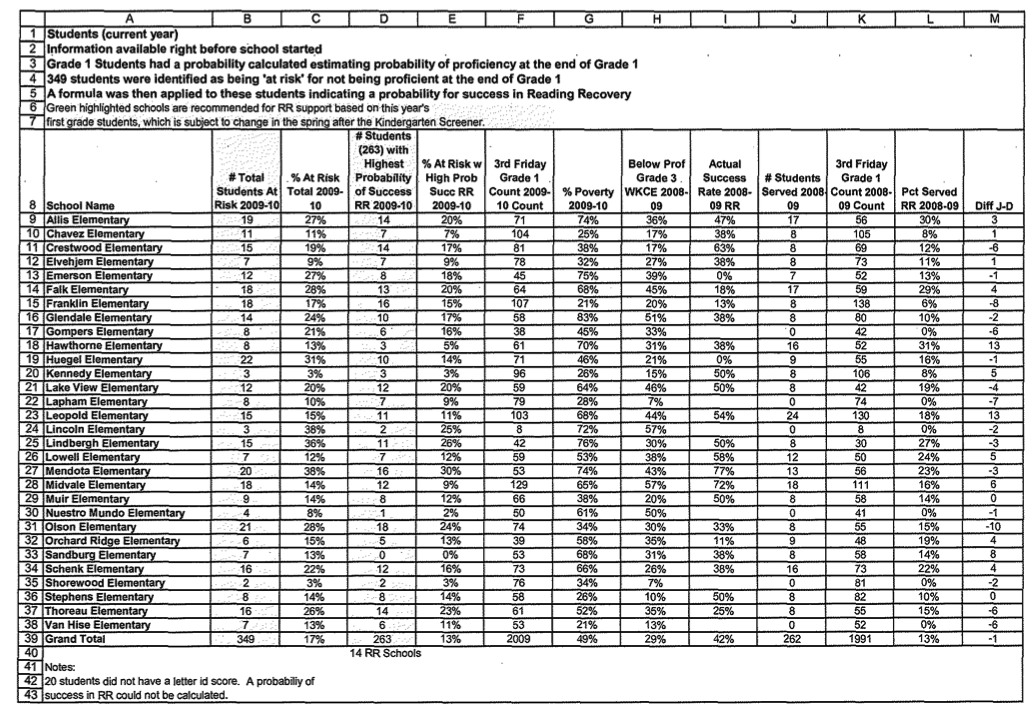
Click for a Reading Recovery Data Summary from Madison's Elementary Schools. December 2009
Madison School Board 24MB mp3 audio file. Madison Superintendent Dan Nerad's December 10, 2009 memorandum [311K PDF] to the board in response to the 12/7/2009 meeting:
Attached to this memo are several items related to further explanation of the reason why full implementation is more effective for Reading Recovery and what will happen to the schools who would no longer receive Reading Recovery as part of the administrative recommendation. There are three options for your review:Related: 60% to 42%: Madison School District's Reading Recovery Effectiveness Lags "National Average": Administration seeks to continue its use.The first attachment is a one-page overview summary ofthe MMSD Comprehensive Literacy Model. It explains the Balanced Literacy Model used in all MMSD elementary schools. It also provides an explanation of the wrap around services to support each school through the use of an Instructional Resource Teacher as well as Tier II and Tier III interventions common in all schools.
- Option I: Continue serving the 23 schools with modifications.
- Option II: Reading Recovery Full Implementation at Title I schools and Non-Title I Schools.
- Option III: Serving some students in all or a majority of schools, not just the 23 schools who are currently served.
The second attachment shows the detailed K-5 Title I Reading Curriculum Description in which MMSD uses four programs in Title I schools: Rock and Read, Reading Recovery, Apprenticeship, and Soar to Success. As part of our recommendation, professional development will be provided in all elementary schools to enable all teachers to use these programs. Beginning in Kindergarten, the four instructional interventions support and develop students' reading and writing skills in order to meet grade level proficiency with a focus on the most intensive and individualized wrap around support in Kindergarten and I" Grade with follow up support through fifth grade.
Currently these interventions are almost solely used in Title I schools.
The third attachment contains three sheets - the frrst for Reading Recovery Full Implementation at Title I schools, the second for No Reading Recovery - at Title I Schools, and the third for No Reading Recovery and No Title I eligibility. In this model we would intensify Reading Recovery in a limited number of schools (14 schools) and provide professional development to support teachers in providing small group interventions to struggling students.The fourth attachment is a chart of all schools, students at risk and students with the highest probability of success in Reading Recovery for the 2009-10 school year. This chart may be used if Reading Recovery would be distributed based on student eligibility (districtwide lowest 20% of students in f rst grade) and school eligibility (based on the highest number of students in need per school).
Option I: Leave Reading Recovery as it currently is, in the 23 schools, but target students more strategically and make sure readiness is in place before the Reading Recovery intervention.
Props to the Madison School Board for asking excellent, pointed questions on the most important matter: making sure students can read.
Newsletter signup | Send us your ideas
via a kind reader's email, who notes that Verona's video archives include very helpful topic based navigation!
At the most recent meeting on Dec. 7, the school board heard a final presentation from New Century School's site council. Developments with New Century's charter renewal are reaching a critical point, since we need approval from the school board by early January to participate in kindergarten recruitment. New Century is one of Wisconsin's oldest charter schools (established in May 1995), and our school community is fighting for the charter's continued existence. It's been a challenging journey.Click "video" for the December 7, 2009 meeting and look for "D", the New Century Presentation. Interestingly, "E" is a presentation on a proposed Chinese immersion charter school.
Unfortunately, Madison lacks significant charter activity, something which, in my view, would be very beneficial to the community, students and parents.
Newsletter signup | Send us your ideas
So far this school year, the approximately 100 school districts that have reached agreements with their teachers have average settlements that increase salaries and benefits by 3.75%, according to Bob Butler, staff counsel for the Wisconsin Association of School Boards. That compares with an average total compensation increase of 4.11% for teachers in the 2008-'09 school year.Related, 9/25/2009: Madison School District & Madison Teachers Union Reach Tentative Agreement: 3.93% Increase Year 1, 3.99% Year 2; Base Rate $33,242 Year 1, $33,575 Year 2: Requires 50% MTI 4K Members and will "Review the content and frequency of report cards".Given that settlements tend to go down the longer negotiations take, Butler said the average increases for 2009-'10 and 2010-'11 are likely to be below what they have been in the past and what was considered a minimum settlement under the QEO law.
The recession, even in growing and financially stable districts, is the main reason behind the settlement drops, Butler said. Even though the Legislature removed the QEO salary restrictions, it left revenue limits in place so that any increase in teacher compensation almost certainly means staff cuts, he said.
In addition, facing pressure from taxpayers, some school districts, such as Whitnall, refused to enact a tax levy up to their state-imposed revenue limits this year.
"We have seen such a drastic reduction in the amount of money we have coming in from the state, it would have been hard to settle at 3.8% even if the QEO still stood there," Whitnall School Board President Bill Osterndorf said.
Newsletter signup | Send us your ideas
Union-represented teachers in the Pulaski County School District stayed home Thursday to protest a school board decision to end recognition of their union.
All 39 schools in the 18,000-student district remained open, with substitute teachers and parent volunteers filling in for the absent teachers, Acting Superintendent Rob McGill said.
"Our first priority was getting students in the classrooms, getting substitutes or volunteers in the classrooms and proper supervision for the students," McGill said."I've had no phone calls as far as schools saying (they are) overwhelmed and can't handle the situation," he added.
Of the district's 1,380 teachers, 690 were out Thursday, exactly half. About a dozen teachers are out on a typical day, McGill said.
Newsletter signup | Send us your ideas
Madison School Board President Arlene Silveira, via email:
4-Year-Old Kindergarten (4K): The Board received updates from the community-based 4K planning committee in the areas of: 1) logistics; 2) curriculum; 3) public/community relations; 4) family outreach/involvement; 5) funding. The Board voted to have the District continue to work with the community in planning for 4K with an anticipated start date of September 2010, pending the determination of the availability of the resources necessary to support the new program. A presentation on financial resources will be made to the Board in December.Financial Audit: As required by state statute, the MMSD hires an independent audit firm to perform an audit of our annual financial statements and review our compliance with federal program requirements. The audit looks at the financial operations of the District. This audit was completed by Clifton Gunderson LLP. The Board received the audit report and a summary from Clifton Gunderson.
When asked what the summary message was that we could share with the community, the response was that the District is in a very sound financial position. Results of operations for 2009 were very positive with $10M added to fund balance. The fund balance is critical to the operation of the District and the cash-flow of the District. We were pleased with the audit outcome.
Math Task Force: The Board approved the administrative response to the 13 recommendations listed in the MMSD Math Task Force Report. The recommendations focused on middle school math specialists; district-wide curricular consistency; achievement gap; assessment; teacher collaboration; parent/community communication; balanced math approach; addressing failing grades in algebra; and algebra in 8th grade. The Board also asked for regular updates on the progress of plan implementation. The Task Force Report is located on the District's web site.
Enrollment Data: The Board reviewed the enrollment data and projections for the District. One area that stood out was the overcrowding in some of the elementary schools in the La Follette attendance area. The Long Range Planning Committee is starting a series of meetings to study the overcrowding in this area and to develop recommendations for the Board on how to address this issue. It is anticipated that recommendations will be brought back to the Board in February. The Board will have the final say on how to deal with the overcrowding issues.
If you have any questions/comments, please let us know. board@madison.k12.wi.us
Arlene Silveira (516-8981)
Newsletter signup | Send us your ideas
Andreal Davis - Madison School District Instructional Resource Teacher for Cultural Relevance, via a kind reader's email:
Communalism is the concept that the duty to one's family and social group is more important that individual rights and privileges. On November 4, 2009 I personally experienced this concept through President Barack Obama's visit to James Coleman Wright Middle School.Clusty Search: Communalism.The experience began with my 12 year old son, Ari Davis, being selected to lead the Pledge of Allegiance during the ceremony. Minutes after being informed of this special occasion, I was invited to attend the event as a member of the Madison Metropolitan School District staff. Thus, I attended the ceremony wearing two hats, one as a parent and the other as an educator.
On the day of this event, several of us anxiously awaited - for more than four hours - the arrival of President Obama. During this period I experienced first hand the spirit of communalism. A recap of my educational career began to unfold in the parking lot as I held conversations with past and current MMSD colleagues. As I entered Wright Middle School I had the opportunity to interact with students I had taught at Lincoln Elementary. This allowed me to see some products of my work by listening to their thought provoking reactions to the President's impending visit.
Newsletter signup | Send us your ideas
4k is really exciting, since it provides a great opportunity for four year olds to get a head start with learning before they get to kindergarten. It's also a promising step towards eliminating the achievment gap. Right now, we're smooting out some rough edges-- deciding whether to start with all of the buildings and teachers, or whether to "phase in," starting with 1/3 or 2/3 the amount of resources, and then increase it in the next few years.However, though there's still some negotiating to go, the 4k plan seems to be on its way. Another issue that involved a lot of intense discussion was the district's Reading Recovery Program.
Reading Recovery is a program for first grade students who are really struggling with reading. Targeted at the lowest 20% reading level students, Reading Recovery provides very intense one-on-one training every day which, when continued throughout the year, has very good national results of getting kids back on track.
However, in the last few years, RR in the MMSD has had less success than the national average (42% students finish the program versus around 60% nationally). This lead the district to worry and evaluate the program. At our meeting, we discussed schools that had experienced success with reading recoverey, and other ones that had not. The team that evaluated the program has recommended "full implementation" of reading recovery at schools with the most needy children, which would hopefully increase the success rate at those schools. However, due to limited resources, Reading Recovery can not be implemented at every school.
Newsletter signup | Send us your ideas
Boos and jeers filled Cobo Hall this afternoon as Detroit Public Schools teachers reacted to details in a proposed contract agreement with the district.The tentative agreement [Master Settlement PDF] includes:
Teachers union president Keith Johnson told the crowd that the contract may not be exactly what they want but the alternative is to have the district declare bankruptcy, possibly leaving many of them unemployed.
- Teachers loaning the district $10,000 each over two years with deductions taken from their paychecks.
- A base salary increase of 1% in the third year of the three-year contract.
- Increase in health insurance costs.
- Plus a plethora of school reforms that include a peer evaluation process.
"I cannot, I will not gamble, play Russian roulette, call the bluff of the district," Johnson said.
Newsletter signup | Send us your ideas
Superintendent Dan Nerad [600K PDF]:
Attached to this memorandum is detailed costing information relative to the implementation of four-year-old kindergarten. We have attempted to be as inclusive as possible in identifying the various costs involved in implementing this program.Each of the identified options includes cost estimates involving all three program models that have previously been discussed. The first option includes the specific cost requests provided to us by representatives from the community providers. The remaining options include the same costing information for Model I programs (programs in district schools) but vary for Model II and III programs (programs in community-based early learning centers). These options vary in the following ways:
The District options with a 1:10 ratio were created because this was the staffing ratio that was recommended by the 4K planning committee and is the ratio needed for local accreditation. All Modell costing(in District schools) is based on a 1:15 ratio with the understanding that additional special education and bilingual support to the classroom is provided. The District options employing a two- or three-year phase-in of the
- For District Option 1, we have used a 1:10 staffing ratio instead of a 1:8.5 staffing ratio that was submitted by representatives from the community providers.
- For District Option 2, we have used a three-year phase-in for the reimbursement to local providers.
- For District Option 3, we have used both a 1:10 ratio and a three-year phase-in for reimbursement to local providers.
- For District Option 4, we have used both a 1:10 ratio and a two-year phase-in for the reimbursement to local providers.
Newsletter signup | Send us your ideas
State Representative Mark Pocan met with the Madison Metropolitan School District Board of Education on Monday, November 30 to discuss "K-12 Funding in Wisconsin and the Impact of the State Budget on School District Finances." (State Senator Mark Miller, who was also expected, was ill, Liz Stevens from his office attended in his stead). The short version of what transpired is that although Pocan brought Bob Lang and Dave Loppnow from the Legislative Fiscal Bureau as support, they were unable to "shut the lions' mouths" and the Board got a few nips in. Beyond that, Pocan explained the intent and context of the budget "fix," emphasized the importance of addressing revenue issues, gave some thoughts on school finance reform, defended parts of his record and more-or-less split the blame for everything bad between Governor Jim Doyle and the economy.I have to give Pocan some credit and respect for facing the lions and for being very forthright and forthcoming. I'll even go beyond that and say that when he was talking about what can and should be done and why, he showed understanding and that he cared. It was words, not actions, and I want action from my State Rep.. But at least he didn't shut the door on action. Let's help him open that door (more on that below, but think Penny for Kids).
Newsletter signup | Send us your ideas
Madison School District Talented & Gifted Plan Presentation 11/17/2009 from SIS.
Click to listen or CTRL-Click to download this 32mb mp3 audio file. Much more on the Madison School District's new talented & gifted plan.Thanks to Jeff Henriques and Laurie Frost for recording this event.
Newsletter signup | Send us your ideas
Bumper stickers are like tattoos for cars. They're gaudy, mighty tough to get off and, no matter how hard they try, rarely inspiring. We don't need goofy "coexist" decals to inform us that the person doing a mean 45 MPH in the passing lane is against religion-fueled hatred and wars. Of course that guy's against war. He's driving a Saturn Ion.Fascinating. The TAG initiative, from my perspective, ideally should lead to increased rigor for all students. That is obviously a contentious topic.....And we've just about had it up to here -- lower jaw area -- with those wretched honor roll notifications. "Oh really, Mrs. Johnson? Tommy's getting straight A's in middle school?" Somebody call NASA. Or, if nothing else, call B.S. Just wait 'til he starts listening to rap music.
But parents, as a species, aren't rational beings. After all, if they were, they would've put you up for adoption. Instead, they foolishly assume their child is The Great White Hope, with equal parts of Jim Brown, Barack Obama and Jesus Christ mixed in -- although, interestingly, none of them are white. In Madison, this wide-eyed parental belief that their genes will save the world is best represented by discussions surrounding programming for gifted youngsters.
As reported Monday in the Wisconsin State Journal, some area parents are becoming increasingly frustrated with the Madison school district's weak implementation of TAG programming. TAG, which stands for "talented and gifted," is class instruction designed to challenge more advanced students, and forever lost its credibility when it became loosely associated with a canned body spray. According to the article, the school district currently has eight and a half positions devoted to pushing TAG programming forward, and that's simply not enough to spawn effective change.
Fortunately, it's not necessary, especially when dealing with elementary and middle school students. Try and tell 9-year-olds they're gifted; they'll listen, but only after a good nose-picking and two minutes of straight laughter stemming from a joke that incorporated the word "butt."
Newsletter signup | Send us your ideas
via an Arlene Silveira email:
Board of Education Progress Report, November, 2009
BOE updates:
Dual Language Immersion (DLI): The Board approved the expansion of our DLI program into our 4 attendance areas at specified schools at the elementary/middle school levels. We are still studying high school models. DLI is a program where children are taught in both Spanish and English. DLI programs are currently at Nuestro Mundo and Leopold Elementary Schools. Next year our first middle school program will be at Sennett.
Cultural Relevance: The Board received an update on our Cultural Relevance initiatives. This is included in the strategic plan as a Strategic Objective in Curriculum. The District has a number of new/expanding projects in this area. Of note is a pilot created at Mendota and Falk Elementary Schools. Staff are collaborating with UW-Madison faculty for professional development in: African American language development; family involvement; black communications; classroom management; teaching from principles; culturally relevant literacy principles.
School Food Committee: This committee was formed to look at possible options for our food service operations. The district is bringing in an expert (Ann Cooper) in transitioning food service programs. Early next year she will come to Madison to look at our operations and provide a cost estimate for a feasibility study of the MMSD.
Budget: The Board approved our final budget and set the tax levy in October. Summary:Going into the meeting, the proposed tax rate was $10.40 with the impact on a $250,000 home of $147.50. Aware of the difficult economic times facing our community, the Board approved 6 budget amendments designed to decrease these numbers to the approved numbers. As part of our effort to decrease property taxes, the Board voted to freeze "non-essential" maintenance spending by deferring or foregoing $3,080,000 in maintenance referendum tax levy spending in 2009-10. By doing so, we were able to decrease the tax impact on the average home by $33.16. What does this mean for the schools? We will continue to make essential repairs using existing maintenance funds or other existing district resources. We have already spent 91% of the maintenance referendum that passed 5 years ago. We will evaluate and prioritize the remaining "non-essential" maintenance projects on the list, and will make funding decisions on an as needed basis using a different source of funding.
- Total levy: $234,240,964 (3.49% increase)
- Tax rate: $10.18 (3.77% increase)
- Impact on $250,000 home: $92.83
Lighthouse Project: The Board and Superintendent are participating in the Lighthouse Project. A study focused on behavior of school boards/superintendents in high-achieving school districts. Our participation in this project over the next 6 months will focus on the 7 conditions of school renewal: 1) Shared leadership; 2) Continuous improvement and shared decision-making; 3) Ability to create/sustain initiatives; 4) Supportive workplace for staff; 5) Staff development; 6) Support for school sites through data/information; 7) Community involvement.
H1N1 Activities: We received a presentation on the district's H1N1 Pandemic Response Plan. The plan focused on 1) Education on H1N1; 2) Vaccination clinics; 3) Student/staff absences; 4) Supporting school operations; 5) Supporting students. An incredible amount of planning and communication went into the development of this plan and the district is now ready to deal with anything that comes our way as a result of H1N1.
If you have any questions/comments, please let us know.
board@madison.k12.wi.us
Arlene Silveira (516-8981)
Newsletter signup | Send us your ideas
65mb mp3 audio file recorded during Monday's meeting. Topics include: Strategic Plan benchmarks and the recent passage of Wisconsin education "reform" legislation.
Newsletter signup | Send us your ideas
via a kind readers email - The Milwaukee Drum:
TMD has obtained an internal memo sent from Sen. Taylor (1.5MB PDF) to other state representatives (dated 11/5/09 7:35 pm) seeking their co-sponsorship for the MPS Takeover legislation. This memo not only asks for co-sponsorship, but it provides specific details of the upcoming (draft) legislation. This is what the public has been waiting for... details!A reader mentioned that the governance changes may apply to other Wisconsin Districts, perhaps rendering local boards as simple wallflowers....Beloved, one thing you will continue to read from me is the mantra follow the money. This entire reform gets down to one thing, money... more specifically, Race To The Top federal grants. State governors must apply for the grant and that is where this all begins with Doyle. Did you know that 50% of any grant received must be given to local educational agencies (LEAs), including public charter schools identified as LEAs under State law? I guess you won't see many preachers in Milwaukee opposing this Takeover since their schools stand to benefit financially. Where did Doyle have that press conference in Milwaukee last week?
Let me back this thing up for you quickly. Some of you still are wondering what gives? Jump down the worm hole with me again just for a second... President Obama and Congress passed the American Recovery and Reinvestment Act of 2009 (ARRA) aka the Stimulus Package (2/17/09). Inside this legislation is approximately $4.3 billion set aside for states that implement education reform targeted to increase student achievement, closing achievement gaps, improving graduation rates and preparation for success in college/careers. Follow the money family...
More to come, I'm sure.
Newsletter signup | Send us your ideas
The elected Madison School Board will be present at Wednesday's visit and rightfully so. There will be plenty of other politicians, but these people truly deserve a bit of time in the spotlight.
Love them or loath them, we should all be thankful for the time and effort our board members devote to that most important public expenditure: public schools. It is truly an essential but thankless job. I believe boardmembers are paid $4,000 annually.
I emailed our board and asked for a quote prior to the President's arrival. Four responded thus far:
President Arlene Silveira:
"How exciting for our students at Wright. To meet the president of the United States is a once in a lifetime opportunity. I hope his visit awakens the civic responsibility in all who attend".Ed Hughes:
We're honored by the President's visit. I'm pleased that the visit will shine a positive light on the great work the Principal Nancy Evans and her staff have been doing at Wright, and that we're able to provide Wright students with a once-in-a-lifetime experience.Beth Moss:
If the President is able to find the time to visit one of our Madison schools, I hope that any Madison parents who have questions about what's best for their kids will similarly make the effort to visit their neighborhood schools and see for themselves what we have to offer.
The President's visit to a Madison school is an honor for our entire community. Nancy Evans, her staff, students, and the Wright Middle School families deserve to be recognized for their success in creating and maintaining a school community worthy of the President's attention. This is an experience that none of us will forget, and we should be extremely proud that we have been chosen to host a presidential speech on education.Marj Passman:
President Obama and I may not always agree about what is best for educationIt will be interesting to observe the Board when and if President Obama discusses mayoral control of schools in Milwaukee, as Alexander Russo muses.
but I am very grateful that he has returned the importance of education to
center stage. It is an honor to have been invited to meet him.
Newsletter signup | Send us your ideas
The local school district's increasing use of reform math programs lead to the creation of a "Math Task Force". The District Administration's response is outlined in this 2.6MB PDF document:
The purpose of this report is to describe the recomrnendations in response to the Madison Metropolitan School District Mathematics Task Force Report: Review of Mathematics Curriculum and Related Issues, submitted to the Board of Education June, 2008.Background notes and links:Administrative Recommendations Summary The materials included in this packet update and replace those distributed to the Board of Education in April 2009. Included in the materials is a proposed budget.
Middle School Mathematics Specialists (see Recommendations 1-5)
The Superintendent and UW-Madison Deans of Letters and Sciences and the School of Education commissioned a representative and collaborative group to design a professional development plan for this initiative. The group was convened in June and has since met four times during the summer to research and design a professional development plan to support middle school mathematics teachers.
The Middle School Math Partnership committee has tentatively planned five courses for the professional development proposal. Those courses are Number and Generalization, Rational Number and Proportional Reasoning, Geometry, Measurement and Trigonometry, and Algebra and Functions. The courses would be spread out over two years and be co-facilitated by UW and MMSD staff.
Research, data gathering and design will continue through 2009-2010 with the initial cohort of middle school teachers beginning in summer 2010. Upon completion of an initial draft, the plan will be presented to district teachers for further input and refinement.
In collaboration with the above group, a National Science Foundation Targeted Partnership proposal, Professional Learning Partnership K-20 (PLP K-20), was submitted on August 20, 2009. A UW-Madison and MMSD team of nearly 30 members worked during the summer to craft a proposal focused on systemic and sustainable mathematics professional development. The vision described in the proposal creates "a lasting interface to coordinate material, human, social, and cyber resources" among the UW-Madison and District. The principal investigator of the NSF proposal is Eric Wilcots. Co-Pl's include Provost Deluca, Superintendent Nerad, Dean Sandefur and Dean Underwood.
Newsletter signup | Send us your ideas
The Madison School Board recently passed the District's Strategic Plan. Superintendent Dan Nerad has now published a draft document outlining performance measures for the plan (this is positive). The 600K PDF document is well worth reading. Mr. Nerad's proposed performance measures rely on the oft criticized - for its lack of rigor - state exam, the WKCE. The Wisconsin Department of Public Instruction recently stated that "Schools should not rely on only WKCE data to gauge progress of individual students or to determine effectiveness of programs or curriculum".
A few highlights from the 600K PDF document:
| Grade | 2006/2007 | 2007/2008 | 2008/2009 |
| 9 | 0.3% | 0.4% | 0.2% |
| 10 | 5.5% | 7.3% | 1.9% |
| 11 | 18.0% | 18.1% | 10.6% |
| 12 | 34.1% | 34.3% | 24.3% |
Discussing these data is a step in the right direction. Unfortunately, use of the WKCE does not instill much confidence, from my perspective.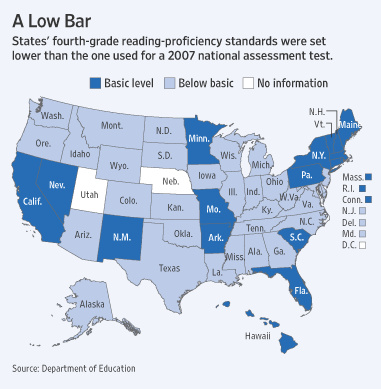
via "Some States Drop Testing Bar" by John Hechinger.
Happy Halloween!
Newsletter signup | Send us your ideas
WKOW-TV, via a kind reader's email:
Madison school board leaders are revising a budget plan that lowers their property tax increase but defers millions of dollars in maintenance.Most budget changes passed 7-0, with the exception of the deferred maintenance, which passed 5-2 with Beth Moss and Ed Hughes voting against it. Moss's school board seat is up for election on April 6, 2010. I emailed Beth last weekend, along with Maya Cole and Johnny Winston, Jr. to see if they plan to run for re-election.Leaders are looking to lower the previously agreed upon property tax hike by about $50 dollars per homeowner: from $147 on a $250,000 home, to $92.83 on a $250,000 home.
To accomplish that, members took from a few funds, and decided they would not levy the remaining balance on a 2005 maintenance referendum: that equaling out to almost $3 million dollars.
School board members had to compensate for the loss of $12-million dollars in state funding.
The loss of funding for the maintenance referendum didn't come without discussion. Board member Beth Moss hoped to levy just enough to pay for $1.4 million dollars of roof maintenance.
Moss says, "The maintenance doesn't go away... You can put it off, but putting it off usually only makes it worse."
On the list for repairs, a boiler at Marquette Elementary, and more efficient windows at Shorewood Elementary.
Listen to Monday evening's Madison School Board discussion via this 1 hour, 50 minute mp3 audio file.
The budget changes were driven by reduced transfers of state tax dollars to school districts and the drop in assessed property values (via an April, 2009 memo). Interestingly, I don't believe this significant Board (mostly 7 votes, but some big dollar 5-2 as noted above) effort to hold down the local school property tax increase would have occurred with earlier Directors.
Newsletter signup | Send us your ideas
The Monday, October 26, 2009 Madison School Board meeting agenda will include a discussion (and presumably a vote) on the upcoming property tax rate increases. The board approved a tax hike earlier this year to make up for a reduction in state income tax and fees redistributed to local school districts due to the "Great Recession". Reductions in property tax assessments ("Of the 73,024 parcels in the City, 53.6% are being changed (6,438 increases and 32,728 reductions") may further drive taxes upward, certainly a challenge given current conditions.
Superintendent Dan Nerad proposed - and passed - a three year referendum that authorized spending and tax increases while providing time for the Administration to, as Board member Ed Hughes stated "put into place the process we currently contemplate for reviewing our strategic priorities, establishing strategies and benchmarks, and aligning our resources." Ed's "Referendum News" is worth reading.
I've summarized a number of links from the 2008 referendum discussion and vote below.
It will be interesting to see what, if anything happens with the recent math, fine arts, talented and gifted task forces and the full implementation of "infinite campus", which should reduce costs and improve services.
Newsletter signup | Send us your ideas
Milwaukee Public Policy Forum:
In the past few weeks Milwaukee has had numerous town hall meetings, panel discussions, and presentations regarding the idea of school district governance reform. At issue is whether the mayor of Milwaukee should be in charge of the Milwaukee Public Schools, rather than an independent board of directors.
At each of these meetings, accountability has been thrown about as both an argument for and against a mayoral take-over of the district. Perhaps a mayor elected in a higher turn-out citywide election would provide more accountability; or maybe losing the opportunity to elect a school board representative would disenfranchise certain voters, diluting accountability.
In Pittsburgh, civic leaders, parents, and citizens decided to stop talking about accountability and actually implement it. A local nonprofit group, A+ Schools: Pittsburgh’s Community Alliance for Public Education, started an initiative called "Board Watch" last winter. The idea is quite simple: send volunteers to attend every board and committee meeting and have them report to the public whether the board is being effective in meeting the district's strategic goals.
Newsletter signup | Send us your ideas
Michelle Rhee's senior staff meeting has all the ceremony of lunchtime in the teachers' lounge. News is exchanged. Ideas tumble around. Rhee sits at the head of the table but doesn't run the meeting or even take the conversational lead. Staffers talk over her as often as she talks over them. If consensus is the goal, the ball is far upfield.But then, Rhee wades in with, "Here's what I think," or "What I don't want," or "This is crap," or "I want someone to figure this out," or "I'm gonna tell you what we're gonna do; we can talk about how we're gonna do it." And that is that. Next order of business, please.
Rhee's style--as steely as the sound of her peekaboo high heels on a linoleum-tile hallway--has angered much of Washington, D.C., and baffled the rest since she arrived as schools chancellor in June 2007. But it is also helping her gain control of a school system that has defied management for decades: that hasn't kept records, patched windows, met budgets, delivered books, returned phone calls, followed court orders, checked teachers' credentials, or, for years on end, opened school on schedule in the fall.
Newsletter signup | Send us your ideas
Palo Alto Unified School District Gifted & Talented Program [219K PDF]:
Palo Alto Unified school district's Gifted and Talented Education (GATE) provides educational opportunities that recognize the performance capabilities of gifted students as well as addresses the unique needs and differences associated with having these abilities. The goals of Gifted and Talented Education can be defined as follows:Palo Alto School District Strategic Plan [780K PDF]Program Model
- To provide students with opportunities for learning that maximize each students' abilities.
- To assist and encourage students to acquire skills and understanding at advanced academic and creative levels.
- To aid students in expanding their abilities to communicate and apply their ideas effectively.
- To engender an enthusiasm for learning.
In elementary and middle school, the program model for GATE is differentiation within the mainstream classroom. In 2001, new legislation called for a change in GATE education. Rather than pull children from class for a different curriculum, all differentiation takes place within the context of standards-based instruction in the regular classroom. Teachers enrich and extend the core curriculum for gifted students by differentiating instruction, content, and process. Through differentiated assignments developed to meet their academic and intellectual needs, GATE students are able to explore and expand to their maximum potential. These differentiated curricular opportunities are available to all students, not just those who are formally identified. In middle school, students also have access to the Renzulli Learning System to allow them to individualize their education based on their needs, interests and creative abilities and to explore the curriculum in greater depth and complexity. Advanced math courses are available for the first time in 7th grade and continue through 12th grade. In high school, gifted students are able to take advanced, honors, and advanced placement courses in a wide variety of subjects.
Madison School District's Gifted & Talented Plan.
Newsletter signup | Send us your ideas
FAMILIES chafe at the Seattle Public Schools' wild variability on student assignments. Proposed new school boundaries and a simplified assignment plan offer promising change. [Complete Assignment/Boundary Plan - 358K PDF]Seattle Schools Strategic PlanA complex maze that used to determine what school students attended has been streamlined into an uncomplicated rule: students' addresses determine their school.
Students entering kindergarten, sixth grade and ninth grade in the 2010-11 year will be assigned to a school near their home. Students in other grades will remain at their current schools, an appropriate grandfathering that minimizes disruptions.
Many families won't notice a difference. For others, this plan is a huge change. Families living on Queen Anne and in Magnolia have long asked for a neighborhood high school so students weren't bused across the city. They're being assigned to one of the best: Ballard High School.
This shift is the correct route forward. After the district ended bussing for integration purposes, it veered into an expensive and convoluted open choice system. Families could choose any school they wanted but the result was a lack of predictability and stability. Most troubling, the system weighed heavily against less savvy families who were unable to navigate the application process.
Newsletter signup | Send us your ideas
Newsletter signup | Send us your ideas
24MB mp3. Notes and links on the recent, tentative agreement between the Madison School District and Madison Teachers, Inc.
Newsletter signup | Send us your ideas
via a kind reader's email (200K PDF):
The Madison Metropolitan School District and Madison Teachers Inc. reached a tentative agreement Tuesday evening on the terms and conditions of a new two-year Collective Bargaining Agreement for MTI's 2,600 member teacher bargaining unit. Negotiations began April 15.The Contract, for July 1, 2009 to June 30, 2011, needs ratification from both the Board of Education and MTI. The Union will hold its ratification meeting on Wednesday, October 14, beginning at 7:00 p.m. at the Alliant Energy Center, Dane County Forum. The Board of Education will tentatively take up the proposal in a special meeting on October 19 at 5:00 p.m.
Terms of the Contract include:
2009-2010 2010-11
Base Salary Raise - 1.00% Base Salary Raise - 1.00%
Total Increase Including Benefits - 3.93% Total Increase Including Benefits - 3.99%
Bachelor's Degree Base Rate $33,242 Bachelor's Degree Base Rate $33,575A key part of this bargain involved working with the providers of long term disability insurance and health insurance. Meetings between MTI Executive Director John Matthews and District Superintendent Dan Nerad and representatives of WPS and GHC, the insurance carriers agreed to a rate increase for the second year of the Contract not to exceed that of the first year. In return, the District and MTI agreed to add to the plans a voluntary health risk assessment for teachers. The long term disability insurance provider reduced its rates by nearly 25%. The insurance cost reductions over the two years of the contract term amount to roughly $1.88 million, were then applied to increase wages, thus reducing new funds to accomplish this.
The new salary schedule increase at 1% per cell, inclusive of Social Security and WRS, amount to roughly $3.04 million. Roughly 62% of the salary increase, including Social Security and WRS, was made possible by the referenced insurance savings.
Key contract provisions include:
Inclusion in the Contract of criteria to enable salary schedule progression by one working toward the newly created State teacher licensure, PI 34. Under the new Contract provision, one can earn professional advancement credits for work required by PI 34. - Additive pay regarding National Board for Professional Teaching Standards, i.e. an alternative for bargaining unit professionals who are not teachers (nurses, social workers, psychologists, et al) by achieving the newly created Master Educator's License.
- Continuance of the Teacher Emeritus Retirement Program (TERP).
- The ability after retirement for one to use their Retirement Insurance Account for insurance plans other than those specified in the Collective Bargaining Agreement. This will enable one to purchase coverage specific to a geographic area, if they so choose, or they may continue coverage with GHC or WPS - the current health insurance providers.
For elementary teachers, the frequency and duration of meetings has been clarified, as have several issues involving planning time. All elementary teachers and all elementary principals will receive a joint letter from Matthews and Nerad explaining these Contract provisions.- For high school teachers who volunteer for building supervision, there is now an option to enable one to receive compensation, rather than compensatory time for the service. And there is a definition of what "class period" is for determining compensation or compensatory time.
- For elementary and middle school teachers, MTI and the District will appoint a joint committee for each to study and recommend the content and frequency of report cards.
For elementary specials (e.g. art, music) teachers, the parties agreed to end the class and a half, which will mean that class sizes for specials will be similar to the class size for elementary classroom teachers.- For coaches, and all others compensated on the extra duty compensation schedule, the additive percentage paid, which was frozen due to the State imposed revenue controls, will be restored.
- School year calendars were agreed to through 2012-2013.
- Also, MTI and the District agreed to a definite five-year exemption to the Contract work assignment clause to enable the District to assist with funding of a community-based 4-year-old kindergarten programs, provided the number of said 4-K teachers is no greater than the number of District employed 4-K teachers, and provided such does not cause bargaining unit members to be affected by adverse actions such as lay off, surplus and reduction of hours/contract percentage, due to the District's establishment of, and continuance of, community based [Model III] 4-K programs. (See note below.)
MTI Executive Director John Matthews said that he was glad that the parties were able to successfully resolve several matters which were raised in negotiations. In all, 67 Contract provisions were amended or created in this year's bargaining.Superintendent Daniel Nerad said, "I am very pleased that we have reached this tentative agreement after an extensive period of bargaining. We have addressed a significant number of contract language related items. A key example lies in the area of elementary planning time. Of greatest significance to the District is an agreement over language that would allow for the implementation of a four-year-old kindergarten program."
"Also, in working with MTI we have been able to provide a salary increase, in part, as a result of reductions in health care costs. I appreciate working with John Matthews in accomplishing these insurance savings. I look forward to presenting this tentative agreement to the Board of Education in the near future."
John Matthews said, "But the economic provisions do not adequately reward those who have made the Madison schools among the best in the country. With the State usurping local control as regards to school funding, this is a matter that the State must fix; there is nothing local school boards can do, given the State's heavy hand. The State must realize that their funding formula for education is inadequate, and that it is causing the dissolution of the great education once available to Wisconsin children. That must be fixed and it is up to the Governor and the Legislators to do it."
For more information and to coordinate interviews, contact:
MMSD: Ken Syke, 663-1903 or Joe Quick, 663-1902
MTI: John Matthews, 257-0491There are three models for how 4-K instruction is delivered, i.e., where and by whom:
Model I - in a school district site and by district-employed teachers
Model II - in preschool/child care centers and by district-employed teachers
Model III - in preschool/child care centers and by center-employed teachers
Newsletter signup | Send us your ideas
The mathematics committee of the junior high schools of Madison has been meeting regularly for four rears with one intention in mind -- to improve the mathematics program of the junior high school. After experimenting with three programs in the 7th grade, the Seeing Through Mathematics series, Books 1 and 2, were recommended for adoption and approved in May of 1963.Related: The recent Madison School District Math Task Force.The committee continued its leadership role in implementing the new program and began evaluation of the 9th grade textbooks available. The committee recommended the adoption of Seeing Through Mathematics, Book 3, published by Scott, Foresman and Company, and Algebra: Its Element and Structure, Book 1, published by Webster Division, McGraw-Hill Book Company, and the Board of Education adopted them on May 3, 1965.
A number of objections to the Seeing Through Mathematics textbooks were made by various University of Wisconsin professors. Dr. R. C. Buck, chairman of the University of Wisconsin Mathematics Department strongly criticized the series. A public objection to the adoption was made at the Board of Education meeting by Dr. Richard Askey of the University Mathematics Department. Later, a formal petition of protest against the adoption of Seeing Through Mathematics, Book 3, was sent to committee members. [related: 2006 Open Letter from 35 UW-Madison Math Professors about the Madison School District's Math Coordinator position]
The sincerity of the eminently qualified professional mathematicians under Dr. Buck's chairmanship was recognized by both the administration and the committee as calling for reconsideration of the committee's decisions over the past three years relative to the choice of Seeing Through Mathematics 1, 2 and 3.
Conversely, the support of the Scott, Foresman and. Company mathematics program and its instruction philosophy, as evidenced by numerous adoptions throughout the country and the pilot studies carried out in the Madison Public Schoolsvindicated that equitable treatment of those holding diametric viewpoints should be given. It was decided that the interests of the students to be taught would be best served through a hearing of both sides before reconsideration.
A special meeting of the Junior High School. Mathematics committee was held on June 10, 1965.
Meeting 1. Presentations were made by Dr. R. C. Buck, Dr. Richard Askey, and Dr. Walter Rudin of the University of Wisconsin Mathematics Department, and Dr. J. B. Rosen, chairman-elect of the University of Wisconsin Computer Sciences Department.
The presentations emphasized the speakers' major criticism of the Seeing Through Mathematics series -- "that these books completely distort the ideas and spirit of modern mathematics, and do not give students a good preparation for future mathematics courses. Examples were used to show that from the speakers' points of view the emphasis in Seeing Through Mathematics is wrong. They indicated they felt the language overly pedantic, and the mathematics of the textbooks was described as pseudo-mathematics. However, it was pointed out that the choice of topics was good the content was acceptable (except for individual instances), and the treatment was consistent. A question and answer session tollowed the presentations.
..........
After careful consideration of all points of view, the committee unanimously recommended:
- that the University of Wisconsin Mathematics and Education Departments be invited to participate with our Curriculum Department in developing end carrying out a program to evaluate the effectiveness of the Seeing Through Mathematics series and, if possible, other "modern" mathematics series in Madison and other school districts in Wisconsin;
- that the committee reaffirm its decision to recommend the use of Seeing Through Mathematics, Book 3, and Algebra: Its Elements and structure, Book 1, in grade nine with Seeing Through Mathematics, Book 1 and 2 in grades seven and eight, and that the Department of Curriculum Developnent of the Madison Public Schools continue its study, its evaluation, and its revision of the mathematics curriculum; and
- that en in-service program be requested for all junior high school mathematics teachers. (Details to follow in a later bulletin).
Britannica on deja vu.
Newsletter signup | Send us your ideas
Former Madison Alder Brenda Konkel summarized the meeting:
The Madison School District shared their data with the group and they decided when their next two meetings would be. Compton made some interesting/borderline comments and they have an interesting discussion about race and how housing patterns affect the schools. There was a powerpoint presentation with lots of information, without a handout, so I tried to capture it the best I could.A few interesting notes:GETTING STARTED
The meeting was moved from the Mayor's office to Room 260 across the street. The meeting started 5 minutes late with Brian Munson, Marj Passman, Mark Clear, Judy Compton, Dave Porterfield, Brian Solomon and Marsha Rummel were the quorum. Judy Olson absent, but joined them later. City staff of Bill Clingan, Mark Olinger, Ray Harmon and Helen Dietzler. Kurt Keifer from the School District was here to present. (Bill Clingan is a former Madison School Board member. He was defeated a few years ago by Lawrie Kobza.
Clear asks if this reflects white flight, or if this just reflects the communities changing demographics. He wants to know how much is in and out migration. Kiefer says they look more at private and parochial school attendance as portion of Dane County and MMSD. Our enrollment hasn't changed as a percentage. There has been an increased activity in open enrollment - and those numbers have gone up from 200 to 400 kids in the last 8 - 10 years. He says the bigger factor is that they manage their enrollment to their capacities in the private and parochial schools. Even with virtual schools, not much changes. The bigger factor is the housing transition in Metropolitan area. Prime development is happening in other districtsFascinating. I wonder how all of this, particularly the high school "small learning community initiatives" fit with the District's strategic plan and recently passed Talented and Gifted initiative?
......
Kiefer says smaller learning communities is what they are striving for in high schools. Kiefer says the smaller learning initiative - there is a correlation in decrease in drop out rate with the program. Compton asks about minority and Caucasian level in free lunch. She would like to see that.
.......Kiefer says that Midvale population is not going up despite the fact that they have the highest proportion of single detached units in Midvale - they are small houses and affordable, but also highest proportion of kids going to private and parochial schools. He says it was because of access because to parochial schools are located there. Kiefer says they think the area is changing, that the Hilldale area has been an attractor for families as well as Sequoya Commons. Family and school friendly areas and he tells the city to "Keep doing that". He is hopeful that Hill Farms changes will be good as well.
Newsletter signup | Send us your ideas
There were several public appearances [4.1MB mp3 audio] Monday evening related to the Madison School District's Talented & Gifted plan. TJ Mertz, Kris Gomez-Schmidt, Janet Mertz (not related) and Shari Galitzer spoke during the public appearance segment of the meeting. Their comments begin at 3:13 into this mp3 audio file.
The School Board and Administration's discussion can be heard via this 6MB mp3 audio file. The previous week's discussion can be heard here. Madison United for Academic Excellence posted a number of useful links on this initiative here.
Finally, the recent Private/Parochial, Open Enrollment Leave, Open Enrollment Enter, Home Based Parent Surveys provides a useful background for the interested reader.
Newsletter signup | Send us your ideas
Madison Board of Education President Arlene Silveira, via email:
TO: MMSD Strategic Planning CommitteeMuch more on the Strategic Planning Process here.Good afternoon,
I am writing to provide you with a Board update on the MMSD strategic plan. Before getting into details, I again want to thank you for all of the time and effort you put into development of the plan. It is appreciated.
On July 21, the Board of Education held our second meeting to review the strategic planning document that you, our community-based strategic planning committee, submitted. The Board unanimously approved the following components of the new strategic plan. The mission, beliefs and parameters were approved with no changes to the plan you submitted. Some language in the strategic objectives was modified for clarity and completeness.
We have not yet approved any of the action plans.
- Mission (see below)
- Beliefs (http://drupal.madison.k12.wi.us/files/strategic%20plan%20complete%20doc%20REV%20june%209.pdf Page 4)
- Parameters (http://drupal.madison.k12.wi.us/files/strategic%20plan%20complete%20doc%20REV%20june%209.pdfPage 4)
- Strategic Objectives (see below)
Newsletter signup | Send us your ideas
24MB mp3 audio file. Mitch and Don discuss the Madison School District's $12M budget deficit, caused by a decline in redistributed tax dollars from the State of Wisconsin and generally flat enrollment. Topics include: Fund 80, health care costs, four year old kindergarten, staffing, property taxes (which may increase to make up for the reduced state tax dollar funding).
Madison School District Board President Arlene Silveira sent this message to local Alders Saturday:
Good afternoon,Related: Sparks fly over Wisconsin Budget's Labor Related Provisions.Below is an update of the MMSD budget situation.
As you know, the biennial budget was signed into law at the end of June. The budget had numerous provisions that will effect the future of public education that include:
The repeal of the QEO will potentially impact future settlements for salries and benefits. The decrease in funding for public education by the state creates the need for a tax increase conversation in order to sustain current programs. The decrease in the revenue limit formula will cause MMSD to face more reductions in programs and services for the next 2 years at a minimum.
- Repeal of the Qualified Economic Offer (QEO)
- Decrease in funding for public education by the state of approximately $14720million
- Decrease in the per pupil increase associated with revenue limits
EFFECT OF STATE BUDGET ON MMSD
- Decrease in state aid: $9.2 million
- Reduction in revenue: $2.8 million (decrease in the per pupil increase from $275 to $200/pupil)
Total decrease: projected to to be $12 million
Last May, the Madison Board of Education passed a preliminary 2009-10 budget that maintained programs and services with a modest property tax increase. The groundwork for our budget was laid last fall when the Board pledged our commitment to community partnership and the community responded by supporting a referendum that allowed us to exceed revenue caps to stabilize funding for our schools. Two months later, with programs and staff in place for next year, we find ourselves faced with State funding cuts far exceeding our worst fears.
HOW DID THIS HAPPEN?
We are in this position in part because Wisconsin's school funding formulas are so complicated that the legislature and supporting agencies did not accurately predict the budget's impact on school districts. State aid to Madison and many other districts was cut by 15%. In practical terms, coupled with additional State cuts of $2.8 million, MMSD is saddled with State budget reductions of $12 million this year.
This grim situation is a result of a poor economy, outdated information used by the legislature, and a Department of Public Instruction policy that penalizes the district for receiving one-time income (TIF closing in Madison). Federal stimulus funds will, at best, delay cuts for one year. We are left with a gaping budget deficit when many fiscal decisions for the upcoming school year cannot be reversed.
WHAT ARE WE GOING TO DO?
We are working on strategies and options and are looking carefully at the numbers to ensure our solutions do not create new problems. We will evaluate options for dealing with the budget in early August.
To repair our budget, we are working with legislators and the DPI to appeal decisions that have placed us in this position. We continue to look for changes in resource management to find additional cost reductions. We are seeking ways to offset the impact of school property tax increases if we need to increase our levy.
At the same time, we pledge that we will not pass the full cost of the cuts along as increased property taxes. We will not resort to massive layoffs of teachers and support staff, t he deadline having passed to legally reduce our staff under union contracts.
I will be back in touch after our August meeting when we have made decisions on our path forward.
If you have any questions, please do not hesitate to contact me.
Arlene Silveira
Madison Board of Education
608-516-8981
Newsletter signup | Send us your ideas
Yet try to find any mention of charter schools in the Madison School District's new strategic plan and you'll feel like you're reading a "Where's Waldo?" book. You almost need a magnifying lens to find the one fleeting reference in the entire 85-page document. And the words "charter school" are completely absent from the strategic plan's lengthy and important calls for action.I agree. I believe that diffused governance, in other words a substantive move away from the current top down, largely "one size fits all" governance model within the Madison public schools is essential.It's more evidence that much of liberal Madison clings to an outdated phobia of charter schools. And that attitude needs to change.
Nearly 10 percent of Wisconsin's public schools are charters. That ranks Wisconsin among the top five states. Yet Madison is below the national average of 5 percent.
Charter schools are public schools free from many regulations to try new things. Parents also tend to have more say.
Yet charters are held accountable for achievement and can easily be shut down by sponsoring districts if they don't produce results within a handful of years.
One well-known Madison charter school is Nuestro Mundo, meaning "Our World" in Spanish. It immerses kindergartners, no matter their native language, in Spanish. English is slowly added until, by fifth grade, all students are bilingual. My daughter attends Nuestro Mundo.
It was a battle to get this charter school approved. But Nuestro Mundo's popularity and success have led the district to replicate its dual-language curriculum at a second school without a charter.
The School Board has shot down at least two charter school proposals in recent years, including one for a "Studio School" emphasizing arts and technology.
Madison School Board President Arlene Silveira told me Friday she supports adding charter schools to the district's action plans in at least two places: under a call for more "innovative school structures," and as part of a similar goal seeking heightened attention to "diverse learning styles."
Newsletter signup | Send us your ideas
On July 21, the Board unanimously approved the following components of the new strategic plan.
New Mission: Our mission is to cultivate the potential in every student to thrive as a global citizen by inspiring a love of learning and civic engagement, by challenging and supporting every student to achieve academic excellence, and by embracing the full richness and diversity of our community.
Strategic Objectives:
StudentNext steps:
We will ensure that all students reach their highest potential and we will eliminate achievement gaps where they exist. To do this, we will prepare every student for kindergarten, raise the bar for all students, create meaningful student-adult relationships, and provide student-centered programs and supports that lead to prepared graduates.Curriculum
To improve academic outcomes for all students and to ensure student engagement and student support, we will strengthen comprehensive curriculum, instruction and assessment systems in the District.Staff
We will implement a formal system to support and inspire continuous development of effective teaching and leadership skills of all staff who serve to engage and support our diverse student body while furthering development of programs that target the recruitment and retention of staff members who reflect the cultural composition of our student body.Resource/Capacity
We will rigorously evaluate programs, services and personnel through a collaborative, data-driven process to prioritize and allocate resources effectively and equitably, and rigorously pursue the resources necessary to achieve our mission.Organization/Systems
We will promote, encourage, and maintain systems of practice that will create safe and productive learning and work environments that will unify and strengthen our schools, programs, departments and services as well as the District as a whole.
We did not approve any action plans. We went around the table and listed our priority areas and the Administration will develop action plans to support those areas and bring them back to the Board in August. There will be plenty of opportunity for discussion around the action plans brought forward. We have structured our process this way to ensure we keep moving forward as the plan is Important for setting the future direction of the District.
Arlene
Newsletter signup | Send us your ideas
The Madison School Board discussed the proposed Strategic Plan [PDF] last evening. Listen to this discussion via this 85MB mp3 audio file. Much more on the proposed Strategic Plan here. Some recent written questions from the Board to the Administration can be found here.
Newsletter signup | Send us your ideas
26MB mp3 audio file. Marj Passman, Lucy Mathiak and Maya Cole raised a number of questions regarding the purchase of $69K worth of Singapore Math Workbooks (using Federal tax dollars via "Title 1") without textbooks or teacher's guides at Monday evening's Board Meeting. The purchase proceeded, via a 5-2 vote. Ed Hughes and Beth Moss supported the Administration's request, along with three other board members.
Related Links:
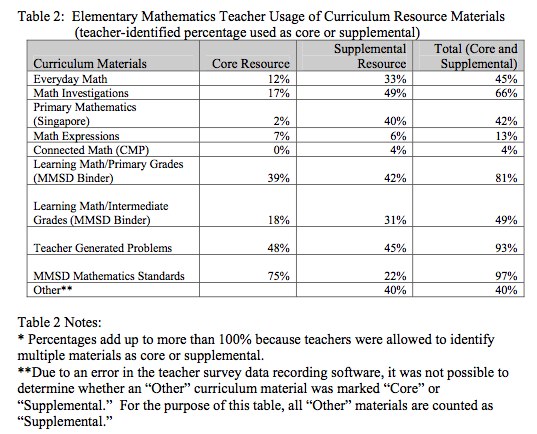 Newsletter signup | Send us your ideas
Superintendent Dan Nerad [184K PDF]:
Every two years the State of Wisconsin goes through a process to finalize a two year budget for all governmental programs. This biennial budget process is the source of the State's commitment to public education here in Wisconsin, historically driven by legislative guidance to adhere to two-thirds funding.
The two-thirds funding has changed over recent years, but for the most part the State of Wisconsin was able to continue annual increases to public education in an attempt to keep up with rising costs within this sector.The biennial budget was sigued into law near the end of June by Governor Jim Doyle after various proposals and with relatively few vetoes. This budget has numerous provisions that will effect the future of public education that include:
Each of these provisions can and Will have a very unique impact on :MMSD over the years to come. The repeal of the QEO will potentially impact future settlements for salaries and benefits. The decrease in funding for public education by the state is projected to create the need for a tax increase conversation in order to sustain current programs. The decrease in the revenue limit formula will cause MMSD to face more reductions in programs and services fur the next two years at a minimum.
- Repeal of the Qualified Economic Offer (QEO)
- Decrease in funding for public education by the state of approximately $147 million
- Decrease in the per pupil increase associated with revenue limits
Many public and private organizations are dealing with this issue. It is perhaps a time to make lemonade out of lemons. In the MMSD's case, getting out of the curriculum creation business (teaching & learning) and placing a renewed focus on hiring the most qualified teachers and letting them run.
Newsletter signup | Send us your ideas
Madison School Board 1.1MB PDF: 4) Curriculum Action Plan - Flexible Instruction (page 44)
Arlene Silveira Is "flexible Instruction" the latest term for differentiation or differentiated teaching/team teaching? If so, we have been doing this for a while in the district. Do we have any evaluation of how this is working?
Lucy Mathiak
Please define "flexible instruction (and in civilian terms vs. eduspeak, please).
Ed Hughes
To what extent, if at all, does the "flexible instruction" action plan contemplate less "pull out" instruction for special ed students?
Madison School District Administration's response:
Flexible instruction is similar to other terms, such as differentiation and universal design. All of these terms mean that teachers begin with explicit standards and/or curricular goals for a unit or course. Teachers then design multiple ways to teach and multiple learning experiences for students for all core standards and/or curricular goals. Flexible instruction is best planned in teams composed of regular education, special education, and ESL teachers so that many aspects of diverse learners, including options for students abovelbelow grade level, are addressed in the original design of lessons. In classrooms with flexible instruction, various groups of students can work together, share and leam from each other even when the different groups of students might be working on slightly different types of experiences.The last paragraph states "Although there is no explicit evaluation of how this is currently working" gets to the heart of curricular issues raised by a number of board members, parents and those discussed in the recent outbound parent survey.Although there is no explicit evaluation of how this is currently working, one of the highest priorities of teachers is the time to engage in this type of collaborative professional work.
This document is a must read for all public school stakeholders. It provides a detailed window into School Board governance and the current state of our public school Administration.
Related Links:
UPDATE: Lucy Mathiak posted her full set of questions here.
Newsletter signup | Send us your ideas
Newsletter signup | Send us your ideas
Newsletter signup | Send us your ideas
The service of school board members on district committees generally does not work well, a state education consultant told school officials yesterday during the Columbia Board of Education's retreat.But board members and administrators agreed that it has worked well for Columbia Public Schools.
"This district has moved this way, and it's had some successes," Superintendent Chris Belcher said.
David Lineberry is the associate executive director for education and training for the Missouri School Boards' Association. He presented to the school board yesterday afternoon during its three-hour retreat.
Lineberry and officials talked about the board's overall role, the school district's upcoming Comprehensive School Improvement Plan, or CSIP [PDF], and the role of board members on committees.
Newsletter signup | Send us your ideas
This memo is a summary of the results from the surveys completed during the past school year with various parent groups whose children reside within the MMSD attendance area but receive certain alternative education options. Also included are results of the survey conducted with non-residents who attend MMSD schools via the Open Enrollment program (Le., Open Enrollment Enter).This document will be discussed at Monday evening's Madison School Board meeting. UPDATE:
Background
Groups were surveys representing households whose students were enrolled in one of four different educational settings: MMSD resident students attending private/parochial schools, MMSD resident students attending other public schools via the Open Enrollment program, non-resident students attending MMSD schools via the Open Enrollment program, and MMSD resident students provided home based instruction.
The surveys were conducted between December 2008 and February 2009. The surveys were mailed to households or they could complete the survey online. Two mailings were conducted - the initial mailing to all households and a second to non-respondents as a reminder request. Total group sizes and responses are provided below.
Newsletter signup | Send us your ideas
In a vote preceded by outbursts from board members, the Montgomery County Board of Education on Wednesday selected Barbara Thompson as Montgomery's new superintendent.Thompson was formerly principal at Lapham Elementary in the Madison School District. The Montgromery School District, with 31,000 students, is nearly 1/3 larger than the Madison Schools.
The board voted 4-3 along racial lines to offer the job to Thompson, who currently serves as superintendent of New Glarus Public Schools in Wisconsin.
Black board members Mary Briers, Eleanor Dawkins, Robert Porterfield and Beverly Ross voted for Thompson. Voting against her were white members Charlotte Meadows, Heather Sellers and Melissa Snowden, who all wanted to continue the search process.
Thompson was the lone finalist for the job after Samantha Ingram, superintendent of Fairfield County Schools in South Carolina, withdrew on Monday.
Ross, chairwoman of the school board, said she called Thompson shortly after the vote and Thompson accepted the job.
"I am excited that she's excited about coming here," Ross said. "She was already talking about how to get our test scores up."
Thompson, in a phone interview from her house in Wisconsin, said she and the board in the next few days should begin working out the details of her contract, which include salary negotiations.
Newsletter signup | Send us your ideas
This is an interesting read (688K PDF).
RACE AND ACHIEVEMENT
Rigor Recommendation: Develop a clear, consistent operational/working definition of rigor to be used at ETHS.Supporting Detail:
- Communicate the definition of rigor to all ETHS stakeholders. (Means of communication to include, e.g., ETHS website/newsletters and displaying definition of rigor in every classroom and in other locations.)
- Ensure a common understanding of rigor by other means, including providing opportunities for all ETHS stakeholders to discuss and better understand the meaning of rigor and what it entails in different ETHS departments, the different expectations associated with rigor by different ETHS stakeholders, and the varying responsibilities of ETHS stakeholders to ensure that rigor is experience by students.
- Identify the components of a rigorous classroom and provide illustrations thereof for each ETHS department, including curriculum/assignments, instructional techniques, behavioral expectations, and classroom dynamics/interaction.
- Ensure that rigor is provided and experienced in ETHS classrooms by means of classroom observations conducted by outside experts andlor by other appropriate means.
- Create and utilize diagnostics to monitor/assess the extent to which rigor actually is being provided at ETHS, to enable teachers to improve the rigor of their classes, and to identify areas where other improvement(s) may be needed. Such diagnostics should include, e. g., assessments that teachers can use in their classrooms to evaluate students' experience of rigor and other questionnaires to be completed by students.
Newsletter signup | Send us your ideas
Via a kind reader's email:
Culturally Relevant/Cultural Relevance 40The free Adobe Reader includes a text search field. Simply open the proposed document (773K PDF) and start searching.Standards 24
Content 21
Measure (including measurement) 28
DPI 2
TAG 17
Special Education 8
ELL 2 (it comes up 45 times, but the other 43 were things like ZELLmer)
inclusion 0
differentiation 0
science 2
mathematics 0
literacy 4
reading 7 (of these, three were in the appendix with the existing 'plan')
African American 7
Hmong 1 (and not in any of the action plans)
Latino or Latina 0
Hispanic 0
Spanish speaking or Spanish speakers 0
Anyone see a problem here?????
The Proposed Strategic Plan, along with some comments, can be viewed here.
Interested readers might have a look at this Fall, 2005 Forum on Poverty organized by Rafael Gomez (audio/video). Former Madison School Board member Ray Allen participated. Ray mentioned that his daughter was repeatedly offered free breakfasts, even though she was fed at home prior to being dropped off at school. The event is worth checking out.
I had an opportunity to have lunch with Madison Superintendent Dan Nerad last summer. Prior to that meeting, I asked a number of teachers and principals what I should pass along. One of the comments I received is particularly relevant to Madison's proposed Strategic Plan:
Notes and links on Madison's Strategic Planning Process.I know these are general, but they are each so glaringly needy of our attention and problem solving efforts.
- Curriculum: greater rigor
- Discipline: a higher bar, much higher bar, consistent expectations district wide, a willingness to wrestle with the negative impact of poverty on the habits of mind of our students and favor pragmatic over ideological solutions
- Teacher inservice: at present these are insultingly infantile
- Leadership: attract smart principals that are more entrepreneurial and less bureaucratic, mindful of the superintendent's "inner circle" and their closeness to or distance from the front lines (the classrooms)
Newsletter signup | Send us your ideas
Monday evening's Madison School Board meeting included approval of another year of Infinite Campus along with (and this is quite important) a motion requiring that within six months, administration document use of IC and identify barriers to use where they exist, with the purpose of achieving 100% implementation by the end of 2012 or sooner.
Successful implementation of this student and parent information portal across all schools and teachers should be job one before any additional initiatives are attempted.
Newsletter signup | Send us your ideas
Watch the discussion here. I've not had a chance to watch or listen to this yet, but I plan to. Much more on Infinite Campus here.
Via a kind reader's email.
Newsletter signup | Send us your ideas
Madison Metropolitan School District, via an Ann Wilson email.
Attached to this e-mail is the Proposed Strategic Plan and a cover memorandum to the Board of Education. We invite all of you to the June 15 Special Board of Education meeting at 6:00 p.m. The Plan, along with a way to respond, is on the district's website (www.mmsd.org) on the home page, under Hot Topics. This is the direct link:Dan Nerad's memorandum to the Madison School Board [PDF] and the most recent revision of the Strategic Plan [PDF].http://drupal.madison.k12.wi.us/node/2246
Thanks to all of you for your hard work and willingness to participate.
Much more on the Madison School District's Strategic Planning Process here.
Newsletter signup | Send us your ideas
We passed the 2009-2010 Madison public school district budget last night. This was the second year in a row that we were able to reallocate to avoid ugly ugly cuts.
This was the first year that we moved to undo damage by reallocating money to put back beginning of the year "Ready Set Goal" parent-teacher conferences AND stop doubling up our art, music, gym, and computer classes through "class and a half." Both items were cuts from past years that were absolute disasters for elementary students.
We expect to receive the strategic planning report in June, and it will inform planning for the 2010-11 budget as we move forward this coming year. In the meantime, we are waiting to hear how the state budget will impact school finance. And we are continuing work to modernize and refine the ways that we work with resources to find additional ways to strengthen our schools.
Newsletter signup | Send us your ideas
44MB mp3 audio file. The April 30, 2009 meeting discussed:
Via a kind reader's email.
Newsletter signup | Send us your ideas
Moreover, parents of future West High students should take notice: As you read this, our department is under pressure from the administration and the math coordinator's office to phase out our "accelerated" course offerings beginning next year. Rather than addressing the problems of equity and closing the gap by identifying minority math talent earlier, and fostering minority participation in the accelerated programs, our administration wants to take the cheaper way out by forcing all kids into a one-size-fits-all curriculum.The fact the Madison's Teaching & Learning Department did not get what they want tonight is significant, perhaps the first time this has ever happened with respect to Math. I appreciate and am proud of the Madison School Board's willingness to consider and discuss these important issues. Each Board member offered comments on this matter including: Lucy Mathiak, who pointed out that it would be far less expensive to simply take courses at the UW-Madison (about 1000 for three credits plus books) than spend $150K annually in Teaching & Learning. Marj Passman noted that the Math Task Force report emphasized content knowledge improvement and that is where the focus should be while Maya Cole noted that teacher participation is voluntary. Voluntary participation is a problem, as we've seen with the deployment of an online grading and scheduling system for teachers, students and parents.
It seems the administration and our school board have re-defined "success" as merely producing "fewer failures." Astonishingly, excellence in student achievement is visited by some school district administrators with apathy at best, and with contempt at worst. But, while raising low achievers is a laudable goal, it is woefully short-sighted and, ironically, racist in the most insidious way. Somehow, limiting opportunities for excellence has become the definition of providing equity! Could there be a greater insult to the minority community?
Newsletter signup | Send us your ideas
Newsletter signup | Send us your ideas
Newsletter signup | Send us your ideas
The meeting, which will discuss math (TJ Mertz comments), non-SAGE schools and many other topics. The meeting begins at 6:00p.m.
O'Keeffe Middle School
510 South Thornton Ave. [Map]
Madison, WI 53703
Library Media Center
The meeting agenda can be found here.
Newsletter signup | Send us your ideas
To: comment@madison.k12.wi.us
Cc: askey@math.wisc.edu
There are a number of points in the Summary of Administrative Response to MMSD Mathematics Task Force Recommendations which should be made. As a mathematician, let me just comment on comments on Recommendation 11. There are other comments which could be made, but I have a limited amount of time at present.
The first question I have is in the first paragraph. "One aspect of the balanced approach is represented in the four block approach to structuring mathematics lessons. The four blocks include Problem Solving, Number Work, Fluency and Maintenance and Inspecting Equations." There is a missing comma, since it is not clear whether Maintenance goes with the previous word or the last two. However, in either case, "Inspecting Equations" is a strange phrase to use. I am not sure what it means, and when a mathematician who has read extensively in school mathematics does not understand a phrase, something is wrong. You might ask Brian Sniff, who seems to have written this report based on one comment he made at the Monday meeting, what he means by this.
In the next paragraph, there are the following statements about the math program used in MMSD. "The new edition [of Connected Math Project] includes a greater emphasis on practice problems similar to those in traditional middle and high school textbooks. The new edition still remains focused on problem-centered instruction that promotes deep conceptual understanding." First, I dislike inflated language. It usually is an illustration of a lack of knowledge. We cannot hope for "deep conceptual understanding", in school mathematics, and Connected Math falls far short of what we want students to learn and understand in many ways. There are many examples which could be given and a few are mentioned in a letter I sent to the chair of a committee which gave an award to two of the developers of Connected Mathematics Project. Much of my letter to Phil Daro is given below.
The final paragraph for Recommendation 11 deals with high school mathematics. When asked about the state standards, Brian Sniff remarked that they were being rewritten, but that the changes seem to be minimal. He is on the high school rewrite committee, and I hope he is incorrect about the changes since significant changes should be made. We now have a serious report from the National Mathematics Advisory Panel which was asked to report on algebra. In addition to comments on what is needed to prepare students for algebra, which should have an impact on both elementary and middle school mathematics, there is a good description of what algebra in high school should contain. Some of the books used in MMSD do not have the needed algebra. In addition, the National Council of Teachers of Mathematics has published Curriculum Focal Points for grades PK-8 which should be used for further details in these grades. Neither of these reports was mentioned in the response you were sent.
I have pointed out errors and omissions in Connected Mathematics and Discovering Advanced Algebra to Sniff, and suggested that teachers be informed about these problems and given suggestions for how to work around them. You might ask him what has been sent to teachers about rational numbers and repeating decimals in Connected Math and the geometric series in Discovering Advanced Algebra. I wrote the principal author of Connected Math about their treatment of repeating decimals in the first edition, in 2000 and 2002. Nothing was changed in the second version. It is still a very poor treatment. I will send separately a paper I gave at a meeting in Lisbon last November. It deals with the help teachers should be given, and how inadequate it frequently is.
The National Mathematics Advisory Panel recommended that the geometric series should be done in first year algebra, since it is not hard to derive the sum of a finite geometric series and it has many interesting applications. In Discovering Advanced Geometry, the sum of this series is stated but not derived. What understanding is this giving students?
There never has been a serious public discussion about the direction of mathematics education in the Madison Schools. There should be. There was a committee set up to report and the part which surprised me most was the survey of elementary school teachers, who reported that most of them did not use a textbook as a primary resource. Decades ago my daughter went through a year at Cherokee with a teacher developed program in math. It was a disaster. I wonder about the results mentioned in a Capital Times article on the charter school Nuestro Mundo. Here are the result on WKCE Third Grade tests.
Percentage scoring proficient or advanced in reading
| Total | White | Hispanic | |
| Nuestro Mundo | 70 | 74 | 46 |
| Madison School District | 72 | 88 | 47 |
Percentage scoring proficient or advanced in math
| Total | White | Hispanic | |
| Nuestro Mundo | 49 | 63 | 15 |
| Madison School District | 72 | 87 | 52 |
Both the reading and math tests were given in English. In every other study I have seen about schools like Nuestro Mundo, the math score relative to the district score is much closer than the reading score is to the district average. Does the math staff at MMSD have an explanation for this dramatic difference?
Here is most of my letter to Phil Daro mentioned above. If you have any questions about what I have written, please feel free to contact me. My phone number is 233-7900.
Richard Askey
Recently I read the announcement of the prizes awarded by ISDDE. The Connected Math award singled out two of their books. The 8th grade book, "Say It With Symbols", had the following written about it:
Say It With Symbols tackles the development of robust fluency in symbolic manipulation (always a high priority) by focusing on "making sense with symbols" at every stage. Work on interpreting symbolic expressions leads on to creating equivalent expressions and thus to sense-making solution of linear and quadratic equations, and to modeling.
Let us look at a little of this book. There is some work on factoring quadratics, but clearly not enough for students to become fluent with it. The quadratic formula is stated but not proven, nor is there a proof (much less a motivated one) in the Teacher's Guide. Completing the square is never mentioned. There are a couple of problems like the following: Page 51 in Second Edition. [I can give comments on the First Edition if that is what you used, but I am giving them a break and using the Second. It has been through even more use than the first, but still has a lot of flaws.]
44. You can write quadratic expressions in factored and expanded forms. Which form would you use for each of the following? Explain. c. To find the line of symmetry for a quadratic relationship Answer: The line of symmetry is a vertical line perpendicular to the x-axis through a point with an x-coordinate half way between the x-intercepts. The factored form can be used to find this point. How about the case when the factors are not real? y=x^2+2x+2. There is still a line of symmetry, but without complex numbers, which few will treat in eighth grade, factoring does not work. Of course one can make it work by subtracting a constant, but this is a book for students who are just learning algebra. Whenever the word "Explain" is used in a question, I look to see what the explanation is. There is no reason given for why half way between the intercepts gives the line of symmetry. A explanation can be given using either form, but the authors do not do this. I can give you many examples where the "Explain" answer in the Teacher's Guide is far from an explanation, and sometimes is wrong.
Part d asks how to find the coordinates of the maximum or minimum point for a quadratic relationship. Here completing the square is clearly the better method at this stage, if one is aiming for the very important goal of fluency in symbolic manipulation, but that is not their goal. They seemingly never make the vital step of changing variables in an expression. There were many places where this could have been introduced and then used to give mathematical closure at the level they deal with, but it is not there.
Let us skip to the end of this book. There is an introduction to tests for divisibility in problem 9 on page 77 and problem 10 on the same page for divisibility by 2 and 4. The answers in the Teacher's Guide are reasonable. Then in problem 41 the problem of divisibility by 3 is considered. The answer pulls out the idea of changing 100a + 10b + c to 99a + a + 9b + b + c and then writes this to get the usual criteria. What is missing is an explanation for why one does this. One looks for the closest numbers to 100 and to 10 which can be divided by 3, which mimics the argument in divisibility by 2 and 4. The teachers will not know this, nor know that this can be extended to divisibility by 11 by a similar argument, although unlike the case of 3 and 9, the step from 11 to 99 to 1001 is only easy for 11 and 99. Before seeing how this extends one cannot just divide 1001 by 11, but write 1001 as 990 + 11. This extends. This is what should be in the Teacher's Guide. One recommendation from the National Mathematics Advisory Panel is that instruction should not be either entirely "student-centered" or "teacher-directed". The problem should have been given with some explanation about how divisibility by 2, 4, and 5 works, and then after remarking that divisibility by 3 cannot come from just looking at the last digit, ask the students to figure out what the closest number to 10 is which is divisible by 3, and then the closest number to 100 which is divisible by 3, and to use this information to try to find a simple test for divisibility by 3.
Let us consider the last problem. Judy thinks she knows a quick way to square any number whose last digit is 5. (Example 25) Look at the digit to the left of 5. Multiply it by the number that is one greater than this number. (example 2*3=6) Write the product followed by 25. This is the square of the number. Try this squaring method on two other numbers that end in 5. Explain why this method works. [Explanation: Students may find it easiest to explain why this method works by forming an equation [sic] to represent the value of any number ending in five, such as (10x+5), where x can be any whole number. Then a student taking the square of this value they [sic] will get (10x+5)(10x+5)=100x^2+100x+25)=100. [The 100 is only part of what should be there. It should be 100x(x+1) + 25.] This equation represents Judy's method of finding the square. [The word "equation" is wrong. They mean "expression".]
If they are going to let x be any whole number, then Judy's method is wrong, since she said to look at the digit to the left of 5, and multiply it by the number that is one greater than this number. So 125^2 would be the same as 25^2, or with careless reading, the same as 2*13 with 25 appended. This is not symbolic fluency in the textbook.
The next to the last problem dealt with divisibility by 6, and the correct statement is given in the Teacher's Guide, but the argument pulls out heavy machinery in the form of the Fundamental Theorem of Algebra when it is not needed. However, the related problem of assuming that a number is divisible by 2 and by 4 (rather than 2 and 3) does not imply it is divisible by 8 is missing. That is a mistake since students at this age will often not see the difference.
I have yet to talk to a high school teacher who thought that students who have had Connected Mathematics Project are better at symbolic calculations than those they had had earlier before CMP was introduced. Some, but not all, say the students have better conceptual understanding. Thus I find it strange that fluency in symbolic skills is singled out as a strength of CMP. Have you read the books which were mentioned?
In other areas, such as geometry, CMP has few if any of the problems which are common in East Asian countries, to help students learn how to solve multistep problems, including quite a few nice problems where auxiliary lines need to be drawn. I have books from Nigeria which have better geometry problems than CMP does. You should know this if what I found on the web is correct, that you are helping develop a middle school program based on Japanese models. Instead of giving CMP an award, it would have been much better to have read the first edition carefully and made constructive suggestions about how to improve it. It needs a lot of improvement.
Newsletter signup | Send us your ideas
The Madison School District's strategic planning group will meet next week and review the work to date, summarized in these documents:
It is important to note that this work must be approved (and perhaps modified) by the school board, then, of course, implemented by the Administration.
Newsletter signup | Send us your ideas
Jim, thank you for posting the link to this fascinating set of rants on the MMSD school board. I STRONGLY suggest that people watch the committee meeting video that is available at: http://mediaprodweb.madison.k12.wi.us/Board+Meetings
Simply put, many of the critiques that Severson complains are not happening are in fact very much alive in school board debate, whether it comes to what needs to happen to improve the math curriculum to the reviews and changes in fiscal practice that are making it possible to close the spending gap without further trashing programs. I guess that Don was napping during the three meetings when the discussions were underway?
Or, I may be wrong. This may not be a manipulation of the truth for political purposes. You be the judge - watch the video - and see whether nothing is being done on significant issues as Severson asserts.
Newsletter signup | Send us your ideas
As noted in an earlier post, the school district presented data at Monday night's meeting on the effects of implementing a strategy of Positive Behavioral Interventions and Support (PBIS). As the report notes, "Documenting behavior referrals is inconsistent across middle schools both in terms of what is recorded and where it is recorded." While this makes it unwise to make comparisons across middle schools, as one school may refer students who are late to class while another only makes referrals as a consequence of fighting, it is valid to make comparisons across time within the same school in order to see what effect the implementation of PBIS has made on student behavior. Unfortunately, as readers of the report will observe, not even that data is consistently presented across the 11 middle schools where PBIS has been implemented. Some schools only have data for the current academic year, others only have data from February 2008 through February 2009, and others provide more.
While the behavioral scientist in me wants to comment on the parts of the report that are incomprehensible (the self-assessment survey schoolwide system analysis from each school) or redundant (providing charts that show time saved in both minutes, in hours, and in days), I will restrict my comments to the data that documents the effects of the implementation of PBIS. While there have been some impressive successes with PBIS, e.g., Sherman, there have also been failures, e.g., Toki. One interpretation would be that some schools have been successful implementing these strategies and we need to see what they are doing that has led to their success, another interpretation would be that PBIS has by and large failed and resulted in an increase in behavioral referrals across our middle schools. At this point, I'll take the middle ground and say that this new approach to dealing with student behavior hasn't made any difference. You can look at the table below and draw your own conclusions, Keep in mind though, as noted above, there is not consistency across schools in what sorts of behavioral problems get documented. It is also true that there is considerable variability in the absolute number of referrals across the 11 middle schools and across months, such that a 30% change in the number of behavioral referrals may reflect 45 referrals at Blackhawk, 10 referrals at Wright, and 170 referrals at Toki.
| Comparison Data Provided | Schools | Results: Change from 07/08 to 08/09* |
|---|---|---|
| None | Cherokee Jefferson Whitehorse |
|
| One month only (February) | Blackhawk |
30% decline (decrease of 40 referrals) |
| O'Keefe | 10% decline (decrease of 10 referrals) | |
| Spring Harbor | 35% increase (increase of 8 referrals) | |
| Wright | 20% increase (increase of 7 referrals) | |
| Six months (Sept. - Feb.) | Hamilton |
Declines in Sept. (20%), Nov. (20%) and Dec. (10%); Increases October (40%) and Jan. (20%); No change in February |
| Sennett | Increases every month ranging from 5% (Dec.) to 75% (Feb.), median increase in referrals - 20% |
|
| Toki | Increases every month ranging from 7% (Nov.) to 200% (Sept), median increase in referrals - 68% |
|
| Multiple years | Sherman | Decreases every month ranging from 30% (Feb.) to 70% (Oct., a drop of more than 250 referrals), median decrease in behavioral referrals - 42% |
Newsletter signup | Send us your ideas
The attached report provides information about the PBIS model and referral information from each of the middle schools.The report includes data from all Madison middle schools.The data for this report comes from both information that has been entered in to Infinite Campus and school based alternate data collection system, Documenting behavior referrals is inconsistent across middle schools both in terms of what is recorded and where it is recorded.
This is an issue we will address as we move forward,
Also included in the report is a variety of "tools" recommended for use by the PBIS network and examples of how these tools are being used in the schools, One of the tools included for each school is the Self-Assessment Survey School Wide System Analysis, Each staff member at an individual school has been given the opportunity to rate if they feel that various systems in their school are in place, A fully implementing school will have scores at 80% or above on all scales, This tool is used to assist schools in future planning, pointing out areas of need as well as strength,
Another tool included is "Tier Analysis", The goal is to have the following percentages represented at an individual school:
Tier 1 - Universal systems (students receiving 0-1 behavior referral, and needing only universal supports) = 80-90% of students
Tier 2 - Secondary systems (students receiving 2-5 behavioral referrals and needing some form of secondary intervention) = 5-10% of students
Tier 3 - Tertiary systems (students receiving 6+ behavioral referrals and needing some form of tertiary intervention) = 1-5 % of students
As schools reach high fidelity implementation levels at each tier, further training and support is provided at the following tier next more intensive tier.
Newsletter signup | Send us your ideas
Newsletter signup | Send us your ideas
via Laurel Cavalluzzo:
WHAT: Board of Education Candidate Forum
with Arlene Silveira Lucy Mathiak Donald GorsWHEN: April 4, 2009 10-noon
WHERE: Lakeview Public Library
2845 N Sherman Ave. [Map]
Madison, WI 53704 (608) 246-4547
Open to the publicLearn more about candidate's positions on issues important to our schools and our communities.
SPONSERED BY:
Lakewood Gardens Neighborhood Committee
WI Charter School Assn
Nuestro Mundo, Inc.
Newsletter signup | Send us your ideas
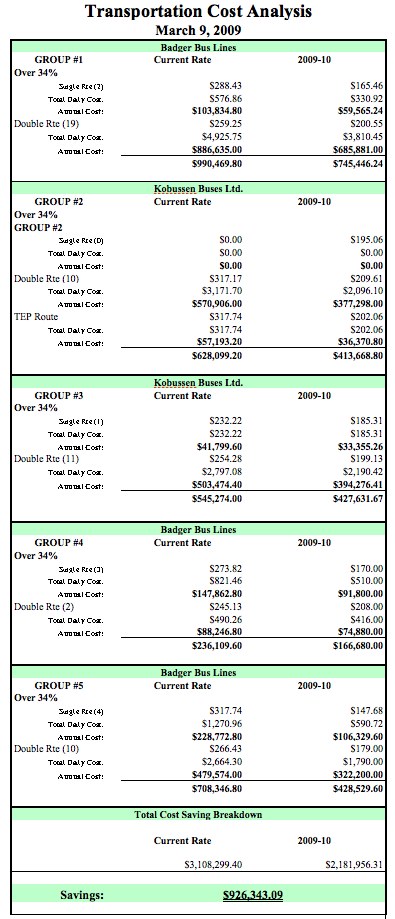
Thanks to Erik Kass for sending this along.
Newsletter signup | Send us your ideas
via MMSDTV. Much more on the proposed Middle School Spanish immersion charter school here.
Newsletter signup | Send us your ideas
Wisconsin State Journal Editorial, via a kind reader's email:
Madison needs to get past its outdated phobia of charter schools.I continue to believe that our community and schools would be better off with a far more diffused governance structure, particularly in the management of more than $415,699,322 (current 08/09 budget) for a 24,189 student district. Related: the failed Madison Studio Charter School application.Charter schools are not a threat to public schools here or anywhere else in Wisconsin. They are an exciting addition and asset to public schools -- a potential source of innovation, higher student achievement and millions in federal grants.
And when charter schools do succeed at something new, their formula for success can be replicated at traditional schools to help all students.
That's what's starting to happen in Madison with the success of a dual-language charter elementary school called Nuestro Mundo. Yet too many district officials, board members and the teachers union still view charters with needless suspicion.
Madison's skeptics should listen to President Barack Obama, who touts charter schools as key to engaging disadvantaged students who don't respond well to traditional school settings and curriculums. Obama has promised to double federal money for charter school grants.
But Madison school officials are ignoring this new pot of money and getting defensive, as if supporting charter schools might suggest that traditional schools can't innovate on their own.
Of course traditional schools can innovate. Yet charter schools have an easier time breaking from the mold in more dramatic ways because of their autonomy and high level of parent involvement.
Several School Board members last week spoke dismissively of a parent-driven plan to create a dual-language charter school within a portion of Sennett Middle School. Under the proposal, Nuestro Mundo would feed its bilingual students into a charter at Sennett starting in the fall of 2010.
Newsletter signup | Send us your ideas
1.2MB PDF File. This document includes responses from Madison School Board seat 1 candidates Arlene Silveira and Donald Gors, Seat 2 candidate Lucy Mathiak and a number of other local and statewide candidates for office in the upcoming April, 2009 election. Via a kind reader's email.
Newsletter signup | Send us your ideas
But there is controversy with 4K, and not just because of the cost. In other districts that have started programs, operators of private centers that stand to lose tuition dollars have emerged as opponents.Related: Marc Eisen on "Missed Opportunities for 4K and High School Redesign".That's unlikely to be true for Renee Zaman, director of Orchard Ridge Nursery School on Madison's west side, who said last week that her center would be in a good position to participate with a 4K program because they already teach 84 4-year-olds and because all of their early childhood teachers are state certified.
But Zaman also said she hopes that the district doesn't push a 4K program through too quickly. She is particularly worried that the curriculum might focus too heavily on academics.
One sticking point in past 4K discussions in Madison was concern from the teachers union, Madison Teachers Inc., that preschool teachers at off-site programming centers might not be employees of the school district.
But Nerad and MTI Executive Director John Matthews have had many discussions about 4K over the past several months, and Matthews said as long as no district teachers are displaced, he is in favor of the program.
Newsletter signup | Send us your ideas
Nineteen years ago, Jennifer Courter set out on a career path that has since provided her with a steady stream of lucrative, low-stress jobs. Now, her occupation -- mathematician -- has landed at the top spot on a new study ranking the best and worst jobs in the U.S.Related:"It's a lot more than just some boring subject that everybody has to take in school," says Ms. Courter, a research mathematician at mental images Inc., a maker of 3D-visualization software in San Francisco. "It's the science of problem-solving."
The study, to be released Tuesday from CareerCast.com, a new job site, evaluates 200 professions to determine the best and worst according to five criteria inherent to every job: environment, income, employment outlook, physical demands and stress. (CareerCast.com is published by Adicio Inc., in which Wall Street Journal owner News Corp. holds a minority stake.)
The findings were compiled by Les Krantz, author of "Jobs Rated Almanac," and are based on data from the U.S. Bureau of Labor Statistics and the Census Bureau, as well as studies from trade associations and Mr. Krantz's own expertise.
According to the study, mathematicians fared best in part because they typically work in favorable conditions -- indoors and in places free of toxic fumes or noise -- unlike those toward the bottom of the list like sewage-plant operator, painter and bricklayer. They also aren't expected to do any heavy lifting, crawling or crouching -- attributes associated with occupations such as firefighter, auto mechanic and plumber.
The study also considers pay, which was determined by measuring each job's median income and growth potential. Mathematicians' annual income was pegged at $94,160, but Ms. Courter, 38, says her salary exceeds that amount.
Newsletter signup | Send us your ideas
The major focus of our meetings in November was on aligning the work of the Board to the district's mission and research regarding effective school boards. The emerging literature regarding the role of school board governance in improving student achievement suggests that the manner in which the Board does its work can lead to positive student achievement results. Superintendent Nerad has provided us with great amount of research and experience to guide us in our discussions. An overview of some of our major changes is below. There are a lot of details behind each of the items listed below. If you have any questions, please let us know via email: comments@madison.k12.wi.us
Arlene Silveira (516-8981)
Committees: We voted to replace the existing committees with the committees listed below in order to create a greater focus on student achievement and the need for improved student achievement and related development outcomes for the district. The committees are structured along key governing lines. Each committee is composed of the board as a whole with co-chairs.
Student Achievement and Performance Monitoring: Focuses on the district's mission and will consist of matters related to factors leading to the improvement of student learning. Governance function: district's mission - work and related accountability for student learning. Co-chairs: Johnny Winston Jr., Maya Cole
Planning and Development: Focuses on ensuring effective planning related to the district's strategic plan, demographic planning, facility planning and budget planning. Governance function: planning for improved results. Co-chairs: Ed Hughes, Marj Passman
Operational Support: Focuses on financial management, building maintenance and operations, land purchase and district administrative operations, retention and hiring of staff and staff equity issues. Governance function: internal functions and ensuring quality business, finance and human resource systems. Co-chairs: Lucy Mathiak, Beth Moss
Engaging/Linking Stakeholders: We are expanding engagement practices with the goals of determining stakeholder perceptions about the district and educating members of the public to build public will and support.
6 Regular board meeting/year will be held in different schools. As part of the agenda, principals and staff will present learning data and their School Improvement Plan.
Each Board member will serve as a liaison to 7 schools to assist the Board in understanding the learning-related work in our schools.
The Board will schedule 4-6 meetings/year within the community to collect input from community stakeholders regarding "big" questions related to the district's strategic plan and/or educational programs/services.
Ensuring a Focus on Results and Accountability:
Data retreats: As part of the work of the Student Achievement and Performance Monitoring committee, 4 meetings/year will include a data presentation related to specific student achievement and student performance measures.
Program evaluation: As part of the Student Achievement and Performance Monitoring committee, a schedule of program evaluations will be identified and implemented.
Improvement benchmarks: When the district's strategic plan is completed. District level improvement benchmarks will be identified for each student based strategy within the plan.
Newsletter signup | Send us your ideas
In the aftermath of the successful Madison Metropolitan School District referendum, many critics and supporters agree on one thing: They were surprised with district voters' overwhelming approval of the operating referendum.Much more on the recent referendum here.Nearly 68 percent of voters favored the referendum, which will allow the district to exceed its tax limits by $5 million during the 2009-10 school year, then by an additional $4 million in each of the following two years. The total increase of $13 million will be permanent for every year after that.
The referendum won a majority in almost every ward in the district, but Superintendent Dan Nerad admitted afterward that he wasn't sure that the initiative would pass due to the tumultuous economy. District officials say the referendum will increase taxes for the owner of an average Madison home by $27.50 the first year, then $43 more the second year and an additional $21 in the third.
Newsletter signup | Send us your ideas
The Madison Metropolitan School District [724K PDF]:
The following document explores enrollment trends based on four different factors: intemal transfers, private school enrollments, inter-district Open Enrollment, and home based enrollments. The most current data is provided in each case. Not all data are from the current school year. Certain data are based on DPI reports and there are lags in the dates upon which reports are published.Summary
Most internal transfers within the MMSD are a function of two factors: programs not offered at each home school (e.g., ESL centers) and students moving between attendance areas and wishing to remain in the school they had been attending prior to the move. Notable schools in regard to transfers include Shorewood Elementary which has both a very high transfer in rate and a very low transfer out rate, Marquette which has a high transfer in rate, and Emerson which has a high transfer out rate.Based on data reported to the Department of Public Instruction (DPI), private school enrollments within the MMSD attendance area have held fairly steady for the past several years, with a slight increase in the most recent two years. The District's percentage of private school enrollment is roughly average among two separate benchmark cohort groups: the largest Wisconsin school districts and the Dane County school districts. Using data supplied annually to the MMSD by ten area private schools it appears that for the past three year period private school elementary enrollment is declining slightly, middle school enrollment is constant, and high school enrollment has been variable. Stephens, Midvale, Leopold, and Crestwood Elementary Schools, and Cherokee and Whitehorse Middle Schools have experienced declines in private school enrollment during this period. Hawthorne and Emerson Elementary Schools, Toki and (to a lesser extent) Sherman Middle Schools, and West and Memorial High Schools have experienced increases in private school enrollments. The East attendance area has very limited private school enrollment.
Home based education has remained very steady over the past six years based on data reported to the DPI. There is no discernible trend either upward or downward. Roughly 420 to 450 students residing within the MMSD area are reported as participating in home based instruction during this period. Like private school enrollment, the MMSD's percentage of home based enrollment is roughly average among two separate benchmark cohort groups: the largest Wisconsin school districts and the Dane County school districts.
Open Enrollment, which allows for parents to apply to enroll their Children in districts other than their home district, is by far the largest contributor to enrollment shifts relative to this list of factors. In 2008-09, there are now over 450 students leaving the MMSD to attend other districts compared with just under 170 students entering the MMSD. Transition grades appear to be critical decision points for parents. Certain schools are particularly affected by Open Enrollment decisions and these tend to be schools near locations within close proximity to surrounding school districts. Virtual school options do not appear to be increasing in popularity relative to physical school altematives.
Newsletter signup | Send us your ideas
Kurt Gutknecht, via a kind reader's email:
A temporary solution to concerns about Leopold Elementary School will be announced by June 2009, according to Daniel Nerad, superintendent of the Madison Metropolitan School District.Much more on Leopold here.Nerad, members of the school board and other officials held what Nerad called "an engagement session" at Leopold on Oct. 20. About 100 parents attended the session, part of what Nerad called an effort to find "a short-term solution to find a long-term solution."
But a show of hands after the meeting indicated most of those attending the session opposed the proposed short-term solution, which would involve transferring fifth graders to Cherokee and Wright middle schools.
"I'm confident it (the short-term solution) would work for two years," Nerad said.
Nerad conceded that the short-term plan would address crowding but not another concern of parents- the high proportion (68 percent) of low-income students at Leopold. The long-term plan would tackle that issue, he said.
Newsletter signup | Send us your ideas
REMINDER: The MMSD district is holding its second of four "Information Sessions" regarding the referendum tonight (Thursday, October 16), 6:30 pm, Jefferson Middle School. You are urged to attend.
The Madison Metropolitan School District seeks approval of the district taxpayers to permanently exceed the revenue cap for operations money by $13 million a year. In the meantime, to establish that new tax base over the next three years, a total of $27 million in more revenue will have been raised for programs and services. The district has also projected there will continue to be a 'gap' or shortfall of revenue to meet expenses of approximately $4 million per year after the next three years, thereby expecting to seek approval for additional spending authority.
Whereas, the Board of Education has staked the future of the district on increased spending to maintain current programs and services for a "high quality education;"
Whereas, student performance on the Wisconsin Knowledge and Concepts Exams has languished at the 7, 8, and 9 deciles (in comparison with the rest of the state's schools where 1 is the highest level and 10 is the lowest) in 4th, 8th and 10th grade reading, math, science, social studies and language arts exams for the past five years. The total percentage of MMSD students performing at either "proficient" or "advanced" levels (the two highest standards) has consistently ranged in mid 60%s to mid 70%s;
Whereas, the district Drop Out Rate of 2.7% (2006-07) was the highest since 1998-99. With the exception of two years with slight declines, the rate has risen steadily since 1999.
Whereas, the Attendance Rate for all students has remained basically steady since 1998-99 in a range from 95.2% (2005-06) to a high of 96.5% (2001-02);
Whereas, the district Truancy Rate of students habitually truant has risen again in the past three years to 6.0% in 2006-07. The truancy rate has ranged from 6.3% (1999-2000) to 4.4% in 2002-03;
Whereas, the district total PreK-12 enrollment has declined from 25,087 (2000-01) to its second lowest total of 24,540 (2008-09) since that time;
Whereas, the district annual budget has increased from approximately $183 million in 1994-1995 (the first year of revenue caps) to approximately $368 million (2008-09);
Whereas, the board explains the 'budget gap' between revenue and expenses as created by the difference between the state mandated Qualified Economic Offer of 3.8% minimum for salary and health benefits for professional teaching staff and the 2.2% average annual increases per student in the property tax levy. The district, however, has agreed with the teachers' union for an average 4.24% in annual increases since 2001;
Whereas, the district annual cost per pupil is the second highest in the state at $13,280 for the school year 2007-08;
The Madison Metropolitan School District seeks approval of the district taxpayers to permanently exceed the revenue cap for operations money by $13 million a year. In the meantime, to establish that new tax base over the next three years, a total of $27 million in more revenue will have been raised for programs and services. The district has also projected there will continue to be a 'gap' or shortfall of revenue to meet expenses of approximately $4 million per year after the next three years, thereby expecting to seek approval for additional spending authority.
Whereas, the Board of Education has staked the future of the district on increased spending to maintain current programs and services for a "high quality education;"
Whereas, student performance on the Wisconsin Knowledge and Concepts Exams has languished at the 7, 8, and 9 deciles (in comparison with the rest of the state's schools where 1 is the highest level and 10 is the lowest) in 4th, 8th and 10th grade reading, math, science, social studies and language arts exams for the past five years. The total percentage of MMSD students performing at either "proficient" or "advanced" levels (the two highest standards) has consistently ranged in mid 60%s to mid 70%s;
Whereas, the district Drop Out Rate of 2.7% (2006-07) was the highest since 1998-99. With the exception of two years with slight declines, the rate has risen steadily since 1999.
Whereas, the Attendance Rate for all students has remained basically steady since 1998-99 in a range from 95.2% (2005-06) to a high of 96.5% (2001-02);
Whereas, the district Truancy Rate of students habitually truant has risen again in the past three years to 6.0% in 2006-07. The truancy rate has ranged from 6.3% (1999-2000) to 4.4% in 2002-03;
Whereas, the district total PreK-12 enrollment has declined from 25,087 (2000-01) to its second lowest total of 24,540 (2008-09) since that time;
Whereas, the district annual budget has increased from approximately $183 million in 1994-1995 (the first year of revenue caps) to approximately $368 million (2008-09);
Whereas, the board explains the 'budget gap' between revenue and expenses as created by the difference between the state mandated Qualified Economic Offer of 3.8% minimum for salary and health benefits for professional teaching staff and the 2.2% average annual increases per student in the property tax levy. The district, however, has agreed with the teachers' union for an average 4.24% in annual increases since 2001;
Whereas, the district annual cost per pupil is the second highest in the state at $13,280 for the school year 2007-08;
Whereas, there has been a significant growth in the numbers of MMSD graduates who are required to take remedial math, English and writing courses at post secondary institutions of higher learning in order to enter regular, beginning level courses;
Whereas, the 2008 MMSD Math Task Force Report states that MMSD students are required to take less math than other urban schools in Wisconsin; and, there are notable differences in the achievement gap;
Whereas, there is district acknowledgement of a serious achievement gap between low-income and minority student groups compared with others. There are no plans evident for changing how new or existing money will be spent differently in order to have an impact on improving student learning/achievement and instructional effectiveness;
Whereas, there are no specific plans and strategies for changes in the response and reporting systems for safety, use of appropriate technology and for curriculum and services for helping students, staff, parents and the community develop shared responsibilities for safety and conflict resolution;
Whereas, there are no cost-sharing and collaborative initiatives taking place with city and county governments to reduce costs, minimize duplication of services and create better-defined roles and responsibilities;
Whereas, the district is not demonstrating full disclosure, accountability and transparency by providing data and information to show and verify criteria, assumptions, base lines, calculations and analyses for stated efficiencies, savings, past and current projects, cuts and reductions;
Whereas, the board will make budget cuts affecting programs and services, whether or not this referendum passes. The cuts will be made with no specific assessment/evaluation process or strategy for objective analyses of educational or business programs and services to determine the most effective and efficient use of money they already have, as well as for the additional spending authority they are asking with this referendum;
Whereas, there is a lack of a data-driven basis for the re-allocation of existing funds, as well as for the allocation of new funds to programs and services for the greater benefit of all students; therefore, all students are in harms way and are impeded in their academic achievement and personal development;
THEREFORE, THE question is: "Why authorize more spending for the same programs, services and personnel which are NOT attaining desirable results with cost efficient and benefit effective performance?
Active Citizens for Education
www.activecitizensforeducation.org
Don Severson, President
608 577-0851 infor@activecitizensforeducation.org
Newsletter signup | Send us your ideas
Taxpayers got a chance to ask the questions Tuesday night about the upcoming multimillion dollar Madison school referendum.Tamira Madsen:More than a dozen people turned out to Sherman Middle School for the first of four public hearings across the city.
Superintendent Dan Nerad gave a brief presentation before opening the forum up for questions.
Voters questioned everything from Fund 80 to the Capital Expansion Fund and student achievement.
Active Citizens for Education said they would like to have seen the referendum scheduled for the spring in order to give the district time to re-evaluate programs that they say are not working - programs that could be cut or changed.
"Where they're talking about maintaining current programs and services it's not getting good results," said ACE's Don Severson. "You look at the achievement gap, look at increased truancy, look an an increased drop-out rate, decreased attendance rates, more money isn't going to get different results."
Referendum supporters, Communities And Schools Together, know the $13 million referendum will be a tough sell, but worth it.
"I think it is going to be a hard sell," said CAST member and first-grade teacher Troy Dassler. "We really need to get people out there who are interested still in investing in infrastructure. I can think of no greater an investment -- even in the most difficult tough times that we're facing that we wouldn't invest in the future of Madison."
School Board President Arlene Silveira was pleased with the dialogue and questions asked at the forum and said she hasn't been overwhelmed with questions from constituents about the referendum."It's been fairly quiet, and I think it's been overshadowed by the presidential election and (downturn with) the economy," Silveira said. "People are very interested, but it does take an explanation.
"People ask a lot of questions just because it's different (with the tax components). Their initial reaction is: Tell me what this is again and what this means? They realize a lot of thought and work has gone into this and certainly this is something they will support or consider supporting after they go back and look at their own personal needs."
Superintendent Dan Nerad has already formulated a plan for program and service cuts in the 2009-2010 budget if voters do not pass the referendum. Those include increasing class sizes at elementary and high schools, trimming services for at-risk students, reducing high school support staff, decreasing special education staffing, and eliminating some maintenance projects.
Nerad said outlining potential budget cuts by general categories as opposed to specific programs was the best route for the district at this juncture.
Newsletter signup | Send us your ideas
Dear Superintendent Nerad:
I was rather surprised to learn today from the Wisconsin State Journal that:
"The district and the union also have quarreled over the role of MTI members in online learning for seven years. Under the new agreement, ANY (my emphasis) instruction of district students will be supervised by Madison teachers. The deal doesn't change existing practice but confirms that that practice will continue."
You are quite new to the MMSD. I am EXTREMELY disappointed that you would "cave in" to MTI regarding a long-standing quarrel it has had with the MMSD without first taking the time to get input from ALL affected parties, i.e., students and their parents as well as teachers who might not agree with Matthews on this issue. Does this agreement deal only with online learning or ALL non-MMSD courses (e.g., correspondence ones done by mail; UW and MATC courses not taken via the YOP)? Given we have been waiting 7 years to resolve this issue, there was clearly no urgent need for you to do so this rapidly and so soon after coming on board. The reality is that it is an outright LIE that the deal you just struck with MTI is not a change from the practice that existed 7 years ago when MTI first demanded a change in unofficial policy. I have copies of student transcripts that can unequivocally PROVE that some MMSD students used to be able to receive high school credit for courses they took elsewhere even when the MMSD offered a comparable course. These courses include high school biology and history courses taken via UW-Extension, high school chemistry taken via Northwestern University's Center for Talent Development, and mathematics, computer science, and history courses taken at UW-Madison outside of the YOP. One of these transcripts shows credit for a course taken as recently as fall, 2005; without this particular 1/2 course credit, this student would have been lacking a course in modern US history, a requirement for a high school diploma from the State of Wisconsin.
The MMSD BOE was well aware that they had never written and approved a clear policy regarding this matter, leaving each school in the district deciding for themselves whether or not to approve for credit non-MMSD courses. They were well aware that Madison West HAD been giving many students credit in the past for non-MMSD courses. The fact is that the BOE voted in January, 2007 to "freeze" policy at whatever each school had been doing until such time as they approved an official policy. Rainwater then chose to ignore this official vote of the BOE, telling the guidance departments to stop giving students credit for such courses regardless of whether they had in the past. The fact is that the BOE was in the process of working to create a uniform policy regarding non-MMSD courses last spring. As an employee of the BOE, you should not have signed an agreement with MTI until AFTER the BOE had determined official MMSD policy on this topic. By doing so, you pre-empted the process.
There exist dozens of students per year in the MMSD whose academic needs are not adequately met to the courses currently offered by MTI teachers, including through the District's online offerings. These include students with a wide variety of disabilities, medical problems, and other types of special needs as well as academically gifted ones. By taking appropriate online and correspondence courses and non-MMSD courses they can physically access within Madison, these students can work at their own pace or in their own way or at an accessible location that enables them to succeed. "Success for all" must include these students as well. Your deal with MTI will result in dozens of students per year dropping out of school, failing to graduate, or transferring to other schools or school districts that are more willing to better meet their "special" individual needs.
Your rush to resolve this issue sends a VERY bad message to many families in the MMSD. We were hoping you might be different from Rainwater. Unfortunately, it says to them that you don't really care what they think. It says to them that the demands of Matthews take primarily over the needs of their children. Does the MMSD exist for Matthews or for the children of this District? As you yourself said, the MMSD is at a "tipping point", with there currently being almost 50% "free and reduced lunch" students. Families were waiting and hoping that you might be different. As they learn that you are not based upon your actions, the exodus of middle class families from the MMSD's public schools will only accelerate. It will be on your watch as superintendent that the MMSD irreversibly turns into yet another troubled inner city school district. I urge you to take the time to learn more about the MMSD, including getting input from all interested parties, before you act in the future.
VERY disappointingly yours,
Janet Mertz
parent of 2 Madison West graduates
"Tuesday's agreement also will implement a measure that requires a licensed teacher from the bargaining unit supervise virtual/online classes within the district. The district and union have bickered on-and-off for nearly seven years over the virtual/online education issue. Matthews said the district was violating the collective bargaining contract with development of its virtual school learning program that offered online courses taught by teachers who are not members of MTI.In the agreement announced Tuesday, there were no program changes made to the current virtual/online curriculum, but requirements outlined in the agreement assure that classes are supervised by district teachers.
During the 2007-08 school year, there were 10 district students and 40 students from across the state who took MMSD online courses.
Though Nerad has been on the job for less than three months, Matthews said he is pleased with his initial dealings and working relationship with the new superintendent.
"This is that foundation we need," Matthews said. "There was a lot of trust level that was built up here and a lot of learning of each other's personalities, style and philosophy. All those things are important.
"It's going to be good for the entire school district if we're able to do this kind of thing, and we're already talking about what's next."
Newsletter signup | Send us your ideas

25MB mp3 audio file from the September 8, 2008 meeting.
Links:
Complete 3.9MB PDF Report Newsletter signup | Send us your ideas
Mitch Henck discusses Monday evening's Madison School Board 7-0 vote to proceed with a recurring referendum this November. 19 minutes into this 15mb mp3. Topics include: property taxes, uncontested elections, health care costs, concessions before negotiations and local control. Via a kind reader's email.
Newsletter signup | Send us your ideas
One of the biggest differences between Nerad and Rainwater, according to School Board members, is that Nerad provides the board with more information about what's happening in the district. Silveira said Nerad's weekly memos help board members feel engaged, and she's hopeful that after the current financial questions are settled, the board can turn its focus to improving student achievement.Notes and links on Dan Nerad, the planned November, 2008 referendum and Active Citizens for Education Memo: Taxpayers should NOT be asked to give the Madison School Board a blank check!.Mathiak said she was thrilled last week after hearing Nerad's plan. "I think there is a honeymoon period and I think we're still in it."
Winston said after watching Nerad at work, "I'm convinced we made the right choice. I think he's here for the long haul, too."
Newsletter signup | Send us your ideas
Active Citizens for Education (ACE) calls for the Madison Metropolitan School District Board of Education to delay making specific decisions for the presentation of a recurring referendum to the taxpayers for a vote on the November election ballot.
Passage of a recurring referendum on the November 2008 ballot would allow the board and school administration to permanently exceed the state mandated revenue spending caps. Such a move to fix a so-called current "budget gap" would allow the board and administration to exceed annual spending caps permanently, every year into the future. This would virtually give the board a "blank check" from district taxpayers to plug future budget gaps or shortfalls. It could prevent the board and administration from having to carefully and thoughtfully budget, like every taxpayer must do when their household budget faces tough economic times and shortfalls.
The plans and communications presented in recent weeks by the board and administration provide greater hope for more effective decision-making now and in the future. The recommendations for changes in policy and accountability options in community services, transportation, lease contracts, fund balances and capital expansion (maintenance) will have positive impacts on reducing the so-called "budget gap."
The Board must earn the trust of the taxpayers by clearly showing that they can be "good stewards" of taxpayer dollars. Past experience has not earned that trust! If a referendum is ultimately required to fix upcoming budgets, it should be a non-recurring referendum, thereby preventing 'mortgaging' the future with year-after-year, permanent increases in spending authority.
The Board and administration must correct the absence of specific processes and strategies for analysis and evaluation of business and educational services, programs, practices and policies. Urgent and substantial investments of time and work are critical for these processes to evolve into hard evidence. This evidence is absolutely necessary to show the public that serious steps are under way to provide clear, concrete data and options for identifying the most effective and efficient results-oriented management of the financial resources of the district. It must be shown that the resources will be directly applied to improvements in student learning and achievement.
In order for the public to support any change in spending habits or spending authority the district must meet the following conditions: a) full disclosure and accountability in the reporting of methodologies, data measurements, analyses and results in spending and the effective use of existing funding levels; b) assure that the shifting of funds is done on the basis of evaluations and assessments; c) changes are put in place to affect improvements in curriculum and instruction which directly increase student achievement and development at all levels; d) make the schools and the educational climate safe and secure for all students and staff; and e) engage in collaborative and cost-sharing initiatives with other government entities, as well as private and non-profit organizations.
Don Severson, President of ACE, said in a statement "When realistic evidence of progress toward these conditions is shown, then Active Citizens for Education and the general public will actively and willingly support the district with appropriate financial means. Anything short of meeting these conditions will not be in the best interests of our children and the community."
The school board and administration must continue to work to improve their communications and evaluation processes to gain the trust and confidence of the public for both short-and long-term successes. The district board is urged to proceed carefully and firmly in a strategic and progressive manner. A decision, at this time, by the board to request taxpayer support for a recurring referendum on the November 2008 ballot would be significantly premature and disastrous.
Questions raised at the Madison School District's Financial Forums
Please send your own comments, concerns and/or convictions to all board members and superintenent at comments@madison.k12.wi.us or to selected ones of your choice.
Newsletter signup | Send us your ideas
I have appreciated having the opportunity to talk about our schools with you and value your insights, so I wanted to let you know where matters stand on the possibility of a school spending referendum on the November ballot.
As you probably know, Superintendent Dan Nerad submitted his recommendations to the Board at a School Board meeting Monday night (1MB PDF, 3 year financial forecast PDF). In summary, the structural deficit the school funding law imposes on districts as well as increased fixed costs result in a projected budget deficit of $8.1 million for the 2009-2010 school year, $4.4 million for the 2010-2011 school year, and $4.3 million for the 2011-2012 school year, calculated on a same-service basis.
To meet these gaps, the superintendent recommends that the Board approve a referendum asking the voters to authorize the district to exceed our spending limits by $5 million next year, and $4 million in each of the following two years. This would be a recurring referendum, meaning that the authorization for the increased spending in the specified amounts would continue indefinitely.
The amount of extra spending authority we would seek is less than the projected budget gaps. The idea is that this a shared-sacrifice sort of proposal - we would be asking the community to permit us to erase some of the gap through additional taxes while we pledge to address the remainder through seeking out savings and efficiencies that will not have a detrimental impact on classroom learning. As is probably apparent, the referendum is not designed to allow us to restore in a significant way any of the painful cuts we have made in previous years.
Budget information for the district has historically been confusing. We're working on greater clarity and transparency in our budget information. I have some questions about our numbers that I'm in the process of trying to get clarified. Part of the confusion derives from the fact that the budget is arranged in a number of separate funds that are defined by DPI. The principal category of spending for our purposes is Fund 10. For the upcoming school year, we are projecting Fund 10 expenditures of about $306 million. For the following year, the one that shows the $8.1 million shortfall, we foresee expenditures of about $318 million, or a 3.78% increase.
With the Qualified Economic Offer, salaries and benefits for teachers are, as a practical matter, required to go up at least 3.8% per year. Our total projected increase for next year for salary and benefits is 3.88%. The rest of the Fund 10 budget, a little under $100 million, increases 3.55% from this year. (By comparison, the consumer price index has increased 5.6% since July of 2007.) This budget does not include any significant new initiatives.
Turning to the revenues side of the ledger, the category of interest here is the tax levy. This is what our community has to cough up to pay for our schools, and it represents the difference between our expenditures and our other sources of revenue, including state and federal aid and grant money. The portion of the tax levy that is attributable to Fund 10 expense is governed by the spending cap that state law imposes.
The total tax levy for the current year is about $226 million. Under the superintendent's plan, if the referendum passes, the total levy for next year would be $237 million, an increase of 5.07%.
If total expenditures are increasing less than 4%, why is the tax levy projected to increase 5.07%? There are a couple of reasons. First, we are unable to project that increases in other sources of funding will keep pace with our increasing level of expenditures. Indeed, we do not project any increase in state or federal aid. Second, the tax levy increase was moderated this year by the one-time injection of about $4.1 million in TIF funds. Had these funds not been received, then the tax levy would have had to increase this year (presumably through a referendum) in order to support this year's level of spending. The 5.07% increase in the tax levy for next year is thus partially the result of starting from an artificially low base.
A final consideration is the mill rate. This is the amount applied against the assessed value of a taxpayer's property to arrive at the amount in taxes that is levied. As the total value of property in our community increases, the mill rate goes down, all things equal. Under the superintendent's plan, the mill rate increases from this year's $9.92 to next year's $10.03 (an increase of about 1%) and then is projected to decrease the next two years, to $9.59 and $9.29. So if one owns a house with an assessed value of $300,000, and the assessment remains the same next year, the amount that taxpayer would pay for schools would rise from $2,976 this year to $3,009 next year, and would decrease in the following two years if one is willing to entertain the unlikely assumption that the assessed value of the house would remain the same over the relevant years.
This analysis assumes that the referendum passes. If the referendum fails, then we will be obligated once more to hack away at the budget and attempt to find cuts that do the least amount of damage to classroom learning.
There are many reasons to want to avoid this. As past experience has shown, it is a divisive and painful exercise for the community. It requires that the Board devote much time and attention to the budget-cutting process - time that could be better used by the Board to work on strategies for improving student learning. Some of the decisions that have resulted from this typically-rushed process have later appeared to be short-sighted or misguided. And, most importantly, the cuts diminish the quality of the education we are able to provide to our students. There are no easy cuts left. If we are compelled to continue to slash away year after year, we will soon be at a point where we will be unable to provide the quality of education that our community wants and expects.
If the referendum passes, we will have breathing room. We should have three years when the specter of budget cuts is not hanging over our heads. This will enable the Board and the new administration to put into place the process we currently contemplate for reviewing our strategic priorities, establishing strategies and benchmarks, and aligning our resources.
Superintendent Nerad has described a proposal that contemplates a broad-based strategic planning process that will kick off during the second semester of the upcoming school year. This process will be designed to identify the community's priorities for our schools, priorities that I expect will reflect a concentrated focus on enhancing student achievement. Once we have identified our priorities and promising strategies for achieving them, we'll likely turn to examining how well our organization is aligned toward pursuing our goals. This will likely be the point at which we take a long, hard look at our administrative structure and see if we can arrange our resources more efficiently.
It will take a while - certainly more than a year - for us to undertake this sweeping kind of review of our programs and spending in a careful, collaborative and deliberative way. If we do go to referendum, and the voters authorize the increased spending authority we seek, then the obligation will pass to the Board and administration to demonstrate that the community's vote of confidence was well placed. There will be much for us to do and it will be fair to judge our performance on how well we take advantage of the opportunity the community will have given us.
These are my initial thoughts. As you can probably tell, I am sympathetic to the approach the superintendent proposes and I am inclined to support his recommendation. However, we did just receive the recommendations Monday night, and I may well be confused about a few of these points. But since we will vote on a referendum next Monday, I wanted to get this summary to you as soon as possible. If you have thoughts or questions, I'd appreciate it if you could share them with me.
Ed
Ed Hughes
2226 Lakeland Avenue
Madison WI 53704
(608) 241-4854
Newsletter signup | Send us your ideas
Download or listen to this 15MB mp3 audio file.
Related:
In 1993, three pieces of legislation were enacted by the State of Wisconsin directly affecting school districts throughout the state. These pieces of legislation created revenue limits, created the state's commitment to two·thirds funding, and created the qualified economic offer (QEO) in Wisconsin. Since 1993 revenue limits in Wisconsin have allowed the Madison Metropolitan School District to increase revenues annually by 2.2% on average. Conversely the QEO requires school boards to offer a comprehensive salary and benefit package to certified teaching staff of not less than 3.8% annually to avoid binding arbitration. Recognizing that the Madison Metropolitan School District's budget is comprised of 84% salary and benefits, it must be recognized that while our revenues increase annually by 2.2%, the largest portion of our budget is mandated to minimally increase by 3.8%. Due to these competing pieces of legislation, the Board of Education since 1993 has reduced program and services by over $60 million to comply with state mandated revenue limits, of which $35 million has occurred within the past five years.Nerad also posted a 3 year financial forecast (250K PDF)Since the 1992·93 School Year the Madison Metropolitan School District has increased the total tax levy by $74,944,431 through the projected 2008·09 property tax levy. This amounts to an average annual increase of 2.56% since the 1992·93 School Year (see Attachment A). During that same time frame from 1992·93 through the projections for the 2008·09 property tax rate, the Madison Metropolitan School District has decreased the total tax rate from $20.69 to a projected rate of $9.92 for the 2008·09 School Year (see Attachment B).
Newsletter signup | Send us your ideas
Nerad told school board members on Monday night that he's recommending a three-year recurring referendum.Andy Hall:
It's part of what he called a partnership plan to address the budget shortfall.The plan would put a referendum on the November ballot for $5 million and would ask voters for $4 million in the two following years.
Nerad said to make up the remaining $3 million gap the district would move $2 million from the district's fund balance, eliminate $600,000 in unallocated staff, which are positions set aside in case of additional enrollment, and make up the remaining $400,000 through other reductions, which he has not yet named.
"We're working both sides of this and in the end our kids need things from us, our taxpayers need us to be sensitive and all I can say is we tried every step of putting these recommendations together to be responsive on both fronts," said Nerad.
The measure, a "recurring referendum," would give the district permission to build on the previous year's spending limit increase by additional amounts of $4 million in 2010-11 and another $4 million in 2011-12. The measure would permit a total increase of $13 million -- a change that would be permanent, unlike the impact of some other referendums that end after a specified period.Tamira Madsen:Approval of the referendum would cost the owner of a home with an assessed value of $250,000 an estimated $27.50 in additional taxes in the 2009-10 school year. That represents an increase of 1.1 percent of the School District's portion of the tax bill.
But for at least the next two years, the schools' portion of that homeowner's tax bill would decline even if the referendum is approved, under the plan developed by Nerad and Erik Kass, assistant superintendent for business services.
They estimate the tax bill for 2010-11 would be $27.50 lower than it is now, and the bill the following year would be about $100 below its current level if voters back the referendum and the School Board implements proposed changes in accounting measures.
In the first year, the referendum would add an additional $27.50 onto the tax bill of a $250,000 home. Another initiative in Nerad's recommendation, drawn up along with Assistant Superintendent of Business Services Erik Kass, is to enact changes to help mitigate the tax impact of the referendum. Nerad and Kass said these changes would decrease taxes for homeowners in the second and third year of the referendum.Links:One aspect of the proposal would return $2 million of an equity to the taxpayers in the form of a reduced levy in the Community Services Fund (Fund 80) for the 2009-10 school year. The second part of the tax impact referendum would be implementation of a Capital Expansion Fund, called Fund 41, in an effort to levy a property tax under revenue limits to spread the costs of facility maintenance projects over a longer period.
Nerad said the referendum process has been a deliberative process, and he's been cognizant of weighing board members and community questions.
Newsletter signup | Send us your ideas
We begin the presentation by focusing on why is there a problem. And we wanna first and foremost point out that the issues affecting this school district are issues that are also occurring in other school districts in the state. While there may be some circumstances, and there are circumstances that are unique to one place or another, we know that this funding dilemma and the gap that exists between what the current state funding formula provides and how expenses are being dealt with in school district is not unique to this school district. Although we have our story here that is certainly unique. And again I want to emphasize that it really lies at the heart of it is the constraint between the current formula that was put into place in 1993 which basically asserted that the state provide more resources to schools through the two thirds funding if, in turn, school districts would control their costs in two ways. One was through the revenue cap and the second was through the qualified economic offer. And so that was the kind of exchange or the quid pro quo that was made at that time in public policy; to be able to provide more state funding for schools at the same time to place limitations on how much a school district could spend.Related:In the document we point out examples of this dilemma as it is affecting some of the top ten school districts in the state. Ranging in, for example Waukesha school district of 2.6 million dollar program and service reduction for the 08/09 school year. The district that I am most recently familiar with, Greenbay with a 6.5 million program and service reduction. And just to point out the difference we mentioned we seen there, we use a wording increase revenue authority that represents their gap but that's also, its described that way because of having more authority through a successfully passed referendum to exceed the revenue cap within that community. So that is what's meant by an increase revenue of authority.
Now the funding formula is one that school districts across the state are wrestling with. You know the history that this school district has had in terms of the types of decisions that have been made which we are going to underscore in just a minute to accommodate that funding formula but as I turn this over to Eric for the bulk of the rest of the presentation, I'll conclude its all with the idea yes there is a need to have school funded but its around the assertion that our kids have to have a high quality education to be successful in the world that they are growing into. And yes we do have a fiscal responsibility to use community resources in the most cost effective manner and the reality of it is there are constraints in meeting that proposition. So with that, and I will return for the conclusion, I'll turn it to Eric who will provide us with more detail of the nature of the problem.
Newsletter signup | Send us your ideas
Thank you for engaging the community in such a meaningful way with the forums this week. I believe the forums were successful in that the participating citizens had the opportunity to openly ask questions, seek information and give suggestions for consideration. The information provided by Dan and Erik was clear and helpful. We believe, that with the actions of the board and administration in recent weeks, there is a new openness, a willingness for exercising greater due-diligence, and an openness to examine more fully the opportunities and challenges with fresh insights and strategies.
There is a challenging road ahead with very heavy lifting to be done to continue to more fully communicate with and engage the public in the decision-making process regarding the future of the district in the educational, business and financial elements. These processes are absolutely critical to charting the course toward more effectivenss in student achievement results and business management. At this point in time, the plans and communications provide greater hope for more effective decision-making. However, time is critical for these processes to evolve with hard evidence to show the public that serious steps are actually underway and are producing information and results in order to provide for clearer future options and enlightened decision-making.
Given the critical values briefly outlined above, it is premature at this time to make recommendations or decisions on a course or courses of action to seek more spending authority as a solution regarding the financial needs of the district. The groundwork for decision-making and the development of improved levels of public confidence in the Board and administration have to continue to be proactively matured for both short- and long-term successes in the district. We urge you to proceed carefully, firmly and in a strategic and progressive manner.
I am available and willing at any time to engage in discussion regarding these statements and recommendations.
Sincerely,
Don Severson
President
Active Citizens for Education
577-0851
Newsletter signup | Send us your ideas
On Aug. 18 Nerad will present his recommendations to the board on whether a referendum is the way to trim an $8.2 million hole in the budget, and the board likely will vote Aug. 25 to formulate referendum questions for the Nov. 4 election. In addition, the gap is expected to be $6 million in the 2010-11 school year and $5.1 million in 2011-12.Andy Hall:Since a state-imposed revenue formula was implemented in 1993 to control property taxes, the district has cut $60 million in programs, staffing and services. The district did not have to make budget reductions during the 2008-09 school year after it benefited from a one-time, $5.7 million tax incremental financing district windfall from the city. The district will spend approximately $367.6 million during the 2008-09 school year, an increase of about 0.75 percent over the 2007-08 school year budget.
In addition to exploring reductions, Madison officials are researching how much it would cost to begin offering kindergarten to 4-year-olds in the district — a program offered by two-thirds of the school districts in Wisconsin.Much more on the budget here.Resident William Rowe, a retired educator, urged school officials to generate excitement by offering 4K, which research has shown can help improve academic achievement.
"I believe this is the time to go for it," said Rowe, who proposed that a 4K referendum be offered separately from a referendum that would help avert budget cuts.
Don Severson, president of Active Citizens for Education, a district watchdog group, praised district officials for making the process so open to the public. However, he urged officials to provide more information about the costs and benefits of specific programs to help the public understand what's working and what's not. He predicted a referendum is "going to be very difficult to pass" but said he still hasn't decided whether one is needed.
Newsletter signup | Send us your ideas
There was an interesting discussion that unfortunately received no publicity during the March 24, 2008 school board meeting regarding proposed Sprecher Road [map] seven figure infrastructure costs (this spending would, perhaps have begun the process of constructing a new east side school). The Board voted 3-3 (Yes: Carstensen, Moss and Silveira; No: Cole, Kobza and Mathiak with Winston absent), which resulted in a no on these costs. Watch the video here. It would seem ill advised to begin borrowing money for a new school given the ongoing budget challenges. Last spring's downtown school closing unpleasantness is another factor to consider with respect to potential new edge schools.
Newsletter signup | Send us your ideas
MMSD Legal Services; 18 Page 758K PDF
On January 8, 2007, the Board took the following action:Background audio, video and documents are available here. The School Board's Performance & Achievement Committee meets today @ 5:00p.m to discuss this memorandum. [Directions & Map] Attend the meeting and send your thoughts to: comments@madison.k12.wi.uslt is recommended that the Board direct the Administration to: 1) freeze new procedures or guidelines for credit towards graduation for courses taken outside the MMSD until the Administration reports to the Board about whether current MMSD policies need to be updated or changed in view of any technological changes in the law and other opportunities; 2) develop a proposal on either the implementation and communication of the policies and procedures to parents and students for consistency across the District at the levels affected; and 3) have the Administration give the Board the pros and cons of adopting a policy like the one proposed by Dr. Mertz as a draft proposal. It is further recommended that the Administration review all nine of the policies, including the proposed "Guidelines for Coursework Outside the MMSD'" for possible revision, consolidation, or propose a newly created policy.
Attached is Exhibit 1, an amended draft of the policy previously submitted to the Board in a memo from Pamela Nash dated May 4, 2007. The amendments modify the timing of a student's appiication to take courses outside the MMSD and the response time of the District. This time frame is modeled after the Youth Options time frame.
Also attached to this Memorandum is a copy of a policy proposal previously submitted by Dr. Janet Mertz, Exhibit 2A, and the District's analysis of that proposal,
Exhibits 2 and 2B. These documents were also submitted to the Board of Education under cover of Dr. Nash's memo of May 4, 2007. This matter is scheduled to be heard before the Performance and Achievement Committee on February 25, 2008.
Newsletter signup | Send us your ideas
The Madison School Board will meet behind closed doors this morning to begin determining which of the three finalists it'd like to hire to replace Superintendent Art Rainwater, who retires June 30.Candidate details, including links, photos, audio and video:We'll soon see what the smoke signals from the Doyle building reveal.Three men from Miami, Boston and Green Bay who share an obsession for education but offer sharply differing backgrounds visited Madison this week to compete for the job of heading Wisconsin's second-largest school district.
Newsletter signup | Send us your ideas
The Madison Metropolitan School District (MMSD) recently submitted a five year, $5 million grant proposal to the US Department of Education (DOE) to support the creation of Small Learning Communities (SLCs) in all four high schools (See here for post re. grant application). While the grant proposal makes mention of the two smaller SLC grants the district received earlier, there is no examination of the data from those two projects. One would think that DOE would be curious to know if MMSD's earlier efforts at creating SLCs had produced the desired results before agreeing to provide further funding. Furthermore, one would think it important to examine if the schools implemented the changes that they proposed in their applications. It is my intention to provide some of that analysis over the course of several posts, and I want to encourage other community members to examine the Memorial grant proposal and final report and the West grant and final report themselves.
We begin by examining Memorial High School's SLC grant which was funded from 2000-2003. Memorial's SLC grant is a good place to start, not only because it was the first MMSD SLC grant, but because they lay out clearly the outcome measures that they intend to evaluate and their final report provides hard numbers (as opposed to graphics) over a number of years before and after the implementation of the SLC grant. Memorial had two goals for their SLC grant: 1) to reduce the achievement gap and 2) to increase students' connectedness to the school.
Examining student achievement suggests mixed results for Memorial's restructuring. Student GPA's indicate a slight narrowing of the achievement gap for African American students and essentially no change for Hispanic students when compared to their fellow white students over the period of the grant.
| Difference Between | 2000 |
2001 |
2002 |
2003 |
| White & African American | 1.35 |
1.35 |
1.16 |
1.24 |
| White & Hispanic | 0.75 |
0.87 |
0.74 |
0.79 |
Student WKCE performance can be considered an external indicator of student success, and these data indicate no change in the proportion of students scoring at the Proficient and/or Advanced levels, an especially noteworthy result given that the criteria for the WKCEs were lowered in 2002/03 which was the last year of the grant. I've included data up through this past school year since that is available on the DPI website, and I've only presented data from math and reading in the interests of not overloading SIS readers.
| WKCE | 99/2000 | 2000/01 | 2001/02 | 2002/03 | 2003/04 | 2004/05 | 2005/06 | 2006/07 |
| Reading | ||||||||
| African American | 45.09 |
54.90 |
36.00 |
33.00 |
40.5 |
45.8 |
42.9 |
29.8 |
| Hispanic | 63.16 |
80.00 |
47.00 |
54.00 |
53.6 |
51.7* |
53.1* |
29.3* |
| White | 93.33 |
85.55 |
86.00 |
89.00 |
90.2 |
86.2 |
89.0 |
84.2 |
| Low Income | 53.33 |
56.36 |
36.00 |
36.00 |
32.9 |
40.7 |
43.7 |
25.7 |
| Not Low Income | 88.00 |
86.9 |
84.7 |
89.8 |
80.2 |
|||
| Math | ||||||||
| African American | 18.00 |
27.45 |
20.00 |
29.00** |
39.2 |
32.2 |
27.3 |
39.4 |
| Hispanic | 42.11 |
40.00 |
33.00 |
49.00 |
42.9 |
62.1* |
59.4* |
36.2* |
| White | 77.44 |
76.48 |
68.00 |
90.00 |
89.7 |
89.3 |
89.0 |
86.4 |
| Low Income | 18.64 |
16.37 |
16.00 |
29.00** |
29.4 |
38.4 |
38.7 |
35.7 |
| Not Low Income | 90 |
85.8 |
86.9 |
89.2 |
84.2 |
The data from DPI looking at ACT test performance and percentage of students tested does not suggest any change has occurred in the last 10 years, so the data presented here would suggest that Memorial's SLC restructuring hasn't had any effect on the achievement gap, but what about the other goal, student connectedness?
Memorial's final report presents data on student suspensions and expulsions as their quantitative indicators of student connectedness. It should be noted that in their grant proposal, Memorial was going to examine student responses to the annual climate survey as a way to track students' sense of belonging and relationship with the school, but, regretfully, that information isn't presented. When we look at the information we are provided with, there appears to be no change, but DPI data suggest that things have declined in recent years: suspension rate the year prior to the grant (99/00) - 4.3%, suspension rate last year of grant (02/03) - 6.1%, suspension rate for most current year's data (05/06) - 10.2%. The picture is the same for student expulsions: 99/00 - 0.20%, 02/03 - 0.23%, 05/06 - 0.6%. Data from DPI also suggest that there has been no change in attendance rates or in the percentage of students habitually truant.
The goals of the District's SLC proposal are admirable. However, this data does not suggest that the Memorial model will produce the desired results. Next time we look at West.
Newsletter signup | Send us your ideas
A few weeks ago, the Madison BOE received a summary of what the board and its committees had done in its meetings during the past year. I am posting the entire document as an extended entry as community information. It provides a lot more detail, a good overview, and a glimpse at the pieces that didn't make it into the print and broadcast media.
Common Council/Board of Education Liaison Committee – 2006/07
Members: MMSD – Lucy Mathiak (chair), Lawrie Kobza, Mary Gulbrandsen
City – Alders Isadore Knox, George Twigg, Cindy Thomas
Liaison: Mary Gulbrandsen
Meeting Date/Agenda
June 21
- Plan for Allied Drive and impact on surrounding neighborhoods
- Communication about polling place accessibility
August 16
- City requirements for mowing fields
- City and MMSD cooperation on forestry and pest control
- Demographic changes affecting neighborhoods & schools, focus on economic & linguistic changes, comparison between Allied Drive and other parts of Madison
- Changes in crossing guard staffing
- Planning for changing traffic patterns in school zones
September 27
- Traffic Safety in School Areas – changes in crossing guard staffing
- Demographic changes affecting neighborhoods and schools
October 18
-Demographic factors affecting school populations
-Traffic safety in middle and high school zones
November 15
-School safety challenges and responses panel discussion with MMSD and MPD staff
-Measures of poverty as related to school and city services planning
December 13
-School Safety presentation on disciplinary process being developed to keep children in an educational setting
-Demographic changes affecting neighborhoods and schools
January 17
-Program to increase student safety in walking or biking to school
-Traffic safety in school areas
February 28
-2005-06 Municipal Court Truancy Report
-Structure and function of the Liaison Committee
March 28
-City of Madison-MMSD Cooperation to Support Neighborhood Schools
-Structure and Function of Liaison Committee
Communications Committee – 2006/07
Members: Arlene Silveira (chair), Lucy Mathiak, Ruth Robarts
Citizen Members –
Liaison: Ken Syke
Meeting Date/Agenda
July 10
-Desired outcomes for committee
- Ways for citizens to communicate about federal and state funding to schools
August 28
Meeting cancelled – no quorum
September 11
- Communications Goal – provide information about community values, concerns, goals for school system; encouraging a sense of community ownership, responsibility for the district.
- Next Steps for the First Step of the Cycle of Engagement – coming together, moving forward, sustaining momentum
-How school board members engage in conversations about MMSD with different community members and soliciting feedback from such community members.
-Engaging the public in MMSD funding issues.
September 25
-Engaging the public in dealing with MMSD funding issues
-Modification of communications goal
-Community Conversations program
October 23
-Resolution supporting moving Security expenditures outside the Revenue Cap
-Statewide Superintendents’ response to Revenue Caps
-Resolution re: Educational Leadership for All Students
-Next steps for Community Conversations
November 27
-Update on planning for and structure of Community Conversations
-Communications to the community during a crisis
-Presentation of information to the community
January 9
-Madison Legislative Delegation
-Statute 118.24(1) Clarification
January 16
-Progress on new web page for citizens wanting to get involved
-2007-09 Legislative Agenda
February 26
-MMSD Legislative Agenda
-Analysis of Governor’s Proposed State Budget
-Planning for meeting with citizens interested in advocating for district on state budget and legislative issues
March 29 – (Special Meeting – Workshop)
-Wisconsin K-12 Public Education Funding
-Key K-12 Provisions in Governor’s Proposed Budget
-Tips for Legislative Communications
-Communication with Other Wisconsin K-12 School Districts
Community Partnerships Committee - 2006/07
Members: MMSD – Lucy Mathiak (chair), Arlene Silveira, Shwaw Vang
Citizen Members –
Liaison: Lisa Black
Meeting Date/Agenda
July 10
- Committee goals and activities
- Regular meeting schedule; establish agenda
August 21
- Strengthening partnerships with parents and caregivers
- Developing standard process for administering grants to community partners
September 11
- Parents as Partners – information gathered through SIP, communities to target for feedback, schedule for feedback sessions, ways to engage administration and school staff in feedback sessions.
- Fund 80
October 9
-Principal Panel on Best Practices for Parent Participation
-Community Service Fund grants
-Timetable and Plan for Parent Input Sessions
November 13
-Update meeting schedule for Community Listening Sessions
-Amount of funds expended for MMSD partnerships
-Review annual report African-American Ethnic Academy
January 22
-Community Organizations funded out of 2006-07 Fund 80 Budget
February 12
-Organizations and programs funded out of the Fund 80 part of the MMSD 2007-08 Budget
-MSCR student functions, supervision and operations
March 12
-Organizations and programs funded out of Fund 80 part of the 2007-08 Budget – African American Ethnic Academy, Centro Hispano, Urban League of Greater Madison
April 9
-UW Foundation Development Presentation
-Funding for Community Partners currently funded through Fund 80
-Future funding of Community Partners through Fund 80
Proposed changes to Board Policy 6491 – Use of School Buildings and Facilities
Finance & Operations Committee – 2007-07
Members: Lawrie Kobza (chair), Carol Carstensen, Lucy Mathiak
Liaison: Roger Price
Meeting Date/Agenda
July 10
- People’s Budget
- Monthly finance report
- Shared savings energy
- Energy Program re: computer shutdown project
- Making East High Field House more accessible
- Upgrading Kelliher Field
- Financing East Field House and Kelliher Field
- Leopold addition update
August 14
- Citizen’s Budget Summary
September 25
- Citizen’s budget summary
- Transportation budget analysis
- Athletics Transportation Procedures, policies, costs
- Budget calendar 2007-08
October 16
-Citizens Budget Summary
-Transportation Budget Analysis
October 30
-Citizen’s Budget Summary
November 21
-Citizen’s Budget Summary
November 27
-Process for getting feedback on the Citizen’s Budget
-Analysis of the 2006-7 Transportation budget
-Salary savings account in the 2006-7 budget
-2006-7 budget related to substitute employees
-Monthly financial report relative to the 2006-7 budget
November 29
-Citizen’s Budget Summary
-Process for getting feedback on the Citizen’s Budget
January 16
Jt w/LRP
-Considerations when redrawing boundary lines for elementary schools
-Elementary school class size
January 22
-Forecast for proposed 2007-08 budget
January 22
Jt w/LRP
-Elementary school class size
January 24
-Citizens Budget (input)
February 19
-Athletics
-Extracurricular Programs
-Citizens Budget
-Issuance of bonds and refinancing outstanding debt related to those bonds
-Impact of Governor’s proposed budget
March 7
-Citizen’s budget
Human Resources Committee – 2006-07
Members: Ruth Robarts (chair), Lawrie Kobza, Shwaw Vang
Liaison: Bob Nadler
Meeting Date/Agenda
August 21
- Committee goals and activities
- Regular meeting schedule
September 25
- WASB Presentation on Impacts of Current Health Insurance Plans
October 23
-Report on status and impact of increasing health insurance costs
-Recommendations re: district approach to health insurance costs
-Handling parent complaints about teachers, principals, or other administrators
November 27
-Review of administrative contract renewal and merit pay for administrators
-Report from Administration on
Administrative positions covered by statute governing renewal, non-renewal
Timeline for administrative lay-off, non-renewal, and renewals later in 2006-7
Policies and procedures pertaining to lay-off, non-renewal or renewal for administrative positions covered by statute
List of positions not covered by statute for administrators, supervisors, non-union professionals
Timeline for lay-off, non-renewal later in 2006-7 for administrators, supervisors, non-union professionals not covered by statute
Policies and procedures pertaining to merit pay for administrators, supervisors, non-union professionals
-Proposal to review goals and calendar for Human Resources Committee
December 18
-Recommendations re: merit pay and contract renewal of administrators
January 29
--Salary survey for administrative staff
March 5
-Annual report on minority recruitment/retention
Long Range Planning Committee – 2006/07
Members: Carol Carstensen, chair; Lawrie Kobza, Arlene Silveira
Liaison: Mary Gulbrandsen
Meeting Date/Agenda
September 18
- Overview of development for next 5-20 years and how that will impact the MMSD
October 23
-Third Friday Enrollment Counts and Districtwide Enrollment Projections
-Enrollment Projection Methodology
-Socioeconomic Status by School
-Considerations with Redrawing Boundary Lines
-Dealing with Overcrowded Elementary Schools
-Elementary Schools with Declining Enrollment
November 13
-Enrollment history and projections by school
-Elementary school potential maximum physical capacity
-Actual vs projected enrollment by school
-2007 enrollment projections and maximum physical plant capacity by attendance area
-MMSD Elementary School Boundaries in the West/Memorial attendance areas
December 18
-Considerations when redrawing boundary lines for elementary schools
-Dealing with overcrowded elementary schools
-Elementary schools with declining enrollment
-Dealing with two elementary schools that are currently overcrowded and will continue to be for the 2007-08 school year
January 10
-Ideas to address overcrowding at Lake View Elementary School
January 16
Jt w/Fin & Oper
-Considerations when redrawing boundary lines for elementary schools
-Elementary school class size
January 18
-Ideas to address overcrowding at Chavez Elementary School
January 22
Jt w/Fin & Oper
-Elementary school class size
January 29
-Dealing with overcrowded elementary schools
-Elementary schools with declining enrollment
-Proposed solutions for overcrowding at Chavez and Lake View
January 31
-Ideas to address overcrowding at Lake View Elementary School
-Long range facility use planning process, and next steps
February 6
-Ideas to address student overcrowding in the East Attendance Area
-Long range facility use planning process, and next steps
February 12
-Report on Northeast Area meetings
-Options to address overcrowded schools in the East Attendance Area
March 19 (Special BOE Meeting)
-Budget impacts of Long Range Planning re: Options to address overcrowded and underenrolled schools in the east attendance area and budget deficits
March 25 (Sunday) Warner Park
-Ideas to address the use of elementary school facilities in the East Attendance Area
-Long range facility use planning process and next steps
March 27 (Tuesday) Black Hawk
-Ideas to address the use of elementary school facilities in the East Attendance Area
-Long range facility use planning process and next steps
April 12 (Thurs) Kennedy Heights
-Long Range Facility Use Planning Process
-Ideas to Address use of elementary /middle school facilities in East Attendance Area in relation to proposed 2007-08 Budget Reductions and next steps
Community Partnerships Committee – 2006/07
Members: MMSD – Lucy Mathiak (chair), Arlene Silveira, Shwaw Vang
Citizen Members –
Liaison: Lisa Black
Meeting Date/Agenda
July 10
- Committee goals and activities
- Regular meeting schedule; establish agenda
August 21
- Strengthening partnerships with parents and caregivers
- Developing standard process for administering grants to community partners
September 11
- Parents as Partners – information gathered through SIP, communities to target for feedback, schedule for feedback sessions, ways to engage administration and school staff in feedback sessions.
- Fund 80
October 9
-Principal Panel on Best Practices for Parent Participation
-Community Service Fund grants
-Timetable and Plan for Parent Input Sessions
November 13
-Update meeting schedule for Community Listening Sessions
-Amount of funds expended for MMSD partnerships
-Review annual report African-American Ethnic Academy
January 22
-Community Organizations funded out of 2006-07 Fund 80 Budget
February 12
-Organizations and programs funded out of the Fund 80 part of the MMSD 2007-08 Budget
-MSCR student functions, supervision and operations
March 12
-Organizations and programs funded out of Fund 80 part of the 2007-08 Budget – African American Ethnic Academy, Centro Hispano, Urban League of Greater Madison
April 9
-UW Foundation Development Presentation
-Funding for Community Partners currently funded through Fund 80
-Future funding of Community Partners through Fund 80
Proposed changes to Board Policy 6491 – Use of School Buildings and Facilities
Performance and Achievement Committee – 2006/07
Members: Shwaw Vang (chair), Carol Carstensen, Ruth Robarts
Liaison: Lisa Wachtel
Meeting Date/Agenda
August 21
- Goals and Activities 2006-07
- Meeting schedule
- ESL Program
October 9
-Schedule for 2006-2007
November 13
-Report on MMSD Fine Arts Program
December 11
-Disproportionality in Special Education
-Credits for Courses Outside the MMSD
December 18
-Creation of Fine Arts Task Force
January 8
-Math Masters Grant Program
February 12
-2006 Summer School Report and 2007 Budget Recommendations
-Nuestro Mundo Proposed Expansion
March 5
-Alternative Programs
-Student Services
Special Meeting of the Board of Education – 2006/07
Members: All Board Members
Liaison: Art Rainwater, Mary Gulbrandsen, Roger Price
Meeting Date/Agenda
July 17
- Proposed Wellness policy
- Schedule, Process for Supt’s Evaluation
- Waiver to change number of days of school
August 7
- Financial Transactions
- Proposed policy – Animals on School Premises
- Modification to Policy re: Pets on School Premises
- Supts Goals Report
- Supt’s Performance Evaluation (Exec)
August 14
- Granting Supt authority to use internal promotion procedure
- Purchase of land for a school (Exec)
- Negotiations (Exec)
- Supt’s Performance Evaluation (Exec)
August 28
- Plan CP2a boundary changes if Linden Park elementary school referendum fails
- Plan CP3a boundary changes if Linden Park elementary school referendum passes
- Negotiations (Exec)
September 11
- Negotiations strategy for SEE, EA, Sec Assts, Trades, FS, Local 60, Administrators (Exec)
- Supt’s Performance Evaluation (Exec)
September 18
- Equity Task Force Interim Report
- Expulsion Process, Expungements, Early Readmission Procedure, Special Education Procedure
- Supt’s Performance Evaluation (Exec)
October 2
- Supt’s Performance Evaluation (Exec)
October 16
-Superintendent’s Goals Report (Open)
-Superintendent’s Goals for 2006-7 (Open)
-Superintendent’s Performance Evaluation (Exec)
October 23
-Expulsion
-Negotiations strategy re: SEE, EA, Security Assistants, Trades, Food Services, and Custodial Collective Bargaining units
-Compensation for administrators and other non-union represented employees
October 30
-Student Recognition
-Finalization of the 2006-07 Budget and Adoption of Tax Levy
-Resolution re: Educational Leadership for All Students
-Resolution supporting moving Security Expenditures Outside the Revenue Cap
-Ratification of Custodial contract
-Superintendent’s Performance Evaluation (Exec)
November 6
-Presentation from MATC representatives re: serving MMSD students (Pres. Betsy Barhorst and Board Member Carousel Bayrd)
-Food Service Ratification
-Play and Learn Program
-Positive Student Behavior in Safe and Secure Schools
-Superintendent’s Performance Evaluation (Exec)
November 13
-Expulsion (Exec)
-Supt’s Performance Evaluation (Exec)
-Amendments to balance the 2006-07 Budget
November 20
-Negotiations strategy re: MTI Teachers Collective Bargaining Agreement (Exec)
-Change of health insurance options for administrators, non-represented employees, security assistants (Exec)
-Options relative to the Board making health insurance contributions to administrators (Exec)
-Impact administrative salary schedule modifications on administrator salaries (Exec)
-2006-7 Goals for the Superintendent (Open)
November 27
-Movement of administrators and non-represented employees to the three HMO Plan on 7/1/07
-High Schools of the future
-Increase in building permit fees
-Waiver of requirements for hiring administrators relative to filling a newly created administrative position
-Annual salary increase for non-represented employees relative to adoption of new salary schedule (Exec)
-Negotiations strategy regarding the MTI Teachers Collective Bargaining Unit (Exec)
December 4
-Expulsions (Exec)
-Report by Madison Partners for Inclusive Education
-Increase in MMSD Building Permit Fees
December 11
-Financial Transaction
-Annual salary increase for NUP and salary increase re: adoption of new NUP salary schedule (Exec and Workshop)
-Negotiations strategy re: MTI Teachers CBA (Exec)
-Increase in MMSD building permit fees
-Positive student behavior in safe and secure schools
-Student code of conduct – Board Policy 4502
December 13
-Public Hearing re: installation of cell towers – Memorial and West High Schools
December 18
--2007-8 Budget Preparation
-2005-6 Audit Report
-Expulsions (Exec)
December 20
-Public hearing re: Studio School
-Proposed Studio Charter School
January 8
-Employment status of two administrative employees
January 16
-Positive student behavior in safe and secure schools and impact on student Code of Conduct
-Timeline for naming the new school at Linden Park Site
-Hiring a consultant to assist the Board in selecting a new superintendent
January 22
-Proposed Studio Charter School
-Superintendent’s Math Goal
January 29
-Financial transaction
-Charter school proposal date change
-Negotiations Strategy- MTI Teachers and SEE (exec)
February 19
-Professional development
-RFP/Qs for consultants to conduct Superintendent search
-Regular education transportation contracts
-Expulsions (Exec)
February 26
-Studio Charter School
-Special Education Services
-RFP/Qs for consultants to conduct Superintendent search
-Negotiations Strategy – MTI Teachers (Exec)
-Contributions for administrators for insurance (Exec and Open)
March 12
-2007-08 Proposed Budget
-Health insurance contributions for administrators
-RFPs/RFQs for consultants to conduct a superintendent search
-Potential Boundless Playground at Elvehjem
-Expulsions (exec)
March 19
-Public hearing on suggested names for the new school at Linden Park
-Budget impacts of Long Range Planning
-2007-08 Proposed MMSD Budget
March 26
-Recognition Ceremony
-Virtual campus
-Financial transactions
-Proposal to hold a referendum
-Referendum to cover the costs of 2007-08 Proposed Budget Cuts
-Impact of Budget on LRP re: Options to address overcrowded and underenrolled schools in East Attendance Area and Budget Deficits
-Joint swim team sponsorship
-Girls hockey cooperative sponsorship
March 28 (Weds)
-Public hearing re: consolidating or closing schools and moving students
-Cooperative team sponsorships
March 29 (Thurs)
-Wisconsin K-12 public education funding
-Key K-12 Provisions in Governor’s Proposed Budget
-Tips for Legislative Communications
-Communication with other Wisconsin K-12 school districts
April 2
-Expulsions
April 9
-Virtual Campus
April 16 10:30 and Noon
-Introduction of Math Task Force Members
-Charge and Expertise of the Math Task Force
-Research, surveys, analysis, resources, etc. the Math Task Force
May use
-Introduction of Proposed Oversight Committee relative to proposal requesting funding from the National Science Foundation
-Proposal requesting funding from the NSF
April 16
-Recognition of retiring Board members
-Superintendent’s Goal on Mathematics Program Evaluation
-Appointment of Math Task Force Members
-Process and Procedure the Math Task Force
May use to reply to its charge
-Equity Task Force Report
-2007-08 Proposed Budget
April 17 (Tues) LaFollette (Exec)
-Negotiations re: SEE Unit
April 17 (Tues)
LaFollette
-Public hearing on 2007-08 Proposed Budget
April 19 (Thurs)
Memorial
-Public hearing on 2007-08 Proposed Budget
April 23 Workshop
-Swearing in of newly elected Board members
-Superintendent’s Goal on Communications
-Proposed 2007-08 MMSD Budget
April 25 Workshop
-Update on legislative activities
-Planning for long-term legislative advocacy to change the revenue limit law
-Identification of people who would continue to lead the process of advocating and next steps
April 30 Workshop
-Expulsions (Exec)
-Finalization of 2007-08 Budget
May 7
-Negotiations Strategy re: Madison Teachers (Exec)
-Acquiring Land for a School (Exec)
-Proposed Contract Compliance Plan
-Summer Scheduling
May 14 Workshop
-Reconsideration of Lapham/Marquette Consolidation
-Reconsideration of Cut to Small School Allocation for Spring Harbor
-Reconsideration of the 2007-08 Budget
May 21
-Expulsions (Exec)
-Financial Transactions
-2007-08 Layoffs of employees in the MTI Teacher Collective Bargaining Unit
-Public Hearing re: Waiver of certain SAGE Requirements to continue to provide alternative SAGE block schools design
-SAGE Resolution
-Proposed Contract Compliance Plan
-Proposed changes to Board Policy 4502 Student Code of Conduct
-Reconsideration of 2007-08 Budget to complete restoration of the Lapham/Marquette pair
May 22 Workshop
-Interviews with consultants to conduct a Superintendent Search
May 23 Workshop
-Interviews with consultants to conduct a Superintendent Search
May 29
-Evaluate consultants to conduct a Superintendent Search (exec)
-Select consultant to conduct a Superintendent Search
-Establish topics the Board will consider for 2007-08
June 4 Exec and Open
-2007-08 Proposed salary increases for administrators
-Negotiations strategy re: MTI Teachers
-Wexford Ridge Neighborhood Center Financing Extension (exec and open)
-Evaluating consultants to conduct Superintendent search (exec and open)
-Expulsions
June 11 Exec and Workshop
-Negotiations strategy re: MTI teachers (exec)
-Progress on MMSD High School Redesign
-Smaller Learning Communities Grant Opportunity
June 18 Workshop
-Ratification of MTI Teacher contract
-Renaming Vang Pao Elementary
-Alternative school locations
-Transportation for Spring Harbor and Wright Middle Schools
June 20 Workshop
-Superintendent’s Implementation of MMSD Strategic Plan
-Setting Board priorities
June 27 Workshop and Exec
-Financial transactions
-Expulsions (exec)
Newsletter signup | Send us your ideas
The Madison School Board voted 4-3 (for: Carstensen, Moss, Silveira and Winston; no: Cole, Kobza and Mathiak) Monday evening to approve the proposed MMSD / MTI 2007 - 2009 agreement. The new arrangement, which does not include substantial health care changes, was set in motion by the "Voluntary Impasse Resolution Document" - also approved by a 4-3 vote (Carol Carstensen's alt view). This document, approved before negotiations began, took health care changes off the table if the discussions resulted in arbitration.
Three Board of Education members voted against the MTI contract on Monday, June 18, 2007. My initial reaction was that it was a ‘free” vote, a vote without consequences. When elected officials know that there are sufficient votes to pass or defeat a measure they can use their votes to make a statement without taking responsibility for what would happen were they to prevail. This is what happened on Monday, those who voted against the contract knew that it would pass and that they would not be held responsible for the serious consequences that would ensue had they been in the majority. Upon reflection, I realized that in fact the vote has the consequences of exacerbating divisions among our teachers that are hard to justify based on their stated rationales for opposing the contract.
Newsletter signup | Send us your ideas
After much consideration, I have decided to vote against the tentative agreement negotiated by the District and the MTI teachers union. I will do so because the agreement fails to include significant health insurance changes, and as a result, unreasonably depresses the salary increases that can be provided to our teachers.
While the total salary and benefit increase to our teachers under the proposed agreement is 4.02%, our teachers will only receive a 1% increase in their salaries in each of the next two years. This is so even though we ask our teachers to do more and more each year given budget cuts and changes in our student demographics. The rest of the increase is eaten up by benefits, the vast majority of which is for health insurance.
I would like to see our teachers’ salaries increase by more than 1% per year. I believe a greater increase is well-deserved, and is needed to continue to keep and retain excellent teachers. I also believe a greater increase is needed so that the District’s starting salary for new teachers is competitive.
While money is obviously very tight, we could provide teachers with higher salaries if the District and the MTI teachers union - working together - would negotiate health insurance changes. The District’s initial proposal regarding health care insurance was to offer teachers the choice of three different HMO options or WPS. If a teacher chose one of the HMO options - Group Health Cooperative, Physicians Plus, or Dean Care- the District would pay the full cost of that HMO. If however a teacher chose coverage under WPS, which would still be available, the District would only pay the cost of the most expensive HMO, and the teacher would pay the rest of the cost of WPS. This proposal would have provided for a 2.81% salary increase for teachers for 2007-2008 - as opposed to a 1% increase.
The District and other employees groups have successfully worked together to revise health insurance coverages during this past year with the result that more money was available for employee wages to these groups. I was hopeful that similar results could be achieved for our teachers.
When I have raised this concern about how teacher salaries have been unreasonably depressed by the increasing cost of WPS, I have been told by some that it is none of the District’s business how MTI decides to split the negotiated salary and benefit package. I just cannot agree with this view.
While it is true that the total dollar impact to the District is the same regardless of how MTI splits the money between salary and benefits, I believe it is very important to the District how the money is spent. It is essential to the District that we have good, competitive teacher salaries and that our health insurance costs not drain money away from those salaries. It is essential that our teachers are paid fairly and equitably. It is not fair that a teacher who takes WPS insurance should receive $7,500 more in salary and benefits than a teacher who takes Group Health Cooperative. It is not fair that a majority of our teachers take Group Health Cooperative, yet they continue to have their compensation reduced to fund the benefits of others.
I am extremely disappointed that the District and MTI, working together, could not reach an agreement that puts more money into teachers salaries and less into health insurance costs. I truly believe that if the interests of the whole had been put first, this could have been done. Because we failed to take advantage of this opportunity, I feel I have no choice but to vote against the tentative agreement.
Newsletter signup | Send us your ideas
Dear BOE,
Hi, everyone. We are writing to share a few thoughts about Monday night's Special Meeting on the High School Redesign and SLC grant. We are writing to you and copying the Superintendent and Assistant Superintendent -- rather than writing to them and copying you -- in order to underscore our belief that you, the School Board, are in charge of this process.
It seems clear to us that the SLC grant requirements and application process will be driving the District's high school re-evaluation and redesign. (So much for the "blank slate" we were promised by the Superintendent last fall. With the SLC grant determining many of the important features of the redesign, obviously some redesign possibilities are already off the table -- whether or not we are awarded the grant, we might add.)
Given that cold, hard fact, it seems to us essential -- ESSENTIAL -- that we understand how our local SLC initiatives have fared before we move forward. That is why Laurie asked on Monday night how the community can access the before-and-after SLC data for Memorial and West.
Memorial and West are, in effect, our "pilot projects." It seems to us that we need to be thoroughly familiar with the results of our pilot projects in order to write the strongest follow-up grant proposal possible. It further seems to us that we need to know if the SLC restructuring programs we have implemented in two of our high schools are achieving their objectives (or not) before we expand the approach to our other high schools (and before we commit to continuing the approach, unchanged, at the first two schools). Let's not forget that our highest priority is to educate and support our students (not to get grant money). In order to do that as well as we possibly can, we need to know what's working for us and what's not working for us. (We imagine the Department of Education will also want to know how our pilot programs have fared before deciding whether or not to give us additional funding.)
The Superintendent said on Monday night that the High School Redesign Committee had "gathered all of the relevant data from each of the four high schools" as part of their early work. And yet, it did not sound like before-and-after SLC restructuring data was part of that effort. We found that very confusing because what data from Memorial and West could possibly be more relevant to the present moment than whether and how their SLC restructuring programs have worked?
With all that as background, we'd like to ask you, the BOE, to:
Based on our reading of the SLC literature, as well as our direct knowledge of the West grant proposal and daily life at West, we think there are a couple of other things we need to know.
We found the meeting to be way too structured, to the extent that it prevented open and free-flowing dialogue. Most of what community members were allowed to say had to be in response to things the administration asked, which means the administration controlled the evening's conversation. There was neither time nor support for audience members to ask what they wanted to ask, or to share their full reactions, concerns and recommendations. Ultimately, it felt like a somewhat shallow gesture of interest in community input, not a genuine desire for real, substantive, collaborative dialogue.
We hope you will make sure that we all have the opportunity to educate ourselves about the details of the Memorial and West SLC initiatives, as well as a chance to have real conversation about the future of our high schools.
As always, thank you.
In partnership,
Laurie Frost and Jeff Henriques
West High School Parents
Newsletter signup | Send us your ideas
According to the November, 2005, report by SLC Evaluator Bruce King, the overriding motivation for the implementation of West's English 10 core curriculum (indeed, the overriding motivation for the implementation of the entire 9th and 10th grade core curriculum) was to reduce the achievement gap. As described in the report, some groups of West students were performing more poorly in English than were other groups of West students. Poor performance was defined as:
I would like to know what English courses the current 500 or so West sophomores signed up for for next year and if the distribution of their course selections -- broken down by student groups -- looks significantly different from that of previous 10th grade classes? When final grades come out later this month, I would also like to know what the impact of the first two semesters of English 10 has been on the achievement gap as defined by the "grade earned" criterion.
Thinking about the need to evaluate the impact of English 10 brings to mind the absence of data on English 9 that became so glaringly apparent last year. [English 9 -- like English 10, a core curriculum delivered in completely heterogeneous classes -- has been in place at West for several years. And yet, according to Mr. King's report, it is not clear if English 9 has done anything to reduce the achievement gap in English among West students. (More precisely, according to email with Mr. King and others after the SLC report was made public, it is not clear that the impact of English 9 on the achievement gap at West has even been empirically evaluated. Readers may recall that some of us tried valiantly to get the English 10 initiative put off, so that the effect of English 9 could be thoroughly evaluated. Unfortunately, we failed.)] I would like to know what has been done this year to evaluate the impact of English 9 on the gap in achievement between different groups of West HS students.
Bruce (King), Heather (Lott), Ed (Holmes) and Art (Rainwater), I do hope you will soon "show us the data," as they say, for West's English 9 and English 10. And BOE, I do hope you will insist on seeing these data asap.
While we're at it, what do the before-and-after data look like for Memorial's 9th grade core curriculum? (In contrast to West, Memorial implemented only a 9th grade core curriculum. TAG and Honors classes still begin in 10th grade, as does access to Memorial's 17 AP classes.)
With the District in the process of applying for a federal grant that may well result in the spread of the West model to the other three comprehensive high schools, we should all be interested in these data.
So should officials in the Department of Education.
Newsletter signup | Send us your ideas
The superintendent, school board president and other school board candidates are already talking as if this were a done deal. But what is “restorative justice,” and what will it mean to have student misconduct addressed with a “restorative justice” approach? A layperson’s online search leads to academic papers in the criminal and juvenile justice area from fields ranging from sociology, social work, philosophy and theology, but not much specific research or data on whether or how “restorative justice” has been found to work as an approach to addressing misconduct in schools. The decision to move away from a discipline-based approach to a “restorative justice” approach will have an immediate, on-the-ground, daily impact on the school climate and educational experience encountered by the students and teachers in our schools, and parents of children in the public schools here may very well have the following questions:
Newsletter signup | Send us your ideas
Madison Superintendent Art Rainwater's recent public announcement that he plans to retire in 2008 presents an opportunity to look back at previous searches as well as the K-12 climate during those events. Fortunately, thanks to Tim Berners-Lee's World Wide Web, we can quickly lookup information from the recent past.
The Madison School District's two most recent Superintendent hires were Cheryl Wilhoyte [Clusty] and Art Rainwater [Clusty]. Art came to Madison from Kansas City, a district which, under court order, dramatically increased spending by "throwing money at their schools", according to Paul Ciotti:
In 1985 a federal district judge took partial control over the troubled Kansas City, Missouri, School District (KCMSD) on the grounds that it was an unconstitutionally segregated district with dilapidated facilities and students who performed poorly. In an effort to bring the district into compliance with his liberal interpretation of federal law, the judge ordered the state and district to spend nearly $2 billion over the next 12 years to build new schools, integrate classrooms, and bring student test scores up to national norms.It didn't work. When the judge, in March 1997, finally agreed to let the state stop making desegregation payments to the district after 1999, there was little to show for all the money spent. Although the students enjoyed perhaps the best school facilities in the country, the percentage of black students in the largely black district had continued to increase, black students' achievement hadn't improved at all, and the black-white achievement gap was unchanged.(1)
The situation in Kansas City was both a major embarrassment and an ideological setback for supporters of increased funding for public schools. From the beginning, the designers of the district's desegregation and education plan openly touted it as a controlled experiment that, once and for all, would test two radically different philosophies of education. For decades critics of public schools had been saying, "You can't solve educational problems by throwing money at them." Educators and advocates of public schools, on the other hand, had always responded by saying, "No one's ever tried."
Cheryl Wilhoyte was hired, with the support of the two local dailies (Wisconsin State Journal, 9/30/1992: Search No Further & Cap Times Editorial, 9/21/1992: Wilhoyte Fits Madison) by a school board 4-3 vote. The District's budget in 1992-1993 was $180,400,000 with local property taxes generating $151,200,00 of that amount. 14 years later, despite the 1993 imposition of state imposed annual school spending increase limits ("Revenue Caps"), the 2006 budget is $331,000,000. Dehli's article mentions that the 1992-1993 School Board approved a 12.9% school property tax increase for that budget. An August, 1996 Capital Times editorial expressed puzzlement over terms of Cheryl Wilhoyte's contract extension.
Art, the only applicant, was promoted from Acting Superintendent to Superintendent in January, 1999. Chris Murphy's January, 1999 article includes this:
Since Wilhoyte's departure, Rainwater has emerged as a popular interim successor. Late last year, School Board members received a set of surveys revealing broad support for a local superintendent as opposed to one hired from outside the district. More than 100 of the 661 respondents recommended hiring Rainwater.Art was hired on a 7-0 vote but his contract was not as popular - approved on a 5-2 vote (Carol Carstensen, Calvin Williams, Deb Lawson, Joanne Elder and Juan Jose Lopez voted for it while Ray Allen and Ruth Robarts voted no). The contract was and is controversial, as Ruth Robarts wrote in September, 2004.
A February, 2004 Doug Erickson summary of Madison School Board member views of Art Rainwater's tenure to date.
Quickly reading through a few of these articles, I found that the more things change, the more they stay the same:
Hanson said the shortfall is partly due to about $1 million in underestimated expenditures. The largest of these are health, dental and othertypes of insurance costs that came in $300,000 over estimates; extended employment and extra duty costs, $300,000; and teacher salaries, $250,000.
In addition, the district did not receive as much as expected in areas suchas disabled tuition, Chapter I aid, food service income and interest income.
School board President Nan Brien also said the board and district are in a tough spot because so many programs have been cut to bring the budget proposal ($149M) under the cap.``The cuts he made are going to give the board some real difficult times,''Brien said.
Brien said she was satisfied that Travis appeared to make his cuts across the board rather than in one area of the budget.
Travis cut $2.3 million in staff requests. Cuts include a phasing out of the birth to age 2 program for children with special needs and $86,000 in funding to the Bootstrap program for students at risk of not graduating.
Other cuts include 11 regular teachers and seven special education teachers, four positions in health services and about 10 custodial positions. Reductions also include $157,000 for a new child care program that would have helped students in the district's School-Age Parenting Program, more than $35,000 for staff training and professional improvement, and $33,000 for an after-school program (AIMS) for minority students.
Newsletter signup | Send us your ideas
 | Watch Monday evening's school board discussion [Video | Download] of the upcoming larger than usual reductions in revenue cap limited increases in the District's 2007 - 2008 budget (they are larger than normal due to the recently disclosed 7 year structural budget deficit). The 2006 / 2007 budget is $333M+ (it was $245M in 98/99 while enrollment has remained flat, though the student composition continues to change). |
The report outlined 10 areas, now called "discussion topics," where the administration and board will look to trim or slash programs, personnel or services in an effort over the coming months to balance the district's 2007-2008 budget."We cannot call these recommendations, but they are areas we will need to look for cuts. This will be a very difficult budget," he added.
The suggested topics for discussion include cutting athletics and extracurricular activities, consolidating schools, increasing ratios of students to teachers, reducing custodial staff and maintenance, reducing administrative staffing, reducing various services from technology to transportation, and reducing supplemental staff like school social workers, nurses and psychologists.
Newsletter signup | Send us your ideas
The October 30, 2006 Board of Education met to discuss a series of resolutions, and approve the final 2006-07 MMSD Budget, and approve the AFSCME Local 60 contract.

The video of the meeting is 210MB, and 2 hours and 30 minutes long. Click on the image at left to watch the video. The video contains chapter headings which allow quick navigation to sections of the meeting. The video will play immediately, while the file continues to download.
Public Appearances
There was a public appearance by Barbara Lewis who expressed concern over the apparent change in policy of MMSD in granting high school credit for courses taken at the University of Wisconsin Madison. Both Superintendent Art Rainwater and Director of Alternative Programs Steve Hartley discussed the issues with the Board and clarified that the policy statement which Ms. Lewis had received, and which apparently was being misinterpreted by some high school staff referred only to Independent Study. The Board, noting confusion of parents, school staff and themselves, requested that these issues be placed on the Board agenda as soon as possible.
Agenda Item #4
Resolution supporting expenditures for school security be placed outside the revenue caps.
Agenda Item #5
Resolution supporting language by the Superintendent and other superintendents that the State adopt the Adequacy Model for school funding.
Agenda Item #6 - Discussion and Approval of 2006-2007 Budget
This portion of the meeting begins at approximately 20 minutes into the meeting and continues until the Board votes to approve the tax levy amount at 2 hours into the meeting. Final approval of the full budget is rescheduled for a later meeting. The discussions included issues of fund equity, the fund reserve, the unexpected decrease of State support, liquidation of earnings on Chavez building funds, changes in the budget necessary to offset decrease in State support, and the minimum decisions the Board needed to make to meet budget deadline.
Agenda Item #7
Approval of the AFSCME Local 60 contract, in which the District and Union agree to a health care package containing only HMOs, saving the District significant healthcare costs, in exchange for a generous wage increase.
Newsletter signup | Send us your ideas
video here | There's been a fascinating school board discussion over the past few weeks as the 2006/2007 $332M+ Madison schools budget is finalized. |
"Why did our equity go down this past year since we, the board, passed a balanced budget in 2005/2006? Why did it go down by $2.8M (about a 1% variance in last year's $319M+ budget)?Art Rainwater:
Answer: "Negative expenditure of $6M in salaries (tuition income was down, special ed high incidence aid was down) $5.9M "structural deficit in place"."
"The way we have attempted to deal with maintaining the quality of education as long as we could was to budget very, very aggressively, realizing that we had an out of fund balance ($5.9M in 2006/2007). We made the decision 7 years ago or so to budget aggressively and try to manage to that budget believing that we would use less fund equity over time than if we set aside a set amount. So that's been our approach. That fund equity has now come down to the point that we believe we can't do that any more and we will not bring you a balanced budget that is aggressive particularly where it gets into aggressive on the revenue side in how much efficiency we believe we can budget. So, what the effect of that is to increase the amount you have to pay.Lawrie Kobza:
We budgeted under this CFO/COO account, we budgeted that we were going to find $6.1M somewhere without saying where, and we didn't. We found all but 2.7M of that. In this year's budget, we have the same type of thing. We have budgeted that we're going to find $5.9M somewhere. So, while we can look at all of our budget items, oh, we're doing great we're right on budget for salaries, transportation, for whatever. We can't just meet our budget, we have to do $5.9M better than our budget. We're going to take this up in the Finance committee to see if there is a different way we can present some of this, to be able to track it.Roger Price mentioned that this was not a new item, but was in place when he arrived in the mid 1990's.
Watch the video here or listen to the mp3 audio.
Bottom Line: Thanks to Lawrie Kobza's digging, the public knows about the Madison School District's $6M "structural deficit". This also means that next year's balanced budget will require significantly greater reductions in spending increases, or "cost to continue approach" than we've seen in the past. It would also be interesting to see how our District's "equity" or cash reserves have declined over the years.
The good news regarding the budget's "Fuzzy Math, or the balanced budget that isn't" (there must be some)? The discussion happened publicly, on MMSDTV, and the community is now aware of looming larger budget changes than we've seen in the past. Unfortunately, I've seen no mention of this in the traditional media.
Newsletter signup | Send us your ideas
The Performance and Achievement Committee meeting of August 21, 2006 has been posted to the at Performance and Achievement sub-blog.
The agenda of the meeting was to cover which topics would be the focus of this academic year's meetings, and received a report on ESL from the ESL Coordinator Amy Christianson.
Newsletter signup | Send us your ideas
Unfortunately, it appears the controls proposed for school districts under the constitutional amendment could undo all that. Just as troubling, it also appears the amendment could seriously disequalize taxes and spending across school districts in Wisconsin – something that itself would appear to violate an existing constitutional mandate that requires school districts to be “as nearly uniform as practical.”
When the proposed amendment was introduced last month, I asked the Legislative Fiscal Bureau to analyze its effect on school levies compared to the statutory revenue controls in current law. Because the proposed constitutional limits would not be in effect until the 2009-10 fiscal year, the bureau analysis estimated the effect of the amendment if it had been in effect for the current school year rather than the current statutory controls.
According to the Fiscal Bureau analysis, “In the absence of the statutory revenue limits, the total allowable levy under the joint resolutions would have been $3.71 billion, which would have been an increase of $117.8 million compared to the actual 2005-06 levy.”
That begs the question, why would we amend the constitution to increase property taxes more than $100 million? How can that be labeled taxpayer protection?
Newsletter signup | Send us your ideas
At this past week's meeting, Adam Gamoran from the UW Center for Educational Research spoke to the Board about ability grouping. Dr. Gamoran talked about how ability grouping often ends up grouping students by race and SES because these students enter school having had different early childhood experiences and different educational opportunities (recall Donna Ford discussing the number of books in the homes of low income and middle income families).
Dr. Gamoran noted that there are often differences in the classroom experiences of high and low ability groups of students in regards to teacher expectations, academic rigor, and teacher ability.
He also emphasized that there is no simple solution to the achievement gap. Heterogeneous or homogeneous grouping by themselves will not reduce the gap in achievement. However, there are some clear cut solutions that are obvious according to Dr. Gamoran.
In discussing heterogeneous grouping, Dr. Gamoran noted that differentiation is hard work for teachers, and they need a lot of support and training in order to be successful.
Dr. Gamoran also shared an example of a school where heterogeneous grouping was successful. This was a school that was 51% free and reduced lunch, but because the school had a strong, dynamic leader and had gotten grants, they were able to recruit a top notch staff. Not only was the principal able to select which teachers worked in the school, but approximately half of the student body had to go through an interview process to get into the school, so this magnet school was selective about its teachers and its students. Class size was kept to 15 students and instruction went at a fast pace. Students who were struggling were expected to attend tutoring sessions on Saturdays. I think there was an expectation that parents would be involved in their student's education, but I am not sure about that.
Obviously the situation in the Madison schools is different from this ideal, and that's why I think it is important for the Board and the administration to hear from students and parents what it is like in the classroom. I should add that Bill Keys was very annoyed that the Board was even discussing this issue because he believes that the Board has no place in the classroom. According to Mr. Keys this is the responsibility of the teachers and administrators and they know better than the members of the Board what should be done in the classroom. However, I would argue that the teachers and administrators don't know any better than the Board does about what happens in the classroom, and they certainly don't know what it is like for high ability students in those classes. Those of us who have sat around the kitchen table while our children talk about their boredom, frustration, and lack of challenge need to help them understand and make our voices heard.
Newsletter signup | Send us your ideas
 Video | MP3 Audio | Monday evening's Board meeting presented a rather animated clash of wills between, it appears, those (A majority of the Board, based on the meeting discussions) who support Fitchburg's Swan Creek residents and their desire to remain at a larger Leopold School vs. those who favor using existing District schools that have extra space for the 63 Fitchburg children (no other students would move under the plan discussed Monday evening), such as Lincoln and/or the Lincoln/Midvale pair. |
Lawrie Kobza and Ruth Robarts suggested that the District's overcrowding priorities are:
|  Video | MP3 Audio | This video clip includes the public comments. |
Local media roundup:
within its school district by pairing Franklin-Randall and Lincoln-Midvale. There was success, it could have been greater.There are certainly no shortage of views on the pairing results, recently expressed within the West Side Task Force.
Facilities are always a tough issue. A reader emailed that Thoreau, for example, does not have a lunch room. Students march in and out of the gym.
Well worth watching, particularly when these questions are sent to the voters via a referendum.
As a parent, taxpayer and citizen, I very much appreciate the questions Lawrie Kobza raised Monday evening (I strongly supported her candidacy last spring). The District's fiscal challenges are not small: flat enrollment, revenue caps which limit growth in the district's $321M budget to 2.5% annually - as long as enrollment is flat, high property taxes and two recent failed referenda. In my view, the District must exhaust all options, thoroughly, before asking for more money. I was glad to see Johnny suggest that other means be pursued to fund these facilities. Finally, Fitchburg's public school climate is a challenge to read. Our neighbor to the south voted down the Leopold expansion referenda last spring. Linking Leopold expansion to a new far west school - built on land which was purchased last fall before the west task force began its work - (part of the Memorial attendance area) is an interesting approach to the question (and, perhaps the April School Board elections).
Another update: another reader emails that four members of the west side task force represented Leopold's interests vis a vis currently or recently enrolled children.
Newsletter signup | Send us your ideas
Marcia and Gray at MMSD TV have been rather busy lately, posting interviews and a BOE meeting online and distributing some of them via podcasts and vidcasts. Links and feeds are available here. I hope we see all BOE meetings available in this manner soon. Great job.
Newsletter signup | Send us your ideas
The Madison School Board heard presentations this past Monday from The District's HR Director, Bob Nadler and Assistant Superintendent for Business Services Roger Price. Both described the functions that their organizations provide to the District.
 |  |
Newsletter signup | Send us your ideas
Barb Schrank collected video & audio clips from last nights Madison School District Board of Education Meeting:
Newsletter signup | Send us your ideas