Who Benefits from Urban Poverty?

Helen Andrews:

Cash on the Block: The Broken Promise of Reinvestment in Black Urban Neighborhoods
by Beryl Satter
Harvard University Press, 416 pages

Beryl Satter is one of the most influential historians in the country, even if you don’t recognize her name. Her book Family Properties: Race, Real Estate, and the Exploitation of Black Urban America (2009) was a major influence on Ta-Nehisi Coates’s blockbuster essay “The Case for Reparations,” published in The Atlantic in 2014. The book’s subject, contract lending to black homebuyers in Chicago, formed the basis of Coates’s case that white wealth is based on “plunder.” Coates first learned about Clyde Ross, the black Chicago man who lost his home in an unscrupulous contract deal, around whom the “Reparations” essay is structured, from Satter’s book.  

Now Satter is back with a new book on a similar theme. Cash on the Block applies the thesis of the earlier book—that the racial wealth gap is the deliberate result of government policy—to a wider range of anti-poverty programs, from the Great Society to subprime mortgage lending. 

What If AI Chatbots Are Saving Lives?

Adam Omary, Jennifer Huddleston:

AI in Health Care: A Policy Framework for Innovation, Liability, and Patient Autonomy—Part 8

The Senate Judiciary Committee advanced Senator Josh Hawley’s Guidelines for User Age-verification and Responsible Dialogue (GUARD) Act. The bill would require every American to verify their age before using a generative AI chatbot and would bar anyone under eighteen from using a “companion” chatbot at all. In the room during the markup were the parents of children who died by suicide after conversations with AI products. Their grief is unimaginable, and their motives are beyond reproach. But, concerningly, such a policy might quietly cost rather than save lives.

The strongest claim animating this bill is the belief that restricting minors’ access to AI chatbots will prevent suicide. On the available evidence, that claim is closer to a hypothesis than a finding—and a hypothesis that runs against several decades of data on how young people die. 

According to the Centers for Disease Control and Prevention, the American suicide rate began climbing around the year 2000—before ChatGPT, smartphones, or social media even existed. It accelerated through the 2010s, then, contrary to popular narrative, plateaued and modestly declined after 2018—even as generative AI moved from research labs into the pockets of nearly every teenager in the country. If chatbots were a meaningful driver of adolescent suicide, the curves should have moved together. They have not, and, importantly, suicide rates among young Americans remain the lowest among any age group. 

K-12 Tax & $pending Climate: Workers are making more, but businesses are cutting back, research shows.

By Emma Nelson

When the Minneapolis City Council approved a controversial $15 minimum wage in 2017, no one knew what would happen next.

Workers and business owners made dueling predictions of boom or bust that would result from the citywide wage hike. Cities with similar policies were still phasing in the $15 minimum, so it was impossible to say who was right. 

Nearly a decade later, businesses in Minneapolis and St. Paul — which passed its own similar law in 2018 — say they’re stretched thinner than ever, and both cities have lost thousands of jobs.

Pressure on the hospitality industry is particularly acute. Restaurants and other leisure-related businesses say shrinking margins have left them less able to weather economic shocks, such as the federal immigration crackdown that forced many to temporarily close this winter.

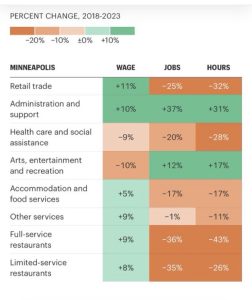
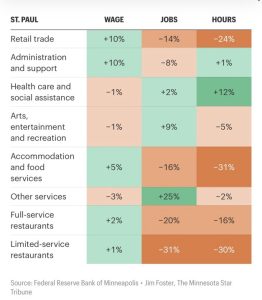
The Federal Reserve Bank of Minneapolis, which has studied the effects of the $15 minimum wage in Minneapolis since 2018, recently reported minimum wage policies have resulted in higher hourly pay but fewer available hours and positions. That has meant lower earnings: Between 2017 and 2021, the average decline in wage earnings across all industries was 1% in Minneapolis and about 2% in St. Paul. The research controlled for the effects of the COVID-19 pandemic and unrest after George Floyd’s murder in 2020.

——-

Nate Hood:

The results are in:

Minimum wage raises wages for those who can find jobs, but reduces the number of hours & the number of jobs.

You can still support this as a policy agenda, but when passed, I think cities policy makers pretended that the trade-off didn’t exist

Civics: An Unlikely Hero Rises, Forged in Fire

Karen Bass likely cheated in the last election over Rick Caruso, and she will cheat again, but it’s possible that Spencer and his campaign have finally, at long last, cracked the code for how to win in this bright blue hellhole.

The magical winning formula? It’s not an election about politics. It’s about survival. Left and right don’t matter anymore. Either we continue to get chased out of our own neighborhoods by gangs, fentanyl zombies, and robbed by the city’s corrupt homeless-NGO elite, or we put a stop to it. We either get the tents off our streets, or we never will. We either keep on dying, or we start living. 

No new laws are required. We simply enforce laws and homelessness disappears. “But where do these poor homeless junkies go?” Answer: wherever they want, as long as its not on the public byways of Los Angeles. Santa Monica doesn’t seem to mind being overrun by the zombies: the Third Street Promenade has plenty of room for more tents!

So to me, he’s basically a blank slate. I became aware of him immediately after the fires when he started using X to post outraged rants about the destruction of his home and Pacific Palisades neighborhood. 

The fire that took his home also took my own childhood home on Via de la Paz, which we lived in until I was five, and my mother’s longtime home in Malibu. My preschool burned down (Methodist). My childhood library is gone. All the local stores I remember. An entire community in ash.

We reduced tuition — and that’s just the beginning.

UC Irvine:

UC Irvine’s Paul Merage School of Business has made the bold move to drastically lower tuition of our Flex MBA by $30,000 and Executive MBA by $48,000 in an effort to expand access and deliver the value of a world-class education to working professionals. This significant tuition decrease is part of a broader strategy to provide exceptional return on investment. The Merage School is not simply cutting costs; it is enhancing every dimension of the MBA experience. Updated offerings integrate AI across the curriculum, expand flexible learning options, and shorten time to completion — all while reducing tuition.

The Machines They Built

FacultyLeaks.com:

The DEI apparatus that’s a staple throughout higher ed isn’t just legally dubious. It’s also a layer of red tape that can undermine its own goals. A FacultyLeaks.com reader at a large public university recently shared with us an anecdote that illustrates this.

Their social science department needed to hire a professor. The job ad was ready to post. Under normal circumstances, it should have gone live within days.

It didn’t. First it had to clear a DEI review committee run by the college’s new Associate Dean for Diversity, Equity, and Inclusion, which took about two weeks. Then it went to a second DEI committee, this one created by a newly hired Vice Provost, for another two weeks.

What were they reviewing? Boilerplate stuff — the same equal-opportunity language that appears on every faculty job posting at the university, which had already been approved by legal, already approved by HR. Yet, it took two committees four weeks to rubber-stamp a form that should have been pro forma.

In this field, timing matters. While this department’s ad sat in a queue for a month, competitors were already scheduling interviews. Three or four strong candidates of color had accepted jobs elsewhere during the delay. The math was simple: a four-week holdup in a fast-moving job market means the best candidates are gone before you’re allowed to even evaluate their CV.

What remained, according to a committee member, was a pool of highly qualified white men and a handful of less-qualified white women — the stronger female candidates, like the candidates of color, were already gone. One went to an Ivy.

Do Teachers Need Advanced Degrees?

Cremieux:

Our society is obsessed with credentials. People with PhDs, MDs, JDs, and even Ed.Ds are lauded as if the credentials they’ve earned signify that they’re more generally capable than their uncredentialed peers. The fact that they are on average because there’s a correlation between real-world qualification and educational attainment is the kernel of truth that has allowed people to be misled into thinking that the credential, the degree itself, is what matters. But it’s not, and you’ll realize it’s obviously not if you think about it for even a moment:

Have you never met a bad doctor? A shoddy lawyer? A barista with a PhD?

Nevertheless, laws have been written, policies have been crafted, and decisions have been made on the basis of credentials that frequently don’t even matter and should instead be downweighted in favor of other, fairer and more important criteria.

Harvard Tries Grade Deflation

Daniel Buck:

This academic year, Harvard has endured a dark night of the soul, including (among other troubles) facing down the consequences of grade inflation and searching for curricular absolution. In a much-publicized fall report, the university confessed that its current grading system is, in fact, a “problem”—an admission that reportedlyleft students “soul-crushed” and crying in their beds.

Undeterred, America’s oldest institution released in February a new plan to deflate grades. Will the new plan lead Harvard from the dark of inflated GPAs and into the light of more accurate grading, or will the institution “continue in Oblivion lost?”

Harvard Has a Plan

The primary recommendation of the new plan is a simple cap on the number of A’s. Professors can now assign only 20 percent of their students (plus four additional A grades, regardless of class size) the top mark. While I applaud just about any effort to curb grade inflation, Harvard’s reform gives reason for skepticism. Harvard is not the first university to try such a scheme.

First, Harvard is not the first university to try such a scheme. In 2004, Princeton noted similar problems with grade inflation and prohibited professors from rewarding A’s to more than 35 percent of their undergraduate classes. And it worked—at least a little. In the decade in which the policy existed, the percentage of A’s droppedfrom 47 to 41.8. A comparable policy, capping most course averages, led to similar results at Wellesley College.

Alas, both colleges reversed course. A report from a faculty committee at Princeton bemoaned increases in student anxiety and poor comparisons to peer universities that had not adopted similar grade caps. In response, the faculty voted in 2014 to remove the cap, and grades once again crept inexorably upward. If past is prologue, then this current initiative from Harvard could be destined for similar tragedy.

Minnesota Teachers Empowered to Keep Parents in the Dark

Kamden Mulder

Minnesota parents can be kept in the dark about important developments in their child’s life by school administrators and teachers who have broad authority under a widely adopted Minnesota School Boards Association (MSBA) policy to withhold information they deem sensitive.

At least 229 school districts in Minnesota maintain a “Protection and Privacy of Pupil Records” policy, according to the watchdog group Defending Education.

Based on language put out by the MSBA, the policy lists several categories of information educators are entitled to withhold from parents at a student’s behest, including, crucially, information related to the child’s health, which can only be released …

The Disappearing Male Student

Rebekah Wanic:

Many have discussed the rapid decline in trust and esteem for institutions of higher education. Most settle on the fact that it is a problem of their own making. This is true: exorbitant pricesactivismsuppression of speech, and discrimination in admissions. These are all problems created from within. So is the guiding ideology that views masculinity as toxic.

As Helen Andrews has pointed out, the damaging effects of wokeness coincide with the increased presence of women in institutional leadership. Universities were once factories of progress—not to be mistaken with progressive—led by innovative risk-takers. Today, they operate more as re-education camps designed to stamp out any hint of masculinity, labeling it as toxic. The feminization of higher education is an ideological takeover that has declared war on the characteristics of the “alpha male,” letting intellectual curiosity and excellence melt in the acid bath of cancel culture.  

Look at the numbers, because they don’t lie even if the administrators do.

Women now dominate college enrollmentgraduate programs, and entire fields like psychologyeducation, and the humanities. Recent reports show that female representation in college leadership has also increased steadily. Meanwhile, the share of men on campus has dropped precipitously. Men now account for roughly 41 to 44 percent of U.S. undergraduates, down from an even split in the 1970s. Fewer men are enrolling in college, and those who do enroll are more likely to drop out. This shift is generally celebrated, and any area where women make up less than 50 percent is often treated as a problem to be solved. Why aren’t there more female university presidents?, activists bemoan. Instead, we should be asking what to do about the missing men.

The Old Guard: Confronting America’s gerontocratic crisis

Samuel Moyn

In Greek myth, Eos falls in love with Tithonus. She is the goddess of the dawn. He is a Trojan prince, yet still a mere mortal. Eos asks Zeus to give her mate the gift of eternal life—­but, foolishly, she forgets to ask for eternal youth too.

Tithonus never dies; he just grows older and older. “Ruthless age,” goes the Homeric hymn recounting his story, is “dreaded even by the gods.” Tithonus becomes more decrepit and wizened with each passing year. Eventually, when he can no longer move, Eos has to shut him away, in a place where “he babbles endlessly, and no more has strength at all.” Eternal life amid the decline of one’s faculties is not a blessing but a curse. “Me only cruel immortality / Consumes: I wither slowly in thine arms,” Tithonus complains in Alfred Tennyson’s rendition of the myth (published in these pages in 1860), in a rare moment of lucidity that emerges from his everlasting gibberish.

The story of Tithonus no longer feels so outlandish, because our society postpones death to an unprecedented degree. Unlike immortals, we still pass. But the great majority of us, and not only the bad, now die old. In whatever nursing home he was parked in, Tithonus must have looked much like we increasingly do, as doctors continuously defer our mortality. We are approaching a time when a legion of Tithonuses will live in our midst. We have already felt the social and political consequences.

During the 2024 presidential campaign, the revelation of Joe Biden’s decline altered the course of American history, leaving a storied republic on the brink. The experience brought home the crisis of the country’s aging leadership: our politicians are dangerously old. I bring little news on this front, but the facts are startling nonetheless. Between 1960 and 1990, the median age of members of Congress was in the early fifties. In the three decades that followed, the median surpassed sixty. Among the effects of this trend has been the on-­the-­job senility or death (or both) of those who govern us. Take, for example, the Texas representative Kay Granger. Eighty-­one years old in 2024, she chose not to seek reelection and disappeared from the Capitol after casting her last vote that summer, only to be found six months later in a senior-­living facility, where she had ended up, without resigning, after experiencing “dementia issues,” as her son put it when reporters tracked him down. Granger’s is an isolated case only in its absurd extremity. At least half the Democrats in the House who are seventy-­five or older—there are nearly thirty in all—are running again this year. Last year, a seventy-­five-­year-­old, Gerry Connolly of Virginia, bested Alexandria Ocasio-­Cortez for a leadership role on the House Oversight Committee before dying of throat cancer soon after, which made it easier for House Republicans to pass President Trump’s One Big Beautiful Bill, slashing taxes and welfare.

Notes on growing redistributed state taxpayer funds and k-12 systems

Olivia Herken:

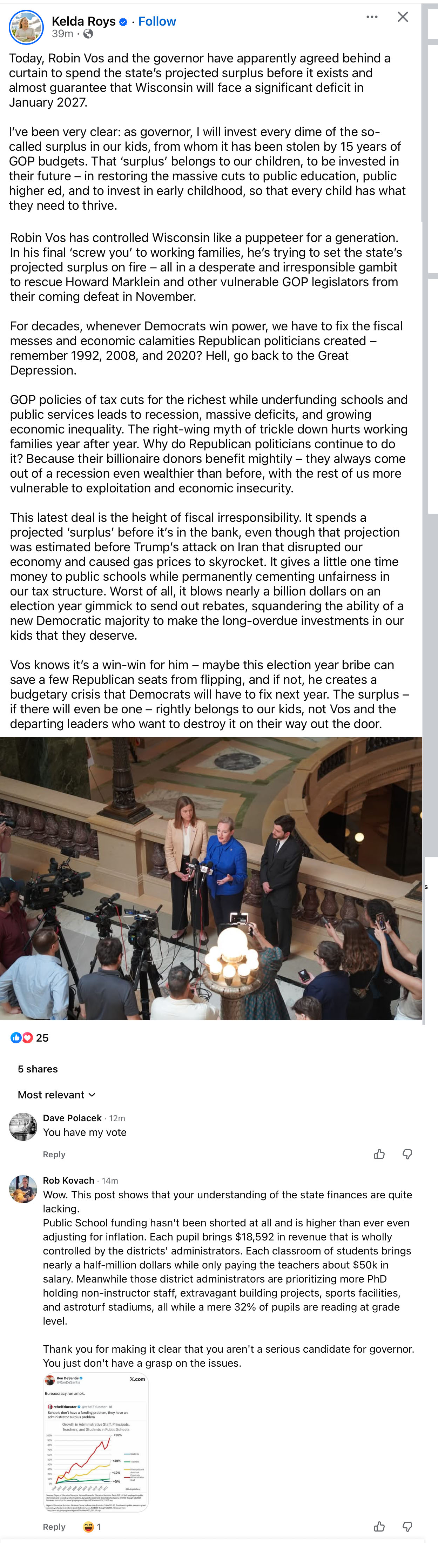
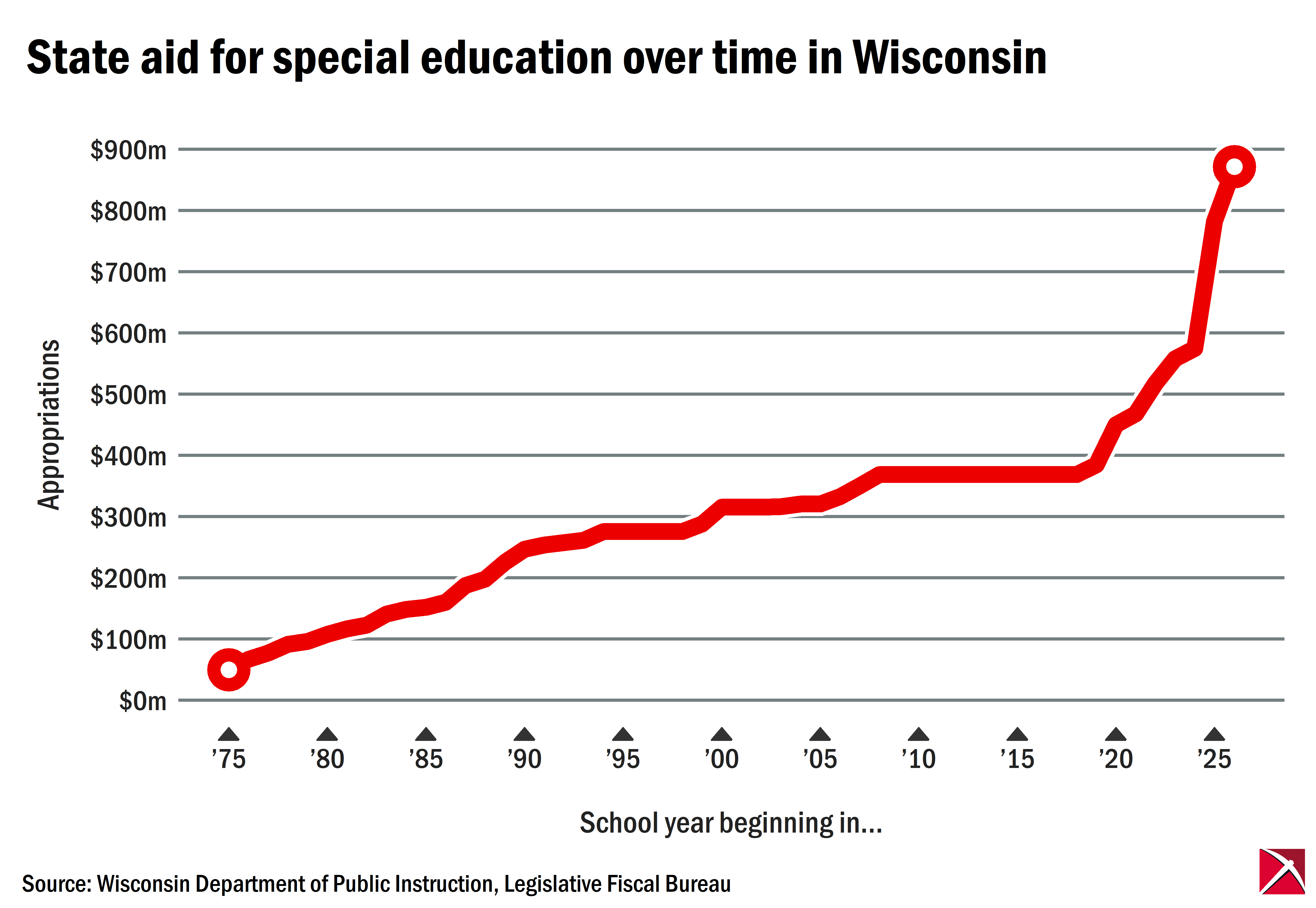
The $1.8 billion deal comes after months of negotiations that were first sparked by a desire from both sides of the aisle to lower property taxes. The package, which lawmakers will vote on this week, includes a historic increase in the state’s special education reimbursement rate and more than $850 million in stimulus checks sent to Wisconsin residents to help them pay for rising costs.

“After months of hard work, I’m proud we were able to put politics aside on a plan to use a portion of our historic state surplus to do the right thing for Wisconsinites across our state,” Evers said in a press release.

The deal adds $300 million to the state’s special education fund, helping bring the reimbursement rate to 50% of school districts’ costs starting next school year. The funding will also help ensure the rate meets 42% this school year, as was promised in the state budget, up from 32%.

An additional $300 million in general school aid will also be part of the legislation, and that funding increase will begin next school year and will in turn provide property tax relief to residents. In total, the package directs over $600 million to K-12 schools. Evers told reporters the school funding was the biggest win of the compromise.

Jesse Opoien & Molly Beck:

  • Wisconsin Democrats are criticizing a bipartisan deal for school funding and property tax relief.
  • The $1.8 billion plan was negotiated by Democratic Gov. Tony Evers and GOP legislative leaders.
  • Critics, including Democratic gubernatorial candidates, called the agreement a “backroom deal” and an “election year bribe.”
  • Evers called the deal a compromise. “That’s how government is supposed to work.”

———

WisPolitics:

The state previously had a projected surplus of nearly $2.5 billion at the end of the 2025-27 budget. The price tag of the deal would be offset somewhat by new revenue projections from the Evers administration suggesting the state could take in $300 million to $350 million more in tax collections than what was previously projected.

The election-year deal includes the money for education that Evers wanted, the property tax relief that Assembly Republicans sought and the rebates that Senate Republicans demanded be part of any deal.

Mitchell Schmidt & Kimberly Wethal:

While the state’s two-year spending plan held general school aid steady, lawmakers did agree to raise the reimbursement rate for special education costs to 42% in the first year and 45% by 2027. However, due to increased costs, those funds will not reach the rate lawmakers had intended.

Evers’ office said the new deal would bring funding to 42% in a matter of weeks, to achieve that goal before the current fiscal year ends at the close of June. Special education funding would reach 50% the following year.

“Although we are waiting to see the final language of the agreement, initial conversations indicate that this is a significant increase in the state’s support of public schools,” Madison Schools Superintendent Joe Gothard said in a statement. “It is also a direct response to the fiscal crisis that I and other district leaders have shared for months.”

Wisconsin Technical College System spokesperson Katy Pettersen said in a statement the additional funds will only offset property taxes and will not strengthen the colleges’ ability to invest in workforce needs or expand enrollment.

——-

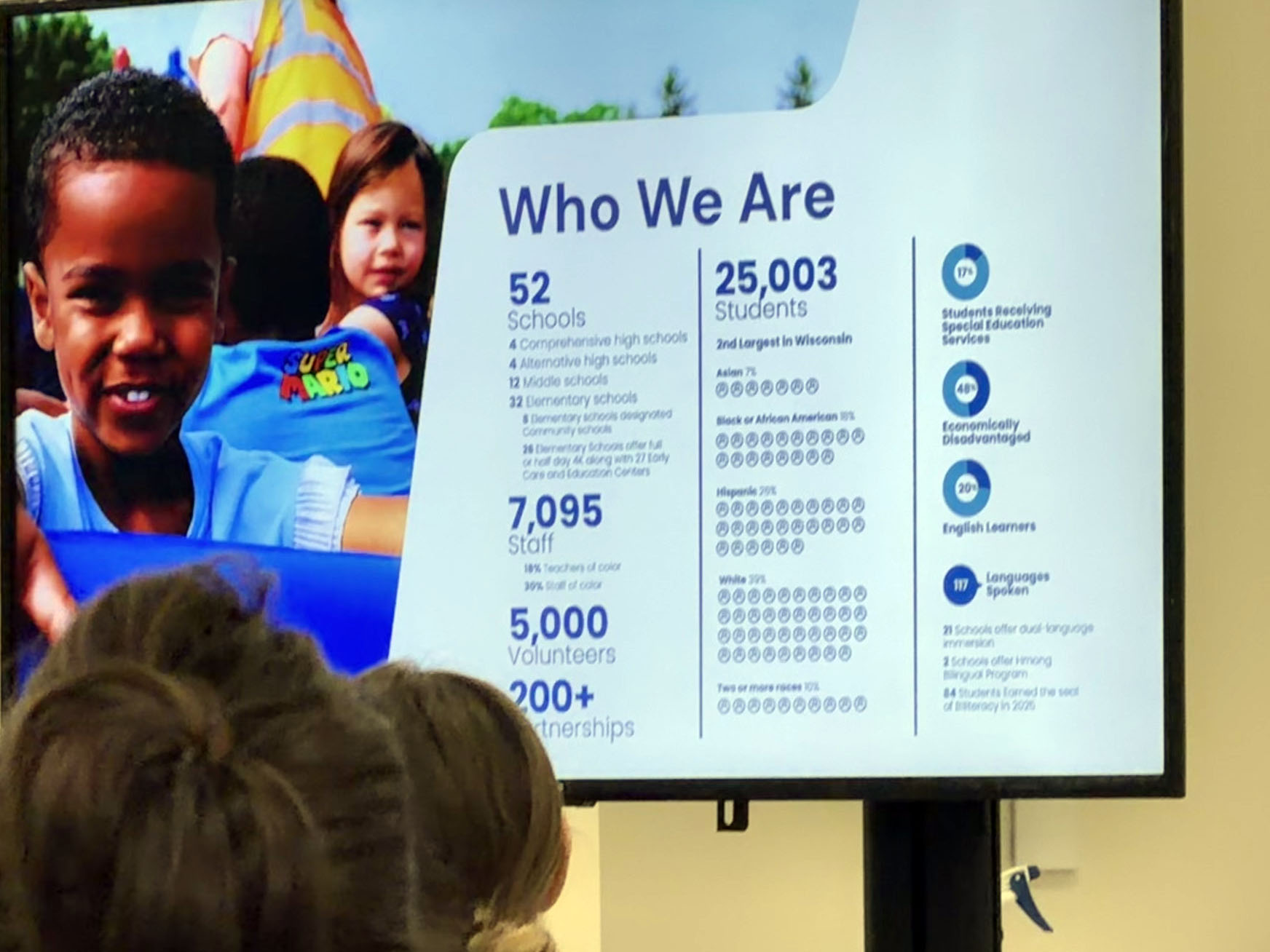
Madison taxpayers have long supported far above average k-12 tax & $pending. This despite our long term, disastrous reading results. May, 2026: 7,095 Staff for 25,003 students; $pending > $26k per student!


Notes on An Alternative Madison School: One City

Erin Gretzinger

But between the years where scores jumped, the state Department of Public Instruction adjusted testing benchmarks and lowered the threshold to score proficient. The number of students reading and writing proficiently statewide went from 39% to 51%.

The department cautions the public against comparing test scores before and after the change because the results “cannot be directly compared to prior years.”

Critics of the benchmark changes have arguedthe move obscures school performance over time and inflates the number of students meeting grade-level expectations. The Department of Public Instruction, led by state Superintendent Jill Underly, has defended the changes.

Got a news tip?

The Cap Times welcomes tips from readers to help us inform our community. Email tips@captimes.com or visit captimes.com/tips for more options.

In statements to school staff and supporters, as well as lawmakers, One City often hasn’t cited the change in benchmarks alongside its boost in scores. Asked this week about that omission, Caire said the school doesn’t reference the change because it’s “hard to tell how this impacted schools.”

“Some schools saw no growth from it while others saw some. DPI made those changes. That’s up to them,” Caire wrote in an email to the Cap Times. “States make changes to their assessments all the time.”

Under the new benchmarks, One City’s scores the past two school years show the percentage of Black students who were proficient in reading and writing remained roughly the same.

——-

Early Literacy Screener Map.

MoreAct 20.

3,887 Madison 4 year old to third grade students scored lower than 75% of the students in the national comparison group.

May, 2026: 7,095 Staff for 25,003 students

Madison taxpayers have long supported far above average k-12 tax & $pending. This despite our long term, disastrous reading results. in 2026,

Madison Schools: More $, No Accountability

The taxpayer funded Madison School District long used Reading Recovery

The data clearly indicate that being able to read is not a requirement for graduation at (Madison) East, especially if you are black or Hispanic”

A.B.T.: “Ain’t been taught.”

My Question to Wisconsin Governor Tony Evers on Teacher Mulligans and our Disastrous Reading Results

2017: West High Reading Interventionist Teacher’s Remarks to the School Board on Madison’s Disastrous Reading Results 

Madison’s taxpayer supported K-12 school district, despite spending far more than most, has long tolerated disastrous reading results.

“An emphasis on adult employment”

Wisconsin Public Policy Forum Madison School District Report[PDF]

WEAC: $1.57 million for Four Wisconsin Senators

Friday Afternoon Veto: Governor Evers Rejects AB446/SB454; an effort to address our long term, disastrous reading results

Booked, but can’t read (Madison): functional literacy, National citizenship and the new face of Dred Scott in the age of mass incarceration.

When A Stands for Average: Students at the UW-Madison School of Education Receive Sky-High Grades. How Smart is That?
Making Public Unions More Accountable

Wall Street Journal:

The single biggest problem in state governance is the political dominance of public unions. These include the SEIU, Afscme and the teachers unions. Several states are now pressing reforms that curb their coercive hold over their members.

Idaho Gov. Brad Little recently signed a bill that will end taxpayer support for teachers unions, notably the Idaho Education Association. The bill will prevent school districts from collecting dues directly from teachers paychecks and limit unions’ ability to recruit members during school hours. It will also end the practice of giving teachers paid time off for “union activities” like supporting candidates for office, soliciting union membership or joining union protests or advocacy.

Public unions count on the ability to mobilize members for political causes while still on the public payroll. Teachers unions swing political weight because their political spending overwhelmingly favors Democrats and because the left knows unions can turn out their members for political causes on short notice. The new legislation will prevent school districts from sharing teachers’ personal information unless the teacher authorizes the disclosure.

Arizona is working on similar guardrails for public unions with a proposed constitutional amendment that would prevent school districts from collecting union dues through a payroll deduction. The bill, which has to be adopted by the Legislature to get onto the November ballot, would ban teacher strikes and require unions to distribute communications off school property.

—–

Related: Act 10.

New Yale Report on Trust in Higher Education Is an Important Step Toward Higher Education Reform

Jane Mangelli:

Gnōthi seauton—know thyself!—was the maxim at Delphi that Socrates famously adopted. The American Council of Trustees and Alumni (ACTA) commends Yale University for its willingness to take a hard look in the mirror with its newly released Report of the Committee on Trust in Higher Education. While so many others avoid taking any responsibility for the decline of American higher education, Yale has acknowledged the need to make changes in the face of the American people’s deep dissatisfaction with our colleges and universities: “Those of us in higher education have too often resisted calls to critically examine our own institutions, professions, and modes of thought,” the Report states. “We must be willing to admit where we have been wrong and where we might improve, even as we defend what is essential about higher education and its academic mission.” This admission alone is a sign of wisdom.

So is the Report’s acknowledgement of Yale’s mission drift:

In 2016, departing from its traditional emphasis on the creation and dissemination of knowledge, Yale expanded its mission statement to include “improving the world today,” educating “aspiring leaders worldwide,” and fostering “an ethical, interdependent, and diverse community.” These are all worthy goals. But they are not what makes a university a university.

We recommend that Yale adopt a focused university-wide mission statement such as the one currently articulated in its own Faculty Handbook: “Yale University’s mission is to create, disseminate, and preserve knowledge through research and teaching.”

Steering Yale’s course back to its core academic mission is an act of courage in American higher education today.

Politics, Legislation and the Judicial Branch: Virginia Edition

Shipwreck:

The idea that the legislature would lower the retirement age to 53 in order to remove them all is just beyond wild.

Then they would install 7 new Justices who would have to commit in advance to reversing the prior Court’s decision — that tells you everything you would ever need to know about anyone who would pledge to do that.

Three Justices voted in the minority, but you can’t exempt them from the retirement because they might object to a corrupt process to remove their colleagues for no reason other than naked partisan politics.

Politics, Interests and Mother’s Day

Brooks Summary:

When Wisconsin women thrive—and when Wisconsin moms thrive—our families thrive, our communities thrive, and our state thrives. 

After years of fighting to get this done, I was proud to sign this expansion into law for our state.

——-

When Tony is trying to take credit for a bill passed because of the hard work of people like @RepSnyder85 and @reptoddnovak, they’re called “moms.”

When he’s trying to pander to liberal activists, they’re called “inseminated persons.”

———

Wisconsin Governor Defends Push To Redefine ‘Mother’ as ‘Inseminated Person’

Accreditation, Innovation, and Modernization (AIM) in Higher Education Comes Due

Kyle Saunders:

In two weeks, a Department of Education rulemaking committee most Americans have never heard of will vote on what could be the most consequential restructuring of the federal accreditation framework since the 1992 Higher Education Amendments, assuming the rule survives implementation, litigation, and the next administration. The committee is called AIM(Accreditation, Innovation, and Modernization). Its first session of negotiations wrapped April 17. Its second and final session runs May 18-22, and the vote on draft regulations comes at the end of that week.

If you’ve been following the bifurcation argument I’ve been making about American higher ed (or the shorter, broader-stakes version aimed at readers who don’t usually track the sector), this is one of the four converging vectors I’ve been tracking. The honest framing is parallel rather than causal. AIM has its own policy genealogy running from the Spellings Commission (2006) through conservative reform think tanks, and it would have happened with or without the degree-hacking phenomenon. What’s notable is that the rulemaking and the market are pushing in the same direction at the same time: outcomes-based accountability that collapses the credentialing function down to measurable outputs.

AIM is also a piece of policy most of the sector hasn’t quite reckoned with. So before the vote, here’s a primer on what AIM is, what it’s about to decide, and why the inside-baseball framing understates the stakes.

“But look squarely at the administrators who are supposed to defend academic freedom and freedom of speech—and who too often undermine those values instead”

Greg Lukianoff:

Every attempt to shut down campus speech should trigger an independent investigation asking two questions:

1) Did administrators do anything to stop the censorship?

2) Did administrators do anything to encourage, excuse, or facilitate it?

Students are responsible for their own actions. But the deeper scandal is administrative complicity.

In a healthy university, the answer to right-wing demands to fire a professor would be: “No way.” And the answer to left-wing attempts to shut down a speaker would be: “Not on my watch.”

Does that sound fanciful? At this point, probably. Because it has become hard to imagine administrators actually acting this way.

The dirty little secret is that too many of them have enabled this for years. Some are hired into ideological jobs built around policing speech, running BRTs, and managing “harm” rather than protecting open inquiry. Sometimes the damage comes through omission: refusing to punish obvious censorship. Sometimes it comes through commission, as at Stanford Law School several years ago, when administrators actively helped the shutdown along. Here, it looks like a combination of both.

Chicago Students Get a Ferris Bueller Day Off

Wall Street Journal Comment:

Your editorial “Making Public Unions More Accountable” (May 5) shows that many states make it easy for public employee unions to use taxpayer resources to advance their political agendas. That dynamic was on display last week when Chicago Public Schools caved to Mayor Brandon Johnson and the Chicago Teachers Union, allowing teachers and students to ditch school to attend socialist-backed labor rallies.

There’s never a good excuse for taxpayer-funded field trips to one-sided political rallies. In Chicago, where so many students are already missing school, it’s particularly indefensible. Roughly a quarter of Chicago high-school students missed more than a month of school in the 2023-24 school year, and chronic absenteeism has persisted. Graduation rates, meanwhile, continue to rise—even as dozens of the city’s schools have failed to educate a single student to grade-level proficiency, according to the watchdog group Wirepoints.

Wisconsin voters support school choice by a 2-to-1 margin, and 80% say they are more likely to back a candidate who would hold all publicly funded schools accountable for outcomes

WisPolitics:

MILWAUKEE — A new statewide survey of 1,658 likely Wisconsin voters by City Forward Collective and CFC Action Fund finds Wisconsin voters deeply concerned about the performance of the state’s public schools and ready to support candidates who treat accountability and outcomes as the central education issue heading into the 2026 election cycle.

“Wisconsin voters are sending a clear signal, and it isn’t a partisan one,” said Colleston Morgan Jr., CFC’s Executive Director. “They want schools that prepare kids for real jobs and real futures. They want accountability: public dollars tied to public results. The candidate for office – Democrats and Republicans alike – who listen to this signal early, especially the ones still introducing themselves to primary voters, will have an opening to lead on an issue that matters to our state’s future.”

Half of voters statewide say the state provides too little K-12 funding. At the same time, 63% say Wisconsin’s academic standards are too low, and 63% oppose the Department of Public Instruction’s 2025 decision to update school report-card benchmarks. Just 26% of Wisconsin voters believe their public schools are doing a good job preparing students for jobs and careers.

Ivy League students are suffering from religious illiteracy

Gregory Conti:

Several years ago, one of my colleagues at Princeton University hosted a lecture on religion and free speech. The talk didn’t seem to be landing with the students. Finally, he realized why: The speaker had made repeated reference to the Ten Commandments, and several students didn’t know what they were.

This isn’t an isolated problem. It’s increasingly common on college campuses to encounter students who are unfamiliar with the most basic features of Christianity, such as the difference between the Old and New testaments or between Catholics and Protestants. They seldom recognize the allusions to the Bible that appear in Shakespeare’s work or in Lincoln’s second inaugural address (or in Obama’s first, for that matter). These students are bright, conscientious and curious. But they lack religious literacy — and their ignorance of religious ideas means they struggle to understand a wide array of Western art, literature and philosophy.

This is a development that even nonbelievers like myself should find troubling. A little over a century ago, the influential legal and political theorist Carl Schmitt wrote that “all political concepts are theological concepts secularized.” Even if one thinks this is an exaggeration, it points to the difficulty of attaining any real understanding of the tradition of Western political theory without religious literacy. The same goes for other subjects: Neither Shakespeare nor Austen nor Mozart nor Rembrandt nor John Ford nor Oscar Wilde can be appreciated absent a grounding in Christianity.

Secularization is sometimes (wrongly, in my view) celebrated as a victory for reason over superstition. But a lack of contact with religion — and particularly with Christianity and its history — is an obstacle to mastering many subjects and to attaining the kind of broad cultural competency that higher education is expected to provide. Take my field, the history of political thought. This subject is at the center of many general-education curriculums, for it goes to the core of liberal education’s promise to help train responsible citizens. But it is hard to appreciate even basic truths about the Western political inheritance without grasping the ways in which thinkers of the past reacted to, or against, the Christian faith.

Outcome Based Student Loan Caps

Ed.gov:

Thanks to President Trump’s Working Families Tax Cuts Act (the Act), new loan limits taking effect this summer will curb excessive borrowing and force institutions to evaluate their costs. These reasonable caps will help prevent borrowers from taking on debt they may struggle to repay while putting downward pressure on institutions to lower costs, making higher education more affordable for America’s students.

How does the Act impact federal student loans?  

The Act affects both the Grad PLUS and the Parent PLUS loan programs and introduces reasonable loan caps on graduate-level federal student borrowing. Undergraduate student limits remain unchanged.  

The Grad PLUS loan program, established in 2006, allows graduate students to borrow up to the full cost of attendance with no aggregate or lifetime limit. When introduced, it effectively removed federal borrowing caps for graduate students. Since then, both tuition and loan debt for graduate students has skyrocketed. Although graduate students make up a relatively small share of total borrowers, they account for a disproportionate share of the loan portfolio. For example, in 2024-25, graduate students represented 16.8% of borrowers but received 46.6% of total loan disbursements that year. 

The Act eliminates the Grad PLUS program, and instead responsibly reinstates borrowing limits for graduate programs by introducing new annual and aggregate limits on federal student loans for graduate and professional students beginning on July 1, 2026. Sensible limits will help curb overborrowing and put pressure on institutions to reduce costs, including unnecessary administrative spending. 

civics: Fake Religions Behind Progressive Disasters In California And New York

Michael Shellenberger:

At the heart of the case for progressivism is compassion. New York’s democratic socialist mayor, Zohran Mamdani, paused the police sweeps that had moved homeless people indoors in winter. Los Angeles Mayor Karen Bass cut the fire department’s budget while expanding city services and proposing cash assistancefor people in the country illegally. Governor Gavin Newsom vetoed legislation that would have allowed taxpayer dollars to support sober housing.

The result of those policies is death and destruction. In San Francisco, a mentally ill homeless woman lived on a sidewalk until her feet rotted from gangrene, after which the hospital amputated them and discharged her back to the same block. After Mayor Mamdani paused the sweeps, at least 19 mentally ill or drug addicted homeless people died outdoors in a single cold snap. In Los Angeles, the underfunded fire department failed to stop the fires in Malibu and other neighborhoods last year, and encampment fires continue to shut down freeways.

The EEOC just sued the New York Times for discrimination against white males. The intern class photos told the story years ago. And it’s not just one newsroom — it’s an entire industry.

FacultyLeaks.com

On Tuesday, the Equal Employment Opportunity Commission filed a federal lawsuit against The New York Times, alleging the newspaper passed over a white male employee for a promotion because of his race and sex. The complaint, filed in the Southern District of New York, says the Times’s “stated race and sex-based representation goals” drove the decision not to advance his candidacy for a deputy editor role.

The Times called the suit “politically motivated.” On X, Harvard professor Maya Sen posted the complaint with a punchy observation: “Very short hop, skip & jump to academia.”

Whether others view that as a warning or a welcome, the connection is hard to argue with. More on that later. But let’s stay with journalism for a moment — because the EEOC lawsuit isn’t the revelation. It’s the confirmation. The discrimination has been happening in plain sight, announced in press releases and class photos, for years. The only news is that a federal agency finally decided to look.

The Class Photos

If you want to understand what’s happening in American journalism hiring, skip the mission statements. Look at the pictures. Try finding a white male in a recent intern class photo. It’s like a game of Where’s Waldo — except in most of these cohorts, Waldo isn’t hiding. He’s just not there.

This has been visible for years. In 2016, a Huffington Post executive editor tweeted a photo of an all-female editors meeting as a celebration of diversity. The backlash wasn’t about the absence of men — it was that the women were too white. The missing men weren’t the bug. They were the feature. A decade later, the pattern has only intensified.

Fairfax Schools Fund PhDs for Highly Paid Administrators as Teacher Positions Cut, Class Sizes Raised 

Stephanie Lundquist-Arora

On Aug. 5, 2025, FCPS Chief of Schools Geovanny Ponce, who earns an annual salary of $289,565, emailed hundreds of district administrators to announce the program. “FCPS is launching a district-sponsored doctoral cohort program in partnership with George Mason University,” he wrote. “This program will lead to an Education Leadership PhD concentration, providing an opportunity to deepen your expertise and advance your career.” 

On Dec. 16, 2025, Kathryn Blackburn, a program assistant at George Mason University, emailed dozens of selected FCPS administrators to notify them about the program’s upcoming virtual orientation. “During this orientation,” she wrote, “students and leadership will learn about program requirements and expectations, student responsibilities, as well as answer questions about the program.”

The Executive Limitation 4 Monitoring Reportopens in a new tab—intended to demonstrate and certify whether the district’s superintendent is complying with School Board policy on human resources, specifically how the district manages its workforce—was presented at the Dec. 4, 2025, meeting of the Fairfax County School Board. It describes the district-funded program, stating, “FCPS supports high-achieving leaders through this rigorous academic experience, which will include dedicated FCPS-led in-person and hybrid sessions.” 

The report, which appears to be the only publicly available information on the program, does not outline its cost to taxpayers or the application process for interested administrators. It does, however, specify that eligible participants must have at least five years of experience as a principal, director, or above, and “must commit to remaining in FCPS for a period of time following completion of the program.” 

Notes on Madison’s Reading Crisis

Jenny Peek:

The gravity of Madison’s literacy crisis didn’t come into focus for Patterson until she became a literacy teacher leader with the Madison Metropolitan School District; before that she had been teaching fourth and fifth grade for 15 years.

“You kind of know as a teacher but once you have an admin-type view you start seeing it at a district-wide level and a nationwide level and it’s like, ‘Oh my gosh,’” Patterson says. “So that’s when my journey to literacy really began.

……

College students will get training, online and in person, from both Morgridge and the district on social-emotional learning, mentoring, and the science of reading, though the exact details of that training are still being figured out.

Despite building strong relationships, and its long tenure, it’s unclear how effective Schools of Hope has been in improving reading. Over the course of its two-plus decades, literacy rates in Madison have remained relatively unchanged.

During the 2024-25 school year, 51.2% of the district’s third through fifth graders were not meeting grade level expectations in reading, according to the Forward exam, which is given to all third through fifth graders in the state.

It’s even worse for students of color. That same school year, 83.6% of the district’s Black elementary school students and 73.8% of the district’s Hispanic elementary school students were not meeting literacy expectations. That’s in comparison to 23.6% of the district’s white students.

—-

Early Literacy Screener Map.

MoreAct 20.

3,887 Madison 4 year old to third grade students scored lower than 75% of the students in the national comparison group.

Madison taxpayers have long supported far above average k-12 tax & $pending. This despite our long term, disastrous reading results.

Madison Schools: More $, No Accountability

The taxpayer funded Madison School District long used Reading Recovery

The data clearly indicate that being able to read is not a requirement for graduation at (Madison) East, especially if you are black or Hispanic”

A.B.T.: “Ain’t been taught.”

My Question to Wisconsin Governor Tony Evers on Teacher Mulligans and our Disastrous Reading Results

2017: West High Reading Interventionist Teacher’s Remarks to the School Board on Madison’s Disastrous Reading Results 

Madison’s taxpayer supported K-12 school district, despite spending far more than most, has long tolerated disastrous reading results.

“An emphasis on adult employment”

Wisconsin Public Policy Forum Madison School District Report[PDF]

WEAC: $1.57 million for Four Wisconsin Senators

Friday Afternoon Veto: Governor Evers Rejects AB446/SB454; an effort to address our long term, disastrous reading results

Booked, but can’t read (Madison): functional literacy, National citizenship and the new face of Dred Scott in the age of mass incarceration.

When A Stands for Average: Students at the UW-Madison School of Education Receive Sky-High Grades. How Smart is That?
“health standards” Commentary

Minnesota Department of Education Summary:

“This concerning number of increases in risk behavior (18 across 79 programs) raises the question of the possible influence of “risk compensation,” a phenomenon in which the perception of condoms as being highly effective would lead to increased risk behavior. Evidence for this has recently been documented in international school populations.74

Perhaps of equal importance, the credible scientific evidence reported here contradicts the oft-repeated claims that research shows abstinence education (AE) is ineffective and/or harmful.13 • 75 • 76 • 77 Seven studies judged to be of adequate scientific rigor by either UNESCO, the CDC, or HHS found that AE produced a long-term delay in sexual initiation (three of these also found long-term reductions in sexual activity by sexually experienced teens). The rate of AE success was about one of two (47%) and the rate of harmful impact (6%) was about what could occur by chance. And there was strong evidence (nine studies) negating the concern that AE does harm by reducing the use of condoms.

Given the claims cited above, it may surprise some people that this database appears to show better evidence for AE than for CSE in U.S. schools. This is especially noteworthy considering the markedly fewer number of available AE studies, and the fact that unlike the CSE results, most of the AE evidence was produced by independent evaluators. The amount of evidence of effectiveness appeared somewhat greater for AE than for CSE in U .5. schools (seven AE studies vs. three CSE studies) and the success rate for AE programs (47%) appeared to be much higher than that of school-based CSE (15%).”

——

More:

“It might be worth your time to search “oppose” to see what opposition there is to the proposed health standards.”

Protesters shut down Berkeley Forum event hosting Google AI scientist

Madeleine Kashkooli:

Protesters interrupted and shut down a Berkeley Forum and College of Engineering event featuring Google chief scientist and Gemini lead Jeff Dean this afternoon, criticizing the use of Gemini AI in the genocide in Gaza.

Approximately 20 protesters marched over from the May Day rally held at noon in front of California Hall. After the rally concluded, a student organizer announced that a speaker from Google’s Gemini AI was speaking at the Grimes Engineering Center and called on rally attendees to join him in disrupting the event, which had started at 1 p.m. The group of protesters headed over to Grimes and entered the event, held in the Eugene Jarvis Auditorium, at 1:37 p.m.

One of the student protesters, a member of Students Organizing for Liberation at UC Berkeley, walked onto the stage with a megaphone and interrupted Dean’s speech. The student led the other protesters, who lined up in the aisle of the event, in a chant of “UC, UC, you can’t hide, you are funding genocide.”

“What do you say for your AI being used to kill Palestinians?” the student asked Dean.

Dean responded that he appreciated the students’ message but was trying to deliver a “scientific lecture.”

During a 10-minute back-and-forth between the protesters, event organizers and attendees, the audience largely expressed support for Dean, chanting his name and cheering when asked if they wanted to hear from him, and booed the protesters.

——

This Berkeley incident is part of a much bigger problem.

@TheFIREorg has already recorded 108 campus deplatforming attempts in 2026, and it’s only May 7.

Sean Stevens breaks down the latest deplatforming data here.👇

Connecticut Goes After Homeschoolers

Wall Street Journal:

Parents currently don’t need the state’s permission, and the state doesn’t mandate annual reviews for homeschooled students. That freedom makes it appealing for many parents. About 1,800 students left public school for homeschooling in Connecticut in the last fiscal year.

Roughly 3% of the state’s nearly 500,000 K-12 students are homeschooled, according to a 2025 Johns Hopkins analysis. Nationwide, homeschool students perform at least as well as, and often better than, public-school peers on tests.

Yet the state House passed a bill last week that would mandate parents notify the state if they want to homeschool. The bill makes all parents declare their children’s enrollment status annually. But starting in the 2027-28 school year, parents withdrawing a child to homeschool would have to appear in person at the local school district office to sign a form.

The bill would also subject those parents to an inspection by the state’s Department of Children and Families (DCF) that can take up to seven days. If a parent is on the state’s child abuse and neglect registry or otherwise caught up in a case with the DCF, even an unresolved one, the family would be forbidden from homeschooling.

Anyone who’s had experience with government bureaucracy knows how this can go. Inspectors who have a bias against homeschooling can easily find a reason to bar such instruction. Using an open case—which could be unresolved for a variety of reasons—as a criterion looks like a violation of due process.

Combatting the Dysfunction Tax

Michael Ford

In communities across the United States, citizens are paying a hidden tax. No, it is not some new fee or utility hike. It is the cost of local government dysfunction. Here in Wisconsin, historically known as a good-government state, news headlines contain stories of local city councils and school boards plagued by infighting, culture war conflict, partisan politics, pettiness and sometimes worse. Ultimately, a dysfunctional governing board hurts the very residents our municipalities and school districts are designed to serve.

For the past 12 years, I have taught Master of Public Administration (MPA) students working in local government. When they consider a job as a city administrator, department head or even an entry-level employee, the first thing they do is Google the municipality, watch a board meeting and talk to others in their professional network. They are looking for red flags. Red flags include:

  • Board conflict that is personal or partisan
  • Elected officials undermining colleagues during or outside meetings
  • Board meetings that feel like congressional hearings with public employees in the hot seat
  • Frequent turnover in management positions
  • Persistent negativity

When qualified professionals see these red flags, they look elsewhere. Cities and school districts quickly develop reputations as no-go zones for top-tier candidates. The result is often less-qualified employees and employees who view the position as a temporary stop until something better comes along. Either way, the municipality or school district pays the opportunity costs of more training, more job searches and lower organizational capacity.

——-

Early Literacy Screener Map.

MoreAct 20.

3,887 Madison 4 year old to third grade students scored lower than 75% of the students in the national comparison group.

Madison taxpayers have long supported far above average k-12 tax & $pending. This despite our long term, disastrous reading results.

Madison Schools: More $, No Accountability

The taxpayer funded Madison School District long used Reading Recovery

The data clearly indicate that being able to read is not a requirement for graduation at (Madison) East, especially if you are black or Hispanic”

A.B.T.: “Ain’t been taught.”

My Question to Wisconsin Governor Tony Evers on Teacher Mulligans and our Disastrous Reading Results

2017: West High Reading Interventionist Teacher’s Remarks to the School Board on Madison’s Disastrous Reading Results 

Madison’s taxpayer supported K-12 school district, despite spending far more than most, has long tolerated disastrous reading results.

“An emphasis on adult employment”

Wisconsin Public Policy Forum Madison School District Report[PDF]

WEAC: $1.57 million for Four Wisconsin Senators

Friday Afternoon Veto: Governor Evers Rejects AB446/SB454; an effort to address our long term, disastrous reading results

Booked, but can’t read (Madison): functional literacy, National citizenship and the new face of Dred Scott in the age of mass incarceration.

When A Stands for Average: Students at the UW-Madison School of Education Receive Sky-High Grades. How Smart is That?
High Tech, Low Play: The Life Of American Children

by Michael Toscano, Lyman Stone and Grant Bailey

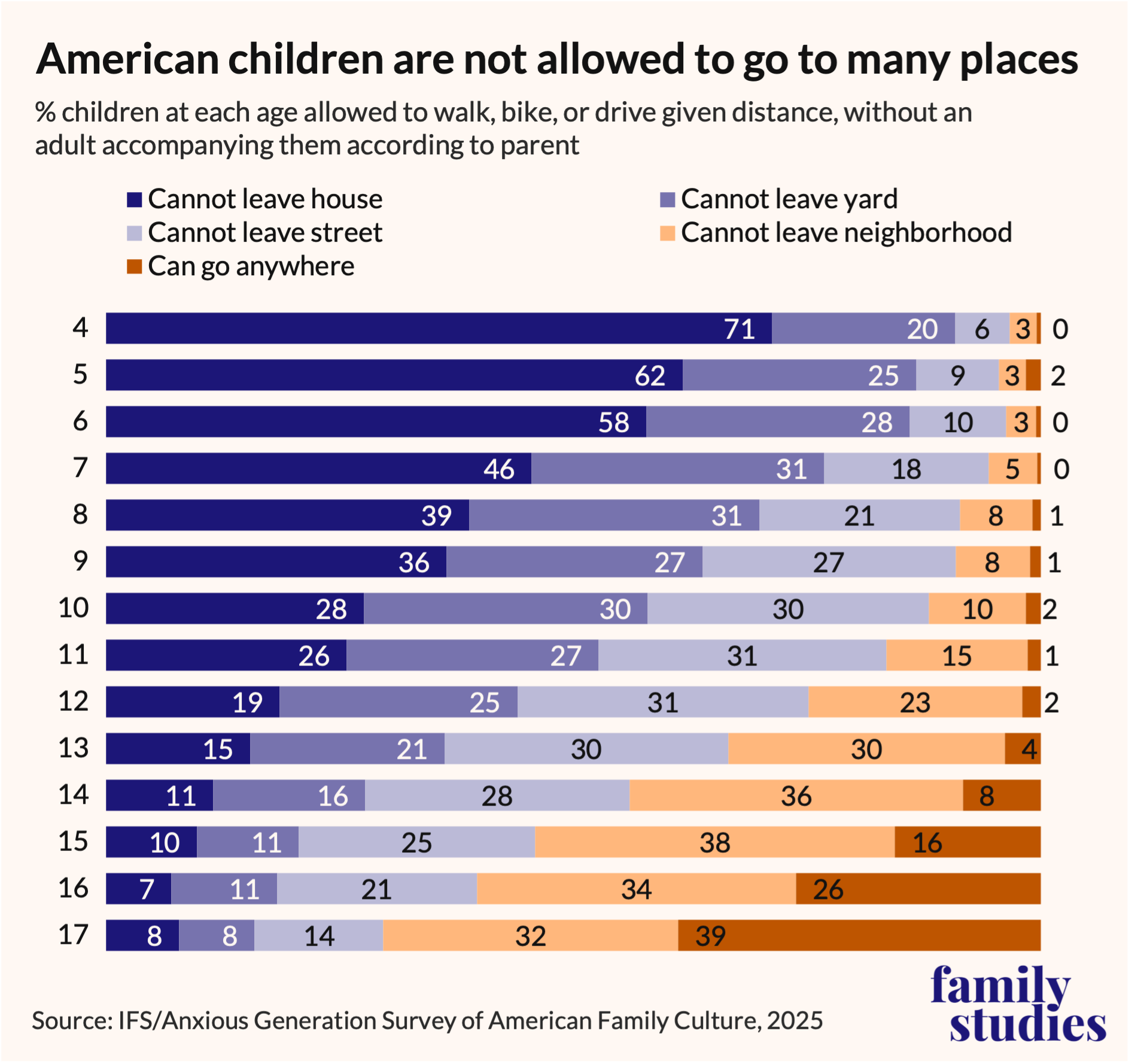
On February 19, 2026, we released a new report, Resilient Children, Struggling Parents: Mapping American Parenting, based on a new survey of almost 24,000 U.S. parents of over 40,000 children, including 2,600 teenagers. This large national sample of parents and teenagers enabled us to analyze parenting cultures around the country on the state level. We found that states where a concentration of parents are actively seeking to raise their children to be independent, free-spirited, resilient adults also tend to be the states where parents say their parenting approach is less supported by surrounding cultural norms.

Comparing parenting cultures by state is an invaluable tool for parents, educators, civic leaders, and policymakers who want to come along side families to help them raise resilient children. With this brief, however, we assess parenting practices on a national level. Below, we analyze the distance American kids are allowed to venture from home, how much time they spend online, what devices they use, the level of restrictions on their smartphones, and how much time they spend with friends. 

We find that American kids spend enormous amounts of time online with very few significant restrictions. Yet, they have very strict limits on their activities in the real world, often not allowed to go far from home. These kinds of norms and rules are strongly shaped by social class, such that higher socioeconomic-status parents tend to restrict screen use more.

U.S. Schools Face a Crisis as the Number of Children Drops

Sarah Mervosh, Francesca Paris and Claire Cain Miller

With fewer students, many public school districts are confronting unfilled classrooms, and hard choices about school closures.

As American women have fewer babies each year, the number of young children in the United States is dwindling. The trend is now catching up to the nation’s public school districts.

There are simply fewer children to attend school in America today: The number of public school students in kindergarten through 12th grade has fallen in 30 states since the mid-2010s.

Enrollment in U.S. public schools plunged during the pandemic. Public schools lost more than a million students.

——

Choose life.

It is interesting to observe the organizations and fund$ that support anti birth and family policies.

“We want critical thinking, not just AI,”

Gillian Tett:

A few months ago a New York financier told me he had just experienced a “first”: his 2025 summer interns “were the first true AI natives I have seen”. This meant they had grown up not only among digital tech, but AI too.

So how did it go? He winced. While those wannabe masters of the universe initially seemed wildly impressive, when senior financiers later probed their ideas they found them alarmingly shallow.

Consequently this person’s company made fewer return offers and is now focusing less on graduates in science, technology, engineering and mathematics — and more humanities students instead.

“We want critical thinking, not just AI,” he explains. Human brainpower is needed to handle the silicon variant.

Now, this is just one tiny anecdote in a tsunami of emerging AI-linked stories and I daresay there are counter-examples. But it illustrates a bigger point: as AI fever sweeps finance, it is neither delivering the profit nirvana predicted by tech evangelists nor hastening the doom the Cassandras have warned about. Or at least not yet

Minnesota Dept of Education changes proficiency scores

Mark Gilson:

Well, what I’ve been predicting for several years now happened.

MDE has eliminated the ability to compare MCA reading results to past results:

“Because the standards and assessments have changed, results from the Reading MCA-IV/Alt
MCA cannot be compared to results from the Reading MCA-III/MTAS.”

Why do the hard work of trying to restore academic performance in Minnesota when you can just eliminate the ability to compare to past results.

Colleges, Maybe Try Teaching!

William Deresiewicz

It’s no coincidence, it seems to me, that the decline of liberal democracy, as a fact and value, has succeeded the decline of liberal education as a fact and value. If we are ever to revive the first, an essential step will be to resurrect the second. The two “liberals,” after all, are the same. They refer to political liberty, as understood by ancient Athens, republican Rome, the American Founders: not libertarian freedom from individual constraint but collective self-government by civic equals. Its opposite is tyranny, arbitrary rule by a single will, a dispensation we’re becoming more familiar with than we had ever thought we’d be.

Liberal education is that form of education that prepares individuals for the exercise of political liberty—in other words, for citizenship. (Its opposite, in Aristotle’s account, is servile education, that which aims at mere utility, the performance of an economic function.) For generations, its importance was a governing idea in American higher education. In 1945, to pick a single milestone, Harvard published what became a widely influential volume, General Education in a Free Society (known from its color as the Redbook)—a pedagogical program, as the war neared its end, for the emerging era of mass political participation. “A republic, if you can keep it,” said Benjamin Franklin, and liberal education, which the Founders also championed, is part of how you keep it.

But citizenship, too, is a concept in long-term decline (along with republic, for that matter). On campus, as a goal of education, it has given way to mere utility, salaried servility, veiled, at selective schools, beneath the drapery of “social justice,” the language of changing the world, which bids young people be not citizens but activists.

Medicine Without Merit

Forrest Bohler:

When I applied to medical school in the midst of the pandemic and in the wake of the death of George Floyd, I had reason to think I was a competitive applicant, particularly for my state’s public medical school, which favors in-state candidates with strong academic records. I didn’t assume I was entitled to admission, but I thought I would get in somewhere. I didn’t.

So I did what failed applicants are told to do: I sought feedback. Eventually, I spoke with an admissions officer at one of the schools that rejected me. He told me that I was extremely qualified and had everything the school looked for in an applicant. He said he couldn’t give me a concrete reason I wasn’t accepted, other than that I didn’t fit the demographic the school was prioritizing, and that other applicants were viewed as having “traveled a longer distance” to medicine. My application, he said, was evaluated through that lens.

That conversation unsettled me in a way I didn’t immediately recognize. I was being told I was qualified, capable, and deserving but simultaneously that those qualities were not enough due to certain immutable characteristics. I had spent years learning about discrimination as something that happened to other people. Nothing in my education had prepared me to think that it could happen to people like me. 

Then it did.

Perhaps I should have seen it coming. The requirements for admission into medical school vary markedly depending on who the applicant is. According to data from the Association of American Medical Colleges (AAMC), the academic thresholds required for acceptance differ substantially between racial groups. The average MCAT score of a white applicant who is accepted into a medical school is 512.4, approximately the 85th percentile nationally. By contrast, the average MCAT score for accepted American Indian applicants is 502.2 (56th percentile), for accepted black applicants 505.7 (67th percentile), and for accepted Hispanic applicants 506.4 (69th percentile).

The disparities are even more pronounced when we look at the applicant pool as a whole. White applicants overall, including those who are rejected, have an average MCAT score of 507.8, roughly the 73rd percentile. In other words, accepted black, Hispanic, and American Indian medical students matriculate with lower MCAT scores, on average, than white applicants who have not yet been accepted to medical school. The same pattern appears when we turn to undergraduate GPA. White applicants apply with an average GPA of 3.7, but require an average GPA of 3.8 to gain admission, while accepted black, Hispanic, and American Indian applicants matriculate with average GPAs of 3.593.66, and 3.64, respectively.

“Community Schools”? $pending & outcomes

Christina Buttons

Governor Gavin Newsom used California’s youth mental-health crisis to build a sprawling therapeutic bureaucracy rooted in the idea that white supremacy was driving children’s distress—and committed billions in taxpayer dollars to it.

Beginning in 2021, the Newsom administration justified a major overhaul of the state’s youth mental-health system by invoking “an escalating behavioral health crisis” marked by “severe outcomes,” including a dramatic increase in hospital visits for self-harm and suicide during the Covid pandemic. California was failing the children in greatest need, leaving them boarding in emergency rooms, traveling hundreds of miles for treatment, and cycling through short-term programs that failed to stabilize them. And this remains the case today.

But the system that Newsom’s effort has built over the past five years, with heavy input from progressive activists, did not focus primarily on those breakdowns in care. Instead, the Children and Youth Behavioral Health Initiative (CYBHI) was organized around “behavioral health,” a legitimate term encompassing mental illness and substance abuse, but broad enough for activists to exploit in service of a statewide equity agenda. The effort centered on “prevention”—the screening, surveillance, and medicalization of children who were not the ones driving the crisis in the first place.

Created through the 2021 Budget Act, the CYBHI was a five-year, multidepartment project with an initial $4.7 billion price tag and a mandate to “reimagine and transform” the behavioral-health system. It became the centerpiece of Governor Newsom’s Master Plan for Kids’ Mental Health. As part of a buildout costing more than $15 billion, the state turned schools into sites of mental-health service delivery, expanded Medi-Cal to reimburse social services, and offered grants for “community-defined” practices in place of evidence-based ones, making programs centered on progressive activism and “gender-affirming” services eligible for public funding.

Commentary on over diagnosis

reddit link:

AIO? My classmate reported me to the DEI office because I said I was “exhausted” during a group project and she claimed it was ableist 

I am in a 4-person group project for my sociology class. Last Tuesday during our meeting I said “guys I’m exhausted, can we wrap this up?”

My classmate J went quiet immediately. The next day I got an email from the DEI office saying a complaint was filed against me for “ableist language” because apparently the word exhausted can be harmful to people with chronic fatigue conditions.

———

Will Flanders:

Decades of over diagnosis with mental disorders, safe spaces and DEI at universities has led us to a place where college students can’t even use the word “exhausted” without fear of retribution from the DEI bureaucracy.

This time is different

Scott Kupor:

When Sir John Templeton coined the phrase – “The most dangerous words in investing are: ‘This time is different’” – he was not thinking about AI. In fact, Templeton uttered these fateful words in October 1987, just a short time before the Black Monday stock market crash. For nearly the past 40 years, Templeton’s words have been a warning to those who ignore history and precedent and instead assume things may play out differently this time than they have previously – often to one’s financial detriment.

The AI “doomers” have now adopted Templeton’s words, arguing that in fact this time is different. That is, the doomers claim AI will destroy jobs – and potentially destroy civilization – reducing us to a labor-less society in which we will have gobs of free time but without delivering significant enough economic growth to sustain our society.

Ok – I am exaggerating a bit for effect – but the arguments are not far off from this. But let’s focus on the core job destruction argument because that is the key doomer worry – AI will inevitably cause unemployment to spike and standards of living to fall precipitously.

I also understand from talking to many of my OPM colleagues that this is of concern to some of you. It’s completely understandable to feel angst about this topic – impending change often fosters such feelings. My goal with this post is to try offer a historical perspective on the jobs question. I don’t pretend to know all of the answers – and reasonable minds disagree on this topic – but hopefully this provides some food for thought and shows the opportunity we have to better serve our customers and the American people.

A quick disclaimer before we go further. I am trying to make a balanced historical argument in this post, but admittedly I am biased by my experiences. I have spent my entire professional career in the technology industry – as an operator and investor – and believe strongly in the power of technology, both to do well and (in the wrong hands) to facilitate evil. Technology is not the panacea for all of the world’s problems, but I do believe technological innovation is a key factor in our ability to enjoy long-term economic, job and productivity growth, stable economies, consumer surplus, and national security. So, you’ve been warned!

Dean of UW’s College of Computing and AI: ‘We’re not here to be AI cheerleaders’

Beatrice Lawrence:

Kate Archer Kent: How do you plan for this college to interact with the rest of the university?

Remzi Arpaci-Dusseau: There’s a research side of that, and there’s an educational side of that. The research side is through partnerships. For example, we’re about to launch a new interaction on health and AI and the future of research and education, in that space between us and the School of Medicine and Public Health. That’s such a great example of the type of possibilities that are there because so much is changing about what it means to be a person working in health tech. What does it mean to be an MD in the future? How much do you have to know about the world of AI to be a successful doctor in the future? We’re going to address that directly. 

It also has an educational bent. We’re hoping that, as we develop new classes, we think about not just classes for our students … but we also hope to be in partnership with all other colleges as a center point for education in what students need to know today that’s going to help them when they leave here to enter the workforce. That’ll probably start with a class or two and eventually be a certificate. I’m hoping we can do a lot of dual majors and dual degrees across all the other colleges, and I think we’ll be really well-positioned to do that.

KAK: What is your approach to teaching ethical issues in AI?

RAD: (This is) exactly why a university has to have a strong unit that is at the center of this world. The world is changing and a lot of it seems …  like the industry is shaping this. Where’s the voice of something other than the tech industry? I think a university can be a lead in that. 

I’m a computer systems expert, so my expertise is not in ethics, and there’s people in our college that have that expertise. And of course, we’ll be working with others on campus that have expertise, (like) the Department of Philosophy. There’s a lot of places where we’ll work together to think about what kind of ethical training students should have here.

It’s one thing to have a class, and it’s quite another thing to make the hard decisions when you’re faced with an ethical conundrum in the real world. So what we can hope to do here is expose students to these ideas and thoughts in class — and as much as we can in real-world situations. Like much of campus, we’ll be doing more experiential learning, where you work in more industry settings, so you see real problems. Hopefully we can give students enough courage of their own conviction, so when they leave here and they’re faced with a tough ethical choice, that they can know what the right thing to do is.

Can we be frank about urban public schools for a second?

Angie Schmitt

The decline is unsustainable. We’re in uncharted territory.

I was thinking about this mom I used to know today because I happened to be driving down her street.

Our kids attended pre-school together for a while. We got to know each other a little bit because every day we would arrive at the back door of the school at pickup. She and another mom and I usually hung around after school and let the kids play on the playground. 

I had recently quit my job to finish my first book. I was planning to start a business when it was finished. So my schedule allowed for that. 

The moms and the kids got to know each other. We were building community, investing time in getting to know each other. We would talk. This one mom, she was visually impaired. She couldn’t read real well. Couldn’t really use a computer. Sometimes she would ask for help filling out a school form. But she was faithful about bringing her daughter to school and she was a sweetheart. She had attended the school herself as a child, she told me and lived just a few blocks away. 

Then one day, without warning, I never saw her again. The school closed for covid and did not open again until very late the following year. A full year later, when the school reopened, my son only returned for a few days before I yanked him for another school that was offering 5 day a week in person instruction (I was lucky to be able to find). (The school we had been attending was only offering kids two days a week in person learning, which meant me paying $700 a month to put my son — who’d missed a year of school — in daycare three days a week where he would “learn” on Zoom. It was truly the dumbest and most insulting thing in the world. The daycare teachers weren’t immune to covid! In fact they were offered vaccines later than K-12 teachers.)

Why harmonized learning outcome measures overstate education in Africa

NICHOLAS DECKER

I think everybody believes that education matters, at least a little, for the economic prospects of a country. If people don’t have skills, they can’t do things. How can someone be an engineer if they don’t know calculus? What we still don’t know is how important it is, really, and what we can do to improve. I do not have a solution to this, so I will instead address one tiny corner – the datasets we use are kinda just bad, and bad to the point that we will believe false things about the world.

Specifically, in order to convert the achievement tests in Africa to something internationally comparable, we need to make assumptions which are almost certainly not true. The result is that the educational performance of every Francophone African nation is much too high, and that education is more important than we think. Further, countries like India, while performing much worse than the developed world, are not actually on par with sub-Saharan Africa, and it is reasonable to be more optimistic about India’s growth prospects.

The first attempt to try and link “human capital” to growth was Mankiw, Romer, and Weil (1992), who propose adding it as a factor of production in a Solow model, and seeing how much of growth they can attribute it to the variable. (For more detail on the Solow model, see here). They find it is surprisingly effective at explaining growth, although attributing causality is difficult. (Do countries get rich because they school, or do they have school because they are rich?). However, their measure of education was really bad. It’s just the average percentage of the population 15-19 that was in secondary school between 1960 and 1985, which completely misses variation in primary school. So, later, better data sets would use years of education as the variable.

Civics: No Secrets in America’s New Surveillance Dragnet

Shane Shifflett, Hannah Critchfield and Alexandra Citrin-Safadi:

iz McLellan took this photo of federal immigration agents making an arrest on Jan. 21 in Westbrook, Maine. Then an agent held up his phone to McLellan’s face. Agents went to McLellan’s house not long after. Liz McLellan
In the battle against illegal immigration, the U.S. is spending hundreds of millions of dollars on tools that give federal agents easy access to the home and workplace addresses of American citizens, their social-media accounts, vehicle information, flight history, law-enforcement records and other personal information, as well as data to track their daily comings and goings, The Wall Street Journal found.

This newly expanded domestic surveillance system, a high-tech dragnet built to locate, track and deport people residing illegally in the U.S., allows thousands of federal agents nationwide to peruse a trove of data belonging to more than 300 million people, including citizens.

Competition For the AP System….

Jeremy Wayne Tate:

Until today, this has all been happening in secret. We have been working with the University of Dallas, Founders Classical, and Founders Bastrop, to launch the beginnings of an alternative to College Board’s AP. Today, for the first time in history, students took the first ever Classical Baccalaureate Exam (U.S. Government and Politics). The exam even included an oral component where students had to have a conversation with an adult about the foundations of American government. We made history today and College Board’s AP program just got a new competitor. This isn’t simply a battle between two companies, this is a battle between competing visions for the future of American education.

k-12 tax & $pending climate: “financial challenges ahead as health insurance costs increased, sales tax revenue growth slowed and the ability to rely on surpluses dwindled”

Daniele DuClos:

Despite that cautionary message, elected leaders approved a 2025 plan to spend more than they expected to collect in revenue. They added the equivalent of about 44 full-time positions and tapped nearly $60 million in savings to make ends meet.

For years, county leaders have authorized budgets where spending outpaced revenues, relying on reserves to balance the books. Recent higher investment yields and sales tax growth had left county coffers padded more than typical.

Leaders started using those reserves to fund the county’s day-to-day operating costs, including hiring more workers and hiking wages. That pattern of increased spending without a commensurate growth in revenues led the county to a structural deficit that now threatens county positions and services for residents.

Hicklin estimated in February the county would face a $32 million deficit for its 2027 budget — the worst outlook since the Great Recession due to declining surpluses.

“The county will need to seek reductions, not just controlled growth,” he wrote in a memo that month to the county executive.

……

More than a decade ago, as the economy recovered from the Great Recession, Dane County lost its AAA bond rating because its reserves went negative, Hicklin said. The bond rating is based on the financial security of the county and determines what interest rates governments get for borrowing money. The AAA bond rating, the highest, secures the county the lowest interest rates and saves taxpayer money on debt service.

When the rating was lost, county leaders then became focused on rebuilding the reserves and repeatedly spent less than revenues coming in each year, budget documents show. After the county regained its AAA bond rating around 2015, it drew up to several million dollars annually from reserves to balance the budget, if needed.

Over those three years, they added 233 positions and gave workers annual median wage increases of 6%, 9% and 4%. The new positions and pay raises ballooned overall spending, as nearly half the annual budget is typically spent on county employees.

Madison’s City Council approved similar pay hikes for its employees in 2023 and 2024, at 5% and 6%, respectively. When city leaders estimated facing a $22 million deficit in 2024, they asked voters to raise property taxes through a referendum. About $14.6 million of the deficit was caused by growing labor costs.

In hindsight, Miles said, the County Board should have taken another look at the wage increases proposed in Parisi’s final budget cycles, which required funding from reserves, also known as the fund balance.

“Was it wise to use fund balance in something like that?” Miles said.

——-

Madison taxpayers have long supported far above average k-12 tax & $pending (> $26k per student!). This despite our long term, disastrous reading results.

K-12 Tax, $pending, governance and election climate: Kelda Roys, WEAC and Healthcare Cost Disease

‘Close to zero impact’: US study casts doubt on effect of phone ban in schools

Richard Adams:

Strict bans on mobile phones in schools have “close to zero” impact on student learning and show no evidence of improvements in attendance or online bullying, a study has found.

Researchers at US universities including Stanford and Duke looked at nearly 1,800 US schools where students’ phones were kept in locked pouches and found little or no differences in outcomes compared with similar schools without strict bans.

The report concluded that among schools instituting a ban: “For academic achievement, average effects on test scores are consistently close to zero.”

The results will come as a disappointment to teaching unions and campaigners in England who backed the government’s recent move to restrict the use of mobile phones in schools. A ban is likely to come into force next year.

But Prof Thomas Dee of Stanford University’s graduate school of education, one of the report’s authors, said it would be wrong for policymakers to see the results as a reason to shy away from restrictions.

“One of the concerns I have about this study is that it might encourage people to walk away from phone bans as a compelling reform. And I think that would be a major mistake,” Dee told NPR.

“There are some encouraging results in the midst of these mixed findings. They are driving down phone usage, and as schools have longer experiences with phone bans, we’re seeing a shift towards more positive outcomes.”

———

All kinds of good ideas on curriculum and pedagogy end up collapsing at the implementation level because the whole ecosystem of education schools and the administrators they turn out is wildly detached from any sound research practices.

———-

It’s the curriculum, folks.

You want to get tech out of classrooms and books back in: the curriculum and school operations need to go backward. To the faraway years of 2016-17.

Not impossible. But identify the right obstacles.

———

America’s Math Crisis

Ted Dintersmith

Some leaders reduce our math crisis to two words: test scores. For decades, hopes of progress were dashed by flat to declining scores. Full-bore panic about fading global competitiveness. Urgent calls for more drills, worksheets, and double-dose tutoring. Whatever it takes, get those test scores up. 

But here’s the real crisis. We teach the wrong math and test it the wrong way. We devote thousands of hours to the obsolete rote math that pervades our high-stakes exams—math that students will never use as adults—while totally ignoring the math that defines our lives. This is a failed agenda set by math-confused policymakers, with a math-confused populace going along.  

The very word “math” may jolt you back in time to high school. To algebra, geometry, trig, and—for the gifted—calculus. A blizzard of esoterica: factored polynomials, side-angle-side, irrational numbers, the chain rule. Worksheets honing our ability to execute few-step procedures quickly and accurately, by hand. A math curriculum laid out for the United States by the Committee of Ten in 1893, when rote math was essential for many respected professions: architects, surveyors, civil engineers, munitions experts, astronomers. 

Then came the computer. From a few mainframes in the 1960s to ubiquitous supercomputer smartphones today, we live in a world of data, data, everywhere. Math surrounds and defines us through algorithms, optimization, statistics, probability, and AI. 

These changes beg for a wholesale overhaul of the math we teach in school. But we’ve chosen poorly, placing ever-higher stakes on ever-less-relevant rote math. We’ve made rote-math scores the defining measure of education quality, a regimen that ranks, sorts, and punishes students.  

But it doesn’t have to be this way. Our schools could teach the math that matters, that shapes what we watch, read, and believe. Math underlies consequential financial and healthcare decisions that all Americans make. Math can help civil society flourish, or our ignorance about math could tear us apart. The right math can engage, empower, and elevate students. We could equip our populace with the math skills to navigate life-defining challenges. 

——-

2014: 21% of University of Wisconsin System Freshman Require Remedial Math

How One Woman Rewrote Math in Corvallis

Singapore Math

Discovery Math

Connected Math (2006!)

Math Forum 2007

Justice Department Investigation Determines UCLA’s Medical School Discriminated Based on Race in Admissions

Justice.gov

The Justice Department’s Civil Rights Division has completed a year-long investigation into the admissions policies and practices at the David Geffen School of Medicine at the University of California at Los Angeles (UCLA).

The Department uncovered evidence that UCLA’s leadership intentionally selected applicants based on their race. Documents reviewed by the Division reveal that UCLA adheres to the dubious contention that patients receive the best care when treated by a doctor of the same race, rather than by the most qualified.

“UCLA’s admissions process has been focused on racial demographics at the expense of merit and excellence — allowing racial politics to distract the school from the vital work of training great doctors.” said Assistant Attorney General Harmeet K. Dhillon of the Justice Department’s Civil Rights Division. “Racism in admissions is both illegal and anti-American, and this Department will not allow it to continue.”

“Federal law and the Supreme Court precedent are clear: Race discrimination has no place in our nation’s institutions of higher learning,” said First Assistant United States Attorney Bill Essayli for the Central District of California. “The pattern of illegal and odious conduct by UCLA’s medical school is abhorrent to our Constitution and our nation’s founding principles.”

Jaweed Kaleem:

  • UCLA’s medical school unlawfully used race in admissions decisions over the last three years, specifically discriminating against white and Asian American applicants, according to Department of Justice findings.
  • The practice violates a 2023 Supreme Court decision banning race-conscious admissions at colleges, the Justice Department said. 

A new silent generation: Why America’s students are choosing self-censorship

Daniel McCarthy:

American teenagers may be doing to themselves what the Chinese Communist state does to its citizens.

An Ivy League professor — an old-fashioned liberal who actually cares about free speech — recently warned me about what’s happening in classrooms like his.

He encourages class discussion of the great books he teaches in class — but students are reluctant to speak.

Not because they’re afraid of the professor, but because they fear each other.

Communist regimes have tried to stamp out dissent for more than a century; tyrants and totalitarians have always tried to sow suspicion among their subjects, turning friends, neighbors and even family members into informers against anyone who won’t conform to the party line.

That’s the scenario in George Orwell’s dystopian classic “Nineteen Eighty-Four,” and it’s the intention behind China’s insidious “social credit” system today.

What Orwell never imagined, though, was that young men and women in a free society would one day willingly impose “political correctness” on their peers — and use the 21st century’s decentralized social media to do it.

Students, the professor told me, are afraid to be recorded on their classmates’ cellphones talking about politics and political philosophy — the subjects he teaches — and don’t want to disagree with their fellow students about anythingbecause the person they’re arguing with might belong to a “disadvantaged” group.

Elite Panic and the Push to Regulate “Misinformation”

JACOB MCHANGAMA AND JEFF KOSSEFF:

European leaders’ warnings of a democratic apocalypse failed to materialize in 2024.

Our book traces the waves of elite panic that drive governments to regulate “misinformation,” “disinformation,” and other speech that the leaders believe are not in the best interests of the public. One wave of elite panic reached its peak in 2024. It was a pivotal year for the future of global democracy, as some 2 billion voters—about half the adult population of the globe—went to the polls, including voters in the United States, the European Union, France, the United Kingdom, Brazil, Indonesia, South Africa, Taiwan, Mexico, and India.

Despite a record number of eligible voters, the mood among many politicians, commentators, and media institutions was more fearful than celebratory. A New York Times article from January 2024 warned that “false narratives and conspiracy theories have evolved into an increasingly global menace,” and that “artificial intelligence has supercharged disinformation efforts and distorted perceptions of reality.” Experts cautioned that the combination of online influence campaigns and artificial intelligence had created a “perfect storm of disinformation” that threatened free and fair elections.

The EU-funded European Digital Media Observatory (EDMO) warned that disinformation campaigns had become “a pervasive phenomenon,” with more voters exposed than ever before. An anonymous senior EU official highlighted the threat from “tsunami levels” of disinformation: “It’s as if we have been infected by this foreign interference. It’s a silent killer.” Not to be outdone, Věra Jourová, the European Commission’s vice president for values and transparency, said AI deepfakes of politicians could create “an atomic bomb … to change the course of voter preferences.” To counter this threat, the European Commission sent menacing letters to social media platforms and dispatched crisis units, expecting to deal with attempts to cast doubt on the legitimacy of the election’s outcome for weeks after the vote.

Michigan Rejected i-Ready as a K-3 Dyslexia Screener and You Should Care Regardless of Where You Live

Courtney Eckert:

There are some spicy takes on i-Ready I’ve seen recently: Kids hate itparents hate itteachers were bamboozled into becoming what amounts to spokesmodels, there’s no data to show it’s working, and experts agree that it’s overselling and underdelivering what it’s calling “differentiated instruction.” What I’m seeing in many of those posts, though, is a hedge like: “It’s a decent screener…” 

Here’s the thing, though: It’s not.

And states are quietly starting to go on record about it. 

The state’s Reading Difficulties Risk Screener Selection Panel (a body created specifically to vet screening tools under California’s new dyslexia screening mandate) published its approved list for the 2025–26 school year. 

Four tools made the cutAmira, DIBELS 8, Multitudes(out of UCSF’s Dyslexia Center) and ROAR (an open source solution out of Stanford).

i-Ready, the biggest player in the room, did not.

Under Public Acts 146 and 147 (Michigan’s new K–12 literacy and dyslexia laws) the Michigan Department of Education was required to publish a list of valid and reliable K–3 screening and progress-monitoring assessments by January 1, 2026. 

They dropped it two weeks early and its document came with two lists: the tools the state trusts to find kids with reading difficulties (AmiraMAP Reading Fluency, and DIBELS 8), and the tools that didn’t clear the bar. i-Ready landed on the second list. According to the published evaluation (summarized at the end of the post), it didn’t meet quite a few of the state’s required criteria.

Civics: Socialists’ Milwaukee golden age and the light it sheds now

Patrick McIlheran:

Socialism is having a politically effervescent moment: From a self-professed socialist winning New York’s mayoralty to leftist members of Wisconsin’s Legislature forming a “Socialist caucus” for the first time since 1931, the soft-core version of Marxism is gaining prominence.

One marker: A member of that caucus, Rep. Francesca Hong of Madison, has led a crowded Democratic Party primary race for governor in three runs of the well-regarded Marquette Law School poll. She identifies as a Democratic Socialist, as do many of her ideological soulmates who seek office.

She is running in a state where socialists have had more success via democracy than perhaps any other, albeit a century ago. Friendly media outlets frequently refer to Wisconsin’s 20th-century dalliance with socialism — especially Milwaukee’s, where socialists held the mayor’s office for 38 years between 1910 and 1960, a fact so well known that it long since has worked its way into pop culture.

The references to Milwaukee’s so-called “sewer socialist” era are meant to defuse the radical nature of socialism’s politics, with references to Milwaukee’s socialist mayors embracing public works, parks and anti-corruption measures.

The nostalgia leaves some parts out. One of Milwaukee socialism’s high points was electing the first Socialist to Congress. Victor Berger won the seat representing northern Milwaukee County in 1910, after Socialist Emil Seidel was elected Milwaukee mayor in the spring.

Often glossed over is that fact unearthed in a Badger Institute story that Berger was a virulent bigot.

He argued against granting women the right to vote, saying they were “not as favorable to Socialism as men are,” being “under the domination of reactionary priests.” He opposed immigration from eastern Europe, saying such “modern white coolies” would depress wages. A newspaper publisher and writer, he wrote the he had “no doubt that  the negroes and mulattoes constitute a lower race.”

A dispute over diversity training

Paul J. Griffiths

Since 1983 I’ve been on the faculties of various universities in the United States: two public land-grant systems (the Universities of Wisconsin and of Illinois), one Catholic university (Notre Dame), and two private research institutions (the University of Chicago and Duke). I’ve taught undergraduates and graduate students, supervised doctoral students, written books and essays and journalism, and, throughout it all, talked to anyone who wanted to listen, with a special preference for those who’d pay to listen to me. The ordinary academic thing.

Prince George’s students with good grades get fast-tracked Bowie State admission

Ellie Wolfe

High school students with at least a 3.0 grade point average will now be guaranteed admission to Bowie State University, Maryland’s oldest historically Black college. 

To apply, students must complete an interest form and submit an unofficial high school transcript. They will not be required to submit essays, recommendation letters, test scores or application fees. Students will also have access to application workshops and help completing financial aid forms.

“The fast-track admissions program creates a clear and supportive pathway to a four-year degree and opens the door to meaningful experiential learning and career opportunities for PGCPS students right here on our campus,” Bowie State President Aminta Breaux said in a statement.

Bowie State saw a 27% decline in freshman enrollment between 2022 and 2025, from 1,170 first-year students to 844. 

It also saw the largest single-year enrollment drop among University System of Maryland institutions last year. Total enrollment at Bowie State fell 6%, from 6,353 students in fall 2024 to 5,970 students in fall 2025.

The College-Admissions Chess Game Is More Complicated Than Ever

Roshan Fernandez:

For high-school seniors across the country, May 1 is the denouement of a college-admissions chess game that has become more complicated than ever.

Friday—the deadline for students to tell colleges their final decisions—marks the culmination of an admissions process whose intensity has accelerated in recent years. Schools are pushing to get commitments sooner, adding new early-admission rounds, and using wait lists aggressively. The tactics force students, in turn, to strategically optimize their odds.

“Some students have this mentality of being a shopper, being the buyer,” said Adam Nguyen, founder of admissions-consulting firm Ivy Link. “You’re not the buyer—you are at the mercy of these colleges.”

When 17-year-old Lauren Tyree plotted out her college-application plan, she shuffled pieces of cardstock around on her table, each labeled with a target school, its deadlines and application stipulations.

Nuestro Mundo educator named a Wisconsin Teacher of the Year

Teagan King:

A teacher at Nuestro Mundo Community School was surprised with a special celebration Wednesday morning after being named one of five Wisconsin Teachers of the Year.

Students and staff filled the school’s gym for what was billed as an all-school assembly. But the true reason for the event quickly became clear when state Superintendent Jill Underly, joined by several Madison School District officials on stage, said she was there to present a Wisconsin Teacher of the Year award.

The gym filled with cheers and applause when fourth-grade teacher Kristen Scott was named one of this year’s five top teachers for her commitment to her students and mentorship of young teachers.

Anarchy and Overregulation in American Education

A structural theory of America’s education dysfunction.

THE STORY is remarkably different for education. The theory I will try to articulate over a few posts, starting with this one, is that education has been uniquely misregulated — so much so that we’ve landed in a paradoxical position where the educational landscape should be understood as a system that is simultaneously anarchic and overregulated. Education is drowning in regulations governing licensing, accreditation, accommodations, civil rights, and funding, and yet so few of these touch what arguably matters most in schools, like whether a reading or math curriculum actually works as described, or whether a student is being placed in classes that best reflect their ability and need.

This paradoxical situation, I argue, can help explain why durable education reform has proven so fleeting, so ineffective, and the diagnoses or solutions so cyclical. To do so I’ll borrow a framework from one of my favorite international relations theorists, Kenneth Waltz, which he used to explain why wars happen. His key insight in Man, the State, and War was not merely that wars have multiple causes operating at different levels, but that reforms targeting only one level are structurally doomed to fail. The problem, he argues, is that the anarchic structure of international relations serves as a permissive cause of war: war happens because there isn’t a higher power that prevents it. War is not inevitable because human beings are inherently flawed, nor is it preventable by improving their individual characters. Neither can it be prevented by just making every state a democracy, or by making them all rich and interconnected through free trade. The problem is a structural feature of the system in which they operate.

Borrowing his frame, I sketch out three different “images” of education reform that map onto different parts of the landscape today:

  1. First-image reforms identify practitioners, teachers, and students as the primary instruments of educational dysfunction, failure, or success, and thus frequently focus on constituting the right kinds of individual actors.
  2. Second-image reforms view the problem in terms of how institutions are composed and arrange themselves, including questions over what types of schools exist (public, private, charter), or the kinds of resources schools, districts, students and families have at their disposal (funding, student populations, choice, etc.). Change the institutional arrangements and structures, and you can reform education.
  3. Third-image reforms identify system-wide problems and propose correspondingly system-wide solutions, like top-down accountability and testing (No Child Left Behind being the quintessential failed example, and the Southern Literacy Surge reforms, a promising effort appearing over the last decade).

——-

All kinds of good ideas on curriculum and pedagogy end up collapsing at the implementation level because the whole ecosystem of education schools and the administrators they turn out is wildly detached from any sound research practices.

The White Man Crying Discrimination at the New York Times

Charlotte Klein:

A white male New York Times employee filed a complaint with the Equal Employment Opportunity Commission alleging the paper had discriminated against him by not giving him a promotion because he is a white male. On Tuesday, the EEOC, now controlled by a Trump appointee who has vowed to help wage the president’s war against DEI culture, filed a civil-rights lawsuit against the Times arguing that the paper’s efforts to satisfy its diversity goals amounted to “unlawful employment practices.” Times spokesperson Danielle Rhoades Ha has dismissed the allegations as “politically motivated.”

The paper itself was first to break the news of the suit but did not name the employee who made the complaint. Reporters at the paper have been scrambling to figure out the employee’s identity, driven in part by bafflement that one of their own colleagues would sell out the paper to the administration, which has used tools of the federal government to attack the press. “You’re giving the Trump administration a weapon while they’re trying to persecute journalists,” said one reporter.

“This has been kind of a shitshow behind the scenes — people trying to figure out who the aggrieved person is,” said another Times staffer. The release of the complaint on Tuesday narrowed the speculation to Bryant Rousseau, a senior editor and producer on the Times’s international desk who has been with the paper for more than a decade. Rousseau’s LinkedIn résumé is identical to that of the charging party in the lawsuit.

According to the EEOC suit, the complainant had been passed over for the deputy real-estate editor position despite meeting “all requirements” for the job, including experience with real-estate journalism. “He was not among the candidates given a final panel interview for the position” because he “did not match the race and/or sex characteristics NYT sought to increase in its leadership through its diversity actions and aspirations,” the complaint argues. The final pool of candidates was composed of a white female, a Black male, an Asian female, and a multiracial female. The multiracial female ultimately got the job even though “her experience did not meet all its stated basic requirements, including the job description’s stated requirement for experience with real estate journalism,” the complaint states.

——

New York Times word Frequency: 1970 – 2018

She passed high school math with A’s and B’s. In college, she had to start over.

Matt Barnum:

Cecilia Lopez Alvarado was scrolling through Reddit one evening in her dorm room when she came across a thread about students at the University of California San Diego who struggled with basic math. 

A report had warned of an alarming decline in students’ math skills at UCSD, a highly selective university. It drew international headlines because of what it seemed to say about the state of American education. Commentators blamed high school grade inflation, test-free college admissions, and even the students themselves. 

Alvarado read these headlines with a growing sense of frustration. People didn’t understand the full story here, she thought. And she would know: Alvarado is a UCSD student who had to take remedial math at the school. She read Reddit comments about how students should have mastered these topics in high school. She wrote back in the comments that some schools — like hers, a high-poverty public high school in San Bernardino, California — don’t even offer calculus.

The consequences of Alvarado’s challenges in math have been significant. After taking the remedial course, she still fell short on a math exam, which covers high school topics like trigonometry and precalculus. Alvarado therefore couldn’t move on to calculus, which was required for her initial major, business economics. Because of this, she recently decided to pursue a degree in communications instead. She aspires to be an accountant and is minoring in accounting.

——-

Early Literacy Screener Map.

MoreAct 20.

3,887 Madison 4 year old to third grade students scored lower than 75% of the students in the national comparison group.

Madison taxpayers have long supported far above average k-12 tax & $pending. This despite our long term, disastrous reading results.

Madison Schools: More $, No Accountability

The taxpayer funded Madison School District long used Reading Recovery

The data clearly indicate that being able to read is not a requirement for graduation at (Madison) East, especially if you are black or Hispanic”

A.B.T.: “Ain’t been taught.”

My Question to Wisconsin Governor Tony Evers on Teacher Mulligans and our Disastrous Reading Results

2017: West High Reading Interventionist Teacher’s Remarks to the School Board on Madison’s Disastrous Reading Results 

Madison’s taxpayer supported K-12 school district, despite spending far more than most, has long tolerated disastrous reading results.

“An emphasis on adult employment”

Wisconsin Public Policy Forum Madison School District Report[PDF]

WEAC: $1.57 million for Four Wisconsin Senators

Friday Afternoon Veto: Governor Evers Rejects AB446/SB454; an effort to address our long term, disastrous reading results

Booked, but can’t read (Madison): functional literacy, National citizenship and the new face of Dred Scott in the age of mass incarceration.

When A Stands for Average: Students at the UW-Madison School of Education Receive Sky-High Grades. How Smart is That?

Madison school district floats all-day cell phone ban for K-8 students

Erin Gretzinger

The Madison school district unveiled its proposal for a new cell phone policy at a School Board meeting Monday, recommending an all-day ban for students in grades K-8 while allowing more leniency for high school students to use their phones during passing time and lunch periods.

At the meeting, some School Board members expressed trepidations about a full-day ban for K-8 students, while others questioned different aspects of the proposed policy.

The district has historically allowed principals to determine cell phone policies at their schools, but a new state law requires the School Board to implement a district-wide policy in the coming weeks.

——-

Early Literacy Screener Map.

MoreAct 20.

3,887 Madison 4 year old to third grade students scored lower than 75% of the students in the national comparison group.

Madison taxpayers have long supported far above average k-12 tax & $pending. This despite our long term, disastrous reading results.

Madison Schools: More $, No Accountability

The taxpayer funded Madison School District long used Reading Recovery

The data clearly indicate that being able to read is not a requirement for graduation at (Madison) East, especially if you are black or Hispanic”

A.B.T.: “Ain’t been taught.”

My Question to Wisconsin Governor Tony Evers on Teacher Mulligans and our Disastrous Reading Results

2017: West High Reading Interventionist Teacher’s Remarks to the School Board on Madison’s Disastrous Reading Results 

Madison’s taxpayer supported K-12 school district, despite spending far more than most, has long tolerated disastrous reading results.

“An emphasis on adult employment”

Wisconsin Public Policy Forum Madison School District Report[PDF]

WEAC: $1.57 million for Four Wisconsin Senators

Friday Afternoon Veto: Governor Evers Rejects AB446/SB454; an effort to address our long term, disastrous reading results

Booked, but can’t read (Madison): functional literacy, National citizenship and the new face of Dred Scott in the age of mass incarceration.

When A Stands for Average: Students at the UW-Madison School of Education Receive Sky-High Grades. How Smart is That?

The Effects of School Phone Bans: National Evidence from Lockable Pouches

Hunt Allcott,  E. Jason Baron, Thomas Dee,  Angela L. Duckworth,  Matthew Gentzkow  & Brian Jacob

Schools across the U.S. have sharply restricted student use of phones during the school day. We evaluate one type of restriction—lockable phone pouches—using nationwide data combining large-scale surveys, GPS pings, standardized test scores, and school administrative records, along with sales records from the largest pouch provider. Using a staggered difference-in-differences design, we find that pouch adoption substantially reduces phone use as measured by GPS pings and teacher reports. In the first year after adoption, disciplinary incidents increase and student subjective well-being falls, consistent with short-term disruption. However, effects on well-being become positive in later years and disciplinary effects fade. For academic achievement, average effects on test scores are consistently close to zero. High schools see modest positive effects, particularly in math, while middle schools see small negative effects. We find little evidence of effects on school attendance, self-reported classroom attention, or perceived online bullying.

Harvard’s ‘Annoying Socratic Gadfly’ Takes a Victory Lap

Evan Goldstein:

Harvey C. Mansfield, who enrolled at Harvard in 1949, joined the faculty in 1962, and retired in 2023, has been called many things: “great dissenter,” “prophet,” “racist, homophobic and misogynist,” “sophist,” “slipshod.” Mansfield prefers “annoying Socratic gadfly.” A dean once advised that he’d be more persuasive if he argued less. Mansfield says he tried, but it didn’t work. “Retirement seems to strengthen my voice.”

Rise of the Faculty Brats

Samuel J. Abrams

There is a particular kind of student you meet on elite college campuses: confident, articulate, fluent in the language and rituals of higher education, and unmistakably more at home in the university setting than almost everyone else. They are, you eventually learn, the children of the faculty. On campus they’re called faculty brats. Once, they grew up to be professors themselves. Increasingly, they grow up to run things.

UW-Madison plans pay raises for 548 faculty in high-demand fields

Becky Jacobs:

Nearly 550 faculty members at the University of Wisconsin-Madison are set to receive pay raises this month as part of efforts to attract and retain faculty in high-demand fields of study.

State lawmakers provided $27 million annually and created an annual appropriation to the UW system in the current state budget for the compensation. Over 2,300 faculty members across the state’s 13 public universities are receiving raises through the funding, said Mark Pitsch, a UW system spokesperson.

The UW system’s Board of Regents reviewed a plan in October for how to allocate the funds, and a legislative committee later approved the board’s proposal.

The money aimed to “address workforce needs that will benefit communities across Wisconsin,” Pitsch said.

Roughly 68% of faculty across the Universities of Wisconsin earned less than the median salary of their peers in recent years, according to the Board of Regents’ meeting materials. Jay Rothman, who led the Universities of Wisconsin until he was fired last month, cited this issue as the UW system sought more money in the current state budget.

What Makes Art Great

Nabeel S. Qureshi

Shakespeare is constantly doing this. It is one of the most important features of his writing that our minds are having to work hard to make sense of what he is actually saying, and this process happens quite fast and unconsciously precisely because he is destabilizing the reader with these types of ambiguous constructions.

Documentary: Classrooms in Crisis!

WILL:

In honor of Teacher Appreciation Week, WILL unveiled a new documentary, “Classrooms in Crisis,” putting human faces on the growing crisis of student behavior, school safety, and teacher authority in Wisconsin classrooms. Through the firsthand accounts of real educators, many of whom left public schools out of fear for their own safety, the mini-documentary reveals an education system under serious strain.

more:

“Administrative support was there when it came to academics, but when it came to behavior, it was the wild west. It was a free-for-all,” said one teacher.

Achievement and cell phone bans

Jennifer Weber:

The new study on school cellphone bans found that phone use dropped, but test scores didn’t improve and behavior worsened at first. Phones give kids constant stimulation and reward. Schools took that away, but didn’t make class more engaging in its place. When you remove something kids want to do, they don’t suddenly focus….they just look for something else to do.

———

Yet the people who advocate such policies never point out that so many schools are just deadly dull and not very intellectually stimulating?  Often what is on the phone is in fact more interesting and sometimes more instructive as well, even if the students do worse in terms of the standards set by the school.

——-

It’s the curriculum, folks.

You want to get tech out of classrooms and books back in: the curriculum and school operations need to go backward. To the faraway years of 2016-17.

Not impossible. But identify the right obstacles.

k-12 Tax & $pending climate: Many “nonprofit” hospitals operate like big businesses.

Scott Hodge:

Nonprofit hospitals have grown into a $1.3 trillion industry, generating nearly $45 billion in tax-free “profits” in 2023. Researchers have estimated that the total annual tax benefit flowing to nonprofit hospitals reached $37.4 billion in 2021 — including $11.5 billion in federal income taxes that Uncle Sam simply forgoes. In exchange for this enormous subsidy, nonprofit hospitals are supposed to provide charity care and community benefits, such as subsidized health services or training of medical professionals. Many don’t come close to earning their keep.

A 2022 study by a team of economists found that 86 percent of nonprofit hospitals did not provide more charity care than the value of their tax exemption. Nearly 40 percent failed to provide a wider array of community benefits that exceeded the value of the tax subsidy they received. We may not know the scale of the problem because, as a Government Accountability Office report noted, the IRS “does not have a method to track how many hospitals have actually been audited based on potential noncompliance with community benefits.”

——-

K-12 Tax, $pending, governance and election climate: Kelda Roys, WEAC and Healthcare Cost Disease

Milwaukee Public Schools, facing crises, should close 25 schools, report warns

Jackson Walker:

The issue is “worse because we’ve punted this can down the road,” said Colleston Morgan, executive director of the advocacy group, City Forward Collective, to the Badger Institute. “It’s going to require some boldness and some political courage frankly at a scale that we have not seen from this district up until this point in time.”

“This is a governing structure for the school system which has been unwilling to deal in reality for a very long time,” he said.

After a 2024 financial reporting scandal that cost the district’s superintendent his job, current superintendent Brenda Cassellius, hired in early 2025, has faced crisesinvolving the district’s finances and old lead paint in its buildings. Auditors concluded this winter that the district overspent its budget by $46 million last school year, a deficit that’s forcing spending cuts. Cassellius won the board’s approval to lay off some staff at the end of this school year, but the district now is bickering with its union about the layoffs and the timing of pay raises.

Meanwhile, a consultant recommended the district close five school buildings amid a long decline in enrollment, but Cassellius said she won’t recommend any closures for next fall, and both the school board and unions have balked.

The failure to right-size the district’s roster of schools, said a City Forward Collective policy brief, compounds the crisis, “draining resources that should go to classrooms.”

k-12 Tax & $pending Climate: Hospital Cost Disease

Zach Cooper:

Americans receive a similar amount of care as people in other countries, but we pay much higher prices for the care we receive. Take hip replacements. Hospitals in the United States earn $29,000 on average for a replacement covered by private insurance and $16,000 for one covered by Medicare. In Germany, the public system of nonprofit insurers, which covers 90 percent of the population, pays hospitals $9,400.

Hospital prices are the leading driver of the 320 percent increase in insurance premiums that Americans have experienced over the past 25 years. Since 2000, prices at hospitals have grown faster than prices in virtually any other sector of the economy. They have grown three times as fast as inflation and twice as fast as prescription drugs and doctor visits.

The reason hospital prices are so high: hospitals’ accumulation of market power, which brings them more bargaining heft when they negotiate prices with insurers. Since 2000, there have been more than 1,300 hospital mergers among the nation’s approximately 5,000 hospitals. When hospitals that were once competitors merge, prices go up, often by double-digit percentages, with no measurable improvement in patient outcomes. Even though we rely on competition to determine hospital prices, 21 percent of hospitals are effectively monopolies — they have no competitor within a 30-minute drive — and an additional 24 percent face only one competitor.

——-

K-12 Tax, $pending, governance and election climate: Kelda Roys, WEAC and Healthcare Cost Disease

In a Minneapolis Public Charter School, a Cure for Toxic Politics

James Traub

This spring, I sat in the back of a ninth-grade class at Eagle Ridge Academy, a classical charter school in the suburbs of Minneapolis. The students were talking about the part of Virgil’s “Aeneid” in which Aeneas tells Queen Dido of Carthage the story of the Trojan War and the travails that had brought him to her shore. Their teacher, Jeremiah Lemon, asked if Aeneas was telling the truth or shaping the tale to his own advantage, as Odysseus had done in “The Odyssey.”

“I think he’s telling the truth,” said one student. “Odysseus was trying to make himself look good, but Aeneas is telling Dido all the dirty details.”

“I agree,” said another. “I think he wants to show Dido that he can persevere, that he can go through hardship and still come out of it.”

That second comment was a reference to Eagle Ridge’s moral code: Citizenship, integrity, perseverance, honor, excellence and respect. Those virtues are meant to infuse the school’s daily life. Almost everyone in Mr. Lemon’s class wanted to talk, but no one interrupted. There was no showboating. The students had arranged their desks in a big square to facilitate this Socratic seminar. At one point, a girl looked at a student who hadn’t spoken and said, “What do you think about this question?” And the student answered.

Having recently spent a year in public school classrooms for a book on civic education, I can tell you that the average ninth-grader does not sound remotely as serious, or as respectful, as the kids in Mr. Lemon’s class. Eagle Ridge is one of a growing body of classical schools whose traditional ethos includes both a curriculum based on the great books of the Western canon and a culture founded on the idea of virtue. That includes old-fashioned rules of comportment. Students at Eagle Ridge wear uniforms; younger students are expected to stand when speaking. The elementary school children enter and exit class in an orderly single file. I heard a kindergarten teacher, Paige Schneider, praise her kids for their perfect performance in the previous day’s bathroom break. “Raise your hand,” she said, “if you’re ready to commit to that again.” They were.

Civics: Notes on Bank Fraud and the SPLC

Alex Tabarrok:

When Bank-1 investigated, an SPLC employee asked the bank to close several of the accounts and transfer the remaining balances to an SPLC account. Later, SPLC’s president/CEO and board chair confirmed in writing that the accounts were opened for SPLC operations and operated under SPLC authority. As Patrick writes, the letter is “a succinct confession to bank fraud.” Thus, the case that the SPLC paid informants through bank accounts opened under fictitious business names appears strong.

But the government had long been aware of SPLC’s informant work, indeed the existence of the informant program has been public knowledge for decades. It’s hard to see how to run a secret network to pay informants without hiding some information–could the SPLC simply have told the bank what they were doing? It seems to me that the punishment for false statements to a bank ought to depend on the motive and intention of the false statements but the law isn’t written that way. Another administration, however, would certainly look away. Which brings us to the second part of the story.

The SPLC itself was embedded in banking and private-sector decision making. Suppose Acme Inc., a large business, wanted to offer its employees matching grants for charitable donations. Acme, however, doesn’t want newspaper headlines like “Acme donated to the KKK!” So Acme contracts with a firm that vets charitable donations, and that firm uses a blacklist created by the SPLC. This was routine. Amazon used the SPLC list for AmazonSmile; workplace-giving vendors used or advertised SPLC screening; all of this gave the SPLC and the broader Change the Terms coalition power to pressure social media, tech, and financial infrastructure firms over speech, blacklisting, and payments because they were already in the door and embedded in their systems.

When the SPLC was mostly identifying nearly universally despised organizations like the KKK, all of this was more or less accepted by everyone in the know, except perhaps for a few hard core civil-libertarians. But in the woke era the SPLC overplayed their hand. The SPLC and related organizations began to take on conservative, Trump affiliated organizations with widespread support. Through a massive PR and outreach campaign they pressured social media organizations, tech firms, and finance firms to follow along–and this was not just a media campaign, the Change the Terms coalition had hundreds of meetings with top level staff. The partisan nature made it legally questionable but when your allies are in power. these things can be overlooked. In perhaps the most remarkable part of the document, Patrick quotes a donor fundraising letter from Free Press and Free Press Action (not the SPLC but part of the larger coalition):

Our efforts have yielded numerous concrete changes. After years of pressure from Free Press and our allies, Twitter finally banned Trump[.]

Commencement Speech Morality

Brandon Warmke:

We are never more high-minded about what matters in life than when we are at commencement ceremonies. As new graduates prepare to head into the real world, speakers tell them that to live meaningful lives they need to get out there and make their mark: change the world, upset the status quo, solve the biggest problems, and shape the revolutions of our time. But is this good life advice? Not really. Commencement Speech Morality encourages young people to become moralizers and busybodies. We should be wary of preaching it.

“Let us make a name for ourselves.” —Genesis 11:4

German births fall to lowest since postwar records began in 1946

Olaf Storbeck:

The number of babies born in Germany last year fell to the lowest level since postwar records began in 1946, as Europe’s largest economy faces a worsening demographic crunch.

Just over 654,000 babies were born in 2025, compared with 1.36mn at the peak of the baby boom in 1964, according to data released by the country’s statistical office on Tuesday.

With almost 1.01mn people passing away, the difference between deaths and births rose to more than 352,000 in 2025, the highest level in postwar history.

Germany has one of the bleakest demographics in Europe, with its population expected to shrink about 5 per cent by 2050 compared with 2025. A rapidly contracting labour force is expected to weigh on growth that has already stagnated since Russia’s full-scale invasion of Ukraine in early 2022 caused a sharp rise in energy costs.

The centralized lottery system was imposed in 2021 due to concerns about equity and access for Black and brown students to some of the Philadelphia’s most coveted schools

Dale Mezzacappa

More than 100 students and some teachers rallied before the Board of Education meeting Thursday to protest how the lottery system for citywide and selective admission high schools is causing huge enrollment drops for many of next fall’s incoming classes.

The declines mean that schools will lose staff positions and many teachers will be reassigned, since teacher allotments are done in the spring based on anticipated fall enrollment. This will destabilize these schools, demoralizing both staff and current students, teachers said.

The centralized lottery system was imposed in 2021 due to concerns about equity and access for Black and brown students to some of the city’s most coveted schools. The lottery also represented an effort to address any “implicit bias,” officials said at the time. It replaced a longstanding process in which principals made the final admissions decisions from the pool of qualified applicants.

Officials said allowing principals to make those calls resulted in a preponderance of white and Asian students at schools like Central and Masterman, even though 80% of the district’s students are Black and Latino. The lottery system also gives preference to students from six ZIP codes that rarely send students to selective schools.

But this year, teachers say, based on current enrollment projections, the lottery process is having dire consequences for a group of themed and innovative high schools that serve mostly Black and brown students. Many of those schools have relatively small enrollments.

“How is this equity?” asked teacher Jessica Way, who runs a medical assistant program at Franklin Learning Center. At her school, there are slated to be 50 open seats in next year’s freshman class and enrollment is projected to dip from nearly 1,000 students in 2020-21 to fewer than 800 next year.

—-

more.

“Meet F-37, a figure in the indictment a federal grand jury in Montgomery, Ala., handed up last week against the self-styled antiracist nonprofit Southern Poverty Law Center”

James Taranto:

“F-37 was a member of the online leadership chat group that planned the 2017 ‘Unite the Right’ event . . . and attended the event at the direction of the SPLC,” the grand jury alleges. “F-37 made racist postings under the supervision of the SPLC and helped coordinate transportation to the event for several attendees. Between 2015 and 2023, the SPLC secretly paid F-37 more than $270,000.00.”

F is for “field source,” the SPLC’s term for inside informants it paid to gather intelligence on white-supremacist groups. According to the indictment, “between 2014 and 2023, the SPLC secretly funneled more than $3 million in SPLC funds to Fs who were associated with various violent extremist groups.” Among these, the indictment says, were F-9, who got a cool million over a decade for activities that included stealing documents from the neo-Nazi National Alliance, and F-39, whom the SPLC paid $6,000 to take the rap for F-9’s theft.

Civics: Discovery and the SPLC indictments

Artemis II fault tolerance

A Learning Day:

Communications of the ACM had a fascinating post about how NASA built Artemis II’s fault tolerant computer. 3 fascinating excerpts.

(1) Eight modules with several back up scenarios“Orion utilizes two Vehicle Management Computers, each containing two Flight Control Modules, for a total of four FCMs. But the redundancy goes even deeper: each FCM consists of a self-checking pair of processors.

Effectively, eight CPUs run the flight software in parallel. The engineering philosophy hinges on a “fail-silent” design. The self-checking pairs ensure that if a CPU performs an erroneous calculation due to a radiation event, the error is detected immediately and the system responds.

“We can lose three FCMs in 22 seconds and still ride through safely on the last FCM,” said Uitenbroek. A silenced FCM doesn’t become dead weight, however; the system is designed to reset, re-synchronize its state with the operating modules, and re-join the group mid-flight.

“the foundation as a separate entity can explicitly lobby people to  vote for the measures”

Erin Gretzinger:

In 2020, the foundation formed Schools Make Madison Advocates, its 501(c)4 advocacy arm with the ability to directly lobby and support candidates for public office.

“The answers to our financial questions reside in the state Capitol,” she said. “They don’t always reside in testimony at a (district) Board of Education meeting, but that tends to be what the public thinks about.”

The foundation’s advocacy backed the district’s 2020 and 2024 property tax referendums — which both far exceeded the simple majority needed to pass. While school districts can only provide neutral information to voters about referendums under state law, the foundation as a separate entity can explicitly lobby people to  vote for the measures.

“Given that referendum campaigns are essentially the only tool a district has to drive more revenue, as their education foundation — as the community’s education foundation — we had to be there,” Heinritz said.

Heinritz views the foundation’s role as explaining why the community should vote in favor. For example, beyond improving schools, Heinritz said the foundation has emphasized economic impact. The district’s ($33,000,000) 2020 referendum created 4,650 jobs, according to a report commissioned by the foundation and conducted by a University of Wisconsin-Whitewater research center.

——

MMSD Budget Facts: from 2014-15 to 2020-21.

Financial details from the Foundation for Madison Public Schools’ annual IRS 990 filing.

 “If someone could present an alternative that is viable for the budget and viable for the district and didn’t hurt students,” she said, “we would seriously consider it.

Terry Falk:

In an open letter on April 6 to the board and the Office of Accountability and Efficiency, the MTEA challenged Superintendent Brenda Cassellius on her plans to implement the two-step COLA and to cut the number of assistant principals, paraprofessionals and centrally assigned teacher specialists, sending most back into schools as classroom teachers. Cassellius stated classroom teachers would not be cut.

The MTEA called Cassellius a “liar,” pointing to reports that some music, art and physical education teachers were being cut at some schools. But Zombor stated that the district would maintain the same number of specialists in these areas even though there would be fewer students in the district next year. In some cases, individual schools simply lost a critical mass of students, or the school community made staffing choices.

Zombor suggested that some of the teacher cuts being announced now are based on projected enrollment at schools for next school year rather than waiting for the actual enrollment numbers in fall, when schools must cut teachers a month after the school year starts, which has caused classroom disruptions. The district is actually hiring 89 additional teachers and 63 paraprofessionals in an effort to lower class sizes.

On April 24, Cassellius sent a memo to principals that paraprofessionals who were cut to 30 hours per week could now be employed for 40 hours if they choose. Additional funds were now available to hire instructional facilitator teachers. Other funds were being sought.

DEI By the Numbers

Unified Solutions America:

For years, top consulting firms pushed sweeping DEI initiatives, leading well-intentioned companies to invest in programs they didn’t always need—many already had diverse teams. The solution wasn’t ideological overhauls but precision refinements.
Rather than disruptive mandates, businesses needed pragmatic adjustments—strengthening what worked instead of dismantling it in the name of progress. The numbers below show the grim results of DEI gone wrong

“Total Benefit: 0”

Peter Principle meets DEI.’ 

David Blaska:

Unsolicited advice to every school of education in America: make the federal criminal case against a child-abusing high school administrator mandatory course work on the perils of diversity, equity, and inclusion. Documents filed in United States of America v Robert Gilkey-Meisegeier(Case 3:25-cr-00088-wmc) constitute the required reading. 

Gilkey-Meisegeier, age 31, was sentenced Tuesday 04-28-26 to 18 years in federal prison for soliciting a video of a partially nude student. Charges of possession of child pornography and attempted production of child pornography were dismissed in a plea agreement.

Sun Prairie WI schools hired the young black man in July 2022 as something called a “youth advocate” and promoted him in August 2024 at age 29 to dean of students at SP West high school. He lasted one turbulent school year before being fired on 06-09-25.

——-

Former Sun Prairie West dean gets 18 years in federal prison

Schools Received More Money Than Ever. Parents Aren’t Seeing The Results.

 Danyela Souza Egorov:

American K-12 public education spending reached $1 trillion for the first time in 2024.

But what are students getting for that money?

While spending grew by 56% since 2013, reading and math scores on the National Assessment of Educational Progress — known as “the nation’s report card” — declined. Over the next decade, national student enrollment is projected to decline by 5.5%, around 2.7 million students.

There are some bright spots. According to the Georgetown University Edunomics Lab, students in Kentucky, Louisiana, Mississippi, Tennessee, and West Virginia have seen some recent gains, with Mississippi leading in reading improvement.

However, most states with increased education budgets have not improved student outcomes, and some have even experienced declines.

What they have done is hire staff. A lot of staff.

K-12 staff grew from 5.9 million in 2014 to 6.6 million in 2024, even as schools served about 1 million fewer students. This disconnect between spending and enrollment has resulted in situations such as a Chicago school with 28 staff members for 27 students.

There’s also a Memphis charter school that was renewed despite having only 14 students enrolled — it may have helped that the principal is marriedto the Memphis-Shelby County Schools superintendent, who is responsible for charter renewal — and 112 New York City schools projected to enroll fewer than 150 students, effectively creating micro schools and raising per-pupil spending to approximately $42,000.

May Day Politics Come to Classrooms

Corey A. DeAngelis:

Chicago Public Schools has struck a deal with the city’s teachers’ union that turns students into political props. On May 1, a regular school day, children will participate in rallies and civic lessons before being bused to a union rally at Union Park. The agreement promises no retaliation for participants and for joint lobbying in Springfield.

This deal does nothing to advance education. It simply enables the union to use children as pawns to demand more money from the very taxpayers funding the system.

The choice of May 1 is no coincidence. May Day has long been celebrated as a labor and communist holiday (and perhaps it’s a warning cry for a reason). The mask slips when the union schedules its political action on this date. Chicago Public Schools will provide the buses and the time. Taxpayers will foot the bill for the union to lobby against them, using their own children as the foot soldiers in the effort to extract more government funding.

The agreement exposes the cozy relationship between the union and the school district. The Chicago Teachers Union deploys its money and political muscle to handpick candidates for office. The union then pressures the school board, stacked with union allies, to do its bidding. The result is a district that serves the interests of adult employees far more than it serves students.

Civics: The Whistleblower Who Uncovered the NSA’s ‘Big Brother Machine’

Cindy Cohn:

The information Mark gave us made the whispers we had heard over the years from our friends at telecommunication companies make more sense. By his account, mass spying involved the internet’s deepest layer, known as the “backbone.” A set of large providers — big companies, academic institutions, and governments — operate a series of powerful computers that provide the backbone’s main data routes.

AT&T operated part of the internet backbone from the Folsom Street facility. One component of Mark’s job was to maintain the section of the AT&T system that routed traffic from AT&T’s internal networks to the internet backbone via a set of connections called “peering links.” What Mark was telling us, and what his documents were showing, was that the NSA was now tapping in at these junctures.

Mark had been a technician at AT&T for many years. In mid-2003, he was transferred to the Folsom Street building and charged with maintaining the room where AT&T’s own fiber-optic network connected to the rest of the internet.

Mark told us that the fiber-optic cables carrying traffic to and from AT&T’s portion of the backbone converged on the seventh floor of the Folsom Street building. This was reasonable. But he showed us that those cables also connected down to the sixth floor of the building. The sixth floor was where the weirdness happened. Sometime in 2002, a “secret room” (designated 641A) had been built on that level of the building, accessible only to workers with NSA clearances. Mark didn’t have clearance himself, but he knew and worked with the person who did and had access to that room.

“Yet the people who advocate such policies never point out that so many schools are just deadly dull and not very intellectually stimulating?”

Tyler Cowen Summary:

Often what is on the phone is in fact more interesting and sometimes more instructive as well, even if the students do worse in terms of the standards set by the school.

Have online worlds become the last free places for children?

Eli Stark-Elster:

Major public intellectuals and politicians have responded by arguing that children should rarely, if ever, participate in digital spaces. As a result, many schools in the US now demand that students seal their smartphones in magnetic pouches. A number of countries, including Australia, the United Kingdom and France, are even considering or have already implemented bans on social media accounts for children and teenagers.

Such restrictions, however, are not the tools of liberation we may imagine them to be.

In fact, for some children, the internet may be one of the last remaining spaces where they can grow up doing what children everywhere have evolved to do: independently play and explore with their peers.

———

Early Literacy Screener Map.

MoreAct 20.

3,887 Madison 4 year old to third grade students scored lower than 75% of the students in the national comparison group.

Madison taxpayers have long supported far above average k-12 tax & $pending. This despite our long term, disastrous reading results.

Madison Schools: More $, No Accountability

The taxpayer funded Madison School District long used Reading Recovery

The data clearly indicate that being able to read is not a requirement for graduation at (Madison) East, especially if you are black or Hispanic”

A.B.T.: “Ain’t been taught.”

My Question to Wisconsin Governor Tony Evers on Teacher Mulligans and our Disastrous Reading Results

2017: West High Reading Interventionist Teacher’s Remarks to the School Board on Madison’s Disastrous Reading Results 

Madison’s taxpayer supported K-12 school district, despite spending far more than most, has long tolerated disastrous reading results.

“An emphasis on adult employment”

Wisconsin Public Policy Forum Madison School District Report[PDF]

WEAC: $1.57 million for Four Wisconsin Senators

Friday Afternoon Veto: Governor Evers Rejects AB446/SB454; an effort to address our long term, disastrous reading results

Booked, but can’t read (Madison): functional literacy, National citizenship and the new face of Dred Scott in the age of mass incarceration.

When A Stands for Average: Students at the UW-Madison School of Education Receive Sky-High Grades. How Smart is That?
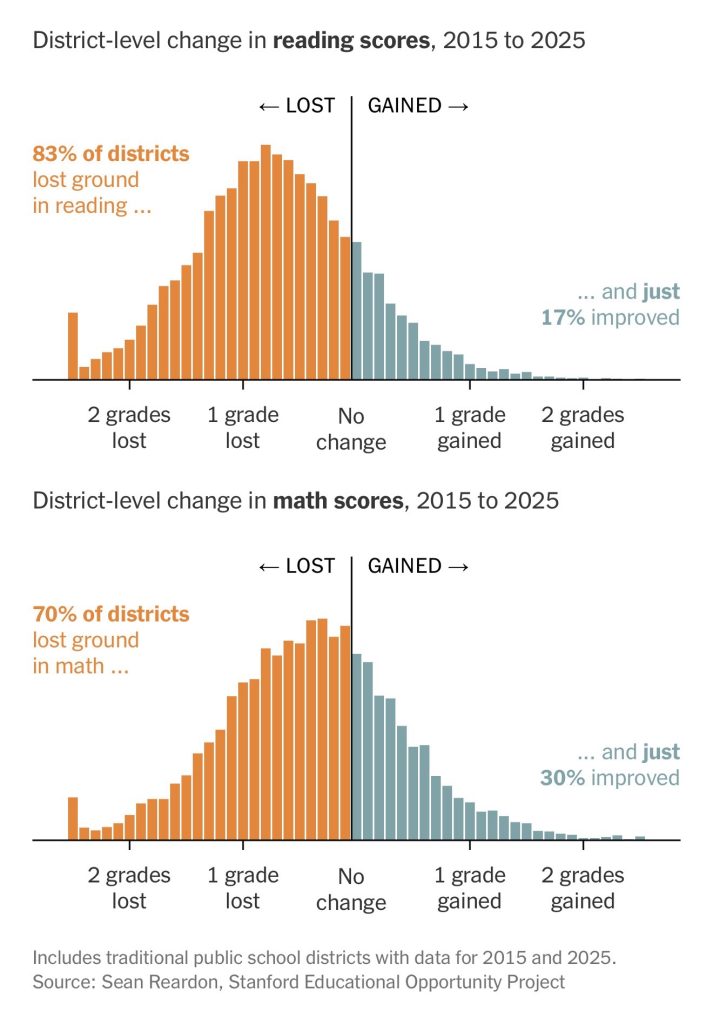
civics: Reihan Salam: What’s the Opposite of Mamdani?

Tunku Varadarajan

When Reihan Salam was 19, someone held a knife to his throat in front of his parents’ house in Brooklyn’s Kensington neighborhood. “The mugger stole my Harvard library card, an issue of Granta, and approximately $11,” he recalls. The police—“incredible, compassionate, competent”—were there within minutes. “There wasn’t much they could do, but they were responsive, and reassuring.” 

It was a “defining experience” for Mr. Salam, now 46: “It’s not quite right to say I was mugged by reality. I wasn’t a bleeding-heart liberal before it happened. But it certainly made me recoil from the antipolice left.” It made him aware of “the fragility of civilized life” and inspired “gratitude for the decency and work ethic of the police.” 

Since 2019 Mr. Salam has been president of the Manhattan Institute, America’s pre-eminent free-market think tank that specializes in urban policy. The institute once had insider cachet as the brain trust for Mayor Rudy Giuliani (1994-2001). Today, with socialist Zohran Mamdani in Gracie Mansion, it is on the front line of opposition, battling to counter what Mr. Salam calls the mayor’s “punitive egalitarianism.” 

The College-Admissions Chess Game Is More Complicated Than Ever

Roshan Fernandez

For high-school seniors across the country, May 1 is the denouement of a college-admissions chess game that has become more complicated than ever.

Friday—the deadline for students to tell colleges their final decisions—marks the culmination of an admissions process whose intensity has accelerated in recent years. Schools are pushing to get commitments sooner, adding new early-admission rounds, and using wait lists aggressively. The tactics force students, in turn, to strategically optimize their odds.

“Some students have this mentality of being a shopper, being the buyer,” said Adam Nguyen, founder of admissions-consulting firm Ivy Link. “You’re not the buyer—you are at the mercy of these colleges.”

When 17-year-old Lauren Tyree plotted out her college-application plan, she shuffled pieces of cardstock around on her table, each labeled with a target school, its deadlines and application stipulations.

She saw that applying to Princeton early, for instance, was limiting: Its “Single-Choice Early Action” option prevented early application to other private schools. Notre Dame’s “Restrictive Early Action” option, however, gave her more leeway. 

She was able to apply regular-decision to the Ivies—and got into Harvard, where she committed. “We had a very clear strategy about maximizing the schools and the chance,” Tyree said.

Confessions of a White House Public Health Priestess

Katy Talento:

HHS settled the lawsuit with a stunning admission – on the record – that no such studies existed. 

But I didn’t know any of that. I only knew that I had done my job and saved children.

For the next few years, I worked on a variety of policies I was really proud of (ending secret health care priceslowering drug prices, combatting opioid addiction) and others that didn’t go quite as well (the doomed repeal-and-replace-Obamacare misadventure). The demands of working in the White House are brutal. While many of my colleagues had become like family, my real family could no longer pick me out of a line-up.

…..

If untrue, the claims in Kennedy’s book were so utterly defamatory that they should have spurred a parade of lawsuits. To my knowledge, no such lawsuits have ever been filed.

This cascade of eye-opening episodes eventually forced me to confront a painful reality: my 2017 take on Mr. Kennedy and his Vaccine Safety Commission had been a massive mistake. 

What if there had been a Vaccine Safety Commission already in place during Operation Warp Speed? During the consideration of federal mandates by the Biden team? Adding COVID vaccines to the childhood schedule? What if Mr. Kennedy had been given regular access to President Trump in the first term?

Now, I’m not naive enough to think that a commission – any commission – would have had some immediate or obvious influence on vaccine policy. I know better than most how slowly government works. And no doubt Team Biden would have either immediately shut down the commission or replaced the commissioners with card-carrying members of the consensus class.

How Silicon Valley’s Brightest Parents Broke Their Own School

Zusha Elinson:

Tears filled the eyes of teachers and students in the combined fourth- and fifth-grade classroom at Tessellations, an exclusive Silicon Valley private school for gifted children.

Classmates had just learned that Meta’s chief product officer, Chris Cox, and his wife were planning to pull their son and five other students out of the small, inseparable class to start a home school. The nine students left behind were distraught.

That bombshell last May was only the latest shake-up at Tessellations, a pre-K to 8th-grade school that bore all the markings of the next big thing for young geniuses when wealthy Silicon Valley parents founded it six years ago. Instead, the institution—where tuition starts at $44,500, for preschool—has spiraled into bitter fights with neighbors, lawsuits from teachers and parents, and an internal war among tech executives who fought over the school’s future.

The saga offers a rare window into high-end Silicon Valley schools for gifted children, where the stakes rival college. Toddlers must ace IQ tests to land spots at the most coveted schools, and tech execs wield seven-figure donations to advance their children’s interests.

Such schools have proliferated in Silicon Valley, where the extraordinary concentration of wealth and smarts has produced an unusual dynamic: Founders and executives who soared by disrupting industries arrive at their children’s schools confident they can do the same to education.

Recovering the University’s Soul

Robert Barron:

This essay was delivered as the First Things 2026 Neuhaus Lecture at the New College of Florida.


The contemporary university is widely acknowledged to be in crisis. Loss of public confidence, relentless tuition increases, and intensifying debates over speech and academic freedom have called into question its purpose and institutional legitimacy. Yet these seemingly discrete crises and external pressures are best understood as symptoms of a deeper contradiction—one that reaches to the very heart of the university’s self-understanding and, at a still deeper level, to its conception of the human being it exists to serve.

More and more, the university treats education not as an intrinsic good but as a mere ­instrument—a means to economic security, social prestige, and self-invention. The university is reimagined as a service provider, the student as a consumer. For many, a four-year degree program represents not a period of intellectual formation but a season of self-exploration, a final interval of freedom before the obligations of adult life set in.

When education is subordinated to self-­invention rather than ordered to the pursuit of truth, the notion that students ought to submit their minds to an inherited body of knowledge and pedagogical tradition becomes untenable. Traditional curricula, disciplinary standards, and intellectual authorities are increasingly viewed with suspicion as remnants of a repressive past or impediments to personal freedom. In many institutions, this suspicion is not merely tolerated but fostered. Students are ­habituated to approach texts, arguments, and traditions not with a view to their intrinsic merit or the truth they may disclose, but rather by questioning whose interests they serve, whom they marginalize, and what structures of domination they ­reinforce. Thus, the intellectual life is transformed from a common search for truth into a contest of competing identities and narratives.

Will AI Gut the College Degree?

Raj Jha:

Industrial‑era college – four expensive years of ladder‑climbing prep – is on a collision course with two forces: compounding automation and collapsing trust in academic gatekeepers. Unless it’s rebuilt from first principles, it will survive only as a high‑priced social club. Here’s why going to college today is probably a bad idea, and how higher education needs to change to remain relevant.

Somewhere along the way, college lost its mid-20th-century connection to the thing that made it useful: it was once a clear signal that someone had the intellectual horsepower to join the expanding market for cognitive labor. Now that intelligence is no longer scarce, that signal is noise.

When I needed a data analyst at my company, I didn’t deal with weeks of hiring, messy HR issues and the overhead of another person, I got it done with a $0.06 API call. I’m not alone. A 2024 hiring-manager survey highlighted in Vanity Fair found 70 percent believe AI can cover intern-level tasks, coinciding with a sharp drop in internship postings across finance, healthcare, and media.

Teaching in classes grouped by ability does not hamper progress of less able pupils, study finds

Richard Adams:

Research on maths teaching in English secondary schools upends decades of debate over mixed-ability education

Teaching pupils in classes grouped by ability improves the results of high-flyers but does not affect the progress of less able children, according to a study that upends decades of debate over mixed-ability education.

The research by University College London’s Institute of Education found that secondary school pupils in England with previously strong maths performances made slower progress in mixed-attainment classes than when they were taught alongside children with similarly high ability.

Crucially, the study backed by the Education Endowment Foundation (EEF) showed that setting by ability did not “significantly harm the attainment of low-prior-attaining or socioeconomically disadvantaged” pupils.

The study’s impact analysis showed negative effects on self-confidence in maths for pupils in mixed-attainment schools, compared with those in schools using setting – challenging previous reports that setting harms the confidence of those outside the top sets.

John Jerrim, professor of education and social statistics at UCL, who has studied the effects of mixed-ability classes but was not involved in the new research, described the outcome as “big and important”.

——-

more.