Search results
149 results found.
149 results found.
Education Minister Erica Stanford has not ruled out job losses as the Government moves to end New Zealand’s long-running reading recovery programme.
The programme, which helps struggling readers, is being dumped as part of a $67 million dollar shake-up of the way literacy is taught in state schools.
The Government is making it mandatory for schools to use a structured literacy approach to teach reaching from next year – which is based on phonics, decoding and word understanding.
The reading recovery programme uses a different “whole language” approach, which has been criticised for using pictures to help children guess words.
On Friday, Stanford confirmed the end of the programme.
Under a new law, HEA 1558, the state of Indiana is mandating instruction and curriculum that aligns with the science of reading; use of Reading Recovery must be phased out by fall of 2024.
Science of reading is a methodology that uses direct, systematic use of five elements in literacy instruction: phonemic awareness, phonics, fluency, vocabulary and comprehension.
It is based on research about how brains actually learn to read.
The law says schools may not adopt curriculum based on the “three-cueing” model, which uses context, pictures or syntax clues for literacy instruction.
Teresa Stuckey, VCSC executive director of elementary education, says that Reading Recovery is considered three-cueing under the changes.
“The research is showing (three-cueing) doesn’t fit with the way children’s minds work, the way the brain processes,” she said.
The district has 24 Title 1 reading teachers, or interventionists, who use Reading Recovery part of the day.
———
Madison has long used Reading Recovery, despite our long term, disastrous reading results.
Underly and our long term disastrous reading results….
WEAC: $1.57 million for Four Wisconsin Senators
Legislation and Reading: The Wisconsin Experience 2004-
“Well, it’s kind of too bad that we’ve got the smartest people at our universities, and yet we have to create a law to tell them how to teach.”
The data clearly indicate that being able to read is not a requirement for graduation at (Madison) East, especially if you are black or Hispanic”
My Question to Wisconsin Governor Tony Evers on Teacher Mulligans and our Disastrous Reading Results
2017: West High Reading Interventionist Teacher’s Remarks to the School Board on Madison’s Disastrous Reading Results
Madison’s taxpayer supported K-12 school district, despite spending far more than most, has long tolerated disastrous reading results.
“An emphasis on adult employment”
Wisconsin Public Policy Forum Madison School District Report[PDF]
WEAC: $1.57 million for Four Wisconsin Senators
Friday Afternoon Veto: Governor Evers Rejects AB446/SB454; an effort to address our long term, disastrous reading results
Booked, but can’t read (Madison): functional literacy, National citizenship and the new face of Dred Scott in the age of mass incarceration.
When A Stands for Average: Students at the UW-Madison School of Education Receive Sky-High Grades. How Smart is That?
A small but positive development in the Massachusetts budget – @maura_healey vetoed the Reading Recovery earmark! Great call. More & more #MaEdu embraces early literacy instruction supported by the evidence. pic.twitter.com/xEXKl1Dgeo
— Michael Moriarty (@mmoriarty61) August 10, 2023
Notes and links on Reading Recovery (Madison is a long time user).
Long-Term Impacts of Reading Recovery through 3rd and 4th Grade: A Regression Discontinuity Study https://t.co/Ci34QiBvl9
“the long-term impact of Reading Recovery on students’ reading/ELA test scores in 3rd and 4th grades is statistically significant & substantially negative”
— Paul Bruno (@Paul__Bruno) May 24, 2023
the report.
Let's make a list of Reading Recovery-based product/program names that parents will see from districts so they know what to avoid and see that their schools don't purchase:https://t.co/Bh6emywzPx
— Gale Morrison (@GaleMorrisonEd) May 24, 2023
“Well, it’s kind of too bad that we’ve got the smartest people at our universities, and yet we have to create a law to tell them how to teach.”
The data clearly indicate that being able to read is not a requirement for graduation at (Madison) East, especially if you are black or Hispanic”
My Question to Wisconsin Governor Tony Evers on Teacher Mulligans and our Disastrous Reading Results
2017: West High Reading Interventionist Teacher’s Remarks to the School Board on Madison’s Disastrous Reading Results
Madison’s taxpayer supported K-12 school district, despite spending far more than most, has long tolerated disastrous reading results.
“An emphasis on adult employment”
Wisconsin Public Policy Forum Madison School District Report[PDF]
WEAC: $1.57 million for Four Wisconsin Senators
Friday Afternoon Veto: Governor Evers Rejects AB446/SB454; an effort to address our long term, disastrous reading results
Booked, but can’t read (Madison): functional literacy, National citizenship and the new face of Dred Scott in the age of mass incarceration.
When A Stands for Average: Students at the UW-Madison School of Education Receive Sky-High Grades. How Smart is That?
Emily Hanford & Christopher Peak:
The fact that students who participated in Reading Recovery did worse in later grades than similar students who did not get the program surprised May. [study]
“Was Reading Recovery harmful? I wouldn’t go as far as to say that,” he said. “But what we do know is that the kids that got it for some reason ended up losing their gains and then falling behind.”
In a written response to the study, the Reading Recovery Council of North America, the organization that advocates for the program in the United States, disputed some of the research methodology and maintained that their program is effective. It also said: “Reading Recovery has and will continue to change in response to evidence gathered from a wide range of studies of both students having difficulties with early reading and writing and their teachers.”
Mandates, closed schools and Dane County Madison Public Health.
The data clearly indicate that being able to read is not a requirement for graduation at (Madison) East, especially if you are black or Hispanic”
2017: West High Reading Interventionist Teacher’s Remarks to the School Board on Madison’s Disastrous Reading Results
Madison’s taxpayer supported K-12 school district, despite spending far more than most, has long tolerated disastrous reading results.
My Question to Wisconsin Governor Tony Evers on Teacher Mulligans and our Disastrous Reading Results
“An emphasis on adult employment”
Wisconsin Public Policy Forum Madison School District Report[PDF]
WEAC: $1.57 million for Four Wisconsin Senators
Friday Afternoon Veto: Governor Evers Rejects AB446/SB454; an effort to address our long term, disastrous reading results
Booked, but can’t read (Madison): functional literacy, National citizenship and the new face of Dred Scott in the age of mass incarceration.
No When A Stands for Average: Students at the UW-Madison School of Education Receive Sky-High Grades. How Smart is That?
Emily Hanford and Christopher Peak
The new, federally funded study found that children who received Reading Recovery had scores on state reading tests in third and fourth grade that were below the test scores of similar children who did not receive Reading Recovery.
“It’s not what we expected, and it’s concerning,” said lead author Henry May, director of the Center for Research in Education and Social Policy at the University of Delaware, who delivered the findings at the prestigious, annual gathering of education researchers being held this year in San Diego.
The findings could prompt school districts nationwide to reexamine their investment in Reading Recovery and consider other ways to help struggling first-graders.
May was the principal investigator of an earlier federally funded study of Reading Recovery, one of the largest ever randomized experiments of an instructional intervention in elementary schools. That study, which began in 2011, found evidence of large positive gains in first grade, as has other research. The program’s advocates have pointed to that research as evidence that the instructional approach is based on sound science and is effective.
But whether the initial gains last and translate into better performance on state reading tests remained a question. The new study on the long-term impact of Reading Recovery is the largest, most rigorous effort to tackle that question, according to May.
The fact that students who participated in Reading Recovery did worse in later grades than similar students who did not get the program surprised May. “Was Reading Recovery harmful? I wouldn’t go as far as to say that,” he said. “But what we do know is that the kids that got it for some reason ended up losing their gains and then falling behind.”
At least 2.4 million students in the United States have participated in Reading Recovery or its Spanish-language counterpart since 1984, when the program first came to America from New Zealand. The program is in nearly 2,000 schools in 41 states.
Mandates, closed schools and Dane County Madison Public Health.
The data clearly indicate that being able to read is not a requirement for graduation at (Madison) East, especially if you are black or Hispanic”
2017: West High Reading Interventionist Teacher’s Remarks to the School Board on Madison’s Disastrous Reading Results
Madison’s taxpayer supported K-12 school district, despite spending far more than most, has long tolerated disastrous reading results.
My Question to Wisconsin Governor Tony Evers on Teacher Mulligans and our Disastrous Reading Results
“An emphasis on adult employment”
Wisconsin Public Policy Forum Madison School District Report[PDF]
WEAC: $1.57 million for Four Wisconsin Senators
Friday Afternoon Veto: Governor Evers Rejects AB446/SB454; an effort to address our long term, disastrous reading results
Booked, but can’t read (Madison): functional literacy, National citizenship and the new face of Dred Scott in the age of mass incarceration.
When A Stands for Average: Students at the UW-Madison School of Education Receive Sky-High Grades. How Smart is That?
James Chapman, via a kind reader:
Children are encouraged to use pictures or other cues to guess unknown words. This approach is supported by the use of predictable books rather than decodable books. Predictable books have sentences that are repetitive and have words that many beginner readers cannot read by themselves.
Learning to read is not like learning to talk. Most children need to be taught explicitly what sounds that letters, and groups of letters, make. Phonics helps in this process. Unfortunately, RR strongly and mistakenly disapproves of phonics. As a result, RR denies most struggling readers with the very skills they need to become successful readers.
RR does not teach children how words work. In addition to letter sounds,there are other important building blocks that children need to learn to help them read. Children need to be able to blend sounds together, segment words into their separate sounds, and break words into syllables. These skills are also really important for spelling development. RR does not focus on developing these skills even though the research about their importance is overwhelming. Struggling readers are disadvantaged as a result.
RR has little to no focus on spelling. Yet, there is a lot of evidence that shows reading and spelling should be learnt at the same time.RR has turned out to be a big disappointment. One major review of early intervention programs showed that RR was no better than one-to-one interventions that were done by teacher aides or volunteers with little training. This comprehensive review showed that the most successful reading intervention programs in the junior primary school were based on phonics approaches. Yet, RR clings to outdated reading approaches that end up disadvantaging the very students the program is supposed to help.
Madison’s long term, disastrous reading results.
The Madison School District (PDF):
What Have We Learned?
Nationally and internationally, large body of research on Reading Recovery with mixed evidence
Locally, although some RR students in some schools have success during and after the program, results over time show no consistent positive effects at a systems level
What do these findings mean for interventions overall and for Reading Recovery?
Next Steps
In General for Interventions:Review current interventions on a cycle that is commensurate with core curriculum review
Central office will provide guidance and support to schools as they select interventions based on student needs
Tighten up system of documentation for all interventions (Oasys)
Continue to identify effective research based interventions that may meet the needs of more students
Continue with our expanded and enhanced professional development model as it is a comprehensive training model that supports coherent instruction
Specific to Reading Recovery:
Based on capacity to implement with fidelity, history of student success, and alignment with School Improvement
Plan, principals have discretion to offer Reading Recovery within their multi-tiered system of supports
Fits with district belief of flexibility within clear parameters
Keeps schools at the center of decision-making because they know their students and staff best
Title 1 schools are no longer required to have Reading Recovery as an intervention
Title 1 schools will not lose any funding if they choose not to implement Reading Recovery
2014 Madison Schools’ Reading Recovery Evaluation (PDF).
Notes and links on Reading Recovery.
Madison’s long term disastrous reading results.
William E. Tunmer, James W. economic communities. Disparities Chapman & Keith T. Greaney (PDF):
In this LDA Bulletin article, we summarise arguments and evidence reported in a detailed paper (Tunmer, Chapman, Greaney, Prochnow & Arrow, 2013) showing that New Zealand’s national literacy strategy has failed and particularly the role of Reading Recovery in contributing to that failure.
In response to growing concerns during the 1990s about New Zealand’s relatively “long tail” of literacy underachievement, the government established a Literacy Taskforce to provide recommendations aimed at raising the literacy achievement of all students but with particular attention given to “closing the gap between the lowest and highest students” (Ministry of Education, 1999, p.7). The recommendations of the Taskforce constituted the national literacy strategy for reducing the large disparity in reading achievement outcomes between good and poor readers.
A decade later, concerns were still being expressed about the literacy achievement gap. In December 2011, the New Zealand Ministry of Education’s Briefing to the Incoming Minister following the New Zealand general election (Ministry of Education, 2011) stated that:
“…the gap between our high performing and low performing students remains one of the widest in the Organization of Economic Cooperation and Development (OECD). These low performing students are likely to be Mãori or Pasifika and/or from low socio-economic communities. Disparities in education appear early and persist throughout learning” (p.8).
Based on these findings, the Briefing concluded that, “The greatest challenge facing the schooling sector is producing equitable outcomes for students” (p.23). This conclusion can be taken as an admission that the national literacy strategy was failing to reduce the gap.
Related: Reading Recovery in madison….. 28% to 58%; lags national effectiveness average…..
Much more on Reading Recovery, here.
Via the Wisconsin Coalition on Reading:
Yet another research paper shows the ineffectiveness of Reading Recovery. Reading Recovery and the failure of the New Zealand national literacy strategy, by Tunmer, Chapman, Greaney, Prochnow, and Arrow, was published in November of 2013, and has been getting some more publicity lately. Aside from the Reading Recovery program itself, which is still in use in many schools in our state, Leveled Literacy Intervention (LLI) is based on the same instructional principles.
Check out this dyslexia PSA produced by students in Oregon.
Wisconsin Reading Coalition, via a kind email:
The results of the 2013 National Assessment of Educational Progress (NAEP) were released today. For Wisconsin, the news on reading is much the same as it was two years ago at the last NAEP administration. 33.6% of our 4th graders reached the proficient level. Massachusetts again scored at the top, with 50.4% of its 4th graders proficient.
Wisconsin students who are Asian, black, and white, as well as students who are not eligible for a free and reduced lunch, all posted scores that are significantly lower than the national averages for those groups of students. We had no 4th grade sub-groups that scored significantly above the national average for their group.
Wisconsin’s black 8th graders had the lowest scores in the nation, falling below Mississippi and Alabama. Wisconsin’s black 4th graders had the second lowest scores in the nation, and at both 4th and 8th grade, Wisconsin had the largest gap between white and black students.
As we examine the data more fully, we will have more specifics.
Fourth- and eighth-graders across the country made modest advances in national math and reading exams this year, according to data released Thursday, but proficiency rates remained stubbornly below 50% on every test.
Amid the sluggish progress nationwide, a few areas notched drastic improvements on the 2013 National Assessment of Educational Progress exams, with Tennessee and Washington, D.C., –as well as schools on military bases–the only ones achieving statistically significant gains on all tests.
Washington gained a cumulative 23 points since 2011, while Tennessee posted a 22-point jump–both compared with a 4-point national gain. The exams are scored on a 0-500 scale.
Officials in Tennessee and Washington attributed the gains to tougher classroom math and reading standards, improved teacher development and overhauling teacher evaluations.
State posts widest achievement gap in ‘the nation’s report card’ by Lydia Mulvany:
Steven Dykstra, a founding member of the Wisconsin Reading Coalition, a grassroots group devoted to reforming reading instruction, said the state needs to start imitating reforms in other states by training teachers more effectively. In the past, Wisconsin students ranked as high as third in the nation in reading.
“This isn’t a surprise. The last time we did well in reading was when everyone sucked at reading,” Dykstra said. “When some states started doing better, they very quickly left us behind.”
“Left behind” is precisely what the data shows is happening to Wisconsin’s black students:
Eighth graders, reading: 9% were judged proficient; 55% rated below basic, the most of any state.
Fourth graders, reading: 11% were proficient; 65% scored below basic, again the most of any state.
Eighth graders, math: 8% were proficient; 62% rated below basic, better than only three states.
Fourth graders, math: 25% were proficient; 30% scored below basic, again with only three states performing worse.
Henry Krankendonk, a retired Milwaukee Public Schools math curriculum planner and NAEP board member, said Wisconsin’s failure to narrow the disparity — which has existed for decades — is a challenge for Milwaukee in particular, because it has the highest concentration of minority students. Krankendonk said the problem has long been weak standards for what students should know, and he was hopeful that the recent adoption of new standards more in line with NAEP, called Common Core State Standards, would help.
Meanwhile, St. Norbert College Education Professor Steve Correia emphasized how well (!) Reading Recovery is working while discussing Wisconsin’s NAEP results on WPR. [5.6mb mp3 audio]
Related: Madison’s long term disastrous reading results.
Much more on NAEP over time, here.
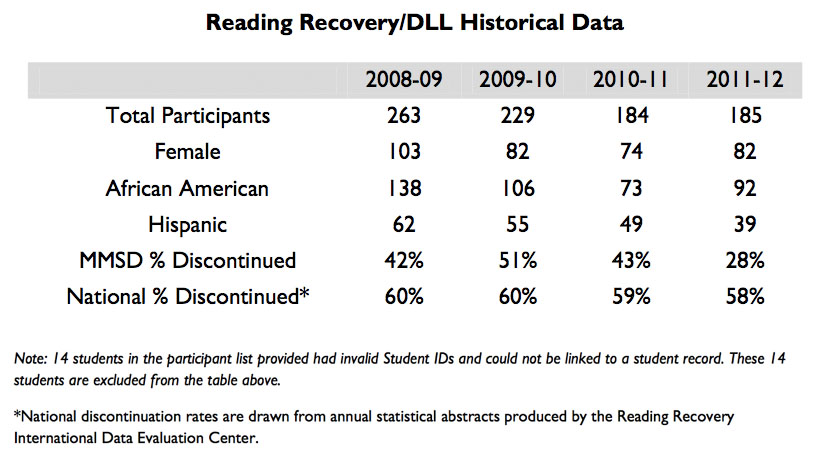
Tap or click for a larger version of the above chart.
Madison Superintendent Jane Belmore:
In investigating the options for data to report for these programs for 2011-12 and for prior years, Research & Program Evaluation staff have not been able to find a consistent way that students were identified as participants in these literacy interventions in prior years.
As such, there are serious data concerns that make the exact measures too difficult to secure at this time. Staff are working now with Curriculum & Assessment leads to find solutions. However, it is possible that this plan will need to be modified based on uncertain data availability prior to 2011-12.
Much more on Madison’s disastrous reading results, here. Reading continues to be job one for our $392,000,000 public schools.
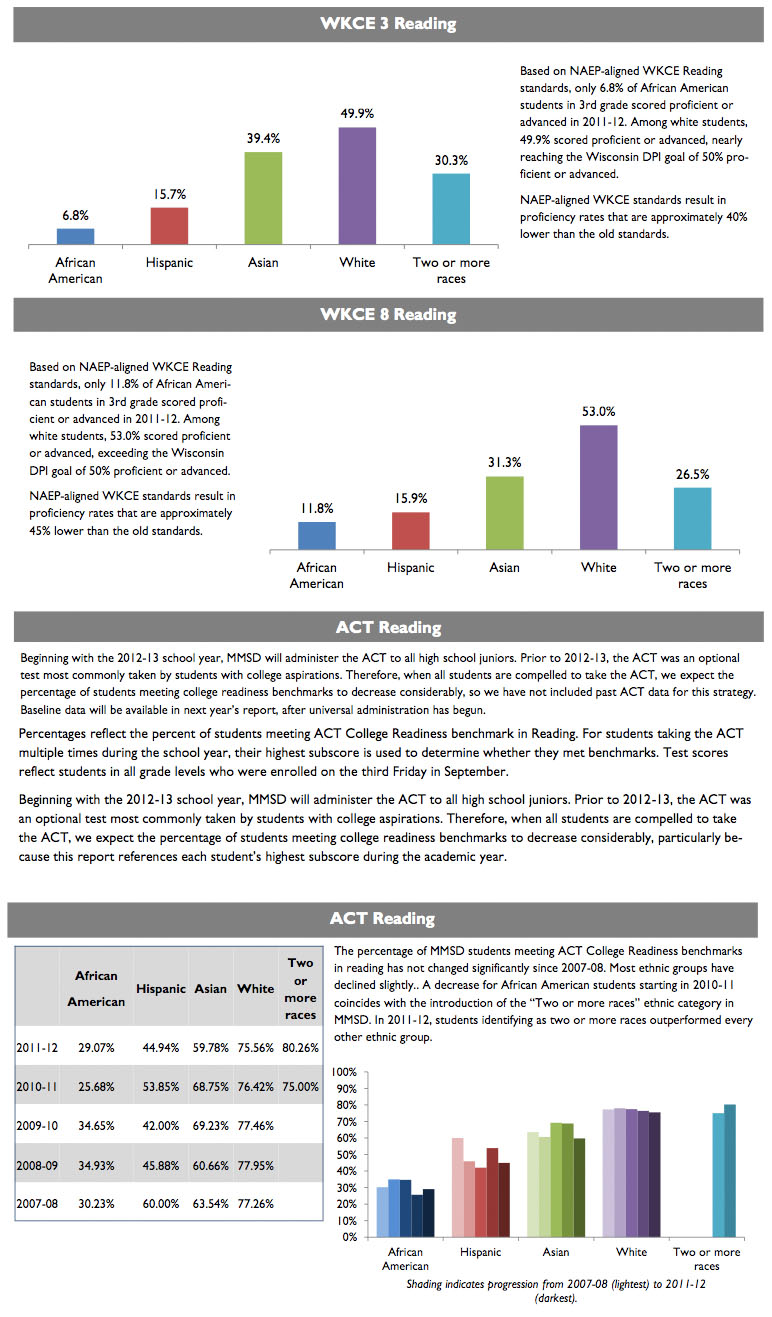
Tap or click to view a larger version of the above image.
Measuring Madison’s Progress – Final Report (2.5MB PDF).
Given the results, perhaps the continued $pending and related property tax increases for Reading Recovery are driven by adult employment, rather than kids learning to read.
UPDATE: April 1, 2013 Madison School Board discussion of the District’s reading results. I found the curriculum creation conversation toward the end of the meeting fascinating, particularly in light of these long term terrible results. I am not optimistic that student reading skills will improve given the present structure and practices. 30 MB MP3.
UPDATE: December, 2017…. ….
The teachers are angry because we are being held accountable for things that we didn’t do at the high school level. Of those 24 students, 21 of them have been enrolled in Madison for four or more years.
Of those 24 students one is Caucasian the rest of them identify as some other ethnic group.
I am tired of the district playing what I called whack-a-mole, (in) another words a problem happens at Cherokee boom we bop it down and we we fix it temporarily and then something at Sherman or something at Toki or something at Faulk and we bop it down and its quiet for awhile but it has not been fixed on a system-wide level and that’s what has to change.
With Monday’s actions, the board still has about $5.6 million to deal with – either through cuts, property tax increases, or a combination of the two – when it meets again next week to finalize the district’s preliminary budget for 2010-11. So far, the board has made about $10.6 million in cuts and approved a levy increase of $12.7 million, a tax hike of $141.76 for the owner of a $250,000 Madison home.
In an evening of cost shifting, the board voted to apply $1,437,820 in overestimated health care insurance costs to save 17.8 positions for Reading Recovery teachers, who focus on the district’s lowest-performing readers. That measure passed 5-2, with board members Maya Cole and Lucy Mathiak voting no. The district is undergoing a review of its reading programs and Cole questioned whether it makes sense to retain Reading Recovery, which she said has a 42 percent success rate.
Related: 60% to 42%: Madison School District’s Reading Recovery Effectiveness Lags “National Average”: Administration seeks to continue its use.
Surprising, in light of the ongoing poor low income reading scores here and around Wisconsin. How many more children will leave our schools with poor reading skills?
The Wisconsin State Journal advocates a teacher compensation freeze (annual increase plus the “step” increases).
Well worth reading, particularly Maya Cole’s suggestions on Reading Recovery (60% to 42%: Madison School District’s Reading Recovery Effectiveness Lags “National Average”: Administration seeks to continue its use) spending, Administrative compensation comparison, a proposal to eliminate the District’s public information position, Ed Hughes suggestion to eliminate the District’s lobbyist (Madison is the only District in the state with a lobbyist), trade salary increases for jobs, Lucy Mathiak’s recommendations vis a vis Teaching & Learning, the elimination of the “expulsion navigator position”, reduction of Administrative travel to fund Instructional Resource Teachers, Arlene Silveira’s recommendation to reduce supply spending in an effort to fund elementary school coaches and a $200,000 reduction in consultant spending. Details via the following links:
Maya Cole: 36K PDF
Ed Hughes: 127K PDF
Lucy Mathiak: 114K PDF
Beth Moss: 10K PDF
Arlene Silveira: 114K PDF
The Madison School District Administration responded in the following pdf documents:
Much more on the proposed 2010-2011 Madison School District Budget here.
US Department of Education, Institute of Education Sciences, via a kind reader’s email:
No studies of Reading Recovery® that fall within the scope of the English Language Learners (ELL) review protocol meet What Works Clearinghouse (WWC) evidence standards. The lack of studies meeting WWC evidence standards means that, at this time, the WWC is unable to draw any conclusions based on research about the effectiveness or ineffectiveness of Reading Recovery® on ELL.
Reading Recovery® is a short-term tutoring intervention designed to serve the lowest-achieving (bottom 20%) first-grade students. The goals of Reading Recovery® include: promoting literacy skills; reducing the number of first-grade students who are struggling to read; and preventing long-term reading difficulties. Reading Recovery® supplements classroom teaching with one-to-one tutoring sessions, generally conducted as pull-out sessions during the school day. The tutoring, which is conducted by trained Reading Recovery® teachers, takes place for 30 minutes a day over a period of 12 to 20 weeks.
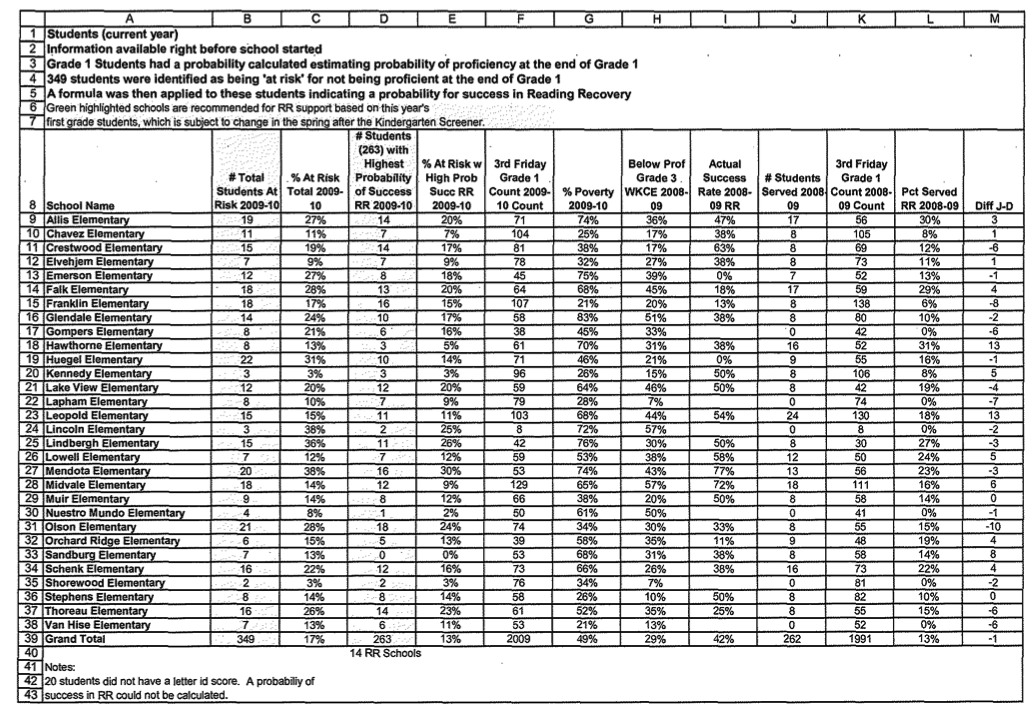
Click for a Reading Recovery Data Summary from Madison’s Elementary Schools. December 2009
Madison School Board 24MB mp3 audio file. Madison Superintendent Dan Nerad’s December 10, 2009 memorandum [311K PDF] to the board in response to the 12/7/2009 meeting:
Attached to this memo are several items related to further explanation of the reason why full implementation is more effective for Reading Recovery and what will happen to the schools who would no longer receive Reading Recovery as part of the administrative recommendation. There are three options for your review:
- Option I: Continue serving the 23 schools with modifications.
- Option II: Reading Recovery Full Implementation at Title I schools and Non-Title I Schools.
- Option III: Serving some students in all or a majority of schools, not just the 23 schools who are currently served.
The first attachment is a one-page overview summary ofthe MMSD Comprehensive Literacy Model. It explains the Balanced Literacy Model used in all MMSD elementary schools. It also provides an explanation of the wrap around services to support each school through the use of an Instructional Resource Teacher as well as Tier II and Tier III interventions common in all schools.
The second attachment shows the detailed K-5 Title I Reading Curriculum Description in which MMSD uses four programs in Title I schools: Rock and Read, Reading Recovery, Apprenticeship, and Soar to Success. As part of our recommendation, professional development will be provided in all elementary schools to enable all teachers to use these programs. Beginning in Kindergarten, the four instructional interventions support and develop students’ reading and writing skills in order to meet grade level proficiency with a focus on the most intensive and individualized wrap around support in Kindergarten and I” Grade with follow up support through fifth grade.
Currently these interventions are almost solely used in Title I schools.
The third attachment contains three sheets – the frrst for Reading Recovery Full Implementation at Title I schools, the second for No Reading Recovery – at Title I Schools, and the third for No Reading Recovery and No Title I eligibility. In this model we would intensify Reading Recovery in a limited number of schools (14 schools) and provide professional development to support teachers in providing small group interventions to struggling students.
The fourth attachment is a chart of all schools, students at risk and students with the highest probability of success in Reading Recovery for the 2009-10 school year. This chart may be used if Reading Recovery would be distributed based on student eligibility (districtwide lowest 20% of students in f rst grade) and school eligibility (based on the highest number of students in need per school).
Option I: Leave Reading Recovery as it currently is, in the 23 schools, but target students more strategically and make sure readiness is in place before the Reading Recovery intervention.
Related: 60% to 42%: Madison School District’s Reading Recovery Effectiveness Lags “National Average”: Administration seeks to continue its use.
Props to the Madison School Board for asking excellent, pointed questions on the most important matter: making sure students can read.
via a kind reader’s email: Sue Abplanalp, Assistant Superintendent for Elementary Education, Lisa Wachtel, Executive Director, Teaching & Learning, Mary Jo Ziegler, Language Arts/Reading Coordinator, Teaching & Learning, Jennie Allen, Title I, Ellie Schneider, Reading Recovery Teacher Leader [2.6MB PDF]:
Background The Board of Education requested a thorough and neutral review of the Madison Metropolitan School District’s (MMSD) Reading Recovery program, In response to the Board request, this packet contains a review of Reading Recovery and related research, Madison Metropolitan School District (MMSD) Reading Recovery student data analysis, and a matrix summarizing three options for improving early literacy intervention. Below please find a summary of the comprehensive research contained in the Board of Education packet. It is our intent to provide the Board of Education with the research and data analysis in order to facilitate discussion and action toward improved effectiveness of early literacy instruction in MMSD.
Reading Recovery Program Description The Reading Recovery Program is an intensive literacy intervention program based on the work of Dr. Marie Clay in New Zealand in the 1970’s, Reading Recovery is a short-term, intensive literacy intervention for the lowest performing first grade students. Reading Recovery serves two purposes, First, it accelerates the literacy learning of our most at-risk first graders, thus narrowing the achievement gap. Second, it identifies children who may need a long-term intervention, offering systematic observation and analysis to support recommendations for further action.
The Reading Recovery program consists of an approximately 20-week intervention period of one-to-one support from a highly trained Reading Recovery teacher. This Reading Recovery instruction is in addition to classroom literacy instruction delivered by the classroom teacher during the 90-minute literacy block. The program goal is to provide the lowest performing first grade students with effective reading and writing strategies allowing the child to perform within the average range of a typical first grade classroom after a successful intervention period. A successful intervention period allows the child to be “discontinued” from the Reading Recovery program and to function proficiently in regular classroom literacy instruction.
Reading Recovery Program Improvement Efforts The national Reading Recovery data reports the discontinued rate for first grade students at 60%. In 2008-09, the discontinued rate for MMSD students was 42% of the students who received Reading Recovery. The Madison Metropolitan School District has conducted extensive reviews of Reading Recovery every three to four years. In an effort to increase the discontinued rate of Reading Recovery students, MMSD worked to improve the program’s success through three phases.
Reading recovery will be discussed at Monday evening’s Madison School Board meeting.
Related:
In her column, Belmore also emphasized the 80 percent of the children who are doing well, but she provided additional statistics indicating that test scores are improving at the five target schools. Thus she argued that the best thing is to stick with the current program rather than use the Reading First money.
Belmore has provided a lesson in the selective use of statistics. It’s true that third grade reading scores improved at the schools between 1998 and 2004. However, at Hawthorne, scores have been flat (not improving) since 2000; at Glendale, flat since 2001; at Midvale/ Lincoln, flat since 2002; and at Orchard Ridge they have improved since 2002 – bringing them back to slightly higher than where they were in 2001.
In short, these schools are not making steady upward progress, at least as measured by this test.
Belmore’s attitude is that the current program is working at these schools and that the percentage of advanced/proficient readers will eventually reach the districtwide success level. But what happens to the children who have reading problems now? The school district seems to be writing them off.
So why did the school district give the money back? Belmore provided a clue when she said that continuing to take part in the program would mean incrementally ceding control over how reading is taught in Madison’s schools (Capital Times, Oct 16). In other words, Reading First is a push down the slippery slope toward federal control over public education.
Thanks to Jason Shepard for highlighting comments of UW Psychology Professor Mark Seidenberg at the Dec. 13 Madison School Board meeting in his article, Not all good news on reading. Dr. Seidenberg asked important questions following the administrations presentation on the reading program. One question was whether the district should measure the effectiveness of its reading program by the percentages of third-graders scoring at proficient or advanced on the Wisconsin Reading Comprehension Test (WRCT). He suggested that the scores may be improving because the tests arent that rigorous.
I have reflected on his comment and decided that he is correct.
Using success on the WRCT as our measurement of student achievement likely overstates the reading skills of our students. The WRCT—like the Wisconsin Knowledge and Concepts Examination (WKCE) given in major subject areas in fourth, eighth and tenth grades— measures student performance against standards developed in Wisconsin. The more teaching in Wisconsin schools aims at success on the WRCT or WKCE, the more likely it is that student scores will improve. If the tests provide an accurate, objective assessment of reading skills, then rising percentages of students who score at the proficient and advanced levels would mean that more children are reaching desirable reading competence.
I’m glad Jason Shepard questions MMSD’s public display of self-congratulation over third grade reading test scores. It isn’t that MMSD ought not be proud of progress made as measured by fewer African American students testing at the basic and minimal levels. But there is still a sigificant gap between white students and students of color–a fact easily lost in the headlines. Balanced Literacy, the district’s preferred approach to reading instruction, works well for most kids. Yet there are kids who would do a lot better in a program that emphasizes explicit phonics instruction, like the one offered at Lapham and in some special education classrooms. Kids (arguably too many) are referred to special education because they have not learned to read with balanced literacy and are not lucky enough to land in the extraordinarily expensive Reading Recovery program that serves a very small number of students in one-on-on instruction. (I have witnessed Reading Recovery teachers reject children from their program because they would not receive the necessary support from home.)
Though the scripted lessons typical of most direct instruction programs are offensive to many teachers (and is one reason given that the district rejected the Reading First grant) the irony is that an elementary science program (Foss) that the district is now pushing is also scripted as is Reading Recovery and Everyday Math, all elementary curricula blessed by the district.
I wonder if we might close the achievement gap further if teachers in the district were encouraged to use an approach to reading that emphasizes explicit and systematic phonics instruction for those kids who need it. Maybe we’d have fewer kids in special education and more children of color scoring in the proficient and advanced levels of the third grade reading test.
New research into the progress of 500 children published today shows that young children who were the poorest readers – and the very lowest-achieving in their class – can go on to outperform the national average within two years. They must be given four to five months of one-to-one tuition by specially trained Reading Recovery teachers for about 30 minutes a day while the children are aged six.
The research by the Institute of Education into the Every Child a Reader project shows that boys benefit to the same extent as girls and that one-to-one tuition helps to reduce the gender gap. The presence of Reading Recovery teachers also helps the other children in the school who do not attend the Reading Recovery lessons.
The two-year research project looked at the reading and writing progress of the lowest achieving children in 42 schools in ten inner London boroughs with the biggest social problems. The eight poorest readers in each class, then aged six, were selected. Eighty-seven of these children had the benefit of the Reading Recovery special tuition programme and their progress was compared to a group of children of similar ability and backgrounds, who did not receive the same tuition.
After one year children who had received the tuition had reading ages that matched their chronological age, and were 14 months ahead of the children in the comparison group.
Complete report here.
Much more on Reading Recovery here.
Reading War II is still raging as reading experts attack a New York Times story on Madison’s decision to reject federal Reading First funds in order to continue a reading program that the Times claims is effective. Education News prints as-yet unpublished letters to the Times from Reid Lyons, Robert Sweet, Louisa Moats, Linnea Ehri and Joanna Williams, Timothy Shanahan and Mark Seidenberg. Professor Moats, formerly co-investigator of the NICHD Early Interventions Project, a five-year, federally funded study of reading instruction in high-poverty schools, points out that the Office of Management and Budget “recently gave the Reading First program its highest (and unusual) rating of effectiveness.”
Joanne will be speaking in Milwaukee on March 23, 2007. More: Reading First and Reading Recovery.
What makes this article from Fargo interesting is how it almost exactly mirrors the findings in my home district, Hortonville, and the recent analysis of Reading Recovery done in Madison. That being, a 50% success rate for RR students. From the article:
“However, West Fargo student data over time, as presented by Director of Knowledge Management Holly Budzinski Monday night, show that while this is happening in the short term, it?s not something the students sustain in the long run. The Administration has been scrutinizing the Reading Recovery program since two days after Budzinski arrived in West Fargo last January, and she has found that the majority of students served by Reading Recovery gradually lose their abilities to meet the class average by the time they reach sixth grade.”
A reader emailed this item: Madison Teachers, Inc. Solidarity Newsletter [pdf file]:
The District sent literature to various teachers offering credit to those who enroll in the above-referenced courses. As an enticement for the Reading Recovery Teacher Leader course, the District offers “salary, tuition, and book costs.” The program will run after work hours during the school year. Regarding the Middle School Math Master’s Program, every District teacher, who teaches math in a middle school, is “expected” to take three (3) District inservice courses in math, unless they hold a math major or minor. The District is advising teachers that they must complete the three (3) courses within two (2) years. The courses are 21 hours each. The program is scheduled to run during the school day, with substitute teachers provided on the days the courses will be taught.
The Wisconsin Employment Relations Commission has previously ruled that an employer offering financial incentives, including meals and lodging, or release time, to employees in conjunction with course work or seminars is a mandatory subject of bargaining between the school district and the union.
The reduction of over $680,000 of ESEA Title 1 entitlement grant dollars challenges the district to change the way students and teachers are supported under Title 1. The current direct service model of student support cannot be supported in the long run with current funding. The administration will use the first semester of next year to develop a new model. (Page 252, Department & Division Detailed Budgets)
The MMSD uses Title 1 money to fund Reading Recovery. Does the statement above mean the end of Reading Recovery in the district?
The use and effectiveness of Reading Recovery is in the news elsewhere. More links. Joanne Jacobs has more.
Mention accelerated learning and you probably think of high school students taking Advanced Placement classes. But did you know that every year about 300 of the very lowest performing first graders participate in a special literacy intervention that provides opportunities for them to accelerate their literacy learning skills? After just 12-20 weeks in Reading Recovery the very lowest readers have the prospect of joining an average reading group!
Rapid changes in learning depend upon the teacher’s ability to individually design a series of lessons to match the unique learning characteristics of each child. So teachers are continually confronted with the need to expand their expertise.
A gift of nearly $3 million is being used to boost teacher training at the UW-Madison in a special, reading program.
But that program, Reading Recovery, has critics, who say it’s not worth the necessary investment.
Training at a new UW-Madison Reading Recovery Center will involve videotaping teachers, as they instruct young children, in a one-on-one process between student and teacher that costs more than group programs.
Student progress with Reading Recovery in the Madison School District and across the country has been questioned.
Below Jeff Henriques posted a response from the MMSD to a letter criticizing Reading Recovery.
The critical letter concludes:
“Reading Recovery has not met the needs of these lowest performing students. Most significantly, its excessive costs can make it more difficult for a school to provide help for all students in need, especially those who are behind in the upper grades. Thus, Reading Recovery is not a productive investment of taxpayers� money or students� time and is a classic example of a �one size fits all� method.”
Read the full letter letter on Reading Recovery’s flaws.
Ed Blume
In response to criticism of Reading Recovery here and on the Madison TAG Parents web site, MMSD Reading Recovery Coordinator, Sharon Gilpatrick, provided TAG staff with information in response to the letter about Reading Recovery and asked that it be shared with the community.
According to the Reading Recovery Council of North America the Internet letter criticizing Reading Recovery was not an “unbiased review of evidence. It represents a narrow but vocal minority opinion.” They also state that it has a number of biases and omits important findings. You can draw your own conclusions by reading their letter signed by their group of international researchers.
American-American students fare badly in Reading Recovery. Only 43% successfully discontinue, compared to 49% for Asian students, 56% for Hispanic students, and 57% for white students.
According to one of the district�s report on Reading Recovery (p. 14), �Discontinued Reading Recovery students [that is, students who �graduate�] outperform the comparison group by 1.2 text reading levels while all other Reading Recovery students score almost 4 text reading levels less than their comparison group.�
In other words, for every 43 discontinued African-American Reading Recovery students who advance 1.2 text reading levels, 57 fall behind by 4 text reading levels relative to their comparison group. The net impact of Reading Recovery reduces overall reading success for the African-American students in the district.
Ed Blume
Christopher Peak and Emily Haavik
Pressure is mounting on two universities to change the way they train on-the-job educators to teach reading.
The Ohio State University in Columbus and Lesley University near Boston both run prominent literacy training programs that include a theorycontradicted by decades of cognitive science research. Amid a $660 million effort to retrain teachers that’s underway in 36 states, other academic institutions are updating their professional development. Yet Ohio State and Lesley are resisting criticism and standing by their training.
For decades, their Literacy Collaborative programs deemphasized teaching beginning readers how to sound out words. These programs do cover some phonics, but they also teach that students can use context clues to decipher unfamiliar words. Studies have repeatedly shown that guessing words from context is inefficient, unreliable and counterproductive. Twelve states have effectively banned school districts from using that flawed approach.
The approach, sometimes called “cueing,” originated in the 1960s in the United States and New Zealand, and was popularized in American reading instruction by Gay Su Pinnell and Irene Fountas, professors at the two universities. Pinnell, who is now retired, founded OSU’s Literacy Collaborative, and Fountas founded and still directs Lesley’s Center for Reading Recovery & Literacy Collaborative.
—-
Jenny Warner shares:
As if they took a cue from @FountasPinnell, @OhioState won’t speak publicly, lucky for us @lesley_u took their cue from Calkins and shared their adoration for @rrcna_org and how they haven’t altered how they teach future teachers how to read, but rather how teach them to be “politically savvy.”
—
The data clearly indicate that being able to read is not a requirement for graduation at (Madison) East, especially if you are black or Hispanic”
My Question to Wisconsin Governor Tony Evers on Teacher Mulligans and our Disastrous Reading Results
2017: West High Reading Interventionist Teacher’s Remarks to the School Board on Madison’s Disastrous Reading Results
Madison’s taxpayer supported K-12 school district, despite spending far more than most, has long tolerated disastrous reading results.
“An emphasis on adult employment”
Wisconsin Public Policy Forum Madison School District Report[PDF]
WEAC: $1.57 million for Four Wisconsin Senators
Friday Afternoon Veto: Governor Evers Rejects AB446/SB454; an effort to address our long term, disastrous reading results
Booked, but can’t read (Madison): functional literacy, National citizenship and the new face of Dred Scott in the age of mass incarceration.
When A Stands for Average: Students at the UW-Madison School of Education Receive Sky-High Grades. How Smart is That?
The big education story of the week is the negative effects of inadequate literacy instruction on parental trust — and the lack of sufficient coverage needed to cover the literacy reform effort.
What’s being attempted in NYC and many other parts of the nation is one of the biggest education stories of the decade. “No major metropolitan school district has ever managed to raise reading achievement at scale — or to make higher test scores stick,” writes Robert Pondiscio in a sobering overview of NYC Reads in the outlet Commentary.
Researchers, school systems, and publishers responsible for the prolonged use of discredited methods and materials are — not surprisingly — trying to avoid accountability. Nineteen different Teachers College colleagues declined to comment or didn’t bother to respond, including the discredited former head of the program, according to the Columbia Spectator’s Sabrina Ticer-Wurr. To block Ohio’s efforts to improve literacy, Reading Recovery is suing Ohio, reports EdWeek’s Sarah Schwartz.
And yet parents and the general public still know precious little about how their kids and their schools’ efforts are going, week in and week out. “It’s no accident that Moms for Liberty has embraced the ‘science of reading’ movement,” writes NYC parent and journalist Kendra Hurley in Slate. “Reading instruction drove a wedge between me and my kids’ teachers.”
Interesting to see how newbie journalists frame issues with US reading instruction:
“Reading Recovery may be like a keto diet: you get results, you get them fast, but you’re not building the fundamentals needed to make sustainable, long-term progress” https://t.co/bxImGrLViu
— Karen Vaites (@karenvaites) April 10, 2023
His budget proposal contains $162 million over the next two years to get the science of reading instructional approach into all of Ohio’s public schools.
At the same time, Ohio State University has been an epicenter of the approach to reading instruction that DeWine wants to get away from – known as “balanced literacy” or “whole language” – since 1984, holding a trademark for an intervention program used to catch struggling readers up with their peers. Hundreds of thousands of students across the country have been educated using the program – called Reading Recovery – which OSU professors take into local schools across the country.
Balanced literacy encourages students, when they encounter a word they don’t know, to use strategies such as looking at the book’s pictures and considering context, sentence structure and the word’s letters.
But DeWine, in his State of the State speech, cited the most recent results of Ohio’s State Test as a reason for schools to change their approach. Just 60.1% of third-grade students scored proficient or higher on reading.
Note that spending increases annually, with Madison taxpayers supporting at least $23,000 per student.
The data clearly indicate that being able to read is not a requirement for graduation at (Madison) East, especially if you are black or Hispanic”
My Question to Wisconsin Governor Tony Evers on Teacher Mulligans and our Disastrous Reading Results
2017: West High Reading Interventionist Teacher’s Remarks to the School Board on Madison’s Disastrous Reading Results
Madison’s taxpayer supported K-12 school district, despite spending far more than most, has long tolerated disastrous reading results.
“An emphasis on adult employment”
Wisconsin Public Policy Forum Madison School District Report[PDF]
WEAC: $1.57 million for Four Wisconsin Senators
Friday Afternoon Veto: Governor Evers Rejects AB446/SB454; an effort to address our long term, disastrous reading results
Booked, but can’t read (Madison): functional literacy, National citizenship and the new face of Dred Scott in the age of mass incarceration.
No When A Stands for Average: Students at the UW-Madison School of Education Receive Sky-High Grades. How Smart is That?
Of all the debates in education, none are quite as absurd as the reading wars. On the one hand there are those who advocate for a phonics-based approach to reading instruction in the early years – making sure children understand sound-letter relationships so they can read words accurately without guessing from the context or pictures.
On the other hand are those who advocate a “whole of language” approach, saying the best way for children to learn whole words is to encounter them in meaningful contexts – meaning kids should be immersed in authentic literature from the get-go.
The reading wars are bizarre because the evidence behind how reading should be taught is so one-sided. Overwhelmingly it tells us that phonics must be explicitly and systematically taught within a literacy program that also develops language and reading habits.
Study after study shows that if phonics is not taught properly, student outcomes suffer across the board. Students with additional learning needs – particularly dyslexia – are further disadvantaged.
Study after study highlights the ineffectiveness of whole-of-language programs such as Reading Recovery – which is why it is no longer supported by the NSW government.
This does not mean that phonics and authentic literature experiences are mutually exclusive. But it does mean they need to be sequential. Children won’t learn to read simply by being read to, or with only incidental teaching of letters and sounds. Phonics is the foundation upon which future literacy skills are built.
2017: West High Reading Interventionist Teacher’s Remarks to the School Board on Madison’s Disastrous Reading Results
Madison’s taxpayer supported K-12 school district, despite spending far more than most, has long tolerated disastrous reading results.
My Question to Wisconsin Governor Tony Evers on Teacher Mulligans and our Disastrous Reading Results
“An emphasis on adult employment”
Wisconsin Public Policy Forum Madison School District Report[PDF]
Booked, but can’t read (Madison): functional literacy, National citizenship and the new face of Dred Scott in the age of mass incarceration
Unions, political affiliation more predictive of virtual learning decision than COVID cases. The report.
.@d8alder announcing on @WORTtalk with @nadaelmikashfi that there is legislation in the works to give 16 year olds the right to vote in local elections
— Abby Becker (@abecker_4) September 4, 2020
“The state’s 2017-2018 Forward Exam showed just 36.6 percent of Madison’s students were proficient in reading. Statewide, 42.4 percent of students were proficient.”
2019: Why are Madison students struggling to read?
My Question to Wisconsin Governor Tony Evers on Teacher Mulligans and our Disastrous Reading Results.
2017: Reading interventionist teacher’s remarks to the school board on Madison’s disastrous reading results
2013: Reading Recovery in Madison….. 28% to 58%; Lags National Effectiveness Average….
2011: A Capitol Conversation on Wisconsin’s Reading Challenges.
2005: When all third graders read at grade level or beyond by the end of the year , the achievement gap will be closed…and not before.
Blacks for Political and Social Action of Dane County, Inc.:
In the midst of these challenges, the Madison Metropolitan School District heard its superintendent-designee, Matthew Gutiérrez, was rescinding his acceptance of the position to remain as superintendent of the Seguin, Texas school district. This lack of a permanent superintendent can have an incredibly negative impact on African American students. The initiative known as “Black Excellence” began under the leadership of former superintendent Jennifer Cheatham. Cheatham has been gone for almost a year. Nothing about the current leadership suggests that Black Excellence is a district priority. African American children in Wisconsin experience the widest achievement disparities in the nation in reading and mathematics. Our eighth graders are performing 47 points below their White counterparts in mathematics. Our fourth graders are performing 39 points below their White counterparts in reading. Where is the collective outrage over these disparities? Who on the current school board is demanding improvement?
The racial problems of MMSD run long and deep: Issues of achievement, disproportionate assignment to special education, lack of access to honors and advanced placement classes, disproportionate levels of suspensions and expulsions, and disproportionate graduation rates (59% Black vs. 88% White). In the midst of this there is an inverse relationship between the percentage of teachers of color and that of students. Eighty-eight percent of the teachers are White in a district with a student population that is 43% White. And, we have had repeated instances of White teachers using racial epithets and other disrespect toward Black students and their parents (e.g. a White teacher mistakenly sent a text to a Black parent about how the parent and her child were so dumb).
African Americans in Madison have been more than patient when it comes to improving their status — education, employment, housing, and every other measure of health and well-being. There have been over 40 years of reports, task forces and initiatives. Post-pandemic Madison will be a “new” Madison. We have learned a lot in the midst of crisis. We know that far too many of our community members are one paycheck away from poverty — loss of housing, food, health care, childcare, schooling, etc. What is the place for African Americans in this new Madison?
Related, Madison K-12 experiments:
Madison’s taxpayer supported K-12 school district, despite spending far more than most, has long tolerated disastrous reading results.
My Question to Wisconsin Governor Tony Evers on Teacher Mulligans and our Disastrous Reading Results
In early March, British leaders planned to take a laissez-faire approach to the spread of the coronavirus. Officials would pursue “herd immunity,” allowing as many people in non-vulnerable categories to catch the virus in the hope that eventually it would stop spreading. But on March 16, a report from the Imperial College Covid-19 Response Team, led by noted epidemiologist Neil Ferguson, shocked the Cabinet of the United Kingdom into a complete reversal of its plans. Report 9, titled “Impact of non-pharmaceutical interventions (NPIs) to reduce COVID-19 mortality and healthcare demand,” used computational models to predict that, absent social distancing and other mitigation measures, Britain would suffer 500,000 deaths from the coronavirus. Even with mitigation measures in place, the report said, the epidemic “would still likely result in hundreds of thousands of deaths and health systems (most notably intensive care units) being overwhelmed many times over.” The conclusions so alarmed Prime Minister Boris Johnson that he imposed a national quarantine.
Subsequent publication of the details of the computer model that the Imperial College team used to reach its conclusions raised eyebrows among epidemiologists and specialists in computational biology and presented some uncomfortable questions about model-driven decision-making. The Imperial College model itself appeared solid. As a spatial model, it divides the area of the U.K. into small cells, then simulates various processes of transmission, incubation, and recovery over each cell. It factors in a good deal of randomness. The model is typically run tens of thousands of times, and results are averaged—a technique commonly referred to as an ensemble model.
In a tweet sent in late March, Ferguson—then still one of the leading voices within the U.K.’s Scientific Advisory Group for Emergencies (SAGE), tasked with handling the coronavirus crisis—stated that the model was implemented in “thousands of lines of undocumented” code written in C, a widely used and high-performing computing language. He refused to publish the original source code, and Imperial College has refused a Freedom of Information Act request for the original source, alleging that the public interest is not sufficiently compelling.
As Ferguson himself admits, the code was written 13 years ago, to model an influenza pandemic. This raises multiple questions: other than Ferguson’s reputation, what did the British government have at its disposal to assess the model and its implementation? How was the model validated, and what safeguards were implemented to ensure that it was correctly applied? The recent release of an improved version of the source code does not paint a favorable picture. The code is a tangled mess of undocumented steps, with no discernible overall structure. Even experienced developers would have to make a serious effort to understand it.
I’m a virologist, and modelling complex processes is part of my day-to-day work. It’s not uncommon to see long and complex code for predicting the movement of an infection in a population, but tools exist to structure and document code properly. The Imperial College effort suggests an incumbency effect: with their outstanding reputations, the college and Ferguson possessed an authority based solely on their own authority. The code on which they based their predictions would not pass a cursory review by a Ph.D. committee in computational epidemiology.
Related, Madison K-12 experiments:
Madison’s taxpayer supported K-12 school district, despite spending far more than most, has long tolerated disastrous reading results.
My Question to Wisconsin Governor Tony Evers on Teacher Mulligans and our Disastrous Reading Results
Amber Northern & Michael Petrilli:
As we were putting the final touches on our new report, The Supplemental Curriculum Bazaar: Is What’s Online Any Good?, Amazon unveiled a “new storefront” called Amazon Ignite. The site will allow educators to earn money by publishing—online, of course—their original educational resources (lesson plans, worksheets, games, and more).
The e-commerce titan’s entry into the curricular marketplace is obviously motivated by a perceived market opportunity—and that’s not wrong. The vast majority of teachers are supplementing their core curriculum or don’t have a core curriculum to start with, so it’s no surprise that they often frequent the online arena to obtain the materials with which to meet their instructional needs.
In fact, recent studies by RAND found that nearly all teachers report using the Internet to source instructional materials, and many of them do so quite often. For example, 55 percent of English language arts (ELA) teachers said they used Teachers Pay Teachers for curriculum materials at least once a week. That site reports that one billion resources have been downloaded—a massive number, to be sure.
Yet we know almost nothing about the quality of such supplementary materials. Although several organizations have stepped up to offer impartial reviews of full curriculum products, to our knowledge there’s no equivalent when it comes to add-on resources. Therefore, we set out to answer a simple question: Are popular websites supplying teachers with high-quality supplemental materials?
2005: When all third graders read at grade level or beyond by the end of the year, the achievement gap will be closed…and not before
2013: Reading Recovery in Madison….. 28% to 58%; Lags National Effectiveness Average….
12 of those 24 have been enrolled in Madison School since Pre-K kindergarten or kindergarden. 12 students have been in Madison Schools.
They have High attendance. They have been in the same (you know) feeder school they have not had high mobility. There is no excuse for 12 of my students to be reading at the first second or third grade level and that’s where they’re at and I’m angry and I’m not the only one that’s angry.
The teachers are angry because we are being held accountable for things that we didn’t do at the high school level. Of those 24 students, 21 of them have been enrolled in Madison for four or more years.
Of those 24 students one is Caucasian the rest of them identify as some other ethnic group.
I am tired of the district playing what I called whack-a-mole, (in) another words a problem happens at Cherokee boom we bop it down and we we fix it temporarily and then something at Sherman or something at Toki or something at Faulk and we bop it down and its quiet for awhile but it has not been fixed on a system-wide level and that’s what has to change.
This meeting was held at Lakeview public library. Asking attendees to leave would have been a violation of the Madison Public Library’s rules of use, which require that “meetings be free and open to the general public at all times.” pic.twitter.com/BRgxOnbSmk
— Chan Stroman (@eduphilia) December 13, 2019
It was nonetheless made quite apparent that we “non-community” members, and our efforts to engage and participate as concerned residents of the district, were unwelcome. pic.twitter.com/yArcWvoqAx
— Chan Stroman (@eduphilia) December 13, 2019
The November meeting did draw some reading experts — including UW-Madison cognitive neuroscientist Mark Seidenberg and Madison reading advocate Laurie Frost – who have been publicly critical of the district’s teaching approach to reading. When they spoke, Morateck emphasized that the meeting was meant for parents, not the community at large, although she did not ask anyone to leave.
“The point of this was to bring in the community and to hear what the community wants to hear,” Morateck said. “And when I say community, I mean parents.”
But Klein complained about this distinction, saying she was glad to see people who simply care about how reading is being taught in the district attend the meeting.
Frost called it a “contrived restriction” on a community meeting. “It’s time to stop playing games, and to actually pay attention to the science and to actually impact the data, to look at the data and take [it] seriously, and to put aside our adult politics about whole language, phonics, whatever, and make sure the kids are learning.”
At the meeting, Seidenberg said that what the community wants is a forum to talk about their concerns.
“I’ve been here in Madison since 2001, and have never had a discussion with anyone from the Madison Metropolitan School District about any policies related to achievement gaps, dyslexia, language differences, bilingual background, speaking a different dialect,” he said. “And so there’s a certain amount of frustration when you say, ‘We’re really interested in these criteria, and we’re really going to look at them seriously.’”
2005: When all third graders read at grade level or beyond by the end of the year, the achievement gap will be closed…and not before
2013: Reading Recovery in Madison….. 28% to 58%; Lags National Effectiveness Average….
12 of those 24 have been enrolled in Madison School since Pre-K kindergarten or kindergarden. 12 students have been in Madison Schools.
They have High attendance. They have been in the same (you know) feeder school they have not had high mobility. There is no excuse for 12 of my students to be reading at the first second or third grade level and that’s where they’re at and I’m angry and I’m not the only one that’s angry.
The teachers are angry because we are being held accountable for things that we didn’t do at the high school level. Of those 24 students, 21 of them have been enrolled in Madison for four or more years.
Of those 24 students one is Caucasian the rest of them identify as some other ethnic group.
I am tired of the district playing what I called whack-a-mole, (in) another words a problem happens at Cherokee boom we bop it down and we we fix it temporarily and then something at Sherman or something at Toki or something at Faulk and we bop it down and its quiet for awhile but it has not been fixed on a system-wide level and that’s what has to change.
To say that many liberal elites have all but given up on educating low-income minorities might seem like an overstatement. But when you consider the state of public education in our inner cities, and the priorities of those in charge, it’s hard to draw any other conclusion.
After Labor Day, New York City’s 1.1 million public school students will return to the classroom. The majority of them can’t do basic reading or math, according to state standardized test results released last week. And the numbers get even more depressing when broken down by race and ethnicity. Black and Hispanic students make up 67% of the system, while whites and Asians are about 15% and 16%, respectively. Only 28% of black students passed the math exam, versus 33% of Hispanics, 67% of whites and 74% of Asians. On the English exam, the passage rates were 68% for Asians, 67% for whites, 37% for Hispanics and 35% for blacks.
Sadly, these racial gaps in academic achievement have persisted for decades, and they are a main source of racial inequality in America. Want to help someone avoid poverty or addiction or incarceration? An education goes a long way. The irony is that the same social-justice advocates who obsess over inequality also spurn reforms, such as public charter schools, that help close black-white differences in learning. “City charter schools, now teaching roughly 10% of the city’s student population, markedly outperformed traditional public schools again” on the state tests, reported the New York Post. Fifty-seven percent of charter-school test takers passed the state English exam, and 63% passed the math portion.
“They’re all rich, white kids and they’ll do just fine” — not!.
Madison’s one size fits all expedition: English 10.
“The data clearly indicate that being able to read is not a requirement for graduation at (Madison) East, especially if you are black or Hispanic”.
Reading Recovery in Madison….. 28% to 58%; Lags National Effectiveness Average.
“I think the most important quality we are looking for in an interim superintendent is stability,” School Board member Cris Carusi said. “I don’t think it really matters as much if it’s an internal or external candidate … we’re going to want someone who can provide stability.”
Carusi noted that she hopes the board can engage in an open process when selecting a new superintendent.
“I really hope we have a transparent, public process for choosing a new superintendent where we are able to get input from our staff and our community,” Carusi said. “We absolutely have to do that for our superintendent process and I think on some level for the interim selection process as well.”
Will the interim superintendent eventually be hired as permanent superintendent?
Rainwater was hired as an interim superintendent before the board voted to hire him after conducting its search process. However, whether to have an interim superintendent considered for a long-term post is something the School Board will have to decide as it crafts the characteristics of who it wants to hire as the new district leader.
“When we did our search, we didn’t want the interim to be a person to be considered for the full job,” Howard said. “That’s something the board will have to decide. When we did it six years ago, we determined we didn’t want that person to be in consideration for the job, but that does not have to be the case this time.”
Oh, the places we go: Madison Superintendents (2012):
Assistant superintendent Art Rainwater was elevated (no one else applied) to Superintendent when Cheryl Wilhoyte was pushed out. Perhaps Madison will think different this time and look outside the traditional, credentialed Superintendent candidates. The District has much work to do – quickly – on the basics, reading/writing, math and science. A steady diet of reading recovery and connected math along with above average spending of nearly $15k/student per year has not changed student achievement.
“The data clearly indicate that being able to read is not a requirement for graduation at (Madison) East, especially if you are black or Hispanic”
2005 (!): When all third graders read at grade level or beyond by the end of the year, the achievement gap will be closed…and not before: :
On November 7, Superintendent Art Rainwater made his annual report to the Board of Education on progress toward meeting the district’s student achievement goal in reading. As he did last fall, the superintendent made some interesting claims about the district’s success in closing the academic achievement gap “based on race”.
According to Mr. Rainwater, the place to look for evidence of a closing achievement gap is the comparison of the percentage of African American third graders who score at the lowest level of performance on statewide tests and the percentage of other racial groups scoring at that level. He says that, after accounting for income differences, there is no gap associated with race at the lowest level of achievement in reading. He made the same claim last year, telling the Wisconsin State Journal on September 24, 2004, “for those kids for whom an ability to read would prevent them from being successful, we’ve reduced that percentage very substantially, and basically, for all practical purposes, closed the gap”. Last Monday, he stated that the gap between percentages scoring at the lowest level “is the original gap” that the board set out to close.
Unfortunately, that is not the achievement gap that the board aimed to close.
Natasha Singer & Danielle Ivory:
Silicon Valley is going all out to own America’s school computer-and-software market, projected to reach $21 billion in sales by 2020. An industry has grown up around courting public-school decision makers, and tech companies are using a sophisticated playbook to reach them, The New York Times has found in a review of thousands of pages of Baltimore County school documents and in interviews with dozens of school officials, researchers, teachers, tech executives and parents.
Related: Madison’s long term, disastrous reading results and
“Kids aren’t going to be able to take risks and push themselves academically, without having a trusting support network there,” said Lindsay Maglio, principal of Lindbergh Elementary School, where some teachers improved on traditional get-to-know-you exercises in the first few weeks of school by adding more searching questions, and where all school staff are engaged in community-building lessons in small-group sessions with students taking place at set periods throughout the year.
While noting that getting to know their students is already “something we do feel strongly about,” fourth-grade teacher Beth Callies, now in her 11th year at Lindbergh, said she saw value in a districtwide strategy emphasizing it. “It’s a good push to remind us,” Callies said.
Beyond asking her students to describe themselves through traditional questions such as choosing what animal or what TV show they would like to be, and where they would like to take a vacation and why, Duernberger also invited them to free-associate this year by responding to the line: “I wish my teacher knew this about me.”
Common ground
The students’ answers, which they also read to each other in a follow-up exercise, were as varied as their life stories. Students said they liked to go camping, had two brothers, worked hard, could read-upside down, and had two dogs at home before mom gave one away.Teachers have been encouraged to mine a book by educator Zaretta Hammond known as “Culturally Responsive Teaching and the Brain” for new techniques and deeper understanding of the issue. At Lindbergh, Maglio built time into the school day for all staff to meet once a week for 40 minutes with students in small groups “to build community and work on trust,” with possible lessons on topics such as resolving conflicts or bullying.
“It’s really based off the issues that kids are having, so there’s not a set structure (for the weekly sessions),” Maglio said. “We just need to think about being more purposeful in how we plan for all our students. It might be working for 80 percent of students, but we need to think more about the ones we may be struggling to reach.”
Madison has long tolerated disastrous reading results, despite spending more than most – now nearly $20,000 per student.
Last October, Madison Superintendent Jen Cheatham signed a resolution agreement with the U.S. Department of Education’s Office for Civil Rights regarding OCR’s compliance review of access to advanced coursework by Hispanic and African-American students in the District. The resolution agreement was presented at the December 5, 2016 Instruction Workgroup meeting (agenda item 6.1):
http://www.boarddocs.com/wi/mmsd/Board.nsf/goto?open&id=AFL2QH731563The description of the resolution agreement by Dylan Pauly & Jen Cheatham starts around 2 (h) 16 (m)
https://www.youtube.com/watch?v=iaW0YclXc8c&feature=em-share_video_userThe OCR resolution agreement was included on the agenda (item 9.3) of the December 12, 2016 full board meeting as part of the Instruction Workgroup “report out” without discussion.
When OCR does a compliance review, it issues a resolution letter to the subject institution which describes OCR’s review and OCR’s findings. The resolution agreement (signed by the institution) then sets forth what the institution agrees to do to address the issues in the resolution letter.
Adele Rapport (PDF), via a kind reader:
According to the Superintendent, the District did not have a unified cuniculum prior to the 2013-201 4 school year. The Distiict recently reported to OCR that it is implementing “a multi-year, multi-phased plan to engage in course alignment. The end result will be courses that share a common course plan, common titles and course descriptions in the high school course guides, syllabi using common templates and common end-of-course summative assessments.” As summarized below. the District’s cum~nt approach to AL services is the product of several programs and initiatives as well as a recently concJuded audit by WDPI.
In 2008 The District received a $5.3 million Smaller Learning Communities grant from the Department. With these funds the District began, in its words, “to rethink and reconceptualize the high school experience.” As a result of this process, the Distri<.:t in October 2010 announced the "Dual Pathways Plan," with goals that included aligning the curriculum among all four high schools: closing the achievement gap between white students and students of color: and remedying what the District concedes was unequal access for students to advanced courses. The District proposed we meet these goals by implementing two different pathways for high school students: a "preparatory pathway" and an "accelerated pathway". In March, 2011, The WDPI concluded an investigation of the District's TAG program by determining that the District had failed to comply with four State of Wisconsin requirements for TAG programs: (1) establish a TAG plan and hire a TAG coordinator: (2) identify TAG students in multiple domain areas, including intellectual, academic, creative. leadership and the arts: (3) provide access to TAG programming without cost and allow parents to participate in identification and programming. The District subsequently adopted and implemented a corrective action plan to address findings of WDPI's audit. On February 6, 2015, WDPI concluded monitoring the implementation of the District's corrective action plan, finding the District in compliance with all relevant statutory requirements for TAG programs in Wisconsin. Also in 2011, in response to unfavorable feedback from parents and community members regarding the Dual Pathways proposal, the District modified the proposal and enacted a more modest series of reforms focusing on curriculum alignment. The District began to scale back its use of prerequisites for advanced high school courses, implementing a system of "recommended skills and experiences." The District also increased its advanced course offerings for the ninth and tenth grade, and expanded its assessment of elementary and middle school students for advanced kaming opportunities by broadening its reliance on qualitative factors like teacher recommendations. ...... The District offers honors ond AP courses to provide enriched academic opportunities for students. The District does not offer an International Baccalaureate program. Students can take honors courses at the middle school level, and both honors and AP courses at the high school level. None of the high schools offers weighted grades or credits for honors or AP courses. The District's offoring of honors and AP courses varies among schools, and neither the alternative high school (Shabazz City High School) nor the non-traditional high school (Innovative and Alternative Education) which focuses on expeliential learning, offers such courses. The District offored 13 different AP courses in multiple sections during the 2013-14 school year and 24 different AP courses during the 2015-16 school year. Recognizing that its AP course offerings vary across its four high schools, the District recently completed a three-year plan for course vetting and course alignment that includes AP coursework. Pursuant to this plan, the District plans to standardize across all four high schools AP courses that do not have prerequisites. In addition, the Dist1ict's Director of CuITiculum and Instruction said the District has the goal to have a standard set of AP courses across all four high schools: the schools will not necessarily offer all of the same courses, but the AP courses each offers will be drawn from the same set of AP courses. The District will gauge student interest in AP courses in deciding where to offer the courses. However, the District will ensure that core AP courses such as Physics and English will be offered at all four high schools. The AL Direclor noted that a first step in offering higher level math courses at all high schools is to ensure that Algebra 1 is the same at all school. The Director of Curriculum and Management confirmed that the District is realigning the math curriculum. ...... The magnitude of the racial disparity in AP enrollment is worse for math and science AP courses. There were only 18 math and 17 science AP enrollments by African-American students, a rate of 1.2 math and 1.1 science AP enrollments per 100 African-American students. There were only 44 math and 38 science AP enrollments by Hispanic students, a rate of 3.9 math and 3.3 science AP enrollments per 100 Hispanic students. By comparison, there were 526.5 math and 368 science AP enrollments by white students, a rate of 14.9 math and 10.4 science AP enrollments per 100 white students. Thus, in the 2013-14 school year, enrollments by white students in AP math and AP science courses were 12.4 and 9.5 times greater respectively, than enrollments by African-American students, and 3.8 and 3.2 times greater, respectively, than enrollmentw by Hispanic students. ...... Further the data provided by the District show that there was underepresentation of African American and Hispanic students in AP courses at each high school in the District. During the 2013-2014 school year, the disparity between African-American students' participation and all other students' participation was statistically significant in 12 of 15 AP courses offered at East High School, 5 of 13 courses at LaFollette High School, 13 of 17 courses at Memorial High School and 9 of 14 courses at West High School. The disparity between Hispanic student enrollment and all other students' enrollment was statistically significant in 2 of 15 AP courses offered at East High SchooL 0 of 13 courses at LaFollette High School. 6 of 17 courses at Memorial High School and 8 of 14 courses at West High School. In addition. African-American students underrepresentation in AP math ws statistically significant in all 12 of the AP math offerings that were offered at every District high school (in the three courses of Calculus AB, Calculus BC and Statistics) and Hispanic students underrepresentation in AP math was statistically significant in 3 of the same 12 AP math offerings. As for participation in AP science, African-American students' underrepresentation was statistically significant in 8 of 12 offerings of AP science (in the three courses of Physics C, Chemistry, Biology and Environmental Science), and Hispanic students' underrepresentation was statistically significant in 3 of the same 12 AP science offerings.
Related:
Small Learning Communities English 10
Madison’s Long Term, Disastrous Reading Results.
Madison students have long endured the disastrous results of “we know best“.
Reading Recovery and Connected Math are two prominent examples.
The question then is whether there is an effective way to prime people to be more science-curious — which could then also have political ramifications.
“It’s an asset that there’s a segment of the population that has that kind of disposition, so what you want to do is exploit it to the greatest extent,” Kahan says. “And if we’re lucky, it will percolate into other people with whom they have interactions.”
Proctor found that ignorance spreads when firstly, many people do not understand a concept or fact and secondly, when special interest groups – like a commercial firm or a political group – then work hard to create confusion about an issue. In the case of ignorance about tobacco and climate change, a scientifically illiterate society will probably be more susceptible to the tactics used by those wishing to confuse and cloud the truth.
Related: Connected Math and Reading Recovery.
The Mann Scholars Ceremony was celebrated at the Wisconsin Institute of Discovery Town Center on the University of Wisconsin-Madison campus June 7.
“It’s a thrill to welcome you all here today to celebrate our new Mann Scholars and our graduating seniors,” said Madison Metropolitan School District Partnerships Coordinator Kathy Price. “The Madison Board of Education and our new [MMSD] Superintendent Jennifer Cheatham are extending their warmest wishes to you tonight and their sincere congratulations. For the Madison District, the Mann Scholars program represents one of our premiere collaboration of family, school, and community partners. This is one that has served as a model for additional scholarship programs that have been launched including the Sanchez Scholars and our the newest scholarship that we have launched — the Reading Recovery Scholarship Program.”
The Mann Educational Opportunity Fund is a scholarship that honors the late Bernard and Kathlyn Mann, long-time African American residents of Madison whose strong belief in education helped ensure the graduation of their five children from Madison Memorial High School and later from universities. The Mann Program’s goal is to provide mentoring and educational tools to students from the Madison Metropolitan School District who show potential for academic achievement but face significant challenges to reaching their full potential.
Mann Scholars are picked every year based on their academic promise, their motivation, their financial need, and the willingness of their families to encourage participation in enrichment activities. They are primarily, but not exclusively, students of color.
Madison School Board Member Ed Hughes:
First, I provide some background on the private school voucher imposition proposal. Next, I list thirteen ways in which the proposal and its advocates are hypocritical, inconsistent, irrational, or just plain wrong. Finally, I briefly explain for the benefit of Wisconsin Federation for Children why the students in Madison are not attending failing schools.
Related: Counterpoint by David Blaska.
Does the School Board Matter? Ed Hughes argues that experience does, but what about “Governance” and “Student Achievement”?
2005: When all third graders read at grade level or beyond by the end of the year, the achievement gap will be closed…and not before
According to Mr. Rainwater, the place to look for evidence of a closing achievement gap is the comparison of the percentage of African American third graders who score at the lowest level of performance on statewide tests and the percentage of other racial groups scoring at that level. He says that, after accounting for income differences, there is no gap associated with race at the lowest level of achievement in reading. He made the same claim last year, telling the Wisconsin State Journal on September 24, 2004, “for those kids for whom an ability to read would prevent them from being successful, we’ve reduced that percentage very substantially, and basically, for all practical purposes, closed the gap”. Last Monday, he stated that the gap between percentages scoring at the lowest level “is the original gap” that the board set out to close.
Unfortunately, that is not the achievement gap that the board aimed to close.
2009: 60% to 42%: Madison School District’s Reading Recovery Effectiveness Lags “National Average”: Administration seeks to continue its use. This program continues, despite the results.
2004: Madison Schools Distort Reading Data (2004) by Mark Seidenberg.
2012: Madison Mayor Paul Soglin: “We are not interested in the development of new charter schools”
Scott Bauer
Almost half of Wisconsin residents say they haven’t heard enough about voucher schools to form an opinion, according to the Marquette University law school poll. Some 27 percent of respondents said they have a favorable view of voucher schools while 24 percent have an unfavorable view. But a full 43 percent said they hadn’t heard enough about them to form an opinion.
“There probably is still more room for political leadership on both sides to try to put forward convincing arguments and move opinion in their direction,” pollster Charles Franklin said.
The initial poll question about vouchers only asked for favorability perceptions without addressing what voucher schools are. In a follow-up question, respondents were told that vouchers are payments from the state using taxpayer money to fund parents’ choices of private or religious schools.
With that cue, 51 percent favored it in some form while 42 percent opposed it.
Walker is a staunch voucher supporter.
More on the voucher proposal, here.
www.wisconsin2.org
A close observer of Madison’s $392,789,303 K-12 public school district ($14,547/student) for more than nine years, I find it difficult to see substantive change succeeding. And, I am an optimist.
It will be far better for us to address the District’s disastrous reading results locally, than to have change imposed from State or Federal litigation or legal changes. Or, perhaps a more diffused approach to redistributed state tax dollar spending.
The city, he says, needs to help by providing kids with access to out-of-school programs in the evenings and during the summer. It needs to do more to fight hunger and address violence-induced trauma in children. And it needs to help parents get engaged in their kids’ education.
“We as a community, for all of the bragging about being so progressive, are way behind the rest of the nation in these areas,” he says.
The mayor’s stated plans for addressing those issues, however, are in their infancy.
Soglin says he is researching ways to get low-cost Internet access to the many households throughout the city that currently lack computers or broadband connections.
A serious effort to provide low-cost or even free Internet access to city residents is hampered by a 2003 state law that sought to discourage cities from setting up their own broadband networks. The bill, which was pushed by the telecommunications industry, forbids municipalities from funding a broadband system with taxpayer dollars; only subscriber fees can be used.
Ald. Scott Resnick, who runs a software company and plans to be involved in Soglin’s efforts, says the city will likely look to broker a deal with existing Internet providers, such as Charter or AT&T, and perhaps seek funding from private donors.
Related: “We are not interested in the development of new charter schools” – Madison Mayor Paul Soglin.
Job one locally is to make sure all students can read.
Madison, 2004 Madison schools distort reading data by UW-Madison Professor Mark Seidenberg:
Rainwater’s explanation also emphasized the fact that 80 percent of Madison children score at or above grade level. But the funds were targeted for students who do not score at these levels. Current practices are clearly not working for these children, and the Reading First funds would have supported activities designed to help them.
Madison’s reading curriculum undoubtedly works well in many settings. For whatever reasons, many chil dren at the five targeted schools had fallen seriously behind. It is not an indictment of the district to acknowledge that these children might have benefited from additional resources and intervention strategies.
In her column, Belmore also emphasized the 80 percent of the children who are doing well, but she provided additional statistics indicating that test scores are improving at the five target schools. Thus she argued that the best thing is to stick with the current program rather than use the Reading First money.
Belmore has provided a lesson in the selective use of statistics. It’s true that third grade reading scores improved at the schools between 1998 and 2004. However, at Hawthorne, scores have been flat (not improving) since 2000; at Glendale, flat since 2001; at Midvale/ Lincoln, flat since 2002; and at Orchard Ridge they have improved since 2002 – bringing them back to slightly higher than where they were in 2001.
In short, these schools are not making steady upward progress, at least as measured by this test.
Madison, 2005: When all third graders read at grade level or beyond by the end of the year, the achievement gap will be closed…and not before by Ruth Robarts:
According to Mr. Rainwater, the place to look for evidence of a closing achievement gap is the comparison of the percentage of African American third graders who score at the lowest level of performance on statewide tests and the percentage of other racial groups scoring at that level. He says that, after accounting for income differences, there is no gap associated with race at the lowest level of achievement in reading. He made the same claim last year, telling the Wisconsin State Journal on September 24, 2004, “for those kids for whom an ability to read would prevent them from being successful, we’ve reduced that percentage very substantially, and basically, for all practical purposes, closed the gap”. Last Monday, he stated that the gap between percentages scoring at the lowest level “is the original gap” that the board set out to close.
Unfortunately, that is not the achievement gap that the board aimed to close.
In 1998, the Madison School Board adopted an important academic goal: “that all students complete the 3rd grade able to read at or beyond grade level”. We adopted this goal in response to recommendations from a citizen study group that believed that minority students who are not competent as readers by the end of the third grade fall behind in all academic areas after third grade.
“All students” meant all students. We promised to stop thinking in terms of average student achievement in reading. Instead, we would separately analyze the reading ability of students by subgroups. The subgroups included white, African American, Hispanic, Southeast Asian, and other Asian students.
“Able to read at or beyond grade level” meant scoring at the “proficient” or “advanced” level on the Wisconsin Reading Comprehension Test (WRC) administered during the third grade. “Proficient” scores were equated with being able to read at grade level. “Advanced” scores were equated with being able to read beyond grade level. The other possible scores on this statewide test (basic and minimal) were equated with reading below grade level.
Madison, 2009: 60% to 42%: Madison School District’s Reading Recovery Effectiveness Lags “National Average”: Administration seeks to continue its use.
Madison, 2012: Madison’s “Achievement Gap Plan”:
The other useful stat buried in the materials is on the second page 3 (= 6th page), showing that the 3rd grade proficiency rate for black students on WKCE, converted to NAEP-scale proficiency, is 6.8%, with the accountability plan targeting this percentage to increase to 23% over one school year. Not sure how this happens when the proficiency rate (by any measure) has been decreasing year over year for quite some time. Because the new DPI school report cards don’t present data on an aggregated basis district-wide nor disaggregated by income and ethnicity by grade level, the stats in the MMSD report are very useful, if one reads the fine print.
Madison School Board Member Ed Hughes
Call me crazy, but I think a record of involvement in our schools is a prerequisite for a School Board member. Sitting at the Board table isn’t the place to be learning the names of our schools or our principals.
Wayne Strong, TJ Mertz and James Howard rise far above their opponents for those of us who value School Board members with a history of engagement in local educational issues and a demonstrated record of commitment to our Madison schools and the students we serve.
Notes and links on Ed Hughes and the 2013 Madison School Board election.
I’ve become a broken record vis a vis Madison’s disastrous reading results. The District has been largely operating on auto-pilot for decades. It is as if a 1940’s/1950’s model is sufficient. Spending increases annually (at lower rates in recent years – roughly $15k/student), yet Madison’s disastrous reading results continue, apace.
Four links for your consideration.
When all third graders read at grade level or beyond by the end of the year, the achievement gap will be closed…and not before
According to Mr. Rainwater, the place to look for evidence of a closing achievement gap is the comparison of the percentage of African American third graders who score at the lowest level of performance on statewide tests and the percentage of other racial groups scoring at that level. He says that, after accounting for income differences, there is no gap associated with race at the lowest level of achievement in reading. He made the same claim last year, telling the Wisconsin State Journal on September 24, 2004, “for those kids for whom an ability to read would prevent them from being successful, we’ve reduced that percentage very substantially, and basically, for all practical purposes, closed the gap”. Last Monday, he stated that the gap between percentages scoring at the lowest level “is the original gap” that the board set out to close.
Unfortunately, that is not the achievement gap that the board aimed to close.
60% to 42%: Madison School District’s Reading Recovery Effectiveness Lags “National Average”: Administration seeks to continue its use. This program continues, despite the results.
3rd Grade Madison School District Reading Proficiency Data (“Achievement Gap Plan”)
The other useful stat buried in the materials is on the second page 3 (= 6th page), showing that the 3rd grade proficiency rate for black students on WKCE, converted to NAEP-scale proficiency, is 6.8%, with the accountability plan targeting this percentage to increase to 23% over one school year. Not sure how this happens when the proficiency rate (by any measure) has been decreasing year over year for quite some time. Because the new DPI school report cards don’t present data on an aggregated basis district-wide nor disaggregated by income and ethnicity by grade level, the stats in the MMSD report are very useful, if one reads the fine print.
Madison Schools Distort Reading Data (2004) by Mark Seidenberg.
How many School Board elections, meetings, votes have taken place since 2005 (a number of candidates were elected unopposed)? How many Superintendents have been hired, retired or moved? Yet, the core structure remains. This, in my view is why we have seen the move to a more diffused governance model in many communities with charters, vouchers and online options.
Change is surely coming. Ideally, Madison should drive this rather than State or Federal requirements. I suspect it will be the latter, in the end, that opens up our monolithic, we know best approach to public education.
Paul Fanlund, via a kind reader’s email
There is an achievement gap. A significant part of the achievement gap is not because of the failure on the part of the Madison public schools, but it is because of the number of students who have transferred here from other districts, districts like Chicago,” he says.
“Those kids come here unprepared. They come from poorly performing schools. There is a reluctance to discuss this factor. The reluctance to discuss it has at least two consequences. The first is that we come to erroneous conclusions about the quality of education in Madison. The second problem is that we don’t develop strategies for these kids so that we can close that achievement gap.”
Soglin says a child who’s far behind in reading “who transferred in from a poorly performing district as opposed to a child who’s been in Madison her entire life, could require very different interventions. There are people who don’t want to talk about this problem and that’s one of the reasons we fail in addressing the achievement gap.
“Now, talking about this alone is not going to solve it, but addressing it and analyzing it properly may in the short term cast some negatives, but it is going to lead to a better job in terms of correcting the problem.”
I (and others) inquired about the data behind the Mayor’s assertion several months ago. I received an email today – after another inquiry – from the District’s Steve Hartley stating that the data will be available in “under 3 weeks”.
Related, also from Madison Mayor Paul Soglin: “We are not interested in the development of new charter schools”.
Background links:
November, 2005 When all third graders read at grade level or beyond by the end of the year, the achievement gap will be closed…and not before
“They’re all rich, white kids and they’ll do just fine” — NOT!
60% to 42%: Madison School District’s Reading Recovery Effectiveness Lags “National Average”: Administration seeks to continue its use
61 Page Madison Schools Achievement Gap Plan -Accountability Plans and Progress Indicators
For all the talk about income inequality in the United States, there is too little recognition of education’s role in the problem. Yet it is no coincidence that, as economist John Bishop has shown, the middle class’s economic woes followed a decline in 12th-grade verbal scores, which fell sharply between 1962 and 1980–and, as the latest news confirms, have remained flat ever since.
The federal government reported this month that students’ vocabulary scores on the National Assessment of Educational Progress have seen no significant change since 2009. On average, students don’t know the words they need to flourish as learners, earners or citizens.
All verbal tests are, at bottom, vocabulary tests. To predict competence most accurately, the U.S. military’s Armed Forces Qualification Test gives twice as much weight to verbal scores as to math scores, and researchers such as Christopher Winship and Anders D. Korneman have shown that these verbally weighted scores are good predictors of income level. Math is an important index to general competence, but on average words are twice as important.
Yes, we should instruct students in science, technology, engineering and math, the much-ballyhooed STEM subjects–but only after equipping them with a base of wide general knowledge and vocabulary.
Related: 60% to 42%: Madison School District’s Reading Recovery Effectiveness Lags “National Average”: Administration seeks to continue its use.
When all third graders read at grade level or beyond by the end of the year, the achievement gap will be closed…and not before.
Madison Superintendent Jane Belmore (2.5MB PDF):
For the past four years, MMSD has been aware that the current implementation of balanced literacy, our core instructional program for literacy at the elementary level, has not resulted in all students making the progress necessary to meet grade level standards. The research shows that three key things are necessary for students to gain proficiency in the common core standards:
- a highly qualified teacher in the classroom
- a strong instructional leader in the school and
- access to an aligned, guaranteed and viable curriculum (Marzano, 2003).
It is clear that MMSD has two out of these three in place: highly qualified teachers and strong instructional leaders. To maintain and develop strong teachers and leaders need well planned, embedded, ongoing professional development. The
School Support Team and Instructional Research Teachers provide us the mechanism for delivering this necessary professional development.
What is needed is a decision about a guaranteed, viable core instructional curriculum that is cohesive across all 32 elementary schools. All student will benefit from consistency across grades levels and schools. Our students from mobile families must have the security and consistency that this core will provide.
60% to 42%: Madison School District’s Reading Recovery Effectiveness Lags “National Average”: Administration seeks to continue its use.
When all third graders read at grade level or beyond by the end of the year, the achievement gap will be closed…and not before.
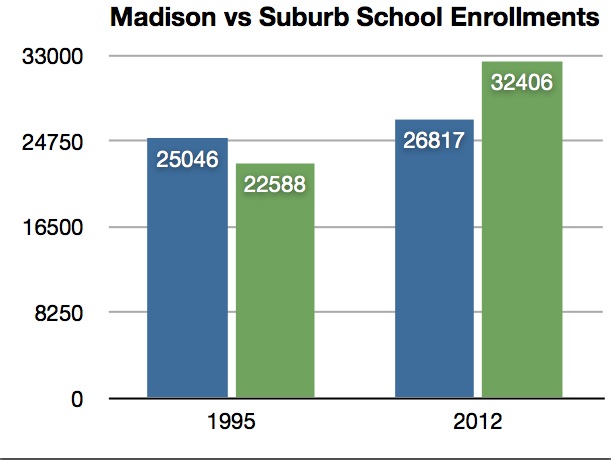
Larry Winkler kindly emailed the chart pictured above.
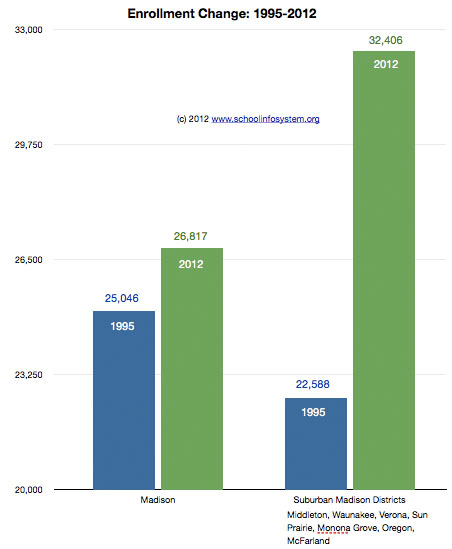
Where have all the Students gone?
Madison Mayor Paul Soglin:
We are not interested in the development of new charter schools. Recent presentations of charter school programs indicate that most of them do not perform to the level of Madison public schools. I have come to three conclusions about charter schools. First, the national evidence is clear overall, charter schools do not perform as well as traditional public schools. Second where charter schools have shown improvement, generally they have not reached the level of success of Madison schools. Third, if our objective is to improve overall educational performance, we should try proven methods that elevate the entire district not just the students in charter schools. The performance of non-charter students in cities like Milwaukee and Chicago is dismal.
In addition, it seems inappropriate to use resources to develop charter schools when we have not explored system-wide programming that focuses on improving attendance, the longer school day, greater parental involvement and combating hunger and trauma.
We must get a better understanding of the meaning of ‘achievement gap.’ A school in another system may have made gains in ‘closing’ the achievement gap, but that does not mean its students are performing better than Madison students. In addition, there is mounting evidence that a significant portion of the ‘achievement gap’ is the result of students transferring to Madison from poorly performing districts. If that is the case, we should be developing immersion programs designed for their needs rather than mimicking charter school programs that are more expensive, produce inadequate results, and fail to recognize the needs of all students.
It should be noted that not only do the charter schools have questionable results but they leave the rest of the district in shambles. Chicago and Milwaukee are two systems that invested heavily in charter schools and are systems where overall performance is unacceptable.
Related links:
I am unaware of Madison School District achievement data comparing transfer student performance. I will email the Madison School Board and see what might be discovered.
Pat Schnieder:
Madison Mayor Paul Soglin has some pretty strong ideas about how to improve academic achievement by Madison school children. Charter schools are not among them.
In fact, Madison’s ongoing debate over whether a charter school is the key to boosting academic achievement among students of color in the Madison Metropolitan School District is distracting the community from making progress, Soglin told me.
He attended part of a conference last week sponsored by the Urban League of Greater Madison that he says overstated the successes elsewhere of charter schools, like the Urban League’s controversial proposed Madison Preparatory Academy that was rejected by the Madison School Board a year ago.
“A number of people I talked with about it over the weekend said the same thing: This debate over charter schools is taking us away from any real improvement,” Soglin said.
Can a new committee that Soglin created — bringing together representatives from the school district, city and county — be one way to make real progress?
The City of Madison’s Education Committee, via a kind reader’s email. Members include: Arlene Silveira, Astra Iheukemere, Carousel Andrea S. Bayrd, Erik Kass, Jenni Dye, Matthew Phair, Maya Cole and Shiva Bidar-Sielaff.
The Madison School Board has scheduled [PDF] a 2:00p.m. meeting tomorrow, Sunday 30 September for an “Initial exchange of proposals and supporting rationale for such proposals in regard to collective bargaining negotiations regarding the Collective Bargaining Agreements (CBA) for MMSD Madison Teachers, Inc. (MTI) Teachers, Substitute Teachers, Educational Assistants, Supportive Educational Employees (SEE), and School Security Assistants (SSA), held as a public meeting pursuant to Wis. Stat. §111.70(4)(cm)”.
The School Board along with other Madison area governments have moved quickly to negotiate or extend agreements with several public sector unions after a judicial decision overturning parts of Wisconsin’s Act 10. The controversial passage of Act 10 changed the dynamic between public sector organizations and organized labor.
I’ve contemplated these events and thought back to a couple of first hand experiences:
In the first example, two Madison School District teacher positions were being reduced to one. Evidently, under the CBA, both had identical tenure so the choice was a coin toss. The far less qualified teacher “won”, while the other was laid off.
In the second example, a Madison School District teacher and parent lamented to me the poor teacher one of their children experienced (in the same District) and that “there is nothing that can be done about it”.
In the third example, a parent, after several years of their child’s “mediocre” reading and writing experiences asked that they be given the “best teacher”. The response was that they are “all good”. Maybe so.
Conversely, I’ve seen a number of teachers go far out of their way to help students learn, including extra time after school and rogue curricula such as phonics and Singapore Math.
I am unaware of the School Board meeting on a Sunday, on short notice, to address the District’s long time reading problems.
A bit of background:
Exhibit 1, written in 2005 illustrating the tyranny of low expectations” “When all third graders read at grade level or beyond by the end of the year, the achievement gap will be closed…and not before”.
Exhibit 2, 60% to 42%: Madison School District’s Reading Recovery Effectiveness Lags “National Average”: Administration seeks to continue its use.
Ripon Superintendent Richard Zimman’s 2009 Madison speech to the Madison Rotary Club is worth reading:
“Beware of legacy practices (most of what we do every day is the maintenance of the status quo), @12:40 minutes into the talk – the very public institutions intended for student learning has become focused instead on adult employment. I say that as an employee. Adult practices and attitudes have become embedded in organizational culture governed by strict regulations and union contracts that dictate most of what occurs inside schools today. Any impetus to change direction or structure is met with swift and stiff resistance. It’s as if we are stuck in a time warp keeping a 19th century school model on life support in an attempt to meet 21st century demands.” Zimman went on to discuss the Wisconsin DPI’s vigorous enforcement of teacher licensing practices and provided some unfortunate math & science teacher examples (including the “impossibility” of meeting the demand for such teachers (about 14 minutes)). He further cited exploding teacher salary, benefit and retiree costs eating instructional dollars (“Similar to GM”; “worry” about the children given this situation).
William Rowe has commented here frequently on the challenges of teacher evaluation schemes.
This being said, I do find it informative to observe the Board’s priorities in light of the District’s very serious reading problems.
This article is worth reading in light of local property taxes and spending priorities: The American Dream of upward mobility has been losing ground as the economy shifts. Without a college diploma, working hard is no longer enough.
Unlike his parents, John Sherry enrolled in college after graduating from high school in Grand Junction, a boom-bust, agriculture-and-energy outpost of 100,000 inhabitants on Colorado’s western edge. John lasted two years at Metropolitan State University in Denver before he dropped out, first to bag groceries at Safeway, later to teach preschool children, a job he still holds. He knew it was time to quit college when he failed statistics two semesters in a row. Years passed before John realized just how much the economic statistics were stacked against him, in a way they never were against his father.
Greg Sherry, who works for a railroad, is 58 and is chugging toward retirement with an $80,000-a-year salary, a full pension, and a promise of health coverage for life. John scrapes by on $11 an hour, with few health benefits. “I feel like I’m working really hard,” he says, “but I’m not getting ahead.”
This isn’t the lifestyle that John’s parents wished upon their younger child. But it reflects the state of upward–or downward–mobility in the American economy today.
Related: Wisconsin State Tax Based K-12 Spending Growth Far Exceeds University Funding.
TJ Mertz comments on collective bargaining, here and here.
Madison School Board Member Ed Hughes: Didn’t See That One Coming: How the Madison School Board Ended Up Back in Collective Bargaining.
The Capital Times: Should local governments negotiate with employees while the constitutionality of the collective bargaining law is being appealed?
Jeff Coen, David Heinzmann and John Chase:
Chicago Public Schools officials expect about 53,000 of the district’s roughly 400,000 students will attend charter schools this year, and the number of charters will increase to more than 100. The city is aiming to add 60 charter schools in the next five years with support from the Bill & Melinda Gates Foundation, which is trying to expand charters across the country.
The biggest push for charter schools locally comes from some of the wealthiest backers of Emanuel, including Bruce Rauner, a venture capitalist who regularly advises the mayor. At a seminar of business and political leaders held the same day teachers voted to return to school, Rauner said the strike would only energize reform efforts that he called a “multiyear revolution.”
“I think we’re going to have a coalescing of interests that’s a focus and drive some major change. And there are some plans in the works, some charter community education innovators who are now focusing on Chicago, and I think in the coming years we can innovate,” he said.
Experts called the union’s stand against privately run networks unique in the United States, where several big cities, including New York, also have pushed charter schools.
“What’s different is this is really the first mass movement against that comprehensive strategy” for privatization, said Janelle Scott, an associate professor at the University of California at Berkeley who studies school policy.
Related:
“Beware of legacy practices (most of what we do every day is the maintenance of the status quo), @12:40 minutes into the talk – the very public institutions intended for student learning has become focused instead on adult employment. I say that as an employee. Adult practices and attitudes have become embedded in organizational culture governed by strict regulations and union contracts that dictate most of what occurs inside schools today. Any impetus to change direction or structure is met with swift and stiff resistance. It’s as if we are stuck in a time warp keeping a 19th century school model on life support in an attempt to meet 21st century demands.” Zimman went on to discuss the Wisconsin DPI’s vigorous enforcement of teacher licensing practices and provided some unfortunate math & science teacher examples (including the “impossibility” of meeting the demand for such teachers (about 14 minutes)). He further cited exploding teacher salary, benefit and retiree costs eating instructional dollars (“Similar to GM”; “worry” about the children given this situation).
New Dorp’s Writing Revolution, which placed an intense focus, across nearly every academic subject, on teaching the skills that underlie good analytical writing, was a dramatic departure from what most American students–especially low performers–are taught in high school. The program challenged long-held assumptions about the students and bitterly divided the staff. It also yielded extraordinary results. By the time they were sophomores, the students who had begun receiving the writing instruction as freshmen were already scoring higher on exams than any previous New Dorp class. Pass rates for the English Regents, for example, bounced from 67 percent in June 2009 to 89 percent in 2011; for the global-history exam, pass rates rose from 64 to 75 percent. The school reduced its Regents-repeater classes–cram courses designed to help struggling students collect a graduation requirement–from five classes of 35 students to two classes of 20 students.
The number of kids enrolling in a program that allows them to take college-level classes shot up from 148 students in 2006 to 412 students last year. Most important, although the makeup of the school has remained about the same–roughly 40 percent of students are poor, a third are Hispanic, and 12 percent are black–a greater proportion of students who enter as freshmen leave wearing a cap and gown. This spring, the graduation rate is expected to hit 80 percent, a staggering improvement over the 63 percent figure that prevailed before the Writing Revolution began. New Dorp, once the black sheep of the borough, is being held up as a model of successful school turnaround. “To be able to think critically and express that thinking, it’s where we are going,” says Dennis Walcott, New York City’s schools chancellor. “We are thrilled with what has happened there.”
Although New Dorp teachers had observed students failing for years, they never connected that failure to specific flaws in their own teaching. They watched passively as Deirdre DeAngelis got rid of the bad apples on the staff; won foundation money to break the school into smaller, more personalized learning communities; and wooed corporate partners to support after-school programs. Nothing seemed to move the dial.
Her decision in 2008 to focus on how teachers supported writing inside each classroom was not popular. “Most teachers,” said Nell Scharff, an instructional expert DeAngelis hired, “entered into the process with a strongly negative attitude.” They were doing their job, they told her hotly. New Dorp students were simply not smart enough to write at the high-school level. You just had to listen to the way the students talked, one teacher pointed out–they rarely communicated in full sentences, much less expressed complex thoughts. “It was my view that these kids didn’t want to engage their brains,” Fran Simmons, who teaches freshman English, told me. “They were lazy.”
Interim Superintendent Jane Belmore:
3. It was moved by James Howard and seconded by Beth Moss that the pending motion to approve the preliminary 2012-2013 School District budget be amended to include specific accountability measures for all reading intervention programs receiving funding pursuant to 2012-2013 budget allocations. Specifically, in order for any reading intervention program being funded during the 2012-2013 school year to receive continued and/or increased funding in future budgets, each intervention must:
a. By November 15, 2012, submit to the Board of Education, proposed progress indicators for improved student achievement for students of color.
b. Progress indicators will be defined on a yearly basis for a minimum of 5 years and compared to the initial year of 2011-12.
c. Progress indicators will be broken down by African-American, Hispanic, special education and other non-White students affected by the program.
d. Progress indicators will include not only student achievement measures but also number of students included.
e. Data for each progress indicator will be required before continued or additional funding is approved.
“I think we have come a long way,” said Superintendent Jane Belmore. “The district, as you may know, developed a pretty ambitious achievement plan last year and came out to the community and talked with folks in the community about it, got a lot of buy-in and there are lots of community organizations that are really behind us on that.”
Superintendent Belmore says it will take a number of years to complete the process–but says they’re fortunate to have the resources to help put it into play this year. “We have a plan that we’re now looking at, really what I’m calling kind of sorting the priorities of the priorities, because it’s very ambitious,” she said. “We’re not going to be able to do everything at the same level, at the same time, but we’re really figuring out what the things are that are going to give us the most leverage.”
The Urban League of Greater Madison has been on the forefront of the fight to address the achievement gap. President and CEO Kaleem Caire says he thought the achievement gap plan was too broad to begin with.
Links:
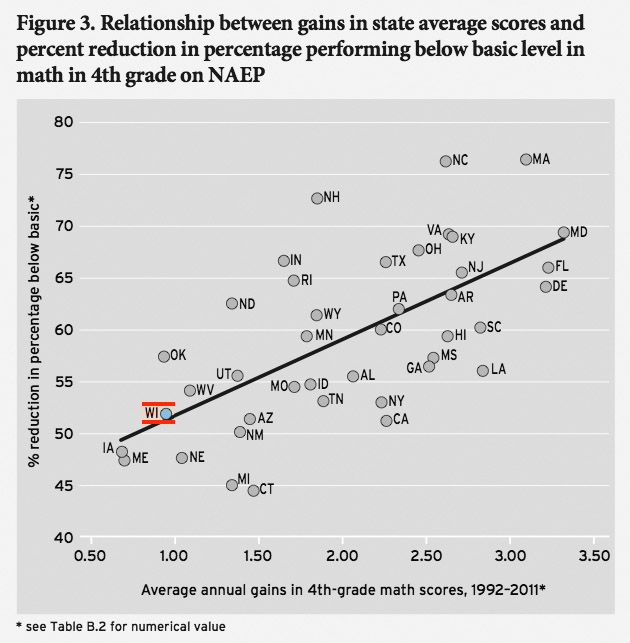
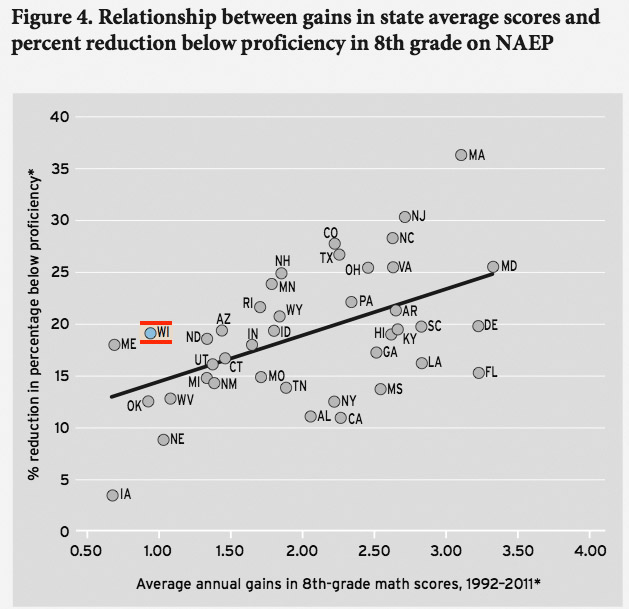

(Tap or click to view a larger version)
Eric A. Hanushek, Paul E. Peterson & Ludger Woessmann
“The United States’ failure to educate its students leaves them unprepared to compete and threatens the country’s ability to thrive in a global economy.” Such was the dire warning recently issued by a task force sponsored by the Council on Foreign Relations.
Chaired by former New York City schools chancellor Joel I. Klein and former U.S. secretary of state Condoleezza Rice, the task force said that the country “will not be able to keep pace–much less lead–globally unless it moves to fix the problems it has allowed to fester for too long.”
The report’s views are well supported by the available evidence. In a 2010 report, only 6 percent of U.S. students were found to be performing at the advanced level in mathematics, a percentage lower than those attained by 30 other countries.ii Nor is the problem limited to top-performing students.
Only 32 percent of 8th- graders in the United States are proficient in mathematics, placing the United States 32nd when ranked among the participating international jurisdictions. Although these facts are discouraging, the United States has made substantial additional financial commitments to K-12 education and introduced a variety of school reforms.
Have these policies begun to help the United States close the international gap?
Progress was far from uniform across the United States, however. Indeed, the variation across states was about as large as the variation among the countries of the world. Maryland won the gold medal by having the steepest overall growth trend. Coming close behind, Florida won the silver medal and Delaware the bronze. The other seven states that rank among the top-10 improvers, all of which outpaced the United States as a whole, are Massachusetts, Louisiana, South Carolina, New Jersey, Kentucky, Arkansas, and Virginia.
Iowa shows the slowest rate of improvement. The other four states whose gains were clearly less than those of the United States as a whole, ranked from the bottom, are Maine, Oklahoma, Wisconsin, and Nebraska. Note, however, that because of nonparticipation in the early NAEP assessments, we cannot estimate an improvement trend for the 1992-2011 time period for nine states–Alaska, Illinois, Kansas, Montana, Nevada, Oregon, South Dakota, Vermont, and Washington.
Related:
Wisconsin students, parents, teachers and property owners will feel the impact of major changes rolling out in Wisconsin’s public schools this school year.
This fall for the first time:
- The state will assign numerical ratings to schools based on various test score measures.
- Most students will start to see a new, more specific curriculum — in math and language arts, and with literacy incorporated in all subjects — in anticipation of a new state test in two years.
- And dozens of schools, including three in Madison, will take part in the state’s new teacher evaluation system, which takes into account student test scores.
“This is huge,” State Superintendent Tony Evers said. “I’ve been doing this for 37 years and I haven’t seen this level of reform efforts.”
The unifying reason for the changes is the end of the No Child Left Behind era and the national move toward a more rigorous set of standards for what students are expected to know at each grade level, said Adam Gamoran, director of the Wisconsin Center for Education Research at UW-Madison. In order to obtain a waiver from NCLB, Wisconsin had to adopt the accountability system, higher curriculum standards and a teacher evaluation system.
“This has nothing to do with the turmoil we experienced in Wisconsin last year,” Gamoran said. “This is happening in every state in the country.”
Related:
I understand closing the achievement gap is a huge task. But the Madison School District often fails to take the right measures. It is a mistake, for example, to spend more money hiring top-level staff to coordinate meetings and oversee district plans. If we truly want to close the achievement gap, resources need to be on the front lines — at the schools working with kids. This is not the approach the district is choosing.
Recently, the School Board voted to hire a chief of staff for interim Superintendent Jane Belmore. The position will cost $170,000 and last one year. The superintendent said: “We’re about doing everything we can to start to close that achievement gap and in order to do that this position is critical.”
I disagree. I understand the need for staff support and accountability. Overseeing a large school district is a huge undertaking. But hiring more top-level staff who earn six figures will not teach third-graders at Glendale Elementary how to read and write.
Related: 60% to 42%: Madison School District’s Reading Recovery Effectiveness Lags “National Average”: Administration seeks to continue its use.
Budget Cuts: We Won’t Be as Bold and Innovative as Oconomowoc, and That’s Okay.
Ripon Superintendent Richard Zimman’s 2009 Madison Rotary Club speech:
“Beware of legacy practices (most of what we do every day is the maintenance of the status quo), @12:40 minutes into the talk – the very public institutions intended for student learning has become focused instead on adult employment. I say that as an employee. Adult practices and attitudes have become embedded in organizational culture governed by strict regulations and union contracts that dictate most of what occurs inside schools today. Any impetus to change direction or structure is met with swift and stiff resistance. It’s as if we are stuck in a time warp keeping a 19th century school model on life support in an attempt to meet 21st century demands.” Zimman went on to discuss the Wisconsin DPI’s vigorous enforcement of teacher licensing practices and provided some unfortunate math & science teacher examples (including the “impossibility” of meeting the demand for such teachers (about 14 minutes)). He further cited exploding teacher salary, benefit and retiree costs eating instructional dollars (“Similar to GM”; “worry” about the children given this situation).
The defeat AFC took was so sweeping that the group had to issue a statement Wednesday in which it “reaffirmed its support for legislators and candidates across Wisconsin who favor expanded educational options for families, following disappointing primary results last night.”
Yikes.
AFC, a group funded by billionaire right-wingers from Michigan (former Michigan Republican Party chairwoman Betsy DeVos and her husband, Amway heir Dick DeVos) and their wealthy allies across the country, poured more than $100,000 (perhaps a lot more) into “independent” campaigns on behalf of supporters of school “choice” and “voucher” schemes, which weaken public schools in Milwaukee and pave the way for privatization.
But the AFC candidates lost. Badly.
State Rep. Jason Fields, the Milwaukee Democrat whose re-election was the chief priority of AFC and its Wisconsin operative, former Assembly Speaker Scott Jensen, was defeated by community activist Mandela Barnes.
Related: Ripon Superintendent Richard Zimman’s 2009 speech to the Madison Rotary Club:
Beware of legacy practices (most of what we do every day is the maintenance of the status quo), @12:40 minutes into the talk – the very public institutions intended for student learning has become focused instead on adult employment. I say that as an employee. Adult practices and attitudes have become embedded in organizational culture governed by strict regulations and union contracts that dictate most of what occurs inside schools today. Any impetus to change direction or structure is met with swift and stiff resistance. It’s as if we are stuck in a time warp keeping a 19th century school model on life support in an attempt to meet 21st century demands.” Zimman went on to discuss the Wisconsin DPI’s vigorous enforcement of teacher licensing practices and provided some unfortunate math & science teacher examples (including the “impossibility” of meeting the demand for such teachers (about 14 minutes)). He further cited exploding teacher salary, benefit and retiree costs eating instructional dollars (“Similar to GM”; “worry” about the children given this situation).
Madison School Board Member Ed Hughes:
A few weeks ago, the Wisconsin Department of Public Instruction (DPI) released an example of what the upcoming report cards for state schools will look like. The report cards are described as one of the package of reforms that that DPI promised to implement in order to win a waiver from the federal Department of Education from the more onerous burdens of the federal No Child Left Behind (NCLB) Act.
One of the qualifications for an NCLB waiver is that a state must put into place an accountability system for schools. The system must take into account results for all students and subgroups of students identified in NCLB on: measures of student achievement in at least reading/language arts and mathematics; graduation rates; and school performance and progress over time. Once a state has adopted a “high-quality assessment,” the system must also take into account student growth.
In announcing the NCLB waiver, DPI claimed that it had established accountability measures that “1) are fair; 2) raise expectations; and 3) provide meaningful measures to inform differentiated recognitions, intervention, and support.”
Designing a fair and meaningful system for assessing the performance of the state’s schools is a worthy endeavor. The emphasis for me is on the “fair” requirement. I consider an assessment system to be fair if it measures how successfully a school promotes the learning of whichever students show up at its door.
Related: Notes and links on the oft-criticized WKCE and Madison’s long term reading recovery challenges.
News that Madison’s new, interim Superintendent Jane Belmore seeks to add a “Chief of Staff” provides taxpayers, parents and students an opportunity to reflect on the District’s priorities within the planned $376,200,000 2012-2013 budget ($15,132/student).
The District’s job #1, in my view is to address its reading problems. A kind reader mentioned that Reading Recovery was discussed at this past Monday’s school board meeting (video).
Will the status quo continue?
Related: Madison Schools Administration has “introduced more than 18 programs and initiatives for elementary teachers since 2009”.
Chris Rickert via several kind readers:
Wisconsin has a “long way to go in all our racial/ethnic groups,” said Adam Gamoran, director of the Wisconsin Center for Education Research at UW-Madison.
My hope is that, given Wisconsin’s overwhelmingly white population, proficiency problems among white students will spur more people to push for policies inside and outside of school that help children — all children — learn.
“I hate to look at it that way, but I think you’re absolutely right,” said Kaleem Caire, president and CEO of the Urban League of Greater Madison. “The low performance of white students in our state may just lead to the type and level of change that’s necessary in public education for black and other students of color to succeed as well.”
Indeed, Gamoran said Massachusetts’ implementation of an evaluation system similar to the one Wisconsin is adopting now has been correlated with gains in reading and math proficiency and a narrowing of the racial achievement gap in math. But he emphasized that student achievement is more than just the schools’ responsibility.
Madison has known for a while that its schools are not meeting the needs of too many students of color.
The issue of low expectations and reduced academic standards is not a new one. A few worthwhile, related links:
Moreover, parents of future West High students should take notice: As you read this, our department is under pressure from the administration and the math coordinator’s office to phase out our “accelerated” course offerings beginning next year. Rather than addressing the problems of equity and closing the gap by identifying minority math talent earlier, and fostering minority participation in the accelerated programs, our administration wants to take the cheaper way out by forcing all kids into a one-size-fits-all curriculum.
It seems the administration and our school board have re-defined “success” as merely producing “fewer failures.” Astonishingly, excellence in student achievement is visited by some school district administrators with apathy at best, and with contempt at worst. But, while raising low achievers is a laudable goal, it is woefully short-sighted and, ironically, racist in the most insidious way. Somehow, limiting opportunities for excellence has become the definition of providing equity! Could there be a greater insult to the minority community?
A few links on Madison’s interim Superintendent, Jane Belmore. Belmore was Madison’s Assistant Superintendent for Elementary Schools before moving to the School of Education at nearby Edgewood College.
And, of course, there are quite a few schoolinfosystem.org links, including this post on the District’s reading problems.
Reading, which is clearly the District’s job number one, continues to be a challenge, according to this 2009 Reading Recovery study: 60% to 42%: Madison School District’s Reading Recovery Effectiveness Lags “National Average”: Administration seeks to continue its use.
Finally, a bit of history on Madison Superintendent hires over the years.
Dan Simmons article mentioned the School District’s spokeswoman: Rachel Strauch-Nelson. Interestingly, Ms. Strauch-Nelson formerly worked for Madison’s previous Mayor, Dave Cieslewicz and prior to that for the Democratic Party of Wisconsin. Chief Information Officer Andrew Statz also worked for the previous Mayor.
Lisa Wachtel, Executive Director of Curriculum & Assessment [104 Page PDF]:
Grades K-2 Literacy Walkthroughs
Background: Observations of literacy classes, or, walkthroughs, were scheduled for seventeen of MMSD’ s highest poverty elementary schools during the months of April and May. Three administrators visited each school for a half-day for a minimum of 12 hours of observation per school. All K-2 classrooms are observed for at least an hour by one of the three administrators. Second/third grade classrooms were observed in schools with multi-aged instructional designs. When substitute teachers are present, follow-up observations were attempted.
The purpose of the walk throughs was to provide schools with a baseline of literacy practices and to communicate a district snapshot of K-2 observable literacy practices when student routines and independence are well established. Although not a complete picture, the walkthroughs provided evidence of teaching emphasis, expectations, school/district implementation efforts and additional anecdotal information that might suggest potential areas for consideration.
Timeline: April16- May 25, 2012 Observations
May 30-31,2012 Meet with principals to discuss results of the observations
Observation Tool: Please see the attached document. This is an observation protocol merging documents developed by Fountas and Pinnell and Dom. This observation tool was selected because it captured the general categories of literacy instruction that would be included in a 90-120 minute literacy lesson. Observers could capture any of the elements observed during the 60 observations. An additional section, classroom environment provides a way to document materials and classroom structures.
Preliminary Findings:
1. The majority of primary literacy environments were organized around a Balanced Literacy Model. However, within that model, there was significant variation in what the model looked like. This lack of consistency was seen both within and across all 17 schools.
2. Most classrooms were organized in a planned and thoughtful manner. Attention was given to the development and use of a classroom library, individual book boxes and areas where students could work in pairs or small groups.
3. Although classrooms in most schools were thoughtfully organized, some classrooms were cluttered and there were not optimal environments for learning. It is recommended that IRTs work with teachers to create good physical environments in all classrooms.
4. Although the majority of classrooms had at least a 90 minute literacy block, some did not. Attention to direct instruction for at least 90 minutes is crucial for the success of all learners. Principals must make this a clear expectation. The literacy block must also be implemented with fidelity.
5. There was a lack of consistency both within and across grade levels based on common core standards and best teaching practices. This should be an area of emphasis for all schools. IRTs and principals will need to develop a tight structure of accountability that supports the Common Core State Standards and the Curriculum Companion tool.
6. In most cases, instruction in phonics and phonemic awareness was clearly evident. This instruction reflected the professional development both at the district and school level around phonics instruction, phonemic awareness and word work. Instruction appeared to be more systematic, targeted and focused than in previous years.
7. Guided Reading Instruction was observed in the many of the classrooms. It should be noted that in several schools guided reading did not occur five days a week. A wide range of practices were observed during guided reading. Teaching points were often unclear. Observers noted few teachers administering running records or maintaining other types of formative assessments.
8. Targeted, focused instruction around a precise teaching point is a critical component of quality literacy instruction. Focused feedback emphasizing areas of student mastery was also inconsistent. Again, consistency related to core practices as well as ongoing specific assessment practices should be apparent within and across elementary grades.
9. Professional development work should continue around the use of assessment tools. Principals must require the practice of ongoing assessment in all classrooms.
10. The development and use of anchor charts and mini lessons are critical pieces of strong core instruction. Anchor charts and mini lessons were seen in some classrooms and not in others. Professional development should address these ideas so that there is consistency across the district.
11. In many classrooms, the quality of independent student work was of concern. Teachers in all classrooms must pay careful attention to independent student work. This work must support the structure of the literacy block, be consistent with the focus of guided reading and be at each student’s independent level. Emphasis must consistently be on authentic reading and writing tasks. Work should be differentiated. Coloring, cutting/pasting and copying of other printed work would not be considered quality independent literacy work and this was seen in many classrooms (bold added).
12. Teachers were inconsistent in giving feedback to students related to specific learning. Clear, corrective feedback and/or affirmation of solid understandings will accelerate individual student learning and help learners tie the known to the new.
13. All students should also be receiving ongoing, focused feedback related to independent work and independent reading. Regular conferencing and assessment of independent reading and writing is a crucial component of a rigorous literacy curriculum.
Lisa Wachtel, Executive Director of Curriculum & Assessment [104 Page PDF]:
Grades K-2 Literacy Walkthroughs
Background: Observations of literacy classes, or, walkthroughs, were scheduled for seventeen of MMSD’ s highest poverty elementary schools during the months of April and May. Three administrators visited each school for a half-day for a minimum of 12 hours of observation per school. All K-2 classrooms are observed for at least an hour by one of the three administrators. Second/third grade classrooms were observed in schools with multi-aged instructional designs. When substitute teachers are present, follow-up observations were attempted.
The purpose of the walk throughs was to provide schools with a baseline of literacy practices and to communicate a district snapshot of K-2 observable literacy practices when student routines and independence are well established. Although not a complete picture, the walkthroughs provided evidence of teaching emphasis, expectations, school/district implementation efforts and additional anecdotal information that might suggest potential areas for consideration.
Timeline: April16- May 25, 2012 Observations
May 30-31,2012 Meet with principals to discuss results of the observations
Observation Tool: Please see the attached document. This is an observation protocol merging documents developed by Fountas and Pinnell and Dom. This observation tool was selected because it captured the general categories of literacy instruction that would be included in a 90-120 minute literacy lesson. Observers could capture any of the elements observed during the 60 observations. An additional section, classroom environment provides a way to document materials and classroom structures.
Preliminary Findings:
1. The majority of primary literacy environments were organized around a Balanced Literacy Model. However, within that model, there was significant variation in what the model looked like. This lack of consistency was seen both within and across all 17 schools.
2. Most classrooms were organized in a planned and thoughtful manner. Attention was given to the development and use of a classroom library, individual book boxes and areas where students could work in pairs or small groups.
3. Although classrooms in most schools were thoughtfully organized, some classrooms were cluttered and there were not optimal environments for learning. It is recommended that IRTs work with teachers to create good physical environments in all classrooms.
4. Although the majority of classrooms had at least a 90 minute literacy block, some did not. Attention to direct instruction for at least 90 minutes is crucial for the success of all learners. Principals must make this a clear expectation. The literacy block must also be implemented with fidelity.
5. There was a lack of consistency both within and across grade levels based on common core standards and best teaching practices. This should be an area of emphasis for all schools. IRTs and principals will need to develop a tight structure of accountability that supports the Common Core State Standards and the Curriculum Companion tool.
6. In most cases, instruction in phonics and phonemic awareness was clearly evident. This instruction reflected the professional development both at the district and school level around phonics instruction, phonemic awareness and word work. Instruction appeared to be more systematic, targeted and focused than in previous years.
7. Guided Reading Instruction was observed in the many of the classrooms. It should be noted that in several schools guided reading did not occur five days a week. A wide range of practices were observed during guided reading. Teaching points were often unclear. Observers noted few teachers administering running records or maintaining other types of formative assessments.
8. Targeted, focused instruction around a precise teaching point is a critical component of quality literacy instruction. Focused feedback emphasizing areas of student mastery was also inconsistent. Again, consistency related to core practices as well as ongoing specific assessment practices should be apparent within and across elementary grades.
9. Professional development work should continue around the use of assessment tools. Principals must require the practice of ongoing assessment in all classrooms.
10. The development and use of anchor charts and mini lessons are critical pieces of strong core instruction. Anchor charts and mini lessons were seen in some classrooms and not in others. Professional development should address these ideas so that there is consistency across the district.
11. In many classrooms, the quality of independent student work was of concern. Teachers in all classrooms must pay careful attention to independent student work. This work must support the structure of the literacy block, be consistent with the focus of guided reading and be at each student’s independent level. Emphasis must consistently be on authentic reading and writing tasks. Work should be differentiated. Coloring, cutting/pasting and copying of other printed work would not be considered quality independent literacy work and this was seen in many classrooms (bold added).
12. Teachers were inconsistent in giving feedback to students related to specific learning. Clear, corrective feedback and/or affirmation of solid understandings will accelerate individual student learning and help learners tie the known to the new.
13. All students should also be receiving ongoing, focused feedback related to independent work and independent reading. Regular conferencing and assessment of independent reading and writing is a crucial component of a rigorous literacy curriculum.
Marcus Winters via a kind Rick Kiley email:
Here’s what looks like a policy dilemma. To attain the economic growth that it desperately needs, the United States must improve its schools and train a workforce capable of competing in the global economy. Economists Eric Hanushek, Dean Jamison, Eliot Jamison, and Ludger Woessmann estimate that improving student achievement by half of one standard deviation–roughly the current difference between the United States and Finland–would increase U.S. GDP growth by about a full percentage point annually. Yet states and the federal government face severe budgetary constraints these days; how are policymakers supposed to improve student achievement while reducing school funding?
In reality, that task is far from impossible. The story of American education over the last three decades is one not of insufficient funds but of inefficient schools. Billions of new dollars have gone into the system, to little effect. Luckily, Americans are starting to recognize that we can improve schooling without paying an additional dime. In fact, by unleashing the power of educational choice, we might even save money while getting better results and helping the economy’s long-term prospects.
Related: State Income Tax Collections Per Capita, Madison’s 4.95% Property Tax Increase, https://www.schoolinfosystem.org/archives/2012/05/madison_schools_79.php and 60% to 42%: Madison School District’s Reading Recovery Effectiveness Lags “National Average”: Administration seeks to continue its use.
Solidarity Newsletter by Madison Teachers, Inc. (PDF):
MTI President Kerry Motoviloff addressed the Board of Education at its May 21 general meeting. At issue is the District’s plan to introduce more new programs into elementary teachers’ literacy curriculum, including Mondo and 3 new assessments. At the same time, elementary teachers are being told that they will be losing release days for the administration of K-2 testing.
Motoviloff listed more than 13 current K-5 assessments, explaining to Board members that each assessment comes with a set of non-comparable data or scores. She noted that the District has introduced more than 18 programs and initiatives for elementary teachers since 2009.
Motoviloff stressed that all teachers are concerned about the achievement gap, and that the District needs to walk its own talk relative to ensuring fidelity in the curriculum process. She challenged the District to prioritize essentials, instead of swamping teachers with initiatives while reducing teachers’ time to implement the curriculum with fidelity, and emphasized the need to include time not only for assessments, but also time for teachers to analyze and plan. She also urged the District to stop pitting professional development against planning/prep time.
Related:
I’ve long suggested that the District should get out of the curriculum/program creation business and focus on hiring the best teachers. Like it or not, Oconomowoc is changing the game by focusing efforts and increasing teacher pay. Madison, given our high per student spending and incredible community and academic resources, should be delivering world class results for all students.
I don’t see how more than 18 programs and initiatives can be implemented successfully in just a few years. I’m glad MTI President Kerry Motoviloff raised this important issue. Will the proposed “achievement gap plan” add, replace or eliminate programs and spending?
Meanwhile, Superintendent Dan Nerad’s Madison tenure, which began in 2008, appears to be quickly coming to an end.
As Jim Anchower says, “I know it’s been a long time since I rapped at ya…” Sometimes you need a break; expect more soon.
Paul Vallas will be featured at a “school reform town hall meeting” this Saturday, May 26, 1:00 PM at LaFollette High School. The announcements feature “Madison Metropolitan School District, Verona Area School District, United Way of Dane County, Urban League of Greater Madison & Boys & Girls Clubs of Dane County” as “collaborating” hosts, but as reported by Matt DeFour the United Way “has requested that our name be removed from all upcoming communications related to the event, but will attend to hear the conversation from all those involved.”
Attempts to clarify MMSD’s role have not yielded a response. You can try yourself: Board of Education: board@madison.k12.wi.us, Supt. Dan Nerad: dnerad@madison.k12.wi.us. I’ve been told unofficially that MMSD is donating the space, which would mean that your tax dollars and mine are being used (see the district facilities rental policy here). It would really be a shame if our district collaborated in bringing Vallas here, there is very little in his version of school reform that our community, or any community will benefit from.
Much more on Paul Vallas’s visit, here.
ACLU on freedom of speech.
Related: 60% to 42%: Madison School District’s Reading Recovery Effectiveness Lags “National Average”: Administration seeks to continue its use?
and: When all third graders read at grade level or beyond by the end of the year, the achievement gap will be closed…and not before
How long will our community tolerate its reading problem? Bread and circuses.
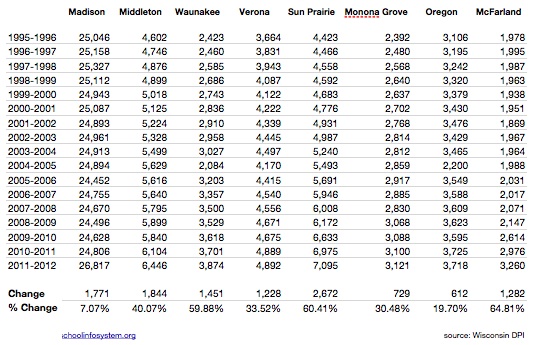
Paul Vallas will be speaking at Madison LaFollette high school on Saturday, May 26, 2012 at 1:00p.m. More information, here.
Much more on Paul Vallas, here.
Directions.
Per Student Spending:
I don’t believe spending is the issue. Madison spends $14,858.40/student (2011-2012 budget)
Middleton’s 2011-2012 budget: $87,676,611 for 6,421 students = $13,654.67/student, about 8% less than Madison.
Waunakee spends $12,953.81/student about 13% less than Madison.
A few useful links over the past decade:
Madison School Board Member Ed Hughes:
Another approach might be eliminating programs or initiatives that are more closely aligned to student learning. Possibilities here could include reducing our school staff who are not classroom teachers, like Reading Interventionists, Instructional Resource Teachers, and Positive Behavior Coaches. We could also eliminate special interventions for struggling readers. The reading recovery program is the best-known example. While reading recovery is backed by research that supports its effectiveness, it’s an expensive program and, at least as of a couple of years ago, we hadn’t seen in Madison the level of successful outcomes in terms of students’ reading progress that had typically been achieved elsewhere with the program.
My view is that we should have in place an established schedule for evaluating the effectiveness of our intervention programs, like Reading Recovery, and we should be willing to make difficult decisions based on what the evaluations tell us. But that evaluation and review process should be separate from our budgeting process. We shouldn’t look at cutting programs like Reading Recovery strictly as a cost-saving measure. I doubt that we’re willing to eliminate all intensive interventions for struggling readers – I don’t even know if we could do so legally – and it’s far from obvious that substituting one intensive reading intervention program for another would end up saving us all that much money.
Related: 60% to 42%: Madison School District’s Reading Recovery Effectiveness Lags “National Average”: Administration seeks to continue its use.
Much more on the Oconomowoc School District’s high school staffing an compensation plan, here.
Chris Rickert summarizes a bit of recent Madison School Board decision making vis a vis educational outcomes. Contrast this with the recent governance news (more) from Oconomowoc; a community 58 miles east of Madison.
Moreover, it’s not like Madisonians are certain to oppose a large tax hike, especially given the way they responded to Walker’s bid to kill collective bargaining.
Before that idea became law, the board voted for — and the community supported — extending union contracts. Unions agreed to some $21 million in concessions in return for two years’ worth of protection from the law’s restrictions.
But the board could have effectively stripped the union of seniority protections, forced members to pay more for health insurance, ended automatic pay raises and taken other actions that would have been even worse for union workers — but that also would have saved taxpayers lots of money.
Board members didn’t do that because they knew protecting employees was important to the people they represent. They should be able to count on a similar dedication to public schooling in asking for the money to pay for the district’s latest priorities.
The changes would have a significant effect on teachers that the district retains. Starting positions – though it’s unclear how many would be available due to the staff reduction – would go from starting at a $36,000 salary to a $50,000 stipend. The average teacher in the district would see his or her pay rise from $57,000 to $71,000. It’s a move that would not only reward educators for the extra work that they would take on, but could also have a significant effect in luring high-level teachers to the district.
In essence, the district is moving forward with a plan that will increase the workload for their strong teachers, but also increase their pay to reflect that shift. In cutting staff, the district has the flexibility to raise these salaries while saving money thanks to the benefit packages that will not have to be replaced. Despite the shuffle, class sizes and course offerings will remain the same, though some teachers may not. It’s a bold move to not only retain the high school’s top performers, but to lure good teachers from other districts to the city.
Tuesday’s meeting laid out the first step of issuing non-renewal notices to the 15 teachers that will not be retained. The school board will vote on the reforms as a whole on next month.
The Madison School District has, to date, been unwilling to substantively change it’s model, one that has been around for decades. The continuing use of Reading Recovery despite its cost and lower than average performance is one example.
With respect to facilities spending, perhaps it would be useful to look into the 2005 maintenance referendum spending & effectiveness.
It is my great “hope” (hope and change?) that Madison’s above average spending, in this case, 33% more per student than well to do Oconomowoc, nearby higher education institutions and a very supportive population will ultimately improve the curriculum and provide a superior environment for great teachers.
Matthew DeFour, via a kind reader’s email:
Madison community members say an extended school day, career academies, cultural training for teachers, alternative discipline, more contact between school staff and parents and recruiting minority students to become teachers are some of the best strategies for raising achievement levels of low-income and minority students.
However, some of those same ideas — such as adding an extra hour in the morning and emphasizing career training over college preparation for some students — are raising the most questions and concerns.
Those are a few of the key findings of a two-month public-input process on Superintendent Dan Nerad’s achievement gap plan.
The district released a summary report Friday. Nerad plans to revise the plan based on the public’s response and deliver a final proposal to the School Board on May 14.
Nerad said there is clearer support for more parent engagement and cultural training for teachers, than for an extended school day. He said not everyone may have understood that students who focus on a technical rather than liberal arts education might still go on to college after they graduate.
Additional reader notes:
There are profound deficiencies in the methodology and attempted “analysis” in the district’s and Hanover reports (https://boeweb.madison.k12.wi.us/files/boe/Appx%2010-40.pdf), but it’s interesting to see the district’s summary of staff input on literacy (page 2 of Marcia Standiford’s memo):
“4. Literacy – Start early with a consistent curriculm [sic]
Support for an emphasis on literacy was evident among the comments. Staff members called for a consistent program and greater supports at the middle and high school levels. Several questioned why the recommendations emphasized third grade rather than starting at earlier grades. Comments also called for bringing fidelity and consistency to the literacy curriculum. Several comments expressed concern that dedicating extra time to literacy would come at the expense of math or other content areas.” And a somewhat buried lede in the Hanover report (p. 3 of the report, p. 21 of the pdf):
“Nine focus groups mentioned the reading recovery [sic] program, all of whom felt negatively about the strategy.” and (p. 10 of the report, p. 29 of the pdf) “Nine comments referred to the reading recovery plan, all of which were negative. Comments noted that ‘reading recovery has failed’ and ‘reading recovery has not been effective in Madison Schools.’ None of the comments supported reading recovery.”
Madison School District related website comments includes:
https://www.madison.k12.wi.us/node/10069 specific criticism of Reading Recovery from Amy Rogers: https://www.madison.k12.wi.us/node/10069#comment-53 and this from Chan Stroman-Roll: https://www.madison.k12.wi.us/node/10069#comment-82
60% to 42%: Madison School District’s Reading Recovery Effectiveness Lags “National Average”: Administration seeks to continue its use.
Madison School Board Member Ed Hughes:
Finally, the troubling differences in levels of student learning that give rise to our achievement gap present an enormous challenge for our teachers. We as a District have long been committed to inclusive and heterogeneous elementary school classrooms. Consequently, given the gap, our teachers frequently lead classrooms with a number of high-achieving students and a number of struggling students. Imagine how much dedication and ingenuity it must take for our classroom teachers to provide a learning environment where all their students can thrive. It would be helpful to hear from teachers about how they think they can be most effective in teaching all students in classes with such a wide span of developed capabilities, given our resource limitations.
Even test results as generally uninformative as the WKCE make clear the extent of our achievement gap in Madison. From the perspective of the WKCE and based on statewide averages, our white students on the whole seem to be doing just fine while our African-American students on the whole are struggling. This shouldn’t come as news to anyone, but it does underscore what’s at stake when over the next several weeks the School Board starts to decide what components of the superintendent’s achievement gap plan we’re actually willing to raise taxes to support.
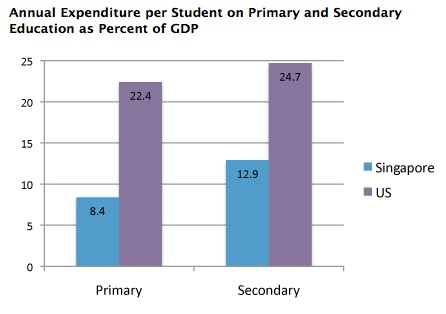
I read with interest Nathan Comps’ article on the forthcoming 2012-2013 Madison School District budget. Board Vice President Marj Passman lamented:
“If Singapore can put a classroom of students on its money, and we can’t even put our money into children, what kind of country are we?” asks Passman, Madison school board vice president. “It’s going to be a horrible budget this year.”
Yet, according to the World Bank, Singapore spends 63% less per student than we do in America on primary education and 47% less on secondary education. The US spent $10,441/student in 2007-2008 while Madison spent $13,997.27/student during that budget cycle. Madison’s 2011-2012 budget spends $14,858.40/student.
The Economist on per student spending:
Those findings raise what ought to be a fruitful question: what do the successful lot have in common? Yet the answer to that has proved surprisingly elusive. Not more money. Singapore spends less per student than most. Nor more study time. Finnish students begin school later, and study fewer hours, than in other rich countries.
In Finland all new teachers must have a master’s degree. South Korea recruits primary-school teachers from the top 5% of graduates, Singapore and Hong Kong from the top 30%.
Rather than simply throwing more money (Madison taxpayers have long supported above average K-12 spending) at the current processes, perhaps it is time to rethink curriculum and just maybe, give Singapore Math a try in the Madison schools.
Related:
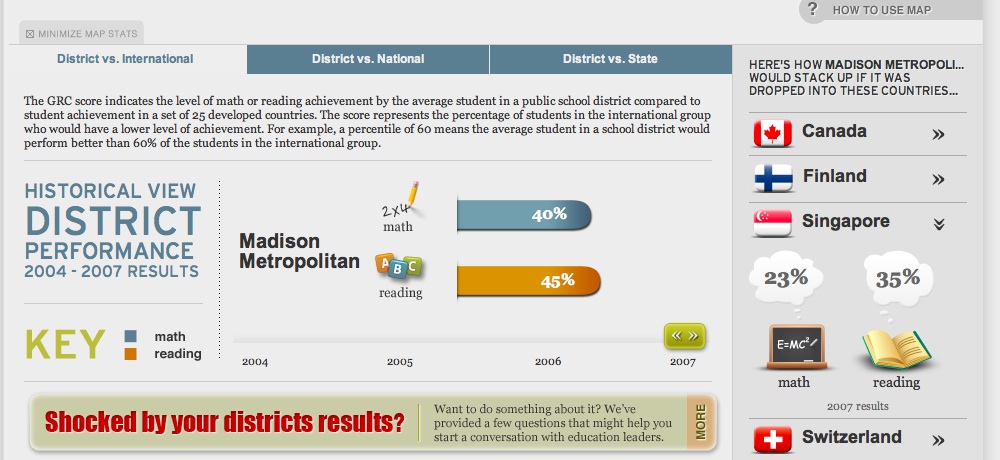
Via the Global Report Card. The average Madison student performs better than 23% of Singapore students in Math and 35% in reading.
The educators’ biases have held sway for decades. But a new coalition is trying to find a way to make sure prospective teachers have some instruction in what decoding strategies are and why they are effective.
The latest action has been in Wisconsin. The state Legislature passed a bill that will help ensure that teachers no longer receive inadequate training in their preparation and professional development. The Wisconsin Reading Coalition, the Wisconsin branch of the International Dyslexia Association, and a group of parents, educators, psychologists and other professionals supported the measure. I was among the many experts submitting testimony for it.
The group had begun looking carefully at beginning instruction after noting Wisconsin children’s stagnant reading scores on the National Assessment of Educational Progress, or NAEP, and comparing those results with the scores in Massachusetts.
Why Massachusetts? Because children there are doing better than pupils in most other states on reading tests.
…….
As noted by Kathleen Porter-Magee in a 2012 Fordham Institute analysis of the impact of high standards on student achievement, the 2009 NAEP reading tests showed that “students scoring in Massachusetts’s bottom 25 percent score higher than students in the bottom 25 percent of any other state in the nation. And students scoring in the top 25 percent perform better than students in the top 25 percent of any other state.”
She attributed this performance to the effective implementation of its highly rated English-language-arts standards, first adopted in 1997 and then re-adopted in a slightly revised form in 2001.
But the Wisconsinites zeroed in on a more specific explanation for the Massachusetts results: the state’s licensing test, in place since 2002, for all aspiring teachers of elementary-age children. The content of the test includes knowledge of code-based beginning-reading instruction.
Related:
In 2010, just five black and 13 Hispanic graduating seniors in the Madison Metropolitan School District were ready for college, according to data from the district and Urban League of Greater Madison. These statistics should make your heart race. If they don’t, and you’re white, you may be suffering from what anti-racism educator Tim Wise calls “the pathology of white privilege.” If you do get it and don’t take action, that is almost worse.
The issue affects all of us and fell a little harder into my lap than it does in most white middle-class families when my daughter told me last summer that I was going to have a biracial grandson. My response? “Not in this school district.”
The dismal academic record of minorities has long been apparent to me, through my own experiences and the stories of others. But many people only hear about the statistics. To help humanize these numbers I asked students and parents who are most affected to share their stories so I could tell them along with mine. The experiences are anecdotal, but the facts speak for themselves.
Related:
In my view, the status quo approach to Madison’s long lived reading challenges refutes Mr. Hughes assertion that the District is on the right track. Matt DeFour’s article:
Overall student performance improved in math and dipped slightly in reading across Wisconsin compared with last year, while in Madison scores declined in all tested subjects.
Perhaps change is indeed coming, from a state level initiative on reading.
So what was new in all the data released last week summarizing results of the standardized tests, known as the WKCEs, that were taken last fall by more than 400,000 students from Kenosha to Superior?
Not much.
Some things a little better, most things the same, the state of meeting our educational needs pretty much unchanged.
But for every answer like that, I have a dozen questions (and lots of sub-questions).
Here they are:
1. Do we have the patience to pursue solid, significant improvement in how our students are doing?
The highflying schools I know of all took years to reach the heights.
Are we willing to do the steady, thoughtful work of building quality and resist the rapidly revolving carousel of education fads?
2. Do we have the impatience to pursue solid, significant improvement in how our students are doing?
At the same time we’ve got to be steady, we’ve got to be propelled by the urgency of improving.
Especially outside of Milwaukee, an awful lot of people are complacent about how Wisconsin’s kids are doing, and that complacency is often not well justified.
Related:
The push to raise achievement for minority and low-income students in Madison Metropolitan School District remains “a work in progress,” said Superintendent Daniel Nerad.
Work has been done on Nerad’s watch, such as drafting a new strategic plan and a multifaceted, $106 million proposal for programs aimed at shrinking test score gaps between students of different races and income levels.
As for results, Nerad and Madison school board member Ed Hughes say there hasn’t been enough progress.
“We certainly haven’t seen, overall, the kind of improvement that we would like to see in reducing the achievement gap,” Hughes said. “But we need to look at whether the steps are being put in place that would give us some hope or confidence that we will see those gaps narrowing in the future.”
Hughes thinks Madison is on the right track.
Related:
In my view, the status quo approach to Madison’s long lived reading challenges refutes Mr. Hughes assertion that the District is on the right track. Matt DeFour’s article:
Overall student performance improved in math and dipped slightly in reading across Wisconsin compared with last year, while in Madison scores declined in all tested subjects.
Perhaps change is indeed coming, from a state level initiative on reading.
A look at the numbers:
Omaha spends substantially less per student than Madison. The Omaha 2011-2012 adopted budget will spend 468,946,264 for 46,000 students: $10,194.48/student. Madison’s 2011-2012 budget spends $369,394,753 for 24,861 = $14,858.40/student, 31.4% more than Omaha…. Green Bay (Superintendent Nerad’s former position) spent about 10% less than Madison, per student.


Related:
Assistant superintendent Art Rainwater was elevated (no one else applied) to Superintendent when Cheryl Wilhoyte was pushed out. Perhaps Madison will think different this time and look outside the traditional, credentialed Superintendent candidates. The District has much work to do – quickly – on the basics, reading/writing, math and science. A steady diet of reading recovery and connected math along with above average spending of nearly $15k/student per year has not changed student achievement.
Madison and Wisconsin are moving in opposite directions in raising achievement levels of black students, according to state test scores released Tuesday by the Department of Public Instruction.
The percentage of black Madison students scoring proficient or better on the state reading test dropped to the lowest level in six years, while statewide black student reading scores continued to improve.
“The results affirm the work that we need to be doing and are doing to close our unacceptable gaps in achievement,” Madison Superintendent Dan Nerad said.
Overall student performance improved in math and dipped slightly in reading across Wisconsin compared with last year, while in Madison scores declined in all tested subjects.
Madison’s strongest gains were among eighth grade math scores, with the percentage of black students scoring proficient gaining 8 percentage points, Hispanic students gaining 16 percentage points and low-income students gaining 6.5 percentage points over last year.
Overall 77 percent of eighth-graders scored advanced or proficient on math, up from 76 percent last year. In all other grade levels the math scores were down in Madison from last year, whereas statewide the scores were up or the same in each grade level.
Related:
Oh, the places we go.
I’m glad Matt DeFour and the Wisconsin State Journal obtained the most recent Superintendent Review via open records. We, as a community have come a long way in just a few short years. The lack of Board oversight was a big issue in mid-2000’s competitive school board races. Former Superintendent Art Rainwater had not been reviewed for some time. These links are well worth reading and considering in light of the recent Superintendent review articles, including Chris Rickert’s latest. Rickert mentions a number of local statistics. However, he fails to mention:
With respect to the current Superintendent Review, the job pays quite well (IRS income distribution data: table 7), so I believe the position should be fully accountable to parents and taxpayers. Matthew DeFour:
In 2014, Madison superintendent Dan Nerad qualifies for a $37,500 payment for six years of service, which like Gorrell’s would be paid into a retirement account. Nerad already receives an annual $10,000 payment into his retirement account, which is separate from his state pension and in addition to a $201,000 yearly salary.
More, here.
The current rhetoric is quite a change in just 8 years. (Why did things change? A number of citizens care, decided to run for school board – won – and made a difference…) I certainly hope that the Board and community do not revert to past practice where “we know best” – the status quo – prevailed, as the Obama Administration recently asserted in a vital constitutional matter:
Holder made clear that decisions about which citizens the government can kill are the exclusive province of the executive branch, because only the executive branch possess the “expertise and immediate access to information” to make these life-and-death judgments.
Holder argues that “robust oversight” is provided by Congress, but that “oversight” actually amounts to members of the relevant congressional committees being briefed. Press reports suggest this can simply amount to a curt fax to intelligence committees notifying them after the fact that an American has been added to a “kill list.” It also seems like it would be difficult for Congress to provide “robust oversight” of the targeted killing program when intelligence committee members like Sen. Ron Wyden (D-Ore.) are still demanding to see the actual legal memo justifying the policy.
More, here on the political class and the legal system.
The choice is ours. Use our rights locally/nationally, or lose them.
A look back at previous Madison Superintendents.
High expectations surely begin at the top.
A controversy broke out on Twitter earlier this week about an article in the Times Educational Supplement in which a teacher called Jonny Griffiths describes a conversation with a bright sixth-former who’s worried about his exam results. “Apart from you, Michael, who cares what you get in your A-levels?” he says. “What is better: to go to Cambridge with three As and hate it or go to Bangor with three Cs and love it?”
The controversy was not about whether the teacher was right to discourage his student to apply to Cambridge – no one thought that, obviously – but whether the article was genuine. Was Jonny Griffiths a real teacher or the fictional creation of a brilliant Tory satirist? Most people found it hard to believe that a teacher who didn’t want his pupils to do well could be in gainful employment.
Alas, Mr Griffiths is all too real. Since 2009, when I first mooted the idea of setting up a free school devoted to academic excellence, I’ve come across dozens of examples of the same attitude, all equally jaw-dropping.
We’ve certainly seen such initiatives locally. They include English 10, Connected Math and the ongoing use of Reading Recovery.
Perhaps Wisconsin’s Read to Lead initiative offers some hope with its proposal to tie teacher licensing to teacher content knowledge.
Related: Examinations for teachers, past and present.
There are certainly many parents who make sure that their children learn what is necessary through tutors, third parties, personal involement, camps, or online services. However, what about the children who don’t have such family resources and/or awareness?
Nancy Cooley has spent 20 years helping struggling young readers build a foundation for academic success.
Each day, Cooley works individually with students like Gavin Bass, a Rosemount first-grader, who need extra help mastering specific literacy skills using a program called “Reading Recovery.” Interventions like these can help get a student back on course, possibly avoiding a learning-disability classification.
“It is designed to catch kids early on, before they feel like they are not successful,” said Cooley, a teacher at Diamond Path Elementary School for International Studies in Apple Valley. She will work with students such as Gavin for a half-hour each day – drilling, quizzing and practicing early literacy concepts to improve core skills.
For Gavin, the program has been a big confidence boost, said his mother, Sarah Bass.
“He loves to read because of it,” she said. “The intervention was everything we had hoped for and more. It has been so much fun for him, and he’s very proud of himself. We wouldn’t have known how to do this at home.”
Wisconsin State Journal Editorial:
Madison school chief Dan Nerad’s plan to close the district’s achievement gap is certainly bold about spending money.
It seeks an estimated $105 million over five years for a slew of ideas — many of them already in place or attempted, just not to the degree Nerad envisions.
The school superintendent argues a comprehensive approach is needed to boost the academic performance of struggling minority and low-income students. No one approach will magically lift the district’s terrible graduation rates of just 48 percent for black students and 57 percent for Latinos.
Much more on the proposed Madison Preparatory IB charter school, here.
Related:
Listen to most of the speech via this 25mb .mp3 file.
Well worth reading: Money And School Performance:
Lessons from the Kansas City Desegregation Experiment:
For decades critics of the public schools have been saying, “You can’t solve educational problems by throwing money at them.” The education establishment and its supporters have replied, “No one’s ever tried.” In Kansas City they did try. To improve the education of black students and encourage desegregation, a federal judge invited the Kansas City, Missouri, School District to come up with a cost-is-no-object educational plan and ordered local and state taxpayers to find the money to pay for it.
Kansas City spent as much as $11,700 per pupil–more money per pupil, on a cost of living adjusted basis, than any other of the 280 largest districts in the country. The money bought higher teachers’ salaries, 15 new schools, and such amenities as an Olympic-sized swimming pool with an underwater viewing room, television and animation studios, a robotics lab, a 25-acre wildlife sanctuary, a zoo, a model United Nations with simultaneous translation capability, and field trips to Mexico and Senegal. The student-teacher ratio was 12 or 13 to 1, the lowest of any major school district in the country.
The results were dismal. Test scores did not rise; the black-white gap did not diminish; and there was less, not greater, integration.
Altogether, Nerad makes about 40 recommendations in six categories — instruction, college and career readiness, culturally relevant practices, school environment, family engagement and staff diversity.
“The plan is based on the view that there isn’t one thing alone the school district can do to eliminate achievement gaps,” Nerad said. “We’re attempting to be comprehensive with the proposal.”
The plan’s projected cost for next year is $12.4 million, which Nerad is recommending come from the district’s untapped property taxing authority under state-imposed limits. The amount includes adding about 67.5 positions, including behavioral support staff, reading specialists and parent liaisons.
Some recommendations wouldn’t take effect until future years. The district estimates they will cost $20.9 million in 2013-14 and $26.6 million by 2016-17. The district doesn’t have the authority to raise property taxes by that amount, though Nerad said part of the discussion in coming months will involve whether the private and nonprofit sectors can help fund the strategies.
“We’re going to have to struggle through the conversation of how to get it done,” Nerad said.
Related:
Listen to most of the speech via this 25mb .mp3 file.
The following questions and concerns are submitted to you for your consideration regarding the “findings and recommendations” of the MMSD K-12 Literacy Program Evaluation report:
1. What findings and recommendations are there for ‘year-around’ literacy experiences to help mitigate ‘losses’ over the summer months in achievement gains during the traditional academic year?
Although “summer loss” was not a particular focus of discussion during the evaluation process, there are several ways in which the recommendations address reducing the impact of summer reading loss. These include:
Recommendation I – curricular consistency will provide for a more seamless connection with content and instruction in summer school, Saturday school (pending funding) and after school supports.
Recommendation II – more explicit instruction focused in early grades will allow students to read for enjoyment at earlier ages.
Recommendation III – a well-developed intervention plan will follow a student through summer school and into the following academic year
2. What are the findings and recommendations regarding parental (significant adults in student’s life) participation, training, evaluation and accountability in the literacy learning process?
Parental participation opportunities to support their children’s enjoyment and achievement in literacy include:
Family Literacy Nights at various elementary schools and in collaboration with Madison School and Community Recreation. Town Hall Meetings that provide opportunities for families to share pros and cons of literacy practices at school and home.
Literacy 24-7: Parent training for Spanish speaking families on how to promote literacy learning. Read Your Heart Out Day: This event builds positive family, community and school relationships with a literacy focus and supports both the family involvement and cultural relevance components of the Madison Metropolitan School District Strategic Plan.
Tera Fortune: Professional development for parents about the Dual Language Immersion Program with a focus on bi-literacy throughout the content areas. MALDEF Curriculum Training: Nine-week training covering a variety of topics to assist parents in sharing the responsibility of student success and how to communicate effectively in schools.
Regular column in Umoja Magazine: Forum to inform families and community members about educational issues through African American educators’ expertise. Several columns have focused on literacy learning at home.
Training is provided for parents on how to choose literature that:
Has positive images that leave lasting impressions
Has accurate, factual information that is enjoyable to read
Contains meaningful stories that reflect a range of cultural values and lifestyles
Has clear and positive perspective for people of color in the 21st century
Contains material that is self affirming Promotes positive literacy learning at home
Evaluations of the Read Your Heart Out and Family Literacy Night were conducted by requesting that participating parents, staff, students and community members complete a survey about the success of the event and the effects on student achievement.
3. What are the consequential and remediation strategies for non-performance in meeting established achievement/teaching/support standards for students, staff and parents? What are the accompanying evaluation/assessment criteria?
A District Framework is nearing completion. This Framework will provide clear and consistent expectations and rubrics for all instructional staff and administrators. Improvement will be addressed through processes that include the School Improvement Plans and staff and administrator evaluations processes.
4. Please clarify the future of the Reading Recovery program.
MMSD proposes to maintain Reading Recovery teachers and teacher leaders as an intervention at grade 1. There are currently two Reading Recovery teacher leaders participating in a two-year professional development required to become Reading Recovery teacher leaders. One of these positions will be certified to support English Language Learners. The modifications proposed include: 1) targeting these highly skilled Reading Recovery teachers to specific students across schools based on district-wide data for 2011-12 and 2) integrating the skills of Reading Recovery staff into a comprehensive intervention plan along with skilled interventionists resulting in all elementary schools benefiting from grade 1 reading intervention.
5. How will the literacy learning process be integrated with the identification and development of Talented and Gifted (TAG) students?
The development of a balanced, comprehensive assessment system will result in teachers having more frequent and accurate student data available to tailor instruction. K-12 alignment uses tools such as Measures of Academic Progress (MAP) and Educational Planning and Assessment System (EPAS) are being implemented in Spring, 2011.
The Response to Intervention model is based on evidence-based instruction and responds to students who need additional challenge and/or support.
6. What will be the 2010-2011 budgetary priorities and strategies for undertaking the literacy program and resources recommendations outlined in the report?
PreK-12 literacy will be a priority for the 2011-12 budget process. In addition to the prioritization of funding within our budget parameters, MMSD is in the process of writing a major grant (Investing in Innovation – i3) to support the recommendations of the literacy evaluation as a key strategy to close achievement gaps and improve literacy for all students to be ready for college and/or careers.
But the Department of Public Instruction (DPI) is questioning the legality of Walker’s proposal to fund the program through the Department of Administration.
Walker has proposed spending $600,000 in each of the next two years to implement recommendations of a new task force appointed by Walker that would develop a third-grade reading test. Walker noted Wisconsin’s performance on a national fourth-grade reading exam has fallen from third out of 39 states in 1994 to 30th out of 50 states in 2009.
“From kindergarten to third grade, our kids learn to read, and then from third grade on, they use reading to learn,” Walker said in his budget address. “We need to make sure every child can read as they move on from third grade.”
Related:
1. Intensify reading instruction in Kindergarten in order to ensure all No additional costs. Professional development provided by central students are proficient in oral reading and comprehension as office and building-based literacy staff must focus on Kindergarten. measured by valid and reliable assessments by 2011-2012. Instruction and assessment will be bench marked to ensure Kindergarten proficiency is at readinQ levels 3-7 {PLAA, 2009).
2. Fully implement Balanced Literacy in 2011-12 using clearly defined, Comprehensive Literacy Model (Linda Dorn), the MMSD Primary Literacy Notebook and the MMSD 3-5 Literacy Notebook.
a. Explore research-based reading curricula using the Board of Education Evaluation of Learning Materials Policy 3611 with particular focus on targeted and explicit instruction, to develop readers in Kindergarten.
b. Pilot the new reading curricula in volunteer schools during 2011-12.
c. Analyze Kindergarten reading proficiency scores from Kindergarten students in fully implemented Balanced Literacy schools and Kindergarten students in the volunteer schools piloting the new reading curricula incorporated into a
Balanced Literacy framework to inform next steps.
d. Continue pilot in volunteer schools in Grade 1 during 2012-13 and Grade 2 durino 2013-14. 2011-12 Budget Addition Request $250,000
3. Incorporate explicit reading instruction and literacy curricula into 6th grade instruction.
…..
3. Review previous Reading Recovery recommendations, with Additional Reading considerations to:
- Place Reading Recovery Teachers in buildings as needed to (displaced rate when new teacher is hired).reflect the needs of 20% of our District’s lowest performing first graders, regardless of what elementary school they may attend;
- Analyze the other instructional assignments given to Reading Recovery teachers in order to maximize their expertise as highly skilled reading interventionists
- Ensure standard case load for each Reading Recovery teacher at National Reading Recovery standards and guidelines (e.g. 8 students/year).
- Place interventionists in buildings without Reading Recovery. Interventionists would receive professional development to lift the quality of interventions for students who need additional support in literacy.
Additional Reading Recovery and/or Interventionist FTE costs. 1 FTE-$79,915 (average rate when teacher is re-assigned). 1 new FTE-$61,180 (displaced rate when new teacher is hired).
Related:
Madison School District Administration 2.8MB PDF:
I. Introduction
A. Title or topic – District Evaluation Protocol – The presentation is in response to the need to provide timely and prioritized information to the Board of Education around programs and interventions used within the District. The report describes a recommended approach to formalizing the program evaluation process within the District.
B. Presenters
Kurt Kiefer – Chief Information Office/Director of Research and Evaluation
Lisa Wachtel– Executive Director of Teaching & Learning
Steve Hartley – Chief of Staff
C. Background information – As part of the strategic plan it was determined that priority must be given to systematically collect data around programs and services provided within the district. The purposes for such information vary from determining program and intervention effectiveness for specific student outcomes, to customer satisfaction, to cost effectiveness analyses. In addition, at the December 2009 Board meeting the issue of conducting program evaluation in specific curricular areas was discussed. This report provides specific recommendations on how to coordinate such investigations and studies.
D. Action requested – The administration is requesting that the Board approve this protocol such that it becomes the model by which priority is established for conducting curricular, program, and intervention evaluations into the future.
II. Summary of Current Information
A. Synthesis of the topic· School districts are expected to continuously improve student achievement and ensure the effective use of resources. Evaluation is the means by which school systems determine the degree to which schools, programs, departments, and staff meet their goals as defined by their roles and responsibilities. It involves the collection of data that is then transformed into useful results to inform decisions. In particular, program evaluation is commonly defined as the systematic assessment of the operation and/or outcomes of a program, compared to a set of explicit or implicit standards as a means of contributing to the improvement of the program.
Program evaluation is a process. The first step to evaluating a program is to have a clear understanding of why the evaluation is being conducted in the first place. Focusing the evaluation helps an evaluator identify the most crucial questions and how those questions can be realistically answered given the context of the program and resources available. With a firm understanding of programs and/or activities that might be evaluated, evaluators consider who is affected by the program (stakeholders) and who might receive and or use information resulting from the evaluation (audiences). It is critical that the administration work with the
Evaluating the effectiveness of Madison School District expenditures on curriculum (such as math and reading recovery) along with professional development (adult to adult programs) has long been discussed by some Board and community members.
The need to succeed at teaching children is at the basic core of everything we do in Madison schools.
So why did the very society that depends on us to educate their most precious beings, their children, come to be so apprehensive about us? How did this happen? When did our state Legislature and many of our fellow citizens decide that an increase and/or a change in public financing of education was not in their interest?
Perhaps we all need to calm down and ask ourselves the very basic question of why we have public schools. The following tenets are a good start:
1. To provide universal access to free education.
2. To guarantee equal opportunities for all children.
3. To unify a diverse population.
4. To prepare people for citizenship in a democratic society.
5. To prepare people to become economically self-sufficient.
6. To improve social conditions.
7. To pass knowledge from one generation to the next.
8. To share the accumulated wisdom of the ages.
9. To instill in our young people a love for a lifetime of learning.
10. To bring a richness and depth to life.
Many Americans have either forgotten, disregard, or no longer view public schools as needed to achieve the above. Some, not all, view the public schools in a much more narrow and self-indulgent way — “What are the public schools going to do for me and my child?” — and do not look at what the schools so richly provide for everyone in a democratic society.
There are many reasons that public education institutions face credibility challenges, including:
Having said that, there are certainly some remarkable people teaching our children, in many cases resisting curriculum reduction schemes and going the extra mile. In my view, our vital public school climate would be far richer and, overall, more effective with less bureaucracy, more charters (diffused governance) and a more open collaborative approach with nearby education institutions.
Madison taxpayers have long supported spending policies far above those of many other communities. The current economic situation requires a hard look at all expenditures, particularly those that cannot be seen as effective for the core school mission: educating our children. Reading scores would be a great place to start.
The two Madison School Board seats occupied by Marj Passman and Ed Hughes are up for election in April, 2011. Interested parties should contact the Madison City Clerk’s office for nomination paper deadlines.
Start the war.
What about Wisconsin? Wisconsin kids overall came in at the U.S. average on the NAEP scores. But Wisconsin’s position has been slipping. Many other states have higher overall scores and improving scores, while Wisconsin scores have stayed flat.
Steven Dykstra of the Wisconsin Reading Coalition, an organization that advocates for phonics programs, points out something that should give us pause: If you break down the new fourth-grade reading data by race and ethnic grouping, as well as by economic standing (kids who get free or reduced price meals and kids who don’t), Wisconsin kids trail the nation in every category. The differences are not significant in some, but even white students from Wisconsin score below the national average for white children.
(So how does Wisconsin overall still tie the national average? To be candid, the answer is because Wisconsin has a higher percentage of white students, the group that scores the highest, than many other states.)
Start the war.
Related: Reading Recovery, Madison School Board member suggests cuts to Reading Recovery spending, UW-Madison Professor Mark Seidenberg on the Madison School District’s distortion of reading data & phonics and Norm and Dolores Mishelow Presentation on Milwaukee’s Successful Reading Program.
Madison School District Superintendent Dan Nerad will present the “State of the Madison School District 2010” tomorrow night @ 5:30p.m. CST.
The timing and content are interesting, from my perspective because:
History is moving rather fast in South Africa. In June the country hosts football’s World Cup, as if in ultimate endorsement of its post-apartheid progress. Yet on February 2 1990, when the recently inaugurated state President de Klerk stood up to deliver the annual opening address to the white-dominated parliament, such a prospect was unthinkable. The townships were in ferment; many apartheid laws were still on the books; and expectations of the balding, supposedly cautious Afrikaner were low.
How wrong conventional wisdom was. De Klerk’s address drew a line under 350 years of white rule in Africa, a narrative that began in the 17th century with the arrival of the first settlers in the Cape. Yet only a handful of senior party members knew of his intentions.
I sense that the Madison School Board and the Community are ready for new, substantive adult to student initiatives, while eliminating those that simply consume cash in the District’s $418,415,780 2009-2010 budget ($17,222 per student).
This points up one of the frustrating aspects of trying to follow school issues in Madison: the recurring feeling that a quoted speaker – and it can be someone from the administration, or MTI, or the occasional school board member – believes that the audience for an assertion is composed entirely of idiots.
In my view, while some things within our local public schools have become a bit more transparent (open enrollment, fine arts, math, TAG), others, unfortunately, like the budget, have become much less. This is not good.
I think Dan Nerad sits on a wonderful opportunity. The community is incredibly supportive of our schools, spending far more per student than most school Districts (quite a bit more than his former Green Bay home) and providing a large base of volunteers. Madison enjoys access to an academic powerhouse: the University of Wisconsin and proximity to MATC and Edgewood College. Yet, District has long been quite insular (see Janet Mertz’s never ending efforts to address this issue), taking a “we know best approach” to many topics via close ties to the UW-Madison School of Education and its own curriculum creation business, the Department of Teaching and Learning.
In summary, I’m hoping for a “de Klerk” moment Monday evening. What are the odds?
Reading Programs: The Board received a presentation on Reading Recovery in the district. A number of questions were raised about our reading programs and how programs worked together to ensure we were meeting the needs of all of our students. Therefore, the Board requested a full evaluation of all reading programs at the elementary level so we have a better understanding of the big reading picture.
Superintendent Goals: As part of the Superintendent evaluation process the Board, in conjunction with the Superintendent, developed goals for the Superintendent. There are a lot of details associated with each goal. The Goal area and targeted Results of each goal are below:
1. Goal Area: Increase the percentage of students who are proficient and advanced in reading. Results: Increased proficiency and advanced proficiency on WKCE or its replacement, other district assessment or standards-based tests. By 2012-14, 100% of students will meet this target.
2. Goal Area: Increase the percentage of students at all grade levels who attend school at 96% or more. Results: Increase attendance for students in every grade, with a specific focus on the students in key transition grades. By 2014-15, 96% or more of students will meet this target.
3. Goal Area: Increase the percentage of students on track for credit attainment for graduation in four years. Results: Increased percentage of students on track for credit attainment for graduation. By 2014-15, 90% or more will meet this target.
4. Goal Area: Completion of a review of the District’s organizational structure and organizational systems/processes and develop a plan to align the work of the Administration to the District’s mission and Strategic Plan. Results: This goal will be assessed by Board approval and successful Administrative implementation of a Plan that aligns the work of the Administration with the District’s mission and Strategic Plan and to principles of quality organizations, and is fiscally sustainable over time.
5. Goal Area: Board relations. Results: Development and implementation of a sustainable system for improving and demonstrating effective communication with the Board of Education.
6. Goal Area: Implement the Strategic Plan action steps targeted for year one as approved by the Board of Education. Results: A report in June 2010 outlining progress toward implementation of the action steps including any evaluation of new programs that has occurred using the approved performance measures.
7. Goal Area: Leadership development goal. To focus on encouraging the heart in others and challenging the process.
What’s Up in January?: 2010 will be a busy year. Items of interest on our January agenda: Decision on the implementation of 4-year-old kindergarten; Race to the Top funds; initial presentation of an environmental charter middle school; core performance measures associated with the strategic plan; and kick-off of the 2010-11 budget process.
Thanks for all you do for our children. Please let us know if you have any questions or comments at board@madison.k12.wi.us .
“The research around early reading intervention illuminates the complex decision making required to meet individual student literacy needs. There seems to be no one right answer, no quick fix for success. While recent research brings up questions as to the cost/benefit of Reading Recovery, what other supports and options are available? One thing is certain, alternative interventions must be in place prior to removing current systems.” Summary, “Reading Recovery: A Synthesis of Research, Data Analysis and Recommendations,” Madison Metropolitan School District Report to the Board of Education, December, 2009.
How well are we teaching our children to read?
The “Annual Measurable Objectives” under No Child Left Behind for Wisconsin call for all students to achieve reading levels of proficient or better under the WKCE by the 2013-14 school year. Benchmarks toward that goal are phased in over time. The current intermediate goal (ending this school year) is 74%. (Put another way, the percentage of students who are below proficient should not exceed 26%.) The goals move up to 80.5% in 2010-11, 87% in 2011-12, and 93.5% in 2012-13.
71.7% of MMSD 3rd graders scored at or above the proficient level on last year’s (November 2008) WKCE reading assessment (this and the rest of the WKCE data cited here are from the DPI web site). This did not quite meet the 74% Annual Measurable Objective. We should be concerned that achievement levels are going down even as achievement targets are going up:
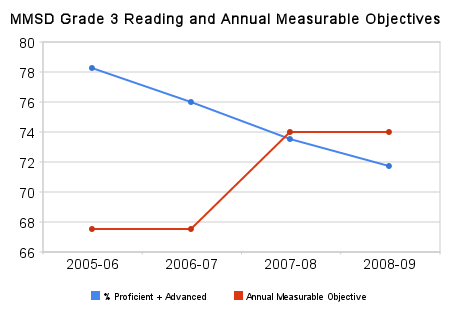
The Annual Measurable Objectives also apply to demographic subgroups, including economically disadvantaged students. Economically disadvantaged students—whose futures are almost wholly dependent on the ability of their schools to teach them to read—and their achievement levels deserve particular attention.
How well are we teaching our children from low-income families to read?
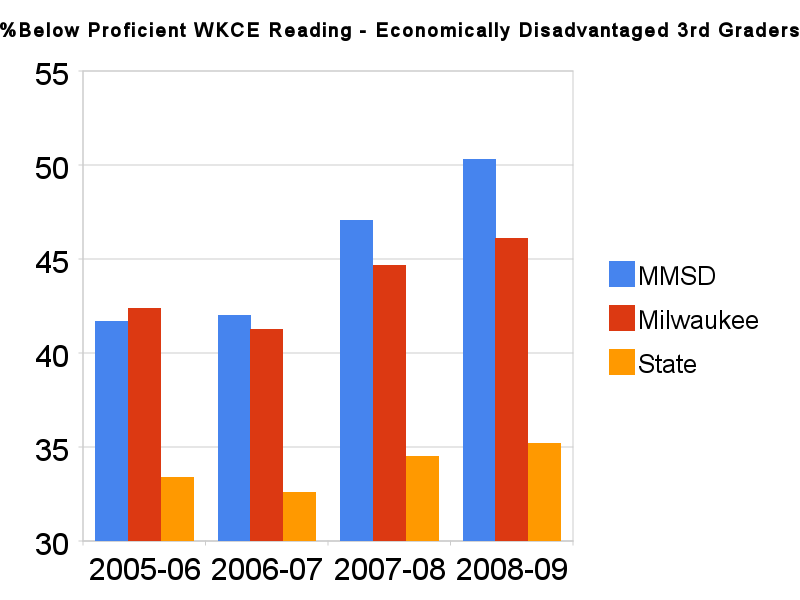
Can we continue to explain/excuse/blame poverty rates for this failure?
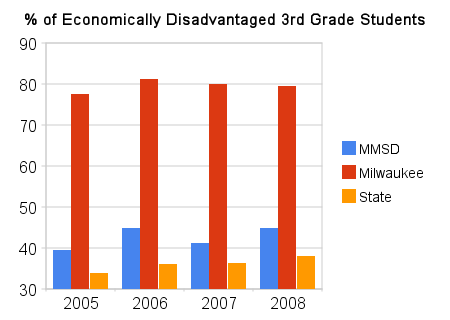
What should we do to acknowledge and address this crisis?
Author Beth Fertig says that as many as 20 percent of American adults may be functionally illiterate. They may recognize letters and words, but can’t read directions on a bus sign or a medicine bottle, read or write a letter, or hold most any job. Her new book, Why cant U teach me 2 read, follows three young New Yorkers who legally challenged the New York City public schools for failing to teach them how to read — and won. Host Scott Simon talks to Fertig about her book.
….
SIMON: The No Child Left Behind Act is often criticized. But you suggest in this book that it perhaps did force teachers to not just let a certain percentage of students slip through the cracks.
Ms. FERTIG: That is the one thing that I do hear from a lot of different people is, by not just looking at how a whole school did and saying, you know, 60 or 70 percent of our kids passed the test, they now have to look at how did our Hispanic kids do, how did our black students do, how did our special ed students do, how did English language learners do – students who aren’t born to parent who speak English.
And this way, by just aggregating the data, they’re able to see which kids are falling behind and hopefully target them and give them more interventions, more help with their reading. And the ideal is that a child like Umilka isn’t going to be caught, you know, in high school and they’re going to figure out then that they weren’t reading.
SIMON: You make a point in the book you can’t get a job cracking rocks these days without having to probably fill out a computer form as to how many rocks you cracked.
Ms. FERTIG: Exactly. Antonio is now working at UPS as a loader. He had to take a basic orientation test. And because he had improved his reading skills to a fourth or fifth grade level, he was able to pass that. But he feels stuck now.
Related: Madison School District Reading Recovery Review & Discussion.
David Zaslawsky, via a kind reader’s email:
MBJ: As superintendent, you are the CEO of a $311 million budget, 32,000 students and 4,500 employees. What are your priorities?
Thompson: Basically, moving the school district forward so we are considered one of the No. 1 school districts in the state. Making sure that our students are successful and that they have skills that will allow them to compete in what I consider a global society. My priority is to make sure first and foremost that we have kids in the classroom – so we have to tackle that dropout rate.
MBJ: Any other initiatives?
Thompson: The Career Academies is another way we’re looking at deterring our dropout rate. We hope that this gives our kids some idea of the light at the end of the tunnel; some skill set they can see and some jobs they can do. Potentially, we see (Career Academies) being a linkage for those kids for reasons why to stay in school because this can give you jobs – these are classes you can take while you’re in high school so when you graduate, you actually have a job. And the last component of that – that three-tier component that I consider — is prevention. We increased seven pre-K programs because the other part of dropout prevention is that part. We added seven pre-K programs this year for a total of 21. The reason that is so critical is because one of the reasons kids drop out is because they don’t have the skills that they need. We’re trying to increase giving the kids skills as 4-year-olds so when they come into kindergarten, they are caught up. That’s part of that three-pronged approach.
MBJ: What are some of the things that you learned about MPS since you took over in August, and what has surprised you?
Thompson: I learned a lot about the commitment that this community has towards education, particularly the business (community), work force development and the chamber. They are very committed to making sure that the public schools in Montgomery are successful. I guess I was surprised at the Career Academies. They are cutting-edge in terms of what you want to be doing in the school district and the involvement that we have in the chamber in the (Career Academies) is exciting and unusual.
Montgomery, AL school district website & Thompson’s blog.
Lapham Elementary’s success with Direct Instruction (phonics) was discussed during a Reading Recovery conversation at the December 7, 2009 Madison School Board meeting.
4k is really exciting, since it provides a great opportunity for four year olds to get a head start with learning before they get to kindergarten. It’s also a promising step towards eliminating the achievment gap. Right now, we’re smooting out some rough edges– deciding whether to start with all of the buildings and teachers, or whether to “phase in,” starting with 1/3 or 2/3 the amount of resources, and then increase it in the next few years.
However, though there’s still some negotiating to go, the 4k plan seems to be on its way. Another issue that involved a lot of intense discussion was the district’s Reading Recovery Program.
Reading Recovery is a program for first grade students who are really struggling with reading. Targeted at the lowest 20% reading level students, Reading Recovery provides very intense one-on-one training every day which, when continued throughout the year, has very good national results of getting kids back on track.
However, in the last few years, RR in the MMSD has had less success than the national average (42% students finish the program versus around 60% nationally). This lead the district to worry and evaluate the program. At our meeting, we discussed schools that had experienced success with reading recoverey, and other ones that had not. The team that evaluated the program has recommended “full implementation” of reading recovery at schools with the most needy children, which would hopefully increase the success rate at those schools. However, due to limited resources, Reading Recovery can not be implemented at every school.
Despite an ailing economy, Madison School Board members were guardedly optimistic last spring as they put together the district’s preliminary 2009-2010 budget. The community had overwhelmingly passed a referendum the previous fall that allowed the district to exceed state revenue caps, providing an extra $13 million to the district through 2012.
As a result, the board was anticipating a rare year where public school programs and services were not on the chopping block and was looking forward to crafting a budget with minimal property tax increases. Initial projections worked out to a $2.50 increase on an average $250,000 Madison home on this year’s tax bill.
For once, it looked as if both parents and taxpayers would be happy with the budget, a rare scenario in Wisconsin where school spending formulas and revenue caps often seem tailor-made to pit taxpayers against school advocates.
But the preliminary budget plan the Madison district drew up and approved in May predated the news that Wisconsin’s revenue situation was far worse than predicted. The result was a steep reduction in what the state’s 438 school districts would get from Wisconsin’s general school aid fund. The drop in general school aid amounted to $149 million, or 3 percent.
These cuts, however, would not be shared equally across every district, and the formula used was particularly unkind to Madison, which overnight saw a gaping hole of more than $9 million, a drop in aid not seen by any other district in the state.
“We were so happy last spring. In retrospect, it was really kind of pitiful,” says Lucy Mathiak, vice president of Madison’s School Board. The mood was decidedly more downbeat, she notes, in late October when the board gave its final approval to the $350 million 2009-2010 school district budget.
I’m glad Susan mentioned the District’s total spending. While such budget changes are difficult, many public and private organizations are facing revenue challenges. The Madison School District has long spent more per student than most Districts in Wisconsin and has enjoyed annual revenue growth of around 5.25% over the past 20+ years – despite state imposed “revenue caps” and flat enrollment.
Some can argue that more should be spent. In my view, the District MUST complete the oft discussed program review as soon as possible and determine how effective its expenditures are. Board Vice President Lucy Mathiak again raised the issue of evaluating math curriculum effectiveness via University of Wisconsin System entrance exam results and college placement. This request has fallen on deaf ears within the MMSD Administration for some time. [Madison School Board Math Discussion 40MB mp3 audio (Documents and links).] I very much appreciate Lucy’s comments. The District’s extensive use of Reading Recovery should also be evaluated in terms of effectiveness and student skills. The District should be planning for a tighter budget climate in this, the Great Recession.
Finally, I found Marj Passman’s comments in the article interesting:
“I understand that the economy is terrible, but for years we heard that the reason we had this school funding mess was because we had Republicans in charge who were basically content with the status quo,” says board member Marj Passman. “I had expected so much change and leadership on school funding issues with a Democratic governor and a Democratic Legislature. Honestly, we’ve got Rep. Pocan and Sen. Miller as co-chairs of the Joint Finance Committee and Democratic majorities in both houses! Frankly, it’s been a huge disappointment. I’d love to see that little beer tax raised and have it go to education.”
In my view, we’re much better off with “divided” government. The current Governor and legislative majority’s budget included a poor change to the arbitration rules between school districts and teacher unions:
To make matters more dire, the long-term legislative proposal specifically exempts school district arbitrations from the requirement that arbitrators consider and give the greatest weight to revenue limits and local economic conditions. While arbitrators would continue to give these two factors paramount consideration when deciding cases for all other local governments, the importance of fiscal limits and local economic conditions would be specifically diminished for school district arbitration.
Madison School District Spending History.
It’s good to see Susan Troller writing about local school issues.

schoolinfosystem.org