School Information System

Civics: special interest funded viral activity: Capitol Hill edition

Joseph Simonsen

Senate and House staff received emails from a researcher at the Joint Center for Political and Economic Studies starting in July asking them to confirm their “racial and ethnic identity” as part of an alleged data collection effort. In at least two cases, senior congressional staffers who declined to provide their races were told by the researcher that the organization’s current data indicated they “may identify as white” and asked the staffers to update if the information was incorrect.

Information collected by the group will be used in its annual report that lobbies for “structural changes on Capitol Hill that would allow for more people of color to be hired in senior positions,” a previous report from the group states. That report is made possible in part by millions of dollars in donations to the Joint Center for Political and Economic Studies from Apple, Google, Meta, Pfizer, the Soros-backed Open Society Foundation, among dozens of other large corporations and nonprofits.

The Joint Center for Political and Economic Studies’ survey is part of a broader trend by left-wing organizations to pressure workplaces and governments to increase affirmative action policies. Often couched in promoting “diversity, equity, and inclusion,” those policies have received criticism for coming at the expense of competence and offering advantages based on race instead of merit. The Free Beacon previously reported on DEI initiatives gaining prominence in medical schools, the Department of Homeland Security, and tech companies such as Google and IBM.

One of the congressional staffers contacted said she was offended by the inquiry. The racial identification of her office’s team, she said, has no relation to its quality of work.

Share

Politics and Poverty

C-span:

Chris Arnade, a former Wall Street trader turned photojournalist, talked about his book, Dignity: Seeking Respect in Back Row America, in which he documents the plight of those living on the margins of society in America. He discussed his photos and shared stories about some of the people he befriended during his travels. close

Share

Sir Patrick Vallance among scientists behind paper that stifled debate into the origins of the virus

Sarah Knapton and Ashley Rindsberg

Top scientists including Sir Patrick Vallance were warned that Covid-19 could have evolved in laboratory animals, but collaborated in a paper which shut down the lab leak theory, it has emerged.

The paper, “The proximal origin of SARS-CoV-2,” published in Nature Medicine in March 2020, argued that a natural spillover event caused the pandemic, and was hugely instrumental in stifling debate into the origins of the virus.

But newly released emails from early 2020 show that in the weeks before publication the authors held lengthy discussions with experts, including Sir Patrick and Sir Jeremy Farrar, the head of the Wellcome Trust.

In those discussions, experts were advised that the unusual features seen in Covid-19 could have evolved in animals in a lab, as well as in the wild.

They were also warned that the Wuhan Institute of Virology (WIV) had been carrying out research on bat-coronaviruses at worrying levels of biosecurity.

Yet by the time the paper was published, all reference to biosecurity problems in Wuhan had been removed, and the authors argued that lab evolution of the virus was unlikely.

Share

Statistical process control after W. Edwards Deming

Thomas:

Deming tried to get his ideas adopted in America, but he fell largely on deaf ears with American industrialists. That isn’t terribly surprising, you need to understand the times, especially shortly after World War II: Americans were the rulers of the world. Europe was in ruins, sometimes even still smoking. China wasn’t the high-tech supplier it is today, but a poor agrarian country. BRIC wasn’t even invented as an acronym, and nobody talked about the “tiger states”.

Why indeed should America change its ways? The future looked bright.

Not only lay Europe in ruins, Japan did, too, maybe even more so. America was occupying Japan, and the story goes that General MacArthur exploded with frustration when his phone call to another island of Japan repeatedly broke off. So he wanted to re-build Japan, at least some infrastructure.

Well, that’s probably not exactly what happened, the story is apocryphal after all, and many other people were in favor of helping rebuild Japan. But the important thing is: America decided to help rebuild Japan. And so many experts from all kinds of fields embarked and came to Japan.

Share

Civics: The Media’s Deranged Hysteria Over Elon Musk’s Promised Restoration of Free Speech

Glenn Greenwald

In unison, these media outlets decreed that not only would greater free speech on Twitter usher in the usual parade of horribles they trot out when demanding censorship — disinformation, hate speech, attacks on the “marginalized,” etc. etc. — but this time they severely escalated their rhetorical hysteria by claiming that Musk would literally cause mass murder by permitting a broader range of political opinion to be aired. The Washington Post‘s Taylor Lorenz even warned of supernatural demons that would be unleashed by these new free speech policies, as she talked to a handful of obviously neurotic pro-censorship “experts” and then wrote about these thinly disguised therapy sessions with those neurotics under this headline: “‘Opening the gates of hell’: Musk says he will revive banned accounts.”

But the self-evident absurdity of this laughable meltdown and the ease of mocking it should not obscure that there are lurking within these episodes some genuinely insidious and serious dangers. These preposterous media employees are just the sideshow. But what they are doing, unwittingly or otherwise, is laying the groundwork for far less frivolous and more serious people to use the attacks on Musk to further fortify the regime of censorship they have been constructing: the limitlessly demonizing language heaped on him, the success they have already had in driving away many if not most corporate advertisers from Twitter, the threats to once again abuse the monopoly power of Google and Apple to destroy Twitter or at least cripple it if Musk does not comply with their censorship orders (as they succeeded in doing last year to the free speech site Parler when it became the most-downloaded app in the country and refused to censor on demand).

Share

China’s “White Paper” Revolution

Peter Stubley:

China has tried to stamp out public protests after students and angry residents rebelled against President Xi’s zero-Covid policy in the largest demonstration of unrest since the Tiananmen Square protests in 1989.

Student demonstrators flooded the grounds of two universities in Beijing while crowds in Shanghai chanted “down with the Chinese Communist Party” and openly demanded Xi’s removal.

The authorities have now imposed tight security measures to suppress any further shows of dissent.

Share

Civics: the media class and the first amendment

Share

Notes on reading, closed schools and ineffective curriculum

Share

Higher Ed’s Prestige Paralysis

Brian Rosenberg:

The recent announcement by the law schools at Yaleand Harvard that they would “no longer participate” in the rankings offered up annually by U.S. News and World Report is, I suppose, worthy of at least polite applause. Berkeley Law followed soon after, then Columbia, Georgetown, and Stanford. As of today, 10 of the top 15 law schools have said they will stop taking part. Apparently crises of conscience are contagious. U.S. News rankings could charitably be called ridiculous and less charitably, pernicious, so any step to loosen their hold on the marketplace should be considered a good thing.

Share

New Book Identifies 26 Lines of Code that Changed the World

David Cassel:

While noting that the computer revolution coincided with the black civil rights revolution, McIlwain points out that this ultimately led to a flawed crime-data algorithm that “laid the cornerstone” for what would become today’s surveillance infrastructure.

And there’s also a larger problem, McIlwain adds in his chapter on the Police Beat Algorithm (which was also published online). “Belief in the objective and infallible nature, and in the predictive power of data, continues to run rampant among technology purveyors, law enforcement personnel, public officials and policy influencers.”

Share

Notes on the “illiteracy cult”; “Well-to-do people simply buy their way out of the problem, a trend scholars have tracked for decades”

Matthew Ladner:

Emily Hanford’s podcast Sold a Story tells the disturbing tale of how schools have come to embrace patently absurd and ineffective methods for literacy instruction. I could summarize one such method, known as “three-cueing,” in one sentence: Teach children how to guess the meaning of a sentence rather than how to read it.

(You can listen to all six episodes of Sold a Story here.)

Despite the implausibility of this strategy – as well as multiple decades of neurological research confirming just how destructive these techniques are – it has a cult-like following among many public-school teachers. As EdWeek reported in 2020:

In 2019, anEdWeek Research Center survey found that 75 percent of K-2 and elementary special education teachers use the method to teach students how to read, and 65 percent of college of education professors teach it.

Episode 4 of Sold a Story, titled “The Superstar,” focuses on Lacey Robinson, an African-American girl in Dayton, Ohio, in the 1970s whose mother insisted she be retained in first grade so she could learn to read. Lacey’s second first-grade teacher taught her to decode words and then Lacey taught her grandmother to read. Inspired, Lacey years later became a teacher with a mission to teach children, especially Black children, how to read.

Lacey Robinson began her career at a Georgia public elementary school where her superiors quashed her efforts to establish a reading program. She moved to a suburban school, hoping to learn what children were offered there, so she could bring it back to inner-city schools.

Along the way, Robinson attended graduate school at Columbia Teacher College and went to work for Lucy Calkins, a leader in three-cueing training. Hanford includes videos in “The Superstar” of teachers fawning over Calkins that are obsequious enough to make 12-year-old Taylor Swift superfans blush.

Robinson found Calkins’ three-cueing system prevalent in suburban schools. got her suburban teaching job and found that Calkins three-cueing was prevalent. But she discovered that her affluent students’ ability to decode words was made possible because they had tutors.

The data clearly indicate that being able to read is not a requirement for graduation at (Madison) East, especially if you are black or Hispanic”

My Question to Wisconsin Governor Tony Evers on Teacher Mulligans and our Disastrous Reading Results

2017: West High Reading Interventionist Teacher’s Remarks to the School Board on Madison’s Disastrous Reading Results 

Madison’s taxpayer supported K-12 school district, despite spending far more than most, has long tolerated disastrous reading results.

“An emphasis on adult employment”

Wisconsin Public Policy Forum Madison School District Report[PDF]

WEAC: $1.57 million for Four Wisconsin Senators

Friday Afternoon Veto: Governor Evers Rejects AB446/SB454; an effort to address our long term, disastrous reading results

Booked, but can’t read (Madison): functional literacy, National citizenship and the new face of Dred Scott in the age of mass incarceration.

No When A Stands for Average: Students at the UW-Madison School of Education Receive Sky-High Grades. How Smart is That?

Share

“At NC State, in 2020-21, no less than $131 million more was spent on administrative (i.e., non-teaching) positions than on teaching ones”

Michael Behrent:

Meanwhile, the ratio of full-time faculty to students is falling, as are faculty wages.

The new ivory tower’s costs are only part of the problem. Unseemly administrative bloat also has a corrosive effect on the university’s mission. The focus on timely graduation rates, “student success,” and enrollment may be worthy goals in themselves. Yet the administrative vice-regencies dedicated to implementing these objectives have fostered an institutional culture that trivializes academic rigor and penalizes faculty who prioritize it. The American university thrived historically on the marrying of teaching and research—the idea that faculty should be not only competent in the classroom but accomplished practitioners of their field. But many of today’s administrators have little research experience and, rather than Ph.Ds. (the global benchmark of academic accomplishment), boast of esoteric degrees in their own administrative nooks and crannies (in fields like “strategic enrollment management” or “student affairs”). It is also not uncommon that administration rewards failure: Faculty who are mediocre teachers and indifferent scholars are offered career redemption when they are promoted to administrative positions. More than ever, faculty and administrators seem to inhabit different worlds.

Like any self-respecting subculture, administrators have their own lingo. Today’s administrative world oozes with invocations of “excellence.” There is relentless talk about marketing the university “brand” while employing mind-numbing mottos like “hubs of innovation” and “think and do.” During the pandemic, a staff report at UNC-Chapel Hill understandably characterized this insipid rhetoric as “toxic positivity.”

The university community faces an expanding bureaucratic framework that values visibility more than substance. The faculty faces an administration that is increasingly indifferent to the variety and nuance of their research and the substance of their teaching. There is more and more empty praise for faculty members in the form of prosaic honors and unimaginative “certificates of appreciation,” but less and less understanding of what faculty do and why. Even the focus on the intellectual development of students is being sacrificed to the vacuous goal of “student satisfaction.”

class.”In many respects, university administrators are academia’s answer to what has become known as the “professional managerial class,” or PMC. As Catherine Liu argues in a recent book, the PMC is comprised of educated professionals who embrace a moralizing progressive ideology while believing that it can be realized only in a top-down, hierarchical manner. The struggles of social movements and democratic processes leave them cold, as these contribute little to administrators’ hunger for professional recognition. Consistent with Liu’s description of the PMC, university administrators “labor in a world of floating signifiers, statistics, analytics, projections, predictions and identity performativity, virtue signaling, and affectual production.” Because they see universities as stages on which they are destined to display their own professional and moral superiority, they hold in low esteem the matters that preoccupy professors—sound pedagogy, academic rigor, publishing in one’s discipline, even reading books. While there is no denying that many professors are politically liberal, many still adhere to the principles of pluralism and recognizing the existence of multiple viewpoints on controversial issues. More than the faculty, the academic PMC is the source of the dogmatism that haunts contemporary academia.

No When A Stands for Average: Students at the UW-Madison School of Education Receive Sky-High Grades. How Smart is That?

Share

Measuring qualifications by merit

Robert Steinbuch:

Oh wait, I forgot–we’ve redefined “equity,” haven’t “we”? Now it means equal outcomes (quotas). Darn! I still haven’t memorized that little red DEI-to-English dictionary provided “free” during one of those toothpick-assisted eye-opening re-education gavages.

The outcomes of these racialized policies are terrible. I collect and study evidence of the effects of affirmative action in law schools. In one large Arkansas dataset, the first-time bar-exam failure rate for the largest minority group was double that of whites; 40 percent of the Black graduates failed on their first try.

That’s bad for the students who weren’t given refunds after being, uh, “helped” through holistic admissions. Thanks, no thanks. That’s bad for the community that has access to fewer practicing lawyers. And that’s bad for schools trying to entice college graduates to attend while showing weaker bar-passage rates.

Leftists complain about merit selection because they correctly observe that law-school graduates compete for jobs based in part on the stature of their schools. All else being equal, graduating from Harvard offers a leg up when compared to, say, Marquette.

But–and this is the critical step elided by race hucksters–all else isn’t equal. So when minorities are given massive placement advantages, as they often are, and they attend better-ranked schools, as they often do, they do worse on average.

Share

Civics: “In three different incidents in Virginia, North Carolina and Oregon, no arrests have been made either, according to news reports”

Lucas Robinson:

After more than six months, Madison police have not made an arrest in an arson at the office of an anti-abortion group, leading its director to question whether the organization’s political stance has slowed the momentum of the investigation.

Wisconsin Family Action has had limited updates from Madison police since the arson in May, one of those the denial of a records request and another a phone call from a detective earlier this month, said Julaine Appling, the organization’s president.

Police also took DNA evidence from staff shortly after the attack, Appling said.

“All of this is beginning to look as if, well, because of your position, because you’re pro-life, we’re just not going to push as hard,” Appling said.

US Constitution: Equal Protection.

Share

Why the UK’s strictest headteacher supports private schools

Rory Sachs:

I first catch sight of Katharine Birbalsingh through a set of ornate gold railings on the window near the entrance of the Guardsman Hotel at St James’s Park.

She is dressed in a flowing blue frock with floral patterning and looks somewhat perplexed. She has only tentatively approached the front door so I frantically wave in her direction.

Birbalsingh is relaxed and jovial as we settle down in the Guardsman’s dining room. Socially speaking, she has ‘quite a boring life’, she says.

Her schedule as head of both a Wembley free school and the government’s Social Mobility Commission is usually marked by a sense of urgency, and not the laid-back rhythms of a Liquid Lunch with Spear’s.

But today is the penultimate day of the summer school term, so Birbalsingh has been able to sneak away from a school trip to the Natural History Museum.

‘I’m not sure I ever really switch off – I live and breathe this stuff,’ she says, leafing through the copy of the Spear’s Schools Index I’ve handed her.

Share

“Why delay all the most exciting things in life?”

Claire Anderson:

Reynolds provided further advice in her comments to The College Fix on where to meet that lifetime partner.

“Do interesting activities,” Reynolds wrote to The Fix. “College campuses have interesting clubs and events that are hard to find or make time for later in life.”

She suggested activities such as “ballroom dancing classes, attend[ing] student debates [or] enter[ing] the trivia competition with a team.”

Reynolds told The Fix that whether you meet your spouse or not in those scenarios, “you will undoubtedly make interesting friends.” And she said those relationships may later on in life be an avenue for meeting a spouse.

The current debate over student loans is also part of the equation, Reynolds told The Fix.

She believes that partially the student loan crisis has been made worse by “the notion that you’ll have a decade in your career before settling down and welcoming children.”

Share

K-12 Governance – Wisconsin DPI; all about the Money…

Complete Interview.

The data clearly indicate that being able to read is not a requirement for graduation at (Madison) East, especially if you are black or Hispanic”

My Question to Wisconsin Governor Tony Evers on Teacher Mulligans and our Disastrous Reading Results

2017: West High Reading Interventionist Teacher’s Remarks to the School Board on Madison’s Disastrous Reading Results 

Madison’s taxpayer supported K-12 school district, despite spending far more than most, has long tolerated disastrous reading results.

“An emphasis on adult employment”

Wisconsin Public Policy Forum Madison School District Report[PDF]

WEAC: $1.57 million for Four Wisconsin Senators

Friday Afternoon Veto: Governor Evers Rejects AB446/SB454; an effort to address our long term, disastrous reading results

Booked, but can’t read (Madison): functional literacy, National citizenship and the new face of Dred Scott in the age of mass incarceration.

No When A Stands for Average: Students at the UW-Madison School of Education Receive Sky-High Grades. How Smart is That?

Share

Civics: China Protest Graphics

Share

Chinese Protest the Same Lockdowns that Elites Advocated Here

Michael Senger:

But in the meantime, it’s worth remembering who it was exactly who advocated these insane Zero Covid lockdown policies and urged us to emulate them: Our own media elites and health officials.

Here’s the New York Times touting the Chinese “version of freedom.”

Share

Snow Extent in the Northern Hemisphere now Among the Highest in 56 years Increases the Likelihood of Cold Early Winter Forecast both in North America and Europe

Renato Colucci:

A larger-than-usual snow extent in the Northern Hemisphere at the end of the Autumn is surely a good start for the upcoming winter season. Nevertheless, several factors have to be taken into account. Snow extent is not enough to ensure a cold start of the winter season itself although it represents a useful piece of the puzzle if other events will lead to arctic outbreaks in Europe and North America.

We will keep you updated on this and much more, so make sure to bookmark our page. Also, if you have seen this article in the Google App (Discover) feed or social media, click the like button (♥) to see more of our forecasts and our latest articles on weather and nature in general.

Share

The population of college-age Americans is about to crash. It will change higher education forever.

Kevin Carey:

In four years, the number of students graduating from high schools across the country will begin a sudden and precipitous decline, due to a rolling demographic aftershock of the Great Recession. Traumatized by uncertainty and unemployment, people decided to stop having kids during that period. But even as we climbed out of the recession, the birth rate kept dropping, and we are now starting to see the consequences on campuses everywhere. Classes will shrink, year after year, for most of the next two decades. People in the higher education industry call it “the enrollment cliff.”

Among the small number of elite colleges and research universities — think the Princetons and the Penn States — the cliff will be no big deal. These institutions have their pick of applicants and can easily keep classes full.

For everyone else, the consequences could be dire. In some places, the crisis has already begun. College enrollment began slowly receding after the millennial enrollment wave peaked in 2010, particularly in regions that were already experiencing below-average birth rates while simultaneously losing population to out-migration. Starved of students and the tuition revenue they bring, small private colleges in New England have begun to blink off the map. Regional public universities like Ship are enduring painful layoffs and consolidation.

Share

Civics: Young voter trends

Dan Hart:

Still, the fact that less younger Americans are identifying as progressive does not necessarily mean that they are identifying as conservative. Research by Morning Consult reveals that more voters are identifying as moderate. “[A]n increase in the share of Americans who identify as moderate, or who are uncertain about where exactly they stand on the ideological spectrum, reveals a growing and electorally decisive center that is discontented with either side’s extremes,” the group emphasized.

Matt Carpenter, the director of FRC Action, detailed his observations of the voting patterns of the younger generations to The Washington Stand.

“Young voters have historically been a key piece of the liberal voting base,” he told TWS. “They tend to be less motivated by issues such as school quality, mortgage rates, and income taxes, for example; and more concerned with things like justice and fairness. The former directly affects a family’s standard of living, while the latter affects how an individual feels about the society they are living in. As a result, younger voters, who most likely don’t have families of their own or own property, tend to vote for Democrats, whose pitch to voters often hinges on themes of justice and fairness.”

Carpenter went on to observe that millennial voters typically have different concerns than their younger counterparts.

Share

Current curricular commentary

Share

Judges at the Center of Yale Law Clerkship Boycott Will Speak at Yale Next Week

Aaron Sibarium:

Two of the federal judges boycotting Yale Law School over its poor record on free speech will speak at the university next week about their decision not to hire clerks from the Ivy League law school, according to promotional materials for the event reviewed by the Washington Free Beacon.

The event, hosted by the William F. Buckley program and set for Nov. 30, will feature Fifth Circuit judge James Ho and Eleventh Circuit judge Elizabeth Branch, who over the past two months announced that they would no longer hire clerks from the school. The Buckley program is independent of the university, and the law school is not sponsoring the event.

Yale Law School dean Heather Gerken has also invited Ho and Branch to speak at the law school in January, a move widely seen as damage control. That event still appears to be in the works, though the law school did not respond to a request for comment.

Next week’s panel comes after a dozen federal judges in addition to Ho and Branch told the Free Beacon they would no longer hire clerks from Yale Law, citing the law school administration’s response to several campus uproars, including its now-infamous intimidation of Trent Colbert, a second-year law student who used the term “traphouse” in an email. They also pointed to administrators’ failure to discipline students who disrupted a bipartisan panel on civil liberties and caused so much chaos the police were called.

Share

Civics: taxpayer supported tule making and your retirement dollars

Jeffrey Carter:

The Biden Administration has now rewritten regulations governing investment to protect ESG fund managers from allegations of fraud. I will quote directly from the WSJ article I linked to and then translate it into plain English. Yes, gentle reader, it does make a difference now who is in power so cast your Senate vote accordingly in Georgia.

On Tuesday the Labor Department finalized a rule that empowers retirement plan sponsors to invest based on environmental, social and governance (ESG) factors and put your 401(k) to progressive political work.

The Labor Department casts its rule as a mere clarification of the 1974 Employee Retirement Income Security Act (Erisa), which requires that retirement plan sponsors act “solely in the interest” of participants and beneficiaries. A Trump Labor rule barred retirement managers from considering factors that weren’t material to financial performance and risk.

Share

A look at the long term effect of closed taxpayer funded schools

Anda Heyl:

School closures due to the COVID-19 pandemic affected learning to varying degrees in different countries. A new study sheds light on what this learning loss will mean for countries’ human capital in the decades to come.

Education is a human right and ensuring access to quality education for all is the fourth Sustainable Development Goal (SDG4) set by the United Nations General Assembly. While there is evidence that more children and youth worldwide have access to education, according to some indicators, the quality is in decline when looking at acquired skills such as literacy or numeracy.

Deeper research into the level of education and acquired skills is crucial to see how recent trends, such as school closures in the COVID-19 pandemic affect the workforce. A new study published in PLOS ONEprojected adult skills until 2050 while measuring the effect of pandemic school closures on these skills.

“Projecting human capital—in other words the economic value of a person’s experience and skills—gives us insight into the future status of societies, particularly the workforce, whose skills are essential for jobs contributing to economic growth and development outlooks,” explains Claudia Reiter, a researcher in the IIASA Social Cohesion, Health, and Wellbeing Research Group and a coauthor of the study. “It also influences people’s capacity to innovate in view of the many challenges to be faced in the future, such as climate change.”

The study uses the Skills in Literacy Adjusted Mean Years of Schooling (SLAMYS) indicator, which combines the lengths of schooling with a factor based on adult literacy test scores. The researchers applied the measure for the working age population in 45 countries and looked at five-year intervals until 2050 under various population scenarios, integrating COVID-19 school closures in the models.

Share

“Under no circumstances can political or ideological activism be the primary purpose of a public university”

CSM Faculty:

We believe the Mission and Vision Statements trample on the fundamental role of the university: to facilitate the creation, curation, and dissemination of knowledge. To elaborate, we believe that the main goals of a university are to empower the pursuit of knowledge, to cultivate lifelong learning, to foster the exchange of ideas, to encourage critical thinking, to unequivocally support free inquiry, and to instill respect for a diversity of ideas and viewpoints.

Under no circumstances can political or ideological activism be the primary purpose of a public university. This is not to say students, faculty, and staff cannot be activists. Quite the contrary: individual people are the agents of social change, and as such they should be encouraged to organize and fight for a better society. Moreover, the public university can play an active role in educating students on pressing issues of social injustice as well as effective methods of activism. However, in this regard the role of the university is to empower people to take action themselves – not to coerce students, faculty, or institutional units to do so.

It is important to emphasize that the fundamental role of the public university can neither be political nor ideological activism. In part, this is due to the illegality of compelled speech in public institutions and our legally binding commitment to academic freedom as outlined in the so-called “red book” on academic personnel policy. Additionally, ideological activism cannot be a central goal of the university because at times it will conflict with education and research. The search for truth can never be subjugated to social or ideological beliefs.

Share

The Right to Read Film

www:

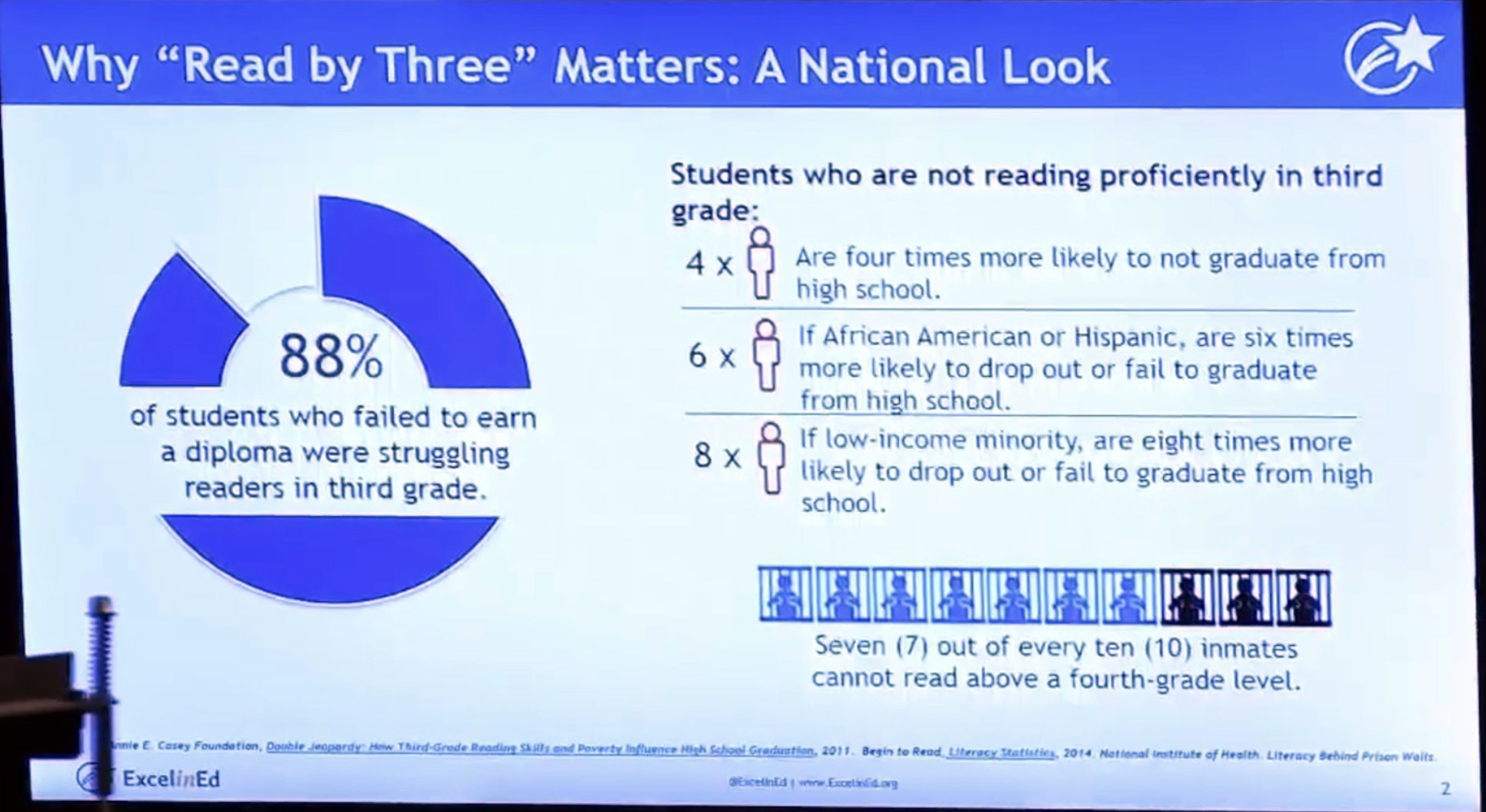
Over 66% of children in the U.S. are not proficient readers.

79% of low-income students, 82% of Black students, and 77% of Hispanic students are not on track for reading by fourth grade.

Children not reading by third grade are 4x less likely to graduate high school.

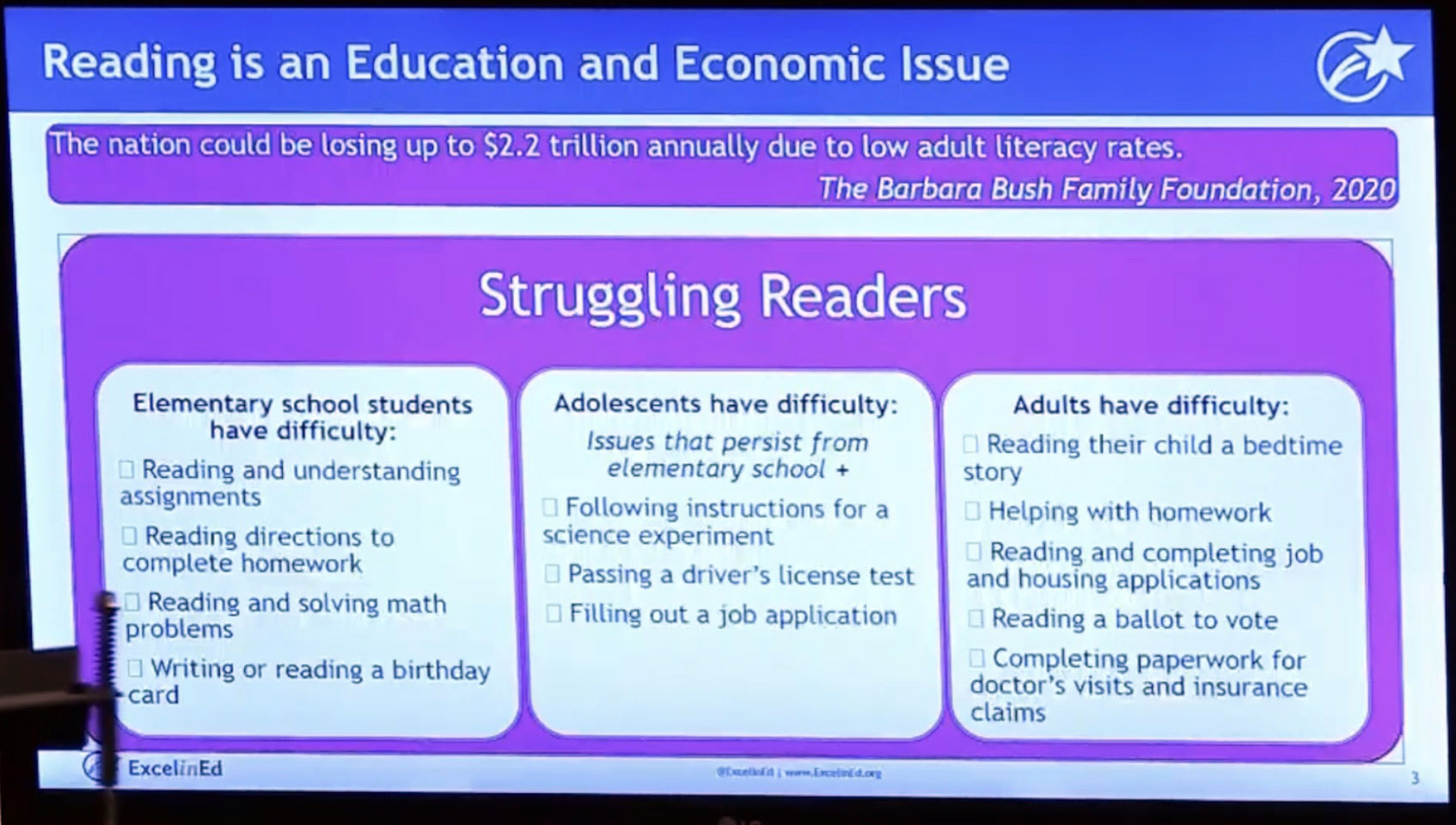
Studies estimate that low-literacy levels among U.S. adults could be costing the economy $2.2 trillion a year.

Children who begin behind in their academics typically remain behind.

Share

The Truth About Reading Film

www:

Create a society in which every individual has the literary skills to become successful in all aspects of life including family, education, work, and community service.

Share

K-12 Tax & Spending Climate: Economic growth and tax base

Ben Sixsmith:

Britain has had minimal economic growth for years. Poland has long been enjoying some of the highest economic growth in Europe. It even emerged from the pandemic better off than other European nations with, as Paweł Bukowski and Wojtek Paczos wrote for the LSE, “a relatively lax approach to economic lockdown and a bit of sheer luck”.

Institutions often seem to work better as well. I can generally visit a GP on the day I call. Britons often have to wait for more than a week. Maternal mortality is higher in the UK — and infant mortality is about the same, despite Britain being much richer overall. Actually, Polish life expectancy as whole is just a touch shorter than British life expectancy, despite the nation having a lot more smokers.

Polish kids have ranked higher on the PISA education rankings than British kids — ranking, indeed, the third highest in Europe in science and maths, and the fourth in reading comprehension. Poland is a more peaceful place than Britain, with murder and rape generally being rarer (granted, statistics in the latter case are famously difficult to trust). Terrorism, for reasons I leave to the reader, has been almost non-existent in Polish society.

Share

“The Science” 1977 H1N1 edition

Share

Britain’s Undergraduates are Worryingly Innumerate

The Economist:

Shaking things up could involve more than academics. Pupils who do the International Baccalaureate (ib) must not only pass exams but also complete some kind of community service. For many of the ib’s boosters, this is a big part of its appeal. Some argue that a “British Baccalaureate” should mix subjects from academic and vocational paths, which at present are kept far apart. Whatever happens, it will probably give no one complete satisfaction. 7

Share

Tax Filing Websites Have Been Sending Users’ Financial Information to Facebook

Simon Fondrie-Teitler, Angie Waller, and Colin Lecher

Major tax filing services such as H&R Block, TaxAct, and TaxSlayer have been quietly transmitting sensitive financial information to Facebook when Americans file their taxes online, The Markup has learned. 

The data, sent through widely used code called the Meta Pixel, includes not only information like names and email addresses but often even more detailed information, including data on users’ income, filing status, refund amounts, and dependents’ college scholarship amounts. 

The information sent to Facebook can be used by the company to power its advertising algorithms and is gathered regardless of whether the person using the tax filing service has an account on Facebook or other platforms operated by its owner, Meta.

Share

Taxpayer supported Madison School District’s open records non responses

Scott Girard:

In May, Wisconsin Transparency Project president and founder Tom Kamenick wrote in an email to the Cap Times that he has “received more complaints about MMSD than any other government agency.”

“I’m frequently seeing lengthy delays, exorbitant fees, and downright illegal denials from the district,” Kamenick wrote. “The district seems to make transparency and accountability a very low priority, and I’m not surprised to see them sued twice in quick succession.”

State statutes outline the requirements for public entities regarding open records. In a 2019 compliance guide, the state’s Office of Open Government called part of the statute on open records “one of the strongest declarations of policy found in the Wisconsin statutes.”

“[I]t is declared to be the public policy of this state that all persons are entitled to the greatest possible information regarding the affairs of government and the official acts of those officers and employees who represent them,” the statute states.

The data clearly indicate that being able to read is not a requirement for graduation at (Madison) East, especially if you are black or Hispanic”

My Question to Wisconsin Governor Tony Evers on Teacher Mulligans and our Disastrous Reading Results

2017: West High Reading Interventionist Teacher’s Remarks to the School Board on Madison’s Disastrous Reading Results 

Madison’s taxpayer supported K-12 school district, despite spending far more than most, has long tolerated disastrous reading results.

“An emphasis on adult employment”

Wisconsin Public Policy Forum Madison School District Report[PDF]

WEAC: $1.57 million for Four Wisconsin Senators

Friday Afternoon Veto: Governor Evers Rejects AB446/SB454; an effort to address our long term, disastrous reading results

Booked, but can’t read (Madison): functional literacy, National citizenship and the new face of Dred Scott in the age of mass incarceration.

No When A Stands for Average: Students at the UW-Madison School of Education Receive Sky-High Grades. How Smart is That?

Share

Yet because school has been the dominant metaphor for learning, children who are not yet in school have often been considered little more than empty vessels waiting to be filled.

Alex Blasdel:

During the past two centuries, educators, psychologists, toy companies and parents like us have acted, implicitly or otherwise, as if the purpose of play is to optimise children for adulthood. The dominant model for how to do that has been the schoolhouse, with its reading, ’riting, and ’rithmetic. The more book learning we could doll up as play, and then cram into our children, the better. Then, with the rise of neuroscience in the second half of the 20th century, toys were increasingly marketed and purchased for the purpose of building better brains in order to build more competitive and successful grownups – to make Homo sapiens that were a little more sapient.

The pressure to do that has been felt most intensely with the youngest kids, aged five and under, and in recent decades the market has bestowed upon us such brands as Baby Einstein, Baby Genius and Fat Brain (tagline: “Toys that Matter to Their Gray Matter”). By 2020, the broad category of educational toys was making nearly $65bn (£55bn) worldwide, a figure that is forecast to double within the decade. Toys that teach – from the Speak & Spell and the See ’n Say to an entire phylum of learn-to-code robots – now pervade many young lives. “This generation of parents is asking toys to provide an end product, and that end product is prosperity,” Richard Gottlieb, an influential toy industry consultant, told me. “They want toys to get their children into Harvard.”

Share

China just announced a new social credit law. Here’s what it means.

Zeyi Yang:

It’s easier to talk about what China’s social credit system isn’t than what it is. Ever since 2014, when China announced a six-year plan to build a system to reward actions that build trust in society and penalize the opposite, it has been one of the most misunderstood things about China in Western discourse. Now, with new documents released in mid-November, there’s an opportunity to correct the record.

For most people outside China, the words “social credit system” conjure up an instant image: a Black Mirror–esque web of technologies that automatically score all Chinese citizens according to what they did right and wrong. But the reality is, that terrifying system doesn’t exist, and the central government doesn’t seem to have much appetite to build it, either. 

Instead, the system that the central government has been slowly working on is a mix of attempts to regulate the financial credit industry, enable government agencies to share data with each other, and promote state-sanctioned moral values—however vague that last goal in particular sounds. There’s no evidence yet that this system has been abused for widespread social control (though it remains possible that it could be wielded to restrict individual rights). 

While local governments have been much more ambitious with their innovative regulations, causing more controversies and public pushback, the countrywide social credit system will still take a long time to materialize. And China is now closer than ever to defining what that system will look like. On November 14, several top government agencies collectively released a draft law on the Establishment of the Social Credit System, the first attempt to systematically codify past experiments on social credit and, theoretically, guide future implementation. 

Yet the draft law still left observers with more questions than answers.

Share

The complacency crisis

Share

K-12 Governance and Practice Notes

Share

Medical Censorship Advocacy

Share

Media veracity: NY Times edition

Share

Gratitude: Reflections on What We Owe to Our Country.

William Buckley:

I have always thought Anatole France’s story of the juggler to be one of enduring moral resonance. This is the arresting and affecting tale of the young monk who aspires to express his devotion to the Virgin Mary, having dejectedly reviewed, during his first week as a postulant at the monastery alongside Our Lady of Sorrows, the prodigies and gifts of his fellow monks. Oh, some sang like nightingales, others played their musical instruments as virtuosi, still others rhapsodized with the tongues of poets. But all that this young novice had learned in the way of special skills before entering the monastery was to entertain modestly as a juggler. And so, in the dead of night, driven by the mandate to serve, walking furtively lest he be seen and mocked by his brothers, he makes his ardent way to the altar with his sackful of wooden mallets and balls, and does his act for Our Lady.

This account of the struggle to express gratitude is unsurpassed in devotional literature. The apparent grotesquerie — honoring the mother of the Saviour of the universe, the vessel of salvation, with muscular gyrations designed to capture the momentary interest of six-year-olds — is inexpressibly beautiful in the mind’s eye. The act of propitiation; gratitude reified.

How to acknowledge one’s devotion, one’s patrimony, one’s heritage? Why, one juggles before the altar of God, if that is what one knows how to do. That Americans growing into citizenhood should be induced to acknowledge this patrimony and to demonstrate their gratitude, for it is the thesis of this exercise. By asking them to make sacrifices we are reminding them that they owe a debt, even as the juggler felt a debt to Our Lady. And reminding them that requital of a debt is the purest form of acknowledging that debt. The mind tends to turn to the alms-giver as one experiences the alms he has to give us. We are familiar with the debt an exonerated defendant feels toward the judicial system on which he suddenly found himself relying. The man truly hungry looks with a different eye on the person who feeds him. It is entirely possible to live out an entire life without experiencing the civic protections which can become so contingently vital to us at vital moments. Even if we never need the help of the courts, or of the policeman, or of the Bill of Rights, that they are there for us in the event of need distinguishes our society from others. To alert us to their presence, however dormant in our own lives, tends to ensure their survival. And tends also to encourage a citizenry alert to the privileges the individual might one day need. This enjoyment, this answering of needs, can make us proud of our country — and put us in its debt. In this essay on the theme of Gratitude, I postulate that we do owe something. To whom? The dead being beyond our reach, our debt can only be expressed to one another; but our gratitude is also a form of obeisance — yes, to the dead. The points I raise will disturb some “conservative” presumptions as also some commonly thought of as “liberal.” I have, in any event, the obligation to explore the social meaning of duty. Those who respond to religious guidelines will not be surprised, for example, by the Christian call to reinspect Divine commandments: “Verily I say unto you, inasmuch as ye have done it unto one of the least of these my brethren, ye have done it unto me.” Although religious faith is not required to prompt attention to the nature of the injunction, the intensity of the concern of some Americans is sometimes best understood by the use of religious metaphors. Emile Durkheim wrote engrossingly on the question when he spoke of the “relation of a devoted child to his parents, of an ardent patriot to his fatherland, [of a] cosmopolitan to mankind, of a worker to his class, of a nobleman conscious of his rank to the aristocracy, of the vanquished to his conqueror, of the good soldier to his army.” “All these relations,” Durkheim concluded, “with their infinitely manifold contents can, indeed do, have a general tenor as far as their psychic aspect is concerned — which must be called a religious key.”

Share

Civics: Veracity, the Establishment and crypto

Share

Civics: taxpayer funded administrative state accountability – judicial edition

Eugene Volokh:

“in a suit over alleged pressure on social media firms to censor posts on topics like Covid-19 vaccines and election fraud.”

Share

Statistical Illiteracy and Governance

David Randall:

No rigorous and fair-minded researcher with any understanding of statistics, experimental design, or the irreproducibility crisis would take this study seriously. Indeed, the fact that it passed peer review is yet more evidence that peer review now functions to credential and accelerate groupthink rather than to deter it.

Such shoddy research is far too common in the sciences and social sciences. This is a grave enough problem in its own right, but it has more serious consequences for America as a whole. We have delegated policymaking authority to professionals who claim expertise in wide swathes of administrative policy, judicial decisionmaking, and legislation. Those experts who claim the mantle of “Science” are foremost among these would-be professional experts. Such men and women far too frequently subordinate the search for truth to the search to impose a preferred policy. Their shoddy research methods are part and parcel of their desire to forward a political agenda—although it should be emphasized that even researchers without a political agenda now use statistical and experimental methods guaranteed to produce a mass of false results.

Shoddy research dovetails astonishingly well with radical polemic.

Share

Hero worship and our disastrous reading results

r2rp

As discussion of Emily Hanford’s new podcast builds,teachers are questioning stories we were sold by people we trusted. For some teachers, this is the first time they’ve doubted instructional materials that are ubiquitous in elementary and reading intervention classrooms. When we question the tenets of Balanced Literacy, teachers can unearth a trove of information. But how to make sense of it all?

As researchers Stanovich and Stanovich explain:

The current problem is how to sift through the avalanche of misguided and uninformed advice to find genuine knowledge. Our problem is not information; we have tons of information. What we need are quality control mechanisms.”

A lack of “quality control” has allowed disproven methods to take root in our classrooms and, if we don’t rethink our approach to finding answers, history may repeat itself. Dr. Emily Solari recently wrote:

Share

Governance and PR influence COVID era sausage making: medical court activity

Zachary Steiber:

“If the government is going to label ivermectin a horse medicine or a horse dewormer and promulgate the idea that it is only for animals, then the natural correlation is that doctors who prescribe it are horse doctors or quack doctors, which has played out,” he said. “That is enough of a harm to get into court” or have the motion to dismiss rejected, he said.

Ivermectin is used on animals in addition to humans. The FDA used a picture of a horse in its Twitter posts and on one of its pages.

“The government engaged in a singularly effective campaign here to malign a common drug that has been used for a very long time and has been dispensed in billions of doses. It’s one of the most famously safe drugs in the history of human medicine. And when people did exactly what the FDA said to ‘Stop it. Stop it with the ivermectin,’ I don’t understand how that would not be traceable back to the FDA,” Kelson said.

U.S. District Judge Jeffrey Brown, a Trump appointee overseeing the case, said he was most concerned about the social media statements because they didn’t include any qualifiers.

Belfer argued the statements were aimed at consumers and that the Twitter posts linked to one of the pages, which does include the qualifier.

“So it was predictable that if you include the link to the article, people will click on the link and will see the full article, which includes that disclaimer that if your doctor writes you a prescription, you should fill it exactly as prescribed,” he said.

“The plaintiffs, by their own admission, have continued to prescribe ivermectin. So they always had the authority. It may be that patients were not able to fill prescriptions, but the doctors themselves always had the authority.”

Brown said he appreciated the briefing from the parties and that he would rule “as quickly as we can for ya’ll.” As of Nov. 19, he hadn’t issued a ruling.

Share

Dollars, rankings and Yale Law School

Bill Henderson:

Yale Law School’s $1.2 billion share of the Yale University endowment provides approximately $63 million in operating funds, which translates into $106,000 per student, though this amount appears to be headed up due to the 40.2% increase in Yale’s endowment in 2021. See “Yale endowment earns 40.2% investment return in fiscal 2021,” Yale News, Oct 14, 2021; Evan Gorelick, “Yale’s endowment, explained,” Yale Daily News, Oct 22, 2022 (discussing Yale endowment’s 5.25% target payout and policy of smoothing returns over multiple years).

To be clear, these are the funds available before Yale Law collects its first dollar of tuition.  Nonetheless, as the top-ranked law school in the US News rankings for more than 30 years, Yale has a superabundance of highly credentialed students who would be willing to pay or borrow the current cost of attendance. For the 2021-22 admission cycle, Yale admitted only 5.6% of applicants; of those admitted, 81% enrolled, making Yale the most selective and elite law school in the nation. See YLS, “Statistical Profile of the Class of 2025.”

Among elite law schools, Yale clearly has the strongest balance sheet.  Its closest competitors are Stanford Law ($76,000 in endowment funding per student) and Harvard ($56,000), which typically rank #2 or #3 in any given year. Among the rest of the T-14, endowment funding generates approximately $20,000 per student, with a high of $33,000 and a low of $4,000, albeit these figures, similar to Yale, may go up due to improved endowment performances, as pandemic-related fiscal and monetary policies tended to make the rich richer. (See Methodological Notebelow for how these figures are calculated.)

The big news, of course, is that Yale recently announced its withdrawal from the US News rankings, at least as an active participant. See Ines Chomnalez, “Yale Law School withdraws from ‘perverse’ U.S. News rankings,” Yale Daily News, Nov 16, 2022.  This decision, and its likely second-order effects for other law schools, are nearly impossible to accurately grasp without also understanding (1) the technical intricacies of how the US News rankings work, as this creates the underlying incentive structure; and (2) the significant risk that Yale was running by continuing to play the US News game, making it a poor data point for generalizing to other law schools.

This special off-publication post covers both topics.

Share

“Here to learn and improve things”

Share

Teacher union$ and $chool Board Governance: Californian edition

Mine Antonucci:

The California Teachers Association spent heavily on school board races in the state, distributing $1.8 million to 125 local affiliates, which were required by union policy to add almost $1 million more to the total.

That investment seems to have mostly paid off. California election results take weeks to finalize, but union-backed candidates are leading in 35 of the 52 races in which the state union spent the most money.

The biggest winner was Rocio Rivas, running for a seat on the Los Angeles Unified School District board. The union contributed more than $330,000 on her behalf.

The union supported Shana Hazan and Cody Petterson with $145,000, and they won seats on the San Diego Unified board.

The data clearly indicate that being able to read is not a requirement for graduation at (Madison) East, especially if you are black or Hispanic”

My Question to Wisconsin Governor Tony Evers on Teacher Mulligans and our Disastrous Reading Results

2017: West High Reading Interventionist Teacher’s Remarks to the School Board on Madison’s Disastrous Reading Results 

Madison’s taxpayer supported K-12 school district, despite spending far more than most, has long tolerated disastrous reading results.

“An emphasis on adult employment”

Wisconsin Public Policy Forum Madison School District Report[PDF]

WEAC: $1.57 million for Four Wisconsin Senators

Friday Afternoon Veto: Governor Evers Rejects AB446/SB454; an effort to address our long term, disastrous reading results

Booked, but can’t read (Madison): functional literacy, National citizenship and the new face of Dred Scott in the age of mass incarceration.

No When A Stands for Average: Students at the UW-Madison School of Education Receive Sky-High Grades. How Smart is That?

Share

Notes on Ethnic Studies Climate

Johanna Markind:

Unlike California, Washington state’s Office of the Superintendent of Public Instruction approved an ethnic studies framework rather than a specific curriculum. As blogger Emily Alhadeff explained, “Without a curriculum, educators who wish to engage with ethnic studies will need to seek out their own professional development, resources, and materials. Earlier this year, it was revealed that the State Board of Education contracted with WAESN [Washington Ethnic Studies Now] for professional development. WAESN is open and ready for business.” Daily Wire elaborated on this: “In March 2021… the Washington State Board of Education voted unanimously to require its own members and staff to take eighteen hours of training from the nonprofit Washington Ethnic Studies Now (WAESN).”

Alhadeff also noted, “WAESN is honest about its vision to take Critical Race Theory mainstream, which counters many claims that CRT is an obscure legal tool that never sees the light of the school day.”

Liberated Ethnic Studies Model Curriculum Consortium (LESMCC) is pursuing a similar strategy to that of WAESN. According to allegations in a pending federal lawsuit, LESMCC is working in coordination with United Teachers of Los Angeles (UTLA). UTLA is an LA teachers’ union and affiliateof the National Education Association.

LESMCC is the group behind the 2019 model curriculum that California rejected for anti-Semitism. Since that rejection, LESMCC has marketed its version of ethnic studies privately to school districts.

Share

Civics: redistributed taxpayer funds for a California Nuclear Power Plant

Sammy Roth:

The $1.1 billion in federal money comes from the infrastructure law passed by Congress and signed by President Biden last year. It should allow PG&E to pay back most of the $1.4-billion loan for Diablo that state lawmakers approved at Newsom’s urging. 

That state money is slated to help PG&E cover the costs of relicensing at the U.S. Nuclear Regulatory Commission, as well as maintenance, fuel purchases and additional on-site storage for radioactive waste needed to keep the plant running past 2025.

Final terms of the federal grant still need to be negotiated with PG&E. Officials at the U.S. Department of Energy say the money will be distributed over four years, from 2023 through 2026. The funds are designed to cover PG&E’s projected losses from keeping Diablo Canyon open longer, so if the company’s operating costs come in lower than expected — or its power-sales revenues are higher than expected — it won’t get quite as much federal money.

If the plant fails to secure its federal license renewal — or any of the state permits it needs to keep operating — the funding spigot will be shut off.

Share

Civics: Politics and the English Language in CBC’s Investigative Journalism

Terry Newman:

George Orwell’s “Politics and the English Language” explains how language – and therefore meaning – can quickly degrade if an author is writing for political reasons.

Orwell points out two ways this degradation happens: staleness of imagery and lack of precision. He gives three possible explanations for this degradation; the writer may have a meaning in mind that they cannot express for whatever reason, or the writer accidentally says something other than what they mean, or the writer could be indifferent or unconcerned about whether their words mean anything or not.

While all three reasons can be attributed to a lack of skill on the part of the writer, the last appears to be the most critical flaw. After all, if a writer does not care whether or not what they are saying actually means anything in reality, or, worse, they are intentionally obscuring reality by failing to explain a situation fully with concrete imagery or by using a word abstractly, without precision, for political purposes, we must then view this as a purposeful attempt to obscure concrete reality. The result is ugly. 

Ugly political writing uses words in a dishonest way as a shorthand to deceive, rather than elaborate, and to signify that some target, some particular person or group of people, is undesirable. 

Ugly political writing seems to be everywhere today, but I am going to focus on a recent CBC piece, “Scores of anti-trans candidates running in Ontario school board elections,” to illustrate how political writing is, as Orwell pointed out, abstract, in that it fails to communicate concrete images to further its arguments, and imprecise, in that it relies on the vagueness of terms in an attempt to prove the political point of the author.

Share

Civics: reforming the administrative state, DIE…

An MR reader request:

You are appointed to the 24 DeSantis cabinet with the task of “fixing the administrative state”. Republicans have a very large Congressional majority. What do you try to do?

2. DIE must die: As a bureaucrat, the main difference I notice between a D and R President is how hard HR initiatives are pushed and how much HR expands. Under D administrations, we spend far more time in meetings and seminars pushing the latest woke fad. Not only does it seem to waste time, but it also puts up barriers between the various groupings of people.

Share

Losing your job over the color of your skin: San Francisco edition

Share

Civics: political class driven censorship and its beneficiaries

Share

2023 Madison Mayoral election: School governance makes a rare appearance?

Scott Girard:

As mayor, she would not have unilateral authority to put officers in schools. The school resource officer program, originally begun in the 1990s, operated on a contract between the city of Madison and the Madison Metropolitan School District.

Both sides voted to terminate it in summer 2020 amid nationwide and local protests over police brutality of Black people, specifically in response to the murder of George Floyd by officer Derek Chauvin in Minneapolis. Reyes said as police officers became “a focal point” of the protests, it “moved us away from officers” in schools.

“It wouldn’t have helped them to stay,” Reyes said. “They couldn’t do their job effectively if they were continuing to be criticized for their actions while in schools.”

Incumbent Mayor Satya Rhodes-Conway, who announced her reelection bid Sunday, supported ending the program in 2020.

Data on the SRO program repeatedly showed racial disparities in who received citations or was arrested by officers in schools.

Reyes, a former police officer, supported the program in 2019, siding with the majority in a 4 to 3 vote to renew the contract at that time. A few weeks before the 2020 vote, she announced her position had changed.

Madison’s mayors have long avoided substantive k-12 activity, despite our long term, disastrous reading results…. I’m told that years ago, Wisconsin City councils were required to pass school district budgets, in addition to the local boards.

The data clearly indicate that being able to read is not a requirement for graduation at (Madison) East, especially if you are black or Hispanic”

My Question to Wisconsin Governor Tony Evers on Teacher Mulligans and our Disastrous Reading Results

2017: West High Reading Interventionist Teacher’s Remarks to the School Board on Madison’s Disastrous Reading Results 

Madison’s taxpayer supported K-12 school district, despite spending far more than most, has long tolerated disastrous reading results.

“An emphasis on adult employment”

Wisconsin Public Policy Forum Madison School District Report[PDF]

WEAC: $1.57 million for Four Wisconsin Senators

Friday Afternoon Veto: Governor Evers Rejects AB446/SB454; an effort to address our long term, disastrous reading results

Booked, but can’t read (Madison): functional literacy, National citizenship and the new face of Dred Scott in the age of mass incarceration.

No When A Stands for Average: Students at the UW-Madison School of Education Receive Sky-High Grades. How Smart is That?

Share

K-12 Tax & Spending Climate: “record-high spending” in Madison

Allison Garfield:

On top of the record-high spending proposed in the original budget — like $21.6 million to reconstruct John Nolen Drive and $23 million in federal funding to secure a fully electric, 46-bus fleet — the council also:

The data clearly indicate that being able to read is not a requirement for graduation at (Madison) East, especially if you are black or Hispanic”

My Question to Wisconsin Governor Tony Evers on Teacher Mulligans and our Disastrous Reading Results

2017: West High Reading Interventionist Teacher’s Remarks to the School Board on Madison’s Disastrous Reading Results 

Madison’s taxpayer supported K-12 school district, despite spending far more than most, has long tolerated disastrous reading results.

“An emphasis on adult employment”

Wisconsin Public Policy Forum Madison School District Report[PDF]

WEAC: $1.57 million for Four Wisconsin Senators

Friday Afternoon Veto: Governor Evers Rejects AB446/SB454; an effort to address our long term, disastrous reading results

Booked, but can’t read (Madison): functional literacy, National citizenship and the new face of Dred Scott in the age of mass incarceration.

No When A Stands for Average: Students at the UW-Madison School of Education Receive Sky-High Grades. How Smart is That?

Share

Eugenicists also believed that science is real

Robert F. Graboyes:

“Be skeptical of everything you hear, including this sentence.” That was the central message of the 48 semester-long classes I taught to medical professionals—doctors, nurses, therapists, administrators, etc. over 19 years. Officially, my courses were on the economics of healthcare, but they also encompassed ethics and a much broader look at epistemology and the philosophy of science.

While my students’ knowledge of science and medicine was vastly greater than my own, it was my point to teach them how dangerous their knowledge could be when when unleashed with inadequate skepticism and introspection. My greatest tool in this effort was to devote a couple of weeks of our course to the history of eugenics—the now-discredited but once-transcendent science of being well-born. The logo of the Second International Eugenics Congress in 1921, pictured above, declared that “Eugenics is the self direction of human evolution,” with the goal being “an harmonious entity.” Self-direction was essential, they thought because, as Alexander Graham Bell had written in 1883, “natural selection no longer influences mankind to any great extent.” (Bell was honorary president of the 1921 conference. More on him in an essay coming soon.)

In the past month, I’ve participated in one webinar and two podcasts on the topic of eugenics. I opened the webinar by arguing three things:

It is a grave error to refer to eugenics, as many do, as a “pseudoscience.” Eugenics was hard science run amok, untempered by skepticism and profoundly intolerant of dissenting viewpoints. In a recent essay, “The Briar and the Rose,” I noted that the field of mathematical statistics—the core of modern science—was to a significant degree an outgrowth of eugenics.

It is equally erroneous to assume that eugenicists were ideological troglodytes—Ku Klux Klansmen in tuxedos,so to speak. Support for eugenics spanned the ideological spectrum, but the movement was at its heart a progressive endeavor. They were profoundly optimistic that eugenics could produce a stronger, happier, healthier human species—with the caveat that some unfortunates would be swept aside in the process.

It is exceedingly dangerous to presume that eugenics is a quaint historical topic of little consequence in our far-more-enlightened era. As we discussed in these recordings, eugenics remains very much with us in spirit, if not in name, and new medical technologies offer “self-directed evolution” to a degree unimaginable to the original eugenicists. And the eugenicists’ lack of skepticism and intolerance for dissent is very much with us in science and policy discussions today

Share

“Anti-adoption drumbeat” leaves kids in foster care

Joanne Jacobs:

Naomi Schaefer Riley hears an “anti-adoption drumbeat” from the media. “In the wake of the Dobbs decision, the Left wants to make sure that no one thinks adoption is preferable to abortion,” she writes.

In fiscal 2021, 114,000 children in foster care were waiting for adoptive parents, according to federal data. Only 54,200 found a “forever family,” a 6 percent drop from the previous year and an 18 percent decline from 2019.

Share

Legacy Media Veracity on “teacher shortages”

Mike Antonucci

In a world where newspapers of record can continually report on a national teacher shortage without actually comparing the number of teachers with previous years, or the number of teachers with the number of students, it’s easy to despair of education reporting.

Thankfully, every so often you come across a reporter like Julia Silverman of The Oregonian, who did both of those things in a story headlined, “Oregon lost students but added teachers, state report shows.”

“Overall, there were 32,836 teachers in Oregon public school classrooms in the ‘21-22 school year, or 1,508 more educators than in the 2017-2018 academic year, according to counts of full-time equivalent positions,” she wrote. “That was the case even though there were 27,672 fewer students enrolled statewide last school year than five years ago.”

Two sentences. That’s all it took to provide context about the level of public school staffing. Any teacher shortage story without those two sentences is incomplete, at best, and deliberately misleading, at worst.

Share

“But Dr. Copeland decided to do something different. He put the needs of the students first. He made the decision to place someone that was qualified in front of the students,”

Olivia Herken:

Others agreed, saying Copeland was known for “speaking plainly.”

“As an educator, when I’ve had the opportunity to speak and interact with Dr. Copeland, I can say that he’s always had respect for me and my interests, as well as my culture,” said Marlene Patiño. She’s a bilingual dual-language seventh-grade science teacher, whose second language is English.

“Speaking plainly is not a crime. But sometimes in Madison we can take things and turn it into a crime,” said Shannon Stevens, a school social worker who occasionally substitute taught at Sennett while Copeland was there. She said Copeland “didn’t mince words” but was always respectful.

When Copeland was initially fired in September, staff expressed that he had transformed the middle school, which had been experiencing behavioral issues.

The data clearly indicate that being able to read is not a requirement for graduation at (Madison) East, especially if you are black or Hispanic”

My Question to Wisconsin Governor Tony Evers on Teacher Mulligans and our Disastrous Reading Results

2017: West High Reading Interventionist Teacher’s Remarks to the School Board on Madison’s Disastrous Reading Results 

Madison’s taxpayer supported K-12 school district, despite spending far more than most, has long tolerated disastrous reading results.

“An emphasis on adult employment”

Wisconsin Public Policy Forum Madison School District Report[PDF]

WEAC: $1.57 million for Four Wisconsin Senators

Friday Afternoon Veto: Governor Evers Rejects AB446/SB454; an effort to address our long term, disastrous reading results

Booked, but can’t read (Madison): functional literacy, National citizenship and the new face of Dred Scott in the age of mass incarceration.

No When A Stands for Average: Students at the UW-Madison School of Education Receive Sky-High Grades. How Smart is That?

Share

After lugging around two fetuses that won’t stop kicking my bladder, I have no patience left for gender activists who pretend that men can give birth.

Elizabeth Emery:

Share

The Human Intelligence Debate

Richard Phelps:

For decades, the indefatigable Will Fitzhugh has refused to stop reminding us of a stark and stubborn paradox of American culture, both apparent and hidden at virtually every U.S. public school. We fastidiously measure observable variations in athletic skill and ability and celebrate those who excel. Meanwhile, we shush and shame those who attempt the same in the cognitive domain. The outfall of this profound bias can be seen in the tables of content of Fitzhugh’s Concord Review, where high school students publish excellent long form scholarly history journal articles. Scan the names of the authors and the locations of their schools over the past few decades and one cannot help but notice the trend—away from American-born authors and toward students raised elsewhere, some now attending U.S. private schools as international students, but many still residing at home overseas. And this not in a STEM field, but in the humanities.

Russell T. Warne’s, In the Know: Debunking 35 Myths about Human Intelligence, ably illustrates another consequence of the suppression of information about intelligence—the size of the chasm that now separates a well-developed subfield of psychological science (perhaps the most developed subfield) and public perceptions of same, even among the otherwise well-educated. In the Know is Warne’s attempt to bridge that chasm.

Warne asserts

it is disheartening that there are so many incorrect beliefs about intelligence. I cannot think of another topic in psychology that is the subject of so many widespread misconceptions. (336)

It is also unfortunate that it takes courage to write about the scientific study of intelligence for a popular audience. But it does; that is, unless one is piling on the intelligence bashing bandwagon. Remarkably, Warne manages to remain (mostly) aloof of the debilitating cultural debates, primarily by sticking to the scholarly research literature, and avoiding popular or political sources. At the same time, Warne writes in a clear and engaging style that makes a technical scientific subject relatively accessible to a popular, educated audience.

He asserts that his book

Share

Civics: Trump should spare us all and retire. But his antagonists’ lack of self-awareness keeps giving him oxygen

Matt Taibbi

Trump was elected in 2016. That’s a fact. The American political establishment has since refused any honest reckoning about how or why it happened. The closest the Times came to an explanation in this week’s editorial:

Share

Is it worth another round on the mythical teacher crisis?

Kevin Drum:

There is probably no force in the universe that can stop the Times and other big news outlets from publishing this drivel. But I can keep trying. Here’s a chart that’s different from others I’ve published on this subject, but amazingly says the exact same thing:

There is no tsunami of teachers quitting. The quit rate has been flat for the past few years and this year it’s down. The average quit rate in 2022 is within a tenth of a point of the average rate in 2019.

There is no massive outbreak of unfilled job openings. Over the past five years, total K-12 student enrollment has been absolutely flat and the number of new teacher hires has been precisely the same as total separations.

The number of unfilled job openings is higher than it used to be, but this is most likely due to an increase in indirect teaching jobs: diversity coordinators, special ed supervisors, senior mentors, etc.

I need to be very clear here: None of this means there are no problems in our schools. None of this means teachers don’t have legitimate gripes. And none of it means there are no teacher shortages anywhere.

Share

K-12 Tax & Spending climate: birthrate edition

Share

How Sam Bankman-Fried won Washington before he lost everything

Alex Seitz-Wald

The week before his cryptocurrency empire spectacularly collapsed, one of Sam Bankman-Fried’s political groups hosted back-to-back happy hours for movers and shakers in both parties at the $3 million townhouse it had recently purchased steps from the Capitol. 

The congressional chiefs of staff, top operatives and lobbyists who attended didn’t come for the open bar and finger foods — mostly vegan, in honor of their benefactor’s preferred diet. They came to cement their connections to a 30-year-old billionaire who had, practically overnight, become one of the country’s biggest Democratic political donors and was building a Washington footprint designed to influence public policy for decades to come.

“SBF,” as he is widely known,” visited the White House, attended a congressional retreat, and held countless meetings with lawmakers and top regulators. He got chummy with Bill Clinton after paying the former president to speak at a conference. He spent $12 million getting a referendum on the ballot in California. And he earned praise during Senate testimony from Sen. Cory Booker, D-N.J., for a “much more glorious afro than I once had.”

Share

Listening speaks to our intuition while reading promotes analytic thought

Geipel, J., & Keysar, B

It is widely assumed that thinking is independent of language modality because an argument is either logically valid or invalid regardless of whether we read or hear it. This is taken for granted in areas such as psychology, medicine, and the law. Contrary to this assumption, we demonstrate that thinking from spoken information leads to more intuitive performance compared with thinking from written information. Consequently, we propose that people think more intuitively in the spoken modality and more analytically in the written modality. This effect was robust in five experiments (N = 1,243), across a wide range of thinking tasks, from simple trivia questions to complex syllogisms, and it generalized across two different languages, English and Chinese. We show that this effect is consistent with neuroscientific findings and propose that modality dependence could result from how language modalities emerge in development and are used over time. This finding sheds new light on the way language influences thought and has important implications for research that relies on linguistic materials and for domains where thinking and reasoning are central such as law, medicine, and business.

Share

Commentary on media academic rankings

David Lat:

Other observers have criticized the rankings pullout as part of a larger assault on standardized test scores and other traditional barometers of merit. If U.S. News changes its rankings to deemphasize or eliminate LSAT/GRE and GPA factors, which YLS and HLS have criticized U.S. News for fetishizing, how can applicants from less-privileged backgrounds—applicants who didn’t go to Ivy League undergraduate institutions, who don’t have well-connected parents, or who don’t have well-paid law school admissions counselors—distinguish themselves?

Within the YLS community, I have heard from some YLS students and alumni who worry about what it might mean for the value of a YLS degree as a credential. This concern generated mockery on Twitter—cue the small violins—but let’s hear them out. Here’s an alum opposed to the change:

Share

More teachers for fewer students: Oregon edition

Julie Silverman:

The total number of teachers employed in Oregon’s public schools in the 2021-2022 school year hit an all-time high, even as the number of enrolled students dropped precipitously, to its lowest level in nearly two decades.

That’s according to the Oregon Department of Education’s annual statewide “report card,” released Thursday, which offers a broad overview of education data and trends.

Overall, there were 32,836 teachers in Oregon public school classrooms in the ‘21-22 school year, or 1,508 more educators than in the 2017-2018 academic year, according to counts of full-time equivalent positions. That was the case even though there were 27,672 fewer students enrolled statewide last school year than five years ago.

Share

Civics: Taxpayer Funded Warrantless Spying: Android edition

Jessica Lyons Hardcastle:

At least two dozen other states also developed COVID-19 apps using Google APIs, but they used community outreach to encourage residents to voluntarily download the apps and opt-in for contact tracing, the court documents say. 

Massachusetts, they allege “is the only state to surreptitiously embed the Contact Tracing App on mobile devices that DPH locates within its borders, without obtaining the owners’ knowledge or consent.”  

This violates Android device owners’ federal privacy and unreasonable search protections as well as the state’s computer crime laws, according to the lawsuit, which also names the Massachusetts Department of Public Health Commissioner Margret Cooke as a defendant.

“The Massachusetts DPH, like any other government actor, is bound by state and federal constitutional and legal constraints on its conduct,” Peggy Little, NCLA senior litigation counsel, said in a statement. “This ‘android attack,’ deliberately designed to override the constitutional and legal rights of citizens to be free from government intrusions upon their privacy without their consent, reads like dystopian science fiction — and must be swiftly invalidated by the court.”

Share

K-12 Tax & Spending Climate: Energy Costs

Gabe Cohen:

Home heating prices are skyrocketing yet again this winter, up 18% nationwide on top of last year’s 17% spike, according to the National Energy Assistance Directors Association (NEADA). 

Charmaine Johnson works in the call center at Philadelphia’s Heater Hotline, part of a non-profit that assists low-income families with their heating systems and bills. Johnson, 63, can relate to the concerns she’s hearing all day. She, too, is struggling to afford her heating bills.

With help from her son, Johnson just paid more than $1,000 to fill part of her oil tank, which she hopes will last her most of the winter.

Johnson says she doesn’t qualify for government assistance with her heating bills. As inflation also pushes up her food budget and other expenses, she is bundling up and keeping the heat turned down, hoping to stretch that oil for as long as possible.

“It’s miserable,” she said. “It’s like living in an igloo.”

Several factors are driving hikes in home heating prices, including the war in Ukraine, OPEC+ cuts, a surge in energy exports, lower energy inventories, and a high demand for natural gas in the US electric power sector, according to the Energy Information Administration (EIA).

EIA projects heating a home with natural gas will cost an extra 25% this winter, and heating with electric will run 11% higher. The steepest hike will be on heating oil, which is expected to be 45% more expensive than last winter, squeezing roughly 5 million households, mostly in the Northeast.

Share

Fifty-eight educators say ‘Sold a Story’ podcast series sells incomplete story about reading instruction

Posted at the Hechinger Report:

Re “A company has made millions selling books on reading instruction rooted in bad science” (Nov. 10, 2022)

We are educators who have devoted our lives to the cause of helping children read and write with power. We’re dismayed that at this moment in our history, when all of us should be banding together to support literacy education, the podcast “Sold a Story” fans divisiveness, creating a false sense that there is a war going on between those who believe in phonics and those who do not. Systematic phonics instruction is essential. That is a settled issue. And essential, too, is comprehension strategy instruction, knowledge building, vocabulary acquisition, language development, writing process, culturally responsive teaching, emotional well-being and attention to educational equity.

The data clearly indicate that being able to read is not a requirement for graduation at (Madison) East, especially if you are black or Hispanic”

My Question to Wisconsin Governor Tony Evers on Teacher Mulligans and our Disastrous Reading Results

2017: West High Reading Interventionist Teacher’s Remarks to the School Board on Madison’s Disastrous Reading Results 

Madison’s taxpayer supported K-12 school district, despite spending far more than most, has long tolerated disastrous reading results.

“An emphasis on adult employment”

Wisconsin Public Policy Forum Madison School District Report[PDF]

WEAC: $1.57 million for Four Wisconsin Senators

Friday Afternoon Veto: Governor Evers Rejects AB446/SB454; an effort to address our long term, disastrous reading results

Booked, but can’t read (Madison): functional literacy, National citizenship and the new face of Dred Scott in the age of mass incarceration.

No When A Stands for Average: Students at the UW-Madison School of Education Receive Sky-High Grades. How Smart is That?

Share

COVID era data analysis

Share

Civics: extend, embrace -> extinguish

Share

Meta Employees, Security Guards Fired for Hijacking User Accounts

By Kirsten Grind and Robert McMillan:

Some of those fired were contractors who worked as security guards stationed at Meta facilities and were given access to the Facebook parent’s internal mechanism for employees to help users having trouble with their accounts, according to the documents and people familiar with the matter.

The mechanism, known internally as “Oops,” has existed since Facebook’s early years as a means for employees to help users they know who have forgotten their passwords or emails, or had their accounts taken over by hackers.

Share

Civics: the political media class and stock trading

Share

Texas spends millions on unproven school safety tool few use

Talia Richman, Lauren McGaughy and Meghan Mangrum:

The Dallas Morning News obtained emails and data about iWatchTexas after submitting numerous public records requests. The News interviewed several school officials for this article after researching which anonymous reporting tools are being used by 20 districts across the state, including in Harris County and 15 of the largest systems in North Texas. None promoted iWatchTexas as the primary method for reporting suspicious activity.

The News also reviewed research on anonymous reporting systems and spoke with officials who promoted different programs.

Roughly 300 Texas school districts use STOPit, according to company officials. It is an anonymous reporting tool that leaders in several districts say works better in a campus setting and has already yielded more results.

In the past five years, STOPit has fielded 40,000 tips in Texas, including one last month in Uvalde. Dallas and a dozen other districts use a system created after the Sandy Hook shooting that also brought in thousands of tips in recent years.

Share

“But these elite universities do not want to sacrifice their elite status”

Josh Blackman:

As a result, if Yale wants to keep its racial diversity numbers high, the overall LSAT and GPA scores would have to drop. And that decrease would affect the law school’s rankings.

Justice Thomas aptly described the dilemma facing Yale in Grutter.

One must also consider the Law School’s refusal to entertain changes to its current admissions system that might produce the same educational benefits. The Law School adamantly disclaims any race-neutral alternative that would reduce “academic selectivity,” which would in turn “require the Law School to become a very different institution, and to sacrifice a core part of its educational mission.” Brief for Respondent Bollinger et al. 33–36. In other words, the Law School seeks to improve marginally the education it offers *356 without sacrificing too much of its exclusivity and elite status. [FN4]

[FN 4]: The Law School believes both that the educational benefits of a racially engineered student body are large and that adjusting its overall admissions standards to achieve the same racial mix would require it to sacrifice its elite status. If the Law School is correct that the educational benefits of “diversity” are so great, then achieving them by altering admissions standards should not compromise its elite status. The Law School’s reluctance to do this suggests that the educational benefits it alleges are not significant or do not exist at all.

The proffered interest that the majority vindicates today, then, is not simply “diversity.” Instead the Court upholds the use of racial discrimination as a tool to advance the Law School’s interest in offering a marginally superior education while maintaining an elite institution. Unless each constituent part of this state interest is of pressing public necessity, the Law School’s use of race is unconstitutional.

Yale can can maintain its racial diversity by sacrificing its elite status. But these elite universities do not want to sacrifice their elite status. Cam Norris made this point during arguments in SFFA:

Share

Commentary on Moms for Liberty

Ed post:

In a California school district, a group of formidable mothers are raging against a new superintendent, whom they say is working to indoctrinate their children with left-wing ideals about race and gender. 

In the name of parental choice, they say, the district should give the superintendent the boot. They attack the superintendent for his global outlook, interest in providing mental health services to students, and his efforts to incorporate inclusive sex education and racial equity initiatives in schools. After months of intense acrimony, the school board heeds their demands and asks him to step down. When he leaves the position, a cloud of unfounded conspiracy theories remain in his wake.

The year isn’t 2022. It’s 1950. 

Seventy years later, similar battles are waging around the country, as groups of conservative parents—often mothers—and school board leaders attack educators and district leaders who emphasize the importance of racial equity. In February, conservative members of a large Colorado school district pushed a superintendent to resign, in part because of his focus on diversity, equity, and inclusion initiatives. Groups like Moms for Liberty are working relentlessly in some districts to get books about civil rights banned.

Since 2020, thousands of parents have become engaged in new activism centered around frustration with pandemic-era safety policies and what they see as a new overemphasis on race and civil rights in schools, often organizing under the banner of groups like Moms for Liberty. 

These groups might be new in name, but historians say they’re born out of clear historical precedent.

Share

Notes on taxpayer supported censorship: DHS edition

Jana Winter

In response to a request from Peters for more information, DHS said that it had “expanded its evaluation of online activity as part of efforts to assess and prevent acts of violence, in ways that ensure robust protections for Americans’ privacy, civil rights, and civil liberties,” according to the Senate report.

But the monitoring of social media reflections and reactions appears to contradict DHS’s claims.

The report also calls on agencies to develop guidance that “must comply with protections in federal law and constitutional limitations, including the First, Fourth, and Fourteenth Amendments, and the agencies should be transparent about what data they use regarding social media.”

Civil liberties advocates said they were alarmed to learn that DHS’ Office of Intelligence and Analysis is monitoring protected speech.

Share

Taxpayer funded information shaping

Share

Civics: Schumer: We Need Amnesty for Illegals Because Americans Aren’t Reproducing Like They Used To

Stacey Matthews:

During the same presser, Schumer suggested that a pathway to citizenship for illegal immigrants must be established ASAP, imploring ten GOP Senators to come on board in the lame-duck session because our country is allegedly “short of workers” and is not “reproducing on its own with the same level that it used to”:

“Now more than ever we’re short of workers. We have a population that is not reproducing on its own with the same level that it used to. The only way we’re going to have a great future in America is if we welcome and embrace immigrants — the DREAMers and all of them — because our ultimate goal is to help the DREAMers — but get a path to citizenship for all 11 million, or however many undocumented, there are here.”

Share

Teachers Unions Buy a ‘Millionaire Tax’ in Massachusetts

Steven Malanga:

Only recently, Massachusetts media described the state government as “awash in cash.” State revenue in 2022 increased 20%, spurring higher spending and triggering $2.94 billion in taxpayer rebates.

The last thing one might have expected, then, was a big tax increase. But on Tuesday Bay State voters approved a $2 billion hike in the form of an amendment to the state constitution adding a 4% surcharge on incomes above $1 million—with much of the revenue designated for schools.

Voters had previously rejected the “millionaire tax” five times. There’s no one reason why it succeeded this time, 52% to 48%, but a significant factor was the ever-growing influence of public-worker unions. Education unions alone poured $23 million into the campaign. That included $15.5 million from the Massachusetts Teachers Association and $6.57 from the National Education Association.

Government unions have made high taxes a priority. In 2016 the California Teachers Association spent $21 million to pass Proposition 55, which extended a tax increase on those making more than $250,000. In 2020 teachers unions, including the NEA, dropped $8 million to win approval of Arizona Proposition 208, a 3.5% surcharge on high earners, only to have a court declare the tax unconstitutional.

Share

Civics: legacy media advocacy: cryptography edition

Share

Civics: political class fund raising on the ashes of FTX

Chuck Ross:

Bankman-Fried gave roughly $40 million to Democrats during the 2022 election cycle, making him one of the biggest donors to a fundraising juggernaut that helped stave off a Republican wave in the midterms. While the 30-year-old entrepreneur contributed to a handful of Republicans, the lion’s share of his spending has gone to Democrats. He contributed $250,000 to the Democratic Congressional Campaign Committee, $66,500 to the Democratic Senatorial Campaign Committee, and $400,000 to the Democratic Grassroots Victory Fund.

Bankman-Fried dangled the prospect earlier this year of giving up to $1 billion to Democrats in the midterms.

Sen. Dick Durbin (D., Ill.) and Rep. Chuy Garcia (D., Ill.) said their campaigns will direct Bankman-Fried’s $2,900 campaign contribution to charity, the Daily Beast reported. Rep. Dave Schweikert, one of a handful of GOP beneficiaries, said he would return a $2,900 contribution from Bankman-Fried’s top lieutenant Ryan Salame.

When FTX came crashing down this month amid a liquidity crunch, FTX account holders saw their portfolios wiped out. Bankman-Fried is reportedly “under supervision” by authorities in the Bahamas, where he lives, for potential fraud charges. Federal agencies are investigating whether Bankman-Fried misused billions of dollars in customer deposits at FTX to prop up a hedge fund he controlled.

While Bankman-Fried garnered widespread media praise in recent years as the fresh face of the crypto industry, a small cadre of skeptics have sounded the alarm on what they saw as a money laundering operation or Ponzi scheme.

“[FTX] is a massive money laundering, Ponzi scheme fraud with a crypto wrapper. This has nothing to do with crypto. This shit needs to stop,” Marc Cohodes, a veteran short seller, saidin September. Cohodes said Bankman-Fried’s source of wealth remains a mystery and questioned Bankman-Fried’s intentions with his donation to lawmakers.

Share

Teens are more likely to view social media as having a negative effect on others than themselves

Pew Research:

Despite these concerns, teens themselves paint a more nuanced picture of adolescent life on social media. It is one in which majorities credit these platforms with deepening connections and providing a support network when they need it, while smaller – though notable – shares acknowledge the drama and pressures that can come along with using social media, according to a Pew Research Center survey of U.S. teens ages 13 to 17 conducted April 14 to May 4, 2022.1

Eight-in-ten teens say that what they see on social media makes them feel more connected to what’s going on in their friends’ lives, while 71% say it makes them feel like they have a place where they can show their creative side. And 67% say these platforms make them feel as if they have people who can support them through tough times. A smaller share – though still a majority – say the same for feeling more accepted. These positive sentiments are expressed by teens across demographic groups.

When asked about the overall impact of social media on them personally, more teens say its effect has been mostly positive (32%) than say it has been mostly negative (9%). The largest share describes its impact in neutral terms: 59% believe social media has had neither a positive nor a negative effect on them. For teens who view social media’s effect on them as mostly positive, many describe maintaining friendships, building connections, or accessing information as main reasons they feel this way, with one teen saying:

“It connects me with the world, provides an outlet to learn things I otherwise wouldn’t have access to, and allows me to discover and explore interests.” – Teen girl

While these youth describe the benefits they get from social media, this positivity is not unanimous. Indeed, 38% of teens say they feel overwhelmed by all the drama they see on social media, while about three-in-ten say these platforms have made them feel like their friends are leaving them out of things (31%) or have felt pressure to post content that will get lots of likes or comments (29%). Another 23% say these platforms make them feel worse about their own life.

Share

The Decline of Work

Andy Kessler:

You hear these all the time now. “I want a career with a purpose,” which usually means an activist. Or “I need a good work-life balance,” which suggests someone doesn’t want to work very hard. Gimme a break. The CEO of a Fortune 500 company told me he recently spent an entire afternoon discussing his company’s pet-bereavement policy. He asked the human-resources folks, “Let me get this right, someone’s goldfish dies, and they get a week off from work?”

Work has become a dirty word. Cyber bohemians just want to dream and stream. And now this: The New York Times ran an opinion piece titled “How to Fight Back Against the Inhumanity of Modern Work.” What? Paper cuts are a bigger risk these days than losing an arm in a loom. Still, I thought the piece would be about dirty jobs—the hardships of coal miners, the plight of burnt-out nurses or the inhumanity of waking up at 5 a.m. to milk cows. Nope. The author complained about digital monitoring—coders, cashiers and others being tracked by evil bosses, who are measuring productivity. Gasp! Has society become that spoiled? Apparently so. The prevailing thinking is we’re all Lucy Ricardo and Ethel Mertz wrapping chocolates on a conveyor belt.

Only 8.4% of U.S. nonfarm payroll positions are in manufacturing. Many of those jobs were exported long ago to cheaper labor markets such as China. Even if some of those jobs return to the U.S., many workers aren’t qualified. Mike Rowe of “Dirty Jobs” fame said, “We are lending money we don’t have to kids who can’t pay it back to train them for jobs that no longer exist.” So they are underemployed. Or quit. Or seek purpose and balance.

We rightly encourage STEM jobs—science, technology, engineering and math. I recently learned of HEAL jobs. Dog walkers? No, jobs in health, education, administration and literacy. These are the growing jobs of a vibrant service economy.

Share

Best Online Teaching Methods That Will Change the Way You Teach

Janica Solis

Project-based Learning or PBL is an online teaching method of designing your curriculum around projects that require students to apply & acquire key knowledge & skills through an engaging experience.

Take note that PBL isn’t just “doing projects”. Instead, the project creation is integrated into the process of learning where it starts with real-world problems and ends with a project presentation and reflection. PBL is popularly used in K-12 classrooms and is now adopted in online courses and Bootcamps.

Share

Taxpayer supported k-12 climate: wrote that it was “not for students who identify only as White.”

Jusneel Mahal:

So far, the national group has identified 43 “incidents” in which they say Massachusetts schools inappropriately — or even illegally — taught students about race, sexual orientation, or gender, setting school districts across the Commonwealth on edge that they might be sued next.

Share

Wisconsin taxpayer supported K-12 Education Policy Commentary

Share

Notes on Wisconsin DPI school ratings

Scott Girard:

MMSD had its strongest ratings in the growth and on-track to graduation priority areas, though both were down slightly from last year’s scores. In growth, the district received a 73.6 out of 100, while it scored 77 out of 100 for on-track to graduation.

In the other two priority areas, MMSD scored a 57 on achievement and 58 on target group outcomes. Both, again, were a slight drop from the previous report card.

MMSD spokesperson Tim LeMonds wrote in an email that the district did not plan to make a statement on the report cards.

Overall scores for schools and districts can fall into five rating categories: significantly exceeds expectations (83-100), exceeds expectations (70-82.9), meets expectations (58-69.9), meets few expectations (48-57.9) and fails to meet expectations (0-47.9).

Earlier this year, Republicans passed a bill to require DPI to return its report card scoring formula to the one used in 2018-19 and force the department to use the public rules process to adjust the formula rather than make any changes itself. It would have restricted DPI from giving greater weight to measures of growth in student achievement than measures of actual achievement in determining a district’s or school’s overall score on the report cards.

Gov. Tony Evers vetoed the bill.

On a call with reporters Tuesday, DPI accountability office staff explained that the changes to the formula that went into effect last year helped soften sometimes large fluctuations in small student groups that “weren’t true school or district changes.”

Office of Educational Accountability assistant director Sam Bohrod said the work began prior to the pandemic and they believe it’s a “more useful tool” for districts and schools to identify where they are in helping their lowest performing students.

Rory Linane:

They reiterated their plan for recovery, including more funding for special education, mental health and general school costs.

“We know that obviously the stressors of the past few years have exacerbated a lot of problems but we also know that mental health for children in Wisconsin, and far beyond Wisconsin, has really been at a significant problem level for far too long,” said Abigail Swetz, communications director for DPI.

DPI provided report card scores for 1,920 public schools and 163 private schools — a minority fraction of the state’s private schools. Private schools are given report cards only if they receive tax-funded vouchers and have a large enough student population.

See scores for all types of schools below.

The data clearly indicate that being able to read is not a requirement for graduation at (Madison) East, especially if you are black or Hispanic”

My Question to Wisconsin Governor Tony Evers on Teacher Mulligans and our Disastrous Reading Results

2017: West High Reading Interventionist Teacher’s Remarks to the School Board on Madison’s Disastrous Reading Results 

Madison’s taxpayer supported K-12 school district, despite spending far more than most, has long tolerated disastrous reading results.

“An emphasis on adult employment”

Wisconsin Public Policy Forum Madison School District Report[PDF]

WEAC: $1.57 million for Four Wisconsin Senators

Friday Afternoon Veto: Governor Evers Rejects AB446/SB454; an effort to address our long term, disastrous reading results

Booked, but can’t read (Madison): functional literacy, National citizenship and the new face of Dred Scott in the age of mass incarceration.

No When A Stands for Average: Students at the UW-Madison School of Education Receive Sky-High Grades. How Smart is That?

Share

Notes on teacher unions and school climate

Joanne Jacobs:

He remembers “when teachers were saying the problem was that parents weren’t involved in their children’s education.” Then parents were forced to get involved by the pandemic, he writes. Educators seem to see that as a problem too.

Homeschooling isn’t easy, writes Knight. But it gives parents the choice of what and how to teach. The NEA is making him feel good about his decision to stick with it.

Share

New enrollment of foreign students jumped 80% last year, thanks to pent-up demand after border closures

Melissa Korn:

International students returned to U.S. college and university campuses in droves last fall, with schools recovering a portion of the enrollment they lost when visas were hard to come by and the nation closed its borders during the depths of the pandemic.

Enrollment by international students rose by 3.8% to 948,519 in the 2021-2022 school year, compared with 914,095 the prior year, according to a new report by the nonprofit Institute of International Education and U.S. State Department.

That gain was fueled by graduate students and was attributed to pent-up demand by those who had deferred their enrollment until they could move to campus. New-student enrollments jumped by 80%, to 261,961 in the 2021-2022 school year.

An early snapshot from this school year, collected by IIE and nine partner higher-education associations, shows a continued uptick in enrollments from overseas, across all academic levels. That survey, based on responses from more than 630 schools, showed total international enrollment rose by 9%, and new-student enrollment ticked up by 7%.

“The data show that U.S. institutions’ doors are open for international students,” said Mirka Martel, IIE’s head of research, evaluation and learning.

Though the trend is positive for U.S. institutions, international-student enrollment is still far off prepandemic levels; the U.S. had roughly 147,000 more students in undergraduate, graduate and nondegree courses or in postgraduate optional practical training programs in the 2018-2019 school year.

Share

Civics: legacy media, politics and “The “Stochastic Terror” Lie”

Christopher Rufo:

The scheme works like this: left-wing media, activists, and officials designate a subject of discourse, such as Drag Queen Story Hour, off-limits; they treat any reporting on that subject as an expression of “hate speech”; and finally, if an incident of violence emerges that is related, even tangentially, to that subject, they assign guilt to their political opponents and call for the suppression of speech. The statistical concept of “stochasticity,” which means “randomly determined,” functions as a catch-all: the activists don’t have to prove causality—they simply assert it with a sophisticated turn of phrase and a vague appeal to probability.

Though framed in scientific terms, this gambit is a crude political weapon. In practice, left-wing media, activists, and officials apply the “stochastic terrorism” designation only in one direction: rightward. They never attribute fire-bombings against pro-life pregnancy centers, arson attacks against Christian churches, or the attempted assassination of a Supreme Court justice to mere argumentation of left-wing activists, such as, say, opposition to the Court’s decision in Dobbs. In those cases, the Left correctly adopts the principle that it is incitement, rather than opinion, that constitutes a crime—but conveniently forgets that standard as soon as the debate shifts to the movement’s conservative opponents.

In recent years, the Left has not only monopolized the concept of “stochastic terrorism” but also built a growing apparatus for enforcing it. Last year, left-wing organizations and the Department of Justice collaborated on a campaign to suppress parents who oppose critical race theory, under the false claim that sometimes-heated school-board protests were incidents of “domestic terrorism.” Earlier this year, left-wing activists and medical associations called on social media companies and the Department of Justice to censor, investigate, and prosecute journalists who question the orthodoxy of radical gender theory. The obvious goal is to suppress speech and intimidate political opponents. “Stochastic terrorism” could serve as a magic term for summoning the power of the state.

Share

Reflections on Common Ground

Frederick M. Hess and Pedro A. Noguera

AEI’s Rick Hess and USC’s Pedro Noguera reflect on the whole Common Ground exercise and consider what it takes to have constructive dialogue.

Share

Wisconsin DPI veracity: 84% exceed expectations

Rory Linane:

Milwaukee Public Schools was among 84 school districts that received a lower star-rating than last year. Giving two stars, DPI said the district “meets few expectations.” Last year, the DPI gave the district three stars and said it met expectations.

Most school districts, about 270, were given the same star rating they got last year. And 24 moved up.

DPI officials said the report cards are continuing to bear the weight of the pandemic, as they take into account three years of testing data.

The data clearly indicate that being able to read is not a requirement for graduation at (Madison) East, especially if you are black or Hispanic”

My Question to Wisconsin Governor Tony Evers on Teacher Mulligans and our Disastrous Reading Results

2017: West High Reading Interventionist Teacher’s Remarks to the School Board on Madison’s Disastrous Reading Results 

Madison’s taxpayer supported K-12 school district, despite spending far more than most, has long tolerated disastrous reading results.

“An emphasis on adult employment”

Wisconsin Public Policy Forum Madison School District Report[PDF]

WEAC: $1.57 million for Four Wisconsin Senators

Friday Afternoon Veto: Governor Evers Rejects AB446/SB454; an effort to address our long term, disastrous reading results

Booked, but can’t read (Madison): functional literacy, National citizenship and the new face of Dred Scott in the age of mass incarceration.

No When A Stands for Average: Students at the UW-Madison School of Education Receive Sky-High Grades. How Smart is That?

Share

My professor says I would not graduate my PhD, although I fulfilled all the requirements

Stackexchange:

I am a Ph.D. student at a university in Germany.

After about four years of research, my supervisor told me to write my thesis. After I sent him my thesis, he told me that he now thinks my work did not have enough scientific soundness and that I would not be graduating anymore. I published more than eight papers with him, including international journals and conferences with him, and worked as he suggested.

One year before, he wrote me saying I had enough material to write a thesis, so I should start writing, and now he is 100 percent the opposite. His behavior is so bossy now that he won’t hear whatever I say. Even the other professors can not challenge his decision because of their personal relations with him.

Should I take legal action against him based on his previous and current statements. If not, then what could be the alternate way?

Share

How the media — including NPR — overlooked the significance of a landmark study on reading education

Will Callan

More than 20 years ago, the federal government released a review of decades of reading research whose findings should have charted a path toward better instruction and higher reading levels.

Based on an extensive research review, the National Reading Panel (NRP) report was an inflection point in the history of reading research and education policy. It found that instruction in five related areas — phonemic awareness, phonics, oral reading fluency, vocabulary, and comprehension — benefits early readers. And, in the minds of many, including its authors, it should have ended the debate about whole-language and basic-skills reading instruction.

Instead, the opposite happened: The fighting over reading instruction intensified, and methods that were failing kids became entrenched.

For that result, there are many contributing factors, some of which have been featured in APM Reports’ new podcast series, Sold a Story, which I helped research.

An inadequate media response may well be one of the reasons the NRP report didn’t have the influence it should have.

At the time, few reporters writing for mainstream outlets recognized the significance of the NRP report and gave it the in-depth, prolonged attention that it warranted — or made regular mention of it in subsequent stories.

Share

Economics

Naval:

Too many takers and not enough makers will plunge a society into ruin

Nivi: It’s not just individuals secretly despising wealth, right? There are countries, groups, political parties that overtly despise wealth. Or at least seem to.

Naval: That’s right. What those countries, political parties, and groups are reduced to is playing the zero-sum game of status. In the process to destroy wealth creation, they drag everybody down to their level.

Which is why the U.S. is a very popular country for immigrants because of the American dream. Anyone can come here, be poor, and then work really hard and make money, and get wealthy. But even just make some basic money for their life.

Share