School Information System

Notes on declining Minneapolis K-12 enrollment

Melissa Whitler:

Minneapolis Public Schools is reporting an official enrollment count for 2022-23 school year of 28,473, down 1,107 students, or 3.7%, since fall of 2021. 

The district had previously predicted an enrollment decline of 1.9% this year, as part of its November 2021 pro forma, and a decline of 3.5% as part of its budget for the 2022-23 school year passed in June 2022. In the 2019-2020 school year, prior to the pandemic, the district had an enrollment of 33,593. The following year enrollment declined by 4.7%. In 2021, the first year of the Comprehensive District Design implementation, enrollment declined by an additional 7.6%.

Share

Madison’s school forest

Pamela Cotant:

Some seventh-grade students went on the field trip Thursday with Ropa and Cecilia Goodale, a math teacher. The two seventh-grade humanities teachers at Spring Harbor, Tiffani Lewis and Cindi Lewis, took the remaining seventh-graders to the school forest on Friday.

“Although we do a lot of these types of activities at school, where they are also effective, these tasks were unique and not being led by their teachers,” Ropa said. “It removes the fear of academic failure that’s on the minds of many and allows them to take on new leadership and teammate roles.”

Seventh-grader James Peterson said he hadn’t been on a field trip for awhile and it was nice to get outside. He also saw the importance of students getting to know each other.

“Some people here aren’t the best of friends with other people,” James said.

Teachers’ requests for outdoor programs offered by Madison School & Community Recreation in areas such as team building, paddling and environmental education have not rebounded to the level that existed before the pandemic, said Liz Just, MSCR community outdoor recreation and camps specialist.

Share

It’s a Wonderful Lie – That Movie Misled Us About Money

Andrew Leahey:

Why, why, why “the money’s not here …. Your money’s in Joe’s house! Right next to yours!” But, that isn’t how money works – George Bailey owes us an explanation if that is his real name. In lieu of George showing up and explaining it to us, we can take a high level look at how money is created. This examination is timely, as commentators and some policy makers seem to imagine the Federal Reserve can simply step in and curtail the amount of money in circulation effectively pressing the big red “Stop Inflation” button – but the truth is much more nuanced. The Federal Reserve doesn’t so much control the flow of money as it controls the interest rate one bank must pay another to borrow money; in sum, it controls the cost of money. 

You were probably taught the same basic lesson Jimmy Stewart delivers to mid-bank-run Bedford Falls residents. The bank gives you interest on money you keep in your savings account because they aggregate all the savings accounts together and use those to issue mortgages so folks can buy homes, auto loans for cars, and the like. Your interest is a portion of the interest they receive on your lent out money, and the cycle continues.

Except that’s almost exactly backwards. 

Deposit accounts don’t create lending opportunities, lending creates deposit accounts. The It’s a Wonderful Life version of banking would cast banks as being little more than entities that connect people with extra money to lend with people looking for money to borrow. The reality is banks do most of the money creation in the modern economy. If you’re wondering why, then, you’ve never seen a giant minting machine churning out bills in the lobby of your local Wells Fargo, then perhaps we should begin at the beginning.

Share

New York Schools and Early Reading

Share

Civics: the political / media class, censorship and free speech

Share

The School-Choice Election Wave

Corey DeAngelis:

There may not have been a red wave or a blue wave, but there was a nationwide school-choice wave.

Florida Gov. Ron DeSantis was the biggest victory of the night for parents. In 2018 William Mattox of the James Madison Institute argued in these pages that “unexpected support from minority women,” whom he dubbed “school-choice moms,” accounted for his narrow victory that year. On Tuesday Mr. DeSantis won by more than 19 points overall and by 11 points in Miami-Dade, a county that favored Joe Biden by 7 points in 2020.

Share

Civics: Legacy media veracity its and the pandemic

Share

This week, the world’s population ticks over a historic milestone. But in the next century, society will be reshaped dramatically — and soon we’ll hit a decline we’ll never reverse.

Casey Briggs

“We have now reached peak child,” Dr Charles-Edwards says. “There will never be more children alive on the Earth than there is today.”

Fertility peaked in the 1950s when women were, on average, having five children each.

That number varied dramatically between regions of the world.

But since then, fertility rates have reliably fallen. In fact, in some parts of the world, including Australia, Europe, North America, and some parts of Asia, fertility rates are already below that replacement number.

Share

‘Masks reduce racism’ study is latest sign US medical establishment is insanely, perilously woke

Karol Markowicz

Sure, masks help fix structural racism. Why not? And the next study will show masking fights climate change.

No, what this study shows is that much of the medical establishment continues to be intensely woke — and deeply dishonest because of it. Just as the “experts” told us gathering in crowds wasn’t OK in spring of 2020, but just weeks later protesting for Black Lives Matter somehow was.

This dishonesty is going to hurt us all for a long time.

As for this study specifically: It does not prove what the authors intended to. It’s just the latest in a push by agenda-driven scientists, and the media who love them, to get people back in masks.

Th The study centers on two Massachusetts school districts that didn’t remove their mask mandates as soon as the state allowed, in March 2022, but kept them until June. A few months later, they saw slightly lower COVID rates than the other districts.

Share

Civics: voting experiences

Share

All about money

Andrew Leahey

The Fed is the marshland of the monetary system. When the Fed sees fit to increase the money supply, it buys Treasury bonds from commercial banks and deposits the cost of purchasing those bonds in the banks’ deposit accounts – no cash need be printed. They can also purchase other similar types of accounts on the open market to the same effect. But their actions are diffuse and rely on knock-on effects to achieve results. The same goes for their adjusting of the interest rate, it doesn’t mandate the rate a bank must charge on a loan to an individual, it just sets the interest rate one bank will pay another for borrowing from its reserve account. 

But wait, that sounds like the Fed is doing the money creation – how can a bank do the same?

The piece of information that brings together the disparate threads we have discussed is: banks don’t only lend out the money they have reserves for, their reserves represent a mere fraction of their total debts. Put differently, if somewhat simplistically, if a bank has $10 in deposits, they’ll typically be free to lend out as much as $100. Their reserve accounts need only have 10% of their outstanding debts on hand. 

So let’s look at a dollar traveling through the system. The Fed decides that $1, yes one more dollar, needs to be added to the economy and then everything will be dandy. The Fed purchases a Treasury bill from Bank X for $1, putting $1 on the deposit side of X’s ledger (remember, no physical currency is involved here). Bank X, subject to a 10% reserve requirement, is then free to lend out, that is create deposits, representing up to $10. The Fed “created” $1 but the commercial bank, X, “created” $9. 

The picture becomes much clearer when one imagines an actual transaction. First, imagine a bank with no debts and no credits – a newborn baby bank. Jane Borrower takes out a mortgage with the bank to buy a house, the mortgage is for $100,000. The bank makes a deposit into the seller’s account for the purchase price, $100,000, and marks in their ledger that they have a $100,000 outstanding debt. At the end of the day, they need only have $10,000 cash on hand, which represents the 10% reserve amount they require. But where has the other $90,000 come from? It is tied up in the value of the house, which is the collateral for that loan. The bank has just converted a house, wood and nails and siding and dirt, into money.

Share

‘Young, male and aimless’: Why are men in India delaying marriage?

Kate Blackwood:

Basu and co-author Sneha Kumar of the University of Texas, Austin, analyzed data from the Indian National Family Health Survey (NFHS), finding that economic changes including unemployment are forcing adaptations in traditional marriage practices – making men wait longer and sometimes pay to tie the knot – but not enough for a modernizing overhaul to this deeply traditional institution.

Although more unmarried men could stir up political trouble, she said, women may benefit in the long run, becoming more educated if they are marrying later.

The study, “Bride Price, Dowry, and Young Men With Time to Kill: A Commentary on Men’s Marriage Postponement in India,” published in the November 2022 issue of Population Studies: A Journal of Demography.

Unemployment and delayed marriage are connected in many parts of the world, Basu said, but the connection has special meaning in India, where, traditionally, men don’t need money to get married and establish a family.

“A still-popular joint family system means that sons do not have to leave home and establish an independent life upon marriage, and marriage expenses are borne almost entirely by the bride’s family in most parts of the country,” Basu said. “Yet there is this connection between male unemployment and delayed marriage.”

Share

An Empirical Analysis Of Racial Bias In The UBE: A Law School’s First-Time Bar Pass Rate Decreases As Its Percentage Of Students Of Color Increases

Scott Devito, Kelsey Hample & Erin Lain

The legal profession is one of the least diverse in the United States. Given continuing issues of racism in our society, the central position the justice system occupies in our society, and the vital role lawyers play in that system, it is incumbent upon those in the profession to identify and remedy the causes of this lack of diversity. This Article seeks to understand how the bar examination, the final hurdle to entry into the profession, contributes to this lack of diversity. Using publicly available data, we analyze whether the ethnic makeup of a law school’s entering class correlates to the school’s first-time bar pass rates on the Uniform Bar Examination (UBE). We find that the higher the proportion of Black and Hispanic students in a law school’s entering class, the lower the first-time bar passage rate for that school, in its UBE jurisdictions, three years later.

Share

Civics: Taxpayer supported local censorship

Christina Hall:

Four Eastpointe residents filed a federal lawsuit against the mayor and the city this week saying the mayor is abusing her power and silencing her critics, even cutting them off during public comment at a September meeting that ended abruptly when the other council members got up and left.

Mary Hall-Rayford, Karen Beltz, Karen Mouradjian and Cynthia Federle filed the lawsuit Wednesday in U.S. District Court in Detroit against Mayor Monique Owens and the city. The Foundation for Individual Rights and Expression, a Philadelphia-based nonprofit, filed the lawsuit on their behalf.

“It concerned us in terms of suppression of the First Amendment rights of these four women. They were interested in having their mayor not censor them,” said Conor Fitzpatrick, an attorney with the foundation.

Share

“So Now What? The Path Ahead for Education in Wisconsin and the Nation.” November 17, 2022 Event

Marquette Law School:

Please join us on Thursday, November 17, for a program, “So Now What? The Path Ahead for Education in Wisconsin and the Nation.”

In Wisconsin, the outcome of the November elections, particularly for governor, will be an important marker in setting the course of education policy going forward, as a new state budget and legislative cycle begins. And both here and across the nation, standardized test scores statewide have declined from pre-COVID levels, and the effects of the COVID-19 pandemic linger as an important factor in determining how to help students. How should we be and how are we addressing needed improvements in education and student achievement?

The conference will include a presentation by Erin Richards, former education reporter for the Milwaukee Journal Sentinel and USA Today and currently with the Center for Reinventing Public Education. She will discuss the center’s recently released report, The State of the American Student: Fall 2022.

The data clearly indicate that being able to read is not a requirement for graduation at (Madison) East, especially if you are black or Hispanic”

My Question to Wisconsin Governor Tony Evers on Teacher Mulligans and our Disastrous Reading Results

2017: West High Reading Interventionist Teacher’s Remarks to the School Board on Madison’s Disastrous Reading Results 

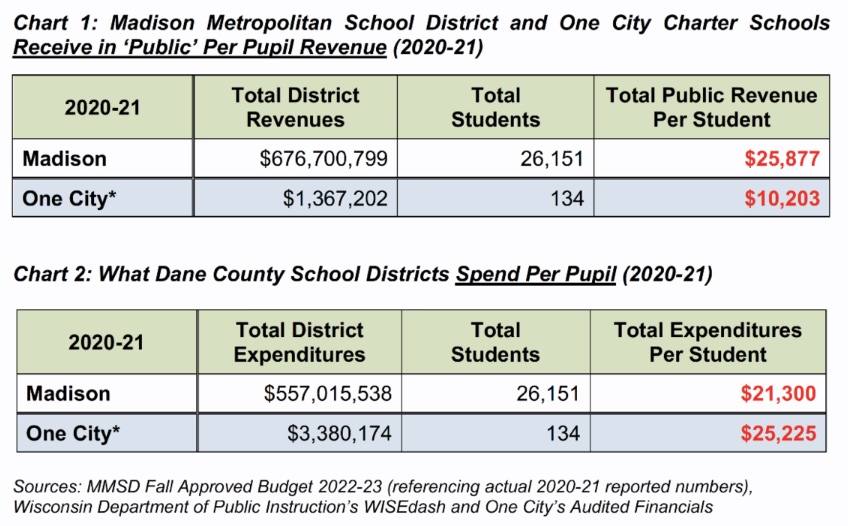
Madison’s taxpayer supported K-12 school district, despite spending far more than most, has long tolerated disastrous reading results.

“An emphasis on adult employment”

Wisconsin Public Policy Forum Madison School District Report[PDF]

WEAC: $1.57 million for Four Wisconsin Senators

Friday Afternoon Veto: Governor Evers Rejects AB446/SB454; an effort to address our long term, disastrous reading results

Booked, but can’t read (Madison): functional literacy, National citizenship and the new face of Dred Scott in the age of mass incarceration.

No When A Stands for Average: Students at the UW-Madison School of Education Receive Sky-High Grades. How Smart is That?
Share

Commentary on the 2023 Madison School Board elections (2 seats). Achievement?

Scott Girard

Vander Meulen has faced an opponent in each of her two previous campaigns. In 2017, Ed Hughes was on the ballot but dropped out of the race following a health issue in his family and in 2020, the late Wayne Strong ran against her, but suspended his campaign amid his own health issues before returning to the campaign later in the spring. Vander Meulen said she expects to have an opponent again.

“If there isn’t, I will be pleasantly surprised,” she said.

The last three years have been an especially busy time on the board. In 2019, then-superintendent Jen Cheatham announced she would leave, and the board hired Jane Belmore as interim for the 2019-20 school year.

During that year, the board hired Matthew Gutierrez from Texas to take over as permanent superintendent, but he withdrew amid the onset of the pandemic to help his district through the challenging time. The board reopened the superintendent search over the first summer of the pandemic, eventually hiring Carlton Jenkins, who started his tenure a month before the 2020-21 school year.

The data clearly indicate that being able to read is not a requirement for graduation at (Madison) East, especially if you are black or Hispanic”

My Question to Wisconsin Governor Tony Evers on Teacher Mulligans and our Disastrous Reading Results

2017: West High Reading Interventionist Teacher’s Remarks to the School Board on Madison’s Disastrous Reading Results 

Madison’s taxpayer supported K-12 school district, despite spending far more than most, has long tolerated disastrous reading results.

“An emphasis on adult employment”

Wisconsin Public Policy Forum Madison School District Report[PDF]

WEAC: $1.57 million for Four Wisconsin Senators

Friday Afternoon Veto: Governor Evers Rejects AB446/SB454; an effort to address our long term, disastrous reading results

Booked, but can’t read (Madison): functional literacy, National citizenship and the new face of Dred Scott in the age of mass incarceration.

No When A Stands for Average: Students at the UW-Madison School of Education Receive Sky-High Grades. How Smart is That?

Share

Taxpayer supported government media influence and censorship notes

Kristina Murkett:

Earlier this week, President Joe Biden was askedif the U.S. government should investigate Elon Musk’s acquisition of Twitter on national security grounds. The President responded that it was “worthy of being looked at”. Yet, strangely, there was no mention of TikTok, which poses a far greater threat to American national security.

For months now Twitter has struggled to keep its most active users engaged, and has plateaued at around 300 million monthly users (by comparison, TikTok has over 1 billion). Twitter has also been struggling financially because it has forgotten that the future is video: relentlessly addictive, auto-playing, effectively infinite video. In 2021, Android phone users spent over 16 trillion minutes on Tikok; in 2022, they spent an average of 95 minutes a day on the app. Facebook reports far greater engagement with video content than other media, and head of Instagram Adam Mosseri confirmed that the app is moving towards becoming a video-sharing platform. It’s no wonder that Twitter is under pressure to reinvent itself.

Leaked Documents Outline DHS’s Plans to Police Disinformation

Share

This School Took Away Smartphones. The Kids Don’t Mind.

Julie Jargon:

Students often looked down at screens during meals and even in class, where phones were prohibited. Teachers grew tired of being gadget police. Kids retreated to their rooms after class to scroll and text rather than gathering in student lounges. When the Covid-19 pandemic hit in 2020 and the school closed for a few months, class went virtual and things got worse.

“We found our students had disengaged more and more from real life as their phones became their world,” says John Kalapos, Buxton’s associate head of school, who graduated from the school in 2013. The trend continued after students returned to campus, he says.

Mr. Kalapos realized something needed to be done late last year after a student live-streamed a physical altercation. Watched on social media by many students, the fight became the talk of the school. He and other administrators began discussing a ban. Many students thought that the school wouldn’t actually do it—and that stripping phones from teens was unrealistic.

Share

Capital hill staff salaries

Hillfaith:

Several positions for staffers working in district offices received increases of 30 percent or more, including District Scheduler (52 percent), District Aide (41 percent), Regional Director (38 percent), and District Staff Assistant (34 percent).

In the Washington, D.C. office, the biggest increase was seen for Digital Director at 50 percent, Staff Assistant/Legislative Correspondent (47 percent), Communications Assistant (42 percent), Senior Advisor (37 percent), Legislative Correspondent (36 percent), and Press Assistant (30 percent).

Interestingly, the CAO’s analysis looked at the minimum and maximum salaries paid on a position-by-position basis.

The highest permitted maximum of $203,700 were paid to at least one individual staffer in these positions: Caseworker, Chief of Staff, Communications Director, Constituent Liaison, Constituent Services Representative, Deputy Chief of Staff, Deputy District Director, District Chief of Staff, District Director, Field Representative, Legislative Assistant, Legislative Director, and Senior Policy Advisor.

At the opposite end of the data, at least one individual in five of the positions listed in the preceding paragraph were paid the minimum salary of $45,000, thus illustrating the wide latitude allowed individual Members in determining pay levels for their staffs, as well as the varying job priorities reflected in those levels.

To read the full dataset, go here, courtesy of Demand Progress.

Share

Our reporting has established that waste, fraud and abuse is baked into mammoth federal and state spending plans.

Mark Lisheron:

Twenty months after Congress passed a bill that rained $2.53 billion down on Wisconsin, the governor’s office in sole charge of administering the funding, as well as  legislative audit and budget officials, have almost no idea of how all that money is being spent. 

Nine months after state Legislative Audit Committee members called for a comprehensive audit of the spending, the Legislative Audit Bureau has so far produced two audits that scrutinized a tiny fraction of the spending. In both studies, the LAB concluded that local and state agencies have collected and analyzed so little data that it’s impossible to know who is being paid for what. 

And from what state Rep. Mark Born (R-Beaver Dam) has been told, the LAB has no plans for a deep dive that might show some of the staggering waste, fraud and abuse that has already shown up at the federal level, as the Badger Institute has reported. 

“This administration (Gov. Tony Evers) is just not sharing the information with us,” Born told the Badger Institute. “These two smaller audits show us there’s a lot to be concerned about. I’m just as frustrated that the administration doesn’t want to share it and the mainstream media doesn’t want to report it.”

Share

Taxpayer funded censorship: Twitter Edition

Share

Academic and K-12 Governance Climate update

Share

Civics: FBI Whistleblower

Matt Taibbi:

Essentially, the FBI made Friend a supervisory agent in cases actually being run by the Washington field office, a trick replicated across the country that made domestic terrorism numbers appear to balloon overnight. Instead of one investigation run out of Washington, the Bureau now had hundreds of “terrorism” cases “opening” in every field office in the country. As a way to manipulate statistics, it was ingenious, but Friend could see it was also trouble.

As a member of a dying breed of agent raised to focus on making cases and securing convictions, Friend knew putting him nominally in charge of a case he wasn’t really running was a gift to any good defense attorney, should a J6 case ever get to trial. 

“They’re gonna see my name as being the case agent, yet not a single document has my name as doing any work,” Friend says. “Now a defense lawyer can say, ‘Hey, the case agent for this case didn’t perform any work.’ Labeling the case this way would be a big hit to our prosecution.”

Friend ended up refusing the arrangement, which led to his suspension. He followed procedure, making protected disclosures to superiors and the FBI’s Office of Special Counsel (OSG). He then reported his suspension to Wisconsin Senator Ron Johnson and whistleblower-whisperer Chuck Grassley of Iowa. They sent a letter to Attorney General Merrick Garland, detailing Friend’s procedural objections, including that “agents are being required to perform investigative actions” they “would not otherwise pursue,” at the direction of the Washington Field Office (WFO).

Share

K-12 Tax & spending climate: non competitive health bids

Share

The success of Yu Ming Charter School shows how our usual ways of thinking about diversity and equity in American schools are becoming outmoded.

Jay Caspian Kang:

There’s a thoroughly unsympathetic but deeply felt crisis that hits the grown children of upwardly mobile immigrants. These second-generation strivers—who are largely assimilated, educated in the U.S., and often ostensibly liberal—have children of their own, and, when faced with the more lax customs of their neighbors, start to wonder if their parents, who forced them into all sorts of academic labor, might have been right all along. I call this population the Amy Chua Silent Majority, after the infamous author of “Battle Hymn of the Tiger Mother.” Despite the association with Asian American tropes, members of the A.C.S.M. are actually quite ethnically diverse. I’ve met Russians, West Africans, West Indians, Central Americans, and South Asians who belong to this group. They squirm every time they hear about “play-based learning.” They collectively roll their eyes at the idea of homework bans. They wonder if it’s really necessary to let kids just be kids.

Their—our—discomfort is nothing new. The anxieties of immigrant populations have shaped American education for more than a century. The establishment of Catholic schools in the U.S., for instance, came from successive waves of immigrants who felt anxious about the public-school system. In the mid-nineteenth and early twentieth centuries, Catholics from Europe migrated into East Coast cities, and their children attended “common schools” founded on Protestant norms that didn’t look particularly fondly on the newcomers. Catholic schools were created, in large part, to allow the children of these immigrants to retain their culture and take classes taught in French, German, or Italian.

The influence of parochial schools grew until 1964, when a full twelve per cent of America’s K-12 students were enrolled in Catholic institutions. But, as Irish and Italian families began to move to the suburbs and into public schools in the latter half of the sixties, a new group of immigrants from Asia, South America, and the Caribbean came in to take their place. Toward the end of the twentieth century, the Catholic school increasingly became something of a middle ground between the public-school system and expensive private schools, and less of a cultural or religious institution. “For immigrant families that have arrived recently,” Vivian Louie and Jennifer Holdaway wrote in a 2009 paper, “religion seems to be more or less irrelevant to the decision to send their children to Catholic school. Instead, like many native Blacks and Latinos, these families chose Catholic schools to avoid what they see as a seriously deficient public school system.”

Share

“I’ll just note here in passing that traditionalists believe that the ability to communicate is an important skill for a teacher”

Dave Cieslewicz:

To which I think I can safely say that I share a widespread reaction among Madisonians: Huh?

Again, we could use a whole lot more context here and it would be useful if Copeland would speak to reporters to clarity just exactly what was going on. But from what’s currently on the record it looks as if Copeland believed that his teachers should have strong English language skills and he felt the District was hiring teachers without those skills, perhaps to meet diversity goals.

Here are a few questions that spring to mind from a writer who is against racism but not necessarily on board with the whole “anti-racist” thing. First, how are students of color served by teachers who struggle to communicate ideas clearly? Second, how are those students served by a chaotic and sometimes even dangerous environment? Third, wouldn’t a principal who was insisting on teachers with strong language skills and on orderly and safe classrooms be serving those students better than anyone?

The story will go on. Copeland is fighting to get his job back and so there will be more proceedings along those lines in which, I hope, more questions will be answered. But from what we know now this looks like yet another mess the Madison School District has gotten itself into because of its obsession with graduate level anti-racist theories as opposed to dealing head on with the real racial unfairness on the ground.

And with that, have a good weekend, folks.

The data clearly indicate that being able to read is not a requirement for graduation at (Madison) East, especially if you are black or Hispanic”

My Question to Wisconsin Governor Tony Evers on Teacher Mulligans and our Disastrous Reading Results

2017: West High Reading Interventionist Teacher’s Remarks to the School Board on Madison’s Disastrous Reading Results 

Madison’s taxpayer supported K-12 school district, despite spending far more than most, has long tolerated disastrous reading results.

“An emphasis on adult employment”

Wisconsin Public Policy Forum Madison School District Report[PDF]

WEAC: $1.57 million for Four Wisconsin Senators

Friday Afternoon Veto: Governor Evers Rejects AB446/SB454; an effort to address our long term, disastrous reading results

Booked, but can’t read (Madison): functional literacy, National citizenship and the new face of Dred Scott in the age of mass incarceration.

No When A Stands for Average: Students at the UW-Madison School of Education Receive Sky-High Grades. How Smart is That?

Share

Taxpayer supported Madison K-12 Governance climate: “could barely communicate with me” and that “they’re just giving people damn jobs.”

Chris Rickert:

Attempts to reach Copeland Thursday night were not successful. Copeland filed a grievance seeking to recover his job on Oct. 12. Attempts to reach his attorney in that matter also were not successful.

Many Sennett parents and staff were dismayed by Copeland’s sudden firing. During a School Board meeting shortly after he was let go, dozens of people questioned the move and asked that he be reinstated, saying bullying and damaging property at the Southeast Side school all but stopped under Copeland’s short tenure.

“You have the ability to save a school, save a staff, save 700 kids,” Tom Blau, who teaches eighth-grade language arts at Sennett, said at the time. “Please, we’re all begging you. Please just do what’s right” and “bring back Dr. Copeland.”

In the voicemail recording released by the district, Copeland can be heard telling the job candidate to give him a call back about an “employment opportunity.”

Then a conversation between him and another staff member can be heard in which the staff member says the candidate appears to have an interest in becoming a science teacher but that perhaps the candidate can obtain an emergency teaching license and get some training and work in special education.

The data clearly indicate that being able to read is not a requirement for graduation at (Madison) East, especially if you are black or Hispanic”

My Question to Wisconsin Governor Tony Evers on Teacher Mulligans and our Disastrous Reading Results

2017: West High Reading Interventionist Teacher’s Remarks to the School Board on Madison’s Disastrous Reading Results 

Madison’s taxpayer supported K-12 school district, despite spending far more than most, has long tolerated disastrous reading results.

“An emphasis on adult employment”

Wisconsin Public Policy Forum Madison School District Report[PDF]

WEAC: $1.57 million for Four Wisconsin Senators

Friday Afternoon Veto: Governor Evers Rejects AB446/SB454; an effort to address our long term, disastrous reading results

Booked, but can’t read (Madison): functional literacy, National citizenship and the new face of Dred Scott in the age of mass incarceration.

No When A Stands for Average: Students at the UW-Madison School of Education Receive Sky-High Grades. How Smart is That?

Share

How “Education Freedom” Played in the Midterms

Jessica Winter:

The 2022 midterm elections offered many snapshots of the contemporary school wars, but one might start with the race for Superintendent of Education in South Carolina, a state that languishes near the bottom of national education rankings and that’s suffering from a major teacher shortage. Lisa Ellis, the Democratic candidate, has twenty-two years of teaching experience and is the founder of a nonprofit organization that focusses on raising teacher pay, lowering classroom sizes, and increasing mental-health resources in schools. Her Republican opponent, Ellen Weaver, who has no teaching experience, is the leader of a conservative think tank that advocates for “education freedom” in the form of more public funding for charter schools, private-school vouchers, homeschooling, and micro-schools. “Choice is truly, as Condi Rice says, the great civil-rights issue of our time,” Weaver stated in a debate with Ellis last week. In the same debate, Ellis argued that South Carolina does not have a teacher shortage, per se; rather, it has an understandable lack of qualified teachers who are willing to work for low pay in overcrowded classrooms, in an increasingly divisive political environment—a dilemma that is depressingly familiar across the country. Ellis also stressed that South Carolina has fallen short of its own public-school-funding formula since 2008, leaving schools billions of dollars in the hole. Weaver countered that the state could easily persuade non-teachers to teach, so long as they had some relevant “subject-matter expertise,” and warned against “throwing money at problems.” The salary floor for a public-school teacher in South Carolina is forty thousand dollars.

In short, the two people vying to run South Carolina’s public schools were an advocate for public schools, and—in her policy positions, if not in her overt messaging—an opponent of public schools. The latter won, and it wasn’t even close: as of this writing, Weaver has fifty-five per cent of the vote to Ellis’s forty-three. Weaver didn’t win on her own, of course—her supporters included Cleta Mitchell, the conservative activist and attorney who aided Donald Trump in his attempt to overthrow the 2020 election results; the founding chairman of Palmetto Promise, Jim DeMint, a former South Carolina senator who once opined that gay people and single mothers should not be permitted to teach in public schools; and Jeff Yass, a powerful donator to education PACs—at least one of which has funnelled money to Weaver’s campaign—and the richest man in Pennsylvania. (Yass, as ProPublica has reported, is also “a longtime financial patron” of a Pennsylvania state senator, Anthony Williams, who helped create “a pair of tax credits that allow companies to slash their state tax bills if they give money to private and charter schools.”)

Weaver borrowed the sloganeering and buzzwords of right-wing activist groups, such as the 1776 Project and Moms for Liberty—which, as my colleague Paige Williams recently reported, have turned public schools into the national stage of a manufactured culture war over critical race theory (C.R.T.), L.G.B.T.Q. classroom materials, the sexual “grooming” of children, and other vehicles of “woke leftist” indoctrination, as well as lingering resentment over COVID-19 lockdowns. During the debate, Weaver railed against C.R.T. and the “pornography” supposedly proliferating in schools, and associated Ellis with a “far-left, union-driven agenda.” (Incidentally, South Carolina’s public employees are prohibited from engaging in collective bargaining.) “They believe in pronoun politics. They believe parents are domestic terrorists, much like Merrick Garland,” Weaver said. (Weaver may have been referring to an incident in May, 2021, when Ellis’s nonprofit cancelled a protest after it “received harassing and threatening messages from groups with extreme views about masking,” including death threats.) “These are people,” Weaver went on, “who are out of touch with the mainstream of South Carolina values, and these are the people who my opponent calls friends.” Ellis maintained that those who profess to be hunting down proponents of C.R.T. in schools are “chasing ghosts.”

Share

Yale Faculty and staff are automatically exempt from the mandates.

William Biagini:

Yale University announced it will now require students to get a bivalent COVID-19 vaccine booster by the start of the 2023 spring semester.

“Based on recent CDC recommendations, the university will require all undergraduate, graduate, and professional students—other than those with an approved medical or religious exemption—to receive an updated, bivalent COVID-19 vaccine booster by the start of the spring semester, even if they have previously received a monovalent booster,” Stephanie Spangler, Vice Provost for Health Affairs and Academic Integrity, wrote in a message to the Yale Community.

She explained that the booster is necessary because “experience and research have shown that vaccine-induced immunity can wane over time, and new COVID-19 variants can challenge our immune defenses.” 

At the same time, faculty “are strongly encouraged” to get boosted once eligible.

Share

The Supreme Court takes up a case of a $2.72 million fine for a taxpayer’s error.

Travis Nix and Tyler Martinez:

Alexandru Bittner, a Romanian-American dual citizen, nonwillfully failed to file five foreign bank account reports, or FBARs, with the IRS while living in Romania between 2007 and 2011. Taxpayers fill out annual FBAR forms if they have “foreign financial accounts exceeding $10,000.” When Mr. Bittner moved back to the U.S., he discovered this responsibility and had his certified public accountant file these forms to the IRS. The IRS responded by imposing a $2.72 million penalty even though there were no allegations of tax fraud or any additional taxes owed.

In Bittner, the court will have to determine how much in penalties Mr. Bittner must pay. The tax code imposes a $10,000 penalty per nonwillful violation of this statute. Mr. Bittner argues he had five violations—one for each missed FBAR—bringing him to $50,000 in fines. The government wants more, arguing he had 272 violations, one for each unreported account during the five-year period.

The consequence of ruling in favor of the government would be severe. Roughly nine million U.S. citizens live abroad and another 45 million are foreign-born. Any of these Americans could hold foreign bank accounts for a variety of reasons: to send money back to their family, to give themselves easier access to funds when visiting or to hold the inheritance of a deceased family member. The IRS’s standard $10,000 penalty has the potential to ruin these Americans’ financial lives.

Share

Google and public influence

Robert Epstein:

We have so far preserved more than 1.9 million “ephemeral experiences” – exposure to short-lived content that impacts people and then disappears, leaving no trace – that Google and other companies are able to use to shift opinions and voting preferences, and we expect to have captured more than 2.5 million by Election Day. 

In emails leaked from Google to The Wall Street Journal in 2018, Googlers (that’s what they call themselves) discussed how they might be able to use “ephemeral experiences” to change people’s views about Trump’s travel ban. The company later denied that this plan was ever implemented, but leaked content (including multiple blacklists) and startling revelations by Tristan Harris, Zach Vorhies, and other whistleblowers show that Google is indeed out to remake the world in its own image. As the company’s CFO, Ruth Porat, said in a November 11th, 2016 video that leaked in 2018, “we will use the great strength and resources and reach we have” to advance Google’s values.

Since early 2016, my team has been developing and improving Neilsen-type monitoring systems that allow us to do to Google-and-the-Gang what they do to us and our children 24/7: to track their activity, and, specifically, to preserve that very dangerous and persuasive ephemeral content.

Since 2013, I have been conducting rigorous controlled experiments to quantify how persuasive that kind of content can be. I’ve so far identified about a dozen new forms of online manipulation that make use of ephemeral experiences, and nearly all these techniques are controlled exclusively by Google and, to a lesser extent, other tech companies. 

These new forms of influence are stunning in their impact. Search results that favor one candidate (in other words, that lead people who click on high-ranking results to web pages that glorify that candidate) can shift the voting preferences of undecided voters by up to 80 percent in some demographic groups after a single search. Carefully crafted search suggestions that flash at you while you are typing a search term can turn a 50/50 split among undecided voters into a 90/10 split with no one knowing they have been manipulated. A single question-and-answer interaction on a digital personal assistant can shift the voting preferences of undecided voters by more than 40 percent.

Share

Papers and journal review

Share

Madison K-12 Governance & School Safety

David Blaska:

Because our Woke school boss confuses correlation with causation. Like all good critical race theorists, he’s big on disproportionality. If A doesn’t equal B, he goes all Al Sharpton. 

Today’s subject is time outs in an empty room for troublemakers or, rarely, restraint. Restraint being just holding back a kid so he doesn’t bust another kids nose.

So here’s the math: Black students = 19% of enrollment but = 48% of the kids restrainedor kept in an empty room — a room, btw, that is above ground, lighted, and is not dripping with toads. That rings Jenkins’ school bell.

“I don’t believe everybody out there is racist,” Jenkins says, before getting to the inevitable but — “but … when something’s racist, you got to call it racist. And we have some acts that are racist, point and blank.”— Carleton Jenkins, superintendent of schools, Madison WI

Who is doing all this restraining and secluding? Madison’s unionized, Black Lives Matter, Rainbow Coalition, transgender-affirming educators! The MTI members who vote Barack Obama and Mandela Barnes. Whose union endorsed Ali Muldrow over David Blaska. Those teachers! Committing acts that are racist, point and blank.

The data clearly indicate that being able to read is not a requirement for graduation at (Madison) East, especially if you are black or Hispanic”

My Question to Wisconsin Governor Tony Evers on Teacher Mulligans and our Disastrous Reading Results

2017: West High Reading Interventionist Teacher’s Remarks to the School Board on Madison’s Disastrous Reading Results 

Madison’s taxpayer supported K-12 school district, despite spending far more than most, has long tolerated disastrous reading results.

“An emphasis on adult employment”

Wisconsin Public Policy Forum Madison School District Report[PDF]

WEAC: $1.57 million for Four Wisconsin Senators

Friday Afternoon Veto: Governor Evers Rejects AB446/SB454; an effort to address our long term, disastrous reading results

Booked, but can’t read (Madison): functional literacy, National citizenship and the new face of Dred Scott in the age of mass incarceration.

No When A Stands for Average: Students at the UW-Madison School of Education Receive Sky-High Grades. How Smart is That?

Share

A debate on COVID lockdown and censorship taxpayer supported policies: 15 November

The SOHO forum

On October 8, 2020, then-director of the National Institutes of Health Francis Collins sent an internal memo to Anthony Fauci, Chief Medical Adviser to the President. The subject-line read: “Great Barrington Declaration.”

The memo read, in part:

“The proposal from the three fringe epidemiologists… seems to be getting a lot of attention — and even a co-signature from Nobel Prize winner Mike Leavitt at Stanford. There needs to be a quick and devastating take down of its premises. I don’t see anything like that on line yet–is it underway?” The memo was signed, “Francis.”

The “three fringe epidemiologists” referenced in the memo included Professor Jay Bhattacharya from Stanford University; the other two were from Oxford and Harvard Universities.

Accordingly, Francis Collins and Anthony Fauci are cordially invited to attend our debate this coming Tuesday, November 15, at 6:30 pm ET. Professor Jay Battacharya will take the Soho Forum stage to defend the resolution: Focused protection, as set forth in the Great Barrington Declaration, should be the general principle of public health management of highly infectious respiratory virus pandemics.

Share

K-12 Tax & Spending Climate: In population terms at least, red America is now growing far more rapidly than blue America.

Joel Kotkin:

Usually, the media assume these two Americas represent equally viable political economies. But this is increasingly not the case. In population terms at least, red America is now growing far more rapidly than blue America. And this makes it more important politically. Since 1990, Texas has gained eight congressional seats, Florida five and Arizona three. In contrast, New York has lost five, Pennsylvania four and Illinois three. California, which now suffers higher net outbound-migration ratesthan most Rustbelt states, lost a congressional seat in 2020 for the first time in its history. 

This decline in blue America has accelerated since the pandemic, due to rising crime and the availability of remote work. Last year, New York, California and Illinois lost more people to outbound migration than all other states. Demographer Wendell Cox notes that the largest percentage loss of residents has occurred in big core cities such as New York City, Chicago and San Francisco. In contrast, population burgeoned in sprawling areas such as Phoenix, Dallas and Orlando.

The future of the GOP depends on the continued growth of such places, as well as the growth of suburbia nationwide. Between 2010 and 2020, 51 major metropolitan areas lost 2.7million net domestic migrants from their most central counties, while suburban counties gained two million people. The Midterms show that Republicans are gaining ground in these largely suburban areas – particularly in Florida, as well as suburban Phoenix, the outskirts of Atlanta, the Houston exurbs, largely suburban Nashville, the sprawling Virginia Beach area and suburban Detroit. Democrats, where they made gains yesterday, tended to be in places like California, where the Republican Party has all but ceased to exist. 

Whether Democrats like it or not, these red-leaning places, not California or New York, are where more Americans plan to settle and start families. Today, blue-state economies, based on tech and finance, generally underperform more blue-collar red economies like Texas, Arizona, Florida and Tennessee. Over the past five years, Raleigh, Phoenix, Nashville, Salt Lake City and Dallas have grown jobs at a faster rate than Silicon Valley and Seattle – and at double the rate of New York, Los Angeles and Chicago. 

Investors are placing their bets in these places, too. California, easily the most important blue state, ranked near the bottom in 2020 in terms of new capital projects, and it suffered even further losses in 2021. The reshoring of basic industries like mining and manufacturing, as well as the new surge of chip production, is happening almost entirely in states like Ohio, New Mexico, Arizona and Texas. Even the green economy – so passionately embraced on the blue coasts – won’t provide many jobs there. Almost all the new electric vehicle and battery plants are located either in the Rustbelt, the south or in places east of the Sierra Nevada.

Share

Inflation Tracker: When Will Prices Stop Going Up?

Brian Whitton and Bourree Lam:

The Journal has put together a price tracker of common items that many Americans buy monthly to see the direction of prices that matter to you. This living page will automatically update with the most recent prices from the CPI as new numbers are released.

Current Inflation Rate: Consumer prices rose 8.2% in September 2022 from a year before

Prices rose the fastest for food at employee sites and schools , a change of 91.43% from prices a year ago this month. Smartphones had the largest drop, falling 21.02% .

Share

Commentary on School Board Elections

Scott Calvert:

The group, calling itself Education Not Indoctrination and backed by a political-action committee pumping money into similar efforts around the U.S., will square off in Tuesday’s election against a four-candidate slate supported by teachers unions, in a contest that both sides say carries high stakes for the school district’s more than 45,000 students.

The spirited race in central Maryland mirrors a continuing fight for control of the elected bodies that oversee public schools nationwide. Many Republicans running for governor and Congress have highlighted in this year’s midterm elections parental rights and K-12 education issues including critical-race theory, book bans and what students can be taught about gender, building on battles dating to school closures earlier in the pandemic.

Share

Political class sausage making, elections

Glenn Kessler:

“Today, the most common price of gas in America is $3.39 — down from over $5 when I took office.”

 remarks at a community college in Syracuse, N.Y., Oct. 27

Many readers complained about his comment, given that average gas prices were about $2.48the week Biden took office, according to the Energy Information Administration. Soaring gas prices over the course of Biden’s presidency have been a drag on his approval ratings. (The White House in fact has preferred to refer the “most common price,” which comes from the GasBuddy app and tends to be lower than the average price because California, with its super-high gas prices, raises the average.)

Biden was basically correct on the “most common price” at the time he made this comment but appears to have misspoken about the price when he took office. Generally, his speeches have referenced prices over the summer, not when he took office, as that tells a better story. For instance, a few days later, on Oct. 31, Biden said: “In June, the average price — not the most common price, but the average price — nationwide was — was over $5 a gallon. Today, the average price for a gallon of gas is $3.76.”

Share

Civics: Ahead Of His Crypto Firm’s Cash Crunch, Billionaire Sam Bankman-Fried Spent Tens Of Millions On Politics

Matt Durot:

Crypto billionaire Sam Bankman-Fried burst onto the political giving scene this election cycle, becoming the second largest billionaire donor to Democratic causes. Altogether he gave $39.9 million, including $35 million to three different political action committees. Two of his deputies at FTX, his cryptocurrency exchange–gave nearly $29 million more. But that giving looks awfully profligate now, following a single tweet Tuesday morning by the world’s richest crypto billionaire, Changpeng Zhao (aka CZ), founder and CEO of crypto exchange Binance.

Share

A New Sister Act: College Students Move Into a Convent

Melissa Korn:

A group of students at Neumann University here spent an evening last month painting pumpkins, making s’mores and dancing to a DJ’s playlist. Their neighbors—a bunch of sisters, and not the sorority kind—joined in the fun. 

In August, 40 undergraduate men and women moved into the Our Lady of Angels Motherhouse Convent, at the edge of this small campus just outside the city. Forty sisters also reside in the building. 

“Young blood, it’s wonderful!” Sister Bernadette Brazil gushed recently when asked how she felt about the newcomers. 

Campuses around the country have struggled to find enough, and affordable, housing for students. At Neumann, the two groups use different entrances to get to their quarters, so the sisters aren’t in danger of stumbling upon a young man in a towel outside the shower. They don’t share a dining hall for everyday meals, either. 

But sisters and students are now getting in the habit of meeting up for nature walks, trading travel tips, planning knitting lessons, extending occasional dinner invitations and marveling at the lives one another leads.

Share

Over 99 percent of University of Wisconsin system professors’ political donations benefit Democrats

Jackson Walker:

Over 99 percent of political donations by University of Wisconsin system professors went to Democrats, according to The College Fix’s analysis of 2021-22 Federal Election Commission data.

Between the systems’ 13 four-year and 13 two-year institutions, 441 faculty gave $291,286.67 to Democratic candidates and left-leaning political action committees. Comparatively, employees within the UW system gave just $3,898.50 to Republican candidates and their PACs.

Data examined included only faculty members whose job title included the term “professor,” including professors emeritus, assistant professors and retired professors. The data are accurate as of October 31.

Nearly one-third of Democratic donations came from UW Madison, the system’s flagship school where $2,063.19 went to Republicans and $106,109.69 went to Democrats.

The system’s Milwaukee campus professors gave $45,732.84 in donations exclusively to Democrats and its Eau Claire campus donated $1,556.50 also exclusively to Democrats.

At UW-Stout in Menomonie, $5,273.50 went to Democrats while $600 went to Republicans, all donated by one professor.

Across the system, an overwhelming majority of Democratic donations went to ActBlue, a fundraising platform used by Democratic candidates and committees to process contributions. Of the 30 donations made to Republicans, the majority supported Senator Ron Johnson’s re-election campaign.

Share

An interview on taxpayer supported disinformation

Share

Judge allows lawsuit by Pennsylvania moms over first-grade transgender lessons to move forward

Jon Brown:

A federal judge in Pennsylvania ruled against a motion to dismiss a lawsuit filed by parents who allege their children’s first-grade teacher violated district policy, state law and the Constitution by teaching children about gender dysphoria and transgender transitioning.

Senior U.S. District Judge Joy Flowers Conti ruled Oct. 27 in Tatel v. Mt. Lebanon School District that the Pennsylvania parents had sufficient reason to allege their constitutional rights were violated if their claims are true.

The lawsuit, filed by mothers Carmilla Tatel, Stacy Dunn and Gretchen Melton in June against the Mount Lebanon School District, seeks a court order to stop the gender-related instruction at Jefferson Elementary School in Pittsburgh or to allow parents the option to opt their children out of it.

The suit also seeks a jury trial in federal court to decide compensatory and punitive damages.

Share

Civics: “Censors boast on video of getting tech companies to ban entire categories of election speech under threat of “huge regulatory pressure.”

Mike Benz:

Last week, The Intercept published a set of leaks that drew broad interest in perhaps the most undercovered scandal inside the US government today: the Department of Homeland Security’s (DHS) quiet move to establish, for the first time in US history, an explicitly inward-facing domestic censorship bureau.

What The Intercept glimpsed, however, is just the tip of a much larger iceberg.

The size, scale and speed of DHS’s censorship operation are vastly larger have been reported. Based on our investigation, below are seven bottom-line figures summarizing the scope of censorship carried out by DHS speech control partners, as compiled from their own reports and videos:

  • 22 Million tweets labeled “misinformation” on Twitter;
  • 859 Million tweets collected in databases for “misinformation” analysis;
  • 120 analysts monitoring social media “misinformation” in up to 20-hour shifts;
  • 15 tech platforms monitored for “misinformation” often in real-time;
  • <1 hour average response time between government partners and tech platforms;
  • Dozens of “misinformation narratives” targeted for platform-wide throttling; and
  • Hundreds of millions of individual Facebook posts, YouTube videos, TikToks, and tweets impacted, due to “misinformation” Terms of Service policy changes that DHS partners openly plotted and bragged tech companies would never have done without DHS partner insistence and “huge regulatory pressure” from government.

The citations above are from just the DHS censorship network’s impact on the 2020 election cycle alone. That was two years ago, when the narrative management machine referenced by The Intercept was first getting formed. Even the above figures, however, just scratch the surface of the full story.

While The Intercept rightly noted that DHS’s “truth cops“ now take on a range of other topics – such as Covid-19 and geopolitical opinions – it all started from, and grew out of, DHS’s speech control infrastructure set up to censor speech about elections.

That started with the 2020 election. But it continues, importantly, with the 2022 midterm elections, which are ongoing this week.

At Foundation for Freedom Online, for more than six months, we have been publishing and sharing research findings about a wide span of shocking components to DHS’s speech control operations. Our investigation has spurred multiple members of Congress to vow aggressive probes into DHS’s “government censorship by proxy.”

Share

K-12 Tax & Spending Climate: Wisconsin Referendum Edition

Share

More elite business schools try virtual degrees to lure graduate students

Lindsay Ellis:

The move to give students flexible location options comes as demand for two-year, full-time traditional M.B.A. programs has been dropping amid a competitive job market and growing concern about the cost of college.

“The pandemic definitely accelerated this in every industry,” said Brian Bushee, who leads teaching and learning at Wharton and also teaches accounting. “I would be surprised in 10 or 20 years if there were schools that only did in-person and did nothing online.”

Between 2009 and 2020 the number of online M.B.A.s at accredited business schools in the U.S. more than doubled, and schools added more fully online M.B.A. degrees over the past two years during the pandemic, according to the Association to Advance Collegiate Schools of Business. Recent announcements by Wharton and others mark a turning point for adoption of the degrees even at highly ranked campuses, school leaders say.

Share

Bloated College Administration Is Making Education Unaffordable

Harvey Silvergate:

All of these orientation activities are overseen by administrative staff, who are now basically running a school within a school, teaching content based on the mandate of their respective offices (disability accommodation, diversity, anti-discrimination, sustainability, student-life enhancement, and so forth). As of 2019, for instance, the University of Michigan was paying $10.6 million annually to employ 76 diversity officers on a single campus. This kind of encroachment has been subtle, but faculty members and other long-time observers of higher education can recognize the phenomenon even if it evades precise description.

The solution rests with college and university governing boards, which typically are composed of non-academics—prominent alumni and civil leaders who play the equivalent role of civilian commanders-in-chief overseeing the military. These governors must wrest control from the bureaucrats who have a vested interest in maintaining (or even exacerbating) the status quo, regardless of its dire effects on these academic institutions.

Share

Five fresh ideas to fix higher ed from the Academic Freedom Conference

Jennifer Kabbany:

Several fresh concepts to reform higher education presented at the Academic Freedom Conference held over the weekend at the Stanford Graduate School of Business deserve further scrutiny.

The conference brought together some of the brightest minds in the nation from all sides of the political spectrum who vigorously defend freedom of thought, inquiry, debate and speech.

Amid this two-day convergence of scholars came suggestions that have not been presented widely before in higher education circles, but should get more traction.

SOURCES: Stanford University law Professor Michael McConnell and Foundation for Individual Rights and Expression President Greg Lukianoff

McConnell: “Borrowing from [a] successful left-wing strategy is to appoint some officers. DEI is all over the place, I can’t tell you how many administrators there are who do this. There is not a single administrator at Stanford whose job it is to protect either student or faculty speech.”

“I have had students call me … and say, ‘This happened to me, where do I go?’ I can’t tell them a place to go. There’s no phone number, there’s no office. When you get an officer whose job it is to promote freedom of thought in the university, they become not just enforcement, they become advocates. That’s why the DEI people are so powerful, right? They elevate the issue. Let’s have some of our own freedom of thought officers.”

Lukianoff: “Require academic freedom and free speech ombudsmen. Using administrators to battle administrators is something I’m increasingly coming around [to]. I can think of ways to keep that position from being hectored.”

Share

I spent 10 days in a secret Chinese Covid detention centre

Thomas Hale:

“You need to quarantine,” a man on the other end of the line said in Mandarin. He was calling from the Shanghai Municipal Center for Disease Control and Prevention. “I’ll come and get you in about four or five hours.”

I dashed out of my hotel to stock up on crucial supplies. Based on advice from colleagues and my previous experience of quarantine in China, these included: tinned tuna, tea, biscuits, three types of vitamin, four varieties of Haribo sweets, Tupperware, a yoga mat, a towel, cleaning equipment, an extension cable, a large number of books, eye drops, a tray, a mug and a coaster with a painting of the countryside surrounding Bolton Abbey in North Yorkshire.

Four to five hours later, I received another phone call. This time it was a woman from the hotel’s staff. “You are a close contact,” she said. “You can’t go outside.”

“Am I the only close contact in the hotel?”

I was, she told me and added “the hotel is closed”, meaning locked down. I went to the door of my room and opened it. A member of staff was standing there. We both jumped.

“You can’t go outside,” she said, mid-jump.

“Will the staff be able to leave?” I asked apologetically.

“It’s OK. I’ve just started my shift,” she replied, smiling.

The men in hazmat suits arrived a little later. First, they administered a PCR test with the same rushed weariness of the man who had called me earlier. Then, one escorted me down the deserted hallway. We passed the lifts, which were blocked off and guarded, and took the staff elevator. Outside, the entrance was also cordoned off. A hotel with hundreds of rooms had been frozen for me alone. I was being “taken away”, as this process is commonly referred to in China these days.

In the empty street, a bus was idling. It was small, a vehicle for school trips or large families, maybe. We drove off. “Are we going to another hotel?” I asked one of the dozen or so passengers on board.

“It’s not a hotel,” he said.

Share

Learning to read notes

The reading ape:

‘Once you learn to read you will be forever free,’ is the quotation by Frederick Douglass (2017, p1) that adorns numerous primary school libraries across England and who would disagree? With 25% of young offenders having reading skills below that of the average seven-year-old and 60% of the prison population having literacy difficulties (Clark and Dugdale, 2008) the assertion might have more accurately quoted that an inability to read will ensure that you may be forever incarcerated.

Certainly the list of ills associated with poor literacy skills make for uncomfortable reading: lower income; greater likelihood of unemployment; lower self-esteem; greater likelihood of school exclusion; greater likelihood of depression; lower levels of trust in others and greater likelihood of feeling unsafe (Literacy Foundation, 2017). It would seem that Kofi Annan’s proclamation that ‘Literacy is a bridge from misery to hope’ (un.com, 1997) has a resounding toll of veracity. And yet the very group within society with the greatest power to address this social and economic debility; the group explicitly trained to challenge it and charged with overcoming it, is the very group most resistant to adopting the means to do so.

Humanity’s ability to communicate through language has developed over an evolutionary period of many hundreds of thousands of years and the ability to communicate through speech is a developmental skill that is biologically primary knowledge (Geary, 2007) and thus developed and absorbed by maturing humans with no need for didactic instruction. Writing on the other hand (and by implication reading) first developed in the ‘fertile crescent’ in the fifth milenium BC with symbolic characters and marks representing words until the revolutionary advance of the Phoenician alphabet in the second millennium BC (Dahaene, 2014). With sounds being represented by letters and groups of letters, literary communication was not now the preserve of a small group of educational elite but was available to anyone who could learn those phoneme/grapheme correspondences. However, the brain has not evolved to read: writing has evolved to the constraints of the human brain (Dehaene, 2014). Written communication is thus biologically secondary knowledge and has to be taught; it cannot be naturally absorbed (Geary, 2007).

Share

Free speech and Public Health

Kristina Fiore

Public health expert Leana Wen, MD, didn’t speak at the American Public Health Association (APHA) annual meeting in Boston this week because of credible threats against her, according to sources with knowledge of the situation.

Wen was slated to speak at a panel discussion that focused on countering backlash against public health.

Groups reportedly planned to create a scene by shouting down speakers and preventing the panel from continuing, and there were reports that Wen could be accosted in a bathroom, sources said.

Share

Free Speech and Scientific Inquiry

Luana Maroja:

For the past two days, more than 150 professors, scholars, and a few hangers-on, including yours truly, gathered at Stanford to talk about the state of academic freedom. If you read this newsletter and listen to our podcast, you know well that the need for such a conference—to say nothing of new universities—is urgent.

This one was organized and attended by many whose names will be familiar to you from their bylines in Common Sense and on Honestly: economist John Cochrane; geophysicist Dorian Abbott; mathematician Sergiu Klainerman; economist Tyler Cowen; historian Niall Ferguson; psychologist Jonathan Haidt; lawyer Nadine Strossen; and courageous young scholars like Solveig Gold, among many others. 

The most important of the panels, to my mind, were those focused on hard sciences and the way that this authoritarian ideology has impacted even fields like chemistry and biology. Below is an edited version of what Luana Maroja, a biology professor at Williams College, shared.

Share

Civics: Elections, Media and interests

Share

Commentary on Free Speech and the Yale Law School

Robert Steinbuch:

Yale Law School has seen a series of attacks on conservative speakers by leftist students. Rather than firmly address the disruptive students’ violations of school policies, time and time again Yale administrators found ways to excuse the wrongdoers and intimidate the victims. Yale certainly isn’t alone in this shameful behavior, but it has elevated to an art form, perhaps unmatched in influence, its open hostility toward conservative ideas and open support for leftist disruptions, eggshell outrage, and violence.

We should have seen this coming. Studies have demonstrated that across the country, university administrators are even more liberal than the faculty. There is no greater echo chamber today than higher education, which has felt emboldened to institutionalize management’s intolerance of conservative ideas precisely because there has been no cost to do so.

So, fourteen federal judges are not going to take it anymore and have publicly or privately announcedtheir refusal to hire law clerks from Yale Law School due to the jurists’ shared concerns about the lack of free speech at Yale. On top of the fourteen instances documented by the press, I personally know of two more participating judges.

James Ho of the Fifth Circuit, who started the boycott, has been openly joined by Elizabeth Branch from the Eleventh Circuit, and conservative icon Edith Jones, on the Fifth Circuit with Ho, publicly expressed sympathy for Ho’s concerns.

Steven Lubet:

Far from criticizing Ho and Branch for threatening to depress Yale’s applicant pool, and weaken the career prospects of future students, Gerken has rewarded them with a speaking invitation, presumably to demonstrate Yale’s compliance with their demands.

Ho and Branch were ungracious in return, using their acceptance letter to further condemn Yale’s culture as “among the worst when it comes to legal cancelation,” while adding that the law school’s recent reforms may be “nothing more than parchment promises.”

For the record, I agree with many of Ho and Branch’s criticisms of Yale, about which I have written in the past. But valid complaints must not be pursued through unethical means. …

Ho and Branch should certainly be able to speak without disruption at Yale, or any law school, if invited by a student group, and Yale’s plan for an “ongoing lecture series that models engaging across divides” is a great idea. But it is disappointing to see the dean’s unqualified imprimatur on an event featuring Ho and Branch, which will be countedas a victory for judicial strong-arming.

Share

Curriculum notes

Share

Civics: Ending Partisan Primaries

Andrew Prokop:

And yet progressives worried about the future of American democracy aren’t so enthusiastic about these reforms — in part because they’d likely weaken the left wing of the Democratic Party as well. Progressives have had their own success at taking down incumbents in primaries that elevated rising stars like Rep. Alexandria Ocasio-Cortez (D-NY) to Congress. They hope to punish Sen. Kyrsten Sinema (D-AZ) for opposing much of President Joe Biden’s agenda this year with a primary challenge in 2024. There is even speculation that fear of a primary challenge has made Senate Majority Leader Chuck Schumer focus hard on pleasing the left during Biden’s term. 

If approved, these reforms probably wouldn’t live up to all their supporters’ ambitions — few reforms do. But they would present a clear path by which politicians of both parties disfavored by the party bases could make it to the general election. And for those who believe the rise of the Trump right presents a clear threat to US democracy, reforms that could weaken that movement’s power are probably worth at least some thought.

Share

“prioritizing a tidy narrative about Anthony Fauci over providing the truth to their readers.”

Zach Weissmueller and Regan Taylor:

“A really central part of this entire story that maybe is not talked about enough is the fact that so many mainstream publications have completely overlooked really key pieces of evidence in this story,” says Kopp. “We see a lot of health editors and health reporters prioritizing a tidy narrative about Anthony Fauci over providing the truth to their readers.”

U.S. Right to Know is devoting significant resources to its “COVID-19 Origins” research with the mission of “investigating the origins of Covid-19, the risks of gain-of-function research and mishaps at Biolabs where pathogens of pandemic potentials are stored and manipulated.”

Kopp has assembled a comprehensive timeline that lays out substantial evidence that Fauci, Collins, and a number of influential scientists misled the public. Whether or not the lab leak theory is correct, it’s now clear that these public officials concealed their conflicts of interest with the Wuhan Institute of Virology and minimized their own roles in providing government funding for unsupervised gain-of-function research that may have led to the pandemic.

Share

“They tend to support individualistic approaches to addressing racial inequality”

BY KIANA COX, BESHEER MOHAMED AND JUSTIN NORTEY

When it comes to their views on race, Black Republicans differ from Black Democrats in one key way: They tend to support individualistic approaches to addressing racial inequality, while Black Democrats tend to support institutional approaches. For example, Black Republicans and those who lean to the GOP are more likely than Black Democrats and Democratic leaners (59% vs. 41%) to say that the bigger problem for Black people is racist acts committed by individual people, as opposed to racism in our laws. And they are less likely than Black Democrats to support complete institutional overhauls to the prison system (35% vs. 57%), policing (29% vs. 52%) and the judicial process (35% vs. 50%) to ensure fair treatment of Black people. 

Here are 10 facts about Black Republicans and what they think about race and identity, based on recent Center surveys. All findings about Republicans and Democrats include independents who lean to each party.

Share

Taxpayer supported Federal Government vote observation

Share

Civics and elections: “But Democrats need to be honest about the consequences of their actions after the 2016 election”

Lev Golinkin:

Trump’s mendacity is arguably the Second Big Lie. Four years earlier, the Hillary Clinton campaign and leading Democrats refused to acknowledge the outcome of the 2016 election, by claiming Donald Trump was not a legitimate president. These actions, while certainly not as dramatic or as immediately damaging as the events leading to Jan. 6 (and today), helped bring us to our current situation.

“He lost the election and he was put into office because the Russians interfered on his behalf,” ex-President Jimmy Carter said in 2019, continuing to deny Trump’s victory three years after the election.

“He knows he’s an illegitimate president,” said Clinton, also three years later. She repeated this sentiment in 2020, telling The Atlantic the election “was not on the level,” and again when she called Trump’s win illegitimate. She piled on to this by saying, “You can run the best campaign, you can even become the nominee, and you can have the election stolen from you,” clearly referring to how she saw her 2016 campaign.

Share

graduate students question career options

Chris Woolston:

One-third of respondents to Nature’s 2022 global graduate-student survey are lukewarm about the value of their current programme. Sixty-six per cent of the PhD and masters’ students who responded think that their degree will “substantially” or “dramatically” improve their job prospects, but the rest see little or no benefit. Less than one-third agree that they expect to find a permanent job within one year of graduating, or that their programme is leaving them well prepared to eventually find a satisfying career.

“I don’t think a PhD degree will do me much good,” says survey respondent Joshua Caley, a master’s student at the University of New South Wales in Sydney, Australia, a country where the impacts of COVID‑19 and economic uncertainty continue to cloud job prospects. Caley plans to pursue a PhD after his master’s, mainly to spend more time studying his topic — the biochemical basis of age-related disease — but he doesn’t have any expectation that an advanced degree will help him to advance his career. “I have a lot of friends and colleagues who did a PhD,” he says, “and it didn’t really help them out”.

More than 3,200 self-selected respondents from around the world took part in the questionnaire (see ‘Nature’s graduate student survey’). It was the journal’s first such survey since the start of the pandemic, and the first to include master’s as well as PhD students. The results point to widespread uncertainty about career paths and the value of advanced degrees (see ‘Career concerns’).

Share

Notes on civics, governance and bi-partisan “election deniers”

Wall Street Journal:

“Truth be told, some in my own Democratic Party have also contributed to the climate of political mistrust and animus. The ranks of election deniers include Georgia’s Democratic candidate for Governor Stacey Abrams, who refused to accept her defeat in 2018. My own press secretary, Karine Jean-Pierre, tweeted in 2020 that Georgia Gov. Brian Kemp ‘stole the gubernatorial election from Georgians and Stacey Abrams.’

“That was wrong, and I’ve asked Karine to apologize at her next press conference. I know she regrets that tweet.

“Worst of all, Hillary Clinton and many others claimed Donald Trump’s victory in 2016 was illegitimate and the result of Russian influence. Some in the FBI even lied to a secret surveillance court to spy on a Trump campaign official. That was wrong, and those lies have made it easier for Trump to exploit fears about a politicized ‘deep state,’ as MAGA Republicans call it. I hope that Secretary Clinton will also acknowledge the damage from those versions of the Big Lie.

“Democracy is too important to have a double standard for election denial. And from now on, including next week, I promise to call out members of my own party if they refuse to recognize they have lost an election after all the votes have been counted and confirmed.

“I also can’t absolve myself for sowing doubts about democracy. In my first year as President I referred to election changes being considered in Georgia as ‘Jim Crow 2.0,’ and I said the midterm election would be ‘illegitimate’ if laws like that passed. 

“Well, the Georgia law did pass, and it looks on the evidence so far that voter turnout in Georgia will set midterm records. I was wrong to use such divisive language, and especially to invoke the shameful era of government racial segregation, to make a partisan point.”

Share

When universities can delay and dodge records requests, a new system is needed.

Neetu Arnold:

It is no secret that American higher education is in crisis due to a lack of affordability, growing irrelevance, and the ideological conformity that prevails in today’s classrooms. Less well-known is the pervasive foreign influence, particularly from authoritarian countries, on today’s college campuses. China has its Confucius Institutes (CIs) to project soft power, while Middle East Studies Centers (MESCs) can also facilitate foreign influence. Little from these programs supports American values of natural rights or freedom of thought. In fact, these programs can pose actual national security threats.

The National Association of Scholars’ (NAS) work in documenting foreign influence has resulted in the closure of more than 100 CIs. And we continue to expose universities that refuse to follow their legal obligations to report foreign money, as when Texas A&M failed to disclose $100 million in Qatari and Russian research funds. The use of open-records laws to obtain research contracts and memoranda of understanding has been crucial to our work in this area. But throughout our pursuit of transparency, we have repeatedly encountered serious flaws with open-records laws and how they are implemented on college campuses.

Higher-ed institutions can delay, obfuscate, and outright deny information that is rightfully owed to the public.

Share

Outsourcing digital education services

Taylor Swaak

The writing was on the wall: The University of Maryland Global Campus was restructuring again.

The vice president for the college’s Digital Teaching and Learning unit had left “cryptically” in February, two UMGC employees told The Chronicle. Around the same time, the fully online university brought in the ed-tech developer LearningMate for about $2 million to move more than 500 undergraduate courses to a universal template — same navigation menus, same discussion-board setup, same grading scale.

Share

“Censorship and Suppression of Covid-19 Heterodoxy: Tactics and Counter-Tactics”

Josh Guetzkow:

“The emergence of COVID-19 has led to numerous controversies over COVID-related knowledge and policy. To counter the perceived threat from doctors and scientists who challenge the official position of governmental and intergovernmental health authorities, some supporters of this orthodoxy have moved to censor those who promote dissenting views. The aim of the present study is to explore the experiences and responses of highly accomplished doctors and research scientists from different countries who have been targets of suppression and/or censorship following their publications and statements in relation to COVID-19 that challenge official views. Our findings point to the central role played by media organizations, and especially by information technology companies, in attempting to stifle debate over COVID-19 policy and measures. In the effort to silence alternative voices, widespread use was made not only of censorship, but of tactics of suppression that damaged the reputations and careers of dissenting doctors and scientists, regardless of their academic or medical status and regardless of their stature prior to expressing a contrary position. In place of open and fair discussion, censorship and suppression of scientific dissent has deleterious and far-reaching implications for medicine, science, and public health.”

Share

Wikipedia and the online battle over facts

Becky Hogge:

Should it be surprising that a Wikipedia entry titled “2011 Egyptian Revolution” was prepared for publication the day before protests began in Cairo’s Tahrir Square? 

An intriguing but inconclusive new book takes a fresh look at the online encyclopedia that anyone can edit through the lens of a single article, and finds reason to question contemporary assumptions about what has been dubbed “the last best place on the internet”.

Heather Ford, a South African internet activist turned academic, has spent 10 years studying the entry covering the Egyptian uprisings on Wikipedia. In the process, she met many of its authors (or “editors”, as they are known on the platform where original research is the equivalent to original sin) — from a Cairo liberal on the inside of events, to an agoraphobic US college graduate for whom stewardship of this slice of history proved “a turning point”.

Share

How the major institutions of American society all came to sing in the woke chorus, and what can be done about it

Michael Lind:

“On or around December 1910, human character changed,” wrote Virginia Woolf. Between 2010 and 2012, American culture changed. Within a few years, what had been obscure concepts in politicized university departments like gender studies and ethnic studies became orthodoxy not only in the academy, media, and the nonprofit sector, but also in the boardrooms of national and global corporations, banks, and in professional associations like the American Bar and Medical associations.

In 2010, if you had said that unisex bathrooms in public schools were necessary to accommodate nonbinary students, hardly anyone, even among progressives, would have known what you were talking about. Then in 2016 the Obama Education Department suddenly threatened to cut off federal funding to K-12 schools that did not allow students suffering from gender dysphoria to use bathrooms reserved for the opposite sex. The Obama Justice Department threatened to sue North Carolina for passing a law requiring people to use bathrooms corresponding to the sex on their birth certificates. By the time it rescinded the law, HB 2, in 2017, the state of North Carolina had lost billions of dollars thanks to simultaneous boycotts by the National Basketball Association, the National College Athletic Association, Deutsche Bank, PayPal, and other corporations and financial institutions.

In isolation, the transgender controversy might have been viewed as a strange aftershock of the gay rights movement, which achieved its much more moderate goals of civil and marriage equality for gay men and lesbian women by the first decade of the 21st century. But the imposition of transgender ideology through economic compulsion by the federal government and major private sector institutions was only the beginning. It was followed by the march through the institutions of “diversity, equity, and inclusion” (DEI) based on “critical race theory” (CRT), a sectarian ideology that holds that all whites and “white-adjacent” Asian Americans, no matter how poor and powerless, are “privileged,” while all Black and Hispanic Americans, no matter how rich and powerful, are “marginalized” members of “underserved communities.”

Share

Party politics and (school board) elections

Share

Why Randi Weingarten Supports Harvard’s Discrimination

Allysia Finley:

You almost have to admire the chutzpah of the teachers unions. Even as they fight to keep poor minority kids trapped in failing public schools, they plead that racial preferences in college admissions are necessary to compensate for these students’ inferior K-12 education. High-achieving Asian-American and white students must be discriminated against to make up for the educational “privileges” that unions deny minorities.

That’s the argument advanced by the National Education Association and the American Federation of Teachers in their friend-of-the-court briefs supporting Harvard and the University of North Carolina in cases the Supreme Court will hear on Monday concerning the legality of racial preferences. “Our schools, from K-12 to higher education, still struggle to provide equitable opportunities for students of color,” the NEA laments.

No argument there—but whose fault is that? Perhaps the gravest injustice of our time is the imprisonment of minority kids in substandard public schools. Students’ dismal scores on the Nation’s Report Card last week provided another reminder.

In Illinois 36% of white eighth-graders were rated proficient or better in math, which isn’t anything to brag about. But figures were only 14% for Hispanics and 8% for blacks. Similar or even wider gaps were found in other cities and states. In Los Angeles, 62% of whites scored proficient or higher in fourth-grade reading, compared with only 18% of blacks and 16% of Hispanics.

Unions blame these disparities on racism. “Racial minorities are disadvantaged in the United States—not only by the persistence of de facto segregation in schools—but by overt racial violence and coordinated efforts to stifle recognition of the nation’s shameful history of racial oppression,” says the NEA in its brief, citing state laws that limit the instruction of critical race theory and the “1619 Project.”

Share

Affirmative Action At The Supreme Court: Post-Argument Analysis Of SFFA V. Harvard/UNC

Gail Herriot, Ilya Shapiro, Wai Wah Chin and James Copland

On October 31, the Supreme Court will hear oral arguments in two cases that challenge the use of racial preferences in higher-education admissions. A group called Students for Fair Admissions sued Harvard University and the University of North Carolina—the nation’s oldest private and public universities, respectively—over their affirmative action policies, which the group contends are unconstitutional because they discriminate against Asian Americans. The challengers argue that the Fourteenth Amendment and the federal law that forbids race discrimination by private educational institutions that receive federal funding require a race-neutral approach to accepting potential students.

In the 1978 Regents of the University of California v. Bakke case, the Supreme Court turned back a constitutional challenge to the use of race in admissions, allowing race to be considered as one of many factors. In 2003, our nation’s highest court in Grutter v. Bollinger again narrowly upheld race-conscious admission practices, if they are “narrowly tailored” to further student-body diversity. The Court noted, however, that public universities’ use of such admissions policies “must be limited in time.”

Share

Civics: Open Source Voting Software

James Reddick and Dina Temple-Raston

Next week, three towns in New Hampshire will embark on a grand electoral experiment, Click Here and The Record have learned. On November 8, the Granite State will pilot a new kind of voting machine that will use open-source software – software that everyone can examine – to tally the votes.

“There’s a strong desire to see how ballot counting machines are actually counting the ballots,” New Hampshire’s Secretary of State, David Scanlan, told Click Here in an interview. “And open-source software really is the only way that you can do that effectively.”

The software that runs voting machines is typically distributed in a kind of black box – like a car with its hood sealed shut. Because the election industry in the U.S. is dominated by three companies – Dominion, Election Systems & Software and Hart InterCivic – the software that runs their machines is private. The companies consider it their intellectual property and that has given rise to a roster of unfounded conspiracy theories about elections and their fairness.

Share

The tyranny of a Covid amnesty: A self-righteous cabal has delivered a public that is sicker and poorer

Mary Harrington:

I spent the last days of innocence before Trump and Brexit heavily pregnant. Like many first-time mums, I read a lot of pregnancy books, but the one I liked most was Expecting Better. Written by Emily Oster, an economist, the book sifts carefully through many of the dire warnings doled out to pregnant women about food, drink, birth choices, and so on, assessing the evidence for each.

On Monday, the same author published an essay arguing for “a pandemic amnesty”. We should, she suggests, move on from the conflict, fear, uncertainty, and doubt that roiled the pandemic years, and focus instead on the urgent issues of today. But while I can understand why Oster might wish to put all the Covid-era bitterness back into a box labelled “the common good”, her effort to do so has not been well received. And this is a consequence of the very policies which Oster would now like everyone to forgive and forget.

Reading avidly in the run-up to my daughter’s birth, it was already clear to me that many of the so-called “mummy wars” are proxies for class issues. Against this emotive backdrop, Oster’s book felt like a refreshing counterbalance. It’s astonishing, in fact, how recently it still felt possible to weigh competing claims on the evidence, and settle on something reasonable. But a great deal has changed since then. And it’s easier to understand why when you consider the difference between trying to settle the “mummy wars” via science and trying to agree upon public health policy during a pandemic.


Share

Did a 1930s Wisconsin farmer not realize he helped discover one of the world’s most significant medical breakthroughs?

Doug Moe:

On Oct. 12, a dedication ceremony was held on the University of Wisconsin–Madison campus to celebrate a revolutionary discovery that both prolonged human lives and killed rats.

The American Chemical Society, or ACS, bestowed the National Historic Chemical Landmark designation on warfarin, the generic name for a prescription blood thinner that, in a slightly different form, proved to be an enormously effective rodenticide. The ACS established the awards in 1992 to recognize seminal events in the history of chemistry. An ACS board member, Dr. Lisa Balbes, was among several speakers at the dedication ceremony for warfarin, which was first marketed in the late 1940s and early ’50s.

Share

Illinois has 132,188 public employees who earn over $100,000.

Wall Street Journal:

According to Open The Books, which focuses on government transparency, the state has 132,188 public employees with salaries and benefits over $100,000. That’s a total cost of $17 billion. The list includes 10 police department leaders and 18 school superintendents with salaries above $300,000 and some 16,592 retirees with six-figure pensions. Five of the top 10 public school employee payouts are for pensions above $330,000 a year.

That’s in a state school system that fails its most vulnerable children. See the National Assessment of Educational Progress, if you dare. In 2020 the average Chicago teacher’s compensation was $108,730 including salary and benefits. Chicago teachers are among the highest paid in the nation, which might be fine if they were also among the highest performing measured by student achievement. But pay for performance is unknown in Springfield.

Giant pensions in some cases outstrip salaries, as politicians know they can increase pension benefits that will be paid long after they leave office. Open The Books says there are “more state police officers retired on six-figure pensions (1,555) than officers currently paid on six-figure salaries (1,540).”

Share

A Radically Different Model of American Education

Dartmouth Review:

Since 2021, the stagnation surrounding American higher education has given way to the first inklings of dynamism with the efforts of the University of Austin (UATX) team to found and accredit a new liberal arts college “dedicated to the fearless pursuit of truth.” Like any start-up, UATX has faced detractors, dismissing the university as a pipe-dream, political pet project, or both. Nevertheless, those who question the feasibility of UAustin are sorely misinformed. A Political Economy Project talk on Monday, September 26 by the university’s Chief Academic Officer, Jacob Howland, made clear that UATX has already begun disrupting the American academy.

From its promotional materials and online presence, it is clear that the University of Austin tries to market itself as something altogether different from its competitors. After all, in a country with more than 5,000 institutions of higher education, it is imperative for a school to separate itself from the pack. Nevertheless, Howland clarified that the difference UATX attempts to offer its potential students is a fundamental one. The University of Austin does not seek to reform America’s traditional model of a university but rather upend it.

The changes Howland listed in his talk, entitled “Revitalizing American Higher Education: The Promise of the University of Austin,” are radical.

Share

High Expectations

David:

That’s what Twitter is going through right now. Elon Musk is administering shock therapy to a company that’s had one of the most lethargic pace settings in the industry for years on end. To illustrate, we once had a designer at 37signals who had worked at Twitter previously. This person had spent over two years at Twitter and never shipping anything. It was mockups, meetings, and then eventual cancelations that propelled life in the product group at that time. Evidence of a company pace setting so depressingly low as to be scarcely believable.

Share

K-12 Tax & Spending Climate: “They broke the law. They refuse to admit it,”

Dean Mosiman:

“They broke the law. They refuse to admit it,” he said. “But breaking the law, violating the Department of Revenue requirements and violating the Constitution are serious offenses.”

City Assessor Michelle Drea defended the city’s practices.

“We respectfully disagree with this decision,” she said. “We believe it is a flawed decision based on a narrow set of skewed data which does not reflect a districtwide uniformity problem.”

The state’s uniformity clause requires that “all property within a class must be taxed on a basis of equality as far as practicable.”

Share

Civic chat at Madison west high school

Scott Girard:

The school’s new Sifting and Winnowing Club organized two sessions for their peers to attend in the auditorium Friday to get answers to questions on issues they care about.

Madison School Board member Nicki Vander Meulen and city of Madison District 5 Ald. Regina Vidaver spoke to the first group, while Emerge Wisconsin executive director Arvina Martin and state Rep. Shelia Stubbs, D-Madison, came for the latter event in the afternoon.

The data clearly indicate that being able to read is not a requirement for graduation at (Madison) East, especially if you are black or Hispanic”

My Question to Wisconsin Governor Tony Evers on Teacher Mulligans and our Disastrous Reading Results

2017: West High Reading Interventionist Teacher’s Remarks to the School Board on Madison’s Disastrous Reading Results 

Madison’s taxpayer supported K-12 school district, despite spending far more than most, has long tolerated disastrous reading results.

“An emphasis on adult employment”

Wisconsin Public Policy Forum Madison School District Report[PDF]

WEAC: $1.57 million for Four Wisconsin Senators

Friday Afternoon Veto: Governor Evers Rejects AB446/SB454; an effort to address our long term, disastrous reading results

Booked, but can’t read (Madison): functional literacy, National citizenship and the new face of Dred Scott in the age of mass incarceration.

No When A Stands for Average: Students at the UW-Madison School of Education Receive Sky-High Grades. How Smart is That?

Share

Notes on legacy media “truthiness”

Share

Civics: public vs private security

John Hindraker:

Ilhan Omar exemplifies this more vicious type of hypocrisy. She hates law enforcement and campaigns to defund the police, but when it comes to her own safety? Men with guns. Alpha News reports:

Rep. Ilhan Omar’s campaign recently dropped tens of thousands of dollars on private security services following her calls to defund the police and support for a campaign to dismantle the Minneapolis Police Department, federal filings show.

According to Federal Election Commission records, the campaign spent $27,081.14 on “security services” between July and September, the highest quarter to date.

Before the third quarter, her campaign paid roughly $83,000 to private security firms between May 2019 and July this year, according to a review of federal filings.

Share

Civics: Taxpayer funded domestic surveillance

Jason Leopold, Katrina Manson, and William Turton

An “experienced” analyst working at the National Security Agency developed a surveillance project about a decade ago that resulted in the unauthorized targeting and collection of private communications of people or organizations in the US, newly unearthed documents show.

An investigation into the matter, which hasn’t been previously reported, found that the analyst “acted with reckless disregard” and violated numerous rules and possibly the law, according to a 2016 report by the NSA’s Office of Inspector General. The agency released the report in response to a Freedom of Information Act lawsuit.

Share

The Latin School of Chicago in Shambles

Florian Sohnke:

Yet nine months ago, 15-year old Nate Bronstein ended his life as a result of cruel and vicious cyberbullying from numerous classmates while attending the Latin School of Chicago. The child-perpetrators, a number of which were privileged children of families named in a lengthy lawsuit filed by the Bronstein family, allegedly have officially faced no consequences. And the former Latin School of Chicago Board Chairman David Koo continues to serve as the Board of Trustees Chair for the Shedd Aquarium. It remains unclear as to what David Koo’s role is in this story, but this will come out in the lawsuit.

Beyond the allegations surrounding Mr. Koo and other community members, not only have the kids involved in the matter not faced any consequences which anyone Chicago Contrarian spoke to is aware of, a “narrative” in the community has developed portraying Nate as troubled teen who struggled to form friendships at his “new school,” was prone to emotional outbursts and generally, “did not fit in” with the Latin culture. Of course all of these comments could not be further from the truth. By all accounts, and Chicago Contrarian has spoken with many parents close to the story, Nate presented as a typical teen with plenty of friends.

Nate, Contrarian is told, cracked a lot of jokes and loved to make his friends laugh. In fact, Nate loved sports and often talked about his future. Nate was empathetic, kind, some would say even a mensch (a person with integrity and honor). Nate played basketball at Oz Park and his friends at Francis Parker, his former school, were thrilled to hear that Nate would return to school for the second semester. Regrettably, Nate’s friends never got the chance to welcome him back.

Share

Wisconsin drops from 200 to 186, 2nd worst in Reading (NAEP, African American Students)

The data clearly indicate that being able to read is not a requirement for graduation at (Madison) East, especially if you are black or Hispanic”

My Question to Wisconsin Governor Tony Evers on Teacher Mulligans and our Disastrous Reading Results

2017: West High Reading Interventionist Teacher’s Remarks to the School Board on Madison’s Disastrous Reading Results 

Madison’s taxpayer supported K-12 school district, despite spending far more than most, has long tolerated disastrous reading results.

“An emphasis on adult employment”

Wisconsin Public Policy Forum Madison School District Report[PDF]

WEAC: $1.57 million for Four Wisconsin Senators

Friday Afternoon Veto: Governor Evers Rejects AB446/SB454; an effort to address our long term, disastrous reading results

Booked, but can’t read (Madison): functional literacy, National citizenship and the new face of Dred Scott in the age of mass incarceration.

No When A Stands for Average: Students at the UW-Madison School of Education Receive Sky-High Grades. How Smart is That?

Share

US legacy media viewers ages 25 to 64

Share

Notes on curriculum at New Trier high school

Isabel Dias:

One day leading up to winter break, administrators of the predominantly white New Trier Township High School in the wealthy northern Chicago suburbs announced that “Understanding Today’s Struggle for Racial Civil Rights” would be the theme for a school-wide topical event known as Seminar Day. One of its main goals was to help “students better understand how the struggle for racial civil rights stretches across our nation’s history.” Featuring National Book Award winners Colson Whitehead, author of the acclaimed The Underground Railroad, and Andrew Aydin, co-author of the March graphic novel trilogy about civil rights icon John Lewis, there also would be more than 100 elective workshops and group discussions, some led by students, on such topics as racial microaggressions, cultural appropriation, and implicit bias. A few months before the program, parents were encouraged to attend a session devoted to talking about identity and race.

The backlash was swift and intense. A group calling themselves Parents of New Trier started a Facebook page and a website to denounce what they considered to be the “biased, unbalanced, divisive, and costly” program. They urgedorganizers to add more conservatives—including former Milwaukee Sheriff David Clarke, who once had compared the Black Lives Matter movement to the Ku Klux Klan—cancel the event, or make it an opt-in day for students. The group even published an annotated version of the speakers’ line-up highlighting such terms as “systemic racism,” “community resistance,” and “Latinos” and described them as “divisive, loaded, biased and in some cases bigoted” language. “If your children attend Seminar Day,” the website suggested, “you may want to encourage them to consider the workshops on comedy, poetry, gospel music, or the Civil War.”

Share

Solutions stories that aren’t puff pieces

Kate Rix:

To give others a better sense of how I approach this kind of reporting, here’s an example of a story I wrote recently about a district in Phoenix where they’ve found ways to bolster the numbers of Black teachers.

The story idea started as I was thinking about missed opportunities to highlight innovation last August, while reporting about a program in Oakland, California, that focuses on young Black boys and men.

One of the program’s pillars is that Black boys and young men need Black male role models as teachers, coaches, and mentors.

There’s a lot of research to back this up. Black kids who have a Black teacher by the third grade are more likely to go to college.

And yet, there aren’t a lot of places where Black and Latino kids are exposed to teachers who look like them.

If having teachers that look like them is so good for kids, who is doing a good job of hiring and retaining teachers of color? Where is progress being made to align teacher workforce ethnicity with student population ethnicity?

Share

Expert: It’s time to stop creating ‘superbugs’ in the lab

Saralyn Cruickshank

“What were they thinking?”

It was the first thought to cross the mind of computational biologist Steven Salzberg after reading about a recent controversial Boston University study that combined strains of the virus that causes COVID-19, creating a form of omicron, the dominant SARS-CoV-2 variant currently circulating in the U.S., that is significantly more deadly among mouse test subjects.

The study, which caused waves in the media for its creation of a potential “superbug,” also renewed an ongoing debate among scientists about the value of gain-of-function research—studies that artificially enhance a microorganism’s genome to give it advantageous attributes, such as greater transmissibility or virulence. The study’s authors and Boston University argue that the study does not qualify as gain-of-function research, and the U.S. National Institutes of Health is conducting a review of the study documentation to determine if that is indeed the case.

An expert in genomics, Salzberg has studied the genomes of viruses including influenza and SARS-CoV-2, and has written about gain-of-function research in his regular Forbes column since 2014. He says it is clear that the BU study does qualify as gain-of-function research, and, as such, carries tremendous risks. The Hub reached out to Salzberg, the Bloomberg Distinguished Professor of biomedical engineering, computer science, and biostatistics, for his take on the issue and what should be done to curtail the creation of superbugs in the future.

You’ve spoken out against gain-of-function research for many years. What initially made you get involved?

Share

Madison East’s April van Buren shares passion for high school journalism

Scott Girard:

A St. Louis-area native, van Buren spent five years teaching there and five more in New Mexico before she arrived in Madison and began working at La Follette. Her jobs have included a mix of teaching English, being a school librarian and now teaching a mix of design and technology classes.

At all of her stops, though, journalism was a key component.

“I don’t want to grade essays, I really just have always wanted to be a full time journalism teacher,” van Buren said, “but that’s not very common. They just don’t have schools where there’s enough classes to be full time journalism.

“So being a librarian and a journalism teacher, I absolutely loved.”

The data clearly indicate that being able to read is not a requirement for graduation at (Madison) East, especially if you are black or Hispanic”

My Question to Wisconsin Governor Tony Evers on Teacher Mulligans and our Disastrous Reading Results

2017: West High Reading Interventionist Teacher’s Remarks to the School Board on Madison’s Disastrous Reading Results 

Madison’s taxpayer supported K-12 school district, despite spending far more than most, has long tolerated disastrous reading results.

“An emphasis on adult employment”

Wisconsin Public Policy Forum Madison School District Report[PDF]

WEAC: $1.57 million for Four Wisconsin Senators

Friday Afternoon Veto: Governor Evers Rejects AB446/SB454; an effort to address our long term, disastrous reading results

Booked, but can’t read (Madison): functional literacy, National citizenship and the new face of Dred Scott in the age of mass incarceration.

No When A Stands for Average: Students at the UW-Madison School of Education Receive Sky-High Grades. How Smart is That?

Share

Former Madison Sennett Principal files Grievance

Olivia Herken:

Former Sennett Middle School Principal Jeffrey Copeland has filed a grievance with the Madison School District seeking to overturn his dismissal, even as both sides still won’t say why he was let go. 

Copeland was placed on leave Sept. 13, and on Sept. 26, the school district announced that he was no longer an employee. His grievance was filed with the district on Oct. 12, said James Dickinson, one of Copeland’s attorneys.

“Basically, Dr. Copeland is hoping to get reinstated. He would like his job back,” Dickinson said. He said his legal team was working “closely” with the school district’s attorney.

It’s still unclear what led to Copeland’s dismissal, which came just a few days into the school year. This was to be his first year in the district.

The data clearly indicate that being able to read is not a requirement for graduation at (Madison) East, especially if you are black or Hispanic”

My Question to Wisconsin Governor Tony Evers on Teacher Mulligans and our Disastrous Reading Results

2017: West High Reading Interventionist Teacher’s Remarks to the School Board on Madison’s Disastrous Reading Results 

Madison’s taxpayer supported K-12 school district, despite spending far more than most, has long tolerated disastrous reading results.

“An emphasis on adult employment”

Wisconsin Public Policy Forum Madison School District Report[PDF]

WEAC: $1.57 million for Four Wisconsin Senators

Friday Afternoon Veto: Governor Evers Rejects AB446/SB454; an effort to address our long term, disastrous reading results

Booked, but can’t read (Madison): functional literacy, National citizenship and the new face of Dred Scott in the age of mass incarceration.

No When A Stands for Average: Students at the UW-Madison School of Education Receive Sky-High Grades. How Smart is That?

Share

Milwaukee Election Commission official Kimberly Zapata could face charges accusing her of fraudulently requesting military ballots

Molly Beck, Alison Dirr, Corrinne Hess and Daniel Bice;

A Milwaukee election official could face criminal charges accusing her of fraudulently requesting absentee ballots reserved for members of the military and sending them to a Republican lawmaker known for embracing unfounded conspiracy theories about the 2020 election.

Milwaukee Election Commission Deputy Director Kimberly Zapata, 45, of South Milwaukee was fired by Milwaukee Mayor Cavalier Johnson this week after Johnson discovered she had requested the ballots. Johnson said Zapata’s actions may have been to show voter fraud was possible.

“This has every appearance of being an egregious and blatant violation of trust,” Johnson said. “Election integrity is absolutely integral. It’s absolutely essential.”

Milwaukee County prosecutors are considering charging Zapata with malfeasance in office, a felony, and illegally requesting a ballot, a misdemeanor, a source told the Milwaukee Journal Sentinel.

District Attorney John Chisholm said in a statement his office is reviewing the election fraud allegations and that prosecutors “expect charges to be filed in the coming days.”

Johnson held a news conference Thursday but left before reporters were finished asking questions about the matter.

Share

In 1 classroom, 4 teachers manage 135 kids — and love it

Neal Morton:

The teachers share large groups of students — sometimes 100 or more — and rotate between group instruction, one-on-one interventions, small study groups or whatever the teachers as a team agree is a priority that day. What looks at times like chaos is in fact a carefully orchestrated plan: Each morning, the Westwood teams meet for two hours of the school day to hash out a personalized program for every student, dictating the lessons, skills and assignments the team will focus on that day.

By giving teachers more opportunity to collaborate and greater control over how and what they teach, Mesa’s administrators hoped to fill staffing gaps and boost teacher morale and retention. Initial research suggests the gamble could pay off. This year, the district expanded the concept to a third of its 82 schools. The team-teaching strategy is also drawing interest from school leaders across the U.S., who are eager for new approaches at a time when the effects of the pandemic have dampened teacher morale and worsened staff shortages.

“The pandemic taught us two things: One is people want flexibility, and the other is people don’t want to be isolated,” said Carole Basile, dean of ASU’s teachers college, who helped design the teaching model. 

ASU and surrounding school districts started investigating team teaching about six years ago. Enrollment at teacher preparation programs around the country was plummeting as more young people sought out careers that offered better pay, more flexibility and less stress. 

Team teaching, a concept first introduced in schools in the 1960s, appealed to ASU researchers because they felt it could help revitalize teachers. And it resonated with school district leaders, who’d come to believe the model of one teacher lecturing at the front of a classroom to many kids wasn’t working.

Share

How the pandemic sets back children’s learning

Robert Kuttner:

Kids have suffered during the coronavirus pandemic in ways whose long-term effects are only starting to become evident. And the reliance on screen time, whether for distance learning or for babysitting, has only worsened things.

I am no fan of standardized testing. But as a gross measure, tests can tell you how well children are learning. According to results of national exams released last week, between 2019 and 2022, students in fourth and eighth grade experienced unprecedented declines in math and reduced reading achievement.

Schools and teachers have been whipsawed between concerns for the health of students and teachers and the need to devise some reasonable form of pedagogy. Teachers also suffered. That’s why they are leaving the profession in droves.

A more subtle cost has been on the socialization of young children. Kids born just before the pandemic are now three and four years old, and starting to attend preschool. The results are not pretty.

Share

Civics: press freedom and the legacy media

Issues and insights:

The problem is that dumping “old-style neutrality” hasn’t made news coverage more accurate, it’s just led the news media even further into the swamp of hysterical partisanship.

It’s left them prone to hoaxes and forced them to issue countless retractions and corrections. Any story that makes Republicans look bad gets paraded around before lifting a fact-checking finger — from Russia collusion to Jussie Smollet to the supposedly racist Catholic schoolboys. 

Immediately after the attack on Paul Pelosi, the press jumped to the conclusion that his attacker was some sort of MAGA nutjob. He’s hardly that

Just as bad, the non-neutral, truth-seeking press does its level best to keep the public in the dark about any scandals (Hunter Biden, anyone?) and crises that make Democrats look bad — a challenge that gets harder by the day.

Truth, it turns out, now matters far less to the “truth-seeking” press than ever.

Consider the recent string of events involving President Biden.

In the span of a few days, he called Kamala Harris a “great president,” got disoriented at an event on the White House lawn, claimed that his student loan giveaway was a law passed by Congress not his own executive order, misstated the name of Britain’s new prime minister, suffered another embarrassing teleprompter failure, appeared to nearly drift off into sleep during a TV interview, got confused about how to exit a stage he’d climbed up just moments before.

A neutral press would be demanding answers from the White House about Biden’s condition. They’d be talking to experts about the grave risks of having a president suffering from dementia in charge. They’d have their pollsters ask the public about its concerns with Biden’s mental health. (Something our Issues & Insights/TIPP has done).

Instead, reporters are feverishly sweeping Biden’s rapid deterioration under the rug. Indeed, if it weren’t for conservative news outlets, the public would have virtually no idea of how disturbing Biden’s decline has become.

They did the same thing with John Fetterman, the Democrat running for a senate seat in Pennsylvania. Reporters covering Fetterman haven’t been truth-seeking. They’ve been truth-denying about the debilitating effects of the stroke he suffered in May.

Share

Why U.S. Public Debt Matters

Matt Hornbach

As U.S. Public Debt continues to break records, should investors be concerned by the amount debt has risen? Or are there other, more influential factors at play?

Share

Americans’ Confidence in Higher Ed Drops Sharply

Karin Fischer

Public confidence in higher education’s ability to lead America in a positive direction has sunk steeply in recent years, falling 14 percentage points just since 2020.

Two years ago, more than two-thirds of Americans said colleges were having a positive effect on the country, according to a survey conducted by New America. In the most recent version of the survey, released Tuesday, barely half agreed.

Share

“The Long-Run Impacts of Same-Race Teachers.”

Seth Gershenson, Cassandra M. D. Hart, Joshua Hyman, Constance A. Lindsay and Nicholas W. Papageorge,

Leveraging the Tennessee STAR class size experiment, we show that Black students randomly assigned to at least one Black teacher in grades K–3 are 9 percentage points (13 percent) more likely to graduate from high school and 6 percentage points (19 percent) more likely to enroll in college compared to their Black schoolmates who are not. Black teachers have no significant long-run effects on White students. Postsecondary education results are driven by two-year colleges and  concentrated among disadvantaged males. North Carolina administrative data yield similar findings, and analyses of mechanisms suggest role model effects may be one potential channel.

Share

After Record Year, University-Endowment Returns Drop Into Negative Territory

Juliet Chung & Melissa Korn:

The median result for endowments and foundations in the fiscal year ended June 30 was a 7.8% loss, according to a preliminary estimate by Cambridge Associates—the worst showing since 2009. Some endowment chiefs and advisers said the returns likely would have been even worse if venture-capital and private-equity valuations fully reflected the deep declines in public markets, a potential overhang on future performance.

Surging venture-capital returns boosted large endowments’ returns the prior year, ushering in a raft of expanded financial-aid initiatives and other programs despite the fact that some of the gains were unrealized.

Endowments also help fund faculty salaries and capital projects. “If this continues for another year there will be impacts,” said Margaret Chen, global head of Cambridge’s endowments and foundations practice.

Still, she said endowments were cushioned from steeper losses by diversification in their portfolios, which beyond public and private equity and fixed income often include hedge funds, real estate, private credit and cash. A benchmark portfolio made up of 70% global stocks and 30% Bloomberg Aggregate bond index lost 13.8% for the period, according to Cambridge.

Share

Advocating Pandemic Accountability

Leslie Eastman:

The only remorse I can sense is the panic of the progressive activists as they see the scale of the retribution for the over two years of bureaucratic bullying and media misinformation that Americans have been treated to. Being sorry for receiving the just punishment to which you are due is NOT remorse.

Real remorse in this instance would be Big Pharma executives issuing heartfelt apologies for asserting the vaccine would stop infection. True regret would be the journalists and entertainers who mocked those who challenged their assertions (correctly), confessing how wrong they were in a sincere manner. Believable contrition would be bureaucrats from all aspects of government that pushed stringent pandemic policies jettisoning any of the current practices related to controlling people…including vaccine mandates.

Share

Commentary on status quo K-12 governance in Wisconsin

Molly Beck:

“The proposal appears to be largely more of the same with some targeted funds at special education,” Bender said of Evers’ proposal. “After surprisingly vetoing bills on reading improvement last year, a bit unexpected that there are not more resources aimed at improving not only the low proficiency rates, but the nation’s worst racial gaps in the country.”

“It does appear that Evers keeps the automatic increase for private school choice and charter schools, but that does nothing to close the large gap between the sectors,” he said.

A spokeswoman for Michels did not answer questions from the Milwaukee Journal Sentinel about Michels’ plans for schools, including whether he would sign a budget that would raise revenue limits, or whether he would increase funding for school districts’ special education costs.

The data clearly indicate that being able to read is not a requirement for graduation at (Madison) East, especially if you are black or Hispanic”

My Question to Wisconsin Governor Tony Evers on Teacher Mulligans and our Disastrous Reading Results

2017: West High Reading Interventionist Teacher’s Remarks to the School Board on Madison’s Disastrous Reading Results 

Madison’s taxpayer supported K-12 school district, despite spending far more than most, has long tolerated disastrous reading results.

“An emphasis on adult employment”

Wisconsin Public Policy Forum Madison School District Report[PDF]

WEAC: $1.57 million for Four Wisconsin Senators

Friday Afternoon Veto: Governor Evers Rejects AB446/SB454; an effort to address our long term, disastrous reading results

Booked, but can’t read (Madison): functional literacy, National citizenship and the new face of Dred Scott in the age of mass incarceration.

No When A Stands for Average: Students at the UW-Madison School of Education Receive Sky-High Grades. How Smart is That?

Share

Why talent sorting in Germany is flawed

Simon Grimm:

  • German academia doesn’t have world-class universities and is self-avowedly egalitarian.
  • Without a clear top university, many talented students instead enter highly competitive medical schools to prove their ability.
  • But, as argued here, medical school is a bad default choice for these students if you care about accelerated scientific, material, and moral progress. This is for four reasons:
    1. Entering many different universities instead of one top college, talented students do not generate and thus do not profit from local agglomeration effects.
    2. Medical students aren’t allowed the intellectual flexibility to explore ideas and projects independently.
    3. Medical school takes six years, offering no intermediate degree. This locks in students’ choice of study, even if they change their minds.
    4. Lastly, practicing medicine offers small impact at the margin (i.e., talented medical students can’t add much to an already highly advanced medical system).
  • Instead, talented individuals could study subjects and enter jobs that allow them to do much more good.
Share