School Information System

Search results for: Madison Preparatory ib charter school

409 results

Stepping Back on Madison Prep Governance Rhetoric

Susan Troller:

Late last week I got an email from Kaleem Caire, Urban League CEO and champion of the Madison Preparatory Academy charter school proposal.
Caire was unhappy with the way I had characterized the latest version of the charter school proposal.
In a blog post following the Madison Prep board’s decision late Wednesday to develop the proposed school as what’s known as a “non-instrumentality” of the school district, I described this type of school as being “free from district oversight.”
While it’s true that the entire point of establishing a non-instrumentality charter school is to give the organization maximum freedom and flexibility in the way it operates on a day-to-day basis, I agree it would be more accurate to describe it as “largely free of district oversight,” or “free of routine oversight by the School Board.”
In his message, Caire asked me, and my fellow reporter, Matt DeFour from the Wisconsin State Journal, to correct our descriptions of the proposed school, which will be approved or denied by the Madison School Board in the coming weeks.
In his message, Caire writes, “Madison Prep will be governed by MMSD’s Board of Education. In your stories today, you (or the quotes you provide) say we will not be. This continues to be a subject of public conversation and it is just not true.”

I wonder if other Madison School District programs, many spending far larger sums, receive similar substantive scrutiny compared with the proposed Madison Preparatory Academy IB charter school? The District’s math (related math task force) and reading programs come to mind.
Ideally, the local media might dig into curricular performance across the spectrum, over time along with related expenditures and staffing.
From a governance perspective, it is clear that other regions and states have set the bar much higher.
Related: Updating the 2009 Scholastic Bowl Longhorns 17 – Badgers 1; Thrive’s “Advance Now Competitive Assessment Report”.
In my view, the widely used (at least around the world) IB approach is a good start for Madison Prep.

November 17, 2011 Madison, Wis. – Last night, by unanimous vote, the Board of Directors of Madison Preparatory Academy announced they would request that the Madison Metropolitan School District’s Board of Education approve their proposal to establish it

The Urban League of Madison, via a kind Kaleem Caire email:

November 17, 2011
Madison, Wis. – Last night, by unanimous vote, the Board of Directors of Madison Preparatory Academy announced they would request that the Madison Metropolitan School District’s Board of Education approve their proposal to establish its all-boys and all-girls schools as non-instrumentality public charter schools. This means that Madison Preparatory Academy would employ all staff at both schools instead of MMSD, and that Madison Prep’s staff would not be members of the district’s collective bargaining units.
If approved, the Board of Education would retain oversight of both schools and likely require Madison Prep to submit to annual progress reviews and a five year performance review, both of which would determine if the school should be allowed to continue operating beyond its first five-year contract.
“We have worked for six months to reach agreement with MMSD’s administration and Madison Teachers Incorporated on how Madison Prep could operate as a part of the school district and its collective bargaining units while retaining the core elements of its program design and remain cost effective,” said Board Chair David Cagigal.
Cagigal further stated, “From the beginning, we were willing to change several aspects of our school design in order to find common ground with MMSD and MTI to operate Madison Prep as a school whose staff would be employed by the district. We achieved agreement on most positions being represented by local unions, including teachers, counselors, custodial staff and food service workers. However, we were not willing to compromise key elements of Madison Prep that were uniquely designed to meet the educational needs of our most at-risk students and close the achievement gap.”
During negotiations, MMSD, MTI and the Boards of Madison Prep and the Urban League were informed that Act 10, the state’s new law pertaining to collective bargaining, would prohibit MMSD and MTI from providing the flexibility and autonomy Madison Prep would need to effectively implement its model. This included, among other things:
Changing or excluding Madison Prep’s strategies for hiring, evaluating and rewarding its principals, faculty and staff for a job well done;
Excluding Madison Prep’s plans to contract with multiple providers of psychological and social work services to ensure students and their families receive culturally competent counseling and support, which is not sufficiently available through MMSD; and
Eliminating the school’s ability to offer a longer school day and year, which Madison Prep recently learned would prove to be too costly as an MMSD charter school.
On November 1, 2011, after Madison Prep’s proposal was submitted to the Board of Education, MMSD shared that operating under staffing and salary provisions listed in the district’s existing collective bargaining agreement would cost $13.1 million more in salaries and benefits over five years, as compared to the budget created by the Urban League for Madison Prep’s budget.
Cagigal shared, “The week after we submitted our business plan to the Board of Education for consideration, MMSD’s administration informed us that they were going to use district averages for salaries, wages and benefits in existing MMSD schools rather than our budget for a new start-up school to determine how much personnel would cost at both Madison Prep schools.”
Both MMSD and the Urban League used the same district salary schedule to write their budgets. However, MMSD budgets using salaries of district teachers with 14 years teaching experience and a master’s degree while the Urban League budgeted using salaries of teachers with 7 years’ experience and a master’s degree.
Gloria Ladson Billings, Vice Chair of Madison Prep’s Board and the Kellner Professor of Urban Education at the University of Wisconsin-Madison stated that, “It has been clear to all parties involved that the Urban League is committed to offering comparable and competitive salaries to its teachers but that with limited resources as a new school, it would have to set salaries and wages at a level that would likely attract educators with less teaching experience than the average MMSD teacher. At the budget level we set, we believe we can accomplish our goal of hiring effective educators and provide them a fair wage for their level of experience.”
Madison Prep is also committed to offering bonuses to its entire staff, on top of their salaries, in recognition of their effort and success, as well as the success of their students. This also was not allowed under the current collective bargaining agreement.
Summarizing the decision of Madison Prep’s Board, Reverend Richard Jones, Pastor of Mount Zion Baptist Church and Madison Prep Board member shared, “Our Board has thought deep and hard about additional ways to compromise around the limitations that Act 10 places on our ability to partner with our teachers’ union. However, after consulting parents, community partners and the MMSD Board of Education, we ultimately decided that our children need what Madison Prep will offer, and they need it now. A dream deferred is a dream denied, and we must put the needs of our children first and get Madison Prep going right away. That said, we remain committed to finding creative ways to partner with MMSD and the teachers’ union, including having the superintendent of MMSD, or his designee, serve on the Board of Madison Prep so innovation and learning can be shared immediately.”
Cagigal further stated that, “It is important for the public to understand that our focus from the beginning has been improving the educational and life outcomes of our most vulnerable students. Forty-eight percent high school graduation and 47 percent incarceration rates are just not acceptable; not for one more day. It is unconscionable that only 1% of Black and 7% of Latino high school seniors are ready for college. We must break from the status quo and take bold steps to close the achievement gap, and be ready and willing to share our success and key learning with MMSD and other school districts so that we can positively impact the lives of all of our children.”
The Urban League has informed MMSD’s administration and Board of Education that it will share with them an updated version of its business plan this evening. The updated plan will request non-instrumentality status for Madison Prep and address key questions posed in MMSD’s administrative analysis of the plan that was shared publicly last week.
The Board of Education is expected to vote on the Madison Prep proposal in December 2011.
Copies of the updated plan will be available on the Urban League (www.ulgm.org) and Madison Prep (www.madison-prep) websites after 9pm CST this evening.
For more information, contact Laura DeRoche Perez at Lderoche@ulgm.org or 608.729.1230.

Much more on the proposed Madison Preparatory IB charter school, here.
Matthew DeFour:

A Madison School Board vote to approve Madison Preparatory Academy has been delayed until at least December after the proposed charter school’s board decided to amend its proposal to use nonunion employees.
The Madison Prep board voted Wednesday night after an analysis by the school district found the pair of single-sex charter schools, geared toward low-income minority students, would cost $10.4 million more than previously estimated if it were to use union staff.
Superintendent Dan Nerad said the district would have to update its analysis based on the new proposal, which means a vote will not happen Nov. 28. A new time line for approval has not been established.
In announcing Wednesday’s decision, the Madison Prep board said the state’s new collective bargaining law made the school district and teachers union inflexible about how to pay for employing teachers for longer school days and a longer school year, among other issues.

Will Madison School Board go for non-union Madison Prep?

Susan Troller:

Backers of the Madison Preparatory Academy are now recommending establishing the proposed single-sex public charter school as what’s known as a “non-instrumentality” of the district.
Ultimately, that means the school’s staff would be non-union, and the Urban League-backed charter school would have an unprecedented degree of autonomy in its operations, free from district oversight.
With the recommendation, made at a meeting Wednesday, Madison Prep supporters, the school district and the local School Board wade into uncharted waters.
Because of the change, school officials will need to revise their administrative analysis of the charter school proposal in advance of a School Board vote on whether to approve the Madison Prep plan.

Related: Madison School Board Member Ed Hughes provides his perspective on the proposed Madison Preparatory IB charter school.
Much more on Madison Prep, here.

Cost for union teachers could be game changer for Madison Prep deal

Nathan Comp:

A new analysis (PDF) by the Madison school district shows that the budget submitted by the Urban League of Greater Madison for a pair of sex-segregated charter schools could potentially cost the district an additional $13 million over the schools’ first five years.
The new numbers came as a shock to Urban League president Kaleem Caire, who says that Madison Prep may pull out of a tentative agreement with Madison Teachers, Inc., that would require Madison Prep to hire mostly union staff.
“It’s become clear to us that the most reasonable path to ensure the success of these kids is as a non-instrumentality,” says Caire. “Others on our board want to look at a couple of other options, so we’re looking at those before we make that final determination.”
One of those options would be to scale back the program, including the proposed longer school days and extended school year.

Much more on the proposed Madison Preparatory IB charter school, here.

Why the ACLU is targeting the Proposed Madison Prep IB Charter School

Susan Troller:

Single-gender classrooms, and, to a lesser degree, single-gender schools, are a hot trend in education circles. In less than a decade, Wisconsin has gone from zero classrooms segregated by gender to more than a dozen scattered across the state. That mirrors increasing numbers throughout the country.
But there’s growing pushback from researchers, who claim the desire to separate boys from girls in school is based on what they call “pseudoscience.”
In September, the prestigious journal, Science, published results of a study that showed sex segregation did not contribute to increased academic performance and harmed students by making sex stereotypes acceptable. Seven well-regarded researchers, including UW-Madison psychology professor Janet Hyde, write in the article, “A new curriculum, like a new drug or factory production method, often yields a short-term gain because people are motivated by novelty and belief in the innovation. Novelty-based enthusiasm, sample bias and anecdotes account for much of the glowing characterization of (single-sex) education in the media.”
In addition, the American Civil Liberties Union has successfully sued on the basis of sex discriminatioSusan Troller:

Single-gender classrooms, and, to a lesser degree, single-gender schools, are a hot trend in education circles. In less than a decade, Wisconsin has gone from zero classrooms segregated by gender to more than a dozen scattered across the state. That mirrors increasing numbers throughout the country.
But there’s growing pushback from researchers, who claim the desire to separate boys from girls in school is based on what they call “pseudoscience.”
In September, the prestigious journal, Science, published results of a study that showed sex segregation did not contribute to increased academic performance and harmed students by making sex stereotypes acceptable. Seven well-regarded researchers, including UW-Madison psychology professor Janet Hyde, write in the article, “A new curriculum, like a new drug or factory production method, often yields a short-term gain because people are motivated by novelty and belief in the innovation. Novelty-based enthusiasm, sample bias and anecdotes account for much of the glowing characterization of (single-sex) education in the media.”
In addition, the American Civil Liberties Union has successfully sued on the basis of sex discrimination, recently forcing a public high school in Pittsburgh to abandon its single-sex classrooms and a school board in Louisiana to end its practice of separating boys and girls at a middle schoo

Much more on the proposed Madison Preparatory IB charter school, here.n, recently forcing a public high school in Pittsburgh to abandon its single-sex classrooms and a school board in Louisiana to end its practice of separating boys and girls at a middle schoo

Madison Prep, More Questions than Answers

TJ Mertz:

With only 24 days remaining till the Madison Metropolitan School District Board of Education will vote on the Madison Preparatory Academy charter and only 9 days until the MMSD administration is required to issue an analysis of their proposal (and that is assuming the analysis is issued on a Sunday, otherwise we are talking only one week), there are still many, many unanswered questions concerning the school. Too many unanswered questions.
Where to start?
All officially submitted information (and more) can be found on the district web site (scroll down for the latest iterations, and thanks to the district public info team for doing this).
The issues around instrumentality/non instrumentality and the status of staff in relation to existing union contracts have rightfully been given much attention. It is my understanding that there has been some progress, but things seem to be somewhat stalled on those matters.

Much more on the proposed Madison Preparatory IB Charter school, here.
Do current schools face the same scrutiny as the proposed Madison Preparatory Academy IB Charter?

Madison Prep’s ambitious plan to close achievement gap sparks vigorous debate

Susan Troller:

Nicole is a teacher’s dream student. Bright, curious and hard-working, she has high expectations for herself and isn’t satisfied with anything less than A grades. In fact, her mother says, she sometimes has to be told not to take school too seriously.
But when Nicole was tested in seventh grade to see if she’d qualify for an eighth-grade algebra course that would put her on track for advanced math courses in high school, her score wasn’t top-notch. She assured the teacher she wanted to tackle the course anyway. He turned her down.
In fact, her score could not predict whether she’d succeed. Neither could the color of her skin.
As an African-American girl, Nicole didn’t look much like the high-flying students her teacher was accustomed to teaching in his accelerated math classes at a Madison middle school. But instead of backing off, Nicole and her family challenged the recommendation. Somewhat grudgingly, her teacher allowed her in the class.
Fast forward a year: Nicole and one other student, the two top performers in the eighth-grade algebra class, were recommended for advanced math classes in high school.

Much more on the proposed Madison Preparatory Academy IB Charter school, here.

Madison Prep Academy would open in former church on Near West Side

Matthew DeFour:

Madison Preparatory Academy would open next fall in a former church on the city’s Near West Side if the School Board approves a contract for the controversial charter school.
The non-profit organization that would run the school has signed a letter of intent to lease the former Mount Olive Lutheran Church at 4018 Mineral Point Road, according to a business plan for the school released Saturday morning.
The site is on a Metro bus route and includes a 32,000-square-foot facility and 1,200-square-foot house. It also achieves the school’s goal of being located near the Downtown, said Urban League of Greater Madison President Kaleem Caire.
“It’s a good neighborhood,” Caire said. “We would hope the neighbors would want to get involved with the kids in the school.”
The business plan lays out several other new details including a daily schedule from 8 a.m. to 5 p.m. with 90-minute classes, report cards for parents and performance bonuses for staff.

Meanwhile, Progressive Dane announces its opposition to the proposed Madison Preparatory IB Charter school.

Madison Prep is so much more than same-sex classes

Scott Milfred

Let’s see:

  • A longer school day and year, with July classes.
  • Higher standards, expectations and school uniforms.
  • Mandated extracurricular activities.
  • Grades for parents based on their involvement at the school.
  • More minority teachers as role models.
  • More connections and internships with local employers.
  • Millions in private fundraising.

If the Madison Preparatory Academy can pull off all of that, how could it not improve the academic success of its largely black and Latino students?
That’s the big picture view Madison should adopt as it considers the Urban League of Greater Madison’s intriguing charter school request. Instead, a disproportionate amount of time and concern has been spent on a final part of the proposal:
Same-sex classrooms.

Related: Much more on the proposed Madison Preparatory Acdemy IB Charter school.

Madison Prep Charter School Receives $2.5M Gift from Mary Burke

Madison Preparatory Academy, via email:

Today, Madison Preparatory Academy Board Chair, David Cagigal, announced a gift of $2.5 million presented to the public charter school from Madisonian Mary Burke.
Ms. Burke, a retired business executive whose family owns Trek Bicycles and who served as Wisconsin’s Secretary of Commerce during the Doyle Administration, described the reason for her gift.
“We all know Madison can do better. I am happy to do my part to invest in our community and the future of all of our youth. Madison Prep is a powerful idea backed up by a powerful and cost-effective plan. It offers real hope to Madison students, teachers and families who want to realize their expectations and dreams.”
Ms. Burke also shared, “I understand we are in tight budget times and don’t want concerns about the cost of Madison Prep or the availability of public funding to supersede the real need for the School Board to support it. I am confident Madison Prep will be a great opportunity for children and want to see it happen. I hope my gift helps the School Board overcome its financial concerns.”
Gloria Ladson-Billings, Vice Chair of Madison Prep’s Board and the Kellner Family Professor of Urban Education at the University of Wisconsin-Madison sees Ms. Burke’s gift as an investment in innovation and human potential.
“We need to search for new solutions to solve the achievement gap in our Madison schools. To do this, we must be willing to innovate. Madison can be a perfect incubator for new educational methods and approaches. Mary Burke’s gift is stunning in its generosity and powerful in its potential.”
Mr. Cagigal sees the gift as the start of an important trend in the region. “Mary is absolutely committed to eliminating the achievement gap and is investing her resources in multiple approaches to achieve this goal. Whether it’s Madison Prep or the Boys & Girls Club’s AVID/TOPS program, Mary believes that supporting such efforts will ultimately benefit our entire community in the future. She is setting a great example for others and we are very thankful to have her in our corner.”
With Ms. Burke’s gift, the Urban League of Greater Madison will further reduce its request for per pupil funding from the Madison Metropolitan School District from $11,471 per pupil to $9,400 in the school’s first year, and $9,800 per pupil in years two through five of the school’s proposed five year budget. The Madison district currently spends $13,207 per pupil to educate students in middle and high schools.
Madison Preparatory Academy plans to open two college preparatory public charter schools in the fall of 2012, one for boys and one for girls. Their mission will be the same: to prepare students for success at a four year college or university by instilling excellence, pride, leadership and service. Both academies will be tuition-free, offer an identical curriculum in a single-sex education environment, and serve as catalysts for change and opportunity, particularly for young people of color.
Beginning with the 2012-13 school year, the Academies will serve 60 sixth grade boys and 60 sixth grade girls when they open next year, eventually growing to serve 820 students total.
Madison’s Board of Education will vote next month on the new charter schools.

Madison Preparatory Academy Hearing Statement

Don Severson, via email:

DATE: October 3, 2011
TO: MMSD Board of Education
FROM: Don Severson, President, 577-0851, donleader@aol.com RE: Madison Preparatory Academy Hearing
Notes: For public appearance
The actions of the past few days are stunning, but not necessarily surprising ULGM (Madison Prep) and MTI have made working ‘arrangements’ regarding employment of teachers and staff and working conditions, the details of which have yet to be made public.
Major issue: ‘negotiations/arrangements’ have been made between MP & MTI without MMSD BOE nor administration at the table–both observed and verified by parties not involved.
In other words, MTI is the de facto negotiator for the Board and NOT the elected BOE, nor specified as its representative
ACE has publicly stated its support of MP. We must now withhold affirmation of that support until and unless major, systemic changes occur in how the proposal process and plans (both academic and business) play out.
By design, default, benign neglect or/and collusion the BOE has abdicated the authority vested in it by law and the electorate of the District with regards to its fiduciary irresponsibility and lack of control for policy-making.
Lest you are OK with your past and current operating methods; have forgotten how you are demonstrating your operating methods; or don’t care, you have been elected to be the leader and be in charge of this District, not MTI.
By whatever BOE action or in-action has thus far been demonstrated, the proposed operational direction of MP has been reduced to appearing and acting in the mirror image of the District. This is inappropriate to say the least. The entire purpose of a charter school is to be different and to get different results.
How is forcing MP to operate in essentially the same fashion as the District and at a cost of more money….any different from….operating the District’s nearly 30 current alternative/innovative programs and services for 800 students, at millions of dollars, taking away from other students in the District? And, you can’t even produce data to show what differences, if any, are being made with these students.
This current Board, and past Boards of Education have proven over and over again that spending more money and doing essentially the same things, don’t get different results (speaking here essentially about the ‘achievement gap’ issue)
Continuing to speak bluntly, the Board’s financial and academic philosophies, policies and actions are inconsistent, phony and discriminatory.
Let us be clear…
The process for consideration of the Madison Prep charter school proposal must

  • be open and public
  • be under the leadership of the BOE
  • be accountable to the BOE and the public
  • have ALL stakeholders at the same table at ALL times

Thank you.

PDF Version.
Much more on the proposed Madison Preparatory IB charter school, here.

Madison Prep and Teacher’s Union Collaborate: What’s it all about?

Kaleem Caire, via email:

October 3, 2011
Dear Friends & Colleagues.
As the Wisconsin State Journal and The Capital Times newspapers reported over the weekend, the Urban League of Greater Madison, the new Board of Madison Preparatory Academy and Madison Teachers, Inc., the local teachers’ union, achieved a major milestone last Friday in agreeing to collaborate on our proposed charter schools for young men and women.
After a two-hour meeting and four months of ongoing discussions, MTI agreed to work “aggressively and proactively” with Madison Prep, through the existing collective bargaining agreement (CBA) between MTI and the Madison Metropolitan School District, to ensure the school achieves its diversity hiring goals; educational mission and staff compensation priorities; and staff and student performance objectives.
Where we started.
In March 2011, we submitted a proposal to MMSD’s Board of Education to start an all-boys public charter school that would serve 120 boys beginning in the 2012-13 school year: 60 boys in sixth grade and 60 boys in seventh grade. We proposed that the school would operate as a “non-instrumentality” charter school, which meant that Madison Prep would not employ teachers and other relevant support staff that were members of MTI’s collective bargaining unit. We also proposed a budget of $14,471 per pupil, an amount informed by budgets numbers shared with us by MMSD’s administration. MMSD’s 2010-11 budget showed the projected to spend $14,800 per student.
Where we compromised.
A. Instrumentality: As part of the final proposal that the Urban League will submit to MMSD’s Board of Education for approval next month, the Urban League will propose that Madison Prep operate as an instrumentality of MMSD, but have Madison Preparatory Academy retain the autonomy of governance and management of both the girls and boys charter schools. MTI has stated that they have no issue with this arrangement.
What this means is that Madison Prep’s teachers, guidance counselor, clerical staff and nurse will be members of the MTI bargaining unit. As is required under the current CBA, each position will be appropriately compensated for working extra hours to accommodate Madison Prep’s longer school day and year. These costs have been built into our budget. All other staff will employed by Madison Preparatory Academy, Inc. and the organization will contract out for some services, as appropriate.
B. Girls School Now: When we began this journey to establish Madison Prep, we shared that it was our vision to establish a similar girls school within 12-24 months of the boys school starting. To satisfy the concerns of the Wisconsin Department of Public Instruction about how Madison Prep complies with federal Title IX regulations, we offered to start the girls school at the same time. We have since accelerated the girls school in our planning and look forward to opening the girls and boys schools in August 2012 with 60 sixth grade boys and 60 sixth grade girls. We will add one grade per year in each school until we reach a full compliment of 6th – 12th grades and 840 students total.
C. Costs: Over the past six months, we have worked closely with MMSD’s administration to identify an appropriate budget request for Madison Prep. Through an internal analysis of their spending at the secondary level, MMSD recently reported to us that they project to spend $13,207 per pupil on the actual education of children in their middle and high schools. To address school board members’ concerns about the costs of Madison Prep, we worked hard to identify areas to trim spending without compromising our educational mission, student and staffing needs, and overall school effectiveness. We’ve since reduced our request to $11,478 per pupil in Madison Prep’s first year of operation, 2012-13. By year five, our request decreases to $11,029 per pupil. Based on what we have learned about school spending in MMSD and the outstanding educational needs of students that we plan to address, we believe this is a reasonable request.
Why we compromised.
We have more information. After months of deliberation, negotiation and discussion with Board of Education members, school district administration, the teacher’s union and community stakeholders, we’ve been able to identify what we believe is a clear path to getting Madison Prep approved; a path that we hope addresses the needs and interests of all involved without compromising the mission, objectives and needs of our future students.
We believe in innovation and systemic change. We are very serious about promoting change and opportunity within our public schools, and establishing innovative approaches – including new schools – to respond to the educational needs, interests and challenges of our children, schools and community. Today’s children are tomorrow’s workforce; tomorrow’s leaders; tomorrow’s innovators; and tomorrow’s peacekeepers. We should have schools that prepare them accordingly. We are committed to doing our part to achieve this reality, including finding creative ways to break down boundaries rather than reinforce them.
The needs and desires of our children supersede all others. Children are the reward of life, and our children are our first priority. Our commitment is first and foremost to them. To this end, we will continue to seek ways to expand opportunities for them, advocate on their behalf and find ways to work with those with whom we have differences, even if it means we have to compromise to get there. It is our hope that other organizations and individuals will actively seek ways to do to the same.
We see the bigger picture. It would not serve the best interests of our community, our children, our schools or the people we serve to see parents of color and their children’s teachers at odds with each other over how best to deliver a quality education to their children. That is not the image we want to portray of our city. We sincerely hope that our recent actions will serve as a example to areas businesses, labor unions, schools and other institutions who hold the keys to opportunity for the children and families we serve.
Outstanding Issues.
Even though we have made progress, we are not out of the woods yet. We hope that over the next several weeks, the Board of Education will respond to your advocacy and work with us to provide the resources and autonomy of governance and leadership that are exceedingly important to the success of Madison Prep.
We look forward to finding common ground on these important objectives and realizing our vision that Greater Madison truly becomes the best place in the Midwest for everyone to live, learn and work.
Thank you for your courage and continued support.
Madison Prep 2012!
Onward!
Kaleem Caire
President & CEO
Urban League of Greater Madison
Phone: 608-729-1200
Fax: 608-729-1205
www.ulgm.org

Crunch Time for Madison Prep Charter School


Ruth Conniff:

Ed Hughes has a problem.
Like most of his fellow school board members and practically everyone else in Madison, he was bowled over by Urban League president Kaleem Caire’s vision for Madison Prep, a charter school that would aggressively tackle the school district’s entrenched minority achievement gap.
“The longer day, the instructional focus, and the ‘no excuses’ approach appealed to me,” Hughes says.
But as he looked into the details, Hughes became more and more concerned about the cost of the school and “whether there is a good match between the problem we are trying to address and the solution that’s being proposed.”
Expressing those doubts in his blog has turned the soft-spoken Hughes into a heretic.
Caire is a superstar who has galvanized the community to get behind his charter school. At school board hearings, only a handful of speakers express any reservations about the idea, while an overwhelming number speak passionately about the need to break the school-to-prison pipeline, and about Madison’s moral obligation to do something for the kids who are not being served.
Hughes listens respectfully. But, he says, “for Madison Prep to be the answer, we’d need to know that the students it was serving would otherwise fall through the cracks.”
…..
But Hughes’ big problem with the Urban League’s draft proposal, submitted to the district last February, is cost. The total cost to the school district of $27 million over five years is just too much, he says.

Madison School Board Member Ed Hughes:

I don’t know if the Urban League’s plans for Madison Prep will come to fruition. If they do, I predict here and now that the school will have a higher graduation rate than the Madison school district as a whole for African-American students and probably for other groups of students as well. I also predict that all or nearly all of its graduates will apply to and be admitted to college. What is impossible to predict is what difference, if any, this will make in overall educational outcomes for Madison students.
Of course charter schools like Madison Prep will have higher graduation rates than their home school districts as a whole. Students enrolled in charter schools are privileged in one clear way over students not enrolled. Each student has a parent or other caregiver sufficiently involved in the child’s education to successfully navigate the process to get the student into the charter school. Not all students in our traditional neighborhood schools have that advantage. Other things equal, students with more involved parents/caregivers will be more likely to graduate from high school. So, one would expect that charter schools will have higher graduation rates.

Proposed Madison Prep IB Charter School and Madison Teachers, Inc will work together on new charter school; to be staffed largely with Union Teachers

Susan Troller:

Several major impediments facing the proposed Madison Prep charter school appear closer to resolution after a series of meetings and communications Friday between Urban League CEO Kaleem Caire, district Superintendent Daniel Nerad and John Matthews, executive director of Madison Teachers Inc.
The changes are just in time for a public hearing on the Urban League-backed school on Monday, Oct. 3 at 6 p.m. at the Doyle Administration Building, 545 W. Dayton St.
In a major shift, the proposed charter school will now be what’s called an “instrumentality” of the Madison Metropolitan School District. That means a significant portion of the school’s staff will be covered by the contract the district has with the local teachers union, Madison Teachers Inc. The contract runs through the end of June 2013

Matthew DeFour and Gayle Worland:

On the eve of a public hearing for Madison Preparatory Academy — a proposed charter school with single-sex classrooms focused on raising the academic performance of minority students — backers of the school agreed to employ union staff, eliminating a potential hurdle to approval of the school.
A budget plan for Madison Prep, proposed by the Urban League of Greater Madison, also was released late Friday. It estimates the Madison School District would spend $19.8 million over five years on the school, or about $2,000 less per student than it spends on other secondary-school students.
In lengthy meetings Friday, Urban League officials hammered out an agreement with Madison Teachers Inc., the union that represents Madison school teachers. MTI executive director John Matthews said the union, which previously opposed creation of Madison Prep, will remain neutral on whether the school should be approved.

Fascinating. It will be interesting to see the substance of the arrangement, particularly its implications for the current MMSD schools and Madison Prep’s curriculum and operating plans. 
A friend notes that the change is “stunning” and that it will likely “cost more” and perhaps “gut” some of Madison Prep’s essential components.

Is it “all about the kids” (and what that might mean)? — Take One (in relation to ULGM and Madison Prep)

TJ Mertz:

My training as a historian has taught me that all knowledge is tentative and that this is especially true when it comes to assigning motives to people’s actions. It has also taught me to not accept self-proclaimed motives at face value , to only state an opinion about the motives of others when there is a preponderance of evidence, and to look at actions and consequences as well as rhetoric when trying to make sense of things.
With those caveats, I think it is worthwhile to investigate the motives, actions and the consequences of the actions of Kaleem Caire and some of others associated with the Madison Prep proposal and the Urban League of Greater Madison in relation to public education.
Enemies of teachers and teacher unions have seized upon the phrase “it is all about the kids” to ridicule and attack teachers and their representatives. With union and (almost all) others, of course it isn’t “all about the kids.” Interestingly, those who blame unions for some or all of the ills of public education — like many of the proponents of Madison Prep — often offer their own versions of “it is all about the kids.” Examples include Michelle Rhee who named her group Students First (Valarie Strauss pointedly offered a column on Rhee’s organization titled “Rhee’s campaign is not about the kids.”) and the anti-Union political bribery has been done in Illinois (and elsewhere) under the banner of Stand for Children ( a must-see video here).

Much more on the proposed Madison Preparatory Academy IB charter school, here.

Proposed Madison Prep Academy needs to show proof of effectiveness of single-gender education to get grant

Matthew DeFour:

The state Department of Public Instruction is requiring backers of the proposed Madison Preparatory Academy to provide scientific research supporting the effectiveness of single-gender education to receive additional funding.
The hurdle comes as university researchers are raising questions about whether such evidence exists. In an article published Thursday in the journal Science, researchers also say single-gender education increases gender stereotyping and legitimizes institutional sexism.
Efforts to justify single-gender education as innovative school reform “is deeply misguided, and often justified by weak, cherry-picked, or misconstrued scientific claims rather than by valid scientific evidence,” according to the article by eight university professors associated with the American Council for CoEducational Schooling, including UW-Madison psychology professor Janet Hyde.
The Urban League of Greater Madison originally proposed Madison Prep as an all-male charter school geared toward low-income minorities. But after a state planning grant was held up because of legal questions related to single-gender education, the Urban League announced it would open the school next year with single-gender classrooms in the same building.

I find this ironic, given the many other programs attempted within our public schools, such as English 10, small learning communities, connected math and a number of reading programs.
Related: Co-Ed Schooling Group Study Assails Merits of Single-Sex Education and from Susan Troller:

A newly published article by child development experts and neuroscientists blasting the trend toward single-sex education as “pseudoscience” won’t help the cause of the proposed Madison Preparatory Academy.
Neither will the continued opposition of the South Central Federation of Labor, which reiterated its opposition to the Urban League-sponsored proposal this week because teachers at the school would not be represented by a union. The Madison Metropolitan School District has a collective bargaining agreement with Madison Teachers Inc. that runs through June of 2013, and Madison Prep’s plan envisions working conditions for its staff — a longer school day and a longer school year, for example — that differ substantially from the contract the district has with its employees.
With a public hearing on the charter school scheduled for Monday, Oct. 3, the debate surrounding Madison Prep is heating up on many fronts. The Madison School Board must take a final vote giving the charter school a go or no-go decision in November.
Kaleem Caire, CEO of the Urban League and a passionate proponent for the separate boys and girls academies aimed at helping boost minority youth academic performance, says he is unimpressed by an article published in the prestigious journal, Science, on Sept. 23, that says there is “no empirical evidence” supporting academic improvement through single-sex education.

Are other DPI funded initiatives held to the same “standard”?
The timing of these events is certainly interesting.
14mb mp3 audio. WORT-FM conducted an interview this evening with Janet Shibley Hyde, one of the authors. Unrelated, but interesting, Hyde’s interview further debunked the “learning styles” rhetoric we hear from time to time.
UPDATE: The Paper in Question: The Pseudoscience of Single-Sex Schooling:

In attempting to improve schools, it is critical to remember that not all reforms lead to meaningful gains for students. We argue that one change in particular–sex-segregated education–is deeply misguided, and often justified by weak, cherry-picked, or misconstrued scientific claims rather than by valid scientific evidence. There is no well-designed research showing that single-sex (SS) education improves students’ academic performance, but there is evidence that sex segregation increases gender stereotyping and legitimizes institutional sexism.

A better way for Madison Prep

Jack Craver:

If people want a charter school to be an inspiration to other youngsters in the community, here’s a better way to do it. Instead of building an entirely new school, which costs a ton and isolates the kids from the rest of their peers, why not go with the school within a school model, in which a charter is operated within an existing public school?
That’s the only original idea I have. Now here is my two cents on the rest of the plan.
I believe Kaleem Caire knows what he is talking about though. It’s frustrating to see a debate on the crisis facing minority students as polarized between the know-nothings on the right who believe the only issues facing blacks are self-inflicted cultural ones and the lefties who refuse to accept that anything besides racism and poverty are responsible for the poor performance of black males in America.

Much more on the proposed Madison Preparatory Academy IB Charter school, here.

Kaleem Caire draws on personal experience to support school alternatives for blacks

Dan Simmons:

“Come on Madison, we can do better than this!”
That’s Kaleem Caire. He said it not recently but in 1998 in an op-ed questioning why his hometown wasn’t paying more attention to the poor educational outcomes and high incarceration rates of black males.
“I’m asking Madison to be your best self and get this done!”
That’s also Caire, in an interview this week about his proposal for a publicly funded charter school designed to improve educational outcomes of low-income minority students.
What hasn’t changed, then to now, is Caire’s conviction that Madison’s public schools are failing minority students and his willingness to force issues that cause some distress to the city’s white liberal establishment.
What has changed is Caire’s clout. He returned to his hometown in 2010 after a decade long detour with his family to the East Coast. As president and CEO of the Urban League of Greater Madison, and public face for the proposed Madison Preparatory Academy, his profile has skyrocketed. But with it has come criticism and skepticism over a plan that challenges Madison’s longstanding commitment to inclusive learning.

Madison Preparatory Academy today announced its inaugural Board of Directors

Laura DeRoche-Perez, via email:

Media Release
Madison Preparatory Academy today announced its inaugural Board of Directors. Board members represent a diverse cross-section of corporate and community leaders from the Greater Madison area who are all passionate about and dedicated to ensuring Madison Prep becomes a reality for young men and women. They are:
Tyler Beck, Undergraduate Student, UW-Madison
Dave Boyer, CEO, MCD, Inc.
David Cagigal, Vice Chair, Urban League of Greater Madison
Elizabeth Donley, CEO, Stemina Corporation
Rosa Frazier, Clinical Professor/Immigration Law, UW-Madison Law School
Dennis Haefer, Vice President of Commercial Banking, Johnson Bank
Donna Hurd, Executive Director, Boardman Law Firm
Torrey Jaeckle, Vice President, Jaeckle Distributors
Rev. Richard Jones, Pastor, Mount Zion Baptist Church
Gloria Ladson-Billings, Chair of Urban Education and Professor of Curriculum & Instruction and Education Policy Studies, UW-Madison
Maddy Niebauer, Managing Director of Strategy & Human Assets, Teach for America
J. Marshall Osborn, Retired Math Professor, UW-Madison
Fran Petonic, President, Meriter Foundation
John Roach, Owner & CEO, John Roach Projects
Mario Garcia Sierra, Director of Programs, Centro Hispano
Derrick Smith, Area Manager, Thermo Fisher Scientific Corporation
Terrence Wall, President, T. Wall Properties
About Madison Preparatory Academy:
Madison Preparatory Academy (Madison Prep) is a tuition-free public charter school that will serve as a catalyst for change and opportunity, particularly for young people of color. Its mission is to prepare students for success at a four year college or university by instilling excellence, pride, leadership, and service. The school will open in the Fall of 2012 to students in the Madison Metropolitan School District, pending approval from the Board of Education in the Fall of 2011.
For more information, contact Laura DeRoche-Perez at 608-729-1230 or Lderoche@ulgm.org
Website: www.madison-prep.org

Much more on the proposed Madison Preparatory Academy IB Charter school, here.

Will Madison School Board pull the plug on Madison Prep’s planning grant?

Susan Troller:

The threat of possible litigation has roiled the already turbulent waters surrounding the proposal for a single-sex Urban League charter school.
Madison school officials began feeling skittish over recommending a $225,000 planning grant for the Madison Preparatory Academy for Young Men after the state Department of Public Instruction raised concerns recently that the school doesn’t meet state and federal requirements to provide gender-equal education.
Now, a new legal threat has emerged, this one from Madison Teachers Inc. Together, the two issues could cause the board to pull back from supporting the planning grant, possibly as early as Thursday.
First, some background: After DPI put the planning grant on hold, the Urban League of Greater Madison last week submitted a new proposal to simultaneously establish a separate campus for girls. Kaleem Caire, Urban League president and a driving force behind Madison Prep, wants to see the schools open next year, initially with 60 sixth-grade girls and 60 sixth-grade boys. The proposal calls for adding 120 additional sixth-graders in each of the four subsequent years. Because the proposal now envisions 600 students rather 480 as originally planned, it would require more funding from the Madison Metropolitan School District than originally planned.

Much more on the proposed Madison Preparatory Academy IB Charter school, here.

Urgent – Support Need; School Board schedules abrupt hearing on Madison Prep; Revised Proposal Submitted to the Madison School District

Kaleem Caire, via email:

September 7, 2011
Dear Friends & Colleagues,
On Thursday, August 25, 2011, leadership of the Urban League of Greater Madison, the Wisconsin Department of Public Instruction and the Madison Metropolitan School District met at DPI’s Madison offices to discuss how the Urban League and MMSD would address DPI’s concerns that a comparable option to Madison Prep’s charter school for boys also be available to girls at the same time the boys’ school would open in August 2012.
During that meeting, all three parties discussed ways “comparability” could be achieved. DPI suggested and the Urban League agreed that starting the girl’s campus at the same time as the boy’s campus would be the best way to achieve comparability and sufficiently comply with state law and federal Title IX regulations that address single-sex public schools.
Initially, the Urban League planned to wait 12-24 months to start the girls’ campus of Madison Prep. However, given DPI’s concerns, we saw this as the perfect opportunity and argument to serve girls right away, and subsequently adjusted our plans to include a girls’ campus of Madison Prep last week. You can review a copy of the proposal we submitted last week to DPI and MMSD that explains how we’ll adjust our plans and add the girls’ campus in 2012 by clicking here. We have also attached the document to this email here.
Today, we were excited to learn from a DPI official, Mr. Bob Soldner, that our proposal for adding the girls’ campus now satisfies DPI’s concerns that a comparable option would be available for boys and girls at the same time. Mr. Soldner also said he was awaiting a response to our plan from the Madison Metropolitan School District before releasing our $225,000 charter school planning grant, which DPI put on hold two weeks ago.
I just learned 2 hours ago from MMSD Superintendent, Dr. Daniel Nerad, that the Board of Education decided today to hold an executive session tomorrow at 4:30pm at the Doyle Administration Building to “discuss the legal implications of Madison Prep and the potential for litigation.” Dr. Nerad said that immediately following their executive session, the Board of Education would also hold a “special public meeting” to discuss Madison Prep.
Unfortunately, the Urban League of Greater Madison and the Board members of Madison Prep will not be able to attend the public meeting on Madison Prep tomorrow as we are attending a long-scheduled fundraiser for the school at the same time tomorrow – 5:30pm. This will be the first major fundraiser for the school, and is being hosted by four prominent leaders and advocates for children in Greater Madison.
We hope that those of you who support Madison Prep and are not attending our fundraiser tomorrow night will be available to attend the public meeting of the Board of Education tomorrow to express your support for our proposal to establish Madison Preparatory Academy campuses for boys and girls. We assume a critical decision regarding our charter school grant application will be decided tomorrow. You can find the agenda for the Board of Education’s meeting by clicking here.
For more information about tomorrow’s Board of Education meeting, please contact the Madison Metropolitan School District’s Board of Education at board@madison.k12.wi.us or 608-204-0341. For more information about our updated Madison Prep proposal, please contact Ms. Laura DeRoche Perez at Lderoche@ulgm.org or 608-729-1230.
We intend to host our own public forum on Madison Prep in the near future. More details and information will be shared with you soon.
Thank you so much. It’s all about the future of our children.
Onward!
Kaleem Caire
President & CEO
Urban League of Greater Madison
Phone: 608-729-1200
Fax: 608-729-1205
www.ulgm.org

Much more on the proposed Madison Preparatory Academy IB Charter School, here.
The Madison Urban League’s 9.2.2011 memorandum to the Madison School District 311K PDF.
Matthew DeFour:

A Madison charter school geared toward low-income, minority students would include single-gender classrooms for both boys and girls in 2012 under a revised proposal for Madison Preparatory Academy.
The new proposal from the Urban League of Greater Madison would nearly double the contribution required by the Madison School District in the fifth year — from $4.8 million in the original plan to $9.4 million — but the net cost to the district remains unclear.
The Urban League submitted the proposal to the school district and the state Department of Public Instruction on Friday, and it was made public by the district Wednesday. The revision came after DPI withheld support for a $225,000 planning grant for an all-boys charter school that the Urban League had discussed creating for more than a year. State officials said that such a school would discriminate against girls and that if they open an all-male school, they must open a similar school for girls at the same time.
The Madison School Board has scheduled two meetings for Thursday, one in closed session at 4:30 p.m. to discuss legal issues related to the new proposal and the second in open session at 5:30 p.m., Superintendent Dan Nerad said.

All-male Madison IB charter school could put minority boys on road to success

Alan Borsuk:

Kaleem Caire knows what it is like to be a young black man growing up in Madison and going on to success. A troubled kid when he was a student at Madison West High School in the 1980s, he went on to become a nationally known Washington-based education advocate before returning in 2010 to head the Urban League of Greater Madison.
Kaleem Caire knows what it means to be a young black man growing up in Madison and going on to failure. He saw what happened to many childhood friends who ended up dead or in prison. He sees it now in the disturbing statistics on African-American education outcomes and unemployment.
And Kaleem Caire has an eye-catching idea he thinks will put more black and Latino youths on the path to success – enough to make a difference in the overall troubling picture of minority life in the state’s second largest city.
The idea? An all-male charter school for sixth- through 12th-graders with longer days and longer school years than conventional schools, an International Baccalaureate program, and high expectations of students and teachers, including academic performance, the way they treat others, and the way they dress.

Related:
Notes and links on the proposed Madison Preparatory IB Charter School.
Susan Troller:Madison Prep now says girls will be welcome:

Kaleem Caire says there’s a simple fix for concerns that a proposal for an all-male charter school in Madison would discriminate against girls.
“If it’s a problem, we’ll introduce a single-sex charter school for girls at the same time we start the boys’ school, in the fall of 2012-2013,” Caire said in an interview Friday.
Caire, president of the Urban League of Greater Madison, first began talking a year ago about creating a rigorous, prep-style public charter school for boys aimed at improving minority student performance. With its single-sex approach, International Baccalaureate curriculum, emphasis on parent involvement and expanded hours and days, Madison Preparatory Academy would not only be unique in the Madison district, but also unique in the state.

The fate of Madison Preparatory Academy will be a defining moment for our school climate.

DOJ group to discuss Madison’s academic disparities among racial minorities

Matthew DeFour:

An arm of the U.S. Department of Justice that mediates racial tension in communities is intervening in the debate over the achievement of racial minorities in the Madison School District.
The Justice Department’s Community Relations Service won’t discuss its role.
But in an email announcement this week, the Urban League of Greater Madison said DOJ this summer “raised concerns about academic achievement disparities among students of color in the Madison Metropolitan School District (MMSD) to the District’s administration.”
DOJ officials will participate in a meeting Wednesday called by the Urban League to discuss minority achievement, graduation rates and expulsion rates in the Madison district, according to Urban League President Kaleem Caire.

Related: the proposed Madison Preparatory Academy IB Charter school.

Our Response to State Education Department’s Hold on Madison Prep Grant

Kaleem Caire, via email

Dear Friends & Colleagues,
In the last 48 hours, local media has been abuzz about the Wisconsin Department of Public Instruction’s decision to put a hold on our charter school planning grant. The grant application was formally endorsed in March 2011 by the Board of Education of the Madison Metropolitan School District.
Last week, DPI officials contacted us to request that our team and the leadership of the Madison Metropolitan School District meet with them to discuss how we intend to address issues related to (a) the 1972 Title IX Education Amendments to the Civil Rights Act of 1964 and (b) new federal Title IX regulations on the establishment of single sex classes, extracurricular activities and schools that took effect in 2006. This meeting has been scheduled.
DPI has publicly stated that it is not uncommon for grant awards to be delayed for various reasons. In our case, DPI wants to ensure that all parties – MMSD, DPI and the Urban League of Greater Madison – are on the same page with regard to how Madison Prep will comply with federal and state statutes relative to single sex public schools. We welcome this conversation. MMSD and the Urban League have been working together on this issue since June.
Single Sex Public Schools are Growing in the U.S.
According to the National Association for Single Sex Public Education, there are presently 116 single sex public schools in the United States. The number of single sex public schools continues to grow each year. For example, the Houston (Texas) Independent School District’s Board of Education recently approved an all boys and later an all girls college preparatory academy for students in grades 6 – 12. Both campuses opened this week.
There are also public charter schools such as Bluford Drew Jemison S.T.E.M Academy for boys in Baltimore, Maryland that was approved by the Board of Education of Baltimore City Public Schools without approving a similar school for girls at the same time. Bluford Drew Jameson is part of BCPS’ bold and aggressive Charter, Innovative and Transformation Schools Plan to revitalize public education in the city. BCPS’ efforts are being heralded nationally as they are seeing clear signs of turning around.
With Confidence, Precedent and Support, We Will Succeed
Given the successful growth of single sex public/charter schools across the country, along with our plans to comply with the new Title IX regulations and our publicly stated commitment to establish the 6-12 grade Madison Preparatory Academy for Young Women, we are confident that the issues raised by DPI will be resolved.
With your support and that of DPI and MMSD, Madison Prep will soon provide a long overdue solution to a deeply rooted pattern of academic failure and under-performance, particularly among African American and Latino boys in our community. It will also serve as a learning laboratory that informs the programs, strategies and practices of schools and educators across Greater Madison and the State of Wisconsin.
We look forward to Madison Prep producing hundreds of confident, excited and future-focused young men who are ready for college and committed to promoting the schools values – leadership, excellence, pride and service – in their community, homes, peer groups and daily lives.
Visit the website and sign our petition below.
Madison Prep 2012: Empowering Young Men for Life!

IB interviewed Kaleem a few weeks ago.
Much more on Kaleem Caire and the proposed Madison Preparatory Academy IB charter school, here.

Rotary Club Speech: Madison Preparatory Academy for Young Men: Innovative Solution & First All-Male Public Charter School in Wisconsin

Madison Rotary Club:

Join us next week,
Wednesday, June 22, at the Alliant Energy Center’s Exhibition Hall as we welcome fellow Rotarian Kaleem Caire to the podium for a presentation on the features of the Madison Preparatory Academy, its timeline for implementation and a status report on where it is in the school development and approval process.
Attendees will learn why and how the Urban League hopes to lead a renaissance in K-12 education in Greater Madison, tying its charter school effort to local school improvement
initiatives, economic development projects and advancements and innovations in higher education and workforce development in Greater Madison.

Seven Stumbling Blocks for Madison Prep

Madison School Board Member Ed Hughes:

The Madison School Board’s recent consideration of the Urban League’s application for a planning grant from DPI for the Madison Preparatory Academy for Young Men prompted me to dig deeper into the issues the charter school proposal raises. I have several concerns – some old and some new – that are described below.
I apologize for the length of this post. It kind of turned into a data dump of all things Madison Prep.
Here are the seven areas of concern I have today about the Madison school district agreeing to sponsor Madison Prep as a non-instrumentality charter school.
1. The Expense.
As I have written, it looks like the roughly $14,500 per student that Madison Prep is seeking from the school district for its first year of operations is per nearly twice the per-student funding that other independent and non-instrumentality charter schools in the state now receive.
Independent charter schools, for example, receive $7,750 per-student annually in state funding and nothing from the local school district. As far as I can tell, non-instrumentality charter schools tend to receive less than $7,750 from their sponsoring school districts.
It seems that the Madison Prep proposal seeks to pioneer a whole new approach to charter schools in this state. The Urban League is requesting a much higher than typical per-student payment from the school district in the service of an ambitious undertaking that could develop into what amounts to a shadow Madison school district that operates at least a couple of schools, one for boys and one for girls. (If the Urban League eventually operates a girl’s school of the same size as projected for Madison Prep, it would be responsible for a total of 840 students, which is a larger total enrollment than about 180 school districts in Wisconsin can claim.)
What about the argument that Madison Prep does not propose to spend any more on a per-student basis than the Madison school district already spends? There are a couple of responses. First, MMSD does not spend $14,500 per student on in-school operations – i.e., teachers, classroom support, instructional materials. The figure is more like $11,000. But this is not the appropriate comparison.

Much more on the proposed IB Charter school: Madison Preparatory Academy, here.

Caire, Nerad & Passman Wisconsin Senate Bill 22 (SB 22) Testimony Regarding Charter School Governance Changes

Madison Urban League President Kaleem Caire 13mb .mp3 audio file. Notes and links on the Urban League’s proposed IB Charter school: Madison Preparatory Academy. Caire spoke in favor of SB 22.
Madison School District Superintendent Dan Nerad 5mb .mp3 audio file. Nerad spoke in opposition to SB 22.
Madison School Board Member Marj Passman 5mb .mp3 audio file. Passman spoke in opposition to SB 22.
Much more on SB 22 here.
Well worth listening to. Watch the hearing here.

Milwaukee Voucher School WKCE Headlines: “Students in Milwaukee voucher program didn’t perform better in state tests”, “Test results show choice schools perform worse than public schools”, “Choice schools not outperforming MPS”; Spend 50% Less Per Student

Erin Richards and Amy Hetzner

Latest tests show voucher scores about same or worse in math and reading.
Students in Milwaukee’s school choice program performed worse than or about the same as students in Milwaukee Public Schools in math and reading on the latest statewide test, according to results released Tuesday that provided the first apples-to-apples achievement comparison between public and individual voucher schools.
The scores released by the state Department of Public Instruction cast a shadow on the overall quality of the 21-year-old Milwaukee Parental Choice Program, which was intended to improve results for poor city children in failing public schools by allowing them to attend higher-performing private schools with publicly funded vouchers. The scores also raise concerns about Gov. Scott Walker’s proposal to roll back the mandate that voucher schools participate in the current state test.
Voucher-school advocates counter that legislation that required administration of the state test should have been applied only once the new version of the test that’s in the works was rolled out. They also say that the latest test scores are an incomplete measure of voucher-school performance because they don’t show the progress those schools are making with a difficult population of students over time.
Statewide, results from the Wisconsin Knowledge and Concepts Exam show that scores didn’t vary much from last year. The percentage of students who scored proficient or better was higher in reading, science and social studies but lower in mathematics and language arts from the year before.

Susan Troller:

Great. Now Milwaukee has TWO failing taxpayer-financed school systems when it comes to educating low income kids (and that’s 89 per cent of the total population of Milwaukee Public Schools).
Statewide test results released Tuesday by the Wisconsin Department of Public Instruction include for the first time performance data from the Milwaukee Parental Choice Program, which involves about 110 schools serving around 10,000 students. There’s a total population of around 80,000 students in Milwaukee’s school district.
The numbers for the voucher schools don’t look good. But the numbers for the conventional public schools in Milwaukee are very poor, as well.
In a bit of good news, around the rest of the state student test scores in every demographic group have improved over the last six years, and the achievment gap is narrowing.
But the picture in Milwaukee remains bleak.

Matthew DeFour:

The test results show the percentage of students participating in the Milwaukee Parental Choice Program who scored proficient or advanced was 34.4 percent for math and 55.2 percent for reading.
Among Milwaukee Public Schools students, it was 47.8 percent in math and 59 percent in reading. Among Milwaukee Public Schools students coming from families making 185 percent of the federal poverty level — a slightly better comparison because voucher students come from families making no more than 175 percent — it was 43.9 percent in math and 55.3 percent in reading.
Statewide, the figures were 77.2 percent in math and 83 percent in reading. Among all low-income students in the state, it was 63.2 percent in math and 71.7 percent in reading.
Democrats said the results are evidence that the voucher program is not working. Rep. Sondy Pope-Roberts, D-Middleton, the top Democrat on the Assembly Education Committee, said voucher students, parents and taxpayers are being “bamboozled.”
“The fact that we’ve spent well over $1 billion on a failed experiment leads me to believe we have no business spending $22 million to expand it with these kinds of results,” Pope-Roberts said. “It’s irresponsible use of taxpayer dollars and a disservice to Milwaukee students.”
Rep. Robin Vos, R-Rochester, who is developing a proposal to expand the voucher program to other cities, took a more optimistic view of the results.
“Obviously opponents see the glass half-empty,” Vos said. “I see the glass half-full. Children in the school choice program do the same as the children in public school but at half the cost.”

Only DeFour’s article noted that voucher schools spend roughly half the amount per student compared to traditional public schools. Per student spending was discussed extensively during last evening’s planning grant approval (The vote was 6-1 with Marj Passman voting No while Maya Cole, James Howard, Ed Hughes, Lucy Mathiak, Beth Moss and Arlene Silveira voted yes) for the Urban League’s proposed Charter IB School: The Madison Preparatory Academy.
The Wisconsin Knowledge & Concepts Examination (WKCE) has long been criticized for its lack of rigor. Wisconsin DPI WKCE data.
Yin and Yang: Jay Bullock and Christian D’Andrea.
Related: “Schools should not rely on only WKCE data to gauge progress of individual students or to determine effectiveness of programs or curriculum”.

PLEASE JOIN US MONDAY! Madison Board of Education to Vote on Madison Prep; costs clarified


March 25, 2011
Dear Friends & Colleagues,
On Monday evening, March 28, 2011 at 6pm, the Madison Metropolitan School District’s (MMSD) Board of Education will meet to vote on whether or not to support the Urban League’s submission of a $225,000 charter school planning grant to the Wisconsin Department of Public Instruction. This grant is essential to the development of Madison Preparatory Academy for Young Men, an all-male 6th – 12th grade public charter school.
Given the promise of our proposal, the magnitude of longstanding achievement gaps in MMSD, and the need for adequate time to prepare our final proposal for Madison Prep, we have requested full support from the school board.
Monday’s Board meeting will take place at the Doyle Administration Building (545 West Dayton Street) next to the Kohl Center. We hope you will come out to support Madison Prep as this will be a critical vote to keep the Madison Prep proposal moving forward. Please let us know if you’ll be attending by clicking here. If you wish to speak, please arrive at 5:45pm to register.
Prior to you attending, we want to clarify misconceptions about the costs of Madison Prep.
The REAL Costs versus the Perceived Costs of Madison Prep
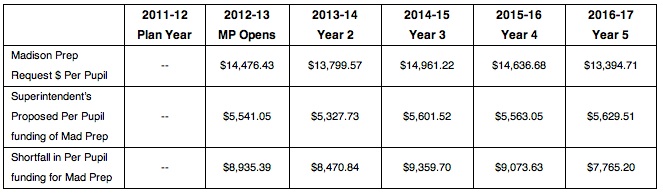
Recent headlines in the Wisconsin State Journal (WSJ) reported that Madison Prep is “less likely” to be approved because of the size of the school’s projected budget. The article implied that Madison Prep will somehow cost the district more than it currently spends to educate children. This, in fact, is not accurate. We are requesting $14,476 per student for Madison Prep’s first year of operation, 2012-2013, which is less than the $14,802 per pupil that MMSD informed us it spends now. During its fifth year of operation, Madison Prep’s requested payment from MMSD drops to $13,395, which is $1,500 less per student than what the district says it spends now. Madison Prep will likely be even more of a savings to the school district by the fifth year of operation given that the district’s spending increases every year.
A March 14, 2011 memo prepared by MMSD Superintendent Daniel Nerad and submitted to the Board reflects the Urban League’s funding requests noted above. This memo also shows that the administration would transfer just $5,541 per student – $664,925 in total for all 120 students – to Madison Prep in 2012-2013, despite the fact that the district is currently spending $14,802 per pupil. Even though it will not be educating the 120 young men Madison Prep will serve, MMSD is proposing that it needs to keep $8,935 per Madison Prep student.


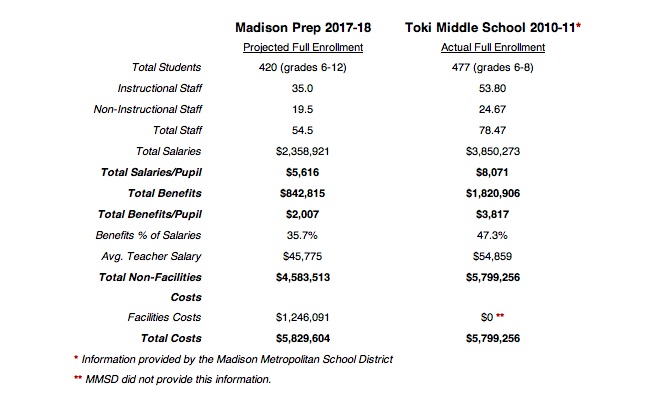
Therefore, the Urban League stands by its request for equitable and fair funding of $14,476 per student, which is less than the $14,802 MMSD’s administration have told us they spend on each student now. As Madison Prep achieves economies of scale, reaches its full enrollment of 420 sixth through twelfth graders, and graduates its first class of seniors in 2017-18, it will cost MMSD much less than what it spends now. A cost comparison between Madison Prep, which will enroll both middle and high school students at full enrollment, and MMSD’s Toki Middle School illustrates this point.


We have also attached four one-page documents that we prepared for the Board of Education. These documents summarize key points on several issues about which they have expressed questions.
We look forward to seeing you!
Onward!
Kaleem Caire
President & CEO
Urban League of Greater Madison
Main: 608-729-1200
Assistant: 608-729-1249
Fax: 608-729-1205
Website: www.ulgm.org


Kaleem Caire, via email.
Madison Preparatory Academy Brochure (PDF): English & Spanish.
DPI Planning Grant Application: Key Points and Modifications.
Update: Madison School Board Member Ed Hughes: What To Do About Madison Prep:

In order to maintain Madison Prep, the school district would have to find these amounts somewhere in our budget or else raise property taxes to cover the expenditures. I am not willing to take money away from our other schools in order to fund Madison Prep. I have been willing to consider raising property taxes to come up with the requested amounts, if that seemed to be the will of the community. However, the draconian spending limits the governor seeks to impose on school districts through the budget bill may render that approach impossible. Even if we wanted to, we likely would be barred from increasing property taxes in order to raise an amount equal to the net cost to the school district of the Madison Prep proposal.
This certainly wouldn’t be the first time that budgetary considerations prevent us from investing in promising approaches to increasing student achievement. For example, one component of the Madison Prep proposal is a longer school year. I’m in favor. One way the school district has pursued this concept has been by looking at our summer school model and considering improvements. A good, promising plan has been developed. Sadly, we likely will not be in a position to implement its recommendations because they cost money we don’t have and can’t raise under the Governor’s budget proposal.
Similarly, Madison Prep proposes matching students with mentors from the community who will help the students dream bigger dreams. Effective use of mentors is also a key component of the AVID program, which is now in all our high schools. We would very much like to expand the program to our middle schools, but again we do not have the funds to do so.

Mr. Hughes largely references redistributed state tax dollars for charter/virtual schools – a portion of total District per student spending – the total (including property taxes) that Madison Prep’s request mentions. I find Madison Prep’s fully loaded school based cost comparisons useful. Ideally, all public schools would publish their individual budgets along with total District spending.

Madison Teachers, Inc. 2011 Candidate Questionnaire

1MB PDF, via a kind reader’s email:. Mayoral Candidate Paul Soglin participated and I found this question and response interesting:


What strategies will you introduce to reduce the 6000+ families who move in and out of Madison Public School classrooms each year?
In the last three years more children opted out of the district than all previous years in the history of the district. That contributed to the increase of children from households below the poverty line rising to over 48% of the kids enrolled.
To stabilize our enrollment we need stable families and stable neighborhoods. This will require a collaborate effort between governments, like the city, the county and the school district, as well as the private sector and the non-profits. It means opening Madison’s economy to all families, providing stable housing, and building on the assets of our neighborhoods.
One decades old problem is the significant poverty in the Town of Madison. I would work with town officials, and city of Fitchburg officials to see if we could accelerate the annexation of the town so we could provide better services to area residents.

Ed Hughes and Marj Passman, both running unopposed responded to MTI’s questions via this pdf document.

MTIVOTERS 2011 School Board Election Questionnaire
Please respond to each ofthe following questions. If you wish to add/clarifY your response, please attach a separate sheet and designate your responses with the same number which appears in the questionnaire. Please deliver your responses to MTI Headquarters (821 Williamson Street) by, February 17, 2011.
General:
If the School Board finds it necessary to change school boundaries due to enrollment, what criteria would you, as a Board member, use to make such a judgement?
Ifthe School Board finds it necessary to close a school/schools due to economic reasons, what criteria would you, as a Board member, use to make such a judgement?
If the School Board finds it necessary, due to the State-imposed revenue controls, to make further budget cuts to the 2011-12 budget, what criteria would you, as a Board member, use to make such a judgement?
IdentifY specific MMSD programs and/or policies which you believe should to be modified, re-prioritized, or eliminated, and explain why.
What should the District do to reduce violence/assure that proper discipline and safety (of the learning and working environment) is maintained in our schools?
Do you agree that the health insurance provided to District employees should be mutually selected through collective bargaining?
_ _ YES _ _ NO Explain your concerns/proposed solutions relative to the District’s efforts to reduce the “achievement gap”.
Should planning time for teachers be increased? If yes, how could this be accomplished?
Given that the Wisconsin Association of School Boards rarely supports the interests of the Madison Metropolitan School District, do you support the District withdrawing from the W ASB? Please explain your rationale.
From what sources do you believe that public schools should be funded?
a. Do you support further increasing student fees? _ _ YES _ _ _ NO
Do you support the Wisconsin Alliance for Excellent Schools’ (WAES) initiative to raise sales tax by 1% to help fund schools?
_ _ YES _ _ NO
Do you support class sizes of 15 or less for all primary grades? _ _ YES _ _ NO
Do you support:
a. The use of public funds (vouchers) to enable parents to pay tuition with tax payers’ money for religious and private schools?
_ _ YES _ _ NO
b. The expansion of Charter schools within the Madison Metropolitan School District? _ _ YES _ _ NO
c. The Urban League’s proposed “Madison Preparatory Academy for Young Men” as a charter school which would not be an instrumentality of the District?
_ _ YES _ _ _ NO
Do you agree that the usual and customary work ofteachers, i.e. work ofthose in MTI’s teacher bargaining unit, should not be performed by others (sub-contracted)?
_ _ YES _ _ NO List MMSD staff and Board member(s) from whom you do or would seek advice.
Is your candidacy being promoted by any organization? _ _ YES _ _ NO
If yes, please name such organization(s). Have you ever been employed as a teacher? If yes, please describe why you left the teaching profession.
Do you support the inclusion model for including Title 1, EEN and ESL students in the regular education classroom? Why/why not?
What grouping practices do you advocate for talented and gifted (TAG) students?
Aside from limitations from lack ofadequate financial resources, what problems to you feel exist in meeting TAG students’ needs at present, and how would you propose to solve these problems?
The Board ofEducation has moved from the development ofpolicy to becoming involved in implementation of policy; i.e. matters usually reserved to administration. Some examples are when it:
a. Decided to hear parents’ complaints about a teacher’s tests and grading. b. Decided to modifY the administration’s decision about how a State Statute should be implemented.
Do you believe that the Board should delegate to administrators the implementation of policy which the Board has created?
_ _ YES _ _ NO
Do you believe that the Board should delegate to administrators the implementation of State Statutes? _ _ YES _ _ NO
Do you support the Board exploring further means to make their meetings more efficient? _ _ YES _ _ _ NO
Do you support a merit pay scheme being added to the Collective Bargaining Agreement _ _ YES _ _ _ NO
If yes, based on which performance indicators?
Do/did/will your children attend private or parochial schools during their K-12 years? Ifno, and ifyou have children, what schools have/will they attend(ed)?
_ _ YES _ _ NO If you responded “yes”, please explain why your child/children attended private parochial schools.
Legislation
Will you introduce and vote for a motion which would direct the Wisconsin Association of School Boards to request the introduction and promote the passage oflegislation to eliminate the revenue controls on public schools and return full budgeting authority to the School Board?
_ _ YES _ _ _ NO
Will you introduce and vote for a motion to direct the Wisconsin Association of School Boards to request the introduction and promote the passage oflegislation to prohibit the privatization ofpublic schools via the use oftuition tax credits (vouchers) to pay tuition with taxpayers’ money to private or religious schools?
_ _ YES _ _ NO
Will you introduce and vote for a motion to direct the Wisconsin Association of School Boards to request the introduction and promote the passage of legislation which will maintain or expand the benefit level of the Wisconsin Family and Medical Leave Act?
_ _ YES _ _ _ NO
Will you introduce and vote for a motion to direct the Wisconsin Association of School Boards to request the introduction and promote the passage oflegislation which will increase the retirement formula multiplier from 1.6% to 2% for teachers and general employees, i.e. equal that of protective employees?
_ _ YES _ _ NO
Will you introduce and vote for a motion to direct the Wisconsin Association of School Boards to request the introduction and promote the passage of legislation which will forbid restrictions to free and open collective bargaining for the selection ofinsurance for public employees (under Wis. Stat. 111.70), including the naming ofthe insurance carrier?
_ _ YES
_ _ NO
Will you introduce and vote for a motion to direct the Wisconsin Association of School Boards to request the introduction and promote the passage of legislation which will guarantee free and open collective bargaining regarding the establishment of the school calendar/school year, including when the school year begins?
_ _ YES _ _ NO
Will you introduce and vote for a motion to direct the Wisconsiu Association of School Boards to request the introduction and promote the passage of legislation to forbid the work of employees organized under Wis. Stat. 111.70 (collective bargaining statute) to be subcontracted?
_ _ YES _ _ NO
Will you introduce and vote for a motion to direct the Wisconsin Association of School Boards to seek passage of legislation which will require full State funding of any State-mandated program?
_ _ YES _ _ NO
Will you introduce and vote for a motion to direct the Wisconsin Association of School Boards to seek passage oflegislation which will provide adequate State funding of public education?
_ _ YES _ _ NO
Do you support a specific school finance reform plan (e.g., School Finance Network (SFN), Wisconsin Alliance for Excellent Schools (WAES), Andrews/Matthews Plan)?
Why/why not? Your Campaign:
Are you, or any of your campaign committee members, active in or supportive (past or present) of the “Get Real”, “ACE”, “Vote No for Change” or similar organizations?
Name ofCampaign Committee/Address/Phone #/Treasurer. List the members ofyour campaign committee.

Chicago’s Urban Prep Academies Visits Madison: Photos & a Panorama

.
Students from Chicago’s Urban Prep Academies visited Madison Saturday, 2/26/2011 in support of the proposed Madison Preparatory IB Charter school. A few photos can be viewed here.
David Blaska:

I have not seen the Madison business community step up to the plate like this since getting Monona Terrace built 20 years ago.
CUNA Mutual Foundation is backing Kaleem Caire’s proposal for a Madison Prep charter school. Steve Goldberg, president of the CUNA Foundation, made that announcement this Saturday morning. The occasion was a forum held at CUNA to rally support for the project. CUNA’s support will take the form of in-kind contributions, Goldberg said.
Madison Preparatory Academy for Young Men would open in August 2012 — if the Madison school board agrees. School board president Maya Cole told me that she knows there is one vote opposed. That would be Marj Passman, a Madison teachers union-first absolutist.
The school board is scheduled to decide at its meeting on March 28. Mark that date on your calendars.
CUNA is a much-respected corporate citizen. We’ll see if that is enough to overcome the teachers union, which opposes Madison Prep because the charter school would be non-union.

Q & A: Charter School Proposal for Madison Preparatory Academy for Young Men

570K PDF:

APPENDIX MMM-7-21 January 31, 2011
Urban League of Greater Madison
SUMMARY
On December 6, 2010, the Urban League of Greater Madison presented an initial proposal for the establishment of Madison Preparatory Academy for Young Men (a non-instrumentality all-boys secondary charter school) to the Planning and Development Committee of the MMSD Board of Education. During the discussion that followed, Board members agreed to submit follow-up questions to the Urban Leagne, to which the Urban Leagne would respond before the next meeting of the Planning and Development Committee. Questions were submitted by Ed Hughes and Lucy Mathiak. Furthermore, Arlene Silveira submitted questions presented to her by several connnunity members. Below each numbered Board member question, you will find the ULGM response.
1. Ed Hughes: Do you have a response to the suggestion that your proposal may violate Wis. Stat. sec. 118.40(4)(c) other than that you also intend sometime in the future to develop and operate a school for girls? If so, what is the response?
ULGM: Please refer to our letter to MMSD Board of Education members that responded to the ACLU’s opposition to Madison Prep. The answer to your question is contained in that letter. We have attached the letter to this document for your review.
2. Ed Hughes: To the extent the information is available to you, please list the 37 or so non instrumentality charter schools currently operating in Wisconsin.
ULGM: The following list of non-instrumentality charter schools currently operating in Wisconsin was compiled from the 20 I 0-20 II Charter Schools Yearbook published by the Department of Public Instruction. You can find the complete Yearbook online at: http://dpi.wi.gov/sms/pdf/2010.llyearbook.pdf
1. Barron, North Star Academy
2. Cambridge, JEDI Virtual High School
3. City of Milwaukee, Central City Cyberschool
4. City of Milwaukee, Darrell Lynn Hines (DLH) Academy
5. City of Milwaukee, Downtown Montessori Academy
6. City of Milwaukee, King’s Academy
7. City of Milwaukee, Milwaukee Academy of Science
8. Grantsburg, Insight School of Wisconsin
9. Hayward, Hayward Center for Individualized Learning
10. Hayward, Waadookodaading Charter School
11. McFarland, Wisconsin Virtual Academy
12. Milwaukee, Carmen High School of Science and Technology
13. Milwaukee, Highland Community School
14. Milwaukee, Hmong American Peace Academy (HAPA)
15. Milwaukee, International Peace Academy
16. Milwaukee, La Causa Charter School
17. Milwaukee, Milwaukee Community Cyber (MC2) High School
18. Milwaukee, Next Door Charter School
19. Milwaukee, Wings Academy
20. Milwaukee, Wisconsin Career Academy
21. Nekoosa, Niikuusra Community School
22. New Lisbon, Juneau County Charter School
23. New Richmond, NR4Kids Charter School
24. Sheboygan, Lake Country Academy
25. UW-Milwaukee, Bruce Guadalupe Community School
26. UW-Milwaukee, Business & Economics Academy of Milwaukee (BEAM)
27. UW-Milwaukee, Capitol West Academy
28. UW-Milwaukee, Milwaukee College Preparatory School
29. UW-Milwaukee, Milwaukee Renaissance Academy
30. UW-Milwaukee, School for Early Development & Achievement (SEDA)
31. UW-Milwaukee, Seeds of Health Elementary School
32. UW-Milwaukee, Tenor High School
33. UW-Milwaukee, Urban Day Charter School, Inc
34. UW-Milwaukee, Veritas High School
35. UW-Milwaukee, Woodlands School
36. UW -Milwaukee, YMCA Young Leaders Academy
37. UW-Parkside, 21st Century Preparatory School
38. Weyauwega-Fremont, Waupaca County Charter School
3. Ed Hughes: Do you have copies of any of the contracts Wisconsin non-instrumentality charter schools have entered into with their school districts? If so, please list the contracts and provide a copy of at least one of them.
ULGM: See attached contracts for Lake Country Academy in Sheboygan and the Wisconsin Virtual Academy in McFarland, which are both non-instrumentality charter schools.
4. Ed Hughes: To the extent the information is available to you, please list the amount ofper.student payment each non-instrumentality charter school in Wisconsin is contractually entitled to receive from its sponsoring school district.
ULGM: We have requested information from the DPI on the current per-student payments to each non-instrumentality charter school in Wisconsin, but we understand that DPI does not now have the information consolidated in one database. We expect that the per-student payment information will be available from DPI by January 17, and we will submit that information to the board and administration as soon as it becomes available from the DPI. The per-pupil payment to each district.authorized charter school in Wisconsin, including instrumentality and non-instrumentality charter schools, is determined through negotiations and mutual agreement between the school district, as the charter school authorizer, and the charter school developer/operator.
5. Ed Hughes: Please identify the minimum per-student payment from the school district that would be required for Madison Prep to be financially feasible from your perspective. If you don’t have a specific figure, provide your best estimate of the range in which that figure is likely to fall.
ULGM: The MMSD Superintendent and Assistant Superintendent-Business in agreement with us that more time is needed to present a projected minimum payment from the school district. DPI’s School Finance Data Warehouse indicates that MMSD reported $14,432 in revenue per student and spent $13,881 per student iu 2008-09. We are certain that we will not request more per student than what MMSD spends annually.
6. Lucy Mathiak: Do you know what Madison Prep will cost the district? And do you know where the money will come from?
ULGM: We have an idea ofwhat our school will cost but as stated in the answer to question number 5, we are working through several costs and line items with MMSD’s Superintendent and Assistant Superintendent-Business. In Wisconsin, public charter schools are funded primarily by school districts or the state legislature (non-school district authorized schools). Generally, private funding is limited to 5% of costs during the budgeting process. However we will raise significantly more in private funding during the pre-implementation and implementation years of the school than we will in out years.
7. Lucy Mathiak: How the financial commitment asked of the district compares to the financial commitment to its existing schools?
ULGM: Assuming you mean existing traditional public schools, we will require more information from MMSD’s administration to make this comparison. Given that Madison Prep will be a new school and a non-instrumentality, there will be costs that Madison Prep has that the school system does not, and vice versa. However, we are firmly committed to ensuring our school is operated within the annual per pupil cost MMSD now spends to educate students in middle and high schools.
8. Community Member, via Arlene Silveira: First of all, has the funding that is indicated as part of the proposal actually been acquired or promised? The proposal indicates $100,000/ year from the Madison Community Foundation, but I can’t find any information from MCF itself about funding Madison Prep. All I can see is that they donated to the Urban League’s capital and Workforce campaigns. Will you check into this? Also, the proposal indicates $250,000/ year for 3 years from Partners for Developing Futures. Last year, despite having received 25 applications for funding from “education entrepreneurs,” this organization did not fund any of them due to the quality of the applications. How is the Madison Prep planning team able to claim this as a source of funding? Have promises been made?
ULGM: The Madison Community Foundation and Partners for Developing Futures were listed as potential revenue sources; these dollars were not committed. Our business plan followed the same approach as most business plans for start-up initiatives: listing prospective revenue sources. However, we do intend to pursue funding through these and other sources. Our private fundraising goals and needs in our five-year budget plan are reasonable.
9. Lucy Mathiak: What additional resources are needed to make the Madison Prep model work?
ULGM: Our school is designed as a demonstration school to be replicable, in whole or in part, by MMSD and other school systems. Therefore, we will not request more than the district’s own annual costs per pupil at the middle and high school levels.
10. Lucy Mathiak: What resources are in hand and what resources will you need to raise?
ULGM: We presently have $50,000 to support the planning of the school, with the offer of additional support. However, we will secure additional private and public funding once the Board of Education formally approves the DPI planning grant application/detailed proposal for Madison Prep.
11. Lucy Mathiak: Ifthere is a proposed endowment, what is the amount of the endowment in hand, the estimated annual rate of return, and the estimated income available for use?
ULGM: New charter schools generally do not budget for endowment in their first few years of operation. We intend to build an endowment at some point and have line items for this in Madison Prep’s budget, but these issues will be decided by the Board ofDirectors ofthe school, for which we will not begin recruiting until the Board of Education approves our DPI plauning grant application/detailed proposal.
12. Ed Hughes: Which parts of your proposal do you require non-instrumentality status to implement?
ULGM: Non-instrumentality status will be vital to Madison Prep’s ability to offer an extended school day, extended school year, as well as the expectations we have of teachers to serve as mentors and coaches to students. The collective bargaining contract between the Board of Education and Madison Teachers, Inc. would not allow for this added instructional time. Yet this added instructional time will be necessary in order for students to meet Madison Prep’s ambitious achievement goals. In addition, our professional development program will also require more hours of training. We also intend to implement other special activities for students and faculty that would not be allowed under MMSD and MTI’s collective bargaining agreement.
13. Ed Hughes: What will be the school’s admission policy? Please describe any preferences that the admission policy will include. To what extent will students who live outside ofthe Madison school district be considered for admission?
ULGM: Madison Prep will comply with all federal and state regulations relating to charter school admissions. In its inaugural school year (20 12-20 13), Madison Prep will be open to any 61h and 7’h grade male student residing within the boundaries of MMSD.
All interested families will complete an Enrollment Form at the Urban League’s offices, online, during community meetings and outreach activities, through local partners, or during a visit to the school (after it opens). If Madison Prep receives less than 45 enrollment forms for either grade (6 and 7) in the tirst year, all students’ who applied will be admitted. If the school receives more than 45 enrollment forms for either grade level in the first year, or enrollment forms exceed the seats available in subsequent years, Madison Prep will hold a public random lottery at a location that provides enough space for applicant students and families. The lottery will be held in accordance with DPI guidelines for random lotteries. If Madison Prep does not fill all available seats, it will continue its grassroots recruitment efforts until it reaches its enrollment goal.
14. Community Member, via Arlene Silveira: We know that Madison Prep won’t accept girls. Will it except boys with Autism or Aspergers? If a boy has a learning disability, will he be allowed to attend? What ifthis learning disability makes it not possible for him to perform above grade level on a standardized test? Will he be allowed in? And can they kick him out if his test scores aren’t advanced/proficient?
ULGM: Please see our answer to question #13. To be clear, Madison Prep will accept students with special learning needs, including students who speak English as a second language. As always, IEP teams will determine on a case-by-case basis if Madison Prep is an appropriate placement for special education students. No Madison Prep student will ever be expelled for academic performance.
15. Ed Hughes: An attraction ofthe proposed school is that it could provide the kind ofiutense academic and other sorts of support that could change the trajectories of its students from failure to success. How will you ensure that your school serves primarily students who require the sort of approach the school will offer in order to be successful?
ULGM: Please see our answer to question #13 and question #16 below. We will go to great lengths to inform parents about Madison Prep as an option for their child, and to recruit students and families to our school. We will over-market our efforts in low-income communities and through media, sports clubs, community centers, churches, employers, and other vehicles that reach these students and their parents. We are also exploring the legality of our ability to set an income goal or threshold for student admissions. Nonetheless, we believe that any young man, regardless of their family background, would be well served by Madison Prep.
16. Ed Hughes: To the extent yon know them, describe what the school’s stndent recruitment and marketing strategies will be.
ULGM: Madison Prep’s marketing plan will support three priorities and goals:
1. Enrollment: Recruiting, retaining, and expanding student enrollment annually -share Madison Prep with as many parents and students as possible and establish a wait-list of at least 20 students at each grade level by June I each year (with the exception of year one).
2. Staffing: Recruiting and retaining a talented, effective, and committed faculty and staff -field qualified applicants for each position in a timeframe that enables us to hire by June 30 each year.
3. Public Image and Support: Building, maintaining, and solidifying a base of support among local leaders, financial contributors, key partners, the media, and the general public.
To ensure the public is well acquainted with the school, Madison Prep, with the support of the Urban League of Greater Madison, will make use of a variety of marketing strategies to accomplish its enrollment, staffing, fundraising, and publicity goals. Each strategy will be phased in, from pre.launch of the school through the first three years of operation. These marketing strategies are less expensive and more sustainable with the budget of a new charter school than television, radio, and popular print advertisements. They also deliver a great return on investment if executed effectively. Each strategy will enable Madison Prep, with its limited staff, to promote itself to the general public and hard-to-reach communities, build relationships, sustain communications and achieve its goals.
A. Image Management: Madison Prep’s logo and images of young men projecting the Madison Prep brand will be featured on the school’.s website, in informational and print materials, and on inexpensive paraphernalia (lapel pins, emblems, ink pens, etc). Students will be required to wear uniforms that include a red or black blazer featuring the Madison Prep emblem, a sweater, a red or black tie, white shirt, black or khaki pants, and black or brown dress shoes. They will also have a gym uniform and athletic team wear that features the Madison Prep emblem. Additionally, Madison Prep will ensure that its school grounds, educational facility, and learning spaces are clean, orderly and well-maintained at all times, and that these physical spaces reflect positive images of Madison Prep students, positive adult males, community leaders, families, and supporters. Madison Prep’s Core Values will be visible through the school as well, and its students, faculty, staff, and Board of Directors will reflect an image in school and in public that is consistent with the school’s Core Values and Leadership Dimensions.
B. Grassroots Engagement: Madison Prep’s founders, Board members, volunteers, and its key staff (once hired) will go door-to-door in target neighborhoods, and other areas within MMSD boundaries where prospective candidates can be found, to build relationships with young men, families, and local community resource persons and advocates to recruit young men to attend Madison Prep. Recruiters will be dressed in the Madison Prep uniform (either a polo shirt, sweater or suit jacket/tie, each showing the Madison emblem, and dress slacks or skirt) and will visit homes in two person teams.
Madison Prep will also partner with City Council members, Advisory Neighborhood Commissioners, and local libraries to host community meetings year-round to promote the school in target neighborhoods and military bases. It will also promote the school to citizens in high traffic residential areas of the city, including metro stops, restaurants, community centers, community health agencies, and at public events. Madison Prep will engage the religious community as well, promoting the school to church leaders and requesting to speak before their congregations or have the church publicize the school during their announcements on Sundays and ministry activities during the week. Area businesses, hospitals, government agencies, foster care agencies, and mentorship programs will be asked to make information available to their patrons, clients, and families. Madison Prep will also seek to form partnerships with the Police Department and Court System to ensure judges, attorneys, neighborhood police officers, and family advocates know about the school and can make referrals of young men they believe will benefit from joining Madison Prep’s school community.
C. Online Presence & Partnerships: Madison Prep will launch a website and update its current Facebook and Twitter pages prior ·to the school opening to expand its public presence. The Facebook page for Madison Prep presently has more than 100 members, has been operational for less than 2 months, and has not yet been widely marketed. The page is used to raise awareness, expand support, communicate progress, announce activities and events, and promote small-donor fundraising campaigns. The website will be used to recruit students, staff, and eventually serve as an entry-point to a member only section on the Internet for faculty, students, and parents. Madison Prep will also seek to establish strategic alliance partnerships with service associations (100 Black Men, Sororities and Fraternities, Civic Clubs or Organizations, etc.), enlisting their participation in the school’s annual events. In addition, Madison Prep will establish partnerships with other public and private schools in the Madison area to recruit students, particularly elementary schools.
D. Viral Marketing: Madison Prep will use email announcements and social networking sites to share its mission, activities, employment opportunities, and successes with its base of supporters and will inspire and encourage them to share the information with their friends, colleagues, parents and young men they know who might be interested in the school. Madison Prep will add to its base of supporters through its other marketing strategies, collecting names and contact information when and where appropriate.
E. Buzz Marketing: Madison Prep will use subtle forms of marketing to recruit students and faculty, increase its donor and support base, and develop a positive public image. The school will maintain an influential board of directors and advisors, will engage notable people and organizations in the school, and will publicize these assets to the general public. The school will also prepare key messages and strategically involve its students, staff, and parents in key events and activities to market its brand -high achieving, thoughtful, forward thinking, confident and empowered young men who are being groomed for leadership and success by equally talented, passionate and committed adults. The messages, images, and quality of interactions that the broader community has with members of the greater Madison community will create a positive buzz about the school, its impact, and the success of its students.
F. School Visits & Activity Participation: Each year, from the week after Thanksgiving through the end of the school year, Madison Prep will invite prospective students and parents, funders, and members of the community to visit the school. A visit program and weekly schedule will be established to ensure that the school day and learning is not interrupted by visitors. Madison Prep will also establish an open visit policy for parents, and will create opportunities for them to leverage their ongoing involvement with the school and their young men. Through nurturing positive relationships with parents, and establishing an enviromnent where they are wanted and respected, Madison Prep will create spokespersons in the community who help grow its student body and community support. Finally, Madison Prep will host an annual community event that engages its school community with the greater Madison community in a day of fun, competitive events for families, and will serve as a resource to parents whose children do not attend Madison Prep by inviting them to participate in its Destination Planning workshops.
G. Popular Media: Madison Prep will allocate resources to market itself on Urban and News Radio during the peak student recruitment season in two phases. Phase I will take place in November 2011 and Phase 2 advertising will take place between Jannary and May 2012. To defray costs, Madison Prep will enlist the support of local and national celebrities for feature interviews, spotlights, and PSAs with Madison Prep’s Leadership to promote the school.
17. Community Member, via Arlene Silveira: It looks like the Charter school is aiming for 50% of its population to be low-income. The middle school my children will go to, Sherman, is 71% low income. Blackhawk is at 62%. Wright is 83%. Sennett is 65%. Cherokee is at 63%. Toki is at 51%. Can we, in good conscious, start a new school-designed to help low income students -that has a lower percentage oflow-income students than six of our existing middle schools?
ULGM: The Urban League has set the 50% low-income target as a floor, not as a ceiling. In fact, we expect that more than 50% of Madison Prep students will qualifY for free or reduced lunch.
Furthermore, we have chosen to use the 50% figure to allow us to be conservative in our budgeting process. No matter what the level of low income students at Madison Prep -50% or higher-the student achievement goals and overall program quality will remain unchanged.
18. Ed Hughes: Have you considered limiting admission to students who have scored minimal or basic on their WKCE tests?
ULGM: No. Madison Prep will be open to any male student who wishes to attend, regardless of past academic performance.
19. Ed Hughes: Some have suggested that Madison Prep could skim offthe most academically.motivated African-American students from the District’s middle and high schools, leaving fewer role models and academic peers for the African-American boys who remain in our existing schools. What is your response to that concern?
ULGM: The notion that charter schools skim off the most motivated students is a common misconception. First, this argument is not logical. Parents/caregivers ofchildren who are academically motivated and doing well in traditional public schools have little incentive to change their students’ educational environment. Those kids will likely stay put. When a parent, teacher, social worker, or school counselor recognizes that a child isn’t doing well in the traditional school and seeks an alternative, the charter school that is sought as an alternative does not in this process gain some advantage. In fact, research suggests the opposite. A 2009 study by researchers at Michigan State University, the University of Wisconsin, and Mathematic Policy Research examined charter schools from across the country to test the “skimming” theory. The researchers found no evidence of skimming. In fact, they found students who go to charter schools typically have LOWER test scores than their counterparts in traditional public schools. (Read the full paper at http://www.vanderbilt.edu/schoolchoice/conference/papers/Zimmer_COMPLETE.pdf)
20. Ed Hughes: Have you extended preliminary or informal offers of employment at Madison Prep to anyone? If so, identify to whom the preliminary or informal offers were made and for which positions.
ULGM:No.
21. Ed Hughes: What will he your strategy for recruiting teachers? What qualifications will you establish for teachers? Please describe the general range of salary and benefits you expect to offer to teachers.
ULGM: Teacher Recruitment -The overarching goal of teacher recruitment will be to hire a highly qualified, passionate, hard-working, diverse staff. The recruitment effort will include casting a wide net that allows Madison Prep to draw from the pool oflocal teachers as well as teachers statewide and nationwide who will embrace the opportunity to help build a school from the ground up. We will recruit though typical both typical means (postings on our website, WECAN, charter school association job pages) as well as through recruitment fairs outside of the state. Our hiring process will take place in early and mid spring rather than late spring and summer so that we may have a competitive edge in recruiting the teachers that are the best fit for Madison Prep. While the Head of School will be responsible for the hiring of teachers, he/she will engage a committee of teachers, community members, parents, and students in the process ofselecting teachers and other staff. In addition to a thorough interview, teacher candidates will be required to teach a sample lesson to a group of students, as well as other interview committee members. Teacher Qualifications-All teachers at Madison Prep will be licensed by the Department of Public Instruction.
General Salary Range and Benefits*-For the 2012-2013 school year, the salary for Master Teachers (of which there will be two) is currently projected to be $61,406 with a signing bonus of $2,000 and a maximum performance bonus of $2,750. The salary for general education teachers is currently projected to be $50,055 for the 2012-2013 school year, with a signing bonus of$2,000 and a maximum performance bonus of$1,750. Madison Prep intends to provide a full range of benefits to its teachers. *Salary and bonus figures are subject to change
22. Ed Hughes: MMSD already has a charter middle school with a very diverse student population -James C. Wright Middle School. If the school district chose to continue James C. Wright as an instrumentality charter school but modeled on your Madison Prep proposal, which components of your proposal do yon think could be implemented at the school and which components of your proposal could not?
ULGM: The Urban League is not in a position to determine how the fundamental elements ofthe Madison Prep proposal could or could not be implemented at James C. Wright Middle School. That determination would have to be made by the district administration and c01mnunity at Wright.
23. Community Member, via Arlene Silveira: Here is the annual report from one of the Urban League charter schools that the proposal cites as a model for Madison Prep:
http://www.doe.mass.edu/charter/reports/2009/annual/0471.doc This is a report from the school’s lO'” year in existence. Please note the test achievement goals and scores on page 4 and compare them with the extremely overconfident goals of the Madison Prep proposal. IfMadison Prep is serious about attaining the goal of 75% oftheir students scoring 22 or higher on the ACT or 1100 or higher on the SAT, how do they plan to achieve this and what will happen with those students who fail to meet this standard? What will happen to the teachers who don’t meet their quota ofstudent test scores above this level? Please investigate these questions in detail and within the framework of Madison Prep processes from admissions through expulsion.
ULGM: The reference to the New Leadership Charter School in Springfield, Massachusetts in the Madison Prep initial proposal was meant to show the precedent for the establishment of charter schools by Urban League affiliates; the New Leadership Charter School is NOT a model for Madison Prep, nor was this ever stated in the initial proposal. That said, Madison Prep IS serious about our student achievement goals related to the ACT and SAT. We plan to meet these goals through-as the proposal states-an all-male student body, the International Baccalaureate Curriculum, college preparatory educational program, Harkness Teaching, an extended school day and year,mentoring and coll1111unity support, and a prep year. Students will be carefully assessed for years leading up to these tests to ensure their preparedness. When formative assessments indicate re-teaching is needed in order to meet the goal, students will receive further individualized instruction. Madison Prep teachers will not have student test score “quotas.”
24. Lucy Mathiak: What would a timeline for the counterpart girls’ school look like?
ULGM: We would like to initiate the process for the girls’ school in the fall of 2012, with an opening aimed at 2014-2015.

I continue to believe that the fate of this initiative will be a defining moment for the Madison School District. If approved and implemented, it will, over time, affect other traditional schools within the District. If it is rejected, a neighboring District will likely step in.
Finally, I found the Urban League’s response to Ed Hughes’ question #5 interesting:
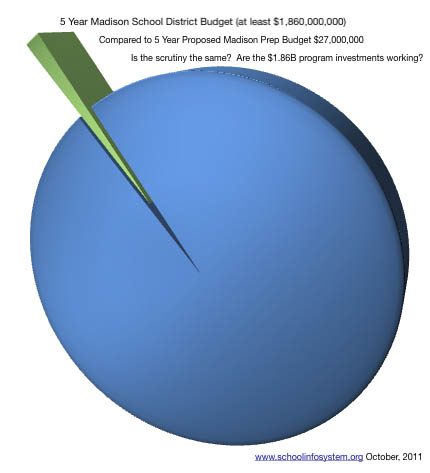

DPI’s School Finance Data Warehouse indicates that MMSD reported $14,432 in revenue per student and spent $13,881 per student iu 2008-09. We are certain that we will not request more per student than what MMSD spends annually.

Proposed Single sex charter school (Madison Prep) funding doesn’t add up

Susan Troller:

There’s been plenty of buzz — much of it positive — surrounding a proposed single sex charter school aimed at improving the academic performance of Madison minority students. Yet a closer look at the financing projections for the Madison Preparatory Academy, starting with the $300,000 the proposal notes is coming from the Madison Community Foundation, raises some questions,
“I have no idea where they got that figure,” says Kathleen Woit, president of the foundation, when asked about the funding. “No, we have not committed to that. We’ll have to get this straightened out.”
The preliminary proposal, presented to the Madison School Board’s Planning and Development Committee Dec. 6, also notes that $1.35 million would be available in six grants of $225,000 through the state Department of Public Instruction’s charter school federal start-up fund. That’s more than twice what is allowable for a school of Madison Prep’s size, and suggests the school would be receiving both implementation and planning grants in two of the four years the school is eligible for start-up money.
“It looks like they are double counting,” says Robert Soldner, director of School Management Services for the Department of Public Instruction. Soldner says that DPI typically helps charters get up and running with several years of funding, starting with a planning grant the first year, an implementation grant the second year and extensions of the implementation grants possible in the next couple of years of operation. Charter schools are not eligible for planning and implementation grants at the same time.

Much more on the proposed Madison Preparatory Academy, here.

Houston School board OKs creation of a school just for boys

No sagging pants and grungy T-shirts will be allowed at this new Houston school.
Neither will bad attitudes.
And neither will girls.
This school, approved by the Houston board of trustees Thursday, will open next fall with only male students. The campus will start with sixth- and ninth-graders, who will have to apply to attend, and will grow annually to become a full middle and high school.
The boys at this new school in Houston’s Fifth Ward will have to wear blazers and ties. They will take advanced courses, learn a foreign language and- the biggest expectation — go on to earn a college degree.
This will be the first all-boys school started directly by the Houston Independent School District, which last month announced plans to open an all-girls campus next year. The district has two other all-boys schools, but they are run by contractors and one is leaving HISD’s umbrella to become a state charter school.

Related: The Proposed IB Charter Madison Preparatory Academy.

Will a boys only, non-union prep school fly in Madison?

Susan Troller

Local attorney and former Wisconsin State Bar Association president Michelle Behnke spoke in favor of Madison Prep, saying both she and her now grown children attended Edgewood High School in preference over Madison public schools. “I am not a gambler,” Behnke, who is black, said during her three minute appearance before the board. She noted that the statistics regarding academic success for minority students in Madison were so bleak that neither she nor her parents felt they could risk a public school education.
Steve Goldberg, representing CUNA Mutual, also testified in favor of the school, saying his organization was looking forward to being involved and supportive of Madison Prep.
According to Caire, extreme measures are needed to deal with the extreme problems facing area black and latino youth in public school settings, claiming that conventional efforts have not yielded significant results. Both the achievement gap and the incarceration rate for black males in Dane County are at the bottom of national statistics.
Caire believes Madison Prep could be an experimental laboratory for change, and that if successful it could be replicated across the Madison district and elsewhere.
“We’ve been trying various approaches for 30 or 40 years and it’s still not working,” he says.

Much more on the proposed IB Charter Madison Preparatory Academy and Kaleem Caire.

Give all-male charter school a chance

Wisconsin State Journal Editorial

The Urban League of Greater Madison’s dramatic proposal for an all-male public charter school deserves open minds and fair consideration from the Madison School Board.
Don’t dismiss this intriguing initiative just because the teachers union is automatically opposed. A new approach to helping more young black men get to college is justified, given the district’s stark numbers:

  • Only 7 percent of black students who took the latest ACT college preparation test were ready for college.
  • Barely half of black students in Madison schools graduated in 2009.
  • Almost three-quarters of the 3,828 suspensions last school year were black students, who make up less than a quarter of the student body

Much more on the proposed IB Charter Madison Preparatory Academy and Kaleem Caire.

Initial Thoughts on the Madison Prep Proposal

Madison School Board Member Ed Hughes:

Thanks to the Kaleem Caire his Urban League team for shining a spotlight on the very troubling issue of the lack of success experienced by so many of our students of color. Thanks even more for proposing a charter school intended to help address this problem. I want the proposal to succeed. But I need to know more about the legality of the proposal’s single-gender approach, a lot more about the projected finances for the school and the extent of the School District’s expected contribution, and more about how the school intends to remain true to its vision of serving Madison’s disadvantaged African-American boys before my sympathetic disposition can grow into active support.

Much more on the proposed IB Charter: Madison Preparatory Academy, here.

Madison Preparatory Academy for Young Men: Initial Proposal to Establish a Charter School

1.1MB PDF; via a Kaleem Caire email:

Based on current education and social conditions, the fate of boys of color is uncertain.
African American and Latino boys are grossly over-represented among youth failing to achieve academic success, are at grave risk of dropping out of school before they reach 10th grade, are disproportionately represented among adjudicated and incarcerated youth, and are far less likely than their peers in other subgroups to achieve to their dreams and aspirations. Likewise, boys in general lag behind girls in most indicators of student achievement.
Research indicates that although boys of color have high aspirations for academic and career success, their underperformance in school and lack of educational attainment undermine their career pursuits and the success they desire. This misalignment of aspirations and achievement is fueled by and perpetuates a set of social conditions wherein men of color find themselves disproportionately represented among the unemployed and incarcerated. Without meaningful, targeted, and sustainable interventions and support systems, hundreds of thousands of young men of color will never realize their true potential and the cycle of high unemployment, fatherless homes, overcrowded jails, incarcerated talent, deferred dreams, and high rates of school failure will continue.
Madison Preparatory Academy for Young Men (Madison Prep) will be established to serve as a catalyst for change and opportunity among young men, particularly young men of color and those who desire a nurturing educational experience for young men.
Madison Prep’s founders understand that poverty, isolation, structural discrimination, lack of access to positive male role models and achievement-oriented peer groups, limited exposure to opportunity and culture outside their neighborhood or city, and a general lack of understanding – and in some cases fear – of Black and Latino boys among adults are major contributing factors to why so many young men are failing to achieve to their full potential. However, the Urban League of Greater Madison – the “founders” of Madison Prep – also understand that these issues can be addressed by directly countering each issue with a positive, exciting, engaging, enriching, challenging, affirming and structured learning community designed to exclusively benefit boys.
Madison Prep will be a non-instrumentality charter school – authorized by the Madison Metropolitan School District Board of Education – that serves an all-male student body in grades 6-12. It will be open to all males residing in Dane County who apply, regardless of previous academic performance. The school will provide a world class secondary education for young men that prepares them for leadership, service, and success at a four-year college or university.
Madison Prep will employ seven Educational Strategies to achieve this mission: an all-male student body, the International Baccalaureate curriculum, a College Preparatory educational program, Harkness Teaching, an extended school day and year, mentoring and community support, and the “Prep Year.”
Madison Prep will also use four key Operational Strategies in order to support the educational strategies: adequate staffing, target student population, appropriate facilities/location, and sufficient funding.
Eight Core Values and Four Leadership Dimensions will additionally serve as underpinnings for the success of Madison Prep and Madison Prep students. These Core Values – Excellence & Achievement, Accountability, Teamwork, Innovation, Global Perspective, Perseverance, Leading with Purpose, and Serving Others – will also root Madison Prep in the Educational Framework of the Madison Metropolitan School District. The Four Leadership Dimensions – Personal, Team, Thought, and Results Leadership – will serve as criteria for student and staff evaluations.
Madison Prep’s educational program will be bolstered by partnerships with businesses, government agencies, professional and membership associations, colleges and universities, and scholarship-providing organizations that have the capacity to bring talent, expertise and resources into the school community to benefit Madison Prep students, faculty, staff, and parents. Madison Prep will also host special activities to engage parents, family members, and the community in the education of their young men. Invitations will be extended to parents, community leaders, and experts to join young men at the Harkness Table to add to their learning and to learn with them.
Seed funding for the establishment of Madison Prep will come from public and private sources, including planning and implementation grants from charter school investment funds, charitable foundations, government agencies, and individuals. Ideally, Madison Prep will be located in a business or higher education environment with access to quality classroom, athletic and laboratory facilities or the ability to create such facilities.
The Urban League of Greater Madison (ULGM or Urban League) will submit a Detailed Proposal for Madison Prep in 2011 to the Madison Metropolitan School District (MMSD) Board of Education to receive approval to open the school in 2012. If approved, the school will open in August 2012 serving 90 boys in grades 6 and 7. The school will grow by one grade level each year until it offers a full complement of secondary grades (6 -12). At maturity, Madison Prep will serve 315 students and graduate its first class of seniors in 2017-18.

Links: Madison Preparatory Academy and Kaleem Caire (interview).
This plan will be presented at the 12/6/2010 Madison School Board meeting.
In many ways, the outcome of this initiative will be a defining moment for our local public schools, particularly in terms of diffused governance, choice, a different curricular approach (potentially a movement away from the one size fits all model), economics and community engagement. If it does not happen in Madison, I suspect it will with a neighboring district.
Page 45:

The Madison Prep Difference
Although it is clear that Madison Prep can and will support MMSD objectives, there is no doubt that Madison Prep will be unique. Madison Prep will be the only all-male public school option in Dane County serving young men when it opens in 2012. Furthermore, the school will be the only IB school in the city offering the full continuum of the IB Programme at the secondary level. Young men enrolled in Madison Prep in 6th grade will begin their education in the IB Middle Years Programme and continue in the curriculum until they move into the rigorous two- year Diploma Programme beginning in 11th grade, thereby increasing their likeliness of success. Finally, while MMSD offers after school activities and care, no school in the district offers a significant amount of additional instructional time through an extended school day and extended school year, as Madison Prep will.

Commentary on the Proposed Madison Preparatory Academy, a Charter School

Kaleem Caire, via email: Chris Rickert:

At some point in the next couple months, members of the Madison School Board are almost certain to be in the unlucky position of having to decide whether to admit what is most fairly characterized as a colossal failure.
Approving a charter for Urban League of Greater Madison President Kaleem Caire’s all-boy, mostly black, non-union Madison Preparatory Academy will make it clear that, when it comes to many black schoolchildren, teachers have failed to teach, parents have failed to parent, and the rest of us have failed to do anything about either.
Reject the charter and risk the false hope that comes from thinking that all these children need is another program and more “outreach.” A tweak here and a tweak there and we can all just keep on keeping on. Never mind that the approach hasn’t seemed to work so far, and that if past is prologue, we already know this story’s end.
Caire’s model would be a radical departure for Madison. The district’s two existing charter schools — Wright Middle School and Nuestro Mundo — don’t exactly trample on hallowed educational ground. They employ union teachers and have the same number of school days and teaching hours as any other non-charter and “broadly follow our district policies in the vast majority of ways,” said district spokesman Ken Syke.

Amber Walker:

I want to thank Kaleem Caire for coming home to Madison and making positive changes. If anyone can make an all-male charter school happen here, he can. The statistics in the article may be alarming to some, but not as alarming to the students and parents who are living these statistics.
I support integration, but how can it be true integration when the education gaps are so large? Who is benefiting? In my eyes, true integration in the school system would support the same quality of education, the same achievement expectations, the same disciplinary measures and so on.
Numbers don’t lie, and what they tell us is that we need to go another route to ensure educational success for black males. If that means opening a charter school to intervene, then let’s do it!

Sally Martyniak:

Instead of the headline “All-male charter school a tough sell,” imagine this one, “Loss to society: Madison schools graduated only 52 percent of black male students in 2009.” Then the reaction to the Urban League’s plan to start a charter school intended to boost minority achievement might have been different.
Reaction in the article discussed all the reasons why people will or should oppose the idea of an all-male charter school, despite its benefits. Let’s not talk about why we should be aghast at the cultural performance disparities in Madison’s schools. And let’s not talk about what we lose as a society when almost half of all black males attending Madison schools fail to graduate.

Marshall Smith:

The comments of John Matthews, head of the Madison teachers union, on charter schools are hyperbole. Saying that the Madison School Board will have no control is a cover for the union not having control.
We can’t argue the importance of good teachers. But the idea that a degree in education, and a union membership, make you the only one capable of performing this role is specious. All of us are teachers, or have been taught meaningfully by individuals with teaching skills. Are we going to let successful teachers teach, or are we going to let their union dictate?
According to Carlo D’Este’s book “Warlord: A Life of Winston Churchill at War,” Churchill, during a lull in his career, learned bricklaying. Hearing this, the British Trade Union Council, in a public relations gesture, offered him a Master’s card.

Douglas Alexander:

Madison Urban League President Kaleem Caire applied for a charter school for males because only 52 percent of black males graduate in Madison schools, while black males are suspended significantly more than the majority white students.
Before anyone responds, they should answer two questions:

  • Are you concerned about these statistics?
  • What are you doing about it?

Much more on the proposed IB Charter school: Madison Preparatory Academy.

“Stand Up Against the MMSD High School Reform”


via a kind reader’s email.
Related:

220K Draft copy of the Madison School District’s “High School Curricular Reform”.

Madison school district to consider alternatives to traditional public schools

Gayle Worland, via a kind reader’s email:

The Madison School District will explore creating more charter schools, magnet schools, and schools-within-schools — in part to help keep middle-class families in the district.
Superintendent Dan Nerad said Tuesday he plans to appoint a committee next month to study alternatives to the traditional public school.
The group will include district staff as well as members from the community and will work on the project for about a year, Nerad said Tuesday in a meeting with the State Journal editorial board.
“I don’t know what they’ll come back with, but it’s something that I think is certainly worth investigating, and worth discussion,” School Board member Arlene Silveira said of the committee. “It’s kind of exciting — there’s so many ways to deliver education now.”

Related:

220K Draft copy of the Madison School District’s “High School Curricular Reform”.
Promising. We’ll see how it plays out.

An Update on Madison Preparatory Academy: A Proposed International Baccalaureate Charter School

Kaleem Caire, via email:

October 8, 2010
Greetings Madison Prep.
It was so wonderful to have those of you who were able to join us for the information session Tuesday night (Oct 5) here at the Urban League. We appreciate you dedicating part of your evening to learning about Madison Preparatory Academy for Young Men and we look forward to working with you on this very important project. You are receiving this email because you volunteered to join the team that is going to put Madison Prep on the map!
There are a few things we want to accomplish with this email:
1. Share information about the project management website that we’ve established to organize our communications and planning with regard to developing the school
2. Secure dates and times that you’re are available to attend the first of your selected Design Team meeting(s)
3. Provide, as promised, background information on Madison Prep along with hyperlinks that will help you educate yourself on charter schools and components of the Madison Prep school design
Please SAVE this email as it contains a number of information resources that you will want to refer back to as we engage in planning Madison Prep. There is a lot of information here and we DO NOT expect you to read everything or learn it all at once. Take your time and enjoy the reading and learning. We will guide you through the process. J
PROJECT MANAGEMENT WEBSITE
Today, you will receive an email with a subject line that reads, “You’re invited to join our project management and collaboration system.” Please open this email. It will contain the information you need to sign up to access the Madison Prep Project Management Site. You will need to select a username and password. FYI, Basecamp is used by millions of people and companies to manage projects. You can learn more about basecamp by clicking here. Once in the site, you can click on the “help” button at the top, if necessary, to get a tutorial on how to use the site. It is fairly easy to figure out without the tutorial. If you have spam controls on your computer, please be sure to check your spam or junk mail box to look for emails and posting that we might make through Basecamp. Occasionally, postings will end up there. Please approve us as an email “sender” to you.
We have already posted the business plan for the original school (NextGen Prep) that is the same model as Madison Prep. We’ve also posted other important documents and have set a deadline of Friday, October 15, 2010 for you to review certain documents that have been posted. The calendar shown in Basecamp will include these assignments. Please email me or Ed Lee (elee@ulgm.org) if you have questions about using this site.
DATES FOR DESIGN TEAM MEETINGS
At the Interest Meeting we held on Tuesday (or in other conversation with us), you indicated a preference for getting involved in one of the following design teams. Please click on the name of the team below. You will be taken to www.doodle.com to identify your availability for these meetings. Please share your availability by Monday, October 11 at 12pm so that we can send out meeting notices that afternoon. We will address the dates and times of future meetings at the first meeting of each team. Please note, you do not need to be a “charter school” expert to be involved with this. You will have a lot of fun working towards developing a “high quality public charter school” and will learn in the process.
· Curriculum & Instruction Team. This design team will develop a thorough understanding of the IB curriculum and define the curriculum of the school, including the core and non-core curriculum. At least for the first meeting of this design team, Instructional strategies will be addressed as well. The Instruction team will develop a thorough understanding of the Harkness teaching method, outline instructional best practices, and address teacher expectations and evaluation. Both teams will address special education and English Language Learners (ELL). Additional details will be shared at the first meeting.
· Governance, Leadership & Operation Team. This design team will help develop the school’s operations plan, define the governing structure, and address the characteristics and expectations of the schools Head of School. The Head of School will be the instructional leader and therefore, there will be some overlapping conversations that need to occur with the team that addresses instruction and quality teaching.
· Facility Team. This team will be responsible for identify, planning, and securing a suitable facility for Madison Prep.
· Budget, Finance & Fundraising Team. This team will be involved with developing Madison Prep’s budget and fundraising plans, and will explore financing options for start-up, implementation, and the first four years of the school’s operation.”
· Community Engagement & Support Team. This team will develop strategies and work to establish broad community support for Madison Prep, develop criteria for partnering with others, and establish partnerships that support teaching, learning, leadership, and community engagement.
BACKGROUND ON MADISON PREPARATORY ACADEMY AND CHARTER SCHOOLS
There is a lot of good support and buzz growing around Madison Preparatory Academy for Young Men (charter school). To ensure you have the opportunity to familiarize yourself with charter schools and single gendered school models, we have listed internet resources below that you can visit and review. Just click on the hyperlinks.
Madison Preparatory Academy for Young Men will be an all-male charter school that we intend to open in the Madison area in the fall of 2012. It will serve as a high quality school option for parents as well as a demonstration school for secondary education reform and improvement in Dane County. We want local teachers and schools to learn from Madison Prep, and will take steps
We have attached the two page executive summary again for your review along with a business plan for the school (that will be modified to fit Madison). Madison Prep was originally to be launched as a charter school in Washington, DC and Prince Georges County, Maryland in 2011 and 2013 under Next Generation, an organization I founded in Maryland with my wife and other partners in 2006.
ABOUT CHARTER SCHOOLS
In 2009, there were 5,043 charter schools in the United States compared to 33,740 private schools and 98,916 traditional public schools. Nationally, charter schools enrolled 1,536,079 students in 2009. According to the Wisconsin Charter School Association, there are more than 223 charter schools in Wisconsin serving more than 37,432 students. There are presently just two charter schools in Madison: James C. Wright Middle School on Madison’s South side, founded in 1997 (originally as Madison Middle School 2000).
Until recently, other school districts in Wisconsin have been more open to charter schools. Appleton (14), Janesville (5), Kenosha (6), LaCrosse (4) and Milwaukee (66), Oshkosh (6), Sheboygan (7), Sparta (4), Stevens Point (7), and Waukesha (6) have authorized a significant number of public charter schools when considering the size of their total school district enrollments. However, recent enthusiasm around the formation of Badger Rock School is a sign that Madison area school districts could be more receptive to innovative charter school models that serve a specific community need and purpose. With your support and that of many others, we intend to make a very strong case for Madison Prep and why it’s so desperately needed in our community.
DESIGNING MADISON PREP
In Maryland, our team spent three years researching and designing the school and the curriculum. Members of the founding team were involved in the establishment and/or leadership of Bishop John T. Walker School for Boys , Septima Clark Public Charter School , The SEED Foundation and Public Charter Schools, Sidwell Friends School (where President Obama’s children attend), and Hyde Leadership Public Charter School . We had an expert on international baccalaureate education lead our curriculum design. We also worked closely with the leadership and faculty of other private and charter schools as we developed the business plan, curriculum and education program, including Washington Jesuit Academy , the St. Paul’s School in Baltimore, and Philips Exeter Academy in New Hampshire. The school will utilize the highly regarded college-preparatory International Baccalaureate (IB) curriculum and the teaching methodology will be rooted in Harkness instruction. St. Paul’s also has a school for girls – the St. Paul School for Girls.
Prior to being hired as President & CEO of the Urban League of Greater Madison (ULGM), I shared with our ULGM board that I would look to establish charter schools as a strategy to address the persistent underperformance and failure of our children attending Madison area schools. As we have engaged our community, listened to leaders, researched the issues, and evaluated the data, it is clear that Madison Prep is not only needed, but absolutely necessary.
SINGLE GENDERED PUBLIC SCHOOLS
As of June 2010, there were 540 public schools in the U.S. offering a single-gendered option, with 92 schools having an all-male or all-female enrollment and the rest operating single gendered classes or programs. There were 12 public schools in Wisconsin offering single gendered classes or classrooms (6 middle schools, 5 high schools, and one elementary school).
There are several single gendered charter schools for young men that have garnered a lot of attention of late, including Urban Prep Academies in Chicago – which sent 100% of its first graduating class to college, The Eagle Academy Foundation in New York City, Boys Latin of Philadelphia, and Brighter Choice Charter School for Boys and Green Tech High School in
Albany, NY,
Bluford Drew Jemison Academy in Baltimore.
MORE ABOUT CHARTER SCHOOLS
To learn more about charter schools, visit the following websites:
US Charter Schools
Information Website
Starting a Charter School
National Alliance of Public Charter Schools, Washington, DC
National Association of Charter School Authorizers, Chicago, IL
District of Columbia Public Charter School Board, Washington, DC (one of the best authorizers of charter schools; the local school board will authorize our school)
Center for Education Reform, Washington,
Wisconsin Charter School Association
Madison, WI
Wisconsin Department of Public Instruction (Charter Schools), Madison ,WI
Green Charter Schools Network, Madison, WI
National Council of LaRaza Charter School Development, Phoenix, AZ
Coalition of Schools Educating Boys of Color (COSEBC), Lynn, MA
National Association for Single Sex Public Education Exton, PA
The Gurian Institute,
Colorado Springs, CO
Some of the more highly recognized and notable “networks” of charter
schools:
Green Dot Public Schools, Los Angeles, California
KIPP Schools, San Francisco, CA
Aspire Public Schools, Oakland, CA
Achievement First Schools, New Haven, CT
Uncommon Schools, New York, NY
Other Programs of interest:
America’s Top Charter Schools, U.S. News & World Report (2009)
New Leaders for New Schools, New York,
NY
Teach for America, New
York, NY
Teacher U, New York, NY
Early College High Schools
Charter School Financing (excluding banks):
State of Wisconsin Charter School Planning and Implementation Grants (planning, start-up, and implementation)
Walton Family Foundation, Bentonville, AR (planning, start-up, and implementation; however, only focus in Milwaukee right now but we can talk with them)
Partners for Developing Futures, Los Angeles, CA (planning, start-up, and implementation)
IFF, Chicago, IL (facilities)
Building Hope, Washington, DC (facilities)
Charter School Development Center, Hanover, MD (facilities)
Local Initiatives Support Corporation, New York, NY (facilities)
NCB Capital Impact, Arlington, VA (facilities)
Raza Development Fund, Phoenix, AZ (facilities)
We look forward to getting Madison Prep off the ground with you! WE CAN DO THIS!!
Whatever it Takes.
Onward!
_____________________________________________
Kaleem Caire
President & CEO
Urban League of Greater Madison
2222 South Park Street, Suite 200
Madison, WI 53713
Main: 608-729-1200
Assistant: 608-729-1249
Mobile: 202-997-3198
Fax: 608-729-1205
Email: kcaire@ulgm.org
Internet: www.ulgm.org
Facebook: Click Here

Next Generation Preparatory Academy for Young Men Empowering Young Men for Life 1.5MB PDF and Madison Preparatory Academy Overview 150K PDF.
Related: Kaleem Caire video interview.

Urban League of Greater Madison CEO invited to Oprah Winfrey Show

Kaleem Caire, via email:

September 21, 2010
Dear Friends & Colleagues,
Today, our President & CEO, Kaleem Caire, was invited to participate in a taping of the Oprah Winfrey Show as a member of the studio audience for a town hall discussion Ms. Winfrey is having on education reform as a follow-up to her show yesterday on the critically acclaimed documentary, “Waiting for Superman.” The film is directed by award winning filmmaker, David Guggenheim, the creative genius behind AN INCONVENIENT TRUTH.
Ms. Winfrey has invited leaders in education, along with parents, community, business leaders, and students to discuss what needs to be done to fix America’s public schools. The full format has not yet been shared but guests have also been invited to view a showing of Waiting for Superman Thursday evening at her studio. The show will air this Friday afternoon. If anything should change, we will let you know.
Considering just 7 percent of Madison’s African American graduating seniors in the class of 2010 who completed the ACT college entrance exam were considered “college ready” by the test-maker (93 percent were deemed “not ready”), it is more important now than ever that the Urban League, our local school districts, local leaders, and other organizations move swiftly and deliberately to implement solutions that can move our children from low performance to high performance. It is even more important that we provide our children with schools that will prepare them to succeed in the economy of the future . With the right approaches, we believe our education community can get the job done!
We look forward to working with our partners at the United Way of Dane County, Madison Metropolitan School District, Boys & Girls Clubs of Dane County, YMCA of Dane County, Madison Community Foundation, Great Lakes Higher Education, and many others to get our youth on the right track.
Madison Prep 2012
Whatever it Takes!

Much more on the proposed Charter IB Madison Preparatory Academy here.

As the Madison school year starts, a pair of predicaments

Paul Fanlund, via a kind reader:

In fact, the changing face of Madison’s school population comes up consistently in other interviews with public officials.
Police Chief Noble Wray commented recently that gang influences touch even some elementary schools, and Mayor Dave Cieslewicz expressed serious concern last week that the young families essential to the health and vitality of Madison are too often choosing to live outside the city based on perceptions of the city’s schools.
Nerad says he saw the mayor’s remarks, and agrees the challenge is real. While numbers for this fall will not be available for weeks, the number of students who live in Madison but leave the district for some alternative through “open enrollment” will likely continue to grow.
“For every one child that comes in there are two or three going out,” Nerad says, a pattern he says he sees in other urban districts. “That is the challenge of quality urban districts touched geographically by quality suburban districts.”
The number of “leavers” grew from 90 students as recently as 2000-01 to 613 last year, though the increase might be at least partly attributed to a 2007 U.S. Supreme Court ruling that greatly curtailed the ability of school districts to use race when deciding where students will go to school. In February 2008, the Madison School Board ended its long-standing practice of denying open enrollment requests if they would create a racial imbalance.
Two key reasons parents cited in a survey last year for moving children were the desire for better opportunities for gifted students and concerns about bullying and school safety. School Board member Lucy Mathiak told me last week that board members continue to hear those two concerns most often.
Nerad hears them too, and he says that while some Madison schools serve gifted students effectively, there needs to be more consistency across the district. On safety, he points to a recent district policy on bullying as evidence of focus on the problem, including emphasis on what he calls the “bystander” issue, in which witnesses need to report bullying in a way that has not happened often enough.
For all the vexing issues, though, Nerad says much is good about city schools and that perceptions are important. “Let’s be careful not to stereotype the urban school district,” he says. “There is a lot at stake here.”

Related: the growth in outbound open enrollment from the Madison School District and ongoing budget issues, including a 10% hike in property taxes this year and questions over 2005 maintenance referendum spending.
The significant property tax hike and ongoing budget issues may be fodder for the upcoming April, 2011 school board election, where seats currently occupied by Ed Hughes and Marj Passman will be on the ballot.
Superintendent Nerad’s statement on “ensuring that we have a stable middle class” is an important factor when considering K-12 tax and spending initiatives, particularly in the current “Great Recession” where housing values are flat or declining and the property tax appetite is increasing (The Tax Foundation, via TaxProf:

The Case-Shiller index, a popular measure of residential home values, shows a drop of almost 16% in home values across the country between 2007 and 2008. As property values fell, one might expect property tax collections to have fallen commensurately, but in most cases they did not.
Data on state and local taxes from the U.S. Census Bureau show that most states’ property owners paid more in FY 2008 (July 1, 2007, through June 30, 2008) than they had the year before (see Table 1). Nationwide, property tax collections increased by more than 4%. In only four states were FY 2008’s collections lower than in FY 2007: Michigan, South Carolina, Texas and Vermont. And in three states–Florida, Indiana and New Mexico–property tax collections rose more than 10%.

It will be interesting to see what the Madison school District’s final 2010-2011 budget looks like. Spending and receipts generally increase throughout the year. This year, in particular, with additional borrowed federal tax dollars on the way, the District will have funds to grow spending, address the property tax increase or perhaps as is now increasingly common, spend more on adult to adult professional development.
Madison’s K-12 environment is ripe for change. Perhaps the proposed Madison Preparatory Academy charter school will ignite the community.

UW researcher surprised by ‘magnitude of grimness’ of Wisconsin achievement gap

Jesse Opoien:

Without trying to pin it on one magic solution — what are some of the potential solutions that are being discussed?
There’s plenty of research that says you get the most bang for your buck in investing in the early childhood grades. That probably still holds true. But at the same time, if you invested in high quality preschool and then let chips fall where they may, many of those positive effects will eventually deteriorate.
My sense is that the efforts to identify high-performing schools, high-quality schools regardless of what sector they’re in — public, charter or private — identifying the characteristics of high-performing schools regardless of sector, and trying to replicate them.
The other thing we’ve known for a long time is the single biggest within-school factor or influence on student achievement, in this order, are the quality of the teacher and the quality of the principal. Investing in ways of identifying effective teachers and helping them get better is almost always a good investment. It’s hard work, but it’s a good investment.
The other thing in terms of causes worth mentioning: there’s plenty of research that shows we have inequitable distributions of teacher quality. The higher the poverty rate, the more likely students are to be taught by a younger, less effective teacher. We can look at ways of trying to incentivize the most effective teachers to teach in the neediest schools. There are some positive signs here, but it’s nothing that’s going to be fixed over night.

Related: the rejected Madison Preparatory IB charter school.

Mayor Paul Soglin Discusses Education Reform with U.S. Secretary of Education Arne Duncan

City of Madison, via a kind reader’s email:

Mayor Paul Soglin joined U.S. Secretary of Education Arne Duncan, other mayors and school superintendents in Washington, DC, today to discuss partnership opportunities between cities and the U.S. Department of Education to foster effective approaches to education reform.
Participating city leaders are part of a new Mayors’ Education Reform Task Force co-chaired by National League of Cities (NLC) First Vice President Chris Coleman, Mayor of Saint Paul, MN, and NLC Second Vice President Ralph Becker, Mayor of Salt Lake City, UT. Mayors Coleman and Becker formed the task force in March 2013 to explore how cities can and should be involved in local education reform efforts.
During today’s meeting, task force members highlighted the growing commitment by municipal officials across the country to promoting educational achievement.
“Mayors and elected officials can bring together all the stakeholders in the education conversation in their cities,” said Mayor Soglin. “The perspectives from mayors of cities large to small are valuable to local and national policymakers. I’m glad we had an opportunity to talk with the Secretary and his staff about the role mayors can play in education transformation.”
Local leaders shared examples of city-school partnerships they have formed in their communities in areas such as school improvement, early learning, afterschool programming, and postsecondary success.
“The trajectory of learning begins at birth and extends over a lifetime,” said Mayor Becker, who was unable to attend the meeting. “Cities now experience an unprecedented level of collaboration and discussion in formulating specific plans for postsecondary access and success and productive out-of-school time learning.”
The meeting with Secretary Duncan provided mayors with an opportunity to discuss how lessons learned at the city level can inform federal education policy. Among the key issues of concern identified by the task force are:

  • Finding a “third way” in education reform that balances a commitment to accountability with a spirit of collaboration among school administrators, teachers, and cities;
  • Transforming schools into centers of community that support parent engagement and provide wraparound services to children and families;
  • Building on successful “cradle-to-career” models to develop a strong educational pipeline;
  • Securing adequate and equitable funding for local education initiatives; and
  • Promoting college access and completion.

“In this global economy, cities and towns depend on an educated workforce and schools are depending on us. We need to work together to ensure that our children graduate high school ready for postsecondary education and career success,” said NLC President Marie Lopez Rogers, Mayor of Avondale, AZ. “As city leaders, we have an important message that must be heard and we must be at the table in guiding federal and local education reform policies.”
In addition to Mayors Soglin, Coleman and Becker participants in today’s meeting included: Mayor Karen Freeman-Wilson of Gary, Indiana; Mayor Edna Branch Jackson of Savannah, Georgia; Mayor Dwight Jones of Richmond, Virginia; Mayor Pedro Segarra of Hartford, Connecticut; Riverside (Calif.) Unified School District Superintendent Rick Miller; Gary Community School Corporations Superintendent Cheryl Pruitt; and New York City Deputy Chief Academic Officer Josh Thomases.
The National League of Cities (NLC) is dedicated to helping city leaders build better communities. NLC is a resource and advocate for 19,000 cities, towns and villages, representing more than 218 million Americans.

Related:

Urban League leader blasts hand-wringing about city’s image

Paul Fanlund:

During 2011, Kaleem Caire became a household name in local public affairs by leading a passionate but ultimately unsuccessful fight to create the proposed Madison Preparatory IB charter school.
When I mentioned it in an interview at his Park Street office last week, Caire, president and CEO of the Urban League of Greater Madison, instantly recited the date of the Madison School Board’s 5-2 rejection (Dec. 19, 2011).
Madison Prep was to be an academically rigorous school of mostly minority students who would dress in uniforms and be divided by gender. The school day would be longer and parental involvement required. Teachers would also serve as mentors, role models and coaches. The goal was to lessen the city’s achievement gap between white and minority students.
But the board voted no, citing unanswered questions and worries about costs. Also in play were teacher union trepidations and widespread skepticism about the charter school concept, a favorite of conservatives, in liberal Madison.

Related: Achievement gap exists for both longtime, new Madison students.
Madison School district must solve problems no matter where they originate.
When all third graders read at grade level or beyond by the end of the year, the achievement gap will be closed…and not before (November, 2005).
Madison Mayor Paul Soglin: “We are not interested in the development of new charter schools”.

The Plight of Young, Black Men Is Worse Than You Think

Peter Coy:

The U.S. has the highest incarceration rate of any wealthy nation, with about 2.3 million people behind bars at any given moment. (That’s 730 out of 100,000, vs. just 154 for England and Wales.) There are more people in U.S. prisons than are in the country’s active-duty military. That much is well known. What’s less known is that people who are incarcerated are excluded from most surveys by U.S. statistical agencies. Since young, black men are disproportionately likely to be in jail or prison, the exclusion of penal institutions from the statistics makes the jobs situation of young, black men look better than it really is.
That’s the point of a new book, Invisible Men: Mass Incarceration and the Myth of Black Progress, by Becky Pettit, a professor of sociology at the University of Washington. Pettit spoke on Thursday in a telephone press conference.

Related: Robert Francis, the Texan judge closing America’s jails

Until recently, these people would have been discarded in overcrowded prisons. After all they were caught in Texas – the toughest state of a nation that locks up more offenders than any other in the world, with more than one in every 100 adults behind bars. Instead they receive counselling and assistance with housing and employment, although they can be sent back to jail if they fail drug tests, abscond or reoffend. One woman, a crystal meth addict, tells me the sessions in court are like walking on eggshells. But there are small incentives for those doing well, such as $10 gift vouchers or – on the day I visited – barbecue lunch out with Francis. “These people have to believe we care and want them to succeed,” he tells me later. “Once they believe in me they can start to change.”
They are beneficiaries of a revolution in justice sweeping the United States, one with illuminating lessons for Britain. It is a revolt led by hardline conservatives who have declared prison a sign of state failure. They say it is an inefficient use of taxpayers’ money when the same people, often damaged by drink, drugs, mental health problems or chaotic backgrounds, return there again and again.
Remarkably, this revolution was unleashed in “hang ’em high” Texas, which prides itself on its toughness and still holds more executions than other states. But instead of building more prisons and jailing ever more people, Texas is now diverting funds to sophisticated rehabilitation programmes to reduce recidivism. Money has been poured into probation, parole and specialist services for addicts, the mentally ill, women and veterans. And it has worked: figures show even violent crime dropping at more than twice the national average, while cutting costs and reducing prison populations.

Much more on the proposed Madison Preparatory IB charter school, here.

“I think we have come a long way”

NBC15:

“I think we have come a long way,” said Superintendent Jane Belmore. “The district, as you may know, developed a pretty ambitious achievement plan last year and came out to the community and talked with folks in the community about it, got a lot of buy-in and there are lots of community organizations that are really behind us on that.”
Superintendent Belmore says it will take a number of years to complete the process–but says they’re fortunate to have the resources to help put it into play this year. “We have a plan that we’re now looking at, really what I’m calling kind of sorting the priorities of the priorities, because it’s very ambitious,” she said. “We’re not going to be able to do everything at the same level, at the same time, but we’re really figuring out what the things are that are going to give us the most leverage.”
The Urban League of Greater Madison has been on the forefront of the fight to address the achievement gap. President and CEO Kaleem Caire says he thought the achievement gap plan was too broad to begin with.

Links:

New Orleans Urban League College Track Graduation Event Tonight


via a kind email.
Perhaps, one day, Madison will take bold steps to address its reading (more) and math challenges. The recent rejection of the proposed Madison Preparatory IB charter school proposal illustrates how far our community must travel.
About College Track:

College Track is the catalyst for change for under-resourced high school students who are motivated to earn a college degree. Since its inception, College Track has grown each year, strengthening its services and expanding its program to support more and more students.

Rigorous college prep program (International Baccalaureate) helps CPS students get into selective colleges

Lauren Chooljian:

New research shows Chicago Public Schools students enrolled in a rigorous college prep program, known as the International Baccalaureate Diploma Programme, are much more likely to get into good colleges.
The IB programs are located in neighborhood high schools around the city. Launched in 1997, the college prep programs were inspired by a long-running IB program in Lincoln Park High School. According to the study, released Wednesday, the programs have increasingly been used by the school district as a to provide a “high-quality education to high-achieving students, regardless of their mobility.”
The study was completed by the University of Chicago Consortium on Chicago School Research. Their research found that students in the IB programs have a greater chance of not only getting into selective four-year colleges, but also staying there.

THe the proposed Madison Preparatory IB charter school featured an International Baccalaureate curriculum.

Achievement gap needs public’s greater scrutiny

Eric Hill:

You’ve undoubtedly read about the Madison Metropolitan School District’s recent initiative to close the racial and socioeconomic achievement gap that’s been plaguing the city for decades. This sudden shift in collective focus is likely the result of the Urban League of Madison’s recent Madison Prep charter school proposal. If not, it’s important to note that the proposal would open two schools to serve a portion of youth from some of city’s most under-served communities. They would borrow from formulas being used by highly effective charter schools across the country to get at-risk youth achieving at levels consistent with their more fortunate counterparts. But despite it being sound, well-funded and supported by evidence, the plan was ultimately voted down by the Madison school board in favor of the unchanging system that guarantees nothing but persistent failure.
The only silver lining to emerge from the school district’s disappointing decision is that the community has a renewed sense of urgency around the issues of education inequality in Madison.

Much more on the proposed Madison Preparatory IB charter school, here.

We Need Transformational Change, and We Can Do it!

Kaleem Caire, via email:

Kaleem Caire, President/CEO
February 21, 2012
Dear Friends & Colleagues.
I read yesterday’s article by Paul Fanlund of the Capital Times titled, “On School Gap Issue, there’s also a Gap between Leaders.” In his article, he addresses the perception of a gap that exist between Madison School’s superintendent, Dr. Daniel Nerad, and myself.
Is there a gap?
Yes. So far as our proposal for Madison Preparatory Academy is concerned, there is a gap. Dr. Nerad did not support the proposal. I do. I still believe, as thousands of others do, that Madison Prep would benefit children and our public schools, and should be supported.
However, beyond Madison Prep, the only gaps that may exist between Dr. Nerad and me are our different personal and professional backgrounds and experiences; his full silver top and my emerging grey hairs; my love for old school hip hop, break dancing and the cupid shuffle, and his love for disco, the mashed potato and the electric slide; and perhaps our respective views about how innovative and aggressive we should be in pursuing change in public education. Although, I did see Dr. Nerad bobbing his head to some Jay-Z, Nas and Kanye West tunes while driving down Park Street last week. We actually might not be that far apart after all (smile).
But these are authentic differences that can be mitigated and parlayed into a powerful and effective partnership, which is something that I am very interested in. More importantly, our mutual concerns outweigh our differences, and that is where we, the media and the public need to focus our attention.
What’s immediately concerning is that this summer, we will learn that another 350 Black, 200 Latino and 50 Southeast Asian teenagers stopped attending school this year. Our children cannot wait any longer. They need transformation change in our schools and community right now. They need Madison to empower them, their families and embrace their cultural differences. They need Madisonians to support and inspire them, not quietly complain about which neighborhood in Chicago they might come from.
Can Dr. Nerad and I work together?
Of course we can; and, we do. This week, we will announce that our organization has secured private funding to partner with MMSD to operate 14 College Readiness Academies between March and December 2012. These academies will provide four-weeks of free ACT prep classes, test preparation and academic skills development to 200 MMSD high school juniors and seniors.
We will also announce the hiring of the Project Director for the South Madison Promise Zone Initiative that we are spearheading. This initiative will address the need for a comprehensive and collaborative approach to addressing the multifaceted needs of children and their families within a specific geographic region of South Madison, with the ultimate goal being the creation of an environment where all children are ready for college. MMSD is a partner in this initiative, too.
Additionally, our agency operates the Schools of Hope Initiative, serving more than 1,300 students in several MMSD middle and high schools in partnership with the United Way of Dane County and other agencies and community partners. We have also worked over the last 2 years to identify federal and national funding to support the work of MMSD and its students, and have helped the District think through some its diversity hiring strategies.
Beyond these things, we are exploring partnerships to expand our children’s involvement in recreational sports and the arts; to give them opportunities to have fun and be kids. We are also planning a new, major annual fall event aimed at building broad community support for our children and schools and restoring fun and inspiration in public education. “School Night” will be an entertaining celebration that recognizes the unsung heroes in our schools, classrooms and community who are going above and beyond the call of duty to provide quality educational experiences for kids.
What About Dr. Nerad’s Plan?
We look forward to sharing our thoughts and suggestions in the coming weeks. However, don’t expect a thoughtless or categorical critique of Dr. Nerad’s plan. Instead of adding more divisive discourse to public education and highlighting where we disagree with Dr. Nerad’s plan, our proposal will flesh out “how” MMSD could, in a cost effective manner, identify and manifest the level of system-wide changes and improvements that we believe are needed in order to eliminate the achievement gap and stop the flow middle class families out of our community and public schools.
Yes, Madison Prep will be included as one valuable strategy, but only because we believe there is much to be gained from what the school can accomplish.
In the end, regardless of our differences, I believe Dr. Nerad and I want the same thing. We want our children and schools to succeed, and we want to keep dancing and having fun for as long as our knees will allow. I remain ready and willing to do whatever it takes to ensure that we achieve these aims.
Onward!
Kaleem Caire
President & CEO
Urban League of Greater Madison
Phone: 608-729-1200
Fax: 608-729-1205
www.ulgm.org

Much more on the proposed Madison Preparatory IB charter school, here.

How Wide Are the Racial Opportunity Gaps in Your Metro?


Margery Turner:

In December, MetroTrends graded America’s 100 biggest metros on measures of economic security. Today we offer a new report card, with grades reflecting the opportunity gaps facing African Americans and Latinos.
We’re all well aware of the national story. Despite the huge achievements of the civil rights era, neither African Americans nor Latinos (on average) enjoy the same school quality, job opportunities, or homeownership access as whites. But the picture isn’t the same in every metro area. So our report card scores metros on five factors: residential segregation, neighborhood affluence (for the average black, Latino, and non-Hispanic white), public school quality (for the average black, Latino, and non-Hispanic white student), employment (among working-age adults), and homeownership.
Let’s start by looking at the grades for black-white equity.
Surprised? The top scorers are mostly small- to medium-sized metros in the south and west (Charleston, SC, and Riverside, CA, for example), while the worst performers are big metros in the midwest and northeast (including New York, Boston, and Chicago).
When I first saw these results, I thought perhaps that so few African Americans live in the high-scoring metros that their high performance is irrelevant. For some top scorers (like Albuquerque and San Jose), that’s definitely the case. But lots of other metros scoring As and Bs on this report card have substantial African American populations.

Madison was given a C on Racial Equity. Milwaukee is the worst while Albuquerque is the best.
Related:

Research about the (Achievement) Gap

Mary Battaglia kindly forwarded this email sent to the Madison School Board:

The high school graduation racial gap has been in the Madison news as though it only affects our fair city. It does not require much research, something the local media has failed to do, to see this is a national concern. According to an analysis called “Schott 50 State Report on Black Males in Public Education,” nationally only 47% of black males graduated from high school in 2007. (1) It has been reported that Madison’s graduation rate for black males is 50%. Obviously a pathetic rate compared to the 87% for whites, but what has not been a part of the local conversation is how Madison compares in relationship to the rest of the nation, and perhaps figure out where black males are graduating at a higher rate, and why. The Schott’s report, revealed two communities with large minority populations with much better graduation outcomes than the rest of the nation, Baltimore and Fort Bend, Texas. What MMSD should be looking into is what are these cities doing, and what curricula or community effort has made them successful? One interesting part of the gap for Madison and the state of Wisconsin is the high rate of whites graduating. While Wisconsin is the worst defender in the racial gap, the states total graduation rate is one the highest in the nation.
When you read various assessments of the “reason” for the gap nationally, the theories include the lack of financial investment, lack of good teachers, and the lack of community structure. While I find these proposals reasonable, I fail to understand how in this community they are relevant. MMSD spends well over $13,000 per student, lack the overwhelming urban problems of Milwaukee and Chicago, and have many fine teachers that somehow get non-minority students educated. These excuses ring hallow as to why MMSD has such a poor rate. What does ring true is we are not educating the population as it exist today. In the last 25 years the MMSD’s minority rate has increased from 20% to one closer to 48%. (2) In the last 25 years MMSD has changed from a district of less than 25% free and reduced lunch to one that is closer to 50%. (3)Madison is still teaching to the population of 25 years ago, the students have changed, but the curriculum has not.
Perhaps, MMSD could improve the graduation rate for all students, with a significant change of focus. For example, MMSD’s high school’s emphasize 4 year college candidates when many of the students would do better in a 2 year or technology school focus. There has been an increased coordination with MATC, but what would be beneficial is to offer a dual graduation for students, so as they graduate from MMSD, they also have a 2 year degree or a certificate from MATC. This is a system that has been successful in a high school in North Carolina. (4) A student that wants to head to college still has that opportunity and perhaps a chance to make some money to support the effort. Perhaps, another way to improve graduation outcomes would include an overhaul of the summer school program. Currently, MMSD summer school staff are paid poorly, the programs focus is mostly on students that have flunked their classes and need a recovery grade, and the programs poor reputation have lead many staff to discourage students from participating. (5) Why not invest in a comprehensive retooling of the summer program that provides a better salary for staff, and includes enrichment, regular classes, as well as recovery options. Let’s find a creative summer program with smaller class sizes and build a program that is the envy of the country and one that works. If summer school is going to be provided, then make it an awesome program, not just a warehouse for failing kids. Perhaps, as most research reveals, early education is a key component to better graduation outcomes, and the district finally is getting a 4K program up and running after a decade long battle with the union.
Madison Prep was an idea, but it is a unique group of students that would select to participate in such a rigorous program, which means an already motivated student or parents with very high expectations, both factors that frequently mean a student would do well anyway. MMSD needs to look at students that may not be that motivated or academically talented and assess what works to keep them engaged. The one thing MMSD has no control over is probably the most important issue for a students outcome. Research concludes the number one predictor of a students academic success is parental expectations. (6) Our schools cannot change parental expectations, however, they can change what a student expects. MMSD students need to expect a positive future, a purpose and a reason to stay in school. Not all kids will succeed but more than half of the black male students should. Let’s develop a district that gives all the students the opportunity to succeed.
blackboysreport.org
http://legistar.cityofmadison.com/attachments/3b609f41-9099-4e75-b894-06f56ab57ca5.pdf
DPI.wi.gov Public school data
http://www.durhamtech.edu/admissions/highschoolstudent.htm

This statement is based on personal experience of having many staff, from middle school up to high school, discourage my daughter who struggles in math from attending summer school. I have also spoke to many parents with the same experience.
http://www.childtrendsdatabank.org/?q=node/366
*** Of note the data of graduation rate is debated in academic circles as the data is not always standardized. Some data includes GED and 5 year rates others include only 4 year rates.
Thanks,
Mary Kay Battaglia

Much more on the proposed Madison Preparatory IB charter school, here.

Stakes high for Nerad on achievement gap proposal, including his contract which currently expires June, 2013

Matthew DeFour:

lot is riding on Madison Superintendent Dan Nerad’s upcoming plan for improving low-income, minority student achievement.
The plan is billed as a blueprint for addressing an intractable, divisive issue in Madison, and it could also factor into the upcoming School Board discussion of Nerad’s future in Madison.
The United Way of Dane County has made closing the achievement gap one of its primary issues for more than 15 years through the Schools of Hope tutoring program. But president Leslie Howard said the recent debate over the proposed Madison Prepatory Academy charter school has drawn more public attention to the issue than ever before.
“I don’t want to say something so grandiose that everything’s at stake, but in some ways it feels like that,” Howard said.

Much more on the proposed Madison Preparatory IB charter school, here.
Related links:
When all third graders read at grade level or beyond by the end of the year, the achievement gap will be closed…and not before
“They’re all rich, white kids and they’ll do just fine” — NOT!
Acting White
Event (2.16.2012) The Quest for Educational Opportunity: The History of Madison’s Response to the Academic Achievement Gap (1960-2011)

History, Not “Conspiracy”: Kaleem Caire’s Connections

Allen Ruff, via a kind email:

First of a series
The recent controversy over the Urban League of Greater Madison’s proposal for a Madison Preparatory Academy has been framed primarily as a local story pitting contending interests within the city. The charter school’s promoters, supporters and mainstream media have portrayed the ULGM’s CEO and President, Kaleem Caire as the Prep’s public champion and native son returned home on a mission to help “close the achievement gap,” the racial disparities in Madison’s schools.
But Caire’s well-established national ties, spanning more than a decade, to numbers of conservative foundations, think tanks and individuals bent on privatizing public school coffers, creating for-profit schools, and destroying teachers’ unions, certainly suggest that there is more to the story.
Caire has consistently dismissed any suggestion of his links to various right-wing efforts. On occasion he has admitted some distant connections but asserted his independence by saying, “They have their agenda, but we have ours.” Lately, he has taken to waving off critic’s references to such ties as nothing more than “guilt-by-association crap” or part of a “conspiracy” and “whisper campaign” coming from those trying to discredit the Mad Prep Academy project. However, a readily traceable history reveals some truth to the charges.

180K PDF version.
Much more on the proposed Madison Preparatory IB charter school, here.
Clusty Search: Allen Ruff, Blekko, google, bing.

K-12 Tax & Spending Climate: The Geography of Jobs

TIP Strategies:

Map Highlights
This animated map provides a striking visual of employment trends over the last business cycle using net change in jobs from the U.S. Bureau of Labor Statistics on a rolling 12-month basis. We used this approach to provide the smoothest possible visual depiction of ongoing employment dynamics at the MSA level. By animating the data, the map highlights a number of concurrent trends leading up to the nation’s present economic crisis. The graphic highlights the 100 largest metropolitan areas so that regional trends can be more easily identified.
The timeline begins in 2004 as the country starts its recovery from the 2001 recession, following the bursting of the dot-com bubble. At first, broad economic growth was apparent across most of the country. Two notable exceptions are the Bay Area — the hub of the tech boom that drove job growth during the prior decade — and several metropolitan areas within the Midwest. The map reveals that much of the industrial Midwest never fully recovered from the previous recession, as manufacturers continue to shed jobs while other parts of the country were adding them in large number.

A rather spirited discussion of Madison school finances and spending priorities occurred during the recent last minute Board Meeting on the proposed Madison Preparatory IB Charter school.

Arizona’s education chief may not like vouchers, but she must follow the law

Jon Gabriel: This week, reporters revealed that the state Department of Education released the personal information of nearly 7,000 families who use Empowerment Scholarship Accounts. Worse still, they sent it to Save Our Schools, staunch opponents of the program and educational choice in general. ESAs enable parents, mostly those who have children with special needs, to […]

Arizona Education Department blunder puts ESA parent names in hands of group that opposes expansion of voucher program

Dillon Rosenblat: The Arizona Department of Education likely violated federal student privacy laws when it released a spreadsheet that inadvertently named every parent with an Empowerment Scholarship Account in the state. The spreadsheet then fell into the hands of a group that opposes expansion of the program. The Yellow Sheet Report, a sister publication of […]

Minnesota’s persistent literacy gap has lawmakers looking for ways to push evidence-based reading instruction

Erin Hinrichs: “Minnesota has a state of emergency regarding literacy. I’m very disappointed with where we’re at right now with the persistent reading success gap between white students and students of color,” he said Wednesday. “We are not making adequate progress, and the future of tens of thousands of our students is seriously at risk […]

“One issue state officials say they have detected as they monitor the effectiveness of the READ Act is that not all teachers are up to date on how best to teach reading.”

Christopher Osher: But districts are free to use their READ Act per-pupil funds on whatever curriculum they want, even on interventions researchers have found ineffective. “Typically, as with any education policy, we’re only given so much authority on what we can tell districts to do and what we monitor for,” Colsman said in an interview […]

Commentary on K-12 Governance Diversity

Will Flanders: The News: January 20-26 marks National School Choice Week, a week-long celebration of the progress made across the country in providing parents with education options. WILL is celebrating National School Choice Week by releasing a short summary of facts about school choice in Wisconsin. All week we’ll be profiling private schools participating in […]

“Folks, we have a huge reading crisis”

Alan Borsuk: 20 percent. That is roughly the percentage of Milwaukee students, both in public and private schools, who were rated proficient or advanced in reading in tests in spring 2018 — and it’s about the same figure as every year for many years. Folks, we have a huge reading crisis. There may be more […]

“We know best”, Disastrous Reading Results and a bit of history with Jared Diamond

Jared Diamond: these stories of isolated societies illustrate two general principles about relations between human group size and innovation or creativity. First, in any society except a totally isolated society, most innovations come in from the outside, rather than being conceived within that society. And secondly, any society undergoes local fads. By fads I mean […]

Why Large Organizations Squander Good Ideas

Tim Harford: Internal politics soon asserted itself. A case study co-authored by Henderson describes the PC division as “smothered by support from the parent company”. Eventually, the IBM PC business was sold off to a Chinese company, Lenovo. What had flummoxed IBM was not the pace of technological change — it had long coped with […]

Commentary on Taxpayer Spending Priorities

Chris Rickert:: It seemed appropriate to look at the Madison School District first, given that on Tuesday, two Madison School Board members, Anna Moffit and Nicki Vander Meulen, took to Facebook in support of Johnson’s Fitchburg grievance. Invoking Martin Luther King Jr.’s observation that “history will have to record that the greatest tragedy of this […]

“We weren’t teaching phonics consistently in the early grades”

Paul Fanlund: For example? “If you’re looking for the simplest examples, we weren’t consistently teaching students the fundamentals of reading in the earliest grades. We weren’t teaching phonics consistently in the early grades, and then you wonder why students aren’t attaining the skills, the basic skills … the foundational skills of reading. We still have […]

Kaleem Caire’s Weekly Talk Show (Tuesdays, 1:00p.m. CST)

Over the last 20 years, I have been a guests on several dozen local and national radio and television talk shows across the U.S., and abroad. Tom Joyner, Joe Madison, George Curry, Laura Ingraham, Tavis Smiley, Don Imus, Rush Limbaugh, Juan Williams, Armstrong Williams, Sean Hannity & Alan Colmes, Jean Feraca, Vicki McKenna, Carol Koby, […]

Diversity: Louisiana may have solution for wait-listed voucher students

Danielle Dreilinger: Louisiana Education Superintendent John White has a radical solution to get 362 voucher students off waitlists: Enroll now, the state will pay later. These students have all been granted taxpayer-funded vouchers to attend private school. But the budget ran short by about $2 million, generating anguish and attention for families that had already […]

Responding to Ed Hughes

Dave Baskerville (7 April 2016) Mr. Ed Hughes, Member, MMSD Board 4/7/16 Ed, I finally got around to reading your “Eight Lessons Learned” article in the 3/9/16 edition of CT. Interesting/thanks. As you know from our previous discussions, we have similar thinking on some of the MMSD challenges, not on others. For the sake of […]

The Most Diverse Cities Are Often The Most Segregated

Nate Silver: When I was a freshman at the University of Chicago in 1996, I heard the same thing again and again: Do not leave the boundaries of Hyde Park. Do not go north of 47th Street. Do not go south of 61st Street. Do not go west of Cottage Grove Avenue. 1 These boundaries […]

Nothing will change if we do nothing — or more of the same

Kaleem Caire:

For the last 17 months, I have followed the commentary and misinformation shared about our organization’s proposal to establish Madison Preparatory Academy.
Some who have written and commented about our proposal have been very supportive; others don’t think Madison Prep should exist. With less than 24 hours until the Madison School Board votes on the school, we would like to bring the public back to the central reasons why we proposed Madison Prep in August 2010.
First, hundreds of black and Latino children are failing to complete high school each year. In 2009, the Madison School District reported that 59 percent of black and 61 percent of Latino students graduated. In 2010, the percentage of graduates dropped to 48 percent for Black and 56 percent for Latino students. This not only has an adverse impact on our young people, their families and our community, it results in millions in lost revenue to the Madison district every year.
Second, in 2010, just 20 percent of the 387 black and 37 percent of the 191 Latino seniors enrolled in the district completed the ACT college entrance exam. The ACT is required for admission by all public colleges and universities in Wisconsin. Unfortunately, just 7 percent of black and 18 percent of Latino student who completed the ACT were “ready for college.” This means that only 5 of 387 black and 13 of 191 Latino students were academically ready for college.

Notes on taxpayer funded Wisconsin DPI governance (and outcomes)

Jim Bender & Patrick Mchileran: More than a bureaucrat, the superintendent is defined in Wisconsin’s constitution. Wisconsin is the only state in the country that elects its superintendent but has no state board of education. This results in a constitutional officer who reports to nobody except the voters every four years. The superintendent heads the […]

The failure of “balanced literacy”

Christina Smallwood: In Reading in the Brain (2009)—which Hanford recommends on the Sold a Story website, writing, “I’ve never filled a book with so many sticky notes”—the cognitive neuroscientist Stanislas Dehaene identifies three stages of learning to read: the pictorial, where children memorize a few words as if they were pictures (these are likely to […]

Rather interesting

LinkedIn post. A majority of the taxpayer supported Madison School Board rejected (2011) Kaleem’s proposed Madison Preparatory Academy IB charter school. Consider the implications for the many children… Mandates, closed schools and Dane County Madison Public Health. The data clearly indicate that being able to read is not a requirement for graduation at (Madison) East, especially if […]

Kaleem Caire and driving student / parent K-12 choice and achievement alternatives

John Roach: I worked with Caire when he headed the Urban League of Greater Madison and on his effort to launch Madison Prep, the earnest but quixotic attempt to address Madison’s embarrassing racial achievement gap. The failure to launch that school was a bitter blow. And the gap has remained unchanged. Madison Prep failed because […]

Culture, Status, and Hypocrisy: High-Status People Who Don’t Practice What They Preach Are Viewed as Worse in the United States Than China

Mengchen Dong: Status holders across societies often take moral initiatives to navigate group practices toward collective goods; however, little is known about how different societies (e.g., the United States vs. China) evaluate high- (vs. low-) status holders’ transgressions of preached morals. Two preregistered studies (total N = 1,374) examined how status information (occupational rank in […]

Howard Fuller: On education, race and racism, and how we move forward as a country

Annysa Johnson: Howard Fuller announced this month that he is retiring from Marquette University, where he is a distinguished professor of education and founder and director of its Institute for the Transformation of Learning. At 79, Fuller has served in many roles in his lifetime: civil rights activist, educator and civil servant. He is a former superintendent of Milwaukee […]

As long as Montgomery County fails to teach children to read, it will have gaps

Karin Chenoweth: In the words of the report, Montgomery County’s curriculum does “not include the necessary components to adequately address foundational skills.” If you’re not immersed in these issues, you might not recognize just how scathing this language is. Montgomery County fails to do what just about all cognitive scientists and most reading researchers agree […]

A Conversation About the Science of Reading and Early Reading Instruction with Dr. Louisa Moats

Kelly Stuart & Gina Fugnitto: Dr. Louisa Moats: The body of work referred to as the “science of reading” is not an ideology, a philosophy, a political agenda, a one-size-fits-all approach, a program of instruction, nor a specific component of instruction. It is the emerging consensus from many related disciplines, based on literally thousands of […]

“The achievement rate has gotten worse. The failure rate of kids has gotten worse. We would keep thinking that we were solving the problem, the United Way and all of these organizations jump on it, but it doesn’t change a thing.”

Steven Elbow: The problem, some say, is that disparities impact a population that has little political or economic clout. And white people, who control the levers of commerce and government, address only pieces of an interconnected web of issues that include child development, education, economics and criminal justice. Brandi Grayson co-founded Young, Gifted and Black […]

Mulligans for Wisconsin Elementary Reading Teachers

The Wisconsin Department of Public Instruction “DPI”, lead for many years by new Governor Tony Evers, has waived thousands of elementary reading teacher content knowledge requirements. This, despite our long term, disastrous reading results. Chan Stroman tracks the frequent Foundations of Reading (FoRT) mulligans: Yet the statutory FoRT requirement is now deemed satisfied by “attempts” […]

“We are 10 steps behind”: Detroit students seek fair access to literacy

CBS News: Our series, School Matters, features extended stories and investigations on education. In this installment, we’re looking at a lawsuit winding its way through the federal appeals process that questions whether access to literacy is a constitutional right. A federal judge in Michigan recently ruled it wasn’t when he dismissed a 2016 case. That […]

Hard Words: Why aren’t kids being taught to read? “The study found that teacher candidates in Mississippi were getting an average of 20 minutes of instruction in phonics over their entire two-year teacher preparation program”

Emily Hanford: Balanced literacy was a way to defuse the wars over reading,” said Mark Seidenberg, a cognitive neuroscientist and author of the book “Language at the Speed of Sight.” “It succeeded in keeping the science at bay, and it allowed things to continue as before.” He says the reading wars are over, and science […]

Wisconsin Election Commentary on our disastrous reading results

Molly Beck: But Walker and his campaign accused Evers of flip-flopping on the issue of school funding because Evers once said in an interview with WisconsinEye that improving academic outcomes for students struggling the most could still be achieved even if the state didn’t provide a significant funding increase. Evers in the interview did say […]

What We Have Here Is Failure To Educate

Francis Turner: The argument for public education is that it is good for society as a whole to have its children educated so that they can successfully take their place in it, contribute to it and so on. This has historically been understood to mean that we expect our children to learn the 3Rs, get […]

One City CEO Selected to Participate in Distinguished Fellowship Program

One City Schools, via a kind Kaleem Caire email: On Monday May 7, the Pahara and Aspen Institutes announced a new class of leaders that were selected to participate in the distinguished Pahara-Aspen Education Fellowship. One City’s Founder and CEO, Kaleem Caire, will join 23 other leaders in this highly prized two-year fellowship program. The […]

Unaccountable

Madison School Board President James Howard’s remarks prior to the recent Montessori “charter” school contract vote (which failed 3-4). Well worth watching. Madison lacks K-12 governance diversity. A majority of the Madison School Board rejected the proposed Preporatory Academy IB Charter School. Madison spends more than most, now nearly $20,000 per student, while tolerating long […]

Advocating K – 12 governance diversity

Molly Beck: The office’s first charter school will be one aimed at helping teenagers recover from drug abuse, which was created by legislation passed this year. It will likely open next year. Two UW System schools and other entities can now create charter schools throughout the state. The Senate budget would let Bennett’s office, any […]

“what will save workers is educational reform” – Perhaps, Given Governance Diversity

Entique Dans: Society’s approach to the relationship between men and robots, taking the definition of robot as broadly as possible, tends to be somewhat apocalyptic: robots will steal our jobs and create a dysfunctional society where manual labor and tasks of little added value or the three Ds have been replaced: in short, a largely […]

Politics And Income Inequality

Scott Adams: Speaking of jobs, if Trump’s job-creation hype evolves from anecdotal to real, that’s a great way to reduce income inequality too. As I have often said, economies run on psychology, and Trump is a master of psychology. He proved that already by injecting enough optimism into the system that it goosed the stock […]

High Standards And Black Student Achievement

Emily Deruy: When states raise the number of math classes they require students to take in high school, black students complete more math coursework—and boost their earnings as a result. That’s the topline takeaway from new research by Joshua Goodman, an associate professor of public policy at Harvard’s Kennedy School of Government. To understand the […]

A Critique Of “We Know Best”

Chris Arnade Trump voters may not vote the way I want them to, but, after having spent the last five years working in (and having grown up in) parts of the US few visit, I know they are not dumb. They are doing what all voters do: Trying to use their vote to better their […]

Remarks delivered by Acting Sec. John B. King Jr. during a confirmation hearing Before the Senate Health, Education, Labor and Pensions Committee

John King: But there are still so many young people out there like me, children whose paths to school have been marked by burdens no young person should have to bear. We owe it to those children to make school for them what it was for me. That’s why I feel such urgency about the […]

In Defense of Success Academy

Danielle Hauser: When I think of the demands on teachers today, I picture the cover of the classic children’s folktale “Caps for Sale,” in which a mustachioed cap salesman falls asleep under a tree, wearing his entire stock of wares on his head. This image, unsurprisingly conjured by an elementary and middle school teacher of […]

An Update on One City Early Learning Centers & Reading….

Kaleem Caire, via a kind email: We had a great time at our campaign kick-off event for One City Early Learning Centers at the CUNA Mutual Conference Center on March 6! More than 350 friends and champions for children joined us on a Friday night to learn about our plans to raise $1.4 million to […]

Pro Choice: Vouchers, per student spending and achievement

The Economist: This is not the end of the story for vouchers, however. In both Milwaukee and Washington, voucher schemes get similar results to the public schools but with much less money. Under the DC scheme, each voucher is worth $8,500 a year, compared with $17,500 to educate a child in the public school system. […]

Let’s get real — African-Americans are complicit in disparities

Tutankhamun Assad, via a kind reader: I am a blue collar African-American man and the proud father of two black boys. I enjoyed reading the Rev. Alex Gee’s eloquent piece about racial disparities, and the many spot-on articles that have followed. While fully appreciating the concern exhibited by the white community for these very real […]

Where are first graduates of Chicago’s Urban Prep?

Lolly Bowean: As a student in the first class of Urban Prep Charter Academy for Young Men, Tyler Beck found himself enveloped in a nurturing environment where teachers came in early and stayed late to help tutor struggling students. There, the boys formed a brotherhood and learned affirmations that kept them pumped up to achieve. […]