School Information System

Conn. Files Long-Awaited Lawsuit Challenging No Child Left Behind Act

Connecticut Attorney General Richard Blumenthal has made good on his nearly 5-month-old threat to sue the U.S. Department of Education over the No Child Left Behind Act, making his state the first to take its objections about the law to the federal courts.
Filed Aug. 22 in U.S. District Court in Hartford, the state’s complaint in Connecticut v. Spellings argues that federal funding to the state for the No Child Left Behind law falls far short of what is needed to meet the law’s testing and accountability requirements. The suit contends the failure to fully fund the law violates a provision in the nearly 4-year-old education statute itself that says states will not be required “to spend any funds or incur any costs not paid for under this act.”
From Education Week, August 22, 2005
By Jeff Archer

(more…)

Share

More on the Elimination of No-Cut Freshman Sports

Susan Lampert-Smith:

At Memorial, Athletic Director Tim Ritchie said he hopes kids who get cut will find a team in an expanded intramural basketball league through Madison School Community Recreation.
“You hope that you have a good intramural program that keeps kids working towards making the team next year,” he said.
I worry about the kids for whom basketball or volleyball would have been their only school activity. And I’m even more worried about the kids who won’t try out because they fear not making the grade.
Those are the missing kids that Joe Frontier worries about.
Sometimes, there’s no real way to know the true cost of saving money.

Lampert-Smith mischaracterizes this decision as a “cost of saving money.” The Madison School District’s budget grows annually (including the generation of grant funds, which is to be commended), this year to $320M+. Rather, the Madison School Board’s decision to eliminate no-cut freshman sports reflects choices made, or not made, such as:

  • Ongoing reductions in Fine Arts Curriculum
  • Controversial growth in health care spending (WPS costs far more than the Group Health Care alternative)
  • Growing administrative budgets ($1.5M more this year than last)
  • Shifting programs to MSCR, which is funded by Fund 80. Fund 80 is a growing, controversial source of local property tax revenue that is not constrained by state spending caps.

Loehrke’s recent speech to the Florence schools provides a roadmap for such decision making: putting students first.

What can you do? Send your thoughts on these matters to the Madison School Board: comments@madison.k12.wi.us and ask 2006 Madison School Board Candidates about these issues. Two seats are up for election in April, 2006; those currently held by Bill Keys and Juan Jose Lopez.

Share

An Exchange with Juan Lopez on Minority Hiring

Isthmus featured a story on the concerns of Juan Lopez about MMSD hiring of people of color.
I sent Juan the following e-mail telling him that I shared his concern:

Juan,
I agree completely with your concerns about minority hiring in the district, as reported in Isthmus. When I attended committee and board meetings in the past, Valencia Douglas was the only district staff of color (unless Clarence attended). Now that she’s gone, we’ll only have a sea of white faces! So sad.
Ed Blume

As an afterthought in a second e-mail, I said:

Juan,
As chair of the Committee on Human Resources, you’re in a great spot to look at district hiring. When you do, I hope that you can make some changes.
Ed


He responded in the following e-mail:

Mr. Blume,
Apparently you have not been closely following the BOE because I have been involved directly and indirectly in the district hiring especially as it relates to hiring people of color. I was also involved prior to being elected to the BOE as a member of the District’s Affirmative Action and the Superintendent’s Human Relations Advisory Committee. The only other people I know who have been as involved and outspoken were Jerry Smith, Jr. and Ray Allen. Johnny Winston and Shwaw Vang have also begun to make a difference. Not only have we been critics, we have actually done something about it. Thank you and have a great weekend.
Juan Jose Lopez


And I responded:

Juan,
I meant my comments as a compliment and support. You seemed to take them as a criticism.
I sincerely wish you luck in getting more people of color into the top administrative positions in the district.
It’s been a concern of mine for years. I did a lot of analysis on the issue and tried to get the Cap Times, State Journal, and Isthmus to write stories, but they never did. If I’d had the blog at those times, I would have had a place to post my analysis. Now it’s out of date, and the data is harder to find to redo the analysis because the district no longer posts reports on minority hiring on the Web site. The last useful information was posted in a press release in 1995. I’d love to see the district prepare a similar analysis comparing the 1995 figures on minority employees to today’s figures.
Again, I wish you well in your efforts.
Ed


Share

Dallas Schools Require Some Principals To Learn Spanish

The Dallas School Board has approved a policy that will require some school administrators to learn Spanish. The new policy, approved by a 5-4 vote on Aug. 25, now requires that all elementary school principals who work in schools in which at least half of the students are English-language learners, or formerly carried that designation, must learn the native language of those students.
From Education Week, August 26, 2005
By Mary Ann Zehr

(more…)

Share

Rubric for School Improvement Posted on Performance and Achievment Blog

The Performance and Achievement Blog contains a new posting describing a rubric for school improvement. The rubrics allow one to estimate the current status of the schools and District with regard to the following: Student Achievement, Quality Planning, Professional Development, School Leadership, Partnerships with Community and Parents, Continuous Improvement and Evaluation.

Share

Rep. Black: Democrat to Offer Constitutional Amendment to Limit Governor’s Veto Power

Representative Spencer Black will introduce a constitutional amendment that would limit the power and scope of the Governor’s veto.

(more…)

Share

How Will the Madison School Board Evaluate the Superintendent? Stay tuned.

Since 1999, the Madison School Board has had a written employment contract with Superintendent Art Rainwater. It contains a job evaluation process that is fair to the superintendent and that requires the Board to perform its most important function, setting clear goals for the district.
Before the first day of each school year, the Board must set performance goals that are “measurable to the extent possible”. By July 30 of the next year, the Board must meet with the superintendent, review his progress toward meeting the performance goals, review his self-evaluation, and review confidential evaluations by other administrators in the district.
If the Board followed the contract, the superintendent and the public would know what’s expected of the most powerful employee in terms of “improvement in programs, projects and activities to be undertaken” during the upcoming year.
According to the MMSD Human Resources department, the last time the Board evaluated the superintendent was in 2002. It did not follow all of the requirements of the contract in that evaluation.
The first day of the school year is September 1. The Board has not set measurable performance goals for the superintendent for 2005-06, although it has had two discussions on the subject.
When the evaluation does occur, I suggest that we all compare the provisions of the contract with the evaluation. If the Board does not set measurable performance goals for the superintendent in 2005-06, it will again fail in its duty under the contract.It will again fail to inform the public about its priorities for our children and fail to hold the superintendent accoutable under the priorities.

(more…)

Share

Why not target school ads at adults, not students?

No doubt that the Madison Schools would benefit from revenues that might come through increased advertising, as recently proposed by Johnny Winston Jr., chair of the Board of Education’s Finance and Operations Committee.
On the other hand, increasing advertising to our students is undesirable for many reasons. Schools should not treat students as consumers, but as learners. Our students already live in an environment saturated with encouragements to consume. In addition, many of the advertisers with strong incentives to advertise to young people sell food products that are not in the kids’ best interest.
My hope is that the Finance and Operations Committee will consider limiting any expansion of advertising opportunities to ads that target adults, not students.
Below is my proposal to this committee.

(more…)

Share

Board & Admin Don’t Know Whether Read 180 Received Funding

Since May I’ve been asking the administration and board members, collectively and individually, whether the budget for this school year includes funding for a promising middle school remedial reading program called Read 180. The headline on a State Journal story on January 29, 2005, read: District Eyes Reading Program For Expansion. The subheadline said: Teachers Want More Students In The Read 180 Program, Which Has Raised Reading Levels Quickly.
But NO ONE seems to know whether the program received any funding at all in the budget!

(more…)

Share

UW may scrap software purchased by MMSD

According to a story in the Capital Times, the University of Wisconsin may scrap software that the MMSD is attempting to use. Like the UW, which spent 6 years and millions beyond the budget for the software, the MMSD devoted “16 hours a day” to get the software to generate a budget for the board to consider in the spring of 2005.

Share

Florence School District Presentation: Is it Possible to Have a Good School District with Less Money?

Steve Loehrke:

Word for word, these are my original goals:

  • 1. Keep our school in our community. Make the school a focal point in our community. Create opportunities for community involvement in our school. Maintain and increase school pride.
  • 2. Balance the budget. Keep looking for costs savings that do not negatively affect the education of our students. Continue plans to balance the budget after the referendum money ends.
  • 3. Provide the best education possible within the budget. Educate the most students possible for the dollars allocated by the revenue cap.
  • 4. Improve test scores. Results must improve in every area tested. Hold the administration and teachers accountable for the test scores. Find ways to obtain test scores that make our students, parents, teachers, administrators, and members of our community proud.
  • 5. Improve teachers. Reward the good teachers. Retrain, eliminate, or replace any ineffective teachers. Increase morale. Require accountability.
  • 6. Improve administration. Reward the good administrators. Retrain, eliminate, or replace any ineffective administrators. Review and recommend updates to school procedures. Require accountability.
  • 7. Improve the school board. Seek responsible board members. Hold the school board accountable for reaching the goals of the board.
  • 8. Work with the parents of home-schooled and parochial school students to see if our school can find ways to help the students achieve a well-rounded education.
  • 9. Listen & Learn. Listen to the concerned members of our community, students, parents, teachers, administrators, and staff. Implement the constructive suggestions of the Steering Committee and Action Teams for Long Range Planning that relate to board goals.
  • 10. Pay attention to details. Review and update board policies and school procedures. Update union contracts. Require a day’s work for a day’s pay. Monitor expenses. Protect the assets of the school district.

(Print Friendly PDF version – 280K).
More on the Florence School District. Loehrke is President of the Weyauwega Fremont School District. [Map]
Loehrke referenced some results, such as:

  • Raised the wages of our teachers, administrators, and every employee in the district.
  • As of June 30, 2004, our fund balance (sometimes called Reserve Account) was $3,042,726
  • Our mill rate was reduced from the highest in our area to the lowest.
Share

“How to Reform Your Local School Board”

Steve Loehrke:

I have been the President of the Weyauwega-Fremont School Board for the last four years. I own a small realty and appraisal company,a small computer, and Internet website development company. I recently founded a non-profit charitable corporation to help underprivileged children in Wisconsin. I serve on the school board primarily as a concerned parent of school aged children and as a taxpayer
I always tell my employees “Don’t bring me a problem without bringing me at least two possible solutions.” So I’m going to tell you what I perceive to be the problem and give you some possible solutions. Some people perceive the problem to be not enough money for education and their only solution is to dig deeper into taxpayer’s pockets. From where I sit, the problem is “How do we maintain or improve the quality of education in Wisconsin while controlling the current and future costs to taxpayers?”
Most people associated with schools in Wisconsin are worried about some type of tax freeze because they think it will limit the money available to schools. I am not. Here’s why: Historically, school districts budgeted for what they thought they would need to run their respective district and raised taxes to match. Then, around 1993, as part of the QEO law changes, the State of Wisconsin established revenue caps. So instead of a bottomless billfold, school districts suddenly had a fixed amount of taxpayer’s money placed into their billfold each year. They had to learn to spend no more than they made, just like most people with regular jobs. However, instead of learning to do with what was available, school districts did things like promote referendums to exceed the revenue cap.
Before I got on the Board, our school district tried three times until they finally received voter approval for a referendum. When I got on the Board, I was told that our district would have to plan for another referendum when the existing one ran out in order to keep our district afloat. Demographics showed that our school district would be switching from an increasing enrollment to a declining enrollment. I have observed that an increasing enrollment hides many financial problems while a declining enrollment emphasizes the problems. Our school district had been running deficits budgets and was depleting its fund balance to pay regular expanses. Our mill rate was one of the highest in the area. Our administrative overhead was one of the highest in the county. Our employees’ health insurance costs were one of the highest in our neighborhood. Our post retirement costs were the highest in our conference. Yet, everyone said they expected another referendum to sustain the bloat. No one wanted to tighten the belt.

More on Steve Loehrke.

Share

Collaboration or collusion: What should the public expect from MMSD-MTI Task Force on Health Insurance Costs?

In a recent letter to the editor of Isthmus, KJ Jakobson asks “whether the new joint district-union task force for investigating health insurance costs be a truly collaborative effort to solve a very costly problem? Or will it instead end up being a collusion to maintain the status quo?”
Here is the full text of the letter, published on August 10, 2005, and her challenge to the Madison School Board.

(more…)

Share

Junk Food Nation: Who’s to Blame for Childhood Obesity?

In recent months the major food companies have been trying hard to
convince Americans that they feel the pain of our expanding waistlines,
especially when it comes to kids. Kraft announced it would no longer
market Oreos to younger children, McDonald’s promoted itself as a salad
producer and Coca-Cola said it won’t advertise to kids under 12. But
behind the scenes it’s hardball as usual, with the junk food giants
pushing the Bush Administration to defend their interests. The recent
conflict over what America eats, and the way the government promotes
food, is a disturbing example of how in Bush’s America corporate
interests trump public health, public opinion and plain old common sense.
The latest salvo in the war on added sugar and fat came July 14- 15,
when the Federal Trade Commission held hearings on childhood obesity and
food marketing.
by Gary Ruskin and Juliet Schor
The Nation, August 29, 2005

(more…)

Share

Board creates task forces for East & West-Memorial attendance areas

The MMSD Board of Education approved the charges to the task forces which will look at attendance issues.
Link to the East charge here.
Link to the West-Memorial charge here.

Share

Ads in Madison Schools: Correction of Capital Times article

Thanks to Christina Daglas for her coverage of the Madison School Board’s “cautious” approach to increasing advertising in the schools. If there is serious business interest in more advertising, the Board must consider the possibilities and the public deserves advance notice that we may increase ads.
I am not, however, concerned “about businesses that, in (my) opinion, fail to advance positive messages in their advertisements, such as fast food companies”, as the article states.
I said that I will not support more advertising of products that undermine our curriculum. I gave Coca-Cola ads as an example because I believe that ads for soft drinks undermine the messages of our health curriculum. The Board should not increase advertising for products whose consumption contributes to demonstrated increases in childhood obesity, diabetes and heart disease. We are already a venue for too many of these ads and products.

Share

Monday Madison School Board Meeting Summary

Cristina Daglas:

The debate about advertising in Madison schools continued Monday night as School Board members came a step closer to forming a subcommittee to examine the issue.
After years of stiff opposition to similar proposals, board members are being cautious. In a meeting of the Finance and Operations Committee, board member Johnny Winston Jr. said district policies currently do not allow advertising. But with tight budgets, no avenue should be overlooked, he said.

Share

Organizational Learning from Open Source

I cringe when I hear people in any organization discussing “our experts know the best”, or generally advocating a top down, command and control approach. Paul Graham recently wrote a wonderful article on the lessons we can learn from “Open Source”. He refers to open source software and blogging among other avocations. Graham includes three lessons from the open source and blogging worlds:

  • People work harder on stuff they like
  • The standard office environment is very unproductive
  • Bottome up often works better than top-down.

Graham is a technologist and investor.

Share

Minneapolis Public Schools Offer Virtual Classes

Sam Dillon:

Physical education is one of 27 online courses now offered by the Minneapolis Public Schools, which had none four years ago. Thousands of other districts nationwide are adding online courses, said Susan Patrick, director of educational technology at the federal Department of Education.
“We’re seeing just tremendous growth,” Ms. Patrick said, “in enrollments and in the kinds of courses offered.”
In a survey, the department estimated that there were 328,000 student enrollments in online courses offered by public schools during the 2002-3 year. Ms. Patrick said enrollments had probably doubled since then.

This is a great example of the “out of the box – non same service thinking” that is required today. Johnny’s post illustrate’s the District’s same service financial challenges:

  • Revenue caps limit spending growth (though Madison spends $13K+ per student, among the highest in Wisconsin)
  • A “same service” budget approach has reached its’ limit.
  • Choices need to be made, one of which could be growth in virtual tools.

Virtual programs may, in some cases and for some students, be far more effective. We all use virtual learning tools daily. I believe our children will increasingly do so as well.

Share

Guest Editorial to the Simpson Street Free Press

Dear Editor:
Thank you for your comments regarding the reductions in Madison Metropolitan School District’s 4th and 5th grade elementary strings program and other Fine Arts programs. I personally know the importance of the strings program. I played the violin many years ago as a student at Lindbergh Elementary School. I continue to support Fine Arts programming. My board motions, budget amendments and voting record reflect those priorities. However, given our budgetary challenges I cannot make a strong commitment to any program in the future.

(more…)

Share

State boasts lowest school dropout rate

Wisconsin kids boast the 10th highest quality of life and the lowest high school dropout rate in the nation.
That’s the good news in a 50-state survey of child and teen well-being released by a national youth advocacy group today.
http://www.madison.com/tct/mad/local//index.php?ntid=48386&nt_adsect=edit

Share

Madison School Board Workshop: Superintendent Review

The Madison School Board discussed their planned Superintendent Review (which has not been done for several years) at their recent workshop (7/18/2005). Watch the video or listen to an mp3 audio file (superintendent review discussion starts about 20 minutes into the audio clip)

Thanks to Ed Blume and Larry Winkler for their time capturing the video clips.

Share

Madison School Board Workshop: Public Participation on Board Committees

The Madison School Board discussed citizen participation on Board Committees Monday evening:


Watch This Discussion – Quicktime
There were a number of interesting discussions in this 30 minute video clip, including the recent Long Range Planning Committee and the recent referenda
Share

Madison School Board Workshop: Evaluate Business Services?

The Madison School Board had several interesting discussions Monday night. The first was a proposed 3rd party evaluation of the District’s Business Services Department. This discussion is somewhat in response to the complaint that, given budget choices, the Madison School District lays off teachers rather than accountants.


Watch This Discussion – Quicktime

MP3 Audio

The 50 minute video provides a very interesting look at the different perspectives that the Madison School Board Members have on evaluating district operations and general decision making. I thought Carol did a nice job making the discussion happen.

Carol Carstensen, Lawrie Kobza and Ruth Robarts provided written comments on the Business Services evaluation – click the link below (well worth reading).

I also understand that the Board will start looking at next year’s budget this fall, rather than waiting until the spring.

(more…)

Share

Board & Administration Don’t Respond to Request

I’ve twice sent the e-mail below, and I have received no acknowldegement or response.

From: Ed Blume
To: rprice@madison.k12.wi.us
Cc: jwinstonjr@madison.k12.wi.us ; arainwater@madison.k12.wi.us ; ccarstensen@madison.k12.wi.us
Sent: Thursday, June 23, 2005 9:26 PM
Subject: Program spending
Roger,
Can you please tell me the amount the MMSD budgeted and spent in the 2004-2005 fiscal year on the following programs:
TEP
Reading Recovery
Read 180
Direct Instruction
Educational Framework
SIP
Could you also give me the amount budgeted for each program in the 2005-2006 fiscal year?
Ed Blume

Share

Task Forces Need Community Expertise & Open Debate

I delivered the following statement to the MMSD Long Range Planning Committee on July 11:

Back on October 18, 2004, I spoke to the Long Range Planning Committee at a meeting at Leopold School. I suggested that “the Long Range Planning Committee take the time to think beyond an April referendum on a new school” at Leopold. I see the West side task force as just that, and I compliment the board for forming the group.
I also made the statement that “citizens of the broad Madison school community include people with a tremendous amount of expertise in education, management, finance, urban planning, real life, and more. You should use every possible opportunity to tap their knowledge.”
I’m here again tonight to restate my plea that the Long Range Planning Committee draw on the vast knowledge and experience of people in the community, because as I said in October, “I have this perhaps naive democratic belief that the more ideas you get the better the final outcome.”

(more…)

Share

Sam Dillon, NY Times: For Parents Seeking a Choice, Charter Schools Prove More Popular Than Vouchers

CLEVELAND – When Ohio enacted a pilot program of school vouchers here a decade ago, David Brennan, an Ohio businessman, quickly founded two schools for voucher students.
Three years later, with voucher programs under attack, Mr. Brennan closed the schools and reopened them as charter schools, another educational experiment gaining momentum at the time.

(more…)

Share

Planning for MMSD Legislative Committee for 2005-06

As chair of the MMSD School Board’s Legislative Committee for 2005-06, I post information about state and federal laws and legislative issues related to the Madison Schools on this blog under Hot Topics , Madison School Board Legislative Committee blog.
In June I asked MMSD staff for the committee, Joe Quick, for his ideas on future directions for the committee. My questions and his answers are available under as well as news reports and background materials.

(more…)

Share

School districts adopt boundary changes

Boundary changes were approved by both Madison and Verona school boards last night.

Share

Blame State Leaders if Schools Close: WI State Journal Editorial

The Wisconsin State Journal’s July 11th editorial says Blame State Leaders if Schools Close “…state leaders are just as much if not more to blame if the Florence School District shuts down. And don’t be surprised if more school districts, particularly in rural areas, are soon forced to consider such a drastic option.”
When will our state leaders get down to business? How much more do our kids have to take?

Share

Florence School Board Votes to Close School District

The Florence County School Board in northern Wisconsin followed through with its plan to shut down the district, voting 6-1 for a second and final time Monday to dissolve next July.
Download file Florence School Board Votes to Close School District

Share

Common Expectations for All Middle Schools

Does the MMSD Web site have a link to the document titled “Common Expectations for All Middle Schools,” which the superintendent mentions as the guide for MMSD middle schools? If the site has a link, I couldn’t find it.

Share

Letter from Art Rainwater to Sherman Parents About Changes at Sherman and Plans for all Madison Middle Schools

In response to inquiries from Sherman Middle School parents, Art Rainwater wrote a letter to parents/guardians dated June 27, 2005. In that letter he mentioned District plans to revisit the core courses taught middle school students – “…we will revisit this document [Common Expectations for All Middle Schools] again, beginning this summer, and address each of the areas in the document to ensure that our middle schools are consistent in the courses offered to each student.” I didn’t read anything about parents being included in such a process. If you have comments re your child’s middle school academics and/or what processes you hope the administration follows – send them to the School Board at www.comments@madison.k12.wi.us.
Download Superintendent Rainwater letter to Sherman parents/guardians

Share

Something New: Sun Prairie’s Website is Now a Blog

The Sun Prairie School District has launched a new website, essentially a blog with links. The key for Sun Prairie or any organization is to embrace all that that internet offers (audio, video, links, background information) and provide timely and useful information. They must frequently update the site. I wish them well. PBS’s Frontline provides a great example. Their stories include video/audio clips, transcripts, documents and extensive background data.

Share

It’s About the Kids

Ed,
My vote re the proposal to fund two West High JV soccer teams was about the kids and was for the kids. MMSD’s athletic budget for next year will fund 8 teams in each high school for soccer, but at West the demand from kids is for 10 teams, so the parent proposal was to fundraise for the two teams that school would be short under next year’s team allocation matrix.
I appreciated the parents’ efforts to be proactive on behalf of 50 high school kids who want to play soccer. I appreciated that the parents from West High expanded the name of their group to Madison, recognizing the possible future need to help kids across the city who want to play soccer. I hope we can harness these parents’ positive efforts for future discussions about what we need to do to keep athletics and other educational opportunities strong for our kids.
Further, in my opinion the long-term issue regarding extra-curricular sports is not about the number of teams (by the way, it’s up to 66 teams for all grades per high school in several sports, not just soccer), but a) what high school athletic program do we want for Madison’s children, b) how much does that athletic program cost, c) how much can the District afford to pay, and d) how will we pay for the amount not covered in the budget. The School Board has not had this discussion and needs to have this discussion ASAP.
In the meantime, as a community member on the Partnership Committee I supported this proposal and will continue to be open to new ideas from the community in all educational areas for different ways to build community linkages that will support a strong, complete educational environment for all our kids.

Share

Why One More Team?

Barb,
If each high school will have 66 teams for each grade level, why do parents feel they need a few more soccer teams at West?

Share

I Voted Yes to Privately Fund Two West High Soccer Teams

At its June 27, 2005 meeting, the Partnership Committee listened to a request from West High School parents (Friends of West High School Soccer) to fundraise money for an additional 2 soccer teams this fall. A committee member made a motion to allow parents to fundraise the money and that motion passed unanimously. The entire School Board will vote on the Partnership Committee’s recommendation on Monday, July 11th and I hope the majority of the School Board votes yes.
I am a community member on the Partnership Committee, and I voted yes because I want as many children as possible who want to play sports (soccer in this case) to have that opportunity, and I appreciate the parent group stepping forward to take on the job of fundraising the necessary money to field two more teams. I would also like to thank the parent group for changing their name from Friends of West High Soccer to Friends of Madison Soccer, intending to form a city-wide support group if that becomes necessary so kids can play sports in high school.
Was I concerned about equity issues among the 4 Madison high schools who field athletic teams when I voted yes? Not in this instance, because during the 2005-2006 school year each high school will have the opportunity to field up to 66 freshman, sophmore, junior varsity, varsity and combination athletic teams (264 teams in total). This district-wide team structure has a $2 million+ budget for next year that the School Board approved in June 2005.
Further, the up to 66 teams per school that is budgeted for the 2005-2006 academic year is more than the number of teams East and Lafollette High Schools had during the 2004-2005 school year and less than the number of teams that West and Memorial High Schools had this past school year.
The West High proposal is NOT about one school having teams and another school not having teams because of any disparity due to access to funding. The Athletic Committee that came up with the team structure for next year treated each school equally when it came to the number of teams per sport and total teams that would be funded.
To me, this proposal is about parents and community members a) seeing a demand for soccer greater than the District’s budget can afford next year, and b) working together to come up with a proposal for helping kids play sports. Helping kids – that’s what made so much sense to me in this proposal.
Will the School Board have to have discussions about equity when funding school activities, public vs. private funding for different activities? Yes, definitely, but I don’t think those needed future discussions should stop the School Board from going forward with a proposal that makes sense. I hope a majority of the School Board supports this proposal on Monday, July 11th. I think it’s a proposal that is good for kids, works within the existing athletic infrastructure, and we will be able to learn from this effort for future discussions about how sports are funded. Thank you, parents and community members for coming forward to help Madison’s students.

Share

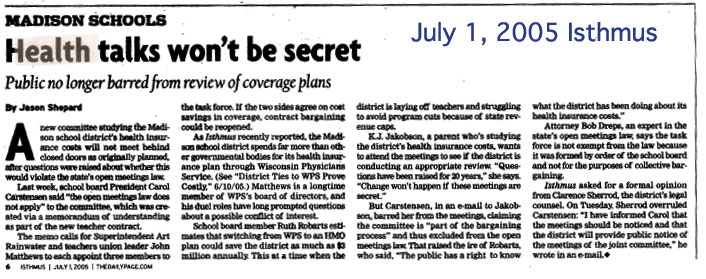
Health Talks Won’t Be Secret

Jason Shepherd wrote about the nature of the Madison School District’s joint committee with MTI (Madison Teachers Inc.)regarding health care costs. Initially, according to Shepherd, Madison School Board President Carol Carstensen said that “the open meeting law does not apply to the committee”.

KJ Jakobsen, a parent studying the District’s health insurance costs, wants to attend the meetings to see if the district is conducting an appropriate review. “Questions have been raised for 20 years,” she says. “Change won’t happen if these meetings are secret”.

But Carstensen, in an e-mail to Jakobsen, barred her from the meetings, claiming the committee is “part of the bargaining process” and thus excluded from the open meetings law. That raised the ire of [Ruth] Robarts, who said, “The public has a right to know what the distrct has been doing about its health insurance costs”.

Read the article here. Isthmus’ web site

Share

Developing Credibility

From Debroah Bush-Suflita, Communications Manager of the Capital Region Board of Cooperative Educational Services, Albany, New York:

The most important element of an effective public information program is credibility. Indeed, credibility is the most important element in an effective educational program. You cannot lie or obscure the truth, because you will quickly lose credibility. . . .

(more…)

Share

Only Half of Committees Have Met

Since the committee chairs announced goals for their committees on June 7, only three committees – Long Range Planning, Finance and Operations, and Partnerships — have met. No committees have meetings scheduled for July or beyond.

Share

Florence School District Likely to Close in One Year

In northern Wisconsin Florence County Schools Likely To Close. The local school board voted 6-1 to consider closing the schools.
Since 1998-1999 school year, Florence School District:
student population declined 15%
property tax share of school costs increased 16%
state contribution to school costs decreased 15.7%
cost to educate a child increased 23.3%
With changes like this coupled with the recent absence of meaningful discussions by the WI government on public education, more school closing/mergers are likely.
When are we going to have the discussion – what does it cost to educate a child? When will the WI government get down to seriously discussing the business of financing the public education of Wisconsin’s children and stop the unproductive rhetoric saying we’re spending more on schools than ever without having any idea of what level of investment is needed to fund public education? The state is happy to avoid the question blathering on about taxes and giving money to special projects all the while shifting the costs of education to property tax payers, an approach that won’t work much longer.
How many more school districts have to close? How many more kids have to be displaced?
School district leadership bears some of the responsibility of meaningful strategic discussions about the future of financing public education and examining different approaches. More on that topic in a later blog.
Immediate issue is a state government that is not seriously undertaking the issue of school financing but is giving tax credits to home and private schooling while avoiding important discussions about the financing of public schools, which is part of the state’s constitution. The United States is littered with examples of state governments who have avoided this responsibility – why does WI have to be one of those states?

Share

Denver’s New Superintendent

Rocky Mountain News:

Moreover, he will lead the campaign for a mill levy to fund ProComp, the pay-for-performance model that has been approved by teachers and that also has Hickenlooper’s support. Indeed, Bennet is so committed to that model that he hopes to negotiate such a provision as part of his own employment contract, a sure sign of confidence that the job is doable and the challenges are not intractable.
On Monday, Bennet said naming a chief academic officer would be among his highest priorities, and that he expects to start a national search for that person soon. That decision, perhaps more than any other he makes early in his new post, could determine whether he achieves the ambitious goal he has set for Denver: to be the best urban school district in the country.

Joanne Jacobs has some useful links behind this story, one of which is Siegfried Englemann’s piece on students “who are victims of the unshifted paradigm”.

Share

Sherman’s Curriculum Riles Parents

Sandy Cullen’s article in the June 28, 2005 WI State Journal Sherman’s curriculum riles parents notes:

On Friday, the state Department of Public Instruction ruled that under Wisconsin law, instrumental music instruction must be available to all students in grades seven through 12 during the regular school day.
“It is unusual to pull students from one class to meet instructional time in another class,” said Michael George, director of the Content & Learning Team for the state Department of Public Instruction, who issued Friday’s ruling. “Clearly, they’re not getting the same experience as other students.”

Besides music instruction, Sherman parents are concerned that few students have the opportunity to take 8th grade algebra and that no child will have the opportunity to take a full year of foreign language prior to high school.
Yehle said middle school is a time when students should be sampling many subject areas to gauge their interests and skills, and should be introduced to what it’s like to study a foreign language, rather than develop proficiencies.

Sherman principal Ann Yehle’s comments seem at odd with a) Wisconsin’s Model Academic Standards in foreign language which call for “… a strong foreign language program beginning in the elementary grades” and b) Wisconsin’s Administrative Code – Public Instruction, Chapter PI 8 Appendix 8 Instructional Guidelines which recommend 100 minutes of foreign language instruction per week beginning in Grade 5.
It’s hard to see where Sherman Middle School’s curriculum is not being dummed down for its students compared to other Madison middle schools and to school districts surrounding Madison WI.

Share

Great Decision Making

The current issue of Fortune (2nd of a 2 part 75th anniversary edition) includes some fascinating examples of leadership and decision making. Jerry Useem summarizes the article.

If surmounting your anxieties is step one, step two is letting go of your inner perfectionist because there is no such thing as a perfect decision-maker. Even if you had all the information in the world and a hangar full of supercomputers, you�d still get some wrong.
But there�s a big difference between a wrong decision and a bad decision. A wrong decision is picking Door No. 1 when the prize is actually behind Door No. 2. It�s a lousy result, but the fault lies with the method. A bad decision is launching the space shuttle Challenger when Morton Thiokol�s engineers predict a nearly 100% chance of catastrophe. The method, in this case, is no method at all.
The distinction is important, because it separates outcomes, which you can�t control, from process, which you can. Wrong decisions are an inevitable part of life. But bad decisions are unforced errors. They�re eminently avoidable—and there are proven techniques to avoid the most predictable pitfalls (see Great Escapes).

20 Decisions that made history is also quite worthwhile.

Share

Madison Girls Hockey Not On Thin Ice Anymore

Message from Mitch Wolfe, parent organizer for the program:
The WIAA Board of Controls approved a 7 school co-op which includes all four Madison city schools, Middleton, Waunakee, and Monona Grove for the upcoming 2005-6 season.

(more…)

Share

What schools get SAGE next year?

What criteria does the district use to select SAGE schools?
The board has before it on Monday, June 27, a motion to drop SAGE at Lapham/Marquette (37/24% low-income) and Crestwood (23% low-income). Huegel (41%) and Sandburg (42%) will replace them. The agenda also lists all of the schools scheduled to be designated SAGE schools.
The following schools will be SAGE schools though they have a lower percentage of low income students than Lapham’s 37%: Chavez (29%), Muir (29%), Shorewood (28%), Stephens (32%).
The following schools with particularly high percentages of low-income students do not appear on the list: Glendale (67%), Lincoln (70%), Mendota (73%), Midvale (65%), and Nuestro Mundo (45%).
The MMSD Web site has a list of low-income students in all schools.

(more…)

Share

Capital Times Editorial: Board backs school quality

Newly elected Madison School Board member Lawrie Kobza was wise to move to use $240,000 in money made available by insurance savings to revive Lincoln Elementary School’s Open Classroom Program and to restore “specials” – music, art and gym classes at the elementary schools – to their regular sizes. And the board majority was right to back her move to maintain broadly accepted standards of quality in the city’s public schools.

(more…)

Share

Taught at Home, but Seeking to Join Activities at Public Schools by James Dao, New York Times

The New York Times
June 22, 2005
STRASBURG, Pa., June 16 – Mary Mellinger began home-schooling her eldest sons, Andrew and Abram, on the family’s 80-acre dairy farm five years ago, wanting them to spend more time with their father and receive an education infused with Christian principles. Home schooling could not, however, provide one thing the boys desperately wanted – athletic competition.

(more…)

Share

Put “no” voters on task force

The long range planning committee approved motions to address the East and West side “demographics and long range facility needs, including the development of a task force, a charge to the task force, task force membership, task force timeline, and task force process.”
The West side task force will presumably tackle the problem of Leopold overcrowding. The body should definitely include representatives of those of us who voted against the referendum on building a second school at Leopold. Hopefully, an inclusive group will produce a proposal that can win wide-spread support. A task force only of supporters will likely fail to gain needed public confidence.

Share

6.20.2005 School Board Meeting Summary

Sandy Cullen summarized last evening’s Madison School Board meeting where:

  • Board members approved an administrative staff hiring freeze (5-2 with Bill Keys and Juan Jose Lopez voting against it)
  • Voted to use 200K in excess district insurance funds for elementary art, music and gym class sizes at 15 students in SAGE schools. (4-3 with Bill Keys, Juan Jose Lopez and Johnny Winston, Jr. voting against it)
  • Adopted the 2005-2006 budget 5-2 with Ruth Robarts and Shwaw Vang opposed
Share

Animosity Toward Band, Orchestra and Vocal Music Curriculum Unnecessary – Alienates Parents, Community

I think what I found most disturbing about the elimination of band, orchestra and vocal music from the school day in Sherman Middle School was the exclusion (almost isolation) of music staff by other Sherman staff from the front of the room at the parent meeting in early June to present the exploratory changes being mandated including questions/issues surrounding the music curriculum at Sherman. I found the a) open irritation by some Sherman Middle School staff toward the music staff shocking, b) the lack of music curriculum assessment and planning for the changes unsettling, and c) the exclusions of parents and students in the process alarming.

(more…)

Share

New Vision of Public Education

Information sent to me by Senn Brown, Secretary
Wisconsin Charter Schools Association.
Read about the new vision of public education in Milwaukee at: http://www.jsonline.com/news/metro/jun05/334378.asp .

(more…)

Share

Madison School Board 6/13/2005 Meeting Audio/Video

Video and audio clips are now available for Monday evening’s Madison School Board meeting:

MP3 audio of both (20MB)

Share

More on Advertising


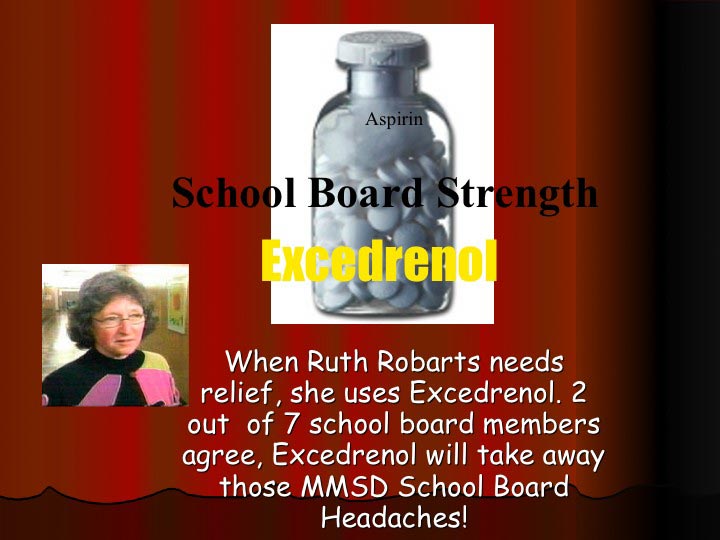
Ruth Robarts wonders what the future is for advertising & the Madison Schools. Reader Troy Dassler, seeing an opportunity, quickly created a mockup for Ruth. Click on the image above for more “details” 🙂

Share

What’s the Future for Ads in the Madison Schools?

Johnny Winston Jr., chair of the Finance and Operations Committee of the Madison School Board, kicked off a new discussion of the possible role of business ads to raise money for our schools at the June 13 meeting of his committee. Committee member Lawrie Kobza asked the administration to bring back information about what other districts are doing beyond the advertisements in yearbooks, school newspapers and the like. Good ideas, both.
However, why stop there? Maybe there are products looking for School Board member endorsements.

(more…)

Share

Madison Schools & Board Communication with the Public

Madison School Board Vice President Johnny Winston, Jr. held a Finance & Operations Committee meeting this evening. Winston discussed and sought feedback on new methods that the Board and District might use to interact with the public. Notes and links are available on the Finance & Operations Committee Blog.

Share

Nuestro Mundo: muy bueno

Doug Erickson, WI State Journal reporter, writes about Nuesstro Mundo, MMSD’s bi-lingual charter school – Two-language school is seen as muy bueno

Share

Teacher Health Insurance Costs: Why They Matter

Madison Teachers, Inc., the Madison teachers’ union, has recently ratified its collective bargaining agreement with the Madison school district for 2005-06 and 2006-07. Later this month, the Board of Education will have its chance to ratify the agreement, although the board gave preliminary assent on June 6.
On June 10, Isthmus writer Jason Shepard provided an excellent analysis of the ways that providing Wisconsin Physicians Service (WPS) to the teachers drives up the cost of each contract. The article also questions the relative quality of the WPS coverage. See “District ties to WPS prove costly”, available at many locations in Dane County.
The following graphs, based on data from MMSD, illustrate the impact of high cost WPS coverage on the cost of the two-year contract and the extent to which access to WPS coverage for roughly half of the teachers receiving health insurance through MMSD erodes wage gains.

(more…)

Share

“With” is Not a Four-Letter Word

The agenda of the Finance and Operations committee meeting for Monday, June 13 contains these items:
4. Communication to the Public about the Proposed 2005-06 Budget
6. Nontraditional Communication Strategies to Speak to Community Stakeholders.
Mark Twain once remarked: “The difference between the right word and the almost right word is the difference between lightening and the lightening bug.”
For me, “communication to” and “speak to” is vastly different than “communication with” and “speak with” — like the difference between “lightening” and “lightening bug”.
I can hear the failed referenda supporters and the supporting press editorials: Just needed a little better PR.
“With” has this strong flavor of team work, working together, listening: dialog!. “To?” Well, that has been the legacy of the Administration and Board.
But, no, folks. “With” is not a four-letter word. It needs to be used, again and again, until it becomes part of the Administration’s and Board’s culture.

Share

Annexing more West side students

Why is the MMSD annexing more students on the West side when there’s such a concern about space? What attendance areas include the annexed land? I wonder too about the fiscal impact of adding more students. Will more students lead to more program cuts, so that the additions really become a fiscal drain rather than a fiscal benefit?
I’m not trying to be difficult, I’m genuinely asking why adding students is a good idea. It may be a perfectly good approach, but it just seems odd given the controversy about West side enrollment and overcrowding.
I’ve actually been wondering whether the MMSD shouldn’t give up some kids to other school districts on the West side. In particular, I wonder about the penninsula that feeds into Leopold. Or by contrast, annexing the land and kids who lie between the penninsula and Chavez and building an elementary school in that annexed territory to relieve the overcrowding at Leopold.
I’m not advocating anything, so don’t “bust my chops.” I’m just thinking out loud.

Share

Out Of The Mouths Of Babes

Have you ever seen the television show, “Kids Say the Darndest Things” hosted by Bill Cosby? Since becoming elected to the Madison school board, I have had students say all kinds of the “darndest” things to me. Here are a few examples…

(more…)

Share

The Lesson

From Milwaukee Magazine:

On the day Dante Hamilton came to Nathaniel Hawthorne Elementary School on Milwaukee’s North Side, he was like most African-American children who enroll in urban school districts in the United States. He was already behind. . . .
Fortunately for Dante, he had what the Chinese call the luck of time and place when his mother enrolled him at Hawthorne. Today, at age 10, he is a fourth-grader who reads at a sixth-grade level.

The article continues for several pages and insightfully covers a wide range of relevant topics on schools.

Share

Who will invite me to talk with them?

Thank you to Troy Dassler, Marisue Horton, and others who commented on my report on the meeting of the Long Range Planning Committee on Monday, June 6.
Several people objected to my characterization of the some of the presentations as nasty and bitter. I know that it’s hard to perceive Leopold leaders and supporters as anything but polite, but I was shocked when they launched into immediate denunciations of Ruth Robarts and Lawrie Kobza, blaming them for the defeat of the referendum.

(more…)

Share

Madison Schools/MTI Pact

Cristina Daglas:

A smaller-than-expected contract for Madison teachers would leave about $400,000 for the School Board to spend on cash-strapped programs, although critics say more was available.
Superintendent Art Rainwater and board President Carol Carstensen would not speculate Tuesday on what programs could benefit, but board member Ruth Robarts said maintaining the Open Classroom program at Lincoln Elementary School and alleviating planned class-size increases for art, music and gym teachers could be possibilities.
Rainwater, Carstensen and Madison Teachers Inc. Executive Director John Matthews presented the proposed contract at a news conference at MTI headquarters Tuesday.

Share

Information From School Districts Across The State

This information was given to Madison school board members via Joe Quick, Legislative Liaison.
Editorial on closing schools

(more…)

Share

Yes, Change IS Hard

Q: How many board members does it take to change a lightbulb?
A: “WHAT!!?!?! CHANGE?” they gasp in horror
No one is going to win as long as there is a divide between the board and the community. It would be great if it were as easy as “we need to educate people,” or, “we need to reach more people,” to pass a referendum as Carol Carstensen has suggested. But that does not appear to be the case.
The issue is not educating, it is persuading people that the board’s strategies are the best options. That cannot be done until all options are on the table with accurate, verifiable, comparative costs and impacts presented so that people can join the board and the administration in supporting its strategies.
This has not happened and, based on the last school board election and the referendum votes, more mailings and radio ads with the same positions is not likely to get more support for the board or its choices.
Using committee meetings to denounce members of the board and citizens who care enough to come to meetings as enemies of public education is not a step forward, either. Particularly when the bashing is based on assumptions rather than fact, as in Juan Lopez’s decision to bash Barb Schrank. Apparently Mr. Lopez was unaware that Barb voted yes on all three questions AND openly urged others to do so. Just how does attacking her publicly win him support for his stated cause?

(more…)

Share

2005-2006 Madison School Board Committee Goals

President Carol Carstensen’s Board Goals 7MB Video
Bill Keys’ Long Range Planning Goals 8MB Video
Lawrie Kobza’s Partnership Committee Goals 6MB Video
Juan Jose Lopez’s Human Resource Committee Goals 3.5MB Video
Ruth Robarts’ Legislative Committee Goals 3MB Video
Shwaw Vang’s Performance & Achievement Committee Goals 4MB Video
Johnny Winston Jr.’s Finance & Operations Committee Goals 4MB Video
Share

Post Leopold / Operating Referenda Long Range Planning Meeting: Arlene Silveira and Beth Zurbuchen Speak

Click to watch this event

The Madison Board of Education’s Long Range Planning Committee met on the 6th. Arlene Silveira and Beth Zurbuchen lead along with many others spoke about the failed referenda and next steps. Results and background here. Arlene and Beth were prominent members of Madison Cares, a group that spent heavily in favor of the referenda.

Don Severson, President of Active Citizens for Education also spoke at this event and recommended that the District look at the entire west side, not just Leopold. Severson also argued for a very open discussion with the community.

Share

MMSD-MTI reach tentative agreement on contract

Joint committee to examine health care changes
Union and district officials announced today a tentative teaching contract settlement for the period beginning July 1, 2005 through June 30, 2007. The contract was given preliminary approval by the Board of Education Monday night, and the union membership will vote this Thursday.
Terms of the contract include:
2005-2006
Base Salary Raise – .75%
Benefits – 3.32%
Total – 3.98%
2006-2007
Base salary raise – .90 %
Benefits – 3.07%
Total – 3.97%

(more…)

Share

Panel OKs task force on West side overcrowding

Editorial note: Carol Carstensen contacted me to correct the sequence of events at the Long Range Planning Committee meeting on Monday, June 6. She initially suggested the formation of a task force, but couldn’t make the motion because she does not formally serve on the committee.
I apologize that I missed her suggestion. Many of the people who spoke earlier had begun to leave and two or three board members seemed to be talking at the same time.
I edited my original post to include Carol’s role in making the suggestion. Ed Blume

Leopold school supporters packed room 103 of the Doyle Building to speak at a meeting of the Long Range Planning Committee on Monday evening, June 6.
Arlene Silveira led off with a bitter attack on Ruth Robarts and Lawrie Kobza, accusing them of causing the defeat of the referendum to build a second school on the Leopold school site.
Beth Zurbachen followed with an equally nasty attack.
Nearly two dozen more Leopold supporters continued the assault for almost two hours.
Ironically, Lawrie Kobza, at Carol Carstensen’s suggestion, kept their hopes alive. Carol offered the idea of forming a task force. Since she isn’t a formal member of the committee, she could not make a motion. Instead Lawrie made, Juan Lopez seconded, and the committee approved a motion to form a task force to explore attendance issues on the West side.
If Carol hadn’t made the suggestion and Lawrie had not made the motion, the committee would have adjourned with absolutely no movement on solving the overcrowding problem at Leopold, and probably no possibility of considering the issue until late in the summer.
Carol deserves praise for recognizing the need to restart an examination of the overcrowding on the West side.
Lawrie also deserves praise for not behaving vindictively against the Leopold supporters who blasted her. Instead she was more than willing to move toward an inclusive process that might just give the Leopold supporters and all West side children an option to overcrowding.

Share

Band and Orchestra To Remain In the School Day at Sherman

This is a letter from Sherman Principal, Ann Yehle via Superintendent Rainwater to school board members regarding NOT moving Band & Orchestra to “8th Hour” for the upcoming year. I do have a copy of her original rationale to why she wished to do it. I will send it to anyone who wishes to read it. No changes will take place in the 2005-06 school year.
To all:
There appears to be lack of a clear understanding relative to what constitutes the school day as well as what bell schedule changes require a waiver and what bell schedule changes do not require a waiver from the state DPI. From communications with other principals in WI who have performance music at a zero hour, over lunch, or during an “8th hour” there isn’t consistency on whether a waiver from DPI is necessary. At this point given our most recent email communication from Mike George at DPI, there is a possibility that DPI would require us to obtain a waiver. While the reasoning we would provide on the waiver would meet the criteria necessary to get a waiver, align with MMSD strategic plan, Sherman CSR work, and while there is precedence for this move in other WI districts, a public meeting in front of the BOE is necessary. The timing on this would present a challenge for next school year. Furthermore, even though we may not need a waiver, I believe the course of action I outline below to be in the best interests of Sherman Middle School students, staff, families for the 05-06 school year.

(more…)

Share

Change Is Hard

Change is hard! This fact holds true to most businesses or organizations including the Madison Metropolitan School District. Though the MMSD is not dying in the sense of being gone forever, the failure of the operating referendum on May 24th has given the school district the opportunity to develop new service delivery models that may enhance student opportunities for success.

(more…)

Share

Is Persuasion Dead?

New York Times editorial by Matt Miller:
Speaking just between us – between one who writes columns and those who read them – I’ve had this nagging question about the whole enterprise we’re engaged in.
Is persuasion dead? And if so, does it matter?
The significance of this query goes beyond the feelings of futility I’ll suffer if it turns out I’ve wasted my life on work that is useless. This is bigger than one writer’s insecurities. Is it possible in America today to convince anyone of anything he doesn’t already believe? If so, are there enough places where this mingling of minds occurs to sustain a democracy?
The signs are not good. Ninety percent of political conversation amounts to dueling “talking points.” Best-selling books reinforce what folks thought when they bought them. Talk radio and opinion journals preach to the converted. Let’s face it: the purpose of most political speech is not to persuade but to win, be it power, ratings, celebrity or even cash.
By contrast, marshaling a case to persuade those who start from a different position is a lost art. Honoring what’s right in the other side’s argument seems a superfluous thing that can only cause trouble, like an appendix. Politicos huddle with like-minded souls in opinion cocoons that seem impervious to facts.
See full editorial

Share

Madison Metropolitan School District Board Agenda June 6

Posted in PDF format here
Highlights:
– Expect several public appearances related to the Sherman strings/band programs
ALSO
– Articulation of committee goals for 05-06
– Recommendations regarding transfer of parcels from Middleton-Cross Plains and Verona districts and related boundary changes
– Purchasing recommendations

Share

Ballot Blunder Blamed On Miscommunication

WKOW-TV reports on the “flawed election ballots for last week’s Madison School District referendum.”

Share

An invitation to Juan Lopez

Juan,
I wrote to you by e-mail previously and invited you to submit on the blog goals for the Human Services Committee, which you chair.
I have not yet received a response.
You may recall that I wrote that schoolinfosystem.org will soon launch a page dedicated to the committees of the Board. We hope to post the following items for each committee:

* Goals for the coming year, as set by each chair or committee.
* Meeting agendas.
* Meeting minutes.
* Documents provided to the committee. (We’d like to post these prior to the committee meetings.)
* Notes and videos of the committees if people submit any to the blog.

I’m once again inviting you to provide the goals that the Human Resources Committee will pursue in the coming year. You can post them directly by asking Jim Zellmer to give you a password so that you can post, or you can send the goals to me, and I’ll post them for you.
I look forward to hearing from you in the near future.
Ed Blume

Share

NY School Board Actions After a Failed Renovation & Expansion Referendum

Reader Rebecca Stockwell emailed this link to a PDF document published by the Public Schools of the Tarrytowns (Westchester County, NY) after a renovation & expansion referendum failed. The newsletter begins:

The referendum was to finance a major school facilities renovation and expansion project. The proposal, which was the result of more than two years of analyzing our facilities needs and evaluating options for addressing them, was defeated by a vote of about 1200 to 1000.
Factors that appear to have contributed to the “no” vote include 1) concern about the cost of the project in a community that had not faced a major facilities referendum in 50 years, 2) some disagreement with the scope and/or conceptual design elements of the project, 3) some confusion and mis- trust over the district’s analysis of the tax implications, and 4) the perception by some that they had not had an adequate opportunity to participate in or be fully informed about the process leading up to the project referendum.
At the same time, feedback also strongly indicated widespread support across all segments of our population for continuing to take a long-range, comprehensive approach in addressing our facilities needs.
We have listened carefully to the feedback.

(more…)

Share

Sherman Middle School Principal Mandates Change by Fiat – Renames Afterschool an 8th hour and Kicks Academic Performance Music Out to Afterschool

The current music education upheaval at Sherman Middle School is about

  • what Madison values for our children’s education, such as academic music education during the school day and
  • who makes those decisions.

It is not about money, because teacher allocations will be needed to teach the 8th hour same as during the school day.
Making changes that seem to be by fiat may be desirable to the person in charge, but the students and parents are the school’s and district’s customers – please listen to us at the start of a process, let us have time to have meaningful input and comment! Isn’t it the School board who are the district’s policymakers, especially curriculum policy and what defines a school day. Those are the basics! A longer school day might make sense – but not by what appears and feels like fiat and not without public discussions, deliberations and decisions by our School Board.

(more…)

Share

Milwaukee Superintendent signals staff cuts

This information was given to Madison School Board members by Joe Quick
Milwaukee Public Schools Superintendent William Andrekopoulos warned Tuesday that if limits on how much Wisconsin school districts can increase their spending are held down by the Legislature, dozens of additional teaching positions in city schools will be cut.
The legislature’s Joint Finance Committee is expected in the next few days to take up proposals to allow school districts to increase their spending over the next two years, but by amounts that are smaller than what Gov. Jim Doyle has proposed.
Read the full article at this link.
http://www.jsonline.com/news/metro/may05/330264.asp

Share

The Good, The Bad and the Ugly of other Blog Sites

Since the May 24th referenda, I began looking at other blog sites such as the Madison.com/ post and the Isthmus “Daily Page.” Here are a few highlights of the Good, the Bad and the Ugly.

(more…)

Share

MMSD Teacher Layoffs Target Elementary String Teachers

On Thursday, based upon Superintendent Rainwater’s recommendation, the Madison School Board approved 20 FTEs for layoff. These layoffs included 60% of the elementary string staff – the largest percentage of one academic personnel group ever laid off in the history of the Madison Metropolitan School District. How come a program that cost less than 1/10 of one percent of the $318 million budget resulted in nearly 50% of the teacher layoffs? Elementary string teacher are less than 3/10 of 1% of the total teacher population. What happeded? No evaluation of the music education curriculum, no planning (not exploring the allowed use of federal dollars for fine arts education for low income children) and some might say vindictiveness from top administrators and some Board members toward string teachers because of the community outcry in support of elementary strings – our community cannot tolerate the latter. Money is not the issue – data do not support money being the issue.

(more…)

Share

Berkun: Why Smart People Defend Bad Ideas

Scott Berkun pens a useful read:

That said, the more homogeneous a group of people are in their thinking, the narrower the range of ideas that the group will openly consider. The more open minded, creative, and courageous, a group is, the wider the pool of ideas they’ll be capable of exploring.

Share

Goals for Achieving an Improved School District

I ran for the School Board, and voted No, No, No on the referenda because of my profound disagreement with how the School Board conducts itself and their lack of leadership and direction, and my strong sense of a deteriorating school system, not all to be blamed on draconian measures by Federal and State politicians.
Marshalling the ideas of other contributors to this site, ideas from the National School Board Association, other sources and my own ideas and goals, I have drafted a rough set of goals that I think the School Board and Madison citizens in general should address. It is meant as a possible starting point for discussions.
The document’s basic purpose is to ensure a high level of student achievement through public accountability, honest and open assessment, transparent setting of priorities, and alignment of the budget with the priorities. It makes an initial attempt to distribute the goals across the BOE’s committees, so they are working toward the same goals.
It is my strong sense that the Board views these committees as somehow dealing with issues that are orthogonal to each other; for example, there were arguments that the Long Range Planning committee must not concern themselves with the decisions of the Finance and Operations committee (which actually wasn’t doing anything, anyway).
I certainly do not believe the current majority on the School Board is willing to make or is capable of making the necessary changes to how it conducts its business to set appropriate priorities and ensure their execution. Certainly comments made by supporters of the referenda after they were voted down indicated that they don’t get it.
In any case, I would like comments and suggestions, agreement, disagreement on this document. Better ideas are welcome.

Share

More Post Referenda Comments

Tuesday’s Madison Schools Referenda results continues to generate comments:

More here

(more…)

Share

Mertz on Teacher Layoffs

Reader Thomas J. Mertz emails:

I agree with Ruth Robarts that the Board should explore all options before laying off classroom personel and that revisting the ongoing MTI negotiations is the place to start.
I think that this issue is also linked to a key to the failure of two of the referenda — the transparency of the process. Wages and benefits are by far the largest budget item, yet the negotiations with MTI are shrouded in mystery. I’ve looked through the newspapers, the MTI site and the MSMD site and can find very little information about the current negotiations. Perhaps this is a legal question and negotiations must be secret (does anyone know?). But if they can be public and publicized, they should be.
If, as many believe, the administration and the Board need to be tougher with MTI, then public scrutiny woulkd make this more likely. If the administration and the Board are already sufficiently tough with MTI (as many others believe), then public scrutiny would undermine the position of those who question the contracts.
I see many potential benefits and little if any harm coming from shining a light on the negotiations.
Thomas J. Mertz

Share

Post Referenda Notes, Comments & Interviews

Here’s a brief roundup of post Referenda voter comments:

(more…)

Share

Needed: New Opportunities and Directions for the School District

On May 24th, the Madison School Board participated in the democratic process by involving local citizens in its budgetary process by putting forth a referendum. Regardless of how you voted, I thank you for taking the time to listen to the issues, weigh in on the debate and cast your ballot the way you saw fit.
I am not surprised at the outcome of the referenda votes. While I voted, Yes, Yes, Yes, and encouraged others to do the same, I can understand why someone voted No, No, No or any other combination. I am sympathetic to community concerns regarding higher property taxes and the uneasiness that leaves in the community’s sense of economic security. While I am disappointed in the outcome of the referenda for the district’s operating budget and building a new school at Leopold elementary, I do believe that these defeats allow for exploring creative opportunities to capitalize on in the future.

(more…)

Share

Study to focus on funding of Wisconsin schools

What does it cost to adequately fund K-12 education in Wisconsin? A nationally recognized expert in school finance at UW-Madison is leading an effort to address this critical question.
The Rockefeller Foundation of New York has awarded Allan R. Odden, professor in the Department of Educational Leadership and Policy Analysis, $500,000 over two years to determine the costs of educational adequacy in Wisconsin.
Read more at UW news.

Share

Robarts Advocates a Delay in Teacher Layoffs

Sandy Cullen:

Madison School Board member Ruth Robarts wants fellow board members to delay today’s vote to lay off about 20 teachers next year in order to ask the Madison teachers union if it would agree to smaller wage and benefit increases to avoid the layoffs.

“Before you do something as severe as layoffs, I think you need to exhaust your alternatives,” said Robarts, who estimated that keeping the 20 teachers positions would cost about $1 million.

Robarts article is here.

Share

Post mortem on Leopold referendum

Joan Knoebel offered her thoughts on how to win support for the operating referendum, and I whole-heartedly second them.
On the Leopold referendum, I’d ask the board and supporters to do two things:
1) Lay out three or four alternative locations and configurations for a new Westside school, draw possible boundaries, develop cost projections, and then debate which alterantive seems to be the most likely to achieve academic excellence on the West side.
2) Invite organizations or individuals to propose a charter school on the Westside. Several people suggested a charter or magnet school, so let’s see whether one might emerge as the best option for providing excellent education in the area.
Current overcrowding is not an issue at Leopold. Leopold is overcrowded, but I’ll vote no again on a second school at Leopold if its supporters rotely drone, “This is the only option. This is the only option. This is the only option.”

Share

Madison Board of Education Should Not Rush to Vote on Layoffs

In the aftermath of the votes on the May 24th Madison School referenda, it is critical that the Madison School Board not rush to vote on layoffs of teachers and other staff. Currently, the Board is scheduled to vote on layoffs at noon on Thursday, May 26. This deadline for layoff votes is self-imposed by the district and Madison Teachers Inc (MTI). State law sets a later deadline. The district and the union could change the May 26 date by mutual agreement. In 2003 the vote on layoffs following a referendum for the operating budget was scheduled for June 4.

(more…)

Share

MMSD Partnership Committee – Citizen Members Sought

The MMSD School Board Partnership Committee has two openings for citizens members. Letters of interest, mailed to the School Board President, Carol Carstensen, are being sought. The deadline for applying is Friday, May 27, 2005.
The MMSD Partnership Committee, which will be chaired by Lawrie Kobza in the 2005-2006 school year, focuses on community partnerships and MSCR. The other two board members on the committee are Ruth Robarts and Johnny Winston, Jr. Information on application for appointment follows:

(more…)

Share

Traditional Madison Media Referenda Coverage

I took a quick tour around the websites of Madison’s traditional media. These sites have a bit more than the usual coverage:

I’ve posted a set of links to those who support and oppose the Referenda questions here.

Share

Ballot Mess Could Be Big Referenda Problem

“You’re tax dollars are paying for printers to work overtime this weekend. 89,000 ballots for Madison school’s May 24th referendum contain wrong information, and it has created quite a mess. . . .”
Story continues on the Web site of Channel 15.

Share

Question Needs to Be: What Does It Cost to Educate a Child in Today’s Society?

I am tired of legislators who look at the amount of money spent to educate a child today compared to prior years and then say: “Look at how much more we are spending to educate our children today. We have fewer children. We have more teachers. It’s a whole lot of money.”
Yes, public education costs a considerable amount of money. Yet, I never hear the legislature take up in a meaningful manner: “What do we need to educate our child in terms of standards, in terms of curriculum to have high school graduates who are well-educated and can compete in the modern workplace? What is this cost? What is the cost to society of not making this investment – in terms of number of crimes committed and prison costs, in terms of the attractiveness to businesses of our schools?”
There was the Governor’s task force on education, and the issue of the cost to educate a child was raised, but the discussion did not go very far. Until you know how what is needed and what that costs, comparing current dollars spent on education to dollars spent before provides little information and no guidance for next steps, processes to follow, etc.

Share

Mischaracterized Mr. Winston Re Sports and Arts

In previous blogs I left the impression that Johnny was pro sports and dropping the ball on fine arts academic curriculum because there was a sports committee last year and not a fine arts committee.
The admin made that decision, not the school board. My apologies to Mr. Winston for assuming as Chair of the Partnership Committee that he had been involved in this decision.
I still believe we need a fine arts committee that includes parents, teachers, fine arts organizations, uw staff, etc., to discuss long-term issues facing MMSD’s fine arts academic curriculum. I hope School Board members urge the administration to get this rolling rather than wait until next spring when it’s too late.

Share

Board Debates 1.8M in a $319M Budget

Lee Sensenbrenner picks up much detail (great work!):

Later in the night, when the board was going back and forth over whether it might keep kindergarten art, music and computer class sizes from doubling next year – a move that would have saved around $270,000 – Robarts said she was struggling to understand how that discussion was taking place when the district next year will pay $21 million for health insurance.
“Excuse me, that’s not germane,” board member Bill Keys said. Earlier Monday, the board had been meeting in closed session about the teachers’ contract currently under negotiation. No financial terms have been disclosed.
“OK, that’s it. I’ll shut up,” Robarts said. “It just seems very backward.”

(more…)

Share

Others also demonize opponents

Beth Zurbuchen isn’t the only pro-referenda advocate who cannot understand referenda opponents who support quality schools but will vote no to force the board and administration to consider better budgeting, management, and curriculum.
Bill Keys said, quoting a Cap Times article:

To school board member Bill Keys, “the people who have doubts about the referendum seem to belong to two camps.”
One, he said, is composed of those who oppose additional school funding whenever the opportunity comes along. . . .
“These people are always against education,” he contended. “That’s their history, that’s their life. They’ve made a career of being against education.”
In the other camp are those, he said, who just don’t want to engage in the complexities of the problem and study the real constraints that exist in school finance.

Share

Hard choices for Madison Voters

On May 24th, citizens in the Madison school district will vote on three referenda questions affecting whether to build an addition to Leopold School, exceed revenue caps, and renew the maintenance referendum.
For many people the answers are an easy yes or no vote. Others, like me, have wrestled with their choice for each question.
Why is the choice so difficult? It should be easy, right? Strong public education is a good thing. We want to support teachers and students in the district. We know that overcrowded schools all too often undermine education.
I can’t speak for others, but I know that I have several barriers to an automatic yes vote. The issues are different for Leopold than for the operating and maintenance questions. For me, the issues come down to what I do – and do not – know about what the questions mean. I feel that my duty as a representative of the community is to make informed decisions on behalf of our children and not to commit to proposals that lack sound justifications.

(more…)

Share

Carol Carstensen on Isthmus’ Recent Madison Schools Coverage

This article, by Madison School Board President Carol Carstensen, appeared in Isthmus‘ May 12, 2005 edition:

Over the last two years, Isthmus’ articles on the Madison school district, especially its approach to teaching reading, have reminded me of a favorite quote from Adlai Stevenson: “These are the conclusions upon which I base my facts.”
The Madison school district has gotten a great deal of negative coverage from Isthmus, despite the fact that the district has seen continued improvement in the numbers and percent of children achieving at the two highest levels on the state’s third-grade reading test.

(more…)

Share