School Information System

Where Have All the Students Gone?


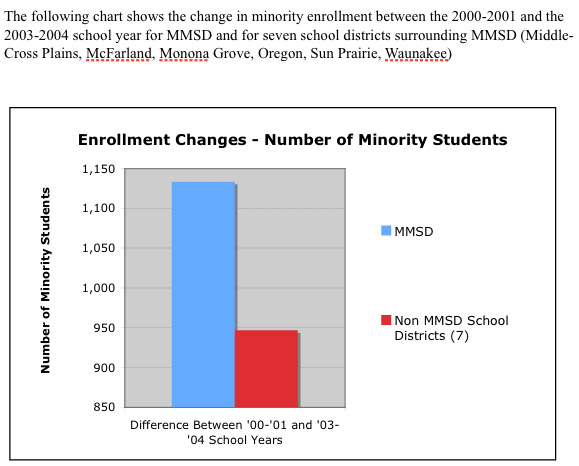
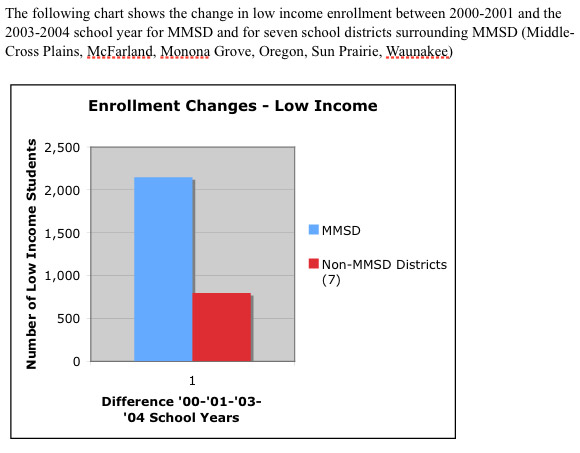
Additional Charts: Enrollment Changes, Number of Minority Students | Enrollment Changes, Low Income
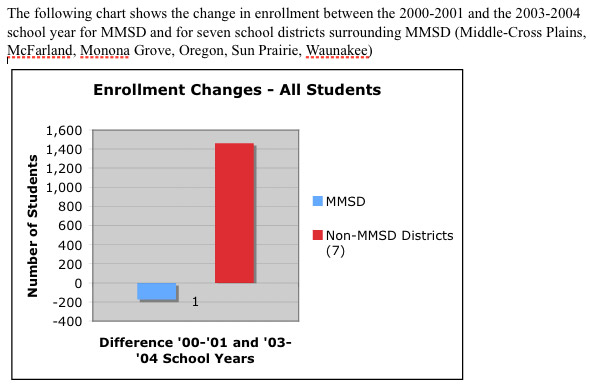
MMSD Lost 174 Students While the Surrounding School Districts Increased by 1,462 Students Over Four School Years. Revenue Value of 1,462 Students – $13.16 Million Per Year*
MMSD reports that student population is declining. From the 2000-2001 school year through the 2003-2004 school year, MMSD lost 174 students. Did this happen in the areas surrounding MMSD? No. From the 2000-2001 through the 2003-2004 school year, the increase in non-MMSD public school student enrollment was 1,462 outside MMSD.
The property tax and state general fund revenue value of 174 students is $1.57 million per year in the 2003-2004 MMSD school year dollars (about $9,000 per student). For 1,462 students, the revenue value is $13.16 million per year. Put another way, the value of losing 174 students equals a loss of 26-30 teachers. A net increase of 1,462 students equals nearly 219 teachers. There are more subtleties to these calculations due to the convoluted nature of the revenue cap calculation, federal and state funds for ELL and special education, but the impact of losing students and not gaining any of the increase of students in the area is enormous.

(more…)

Share

Governance in the LA Schools & Seniority

LA Times Editorial:

A RECENT STUDY SHOWS HOW union contracts can hamper school improvement — and provides another compelling reason why having L.A.’s mayor run the schools could help.
The study by the nonprofit New Teacher Project found that teacher contracts place seniority over what’s best for students, especially by favoring longtime teachers for desired teaching slots over newer teachers who might be better for the job. That’s true even if the more senior teacher is needed in another school.

To see The New Teacher Project’s latest report, Unintended Consequences: The Case for Reforming The Staffing Rules in Urban Teachers Union Contracts, click here.

The report shows how contractual staffing rules undermine urban schools and the educational needs of their students. To view the press release, click here.
Leading educators, researchers and policy makers have galvanized around the importance of sharing the report’s data and recommendations. To view their statements of support, click here.

Share

The Teacher in the Grey Flannel Suite

The Economist:

The second argument had to do with the rise of knowledge workers. Mr Drucker argued that the world is moving from an “economy of goods” to an economy of “knowledge”—and from a society dominated by an industrial proletariat to one dominated by brain workers. He insisted that this had profound implications for both managers and politicians. Managers had to stop treating workers like cogs in a huge inhuman machine—the idea at the heart of Frederick Taylor’s stopwatch management—and start treating them as brain workers. In turn, politicians had to realise that knowledge, and hence education, was the single most important resource for any advanced society.
Yet Mr Drucker also thought that this economy had implications for knowledge workers themselves. They had to come to terms with the fact that they were neither “bosses” nor “workers”, but something in between: entrepreneurs who had responsibility for developing their most important resource, brainpower, and who also needed to take more control of their own careers, including their pension plans.

Share

My Open Records Complaint to DA Brian Blanchard

Following up on my 10/12/2005 Open Records request regarding closed discussions (particularly the terms) of the Madison School District’s purchase of land for a new elementary school on the far west side, I recently filed the following open records complaint with District Attorney Brian Blanchard: Background:

(more…)

Share

Carol Carstensen’s Email Message to Parent Groups

Carol Carstensen:

Parent Group Presidents:
N.B. The Board’s discussion regarding animals in the classroom has been postponed until January.
BUDGET FACTOID:
Why does the Madison district spend more than the state average per pupil? One part of the answer is that our student enrollment differs significantly from the state average in areas which require more services (and therefore greater costs):

  • Poverty Madison’s rate is 30% greater than the state’s average
  • English Language Learners (ELL): our percentage is more than 300% greater than the state’s
    Special Education the district has a higher percentage (16.8% vs. 12.6%) of students with special education needs – and a significantly higher percentage of high needs students. Of 389 students in the state identified with costs over $30,000 Madison has 109 (nearly 30%).

(more…)

Share

MMSD Budget Mystery #4: Body Count or 1-2-3 FTE

All right, gice and galz. I been called in. Sam Spade, that is. No more pussyfootin’ around like that little Nancy Drew kinda mystery ya been seein’. Dis is a tough one. Ain’t none of ya gonna’ figur it out. But I’m here ta make ya try.
When da Board of Education passed the MMSD buget on the first go round, that is, da balanced budget, da buget supposedly had 3781.23 FTEs (that’s full time equivalent postions, for you beginners), compared to da 04-05 school year which supposedly had 3880.86 FTEs, and compared to da “same service” budget which supposedly had 3914.86 FTEs. Ya followin’ me?
When da same said Board of Education passed da final buget, how many of dem so-called FTEs did it approve?
Ta give ya a hint, click here ta see a chart that shows some of da FTEs, but it’s got lots of blanks, and I don’t mean blanks in my .38. That’s fully loaded.
The winnin’ PI is da one can fill in da most blanks based on da MMSD buget documents.
Knock yerselfs out!

Share

West / Memorial Forum Audio/Video Archive (11/15/2005 @ Leopold)

Watch this event (about 90 minutes) or Listen (mp3 audio)

A public forum was held to update the community on plans to address overcrowding in the West-Memorial attendance area at Leopold Elementary School Tuesday evening. Troy reports 150 people attended (in the comments, take a look at the video clip for details), rather decent, given some other events I’ve participated in – much more than my quick estimate of 40, which was wrong. [Editor: gotta love the quick feedback loop. Anyone else have a count? :)] In any event, substantive questions were discussed and raised.

A number of ideas were shared along with quite a few public comments. I’ve summarized a few below (from my notes) (there were many more – have a look at the video):

  • Why does Van Hise Elementary have such a small low income population relative to other schools?
  • What data supports the creation of “paired schools” from a student achievement perspective?
  • Why are we considering busing children all the way to Marquette / Lapham [map]?
  • (this comment was made after the official event closed) Why won’t the MMSD build a school (farther south) in Fitchburg?
  • I asked: “Why were no scenarios / ideas presented vis a vis the nearby [map] Wright Middle School Facility?”

This 3 page pdf Forum / idea summary was sent to all Thoreau parents Tuesday. UPDATE: Arlene Silveira mentions, via email, that she thought about 120 attended.

Share

Union Contracts Stymie School Hiring Decisions

Elaine Korry, All Things Considered:

A new study details obstacles in union contracts that schools in big cities face in terms of being able to hire and fire teachers. In as many as 40 percent of teacher openings in five large districts, the study says, school administrators had no say in the selection process.

audio Much more, here.

Share

Board of Education in No Rush to Explore Health Insurance Savings

Last June, the Madison Board of Education ratified the 2005-07 collective bargaining agreement with Madison Teachers, Inc. The agreement commits the district and the teachers union to form a task force to identify potential cost savings from changes in health insurance coverage. If the task force finds savings, the parties may renegotiate the health care provisions. The deadline for this work is February of 2006.
Months ago, both sides named their representatives to the task force. Months ago, the Board’s attorney declared that the task force meetings—–prior to possible renegotiation—–would be public meetings. Five months have passed without a public meeting of the task force. The Human Resources Committee, which has oversight of this process, has not mentioned the topic or called for a report from administration. In fact, the board has received more updates from the administraton about discussions on the future of guinea pigs in classrooms than it has on possible savings in health care costs. Now only a few months remain to collect information on this complex topic, analyze the options and, if possible, renegotiate the health insurance provisions in the two-year agreement.

(more…)

Share

“Poor Kids Aren’t Dolts — Push Them Harder”

Wendy Kopp (President and Founder of Teach for America):

According to the annual Phi Delta Kappa/Gallup survey, the most recent of which was released in September, most Americans cite a lack of parental involvement, as well as problems in students’ home life and upbringing and their lack of interest and motivation as the most important reasons for the huge gap between the achievement levels of students in upper- and middle-class neighborhoods and those in poor neighborhoods. More than 75% of those polled said they believe that white students and students of color have the same academic opportunities.
In contrast, Teach for America corps members, who are in those poor neighborhoods every school day, say the key to closing that gap is to train and employ better teachers and improve the quality of the leaders who make decisions in schools and school districts — while simultaneously ensuring that teachers, principals and parents expect the kids to meet challenging academic standards.

Much more, including this, here:

Funding, in itself, is not the answer. Teacher quality and expectations of students outranked funding as both causes of and solutions to the gap. And as corps members spend more time in the classroom, the priority they place on funding gives way to other factors, such as school leadership. While some of their proposed solutions may require further investment, corps members express skepticism about increasing funding without addressing current allocation of resources.

Via Joanne.

Share

West High School Presentation on 10th Grade English: Same Curriculum for All Students

Click to view the Video

MP3 audio only

Barb Schrank, Videographer

Principal Ed Holmes, English department chair Keesia Hyzer, and teacher Mark Nepper presented information on the planned single English curriculum for all 10th graders at West this past Monday evening. Watch the video or listen to the audio by clicking on the links just to the left of this text. Background on this matter:

Share

When all third graders read at grade level or beyond by the end of the year, the achievement gap will be closed…and not before

On November 7, Superintendent Art Rainwater made his annual report to the Board of Education on progress toward meeting the district’s student achievement goal in reading. As he did last fall, the superintendent made some interesting claims about the district’s success in closing the academic achievement gap “based on race”.
According to Mr. Rainwater, the place to look for evidence of a closing achievement gap is the comparison of the percentage of African American third graders who score at the lowest level of performance on statewide tests and the percentage of other racial groups scoring at that level. He says that, after accounting for income differences, there is no gap associated with race at the lowest level of achievement in reading. He made the same claim last year, telling the Wisconsin State Journal on September 24, 2004, “for those kids for whom an ability to read would prevent them from being successful, we’ve reduced that percentage very substantially, and basically, for all practical purposes, closed the gap”. Last Monday, he stated that the gap between percentages scoring at the lowest level “is the original gap” that the board set out to close.
Unfortunately, that is not the achievement gap that the board aimed to close.

(more…)

Share

Thursday’s Middle School Curriculum Parent Forum

I believe a relevant and challenging curriculum is the #1 priority for any educational organization. There have been a number of questions raised over the years regarding the Madison School District’s curriculum, including Math, English and Fine Arts and the recent controversial changes at Sherman Middle School (more details in Kathy Esposito’s recent Isthmus article).

The District is currently conducting a Middle School Curriculum Review, lead by Assistant Superintendent Pam Nash (Formerly Principal of Memorial High School). Pam lead a Parent Forum Thursday evening, which I attended (one of about 28 participants). (7MB video clip of Pam kicking off the Forum). The goal of this event was to collect feedback from parents regarding these five questions (pdf version):

  1. The school district is continually working to build more rigor into the learning experiences that students have. Rigor is defined as commitment to a core subject matter knowledge, a high demand for thinking, and an active use of knowledge. When you think of a rigorous academic curriculum in the middle school, what would it look like?
  2. What experiences do you want your child to have in middle school to enhance his or her social and emotional growth?
  3. What are your hopes and dreams for your child in middle school?
  4. What are your greatest concerns for your child in middle school?
  5. If you could design Madison middle schools in any way you wanted, what would they be like?

Pam mentioned that the parent comments would be posted on the district’s website, hopefully next week. She also said that the district would post these questions online, in an interactive way so that parents who were unable to attend Thursday’s event might add their comments.

My notes follow:

  • Superintendent Art Rainwater wants the middle school curriculum task force to report back to him by mid December (2005).
  • The task force “design teams” recently broke up into “work teams”.
  • Recommendations will affect middle school allocations.
  • I asked Pam when this process began. She said it started one month ago.
  • Pam mentioned that they hope to pull the parent group together one more time, in December.

I was initially displeased that the group of 28 participants was broken up (I was interested in hearing all of the conversations). However, I thought that the format was rather effective in obtaining comments from all participants (at least those in my group). Kudos to Pam for collecting a good deal of information.

I spoke briefly with Pam when the event concluded. I mentioned that it appears to me, a layman, that it would be challenging to implement major changes via a two month task force. However, incremental changes occuring via the allocations are certainly possible (for better or worse).

I heard many useful suggestions on these questions and will point to them when available on the District’s website.

Learn more about the “Middle Grades Design Team” via this Board presentation (800K PDF file) Email your comments on this initiative to the Madison School Board: comments@madison.k12.wi.us

Share

Minority Hiring Not as Good as MMSD Touts

A story in today’s Wisconsin State Journal reports carries a headline saying “Schools show big boost in minority staff.” It’s just not so.
The MMSD chose to give the paper the number of minority employees in various job categories in 1987 and 2005 — ignoring an MMSD press release issued October 9, 1995, comparing 1987 and 1994.
If the recent release had compared 1994 and 2005, the comparison would have shown a decrease in the numbers and percentages of minorities among administrators from 23 (17%) in 1994 to 22 (15%) in 2005. Minority employees in clerical and technical catetories decreased from 47 (18%) in 1994 to 15 in 2005. (The press release did not provide a percentage for clerical technical categories.) Among custodians the number of minority employees remained unchanged: 37 (15%) in 1994 compared to 37 (17.7%) in 2005.
Click here for a Word file with numbers and percentages for all of the categories, including figures showing increases in the proportion of minority employees in other categories.

Share

Ed Lite: Middle schools stress social adjustment at the expense of academic achievement


Katherine Esposito:

Helen Fitzgerald, Sherman parent and president of the school’s parent-teacher group, wants high expectations set for Sherman.
“My kids want to compete!” she says, clearly frustrated. “They want to go to Brown. They want to go to Yale, to UC-Berkeley. My daughter wanted to go to Harvard when she was in the fourth grade! That’s their eye on the ball. That’s their expectation. And Sherman ain’t teachin’ those kids!”
In the modern middle school, however, competition is barely a footnote. Cooperation is king.
In the 1960s and 1970s, as an antidote to a hierarchical and often violent world, American educators proposed a middle-grades school for preteens that would place a premium on their social needs. Such practices as cooperative learning, peer tutoring and heterogeneous grouping would be kinder, gentler substitutes for the traditional top-down form of classroom organization in these “middle schools.”

Share

Change the School Board to Change the Conversation – That’s Just What Dover, PA, Did

On Tuesday, the voters of Dover, PA, voted out 8 school board candidates running who had promoted intelligent design in the science curriculum.

Share

Report on Minority Employees in the MMSD

Press Release from the BOE Human Resources Committee:
The number of racial minorities employed by the Madison Metropolitan School District has increased substantially since 1987 according to a report released today. The data also includes information from 1994. “The Board of Education has made diversifying our workforce a strong priority, I am happy to see the increase in the numbers of staff that reflects the diversity of our schools” says Juan Jose Lopez, the Chair of the Human Resources Committee which also includes board members Shwaw Vang and Johnny Winston, Jr.

(more…)

Share

Should MMSD Board Follow Open Meetings Laws or Change Them?

In her posting, “Westside Land Purchase – was public if you were interested, Marisue Horton suggests that I, as chair of the Madison School Board’s Legislative Committee “start making recommendations for change. Start changing the process instead of sitting around and bitching about it.”
I am not suggesting that we need new processes. Like Lawrie Kobza, I am advocating that the Madison School Board follow the spirit and letter of existing Wisconsin law. I agree with the principles of the Open Meeting law.
As the law states,

” [a] representative government of the American type is dependent upon an informed electorate, [therefore]it is declared to be the policy of this state that the public is entitled to the fullest and most complete information regarding the affairs of government as is compatible with the conduct of governmental business.” Only in specified exceptional cases may the school board go into closed sessions.

I also agree with Lawrie that the narrow exception allowing ongoing negotiations to be discussed behind closed doors did not apply to the October 10 meeting on the purchase of 8.3 acres of land near your home for a future elementary school. The Board’s attorneys disagree. The legal issue will not be resolved until, as Bill Keys recommended, an official complaint has been filed with the Dane County District Attorney and we have his opinion. Isthmus newspaper has filed that complaint and in due time we will have a ruling by a neutral legal authority.
In this case, the Open Meetings law protects the public’s interest in knowing how much the district planned to pay for this particular parcel and the conditions of the sale before the sale was complete. That interest was not respected. Maybe other sellers would have come forward with better offers, if they had known that we were poised to complete this purchase and were willing to sell the land back to them at less-than-appreciated value in the future. Maybe not. We will never know. Seven weeks passed between the signing of the deal by administration and the closed session meeting at which the board accepted the terms. The closing is not until November 15. What was the rush on November 7?

Share

MMSD: Shutting out the public

Isthmus, November 11, 2005, reports on the refusal of the MMSD administration and Board of Education to release details on a land purchase for a new school. Isthmus posted the full article and supporting documents in the Document Feed of thedailypage.com. Here are excerpts:

Jim Zellmer doesn’t know whether buying land for a new elementary school on the city’s far southwest side is a good idea. But he’s sure keeping the deal secret almost until the moment of final approval is a bad one. . . .
The deal was kept under wraps until 4:30 last Friday afternoon, when the school district put the contract into media folders just before closing for the weekend. At Monday’s meeting, Robarts and Kobza urged the board to delay approval for one week, to allow for public input, including that of a task force studying west-side school overcrowding. . . .
But Kobza’s motion failed on a 3-3 vote, with board members Bill Keys, Juan Jose Lopez and Johnny Winston Jr. opposed. Keys haughtily challenged critics of the secret deal to “go ahead and file charges”; Kobza urged members of the public to take up his suggestion.
On Wednesday, Isthmus followed through, asking Dane County District Attorney Brian Blanchard to investigate and prosecute. . . .

Share

Far West Land Purchase – Approved

WKOW-TV:

The board voted four to two to spend 525-thousand dollars for the land.
The purchase was almost tabled by two school board members, which included Lawrie Kobza.
Lawrie Kobza said, ‘I believed the negotiations were finished we should of been talking about these things in the public really for the last month in a half.”
“It’s the process the board goes through and developing public trust on decisions that were made, I was really trying to focus on that and it’s disappointing the majority of the board didn’t go with me,” said Kobza.
“This isn’t a secret, our community knows it’s growing and we’re going to have to build new schools in the future and we’re going to have to purchase the land first,” said Madison School Board Member Johnny Winston.

Share

Carol Carstensen to speak Thursday night, Nov. 10

From Schenk-Atwood-Starkweather-Yahara Neighborhood Association council:

Long time Madison Board of Education member Carol Carstensen has agreed to be at our neighborhood association meeting next Thursday November 10 – 7:15 PM – at the Atwood Community Center – to talk about the future of east side schools, particularly Lowell and Lapham-Marquette elementary schools.
A school board task force is looking into underenrollment at some east side elementary schools – crowding at others – and what to do about it. Adjusting school attendance area boundary lines and / or closing schools are some of the options on the table. Emerson, Lapham and Lowell elementary schools — all under capacity — are said to be at risk if closings are considered.
In January the east side task force will recommend up to 3 options to the school board’s Long-Range Planning Committee.

Share

Public Information and Tonight’s Land Purchase Vote

Tonight the Board of Education will vote on approving the purchase of land in the proposed plat of Linden Park located along Redan Road on the west side of Madison. The Board will vote on approving the purchase of 8.234 acres for the price of $535,258.83. One provision of the agreement requires the District to offer to sell the property back to the developer at the District’s original purchase price plus the cost of improvements plus 5% interest compounded daily, if the District determines not to build a school on the site and instead to sell the property.
The Offer to Purchase this property was signed by the developer on September 23, 2005, and was signed by Roger Price for the School District on September 26, 2005. The Offer is contingent upon Board approval.
Despite the fact that negotiations over this contract were completed at the end of September, this signed contract was not available for public review until last Friday, November 4, 2005. In fact, the signed contract was deliberately kept from public review before then. A Board meeting to discuss the signed contract was held in closed session on October 10, 2005 (Ruth Robarts and I voted against going into closed session on this matter), and an open records request by Jim Zellmer for a copy of the signed document was denied.

(more…)

Share

$293,000 Unspent in Library Aids; Mystery #2 Deepens

In our unrelently effort to unravel the mysteries of the MMSD budget, our loyal fans may remember the Case of the Disappearing Library Aids – Budget Mystery #2.
It all began with an innocuous inquiry from a schoolmarm and inquisitive assistant who claimed that their library did not receive library aids for the last school year.
After more than a month of pointed proding, Assistant Superintendent Roger Price responded with a most mystifying missive which includes the alarming admission that the MMSD did not expend $293,055 in library aids received from the DPI last year!

(more…)

Share

Questions about task force data

In surfing through the information posted for the task forces, I have two questions about some of it.
First, I don’t know why the MMSD staff presented the chart on Transportation_Students_Special Ed_ELL. However, the district does more busing and cabbing than just special ed and ELL students. Most children, I believe, in early childhood programs get bused or cabbed, but they may be included in the special ed students. In addition, children in TEP (Temporary Education Program) for homeless kids get bussed or cabbed (sometimes from Verona, Middleton, and Sun Prairie). If the chart were to include all kids who are bussed, the TEP kids definitely need to be added.

(more…)

Share

East Options & West/Memorial Plans

The MMSD Web site lists eight options for further review by the task force. Rather than try to list them here, you can link to the meeting minutes with the options.
The minutes from the West/Memorial task force include the following:

Seven Task Force members indicated that they had ideas for options to begin the discussion. Jane noted that we would have members bring up their ideas and then determine how to proceed in refining the ideas. She also noted that District staff would analyze the options further before the next meeting of the Task Force.

Share

Board of Education’s 2005-06 evaluation of superintendent: next steps

On October 31, the Human Resources Committee of the Madison Board of Education reviewed a memo from Juan Jose Lopez, the chair of the committee. According to the memo, the Board developed goals for the 2005-06 evaluation of the superintendent during its recent closed sessions to evaluate his performance between 2002 and now.
If so, I believe that the Board violated the requirements of the Wisconsin Open Meetings law in those sessions. The Open Meetings law permits the Board to meet in closed sessions to consider “performance evaluation data”. That is, the Board may discuss how the superintendent’s performance measures up under the performance standards. The law does not permit the Board to develop the standards for future evaluations behind closed doors. That’s why the October 10 meeting was scheduled as an open meeting. The Board must hold its discussion of future standards for this evaluation in public.
The memo also refers to a still secret document, “the Superintendent’s evaluation”, and recommends that the next evaluation of Superintendent Art Rainwater focus on four categories. Did the Board evaluate the superintendent in just four categories? We can’t say, because the sessions were closed. Were there other ideas about where improvement is needed? We can’t say, because the sessions were closed. Is this memo an accurate summary of Board discussions? We can’t say, because the sessions were closed.
The next step is another Human Resource Committee meeting. Board members are encouraged to submit recommendations for the next evaluation before this meeting.
The memo follows:

(more…)

Share

Equity and School Board – Hard Work Needed by School Board AND Equity Task Force

I’ve attended many of the School Board meetings where equity issues came up. I listened to parents and representatives from the Northside Coalition talk about their concerns about equity issues over the past several years, including concerns about the application of the equity formula over the past several years frustrated, in part, that the School Board was not implementing and overseeing the established, Board approved equity policy.
My daughter does not attend any of the schools represented by these parents, but my husband has taught in some of these schools, so I’m familiar with some but certainly not all of issues, and I’ve worked as a PTO Board member in support of many similar issues. I wholeheartedly support parent and community members’ concerns, and I wholeheartedly believe we need to take steps to do the right thing for all our students, especially helping those who are in the greatest need of support to be successful learners.
I wasn’t at Monday night’s meeting, but I’ve heard Lawrie Kobza testify and speak on the need for the School Board to take steps to insure that the Equity Policy is implemented and to monitor the implementation of that policy as required. I agree with her recommendation that a first step for the Task Force would be to examine the existing equity policy, even though I believe this motion was defeated. I hope the Equity Task Force, when formed, will go ahead and begin their work by looking at the existing policy and keep the big picture in mind.

(more…)

Share

Equity and the School Board – No Easy Answers

The district’s equity policy was originally adopted in 1994. Shortly after, the East Area Success Team came to the Board with a proposal that we adopt a more equitable approach to distributing resources. This became the Equity Resource Allocation formula; it was used, and is still used, to distribute additional resources (supplemental) to the neediest schools at the elementary level. The Board allocated a number of the supplemental positions to support SAGE programming at 16 schools in 2000-01. Since most schools used the supplemental resources to decrease class size this appeared to be a reasonable way to reduce class sizes and gain a bit more in state funding.
Last spring the Northside PTO Coalition, which has been very concerned about the equity policy, put this question before the school board: “If further cuts are required, will you commit to working with the community to try to protect smaller class sizes at the neediest schools, even if that means raising class sizes at schools with lower poverty levels?”
The Board discussion reported in the Capital Times earlier this week was about the questions and issues such an approach raises. My questions are:
How much do we take away from some schools and some programs to maintain resources at other schools?

  • Just to clarify, the first step the Task Force on Equity is directed to take is to review the district’s current policy and the equity resource allocation formula.
  • Is the income of students to be the overriding criteria in funding discussions?
  • Do we end SAGE at those schools with poverty levels significantly below the district average (say less than 30%)?
  • Do we take away the .5 supplemental allocated to schools with lower poverty rates?
  • How do we handle programs that serve a lower percentage of low-income students?
  • Do we eliminate advanced courses at the high school or foreign language at the middle school in order to give additional resources to the secondary schools with the highest proportion of low-income students?

I do not have a ready answer to these questions – but they are ones that the Equity Task Force will discuss in considering their recommendations to the Board. The Equity Task Force was specifically requested by a number of parents and the Northside PTO Coalition.

Share

One English Program for West’s Sophomores

Matt Pommer:

Under the new program targeted for fall 2006, all sophomores will take the same English program in the first semester focusing on the American Dream. In the second semester, students will be able to select from the themes of justice or identity, according to Keesia Hyzer, chair of the school’s English department.
In the past, 10th-grade students have had more than 20 options, but 85 percent have selected among five or six choices, she indicated. Current plans call for the curriculum to be taught next year in 18 sections.
Principal Ed Holmes said the core curriculum “will meet the needs of the struggling learner as well as those of our gifted and talented students.” He indicated that there is concern among some parents, but he urged them to see what the core curriculum will mean to their students. The core curriculum is still “a work in progress,” he said, but it will be explained at Monday’s PTO meeting.
“The parents’ concern is that we are going to give up the rigor and challenge for our most talented students. By no means!” he said in a Capital Times interview.

Background:

Share

MMSD Equity Policy Exists – Board Not Overseeing Policy

On Monday, October 31st, the Madison School Board voted to establish an equity policy task force even though a board equity policy exists – http://www.madison.k12.wi.us/policies/9001.htm. The existing equity policy goals are twofold: (1) that all students will be provided an equitable educational opportunity in a diverse setting and (2) that all students will achieve in accordance with the 100% success objectives. MMSD School Board members are not taking the necessary steps to ensure that the existing School Board Equity Policy is being implemented as stated in the policy requirements. Why not? It seems to be easier for the Board majority to punt to another new task force and confuse the situation, further delaying action.
There are serious flaws and confusion in the ‘reasoning’ and applications of the ‘equity policy’ by the majority of the Board: equity and equal are NOT the same; nor do the equity policy and the equity formula mean, nor do the same things. The Board majority and the Administration conveniently hide behind the confusion and lack of accountability they create to ‘assure’ everyone they are doing everything they can given financial constraints that prevent them from doing more. The lack of prior board oversight, work and actions simply do not support the board majority’s statements on Monday night.
For example, as Chair of the Performance and Achievement Committee last year, Board member Juan Jose Lopez had both the power and the authority to set the agenda for his committee. Did his committee make closing the achievement gap a priority? No. Did his committee examine curriculum, identify where resources are being allocated and what support resources are needed, review test results, budgets and make recommendations for changes to improve the achievement gap? No. I attended all the Performance and Achievement Committee meetings. What was done? District administrators made “seminar type” information presentations on various subjects and curricula, but no data on MMSD’s students were presented.

(more…)

Share

The Seven Options of the West/Memorial Task Force

The MMSD Web site says that the West/Memorial task force “identified seven options for additional analysis” by MMSD staff. I asked Superintendent Rainwater’s Chief of Staff Mary Gulbrandsen for a list of the seven options, and here is her reply:

The West Memorial task force has not even seen the seven ideas that
were put forth by the seven small work groups, as they were the last
thing that we did at the meeting on Thursday night. We are just pulling the ideas together and are going to work with some of the members to actually create options. As soon as we have something that is in a form to send out to the task force, it will be posted on the MMSD website for reviewing. Mary

Share

Run for School Board

It’s not too early to think about running, even though school board elections are “spring elections,” because it takes time to learn the issues and organize a campaign.
A lively debate during school board elections will help shape better policies and improve programs for Madison’s children. A lively debate, of course, requires more than one candidate in a race. You can be one of those candidates!
You won’t be alone. A strong network of experienced activists from all across the city will help with research, organizing, fundraising, and all the other necessities of running a campaign.
As a candidate, you would run city-wide for one of two numbered seats currently held by Bill Keys and Juan Lopez, both of whom I have encouraged to run again.
Learn more by visiting this web page.
If you’d like to know more about how to run, feel free to contact Jim Zellmer, Webmaster of schoolinfosystem.org, (608) 213-0434, zellmer at mac dot com; Don Severson, Active Citizens for Education, (608) 238-8300, don at activecitizensforeducation dot org; Ed Blume, (608) 225-6591, edblume at mailbag dot com.

Share

Middle School Focus Group – Parents

Pam Nash (Assistant Superintendent for Secondary Schools) emailed this notice:

Many of you have expressed an interest in participating and discussing the changes to our middle schools. There will be a middle school focus group meeting for parents on Thursday, November 10, 2005, 7:00-8:30 p.m. at the Doyle Building, 545 W. Dayton Street in Room 103. [Map]
At this meeting, we will be gathering thoughts of what parents would like to see in the middle schools in Madison. There will also be an on-line survey available for parents to complete if they were unable to attend the meeting.

Share

Barbara Golden: Is Art Rainwater Doing a Good Job?

Barbara Golden:

The Madison Metropolitan School District HAS NOT CLOSED THE ACHIEVEMENT GAP. Black third graders are still not reading at the same level as white students, most school arrests involve African Americans and the graduation gap is as wide as ever. Black students are disproportionately referred to special education (and once in, rarely get out), and are overly represented in remedial classes that do not prepare them for higher education, or meaningful employment after high school.

Share

What are the Task Force options?

The newsletters posted on the MMSD’s Long Range Planning page say that the East task force narrowed its considerations to eight options, and the West/Memorial narrowed its considerations to seven.
Could someone please post a list of the options for each task force?

Share

I am Greatly Distressed About La Follette High School’s Four Block System

Dear La Follette Parents & Taxpayers,
I am writing because I am greatly distressed about conditions at La Follette High School under the 4-block system. I strongly believe that as parents and taxpayers you have the right to be included in the debate about your child’s education. Because I believe the future of the 4-block will be decided in the near future I am compelled to provide you with some information.

  1. Students in the traditional MMSD high schools are required to spend 50% of the credits required for graduation in academic areas. La Follette students are required to spend only 42% of their time in academic areas. Why does the district believe that La Follette students need less time in academic areas? Do the taxpayers support this decision? I understand that this is a debatable question. What I do not understand is why there is a different answer for La Follette students.

    (more…)

Share

Massachusetts Schools Try a Longer School Day

Anthony Brooks:

Massachusetts is the first state giving out grants to school districts to pursue a longer school day — and 20 districts have applied for the money. Murphy Middle School in Boston is already experimenting with a longer day, offering help with homework and extra curriculum until late in the evening.

Share

MMSD Legislative Committee Recommends Joining Statewide Coalition

On October 17, the Legislative Committee of the Madison School Board voted unanimously to recommend that the district join the Wisconsin Alliance for Excellent Schools (WAES) The organization is a diverse, statewide coalition working for comprehensive school-funding reform.
Partners in the coalition believe in the following core principles that serve as “membership criteria” and the rationale for a school-finance reform proposal based on the Adequacy model, the Wisconsin Adequacy
Plan.

(more…)

Share

Colorado Referendum Targets Revenue Cap

To some Colorado residents, Referendum C is the best chance to spare the state’s schools from deep budget cuts. To others, the ballot measure—which will go before voters Nov. 1—represents a steep tax increase and gives lawmakers too much power over how state revenues are spent.
Referendum C is a proposed five-year suspension of Colorado’s Taxpayer Bill of Rights, or TABOR. TABOR is a voter-approved 1992 constitutional amendment that imposed a formula-driven cap on state spending and required the state and local jurisdictions, including school districts, to give back to taxpayers any revenues in excess of the cap.
“It is by far and away the most restrictive tax and spending limitation in the country,” said Wade Buchanan, the president of the Bell Policy Center, a think tank in Denver. “It really is a measure that gives fiscal decisionmaking powers almost exclusively to the voters.”
From “Colorado Referendum Targets Revenue Cap: Easing restrictions would free up more tax dollars for schools and colleges”, by Linda Jacobson in Education Week, October 19, 2005.

(more…)

Share

Amazing solution to Mystery #3: Unknown Authorization

Try your decoder ring on this cryptic missive to solve Mystery #3, Case of the Unknown Authorization:

Major Division Highlights and Anticipated Challenges [for the Department of Educational Services]:
– Expand programming and placement options for elementary age students with severe Emotional Behavioral Disability (EBD) and significant mental health needs. Budget & District Profile, page 79


When you break the MMSD’s crypt it means:

Create two new classrooms at Marquette Elementary for students with EBD;
Put two teachers, two aids, and a school psychologist in the two classrooms;
Spend a minimum of $350,000 on the classrooms.

(more…)

Share

Public’s Right To Know: Madison School District Land Purchases

Two weeks ago, I emailed this Open Records request to Madison School District Attorney Clarence Sherrod:

Good Afternoon, Clarence:
I hope this note finds you well.
I am writing to make an open records request under sec. 19.35 of the Wisconsin Statutes. I would like copies of any agreements signed this year by the Madison Metropolitan School District or its representatives to purchase land for a school site. I believe the issue of purchasing land for a school site was discussed by the Madison Board of Education on 10/10/2005.
I believe that these sort of land/facilities discussions should be public knowledge, particularly in light of the East / West task force activity.
Thank you very much and best wishes.

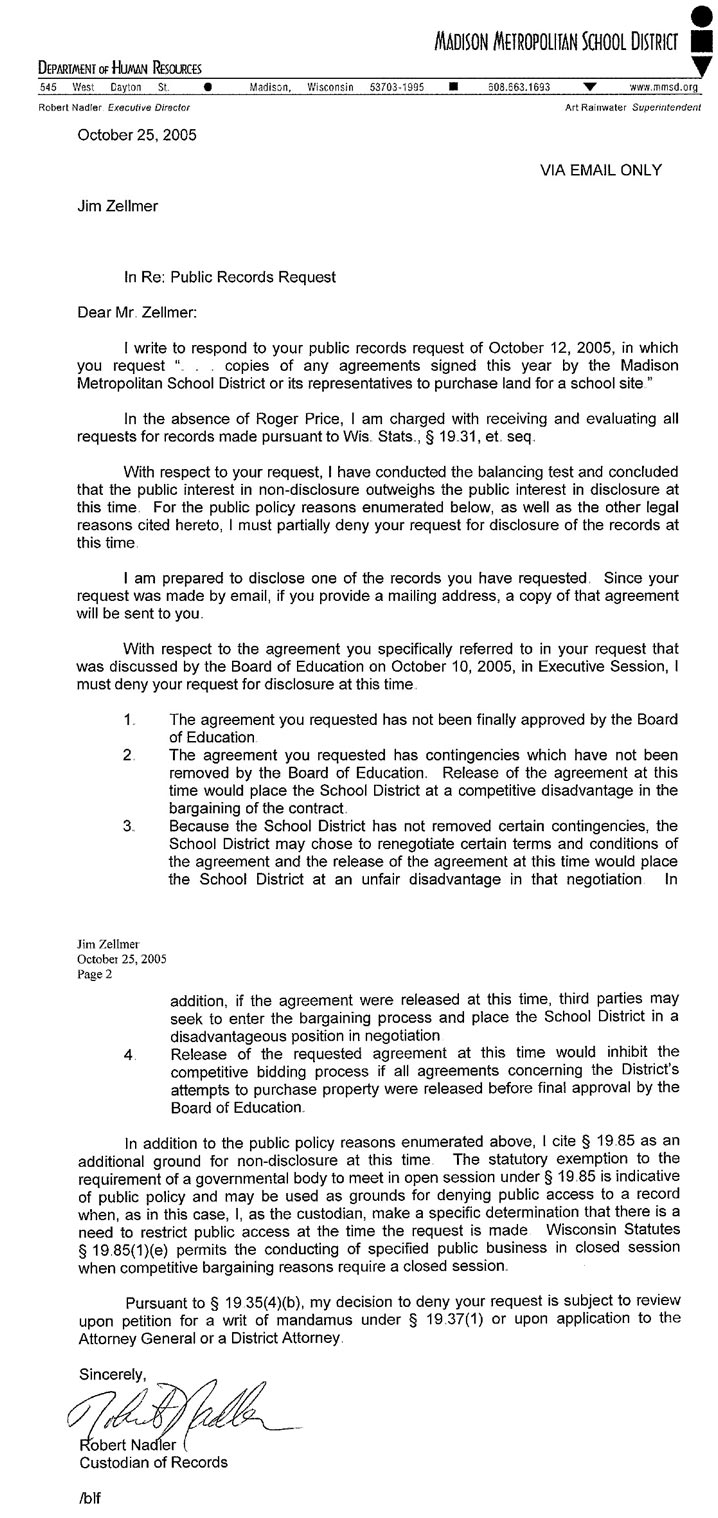
I received a response today from Bob Nadler, the District’s Custodian of Records. Essentially, this response means that the public has no right to know about the District’s purchase of land for a new school site until after the Board agrees to purchase. Read Bob’s letter here. I will post the document he referenced upon receipt.

Share

Mystery #3: Case of the Unknown Authorization

So far, undaunted detectives, Mysteries #1 and #2 remain largely unsolved, and I’ll shortly update the faithful followers on those.
In the meantime, train your magnifying glasses on Mystery #3, The Case of the Unknown Authorization.
The Unknown Authorization took place in the MMSD budget approved by the Board of Education. It created two new classrooms at Marquette Elementary for a cost of at least $350,000.
Find the authorization and the funds in the MMSD budget documents . . . if you can.
Hint: You’ll need your secret decoder ring!
Good sleuthing!

Share

Mary Gulbrandsen: MMSD Power Broker

No one appreciates Mary Gulbrandsen’s contributions to the Madison Metropolitan School District (MMSD) more than her boss, superintendent Art Rainwater. When we included Gulbrandsen in Madison Magazine’s 2004 People You Should Know list, Rainwater was the first to let us know we’d made an inspired choice. As MMSD chief of staff for the last two years, Gulbrandsen’s influence on all aspects of Madison’s K-12 schools is undeniable. From long-range planning to finance and operations to performance and achievement, district administration minutes suggest Gulbrandsen has spent the last two years in meetings. But seeing her in action on some of the most difficult issues, like the school environment for kids and families of color, proves what a skilled administrator she’s become. Add on top of all that her striking warmth and good sense, and Gulbrandsen seems a perfect fit for her behind-the-scenes position of power.

From “Power Influence & Anonymity: The Seven Women Power Brokers You Need to Know” by Robert Chappell, Neil Heinen and Brennan Nardi
Madison Magazine, November 2005

Share

The Budget: Same Service = Cost to Continue = Baseline

Jim Zellmer, and others have taken the district to task for having a “same service” budget – alledging that nothing changes as a consequence.
But let’s clarify the use of some terms. The district uses the term “same service” to estimate the next year’s costs – the city and county do the same thing, but use the term “cost to continue.” This is not the entire process, but merely the starting place. The district and Board then make changes – both to comply with the state revenue caps and to improve our programs. We can figure what the changes will cost (or amount saved) by the difference from the same service budget.
Change and how to achieve it in a large system such as the school district is a major concern. Some changes have significant budgetary impacts, e.g. equipping schools with adequate computers (and the infrastructure to support this), reducing class sizes in the primary grades.
However, the one of the most far-reaching changes needed is to change what is occurring in the classroom. This change is brought about through intensive staff development – and is aided by smaller class sizes, but once the district budget includes funding for staff development and for smaller classes the critical factor is not the budget for these but how the funds are used.

Share

Media – The Next Generation

Lookout Sandy Cullen, Matt Pommer, Jason Shepard, and Mitch Henck! Professor Jack Mitchell’s Journalism 335 class at the University of Wisconsin-Madison is teaching the next generation of media. For several weeks these students learn about the Madison School Board and the City Council. I asked Professor Mitchell if I could share the stories with all of you. Enjoy.
http://www.journalism.wisc.edu/j335/mitchell/fall05/gov.html

Share

Message from Mr. Mom’s Attorney

This message was posted on the Communities United list serve by Yolanda Woodard, attorney for Mr. Mom’s Transportation Service.
Dear Concerned Community & Business Leaders:
Recently the local newspapers and electronic media have reported on the Mr. Mom’s Transportation Service. This coverage has been in the most unfavorable light possible. While some missteps have been made with the current operation of the business, the sensational, negative media coverage far exceeds the true nature of the situation.
Corrective actions have already begun, long before it became fashionable for the local media to “bash” Mr, Mom’s.
Accordingly, we respectfully request that those of good conscience support Jeff and Cathy Smith and their company Mr. Mom’s. We are asking the community to support this company’s long standing presence in our community and its efforts to address the public concerns by attending a Press Conference to be held on Wednesday, October 21st at 10 am at the Genesis Economic Development Center, 313 W. Beltline Hwy. (Next to Nedrebo’s).

UNITED WE STAND!
Yolanda S. Woodard
Attorney for Cathy and Jeff Smith
608-277-1950

Share

Eyewitness Report: School Board Decisions on Bus Contracts

A recent editorial in the Wisconsin State Journal claims that the Madison school board rejected Superintendent Art Rainwater’s “painstaking” analysis of known problems with local bus companies when it granted long-term contracts to transport our students to locally owned companies. According to the editorial, the administration informed the Board about safety and reliability problems with some of the companies, but—safety and reliability be damned— the Board rushed ahead. The administration, having taken its stand, then meekly agreed to commit the districts to contracts likely to fail our students and their families.
Time for a fact check. I was there for the administration’s presentation, for the votes on the contracts and for recent Board discussions about the problems that have developed with one of the local companies, Mr. Mom’s.
This is my eyewitness report.

(more…)

Share

Minority Overrepresentation in Special Ed. Targeted

From Education Week, October 12, 2005
By Christina A. Samuels
A new provision of federal law taking effect this school year allows, and in some cases requires, school districts to focus some of their federal special education money on reducing the enrollment of minority students in such programs.
The provision, contained in the 2004 reauthorization of the Individuals with Disabilities Education Act, requires some districts to spend as much as 15 percent of that federal aid on what are called “early intervening” services, which are meant to bolster the achievement of students before they are officially referred for special education.

(more…)

Share

UW Center Established To Promote Reading Recovery

A gift of nearly $3 million is being used to boost teacher training at the UW-Madison in a special, reading program.
But that program, Reading Recovery, has critics, who say it’s not worth the necessary investment.
Training at a new UW-Madison Reading Recovery Center will involve videotaping teachers, as they instruct young children, in a one-on-one process between student and teacher that costs more than group programs.
Student progress with Reading Recovery in the Madison School District and across the country has been questioned.

(more…)

Share

Ridgewood building razed

FITCHBURG – A demolition crew on Monday began tearing down a fire-ruined apartment building at 2001 Post Road in the Ridgewood Country Club Apartments complex.
Though the work was the first visible activity in the 52-acre, 832 apartment subdivision since Madison developers E.J. Plesko & Associates bought the troubled property this summer, a spokesman said taking down the structure “is not a precursor to other actions” being planned there.
By Cliff Miller
Correspondent for The Capital Times
October 18, 2005

(more…)

Share

Madison School District Student Fee(s) Analysis

The Madison Board of Education Finance and Operations Committee will discuss student fees during their meeting tonight. Committee Chair Johnny Winston, Jr. kindly asked Barbara Lehman to forward two documents:

Share

A Few Notes on the Superintendent’s Evaluation & Curriculum

Several writers have mentioned the positive news that the Madison Board of Education has reviewed Superintendent Art Rainwater for the first time since 2002. I agree that it is a step in the right direction.
In my view, the first responsibility of the Board and Administration, including the Superintendent is curriculum: Is the Madison School District using the most effective methods to prepare our children for the future?
There seems to be some question about this:

  • Language: The District has strongly embraced whole language (Troy Dassler notes in the comments that he has been trained in balanced literacy). I would certainly be interested in more comments on this (and other) point(s). [Ed Blume mentions that “”Balanced literacy” became the popular new term for whole language when whole language crumbled theoretically and scientifically.”] UW Professor Mark Seidenberg provides background on whole language and raises many useful questions about it. Related: The District has invested heavily in Reading Recovery. Ed Blume summarized 8 years of District reading scores and notes that Madison 3rd graders rank below state wide average for children children in the advanced and proficient categories. (Madison spends about 30% more than the state average per student)
  • Math: The District embraces Connected Math. UW Math Professor Dick Askey has raised a number of questions about this curriculum, not the least of which is whether our textbooks include all of the corrections. A quick look at the size of the Connected Math textbooks demonstrates that reading skills are critical to student achievement.
  • Sherman Middle School’s curriculum changes
  • West High School’s curriculum changes and families leaving
  • Same Service Budget Approach“: I think the District’s annual same service approach reflects a general stagnation.

(more…)

Share

Superintendent’s Evaluation: What’s Missing?

For the first time since 2002, the Madison School Board has produced a performance evaluation of Superintendent Art Rainwater. It’s a small step in the right direction. However, it’s important to understand how the evaluation fails to meet the requirements of the district’s employment contract with the superintendent.
The contract requires the Board to set specific, measurable goals for the superintendent by the first day of each school year. That did not happen.

(more…)

Share

Families Leaving West?

Many good things are happening in the Madison Metropolitan School District! This viewpoint and the things we see conflict with the stated concern by some families as they tell us that they will be leaving the district rather than attend West high school. The one reason common to families is that they want their child to have a chance to take AP courses (limited numbers offered at West, in contrast to the other MMSD high schools) for the academic challenge offered to prepare their child for application to competitive colleges. (This viewpoint seems to be paired with a concern that the Small Learning Community approach at West may result in decreased opportunities for other challenging course work). It seems so sad that these families are choosing to leave the district. The contributions that children and parents have made to the district will be greatly missed.
AP offerings seem to be the norm across the nation, yet at least one West staff member opposes these offerings. Can we have an open discussion about issues of concern??? What are the pros and cons of increased AP offerings? Is it important to attempt to retain families currently attending our schools? What do you think? If you have a special interest in this issue, you may want to check below for additional information. . . .

(more…)

Share

Comments on Superintendent Evaluation

Thanks to both Johnny & Ruth for posting the news of the superintendent’s evaluation.
Since neither left their posts open for comments, I’ll offer a comment and encourage others to use this post for additional comments.
I’m particularly pleased that the board said that it “would like the Superintendent to develop targets and measures for each priority and to provide an annual report on our performance in each area.”
I’ve argued before (Was the board actually listening!) that the priorities have no power without measurable, time-specific goals. Now maybe they will.

Share

Superintendent Evaluation: Board President’s News Release

Madison Board of Education President Carol Carstensen released this Report on Evaluation of the Superintendent earlier today. (PDF), or click below to read the release.

(more…)

Share

Report on Evaluation of the Superintendent

News Statement from the Madison Board of Education
Report on Evaluation of the Superintendent
Hiring, supervising and evaluating the Superintendent are major responsibilities for the Board of Education. It is important to remember that this is a collective task for the Board and represents the combined views of seven very different individuals.
Download file

(more…)

Share

Mr. Mom’s – Due Process Must Happen

It is no longer a secret that Mr. Mom’s Transportation Services currently faces significant challenges. Probably the biggest challenge for this small, local, minority owned business came from the school board last spring (2004). Mr. Mom’s and Badger Bus services were denied district transportation contracts. Our community was angered by this. In 2004, the Board received dozens of e-mails criticizing our decisions regarding contracts with local businesses. Here are some examples of the e-mails the school board members received:

(more…)

Share

Madison Schools Transport Update: Cullen and Pommer on Mr. Mom’s

Sandy Cullen:

The district is investigating how long the company was without insurance and also is looking into reports that some bus drivers did not have valid driver’s licenses, Rainwater said.
Also last month, the brakes failed on a bus returning students to Spring Harbor Middle School after a field trip, Rainwater said. No students were injured, and the bus did not crash.
Attorney Clarence Sherrod said the district is in the process of preparing a notice of default, which could lead to termination of Mr. Mom’s two contracts with the district.
Under the terms of its contracts, Mr. Mom’s will have 20 days to respond to the default notice.

Matt Pommer has more:

Price provided copies of the safety audits done on the five bus firms that serve the Madison district in response to questions raised Monday by School Board member Ruth Robarts.
The reports showed that other bus firms last year had far smaller percentages of buses needing repairs in inspections by the State Patrol. Two of 15 Badger buses needed work; one of 20 Rite-Way vehicles needed repairs; eight of 23 Durham buses failed; and five of 21 First Student buses inspected needed work.

Share

Update: Mr. Mom’s Bus Company Contract with the Madison School District

As reported in The Capital Times, I recently questioned Superintendent Art Rainwater about the process that the district used to determine that Mr. Mom’s bus company was qualified to bid for contracts to transport our students in the years from 2005-06 through 2010-11. The process is known as the “pre-qualification evaluation”.
In a memo today, Assistant Superintendent for Business Services Roger Price told the Board of Education that the pre-qualification evaluation for companies who wanted to bid on these six year transportation contracts was conducted in December of 2004. The process resulted in qualifying five companies to bid for the contracts. Mr. Price noted that “all vendors had some vehicles fail inspection” on the most recent inspections by the State Patrol.
His materials show very different failure rates for the companies.
Riteway: .5% failure rate (19 vehicles passed, 1 failed)
Badger Bus: 13% failure rate (13 vehicles passed, 2 failed)
First Student: 19% failure rate (21 vehicles passed, 5 failed)
Durham: 26% failure rate (23 passed, 8 failed)
Mr. Mom’s: 75% failure rate (2 passed, 8 failed)
When the Board of Education voted on the contracts, it did not receive this information.

Share

School Board Governance Perspectives

Last night’s Madison Board of Education meeting provided an illuminating look at two rather different perspectives on governance. The Board voted 4 (Carstensen, Keys, Lopez and Winston) – 3 (Kobza, Robarts, Vang) to support the Administration’s approach to the growing problems with Mr. Mom’s Transport Service (I believe there were two votes on this question – the minutes are not available as of this writing).

Many points were discussed, including the District’s pre-contract vetting of Mr. Mom’s and whether, given recent experience, the Administration should be allowed to subcontract with Badger Bus via Mr. Mom’s (Badger Bus is replacing Mr. Mom’s service on many routes). The District recently signed a five year agreement with Mr. Mom’s Transport Service.

The motion passed 4-3 to allow the Administration to Subcontract Badger Bus service via Mr. Mom’s (again, I think there was a 2nd vote on this). Watch the debate here

For what it’s worth, I’m actually in favor of long term (5 year) contracts. They, hopefully allow vendors to optimize and perhaps manage costs more effectively. The subcontract to Badger Bus via Mr. Mom’s, given the issues, seems unusual.

UPDATE: The 4-3 vote was on a Kobza motion, seconded by Robarts to contract directly with Badger Bus, rather than using a subcontract via Mr. Mom’s. After this motion was defeated 4-3 (Kobza, Robarts, Vang), as noted above, the Board voted 5 – 2 (Kobza joined Carstensen, Keys, Lopez and Winston) to support the Administration’s proposed subcontract with Badger Bus via Mr. Moms.

Share

Madison Schools Superintendent Art Rainwater’s October Message


Art Rainwater’s October Message. Quicktime Video

Share

Take Nothing from the MMSD at Face Value – Part 2

I previously posted a warning to take nothing from the MMSD at face value.
Here’s another reason.
The MMSD claims that capacity at Lapham Elementary stands below 67%. However, the MMSD reports Lapham’s maximum capacity at 304 students, and this year’s attendance at 252 students, giving Lapham a current enrollment of 82.9% of capacity.
It’s easy to believe that the MMSD administration has a hidden agenda to close an east side school when the administration plays with the truth.
Click here for a chart of enrollment and capacity.

Share

More on East / West Task Forces

Sandy Cullen:

Elementary schools considered most at risk are Emerson, Lapham and Lowell – which are at or below 67 percent of their capacity for students – as well as Lindbergh, Cohen said.
“We’re rallying around Lindbergh,” he said, adding that the school serves “probably the most fragile” population of low-income and minority families, including many from Kennedy Heights just across the street from the school.
Mary Gulbrandsen, director of student services and chief of staff to Superintendent Art Rainwater, said the Madison School District has no hidden agenda to close one or more East Side schools, as some parents fear.

Much more here.

Share

Town of Burke Aligns with DeForest

Bill Novak:

Madison’s Smart Growth (land use) plan was rolled out this summer, and it put a shiver into Burke residents.
“It showed Madison stretching north to Wisconsin 19, which is the southern border of DeForest,” Miller said. “When Burke officials came to us they said the residents of the town go to the DeForest schools so they wanted to be part of DeForest.”

Share

Nichols on Departing Madison School Board Member Bill Keys

John Nichols:

No member of the current Madison School Board has been more willing to throw himself into the thick of a debate – even if that meant going it alone on principle – than Bill Keys.

Share

Example of Board Goals

Thanks to Lawrie Kobza for her post “Superintendent’s Evaluation a Step in the Right Direction.”
She stresses the need for the board to set goals and expectations.
As an example of board-set goals and expectations, I noticed a list created by the board of education of the Forest Grove School District in Oregon. (I first saw the list when looking at the way the Forest Grove district used the concept of the $100 budget, promoted for use by the MMSD by Johnny Winston, Jr.)

(more…)

Share

Senate Bill 286, What a waste of time

WWW.Legis.state.wi.us/2005/data/SB-286.pdf
Just wanted to let everyone know that while WI tries to figure out how to pay for schools, healthcare, balance the budget, care for the needy, etc………………
Your legislatures are spending time on SB286.
In a nutshell it says “school districts should teach abstinence” as the only way to prevent STD and pregnancy. Wow, what a waste of time and your money. I received my undergraduate degree in Secondary Health and Biology education and I can assure you that all the books, lectures, and information I received in college taught me that this was the only form of “birth control” that was 100%. While I agree a great Health or Human Growth and Development class is of utmost importance to a great school district, this legislation is the biggest waste of time and tax payers money, but the biggest laugh is there are communities that will not allow you to teach Sex Education, or Human Growth and Development as we like to call it, in their schools so where does the Senate assume this statement or lecture will occur in these ultra conservative districts?
Wisconsin Legislation could not scream any louder that it is ignorant and scared of SCIENCE. Look at the bills; ban cloning, teach abstinence only, alleviate health care providers of responsibility if there is a conflict with moral judgement, and the ever popular intellegient design in science classes. We as educated parents should be concerned with science education in this state and how new legislation could effect our children’s view and evaluation of science and theroy. Science is currently on the chopping block of the evagelical right and I am very concerned about legislation at the federal and state level concerning what our children are taught in Science class and whether that is decided by scientist and educators or whether it is decided by a religious political group.

Share

SUPERINTENDENT’S EVALUATION A STEP IN THE RIGHT DIRECTION

Establishing Performance Goals Must Be Next
I ran for the Madison School Board because I believed the Board needed to change how it did business. The majority of voters agreed with me.
I have now been on the Board for five months, and it is fair to ask whether my election really will make a difference. Will it result in the change I called for?
I am hopeful it will.

(more…)

Share

Doyle Wants to Increase Math and Science Requirements

From NBC15.madison.com
Gov. Doyle says he wants high school students to take another year of math and science. Doyle says the move will make students better prepared for the future.
The announcement came when Gov. Jim Doyle released his Grow Wisconsin agenda last week.

http://nbc15.madison.com/news/headlines/1882932.html

(more…)

Share

MMSD Purchase of School Site

Here’s the agenda for a special meeting of the Board of Education:

Monday October 10th, 2005
6:00pm – Special BOE Meeting, Doyle Admin Bldg, Rm 103
* Purchase of School Site
* Behavior and Discipline Plan

Share

New Elementary Attendance Compared to Last Year

You can find the attendance by elementary school for the 2004-2005 school year compared to the newly release figures for the 2005-2006 school year. The comparisons are grouped by high school attendance area. Click here.
ps My apologies for the earlier and erroneous chart. I replaced it with one that should be accurate. If it isn’t, please let me know. And always remember, take nothing at face value from me or the MMSD. Always check and double-check.

Share

Handcuffed, isolated, and gagged

The task forces looking at eastside and westside enrollment and facilities operate under a set of “givens” that restrict the options they might consider, isolate them from publilc discussion, and control what items they can discuss at meetings.

(more…)

Share

The Achievement Gap in Elite Schools

Samuel G. Freedman
“An uneasy amalgam of pride and discontent, Caroline Mitchell sat amid the balloons and beach chairs on the front lawn of Princeton High School, watching the Class of 2004 graduate. Her pride was for the seniors’ average SAT score of 1237, third-highest in the state, and their admission to elite universities like Harvard, Yale and Duke. As president of the high school alumni association and community liaison for the school district, Ms. Mitchell deserved to bask in the tradition of public-education excellence.
Discontent, though, was what she felt about Blake, her own son. He was receiving his diploma on this June afternoon only after years of struggle – the failed English class in ninth grade, the science teacher who said he was capable only of C’s, the assignment to a remedial “basic skills” class. Even at that, Ms. Mitchell realized, Blake had fared better than several friends who were nowhere to be seen in the procession of gowns and mortarboards. They were headed instead for summer school.”

Share

Illinois Teacher Calls Art Rainwater’s Recent Message “Misquided”

Bruce Allardice, a public school teacher in Des Plains, ILL wrote a letter to the Capital Times in response to Madison Schools Superintendent Art Rainwater’s recent article on the need for public education:

Dear Editor: If I was grading the Tuesday guest column of Madison School District Superintendent Art Rainwater titled “Free public education is cornerstone of country,” I’d give the superintendent a D. His rhetoric is nice, but the logic is horribly misguided.

(more…)

Share

Defense of the Status Quo

I agree wholeheartedly with Johnny Winston’s comments that were reported in the Isthmus article on the upcoming board evaluation of the performance of Superintendent Rainwater. The article by Jason Shepard says:

Winston . . . cites Rainwater’s reluctance to take risks to solve educational problems: “If we have an issue related to student achievement, I’d like the superintendent to say, ‘You know what? It’s not working right now, and I’d like us to try something different.’ I’d like Art to lead the charge on that.” Winston would also like Rainwater to “be more critical of the organization” as a means of self-improvement.

(more…)

Share

Secrets of Success: America’s system of higher education is the best in the world. That is because there is no system

The Economist via Tom Barnett:

Wooldridge says three reasons account for this: 1) the Fed plays a limited role, unlike in a France or Germany; 2) schools compete for everything, including students and teachers; and 3) our universities are anything but ivory towers, instead being quite focused on practical stuff (Great line: “Bertrand Russell once expressed astonishment at the worldly concerns he encountered at the University of Wisconsin: ‘When any farmer’s turnip go wrong, they send a professor to investigate the failure scientifically,'” So true, as anyone who’s grown up in Wisconsin farmland can attest.)
Two interesting data points: listing of top global universities features 1 from Japan, two from UK and 17 from U.S. Wisconsin, my alma mater is 18 (ahead of Michigan!) and Harvard is number 1.
Also interesting: Of the students who travel abroad, 30 percent come to America. Britain is next at 12%, then Germany, then Australia, then France and Japan. After Australia it’s all single digits.
I guess America isn’t exactly out of the source code business, at least in the most important software package known to man.

(more…)

Share

Members of West/Memorial Task Force

At large representatives representing an ethnic group who reside within the attendance areas:
Prasanna Raman
Brenda Gonzalez
Name
Community member without children in the district:
Tim Otis
Student Liaison to the Board of Education:
Connor Gants
School & Representative
Chavez – Rich Rubasch – Jennifer Sheridan (Alternative)
Crestwood – Marisue Horton – Mary Kay Battaglia (Alt.)
Falk – Dr. Matthew Raw – Karl Woodruff (Alt.)
Huegel – Laura Lenzen (Alt.)
Muir – Ann and Brett Larget
Orchard Ridge
Stephens – Carol Quintana
Jefferson – Wilma Gurl
Spring Harbor – Don Jorgensen
Toki – Sue Mowris
Memorial – Mary/Scott Whitcomb – Mary Fahey (Alt.)
Franklin/Randall – Michael Maguire
Leopold – Rusty Shoemaker-Allen
Lincoln – Lori Mann Carey
Midvale – Jerry Eykholt – Brian Tennant (Alt.)
Shorewood – Janice Ferguson – Michelle Vassallo (Alt.)
Thoreau – Gina Hodgson – Erin Weiss (Alt.)
Van Hise – Wendy Cooper – Jim Bauman (Alt.)
Cherokee – Arlene Silveira – Marcia Bastian (Alt.)
Hamilton – Mark Kaiser – Alan Kim (Alt.)
Wright – Fern Murdoch – Sandra Willis-Smith (Alt.)
West – Michelle Reynolds
Shabazz – Paula Volpiansky – Stacy Sandler (Alt.)
Affiliated Alt

(more…)

Share

Members of the East Task Force

At large representatives representing an ethnic group who reside within the attendance areas:
James Howard
Ramona Natora
Name

Community member without children in the district:

Pat Mooney
One East High School student:
Rebecca Berkenstadt
School & Representative
Emerson – Linda Galang – Michelle Rawlings (Alternate)
Gompers – Amy Riedemann
Hawthorne
Lake View
Lapham – Mike Wygocki – Chris Oddo (Alt.)
Lindbergh – Tonja Prodehl
Lowell – Maria Doyle
Marquette – Laura Chastain – Kimberly Neuschel (Alt.)
Mendota – Michelle Brokaw – Mike McCabe (Alt.)
Sandburg – Lisa Kind
Black Hawk – Jill Jokela
O’Keeffe – David Wallner – Josh Day (Alt.)
Sherman – Vicky Nelson – Angela Nash (Alt.)
East – Brenda Robinson
Shabazz – Kim and Richard Karlin-Kamin
Affiliated

(more…)

Share

School-Funding Update from WAES (WI Alliance for Excellent Schools)

Referendum soundly defeated in Phillips School District
Greendale voters support $14 million tax levy
North Carolina will use lottery proceeds for schools
Slot machine revenue not best bet for public schools
What’s new in the anti-TABOR toolbox?
School-funding reform calendar
The Wisconsin Alliance for Excellent Schools (WAES) is a statewide network of educators, school board members, parents, community leaders, and researchers. Its Wisconsin Adequacy Plan — a proposal for school-finance reform — is the result of research into the cost of educating children to meet state proficiency standards.

(more…)

Share

A Few Task Force Names – Updated

Carol Carstensen provided updated information on the people selected by the Board of Education to serve on the attendance task forces:

West-Memorial
Prasanna Raman (nominated by Ruth Robarts to fill a position as an Asian member of the task force)
Tim Otis (nominated by Bill Keys to fill a position as a resident with no children in the district)
Brenda Gonzalez (nominated by Juan Lopez to fill a position as an Hispanic/Latino member of the task force)
Charlie Daniel (to fill a positon as an African American member of the task force)
East
James Howard (nominated by Lawrie Kobza to fill a position as an African American member of the task force)
Pat Mooney (nominated by Carol Carstensen to fill a position as a resident without children in the district)
Ramon Natera (nominated by Juan Lopez to fill a position as an Hispanic/Latino member of the task force)
– A represenative of the Asian community has notyet been named

Carol Carstensen says that the district may soon release the names of the members selected by the principals and PTOs.

Share

Agenda for East Task Force

THURSDAY, SEPTEBMER 22, 2005
6:30 p.m. Special Meeting of the Madison School Board and the East
Attendance Area Demographics and Long Range Facility Needs Task Force
Sherman Middle School
Library Media Center
1610 Ruskin Street
Madison, WI

(more…)

Share

Agenda for West/Memorial Task Force

TUESDAY, SEPTEMBER 20, 2005
6:30 p.m. Special Meeting of the Madison School Board and the Memorial and West Attendance Areas Demographics and Long Range Facility Needs Task Force
Toki Middle School
Library Media Center
5606 Russett Road
Madison, WI 53711

(more…)

Share

Is the Cluetrain Running Over Government?

Sophos writing at IT Toolbox:

Government is still in the old broadcast mode of press conferences and press releases and talking at you rather than with you. Government only seems to have time to converse with lobby groups, mass media reporters and interests that are going to make them or their friends money. Money from the government.
The conversations are growing – mass media is at a loss to understand how to deal with or contend with the number of blogs, cross-linking of blogs and the sheer volume of people getting involved in the conversation. It is no holds barred and far more interesting than the scripted Q&A being spouted from press conferences. Mass media is so flabbergasted, that they have resorted to reading blogs on their broadcasts! How crazy is that – broadcasting elements of the conversations from the blogosphere on TV. Media is stunned. The administration is stunned. It is only going to get worse for all of them.

Share

No Names Yet of Task Force Members

For more than a week, I’ve been trying to get the names of the people appointed to the East and West/Memorial task forces on attendance and facilities.
I have the following partial list of the names of people who were nominated by board members and the board member who nominated each.

(more…)

Share

Superintendent’s Message

Madison School District Superintendent Art Rainwater is beginning to write a series of monthly articles which he will use as his Superintendent’s Report. Listen to this month’s report by watching this 5 minute video clip. I looked around the District’s site and did not immediately see a text version of this report. UPDATE: The message was circulated via email Tuesday morning, 9/13/2005. Click the link below to read a text version:

(more…)

Share

Clarification of Tonight’s Special Board Meeting Regarding the Equity Policy

I wanted to clarify (via the Board President) the reason for the equity policy meeting tonight. If you remember last winter a majority of the Board indicated it wanted to set up a task force to look at the equity policy – but did not give any further directions. Tonight’s meeting is to bringing the issue back to the Board for further discussion and to get more direction from the members about a possible composition and charge to a task force. In President’s defense, she gave her commitment to the community that the board would have a citizen group work on this issue and she’s following through.

(more…)

Share

School-funding update

Two gubernatorial candidates endorse school-funding reform
Check out the school-funding reform calendar
What’s new in the anti-TABOR toolbox?
School-funding reform calendar
The Wisconsin Alliance for Excellent Schools (WAES) is a statewide network of educators, school board members, parents, community leaders, and researchers. Its Wisconsin Adequacy Plan — a proposal for school-finance reform — is the result of research into the cost of educating children to meet state proficiency standards.
**************

(more…)

Share

Equity Policy:  Discussion Not Voting

The issue of the district’s equity policy is on the agenda for this evening’s discussion to get more direction from the Board.  The last time the Board looked at this issue it indicated the need to establish a task force but did not specify membership, charge or process.  When I described my goals as President (and during the spring campaign) I specifically said I would follow through with creating a task force to look at the equity policy.  This is on a Special Board meeting because it is being brought to the Board for discussion not action.   I am sorry that there seems to be some confusion about this.

Share

Madison School Board Votes on Equity Policy On September 12: what’s at stake? what’s the rush?

On Monday, September 12, the Madison Board of Education will vote on proposed revisions to the district’s Equity Resource Policy. The revisions gut the current policy and replace it with an already existing formula for allocating staff to schools based on socioeconomic factors. The meeting is a Special Board meeting called by President Carol Carstensen. At the meeting administrators will recommend this change and the full Board will vote on the recommendation. Not much notice to the public, not much opportunity to hear public opinion and analysis, no analysis by any Board committee. Only very savvy people who closely watch the Board agendas will know that this vote is coming.

What’s at stake?

(more…)

Share

Task Forces To Meet Week of September 19

Carol Carstensen sent me the following about the task forces:

Because not all schools have named representatives yet, the first meetings of the task forces has been moved back a week – Sept. 20 for West/Memorial and Sept. 22 for East.

Share

East & West Task Forces Meet Next Week?

A person who was apparently appointed to one of the task forces to study attenance and facilities on the east and west sides says that the task forces have been scheduled to meet next week.
The MMSD has released no information about the task forces.
Does anyone know what’s going on?

Share

Lawmaker and Educator Propose Incentive Pay for Teachers in Troubled Schools

David M. Herszenhorn: Representative Charles B. Rangel and Arthur Levine, the president of Teachers College at Columbia University, urged the Bloomberg administration and the teachers’ union yesterday to create pay incentives of $10,000 a year or more to entice educators to work in some of city’s lowest-performing schools.

Share

A Model for the School Board to Get Budget Input?

Mayor Dave issued the following message on how he hopes city residents can help shape Madison’s next budget. I hope that the Board of Education uses a similar approach during the district’s budgt process next spring.

Thanks to the combination of state levy limits and higher costs for providing City services (due to factors such as escalating fuel costs),the City of Madison faces a $4 million budget gap for 2006.
Closing this gap will force the City to make a number of tough choices.
As I work on developing my budget proposal, I want to hear from the public about what priorities we should set for scarce City resources.
To help get that input, I am holding a series of interactive “Build
Your Own Budget” forums this month. At these forums, participants will get to put themselves in my shoes, and balance the City budget through their chosen combination of spending cuts and revenue increases.
Background and worksheets will be provided to guide participants
through the budget process and outline various spending and revenue options to choose from. I will use the information gathered at these forums as I craft my executive budget for introduction in October.
The forums are all free and open to the public. The forum schedule is
listed below. I hope that you will take this unique opportunity to make your voice heard on how the City should set its priorities in the year to come.

(more…)

Share

Back to School, Thinking Globally

New York Times Editorial:

The great achievement of No Child Left Behind is that it has forced the states to focus at last on educational inequality, the nation’s most corrosive social problem. But it has been less successful at getting educators and politicians to see the education problem in a global context, and to understand that this country is rapidly losing ground to the nations we compete with for high-skilled jobs that require a strong basis in math and science.
American taxpayers have heard a fair amount about the fact that their children lag behind the children of Britain, France, Germany and Japan. But American students are also bested by nations like Poland, Ireland and the Czech Republic. Worst of all, they fall further and further behind their peers abroad the longer they stay in school.

Share

Indianapolis School Superintendent: A Change Maker?

Matthew Tully:

“We have to turn things around right away,” he said. “They didn’t bring me in to be safe. They brought me in to be a change maker.”
So he has tossed out troublemaking students and offered ambitious plans for historic schools Crispus Attucks and Shortridge. He’s demanded more from all, from teachers to students to janitors.
White has been the city’s top newsmaker since becoming superintendent of the state’s largest school system July 1. He seems to have commandeered space on the front page.

More on Eugene G. White, Indianapolis’s new Superintendent. Via Eduwonk.

Share

An observation on what makes a good school board member

The first paragraph of the link recommended by Barb Schrank says:

An effective school board plays an important watchdog role in keeping your local school on track, and setting policies that affect your child and your school. The school board sets the vision and goals for the school district, and holds the district accountable for results. One school board member cannot do the job alone. Effective school board members contribute their unique talents while collaborating and working as a team with other board members.

I find the Madison Board of Education and superintendent do well on collaboration, except for attacking Ruth Robarts, but I’d like to see the board improve dramatically on being a watchdog, setting policy, setting the vision and goals for the district, and holding the district accountable for results.

Share

What Makes a Great School Board Member?

Great Schools a non-profit California organization writes about what it means to be a great school board member.
A North Carolina school board looked out 10 years asking where they wanted to be and set annual goals accordingly: “Griffin [a school board member in a North Carolina school district] began his first term on the board by asking the tough question: “Where do we want our schools to be in 2010 and how will we know that we have gotten there?” He then worked with his board and superintendent to set the vision and goals for their district. When a new superintendent was hired, he insisted that the adopted school district goals be written into his contract, and that the superintendent be evaluated annually based on the goals.”

Share

Milwaukee Schools Health Care Coverage Changes

Alan J. Borsuk and Sarah Carr:

Milwaukee Public Schools teachers will begin shouldering a larger share of the costs of their health care under an arbitrator’s ruling issued Tuesday.
The decision ended 2 1/2 years of work on a two-year contract for more than 6,000 teachers with a victory for the School Board and the administration of Superintendent William Andrekopoulos.
After management and the Milwaukee Teachers’ Education Association deadlocked – almost entirely over health insurance issues – the dispute went to the arbitrator, Marquette University Law School Professor Jay Grenig, who was required to pick between the final offers of each side without making any changes.
Under the MPS plan, teachers would begin paying portions of the cost of their health care, including deductibles and co-pays on many services. Administrators say the district pays more than 60 cents in fringe benefits for every dollar it pays in salaries.

Share

Gorman Drops Ridgewood Plans

By mid-December of 2005, a task force appointed by the Madison School Board will make recommendations about future school construction and possible school boundary changes in the West and Memorial High School areas of the district. In the following article from The Capital Times, August 30, writer Cliff Miller reports that developer Gary Gorman has withdrawn from his role in the redevelopment of a large apartment complex adjacent to Leopold Elementary School. The complex—Ridgewood Country Club Estates—has housed low-income families whose children have attended Leopold and Chavez Elementary Schools. The nature of the new housing and the timing of the redevelopment could have significant implications for west side elementary school enrollments, particularly the future enrollment at Leopold School.

(more…)

Share