School Information System

30 Years of Clout: MTI’s John Matthews & the ’76 Teacher’s Strike

Susan Troller:

The key architect behind that transformation was the tough young executive director of Madison Teachers Inc., John Matthews, who had come to Madison eight years earlier from Montana.
Thirty years later, Matthews is still tough and, more than ever, still casts a powerful shadow across the public education landscape of Madison as a tireless and relentless advocate for teachers. With Matthews at the helm, MTI has remained a dominant force in education and labor.

Former Madison Mayor (currently with Epic Systems – Verona) Paul Soglin weighs in as well.

Share

One of these things is not like the others: School Board Oversees Task Forces Except When Savings in Health Care Costs at Stake

Recently, the Madison School Board has authorized a plethora of special committees to consider issues confronting the district and to make recommendations to the board. These committees have the potential to improve future board decisions by bringing new ideas and new information to our attention.
Currently, there is a special committee to advise the board on advertising. There are the two large task forces that recently issued recommendations regarding overcrowding and under-utilization problems in the West, Memorial and East High attendance areas. There is committee of parents, teachers, and administrators to suggest changes in our health and safety policies regarding animals in our classrooms. There is a committee to review whether staff and other resources are allocated equitably to the schools, taking differences in student populations into consideration. There are budget forums intended to seek community input on next year’s budget.
In every case, the board publicly discussed its goals for the committee before launching it. In every case, the board voted on a specific charge to the committee and set procedures and a timeline for meetings. In every case the board has received regular reports on the progress of the committee.
The glaring exception to this process was the creation of a task force of teachers union and district representatives to consider whether changes in health insurance programs for the teachers might make it possible for the district to shift dollars from health insurance payments to wages. Millions of dollars in potential savings are at stake.

(more…)

Share

Isthmus: Take Home Test for Week 1; Madison School Board Candidates

Isthmus has posted week 1 of their Take-Home Test:

weekly question-and-answer quiz of the five candidates vying for two seats on the Madison Board of Education.
Every week, we’ll ask them a set of questions, one dealing with school board dynamics or the issues facing the 24,000-student-district, and the other more personal, aimed at revealing their experiences and attitudes.

Fabulous.

Share

Elimination at Jr. High

My Jr. High student at Jefferson has been informed that there is a good chance his Family and Consumer Education (FCE) and his Technology classes will not be at Jeffferson next year. I have heard ramblings about foreign language being reduced at Jr. High level as well.
This is where I begin to think Public Schools are going to continue to lose students. My son would never choose to take a foreign language or FCE. He is my “jock” and the wonderful cultural and diverse information he is receiving from foreign L.A. and F.C.E are the reason we keep sending our kids to a public school. If the public offerings dwindle to nothing, why would we, a middle to high income family continue to send our children to public schools? If MMSD continues eliminate the diversity and class selection, they can continue to see the decrease in high income students. Money is required to offer these classes, however, if the extra-curricula activities and interesting diverse classes are eliminated, the district will deal with less students, higher numbers of low income students, and the continual decrease of middle and high income students. Many will not see the significance of these numbers, but it is significant as costs rise to educate students that demand more social and psychological needs. The district needs to evaluate the long term effects of eliminating these programs.

Share

Candidate Forum: Dane County Public Affairs Council

Wednesday, 1.25.2006; 7:30 – 9:00a.m. @ US Bank Plaza [map / directions] Lower Level Conference Room:

A discussion of issues facing our school district and community such as: high costs and low achievement; the budget; revenue caps; referenda; reading and math curricula; health care costs; dministrative costs; contract negotiations; boundary changes and school closings/new buildings; violence in schools; Fund 80; and more. Primary election for seat one is Feb. 21. Final elections in April. Who will earn your support?

Share

Candidate Interviews Continue: Seat 1, Arlene Silveira

Video | MP3 Audio

The second candidate interview is now available. Look for an interview with Lucy Mathiak soon (I’ve not heard back from Michael Kelly or Juan Jose Lopez). Maya Cole’s interview is here

Candidate details here

Share

Searches for Superintendents Hang on a Pivotal Decision

Ian Shapira:

As many of the nation’s school systems begin searching for new superintendents in the next few months, they will employ a traditional tactic: secrecy. In many cases, the process will involve only a select few who know who is being considered for what can be a municipality’s most highly paid public…

Share

MAUE School Board Candidate Forum

Madison United for Academic Excellence [www site] held a Madison School Board candidate forum Tuesday evening, January 17, 2006. Maya Cole, Michael Kelly, Lucy Mathiak and Arlene Silveira participated (election website). Candidate statements and questions appear below:

(more…)

Share

Citizens swing ax at school budget

A story by Sandy Cullen in the Wisconsin State Journal reports on two groups that tried the $100 budget exercise:

The State Journal asked 10 people to participate in the exercise led by Superintendent Art Rainwater and his assistant superintendent for business services, Roger Price. District administrators will lead additional sessions of the exercise at Madison’s 11 middle schools on Tuesday, Wednesday and Thursday.
“This is not a process to build a budget,” Price said. Rather, the exercise is meant to give residents an opportunity to express their priorities to administrators and School Board members as the district puts together its 2006-07 budget.

Share

Administrator and Teacher Contracts – Timing and Position do Seem to Matter

Teachers sign their contracts for the next year usually in March – however, this is not a guarantee of a job for next year. Teachers can still be surplused or laid off from their jobs. The process for this is governed by their MTI contract.
Surplusing teachers effects the school budget the next school year, so there is an “immediate” effect upon the number of teachers, upon the district’s educational resources available for children’s learning and upon the budget’s bottom line. This is different for MMSD personnel on administrative contracts. Administrative contracts are in most cases two-year rolling contracts, except as stated in the Human Resources (HR) policy , so the financial effect of reducing administrative positions that are filled can take up to 18 months to be reflected in the budget. Wouldn’t this reduce the Board’s decisionmaking authority during the budget process and potentially put an additional burden of budget cuts on teachers, psychologists, social workers, custodians, etc.?
Does this mean that administrative employees on a two-year rolling contract have 18 months to retrain/to apply for an open position in MMSD or to find a new job while still keeping their current job and getting paid if their contract is not extended. WI law governs some of the policy in place, but I don’t know how much of MMSD’s policy is required by state law, and I don’t know if state law requires contracts for all administrative personnel.

(more…)

Share

Budget: WPS Presentation to MMSD/MTI Health Insurance Task Force

WPS’s (Wisconsin Physician Service) recent presentation to the MMSD/MTI Health Insurance Task Force. [Text: HTML] [pdf slides]
Share

Final Report of the Memorial/West and East Task Forces

The report is available here: 4MB PDF. Long Range Planning Committee website.
Channel3000 has more.

Share

Budget: GHC Presentation to MMSD/MTI Health Insurance Task Force

Group Health Cooperative’s recent presentation to the MMSD/MTI Health Insurance Task Force. [5.1MB PDF]
Share

Tongue in Cheek Solution

I have noticed a movement about MMSD. There seems to be the following needs:
1. Make each grade/class the same across the district so that all
students have a equitable distribution of funds, resources, and knowledge. (Connected math, FOSS science, middle school curriculm, and West English)
2. Great concern from “legal” I assume that food, animals, and flammable paper present a hazard to the students and potentially invite a lawsuit. (pet proposal, upcoming food proposal to eliminate any homemade food in the school, and the fire code issue)
3. Boundary changes to solve growth and income disparity which causes financial stress on the district. (Task forces, failed referendum, spending cap)
So here’s the solution:

(more…)

Share

Candidate Interviews Begin: Seat 1, Maya Cole

Video | MP3 Audio

The first candidate interview is now available. Look for interviews with Arlene Silveira (Arlene’s interview is now available here) and Lucy Mathiak soon (I’ve not heard back from Michael Kelly or Juan Jose Lopez).

Candidate details here

Share

Very disappointing start for MTI-MMSD health insurance task force

On Wednesday, January 11, representatives of Madison Teachers, Inc. (MTI) and the Madison school district met at the union’s headquarters for three hours. MTI Executive Director John Matthews chaired the meeting. It was the first of two meetings at which MTI and MMSD will supposedly explore the potential for savings on health insurance costs for the teachers. Those expecting a serious effort by union and district representatives to compare costs and services from a range of health insurance providers and press the companies for savings will be seriously disappointed.
There were two presentations at the meeting: one from representatives of Wisconsin Physicians Services (WPS) and one from Group Health Cooperative (GHC). Despite a promise from the board president and superintendent that the meeting would be videotaped, the district did not tape the meeting. So far only the text for the WPS presentation (with accompanying PowerPoint) is available for public review.
At the meeting on January 25, 2006—also at MTI’s headquarters at 821 Williamson Street beginning at 1 p.m.—the task force will hear presentations from representatives of Dean Care and Unity. There has been no explanation of why there will not be presentations from Physicians Plus or the State Group Health Plan. Both offer services comparable to those that teachers currently receive under the collective bargaining agreement between the parties at competitive rates.

(more…)

Share

Program & staffing changes in my $100 budget exercise

$1.74 – Move all employees in Curriculum Research and Staff Development into classroom teaching and school administrative positions that will be vacated through normal attrition.
$0.40 – Replace Reading Recovery with Read 180
$0.15 – Move Associated Alternatives to Doyle. (Plenty of room with Curriculum Research & Staff Development leaving. Use UW facilities for gym. Use various large conference rooms for lunch.)
$?.?? – Move MSCR to Doyle. Mothball Hoyt subject to further review of best use or sale.
$0.043 – Eliminate one administrative position in superintendent’s office.
$0.043 – Eliminate Legislative Liaison position; rely on lobbyists of Wisconsin School Board Association.
$0.043 – Eliminate Director, Public Information.
$0.243 – Eliminate 9 positions in Gateways to Learning
$0.043 – Eliminate 1 position in research
$0.043 – Eliminate 1 position in Human Resources
Total reduction $2.791 or $7,256,600, without eliminating a single classroom teacher.

Share

More on Milwaukee Vouchers & TABOR

John Fund:

The irony is that public educators in Milwaukee believe choice has helped improve all the city’s schools. “No longer is MPS a monopoly,” says Milwaukee Public Schools superintendent William Andrekopoulos. “That competitive nature has raised the bar for educators in Milwaukee to provide a good product or they know that parents will walk.” The city’s public schools have made dramatic changes that educators elsewhere can only dream of. Public schools now share many buildings with their private counterparts, which helps alleviate the shortage of classrooms. Teachers, once assigned strictly by seniority, are now often hired by school selection committees. And 95% of district operating funds now go directly to schools, instead of being parceled out by a central office. That puts power in the hands of teachers who work directly with students.

Milwaukee schools are still struggling, but progress is obvious. Students have improved their performance on 13 out of 15 standardized tests. The annual dropout rate has fallen to 10% from 16% since the choice program started. Far from draining resources from public schools, spending has gone up in real terms by 27% since choice began as taxpayers and legislators encouraged by better results pony up more money.

Rich Eggleston says that TABOR would subvert Democracy:

In Wisconsin, the ‘Taxpayers Bill of Rights’ is being billed as a tool of democracy, but it’s actually a tool to subvert the representative democracy that to reasonable people has worked pretty well. When Milwaukee-area resident Orville Seymeyer e-mailed me and suggested I “get on the TABOR bandwagon,” this is what I told him:

via wisopinion

Share

Questions about using the Doyle Building

Since there have been different ideas about using Doyle to solve some of the district’s space/funds problems, I thought I would list the questions that occur to me as I consider next steps.
1.Locate the Affliated Alternatives (at Brearly) in Doyle:
a. How much space will AA need?
b. What will be the cost of remodeling to accommodate students?
c. What about cafeteria and gym space?
d. Where would we move the staff that must leave Doyle to make room for the students?
e. What is the cost of the move and of remodeling the new space?
2.Sell or lease Doyle
a. Where would central office staff be located?
b. What is the cost of the move?
c. What is the cost of remodeling the new space?
d. What are the out-of-pocket costs (travel, time, etc) of locating Doyle staff in more than one location?
e. What is a realistic expectation of the money generated by a long-term lease?
f. What is a realistic expectation about the amount Doyle would bring if sold?
g. If there is development potential, why haven’t there been proposals for the district/UW parking lots behind Doyle?

Share

Madison school puzzle at crossroads

Sandy Cullen writes:
For nearly two years, a wide range of school officials and parents have puzzled over what to do about the lopsided enrollment trends. In the next few weeks, the emotionally charged issue will come to a head as two task forces offer their ideas to the Madison School Board.
A next step might include representatives from both task forces working with the school board, because these representatives bring to the table the two very different perspectives of these task forces, which the School Board will have to meld into one plan. Both task forces have worked thoughtfully and diligently, and representatives of these task forces would bring that experience to help with next steps.
As a community, we need to make this work for all kids fairly with consideration of their education needs and the financial resources available.

Share

What happens to Hoyt?

If the MSCR were to be moved from Hoyt, how would Hoyt be used?

Share

MTI School Board Candidate Questions / Answers

Two Madison School Board Candidates have published their answers to Madison Teachers, Inc. 2006 School Board Election Questionnaire:

I’ll post links to the other candidate’s responses if and when I receive them here and on the election page.

Share

Task Force Insight

Dear Board,
While serving as a member on the Long Range Planning Committee for the West/Memorial Task Force I came to a few insights I would like to share.
Our charge was to seek solutions for the over-crowded schools in Memorial and Leopold attendance area as well as address the low income disparity throughout the area.

  • Overcrowding in Memorial – with current data and projected growth to be over 100% capacity in 5 of the elementary schools I believe the only solution to this problem is a new school. With the purchase of the far west land the board must believe this as well. This should be the number one priority of the growth solution for MMSD. There is space at Toki/Orchard Ridge and a few seats at Muir for this attendance area and additions could be made to Falk, or an update and expansion of Orchard Ridge/Toki could be made, but otherwise there is no room without changing programmatically.
  • Leopold overcrowding is much more complicated, as you know. This huge expansive slice of Madison and the entire city of Fitchburg attendance area has somehow become one elementary school. I do not support an addition to this school for many of the same reasons I did not like two schools on the same land. It is lots of seats in one part of town and you create problems for the future. If Shorewood or Crestwood had 1000 seats we would be busing kids from Fitchburg to that school because that’s where the space is. An addition without a new school means a principal, staff and others at this school are functioning like the other 4 – 5 hundred space schools but with double the students, is that fair to the staff of that school? Would you want to be the principal of 800 – 900 students? I would rather have a school in Fitchburg or south of the Beltline off of 14 to help Leopold and the Allis attendance area that currently is sent to the other side of Monona.
    There is space at Midvale/Lincoln, Randall, Shorewood,and there is 110 seats at Hamilton, 94 seats at Wright, and 118 seats at Cherokee. And of course the strange building of Hoyt that must have ghost or something since no one wants to touch it. There is space in West. The move of Leopold to Chavez is wrong minded since it shifts the West area problem to the overcrowded Memorial area.
    The Elephant in the Room throughout the entire Task Force was Midvale/Lincoln and the perceived lack of quality at that school. There is 75 seats at Lincoln and 62 seats at Midvale this year and each time the suggestion was made to shift students from Leopold to M/L it was met with distaste, (except for two apartment buildings of 30 students) as the memo from the Swan Creek neighborhood (see attachment) was an example. That memo, while it outraged me, is a glaring example why we can’t solve Leopold overcrowding (see memo [pdf] from Midvale Parent Jerry Eykholt to the Swan Creek Parents). On the task force Leopold was sent to Chavez, Randall/Franklin, Thoreau over and under M/L, but somehow those 137 seats at M/L seemed too far away. I think the district is failing Midvale/Lincoln.

(more…)

Share

Stossel: How the Lack of School Choice Cheats Our Kids Out of A Good Education

John Stossel:

And while many people say, “We need to spend more money on our schools,” there actually isn’t a link between spending and student achievement.
Jay Greene, author of “Education Myths,” points out that “If money were the solution, the problem would already be solved … We’ve doubled per pupil spending, adjusting for inflation, over the last 30 years, and yet schools aren’t better.”
He’s absolutely right. National graduation rates and achievement scores are flat, while spending on education has increased more than 100 percent since 1971. More money hasn’t helped American kids.
Ben Chavis is a former public school principal who now runs an alternative charter school in Oakland, Calif., that spends thousands of dollars less per student than the surrounding public schools. He laughs at the public schools’ complaints about money.

I’m impressed ABC devoted so much effort to education. The article includes full text and video.
Stossel also touches on Kansas City’s effort to turn around (1980’s and 1990’s) by spending more per student than any other district in the country. Madison School District Superintendent Art Rainwater implemented the largest court-ordered desegregation settlement in the nation’s history in Kansas City, Mo

Share

Decentralizing Schools

Jenny D:

William Ouchi is giving a talk today on decentralized schools, and organizations. He’s a management prof at UCLA and author of a best-seller, Making Schools Work. He says that before WWII there were 25 million students in public schools, now there are 50 million. Before WWII there were 116,000 school districts, now there are 16,000. School districts have become centralized.

Share

Swan Creek Residents Organize to Stay at Leopold

Kurt Gutknecht, writing in the Fitchburg Star:

Residents of Swan Creek have launched a spirited campaign against plans to bus students from the area to Midvale/Lincoln elementary schools.
A few days after Christmas, 185 households signed a letter [500K PDF] opposing the plan, which a task force had proposed to address overcrowding at several schools in the western part of the Madison Metropolitan School District.
Students from Swan Creek now attend Leopold Elementary School.
The letter was presented at the Jan. 5 meeting of the task force. Another task force is preparing plans for the east side of the district where under enrollment is a greater concern.
According to the letter, said the plan being considered meant the “subdivision is used selfishly by the Madison school district” to “plug holes in a plan that has very little merit” and contradicts an agreement the district made when it exchanged land with the Oregon School District. During the negotiations prior to the land swap, the Madison district said children from Swan Creek would attend Leopold.
The letter cited behavioral and safety issues associated with long bus rides, the negative effects on parent involvement and neighborhood cohesion, and criticized the attempt to use children from the subdivision to achieve balanced income at the schools.
Prasanna Raman, a member of the task force who presented the letter, said busing students from Swan Creek could be a case of reverse discrimination.

UPDATE: Midvale parent Jerry Eykholt sent this letter [pdf] to the Task Force and Swan Creek residents.

(more…)

Share

Forum on moving alternative programs to O’Keefe

O’Keeffe and Lapham/Marquette PTGs will host a forum on the Affiliated Alternative Programs at 6:45 p.m. in the all purpose room on Wednesday, January 18. A flyer on the meeting lists the following purposes for the forum:

* Provide an opportunity for O’Keeffe, Lapham/Marquette school community members to ask questions about the proposal to place the Affiliated Alternative Program at the O’Keeffe/Marquette site AND to have an open community forum among ourselves after the Q&A
* Steve Hartley, Director of Alternative Programs, will be presenting information on the Affiliated Alternative Program and its space needs.
* Loren Rathert, Chairman for the East Area Task Force, will answer questions regarding the task force process.

Share

Thursday Morning Links: School Performance

  • Milwaukee’s new School Performance Ratings:

    Andrekopoulos said those studies are showing that students in high value-added programs are decidedly more engaged in actual classroom activity than those in low value-added schools.
    In a recent presentation to the School Board, he said MPS now understands why low-performing schools are that way. “We didn’t know that two years ago,” he said.
    Milwaukee Public Schools has begun listing how individual schools are doing not only on the widely used measure of what percentage of students are proficient or btter in standardizd tests, (attainment), but also with a measure in which the average increase in student scores from year to year in each school is compared with the average for all of MPS (value added).

  • Houston to pay teacher bonuses based on student test scores.
Share

Don Severson / Vicki McKenna Discussion

Active Citizens for Education’s Don Severson appeared on Vicki McKenna’s radio show recently. [10mb mp3 – about 30 minutes]

Share

Rationale for Removing School Closings from Consideration

Message from the East Attendance Area Task Force regarding rationale for Removing School Closings from Consideration. It reflects contributions from several Task Force members. This is another reason to be impressed by the hardwork of both the East and West/Memorial Task Forces.

(more…)

Share

West Attendance Area Task Force Discussion at a PTO Meeting

Summary of a West Attendance Area Task Force Discussion at the Thoreau PTO:
MMSD Chief of Staff Mary Gulbrandsen participated in a well attended Thoreau PTO meeting recently to discuss the options that the West Attendance Area Task force is currently evaluating. I thought the conversation was quite interesting and have summarized several of the points discussed below:

  • The May, 2005 referenda failed due to poor communication. What will the District due to improve that? There was some additional discussion on this topic regarding whether a referendum could pass.
  • Why don’t the developers (and therefore the homeowners in these new subdivisions) pay for the costs of a new school? Discussion followed that included much larger building permit fees, a referenda question that asked whether the homeowners in these emerging subdivisions should pay for a facility and changes in the way that we fund public education. Some also suggested that people purchased homes in these areas knowing that there was not a school nearby and therefore should not be surprised that a bus ride is required. Mary mentioned her experiences growing up an a farm where a 45 minute bus ride was no big deal. Obviously, there are different perspectives on this – I rode the bus daily for several years.
  • Can’t the District sell some of their buildings (excess schools, Hoyt, Doyle – next to the Kohl Center) to pay for this? That would be a strong statement that might support the passage of a referendum.

(more…)

Share

Racine Independent Commission on Education Reports

Independent Commission on Education:

The mission of the ICE is to provide a wholly independent, fresh and informed perspective on the District’s finances and operations to ensure the right resources are available and aligned to help the District achieve its academic plan.

Commission Report [pdf] | Deloitte Report [pdf]

Share

The Gap According to Black

Cydny Black:

In high school now, at Madison Memorial, I see this achievement gap more clearly than ever. Where are all the minority students in my advanced placement classes? Or more specifically, where are all the black students? In my advanced classes I can count them on one hand. And of these students, most are from middle to upper class families. Their parents have degrees of some sort, and their parents have pushed education—just as my parents encouraged me.
This leads me to ask, “What happens to all the kids whose parents don’t have degrees and who aren’t pushed to learn?” It seems to me that in a lot of these cases, they get trapped in the system, just like the two boys who fought at my school. And do teachers and administrations really know how to help them? It surprises me that we are taught history, math, science, and English but we are never given answers to some of the more difficult questions. The questions that deal with our society and our lives as young people growing up.
What does all of this mean for the African American youth who are struggling? How will they advance in school, and what’s more, in society?

Share

Help Create a Public Charter School of Arts and Technology – in Madison

Are you interested in helping to create a public charter school of arts and technology in Madison?
You’re invited to attend a planning meeting of local parents, educators and others at:
Date: January 18 ( Wednesday )
Time: 6:00 – 8:00 pm
Site: MADISON Library – Sequoya Branch
513 South Midvalle Blvd. [map]
Please help to make THE STUDIO SCHOOL a reality within the public school district.

(more…)

Share

“Here’s an Idea: Put 65% of the Money Into Classrooms”

Alan Finder:

The idea’s appeal lies in its simplicity, proponents say. If school districts were required to make their administrative operations more efficient, they could free up money for use in the classroom.

Share

“Charter School Confidential”

Jay Matthews:

I don’t think there is a more important story in this new year of 2006 than what happens to the country’s growing charter schools.
But no matter what happens to the federal law, we are going to continue to try to improve schools in this country, one way or another. I would prefer to spend my time looking at the most interesting and encouraging efforts to do so, and that means checking on the charter schools — independently run public schools — since they have the most freedom to innovate.

Share

Tax Base, City Growth and the School District’s Budget

Paying my annual property tax bill recently, I wondered what the effect of Madison’s development growth (some might call it sprawl) has had on overall spending growth and on an individual’s tax burden (note, Madison Schools include Fitchburg, Maple Bluff and Shorewood parcels). I contacted the city assessor’s office and asked how the number of parcels has changed since 1990. Here are the numbers (thanks to Hayley Hart and JoAnn Terasa):

2005: 64976 2004: 62249 2003: 60667 2002: 59090
2001: 58140 2000: 57028 1999: 56006 1998: 54264
1997: 53680 1996: 53152 1995: 52524 1994: 51271
1993: 50938 1992: 49804 1991: 49462 1990: 49069

Some believe that more money will solve the School District’s challenges.

(more…)

Share

2006-2007 MMSD Budget Comments

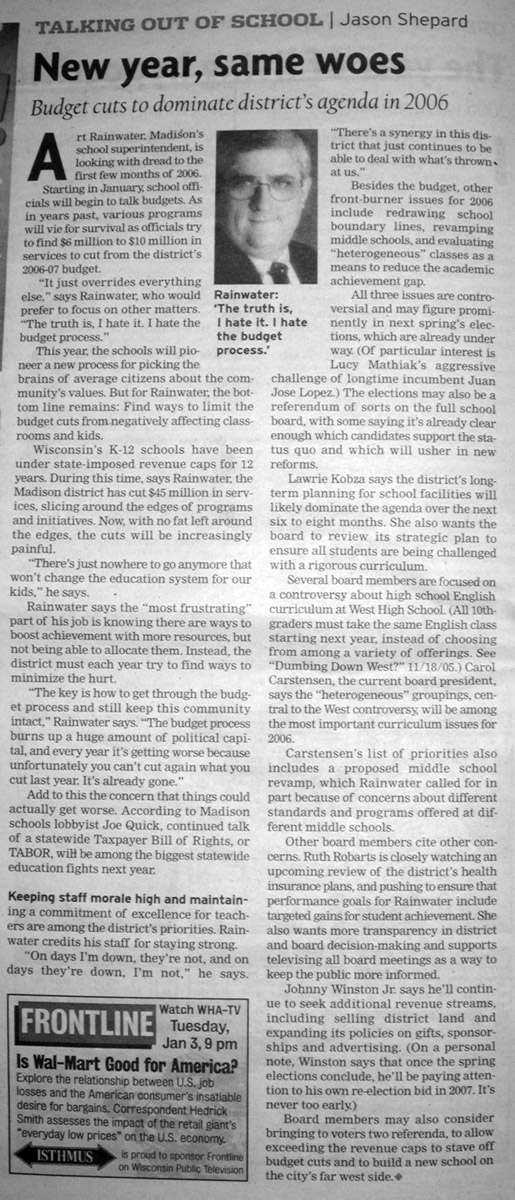
Jason Shepherd writing in the December 29, 2005 Isthmus:

  • Superintendent Art Rainwater: says the “most frustrating” part of his job is knowing there are ways to boost achievement with more resources, but not being able to allocate them. Instead, the district must each year try to find ways to minimize the hurt.
  • Board member Lawrie Kobza wants the board to review its strategic plan to ensure all students are being challenged with a rigorous curriculum.
  • Carol Carstensen, the current Board President says the “heterogenous” groupings, central to the West controversy (English 10, 1 curriculum for all), will be among the most important curriculum issues for 2006.
  • Ruth Robarts is closely watching an upcoming review of the district’s health insurance plans and pushing to ensure that performance goals for Rainwater include targeted gains for student achievement.
  • Johnny Winston says he’ll continue to seek additional revenue streams, including selling district land.

Read the full article here.

With respect to funding and new programs, the district spends a great deal on the controversial Reading Recovery program. The district also turned down millions in federal funds last year for the Reading First Program. Perhaps there are some opportunities to think differently with respect to curriculum and dollars in the district’s $329M+ budget, which increases annually.

Teacher Barb Williams offers her perspective on the expensive Reading Recovery program and the district’s language curriculum.

Board Candidate Maya Cole offers her thoughts on Transparency and the Budget

Share

New York City’s Big Donors Find New Cause: Public Schools

David M. Herszenhorn writes:
In the context of the system’s regular budget of about $15 billion a year, $311 million might seem insignificant. But the tax dollars come with so many strings that the administration has viewed private money as crucial for research and development and an array of experimental programs.

“You are able to do it without saying this is money that is going to come out of the classroom,” Mr. Klein said in an interview.
So far, the mayor’s and the chancellor’s collections include more than $117 million to start new small schools; nearly $70 million to open an academy for principal training; $41 million for the nonprofit center supporting charter schools; $11.5 million to renovate libraries; $8.3 million to refurbish playgrounds; and $5.7 million to reshape troubled high schools.


New money or old, donors have been enthusiastic enough to write seven- and eight-figure checks. As a result, the school system has been the largest beneficiary in a mayoralty that has reached to the private sector, strategically and aggressively, for all sorts of support.
Donors to the schools, many of whom have been attending black-tie benefits together for years, said the mayor and the chancellor have transformed the way the school system relates to gift-givers, by improving communication and creating a sense of professionalism.
“I come from the business world; I’m used to a world where there is freedom and accountability and that never seemed to exist in the world of public education,” Mr. Reich said.
“The very notion of a dynamic entrepreneur is that they want to make something happen,” he continued, sipping from a demitasse of espresso served by an aide in chef’s whites. “They want to be part of a movement. As mayor he believes in the ideal of these public-private partnerships.”
After becoming chancellor in 2002, Mr. Klein created an Office of Strategic Partnerships and imposed on his wife’s college friend, Caroline Kennedy, to serve as its chief executive. Mr. Klein made the pitch while visiting Ms. Kennedy and her husband, Edwin A. Schlossberg, on Martha’s Vineyard.

Share

Bill Lueder’s 2005 “Cheap Shots” Awards

Bill Lueders:

Most Secretive Public Entity:
Madison Schools
This summer, the school board announced plans to meet in closed session to discuss teacher bennies, until this was deemed improper. In fall, the district suppressed a report that criticized school officials over the stun-gunning of a 14-year-old student on grounds that there was “pending litigation” — which of course means the litigants had certain access. It also cut a secret deal to buy land for a new school on the city’s southwest side, with board members refusing to delay final approval for even one week to allow for public input. What might voters do the next time the schools come seeking more money? Shhh! It’s a secret!

Share

AP Courses Gain Ground in High Schools (DC)

Jay Matthews:

The D.C. public school system’s college-level test participation rate increased slightly in 2005, with the largest high school, Wilson, making the greatest gain, according to The Washington Post Challenge Index survey of area schools.
The participation rate for D.C. schools, calculated as the number of college-level tests per graduating senior, went from 0.776 in 2004 to 0.820 in 2005, an increase of almost 6 percent

Share

Raising Expectations in Watts

Lance Izumi:

One place where such heroic work is taking place is the Watts Learning Center (WLC) charter school, one of the most improved charter schools in California.
From 2000 to 2005, the WLC rose from a low test-score ranking to a level near the state’s proficiency target score of 800. The K-5 charter school was able to defy low expectations and accomplish this feat with a student population nearly all African American and low income. In an example of what the President called “the soft bigotry of low expectations,” these two factors are too often considered indicators of educational failure. WLC charter school proved defied that expectation.
Gene Fisher, founder and president of WLC, says that the school’s mission is to create a culture of learning and high expectations for students, parents, faculty and staff. He points out that, “The job of our teachers includes an emphasis on a proven curriculum while also reinforcing these high expectations – a belief that students can and will succeed.”
The school uses the structured phonics-based Open Court reading program. WLC chose Open Court before the Los Angeles Unified School District adopted the same program. Open Court emphasizes continuous review and practice of already learned material. Sandra Fisher, the school’s executive director, says that it is important that the curriculum be structured because so many students lack structure in their lives.

Links:

via Joanne

Share

Disintegrating District: Los Angeles

Evan George writing in LA Alternative:

But on November 15th, Jefferson saw a new kind of disruption: a march organized by the students and parents of Small Schools Alliance, to protest what they see as indifference to the inadequate learning environment at Jefferson. More than 500 marchers converged on LAUSD headquarters with a petition of 10,000 signatures calling for the district to relinquish control of Jefferson High School and transform it into six independent charter schools to be operated by Green Dot Public Schools, a local, non-profit charter school developer, created by former Democratic party activist—and Rock the Vote founder—Steve Barr.
Green Dot, which currently operates five high schools in the Los Angeles area, has vied for control of Jefferson High School for nearly a year and a half. Charter school critics—and there are many—have long decried Romer’s own association with the Charter School Movement. As reported in this paper back in February of 2003, Romer then supported a contentious bill aimed at resurrecting the controversial Belmont Learning Center as a risky charter school program.
“I think the Left, which I’m a member of, has to pull our heads out of our xxxxx and come up with some solutions, and stop defending failed systems. Especially un-democratic, centralized bureaucracies that are not effective,” says Barr in an interview with L.A. Alternative. “We have no answers for the education issue. Our answer is to give more money to a failed centralized system?”
Here is an eduprediction: One way or another, things are going to change at Jefferson, Barr has let the genie out of the bottle and it’s not going back in. And that is his endgame anyway, improving things. Those parents want fresh ground now that they know it’s out there.
Barr has this old fashioned notion that the public schools are supposed to be a way up the economic ladder a few rungs — for the kids not the adults.

via Eduwonk

Share

Public Not Welcome at MMSD Talks about Future Health Insurance Costs

Last August, MMSD parent KJ Jakobson asked “whether the new joint district-union task force for investigating health insurance costs be a truly collaborative effort to solve a very costly problem? Or will it instead end up being a collusion to maintain the status quo?” Collaboration or collusion: What should the public expect from MMSD-MTI Task Force on Health Insurance Costs?
Her question remains an important one. If the task force of representatives of the school district and Madison Teachers , Inc. identifies future cost savings from changes in health insurance providers, the district could save million of dollars per year after 2007. Although the savings would go to higher wages for teachers during the 2005-07 collective bargaining agreement, there would be possible savings for the district budget in future years. The district now pays about $37 M per year for health insurance for its employees.
Unfortunately, the history of the task force to date suggests that Ms. Jakobson’s fears were well-grounded.

(more…)

Share

West Area Attendance Task Force Minutes (12/20/2005)

Minutes from the 12/20/2005 West Attendance Area Task force meetings. [PDF version] January 5, 2006 Agenda [PDF version]

Share

“In Middle Class, Signs of Anxiety on School Efforts”

Susan Saulny:

Some of the very changes that Chancellor Joel I. Klein has made his hallmark – uniform programs in reading and math for most schools; drilling that helped produce citywide gains last spring on standardized tests; changes in rules for admission to programs for the gifted and talented, designed to make them more equitable – have caused unease among that important constituency.
Many parents say, however, that there are extremely limited public school options in the middle school years, and some chafe at how the new rules for gifted programs in the elementary schools and for certain select schools have made competition for admission stiffer.
City officials say that judging by the number of children eligible for free lunch, the class divide in the system remains stable: About 80 percent of the children are poor, with no increase in middle class flight.
Yet Emily Glickman, a consultant who advises parents in the city on winning admission for their children to private schools, said, “The last two years the interest in private schools has exploded, as I see it with people coming to me.”

Share

Why is the MMSD Afraid to Have a General Discussion of Their Mathematics Program?

A year ago the Jefferson PTO planned to have a mathematics night, with a discussion of their math program. I was asked if I would appear and said yes. The Madison Metropolitan School District was asked and they refused to send anyone, saying that they did not want to do this school by school. but district wide. When Mary Ramberg was asked when this would be done, she said they had no plans to do this.
Here is part of the report from 1882 from the State Superintendent about textbooks. At this time changes in textbooks had to be approved by the State Superintendent. The following should be done:

  • 3d. That regard shall be had to the merits of the books, and that if the change is sought to be made in the interests of better books, the superior merits of the books proposed to be introduced shall be stated.
  • 4th. That the change shall not be against the pronounced public opinion of the locality interested.

Why is the MMSD afraid to have a general discussion of their mathematics program?

Share

“Urgency is Needed to Improve our Schools”

Boston Herald Editorial:

It may sound simple, but it helps illustrate the urgent need to change the state’s approach to improving failing schools.
As it stands, the state can deem a school underperforming if students fail to meet minimum standards for two or more years.
Then it’s six months to come up with an improvement plan, another two years to make changes and only then does the state even consider intervening. Meanwhile, another generation spends its most important years in schools that aren’t getting the job done.

Share

Vouchers, Charters and Public School Accountability

Eduwonk rounds up a number of interesting comments on Milwaukee’s voucher program, including this:

Update: Concerning public accountability, one reader writes:
Yeah, yeah, yeah. I’m not defending these voucher schools, or any schools that hide from legitimate public oversight. But I’ve spent years now working on projects that required interviews with school personnel, site visits, documentation from the central office, etc., etc. And if you think that refusing to submit to outside evaluation is specifically or even primarily a problem of private/voucher schools, you’re nuts. There’s no stonewaller like the public school stonewaller. Administrative assistants are the worst. And don’t give me all that FERPA xxxx, either; they just don’t want people snooping around.
That’s a fair enough point, it’s not just a voucher school problem (though not every public school stonewalls either).

Share

Stay out of YOUR business!

Public education is public business, that is, your business. However, the administration thinks otherwise, and I was raked over the coals a few days back for saying, “The MMSD’s line certainly tells students, parents, teachers, and taxpayers that we don’t know bleep about education, so we should sit down, shut up, and get out of the way while the administration does what it pleases.”
I further commented, “The issue is MMSD’s ‘corporate culture,’ and how it values the opinions of administrators vs. the rest of us.”
In the draft of the minutes of Performance and Achievement Committee on November 14, 2005, we get a clear restatement of the MMSD’s organizational culture:

The reason that the board and public will not be able begin thinking through the curriculum redesign is that the superintendent invoked a new form of ‘executive privilege’ at last Monday’s meeting. When I asked for information as soon as the committee makes its recommendations, the superintendent successfully argued that no one outside of administration should have access to the recommendations until he decides which recommendations he supports. According to Rainwater, public discussion of the recommendations before he makes his choices would interfere with his discussion with the experts on his staff. Apparently protecting administrative discussion is more important than opening the curriculum-choosing process to public scrutiny and input.

(more…)

Share

Report of Committee to Redesign Middle School Curriculum: Top Secret for Now

An administrative report recommending changes the middle school curriculum district-wide that was due in late December is now expected some time in January. Shwaw Vang, chair of the Performance and Achievement Committee of the MMSD school board, held a second meeting on the expected report on December 19. According to minutes of the November meeting on this topic, the December meeting would be an opportunity for Board members to provide feedback or input.
Unfortunately, the Board received no new information about the likely proposal of the committee, although the recommendations will affect most areas of the middle school curriculum, including Fine Arts, Life Skills, Mathematics, Wellness, and World Languages as well as Student Support Services. Among other things, the recommendations will result in equal minutes of instruction across subject areas.

(more…)

Share

Community Invited to Suggest Budget Reductions

Residents of the Madison Metropolitan School District will be given the opportunity in 11 January sessions to make suggestions and set priorities for budget reductions necessary for the 2006-07 school year. The budget reduction exercise uses a $100 budget that reflects the proportionate share for 47 major program areas of the actual MMSD budget.
MMSD Press release, 12/22/05

(more…)

Share

Lopez to Seek 5th Term

Sandy Cullen:

Two slots on the Madison School Board will be up for grabs in spring elections in which one incumbent will face a challenger while other candidates vie for an open seat.
Board member Juan Jose Lopez announced Tuesday that he will seek a fifth three-year term. He is facing a challenge by Lucy Mathiak, a parent and organizer of the advocacy group East High United.
Parents Arlene Silvera and Maya Cole, both active PTO members at different West Side schools, have declared their candidacy for the seat being vacated by Bill Keys.

Websites: Maya Cole | Juan Jose Lopez | Lucy Mathiak | Arlene Silveira (Arlene told me her site would be up soon).

Share

Tim Olsen on Generating Cash from the Doyle Administration Land/Building

Tim Olsen’s email to Madison Board of Education Member Ruth Robarts:

And below are the specifics you requested re calculating an estimated value for the Doyle site. You are welcome to share this email with anyone interested. And thanks for the opportunity to speak to the Board, for your comments, and for including Lucy Mathiak’s blog-article. Someone told me about her article and I’m happy to receive a copy.

(more…)

Share

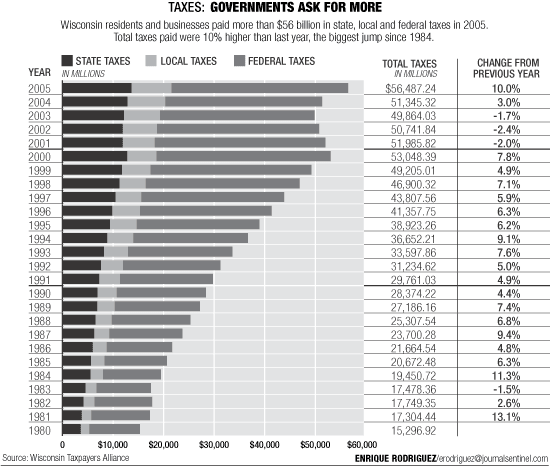
Wisconsin Taxes Rose 10% in 2005

taxes21g.gif

  • Wisconsin Taxes Set a Record: Residents and Business give 10% more:

    Wisconsin residents and businesses paid a record $56.5 billion in state, local and federal taxes and fees this year, a 10% increase from last year and the biggest jump in more than two decades, according to a study by a non-partisan taxpayers group. = WISTAX

    • Wisconsin’s total taxes rose 1.4 percentage points in 2005 to 32.0% of personal income
    • Net local property tax levies rose 6.3% in 2005. At 4.3% of personal income, 2005 net levies were at their highest level in 10 years.
Share

Task Forces Present Early Options

Sandy Cullen:

Those options would move between 316 and 620 students. Some students at Leopold, Chavez, Falk, Thoreau, Stephens and Huegel would go to existing schools, while some students from Crestwood, Huegel, Stephens and Chavez would attend a new school.
School Board member Lawrie Kobza questioned why an option moving fewer students, which had been presented at recent public forums, was off the table. “I had felt we were moving in the right direction when moving the least number of kids,” she said.
Facilitator Jane Belmore said bus rides for some of those students would have exceeded 45 minutes each way.
….parent Tim Olsen called on administrators to “lead from the front” instead by selling the Doyle Administration Building.
Olsen said that selling the property adjacent to the Kohl Center could bring nearly $7 million to the district, which anticipates eliminating up to $10 million from its current budget next year to comply with state revenue limits.

Share

“School Contests Promise to Be Hot”

Lee Sensenbrenner:

With this spring’s elections to the Madison School Board, the balance of power on the seven-member body hinges on the outcome of what surely will be two hotly competitive races.

Much more on the candidates and the election here.

Share

MMSD Budget Mystery #5: Mumbo Gumbo in the Kitchen

Let me first say, daring detectives, we dismissed Sam Spade that language larruping lout. So uncouth!
So let’s get back to real sleuthing on the case of Mumbo Gumbo in the Kitchen, the MMSD kitchen to be exact.
The puzzling budget portfolio presented to the Board of Education says, “The Division [Food Service] is reviewing staffing levels for the 2005-2006 school year and expects to reduce the staffing level by approximately 2%.” (page 150)
Now here’s the first of the mysteries in this mumbo gumbo. The budget figures on page 149 (the page right before page 150!) show the Food Service budget RISING from $7,152,021 to $7,398,620, an increase of $246,599 or 3.5%! Mysterious!
Don’t go away. We’re just getting started on these numbing numbers.
“Fringe FTE” increased from $1,004,621 to $1,922,782, or $918,637 or 91.5%, according to the same budget figures. Do the Food Service employees have such a bold bargaining brigade as to wring such a wonderful increase from the MMSD contract negotiators?
The same table shows that “Other Salary and Benefits” leaped from $1,219,053 to $2,180,790, an increase of 78.9%.
What would cause such a dramatic increase in salaries and fringes in light of the professed reduction in staffing level “by approximately 2%?” (The simple solution won’t stump those who paid attention to Mystery #4: Body Count or 1-2-3 FTE.)
“Other expenses” in Food Services (still on page 149) yo-yo around from $2.1 million in 2003-2004, $3.9 million in 2004-2005, and settle at $2,395,600 in 2005-2006.
This is a most curious concoction!
Can anyone tell the okra from the rice in this gurgling mumbo jumbo?


Share

Internationalizing Our Schools

Elizabeth Burmaster:

We live in a world instantly connected via satellites, computers, and other electronic technology. Our children embrace the technology that makes those connections possible, but need the educational background through cultural and linguistic experiences that will prepare them for the global world of today and their international future.

Burmaster raises some useful points. Clearly, it is no longer sufficient to compare Madison’s curriculum and achievement with Racine, Green Bay or Kenosha. Rather, the question should include Bangalore, Helsinki, Shanghai, Taipei and Osaka, among others.

Share

MMSD opposes charter school

An article by Joe Quick on MMSD’s Web site lists the MMSD as one of the organizations opposed to legislation that would allow the UW-Madison to support a charter school in Dane County. Quick wrote:

Two Milwaukee-area legislators have proposed allowing the UW System to operate or contract for the operation of a charter school with the approval of the Board of Regents. According to the Legislative Reference Bureau analysis, “the school must be located in Dane County and may accept any pupil who resides in Dane County. The school may accommodate up to 700 pupils in its first school year (which may be no sooner than 2007-08), and up to 1,400 pupils thereafter.”
. . . The bills are opposed by the: School Administrators Alliance, Wisconsin Association of School Boards, Wisconsin Education Association Council, Milwaukee Public Schools, Janesville and Madison Schools. As of December 15, no lobbying group or individual registered with the State Ethics Board has indicated support for the measure.


An individual does not have to register with the State Ethics Board unless they are a paid lobbyist working for a group like those listed above.

Share

When Learning Counts: Rethinking Licenses for School Leaders

Jacob E. Adams, Jr. & Michael A. Copland [PDF]:

This report asks two fundamental questions: do the licenses that states require of school principals encompass the knowledge and skills those principals need to promote student learning? If not, what kind of policy framework would help decisionmakers, educators, and others rethink principal licenses and the school leadership they support? To find the answers, we examined licensure content for principals in all 50 states plus the District of Columbia. Based on that in-depth investigation, we reached the following conclusions.
Licenses don’t reflect a learning focus. No state has crafted licensing policies that reflect a coherent learning-focused school leadership agenda. On the contrary, licenses run between two extremes: a reliance on individual characteristics, such as background checks or academic degrees, that signal nothing about the purposes or practice of the principalship, and lists of knowledge and skill requirements whose scope and depth don’t clearly sum to a meaningful definition of the job. Neither approach represents a set of qualifications on which the public may rely or the profession may depend. In an era of standards and accountability, this omission stands out.
Licensing requirements are unbalanced across states and misaligned with today’s ambitions for school leaders.

Share

Public Education Goes to School

Harvard Business School:

We asked our nine districts what their biggest barriers were in achieving excellence at scale, and they described five categories of management challenges:

  1. Implementing a district-wide strategy
  2. Achieving organizational coherence in support of the strategy
  3. Developing and managing human capital
  4. Allocating resources in alignment with the strategy
  5. Using performance data for decision making and accountability

Share

If “homogeneous” is bad, is “heterogeneous” better?

An article from American Educator, a magazine of the American Federation of Teachers:

. . . detracking accomplished many transformations in a few short years. It transformed teaching from difficult to impossible. It transformed the ideal of equal instruction for all into practices offering less instruction for all. It transformed faster students from motivated allies to disengaged threats . And it transformed teachers from detracking enthusiasts into advocates for a return to tracking. These results pose challenges for researchers and practitioners. While tracking often has bad outcomes, detracking
is not necessarily better.
Researchers who have played a role in criticizing tracking must also consider the potential problems of detracking. Until such studies are done, high school practitioners should be cautious about proceeding to detracking reforms just because they sound appealing. There is too much at stake, and there is great risk of unanticipated negative outcomes. These teachers’ experiences indicate that good intentions and hard work are not enough to make detracking successful.


Substitue “homogeneous” for “tracked” and “heterogeneous” for “detracked,” and see whether the article has any application to West’s Curriculum Reduction Plan.

Share

Madison School Board – SPAMMED!!!

Since Thursday, “thousands and thousands” (and I mean – thousands) of e-mails have filled the e-mailboxes of Madison School Board members (and probably other members of school boards in Wisconsin). The message reads:

(more…)

Share

Attendance Task Force Update

Please see www.madison.k12.wi.us and click on the Long Range Planning section and view the updated options on this site. Or view the report that will be given to the BOE Monday evening. The W/M Task Force will have another meeting on Dec 20th and tweeking of the options may occur but many of us feel we have reached the near end. (Of course anything can happen so don’t hold me to that.) Also, the East Task Force Report for the BOE is available on the LRP site.

Share

Madison School Board looking for community members to serve on Equity Task Force

The Madison School Board is looking for persons interested in serving on an Equity Task Force. At this time we are targeting our efforts in finding citizens that live and/or have children in the LaFollette and Memorial attendance areas. Persons selected will need to be sensitive and understanding of issues of poverty, class, privilege, race, and disenfranchisement. Other attributes would include someone who has had experience working or living in a culture, community or environment that serves predominately low income or individuals in a minority group.

(more…)

Share

Giving Credit Where Credit Is Due: A Look at the Educational Histories of the 29 West HS National Merit Semi-Finalists

Earlier this semester, 60 MMSD students — including 29 from West HS — were named 2006 National Merit Semifinalists. In a 10/12/05 press release, MMSD Superintendent Art Rainwater said, “I am proud of the many staff members who taught and guided these students all the way from elementary school, and of this district’s overall guidance and focus that has led to these successes.”
A closer examination of the facts, however, reveals that only 12 (41%) of West High School’s 29 National Merit Semifinalists attended the Madison public schools continuously from first grade on (meaning that 59% received some portion of their K-8 schooling in either private schools or non-MMSD public schools). Here’s the raw data:

(more…)

Share

Weekly Email From Board President Carol Carstensen

Parent Group Presidents:
BUDGET FACTOID:
The Qualified Economic Offer (Q.E.O.) law provides that a district which offers its teachers a combined salary and benefit package of at least 3.8% can avoid going to binding arbitration. The practical impact is that a district must offer at least 3.8%. Over the 12 years of revenue caps, the Madison district has settled at about 4.2% with MTI that means the total increase of salary and benefits (including health insurance) has been about 4.2%. This year the settlement was 3.98%.

(more…)

Share

Cheating Our Kids

Greg Toppo:

Q: So what can parents do to fight for better schools?
A: Former American Federation of Teachers president Al Shanker said the New York City union needed to “become a disaster” to be taken as seriously as a hurricane that had worked its way up the East Coast. Parents also need to be a “disaster.” No one who has power in education got it by asking nicely. Public education is about politics, politics is about power, and if parents want control over what happens to their kids, they have to go out there and steal power from someone else. I’m not suggesting that parents be out there running schools, but if they were a little more demanding, we wouldn’t be in this mess.

Share

Milwaukee: “Main Street of School Reform”

Alan J. Borsuk:

North Ave. is a microcosm of the wealth of things being done to help educate low-income black students and is ground zero in Milwaukee (which itself has been called ground zero in America) for school reforms of many kinds – all of them paid for with public money.
“This whole plethora of schools has inspired this community and given this community hope,” Johnson says. “All of the schools along the avenue are sending a very strong message to the community that education is the key, and there are very strong options.”
But if North Ave. illustrates how parents in Milwaukee have a wider array of choices in publicly funded education than parents elsewhere in America, it does not yet provide convincing answers of what will come from the innovations.

Map of the North Avenue Area.

The most interesting quote of the article:

(Milwaukee Public Schools Superintendent William) Andrekopoulos says: “We do things differently because we have to compete. We have a consciousness of all the options in the community.”
At the Young Leaders Academy, Ronn Johnson says, “It’s very clear to the school operators that you have to offer a high quality option or your customers will leave.”
He calls the burst of new schools “a wake-up call to everyone that the power has shifted. It’s no longer in the district. . . . Parents really have the power now.”

Share

Math, Science and Rigor

Sandy Cullen:

Gov. Jim Doyle supports the push to increase the math and science proficiency of high school students, which is primarily coming from business leaders.
They say a lack of these skills among those entering the labor pool is putting Wisconsin at risk of losing jobs because there won’t be enough qualified workers to fill positions ranging from manufacturing jobs to computer specialists, from engineers to mathematical, life and physical scientists and engineering and science technicians.
Art Rainwater, superintendent of the Madison School District, supports increasing the state requirements. Madison high schools require two years of each subject, but in recent years the district has strengthened its math requirement so that all students must now take algebra and geometry to graduate, Rainwater said.
If the state does not increase its math and science requirements, the district will likely consider raising them, he said.
But School Board President Carol Carstensen said she isn’t certain requiring more courses is the way to best prepare all students to succeed after high school.
And just increasing the requirements (emphasis added) won’t make the classes more rigorous, said Lake Mills chemistry teacher Julie Cunningham, who recently won the prestigious Milken Family Foundation National Educator Award.

Additional links and background on math and science curriculum.

Share

East Task Force Action?

The East task force met last night (December 8). Can anyone provide an update?

Share

Public Knowledge: Vote Database – A Fabulous Resource

Perhaps we’ll see something like this for local officials, including our own Board of Education. Very impressive use of RSS.
Ideally, the district would publish a page with votes along with items that Board members requested be placed on an agenda. This information would provide the public with easily accessible voter data and illuminate issues that were prevented from being discussed by the then current President. What is RSS?

Share

Time for Our Own District (Fitchburg)

Kurt Gutknect writing in the Fitchburg Star:
Satellite View of Fitchurg | Madison School District Map | Oregon School District Map | Verona School District Map

You don’t have to travel very far to hear snide remarks about Fitchburg. It’s a sprawling suburb. Unchecked growth. An enclave for white folks and their McMansions.
Of course, there’s an element of truth in all of these barbs, and I frequently indulge my doubts that this appendage of Madison is a manifestation of our most noble civilizing instincts.
But I confess to getting rather fond of Fitchburg, and occasionally entertain notions that its sprawling, disjointed character is normal. The city might be evolving toward something that resembles, well, a city.
My main reservations about Fitchburg have more to do with doubts that 21st century American culture is really creating a better world for the next generation. For better or worse, Fitchburg is a product of the times. It’s unrealistic to expect us to evolve into an enclave against virulent consumerism or to stanch the flow of SUVs.
All things considered, Fitchburg does about as well as can be expected, and maybe better than many other burbs.

(more…)

Share

Options under review by task forces

Could someone post a report on the December 6 meeting of the West/Memorial task force? At the meeting the members were going to consider the following 5 Base Plans.
* A2e- New School – Pair Chavez/Falk
* A2f- New School – Move some Leopold to Chavez
* C3 – No New School – Pair Chavez/Falk- Leopold to Thoreau
* C4 – No New School – No Pair- move a grade level to another location
* C5 – No New School – No Pair – Move some Leopold to Chavez
(In all plans, students who live on Allied Drive will be assigned to Stephens and Crestwood)
The six “preliminary” options for consideration by the East task force at its meeting on December 8 are:
E-1 Move students from the West attendance area into the East attendance area schools
E-2 Move portions of the La Follette attendance area into the East attendance area
E-3 Move MSCR (Madison School Community Recreation) into the East attendance area schools
E-4 Move Alternative Education Programs in rented space into the East attendance area schools
E-5 Move Packers Townhouse area from Lindbergh to Mendota
E-6 Analyze East Attendance Area school pairings

Share

Proving Success using Different School Models

American Institutes for Research:

Of the 22 reform models examined, Direct Instruction (Full Immersion Model), based in Eugene, Ore., and Success for All, located in Baltimore, Md., received a “moderately strong” rating in “Category 1: Evidence of Positive Effects on Student Achievement.”
Five models met the standards for the “moderate” rating in Category 1: Accelerated Schools PLUS, in Storrs, Conn.; America’s Choice School Design, based in Washington, D.C.; Core Knowledge, located in Charlottesville, Va.; School Renaissance in Madison, Wis.; and the School Development Project, based in New Haven, Conn. Models receiving a “moderate” rating may still show notable evidence of positive outcomes, but this evidence is not as strong as those models receiving a “moderately strong” or “very strong” rating.

The Complete report is available here [Elementary | Middle and High School] Via Joanne.

Share

PAGING RANDY ALEXANDER?

Or, What Is This Old Building Worth?

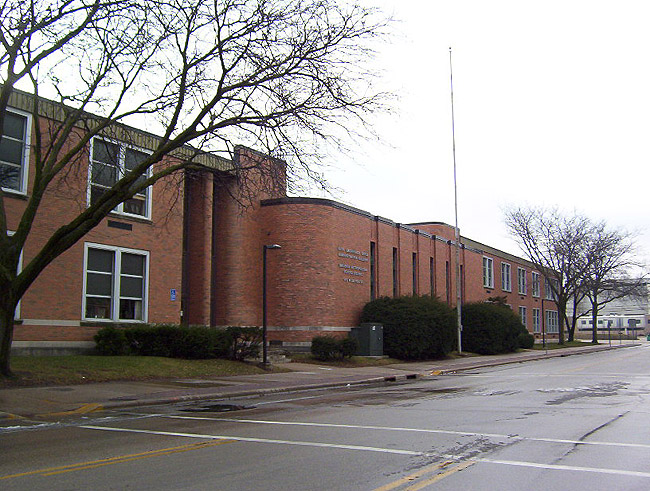
WashingtonSchool1.jpg.jpeg
Photo of Washington Public Grade and Orthopedic School, 545 W. Dayton St., Madison Trust for Historic Preservation. To see where it is located, click here.
Complex problems require creative solutions. But what happens when innovative ideas don’t get serious consideration?
This fall, the Madison School Board assembled two task forces to propose solutions to the knotty problems of shifting enrollments and facility use in the East and West/Memorial High School attendance areas. The people tapped to serve on the task forces have put in long hours and, in the process, have come up with some creative options that go beyond the “standard” proposals to close schools and/or move boundaries. Unfortunately, at least one credible idea for fully using space in East side schools with low enrollments has been taken off the table.
The proposal definitely represents “new thinking.” Rather than closing schools that don’t have “enough students,” the proposal is to sell the Doyle administration building and relocate district administration to one or more of the under-enrolled schools on Madison’s East side.

(more…)

Share

Steve Rosenblum on West’s Planned English 10: Same Curriculum for All

Steve Rosenblum, writing to Carol Carstensen:

Date: Fri, 2 Dec 2005 15:07:45 -0600
To: Carol Carstensen ,”Laurie A. Frost” From: Steven Rosenblum Subject: Re: West English
Cc: raihala@charter.net, jedwards2@wisc.edu, bier@engr.wisc.edu, jlopez@madison.k12.wi.us, wkeys@madison.k12.wi.us, svang7@madison.k12.wi.us, rrobarts@madison.k12.wi.us, jwinstonjr@madison.k12.wi.us, lkobza@madison.k12.wi.us
Carol,
Thank you for the response. I am somewhat confused however regarding your statement concerning the Board’s role. Maybe you could define what is included under ‘set policy’ and what is excluded. I am aware of the situations you reference regarding the BOE and what some may consider poor decisions on subject matter and censorship. I also believe the public was able to vote boards out when the decisions made do not reflect community opinion. I thought our BOE was responsible to control the Administration’s decisions regarding just these type of issues.
With a child entering West next year, I am personally very concerned with what I perceive is a reduction in education quality at West. We see this in English, in the elimination of Advanced Placement Courses, through the homogenization of class make-up which ignores student achievement and motivation. In addition, I really do not feel we can allow much time to resolve these issues, especially when decisions can be made in closed door sessions and without supporting data.

(more…)

Share

Monday Morning Links

Share

The Community Speaks:
West Side Task Force Meetings: Hamilton and Cherokee

11.30.2005 Hamilton Questions [Video] 11.30.2005 Hamilton Statements [Video] 12.1.2005 Cherokee Statements [Video]

Fascinating. Statements and questions from parents, including those who send their children to private schools. Well worth watching. Cherokee questions pending. Thanks to MMSD-TV for recording and broadcasting the Hamilton event.

Share

06 – 07 Budget Positioning: HR and Business Services Presentation to the Madison School Board

The Madison School Board heard presentations this past Monday from The District’s HR Director, Bob Nadler and Assistant Superintendent for Business Services Roger Price. Both described the functions that their organizations provide to the District.

Bob Nadler’s Presentation: Video
Roger Price’s Presentation: Video

The District’s Budget increases annually ($329M this year for 24,490 students). The arguments begin over how that increase is spent. Ideally, the District’s curriculum strategy should drive the budget. Second, perhaps it would be useful to apply the same % increase to all budgets, leading to a balanced budget, within the revenue caps. Savings can be directed so that the Board can apply their strategy to the budget by elminating, reducing or growing programs. In all cases, the children should come first. It is possible to operate this way, as Loehrke notes below.
Learn more about the budget, including extensive historical data.
Steve Loehrke, President of the Weywauga-Fremont School District speaks to budget, governance and leadership issues in these two articles:

Share

Excellent data from MMSD on Read 180

Who would believe that I’d call any MMSD data excellent?
It’s true!
But first, the critical point: I respectfully urge the board of education to approve funding in the next budget to expand Read 180 to West as part of West’s English 9 and English 10. Read 180 would help those students who cannot read well enough to succeed in those courses, as well as all other West courses.
Now the background.
After I asked and asked for data on the costs of various programs, the MMSD finally posted (without any fanfare) useful figures on the cost of Read 180, a successful program used in Wisconsin and across the nation to teach reading to adolescents.
The MMSD praised Read 180, but the superintendent said the district had no funds to expand the program.
Now we see that the computer-based Read 180 curriculum costs about $40,000 per school for hardware and software, according to the MMSD figures.
Read 180 could address the lack of any current proposal for instruction for poor readers in English 9 and 10.
With real numbers about costs, the board of education can now decide whether it’s willing to find $40,000 in the next budget to round out West’s English curriculum. Once low-skilled readers can actually read at grade level, core English might begin to make sense. But not until all the students can read at grade level.

Share

West HS English 9 and 10: Show us the data!

Here is a synopsis of the English 10 situation at West HS.
Currently — having failed to receive any reply from BOE Performance and Achievement Committee Chair Shwaw Vang to our request that he investigate this matter and provide an opportunity for public discussion — we are trying to get BOE President Carol Carstensen to put a discussion of the English 10 proposal (and the apparent lack of data supporting its implementation) on the agenda for a BOE meeting.  Aside from the fact that there is serious doubt that the course, as proposed, will meet the educational needs of the high and low end students, it is clear we are witnessing yet another example of school officials making radical curricular changes without empirical evidence that they will work and without open, honest and respectful dialogue with the community.
As the bumper sticker says, “If you’re not outraged, you’re not paying attention!”

(more…)

Share

They’re off and running: Three new faces seek seats on Madison’s school board

This week is the official start of the spring campaign season, and three local parents are launching bids for Madison’s board of education.
Arlene Silveira, 47, the president of Cherokee middle school’s parent-teacher organization, and Maya Cole, 42, an active member of the parent-teacher group at Franklin-Randall, are seeking the open seat being vacated by Bill Keys. Both say they’ll circulate nomination papers starting Dec. 1, the first day the law allows.
And, in the race generating the most buzz, Lucy Mathiak is seeking the seat now held by Juan Jose Lopez. The most aggressive of the three candidates, Mathiak could significantly alter the makeup of the board.
“People are disgusted and worried about our schools,” says Mathiak, 50. “People are tired of speeches. They want action, and they’re not seeing it.”
Lopez hasn’t decided whether to seek a fourth three-year term, but says he’s “leaning toward running.” He adds, “There are two things I love most. The first one is working with kids and the second is working on the school board.”
By Jason Shepard, “Talking out of school” from Isthmus, December 2,2005

(more…)

Share

This is Not Your Grandchild’s Madison School District

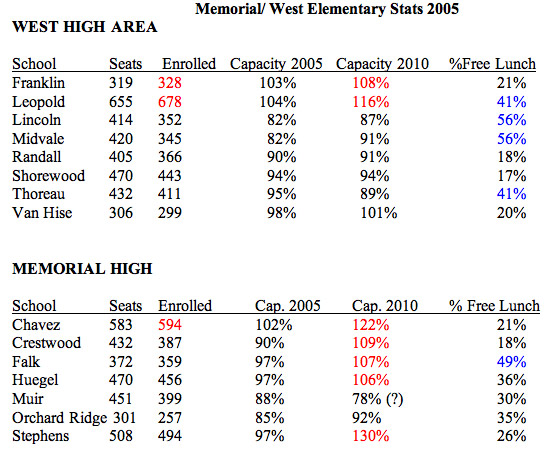
While viewing the MMSD web site I came across some data called District data profile that suprised me, and answered some of my questions concerning low income disparity. While sitting on the task force, I have been bothered by the districts solution for dealing with high numbers of low income students by rearranging school boundaries and/or paring schools, and wondered if you really solved the disparity issue or if you shifted the issue to another school or something that would have to be solved at another time.
Madison school district low income percentages per www.mmsd.org 1991 – 2005.

East High 2005 – 2010 Elementary Projections (click to view a larger version) Memorial/West 2005 – 2010 Elementary Projections (click to view a larger version)

In 13 years, 1992 to 2005, MMSD low income percentage has gone from 24.6% to 42%.

  1. Has the definition of low income changed during this time period?
  2. Has the community as a whole really changed this much in 13 years?
    As a community member that hears and believes there is no low income housing, where do these people live if 42% of our community is now low income?

  3. We have lost 1000 elementary students in the same time period and doubled our minority students. Is this a wave of low births or are we losing students?

Middle School totals

  • In 1991 there were 4776 students with a 20.3% low income.
  • In 2005 there are 5297 students with a 38.6% low income.

High School totals

  • In 1991 there were 6435 students with a 12% low income.
  • In 2005 there are 8429 students with a 28% low income.

The question about pairing two schools and whether it improves low income percentage numbers over time was also in the data.

  • Lincoln in 1991 was at 51% low income, 1997 59%, and 2005 69%.
  • Midvale in 1991 was 42% low income, and 2005 it is at 64%.

It does not seem to have improved the high percentage of low income numbers.

Share

Wright Middle School Charter Renewal – Leopold?

I’ve attended a couple of the East / West Task Force Meetings (props to the many volunteers, administrators and board members who’ve spent countless hours on this) and believe that Wright Middle School’s facilities should be part of the discussion, given its proximity to Leopold Elementary (2.2 miles [map], while Thoreau is 2.8 miles away [map])
Carol Carstensen’s weekly message (posted below) mentions that Wright’s Charter is on the Board’s Agenda Monday Night. Perhaps this might be a useful time to consider this question? Carol’s message appears below:

(more…)

Share

Not much new in MMSD report on worker’s comp

Juan Lopez, chair of the Board of Education Committee on Human Resources, released a report on the MMSD’s worker’s compensation experience after a critical story on Madison’s WKOW-TV.
The new MMSD report seems only to repeat the information contained in the TV report.
Roger Price, assistant superintendent and author of the report, offered this conclusion, without directly responding to any of the issues raised in the TV station’s story:

Great steps have been taken over the last few years to improve MMSD’s worker’s compensation reporting and claims (loss) experience. This has resulted in a significant drop in our experience mod and subsequently in our premiums. We have also realized adjustments in each of the last two years as a result of a positive loss experience. However, some of these improvements will be difficult to sustain with the limited staff assigned to Risk Management.
Work is underway to create a Safety Committee that could fill part of the void left by the reduction in staff.

Share

New LA Mayor Plans to Take Over School District

NPR:

Los Angeles Mayor Antonio Villaraigosa has been talking tough in his bid to take control of the huge, but troubled Los Angeles Unified School District. Such a takeover could put Villaraigosa at odds with the teachers’ union, a group he once served as a labor organizer

More on similar efforts in New York and Chicago.

Share

Morning Links

Share

Report Proposes Employee Health Insurance Savings through Switch to State Health Care Plan

According to a recent report by the Wisconsin Policy Research Institute, the Madison school district could save $2.4M per year by negotiating health insurance coverage for its teachers through the state’s employee health insurance plan, rather than continue with Group Health (HMO) and Wisconsin Physician’s Service plans.
The $100 Million Question: Breaking the Health Insurance Monopoly”.

Share

Letter to Performance and Achievement Committee

The following letter was hand delivered to Shwaw Vang a week ago, and email copies were sent to the Board, Superintendent Rainwater, and Assistant Superintendent Pam Nash. There so far has been no response. A follow up email was sent yesterday to the Performance and Achievement Committee again asking that they look into why the English 9 curriculum has not worked in raising student achievement before allowing West High School to implement changes in the 10th grade English curriculum.
Dear Shwaw,
We are writing to you in your capacity as Chair of the BOE Performance and Achievement Committee to ask that you address a critical situation currently unfolding at West High School.

(more…)

Share

Madison School District Podcasts

Conversations with current Board of Education members in mp3 format can be found here. Art Rainwater’s September and October messages are posted (in mp3 format) here. Both can be used with itunes automated podcast subscription tools.

Share

Thoreau Boundary Change Grassroots Work

Erin Weiss and Gina Hodgson (Thoreau PTO) engage in some impressive grassroots work:

November 28, 2005
Dear Thoreau Families, Staff, Teachers and Friends,
Now is the time for you to get involved in the MMSD redistricting process! This Thursday, December 1 at 6:30pm, a Public Forum will be held at Cherokee Middle School. This forum is being sponsored by the Board of Education in conjunction with the District’s Long Range Planning Committee and Redistricting Task Force. Please come to this forum to hear about the progress of the Redistricting Task Force, but more importantly, to share your opinions and ideas.
On the following pages is a brief description of the current Task Force ideas (as of November 28). Please bear with us if all the information presented below is not completely accurate. These ideas are changing rapidly and we are doing our best to summarize them for you with the information that is currently available. Please know that Al Parker, our Thoreau Task Force Representative, has been working hard for Thoreau school at Task Force meetings. He is a strong supporter of our school as it exists today.

(more…)

Share

Milwaukee Schools Superintendent Review

http://www.jsonline.com/news/metro/nov05/373715.aspAlan Borsuk:

But issues facing MPS, including budget constraints, school closings and a recent decision by an arbitrator on a teacher contract that was widely unpopular among teachers, have subjected Andrekopoulos to increased heat.
The issues have underscored the way the board is frequently divided into two factions, with five members consistently supporting Andrekopoulos and the other four ranging from mild support to general opposition.
On the recent high-profile votes to close Juneau High School, the board repeatedly split 5-4, including six votes of 5-4 in one meeting.

The Milwaukee Journal-Sentinel argues that Andrekopoul should have more time:

The reasons for supporting Andrekopoulos are as clear now as they were in 2004. The superintendent may have the toughest job in Milwaukee. No one in the country, as far as we know, has been completely successful at turning around a big-city school district. But Andrekopoulos has a vision for reform and a plan to make that vision a reality. He was hired to carry out that vision – which includes a move toward smaller high schools and cutting the district’s central bureaucracy – and has had some success in moving it forward. But much more needs to be done.

Share

Status of West/Memorial Options

The MMSD Web site includes a table of options discussed and action taken at the meeting on November 17.

Share

Students Ace State Tests, but Earn D’s From U.S.

Sam Dillon, New York Times writes:
“After Tennessee tested its eighth-grade students in math this year, state officials at a jubilant news conference called the results a “cause for celebration.” Eighty-seven percent of students performed at or above the proficiency level.”

The WKCE test taken in Fall 2005 (reported in Spring 2005) shows statewide percent performing at minimal (below basic level) in Grade 4 Reading: 4%; Grade 4 Math: 16%; Grade 8 Reading: 6%; Grade 8 Math: 11%.
The WKCE test results for test taken in Fall 2004 (reported in Spring 2005) shows MMSD percent performing at minimal level in Grade 4 Reading: 5%; Grade 4 Math: 16%; Grade 8 Reading: 3%; Grade 8 Math: 10%.
National Assessment of Educational Progress – Also known as “The Nation’s Report Card” is the only national standardized continuing assessment administered periodically by the US Dept. Of Education in reading, math, science, writing, US history, civics, geography, and the arts to random schools in each state to evaluate national performance of students ages 7, 12, 14, and 17.
The 2005 NAEP results for Grade 4 Reading: 33%; Grade 8 Reading: 23%; Grade 4 Math: 16%; Grade 8 Math: 24%.

Share

Carol Carstensen’s Message to PTO Presidents

Madison Board of Education President Carol Carstensen:

Subject: Nov. 21 Update
Parent Group Presidents:
BUDGET FACTOID:
The school district has been under revenue caps since 1993 when all school district budgets were frozen and then permitted to increase only by an amount per pupil each year (this year it is $250). That amount approximates a budget increase of 2.5% (the city and county are both struggling with cuts to keep their budgets close to a 4% increase).
Board meetings on Monday, November 21:
The Board looked at a comparison of the school district policy on arresting a child at school and the Police Department’s guidelines there are some significant differences, mostly in the area of informing the parent/guardian before the child is questioned and in making sure the child fully understands his/her rights at the time of questioning. The Board took no action but did ask the administration to continue working with the Police Department to try to bring their procedures more in line with school district policy.

(more…)

Share

School’s anti-war assignment canceled

A letter-writing campaign by third-graders at Allis Elementary School encouraging an end to the war in Iraq was canceled because it violates School Board policy, district officials said Tuesday.
Julie Fitzpatrick, a member of the 10-teacher team that developed the project for the school’s 90 third-grade students in five classes, said the assignment was intended to demonstrate citizen action, one of the district’s standards in social studies.
By Sandy Cullen, Wisconsin State Journal, 11/23/05

(more…)

Share

Bush Administration Grants Leeway on ‘No Child’ Rules

By Nick Anderson
Washington Post Staff Writer
Tuesday, November 22, 2005; A01
The Bush administration has begun to ease some key rules for the controversial No Child Left Behind law, opening the door to a new way to rate schools, granting a few urban systems permission to provide federally subsidized tutoring and allowing certain states more time to meet teacher-quality requirements.
The Education Department’s actions could signal a new phase for school improvement efforts nearly four years after the law’s enactment. Taken together, these actions amount to a major response to critics who have called No Child Left Behind rigid and unworkable. They also help the administration combat efforts to amend the law in Congress.

(more…)

Share

Which East Side Schools Examined for Closing?

According to the minutes of the November 10 meeting of the East task force:

Task Force members requested information on savings from [closing] specific schools.


Unfortunately, the minutes do not mention the “specific” schools. Can a member of the task force or someone who attended provide the names of those schools?
I also wonder whether the meetings are getting a bit contentious.

(more…)

Share