School Information System

Governance in the LA Schools & Seniority

LA Times Editorial:

A RECENT STUDY SHOWS HOW union contracts can hamper school improvement — and provides another compelling reason why having L.A.’s mayor run the schools could help.
The study by the nonprofit New Teacher Project found that teacher contracts place seniority over what’s best for students, especially by favoring longtime teachers for desired teaching slots over newer teachers who might be better for the job. That’s true even if the more senior teacher is needed in another school.

To see The New Teacher Project’s latest report, Unintended Consequences: The Case for Reforming The Staffing Rules in Urban Teachers Union Contracts, click here.

The report shows how contractual staffing rules undermine urban schools and the educational needs of their students. To view the press release, click here.
Leading educators, researchers and policy makers have galvanized around the importance of sharing the report’s data and recommendations. To view their statements of support, click here.

Share

Boosters & The Madison School District Budget

Sandy Cullen:

In the last five years, the La Follette High School Booster Club has paid for everything from bats to books.
They’ve raised more than $260,000 to pick up the tab for balls and jerseys, renovations of weight rooms and training rooms and even taxi fare for students who needed transportation to get eyeglasses, said Deb Slotten, president of the La Follette club.
But Slotten draws the line at paying overtime for a custodian to be at the high school so teams can practice on five days the Madison School District is closed for Thanksgiving and winter break.
…
And then there are costs the boosters simply don’t want to pay, such as the custodians who, administrators say, are required to be at the schools for practices during holiday breaks for contractual and safety reasons. The district’s contract with AFSCME Local 60 requires custodians – who are paid $16.54 to $25.81 an hour – to be paid double-time in addition to their holiday pay if they have to work on a district holiday, said Human Resources Director Bob Nadler.

District spending goes up annually, while enrollment has remained flat over the years. The debate is largely where the money goes. A great deal of information can be found via these links:

Share

The Teacher in the Grey Flannel Suite

The Economist:

The second argument had to do with the rise of knowledge workers. Mr Drucker argued that the world is moving from an “economy of goods” to an economy of “knowledge”—and from a society dominated by an industrial proletariat to one dominated by brain workers. He insisted that this had profound implications for both managers and politicians. Managers had to stop treating workers like cogs in a huge inhuman machine—the idea at the heart of Frederick Taylor’s stopwatch management—and start treating them as brain workers. In turn, politicians had to realise that knowledge, and hence education, was the single most important resource for any advanced society.
Yet Mr Drucker also thought that this economy had implications for knowledge workers themselves. They had to come to terms with the fact that they were neither “bosses” nor “workers”, but something in between: entrepreneurs who had responsibility for developing their most important resource, brainpower, and who also needed to take more control of their own careers, including their pension plans.

Share

WiFi Ruining College Classes?

Slashdot:

theodp writes “Over at Slate, Avi Zenilman has seen the real classroom of the future firsthand: Students use class time to read the Drudge Report, send e-mail, play Legend of Zelda, or update profiles on Facebook.com. But not to worry – replace laptops with crumpled notes, and the classroom of the future looks a lot like the classroom of the past.” From the article: “… when Cornell University researchers outfitted classrooms with wireless Internet and monitored students’ browsing habits, they concluded, ‘Longer browsing sessions during class tend to lead to lower grades, but there’s a hint that a greater number of browsing sessions during class may actually lead to higher grades.’ It seems a bit of a stretch to impute a causal relationship, but it’s certainly possible that the kind of brain that can handle multiple channels of information is also the kind of brain that earns A’s.”

Share

My Open Records Complaint to DA Brian Blanchard

Following up on my 10/12/2005 Open Records request regarding closed discussions (particularly the terms) of the Madison School District’s purchase of land for a new elementary school on the far west side, I recently filed the following open records complaint with District Attorney Brian Blanchard: Background:

(more…)

Share

Four Milwaukee Schools to Close

Doug Hissom:

The Milwaukee School Board voted to close Frederick Douglass and Philipp elementary schools, Webster Middle School and Juneau High School, with under-enrollment the contributing cause. The vote by the board was split along its usual 5-4 ideological leanings.
Closing Juneau High School raised the most questions, since, according to criteria set out by the MPS administration, it shouldn’t have been closed. Juneau, located at 6415 W. Mount Vernon Ave., was not under its enrollment. In fact, Juneau was over the capacity listed in its charter with MPS. The school is a citywide business school and also specializes in dealing with visually impaired students.

Share

MMSD Today Debuts

The Madison School District launches a very nice blog like page, including a syndication feed. Staff can submit articles and photographs, here.

Share

Carol Carstensen’s Email Message to Parent Groups

Carol Carstensen:

Parent Group Presidents:
N.B. The Board’s discussion regarding animals in the classroom has been postponed until January.
BUDGET FACTOID:
Why does the Madison district spend more than the state average per pupil? One part of the answer is that our student enrollment differs significantly from the state average in areas which require more services (and therefore greater costs):

  • Poverty Madison’s rate is 30% greater than the state’s average
  • English Language Learners (ELL): our percentage is more than 300% greater than the state’s
    Special Education the district has a higher percentage (16.8% vs. 12.6%) of students with special education needs – and a significantly higher percentage of high needs students. Of 389 students in the state identified with costs over $30,000 Madison has 109 (nearly 30%).

(more…)

Share

WKCE Test Problems

Amy Hetzner:

Missing and duplicate pages in test books, answers that were already filled in and other errors with the Wisconsin Knowledge and Concepts Examinations have been reported by school districts from Cudahy to Wausau as the state’s testing period nears its end.
In all, 21 school districts have reported errors in 27 tests handed out to students since Oct. 24, the start of Wisconsin’s five-week testing period for every third- through eighth-grader and high school sophomore enrolled in public school.
A spokeswoman for CTB/McGraw-Hill, which was paid $6.6 million in 2004 to oversee Wisconsin’s testing program, blamed “printer-related problems” that affected test books given to a small number of students in fourth, eighth and 10th grades.
“The main thing to know is that the integrity of the student scores will be ensured,” said Kelley Carpenter, director of public relations for CTB/McGraw-Hill.

Share

Romney Calls for More Tech Innovation

Stan Gibson:

Underlining the challenge, Romney said leaders of one technology firm in Massachusetts anticipated that 90 percent of its skilled labor would be in Asia in 10 years. He also pointed to statistics that show the United States graduating only 4,400 mathematics and science PhDs each year compared with 24,900 math and science PhDs for greater Asia.
“China and India have a population a multiple of ours. They have natural resources. There is no reason they can’t emerge as the superpower. The only way we can preserve that role for ourselves is through innovation. It’s erroneous that we do high-level work here and send low-level work abroad. When our market is no longer the largest market in the world, the idea that we’re going to be innovating and they’re going to be copying is erroneous,” Romney said.In response to the looming crisis, Romney pointed to some specific problems and proposed some remedies.
He said we must close the educational achievement gap between racial groups in the United States. “The education gap is the civil rights issue of our age.” He also said all U.S. students must raise their standing compared with students in other industrialized countries. According to one study, U. S. students rank 25th out of 41 industrial nations. “Fewer and fewer are performing at the top level,” he said.
He suggested paying teachers a $5,000 bonus for teaching Advanced Placement courses, as well as giving the top third of teachers a $5,000 bonus. He also suggested a bonus for teachers that teach in troubled school districts. Romney also favored giving secondary school students laptop computers.

Share

Middle School Focus Group Parent Group Comments

November 10 Focus Group Responses (Background): [html version] [PDF]

The school district is continually working to build more rigor into the learning experiences that students have. Rigor is defined as commitment to a core subject matter knowledge, a high demand for thinking, and an active use of knowledge. When you think of a rigorous academic curriculum in the middle school, what would it look like?

Share

Gates Foundation Looks at Results

Joanne Jacobs:

After investing $1 billion in small high schools, the Gates Foundation has learned results are “mixed,” according to a study commissioned by the foundation. The study found progress in reading and language arts, but not in math.

Among the most disheartening findings of that analysis — and one the researchers said also applied to comparison schools in their study that do not receive Gates support — was the lack of rigor in teacher assignments and student work, especially in math.

“[W]e concluded that the quality of student work in all of the schools we studied is alarmingly low,” the evaluation says. “This is not surprising, however, because students cannot demonstrate high-quality work if they have not been given assignments that require deep understanding” and higher-order thinking skills.

Education director Tom Vander Ark said the Gates Foundation already is working on the problems cited in the study, emphasizing “districtwide measures intended to improve the quality of curriculum and instruction, as well as an emphasis on using proven school models.”

New schools had better results than existing schools that had been redesigned.

Share

Bus Battle Brewing at LaFollette

Angela Bettis:

Students and teachers at LaFollette High School are fighting for equal bus service.
They’ll take their argument to the city council Tuesday.
Limited bus service from Lafollette on the east side to students’ homes on the south side of the city is creating problems academically.
Students say they are not able to go to the same after school activities as kids at other schools because of the ongoing transportation problem.
Andres Garcia runs an after school Latino Club, but has been having problems getting students in the door.
“Because of the bus problems, no one was actually able to stay,” he said.
Teachers have said students who need more help learning English are missing out.
“We have academics that meet after school and clubs,” said science teacher Lisa Endicott. “Some of those things we can’t get the kids home for academics is the thing that hurts the most.”

Share

West / Memorial Forum Audio/Video Archive (11/15/2005 @ Leopold)

Watch this event (about 90 minutes) or Listen (mp3 audio)

A public forum was held to update the community on plans to address overcrowding in the West-Memorial attendance area at Leopold Elementary School Tuesday evening. Troy reports 150 people attended (in the comments, take a look at the video clip for details), rather decent, given some other events I’ve participated in – much more than my quick estimate of 40, which was wrong. [Editor: gotta love the quick feedback loop. Anyone else have a count? :)] In any event, substantive questions were discussed and raised.

A number of ideas were shared along with quite a few public comments. I’ve summarized a few below (from my notes) (there were many more – have a look at the video):

  • Why does Van Hise Elementary have such a small low income population relative to other schools?
  • What data supports the creation of “paired schools” from a student achievement perspective?
  • Why are we considering busing children all the way to Marquette / Lapham [map]?
  • (this comment was made after the official event closed) Why won’t the MMSD build a school (farther south) in Fitchburg?
  • I asked: “Why were no scenarios / ideas presented vis a vis the nearby [map] Wright Middle School Facility?”

This 3 page pdf Forum / idea summary was sent to all Thoreau parents Tuesday. UPDATE: Arlene Silveira mentions, via email, that she thought about 120 attended.

Share

Beaverton School Board Rejects Regional Income Tax

OPB News:

A proposed regional tax to fund metro-area schools next year is dead.
The responsible party is the Beaverton school board, whose members voted unanimously last night to reject the plan. Rob Manning reports.
The vote was seven to zero. Eight to zero, if you count retired board member, Mike Leopold.
Mike Leopold: We don’t want to let our local control away, let slip away, by joining with the other school districts to initiate a regional income tax.

Share

Union Contracts Stymie School Hiring Decisions

Elaine Korry, All Things Considered:

A new study details obstacles in union contracts that schools in big cities face in terms of being able to hire and fire teachers. In as many as 40 percent of teacher openings in five large districts, the study says, school administrators had no say in the selection process.

audio Much more, here.

Share

Grant to Increase AP Classes

Matt Pommer:

Madison will build on Project Excel, a program started last year to identify promising eighth-graders and provide assistance as they begin their high school years. Assistant Superintendent Pam Nash said the grant focuses on helping those students in the ninth grade.
Memorial High School now has a large number of advanced placement courses, and the district will focus on increasing the advanced placement courses at the other three high schools. Advanced placement courses often provide college credits, and that’s important in an era of high tuitions, Nash said.
“Advanced placement courses are wonderful opportunities for students to be challenged,” she said.
The eight rural districts, all in southwestern Wisconsin, will expand their opportunities through distance learning, aided by the University of Wisconsin and the Cooperative Educational Service Agency in Tomahawk.

Share

Student Shoots Classmate with BB Gun

Angela Bettis:

A 13-year-old boy is in police custody after allegedly shooting three fellow middle school students with a BB gun.
The incident happened on a Madison Metro bus Tuesday morning. Now that student could face expulsion. Officers say a Black Hawk Middle School 7th-grader hid a BB gun pistol in his sleeve, brought it on the school bus and shot one student in the chest and two others in the leg. Police say it all happened in the 500 block of Northport Drive.

Share

Middleton Schools Seek Answers to Failed Referenda

Ann Marie Ames:

The School Board wants to know why three of four referendum questions failed last month.
Board members on Monday night reviewed draft copies of a survey they intend to send to 400 residents in the Middleton-Cross Plains district.
The survey is one way the board hopes to improve communication between the school district and the community. The district also plans to increase the amount of positive information about district events sent to residents via e-mail.

Share

2M Student System Approved

Matt Pommer:

The $2 million for the student information system will be spread out over six budget years. Assistant Superintendent for Business Roger Price and planning and research director Kurt Kiefer said the system will pay for itself through efficiency and reduced staffing needs.
Parents would begin to see the impact of the new online system in the 2006-2007 school year, Kiefer said. He warned that training and implementation of the new computer software would take time and be “painful” for a period. The system is similar to one already being used in the Middleton-Cross Plains school district.
When it is fully operational, parents will be able to use a computer to see their child’s grades, progress reports, attendance and behavior reports. Students will be able to examine course schedules and register over the new system. Class attendance reporting will be fully computerized with the system.
Board member Ruth Robarts questioned how much parents would be able to use the system to communicate with teachers or to see course assignments. Rainwater said there are labor union contract issues related to what teachers could be required to do in those areas.

Ruth identified a critical issue in the successfull implementation of such a system.

Share

Middleton High School Wins DOE Blue Ribbon Award

Angela Bettis:

Middleton High School is one of the top in the state according to the federal government.
The school is one of only two high schools in Wisconsin to be recognized as a blue ribbon school by the U.S. Department of Education. The award recognizes Middleton’s academically superior student performance.

Share

“Poor Kids Aren’t Dolts — Push Them Harder”

Wendy Kopp (President and Founder of Teach for America):

According to the annual Phi Delta Kappa/Gallup survey, the most recent of which was released in September, most Americans cite a lack of parental involvement, as well as problems in students’ home life and upbringing and their lack of interest and motivation as the most important reasons for the huge gap between the achievement levels of students in upper- and middle-class neighborhoods and those in poor neighborhoods. More than 75% of those polled said they believe that white students and students of color have the same academic opportunities.
In contrast, Teach for America corps members, who are in those poor neighborhoods every school day, say the key to closing that gap is to train and employ better teachers and improve the quality of the leaders who make decisions in schools and school districts — while simultaneously ensuring that teachers, principals and parents expect the kids to meet challenging academic standards.

Much more, including this, here:

Funding, in itself, is not the answer. Teacher quality and expectations of students outranked funding as both causes of and solutions to the gap. And as corps members spend more time in the classroom, the priority they place on funding gives way to other factors, such as school leadership. While some of their proposed solutions may require further investment, corps members express skepticism about increasing funding without addressing current allocation of resources.

Via Joanne.

Share

Sanderfoot on Ed Lite

Parent Alan Sanderfoot wrote a letter to the Isthmus Editor on Katherine Esposito’s recent article: Ed Lite: Madison Middle Schools Serve Up an Uninspiring Academic Menu:

Dear editor,
Thank you for publishing Katherine Esposito’s article about Madison’s middle schools (“Ed Lite,” Nov. 11, page 12). Please allow me, however, to correct some mischaracterizations in her piece.
On the contrary, my daughter Olivia did not “bail” from Sherman when she transferred to O’Keeffe. Her mother and I worked diligently during her entire 6th grade year at Sherman trying to get the school and teachers to address her unique academic and social needs. Throughout the year, we met with Olivia’s team of three teachers, the learning coordinator, the guidance counselor and administrators. Much was discussed, but little action followed.

(more…)

Share

2006 Distinguished Service Award Nominations

The Madison Metropolitan School District:

The Distinguished Service Award (DSA) honors individuals for service beyond the call of duty. It is considered to be the most prestigious of the recognition awards offered by the Madison Metropolitan School District. Distinguished Service Awards may be to employees who have served at least ten years with the MMSD in each of the following categories: elementary, middle and high school teachers, administrators, support personnel clerical/technical employees, custodial/building services/trades personnel, educational assistants and food service staff. Special awards are also given to employee teams, citizen volunteers and high schools seniors involved in community service.
To nominate someone you must answer five questions about the nominee and submit three letters of support. Anyone may submit a nomination. Self-nominations are not accepted. Please print the nomination form available below and carefully read the guidelines on page two of the nomination form.

I have several people in mind.

Share

1898 Michigan Teacher Exam

Fascinating 600K PDF (I would be in trouble)

Share

West High School Presentation on 10th Grade English: Same Curriculum for All Students

Click to view the Video

MP3 audio only

Barb Schrank, Videographer

Principal Ed Holmes, English department chair Keesia Hyzer, and teacher Mark Nepper presented information on the planned single English curriculum for all 10th graders at West this past Monday evening. Watch the video or listen to the audio by clicking on the links just to the left of this text. Background on this matter:

Share

SchoolFacts 2005: Madison School District Comparison

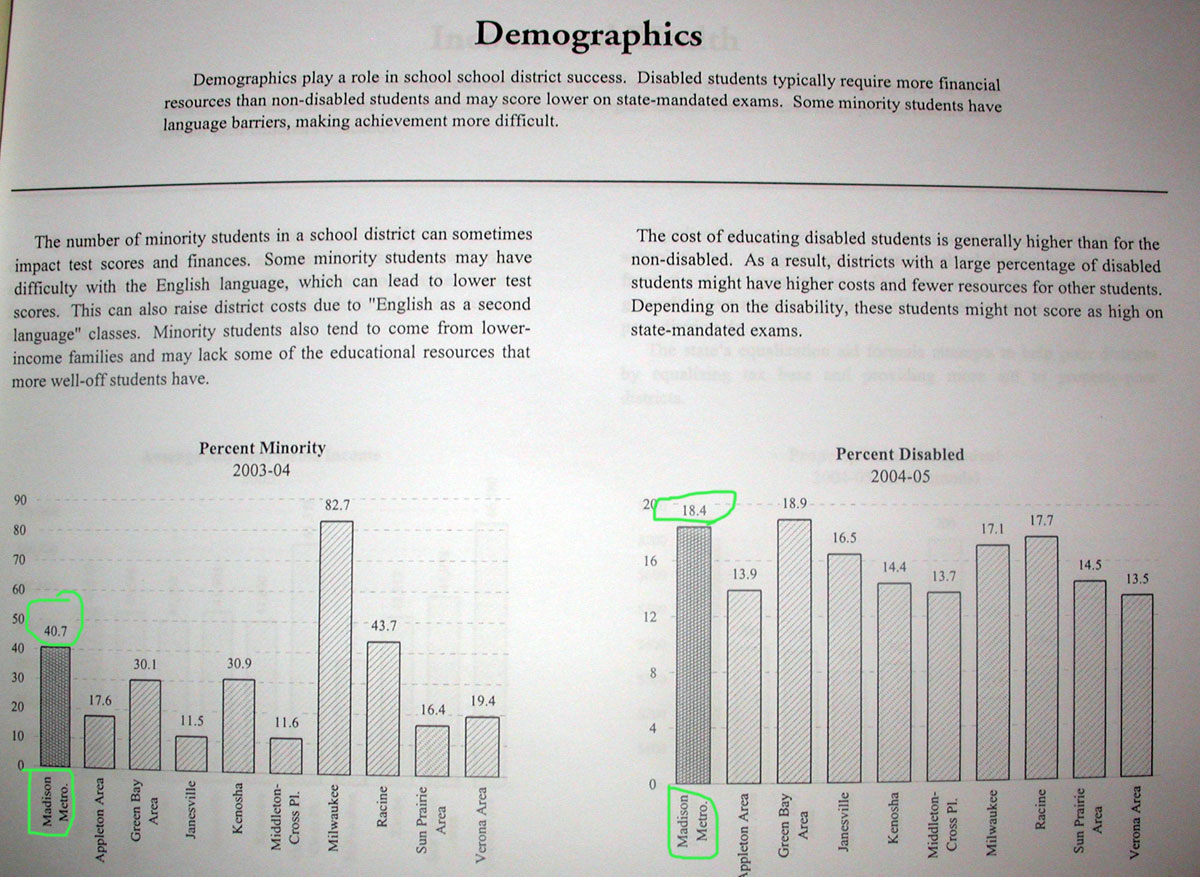
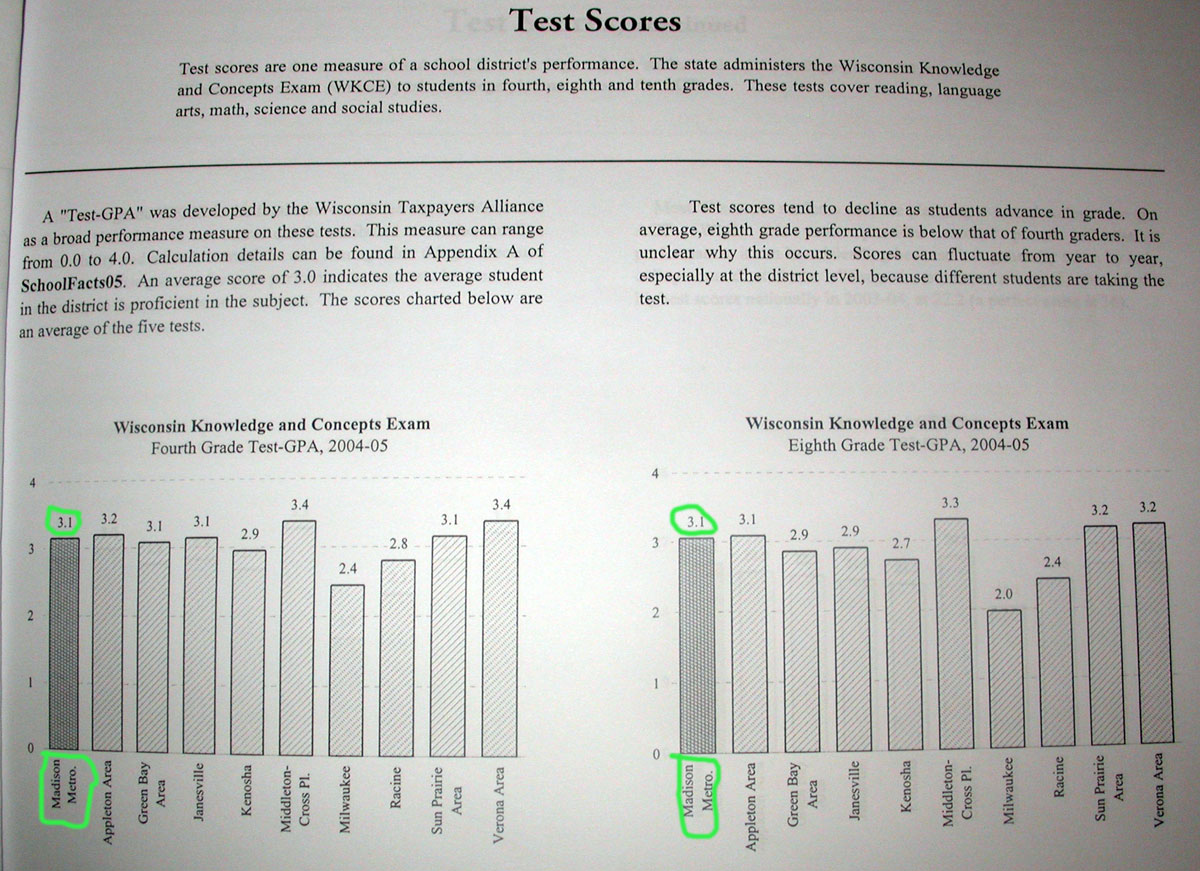
Active Citizens for Education recently commissioned a custom report from WISTAX. This report compares demographics, income / wealth, spending, staffing ratios and test scores between the Madison School District and Appleton, Green Bay, Janesville, Kenosha, Middleton-Cross Plains, Milwaukee, Racine, Sun Prairie and Verona.

Details below:

  1. Demographics
  2. Income and Wealth
  3. Spending
  4. Staffing Ratios
  5. Test Scores
  6. Test Scores (more)
Share

Anonymous Donors Provide 100% Tuition for Kalamazoo Public High Grads

Mark Baker:

Anonymous donor’s provide up to 100% college tuition for graduates of the Kalamazoo Public Schools. The Kalamazoo Promise – Press Release.
Wow! This is a community serious about providing a sustainable differen

Share

Thursday’s Middle School Curriculum Parent Forum

I believe a relevant and challenging curriculum is the #1 priority for any educational organization. There have been a number of questions raised over the years regarding the Madison School District’s curriculum, including Math, English and Fine Arts and the recent controversial changes at Sherman Middle School (more details in Kathy Esposito’s recent Isthmus article).

The District is currently conducting a Middle School Curriculum Review, lead by Assistant Superintendent Pam Nash (Formerly Principal of Memorial High School). Pam lead a Parent Forum Thursday evening, which I attended (one of about 28 participants). (7MB video clip of Pam kicking off the Forum). The goal of this event was to collect feedback from parents regarding these five questions (pdf version):

  1. The school district is continually working to build more rigor into the learning experiences that students have. Rigor is defined as commitment to a core subject matter knowledge, a high demand for thinking, and an active use of knowledge. When you think of a rigorous academic curriculum in the middle school, what would it look like?
  2. What experiences do you want your child to have in middle school to enhance his or her social and emotional growth?
  3. What are your hopes and dreams for your child in middle school?
  4. What are your greatest concerns for your child in middle school?
  5. If you could design Madison middle schools in any way you wanted, what would they be like?

Pam mentioned that the parent comments would be posted on the district’s website, hopefully next week. She also said that the district would post these questions online, in an interactive way so that parents who were unable to attend Thursday’s event might add their comments.

My notes follow:

  • Superintendent Art Rainwater wants the middle school curriculum task force to report back to him by mid December (2005).
  • The task force “design teams” recently broke up into “work teams”.
  • Recommendations will affect middle school allocations.
  • I asked Pam when this process began. She said it started one month ago.
  • Pam mentioned that they hope to pull the parent group together one more time, in December.

I was initially displeased that the group of 28 participants was broken up (I was interested in hearing all of the conversations). However, I thought that the format was rather effective in obtaining comments from all participants (at least those in my group). Kudos to Pam for collecting a good deal of information.

I spoke briefly with Pam when the event concluded. I mentioned that it appears to me, a layman, that it would be challenging to implement major changes via a two month task force. However, incremental changes occuring via the allocations are certainly possible (for better or worse).

I heard many useful suggestions on these questions and will point to them when available on the District’s website.

Learn more about the “Middle Grades Design Team” via this Board presentation (800K PDF file) Email your comments on this initiative to the Madison School Board: comments@madison.k12.wi.us
Share

9th Grade Madison School District Algebra Data

Matt Pommer:

African-American rates increased from 27.5 percent to 49.7 percent in the four years and from 29.8 percent to 50 percent for Hispanic students. Among white students algebra completion rates had improved from 68.9 percent to 82.6 percent, the report said.

Related: this week’s Isthmus article on Middle School Curriculum.

These report items were interesting as well:

  • In 10 years the number of African-American students has increased from 4,126 to 5,216, while the number of Hispanic students has increased from 957 to 2,845. White enrollment has gone from 17,937 to 13,712 in the decade. Asian enrollment has grown from 1,885 to 2,569.
  • The 94 percent enrollment goal was met at the elementary (95.1 percent) and (94.4 percent) middle school levels. But high school attendance dipped last year to 92.5 percent overall, including an 86.8 percent rate for pupils from low-income families, the report said. The best overall attendance for high schools was 93.6 percent in 2002-2003.
Share

Irving Independent School District Symposium

David Weinberger on the Irving School District’s 1 to 1 Laptop Implementation:

Darrell Lynn of Apple, a sponsor of the event, introduces Angus King, former two-term, independent governor of Maine. King appears via his $129 iSite. He talks about the insights that guided him to the laptop policy.
First, he has no idea what the economy of the US and of Maine will be in ten years. But, he says he does know that whatever happens will require more education and a higher level of comfort with technology.
Second, every governor chases quality jobs for their state. “You don’t get ahead by keeping up.”
Third, everything governments do is incremental. Baby steps, not real change. In 1999, Maine had a surplus. So, King thought about how it could be used to bring change.
In 1996, he had lunch with Seymour Papert who told him that reducing the ratio of students to computers wouldn’t matter until the ratio is 1:1.
So, Maine started by giving laptops to every kid in grades 7-8. King thought this would be well received, but it wasn’t. He blurted out, in response to a question, that the computers would belong to the students, not the school. He says, “I got the living xxxx kicked out of me.” [xxxx Barrier transgressed at 9:15am…and by a former governor!] The emails to his officce were 10:1 against. He persevered. (PS: The schools own the laptops.)

At some point, textbooks will be gone. I do generally like this sort of thing and perhaps it’s fundamental to addressing some of the challenges Kathy Esposito noted in her excellent article on Madison’s middle school curriculum. There’s no doubt that for someone who knows how to use a computer effectively, the amount of information one can learn and use is simply extraordinary. My youngest found a very well done learning spanish podcast on itunes just the other day – free and simply delightful!!!

Share

Ed Lite: Middle schools stress social adjustment at the expense of academic achievement


Katherine Esposito:

Helen Fitzgerald, Sherman parent and president of the school’s parent-teacher group, wants high expectations set for Sherman.
“My kids want to compete!” she says, clearly frustrated. “They want to go to Brown. They want to go to Yale, to UC-Berkeley. My daughter wanted to go to Harvard when she was in the fourth grade! That’s their eye on the ball. That’s their expectation. And Sherman ain’t teachin’ those kids!”
In the modern middle school, however, competition is barely a footnote. Cooperation is king.
In the 1960s and 1970s, as an antidote to a hierarchical and often violent world, American educators proposed a middle-grades school for preteens that would place a premium on their social needs. Such practices as cooperative learning, peer tutoring and heterogeneous grouping would be kinder, gentler substitutes for the traditional top-down form of classroom organization in these “middle schools.”

Share

Recent Referenda Results

WisPolitics Referenda Roundup:

Share

Innovative Math: But Can You Count?

Samuel Freedman:

LAST spring, when he was only a sophomore, Jim Munch received a plaque honoring him as top scorer on the high school math team here. He went on to earn the highest mark possible, a 5, on an Advanced Placement exam in calculus. His ambition is to become a theoretical mathematician.
So Jim might have seemed the veritable symbol for the new math curriculum installed over the last seven years in this ambitious, educated suburb of Rochester. Since seventh grade, he had been taking the “constructivist” or “inquiry” program, so named because it emphasizes pupils’ constructing their own knowledge through a process of reasoning.
Jim, however, placed the credit elsewhere. His parents, an engineer and an educator, covertly tutored him in traditional math. Several teachers, in the privacy of their own classrooms, contravened the official curriculum to teach the problem-solving formulas that constructivist math denigrates as mindless memorization.
“My whole experience in math the last few years has been a struggle against the program,” Jim said recently. “Whatever I’ve achieved, I’ve achieved in spite of it. Kids do not do better learning math themselves. There’s a reason we go to school, which is that there’s someone smarter than us with something to teach us.”

This sort of thing is happening in Madison as well. Much more here.

Share

More on Taser Report

Angela Bettis:

The Madison school district may have violated some of its’ policies, according to the report.
The incident involved Dalarence Goodwin, then 14, who was arrested at school and later shot by police with a Taser gun.
The independent report by lawyer Eileen Brownlee was posted on the Isthmus Website.
Brownlee was hired by the school district to sift through exactly what happened on Jan. 21 when Goodwin was tasered by Officer Tim Harder.
News 3’s Dawn Stevens talked exclusively with Dalarence and his mother when charges of resisting arrest were dropped last month.

Share

Far West Land Purchase – Approved

WKOW-TV:

The board voted four to two to spend 525-thousand dollars for the land.
The purchase was almost tabled by two school board members, which included Lawrie Kobza.
Lawrie Kobza said, ‘I believed the negotiations were finished we should of been talking about these things in the public really for the last month in a half.”
“It’s the process the board goes through and developing public trust on decisions that were made, I was really trying to focus on that and it’s disappointing the majority of the board didn’t go with me,” said Kobza.
“This isn’t a secret, our community knows it’s growing and we’re going to have to build new schools in the future and we’re going to have to purchase the land first,” said Madison School Board Member Johnny Winston.

Share

Every State Left Behind

Diane Ravitch:

WHILE in office, Presidents George H. W. Bush and Bill Clinton both called for national academic standards and national tests in the public schools. In both cases, the proposals were rejected by a Congress dominated by the opposing party. The current President Bush, with a friendly Congress in hand, did not pursue that goal because it is contrary to the Republican Party philosophy of localism. Instead he adopted a strategy of “50 states, 50 standards, 50 tests” – and the evidence is growing that this approach has not improved student achievement. Americans must recognize that we need national standards, national tests and a national curriculum.
The release last month of test results by the National Assessment of Educational Progress, which is part of the Department of Education, vividly demonstrated why varying state standards and tests are inadequate. Almost all states report that, based on their own tests, incredibly large proportions of their students meet high standards. Yet the scores on the federal test (which was given to a representative sample of fourth and eighth graders) were far lower. Basically, the states have embraced low standards and grade inflation.
Idaho claims that 90 percent of its fourth-grade students are proficient in mathematics, but on the federal test only 41 percent reached the Education Department’s standard of proficiency. Similarly, New York reports that nearly 85 percent of its fourth graders meet state standards in mathematics, yet only 36 percent tested as proficient on the national assessment. North Carolina boasts an impressive 92 percent pass rate on the state test, but only 40 percent meet the federal standard.

Share

The Shocking Truth

Jason Shepherd:

A series of institutional failures – by court employees, police officers and school officials – led to a Madison student being shot with a Taser stun gun in a school parking lot early this year, according to an independent investigator whose report the school district has tried to keep secret.
No one comes off unscathed in the report, issued last month by attorney Eileen Brownlee, whom the district hired to investigate the incident.
Some background: On Jan. 21, Madison Police Officer Tim Harder shot Dalarence Goodwin, a 14-year-old freshman, in the back with a Taser in the parking lot of Memorial High School. Goodwin had broken free from Harder’s grip while Harder was attempting to handcuff him after arresting him inside the school. The arrest itself was based on a warrant apparently issued in error by a juvenile court.
Brownlee’s eight-page report concludes in no uncertain terms that in the hours before and after the shooting, Harder and school officials violated district procedures.
“It is clear,” Brownlee notes after recounting various versions of the events, “that the policy was violated.”

Brownlee’s Report on the Taser incident [PDF]. Ed Blume’s notes.

Share

Survey: Ohio Residents Attitutude Toward Public Schools

Fordham Institute:

This is a problem. Serious education reform demands strong, competent leadership for two reasons. First, kids don’t have lobbyists to look after their interests. The inertia and resistance to change manifested by the education system and its myriad adult interest groups are so powerful that, absent first-rate leadership, one must expect nothing much to change. This is particularly dangerous for a state with weak job growth, anemic economic growth, and signs of a brain drain.
Second, while Ohioans substantially agree about many of the problems facing public education and the reforms needed to address those problems, they are split down the middle on others. Effective leadership is mandatory, else nothing will change.
This would be okay if nothing needed to change, but Ohioans surely don’t think so—and plenty of objective evidence says they are correct. Only a third of survey respondents—and fewer than one in five African Americans—believe their local public schools are “doing pretty well and need little change.” Virtually all others want “major change” or “a whole new system.” This is no surprise in a state where close to half of respondents also see the economy as a serious issue. Ohioans know that education and economic opportunity are connected, and they’re worried about both
But there’s good news in the survey, too. On many important education issues and reform ideas, Ohioans manifest broad agreement as to what’s wrong, what’s important, and what ought to happen.
Here are five key education topics where we see something akin to consensus:

  1. Money alone won’t accomplish much. Respondents believe it would “get lost along the way” to classroom improvement (69 percent).
  2. Stop social promotion and automatic graduation. Teachers should pass kids to the next grade “only if they learn what they are supposed to know” (87 percent) and high school students should pass tests “in each of the major subjects before they can graduate” (83 percent).
  3. Free-up the front-line educators. Local schools ought to have considerably greater freedom and control over curriculum, budgets, and, especially, firing “teachers that aren’t performing” (89 percent).
  4. Reward good teachers. Good teachers should be rewarded with higher pay (84 percent) and paid more if they “work in tough neighborhoods with hard-to-reach students” (77 percent).
  5. Enforce discipline. Schools should enforce strict discipline with regard to student behavior, dress, and speech (91 percent).

Joanne’s site has links to Ohio’s NAEP numbers.

Share

Madison Leaders Discuss Gang Issue Saturday

Channel3000:

“In the 80s, we had African-American gangs really hit the scene here in Madison,” said Madison Police Chief Noble Wray. “But what we’re looking at today is that we have more young ladies involved in gangs, we have Asian gangs, and a real increase in Latino gangs.”
Dane County Executive Assistant Ken Haynes said gang members are coming from diverse backgrounds, not just low-income neighborhoods.
“Problems … challenges don’t stop at geographic boundaries,” Haynes said.
Community leaders said that to reduce gang activity, everyone needs to work together.
“Our strategies need to be connected to all the strategies with other service providers, strategies in the schools and the strategies with parents,” Wray said

Video clips and archives from the recent Gangs and School Violence Forum.

Share

Local School News Roundup

Local media posted a number of K-12 articles this morning:

Share

One English Program for West’s Sophomores

Matt Pommer:

Under the new program targeted for fall 2006, all sophomores will take the same English program in the first semester focusing on the American Dream. In the second semester, students will be able to select from the themes of justice or identity, according to Keesia Hyzer, chair of the school’s English department.
In the past, 10th-grade students have had more than 20 options, but 85 percent have selected among five or six choices, she indicated. Current plans call for the curriculum to be taught next year in 18 sections.
Principal Ed Holmes said the core curriculum “will meet the needs of the struggling learner as well as those of our gifted and talented students.” He indicated that there is concern among some parents, but he urged them to see what the core curriculum will mean to their students. The core curriculum is still “a work in progress,” he said, but it will be explained at Monday’s PTO meeting.
“The parents’ concern is that we are going to give up the rigor and challenge for our most talented students. By no means!” he said in a Capital Times interview.

Background:

Share

Gates Foundation & LA’s Small Learning Communities

Naush Boghossian:

But the grant, the foundation’s first sizable sum to the Los Angeles Unified School District, falls far short of investments the foundation has made across the country to smaller districts – a disparity some officials blame on the LAUSD’s lack of a comprehensive plan.
And critics said Wednesday that, despite years of discussions with the Gates Foundation, the district superintendent, Roy Romer, has been unwilling to relinquish any control and create a partnership with the foundation to build the smaller learning environments that require autonomy to succeed – a charge Romer strongly denies.

Share

School Districts Sharing Services

Reason Foundation:

in many parts of the country 40 to 50 percent of education funding never makes it to the classroom. A new report by Reason and Deloitte finds that saving just a quarter of the tax dollars spent by school districts on non-instructional operations could save $9 billion. To put this number in perspective, it is equivalent to 900 new schools or more than 150,000 additional teachers. “School funding and per pupil spending are always hot-button issues,” said Lisa Snell, co-author of the report. “Sharing services gives schools and districts a great opportunity to send a lot more money straight to classrooms, where it belongs. With much of the education world facing tough budget decisions, sharing services is a dramatically under-used option that can yield significant results.”

Full Report [PDF] Obviously a good idea, however like many such initiatives (city / county consolidation is another example), execution is generally non-trivial. Reason has a number of education oriented publications posted here.

Share

Baltimore Schools Offer Algebra to Parents

Allison Keyes:

In Maryland, the current class of 9th graders will be the first to have to pass an algebra test to graduate from high school. That’s putting pressure on some parents to brush up on their math skills so that they can help their children. Baltimore County’s school system has recognized this potential problem and is now offering classes to bring parents up to speed on algebra.
The school system is offering its algebra awareness class for parents in a three-session format. Each session is two hours long.
The idea came from discussions of the new algebra requirement at Parent-Teacher Association meetings last year.

Share

Catholic Schoolgirls Unravel DNA

Michael D. O’Neill:

There were many big-league DNA scientists at the annual genome sequencing conference held here last month, but no one stood out more than a slight high school teacher in religious habit towing five of her students through the imposing crowd of genetics pioneers with a quiet grace.
The unlikely delegate was Sister Mary Jane Paolella, of Sacred Heart Academy, an all-girls Roman Catholic high school in Hamden, Connecticut. She wasn’t here on a sightseeing trip. Paolella showed up with her students to make an official presentation of DNA sequencing data that her honors biotechnology class generated from genes associated with osteoporosis.
Paolella’s been bringing her students here for eight years. The point, she says, is to give her class the opportunity to rub elbows with top scientists working at the cutting edge of research — luminaries like Craig Venter, who led the private effort to sequence the human genome, and Dr. Hamilton Smith, who won the 1978 Nobel Prize for his work on DNA-cutting enzymes. She credits the experience for inspiring more and more of her students to pursue careers in traditionally male-dominated scientific fields.

Share

NPR: Hispanic Students Most Ill-Served in US

Claudio Sanchez:

New reports from the Pew Hispanic Center conclude that low-income Latino students are the most segregated, ill-served group in the country’s public high schools. The reports detail high school conditions for Hispanic students in the United States.

Read the full report here.

Share

Teacher Talk: Plainview, NY Teacher’s Union President

Morty Rosenfeld:

If the United States is to preserve our system of free public schools, teacher unions are going to have to stop accepting the status quo and making excuses for the poor performance of our students. Most of us know that contrary to all of the talk about how we are raising our standards, in most of our schools they continue to decline. The low scores on the so-called high stakes tests are testimony to the fact that large numbers of students leave school knowing next to nothing and ill equipped for any but the most menial of jobs. While many of our most talented young people spend their days in so-called accelerated courses with curricula once thought more appropriate to the college level, too many of them have whizzed right by basic skills and cannot string together three coherent sentences or know to any degree of certainty if they have received the correct change in a store. We must face the fact that some of the right-wing critique of public education, particularly their criticism of the ever inflating costs of public education, resonates with the American public because it is true, or at least truer than some of the blather put out by the people who run the schools and the unions who represent the people who work in them. If it is true that our freedom is ultimately tied to our being an enlightened and educated citizenry, we are in terrible trouble.
Excuse number one – We don’t have enough money to meet the educational needs of our students. While too many of our school districts do need more financial resources, resources that many find impossible to raise trough the regressive property tax, the fact of the matter is too many of them also waste a substantial portion of what they have, a good piece of the waste mandated by state and federal law. I’ve written elsewhere about the administrative bloat in school districts where level upon level of bureaucracy insures that teachers and educational support staff are over scrutinized and under supervised to the point where teaching innovation and imagination are increasingly giving way to the routines of educational programs, particularly in math and English, that are intended to make teaching thinking-free.

Via Joanne and EIA Communique.

Share

West Task Force Survey (Cherokee)

A task force created by the Board of Education is evaluating options to address overcrowding in the West and Memorial attendance areas. The task force is expected to recommend three options to the Board in early January; the option chosen will be implemented in fall, 2006. Please help the Cherokee task force members accurately represent your views by answering the questions below.

Survey: English | Spanish

Share

Referenda: Elmbrook’s Poll on $100M High Schools

Lisa Sink:

But he said that Elmbrook’s results likely wouldn’t stop other districts from moving forward with referendum plans because the cost of Elmbrook’s plans was more than double what others typically seek.
“The size of the amounts are just so out of line with what everybody else has done that I’d be leery to generalize (Elmbrook’s results) to someone who’s going to ask for $25 million to build a school,” Knapp said.
Spread across the district’s tax base, the five building improvement plans presented in Elmbrook’s survey would have a tax impact on an average $300,000 home of $288 to $363 per year for 20 years.

Share

Middle School Focus Group – Parents

Pam Nash (Assistant Superintendent for Secondary Schools) emailed this notice:

Many of you have expressed an interest in participating and discussing the changes to our middle schools. There will be a middle school focus group meeting for parents on Thursday, November 10, 2005, 7:00-8:30 p.m. at the Doyle Building, 545 W. Dayton Street in Room 103. [Map]
At this meeting, we will be gathering thoughts of what parents would like to see in the middle schools in Madison. There will also be an on-line survey available for parents to complete if they were unable to attend the meeting.

Share

Denver to Vote on Teacher Pay for Performance

Andrea Dukakis:

Denver residents will vote Tuesday on whether to approve a far-reaching plan to pay teachers extra based on their students’ performance. School districts across the country are under pressure to raise test scores, and they are watching the vote closely.

audio

Share

Barbara Golden: Is Art Rainwater Doing a Good Job?

Barbara Golden:

The Madison Metropolitan School District HAS NOT CLOSED THE ACHIEVEMENT GAP. Black third graders are still not reading at the same level as white students, most school arrests involve African Americans and the graduation gap is as wide as ever. Black students are disproportionately referred to special education (and once in, rarely get out), and are overly represented in remedial classes that do not prepare them for higher education, or meaningful employment after high school.

Share

Bob & Jan Davidson: Child Geniuses Find A Home

CBS News:

Finally it meant I wasn’t the crazy mom who was pushing her kid to do things. I was a mom of a kid who had extraordinary abilities,” Alicja says.
Jacob Komar was the epitome of what the Davidsons were looking for and the Davidson Institute was just what the Komars needed. First, the Davidsons helped pay Jacob’s tuition to a private middle school for gifted math and science students.

More on Jan Davidson, here. Her low cost ideas for improving schools

Share

Obama on No Child Left Behind

Barack Obama:

But we don’t make much progress for our kids when we constrain ourselves like this. It appeared for a brief moment that the President, working with leaders like Senator Kennedy understood this, and many of us were initially encouraged by the passage of No Child Left Behind. It may not be popular to say in Democratic circles, but there were good elements to this bill – its emphasis on the achievement gap, raising standards, and accountability. Unfortunately, because of failures in implementation, particularly its failure to provide adequate funding and a failure to design better assessment tests that provide a clearer path for schools to raise achievement, the bill’s promise is not yet fulfilled.
The shortcomings of NCLB shouldn’t end the conversation, however. They should be the start of a conversation about how we can do better. Yes, it’s a moral outrage that this Administration hasn’t come through with the funding for what it claims has been its number one domestic priority. But to wage war against the entire law for that reason is not an education policy, and Democrats need to realize that.

[PDF Verision]

Share

Massachusetts Schools Try a Longer School Day

Anthony Brooks:

Massachusetts is the first state giving out grants to school districts to pursue a longer school day — and 20 districts have applied for the money. Murphy Middle School in Boston is already experimenting with a longer day, offering help with homework and extra curriculum until late in the evening.

Share

Organized Athletics Taking Away from Kids Childhood?

Rob Zaleski:

A group of kids in the 8- to 10-year-old range would gather in a small park just across the street and engage in pickup baseball games, much like Richter, the recently retired University of Wisconsin athletic director, did while growing up on Madison’s east side a half-century ago.
“They actually took a hammer and nails and some old plywood they must have found and tried to make a dugout,” Richter laughs. “And they put a pole out in left field, with a tennis ball on top, as a foul line. I was just amazed.”

Share

Poverty and Education Forum: Audio and Video Archive

Rafael Gomez organized an excellent Forum Wednesday evening on Poverty and Education. Participants include:

  • Tom Kaplan: Associate Director of the Institute for Research on Poverty kaplan at ssc.wisc.edu
  • Ray Allen, Former Madison Board of Education Member, Publisher – Madison Times
  • Maria Covarrubias: A Teacher at Chavez Elementary mcovarrubias at madison.k12.wi.us
  • Mary Kay Baum: Executive Director; Madison-Area Urban Ministry mkb at emum.org
  • Bob Howard: Madison School District rhoward at madison.k12.wi.us

Listen to the entire event (70 minutes) via a mp3 file on your ipod/mp3 player or watch the entire video here. Individual presentations are available below:

Maria Covarrubias: A Teacher at Chavez Elementary describes her journey from a California migrant worker to a UW Educated Madison Teacher. Video

(more…)

Share

Arts & Technology Charter School

The Capital Times:

The initial steps toward creation of an arts and technology charter public school in Madison will be held Thursday at 6 p.m. at the Madison Gas and Electric Co. Innovation Center in Research Park.
The target date to begin such a program is the fall of 2007, according to Nancy Donahue, a leader in the Preschool of the Arts. The Madison School District now has two charter schools – the Wright Middle School and Nuestro Mundo, a kindergarten/first-grade unit operating in the Allis Elementary School. Board of Education approval would be required to add a third school.
Donahue said the charter school could be built on encouraging the exploration by pupils much like what occurs in the private preschool of the arts. A downtown location would enable pupils to tap into existing resources there, she said.

Share

Madison Country Day School Budget Challenges

Doug Erickson:

Part of the operating budget for the private school was covered each year by John Frautschi of Maple Bluff, father of school founder Christopher Frautschi, according to Dan Stewart, newly elected chairman of the school’s board of trustees.
The elder Frautschi will no longer fill that role, Stewart said.
Stewart would not reveal the size of Frautschi’s annual subsidy, other than to say it was sizable. School officials are discussing the matter with other potential donors who have the capacity to give “six-figure gifts,” he said.
“We do face a fundraising challenge this year of significant proportion,” Stewart said. “The initial responses we’re receiving are very encouraging and point toward a significant opportunity for success.”

Share

Jan Davidson’s Presentation: How to Stop Wasting Our Brightest Young Minds

Jan Davidson’s recent Madison visit was (very nicely) recorded by MMSD-TV.

Watch the video here, or download an mp3 of her presentation for your ipod/mp3 player.

More on Jan Davidson.

Share

Language Learning Through Podcasts

Alex Williams:

It’s evident that podcasting is changing how educators view how they teach. Language learning services are picking up on the trend and in the process, showing the first examples of podcasting as a premium service.
I ran across an article in Asia Times Online about ALC Press Inc., a company in Japan that is teaching conversational english to students by using podcatching services. The cost comes to about $86 per year.
In ALC’s new service, the student will pay a monthly study fee. The student will also purchase a study book that includes the necessary software for “podcatching”, the process used to download new podcast feed files.
Here’s how it works.

Share

300 Turn Out for Memorial Violence Meeting

Channel3000:

There have been six incidents of violence at the school in the past week.
“It’s pretty obvious that there is some gang issues related to what happened at school yesterday,” said Lt. Tony Peterson.
Peterson said there have now been 40 arrests and citations at Memorial this school year.
Following a freedom of information request, the district released surveillance tape to News 3 showing a student waving a knife following an open gym night. Later, two others got into a fight.
Weapons, including a box cutter and a 9 mm handgun have also been seized from Memorial students.

Share

Public’s Right To Know: Madison School District Land Purchases

Two weeks ago, I emailed this Open Records request to Madison School District Attorney Clarence Sherrod:

Good Afternoon, Clarence:
I hope this note finds you well.
I am writing to make an open records request under sec. 19.35 of the Wisconsin Statutes. I would like copies of any agreements signed this year by the Madison Metropolitan School District or its representatives to purchase land for a school site. I believe the issue of purchasing land for a school site was discussed by the Madison Board of Education on 10/10/2005.
I believe that these sort of land/facilities discussions should be public knowledge, particularly in light of the East / West task force activity.
Thank you very much and best wishes.

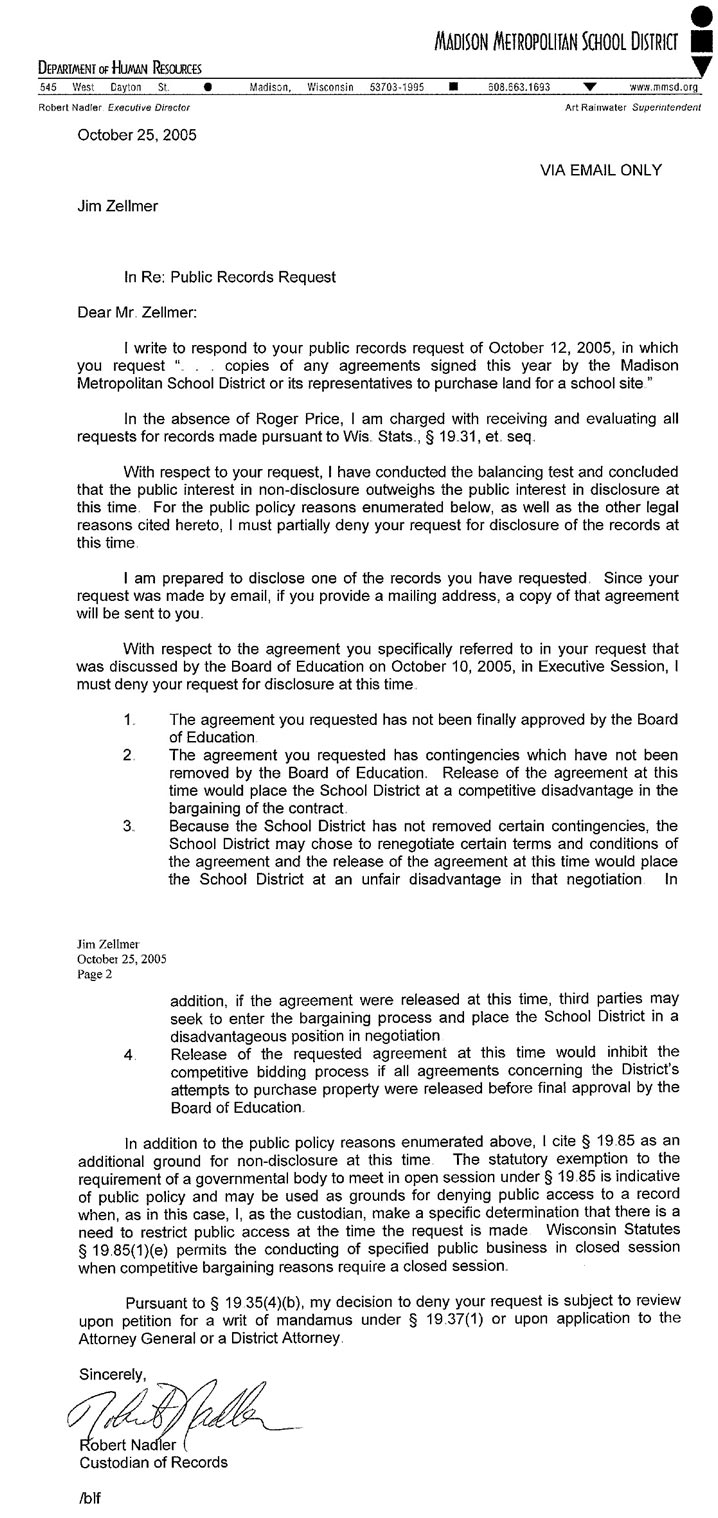
I received a response today from Bob Nadler, the District’s Custodian of Records. Essentially, this response means that the public has no right to know about the District’s purchase of land for a new school site until after the Board agrees to purchase. Read Bob’s letter here. I will post the document he referenced upon receipt.

Share

Monday’s Madison School Board Meeting: Buses and Taxes

The Madison School Board met Monday evening. Here are a few items from that meeting:

Share

Beaver Dam School Wins National Award

Channel3000:

Statistics show half the students at South Beaver Dam Elementary fall into the disadvantaged category.
Yet the school scored 100 percent on reading, knowledge and concept exams and more than 96 percent in attendance.
The school received a National Blue Ribbon Award from the U.S. Department of Education.
“There is no child left behind,” said parent Amy Grunst. “No child who can’t go. Everybody goes.”
“Our expectations are high,” said Principal Dan Rikli. “We are sensitive where they came from, but we expect just as much from every kid who walks into this school.”

Share

Making Schools Work: Hedrick Smith

Hedrick Smith:

This web site follows our production team into classrooms from coast to coast to see how some American communities are creating a small revolution in our schools. Don’t expect one magic formula. You’ll see different strategies. The common denominator is results – lifting scores and closing achievement gaps, not just for a few hundred children but for nearly two million, from our inner cities to rural America.

Transcript here.

Share

Ken Lonnquist @ Thoreau School


Local musician Ken Lonnquist was recently in residence at Thoreau School. Ken worked with each grade to compose a song. The resulting music, ultimately destined for a CD, was performed on a recent evening. Here’s a brief video clip from the event.
UPDATE: Thoreau’s Rhonda Schilling emailed the funding details:

Dane County Cultural Affairs ($1450 grant)
Wisconsin School Music Association ($500 grant)
Thoreau PTO ($1750 Cultural Arts Budget and Barnes & Noble Fundraiser)

Share

Fascinating: Novel Way to Assess School Competition Creates a Stir

Jon E. Hilsenrath:

The unusual spat has put a prominent economist in the awkward position of having to defend one of her most influential studies. Along the way, it has spotlighted the challenges economists face as they study possible solutions to one of the nation’s most pressing problems: the poor performance of some public schools. Despite a vast array of statistical tools, economists have had a very hard time coming up with clear answers.
“They’re fighting over streams,” marvels John Witte, a University of Wisconsin-Madison professor of political science and veteran of a brawl over school vouchers in Milwaukee in the 1990s. “It’s almost to the point where you can’t really determine what’s going on.”
Milton Friedman, the Nobel Prize-winning economist known for his free-market views, proposed 50 years ago that to improve schools, parents could be given vouchers — tickets they could spend to shop for a better education for their kids. He theorized that the resulting competition among schools would spark improvements in the system. Free-market advocates loved the idea. Teachers’ unions hated it, arguing that it could drain resources from some public schools and direct resources to religious institutions.

(more…)

Share

Student Brings Weapons into Memorial High School

Channel3000.com:

Another Memorial High School student was arrested Thursday, when school officials say a teen brought in a handgun magazine and 12 9-mm rounds to school.
News 3 reported a teacher noticed them when they fell out of the student’s pocket. A search of his car turned up two more boxes of ammo and a 12½ inch “Rambo Style” knife.
The student was taken to Dane County jail and arrested for carrying a concealed weapon and having a dangerous weapon on school grounds. Police said this is the third weapons incident at Memorial in a week.

Share

Michigan Universities Offer More Remedial Math Courses

Lori Higgins:

What’s the price of leaving high school unprepared? Ask Chelsea Stephanoff, a Wayne State University student who is spending nearly $600 this semester for a class that won’t count toward graduation.
Why? Her math skills were poor enough that even after four years of high school math, she was placed in a remedial class.
“Math is not my strong point at all. I’m horrible at it. I have a hard time focusing on it,” said Stephanoff, a fourth-year student from Shelby Township who wants to be an elementary school teacher.

Via Joanne.

Share

Mr. Mom’s Transport Service Press Conference

Mr. Mom’s Transport held a news conference Friday. Pat Schneider was there:

Peter Munoz, executive director of Centro Hispano, fought back tears as he recounted the company’s generous support of his nonprofit agency.
The Smiths’ predicament, he said, “embodies some of the most intransigent problems we face in economic disparity and injustice.
“This business cannot be allowed to fail. It is too important,” he said.
Richard Harris, executive director of the south side Genesis Enterprise Center where the news conference was held, said he doubted that state officials were giving other transportation providers “scrutiny as intent as Mr. Mom’s.”
“Ask yourself: Is the playing field equal?” he said.

More on the Madison School District’s transportion contracts.

Share

Stanford on iTunes

Interesting stuff: Stanford posts lectures, interviews, music and sports via itunes. One of the interesting lectures appears to be Denise Clark Pope’s “Getting Ahead in School: How we are creating a Generation of Stress-Out, Materialistic and Miseducated Students”. Perhaps the UW will follow suit (and the MMSD?)
UPDATE: Jeff Henriques points out in the comments that the UW has a resource page up here.

Share

Child Enticement Near Emerson

Channel3000:

Madison police are warning parents about another child enticement. This one happened near Emerson School on Johnson Street. Two sisters say a man in a 4-door dark sedan told them to get in his car last Thursday morning. The suspect was a white male with a gray beard. He took off when the girls ran away. Similar cases have been reported in the Madison-metro area since September.

Share

Police and Madison Schools

Bill Lueders and Jason Shepherd:

In the 2004-05 school year, police were summoned to Madison schools more than 1,500 times and made nearly 400 arrests, mostly of students. Recently Isthmus writer Jason Shepard went through raw data of police reports to compile spreadsheets of police calls and arrests, arranged by school. One resulting finding — that students of color account for a sharply disproportionate percentage of arrests — has stirred particular concern, a topic explored in Shepard’s column for the Oct. 21 edition of Isthmus. Included here is that column and three spreadsheets that provide cumulative data

Share

2005 NAEP Results

2005 National and State Mathematics and Reading Assessments for grades 4 and 8 are now available.
Robert Tomsho takes a look at the reading results:

Observers say boosting reading scores isn’t likely to get any easier, given the rapidly changing demographics in the nation’s schools where, for many students, English is a second language. Indeed, English was a second language for 10% of the fourth graders who took the NAEP reading test this year, up from 3% in 1992.
The lack of progress may also reflect divisions in the philosophy of how reading should be taught. Educators and political partisans have waged a long and sometimes bitter battle over how to handle the subject, as conservatives championing basic phonics-based teaching have clashed with liberal backers of “whole language,” which revolves around making English instruction exciting by reading stories.

Share

Study Shows Few Gains Since NCLB

Lois Romano:

Despite a new federal educational testing law championed by the Bush administration, scores among fourth and eighth graders failed to show any improvements in reading, and showed only slow gains in math nationally during the past two years, according to a study released today.
Most troubling for educators are the sluggish reading skills among middle school students, which have remained flat for 13 years, according to the National Assessment of Educational Progress (NAEP), which has been testing students for three decades and bills itself as the “nation’s report card.”
“There is no rationale on eighth-grade reading other than we are not making progress,” said Darvin M. Winick, chairman of the National Assessment Governing Board, which oversees the testing. Yet, he added, “I think educators and parents of elementary schools students should feel pretty good about this report. There is progress.”

interesting quote NPR has more.

Share

Wisconsin AB 618 and SB 305: Protect Child Passengers

Denny Lund emailed this information on two bills that address requirements for child passenger booster seats:

On Wednesday, October 19, the Joint Finance Committee of the Wisconsin State Legislature will be voting on both AB 618 and SB 305. Because there is no public hearing for this bill, it is imperative that these committee members hear from you.
Please call and/or email your representatives and urge them to support AB 618 and SB 305. If they are not on the Joint Finance Committee, urge them to contact committee members.
Find your legislator’s phone number here: www.legis.state.wi.us
List of Joint Finance Committee members

(more…)

Share

Non-Traditional School Finance Discussion

Props to Johnny Winston, Jr. for organizing today’s Madison Board of Education Finance & Operations Subcommittee on Advertising meeting. I think a discussion of alternative funding sources is vital in light of Madison’s generally high property taxes, sluggish economic growth and the biennial state funding battles. A number of possibilities were discussed including:

  • The District leading the implementation of local fibre optic networks, via it’s many facilities (with, perhaps wifi servicing the last mile). I think this is quite interesting. Madison lags in true broadband service.
  • Naming Rights
  • Curriculum Program Underwriting
  • Sponsorships for district cable channels, website(s) and other parental communications

Participants included: Johnny, Roger Price, Barb Lehman, Ken Syke, Vince Sweeney (UW Athletic Department), Melanie Schmidt (President of the Timpano Group) Jodi Bender Sweeney, President of the Foundation for Madison Public Schools and the writer (me).

Finally, A representative of local cell providers discussed the type of fees they would pay for very small antennas placed on District facilities (no towers). The Capital Times’ Matt Pommer attended as well and will, I’m sure write about it.
UPDATE: Pommer’s article is here. I have some corrections:

  • I did not hear the word tower used in connection with the cell service discussions. I heard the word antenna used. Obviously, we’ll have to see what the actual plans include to make an aesthetic determination on this question.
  • I’m quoted as saying “Madison is way behind on this issue,” related to sponsorship and advertising. I said this when Roger Price was discussing the District’s fibre optic network options vis a vis community broadband.
Share

Ridgewood Apartment Building Demolished

Channel 3000:

Demolishing the structure was the last step necessary for previous managers, CMS, to collect on the insurance claim.
New owners, EJ Plesko & Associates, are now in the early stags of conducting a market analysis.
“You want to look at surrounding areas,” said Plesko official Brandon Scholz. “You want to know what apartments are like, what condos are like, what businesses are like and be able to look at what you have and how much more development you want to put into it.”
EJ Plesko & Associates hopes to have a redevelopment plan to Fitchburg officials by early 2006.

Share

Madison School District Student Fee(s) Analysis

The Madison Board of Education Finance and Operations Committee will discuss student fees during their meeting tonight. Committee Chair Johnny Winston, Jr. kindly asked Barbara Lehman to forward two documents:

Share

Schoolhouse Blogs

Edward Moyer:

As blogging enters the classrooom and takes its place alongside reading, writing and ‘rithmetic, adult Web surfers have the chance to relive the trials and tribulations of the wonder years.

Share

Book: Top of the Class

Soo Kim Abboud and Jane Y Kim:

Asians and Asian-Americans make up 4 percent of the U.S. Population, and 20 percent of the Ivy League. The authors contend that Asian-Americans are no more intelligent than any other race or ethnic group, but that their parents have instilled in them a love of learning.

Share

A Few Notes on the Superintendent’s Evaluation & Curriculum

Several writers have mentioned the positive news that the Madison Board of Education has reviewed Superintendent Art Rainwater for the first time since 2002. I agree that it is a step in the right direction.
In my view, the first responsibility of the Board and Administration, including the Superintendent is curriculum: Is the Madison School District using the most effective methods to prepare our children for the future?
There seems to be some question about this:

  • Language: The District has strongly embraced whole language (Troy Dassler notes in the comments that he has been trained in balanced literacy). I would certainly be interested in more comments on this (and other) point(s). [Ed Blume mentions that “”Balanced literacy” became the popular new term for whole language when whole language crumbled theoretically and scientifically.”] UW Professor Mark Seidenberg provides background on whole language and raises many useful questions about it. Related: The District has invested heavily in Reading Recovery. Ed Blume summarized 8 years of District reading scores and notes that Madison 3rd graders rank below state wide average for children children in the advanced and proficient categories. (Madison spends about 30% more than the state average per student)
  • Math: The District embraces Connected Math. UW Math Professor Dick Askey has raised a number of questions about this curriculum, not the least of which is whether our textbooks include all of the corrections. A quick look at the size of the Connected Math textbooks demonstrates that reading skills are critical to student achievement.
  • Sherman Middle School’s curriculum changes
  • West High School’s curriculum changes and families leaving
  • “Same Service Budget Approach“: I think the District’s annual same service approach reflects a general stagnation.

(more…)

Share

Thinking Different: Little Rock Principal and Teacher Incentives

Daniel Henninger:

She went to the Public Education Foundation of Little Rock. The Foundation had no money for her, and the Little Rock system’s budget was a non-starter. So the Foundation produced a private, anonymous donor, which made union approval unnecessary.
Together this small group worked out the program’s details. The Stanford test results would be the basis for the bonuses. For each student in a teacher’s charge whose Stanford score rose up to 4% over the year, the teacher got $100; 5% to 9% — $200; 10% to 14% — $300; and more than 15% — $400. This straight-line pay-for-performance formula awarded teachers objectively in a way that squares with popular notions of fairness and skirts fears of subjective judgment. In most merit-based lines of work, say baseball, it’s called getting paid for “putting numbers on the board.”
Still, it required a leap of faith. “I will tell you the truth,” said Karen Carter, “we thought one student would improve more than 15%.” The tests and financial incentives, however, turned out to be a powerful combination. The August test gave the teachers a detailed analysis of individual student strengths and weaknesses. From this, they tailored instruction for each student. It paid off on every level.

(more…)

Share

A Profile of 2004 American High School Seniors

National Center for Education Statistics:

More than two-thirds of students who were high school seniors in 2004 expected to complete a bachelor’s degree, and 35 percent planned to get a graduate or professional degree. But nearly two-thirds of the students who expected to get a four-year degree had not mastered intermediate level mathematics concepts as 12th graders, and nearly a third could not consistently solve simple problems based on low-level mathematical concepts, according to a study released Friday by the U.S. Education Department.

Via Inside Higher Ed.

Share

Tell Family Stories To Your Kids

Jennifer Harper:

Granddad’s first job, the old homestead, mom’s legendary cooking: Family stories make effective armor for children in an unsure world, according to a three-year study of 40 families by Emory University.
It found that children who share in those endearing and even heroic memories can grow strong and resilient for a simple reason: They have proof from mom and dad that family life goes on, despite negative outside events.

This is right on. I have direct experience with this, via my parents and grandparents.

Share

Madison Schools Transport Update: Cullen and Pommer on Mr. Mom’s

Sandy Cullen:

The district is investigating how long the company was without insurance and also is looking into reports that some bus drivers did not have valid driver’s licenses, Rainwater said.
Also last month, the brakes failed on a bus returning students to Spring Harbor Middle School after a field trip, Rainwater said. No students were injured, and the bus did not crash.
Attorney Clarence Sherrod said the district is in the process of preparing a notice of default, which could lead to termination of Mr. Mom’s two contracts with the district.
Under the terms of its contracts, Mr. Mom’s will have 20 days to respond to the default notice.

Matt Pommer has more:

Price provided copies of the safety audits done on the five bus firms that serve the Madison district in response to questions raised Monday by School Board member Ruth Robarts.
The reports showed that other bus firms last year had far smaller percentages of buses needing repairs in inspections by the State Patrol. Two of 15 Badger buses needed work; one of 20 Rite-Way vehicles needed repairs; eight of 23 Durham buses failed; and five of 21 First Student buses inspected needed work.

Share

Persistence

Vernice Jones:

I left the Dominican Republic to come to the United States in 7th grade. I was put in a special education class. I wasn’t slow, but I was quiet – you know different culture? I was very introverted. I’ll always remember that class. Other kids used to tease all of us. It’s interesting how people can get lost that way.
I befriended a teacher who took me under his wing. He encouraged me to participate in class. It was just a matter of confidence. If we were going to do something in science, he would encourage me to do a project and present it. He helped me come out of my shell.

Via Joanne.

Share

3 of 4 Middleton-Cross Plains Referenda Fail

Barry Adams:

Voters in the Middleton-Cross Plains School District narrowly approved Tuesday more elementary space and upgrades to heating and air conditioning at two schools but overwhelmingly rejected three other questions in a $53 million referendum package.
Voters said no to a $36 million combined elementary and middle school, a $5.8 million transportation garage and increases in state-imposed revenue caps.
“I’m really not surprised because of the bottom-line price,” School Board member Ellen Lindgren said. “I think we’ll have to take quite a bit of time analyzing why they voted the way they did.”

Channel3000 has more.

Share

School Board Governance Perspectives

Last night’s Madison Board of Education meeting provided an illuminating look at two rather different perspectives on governance. The Board voted 4 (Carstensen, Keys, Lopez and Winston) – 3 (Kobza, Robarts, Vang) to support the Administration’s approach to the growing problems with Mr. Mom’s Transport Service (I believe there were two votes on this question – the minutes are not available as of this writing).

Many points were discussed, including the District’s pre-contract vetting of Mr. Mom’s and whether, given recent experience, the Administration should be allowed to subcontract with Badger Bus via Mr. Mom’s (Badger Bus is replacing Mr. Mom’s service on many routes). The District recently signed a five year agreement with Mr. Mom’s Transport Service.

The motion passed 4-3 to allow the Administration to Subcontract Badger Bus service via Mr. Mom’s (again, I think there was a 2nd vote on this). Watch the debate here

For what it’s worth, I’m actually in favor of long term (5 year) contracts. They, hopefully allow vendors to optimize and perhaps manage costs more effectively. The subcontract to Badger Bus via Mr. Mom’s, given the issues, seems unusual.

UPDATE: The 4-3 vote was on a Kobza motion, seconded by Robarts to contract directly with Badger Bus, rather than using a subcontract via Mr. Mom’s. After this motion was defeated 4-3 (Kobza, Robarts, Vang), as noted above, the Board voted 5 – 2 (Kobza joined Carstensen, Keys, Lopez and Winston) to support the Administration’s proposed subcontract with Badger Bus via Mr. Moms.

Share

Middleton-Cross Plains School Referenda

Channel 3000:

Some in the district are concerned that there would be too many kids of widely varying age groups on the same campus, but Supt. Bill Reis sees benefits in kids staying at one school for nine years.
“So we’ll get to know families, teachers, get to know kids,” said Reis. “There will be communication elementary to middle school so that transition, I think, will be more successful.”
But at least one Middleton resident opposes the idea.
“Mostly I’m looking at physical problems,” said Karl Schroeder. “You already have harassment in your own age group. Now, you’re just adding on to that.”
Enrollment figures released to News 3 show just a one-student increase in the school district from one year ago, but explosive future population growth seems imminent.

Share

Madison Schools Superintendent Art Rainwater’s October Message


Art Rainwater’s October Message. Quicktime Video

Share

Schools Try Recess First, Lunch Later

Amy Hetzner:

Proponents of holding recess before lunch say it helps reduce food waste in the cafeteria, increases students’ caloric and calcium consumption and can provide a calming buffer between frenetic play and quiet classroom work.
Food service and school nutrition groups have been busily advocating for more schools to change their schedules to reap the benefits.

Share

Wisconsin School Spending Increases 4.6%, largest since 2001-2002

Wistax:

Wisconsin public school spending rose 4.6% in 2004-05, the largest increase since 2001-02 (5.7%). Spending on instructional support for such items as staff training, library services and athletics rose 7.7%. Expenditures for instruction and for building and grounds were both up 4.8%.
Spending per student rose 4.8%, slightly faster than the total because enrollments in the state’s public schools fell 0.3% in 2004-05 to 869,961. In 2004-05, Wisconsin school districts budgeted to spend $10,367 per student, or $477 more than the year before (The Madison School District’s per student spending is about 30% higher than the state average). The majority of expenditures were for instructional costs, which climbed 5.0% to $6,068 per student. Expenditures for instructional salaries and benefits ($5,428) rose 4.6%, higher than the annual average of 3.9% during the previous five years. Per student expenditures for transportation ($408, +2.5%) and administration ($785, +3.8%) increased at below-average rates, WISTAX noted.

Share

More on East / West Task Forces

Sandy Cullen:

Elementary schools considered most at risk are Emerson, Lapham and Lowell – which are at or below 67 percent of their capacity for students – as well as Lindbergh, Cohen said.
“We’re rallying around Lindbergh,” he said, adding that the school serves “probably the most fragile” population of low-income and minority families, including many from Kennedy Heights just across the street from the school.
Mary Gulbrandsen, director of student services and chief of staff to Superintendent Art Rainwater, said the Madison School District has no hidden agenda to close one or more East Side schools, as some parents fear.

Much more here.

Share

The Social Logic of Ivy League Admissions

Malcolm Gladwell:

“As a hypothetical example, take the University of Pennsylvania and Penn State, which are two schools a lot of students choose between,” Krueger said. “One is Ivy, one is a state school. Penn is much more highly selective. If you compare the students who go to those two schools, the ones who go to Penn have higher incomes. But let’s look at those who got into both types of schools, some of whom chose Penn and some of whom chose Penn State. Within that set it doesn’t seem to matter whether you go to the more selective school. Now, you would think that the more ambitious student is the one who would choose to go to Penn, and the ones choosing to go to Penn State might be a little less confident in their abilities or have a little lower family income, and both of those factors would point to people doing worse later on. But they don’t.”
Krueger says that there is one exception to this. Students from the very lowest economic strata do seem to benefit from going to an Ivy.

More on Gladwell.

Share

Teach for America is 15

Morning Edition:

Renee Montagne talks with Wendy Kopp, president and founder of Teach for America, about how far the organization has come in the last 15 years. Kopp came up with the idea for Teach for America as her senior project at Princeton and has since built it into a powerful nonprofit.

Share

364 Day School Opening?

BBC:

A school is to consult teachers and parents on the idea of opening for lessons 364 days a year.
Teaching would take place throughout the year – even on weekends – but not everyone would be in at the same time.
Paul Mortimer, who is a government adviser and in charge of two Rochdale schools, says he wants to have a school of the 21st Century, not the 19th.

Share

Town of Burke Aligns with DeForest

Bill Novak:

Madison’s Smart Growth (land use) plan was rolled out this summer, and it put a shiver into Burke residents.
“It showed Madison stretching north to Wisconsin 19, which is the southern border of DeForest,” Miller said. “When Burke officials came to us they said the residents of the town go to the DeForest schools so they wanted to be part of DeForest.”

Share