School Information System

Gifted Students and Equity Discussion

Eduwonk posts a variety of responses to Susan Goodkin’s OP-ED on gifted children and No Child Left Behind:

Not surprisingly, with the entire curriculum geared to ensuring that every last child reaches grade-level proficiency, there is precious little attention paid to the many children who master the standards early in the year and are ready to move on to more challenging work. What are these children supposed to do while their teachers struggle to help the lowest-performing students? Rather than acknowledging the need to provide a more advanced curriculum for high-ability children, some schools mask the problem by dishonestly grading students as below proficiency until the final report card, regardless of their actual performance.

More:

As a matter of pure politics, how can you expect to retain public support for a school reform regime that short-changes high-achieving students, whose parents, whether rich or poor, are likely to be more politically engaged and influential than the parents of low-performing students?

Share

West Area Attendance Task Force Minutes (12/20/2005)

Minutes from the 12/20/2005 West Attendance Area Task force meetings. [PDF version] January 5, 2006 Agenda [PDF version]

Share

“In Middle Class, Signs of Anxiety on School Efforts”

Susan Saulny:

Some of the very changes that Chancellor Joel I. Klein has made his hallmark – uniform programs in reading and math for most schools; drilling that helped produce citywide gains last spring on standardized tests; changes in rules for admission to programs for the gifted and talented, designed to make them more equitable – have caused unease among that important constituency.
Many parents say, however, that there are extremely limited public school options in the middle school years, and some chafe at how the new rules for gifted programs in the elementary schools and for certain select schools have made competition for admission stiffer.
City officials say that judging by the number of children eligible for free lunch, the class divide in the system remains stable: About 80 percent of the children are poor, with no increase in middle class flight.
Yet Emily Glickman, a consultant who advises parents in the city on winning admission for their children to private schools, said, “The last two years the interest in private schools has exploded, as I see it with people coming to me.”

Share

Fairfax: Rocky End to Schools’ Growth

Maria Glod:

The proposed downsizing of Glasgow — and the anger it has sparked among parents — underscores a dramatic shift in the region’s largest school district, where the rapid student growth of the past decade appears to have come to an abrupt end.
Just four years ago, school officials predicted that there would be more than 171,000 students this year and that the number would continue rising. Now they think the district, the 12th largest nationwide, will max out next school year with 164,725 students.

Share

“Urgency is Needed to Improve our Schools”

Boston Herald Editorial:

It may sound simple, but it helps illustrate the urgent need to change the state’s approach to improving failing schools.
As it stands, the state can deem a school underperforming if students fail to meet minimum standards for two or more years.
Then it’s six months to come up with an improvement plan, another two years to make changes and only then does the state even consider intervening. Meanwhile, another generation spends its most important years in schools that aren’t getting the job done.

Share

Vouchers, Charters and Public School Accountability

Eduwonk rounds up a number of interesting comments on Milwaukee’s voucher program, including this:

Update: Concerning public accountability, one reader writes:
Yeah, yeah, yeah. I’m not defending these voucher schools, or any schools that hide from legitimate public oversight. But I’ve spent years now working on projects that required interviews with school personnel, site visits, documentation from the central office, etc., etc. And if you think that refusing to submit to outside evaluation is specifically or even primarily a problem of private/voucher schools, you’re nuts. There’s no stonewaller like the public school stonewaller. Administrative assistants are the worst. And don’t give me all that FERPA xxxx, either; they just don’t want people snooping around.
That’s a fair enough point, it’s not just a voucher school problem (though not every public school stonewalls either).

Share

AP Class Quality Control

Georgina Gustin:

Starting in the 2007-08 school year, any high school that offers an AP class will have to prove it meets certain College Board requirements. Teachers and administrators will have to perform annual self-audits and submit materials, including syllabi, to the College Board.

Via Education Gadfly:

Prestigious universities value the letters AP (i.e., Advanced Placement) on an applicant’s transcript, maintaining that success in AP courses is the best indicator of success in college. But students looking to score points with admissions officers have begun gaming the system. Many enroll in AP courses but never sit for the accompanying AP exam. And high schools—bowing to student pressure for more AP courses—are lowering expectations so that more students can have the coveted letters on their transcripts (see here for more on AP’s expansion).

Share

“Mysteries of Testing Solved”

Jay Matthews:

Bracey has been exposing statistics abuse for years. But I have never seen him put together all that he knows as well as he has in this book. It has some of the best explanations of educational numbers manipulation I have ever read, particularly issues like SAT scores, year-to-year school comparisons and argument by graph that are most likely to deceive us innocents. The book has Bracey’s deft prose and sure touch with clarifying examples. I also appreciate the fact he trimmed much of his sharp ideological edge, loved by many of his fans, but not by me. He acknowledges several times that no combatant in the bitter education policy wars has an unquestionable grasp on the truth.

Share

One Room Schools Holding Up in Rural America

Neenah Ellis:

One-room schools still exist in America. They are a legacy of a less mobile, more rural time in American history. Mostly serving isolated communities, the remaining schools require one teacher to educate children of varying ages at the same time in a single classroom.

Share

Lopez to Seek 5th Term

Sandy Cullen:

Two slots on the Madison School Board will be up for grabs in spring elections in which one incumbent will face a challenger while other candidates vie for an open seat.
Board member Juan Jose Lopez announced Tuesday that he will seek a fifth three-year term. He is facing a challenge by Lucy Mathiak, a parent and organizer of the advocacy group East High United.
Parents Arlene Silvera and Maya Cole, both active PTO members at different West Side schools, have declared their candidacy for the seat being vacated by Bill Keys.

Websites: Maya Cole | Juan Jose Lopez | Lucy Mathiak | Arlene Silveira (Arlene told me her site would be up soon).

Share

Tim Olsen on Generating Cash from the Doyle Administration Land/Building

Tim Olsen’s email to Madison Board of Education Member Ruth Robarts:

And below are the specifics you requested re calculating an estimated value for the Doyle site. You are welcome to share this email with anyone interested. And thanks for the opportunity to speak to the Board, for your comments, and for including Lucy Mathiak’s blog-article. Someone told me about her article and I’m happy to receive a copy.

(more…)

Share

Wisconsin Taxes Rose 10% in 2005

taxes21g.gif

  • Wisconsin Taxes Set a Record: Residents and Business give 10% more:

    Wisconsin residents and businesses paid a record $56.5 billion in state, local and federal taxes and fees this year, a 10% increase from last year and the biggest jump in more than two decades, according to a study by a non-partisan taxpayers group. = WISTAX

    • Wisconsin’s total taxes rose 1.4 percentage points in 2005 to 32.0% of personal income
    • Net local property tax levies rose 6.3% in 2005. At 4.3% of personal income, 2005 net levies were at their highest level in 10 years.
Share

Task Forces Present Early Options

Sandy Cullen:

Those options would move between 316 and 620 students. Some students at Leopold, Chavez, Falk, Thoreau, Stephens and Huegel would go to existing schools, while some students from Crestwood, Huegel, Stephens and Chavez would attend a new school.
School Board member Lawrie Kobza questioned why an option moving fewer students, which had been presented at recent public forums, was off the table. “I had felt we were moving in the right direction when moving the least number of kids,” she said.
Facilitator Jane Belmore said bus rides for some of those students would have exceeded 45 minutes each way.
….parent Tim Olsen called on administrators to “lead from the front” instead by selling the Doyle Administration Building.
Olsen said that selling the property adjacent to the Kohl Center could bring nearly $7 million to the district, which anticipates eliminating up to $10 million from its current budget next year to comply with state revenue limits.

Share

“School Contests Promise to Be Hot”

Lee Sensenbrenner:

With this spring’s elections to the Madison School Board, the balance of power on the seven-member body hinges on the outcome of what surely will be two hotly competitive races.

Much more on the candidates and the election here.

Share

Highland’s Distance Learning Grant

Amanda Kraemer:

The Highland School District, which has about 300 kindergarten through high school students, learned early this month they are one of 79 nationwide recipients of a $300,000 U.S. Department of Agriculture rural development grant.
School Board president Brad Laufenberg said one of the disadvantages of being a smaller school district is the inability to provide a large and varied number of courses to their students.
“The distance learning lab will enable us to provide many more of those courses to both our students and the rest of the community,” he said.

Share

Internationalizing Our Schools

Elizabeth Burmaster:

We live in a world instantly connected via satellites, computers, and other electronic technology. Our children embrace the technology that makes those connections possible, but need the educational background through cultural and linguistic experiences that will prepare them for the global world of today and their international future.

Burmaster raises some useful points. Clearly, it is no longer sufficient to compare Madison’s curriculum and achievement with Racine, Green Bay or Kenosha. Rather, the question should include Bangalore, Helsinki, Shanghai, Taipei and Osaka, among others.

Share

When Learning Counts: Rethinking Licenses for School Leaders

Jacob E. Adams, Jr. & Michael A. Copland [PDF]:

This report asks two fundamental questions: do the licenses that states require of school principals encompass the knowledge and skills those principals need to promote student learning? If not, what kind of policy framework would help decisionmakers, educators, and others rethink principal licenses and the school leadership they support? To find the answers, we examined licensure content for principals in all 50 states plus the District of Columbia. Based on that in-depth investigation, we reached the following conclusions.
Licenses don’t reflect a learning focus. No state has crafted licensing policies that reflect a coherent learning-focused school leadership agenda. On the contrary, licenses run between two extremes: a reliance on individual characteristics, such as background checks or academic degrees, that signal nothing about the purposes or practice of the principalship, and lists of knowledge and skill requirements whose scope and depth don’t clearly sum to a meaningful definition of the job. Neither approach represents a set of qualifications on which the public may rely or the profession may depend. In an era of standards and accountability, this omission stands out.
Licensing requirements are unbalanced across states and misaligned with today’s ambitions for school leaders.

Share

Public Education Goes to School

Harvard Business School:

We asked our nine districts what their biggest barriers were in achieving excellence at scale, and they described five categories of management challenges:

  1. Implementing a district-wide strategy
  2. Achieving organizational coherence in support of the strategy
  3. Developing and managing human capital
  4. Allocating resources in alignment with the strategy
  5. Using performance data for decision making and accountability

Share

Friedman on Vouchers

Nick Gillespie:

In 1955 future Nobel Prize–winning economist Milton Friedman kick-started modern education reform with an article titled “The Role of Government in Education.” Bucking the “general trend in our times toward increasing intervention by the state” in virtually all economic and social activities, Friedman argued that universal vouchers for elementary and secondary schools would usher in an age of educational innovation and experimentation, not only widening the range of options for students and parents but increasing all sorts of positive outcomes.
“Government,” wrote Friedman, “preferably local governmental units, would give each child, through his parents, a specified sum to be used solely in paying for his general education; the parents would be free to spend this sum at a school of their own choice, provided it met certain minimum standards laid down by the appropriate governmental unit. Such schools would be conducted under a variety of auspices: by private enterprises operated for profit, nonprofit institutions established by private endowment, religious bodies, and some even by governmental units.”

Share

Elite French Schools Block the Poor’s Path to Power

Craig Smith:

Nothing represents the stratification of French society more than the country’s rigid educational system, which has reinforced the segregation of disadvantaged second-generation immigrant youths by effectively locking them out of the corridors of power.
While French universities are open to all high school graduates, the grandes écoles – great schools – from which many of the country’s leaders emerge, weed out anyone who does not fit a finely honed mold. Of the 350,000 students graduating annually from French high schools, the top few grandes écoles accept only about 1,000, virtually all of whom come from a handful of elite preparatory schools.

Share

East High Principal Allen Harris Profile

Sandy Cullen:

You can tell something’s different at East High School this year without even going inside.
Gone is the “smoking wall,” where for generations, students gathered to hang out and smoke cigarettes before and during the school day.
“It was intimidating,” said parent Lucy Mathiak, who admits she was uncomfortable walking past the large group of students who would gather along the wall on Fourth Street. “It smelled terrible and it was really annoying,” added Mathiak’s son Andrew Stabler, 16, a junior at East.
It was also one of the first things to change this fall after Alan Harris stepped in as the school’s new principal.

Background on East High’s recent principal position turnover. More on Allen Harris, including his appearance at the recent Gangs and School Violence Forum

Share

Winter Solstice Celebration: Thoreau Student Self Portraits


Thoreau Art Teacher Andy Mayhall:

Thoreau Elementary School was given a donation by a retired art teacher to have an artist-in-residency. We had artists submit proposals to the school, which were reviewed by the Cultural Arts Committee. Local artist, Susan Tierney, was selected to work with me, and Thoreau students to create self-portrait paintings. Susan worked with students in the classroom on and off for about a month. The students made sketches and then final drawings onto hardboard. Students could create realistic or non-realistic, some were cartoon like, self-portraits. They used colored pencil and acrylic paint to color the portraits. The finished portraits were put together to form 22 murals. The murals are on display in the hallway between the LMC (library) and classrooms on the upper floor. These murals will be a permanent display at Thoreau.

Check out the murals via these photos.

Share

Investing in Education

KJZZ:

In this essay we hear from Chris Coffey, an educator who has gone into teaching as a second career and who thinks it’s time for a lot of us to do more than talk about improving education. Chris Coffey is a lawyer who has returned to education and teaches in the Law Magnet Program at South Mountain High School in the Phoenix Union High School District.

audio

Share

New Special-Ed Testing Rules

Nick Anderson:

Education Secretary Margaret Spellings outlined new testing rules for disabled students yesterday, formalizing an initiative that has already helped more than 100 public schools in Maryland and Virginia meet the standards of the No Child Left Behind law.

Share

Making AP Work For Students

Jay Matthews:

The board had decided that any student who wanted to take a high school honors or college-level course could do so. The only prerequisite was a desire to work hard.
The School Board also said that anyone taking difficult Advanced Placement and International Baccalaureate courses had to take the special AP and IB exams written and scored by independent experts and administered in May. The number of exams nearly doubled, and passing rates on those college-level tests dropped sharply. In 1998, 75 percent of students taking AP tests in the county received passing scores. In 1999, that figure was only 62 percent.

Share

How One Suburb’s Black Students Gain

Micael Winerip:

Here in this integrated, upper-middle-class Cleveland suburb, you would think they would be boasting. African-Americans’ combined math and verbal SAT scores average 976, 110 points above the national average for black students. The number of black sixth graders scoring proficient on the state math test has nearly doubled in three years and is more than 20 percentage points above the Ohio average for blacks.
A black parent group here has sponsored many projects aimed at narrowing the gap, including a summer enrichment program started in 1997. In October, Alisa Smith opened a parent room at the high school to encourage more adult involvement. Ms. Smith, a Columbia graduate and a stay-at-home mother, and her husband, a doctor, have three children in the schools, including Andre, the MAC scholar. While she says her children have been underestimated at times because they are black, over all she is delighted with the schools.

Share

Education Trust: “How Some High Schools Are Boosting Student Achievement.”

The Education Trust:

The Education Trust’s two newest reports highlight the practices of high schools that are getting the job done and improving student achievement, especially for the poor and minority children traditionally underserved by the American high school.

(Press Release) (Gaining Traction; Gaining Ground) (The Power to Change)

Share

“Poor Basic Skills Mar Progress”

BBC:

Improvements in standards in primary and secondary schools in England are being marred by poor levels of literacy and numeracy, Ofsted inspectors say.
Pupils with below average abilities in reading, writing and maths are not getting enough help, Ofsted reports.

Share

“School Choice and the Civil Rights Establishment”

Shavar Jeffries:

According to the Joint Center for Political and Economic Studies, Black parents, especially Black parents of children in urban schools, strongly support school choice. This result should be unsurprising: The futures of their children are directly, if not irrevocably, compromised by the continuing failure of urban schools. At the same time, most longstanding civil-rights organizations — like the NAACP, the NAACP Legal Defense and Education Fund, and the Leadership Conference on Civil Rights (LCCR) — strongly oppose school choice. The following assertions of LCCR, contained in its platform statement on educational matters, is typical:

Share

Michigan Considers Requiring High-School Students to Take at Least One Online Course

Dan Carneville:

The Michigan State Board of Education is set to approve a new graduation requirement today that would make every high-school student in the state take at least one online course before receiving a diploma.
The new requirement would appear to be the first of its kind in the nation. Mike Flanagan, the Michigan state superintendent of public instruction, said he proposed the online-course requirement, along with other general requirements, to make sure students were prepared for college and for jobs, which are becoming more technology-focused.
“We don’t want our kids left in the global dust,” Mr. Flanagan said. “It’s an experience we need to have.”

Share

BIO 2006 Chicago


This April, 2006 event would be a fabulous class trip for any K-12 student. McCormick Place.
There’s a one day primer on biotechnology (Saturday) that looks useful.
Ironically, during the mid-1990’s, the Madison School District declined an offer of free land in Fitchburg for a school and a partnership with Promega.

Share

“Hopes, Fears, & Reality: A Balanced Look at American Charter Schools in 2005”

Robin J. Lake and Paul T. Hill, Editors:

The report is in two parts. In the first, the National Charter School Research Project (NCSRP) provides new data that inform questions such as: Is the charter school movement growing or slowing down? Do charter schools serve more or fewer disadvantaged children than regular public schools? Are charter schools innovative? It also identifies several important questions on which state and local record keeping needs to be improved.
The second part of this report takes up issues and controversies that have characterized the discussion of charter schools in the past year. NCSRP’s goal is to provide essays that examine these controversies in a broad context and assemble evidence in as balanced and informative way as possible. The essays are unlikely to settle any of these issues definitively, but they may establish a more constructive basis for continued discussion.

Share

Weekly Email From Board President Carol Carstensen

Parent Group Presidents:
BUDGET FACTOID:
The Qualified Economic Offer (Q.E.O.) law provides that a district which offers its teachers a combined salary and benefit package of at least 3.8% can avoid going to binding arbitration. The practical impact is that a district must offer at least 3.8%. Over the 12 years of revenue caps, the Madison district has settled at about 4.2% with MTI that means the total increase of salary and benefits (including health insurance) has been about 4.2%. This year the settlement was 3.98%.

(more…)

Share

UW Signs Onto Satellite Teaching Program

Ryan Eisner:

EDUSAT, sent into space last year, is India’s first educational satellite. It will allow American instructors to lead classes in remote classrooms, thousands of miles away, via Web cast.
“Any Indian village could set up a receiving station and receive a signal, and schools would need only a computer and a simple Web camera to view the lessons,” Sanjay Limaye, senior scientist at the UW-Madison Space Science and Engineering Center, said in a release.
The targets of the satellite are rural Indian communities, which are plagued by a lack of educational infrastructure and a lack of good teachers.

Share

Crucial Year Can Be Precipice or Springboard

Jay Matthews:

“Ninth grade in America’s public schools has become an increasingly severe hurdle to student progress,” said Walter Haney, a Boston College education professor who has done much research on why more ninth-graders are being held back and eventually dropping out.

Share

Cheating Our Kids

Greg Toppo:

Q: So what can parents do to fight for better schools?
A: Former American Federation of Teachers president Al Shanker said the New York City union needed to “become a disaster” to be taken as seriously as a hurricane that had worked its way up the East Coast. Parents also need to be a “disaster.” No one who has power in education got it by asking nicely. Public education is about politics, politics is about power, and if parents want control over what happens to their kids, they have to go out there and steal power from someone else. I’m not suggesting that parents be out there running schools, but if they were a little more demanding, we wouldn’t be in this mess.

Share

“More Black Families Homeschool”

Zinie Chen Sampson:

Joyce Burges, of the Baton Rouge, La., area, says she and other black home schoolers have been likened to traitors by people who think they’ve turned their backs on the struggle to gain equal access to public education. But she feels that when schools don’t teach children to read, or fail to provide a safe place to learn, children should come first.
“You do what you have to do that your children get an excellent education,” she said. “Don’t leave it up to the system.”
(Michael) Apple, the Wisconsin professor, said improving public education for the greatest number of students depends on mass mobilization by concerned parents, but he raises a cautionary note.

A homeschooling mother of one blog National Black Home Educators Resource Association.

Share

The Next Retirement Time Bomb

Milt Freudenheim and Mary Williams Walsh:

The pressure is greatest in places like Detroit, Flint and Lansing, where school systems offered especially rich benefits during the heyday of the auto plants, aiming to keep teachers from going to work in them. Away from those cities, retiree costs may be easier to manage. In the city of Cadillac, 100 miles north of Grand Rapids, government officials said they felt no urgent need to cut benefits because they promised very little to begin with. Instead, Cadillac has started putting money aside to take care of future retirement benefits for its 85 employees, said Dale M. Walker, the city finance director.
Ohio is one of a few states to set aside significant amounts. Its public employee retirement system has been building a health care trust fund for years, so it has money today to cover at least part of its promises. With active workers contributing 4 percent of their salary, the trust fund has $12 billion. Investment income from the fund pays most current retiree health costs, said Scott Streator, health care director of the Ohio Public Employee Retirement System. “It doesn’t mean we can just rest,” he said. “It is our belief that almost every state across the country is underfunded.” He said his system plans to begin increasing the employee contributions next year.

The Madison School District’s Health insurance costs have been getting some attention recently:

  • WPS Insurance proves Costly – Jason Shepherd
  • “Important Facts, Text and Resources in Consideration of Issues Relevant to Reducing Health Care Costs in the Madison Metropolitan School District In Order to Save Direct Instruction and Other Staffing and Programs for the 2005-06 School Year” – Parent KJ Jakobson
  • MMSD/MTI Joint Insurance Committee is holding the first in a series of meetings to discuss healthcare costs at MTI’s office on January 11, 2006 @ 1:00p.m. via the BOE Calendar
  • Many more health care related blog posts are available here
Share

“What’s the Return on Education?”

Anna Bernasek:

This academic year, the better part of $1 trillion will be spent on education in the United States. That’s an awful lot of spending, approaching 10 percent of the overall economy. But what exactly is the return on all of that money?
While the costs are fairly simple to calculate, the benefits of education are harder to sum up.
Much of what a nation wants from its schools has nothing to do with money. Consider the social and cultural benefits, for instance: making friends, learning social rules and norms and understanding civic roles.
But some of the most sought-after benefits from education are economic. Specialized knowledge and technical skills, for example, lead to higher incomes, greater productivity and generation of valuable ideas.

Share

School Improvement Plan at John Muir Elementary

L. Johnson:

SIP Goal #2: Literacy-All students at John Muir will be proficient readers by the end of third grade.
Rationale: 50% of African Americans beginning fourth graders have minimal or basic reading skills as measured by the WKCE test. As a school, all students need to demonstrate proficient or advanced reading and writing skills. All classroom teachers will implement components of a Balance Literacy program. Students will have increased opportunities to read and practice their skills using a variety of ficion and non-fiction texts.

Share

Illinois Schools Proposed Junk Food Rules

AP:

Cartons of whole milk would be considered junk food, but baked Cheetos would not, under new rules proposed Friday by Illinois education officials

Read the proposed rules: [pdf]

Share

“Schools of Hope” is 10 Years Old: 3rd Grade Reading Scores

Channel3000:

During its 10 years, the project has been making a difference to local children, WISC-TV reported.
Since then, the achievement gap has narrowed between students of color and white students who complete algebra by the 10th grade.
At Friday’s Schools of Hope Annual Meeting, the group declared their first goal of closing the gap in third grade reading scores closed. This is something that hasn’t been achieved anywhere else in the country.

Ruth Robarts posts a different perspective and notes that while there has been real progress, the gap has not in fact been closed: “For example, African American third graders scoring proficient or advance has risen from 41% in 1998 to 69% in 2004. Nonetheless, there are significant differences between the percentages of students in subgroups who score proficient or advanced and those who score basic or minimal.” Joanne Jacobs links to two Education Trust reports that describe a “culture of excellence” for high school curriculum.
UPDATE: Sandy Cullen has more on Schools of Hope

Share

Gifts for Teachers

KJZZ:

Diane Duffy, a teacher at Kyrene de la Mirada Elementary School in the Kyrene School District, talks about gifts for teachers during the holiday season.

audio

Share

“The Absolute Necessity of School Choice”

Shavar Jeffries:

In the current model, public schools have little incentive to respond meaningfully and systematically to the interests of Black parents, particularly poor Black parents, as these parents simply do not have the political capital to impact systematically the way in which public schools deliver education. A choice model, however, consistent with the most basic predicates of freedom and democracy, begins to grant poor people the opportunity to opt out of the public system if it continues miserably to fail their children. At the same time, it empowers Black parents to select educational models less contaminated by diminished conceptions of Black existential capacity — a phenomenon James Baldwin warned us about forty years ago.

Share

Public Knowledge: Vote Database – A Fabulous Resource

Perhaps we’ll see something like this for local officials, including our own Board of Education. Very impressive use of RSS.
Ideally, the district would publish a page with votes along with items that Board members requested be placed on an agenda. This information would provide the public with easily accessible voter data and illuminate issues that were prevented from being discussed by the then current President. What is RSS?

Share

Time for Our Own District (Fitchburg)

Kurt Gutknect writing in the Fitchburg Star:
Satellite View of Fitchurg | Madison School District Map | Oregon School District Map | Verona School District Map

You don’t have to travel very far to hear snide remarks about Fitchburg. It’s a sprawling suburb. Unchecked growth. An enclave for white folks and their McMansions.
Of course, there’s an element of truth in all of these barbs, and I frequently indulge my doubts that this appendage of Madison is a manifestation of our most noble civilizing instincts.
But I confess to getting rather fond of Fitchburg, and occasionally entertain notions that its sprawling, disjointed character is normal. The city might be evolving toward something that resembles, well, a city.
My main reservations about Fitchburg have more to do with doubts that 21st century American culture is really creating a better world for the next generation. For better or worse, Fitchburg is a product of the times. It’s unrealistic to expect us to evolve into an enclave against virulent consumerism or to stanch the flow of SUVs.
All things considered, Fitchburg does about as well as can be expected, and maybe better than many other burbs.

(more…)

Share

Oxford English Dictionary Newsletter

Some interesting tools online at the OED:

Share

Report Says States Aim Low in Science (Wisconsin’s Grade = “F”)

via reader Rebecca Cole: Michael Janofsky:

The report, released Wednesday by the Thomas B. Fordham Institute, suggests that the focus on reading and math as required subjects for testing under the federal law, No Child Left Behind, has turned attention away from science, contributing to a failure of American children to stay competitive in science with their counterparts abroad.
The report also appears to support concerns raised by a growing number of university officials and corporate executives, who say that the failure to produce students well-prepared in science is undermining the country’s production of scientists and engineers and putting the nation’s economic future in jeopardy.

The full report is available here.

Wisconsin’s results are available in a one page PDF file:

The Wisconsin Model Academic Standards announce confidently that they “set clear and specific goals for teaching and learning.” That was not the judgment of our review. They are, in fact, generally vague and nonspecific, very heavy in process, and so light in science discipline content as to render them nearly useless at least as a response to problems for which state learning standards are supposed to be a remedy.

(more…)

Share

“What Kind of School Systems Are Our Taxes Supporting”

Word travels quickly in 2005: Northwestern Adjunct Professor James Carlini:

This question becomes very critical given the fact that jobs are being outsourced to other countries by the thousands and many leaders of public schools have lost touch with what’s important. Educators better get with the program and start teaching real skills along with the ability to learn and compete.
……
Where is the quality control in public schools? Political correctness and slanted ideology should be replaced with political accuracy and strong, fundamental and objective learning skills. Schools should also concentrate on developing skill sets to compete globally. A focus on creativity, flexibility and adaptability – rather than rote, repetition and routine – should be the critical objective of today’s school goals for educating tomorrow’s work force

More about Carlini. There are, of course, no shortage of opinions on this matter.

Share

Proving Success using Different School Models

American Institutes for Research:

Of the 22 reform models examined, Direct Instruction (Full Immersion Model), based in Eugene, Ore., and Success for All, located in Baltimore, Md., received a “moderately strong” rating in “Category 1: Evidence of Positive Effects on Student Achievement.”
Five models met the standards for the “moderate” rating in Category 1: Accelerated Schools PLUS, in Storrs, Conn.; America’s Choice School Design, based in Washington, D.C.; Core Knowledge, located in Charlottesville, Va.; School Renaissance in Madison, Wis.; and the School Development Project, based in New Haven, Conn. Models receiving a “moderate” rating may still show notable evidence of positive outcomes, but this evidence is not as strong as those models receiving a “moderately strong” or “very strong” rating.

The Complete report is available here [Elementary | Middle and High School] Via Joanne.

Share

Competing for Students

Anthony Gottschlich:

Catholic and private schools in Dayton have seen a 20 percent decline in enrollment over the past five years in the face of changing demographics and intense competition from charter schools, which are tuition-free public schools run by private operators.

Share

Our Education System isn’t Ready for a World of Competition

Norman R. Augustine:

But the U.S. educational system is failing in precisely those areas that underpin our competitiveness: science, engineering and mathematics. In a recent international test involving mathematical understanding, U.S. students finished 27th among the participating nations. In China and Japan, 59 percent and 66 percent, respectively, of undergraduates receive their degrees in science and engineering, compared with 32 percent in the United States.
I’ve recently had an opportunity to review these trends as chairman of a 20-member committee created by the National Academy of Sciences, the National Academy of Engineering and the Institute of Medicine. Congress asked the committee to examine the threats to America’s future prosperity. The panel was a diverse group that included university presidents, Nobel laureates, heads of companies and former government officials. We agreed unanimously that the United States faces a serious and intensifying economic challenge from abroad — and that we appear to be on a losing path.

Share

FINDINGS CHALLENGE CONVENTIONAL WISDOM ABOUT U.S. MATH SUCCESS IN EARLY GRADES

American Institutes for Research:

U.S. students consistently performed below average, ranking 8th or 9th out of twelve at all three grade levels. These findings suggest that U.S. reform proposals to strengthen mathematics instruction in the upper grades should be expanded to include improving U.S. mathematics instruction beginning in the primary grades.
“The conventional wisdom is that U.S. students perform above average in grades 4 and 8, and then decline sharply in high school,” says Steven Leinwand, principal research analyst at AIR and one of the report’s authors. “But this study proves the conventional wisdom is dead wrong.”
Previous studies compared U.S. performance with substantially more countries, whose characteristics vary widely. A total of 24 countries participated in TIMSS-grade 4, 45 countries in TIMSS-grade 8, and 40 countries in PISA.

Share

Tuesday Links

Seat 1 Madison Board of Education Candidates:

(more…)

Share

Education for ALL Children

Art Rainwater:

The Madison Metropolitan School District has been a leader in creating inclusive educational opportunities for children. Since the District’s closing of Badger School in 1977, there has been steady progress toward fully including our children with disabilities in the general educational experience in our schools. Most children with disabilities now attend their neighborhood school where special education and classroom teachers work collaboratively to ensure that the learning experience is appropriate for every child in the classroom.
The sense of community and relationships between students with and without disabilities that develop in the school setting set the stage for many of our disabled citizens to join a pluralistic society as adults. Our community at large is enriched by providing valuable opportunities for children with disabilities to move into the world of work and be productive citizens.

Share

Steve Rosenblum on West’s Planned English 10: Same Curriculum for All

Steve Rosenblum, writing to Carol Carstensen:

Date: Fri, 2 Dec 2005 15:07:45 -0600
To: Carol Carstensen ,”Laurie A. Frost” From: Steven Rosenblum Subject: Re: West English
Cc: raihala@charter.net, jedwards2@wisc.edu, bier@engr.wisc.edu, jlopez@madison.k12.wi.us, wkeys@madison.k12.wi.us, svang7@madison.k12.wi.us, rrobarts@madison.k12.wi.us, jwinstonjr@madison.k12.wi.us, lkobza@madison.k12.wi.us
Carol,
Thank you for the response. I am somewhat confused however regarding your statement concerning the Board’s role. Maybe you could define what is included under ‘set policy’ and what is excluded. I am aware of the situations you reference regarding the BOE and what some may consider poor decisions on subject matter and censorship. I also believe the public was able to vote boards out when the decisions made do not reflect community opinion. I thought our BOE was responsible to control the Administration’s decisions regarding just these type of issues.
With a child entering West next year, I am personally very concerned with what I perceive is a reduction in education quality at West. We see this in English, in the elimination of Advanced Placement Courses, through the homogenization of class make-up which ignores student achievement and motivation. In addition, I really do not feel we can allow much time to resolve these issues, especially when decisions can be made in closed door sessions and without supporting data.

(more…)

Share

Monday Morning Links

Share

The Community Speaks:
West Side Task Force Meetings: Hamilton and Cherokee

11.30.2005 Hamilton Questions [Video] 11.30.2005 Hamilton Statements [Video] 12.1.2005 Cherokee Statements [Video]

Fascinating. Statements and questions from parents, including those who send their children to private schools. Well worth watching. Cherokee questions pending. Thanks to MMSD-TV for recording and broadcasting the Hamilton event.

Share

Letters to the Editor: The Prodigy Puzzle

Letters to the NY Times Magazine regarding “The Prodigy Puzzle“:

It is easier to be a genius when you don’t have to pay the rent. We live in a world that values dependability over brilliance and where jobs that reward curiosity may not support a family. The time to explore and take bold risks is a luxury few of us, genius or not, can afford once we leave school. Measuring programs for gifted children by the success of their adult graduates overlooks the significant hurdles that lie just after graduation.
Kate Wing
San Francisco
I have found that there is often an inverse relationship between what I perceive to be a genuinely innovative thinker in my third-grade classroom and the attitude of the parents. The most intellectually curious and imaginative problem solvers have parents who are supportive of rather than ambitious for their child. And each year I am struck by how some of the most perceptive children come from families whose parents have no time to advocate for them and no “gifted” agenda to pursue.
Barbara Yost Williams
Madison, Wis.

Much more.

Share

The Importance of Making Connections

KJZZ:

Holly Batsell, a Language Arts teacher at Sandra Day O’Connor High School in the Deer Valley Unified School District, comment on how she and her colleagues need to help students make connections during the difficult, teenage years.

audio

Share

06 – 07 Budget Positioning: HR and Business Services Presentation to the Madison School Board

The Madison School Board heard presentations this past Monday from The District’s HR Director, Bob Nadler and Assistant Superintendent for Business Services Roger Price. Both described the functions that their organizations provide to the District.

Bob Nadler’s Presentation: Video
Roger Price’s Presentation: Video

The District’s Budget increases annually ($329M this year for 24,490 students). The arguments begin over how that increase is spent. Ideally, the District’s curriculum strategy should drive the budget. Second, perhaps it would be useful to apply the same % increase to all budgets, leading to a balanced budget, within the revenue caps. Savings can be directed so that the Board can apply their strategy to the budget by elminating, reducing or growing programs. In all cases, the children should come first. It is possible to operate this way, as Loehrke notes below.
Learn more about the budget, including extensive historical data.
Steve Loehrke, President of the Weywauga-Fremont School District speaks to budget, governance and leadership issues in these two articles:

Share

Nutrition and Schools Forum Audio, Video and Links

Rafael Gomez and volunteers from this site organized a Schools and Nutrition Forum Wednesday evening, November 30, 2005.

Video | MP3 Audio

Participants included:

(more…)

Share

The New White Flight?

Lita Johnson quotes Leonard Pitts:

Consider the National Assessment of Educational Progress, a federal study released last month. It found that, despite some improvement, American kids remain academically underwhelming. Only 31 percent of fourth-graders, for instance, were rated ”proficient” or better in reading. Just 30 percent of eighth-graders managed to hit that mark in math.
In recent years, I’ve taught writing at an elite public high school and three universities. I’ve been appalled at how often I’ve encountered students who could not put a sentence together and had no conception of grammar and punctuation. They tell me I’m a tough grader, and the funny thing is, I think of myself as a soft touch. ”I’ve always gotten A’s before,” sniffed one girl to whom I thought I was being generous in awarding a C-plus.
It occurs to me that this is the fruit of our dumbing down education in the name of ”self-esteem.” This is what we get for making the work easier instead of demanding the students work harder — and the parents be more involved.
So this new white flight is less a surprise than a fresh disappointment. And I’ve got news for those white parents:
They should be running in the opposite direction.

Share

Charlotte’s Top’s NAEP Urban School Tests

Robert Tomsho:

A reform effort launched by Charlotte-Mecklenburg in the late 1990s focused on shifting more district funds to low-performing schools from schools that were doing better — a move that has lately created some backlash. The district also reduced class sizes in those schools and offered to pay graduate-school tuition for teachers who agreed to work in those schools for at least two years. The district also required all of its elementary schools to adhere to a strict, phonics-based reading program.
And it brought more learning-disabled students back into mainstream classrooms and paired up teachers who had been teaching them separately. Now, “you have a great combination of teachers who are very, very versed in reading and teachers who are very, very versed in additional learning strategies,” says Frances Haithcock, the district’s interim superintendent.

Share

Debating the Future of Education Reform

Reason Magazine:

Fifty years after Milton Friedman first proposed the idea of education vouchers, school choice proposals come in all shapes and sizes. We asked a dozen experts what reforms they think are most necessary and promising to improve American education. We also asked them to identify the biggest obstacles to positive change. Here are their answers. Comments should be sent to letters@reason.com.

Via Joanne Jacobs who has more on Math Curriculum in China.

Share

Wright Middle School Charter Renewal – Leopold?

I’ve attended a couple of the East / West Task Force Meetings (props to the many volunteers, administrators and board members who’ve spent countless hours on this) and believe that Wright Middle School’s facilities should be part of the discussion, given its proximity to Leopold Elementary (2.2 miles [map], while Thoreau is 2.8 miles away [map])
Carol Carstensen’s weekly message (posted below) mentions that Wright’s Charter is on the Board’s Agenda Monday Night. Perhaps this might be a useful time to consider this question? Carol’s message appears below:

(more…)

Share

From Private School to a Differentiated Public School

Reader Helen Hartman emailed this article: Michael Winerip:

SARAH JACOBS’ son Jed, 9, has a learning disability. He’s easily distracted and, if asked to do too many things at once, panics. At his former school, a private academy that cost $20,000 a year, his mother says Jed got into trouble daily (“kicking and even some biting”) and stopped learning. “He was reading ‘Captain Underpants’ in kindergarten and he was in third grade and still reading ‘Captain Underpants,'” she says.
So in September she switched him to a nearby public school, P.S. 75 on the Upper West Side of Manhattan. Jed was a new boy. His fourth grade had two full-time teachers and the class was so well-organized, Jed moved smoothly from one task to the next. When Ms. Jacobs asked how he liked it, Jed said he thought his teachers must have a disability too, because they made it so easy to understand the work.

Share

Primary Reading Set for Overhaul

BBC:

The government has accepted a review which backs the greater use of a method called synthetic phonics.
Children are taught the sounds of letters and combinations of letters before they move onto books rather than reading simple books from the start.
Critics say the approach could stop pupils from getting a love of reading.
The review was carried out by Jim Rose, a former director of inspections at England’s schools’ inspectorate, Ofsted.

Share

Parents Get a Bigger Say in Education – Maryland

Nick Anderson:

“The time is ripe in Maryland, and nationally, for parent involvement to be seen as the critical element that it is, not as an add-on,” Grasmick said in a recent letter to education reporters.
Grasmick said the state also would begin to consider family involvement when it gives awards to principals, teachers and schools. And she said the department would redesign its Web site, http://www.marylandpublicschools.org , to make it more friendly to parents.
How parents affect the educational equation is a subject of debate. Some experts say rigorous academic programs and a quality teaching force are more important.

Share

New LA Mayor Plans to Take Over School District

NPR:

Los Angeles Mayor Antonio Villaraigosa has been talking tough in his bid to take control of the huge, but troubled Los Angeles Unified School District. Such a takeover could put Villaraigosa at odds with the teachers’ union, a group he once served as a labor organizer

More on similar efforts in New York and Chicago.

Share

Soft Drink Sales Down in US Schools?

AP:

the American Beverage Association sounds almost proud when it declares in a report being released Thursday that the amount of non-diet soft drinks sold in the nation’s schools dropped more than 24 percent between 2002 and 2004.
The trade group’s report is an effort to deflate threats of a lawsuit against soft drink companies, which face mounting pressure as childhood obesity concerns have led schools to remove sodas.
During the same two-year period, the amount of sports drinks sold grew nearly 70 percent, bottled water 23 percent, diet soda 22 percent and fruit juice 15 percent, according to the report, which is based on data from beverage bottling companies.
Regular soda is still the leader within schools, accounting for 45 percent of beverages sold there this year. But that’s down from 57 percent three years earlier, the industry said, citing additional numbers based on 2002-2005 data.

Share

Paying Children for Performance

NY Post:

Under the pilot, a national testing firm will devise a series of reading and math exams to be given to students at intervals throughout the school year.
Students will earn the cash equivalent to a quarter of their total score — $20 for scoring 80 percent, for instance — and an additional monetary reward for improving their grades on subsequent tests….
Levin said details about the number of exams, what grades would be tested, funding for the initiative — which would be paid for with private donations — and how the cash will be distributed are still being hammered out….
“There are people who are worried about giving kids extra incentives for something that they should intrinsically be able to do,” Fryer said. “I understand that, but there is a huge achievement gap in this country, and we have to be proactive.”

Share

Morning Links

Share

Joy Cardin and Marcy Braun: Nutrition and Schools

Wisconsin Public Radio:

Wednesday, November 30, 2005 at 6:00 AM
What our kids are eat at school can send the wrong message about health and nutrition. So says Joy Cardin’s guest, today after six. Guest: Marcy Braun (“brown”), nutritionist with the UW Health – Pediatric Fitness Clinic. She is a panelist at tonight’s Nutrition and Schools Forum in Madison. www.schoolinfosystem.org/archives/2005/11/11302005_nutrit.php

UPDATE: MP3 Audio of this broadcast

Share

WSJ: Texas School Finance Lesson

Wall Street Journal Review and Outlook:

The Texas Supreme Court did the expected last week and struck down the statewide property tax for funding public schools. But what was surprising and welcome was the Court’s unanimous ruling that the Texas school system, which spends nearly $10,000 per student, satisfies the funding “adequacy” requirements of the state constitution. Most remarkable of all was the court’s declaration that “more money does not guarantee better schools or more educated students.”
In one of the most notorious cases, in Kansas City, Missouri in the 1980s, a judge issued an edict requiring a $1 billion tax hike to help the failing inner-city schools. This raised expenditures to about $14,000 per student, or double the national average, but test scores continued to decline. Even the judge later admitted that he had blundered.

LA education writer Paul Ciotti wrote in 1998 about the Kansas City Experiment:

In fact, the supposedly straightforward correspondence between student achievement and money spent, which educators had been insisting on for decades, didn’t seem to exist in the KCMSD. At the peak of spending in 1991-92, Kansas City was shelling out over $11,700 per student per year.(123) For the 1996-97 school year, the district’s cost per student was $9,407, an amount larger, on a cost-of-living-adjusted basis, than any of the country’s 280 largest school districts spent.(124) Missouri’s average cost per pupil, in contrast, was about $5,132 (excluding transportation and construction), and the per pupil cost in the Kansas City parochial system was a mere $2,884.(125)
The lack of correspondence between achievement and money was hardly unique to Kansas City. Eric Hanushek, a University of Rochester economist who testified as a witness regarding the relationship between funding and achievement before Judge Clark in January 1997, looked at 400 separate studies of the effects of resources on student achievement. What he found was that a few studies showed that increased spending helped achievement; a few studies showed that increased spending hurt achievement; but most showed that funding increases had no effect one way or the other.(126)
Between 1965 and 1990, said Hanushek, real spending in this country per student in grades K-12 more than doubled (from $2,402 to $5,582 in 1992 dollars), but student achievement either didn’t change or actually fell. And that was true, Hanushek found, in spite of the fact that during the same period class size dropped from 24.1 students per teacher to 17.3, the number of teachers with master’s degrees doubled, and so did the average teacher’s number of years of experience.(127)

More on Ciotti
Madison Schools Superintendent Art Rainwater “implemented the largest court-ordered desegregation settlement in the nation’s history in Kansas City, Mo” Google search | Clusty Search


Share

The Colossal Campus Challenge

Jay Matthews:

As states, school systems and private groups, backed by donations from software magnate Bill Gates, put new emphasis on making high schools smaller, monster campuses such as Robinson increasingly look out of place. Yet many of the educators who run them say big is not always bad and point to an array of unusual opportunities that large schools provide students.
“The fact that our school is so large allows us to offer a wide variety of electives that we may not be able to offer otherwise,” said Shawn Ashley, principal of Long Beach Polytechnic High School in California, which has 4,779 students in ninth through 12th grades. Long Beach Poly’s electives include print shop, auto shop, drafting, electronics, six kinds of art, nine science courses and many music choices.

Share

NYT Editorial: A Victory For Education

New York Times Editorial:

A federal judge in Michigan took exactly the right action last week when he dismissed a transparent attempt by the National Education Association, the nation’s largest teachers’ union, to sabotage the No Child Left Behind education act. The ruling validates Congress’s right to require the states to administer tests and improve students’ performance in exchange for federal education aid. Unfortunately, it will not put an end to the ongoing campaign to undermine the law, which seeks to hold teachers and administrators more closely accountable for how their schools perform.

Share

Madison School District Podcasts

Conversations with current Board of Education members in mp3 format can be found here. Art Rainwater’s September and October messages are posted (in mp3 format) here. Both can be used with itunes automated podcast subscription tools.

Share

Thoreau Boundary Change Grassroots Work

Erin Weiss and Gina Hodgson (Thoreau PTO) engage in some impressive grassroots work:

November 28, 2005
Dear Thoreau Families, Staff, Teachers and Friends,
Now is the time for you to get involved in the MMSD redistricting process! This Thursday, December 1 at 6:30pm, a Public Forum will be held at Cherokee Middle School. This forum is being sponsored by the Board of Education in conjunction with the District’s Long Range Planning Committee and Redistricting Task Force. Please come to this forum to hear about the progress of the Redistricting Task Force, but more importantly, to share your opinions and ideas.
On the following pages is a brief description of the current Task Force ideas (as of November 28). Please bear with us if all the information presented below is not completely accurate. These ideas are changing rapidly and we are doing our best to summarize them for you with the information that is currently available. Please know that Al Parker, our Thoreau Task Force Representative, has been working hard for Thoreau school at Task Force meetings. He is a strong supporter of our school as it exists today.

(more…)

Share

Milwaukee Schools Superintendent Review

http://www.jsonline.com/news/metro/nov05/373715.aspAlan Borsuk:

But issues facing MPS, including budget constraints, school closings and a recent decision by an arbitrator on a teacher contract that was widely unpopular among teachers, have subjected Andrekopoulos to increased heat.
The issues have underscored the way the board is frequently divided into two factions, with five members consistently supporting Andrekopoulos and the other four ranging from mild support to general opposition.
On the recent high-profile votes to close Juneau High School, the board repeatedly split 5-4, including six votes of 5-4 in one meeting.

The Milwaukee Journal-Sentinel argues that Andrekopoul should have more time:

The reasons for supporting Andrekopoulos are as clear now as they were in 2004. The superintendent may have the toughest job in Milwaukee. No one in the country, as far as we know, has been completely successful at turning around a big-city school district. But Andrekopoulos has a vision for reform and a plan to make that vision a reality. He was hired to carry out that vision – which includes a move toward smaller high schools and cutting the district’s central bureaucracy – and has had some success in moving it forward. But much more needs to be done.

Share

School Programs Promote Wellness for Life

Karen Matthews:

In a mirror-lined dance studio, teenagers sashay through a number from the musical “Hairspray.” Next door in the weight room, teacher Shawn Scattergood demonstrates proper form on the leg press. At Northport High School on Long Island, physical education also includes yoga, step aerobics and fitness walking, as well as team sports like volleyball and basketball. There are archery targets, soccer fields and a rock-climbing wall where students inscribe their names to show how high they get.
For anyone who grew up when P.E. meant being picked last for softball, it’s a dizzying array of choices.
“What we try and do is give them a real broad offering so that they can choose things they want to do,” said Robert Christenson, the director of physical education. He said the current curriculum has been developed over the last five years.

Share

The Golden Carrot

CBS News:

At Seven Hills Elementary School in Cincinnati, Ohio, Hartman finds a cafeteria renowned for its great-tasting, healthy school lunches.
The Physicians Committee for Responsible Medicine awarded the cafeteria for overhauling the way they prepare food. Translation: they tossed out the deep fryer.
One worker was asked how the foods are fried and replied, “We don’t fry. We bake.”
And you know what that means: the food has less fat, of course, and there’s less salt and sugar, and everything’s cooked from scratch using organic meats, vegetables and whole grains.
“Some of the things we have here, I can’t even pronounce,” says one kitchen worker.

Rafael Gomez and volunteers from www.schoolinfosystem.org are hosting a Nutrition and Schools Forum Wednesday night, from 7 to 8 in the McDaniels Auditorium. Participants, topics and directions are available here.

Share

UW Madison Saturday Enrichment Program

University of Wisconsin School of Education:

Sessions each Saturday are 9:30 am – 12:00 pm; 12:30 pm – 3:00 pm, or 9:30 am – 3:00 pm. Students may participate in either a half day or full day experience. Students who choose to participate in a full day session should bring a sack lunch.

Course list.

Share

Cars for Coursework

Toni Randolph:

Newgate is a nonprofit organization that is completely self-supporting. It costs about $900,000 a year to run the program. Newgate gets all of its revenue from the sale of cars on which the students train. They buy some of the vehicles, and the rest are donated.
Instead of a traditional classroom, the students learn in the shop doing actual repair work. The students here don’t take English and math classes, but they start with the basics of engine repair, then cleaning a car. Eventually, they start knocking out dents and dings, working their way up to more complex auto body work.
Newgate’s been around for more than 25 years. More than 400 students have been through the 15-month program. About 20 students are enrolled at any given time.

Share

Educators, Students, Parents and Blogs

Vauhini Vara:

As parents wring their hands about Internet predators, many teens are worried about a different kind of online intruder: the school principal.
Students are blogging about schoolyard crushes and feuds, posting gossip about classmates on social-networking sites like MySpace.com and Facebook.com, and sharing their party snapshots on public Web pages. Increasingly, their readers include school administrators, who are doling out punishments for online writings that they say cross the line.

Kevin Delaney finds that parents are also watching what their children write online:

The spying started two years ago. Karen Lippe’s daughter told her she was going to a school football game with friends. The next day, Ms. Lippe found out the truth: Her daughter, then 14 years old, had skipped out on the game with a friend, got in the car of a boy Ms. Lippe didn’t know and headed to an ice-cream shop without permission. Ms. Lippe sat her daughter down after dinner to warn her not to let it happen again.
Ms. Lippe, a marketing consultant in Irvine, Calif., didn’t divulge how she had found out. But her daughter figured it out anyway. The daughter’s friend had recounted the transgression on her Web log, or blog, which Ms. Lippe had read online.

Share

Jay Matthews on AP Classes

Jay Matthews:

So after more than two decades of underwhelming scholarly interest in this topic, I am delighted to report a surge of serious AP research, with four new studies in the past year and a fine piece by Andrew Mollison in the latest issue of the quarterly Education Next summing them up [see http://www.educationnext.org ]. One study in particular merits attention: “The Relationship Between Advanced Placement and College Graduation,” by Chrys Dougherty, Lynn Mellor and Shuling Jian of the National Center for Educational Accountability.
Almost all the new studies show that students who get a good score on an AP test in high school do better in college than those who get a bad score or don’t take AP. But I am also interested in how those students with bad scores did in college compared with students who did not take AP. Many AP teachers have shown me examples of students who did poorly on the exam but did well in college — in part, they think, because struggling with AP gave them a useful dose of thick-reading-list-and-long-final-exam trauma.

Share

Studying the Achievement Gap: Voices from the Classroom

Audie Cornish:

From the MCAS test to the SAT, test scores have become the de-facto definition for achievement. There is evidence of girls scoring better than boys, or vice versa, or richer students outscoring poorer ones.
One longtime puzzle of the so-called achievement gap has taken center stage — that gap between different races of students. In the past, the issue has rested in the laps of parents, but recent education reforms have pushed it firmly into the arms of teachers.
In the first of a WBUR four-part series examining the achievement gap, Audie Cornish visits one school that is trying to understand the problem and make changes.

audio

Share

Anti-NCLB Lawsuit Fails

Joanne Jacobs:

A judge has thrown out a lawsuit seeking to block No Child Left Behind.

The NEA and school districts in three states had argued that schools should not have to comply with requirements that were not paid for by the federal government.

Chief U.S. District Judge Bernard A. Friedman, based in eastern Michigan, said, “Congress has appropriated significant funding” and has the power to require states to set educational standards in exchange for federal money.

The ruling came as no surprise. However, the teachers’ union says it plans to appeal.

The union got a lot of publicity for the lawsuit, Eduwonk notes. The dismissal won’t get as much ink.

Share

Carol Carstensen’s Message to PTO Presidents

Madison Board of Education President Carol Carstensen:

Subject: Nov. 21 Update
Parent Group Presidents:
BUDGET FACTOID:
The school district has been under revenue caps since 1993 when all school district budgets were frozen and then permitted to increase only by an amount per pupil each year (this year it is $250). That amount approximates a budget increase of 2.5% (the city and county are both struggling with cuts to keep their budgets close to a 4% increase).
Board meetings on Monday, November 21:
The Board looked at a comparison of the school district policy on arresting a child at school and the Police Department’s guidelines there are some significant differences, mostly in the area of informing the parent/guardian before the child is questioned and in making sure the child fully understands his/her rights at the time of questioning. The Board took no action but did ask the administration to continue working with the Police Department to try to bring their procedures more in line with school district policy.

(more…)

Share

Cullen: East / West Taskforce Summary

Sandy Cullen:

task force representing schools on Madison’s East Side has voted not to recommend closing any schools as a means of addressing declining enrollments in some elementary schools.
Instead, task force members are considering several possible recommendations for using available space in underenrolled schools, including moving Madison School & Community Recreation offices and programs from the Hoyt Building at 3802 Regent St., which the district could then sell. Other options include relocating the district’s alternative programs from rented facilities on Brearly Street and reassigning some students from the West or La Follette attendance areas to the East attendance area.
Task force member David Wallner said savings of $300,000 to $500,000 gained by closing a school would be offset by costs to bus students who now walk to school and by the negative impact closings would have on students, families and neighborhoods.
A similar task force addressing crowding in elementary schools in the West and Memorial attendance area has taken building a second school at Leopold Elementary off the table in favor of considering a new school on the far West Side, where large growth from new housing developments is anticipated.

Share

Parents Effect on Achievement

Jay Matthews:

The group surveyed 5,500 teachers and 257 principals at California public elementary schools with large numbers of low-income students. They compared the methods used at each school with the average score on the 200-to-1,000-point API scale, which is based on state test results. The four practices most closely associated with high student performance were putting greater emphasis on student achievement, tightening the curriculum to fit the state academic standards, using student assessments to identify and remove weaknesses in instruction, and assembling certified and experienced teachers and principals with the best educational equipment.
Like the California study’s authors, researchers say that regular parental contact correlates with achievement, even if it is unclear how much. “I’ve published four research reviews on this topic since 1981 . . . and I’m convinced that parent involvement is a key factor in the achievement gap and in improving low achievement,” said Anne T. Henderson, a senior consultant with the Institute for Education and Social Policy at New York University.

Share

Link Roundup

Share

School Nixes Fundraisers and Raises More

Channel3000:

Instead of asking students and parents at Middleton’s Sunset Ridge school to sell candy, magazines or wrapping paper, the school simply asked for a check.
To their surprise, they raised twice as much.
Sunset Ridge 4th graders headed to the capitol Tuesday morning for a tour then it was on to Overture Center for a symphony concert.
The PTA paid for the field trip.
But this year, instead of another product to sell, the PTA simply asked for a donation.
“A lot of time families are consumed with three or four fundraisers per year,” said PTA president Donna Brambough. “A lot of times you’re calling the same people over and over again.”
The donations worked.

Share

11/30/2005 Nutrition and Schools Forum

Rafael Gomez and volunteers from this site are hosting a Forum on Nutrition Wednesday evening, November 30, 2005 from 7 to 8p.m. at the McDaniels Auditorium [Map]. The event will discuss the following questions:

  1. Should schools serve lunch?
  2. What kind of food would be best to serve?
  3. How do students feel about their lunch at school?
  4. If the public feels strongly about improving what is being served in their school, how could they raise the profile of this issue?

Participants include:

Share

Local Gang Prevention Task Force

Bill Novak:

“Larger numbers of young people are joining gangs, including more girls,” Falk said, highlighting information in a new report by the Dane County Youth Prevention Task Force. “We are renewing our efforts to help keep young people from joining gangs.”
Stephen Blue, delinquency services manager and co-chair of the task force, said about 4 percent of the area’s young people, or about 1,400 kids in all, identify themselves as being members of gangs.
“The kids are disenfranchised, not getting support,” Blue said.

Rafael Gomez and volunteers from this site hosted a Gangs and School Violence Forum on September 23, 2005. Audio and Video archives are online here, along with notes from that event.

Share

Bay View High School Leaders Take to the Streets to Stop Students Playing Hooky

Vikki Ortiz:

A few steps down the sidewalk, the students meet the gaze of assistant principal Jerome Hardt, who looms at the corner with a school security guard. Using sweeping arm motions, Hardt points the teens toward the high school building, ignoring the ones who roll their eyes.

Hardt is there to send students a stern message: Don’t even think about heading into McDonald’s or convenience stores instead of school.

Share

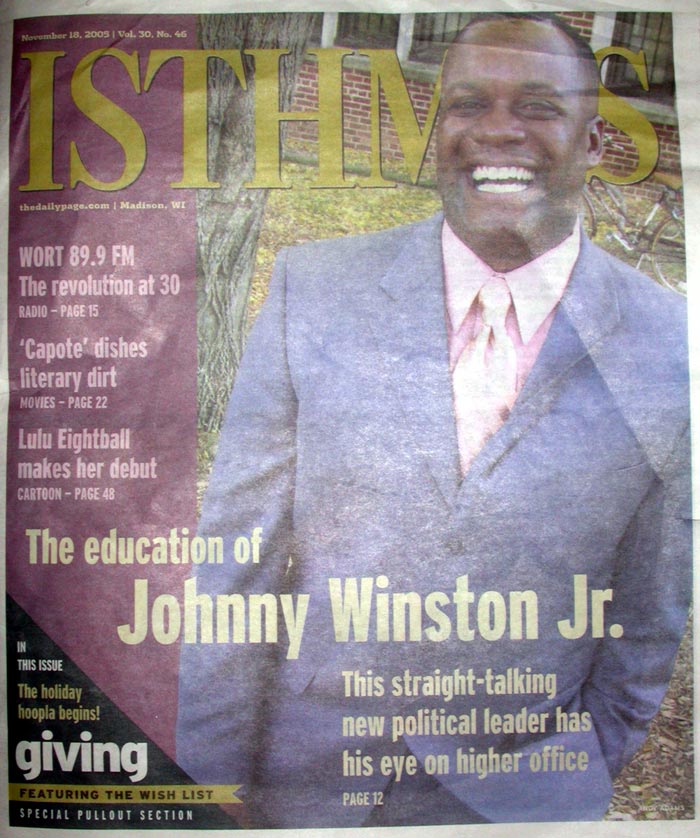
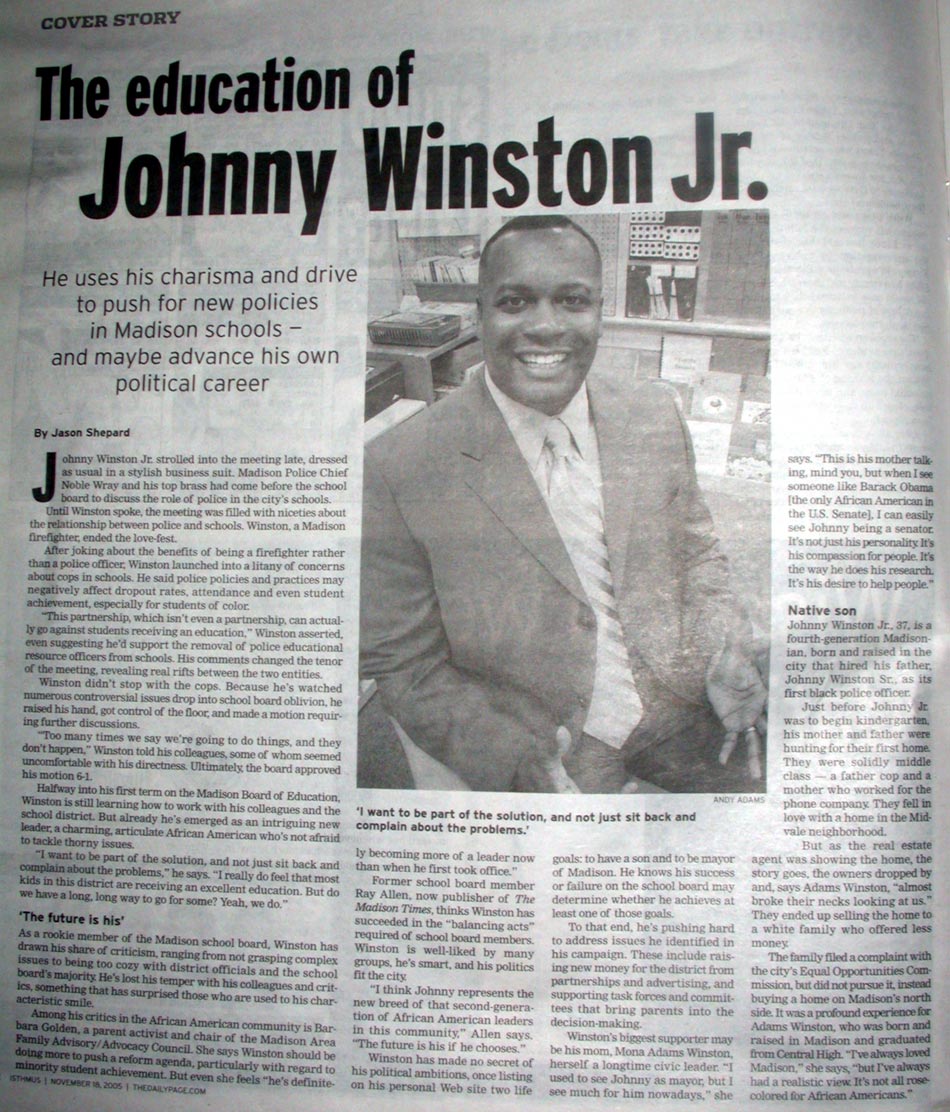
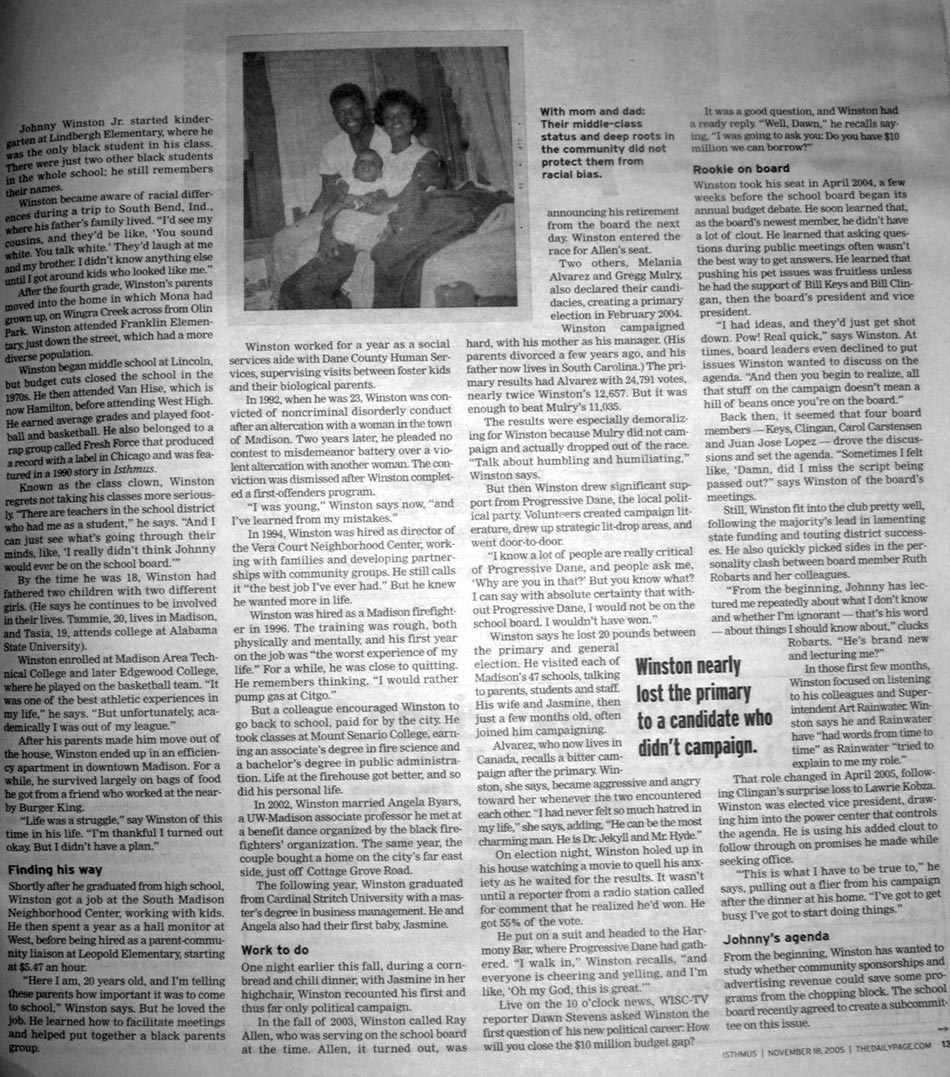
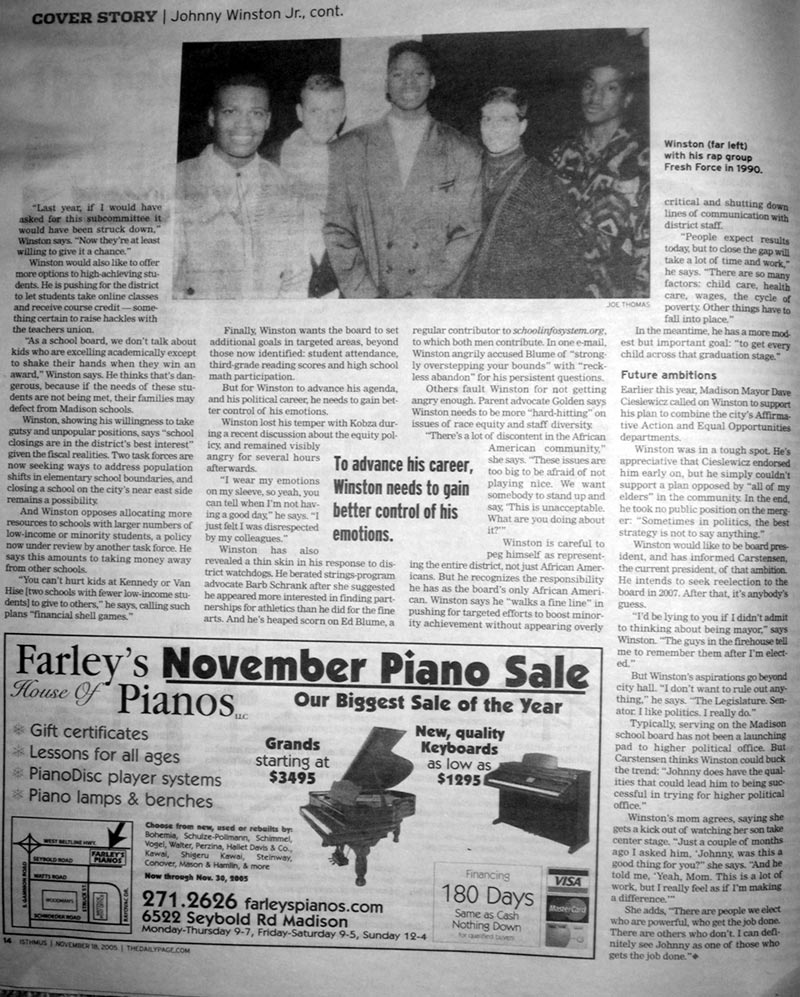
Johnny Winston, Jr. Isthmus Profile

Madison School Board Vice President Johnny Winston, Jr. is profiled in the current Isthmus. I’ll link to the article if and when it is available online.

It might be useful to visit my April, 2004 elections page to take a look at a pre-election video interview with Johnny. Our public schools have no shortage of challenges. I hope that Johnny plays a major role in these transformations.
Article scans: Cover | Page 1 | Page 2 | Page 3

Share

Look to Japan for Better Schools?

Brent Staples:

The United States will become a second-rate economic power unless it can match the educational performance of its rivals abroad and get more of its students to achieve at the highest levels in math, science and literacy. Virtually every politician, business leader and educator understands this, yet the country has no national plan for reaching the goal. To make matters worse, Americans have remained openly hostile to the idea of importing strategies from the countries that are beating the pants off us in the educational arena.
The No Child Left Behind Act, passed four years ago, was supposed to put this problem on the national agenda. Instead, the country has gotten bogged down in a squabble about a part of the law that requires annual testing in the early grades to ensure that the states are closing the achievement gap. The testing debate heated up last month when national math and reading scores showed dismal performance across the board.
Lurking behind these test scores, however, are two profoundly important and closely intertwined topics that the United States has yet to even approach: how teachers are trained and how they teach what they teach. These issues get a great deal of attention in high-performing systems abroad – especially in Japan, which stands light years ahead of us in international comparisons.

(more…)

Share

The Prodigy Puzzle

Ann Hulbert:

It is the Davidsons’ other, related aim that calls forth a different kind of fervor. Authors (with Laura Vanderkam) of a book called “Genius Denied: How to Stop Wasting Our Brightest Minds” (2004), they are on a mission to remedy what they are convinced is a widespread neglect of exceptionally talented children. That means challenging the American myth that they are weirdos or Wunderkinder best left to their own devices or made to march with the crowd. “By denying our most intelligent students an education appropriate to their abilities,” Jan Davidson warns a nation in the midst of a No Child Left Behind crusade, “we may also be denying civilization a giant leap forward.” Precocious children are not only avid learners eager for more than ordinary schools often provide, the Davidsons emphasize; they are also a precious – and imperiled – resource for the future. The Davidsons, joined by many other advocates of the gifted, maintain that it is these precocious children who, if handled right, will be the creative adults propelling the nation ahead in an ever more competitive world. As things stand, the argument goes, the highly gifted child is an endangered species in need of outspoken champions like the Davidsons, who are role models for the “supportive, advocating parent” they endorse.

Jan Davidson recently visited Madison. View her presentation: How to stop wasting our brightest young minds.

Share

Too Much Rigor? “The New White Flight”

Suein Hwang:

By most measures, Monta Vista High here and Lynbrook High, in nearby San Jose, are among the nation’s top public high schools. Both boast stellar test scores, an array of advanced-placement classes and a track record of sending graduates from the affluent suburbs of Silicon Valley to prestigious colleges.
But locally, they’re also known for something else: white flight. Over the past 10 years, the proportion of white students at Lynbrook has fallen by nearly half, to 25% of the student body. At Monta Vista, white students make up less than one-third of the population, down from 45% — this in a town that’s half white. Some white Cupertino parents are instead sending their children to private schools or moving them to other, whiter public schools. More commonly, young white families in Silicon Valley say they are avoiding Cupertino altogether.
Whites aren’t quitting the schools because the schools are failing academically. Quite the contrary: Many white parents say they’re leaving because the schools are too academically driven and too narrowly invested in subjects such as math and science at the expense of liberal arts and extracurriculars like sports and other personal interests.
The two schools, put another way that parents rarely articulate so bluntly, are too Asian.

Share