Nichols on Departing Madison School Board Member Bill Keys
No member of the current Madison School Board has been more willing to throw himself into the thick of a debate – even if that meant going it alone on principle – than Bill Keys.
No member of the current Madison School Board has been more willing to throw himself into the thick of a debate – even if that meant going it alone on principle – than Bill Keys.
For two decades, policymakers have decreed that seventh grade should be a time when children have a chance to adjust to puberty and cliques and the other annoyances of turning 13. Lessons should be engaging and enriching, middle school advocates have said, but not put too much emphasis on mastering subject matter and passing difficult tests.
That attitude is changing, at Kenmore Middle School and in much of the rest of the country. Middle schools have “overemphasized emotional development at the expense of academic growth,” said Mike Riley, superintendent of Bellevue, Wash., schools
Children today have been labeled “the connected generation,” with iPods in their ears, text messages at their fingertips and laptop screens at eye level. But their technology-focused lifestyle can also leave them disconnected from the wider world, especially from their parents.
Many teens won’t give friends their home numbers, says Samantha Landau, 15, of West Hills, Calif. “They don’t want friends to talk to their parents, because they don’t want their parents to know about their lives.”
A reader forwarded another perspective on school-parent communication in the Madison School District:
Here are some examples of really positive communication:
Our child’s savvy, experienced 4th grade teacher sends home a ‘weekly work ticket’. The ticket summarizes test/quiz scores, unfinished work not turned in and includes a place for teacher comments. I think this format is exceptional. It is certainly a time intensive task for the teacher. During the elementary years both of our children often had to return weekly progress slips with our signature. The teacher both children had for 3rd grade sent home a weekly newsletter that was simply a joy to read. A synopsis was created of the week’s work and provocative questions were included to facilitate parent/child conversation. Example, “Tell me about the way mummies were preserved in Ancient Egypt?” The kids do have some responsibility for communication.
So? “The state test was easier,” she said. Ms. Rosenstein, who has been principal 13 years and began teaching in 1974, says the 2005 state English test was unusually easy and the 2004 test unusually hard. “I knew it the minute I opened the test booklets,” she said.
The first reading excerpt in the 2004 test was 451 words. It was about a family traveling west on the Oregon Trail. There were six characters to keep track of (Levi, Austin, Pa, Mr. Morrison, Miss Amelia, Mr. Ezra Zikes). The story was written in 1850’s western vernacular with phrases like “I reckon,” “cut out the oxen from the herd,” “check over the running gear” for the oxen, “set the stock to graze,” “Pa’s claim.”
BBC:
A school in Arizona, US, has thrown out its paper-based text books and is relying solely on laptops and digital material to teach its pupils.
Empire High School is one of a band of schools which is taking computer technology out of the classroom and into students’ bags.
Calvin Baker, chief superintendent of the Vail School district, told BBC World Service programme Go Digital that it has not signalled the total demise of text books
Carol’s school in China is sharply focused on math and sciences. In one day she takes math, two physics classes and three chemistry classes. In Emily’s school in Maryland, interest in these subjects is dwindling.
It is perhaps the final chance for Smith to impose his vision, and his will, on a school system he set out to transform three years ago. He has built much of his reputation in Anne Arundel by importing or expanding rigorous programs such as IB, on the theory that an infusion of challenging coursework would benefit all.
Smith acknowledges that completing the trio of IB schools is “a very important piece” of his plan, and his legacy, in the county.
Madison Metropolitan School District:
The third most students in Madison history — 60 — have qualified as semifinalists in competition for the 2006 National Merit Scholarship Awards. Three Madison students earned National Merit Achievement semifinalist status. This is the sixth straight year that at least 56 Madison students have achieved semifinalist status, a number not reached by any of the previous classes. That’s quite remarkable because the National Merit Corporation says that about 1.3% of test-taking students become semifinalists. Based on that percentage, the Madison district should have about 10 semifinalists. Only last year and the year before did Madison have more semifinalists, 69 and 67 respectively.
But few of the hundreds, if not thousands, of poor evacuees now staring at Chicago’s formidable towers are likely to enjoy the good fortunes of A. J. Liddell. And that’s the larger story of the local economy: that in this era of outsourcing, housing bubbles and budget deficit pay-downs, the traditional Chicago gap between haves and have-nots has eroded into a chasm.
For a surprisingly large number of bright young people, Teach for America – which sends recent college graduates into poor rural and urban schools for two years for the same pay and benefits as other beginning teachers at those schools – has become the next step after graduation. It is the postcollege do-good program with buzz, drawing those who want to contribute to improving society while keeping their options open, building an ever-more impressive résumé and delaying long-term career decisions.
This year, Teach for America drew applications from 12 percent of Yale’s graduates, 11 percent of Dartmouth’s and 8 percent of Harvard’s and Princeton’s. The group also recruits for diversity, and this year got applications from 12 percent of the graduates of Spelman College, a historically black women’s college in Atlanta
High-stakes testing in Texas and across the nation has had
little impact on student achievement and is disproportionately targeting
minority students – as evidenced by increased retention and dropout
rates in many states – according to a study by researchers in Texas and Arizona.
The study, which examined the impact of high-stakes testing in Texas and 24 other states, found “no convincing evidence” that the pressure
associated with those tests – such as threatened sanctions for low
scores – produced better student achievement than would otherwise have
been expected.
Via Tom Maxwell.
Jordan Horowitz’s Inside High School Reform, Making the Changes that Matter details the turnaround approaches that are preparing more students for college – disadvantaged students who wouldn’t get there otherwise.
TOP TEN TIPS FOR IMPROVING HIGH SCHOOLS
- Treat teachers as the trained education professionals they are.
- Hold students to high expectations.
- Continually use school, teacher, and student data to decide what changes to make next.
- Start with what you want students to know and achieve, then work backwards to create tests and lesson plans.
- Coordinate lesson plans and tests within departments and across grades and schools.
- Don’t take the “easy way out” when deciding how to help underachieving kids.
- Create an optimistic, college-going culture and help students understand how high school work affects their future college and career choices.
- Develop flexible school systems to maintain reforms that work.
- Find partners such as local colleges, businesses, other schools, and parent groups to provide help.
- Stay alert for new partners, activities, and funding streams while maintaining a focus on reform.
Frontline has just made one of the most requested shows of all time available online for your viewing pleasure: A Class Divided:
A Class Divided is an encore presentation of the classic documentary on third-grade teacher Jane Elliott’s “blue eyes/brown eyes” exercise, originally conducted in the days following the assassination of Rev. Martin Luther King Jr. in 1968. This guide is designed to help you use the film to engage students in reflection and dialogue about the historical role of racism in the United States, as well as the role of prejudice and stereotyping in students’ lives today.
Via Dewayne Hendricks video Very nicely done with transcripts, links and a teacher’s guide.
In Education Myths, Jay P. Greene takes on the conventional wisdom and closely examines twenty myths advanced by the special interest groups dominating public education. In addition to the money myth, the class size myth, and the teacher pay myth, Greene debunks the special education myth (special ed programs burden public schools), the certification myth (certified or more experienced teachers are more effective in the classroom), the graduation myth (nearly all students graduate from high school), the draining myth (choice harms public schools), the segregation myth (private schools are more racially segregated), and a dozen more.
Watch or listen to a recent Jay Green Speech here.
The large majority of teachers, of course, are well-qualified and dedicated. Parents should weigh a child’s complaints carefully: Is the problem really a bad teacher, or a misdirected kid? “Many times the parent only gets the child’s side of the story,” says John Mitchell, deputy director of the American Federation of Teachers union.
The rumor mill can be misleading. Matt Sabella of Armonk, N.Y., was warned by other elementary-school parents that his daughter’s teacher was “so-so.” He found the opposite to be true. The teacher “helped my daughter become a whiz in math,” Mr. Sabella says. Also, if you rescue a child too quickly, you risk producing what some administrators call “teacups” — carefully crafted but fragile kids who lack resiliency, says Patrick Bassett of the National Association of Independent Schools, Washington, D.C.
Gena Kittner posted a useful article on the growth, both in student population and facilities of suburban Dane County School Districts.
Eleven of 16 school districts in the county have shown increased enrollment between 2001 and 2004, according to the Wisconsin Department of Public Instruction.Madison is grappling with growth in more than half of its district and declines elsewhere.
Madison’s enrollment has been flat for quite some time, though the population is moving around:
Two task forces, including parent representatives from each of the district’s schools [East] [West, are working to find ways to accommodate a projected increase of more than 500 elementary school students over the next five years in the West and Memorial high school attendance areas – where several housing developments are in the works.
The groups are also wrestling with high enrollment at some elementary schools and under-enrollment at others, in the East and La Follette high school attendance areas.
Based on last year’s figures, the district projects that by 2010, it will have 192 more students than it has seats for on the district’s west side, and 989 more seats than students on its east side.
The Madison School Board approved (6-1) additional spending using Fund 80 (property taxes not subject to state revenue caps, in other words, local taxes that can go up as fast as the District approves) to create new rec sports programs:
Ruth Robarts, the only board member to vote against the spending increase, expressed concern that using Fund 80 to restore programs that have been cut from the portion of the district’s budget subject to revenue cap feeds “the perception that Fund 80 is a slush fund.”
Robarts asked that a public hearing be held before the board took action, but a motion to table the measure failed.
Board President Carol Carstensen said board members agreed to cut the number of freshmen and junior varsity teams with the understanding that MSCR would try to create a recreational sports program to provide opportunities for more students to participate in athletics.
Three board members voiced concerns before the funding was approved. Member Ruth Robarts, the sole dissenter, tried to table the proposal until after a public hearing could be held. The table motion failed 5-2. Member Shwaw Vang said he was wary many of the district’s neediest students still would not be reached and member Lawrie Kobza said she was concerned about costs of the sports-related aspect already in MSCR’s budget.
But despite concerns, a majority of board members felt it necessary to push the program’s development ahead. Board President Carol Carstensen said the only reason she agreed to the elimination of no-cut freshman sports months ago was because of the possibility of this extramural program.
But I have learned that both my newspaper and I have been, in at least one instance, treating them as if they did not exist — a bad habit shared by many across the country. Nobody likes to be ignored for no good reason, but that is what has been happening to charter schools, and it is not good for the 1 million students attending 3,500 such schools in 40 states plus the District.
In Greenville, S.C., the Sirrine scholarships of $200 to $2,000 have helped many public school graduates over the years, but Laura H. Getty of the Greenville Technical Charter High School said charter school students are not eligible. She has also noticed that the state of South Carolina does not allow charter school teachers to participate in the state retirement system unless they were in the system before they moved to a charter school.
Bruce Allardice, a public school teacher in Des Plains, ILL wrote a letter to the Capital Times in response to Madison Schools Superintendent Art Rainwater’s recent article on the need for public education:
Dear Editor: If I was grading the Tuesday guest column of Madison School District Superintendent Art Rainwater titled “Free public education is cornerstone of country,” I’d give the superintendent a D. His rhetoric is nice, but the logic is horribly misguided.
Sandy Cullen recently posted two very useful articles on local Virtual School activity:
Their mother spends four to five hours a day guiding her daughters through daily lesson plans, drawn primarily from curriculum developed over the past century at the Calvert School, a private “bricks-and-mortar” school in Baltimore, where tuition ranges from $14,000 to $17,000 a year for its 500 on-site students.
Home-schoolers can buy Calvert’s curriculum and support services at prices ranging from $245 for pre-kindergarten to $760 for eighth-grade.
But because her children are enrolled in Wisconsin Connections Academy, Leonard pays nothing. State taxpayers provide about $5,745 to the Appleton School District for each of her daughters. That’s the amount all school districts receive for students who live in another district and register through the state’s open-enrollment option.
The state’s largest teachers union has filed lawsuits — one unsuccessful and another ongoing — against two of the state’s virtual charter schools, claiming they violate state laws.
I’ve long been a proponent of keeping tabs on our elected representatives. Kristian Knutsen, writing at Isthmus’s Daily Page is doing a fabulous job summarizing our federal representative’s weekly voting record. Knutsen’s latest: Here’s one example (I’d love to know which lobbyist was powerful enough to cause the Senate to vote on horse inspections:
Roll Call 237 – Sep. 20
Ensign Amdt. No. 1753, As Modified; To prohibit the use of appropriated funds to pay the salaries or expenses of personnel to inspect horses under certain authority or guidelines.
Feingold: Yea
Kohl: Yea
Keep reading for a look at our Federal representives priorities.
Reader Troy Dassler emails this article by Jonathan Kozol “It seems appropriate that we should all read it on the eve of a day where everyone in the district is in an in-service talking about race”:
“Segregation is not something that happens by chance, like weather conditions,” says Jonathan Kozol. “It is the work of men.” So it is not without irony that it has taken a hurricane — and the excruciating images of stranded black faces, beamed across cable airwaves — for Americans to confront the reality that vast numbers of their fellow citizens live in segregated ghettos and suffer from abject poverty. But for Kozol, who has built his career on exposing the race- and class-based injustices endemic to the United States’ educational system, the knowledge that we live in a deeply divided society has long been a foregone — if heartbreaking — conclusion.
Abigail Thernstrom says Kozol’s analysis is “worthy of a third grader“.

Reader Barb Williams forwarded this article by Kim Severson:
But perhaps no school is taking a more wide-ranging approach in a more hard-pressed area than the Promise Academy, a charter school at 125th Street and Madison Avenue where food is as important as homework. Last year, officials took control of the students’ diets, dictating a regimen of unprocessed, regionally grown food both at school and, as much as possible, at home.
Experts see the program as a Petri dish in which the effects of good food and exercise on students’ health and school performance can be measured and, perhaps, eventually replicated.
Currently, 135 women receive bachelor’s degrees for every 100 men. That gender imbalance will widen in the coming years, according to a new report by the U.S. Department of Education.
This is ominous for every parent with a male child. The decline in college attendance means many will needlessly miss out on success in life. The loss of educated workers also means the country will be less able to compete economically. The social implications — women having a hard time finding equally educated mates — are already beginning to play out.
The Documentary SuperSize Me has two segments useful to readers: School food and PE. The school food segment includes a visit to Appleton Central Alternative School and a discussion of their healthy food partnership with Natural Ovens of Manitowoc. Interesting. 20MB Video excerpt from the film SuperSize Me
|
Introductions 8MB Quicktime Video Note: The audio during the first minute is not great. |
|
Question 1: Has the gang issue changed over the past 10 years? 29MB Quicktime Video |
The Economist via Tom Barnett:
Wooldridge says three reasons account for this: 1) the Fed plays a limited role, unlike in a France or Germany; 2) schools compete for everything, including students and teachers; and 3) our universities are anything but ivory towers, instead being quite focused on practical stuff (Great line: “Bertrand Russell once expressed astonishment at the worldly concerns he encountered at the University of Wisconsin: ‘When any farmer’s turnip go wrong, they send a professor to investigate the failure scientifically,'” So true, as anyone who’s grown up in Wisconsin farmland can attest.)
Two interesting data points: listing of top global universities features 1 from Japan, two from UK and 17 from U.S. Wisconsin, my alma mater is 18 (ahead of Michigan!) and Harvard is number 1.
Also interesting: Of the students who travel abroad, 30 percent come to America. Britain is next at 12%, then Germany, then Australia, then France and Japan. After Australia it’s all single digits.
I guess America isn’t exactly out of the source code business, at least in the most important software package known to man.
This evening’s Gangs and School Violence Forum was quite interesting. Rafael organized an excellent panel. We’ll post a link to video and audio files when they are complete. Following are links to local articles and commentary on this event:
Yudice said there has been a “huge development in the area of Latino gangs” in Madison specifically, and Blue noted an increase in girls in gangs.
“We have seen a great surge in activity,” Yudice said.
All of the panelists offered ideas to help reduce the problem in Madison’s high schools, including limiting off-campus privileges and continuing consistent enforcement against gang colors and clothing in schools.
“It’s really easy to slip out a door,” said Madison Memorial High School Principal Bruce Dahmen. “It’s important that we have high expectations for all the children.”
If you need any assistance regarding information about gangs in Madison or resources for schools to tackle the gang problem, feel free to contact me or visit my website at www.knowgangs.com.
I am a former California police officer and a nationally recognized gang expert. I now reside in Jefferson County and continue to teach law enforcement officers, educators and social service workers about dealing with gang problems nationwide.
Students and parents listened during a Wednesday night meeting and took notes, a move in the right direction according to Officer Moore.
“Last year they were telling me there was no gang issue in or around any of our schools, I was told that by the administration here,” he says. “So this is something that is really great for me that we are finally acknowledging that we do have gang issues.”
There are resources for at risk youth in the Madison area, but many on the panel stressed that a unified strategic plan is needed.
Officer Moore also strongly suggested that the High Schools eliminate their open campus policy.
Blue and other panelists attributed the increase in gang activity to a growing number of students who feel a disconnection with their school and community, and with adults who care about them.
“We’re getting a wake-up call that says certain parts of our community are not healthy,” Blue said.
Forum video and audio archive
A bus service that contracts with the Madison Metropolitan School District is back in business after transporting students without having insurance.
One former employee said Mr. Mom’s Transport was operating without insurance for a month and a half.
“I think things are back to normal,” said school district spokesman Ken Syke.
Vernice Jones, a New York Black Mother is writing a weblog on homeschooling her child:
I am a Woman of Color trying to homeschool my child of 4 1/2 even though he goes to preschool full-day every day. Call me a skeptic, but I don’t feel I can trust the school system to educate my child. So far as I’m concerned, I am a homeschooling mother of one. Here’s to a day in my life.
via Joanne.
WisPolitics [PDF]:
The two-day event at the University of Wisconsin-Madison Memorial Union will include sessions Wednesday on the future of No Child Left Behind (NCLB) at 10:30 a.m., high school redesign at 11:20a.m., and the “New 3 R’s for the UW-Madison School of Education” at 1:15 p.m. Sectionals that begin at 2:30 p.m. will include changes in special education law, open enrollment, rural schools and communities, NCLB in Wisconsin, and virtual education. Dennis Winters, vice president and director of research for NorthStar Economics Inc. of Madison, will present research on the economic impact of 4-year-old kindergarten (4K) at 2:30 p.m. Wednesday. (Media have been invited to this briefing.)
Wes Daily emailed a few comments on Gangs:
Gangs are not a new phenomenon in the United States and were originally formed as social clubs and a means of self-protection. Today, gangs have evolved into violent predators focused on obtaining money and power. According to the National Drug intelligence Center (NDIC), there are at least 21,500 gangs and more than 731,500 active gang members in the United States. NDIC defines a street gang as an ongoing group, club, organization, or association of five or more persons that has as one of its primary purposes the commission of one or more criminal offenses. Street gangs are no longer just an urban problem as they continue to seek new drug markets in suburban and rural areas. Gangs and their members can be identified by various methods including self admission, tattoos, possession of gang paraphernalia, information from other agencies, and photographs. Initiations vary from gang to gang and set to set. Most common inductions required for membership include the commission of a crime such as armed robbery, assault, rape, drive-by shootings, and murder. Other known initiations entail a beat-in or jump-in, in which the inductee must endure a severe beating by gang members, or a sex-in in which a female member must have sexual intercourse with multiple gang members.
CRIPS
The Crips originated in 1969 in Los Angeles, California from a youth gang known as the Baby Avenues, which then became known as the Avenue Cribs. In the early 1970s, the Avenue Cribs changed their name to the Crips. This gang was originally an African American male gang, but it now accepts Hispanic, Asian, and Caucasian males and females to bolster their membership. The Crips wear blue and gray or purple and orange clothing. Members wear British Knight or Adidas sneakers. This changes in different communities throughout the nation. To the Crips, Adidas stands for All day I destroy a slob, and BK stands for Blood Killer, which are derogatory slangs towards their rivals the Bloods. NDIC estimates national membership at 30,000 to 35,000. Theses figures are based on national reporting, which is consistently low due to denial.
Rafael Gomez is leading a Forum this Wednesday (9.21.2005) @ 7:00p.m. on Gangs and School Violence at the Doyle Administration Building. Learn more.
Senn Brown forwarded these links and information:
Eco-charter schools with environment-focused and project-based programs are springing up throughout Wisconsin, Minnesota and other states. Environment and sustainability are the integrating qualities of learning in “green,” high-performance charter schools. See website links (below) to several “green” charter schools.
Earlier this summer, a group from Wisconsin and Minnesota’s green/environmental focused charter schools gathered at Beaver Creek Nature Reserve, site of the new Wildlands Charter School (see link below), for a day-long “Green” High-Performance Charter Schools Conference. The gathering provided an opportunity for charter school, higher education and state-level folks to share information on green/environmentally focused programs, practices, experiences and “green” school design principles. The group agreed to establish a steering committee to develop plans for fostering the creation of environmental-focused charter schools, sharing effective practices, networking and describing design principles for all environmentally friendly charter schools. The WCSA and Minnesota Association of Charter Schools are assisting the steering committee to coordinate the green/environmental charter schools initiative.
About 100 young people were involved in a disturbance by the concession stand at the LaFollette versus East High School football game at Lussier Stadium at about 9:45 p.m. No one was hurt, but police detained 12 kids and arrested four.
What IS it about some kids? Why does ONE teenager run into trouble time after time, when his or her siblings don’t? Why do kids make bad choices, just when parents think they’re doing the best they can to love, support, and encourage them? From kindergarten to college, a new school year brings kids new challenges, renewed problems. From bullying to binge-drinking. Dr. James Garbarino is recognized as a leading authority on child development and youth violence. His books include “Lost Boys: Why Our Sons Turn Violent and How We Can Save Them”. And, “Parents Under Siege: Why You Are the Solution, Not the Problem in Your Chld’s Life”. He speaks to St. Lawrence University classes today, and in a public presentation in the Canton Central School auditorium tonight at 7.
Claire Simmons talks about lessons an elementary school teacher learns when given the time to listen to students. audio
Karen MacPherson on the growing opposition to mental health screening in schools.
Doug Erickson takes a useful look around Madison’s gang scene, including the recent events in Oregon. Erickson also mentions this Wednesday’s SIS supported event, lead by Rafael Gomez on Gangs and School Violence (9.21 @ 7:00p.m.):
“It sets a watershed mark for the number of individuals involved in one event,” said Stephen Blue, who has studied local gangs since 1986 and is delinquency services manager for the Dane County Department of Human Services.
Blue is among panelists scheduled to discuss gangs and school violence Wednesday at the Doyle Administration Building of the Madison School District. The event is sponsored by www.schoolinfosystem.org, a Web site devoted to school issues.
Rafael Gomez, a district parent who helped organize the forum and will be its moderator, said the topic was chosen before the Oregon shootings.
“One of the questions we will be asking the panel is how the whole issue of gangs in our schools has changed in the last 10 years,” he said. “I think that’s a good way to frame the situation in Oregon.”
I hate to break it to you, though, but it looks like e-books in their current form aren’t going to break out of their early adopter ghetto any time soon. Certainly books stored in electronic form have flourished in a number of niche markets — reference books, in particular, are becoming more and more prevalent as electronic form rather than paper (see Resources for more on this and other wacky links). But when it comes to the books that make up the bulk of our reading lives, the vast majority of us are still reading words printed with ink on paper bound with glue and string.
I think the future, (or is it present?) of online learning is something between blogs, heymath, edhelper and wikipedia with interesting tools like RSS thrown in.

A year’s worth of Connected Math textbooks and teacher guides are on the left while the equivalent Singapore Math texts are on the right.
Friedman’s latest ,where he demonstrates how other countries are “eating our kid’s lunch in math” is well worth reading, as are these www.schoolinfosystem.org math posts. UW Math Professor Dick Askey has much more to say on K-12 math curriculum.
A few observations from a layperson who couldn’t be farther from a math expert’s perspective on this (in other words, I’m not a math expert):
There’s quite a bit of discussion on Connected Math and Singapore Math around the internet. Maybe it’s time to follow the www.heymath.net people (from India, China and Great Britain) and virtualize this while eliminating the textbooks?
Post your comments below.
Tyler Cowen takes a quick look at William St. Clair’s new book: The Reading Nation in the Romantic Period. This book, so interesting on many levels looks at:
During the four centuries when printed paper was the only means by which texts could be carried across time and distance, everyone engaged in politics, education, religion, and literature believed that reading helped to shape the minds, opinions, attitudes, and ultimately the actions, of readers. William St Clair investigates how the national culture can be understood through a quantitative study of the books that were actually read. Centred on the romantic period in the English-speaking world, but ranging across the whole print era, it reaches startling conclusions about the forces that determined how ideas were carried, through print, into wider society. St Clair provides an in-depth investigation of information, made available here for the first time, on prices, print runs, intellectual property, and readerships gathered from over fifty publishing and printing archives. He offers a picture of the past very different from those presented by traditional approaches. Indispensable to students, English literature, book history, and the history of ideas, the study’s conclusions and explanatory models are highly relevant to the issues we face in the age of the internet.
- The first study of actual reading using quantification and economic analysis
- Sheds new light on aspects of reading and its effect on the nation
- An indispensable resource for scholars working on literature, reading, and the history of publishing and printing
HeyMath! is
an E-learning system that supports the work of teachers in teaching and assessment, whilst helping students build a strong foundation in Math and become independent learners.
International Business Machines Corp., worried the United States is losing its competitive edge, will financially back employees who want to leave the company to become math and science teachers.
The new program, being announced Friday in concert with city and state education officials, reflects tech industry fears that U.S. students are falling behind peers from Bangalore to Beijing in the sciences.
Up to 100 IBM employees will be eligible for the program in its trial phase. Eventually, Big Blue hopes many more of its tech savvy employees – and those in other companies – will follow suit.
The Governance Divide: A Report on a Four-State Study on Improving College Readiness and Success authored by The Institute for Educational Leadership, The National Center for Public Policy and Higher Education, The Stanford Institute for Higher Education Research. Foreword, Executive Summary, Full Report (345K PDF):
The report also offers recommendations to help states transform ad hoc approaches into sustained action and institutionalized, long-term K-16 reforms. Every state needs to increase the percentage of students who complete high school and finish some form of postsecondary education; existing governance structures and policies cannot meet this overwhelming need. For most states, these structures and policies must be revised in significant ways.
Currently, K-12 and postsecondary education exist in separate worlds in the United States. Policies for each system of education are typically created in isolation from each other-even though, in contrast to the past, most students eventually move from one system to the other. Students in K-12 rarely know what to expect when they enter college, nor do they have a clear sense of how to prepare for that next step. Particularly now, in the 21st century, when more students must complete some postsecondary education to have an economically secure life, the need for improved transitions from high school to college is urgent. This need for some postsecondary education extends beyond individual aspirations. In this global economy, businesses and communities-and our nation as a whole-must have residents who have achieved educational success beyond high school.
Phoebe Randall has more, including comments from the Wisconsin DPI:
The Wisconsin Department of Public Instruction acknowledges there is a problem and said the department is working to improve the situation with new programs.
“In Wisconsin, there is a tremendous amount of coordination to ensure that students are prepared for college,” DPI Communications Officer Joe Donovan said.
This coordination comes in the form of a program called PK16, which stands for pre-kindergarten through grade 16. One of the program’s goals is to focus on keeping students motivated and challenged during the transition from their senior year of high school to college.
Maryland Lt. Gov. Michael S. Steele released his blueprint for education reform yesterday, a series of 30 recommendations that call for schools to be graded and teachers to be paid for performance.
Members of the 30-person Governor’s Commission on Quality Education in Maryland recommended efforts to promote charter schools but rejected school vouchers, a far more divisive topic
Full Report (PDF)
BBC:
“California is facing an obesity epidemic,” Mr Schwarzenegger said. “Today we are taking some first steps in creating a healthy future for California.”
Under the new rules, pizza, burritos, pasta and sandwiches must contain no more than four grams of fat for every 100 calories, with a total of no more than 400 calories.
From 2007, students will only be allowed to buy water, milk and some fruit and sports drinks that contain a controlled amount of sweeteners.
It is thought that the move could cost school districts hundreds of thousands of dollar in lost income, as they receive money from companies in return for allowing them to sell their products in schools.
The OECD released their “Education at a Glance – 2005 Report” Daniel Drezner summarizes his take on the US Performance:
1) In science and math, the U.S. is ahead of only the really poor OECD countries — Turkey, Mexico, etc. So yes, there is reason to worry.
2) The poor performance is not because of a downward trend — in fact, if you look at chart A7.1 (“Differences in mean performance of eighth-grade students from 1995 to 2003”), you discover an interesting fact: the United States showed the greatest improvement in science and math scores of the sample — including Korea.
3) The poor performance isn’t because of a dearth of funds — table B1.1 shows that, Switzerland excepted, the United States spends the most amount of money per student in the OECD. You get a similar result if the metric is education spending as a percentage of GDP. Indeed, the OECD comments:Lower expenditure cannot automatically be equated with a lower quality of educational services. Australia, Belgium, the Czech Republic, Finland, Japan, Korea, the Netherlands and New-Zealand, which have moderate expenditure on education per student at the primary and lower secondary levels, are among the OECD countries with the highest levels of performance by 15-year-old students in mathematics.
The survey suggests that family time may be more important to children than many parents realize.
It found teens having family dinners five or more times a week were 42 percent less likely to drink alcohol, 59 percent less likely to smoke cigarettes, and 66 percent less likely to try marijuana.
“At a time when kids are under a lot of stress for a lot of different reasons, having that regular meal time that they can count on, that their parents are there for support — that can be very helpful,” said David Elkind, a professor of child development at Tufts University in Massachusetts.
Sophos writing at IT Toolbox:
Government is still in the old broadcast mode of press conferences and press releases and talking at you rather than with you. Government only seems to have time to converse with lobby groups, mass media reporters and interests that are going to make them or their friends money. Money from the government.
The conversations are growing – mass media is at a loss to understand how to deal with or contend with the number of blogs, cross-linking of blogs and the sheer volume of people getting involved in the conversation. It is no holds barred and far more interesting than the scripted Q&A being spouted from press conferences. Mass media is so flabbergasted, that they have resorted to reading blogs on their broadcasts! How crazy is that – broadcasting elements of the conversations from the blogosphere on TV. Media is stunned. The administration is stunned. It is only going to get worse for all of them.
“McDonald’s Passport to Play” will launch in 31,000 schools this fall, reaching an expected 7 million children in grades three through five, the company said.
The move is part of McDonald’s (Research) so-called “Balanced Lifestyles” initiative, an aggressive effort to promote physical activity and nutrition and deflect harmful claims that its food is unhealthy and fattening.
Several AFT American Educator articles on Teaching Mathematics:
A professional mathematician shares his insights about effective instructional practice, how children learn, the importance of a coherent, systematic curriculum—and mathematics—after taking up the challenge of teaching in an Israeli elementary school.
There is general agreement that teachers’ knowledge of the mathematical content to be taught is the cornerstone of effective mathematics instruction. But the actual extent and nature of the mathematical knowledge teachers need remains a matter of controversy. A new program of research into what it means to know mathematics for teaching—and how that knowledge relates to student achievement—may help provide some answers.
 |
Madison School District Superintendent Art Rainwater is beginning to write a series of monthly articles which he will use as his Superintendent’s Report. Listen to this month’s report by watching this 5 minute video clip. I looked around the District’s site and did not immediately see a text version of this report. UPDATE: The message was circulated via email Tuesday morning, 9/13/2005. Click the link below to read a text version: |
Starting next fall, Wisconsin residents can apply for discount tuition at 130 colleges in six Midwestern states under a plan approved by University of Wisconsin System regents.
In exchange, residents from those states could pay reduced rates at several schools in the UW System – but not the flagship UW-Madison campus. The regents voted Friday to join the Midwestern Higher Education Compact, a coalition of regional colleges and universities.
During the first six years of the program, the analysis found, 15 suburban districts each earned more than $1 million in extra state aid because they gained more students than they lost through open enrollment transfers.
MPS, meanwhile, lost more than $32 million.
Four other districts – Racine Unified, Waukesha, Oconomowoc and Kewaskum – each lost more than $1 million.
Washington, D.C. – In a letter to Department of Education Secretary Margaret Spellings, U.S. Senators Russ Feingold (D-WI) and Dick Durbin (D-IL), are calling on the administration to help schools across the nation that are taking in the thousands of students displaced by the devastating effects of Hurricane Katrina by increasing funding to those schools while relaxing the accountability standards mandated by the No Child Left Behind Act.
More money for less? More from Eduwonk.
Kristian Knutsen nicely summarizes the upcoming spring 2006 Madison School Board election politics and mentions that the election will likely include a non-binding referendum to overturn the tavern smoking ban (Isthmus’ The Daily Page):
There is ongoing speculation as to whether either incumbent will run for another term. Whether or not they do, the “anti-status quo” group of school board activists that support Robarts, helped boost Kobza to victory in April, and were mostly in opposition to the defeated May referendum questions, is gearing up for the next round, an election that could advance them to a majority position.
More here.
As they wait for their children’s first report card to come home this year, elementary-school parents across Pennsylvania also can expect to receive a separate report on a key indicator of their children’s health.
In an effort to combat childhood obesity, the state Health Department is requiring school nurses to compute students’ body-mass index – or height-to-weight ratio – during annual growth screenings, starting this year with children in kindergarten through fourth grade.
Parents will receive letters about the results that will encourage them to share the information with their family physician. The letters will explain whether the BMI is above, below, or within the normal range for the child’s age and gender.
Candy, soda, pizza and other snacks compete with nutritious meals in nine out of 10 schools, a government survey found.
Already plentiful in high schools, junk food has become more available in middle schools over the past five years, according to the Government Accounting Office, the investigative arm of Congress.
“Parents should know that our schools are now one of the largest sources of unhealthy food for their kids,” Sen. Tom Harkin, who asked for the study, said in an interview.
Singapore’s first Prime Minister Lee Kuan Yew speaks with Der Spiegel on Asia’s rise to economic power, China’s ambitions and the West’s chances of staying competitive:
Mr. Lee: Right. In 50 years I see China, Korea and Japan at the high-tech end of the value chain. Look at the numbers and quality of the engineers and scientists they produce and you know that this is where the R&D will be done. The Chinese have a space programme, they’re going to put a man on the Moon and nobody sold them that technology. We have to face that. But you should not be afraid of that. You are leading in many fields which they cannot catch up with for many years, many decades. In pharmaceuticals, I don’t see them catching up with the Germans for a long time.
CNN:
CNN: What will surprise us about the future evolution of the Internet?
BERNERS-LEE: The creativity of our children. In many ways, people growing up with the Web and now the Semantic Web take the power at their fingertips for granted. The people who designed the tools that make the Net run had their own ideas for the future. I look forward to seeing what the next generation does with these tools that we could not have foreseen. …
School has once again successfully lifted off, thanks to a great deal of hard work on the part of many people including teachers, staff and administrators. I thought it would be useful to pass along a few observations:
Please add your anecdotes in the comments below!
The great achievement of No Child Left Behind is that it has forced the states to focus at last on educational inequality, the nation’s most corrosive social problem. But it has been less successful at getting educators and politicians to see the education problem in a global context, and to understand that this country is rapidly losing ground to the nations we compete with for high-skilled jobs that require a strong basis in math and science.
American taxpayers have heard a fair amount about the fact that their children lag behind the children of Britain, France, Germany and Japan. But American students are also bested by nations like Poland, Ireland and the Czech Republic. Worst of all, they fall further and further behind their peers abroad the longer they stay in school.
“We have to turn things around right away,” he said. “They didn’t bring me in to be safe. They brought me in to be a change maker.”
So he has tossed out troublemaking students and offered ambitious plans for historic schools Crispus Attucks and Shortridge. He’s demanded more from all, from teachers to students to janitors.
White has been the city’s top newsmaker since becoming superintendent of the state’s largest school system July 1. He seems to have commandeered space on the front page.
More on Eugene G. White, Indianapolis’s new Superintendent. Via Eduwonk.
Madison Metropolitan School District:
Madison school officials on Friday said the district will make every effort to assist families and students displaced by hurricane Katrina by simplifying the enrollment process and getting students immediately into classes.
By Friday, the district had received several calls from individuals in Madison, who have family in the areas affected by the hurricane, inquiring about school possibilities for their relatives. Calls were also received from individuals in relief shelters in the South.
“They are welcome in Madison and we will ensure that families temporarily relocating to Madison will be able to get their children into school immediately,” said Superintendent Art Rainwater.
The most disturbing development in the world of PowerPoint is its migration to the schools — like sex and drugs, at earlier and earlier ages. Now we have second-graders being tutored in PowerPoint. No matter that students who compose at the keyboard already spend more energy perfecting their fonts than polishing their sentences — PowerPoint dispenses with the need to write any sentences at all. Perhaps the politicians who are so worked up about the ill effects of violent video games should turn their attention to PowerPoint instead.
In the meantime, Tufte, who’s now doing consulting work for NASA, has a modest proposal for its new administrator: Ban the use of PowerPoint. Sounds good to me. After all, you don’t have to be a rocket scientist to see the perils of PowerPoint.
Leopold Teacher Troy Dassler, via email:
As part of full disclosure, I must admit that one of the two classrooms that were carved out the lunchroom is where I teach our children. So, this story has special significance to me and my students.
Troy Dassler
NBC 15 News:
New School Year, Same Referendum Questions
Overcrowding on First Day
Updated: 6:29 PM Sep 1, 2005
Zac Schultz
Madison: The new third graders at Aldo Leopold Elementary probably did not pay much attention to the school referendum questions last spring.
They don’t know that the voters rejected a plan that would have given them a new school by the time they were in 5th grade. But some of them do understand overcrowding.
“I would say in terms of optimal learning environment Leopold is overcrowded now. We’re using every square inch of Leopold with kids,” says Madison Schools Superintendent Art Rainwater.
“We try to organize to minimize the impact on children,” says Leopold Principal Mary Hyde.
The Economist on two new books, The Accidental Masterpiece: On the Art of Life and Vice Versa and What Good Are the Arts:
Mr Kimmelman, a gifted piano student as a boy, returned more seriously to the keyboard in 1999 when he entered, and went on to the final round, of an amateur piano competition in Fort Worth, Texas. Organised by the Van Cliburn Foundation, which since 1962 has presented the world’s leading piano competition for young professionals, the competition brought 90 people, who neither taught nor performed professionally, to Texas.
Mr Kimmelman’s article about his fellow pianists—a numismatist, two flight attendants, a hairstylist and a former crack addict who had been jailed for burglary and who found taking up music helped him recover—raised a sizeable correspondence from people who are not artists by profession, but for whom art adds an important other dimension to their lives. It was this idea, so emblematic of the author’s own life, that spawned the book.
Far better is the second half of the book in which Mr Carey seeks to persuade us that the greatest of all art forms is not painting or music but literature, and English literature specifically. Uninflected and without gendered nouns, English was uniquely placed to offer Shakespeare the linguistic pliancy and suppleness he needed to turn out the epidemic of metaphors and similes that so mark his work.
Police spokesman Mike Hanson said the report of an incident April 1, 2004, at Sennett Middle School “slipped through the cracks,” and was not reviewed by a detective or a representative of the Dane County district attorney’s office to determine if charges should be filed.
“It’s an unfortunate event,” Hanson said. “We need to backtrack and go back and investigate.”
Hanson said it is not known exactly how the mistake occurred, but the report had been mislabled in a way that could have erroneously indicated that it had already been referred to the district attorney.
More from Steve Elbow.
Alan J. Borsuk and Sarah Carr:
Milwaukee Public Schools teachers will begin shouldering a larger share of the costs of their health care under an arbitrator’s ruling issued Tuesday.
The decision ended 2 1/2 years of work on a two-year contract for more than 6,000 teachers with a victory for the School Board and the administration of Superintendent William Andrekopoulos.
After management and the Milwaukee Teachers’ Education Association deadlocked – almost entirely over health insurance issues – the dispute went to the arbitrator, Marquette University Law School Professor Jay Grenig, who was required to pick between the final offers of each side without making any changes.
Under the MPS plan, teachers would begin paying portions of the cost of their health care, including deductibles and co-pays on many services. Administrators say the district pays more than 60 cents in fringe benefits for every dollar it pays in salaries.
The Middleton-Cross Plains School District has posted information on their upcoming vote on borrowing $53 Million to finance the construction and operation of a K-8 school, a new transportation center, and improvements to several elementary schools. Ann Marie Ames has more. The District also has a new website with the latest news posted on their home page. The site also includes the ability to pay for meals online.
A Madison middle school teacher has been suspended with pay pending the outcome of an independent investigation of a sexual harassment complaint filed by 28 parents, district officials said Tuesday.
Jefferson Middle School Principal John Burmaster said that when school resumes Thursday there will be a new Spanish language teacher in place of Hector Vazquez, whom parents say created a hostile learning environment for their children last year.
“That’s good news,” said Roger Greenwald, one of the parents who filed the Title IX complaint against Vazquez on Friday because they were not satisfied with the district’s initial investigation of their concerns this past spring.
In their complaint, parents said Vazquez showed students an R-rated movie, made repeated references to his personal sexual exploits, stared at girls’ breasts in class and touched students in a way that made them and observers uncomfortable.
More from Steve Elbow.
The Madison School District announced that the 24% of eligible Madison students taking the SAT scored the highest ever and remain significantly above state and national averages:
Madison students’ composite score is 1266, up 37 points from four years ago (1229) and up 16 points from last year’s results (1250). The 1266 Madison composite is well over the state average composite of 1191, and significantly over the national average of 1028. (See tables below for details.)
The 16 point improvement is attributable to higher scores on both the verbal and math portions of the exam. The average verbal score for Madison students is 624, up from 615 the previous year. The average math score is 642, up from 635 in 2003-04.
The College Board posted national results and aggregate scores here.
At Memorial, Athletic Director Tim Ritchie said he hopes kids who get cut will find a team in an expanded intramural basketball league through Madison School Community Recreation.
“You hope that you have a good intramural program that keeps kids working towards making the team next year,” he said.
I worry about the kids for whom basketball or volleyball would have been their only school activity. And I’m even more worried about the kids who won’t try out because they fear not making the grade.
Those are the missing kids that Joe Frontier worries about.
Sometimes, there’s no real way to know the true cost of saving money.
Lampert-Smith mischaracterizes this decision as a “cost of saving money.” The Madison School District’s budget grows annually (including the generation of grant funds, which is to be commended), this year to $320M+. Rather, the Madison School Board’s decision to eliminate no-cut freshman sports reflects choices made, or not made, such as:
Loehrke’s recent speech to the Florence schools provides a roadmap for such decision making: putting students first.
What can you do? Send your thoughts on these matters to the Madison School Board: comments@madison.k12.wi.us and ask 2006 Madison School Board Candidates about these issues. Two seats are up for election in April, 2006; those currently held by Bill Keys and Juan Jose Lopez.
First the bad news: Only about two-thirds of American teenagers (and just half of all black, Latino and Native American teens) graduate with a regular diploma four years after they enter high school.
Now the worse news: Of those who graduate, only about half read well enough to succeed in college.
Don’t even bother to ask how many are proficient enough in math and science to handle college-level work. It’s not pretty.
Of all the factors combining to shape the future of the U.S., this is one of the most important. Millions of American kids are not even making it through high school in an era in which a four-year college degree is becoming a prerequisite for achieving (or maintaining) a middle-class lifestyle.
The complete report can be found here (PDF). Campaign for America’s Future Website.
Norimitsu Onishi writes from Seoul:
JUST as she did during the school year, Jeong Hye Jin, 15, spent the long, sweltering summer commuting to her high school by day and to private classes in the evening.
Summer school was mandatory, not for students who had fallen behind, but for those who, as she put it, “have a chance of getting into good universities.” Not attending was never an option for Hye Jin, who is ranked 17th out of 430 students in the 10th grade at Young Hoon High School, in a working-class neighborhood here in the capital.
Nolan Finley writing from Detroit:
The hope is that this first, small school will turn into a statewide system of high schools linked to businesses and hell-bent on preparing Michigan kids for the best colleges, the best jobs, the best futures.
“We know from research that small high schools are making a big difference in the lives of young people across the country,” says Granholm, who approached Apple about coming to Detroit during a visit to Silicon Valley several months ago. “When a global corporation like Apple makes a commitment of this magnitude to education in Michigan, it underscores how critical it is that we prepare all of our children for the 21st-century economy.”
Michigan certainly isn’t doing that today. You’ve read these statistics before, but they are so bleak, so disturbing, that they bear repeating at every opportunity, lest parents forget how greatly their children are being cheated:
I think Madison should also explore smaller high schools (including smaller facilities).
The overpayments, mentioned briefly by the school system’s outside auditor in a report made public in July, were documented in greater detail in an internal audit dated June 30. The Post obtained the internal audit through a public-records request.
Some employees were allowed to rack up “negative leave balances,” meaning they were paid for time off beyond what they were owed.Some employees who had retired and then returned to active service under a special state program had salaries larger than allowed under law.
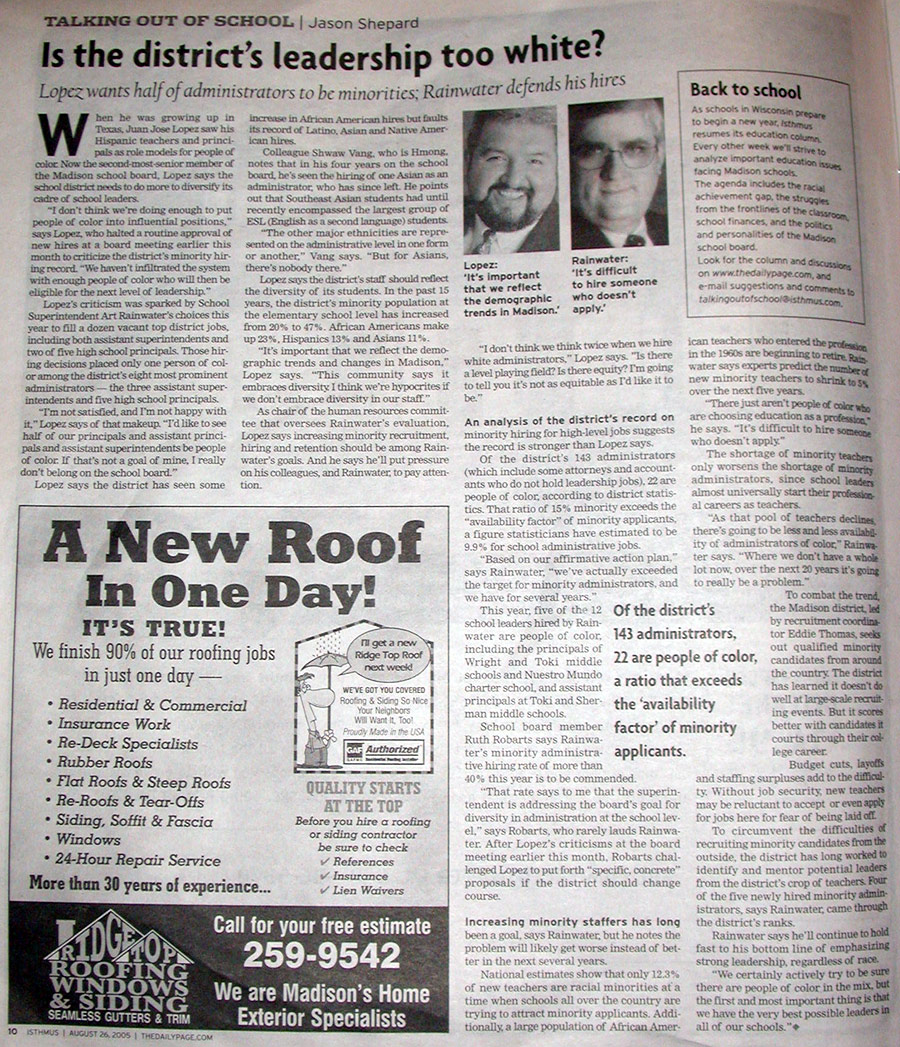
Click on the image to view the article.
Jason Shephard starts Isthmus’s excellent biweekly Talking Out of School Column with a look at the Madison School District’s minority hiring policies.
“I don’t think we’re doing enough to put people of color into influential positions,” says [Board Member Juan Jose] Lopez, who halted a routine approval of new hires at a board meeting earlier this month to criticize the district’s minority hiring record.
School Board Member Ruth Robarts says [Superintendent] Rainwater’s minority administrator hiring rate of more than 40% this year is to be commended.
According to a note next to this article, Talking out of School will be available on Isthmus’s website. We’ll link to those, of course.
By January of 2003, Kentucky reading officials were frustrated. They had just been denied federal Reading First funds for the third time, and state leaders worried that they might lose the opportunity to bring in an unprecedented $90 million for reading instruction in grades K-3 over six years. Like most states strapped by budget cuts, they could not afford to lose that money.
Months before, consultants to the federal program strongly suggested to state officials that Kentucky’s choice of assessment was a major sticking point in their pursuit of the grant. According to the officials, consultants pushed them to drop the assessment they were using, Pearson’s Developmental Reading Assessment (DRA), and choose the Dynamic Indicators of Basic Early Literacy Skills (DIBELS), which was quickly becoming the most widely used test under Reading First. But there was a problem: One of the consultants on the four-member team had a second job — as a trainer for DIBELS.
Eduwonk has more.
Twenty-eight parents have filed a sexual harassment complaint with the Madison School District against a Jefferson Middle School teacher they claim created a hostile learning environment for their children last year.
Roger Greenwald, a member of the Committee of Concerned Parents of Jefferson Middle School, said the Title IX complaint was filed Friday because parents were unhappy with the district’s initial response to their concerns about Spanish teacher Hector Vasquez, who came to Jefferson last year from Sennett Middle School.
A suburban Dallas school district launched the “Virtual Cafeteria” site to show what’s being served each day at each school. It can tally nutritional information for items on a lunch tray, including calories, fat grams, carbs, protein, vitamin A and vitamin C.
For instance, a meal of a chef salad, a slice of pizza, a cookie and milk will cost $4.75 and runs about 746 calories.
“We are really making a valiant effort to put nutritional information in the hands of our customers, be it parents, a grandmother, a teacher or the student themselves,” said Rachelle Fowler, student nutrition director for the Carrollton-Farmers Branch school district.
Thousands of rookie teachers across the country nervously contemplate study plans and wonder if they can live up to the expectations of students, parents, the principal and themselves. Classroom veterans offer advice to the new teachers. Guests:
Jennifer Westra, first-time teacher at Liliam Lujan Hickey Elementary School in Las Vegas, Nev.
Rafe Esquith, author of There Are No Shortcuts and longtime fifth-grade teacher in Los Angeles
David Espinosa, New York City teaching fellow
audio>
Wisconsin DPI (PDF):
The Wisconsin Department of Public Instruction will conduct a hearing Aug. 29 at the agency headquarters in Madison to take public testimony on a change in administrative rules affecting the open enrollment program. The hearing will be held from 5 to 6 p.m. in Room 041 of the GEF 3 Building, 125 South Webster Street, Madison.
Dr. Ari Brown – pediatrician in Austin, Tex., spokeswoman for the American Academy of Pediatrics and author of “Baby 411: Clear Answers and Smart Advice for Your Baby’s First Year” – cautions that in haste to get children the clothes and supplies they need for school, health issues are sometimes overlooked.
She and other experts offer the following advice:
BACKPACKS Many children have no lockers in school and are forced to carry all their books back and forth to school and between classes. An overweight pack can cause muscle strains and overuse injuries and distort the child’s posture.
A loaded backpack should not weigh more than one-fifth of a child’s weight. The pack’s shoulder straps should be wide and padded on the back as well. The pack should always be carried using both straps. “Now and then, a parent should check what’s in the pack and determine if everything has to be carried daily,” Dr. Brown suggested.
Several Madison School District parents emailed the following questions recently:
Please post information you might have on these topics by clicking the comments link below. Thanks.
He arrived 10 minutes before his fate, so Filip Olsson stood outside Severna Park High School and waited for coaches to post the cut list for the boys’ soccer team.
Olsson, a sophomore, wanted desperately to make the junior varsity, but he also wanted justification for a long list of sacrifices. His family had rearranged a trip to Sweden so he could participate in a preparatory soccer camp; he’d crawled out of bed at 5:30 a.m. for two weeks of camp and tryouts and forced down Raisin Bran; he’d sweated off five pounds and pulled his hamstring.
Sort of related: Sunday’s Doonesbury on overstressing our children.
Additional grist:
Underheim argues that technology could save schools money if they used it more creatively. Instead of funding two classes of 10 students apiece with both an algebra and a geometry teacher, he asks, why not combine the classes, give every student a computer with software for the specific subject they are trying to learn and keep just one math teacher available to help with special problems?
Yet in less than five years, that entire market has come undone. By 2004, sales of educational software – a category that includes programs teaching math, reading and other subjects as well as reference works like encyclopedias – had plummeted to $152 million, according to the NPD Group, a market research concern.
“Nobody would have thought those were the golden days,” Warren Buckleitner, editor of Children’s Technology Review, said of the late 1990’s. “Now we’re looking back and we’re saying, ‘Wow, what happened?'”
UPDATE: Hetzner posts the 3rd and last part of her series on Technology & Schools here:
University Lake School in Delafield has enough wireless laptop computers for every student and teacher in grades six through 12 — a 5-year-old venture that is part of an experiment known in education circles as one-to-one, or ubiquitous, computing.
Slashdot discussion.
As college students begin a new academic year, many parents are reeling from tuition fees. This fall’s probable average 8% increase at public universities, added onto double-digit hikes in the two previous years, means tuition at a typical state university is up 36% over 2002 — at a time when consumer prices in general rose less than 9%. In inflation-adjusted terms, tuition today is roughly triple what it was when parents of today’s college students attended school in the ’70s. Tuition charges are rising faster than family incomes, an unsustainable trend in the long run. This holds true even when scholarships and financial aid are considered. One consequence of rising costs is that college enrollments are no longer increasing as much as before. Price-sensitive groups like low-income students and minorities are missing out. A smaller proportion of Hispanics between 18 and 24 attend college today than in 1976. The U.S. is beginning to fall below some other industrial nations in population-adjusted college attendance.
“We don’t have a lot of proof that this works,” said Neah Lohr, the former director of the informational media and technology team for the state Department of Public Instruction. “Certainly students like the technology. That’s not the question.”
Research results are mixed. But most studies conclude that for computers and other technology to have much effect on student performance, a number of conditions are necessary: Teachers have to be technologically adept; classroom assignments have to allow for exploration; and curricula have to abandon breadth for depth.
Although schools have made changes in some of those areas, particularly increasing teachers’ technical proficiency, the predominant uses of computers remain word processing, heavily filtered Internet searches and the occasional PowerPoint presentation. In addition, with pressure rising to improve test scores, more schools have embraced skill-drilling software that contributes little to long-term student learning, observers say.
My view is that technology is simply another tool that may be part of a successful learning process. Critical thinking, rigor and general inquisitiveness are far more important than learning Word 2003 (which will be obsolete by the time our students reach the workforce). Successful technologists are capable of learning and using any tool. I was reminded of our priorities yesterday while visiting Sun Prairie’s CornFest: a teen could not make change (1.50 change was given for a 2.50 purchase from a $5.00 bill). More posts on this subject.
Teachers say creating a PowerPoint presentation captivates students and gives them background using a technological tool common in business.
Critics say PowerPoint requires students to do little more than assemble outlines and is a poor replacement for age-old standards such as essays.
Edward Tufte, professor emeritus at Yale University, has been one of the most vocal opponents, such as in an opinion piece called “PowerPoint is Evil” carried in the September 2003 edition of Wired.
“Rather than learning to write a report using sentences, children are being taught how to formulate client pitches and infomercials,” Tufte wrote.
With 10 to 20 words and a piece of clip art for each PowerPoint slide, with only three to six slides per presentation, that amounts to only 80 words for a week’s work. “Students would be better off if the schools simply closed down on those days and everyone went to the Exploratorium or wrote an illustrated essay explaining something,” he wrote.
More on Powerpoint and schools here.
Word for word, these are my original goals:
- 1. Keep our school in our community. Make the school a focal point in our community. Create opportunities for community involvement in our school. Maintain and increase school pride.
- 2. Balance the budget. Keep looking for costs savings that do not negatively affect the education of our students. Continue plans to balance the budget after the referendum money ends.
- 3. Provide the best education possible within the budget. Educate the most students possible for the dollars allocated by the revenue cap.
- 4. Improve test scores. Results must improve in every area tested. Hold the administration and teachers accountable for the test scores. Find ways to obtain test scores that make our students, parents, teachers, administrators, and members of our community proud.
- 5. Improve teachers. Reward the good teachers. Retrain, eliminate, or replace any ineffective teachers. Increase morale. Require accountability.
- 6. Improve administration. Reward the good administrators. Retrain, eliminate, or replace any ineffective administrators. Review and recommend updates to school procedures. Require accountability.
- 7. Improve the school board. Seek responsible board members. Hold the school board accountable for reaching the goals of the board.
- 8. Work with the parents of home-schooled and parochial school students to see if our school can find ways to help the students achieve a well-rounded education.
- 9. Listen & Learn. Listen to the concerned members of our community, students, parents, teachers, administrators, and staff. Implement the constructive suggestions of the Steering Committee and Action Teams for Long Range Planning that relate to board goals.
- 10. Pay attention to details. Review and update board policies and school procedures. Update union contracts. Require a day’s work for a day’s pay. Monitor expenses. Protect the assets of the school district.
(Print Friendly PDF version – 280K).
More on the Florence School District. Loehrke is President of the Weyauwega Fremont School District. [Map]
Loehrke referenced some results, such as:
The Sun Prairie School District’s increasingly active weblog:
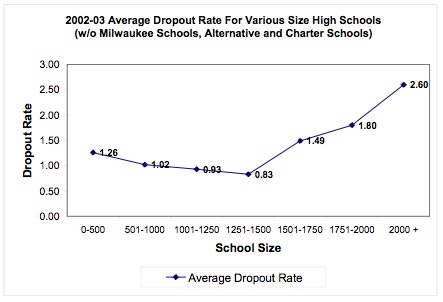
On August 9, 2005, a public hearing was held on the proposed high school facilities in Sun Prairie. At the hearing a question was asked regarding the high school drop-out rates for all Wisconsin public high schools. Drop out rates refer to the percent of students who do not complete a high school education We have compiled information for three years for all public school districts except the Milwaukee Public Schools. The data is the latest information available from DPI. A clear pattern is evident over the three years. It is apparent that as high schools grow above 1500 students, the percentage of drop-outs doubles and triples over that of high school with enrollments between 1000-1500.
Sun Prairie is planning to construct two new, smaller higher schools rather than one very large facility.
Madison students who took the 2005 ACT college entrance exam continued to outperform their state and national peers. MMSD students’ composite score was slightly higher overall on the ACT compared to a year ago, 24.3 vs. 24.2 (scale of 1 to 36), while the average ACT score this year for Wisconsin students was 22.2 and nationally, 20.9.
Almost 74 percent of the MMSD students in the Class of 2006 took the ACT, a record number. Generally, when more students take the test, scores drop. However, the average MMSD ACT participant scored higher than roughly 72% of all Wisconsin ACT participants and higher than 78% of all ACT participants across the country.
Only about half of this year’s high school graduates have the reading skills they need to succeed in college, and even fewer are prepared for college-level science and math courses, according to a yearly report from ACT, which produces one of the nation’s leading college admissions tests.
The report, based on scores of the 2005 high school graduates who took the exam, some 1.2 million students in all, also found that fewer than one in four met the college-readiness benchmarks in all four subjects tested: reading comprehension, English, math and science.
American Beverage Association:
Under the new policy, the beverage industry will provide:
- Elementary Schools with only water and 100 percent juice.
- Middle Schools with only nutritious and/or lower calorie beverages, such as water, 100 percent juice, sports drinks, no-calorie soft drinks, and low-calorie juice drinks. No full-calorie soft drinks or full-calorie juice drinks with five percent or less juice until after school; and
- High Schools with a variety of beverage choices, such as bottled water, 100 percent juice, sports drinks, and juice drinks. No more than 50 percent of the vending selections will be soft drinks.
The American Beverage Association is asking beverage producers and school districts to implement the new policy as soon as possible. Where school beverage contracts already exist, the policy would be implemented when the contract expires or earlier if both parties agree. The success of the policy is dependent on voluntary implementation of it by individual beverage companies and by school officials. The policy will not supercede federal, state and local regulations already in place. ABA’s Board of Directors, which unanimously approved the policy, represents 20 companies that comprise approximately 85 percent of school vending beverage sales by bottlers.
Childhood obesity is a serious problem in the U.S., and the responsibility for finding common-sense solutions is shared by everyone, including our industry. We intend to be part of the solution by increasing the availability of lower-calorie and/or nutritious beverages in schools,” said Susan K. Neely, ABA president and chief executive officer.
Pepsi Statement | Coke Statement (not yet online). Betsy McKay has more (click the link below).
I have been the President of the Weyauwega-Fremont School Board for the last four years. I own a small realty and appraisal company,a small computer, and Internet website development company. I recently founded a non-profit charitable corporation to help underprivileged children in Wisconsin. I serve on the school board primarily as a concerned parent of school aged children and as a taxpayer
I always tell my employees “Don’t bring me a problem without bringing me at least two possible solutions.” So I’m going to tell you what I perceive to be the problem and give you some possible solutions. Some people perceive the problem to be not enough money for education and their only solution is to dig deeper into taxpayer’s pockets. From where I sit, the problem is “How do we maintain or improve the quality of education in Wisconsin while controlling the current and future costs to taxpayers?”
Most people associated with schools in Wisconsin are worried about some type of tax freeze because they think it will limit the money available to schools. I am not. Here’s why: Historically, school districts budgeted for what they thought they would need to run their respective district and raised taxes to match. Then, around 1993, as part of the QEO law changes, the State of Wisconsin established revenue caps. So instead of a bottomless billfold, school districts suddenly had a fixed amount of taxpayer’s money placed into their billfold each year. They had to learn to spend no more than they made, just like most people with regular jobs. However, instead of learning to do with what was available, school districts did things like promote referendums to exceed the revenue cap.
Before I got on the Board, our school district tried three times until they finally received voter approval for a referendum. When I got on the Board, I was told that our district would have to plan for another referendum when the existing one ran out in order to keep our district afloat. Demographics showed that our school district would be switching from an increasing enrollment to a declining enrollment. I have observed that an increasing enrollment hides many financial problems while a declining enrollment emphasizes the problems. Our school district had been running deficits budgets and was depleting its fund balance to pay regular expanses. Our mill rate was one of the highest in the area. Our administrative overhead was one of the highest in the county. Our employees’ health insurance costs were one of the highest in our neighborhood. Our post retirement costs were the highest in our conference. Yet, everyone said they expected another referendum to sustain the bloat. No one wanted to tighten the belt.
More on Steve Loehrke.
Alan Borsuk (69% of Wisconsin’s Class of 2005 took the ACT):
Wisconsin kids in the Class of 2006 averaged 22.2 on a scale of 36 on the ACT, the same score for Wisconsin for the sixth straight year. But the average score in Minnesota moved up a tenth of a point to 22.3, breaking last year’s tie for the best record among 25 states where the ACT is the dominant exam.
Wisconsin officials said 10.2% of the 45,700 students in the Class of 2005 who took the ACT were from minority groups, up from 9.8% in 2004.
However, the gap between white students and some minority groups, particularly African-Americans, remained a major concern, both Ferguson and Burmaster said, and the new results presented little evidence that the gap was closing.
The composite score of black students in Wisconsin was 16.9 this year, compared with 17.2 a year ago. The composite score of white students stayed the same at 22.6.
ACT officials also report results based on whether students took what is considered a “core curriculum” for getting ready for college – at least four years of English and three years of math, natural sciences and social sciences.Wisconsin students who did that had an average score of 22.9 while those who took less than the core program averaged 20.9. Both figures were a point or better than the comparable national averages.
ACT data and results are available here.
When students in Leslie Chernila’s English class at the Art Institute of Washington write an essay about the work of Garrison Keillor, she has them send it off to a critic halfway across the country before turning it in. The paper soon returns, complete with comments about structure and word choice.
The service, offered by District-based Smarthinking Inc., is part of a growing educational trend that has millions of students logging on to get assistance with reading, writing and arithmetic. Once a dot-com pipe dream, online education is now maturing into a viable market. More than 2.6 million students in the United States were expected to study online through courses and tutoring last fall, up from 1.9 million in 2003, according to the Sloan Consortium, an online research group.
Burck Smith, chief executive and co-founder of Smarthinking, credits the rise in demand for online educational services to several factors, including an increase in the number of non-traditional students who don’t have a lot of time to look for on-campus resources, a more competitive educational landscape in which colleges and schools are trying harder to attract students with additional services and students’ greater familiarity with the Internet.
More than 500 institutions, including Anne Arundel Community College, Gallaudet University and the Art Institute of Washington, subscribe to Smarthinking. And the company says it has signed up 19 institutions for this fall, including District-based Southeastern University.
Milwaukee Public Schools – PDF:
With 95,600 students enrolled in its facilities, and room for 122,000 students, MPS has too much vacant space. To save money and more prudently use MPS resources, the administration, working with consultants, developed the draft guidelines for public input. After the public has had the opportunity to provide feedback, the guidelines will be finalized and sent to the school board for final approval this fall.