School Information System

West Moves Ahead With English 10 Restructuring

West High School has decided to move ahead with their curriculum reduction plan. The school has posted a document explaining the changes on their website. The one concession that the school has made to parents is their decision not to require students to give up time at lunch in order to earn an honors designation. Instead, there will be an embedded honors component where students will be expected to complete more complex assignments and take more challenging exams. Support for struggling students will now occur in the classroom as well.
From the document:

The staff training necessary for full implementation of the tenth grade English program will include:
• The basics of how to differentiate in the classroom. What is really meant by differentiated instruction? How is it successfully implemented at the high school level?
• Best practice strategies for supporting struggling learners in the heterogeneous classroom.

Share

Stay out of YOUR business!

Public education is public business, that is, your business. However, the administration thinks otherwise, and I was raked over the coals a few days back for saying, “The MMSD’s line certainly tells students, parents, teachers, and taxpayers that we don’t know bleep about education, so we should sit down, shut up, and get out of the way while the administration does what it pleases.”
I further commented, “The issue is MMSD’s ‘corporate culture,’ and how it values the opinions of administrators vs. the rest of us.”
In the draft of the minutes of Performance and Achievement Committee on November 14, 2005, we get a clear restatement of the MMSD’s organizational culture:

The reason that the board and public will not be able begin thinking through the curriculum redesign is that the superintendent invoked a new form of ‘executive privilege’ at last Monday’s meeting. When I asked for information as soon as the committee makes its recommendations, the superintendent successfully argued that no one outside of administration should have access to the recommendations until he decides which recommendations he supports. According to Rainwater, public discussion of the recommendations before he makes his choices would interfere with his discussion with the experts on his staff. Apparently protecting administrative discussion is more important than opening the curriculum-choosing process to public scrutiny and input.

(more…)

Share

School-funding update from Wisconsin Alliance for Excellent Schools (WAES)

The Wisconsin Alliance for Excellent Schools (WAES) is a statewide network of educators, school board members, parents, community leaders, and researchers. Its Wisconsin Adequacy Plan — a proposal for school-finance reform — is the result of research into the cost of educating children to meet state proficiency standards.
Washburn joins list of districts in budget distress
Wisconsin schools serve too few breakfasts
Advocates tie education to brighter economic future
More evidence behind pre-school for disadvantaged kids
Arkansas next in line to change school-funding system
School-funding reform calendar

(more…)

Share

Report of Committee to Redesign Middle School Curriculum: Top Secret for Now

An administrative report recommending changes the middle school curriculum district-wide that was due in late December is now expected some time in January. Shwaw Vang, chair of the Performance and Achievement Committee of the MMSD school board, held a second meeting on the expected report on December 19. According to minutes of the November meeting on this topic, the December meeting would be an opportunity for Board members to provide feedback or input.
Unfortunately, the Board received no new information about the likely proposal of the committee, although the recommendations will affect most areas of the middle school curriculum, including Fine Arts, Life Skills, Mathematics, Wellness, and World Languages as well as Student Support Services. Among other things, the recommendations will result in equal minutes of instruction across subject areas.

(more…)

Share

Community Invited to Suggest Budget Reductions

Residents of the Madison Metropolitan School District will be given the opportunity in 11 January sessions to make suggestions and set priorities for budget reductions necessary for the 2006-07 school year. The budget reduction exercise uses a $100 budget that reflects the proportionate share for 47 major program areas of the actual MMSD budget.
MMSD Press release, 12/22/05

(more…)

Share

Equity Task Force Members

School Board President Carol Carstensen provided the following list of recommended Task Force Members (and the elementary attendance area of their residence):

EAST
David Cohen – Gompers
Wendy Sauve – Emerson
Lisa/Luis Cuevas – Lakeview (child at Lowell)
LAFOLLETTE:
Christa Bruhn – Schenk
Paul Kusuda – Glendale
Tamaria/Glenn Parks – Glendale
MEMORIAL
Toya Robinson – Falk
Matt Silvern – Orchard Ridge
Jackie Woodruff – Falk
WEST
Rafael Gomez – Thoreau
Thomas Mertz – Franklin/Randall
Beth Swedeen – Midvale/Lincoln

Her recommendations must still be approved by the full Board, and the names will be on the Board’s agenda for the board’s next meeting, January 4, 2006.

Share

“Beat the Achievement Gap” Student Conference

Students, mark your calendars!
The Simpson Street Free Press will be holding a city-wide “Beat the Achievement Gap” conference on February 25 at 2:00 p.m. At this conference, students will take the following pledge: “I will be an active role model for younger students. I will work to spread a positive message of engagement at my school and in my community. I will encourage academic success among my peers.”
For more information, see “The Gap According to Black: A Feature Column by Cydny Black” and the inspiring two-page spread entitled “Education: Bridging the Achievement Gap” in the January, 2006, issue of The Simpson Street Free Press. Additional information will soon be posted at www.simpsonstreetfreepress.org

Share

Memorial Black Student Union

A new student group at Memorial:

The Black Student Union (MBSU) was designed to encourage and develop the Black students of James Madison Memorial High School and beyond. Our purpose is to serve as a liaison between students and the administration, link students to the community, and provide a positive social and cultural atmosphere. Our goal is to build better relationship among one another and to break the typical presentations of the Black community while maintaining respect, unity, and love.


Read more on the blog of the Madison Area Family Advisory/Advocacy Coaliton (MAFAAC).

Share

MMSD Budget Mystery #5: Mumbo Gumbo in the Kitchen

Let me first say, daring detectives, we dismissed Sam Spade that language larruping lout. So uncouth!
So let’s get back to real sleuthing on the case of Mumbo Gumbo in the Kitchen, the MMSD kitchen to be exact.
The puzzling budget portfolio presented to the Board of Education says, “The Division [Food Service] is reviewing staffing levels for the 2005-2006 school year and expects to reduce the staffing level by approximately 2%.” (page 150)
Now here’s the first of the mysteries in this mumbo gumbo. The budget figures on page 149 (the page right before page 150!) show the Food Service budget RISING from $7,152,021 to $7,398,620, an increase of $246,599 or 3.5%! Mysterious!
Don’t go away. We’re just getting started on these numbing numbers.
“Fringe FTE” increased from $1,004,621 to $1,922,782, or $918,637 or 91.5%, according to the same budget figures. Do the Food Service employees have such a bold bargaining brigade as to wring such a wonderful increase from the MMSD contract negotiators?
The same table shows that “Other Salary and Benefits” leaped from $1,219,053 to $2,180,790, an increase of 78.9%.
What would cause such a dramatic increase in salaries and fringes in light of the professed reduction in staffing level “by approximately 2%?” (The simple solution won’t stump those who paid attention to Mystery #4: Body Count or 1-2-3 FTE.)
“Other expenses” in Food Services (still on page 149) yo-yo around from $2.1 million in 2003-2004, $3.9 million in 2004-2005, and settle at $2,395,600 in 2005-2006.
This is a most curious concoction!
Can anyone tell the okra from the rice in this gurgling mumbo jumbo?

Share

MMSD opposes charter school

An article by Joe Quick on MMSD’s Web site lists the MMSD as one of the organizations opposed to legislation that would allow the UW-Madison to support a charter school in Dane County. Quick wrote:

Two Milwaukee-area legislators have proposed allowing the UW System to operate or contract for the operation of a charter school with the approval of the Board of Regents. According to the Legislative Reference Bureau analysis, “the school must be located in Dane County and may accept any pupil who resides in Dane County. The school may accommodate up to 700 pupils in its first school year (which may be no sooner than 2007-08), and up to 1,400 pupils thereafter.”
. . . The bills are opposed by the: School Administrators Alliance, Wisconsin Association of School Boards, Wisconsin Education Association Council, Milwaukee Public Schools, Janesville and Madison Schools. As of December 15, no lobbying group or individual registered with the State Ethics Board has indicated support for the measure.


An individual does not have to register with the State Ethics Board unless they are a paid lobbyist working for a group like those listed above.

Share

If “homogeneous” is bad, is “heterogeneous” better?

An article from American Educator, a magazine of the American Federation of Teachers:

. . . detracking accomplished many transformations in a few short years. It transformed teaching from difficult to impossible. It transformed the ideal of equal instruction for all into practices offering less instruction for all. It transformed faster students from motivated allies to disengaged threats . And it transformed teachers from detracking enthusiasts into advocates for a return to tracking. These results pose challenges for researchers and practitioners. While tracking often has bad outcomes, detracking
is not necessarily better.
Researchers who have played a role in criticizing tracking must also consider the potential problems of detracking. Until such studies are done, high school practitioners should be cautious about proceeding to detracking reforms just because they sound appealing. There is too much at stake, and there is great risk of unanticipated negative outcomes. These teachers’ experiences indicate that good intentions and hard work are not enough to make detracking successful.


Substitue “homogeneous” for “tracked” and “heterogeneous” for “detracked,” and see whether the article has any application to West’s Curriculum Reduction Plan.

Share

Madison School Board – SPAMMED!!!

Since Thursday, “thousands and thousands” (and I mean – thousands) of e-mails have filled the e-mailboxes of Madison School Board members (and probably other members of school boards in Wisconsin). The message reads:

(more…)

Share

Illiteracy remains a problem in the U.S.

Larry Winkler called attention to the figures in the recent assessment of literacy among adult Americans, as reported in the New York Times. An article in the Capital Times brings the issue closer to home:

. . .Wisconsin has the second highest high school graduation in the country for whites, it has the worst (50th out of 50 states) for African-Americans, the Center on Wisconsin Strategy reports.
Community-based literacy councils attempt to help those with the lowest literacy skills, said Erickson, whose nonprofit statewide organization provides support, training and advocacy to its 45 member literacy councils.
“They are on the frontlines serving the adults in the very lowest levels of literacy skills without access to most of the federal and state funding,” she said.
Most, in fact, rely on volunteers to tutor adults with limited literacy skills.
In 2004, more than 1,000 adult learners were served by the Madison Area Literacy Council, 264 of whom got the skills needed to get a job, while 280 learners were able to become active in the education of their children, said Executive Director Greg Markle.
To volunteer or sign up for services, contact the council at 244-3911 or see www.madisonarealiteracy.org.

Share

An End to the Blame Game

This is an article by Martha McCoy and Amy Malick which was published in the December 2003 journal of the National Assocation of Secondary School Principals. The Madison Partners in Special Education are very interested in using this as a tool to engage the MMSD school board, staff and various parent groups in productive dialogue. The link follows below and the entire article is an extended entry.

(more…)

Share

Attendance Task Force Update

Please see www.madison.k12.wi.us and click on the Long Range Planning section and view the updated options on this site. Or view the report that will be given to the BOE Monday evening. The W/M Task Force will have another meeting on Dec 20th and tweeking of the options may occur but many of us feel we have reached the near end. (Of course anything can happen so don’t hold me to that.) Also, the East Task Force Report for the BOE is available on the LRP site.

Share

And the (West HS English 10) beat goes on …”

Here is the email I wrote earlier today to Ed Holmes, Art Rainwater, Pam Nash, Mary Gulbrandsen, and the seven members of the BOE, followed by the reply I just received from Ed Holmes:
I wrote:
Hello, everyone. I wonder if one of you would please send us a status report on the plans for 10th grade English at West for next year? Many of us have written to you multiple times about this matter, but without any reply. We are trying to be patient, polite, collaborative and upbeat (despite the fact that we are feeling frustrated, ignored and stonewalled).
Specifically, would one of you please tell us:

(more…)

Share

Science, The Rebel Educator

Lynn Margulis writing in the American Scientist:

The ridiculous but effective public-relations tactics of hype and guile serve our television culture. Pressures to produce and consume generate deceptions and half-truths. On the dominant side of the cultural abyss, hard-sell tactics contradict the demands of science: honesty, rigor and logic. Scientific inquiry, on the other side of the abyss, is a search for truth—whether or not, to paraphrase the wise, recently deceased physicist David Bohm, the truth pleases us.
….
When he described America as a self-imagined nation of “pragmatic, pious businessmen,” Baldwin unwittingly exemplified science education. Science for schools is written, controlled and produced by publishers whose goal is to sell materials in huge quantities to avoid sales taxes. Qualified scientists and teachers are not paid for comprehensibility, accuracy or logic, but rather bribed to rapidly approve “content” that no one understands. Such beleaguered experts rush to meet publishers’ deadlines for “up-to-date” consumer products that quickly earn money. To maximize profit, books, digital media, supplies, even equipment are planned to be obsolete within the academic year.

Share

Decrease in Literacy for College Graduates

The National Assessment of Adult Literacy, as reported by the New York Times, has declined significantly from 1992 to 2003.
In 1992, the percentage of college graduates scoring proficient in English was 40%; in 2003 the percentage had declined to 31%. Of those college graduates below proficient, 53% score intermediate, while 14% had only basic literacy. Astonishingly, 3% of college graduates had less than basic literacy in English.
Separating the data by ethnicity, Blacks increased statistically signficantly from 29% to 33%, Asian literacy increased significantly from 45% to 54%, but Hispanic literacy declined significantly from 33% to 27% in intermediate/proficient, while below basic literacy increased significantly from 35% to 44%.
The NAAL study includes sampling of 19,000 people above age 16.
Of course, non-English literacy is not the same as illiteracy, so the study should be interpreted with this distinction in mind.

Share

Solution to MMSD Budget Mystery #4: Body Count or 1-2-3 FTE

Congratulations to Roger Price, MMSD assistant superintendent, for completing the table with the FTE (full time equivalent) positions for 2004-2005 and 2005-2006, i.e., last year compared to this year.
If you open the Excel file, you’ll see some potentially surprising figures. Unlike the reports, total FTEs for this school year compared to 2004-2005 did not decrease by the threatened 131 positions. The total fell by 90.
You can also see that some job categories actually increased. Food service staff increased by 10 FTEs. The increase seems odd when MMSD enrollment declined this year, presumably meaning the MMSD will prepare and serve fewer meals.
Unspecified “Supervisors” increased by 2.95 FTEs, while “administrators” fell by 2.0 FTEs. Does that mean “downtown” staff actually rose by .95 FTE?
School psychologists and social workers took the largest percentage hit at 12.2%.
I’ve been urging the board to use year-to-year comparisons during budget deliberations, and this table provides an excellent example of why. That is to say, no one during any budget deliberation even mentioned the increase in food service staff. The administration gave no justification; the board asked no questions.
With the comparative information in the table, which the board did not have during the budget process, some board member might have asked whether the budget should increase the number of food service workers while decreasing the number of school psychologists and social workers.
In the coming budget process, I hope that the board asks for an update of the table with a column added for the FTEs under a balanced budget for 2006-2007 . . . before they vote on a budget.

Share

Madison School Board looking for community members to serve on Equity Task Force

The Madison School Board is looking for persons interested in serving on an Equity Task Force. At this time we are targeting our efforts in finding citizens that live and/or have children in the LaFollette and Memorial attendance areas. Persons selected will need to be sensitive and understanding of issues of poverty, class, privilege, race, and disenfranchisement. Other attributes would include someone who has had experience working or living in a culture, community or environment that serves predominately low income or individuals in a minority group.

(more…)

Share

Videoconference on youth gangs on January 11th, 2006

Please join the City of Madison, Madison Police Department, UW Police Department, Dane County Human Services, Dane County Youth Prevention Task Force, Project Hugs, NIP, Dane County Sheriffs Office and others for a nation-wide videoconference addressing strategies and community programs concerning gangs and gang violence. Following the videoconference there will be an interactive discussion about gangs in Dane County and address some strategies or programs that will assist us in dealing with our current gang issue. Light refreshments will be available.

(more…)

Share

Congratulations to LaFollette Principal Mike Meissen

Message to the School Board from Superintendent Art Rainwater:
I am pleased to announce that Mike Meissen has accepted the position of Superintendent of the Glenbard Township High School District in Illinois effective July 1, 2006. Glenbard is a high school district with 4 high schools and almost 9,000 students.
After many years of service to the children of Madison, we are all very excited that Mike can realize his dream of leading a school district.

(more…)

Share

The impossibility of English 10

Forget the philosophies about heterogeneous versus homogenous classrooms. Forget English 9. Forget Shakespeare.
English 10 just ain’t gonna’ work for struggling and advanced student, who we’re told can meet with teachers twice a week during the lunch hour.
A few quick calculations show the glaring impossibility of success for these students.

* Twenty-percent of West’s 10th graders cannot read at grade level.
* Let’s assume a perfect bell shaped curve, which would mean twenty percent can handle work beyond the regular coursework.
* Soooooo, 40% of the 10th graders should be meeting with teachers during lunch.
* West has 535 9th graders this year, meaning that next year 214 10th graders will need to meet with a teacher during the lunch hour. (535 x 40% = 214)
* If they meet with a teacher twice a week, that produces 428 contacts of some sort in the week. (214 students x twice a week = 428)
* Those 428 contacts spread over five days in the week mean that 85 10th graders need to see a teacher during the lunch hour each day.
* Let’s assume that 10 English teachers will be available, meaning that each teacher will be able to meet with 8 students during a lunch hour.
* Going further, let’s assume that in between eating and getting to the class after lunch, the schedule allows 40 minutes for students to meet with teachers.
* If each teacher meets individually with each of the 8 students during those 40 minutes, each student will have 5 minutes with a teacher.

What’s a struggling student or an honors student going to learn in 5 minutes?
Or, maybe West could create 3 or 4 more sections of English 10 to meet during those 40 minutes for those 85 students each day, leading us right back to asking whether those classes should be grouped heterogeneously or not.
In short, the planning for West’s English Curriculum Reduction Plan needs to deal with the reality of only a few minutes a day during lunch to meet the academic needs of 214 students. It needs to deal with the reality of providing academic challenge and producing academic excellence for each and every student at West. The students deserve it.
ps. See what else goes on at lunch at West by visiting the school’s page on more than 100 Lunch and Learn Activities, which run AODA Use Support Group to English Help groups five days a week.

Share

Giving Credit Where Credit Is Due: A Look at the Educational Histories of the 29 West HS National Merit Semi-Finalists

Earlier this semester, 60 MMSD students — including 29 from West HS — were named 2006 National Merit Semifinalists. In a 10/12/05 press release, MMSD Superintendent Art Rainwater said, “I am proud of the many staff members who taught and guided these students all the way from elementary school, and of this district’s overall guidance and focus that has led to these successes.”
A closer examination of the facts, however, reveals that only 12 (41%) of West High School’s 29 National Merit Semifinalists attended the Madison public schools continuously from first grade on (meaning that 59% received some portion of their K-8 schooling in either private schools or non-MMSD public schools). Here’s the raw data:

(more…)

Share

Wisconsin Scores “F” on State Science Standards (continued)

The Fordham Institutes State of Science Report for 2005 reviews the state of State Standards in Science and found 15 states scoring “F”, Wisconsin among them. The states whose Science Standards were deemed worthy of an “A” are California, New Mexico, Indiana, New York, Massachusetts, Virginia, and South Carolina.
Of course, standards are one thing, implementation is another. This report does not, and is not meant to directly address delivery of the content; but, it is likely to have either a positive or negative effect depending on the quality of the Standards. To quote the report:
“Academic standards are the keystone in the arch of American K-12 education in the 21st century. They make it possible for a sturdy structure to be erected, though they don’t guarantee its strength (much less its beauty). But if a state’s standards are flabby, vague, or otherwise useless, the odds of delivering a good education to that state’s children are worse than the odds of getting rich at the roulette tables of Reno.”
“Sure, one can get a solid education in science (as in other subjects) even where the state’s standards are iffy—so long as all the other stars align and one is fortunate enough to attend the right schools and benefit from terrific, knowledgeable teachers. It’s also possible, alas, to get a shoddy education even in a state with superb standards, if there’s no real delivery-and-accountability system tied to hose standards.”
The report, written by active scientists, is highly critical of the current approach to teaching science, and argues frequently against “discovery” methods, “inquiry-based” learning, and the false dichotomy between “rote-learning” and “hands-on” learning.
Interestingly, the Fordham Report is highly critical of the AAAS (American Association for the Advancement of Science) and the NRC (National Research Council) for producing very weak “national standards”, due to their enshrining of “discovery learning” pedagogy over “old-fashioned” instruction, remarking that this pedagogy essentially expects American students to learn science by reinventing the work of Newton, Einstein, Crick and Watson. “That’s both absurd and dysfunctional.”
Wisconsin’s Science Standards scored 29% — “F”. In the previoius Fordham Institute’s 2000 report, Wisconsin scored “C”. To quote the report on the current Wisconsin standards:
“The Wisconsin Model Academic Standards announce confidently that they “set clear and specific goals for teaching and learning.” That was not the judgment of our review. They are, in fact, generally vague and nonspecific, very heavy in process, and so light in science discipline content as to render them nearly useless….”
To make these matters concrete, compare the California Science Standards (a single PDF document) to the vague and disorganized Wisconsin Science Standards.
Then, review what your child(ren) has(have) learned or are learning in our schools. In spite of the Wisconsin Standards, are they learning, or have learned the curriculum as described in the California Science Standard document, or is their learning as vague and useless as the Wisconsin Science Standard?
Share

12/9/05 Reply to West Principal Ed Holmes re: English 10

Hi, Ed. Thanks for writing. I look forward to seeing the material you’re putting up on the website.
A couple of other questions —
I’m curious to know what Shwaw Vang has asked you for? In particular, did his request include outcome data for English 9? As you know, many of us think a thorough evaluation of English 9 is the wisest (and most responsible) first step to take in developing English 10. Wouldn’t it be a shame not to avail ourselves of the several years’ worth of data there for the picking?
Also, given that one of the concerns driving the English 10 initiative is concern that some students don’t take the higher level electives and some get through West without any bona fide literature and writing courses, did anyone think about requiring a certain number of upper level electives, literature courses, and writing courses for graduation? That seems to me the most straightforward approach to the stated problem.
I am glad to know that you are starting to see us as your partners in this process — not your adversaries — and that you are grappling with the Very Challenging Truth that West’s diverse student body does not have exactly the same learning needs throughout, thus the needs cannot be met effectively with standardized, cookie-cutter solutions.
Speaking of partnership and the diversity of solutions needed, later today I will be dropping off the 20-minute DVD on the Odyssey Project that Emily Auerbach sent me. I would appreciate getting it back by winter break. Feel free to share it with Keesia, Pam, Art and any others. It’s really powerful. When I think of some of the students who appear in the film being available to dialogue with students and teachers at West, well, I get really hopeful.
Finally, please know that no one is questioning the excellence or commitment of anyone involved in this conversation and struggle. Never have been. I truly believe that we all have the kids as our highest priority.
Have a good weekend.
Sincerely,
Laurie
www.odyssey.wisc.edu

Share

THE HANDBOOK OF SCHOOL COUNSELING: COUNSELING THE GIFTED AND TALENTED

Below is an excerpt from the book entitled: THE HANDBOOK OF SCHOOL COUNSELING: COUNSELING THE GIFTED AND TALENTED. It has not yet been published (so you get to read it first). It is written for school counselors, who I believe are very integral to student success. The authors of this book are Corissa C. Lotta, PhD; Barbara A. Kerr, PhD; and Erica A. Kruger, MS. I have been corresponding with Dr. Lotta at the University of Wisconsin-Madison regarding the use of on-line curricula for gifted students. Enjoy.

(more…)

Share

Milwaukee: “Main Street of School Reform”

Alan J. Borsuk:

North Ave. is a microcosm of the wealth of things being done to help educate low-income black students and is ground zero in Milwaukee (which itself has been called ground zero in America) for school reforms of many kinds – all of them paid for with public money.
“This whole plethora of schools has inspired this community and given this community hope,” Johnson says. “All of the schools along the avenue are sending a very strong message to the community that education is the key, and there are very strong options.”
But if North Ave. illustrates how parents in Milwaukee have a wider array of choices in publicly funded education than parents elsewhere in America, it does not yet provide convincing answers of what will come from the innovations.

Map of the North Avenue Area.

The most interesting quote of the article:

(Milwaukee Public Schools Superintendent William) Andrekopoulos says: “We do things differently because we have to compete. We have a consciousness of all the options in the community.”
At the Young Leaders Academy, Ronn Johnson says, “It’s very clear to the school operators that you have to offer a high quality option or your customers will leave.”
He calls the burst of new schools “a wake-up call to everyone that the power has shifted. It’s no longer in the district. . . . Parents really have the power now.”

Share

Math, Science and Rigor

Sandy Cullen:

Gov. Jim Doyle supports the push to increase the math and science proficiency of high school students, which is primarily coming from business leaders.
They say a lack of these skills among those entering the labor pool is putting Wisconsin at risk of losing jobs because there won’t be enough qualified workers to fill positions ranging from manufacturing jobs to computer specialists, from engineers to mathematical, life and physical scientists and engineering and science technicians.
Art Rainwater, superintendent of the Madison School District, supports increasing the state requirements. Madison high schools require two years of each subject, but in recent years the district has strengthened its math requirement so that all students must now take algebra and geometry to graduate, Rainwater said.
If the state does not increase its math and science requirements, the district will likely consider raising them, he said.
But School Board President Carol Carstensen said she isn’t certain requiring more courses is the way to best prepare all students to succeed after high school.
And just increasing the requirements (emphasis added) won’t make the classes more rigorous, said Lake Mills chemistry teacher Julie Cunningham, who recently won the prestigious Milken Family Foundation National Educator Award.

Additional links and background on math and science curriculum.

Share

East Task Force Action?

The East task force met last night (December 8). Can anyone provide an update?

Share

Options under review by task forces

Could someone post a report on the December 6 meeting of the West/Memorial task force? At the meeting the members were going to consider the following 5 Base Plans.
* A2e- New School – Pair Chavez/Falk
* A2f- New School – Move some Leopold to Chavez
* C3 – No New School – Pair Chavez/Falk- Leopold to Thoreau
* C4 – No New School – No Pair- move a grade level to another location
* C5 – No New School – No Pair – Move some Leopold to Chavez
(In all plans, students who live on Allied Drive will be assigned to Stephens and Crestwood)
The six “preliminary” options for consideration by the East task force at its meeting on December 8 are:
E-1 Move students from the West attendance area into the East attendance area schools
E-2 Move portions of the La Follette attendance area into the East attendance area
E-3 Move MSCR (Madison School Community Recreation) into the East attendance area schools
E-4 Move Alternative Education Programs in rented space into the East attendance area schools
E-5 Move Packers Townhouse area from Lindbergh to Mendota
E-6 Analyze East Attendance Area school pairings

Share

Reply from West HS Principal Ed Holmes to request for update on English 10

Hi Laurie,
The discussion about 10th grade English and 10th grade core continues. There will be a statement and responses to questions that have been raised by parents, community, and staff online in the form of a link from the West High website early next week. I will also submit information to MMSD School Board member Shwaw Vang as per his request regarding direction of 10th grade English.
I have been working with some of the best eductors in the field to address the concerns that have been raised in order to develop the best plan possible to meet the academic needs of all students at West High. I am excited that we are having this discourse and that everyone’s perspective is being heard. This process challenges everyone to work hard to come up with the best possible plan to meet the academic needs of our students.
I expect to hear a strong voice and challenge from a community and parents that are as informed and concerned as the parents and community of West. I will continue to do my best as Instructional Leader at West to meet the needs of all students, maintain high academic standards, and preserve the reputation of West as a school of academic excellence.
This is indeed challenging and exciting work. Thank you for your continued interest, perspective, and concern.
Ed Holmes, Principal
West High School

Share

NEW ART DOLLARS TARGET MADISON SCHOOLS

American Girl and an anonymous donor contribute $20,000 to grants program
The Foundation for Madison’s Public Schools and the Dane County Cultural Affairs Commission have secured $20,000 in new grant funds designated exclusively for arts programs in Madison schools. The two organizations have forged a unique grantmaking partnership to distribute the funds supporting guest artist residencies and other special K-12 arts programs in the schools planned for the 2006-07 year

(more…)

Share

Straight Talk: What Every Parent Needs to Know about Alcohol, Drugs, and Teens

Over the last year, several informal surveys taken throughout the district indicated a desire on the part of parents for information on drugs and alcohol. As a result, a three part series entitled STRAIGHT TALK has been designed for all district parents who want to learn more about these topics.
These forums will be of great benefit to the parents of ALL Madison school children, no matter their ages. The following statistics from the Partnership for a Drug Free America and the Substance Abuse and Mental Health Services Administration are quite alarming and demonstrate the need for these events in the Madison area.

(more…)

Share

Successful First Day of MSCR’s Extramural Programming

Message to the School Board from Lucy Chaffin, MSCR Director:
On Saturday December 3, 2005 we held the first day of games for the new 9th and 10th grade extramural basketball league. We had 71 participants for a total of 8 teams and roughly 100 spectators including parents and friends of players. All participants, coaches and specators were very respectful and well behaved and created a fun and recreational atmosphere for the day. Skill levels of participants varied greatly and all students received equal playing time.

(more…)

Share

PAGING RANDY ALEXANDER?

Or, What Is This Old Building Worth?

WashingtonSchool1.jpg.jpeg
Photo of Washington Public Grade and Orthopedic School, 545 W. Dayton St., Madison Trust for Historic Preservation. To see where it is located, click here.
Complex problems require creative solutions. But what happens when innovative ideas don’t get serious consideration?
This fall, the Madison School Board assembled two task forces to propose solutions to the knotty problems of shifting enrollments and facility use in the East and West/Memorial High School attendance areas. The people tapped to serve on the task forces have put in long hours and, in the process, have come up with some creative options that go beyond the “standard” proposals to close schools and/or move boundaries. Unfortunately, at least one credible idea for fully using space in East side schools with low enrollments has been taken off the table.
The proposal definitely represents “new thinking.” Rather than closing schools that don’t have “enough students,” the proposal is to sell the Doyle administration building and relocate district administration to one or more of the under-enrolled schools on Madison’s East side.

(more…)

Share

Reply to Carol Carstensen re: West HS

Dear Carol,
First, let me say a hearty and heartfelt “thank you” for replying to my 12/2 email request — and so promptly. One of the major frustrations parents have experienced over the many months we have been expressing our concerns about what’s happening at West HS is the chronic non-responsiveness of the people we have been trying to dialogue with. (Frankly, I am continually amazed to see how little understanding District officials seem to have about how their silence makes difficult situations much, much worse than they need to be.)
Also, I am glad to know that you see the issue of heterogeneous versus homogeneous grouping in classrooms as “a broader policy issue” that the BOE has a responsibility to involve itself with. I hope you will also agree that the conversation — if it is to be a responsible and meaningful one — must be empirically based. To that end, parents have repeatedly asked District officials for MMSD data and empirical studies from the educational literature that support, for example, the changes being made at West and the District’s drive, generally, towards heterogeneous classes in our middle and high schools. I hope you, too, will insist that those data and studies be brought forward and evaluated thoroughly before any actions are taken.

(more…)

Share

Response to “This is Not Your Grandchild’s Madison School District”

This is an open response to Mary Battaglia and Larry Winkler’s posts on the data showing rising numbers of low income and minority students in the Madison Metropolitan School District.
I tend to agree with Larry Winkler’s take that the “low income” and “minority” data is more of a diversion from the larger discussion of standards and achievement in our schools. The district and board have presented data on low income and/or minority status (not synonymous) as if it is an explanation or an excuse for the low expecations and low achievement levels of portions of the district student body.
We need to rethink to how our schools and educational programs operate and are staffed if we are to achieve high educational standards during a time of demographic change. We are seeing changes that include more low income students, students of color, populations for whom English is a second language, and students of all backgrounds who face extraordinary challenges at home. We also are seeing more stress among students who are under extreme academic pressure at home and at school in ways that did not exist twenty years ago.
We don’t have the same populations that we had five or ten years ago. Why would expect to sustain high academic achievement without a discussion of whether we need to realign our human and financial resources in order to do so? (And I’m not talking about one-directional PowerPoint presentations that don’t get at the issues.)

(more…)

Share

Virtual Schools – Cash Cow Dry???

Original URL: http://www.jsonline.com/news/state/dec05/375354.asp
No tide of cash from virtual schools
Online efforts aren’t the big revenue source many had foreseen
By AMY HETZNER, Milwaukee Journal Sentinel
ahetzner@journalsentinel.com
Posted: Dec. 4, 2005
With a contract to open the first statewide virtual high school before them, the mood of the members of the Waukesha School Board at their January 2004 monthly meeting was effusive.
A cost simulation showed that the school – called iQ Academies at Wisconsin – could start generating as much as $1 million for the school district by the 2006-’07 school year.
School Board members gushed.
“Pretty sweet,” board member Daniel Warren said about the numbers.
A little more than a year into the iQ’s operation, however, the school has yet to come close to matching the board’s high hopes.

(more…)

Share

Get Off the Bus: Commemorating the 50th Anniversary of the Montgomery Bus Boycott and the life of Ms. Rosa Parks

The Martin Luther King, Jr. Coalition is inviting all local citizens to share in a brief ceremony commemorating the 50th Anniversary of the historic Montgomery Bus Boycott. The ceremony will be held on Monday, December 5, 2005 at 12 noon in the lobby of the Madison Municipal Building (215 Martin Luther King, Jr. Blvd.). It will begin at noon with a brief program featuring comments by current civil rights leadership as well as Madison’s Mayor. Their words of reflection will be followed by a reenactment of Ms. Parks’ courageous stand on the bus some 50 years ago.

(more…)

Share

Storm Warnings for America’s Public Schools

I came across this article from the Black Commentator written by Paul A. Moore. It is very interesting and I thought I would share it. I agree with much of it, however, some of it I don’t.
I have never been a fan of talking about “The Achievement Gap.” I even argued about this with my campaign team in 2004. I hope to write about this when I get some quality time to collect my thoughts. I personally would rather focus on “Achievement” for our students and less on the “Gap.” Enjoy.
http://blackcommentator.com/161/161_moore_storm_warnings_schools.html

Share

Statewide Advocacy Effort for Gifted and Talented Education

AP:

the state Department of Public Instruction to create rules forcing Wisconsin schools to offer uniform programs for gifted and talented students.
State law already requires districts to identify students who qualify as gifted and talented and offer appropriate programming.
But Todd Palmer, a Madison attorney spearheading the parents’ effort, said Thursday schools have pulled resources away from those programs because of ongoing budget problems. The parents filed a petition for rulemaking, a rarely used option to ask the agency to create new rules.

DPI Petition:

My name is Todd Palmer and I am a parent of three students enrolled in Wisconsin public schools.  I am writing to ask for your help on a matter which should not take more than several minutes of your time. 
Specifically, I am asking you to sign a Petition requesting that DPI promulgate rules to govern public school districts in providing access to appropriate and uniform programs for pupils identified as gifted and/or talented.  This Petition was filed with DPI on November 29, 2005 under the signatures of several parents and educators.  However, this effort could use additional support from you.  This would involve a minimal effort on your part, but has the potential to greatly benefit your children and/or students. 

(more…)

Share

Carol Carstensen on West’s Planned English 10 Single Curriculum for All

Laurie:
Thank you for your email. I have been following the discussion on the proposed changes to English 10 at West. I know that there have been various conversations between West High staff and parents and downtown administrators. I believe that a number of the concerns raised by parents are being given serious consideration. I really think you need to allow some time here.
I do see a broader policy issue of the question of heterogeneous grouping. Since this is really in the area of the Performance and Achievement Committee, I will talk with Shwaw Vang about having a meeting on this topic. Given the current schedule of Board meetings it looks as if January is the earliest we can have a meeting on this.
It is important to remember that the Board’s role is to set policy not to get involved in curriculum decisions. Just to remind you of some of the pitfalls of having politicians make curriculum decisions: there is the national controversy over the teaching of evolution and the example of the Dover PA board; there is also the current push to require the use of abstinence only programs; and lastly various attempts to censor what books are used in classrooms.
Carol
P.S. If you decide to forward or post this, please use the entire response.
………….
At 08:32 AM 12/2/2005 -0600, you wrote:
Dear Carol,
I am writing to request that you put a discussion of the plans for English 10 at West HS (and the question of whether or not West’s English 9 course has been appropriately evaluated, and whether or not the results of any evaluation support the implementation of English 10) on the agenda of a BOE meeting as soon as possible.
I believe it is time for the BOE to step in and take seriously its responsibility to students by insisting that the West administration make a sound, empirically-based decision.
Many thanks,
Laurie

Share

Excellent data from MMSD on Read 180

Who would believe that I’d call any MMSD data excellent?
It’s true!
But first, the critical point: I respectfully urge the board of education to approve funding in the next budget to expand Read 180 to West as part of West’s English 9 and English 10. Read 180 would help those students who cannot read well enough to succeed in those courses, as well as all other West courses.
Now the background.
After I asked and asked for data on the costs of various programs, the MMSD finally posted (without any fanfare) useful figures on the cost of Read 180, a successful program used in Wisconsin and across the nation to teach reading to adolescents.
The MMSD praised Read 180, but the superintendent said the district had no funds to expand the program.
Now we see that the computer-based Read 180 curriculum costs about $40,000 per school for hardware and software, according to the MMSD figures.
Read 180 could address the lack of any current proposal for instruction for poor readers in English 9 and 10.
With real numbers about costs, the board of education can now decide whether it’s willing to find $40,000 in the next budget to round out West’s English curriculum. Once low-skilled readers can actually read at grade level, core English might begin to make sense. But not until all the students can read at grade level.

Share

West HS English 9 and 10: Show us the data!

Here is a synopsis of the English 10 situation at West HS.
Currently — having failed to receive any reply from BOE Performance and Achievement Committee Chair Shwaw Vang to our request that he investigate this matter and provide an opportunity for public discussion — we are trying to get BOE President Carol Carstensen to put a discussion of the English 10 proposal (and the apparent lack of data supporting its implementation) on the agenda for a BOE meeting.  Aside from the fact that there is serious doubt that the course, as proposed, will meet the educational needs of the high and low end students, it is clear we are witnessing yet another example of school officials making radical curricular changes without empirical evidence that they will work and without open, honest and respectful dialogue with the community.
As the bumper sticker says, “If you’re not outraged, you’re not paying attention!”

(more…)

Share

They’re off and running: Three new faces seek seats on Madison’s school board

This week is the official start of the spring campaign season, and three local parents are launching bids for Madison’s board of education.
Arlene Silveira, 47, the president of Cherokee middle school’s parent-teacher organization, and Maya Cole, 42, an active member of the parent-teacher group at Franklin-Randall, are seeking the open seat being vacated by Bill Keys. Both say they’ll circulate nomination papers starting Dec. 1, the first day the law allows.
And, in the race generating the most buzz, Lucy Mathiak is seeking the seat now held by Juan Jose Lopez. The most aggressive of the three candidates, Mathiak could significantly alter the makeup of the board.
“People are disgusted and worried about our schools,” says Mathiak, 50. “People are tired of speeches. They want action, and they’re not seeing it.”
Lopez hasn’t decided whether to seek a fourth three-year term, but says he’s “leaning toward running.” He adds, “There are two things I love most. The first one is working with kids and the second is working on the school board.”
By Jason Shepard, “Talking out of school” from Isthmus, December 2,2005

(more…)

Share

This is Not Your Grandchild’s Madison School District

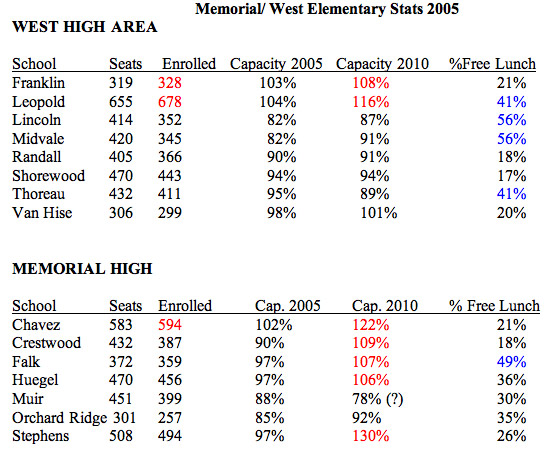
While viewing the MMSD web site I came across some data called District data profile that suprised me, and answered some of my questions concerning low income disparity. While sitting on the task force, I have been bothered by the districts solution for dealing with high numbers of low income students by rearranging school boundaries and/or paring schools, and wondered if you really solved the disparity issue or if you shifted the issue to another school or something that would have to be solved at another time.
Madison school district low income percentages per www.mmsd.org 1991 – 2005.

East High 2005 – 2010 Elementary Projections (click to view a larger version) Memorial/West 2005 – 2010 Elementary Projections (click to view a larger version)

In 13 years, 1992 to 2005, MMSD low income percentage has gone from 24.6% to 42%.

  1. Has the definition of low income changed during this time period?
  2. Has the community as a whole really changed this much in 13 years?
    As a community member that hears and believes there is no low income housing, where do these people live if 42% of our community is now low income?

  3. We have lost 1000 elementary students in the same time period and doubled our minority students. Is this a wave of low births or are we losing students?

Middle School totals

  • In 1991 there were 4776 students with a 20.3% low income.
  • In 2005 there are 5297 students with a 38.6% low income.

High School totals

  • In 1991 there were 6435 students with a 12% low income.
  • In 2005 there are 8429 students with a 28% low income.

The question about pairing two schools and whether it improves low income percentage numbers over time was also in the data.

  • Lincoln in 1991 was at 51% low income, 1997 59%, and 2005 69%.
  • Midvale in 1991 was 42% low income, and 2005 it is at 64%.

It does not seem to have improved the high percentage of low income numbers.

Share

Not much new in MMSD report on worker’s comp

Juan Lopez, chair of the Board of Education Committee on Human Resources, released a report on the MMSD’s worker’s compensation experience after a critical story on Madison’s WKOW-TV.
The new MMSD report seems only to repeat the information contained in the TV report.
Roger Price, assistant superintendent and author of the report, offered this conclusion, without directly responding to any of the issues raised in the TV station’s story:

Great steps have been taken over the last few years to improve MMSD’s worker’s compensation reporting and claims (loss) experience. This has resulted in a significant drop in our experience mod and subsequently in our premiums. We have also realized adjustments in each of the last two years as a result of a positive loss experience. However, some of these improvements will be difficult to sustain with the limited staff assigned to Risk Management.
Work is underway to create a Safety Committee that could fill part of the void left by the reduction in staff.

Share

Report Proposes Employee Health Insurance Savings through Switch to State Health Care Plan

According to a recent report by the Wisconsin Policy Research Institute, the Madison school district could save $2.4M per year by negotiating health insurance coverage for its teachers through the state’s employee health insurance plan, rather than continue with Group Health (HMO) and Wisconsin Physician’s Service plans.
The $100 Million Question: Breaking the Health Insurance Monopoly”.

Share

Letter to Performance and Achievement Committee

The following letter was hand delivered to Shwaw Vang a week ago, and email copies were sent to the Board, Superintendent Rainwater, and Assistant Superintendent Pam Nash. There so far has been no response. A follow up email was sent yesterday to the Performance and Achievement Committee again asking that they look into why the English 9 curriculum has not worked in raising student achievement before allowing West High School to implement changes in the 10th grade English curriculum.
Dear Shwaw,
We are writing to you in your capacity as Chair of the BOE Performance and Achievement Committee to ask that you address a critical situation currently unfolding at West High School.

(more…)

Share

Liveitprogram.com

Did anyone else read Michael O’Shea in Sunday’s Parade this weekend? Only one state, Illinois, has PE mandatory in K – 12 and 40% of our elementary schools throughout the nation no longer set aside time for recess. See www.actionforhealthkids.org or www.liveitprogram.com.
Is it me or is there a reason students are heavier, and is there a reason 1/4 of students attending American schools take some form of mood altering medication?
My happy, busy 2nd grade son, who loves school and gets along well with his peers, has been the subject of well meaning teachers requesting an ADHD evaluation. Are we treating kids so they can survive an 8 hour day without activity? Is this in the best interest of our children or to accommodate the “union approved schedule”?
My son has P.E. three times a week and recess for 25 minutes in an 8 hour day 4 days a week. He is 8. I take more breaks from work than he does. We (the nation) really don’t get it. I look at the people I currently know who are successful as adults and not many of them sat still for 8 hours a day without activity, creativity, and pure frustration from adults around them nor were they medicated or prevented from physical activity due to budget cuts and testing. I can include in this list

  • my physician husband, (76 stitches by the time he was 10),
  • my cardiac surgeon brother-in-law, (who was told by teachers over and over he would never succeed because he never sat still as is his the same with his son),
  • my lawyer cousin who was always fighting those in authority (as is his son).

Not one of these adults were medicated as children but everyone of their children have been asked to be evaluated for ADHD. I don’t disapprove of meds to help a real problem and I have seen the devastation of mental illness in my own family but students that love school, and have positive relationships at school, do we do them a disservice by turning to meds first?
We should let them move first then see what happens. I don’t encourage hostile, ill behaved students but are we encouraging growth, creativity within unique students that succeed by eliminating movement? We need to let kids move so they can concentrate.
Let’s keep Madison kids moving so they can think.

Share

Revisit and Evaluate a Strings Change

I know this topic is discussed every year but I want to re-visit the success of the administrative change to 4/5 strings based on budgetary demands versus academic demands.
The 4/5 strings was changed to once a week this year from twice a week last year. The choices the board juggled was no strings in 4/5, twice a week 5th only, or once a week 4/5 strings due to the budget cuts. While I applaud the board for trying to work with the community I would love some feedback on how the once a week 4/5 decision is working at other schools.
For my daughter, and I can only speak for her and a few of her friends, this is what we have experienced………

(more…)

Share

We Can Make Health Care Affordable

Wisconsin families and businesses are being priced out of health care coverage. It doesn’t have to be this way. We can turn things around.
Every day brings new evidence that we are in the middle of a health care crisis.
The Wisconsin Realtors Association released a poll earlier this month that showed 66 percent of Wisconsin residents are worried that health care costs will soon become unaffordable.
By Wisconsin State Senator Judy Robson (D-Beloit), a registered nurse, from WisOpinion.com, November 21, 2005.

(more…)

Share

Status of West/Memorial Options

The MMSD Web site includes a table of options discussed and action taken at the meeting on November 17.

Share

Wisconsin Charter School News (11/26/2005)

Share

Students Ace State Tests, but Earn D’s From U.S.

Sam Dillon, New York Times writes:
“After Tennessee tested its eighth-grade students in math this year, state officials at a jubilant news conference called the results a “cause for celebration.” Eighty-seven percent of students performed at or above the proficiency level.”

The WKCE test taken in Fall 2005 (reported in Spring 2005) shows statewide percent performing at minimal (below basic level) in Grade 4 Reading: 4%; Grade 4 Math: 16%; Grade 8 Reading: 6%; Grade 8 Math: 11%.
The WKCE test results for test taken in Fall 2004 (reported in Spring 2005) shows MMSD percent performing at minimal level in Grade 4 Reading: 5%; Grade 4 Math: 16%; Grade 8 Reading: 3%; Grade 8 Math: 10%.
National Assessment of Educational Progress – Also known as “The Nation’s Report Card” is the only national standardized continuing assessment administered periodically by the US Dept. Of Education in reading, math, science, writing, US history, civics, geography, and the arts to random schools in each state to evaluate national performance of students ages 7, 12, 14, and 17.
The 2005 NAEP results for Grade 4 Reading: 33%; Grade 8 Reading: 23%; Grade 4 Math: 16%; Grade 8 Math: 24%.

Share

Channel 3000 story on School Nurses

The following story aired on Channel 3/9 a few weeks ago and was recently posted on the Channel 3000 web site. This story discusses the impact of cutbacks of in-school staff, in this case school nurses, and reflects a serious issue that affects all of our schools. I urge you to read the extended story, which includes data on the number of students with serious chronic medical conditions in our schools.
When I was growing up, the school nurse was the lady in sturdy shoes and white opaque stockings who administered hearing and vision exams. We avoided her like the plague.
Today’s school nurses are a far cry from what I grew up with in the 1960s and 1970s. They often are the primary health care providers for students. For students with chronic diseases, trained nurses are the key link between families and schools. In many of our schools, nurses provide gently used clothing – everything from underwear to mittens – for students who come to school without proper clothing, or who need emergency replacement clothing. They serve as de facto counselors for students who visit them with health problems that may come from stress at school or at home.
School Nursing Shortage Affects Madison Students
POSTED: 12:50 pm CST November 22, 2005
UPDATED: 10:30 am CST November 23, 2005
In the Madison School District, up to 700 kids a day need medical attention. But as News 3’s Dawn Stevens reported, sometimes the person taking care of them doesn’t have official medical training.

(more…)

Share

Study Indicates Changes in Global Standing for U.S.

The nation’s 4th graders may not stack up quite so well against their peers around the globe as previously thought, but also may not post as big a drop-off in achievement when they get to high school, a new analysis of international-test comparisons concludes.
The study, conducted by the Washington-based American Institutes for Research and sponsored by the U.S. Department of Education and the Urban Institute, looked at two international-assessment comparisons, covering grades 4 and 8 and 15-year-olds. It found that, when compared only with those countries that participate in both studies for all three student groups, the United States ranked in the middle or bottom of each.
By Kathleen Kennedy Manzo
From Education Week, November 22, 2005

(more…)

Share

School’s anti-war assignment canceled

A letter-writing campaign by third-graders at Allis Elementary School encouraging an end to the war in Iraq was canceled because it violates School Board policy, district officials said Tuesday.
Julie Fitzpatrick, a member of the 10-teacher team that developed the project for the school’s 90 third-grade students in five classes, said the assignment was intended to demonstrate citizen action, one of the district’s standards in social studies.
By Sandy Cullen, Wisconsin State Journal, 11/23/05

(more…)

Share

Bush Administration Grants Leeway on ‘No Child’ Rules

By Nick Anderson
Washington Post Staff Writer
Tuesday, November 22, 2005; A01
The Bush administration has begun to ease some key rules for the controversial No Child Left Behind law, opening the door to a new way to rate schools, granting a few urban systems permission to provide federally subsidized tutoring and allowing certain states more time to meet teacher-quality requirements.
The Education Department’s actions could signal a new phase for school improvement efforts nearly four years after the law’s enactment. Taken together, these actions amount to a major response to critics who have called No Child Left Behind rigid and unworkable. They also help the administration combat efforts to amend the law in Congress.

(more…)

Share

Legislative Fiscal Bureau Releases 2005-2006 General School Aids Amounts for Districts

November 17, 2005
TO: Members Wisconsin Legislature
FROM: Bob Lang, Director
SUBJECT: 2005-06 General School Aids Amounts for All School Districts
In response to requests from a number of legislators, this office has prepared information [PDF File] on the amount of general school aids to be received by each of the 426 school districts in 2005-06. This memorandum describes the three types of aid funded from the general school aids appropriation and the reductions made to general school aid eligibility related to the Milwaukee and Racine charter school program and the Milwaukee parental choice program. The attachment
provides data on each school district’s membership, equalized value, shared costs and general school aids payment, based on the October 15, 2005, equalization aid estimate prepared by the Department of Public Instruction (DPI).
Full document on-line here.

Share

Which East Side Schools Examined for Closing?

According to the minutes of the November 10 meeting of the East task force:

Task Force members requested information on savings from [closing] specific schools.


Unfortunately, the minutes do not mention the “specific” schools. Can a member of the task force or someone who attended provide the names of those schools?
I also wonder whether the meetings are getting a bit contentious.

(more…)

Share

Where Have All the Students Gone?


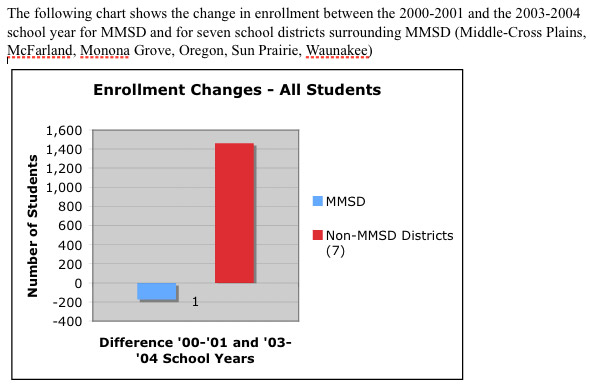
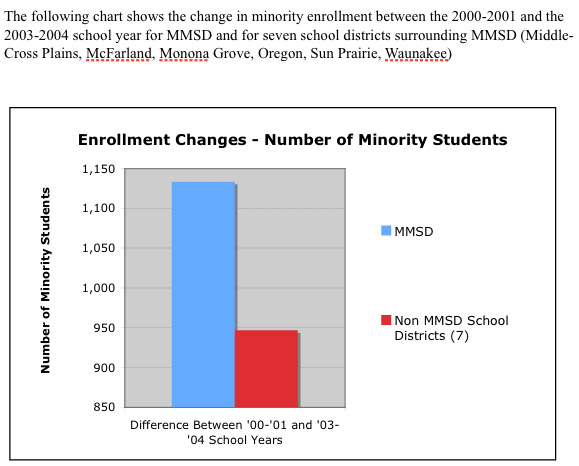
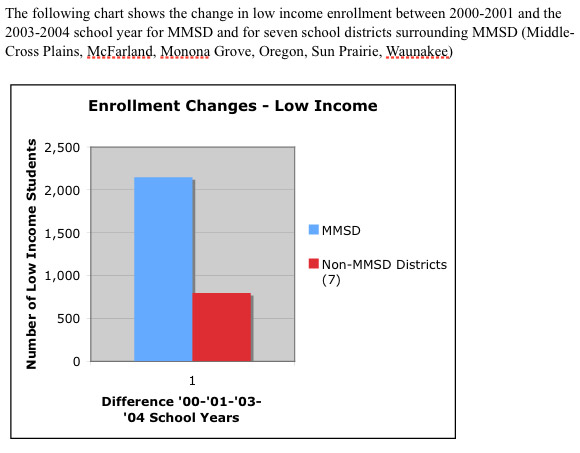
Additional Charts: Enrollment Changes, Number of Minority Students | Enrollment Changes, Low Income
MMSD Lost 174 Students While the Surrounding School Districts Increased by 1,462 Students Over Four School Years. Revenue Value of 1,462 Students – $13.16 Million Per Year*
MMSD reports that student population is declining. From the 2000-2001 school year through the 2003-2004 school year, MMSD lost 174 students. Did this happen in the areas surrounding MMSD? No. From the 2000-2001 through the 2003-2004 school year, the increase in non-MMSD public school student enrollment was 1,462 outside MMSD.
The property tax and state general fund revenue value of 174 students is $1.57 million per year in the 2003-2004 MMSD school year dollars (about $9,000 per student). For 1,462 students, the revenue value is $13.16 million per year. Put another way, the value of losing 174 students equals a loss of 26-30 teachers. A net increase of 1,462 students equals nearly 219 teachers. There are more subtleties to these calculations due to the convoluted nature of the revenue cap calculation, federal and state funds for ELL and special education, but the impact of losing students and not gaining any of the increase of students in the area is enormous.

(more…)

Share

Are school lunches helping kids develop a healthy relationship with food as well as a healthy body?

Early in my career, I had to make a paradigm shift. Starting out, I thought my job was to tell people how to eat and I expected that they would eat as they “should”. Now I know that eating is a matter of taste and style and depends, for most people, to a lesser extent on nutrition facts. Although I’d love to be able to control what my clients eat, I have settled with the reality that I can’t even control what my dog eats! I buy Whole Foods dog food…he eats the white bread our neighbors toss on their lawn for the birds.
The point here is that your child’s eating style will be as unique as his appearance. It’s important that kids are provided with regular, fairly balanced meals and can choose what and how much to eat. It’s also important that they eat with others because meals are not just about consuming food. Once kids have meals that provide a framework for eating a variety of foods at predictable times, then the tendency to snack will lessen and cravings for processed foods will fade. Your child’s diet won’t be perfect, but he or she can still be perfectly healthy.

(more…)

Share

Educational Reform Movements

“Left Back: A Century of Failed School Reforms” is a book by Diane Ravitch. On September 11, 2000, the Brookings Institute invited Ravitch for a discussion and public forum. Introductory remarks by Donna Shalala, then Secretary of HHS, and William Bennett, former Secretary of Education, preceded Ravitch’s presentation, and the question/answer session that followed. Here
The basic premise of the book, an in depth study of the history, is that the reforms moved away from traditional rigorous academic standards, into social reform, causing the schools to fail for all kids, and therefore society. She also illustrates the how political labeling such as “liberal” and “conservative”, “reform” and “traditional” have played an important role in school’s failures.
Shalala’s opening remarks should be familiar to those of us who followed her tenure as UW-Madison Chancellor. She emphasizes “we are not fair or honest with American kids about how hard learning is”, citing her view that teacher should learn from coaches, who understand the role that practice, repetition, and small corrections play in achievement and reaching perfection.
Bennet’s remarks are, from my view, the typically political “liberal v conservative” tripe that he is famous for, even as the issue of political labeling in the reform movement has been a contributing factor in educational quality failures.

Share

MMSD and Big Brothers Big Sisters of Dane County Expand Mentoring Program

The Madison Metropolitan School District and Big Brothers Big Sisters of Dane County are expanding the SOL Mentor Program to Leopold Elementary and Cherokee Middle Schools. The SOL Mentor Program continues to serve Latino, Spanish-speaking students at Frank Allis Elementary and Sennett Middle Schools and aims to match an additional 75 students with adult volunteers in the community over the next three years.

(more…)

Share

Dane County United Calls for Child Care Funding

More day care funding urged for low-income kids
By Pat Schneider, the Capital Times
November 17, 2005
Every kid deserves a piece of the pie.
That was the message Wednesday, when members of Dane County United joined with the Bright and Early Coalition to put out the message that more public money is needed to support quality child care programs for low-income families.
One half of Madison children enrolled in day care are in city-accredited programs, said Vernon Blackwell, a member of Dane County United, a grass-roots social justice advocacy group.

(more…)

Share

History Will Be Made On Friday Night!!!

On Friday November 18th at Madison Ice Arena [map] the Madison Metro Lynx invites you to attend their game versus Superior High School at 6:30 p.m. This is the first girls ice game in the history of the Madison Metropolitan School District!
Madison Metro Lynx is a seven school cooperative effort of the MMSD with Madison Memorial serving as lead school. Skaters also attend Middleton, Waunakee and Monona Grove.
For these girls and many other younger female hockey players in Dane County, this sport will provide an additional meaningful opportunity as they progress through their high school years.
We hope to see you as the Madison Metro Lynx play in their first game in their inaugural season.

Share

MMSD Budget Mystery #4: Body Count or 1-2-3 FTE

All right, gice and galz. I been called in. Sam Spade, that is. No more pussyfootin’ around like that little Nancy Drew kinda mystery ya been seein’. Dis is a tough one. Ain’t none of ya gonna’ figur it out. But I’m here ta make ya try.
When da Board of Education passed the MMSD buget on the first go round, that is, da balanced budget, da buget supposedly had 3781.23 FTEs (that’s full time equivalent postions, for you beginners), compared to da 04-05 school year which supposedly had 3880.86 FTEs, and compared to da “same service” budget which supposedly had 3914.86 FTEs. Ya followin’ me?
When da same said Board of Education passed da final buget, how many of dem so-called FTEs did it approve?
Ta give ya a hint, click here ta see a chart that shows some of da FTEs, but it’s got lots of blanks, and I don’t mean blanks in my .38. That’s fully loaded.
The winnin’ PI is da one can fill in da most blanks based on da MMSD buget documents.
Knock yerselfs out!

Share

Board of Education in No Rush to Explore Health Insurance Savings

Last June, the Madison Board of Education ratified the 2005-07 collective bargaining agreement with Madison Teachers, Inc. The agreement commits the district and the teachers union to form a task force to identify potential cost savings from changes in health insurance coverage. If the task force finds savings, the parties may renegotiate the health care provisions. The deadline for this work is February of 2006.
Months ago, both sides named their representatives to the task force. Months ago, the Board’s attorney declared that the task force meetings—–prior to possible renegotiation—–would be public meetings. Five months have passed without a public meeting of the task force. The Human Resources Committee, which has oversight of this process, has not mentioned the topic or called for a report from administration. In fact, the board has received more updates from the administraton about discussions on the future of guinea pigs in classrooms than it has on possible savings in health care costs. Now only a few months remain to collect information on this complex topic, analyze the options and, if possible, renegotiate the health insurance provisions in the two-year agreement.

(more…)

Share

Test Prep Help for Students Who Can’t Afford Kaplan

I’m not sure if this is still the case, but at one time, MMSD offered a college entrance test prep course in an 8-week summer session. But for many reasons, needing to work among them, not all students can take advantage of this opportunity.
What if high school seniors or adult volunteers tutored their younger classmates, especially those who can’t afford the time or the money to take the Kaplan courses? How about a service project where students or adult volunteers offer a weekly review after school or (if student-run,during the lunch hour)?
In a perfect world, everyone would be taking these tests “cold”, but the reality is that a tremendous amount of coaching takes place. Practicing the test format alone is helpful.
ACT test prep for low income students
MIDDLE- and upper-class teenagers get lots of extra help in the college application process. They get personal SAT tutors and SAT prep courses, they get assistance on their résumés and college essays from writing coaches and parents. They have guidance counselors and teachers with time to help.
The poor tend not to be so lucky. They can’t afford tutors or prep courses, and often don’t have parents who’ve been to college to guide them. Their high schools are more likely to be understaffed. North High School here, which is three-quarters black, has two guidance counselors for 1,100 students.
But a nonprofit program started here five years ago, Admission Possible, aims to give 600 poor teenagers a year (average family income of $25,000) the kind of edge that wealthy students routinely enjoy.

(more…)

Share

Strong, Consistent Middle School Academics

As I listened to the Pam Nash’s (Assistant Superintendent for Secondary Schools) presentation on the Middle School Redesign to the Performance and Achievement Committee last night, I was thinking of an academic/elective middle school framework applied across the district that would be notable in its rigor and attractiveness to parents and some next steps. Personally, I consider fine arts and foreign language as core subject areas that all students need and benefit from in Grades 6-8.
Have at it and comment with your wish list/ideas, education and support for students, developing a few more options/strategies.
Possible “common” structure in middle school that next year could look like:
6th – math, social studies, language arts, science on a daily basis plus two unified art periods (one is A/B phys ed and music plus 4 one quarter units).
7th – math, social studies, language arts, science, foreign language on a daily basis plus two unified art periods (one is a/b phys ed and music plus 4 one quarter units)
8th – math, social studies, language arts, science, foreign language on a daily basis plus two unified art periods (one is a/b phys ed and music plus 2 half semester units

(more…)

Share

No Place for a Poet at a Banquet of Shame

You might agree or disagree with poet Sharon Olds on the war in Iraq, but you have to be touched by her description of writing by patients with severe disabilities. Read the full open letter in The Nation.

When you have witnessed someone nonspeaking and almost nonmoving spell out, with a toe, on a big plastic alphabet chart, letter by letter, his new poem, you have experienced, close up, the passion and essentialness of writing. When you have held up a small cardboard alphabet card for a writer who is completely nonspeaking and nonmoving (except for the eyes), and pointed first to the A, then the B, then C, then D, until you get to the first letter of the first word of the first line of the poem she has been composing in her head all week, and she lifts her eyes when that letter is touched to say yes, you feel with a fresh immediacy the human drive for creation, self-expression, accuracy, honesty and wit–and the importance of writing, which celebrates the value of each person’s unique story and song.

Share

West Reading Scores by Ethnicity

These are the figures from the DPI Web site on minimum and basic 10th grade readers at West.
Asian/Pacific Islander:

Minimum – 5%
Basic – 11%

Black

Minimum – 22%
Basic – 24%

Combined Groups(Small Number)

Minimum – 25%
Basic – 34%

How will the core curriculum teach them to read and write?

Share

Evaluation of the SLC Project at West High School

Here is the full text of SLC Evaluator Bruce King’s recent report on the plan to implement a common English 10 course at West HS.
Evaluation of the SLC Project at West High School
The 10th Grade English Course
M.Bruce King, Project Evaluator
608-263-4769, mbking1@wisc.edu
2 November 2005
The development and implementation of the common 10th grade English course is a significant initiative for two related reasons. First, the course is central to providing instruction in the core content areas within each of the four small learning communities in grade 10, as outlined in the SLC grant proposal. And second, the course represents a major change from the elective course system for 10th graders that has been in existence at West for many years. Given the importance of this effort, we want to understand what members of the English Department thought of the work to date.

(more…)

Share

A different student viewpoint of West High

This was forwarded to the West High listserve with the request that it be posted as part of the current discussion about changes at West High.

When I read the anonymous email from a current West freshman who is defined as “talented and gifted,” I could not help but feel that I should write about my own personal experiences. I am in the exact same position as the previous writer (a current freshman at West High, defined as “talented and gifted.”), but I have completely opposite views. My time at West so far has been quite enjoyable. While some of the core freshman classes are indeed rather simple, I do not feel that my assignments are “busy work.” While most classes may be easy, they still teach worthwhile information.

(more…)

Share

New Wisconsin Promise Conference: Closing the Achievement Gap

The 2006 New Wisconsin Promise Conference, Closing the Achievement Gap, will be held at the Monona Terrace Convention Center in Madison on January 11-12, 2006.
The conference will focus on strategies for educators who are looking for help in meeting the progressively higher academic expectations of No Child Left Behind.

(more…)

Share

Middle School Survey

http://www.madison.k12.wi.us/admin/ms_question.pdf
Send this web site to all the middle school, future middle school parents, and concerned community members you can e-mail.
Pam Nash and the middle school committee are seeking input from parents and this is our chance to give them feedback. While I find the survey would be on the “How to Not Make a Survey” curriculum in my graduate school class on Effective Survey’s, I say congrates to the BOE and administration for allowing the community to give some feedback and input on this development. While it seems a little forced, quick and for some reason I am unclear why this issue is being discussed for middle schools that are functioning at a high level,(in other words let’s fix the problem’s where they exist, even if it means more resources, and not mess with what is working) I want all parents and those in the community interested to voice their thoughts and opinions. Please print off this survey and let the district know we want great middle schools, that reflect their community, not carbon copies of mediocre education.

Share

No Gifted Child Kept Behind

A letter to the NYTImes: http://www.nytimes.com/2005/11/14/opinion/l14educ.htm
Gifted Children
To the Editor:
Diane Ravitch (“Every State Left Behind,” Op-Ed, Nov. 7) hits the nail on the head when she suggests that we should not sacrifice our country’s future for low academic standards and demands for good news.
A particular problem not addressed by most American schools is that our gifted youth are told to wait for their classmates to catch up with them and not to rush their learning. America is wasting precious talent because it keeps its gifted children from soaring.
Stringent federal standards are great, but why does No Child Left Behind have to mean “every gifted child kept behind”?
Mary Beth Miotto
Northborough, Mass., Nov. 7, 2005
The writer is vice president, Massachusetts Association for Gifted Children.

Share

When all third graders read at grade level or beyond by the end of the year, the achievement gap will be closed…and not before

On November 7, Superintendent Art Rainwater made his annual report to the Board of Education on progress toward meeting the district’s student achievement goal in reading. As he did last fall, the superintendent made some interesting claims about the district’s success in closing the academic achievement gap “based on race”.
According to Mr. Rainwater, the place to look for evidence of a closing achievement gap is the comparison of the percentage of African American third graders who score at the lowest level of performance on statewide tests and the percentage of other racial groups scoring at that level. He says that, after accounting for income differences, there is no gap associated with race at the lowest level of achievement in reading. He made the same claim last year, telling the Wisconsin State Journal on September 24, 2004, “for those kids for whom an ability to read would prevent them from being successful, we’ve reduced that percentage very substantially, and basically, for all practical purposes, closed the gap”. Last Monday, he stated that the gap between percentages scoring at the lowest level “is the original gap” that the board set out to close.
Unfortunately, that is not the achievement gap that the board aimed to close.

(more…)

Share

Minority Hiring Not as Good as MMSD Touts

A story in today’s Wisconsin State Journal reports carries a headline saying “Schools show big boost in minority staff.” It’s just not so.
The MMSD chose to give the paper the number of minority employees in various job categories in 1987 and 2005 — ignoring an MMSD press release issued October 9, 1995, comparing 1987 and 1994.
If the recent release had compared 1994 and 2005, the comparison would have shown a decrease in the numbers and percentages of minorities among administrators from 23 (17%) in 1994 to 22 (15%) in 2005. Minority employees in clerical and technical catetories decreased from 47 (18%) in 1994 to 15 in 2005. (The press release did not provide a percentage for clerical technical categories.) Among custodians the number of minority employees remained unchanged: 37 (15%) in 1994 compared to 37 (17.7%) in 2005.
Click here for a Word file with numbers and percentages for all of the categories, including figures showing increases in the proportion of minority employees in other categories.

Share

Wisconsin Assembly Passes Two Bills Expanding Charter School Opportunities

This week the Wisconsin Assembly passed two bills that could expand charter school opportunities in this state. The Legislative Committee of the Madison School Board will review these bills on December 5.
Assembly Bill 730 proposes to amend current law to allow 5 UW-System 4-year universities, in addition to UW-Milwaukee and UW-Parkside, to each sponsor not more than 5 charter schools. The vote to pass was 56-36.
Assembly Bill 698 would amend current law to raise the student enrollment cap from 400 to 480 for the elementary charter school (21st Century Preparatory School) sponsored by UW-Parkside. The vote on this bill was 62-29.

(more…)

Share

Change the School Board to Change the Conversation – That’s Just What Dover, PA, Did

On Tuesday, the voters of Dover, PA, voted out 8 school board candidates running who had promoted intelligent design in the science curriculum.

Share

Proposed West High 10th Grade English – The Male American Experience?

Meg Cooper, parent, gave permission for her observation of the proposed West HS 10th grade English curriculum to be posted:
Has anyone else noticed that 80% or more of the proposed new West HS English 10 curriculum consists of male authors? Perhaps it should be called The Male American Experience/Justice/Identity relating to The Male American Dream…! I was very shocked. It appears so traditional (in a bad way) and excludes half [the femamle’s perspective] of the American experience. How can this possibly be a better program than the current English 10 electives at West HS?

Share

Wisconsin Charter Bill Passes the Assembly

Earlier this afternoon, the Wisconsin Assembly passed the following two legislative bills which would expand the Wisconsin charter school law:
AB 698 proposes to amend current law to raise the student enrollment cap from 400 to 480 for the elementary charter school (21st Century Preparatory School) sponsored by UW-Parkside. The vote on the passage motion was 62-Ayes and 29-Noes.
AB 730 proposes to amend current law to allow 5 UW-System 4-year universities, in addition to UW-Milwaukee and UW-Parkside, to each sponsor not more than 5 charter schools. The vote on the passage motion was 56-Ayes and 36-Noes. In a related development earlier this week, the Senate Higher Education and Tourism Committee recommended passage of Senate Bill 96 (i.e. Senate companion / identical bill to AB 730) on a vote of 4-Ayes (Senators Harsdorf, Kedzie, Kapanke and Plale) and 1-No (Senator Breske).
Both Assembly bills (AB 698 and AB 730) were messaged to the Senate.
A new ECS Issue Brief entitled “A State Policymaker’s Guide to Alternative Authorizers of Charter Schools” provides good info about the rationale for multiple-authorizers. You’ll find the ECS Issue Brief at the Education Commission of the State’s website — http://www.ecs.org/clearinghouse/64/69/6469.pdf
The State Legislature’s current floorperiod ends today. The next two-week floorperiod is scheduled for December 6 – 15, 2005. Then, the legislature will recess through the holidays … and resume floorsessions in the new year.
This was a good day at the Capitol for charter school friends. If you have an opportunity, please communicate special thanks to Representative Leah Vukmir and Senator Alberta Darling who are the lead authors of AB 730 and SB 96 (i.e. companion / identical bills to allow 5 UW System universities to sponsor charter schools); and thank Rep. Vos and Senator Stepp who are the lead authors of AB 698. Enjoy the moment!

Share

4 arrested after brawl at Memorial

A story by Steven Elbow from the Capital Times, November 10:

A brawl that police say was gang-related led to the arrest of four teenage boys Wednesday at Memorial High School.

(more…)

Share

Report on Minority Employees in the MMSD

Press Release from the BOE Human Resources Committee:
The number of racial minorities employed by the Madison Metropolitan School District has increased substantially since 1987 according to a report released today. The data also includes information from 1994. “The Board of Education has made diversifying our workforce a strong priority, I am happy to see the increase in the numbers of staff that reflects the diversity of our schools” says Juan Jose Lopez, the Chair of the Human Resources Committee which also includes board members Shwaw Vang and Johnny Winston, Jr.

(more…)

Share

Should MMSD Board Follow Open Meetings Laws or Change Them?

In her posting, “Westside Land Purchase – was public if you were interested, Marisue Horton suggests that I, as chair of the Madison School Board’s Legislative Committee “start making recommendations for change. Start changing the process instead of sitting around and bitching about it.”
I am not suggesting that we need new processes. Like Lawrie Kobza, I am advocating that the Madison School Board follow the spirit and letter of existing Wisconsin law. I agree with the principles of the Open Meeting law.
As the law states,

” [a] representative government of the American type is dependent upon an informed electorate, [therefore]it is declared to be the policy of this state that the public is entitled to the fullest and most complete information regarding the affairs of government as is compatible with the conduct of governmental business.” Only in specified exceptional cases may the school board go into closed sessions.

I also agree with Lawrie that the narrow exception allowing ongoing negotiations to be discussed behind closed doors did not apply to the October 10 meeting on the purchase of 8.3 acres of land near your home for a future elementary school. The Board’s attorneys disagree. The legal issue will not be resolved until, as Bill Keys recommended, an official complaint has been filed with the Dane County District Attorney and we have his opinion. Isthmus newspaper has filed that complaint and in due time we will have a ruling by a neutral legal authority.
In this case, the Open Meetings law protects the public’s interest in knowing how much the district planned to pay for this particular parcel and the conditions of the sale before the sale was complete. That interest was not respected. Maybe other sellers would have come forward with better offers, if they had known that we were poised to complete this purchase and were willing to sell the land back to them at less-than-appreciated value in the future. Maybe not. We will never know. Seven weeks passed between the signing of the deal by administration and the closed session meeting at which the board accepted the terms. The closing is not until November 15. What was the rush on November 7?

Share

MMSD: Shutting out the public

Isthmus, November 11, 2005, reports on the refusal of the MMSD administration and Board of Education to release details on a land purchase for a new school. Isthmus posted the full article and supporting documents in the Document Feed of thedailypage.com. Here are excerpts:

Jim Zellmer doesn’t know whether buying land for a new elementary school on the city’s far southwest side is a good idea. But he’s sure keeping the deal secret almost until the moment of final approval is a bad one. . . .
The deal was kept under wraps until 4:30 last Friday afternoon, when the school district put the contract into media folders just before closing for the weekend. At Monday’s meeting, Robarts and Kobza urged the board to delay approval for one week, to allow for public input, including that of a task force studying west-side school overcrowding. . . .
But Kobza’s motion failed on a 3-3 vote, with board members Bill Keys, Juan Jose Lopez and Johnny Winston Jr. opposed. Keys haughtily challenged critics of the secret deal to “go ahead and file charges”; Kobza urged members of the public to take up his suggestion.
On Wednesday, Isthmus followed through, asking Dane County District Attorney Brian Blanchard to investigate and prosecute. . . .

Share

West-Memorial Forum

A PUBLIC FORUM  will be held to update the community on plans to address overcrowding in the West-Memorial attendance area.  Come to learn about options being considered AND to share your input!!
 
When:  7:00 p.m. Tuesday, November 15, 2005
Where:  Leopold Elementary school [Map]
Sponsors:  Thoreau, Leopold, and Cherokee

Share

1 Of 7 City Children Needs Mental Help

Our school staff certainly cannot meet the needs of children with mental illness. As a society we need to staff schools with mental health experts or examine new alternatives for educating children who pose challenges beyond our schools’ capabilities.
Read Andy Hall’s troubling story in the Wisconsin State Journal from October 25, 2005.

Share

West’s Core Program: Enrichment, or Deprivation?

This anonymous entry is from a current 9th grader at West who shares their thoughts about the proposed changes in 10th grade English as well as lets us know how the current 9th grade core is experienced by students.

I am writing from the viewpoint of a gifted and talented 9th grader at West High who is stuck in the core program of English and History 9. “Stuck” is the perfect word for my situation. I am stuck in classes where brilliance is not only limited, but discouraged. I have been reprimanded by teachers for exceeding their expectations. Does West want to be a school known for restricting its gifted students?

(more…)

Share

Academic gap shrinks; both levels drop

By Michele Munz
ST. LOUIS POST-DISPATCH
Sunday, Oct. 30 2005
The gap in academic achievement between black and white students in the St. Louis area has decreased in the past five years, according to findings released Sunday of the first comprehensive study of school districts’ efforts to reduce the gap – but only because the academic performance of white students dropped more than that of black students.
The study concluded: “An alarming fact came forth: the decrease in the gap was not due to an increase in achievement by black students, but, instead, resulted largely from a decrease in achievement levels by both black and white students.”

(more…)

Share

Report from West High PTSO Meeting

Some 70 parents were in attendance at Monday evening’s PTSO meeting to hear about West High School’s plans for 10th grade English. This was the largest turnout for a PTSO meeting in recent history. Approximately one-third of those there were parents of elementary and middle school students who will be attending West at some point in the future.
The consensus from parents was that they want more discussion of these planned changes, and given the school’s timeline for formalizing next year’s course offerings, these meeetings have to happen soon.
Parents heard from Principal Ed Holmes, English department chair Keesia Hyzer, and from teacher Mark Nepper. What follows is a brief summary of the presentation.

(more…)

Share

Carol Carstensen to speak Thursday night, Nov. 10

From Schenk-Atwood-Starkweather-Yahara Neighborhood Association council:

Long time Madison Board of Education member Carol Carstensen has agreed to be at our neighborhood association meeting next Thursday November 10 – 7:15 PM – at the Atwood Community Center – to talk about the future of east side schools, particularly Lowell and Lapham-Marquette elementary schools.
A school board task force is looking into underenrollment at some east side elementary schools – crowding at others – and what to do about it. Adjusting school attendance area boundary lines and / or closing schools are some of the options on the table. Emerson, Lapham and Lowell elementary schools — all under capacity — are said to be at risk if closings are considered.
In January the east side task force will recommend up to 3 options to the school board’s Long-Range Planning Committee.

Share

Public Information and Tonight’s Land Purchase Vote

Tonight the Board of Education will vote on approving the purchase of land in the proposed plat of Linden Park located along Redan Road on the west side of Madison. The Board will vote on approving the purchase of 8.234 acres for the price of $535,258.83. One provision of the agreement requires the District to offer to sell the property back to the developer at the District’s original purchase price plus the cost of improvements plus 5% interest compounded daily, if the District determines not to build a school on the site and instead to sell the property.
The Offer to Purchase this property was signed by the developer on September 23, 2005, and was signed by Roger Price for the School District on September 26, 2005. The Offer is contingent upon Board approval.
Despite the fact that negotiations over this contract were completed at the end of September, this signed contract was not available for public review until last Friday, November 4, 2005. In fact, the signed contract was deliberately kept from public review before then. A Board meeting to discuss the signed contract was held in closed session on October 10, 2005 (Ruth Robarts and I voted against going into closed session on this matter), and an open records request by Jim Zellmer for a copy of the signed document was denied.

(more…)

Share

$293,000 Unspent in Library Aids; Mystery #2 Deepens

In our unrelently effort to unravel the mysteries of the MMSD budget, our loyal fans may remember the Case of the Disappearing Library Aids – Budget Mystery #2.
It all began with an innocuous inquiry from a schoolmarm and inquisitive assistant who claimed that their library did not receive library aids for the last school year.
After more than a month of pointed proding, Assistant Superintendent Roger Price responded with a most mystifying missive which includes the alarming admission that the MMSD did not expend $293,055 in library aids received from the DPI last year!

(more…)

Share

Questions about task force data

In surfing through the information posted for the task forces, I have two questions about some of it.
First, I don’t know why the MMSD staff presented the chart on Transportation_Students_Special Ed_ELL. However, the district does more busing and cabbing than just special ed and ELL students. Most children, I believe, in early childhood programs get bused or cabbed, but they may be included in the special ed students. In addition, children in TEP (Temporary Education Program) for homeless kids get bussed or cabbed (sometimes from Verona, Middleton, and Sun Prairie). If the chart were to include all kids who are bussed, the TEP kids definitely need to be added.

(more…)

Share

East Options & West/Memorial Plans

The MMSD Web site lists eight options for further review by the task force. Rather than try to list them here, you can link to the meeting minutes with the options.
The minutes from the West/Memorial task force include the following:

Seven Task Force members indicated that they had ideas for options to begin the discussion. Jane noted that we would have members bring up their ideas and then determine how to proceed in refining the ideas. She also noted that District staff would analyze the options further before the next meeting of the Task Force.

Share

Music and Art Improve Student Achievement, Especially for English Language Learners and Low Income Students In Tucson Unified School District

The Tucson Unified School District’s Opening Minds through the Arts , also known as OMA, was recently awarded a federal grant totaling over one million dollars to continue research on its music and art model and how it positively effects student achievement.
Independent research has shown that OMA participant’s especially English language learners and students from disadvantaged communities, have significantly improved their standardized test scores in reading, language, and math. Furthermore, research indicates that students at OMA schools demonstrate fewer behavioral problems, improve their classroom focus, and show greater respect for themselves and fellow students and teachers.
Now in its fifth year at TUSD, OMA integrates the fine arts into traditional and arts curriculum for kindergarten through sixth-grade students. The OMA model is based on extensive research on the neurological development of children. Using opera, dance, costume design and music, students learn new ways to view and understand complex math and language problems. In Grade 3 students learn to play the recorder. In Grade 4 all students learn to play a stringed instrument and in Grade 5 all students learn to play an instrument in a band or orchestra.
OMA was one of 23 programs selected nationally to receive the U.S. Department of Education grant. Titled Professional Development for Arts Educators, the grant will provide the district with $1,001,700 over the next three years for additional research on past student achievement results and specific OMA components that help increase student success.
It’s amazing what can be accomplished when minds are open to changes and a focus on what contributes positively to student achievement and what improves learning and closing the achievement gap. Federal funding for approaches similar to OMA have been available for several years. But, the first step is support for what supports children’s learning and achievement and a willingness to work together under current constraints on new ideas. This past summer the director of OMA conducted workshops throughout the US, one in Minneapolis. Perhaps School Board will put together a working group to get started on something similar for our children.

Share