School Information System

Teachers bar shift in health coverage

Madison’s teachers union said Friday it will not agree to reopen its contract with the School District to renegotiate health-care benefits, dashing hopes the district could find cheaper coverage.
A joint committee of district and union representatives has been studying rising health- care costs, but both sides had to agree to reopen the 2005-07 contract to take any action. Either way, officials say taxpayers would not have seen savings, at least not in the short term.
John Matthews, executive director of Madison Teachers Inc., said a strong majority of union members like the coverage they have and don’t want to jeopardize it, even though any savings would have gone to higher salaries.
“Members of MTI have elected to have a higher quality insurance rather than higher wages, and that’s their choice,” he said.
By Doug Erickson, Wisconsin State Journal, February 18, 2006
derickson@madison.com

(more…)

Share

Lapham Student Move Called Unlikely

Kobza Says Most Of Board Rejects Idea
A new Madison School District report that outlines how Lapham Elementary School students could be moved to the Marquette-O’Keeffe school site has rattled parents and staff, but the School Board member who requested the analysis says she doubts it will go anywhere.
As outlined in the report, the move would free up space at Lapham for other school district programs, including Affiliated Alternatives, which currently rents space on Brearly Street, MSCR (Madison School Community Recreation) programs and a day care facility. An early childhood program would remain at Lapham under the scenario sketched out in the report.
By Susan Troller, The Capital Times, February 16, 2006

(more…)

Share

Alliances Are Unconventional In School Board Primary Race


Madison school politics make for some strange bedfellows.

Take the case of the Feb. 21 primary race for the School Board, in which three candidates are vying for the seat left open by incumbent Bill Keys’ decision not to seek re-election.
The marketing manager of a Madison-based biotechnology giant has been endorsed by the powerful Madison teachers union and Progressive Dane. Meanwhile, an activist stay-at-home mom who helped put pink paper locks on legislators’ doors to protest concealed carry legislation is aligned with voices in the community that challenge the district’s status quo. As a critic of the board’s budget, she has struck a chord with some conservatives.
And then there’s the unanticipated late entrant into the race who forced the primary to be held, a UW doctoral candidate in medieval history who arrived in Madison last August.
By Susan Troller, The Capital Times, February 16, 2006

(more…)

Share

AFRICAN-AMERICAN BOYS: THE CRIES OF A CRISIS By E. BERNARD FRANKLIN

This message was sent to me by Mazie Jenkins an MMSD employee. This trend needs to STOP. I’m committed to changing this. I need your support on Monday nights and every single day!!!
If there is not major intervention in the next 25 years, 75 percent
of urban young men will either be hopelessly hooked on drugs or
alcohol, in prison or dead.
The data are clear. Reports by the American Council on Education, the
Education Trust and the Schott Foundation show that African-American
boys spend more time in special education, spend less time in advanced
placement or college prep courses and receive more disciplinary
suspensions and expulsions than any other group in U.S. schools today.

(more…)

Share

“Why We May Have to Move …”

I received a copy of this personal essay — a letter to the Administration and BOE — last night. The author said it was fine for me to post it, if I thought it was worth it. I most definitely think it’s worth it because it so poignantly describes a family’s real life experience and frustration in our schools … not to mention their agony over whether or not to move elsewhere.

Our kids are in 5th, 4th and 1st grades. I am really very concerned about our son going into sixth grade next year. He has some special education needs related to Asperger Syndrome, such as sensory defensiveness and skills to do with what some have called “theory of mind” (self-control, recognizing and assessing others’ points-of-view and feelings, anger management). I love the idea that Spring Harbor is smaller because of his sensitivities to light, personal space issues, noise levels and the like. I do not like that they are relatively inflexible in meeting special needs otherwise because they are small and missing some services – or severely limited – due to space and spending constraints. I also do not like that we would have NO options as to who his special ed case manager/teacher would be, because there is essentially one person to cover it all for each grade, whether or not they display and apply the kind of flexibility that being a “cross-categorical” special ed teacher demands.

(more…)

Share

Noted Educator Donna Ford is Coming to Wisconsin

Dr. Donna Ford, Vanderbilt University Professor and nationally known speaker on gifted education and multi cultural and urban education issues, will be visiting Wisconsin this March.
In conjunction with the MMSD Parent Community Relations Department, Dr. Ford will be presenting a workshop for parents entitled “Promoting Achievement, Identity, and Pride in your Children” on March 8, 2006 from 6:00—8:00 p.m. at the Double Tree Hotel, 545 W. Johnson Street, Madison, WI. For more information and to register, contact Diane Crear at 663-1692 or dcrear@madison.k12.wi.us Space is limited. Please make your reservation no later than February 20, 2006
Then on March 10 and 11, the Wisconsin Association for Talented and Gifted (WATG) is proud to have Dr. Ford as the featured speaker for their spring event for educators and parents:
On Friday afternoon, March 10, Dr. Ford will speak on “In Search of the Dream: Designing Schools and Classrooms that Work for High Potential Students from Diverse Cultural Backgrounds” in Janesville.
Friday evening, March 10, Dr. Ford will address parents and educators on the topic of “Parenting for Achievement and Identity” in Milwaukee.
Saturday, March 11, Dr. Ford will present an all day workshop in Milwaukee on “In Search of the Dream: Designing Schools and Classrooms that Work for High Potential Students from Diverse Cultural Backgrounds.” This is a learning and application experience designed specifically for use in the urban/suburban classroom!
For more information and to register go to www.watg.org .

(more…)

Share

Video of Performance and Achievement Meeting Available

The video of the Performance and Achievement meeting of December 19, 2005 is available in the Performance and Achievement blog site.
This meeting is the second meeting concerning the Middle School Design Team work, with a presentation by Pam Nash explaining the current status, focus groups involved, role of the Board, access by the Board to draft decisions and general approaches being considered by the Team and Administration.

Share

A Tale of Two Budgets: the Operating Budget for Madison Schools versus its Budget for Community Programs and Services

Everybody knows that the Madison School district has an operating budget for the district’s educational programs. The district also has a second budget for community programs and services. The second budget is sometimes known as “Fund 80”.
Things to know about the community programs and services budget:
1. “Fund 80” sounds like a source of outside funding, such as federal aid. It’s not. When the district spends funds for community purposes, it accounts for the expenditures under this accounting title.
2. The district cannot raise property taxes for the operating budget more than a small percentage from year to year without passing a referendum. That’s not true of the community program budget. The district can raise taxes for community programs and services by any percentage without going to referendum and it does. In other words, there are two budgets and two taxes.

(more…)

Share

Nick Berigan: Silveira’s actions prove she belongs on School Board

A letter to the editor
Dear Editor: I’m voting for Arlene Silveira for Madison School Board because she has, with words and actions, shown leadership about school resource policy. From the last year’s dialogue I’ve concluded that candidates need to be judged on how they respond to the complex issues. Does he or she problem-solve or position?
I think it’s useful when a candidate focuses on improving communications and helps devise ways to get wider circles involved in resource issues. If a candidate has actually organized people to address resource issues, then she has demonstrated credibility. Arlene has helped organize people toward solutions. I don’t think it is useful when candidates talk ambiguously about trust and perceptions without offering solutions.
I think it’s practical when, in response to state funding failures, a candidate supports interim solutions to minimize the damage. Arlene took a stand on the referendums. I think it’s disingenuous when candidates avoid taking such clear stands, preferring instead to criticize the real outcomes that result from those state failures.
I think it’s responsivewhen candidates offer interim solutions to resource issues so the community can re-evaluate as circumstances change. Arlene helped make those decisions. I think it’s “spin” when a candidate attempts to portray short-term solutions as ignoring planning just to make a political point (especially when long-term planning IS occurring).
I think it’s strategic when candidates talk about districtwide solutions that engage the support of a range of interests from real estate agents to homeowners, parents of students and teachers. As a businesswoman Arlene is credible across that spectrum. I think it erodes support for schools when candidates “work” narrow interests, promising narrow solutions.
Times are tough for our schools. Neocon policies at other levels of government are designed to reduce the expectations of publicly delivered education here and elsewhere. Candidates who resist that drift by bringing people to the process and seeking real solutions counter those damaging intentions.
Arlene has demonstrated a view that school resource policy is not just about her kids, their school or this or that program but is a matter that impacts shared expectations for our schools across the district.
Nick Berigan
Madison
Published: February 16, 2006
Copyright 2006 The Capital Times

Share

Performance and Achievement Videos available.

Videos of the Performance and Achievement committee meetings of January 30 and February 6 are available in the Performance and Achievement blog.
The topics of these meetings were heterogeneous vs. homogeneous classroom instruction. Professor Adam Gamoran, Director of WCER, made a presentation at the January 30 meetng. His Powerpoint presentation and a research paper are included.
The following week continued with presentations by Mike Lipp, West HS Biology teacher; Linda McQuillen, Math Resource teacher; Jenny Ruef, Math teacher at East HS; Lisa Wachtel, Science and Environment Coordinator, and Pam Nash, Asst Superintendent for Secondary Schools.

Share

Analysis critical of proposed constitutional revenue limits

The full text of the analysis is on-line in PDF format at:
http://www.lafollette.wisc.edu/calendar-news/2006/reschovskyanalysis.pdf
From the UW-Madison on-line press releases:
Analysis critical of proposed constitutional revenue limits
February 14, 2006
by Dennis Chaptman
Proposed limits on the amount of revenue Wisconsin governments can collect would reduce public services, hamstring the state’s future economic growth, and diminish local control, according to an analysis by a UW-Madison economist.

(more…)

Share

“Beat the Achievement Gap” Student Conference

The Simpson Street Free Press will be holding a city-wide “Beat the Achievement Gap” conference on Saturday, February 25, at 2:00 p.m. at LaFollette High School, 702 Pflaum Road. At the conference, students will take the following pledge: “I will be an active role model for younger students. I will work to spread a positive message of engagement at my school and in my community. I will encourage academic success among my peers.”
For more information, see “The Gap According to Black: A Feature Column by Cydny Black” and the inspiring two-page spread entitled “Education: Bridging the Achievement Gap” in the January, 2006, issue of The Simpson Street Free Press.
Additional information at www.simpsonstreetfreepress.org

Share

Moving Lapham to Marquette; Affiliated Programs to Lapham

The Lapham/Marquette PTG e-mailed the following to members today:

The Lapham/Marquette PTG will meet this evening from 6:30 – 8pm in the Marquette LMC. Childcare will be available.
Following are agenda items (not necessarily in this order):
1) Preschool Survey preliminary results
2) MMSD’s Feb. 9th executive summary for Lapham School summarizing the impacts of moving Lapham to Marquette and moving the Alternative Affiliated Programs into Lapham. (So, they finally said it. How will we respond?)

Share

Fragile Futures: Risk and Vulnerability Among Latino High Achievers

Patricia Gándara
Policy Information Center, Educational Testing Service
December 2005
The achievement gap usually refers to the chasm between low- and higher-performing students. But, as this study makes clear, disparities are just as pronounced among separate groups of high-achieving students. For example, in 2002 the top fifth of Latino test-takers scored means of 598 and 646 on the SAT verbal and math sections, respectively. Their white peers’ mean scores were 65 points higher on the verbal section and 74 points higher in math. Yet of the hundreds of studies reviewed for this report, hardly any “acknowledge… that high-achieving students might need support and that this support might differ from what is needed by their lower-achieving peers.” It’s tempting to think that smart youngsters, regardless of socio-economic situations or ethnic backgrounds, will turn out just fine. But as these data show, that’s not always true. Bright Latino students, who often come from low-income families and have parents with little education, are particularly susceptible to becoming frustrated or discouraged with schoolwork and the school environment. These kids require just as much encouragement, support, and instruction as their lower-performing peers, albeit in different ways. They, too, need goals, and information on where academic achievement can lead (college). But too often, they don’t receive it. Even when Latino students earn good grades in high school, register for the SAT (not an insignificant step), and do well on the exam, many still make poor college decisions. We cannot address achievement gaps by continuing to ignore these bright youngsters.

Share

By Invitation Only: How the MMSD-MTI Health Insurance Task Force Limited Its Options

In June of 2005, when the majority of the Madison School Board approved the two-year collective bargaining agreement with the teachers union, the agreement included a task force to study and make recommendations on possible changes in health insurance coverage for the teachers, the majority of the district’s employees. Task force members would be the superintendent and his appointees and John Matthews, exuective director of Madison Teachers,Inc. (MTI) and his appointees. They were to issue a report no later than February 15, 2006.
From the beginning, the task force provision was a great deal for the teachers union. It was risk-free. If the parties could identify health insurance savings, the savings would go directly to increase teacher wages during 2006-07. The parties would re-open the contract to switch dollars from this important fringe benefit to wages. If not, the teachers would keep the current coverage and current wages.
A gain for the district was not so easy to identify. Superintendent Art Rainwater talked about the potential health insurance savings as a benefit in future negotiations. Lowering health insurance costs during 2006-07 would allow the district to continue high quality health insurance coverage for its teachers (as we should) and go into future negotiations with a reduced base for health insurance costs. With health insurance costs for all employees running at about $35M per year, any longterm reduction would help the board redirect significant dollars to school programs and staff.
If the task force had used the year to take a comprehensive, objective look at health insurance alternatives for the teachers, the school board might expect an important report this week. It would tell the board how dollars currently going to health insurance could be used for wage increase at no loss in quality of care for district employees. I don’t expect anything like that because we have not seen a serious effort to seek out alternative insurance proposals and evaluate them and the board has exercised no oversight or direction.
The task force has met twice at MTI headquarters, on January 11 and January 25. It did not solicit a wide range of proposals for health insurance for the teachers.
Instead, the task force invited the current providers, Wisconsin Physicians Services and Group Health Cooperative, plus Dean Care and Unity to make presentations. They did not invite Alliant (whose insurance is good enough for MMSD administrators and the custodial union), Physicians Plus (a very competitive local provider with a doctors’ network that overlaps the current providers), the State Health Plan (open to school districts) or WEA-IT (a company associated with the Wisconsin Education Associations Council). John Matthews, who continues to serve on the Board of Directors for WPS, did most of the questioning of the insurance companies at the task force meetings. The gist of his questions for Dean Care and Unity were whether they could provide what WPS currently provides, according to him.

(more…)

Share

EXECUTIVE SUMMARY MIDDLE SCHOOL DESIGN TEAM

Focus groups have been held with parents, middle school teachers, current high school students, current middle school students, and representatives of community organizations that are connected to our middle schools through tutoring, mentoring or other programming. Summaries of those focus groups are attached.
The design team has set one additional all day meeting to draft the recommendations. This meeting will be held on December 20. The report will go to the Superintendent and will also be made available to the original parent focus group for their feedback and suggestions.
Throughout this process, information, questionnaires and summaries of input have consistently been made available on the district website.
The design is going to focus on specific, consistent recommendations regarding length and duration of classes in middle school in the areas of FiFine Arts, Life Skills, Mathematics, Wellness, Student Services, and World Languages.

Share

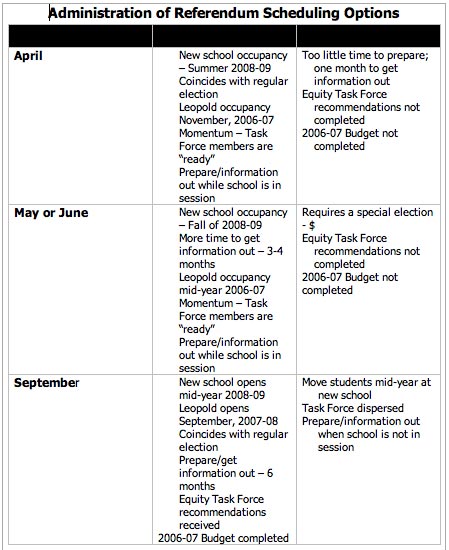
Administrative Analysis of Referendum Scheduling

A note from Superintendent Art Rainwater to the Madison Board of Education on 2006 Referendum scheduling:

At Carol’s request we have prepared an analysis of the possible dates to seek referendum approval for one or more new facilities. The analysis includes our view of the positives and negatives of three dates: April 06, June 06 and September 06

mmsd2006ref.jpg

Share

School Board Candidate Campaigns With Podcast

In what may be a Wisconsin first, Maya Cole posts pod casts on the Web. A story by Susan Troller in The Capital Times reports on the innovation:

Madison School Board candidate Maya Cole is reaching out to tech-savvy voters with a new way of communicating her campaign issues.
Cole, who is in a primary race for Seat 1 on the School Board against Arlene Silveira and Michael J. Kelly, has started podcasting what she calls a “School Board Minute.”
The 60-second audio summaries are recorded in her own voice and are available on her Web site and on the School Information Systems blog run by Jim Zellmer, who is one of Cole’s supporters.

Share

MMSD: Searching for alternative revenue streams

As a member of the Madison School Board and chair of the Finance and Operations Committee, I would like to get your ideas and perspectives regarding “alternative revenue streams” for the MMSD. The parameters would be: not to target students, No alcohol & drugs (e.g. bars), promotion of good health (e.g. no soft drinks), nothing morally questionable (use your imagination). Here are some areas identified:

(more…)

Share

Charge to the equity task force

Jason Shepard reports in this week’s Isthmus that the newly appointed task force on equity will look at “Differences in curriculum opportunities, extracurricular programs and access to meaningful information about a school’s performance . . .”
However, I can’t find a charge to the task force. Can someone post it or provide a link?

Share

Good goals, flawed reasoning: Administration Goes Full Speed Ahead on English 10 at West High

At January and February school board meetings, Madison Superintendent Art Rainwater reported on the administration’s plan to go ahead with one English course for all tenth graders at West High School starting in 2006-07. The goal of the plan is to increase academic opportunity for students of color. The mechanism is to teach all students the same curriculum, leaving it up to teachers to “differentiate” their approach and give equal challenge to every student. The school board has taken no action on this plan and does not plan to adopt, modify or otherwise vote on the plan before it is implemented.
I support the goal. I am not convinced, however, that the mechanism is based, as claimed, on the best research. The presentations to the Performance and Achievement Committee have raised my level of doubt.
At the January 30 meeting, the board heard from a University of Wisconsin expert. His published research on the subject of differentiated teaching concluded that more research is needed on this subject. Where the expert found successful differentiated teaching in high schools,the circumstances of the schools were far different from the circumstances at West High School. For example, successful “differentiated” classes occurred in schools where administration could match the skills and motivation of the teachers to the classes and where students vied for spots in the classrooms. We have a staff based on seniority and teacher options within the seniority system and must accept all students at tenth grade level into the program.
We were asked to consider the Biology I/ Advanced Biology I program at West High as a basis for making the change in the English program. In that program, approximately 20 students qualify for the advanced course and all others take Biology I. We were told that taking Biology I (rather than the advanced course) had not prevented a high percentage of West students from becoming National Merit Semi-Finalists. Never mind that the tests used for selecting the semi-finalists do not test science skills. At best, this correlation shows that taking Biology I did not harm the high-scoring students skills and aptitudes in non-science areas.
Two of our teachers made more persuasive arguments for caution in moving to “differentiated” courses. One cited research showing that the teacher training for these courses is a five to ten-year process. The other teacher gave us the factual background necessary to analyze the administration’s proposal. That teacher’s testimony follows.

(more…)

Share

MMSD’s Enrollment & Capacity Picture: A Perspective

The Madison Metropolitan School District (MMSD) is facing a significant challenge – growth. As a result of that growth – which is not evenly distributed across the district’s region – some schools are facing, or will soon be facing, overcrowding. Other schools still continue to see languishing enrollment which calls into question the appropriate future use of their facilities. Two task forces were created to examine these issues, and to recommend up to three options to address them. The task forces were also asked to develop options so as to reduce concentrations of low-income students. This report endeavors to examine how the enrollment picture plays out over the next five years, particularly under the various options proposed by the task forces. Special attention is given here to the West Side task force options due to this author’s greater familiarity with them, and his continued maintenance of a model tracking their proposals.
This report [121K PDF] first looks at the proposed options for the West & Memorial areas, and examines how projected enrollment and capacity compare over each of the next five school years. The report will then consider population projections over the next 25 years to try to get some sense of what one may expect as regards future demand for school facilities.
Disclosure, or why am I doing this?

  • I recently moved to Madison and saw this issue as a way to get involved in the community and to understand “how things work” here.
  • This particular issue is a complex problem, and therefore a rather interesting one to look at.
  • I have two children attending MMSD schools, and therefore am especially interested in the well-being of this district, and community.
  • Once I got started, it’s been hard to stop (though my work and family demands have certainly constrained my efforts).

(more…)

Share

Board Committee Meetings – Live on TV

The MMSD is beginning to regularly broadcast live School Board committee meetings on Cable Channel 10. Most board committee meetings are held on Monday and begin around 5 p.m.
This is a first for the school district, and I welcome this outreach step. It’s during the board workshops, special sessions and committee meetings that issues can be discussed in a fair level of detail over several meetings.

Share

MMSD School Board’s Philosopy of Education – community responsibility

Point 5 in the Madison Metropolitan School District’s Philosophy of Education says:
We believe that students, parents, school personnel, members of the BOARD, and the general public share the responsibility for the total educational program of the School District. We believe that this responsibility requires cooperation, effort, and dedication if the youth of the school community are to receive the learning opportunities necessary for them to become effective citizens in a free society.
I would like to see the School Board keep this point in mind when discussing heterogenous classes, changes to curriculum, redesigning middle school. Other school districts use on-going broader-based public coalitions when changes are being considered and as changes are being made leading up to board decisions.
The School Board took a positive step in this direction with the long-range planning task forces, and I hope this will extend to other areas in a meaningful way. I’d only add that the issues and timelines for the long-range planning task forces needed to extend beyond the task force work so next steps were better understood by all, including all board members.
Too often the School Board’s approach seems to be the board and admin. vs. them (teachers, parents, for example) on any number of topics (heterogenous classes at the Board meeting tonight and social studies curriculum at West High tonight but over the past few years there have been issues – fine arts curriculum, math, reading, open classroom) rather than working toward approaches/solutions and bringing the various knowledgable, interested and concerned parties together. I think a change in conversation and how we work together is warranted, because we will have to pass referendums. This is not simply a case of folks not happy with decisions. I think the feelings run much deeper, and the implications for successful referendums are not good if we continue in this manner and that worries me.

Share

MMSD School Board Says They Don’t Do Curriculum: WI State Law Says Otherwise

The Madison School Board is directly and legally responsible for the curriculum taught in their district. The WI Administrative Code, which is law, sets forth the legal requirements for public instruction. Public Instruction, Chapter PI 8.01 (Download Admin. Code Public Instruction – School Standards)says:
2. Each school district board shall develop, adopt and implement a written school district curriculum plan which includes the following: a. A kindergarten through grade 12 sequential curriculum plan in each of the following subject areas: reading, language arts, mathematics, social studies, science, health, computer literacy, environmental education, physical education, art and music.
Does this mean the Madison School Board is responsible for designing and creating curriculum and curriculum plans? No, of course not. I feel, however, they are responsible a) for making sure a process is in place so that academically rigorous, sequential curriculum plans are developed and evaluated regularly for meeting stated goals (and with opportunity for public comment along the way) and b) for approving curriculum plans developed under the guidance of the administration. How does the process currently this work? It’s not publicly clear, perhaps, because the Madison School Board has no written curriculum board policy and no written administrative procedures (that I could find and I’ve asked – see below) for the development and approval of curriculum plans.
I have been told by board members the Superintendent and his staff “do curriculum,” because they are the experts. What does that mean? Of course, we hope they are the experts; and, being experts in education administration, we hope and expect they use the teachers and other professionals who are experts in their field to develop curriculum plans using a well defined process that is clear and known by all. Yet, the sentiment from the board that was heard again in the their discussions of heterogenous classes is simply, “We don’t do curriculum.” When I first heard this type of statement from board members several years ago, I was puzzled and then I found the WI Admin. Code, which identifies the Board’s responsility over approval of curriculum plans. My question for the Madison School Board is: How do and will you execute your legal responsibility? How can the School Board make this clear to the public? Written board policies and procedures that are discussed and approved by a school board are how board members spell out publicly how they will execute their legal responsibilities. I feel such policies and procedures for curriculum, which ties directly with a board’s top priority of student achievement, would be illuminating and helpful for the board, public, teachers, administrators, etc.

(more…)

Share

Notes from Performance & Achievement Meeting on Ability Grouping

At this past week’s meeting, Adam Gamoran from the UW Center for Educational Research spoke to the Board about ability grouping. Dr. Gamoran talked about how ability grouping often ends up grouping students by race and SES because these students enter school having had different early childhood experiences and different educational opportunities (recall Donna Ford discussing the number of books in the homes of low income and middle income families).
Dr. Gamoran noted that there are often differences in the classroom experiences of high and low ability groups of students in regards to teacher expectations, academic rigor, and teacher ability.
He also emphasized that there is no simple solution to the achievement gap. Heterogeneous or homogeneous grouping by themselves will not reduce the gap in achievement. However, there are some clear cut solutions that are obvious according to Dr. Gamoran.

  1. No more dead end classes like general math for the low ability students;
  2. high academic expectations for students of all ability levels; and
  3. teachers should not be assigned in a way that results in only the newest and least experienced teachers working with the low ability students, in other words, all students deserve quality instruction.

In discussing heterogeneous grouping, Dr. Gamoran noted that differentiation is hard work for teachers, and they need a lot of support and training in order to be successful.
Dr. Gamoran also shared an example of a school where heterogeneous grouping was successful. This was a school that was 51% free and reduced lunch, but because the school had a strong, dynamic leader and had gotten grants, they were able to recruit a top notch staff. Not only was the principal able to select which teachers worked in the school, but approximately half of the student body had to go through an interview process to get into the school, so this magnet school was selective about its teachers and its students. Class size was kept to 15 students and instruction went at a fast pace. Students who were struggling were expected to attend tutoring sessions on Saturdays. I think there was an expectation that parents would be involved in their student’s education, but I am not sure about that.
Obviously the situation in the Madison schools is different from this ideal, and that’s why I think it is important for the Board and the administration to hear from students and parents what it is like in the classroom. I should add that Bill Keys was very annoyed that the Board was even discussing this issue because he believes that the Board has no place in the classroom. According to Mr. Keys this is the responsibility of the teachers and administrators and they know better than the members of the Board what should be done in the classroom. However, I would argue that the teachers and administrators don’t know any better than the Board does about what happens in the classroom, and they certainly don’t know what it is like for high ability students in those classes. Those of us who have sat around the kitchen table while our children talk about their boredom, frustration, and lack of challenge need to help them understand and make our voices heard.

Share

School Foods Policy Meeting

I took the opportunity to attend the meeting for health professionals on the development of a school foods policy for the MMSD.
Americans seem to take an “all or nothing” approach to nutrition (either “on” a diet or “off”; restrained with eating all day and anything goes in the evening)–I’m afraid most of us know what I’m talking about. I’m hoping food policy doesn’t take a similar dichotomy.
There is concern that school food service will not be able to operate in the black if they don’t sell food that “students will actually buy and eat”. I think there can be a moderate approach that is healthful. Yes, pizza can still be served, but how about a smaller portion as part of a meal that includes fruit/vegetable/salad and milk?
Here are the recommendations from our clinic–in short, we want to encourage normal meals at mealtimes (a good mix of foods, appropriate portion sizes, reasonable time allotment). Much of what has gone wrong with our eating is this country can be traced to the breakdown of meals and the huge increase in snacking/grazing on processed snack foods. Correcting this accomplishes the first big step in changing our consumption patterns and disease risk.

(more…)

Share

East / West Task Force Report: Board Discussion and Public Comments

Video | MP3 Audio

Monday evening’s Board meeting presented a rather animated clash of wills between, it appears, those (A majority of the Board, based on the meeting discussions) who support Fitchburg’s Swan Creek residents and their desire to remain at a larger Leopold School vs. those who favor using existing District schools that have extra space for the 63 Fitchburg children (no other students would move under the plan discussed Monday evening), such as Lincoln and/or the Lincoln/Midvale pair.

(more…)

Share

State ranks 13th in national health study

By Anita Weier, The Capital Times, JAnuary 31, 2006
Wisconsin ranked 13th among the states in a national health study, down from ninth in 2004, as obesity and child poverty rose.
The study, titled America’s Health Rankings 2005, analyzed personal behaviors, community environment, health policies and health outcomes.
The healthiest states were Minnesota, Vermont, New Hampshire, Utah and Hawaii, in that order. The least-healthy was Mississippi, followed in order by Louisiana, Tennessee, Arkansas and South Carolina.
Wisconsin’s strengths included a high rate of high school graduation, a low rate of violent crime, a low incidence of infectious diseases and a low rate of uninsured people.

(more…)

Share

School Board split on referendum: must vote by Feb. 17

By Susan Troller, The Capital Times, January 31, 2006
Madison voters may be looking at another referendum on school building this spring to address overcrowding issues, but the School Board appears split in its support of taking the issue to the voters.
School Board President Carol Carstensen has recommended that the administration prepare language that would ask voters to approve spending for a new $17 million elementary school on the city’s far west side and an addition to Leopold Elementary, south of the Beltline in Fitchburg. Both proposals were unanimously recommended by a citizen-led task force that has been studying boundary issues and overcrowding since last fall.

(more…)

Share

Do recommendations meet stated goal?

When the task forces began, each had three stated goals to address, including the following:

Income dispartiy among schools

Just eyeballing the final reports of the task forces gives me the impression that the recommended changes will not significantly change the low-income percentages of kids in any of the schools.

Share

Latin lovers whoop it up at convention

Capital Times article published on Saturday, 1/28/06
by Susan Troller
When more than 400 enthusiastic young Latin lovers packed Great Hall of the Memorial Union this week, their whoops and cheers were loud enough to, well, awaken a dead language.
Hailing from both public and private high schools, the exuberant students were attending the annual Wisconsin Junior Classical League Convention, which began Thursday and ends today. The unlikely object of their enthusiasm was the study of Latin, which was, repeatedly, described as awesome, amazing and life-altering.
Carolyn Briggs, a Madison West junior who is president-elect of WJCL, said, “When I first went to the national convention, I fell in love. Not with a person, but with a language. Now my devotion to Latin, and to WJCL, borders on an obsession.”

(more…)

Share

2006 Candidate Forum Audio/Video: Dane County Public Affairs Council

Dane County Public Affairs Council
2006 Madison School Board Candidate Forum.
View [video] or listen [mp3 audio] to the entire event, or read each question below and view the candidate responses.

(more…)

Share

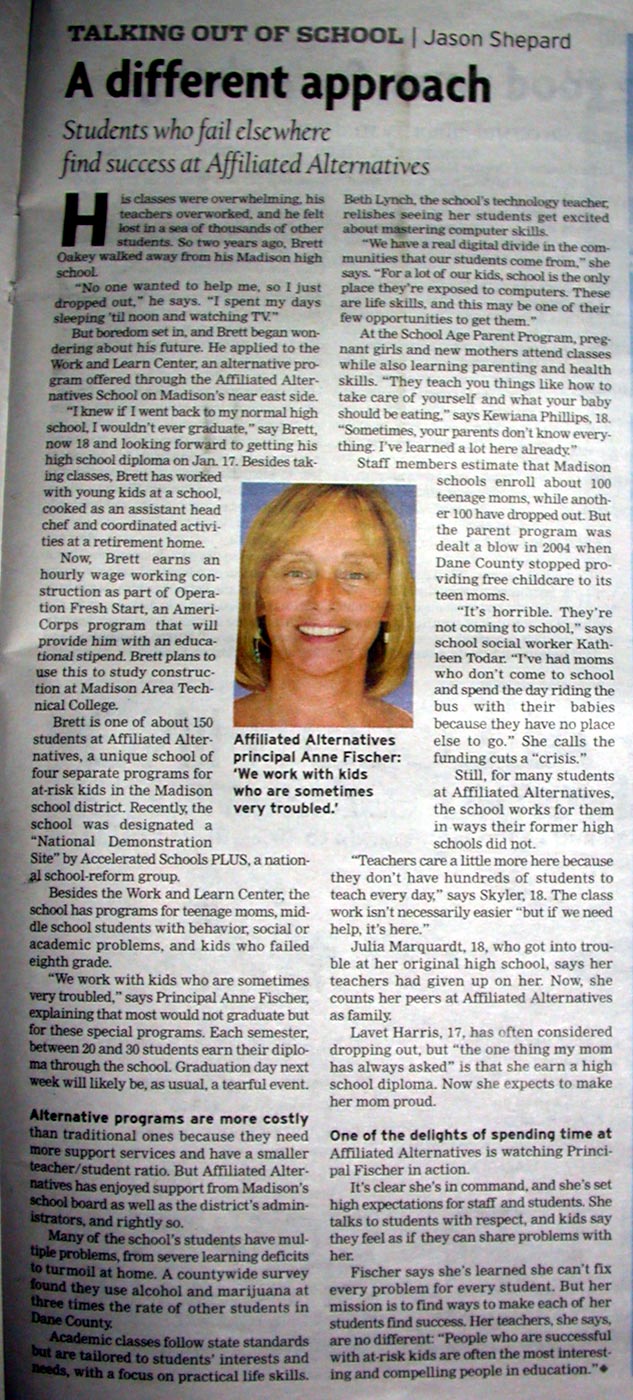
A Different Approach: Affiliated Alternatives

Jason Shepherd recently wrote an article on the Madison School District’s Affiliated Alternatives Program. This differentiated program supports about 150 students:

Many of the school’s students have multiple problems, from severe learning deficits to turmoil at home. A countywide survey found they use alchol and marijuana at three times the rate of other students in Dane County.
Academic classes follow state standards but are tailored to students’ interests and needs, with a focuse on practical life skills.
One of the delights in spending time at Affiliated Alternatives is watching Principal Fischer in action.
It’s clear she’s in command, and she’s set high expectations for staff and students. She talkes to students with respect, and kids say they feel as if they can share problems with her.

View full article.

Sort of related: Carol Carstensen mentioned that the Board’s Performance and Achievement committee, in a somewhat rare meeting, will discuss heterogeneous groupings at 5 p.m. Monday, January 30, 2006. This is apparently the first of several meetings on this topic. West High School’s imminent English 10, one curriculum for all (apparently 40+ sophomore English electives reduced to none) has created no small amount of heterogeneous grouping discussion. I’m glad that a Board committee will soon discuss curriculum, in my view, the District’s #1 priority.

Share

One of these things is not like the others: School Board Oversees Task Forces Except When Savings in Health Care Costs at Stake

Recently, the Madison School Board has authorized a plethora of special committees to consider issues confronting the district and to make recommendations to the board. These committees have the potential to improve future board decisions by bringing new ideas and new information to our attention.
Currently, there is a special committee to advise the board on advertising. There are the two large task forces that recently issued recommendations regarding overcrowding and under-utilization problems in the West, Memorial and East High attendance areas. There is committee of parents, teachers, and administrators to suggest changes in our health and safety policies regarding animals in our classrooms. There is a committee to review whether staff and other resources are allocated equitably to the schools, taking differences in student populations into consideration. There are budget forums intended to seek community input on next year’s budget.
In every case, the board publicly discussed its goals for the committee before launching it. In every case, the board voted on a specific charge to the committee and set procedures and a timeline for meetings. In every case the board has received regular reports on the progress of the committee.
The glaring exception to this process was the creation of a task force of teachers union and district representatives to consider whether changes in health insurance programs for the teachers might make it possible for the district to shift dollars from health insurance payments to wages. Millions of dollars in potential savings are at stake.

(more…)

Share

Student Posting on District Food Policy

I am a member or the MMSD’s Student Senate. I am currently involved in a group discussing a draft of a proposed food policy which I feel is rather Draconian. The draft has not yet been made public (I am told this is because it is a “draft” and thus not ready for release) and that the issues have been publicized. However, I am concerned about some measures of the policy and feel that they have not been highlighted for interested parents. I think some of you might have concerns as well. Here are some of the propositions that my committee has voted against altering as well as what parents were told at the January 17th meeting about the policy
“When beverage vending is available, the only beverages that be offered for sale [not me wording] or permitted in schools at all sites accessible to students will be water, milk, fruit juices composed of 100% fruit juice with no added sweeteners of caffeine, and electrolyte replacement (“sports”) beverages that do not contain caffeine or more than 42 grams of added sweetener per 20 oz serving.”
“No food will be sold to students in vending machines”
This is currently true of all elementary schools and most middle schools, but not the high schools. Vending sales at the four major high schools bring in roughly $15-20 thousand a year for the school (some of a principal’s only discretionary income). Personally, I feel eliminating all sales of soda and snacks seems extreme, especially considering the current financial pressure schools are under. The “cold turkey” elimination of all of these sales starting with the 06-07 school year seems like too much.
“Candy will not be given or sold to students nor offered for sale at school or to the community by the school during the school day. The sale of candy and snacks [this language will be revised to be more specific] is not permitted on school grounds during the school day.”
This would mean that clubs that rely on sales of such items would have to search for new methods. Bake sales would be eliminated. Students would be able to buy a giant cookie in the lunchroom, but not a small one in support of a club.

(more…)

Share

Elimination at Jr. High

My Jr. High student at Jefferson has been informed that there is a good chance his Family and Consumer Education (FCE) and his Technology classes will not be at Jeffferson next year. I have heard ramblings about foreign language being reduced at Jr. High level as well.
This is where I begin to think Public Schools are going to continue to lose students. My son would never choose to take a foreign language or FCE. He is my “jock” and the wonderful cultural and diverse information he is receiving from foreign L.A. and F.C.E are the reason we keep sending our kids to a public school. If the public offerings dwindle to nothing, why would we, a middle to high income family continue to send our children to public schools? If MMSD continues eliminate the diversity and class selection, they can continue to see the decrease in high income students. Money is required to offer these classes, however, if the extra-curricula activities and interesting diverse classes are eliminated, the district will deal with less students, higher numbers of low income students, and the continual decrease of middle and high income students. Many will not see the significance of these numbers, but it is significant as costs rise to educate students that demand more social and psychological needs. The district needs to evaluate the long term effects of eliminating these programs.

Share

Curriculum Policy – Top School Board Priority

Student achievement is a top priority of all school boards. To me student achievement in any subject area results from how well the student is able to learn and to experience what’s being taught. Multitudes of factors effect how well students are able to learn –for example, a students’ personal socioeconomic background and parents’ education, the school environment, teacher training, etc. There is something else that can effect how well each and every child will learn – curriculum.
What is the school board’s responsibility regarding curriculum? In the next few blogs, I’ll be posting some information I’ve gathered and thoughts/questions I have about curriculum policy and school board responsibility. Personally, I feel that developing and overseeing curriculum policy is one of the most important roles of any school board if that board’s top priority is student achievement. What is the MMSD School Board’s curriculum policy?

Share

Candidate Interviews Continue: Seat 1, Arlene Silveira

Video | MP3 Audio

The second candidate interview is now available. Look for an interview with Lucy Mathiak soon (I’ve not heard back from Michael Kelly or Juan Jose Lopez). Maya Cole’s interview is here

Candidate details here

Share

Administrator Contracts – School Board Adds to Agenda

An agenda item has been added to tomorrow night’s School Board meeting – Administrator Contracts. The board meeting begins following a 5 p.m. executive session. Meeting location is in Lincoln Elementary School, 909 Sequoia Trail.
I hope the State of WI legal requirements regarding this class of employee contract is presented. Does MMSD meet / exceed these legal requirements? If so, how?
Questions that are not clear to me include: a) is a two-year rolling contract required for all administrators, b) what is the difference between non-renewal and extension of a contract – is the end of January date really an extension?, c)is there a Board policy – if not, does one need to be developed, d) are there options open to the School Board to hold on one-year contract extensions due to upcoming cuts to the budget, e) how can changes be made by moving/retraining staff if needed, and f) can grant money being used to pay for administrators be used in other ways (not including grant oversight/accounting? We’re in the same spot as the past two years – not talking about administrator contracts until one week or so before a deadline.
I feel this information needs to be clear and to be transparent to all employees, the board and the community. I believe a multi-year staffing strategy as part of a multi-year strategic plan is important to have, especially given the critical nature of the district’s resources. This idea is not proposed as a solution to the public school’s financial situation – not at all, that’s not the point.
The $100 budget process is helping the community learn about the fiscal constraints and is an important first step, but this community exercise does not provide for reallocation of resources or different ways of doing things. A next step could help answer the question – now what? A multi-year strategic plan would provide the opportunity for the community to talk about those next steps, convey their values, etc. What does the community want Madison’s public education to look like in five year (ten years), what do we need to do, and what do we need to do differently.

Share

Citizens swing ax at school budget

A story by Sandy Cullen in the Wisconsin State Journal reports on two groups that tried the $100 budget exercise:

The State Journal asked 10 people to participate in the exercise led by Superintendent Art Rainwater and his assistant superintendent for business services, Roger Price. District administrators will lead additional sessions of the exercise at Madison’s 11 middle schools on Tuesday, Wednesday and Thursday.
“This is not a process to build a budget,” Price said. Rather, the exercise is meant to give residents an opportunity to express their priorities to administrators and School Board members as the district puts together its 2006-07 budget.

Share

Administrator and Teacher Contracts – Timing and Position do Seem to Matter

Teachers sign their contracts for the next year usually in March – however, this is not a guarantee of a job for next year. Teachers can still be surplused or laid off from their jobs. The process for this is governed by their MTI contract.
Surplusing teachers effects the school budget the next school year, so there is an “immediate” effect upon the number of teachers, upon the district’s educational resources available for children’s learning and upon the budget’s bottom line. This is different for MMSD personnel on administrative contracts. Administrative contracts are in most cases two-year rolling contracts, except as stated in the Human Resources (HR) policy , so the financial effect of reducing administrative positions that are filled can take up to 18 months to be reflected in the budget. Wouldn’t this reduce the Board’s decisionmaking authority during the budget process and potentially put an additional burden of budget cuts on teachers, psychologists, social workers, custodians, etc.?
Does this mean that administrative employees on a two-year rolling contract have 18 months to retrain/to apply for an open position in MMSD or to find a new job while still keeping their current job and getting paid if their contract is not extended. WI law governs some of the policy in place, but I don’t know how much of MMSD’s policy is required by state law, and I don’t know if state law requires contracts for all administrative personnel.

(more…)

Share

Science Standards Mediocre, Study Finds

Fordham Foundation criticizes focus on ‘discovery learning.’
More than two-thirds of states have science standards that earn a C grade or worse for their quality, in part because they overemphasize “discovery learning,” the idea that students should be encouraged to acquire knowledge through their own investigation and experimentation, a study issued last week concludes.
Too many of those standards—documents that spell out what students are expected to know—also present science in a sprawling, unorganized way that is short of facts and content, according to the report by the Thomas B. Fordham Foundation.
By Sean Cavanagh, Education Week, December 14, 2005

(more…)

Share

Budget: WPS Presentation to MMSD/MTI Health Insurance Task Force

WPS’s (Wisconsin Physician Service) recent presentation to the MMSD/MTI Health Insurance Task Force. [Text: HTML] [pdf slides]
Share

Thank you, Carol, for posting questions about the future of the Doyle Building

Dear Carol,
You raise several intriquing questions in your recent post on the Doyle Buildin. I look forward to you putting the future use/ownership of the Doyle building on a School Board agenda so that there can be full and public discussion of the costs/benefits, advantages/disadvantages of a full range of proposals from no change to sale. Having read the various memos, I know that I would appreciate a full exploration of factual and verifiable information on what the move would mean.
A meaningful inquiry, with opportunity for respectful dialogue between an informed public – including developers, preservationists, and members of the university community – and an engaged board would go a long way toward vetting the issues related to continued ownership, use as a rental property, or sale.
I am confident that you will post the date when this will be on the board agenda to this and other sites so that we can all stay current with the discussion. Thank you so much for your interest in this intriguing question and for your interest in exploring alternative proposals and new ideas for handling district resources.
Lucy Mathiak

Share

Non-Renewal (or Contract Extension) of MMSD Administrative Contracts is Not About the Value of Administrators’ Roles

Administrators are a vital and integral part of any responsibly operating organization, including MMSD. If I feel that way, why would I would like to see the School Board consider making decisions that would keep options for staff reductions open until later in the budget process? Given that no multi-year strategic, budget or staffing plans are in place, I would like the School Board to discuss what their options are at this time or is the only option moving to one-year contracts for a majority of administrators. I urge the Board to maintain their decision-making flexibility at this time in the annual budget process.
Two years ago, as I was learning more about MMSD’s operations, I came across the end of January date (which is based on WI law, but I don’t know the specifics or how MMSD’s Human Resources applies the policy) to notify administrators of contract extensions for one year or non-renewal (I haven’t found all the definitions). I felt then the school board’s authority to make budgetary decisions was diminished if the passing of this date meant the board was “locked” into multi-year personnel commitments for administrative employees at the start of the budget process.

(more…)

Share

Budget: GHC Presentation to MMSD/MTI Health Insurance Task Force

Group Health Cooperative’s recent presentation to the MMSD/MTI Health Insurance Task Force. [5.1MB PDF]
Share

Wisconsin Alliance for Excellent Schools School-funding update

The Wisconsin Alliance for Excellent Schools (WAES) is a statewide network of educators, school board members, parents, community leaders, and researchers. Its Wisconsin Adequacy Plan — a proposal for school-finance reform — is the result of research into the cost of educating children to meet state proficiency standards.
Quality Counts grades are mixed for Wisconsin
Waukesha looks at cutting $3 million, 32 positions … and more
Racine looking at yet another referendum
School districts prepare for budget cuts
School-funding reform calendar

(more…)

Share

International Baccalaureate program considered for grades K-12

Maricella Miranda writes:
Teachers and administrators want to keep challenging students in the Burnsville-Eagan-Savage school district [MN], but traditional college-prep courses may not be enough.
That’s why the International Baccalaureate program might be introduced into the curriculum districtwide. The program’s rigorous courses demand critical thinking and hands-on learning from students of all ages while focusing on international components for each subject. The IB program is taught in 1,597 schools in 122 countries.
There are three International Baccalaureate programs for grades K-12. They have common components, such as relating subjects and finding connections in local and international communities.
“We want to make sure we have something that gives our students an advantage. We want our students to stay in our district,” Babbitt said. Adding the programs to District 191’s curriculum would cost an estimated $100,000, district administrators said.

Rufus King, Milwaukee WI , known as the Rufus King International Baccalaureate High School is a WI urban, citywide, college preparatory high school that is strongly committed to math, science, technology, and the International Baccalaureate (IB) Program. Well over 1000 students each year now vie for the 350 freshmen seats. Rufus King is consistently in the top 50% of schools in the U.S., and the top 3.5% of schools worldwide in the number of IB examinations given.

Share

Tongue in Cheek Solution

I have noticed a movement about MMSD. There seems to be the following needs:
1. Make each grade/class the same across the district so that all
students have a equitable distribution of funds, resources, and knowledge. (Connected math, FOSS science, middle school curriculm, and West English)
2. Great concern from “legal” I assume that food, animals, and flammable paper present a hazard to the students and potentially invite a lawsuit. (pet proposal, upcoming food proposal to eliminate any homemade food in the school, and the fire code issue)
3. Boundary changes to solve growth and income disparity which causes financial stress on the district. (Task forces, failed referendum, spending cap)
So here’s the solution:

(more…)

Share

Response to “The Gap According to Black”

I think we need to be careful about what we assume when we are talking about students of color in the schools. The children of color in our schools include a growing number of children whose parents, regardless of racial or ethnic identity, are highly educated with degrees ranging from the BA/BS levels to PhD, law, and medical degrees. Many have attended schools or come from communities with high numbers of professionals of African American, Latino/a, Asian American, or American Indian heritage. As our businesses and higher educational institutions hire more diverse professionals, we will see more children of color from middle and upper income families.
Children of color with highly educated parents historically have had trouble getting access to advanced educational opportunities regardless of their academic preparation or ability. And we are seeing a concurrent relocation to private schools, suburbs, and other cities because the parents have every bit as high expectation for their children as any other parents.
We also need to take a look at ALL children – including low income and/or children of color – when we are planning for advanced academic opportunities and placement in our schools. According to an MMSD study a few years ago, a significant portion of our high school drop outs are African American males who tested at the high end of the scale at the elementary level.

MMSD Withdrawal/Did Not Graduate Student Data
(1995 – 1999)


When the District analyzed dropout data for this five year period, they identified four student profiles. One of these groups, it could be argued, would have benefited from appropriately challenging learning opportunities, opportunities which might have kept them engaged in school and enabled them to graduate.

Group 1: High Achiever, Short Tenure, Behaved

This group comprises 27% of all dropouts during this five-year period.
Characteristics of this group:
• Grade 5 math scores 84.2 percentile
• Male 55%
• Low income 53%
• Minority 42%
• African American 31%
• Hispanic 6%
• Asian 5%
Group 1 dropouts (expressed as the % of total dropouts for that school)


High School
East 25.9%
La Follette 23.8%
Memorial 23.4%
West 32.4%

We all – including the Madison School Board – need to ask whether we are doing enough to identify and provide opportunities for gifted and talented youth among children of color or children from low income backgrounds. Then we need to create sufficient classes and class space to allow ALL children who are capable of succeeding access to the highest level of classes possible. Creating false shortages for advanced academics helps no one, from individual students to entire schools.
Many of our schools now enroll populations that are 40% – 60% students of color. To have advanced classses with only a few – if any – students drawn from this potential talent pool, defies the statistical odds for the population. We can change this if, as a school community, we have the will to do so and the courage to talk openly about our priorities, practices, and assumptions.
Share

School Information System Blog Open to All Perspectives

In a recent comment, a person asked if you had to be unhappy with MMSD to write on the blog. Short answer – no. Jim Zellmer, who began this blog, encourages folks with all different thoughts, ideas and opinions about MMSD and education to write and/or make comments on the blog. I would like to encourage those who are interested in writing about what they think and what their ideas, hopes and dreams are for public education will contact Jim (zellmer at virtualproperties_dot_com) to learn more about becoming a SIS blogger. Diverse perspectives have the potential to enrich and deepen the discussions, which I feel will benefit our community.

Share

Very disappointing start for MTI-MMSD health insurance task force

On Wednesday, January 11, representatives of Madison Teachers, Inc. (MTI) and the Madison school district met at the union’s headquarters for three hours. MTI Executive Director John Matthews chaired the meeting. It was the first of two meetings at which MTI and MMSD will supposedly explore the potential for savings on health insurance costs for the teachers. Those expecting a serious effort by union and district representatives to compare costs and services from a range of health insurance providers and press the companies for savings will be seriously disappointed.
There were two presentations at the meeting: one from representatives of Wisconsin Physicians Services (WPS) and one from Group Health Cooperative (GHC). Despite a promise from the board president and superintendent that the meeting would be videotaped, the district did not tape the meeting. So far only the text for the WPS presentation (with accompanying PowerPoint) is available for public review.
At the meeting on January 25, 2006—also at MTI’s headquarters at 821 Williamson Street beginning at 1 p.m.—the task force will hear presentations from representatives of Dean Care and Unity. There has been no explanation of why there will not be presentations from Physicians Plus or the State Group Health Plan. Both offer services comparable to those that teachers currently receive under the collective bargaining agreement between the parties at competitive rates.

(more…)

Share

Charter Schools And Healthful Foods

Share

Will the MMSD School Board Majority Appear to Let Administrators Preserve Jobs – Their Own?

A 2006 budget staffing discussion to come before the School Board tonight is about changes to administrative positions for next school year outlined in a memo to the School Board from the Superintendent. (Download memo on administrative changes for 2006-2007). The Superintendent is intending to save money through the elimination of several positions via resignations or retirements. I don’t remember seeing a dollar figure in the memo. However, I don’t feel this is an adequate administrative staffing reduction proposal at this time in the budget process.
What’s the big deal? If there are no other reductions made to the administrative budget prior to the end of this month, no additional reductions in administrative positions can be made due to requirements in the administrators’ contracts. This means that any and all other necessary reductions in staffing positions will have to come from those personnel who most likely work directly with students – teachers, SEAs, etc. I’m not proposing staffing cuts, but the School Board will be facing budget cuts this spring for next year.
To prevent this, the School Board might consider a minimum of a 20%+ reduction (vs. the proposed less than 5% reduction) in the administrative contract budget. Why? Later in the budget process, the School Board will be faced with cuts to custodians, teachers, etc. I believe the School Board could consider taking this action now to enable them to have the ability to make the best decisions on behalf of students when they have better information about what additional cuts will be proposed.
Last spring Lawrie Kobza made the following comment: “For the most part, our budget cuts are not based upon whether we are overstaffed in a particular area. I don’t feel that we cut teachers, or social workers, or custodians because we felt that we were overstaffed in those areas. We didn’t compare the District to benchmarks from other districts on custodial staffing levels to determine appropriate staffing levels for the District. We cut custodians because we had a budget that we had to meet.”

(more…)

Share

Burmaster allocates $1.25 million for high-cost special education aid

Elizabeth Burmaster, State of WI Superintendent recently informed school districts that she is setting aside federal Individuals with Disabilities Education Act (IDEA) discretionary funding to reimburse Wisconsin schools for services to children with severe disabilities.
“I am again allocating federal discretionary dollars, a total of $1.25 million, to support my Keeping the Promise: High-Cost Special Education Aid program,” Burmaster said.
“It is our long-held belief that all children are entitled to a quality education. However, some of our students have severe or multiple disabilities that require very specialized equipment and services that can cost three or more times the average expense of educating a student. This aid will help our schools pay for services for these children.”
School districts have until February 24 to make claims for costs incurred in the 2004-05 school year. Reimbursement will be made in June. As in past years, the Department of Public Instruction expects that the number and amount of eligible claims will require that reimbursement be prorated.

I wonder how much MMSD received last year – how were the reimbursed funds allocated? What decision(s) did the Board make? Did the reimbursed funds stay in the Special Education Fund or were they reallocated to other areas in the budget. As clarification, I’m not talking about the funds from DPI but the funds they are reimbursing. I also know that special education was cut last year as were other areas in the budget.

Share

Of McDonalds and K-12 Schools

From an email I received recently:
——————–
McDonald’s has competition everywhere… globally. It is exceptional when it comes to standardization of product and services – they even have Hamburger U. Yet I have been to McDonald’s in suburbia and McDonald’s in rural America and McDonald’s in poor urban areas. They are not equal. And it isn’t just a case of McDonalds.. the same is true for Burger King and any other fast food chain that has corporate inspections and standards.
For instance, the Burger King, KFC, and McDonald’s near my urban church each suffer from the same problems – they are dirtier and have poorer service than those same stores in the suburban area I live in… there is no McDonald’s Playland in the urban Cleveland or Akron McDonald’s I know but there are loads of them out in my suburban area. Competition doesn’t seem to be helping those who live in the poor urban area gain the same experience those in suburbia get… even with restaurants that possess strong standards and assessments.
I think this says something about the theory that competition would be good for our schools and would equalize the playing field for kids in urban, rural, and suburban schools. It doesn’t seem to be working for McDonald’s.
Sue
Sue Ramlo, PhD
Professor of General Technology
Department of Engineering & Science Technology
The University of Akron
Akron, OH 44325-6104
sramlo@uakron.edu
330-972-7057

Share

A Nation at Risk: Obesity in the United States

American Heart Association:

The report is that nearly one sixth of young people between the ages of 2-19 are said to be overweight. While this is alarming, it is perhaps even more important to appreciate that the 16% overweight rate represents the nationwide average. Local rates vary widely depending on gender, race, socioeconomic status, educational background, and probably more, as yet, undetermined factors.
Among Mexican Americans ages 6-19, nearly one in four boys, and one in five girls are overweight. Over one fifth of African American females ages 6-19 are overweight. Combining these figures with those at risk for being overweight, we learn that excessive weight threatens the health of between a third and a half of children in these groups. And, the situation continues to worsen.

Share

Program & staffing changes in my $100 budget exercise

$1.74 – Move all employees in Curriculum Research and Staff Development into classroom teaching and school administrative positions that will be vacated through normal attrition.
$0.40 – Replace Reading Recovery with Read 180
$0.15 – Move Associated Alternatives to Doyle. (Plenty of room with Curriculum Research & Staff Development leaving. Use UW facilities for gym. Use various large conference rooms for lunch.)
$?.?? – Move MSCR to Doyle. Mothball Hoyt subject to further review of best use or sale.
$0.043 – Eliminate one administrative position in superintendent’s office.
$0.043 – Eliminate Legislative Liaison position; rely on lobbyists of Wisconsin School Board Association.
$0.043 – Eliminate Director, Public Information.
$0.243 – Eliminate 9 positions in Gateways to Learning
$0.043 – Eliminate 1 position in research
$0.043 – Eliminate 1 position in Human Resources
Total reduction $2.791 or $7,256,600, without eliminating a single classroom teacher.

Share

Singapore Education Minister Compares Singapore and America Schools

Newsweek International Edition columnist Fareed Zakaria interviewed Singapore Minister of Education Tharman Shanmugaratnam to understand why he believes Singapore students score tops in math and science on international tests, but lacks leaders in business, academia, math and science in the professional world.
Shanmugaratnam’s sees driving ambition, creativity, and adventuresomeness as lacking in Singapore students — characteristics that are not measured in global testing. He says, “Most of all, America has a culture of learning that challenges conventional wisdom, even if it means challenging authority. ”
Funding and academic-private partnerships are another factor in U.S. favor, he says. Foundations are critical for funding research in the U.S. “For example, you could not imagine American advances in biomedical sciences without the Howard Hughes Foundation,” says Shanmugaratnam.
But Shanmugaratnam is not all praise for U.S. education system. “[It] as a whole has failed. Unless you are comfortably middle class or richer,” he explained, “you get an education that is truly second-rate by any standards…. In Singapore we get the poor kid who is very bright and very hungry, and that’s crucial to our success.”

Share

Questions about using the Doyle Building

Since there have been different ideas about using Doyle to solve some of the district’s space/funds problems, I thought I would list the questions that occur to me as I consider next steps.
1.Locate the Affliated Alternatives (at Brearly) in Doyle:
a. How much space will AA need?
b. What will be the cost of remodeling to accommodate students?
c. What about cafeteria and gym space?
d. Where would we move the staff that must leave Doyle to make room for the students?
e. What is the cost of the move and of remodeling the new space?
2.Sell or lease Doyle
a. Where would central office staff be located?
b. What is the cost of the move?
c. What is the cost of remodeling the new space?
d. What are the out-of-pocket costs (travel, time, etc) of locating Doyle staff in more than one location?
e. What is a realistic expectation of the money generated by a long-term lease?
f. What is a realistic expectation about the amount Doyle would bring if sold?
g. If there is development potential, why haven’t there been proposals for the district/UW parking lots behind Doyle?

Share

Urban League Honors Outstanding Students

Nine local high school students were inducted into the National Achievers Society at Sunday’s 22nd annual Youth Recognition Breakfast. The society was started by the National Urban League and other civic groups to promote positive attitudes about academic achievement, school participation, and a committment to exceeding expectations. The inducted students include Tyrone Cratic of East, Ricquelle Badger of Edgewood, Chukwuma Offor of La Follette, Heena Ahmed of McFarland, Latoya Allen of Memorial, April Greene of Sun Prairie, Tessia Brown of Verona, Rob Hetzel of Waunakee, and Diana Savage of West. In addition, Halil Ahmed and Shamika Kroger from Memorial and La’Basha McKinney of East were named Mann Scholars, a program that honors the legacy of Bernard and Kathlyn Mann, African-American parents whose five children graduated from Madison schools and went on to receive college degrees. Outstanding Young Person Awards were also presented to over 170 middle and high school students from around Dane county. Congratulations to these exemplary students.

Share

Madison school puzzle at crossroads

Sandy Cullen writes:
For nearly two years, a wide range of school officials and parents have puzzled over what to do about the lopsided enrollment trends. In the next few weeks, the emotionally charged issue will come to a head as two task forces offer their ideas to the Madison School Board.
A next step might include representatives from both task forces working with the school board, because these representatives bring to the table the two very different perspectives of these task forces, which the School Board will have to meld into one plan. Both task forces have worked thoughtfully and diligently, and representatives of these task forces would bring that experience to help with next steps.
As a community, we need to make this work for all kids fairly with consideration of their education needs and the financial resources available.

Share

What happens to Hoyt?

If the MSCR were to be moved from Hoyt, how would Hoyt be used?

Share

MTI School Board Candidate Questions / Answers

Two Madison School Board Candidates have published their answers to Madison Teachers, Inc. 2006 School Board Election Questionnaire:

I’ll post links to the other candidate’s responses if and when I receive them here and on the election page.

Share

Task Force Insight

Dear Board,
While serving as a member on the Long Range Planning Committee for the West/Memorial Task Force I came to a few insights I would like to share.
Our charge was to seek solutions for the over-crowded schools in Memorial and Leopold attendance area as well as address the low income disparity throughout the area.

  • Overcrowding in Memorial – with current data and projected growth to be over 100% capacity in 5 of the elementary schools I believe the only solution to this problem is a new school. With the purchase of the far west land the board must believe this as well. This should be the number one priority of the growth solution for MMSD. There is space at Toki/Orchard Ridge and a few seats at Muir for this attendance area and additions could be made to Falk, or an update and expansion of Orchard Ridge/Toki could be made, but otherwise there is no room without changing programmatically.
  • Leopold overcrowding is much more complicated, as you know. This huge expansive slice of Madison and the entire city of Fitchburg attendance area has somehow become one elementary school. I do not support an addition to this school for many of the same reasons I did not like two schools on the same land. It is lots of seats in one part of town and you create problems for the future. If Shorewood or Crestwood had 1000 seats we would be busing kids from Fitchburg to that school because that’s where the space is. An addition without a new school means a principal, staff and others at this school are functioning like the other 4 – 5 hundred space schools but with double the students, is that fair to the staff of that school? Would you want to be the principal of 800 – 900 students? I would rather have a school in Fitchburg or south of the Beltline off of 14 to help Leopold and the Allis attendance area that currently is sent to the other side of Monona.
    There is space at Midvale/Lincoln, Randall, Shorewood,and there is 110 seats at Hamilton, 94 seats at Wright, and 118 seats at Cherokee. And of course the strange building of Hoyt that must have ghost or something since no one wants to touch it. There is space in West. The move of Leopold to Chavez is wrong minded since it shifts the West area problem to the overcrowded Memorial area.
    The Elephant in the Room throughout the entire Task Force was Midvale/Lincoln and the perceived lack of quality at that school. There is 75 seats at Lincoln and 62 seats at Midvale this year and each time the suggestion was made to shift students from Leopold to M/L it was met with distaste, (except for two apartment buildings of 30 students) as the memo from the Swan Creek neighborhood (see attachment) was an example. That memo, while it outraged me, is a glaring example why we can’t solve Leopold overcrowding (see memo [pdf] from Midvale Parent Jerry Eykholt to the Swan Creek Parents). On the task force Leopold was sent to Chavez, Randall/Franklin, Thoreau over and under M/L, but somehow those 137 seats at M/L seemed too far away. I think the district is failing Midvale/Lincoln.

(more…)

Share

Forum on moving alternative programs to O’Keefe

O’Keeffe and Lapham/Marquette PTGs will host a forum on the Affiliated Alternative Programs at 6:45 p.m. in the all purpose room on Wednesday, January 18. A flyer on the meeting lists the following purposes for the forum:

* Provide an opportunity for O’Keeffe, Lapham/Marquette school community members to ask questions about the proposal to place the Affiliated Alternative Program at the O’Keeffe/Marquette site AND to have an open community forum among ourselves after the Q&A
* Steve Hartley, Director of Alternative Programs, will be presenting information on the Affiliated Alternative Program and its space needs.
* Loren Rathert, Chairman for the East Area Task Force, will answer questions regarding the task force process.

Share

The seven stupid arguments for cutting gifted education

Michael F. Shaughnessy recently interviewed Frances R. Spielhagen about Gifted Ed in the new millennium. Dr. Spielhagen has engaged in both funded and non-funded education research and policy analysis. As an Eleanor Roosevelt Fellow in 1991-1992, she explored perspectives of achievement among gifted females, ages 9-26. She continues her work on acceleration policies in mathematics, working in collaboration with Dr. Joyce Van Tassel-Baska, of the Center for Gifted Education at the College of William and Mary, in Williamsburg, Virginia. Dr. Spielhagen has recently spoken out against cuts in gifted education, and has identified “seven stupid arguments” that are offered as explanations for cutting gifted education.
# 1: All children are gifted
#2: It is not fair to offer special services for gifted students.
#3: Gifted students learn on their own.
#4: Gifted programs are elitist.
#5: Gifted programs are racist.
#6: Gifted children are weird.
#7: Why bother? Gifted students pass the state tests.
You can read the entire interview at EducationNews.Org.

Share

Speaking up about Dr. Martin Luther King Jr. & King Events in Madison

The Madison Times (now owned by former school board member, Ray Allen) recently asked various members of the Madison community to comment on the life and legacy of Dr. Martin Luther King, Jr. I was honored to do so. These comments can be seen in this weeks issue. I’m also including dates and times of Dr. King events in the City. I hope you and your family are able to attend some of these events.

(more…)

Share

20/20 Program – Stupid in America: How We Cheat Our Kids

American students fizzle in international comparisons, placing 18th in reading, 22nd in science and 28th in math – behind countries like Poland, Australia and Korea. But why? Are American kids less intelligent? John Stossel looks at the ways the U.S. public education system cheats students out of a quality education in “Stupid in America: How We Cheat Our Kids,” airing this Friday at 9 p.m CST on ABC.

Share

Candidate Forum

Madison United for Academic Excellence will be hosting a Candidates Forum this coming Tuesday, January 17, 2006 to be held at 7:00 p.m. in Room 209 of the Doyle Administration Building.
Come dialogue with the candidates for the Madison School Board about curriculum, academic excellence and related issues. Voice your concerns. Share you views.
You are invited and encouraged to submit questions to the candidates before the forum. Please email them at:

Candidates for Seat 1

Candidates for Seat 2

Our you can send your questions to madison_united@yahoo.com, and we will pass them along to the candidates.
We hope that you can join us on Tuesday night.

Share

Madison a National Leader in Special Education

“Inclusive education” is often mischaracterized as solely about educating students with disabilities in the “least restrictive environment.” Fortunately, inclusive education now means providing a supportive and quality education for all students. It is in this spirit that I want to speak to the accomplishments of our staff in making Madison one of the most inclusive, progressive urban school systems in the country.

(more…)

Share

Rationale for Removing School Closings from Consideration

Message from the East Attendance Area Task Force regarding rationale for Removing School Closings from Consideration. It reflects contributions from several Task Force members. This is another reason to be impressed by the hardwork of both the East and West/Memorial Task Forces.

(more…)

Share

The Issue Of Mascots

This is a message from Janice Rice of the Native American Council of Madison on the Communities United list serve. This message is pertinent given some of the changes that State Superintendent Libby Burmaster is proposing regarding state high schools and nicknames.

(more…)

Share

Clarification of plans for 9th and 10th grade science at West HS

If you were at the West HS PTSO meeting last night (report to be posted soon for anyone who was unable to attend — the topic was an update on the SLC initiative by SLC Coordiator Heather Lott), then you know that the question of what 9th and 10th grade science will look like next year and thereafter was left somewhat unanswered. I had the following clarifying email exchange with West HS Principal Ed Holmes today:

(more…)

Share

First election mailing from Juan Lopez

I received a mailing from Juan Lopez today, and his message struck me as sharply negative toward his opponent and anyone else who makes suggestions about how to improve the district. Here are a few excerpts:

We do not lack for nay-sayers and pessimists who say that the sky is falling and dismiss our accomplishments. . . . We do not lack for special interests during this period of fiscal austerity. . . .
Already my opponents are crafting narrow, negative issues to try to focus the campaign on a few trees while ignoring the beauty of the forest. . . .
I will be vocal during the upcoming campaign in order to counter the distrotions and pessisism that may be put forward during this election. . . .


I respectfully urge Juan to take the high road throughout the rest of the campaign.
Truth in advertising: I’ll be voting for Lucy Mathiak.

Share

Eat and Help Memorial Language Students Experience China

CHINESE NEW YEAR’S DINNER
Sunday, January 22, 5:00 PM, Peking Palace
Dinner provided by Peking Palace & other local restaurants – $10 !

(more…)

Share

“They’re all rich, white kids and they’ll do just fine” — NOT!

Two of the most popular — and most insidious — myths about academically gifted kids is that “they’re all rich, white kids” and that, no matter what they experience in school, “they’ll do just fine.” Even in our own district, however, the hard data do not support those assertions.
When the District analyzed dropout data for the five-year period between 1995 and 1999, they identified four student profiles. Of interest for the present purpose is the group identified as high achieving. Here are the data from the MMSD Research and Evaluation Report from May, 2000:
Group 1: High Achiever, Short Tenure, Behaved
This group comprises 27% of all dropouts during this five-year period.
Characteristics of this group:

  • Grade 5 math scores – 84.2 percentile
  • Male – 55%
  • Low income – 53%
  • Minority – 42%
  • African American – 31%
  • Hispanic – 6%
  • Asian – 5%

(more…)

Share

Help Create a Public Charter School of Arts and Technology – in Madison

Are you interested in helping to create a public charter school of arts and technology in Madison?
You’re invited to attend a planning meeting of local parents, educators and others at:
Date: January 18 ( Wednesday )
Time: 6:00 – 8:00 pm
Site: MADISON Library – Sequoya Branch
513 South Midvalle Blvd. [map]
Please help to make THE STUDIO SCHOOL a reality within the public school district.

(more…)

Share

MMSD $100 Community Budget Process – Information Available

Information about MMSD’s Community $100 Budget Process is now available. Community members will have the opportunity to participate in this process on one of three nights (January 24, 25, 26) at one of 11 locations (MMSD middle schools) around Madison.
Through this process, community members will have the opportunity to share their priorities for cutting the budget with the School Board. At each meeting there will be a presentation followed by community input.
The goals of this process are: 1) generate community priorities to use in the formal budget process, 2) provide opportunities for individuals to express budget priorities, 3) demonstrate difficulty in making $6-10 million in cuts, 4) improve understanding of educational implications of budget reductions and 5) develop awareness of size and complexity of operating budget.
Every MMSD resident is invited to participate, but each is limited to participating one time. Length of the sessions will be between 1 hour 20 minutes and 1 hour 45 minutes.

Share

Wisconsin Scores “F” on State Science Standards (Redux)

In my Dec 12, 2005 entry, I described the 2005 Fordham Institute report giving Wisconsin an “F” on its State Science Standards. As I mentioned, then, having a quality state standard is not synonomous with quality implementation. The Fordham report also included comments by the evaluators, disparaging the pedagogical approaches taken by schools.
To make the issue of Standards vs. Implementation more concrete, here is a year 2000 report by Dr. Gerald Bracey comparing Fordham’s prior report with the NAEP and other tests.
His analysis showed that the states scoring highest in the Fordham study ranked at the low end of the scale on NAEP and the international TIMSS study, while the states that the Fordham study ranked “irresponsible” occupied 7 of the top 10 on NAEP-TIMSS.
I briefly reviewed the latest published NAEP Science report (2000) for a similar comparison. The Fordham “A” states of California, New Mexico, and South Carolina scored significantly below the National average; the “A” states of Indiana and New York scored average; and only the “A” states of Massachusetts and Vermont scored as above average. (Wisconsin was not included in the report).
So, now I ask, as I asked and suggested in a previous comment, where is the data and reliable information to make informed decisions? or even to have an informed opinion?

Share

Board of Education Meetings and Agendas, week of January 9

NOTES:
This version includes the address/location of the joint insurance committee meeting on Wednesday.
Also, note that the agenda for the Board-Common Council Liaison meeting on Wed. night is of interest to the two attendance area task forces that are due to report in this month.
_____________________
WEDNESDAY, JANUARY 11, 2006
1:00 p.m. Madison Metropolitan School District/Madison Teachers Inc.
Joint Insurance Committee
1. Call to Order
2. Options regarding Health Insurance Benefits for Certain Madison School District Employees
3. Adjournment
Madison Teachers Inc.
Large Conference Room
821 Williamson Street
Madison, WI 53703
—————————————————————————
6:30 p.m. Special Meeting of the Madison School Board and the Memorial
and West Attendance Areas Demographics and Long Range Facility Needs Task
Force
Doyle Administration Bldg
Room 103
545 W. Dayton St.
Madison, WI 53703
—————————————————————————
7:00 p.m. Common Council/Board of Education Liaison Committee
1. Approval of Minutes dated November 16, 2005
2. Public Appearances
3. Announcements
There are no announcements.
4. New Developments/Growth in the City of Madison and Implications for
Madison Schools
5. Housing Patterns Impact on Student Enrollments in Madison Schools
6. Madison Schools with Declining Enrollments
7. Other Business
There is no other business.
8. Adjournment
Doyle Administration Bldg
McDaniels Auditorium
545 W. Dayton St.
Madison, WI 53703

Share

The Two Faces of Advance Placement Courses

Tamar Lewin writes in the New York Times January 8, 2006, about Advance Placement Classes – students and parents believe AP classes are important preparation for college, colleges have mixed feelings about students who take AP classes.
“We’ve been put off for quite a while about the idea of teaching to the test, which is what a lot of A.P.’s are,” says Lynn Krahling, guidance director of the Queen Anne’s School in Upper Marlboro, Md. “We’re convinced, as an educational institution, that they’re not as valuable as what we could be offering on our own.
“But,” she says, “I think we’re going to stick with A.P.’s – purely out of fear. Parents are so terrified that if we drop our A.P.’s it would really affect college admissions that I think some of them would jump ship.”

(more…)

Share

Carstensen’s “attempt to answer” MMSD Budget Mystery #4: Mumbo Gumbo in the Kitchen

Let me attempt to answer your questions [about Mumbo Gumbo in the Kitchen].
First, remember that the budget is an estimate made in April/May of what will be needed in the next school year. Several determinants of the budget are not known until the fall – most importantly, the number of students.

(more…)

Share

Governor Supports Higher Math and Science Graduation Requirements

Preview of Doyle’s State of the State speech from The Wheeler Report, 1/6/06
DOYLE ENDORSES HIGHER MATH, SCIENCE GRADUATION REQUIREMENTS
MERRILL, WI — Gov. Doyle last night endorsed higher math and science requirements for high school graduation during a town hall meeting set up to preview his January 17 State of the State Message to the Legislature.
Doyle focused on education, health care and environmental proposals during the session. “I want to make sure every kid in Wisconsin gets a quality education,” he said, pointing to his vetoes in the current budget to restore twothirds funding for public schools. He said three years of science and three years of math should be required in Wisconsin high schools.

(more…)

Share

Senator’s bill targets government waste

From today’s Capital Times:
By Anita Weier
January 4, 2006
Fraud, waste and mismanagement in state government are the targets of a bill authored by state Sen. Julie Lassa. The bill would create a toll-free telephone line in the Legislative Audit Bureau to receive reports of questionable activities.

(more…)

Share

MMSD Budget Mystery #4 (Disappearing Library Aids) Prompts Changes

After schoolinfosystem.org reported on inconsistencies in the MMSD’s library aids budgeting and possibly poor management of the funds (also called Common School Funds), the MMSD changed budget and accounting practices in October.
In a communication to MMSD School Library Media Specialists, the MMSD’s library coordinator Mark Lea wrote on October 24, 2005:
“On Wednesday, the Superintendent, Art Rainwater informed the building principals of the steps that the District needed to take to satisfy the requirements of the 2004-05 disbursement of the Common School Fund (CSF). In late April of 2005, the District received $675,055 in categorical aid to compensate us for the purchase of school materials purchased during the 2004-205 school year. In 2004-05, the District expended @$382,000 (sic) school library materials, so we were about $293,000 short of fulfilling our obligation for receipt of the categorical aid. Because we did not spend as much as we received in categorical aid, we are required to expend an additional $293,000 this year, or return the difference to DPI.”

(more…)

Share

State Superintendent’s PK-16 Institute on Service-Learning and Citizenship

The 2006 State Superintendent’s PK-16 Institute on Service-Learning and Citizenship, in conjunction with the Dialogues with Democracy Conference, will be held February 2, 2006 at the Marriott West in Madison. Julie Rodriguez Chavez, granddaughter of late civil rights and farm labor leader, Cesar Chavez, will deliver the keynote presentation.

(more…)

Share

We All Have a Lot to Learn

Fareed Zakaria:

This small event says a lot about global competition. Traveling around Asia for most of the past month, I have been struck by the relentless focus on education. It makes sense. Many of these countries have no natural resources, other than their people; making them smarter is the only path for development. China, as always, appears to be moving fastest.
But one thing puzzles me about these oft-made comparisons. I talked to Tharman Shanmugaratnam to understand it better. He’s the minister of Education of Singapore, the country that is No. 1 in the global science and math rankings for schoolchildren. I asked the minister how to explain the fact that even though Singapore’s students do so brilliantly on these tests, when you look at these same students 10 or 20 years later, few of them are worldbeaters anymore. Singapore has few truly top-ranked scientists, entrepreneurs, inventors, business executives or academics.

Share

Greatest classroom catastrophe in 50 years

The Daily Telegraph reports on the collapse of the most accepted and widely used reading methodology in England and the United States:

The abandonment by teachers of the traditional method of teaching reading, known as phonics, precipitated the greatest educational catastrophe of the past 50 years.
Their steadfast refusal to re-introduce the method, in the face of overwhelming evidence of sharply falling reading standards, represents the greatest educational betrayal of the past 20 years, reducing the life chances of an estimated four million children.
Yesterday’s carefully worded but withering report by Jim Rose (176K PDF), a former chief inspector, accepted instantly and in its entirety by Ruth Kelly, the Education Secretary, should finally draw a line under this shocking example of the profession’s capacity for collective pig-headedness and self-delusion.


Jim Zellmer previously posted a BBC story on the report by Rose.

Share

More than a Comment: Gifted Education and Equity

(What follows started out as a comment in response to the 12/27 entry and 1/3 comment on gifted education and equity, but has grown to entry status.)
Here is another relevant link — http://www.nagc.org/index.aspx?id=538. It’s to a page on the National Association for Gifted Children (NAGC) website. The page is entitled “Why We Should Advocate for Gifted and Talented Students.”
I think it’s important, when speaking about these issues, to know where the education money is going. It’s really quite sobering to learn the truth and should put anyone who feels guilty about advocating for the needs of really bright, academically advanced kids at ease. Remember, the bright kids who suffer the most as a result of the lack of dollars and appropriate curriculum — the ones whose potential remains untapped and undeveloped — are the ones whose parents cannot provide for them when the schools fail to. In addition, as learning continues to be watered down, more and more students will need additional challenge beyond what they receive in the regular classroom — if they are to thrive, that is, rather than just get by. Of course, much of what we are dealing with these days is less a matter of money than it is a matter of attitude.
By the way, in case you didn’t know, gifted programming is mandated in the state of Wisconsin — http://dpi.wi.gov/cal/gifted.html. It’s just not funded (until this year, when fewer than $200,000 were included in the budget for a new gifted and talented consultant at DPI and some AP and middle school programming). Not only that, but for well over a decade there hasn’t been a g/t consultant on the staff of DPI (see last sentence — that will be changing in February). That means no one to oversee the delivery of services to the 51,000 gifted students in Wisconsin and no one to monitor districts’ compliance with the state statutes.
What about the MMSD? Well, the MMSD has been out of compliance with Wisconsin state statutes for gifted education since 1990. (Yes, 1990. That’s not a typo.) It’s “Talented and Gifted Program Plan” was written in 1991. I’m trying to get it posted on the District website.
Anyway, here is the excerpt from the NAGC website:

(more…)

Share

Unsolved MMSD Budget Mystery #5: Mumbo Gumbo in the Kitchen

To cut through the fog, intrepid investigators, the so far unsolved mystery boils down to three questions:
1. Why did the MMSD Food Service budget increase by $246,599 or 3.5% this year compared to the previous year?
2. Why did the MMSD add 10 new food service workers, when the school population (and presumably the number of meals) is in decline?
3. Why did the budget document claim to reduce staffing by “by approximately 2%” when staffing actually increased by 10.9%?

Share

Article from 12/25 Wisconsin State Journal on Successul Job Placement of Student with Disabilities

Here are links to the Wisconsin State Journal article on Dan Spooner that I mentioned in my December 29 post. This portrays just one of a number of students in MMSD who make very successful transitions into adulthood and jobs, thanks to strong cooperatiive efforts between the school district and local employers, with support from Dane County.
These are links to the main story and the sidebar:
http://www.madison.com/archives/read.php?ref=wsj:2005:12:25:539027:FRONT
http://www.madison.com/archives/read.php?ref=wsj:2005:12:25:539026:FRONT

Share

New York City’s Big Donors Find New Cause: Public Schools

David M. Herszenhorn writes:
In the context of the system’s regular budget of about $15 billion a year, $311 million might seem insignificant. But the tax dollars come with so many strings that the administration has viewed private money as crucial for research and development and an array of experimental programs.

“You are able to do it without saying this is money that is going to come out of the classroom,” Mr. Klein said in an interview.
So far, the mayor’s and the chancellor’s collections include more than $117 million to start new small schools; nearly $70 million to open an academy for principal training; $41 million for the nonprofit center supporting charter schools; $11.5 million to renovate libraries; $8.3 million to refurbish playgrounds; and $5.7 million to reshape troubled high schools.


New money or old, donors have been enthusiastic enough to write seven- and eight-figure checks. As a result, the school system has been the largest beneficiary in a mayoralty that has reached to the private sector, strategically and aggressively, for all sorts of support.
Donors to the schools, many of whom have been attending black-tie benefits together for years, said the mayor and the chancellor have transformed the way the school system relates to gift-givers, by improving communication and creating a sense of professionalism.
“I come from the business world; I’m used to a world where there is freedom and accountability and that never seemed to exist in the world of public education,” Mr. Reich said.
“The very notion of a dynamic entrepreneur is that they want to make something happen,” he continued, sipping from a demitasse of espresso served by an aide in chef’s whites. “They want to be part of a movement. As mayor he believes in the ideal of these public-private partnerships.”
After becoming chancellor in 2002, Mr. Klein created an Office of Strategic Partnerships and imposed on his wife’s college friend, Caroline Kennedy, to serve as its chief executive. Mr. Klein made the pitch while visiting Ms. Kennedy and her husband, Edwin A. Schlossberg, on Martha’s Vineyard.

Share

Healthy Children, Healthy Planet

For a couple of years now, with the support of Madison Community Foundation, Sustain Dane, a local non-profit organization, has been organizing and facilitating community discussion groups. “Healthy Children, Healthy Planet” is the newest program and is just being launched.
The “Healthy Children, Healthy Planet” is a seven session program designed to create awareness, heighten motivation and support parents, families or anyone who is concerned about the lives of children, and help them understand the pressures and offer antidotes to creating healthy environments for children.

(more…)

Share

Public Not Welcome at MMSD Talks about Future Health Insurance Costs

Last August, MMSD parent KJ Jakobson asked “whether the new joint district-union task force for investigating health insurance costs be a truly collaborative effort to solve a very costly problem? Or will it instead end up being a collusion to maintain the status quo?” Collaboration or collusion: What should the public expect from MMSD-MTI Task Force on Health Insurance Costs?
Her question remains an important one. If the task force of representatives of the school district and Madison Teachers , Inc. identifies future cost savings from changes in health insurance providers, the district could save million of dollars per year after 2007. Although the savings would go to higher wages for teachers during the 2005-07 collective bargaining agreement, there would be possible savings for the district budget in future years. The district now pays about $37 M per year for health insurance for its employees.
Unfortunately, the history of the task force to date suggests that Ms. Jakobson’s fears were well-grounded.

(more…)

Share

In Middle Class, Signs of Anxiety on School Efforts

The NYTimes examines middle-class unease with changes to curriculum and admission requirements to TAG programs:

“Randi Weingarten, the president of the teachers’ union, faulted the administration for using a “Robin Hood” approach. “You have to simultaneously work to help your struggling students in particular schools and keep your middle class – you have to do both these things at the same time,” she said.
“When you do one at the expense of the other, you get the rebellion and revolt you see in District 3,” she said, referring to the Upper West Side, where some parents have complained that their children were suddenly being shut out of admission to top public school programs.
Part of the sense of grievance in the middle class comes from how much energy those parents typically pour into searching for schools and then, once their children are accepted, into working to support the schools. They organize libraries. They donate toilet paper and crayons and cash. And when there’s not enough, they raise funds for more.”

Share

Why is the MMSD Afraid to Have a General Discussion of Their Mathematics Program?

A year ago the Jefferson PTO planned to have a mathematics night, with a discussion of their math program. I was asked if I would appear and said yes. The Madison Metropolitan School District was asked and they refused to send anyone, saying that they did not want to do this school by school. but district wide. When Mary Ramberg was asked when this would be done, she said they had no plans to do this.
Here is part of the report from 1882 from the State Superintendent about textbooks. At this time changes in textbooks had to be approved by the State Superintendent. The following should be done:

  • 3d. That regard shall be had to the merits of the books, and that if the change is sought to be made in the interests of better books, the superior merits of the books proposed to be introduced shall be stated.
  • 4th. That the change shall not be against the pronounced public opinion of the locality interested.

Why is the MMSD afraid to have a general discussion of their mathematics program?

Share

Pretty Good

A poem by Charles Osgood of CBS News quoted in There Are No Shortcuts, by Rafe Equith
Pretty Good
There once was a pretty good student,
Who sat in a pretty good class;
Who was taught by a pretty good teacher,
Who always let pretty good pass–
He wasn’t terrific at reading,
He wasn’t a whizbang at math;
But for him education was leading
Straight down a pretty good path.
He didn’t find school too exciting,
But he wanted to do pretty well;
And he did have some trouble with writing,
And no one had taught him to spell.
When doing arithmetic problems,
Pretty good was regarded as fine–
5 plus 5 needn’t always add up to be 10
A pretty good answer was 9.
The pretty good class that he sat in
Was part of a pretty good school;
And the student was not the exception,
On the contrary, he was the rule.
The pretty good student, in fact, was
Part of a pretty good mob;
And the first time he knew that he lacked was
When he looked for a pretty good job.
It was then, when he sought a position,
He discovered that life could be tough–
And he soon had a sneaking suspicion,
And he soon might not be good enough.
The pretty good town in our story
Was part of a pretty good state,
Which had pretty good aspirations,
And prayed for a pretty good fate.
There once as a pretty good nation,
Pretty proud of the greatness it had,
Which learned much to late, if you want to be great,
Pretty good is, in fact, pretty bad.

Share

West HS students speek/speak out on English 10

Here are two stories from the December 23, 2005, issue of the West HS student newspaper, The Regent Review. I reprint them here just as they appear in print (that is, with all misspellings, grammatical errors, etc.). (Note: the faculty advisor for The Regent Review is West HS English teacher Mark Nepper. Mr. Nepper has been involved in the development of English 10. Some of you may recall that Mr. Nepper joined English Department chair Keesia Hyzer in presenting the plans for English 10 at the November 7 West PTSO meeting.)
From the front page: “A new English 10 expected for next year,” by CI, a senior at West HS and co-editor of the student newspaper:

In an attempt to bridge the minority gap and continue with the smaller learning communities, Madison West High will tentativly be changing to a core English for all sophomores.
Ed Holmes, current West High principal, says he is doing his best to continue our tradition as a “School of Excellence.” To achieve this ideal excellence, Holmes recognizes that he not only has to raise the standards of the struggling students but also continue to push accelerated students to be better each day.
The goal is to have this new English ciriculum continue to push West’s excellence. The cirriculum will incorporate the current classes of FWW, IWW, With Justice for All, Writers in their Time, and Modern Literture. Now students will read and learn writing habits at the same time so that they can incorporate the new techniques that they are learning into the papers that they write.

(more…)

Share