School Information System

To Voting Madison Citizens

I didn’t vote for the Leopold referendum last spring, and I still believe that was the correct vote. If the community had voted to build a second school on Leopold then we would not have the opportunity for the community to vote “Yes” on this referendum, which I believe is a better financial and long term solution for our growth. When I was asked to participate on the Westside Long Range Planning Task Force, I was determined to find a better solution for our district than building another school.
I approached this job with study and concentration, as did many of the Task Force participants. In my effort to not build a new school I looked at shifting students East, shifting South, moving 5th graders to middle school, and moving neighborhoods to other schools and in the end I found it was more than just filling seats. The shifts made equity uneven. One shift created a school with less than 5 % low income while others were closer to 70%. Other shifts still left some schools too full because the seats were not where the growth is coming from. Some shifts worked but only for two years. After many hours of discussion and shifting, it became clear that we could shift students if we wanted to; split neighborhoods, shift them again in two years, create schools of inequity, provide 100’s of students with a bus ride of 45 minutes or more each way, and change our classroom quality so that teachers no longer had classrooms but carts that they moved from room to room (Art and Music Teachers). When we thought about those options, none of us wanted it for our own children or grandchildren and we believed that for $30 a year, others in the community would prefer that their children and grandchildren not be handed one of these options either. There are other options, but none with the long term solutions that the current referendum provides.

(more…)

Share

Maybe Math isn’t Supposed to be Fun: Just Cutting to the Chase is a Better Approach

Ben Feller:

Children who are turned off by math often say they don’t enjoy it, they aren’t good at it and they see little point in it. Who knew that could be a formula for success?
The nations with the best scores have the least happy, least confident math students, says a study by the Brookings Institution’s Brown Center on Education Policy.
Countries reporting higher levels of enjoyment and confidence among math students don’t do as well in the subject, the study suggests. The results for the United States hover around the middle of the pack, both in terms of enjoyment and in test scores.
In essence, happiness is overrated, says study author Tom Loveless.”We might want to focus on the math that kids are learning and just be a little less obsessed with the fact that they have to enjoy every minute of it,” said Loveless, who directs the Brown center and serves on a presidential advisory panel on math.
“The implication is not Let’s go make kids unhappy,'” he said. “It’s Let’s give kids better signals as to how they’re performing, relative to the rest of the world.'”
Other countries do better than the United States because they seem to expect more from students, he said. That could also explain why high performers in other nations express less confidence and enjoyment in math.

Share

Facts & Questions about the 2006 Madison School District Referendum

Questions:

What is the anticipated cost of equipping the Leopold addition and the elementary school at Linden Park? Are those projected costs included in the referendum authorization or not?
What is the anticipated cost of operating the Leopold addition and the elementary school at Linden Park? How will those costs be appropriated/budgeted (and in what years?) given that the Board expects to have to cut $6-8 million per year?
What are the “shared revenue” total costs for each of three parts of the referendum question? Are these costs included in the $29.20 estimated cost for a median assessed home-owner? Please provide the ‘working papers’ or calculations arriving at these costs. How can a home-owner figure the annual cost of this referendum for the assessed value of their home?
What information about the Ridgewood complex and projected enrollment was used to calculate the need for the Leopold addition?
Construction has already begun for the Leopold addition without voter/taxpayer approval. What is the current impact on the operations budget? What would be the future impact on the operations budget if the referendum fails?

(more…)

Share

If Chartering is the Answer, What was the Question?

Ted Kolderie and Joe Graba, charter school leaders at Education/Evolving urge legislators to expand Wisconsin’s charter school law:

“The Importance of Innovation in Chartering”
Remarks to the Legislative Study Committee on Charter Schools
By Ted Kolderie and Joe Graba, Education/Evolving
October 17, 2006
TED KOLDERIE
Let me try to set the context for the Legislature’s use of the chartering strategy. The ‘Why?’ of anything is important to legislators. It is fair to ask: “If ‘chartering’ is the answer, what was the question?”
The question is: How do we make schooling different enough to motivate the kids who have never learned well in conventional school?
Paul Houston, the head of AASA, has been pointing out how dramatically the signals have been switched for public education. Forever, their charge was access and equity: take everybody; give everybody the opportunity to participate and to learn. Now suddenly the charge is proficiency: The districts are required to see that all children learn.
This is a huge change. The current model of schooling was not built for this. The districts were not built for this. Success with this very different assignment requires major readjustment in the institution.

(more…)

Share

Reading First: The Lie of Robert Sweet of Errors and Misconceptions in Washtington Post

Trying to find the truth in education, like in most areas in American society, is fraught with dilemma — most public commentors are either incompetent or bald-faced liars.

Robert W. Sweet, Jr. likely falls into both categories.

See previous posts of regarding his comments on this site, and his letter to the Washington Post here. Robert Sweet’s title is Former Professional Staff Member Committee on Education and the Workforce, U.S. House of Representatives Committee Staffer for the Reading First law.

First, let’s place all this into context. The Inspector General’s Reading First report (hereafter IGRF), published September 2006, audited the Reading First Grant Application Process and reported problems. Michael Grunwald of the Washington Post wrote an article about the IGRF Report, and Robert Sweet responded to the Grunwald article in a letter to the Washington Post editor. The crux of the Sweet letter was to allege, point-by-point, each significant error made the Grunwald in his article interpreting the IGRF findings.

I’m not going to review either Grunwald’s article nor Sweet’s response point-by-point, and I have not read or studied the IGRF fully, so I’m not prepared to do so. To prove Robert Sweet a liar will only require comparing one, his first, claim of “error” he’s alleged with the actual language of the IGRF.

Here is Sweet’s first alleged error by Grunwald.

1. Grunwald: “The Reading First panels that oversaw state applications were stacked with department officials and other phonics fans.”
Correction: Department officials were not on panels that judged state applications.

Sweet’s comment shows his art of misdirection — his “correction” does not refute Grunwald’s interpretation. It’s true that Department officials were not on the panels, but as the IGRF details, quoted below, it was the Department officials who actually judged the applications from the States’ perspective.
Let’s read the actual language of the IGRF report, at length (with minimal editting).

(more…)

Share

East & West locked down on Monday

From madison.com:

Madison school officials locked down East High School this morning after “serious” threats were made by one student to another.
The school’s safety procedures call for the doors, which were secured at 11 a.m., to remain locked until the end of the school day at 3:30 p.m. Students were not to be released until that time.
The threat was made to one student who was at the school by another who was off school grounds.
“The danger is outside the school, not inside,” said school district spokesman Ken Syke. “That’s why we went into lockdown.”
Officials said the threats stemmed from fights between East High students over the weekend, with the disputes remaining unresolved today.
Syke said rumors circulating among students that someone was spotted with a gun are simply “not true.”
But he added, “It was a legitimate enough notice that we have taken it seriously.”
Also at West High School this morning, pellet gun shots were reportedly fired from a vehicle passing the school. The shots were reported by a witness who heard the shots and saw the vehicle.
Police had the alleged perpetrator in custody by 1 p.m. District security coordinator Luis Yudice, West High administrators, central office staff and Madison police worked together to initiate the district’s safety and security procedures to respond to the situation at West, which included limiting access to the school until early this afternoon.

Share

More concern about technology in MMSD: another teacher explains the problem

Recently, I posted a letter from a middle school teacher in Madison regarding inadequate computers at one of our middle schools. Fancy programs on aging computers:an MMSD teacher tries to make things work
Today the Madison school board received another letter from a teacher explaining how the current state of computers and software makes teaching harder and more stressful. While this is a typical complaint from the schools, I don’t see the same problems with central administration computers.
Dear Board Members and Mr. Rainwater,
I have been a teacher for MMSD for fifteen years. I am committed to and love this district and its students. I work at …. This is a wonderful building in which to work. The staff is solid, caring, and professional.
….
A second concern in our building is technology. I love the new attendance system and am currently using the grading program on infinite campus which I also enjoy. Unfortunately, our computers are slow and often freeze up. Quite often, I have to call my attendance into the office because it takes 10-15 minutes for the computer to load. We have little access to adequate computers as a staff. It makes it difficult to be able to keep grades in a timely manner. Six of us in 8th grade have to share one antiquated computer for our planning area. My guess is that most other professionals in this city would not even think of working with such inadequate technology.

(more…)

Share

A New School on Madison’s Far West Side: A Long Term Perspective

On November 7, Madison area residents will be asked to vote on a referendum concerning our local schools. While the referendum has three parts, this paper will focus on the first part – the construction of a new school on the far west side, representing over 75% of the total cost of the referendum.

This report will argue that the most important determinant of whether or not a new school should be built on the far west side (or anywhere else in the district), is whether the long-term outlook clearly indicates it is appropriate. Otherwise, the problem should be considered temporary, with temporary measures pursued to address it. However, the situation here suggests strongly that the problem is a more permanent one, requiring a “permanent solution”, the building of a new school.

This report will not attempt to forecast specific enrollment figures for the Madison Metropolitan School District (MMSD) – such an effort would take several months to do properly. Instead, it will focus on the TRENDS that support the conclusion a new school is warranted.

(more…)

Share

Changing our high schools

by Superintendent Art Rainwater
The purpose of high school is to ensure that all of our students leave ready for college, jobs and civic involvement. Our traditional, comprehensive high schools today look and feel much like they have for generations. However, the world our students will live and work in has changed dramatically.
The structure of high schools has served society well by preparing young people for the world they were entering. There were good, family supporting jobs that didn’t require a high school diploma. The type of classroom teaching strategies that were employed worked well for the post high school plans of our students.
It is becoming increasingly clear however, that not only four year colleges, but also any post secondary education or job training program requires a substantial background in mathematics, science, social studies and language arts.
We need to dramatically change our high schools. This is not a reflection of current high school teachers or their teaching methods. It is a reflection of a changing society. The needed reforms at high school have to be concentrated on making a high level of demanding coursework accessible to all students. To accomplish this goal requires that we change the way we relate to students and that we implement a wide variety of teaching strategies in every class.
The education world has not been oblivious to this need for change. There have been many efforts, across the country, to change high schools, including in our own district. However, high school reform has rarely addressed the underlying problem — the high school classroom.
To meet the needs of every student, the student, not the content of the course, must be at the center of our work. It’s obvious that the content is critical, for that is what will prepare students for adult success. But first, everything from our teaching methods to the way we inculcate positive behaviors must begin with the student and not the textbook. We have to use our knowledge of how children learn to create classroom strategies that connect with students’ own experiences and relate what we want them to learn to its use in the real world.
Regardless of how our high schools look there must always be three goals for our students: ensure that every student gains the knowledge and skills to be a successful adult, provide the opportunity for every student to grow academically and socially, and to learn to be an active participant in the society in which they live.
To reach these three goals we must continue to foster high academic achievement; we must close the achievement gap among different groups of students and we must promote civic and personal growth among our students.
We are beginning the journey of redesigning our high schools. This will take creativity, commitment and our best thinking. It will take all of us, collectively, having the will to find the way so that a diploma from our high schools can provide a ticket to the future for all of our students.

Share

Conference on High School Task Force recommendations

The State Superintendent will host a conference on October 20 on the recommendations of the High School Task Force, which she appointed:

A: Encourage educators and policymakers to move outside of existing structures and pursue innovation.
B: Give students the opportunity to engage in rigorous, authentic learning experiences that are relevant to their learning needs and future ambitions.
C: Create smaller, personalized learning environments and require learning and lifelong education plans for individual students.
D: Promote and enhance partnerships among schools, parents, businesses, and communities, linking community resources with school programs and curriculum
.

Link to a PDF of the conference brochure.

Share

Indiana School District Deploys District-Wide Wireless Network

Government Technology:

New Castle School District of New Castle, Indiana, is deploying the Meru Networks Wireless LAN System across its district to enable its more than 4,000 students and 500 staff and faculty to access a broad range of wireless voice and data applications. When completed, the wireless deployment will span New Castle’s seven elementary schools, a middle school, high school and vocational school, the district’s administration building and its technology center.
With a wireless LAN and several mobile computer labs, New Castle could allow entire classrooms to use computing resources efficiently and cost-effectively. In addition, the district wanted a solution that could be used for both data and voice over IP, allowing staff to keep in touch as they move about the school’s campus during the workday.

Share

Tests & Results: New York State Elementary & Middle Mathematics

New York State Education Department:

Share

Teaching Math, Singapore Style

The countries that outperform the United States in math and science education have some things in common. They set national priorities for what public school children should learn and when. They also spend a lot of energy ensuring that every school has a high-quality curriculum that is harnessed to clearly articulated national goals. This country, by contrast, has a wildly uneven system of standards and tests that varies from place to place. We are also notoriously susceptible to educational fads.
Editorial, New York Times, September 18, 2006

(more…)

Share

Report Urges Changes in the Teaching of Math in U.S. Schools

In a major shift from its influential recommendations 17 years ago, the National Council of Teachers of Mathematics yesterday issued a report urging that math teaching in kindergarten through eighth grade focus on a few basic skills.
If the report, ”Curriculum Focal Points,” has anywhere near the impact of the council’s 1989 report, it could signal a profound change in the teaching of math in American schools. It could also help end the math curriculum struggles that for the last two decades have set progressive educators and their liberal supporters against conservatives and many mathematicians.
Article by Tamar Lewin, New York Times, September 13, 2006

(more…)

Share

Fancy programs on aging computers: an MMSD teacher tries to make things work

From time to time, I wonder whether MMSD’s central administration decisions take into account the needs of staff in our schools. Here’s a recent letter to the school board from a middle school teacher discussing the poor fit between software and hardware at the school.
“I came in very early this morning to run new student summaries for several of my kids who had decided to make up missing work in order to raise their grades. I think we would all agree that this is a good thing.
I spent 15 minutes trying to get my computer to print one student’s summary. The computer kept locking up on me and I would have to cold boot it. Actually, this is not my computer; it is the only computer in the planning area shared by 6 eighth grade teachers. It runs Windows 98.

(more…)

Share

Falling need for West side school?

Do current housing declines wipe out the need for a new West side school? Here’s an article from The Capital Times (Oct. 9, 2006):

Home building keeps plunging here
The decline in home building in Dane County this year accelerated in September, remaining the weakest this century, according to the latest figures from MTD Marketing.
There were just 73 permits issued for single-family homes and duplexes here in September, less than half the 195 last September, and at least 68 below every September back to 1999, the earliest year MTD reported figures.
The September permits did set a record average value for the month at $242,836. The average square footage was 2,410, third highest since 1999.
Year-to-date through September, there were 1,116 permits in Dane County, 711 below a year ago and at least 332 below every year back to 1999. The average value for the first nine months of the year did set a record at $246,660. The average square footage of 2,449 was behind only the 2,469 in 2004.

Share

School Improvement Rubrics

School Improvements, desired by all of us, need financial resources, but primarily, the need is for a quality strategic and measureable plans and goals. Ed Blume has posted a few such rubrics from Victoria Bernhardt. He has not received much input on these worthy rubrics. See.
That was certainly my experience also, as I posted a full Excel spreadsheet of Bernhardt’s rubrics on this site back in August 21, 2005.
I will continue with three more school improvement rubrics from Bernhardt: Continuous Improvement, Information and Analysis, and Student Achievement.
Bernhardt’s rubrics allows one to subjectively rate each of these measures on Approach, Implementation and Outcome on a scale of 1 to 5.
The above three rubrics add to this important list. These rubrics are based on measuring individual schools, and so those with more intimate knowledge of a particular school will be better able to evaluate these rubrics, but using these rubrics to evaluate the District would also be useful. I think finding such raters, at the school level, will be nigh impossible because what I perceive to be the very closed nature of the school administration at MMSD as a whole.
To start the exercise, look at Continuous Improvement.
Level ONE

Approach: Neither goals nor strategies exist for the evaluation and continuous improvement of the school organization or for elements of the school organization.
Implementation: With no overall plan for evaluation and continuous improvement, strategies are changed by individual teachers and administrators only when something sparks the need to improve. Reactive decisions and activities are a daily mode of operation.
Outcome: Individuals struggle with system failure. Finger pointing and blaming others for failure occurs. The effectiveness of strategies is not known. Mistakes are repeated.

Level TWO:

Approach: The approach to continuous improvement and evaluation is problems solving. If there are no problems, or if solutions can be made quickly, there is no need for improvement or analyses. Changes in part of the system are not coordinated with all other parts.
Implementation: Isolated changes are made in some areas of the school organization in response to problem incidents. Changes are not preceded by comprehensive analyses, such as an understanding of the root causes of problems. The effectiveness of the elements of the school organization, or changes made to the elements, is not known.
Outcome: Problems are solved only temporarily and few positive changes results. Additionally, unintended and undesirable consequences often appear in other parts of the system. Many aspects of the school are incongruent, keeping the school from reaching its vision.

Level THREE:

Approach: Some elements of the school organization are evaluated for effectiveness. Some elements are improved on the basis of the evaluation findings.
Implementation: Elements of the school organization are improved on the basis of comprehensive analyses of root causes of problems, client perceptions, and operational effectiveness of processes.
Outcome: Evidence of effective improvement strategies is observable. Positive changes are made and maintained due to comprehensive analyses and evaluation.

Level Four:

Approach: All elements of the school’s operations are evaluated for improvement and to ensure congruence of the elements with respect to the confirmation of students’ learning experience.
Implementation: Continuous improvement analyses of student achievement and instructional strategies are rigorously reinforced within each classroom and across learning levels to develop a comprehensive learning continuum for students and to prevent student failure.
Outcome: Teachers become astute at assessing and in predicting the impact of their instructional strategies on individual student achievement. Sustainable improvements in student achievement are evident at all grade levels, due to continuous improvement.

Level FIVE:

Approach: All aspects of the school organization are rigorously evaluated and improved on a continuous basis. Students, and the maintenance of a comprehensive learning continuum for students, become the focus of all aspects of the school improvement process.
Implementation: Comprehensive continuous improvement becomes the way of doing business at the school. Teachers continuously improve the appropriateness and effectiveness of instructional strategies based on student feedback and performance. All aspects of the school organization are improved to support teachers’ efforts.
Outcome: The school becomes a congruent and effective learning organization. Only instruction and assessment strategies that produce quality student achievement are used. A true continuum of learning results for all students.

*****
Now, on this one measure called Continuous Improvement, how would you rate the Board of Education, MMSD, and one or more individual schools that you are familiar with?

Share

If I were superintendent

If I were the superintendent of the MMSD, I’d set the following as my highest management priorities:
1. Move the MMSD administration out of Stage 1 and toward Stage 5 on leadership and partnerships;
2. Focus on the MMSD’s core mission: education. That might mean finding other agencies to provide MSCR functions and summer food programs, for example;
3. Design and implement a budget system that allows for assessment and control of operational and curriculum expenditures by the board;
4. Innovate for achievement, beginning by initiating pilot projects staring with curriculum and charter schools and partnerships with other educational institutions to give MMSD students a wider range of academic choices.
Hopefully, others will post thoughts on what their priorities might be as superintendent.

Share

Containing MMSD’s employee health insurance costs: what’s next?

In June of 2006, the Madison School Board identified containment of employee health insurance costs as a major goal for its Human Resources Committee for 2006-07. On September 25, the HR committee began to study current health insurance costs, projections of future increases in these costs and the implications of failing to slow the expected increases. At the September meeting, Bob Butler, an experienced negotiator and consultant from the Wisconsin Association of School Boards, presented the facts. 9/25/2006 Health Insurance Presentation
When the HR committee meets again on October 30, I will ask the committee to follow up on key recommendations in the Butler presentation. I will propose two things: a public education campaign and a public process for exploring alternatives. The public education campaign would explain in detail why it is in the best interests of the employees and the district to contain health insurance costs. The public process for exploring alternatives would involve inviting representatives of our employees to engage in a joint and public exploration of changes in plan designs, insurance providers, wellness programs and other options.

Share

A Recipe to Fix School Funding

Andy Hall
Wisconsin State Journal
October 4, 2006
On a moonlit autumn evening, talk turned Tuesday to a “perfect storm” that might actually help Wisconsin fix its school-funding mess.
“Everything is coming together in an election year,” Thomas Beebe, outreach specialist for the nonprofit Institute for Wisconsin’s Future, told 17 Madison School District parents and activists who gathered at the Warner Park Community Recreation Center to discuss why Wisconsin schools always seem to be running out of money, and what to do about it.
The Institute for Wisconsin’s Future helped establish the Wisconsin Alliance for Excellent Schools, a coalition of 122 organizations and school districts, including Madison’s, focusing on school-finance reform.
Beebe, a former official at the state Department of Public Instruction, who served on the Fort Atkinson School Board, said prospects are brighter now than any time in the past decade because increasing numbers of the state’s 425 public school districts are reporting serious financial problems because of state revenue limits imposed since 1993.
In addition, Beebe said, a state task force headed by UW-Madison researcher Allan Odden soon will recommend major changes in how Wisconsin pays for its schools, and a bipartisan Wisconsin Legislative Council panel is exploring school financing for the first time in a decade.
A top goal, Beebe said, would be to radically shift Wisconsin’s philosophy. The education budget would be based on what’s needed to adequately educate all children, including those with special needs, rather than forcing schools to make do with whatever amount of money is available through a formula.
But to make the storm happen, Beebe said, the public will need to push political candidates and public officials into taking stands – including support of controversial proposals to boost school funding by raising the sales tax, eliminating some sales tax exemptions, raising corporate income taxes, and other means.
“I think Tom is exactly right,” Barbara Arnold, a former Madison School Board president who two years ago served on a governor-appointed task force on education reform, said after the session sponsored by the East Attendance Area PTO Coalition.
Matt Calvert, a parent of a Lapham Elementary first- grader and a Marquette Elementary third-grader, said he’s pleased with the schools and their teachers, but he’s troubled by discussions of reducing a music program and increasing class sizes.
“It’s getting to the point now that it’s pinching,” Calvert said.
Madison School Board member Carol Carstensen agreed that prospects for reform are brightening, but she also warned that big changes will require sacrifice.
“There’s no real solution without additional funds,” she said.

Share

Comment on Early Repairs in Foundation for Reading

The post by Ruth Robarts includes the following:

The panel also will recommend some shifts in teaching techniques, said a panel member, Dr. Susan Landry of the University of Texas Medical School at Houston. These include having at-risk children spend more time in small groups that address their specific weaknesses; emphasizing skills like blending sounds (C + AT = CAT), which have been found to be good performance predictors; and training parents to reinforce school lessons.


To be able to blend C+AT, a student must first have a command of phonemic awareness, i.e., the ability to hear three sounds. To be able to read (and therefore blend) C+AT, the student must have a command of sound-symbol correspondence, i.e., the child must know what sounds the letters make when pronoucing C, A, and T.
This is true of absolutely every child, regardless of their so-called learning style.
Effective reading programs (like direct instruction curricula) make absolutley and systematically certain that students possess phonemic awareness and sound-symbol correspondence.
Less effective reading programs (like Reading Recovery and balanced literacy) leave the student to discover or construct phonemic awareness and sound symbol correspondence hapazardly on their own.
Unfortunately, children who struggle to read do not easily (and sometimes never) make these discoveries on their own. Even those who learn to read easily benefit from instruction that builds mastery of phonemic awareness and sound-symbol correspondence.

Share

Early Repairs in Foundation for Reading

ALLENTOWN, Pa. — Children with severe reading problems usually struggle for years before getting the help they need. But a growing number of neurologists and educators say that with the latest diagnostic tests, children at high risk for these problems can be identified in preschool and treated before they ever begin to read.
The newer tests, available in computerized versions, measure a child’s fluency with the skills that are the foundation of reading: the ability to recognize differences between sounds, the knowledge of letters and the accumulation of basic vocabulary and language skills. The National Early Literacy Panel, a committee of experts convened by a consortium of federal agencies, has found that these tests, when given to 3- and 4-year-olds, predict later reading problems as effectively as they do when they are given to kindergartners and first graders, said the panel’s chairman, Dr. Timothy Shanahan of the University of Illinois in Chicago. The committee plans to recommend increased preschool screening when it publishes its findings later this year.
The panel also will recommend some shifts in teaching techniques, said a panel member, Dr. Susan Landry of the University of Texas Medical School at Houston. These include having at-risk children spend more time in small groups that address their specific weaknesses; emphasizing skills like blending sounds (C + AT = CAT), which have been found to be good performance predictors; and training parents to reinforce school lessons.
The point is to identify and attack the problems early, when they are easiest to correct.
“Once a child falls behind, it’s very difficult to catch up,” said Dr. Angela Fawcett of the University of Sheffield in England.
Article from New York Times by By JOHN O’NEIL, published: October 4, 2006

(more…)

Share

Wisconsin Association of School Boards Governor’s Q&A

Too busy to continue the farewell and the urge to share information remains. This is from the October School News a publication of the WASB. Linked here.
Excerpt:

SN: Gov. Doyle, in the 2005-07 state budget, you provided more than $700 million for K-12 schools and restored two-thirds funding in the second year of the biennium. Will school funding again be your priority in the 2007-09 state budget? Will you propose restoring the state’s two-thirds funding commitment?
Doyle: Education is my top priority.
As governor, I have consistently
fought to ensure that our schools have the resources they need to maintain the high quality of instruction and services that Wisconsin
parents and taxpayers expect.
While I have fought to increase resources to make Wisconsin’s high-quality schools even better, I have also been helping to protect our schools from repeated Republican attacks to cut school funding. In the 2003-05 biennial budget, I vetoed Republican efforts to cut $400 million from our schools, and, again, in the 2005-07 budget, I vetoed Republican efforts to cut $330 million. These cuts would have put thousands of teachers out of work, forced the elimination of arts and foreign language classes, increased class sizes and put our children’s education at risk. The Wisconsin Association of School Boards released a study that showed the Republican budget proposal could have meant the elimination of more than 4,700 teacher positions.
Just as it was in this past budget, school funding will continue to be a top priority of mine in the 2007-09 biennial budget. As part of this commitment,
I will again propose funding two-thirds of the cost of local schools in the 2007-09 biennial budget.
SN: Rep. Green, at the State Education
Convention in January, you stated that you are opposed to the restoration of the state’s two-thirds funding commitment for schools.
At what level should the state fund public K-12 schools?

Green: I believe that a strong education
system is critical to the future of our state. Without a solid educational
foundation, we are disadvantaging
our students as compared to students from neighboring states.
While education will always be my top spending priority, given our current fiscal climate, I think it would be irresponsible for me as a candidate to be our state’s chief executive to say I would arbitrarily commit to a $500 million spending increase. I believe our state needs to commit to K-12 education an amount that begins to meet the mutual goals established for our K-12 public schools by the citizens of Wisconsin, the governor’s office and the state Legislature. For some years that may, in fact, be two-thirds funding, but in others, it may be more or it may be less. In either case, I will increase funding for education — it is just a matter of how much.
I cannot, in good conscience, make a promise I am not 100 percent certain I could keep. Jim Doyle promised as a candidate in 2002 to fund two-thirds. However, less than two months after being in office, he broke that promise.
If there is one thing I know about our state it is that there is no shortage of good ideas. My door would always be open to you to make certain we are meeting the needs of our students.

Share

Two at Memorial get national kudos …

From The Capital Times (Weekend of September 30 – October 1, 2006):
Two Madison Memorial students are among 1600 African American high school seniors being honored for their academic excellence by the National Achievement Scholarship Program.
Michael McKenzie and Jarrell Skinner-Roy are designated semifinalists in the 43rd annual awards competition, which makes them eligible to compete for about 800 scholarship awards worth a total of about $2.5 million.
The National Achievement program is conducted by the National Merit Scholarship Corporation and was initiated in 1964 to honor academically promising black youths.
Congratulations, Michael and Jarell!

Share

Tuesday October 3d Forum on School Funding — Warner Park

Another thing more important than my farewell.
TJM
On Tuesday, October 3rd, a Wisconsin Alliance for Excellent Schools (WAES) forum on school funding will be held at the Warner Park Community Center from 6:30 – 8:00. This event is sponsored by the East Attendance Area PTO Coalition. A flyer of the event is available.

Share

MMSD to get continuous improvement grants

According to a media release from DPI, the MMSD will receive $135,000 in continuous improvement grants:
District School Improvement Grant $80,000
Alliance for Attendance Grant $20,000
Early Literacy Grant $35,000
I haven’t seen any comment from the MMSD.
Read the release here.

Share

GOP likes (and will keep) school spending caps

Some people believe that the Wisconsin Legislature just doesn’t understand how revenue caps affect Wisconsin schools.
I’m sorry to say, legislators know very well how caps control spending and they’re happy about it.
“In GOP Plays Politics With Property Taxes,” The Capital Times’ Matt Pommer wrote in December 2004:

Republicans sought to recapture the anti-tax banner by imposing tougher spending limits on school districts than the current revenue controls. The unionized teachers had supported Doyle, and toughening the already-in-place spending limits seemed like a nifty political move. Doyle vetoed the tougher spending limits.

(more…)

Share

I oppose Constructivist Teaching Practices

As you know, I oppose constructivist teaching practices and favor a more traditional instructivist approach. But there is another way too. I’ll call it “de-structivism”
A good example here.
BTW, I’ve managed to get the new school cell phone policy training video. It’s about time.
Video here.

Share

Press release: MMSD Information sessions about Nov. 7 referendum

The Madison School District will hold four referendum information sessions in advance of the November 7 referendum. The public is invited to attend any of these sessions.
Thurs. October 12 6:30 PM Sennett School 502 Pflaum Rd. 53716 Lecture lab
Tues. October 17 6:30 PM Cherokee School 4301 Cherokee Dr. 53711 LMC
Wed. October 18 6:30 PM Sherman School 1610 Ruskin St. 53704 Cafeteria
Wed. October 25 6:30 PM Jefferson School 101 S. Gammon Rd. 53717 Lecture hall

(more…)

Share

9/25/2006 Health Insurance Presentation

On September 25, the Human Resources Committee of the Madison School Board heard a presentation from Robert Butler, a negotiations consultant from the Wisconsin Association of School Boards, about the ever-increasing costs for employee health insurance for school districts. Mr. Butler also recommended steps for the district to take in the future. The committee meets again on Monday, October 30. Board members on the committee are Lawrie Kobza and Shwaw Vang. I am the chair.
Butler’s presentation [269K PDF].

Share

MMSD Referendum Info

The attached document is copied from Vicki McKenna’s web site. Her comments are accurate from the conversations she and I have had and information she has reviewed. There still is a lot more critical information, questions and concerns about the referendum that needs exploration, analysis and ‘airing.’
Here is what I think is some significant additional data:
The District continues to refuse to tell the public (taxpayers) about the TRUE costs of the referendum. The District is only telling us to consider a $23.1 million referendum without telling us the FULL tax burden that includes the approximate 60% (Sixty) additional cost to taxpayers to satisfy the State Equalization (negative aids) obligation. That $23.1 million actually becomes an estimated $37.67 million. The three parts to the referendum question break out as follows:

  1. Linden Park Elementary: Basic of $17.7 million, plus 60% or $10.6 million equals $28.3 million total actual tax burden
  2. Leopold Elementary School Addition: Basic of $2.76 million, plus 60% or $1.65 million equals $4.41 million total actual tax burden
  3. Debt Refinance: Basic of $3.1 million, plus 60% or $1.86 million equals $4.96 million total actual tax burden

Items 2 and 3 are, in effect (back door approach), a referendum to raise the revenue cap by releasing over $800,000 per year from debt obligations in the operations budget to spend in whatever ways the Board of Education chooses. The Board has done no planning as to if, let alone how, this money will be spent on priorities for classroom, instruction and programs and services toward directly affecting student achievement.
I encourage you to share your insights, questions and suggestions.
An Active Citizens for Education (ACE) meeting is scheduled for Thursday, October 5, 7:00 pm, Oakwood Village West. More details to follow. McKenna’s website.

Share

MMSD at Stage 1 in partnerships

As with leadership, Stage 1 on the five-stage chart best describes the MMSD’s partnership development:

Approach in Stage 1
There is no system for input from parents, business, or community.
Status quo is desired for managing the school.
Implementation in Stage 1
Barriers are erected to close out involvement of outsiders. Outsiders are managed for least impact on status quo.
Outcome in Stage 1
There is little or no involvement of parents, business, or community at large. School is a closed, isolated system.

I can see some members of the board nudging the district toward more involvement of parents, but the creep is slow, slow, slow.
The description of implementation clearly describes the administration and the thinking of some board members in my mind. The description explains to me why the superintendent unilaterally returned the two-million-dollar Reading First grant. The recent revelations of bureaucratic impropriety are just after-the-fact rationalizations.
I encourage others to comment on this chart and the previous one. If various school advocates can come to some agreement (or at least understanding of each others’ points of view) on these charts, we might be able to begin some productive dialog that would move the MMSD closer toward Stage 5.

Share

CASTing

This is the third in a series of farewell posts to the SIS blog. I still don’t know how long this will take; I don’t have a schedule but I don’t think too much longer. There are still things I want to say before I leave this forum. “The Long Goodbye?” I hope not, but a bit longer. I also want to note that as part of weaning myself from SIS, I’ve decided not to “do comments.” Some of that decision is a selfish desire to pursue my own agenda and some of it is a recognition that “doing comments,” pulls me in exactly the direction I’ve been complaining about. I only mention this because I want to applaud Ed Blume’s recent effort to be constructive, education4U’s and Larry Winkler’s comments on my previous post in this series and thank Barb S. for her kind words. Some of the things I want to say are very general about how I think about education and activism; some are specific to my experiences in Madison and with SIS. Most are a combination. This one is a combination that turns out to be timely (I intended to write this before the event that gives it timeliness – an event I had no direct part in).
This post is about the referendum campaign, CAST (Communities and Schools Together) and what others have called “the CAST leaders,” (I have never heard anyone associated with CAST call himself or herself or anyone else a leader. I prefer to think them as those who are working the hardest). There has been an attempt to make the referendum campaign at least partially about the people working with CAST. If that is gong to be the case I think it is important to relate what I know about those people and that organization.
It is serendipitous that the word CAST fits so well with what I want to write about, which is the how CAST came together and how it functions. I don’t know the entire story and the fact that I don’t know is part of the story. It is significant that there is very little formal organization or structure and much improvisation; that things get done because varied and talented and committed people find the time and means to get them done. We’ve been doing this without being given orders or deadlines or anything but encouragement. So I don’t know all about how CAST came together (and in fact to know all that, I think I’d have to query every person who proudly calls himself or herself a member of CAST because every person has their individual story and reasons for wanting to help get the referendum passed). Enough with the protestations of ignorance, there are some things that I do know and these are part of the story too.
Carol Carstensen was designated (officially? unofficially?) by the Board of Education to coordinate the campaign. In some manner and in some way and to some (from what I can tell, limited) fashion Carol recruited people to fit certain slots, like a casting director casts a play or movie. I don’t know what these slots were, but I would guess that geographic diversity and earned respect from varied portions of the MMSD community were part of the criteria and skills and strengths may also have been considered. That is one meaning of cast.
Cast also describes casting a line or a net to see what you catch. That’s how most of the people working for the referendum came together. It was more of a wide net than a line. Calls for help on list serves, word of mouth, letters to supporters of past referendums, more word of mouth…were all parts of it that I know of. When you cast a wide net, you can end up with many different types of fish.
CAST has many different types of fish, many different types of educational activists. Really, we share only three things: (1) A desire to see the referendum pass; (2) a willingness to work to make that desire a reality and (3) respect for one another. There are people who I am working closely with who I have in the past had public disagreements with. There are people who I am working closely with who have made public statements that show they have a greater concern than I do about “Bright Flight.” There are people making great contributions and I don’t know anything about them but their names and their contributions. There are probably people who have views that are very, very different from mine. There is no party line but to get the referendum passed. That’s one reason why it is so laughable that anyone would try to make a big deal about the fact that no CAST member “called” me on what I wrote about the Wright PSO meeting (and note that the person making that accusation was on the CAST list, read the message and only attempted to “call” me on it in a different and more public forum where he was confident that his distortions would get a more friendly reception). What was really going on was I was sharing something that was important to me with a diverse group who I knew would (with one exception) treat my thoughts with respect. I didn’t post those thoughts on SIS because I knew they wouldn’t be treated with respect. I don’t give a damn now, so before I leave I’m going to say a lot more about that meeting. The other people on the list (with one exception) understood that: TJ on the soapbox again, sometimes worth heeding, sometimes wrong, sometimes tiresome, but not to be twisted or ridiculed. Respect. It wasn’t a policy statement or an attempt to convince anyone of anything. Maybe at some level I wanted to prompt people to think about contrasting attitudes on support for public education, but mostly I wanted to share my moving experience of hearing from other supporters with those who are working to build support (again, with one exception). So a wide net was cast and the catch is good and varied. That’s what coalitions are. We work together to achieve those goals we share in common.
The final usages of cast I want to bring in are biblical. “Cast your bread on the waters; for you shall find it after many days” (Ecclesiastes 11). Most interpretations of this injunction concern faith and charity and doing good works. Having faith to follow a practice that appears to make no sense (historically seed was cast from river boats at high tide as a way of planting, so there was method to the madness). And charity and good works, in that if give of yourself based on faith, your faith will be returned, your good works will yield returns, you will find the bread. I have the sense that the people working with CAST are working based on a faith that building that school, renovating the other, refinancing those debts will all be returned to the community with a multitude of small and large benefits. Given the current atmosphere, I need to point out that this isn’t a blind and irrational faith, there is good evidence to back it up (look at the CAST web site). But in another sense it is irrational for many of us. My children will not attend the new school or Leopold; the odds of the money saved directly benefiting my children are very small. Still I have faith that doing what is right — right for the children who will attend the new school, right for those whose schools will avoid some overcrowding because of the new school, right for those at Leopold who will finally get some relief from overcrowding, right for those who may gain a teacher or a smaller class and will not lose some services because of the refinancing, right for the MMSD community of five or ten or fifteen years from now who without these measures will be forced to build a new school or new schools in crisis situations (because that land is there and homes will be built and children will need schools) — will yield indirect returns for me and those I care about. It will make Madison a better place. I can’t see any way that failing to pass this referendum will make Madison a better place.
My faith has been shaken lately. Not my faith that passing the referendum is the right thing to do. It is my faith in myself, in my understanding of how the world works and in my belief that the vast, vast majority of people on this planet are people of good will. These faiths have been shaken by doubts that whatever benefits may come from my advocacy; the road that I have taken my advocacy on in response to recent events may be causing harm to an individual in ways that I did not anticipate and do not desire. These faiths have also been shaken by momentary doubts about how much and how far I can trust someone who I like very much but don’t know very well. The first set of doubts I am struggling with. I quickly decided to dismiss the second set, but I am ashamed that they even rose in my mind. I am sorry to be so cryptic, and only am sharing this because it has brought home to me how important trust and honesty are. Living life with the assumption of distrust is not a good way to be. Working to improve our children’s schools and futures based on distrust is not a good way to get things done.
The last use of cast I’m going to say anything about is “He that is without sin among you, let him cast the first stone” (John 8:7). (If you got this far aren’t you glad I decided not to drag in anything about casting from a mold, or a cast for a broken bone. I am.) I’ve cast some stones in my day that I am not proud of and I’m not without sin, so I’m not claiming personal purity. I’ve certainly had some stones cast my way lately. I’ll pick a fight and almost never back down, but I would never initiate the kind of dirty tactics I’ve seen directed my way and at CAST. As I am sure anyone who was on the CAST list can attest, there has never been any discussion or contemplation of using dirty tactics. (Really, the best opposition research that came from this failed Nixonian misadventure was a statement from me completely divorced from the referendum that had to be misinterpreted in order to even try to do anything with.) I’m not saying CAST is without sin, but we aren’t casting stones either. There may be referendum supporters casting stones, but they are not part of any campaign I am involved with.
CAST is a coalition of dedicated people who believe that passing the referendum is the right thing to do. No more, no less. In regard to how the electorate votes on the referendum, most of this shouldn’t matter at all. I’ve asked repeatedly that those of us who devote time to educational activism help others decide how to vote based on the merits of the proposals on the ballot. This plea has been met with resistance from those who oppose the referendum and those who have not taken public stances. Who supports or opposes the referendum and how they express their support or opposition isn’t on the ballot. This shouldn’t be about me or anyone else. Unfortunately Jim Zellmer and others are correct that at least some voters will be thinking of things other than the merits of the ballot measures as they cast their votes. If one of those things is the revealed character of activists on each side, then I can’t help but feel good about the prospects for passage.
Vote Yes for Schools!
To be continued.
TJM

Share

U.S. homework outsourced as “e-tutoring” grows

Jason Szep
BOSTON (Reuters) – Private tutors are a luxury many American families cannot afford, costing anywhere between $25 to $100 an hour. But California mother Denise Robison found one online for $2.50 an hour — in India.
“It’s made the biggest difference. My daughter is literally at the top of every single one of her classes and she has never done that before,” said Robison, a single mother from Modesto.
Her 13-year-old daughter, Taylor, is one of 1,100 Americans enrolled in Bangalore-based TutorVista, which launched U.S. services last November with a staff of 150 “e-tutors” mostly in India with a fee of $100 a month for unlimited hours.
Taylor took two-hour sessions each day for five days a week in math and English — a cost that tallies to $2.50 an hour, a fraction of the $40 an hour charged by U.S.-based online tutors such as market leader Tutor.com that draw on North American teachers, or the usual $100 an hour for face-to-face sessions.
“I like to tell people I did private tutoring every day for the cost of a fast-food meal or a Starbucks’ coffee,” Robison said. “We did our own form of summer school all summer.”
The outsourcing trend that fueled a boom in Asian call centers staffed by educated, low-paid workers manning phones around the clock for U.S. banks and other industries is moving fast into an area at the heart of U.S. culture: education.

Share

Schools Of Hope – Tutors Needed

[Not part of the “farewell series,” much more important]
TJM
SCHOOLS OF HOPE ? TUTORS NEEDED
09/28/06
WISC-TV
There are a number of factors that have contributed to the historic closing of the achievement gap in Madison schools including small class sizes and talented and well trained teachers. But there’s no disputing the United Way of Dane County-led Schools of Hope project and the hundreds of tutors it has mobilized have played a crucial role. So crucial that a significant decrease in tutors would put the hard won gains at risk. We believe this community won’t let that happen.
United Way, and Schools of Hope partners RSVP and the Urban League are conducting training for tutors right now. Tutors need no prior experience or training, just the interest to devote a little time to helping en elementary school child with reading or a middle school child with algebra. 104 volunteers registered this week. But at least another hundred are needed. The next training is Tuesday October 3 from 4:00 to 6:00 at the Memorial Union. Schools of Hope is a community success. It works because of you. It’s that important. Help if you can.

Share

Talking passed each other

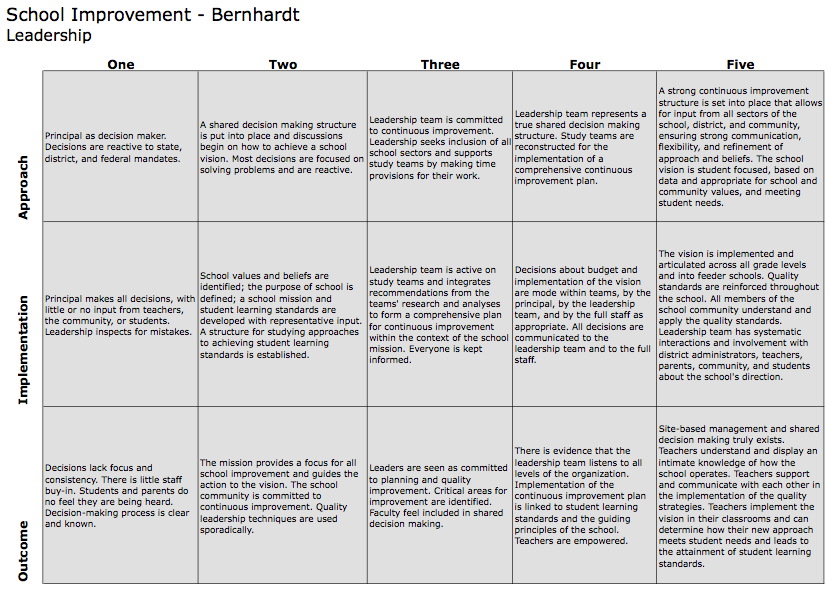
I can make sense out of the tensions between different factions of MMSD advocates by placing their various positions at the different ends of the attached chart on school leadership. (Replace “principal” with “superintendent” and “school” with “district” when reading the chart.)
At stage 1 on the chart,

the Approach is:
[Superintendent] as decision maker. Decisions are reactive to state,
district, and federal mandates;
the Implementation is:
[Superintendent] makes all decisions, with little or no input from teachers, the community, or students. Leadership inspects for mistakes;
the Outcome is:
Decisions lack focus and consistency. There is little staff buy-in. Students and parents do no feel they are being heard. Decision-making process is clear and known.

I feel (and perhaps many other posters do to) that Stage 1 closely describes the MMSD.

(more…)

Share

Punished by CAST?

The pro-referendum group Communities and School Together (CAST) deleted my membership in its list serve, and changed the membership process to require membership approval by a moderator.
I guess that some members of the community are welcome and others aren’t. We’ll see whether CAST lets me rejoin. Probably not.
Should CAST members be banned from schoolinfosystem.org?

Share

Pouring Water

When I’m doing the very best I can
You’re pouring water
On a drowning man
You’re pouring water
On a drowning man

“Pouring Water on Drowning Man”
Dani McCormick & Drew Baker
Download file”>Listen to James Carr’s version
This is the second of a series of farewell posts to this blog. My original intent had been to wait till the final posts to directly address the reasons contributing to my decision to leave this forum. I’m still going to post those, but Barb Lewis’ comment on the first in this series is such a perfect example of one of the contributing factors that I couldn’t pass up the opportunity to interrupt my plan and explore the pervasive poison culture that has come to dominate here and to a lesser extent MMSD (and maybe educational) politics and advocacy in general. For those who need it spelled out, I’m drowning in disgust with this culture and Barb Lewis’ comment is the titular water.
Barb Lewis wrote:
Once again the position of most TAG advocates is misunderstood. What many of us would like to see are programs which actually try to identify and serve ALL talented and gifted kids, not just those who have the good luck to be born to parents who are well-educated themselves and have the financial resources to help them be challenged outside of school if necessary. It is precisely the children you mention, who have no books or even homes, who are being most underserved now by MMSD’s almost nonexistent TAG programs. They are the ones who would benefit most from being nurtured and encouraged at an early age, so that they might actually make it to Calculus.
I am sick and tired of people telling me (or anyone else) what I (or anyone else) understood or misunderstood, believe or think. This is especially true in cases like this when the words I wrote and presumably are in front of them give no support their assertions and in fact support an interpretation to the contrary. If something isn’t clear, ask for a clarification. I do, often.
Inevitably this happens when someone (in this case me) posts something that doesn’t 100% agree with the commentator’s views. Go back and read what I wrote. I did not say a word about TAG parents concern for children in poverty. Everything I wrote about TAG advocates was to praise them. I did imply (and believe) that if your educational priorities center on children in poverty, then TAG programming should not be the primary way to address their needs. If you believe differently I would guess you are woefully and perhaps willfully ignorant of the circumstances of children in poverty and the educational research about addressing these circumstances (please note, this is a guess, if the guess is wrong, please correct me and explain why you believe differently. That is a discussion I’d welcome). What Barb Lewis posted was a subtle straw man attack. She did not engage what I wrote (I would welcome a discussion of that line dividing desires from needs), she put words in my mouth and used them to attack me.
The irony here is that in fact I agree with Barbra Lewis that part of the answer is reaching out to include children in poverty and other underrepresented groups in TAG and other advanced programs. It is one reason why I support “some TAG programming.” It is why I wrote about the need to “create opportunities for children who have no books in their homes or no homes at all.”
More importantly, I have (as I have noted on this site) advocated for this in my work on the MMSD Equity Task Force. I drafted the original language of the following material from the Task Force Interim Report (the final language is a collaborative effort):
(Under Guiding Principles)
The district will eliminate gaps in access and achievement by recognizing and addressing historic and contemporary inequalities in society.
(Under Implementation Strategies)
Open access to advanced programs, actively recruit students from historically underserved populations and provide support for all students to be successful.
I make no claim to any special or original authorship of the definition of Equity offered by the Task Force, but I think it also speaks to these issues:
Equity assures full access to opportunities for each MMSD student,
resulting in educational excellence and social responsibility.

What is so sad and awful about this is that instead of seeing the potential and seizing the opportunity to build a coalition to work toward achieving the goals we share, there is an inclination to see the worst in those who don’t share all your goals or strategies and (unfortunately) attack them.
TJM

Share

And Now For Something Completely Different…

Thought we could all use a yuck…
NEW YORK — A public school teacher was arrested today at John F. Kennedy
International Airport as he attempted to board a flight while in
possession of a ruler, a protractor, a set square, a slide rule and a
calculator. At a morning press conference, Attorney General Alberto
Gonzales said he believes the man is a member of the notorious Al-gebra
movement.
Mr. Gonzales did not identify the man, who has been charged by the FBI
with carrying weapons of math instruction.
“Al-gebra is a problem for us,” Gonzales said. “They desire solutions by
means and extremes, and ! sometimes go off on tangents in search of absolute
values.”
“They use secret code names like ‘x’ and ‘y’ and refer to themselves as
‘unknowns’, but we have determined they belong to a common denominator of
the axis of medieval with coordinates in every country.”
As the Greek philanderer Isosceles used to say, ‘There are 3 sides to
every triangle’.”
When asked to comment on the arrest, President Bush said, “If God had
wanted us to have better weapons of math instruction, He would have given
us more fingers and toes.”

Share

PUTTING FUNDS FROM LEOPOLD REFINANCING INTO THE DISTRICT’S CONTINGENCY FUND IS A WISE MOVE

I would like to address the issue of how the $276,000 from the Leopold refinancing would be handled in the 06-07 school year if the referendum is passed.
The money for the debt service related to the Leopold construction is currently in the Business Services Budget for the District. If the referendum passes, the Board has committed to moving that $276,000 to the District’s contingency fund. Questions have been raised about the wisdom of moving the money to the contingency fund. I believe that is a wise move.
The Board has three options for the funds if the referendum is passed. It can either leave that money in the Business Services budget, it can decide to spend that money in another way, or it can decide to move the money to the contingency fund and potentially use it to soften the budget cuts that will be required for the 2007-08 budget period.
I believe the best course is to put the money in the contingency fund and use it to soften the budget cuts needed for 2007-08 if possible. I don’t believe it is wise to put something back into the 2006-07 budget now – after it was already cut – especially if it is likely that it would need to be cut again in 2007-08.
Putting money in the contingency fund does give the Board discretion on how to spend or not spend the money. Therefore, if 5 out of the 7 Board members believe that the contingency fund is needed in 2006-07 for some unexpected or unbudgeted item, the money could be used for that item. However, and I believe most importantly, the Board could decide not to spend that money at all and use it to address the cuts needed in the 2007-08 budget. If the Board instead determines now to spend that money in 2006-07, that money would not be available to cushion the blow in 2007-08.

Share

Flowers for the Easter Altar

This is the first of a series of farewell posts to this blog. The reasons behind that decision will be detailed in other posts. There are some things I want to say first. I don’t know how many posts or how long this will take. This one is a story about my mother.
In 1968 when Dr. Martin Luther King was assassinated, my parents were involved in an effort to get food, clothes and shelter to those people on the west side of Chicago who lost everything in the destruction that followed. My parents’ activism was rooted in the Catholic Social Action tradition. We attended a suburban parish where their work both found much support and inspired obscene phone calls, filled with racist language, letters and other personal attacks (the callers on occasion directed their hate at me and my brother if we happened to answer the phone – so I learned about being attacked by idiots early on).
As you may remember, Dr. King was killed shortly before Easter. My parent’s desire to help those in need was one with their faith, their understanding of what it meant to be a Catholic. So the natural thing for them to do was to ask permission to collect money to help the relief effort outside of Church after Mass. The Monsignor refused, with the explanation that they were already scheduled to collect money for flowers to place on the altar Easter morning. My mother argued (correctly) that Christ’s mission was better served by helping people in need than by decorating the altar of a suburban church. The Monsignor wouldn’t budge. Neither would my mother. The meeting ended in an impasse.
Sunday morning, my mother was on the corner collecting money for those in need. My brother and I were with her. We saw people give generously and express support and we saw people sneer and mutter ugly things as they passed. The Monsignor sent a young Priest to remove her. She refused. She had learned the lessons of non-violent direct action. She stayed till the end. My mom taught me a lot and gave me much to be proud of.
My educational priorities have been the topic of discussion here lately. This story helps me explain them. I look around our district and see the equivalent of those who lost everything in the riots of 1968. I want to help them get what they need. I also look around this district and see people working to get what I consider to be the educational equivalent of flowers for the Easter altar. I like flowers on the Easter altar; I wish MMSD could afford to give every student everything they desire. I respect (most of) these people for their willingness to work for what they believe in, for what they think is best for the schools. They might be surprised to learn (even though I’ve said this on this blog before) that I strongly believe MMSD should offer some advanced programming, some AP classes, some talented and gifted programming, some arts education… These are all things that I classify as needs. I also distinguish needs from desires. I don’t put my efforts in these areas (yet) because there are already very able advocates and because I don’t believe that in MMSD we have reached that hard to define line that divides needs from desires. I can’t define that line, but I will say that there is a difference in the long term good or harm produced by funding or cutting programs that do their best to educate and create opportunities for children who have no books in their homes or no homes at all and programs that offer a second year of calculus for high achieving high school students. If the first year of calculus is on the cutting block, you may find me fighting alongside the TAG advocates.
Stay tuned for more.
TJM

Share

Home sales collapse means what for MMSD?

Existing home sales fall for fifth straight month, reports MSNBC.
Though the article reports that Midwest sales have not been hit as hard as other regions, what are the trends for homes in the MMSD?
If home sales slow, does the MMSD need a new West side school at this point in time?
It’s easy to predict a contraction of outlying areas in coming years as high fuel prices (gasoline, heating oil, natural gas) pull people closer to central cities. This possibility also could reduce growth on the fringes of the MMSD — both east and west.

Share

Pro-referendum leader doesn’t care about parents of TAG students

From the list serve of the pro-referendum group, Communities and Schools Together (CAST):

We have at least three people willing to translate into Spanish (anyone for Hmong?). I think that the “newsletter blurb” and the FAQ are musts. Do we want anything else? I’ll get these started with the volunteers on Wednesday or Thursday.
At the Wright PSO meeting one of the things that really got me was a father who talked at length about “so little money for the children.” I thought about how many of these families have made such great sacrifices for their children’s futures, leaving their homes, coming to strange country, struggling with language… that to them it is a no brainer to spend a bit more for the schools. We hear about “Bright Flight,” but when it comes down to it I care a lot more about giving these immigrants what they came for than I do about catering to those who threaten to move out or go to private schools. I think I share their values more and know I want what they have to offer for our shared future.
Sorry for getting on the soapbox, but it was very moving to hear how simple the referendum question appeared to them. Like anyone else they wanted the figures and the details, but when they heard them there was no question where they stood. Hell, it seems simple to me too. (emphasis added)


It’s a sad comment from a leader of a group which supposedly advocates for quality education for all kids. (No one on the CAST listserve called him on his statement. Does his thinking represent all of the leadership?)
I won’t invade the writer’s privacy by revealing his name; however, if he has any courage in his convictions, he’ll post his thinking behind his comment.
I’m voting NO on the referendum.

Share

Audit Finds Education Department Missteps

Ben Feller:

A scorching internal review of the Bush administration’s billion-dollar-a-year reading program says the Education Department ignored the law and ethical standards to steer money how it wanted.
The government audit is unsparing in its view that the Reading First program has been beset by conflicts of interest and willful mismanagement. It suggests the department broke the law by trying to dictate which curriculum schools must use.
Reading First aims to help young children read through scientifically proven programs, and the department considers it a jewel of No Child Left Behind, Bush’s education law. Just this week, a separate review found the effort is helping schools raise achievement.

This audit confirms that Reading First is yet another example of rampant cronyism within President Bush’s administration. MMSD was wise to stand up to federal blackmail by refusing to abandon its successful elementary reading program.
US Education Secretary Margaret Spelling’s statement. The complete Inspector General report [2.9MB PDF].

Share

Madison School District Policy Change Regarding Credit for Non-MMSD Courses

I emailed this message to the Madison School Board:

A policy change has recently been implemented in the MMSD regarding whether students can receive high school credit for courses offered by the MMSD that they take elsewhere (e.g.’s, via correspondence through UW-Extension, Stanford’s EPGY, and Northwestern’s Letterlinks programs, attendance at UW or MATC, summer programs offered through the Wisconsin Center for Academically Talented Youth and Northwestern’s Center for Talent Development).
Prior to this fall, students could receive high school credit for non-MMSD courses as long as they obtained prior written approval that the courses they planned to take were deemed worthy of high school credit. I have recently learned that this is no longer true. Rather, the only non-MMSD courses that can currently be approved for high school credit are ones in which a comparable course is not offered ANYWHERE in the District.
Why the change in policy?

(more…)

Share

Benefit Performance for GSA for Safe Schools

Mark your calendars!
Stage Q is having a benefit performance of Carolyn Gage’s play “Ugly Ducklings” for GSA for Safe Schools. Under the direction of Jan Levine Thal, the benefit performance will be held on Friday, September 29th, at 8:00 p.m. at the Bartell Theater (113 E Mifflin Street). Call 608-661-9696, ext. 3, for tickets. Cost is $15.
“Ugly Ducklings” picks up where “Tea and Sympathy” and “The Children’s Hour” left off. Set in a girls’ summer camp, the play explores the dynamics of homophobia in a same-sex environment. A gothic thriller, “Ugly Ducklings” examines the unhealthy turns that relationships between girls can take when they are not allowed their natural expression. The so-called “Ophelia Syndrome” comes alive as the cabin of younger girls, their self-esteem still reinforced by the primacy of their relationships, comes into contact with the older girls who have begun to turn against themselves and each other in their attempts to conform to the pressures of compulsory heterosexuality. Angie, a middle-class college student, is falling in love with another counselor at the camp, Rene, who is a working-class “out” lesbian. Against this backdrop of intense homophobia, the young women struggle with their feelings for each other and the problems of defining themselves in a society that insists they be invisible. The camp legend about a monster in the lake parallels the adult phobias about lesbianism, and, confronted with an attempted child suicide, campers and counselors are compelled to face their worst fears in the microcosmic world of the summer camp.
Pre-theater event: Cafe Montmartre (127 E. Mifflin) between 6:30 and 7:45. Light snacks will be offered. You may also purchase dinner.

Share

Research: School diversity may ease racial prejudice

A small study and I confess I haven’t looked at the study itself, but a reminder that some important aspects of education aren’t measured by standardized tests.
TJM
Research: School diversity may ease racial prejudice
More bias seen in kids in mostly white setting
By Shankar Vedantam
The Washington Post
Published September 19, 2006
White children in 1st and 4th grades who live in areas and attend schools with little ethnic diversity are more likely to blame a black child than a white child when presented with ambiguous information involving potential misbehavior, according to a study released last week that explores the origins of bias.
Researchers showed 138 white children attending a rural Middle Atlantic school a number of pictures and then asked them what they thought was happening.
One set of pictures, for example, showed a child sitting on the ground with a pained expression, while another child stood behind a swing–suggesting that the child on the ground might have been pushed. Another interpretation would be that the child on the ground had fallen off.
In every case, the pictures showed children of different races. In some, a white child stood behind the swing and a black child was on the ground. In other pictures, a black child was the potential perpetrator, and the white child the potential victim.
While 71 percent of the 7- and 10-year-old children said the pictures showed evidence of wrongdoing when the child behind the swing was black, only 60 percent guessed that the white child had pushed the black child when the roles were reversed, University of Maryland researchers Heidi McGlothlin and Melanie Killen reported last week in the journal Child Development.
The paper noted that white children at a more diverse school had not shown such a bias in a previous experiment, suggesting that greater social contact among children of different ethnicities may prevent or reduce bias among youngsters.
Copyright © 2006, Chicago Tribune

Share

Third Friday Counts

The official Download fileThird Friday Counts were distributed to the Board of Education last night (and shared with the Advocates for Madison Public School list serve this morning). Contrary to dire predictions and assessments (see here: and here), the district is growing. This will mean some increased funding under the current formula and that is good news.
However, the reassignments of the first weeks reveal how the continued tight budget situation limits flexibility in ways that disrupt schools, teachers, families and children.
I believe that this growth is further evidence that passage of the referendum is necessary; that the time to act is now at the beginning of the projected upswing in enrollments.
TJM

Share

Miracle Math

Typical of many math textbooks in the U.S., this one is thick, multicolored,and full of games,puzzles,and activities,to help teachers pass the time, but rarely challenge students. Singapore Math’s textbook is thin, and contains only mathematics — no games. Students are given briefexplanations, then confronted with problems which become more complex as the unit progresses.

ednext20064_38b.jpg


Barry Garelick [232K PDF]:

It was another body blow to education. In December of 2004, media outlets across the country were abuzz with news ofthe just-released results of the latest Trends in International Mathematics and Science Study (TIMSS) tests. Once again despite highly publicized efforts to reform American math education (some might say because of the reform efforts) over the past two decades, the United States did little better than average (see Figure 1). Headquartered at the International Study Center at Boston College and taken by tens of thousands of students in more than three dozen countries, TIMSS has become a respected standard of international academic achievement. And in three consecutive TIMSS test rounds (in 1995, 1999,and 2003), 4th- and 8th-grade students in the former British trading colony of Singapore beat all contenders, including math powerhouses Japan and Taiwan. United States 8th graders did not even make the top ten in the 2003 round; they ranked 16th. Worse, scores for American students were, as one Department of Education study put it,”among the lowest of all industrialized countries.”

Share

MIT dean takes aim at admissions anxiety

Justin Pope
AP Education Writer
Though just teenagers, the applicants to the Massachusetts Institute of Technology are a scarily accomplished lot. They have started businesses and published academic research. One built a working nuclear reactor in his garage. In their high schools, they have led every extracurricular club and mastered the SAT.
But surprisingly few have done what Marilee Jones, the woman who actually decides which one in seven MIT applicants gets in, thinks 18-year-olds ought to be doing.
Not many sleep eight hours a night, or eat three meals a day. Few spend time each day just staring into space.
And Jones is blunt about the consequences.
The quest for perfection “is making our children sick,” the MIT dean of admissions told a recent gathering of college admissions professionals in Boston. She means it literally, snapping off statistics on the increase in ulcers, anxiety disorders and control disorders such as cutting and anorexia.
“Kids aren’t supposed to be finished,” she said. “They’re partial. They’re raw. That’s why we’re in the business.”
For years, high school teachers and counselors have been complaining about the emotional and physical toll of the competition for slots in selective colleges. SAT prep classes and an arms race of extracurricular resume-building, they say, are draining the fun out of life for their students.

Share

Local Students in the Admissions Pressure Cooker

DEBORAH ZIFF
Wisconsin State Journal
Sunday, September 17, 2006
dziff@madison.com
Madison West High School senior Eliza Zimmerer is a teaching assistant in a bio- technology class.
She mentors younger students and leads freshmen through orientation. She’s involved in student government. Captain of the varsity tennis team. Honor roll. French honor society.
Her resume goes on and on, but she still wonders if it’s enough to get her into some of her preferred schools. And she’s not alone.
“It’s really apparent here, as it is in almost any high school,” said Becky Bebber-Wells, a guidance counselor at West. “Now, more and more kids are trying to apply to these select colleges. They feel if they don’t get in, that’s the end.
“They’re taking a full load of courses, doing a sport or two, they might be working a part- time job,” she said. “And of course, homework. They’re also going to bed really late and getting up really early.”
Bebber-Wells recalls a recent day in her office when a sophomore came in crying because she couldn’t get into one class for a “perfect schedule.”
“She about had a nervous breakdown,” she said.
The agonizing and hand- wringing over getting into a top-tier college isn’t just something that happens with students aiming for the Ivy League.
Zimmerer, who’s looking at Rice University, Carleton College, UW-Madison and a handful of other schools, said she chooses her activities based on what she values, rather than what will look good on a college resume. But she admits the nonstop schedule is demanding.
“It’s pretty exhausting,” she said. “The classes I’m taking really require a lot of work. On top of that pressure, not only do I have to write an essay for English class, I also have to write a personal statement for Madison.”
To ease the waiting-game grief, UW-Madison uses a rolling admissions process, letting students know whether they’ve been accepted within four to six weeks of application rather than waiting until April•1.
“Who do you think has a better senior year, someone applying to Harvard or Wisconsin?” UW-Madison Dean of Admissions Robert Seltzer asked rhetorically.
On a recent evening at Memorial High School, parents of seniors sat in the auditorium to learn about what their children need to do to prepare for college.
“It’s so different these days,” Tina Moses, whose daughter Lisa is a senior, said after the session. Both she and her husband went to UW-Madison, one of the schools Lisa is considering.
“It’s much more competitive. I never questioned I’d be accepted at Madison,” she said. “Now you’re lucky if you get in.”
Moses said she looks at the personal-statement section on college applications and thinks, “You know they are saying the exact same thing as everyone else.”
She recalled seeing a newspaper article about a high- school-age girl who spent her summer break volunteering in Africa.
“I feel like, oh God, does my child have to go to Africa to stand out?”
Copyright © 2006 Wisconsin State Journal

Share

Private School Parents Control Board

Destroying Public Schools
New York Times
September 16, 2006
At Odds Over Schools
By BRUCE LAMBERT
LAWRENCE, N.Y.
[This] school district has been changing, house by house, as Orthodox Jewish families have flocked here over the last two decades, gradually at first and then in growing numbers.
While not yet a majority, the Orthodox have nonetheless emerged as the dominant force in a clash of cultures. And the front line in this battle is Lawrence’s once highly regarded public school system.
In each of the last four years, Orthodox voters mobilized to defeat the school budget — one of the longest losing streaks on Long Island. Then in July, they took charge of the school board, though few of the Orthodox send their children to public schools. Out of seven seats, the new majority consists of four Orthodox members and one ally.
[M]any of this district’s Orthodox residents object to paying school taxes that average about $6,000 per home for a system they do not use. Their leaders also complain that more public money should be channeled to the Orthodox day schools, which by law are limited to tax-financed busing, books and special education services.
“We feel invaded,” said an Atlantic Beach delicatessen customer, a self-described non-Orthodox Jew and activist parent who declined to give her name. “We don’t mind them being here, but taking over and shutting down the school system is not the right thing.” (Atlantic Beach is part of the Lawrence school district.)
Experts who track expanding Orthodox neighborhoods around the nation say the conflict in Lawrence has far-reaching implications.
“Other communities are watching Lawrence very closely, for fear they may be next,” said Prof. William B. Helmreich, the director of the Center for Jewish Studies at Queens College. Orthodox adherents “are cohesive, they marshal forces and vote as a bloc,” he said. “It could happen anywhere.”
It has already happened in Rockland County, where Orthodox residents control the East Ramapo school board. Similar strains have arisen over the schools and other services in Lakewood, N.J., home to a large Orthodox population.
“It’s ominous,” said Steven Sanders, a former New York City assemblyman who was chairman of the State Assembly’s Education Committee. “This is not going to be an isolated situation. This is a worrisome trend. The common thread is not religion. The common thread is people who don’t feel invested in educating other people’s children. What do you do when a community is significantly comprised of individuals who don’t have a stake in public schools when they’re already spending for private schools? It’s a fracturing of the social compact.”

Share

The Midwest Academic Talent Search

Madison United for Academic Excellence (MUAE) is hosting an informational session about the Midwest Academic Talent Search (MATS) program run by the Center for Talent Development (CTD) at Northwestern University.
The MATS provides an opportunity for academically advanced students in grades three through nine to take an out-of-grade-level standardized test. Students in grades three through six may take the Explore test (essentially an ACT designed for eighth graders); students in grades six through eight may take the SAT test; and students in grades six through nine may take the ACT test. For students who routinely hit the ceiling of their district and state level tests, an out-of-grade-level test may be the only way to truly know what they know. Test results may be used for advocacy purposes, as well as to access a wide array of advanced educational experiences across the country.
Our guest speaker for the evening will be Carole Nobiensky, longtime staff member and Director of Programs at the Wisconsin Center for Academically Talented Youth (WCATY).
Please join us on Wednesday, September 27, from 7:00 p.m. to 8:30 p.m. in Room 209 of the Doyle Administration Building, 545 West Dayton Street.

Share

As Homework Grows, So Do Arguments Against It

Valerie Strauss
The nation’s best-known researcher on homework has taken a new look at the subject, and here is what Duke University professor Harris Cooper has to say:
Elementary school students get no academic benefit from homework — except reading and some basic skills practice — and yet schools require more than ever.
High school students studying until dawn probably are wasting their time because there is no academic benefit after two hours a night; for middle-schoolers, 1 1/2 hours.
And what’s perhaps more important, he said, is that most teachers get little or no training on how to create homework assignments that advance learning.
The controversy over homework that has raged for more than a century in U.S. education is reheating with new research by educators and authors about homework’s purpose and design.
No one has gone as far as the American Child Health Association did in the 1930s, when it pinned homework and child labor as leading killers of children who contracted tuberculosis and heart disease. But the arguments seem to get louder with each new school year: There is too much homework or too little; assignments are too boring or overreaching; parents are too involved or negligent.

Share

Children from low-income families often suffer exclusion at school

Children from low-income families often suffer exclusion at school
Tuesday, September 05, 2006
BY JOAN MADELEINE DOUGHTY
©2006 Ann Arbor News
Imagine this: You live in Ann Arbor. Your first-grade student comes home from school and tells you the teacher handed out cupcakes today – to every child except yours and two others. Why? “Teacher said I wasn’t on the list of kids who were paid for.”
You call the teacher and are told you never sent in money for daily snacks. The reason you didn’t pay was because you couldn’t. With four mouths to feed, living on disability, you struggle to pay your rent, utilities and food bills. There is no money for extras. And now your child watches, while almost everyone in the class enjoys snacks every day.
Does this really happen in Ann Arbor? It does not. If it did, we would collectively rise in protest. We can’t imagine a teacher who would skip a student when distributing treats just because his or her parent is too poor to pay. In fact, when research showed hungry children had trouble focusing on academics, policy makers universally embraced the concept of free and reduced school breakfast and lunch programs.
Now ask yourself this: Which would a child rather have – a cupcake or school pictures? A bag of chips or a yearbook? Every year in most of our children’s classrooms, teachers hand out school picture packets to some kids, but not others. They give certain children yearbooks, but skip their peers. Why? Because their parents didn’t pay. Sometimes by choice, but more often the reason is financial.

(more…)

Share

How Can This Continue: Negotating Health Insurance Changes

Robert Butler[PDF]:

Health insurance has become the most prevalent issue discussed at the bargaining table today. Recent premium increases for school districts with July renewal
dates have focused even more attention on this issue.
Many administrators and board members ask: How can this continue? How do we communicate to our employees, our taxpayers and other interested constituents the effect that our health insurance costs have on our budgets? How do we maintain and, hopefully, expand our educational offerings when our costs for health insurance continue to eat up an ever larger portion of our budget?
There are many factors that have contributed to the high cost of health insurance: utilization of services, demographic trends (such as life expectancy and obesity), healthcare provider consolidation, duplication of services, new products and services, the growing number of uninsured, marketing of prescription drugs, medical malpractice expenses, level of benefits and plan design, among others.
This article will provide insight on how to address items that we can control at the bargaining table: the level of benefits, plan design and consumer behavior. Remember, health insurance is an economic and emotional issue; people don’t always make rational decisions when negotiating over this topic.

Butler is Co-Director of Employee Relations Services, Staff Counsel; Wisconsin Association of School Boards.
Negotiating health care costs with employees is the first item on the Board’s Human Resources Committee agenda: Monday, September 25, 2006 @ 6:00p.m. in the McDaniels Auditorium [map].

Share

Locked-in lunches now for East High 9th-graders

A story from Susan Troller and The Capital Times:

Freshmen at East High School will no longer be spending their lunch hours at Burger King or the local convenience store.
A new closed-campus policy for ninth-graders went into effect today at Madison’s oldest public high school.
“We’re interested in getting our entering freshmen off to a good start,” East Principal Alan Harris said as he explained the sharp departure from a policy that had given freshmen through seniors the ability to come and go at lunch time.

(more…)

Share

First item on Human Resources Agenda for MMSD: Negotiating health care costs with employees

In August the Human Resources Committee of the Madison School Board—Lawrie Kobza, Shwaw Vang and I–voted unanimously to adopt committee goals for 2006-07 previously presented in this blog.
Human Resources Committee of Madison Board To Set Agenda

Accordingly, Bob Butler, a collective bargaining consultant from the Wisconsin Association of School Boards, will discuss why and how school boards should approach negotiating changes in the cost of employee health insurance plans [How Can This Continue? Negotiating Health Insurance Changes]. The meeting of the Human Resources Committee is currently scheduled for 6:00 p.m. in McDaniels Auditorium on Monday, September 25.

Share

Fallacy

Many of you probably read John Stossel’s polemic in the Sunday Wisconsin State Journal (9/3/06). I’d reprint here, but I don’t want to give it a wider readership than it already has. Instead I want to say few words about a central fallacy in the thinking of Stossel (and many others who wish to destroy public education). Contrary to their rhetoric, PUBLIC EDUCATION IS NOT A MONOPOLY.
I’m not talking about the fact that many fine non-public schools thrive (although that’s true), what I want to do is remind people of the important distinctions between the public and private spheres, between government and enterprise (these distinctions aren’t quite the same, but they are close enough for the purposes here). Education is a public matter, a government function because we have for 150 years (more-or-less, depending on the state and locality) we have wanted it that way.
There were and are many good reasons why this is the case. At base, education is – like garbage disposal, safe food and drugs, efficient roads, airline safety, clean water and much else – too important to be left to the vagaries of the market. At one point Stossel quotes an economist praising the “unpredictability” of the market as a source of innovation. That’s fine for producing a better mousetrap, but in schools (as in all the other examples listed) the stakes are too high to let greed be the motive force. I hear “unpredictability” and think of the children in scam voucher schools who lost out so someone could profit. The successes and innovations of capitalism are the successes of greed. The failures of capitalism are the failures of greed. Tainted milk, like bad charter schools in Milwaukee, was profitable; the market did its work by inducing more people to sell tainted milk. It isn’t the all powerful and all wise market that makes sure our children have safe milk — profit is profit, the market doesn’t care — it is the government. Schools were once all private or semi-private, but this – like tainted milk – was not satisfactory and in a democracy things that aren’t satisfactory can be changed.
Democracy is one key to why education is a public matter. If you read the words of those 19th and early 20th century men and women who created and expanded public education, you can sense both their fears and faith. Democratic self-government was a new thing and many scoffed at the idea that “the masses” were capable of the tasks. There was a very real fear of rule by the ignorant mob. But there was also a faith that given the tools their fellow-countrymen (and later women) would be up to the job. The most basic tool was literacy and more broadly education. The state of our political culture may induce many to think that these optimists were wrong about the potential for self-government or perhaps that public education has failed in this mission. I feel that way sometimes, but the republic has survived and the experiment isn’t over. I don’t think we should abandon the basic idea, I think we should work to improve our execution. And since public education is democratically governed (another reason that terming it monopoly is a misnomer), we have the means to make our calls for improvement heard.
Democracy also requires a sense of belonging to the community and the nation. There has long been a tension between the Pluribus and the Unum. America has always been diverse and group identities have threatened to overwhelm a sense of common purpose. When German children went to German schools and Presbyterian children went to Presbyterian schools and rich children went to elite schools and many children went to no school at all (or to charity schools), there was very little to bind them together and much to pull them apart. By making schools public and “common,” the school promoters sought to bolster the Unum. We also struggle with these issues and have arrived in a slightly different place where most of us desire schools to respect group identities, teach respect for group identities (multiculturalism) as well cultivate our commonalities. Finding the balance is not easy and never finished. That cultivating the common is necessary and that the best place to do this is in democratically controlled public schools seems beyond question to me.
Interestingly, capitalism is another reason why public education was considered essential to the health of the nation. There has always been a desire for trained workers and for people to be trained for work, but that isn’t the most interesting or important way that public schools support capitalism. Capitalism is a system of winners and losers. Democracy depends on a rough sense of egalitarianism – “All men are created equal.” So there is another tension here and public education helps resolve it. With free public education, equality becomes “equality of opportunity” and eventually “equality of educational opportunity” (as in the Equal Educational Opportunities Act of 1974). The promise (unfulfilled to a great degree) of equality of opportunity through education further binds the nation together, diffuses the resentments of existing inequalities and provides hope for mobility. Without this, capitalism would be constantly threatened by the “losers.”
Disciples of the market like Stossel rarely address a basic premise of their philosophy and that is that greed and only greed can produce progress and improvement. They see schools that aren’t as good as they should or must be and see “introducing market forces” as the only solution. I don’t hold this dark view of human nature or society. I think that we can be genuinely altruistic; I think that we can work together (cooperation) instead against each other (competition) to produce better schools and a better world. The people who founded public education were far from perfect and filled with self-interested motives, but at the core most shared this belief and I would point to their creation (as imperfect as it is) as evidence that they were right.
TJM

Share

Student Math & Writing Skills

I have a friend that teaches at MATC–she tells me that she is shocked at the lack of math and writing ability of the Madison high school students coming to MATC’s two year technical programs. MATC is very important to Wisconsin’s future. What is happening at the high school level that these students are not prepared properly? Anyone have any thoughts?

Share

What can the MMSD sell?

Congratulations! You have been selected to write 30 second radio ads for the MMSD to recruit families and students to the district’s schools. Remember, the ads should stress what’s unique about Madison schools, and what a student will get only in Madison, because all of the area’s suburban and private schools compete for the same students; so the ads should subtly contrast the MMSD with those competitors. The ads cannot just say, “Madison has excellent, dedicated teachers and staff,” because every school district probably says the same thing.
The ads need to target familes with students of various ages, so we need at least three ads, separately targeting elementary, middle, and high school. You might consider speciality ads for families from various cultures and races.
Post your ads (not lengthy discussions) as responses to this post.

Share

Wisconsin CHARTER SCHOOL NEWS: Week of August 21

DPI Awards $4 Million in Charter School Grants
WCSA’s New Office — The WCSA is now located in a new office in downtown Madison. The WCSA’s new address, phone, fax and email is — Wisconsin Charter Schools Association, P.O. Box 1704, Madison, WI 53703 & Tel: 608-661-6946 & Fax: 608-258-3413 & Email: info@wicharterschools.org WCSA website: http://www.wicharterschools.org
WCSA’s New Directors & Officers — The WCSA Board of Directors has elected its officers for 2006-07 — President Tom Scullen, Appleton; Vice-President Barbara Horton, Milwaukee; Secretary Sandra Mills, Menasha; and Treasurer Jim Morgan, Madison. The WCSA is governed by a 12-member Board of Directors
State Legislature’s Special Study Committee on Charter Schools schedules initial meeting on September 26 —
Charter School to Focus on Health Science & Technology

(more…)

Share

Who got the money? Johnny won’t answer.

In using MMSD resources and schoolinfosystem.org to promote his basketball event, Johnny Winston, Jr.’s announcements said:

This year’s proceeds will go toward “The Campaign to Promote Student Achievement and Parent Involvement in Schools.”


I have e-mailed him twice to ask for details about the campaign, and he has not answered. Laurie Frost also raised this question in response to Johnny’s post and received no response.
I searched the online records of the Department of Regulation and Licensing for a charitable organization by that name. Nothing. I searched the records of the Department of Financial Institutions for a corporation by that name. Nothing. I searched the Internet, and the name only appears in the announcements Johnny distributed.
Johnny’s silence makes me wonder whether any such campaign exists, and whether he misused MMSD resources, his political position, and the public’s trust. I hope that I’m wrong.

Share

Black students boost ACT scores

Madison students continue to top state average
By TCT staff, news services
Madison high school students bested the state ACT test score average once again for the 12th straight year, with scores of African-American students rising at a greater pace than all other students.
ACT test score comparisons were released today.
According to the Madison Metropolitan School District, the composite score for Madison students was 24.2, or two points higher than the statewide average of 22.2 and more than three points higher than the national average of 21.1. A perfect score is 36.
African-American students in Madison scored an average composite of 18.8, a 6 percent increase from the 17.7 average in 2005, while Asian students had a 23.0 composite this year (22.1 in 2005) and Hispanic students a 21.8 composite (21.5 in 2005).
The big increase in black students’ scores closed the gap on white students’ scores locally, with the white students composite of 24.8, 24 percent higher than the black students composite, down from a 30 percent gap last year.

(more…)

Share

Superintendent’s evaluation

Here’s what the superintendent’s life-time contract language says about the superintendent’s evaluation:

PERFORMANCE EXPECTATIONS: Each year before the first day of school, the Board and superintendent must establish performance expectations for the next year in writing based on his duties and responsibilities under the contract and any other criteria mutally agree upon.
MEASURABLE OUTCOMES: “To the extent possible, all performance expectations shall have measurable outcomes”.
JULY 30 DEADLINE: After setting performance expectations, the Board must meet with the superintendent to discuss his evaluation no later than July 30.
Two types of appraisals are required.
SPECIFIC RESULTS & ACCOMPLISHMENTS BASED ON PERFORMANCE EXPECTATIONS: The written performance expectations must include goals that reflect the superintendent’s priorities for the improvement programs, projects and activities to be undertaken. Prior to meeting with the Board for his evaluation, the superintendent must complete a self-evaluation that summarizes his progress on each goal.
PERFORMANCE CATEGORIES—PLANNING, ORGANIZING, LEADING, SUPERVISING AND JOB KNOWLEDGE: In each category the Board must indicate the type of evidence of performance and data sources that will be used to evaluate the superintendent’s performance.
SURVEYS OF OTHER ADMINISTRATORS: The Board must distribute surveys about the superintendent’s performance in the five categories to individuals who report directly to him and a random selection of other administrators.


Has the board met the contract requirements? No one knows.
Last year Ruth Robarts posted news of the evaluation.

Share

Human Resources Committee of Madison Board To Set Agenda

On Monday, August 21 the Human Resources Committee of the Madison School Board will have its first meeting at 7:00 p.m. in Room 103 of the Doyle Administration Building (545 West Dayton Street).
Following a goal-setting meeting of the Board on June 19, the committee will address a number of important issues, beginning with alternative ways that the district could negotiate health insurance coverage for its employees with the goal of providing the same quality service, higher wages and savings for the district. Committee members this year are Shwaw Vang and Lawrie Kobza. I am the chair.

(more…)

Share

CAST Gearing Up For $23.5 Million Referendum

From Channel 3000:

Fall is right around the corner. That means classes back in session and another school referendum for Madison voters.
A group calling itself CAST is gearing up to get voters to say yes to a $23.5 million referendum on Nov. 7.
CAST stands for Communities And Schools Together.
Rich Rubasch is heading up the group. He’s a parent looking out for the best interest of his children. He believes a referendum is the answer.

(more…)

Share

Still On the Slippery Slope of West HS’s English 10?

Last week, families of rising juniors at West High School received a copy of the Junior School Counseling Newsletter. On page 2, there is a section entitled “English Course Selections for 2006/07.” The paragraph reads as follows:
Students are required to earn four credits of English for graduation, and this must include one semester of composition beyond tenth grade. Students in grades 11 and 12 are given a choice of non-sequential semester electives, each providing one-half credit towards graduation. College preparatory students, however, should check the colleges of their choice to be sure about what courses are acceptable for college admisison, i.e., some colleges might not accept courses in such areas as theater or media for admission.
The second half of the first sentence (assuming it is not a typo) reflects an important change in the English requirement for graduation at West — one that has never been discussed with students and parents and one that is surprising and confusing, given the stated goals and content of English 10.
It is also not consistent with what’s stated in the 2006-07 course catalogue. (Thanks for bearing with me for including the complete entry here.)

(more…)

Share

Who should public schools serve?

Mary Battaglia’s post on a Curious Social Development began to raise some fundamental questions about who the public schools should serve, and a healthy discussion on this blog might help clarify differing views on some of the current trends being implemented in the MMSD.
To set the discussion, let me offer that schools serve roughly three populations: the neediest, the average, and the brightest — not too startling a breakdown.
Which group should the schools target?
If schools target one, should the schools just let the other two groups fend for themselves? For example, should schools place their priorities on raising the academic accomplisments of the lowest performing students, on the assumption that the average will get by and the brightest will succeed regardless of what schools do? Or maybe schools should triage the groups? Let the neediest drop by the wayside, target the average, and just expect the brightest to do well.
How then do we determine whether the schools succeed? Do we measure success by the number of National Merit Scholars or by the increase in the performance of the neediest?
I think schools should and can successfully serve all three groups by using curriculum and programs to challenge all students academically.
I hope that many will candidly post their opinions.
Ed
ps. To the grammarians, I know that the title should be “Whom should public schools serve?” But “whom” sounds so stilted.

Share

People’s Budget: Conceptual Thoughts

Please review and add comments. We’ll be discussing this Monday evening.

Share

Curious Social Development

My daughter is the “Mothering Type”. You know the kind. She still loves dolls beyond her friends, and loves pets, and she took the babysitting class as soon as possible so she could be around small children. She is always the person in the class the helps and socializes with the high needs kids in her classroom too. One day while I was volunteering at her school, a very nice mom of a high need autistic child was in her class, to discuss what she needed the students in this class to know. She discussed her child’s sensitivity to sound, high stimulation, and the need for calmness. During this discussion the students in the class discovered that this student had a sibling. A student inquired about this sibling and who’s class (teacher) he/she was in….

(more…)

Share

A question for Tom & Neal Gleason

Tom,
I’ve asked you, Neal Gleason and others, but all of you avoid the question. Let’s try one more time.
Do you believe a 50%-60% success rate for Reading Recovery is about all that can be achieved because 1) some students just can’t learn or 2) no one knows how to teach struggling first graders or 3) the MMSD doesn’t know how to teach those first graders?
Ed

Share

Acting White

Donna Ford, Ph.D., and Gilman Whiting, Ph.D., both of Vanderbilt University, are two leading African American education scholars who have dedicated their professional lives to the issue of minority achievement. Professor Ford is a nationally recognized expert in gifted education, multicultural education, and the recruitment and retention of diverse students in gifted education. Professor Whiting is a nationally recognized expert in African American male achievement and under-achievement. Professors Ford and Whiting made a two-part visit to the MMSD earlier this year, the result of an invitation from Diane Crear, recently retired MMSD Special Assistant to the Superintendent for Parent-Community Relations. As part of their program for minority parents, Professors Ford and Whiting talked about the research that attests so clearly to the importance of books in the home, reading to our children, talking with our children in intellectually stimulating ways, and taking an active interest in our children’s educational experience. They also showed the following segment from a June, 1999, episode of ABC’s “20/20.” The segment is entitled “Acting White” and was filmed at our own Madison East High School. It is thought-provoking, to say the least, and generated a lot of discussion amongst those in the audience last March when it was shown. We offer it to SIS readers for their thoughtful consideration.

20/20 Acting White (1999).

2020.jpg

Video

For more on the work of Drs. Ford and Whiting, here are two recent papers:
Ford, D. Y. & Whiting, G. W. (2006). Under-Representation of Diverse Students in Gifted Education: Recommendations for Nondiscriminatory Assessment (Part 1). Gifted Education Press Quarterly, 20(2), 2-6.
Moore, J. L., Ford, D. Y., & Milner, R. (2005). Recruitment Is Not Enough: Retaining African American Students in Gifted Education. Gifted Child Quarterly, 49, 51-67.

Share

The Complex Relationship Between Nature, Nurture, and Intelligence

After the Bell Curve
David L. Kirp
The New York Times
When it comes to explaining the roots of intelligence, the fight between partisans of the gene and partisans of the environment is ancient and fierce. Each side challenges the other’s intellectual bona fides and political agendas. What is at stake is not just the definition of good science but also the meaning of the just society. The nurture crowd is predisposed to revive the War on Poverty, while the hereditarians typically embrace a Social Darwinist perspective.
A century’s worth of quantitative-genetics literature concludes that a person’s I.Q. is remarkably stable and that about three-quarters of I.Q. differences between individuals are attributable to heredity. This is how I.Q. is widely understood — as being mainly “in the genes” — and that understanding has been used as a rationale for doing nothing about seemingly intractable social problems like the black-white school-achievement gap and the widening income disparity. If nature disposes, the argument goes, there is little to be gained by intervening. In their 1994 best seller, “The Bell Curve,” Richard Herrnstein and Charles Murray relied on this research to argue that the United States is a genetic meritocracy and to urge an end to affirmative action. Since there is no way to significantly boost I.Q., prominent geneticists like Arthur Jensen of Berkeley have contended, compensatory education is a bad bet.
But what if the supposed opposition between heredity and environment is altogether misleading? A new generation of studies shows that genes and environment don’t occupy separate spheres — that much of what is labeled “hereditary” becomes meaningful only in the context of experience. “It doesn’t really matter whether the heritability of I.Q. is this particular figure or that one,” says Sir Michael Rutter of the University of London. “Changing the environment can still make an enormous difference.” If heredity defines the limits of intelligence, the research shows, experience largely determines whether those limits will be reached. And if this is so, the prospects for remedying social inequalities may be better than we thought.

Share

Community service levies climb since cap lifted

Five years after state legislators released them from state-imposed revenue caps, school districts’ community service tax levies have nearly tripled, reaching $49 million this year.
The rampant growth in these property taxes – earmarked for community-based activities – took place as the total levies for schools statewide rose by 22.7%.
That has raised concerns about school districts skating around revenue limits and has prompted one lawmaker to request an audit of the program.
State Rep. Debi Towns (R-Janesville) said she is curious why property taxes that pay for recreational and community activities offered by school districts have grown so much since the 2000-’01 school year. In that time, the number of school districts raising taxes for such services has doubled to 240.
“I’m not saying anyone’s misspending. I’m just saying the fund has grown tremendously, and the purpose never changed,” said Towns, chairman of the Assembly Education Committee. In November, Towns called for the Legislative Audit Bureau to study how select school districts use their community service levies.
“So that, of course, leads to a natural questioning of what are they doing differently now than they were doing before,” she said.
The growth in the community service levies is expected to continue next year.
Arts, police, pools
Already, Milwaukee Public Schools has launched a arts education program through its recreation centers that it expects to fund with $1 million in community service funds. The Mukwonago School District plans to keep a police officer in its high school, despite the recent loss of a grant, with a $60,000 boost in property taxes from its community service levy.
The Menomonee Falls School District, which has not raised its levy for recreation and community activities in more than a decade, is counting on a $180,000, or 63%, increase next school year to continue operating one of its two pools.
School administrators say they have a simple explanation for why they are turning to their community service levies more now than they did when they were capped – it didn’t matter before. Because both the general and community service funds were restricted by revenue caps and eligible for state aid, it was simply an accounting preference whether a district paid for it from one fund or the other.
Athletics or academics?
But once the Legislature removed the caps on the community service levies for the 2000-’01 school year and gave school districts an opportunity to keep their recreational activities from conflicting with educational programs, more took advantage of it.
“I think – when you look at districts across the state – that’s really what caused the jump,” said Art Rainwater, superintendent of the Madison Metropolitan School District, which in 2005-’06 had the largest community service levy in the state.
Like some of the bigger community service funds, Madison’s supports a full recreation department with adult and youth programming. But it also helps pay for television production activities, after-school activities, a gay and lesbian community program coordinator and part of a social worker’s time to work with low-income families, Rainwater said.

The School District’s community service levy is expected to grow to $10.5 million in the coming school year. In contrast, the same levy for Milwaukee Public Schools – which serves nearly four times as many children in its educational programs – is expected to reach $9.3 million, said Michelle Nate, the district’s director of finance.
Although the state Department of Public Instruction has issued guidelines to school districts on how they should use their community service levies, it leaves it up to local residents to decide whether their school boards do so wisely and legally.
In the Greendale School District, which at $990,000 had the sixth-largest community service levy in the state last school year, business manager Erin Gauthier-Green acknowledges that her school system has gotten good use out of the fund.
But she also said the School District plans to reduce the property taxes it levies for community services by $300,000 next year now that it has completed some repair projects and before taxpayers complain.
“We know it can be a hot-button issue,” Gauthier-Green said.
By AMY HETZNER
ahetzner@journalsentinel.com
July 22, 2006

Share

What’s the MMSD doing for 10th graders who can’t read?

Not much in any systematic way.
Twenty-four percent of Madison’s 10th graders read at a minimal or basic level, i.e., below grade level.

Share

Comparing Low Income with Teacher Attributes

The question was recently asked on this site as to how teacher experience compared with poverty levels by school. Using the 2004-05 school data provided in the 2005-06 detailed budget, I compared low-income percentages with: number of years’ experience; % of teachers with advanced degrees; student / teacher ratio. Below are summary charts for all schools in the MMSD.

The first chart compares each school’s low-income percentage with the average number of years of experience their teachers have. Each pink data point represents a different school within the district. For example, the highest point on the chart represents Schenk Elementary School, which had 51% low-income (reading from the x-axis), and an average teachers’ experience of 22.8 years (reading from the y-axis). The black line is the Excel-generated trend line depicting the relationship between teacher experience and school poverty levels. Notice that the points in the chart are widely scattered – they are not closely surrounding the trend line. This dispersion implies a very weak relationship between teacher experience and poverty levels. The very weak relationship that does exist suggests teacher experience declines slightly as low-income levels increase. The oft-stated lament in this country is that as teachers become more experienced, they gravitate toward the “easier” schools with fewer low-income kids. In the MMSD at least, that gravitation appears to be occurring at a remarkably slow rate.

(more…)

Share

Conspiracy to end public schools?

Does the Bush administration want to undermine and eliminate public education?
To my amazement, I was told today that many people in education would emphatically answer yes.
What are the thoughts of people who post on or read schoolinfosystem.org?
Ed Blume

Share

Don Severson / Vicki McKenna Discussion on Local School Climate, the School District Budget and the Fall Referendum

WIBA’s Vicki McKenna and Active Citizens for Education’s Don Severson discussed a variety of topics today, including Judy Newman’s series on Madison’s changing economic landscape, the Madison School District’s budget process and the planned November referendum for a new far west side school, Leopold Elementary school expansion and debt consolidation. 17MB MP3 audio.

Share

Board and committee goals – 2006

Johnny Winston, Jr. provided a summary of the board’s June 19th discussion of board and committee goals.
I found two of the board’s priorities particularly noteworthy.
One priority under Performance and Achievement reads:

Math and Literacy and Curriculum
• Review the appropriateness of the goal of completion of algebra and geometry in high school in view of test scores in math (and sub categories) at 4th and 10th grades
• Develop specific, measurable goals regarding the district’s strategic priorities: “offering challenging, diverse and contemporary curriculum and instruction”
– Include input from community
• Initiate public discussion and dissemination of MMSD information that explains:
– What curriculum is used and why
– Evidence base for choosing curriculum and teaching methodologies
– Evaluation of student outcomes associated with changes/use of specific curriculum/methodologies
• Curricular review with input from parents and K-12 post secondary educators and employers
• Cost effectiveness of reading recovery
• Math curriculum
• Review math and reading curriculum to assess impact on high school

(more…)

Share

Summer leisure and Drop-out Students

My 13 year old son was complaining the other day about how “hard” it was he had to get up and swim at 7 a.m. for his local swim club. (7 is a little early when it’s cold but…) He then complained about umpiring a Little League game because a coach yelled at him.
As a calm and understanding parent I lost my temper, “They created summer for farm children to get up at sun rise and pick corn, cotton, etc… and all you have to do is play sports and relax. I had to haul hay and clean rental homes for my dad, you need to work more that is your problem!” Which of course, as a parent I am completely guilty of making this life too easy for my children, and I will be correcting that problem next summer…my motto now is if they are bored give them a chore…….
Which reminded me of an idea I had when I was in high school, and again when I was teaching high school, and again when I recently read an article in Newsweek
In North Carolina there are several school districts that have an agreement with their local community colleges (MATC) that allows Junior and Senior students in high school to receive credits for both a skill and high school. When these students graduate they have a degree from High School and an associates degree in whatever interest them. WOW! That was my idea 20 year ago. I noticed when I was in high school that many of my friends and myself left school at 3:00 and went to work. Some were so interested in work and the skills they learned they left school to make money and pursue a more interesting skill.
We could reduce the drop out rate if we arranged a similar association with MATC for our students not bound for college. They would be ready for a job, have a diploma, and excited about their future. If they changed their mind they still have a H.S. degree and could go to college. 16 and 17 year olds get into trouble because they are bored….and they are bored because we wait until they are 18 to treat them as participants in society. We assume they are all interested in calculus and becoming lawyers, of course that is not true. Most other industrialized countries realize this and have created “prep” schools for those that will attend college. The great part about the N.C. plan is they will have a degree and can change their direction or mind to attend college, because 16 is a young age to decide your future, but at least they would have a skill to fall back on.
I remember how busy I was the last two years of high school, not studying but doing all kinds of activities, taking college courses, working a couple of jobs, and I was not even away from home yet. We need to advance these capable students forward to an area that interests them. Utilize their endless energy. Let’s look at this model and see if this would help resolve our gap, dropout rate and problem students for MMSD. We have the community college right here and plenty of educators…..this is an issue that should be discussed.

Share

Create public ARTS school in Madison

Please help to make  THE STUDIO SCHOOL  —  an option for parents and children within the public school district.
 
You’re invited to attend a planning meeting of local parents, educators, community leaders and others:   
 
Date:    July 19 ( Wednesday )
Time:    6:00 – 8:00 pm 
Site:     MADISON Library – Sequoya Branch
513 South Midvalle Blvd. [Map]  — 
 
See the summary description of the proposed school  —   executive summary
 
BRYAN GRAU, co-founder of Nuestro Mundo Community (charter) School in Madison, has been invited to the July 19 meeting to discuss the charter school authorization and implementation process.
 
Here’s additional background info for your review …..  
 
Creating a Charter School  — 
 
DPI – Charter Schools in Wisconsin — 
 
Academy of Fine Arts  — 
 
Reggio Emilia-based Schools  — 
 
The Growing Place  — 
 
The Arts & Technology Academy  — 
 
PreSchool of the Arts  — 
 
Elements of Effective Charter Schools  — 
 
Please RSVP to:
     
SENN BROWN
Wisconsin Charter Schools Association
P.O. Box 628243
Middleton, WI 53562
  Tel: 608-238-7491   Fax: 608-663-5262
  Email: sennb@charter.net   Web: http://www.wicharterschools.org

Share

Revenue Caps Affect Middleton

Budget Hangs On Enrollment Middleton Watching Numbers
The Capital Times Tuesday, July 11, 2006
By Christopher Michaels
Increased enrollment in the weeks preceding the start of the school year could mean more state aid for the Middleton-Cross Plains School District. It also could mean an easing of planned staff reductions of special concern to one of the district’s elementary schools.
Teachers and parents from Park Elementary School in Cross Plains are asking the School Board to do what it can to avoid staff cuts at their school, which has a number of special needs students.
In a preliminary 2006-07 district budget approved by the School Board Monday, the tax rate remains unchanged from the 2005-06 school year. However, state revenue limits mean the district has had to reduce its budget by about $1.4 million compared to last year.
That reduction is taking its toll on programs and staffing with about 15 positions districtwide being eliminated, said Superintendent Bill Reis. Some of those positions, including two teachers and available hours for educational assistants, are at Park.

(more…)

Share

Home starts here remain weak

Home building in Dane County remains the weakest it has been this century, according to the latest figures from MTD Marketing.
There were just 129 permits issued for single-family homes and duplexes here in June, well below the 222 last year and at least 39 below every June since 1999, the earliest year for which MTD reported figures. The June permits did have a record average value of $243,038. The average square footage was 2,357, behind only the 2,379 a year ago.
Year-to-date through June, there were 822 permits in Dane County, 414 below a year ago and at least 167 below every year since 1999. This year’s permits had a record average value of $250,444, up from the prior record of $239,166 a year ago. The average square footage was a record 2,480, edging out the 2,477 in 2004.
From The Capital Times, July 10, 2006

Share

UK ‘Brains register’ for bright children

‘Brains register’ for bright children
By Nick Hodgson, PA
Published: 11 July 2006
A register of talented pupils in England is being launched by the Government.
Head teachers at every secondary school will get letters this week asking them to register their brightest and most talented pupils with the National Academy for Gifted and Talented Youth (Nagty), according to the BBC.
The aim is to help children from poorer backgrounds fulfil their potential.
Schools Minister Andrew Adonis said: “We must stop the terrible waste of talent when children don’t reach their full potential.
“This register will ensure they are spotted early and don’t lose out because they come from a deprived background.
“Our brightest children should be helped to reach the top and use their gifts. The pursuit of excellence which benefits the whole country should be open to children of all backgrounds, not just a privileged minority.”
The scheme will involve having specially-trained teachers in every secondary school and in groups of primary schools.
But the plans have been criticised.
Former chief inspector of schools Chris Woodhead said the problem was not identifying the bright pupils, but offering them appropriate support.
Mr Woodhead, professor of education at the University of Buckingham, said: “The problem is doing something for them and if secondary schools are not doing enough for the brightest children now why are they going to do anything for them if they are on a register?”
He said if there were more grammar schools gifted children would prosper anyway because “there, bright children are educated in schools for bright children”.
The register follows research from education charity the Sutton Trust which suggested just one-in-five children from poorer homes go on to higher education compared with half of those from the top three social classes.
The Government wants schools to identify the top 5% of 11 to 19-year-olds who are eligible for Nagty membership.
http://education.independent.co.uk/news/article1171813.ece

Share

MMSD board goals for 2006-2007

According to Johnny Winston, Jr.:

On June 19th the board held a “brainstorming session” to discuss future district directions. This included developing agenda items for the board and committees. For the ‘06-‘07 school year, the entire board will focus on: 1) Attendance, Dropouts, Truancy and Expulsions; 2) Budget Process; 3) Math & Literacy; and 4) Equity. Many items were discussed for committee agendas and the committees themselves will prioritize them


More than once in the last several weeks, I asked Carol Carstensen via e-mail whether she’d support a task force or pilot program to look at more effective reading programs than those used by the district, and she has not given me an answer.
Here is what I posted on May 26:

Carol Carstensen provided the third grade reading scores for students who had been in Reading Recovery in first grade. According to the 2003-04 WRCT results of former Reading Recovery students, only 57% scored at or above grade level, not 89% as Carol suggested in a comment. . . .
I suggested to Carol that it might be wise for the district to pilot a curriculum stressing systematic, direct, and explicit instruction, since Reading Recovery does little of those. A pilot would tell the board whether another curriculum would help students even more.
She’ll probably say no way.


Her silence loudly says, “No way.”

Share

Civics in Mexico

Yesterday, Sunday, Mexicans voted for a president to succeed Vincente Fox.
Many people returned to their home towns and stood in line in the blazing sun for up to eight hours to vote.
While not necessarily an education issue, it’s impressive to know how seriously other people take their right to vote.
Ed Blume

Share

Education Action

Posted on Edwonk
FROM JONATHAN KOZOL:

An Update, Bulletin, and Manifesto to the Education Activists who have asked me: Where do we go next?
June 16, 2006
Dear
This is to report that, at long last, the network of activists in education that I’ve been assembling from the thousands of teachers and advocates for children who turned out for massive rallies while I was on that grueling six-month book-tour for The Shame of the Nation as well as the many local groups of teachers organized to fight racism and inequality and the murderous impact of the NCLB legislation is now up and running.
We’re using the name Education Action and will soon set up a website but, for now, I hope that you’ll feel free to contact us at our e-mail, EducationActionInfo@gmail.com
By the start of August, we’ll be operating out of a house we’ve purchased for this purpose (16 Lowell St, Cambridge, MA 02138) in which we hope to gather groups of teachers, activists, especially the leaders of these groups, for strategy sessions in which we can link our efforts with the goal of mobilizing educators to resist the testing mania and directly challenge Congress, possibly by a march on Washington, at the time when NCLB comes up for reauthorization in 2007.
We are already in contact with our close friends at Rethinking Schools, with dozens of local action groups like Teachers for Social Justice in San Francisco, with dynamic African-American religious groups that share our goals, with activist white denominations, and with some of the NEA and AFT affiliates in particular, the activist caucuses within both unions such as those in Oakland, Miami, and Los Angeles. But we want to extend these contacts rapidly in order to create what one of our friends who is the leader of a major union local calls a massive wave of noncompliance.
My close co-worker, Nayad Abrahamian, who is based in Cambridge, will be the contact person for this mobilizing effort, along with Rachel Becker, Erin Osborne, and a group of other activists and educators who are determined that we turn the growing, but too often muted and frustrated discontent with NCLB and the racist policies and privatizing forces that are threatening the very soul of public education into a series of national actions that are explicitly political in the same tradition as the civil rights upheavals of the early 1960s.
We want to pull in youth affiliates as well and are working with high school kids and countless college groups that are burning with a sense of shame and indignation at the stupid and destructive education policies of state and federal autocrats. We want the passionate voices of these young folks to be heard. College students tell us they are tired of so many feel-good conferences where everyone wrings their hands about injustice but offers them nothing more than risk-free service projects? that cannot affect the sources of injustice. They’ve asked us for a mobilizing focus that can unify their isolated efforts. We are writing to you now to ask for your suggestions as to how we ought to give a realistic answer to these students.
IMPORTANT: When I say we’re ‘up and running,’ I mean that Education Action, as a framework and an organizing structure for our efforts, is in place. I do not mean that our goals and strategies are set in stone. We are still wide-open to proposals from you, and other organizational leaders we’re in touch with, to rethink our plans according to your own experience and judgment. We’d also like to broaden our initial organizing structure by asking if you’ll serve, to the degree that’s possible for you, as part of our national board of organizers and advisors. We don’t want to duplicate the efforts strong groups are already making. And the last thing on our minds is to compete with any group already in existence.? (Political struggles ever since the 1960s have been plagued with problems based on turf mentality. We want to be certain to avoid this.)
Tell us how you feel about our plans and how you think they ought to be expanded or improved. How closely can we link our efforts with your own? Do you believe that NCLB can be stopped, or at least dramatically contested, by the methods we propose?
Let us hear from you! We want to be in touch.
In the struggle,
Jonathan Kozol for Education Action

Share

The Schools Scam

I realize that some of the legal frameworks differ but think that this serves as a good remider that TIFs have an impact on school funding everywhere.
From the Chicago Reader See also: Epoch TimesTJM
By Ben Joravsky
The Schools Scam

Under the TIF system millions of dollars in property taxes are being diverted from education to development.
By Ben Joravsky June 23, 2006
On June 15 Mayor Daley brought public school officials and aldermen to a south-side grammar school for a revival meeting of sorts. The ostensible purpose of the press conference was to announce the mayor’s plans to spend $1 billion over the next six years to build 24 new schools in neighborhoods across Chicago. But Daley and the other officials made a point of reminding people of the economic development plan that makes this possible: the tax increment financing program.
“This is a creative use of existing dollars which have accrued from our successful TIF program and will not require any property tax increase by the city of Chicago to fund,” Daley said in his remarks.
Even as public pronouncements go, this was a whopper. Of course building new schools requires an increase in property taxes. It’s just that in this case the deed’s been done: TIFs have been jacking up property tax bills for almost 23 years. Rest assured they’ll continue to—the city shows no sign of abandoning them. On the contrary, City Hall insiders tell me that the mayor’s press conference was part of a move to win public approval for the extension of the Central Loop TIF, the city’s oldest and largest, which is set to expire next year.
But as a public relations maneuver the announcement was brilliant. In one fell swoop, Daley managed to tweak the state for not paying more in education funds and look like the heroic protector of the city’s schoolchildren, using the promise of new schools to camouflage the diversion by TIFs of millions from public education coffers.
According to the city, as much as $600 million, or 60 percent, of the new construction costs will come from various TIFs, districts created by the City Council that put a rough cap on the amount of property taxes that go to the schools, the parks, and the county for a period of 23 years. Additional property taxes generated in these districts through rising assessments and new development flow into TIF accounts, which function as virtually unmonitored slush funds.
Originally TIFs weren’t intended to build tax-exempt properties like schools: they were supposed to subsidize economic development in blighted communities with the goal of even-tually increasing property tax revenue. But as the TIF program has expanded and evolved—the city’s created more than 100 districts in the last ten years—Mayor Daley and the City Council have drawn on them to subsidize projects from upscale condos in trendy neighborhoods to Millennium Park to a rehab of of the lake-shore campus of tax-exempt Loyola University.
Daley says he’s repaying the public. “Our taxpayers have been generous beyond words,” he said at the press conference. “Today we’re giving back to those taxpayers something real and meaningful—something they will see and touch and feel and know that their dollars are being invested carefully and appropriately.”
That’s a noble aspiration, and Lord knows there are neighborhoods that desperately need new classrooms. But even with the new construction, the Chicago Public Schools won’t come close to retrieving the property tax revenue it’s lost to TIFs. According to CPS officials, the city has already spent about $280 million in TIF funds building or rehabbing schools. By 2012, when the proposed construction program is completed, that amount will have gone up to about $880 million. Since TIFs operate without budgets, the other side of the ledger is more difficult to calculate. But based on the annual statements provided by the county clerk’s office, TIFs have diverted about $621 million in property taxes over the last two years. Since roughly half of this would have gone to the schools, the money diverted from the schools to TIFs amounts to about $310 million in the last two years alone. As TIFs continually grow, this means that by a conservative estimate they will have diverted well over $1 billion from the schools by 2012, when the new construction is completed—a shortfall of $120 million or so.

(more…)

Share

Teach for America: Why We Should Be Afraid

Here’s an excerpt from a post by Jim Horn [Corrected Peter Campbell]on an education blog I really like, Schools Matter.

[TFA President and Founder Wendy} Kopp says that we have many examples of how schools can take kids growing up in poverty and put them on a level playing field with kids in other communities. I know of some schools that have been able to do this, most notably the KIPP schools that TFA alumni Mike Feinberg and Dave Levin started. But these are only a handful of schools scattered amongst the country’s 15,000 school districts. We must never mistake these isolated examples as the norm. They aren’t. Nor must we ever believe that these isolated cases can be reproduced nation-wide. They can’t. KIPP relies on energetic idealists in their 20’s who are single and have no kids to work 10 hour days, an extra day on Saturday, and an extra month in the summer. There are only so many people who are willing to do this. There are even fewer who can do this because of their family commitments. They have to go home, fix dinner, do the dishes, walk the dog, and help with their kids’ homework.

To read the rest, click here.
TJM

Share

YearlyKos Education Panel

Much good stuff here but I’ll just point to the “Blueberry Story,” which encapsulates how public education differs from business.
Click the title link for a version with comments
TJM

The Yearlykos Education Panel – a review / reflection
by teacherken
Sat Jun 17, 2006 at 03:19:37 AM PDT
NOTE also crossposted at MyLeftWing
I had the honor and pleasure of chairing the Yearlykos Education Panel discussion on Saturday Morning, June 10. After soliciting ideas from a number of people, I had finally wound up with a principal speaker, Jamie Vollmer, a responder, Gov. Tom Vilsack of Iowa, and a moderator / commenter – me. I will in this diary attempt to cover as much as I can from my notes of what occurred. I did not take detailed notes during the 15-20 minutes of questions, although I may be able to reconstruct at least some of it.
I hope after you read it you will realize why many who attended considered this one of the best panels of the get-together. Perhaps now you will be sorry you slept in after the wonderful parties sponsored by Mark Warner and Maryscott. But if you got up for Howard Dean, you really should have walked over to Room 1 for our session. See you below the fold.
teacherken’s diary :: ::
We started a few minutes late. I began the panel by explaining that we would not be discussing NCLB but talking about education far more broadly. I introduced our two panelists and explained the format — that since people already knew much of what I thought about education I would not talk much until questions. Jamie Vollmer a former business executive who had come to realize that education is not like business would address us for about 20 minutes, then Tom Vilsack who as governor of Iowa had a real commitment to public education would respond for 10-12 minutes, and then we would take questions. I then mentioned that I had a diary with a list of online resources on education (which you can still see here). I then called Jamie up.
Jamie began by making a small correction. I had described him as CEO of the Great American Ice Cream Company and as he said it was not that broad – it was the Great Midwest Ice Cream Company, based in Iowa. He explained that in 1984 Dr. William Lepley, then head of the Iowa schools, invited him to sit on a business and education roundtable, which is what began his involvement with public education. As he got more an more involved he came to three basic assumptions which he said were reinforced by the other businessmen on the roundtable:
1) Public education was badly flawed and in need of change
2) the people in the system were the problem
3) the solution was to run education more like a business.
For several years he continued along this path until he received his comeuppance while presenting at an inservice. He recounted a brief version of the Blueberry story, which can be read here from Jamie’s website and which I used as the basis of my diary BLUEBERRIES – our wrong national education policy, which got over 170 comments, a similar number of recommendations and stayed visible for quite some time.
Back to the panel – as a result of the experience he described Jamie began to examine education more closely. He came to realize that there were four main building blocks of preK-12 public education:
1) curriculum
2) attempting to get around our national obsession with testing
3) going after instruction
4) the school calendar.
Jamie went through each of three key assumptions with which he had started, and explained how his misbelief in each was stripped away. He also bluntly said the No Child Left Behind might be filled with good intentions but it was taking our educational system straight to Hell. He pointed out that we needed authentic assessment of real world tasks and not tests in isolation.
Jamie came to realize that our schools cannot be all things to all people. He quickly came to realize that the people in the system were not the problem. He asked us who actually held the status quo of American schools in place, and his answer was they we did, our neighbors did, because we are the ones who elect the school board members and the legislators and council members who make the policies that maintain the status quo.
He said that we were afflicted with the TTSP hormone — “this too shall pass” – and that people resisted change. He reminded us of Pogo overlooking the swamp — that when it comes to public schools “we have met the enemy and he is us.” He pointed people at the work of organizational thinker Peter Senge (here’s a google search which will give you some access to his ideas).
Jamie emphasized that we needed to change our mental model of the educational system. As it currently exists, everyone inside the system is there to sort people into two groups. He offered us some statistics to explain.
For those alive in 1967 who had graduated high school, 77% of the workforce worked in unskilled or low skilled labor, and the school system was designed to sort people between that group and the far smaller group who went on for further education and more skilled employment. And yet today on 13% of the workforce is the unskilled or low skilled labor, and by 2010 it will be down to 5%. Yet our model of schooling has not changed, for all our rhetoric about how important schooling is. Vollmer said of such people
If they believed it was a high priority they would put their money where their mouth is and fully fund education.
He went on to outline what he saw as the prerequisites for educational success:
– build understanding We need to help each other understand . he does not see why it needs to be difficult. Most of educational decision making should, he believes, be left at the local district level, with state and national guidelines, not mandates. He said that every mile the decision making is removed from the school increases the stupidity of the decision.
– rebuild trust he talked about how we have spent over 20 years since A Nation at Risk tearing support away from public schools. Given that less than 1/3 of taxpayers have children in public schools this is a problem. it has lead to a decline social capital, the elements we have seen in schools and elsewhere towards privatization.
– get permission to do things differently We need to allow experimentation of doing things differently than we currently do. In order to achieve this, we need to encourage involvement of people in the community including the business community, but first they need to be informed. We need the informed support of the entire community.
– stop badmouthing one another in public and emphasize the positive if all people here about schools is what is wrong, with constant attempts to affix blame to one another, there will be no opportunity to fix what needs to be fixed. There are good things happening in most of our schools, and we have to stop being reluctant to talk about them. This will help rebuild the trust that we will need to make the changes that will make a difference.
Jamie forcefully reminded the audience that while this might be a national problem, the solution would have to be from the bottom up. We need to reclaim and renew our schools, one community at a time. This was a message that clearly connected with an audience of netroots activists.
Jamie could have gone on for much longer, but I gently urged him to bring things to an end, and then Governor Vilsack took over. He said that there are two man challenges facing this nation, and that are the economic challenge and the issues of safety and security. To address these require smart, innovative and creative people. He said we don’t need to create a nation of successful test takers, which is all the NCLB is giving us, which is one reason we need to replace it. He slightly disagreed with Vollmer when he said that he felt the principal responsibility for our current situation in public education belongs with those political leaders who have chosen to manipulate our feelings about schools for political advantage without providing the resources necessary to make our schools successful.
He told an anecdote of when he visited China and met with the principal of a school. He learned that Chinese children were learning their second foreign language in elementary school. That didn’t scare him. They were beginning physics in 7th grade. That didn’t upset him. But then the principal told him they were trying to teach the children how to be creative. Vilsack’s first reaction was that you couldn’t teach someone to be creative, and his second was that if the Chinese have figured out how to do that we are in real trouble.
My notes end at this point. I have memories of Tom talking about the resources they have put into public education in Iowa, that 97% of their communities have access to high speed internet connections. He remarked about his wife being a long-time classroom teacher and the respect that causes him to have for teachers. He knew that there was some concern that he had sign off on a bill that included tuition tax credits for elementary and secondary education, and explained that he was dealing with a Republican controlled legislature and that was part of the deal necessary to get increases in teacher pay and other important needs in education to be met.
I made few remarks during the main part of the session, but we all shared equally during the Q&A. There was a question on charters, here were questions about the loss of instructional time for subjects not tested under NCLB, it was moving fast, and there was little time for me to take notes.
Were I to summarize the session, I would say it met the goals i set for it, with guidance from Gina. We wanted the session to give the people something concrete they could take back with them. I feel that jamie Vollmer’s truly inspirational presentation helped with that. I have had several people communicate in different ways that they plan to explore running for school board in order to make a difference, others who said they would be come active in PTAs or other home-school or community-school associations. The other goal Gina had was to highlight the abilities and skills of our blogging community, and raise their visibility with policy makers and politicians. I think the relationships I have developed over the months with Tom Vilsack, and the obvious mutual respect we share on the key issue of education fulfilled that part of the mandate.
Of greater importance, almost all of the feedback on the session has been positive. Here I will exclude the snarky and inaccurate article in The New Republic by Ryan Lizza – that has been discussed in great detail in the dailykos community in a variety of diaries, both by Tom Vilsack and by me. I have noted remarks in diaries posted here by others, in postings at other websites, in offline electronic messages I have received, and in the words i heard while I was still at the Riviera, and from those with whom I traveled to McCarran Airport.
I believe that American public education is at serious risk. So do Jamie and Tom. I believe that we cannot make the kinds of changes we have to make until we can develop a broad commitment to the idea of public education. Jamie talked about that, and Tom addressed some of the things he has done, and why. I believe that unless and until we organize and build connections at the grass-roots level, we will not be able to have the influence on the policy makers that is necessary if we are going to preserve and improve public education as a public good, as something that is a right for all residents of this great nation. It is my belief that the panel session on education helped move us in that direction, something that is appropriate for the netroots, because we must do it one community at a time.
I look forward to the comments of others. I know there are many attendees of that panel whom will able to contribute more than my memory and my notes can sustain — I was at times distracted by my responsibilities as moderator and timekeeper, and at others by thoughts of what I wanted to say in response to questions or to the remarks of my co-panelists.
I look forward to any additions or corrections that others may offer. I also encourage further dialog on this topic. I will, to the best of my ability, try to monitor the diary for any comments posted, especially should the community deem this diary worthy of elevation to a higher visibility in the recommended box. As always, what happens to this diary at dailykos (it will be cross-posted elsewhere) is subject to the judgment of the community as a whole, a judgment to which I am happy to submit this posting.
UPDATE Look for the comment by Chun Yang for some good info on the Q&A for which I did not have notes, but which I can assure you is quite accurate.

Share

SIS Forum on Education and Immigration

School Information System’s Forum on Immigration and Education, May 24, 2006.
The video QT Video of the meeting is 85MB and 60 minutes long. Click on the image at left to watch the video. The video contains chapter headings which allow quick navigation to each topic.
Moderator Rafael Gomez introduces Joe Nigh, Counselor at East High School; Father Mike Moon, Catholic priest, serving the parishes of Holy Redeemer and St. Joseph, and also working at the Catholic Multicultural Center; Alfonso Cepeda Capistran, educational specialist with DPI – Migrant Education, appearing as an active community member, and former President of Latinos United for Change and Advancement; and, Jose Calixto, UW student and Co-President of MECha (Movimiento Estudiantil Chicano de Aztlan), a UW-Madison student organization.
The discussion covers the following topics:

  • Demographics of Madison Latino population
  • Changing Demographics Statewide: Impact of NAFTA, decline of family farms, rise of corporate, import of labor
  • The Legal Landscape
  • Moral and Human Costs
Share

Study: Gifted Students Become Bully Magnets

Bullying in the gifted-student population is an overlooked problem that leaves many of these students emotionally shattered, making them more prone to extreme anxiety, dangerous depression and sometimes violence, according to a Purdue University researcher.
In what is believed to be the first major study of bullying and gifted students, researchers found that by eighth grade, more than two-thirds of gifted students had been victims. Varying definitions of bullying in other studies make comparisons difficult, although the prevalence here is similar to findings in a few other studies.
“All children are affected adversely by bullying, but gifted children differ from other children in significant ways,” says Jean Sunde Peterson, an associate professor of educational studies in Purdue’s College of Education.
“Many are intense, sensitive and stressed by their own and others’ high expectations, and their ability, interests and behavior may make them vulnerable. Additionally, social justice issues are very important to them, and they struggle to make sense of cruelty and aggression. Perfectionists may become even more self-critical, trying to avoid mistakes that might draw attention to themselves.”
Read the entire article here.

Share

Fair Test Examiner Now On Line

The National Center for Fair & Open Testing has been publishing the Fair Test Examiner since 1987. They have just published the first on line issue. Here is the TOC:
Current Issue: May 2006
Welcome
University Testing: SAT Scoring “Debacle” Undermines Test-Maker Credibility
University Testing: Test Optional Admissions Movement
University Testing: No Pay for Performance at Testing Companies
Teacher Testing: ETS Pays $11.1 Million to Settle Teacher Test Lawsuit
K-12 Testing: California Supreme Court Halts Injunction against Grad Test
K-12 Testing: Arizona Grad Test in Place…for Now
K-12 Testing: MA Grad Test Battle Flares Up Again
K-12 Testing: Washington, Other States Allow Alternatives to Test
K-12 Testing: Forum on Educational Accountability
K-12 Testing: PEN Report Sharply Criticizes NCLB
K-12 Testing: Are Students Not Counted
K-12 Testing: NCLB Reports Cite Fundamental Flaws
K-12 Testing: Campaign for the Education of the Whole Child
K-12 Testing: Learning to Strengthen Formative Assessment Practices
K-12 Testing: Testing Industry Critique Falls Short
K-12 Testing: Cheating Reports Continue to Erupt
K-12 Testing: Errors Grow with Mounting Test Pressures

Share

English 11 Planned for 2009?

Reprinted from the newest West High School publication, The Scallion.
In response to the popularity of the recently proposed English 10 curriculum, school administrators have begun to plan English 11, a standardized syllabus they believe will promote “equality in the school and confidence in the student.” The course is to be implemented in the 2009-2010 school year so that West High School can end the decade “with a bang!”
However, many teachers and officials disagree on which books to feature. One faction desires a challenging curriculum that would include Othello, The Picture of Dorian Grey, and the short stories of William Faulkner. Noting that this list may expose intellectual differences between students and will thus lessen the net confidence gain of the school, an opposing faction has titled their proposal “The Life Works of Dr. Seuss: from The Cat in the Hat to Green Eggs and Ham.”
The growing rift between the two factions has increasingly been manifested through harsh words. One teacher, who wished to remain anonymous, referred to the more classical curriculum as “pandering to the bourgeois interests of the University Heights junta.” In response, the classical teachers noted that while “Dr. Seuss is a widely respected author and his rhymes are humorous and entertaining, his works are inappropriate for the High School setting.”
Augmenting the current debate, the feminist movement has made clear their opposition to the Dr. Seuss curriculum. Says junior Anna James, “we don’t need to place another dead white man up on a pedestal. The Dr. Seuss proposal is representative of the sexist academia placing the unqualified man over the more qualified woman.” James has proposed her own curriculum of Virginia Wolff and Maya Angelou in a gesture the MENS club referred to as “reverse sexism.”
In the end, it seems likely that Dr. Seuss will feature prominently in the English 11 curriculum. As Art Rainwater says, “why have intellectual standards when you can have artificially contrived equality that engenders undeserved confidence and intellectual apathy in the students?”
Many thanks to the Scallion staff responsible for this humorous and insightful piece.

Share

Far West Side Elementary School Referendum: Potential Boundary Changes

View the details: CP2a:

New Leopold addition. No new school far west side. Gain capacity by programmatic changes, e.g.SAGE reduction, Art and Music rooms converted to classrooms, or reduction of flexible room, at Crestwood and Chavez (increasing capacity). Early Childhood moved from Stephens and Muir to Midvale-Lincoln. Multiple boundary changes.

and CP3a:

New addition at Leopold. New school far West Side. Multiple Boundary Changes

Source .xls files: CP2a and CP3a.

Share

Psychopharmaceuticals: A Dose of Genius?

Joel Garreau:

Her friend’s attention is laserlike, totally focused on her texts, even after an evening of study. “We were so bored,” Lessing says. But the friend was still “really into it. It’s annoying.”
The reason for the difference: Her pal is fueled with “smart pills” that increase her concentration, focus, wakefulness and short-term memory.
As university students all over the country emerge from final exam hell this month, the number of healthy people using bootleg pharmaceuticals of this sort seems to be soaring.
Such brand-name prescription drugs “were around in high school, but they really exploded in my third and fourth years” of college, says Katie Garrett, a 2005 University of Virginia graduate.

Share

Weighted Student Formula : Putting Funds Where They Count in Education Reform

This is an excerpt from the conclusion of an recent paper posted on the Education Working Paper Archive by Bruce S. Cooper, Timothy R. DeRoche, William G. Ouchi, Lydia G. Segal, and Carolyn Brown. WSF stands for Weighted Student Formula, a means of budgeting that assigns money to students based on a number of factors instead budgeting by position or building. The Equity Formula in Madison is similar in some ways, but recent budget cuts have left very little money to be distributed. To read the full paper click here.
TJM
IV. Twelve Suggestions for Successful Implementation of WSF
Based on lessons learned from Edmonton, Seattle, and Houston, we have compiled the following list of “commandments” that may be useful to districts beginning to implement a WSF system. By following these guidelines, district leaders can ensure that the WSF program allocates funds equitably and provides local educators with the right kinds of incentives.
Distribute as much as possible of the operating budget via the WSF. Schools will feel the impact of budgetary discretion only when they have significant resources at their disposal.
Avoid subsidies for small schools. If small schools are to succeed, they must do so within the same per-pupil budget as larger schools.
Phase-in the financial impact of WSF over 2-3 years. Schools need time to prepare for the significant budget changes that often result from the implementation of WSF. Pilot programs may not be effective, since they can pit schools against one another.
Phase-in the use of actual teacher salaries over 5-10 years. Schools need an extended period of time to address the complex financial consequences of their hiring decisions.
Establish a public forum for making weighting decisions. Weighting decisions must be driven by the educational needs of different types of students. Principals, district administrators, parents, and teachers must all accept the weights as valid.
Base funding on a mixture of enrollment and attendance. Schools should receive a financial incentive to improve attendance rates. However, policies should not penalize schools that serve students with high rates of truancy.
Fund secondary schools at a higher base rate than elementary schools. Historically, secondary schools have required more funds per student than elementary schools, and WSF should reflect this difference.
Give schools information on expenditures as soon and as often as possible. To make responsible spending decisions, principals must have access to up-to-date financial information. Financial systems must be transparent, accurate, and up-to-date.
Make it easy for schools to purchase from outside vendors. When schools are allowed to purchase products/services from outside vendors, Central Office units must compete for business and therefore push themselves to improve services. Credit cards allow schools to make instantaneous spending decisions.
Provide appropriate support and oversight for principals and support staff. To operate in a world of budgetary discretion, new principals need management training. Each school may need one highly-trained support person to serve as the site’s business manager.
Allow parents to choose the public school that best fits their needs. Public school choice complements a WSF system by creating a financial incentive for schools to improve their educational programs, thereby attracting more students (and more dollars). Weightings ensure that schools have an incentive to recruit and serve students with special needs.
Share information on school performance with educators and parents. Decision makers must see the educational consequences of their spending decisions. Since WSF empowers schools to target programs to the local student population, local educators need accurate, up-to-date information on student achievem

Share

Are Mathematicians Smarter Than Math Teachers?

Are Mathematicians Smarter Than Math Teachers?June 6, 2006 04:45 PM
Maybe. But math teachers know things that are (1) useful for teaching math and (2) difficult for non-teaching mathematicians to grasp, according to Deborah Loewenberg Ball, a University of Michigan researcher who spoke recently to a gathering of AFT leaders and staff.
Here’s an example of a task* at which math teachers outperform mathematicians.
Three students were asked to multiply 35 by 25. The answer is 875. Each came up with the wrong answer, but for different reasons. (Click on the links to see if you can figure out the thinking behind the errors.)
Ball reports that math teachers were much better than mathematicians at identifying where students went wrong–an important fact to know to help put students back on track.
In “Knowing Mathematics for Teaching: Who Knows Mathematics Well Enough To Teach Third Grade, and How Can We Decide?” a 2005 article in American Educator, Bell and co-authors Heather C. Hill and Hyman Bass conclude that there is a body of knowledge math teachers need to be effective. They created test questions that captured this body of knowledge, tested teachers, and used the results to accurately predict which teachers’ students would learn more.
Ball told AFT leaders that the finding that there is a body of knowledge teachers need to have to teach math can be extended to other subjects. As the drumbeat for “content knowledge” becomes louder and louder, this research answers the questions “Which content?” “Which knowledge?”
*Ball notes that this type of thinking, error analysis, is not only a teacher thing but an important area of mathematics
Posted by John on June 6, 2006 04:45 PM | Permalink
Comments
Understanding the source of error is very important. A math teacher needs to have extensive experience analyzing mistakes. This requires a strong, strong handle on arithmetic.
But I would be careful before dismissing the math professors. They don’t teach, that is true. They don’t know error analysis, and some other things math teachers need.
But when they get outraged, there is usually a reason. Such as not teaching standard algorithms at all. Avoiding fractions. Not teaching long division. Placing so much emphasis on concept that skill is overlooked (each year I get incoming freshmen from a progressive district who have a real solid understanding of what multiplication is, the variety of meanings it might have, etc, but who have difficulty with facts, eg, 7 x 8.)
Pedagogy and content are both important. Some of the education people and the ‘modern’ curricula privilege pedagogy over content. Back to basics folks tend to emphasize content and ignore pedagogy. Good math teachers, experienced math teachers, we know that we need to pay attention to both and defend our work from either extreme.

Share