Another blog
Elizabeth, who posted a comment below, maintains an interesting blog on education issues at http://hasdcur.blogspot.com.
Elizabeth, who posted a comment below, maintains an interesting blog on education issues at http://hasdcur.blogspot.com.
APPLETON (AP) – Lunch hour at two local schools became the subject for a film crew as part of a federal agency’s plan to show how the Appleton district is trying to promote healthy lifestyles and fight the epidemic of childhood obesity.
The media crew also filmed fitness programs at Edison Elementary School and West High School and interviewed staff members, including Superintendent Tom Scullen, for the footage due to be aired June 20 as part of a national talk show on child health and nutrition.
SEATTLE POST-INTELLIGENCER
http://seattlepi.nwsource.com/national/1154AP_Scotus_Schools_Race.html
Monday, June 5, 2006 · Last updated 8:37 a.m. PT
Supreme Court to hear schools race case
By GINA HOLLAND
ASSOCIATED PRESS WRITER
With the addition of the Supreme Court’s newest member, Justice Samuel Alito Jr., top row at right, the high court sits for a new group photograph, Friday, March 3, 2006, at the Supreme Court Building in Washington. Seated in the front row, from left to right are: Associate Justice Anthony M. Kennedy, Associate Justice John Paul Stevens, Chief Justice of the United States John G. Roberts, Associate Justice Antonin Scalia, and Associate Justice David Souter. Standing, from left to right, in the top row, are: Associate Justice Stephen Breyer, Associate Justice Clarence Thomas, Associate Justice Ruth Bader Ginsburg, and Associate Justice Samuel Alito Jr. The Supreme Court said Monday, June 5, 2006, that it will decide the extent to which public schools can use race in deciding school assignments, setting the stage for a landmark affirmative action ruling (AP Photo/J. Scott Applewhite)
WASHINGTON — The Supreme Court said Monday it will decide the extent to which public schools can use race in deciding school assignments, setting the stage for a landmark affirmative action ruling.
Justices will hear appeals from a Seattle parents group and a Kentucky parent, ruling for the first time on diversity plans used by a host of school districts around the country.
Race cases have been difficult for the justices. The court’s announcement that it will take up the cases this fall provides the first sign of an aggressiveness by the court under new Chief Justice John Roberts.
The court rejected a similar case in December when moderate Justice Sandra Day O’Connor was still on the bench. The outcome of this case will turn on her successor, Samuel Alito.
“Looming in the background of this is the constitutionality of affirmative action,” said Davison Douglas, a law professor at William and Mary. “This is huge.”
Arguments will likely take place in November. The court’s announcement followed six weeks of internal deliberations over whether to hear the appeals, an unusually long time.
In one of the cases, an appeals court had upheld Seattle’s system, which lets students pick among high schools and then relies on tiebreakers, including race, to decide who gets into schools that have more applicants than openings.
The lower court decision was based in part on a Supreme Court ruling three years ago, written by O’Connor, which said that colleges and universities could select students based at least in part on race.
The court also will also consider a school desegregation policy in Kentucky. That case is somewhat different, because the school district had long been under a federal court decree to end segregation in its schools. After the decree ended, the district in 2001 began using a plan that includes race guidelines.
A federal judge had said system did not require quotas, and that other factors were considered including geographic boundaries and special programs.
A mother, Crystal Meredith, claimed her son was denied entrance into the neighborhood school because he is white. The Jefferson County school district, which covers metropolitan Louisville, Ky., and has nearly 100,000 students, was ordered to desegregate its schools in 1974.
The court will also consider whether Seattle’s so-called integration tiebreaker system, which has been discontinued, is tailored to meet a “compelling interest” by the school.
A group called Parents Involved in Community Schools sued in July 2000, arguing that it was unfair for the school district to consider race, and Seattle halted the system.
Lawyers for the Seattle school district had told justices that it was not known what the district’s new school board and new superintendent would do now.
Under the district’s plan, the first tiebreaker was whether an applicant has a sibling already at the school. The second tiebreaker was race: which applicant would bring the high school closer to the districtwide ratio of whites to nonwhites, roughly 40 percent to 60 percent. The third tiebreaker was distance, with closer students getting preference.
Seattle has about 46,000 public-school students. The racial tiebreaker helped some whites get into predominantly minority schools, and vice versa.
The cases are Parents Involved in Community Schools v. Seattle School District, 05-908, and Meredith v. Jefferson County Board of Education, 05-915.
Here is the link to the school district’s monthly newsletter: http://www.madison.k12.wi.us/today/
I thought the story about awards to staff was especially important: it is half-way down the page,
The superintendent recently received 2 awards from the UW School of Education – to quote from the newsletter:
Professor Paul V. Bredeson, UW School of Education department chair, gave MMSD Superintendent Art Rainwater a Senior Faculty Fellow award in recognition of his significant contributions to the work of the department and his fostering of collaboration between the University and administrators throughout the Madison School District.
This took place at the UW Department of Educational Leadership & Policy Analysis awards reception May 5.
Art also received the national University Council on Educational Administration’s (UCEA) Excellence in Educational Leadership Award from UW School of Education Dean Julie K. Underwood.
The faculty of the UW Department of Educational Leadership & Policy Analysis nominated Rainwater for the national recognition given to practicing school administrators who have made significant contributions to the improvement of administrator preparation.
Carol Carstensen
Wisconsin Charter School NEWS
Sheboygan Considering 6 New Charter Schools
Twelve Charter Schools in Appleton
Wisconsin Embraces Charter Schools
Proposed Charter School of Architecture & Urban Design
Wauwatosa Explores Charter School Options
New Horizons for Learning Charter School
WCSA’s Strategic Growth Plans
Charter Schools BLOG
A letter to the editor
Dear Editor: I want to respond to the story about the Baraboo School Board member who talked about the uselessness of trying to teach students with “nothing upstairs.”
I taught a class called Interpersonal Communications, often in conjunction with the speech classes I taught at Madison West High. The course helped students learn effective communication skills to build and maintain interpersonal relationships in their world. The class was made up of 10th- through 12th-graders, so many didn’t know each other.
One semester on the first day, I divided the students, as I often did, in small groups, to learn something about each other. One group had a boy who was a “special ed” student. He started to draw wide circles and ramble a bit to himself. The other students drew back with looks at each other, and everyone was very uncomfortable.
I had not been told the student had various disabilities, but that day I went to the chair of the department and told him to find a way to keep “Robert” out of class the next day. Then I asked him to come to my class and tell the students just what Robert’s disabilities were and what the goals for him were. Those goals included Robert being able to find the right bus to take him home, and maybe, someday, to have and keep a simple job. The students listened and learned.
The next day, Robert was back in class, and I asked the students to again meet in groups. Robert’s group said, “Come on, Robert, you’re with us!” From then on, all the students helped him, made friends with him, and all of us saw the joy in his face as he felt part of the class and advanced his communication skills as well.
The lesson for this might be, it is not what you have, it’s what others find in you and themselves. I have a lot of stories like this – and it’s how my young students made my teaching such a gift to each other and to me.
Mary Moen
Madison
Published: June 2, 2006
The Capital Times
Thank you to students, parents and community members who wrote to and spoke before the School Board in support of elementary strings. It may seem, at times, that your letters or statements fall on deaf ears, but that is not the case. Each and every letter and each and every statement of support is critical to communicating to the School Board how much the community values this course. There are Board members who listen and understand what you’re saying.
Last night MMSD School Board members Lawrie Kobza, Lucy Mathiak, Ruth Robarts and Shwaw Vang voted to restore Grade 5 elementary strings classes to twice weekly. Also, these same four Board members voted in favor of a pilot elementary string course at one or more schools that would provide 4th and 5th grade students with the option to select either General Music or Elementary Strings as their music class. My thanks for their votes of support for elementary strings and a strong music education and opportunities for all our children.
Johnny Winston Jr. (Board President), Carol Carstensen and Arlene Silveira voted against this option, electing to support cutting elementary strings. These three board members did not support elementary strings and supported the Superintendent’s proposal, which would cut Grade 4 elementary strings next year and would have cut Grade 5 elementary strings the following year, eliminating elementary strings for about 543 low-income children, 1610 elementary children in all, within two years.
The elementary string program, even with an additional class in Grade 5 was cut in Grade 4 and the budget was reduced about 13% on top of a 50% cut the previously year. (In comparison, the budget for extracurricular sports increased 25%.)
The board majority who voted for 2 classes per week in Grade 5 and a pilot want to learn more about what option(s), instructionally, administratively, and financially would work best in the future, so elementary string instruction remains part of music education. I appreciate their efforts.
Elementary strings is less than 0.09% of the District’s $330+ million budget, taught 1610 (543 low income) Grade 4 and Grade 5 children this year, is a heterogenous, diverse course.
Madison Metropolitan School District Superintendent Art Rainwater replied via email to our “Open letter about Math Coordinator position at MMSD“:
On Wed, 31 May 2006, Art Rainwater wrote:
Dear Steffen and others;
Thank you for sharing your concens.
The District has always employed outstanding curriuclum leaders in our Teaching and Learning Department. Mary Ramberg has been a leader in Teaching and Learning as have Lisa Wachtel in Science and Mary Watson Peterrson in Literacy and Language Arts.
Please rest assured that I. even more than you, am committed to employing the best possible math corrdinator. The minimum requirements posted are exactly what they say. They are minimum requirements and failure to meet the requirements eliminates the person from consideration immedately without even a further paper screen. Our district has a hiring process that has served us vrey well over the years and this is only the first part of that process.
The breadth and depth of knowledge of mathematics is obviously one of two key components in determining who will be the final pick for this position. However, equally important in the decision is the breadth and depth of pedogogical knowledge. Both of these will be given equal weight and I will not employ anyone who does not have both.
Art Rainwater
My reply:
Dear Art,
Thanks for your prompt reply.
What caused all of us to write/sign this letter is that the posted job ad does precisely NOT require what we consider two MINIMUM requirements for this position, namely (and I repeat):
- subject knowledge equivalent to a strong bachelor’s degree in mathematics, and
- teaching experience at the highest level in the high school curriculum.
I do hope that the school board and the district administration will RESTRICT its search to ONLY candidates meeting these two MINIMUM requirements.
Thanks for your attention!
Steffen
State tightening class-size initiative
Schools receiving funding must get formal waiver to exceed 15-1 ratio
By AMY HETZNER, Milwaukee Journal- Sentinel
ahetzner@journalsentinel.com
Posted: May 31, 2006
In an effort to get a better handle on state money schools use to reduce class sizes, the state Department of Public Instruction plans to tighten its control over schools that seek to escape from standards set by a state class-size reduction program.
Advertisement
The state agency has imposed a new requirement that schools seek formal waivers before exceeding a 15-to-1 student-teacher ratio guideline set by the Student Achievement Guarantee in Education program.
DPI Deputy Superintendent Tony Evers acknowledged that requiring schools to get a waiver could end some practices the DPI had not known were in effect. Yet the requirement isn’t designed to limit flexibility schools have had, he said.
At the end of six and a half hours of discussion on May 31, the Madison School Board voted 7-0 to adopt the superintendent’s proposed budget for 2006-07. The vote came after board members made amendments to the expenditures for the next school year.
School Board cuts 41 teacher spots
adison seventh-grader Isabel Jacobson proved that her bite was louder than her bark on Wednesday at the Scripps Howard National Spelling Bee, correctly spelling affenpinscher – a breed of small dogs of European origin – on her way to advancing to the fourth round.
The bee stopped for the day in the middle of the fourth round, with Jacobson yet to spell and 46 spellers still standing.
Competition resumes this morning at 11 CDT and will be aired live on ESPN. The final rounds will be aired tonight live on ABC from 7 to 9 CDT.
National Spelling Bee website
OPEN LETTER:
Dear Members of the School Board, dear Superintendent Rainwater,
We are writing to strongly urge that the new Coordinator of Mathematics have the depth of knowledge of mathematics that we believe is essential for the position. While we are obviously concerned about the preparation of students entering the University, our concerns are much broader than that. The new Coordinator must have a high level of understanding of both mathematical content and pedagogy to independently navigate through the controversies that surround the established standards and published curricula. These “navigational skills” are essential if we are to achieve a program for the Madison school system that meets the needs and aspirations of all the students in the system.
This year’s budget process showed some improvement over previous years, including:
– The “tabs” with questions from board members and responses from the administration;
– Board members’ amendments in writing prior to consideration;
– A hearing after the board members submitted their amendments;
– A more deliberate process, which did not feel as rushed as previous years;
– More information posted on the MMSD’s site;
– Board members asking questions and expecting meaingful answers.
I look forward to more improvements next year, including:
– Beginning next year’s budget process tomorrow, literally;
– Clear comparisons between previous year spending and proposed spending;
– Comparisons by school for previous year spending and proposed year;
– Comparisons by major program areas for previous year and proposed;
– Proposed program changes by school;
– Proposed staffing changes by school;
– Showing program and school funding by source (fed, state, local, grant, for instance).
And most important of all, the administration, board, and community need to formulate a shared vision for Madison schools and use the budget to advance the vision.
This year’s budget deliberations lack any sense of direction. One board member brings up a subject and it’s largely considered in isolation. The next board member brings up a different subject and it gets considered in isolation. All budget items should be considered in how they advance or hinder achievement of a vision.
But the board first needs to take on the difficult challenge of leading the community in defining the vision.
Tim Schell in his comments on the District’s Equity Fund referenced a DPI web page on Fund Balance Practices. I went to this web page and found the information on Fund Balance Practices (Equity Fund) useful and easy to understand. I hope our Board members and others who follow district budget issues take a moment to read this information.
While the Equity Fund is not a “pot of money” for annual district expenditures, this is a substantial financial fund and needs to be part of the School Board’s discussions during the annual budget process and discussions about long-term financial planning. Closer board monitoring of and board direction to the administration re the amount and uses of this fund is the board’s responsibility, and the public deserves to know and understand how the School Board is using this Fund during the annual budget process, in the School Board’s monitoring of revenues and expenditures and in the context of the district’s long-term financial planning.
At a recent board meeting, when the question came up about the Equity Fund – what is it and how is it used. The administration’s answer was to balance the books – which is indeed one role for this fund. This raised a series of questions when board members heard more about account overruns, unnexpected expenditures (rise in utility costs), which caused cash to be drawn from this Fund to balance other Funds. For example, the Equity Fund was used to balance the deficit in the Food Service fund at the end of a fiscal year. (Accounting practices for balance sheet require this.) I was perplexed that the School Board did not have a clear understanding of how this significantd fund is used and what their role/responsibility in managing this fund is.
The School Board is responsible for determining the Fund Balance they want to work with. From DPIs web page:
As part of the budget process, the board must determine fund balance amounts to be:
- retained for working cash needs, recognizing that the working cash fund also serves as district’s contingency or “rainy day” fund.
- used to fund expenditures of the next fiscal period, recognizing that if used for recurring expenditures, future budget decisions will revolve around finding resources to continue funding these expenditures.
I have not seen the School Board take up this discussion during the budget process. In fact, the board has had a separate contingency fund of less than $1 million separate from the Equity Fund. Why? And why does the school board not discuss fund overruns before they are “balanced out” using the equity fund?
The Equity Fund balance influences what interest rate district gets for short-term borrowing, bond ratings, etc. Therefore, I would like the School Board to ask the administration what their current practices are for this fund using examples from the past several years. What is the overall Fund balance target? How is this achieved and maintained?
In general, I would like to see the School Board have a clearer understanding of the Equity Fund and more closely monitor accounts within fund areas before the end of the fiscal year. For example, on a regular basis the School Board could ask for updated forecasts of expenditures and revenues for different accounts such as food services, contractors, utilities, transportation, etc.
As a starting point, I would like to see the School Board ask for a summary of changes in the Equity Fund for the past five to ten years by the various categories in this fund – reserved (committed for identified purposes), unreserved – designated (school board has identified tentative uses – working cash purposes), unreserved – undesignated fund balance (not identified). Note: It should be noted that opinions of the Wisconsin Attorney General have stated that Wisconsin governments cannot accumulate fund balances without having a specified purpose for such balances.
I’m sure the School Board, as part of various approval processes, approves the Equity Fund, but how this is done and when might merit a review tomorrow as part of the budget discussions. Also, I would like to see more discussion a) about what and how much is included in “unreserved-designated” and b) closer monitoring of budget expenditures so that the board is determining what is being used out of the equity fund to cover contingencies – and board members know this well in advance of June 30th each year.
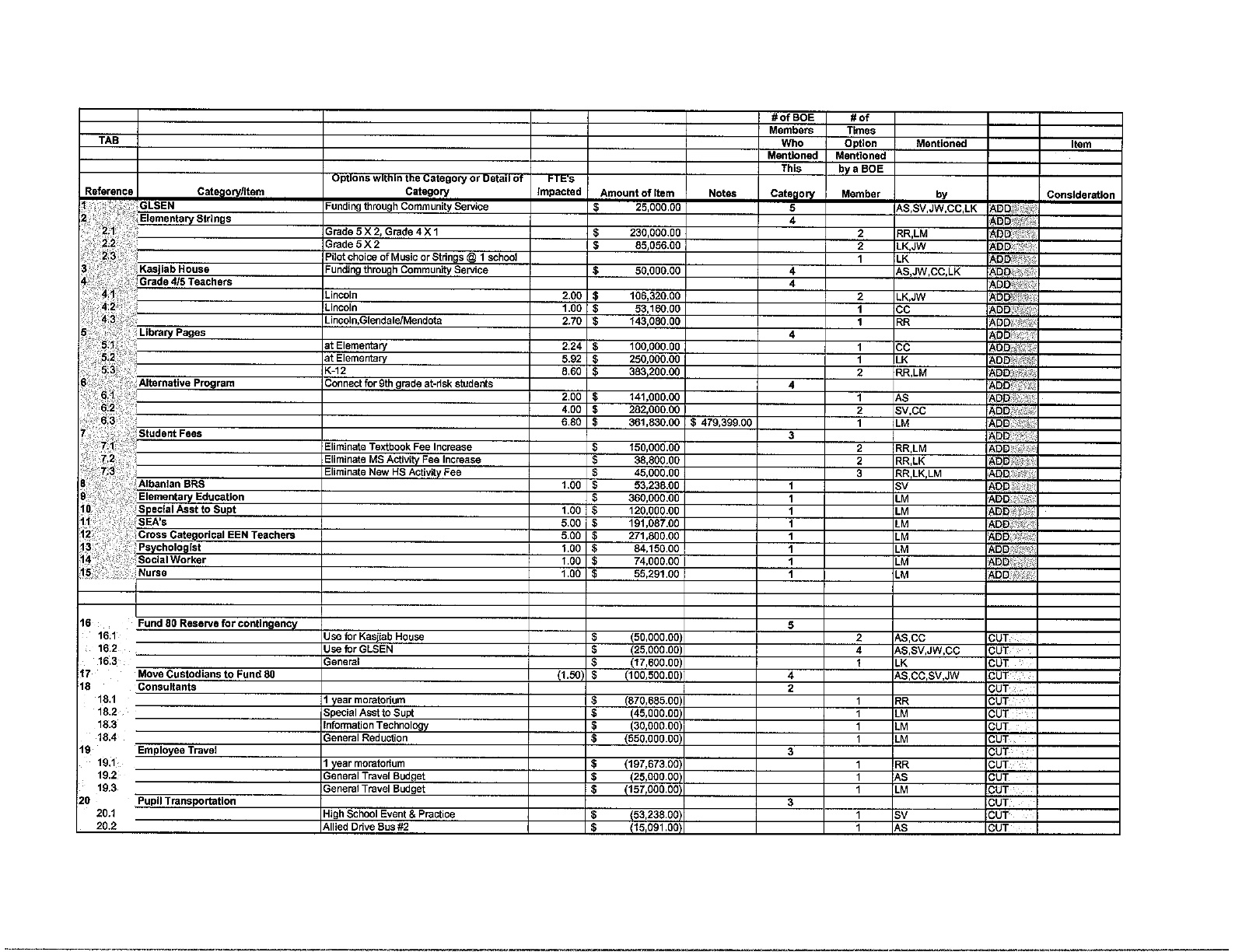
The Madison School District has posted a summary spreadsheet of board add/cut recommendations and district analysis of the various proposals on its web site.
http://www.madison.k12.wi.us/budget/mmsd/0607/budget.htm
Page 1 | Page 2 | Page 3
On Wednesday, May 31st, the MMSD School Board will consider amendments to the 2006-2007 school budget proposed by the Superintedent. In his proposal, the Superintendent proposed cutting Grade 4 strings this year and Grade 5 strings the end of next year. One amendment to be discussed on Wednesday would have Grade 4 strings 1x per week (45 minutes) and Grade 5 2x per week (45 minutes each class).
Students who will be affected the most are our low-income children. There is no other place in Dane County that can teach so many low-income children. This year about 550 low-income students took elementary strings. Fewer opportunities at this age will lead to fewer low-income/minority students in our middle and high school orchestras and band – this is a direction we do not want to move in as our student body becomes more diverse.
Like it or not, people moving into the area with children check out what schools offer – our suburban school districts have elementary string programs that are growing in many towns.
I’ve advocated for a community committee for fine arts education to develop a long-term plan for this academic area. I hope this comes to pass, but first I hope the School Board favorably considers this amendment and follows Lawrie Kobza’s idea – hold off spending on “things” because people cannot be added back in as easily as things can be added back into the budget.
I’ve written a letter to the school board that follows:
“Finding Common Ground in the U.S. Math Wars”, Science Magazine, May 19, 2006 describes the 18-month effort initiated by Richard Schaar, mathematician and former president of Texas Instruments, to bridge the gap between professional mathematicians, and math educators. Leaving many issues still to be addressed, the following is their initial statements:
Fundamental Premises
All students must have a solid grounding in mathematics to function effectively in today’s world. The need to improve the learning of traditionally underserved groups of students is widely recognized; efforts to do so must continue. Students in the top quartile are underserved in different ways; attention to improving the quality of their learning opportunities is equally important. Expectations for all groups of students must be raised. By the time they leave high school, a majority of students should have studied calculus.
For further elaboration, see Common Ground
Last month, NCTM (National Coucil of Teachers of Mathematics) endorsed a short list of skills, by grade, that every grade and middle school student must master. These “Curriculum Focal Points” are an attempt to correct the “mile-wide, inch-deep” curricula in most schools, which leave most student incapable and ill-prepared for further work in mathematics, science and engineering disciplines. The Focal Points document has not be published at this time.
But, to place these “improvements” into perspective, no one expects these initiative to make improvements by themselves. Further, UC-Berkeley Math Prof Hung-Hsi Wu says “Better mathematics education won’t take place in the next 10 years, I think it will take 30 years.”
A letter to the editor
Dear Editor: I appreciated Susan Troller’s recent article where she examined the impact of eroding budgets on schools and classrooms throughout Madison. Unfortunately, this situation is not unique to Madison schools.
The repeated cutting of school budgets is strongly affecting classrooms, teachers and students in scores of school districts throughout Wisconsin. I feel confident that Madison schools, and many other school districts, are years past cutting the “frills” from their budgets school boards and administrators are now forced to make cuts that truly affect the quality of education that our children are receiving.
These current cuts, and inevitable future cuts, are a direct result of statewide school finance restrictions that have been placed on local communities by our state Legislature since the mid-1990s. School funding is extremely complicated, and I won’t begin to try to explain it here. What I will do, however, is invite readers to educate themselves on this very important issue. A good place to begin is the Web site of the Wisconsin Alliance for Excellent Schools, www.excellentschools.org.
After we better educate ourselves, we need to have conversations with our neighbors, our friends, our school personnel and our policy makers. School financing, as it currently exists, is not going to change unless we help to make it change. And if our current school financing system does not change, then our schools will cease to be the national leaders that they still are today. And the ones who truly will lose out are our children.
I encourage readers to learn about school financing and to engage in positive dialogue with others so that we can quickly find creative solutions.
Barbara Katz
Madison
Published: May 26, 2006
The Capital Times
I sent the following message to the School Board yesterday, in reaction to MMSD’s announcement that 6 elementary principals will be moved to different schools this summer in a series of transfers.
I realize that it’s easy to talk tough from the sidelines, but I think that this is a significant personnel decision that will affect a lot of teachers, kids, and communities. If the School Board hasn’t received a thorough explanation of its rationale, I think they should request one.
A few people have suggested that I post my message to the Board here, so here it is.
—————————————–
To the MMSD Board of Education:
I don’t think I understand why Elizabeth Fritz was transferred from Crestwood. It appears that Art Rainwater has decided to remove an effective leader from a healthy school–one whose health she has helped to develop. His letter did not make the reason clear, except to suggest that he thinks it is good to move principals from one school to another every so often. Is this really his view, or the view of the School Board? It doesn’t make sense to me.
Perhaps there are good reasons for these principal moves that I’m not aware of. But from the outside they give a worrisome impression–that the Superintendent might be “protecting his own” at the expense of the students he is serving. From the outside, and with incomplete information, it looks as though Mr. Rainwater might be doing the easier thing instead of the better thing–shuttling some unsuccessful principals to different schools instead of firing them. This would at least be a plausible motivation. Rotation for the sake of rotation does not seem to be.
I think the role of principal is the most important role in a school district, and that a principal has more impact on a school’s climate than any other person. Good ones are not so easy to come by, and I don’t think they should be transferred out unless there’s a good reason. I hope the School Board will question Mr. Rainwater closely on his reasons. If it appears he’s trying to protect weak principals, or if he can’t do better than to say that it’s good to rotate principals every so often, I hope the School Board will consider overturning his decision.
Thank you for your consideration.
Bill Herman
There were some earlier postings and questions about the Equity Fund that I believe need to be answered. First equity in this case is similar to the equity you have in your house as you pay down your mortgage.
The Equity Fund is a consequence of the fact that, by state law, the district operates on a fiscal year budget (July 1-June 30) but the taxes are collected on a calendar year basis. So the 2006-07 year is paid for partially from last year’s tax levy and partially from the 2007 taxes that will be collected in January 2007.
Furthermore, about 75% of total taxes come in by January 31 – the rest come in by July 31. So when the district closes its books at the end of the fiscal year (June 30th) it has some tax funds set aside to pay for the July-Jan portion of the year and bookkeepers and accountants require a label/category for all funds – this is the Equity Fund. It is the funds that (with the additional July collections) are intended to cover the expenses of the district for the July-Jan months.
Let the Dialogue Begin
Bridging Differences A Dialogue Between Deborah Meier and Diane Ravitch
May 24, 2006
By Deborah Meier & Diane Ravitch
In the course of the last 30 years, the two of us have been at odds on any number of issues – on our judgments about progressive education, on the relative importance of curriculum content (what students are taught) vs. habits of mind (how students come to know what they are taught), and most recently in our views of the risks involved in nationalizing aspects of education policy.
Meeting recently to prepare for a debate on the federal No Child Left Behind Act, however, we found ourselves agreeing about the mess that has been generated by local and state testing. Both of us agreed that the public needs far better information about both inputs and outcomes, without which the public is woefully uninformed and too easily manipulated. As we discussed what the next policy steps should be, Diane preferred a national response, and Deborah preferred a local one.
As we talked further, we were surprised to discover that we shared a similar reaction to many of the things that are happening in education today, especially in our nation’s urban school districts. Recent trends and events seem to be confirming our mutual fears and jeopardizing our common hopes about what schooling might accomplish for the nation’s children. We might, we agreed, be getting the worst of both our perspectives.
Unlike Deborah, Diane has long supported an explicit, prescribed curriculum, one that would consume about half the school day, on which national examinations would be based. Diane believes in the value of a common, knowledge-based curriculum, such as the Core Knowledge curriculum, that ensures that all children study history, literature, mathematics, science, art, music, and foreign language; such a curriculum, she thinks, would support rather than undermine teachers’ work. Deborah, while strongly agreeing on the need for a broad liberal arts curriculum, doubts that anyone can ensure what children will really understand and usefully make sense of, even through the best imposed curriculum, especially if it is designed by people who are far from the actual school communities and classrooms.
Yet both of us are appalled by the relentless “test prep” activities that have displaced good instruction in far too many urban classrooms, and that narrow the curriculum to nothing but math and reading. We are furthermore distressed by unwarranted claims from many cities and states about “historic gains” that are based on dumbed-down tests, even occasionally on downright dishonest scoring by purposeful exclusion of low-scoring students.What unites us above all is our conviction that low-income children who live in urban centers are getting the worst of both of our approaches.
Board member stirs controversy
Baraboo News Republic
Thursday May 25, 2006
By Christina Beam
BARABOO – New Baraboo School Board member Kevin Bartol
(
“There are some people in this country that cannot be educated,” Bartol said to the board. “They may have their eyes open, but there’s no one awake upstairs.”
His comments Monday came as part of the board’s review of district
policies, including one for “Programs for Students with Disabilities.” The first sentence of that policy reads that the board “shall provide a free and appropriate public education in the least restrictive environment for students with disabilities who reside within the district.”
Bartol proposed the board add a modifier before the word student, such as “educable,” so that if a child who “can’t be taught” wants to enter or stay in a Baraboo public school the district is not required to serve him or her.
“Every child can be taught,” said Director of Special Ed Gwynne Peterson said, who added the district is under federal obligation -as well as moral and ethical – to teach every student.
“I don’t think that’s true,” Bartol said. “What if you teach them for two or three years and they haven’t learned anything?”
High School Principal Machell Schwarz responded, “Then we work with them and try everything we possibly can.” Bartol requested the board look into the legalities of modifying the disability policy.
By Tuesday word of the exchange had spread around the district, District Administrator Lance Alwin said, and he had received feedback from community members troubled by Bartol’s comments.
“Any family that has a child with special needs would be very disconcerted to know we were thinking about defining the type of child we intend to work with,” Alwin said. “All children shall be served. Until I’m told differently, I have no intention of beginning to socially exclude any child that shows up at our doorstep.”
In an interview Wednesday Bartol did not back down from his statements but said he was misunderstood by administrators and other board members who took offense to his comments.
“To my knowledge, all the students that are attending the Baraboo School District fall into the category of being able to be educated,” he said. “But it is feasible and it has occurred in other school districts where students that because of some type of brain damage were not be able to be educated and yet they were allowed to go to school.”
In a statement from Wisconsin Association of School Boards Wednesday,
attorney Nancy Dorman advised the district state and federal laws entitle all children to an education, and the district’s obligation to provide it cannot be waived through local policy.
It’s possible those state and federal laws implied that “students” were children capable of being educated, Bartol said. He said ideally the district would have a team of experts determine if children with severe cognitive disabilities were making progress in the public school setting. If after a year or two they hadn’t improved, he said, they could go elsewhere.
“Public school systems are not a baby-sitting service or a nurse care
service for children such as those,” he said. “They’re a place to educate students.”
Peterson, who also investigates discrimination and harassment complaints in the district, said she was outraged by Bartol’s “discriminatory and prejudicial” remarks.
“It’s frightening to me that someone in a position making decisions on the education of the students in our community believes these kinds of things,” she said.
Education for severely cognitively disabled students is adapted and
individualized to the children’s needs, Peterson said, but it still
qualifies as education. Special ed teachers may work with a student to
learn to hold his head up, she said, freeing the student to be more
independent and spend his energies learning new tasks and concepts.
“We have had very young students with developmental disabilities who you might look at and just by appearance decide this student can’t learn,” she said. “I’ve seen those kids, and I’ve seen how far they do come.”
The district’s policy for students with disabilities borrows heavily from state and federal legislation, such as the Individuals with Disabilities Education Act, which defines disabilities and schools’ obligations to serve students.
Bartol said the whole issue is probably moot if the board is unable to make any policy changes. “I’m not going to be upset about it one way or another,” he said, “and hopefully no one else gets upset about it one way or another.”
Bartol was elected to the board after a recount of the April 4 election had him winning by a three-vote margin over write-in candidate Doug Mering. Bartol, who was on the same ticket as a five-year, $7.5-million referendum, ran on an anti-referendum platform.
With the MMSD considering an addition to Leopold Elementary and a new west side high school, the fabulous Renewable Energy and Sustainable Living Fair in Custer, Wisconsin (just 7 miles east of Stevens Point) offers a relevant presentation titled Lighting and Daylighting in School Buildings. The Fair program describes the presentation:
Learn to evaluate the light needed for the activity at hand. Plus, gain some tips on daylighting — using a bit of the most abundant, accessible and predictable renewable resource available to us.
The presentation will be offered on Friday, June 23, at 12:00 noon. The presenter Bob Drevlow works with the Focus on Energy Schools Program.
Daylighting saves electricity without adding cost to a school, as demonstrated by Clackamas High School in Clackamas, Oregon.
One of those cryptic messages in the current MMSD budget document says:
One of the major challenges for the 2006-07 school year is implementing a change in the philosophy and approach to creating positive student behavior. We are moving from a punitive system of student behavior management to a distict wide positive approach to changing student behavior thorugh education, dialogue and resotrative justice.
In plain language, the district will implement a variation of a program created by Corwin Kronenberg. The program won’t be the complete version of Kronenberg’s plan because he and the district had a falling out, similar to the parting of ways between the MMSD and Glen Singleton with his “courageous conversations” on race.
Kronenberg doesn’t seem to have a Web site that lays out his behavioral management plan, but it’s posted below as it appears on the Web site of the Sheboygan school district.
For immediate release
Wednesday, May 24, 2006
Six elementary principals to lead different schools for 2006-07
Six elementary school principals will lead different schools next year in a series of transfers within the Madison School District. All six principals have been at their current schools for at least five years.
The list of new assignments, by principal, with current school and length of service:
Craig Campbell to Elvehjem from Kennedy (10 yrs.)
Lisa Kvistad to Lowell from Elvehjem (5 yrs.)
Bev Cann to Kennedy from Lowell (5 yrs.)
Linda Allen to Chavez from Thoreau (5 yrs.)
Howard Fried to Crestwood from Chavez (6 yrs.)
Liz Fritz to Thoreau from Crestwood (6 yrs.)
In making these assignment changes, Superintendent Art Rainwater said, “All of these principals have been at their schools for several years, and I believe these changes are good for the district, the principals, the staff and the students.”
Parents at each of the schools were notified yesterday. The changes will take place over the summer in time for the Tuesday, September 5 start of the new school year. Each of the principals will assist his or her successor in the transition to make it more effective and efficient.
COMMENTS OR QUESTIONS? PLEASE CONTACT:
Madison Metropolitan School District
Public Information Office
545 W. Dayton St.
Madison, WI 53703
608-663-1879
 |
28 minute video excerpt of this evening’s discussion of the MMSD’s food service budget (the food service budget is evidently supposed to break even, but the operating budget has apparently been subsidizing it by several hundred thousand dollars annually). |
This sort of excellent citizen oversite is essential to any publicly financed organization, particularly one that plans to spend $332M in taxpayer funds next year and hopes to pass referenda in the near future.
Former Madison Mayor Paul Soglin made a similar case today when he discussed our fair city’s water problems:
It’s funny how progressives forget their history and the reason for doing things. The idea is to have a citizen board, not a board with public employees. That is part of the checks and balances. In fact the progressive left in Madison went though considerable time over the years gradually removing city staff from committees so they would not dominate and squelch the citizens who are more likely to be ‘whistleblowers.’
In the water example, a citizen spent years chasing this issue, finally getting the attention of the traditional media and the politicians.
A number of board members have been asking many questions (the video clip will give you a nice overview of who is asking the questions and what the responses are). You can check the action out here (Each “Tab” is a question to the Administration, with their response”). For example, we learn in tab 11 2 Page PDF that the district spent a net (after 200K in gate receipts and 450K in student fees) $1,433,603 on athletics in 2005/2006 and plans to spend a net $1,803,286 in 2006/2007, a 25% increase. The overall budget will grow by more than 3%.
This is quite a change from past years, and provides some hope for the future.
In an effort to build community, enhance self-esteem and inspire the
spirit of giving among its students, Lapham Elementary School has
organized a very special service-learning project. The “Lapham to
Lubasi Run-a-thon”, held Wednesday May 10th, was led by one of the
school’s second grade classes to raise awareness of poverty in Africa
and to collect books to build a library for the Lubasi Children’s
Home, an orphanage in Livingstone, Zambia.
Lubasi is a community-supported home for over sixty Zambian children
ranging in age from 5 to 15 years. As part of their Africa curriculum
this spring, a class of Lapham second graders made a connection with
this special home, and has been writing back and forth to learn more
about life in Africa. And learning about some of the challenges of
growing up in a poor country made the students eager to help.
Inspired by teacher Catherine McCollister’s passion for running and
fitness, they selected the run-a-thon as their way to support their
new friends, and they enlisted the entire school to help.
The event was a great success. The students had a collective goal of
832 laps around the field. With each lap representing 10 miles, this
goal would symbolically take the runners the 8,320 miles from Lapham
School all the way to the Lubasi Home for Children. Nearly 250
students ran the course in three waves. Parents and teachers cheered
the students on and everyone celebrated together as laps accumulated.
An old school bell was rung at every one hundred laps reached. By the
time the third wave had finished, the students had run over 1,200
laps.
The students also surpassed their goal for book donations. With a
goal of collecting at least 200 books, their efforts have raised over
450 beautiful new books so far, as well as several hundred dollars to
cover shipping and help Lubasi with library construction costs.
Next week Lapham students will write letters to their friends in
Zambia, and pack up their gift to send the 8,320 miles to Lubasi.
For more information, please contact:
Katherine Davey, (608) 770-9066 or katherine_davey@yahoo.com
According to the data on DPI’s Web site, the combined percentages for minimum and basic categories (these are below grade level) for MMSD’s 10th graders on the WKCE reading test in November 2004 were:
All students – 26%
African American – 53%
Asian – 29%
Hispanic – 51%
White – 15%
The real shame lies, not in the scores, but in the MMSD’s lack of any systematic program to raise these students’ reading abilities before graduation.
A few schools may offer Read 180, a remedial curriculum praised by staff in the MMSD and other districts.
Pam Nash illustrated the MMSD’s weak commitment to Read 180 in a response to my question on how much money the current budget includes for Read 180. Pam wrote:
The district has not included any specific budget for 2006-07 that would be utilized for READ 180. Individual building principals may utilize existing supply/formula and staffing allocations to provide READ 180 strategies within existing curriculum offerings. Read 180 will be offered at all four high schools and Brearly Street Alternatives. (emphasis added)
Given that implementation of Read 180 costs about $40,000 per school, according to district figures, Read 180 won’t be expanded to schools currently without it.
From the WKCE scores, probably 20% to 26% of MMSD graduates cannot read their diploma, let alone read well enough to continue their education or land a job that pays a living wage. (The percentage might be lower than 20% since many non-readers may drop out before graduation.)
Additionally, the superintendent and some board members like to brag that the MMSD closed the achievement gap because children of color are no longer over represented in the minimum category on the third grade reading test. Obviously, that’s a pitiful claim when more than half of Madison’s African American 10th graders can’t read at grade level.
In the wake of the annual EdWeek Technology Counts issue, there has been some discussion surrounding the idea that technology is education is harmful. I attribute this to a few factors, including to overstated claims for educational technology in the past, concerns about very specific uses of technology in education like calculators, and the comfort some of us take in the instructional environments we experienced. This rejection of technology is unfortunate, however. Effectively utilized technology has an important role to play in increasing the effectiveness of our schools.
The focus on technology as an end in and of itself is very misplaced in K-12. Instead, districts should focus on providing an adequate level of infrastructure for staff and students and then using technology where it can improve student and staff productivity, allow for a more personalized learning experience, and provide an interactive learning experience.
Seven metropolitan areas of Wisconsin are in the top 25 metros for public schools in the country, according to a survey ranking U.S. school districts with 3,300 students or more. The survey was conducted by Expansion Management Magazine, a monthly business publication for executives of companies that are actively looking to expand or relocate facilities within the next three years. The seven metropolitan areas of Wisconsin—Sheboygan (5), Eau Claire (7), Madison (8), Wausau (11), Appleton(16), Oshkosh-Neenah (20), and Fond du Lac (24)—appeared in a list of the 25 Top Metros for Public Schools. Schools in these areas, plus Green Bay and La Crosse, were named to the magazine’s 5-Star Public Schools Metros list.
“I am extremely proud of Wisconsin teachers and students for their dedication to quality teaching and learning, and their hard work shows in this survey of the best metropolitan school systems in the nation,” said State Superintendent Elizabeth Burmaster. “Our students, overall, consistently score among the very best in the nation on the major college entrance exams and high school graduation rates. This affirmation of the quality of Wisconsin schools from an independent, unbiased study, underscores our students’ dedication to excellence in learning and academic achievement, and the support they
receive from their teachers, families, and communities.
“Public education in Wisconsin is moving forward, supported by our early learning and classsize reduction programs. This recognition tells us that we are on the right track and must continue to invest in education, pre-kindergarten through university. Our sustained efforts as students, educators,parents, community volunteers, and citizens will ensure that our students graduate with the knowledge and skills they need to succeed in postsecondary education, the workplace, and as citizens of our 21st century global society,” she said.
The magazine rated the metro area schools as a way of providing a basis for executives to compare the type of work force they are likely to encounter in various communities around the country. Using the data from its 15th annual Education Quotient ratings, which compared 2,800 secondary school districts throughout the country, Expansion Management grouped school districts into Metropolitan
Statistical Areas (MPAs). Public schools in those 362 MPAs were compared according to a variety of categories, including college admission test scores, graduation rates, beginning and average teacher
salaries, per pupil expenditures, and student-teacher ratio.
Bill King, chief editor of Expansion Management Magazine, speaking to the importance of quality schools to business success, said, “Today’s workers, most of whom are high school graduates, must possess skills far beyond those needed just a generation ago. Clearly, the quality of the public schools is a pretty good indicator of the type of manufacturing work force a company is likely to encounter in a
particular community.”
NOTE: A list of the Best Overall U.S. Metros for Public Schools with 3,300 students or more, according to Expansion Management magazine, follows.
Top Metros for Public Schools
1. State College, Pa.
2. Ithaca, N.Y.
3. Lawrence, Kan.
4. Iowa City, Iowa
5. Sheboygan, Wis.
6. Charlottesville, Va.
7. Eau Claire, Wis.
8. Madison, Wis.
9. Columbia, Mo.
10. Harrisonburg, Va.
11. Wausau, Wis.
12. Ames, Iowa
13. Missoula, Mont.
14. Grand Forks, N.D.-Minn.
15. Billings, Mont.
16. Appleton, Wis.
17. Bloomington, Ind.
18. Flagstaff, Ariz.
19 Glens Falls, N.Y.
20. Oshkosh-Neenah, Wis.
21. Blacksburg-Christianburg-Radford, Va.
22. Jonesboro, Ark.
23. Burlington-South Burlington, Vt.
24. Fond du Lac, Wis.
25. Ocean City, N.J
For further information, contact Joseph Donovan, Communications Officer, DPI, 608.266.3559
I had a very nice day today chaperoning the Randall Safety Patrol at the Wisconsin Dells. First, Susan Smith and Phil Watters who have worked with the Safety Patrol all year deserve much thanks. The AAA, who sponsor the Safety Patrol and made the trip possible also deserve praise.
But mostly it was the students who made it such a good day. They were great; polite, well behaved, interesting and fun. There were many other Safety Patrol groups from around the state there and I can say without reservation that none were better behaved and none seemed to enjoy themselves as much as our group. What a great combination. It is easy to lose track of some of the little things like this that are part of our school system, but we shouldn’t. They made me both happy and proud.
I’d like to keep this upbeat, but am compelled to close on a down note. Susan Smith is the School Nurse at Franklin and Randall. Next year, due to financial considerations she will also serve a third school and almost assuredly will not be able to continue as a Safety Patrol mentor. This may seem like a small loss for the district as a whole, but after today it seems like a big one to me.
TJM
“Go into any inner-city neighborhood, and folks will tell you that government alone can’t teach kids to learn. They know that parents have to parent, that children can’t achieve unless we raise their expectations and turn off the television sets and eradicate the slander that says a black youth with a book is acting white.”
—Barack Obama, Keynote Address, Democratic National Convention, 2004
Acting white was once a label used by scholars, writing in obscure journals, to characterize academically inclined, but allegedly snobbish, minority students who were shunned by their peers.
Now that it has entered the national consciousness—perhaps even its conscience—the term has become a slippery, contentious phrase that is used to refer to a variety of unsavory social practices and attitudes and whose meaning is open to many interpretations, especially as to who is the perpetrator, who the victim.
I cannot, in the research presented here, disentangle all the elements in the dispute, but I can sort out some of its thicker threads. I can also be precise about what I mean by acting white: a set of social interactions in which minority adolescents who get good grades in school enjoy less social popularity than white students who do well academically.
From the New York Times a discussion of how Asian families value education and how those family values result in successful students.
The Model Students
By NICHOLAS D. KRISTOF
Why are Asian-Americans so good at school? Or, to put it another way, why is Xuan-Trang Ho so perfect?
Trang came to the United States in 1994 as an 11-year-old Vietnamese girl who spoke no English. Her parents, neither having more than a high school education, settled in Nebraska and found jobs as manual laborers.
The youngest of eight children, Trang learned English well enough that when she graduated from high school, she was valedictorian. Now she is a senior at Nebraska Wesleyan with a 3.99 average, a member of the USA Today All-USA College Academic Team and a new Rhodes Scholar.
Increasingly in America, stellar academic achievement has an Asian face. In 2005, Asian-Americans averaged a combined math-verbal SAT of 1091, compared with 1068 for whites, 982 for American Indians, 922 for Hispanics and 864 for blacks. Forty-four percent of Asian-American students take calculus in high school, compared with 28 percent of all students.
A report from an organization called MDRC strikes a responsive chord because the report stresses the need to “assist students who enter high school with poor academic skills” instead of dumping them in English 10 and to improve instructional content and practice:
[The report] offers research-based lessons from across these evaluations about five major challenges associated with low-performing high schools: (1) creating a personalized and orderly learning environment, (2) assisting students who enter high school with poor academic skills, (3) improving instructional content and practice, (4) preparing students for the world beyond high school, and (5) stimulating change in overstressed high schools.
The overall message of this synthesis is that structural changes to improve personalization and instructional improvement are the twin pillars of high school reform. Small learning communities and faculty advisory systems can increase students’ feelings of connectedness to their teachers. Especially in interaction with one another, extended class periods, special catch-up courses, high-quality curricula, training on these curricula, and efforts to create professional learning communities can improve student achievement. School-employer partnerships that involve career awareness activities and work internships can help students attain higher earnings after high school. Furthermore, students who enter ninth grade facing substantial academic deficits can make good progress if initiatives single them out for special support. These supports include caring teachers and special courses designed to help entering ninth-graders acquire the content knowledge and learning skills that they missed out on in earlier grades.
Allocations were sent to schools in early April 2006 for staffing for the 2006-2007 school year. This represents about 80%+ of the district’s budget. These are NOT final allocations. (For example, the School Board HAS NOT made a decision to cut Grade 4 strings for next year – that is the Superintendent’s proposal.)
The school board HAS NOT approved the budget for next year. What has been implemented is based upon the Superintendent’s recommendations to the School Board, but will not be final until the School Board approves budget, currently scheduled to take place on May 31st.
There will be another public budget hearing, Tuesday, May 30th at the Doyle building, 545 W. Dayton St. I’m not yet sure of the starting time.
I have been an outspoken advocate for elementary strings the past several years, because this course is a highly valued, high demand academic course that is part of the K-12 MMSD music curriculum but has been repeatedly put on the cut list without any meaningful curriculum planning taking place from year to year. However, I also strongly believe there has been a lack of long-term planning in all fine arts education since cuts began about 1999. Perhaps other academic areas have needed the administration’s attention, such as reading and math. That’s understandable, but the School Board missed yearly opportunities to put in place other structures to plan for the future of fine arts education in Madison – community committee is an example of one option they might have considered pursuing.
I was encouraged two weeks ago when the Performance and Achievement and Partnership Committee chairs indicated an interest in working on not only the cuts to elementary strings, but also other aspects of fine arts education. I hope a community-led fine arts education committee is formed from these two Board committees that will undertake long-term, strategic planning for fine arts education in Madison. I would like to see such planning include music, visual arts, dance, theater, etc. – all facets of the arts that bring joy and enrichment to the citizens in our community, growth to our city’s economy now and in the future and play an important academic role in the excellent education our children receive.
Again, School Board members can be emailed at: comments@madison.k12.wi.us
The school board agenda for tonight’s meeting (May 15) shows that the board will discuss funding for the following groups:
– The Gay, Lesbian, and Straight Education Network
– The Center for Academically Talented Youth
– The Kajsiab House Project
– The Youth Empowerment Academy.
Johnny Winston, Jr. previously chose these groups and convinced the board to fund them without inviting all community groups to apply through a request for proposals, which could be used to solicit programs to further specific MMSD goals. (Funds for the Youth Empowerment Academcy were previosly provided through a grant to The Charles Hamilton Houston Institute, Inc.)
Board member Ruth Robarts raised concerns about this funding approach the first time around, and her concerns remain valid.
Since Johnny Winston, Jr. and the board continue to fund community groups, it would be wise for any and all community groups to apply for funding from the MMSD. I suppose that proposals could be sent to Johnny Winston, Jr. or Supintendent Rainwater.
MMSD’s School Board meets tonight to discuss the 2006-2007 school budget. There are no public appearances on tonight’s agenda, but the Madison community can continue to email the School Board in support of elementary strings at: comments@madison.k12.wi.us. Thank you to the parents and community who have attended the public hearing and who have sent emails to the School Board in support of elementary strings for Madison’s 9- and 10-year old students.
Cutting elementary strings will hurt low-income children! Keep the emails coming in support of about 550 low-income children who signed up for elementary strings – no other organization in Madison or Dane County offers an academic year long class that teaches this many children how to play an instrument. Madison School Board: Let’s work together to enhance this learning experience for our children; not tear it down and not tear it down before hearing from and working with the community.
I support restoring elementary strings to 2x per week, and I support forming a community task force on elementary strings and fine arts education to build fine arts education in Madison, not continue to tear it down. I reject late spring reports from the District administration that are clearly biased against this course and have not engaged teachers, music professionals, the community in the preceding 4 years! It’s not a administrative staffing issue, but it is poor, poor planning. We’ve had revenue caps since the early 1990s, and the Superintendent has been cutting fine arts since 1999 with no long-term plan in place, no community task force formed.
Call for an end to unfair cuts to elementary strings – cut 50% last year. No other high demand, highly valued course has been targeted in any year let alone year in and year out for cuts for 5 springs!
The state needs to take action on school financing; Madison needs the MMSD School Board to take action on elementary strings and fine arts educationl. Work with the community – please start now!
The reduction of over $680,000 of ESEA Title 1 entitlement grant dollars challenges the district to change the way students and teachers are supported under Title 1. The current direct service model of student support cannot be supported in the long run with current funding. The administration will use the first semester of next year to develop a new model. (Page 252, Department & Division Detailed Budgets)
The MMSD uses Title 1 money to fund Reading Recovery. Does the statement above mean the end of Reading Recovery in the district?
This is to briefly summarize from my point of view what went on at the MSRI workshop on equity in math education last week. (Vicki was also there and may wish to give her side of the story so you get a more complete picture. It was a very broad workshop, 13 hours a day for 3 days. The web site is down right now, but you can view a cached version here.)
The charge of the workshop was to brainstorm solutions to the underrepresentation of (racial and ethnic) minorities in mathematics and mathematics courses which frequently serve as gatekeepers to other areas.
The participants were thus rather heterogeneous, policy-makers, mathematics educators, mathematicians and teachers, including several groups of young people from various projects who serve as mentors and tutors in mathematics.
The talks and presentations were thus rather mixed, from talks by a law professor about constitutional issues on education to examples of math games played by young tutors and an actual 9th grade math class right with 22 students from a nearby high school right in front of all participants.
There were also some chilling descriptions of the abominable conditions at some schools serving mostly black and native American students.
The usual disagreements between research mathematicians and math educators were not brought to the surface much, but were brought up in many personal conversations during breaks and meals. However, there was general agreement that the underrepresentation of minorities is a serious national problem, and that more resources and better teachers are crucial to its solution.
However, no firm solutions or consensus emerged.
The two things I took away from the workshop are:
It appears that the MMSD site is down http://www.mmsd.org/.
Does anyone know why or how long it has been down?
TJM
We Energies has posted on its website a Request for Proposals (RFP) to identify and to competitively select the best customer-sited renewable energy projects to receive customer project incentives under the We Energies “Renewable Energy Development” program:
We Energies will provide financial incentives ranging from $10,000 to $100,000 to selected customer-owned renewable energy projects that are interconnected to the We Energies distribution system and meet the eligibility criteria of ownership by a not-for-profit organization, not-for-profit educational/academic institution, unit of government, or special district or authority defined as government under Wisconsin law. In addition, all proposed projects need to include a strong and clearly-identified outreach and educational component that will be used to inform and educate members of the general public about renewable energy in a ongoing and continuous manner. In all cases, incentive recipients must be existing We Energies retail electric customers in Wisconsin.
Incentives shall not exceed 50% of total installed project cost less any federal or state government incentive or credit and less any Focus on Energy funding. Proposed solar photovoltaic and wind energy system projects must have a site assessment completed (preferably though the Wisconsin Focus on Energy Site Assessment Program, or equivalent). The assessment shall provide an estimate of the energy output of the project once operational. In addition, all installations must be completed by a Focus on Energy designated Full Service Installer.
There may be up to five rounds of incentive applications and evaluations. Deadline for first round of applicants is May 31, 2006.
Does the MMSD have a problem with high turnover? Two comments raise the issue in the undated 2006 budget document Department & Division Detailed Budgets:
A challenge at the middle school level includes the frequent turn-over of teachers assigned to teach mathematics. (page 88)
Middle School science teachers are developing pedagogical content expertise to be able to teach standards-based science to support the MMSD K-8 Science & Scope & Sequence. A facet of this work will include writing and implementing a Title II Part B grant to support district efforts. Challenges include designing and supporting professional development with adequate rigor and duration in light of teacher “turn-over” in MMSD and working with middle school principals to support hiring, transferring and maintaining highly-qualified science (and mathematics) teachers in science positions. (page 94)
A Madison School’s TV Channel 10 video, MSCR: Middle School
After-School Programs received a “Significant Community Programming”
distinction at the annual awards for the Wisconsin Association of PEG
Channels (WAPC). WAPC represents local public, educational and
government access cable channels across the state.
The TV program, cooperatively produced by Lindy Anderson of the
Madison Schools’ media production department and Nicole Graper of
Madison School & Community Recreation (MSCR), highlights the
variety of after-school programs and services available to Madison’s
middle school children.
This award marks the third year in a row MMSD-TV has been honored at
the annual ceremony. Previous awards have been presented to MMSD-TV
from the Wisconsin School Public Relations Association, the National
Alliance for Community Media and the Wisconsin Educational Media
Association.
MMSD-TV 10 can be seen on the Charter Cable system in Madison and
surrounding areas.
For more information, contact:
Marcia Standiford, 663-1969
Active Citizens for Education offers the following recommendations for the consideration of the MMSD Board of Education in the allocation of funds for the 2006-2007 budget: (I appeared on WIBA, 1310, this evening with Brian Schimming and discussed the MMSD proposed budget and ACE recommendations) [18MB mp3]
Members of the Board of Education,
I am writing to urge you all to vote in support of continuing the strings program in elementary schools.
I am a parent of a 6th grader at Hamilton Middle School, and I am fortunate to have been able to afford private and group violin lessons outside the school system for my son, since kindergarten. I can not tell you what a huge benefit this has been to him, in terms of teaching him to strive towards a rewarding goal, the joy of working together in a group of other learners, and appreciating the goodness of the arts in a troubled world.
And yet I know that the disadvantaged children in MMSD have no opportunity at all to play a violin or other instrument in elementary school unless the strings program continues.
It is clear to me and all music instructors that if a child starts violin in 6th grade, it is by far more difficult for them and much more likely that they will become frustrated and give up.
Starting in grade 4 will not only help students learn and stay with it, but will be a better use of the precious funds that we do allocate to strings in all grades — a better foundation means better participation and more benefits in the later grades.
My own son did not take strings in 4th and 5th grade, because I felt it was better to give another spot to a family that did not have another means to offer strings to their child. He now participates in 6th grade. I can tell you that with all the other major adjustments of the transition to middle school, starting a stringed instrument from scratch would have added a lot of stress to our family.
Please, please find a way to continue strings in 4th and 5th grades. I have been to enough meetings to know that there are things that could be cut from the budget that are way less important than strings.
Thank you,
Jane Sekulski
PS. If you have never seen the movie “Music of the Heart”, please consider doing so. It is based on a true story, which is documented in the film “Small Wonders”, of a violin program in inner city New York. The documentary is even better.
Page 98 of the undated 2006 budget document includes the following:
Library Media Services Division initiatives contemplated for the upcoming 2006-07 school year include (a) the consolidation of the elementary and middle school Technology and Information Literacy curricula, (b) the expansion of Accent database services to bookrooms and high school textbook collections, (c) the transition from a magnetic tape-based video distribution system to a datacast and optical disc-based distribution system and (d) further expansion of district-wide online subscriptions.
The document leaves to the reader’s imagination what the initiatives might cost or whether they’re worth the cost, because it offers no rationale or estimated expenditure that I can find.
Further, the document gives the board and public no information with which to compare the value of these initiatives to other ways the money might be spent. Yet, those are exactly the choices the board and community ought to be able to make through budgeting.
Dear Madison Community,
Children and parents are encouraged to speak in support of elementary strings and to bring their instruments to tonight’s School Board public hearing on the budget if they would like to play. My husband, Fred Schrank, who is the principal bassist with the MSO and who teaches orchestra to elementary and middle school children in the district, will be there. I’ve asked him if he would accompany those children who might want to play for the School Board to show their support for the course. The public hearing begins 6:30 p.m at Memorial High School, 201 S. Gammon Road, Auditorium [map].
For your information – the School Board takes students who want to speak for 3 minutes (or play for 3 minutes) first. I also have signs and will have colored markers for students or others who want to make signs for the School Board to see.
The Superintendent’s proposal to cut Grade 4 strings is unacceptable, incomplete and would put in place a music curriculum planning process AFTER the cut is made to Grade 4 strings instruction. His conceptual idea is to plan to offer elementary children experiences with varied instruments in the 07-08 school year when Grade 5 strings would be cut and there would be no more elementary strings. That’s a curious idea. Why? Current General Music practice is to offer children experiences on different instruments – so the planning would not result in any meaningful curriculum change except the elimination of elementary stringed instrument instruction. What kind of plan would that be? No community planning took place this year for music education, which DPI recommends as best practice for standards based curriculum planning – include professionals and the community in the effort. The only plan is to cut Grade 4 strings, with planning for next steps to follow. Without good planning and good information – bad practice and bad decisions follow.
My question: Where’s the planning been for the past year, for the past 5 years? Our kids deserve better. Hundreds of children and community members have spoken in support of the elementary strings course over the years and emails and support for this course remain strong as demonstrated by the children once again this year through their enrollment in this course – over 1,700 children in September (550+ low income children who will be hurt the most by this cut).
After 5 springs of advocating for this course, I’m exasperated and annoyed; but when I listen to children and parents tell their stories about their hopes and dreams, I get reinvigorated as I was last night after listening and speaking. Last night, Ruth Robarts, Shwaw Vang and Lucy Mathiak spoke strongly in support of the program and in working on strings through the Performance and Achievement and the Partnership Committees. I think the idea to collaborate among board committees is novel and appropriate for Fine Arts – and may be for other areas. I feel involving the community – music and art professionals, parents, organizations in the process is critical to the long-term success of fine arts education in Madison, especially in tight financial times.
Also, Lawrie Kobza, School Board Vice President, reminded the Superintendent that the School Board had additional options to his proposal to consider – the Superintendent’s options plus keeping the course the same as this year or restoring the course to what it was two years ago (2x per week for 45 minutes).
So, please, if you have time tonight, come and Speak Up For Strings! Even if it’s only to stop in on your way to and from another event (it’s that crazy time of year with concerts, sporting games, dances and preparation for graduations taking up lots of time) and register with the Board in support of the course. I’ll be there to help with registering to speak in support, or simply registering your support. Each person’s presence makes a difference – individually and collectively!
Best,
Barbara Schrank
P.S and FYI – the Supt.’s proposed Grade 4 strings cut would not affect any current teachers and would be made through retirements and resignations. However, 1,700 children would lose something they dearly value that provides them with so much. I think, over time, our community will lose even more.
Why is presentation and discussion of next year’s school budget last on the agenda, following a substantial meeting agenda and, tonight, a public hearing. I don’t understand why there aren’t more public discussions planned for the budget. Perhaps the budget discussion timeline will be discussed further tonight. I hope so, because I think public discussion of the budget and the Board’s decisions are important. What process is followed and decisions made are likely to affect the outcome of future referendums.
In my previous post on Speak Up for Strings, I wrote about two ways to contact the School Board – one way is by speaking to the School Board at public appearances; which,is normally after the minutes of a meeting – at the beginning, before the board begins it’s business. A special Board meeting is scheduled for today, but public appearances will not be until agenda item 10, which follows many substantive agenda items, so chances to speak will not be until later in the evening – perhaps quite late.
I sent the following letter to the School Board last week after reviewing data and text on elementary strings sent to the School Board by the Fine Arts Coordinator. In late March, I spoke before the School Board about working together on strengthening strings and fine arts education and hoped that we would not see another spring of “surprise reports.” Shwaw Vang and others thought this was a good idea, but I guess the administration did not agree. Following my talk, the Superintendent sent a memo to the School Board with a proposal to eliminate elementary strings the end of next school year and offer General Music.
For the past five springs, in one form or another, reports on strings have been presented to the School Board, which present data and give reasons why not to teach strings. These reports are all prepared by top administrators with basically no input from or curriculum review by teachers, parents, students, the community. No other data are presented in the same manner and with as much detail as this course – none, which I find troubling. Courses are dropped for lack of enrollment, which is not the case with elementary strings. Also, no other academic course has come before the School Board year after year for cuts – not even open classroom, ropes, wrestling.
I have MMSD historical data on strings from when the course was first introduced. In spite of the administration’s best efforts to cut the course,
In a comment, Lucy Mathiak wrote: “As a board member, I do not see the issue as strings vs. math vs. athletics, which is how the annual budget pageant usually works. I see the issue as strings and math and athletics vs. cost overruns in building projects, growth in business services, and expenditures for contracted services that may or may not benefit our schools.
Attacking strings, or extracurriculars, or sports, will not put teachers, librarians, and other key staff into schools. Nor will it repair curricula that are of questionable efficacy. If we want good schools, the conversation starts with what is in the budget — ALL of the budget — and whether the budget supports the kind of programs that we value in our schools.” I strongly agree with her statement, because focusing on ALL of the budget keeps the focus on what’s important – student learning and achievement. An increasing body of research and experience shows studying an instrument positively affects student achievement. If so, why isn’t the School Board working with the community to strengthen fine arts education.
Dear School Board Members,
You recently received some statistical information from the District Fine Arts Coordinator on string instrumental enrollment for Grades 4-12 that was in response to a question from Ms. Carstensen on enrollment.
I feel the information presented could have been titled, “Reasons [the Administration Wants] to Cut Elementary Strings,” which, of course I found strange and inconsistent with data on this course and how other data are presented to the School Board [for issues/practices the administration supports].
I would like to provide you with some additional information that I believe provides a bigger picture and shows how this course has grown as the District has changed:
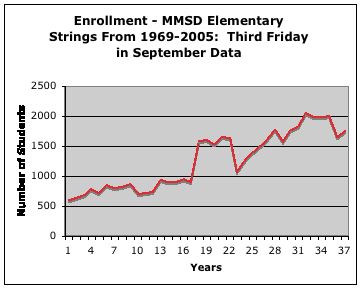
While the school board refused last year to get outside advice on the operations of Business Services, the department just keeps growing and growing and growing.
Compared to 2004-2005 budget, the number of Food Service Workers would increase by 11.32 FTE if the board approves the administration’s proposed budget. District enrollment will decline by approximately 336 students between 2004-2005 and next year. Why does it take 11 more people to feed 336 fewer students?
The job category “trades” would grow by 7 FTE from last year to next year, while cutting 1 painter and 1 carpenter, according to the proposed budget.
But what’s really odd, the budget approved by the board in the summer of 2005 shows 27 FTE in trades. Now the administration asserts that the revised budget approved in October 2005 increased the number to 35 FTE. Not! At least not that I can find. No place does the revised budget show an increase in FTEs in trades.
Is someone “cooking” the numbers or padding the payroll to increase the Business Services domain?
Wisconsin State Journal editorial
Wednesday, May 3, 2006
Madison should take a bow and be proud of its decade-long effort to improve early reading skills and boost school achievement for all racial groups.
Yet the hard work isn’t over and may be getting harder.
UW-Madison education researchers hailed Madison this week for shrinking its racial achievement gap more than probably any urban area in the country. And at the same time, test scores for white students in Madison kept improving.
More young students of all backgrounds can read.
More older students of all backgrounds are graduating.
Madison’s formula for success, according to the researchers, is largely the result of three things:
One-to-one tutoring by trained volunteers.
The Wisconsin State Journal and WISC-TV (Ch. 3) helped launch a decade ago the Schools of Hope civil journalism project that stressed the recruitment and training of volunteer reading tutors. The United Way now oversees the effort and counts about 1,000 tutors working with 2,000 struggling students on reading and math in kindergarten through eighth grade.
Organizers say the effort will continue and possibly expand until at least 2011.
Small class sizes in the earliest grades.
The state is contributing millions to Madison schools for poor children to benefit from the extra attention smaller class sizes allow during kindergarten through third grade.
Better teacher training.
This might be the hardest element of Madison’s success to maintain, much less improve. With relatively flat school enrollment and high property values in Madison, the state steers a lower percentage of aid our way. And voters have shown they’re skeptical of approving higher operational spending than a state cap otherwise allows.
That means other areas of school spending should be cut before teacher training is reduced. Or perhaps the district can develop creative, lower-cost ways to train those teachers who most need it.
Madison just might become a national model for closing the racial achievement gap if existing trends continue. But that won’t be easy given financial constraints and a growing influx of students who lack English skills.
But hope is high. Volunteers are energetic. Educators passionately want students to succeed.
Let’s stay at it, Madison, and show the nation the way.
I’ve watched a few minutes of the last two board meetings with new board members Arlene Silveira and Lucy Mathiak. What a refreshing improvement! The meetings seem more focused on the issues at hand with members better prepared to ask questions and give direction to the administration. Bravo!
The National School Board Association argues that local school boards exist to translate the community’s educational goals for its children into programs and to hold staff accountable for the quality and effectiveness of the programs:
Your school board sets the standard for achievement in your district, incorporating the community’s view of what students should know and be able to do at each grade level. Your school board also is responsible for working with the superintendent to establish a valid process for measuring student success and, when necessary, shifting resources to ensure that the district’s goals are achieved.
Don’t expect to see that kind of process as the Madison School Board adopts a $383.7M budget for 2006-07.
On April 24, 2006, Superintendent Art Rainwater presented his proposed budget for 2006-07 to the school board. MMSD Proposed Balanced Budget for 2006-07 To the credit of the administration, the documents are better organized and provide more detail than in recent years.
Nonetheless, the board’s adoption of next year’s budget will likely be an unsatisfying process for parents and the community. I say this because the Madison board has again skipped the decision-making steps that are necessary for budget decisions to occur within a framework that we can all understand and support.
Long before the school board tries to evaluate a budget, the board should have translated the community’s vision for the education of its children into specific, measurable goals for student achievement. Key Work of School Boards
We don’t have such goals except for third grade reading, completion of algebra and geometry and attendance. What kind of budget commitment should we make to offering a comprehensive high school program? We don’t know, because we have set no standards for the “challenging, contemporary curriculum” that we claim is a strategic priority for the district. What funds should we commit to fine arts education? We don’t know, because we have no achievement goals in the arts or any other curriculum area. Should we cease funding a “Race and Equity” position at the $100,000 a year level? We don’t know because we don’t have objectives for the position to accomplish.
The board should also have developed a shared understanding of how data will be used to evaluate the district’s progress toward meeting its goals.
We don’t determine which data will be used in decisions about educational programs or any other aspect of the budget. Should we cease the “same service” approach to the teaching of reading? Should we continue to invest in “instructional coaches” who teach teachers how to present the Connected Math program? Again, we don’t know. The administration claims that its curriculum decisions are data-driven. However, the administration does not share the student achievement data behind our “same service” approach or proposed new programs nor has the board agreed to rely on whatever data that the administration may use in its internal analysis.
As the result of the April elections, the board has two new members: Lucy Mathiak and Arlene Silveira. Both promised to focus on standards and accountability during their campaigns. Maybe next year will be better. That’s important because the fuss that occurs each spring as the board struggles to “restore” programs or staff that the superintendent has cut should not occur. We should not be on the defensive–always having to create our own individual rationales for replacing cut items or changing programs. We should be on the offensive—judging the superintendent’s budget against the goals that we have set for our programs and the measurements of effectiveness that we have agreed on.
Please stay tuned.
Ruth Robarts
Member, Madison School Board
From the Wisconsin State Journal, May 2, 2006
ANDY HALL ahall@madison.com
Madison made more progress than any urban area in the country in shrinking the racial achievement gap and managed to raise the performance levels of all racial groups over the past decade, two UW- Madison education experts said Monday in urging local leaders to continue current strategies despite tight budgets.
“I’ve seen districts around the United States, and it really is remarkable that the Madison School District is raising the achievement levels for all students, and at the same time they’re closing the gaps,” Julie Underwood, dean of the UW- Madison School of Education, said in an interview.
Underwood said she’s heard of no other urban district that reduced the gap so significantly without letting the test scores of white students stagnate or slide closer to the levels of lower-achieving black, Hispanic or Southeast Asian students.
“The way that it’s happened in Madison,” she said, “is truly the best scenario. . . . We haven’t done it at the expense of white students.”
Among the most striking trends:
Disparities between the portions of white and minority students attaining the lowest ranking on the state Third Grade Reading Test have essentially been eliminated.
Increasing shares of students of all racial groups are scoring at the top levels – proficient and advanced – on the Third Grade Reading Test.
Graduation rates have improved significantly for students in every racial group.
Underwood commented after one of her colleagues, Adam Gamoran, director of the Wisconsin Center for Education Research, presented a review of efforts to attack the racial achievement gap to the Schools of Hope Leadership Team meeting at United Way of Dane County.
Gamoran told the 25- member team, comprised of community leaders from the school system, higher education, nonprofit agencies, business and government, that Madison’s strategy parallels national research documenting the most effective approaches – one-to-one tutoring, particularly from certified teachers; smaller class sizes; and improved training of teachers.
“My conclusion is that the strategies the Madison school system has put in place to reduce the racial achievement gap have paid off very well and my hope is that the strategies will continue,” said Gamoran, who as director of the education-research center oversees 60 research projects, most of which are federally funded. A sociologist who’s worked at UW-Madison since 1984, Gamoran’s research focuses on inequality in education and school reform.
In an interview, Gamoran said that Madison “bucked the national trend” by beginning to shrink the racial achievement during the late 1990s, while it was growing in most of America’s urban school districts.
But he warned that those gains are in jeopardy as Wisconsin school districts, including Madison, increasingly resort to cuts and referendums to balance their budgets.
Art Rainwater, Madison schools superintendent, said Gamoran’s analysis affirmed that the district and Schools of Hope, a civic journalism project of the Wisconsin State Journal and WISC-TV (Ch. 3) that grew into a community campaign to combat the racial achievement gap, are using the best known tactics – approaches that need to be preserved as the district makes future cuts.
“The things that we’ve done, which were the right things to do, positively affect not just our educationally neediest students,” Rainwater said. “They help everybody.”
John Matthews, executive director of Madison Teachers Inc., the teachers union, and Rainwater agree that the progress is fragile.
“The future of it is threatened if we don’t have it adequately funded,” Matthews said.
Leslie Ann Howard, United Way president, whose agency coordinates Schools of Hope, said Gamoran’s analysis will help focus the community’s efforts, which include about 1,000 trained volunteer tutors a year working with 2,000 struggling students on reading and math in grades kindergarten through eight.
The project’s leaders have vowed to continue working until at least 2011 to fight gaps that persist at other grade levels despite the gains among third- graders.
“I think it’s critical for the community to know that all kids benefited from the strategies that have been put in place the last 10 years – the highest achievers, the lowest achievers and everybody in between,” Howard said.
“To be able to say it’s helping everyone, I think is really astonishing.”
By mid-June the Madison School Board plans to adopt a new food policy that addresses food safety and nutrition. Proposed Comprehensive Food Policy Developed by Student Work Group The proposed policy does not address physical activity opportunities for our students, although activity is an important factor in evaluating food policy implications.
This would be a good time for the Madison community and the school board to engage in an in-depth discussion of the connection between physical activity, school nutrition and health. The Center for Disease Control and Prevention offers outstanding do-it-yourself materials to review school health at elementary, middle and high schools. CDC School Health Index.
The CDC also grants funds to help elementary schools improve the health of school children by increasing physical activity and nutrition programs. Mini-Grants for Physical Activity and Nutrition Improvements
Please Help Save Elementary Strings!!!
How: Ask the New School Board –
Work with the Community to Build Fine Arts Education!
When: Starting May 9th
Other districts facing fiscal and academic achievement challenges have had successes maintaining and growing their fine arts education – through strategic planning, active engagement and real partnerships with their communities. School districts in Arizona, Chicago, New York, Texas and Minneapolis are looking for innovative ways to preserve and to grow fine arts education when facing tight budgets.
What does MMSD do?
For the 5th spring, elementary strings are at risk. Superintendent Rainwater is proposing to eliminate elementary strings – to cut Grade 4 strings next year and Grade 5 strings the following year. NO other high demand, highly valued academic course is targeted in next year’s budget – NONE.
Hundreds of students, parents, teachers and community members understand the value of this course for young children and have shown their public support for this course before the School Board each spring. We need to remind the new School Board, once again, of the value of this course – to our students’ growth and achievement, to our community.
Facts:
Enrollment Doubled – In the 1990s, course enrollment doubled to slightly more than 2,000 students – at the same time the low income and minority elementary student population increased. Approximately 50% of 4th and 5th graders elect to participate in elementary strings.
Low Income Enrollment Grew – Over time, low-income enrollment in elementary strings has grown. This year, the percentage of low-income children enrolled in Grade 4 strings is higher than the percentage of low-income children in that grade enrolled in the district. No other private/public organization in Madison teaches 550+ low-income children how to play an instrument at a higher level and to perform in ensembles.
You Can Help:
Speak to the School Board – bring signs, play your instrument
When: Tuesday, May 9, 2006 – 6:30 p.m., Memorial High School Auditorium [map]
Write to the School Board – comments@madison.k12.wi.us – and ask them
Five years of targeting strings is unacceptable, short-sighted and goes against a) what the research shows strings does for children’s growth, development and academic achievement, b) what’s being done in other areas in MMSD, and b) what the community values for our children’s education.
For more information, email: savestrings@charter.net
Roger Price’s corrected table of FTEs shows that the proposed MMSD budget would cut 29.5 FTE aide positions compared to the cost-to-continue budget. According to my comparison, the budget would cut 13.16 FTE aide positions in the coming year compared to the actual FTEs this year.
When I plow through the budget document titled Department & Division Detailed Budgets (undated), the document appears to show total FTE reductions of 18.95 (see pages 16, 38, and 63) in postions for educational assistants.
So, dedicated detectives, see whether you can make sense of the numbers. Does the proposed budget reduce educational assistant FTEs by 29.5, 13.16, or 18.95?
I continue to receive messages from elementary school parents about the lack of information on the 3rd quarter report cards regarding the academic achievement of their children.
Concern about quality of 3rd quarter report cards (cont)
Good afternoon,
A friend just passed on the article on the web about Crestwood and Elvejhem parents being upset about 3rd quarter report cards. Well, there are some at Sandburg as well.
An inconspicuous provision in the newly unveiled MMSD budget document would establish an ESL/bilingual advisory council (Department & Division Detailed Budgets, page 55).
I encourage the Board of Education to remove the provision and give any proposed council the careful and detailed attention the board gave to the attendance task forces and equity task force.
As the provision stands, the budget document provides absolutely no justification, no charge, no detail, no membership, no cost, and no staffing for the proposal.
The advisory council might be valuable, but it needs much more consideration before the board acts on it.
Last year a similarly obscure phrase led to the creation of two new classrooms and an expenditure of $350,000 at Marquette.
I see a pattern here. Cryptic language being use to launch new initiatives without board or public input.
In an e-mail to the Board of Education, Roger Price admitted a serious error in the budget documents given to the board only three days ago:
I incorrectly classified some professional positions as administrators and some supervisory positions as clerical.
Price attached a corrected Excel table to show the FTEs in the revised “balanced budget.”
I’ve taken Price’s revised “balanced budget” FTEs and compared them to the current year FTEs in a second Excel table.
Initially, Price’s table show and INCREASE of 5.38 FTE clerical positions. Now he shows a DECREASE of 16.32. His original table showed a DECREASE of 22.70 supervisor FTEs. Now he shows a decrease of 1. For administrators, the original table showed an INCREASE of 2.50. His table now shows a DECREASE of 3.00.
You have to wonder how many other figures are wrong. You have to wonder whether the rest of the budget figures need to be changed throughout the 99-page Financial Summaries document to reflect the errors.
And now the MOST AMAZING CHANGE! Price’s new chart includes the seven members of the board in the FTEs. This has NEVER been done previously, and Price gave no reason in his memo to explain the sudden need to add the board members to the FTEs.
This budget process has GOT TO CHANGE!
Remember, this is the same Roger Price who couldn’t produce a budget on time last year, and then needed hundreds of hours of staff overtime to produce the budget at the last minute! This is the same Roger Price who cost the district tens of thousands of dollars to reprint referendum ballots because of “miscommunication”.
The community CAN HELP elementary strings and fine arts education in MMSD. Please write the School Board – comments@madison.k12.wi.us – ask them a) to establish a community fine arts education advisory committee beginning with a small community working group to put together a plan for this, b) develop a multi-year strategic and education plan for fine arts education, c) work with the music professionals and community to address short-term issues facing elementary music education (other fine arts areas – dance, drama) that supports children’s learning and academic achievement. Until this is done, please write the School Board asking them not to accept (to reject) the Superintendent’s current K-5 music education proposal to eliminate elementary strings.
At this late date in the year, I feel a small community working group needs to be established that will develop a plan for moving forward with the community on fine arts education issues. I would be more than happy to volunteer my time to help coordinate this effort, which I see as a first step toward the establishment of a community fine arts education task force/advisory committee. However, what is key is the School Board’s support and the Superintendent’s leadership, and I would be honored to work with all members of the school board and with the Superintendent. I’m sure other people would be happy to help as well.
The issues with MMSD’s fine arts elementary music education is not solely a budget issue, but the administration’s lack of imagination and longer-term education planning in fine arts makes courses such as strings become budget issues because nothing is done from year to year to make it anything other than a budget issue.
Elementary strings is a high-demand course – this isn’t 50 kids across the district, it was 1,745 in September 2005. From 1969 to 2005, enrollment has tripled, increasing by 1,000 students from 1992 until 2002, at the same time that the number of low income and minority children increased in the elementary student population. Demand for the course is annually 50% of the total enrollment in 4th and 5th grade. Plus, minority and low income enrollment has increased over the years. This year there are about 550 low income children enrolled in the elementary class. More low income children enrolled to take the course, but did not because of the pull out nature, I’m assuming. There is nowhere else in the City that so many low-income children have the opportunity to study an instrument at a higher level and continuously as part of their daily education.
From the latest Teacher’s College Record.
It looks like a solid study, but I have one caveat. One of the findings is that successful schools are aligned with the State Standards and success is then measured by these standards. This does raise questions about the content of these standards. The creation of these standards has been highly political and in some cases the resulting standards leave much to be desired. For an earlier California story, see Gary Nash, Charlotte Crabtree and Ross Dunn’s History on Trial.
http://www.amazon.com/gp/product/0679767509/002-1214435-6720800?v=glance&n=283155
TJM
http://www.tcrecord.org/Content.asp?ContentID=12299
Similar Students, Different Results
by Trish Williams & Michael W. Kirst — January 25, 2006
Why do some California elementary schools serving largely low-income students score as much as 250 points higher on the state’s academic performance index (API) than other schools with very similar students?
That’s the research question asked by a new, large-scale EdSource-led study that surveyed principals and teachers in 257 such schools across the state. What we learned is that the higher performing schools tend to have four interrelated practices at the core of their operation—prioritizing student achievement; implementing a coherent, standards-based curriculum and instructional program; analyzing student-assessment data from multiple sources; and ensuring availability of instructional resources.
Many studies have examined successful schools as a group, in an effort to understand their methods or best practices. This study—conducted by EdSource and researchers from Stanford University, the University of California, Berkeley, and the American Institutes for Research—took a different tack. Rather than looking at a specific performance zone, we examined elementary schools within a specific, fairly narrow socioeconomic and demographic band but across the full range of school performance.
In light of the planning grant application approval for the proposed Studio School Charter yesterday, I’m curious about how others view public charters and what their roles should be.
Here are some different conceptions that I’ve heard or read (I’m sure there are many more and I’d be glad to hear about those):
Related questions include: How should charters and charter proposals be evaluated?
TJM
Expressions of parent concern over the quality of third-quarter report cards for students in Madison’s elementary schools continue. Parents at Thoreau School joined parents from other schools who have wondered why their children make so little progress in the third quarter of the year in many subject areas that no information on progress can be provided to their families. Another Parent Concerned About Third-Quarter Report Cards and Can We Talk 3: 3rd Quarter Report Cards
Here is a letter from Thoreau parents to the Assistant Superintendent for Elementary Schools.
Once again the strange MMSD budget process presents uncountable mysteries for our intrepid investigators.
Somehow the administration puts this year’s budget and staff into a black box somewhere in the Doyle Building and miraculously out comes a prediction of the FTEs needed to continue the current level of services, as well as proposed FTEs for a balanced budget.
A look at this year’s FTEs compared to the balanced budget FTEs produces a much different picture for investigation, as you can see from the attached Excel file.
Train your spy glasses on the puzzling FTEs in a couple of job classifications.
In 2005-2006 the district employed 34.70 supervisors. However, the administration said only 11 are need under the cost to coninue budget (page 41) and 12 under the balanced budget. Page 41 then shows an increase of one position, when the comparison between current FTEs and the balanced budget shows a reduction of 22.7. (As an aside, does the cost to continue with 11 supervisors mean that last year the district employed 23.70 supervisors who really weren’t needed?) Very strange.
In another inexplicable change, the district employed 94.57 food service workers in 2004-2005. This year’s balanced budget proposes 105.89 FTEs for Food Service Workers. Why? Why does the district need 11.32 more FTEs to serve about 300 fewer students? Maybe we’re getting bigger eaters in the MMSD. Who knows?
Check this writer’s facts, the district’s facts, and come up with soluitons to the Mysteries of the Black Box Budget!
Madison School Board OK’s charter school of arts applying for DPI planning grant. See The Studio School Website
Converting to Healthy Living Charter School
Governor Proclaims May 1 – 6, 2006 as Charter Schools Week in Wisconsin
Charter Schools about Social Justice, says Fuller
What is Chartering and Where Did It Come From?
DPI’s NEW 2005-06 Charter Schools Directory (Under “Charter School Information” on right side of page, click “2005–06 Directory” (pdf)
“A small cadre of math specialists is helping teachers with instruction and curriculum.”
While it sounds promising that “math specialists” will be helping teachers with instruction and curriculum, the converse may be likely to occur.
In the following excerpt from “Why Johnny Can’t Calculate” (Los Angeles Times, September 26, 2005–link here), CSU-Northridge mathematics professor David Klein and high school teacher Jennifer Marple have detailed how the “experts” responsible for professional development for LAUSD often fail to deliver.
The district requires math teachers to attend in-service meetings to learn more math and better ways to teach it. No one would quarrel with those goals, but the quality of professional development programs is often so poor that they are likely to cause more harm than good.
I recently posted a comparative list of the English courses offered to 9th and 10th graders at Madison’s four high schools. The list showed clearly that West High School does not offer its high achieving and highly motivated 9th and 10th grade students the same appropriately challenging English classes that are offered at East, LaFollette and Memorial.
Here is the yield from a similar comparison for 9th and 10th grade Social Studies and Science.
Other districts facing fiscal and academic achievement challenges have had successes maintaining and growing their fine arts education – through strategic planning, active engagement and real partnerships with their communities. In Tuscon, AZ, with a large low income and hispanic population, test scores of this population have climbed measurably (independent evaluations confirmed this). This state has received more than $1 million in federal funding for their fine arts education work. School districts in Chicago, New York, Texas and Minneapolis have also done some remarkable work in this area.
In my opinion, the administration’s music education work products and planning efforts this year are unsatisfactory, unimaginative and incomplete. In spite of research that continues to demonstrate the positive effects on student achievement (especially for low income students) and the high value the Madison community places on fine arts, the administration continues to put forth incomplete proposals that will short change all students, especially our low-income students, and the administration does its work “behind closed doors.”
Three or four weeks ago, I spoke at a board meeting and said I thought we needed to do things differently this year – Shwaw Vang and other board members supported my idea of working together to solve issues surrounding elementary strings. Apparently, the administration saw things differently. Since my public appearance the Superintendent has issued two reports – one eliminating elementary strings replacing K-5 music with a “new, improved” idea for K-5 music and a second report with enrollment data presented incompletely with an anti-elementary strings bias. Teachers had no idea this proposal or data were forthcoming, saw no drafts, and they did not receive copies of statistics relevant to their field that was sent last week to the School Board. Neither did the public or the entire School Board know these reports were planned and underway. During the past 12 months, there were no lists of fine arts education priorities developed and shared, no plans to address priorities, processes, timelines, staff/community involvement, etc. String teachers received no curriculum support to adjust to teaching a two-year curriculum in 1/2 the instructional time even though they asked for this help from the Doyle building, and they never received information about the plans for recreating elementary strings in the future. None.
I don’t feel the Superintendent proceeded in the manner expressed to me by Mr. Vang nor as demonstrated by the School Board’s establishment of community task forces over this past year on a number of important issues to the community. Madison’s love of fine arts lends itself well to a community advisory committee. I hope other Board members support Mr. Vang’s community team approach, rejecting the Superintendent’s recent music proposal as incomplete and unacceptable.
In his fifth year of proposals to eliminate elementary strings, the Superintendent is proposing a “new and improved” K-5 music that is not planned for another year, but requires elimination of Grade 4 strings next year. The recent proposal, once again, was developed by administrators without any meaningful involvement of teachers and no involvement of the community. Elementary strings and fine arts education are important to the community. The Superintendent did not use a process that was transparent, well planned with a timeline, open and involved the community.
Music education, including elementary string instruction, is beneficial to a child’s developing, learning and engagement in school. However, music education, also directly supports and reinforces learning in math and reading. Instrument instruction does this at a higher level and that’s one of the reasons why MMSD’s music education curriculum introduces strings in Grade 4, following a sequence of increasing challenges in music education. In fact, all the points made in the Superintendent’s “new” K-5 music program, including multicultural experiences, exist in MMSD’s current music curriculum. The only thing “new” in the Superintendent’s proposal is the elimination of elementary strings.
It is not acceptable to say that we have to do something, because we have to cut money. Also, this is not about some folks being able to “yell” louder than others. To me, this is about five years that have been wasted – no planning, no community involvement, no shared visions. Our kids deserve better. Let’s get started on a new path working together now.
Landmark Legal Foundation today asked the Internal Revenue Service (IRS) to investigate numerous activities by the National Education Association’s Wisconsin affiliate, the Wisconsin Education Association Council (WEAC) that may have violated federal tax law.
WEAC made a total of $430,000 in contributions to the Democratic Legislative Campaign Committee (DLCC) that weren’t reported on WEAC’s tax returns. The DLCC is a political organization formed by the Democratic National Committee to provide funding and logistical assistance to state legislative campaigns around the country. The WEAC contributions, which were reported by the DLCC on its tax filings, were made in 2000 and 2002, and were apparently used by the DLCC to underwrite state legislative campaigns in California and elsewhere.
WEAC is a 501(c)(5) tax-exempt union under the Internal Revenue Code (IRC). As a 501(c)(5), WEAC is required to report and pay federal income tax on almost any general revenue funds used for political purposes, including contributions made by the union to political organizations like the DLCC (called 527s, for the section of the IRC under which they are formed.) WEAC’s own 527, the Wisconsin Education Association Council — Political Action Committee (WEAC-PAC), also did not report the DLCC contributions in question on their tax filings.
Milwaukee Journal-Sentinel editorial:
t is simply nothing short of catastrophic that so many Milwaukee youngsters are being left behind in a world in which a bachelor’s degree is the new high school diploma. It’s a trend that bodes ill for the region’s capacity to grow and compete.
Yes, Milwaukee again makes a list it should wish it weren’t on with a ranking that should properly make every Milwaukee Public Schools official, School Board member, teacher, parent and taxpayer intensely introspective, not to mention angry.
That’s because, whether the graduation rate is 45% – ranking it 94th among the 100 largest school districts in the country, according to the generally conservative-leaning Manhattan Institute – or 61% or 67%, what, respectively, the state and district say it is, that’s too few high schoolers graduating.
And the gap between African-American and white achievement in Wisconsin (and between boys and girls) should be topics getting more focus than they have to date. The Manhattan Institute study, released Tuesday, says Wisconsin overall enjoys an 85% graduation rate, but for African-Americans statewide, it’s 55%, the second lowest in the country.
Yes, we know all the societal factors involved in low graduation rates, mostly revolving around poverty. However, these graduation figures also point to a degree of failure in the district in dealing with these realities
“I just really hated school, and Roosevelt brought that out of me,” the 19-year-old said one spring afternoon next to an iron handrail that doubled as a launching slope. “Being told what to do and what to learn. Having to do homework. Grades. Grade levels. Everything that this school stands against.”
Justin will graduate in June from the highly unconventional Fairhaven School with a diploma that may require explanation to a college or future boss. He took no tests in his three years at the private school, received no grades and had no course requirements. But he played electric guitar, read and wrote poetry, made friends and got the last laugh on lunch. “No more tater tots!” he said.
Cory Doctorow discusses his own experiences with a “free school” and points to a trailer for a documentary called “Voices from the New American Schoolhouse“.
About 50 of 122 schools in the voucher program have no form of accreditation – no organization outside the school that is giving it a stamp of approval. Although some of the unaccredited schools should be able to get accreditation, the list includes almost all the schools that raise the most doubts among knowledgeable observers.
Some of those observers will be in positions to do something because they will be involved in accreditation, and generally, they are talking a tough game: They will be insistent that voucher schools demonstrate they meet genuine standards of quality.
The new law makes that more than idle talk. While attention focused on allowing the program to grow from less than 15,000 students to 22,500, the law also makes this clear: No accreditation, no money from the state.
Sarah Carr has more.
I thought some of the readers might be interested in a Blog dedicated by and for those working in the Foundations of Education field. Full disclosure, my academic work as a historian is on the margins of Foundations of Education and one of the contributers, Sherman Dorn, is a friend.
http://thewallofeducation.blogspot.com/
TJM
Oprah Winfrey recently used two days of her program to highlight the crisis in American public schools, focusing attention on our appalling dropout problem. The visuals were quite stunning.
In one segment, a group of inner-city Chicago students traded places with a group of suburban students to compare facilities and curriculums. In another, a valedictorian from a rural high school told of needing remedial classes in college. Perhaps most striking of all, CNN’s Andersen Cooper toured a high school near the White House that was in a shameful state of disrepair. Pieces of the ceiling had fallen on the ground, holes in the roof let rain pour into the school, restrooms were inoperable and unlit.
Oprah deserves a good deal of credit for putting a spotlight on these problems. Public schools face a dropout problem of stunning scale. Estimates from the Manhattan Institute put the nation’s dropout rate near 30 percent, with rates much higher among low-income and minority students. Many who do graduate do so without mastering high-school level material, as evidenced not only by the need for remediation among college students, but also in the stunningly poor literacy skills of the public.
National reading tests show that 38 percent of our fourth-graders score “below basic” in reading, meaning that they have failed to gain the basic literacy skills necessary to function academically. These students will drift into middle school, and literally be unable to make heads or tails of their textbooks.
via Andrew Rotherham:
Matthew Ladner, of steak dinner fame, weighs-in in the Philly Inquirer about what the Oprah hype all means. You can disagree with Ladner’s advocacy of vouchers but he nails the macro-problem here:
Consortium on Chicago School Research at the University of Chicago:
Following CPS (Chicago Public Schools) graduates from 1998, 1999, 2002 and 2003, this report uses records from Chicago high schools and data from the National Student Clearinghouse to examine the college experiences of all CPS alumni who entered college in the year after they graduated high school.
The study paints a discouraging picture of college success for CPS graduates. Despite the fact that nearly 80 percent of seniors state that they expect to graduate from a four-year college, only about 30 percent enroll in a four-year college within a year of graduating high school, and only 35 percent of those who enroll received a bachelor’s degree within six years. According to this report, CPS students’ low grades and test scores are keeping them from entering four-year colleges and more selective four-year colleges.
Complete study [14.9MB PDF]
Several of us received the following email today from Ted Widerski, MMSD TAG (“Talented and Gifted”) Resource Teacher for Middle and High Schools. Ted has been working with other District and West HS staff to find a way to allow West 9th and 10th graders who are advanced in English to grade accelerate in English, whether through the INSTEP process or some other method.
Here is what he wrote:
Parents –
On Wednesday, April 12th, Welda Simousek and I met with Pamela Nash, Mary Ramberg, Mary Watson-Peterson, Ed Holmes, and Keesia Hyzer to discuss In-STEP procedures for students in English 9 and/or 10. Through this discussion, it became clear that there was no reasonable method available at this time to assess which students might not need to take English 9 or 10 because part of what is learned in English classes comes through the processes of analysis, discussion, and critical critiquing that are shared by the entire class. An alternative assessment approach was discussed: having students present a portfolio to be juried. This approach would require a great deal of groundwork, however, and would not be available yet this spring. It will be looked at as a possibility for the future.
Please keep in mind that it is the intention of West High School to offer meaningful and challenging English courses for all levels of students. It is also the usual TAG Classroom Action Summary and In-STEP approach to have students be present in a classroom for a period of time before it is possible to assess whether they are extremely beyond their classroom peers and need a different option. Welda will follow up with teachers and students in the fall to ascertain progress for students during the first semester. The use of the Classroom Action Summary and In-STEP approach (with a brainstorming of possible options) will be reviewed again at the end of semester one.
Please feel free to contact me with further questions.
Ted Widerski
Talented and Gifted Resource Teacher
Madison Metropolitan School District
I replied to Ted (copying many others, including parents, Teaching and Learning staff, Art Rainwater, Pam Nash, the BOE, and West HS staff), saying that this is a case of unequal access to appropriate educational opportunities because of how poorly West HS provides for its 9th and 10th graders who are academically advanced in English, as compared to the other three high schools.
Here is my reply:
Teachers are far more pessimistic than parents about getting every student to succeed in reading and math as boldly promised by the No Child Left Behind Act. That’s left a huge expectations gap between the two main sets of adults in children’s lives.
An AP-AOL Learning Services Poll found nearly eight in 10 parents are confident their local schools will have students up to state standards by the 2013-14 school year target. Yet only half of teachers are confident the kids in their schools will meet that deadline.
The finding underscores a theme in the poll. Parents and teachers often disagree on daily aspects of education, from the state of discipline to the quality of high schools.
A major reason is that adults see the children differently. Parents tend to focus on their own children, while teachers work with dozens of students from different backgrounds.
The Superintendent, along with the President and Vice President of the School Board, is holding a press conference to announce the 2006-2007 school budget. They’re performing as if this is the start of the public discussion of the budget for next year, which it is. While late April may be the first time the School Board and the community have seen next year’s school budget, this budget has already been implemented, beginning in early April and possibly earlier –
Was the School Board involved with any aspect of the implementation of next year’s budget? NO. On April 3rd, under the Superintendent’s direction, all schools received their staffing allocations for the next year – 85% of the district’s budget is staffing. The administration says deadlines for layoff notices and surplus notices to teachers per the union contract drive this timeline, because it takes the district two months to figure out who will need to be laid off – last year it was about 10 people who received layoff notices.
What does this reason have to do with School Board’s responsibility to see that proposed resources are being allocated according the the School Board’s goals and objectives for next year? Nothing. If the Superintendent feels he needs to give allocations to schools in early April, he then needs to present the budget earlier if he is implementing allocations with budget cuts. (I do not feel the School Board understood that the budget is implemented when allocations are given when they set the budget timeline.)
Prior to the implementation of next year’s school budget, I believe the School Board needs to know what is in the budget, what cuts (if any) are being proposed, what curriculum changes are being implemented. Also, they need to know what planning is underway in other areas of the budget for next year that is using current staff time and dollars. In order to perform their responsibilities, the School Board needs some form of an Executive Budget that lays out the framework and gives the School Board the opportunity to publicly discuss the Superintendent’s proposed changes. I would recommend strongly that the School Board consider this for next year.
When could the School Board do this? I would suggest the School Board consider doing this during the month of March prior to April 3rd if that deadline is firm. Did any budget discussions take place this year, prior to April 3rd and the April 4th school board elections. NO. Johnny Winston, Jr., who chairs the Finance and Operations Committee, held no meetings in March to discuss next year’s school budget, so this might be the time to hold those meetings, asking for the presentation of an Executive level budget with proposed changes.
There is another reason to do this – staffing confusion and uncertainty. Building principals give surplus notices, but staff has no idea what the budget is, if the School Board approved these decisions (School Board has not approved the staffing allocations).
I believe budget objectives, an executive budget (by department) and any cuts to the budget need to be packaged together and the School Board needs to publicly discuss this prior to implementation. As one principal said to me years ago, “Once the Superintendent gives us our allocations, there won’t be any changes.” That’s what I have observed over the past five years. By the time the School Board receives the budget document, next year’s budget is already in place and being implemented, and the School Board ends up talking in great detail about less than $1 million of the budget, is unable to make/direct changes.
Sure, the School Board has the authority and can make any changes the majority approves, but a) why isn’t the School Board “approving” the budget vs. the Superintendent and b) why would a School Board want to waste precious resources implementing and then reimplementing the budget?
The Madison Board of Education is scheduled to act on Monday evening (4/24) on a request relating to a proposed charter elementary school of arts and technology.
The Board will vote on whether or not to support a grant application to the Wisconsin Department of Public Instruction for funds to support planning of The Studio School by a group of educators, parents and others. See info about The Studio School, including the proposed planning grant application at: http://www.madisonstudioschool.org .
The Board’s meeting, which begins at 5:00 pm, will be held in the McDaniel’s Auditorium at the district offices at 545 West Dayton Street. [map]
As we know, curriculae like Everyday Math, Core Math, Reading Recovery, Balanced Literacy and the Literacy Collaborative are based on the constructivist theory of education. Indeed, the Literacy Collaborative (a trademarked name for Balanced Literacy) states that its framework is based on the theories of Vygotsky, Bruner and Clay.
For an interesting exercise, do a google search with all three of these keywords “constructivist marxism vygotsky” [ask | clusty | google | msn | yahoo]
Now before the constructivists out there accuse me of labelling them as marxists, let me say I am not. I am, however, making the point that the curriculae you advocate has deep roots in marxist egalitarian theory.
I was looking for more information about the combined grades at Elvejhem (my grade school was all combined grades with team teaching and it worked very well) and I found an interesting study that I don’t think has been previously noted on SIS. It is by noted Urbanist David Rusk and looks at the effects of economic segregation and integration on academic performance in Madison schools. I hope the East and West task forces were aware of this study.
TJM
The conclusion states:
“Summing Up Part V: A school’s socioeconomic context does matter far more for low-income pupils than for their middle class counterparts. The statistical analysis did show a slight decline of middle class pupils’ test scores as the percentage of low income classmates increased. The rate of decline for middle class pupils was less than half the rate of improvement for low income pupils.
However, that apparent decline in middle class pupils’ performance most probably reflected the changing composition of the “middle class” in schools with increasingly higher percentages of low income classmates. “Middle class” schools with very few low income pupils had higher percentages of children from the highest income, largely professional households. In “middle class” schools with much larger numbers of lowincome pupils, children from more modest “blue collar” households predominated.
That was most likely the primary contributing factor to the apparent slow decline in middle class test scores and not any directly adverse effect of having more low income classmates. From a larger perspective, middle class pupils’ performance levels never dropped below 70-75% achieving advanced and proficient levels under any socioeconomic circumstances in Madison-Dane County (which had no very high-poverty schools).”
Here is a link to the pdf file: Final Report
Recently, a parent expressed concern about the quality of third-quarter report cards at Crestwood Elementary School.
Can We Talk 3: Third-Quarter Report Cards
Today a parent of students at Elvejhem Elementary asked Madison School Board members why the teachers only reported on 10% of content areas. I have asked Superintendent Art Rainwater for a response to the parent’s concerns.
MOUNTAIN VIEW, CA—Does a school’s performance on California’s Academic Performance Index (API) relate to the use of a particular curriculum program? An analysis released today by EdSource from a large-scale survey of elementary schools serving similarly-challenged students suggests an answer.
School APIs are based on student test scores on the California Standards Tests, which measure how well students at the school are mastering grade level academic standards. According to many experts, California’s K-12 academic standards, adopted in the late 1990s, are among the most challenging in the nation.
The new analysis found that for English language arts, using the Open Court curriculum program school-wide did appear to make a difference in a school’s API score. Open Court appeared to be most effective when it was:
- used intensively—i.e., all teachers in the school reported using Open Court daily;
- combined with a coherent, school-wide, standards-based instructional program; and
- combined with the frequent use of student assessment data to improve instruction.
Open Court is one of two main English language arts curriculum packages currently approved by the State Board of Education in California. The new findings are the result of an extended regression analysis of survey data collected last spring from 5,500 K-5 classroom teachers in 257 schools from 145 different districts.
Joanne Jacobs has more.
Accountability is a constructive and increasingly powerful force in the education of New York City schoolchildren. It starts with report cards and runs far deeper.
Third-graders have to pass a basic skills test to be promoted to fourth grade. High school seniors cannot earn a Regents diploma without passing a series of exams. And, of course, students hoping to attend college need to take, and perform moderately well, on the SAT or ACT.
B ut while young people have been held increasingly accountable for results, adults who work in the schools have been largely shielded from such judgments. Whether students succeed or not has little or no effect on whether teachers or administrators continue to be employed or how much they are paid. Heroic educators who transform the lives of their students are not rewarded, nor are subpar educators who deprive students of future opportunities required to improve or punished.
Last month, members of the non-profit Wisconsin Academic Decathlon announced that “donor fatigue” had severely weakened program donations and that the organization would deplete its reserves to make it through this year’s State Finals. Program Director Molly Ritchie revealed that the 23-year-old extra curricular scholastic program for Wisconsin high school students might very well have to shut down. Ritchie invited a major corporate sponsor, or sponsors, to come to the rescue with a $150,000 donation.
Dependent on private funding for the last eleven years-since the elimination of their Department of Public Instruction state grant in 1995, Wisconsin has maintained a solid and competitive statewide program, third largest among 40 in the nation, faring well in national competition. For the past two decades, the state champions have placed in the top 10 nationwide, in all but two appearances, and landed the national overall title with Waukesha West’s big win in 2002. However, the program’s success alone no longer generates enough donations to cover the $220,000+ annual budget (67% of funds are secured through donations, team entrance fees bring in the rest).
Peter Gascoyne kindly covered this years event, held a few weeks ago.
In recent weeks Madison homeowners received their 2006 assessments. Most of us saw an increase in the value of our homes. What will this mean for the next property tax bill?
Last spring Grandparents United for Madison Public Schools attempted to explain that school property taxes had actually gone down for many Madison homeowners over the previous 10 years.
Now it’s time to revisit five factors that influence the school district’s role in your property tax bill.
School District tax levy: Property taxpayers fund a little less than two-thirds of the Madison School District budget, which was $321 million in 2005-06.
A letter to the editor
Dear Editor: I want to thank my supporters and many volunteers during the spirited run for Seat 1 of the Madison School Board. I appreciate the challenging forums and discussions with the press and community members, who have shown why Madison is always considered among the top school systems in the United States.
I also thank those who voted for me in this close election a choice that was confirmed with a well-organized and competent recount.
I look forward to being sworn in on April 24 for Seat 1, and from then on, serving every child, school and family in the best way I know how. I will represent all the district and will seek information from all sources, listen carefully and make sound choices when voting on all issues.
I am eagerly anticipating being the School Board member I promised to be during the campaign: ensuring access to all, welcoming all, improving on a strong school system, and respecting taxpayer dollars in school spending.
Arlene Silveira
Madison School Board member-elect
Fitchburg
Published: April 18, 2006
The Capital Times
Rick Burke remembers looking at his elementary-school daughter’s math homework and wondering where the math was.
Like many Seattle schools, his daughter’s school was teaching “reform” math, a style that encourages students to discover math principles and derive formulas themselves. Burke, an engineer, worried that his daughter wasn’t learning basic math skills.
“It was a lot of drawing pictures and playing games,” he said. “Her whole first-grade year was pretty much a lateral move.”
So for the past few years, Burke and his wife have been tutoring their three children after school — and this fall, they plan to switch them to North Beach Elementary, which uses a more traditional approach to math.
The biggest problem is that the teachers currently in service never learned enough math to begin with, and so can’t be expected to teach what they don’t already know. We only think our teachers know math because they know just as little math as we do. If you want to know how scarily ignorant of math our teachers are, I suggest reading Liping Ma’s Knowing and Teaching Elementary Mathematics for a start.
I’ve written about this on my own blog, and I’m not just talking out of my butt here. I’ve taught math to these potential teachers. They lack the prerequisite skills to pass a college algebra class. You can tell who in the class is in the Elementary Education program; they’re the ones sitting in the back row, getting a D on every exam because they have to use a calculator to do three times two (and they think this is normal). So when Bob Brandt of Bellevue says “How do you know three times two equals six? Any idiot knows that,” I would counter that an exceptional idiot must be teaching his kids math. We’ve raised an entire generation of teachers who don’t even know enough about math to know that they are ignorant of it.
D-Ed Reckoning touches on math as well.
Ms. Abplanalp and MMSD District Staff (cc’d to the Board of Education),
I read with some confusion your letter [350K PDF] sent to all elementary school parents about the lack of measurable change in students marking period as too small to report to parents on their third quarter report cards.
Here’s my confusion. I have complained many times about the lack of communication from MMSD to parents concerning students grades or progress. At the elementary level the “grade issue” seems to do with the lack of any measurable assessments. While I know testing is a bad word in the education world I find it amusing that between the end of Jan. and beginning of April, my two elementary students failed to have any measurable change in their grades. My 7th grader had a full report card…..with grades and everything. I’m old at 42, but we used to have report cards come home every 6 weeks. My parents could assess my progress rather well that way, and I got lots of candy from Grandma. I accept the quarter system as being more practical but seriously…you can’t even accomplish quarterly reports.
I am wondering why my two elementary students were sent home early on April 4th. My tax dollars went to pay for what?…..four grades evaluated out of 31 (not including behavior grades). The teachers spent the time to log onto the computers to tell me about one grade in reading and 3 in math. My daughter who is in 5th grade tells me lots of social studies and science occurred from Jan. to April but I guess none was graded. The paper work, the early release, the time spent logging on for four grades has to rank up there with the last day of school with the amount of waste of tax payer money (last day is one and 1/2 hour of school with bus service and all).
To those concerned about the success of the Madison Schools,
I am writing to express my support for the positive changes proposed by the district with respect to food policy. It is exciting that the district has been proactive in including students, parents, health providers, educators, and policy makers. As a pediatrician working with childhood obesity and childhood diabetes, I believe our schools do- and can have an even more positive influence- on the health of our children.
We are all struggling with the epidemic of childhood obesity, its costs, ramifications, and its effect on children and their families. We need to address this problem though our families, through our communities, and definitely through our schools. We continue to “leave many children behind” when it comes to healthy nutrition and physical activity. The State of California has shown that children with greater fitness levels, also have greater academic levels. Supporting an environment for achieving this is imperative for our children.
Healthy food choices should always be offered even if it means different fund raising methods in our schools including removing soda, and other unhealthy food practices. It is time for the Board to look carefully at how they can help be part of the solution regarding this problem and the long-term health of our students.
Looking to give poorer students the technological muscle to scale the “digital divide,” the Milwaukee Public Schools district is turning to the promise of an emerging wireless service described as “Wi-Fi on steroids.”
Using WiMax, MPS would provide free broadband Internet service to the homes of all MPS students and staff.
The district would be one of the first public entities in the country to launch a WiMax system, using television channels that the Federal Communications Commission allocated for educational purposes. A pilot system covering roughly 5 square miles is scheduled to be operating by August 2007.
Having said all this, let me turn, now, to some of the reasons for the growing public cries for better accountability, and some of the problems I think we need to address in our system of self-regulation:
1. Even in the best-performing universities, there is still considerable room for improvement. To mention one high-visibility area, I think it is nothing short of scandalous that, in 2006, the average six-year graduation rate is only around 50 percent nationwide. Either we are doing a disservice to under-prepared or unqualified students by admitting them in the first place, or we are failing perfectly capable students by not giving them the advising and other help they need to graduate. Either way, we are wasting money and human capital inexcusably. Even at universities like mine, where the graduation rate is now 80 percent, if there are peer institutions doing better (and there are), then 80 percent should be considered unacceptably low.
Now, if we were pressured to increase that number quickly to 85 percent or 90 percent and threatened with severe sanctions for failing to do so, we could meet any established goal by lowering our graduation standards, or by fudging our numbers in plausibly defensible ways, or by doing any number of other things that would satisfy our self-interest but fail the public-interest test. Who’s to stop us? Well, I submit these are exactly the sorts of conflicts of interest the accrediting organizations should be expected to monitor and resolve in the public interest. The public interest is in a better-educated public, not in superficial compliance with some particular standard. The public relies on accreditors to keep their eye on the right ball. More generally, accrediting organizations are in an excellent — maybe even unique — position to identify best practices and transfer them from one colleges to another, improving our entire system of higher education.
Some parents say the Madison School District’s spending cuts, combined with its attempts to close the achievement gap, have reduced opportunities for higher-achieving students.
Jeff Henriques, a parent of two high-achieving students, said one of the potential consequences he sees is “bright flight” – families pulling students with higher abilities out of the district and going elsewhere because their needs aren’t being met.
One of the larger examples of this conflict is surfacing in the district’s move toward creating “heterogeneous” classes that include students of all achievement levels, eliminating classes that group students of similar achievement levels together.
Advocates of heterogeneous classes say students achieving at lower levels benefit from being in classes with their higher-achieving peers. But some parents of higher-achieving students are concerned their children won’t be fully challenged in such classes – at a time when the amount of resources going to talented and gifted, or TAG, programs is also diminishing.
Check out Part I and Part II of Cullen’s series.
Watch Professor Gamoran’s presentation, along with others related to the homogeneous / heterogeneous grouping debate here. Links and commentary and discussion on West’s English 10. Jason Shepherd took a look at these issues in his “Fate of the Schools” article.
The concept of Talent Development rests largely on two pillars. One is a special ninth-grade “academy” that focuses extra attention on freshmen, who are at the highest risk of dropping out. Once students make it to 10th grade, the odds are strong that they will graduate.
The other pillar involves a different way of scheduling classes. Known as the “four-by-four block schedule,” it breaks the school year into quarters, and the school day into four 90-minute classes. The idea is to make each course more intensive, collapsing a semester’s work into 10 weeks. It also gives students the opportunity to take more courses over a school year — 16, compared with 12 in a typical schedule. If a student flunks a class, there are more opportunities to make it up.
John Francis Polytechnic High School in Sun Valley adopted the four-by-four schedule in 2004, along with other aspects of the Talent Development program. Last June, 92% of its ninth-graders had enough credits to move up to 10th grade, about one-third more than the previous year.
The Web site of the Milwaukee schools includes the documents school use to build their budgets. Unlike the MMSD, which creates a budget in a black box at the top, the Milwaukee district appears to build a budget publicly from the bottom up. I prefer Milwaukee’s approach.
Five years ago we moved to Madison. A big factor in this decision was the expectation that we could rely on Madison public schools to educate our children. Our eldest went through West High School. To our delight the rigorous academic environment at West High transformed him into a better student, and he got accepted at several good public universities.
Now we are finding this promise betrayed for our younger children. Our elementary school appears to be sliding into disarray. Teachers and children are threatened, bullied, assaulted, and cursed at. Curricula are dumbed down to accommodate students who are unprepared for real school work. Cuts in special education are leaving the special needs kids adrift, and adding to the already impossible burdens of classroom teachers. To our disappointment we are forced to pull one child out of public school, simply to ensure her an orderly and safe learning environment.
Unless the School Board addresses these challenges forcefully and without obfuscation, I am afraid a historic mistake will be made. Madison schools will slip into a vicious cycle of middle class flight and steady decline. The very livability of our city might be at stake, not to mention our property values.
To me the necessary step is clear. The bottom five to ten percent of students, and especially all the aggressive kids, must be removed from regular classes. They should be concentrated in separate schools where they can receive the extra attention and intensive instruction they need, with an option to join regular classes if they are ready.