School Information System

Friends of Johnny Winston, Jr. School Board Campaign -Seat 4

Dear Friends & Supporters of Education:
On Tuesday April 3rd, I am seeking to be re-elected to the fourth seat on the Madison School Board. I ran for election to the Board of Education in 2004, because I felt that public service is a wonderful opportunity to continue giving back to the community that helped educate me from childhood to adulthood. But, I’m not done … Tough times are ahead … More difficult decisions need to be made … Every student in the MMSD needs the opportunity for a quality education to be prepared for successful participation in our global economy.

(more…)

Share

A judge says Preston Hollow Elementary segregated white kids to please parents. The reality is deeper and maybe more troubling.

On a sunny September morning in 2005 Preston Hollow Elementary School hosted Bike to School Day. Dozens of grinning children with fair skin played and talked outside in the courtyard, relaxing happily after rides through their North Dallas neighborhood of garish mansions and stately brick homes. Parents shared tea and fruit, capturing the smiles of their kids with digital cameras. A police officer gave the group a friendly lecture on bicycle safety. Inside the classrooms surrounding the courtyard, other children watched glumly. Many of them lived in the modest apartment complexes off Central Expressway, separated from their school by busy roads and shopping centers. Those kids, nearly all them Hispanic and black, took the bus to school.
As their classmates parked their bikes and snacked on fruit and juice the other children waited in English as a second language (ESL) classes. A federal judge would later rule that many of them shouldn’t have been there. Their language skills were good enough to be in the same classes as the kids who rode their bikes to Preston Hollow.

From Dallas Observer, January 11, 2007.

(more…)

Share

West High School PTSO Meeting of 08-Jan-2007

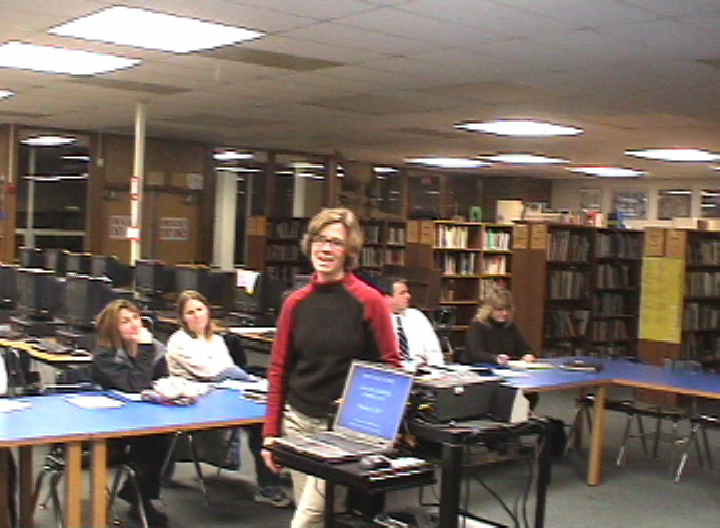
The West High School PTSO met on January 8, 2007 with featured guest West teacher Heather Lott,
coordinator for the Small Learning Community grant implementation. The video below only includes Heather Lott’s presentation and questions that followed. It does not include other portions of the meeting such as Dr. Holmes report of the West Principal, nor reports from West PTSO officers.
The video QT Video of the meeting is 117MB, and 1 hour and 27 minutes long. Click on the image at left to watch the video. The video contains chapter headings which allow quick navigation to sections of the meeting. The video will play immediately, while the file continues to download.
Lott presented an overview of the three-year Federal SLC grant (Year 1, 2003-2004; Year 2, 2004-2005; Year 3, 2005-2006), what changes were begun in the year prior and the changes and goals for the 2006-2007 school year, post-SLC grant. She emphasized that the SLC plan would take 7 years to “complete” and that the remaining 4 years would need to be funded. The 3 year federal grant paid her salary and for professional development only. Budget cuts for the 2006-2007 year and continuing fiscal problems in the district will hamper making the desired progress.
When asked how much, minimally, West would need make acceptable progress in the implementation of the SLC plan, Dr. Holmes suggested $20,000.
She also presented data showing discipline improvements and academic achievement improvements over the SLC years.
Discussions also included the topics of differentiation and heterogeneity, and general discussions from parents of incoming West students on the social aspects of the small learning communities.
Slides for Heather Lott’s presentation are in PowerPoint and PDF for your convenience.

Share

News on boundary changes?

Does anyone have any news on the meeting on January 10 on boundary changes on the north side?
The rumor mill says that the administration offered a plan to close Lapham.
How could closing Lapham improve the situation on the north side?

Share

More on School Violence

Ruth’s recent post on the Madison School District’s Student Discipline Code generated some email. There are a number of related posts available here, including the Fall, 2005 Gangs & School Violence Forum Audio / Video. Post your comments here.

Share

It’s the right time for Madison School Board to review student discipline code

In The Capital Times, reporter Susan Troller tells the stories of students and teachers who recently experienced violence at Madison schools or school-related activities. The story underscores how important it is for the Madison School Board to take a hard look at violent misconduct at all levels. The board must consider whether the current discipline system needs change–both to improve safety for students and staff and to ensure that interventions are prompt, consistent, unbiased and effective.
The MMSD administration has made some presentations on its ideas during the fall of 2006. Before the board considers changes, I hope that the board will hear more about the facts, particularly the facts about violent incidents. No changes will help unless they are carefully calibrated to the facts.
Facing Violence at School:Social events canceled as girls caught in hostilityFacing Violence at School

Share

Madison Superintendent Rainwater Tells MTI about Resignation Plans Before He Tells the School Board?

In a guest editorial in The Capital Times on January 10, 2007, MTI leader John Matthews explains that Madison school superintendent Art Rainwater unveiled his plan to resign at the end of 2007-08 to the teachers union leader long before he told the Madison Board of Education in an executive session on Monday, January 8, 2007.

“When Madison Superintendent of Schools Art Rainwater announced on Monday that he will retire in June of 2008, the news did not catch me by surprise for two reasons.
First, he proclaimed when he was appointed superintendent in 1999 that he would serve for 10 years, the duration of his contract. He said then that he and his wife, a teacher in Verona, planned to retire in 2008.
Secondly, he told me at our regular weekly meeting during the week of Dec. 18 that he would advise the School Board of his resignation when school resumed in January.

(more…)

Share

Madison Superintendent To Retire In 18 Months

From Channel 3000:

MADISON, Wis. — Madison Metropolitan School District Superintendent Art Rainwater announced on Monday night that he will retire next year.
Rainwater informed the district’s Board of Education at their Monday meeting. His retirement will be effective the end of next school year, which will be June 30, 2008, according to a district press release.
“I am thankful for the opportunity to serve the board and the Madison community,” said Rainwater in the news release. “This is a great school district and a great community that has always put the welfare of our children first. I am honored to contribute to this effort.”
Rainwater said that he gave the board 18 months notice so they would have sufficient time to conduct a search for the next superintendent.
Rainwater has been the district’s superintendent since February 1999.

Share

View from the MMSD Student Senate

At its November 21, 2006, meeting, the MMSD Student Senate discussed many issues of interest to this blog community (e.g., completely heterogeneous high school classes, embedded honors options, etc.). Here is the relevant section from the minutes for that meeting:
Comments and Concerns:

  • regular classes don’t have a high enough level of discussion
  • students who would normally be in higher level courses would dominate heterogeneous class discussions
  • bring students up rather than down
  • honors classes help students who want to excel to do so
  • array of advanced and regular classes in every subject
  • honors and AP classes are dominated by a certain type of students (concerning ethnicity, socio-economic status, neighborhood, family, etc.)
  • honors within regular classes — response to whether or not regular students are an integral part of the class:
      not isolating
      discussion level is still high
      homework is the same (higher expectation for essays; two textbooks)
      teachers don’t cater to one type of student in discussions
  • there’s a risk of losing highly-motivated students to private schools
  • being in a classroom with students of similar skill levels is beneficial
  • teachers teach very differently to honors/advanced/AP students than they do to regular students
  • least experienced teachers are given to students who need the most experienced teachers (new teachers get lowest level classes)
  • sometimes split classes will be divided so that the honors students will be doing work in the front of the classroom while the regular students are doing lab work in the back
  • the problem is with the average classes
  • won’t help anything to cut TAG classes
  • mental divide among students in classes where honors and regular students are in the same classroom
  • more behavioral problems in regular classes (possibly more behavioral problems) à cycle teachers through so that one teacher isn’t stuck with the same type of student for an extended time
  • college is a factor to consider
  • Main problems to bring to BOE:

    • higher standards for all students *
    • division within classes creates too many boundaries *
    • not bad to keep advanced classes in some disciplines *
    • voluntary peer education *
    • colleges consider accelerated course loads (factor to consider) *

    *Group majority

    (more…)

    Share

    LaFollette ranks third on most indicators

    With the debate about high school redesign and the furor over the four-block schedule at LaFollette, I looked at DPI data for Madison’s high schools. On nearly every indicator, LaFollette ranks third behind West and Memorial, with East ranking fourth.
    See the data
    here.

    Share

    Fame Junkies

    Jake Halpern
    Recently profiled on ABC’s 20/20, the soon-to-be published book Fame Junkies highlights anecdotes and research on the attitudes of American kids (and adults) regarding fame.

    Fame Junkies chronicles journalist Jake Halpern’s journey through the underbelly of Hollywood and into the heart of the question that bedevils us all: Why are Americans so obsessed with fame and celebrities?
    We live in a country where more people watch the ultimate competition for celebrityhood – American Idol – than watch the nightly news on the three major networks combined. So what are the implications of this phenomenon? In his new book, Fame Junkies, Halpern explores the impact that celebrity-obsession is having on three separate niches of Americans: aspiring celebrities, entourage insiders, and diehard fans.
    Halpern begins his journey by moving into a gated community inhabited almost entirely by aspiring child actors. During his stay, he interviews dozens of kids and teenagers, who seem to have an almost religious conviction that fame is a cure-all for life’s problems. What’s truly impressive is that these anecdotes are then supported with hard evidence. As part of the extensive research that he did for this book, Halpern teamed up with several statisticians and orchestrated a survey involving three separate school systems and over 650 teenagers. Many of his findings were deeply troubling. For example – when given the option of “pressing a magic button” and becoming stronger, smarter, famous, or more beautiful – boys in the survey chose fame almost as often as they chose intelligence, and girls chose it more often. Among today’s teenagers, says Halpern, fame appears to be the greatest good.
    In second part of his book, Halpern becomes an honorary member of the Association for Celebrity Personal Assistants (ACPA) where he spends a great deal of time with Annie Brentwell who has slavishly devoted every iota of her personal and professional life to celebrities like Oliver Stone, Sharon Stone, and (most recently) Dennis Hopper. In her spare time, when she is not serving Hopper, Brentwell teaches at a school that the ACPA runs to teach aspiring assistants; and, of course, Halpern tags along. This section of Fame Junkies also investigates a fascinating vein of psychological research on what type of people are most likely to “bask in reflected glory” or BIRG. For example, college students with low self-esteem are far more likely to embrace their school’s football team when it wins and dissociating themselves from that same team when it loses. Halpern goes on to consider how BIRG research applies to Hollywood.

    Share

    New Math and Science Repository

    This note comes from a listserve, and I thought that it was worthwhile to pass it on:

    Internet Scout, a 12-year-old UW-Madison online research project, unveiled its new national math and science educational project, the Applied Math and Science Education Repository.
    Read more: http://www.news.wisc.edu/13307.html

    Share

    School Board head faces challenger

    Susan Troller reports in the Cap Times:

    When Tom Brew takes on incumbent School Board President Johnny Winston Jr. in the spring election for Seat 4, he, like Winston, will bring a lifetime of experience with Madison schools to the race.
    Brew’s own children attended Huegel and Orchard Ridge schools and graduated in the late ’80s to mid-90s. A lifelong Madisonian, he attended the former Longfellow Elementary and Central High schools.
    “I felt I had some different viewpoints to offer from Johnny’s,” Brew said this morning. “Basically, I think Johnny has had a go-along-to-get-along attitude.”

    (more…)

    Share

    A Direct Challenge

    Direct Instruction is just curriculum that uses direct, systematic, and explicit instruction. Any one of the direct instruction curricula would improve academic performance if it were used in the MMSD.
    This comes from an Education Week article in 1999:

    When an independent research group evaluated the research backing up 24 popular school reform models this year, it found two surprises.
    The first surprise was that only three programs could point to strong evidence that they were effective in improving student achievement. The second surprise was that Direct Instruction, a program long scorned by many educators and academics for its lock-step structure, was one of them.
    Direct Instruction grew out of studies on the teaching of beginning reading that Siegfried Engelmann began at the University of Illinois in the 1960s. Thirty years later, only 150 schools across the country use on a schoolwide basis the program he developed. By comparison, Success for All, another reform model with high marks for its solid research base, is used in more than 1,100 schools.
    Thousands more schools, however, use Direct Instruction’s commercially produced materials–usually in remedial classrooms, special education resource rooms, or special programs for disadvantaged students.
    “We were sort of like the plague for regular education,” says Mr. Engelmann, now 67 and a professor at the University of Oregon. “Regular education would have nothing to do with us. It wasn’t until the last few years that we started to break the mold.”

    Share

    Work to change school funding already begun

    A story by Kayla Bunge in The Monroe Times reports:

    MADISON — With a new legislative session beginning in just about a week, the issue of school funding is certain to receive more attention.
    And two local legislators — 17th District Sen. Dale Schultz, R-Richland Center, and 27th District Sen. Jon Erpenbach, D-Middleton — already have begun working.
    Schultz, the former Senate majority leader, played a leading role in creating the Special Committee on Review of the State School Aid Formula.
    The committee’s purpose, he said, is “to recognize the special challenges that small school districts have trying to continue to provide a quality education in rural communities where student populations are declining.”

    (more…)

    Share

    Madison Studio Charter School: A Final Push – You can Help

    Dear Supporters of The Studio School:
    As you probably know, we met with the MMSD Board members last Wednesday and are satisfied with how the Board meeting went. Many individuals took the opportunity to speak at the meeting and each of them did a fantastic job! THE OUTCOME OF THE MEETING IS THAT WE NEED TO PREPARE A RESPONSE TO THEIR QUESTIONS and have very limited time to accomplish this since they need to have it by January 18th. So here’s our plan:
    We need to put together three short-term task forces:

    1. “money team” to work on the budget and financing
      • Determine what an accurate and detailed representation of costs and revenues would look like and fill in the numbers.
      • Consider creative ways to finance the school with the implementation grant Help! We need more school finance expertise for this one.
      • We still need money to file for tax exempt status ($750) Help! If we could get a/some contributions to cover this cost, we have found an attorney who will file it pro bono…
      • So if we could get a sizable donation to get this school started since the district’s finances are in such a bad state, the Board would be more favorably disposed to our proposal. (This would be added to federal grant funds of $340,000.)
    2. “people team” to reach out to a more diverse population (Kristin Forde is going to organize this.)
      Meet with or provide information to people we haven’t had an opportunity to connect with so we can share information about the school and encourage them to attend the January 22nd meeting to express support and interest in The Studio School Help! We could use some marketing expertise.

    3. “plan team” to develop a clearer description of the school and how it would actually work, including the technology
      Develop a more detailed implementation plan and a clearer representation of how it will operate and look. Help! I can work on this but I would like some people (parents, educators, interested parties) to collaborate with me in order to figure out how to communicate it more clearly.

    If you or anyone you know can help out over the next few weeks, please have them contact me. This is our last opportunity to pull it all together and make The Studio School a choice for Madison children – this means that we need to start the new year ready to get it done.
    We have made it to this point because of the dedication and hard work of our core planning group and the assistance and support from people like you. We are almost there! A “final push” kickoff meeting is scheduled for January 3rd at 6:00…location to be determined. After that, we have two weeks to get it all done. So please let me know ASAP if you, or someone you know, can lend us a hand.
    Thank you for your continued support. We are looking forward to celebrating and sharing our success in February after the final vote on January 29th!
    WITH WARM WISHES TO YOU AND YOUR FAMILIES….
    Nancy Donahue
    218-9338
    The Studio School, Inc.

    Share

    LaFollette’s four block schedule: good or bad?

    When the four block schedule began at LaFollette a few years ago, the MMSD praised its succeses:

    Under the new “four block” schedule, La Follette High School students are missing school less, are better behaved and are taking tougher courses, all of which is adding up to better academic performance, an analysis of first quarter data shows. Press release, December 17, 1997.
    La Follette High School students flourished during the first year of the school’s four block schedule, a year-end summary reports. Press release, September 9, 1998

    (more…)

    Share

    Watch a Discussion of the Proposed Madison Studio School

    Watch this 2 hour discussion or download the 69MB video clip.

    Much more on the Madison Studio School.
    Ben Popper:

    “I want to know why these charter options exist in other parts of the state, but not in Madison,” said Christina Navaro. “Here in the shadow of this amazing university, why don’t we have the choices that will keep parents in the public school system?”
    Becky Van Houten, director of the Preschool of the Arts, where Donahue had taught, tried to give a historical perspective on the importance of a Reggio education.
    “The educators who created Reggio were reacting to the terrors of fascist regimes,” she said. “They wanted to educate students who would not simply go along with what they were told.”

    Zig & Zag with the Madison Studio School Politics.

    Share

    Video Games/Computers for Children a No-No

    Baby Frankenstein — Forbes
    Jane Healy, an educational psychologist and author of Failure to Connect: How Computers Affect Our Children’s Minds and What We Can Do About It doesn’t agree that video games and computers for children will give them a leg-up in the competitive world of the 21st Century. “Behind the big push to get kids onto computers is this idea that if we don’t, they won’t become functional members of the 21st century,” she says. “That’s not only false, it’s dangerous.”
    In Healy’s opinion, electronic gaming at a young age can lead to shorter attention spans, a lack of internal motivation, difficulty with problem solving and a lack of creativity. She thinks kids should avoid computers entirely until the age of 7.
    But while harried parents may love the videos, to suggest that it therefore means they’re good for kids is like suggesting that Coca-Cola (nyse: KO – news – people ) is a health drink because millions of customers love it.
    Good learning games, on the other hand, can be simple and cheap. A game of jump rope, for example, promotes fitness, coordination and social skills, while basic board games like Hasbro’s (nyse: HAS – news – people ) Candy Land and Snakes and Ladders teach children about rules and consequences.
    So, by all means, give your kids a leg up on learning when picking out their gifts this year. But consider doing so with a set of blocks, a board game or a jump rope.

    Share

    Madison Studio School Public Hearing Today @ 5:00p.m.

    Will you have an opportunity to register SUPPORT for The STUDIO SCHOOL at today’s (5:00pm) public hearing by the Madison School Board?
    With the approval of the school board, the public charter school of arts and technology would open next fall in Madison. See more about The STUDIO SCHOOL (SIS Links) here:

    Please contact school board members to voice your support for creating this new educational opportunity, within the public school system, for children in Madison. Thank you.

    Share

    Rigorous Evidence in Educational Practices

    U.S. Department of Education – Research, Statistics and Publications
    In reading studies, reports, and especially, journalists’ impressions and advocacy articles, the paper entitled Identifying and Implementing Educational Practices Supported By Rigorous Evidence: A User Friendly Guide should be required reading.
    It is a well-written 28-page summary of good research design and the problems that can and do occur and the inappropriate conclusions drawn from poorly-designed and implemented research.
    It should certainly stop all of us from merely repeating opinions and articles as though they were true, even when they support our own prejudices.
    I’m reminded of a quote (paraphrased), I believe from John Tukey: “You can lie with statistics, but you can’t tell the truth without statistics.”
    Quoting from the Executive Summary of this report:
    Purpose and Executive Summary
    This Guide seeks to provide educational practitioners with user-friendly tools to distinguish practices supported by rigorous evidence from those that are not.

    The field of K-12 education contains a vast array of educational interventions – such as reading and math curricula, schoolwide reform programs, after-school programs, and new educational technologies – that claim to be able to improve educational outcomes and, in many cases, to be supported by evidence. This evidence often consists of poorly-designed and/or advocacy-driven studies. State and local education officials and educators must sort through a myriad of such claims to decide which interventions merit consideration for their schools and classrooms. Many of these practitioners have seen interventions, introduced with great fanfare as being able to produce dramatic gains, come and go over the years, yielding little in the way of positive and lasting change – a perception confirmed by the flat achievement results over the past 30 years in the National Assessment of Educational Progress long-term trend.
    The federal No Child Left Behind Act of 2001, and many federal K-12 grant programs, call on educational practitioners to use “scientifically-based research” to guide their decisions about which interventions to implement. As discussed below, we believe this approach can produce major advances in the effectiveness of American education. Yet many practitioners have not been given the tools to distinguish interventions supported by scientifically-rigorous evidence from those which are not. This Guide is intended to serve as a user-friendly resource that the education practitioner can use to identify and implement evidence-based interventions, so as to improve educational and life outcomes for the children they serve.

      Table of Contents:

    1. Title Page
    2. Coalition Board of Advisors
    3. Purpose and Executive Summary
    4. Identifying and Implementing Educational Practices Supported By Rigorous Evidence: A User Friendly Guide
    5. I. The randomized controlled trial: What it is, and why it is a critical factor in establishing “strong” evidence of an intervention’s effectiveness.
    6. II. How to evaluate whether an intervention is backed by “strong” evidence of effectiveness.
    7. III. How to evaluate whether an intervention is backed by “possible” evidence of effectiveness.
    8. IV. Important factors to consider when implementing an evidence-based intervention in your schools or classrooms.
    9. Appendix A: Where to find evidence-based interventions
    10. Appendix B: Checklist to use in evaluating whether an intervention is backed by rigorous evidence
    11. References
    Share

    La Follette principal resigns; Rathert named interim principal

    The MMSD released the following this afternoon:

    La Follette High School Principal John Broome on Friday tendered his resignation from his position. Former Madison high school principal Loren Rathert now becomes the interim principal at the school for the remainder of the 2006-07 school year.
    The Madison School District will conduct a national search for a new La Follette principal to begin the 2007-08 school year.
    “John Broome came to us Friday and said that the needs of the school and his skills were not a match, and in the best interests of the school he felt he should resign,” said Superintendent Art Rainwater.
    “I’m appreciative to John for recognizing the situation and putting the needs of the La Follette students first.”
    Rathert is a veteran school administrator who retired in June of this year. He was the principal of Madison West for three years (2001-04) and was the interim principal at Madison East from September 2004 through June 2005.
    “We’re fortunate that Loren Rathert is willing to take this position,” said Rainwater. “He’s an outstanding principal and is experienced in managing a large, urban high school.”
    Broome became La Follette’s principal on July 1, coming here from a high school principalship in Charleston, IL.

    Share

    Structural budget deficit will increase MMSD revenue shortfall for 2007-08

    A few weeks ago when the Madison School Board was finalizing the budget for the current academic year, Vice-President Lawrie Kobza pointed out two very serious problems. First, the district has been overstating expected revenues in recent years during the months when the board was reviewing and approving the budgets. Second, the district has been balancing the budget at the end of the year by dipping significantly into its reserves (equity fund).
    In Susan Troller’s article in The Capital Times, Roger Price, the assistant superintendent for Business Services, promises a “more conservative approach” to budgeting. In part, the “more conservative approach” seems to mean that revenue estimates will not be overstated, making deeper cuts more necessary, but perhaps giving the board a way to reduce the drain on its reserves.
    School Board anticipates big budget shortfall.

    Share

    Madison United for Academic Excellence, 12-December-2006 Presentation

    The Madison United for Academic Excellence (MUAE) meeting of 12-December-2006 offered a Question and Answer session with Madison Director of Teaching and Learning, Lisa Wachtel, and Brian Sniff, District K-12 Math Coordinator.
    A list of questions was prepared and given to the speakers in advance so they could address the specific concerns of parents.

    The video

    QT Video
    of the meeting is 130MB, and 1 hour and 30 minutes long. Click on the image at left to watch the video.
    The video contains chapter headings which allow quick navigation to sections of the meeting. The video will play immediately, while the file continues to download.

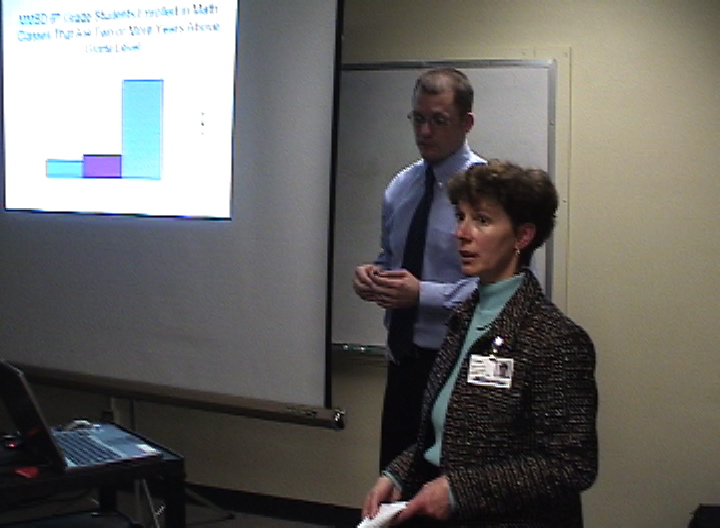
    The topics covered during remarks and the question and answer sessions were accompanied by a PowerPoint presentation (here in PDF format), highlights of which are

    • Changing demographics in the school district
    • Listing of Superintendent’s Goals for comprehensive review, as set by the Board of Education
    • K-5 Math Standards, Resources, and role of Teaching and Learning
    • Professional development for K-5 teachers
    • 5th Grade Math Assessment Pilot project for advanced students
    • Middle school math, 6th to 8th grade
    • Math certification of middle school math teachers, with an extended discussion of the statistic that only 5% of middle school math teachers are math certified,
      comparing Wisconsin to bordering states
    • WKCE tests and testing in general
    • Discussion by audience of recent studies and trends in math preparation for college
    Share

    Spring elections for Madison School Board: reformers versus old guard

    Writing in this week’s Isthmus newspaper, reporter Jason Shepard frames the issue in the spring school board elections for MMSD: Will Madison voters support the new direction of “tackling fiscal, managerial and achievement-related problems” or bring back an approach that blames all problems on the state legislature and is very light on oversight and accountability regarding finances and student achievement?
    Spring elections could bring new directions

    Share

    Exploring Alternatives to the Traditional High School

    Share

    MPS starts talk of curbing cell phone use

    Milwaukee schools Superintendent William Andrekopoulos says the school system must come up with a way to deal with the heavy use of cell phones when trouble breaks out at a school, an innovation that has increased the severity of incidents such as a fight Monday morning at Bradley Tech High School.
    Five people were arrested and two others were given citations by police as a result of the fight, which included attacks on several Milwaukee Public Schools safety aides.
    The fight, coincidentally, occurred on the same day that officials announced that Bradley Tech, at S. 4th St. and W. National Ave., would be the first MPS school to have a pair of police officers on duty full time. A second pilot project for stationing police in schools – an innovation in MPS, though it is common in suburban schools – will involve a cluster of schools on the north side, focusing on Custer High School, 5075 N. Sherman Blvd.
    Andrekopoulos made his remarks about cell phones at a meeting with Bradley Tech teachers Monday afternoon.
    The cell phone phenomenon has shown up in other schools in MPS, in the suburbs and nationwide: When trouble breaks out, students reach for the phones, and within moments, other youths are on their way to the scene, sometimes literally from miles around.
    Bradley Tech Principal Ed Kovochich said he has had teachers change tests every hour because students take cell phone photographs of the documents and sell copies to peers who haven’t taken the exam.
    Although use of cell phones is generally banned in schools, both in Milwaukee and the suburbs, it is obvious to anyone around a high school or middle school – and sometimes even elementaries – that a vast majority of students carry them and use them frequently. Sometimes when schools have tried to crack down on the phones, parents have been the ones to object the most, saying they want their children to be able to reach them during school hours.
    Cell phones are banned during MPS basketball games, largely because they have been used during incidents in prior years to summon “help” when trouble breaks out among kids.
    Kovochich said he doesn’t know how to stop students from using cell phones in school, a problem he said has gotten out of control.
    “We keep having problems with extended members of someone’s family coming up to intervene,” he said. “I’m telling you, this whole thing with the use of cell phones is coming to a head. If we have a simple fight, everyone text-messages or calls their friends, half the school knows about it and shows up.”
    On Monday, Kovochich said a staff member came to him during a routine weapons check at the door as students arrived for school and said two girls were arguing over a boy. The staff member thought trouble was about to start.
    Within moments, Kovochich said, “all I could see was a ton of cell phones coming out of pockets.” A crowd gathered quickly, and the fight began. Police officers arrested one 17-year-old girl on allegations of substantial battery and issued disorderly conduct citations to another two.
    Kovochich said one student must have called her extended family because a short time later, four adult males arrived at the scene, pushed aside the metal detectors, jumped the tables and attacked safety aides and others. Police eventually arrested all four men. Kovochich said he saw the butt of a gun sticking out of the pocket of one of the four.
    Andrekopoulos told the Tech teachers, “We’re going to have to come up with a strategy” to minimize the negative effects of having cell phones in the hands of the vast majority of students.
    He said MPS security chief Peter Pochowski began calling other districts Monday to find out what they do to hold down cell phone use during crises.
    Kovochich told a reporter it’s also possible the schools could petition the Federal Communications Commission to allow for special antennas that, with a flip of a button, could block a citywide swath from cell phone service.
    The pilot projects to place two pairs of police officers full time in MPS schools comes after a series of violent episodes this fall, including attacks on a principal and several teachers. Mayor Tom Barrett, Police Chief Nannette Hegerty, Andrekopoulos and leaders of MPS labor organizations have been meeting to come up with a plan.
    “We’ve heard you loud and clear,” Sid Hatch, assistant executive director of the Milwaukee Teachers’ Education Association, told the Bradley Tech teachers. “It is painfully clear that the schools’ safety and security is the foremost issue in the minds of teachers.”
    The effort is to be funded by up to $250,000 from the police budget and $250,000 from MPS. The “school resource officers” will begin work with the start of the second semester in late January, Andrekopoulos said.
    Andrekopoulos told the high school staff that Bradley Tech was not picked for the program because it was the worst school in the city. On the contrary, he said, grade-point averages, attendance and graduation rates have risen over the last several years. But he said factors including the launch of a schoolwide academic and behavior program this fall made it a good candidate.
    He said a good climate for education could be created in Milwaukee schools, but it will take “a herculean effort of all of us working together.”
    http://www.jsonline.com/story/index.aspx?id=540755

    Share

    Public Comments Regarding Credit For Non-MMSD Courses

    Parents Jeff Henriques, Larry Winkler and Janet Mertz appeared in front of the Madison School Board’s Performance & Achievement Committee regarding credit for non-MMSD courses. Watch the video.

    Background here.

    Share

    BOE Progress Report for December

    Happy Holidays to everyone! Despite the cold weather, the Madison Board of Education continues its work.

    (more…)

    Share

    Important new information about credit for non-MMSD courses issue.

    “In preparation for the December 11, 2006 meeting of the BOE’s Performance and Achievement Committee, Assistant Superintendent Pam Nash prepared a memo dated December 5, 2006 along with 10 “exhibit” appendices for distribution to the BOE. “Exhibit 10” is a copy of the “Guidelines for Taking Coursework Outside the District” that she wrote in October, 2006, and I previously posted on SIS. In her memo she states “All the other nine procedures described herein, except this one, are governed by law or Board Policy. This process (her new Guidelines) was created by the MMSD to expand the opportunities for students to take courses outside the MMSD without increasing the costs to the MMSD and without undermining the integrity of the diploma a student receives from the MMSD. The “Guidelines for Taking Coursework Outside the MMSD” is the process and procedure currently used when, for example, a student who wants to take outside courses, but does not have any other option available to him/her. The cost for taking courses under this procedure is the responsibility of the student/parents. The procedure requires pre-approval by the principal and if the student wants credit for taking the course, he/she will receive elective credit if the District does not offer a comparable course. If the District offers a comparable course, the student will not receive credit. The student’s transcript will only include a description of the course, the institution, if any, the date the course was completed, the credit, if any, and the pass/fail grade.”
    As I had stated previously on SIS I believe this is a new policy. It is definitely different from the one used in the recent past at Madison West HS in several crucial respects. It has never previously been brought before the BOE for formal approval. At the November 13, 2006 meeting of the Performance and Achievement Committee, I presented Superintendent Rainwater and members of the BOE with a copy of these “Guidelines”. Superintendent Rainwater responded by stating that these Guidelines only apply to “Independent Study” and do not represent a change in policy. I interpreted his comments to mean they are simply a restatement of Board Policy 3545 – Independent Study. However, Nash’s December 5th memo to the BOE quoted above seems to indicate that her “Guidelines” are to be interpreted as a catchall, meant to apply not just to independent study, but to ALL course work not specifically governed by State law or existing MMSD Board Policies, i.e., her exhibits 1-9. In other words, it is to apply as well to UW courses taken outside of the YOP, WCATY courses, online courses such as Stanford’s EPGY taken outside of the InSTEP Program, UW-Extension courses where the District claims to offer a comparable course (even though in a very different format), etc., i.e., a variety of different types of formal course work offered through certified, non-MMSD programs. If so, shouldn’t these “Guidelines” need formal BOE approval as a new Board Policy since, as Nash states in her memo, they are not currently covered under any existing Board Policies?

    (more…)

    Share

    Credit for Non-MMSD Courses: Performance & Achievement Committee Discussion

    Please take note that the MMSD BOE’s Performance and Achievement Committee
    will be meeting at 5:45 pm on Monday, December 11th. [map]
    One of their two agenda items scheduled for that meeting is “Credit for Non-MMSD Courses.”
    This is a very important issue for academically gifted students who would like to be able to substitute higher-level, faster-paced, or more-readily-accessible-to-them (e.g., because of transportation problems) courses taken via WCATY, EPGY, APEX, UW, etc. for ones offered by their local middle or high school. It is an important issue for other types of alternative learners (e.g., special ed students, temporarily ill or disabled students) as well. It has taken years to get this topic placed on the BOE’s agenda. This coming Monday may well be our best opportunity to influence MMSD policy relating to this matter.
    Thus, I urge ALL of you who are concerned about this issue either (i) to attend this BOE meeting prepared to give a 3-minute speech during the Public Comments period, or (ii) to send an email this week to Art Rainwater, Pam Nash, and all BOE members (via their comments email address) describing why it is important for their students to be permitted to receive credit toward fulfilling graduation requirements for qualified high school- and college-level courses taken at UW, MATC, TAG summer programs, online, or via correspondence.”

    Share

    A few questions for MPIE members …

    I have a few questions for Barb and the other members of MPIE. I hope one or more of them will take the time to answer.
    As I look over the course catalogs for the four high schools, I see that each school has both a Special Education Department and an English as a Second Language Department (although they may not be called exactly that at each school). Each of these departments in each of the four high schools offers an extensive range of courses for students who qualify and need the specialized educational experiences offered within these departments. Many of the courses offered by these departments fulfill graduation requirements and so can be used as curriculum replacement for the “regular” courses.
    Here are my questions:

    1. Does MPIE advocate having the District dismantle the Special Education and English as a Second Language Departments in our high schools? (I assume the answer is “no.”)
    2. Does MPIE advocate having the District deny high school graduation credit for any and all courses offered within these departments, so that truly ALL students will be required to take 9th (and — at West — 10th) grade core courses at our high schools? (Again, I assume the answer is “no.”)
    3. If MPIE advocates full inclusion, why aren’t the answers to the above two questions “yes — absolutely, yes”?
    4. Does MPIE advocate getting rid of all advanced, honors, accelerated, TAG and Advanced Placement classes at our four high schools? In 9th grade? In 10th grade? In all four grades? What is your vision with regard to advanced and accelerated classes?
    5. Please help me understand the logic that says it’s O.K. to have entire departments within each high school devoted to the specialized educational needs of some groups of students (not to mention adjustments to high school graduation requirements designed to meet those students’ needs), but it is not O.K. to have even a few sections of classes aimed at meeting the specialized educational needs of other students? (IMHO, this way of thinking is really best described as a belief in “selective inclusion.”)
    6. Can you see the inherent illogic, inequity and unfairness of that position?
    7. How do you decide which groups of students with specialized educational needs get to have their educational needs met and which groups of students do not?
    8. It seems to me that a big part of the answer to that question should come from the research done from the perspective of the group of students under consideration. Do you agree or disagree with that premise?
    9. Are you aware of the consistency (of findings, of conclusions, of recommendations) within the literature on how best to meet the needs of high performing students (a.k.a. “best practices”)?
    10. Why does MPIE prefer the policy of getting rid of advanced high school classes over the policy of working with all K-8 students (and their families) in such a way as to increase the diversity of the students in those classes?
    11. What do some middle and upper middle class parents of children with special education needs find so threatening about the thought of having their schools meet the educational needs of high ability, high performing, even academically talented students with the same thoughtfulness and commitment that they meet the needs of students with other special educational needs?
    12. Are you aware that MMSD and national data indicate that approximately 20-25% of high school dropouts are academically gifted and have a demonstrated history of high academic performance? (In our District, that number is significantly higher at West HS than at the other three high schools and a disproportionate number of the “high performing” dropouts throughout the District are poor and minority students.) How do you understand those data and what do you think should be done about the situation?
    13. Have you read this American Psychologist article on “the two tails of the normal curve,” co-authored by nationally recognized experts on the educational needs of students in each of the two “tails”? http://psych.wisc.edu/henriques/papers/two_tails.pdf If so, what do you think of it?

    Would any of you would be willing to meet over coffee to talk about how we can work together on these issues and to see if we can find common ground?

    Share

    High School Redesign Notes

    As Arlene has reached out to the community for suggestions about the Redesign of the high schools, let me share a couple of thoughts:

    1. It’s too late. The students that are behind in 5th grade rarely catch up. The 2/3 combinations are by far the worst academic combination for elementary students, yet we continue this practice to save money, and to save SAGE. I understand the pull out combination system is a great way to deal with cost and transient students….but does it really help? Can’t we negotiate with the Union to allow 4 year kindergarten? This is really annoying that we have to bow to the Union for the sacrifice of the lower income students.
    2. The middle school years has a great resource of teachers. My children have had teachers that felt students are undergoing hormonal warfare and felt they should teach less so as not to upset the students. As I quote a teacher my child had in a “Charlie Brown teachers voice”, “Less is more and as long as they learn a couple of concepts during the year I feel I have done my job”. This fortunately is not the normal approach my children have received. Most of the Jr. High teachers have been focused on preparing the students for Memorial. I wonder if this is the model for most of the Jr. High Schools throughout the district?
    3. The district currently has the highest number of National Merit Scholar graduates in the state, I would assume we send hundred of students to college each year and those that are from higher income families do well. I wonder if the problem is less racial gap and not more economic gap. Please follow the link to the following Newsweek article released by the North Carolina Democratic Party….http://ncdp.org/node/1081. This is an article about how North Carolina kept their struggling students, drop out prone students and low income students engaged in high school by offering them an option to attend a local community college (MATC) and receive not only their HS diploma upon graduation but also an associate degree in an area of interest so that staying in school had meaning….and graduating means getting a real job. Currently all we can offer students that graduate from high school is they will have a diploma and they can essentially get the same jobs in this area with or without that diploma….with an associates degree they can make more than their teachers in computer repair, Xerox repair, IT, health associate degrees and others. Please think about raising the standards and the options for the struggling students, not lowering the standards for the top tier students. This IDEA and a proven method could benefit the entire community and raise the standard of living for lower income families. Please read this article.
    Share

    Former teacher runs for School Board

    Susan Troller reports in The Capital Times on school board candidates:

    A retired teacher has thrown her hat in the ring as a candidate for the Madison School Board.
    Marj Passman, who was active in the recent successful referendum to approve funding for a new elementary school, has announced that she will be a candidate for Ruth Robarts’ open seat on the board. Robarts, who has served as a School Board member since 1997, will not be running again.

    (more…)

    Share

    Madison Partners for Inclusive Education Presentation to the School Board

    The Madison Partners for Inclusive Education presented information to the School Board Monday evening. Watch the 38 minute video.

    The clip begins about 5 minutes into the presentation (I missed the first few minutes).

    Share

    Superintendent’s letter misleads

    Superintendent Rainwater and I engaged in a lengthy series of e-mails when I questioned the truth of a statment in a letter he wrote to Wisconsin congressmen to seek their help in reinstating the MMSD’s eligibility for funds from Reading First.
    In his letter the superintendent said that the MMSD was told “we had to use one of the preferred reading packages authorized by USDOE.”
    At first the superintendent denied that he said such a thing and asked me to retract the quote from the letter.
    After I sent him a link to his letter, he kindly wrote:

    I apologize. I did not recall the wording of the letter to our congressional delegation and the fact that we simplified the process in writing them. You are correct that this letter does not accurately reflect everything that happened during the process. Although it was made clear throughout the process that we could opt for one of the pre-approved programs and move ahead the choice was never presented that we had to do that. The final choice that we were faced with was to make the final changes that they required to our program, accept one of the pre-approved programs or reject the grant. Art


    As I always say, take nothing from the MMSD at face value.

    Share

    Circulate nomination papers now

    Candidates for school board elections in the spring could begin circulating nomination papers on December 1.
    Get the details at http://www.zmetro.com/election/.

    Share

    One Small Step in the Right Direction at West HS …

    In light of recent events regarding curriculum and other issues in our high schools, there has been a small step in the right direction at West HS. Superintendent Rainwater announced at our 11/29 MUAE meeting that he has been in discussion with West HS Principal Ed Holmes about providing West 9th and 10th graders who are advanced in language arts the opportunity to skip over English 9 and/or English 10. Advanced placement decisions will be based on grades, teacher recommendation, writing samples, WKCE scores, and ACT/SAT scores. Details will be worked out by Mr. Holmes, the West English Department and District TAG staff.
    This small — but important — change brings West more in line with Memorial, the only other high school that has a core English 9 curriculum delivered in completely heterogeneous classes. Every year, four or five academically advanced Memorial freshmen are allowed to go into English 10 — specifically, English 10 Honors. (FYI: Unlike West, Memorial has honors classes in 10th grade; as well, 10th graders can take some of Memorial’s 17 AP classes.) East and LaFollette, of course, have two or three levels of ability/interest-grouped classes for freshman (and sophomore) English — called regular, advanced and TAG at East and regular and advanced at LaFollette — and will continue to have them for at least the next two years.
    If you are the parent of a West area 8th or 9th grader who is advanced and highly motivated in English, you might want to consider having your student take either the ACT or SAT through the Midwest Academic Talent Search (MATS) in order to support a request for single subject acceleration. There is still time to register for the MATS online: http://www.ctd.northwestern.edu/mats/index.html
    IMPORTANT NOTE: As I see it, this development does not in any way mean we should slow down our lobbying efforts vis a vis the BOE and Administration to get them to make West more like the other high schools — in terms of course offerings and other oportunities for academically advanced students — during the two years of the high school redesign study introduced by Superintendent Rainwater at the 11/27 BOE meeting.

    Share

    Video of 29-Nov-2006 MUAE Meeting with Supt. Rainwater

    The Madison United for Academic Excellence (MUAE) meeting of 29-November-2006 offered a question and answer session with Madison Superintendent Art Rainwater.
    After opening remarks by Jeff Henriques, the Superintendent summarized his goals, rationale and approach to the high school redesign project, and discussed
    his prior experience as a teacher and principal.

    The video

    QT Video
    of the meeting is 183MB, and 1 hours and 30 minutes long. Click on the image at left to watch the video.
    The video contains chapter headings which allow quick navigation to sections of the meeting. The video will play immediately, while the file continues to download.

    The topics covered during remarks and the question and answer session are

    • Assessment, differentiation, grouping, school redesign
      • Differentiation training in elementary school
      • Investment in training, coaching, Teaching and Learning
    • What to do when teacher refuses to differentiate.
    • Evaluating Teachers
    • Student assessment and WKCE
    • Maintaining quality control and teacher skills
    • Lighthouse schools
    • Differentiation in Math
    • Limits of flexible grouping
    • View of NCLB
    • Math curriculum and its evaluation
    • Evaluating differentiation
    • Assessing high achieving students
    • NCLB and the growth model
    • West English 9 and 10
    • Using WKCE to inform instruction
    Share

    Additional Notes on “What it Takes to Make a Student”

    Joanne Jacobs:

    Last night at the Hunt Institute retreat for North Carolina legislators, the former governor, Jim Hunt, handed out copies he’d underlined to everyone there, urging the legislators to “read every word.”
    Schools like KIPP and Amistad [Clusty on Amistad] that succeed in educating low-income students tend to do three things well, Education Gadfly points out.

    Students are required to be in school longer-much longer-than their peers in traditional public schools.
    Pupils are tested, and re-tested, to measure achievement. Lesson plans, teaching strategies, even whole curricula are adjusted based on how well, or poorly, students are learning what they should. Moreover, teachers are closely monitored and constantly working to improve their skills.
    Students’ behavior and values are aggressively shaped by school leaders and instructors.
    What is complicated, however, is implementing these changes within today’s rule-bound, bureaucratic system, with its collective bargaining constraints, bureaucratic regulations, and the inertia of 100-plus years of public education. It’s no coincidence that all of Tough’s profiled schools are charters, and as such have the freedom to do things differently and take control of their own destinies. In turn, this greater autonomy allows them to attract many top-notch, talented, and energetic teachers who are willing to work long hours for mediocre pay because they yearn for a results-oriented, break-the-rules environment. Replicating this atmosphere in the traditional system would be hard-maybe even impossible. But expanding charter schools–and getting more good ones-is no easy feat, either.

    Dennis Doyle adds a few thoughts.

    Share

    Revamping the high schools

    Isthmus’ Jason Shepard covers the story:
    Curriculum changes halted as district eyes study group
    JStanding in front of a giant projection screen with his wireless remote control and clip-on microphone, Madison School Superintendent Art Rainwater on Monday unveiled his grand vision for Madison’s four major high schools. But the real backdrop for his presentation before the Madison school board was the criticism of changes implemented last year at West High and proposed this year at East. Both involved reducing course offerings in favor of a core curriculum for all students, from gifted to struggling.
    Rainwater stressed his intention to start from scratch in overhauling all aspects of the education provided at West, East, Memorial and La Follette, whose combined enrollment tops 7,600 students. The move follows consolidation of practices in the city’s elementary and middle schools. But it may prove more challenging, since the high schools have a longstanding tradition of independence.
    Over the next two years, Rainwater would like a steering committee of experts to study best practices in high school education. Everything, Rainwater stresses, is on the table: “It’s important we don’t have preconceived notions of what it should be.”
    Heterogeneous classes, which until last week were the district’s preferred direction for high school changes, are, said Rainwater, “only one piece” of the redesign. But curriculum changes are clearly going to happen.
    “It’s not acceptable anymore to lecture four days a week and give a test on Friday,” Rainwater declared. Teachers must learn how to teach students, rather than teach content.
    The 50 parents and teachers in the audience reacted coolly, judging from the comments muttered among themselves during the presentation and the nearly two-hour discussion that followed.
    Tellingly, the biggest applause came when board member Ruth Robarts said it was “high time we as a board start talking about high school curriculum.” Robarts chastised Rainwater for not including teachers and parents on the steering committee, which will “reinforce a perception that is not in our favor.” She said the district was giving critics only two options: accept the changes or “come down and protest.”
    On Nov. 16, East Principal Alan Harris unveiled plans to eliminate several courses in favor of core classes in ninth and 10th grades. Attendees said the plan was presented as a “done deal.” In e-mails to the board, parents called the plan “short-sighted and misguided,” and one teacher warned: “Don’t do it.”
    Rainwater, apparently recognizing the damage to parent and teacher relations, sent a memo to principals last week.
    “I am asking you to cease any significant programmatic changes at each of your schools as this community dialogue progresses,” he wrote. “We need a tabula rasa mentality that will allow for a free flow of ideas, an opportunity to solidify trust in our expertise, and a chance at a solid, exciting product at the end.”
    The four high schools will remain under their current programs until the steering committee gets to work. Chaired by Pam Nash, deputy superintendent of secondary schools, it will include several district administrators as well as experts from the UW-Madison, Edgewood College and MATC.
    Rainwater sought to assure board and audience members that teachers and parents will have ample opportunity for input. His plan calls for three separate periods of public comment, after which subcommittees will make revisions. The school board will then vote on the recommendations after additional hearings and debate.
    “You get better input if people have something to react to,” Rainwater said, adding that involving teachers in all stages would be impractical, because it would be difficult to cover their teaching assignments. That comment drew a collective groan from teachers in the audience.
    Rainwater’s call for a revamping of the city’s high schools suggests the current approach isn’t working. And that poses a dilemma for school officials. The district likes to tout its record number of National Merit semifinalists and state-leading ACT scores as proof that its high schools are successful. Many parents worry that those high-end benchmarks are under attack.
    But Madison’s schools continue to fail countless kids — mostly low-income and minority students. This is a profound challenge hardly unique to Madison, but one that deserves more attention from policymakers.
    Research in education, the starting point for Rainwater’s steering committee, offers promising solutions. But the district risks much in excluding teachers from the start, since inevitably they will be on the front lines of any change. And excluding parents could heighten the alienation that has already prompted some middle- and upper-class families to abandon the public schools.
    While struggling over details, most board members conceptually support the study. During their discussion Monday, Lawrie Kobza cut to the chase.
    “What is the problem we’re trying to solve?” she asked. “And is this how we solve this problem?” Kobza professed not to know the answer. But these are the right questions to ask.
    http://www.thedailypage.com/isthmus/article.php?article=4919

    Share

    Closing the Racial Achievement Gap

    On Point, Tom Ashbrook:

    By 2014, just eight years from now, the No Child Left Behind Act mandates that there be no racial achievement gap in American education — none. All children — black, white, Hispanic, Asian — will be performing on the same bell curve of test scores.
    It’s a tough deadline and a beautiful idea. Trouble is, despite Bush administration claims, most studies show it is not happening.
    Test score gaps show up in kindergarten, and just get worse, except where they don’t. There are trend-bucking success stories in this country – remarkable schools where that gap is being closed, child by child.
    This hour On Point: we talk with three principals in the trenches who have made it happen in the war on America’s education achievement gap.

    Share

    11/27/2006 High School Redesign Presentation Materials

    Here is a copy of Monday night’s presentation. I amended it to include the listening sessions with the individual schools as the first step in the process. [354K PDF Version] Video here.

    Share

    All kids need all skills to read

    ALL knowledge and skills essential to reading are essential for ALL learners. Absolutely every proficient reader must master all of the following:

    a. Phonemic awareness: hearing the separate sounds and syllables in words and words in sentences;
    b. Alphabetic principle: knowing which sounds go with which letters; using knowledge of which sounds go with which letters to sound out or decode words;
    c. Fluency: reading words and connected text quickly and accurately;
    d. Vocabulary: knowing the meanings of words;
    e. Comprehension: making sense of text.

    Every “school” of reading instruction agrees on these five, whether the schools are Direct Instruction or constructivist (whole language and balance literacy).
    However, direct instruction makes certain that every child masters every skill. Direct instruction leaves nothing to chance.
    On the other hand, constructivist theory lets the child “discover” these five skills. Consequently, some children will discover them all; some will discover some of them; some may not discover any of them.
    In short, learning is too important to be left to chance.

    Share

    Comments on Redesign of MMSD High Schools

    Kudos to the district for stopping the rush to the middle Rainwater and his assistants have been promoting for East. However, the changes that were pushed onto West should also be backed off while the district has a long overdue, community-wide conversation about what it desires its high schools to provide all students. And this time, let’s have that discussion backed with empirical studies. Even if the community agrees with Rainwater (and some if not all of the BOE) that closing the minority achievement gap takes priority over other educational goals, let’s have a frank discussion as to how that is best achieved.

    Share

    MMSD to study high schools before “redesigning” them

    Madison school Superintendent Art Rainwater has put the brakes on recently proposed changes to the city’s high schools as part of an effort to make long-term progress.
    That means putting a hold on the proposed elimination of accelerated classes at East. In addition, there will be no changes in the four-block schedule at La Follette at least until a comprehensive look at the entire high school experience in Madison is completed, Rainwater confirmed in an interview this morning. Rainwater says ‘whoa’ to school changes
    By Susan Troller, The Capital Times, November 28, 2006

    Share

    School Board to discuss future of high schools

    From The Capital Times:

    A discussion regarding the future of Madison’s high schools is back on the agenda for tonight’s School Board meeting.
    The controversial item, which involves curriculum changes and other proposals, is scheduled as part of a special board meeting at 8 p.m. in the Doyle Administration Building, 545 W. Dayton St.
    In an officers meeting last week, School Board President Johnny Winston Jr. removed the topic of high school redesign from tonight’s agenda, saying that he felt the process was not far enough along to produce a productive discussion.
    But when other School Board members said that they would prefer keeping the subject on the agenda for tonight’s meeting, Winston agreed to return it to the lineup of topics.
    The special session will follow meetings of the communications committee at 5 p.m., the human resources committee at 6 p.m. and the finance and operations committee at 7 p.m.
    Later tonight, the board also is expected to go into a closed-door discussion of the negotiation strategy regarding Madison Teachers Inc., the teachers union.

    Share

    Board works harder, better

    What a difference a couple of elections make!
    In November of 2005, the MMSD Board of Education held two meetings (and the attendance task forces met six times).
    This November, the Board has six meetings of the full board, including executive and open sessions, and ten committee meetings. The Equity Task Force will meet once.
    Congratulations to a harder working, more effective board.
    Let’s elect people in the spring who will conintue this new board’s committment to overseeing management of the MMSD.

    Share

    What It Takes to Make a Student

    A lengthy discussion of what it might take to close the minority achievement gap in the New York Times Magazine entitled, ” What It Takes to Make a Student”. The study Larry Winkler has so cogently referenced time and again here is highlighted.
    The author concludes that low-income minority students need better educational opportunities than their middle class white counterparts. If there is a limited budget for education, does this mean then that those middle class students must accept less? Is it this thinking that is driving the elimination of diversity in our high school curricula? As I read this article, the greatest chance of overcoming disparities resides in early childhood and elementary experiences, not in dismantling the high school curriculum.

    Share

    Does Closing the Minority Achievement Gap Require a Downward Rush to the Middle

    The prime motivator for taking MMSD’s high schools from an academically rich curriculum to the one-room schoolhouse model has been to close the minority achievement gap. Thus, I read with interest the following NYTimes letters:
    A Racial Gap, or an Income Gap? (7 Letters)
    Published: November 24, 2006
    To the Editor:
    In emphasizing race-based achievement gaps, “Schools Slow in Closing Gaps Between Races” (front page, Nov. 20) pays insufficient attention to the significant role of socioeconomic inequalities in explaining these gaps.
    For social scientists studying the No Child Left Behind law, the slow progress comes as no surprise. The education researcher David Berliner has noted that “poverty is the 600-pound guerilla in the classroom.”
    As long as proponents of No Child Left Behind continue to dismiss the examination of the economic backgrounds of students as an example of what President Bush has called the “soft bigotry of low expectations” or as an excuse for low achievement by low-income students, standards-based reforms like No Child Left Behind will have limited effects.
    It is time for policy makers to place as much emphasis on reducing poverty as they do on improving the schools attended by poor children. Both are necessary, but are alone insufficient to reduce the achievement gap.
    Alan R. Sadovnik
    New York, Nov. 20, 2006
    The writer is a professor of education, sociology and public affairs at Rutgers University in Newark.

    To the Editor:
    Yes, the achievement gaps remain persistent. But perplexing? Come on.
    Having 10 years’ experience teaching in low-income, largely black districts, and also having raised three middle-class white children, I consider it a no-brainer why my children achieve well in school while many of my students do not: I am one mother to three kids, but a teacher to 25.
    Aside from the socioeconomic differences between my kids and my students (a separate, undoubtedly more important perspective on achievement disparities), my children get more of my attention, period.
    I want to give all of my students the same advantages I’ve given my own kids, but how can I possibly meet 25 individual needs with as much sensitivity and precision?
    Why does this discussion always ignore class size as a contributing factor?
    Why not lower the teacher-student ratio to 1 to 10 for a few years and then study the outcomes? The obvious answer is cost. But perhaps over the years this would be offset by the savings built from a better-educated and more productive group of graduates.
    Mary Scheffler
    Ocean, N.J., Nov. 20, 2006

    To the Editor:
    No Child Left Behind, signed into law by President Bush in January 2002, has not closed the achievement gap between minority and white students, but it has had a major effect on education in America.
    The law has had a major impact on the privatization of education. With financing now available from school vouchers, increasing numbers of both minority and white families are placing their children in private and religious schools.
    In addition, American schools are increasingly becoming racially segregated as white parents remove their children from public education.
    Martin Gittelman
    New York, Nov. 20, 2006

    To the Editor:
    All the tests in the world will not close the achievement gap. When politicians and business leaders stop blaming the schools and start focusing on the real reasons for the achievement gap — the economic gap, the health care gap and the racial gap — poor and minority students may have a fighting chance.
    Until then, the more than $2 billion testing industry will continue to reap a bonanza as our nation falls further and further into the educational abyss.
    Judy Rabinowitz
    Ocean, N.J., Nov. 20, 2006

    To the Editor:
    How can you discuss the test-score gaps between minority and white students without attributing some of the problem to the child poverty rate of almost 18 percent, the child hunger rate of 17 percent and the 19 percent uninsured rate for poor children, when African-Americans and Hispanics bear the brunt of those disadvantages?
    Yet the education experts quoted in your article speak as if poverty and hunger, and the illnesses associated with them, had no effect on children’s school attendance and capacity to learn.
    That’s not the way the principal of a school that narrowed the gap between black and white students saw it. You write that he “credited a prekindergarten program and a school health clinic that helped keep poor students from missing class.”
    No Child Left Behind is big on testing and promises. But it does far too little to address the social and economic needs of black, Hispanic and poor white children — needs that are inextricably linked to school achievement.
    Milton Schwebel
    New Brunswick, N.J., Nov. 20, 2006
    The writer is the emeritus dean of the Graduate School of Education, Rutgers University.

    To the Editor:
    Standardized tests may be relatively efficient to administer, but they do not provide the information educators need to understand and work to close the achievement gap. Teachers need detailed information about their students’ strengths and areas of need. All they get from a standardized test is a number.
    If we want to make greater progress toward the goal of leaving no child behind, let’s shelve those standardized tests and work together to truly understand the nature of the achievement gap and the academic, social and economic factors that contribute to it.
    Howard Miller
    Dobbs Ferry, N.Y., Nov. 20, 2006
    The writer is an associate professor of literacy education at Mercy College.

    To the Editor:
    A new approach to closing the education gaps between races is needed.
    Instead of looking at the performance of unsuccessful schools, unsuccessful teachers and poorly performing minority students, why not look for the factors that underlie success?
    A study of the successful Asian students who outperform whites and other minority students might yield some interesting insights that could be effectively applied to solving the problem of those “left behind.”
    Lynn Garon
    New York, Nov. 20, 2006
    Share

    Letter to East Community From Principal Harris Nov. 22, 2006

    From the East High Web Site
    November 22, 2006
    Dear East High School Community:
    When I decided to become a principal I promised myself that I would do several things. One was to work as hard as I could to make quality education a reality for all of the students in my building and the second was to pay attention when confronted by people’s concerns and hopes.
    As I have worked at East over the last year and a half I have pushed to get the building under control, to begin a conversation with the teaching staff about high quality instruction, to empower students, and to take an honest look at our data.

    (more…)

    Share

    Supt. Rainwater requests reinstatement of Reading First grant funds

    MMSD
    Feds seek Reading First probe
    by Joe Quick, Legislative Liaison/Communication Specialist
    Sens. Herb Kohl and Russ Feingold, along with Rep. Tammy Baldwin have requested that the U.S. Department of Education investigate Madison Schools’ loss of an estimated $3.2 million after the district refused to dismantle its successful reading program two years ago, and seek to have the grant re-instated.
    A scathing internal audit this fall claimed that USDOE officials managing the $1 billion program knowingly broke the law with unethical practices surrounding the program. In a letter to the above named members of Congress, Supt. Art Rainwater said, “In light of the government audit of the federal Reading First program contending that USDOE ignored the law and violated ethical standards to steer money the way it wanted, I am asking that you request reinstatement of the lost resources to the Madison Metropolitan School District due to USDOE’s faulty conclusions that the audit makes obvious.”
    In a letter to Terrell Halaska , USDOE assistant secretary for legislative and Congressional affairs, the Wisconsin Congressional members said, “The report from the Office of Inspector General questions the program’s credibility and implies the Department broke the law by interfering in the curriculum decisions made by schools, thereby failing to follow proper grant review procedures.
    “We would appreciate your review and investigation of the concerns expressed by the Madison Metropolitan School District. Specifically, they are seeking reinstatement of lost federal resources to the Madison Schools from the Reading First program.”
    The Elementary and Secondary Education Act (now referred to as No Child Left Behind) is before Congress for reauthorization in 2007. Discussion of Reading First is sure to be part of Congress’ examination of needed modifications to the law.

    Share

    Redesign acknowledges failure to close achievement gap

    The high school dumbing down (aka high school redesign) shows the MMSD administration’s loss of will, as well as its refusal to adopt curriculum changes needed to close the achievement gap.
    The gap begins in elementary school: 46% of black students score below grade level on the third grade reading test, but only 9% of the white students.
    The gap remains into high school: 49% of black 10th graders score below grade level in reading, while only 12% of the white students are at the minimal or basic levels.
    Facing the failure to raise the performance of black students, the MMSD superintendent and his administrators have thrown up their hands and turned to dumbing down the curriculum.
    The gap remains because the superintendent and administrators refuse to use curricula that will raise performance. For example, the MMSD clings to expensive and ineffective Reading Recovery and fuzzy math in the lower grades, while refusing to expand Read 180 which the district’s reading staff trumpeted for its success in upper grades.Previous boards and some current members share the responsibility too, because of their insistence that they have no role in curriculum issues.
    Fortunately, the insistence of some board members to hold a public session on high school dumbing down might represent a modicum of hope that curriculum improvements may be possible.

    Share

    ARE TAXPAYERS BEING TAKEN FOR A RIDE?

    I am still amazed four years later after a transportation department change that was made during a budget crunch timeframe, that not only is the department still lacking the secretarial position, but it increased the salary and benefits level of every player involved in the situation.

    • Are the students, parents and school staff being better served by the Transportation Department’s surplus of a knowledgeable union employee (4 years ago today)?
    • Has the fact that the Transportation Coordinator was promoted to Manager, and the newly hired Transportation Coordinator (a former staff of First Student Bus Co) helped with the enormous amount of phone calls that department receives on a daily basis?
    • Have the homeless students been served with a staff person who stays at the office when a child is lost or not accounted for? (I risked insubordination for “refusing to lose a child in order to force the Board to realize we needed a 3rd person in the department”)

    I find it hard to believe knowing that the district is maintaining an employee on staff (not even a union employee) waiting for the position of the transportation secretary, to once again be posted and for her to be hired. Until then, I hear the secretaries in the schools and other district operations saying they can’t get anyone to talk to in the Transportation Dept or that the carriers have been given the go-ahead to make the decisions.

    (more…)

    Share

    Board’s goals for Superintendent Rainwater in 2006-07

    On Monday, November 20, 2006, the Madison Board of Education voted unanimously to approve four goals for Superintendent Art Rainwater for 2006-07. (Carstensen, Kobza, Mathiak, Robarts, Silviera, Vang voting yes; Winston absent)
    The goals require the superintendent to do the following:
    1. Initiate and complete a comprehensive, independent and neutral review and assessment of the District’s K-12 math curriculum.
    • The review and assessment shall be undertaken by a task force whose members are appointed by the Superintendent and approved by the BOE. Members of the task force shall have math and math education expertise and represent a variety of perspectives regarding math education.
    • The task force shall prepare and present to the BOE a preliminary outline of the review and assessment to be undertaken by the task force. The outline shall, at a minimum, include: (1) analysis of math achievement data for MMSD K-12 students, including analysis of all math sub-tests scores disaggregated by student characteristics and schools; (2) analysis of performance expectations for MMSD K-12 students; (3) an overview of math curricula, including MMSD’s math curriculum; (4) a discussion of how to improve MMSD student achievement; and (5) recommendations on measures to evaluate the effectiveness of MMSD’s math curriculum. The task force is to present the preliminary outline and a timeline to the BOE for comment and approval.
    • The task force is to prepare a written draft of the review and assessment, consistent with the approved preliminary outline. The draft is to be presented to the BOE for review and comment.
    • The task force is to prepare the final report on the review and assessment.
    2. Develop in collaboration with the Board and external advisors, a plan for the District to communicate to the community why parents or guardians should send their children to MMSD schools. Specific tasks include (1) determining what parents and guardians consider important in selecting schools; (2) determining whether and how MMSD schools provide what parents and guardians consider important in selecting schools; (3) using the information gained from parents and guardians, developing a vision of what MMSD should be in the future; and (4) developing a communications plan to promote MMSD schools and why parents or guardians should send their children to them. Timeframe to develop: 6 months.
    3. Provide information to the Board in a clear, accurate, complete yet concise, and timely manner. The Board will evaluate progress on this goal through the use of a rating sheet for Board members to give periodic feed-back on the information they receive from the administration. Information provided to the Board shall be rated for timeliness, accuracy, organization and presentation.
    4. Implement the Administrative Intern Professional Development Program. Program participants should be selected by the 4th quarter of this year. Special attention will be given to the recruitment of people of color and other historically under-represented groups in administrative positions in all employment categories of the District. (principals, building services, etc.) A report on the program shall be provided to the BOE at least annually.

    Share

    More Than English 10: Let’s REALLY Talk About Our High Schools

    First, I want to say BRAVO, RUTH, for putting it all together and bringing it on home to us. Thanks, too, to the BOE members who overrode BOE President Johnny Winston Jr’s decision to table this important discussion. Finally, deepest thanks to all of the East parents, students and teachers who are speaking out … and to the many West parents, students and teachers who have also spoken out over the past few years.
    As we begin what will hopefully be a thoughtful and thoroughgoing community-wide conversation about what’s going on in our high schools, I’d like to clear up some muddiness about what’s happened at West in the past few years. I think it’s important to have our facts straight and complete. In doing so — and in comparing what’s happened at West to what’s now going on at East — I’d like to draw on the image of an animal experiment (that apparently never happened). In one condition, a frog is put into a bath of cool water, the temperature is gradually raised to boiling, and the frog dies without a struggle. In another condition, a frog is put into a bath of boiling water, immediately jumps out, and lives to tell the tale. As I see it, West was put in the first condition. The administration implemented small changes over the course of several years, with the ultimate goal of turning 9th and 10th grades into two more years of middle school. Students and parents were lulled into thinking that everything was O.K. because, hey, what’s one small change? East, in contrast, has been put in the second condition. There, the administration seems to have the same goal of turning 9th and 10th grade into two more years of middle school, but has introduced all of the changes at once. Like the frog placed in the boiling water, East has been shocked into strong reaction.

    (more…)

    Share

    Comments from East High Parents on Proposed Curriculum Changes

    Viewpoints coming to Madison School board members illustrate the need for a thoughtful look at new goals or curriculums for our high schools.
    Here are two samples from e-mail to the board on November 22.

    (more…)

    Share

    Superintendent Rainwater: “We need to dramatically change our high schools.”

    On Monday, November 27, the Madison School Board will begin to address rumors about major changes coming to our high schools. There are some realities behind the rumors.
    For example, West High School substantially reduced the English courses for tenth graders this year. The principal at East High School met with parents last week. He delivered a message that many parents understood as an explanation that decisions on curriculum changes at EHS have already been made and would be carried out. Period. He has since said that he welcomes student and parent viewpoints. End of Gifted Class Drawing Protest And last month there was–to say the least–confusion and misinformation about when students can opt to take college courses for high school credit.
    However, the main source of community comment and concerns may be Superintendent Rainwater’s October editorial announcing his commitment to redesign of the high schools. Changing our high schools The editorial that went sent to homes across the district via student backpacks is long on generalities and short on specifics, giving rise to the kinds of questions that I have been hearing at work.
    In my opinion, now is the right time for the school board to set parameters and goals for changes in the high schools. That’s our role. We should hear the ideas coming from the schools and their communities as well as those coming from central administration before any process to redesign the schools goes forward.
    I welcome both an on-going board discussion and community public discussion of possible changes to our high schools, particularly changes that could raise academic goals for all students and ensure a wide range of academic challenging courses and activities.

    Share

    Keep an eye on math, board tells Rainwater

    The Madison School Board has given Superintendent Art Rainwater a set of specific orders to accomplish in the coming year, including several directives to take an in-depth look at the district’s entire math curriculum.
    In the past several years, area math educators have expressed concern about the effectiveness of the Madison district’s reliance on a reform math curriculum, which emphasizes word-based problem-solving.
    Another goal board members mandated for the superintendent for next year is that he collaborate with them and other advisers on a plan to tell community members why parents and guardians should send their children to Madison public schools.
    In addition, the board will evaluate the administration on providing information in a clear, accurate, concise and timely manner.
    By Susan Troller, The Capital Times, November 21, 2006

    (more…)

    Share

    BOE has completed the evaluation of the Superintendent

    The Madison Board of Education has completed the evaluation of Superintendent Art Rainwater for the 2005-06 school year. The Board met several times since September in executive session to complete the Superintendent Appraisal Report and discuss goals for this year. We also discussed the goals from last year in open session, which the Superintendent has successfully completed.

    (more…)

    Share

    Board of Education meeting of 30-Oct-2006

    The October 30, 2006 Board of Education met to discuss a series of resolutions, and approve the final 2006-07 MMSD Budget, and approve the AFSCME Local 60 contract.

    QT Video
    The video of the meeting is 210MB, and 2 hours and 30 minutes long. Click on the image at left to watch the video. The video contains chapter headings which allow quick navigation to sections of the meeting. The video will play immediately, while the file continues to download.
    Public Appearances
    There was a public appearance by Barbara Lewis who expressed concern over the apparent change in policy of MMSD in granting high school credit for courses taken at the University of Wisconsin Madison. Both Superintendent Art Rainwater and Director of Alternative Programs Steve Hartley discussed the issues with the Board and clarified that the policy statement which Ms. Lewis had received, and which apparently was being misinterpreted by some high school staff referred only to Independent Study. The Board, noting confusion of parents, school staff and themselves, requested that these issues be placed on the Board agenda as soon as possible.
    Agenda Item #4
    Resolution supporting expenditures for school security be placed outside the revenue caps.
    Agenda Item #5
    Resolution supporting language by the Superintendent and other superintendents that the State adopt the Adequacy Model for school funding.
    Agenda Item #6 – Discussion and Approval of 2006-2007 Budget
    This portion of the meeting begins at approximately 20 minutes into the meeting and continues until the Board votes to approve the tax levy amount at 2 hours into the meeting. Final approval of the full budget is rescheduled for a later meeting. The discussions included issues of fund equity, the fund reserve, the unexpected decrease of State support, liquidation of earnings on Chavez building funds, changes in the budget necessary to offset decrease in State support, and the minimum decisions the Board needed to make to meet budget deadline.
    Agenda Item #7
    Approval of the AFSCME Local 60 contract, in which the District and Union agree to a health care package containing only HMOs, saving the District significant healthcare costs, in exchange for a generous wage increase.

    Share

    Mutiny on the MMSD Intrepid?

    Celeste Roberts posted the following comment in an earlier thread, and it’s too good to get lost in the comments section. It deserves recognition on its own.

    Captain Rainwater of the MMSD Intrepid, renowned ’round the world for his feckless bravery and singlemindedness, stands at the helm of his beloved vessel and surveys the icy waters ahead.
    A crew member approaches. “Captain, sir, we’ve just received an urgent radio message. Satellite photos show us bearing down on a large iceberg, and nearby ships respectfully asking us if we are monitoring this?” Captain growls, “Well, what do the instruments show?” “Nothing, sir.” Captain, glaring, “Well, what are you standing there for? Back to your post.” “But sir, what shall I tell the other ships?” “Tell??? Tell them NOTHING,” roars the captain. Some moments later, a loud cry is heard. “Ahoy! Iceberg spotted ahead.” Soon the deck is filled with sailors scanning the foggy seas ahead. The Captain impassively stands at the helm, maintaining his course. “Captain, what shall we do? Why don’t you turn the ship, call for help?” cries one sailor, despairing at the Captain’s apparent lack of reaction to the impending disaster.

    (more…)

    Share

    Job Opening: WCSA EXECUTIVE DIRECTOR

    The Wisconsin Charter Schools Association, headquartered in Madison, is seeking an Executive Director to assume the leadership role with the statewide organization.
    See Responsibilities of the Executive Director, Qualifications, and Application Information
    To be considered in the initial application review process, a cover letter and resume must be submitted by December 15, 2006 to:
    Barbara Horton, Chair
    Executive Director Search Committee
    Wisconsin Charter Schools Association
    PO Box 1704
    Madison, WI 53701 – 1704
    WCSA Website

    Share

    Did the tide turn last week?

    A week ago, I said people who want change in the MMSD are a bunch of damn fools. We keep raising issues and making suggestions, but nothing changes. The champions of management without input must laugh themselves to sleep every night, I thought.
    However, the forces of board and citizen control may have gained an upper hand in the last week:

    The board proposed an independent review of the MMSD math curriculum when the superintendent defended it as good as any other math curriculum available and proposed adding math coaches.
    The board proposed a goal for the superintendent to “Provide information to the Board in a clear, accurate, complete yet concise, and timely manner.”
    Parents didn’t back down and said the central administration (not individual guidance counselors) had to clarify its own policies on credit for courses taken outside of the MMSD. AND, the board agreed to discuss the issue in committee. (In the last few years, board committees never met, and when they did, they just listened to presentations by the administration.)
    The board seems to want to examine the dumbing down of high school curriculum. (The administration calls it high school redesign, but all the rest of us know its dumbing down.)
    Lawrie Kobza uncovered the administration’s practice of proposing an out-of-balance budget. (Previous board approved budgets with barely a single probing question.)
    The expenditure of $1.34 million for a Madison Virtual Campus came to light and may be an item for discussion on a future board agenda.

    Could it be true? Could the board, parents, and citizens be taking control of the Madison schools away from the administration?

    Share

    New Glarus Parent Files Request for Summary Judgement On Behalf of Gifted Education in Wisconsin

    State gifted education advocate and Madison attorney Todd Palmer recently filed a request for a judicial “summary judgement” in the matter of “Todd Palmer v. The State of Wisconsin Department of Public Instruction and Elizabeth Burmaster.” As he explained it to me in layperson’s terms, a summary judgment “is a procedure wherein a party (me) asks the judge to render a decision based on the record. I am essentially arguing that the factual issues here are undisputed, therefore the judge can render a decision without a trial. I have every expectation that this motion will decide all relevant issues (one way or the other) and therefore we will avoid a trial. The state (DPI) must respond to my motion on or before 12/1/06.” Todd expects a decision from Judge Nowakowski sometime in January, 2007.
    The complete document has been posted on the Madison United for Academic Excellence (MUAE) website — http://madisonunited.org/documents/pld_061101_brief_in_supp_MSJ1.pdf
    Here is the Introduction:

    This case is about a state agency purposely ignoring statutory mandates that require educational opportunities to be provided to an entire class of underserved and at-risk children — specifically those labeled as “gifted and talented.”
    At their core, the issues before this Court are straightforward: Can a state agency ignore a legislative directive to promulgate rules governing this underserved class of children? Alternatively, can a state agency unilaterally transfer this rulemaking responsibility to local units of government in contradiction of a clear legislative directive? The clear answer to both issues is no.

    (more…)

    Share

    Board proposes goals for superintendent

    According to the agenda for the Board of Education meeting on November 20, 2006:

    It is recommended that the Board approve the 2006-07 goals for the Superintendent that require the Superintendent to:
    a. Initiate and complete a comprehensive, independent and neutral review and assessment of the District’s K-12 math curriculum.

    • The review and assessment shall be undertaken by a task force whose members are appointed by the Superintendent and approved by the BOE. Members of the task force shall have math and math education expertise and represent a variety of perspectives regarding math education.
    • The task force shall prepare and present to the BOE a preliminary outline of the review and assessment to be undertaken by the task force. The outline shall, at a minimum, include:
      1. analysis of math achievement data for MMSD K-12 students, including analysis of all math sub-tests scores disaggregated by student characteristics and schools;
      2. analysis of performance expectations for MMSD K-12 students;
      3. an overview of math curricula, including MMSD’s math curriculum;
      4. a discussion of how to improve MMSD student achievement; and
      5. recommendations on measures to evaluate the effectiveness of MMSD’s math curriculum. The task force is to present the preliminary outline and a timeline to the BOE for comment and approval.
    • The task force is to prepare a written draft of the review and
      assessment, consistent with the approved preliminary outline. The draft is to be presented to the BOE for review and comment.
    • The task force is to prepare the final report on the review and assessment.

    (more…)

    Share

    More effective school boards

    Tim Schell marvels at the difficulty of serving on a local school board, and I certainly share his amazement at the volume of information presented to board members. With all of that information and time necessary to understand it, how can board effectively oversee the management of a school district? To me, effective means being certain the boards decision’s and the actions of the administration reflect the educational goals and values of a community.
    I’d think that a board could function most effectively if a district had a clear plan for its future — clear enough that the community can understand and support it; clear enough that the volumes of information can be understood in the context of the plan; clear enough that a board can keep the administration and itself focused on the plan; clear enough that new programs, new laws, new grants can be assessed against the plan.
    Little of the above seems to apply to the MMSD, so the board’s oversight of the administration happens piecemeal, largely in response to community screams about changes made unilaterally by the administration.
    The disussion of the Madison Virtual Campus stands as an illustration of my point; the board and the community seem to know little about it; no one seems to have discussed whether the Madison Virtual Campus might fit into a grand plan or impact other activities of the district. Just to list a few questions, could the virtual campus satisfy the requests for AP and other advanced classes? Could it reduce the need for more classrooms on the edges of the community? Could it actually reduce MMSD expenditures? Could it be used to raise academic achievement for students who are not up to grade level standards? And the big question, what’s the goal or goals of the Madison Virtual Campus?
    Back to my original point, the MMSD board could more effectively oversee the Madison Virtual Campus if the MMSD had a clear plan and a clear statement of how the Madison Virtual Campus fits into that plan.

    Share

    Madison Virtual Campus costs $1.34 million so far

    I asked Roger Price to point out where I could find spending for the Virtual Campus in the MMSD budget documents.
    The MMSD then provided a memo which shows the following expenditures from DPI grants:

    $295,000 . . 2001-2002
    $250,000 . . 2002-2003
    $235,000 . . 2003-2004
    $250,000 . . 2004-2005
    $200,000 . . 2005-2006
    $100,000 . . 2006-2007
    $ 7,755 Spring 2005
    ———
    $1,337,755 Total

    No district operating budget has been used to build the Virtual Campus,” according to the memo (original emphasis).
    Based on Johnny Winston’s comment, “Why don’t people know about this,” I can only assume that the administration spent $1.34 million without ever informing the Board of Education. That’s just plain wrong (my emphasis).

    Share

    Boundary changes for Lake View & Chavez?

    A story by Susan Troller in the Cap Times reports:

    Two elementary schools at opposite ends of the Madison Metropolitan School District are bursting at the seams and may face boundary changes next year to deal with crowding.
    Lake View Elementary on the northeast side of the city and Chavez Elementary on the southwest side are both well over their intended capacities, with Lake View at 116 percent and Chavez at 108 percent.
    Lake View has an enrollment of 309 students, but is designed for 266. Chavez, with an intended capacity of 602 students, has an enrollment this year of 652 students.

    (more…)

    Share

    National Council of Teachers of Math Changes Course on Teaching Math Fundamentals

    SEATTLE — For the second time in a generation, education officials are rethinking the teaching of math in American schools.
    The changes are being driven by students’ lagging performance on international tests and mathematicians’ warnings that more than a decade of so-called reform math — critics call it fuzzy math — has crippled students with its de-emphasizing of basic drills and memorization in favor of allowing children to find their own ways to solve problems.
    At the same time, parental unease has prompted ever more families to pay for tutoring, even for young children. Shalimar Backman, who put pressure on officials here by starting a parents group called Where’s the Math?, remembers the moment she became concerned.
    “When my oldest child, an A-plus stellar student, was in sixth grade, I realized he had no idea, no idea at all, how to do long division,” Ms. Backman said, “so I went to school and talked to the teacher, who said, ‘We don’t teach long division; it stifles their creativity.’ ”
    As Math Scores Lag, a New Push for the Basics

    Share

    Equity Task Force Community Input

    The Equity Task Force will be holding two public sessions this week and is continuing to collect feedback via the web.
    The first session will be hosted by the Falk PTO as part of their regular meeting, between 6:30 and 8:00 pm on Tuesday November 14th in the LMC. The second will be Wednesday November 15 at 11:30 am at Centro Hispano, 810 W. Badger Rd.
    That’s the official information. Unofficially (as a Task Force member, but not speaking for the Task Force), I’d like to explain a little about this phase of our work. What we are seeking is kind of a reality check, a general sense of what others think about equity, what is important to them and what they would like an equity policy to do. We want to consider this information as we prepare our report to the Board of Education. When we finish with our recommendations and present them to the Board of Education there will be plenty of opportunities to weigh in on the specifics.
    Thanks in advance for your participation.
    TJM

    Share

    World’s Oldest Organization on Intellectual Disability Has a Progressive New Name

    AAMR’s name change draws applause from professional community and people living with a developmental disability
    Washington, DC (November 2, 2006)-The American Association on Mental Retardation (AAMR), a 130-year old association representing developmental disability professionals worldwide, has changed its name to the American Association on Intellectual and Developmental Disabilities (AAIDD), establishing a new standard in disability terminology and making way for a more socially-acceptable way of addressing people with intellectual disabilities. The AAIDD is arguably best-known for officially defining the condition of mental retardation for the world, and its successful advocacy in abolishing the death penalty for victims with this condition in the United States. The name change will take effect January 1, 2007.
    “This new name is an idea whose time has come,” says Doreen Croser, Executive Director of AAIDD. “Individuals with disabilities and family members do not like the term ‘mental retardation’ and their advocacy is encouraging political and social change at national, state, and local levels. Our members demanded that we keep up with times and they voted for this name change.” AAIDD members consist of faculty members, researchers, and service professionals working with people with intellectual disabilities in settings such as group homes, institutions, schools, hospitals, private clinics, colleges, and university centers.
    The name of the AAIDD has been an ongoing source of contention in the disability community. While it is widely perceived that mental retardation (MR) is a condition that exists, it was also recognized that the term is prone to abuse, misinterpretation, and has devolved into an insult, especially for people with disabilities and family members. Further, the name AAMR was perceived as not in keeping with the progressive orientation of the information, products, and services offered by the Association.
    The applause from the community of people with disability was unanimous once the name change was announced. “In taking ‘MR’ out of your name, you’ve set a precedent for it to be taken out of the classrooms, the doctors’ offices, personal case records, and eventually out of the vocabulary of people walking down the street,” says Amy Walker of Illinois Voices, a group working on behalf of people with intellectual disabilities.
    Hank Bersani, current President of AAIDD explains, “Intellectual disability is a more accurate and modern term, and is also in keeping with terminology in Europe and Canada. We want to move away from any use of the word ‘retardation,’ while still allowing educators and other professionals to accurately describe the needs of the people they serve. Further, with the new name, we are reminding our members and the public that our mission has long included people with various developmental disabilities.” Most members of AAIDD work closely with people with developmental disabilities since conditions such as autism and Down syndrome often co-exist with an intellectual disability.
    Despite the new name, the core mission of the Association still remains the same-to promote progressive policies, sound research, effective practices, and universal rights for people with intellectual and developmental disabilities. The AAIDD has changed its name four times since its inception is 1876. The Association last changed its name in 1987 to the American Association on Mental Retardation.
    Apart from its definition and advocacy work, the AAIDD is well-known for its journals, the American Journal on Mental Retardation and Mental Retardation. In recent times, the Association has received critical acclaim for the Supports Intensity Scale, a planning tool that empowers people with intellectual disabilities to live a desired life by getting services based on individual needs, not deficits.
    Learn more about AAIDD at www.aamr.org.
    CONTACT: Anna Prabhala
    Ph: (202) 387-1968, ext. 212
    Email: annap@aamr.org

    Share

    No money, no money, no money

    For the last few years, we’ve heard the mantra from many school board members and the administration – no money, no money, no money – especially for new programs.
    Thanks to Isthmus we now learn that “The district has spent five years building infrastructure, training staff and convincing stakeholders of the growing demand for virtual learning.”
    Development of the virtual classroom once again confirms the administration’s approach to managing the MMSD to minimize input from any source other than administrative staff in the Doyle Building. The administration always seems to find money for what it wants to do, such as a new classroom at Marquette, but never money for suggestions from others.

    Share

    Performance and Achievement of August 21, 2006

    The Performance and Achievement Committee meeting of August 21, 2006 has been posted to the at Performance and Achievement sub-blog.
    The agenda of the meeting was to cover which topics would be the focus of this academic year’s meetings, and received a report on ESL from the ESL Coordinator Amy Christianson.

    Share

    Madison BOE Progress Report for November 8th

    I would like to thank our community for their passage of the referendum on November 7th. This referendum will build a new school in Linden Park, finance the cafeteria and remodeling of Leopold Elementary and refinance existing debt…

    (more…)

    Share

    Creating a positive place for students

    By Superintendent Art Rainwater
    The three tragic school shootings that occurred this fall made us aware of the unique place that school occupies in our minds. Each of us felt the trauma that accompanied the violation of that place that we hold special.
    School is the one common experience we all have. School is a place for friendships to grow and to learn the skills needed for adulthood. It is a place where we should feel safe, both physically and emotionally.
    As tragic and traumatic as school shootings are, they are rare. It is important that we prepare to prevent violence in any form, and react immediately and strongly when it does occur. However, the real safety issue in schools is much more common and insidious. The often unspoken and hidden safety issue that must be addressed is emotional safety.
    Children are much more likely to be emotionally damaged than they are to be physically harmed. Bullying and harassment in all of its forms carry lasting affects.
    It is easy to reminisce about the good old days and say “there has always been a bully on the playground”. Because there has always been harassment doesn’t make it right, then or now. We know more today about children and the effects that everyday interactions with peers and adults have on their adult persona, both positive and negative.
    It is clear that we need to teach students how to respect differences and accept people for the value that each of them contributes. It is less obvious, but more important, that schools ensure that our adult interactions and institutional systems promote these same ideals.
    Historically, school has been a place where rules and punishments were the norm for dealing with misbehavior. Most of us hold that as the expectation and the standard. It shouldn’t be. We have an obligation to our future adults to assure that we teach, using every skill that we have, what good behavior looks and feels like. Instruction in behavior should be an on-going part of our educational mission.
    The one thing that is a given is that most children will test the limits of the boundaries we set. That is a necessary part of growing up. The key to creating a positive place for students to learn is how we react to those tests.
    Rather than a punitive response only, we must help the student accomplish three things:

    • Gain an understanding of what he/she did and who was affected and how he/she might have handled the situation differently,
    • Provide restitution to those harmed by his/her actions,
    • Return to good standing in his/her community with a new set of behavior skills.

    If we, along with children’s families, can accomplish these three things, students will grow into adulthood
    with the interpersonal and social skills to function effectively as productive and contributing citizens.
    After all, that is one of the most important goals of public education, and where we fail in that mission we fail not just the student but all of us.

    Share

    LA Community College District to be Powered by the Sun

    From Solar Energy International:

    The Los Angeles Community College District (LACCD), the nation’s largest community college district, plans to produce enough of its own electricity to take its nine campuses “off the grid.” The LACCD believes that it is the first community college district in the nation to plan to generate all its own electricity. The initial plan is to install enough PV to produce one megawatt of electricity at each of its nine colleges.
    The one megawatt per campus program is part of the LACCD’s Energy Strategy Plan which includes: plans for a renewable energy Central Plant; performance conservation efficiency contracts; and a sustainability curriculum for its nine Los Angeles-area colleges.

    Read the LA district’s press release.
    Hopefully the MMSD school building approved by voters in the November referendum will include solar and other green building features.

    Share

    Going Green Saves Schools $100,000 a Year

    From GreenBiz.com:

    A new national report finds that building “green” would save an average school $100,000 each year – enough to hire two new additional full-time teachers.
    The report breaks new ground by demonstrating that green schools – schools designed to be energy efficient, healthy and environmentally friendly — are extremely cost-effective. Total financial benefits from green schools outweigh the costs 20 to 1. With over $35 billion dollars projected to be spent in 2007 on K-12 construction, the conclusions of this report have far-reaching implications for future school design.

    (more…)

    Share

    Youth Options Program – DPI Information and Link

    There’s been discussion on this website about taking UW classes and the WI Youth Options Program – who pays and who gets credit, what are the District’s policies. Wisconsin’s Department of Public Instruction (DPI) has a website with a brochure and frequently asked questions on this program – http://dpi.wi.gov/youthoptions/yocolcont.html. The website also includes the state law on this topic.
    The Youth Options program allows all public high school juniors and seniors who meet certain requirements to take postsecondary courses at a Wisconsin technical college or institution of higher education. An institution of higher education (IHE) includes UW System institutions, tribally controlled colleges and private, nonprofit institutions. Youth Options Program Brochure
    On Monday, November 13th at 6:15 p.m., McDaniels Auditorium, the Board of Education’s Performance and Achievement Committee’s second topic for discussion isCredits for courses outside the MMSD.

    (more…)

    Share

    I Didn’t Know … Reading First Grant Audit

    In the post “Audit Faults Wisconsin’s Reading First Grant Process” the author, Kathleen Kennedy Manzo, in Education Week wrote, “There is also no explanation of the decision by officials in the Madison school district to give back its $2 million grant shortly after it was approved. Madison Superintendent Art Rainwater decided to drop out of the program after federal consultants told district officials they would have to abandon their existing literacy initiative and adopt a commercially published core reading program, he wrote in a detailed memo to the school board. (“States Report Reading First Yielding Gains,” June 8, 2005.)”
    I thought MMSD, per the Superintendent, did not continue the process rather than turned down an approved $2 million grant, because he felt the District was being pressured into a curriculum that did not support what was currently underway in the District, and the Superintendent felt the District’s curricula was better for Madison’s kids.
    Does anyone remember the process? Was the School Board involved?
    I’m sick to my stomach about the Dept. of Education’s administration of the Reading First grant dollars. Does anyone know if children’s reading achievement has improved due to Reading First?

    Share

    Audit Faults Wisconsin’s Reading First Grant Process

    Wisconsin education officials failed to ensure that schools and districts that received federal Reading First grants adhered to the program’s strict guidelines, a failing that, if not rectified, could cost the state nearly $6 million of its $45 million allocation, a federal report concludes.
    The audit by the U.S. Department of Education’s inspector general, dated Oct. 20, found that nine of the state’s 26 grant recipients had not received the required approval of a review panel and may not have met all the requirements for receiving the money.
    By Kathleen Kennedy Manzo, Education Week, November 1, 2006

    (more…)

    Share

    DPI has grants for after-school academic enrichment

    The Department of Public Instruction has announced the availability of grant funding through the 21st Century Community Learning Centers program, funded under the federal Elementary and Secondary Education Act. Funds may be used to build or expand after school programs that provide academic enrichment in reading and math, as well as other youth development and recreation activities during the hours when school is not in session. For centers new to DPI funding, grants awarded through the competition will provide an average of $100,000 per center, per year, for a period of five years, assuming adequate funds continue to be appropriated by Congress.
    DPI will give priority to applications which address higher levels of economic disadvantage than the minimum requirement, and program services to be provided in a school, or with students primarily attending schools that failed to make adequate yearly progress or are identified for improvement. Workshops and other resources will be available to assist applicants in preparing proposals. See the complete story at http://www.dpi.wi.gov/seachange/sea0532_4.html for further information on eligibility, program requirements, priorities, and additional resources on best practices may be found on the DPI website.

    Share

    Big Brother working in Food Services?

    A plan to fingerprint elementary school students when they buy lunch has some parents worrying that Big Brother has come to the cafeteria.
    The Hope Elementary School District has notified parents that, beginning this month, students at Monte Vista, Vieja Valley and Hope elementary schools will press an index finger to a scanner before buying cafeteria food.
    The scan will call up the student’s name and student ID, teacher’s name and how much the student owes, since some receive government assistance for food. 3 California schools to fingerprint students

    Share

    Poor Management Compels “No” Vote

    After being decisively defeated in two spending referendums last year, the administration and a majority of the Madison School Board haven’t learned that the voters are sick and tired of runaway spending and poor management.
    In a demonstration of true arrogance, after being told in May 2005 that flat enrollment did not justify a new school in the Leopold School area of Arbor Hills, in June this year, the administration began construction of a major addition to Leopold School.
    In so doing they put forth no plan to pay for the addition while gambiling on voters reversing themselves in a new referendum.
    Madison spends significantly more per student than other Wisconsin districts. Over the past 10 years, while student enrollment has declined, full-time equivalent staff has increased by more than 600. At the same time, operating budgets have increased 58 percent, the cost per pupil is up 59, and there are 325 more non-teaching staff and administrators.
    Clearly, the administration does not seem to be able to prudently manage district finances.

    (more…)

    Share

    THOROUGH ANALYSIS SUPPORTS “YES” VOTE ON SCHOOL REFERENDUM

    On November 7th, voters will be asked to approve a referendum allowing the Madison Metropolitan School District to build a new school and exceed its revenue cap. After very careful consideration, the Board of Education unanimously decided to ask the question. I fully support this referendum and urge you to vote yes.
    Our community is committed to our children and our public schools. We want our children to be well-educated and prepared for the future. We engage in passionate discussions over how best to educate our students, and how to ensure that the community’s investment in education is sound. We are not satisfied with the status quo, and we are continually looking for our schools to do better. The Board of Education shares this commitment. We take very seriously our responsibility to gather information, ask questions, and initiate actions to accomplish these goals.
    We need to build a new elementary school on the far west side of Madison because there is simply not be enough room in our schools to accommodate the dramatic growth there. Projections, confirmed by student count information, are that elementary schools in the Memorial attendance in total will exceed capacity by 2007 and will be at 111% of capacity by 2010. Linden Park, a fast growing residential area about three miles from the nearest elementary school, is an excellent location for that school. It will service a large attendance area where many students will be able to walk to school, helping to control bussing costs.

    (more…)

    Share

    Mosquito RingTones

    On a humorous note from Mulitmedia and Internet
    Cell phones may be ringing in your classroom—and you may not be able to hear them.
    A new cell phone ringtone that may only be heard by the young has been created from a high-pitched sound originally developed to keep groups of young people from congregating in public places.
    The “ultrasonic youth deterrent for shops and homes” was developed in the U.K. by Compound Security Systems in an effort to “disperse gangs of youngsters hanging around the streets,” without affecting older generations. Nimble technologists decided the sound would make a perfect ringtone in situations where the young wouldn’t want older folks to know that phones were ringing—places like classrooms, for example.
    Bootleg versions of the sound as ringtone were becoming so popular that Compound Security Systems developed Mosquitotone, the official Mosquito ringtone. In the U.S., Mosquitotone is available at http://www.fork.com/, currently only for mp3-compatible phones. Additional formats are expected soon.

    Share

    Candidate training for women

    Fact: Women make up 51% of the US population, but only 14% of the US Congress. Fair representation is the way to fair policies; we’re not there yet, and we can do better.
    Studies show that women win just as frequently as men. Conclusion: more women need to run for office. Studies also show that women need to be asked to run for office three times before they will do it. Conclusion: consider yourself asked, and tell your girl friends to run.
    Emerge Wisconsin is a groups that recruits and trains women to run for office. Their training program is 1 weekend/month for seven months, and is the most comprehensive candidate training program that I know of. The deadline for applying for the program is November 15th, and I’m hoping that you (if you are female) will consider applying, or pass this on to women who you think should run for office.
    Emerge’s website: www.emergewi.org
    The application can be downloaded and viewed at: http://www.emergewi.org/template.php?page=application
    Sincerely,
    Melissa Malott, Attorney
    Water Program Director
    Clean Wisconsin
    122 State St., Suite 200
    Madison, WI 53703
    tel. (608) 251-7020 x13
    fax (608) 251-1655
    www.cleanwisconsin.org

    Share

    Jacob Stockinger: A ‘yes’ vote for schools ensures a better future

    This is one of the best things I read recently on support for public education.
    TJM
    Jacob Stockinger: A ‘yes’ vote for schools ensures a better future
    By Jacob Stockinger
    There is a lot I don’t know about my parents. But I do know this: They would never have voted no on a school referendum.
    They grew up in the Depression, then worked and fought their ways through World War II.
    They saw how the GI Bill revolutionized American society and ushered in the postwar economic boom. They knew the value of education.
    If the schools said they needed something – more staff, another building, more books – then they got it.
    I am absolutely sure my parents and their generation thought there was no better way to spend money than on schools. Schools meant jobs, of course – better jobs and better-paying jobs. But schools also meant better-educated children, smart children. And schools were the great equalizer that meant upward social mobility and held a community together. Schools guaranteed a future: Good schools, good future. Bad schools, bad future.
    Schools were the linchpin, the axis of American society. That’s the same reason why they would never have questioned a teacher’s judgment over one of their own children’s complaints. Teachers were always right because they were the teachers.
    And the reason I can still remember the name of the local superintendent of schools – Dr. Bruce Hulbert – was because my parents spoke of him with awe and respect as a man who was not looking to steal from their checking account but instead to help their children.
    It’s probably the same reason I can recall so many of my teachers’ names – Mrs. Cuneo, in whose second-grade class I took part in the Salk polio vaccine trials, and Mr. Firestone, my sixth-grade teacher who made me memorize the multiplication tables and then sing in Gilbert and Sullivan’s “The Pirates of Penzance.” And so on right though high school and undergraduate school and graduate school.
    I find myself thinking of my parents now, wondering what they would do in the current atmosphere of criticism and even hostility directed at the schools.
    They were middle-class, not wealthy, so when they paid taxes, it was not always happily but it was always with gratitude. They believed that paying taxes was a patriotic duty, the price you paid for living in a privileged, free and – in those days – increasingly egalitarian society.
    Taxes were the cement that held us together, the concrete expression of the social contract. Taxes, they felt, were a form of insurance that guaranteed life would get better for everyone, especially for their own children.
    But they knew value, and they knew that no dollar buys more value than a dollar you spend on educating a child.
    Of course, times have changed.
    Things are more expensive. And we have forgotten what life was really like – for the poor, for the elderly, for ethnic minorities, for the disabled – when we had the small government and low taxes that today’s Republicans have bamboozled people into thinking were the good old days. My parents, and their parents, knew better.
    But whatever fixes we need now, we should not deprive the children.
    Yes, I see room for changes.
    •We need to shift the burden of funding from the property tax. I think the income tax is more appropriate, along with a sales tax. And what would be wrong with just a plain old education tax?
    •We need to correct the feeling that the public has been lied to. School spending keeps going up and up, but we keep seeing reports that American students have become less competitive internationally. Is someone crying wolf?
    Let me suggest that a lot of the confusion has to do with bookkeeping. I would like to see the health costs for special education come from the state Department of Health and Family Services budget. I would like to see how much money goes for actual curriculum and instruction. Call it truth in spending.
    Mind you, I am not suggesting that special education is wrong or too expensive. It is important for us to provide it. ^^^^^^^^^^^^^^^^^^^^^^^^^But we should have a better idea of just how much everything costs and whether some areas benefit because others are shortchanged.
    •We need to stop lobbying groups like the Wisconsin Millionaires Club – I’m sorry, I mean Wisconsin Manufacturers & Commerce – from luring money away from other social programs for socialized business disguised as free market capitalism.
    •We need to become prouder of paying taxes because they are, despite some instances of waste or mismanagement, generally very good deals. If you want Mississippi taxes, are you really ready for Mississippi schools and Mississippi health care and Mississippi arts?
    •We need to make Washington pay its fair share of education costs. If we can fight wars as a nation, we can educate children as a nation.
    So for the sake of myself, my parents and the children, I will vote yes on the Nov. 7 referendum for Madison’s schools. I urge you to do the same.
    Jacob Stockinger is the culture desk editor of The Capital Times. E-mail: jstockinger@madison.com
    Published: November 1, 2006

    Share

    High School Redesign & Academic Rigor: East High United Meeting 11/9 @ 7:00p.m.

    With all of the talk about the district’s high schools going through a redesign process (similar to what the middle schools did last summer), I think it’s important that as many interested people as possible attend the East High United meeting at 7 p.m. on Nov. 9 at East High School [map/directions].
    I recently asked principal Alan Harris about English 9 and whether it would continue to be divided into three ability groupings: TAG, Academically Motivated, and regular. I was pleased to find out that they no longer call one section Academically Motivated. Instead, it’s called Advanced.
    At any rate, Alan told me that assistant principal David Watkins is the best contact for all information regarding core academics (English, Math, Science, Social Studies). He also told me that they are in the current planning stages for next year and can’t say whether ability groupings will be offered.
    Alan stated: “At our East High United meeting on November ninth, at 7:00 we will be discussing our Vision 2012 goals related to high expectations. Advanced classes, TAG programming and curriculum expectations will be a part of this discussion.”
    If TAG programming, high expectations, and academic rigor are important to you, please attend this meeting and voice your concerns.
    Thank you,
    Alan Sanderfoot
    H 608.242.7344
    E sanderfoot at charter.net

    Share

    Dane County health insurance costs are lowest in Wisconsin

    A new study by the Institute for One Wisconsin found that Dane County had the lowest regional health insurance cost in the state, as did the Madison metropolitan area compared to other metro areas.
    The analysis by the nonprofit research and education organization, which supports a progressive agenda, found that there was a nearly 30 percent cost variation between the highest and lowest cost areas.
    Northwestern Wisconsin had the highest costs by region, followed by west-central and then southeastern Wisconsin. The Racine metro area had the highest cost, followed by the Chippewa Valley and then La Crosse.
    By Anita Weier, The Capitol Times, October 31, 2006.
    October 31, 2006

    (more…)

    Share

    Chuckle from the MMSD budget

    I know that decision-makers often try to bury items in budgets, planning documents, and legislation, but I had to chuckle at one that I found in an MMSD budgte document that details spending on consultants. Here’s how the explanation of a consulting expenditure of $159,144 reads:

    debate and forensics, accompanists for choral/band/orchestra concerts and rehearsals and jazz directors, piano/organ player for graduation, consultant for developing middle school guidance program, drama (costume designers, pit orchestra, lighting, set designers). Other expenses are speakers for all school assemblies, artists in residence, speakers for various classes.

    Now isn’t it odd that an expenditure for a “consultant for developing middle school guidance program” get buried in a long list of items for the performing arts? Could a reasonable person believe that someone was trying to hid the expenditure for a consultant for developing middle school guidance program?
    I asked the MMSD to provide a breakout of the expenditure for the guidance program consultant.
    Feel free to search for other oddities in the million dollar budget for consultants. Click here for a PDF of the expenditures.

    Share

    Toss Out the PR Playbook

    As a senior adviser and former president of Public Agenda, I’m often asked to interpret public-opinion research in relation to the priorities of major education groups. These groups are seeking information that can help them refine their “messaging” strategies to promote a particular agenda.
    “Messaging,” when it assumes that the solution is a given, merely in need of better packaging, is the last thing education reform needs more of. What is undeniably needed in its stead is authentic public engagement, and lots more of it.
    The American public education system is facing multiple challenges that are unique in its history, and its ability to respond will depend on greater public involvement and understanding than has been evident to date.
    By Deborah Wadsworth, Education Week, October 25, 2006

    (more…)

    Share

    Getting out information about MMSD health insurance costs: some progress


    At the October 23, 2006 meeting of the Human Resources Committee for the Madison School Board, I reported on why the Board of Education and employee representatives should work together to reduce future health insurance costs.
    With one exception, my data came directly from the September 25 presentation by Bob Butler, attorney-consultant for the Wisconsin Association for School Boards. Madison School Board HR Committee: Health Care Costs Discussion What’s new in my presentation [880K pdf version]is the cost for employee health insurance in 2006-07 ($43.3M) and the portion of this year’s budget that goes to pay for health insurance (13%).
    Here’s the short version of my presentation.
    Reason 1: Health insurance costs for school districts are increasing at higher rates than for the private sector or other government employers in Wisconsin.
    Reason 2:
    The percentage of the district’s operating budget that goes to health insurance is large and growing rapidly.

    • $43,303,350 will go to employee health insurance for 2006-07
    • 13% of the total budget for 2006-07 will go to employee health insurance
    • 17% of the budget under revenue limits will go to employee health insurance

    Reason 3: Spending more and more on health insurance means that the district must go to strategies such as cutting positions, not replacing employees that retire, increasing class sizes, or creating positions that do not qualify for health insurance in order to balance the budget.
    Reason 4: Health insurance costs are drastically reducing dollars that can go to pay competitive wages.
    Reason 5: Health insurance costs are also drastically reducing post-retirement benefits to our employees.
    Reason 6: Changes in providers and plans can significantly affect future costs.
    Reason 7: Districts can have a significant impact on future health insurance costs by working with employee representatives to propose changes in plan designs, providers and wellness plans.

    (more…)

    Share

    Latest on the Madison School District’s Policy Change Regarding Credit for Non-MMSD Courses

    Here is the official wording of the new MMSD policy regarding students taking non-MMSD courses. 78K PDF. See my earlier post on this unpublished change:

    A. Taking outside courses (other than Youth Options) if a student wishes to receive credit toward graduation.

    1. The course must be pre-approved by the principal.
    2. The course may only be an elective.
    3. A student may only receive elective credit toward graduation provided the District does not offer a comparable course, if a student receives credit it will be reflected as pass/fail.
    4. Elective credits toward graduation shall be granted in the following manner:

      No more than 1 elective credit per year. No more than 1 elective credit in the same subject. more than 2 elective credits may be applied to the total graduation requirement.

    5. The student’s transcript shall only include a description of the course, the institution, if any, the date the course was completed, the credit, if any, and the pass/fail grade.
    6. No grades will be included as part of a student’s GPA.
    7. All costs related to taking the course shall be the responsibility of the guardian of the student or student.

    (more…)

    Share

    Could be much worse

    Having long believed that there are solid grounds for criticizing the Madison School Board, I am happy to see how well we compare in our conduct and meetings to some school boards.
    School board has a truancy problem
    Steve Brandt, Star Tribune
    State conservation officer Brian Buria was checking a wetland complaint on Deer Lake last summer when he encountered a nude Minneapolis school board member.
    “It was 3 o’clock in the afternoon. I said, ‘Jeepers. You got to be careful about that. You can get yourself in trouble. You could get registered as a sex offender exposing yourself.’ ”
    Neighbors say it was just another swim for Audrey Johnson. Bert Robertson, who lives next door, is among the neighbors who say that Johnson has been living at her family’s Itasca County cabin, almost 200 miles from her Minneapolis constituency.
    Johnson is one of three members of the seven-person board whose attendance has plummeted this year.
    Johnson and Colleen Moriarty, both lame ducks whose terms conclude Dec. 31, have missed six and nine, respectively, out of about 30 public meetings since January, records indicate. Mid-termer Sharon Henry-Blythe has missed seven.
    Responding via e-mail from her cabin, Johnson said she has spent substantial time at her cabin for family reasons and acknowledged the skinny-dipping, but she disputed the neighbors’ time estimates for both. She said she keeps in touch with constituents mostly by e-mail but also by phone.
    Other board members say the absences are frustrating, one factor in the perception that the board has lost steam this year.
    There’s plenty to deal with: falling enrollment, tight money, an achievement gap, reforming middle and high schools. The board sets policy in these areas, hires a superintendent and oversees finances.
    “It’s never an easy job, but when I look at what’s on their plate, it’s an awful lot,” said Ann Kaari, a former board chairwoman.
    The board adopted a budget in June with only four of seven members present; the numbers were the same on Aug. 22 and Sept. 26, when the board got state testing results. Minutes indicate that the board hasn’t met at full strength since July 11.
    “It’s been really frustrating not to have a full board for meetings,” said first-termer Peggy Flanagan. “Frankly, when you run for the board you say you’re going to serve the people of Minneapolis, and people need to honor that commitment to the end of the term.”

    (more…)

    Share

    Vang won’t run for re-election

    Now, six years later, we were alone as we discussed Vang’s reasons for not seeking reelection to the school board in April 2007. While I had heard rumors of his decision, our discussion made it public and official. Vang’s life had changed in six years. His job at Kajsiab House as the resource development director was taking up more and more of his time. And his children were growing older and needing more and more of his time, whether they realized it or not. His oldest son was now in high school.

    Continued at The Capital City Hues.

    Share

    A different view of Reading First controversy

    From Nancy Salvato, a Head Start teacher in Illinois:

    In the Summer of 2001 Dame Marie Clay, creator of the New Zealand based Reading Recovery program, and her entourage came to the Rayburn House Office Building in Washington, DC, to speak with House Education Committee Staffer Bob Sweet. Her purpose was to ascertain whether Reading Recovery would be eligible for Reading First funding once the bill was passed. Bob explained to Ms. Clay that explicit, systematic phonics instruction had to be included in any program eligible for RF funding because it was one of the necessary key components of reading instruction that had been established through decades of carefully conducted quantitative research.
    These findings had been validated in the Report of the National Reading Panel in 2000 and were now going to become an essential part of the Reading First Law. He pleaded with Ms. Clay to use her extensive network of teacher training programs all over the US to help in the implementation of the RF program. He encouraged her to provide the leadership within the RR family to make the modifications necessary, and thus make RR eligible for RF funding consideration.
    With a stare as cold as ice, Marie Clay replied that RR would not be making any changes to their program; however, Mr. Sweet could be certain a new description of its components would be written in such a way as to bring it into compliance with the RF law. Momentarily dumbfounded, he maintained that Reading Recovery could not be eligible for RF funding without modification, and his initial estimation then still stands today.

    Continued at National Ledger:

    Share

    Terrific job by Lucy Mathiak

    Lucy Mathiak deserves high praise for her performance in the discussion on the MMSD’s math curriculum. She pressed and pressed the superintendent to justify his recommendations.
    A board member of any organization or corporation does not need to be an expert on a topic, but simply has to be certain that the head of the organization holds a firm grasp of the facts to support the direction of the organization.
    We need more Lucy Mathiak’s on the board.

    Share

    Dane County Saves $1.2M on Employee Health Insurance: Will the Madison School District Follow This Lead?

    Recently, the Sun Prairie School district and its teachers’ union successfully bargained with DeanCare to bring down future costs for employee health insurance. This week Dane County and five of its employee unions agreed to save $1.2M in employee health insurance costs for 2007 by moving all covered employees to one provider, Physicians Plus HMO. County reaches pacts with 5 of 9 employe unions They chose Physicans Plus HMO following a competitive bidding process.
    Can the Madison School Board learn from these examples? I hope so.
    On September 25, the Human Resources Committee (Kobza, Vang and Robarts) heard a presentation from a Bob Butler, an attorney-consultant from the Wisconsin Association of School Boards on this topic. Containing MMSD’s employee health insurance costs: what’s next? The presentation demonstrated why school districts have no choice but to work with employee representatives to try to get the best health insurance for the lowest cost.
    On Monday, October 23, the Human Resources Committee will consider making recommendations to the full board regarding future health insurance costs. The meeting will be at 7:45 p.m. in McDaniels Auditorium and will be televised.

    Share

    Nations With ‘Happy’ Students Post Poorer Scores

    A nation full of students who enjoy mathematics and feel confident in the subject is not necessarily a nation that scores high on international math tests, a report being released this week concludes.
    The report from the Brookings Institution suggests, in fact, that the so-called “happiness factor” in math may be inversely related to achievement. In countries where students express high levels of math confidence and enjoyment, it says, students tend to score below average on international math exams in 4th and 8th grades, and vice versa.
    Students in the United States are among the world’s happiest, though their average scores are higher than those for most countries that rate strongly on the “happiness” scale.
    By Debra Viadero, in Education Week, published October 18, 2006

    (more…)

    Share