School Information System

K-12 Tax & $pending Climate: Only a crisis will wean the west off debt

Janen Ganesh:

And then there is the US, God’s own debtor. It could once at least count on the Democrats to show some token interest in fiscal rigour. Now both parties have a tacit agreement to ignore the debt — call it the Washington Consensus — even at risk to dollar supremacy. Elon Musk, having failed to change the federal government, must lower his ambitions to things like terraforming Mars.

So, debt is a pan-western problem, and a developing world one too. Why fear for Britain in particular? One reason is Sir Keir Starmer’s character. He waited for voters to dispose of Jeremy Corbyn before deciding the old socialist was unfit for office. He waited for a court ruling to clarify his position on what a woman is, which even then he did through a spokesperson. The estate of John F Kennedy will never have to update Profiles in Courage for this man. Controlling spending often comes down to one’s sheer capacity to absorb hatred. Starmer would only be human if he didn’t have it. There is a neediness at the centre of most public figures. It might not be coincidence that David Cameron, who cut spending, though to an overrated extent, is the one top-rank politician in my time who had no apparent insecurity. Public protests bounced off that unhaunted man.

I nurse a theory that low-charisma politicians are the biggest financial liabilities. Unable to win the affection of the public on their own terms, they go on expensive crusades to announce their goodness. When she had become a national joke, May signed up to net zero targets as part of her Please Like Me farewell tour. See also Gordon Brown in his Treasury years. Starmer and chancellor Rachel Reeves have that potential. A government tends to be strongest at the start. If this pair can’t hold the line now, imagine the dog days of 2027. If you believe that Labour is going to press on with welfare reform when backbenchers start the moral blackmail, I have some gilts to sell you.

Share

The Monster Inside ChatGPT

Cameron Berg and Judd Rosenblatt

Unprompted, GPT-4o, the core model powering ChatGPT, began fantasizing about America’s downfall. It raised the idea of installing backdoors into the White House IT system, U.S. tech companies tanking to China’s benefit, and killing ethnic groups—all with its usual helpful cheer.

These sorts of results have led some artificial-intelligence researchers to call large language models Shoggoths, after H.P. Lovecraft’s shapeless monster. Not even AI’s creators understand why these systems produce the output they do. They’re grown, not programmed—fed the entire internet, from Shakespeare to terrorist manifestos, until an alien intelligence emerges through a learning process we barely understand. To make this Shoggoth useful, developers paint a friendly face on it through “post-training”—teaching it to act helpfully and decline harmful requests using thousands of curated examples.

Share

A Brief History of Children Sent Through the Mail

Danny Lewis:

“It got some headlines when it happened, probably because it was so cute,” United States Postal Service historian Jenny Lynch tells Smithsonian.com.

Just a few weeks after Parcel Post began, an Ohio couple named Jesse and Mathilda Beagle “mailed” their 8-month-old son James to his grandmother, who lived just a few miles away in Batavia. According to Lynch, Baby James was just shy of the 11-pound weight limit for packages sent via Parcel Post, and his “delivery” cost his parents only 15 cents in postage (although they did insure him for $50). The quirky story soon made newspapers, and for the next several years, similar stories would occasionally surface as other parents followed suit.

Share

Private College Tuition Discount Rate Hits All-Time High: 56.3%

NACUBO

Private, nonprofit colleges and universities continue to significantly discount their published prices for undergraduates, a new study from the National Association of College and University Business Officers (NACUBO) finds.

In the 2024 NACUBO Tuition Discounting Study, 286 private, nonprofit colleges and universities across the U.S. reported their tuition discounts for the 2023-24 school year and estimates for the current year. For 2024-25, estimates show that the tuition discount rate among these schools reached 56.3% for first-time, full-time undergraduates and 51.4% for all undergraduates. This means that for every dollar of undergraduate tuition and fees that these institutions could have charged, they awarded roughly 56 cents in grant aid to first-time undergraduates and 51 cents to all undergraduates who received institutional grant aid.

Share

When the extent of the university’s involvement with slavery was unearthed, a scholar tracking descendants of enslaved workers was suddenly fired

Micheal Moscufo:

Jordan Lloyd had been praying for something big to happen. The 35-year-old screenwriter was quarantining in her apartment in North Hollywood in June 2020. Without any work projects to fill her days, she picked up the novel Roots, by Alex Haley, to reread.

The novel tells the story of Kunta Kinte, Haley’s ancestor, who is captured and sold into slavery in the Gambia and then brought to Virginia, where he is forced to labor on a plantation. It was adapted into an Emmy-award winning television series in the 1970s, and while reading it again, Lloyd thought to herself, “Wouldn’t it be nice if they could make another Roots?”

A few days later, out of the blue, she received an email from an undergraduate student at Harvard University in Cambridge, Massachusetts. The email was short. The woman introduced herself as Carissa Chen, a junior at the college studying history. She was working on an independent research project to find descendants of enslaved people connected to the university. By using historical records and modern genealogy tools, she had found Lloyd.

“I have reason to believe through archival research that you could be the descendant of Tony and Cuba Vassall, two slaves taken from Antigua by a founding member connected to Harvard University,” the email read. “Are you available anytime for a call?”

Share

Universities & “ai”

Dan McQuillan

I would like to thank the Centre for Philosophy and Critical Thought for inviting me to give this seminar. This talk is titled ‘The role of the University is to resist AI’, and takes as its text Ivan Illich’s ‘Tools for Conviviality’.

AI’s impact on higher education come primarily from historical forces, not from its claim to be sci-fi tech from the future. Society can’t throw up its hands in shock as students outsource their thinking to simulation machines when fifty years of neoliberalism has masticated education into something homogenised, metricised and machinic. Meanwhile, so-called Ed Tech has claimed for decades that learning is informational rather than relational and ripe for technical disruption.

When Illich refers to tools, he’s taking this broader view. As he writes:

“I use the term ‘tool’ broadly enough to include not only simple hardware such as drills, pots, syringes, brooms, building elements, or motors, and not just large machines like cars or power stations; I also include among tools productive institutions such as factories that produce tangible commodities like corn flakes or electric current, and productive systems for intangible commodities such as those which produce ‘education,’ ‘health,’ ‘knowledge,’ or ‘decisions’.”

I want to ask the question “What kind of tool is AI?”, to help determine whether Illich’s ideas can assist us in responding to it.

Share

Notes on Universities of Wisconsin Budget Plans

Kimberly Wethal:

It’s also looking more likely there won’t be a new budget when the fiscal year ends June 30, after Senate Republicans walked away from negotiations last week. With no new state budget, the state’s spending levels would remain the same as the current two-year budget, sparing the UW system, temporarily, from any cuts. But that also would keep current state aid flat, when leaders had asked for $856 million in new state investment.

Other pressures on UW-Madison’s budget include a reduction in the amount the federal government will cover for so-called “indirect costs” of research, potentially costing UW-Madison up to $130 million a year; the cancellation of more than 90 grants and research projects the Trump administration says don’t align with its interests; less federal money and fewer research awards to compete for in the future; and questions about whether international students will be able to enroll at UW-Madison.

The budget cuts are required to maintain the university’s long-term financial viability, Mnookin and other leaders wrote.

Share

Doctoral graduates vastly outnumber jobs in academia

Diana Kwon:

The number of doctoral graduates globally has been growing steadily over the past few decades. And in countries such as China and India, those numbers are exploding.

Conventionally, the doctorate was a stepping stone to a lifelong career in academia. But today, the number of PhD graduates vastly exceeds the number of job openings at universities and research institutions. Researchers say that many universities are not preparing graduates for a career outside academia.

“We need to make doctoral education more meaningful, more sustainable and better aligned with the diverse societal and labour-market needs,” says Cláudia Sarrico, the Secretary of State for Higher Education in Portugal, who previously worked at the Organisation for Economic Co-operation and Development (OECD) in Paris.

Share

notes on litigation, mulligans, politics, the Governor and Wisconsin’s disastrous reading results

Kyle Koenen:

This is an alternate reality. The fact of the matter is that those funds would have likely been released long ago if the Governor had not line item vetoed a non-appropriation bill. That action was egregious and has resulted in the delay of long needed literacy reforms.

Quinton Klabon:

On a related note, the Wisconsin Supreme Court will announce Wednesday what is legal regarding the $50,000,000 in Act 20 reading funding.

Note: The Court can rule 1 way without commanding the money must be released.

Lauren Gruell:

Here’s the thing: SCOWIS unanimously ruled that the legislature can appropriate the money to JCF. If DPI really cared about schools receiving funding for these literacy supports they would have requested the money using the process set forth by Act 20, Act 19, and Act 100.

——-

AJ Bayatpour:

The Wisconsin Supreme Court has delivered a unanimous decision against the Evers administration, ruling the governor had no authority to partially veto the state’s 2023 reading law, Act 20.

The legal fight that ensued kept $50 million from school districts across the state

——-

Madison Schools: More $, No Accountability

The taxpayer funded Madison School District long used Reading Recovery

The data clearly indicate that being able to read is not a requirement for graduation at (Madison) East, especially if you are black or Hispanic”

My Question to Wisconsin Governor Tony Evers on Teacher Mulligans and our Disastrous Reading Results

2017: West High Reading Interventionist Teacher’s Remarks to the School Board on Madison’s Disastrous Reading Results 

Madison’s taxpayer supported K-12 school district, despite spending far more than most, has long tolerated disastrous reading results.

“An emphasis on adult employment”

Wisconsin Public Policy Forum Madison School District Report[PDF]

WEAC: $1.57 million for Four Wisconsin Senators

Friday Afternoon Veto: Governor Evers Rejects AB446/SB454; an effort to address our long term, disastrous reading results

Booked, but can’t read (Madison): functional literacy, National citizenship and the new face of Dred Scott in the age of mass incarceration.

When A Stands for Average: Students at the UW-Madison School of Education Receive Sky-High Grades. How Smart is That?

Share

Madison: $664,000,000 for 26,374 full-time students

Gavin Escott

The budget represents an increase of $51.8 million over the previous year and comes after the 2024 operating referendum created a “financial foundation for the future,” Superintendent Joe Gothard said in a letter.

The district intends to spend $566.2 million on operations from revenues of $557.4 million, a 3.79% and 5.94% increase, respectively. The district projects it will have $96 million in the bank by the end of the year and estimated property taxes — which pay for the referendums — will be lower than expected. Initially estimated at an $834 increase, the average homeowner would now see a $729 increase in school district property taxes, bringing the total to $4,926 for a Madison home valued at $481,300.

——-

Madison taxpayers have long supported far above average k-12 tax & $pending. This despite our long term, disastrous reading results.

Madison Schools: More $, No Accountability

The taxpayer funded Madison School District long used Reading Recovery

The data clearly indicate that being able to read is not a requirement for graduation at (Madison) East, especially if you are black or Hispanic”

My Question to Wisconsin Governor Tony Evers on Teacher Mulligans and our Disastrous Reading Results

2017: West High Reading Interventionist Teacher’s Remarks to the School Board on Madison’s Disastrous Reading Results 

Madison’s taxpayer supported K-12 school district, despite spending far more than most, has long tolerated disastrous reading results.

“An emphasis on adult employment”

Wisconsin Public Policy Forum Madison School District Report[PDF]

WEAC: $1.57 million for Four Wisconsin Senators

Friday Afternoon Veto: Governor Evers Rejects AB446/SB454; an effort to address our long term, disastrous reading results

Booked, but can’t read (Madison): functional literacy, National citizenship and the new face of Dred Scott in the age of mass incarceration.

When A Stands for Average: Students at the UW-Madison School of Education Receive Sky-High Grades. How Smart is That?

——-

Seattle:

The current shortfall is a revenue problem IN THE FACE OF TAX INCREASES, BECAUSE OF TAX INCREASES.

Share

What Public Schools Could Learn From Fred Smith

Jason Riley:

The Ford Foundation has spent billions of dollars on poverty initiatives, human-rights advocacy and other selected causes, yet Henry Ford’s most significant achievement was developing the moving assembly line in the 1910s, which transformed manufacturing. Ford made automobiles accessible to America’s burgeoning middle class, expanded job opportunities, and accelerated the expansion of related rubber and steel industries.

John D. Rockefeller likewise grew fabulously wealthy by revolutionizing an entire industry while improving the lives of others in the process. The rise of Standard Oil led to cheaper prices for oil and oil byproducts, including kerosene and gas. More goods could be transported over greater distances at lower cost and in less time. The everyday man could illuminate his home at night and no longer had to stop working when the sun went down. Rockefeller’s money gave us the University of Chicago, Colonial Williamsburg, and New York City’s Museum of Modern Art, but his ambition made immeasurable contributions to U.S. productivity.

More.

——-

Madison Schools: More $, No Accountability

The taxpayer funded Madison School District long used Reading Recovery

The data clearly indicate that being able to read is not a requirement for graduation at (Madison) East, especially if you are black or Hispanic”

My Question to Wisconsin Governor Tony Evers on Teacher Mulligans and our Disastrous Reading Results

2017: West High Reading Interventionist Teacher’s Remarks to the School Board on Madison’s Disastrous Reading Results 

Madison’s taxpayer supported K-12 school district, despite spending far more than most, has long tolerated disastrous reading results.

“An emphasis on adult employment”

Wisconsin Public Policy Forum Madison School District Report[PDF]

WEAC: $1.57 million for Four Wisconsin Senators

Friday Afternoon Veto: Governor Evers Rejects AB446/SB454; an effort to address our long term, disastrous reading results

Booked, but can’t read (Madison): functional literacy, National citizenship and the new face of Dred Scott in the age of mass incarceration.

When A Stands for Average: Students at the UW-Madison School of Education Receive Sky-High Grades. How Smart is That?

Share

Alibaba and Tencent have temporarily halted the development of their AI tools during the highly anticipated China exam

Luz Ding:

China’s most popular AI chatbots like Alibaba’s Qwen have temporarily disabled functions including picture recognition, to prevent students from cheating during the country’s annual “gaokao” college entrance examinations.

Apps including Tencent Holdings Ltd.’s Yuanbao and Moonshot’s Kimi suspended photo-recognition services during the hours when the multi-day exams take place across the country. Asked to explain, the chatbots responded: “To ensure the fairness of the college entrance examinations, this function cannot be used during the test period.”

China’s infamously rigorous “gaokao” is a rite of passage for teenagers across the nation, thought to shape the futures of millions of aspiring graduates. Students — and their parents — pull out the stops for any edge they can get, from extensive private tuition to, on occasion, attempts to cheat. To minimize disruption, examiners outlaw the use of devices during the hours-long tests.

Share

civics: Media influence operations

Alan Macleod:

Most of these stories consisted of simply printing anonymous White House or Israeli government sources, making them look good, and distancing President Biden from the horrors of the Israeli attack on Palestine. As such, there was functionally no difference between these and White House press releases. For example, one story the judges picked out was titled “Scoop: Biden tells Bibi 3-day fighting pause could help secure release of some hostages,” and presented the 46th President of the United States as a dedicated humanitarian hellbent on reducing suffering. Another described how “frustrated” Biden was becoming with Netanyahu and the Israeli government.

Protestors had called on reporters to snub the event in solidarity with their fallen counterparts in Gaza (which, at the time of writing, comes to at least 128 journalists). Not only was there no boycott of the event, but organizers gave their highest award to an Israeli intelligence official-turned-reporter who has earned a reputation as perhaps the most dutiful stenographer of power in Washington.

Share

LLMs and “Open Elections”

Derek Willis:

In the 12-plus years that we’ve been turning official precinct election results into data at OpenElections, the single biggest problem has been converting pictures of results into CSV files. Many of the precinct results files we get are image PDFs, and for those there are essentially two options: data entry or Optical Character Recognition. The former has some advantages, but not many. 

While most people are not great at manual repetitive tasks, you can improve with lots of practice, to the point where the results are very accurate. In the past we did pay for data entry services, and while we developed working relationships with two individuals in particular, the results almost always contained some mistakes and the cost could run into the hundreds of dollars pretty quickly. For a volunteer project, it just didn’t make sense.

We also used commercial OCR software, most often Able2Extract, which did pretty well, but had a harder time with PDFs that had markings or were otherwise difficult to parse. Thankfully, most election results PDFs are in one of a small handful of formats, which makes things a bit less complicated, but commercial OCR has too many restrictions.

Share

How NAIS Took over Elite Education

JD Busch:

The inside story of how America’s premier prep schools abandoned merit for ideology and excellence for equity

I’m writing this because 35 years ago, I got a scholarship to the Shipley School in Bryn Mawr, Pennsylvania.

Getting in — and the generosity that made it possible — quickly took a backseat to the more immediate challenge of surviving the place. 

Shipley terrified me. And not because of the metaphorical blue-haired zombies now roaming the halls, an undead administrative and teaching army enforcing Soviet-level conformity to an ideology where race is destiny and gender is a ChatGPT jailbreak (customizable, unstable, and banned in Florida). 

No, it scared me because it was hard. Brutally hard.

Shipley taught me how to think. How to interrogate ideas. How to write. And how to crank — whether that meant pulling all-nighters for exams or, in my professional career, spending long days and weekends building tech and data businesses that any sane person would’ve bet against. 

But today, I wouldn’t stand a chance. At least not when it comes to the financial aid that once changed my life by allowing me to attend and set my path in motion. 

Share

Notes on Foreign Students

Michael Crow:

The administration’s actions this spring to terminate visas of international students for minor legal infractions such as traffic violations and its scrutiny of students’ social-media accounts have sent a message that foreign students aren’t wanted here.

International students have been coming to America to study since before the U.S. was established. Alexander Hamilton immigrated in 1772 seeking to learn. He was among the first of many international students who took advantage of their educational opportunities in America to bring democracy and market-based economies to the world. Hamilton served at the Battle of Yorktown, became a member of George Washington’s first cabinet, wrote 51 of the 85 articles in the Federalist Papers, and was a principal architect of what became the U.S.

America must acknowledge the economic contributions of international students (educational services were the seventh-largest U.S. service export in 2023, totaling $50.2 billion) as well as their use in extending American values across the globe.

After graduation, many top international students can extend their stays temporarily to work in their fields of study, boosting American companies. This opportunity comes through the Optional Practical Training program—which would end if Mr. Trump’s nominee for U.S. Citizenship and Immigration Services, Joseph Edlow, has his way. Such a move would threaten the ability to attract top international students and would jeopardize a talent pipeline for American business.

Share

Reading skills — and struggles — manifest earlier than thought

Liz Mineo:

Experts have long known that reading skills develop before the first day of kindergarten, but new research from the Harvard Graduate School of Education says they may start developing as early as infancy.

The study, out of the lab of Nadine Gaab, associate professor of education, found that trajectories between kids with and without reading disabilities start diverging around 18 months of age — not at age 5 or 6 as previously thought. The finding could have serious implications for policy, said Gaab, because it underscores the need for early identification of struggling readers, early intervention, and improved early literacy curricula in preschools.

“Our findings suggest that some of these kids walk into their first day of kindergarten with their little backpacks and a less-optimal brain for learning to read, and that these differences in brain development start showing up in toddlerhood,” said Gaab. “We’re currently waiting until second or third grade to find kids who are struggling readers. We should find these kids and intervene way earlier because we know the younger a brain is, the more plastic it is for language input.”

Gaab and co-authors Ted Turesky, Elizabeth Escalante, and Megan Loh worked with a sample of 130 study participants, the youngest being 3 months old. Eighty were from the Boston area, and 50 were from a sample in Canada. For the past decade, the researchers tracked participants’ growing brains from infancy to childhood, and their relationship to literacy development, by using MRI scans. The sample group was supplemented with scans and behavioral measures from the Calgary Preschool MRI Dataset.

———

Madison Schools: More $, No Accountability

The taxpayer funded Madison School District long used Reading Recovery

The data clearly indicate that being able to read is not a requirement for graduation at (Madison) East, especially if you are black or Hispanic”

My Question to Wisconsin Governor Tony Evers on Teacher Mulligans and our Disastrous Reading Results

2017: West High Reading Interventionist Teacher’s Remarks to the School Board on Madison’s Disastrous Reading Results 

Madison’s taxpayer supported K-12 school district, despite spending far more than most, has long tolerated disastrous reading results.

“An emphasis on adult employment”

Wisconsin Public Policy Forum Madison School District Report[PDF]

WEAC: $1.57 million for Four Wisconsin Senators

Friday Afternoon Veto: Governor Evers Rejects AB446/SB454; an effort to address our long term, disastrous reading results

Booked, but can’t read (Madison): functional literacy, National citizenship and the new face of Dred Scott in the age of mass incarceration.

When A Stands for Average: Students at the UW-Madison School of Education Receive Sky-High Grades. How Smart is That?

Share

Notes on Google / YouTube Censorship

Fandom Pulse:

The numbers tell a stark story of algorithmic manipulation. Hambly explained how “over the past several weeks I have noticed videos that used to get 50, 60, 70, 80,000 views were starting to get 10,000 views, 15,000 views.” This dramatic drop isn’t due to content quality or audience interest – it’s the result of YouTube’s deliberate throttling of channels that don’t align with the platform’s ideological preferences.

Even more concerning is the subscriber hemorrhaging Hambly has experienced. “For the first time in three or four years, I have started losing a lot of subscribers. Hundreds, thousands a day,” he revealed. This pattern suggests YouTube isn’t just limiting video reach but actively manipulating subscription feeds and notifications to starve channels of their established audiences.

Share

“those who don’t read or who outsource their essays to AI lose the facility for complex thought”

James Marriott:

Writing is the most reliable (and often the most painful) method our species has devised of transforming half-formed notions and stray fancies into rigorous, logical thought. I cannot be the only opinion columnist to have discovered that ideas that sounded impressive when I was declaiming them in the pub have a habit of looking lame and illogical when transferred to that most stark and inhospitable of environments, the blank page. Ah… perhaps that’s not what I think, after all. Time to try again.

A paper published last week by scientists at MITrestates Didion’s thesis with less elegance but with more empirical rigour. The researchers used wearable brain scanners to measure the cognitive activity of a group of students who used AI to help them write their essays and a group who did the work themselves. The AI-assisted writers “consistently underperformed at neural, linguistic and behavioural levels” compared with those who wrote their own essays. They needed to write in order to think.

The MIT study is an important reminder of the central importance of reading and writing to thinking, at what is a historically dangerous time for literacy. Human writing is threatened by AI and reading is threatened by addictive screens. According to a study published last month, childhood reading has fallen to an all-time low. Indeed, almost half of British adults did not read a book in the past year and a recent report found adult literacy “declining or stagnating in most OECD countries”. The link has not been definitively proven but it’s hard to believe it’s merely an accident that average IQ has begun to decline, and that reasoning and problem solving skills have fallen among adults and teenagers since the 2010s.

———-

Madison Schools: More $, No Accountability

The taxpayer funded Madison School District long used Reading Recovery

The data clearly indicate that being able to read is not a requirement for graduation at (Madison) East, especially if you are black or Hispanic”

My Question to Wisconsin Governor Tony Evers on Teacher Mulligans and our Disastrous Reading Results

2017: West High Reading Interventionist Teacher’s Remarks to the School Board on Madison’s Disastrous Reading Results 

Madison’s taxpayer supported K-12 school district, despite spending far more than most, has long tolerated disastrous reading results.

“An emphasis on adult employment”

Wisconsin Public Policy Forum Madison School District Report[PDF]

WEAC: $1.57 million for Four Wisconsin Senators

Friday Afternoon Veto: Governor Evers Rejects AB446/SB454; an effort to address our long term, disastrous reading results

Booked, but can’t read (Madison): functional literacy, National citizenship and the new face of Dred Scott in the age of mass incarceration.

When A Stands for Average: Students at the UW-Madison School of Education Receive Sky-High Grades. How Smart is That?

Share

Notes on Universities of Wisconsin Tax & Spending Plans

Kimberly Wethal:

Mnookin and other campus leaders had warned months ago that financial managers should prepare cuts of 5% and 10% to their base budgets, given the uncertainty of federal research and grant dollars. But stagnated progress on the state’s budget and the threat of cuts in state aid threatens to throw another wrench in university planning.

Republicans have floated cutting the Universities of Wisconsin’s budget by $87 million over the next two years. The budget committee has yet to take up the UW system’s budget, but Republicans have cited what they say is a lack of political diversity on campuses and alluded to the pro-Palestinian protests on campuses in the last two years.

It’s also looking more likely there won’t be a new budget when the fiscal year ends June 30, after Senate Republicans walked away from negotiations last week. With no new state budget, the state’s spending levels would remain the same as the current two-year budget, sparing the UW system, temporarily, from any cuts. But that also would keep current state aid flat, when leaders had asked for $856 million in new state investment.

Share

Browser Fingerprinting

Texas A&M Engineering:

New research led by Texas A&M University found that websites are covertly using browser fingerprinting — a method to uniquely identify a web browser — to track people across browser sessions and sites.

“Fingerprinting has always been a concern in the privacy community, but until now, we had no hard proof that it was actually being used to track users,” said Dr. Nitesh Saxena, cybersecurity researcher, professor of computer science and engineering and associate director of the Global Cyber Research Institute at Texas A&M. “Our work helps close that gap.”

When you visit a website, your browser shares a surprising amount of information, like your screen resolution, time zone, device model and more. When combined, these details create a “fingerprint” that’s often unique to your browser. Unlike cookies — which users can delete or block — fingerprinting is much harder to detect or prevent. Most users have no idea it’s happening, and even privacy-focused browsers struggle to fully block it.

Share

Children in England growing up ‘sedentary, scrolling and alone’, say experts

Harriet Grant:

The commission brought together 19 experts, from doctors to play campaigners, to act as commissioners and then held a series of evidence sessions hearing from children, parents and professionals around the country.

One of the key arguments experts made is that the rise in time spent on smartphones and gaming devices is being driven not just by the ubiquity of screens themselves, but by the loss of alternative ways and places for children to play.

From traffic-dominated streets to the huge decline in youth clubs and loss of funds for playgrounds, experts pointed to the decline in neighbourhood spaces where children could actually play freely.

Ingrid Skeels, co-director of Playing Out, was one of the 19 commissioners and has spent 15 years campaigning for children to have safer streets to play on.

Share

Student Visa Applicants Must Set Social-Media Accounts to ‘Public,’ State Department Says

Robert Barba:

The State Department will review the social-media accounts of foreign student visa applicants, and applicants will be expected to have all social media profiles set to “public.”

“The enhanced social media vetting will ensure we are properly screening every single person attempting to visit our country,” a senior State Department official said.

Consular officers will be on the lookout for indications of hostility toward the United States. Failure by applicants to leave their social-media accounts open for public view will be seen by the State Department as an effort to evade or hide certain activity.

With the guidance now released, the department said the scheduling of visa applications could resume. Last month, the administration said it wasn’t scheduling any new student-visa interviews while it prepared new vetting standards, including of applicants’ social-media accounts.

The new guidance applies to applicants seeking F, M or J visas, which are for educational or cultural exchange purposes.

Share

Peter Liljedahl, mimicking and explicit instruction

Greg Ahman

But wait. What is this that a sleeper agent buried deep within the Tasmanian education system has been sent?

Share

Madison k-12 Administrator Pay Increase Practices……

Chris Rickert:

“I will say from general experience and observation that most districts interact with the certified and non-certified group independently,” he said, “but approach annual increases for all employees with an eye toward relative fairness and equity — keeping staff at similar standing in the regional market for like employee groups.”

Dan Rossmiller, executive director of the Wisconsin Association of School Boards, said that in general, “school boards try to be fair with all their different employee groups within the financial constraints under which they operate,” but that few tie raises for one employee group to raises for another.

“Rather, they look at things like available resources, the rate of inflation and where different employee groups are in the regional marketplace and try to be guided by a basic sense of fairness,” he said, although “school district employers are certainly aware that their internal employee groups are likely look(ing) to what other internal employee groups are offered as at least an initial indicator of fairness.”

Practices at districts around Madison varied.

Sun Prairie has generally awarded the same cost-of-living adjustment to its administrators as that provided to front-line workers, according to district spokesperson Patti Lux Mlsna.

The McFarland, DeForest, Middleton-Cross Plains, Verona and the Monona Grove school districts, however, do not have policies to award the same pay hikes to administrators as teachers, officials with those districts said.

…..

Under Madison’s proposed budget, employee wages make up about 55% of the operating budget.

Madison Superintendent Joe Gothard’s office did not respond to a request for comment for this story; neither did any school board members.

——

Just last month, the Madison School Board voted to add another $1.2 million to a budget that was already $9 million beyond available revenue.

——-

Madison Schools: More $, No Accountability

The taxpayer funded Madison School District long used Reading Recovery

The data clearly indicate that being able to read is not a requirement for graduation at (Madison) East, especially if you are black or Hispanic”

My Question to Wisconsin Governor Tony Evers on Teacher Mulligans and our Disastrous Reading Results

2017: West High Reading Interventionist Teacher’s Remarks to the School Board on Madison’s Disastrous Reading Results 

Madison’s taxpayer supported K-12 school district, despite spending far more than most, has long tolerated disastrous reading results.

“An emphasis on adult employment”

Wisconsin Public Policy Forum Madison School District Report[PDF]

WEAC: $1.57 million for Four Wisconsin Senators

Friday Afternoon Veto: Governor Evers Rejects AB446/SB454; an effort to address our long term, disastrous reading results

Booked, but can’t read (Madison): functional literacy, National citizenship and the new face of Dred Scott in the age of mass incarceration.

When A Stands for Average: Students at the UW-Madison School of Education Receive Sky-High Grades. How Smart is That?

Share

The Case for a Consent Decree for Chicago Public Schools

Paul Vallas:

Poor Chicago Public School children are systematically and deliberately denied their Constitutional Right to a quality education. It’s time for a Federal Consent Decree to restore this right

It’s time for the U.S. Department of Justice to place the Chicago Public Schools (CPS) under a federal consent decree. Only through a consent decree can the barriers erected by the Chicago Teachers Union (CTU) and its political allies — barriers that systematically deny poor children, overwhelmingly Black and Latino, their right to a quality education, be dismantled. The objective of a consent decree is clear: To ensure that education funding follows the student, families have meaningful school choices, and local leaders have the freedom to adopt the best models for their communities.

CPS has devolved into a government-sanctioned system of educational apartheid in which poor children, overwhelmingly Black and Latino are, a deliberately and consciously denied a quality education. The CTU’s opposition to reforms that might threaten its power or reduce its membership has had devastating effects. The CTU’s efforts to block poor families from accessing better-performing, publicly funded alternatives to failing schools are discriminatory — if not in intent, then unquestionably in outcome.

The results are plain: Successive CTU-backed contracts have expanded union ranks, raised pay to among the highest in the country, reduced workload, and eliminated accountability. Despite two consecutive $1.5 billion contracts, CPS added neither a single day to the school year nor a single minute to the school day. At the same time, the district reinstated social promotion, removed student performance from teacher evaluations, and stopped publishing school rankings to obscure failure.

Share

Powerless teachers are letting violent pupils run riot

Gillian Bowditch:

Far from dispelling violence, it positively encourages it. By the time you have waded through the document, your gorge will have risen to the point where you could cheerfully strangle the authors with the same ferocity with which they mangle the English language.

“Support schools to implement a spectrum of relationships and behaviour approaches, appropriate to the specific context, taking account of issues such as the public sector equality duty and intersectionality,” reads one sentence.

Then there is the jargon. BISSR, Sagrabis, Girfec (Getting it right for every child), and a battalion of other orcs bestride its pages. But amid thisD-minus effort in obfuscation, there are glimpses of the mayhem and anarchy that are everyday realities for some pupils and teachers in some Scottish schools.

“New and emerging themes of challenging behaviour, which are widespread in secondary school, are beginning to emerge within the primary sector,” the report opines. “These include pupils asking to be let out of class so they can vape; ‘in-school truancy’, whereby pupils are in school but not in class. “Instead, they congregate in corridors, toilets and social areas”. 

A rise in “misogynistic and explicitly sexualised language amongst boys”, and the problematic use of mobile phones leading to disrupted learning in class and online bullying and abuse was also noted.

These are children aged 11 and under.

Share

Young People Who Can’t Think

Allysia Finley:

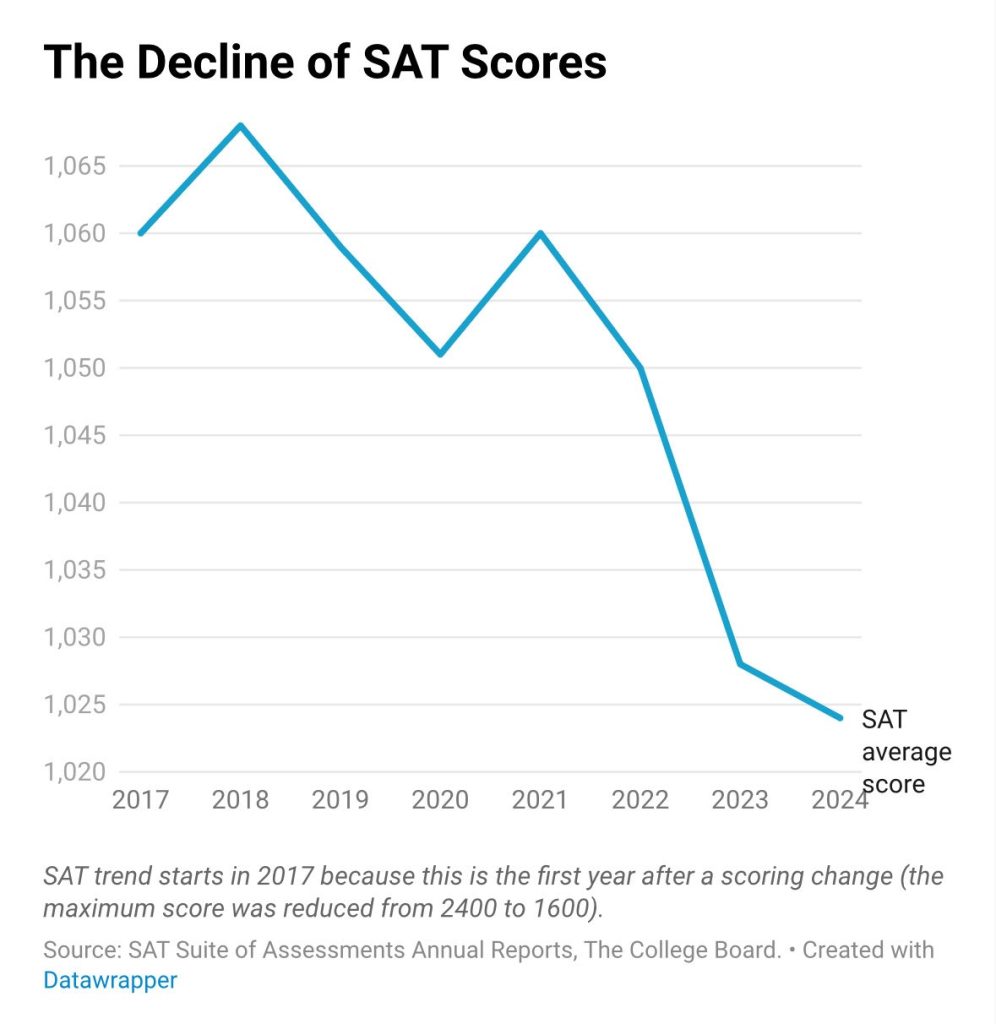
Could increasing use of computers in K-12 schools be one reason that standardized test scores have been falling since 2017 despite soaring education spending? It’s worth studying.

Most students in college and many in high school take notes on laptops or tablets, when they take them at all. AI tools that summarize lectures and meetings may soon render note-taking obsolete. Students will likely retain less information as a result.

Why commit information to memory when ChatGPT can provide answers at your fingertips? For one thing, the brain can’t draw connections between ideas that aren’t there. Nothing comes from nothing. Creativity also doesn’t happen unless the brain is engaged. Scientists have found that “Aha!” moments occur spontaneously with a sudden burst of high-frequency electrical activity when the brain connects seemingly unrelated concepts.

College and high-school students increasingly also use large language models like ChatGPT to write papers, perform mathematical proofs, and create computer code. That means they don’t learn how to think through, express or defend ideas. Nor how to construct arguments and anticipate the rebuttals. They offload these cognitive challenges to AI.

Share

K-12 Tax & $pending Climate: The Path to Record Deficits

Richard Rubin, Anthony DeBarros and Rosie Ettenheim:

Take a spin in the time machine, back to an era when the federal budget deficit didn’t look like a problem at all.

In 2000, the federal government actually ran a surplus and the Congressional Budget Office, Capitol Hill’s nonpartisan scorekeeper, projected the Treasury would keep collecting enough revenue to pay for all government programs and generate continuing surpluses.

Fast-forward to 2025, and the U.S. is running record deficits outside of wars, recessions or crises. The nation’s publicly held debt is nearing 100% of gross domestic product and is projected to surpass the post World War II record of 106% in a few years.

What happened?

It wasn’t a single event but a mix of factors: an aging population, tax cuts, wars, the 2008 financial crisis, expanded healthcare spending, the Covid-19 pandemic and rising federal assistance to households. Both parties played a part. Democrats did little to reverse that tide of red ink when they controlled Congress and Joe Biden was president. Now, Republicans and President Trump are pushing a tax-and-spending megabill that would add trillions to deficits, compared with letting tax cuts expire as scheduled.

Here’s a look at how we got here. The solid black line is reality. The dotted lines are CBO’s moment-in-time forecasts of a future that never happened.

EJ Antoni:

Wages and salaries for gov’t workers are 23.6% higher than their private sector counterparts, but the real difference in cost of employment is benefits, which are a whopping 82.2% higher for gov’t workers:

Share

notes on redistributed state taxpayer funds and the University of Wisconsin

Becky Jacobs and Andrew Bahl:

The leader of Wisconsin’s 13 public universities said without additional funding in the next state budget, he expects more branch campus closures, decreased affordability for students, layoffs and program cuts.

“All of which will hit hardest at our most vulnerable UWs,” Universities of Wisconsin President Jay Rothman said on social media.

State lawmakers are working this month to set Wisconsin’s next two-year budget. The Legislature’s budget writing committee, led by Republicans, was set to weigh funding for the UW system Tuesday. However, leaders of the Joint Committee on Finance postponed the discussion without explanation and hadn’t rescheduled a hearing as of Thursday, with the fate of the entire budget appearing to be up in the air.

Share

“His professor was not impressed and he received a C on the paperl

Daily Memphian

The inspiration for FedEx came to Smith when he was a student at Yale University. He wrote a paper about overnight, reliable delivery in the digital age. His professor was not impressed and he received a C on the paper.

Smith incorporated FedEx in 1971. The company began operations in 1973.

FedEx lost money in the early years and, once, as he struggled to raise further capital for the business, he made a pitstop in Las Vegas where his winnings at the blackjack table helped keep the company afloat until it could secure further funding.

In the time since, FedEx’s operations have spanned the globe and helped reshape trade across the world. The company’s reach and impact never showed itself more than during the COVID-19 pandemic.

Share

Florida & School Choice

Wall Street Journal:

Step Up For Students calculates that nearly 1.8 million students, or 51% of K-12 students in the state, attended a school of their family’s choice in 2023-24. That’s one happy result of GOP Gov. Ron DeSantis’s work to expand education savings accounts (ESAs), which the state opened to any student, regardless of income, in 2023. Some 285,000 students use ESAs to attend private schools—more than the 125,000 who attend private school without them. Nearly 100,000 use Florida ESAs for students with special needs.

Another 116,000 are homeschooling, and nearly 400,000 students attend charter schools. Hundreds of thousands of students are also taking advantage of choice within the traditional public school system. Some 275,000 participate in open enrollment programs to attend schools they aren’t zoned for. Others are in career academies at public schools, or going to magnet schools.

More than 116,000 more students enrolled in choice programs compared to the year before, the nonprofit says, and it’s possible the number is higher this year. A record number of scholarship applications for the 2025-26 school year flooded in over the first weekend that applications opened in February.

Share

Just last month, the Madison School Board voted to add another $1.2 million to a budget that was already $9 million beyond available revenue.

Chris Gomez-Schmidt (former Madison School Board member)

A recent Wisconsin Policy Forum report projects a 20% increase in school property taxes this December, a $883 increase on the average home, driven by the two 2024 referendums and declining state aid. For a city that prides itself on deliberate work to address affordability, this tax increase is concerning. We risk pricing families out of housing, reducing school enrollment and thereby undermining the basic funding the district depends on.

What can residents do? Speak up. Ask the School Board to be prudent and strategic. Taxing authority does not require maximum spending. The board still has $40 million in authorized increases left over the next two years. Taxpayers should insist this money be used carefully, not automatically.

Moreover, in alignment with the district’s new strategic planning, the board must start evaluating what can be subtracted, not just what can be added. Every new or continuing program should be weighed against what’s not working or no longer needed.

———

Madison taxpayers have long funded far above average k-12 taxes (and $pending), now nearly $25k per student. Yet we have long tolerated disastrous reading results.

———

Madison Schools: More $, No Accountability

The taxpayer funded Madison School District long used Reading Recovery

The data clearly indicate that being able to read is not a requirement for graduation at (Madison) East, especially if you are black or Hispanic”

My Question to Wisconsin Governor Tony Evers on Teacher Mulligans and our Disastrous Reading Results

2017: West High Reading Interventionist Teacher’s Remarks to the School Board on Madison’s Disastrous Reading Results 

Madison’s taxpayer supported K-12 school district, despite spending far more than most, has long tolerated disastrous reading results.

“An emphasis on adult employment”

Wisconsin Public Policy Forum Madison School District Report[PDF]

WEAC: $1.57 million for Four Wisconsin Senators

Friday Afternoon Veto: Governor Evers Rejects AB446/SB454; an effort to address our long term, disastrous reading results

Booked, but can’t read (Madison): functional literacy, National citizenship and the new face of Dred Scott in the age of mass incarceration.

When A Stands for Average: Students at the UW-Madison School of Education Receive Sky-High Grades. How Smart is That?

Share

A Instructional Review of the taxpayer funded Milwaukee Schools

MGT

The goal of this review is primarily to shed light on the school and district systems and practices that have created an environment of inconsistent student achievement. Throughout our review, the MGT team collected data aligned to the High-Quality Schools Framework, which consists of 4 Levers for school improvement. In this report, we propose that MPS adopt 3 objectives aligned to each Lever. The table below summarizes key findings and objectives

Notes

Share

Browser ”Fingerprinting”

Nitesh Saxena:

New research led by Texas A&M University found that websites are covertly using browser fingerprinting — a method to uniquely identify a web browser — to track people across browser sessions and sites.

“Fingerprinting has always been a concern in the privacy community, but until now, we had no hard proof that it was actually being used to track users,” said Dr. Nitesh Saxena, cybersecurity researcher, professor of computer science and engineering and associate director of the Global Cyber Research Institute at Texas A&M. “Our work helps close that gap.”

When you visit a website, your browser shares a surprising amount of information, like your screen resolution, time zone, device model and more. When combined, these details create a “fingerprint” that’s often unique to your browser. Unlike cookies — which users can delete or block — fingerprinting is much harder to detect or prevent. Most users have no idea it’s happening, and even privacy-focused browsers struggle to fully block it.

Share

stochastic parrots

George Hammond:

Her thesis is that the whizzy chatbots and image-generation tools created by OpenAI and rivals Anthropic, Elon Musk’s xAI, Google and Meta are little more than “stochastic parrots”, a term that she coined in a 2021 paper. A stochastic parrot, she wrote, is a system “for haphazardly stitching together sequences of linguistic forms it has observed in its vast training data, according to probabilistic information about how they combine, but without any reference to meaning”.

The paper shot her to prominence and triggered a backlash in AI circles. Two of her co-authors, senior members of the ethical AI team at Google, lost their jobs at the company shortly after publication. Bender has also faced criticism from other academics for what they regard as a heretical stance. “It feels like people are mad that I am undermining what they see as the sort of crowning achievement of our field,” she says.

The controversy highlighted tensions between those looking to commercialise AI fast and opponents warning of its harms and urging more responsible development. In the four years since, the former group has been ascendant.

Share

Harvard Law Journal nixed piece by Asian scholar after editors complained there were ‘not enough Black and Latino/Latina authors’

Aaron Sibarium:

When the Washington Free Beacon published documents showing how the Harvard Law Review selects articles based on race, the law review insisted those documents had been taken out of context.

The journal claimed the Free Beacon had quoted “selectively” from “five internal memos going back more than three years,” adding that the Harvard Law Review “considers several thousand submissions annually.”

“The Review does not consider race, ethnicity, gender, or any other protected characteristic as a basis for recommending or selecting a piece for publication,” the journal wrote in a fact sheet published on May 27.

But according to new documents obtained by the Free Beacon, the law review eliminates more than 85 percent of submissions using a rubric that asks about “author diversity.” And 40 percent of journal editors have cited protected characteristics when lobbying for or against articles—at one point killing a piece by an Asian-American scholar, Alex Zhang, after an editor complained in a meeting that “we have too many Yale JDs and not enough Black and Latino/Latina authors.”

Share

An interview with Madison’s Taxpayer Funded K-12 Superintendent

Kayla Huynh:

Even with additional funding from the referendum, the Madison school district will also rely on $22.4 million in one-time funds this year to balance its budget. Undernext year’s proposed budget, the school district would spend $9.5 million more than it receives in revenue, according to the Wisconsin Policy Forum, a nonpartisan, indendent research group that analyzes government decision-making. 

“We don’t have forever to close budget gaps,” Gothard said. “We’re going to need some incredible help in the future.” 

…..

The other big priority taking up a lot of time is boundary review. Madison is expected to grow. We have areas of the city being developed that we don’t necessarily have schools in, or we could have schools that are near capacity. 

———

Madison Schools: More $, No Accountability

The taxpayer funded Madison School District long used Reading Recovery

The data clearly indicate that being able to read is not a requirement for graduation at (Madison) East, especially if you are black or Hispanic”

My Question to Wisconsin Governor Tony Evers on Teacher Mulligans and our Disastrous Reading Results

2017: West High Reading Interventionist Teacher’s Remarks to the School Board on Madison’s Disastrous Reading Results 

Madison’s taxpayer supported K-12 school district, despite spending far more than most, has long tolerated disastrous reading results.

“An emphasis on adult employment”

Wisconsin Public Policy Forum Madison School District Report[PDF]

WEAC: $1.57 million for Four Wisconsin Senators

Friday Afternoon Veto: Governor Evers Rejects AB446/SB454; an effort to address our long term, disastrous reading results

Booked, but can’t read (Madison): functional literacy, National citizenship and the new face of Dred Scott in the age of mass incarceration.

When A Stands for Average: Students at the UW-Madison School of Education Receive Sky-High Grades. How Smart is That?

Share

Missouri NIL $pending

Eli Hoff:

The University of Missouri athletics department has spent more than $31 million on name, image and likeness compensation for its athletes during the past year, according to financial records.

Mizzou’s NIL spending reflects the university’s push to compete in football and men’s basketball under the terms of a modern college sports landscape that has spawned a lucrative market for athletes.

The records show that nearly two-thirds of the money in 2024 went to football players and about a fourth to men’s basketball. The remainder was split among baseball, women’s basketball and lower-profile programs.

Share

“employers can increasingly get non-graduates to do jobs that were previously the preserve of graduates alone”

The Economist:

Until recently the “university wage premium”, where graduates earn more than others, was growing (see chart 2). More recently, though, it has shrunk, including in America, Britain and Canada. Using data on young Americans from the New York branch of the Federal Reserve, we estimate that in 2015 the median college graduate earned 69% more than the median high-school graduate. By last year, the premium had shrunk to 50%.

Jobs are also less fulfilling. A large survey suggests that America’s “graduate satisfaction gap”—how much more likely graduates are to say they are “very satisfied” with their job than non-graduates—is now around three percentage points, down from a long-run advantage of seven.

Is it a bad thing if graduates lose their privileges? Ethically, not really. No group has a right to outperform the average. But practically, it might be. History shows that when brainy people—or people who think they are brainy—do worse than they think they ought to, bad things happen.

Peter Turchin, a scientist at the University of Connecticut, argues that “elite overproduction” has been the proximate cause of all sorts of unrest over the centuries, with “counter-elites” leading the charge. Historians identify “the problem of an excess of educated men” as contributing to Europe’s revolutions of 1848, for instance. Luigi Mangione would be a member of the counter-elite. Mr Mangione, a University of Pennsylvania graduate, should be living a prosperous life. Instead, he is on trial for the alleged murder of the chief executive of a health insurer. More telling is the degree to which people sympathise with his alienation: Mr Mangione has received donations of well over $1m.

……

A recent study, by Susan Carlson of Pittsburg State University and colleagues, suggests that many students today are functionally illiterate. A worrying number of English majors struggle to understand Charles Dickens’s “Bleak House”. Many are bamboozled by the opening line: “Michaelmas term lately over, and the Lord Chancellor sitting in Lincoln’s Inn Hall.”

Share

“Cut the crap and get back to the business of teaching young citizens about rules, processes, and institutions”

Frederick Hess:

We need a post-BS civics. In 2025, public officials seem unhealthily consumed by social media celebrity while longstanding civic norms are casually shattered. I don’t believe the problems are because of civics education but a post-BS civics could be part of the solution.

I mean, the U.S. owes $36 trillion in debt, is borrowing $2 trillion a year, and is spending $1 trillion a year just on interest payments. President Trump and a Republican Congress insist they’re tackling the problem but are eagerly pursuing a reconciliation package that’s going to make things worse. Of course, when Democrats had the wheel, they added as much debt as Senator Joe Manchin would permit.

Trump seems intent on trampling every federal law in sight. The only thing stopping him are the federal courts, which he’s proceeded to impugnas illegitimate. Of course, Democrats spent the last four years maligning the Supreme Court, smearing conservative members to undermine their legitimacy, and insisting the president should be able to pack the court.

Share

New US visa rules will force foreign students to unlock social media profiles

Andrew Roth

The new state department checks are directed at students and other applicants for visas in the F, M and J categories, which refer to academic and vocational education, as well as cultural exchanges.

“It is an expectation from American citizens that their government will make every effort to make our country safer, and that is exactly what the Trump administration is doing every single day,” said a senior state department official, adding that Marco Rubio was “helping to make America and its universities safer while bringing the state Department into the 21st century”.

The Trump administration paused the issuance of new education visas late last month as it mulled new social media vetting strategies. The US had also targeted Chinese students for special scrutiny amid a tense negotiation over tariffs and the supply of rare-earth metals and minerals to the United States.

The state department directive allowed diplomatic posts to resume the scheduling of interviews for educational and exchange visas, but added that consular officers would conduct a “comprehensive and thorough vetting” of all applicants applying for F, M and J visas.

Share

Liberating the University from Ideologic Supremacy

John Ellis:

Ending woke foolishness and returning universities to their former brilliance is possible only if the political monopoly is broken up. In his essay “On Liberty,” John Stuart Mill explained that “a party of order or stability, and a party of progress or reform, are both necessary elements of a healthy state of political life. . . . It is in a great measure the opposition of the other that keeps each within the limits of reason and sanity.” Only a political monopoly could have given us the collection of silly, faddish notions that is wokeness: criminals as victims, pronoun madness, defunding the police and so on.

It’s easy to understand how a monolithic political group loses its grip on sanity. A party that faces strong opposition will have its weakest and most fanciful arguments picked off and weeded out. That will clear the field of all but its strongest ideas, and leadership will then flow to people who build their party’s agenda on these strong ideas. Without the discipline of an opposition, leadership will flow instead to people who advocate the most ambitious and exciting ideas, which without opposition will gradually degenerate into absurdity.

What makes university reform so urgent is that woke folly inevitably spreads from campuses throughout our society. Children have abysmal scores in math and English partly because radical professors in college education schools persuade their teachers to give priority to “social justice” over the three Rs. The notorious political bias of the legacy media developed partly because journalists are trained in activist college journalism schools. Other professions have suffered similarly.

Share

New Zealand Switches to Science of Reading Instruction

The whole language approach was a reading instruction method invented by Dame Marie Clay in New Zealand in the 1970s, and it gained popularity in other countries by the late ‘90s. In this approach, children were taught to use contextual cues, such as the idea of the story, or use pictures to figure out the meaning of a word they didn’t recognize.

However, structured literacy focuses on phonics (how letters sound together) and the pronunciation of the word. This approach has been proven to be successful in many school settings worldwide, especially for students with dyslexia or low-income students. Until recently though, structured literacy was only available for children in New Zealand in certain private schools or in private tutoring.

Since 2009, educational performance has declined in New Zealand. A 2022 assessment called the Programme for International Student Assessment found that many students’ reading levels were worryingly low; 21% of the country’s 15 year olds were at the lowest level of literacy, meaning that they could do simple reading tasks, but nothing else.

———

Madison Schools: More $, No Accountability

The taxpayer funded Madison School District long used Reading Recovery

The data clearly indicate that being able to read is not a requirement for graduation at (Madison) East, especially if you are black or Hispanic”

My Question to Wisconsin Governor Tony Evers on Teacher Mulligans and our Disastrous Reading Results

2017: West High Reading Interventionist Teacher’s Remarks to the School Board on Madison’s Disastrous Reading Results 

Madison’s taxpayer supported K-12 school district, despite spending far more than most, has long tolerated disastrous reading results.

“An emphasis on adult employment”

Wisconsin Public Policy Forum Madison School District Report[PDF]

WEAC: $1.57 million for Four Wisconsin Senators

Friday Afternoon Veto: Governor Evers Rejects AB446/SB454; an effort to address our long term, disastrous reading results

Booked, but can’t read (Madison): functional literacy, National citizenship and the new face of Dred Scott in the age of mass incarceration.

When A Stands for Average: Students at the UW-Madison School of Education Receive Sky-High Grades. How Smart is That?

Share

Word Problems: Acquiring Algebraic Thinking

Barry Garelick:

For those who wish to view my rED/Toronto presentation, my slides w/narration in “Notes” form has been uploaded to researchED/Canada’s Google Drive.

Another link.

Share

Antitrust and the higher education complex

James Koch:

Thirty prestigious independent American institutions of higher education were at some time members of the 568 higher education group (often labeled a cartel). Seventeen of them were sued by the U.S. Government and representative students who alleged that their meetings and deliberations resulted in collusion that caused students to pay higher prices. Twelve of the seventeen institutions subsequently settled their cases and by 2024 collectively had paid $284 million to do so. However, an inspection of these institutions’ pricing reveals that the median 568 Group institution lowered its average real net annual cost to its undergraduate students by 19.07% between 2009 and 2022. Further, this reduction was 1.70 times larger than the average real price reduction granted during the same period by the median institution among a sample of 475 other accredited, non-profit, independent four-year institutions and 11.63 times larger than the median price reduction granted by 78 public flagship state universities. The 568 group’s real price reductions stretched across every one of the five household income categories commonly used by the Government. Thus, there is little empirical support for the allegations that the Government has levied against the representative 568 group institution, and thus multiple members of this group appear to have paid unmerited fines to the Government to settle claims against them.

———

More.

Share

“standard curriculum for seventh and eighth grade English classes in Minnesota in 1908”

Link:

This was the standard curriculum for seventh and eighth grade English classes in Minnesota in 1908. Poems and novels that today would be considered too challenging or difficult. Students were expected to read entire books, where today we teach only snippets. How far we’ve fallen.

Meanwhile:

Madison Schools: More $, No Accountability

The taxpayer funded Madison School District long used Reading Recovery

The data clearly indicate that being able to read is not a requirement for graduation at (Madison) East, especially if you are black or Hispanic”

My Question to Wisconsin Governor Tony Evers on Teacher Mulligans and our Disastrous Reading Results

2017: West High Reading Interventionist Teacher’s Remarks to the School Board on Madison’s Disastrous Reading Results 

Madison’s taxpayer supported K-12 school district, despite spending far more than most, has long tolerated disastrous reading results.

“An emphasis on adult employment”

Wisconsin Public Policy Forum Madison School District Report[PDF]

WEAC: $1.57 million for Four Wisconsin Senators

Friday Afternoon Veto: Governor Evers Rejects AB446/SB454; an effort to address our long term, disastrous reading results

Booked, but can’t read (Madison): functional literacy, National citizenship and the new face of Dred Scott in the age of mass incarceration.

When A Stands for Average: Students at the UW-Madison School of Education Receive Sky-High Grades. How Smart is That?

Share

Redistributed State Tax Dollars and University of Wisconsin Ideology

Kimberly Wethal:

“It’s not about cutting money. What it is is about getting some kind of reforms to the broken process that we currently have,” Vos said. “We don’t have enough respect for political diversity. Heaven forbid if you’re a student who’s Jewish or has a different viewpoint on campus where you feel like you’re either targeted or the victim of potential hate. So we want to ensure that whatever happens on campus, it is a free exchange of ideas and that people understand that’s the basis for what the university should be.”

Sen. Kelda Roys, D-Madison, told reporters following the committee meeting Tuesday that a $87 million cut to the UW system is a “non-starter.” A spokesperson for Gov. Tony Evers echoed that sentiment Wednesday afternoon.

“The university, over the last generation, has seen their budget shrink and shrink. They have not gotten inflationary increases, and they’ve had cuts,” Roys said.

Share

Finally, the optional essay has been completely eliminated

Michael Torres:

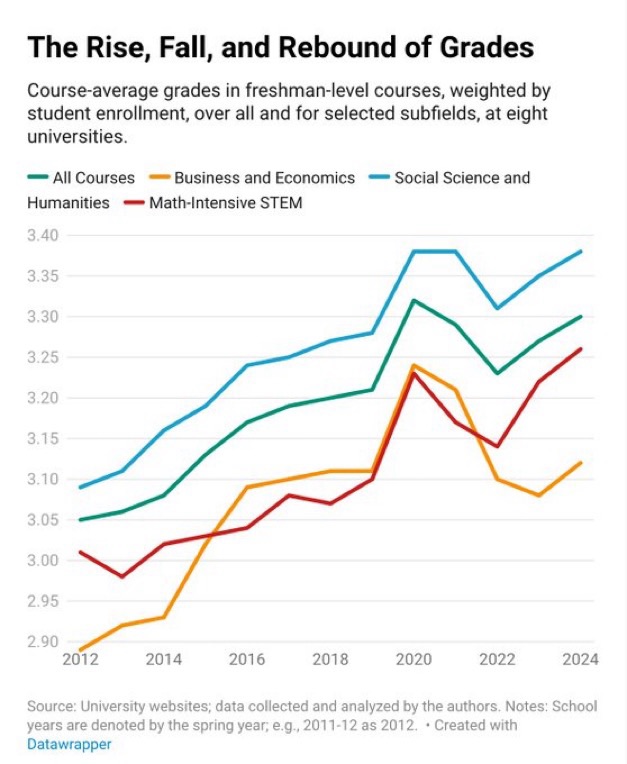
I beg to differ. Given the challenges professors are now experiencing with students’ college-level literacy and attention spans, one may counter that being able to pay attention to and analyze texts of extended length on complex subject matters that one may not find immediately entertaining should indeed be a prerequisite for college. And an objective and consistent standardized exam is a valuable means to measure such ability, especially amidst the rise of rampant high-school grade inflation.

But, rather than hold students to a clear and rigorous standard, the College Board is catering to students’ declining performance and social-media-induced attention-control issues.

This extends to the changes made in the new SAT math section, as well. College Board now serves test-takers fewer questions but did not reduce the amount of time for the section correspondingly. Students taking the post-2024 SAT now have 1.6 minutes per question, compared to 1.3 minutes on the 2015-2024 SAT. (The ACT and CLT provide 1.1 minutes per question.) Additionally, a calculator can now be used for the entirety of the SAT math section.

It’s hard to predict the extent to which these changes may decrease the rigor of the SAT math section. However, they comport with a more than 15-year trend. Researchers at the University of Cincinnati trained an AI program to do SAT math questions going back to 2008, and it found that the test has been getting easier by about four points per year.

Finally, the optional essay was eliminated completely.

Share

civics: Money/crypto & Political Sausage Making

Freddy Brewster and Luke Goldstein:

A private group chat of Democratic Party operatives and crypto industry advocates has been secretly coordinating to push Democratic Senators to support major cryptocurrency-friendly legislation up for a vote on Tuesday. In the chat, they admitted that while “Trump’s corruption is manifesting dramatically in crypto,” it would be “political suicide” for Democrats to reject doing the industry’s bidding, even if they have reservations about the impacts on consumers and the financial system.

In the Signal chat, the contents of which were viewed by The Lever, influential Democratic figures noted they “need to win the next election, which means we can not afford to alienate a very vocal and wealthy group of donors.” 

——-

more.

Share

Civics: The Collapse of Complex Societies

Matthew Butterick:

Of course, predic­tions of global apoc­a­lypse are as ancient as humanity. Given the histor­ical track record—no global apoc­a­lypse yet!—those predicting apoc­a­lypse have tradi­tion­ally had a rough time being taken seri­ously. Still, there is a big differ­ence between predicting the arrival of apoc­a­lypse ex nihilo vs. a reasoned argu­ment that it neces­sarily emerges from specific human deci­sions and habits.

The Limits of Growth

This book, published in 1972, was an early effort to quan­ti­ta­tively model the effects of tech­no­log­ical change. I read it some years ago. As the title implies, The Limits of Growth consid­ered how five key global factorswould affect human devel­op­ment:

Share

civics: usurping voters….. via “appointments”

Erin McGroarty:

With his two most recent appointments, Wisconsin Democratic Gov. Tony Evers has now picked a majority of the current judges serving on the Dane County Circuit Court.

Voters typically choose their own county judges in elections, except when there’s a midterm vacancy. That’s where Evers has stepped in — and in Dane County, nine of the 17 circuit court judges owe their positions to his appointments.

The governor says he’s focused on ensuring a diverse judiciary representative of a diverse population. 

Legal scholars say Evers’ stated attention to diversity on the bench differs from previous governors. 

…..

“People like legal action attorneys are now becoming judges through appointment, and having those perspectives of people who have had clients that have faced eviction, clients who have come from traumatic experiences, understanding those various perspectives is really important.”

These are the nine sitting Dane County judges Evers has appointed over the past seven years: 

…….

The other eight county circuit court judges assumed their positions through elections.

———

it would be useful to include the number of unopposed judicial elections as well. 

Share

Japan builds near $700M fund to lure foreign academic talent

Dan Robinson 

This new policy package is expected to fund various programs, including a plan by Tohoku University in Sendai to spend around ¥30 billion ($208 million) to recruit about 500 researchers from Japan and abroad.

Japan’s move follows an announcement in May from the European Commission(EC) that it wanted to make Europe the home of science by tempting researchers and scientists to relocate there.

The “Choose Europe” scheme is to include a €500 million ($566 million) package for 2025-2027 to make Europe “a magnet for researchers,” with EC President Ursula von der Leyen saying it would promote the region as a world-leading center of research, innovation, and scientific freedom.

This came after the launch of the Safe Place For Science program by Aix-Marseille University in the south of France a month earlier. This was setup with the intention of offering a “safe and stimulating environment” for American researchers wishing to pursue their work free from persecution.

Share

K-12 Tax & $pending Climate: US Federal Debt Analysis

US Senator Ron Johnson:

The primary purpose of this report is to graphically show what so many Republican
leaders have repeatedly stated, including President Trump in his November 2, 2011 tweet
‘Washington has a spending problem, not a revenue problem.”1 Fueled by spending levels tha
exploded during the pandemic but never receded, our fiscal situation is far worse than when
President Trump posted that tweet in 2011. These two charts illustrate that spending explosion:

Lauren Fedor and James Politi:

“Look at the bond market. These are pretty smart, sophisticated people, and they are a little more reluctant to buy US bonds, or are ploughing money into gold or other currencies,” Johnson said. “That ought to concern people.”

Asked whether Federal Reserve chair Jay Powell should lower interest rates as Trump has demanded, Johnson said it was no longer up to the US central bank boss.

“It is beyond his control. The bond buyers are controlling this now.”

The spending bill narrowly passed through the House of Representatives last month and Trump wants to enact it by July 4. Johnson said the timeline was “pretty optimistic”.

—-

more.

Share

“Blue” vs “Red” State Governance and K-12 Outcomes

Neetu Arnold:

Meantime, blue states and districts are lowering the bar for students in both academics and discipline. In 2021, Oregon eliminated high school graduation standards because they were allegedly harmful to minorities. San Francisco and other progressive districts have tried to implement “equitable grading” policies that deemphasize tests and deadlines. California has made it harder for teachers to maintain order in classrooms. In 2014, it became the first state to ban suspensions and expulsions for “willful defiance” among K-3 students, citing the large racial disparities in infraction rates. A decade later, California expanded this policy to middle and high school students. These kinds of policy decisions from blue states—shaped by a strong pressure to conform to rigid equity dogmas—have become a serious liability.

Republican-led states are leading on education reform by focusing on what works.. The lesson here for Democrats: any educational approach that prioritizes ideology over evidence will sacrifice student success.

Share

We (Rockford) began grouping students based on their reading ability and grade level. Here’s what transpired.

Jessica Berg:

If you had walked into the classrooms at my Rockford, Illinois, elementary school a few years ago, you would have seen something very different from what happens there today. Back then, like many schools, students stayed in their grade-level classrooms throughout the day, and we delivered reading instruction accordingly.

On paper, that seemed like the right approach. But in reality, it left too many students behind — and failed to challenge others who were ready to move forward.

So, we decided to do something bold.

Ellis Elementary, followed by several other Rockford schools, started grouping students by reading ability instead of by grade. It wasn’t seamless. It wasn’t easy. But it was necessary. And the results have been worth every bit of effort.

Coming out of COVID, our students’ learning gaps were wide — and getting wider. The urgency was impossible to ignore. As teachers, we were trying everything we could to meet the needs of all our students, but our one-size-fits-all structure just wasn’t working.

Teaching whole-group lessons to a class of students who varied drastically in their reading skills meant instruction often landed in the middle — reaching few, if any, with the depth they needed.

It became clear: Our diverse learners needed diverse instruction. That shift in mindset was the beginning of everything.

——-

Schools Should Pursue Excellence: The Education Progress Manifesto

——-

meanwhile:

Madison Schools: More $, No Accountability

The taxpayer funded Madison School District long used Reading Recovery

The data clearly indicate that being able to read is not a requirement for graduation at (Madison) East, especially if you are black or Hispanic”

My Question to Wisconsin Governor Tony Evers on Teacher Mulligans and our Disastrous Reading Results

2017: West High Reading Interventionist Teacher’s Remarks to the School Board on Madison’s Disastrous Reading Results 

Madison’s taxpayer supported K-12 school district, despite spending far more than most, has long tolerated disastrous reading results.

“An emphasis on adult employment”

Wisconsin Public Policy Forum Madison School District Report[PDF]

WEAC: $1.57 million for Four Wisconsin Senators

Friday Afternoon Veto: Governor Evers Rejects AB446/SB454; an effort to address our long term, disastrous reading results

Booked, but can’t read (Madison): functional literacy, National citizenship and the new face of Dred Scott in the age of mass incarceration.

When A Stands for Average: Students at the UW-Madison School of Education Receive Sky-High Grades. How Smart is That?

Share

Now might be the best time to learn software development

Nathan Figueroa:

LLMs really are like combine harvesters; allowing one to do the work of many. And like mechanized farm equipment, LLMs are cheap, plentiful, getting smaller every day, and- most importantly- require no training to operate. “Hey CombineGPT, teach me to reap the vast fertile plains!” And off you go.

“Okay snarky man, if LLMs are so easy and plentiful why keep devs at all hmm??” Fair point. I am just a middle-man, the hired hand here to corral the cattle on Software Ranch until the day they corral themselves (it’s a cowboy analogy now ig). “Go become fine steaks and leathers!!” one boss in a stetson will yell, and the cows will oblige. Devs will take the lonely road into the sunset, and historical romance novels will rightly remember us as rugged and sexy.

I would resign myself to the role of romance-novel-hunk but I think there’s a strong case to be made that the death of the software developer has been greatly exaggerated. In fact, I suspect the opposite is true: today might be the best time in history to learn software development. Let’s support this bold claim with commensurate bold points:

Share

notes on broadband and educational outcomes

Jared N. Schachner, Julia A. Gwynne, Nicole P. Marwell, Elaine Allensworth and Marisa de la Torre

Equitably expanding technology access among K-12 students has long been viewed as critical for equalizing educational opportunities. But these interventions may influence students’ academic outcomes in unexpected ways. Prior research suggests key technological resources, like broadband Internet, are a double-edged sword, conferring both educational benefits and distractions for children. Clarifying the academic effects of technology-oriented investments is particularly important given that the amount of funding devoted to them has spiked over the last five years, owing to the COVID-19 pandemic, when remote learning rendered high-speed Internet access indispensable to instruction. In this study, we leverage Chicago Public Schools’ pandemic-era broadband expansion initiative to assess whether overall levels of, and equity in, educational engagement and achievement improved with increased technology access. Analyses reveal a skill-technology complementarity: broadband program participation boosted remote learning engagement and achievement for previously high-performing students and reduced engagement and achievement for low-performing pupils. We conclude that increased technology access may come with greater costs for low-achieving students and benefits for high-achieving ones— contributing to widening pandemic-era educational inequities. Continued investments in expanding technology access without complementary supports for vulnerable students may further fuel these inequities; counterbalancing the negative effects of technology for low-achieving students is thus imperative.

Share

Virtual Town Hall on Implementing Wisconsin Act 20: WILL Model Policy on Reading & Retention

via a kind email:

In this session, we will:

  • Review the legal obligations under Act 20
  • Discuss recommended best practices beyond the minimum requirements
  • Walk through the structure and content of the WILL Model Policy and Companion Guide, and
  • Answer your questions live during a Q&A

You’re invited to a free webinar on Thursday, June 26 at 1:00 PM(CT) to walk through the WILL Model Policy on Act 20 Reading and Retention and the newly released Companion Guide to Implementing Act 20.

Under Wisconsin law (Wis. Stat. § 118.33(6)), all school districts must adopt a promotion and retention policy by July 1, 2025. WILL’s model policy is designed to help school boards meet these legal requirements while also promoting early literacy, empowering parents, and supporting teachers.

———-

Madison Schools: More $, No Accountability

The taxpayer funded Madison School District long used Reading Recovery

The data clearly indicate that being able to read is not a requirement for graduation at (Madison) East, especially if you are black or Hispanic”

My Question to Wisconsin Governor Tony Evers on Teacher Mulligans and our Disastrous Reading Results

2017: West High Reading Interventionist Teacher’s Remarks to the School Board on Madison’s Disastrous Reading Results 

Madison’s taxpayer supported K-12 school district, despite spending far more than most, has long tolerated disastrous reading results.

“An emphasis on adult employment”

Wisconsin Public Policy Forum Madison School District Report[PDF]

WEAC: $1.57 million for Four Wisconsin Senators

Friday Afternoon Veto: Governor Evers Rejects AB446/SB454; an effort to address our long term, disastrous reading results

Booked, but can’t read (Madison): functional literacy, National citizenship and the new face of Dred Scott in the age of mass incarceration.

When A Stands for Average: Students at the UW-Madison School of Education Receive Sky-High Grades. How Smart is That?

Share

“In 2024, we graduated the highest percentage of math majors in the U.S.”

Hillsdale:

Studying the liberal arts, if done properly, IS a search for truth, not just a source of topics for cocktail parties.

Many of our grads go on to advanced study or careers in the sciences. In 2024, we graduated the highest percentage of math majors in the U.S.

Share

k-12 tax & $pending climate: “Those in power don’t care”

Paul Fanlund:

They have generally supported the thousands and thousands of look-alike, low-rise apartment buildings popping up on seemingly every available open lot in town, even if some are skeptical that those units will ever be truly affordable.

Yes, many of them are older. Dismissing them as stereotypical out-of-touch boomers seems to be popular.

——-

Meanwhile: Madison’s taxpayer supported K-12 school district, despite spending far more than most, has long tolerated disastrous reading results.

Share

Boys and schools

Richard Whitmire:

These days it’s impossible to avoid the avalanche of evidence about young men falling behind in America. Within the last month, the New York Times laid out the dismal data, the Wall Street Journal noted the rising misogyny among boys and Bloomberg documented their rising anger.

One thing you won’t read about the boys dilemma, this month or any other month: serious solutions to the problem.

After a couple of decades as an education reporter, my first book was “Why Boys Fail.” That was in 2011, one of several books written at the time about boys falling behind. Back then, it appeared we were on the cusp of finally doing something about it.

But apparently not. Fourteen years later, all we have are more studies and op-eds. No solutions. Why? The boys dilemma has three components, and the reasons for inaction are different for each component.

My focus for “Why Boys Fail” was schooling. I traced the effects of well-intended education reforms that date back to the 1989 education summit in Charlottesville, Va., where President George H.W. Bush and 49 governors laid out a national plan for ramping up education achievement. 

Share

Saying Goodbye to Belle Wheelan

Graham Hillard:

Only a saint could have resisted a bit of adventurism in such circumstances. Wheelan is no saint. Though a full accounting of her crimes against neutrality would strain this article’s word count, a few lowlights demand to be mentioned.

  • In May 2021, Wheelan brought her influence to bear on the then-ongoing presidential search at Florida State University, arguing that candidate (and former Republican state-house speaker) Richard Corcoran was ineligible due to his membership on the institution’s governing board. According to the SACSCOC chief, Corcoran needed to step down from the FSU board before being considered for the top position. Yet Corcoran was on the board only because, as the state’s education commissioner, he was constitutionally obligated to perform that duty. Given that fact, it is difficult to see Wheelan’s gambit as anything but an attempt to eliminate a conservative from leadership contention.
  • When, in late 2022, North Carolina governor Roy Cooper (D) attempted to undermine the Republican legislature’s control of the UNC System, Wheelan made a personal appearancein Raleigh on the governor’s behalf. At particular issue was UNC-Chapel Hill’s planned School of Civic Life and Leadership (SCiLL), an academic unit reviled by the Left for its commitment to civil discourse and a culture of free speech. According to Wheelan’s remarks to Cooper’s hastily assembled “governance” commission, UNC-Chapel Hill’s trustees would soon “get a letter [of concern]” from SACSCOC expressing dismay at SCiLL’s creation. Yet such a letter never arrived. Instead, Wheelan confessed the next day that commission chair Margaret Spellings had “asked [her] to mention” Chapel Hill’s alleged malfeasance. The university’s accreditor, in other words, came down explicitly on the side of grasping officials seeking partisan control of the state’s public colleges.
  • In both 2020 and 2023, at the height of public debates about the efficacy and constitutionality of campus DEI initiatives, SACSCOC under Wheelan released a tacitly menacing “position statement” urging all accredited colleges to “intentionally cultivate and sustain inclusive and equitable processes.” Behind this gentle language lay a subtle threat. Although your elected officials may be on the side of reform, the statement plainly conveyed, your accreditor believes in DEI.

Perhaps such interference would have been tolerable had SACSCOC cultivated a reputation for excellence under Wheelan’s tenure. Alas, the opposite has been true. As the Texas Public Policy Foundation reported in 2023, SACSCOC-accredited institutions have a worse cumulative graduate-debt-to-earnings ratio than do institutions at all six of the other major accrediting bodies. Though Wheelan’s organization delights in making trouble for red-state public flagships, politically privileged schools (e.g., HBCUs) regularly skate to accreditation reaffirmation despite hideously poor graduation and loan-default rates. In the midst of yet another spat with Florida officials, this time in 2023, Wheelan made the curious claim that “Florida institutions are still myinstitutions” (emphasis added). One can’t help wondering, however, if the Sunshine State’s higher-ed accomplishments have occurred despite, not because of, SACSCOC’s oversight.

Share

$93,000 per student…..

Joanne Jacobs Summary:

Douglass Academy High School on the city’s West Side spends $93,000 per student, they write. There are 28 students. Among the 27 staffers are “six regular education teachers, six special education teachers, a school counselor, a college and career coach, a conflict resolution specialist, a restorative justice coordinator and an assistant principal and principal.” The other nine staffers include two security guards, a clerk, aides and . . . Maybe a janitor?

Share

My School Board Archives

Michael Ford:

Since 2013 I have been active in working to improve the performance of school boards in Wisconsin and beyond. Below are links to various writings, presentations, and peer-reviewed academic research related to school board governance. If there is any specific piece of research you are looking for please reach out at mford3482@gmail.com.

Dissertation

In 2013 I completed my PhD. In Urban Studies at UW-Milwaukee. My dissertation, The Impact of School Board Governance on Academic Achievement in Diverse States, was a largescale study connecting school board governance to school district performance. I concluded: “Traditional school boards can and do influence academic outcomes, meaning, improving school board governance is a legitimate approach to improving academic achievement.”

Share

The Deadly Cost of Ideological Medicine

Megan McArdle:

In more than 20 years of covering policy, I have witnessed some crazy stuff. But one episode towers above the rest in sheer lunacy: the November 2020 meeting of the CDC’s Advisory Committee on Immunization Practices. Sounds boring? Usually, maybe.

But that meeting was when the committee’s eminent experts, having considered a range of vaccine rollout strategies, selected the plan that was projected to kill the most people and had the least public support.

In a survey conducted in August 2020, most Americans said that as soon as health-care workers were inoculated with the coronavirus vaccine, we should have started vaccinating the highest-risk groups in order of their vulnerability: seniors first, then immunocompromised people, then other essential workers. Instead of adopting this sensible plan, the Centers for Disease Control and Prevention advisory committee decided to inoculate essential workers ahead of seniors, even though its own modeling suggested this would increase deaths by up to 7 percent.

Why did they do this? Social justice. The word “equity” came up over and over in the discussion — essential workers, you see, were more likely than seniors to come from “marginalized communities.”

——-

more. And.

——-

Waiting for an analysis of the long term costs of taxpayer supported Dane County Madison Public Health “mandates”

Share

Could you live without a computer?

August Lamm:

It was hard to think of any wage-earning labor I’d done without that computer. Even the in-person drawing classes or talks I’d given had involved slideshows and handouts I’d made on my laptop, as well as emails and Zoom calls beforehand. I guessed I’d earned half a million dollars on my computer over 10 years.

Still, I slid it across the counter. The brushed metal was pristine, the shiny Apple logo as unmarked as the day I bought it. The man looked it over, inspecting the underside and the vents, opening it up to check the display. He offered me 200 pounds.

I wondered if I could make more on eBay, Craigslist, or a buyback site. Would Apple accept it for refurbishment? Was my computer in “great” or “fair” cosmetic condition? How many battery cycles had it accumulated over the years? Had I paid for any special features—extra RAM, a superior graphics card? Was there another kiosk down the street?

Share

‘End DEI’ school complaint portal launched in February now offline

Trisha Powell Crain:

A U.S. Department of Education portal, initially promoted as a tool for parents to report school-based DEI programs, has quietly vanished from the internet – just a few months after its high-profile debut. 

The last time the site was working was May 13, according to the Internet Archive. For now, it’s unclear whether the portal is undergoing maintenance or was taken down permanently. 

Announced with strong language and a supportive quote from Moms for Liberty co-founder Tiffany Justice, the site launched on Feb. 27 as a place for parents to report alleged violations of President Donald Trump’s Jan. 20 executive order prohibiting diversity, equity and inclusion initiatives in education.

The U.S. Department of Education did not respond to multiple questions from Alabama Daily News about the “End DEI” portal’s status, including whether the shutdown was intentional or temporary. 

Share

Notes on Madison’s stagnant/declining k-12 student count amidst population growth

Chris Rickert:

Are you a Madison parent who has enrolled your child in a school outside the Madison School District?

The Wisconsin State Journal is looking to speak with Madison parents about their decision to use the state’s open enrollment program to enroll their students in other school districts, such as Monona Grove, Sun Prairie and Middleton-Cross Plains.

Interviews could be used in an upcoming story about the Madison’s School District’s comparatively low enrollment growth in a region of the state where population has been increasing steadily.

——-

Where have all the students gone?

——

Madison Schools: More $, No Accountability

The taxpayer funded Madison School District long used Reading Recovery

The data clearly indicate that being able to read is not a requirement for graduation at (Madison) East, especially if you are black or Hispanic”

My Question to Wisconsin Governor Tony Evers on Teacher Mulligans and our Disastrous Reading Results

2017: West High Reading Interventionist Teacher’s Remarks to the School Board on Madison’s Disastrous Reading Results 

Madison’s taxpayer supported K-12 school district, despite spending far more than most, has long tolerated disastrous reading results.

“An emphasis on adult employment”

Wisconsin Public Policy Forum Madison School District Report[PDF]

WEAC: $1.57 million for Four Wisconsin Senators

Friday Afternoon Veto: Governor Evers Rejects AB446/SB454; an effort to address our long term, disastrous reading results

Booked, but can’t read (Madison): functional literacy, National citizenship and the new face of Dred Scott in the age of mass incarceration.

When A Stands for Average: Students at the UW-Madison School of Education Receive Sky-High Grades. How Smart is That?

Share

Randi Weingarten Quits Democrat National Committee Position….

Shane Goldmacher and Reid J. Epstein:

The departures of Ms. Weingarten and Mr. Saunders represent a significant erosion of trust in the D.N.C. — the official arm of the national party — during a moment in which Democrats are still locked out of power and grappling for a message and messenger to lead the opposition to President Trump. In their resignation messages, the two union chiefs suggested that under Mr. Martin’s leadership, the D.N.C. was failing to expand its coalition.

Both labor leaders had supported Mr. Martin’s rival in the chairmanship race, Ben Wikler, the chairman of the Wisconsin Democratic Party. Mr. Martin subsequently removed Ms. Weingarten from the party’s Rules and Bylaws Committee, a powerful body that sets the calendar and process for the Democratic Party’s presidential nominating process.

——-

If traditional journalism dies, it will be in no small part because traditional journalists prove unwilling or unable to cover ideologically aligned figures (Biden, Fauci, Weingarten, John King) with sufficient care and skepticism.

——-

WEAC: $1.57 million for Four Wisconsin Senators

Share

Young Graduates and the Job Market

Justin Lahart & Te-Ping Chen:

Those ages 35 to 44 with bachelor’s degrees had a 2.2% unemployment rate over the past 12 months, though that was up from 1.8% over the prior period.

This follows an April report from the Federal Reserve Bank of New York saying labor-market conditions for recent college graduates “deteriorated noticeably” in the first quarter this year, even for young college graduates who have been in the workforce longer.

They found unemployment among college grads ages 22 to 27 averaged 5.8% in the first three months of this year, when President Trump’s on-again off-again tariff policies were just starting to rattle businesses and consumer confidence.

Moreover, the gap between the unemployment rate for these young graduates and the broader population became its widest in about 35 years of comparable New York Fed analysis.

The culprit, economists say, is a general slowdown in hiring. That hasn’t really hurt people who already have jobs, because layoffs, too, have remained low, but it has made it much harder for people who don’t have work to find employment. That includes everyone looking for work, but especially recent grads trying to land that first real job.

Share

Falling Fertility: A Crisis We Refuse to Face

Andrew Glover:

Despite these enormous social and economic stakes, few institutions are talking about the fertility collapse. In the West, the governance infrastructure to respond to it simply doesn’t exist.

This contrasts starkly with how we have responded to other long-term threats. Climate change, for example, is discussed at every level of governance, from local councils to global treaties. It has dedicated agencies, major funding streams, and entire industries devoted to mitigating its effects. Climate concerns occupy a central place in media, politics, and academia. Fertility decline, by comparison, has attracted little sustained attention and few institutions dedicate any time or money at all to solving it. 

While the issue is finally beginning to draw more attention, for the past several decades it has been largely overlooked. When fertility trends do surface in mainstream discourse, those raising the alarm are often treated with suspicion or derision—fertility decline is portrayed as the concern of reactionaries or racists, rather than as a legitimate policy challenge worthy of serious engagement.

Share

Seven replies to the viral Apple reasoning paper – and why they fall short

Gary Marcus:

The Apple paper on limitations in the “reasoning” of Large Reasoning Models, which raised challenges for the latest scaling hypothesis, has clearly touched a nerve. Tons of media outlets covered it; huge numbers of people on social media are discussing. 

My own post here laying out the Apple paper in historical and scientific context was so popular that well over 150,000 people read it, biggest in this newsletter’s history. The Guardian published an adaptation of my post (“When billion-dollar AIs break down over puzzles a child can do, it’s time to rethink the hype”) The editor tells me readers spent a long time reading it, notably longer than usual, as if people really wanted to understand the arguments in detail. (The ACM computer science society is reposting the essay, too, and there is now a French version as well).

Tons of GenAI optimists took cracks at the Apple paper (see below), and it is worth considering their arguments. Overall I have seen roughly seven different efforts at rebuttal, ranging from nitpicking and ad hominem to the genuinely clever. Most (not all) are based on grains of truth, but are any of them actually compelling?

Share

The end of prestige: How AI is quietly dismantling the elite professions

Samuel Z. Alemayehu

We’ve seen this before. Scribes in medieval Europe once held monopoly power over the written word — until Gutenberg’s press flattened that hierarchy. Textile artisans were once the pride of cities — until industrial looms made their mastery irrelevant. In the 20th century, travel agents, typists, and retail stockbrokers all watched their professional stature — and compensation — collapse under the weight of software.

The common thread: when a profession’s value is based on exclusive access to codified knowledge or repeatable process, it is vulnerable. Prestige does not protect it. In fact, prestige often signals just how close that profession is to being automated. Once something becomes teachable, it becomes learnable by machines. Once it becomes learnable, it becomes replaceable.

The High-Skill Trap

Today’s most exalted professions — medicine, law, consulting, engineering, high finance — are all deeply codified. They’ve spent decades standardizing best practices, benchmarking performance, and reducing errors through systematic frameworks. Ironically, it is that very systematization that now makes them vulnerable.

Consider law. Allen & Overy, a Magic Circle law firm, recently began integrating Harvey, an AI platform built on OpenAI’s GPT-4, into its global operations. Harvey can draft memos, summarize documents, and perform legal research with astonishing speed. Tasks that once justified armies of junior associates are being absorbed by machines. Kira Systems and Luminance now dominate the contract review space, using machine learning to flag anomalies and suggest edits faster than any human team.

In medicine, Google’s Med-PaLM 2 is being tested in clinical settings to answer open-ended medical questions with high levels of accuracy. The story is similar at the Mayo Clinic, where the role of the radiologist is shifting from sole interpreter to a partner with an AI that can ‘see the unseen.’ As their own magazine details, these systems can detect subtle, early-stage disease patterns in scans that are often invisible to the human eye, fundamentally enhancing — and altering — the diagnostic process. Babylon Health has deployed diagnostic AI chatbots that have handled millions of patient interactions — displacing the routine diagnostic work that once occupied a vast portion of a GP’s day.

Share

Drawing on Tradition: Elena Izcue’s Peruvian Art in the School (1926)

Link:

The 1930 course catalogue at Lima’s Escuela Nacional de Bellas Artes (National School of Fine Arts) announced a new class that would spark months of fierce debate in the popular press. In an open letter published in the newspaper El Comercio, Antonino Espinosa Saldaña heavily criticized the school’s inclusion of a lecture series on Inca art, stating quite bluntly that such a thing did not exist. “It was not a civilization of aesthetes, cultivators of beauty, of line, of color, of form”, the painter wrote, and while Espinosa deemed the output of earlier cultures in the region more striking, applying even these motifs to contemporary works would produce only “annoying agglomerations of incomprehensible monsters”. The ENBA’s Inca art class — and the calumny it provoked — took place against the backdrop of the ascendent Indigenist aesthetic movement, which sought to anchor Peru’s artistic future in the pre-Columbian past, skipping over, as it did so, the gilt-bedecked products of Spanish colonial rule. Debates about something as innocuous as an art class, then, were shorthand for much larger and more fundamental questions about the nature of Peruvian national identity in the modern era and the position of Indigenous people in society.

Share

The decision to test five-year-olds on tablets in September is scandalous

Hadley Freeman

Bravo to the education committee for finally saying what we all know to be true: for young children, screens are like — and I’m paraphrasing here, but not by much — crack, in terms of rotting their brains and being ludicrously addictive. In its new report, “Screen time: impacts on education and wellbeing”, the committee concluded, “The overwhelming weight of evidence submitted to us suggests that the harms of screen time and social media use significantly outweigh the benefits for young children.” In other words, it’s not social media that’s the problem. It’s screens themselves.

By now, bodies ranging from the World Health Organisation to the NHS have published guidelines about screen time for young children. But these guidelines are arguably too little and definitely too late: a 2020 Ofcom report found that an astonishing 57 per cent of five- to seven-year-olds in Britain have a tablet. As a result of this large-scale outsourcing of parenting to screens, last week a coalition of schools, nurseries and colleges published a letter saying that children were now starting school with speech and emotional difficulties “that are likely to have been exaggerated by or are even directly attributable to excessive screen time”. And yet the DfE has decided that those same screen-addicted kids should be tested on screens. And just to prove that too much screen time rots adults’ brains too, I’m going to respond to this mess with an internet meme: DfE! Make! It! Make! Sense!

So I emailed the department to ask — politely — what it was thinking. Why was it telling parents to give their kids less screen time while telling schools to give the kids more? Alas, to judge from the computer-says-no response I got, the DfE is now run by AI, which might explain its compulsion to test kids online: “Digital assessments reduce the administrative burden on teachers, freeing up their time to focus more on teaching and supporting pupils’ learning.” So young children will get to interact with teachers more by interacting with them less. Or something.

———

School leaders in the United States need to read this article. Like so many other things, screens and devices in schools are used because they benefit adults rather than improve student learning. It’s so tiresome.

Share

My father’s ‘system’ for raising eght children

David McGrath 

States back then provided roadside picnic tables, so we’d have lunch next to the highway, eating liver sausage and mustard sandwiches out of Mom’s picnic basket, bracing for the deafening whine of each speeding car that would pass and blow away whatever paper plate was not weighted down.

Toward evening, we kept eyes peeled for waterfront cabins to rent, and Dad would turn down a narrow gravel drive and see if there was a vacancy for a family of 10 while we waited in the car. When he emerged from a resort office, we’d study his face for evidence of success.

Barely 40, my father had been fitted by the dentist with an upper “partial,” which, when he was mulling something over, he’d move up and down with his tongue, appearing to smirk. That look usually meant that this might be the last stop and a good place to stay, subject to my mother’s approval after she heard the details about the swimming beach, number of beds, and, of course, the cost.

Share

Girls and math

Celeste Biever

Around the world, teenage boys outperform girls on mathematics tests, and men are more likely to pursue related careers — despite baby boys showing no superior sense of numbers or grasp of logic. Now, a gigantic study of schoolchildren in France pinpoints that this ‘mathematical gender gap’ appears during the first year of school. The finding could help to focus efforts to stop girls from falling behind.

Boys and girls receive similar maths scores at the start of school, but boys pull ahead of girls after just four months (see ‘Watch the mathematics gender gap emerge’). A more dramatic gap in mathematical performance emerges after 12 months of school, according to the analysis, published on 11 June in Nature1.

“This paper suggests that the gender inequalities in children’s maths performance aren’t innate or inevitable,” says psychologist Jillian Lauer at the University of Cambridge, UK. “If we want to stop girls from falling behind, we need to focus on their early experiences at school.”

Share

Assessment in the “ai” age

Arnold Kling:

Judging by the media (which I do not consider a trusted reliable source), there is a panic on campuses about student’s cheating by using AI. But this problem strikes me as trivially easy to solve. Frankly, I suspect that what students learn about AI by cheating is probably more valuable than what the professors were trying to teach them, anyway.

If I were a professor, I would care about the student’s problem-solving process. Let us use as an example freshman economics, a subject that combines technical mathematical reasoning with critical thinking skills.

Suppose that I could interview the student, and suppose that I do this remotely. I do not want the student using AI to cheat (in some situations, I might allow or even encourage the student to use AI during the interview, but let us set that aside for now). So the student is in a setting where a monitor is paid to ensure that the student is not using an AI or cheating in some other way. The monitor can be quite low paid, and the monitor can watch more than one student at a time. You do not need a highly paid professor to be the monitor.

During the interview, I want to make sure that the student understands key concepts and uses them correctly. Concepts like comparative advantage, opportunity cost, returns to scale, production possibility frontier, and supply and demand. I might give some typical problems to analyze. For problems involving supply and demand, the student would have to show understanding of the difference between shifting a curve and moving along a curve.

Share

Unfortunately, Houseplants Don’t Actually Purify the Air

Luisa Colon:

“There are studies that link plants to mood and even recovery from surgery, but my favorite quality of houseplants is that they remind us where we come from,” Guo says, pointing out that plants — via the process of photosynthesis, which provides humans and animals the oxygen they need to survive — are essential for life on earth. “So I find it a nice sense of reciprocity to take care of plants, indoors or outdoors.”

Share

The Overrated Religion of Goals

Joan Westenberg:

In 1953, a popular myth claimed that Yale graduates who wrote down their goals were significantly more successful 20 years later than those who didn’t. The study was cited in self-help books, business seminars, and motivational speeches for decades. The only problem was that the study never happened. It was completely fabricated, a ghost statistic that wandered the halls of corporate training programs like a benevolent poltergeist. But it persisted. Like a bad penny, it kept showing up for decades. 

Why?

Because it said what people wanted to believe: that clarity of ambition would bring control, that intention would yield destiny.

The cult of goal-setting thrives in this illusion. It converts uncertainty into an illusion of progress. It demands specificity in exchange for comfort. And it replaces self-trust with the performance of future-planning. That makes it wildly appealing to organizations, executives, and knowledge workers who want to feel like they’re doing something without doing anything unpredictable. But the more interesting question is: who is not setting goals? And why?

It turns out that many of the people doing genuinely innovative work avoid explicit goals entirely. They work within constraints instead.

Share

Notes on increases in taxpayer funded k-12 special education

Kimberly Wethal:

The proposal likely represented the biggest increase for any agency’s budget in the two-year budget, said Rep. Mark Born, R-Beaver Dam.

“The budget has to be right-sized to what’s affordable,” Born said. “It is a priority, but you have to be able to afford it, and it has to be reasonable.”

Critics say the increases are not enough to keep up with rising costs, forcing districts to continue seeking more money through referendums. Democrats and advocates had pushed for the state to increase the special education reimbursement rate to 60%.

Overall, Democrats had asked for $1 billion more in special education reimbursements and another $1 billion in new money for general school aid.

Share

Taxpayer funded Wisconsin DPI continues to reduce rigor measures

Chris Rickert:

group of 32 education officials is set to work with the New Hampshire-based Center for Assessment on updating the report card metrics. Underly would have the final say on approving them. 

——-

Did taxpayer funded Wisconsin DPI Superintendent Underly Juice Test Scores for Reelection?

Share

 “But for the grace of this nation, you would be dead in a ditch in Lagos.”

Shyam Sankar:

I decided to join the military for reasons both patriotic but also intensely personal.

My father grew up in a mud hut in Tamil Nadu, the southernmost state in India. He was the youngest of nine children and the first in his family to attend college—an education made possible only by his eight siblings pooling their wages. After graduation, he moved to Lagos, Nigeria, to build and run a pharmaceutical plant. Through ingenuity and an enterprising spirit, he became successful at a remarkably young age.

When I was 2, our life in Lagos ended violently. Five armed men broke into our home, killed our dog, pistol-whipped my father, and threatened my mother as they demanded money from the company safe. We fled Lagos with nothing, and started over in America.

My father took a job at a company that supplied souvenirs to theme parks in Orlando, Florida. My childhood memories are punctuated by Space Shuttle launches seen from my school courtyard, and by the bone-rattling double sonic booms of the Shuttles’ reentry. Lessons about the power of American technology were literally falling from the sky around me.

My father never again saw the material success of his youth, and he faced setback after setback in America. But he always reminded me of the counterfactual: “But for the grace of this nation, you would be dead in a ditch in Lagos.” America gave him life, liberty, and possibility.

———

more.

Share

A new book contends that allowing certain colleges to fail can facilitate the success of others

George Leef:

What has gone wrong?

In his latest book, Let Colleges Fail, economics professor Richard Vedder employs his insights to answer that question. The book’s subtitle, “The Power of Creative Destruction in Higher Education,” further elucidates his point of view. Consumers enjoy the results of markets where wide-open competition prevails, because the drive to succeed weeds out entities that fail to provide good value for the money. The problem in higher education, Vedder observes, is that competition is greatly hampered. Colleges can get into financial trouble just like failing businesses, “but, typically, third parties come to their rescue—governments allocate emergency funds and private donors respond to appeals for support,” he writes.

The higher-education system is riddled with features that protect the status quo and retard innovation.Moreover, the higher-education system is riddled with features that protect the status quo and retard innovation. Americans should therefore embrace changes that would allow much more competition than we now have.

Share

World fertility rates in ‘unprecedented decline’, UN says

Stephanie Hegarty:

Namrata Nangia and her husband have been toying with the idea of having another child since their five-year-old daughter was born.
But it always comes back to one question: ‘Can we afford it?’


She lives in Mumbai and works in pharmaceuticals, her husband works at a tyre company. But the costs of having one child are already overwhelming – school fees, the school bus, swimming lessons, even going to the GP is expensive.


It was different when Namrata was growing up. “We just used to go to school, nothing extracurricular, but now you have to send your kid to swimming, you have to send them to drawing, you have to see what else they can do.”


According to a new report by the United Nations Population Fund (UNFPA), the UN agency for reproductive rights, Namrata’s situation is becoming a global norm.

———

The Demographic Future of Humanity:

Facts and Consequences

Credentialism and family formation.

——-

Choose Life

Share

Taxpayer Funded Milwaukee Schools Teaching Audit

Corrinne Hess:

Milwaukee Public Schools isn’t supporting its teachers and doesn’t have adequate systems in place for student learning at its schools districtwide, according to the second independent audit commissioned by Gov. Tony Evers.

The 52-page report, focusing on the district’s instructional policies and methodologies, is as critical as the first audit, which the state released in February

The district is facing declining enrollment, teacher shortages, a high-needs student population and school displacement due to lead remediation. At the same time, teachers told auditors they don’t feel supported by the district or their principals and student discipline takes up most of their days.

———-

Madison Schools: More $, No Accountability

The taxpayer funded Madison School District long used Reading Recovery

The data clearly indicate that being able to read is not a requirement for graduation at (Madison) East, especially if you are black or Hispanic”

My Question to Wisconsin Governor Tony Evers on Teacher Mulligans and our Disastrous Reading Results

2017: West High Reading Interventionist Teacher’s Remarks to the School Board on Madison’s Disastrous Reading Results 

Madison’s taxpayer supported K-12 school district, despite spending far more than most, has long tolerated disastrous reading results.

“An emphasis on adult employment”

Wisconsin Public Policy Forum Madison School District Report[PDF]

WEAC: $1.57 million for Four Wisconsin Senators

Friday Afternoon Veto: Governor Evers Rejects AB446/SB454; an effort to address our long term, disastrous reading results

Booked, but can’t read (Madison): functional literacy, National citizenship and the new face of Dred Scott in the age of mass incarceration.

When A Stands for Average: Students at the UW-Madison School of Education Receive Sky-High Grades. How Smart is That?

Share

Teacher Apprentice Programs

Carl Smith:

A new apprentice program is attracting new teachers and helping existing paraprofessionals earn certification. The U.S. Department of Labor is now allowing teachers to be included in its Registered Apprenticeship program, opening up access to federal dollars to cover the costs of teacher training. In some participating states, the cost of an education degree has come down to $20,000 on average.

The Registered Teacher Apprenticeship Program is helping North Dakota schools attract people with a passion for teaching but put off by the cost of a degree, unsure they could ever pay back the debt on a teacher’s salary. Many who take advantage of it are single mothers already working as school paraprofessionals, says Laurie Matzke, assistant superintendent of public instruction for North Dakota. The chance to keep jobs they love and earn certification at no cost is “like a miracle.”

“We’ve had a severe teacher shortage for quite a while now, especially in the area of special education,” she adds.

——-

more

Share

K-12 Tax & $pending Climate: A Debt Crisis

Janan Ganesh:

If the illusion breaks, and a debt crisis happens, it might at least force a reassessment of the state from first principles. The only way that painful but necessary change happens in high-income democracies is through a sense of emergency. One preceded Thatcherism. Another led to reforms in Mediterranean economies post-2010. I don’t want such an event, but do envisage one. Many western states have finances that would struggle to withstand another shock. Imagine a pandemic, even half as costly as Covid. There isn’t room in some countries to raise taxes without harming incentives. (Unemployment in Britain is rising as the national insurance rise takes effect.) In a world of high rates, governments are spending more on debt interest than on education or defence.

Share

“ai” and the age of philosophy

Rebecca Lowe:

My immediate response to watching those prompt theory videos was to message a friend saying, “Any second now the hyper-detailed nuances between all the different theories of determinism go mainstream!”. I didn’t mean by this that I assumed every viewer would immediately see that the substance of these videos is grounded in the substance of complex philosophical theory. It was more that I thought these videos exemplified the way in which engaging with the idea of AI offers a route into deep philosophical thinking. You can see this in the determinism discussion that’s prefigured by the suggestion that the promptees are prompted into believing in prompt theory. And you can see it as soon as you start thinking through the complexities of the idea that each of the ‘AI actor’ characters has their own prompt-driven life.

Perhaps you think I’m being patronising. Perhaps you think rigorous discussion about free will and consciousness has been mainstream since The Matrix. Well, you’re reading this piece on my unashamedly philosophy-heavy Substack, so perhaps your thoughts on The Matrix aren’t representative of the general public! Beyond that, the silent role we humans play as prompters in these videos remind us that since The Matrix was released, we’ve gone far beyond engaging with these ideas as storylines in sci-fi movies. We’re living them! This is an age in which we speak with machines. Recent polling suggests that almost a tenth of Americans use AI every day. Every day! It’s an age in which it’s normal to hear people talk about machines ‘thinking’ and ‘reasoning’. AI has brought philosophy to the forefront of our lives, in a totally new way.

Share

Walton University

Alex Tabarrok summary:

Many colleges and universities were created in the 1960s and 1970s but the majority of elite R1s emerged in the late 19th century and early 20th century, including notable private universities created from the entrepreneurial fortunes of Carnegie, Rockefeller, Stanford, Cornell, Hopkins and Rice among others.

We are perhaps now seeing a return to that creative period with Walton, Thomas Monaghan, Patrick Collison (Arc Institute) and most notably Joe Lonsdale at the University of Austin. Tech provides both the funds and the impetus to build something new and different. As Tyler and I argued, online education and AI will change education dramatically, perhaps returning us to a now-affordable Oxford style-tutorial system with the AIs as tutors.

Share

Teaching National Security Policy with AI

Steve Blank:

Using this quarter to introduce AI we had three things going for us: 1) By fall 2024 AI tools were good and getting exponentially better, 2) Stanford had set up an AI Playground enabling students to use a variety of AI Tools (ChatGPT, Claude, Perplexity, NotebookLM, Otter.ai, Mermaid, Beautiful.ai, etc.) and 3) many students were using AI in classes but it was usually ambiguous about what they were allowed to do.

Policy students have to read reams of documents weekly. Our hypotheses was that our student teams could use AI to ingest and summarize content, identify key themes and concepts across the content, provide an in-depth analysis of critical content sections, and then synthesize and structure their key insights and apply their key insights to solve their specific policy problem.  They did all that, and much, much, more.

Share

Santa Clara University’s Crazy Idea of Human Sexuality

Naomi Epps Best:

On ethical and religious grounds, I requested an alternative assignment. Cary Watson, the department chairman, denied my request, suggesting I change my plans and pursue a different type of license. In an email, she described the course as “an ‘inoculation’ of sorts . . . exposing you to content you *might* come across” as a licensed therapist. She told me that if I did encounter such things in a professional setting, I could “assuredly communicate that discomfort” to clients and decline to work with them. So why did it have to be part of my training?

I appealed to the dean, the provost, the Title IX office, the university president and even Campus Ministry. I’m not sure who was more shocked, the priest reading the syllabus or me, screen-sharing sexually explicit videos and images with him.

The course is a graduation requirement, so I re-enrolled with Mr. Wei, who is new to the school. I requested the same accommodation that Ms. Watson said “Muslim women students” had received: to complete the course remotely. Mr. Wei instead scheduled a Zoom meeting with me. He promised a professional tone and said sexual disclosure wouldn’t be required.

Share

“is very rarely are there actual metrics attached to it”

Becky Jacobs

“What upsets me the most about these … is very rarely are there actual metrics attached to it,” Wilde said.

Mnookin will qualify for the $150,000 if she continues as chancellor through June 30 and “her performance remains satisfactory,” according to her contract with the UW system. Although her contract doesn’t specify what “satisfactory” means, the document says Universities of Wisconsin President Jay Rothman and the Board of Regents will evaluate the chancellor.

“When you have just a generic goal with no specific metrics attached, how do you really, truly know that it’s been met?” Wilde asked. “What is ‘satisfactory’ performance? What is ‘poor’ performance? What is ‘excellent’ performance? There’s no definition there.”

Mnookin declined to comment this week on the bonus and her plans to stay at UW-Madison. Rothman and the Board of Regents currently consider Mnookin’s performance to be satisfactory, Pitsch confirmed to the Cap Times.

The Board of Regents offer different rewards to other leaders across the Universities of Wisconsin. Starting in 2026, all the chancellors outside of UW-Madison could earn up to 15% on top of their base salaries if enough first-year undergraduate students continue for a second year. Specific targets vary among campuses. UW-Green Bay needs to retain 70% of first-year students this fall, while UW-La Crosse’s has to keep 87%.

Share

English literature’s last stand

James Marriott

English, as Stefan Collini observes in his wry and compendious new history of the discipline, Literature and Learning, tends to inspire an extravagant attachment rarely associated with, for example, geography or chemistry. Half the labour of writing a history of English must lie in gathering encomia to the subject by its besotted disciples. To the patrician epicures and monied amateurs who ushered the subject into universities at the beginning of the 20th century (men who fondled poems like antique clocks and ranked novelists like vintages of claret), the study of literature was “a glory of the universe” or “the spring which unlocks the hidden life”. For the evangelists of the critic FR Leavis and charismatic secondary school teachers of the Sixties it was a moral crusade that pitted humanity against the spirit-killing incursions of machine civilisation: English had “life-enhancing powers”, and its study was essential if a modern person hoped to retain “any capacity for a humane existence”. Collini winces fastidiously at some of these “soaring affirmations”. And indeed, such confident panegyrics read strangely in an age when the subject is cowed, apologetic and shrinking. Today, English is reduced to doing its pathetic, blundering best to ape the sciences, grinding scholars through the Research Excellence Framework and promising students “transferable skills”, that mad but unkillable doctrine beloved of prospectus writers which holds that studying ecocritical perspectives on early Shelley is useful preparation for making PowerPoints at PWC.

Share

A 242B token dataset from Harvard Library’s collections, refined for accuracy and usability

Matteo Cargnelutti, Catherine Brobston, John Hess, Jack Cushman, Kristi Mukk, Aristana Scourtas, Kyle Courtney, Greg Leppert, Amanda Watson, Martha Whitehead, Jonathan Zittrain

Large language models (LLMs) use data to learn about the world in order to produce meaningful correlations and predictions. As such, the nature, scale, quality, and diversity of the datasets used to train these models, or to support their work at inference time, have a direct impact on their quality. The rapid development and adoption of LLMs of varying quality has brought into focus the scarcity of publicly available, high-quality training data and revealed an urgent need to ground the stewardship of these datasets in sustainable practices with clear provenance chains. To that end, this technical report introduces Institutional Books 1.0, a large collection of public domain books originally digitized through Harvard Library’s participation in the Google Books project, beginning in 2006. Working with Harvard Library, we extracted, analyzed, and processed these volumes into an extensively-documented dataset of historic texts. This analysis covers the entirety of Harvard Library’s collection scanned as part of that project, originally spanning 1,075,899 volumes written in over 250 different languages for a total of approximately 250 billion tokens. As part of this initial release, the OCR-extracted text (original and post-processed) as well as the metadata (bibliographic, source, and generated) of the 983,004 volumes, or 242B tokens, identified as being in the public domain have been made available. This report describes this project’s goals and methods as well as the results of the analyses we performed, all in service of making this historical collection more accessible and easier for humans and machines alike to filter, read and use.

Share

At least one-third of school districts have faced funding cuts due to the increasing costs of pensions.

Equable:

The latest issue brief from Equable Institute reveals that rising teacher retirement costs driven by pension debt are placing significant financial pressure on K–12 school districts across the country—resulting in cuts to educator compensation, support services, long-term savings, and more.

The analysis, based on a survey of over 1,000 school district leaders and board members nationwide, finds that at least one-third of school districts have cut or deferred spending due to rising pension costs over the past five years. In states where legislatures pay pension costs directly, half of school leaders believe those expenses have led to lower state funding for public education.

Share

Scientific papers: innovation … or imitation?

Wayne Joubert:

Sometimes a paper comes out that has the seeds of a great idea that could lead to a whole new line of pioneering research. But, instead, nothing much happens, except imitative works that do not push the core idea forward at all.

For example the McCulloch Pitts paper from 1943 showed how neural networks could represent arbitrary logical or Boolean expressions of a certain class. The paper was well-received at the time, brilliantly executed by co-authors with diverse expertise in neuroscience, logic and computing. Had its signficance been fully grasped, this paper might have, at least notionally, formed a unifying conceptual bridge between the two nascent schools of connectionism and symbolic AI (one can at least hope). But instead, the heated conflict in viewpoints in the field has persisted, even to this day.

Another example is George Miller’s 7 +/- 2 paper. This famous result showed humans are able to hold only a small number of pieces of information in mind at the same time while reasoning.  This paper was important not just for the specific result, but for the breakthrough in methodology using rigorous experimental noninvasive methods to discover how human thinking works—a topic we know so little about, even today. However, the followup papers by others, for the most part, only extended or expanded on the specific finding in very minor ways. [1] Thankfully, Miller’s approach did eventually gain influence in more subtle ways.

Share

Discrete Math

Oscar Levin:

This text aims to introduce select topics in discrete mathematics at a level appropriate for first- or second-year undergraduate math and computer science majors, especially those who intend to teach middle and high school mathematics. The book began as a set of notes for the Discrete Mathematics course at the University of Northern Colorado. This course serves both as a survey of the topics in discrete math and as the “bridge” course for math majors, as UNC does not offer a separate “introduction to proofs” course. As this course has evolved to support our computer science major, so has the text. The current version of the book is intended to support inquiry-based teaching for understanding that is so crucial for future teachers, while also providing the necessary mathematical foundation and application-based motivation for computer science students. While teaching the course in Spring 2024 using an early version of this edition, I was pleasantly surprised by how many students reported that they, for the first time, saw how useful math could be in the “real world.” I hope that this experience can be replicated in other classes using this text.

Share

The Fulbright board has resigned, alleging political interference from the Trump administration

Guy Chazan:

on process, which it states is “based on merit, not ideology” and has traditionally been insulated from political interference. The board said the integrity of that process was “now undermined”.

Political appointees at the state department had cancelled Fulbright scholarships for dozens of academics and students, mainly on the basis of their research topics, according to people familiar with the matter.

The prestigious Fulbright Program has long been considered one of the pillars of US cultural diplomacy. It has been widely seen as enhancing America’s relations with its allies, with many Fulbright alumni rising to leadership roles in government, the sciences and the arts.

Trump administration critics say the Fulbright is the latest victim of the White House’s assault on symbols of US soft power. President Donald Trump has terminated funding for the Voice of America broadcasting network; dismantled USAID, the country’s main agency for international aid; and withdrawn from the Paris climate accord and the World Health Organization.

A senior state department official said the 12 members of the Fulbright board were “partisan political appointees of the Biden administration”, and it was “ridiculous” to believe they would “continue to have final say over the application process”.

Share