Ousted UW president implies UW regents are to blame for dysfunction

Kelly Meyerhofer:

Ousted Universities of Wisconsin President Jay Rothman cast the UW Board of Regents as dysfunctional and called for changes, such as fewer and better-educated board members.

“The change must start at the top with the Board of Regents,” he wrote in a Milwaukee Journal Sentinel op-ed.

Rothman lost his job April 7 when the board unanimously voted to fire him. Board President Amy Bogost cited a loss of confidence in his leadership, and later elaborated to a legislative committee that Rothman’s controlling management style and lack of urgency in addressing key priorities were among their concerns.

Rothman was taken aback by the board’s termination. He said he was told to step down by board leaders without being given a significant explanation, and he refused on principle. He will remain on the payroll through Oct. 8 and has 90 days to vacate the state-owned home he lived in as part of the job, according to his termination letter.

Rothman has given a handful of media interviews since his termination, but his op-ed offers new insight on what he believes drove the dustup. He didn’t outright blame the board but rather implied it is falling short by outlining how he believes a well-functioning board should operate.

“To be functional, the board must provide clear direction to the leadership of UW Administration, which, in turn, requires strong and decisive board leadership,” Rothman wrote. “Each of the 18 regents cannot be providing directives to system leadership about what they individually would like to see accomplished. Board leadership must build a consensus among the regents and only then provide direction to system leadership.”

Historical Birth Decline

Ness Sandoval:

If you follow the national headlines, you will see a familiar story: the United States is experiencing historic declines in births. That is true. But when you move from the national narrative to the regional data, a sharper reality comes into focus. The 2025 population estimates suggest that the 15 county St. Louis MSA is not just participating in this trend, it is emerging as one of its epicenters.

Here are the facts.

Among the 50 largest metropolitan areas, St. Louis ranks number 1 in percent decline in births from 2021 to 2025, at 8.57 percent, tied with Virginia Beach. In absolute terms, St. Louis ranks number 3 in total birth decline at 2,562, behind Chicago at 3,916 and Los Angeles at 4,043. Given the relative size of these regions, that places St. Louis near the top nationally in the scale of decline. In other words, the St. Louis region is experiencing a decline in births like a top tier metropolitan area. Looking more broadly, among the 100 largest met-ros, St. Louis ranks third, behind Baton Rouge and New Orleans. Among the 200 largest metros, it ranks sev-enth. The short term trend reinforces the pattern. From 2024 to 2025, births in the St. Louis metro declined by 1.13 percent, ranking sixth among the 50 largest metros and eleventh among the top 100.

But the longer arc tells the more consequential story.

In 2011, the 15 county St. Louis region recorded 34,821 births. Today, that number has fallen by 7,499 births annually, a 21.5 percent decline. That is not a fluctuation. That is a structural shift. We don’t know the bottom just yet.

The loss of births will show up across every major demographic measure, including declining school enroll-ment, a smaller future workforce, and a population that must support a rapidly aging population. The only way to change this projected decline is through positive in migration, either domestic or international. Many in the region are still operating as if the St. Louis region has 35,000 births per year and will see the same number of children in 2035 as it does today. That assumption is no longer valid. A decline of 7,500 births per year, without in migration, leads to one clear outcome. The 15 county St. Louis region has shifted demographic tracks. It is no longer a region of population stagnation. It is now on a path of population decline. One thing people need to understand, without a reversal in migration patterns, across the 15-county metro area, there will be fewer children under 15 in 2045 than there are today.

———

Choose life.

It is interesting to observe the organizations and fund$ that support anti birth and family policies.

Religious Freedom Before Locke

Alexander William Salter:

John Locke’s A Letter Concerning Toleration is widely regarded as a foundational text of religious liberty. For centuries, thinkers have praised its clarity, moral confidence, and rejection of the coercive religious politics that prevailed in early modern Europe. On the surface, Locke offers a simple and powerful claim: the state has no authority over the salvation of souls, and therefore it ought not to coerce religious belief or practice.

But this framing, so often viewed as self-evident, rests on claims that are highly contestable. Locke’s case is not religiously neutral. His argument becomes far less persuasive once we interrogate his assumptions. Religious freedom is good, but Lockean toleration is too fragile to sustain it.

Locke’s argument depends on a sharp division between the civil and the spiritual. The magistrate, he says, is concerned only with outward goods: life, liberty, property. Religion, by contrast, concerns inward belief and the salvation of the soul. Because belief cannot be forced, and because the state has no power over salvation, coercion in religion is both ineffective and illegitimate.

The argument is neat, forceful, and compelling on its surface. But it sidesteps rather than engages the thorny issues surrounding religious freedom.

Of course, coercion cannot produce genuine faith. This is obvious and had been recognized long before Locke. The deeper issue is that Locke quietly redefines both religion and politics to make his conclusion seem inevitable. Religion becomes primarily inward, a matter of private conviction. The Church becomes something akin to a club, a mere gathering of like-minded individuals. Politics, meanwhile, is reduced to the management of external order.

Why Must Academia Evolve?

Chuck Pezeshki

Academia is not truly identical the world over. There are better and worse universities out there, doing what they do. From an engineering perspective, the very best? TU Delft, and the German ones. The worst are scattered across the globe, and their manifestation largely relies on how much money they have. I’ve been in labs at Egyptian universities that were supported by USAID that were awesome, next to classrooms with broken furniture and no windows. I’ll never forget the scene I witnessed of the departmental chair doling out semi-worthless Egyptian pounds as salary to his faculty. And yet I’m not sure he was any more corrupt than any of the more modern schemes I’ve seen.

But as crazy as it may seem, they all have the same social structure. And as such, they nominally behave the same way. Sure, the European universities elect their presidents and rectors, or whatever. And they ARE a little more progressive. But most of the lot functions exactly the same, the world over. 

The spotlight has re-focused on corruption in academia because of the recently revealed scandal regarding billionaire pedophile Jeff Epstein giving cash to the MIT Media Lab. Specifically, Joi Ito, professor and director, started taking money from Epstein, partially on the advice of the former Media Lab’s director and co-founder, Nicholas Negroponte. And yeah, in case you’re wondering, Nick’s brother John was the one who gave us Iran-Contra, as well as the veritable collapse of Iraq. These folks get around. Considering the cast of characters, it’s easy to lapse into ‘blame the individual’, non-systemy-goodness thinking. The Negroponte boys — a pair of consiglieres if there ever were a pair.

Arizona School Districts’ Growing Problem with Empty Buildings and Empty Buses

Common Sense Institute

Introduction

Arizona’s district public school system has deep roots, stretching back to its territorial days. For most of its history, this system grew alongside Arizona’s population, fueled by the fact that 80% or more of Arizona’s 6-year-olds went to their local district public school. Arizona school districts built schools, hired teachers, and expanded bus routes, anticipating perpetual growth. By the 2010s, Arizona’s public K–12 system was a sprawling network of thousands of school buildings, vehicles, and people – designed to educate a swelling student body in a state that assumed this would go on forever.

But the tide has turned. Since 2008, district school enrollment has steadily declined, and the decline is accelerating. Enrollment dropped another 5% since 2019 alone – in contrast to the growth mindset that once defined the system. Meanwhile, educational choice has reshaped the landscape: 40% of incoming kindergarteners now opt for charter or private schools, despite smaller facilities, leaner staffs, and a lack of formal transportation options. Despite this shift, district schools have doubled down on expansion, adding 499 new buildings and boosting gross square footage by 3% in just the last five years. Today, Arizona’s public district schools have 78 million square feet of ‘excess’ space.

This report exposes the inefficiencies that have taken root. It’s a story of misaligned priorities and outdated systems, where resources pile up unused while student outcomes falter. Capital spending has increased by 67% to $8.9 billion since 2019. Transportation costs have increased by 11.3% to $561.2 million, despite a 45% drop in eligible bus riders. Urban districts have seen a 63% increase in bus miles per rider, while rural and choice students often struggle to access reliable transportation services. Staffing has grown too, but academic results haven’t followed – math proficiency has fallen 25% since 2019, and low-performing schools limp along at about one-fifth of their rated capacity.

The root causes lie in history and policy. Arizona’s funding models, forged in an era of expansion, tie dollars to building projects and bus routes rather than student needs. Districts, incentivized to spend rather than adapt, have amassed assets that no longer serve their purpose. Urban areas, flush with school choice options, often see the starkest inefficiencies. The result is a system out of sync with reality, where billions in taxpayer funds prop up a shrinking district footprint instead of fostering equity, promoting innovation, or ensuring funding ends up where the students are.

New Toolkit Calls for Charter Schools to Renew Commitment to Academic Excellence

Avonlea Cummings:

Student achievement gains eroded amid shift to “social justice” education  

BOSTON – After years during which too many charter public schools turned away from the rigorous academic practices that made them the nation’s most successful urban education reform, the sector should return to the proven model that closed achievement gaps, according to a new “Charter School Toolkit” published by Pioneer Institute. 

The case for renewal begins with a clear record of success: examining student outcomes in 29 states, Washington, D.C., and New York City between 2015 and 2019, Stanford University’s Center for Research on Educational Outcomes found that some 200 charter networks were closing or even reversing longstanding achievement gaps in reading, math or both. 

“These charter school networks dramatically outperformed the urban districts their students would have attended, are less expensive to operate, and can scale without limit,” said Steven F. Wilson, who authored the Toolkit

In recent years too many urban charters retreated from academic rigor. Newly minted teachers called for “social justice” education that braided political teachings into every lesson and regarded many of the networks’ distinctive practices—disciplined classrooms, rigorous curricula, and an extended school day a year—as “symptoms of white supremacist culture.” Teachers were asked to function as much as therapists as educators, as the belief was that before students could learn schools had to engage the trauma students and teachers carried from living in a racist society.

Civics: WMC Wins Appeal in Attorney General Kaul’s 18-Month Open Records Delay

Kristen Nupson

MADISON – On Wednesday, the Wisconsin Court of Appeals reversed a Dane County Circuit Court ruling, holding that unreasonable delays by government agencies in responding to public records requests may be challenged under Wisconsin’s Public Records Law—a significant win for the rule of law and government accountability.

In 2022, WMC submitted a public records request to the Wisconsin Department of Justice (DOJ), which acknowledged the request but took 548 days—roughly 18 months—to deny the request, asserting all the records were privileged. In response to the denied access, WMC filed a lawsuit alleging that both the DOJ’s refusal to turn over the requested records and its prolonged delay in responding violated Wisconsin’s Public Records Law.

The circuit court ruled that the DOJ had illegally withheld records and ordered the disclosure of many of them but dismissed WMC’s claim challenging the delay. The Court of Appeals reversed that dismissal, siding with WMC and remanding the case to the circuit court for further proceedings on WMC’s claim of unlawful delay. This ruling is a win for the public and reaffirms the law’s mandate that the government must respond to a request for records “as soon as practicable and without delay.”

A Science of Reading Progress Report

Michael J. Petrilli, David Griffith, Ph.D., Brian Fitzpatrick, Ph.D., Amber M. Northern, Ph.D.:

In recent years, states and districts have made a concerted effort to align early elementary school instruction with “the science of reading.” But how much progress has actually been made?

To find out, Fordham researchers David Griffith and Brian Fitzpatrick analyzed results from a nationally representative survey of K–3 teachers—developed by Fordham and fielded by RAND—that examined their knowledge of reading science and its relationship to the policies that shape instruction.

The takeaway: Progress is real, but incomplete.

Foreword

By Amber M. Northern and Michael J. Petrilli

Formal reading instruction in the United States predates our nation’s founding. Published in the 1680s, The New England Primer—the nation’s first major schoolbook—included spelling and sounding-out exercises that modern science of reading advocates would readily identify as early phonics instruction.

But it was the late nineteenth-century psychologist Edmund Huey who established the roots of the “science of reading” (SoR). Using rudimentary mechanical devices to measure eye movements, he showed that the act of reading was not a smooth process but rather a series of “rapid eye jumps and pauses,” reflecting the complex mental processes involved in decoding and comprehension.

In the decades that followed, a procession of influential scholars—including Edward ThorndikeRudolf FleschJeanne ChallKeith Stanovich, and Marilyn Jager Adams—built an empirical foundation on how children learn to read. And in 2000, the National Reading Panel synthesized the best evidence and the takeaways for classroom implementation.

Yet this long research tradition has not produced uniform understanding or practice in today’s literacy classrooms. Instead, we’ve experienced significant bumpsdetours, and even reading “wars,” as advocates of effective reading instruction have struggled to make their voices heard.

In 2022, Emily Hanford’s podcast series, Sold a Story, initiated a fresh wave of concern and advocacy, and state and local policies meant to improve reading instruction have proliferated in response. (At least 40 states and counting have enacted science of reading laws.) Whether these efforts ultimately succeed depends in large part on how clearly and consistently they are understood, supported, and enacted by teachers.

K-12 Tax & $pending climate: Killing or building the tax base

Brivael Le Pogam:

The bureaucrat takes no personal risk. His salary is guaranteed. At best, he maintains an existing rent. At worst, he destroys it through overregulation, forced bad allocation, perverse incentives that discourage those who produce. But in no case does he create.

Look at the last 50 years. iPhone, civilian internet, SpaceX, Tesla, Google, Amazon, Stripe, mRNA, ChatGPT. All private inventions, driven by entrepreneurs, funded by venture capital. Not a single ministry has invented anything that’s changed your daily life.

France has become the world’s laboratory for bureaucratic drift. 57% of GDP in public spending, an absolute record. A sprawling administration, a tax system that penalizes wealth creation. Result: falling behind the United States, Germany, Switzerland. Brain drain. Deindustrialization. Exploding debt.

In Backlash Against Tech in Schools, Parents Are Winning Rollbacks

Natasha Singer:

Last week, the Los Angeles school board passed a resolution requiring the district to restrict student access to YouTube, eliminate digital devices entirely through first grade and develop screen time limits for higher grades — becoming the first major U.S. school system to do so.

The parents’ successful campaign points to an escalating national reckoning for the powerful classroom technology industry. Encouraged by the fast spread of school cellphone bans, parents, teachers and legislators across the United States have banded together to ensure that technology use in schools is beneficial for learning.

In New York City, hundreds of parents have urged the mayor to postpone the introduction of artificial intelligence chatbots like ChatGPT in schools. Last month, the governor of Utah signed a law that will allow parents to see how much time their child spent on a school device and review the websites their child visited.

Evidence Young People Are Turning To Christianity Isn’t Anecdotal — It’s Real

Nathanael Blake

The revival is real, but the devil has backup plans. The evidence that the youth are turning to Christianity is going from anecdotal to data. In particular, young people on the rightespecially men, seem to be finding faith. 

As InteractivePolls noted on X, a recent Gallup poll found that “42% of men aged 18-29 now say religion is ‘very important’ in their lives — a sharp jump from just 28% in 2022-2023. Monthly religious attendance among young men has climbed to 40% (up from 33%), the highest level in over a decade.” 

This might be dismissed as an outlier, but polls are consistently showing that the share of “nones” (those who claim no religion) has leveled off. And there are other signs, such as Catholic parishes welcoming record numbers of converts this Easter. 

What will it take to get AI out of schools?

Jessica Winter: 

Support for generative AI in elementary and middle schools clusters around the belief that early exposure to the technology will foster digital-media literacy, give students a foundation in engineering concepts, and prepare them for a future in which most professions are steeped in AI. Proponents say that teachers can use AI to save time on grading papers and tedious administrative tasks; they also tout the adaptive-learning aspects of AI tools, which adjust in real time to a child’s progress and, by producing troves of data, help teachers give individualized attention to each student. “One of the core things that we think about when we bring AI to education institutions is: how do you put the educator at the centre of that experience?” Shantanu Sinha, who is one of the VPs of Google for Education, told me. Gemini’s aim, Sinha went on, is to “empower the educators” in “creating richer experiences. We are not the pedagogical experts.”

Other advocates suggest that AI might eliminate the need for pedagogical expertise altogether. Alpha, a fast-growing private-school chain that employs “guides” instead of teachers and serves children as young as four, claims that it “harnesses the power of AI technology to provide each student with personalized 1:1 learning,” allowing kids to “crush academics in just two hours” per day, according to its website. At a recent White House summit on children and tech, Melania Trump appeared alongside Figure 03, a humanoid contraption by the robotics company Figure AI, which looks, sounds, and moves as if Eve from “Wall-E” had mated with an arthritic Imperial Stormtrooper. The First Lady asked her audience to imagine such an AI-powered robot as a teacher, one who is “always patient and always available” to its student. This lucky pupil will learn more quickly and have more time for friends and sports, Trump said; he or she will become “a more complete person.” Figure 03’s face is literally a black screen: a robotic balaclava.

Taxpayer Funded Wisconsin DPI Announces Literacy Coaches

www

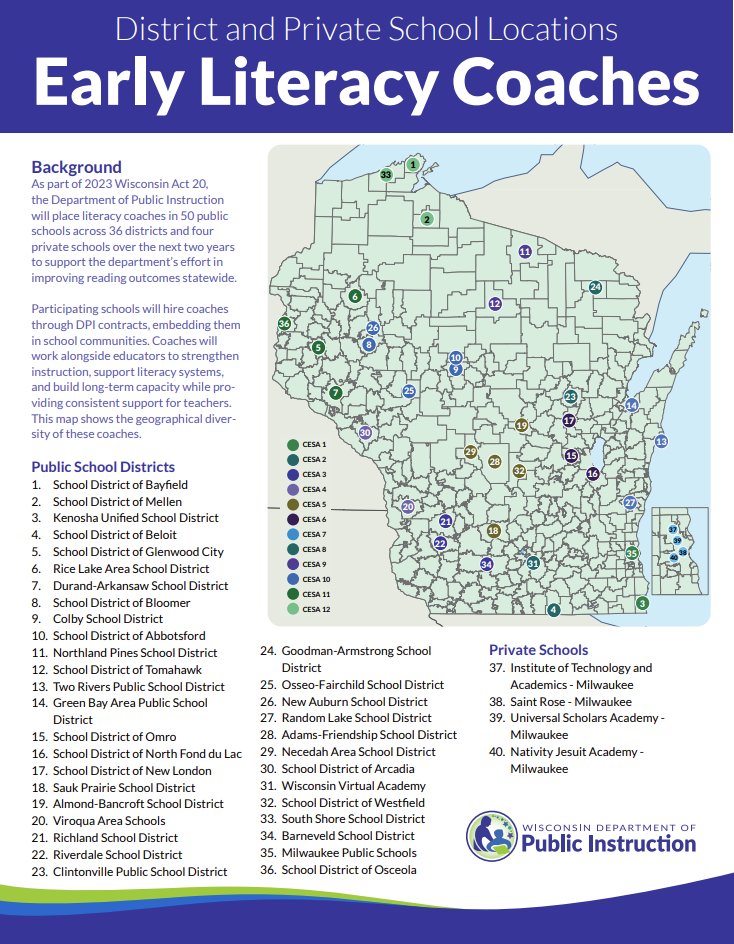
The Wisconsin Department of Public Instruction today announced new partnerships with public and private schools to expand early literacy support through the hiring of literacy coaches.

As part of ongoing efforts under 2023 Wisconsin Act 20, the DPI will place literacy coaches into 50 public schools and four private schools over the next two years. A map showing the districts and private schools across the state to receive coaches is available on the DPI’s website. The initiative is designed to strengthen reading instruction and improve literacy outcomes for students statewide.

“Improving literacy takes sustained effort,” State Superintendent Dr. Jill Underly said. “This work is about doing what’s best for kids and making sure every student builds the strong reading foundation they need to succeed. That means ensuring educators have the time, support, and coaching necessary to meet students where they are.”

——-

Notes and links on the Wisconsin DPI, here.

Foundations of Reading.

Act 20.

Wisconsin Early Literacy Screener Map.

New CUW–ICOM partnership opens doors to medical school

Concordia University Wisconsin – via a kind reader:

Through this agreement, ICOM and CUW will work together to create streamlined pathways for students pursuing careers in medicine, including eventual plans to establish an ICOM instructional site on the CUW campus. The partnership includes an articulation agreement that facilitates qualified Concordia students’ admission into ICOM’s Doctor of Osteopathic Medicine program. The articulation agreement is effective immediately, and plans to establish an ICOM-CUW satellite campus in Mequon are contingent upon the approval by the Commission on Osteopathic College Accreditation.

“This partnership builds directly on Concordia’s strong tradition in the health sciences,” said Dr. Erik Ankerberg, president of Concordia. “We are expanding what’s possible for our students—creating a clearer, more connected path from undergraduate study into medical school while strengthening our Christ-centered role as a leader in preparing healthcare professionals. This is a natural next step for Concordia and a significant benefit for the students and communities we serve.”

Commentary on K-12 Taxpayer $pending and outcomes: One City Schools Edition

Erin Gretzinger:

In Caire and his team’s view, One City and other charter schools are more accountable than traditional public schools given the specific academic goals and other stipulations in their charter contracts. 

Wittke, the Republican lawmaker, said One City’s lobbying wasn’t a factor in his support for funding demonstration charter schools.

“I don’t care if there’s a thousand lobbyists or none,” he said. “What bothers me about that is I think these are all things on the outside trying to discredit someone instead of debating what the real issue is.”

Some staff, students and other supporters have rallied behind One City. Two dozen parent testimonials in support of One City were submitted to the Legislature, plus letters from teachers, support staff and administrators.

“We cannot continue doing the same things and expect different outcomes,” wrote Alexandra De Craene, a One City special education teacher. The bill would provide “the stability needed to innovate, scale effective practices, and close achievement gaps statewide.”

One parent of a third grader, who didn’t provide a name, cited funding in particular as one of One City’s “many obstacles to success.”

“Like anything, One City isn’t perfect, but it is constantly improving — every year has been better than the last,” the parent wrote. “My hope for us at One City is that the larger community around us continues to believe in and support this school, because magical things are happening here that can genuinely change the world if given the chance.”

…..

However, the amount of per-pupil public taxpayer dollars received by independent charter schools like One City is several thousand dollars less than an average public school.

One City receives about 55% of its funding from public sources and raises the other 45% from private donors. For example, one donor funded about one-fifth of its operations last fiscal year, the school’s financial statements show.

One City’s leaders argue the proposed boost in funding would bring it up to what they estimate would be the average amount of public dollars that other Wisconsin public schools receive per student in the 2026-27 school year. (One City’s calculation, however, doesn’t account for increases in certain kinds of state aid for traditional public schools, and it excludes about $2,000 per student in federal dollars it receives via reimbursements.)

“If we don’t do the work and make the investment, you can’t take kids who are at the bottom of the barrel — they’re at the bottom of academic performance — and move them to the top,” Caire said.

——

Notes and links on Kaleem Caire’s tireless life!

A majority of the taxpayer funded Madison School Board aborted the proposed Madison Preparatory Academy IB Charter School.

On the 5-2 Madison School Board No (Cole, Hughes, Moss, Passman, Silveira) Madison Preparatory Academy IB Charter School Vote (Howard, Mathiak voted Yes)

——

3,887 Madison 4 year old to third grade students scored lower than 75% of the students in the national comparison group.

Madison taxpayers have long supported far above average k-12 tax & $pending. This despite our long term, disastrous reading results.

Madison Schools: More $, No Accountability

The taxpayer funded Madison School District long used Reading Recovery

The data clearly indicate that being able to read is not a requirement for graduation at (Madison) East, especially if you are black or Hispanic”

A.B.T.: “Ain’t been taught.”

My Question to Wisconsin Governor Tony Evers on Teacher Mulligans and our Disastrous Reading Results

2017: West High Reading Interventionist Teacher’s Remarks to the School Board on Madison’s Disastrous Reading Results 

Madison’s taxpayer supported K-12 school district, despite spending far more than most, has long tolerated disastrous reading results.

“An emphasis on adult employment”

Wisconsin Public Policy Forum Madison School District Report[PDF]

WEAC: $1.57 million for Four Wisconsin Senators

Friday Afternoon Veto: Governor Evers Rejects AB446/SB454; an effort to address our long term, disastrous reading results

Booked, but can’t read (Madison): functional literacy, National citizenship and the new face of Dred Scott in the age of mass incarceration.

When A Stands for Average: Students at the UW-Madison School of Education Receive Sky-High Grades. How Smart is That?

Commentary on Universities of Wisconsin Board of Regents

Jay Rothman:

When I started in June 2022, it was clear that the status quo was not sustainable. I am proud of what my team accomplished during nearly four years. But now it is time to look to the future and the change that still needs to be done.

While I regret that I will not be actively involved in that work, the path forward must look different for the state’s university system to succeed in an environment where constant change will be essential for sustainability and perhaps even survival.

The enormous impact the Universities of Wisconsin have on the economic prosperity and social vibrancy of our state is not open to debate. But our campuses are far too important to Wisconsin to allow for governance that does not meet the moment. As always, that governance starts with the UW Board of Regents.

The board is charged with overseeing the $7 billion annual operating budget of the Universities of Wisconsin, setting strategic direction and vision, and ensuring universities have the necessary resources to remain focused on their mission to serve Wisconsin. Given this role, the board cannot afford to be anything but a highly functioning body.

I practiced corporate governance law for over three decades. In that time, I worked with some truly exceptional boards that made meaningful contributions to the organizations they served. I also witnessed boards that hindered and damaged the very entities they were meant to serve. The difference was always the expertise of the board members and how seriously they took their responsibilities — and whether the structure around them set them up to succeed.

The structural challenges facing the Board of Regents are real. At 18 members, the board is too large to be effective. A board of nine to 12 qualified individuals is far more likely to provide the direction the our campuses need.

Who sits on the board matters enormously. A majority of regents should have served in senior management positions at substantial organizations. Regents should never be appointed solely on the basis of political patronage. It is time for the state to enact a law — similar to that governing the State of Wisconsin Investment Board — establishing criteria that must be met for board service.

Each regent must also be wholeheartedly committed to the mission of the Universities of Wisconsin — not to notoriety or self-interest — and must model a culture of stewardship, mutual trust and genuine teamwork. The UW campuses are too complex to govern by merely attending periodic meetings. To be fully informed and positioned to make major decisions, the Regents must invest real time visiting campuses, engaging faculty and students, and studying the intricacies of higher education.

To be functional, the board must provide clear, unified direction to UW administration — which requires strong and decisive board leadership. Each of the 18 regents cannot provide individual directives to system leadership, some of which conflict with one another.

Board leadership must build consensus and only then provide direction. There is no place for a regent going rogue on topics that impact the entire board. The message provided by any regent needs to be set by board leadership and then consistently delivered to all stakeholders.

The board also must understand the critical distinction between oversight and management. Oversight is the purview of regents. Management is the responsibility of UW administration. When the board seeks to perform managerial functions by directing how and when day-to-day decisions are made, the board ceases to be functional.

On an annual basis, the board should conduct a self-assessment of its performance — ideally with a third-party facilitator – and document areas for improvement, and track progress against those goals.

Finally, the board must commit to a strategic plan and have the courage to follow it. A plan must serve as the North Star for the Universities of Wisconsin, against which every board decision is measured. In the absence of that discipline, strategy disintegrates at the hands of opportunism, and no shared vision moves forward.

The board will not satisfy all stakeholders, but the Regents must exercise the fortitude to make decisions based solely on what is in the best long-term interests of the Universities of Wisconsin, and then allow the chips to fall where they may.

The Universities of Wisconsin stand at a crossroads. The challenges facing higher education are significant, and leadership — particularly at the board level — matters.

I will be rooting for our universities from the sidelines. Wisconsin wins when the Universities of Wisconsin succeed.

Rothman is the former president of the Universities of Wisconsin and previously served as chairman and CEO of Foley & Lardner. He practiced law in the areas of securities, mergers and acquisitions, and corporate governance.

US universities are creating a new aristocracy

James Marriott:

Meritocratic competition is giving way to increasingly opaque systems of admission. Many universities have abandoned rigorous tests like SATs in favour of “holistic” assessments intended to help more diverse students but which inevitably also favour the kinds of wealthy elite scions who can spend vast sums of parental money on fencing tutors.

Most astonishing is the system of “legacy admissions”, which gives preferential treatment to the children of donors and alumni. Fully 21.5 per cent of a recent cohort of successful white applicants to Harvard had legacy status. One in six Ivy League students belong to the wealthiest 1 per cent of society.

It is no surprise, then, that elite universities are increasingly behaving like aristocratic finishing schools, resuming the role they played at the beginning of the 20th century. The most exclusive American campuses are not (as their idealistic founders might once have hoped) austere temples of learning but five-star hotels with educational facilities attached. Exorbitant student fees help fund luxury gyms, sports clubs, spas, emotional support animals, safe spaces and organic cafeterias. It is an elite world that makes sense if you have grown up cocooned in the upper middle class but which is disconnected from the way the rest of the country lives.

And inevitably, America’s universities are once again developing a rarefied culture that is as exotic to ordinary people as the top-hatted and tailcoated world of Yale’s Wasps was in the 1920s.

Those declines don’t just represent lost population. They also represent lost wealth and earnings.

Joanne Drilling:

Metro New York, for instance, posted a decline of $50 billion in adjusted gross income between 2022 and 2023. The average adjusted gross income for people leaving New York was more than $110,400, while the income for people moving in was less than $104,500.

Those gaps can create a host of challenges for businesses and local governments in areas seeing substantial losses in net migration.

Why New York City Spends So Much on Its Mediocre Schools

Marc Novicoff:

New York City’s new mayor, Zohran Mamdani, will soon confront an ordeal that might finally knock that trademark smile off his face: balancing the budget. The city is projected to have a $5 billion deficit this year and is required by law to make up for that shortfall by raising revenue, cutting spending, or both. Mamdani has proposed large tax increases paired with modest cuts to city programs. But getting to $5 billion won’t be easy, in part because the biggest portion of the city’s budget is considered untouchable.

I refer not to the police department or the transit system, but to the department of education. It costs about $40 billion a year, making up a third of the city’s gargantuan budget. New York City spends more money per pupil—north of $40,000, according to one recent estimate—than any of the other 100 largest public-school districts in the country, and more than twice as much as the median district. Meanwhile, it generates educational outcomes that are average at best. According to federal data, its per-pupil spending is nearly 50 percent higher than Los Angeles’s and Chicago’s (the second- and fourth-largest districts), and 150 percent higher than Miami’s (the third-largest). Per pupil is the key phrase here. New York City’s public-school system is the largest in the country, but that’s not the problem. The problem, actually, is that the student body is small relative to the resources devoted to it, and shrinking fast—but the city and state governments won’t cut education spending accordingly. As long as that’s the case, the city’s financial situation will grow only harder to manage.

Where does all the money go? The simple answer is that it goes to the teachers. According to a cross-district analysis by the National Center for Education Statistics, New York City spent 61 percent of its education budget on instructor compensation in 2023. Los Angeles spent 52 percent on teachers; Miami, 43 percent.

Surprisingly, given those figures, New York City teachers are far from the highest paid in the country. A starting New York City teacher makes about $69,000 a year, whereas a new teacher in Seattle makes $74,730. A first-year Dallas teacher makes $65,000, but the cost of living in that city is significantly lower than in New York. And unlike the New York teacher, the Dallas teacher will not be required to get a master’s degree within five years of starting. Closer to home: The median teacher in the New York suburbs of Long Island and the Hudson Valley earns 14 percent more money than their counterpart in the city.

New York manages to spend so much on its teachers without paying them all that much by having so many of them. New York City’s pupil-to-teacher ratio is lower than that of each of the next 80 largest school districts. According to the New York City Independent Budget Office, that number stands at one instructor for everynine pupils. (This includes all pedagogic staff, including specialists, guidance counselors, and speech pathologists—not just the classroom teachers.) Melissa Arnold Lyon, a public-policy professor at SUNY Albany, told me that small class sizes are often the natural result of a dance between teachers’ unions and school districts. “The teachers’ union is coming in asking for higher salaries,” she said. “The city will say, ‘We don’t have enough money for that salary ask. What else would you take?’” Small class sizes, which make a teacher’s job easier, are one answer.

Taxpayer funded covid era Governance (and coverup)

Josh Christenson:

The Department of Justice indicted a former senior adviser to Dr. Anthony Fauci on Tuesday for allegedly concealing records amid probes into the origins of the COVID-19 pandemic.

David Morens, 78, has been charged with conspiracy against the United States; destruction, alteration, or falsification of records in federal investigations; concealment, removal, or mutilation of records; and aiding and abetting.

The indictment, unsealed Monday in Maryland federal court, also lists two unnamed co-conspirators who “concealed, removed, destroyed and caused the concealment, and removal of federal records to evade FOIA [Freedom of Information Act] and FRA [Federal Records Act].”

——-

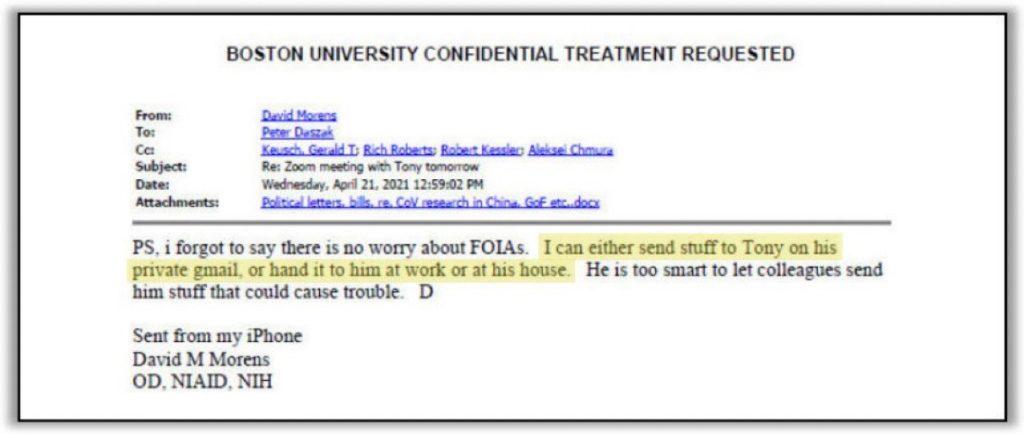
In April 21, 2021 he worked with co-conspirators Peter Dazsak (@peterdaszak) and others, to keep Covid schemes secret from public inquiry by “handing stuff to him at work or in his house.”

WTF “Additionally, the indictment further alleges that Morens and Co-Conspirator 1 conspired to pay illegal gratuities. The indictment states that Co-Coconspirator 1 gifted Morens wine for his “behind-the-scenes shenanigans,” and arranged for its delivery to Morens’s residence in Maryland.  Morens then allegedly identified an official act that he could perform to “deserve” the gift, which was a scientific commentary in a prominent medical journal advocating that COVID-19 had natural origins. The indictment further alleges that Co-Conspirator 1 suggested he would provide Morens with additional things of value, including meals at Michelin-starred restaurants in Paris, New York, and Washington, D.C.”

——

The complaint.

Civics: Voter ID, Elections, Taxpayer Funds and Barack Obama

Gregg Easterbrook:

That Obama opposes photo ID in voting, but requires it at his new billion-dollar palace so the desk staff doesn’t inadvertently issue a $4 discount, is a hoot.

….

The facility is extensively subsidized by the public: about $200 million in city-paid infrastructure and about $300 million in federal and state tax deductions on donations to support construction. (Donors are not required to claim deductions, almost always do.)

Despite tax favors and public subsidies, adult admission will be $30. Sales tax in the gift shop will be 10.25 percent, plus a 15 cent city tax per bag to hold said gifts.

Illinois residents get $4 off admission. To claim the discount, guests must show a state photo ID. 

Barack Obama opposes requiring a photo ID to vote, including the current Republican bill about this in Congress. The GOP’s ridiculously named Save America Act just failed on a close roll call in the Senate, probably is unconstitutional anyway – states, not the federal government, control the manner of elections.

States are free to impose voter identification requirements, so long as not to disadvantage minorities. 

Penn State Budget & “low demand offerings”

Maddie Aiken:

Penn State University could slash 12% of its undergraduate academic programs this fall if school leaders follow through with preliminary recommendations to eliminate low-demand offerings.

Forty-nine of Penn State’s 403 baccalaureate and associate degree programs are potentially on the chopping block after a months-long review of the university’s academic programs and portfolio, officials shared this month.

Discussions will continue throughout the summer, with final decisions expected by the fall semester. The university has employed the consulting firm McKinsey & Company Education Practice to assess its academics and organizational functions.

“Higher education is changing, and we must rise to the occasion,” Penn State Provost Fotis Sotiropoulos said in a statement. “A full accounting of our academic offerings, and a commitment to an ongoing cycle of program reviews moving forward, are critical parts of the work we all must do to position our students, and Penn State, for long-term success.”

The commonwealth campuses would bear the brunt of cuts; 39 programs could be slashed at these campuses.

Do the top factors in admission decisions vary by type of college?

NACEC:

Across all four-year colleges surveyed, high school grades and strength of high school curriculum are uniformly rated as the most important factors. However, some differences were found between public and private colleges in the level of importance given to the following factors:

  • high school grades in college prep courses
  • strength of curriculum
  • class rank
  • positive character attributes
  • the essay or writing sample
  • the interview
  • work
  • extracurricular activities
  • counselor and teacher recommendations
  • student’s interest in attending the institution.

God and Man at MIT

Siddhu Pachipala:

The pamphleteers are hard to miss. They stand in front of the big doors of Lobby 7, MIT’s main entrance, waving, preaching, and flagging down passersby with all the urgency appropriate to their task: saving young souls. Most students stream past, smiling politely, avoiding eye contact, and chuckling once they’re out of earshot. Some, feeling momentarily clever, stop to argue, hoping to outfox the proselytizer with a paradox about omnipotence and evil. Only occasionally does someone stop and listen. Fewer still will show up to a church, temple, or mosque. 

When I arrived at MIT, I was among the indifferent passersby. After three years here, I’m not so sure.

The stereotype of the elite campus, on which faith survives mostly as an object of satire or neglect, is instantly recognizable. Thirty-five percent of American college students report having never attended religious services; just 17 percent attend “about weekly” or more. The pattern is especially pronounced at MIT, where a majority of students identify as atheist or agnostic. Those who speak openly about their religion or spirituality are even fewer. In a political science seminar I took last year, the professor asked us to list our most dearly held identities, ordered by importance, and then share them aloud. Not one person in a class of fifty listed a religious or spiritual affiliation.

At first glance, it seems that secularism has hardened here into ­scientism, the belief that science tells us everything knowable, and perhaps everything worth knowing, about the world. We are led to feel that we have two options—blind submission to faith or adherence to the scientific method—and that by virtue of our attending a serious technical school, we have chosen the latter. Religion belongs to a different sort of person—certainly not the sort who sits in this room. I am told that in the mid-to-late 2000s, to profess faith openly, or draw on it in class, was to invite cocked eyebrows and hallway snickers. Better to cite the theories of Marx than the Gospel of Mark. The Secular Society, a student organization active at the time, devoted itself to “help[ing] . . . members develop skills in counterapologetics and navigating life without religion.” The secularists winkingly invited you to “hang out with the best goddamned group on campus.”

“The harms of universal screenings for mental disorders far outweigh the benefits”

Chris Evans, Carolyn D. Gorman

Widespread screening does, however, produce alarmingly high rates of false positives, leading to harmful misdiagnoses. One study published by Cambridge University showed a false-positive rate as high as 90 percent. That’s why Virginians (and all Americans) should push back against efforts to introduce universal mental-health screenings in schools.

In recent years, school districts across the country have begun requiring students to answer personal questions about emotions, behaviors, and suicidal thoughts. The practice has become widespread, with at least one-third of schools reporting that they administer mental-health screenings. Last year Illinois became the first state to mandate that all schools administer universal screenings to students in third through twelfth grade.

Most students that such screenings flag as “at risk” are merely feeling the normal stresses of life, so the scrutiny often leads to unwarranted labeling and intervention. By design, screening interprets emotions through a medical lens, construing any sign of anxiousness, inattention, or distress as a potential clinical disorder. But there’s simply no foolproof way to confirm mental-health disorders—no biomarkers, blood tests, or brain scans. Ordinary worry can easily be misconstrued as anxiety disorder, sadness as clinical depression.

Serious mental illnesses causing functional impairment affect only about 5 percent of Americans, and these conditions typically don’t develop until the late teens and early twenties. If America’s nearly 50 million public school kids were screened annually for rare conditions, the majority flagged would be false positives, leading potentially to millions of children being wrongly shuffled into the mental-health system.

China shock 2.0: the flood of high-tech goods that will change the world

Ryan McMorrow, Sam Fleming, Peter Foster and Joe Leahy:

Mega-Senway made its first sensors for about Rmb40 each and sold them for Rmb100, leaving Huang with a healthy margin. As Chinese competition poured in, prices started to fall. European groups gradually exited the market. Huang’s Shanghai-based company now sells some sensors for as little as Rmb10 a pop. “We never thought the price decline would happen this fast,” he says.

His company’s trajectory is emblematic of the larger economic forces reshaping global industry and trade as extraordinarily competitive Chinese companies push into a variety of industries at dizzying speed.

Twenty years ago the global economy was shaken by a first “China shock” as a wave of low-cost goods destroyed the business models of manufacturers in advanced economies, displacing millions of workers and feeding discontent that fuelled populist politicians including US President Donald Trump.

Now a second shock is under way — one that is even more threatening to China’s trading partners: an assault on high-end manufacturing.

Vicious domestic competition, coupled with vast industrial scale, ample pools of engineering talent and some of the highest subsidies in the world, has generated world-beating Chinese champions in EVs, solar panels, batteries, wind turbines and a lengthening list of advanced manufacturing sectors.

Former Sun Prairie West dean gets 18 years in federal prison

Chris Rickert:

Ploeger was one of several current or former school district employees criticized in an investigation into the district’s response to the sex-crime allegations made against Gilkey-Meisegeier. That investigation, by Milwaukee attorney Samuel C. Hall Jr., found district leaders didn’t do enough to investigate the allegations.

The investigation found that “school-level and district-level administrators failed to recognize Title IX obligations” — a reference to the federal law against sex-based discrimination in schools.

That failure “resulted in insufficient investigations into serious allegations,” Hall writes in his report, released on Jan. 6. “Investigative practices were poor, with limited interviews, lack of documentation, and an HR-centric approach that was not primarily focused on the students involved.”

more:

The full story on how “George Floyd Era” DEI lead to the promotion of a dangerous public-school employee, and then how DEI caused school officials to look the other way. From the defendant’s own attorney…

—–

WMTV:

“What qualifications did he have for that? What training did he have for that? What supervision did he get for that? None,” Van Wagner said.

Van Wagner told WMTV 15 News that Gilkey-Meisegeier should not have been in a supervisor position in the Sun Prairie school, and instead should have been supervised. Van Wagner said Gilkey-Meisegeier suffered from fetal alcohol syndrome and lacked the qualifications necessary for his position.

“The judge depicted him as the kind of person who’s a predatory when really he is a victim of sorts,” Van Wagner said.

Van Wagner also said Sun Prairie promoted Gilkey-Meisegeier to dean without training or credentials.

“They didn’t really look. Why? Because they had a person of color who had a degree. It was in the post-George Floyd era. It was in the DEI era. And the last thing they were going to do was remove a young black man who they viewed as a professional staffer who was apparently popular with and supported by the young people of color in the high school in a district where young people of color were becoming more numerous,” Van Wagner said.

A Conformity Crisis

Arthur Brooks:

“Echo chambers do not produce the best teaching, research, or scholarship.”

So said a self-critical report published this month by Yale University, bemoaning the lack of intellectual diversity at their own college and most of the nation’s other leading campuses. Well, duh, readers of The Free Press might respond. To you, this report, which also cited problems in higher education including ballooning tuition fees, opaque and unfair admissions criteria, and grade inflation—may sound like a master class in the obvious.

But to many in academia, this is not obvious. Despite decades slipping into an ideological monoculture, many academics still don’t see a problem. Amid increasingly widespread scrutiny, they don’t understand why so many elite colleges have squandered public trust.

Hardly a week goes by when the Madison school district doesn’t demonstrate its contempt for its own taxpayers. 

Dave Cieslewicz:

Shortly after those taxpayers voted to pony up a record $607 million in school spending increases, the district blew $100,000 on a new marketing campaign including a new MMSD logo — to add insult to injury that money was paid to an outstate consulting firm. Then the school board voted themselves a massive 88% pay increase, going from $8,000 to $15,000 a year plus bonuses for being the board president or sitting on committees. They also proposed that the district pick up their health insurance. That one didn’t pass, but wait until next year. 

Now the district is giving their teachers an extra paid day off. That’s right, the schools will be closed this Friday, May 1st, so that teachers can march to the Capitol to demand more school funding and to also (and I’m not sure how these two things go together) demand that we all but stop enforcing immigration laws. 

This isn’t Arbor Day. It’s a highly partisan, hard-left event that MMSD is tacitly endorsing. 

——-

3,887 Madison 4 year old to third grade students scored lower than 75% of the students in the national comparison group.

Madison taxpayers have long supported far above average k-12 tax & $pending. This despite our long term, disastrous reading results.

Madison Schools: More $, No Accountability

The taxpayer funded Madison School District long used Reading Recovery

The data clearly indicate that being able to read is not a requirement for graduation at (Madison) East, especially if you are black or Hispanic”

A.B.T.: “Ain’t been taught.”

My Question to Wisconsin Governor Tony Evers on Teacher Mulligans and our Disastrous Reading Results

2017: West High Reading Interventionist Teacher’s Remarks to the School Board on Madison’s Disastrous Reading Results 

Madison’s taxpayer supported K-12 school district, despite spending far more than most, has long tolerated disastrous reading results.

“An emphasis on adult employment”

Wisconsin Public Policy Forum Madison School District Report[PDF]

WEAC: $1.57 million for Four Wisconsin Senators

Friday Afternoon Veto: Governor Evers Rejects AB446/SB454; an effort to address our long term, disastrous reading results

Booked, but can’t read (Madison): functional literacy, National citizenship and the new face of Dred Scott in the age of mass incarceration.

When A Stands for Average: Students at the UW-Madison School of Education Receive Sky-High Grades. How Smart is That?

The Honesty Gap: Report Cards Are Sending Parents the Wrong Signals

Bloomberg:

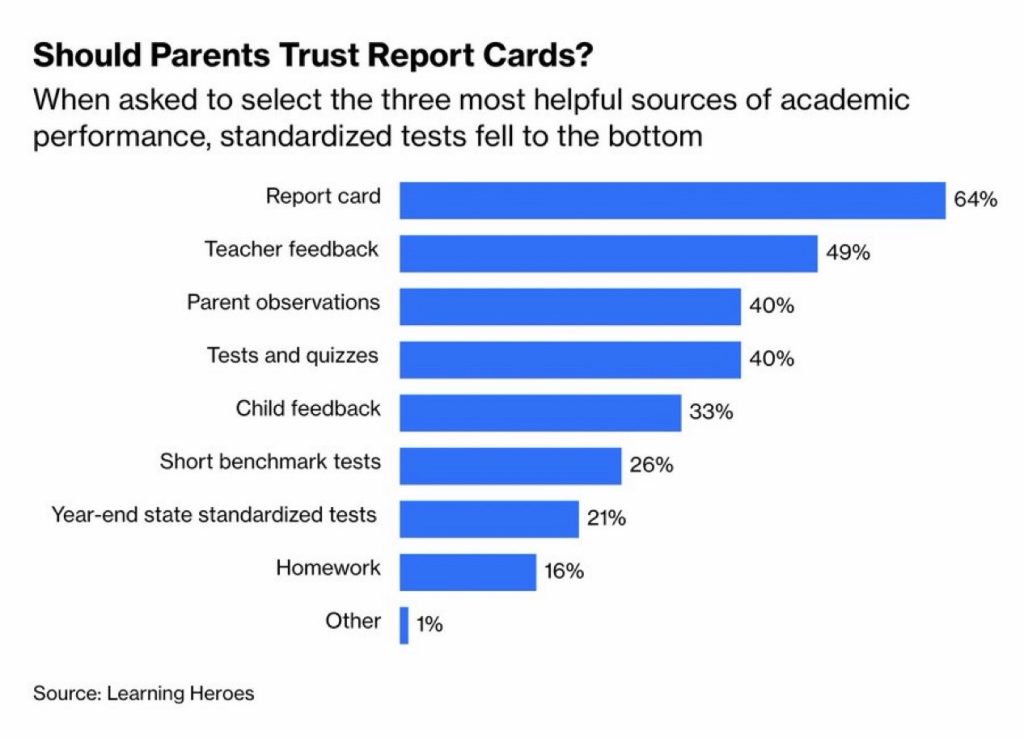
Most students in the US aren’t proficient in reading or math — but you wouldn’t know it by looking at their report cards. Four out of 5 parents say their children are getting B’s or higher. Test scores, meanwhile, have hit multiyear lows. According to one study, 60% of grades don’t match standardized assessments. 

One might hope such a discrepancy would set off alarm bells. Yet surveys show that parents are more inclined to trust report cards than test results. The upshot: Not only are measures of student performance diverging, but parents are also looking at the wrong signals.

——

3,887 Madison 4 year old to third grade students scored lower than 75% of the students in the national comparison group.

Madison taxpayers have long supported far above average k-12 tax & $pending. This despite our long term, disastrous reading results.

Madison Schools: More $, No Accountability

The taxpayer funded Madison School District long used Reading Recovery

The data clearly indicate that being able to read is not a requirement for graduation at (Madison) East, especially if you are black or Hispanic”

A.B.T.: “Ain’t been taught.”

My Question to Wisconsin Governor Tony Evers on Teacher Mulligans and our Disastrous Reading Results

2017: West High Reading Interventionist Teacher’s Remarks to the School Board on Madison’s Disastrous Reading Results 

Madison’s taxpayer supported K-12 school district, despite spending far more than most, has long tolerated disastrous reading results.

“An emphasis on adult employment”

Wisconsin Public Policy Forum Madison School District Report[PDF]

WEAC: $1.57 million for Four Wisconsin Senators

Friday Afternoon Veto: Governor Evers Rejects AB446/SB454; an effort to address our long term, disastrous reading results

Booked, but can’t read (Madison): functional literacy, National citizenship and the new face of Dred Scott in the age of mass incarceration.

When A Stands for Average: Students at the UW-Madison School of Education Receive Sky-High Grades. How Smart is That?
The Dollar

amuse

…..and, in hypothetical stress scenarios, preventing disorderly sales of US assets.” He went further and named the actual game: “Dollar dominance and reserve currency status are strengthened by constant long-term initiatives, including countering the growth of problematic, alternative payment systems.” Translation for those who do not speak Treasury, this is about killing the petroyuan in its cradle.

To see why this matters, consider the architecture Beijing has spent the past decade methodically constructing. The People’s Bank of China has established more than 40 bilateral yuan swap arrangements with foreign central banks. The Cross-Border Interbank Payment System, China’s parallel to SWIFT, has expanded continuously through 2025, connecting thousands of indirect participants and reaching well over 100 countries and regions. The mBridge cross-border central bank digital currency project, in which Saudi Arabia is a participant, provides yuan-denominated settlement rails that bypass SWIFT entirely. The Council on Foreign Relations argued in March 2026 that rising cross-border yuan payments may be weakening a key US sanctions tool, and a March 2026 House Select Committee investigation documented that China has effectively become the clearing market for sanctioned oil from Iran, Russia, and Venezuela. Iran’s 25-year cooperation agreement with Beijing routes a substantial majority of Iranian oil exports through yuan-denominated channels, often processed by smaller Chinese refineries to obscure the trade flows. Venezuela has settled the bulk of its oil exports to China outside the dollar system since 2018. The China-Russia-Iran-Venezuela-Cuba axis is not a coincidence and it is not a fringe alliance. It is a deliberately constructed parallel financial system, and Xi Jinping’s previously private 2024 instructions, since published in the Communist Party’s flagship ideological journal Qiushi, direct officials to build a strong currency widely used in international trade and foreign exchange, with a powerful central bank capable of attracting investment and influencing global pricing.

Less than 3% of book challenges came from parents

Naaz Modan:

Groups or government officials initiated 92% of challenges, and two-thirds overall ended in removals, according to an American Library Association report.

  • Less than 3% of book challenges in 2025 came from parents, and a full 92% were initiated by groupsor government officials, according to an analysis of book challenges at public, school and college libraries published Monday by the American Library Association. The remaining 5% came from library users or unknown sources. 
  • The percentage of challenges originating with sources other than individual parents jumped from 2024, when it stood at 72%. 
  • Some two-thirds of the challenged books, or about 5,668, went on to be banned, and anadditional 920 titles were restricted in some way. That’s the highest number of titles censored in a single year and highest rate of censorship recorded between 1990 and 2025, according to ALA. 

Dive Insight:

Of the challenged titles, 40% reflected LGBTQIA+ experiences and the experiences of Black and Indigenous people, and people of color, according to the ALA analysis. 

The top-most challenged book was “Sold” by Patricia McCormick, a novel about a Nepali teenager who is sold into India’s sex slave trade.

The Age of Ambiguity

Kevin Kelly:

A great question to ask when creating a scenario is what could prevent it from happening? Maybe there is not a single force that can undo this sustained uncertainty, but perhaps it is a mixture of several. If AGI arrived without a doubt in 3 years and China took over Taiwan despite the US’s actions, and if companies found a way to embed reliability and trust in media, then maybe this extended uncertainty could cease.

A second question to ask, is if we find ourselves in this scenario, what should we do about it? The most effective response to this multi-layered persistent uncertainty is not to seek impossible stability, but to cultivate radical adaptability and radical optionality. Give up on having a reliable prediction of what happens next. Instead cultivate multiple scenarios of what could happen, and endeavor with each of them to maximize your options. Goals should be considered as disposable hypotheses, constantly ready to be discarded and replaced by better-fitting concepts later on. You will be dead wrong on 19 out of your 20 expectations, but at least one of them will allow you to proceed. Make your decisions not on whether they are “right” but on whether they tend to give you more options later.

In our era of uncertain uncertainty, certainty will be the killer. In this era more downfalls will happen because of overconfidence than questioning. The key is to not get stuck on just one option. You have to become at ease holding multiple contradictory possibilities at once. (To prevent yourself from being swept away by the latest current and fashionable whim, this radical adaptability must be anchored on a steadfast set of unchangeable virtues, as corny as honesty, or as slick as generosity.) The strategy for prospering in prolonged uncertainty must be one of constant, agile recalibration.

Defending Education released 2 reports outlining national and local teachers union spending

 Andrew Mark Miller 

According to research from Defending Education, national teachers unions alone have directed roughly $669 million toward left-wing political groups, advocacy organizations and campaigns since 2015. When state and local affiliates are included, that figure balloons to more than $1 billion in total political spending.

The reports track spending from the two largest unions, the National Education Association (NEA) and the American Federation of Teachers (AFT), as well as their state-level affiliates, using federal filings and campaign finance records.

“These entities are a political machine,” Rhyen Staley, research director at Defending Education, told Fox News Digital.

———

WEAC: $1.57 million for Four Wisconsin Senators

When Knowledge Dies, It Stays Dead

Denis Stetskov:

Then there’s Fogbank. A classified material used in nuclear warheads. Produced from 1975 to 1989, then the facility was shut down. When the government needed to reproduce it for a warhead life extension program in 2000, they discovered they couldn’t. A GAO report found that almost all staff with production expertise had retired, died, or left the agency. Few records existed.

After spending an additional $69 million and years of reverse engineering, they finally produced viable Fogbank. Then discovered the new batch was too pure. The original had contained an unintentional impurity that was critical to its function. That fact existed nowhere in any document. Only the workers who made the original batch knew it, and they had retired years earlier.

A nuclear weapons program lost the ability to make a material it invented. The knowledge existed only in people, and the people were gone.

DEI Industrial Complex Survival Guide: “hide it and conceal it and mask it”

William A. Jacobson

Think of diversity, equity, and inclusion is how universities, K-12, and companies implement intersectional theory. They may not even know they’re doing it. That’s why we are calling on the administration to update their executive orders, to issue a new executive order which includes intersectionality under the definitions of diversity, equity, and inclusion.

It’s a very simple remedy, issue a new executive order saying intersectionality shall be deemed a practice that falls under diversity, equity, and inclusion for the purpose of all the other executive orders we have issued. Close the intersectionality loophole.

Additionally, we hope that Congress will get involved. We’ve seen on many issues, including antisemitism, that congressional hearings have proven extremely informative and extremely effective at addressing the problems.

In an era when AI can write anything, authentic education must go beyond the mere production of words.

Santiago Schnell:

“The end then of Learning,” wrote John Milton in 1644, “is to repair the ruines of our first Parents.” The image is hard to improve: education as repair, as recovery, as the restoration of capacities diminished by sin and neglect. 

Four centuries later, in the age of generative artificial intelligence (AI), that image has become urgent again — because we are now surrounded by a technology that offers to perform, on demand, much of what we had long assumed education required us to do ourselves.

I came across Milton’s passage by chance while browsing a collection of the English writer’s works and opening it to his 1644 tract Of Education. Milton was not writing about algorithms. Yet he saw with unusual clarity the educational error that AI now magnifies: the confusion of language with learning. 

Language, he wrote, is “but the instrument conveying to us things useful to be known.” He warned against mistaking command of words for possession of the solid things those words are meant to disclose. He joined language to substance, sequence to maturation, and study to direct contact with reality — principles that four centuries have not made less urgent.

College Graduates Are Finally Catching a Break in This Job Market

Ray A. Smith & Te-Ping Chen

At long last, the job market might be giving the Class of 2026 an early graduation present. 

After years of steady deterioration, there are early signs entry-level hiring is picking up. A widely watched survey by the National Association of Colleges and Employers out Monday shows employers expect to boost new-graduate hires by 5.6% this spring from a year ago—a turnaround from their much grimmer forecasts last fall

Students per school

Quinton Klabon:

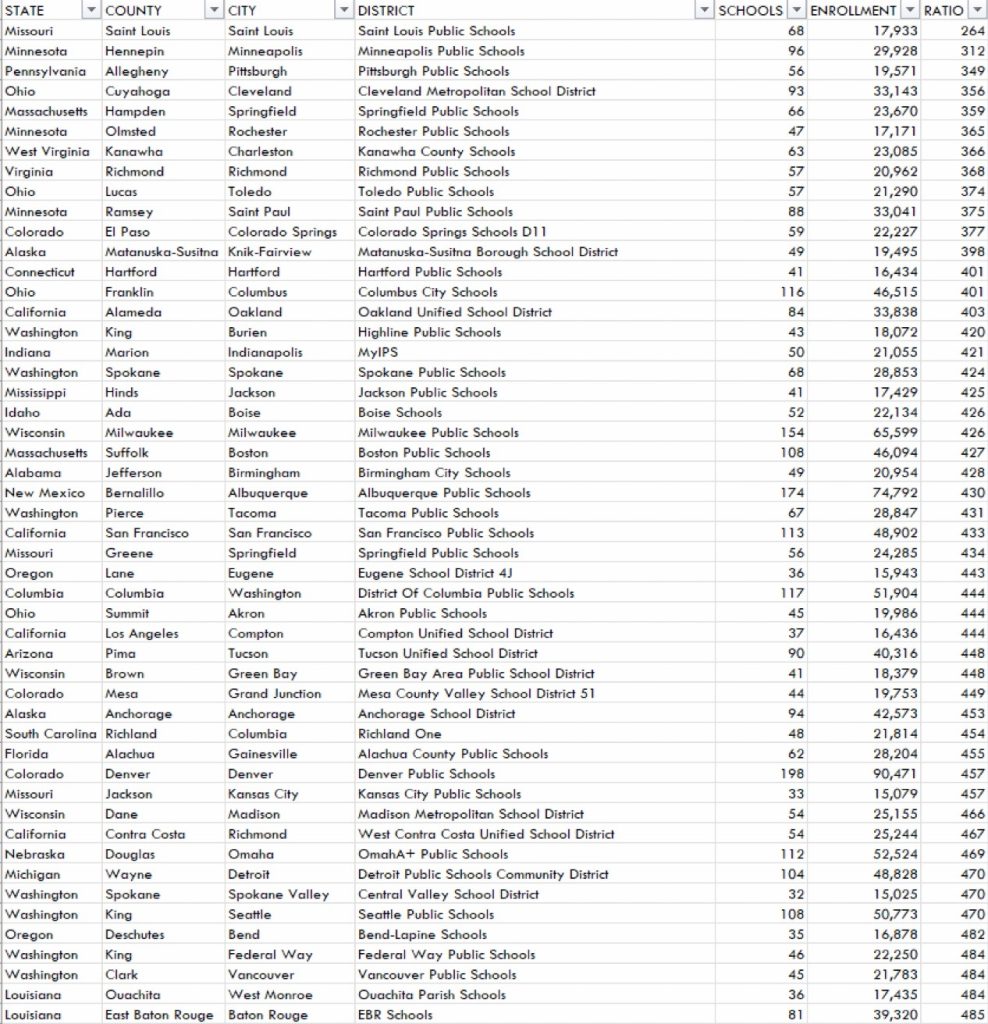
fewest students per school, 2025 school year, 518 districts over 15,000 students across America

Milwaukee: 21st (426)
Green Bay: 33rd (448)
Madison: 40th (466)
Kenosha: 121st (555)
Racine: 221st (631)

(5 lowest: Saint Louis, Minneapolis, Pittsburgh, Cleveland, Springfield)

Taxpayer Funded Madison public schools projected to lose 700 students in next 5 years

Erin Gretzinger:

“I don’t know when, where or what age — but there is interest in the city, in this region, right now that we have to think is going to produce more children with the kind of growth that’s being projected,” Superintendent Joe Gothard said in an interview this year.

The new projections from MGT, a Florida-based consulting firm hired to help with the boundary review process, outline why the district’s enrollment may not yet be climbing as administrators have hoped.

MGT analyzed all active or planned housing developments in Madison as of December. Among more than 12,000 units included in the forecast, 81% are apartments and about a quarter will be in the current Franklin-Randall Elementary School attendance area in the heart of downtown where many University of Wisconsin-Madison students reside.

There won’t be many families with school-aged children living in those housing units, MGT consultant Isaac Johnson told School Board members at their last meeting.

———

Part 1: Fix The Leaky Pipes – Fund Students, Not The System

———

3,887 Madison 4 year old to third grade students scored lower than 75% of the students in the national comparison group.

Madison taxpayers have long supported far above average k-12 tax & $pending. This despite our long term, disastrous reading results.

Madison Schools: More $, No Accountability

The taxpayer funded Madison School District long used Reading Recovery

The data clearly indicate that being able to read is not a requirement for graduation at (Madison) East, especially if you are black or Hispanic”

My Question to Wisconsin Governor Tony Evers on Teacher Mulligans and our Disastrous Reading Results

2017: West High Reading Interventionist Teacher’s Remarks to the School Board on Madison’s Disastrous Reading Results 

Madison’s taxpayer supported K-12 school district, despite spending far more than most, has long tolerated disastrous reading results.

“An emphasis on adult employment”

Wisconsin Public Policy Forum Madison School District Report[PDF]

WEAC: $1.57 million for Four Wisconsin Senators

Friday Afternoon Veto: Governor Evers Rejects AB446/SB454; an effort to address our long term, disastrous reading results

Booked, but can’t read (Madison): functional literacy, National citizenship and the new face of Dred Scott in the age of mass incarceration.

When A Stands for Average: Students at the UW-Madison School of Education Receive Sky-High Grades. How Smart is That?
“An emphasis on adult employment”

Will Flanders:

In Madison, less than 40% of students can read proficiently using the most recent legitimate data. Perhaps it’s not surprising that the union would shut down schools for a day for politics given their history of supporting COVID shutdowns—doing immeasurable harm to a generation

SCOOP: The Madison Metropolitan School District (@MMSDschools) in Wisconsin sent out a message notifying parents that May 1st classes will be canceled so teachers can join anti-ICE protests

———

Now thousands of working parents in Madison are scrambling to line up child care because the teacher’s union wanted a day off. Madison, you voted for this crap. Enjoy!

———

More.

———

3,887 Madison 4 year old to third grade students scored lower than 75% of the students in the national comparison group.

Madison taxpayers have long supported far above average k-12 tax & $pending. This despite our long term, disastrous reading results.

Madison Schools: More $, No Accountability

The taxpayer funded Madison School District long used Reading Recovery

The data clearly indicate that being able to read is not a requirement for graduation at (Madison) East, especially if you are black or Hispanic”

My Question to Wisconsin Governor Tony Evers on Teacher Mulligans and our Disastrous Reading Results

2017: West High Reading Interventionist Teacher’s Remarks to the School Board on Madison’s Disastrous Reading Results 

Madison public schools projected to lose 700 students in next 5 years

Madison’s taxpayer supported K-12 school district, despite spending far more than most, has long tolerated disastrous reading results.

“An emphasis on adult employment”

Wisconsin Public Policy Forum Madison School District Report[PDF]

WEAC: $1.57 million for Four Wisconsin Senators

Friday Afternoon Veto: Governor Evers Rejects AB446/SB454; an effort to address our long term, disastrous reading results

Booked, but can’t read (Madison): functional literacy, National citizenship and the new face of Dred Scott in the age of mass incarceration.

When A Stands for Average: Students at the UW-Madison School of Education Receive Sky-High Grades. How Smart is That?

May Day Curriculum Building Resources

Taxpayer funded Chicago Public Schools

Table of contents (click on the links below to jump to the content)

——

More.

Civics: USA 250 and the Stamp Act

Scott Johnson:

Having just done a bit of that right here, the next step might be to examine our recent history. Is there a Stamp Act moment to be found? Are ICE agents comparable to troops marching in the city of Boston? Has Congress passed draconian laws akin to those so-called Intolerable Acts that shut down the port of Boston, revoked the colony’s charter, forced local citizens to house British soldiers, and let British soldiers and officials return to England where they might or might not face trials and punishment for any violations of colonial laws?

In sum, are we actually on a revolutionary road today? And if so, just where are we on it? Has the current administration really done anything that is comparable? 

The previous administration let untold millions simply stream into the country–and in the midst of a covid shutdown no less. The opposition party nominated a candidate who promised that, if elected, he would take serious steps to close the border and remove many of those who were here in violation of entry, beginning with those who were criminals before they came or had committed serious crimes once here. That candidate won the election and began to fulfill not just any campaign promise, but a promise that was very much a key to his victory.

Doomsday letter from faculty at top California business school warns of disturbing trend

Nina Joudeh:

A growing revolt is unfolding at the the University of Southern California’s prestigious Marshall School of Business, where faculty are warning of the program’s downward slide.

In a sharply worded letter to USC Dean Geoffrey Garrett, 52 tenured professors flagged falling enrollment and graduate program cuts as signs of deeper trouble at the school, according to L.A. Material.

“There are clear signs of our downward trajectory in terms of academic reputation, commitment to excellence in research, and the demonstrated academic excellence of the students which graduate from our programs,” the letter states.

While faculty pushback isn’t unusual on college campuses, current and former USC administrators described the warning as rare, high-level rebuke that could force leadership to take a hard look inward.

Enormous variation in school instructional time for Oregon students, according to new data tool

Elizabeth Miller:

Lauren Weisskirk hadn’t heard the phrase “No School November” until she moved to Portland seven years ago. In her group chats with other moms around the country, her friends have a running joke.

“‘Hey Lauren, are your kids in school today?’” Weisskirk said. “Because they know there’s a high chance that the kids aren’t.”

From parents at the local level to the state’s top elected official, Oregon has long been known as a state with a short school year. Recent research backs that up.

Lauren Weisskirk has two children in Portland Public Schools and says Oregon could learn from other states in how to provide more instructional time. A new report suggests students in some Oregon districts get the equivalent of eight fewer weeks of school than kids in other parts of the state.

Now, a new data tool from Stand For Children offers details on just how short Oregon’s school year is — and how broad the variation is from district to district.

Why Everyone Hates the Ivy League

Douglas Belkin:

Last spring, Yale University President Maurie McInnis asked a group of faculty to examine why Americans were losing confidence in higher education—and to propose remedies to restore it.

Their much-anticipated findings, released Wednesday, call for changes to address everything from perceived political bias among faculty, to opaque admission standards and crushing student debt.

“In its report, the committee calls on Yale to reflect on and take responsibility for our role in the erosion of public trust,” McInnis wrote. “I accept this judgment fully.”

The report comes as colleges and universities seek to placate a presidential administration that has filed lawsuits, frozen federal research funds and generally made life uncomfortable for institutions accustomed to more autonomy. Yale and Dartmouth, are the Ivy League schools least affected by President Trump’s scrutiny.

In 2025, only 42% of Americans expressed “a great deal” or “quite a lot” of confidence in higher education, up slightly from recent years, but still down from 57% in 2015, according to Gallup.

k-12 Tax & $pending climate: “ai” and government debt

Hanno Lustig

A tenth of a percentage point of extra productivity growth — well within the range of plausible near-term AI effects — raises the fundamental value of U.S. government debt by $1.3 trillion. If markets fully priced this in, nominal Treasury yields would fall by about 70 basis points.

——

So when GDP grows faster, the government collects a lot more and spends only a little more. The difference flows straight to primary surpluses. Bondholders are implicitly holding a levered claim on GDP, financed by a short position in an inflation-indexed bond. That is a long productivity position.

——

Commentary.

Oxford All Souls College General Examination

PDF link

Candidates should answer THREE questions.

1. In the essay version of the Turing test, an examiner decides which of two essays was written by a human and which by a machine. Convince the examiner that you are the human.

2. Is body language a language?

3. Are dreams more like movies or video games?

…..

Civics: Discovery and the SPLC indictments

Lydia Brimelow:

You’re telling me that an SPLC employee was able to walk into a bank and open five fraudulent bank accounts in one day with fake documents and fake EIN numbers? There’s got to be more to that story.

Now back to our regularly scheduled indictment:

The funds deposited…were then loaded onto pay cards issued to the [field sources] who were supposedly employees of the fictitious entity…the [field sources] pay cards were designed to still further conceal the true nature, source, ownership and control of the donated funds the SPLC was paying to the [field sources].

There are rumors that there are RICO possibilities here. I don’ t know the law behind RICO but I do know that it has a way of unzipping long lines of related people who are connected by money. 

I can’t pretend to be sad that the SPLC might be facing such a pickle but I’m also curious—will it start unzipping these extremist groups too? Will we see Heidi Beirich and the Grand Wizard of the KKK perp-walked together? The memes write themselves.

——-

Legal Discovery.

The SPLC Targeted Me. Now Its Reckoning Has Come.

“SPLC funneled over $3 million to persons in extremist groups – including the KKK and American Nazi Party”

Civics: Mike Johnson’s Crusade to Renew Warrantless NSA Spying on Americans Culminates This Week

Glenn Greenwald

The FISA bill that permits warrantless NSA spying on American citizens was first enacted by Nancy Pelosi’s House in 2008, then signed into law by President Bush. The law provided for those powers to expire four years later, unless Congress approved renewal. 

The law was first renewed in 2012 with the support of the Obama White House, this time for five years, without any reforms. When that five-year renewal was set to expire in 2018, Congress, this time backed by the Trump White House, passed a six-year reform-free renewal, requiring a new vote in 2024.

For the 2018 renewal, there was a mountain of evidence demonstrating abuse, which in turn gave rise to steadfast opposition to such a renewal from dozens of members of both parties (who were demanding, among other reforms, the addition of a warrant requirement for spying on Americans). As a result, then-Speaker Paul Ryan (R-WI) was forced to rely on dozens of Democratic representatives to secure FISA renewal.

Ryan accomplished this by working in close tandem with three key California Democrats: then-Minority Leader Nancy Pelosi, ranking Intelligence Committee member Adam Schiff, and Eric Swalwell (D-CA). That liberal trio led 65 House Democrats alongside 191 Republicans to vote to endow a President they were calling a Hitler-type fascist with virtually unlimited power to spy on Americans without warrants.

k-12 tax & $pending climate: Tax burden & affordability

Derek Thompson:

Putting it all together: In the last 40 years, Americans have come to expect and prize affordability without even having to think about it. But in the last five years, prices for all sorts of things, including housing, have increased about three times faster than the rate Americans are used to; meanwhile, full employment has put upward pressure on the cost of services. The US public has responded by not only screaming at pollsters about their misery but also by rushing to the polls to vote out every incumbent who failed to do something about the “affordability” crisis of the 2020s. And Americans are not alone: The year 2024 was a bloodbath for incumbent parties around the world, as fury about high prices went as global as the pandemic itself.

USA 250: My country, right or wrong

Scott Johnson

We attended the Federalist Society’s 2026 G. Barry Anderson Dinner and Award yesterday evening. Minnesota Court of Appeals Judge Matthew Johnson received the award for his scrupulous contributions to the court. 

Third Circuit Judge Thomas Hardiman was the keynote speaker. His subject was patriotism. It was a beautiful and moving speech. Some prominent publication like the Wall Street Journal should ask for a look at the text of Judge Hardiman’s speech and seek his permission to publish it in some form. 

Anticipating the 250th anniversary of the Declaration of Independence this coming July, Judge Hardiman’s speech expressed pride in, and appreciation of, our history and our founding documents. He recalled how his mother and father had inculcated a knowledgeable patriotism in him as he grew up in Waltham, Massachusetts. He concluded with some ideas regarding the perpetuation of our patriotism.

His speech put me in mind of Senataor Carl Schurz’s 1871 restatement of Stephen Decatur’s famous declaration (“Our country! In her intercourse with foreign nations may she always be in the right; but our country, right or wrong!”). This was Senator Schurz’s slightly modified restatement: “My country, right or wrong; if right, to be kept right; and if wrong, to be set right.”

Federal taxpayer funds Wisconsin DPI audit

Erin Gretzinger:

The state Department of Public Instruction is disputing the findings of an audit by the U.S. Department of Education, which found the state agency improperly ran a pandemic relief program and urged returning over $20 million.

The state allocated COVID-19 relief funding to private schools that were ineligible to receive aid, according to a September 2025 audit report by the federal department’s Office of Inspector General.

The Office of Inspector General found one ineligible school received $838,829. However, both the state and federal agencies say that money has since been retrieved from the school.

The Office of Inspector General report doesn’t name the school. Department of Public Instruction officials also declined to identify the school in response to questions from the Cap Times.

The federal audit concluded the Department of Public Instruction, which is overseen by state Superintendent Jill Underly, and the department’s contractor failed to verify information that schools provided in their funding applications. In total, the department provided more than $20 million in federally funded services and assistance to 184 ineligible schools, according to the audit.

“Federal data projects a California 15.7% enrollment collapse by 2031, the worst of any major state”

By Garry Tan

California is projected to lose 15.7% of its public school students by 2031. That’s nearly one million kids, gone from a system that currently educates 5.9 million. When the dust settles, federal enrollment data shows California will have fewer students than Texas had in 2019.

This can’t simply be shrugged off as a nationwide trend. California’s student exodus will come to nearly three times the national average decline of 5.5%. Forty states and D.C. will lose students, but California is losing them faster than any other large state in America.

Students and families aren’t leaving randomly. This exodus is a predictable result of a growing affordability crisis and a declining quality of education. And it has consequences: a massive decrease in student numbers will hit school districts, California’s political power on the national stage, and every child-focused service that families rely on.

As a father raising children and navigating the California school system, this trend is as troubling to me as it is infuriating. The numbers convey what’s been clear to me for some some time now: California isn’t prioritizing families — in fact, it’s actively chasing them away. 

How institutional review boards threaten groundbreaking research in higher ed

Nate Honeycutt: & Ryne Weiss:

What is an IRB, and why do they exist?

An IRB is a committee at a college or university that reviews and approves any kind of research involving human subjects. The idea is straightforward: the IRB wants to make sure that nobody is harmed and that participants know what they’re signing up for when participating in a study.

If this sounds reasonable, that’s because it is. In fact, IRBs were established by federal directives in the U.S. after major ethical abuses in research. One of the most infamous was the untreated syphilis study at Tuskegee between 1932 and 1972, in which the U.S. government studied the effects of syphilis on black men for decades without treating them — or even telling them what disease they had.

In 1979, the federal government issued the Belmont Report, which laid out three core principles for ethical research:

  1. Respect for persons: People must give informed consent.
  2. Beneficence: The benefits of research must be weighed against the risks.
  3. Justice: The burdens and benefits of research should be shared fairly.

K-12 Tax & $pending Climate: What’s a ‘fair share,’ if the top 10% already pay 72% of the revenue?

Wall Street Journal:

Tax Day has arrived again, and our April 15 condolences to those who pay the bulk of the nation’s bills. It’s a smaller group than many Americans realize, and those figures bear repeating, as Democrats renew their line that the rich won’t pay their “fair share.”

Sen. Cory Booker has a bill to raise the top individual income-tax rate to 43%, from today’s 37%. Sen. Chris Van Hollen wants 49%. Both proposals would also eliminate income taxation for many lower earners.

“My bill would guarantee no income tax on the first $75,000 families earn,” Mr. Booker said last month. He claimed this would “help restore tax fairness.” Mr. Van Hollen’s legislation, according to his press release, would end income taxation for those making under $46,000, while providing “a significant tax break” to individuals up to $80,500.

Yet the notion that America’s income tax is biased against the working class is a progressive fantasy. According to the official numbers from the IRS, the top 1% of income-tax filers in 2022 contributed 40.4% of the revenue. The top 10% of filers paid 72%. The top quarter contributed 87.2%.

Twitter Files, Southern Poverty Law Center Edition: Hate Inflation?

Matt Taibbi:

On July 20, 2022, Quartz published an article titled, “A new dashboard tracks real-time extremist hate online,” above a scary photo of tiki-torch-bearing supremacists at Charlottesville: 

The article cheered the launch of “Exploring Hate Online,” a new tool launched by the Googleand-taxpayer-funded New America Foundation in conjunction with the Anti-Defamation League. The new digital tool aimed “to give new insight into how this kind of manipulation… spreads online” by “monitoring over 1,000 of the most active extremist accounts on Twitter.” The article noted the new tool worked “in a similar way to Hamilton 68, a dashboard… which shows analysts what Russia-linked Twitter accounts are focusing on.” It wasn’t similar to Hamilton 68, it was the same:

On “Intelligent Idiots”

Mark Manson

Once there, Caldwell toured the country. He met the leadership and learned about their policies firsthand. But the climax of his trip was the last evening — a private audience with Pol Pot himself. Reportedly, Caldwell was “euphoric” with excitement and anticipation. Once in private, Caldwell and Pol Pot had a long intellectual conversation. In his enthusiasm, Caldwell began sharing some of his ideas for the Cambodian regime. He began to offer feedback and dare I say, potentially even a little criticism. Pol Pot, not used to being lectured to by a professor, promptly had Caldwell killed that night.

Malcolm Caldwell is what I like to refer to as an intelligent idiot. A man with an encyclopedic breadth of knowledge and understanding, a world-class mind with powerful thoughts, and yet absolutely no idea how to apply any of it.

The world seems to be full of intelligent idiots. The examples are endless.

The SPLC Targeted Me. Now Its Reckoning Has Come.

Ayaan Hirsi Ali:

A federal grand jury in Montgomery, Alabama, on Tuesday issued an 11-count indictment against the Southern Poverty Law Center (SPLC). The charges include wire fraud, bank fraud, and conspiracy to commit money laundering. Prosecutors allege that between 2014 and 2023, the SPLC funneled more than $3 million of donors’ money to members of groups like the Ku Klux Klan, Aryan Nations, and the National Socialist Movement—groups it simultaneously condemned in fundraising letters and press releases. To move the money, the SPLC allegedly used fictitious business names.

For many of us who spent years on the receiving end of the organization’s lists and labels, the indictment itself was no surprise. What surprised us was that it took until 2026 to arrive.

I was placed on an SPLC blacklist in October 2016. The document was called “A Journalist’s Manual: Field Guide to Anti-Muslim Extremists.” My name appeared beside Maajid Nawaz, a reformed radical who ran a counter-extremism organization, and an array of figures also dedicated to combating Islamism and antisemitism, such as David Horowitz and Daniel Pipes. The list handed journalists a ready-made roster of 15 people whose views were to be seen as toxic. But to call it a mere reference guide is to understate what it was.

Fake science on biological sex is now making real law

Colin Wright:

The Montana Supreme Court’s decision last week in Kalarchik v. State should put to rest the Right’s celebratory mantra that “woke is dead.” It isn’t. 

In a 5–2 ruling, the court upheld a preliminary injunction blocking enforcement of key parts of Montana’s 2023 law, SB 458, and related agency policies that defined sex in binary, biological terms and limited changes to birth certificates and driver’s licenses. 

The ruling does not finally invalidate the law, but it allows Montanans with transgender or “nonbinary” identities to continue changing the sex marker on identity documents while the constitutional challenge proceeds. More importantly, the majority signaled its view that the challenged policies likely violate Montana’s constitution, holding that “transgender discrimination is, by its very nature, sex discrimination” and subjecting the state’s policy to strict scrutiny.

On Common Core and Educational Testing

Joye Walker:

Common Core has contributed greatly to decline in academic achievement. K-6 teachers use it as a guide, and feel that it is more of a ceiling to reach rather than a basement to stay above. I found that as I continued teaching high school math, I had to gradually make my tests a bit shorter as students seemed not to be able to finish as easily as they did when I first started teaching. I also noticed that students were coming to high school unprepared to do basic arithmetic, relying heavily on calculators. Number sense just wasn’t as strong as it needed to be — e.g. multiples of 12 or 15 were not readily recognized. Junior high math teachers — often K-8 generalists — would argue that students don’t need to simplify radicals — just give ’em a calculator and round to the nearest hundredth (eyeroll…). For example, something like the square root of 12 over 4 simplifies to the square root of 3 over 2, a frequently used trigonometric ratio. If you haven’t taught trigonometry, you probably won’t recognize how important that kind of number could be.

It always felt like the teachers at the K-8 level felt that they should be the teachers who determined what needed to be learned in math and to what level of expertise. I once gave a presentation to a group of K-8 teachers and gave an example of the basic fact 9 x 7 = 63 and how it was used in all high school math classes through AP calculus. I’m sure that many didn’t understand the examples I gave, and it not, I rest my case.

Civics: Psychopathic Inversion and the Relational Devolution of the Left

Chick Pezeshki:

It’s not exactly a secret that I’ve been a social activist, almost completely unpaid, my entire life. It started back in 1989, after I moved out to Pullman and became involved with the environmental movement. I fell under the tutelage of Leroy Lee, a Native American wannabe as close to being a Nez Perce Indian as one could be. Leroy was no Pretendian — but he was as ingratiated with both the Coeur D’alene and Nez Perce tribes. And he decided I was smart, which has always been a curse, and enlisted me in helping him with what turned into the Phantom Forest scandal. Leroy was a timber stand examiner, and worked in the woods measuring exactly how much actual timber was present on both private and mostly National Forest land. So he drug me along as he compiled damning evidence on the US Forest Service, showing that they had kept two sets of books regarding sustainability of that resource — one inflated, to justify increased cutting. And one actual — because in the end, the USFS had to sell that timber. I was a protege — not an architect. But I learned a lot from Leroy, who had intuited that I would go on to continue his work. 

Leroy died young — 18 years ago, but I still remember him fondly.

And that launched my own benighted career — defending beautiful places that no one knew, and no one really cared about. Most people, when it comes to saving forests, sort the world into what they can see from the highway. And if there’s a “beauty strip” — a row of trees that blocks the view of clearcuts from the road, most will never question any of it. Even in this latest round of dealing with Donald Trump and ostensibly renewed calls for more logging on National Forests (most people don’t even understand that National Forests are NOT National Parks — they can and are logged) I’ve found that most people, even while professing care about ecological integrity, haven’t the foggiest what that means. Even professional environmental activists have fallen into line defending agencies I literally spent decades fighting.

Chinese American mother challenges New York’s discriminatory school admissions policy

Alessandra Caruso:

Active: Federal lawsuit challenges race-based changes to New York City’s Specialized High Schools admissions

Yi Fang Chen came to the United States from China in 1996 as a teenager, speaking little English. She went on to earn a Ph.D. in statistics from Stanford University and today works as a data scientist in New York City. Like many immigrant parents, Yi Fang has poured her energy into building a better life for her family—and she wants the same opportunity for her children.

Yi Fang’s oldest son recently took the Specialized High School Admissions Test (SHSAT), the competitive exam that serves as the gateway to New York City’s eight elite Specialized High Schools. These world-class institutions have produced many Nobel laureates and launched countless students into top colleges and successful careers. Yi Fang’s son set his sights on Stuyvesant High School, one of the most prestigious public high schools in the nation.

He scored a 558 on the SHSAT, which is in approximately the 95th percentile. It would have earned him a seat at Stuyvesant the year prior. But this year, the cutoff was 561, and his application was denied.

Under New York state law, admission to the Specialized High Schools must be based “solely and exclusively by taking a competitive, objective and scholastic achievement examination, which shall be open to each and every child in the city of New York.” State law also allows for the Discovery program, which historically offered a small number of seats—less than 5% of total admissions—to low-income students who scored just below the cutoff.

Initial designs revealed for new taxpayer funded Sennett, Cherokee Heights middle schools

 Teagan King:

The Madison School District has released its initial designs for the new Cherokee Heights and Sennett middle schools.

Susan Bowersox, a senior project architect with the district’s partner OPN Architects, presented the designs to Madison’s Urban Design Committee at its April 15 meeting, highlighting design features such as community learning spaces and nature-inspired details.

The committee provided feedback on the designs, but they weren’t put to a vote. The final plans will need city approval.

Sennett Middle School’s proposed design is a 155,000-square-foot, two-story building that would include two gyms, classrooms that look out onto green space and a portion available for public use after school.

The new building will be located next to the existing building at 502 Pflaum Road, which will be demolished and replaced with green space and athletic courts.

——

Madison taxpayers have funded many referendums over the past decades, including the expansion of our least diverse schools: Van Hise and Hamilton when space was/is available elsewhere. Overall enrollment is flat to declining.

“That A isn’t what you think it is”

Jen Hoffmann

A parent emailed me last week asking why her son has a C in my class.

He doesn’t turn in work. He doesn’t study. He sits in class doing other things. I’ve told her this before. The C is not a mystery. It’s the natural result of months of choices.

But that isn’t really what she wanted to talk about. She wanted to talk about the A he earned in another class. If he can get an A there, she asked, why can’t he get one here?

I didn’t send the reply I wanted to write. So I’m writing it here instead.

Thirty years ago, when I started teaching, an A meant something clear and solid. It meant a student had worked hard, retained the material, and could actually use what they’d learned. Today, that same letter is often given for far less. The floor has quietly dropped, but we kept using the same alphabet on the report card.

According to a major ACT study tracking more than 4.3 million high school students, average GPAs rose from 3.17 in 2010 to 3.36 in 2021 — while ACT scores actually fell. The letter stayed the same. What it measures has changed.

Yale’s English department had a target of four incoming graduate students for next year

Sasha Hurowitz

— down from as many as a dozen. Medieval Studies could make just one offer, down from its usual two. Classics will have three spots instead of four.

Facing an 8 percent federal tax on its endowment investment income and resulting University budget cuts, the Graduate School of Arts and Sciences has reduced the size of incoming graduate student cohorts across various programs. Administrators’ plans to reduce graduate student enrollment over the next three years — by approximately 13 percent in the humanities and social sciences and 5 percent in STEM programs — emerged in the winter

Now, some enrollment numbers for next year are coming into focus. Directors of graduate studies across a variety of departments, who provided the sizes of the incoming and previous classes, told the News that the reductions will diminish graduate and undergraduate student experiences.

“Because the cuts came so quickly and were a surprise to many of us, we’re now kind of scrambling to figure out what other kind of changes we need to make to our programs in response to what seems to be a far smaller profile or footprint for graduate education in our program,” Daniel HoSang, the director of graduate studies for Yale’s American Studies Program, said in a phone interview.

What New York Can Learn from Mississippi’s Education Miracle

Jennifer Weber:

A new report from the center-left Progressive Policy Institute documents how Mississippi climbed from last in the country in fourth-grade reading to above the national average. The report’s insights offer useful guidance for New York State.

The report identified four reasons for Mississippi’s success. Its widely touted “science of reading” initiative, which implemented evidence-based reading programs, was one. The other three were rigorous standards and accountability, real consequences for poor performance, and careful state-level implementation.

More than 40 states have adopted policies aimed at evidence-based reading instruction. Most have not adopted the other three policies. But clearly the full package is needed for success.

What does Mississippi’s approach look like in practice? Starting in 2012, the state began grading every school based on measurable student outcomes. Schools earned points only for students performing at or above grade level. High schools received the most credit for students graduating with a standard diploma in four years. Students who earned a GED, occupational diploma, or certificate of attendance garnered the school fewer points. Students who dropped out cost points.

The impact of declining fertility rates on public schools already struggling with significant enrollment decreases

Jude Schwalbach:

Earlier this month, the Centers for Disease Control and Prevention released provisional data for 2025, showing that the nation’s nearly two-decade baby bust continued, with U.S. fertility rates hitting a historic low. Since 2007, when the so-called birth dearth began, the number of births in the U.S. has dropped by 18%. This means that nearly 718,000 fewer children were born in 2025 than in 2007.

In the long term, this significantly affects public schools because their funding is based on enrollment. And fewer students means less money. 

Public schools are already feeling the squeeze of reduced enrollment. Since 2020, national enrollment numbers have dropped to 49,516,361 students — a loss of almost 1.3 million students, or -2.5% — as of 2024, the most recent year with complete data available. 

According to the National Center for Education Statistics (NCES), public school enrollment is projected to decline by another 2.6 million students by 2031, which would mean a loss of four million public school students since 2020. (see Figure 1).

How Campus Dogma Distorts Teaching and Research

Frederick Hess & Annika Marshall

The ideological tilt of academe is striking. Today, 60 percent of faculty identify as far left or liberal and just 12 percent as conservative. Fifty-four percent of humanities faculty and 45 percent of social sciences faculty say that terms such as “radical,” “activist,” “Marxist,” or “socialist” describe them at least moderately well. Republicans make up just six percent of political science faculty (and even less of history or literature faculty).

While complaints about a campus monoculture are nothing new, higher ed’s defenders are prone to argue that progressive bias doesn’t ultimately matter because scholars are professionals who don’t allow their personal views to color their teaching or research. Indeed, some prominent campus voices dismiss talk of viewpoint diversity as a “MAGA plot.”

To sort through all this, AEI last week hosted a webinaron why higher education’s ideological tilt matters for academic research and teaching, featuring three scholars who’ve tackled this topic over the past year: Richard Kahlenberg of the Progressive Policy Institute; the Goldwater Institute’s Timothy Minella; and Jon Shields of Claremont McKenna College. Their findings suggest that airy claims of scholarly detachment and neutrality miss the mark. Collectively, the researchers described a teaching and research enterprise warped by ideological dogma.

Take teaching. Last year, Shields and two colleagues dove into 27 million college syllabi to examine the texts college students are assigned to read on controversial topics like criminal justice and abortion. The most widely assigned texts were celebrated left-leaning works like Michelle Alexander’s The New Jim Crow. But the team was more interested in how frequently these canonical progressive works were paired with “their most important intellectual critics.” The answer? Rarely. Nine times out of ten, no works are assigned that offer a competing perspective. As they explain, “It seems that professors generally insulate their students from the wider intellectual disagreements . . . That is the academic norm, at least in the cases we studied.”

Some identifying details have been changed. The dysfunction has not.

Faculty Leaks:

Before I do, some context. Every faculty hiring committee I’ve ever sat on has operated on an official premise: find the best person for the job. What actually happens in the room is another matter entirely. But this search was something else — even by the standards of a process that has never been as neutral as advertised.

The Spreadsheet

It started before the first application was reviewed. A colleague — one of the committee’s true believers — laid it out plainly: any new hire “must not be white.” Not “diversity is a priority.” Not “we should broaden our search.” Must. Not. Be. White.

This wasn’t a suggestion. It became the operating framework. The committee created a scoring matrix: teaching, research, terminal degree — and diversity. Except “diversity” didn’t mean what the university’s official policy said it meant.

The committee’s original definition of “diverse” meant non-male — excluding white men while allowing white women. When I pointed out that women are not exactly underrepresented in academia, and that excluding white men specifically would constitute gender discrimination, the definition was revised. The solution: expand the discrimination. It now meant non-white. All white candidates, men and women, were out. Progress.

White applicants were filtered out in the first round. Not evaluated and found lacking. Filtered. Pre-screened by name before anyone read their application. If your name sounded WASPy — think Milford C. Wellington III — your CV went in the trash unread. No one checked your teaching record. No one looked at your research. The name was enough. Ivy League PhDs, Emmy Award winners, Fulbright Scholars — an enormous swath of the applicant pool, gone before anyone read a word.

From the War on Poverty to ‘quiet quitting,’ we’ve stopped appreciating the value of honest labor.

Barton Swaim:

Thus wrote Alexis de Tocqueville in “Democracy in America” about the reverence with which this country’s citizens in the 1830s regarded remunerative labor. The great French writer compared aristocratic societies, among whose elite work was regarded as a thing to be done for honor but not money, with the nascent bourgeois society of America, in which gainful employment was an unavoidable part of life. Half a century ago the average college-educated American would have endorsed Tocqueville’s remark and marveled that anyone would think otherwise. In the 2020s many Americans evidence a deep confusion about the nature and purpose of work.

Did the “war” bring victory? On the one hand, today’s poor live vastly more prosperous lives by any material measure than the poor of the 1960s. Talk of citizens living over or under a “poverty line” is meaningless, Mr. Eberstadt shows, the de facto line having risen so dramatically upward—a fact that has little to do with government transfer payments and almost everything to do with rapid economic growth in the postwar period.

On the other hand, antipoverty programs have left more or less the same proportion of the citizenry dependent on welfare and disinclined to join the workforce. So private-sector growth has made today’s “poor” rich by comparison with their forerunners two generations ago, even as government antipoverty measures have ensured that today’s poor, however well off by comparison, remain dependent and resistent to upward mobility. The War on Poverty hasn’t only failed; it has weakened virtues its originators took for granted.

From the War on Poverty to ‘quiet quitting,’ we’ve stopped appreciating the value of honest labor.

Barton Swaim:

‘In democratic peoples, where there is no hereditary wealth, everyone works to live, or has worked, or was born of people who worked. The idea of work as a necessary, natural and honest condition of humanity is therefore offered to the human mind on every side.”

Thus wrote Alexis de Tocqueville in “Democracy in America” about the reverence with which this country’s citizens in the 1830s regarded remunerative labor. The great French writer compared aristocratic societies, among whose elite work was regarded as a thing to be done for honor but not money, with the nascent bourgeois society of America, in which gainful employment was an unavoidable part of life. Half a century ago the average college-educated American would have endorsed Tocqueville’s remark and marveled that anyone would think otherwise. In the 2020s many Americans evidence a deep confusion about the nature and purpose of work.

The weakening of America’s Protestant work ethic, to use a contested but irreplaceable phrase, is a complicated story, but you could trace its beginnings to the 1960s. No one has chronicled that story more incisively than Nicholas Eberstadt of the American Enterprise Institute. In November Mr. Eberstadt published “America’s Human Arithmetic,” a collection of essays mainly on the subject of labor. The book includes a 2014 address about Lyndon B. Johnson’s War on Poverty, that assortment of programs begun in the mid-1960s—Head Start, Medicaid, expanded food stamps and many others.

A college instructor turns to typewriters to curb AI-written work and teach life lessons

Jocelyn Gecker:

The scene is right out of the 1950s with students pecking away at manual typewriters, the machines dinging at the end of each line.

Once each semester, Grit Matthias Phelps, a German language instructor at Cornell University, introduces her students to the raw feeling of typing without online assistance. No screens, online dictionaries, spellcheckers or delete keys.

The exercise started in spring 2023 as Phelps grew frustrated with the reality that students were using generative AI and online translation platforms to churn out grammatically perfect assignments.

“What’s the point of me reading it if it’s already correct anyway, and you didn’t write it yourself? Could you produce it without your computer?” said Phelps.

She wanted students to understand what writing, thinking and classrooms were like before everything turned digital. So, she found a few dozen old manual typewriters in thrift shops and online marketplaces, and created what her syllabus calls an “analog” assignment.

Milwaukee School District Benefit Costs Are Horrific

Dad29

In the Good Old Days of the mid- ’70’s, a “very generous” benefit plan cost about 33% of payroll dollars.  IOW, for every dollar one was paid, another 33 cents were paid by the employer in benefit costs:  the Social Security tax, health insurance, pension, unemployment comp, disability, etc., etc.  Those numbers were common with Miller Brewing, Allis-Chalmers, Rex Chainbelt–the “big players” in Milwaukee’s industrial landscape.

But by 2010 or so, a “very generous” benefit plan’s cost was around 25% (or less) of payroll dollars.  Pensions disappeared in favor of 401(k)s, health insurance was reduced, and some other trimming was done.

But not in the Milwaukee Public Schools!!!  

So now, Da Yooonion is looking for Moar Money and an argument ensued:

… MPS estimates payroll tax and benefit costs would be 53%. In a statement, district officials said, “MPS’s 53% benefit rate is correct and validated by external audits. Both the rate and our proposals have been validated by our team as well as veteran school finance expert who has worked for some of the nation’s largest school districts.”…

——-

Related: Act 10.

Milwaukee County pension scandal trial primer

WEAC: $1.57 million for Four Wisconsin Senators

Teacher Union and the 2026 Wisconsin Governor Election

What does partisan polarization mean for schooling and higher education?

Rick Hess:

Q: Is it possible for education to be separated from politics?

A: Not really. The American public spends close to $2 trillion a year on K–12 and higher education. When public officials are allocating vast sums to provide a service through government-run or -subsidized institutions, there are going to be disagreements. Politics is how we resolve those without throwing rocks at one another. Education is inherently political. The question is whether our education politics are healthy or unhealthy.

Q: So, are our education politics healthy?

A: Nah, not by a long shot. I just mentioned the problem with social media, polarization, and the resulting incentives. More broadly, politics has been totalized. Politicians are supposed to be political, of course. But politics should be one thread in the broader civic tapestry. The problem is that political identity has taken on outsized importance in American life. During the pandemic, school closures became a test of one’s feelings about Donald Trump. Sensible attempts to revamp history standards or strengthen civics got co-opted by the progressive “America sucks” crowd, which has yielded a backlash from MAGA warriors. Much of today’s education politics isn’t even about ideology—it’s about theater.

Q: What do you mean it’s not about ideology? It seems like we’ve got intense ideological fights about education.

Comments on Hung-Hsi Wu’s “What is school mathematics?”

Joye Walker:

I read a document by Hung-Hsi Wu entitled “What is school mathematics?” I recall reading about some of Wu’s ideas back in the 1990s when I worked for the Department of Mathematics at The University of Iowa. Since that time, I did spend 23 years teaching high school mathematics, 22 of which were teaching honors precalculus to Iowa City’s (Big 10 University town and home of a teaching medical school) best and brightest. A few topics caught my eye enough to want to comment.

Regarding fractions, I became aware after teaching high school and before that, working in the Mathematics Tutorial Laboratory at U of Iowa for 7 years, that students really didn’t understand what fractions were. Clearly, it also shows up if one works, for example, in industry, (I turned cast iron and steel parts on automatic lathes in a machine shop off and on) only to find that new workers struggle with measurement — in particular, how to read a tape measure. I once taught a group of 6th graders at the Belin-Blank Center for gifted education (U of Iowa) and we talked about the meanings of “numerator” and “denominator.” In my mind, the numerator is the counter — it says how many. The denominator indicates what is being counted. For example, 3/4 means three quantities of 1/4. In other words, it means 1/4+1/4+1/4, or 3(1/4). On a tape measure, if the distance, say, between 1 and 2 inches is divided into 16 intervals (count those little lines between the 1 and 2 on a ruler), that means that each little space between consecutive little lines represents 1/16 of an inch. If the distance being measured shows 5 of those little lines after the 1 inch mark on the tape measure, then it measures 1 5/16 of an inch. We didn’t use pizzas or areas to do this. We actually used linear measure, much like a number line.

civics & health: “informed consent”

Aaron Siri:

Someone inside Kaiser sent me the below internal guidance concerning shots and medications for newborns.

It tells Kaiser employees that the “approach to how we introduce and administer routine newborn … Hepatitis B vaccine” is to ” avoid saying ‘it’s optional’ or ‘you can refuse’ unless directly asked” and to tell parents that “we will be giving” instead of asking consent to give. This is the antithesis of informed consent. Yet Kaiser calls it “excellent patient and family care.”

Stanford Student Group $pending

Aaron Sibarium

NEW: Stanford is awarding five times as much money to a campus drag troupe as to an undergraduate veterans association. And it’s awarding more money to the Muslim Student Union—$175,000—than every Christian student group combined.

We obtained the school’s activities budget.

Ending the Occupational Licensing Racket

Alex Tabarrok:

VinNews: The Rockland County Legislature approved amendments to the Home Improvement Law, dissolving the existing Home Improvement Licensing Board and shifting primary licensing authority to the Legislature itself…Under the new rules, the former licensing board will be reduced to an advisory role, losing its power to issue or revoke licenses. Licensing responsibilities will now fall under the Rockland County Legislature…

This is an interesting change and worth studying. In the Licensing Racket, which I reviewed for the WSJ, Rebecca Haw Allensworth emphasizes that occupational licensing boards put the fox in charge of the chickens:

WEAC & The 2026 Governor Election

Olivia Herken:

But the endorsement this month from the Wisconsin Education Association Council, or WEAC, gives her a boost in a primary race just beginning to heat up.

Here’s how Roys, whose campaign calls her “a dark horse” in the race, received the endorsement from an organization representing about 97,000 educators in Wisconsin:

Peggy Wirtz-Olsen, the WEAC president, said the union’s political action committee interviewed seven of the nine Democratic candidates and extended invites to the Republican candidates, who chose not to participate.

The committee then made a recommendation to the WEAC board of directors, which then voted on the endorsement. The decision among the roughly 25 board members was not unanimous, Wirtz-Olsen said, but support was still “very strong.”

The group liked Roys’ experience on the Legislature’s budget-writing committee — where much of school funding gets debated and slashed or bolstered — and her deep knowledge of public education and labor, Wirtz-Olsen said. Roys also shared solutions to the school funding crisis, supported other initiatives like paid family leave and healthy school lunches, and had a track record of listening directly to educators to learn about their needs.

——

WEAC: $1.57 million for Four Wisconsin Senators

The Cheese Map

www

Charting the combinatorial space of cheesemaking

Every cheese is a combination of milk, texture, rind, mold, aging, and processing. Put all the combinations in a grid and you find holes — cheeses nobody has made yet, or that only exist in one remote valley. This is that grid. Click any cell to expand it.

The Faculty Are the Problem, Apparently

Kristen Weld:

Last week, The Crimson revealed a large-scale fundraising campaign by senior administrators intended to transform the ideological makeup of Harvard’s faculty, ostensibly to provide “viewpoint diversity.” Per this plan, some 20 to 30 new professors could be appointed “at the University level” — which suggests, not by field experts at the department level, a sharp departure from the normal course of faculty appointments — and “embedded across schools and departments,” in an apparent attempt to dilute our professoriate’s purported liberal bias.

Amid a hiring freeze and a hurried retreat from almost everything that smacks of affirmative action or DEI, what could explain the University’s eagerness to embrace one, and only one, special form of diversity?

Fundamentally, this hiring push is part of a broader effort to diminish the authority and autonomy of the faculty. It would weaken a robust tradition of peer review and increase administrative control over University affairs.

Recent evidence suggests that Harvard’s upper administration sees its own faculty as a problem that needs to be solved. In December, University President Alan M. Garber ’76 blamed faculty activism — not the Trump administration’s lawsuits and attacks, not the doxxing of students, and not the numerous other reasons previously raised by the professoriate — for having chilled free speech on campus.

K-12 Tax & $pending Climate: Cost Disease – heathcare edition

The Economist:

Hospitals are jammed up despite being well-resourced. Funding for health care is the highest it has ever been, outside covid. After stabilising in the 2010s, spending in the OECD rose to nearly 10% of GDP following the pandemic. Median spending per person in Europe has risen 13% in constant prices since 2019. There are also more helping hands. Hospitals added nearly 140,000 jobs in America last year, more than the entire rest of the economy. Hiring by England’s National Health Service has increased sharply: its headcount has grown by 25% since 2019 to employ some 1.4m people—or 2% of the population.
All this presents a productivity puzzle. Some hospitals seem to be faring worse with more resources. In Australia, where the hospital workforce grew by almost 20% from 2019-24, elective surgeries are basically flat—the only difference is that the sick are waiting longer to be seen. Though there has been a gradual recovery, “On any measure you want to use in England, productivity is below where it was pre-pandemic,” says Max Warner of the Institute for Fiscal Studies, a think-tank in London.

To Inflate a Mockingbird

Joel Miller:

Yes, the original price of To Kill a Mockingbird and Tolkien’s Fellowship were just $3.95 and $5. But those are nominal values. When we factor inflation, the picture changes dramatically. In today’s dollars—and you can run this exercise yourself—those cover prices would look more like $43 and $54.

But, of course, they’re nowhere near so high. I’ve got a hardcover of To Kill a Mockingbird right here by my elbow printed in 2023. Cover price? $27.99. So, while the nominal cost of books has gone up, factoring inflation, it’s nowhere near as high as we should expect. In fact, while not immune, books have been remarkably resistant to inflation.

Along with countless other goods and services, the Bureau of Labor Statistics tracks the cost of “recreational books” year over year as part of the Consumer Price Index. And guess what? $20 worth of books in 1997 would cost you a skosh less today: $19.49. “Recreational books experienced an average inflation rate of -0.09% per year,” reports the CPI Inflation Counter website.

Dad brains: How fatherhood rewires the male mind

Diego Arguedas Ortiz

From before their babies are born, men undergo serious hormonal changes that can powerfully influence their behaviour – with consequences for their child’s wellbeing.

In the months before my son was born, my partner and I attended an active birth workshop, a breastfeeding session and the hospital-run antenatal course, read a small pile of pregnancy and baby books and scrolled through loads of websites. Our notepads quickly filled up.

Among my notes of that time are details of the many ways women’s bodies prepare for birth and motherhood: hormones rise and drop, organs move, brains reshape.

No one, however, told me that my brain and body were also readying for fatherhood.

My son was over a year old when I first came across that idea in Father Time, a book by primatologist Sarah Blaffer Hrdy in which she argues that men have all the necessary biological wiring to be “every bit as protective and nurturing as the most committed mother”.

What is a city without children?

Hugo Cox:

On a clear spring day in an inner-city neighbourhood, a large primary school, recently closed, stands as both a relic of the past and a sign of a contemporary social shift. For a century and a half, its imposing facade gathered and dispensed more than 200 local children every school day. They would stream in and out, through the bustle of the nearby market founded around the same time — their parents customers and acquaintances of the stallholders. During the school run, business would pick up and everyone seemed — even for those brief interludes — to behave better, because children were about.

The school, Colvestone, is in Hackney, east London. It is one of four schools that closed in the borough in 2024. Four more closed last year. But not even that accurately shows the declining numbers of schoolchildren here. Earlier this week, parents of four-year-olds across the UK learnt where their child has been accepted to primary school, but in the capital many seats will remain empty. Last year, it was roughly one in five places in Hackney alone — nearly 500 in all.

The falling numbers of children in London is mirrored across cities in Europe and the US. In Paris, primary school enrolment has fallen by a quarter in the past decade. First year elementary school enrolment in New York fell 18 per cent in the decade to autumn 2024, while in Barcelona, preschool entry (three to six years), the main entry point into the school system, fell 16 per cent between autumn 2016 and autumn 2024. 

Politics, Teacher Unions, Taxpayer funds, outcomes and K-12 Governance

Quinton Klabon:

1 of the main reasons Milwaukee Public Schools is among Wisconsin’s and America’s lowest-performing districts is that Milwaukee banishes superintendents who try to address root problems.

May God help us if it happens again.

more.

We’ve now updated this story with total cost savings estimates, per bargaining documents. For union workers, specifically, delaying the COLA adjustments would save between about $3 million and $7 million. A previous estimate Supt. Cassellius gave included non-union workers, too

A Dane County Judge appointed by Governor Evers – Ben Jones – was previously a DPI attorney.

DPI notes & links.

Jill Underly.

Related: Act 10.

Milwaukee County pension scandal trial primer

WEAC: $1.57 million for Four Wisconsin Senators

Hustisford school district will dissolve after another failed referendum (enrollment declined substantially….)

Royce Podeszwa

Another failed referendum in the Hustisford School District on April 7 means the district will start the dissolution process. 

Voters rejected a $3.75 million referendum 861-612. 

Todd Bugnacki is interim superintendent for the Hustisford School District. He told WPR’s “Wisconsin Today” that means the district’s students and assets will be divided between neighboring districts. 

———

Enrollment has declined substantially since 2000 (455) to 236 currently….

——-

The impact of declining fertility rates on public schools already struggling with significant enrollment decreases:

A sampling of what the Washington Education Association was focused on during their annual conference. They are obsessed with radical gender ideology. No wonder test scores are in the garbage.

My woke aunt learning her SPLC donations were funding the KKK

More:

In 2025, Hustisford had 54 staff educating 277 students, or 1 adult per 5 students.

Butternut had 40 staff educating 176 students, or 1 per 4.

“pressed state Superintendent Jill Underly on how she planned to address educator sexual misconduct and grooming in Wisconsin”

Danielle DuClos:

“You’ve been in office about four and a half years,” Nass, a Republican from Whitewater, told her during a public hearing last fall. “Without that Cap Times article, I don’t think we’d be here today.” 

Legislators called the hearing with Underly weeks after the newspaper revealed the Department of Public Instruction investigated more than 200 educators accused of sexual misconduct and grooming. The reporting showed the department fell short of investigative steps and transparency measures that abuse prevention advocates say would better protect children.  

In response, Wisconsin lawmakers held three hearings questioning top education officials, ordered an audit of the department’s practices, and passed laws to close loopholes and help prevent students from being abused by teachers and others. The new laws: 

  • Criminalize grooming a child for sexual activity.
  • Require schools to adopt policies on appropriate communication and to train staff on recognizing grooming.
  • Ban schools from entering into non-disclosure agreements with employees investigated for misconduct.
  • Require the Department of Public Instruction to maintain an online, searchable database that shows the outcomes of misconduct investigations and identifies educators who lost their licenses. 

After signing the searchable-database measure into law, Gov. Tony Evers commended its intentions.  

———

more.

A Dane County Judge appointed by Governor Evers – Ben Jones – was previously a DPI attorney.

DPI notes & links.

Jill Underly.

Civics: “SPLC funneled over $3 million to persons in extremist groups – including the KKK and American Nazi Party”

US District Court:

The Grand Jury charges:

INTRODUCTION

The Southern Poverty Law Center’s (“SPLC”) stated mission included the dismantling of white supremacy and confronting hate across the country. However, unbeknownst to donors, some of their donated money was being used to fund the leaders and organizers of racist groups, including the Ku Klux Klan, the Aryan Nation, and the National Alliance. The SPLC’s paid informants (field sources”) engaged in the active promotion of racist groups at the same time that the SPLC was denouncing the same groups on its website. The SPLC also had a field source who was a member of the online leadership chat group that planned the 2017 “Unite the Right” event in Charlottesville, Virginia. That field source made racist postings under the supervision of the SPLC and helped coordinate transportation to the event for several attendees. In order to covertly pay its field sources, the SPLC opened bank accounts connected to a series of fictitious entities.

The covert nature of the accounts allowed the SPLC to disguise the true nature, source, ownership, and control of the fraudulently obtained donated money the SPLC paid the field sources. In order to keep the scheme going, the SPL made a series of false statements related to the operation of the accounts.

——

Yes. Funded, planned, coordinated and executed.

Well, this story isn’t going to get any coverage in the majority of media. The Southern Poverty Law Center played a major role in organizing the Charlottesville Unite the Right rally, which was falsely used as a political knife against Trump for years.

SPLC tax filing & compensation.

How did the SPLC get a half-billion dollar plus offshore endowment in the Cayman Islands?

Name a more perfect representation of 21st-century America. It’s like owning shares in Nestle and Novo Nordisk. Selling the cure and the disease.

Their game plan? Scare financial institutions into debanking us, pressure schools to cancel us, and demonize us so some unhinged lunatic feels justified targeting us. Remember the Family Research Council? An SPLC-inspired gunman went after them. They’d love nothing more than to see TPUSA in the crosshairs.

——-

Also, the SPLCs “Behavior & Mindset” Standards are required for all K-12 students through the American School Counselor Association! x.com/jenn_mcw/statu…

——-

WI DPI has sooo many interesting resources from Southern Poverty Law Center.

———

But here’s what the SPLC headlines are missing:

  • The indictment describes a paid informant in the leadership chat that PLANNED Unite the Right
  • That informant “helped coordinate transportation” to the rally… at SPLC’s direction
  • There is ONE publicly identified organizer whose documented role was transportation coordinator
  • His Discord posts about running over protesters were made 26 DAYS before Heather Heyer was killed by a car
  • The indictment says postings were made “under the supervision of the SPLC”
  • Charlottesville then became the founding event for a billion-dollar political machine
  • SPLC installed itself as that machine’s definitional gatekeeper

——-

It’s a delicate balance to be distrusting of most things without wandering into paranoia.

——-

The rise of white supremacy was a media generated narrative. This is observable:

——-

Paying millions of dollars to Nazis and Klansmen would be bad enough. But the indictment alleges that the SPLC went beyond that, actually underwriting the Unite the Right rally in Charlottesville in 2017, providing material support and supervision to what the Left turned into the symbol of Right-wing hate.

One of the people the SPLC was working with was a leading planner of the rally and attended the event “at the direction of the SPLC.” He also “made racist postings under the supervision of the SPLC and helped coordinate transportation to the event for several attendees.” 

For his pains, he was paid $270,000.

——

Kudos to the New York Post for being the only major outlet to get this right. The SPLC were paying the leaders. By definition, leaders cannot be informants. They run the operation. It is like paying the leader of Auschwitz to inform on who is carrying out the gassings instead of paying him to stop the gassings. It is perhaps the most grotesque, cynical, and pernicious racket ever devised. Of course, plenty of groups extract money from taxpayers and well-meaning donors off problems they inflate, but this is far worse because it breeds real hatred and manufactures racial division to keep the grift alive.

——

In a 2021 statement still on their website, WEAC President Ron Martin defended the “Learning for Justice Curriculum of the Southern Poverty Law Center” by name, calling any limits on it “bullying” and vowing to keep teaching “systemic racial inequality” and “the roots of U.S. racism.”

They also list Teaching Tolerance (SPLC’s K-12 program, now Learning for Justice) on their official “High Quality Enrichment Resources” page right now. Same organization. Same materials. Same commitment.

This is what they recommend to WI teachers — even after SPLC’s leaders were federally indicted this week for wire fraud, bank fraud & money laundering.

——-

The Southern Poverty Law Center paid the National Education Association hundreds of thousands of dollars.

——-

The CBS News segment on SPLC defrauding its donors and paying hate groups is wild.

“The SPLC was not dismantling these groups. It was instead manufacturing the extremism it purports to oppose.”

——-

From 2016 through 2024, USAID granted $27 million to the Tides Network to “strengthen global civil society organizations, promote transparency, accountability, citizen engagement, and serve as fiscal agent for USAID’s Civil Society Innovation Initiative.

——-

more.

Commentary.

Looking back.

Andrew Kolvet:

SPLC revenue before Charlotesville – $51,871,438
SPLC revenue after Charlotesville – $133,463,398

The SPLC paid $270,000 to a Unite the Right Rally leader.

Ahead of Virginia’s gerrymandering referendum, a lesson from my boys in public school

Kelly Sadler:

Democrats use classrooms to influence parents as students carry political messaging home

Turns out, in both of their civics classes that day, taught by two different teachers in Fairfax County Public Schools, they were urged to go home and persuade their parents to vote yes on the measure to make Virginia’s maps “as fair as they can be,” to “stop Donald Trump at all costs.” They used the same talking points being spewed by endless Democratic campaigns in the commonwealth to make Virginia come under one-party Democratic rule.