School Information System

“Frustration that the U.S. is spending more for worse outcomes”

Allysia Finley:

a similar phenomenon exists in K-12 education—is helping to drive the “Make America Healthy Again” movement. Bigger government has benefited the health-industrial complex but not Americans.

One problem is that simply having insurance doesn’t change people’s behavior. It does, however, cause them to use more care. This is a particular problem in Medicaid, since beneficiaries often rush to the emergency room for nonemergencies because they don’t have deductibles or co-pays.

Another problem: The nearly 100 million Americans on Medicaid or tightly regulated and generously subsidized exchange plans struggle to find doctors to treat them. Physician access for Medicaid patients has long been limited owing to the program’s low reimbursement rates.

It has gotten worse since ObamaCare expanded eligibility, as states have tried to hold down Medicaid costs by reducing reimbursements. A 2019 study found that patients were only half as likely to get an appointment with a doctor compared with privately insured patients before the law passed. Post-ObamaCare, they were less than one-third as likely. Medicaid is insurance in name only.

Patients with exchange plans hardly fare better. Affordable Care Act plan networks include on average only 40% of local physicians and 21% of those employed by hospitals. Patients must pay significantly more out of pocket to see out-of-network doctors. If you find a doctor in network, there’s no guarantee he’ll continue to be. Insurers are narrowing coverage to keep down costs.

They are also hiking deductibles, which this year averaged $5,241 for a typical plan. That’s up from $2,425 in 2014. Although subsidies reduce how much people with ObamaCare plans pay toward their premiums, they are stuck paying out of pocket until they hit their deductible.

Share

thinking about ai

Dr Drang:

I’m still not sure how to think about AI. While some aspects of it seem useful, I’m not sure I care about them. The few times I’ve tried it out on topics of interest to me, using both ChatGPT and Perplexity it’s failed.

And there have also been failures on tests that I didn’t mean to run. Last week, during the Illinois-Northwestern football game, my sons and I were wondering whether a Northwestern receiver, Calvin Johnson, was related to the former Detroit Lions receiver of the same name (but who is probably better remembered for his nickname, Megatron). My older son pulled out his phone and Googled. The Gemini answer, which appeared above the links, said he was Megatron’s son, but the very first line of one of the top links said

He may not be related to Megatron, but Northwestern will welcome this Calvin Johnson to Evanston with open arms.

More disturbing than obvious outright errors like that is the possibility that using AI will affect our ability to judge its value. I’m thinking of something that came up in a recent episode of The Talk Showthe one with Joanna Stern. Starting about 53 minutes into the show, they start talking about they both asked ChatGPT to make an image of what it thinks their life looks like. Joanna tried it twice, and you can see the images by following links in the show notes. Prominent in both images were representations of scouting.

Share

3 Madison School Board seats on the April 2025 ballot

David Blaska summary:

Madison will elect three of the seven school board members, seats currently held by Laura Simkin (seat 3), Ali Muldrow (seat 4), and Nichelle Nichols (seat 5). Uniquely in the entire state, candidates run district wide but must specify which seat. Three-year terms, also an oddity.

If April 1, 2025 seems a leap into infinity and beyond, consider that the deadline to file nomination papers is 5 p.m Tuesday, January 7. One month from the here and now.

More information on gathering nomination signatures, here.

Share

Trump Administration Can Save American Education – Here’s How

Konstantin Kisin:

President-elect Donald J. Trump has a clear mandate to reform higher education in his second term, for two reasons.

First, Vice-President Kamala Harris’ association with unpopular ‘woke’ ideas emanating from higher education was one of the biggest reasonsTrump won the election. Some of these ideas merely offended the average American’s moral sensibilities—like the idea that America is fundamentally bad; that people should be judged, admitted to college, and hired on the basis of their race or gender; or that there is moral equivalence between Israel (the Middle East’s only democracy) and Hamas (an openly genocidal terror group that uses its own citizens as human shields). Other ideas—like ‘defund the police’, open borders, and no cash bail—inspired policy mistakes that caused major quality-of-life issues in Democrat-run cities. Voters in those cities shifted towards Trump (or moved away from the cities) faster than any other group.

Harris didn’t help herself by responding tepidly and equivocally to a full year, post-October 7th, of near-constant antisemitic—sometimes explicitly pro-genocide and pro-terror—agitation on many college campuses. Only four years ago, Joe Biden claimed he was inspired to run for President by a single far-right antisemitic rally in Charlottesville, which showed him that we needed to battle “for the soul of this nation”. But a full year of nightly far-left Charlottesvilles on campus somehow doesn’t threaten the nation’s soul?

Second, these bad ideas have created public-trust problems for universities which are no longer deniable. U.S. universities have lost trust over the past decade in lockstep with the rise in symptoms of their woke takeover. Polls suggest this is not a coincidence (see the chart below). Enrollment has declined over the same time period, driven largely by a sharp decline among menwho increasingly reject wokeness. The enrollment decline may have accelerated this past year. Even left-leaning outlets like the New York Times have started publishing embarrassing stories about university leaders subordinating their research and teaching missions to woke fads, wasting hundreds of millions of taxpayer dollars in the process. Employers are increasingly shunning graduates from elite schools, whose brands have been tainted by extremism and antisemitism, and shifts away from merit in admissions. The public has had enough, and rightly so. “We asked for it,” Case Western English professor Michael Clune observed in The Chronicle of Higher Education.

Share

US College Closures Are Expected to Soar

Nic Querolo:

The number of colleges that close each year is poised to significantly increase as schools contend with a slowdown in prospective students. 

That’s the finding of a new working paperpublished by the Federal Reserve Bank of Philadelphia, where researchers created predictive models of schools’ financial distress using metrics like enrollment and staffing patterns, sources of revenue and liquidity data. They overlayed those models with simulations to estimate the likely increase of future closures.

Share

Just a few of the titles from our freshman reading list:

University of Austin

  • Homer’s Odyssey
  • How Innovation Works by Matt Ridley
    • Aristotle’s Nicomachean Ethics
  • Plato’s Republic
  • Creativity by Mihaley Csikszentmihalyi
  • The Abolition of Man by C.S. Lewis
  • Aeschylus’s Oresteia
  • The Book of Genesis
  • Hesiod’s Theogony

• Literary Works: Homer’s Odyssey, Aeschylus’s Oresteia, The Book of Genesis, Hesiod’s Theogony. • Philosophical Texts: Aristotle’s Nicomachean Ethics, Plato’s Republic. • Other Notable Works: How Innovation Works by Matt Ridley, Creativity by Mihaley Csikszentmihalyi, The Abolition of Man by C.S. Lewis.

Share

k-12 Tax & $pending climate: “income tax system continues to be progressive”

Erica York:

New Internal Revenue Service data for tax year 2022 shows the US federal income tax system continues to be progressive as high-income taxpayers pay the highest average income tax rates. Average tax rates for all income groups remained lower in 2022, five years after the Tax Cuts and Jobs Act (TCJA), than they were in 2017 prior to the reform.

  • In 2022, taxpayers filed 153.8 million tax returns, reported earning nearly $14.8 trillion in adjusted gross income(AGI), and paid $2.1 trillion in individual income taxes.
  • The average income tax rate in 2022 was 14.5 percent. The top 1 percent of taxpayers paid a 23.1 percent average rate, six times higher than the 3.7 percent average rate paid by the bottom half of taxpayers.
Share

Universities draw gawking travelers, annoying scholars; ‘like observing zoo exhibits’

Chun Han Wong:

Sightseeing travelers from China have swamped the grounds of Singapore’s two biggest universities, peering into classrooms, snapping selfies and even barging into lectures to get a sampling of the education. From tiger parents and their children to trend-chasing influencers, visitors cite the allure of campus life in a Southeast Asian city-state known for its clean streets, lush greenery and first-rate colleges.

The influx has annoyed scholars and students. In online forums and on social media, they complain about being crowded out of cafeterias, study areas and other student zones by busloads of tourists.

“Tourists are openly abusing the fact that our campus is open to the public,” said Benjamin Liu, a fourth-year psychology student at Nanyang Technological University, or NTU. “We were inherently trusting the public not to abuse our facilities. But these tourists show no such respect for us.”

“Many of them weren’t shy to take a few pictures or videos too. I think to them it’s like observing zoo exhibits,” recalled a recent graduate from one of the universities. “At the same time, we were observing them and the reactions on their faces.”

Share

“The Chicago Teachers’ Pension Fund currently has $14 billion worth of unfunded liabilities and a funded ratio of 48%”

Bryce Hill:

Chicago Mayor Brandon Johnson is currently set to receive a pension worth an estimated $3.8 million through the Chicago Teachers’ Pension Fund and the Municipal Employees Annuity and Benefit Fund.

He qualifies for these benefits thanks to multiple loopholes in the state’s pension code. His pension payout could ultimately be worth far more – maybe $5.53 million – by further leveraging these loopholes after four years in a classroom and his first term as mayor.

Austin Berg

NEW: Chicago Mayor Brandon Johnson’s pensions are worth an estimated $3.8 million after only four years as a teacher and one term as mayor.

John Arnold:

Projected Chicago area budget deficits for upcoming year
Chicago Public Schools: $505 mil
Chicago Transit: $577 mil
City of Chicago: $982 mil
Cook County: $218 mil
Illinois: $3.2 bil

Even Univ off Chicago has $221 million deficit. Each also faces huge unfunded pension debt.

Share

thinking different on k-12 costs

Rick Rojas:

But first, Ms. Hooper stood before the student body at Abundance Educational Academy in Mississippi and closed her eyes.

“I ask in Jesus’s name that our students supernaturally learn everything presented before them on today,” Ms. Hooper, a longtime teacher who founded the small private school about three years ago, said in a prayer on a recent morning, savoring that peaceful moment soon after everyone arrived.

—-

Madison $pends far more than most….

Share

civics: How the federal government Weaponized The Bank Secrecy act to spy on Americans

Committee on the Judiciary and the Select Subcommittee on the Weaponization of the Federal Government. U.S. House of Representatives

Financial data can tell a person’s story, including one’s “religion, ideology, opinions, and interests”1 as well as one’s “political leanings, locations, and more.”2 Because of this data’s usefulness, federal law enforcement agencies increasingly coordinate with financial institutions to secure even greater access to Americans’ private financial information, often without legal process, and use federal laws like the Bank Secrecy Act (BSA) to do so. This interim report continues the oversight of the Committee on the Judiciary and its Select Subcommittee on the Weaponization of the Federal Government into financial surveillance in the United States. Based. on nonpublic documents, this report sheds new light on the decaying state of Americans’ financial privacy and the federal government’s widespread, warrantless surveillance programs.

The Committee and Select Subcommittee began this investigation into government-led financial surveillance after a whistleblower disclosed that following the events of January 6, 2021, Bank of America (BoA), voluntarily and without legal process, provided the Federal Bureau of Investigation (FBI) with a list of names of all individuals who used a BoA credit or debit card in the Washington, D.C. region around that time.3 In response to these allegations and corroborating testimony from FBI officials, the Committee and Select Subcommittee requested documents from BoA and six other national financial institutions about the provision of Americans’ private financial information to federal law enforcement without legal process.4 On March 6, 2024, the Committee and Select Subcommittee released an interim report revealing that federal law enforcement had used sweeping search terms like “MAGA” and “TRUMP” to target Americans and even treated purchases of religious texts or firearms as indicators of “extremism.”5 That report detailed how federal law enforcement derisively viewed American citizens—treating Americans who expressed opposition to firearm regulations, open borders, COVID-19 lockdowns, vaccine mandates, and the “deep state” as potential domestic terrorists.6

Share

University leaders are experimenting with differential tuition. That’s (mostly) a good thing

Joe Pitts

Institutions of higher education are bracing for a crunch, if they aren’t experiencing one already. Slowing population growthmounting skepticism of academia, and various other factors have provoked college leaders—at least perceptive ones—to craft novel strategies to navigate these perilous waters. Universities will be increasingly competing for a shrinking pool of customers in the years to come. How these institutions differentiate themselves and win over students will determine their ability to survive in the 21st century.

Universities, like firms in any stagnating market, will need to find new revenue sources or cut costs. There is no other way out of this conundrum. As Beth Akers, an economist studying higher education, has argued, the looming crunch may actually benefit students: “Higher education, the golden child of the movement to advance social mobility, has rested on its laurels and failed to incorporate innovations that will better serve students and our nation.” Necessity is the mother of invention. Declining revenues coupled with fierce competition may be what universities need to slash waste and deliver economic results for students.

Paying at the program level reduces the cross-subsidization implicit in charging a flat rate for all programs.In light of such shifts, a growing share of institutions are weighing the adoption of differential tuition (DT) policies. Conceptually, the model is simple. Instead of charging a flat rate for tuition regardless of major area or degree program, universities charge tuition based on the instructional costs of particular areas of study. Mechanical engineering majors, for instance, would likely pay higher tuition than English majors at a university implementing DT.

Share

California bar considers campus protests in moral character review for lawyer licensing

Karen Sloan:

Bar admission authorities in California will consider applicants’ participation in campus protests on an “individual basis” during the moral character process, following an internal review.

A State Bar of California working group, which took up the issue of whether and how the bar should continue to weigh applicants’ participation in campus protests when determining if they have the moral character to become licensed attorneys, said that evaluators must be careful to exclude protected political speech or expression, according to a memo slated to be discussed by the state bar’s Committee of Bar Examiners on Friday.

Share

Litigation and Higher Education Governance

Frederick Hess

It’s been a tough stretch for college presidents, but things are about to get tougher. The past few years have been marked by falling enrollment and declining trust in higher education, public frustration with campus protests, and Congressional hearings that helped end the tenures of several high-profile university presidents. Now, the pressure is about to rise to a whole new level.

The vice president-elect has deemed universities “the enemy.” President-elect Trump has promised to dismantle DEI, bust the accreditation cartel, and boost the tax on college endowments. Elon Musk and Vivek Ramaswamy, the co-chairs of Trump’s Department of Government Efficiency, have discovered the hefty overhead rates that higher education pockets for taxpayer-funded research and eachsuggested that slashing those is on their to-do list. Another administration priority, getting tough on illegal immigration, will have big ramifications for students and staff at many campuses. It’s going to be a long four years for college presidents.

Share

Department of Education: A Bad Idea Whose Time Has Gone

Gloria Romero:

As part of Donald Trump’s effort to make America great again, I propose that we make America read again. One way to start would be to dismantle the Department of Education and return its responsibilities to the states.

The education industrial complex is a quagmire. Nationally, student academic outcomes have plateaued or declined. Wide achievement disparities affecting racial and ethnic minorities should shock the American conscience. Parents, particularly of African-American and Latino students, want to close these gaps and have embraced school choice. The Trump administration has an opportunity to deliver for children who for generations have been trapped in failing schools by the Democratic Party.

In 1979 President Jimmy Carter, backed by the teachers unions, signed the Department of Education Organization Act. A single department, he reasoned, would reduce administrative costs and improve efficiency. It didn’t.

Share

notes on the (Virginia) education press

by Todd Truitt

If you were expecting any humility after the Virginia education press ran with the false claim for months that 70%+ of Virginia schools would be in the bottom two of four summative categories (Off Track, Needs Intensive Support) of the new accountability system–-when it was actually in the 30s—think again. The Washington Post is on the case this week with a 1,600+ word article, devoting substantial column space to instead implying that a government conspiracy occurred.

The Post also, astonishingly, spends most of the other column space implying that the fact that the new system brings much greater transparency to Virginia’s educational inequality is a negative. However, that transparency is a feature of accountability systems, not a bug. With the new transparent accountability system, we’re going to stop talking about educational inequality in quiet rooms and start talking about it publicly so we can better devote resources to the schools that need assistance.

Washington Post Sees Government Conspiracy in Press Mistake

As I detailed five weeks ago now, the Virginia education press ran with a made-up 70% metric that was first speculated at an August Virginia Board of Education (VBOE) meeting in an off-the-cuff estimate from a slide that clearly stated it was based on “partially modeled data.” State Superintendent Coons even warned at the meeting that the 70% metric was fabricated, “I think we’re making assumptions before we have data, so I caution us to make assumptions without that information.”

But the Virginia education press publicized it broadly anyway, particularly Anna Bryson of the Richmond Times-Dispatch. Once the Virginia Department of Education (VDOE) received almost all outstanding information seven weeks later, the VDOE provided an FAQ, which showed that, in fact, 37% of Virginia schools were in the bottom two tiers.

——

Andrew Rotherham comments

Share

America’s best-known practitioner of youth gender medicine is being sued

The Economist

Now, however, Dr Olson-Kennedy is being sued by a former patient, Clementine Breen, who believes that she was harmed precisely by a lack of gatekeeping. And many of Ms Breen’s claims appear to be backed up by Dr Olson-Kennedy’s own patient notes, which Ms Breen and her legal team have shared with The Economist. The medical-negligence lawsuit was filed on December 5th in California.

Ms Breen is a 20-year-old drama student at ucla whose treatment at Dr Olson-Kennedy’s clinic included puberty blockers at age 12, hormones at 13 and a double mastectomy at 14. She stopped taking testosterone for good about a year ago and then began detransitioning in March. The lawsuit’s defendants are Dr Olson-Kennedy, the gender therapist to whom Dr Olson-Kennedy referred her, the surgeon who performed the double mastectomy and 20 as-yet-unnamed “Doe Individuals” who were agents, servants, and employees of their co-defendants.” Ms Breen’s attorneys accuse them of medical negligence on a number of grounds, including an alleged lack of psychological assessment, poor management of Ms Breen’s mental health and a lack of concern about the effects of puberty blockers on Ms Breen’s bone health.

Why sue? One answer is that Ms Breen is seeking monetary damages. But she also cites “personal closure reasons” in an interview, as well as a desire to rebut the notion that rushed youth gender transitions are rare in America, a claim commonly made by some lgbt activists. “People are just brushing exactly what happened to me off as something that doesn’t happen,” she says.

JK Rowling:

The doctor who chose not to publish a study on puberty blockers because it showed no improvement in participants’ mental health is the very same Johanna Olsen-Kennedy who’s being sued by a young woman put on blockers at 12, given testosterone at 13 and a double mastectomy at 14.

Share

civics: “You think that every single interaction at a polling location goes exactly by what they mark?”

Austin Berg:

Jason Lee is one of Johnson’s closest advisors and earns a taxpayer-funded salary of more than $189,000. 

But Harris County, Texas, records show Lee is an active registered voter in Texas, and cast a vote in the 2024 presidential election there. Records from the Chicago Board of Elections show Jason Lee registered to vote in Chicago on the day of the March 2020 Democratic primary, cast a vote in that election, and had his registration canceled on Sept. 6, 2023.

The city of Chicago’s residency requirement statesthat “all officers and employees of the city shall be actual residents of the city.”

And according to Texas election code, a voter’s residence “means domicile, that is, one’s home and fixed place of habitation to which one intends to return after any temporary absence.”

Share

University of Virginia DEI $pending

Adam Andrzejewski

“This institution will be based on the illimitable freedom of the human mind,” Thomas Jefferson wrotein founding the University of Virginia. Two centuries later, however, UVA has pledged to spend seemingly illimitable funds—up to $1 billion—on diversity, equity, and inclusion programs, all while trying to downplay these efforts.  OpenTheBooks.com, an organization I founded and lead, is taking a closer look.

Four years ago, UVA president Jim Ryan announced the university’s major financial commitment to DEI initiatives. He outlined a package that included up to $150 million for race-based equity projects over the next three to five years; up to $650 million in long-term, endowed equity projects; and up to $150 million more for race-based scholarships and faculty chairs.

OpenTheBooks.com has since analyzed official UVA payroll records. In March, we concluded that the university was spending no less than $20 million per year of students and taxpayers’ money on 235 DEI employees, 82 of whom were students. Many employees, we found, were making more than $200,000 per year before benefits.

Share

Civics: “bias meter”

Erik Hayden:

The Los Angeles Times mogul added, “What we need to do is not have what we call ‘confirmation bias’ and then that story, automatically, the reader can press a button and get both sides of that exact same story based on that story. And then give comments. Now, I’m giving you some little breaking news here but this is what we’re currently building behind the scenes. And I’m hoping that by January we launch this.”

Jennings replied, “So we’re talking about a fusion of content created by journalists and technology that you’re developing that will give the readers a more well-rounded or complete view of any given story at any given time.”

“Correct,” Soon-Shiong said, adding: “Comments are as important as sometimes the story, because you get a feel of what people are thinking and, as you said, you can have a conversation, a discourse, a respectful disagreement.”

Share

notes on Governance and regulatory reform

Nicholas Bagley:

A unilateral pause won’t be as helpful as Musk and Ramaswamy seem to think. Many businesses, especially big businesses, have to certify their legal compliance to government agencies—most notably via financial reports to the Securities and Exchange Commission, where false certifications can trigger criminal penalties under Sarbanes-Oxley. Few will feel comfortable ignoring rules that are still on the books just because DOGE tells them they might someday be rescinded.

What’s more, you need smart bureaucrats to make sure that rescissions hold up in court. Under settled law, established way back in the Reagan administration, “an agency changing its course by rescinding a rule is obligated to supply a reasoned analysis for the change.” Compiling that analysis requires technical skills that agency bureaucrats will have and that DOGE will lack. Slashing the federal workforce will thus work at cross-purposes to deregulation.

Share

Academic freedom at universities and medical schools who seek taxpayer funded NIH grants

Liz Essley Whyte:

He isn’t yet sure how to measure academic freedom, but he has looked at how a nonprofit called Foundation for Individual Rights and Expression scores universities in its freedom-of-speech rankings, a person familiar with his thinking said.

The nonprofit scores schools based on a survey of students’ perceptions of factors such as whether they feel comfortable expressing ideas. Schools are also penalized if their administrators sanction faculty for opinions or disinvite a speaker from a campus event after a controversy.

Universities that are leading recipients of NIH grants but have poor FIRE rankings include the University of Pennsylvania (“very poor”), Columbia University (“abysmal”) and the University of Southern California (“very poor”). Schools with top scores in FIRE’s most recent rankings are the University of Virginia, Michigan Technological University and Florida State University.

Share

The Man Who Fought Fauci—and Won

Tunku Varadarajan:

“That is when the attacks started,” Dr. Bhattacharya, 56, says in a Zoom interview from his office in Palo Alto, Calif. In April 2020 he and several colleagues published a study that confirmed his hypothesis. The prevalence of Covid antibodies in Santa Clara County, where Stanford is located, was 50 times the recorded infection rate. That, he says, “implied a lower infection mortality rate than public-health authorities were pushing at a time when they and the media thought it was a virtue to panic the population.” His university opened a “fact finding” investigation into him after BuzzFeed made baseless charges of conflict of interest. “This was the most anxiety-inducing event of my professional life,” he says.

Shaken but steadfast, Dr. Bhattacharya, who is an economist as well as a physician, continued to oppose lockdowns, on Oct. 4, 2020, with the Great Barrington Declaration, of which he was one of three principal co-authors. (The others were Sunetra Gupta, a theoretical epidemiologist at the University of Oxford, and Martin Kulldorff, a statistician who has since been fired from Harvard for refusing a Covid vaccine.) The declaration dissented from the Anglo-American scientific establishment and argued for focused, age-based protection from Covid instead of universal and indiscriminate lockdowns.

Dr. Bhattacharya’s life was “completely overturned” in the months leading up to, and just after, Great Barrington. “I couldn’t eat or sleep for months,” he says. Not a big man, he lost 30 pounds. He received death threats. “There were some very, very nasty attacks.” Once-friendly colleagues stopped talking to him: “They crossed the street to avoid me.”

Share

civics: Church committee 2.0

John Schindler

Nevertheless, it can be stated that the mid-1970s IC reforms birthed by the Church Committee broadly served the country well for nearly a half-century. Recent years, however, have brought America’s spy agencies back to the dark place they were in the early 1970s: mired in scandal, operating beyond legal norms, exploited by a rogue president, sullied by partisan political games, having lost the confidence of much of the American public. The only difference between 1974 and 2024 is that the sides have switched: where Democrats then wanted to reform the IC from the Left, Republicans now seek to do so from the Right. Yet, the underlying issues are nearly identical. American spies need a revised governance system, adapted to a new era.

This sorry state of affairs is why I outed myself as a Deep State Dissident a few months ago. Despite being a former intelligence officer for more than one U.S. spy agency, and the son of two “lifer” NSA officials, I’ve had enough. The Obama and Biden presidencies have abused the spooks for their own partisan ends, and the rot now extends deeply and widely across the IC. Deep, systemic reform is required. Some of this can be accomplished by the incoming Trump administration alone.

Significant depoliticizing of the IC can be achieved simply by rewriting Executive branch rules regarding partisan political activity. Take the notorious “spies who lied” in Oct. 2020 about Hunter Biden’s seedy laptop, erroneously dismissing it as a Russian disinformation scheme, which probably led to Joe Biden’s election. That’s an easy one to fix, as I recently explained:

Share

an update on Chicago’s $30k/student k-12 system

Paul Vallas:

The push to oust Pedro Martinez is a sideshow. CTU Pres. Stacy Davis Gates needs a scapegoat on her failure to deliver the $10 billion contract promised to her supporters and the Mayor is doing her bidding.  Martinez’s counter offer would cost the district over $3 billion.

City Council may block a city property tax increase but won’t be able to block the new school board from raising our property taxes AGAIN by at least the $168 million they increased them last year. This board, controlled by a majority of members that are the Mayors appointees, was just given another $300 million in TIF windfall by Johnson.

Stacy Davis Gates cries poor despite CPS spending $30,000 per child and the last contract giving  CTU members raises of 24-50%, while adding over 9,000 new positions. Today there’s ONE full time staff position for every 7.6 students and over 22,000 NON-TEACHING STAFF.

Share

“In retrospect, perhaps it was a mistake to invite elites to “preach what they practice.”

Rachel Lu:

As an adjunct philosophy professor in the early 2010s, I taught excerpts from Charles Murray’s Coming ApartThe course, “Introduction to Ethics,” was required for all students, and the only class I taught in my seven years at the University of St. Thomas. Needless to say, Coming Apart is not traditionally listed as a great work of moral philosophy. It sometimes happens, however, that adjunct professors get a little creative with their syllabi, once they realize they will be teaching the same course relentlessly until they quit or the sky falls. The book interested me, and I thought it would interest the students. It did. 

Nearly everyone was engaged by Murray’s argument. I’m glad now that I taught it, because I now have clear memories of my early impressions, and also of the way the book’s cultural significance morphed and evolved as the Republican Party reinvented itself a few years later. By that time I had quit teaching, replacing the paltry income by instead contributing to right-wing media. So I was well positioned to watch as Murray’s “bubble quiz” morphed from a fun conversation-starter into a class-war weapon. I remember vividly the days when a piece on electoral politics could draw a flurry of accusations from readers demanding to know if I had ever even met someone who drove a pick-up truck. (I have! My father used to drive me to school in a pick-up, and my husband’s truck is parked in our garage at this moment. But perhaps the actual vehicles are beside the point?) 

It was an iconic book for a tumultuous decade. Looking back with the benefit of hindsight, it seems to me that Murray was in one sense prophetic, but in another way quite wrong. He saw the widening crack that is now a defining feature of America’s political landscape. That’s impressive. But he also misread America’s educated elites in significant ways, and accordingly made recommendations for cultural reform that now seem rather curious. Murray wanted elites to try harder to shape and maintain a common American culture that reflected their own values. He worried that they were too reticent to cast judgment on less-elite compatriots. Does that still sound right? The next crop of populists seized eagerly on Murray’s indictments of “bubbled elitists” while jettisoning all the complimentary and approving parts. Coming Apart now feels somewhat dated, but it’s worth revisiting nevertheless, as a cultural touchstone but also as a potentially helpful jumping-off point for a revised set of recommendations.

Share

more on Act 10, litigation (lawfare) and taxpayer funded k-12 systems

David Blaska:

You are not a Dane County judgei n good standing if you have not ruled against Act 10, the statutory limitations on government employee collective bargaining. Bonus points if you supported the recall of Act 10’s author, Gov. Scott Walker.

The latest judge to make his progressive bones here in Madison WI is Jacob Frost. He ruled Act 10 unconstitutional on the grounds that some public safety workers were denied full collective bargaining rights — such as conservation wardens, Capitol and UW police — while sheriff’s deputies, city police, and State Patrol can bargain freely

Erin McGroarty

Lawyers representing conservative members of the Legislature also asked the Waukesha-based District Court of Appeals to toss out all previous rulings in the case, including Frost’s original decision in July calling Act 10 unenforceable. 

On the other hand, now that the case has been appealed, union representatives seeking to throw out the law limiting collective bargaining might request the state Supreme Court take up the case directly. 

Due to the contentious nature of the most recent challenge to the 13-year-old law, it remains more than likely that the case will make its way to the state Supreme Court one way or another. 

However, it’s in the best interest of those seeking to kill the case to drag out the process until after the April 2025 election, which could shift the Wisconsin Supreme Court back to a conservative majority. The seat opened up when liberal Justice Ann Walsh Bradley announced she would retire at the end of this court term. 

——

Patrick Mcilheran:

Voters in Madison’s school district just agreed to tax themselves $600 million harder.

The teachers union says that’s not going to be the half of it.

——-

A deeper dive.

The data clearly indicate that being able to read is not a requirement for graduation at (Madison) East, especially if you are black or Hispanic”

My Question to Wisconsin Governor Tony Evers on Teacher Mulligans and our Disastrous Reading Results

2017: West High Reading Interventionist Teacher’s Remarks to the School Board on Madison’s Disastrous Reading Results 

Madison’s taxpayer supported K-12 school district, despite spending far more than most, has long tolerated disastrous reading results.

“An emphasis on adult employment”

Wisconsin Public Policy Forum Madison School District Report[PDF]

WEAC: $1.57 million for Four Wisconsin Senators

Friday Afternoon Veto: Governor Evers Rejects AB446/SB454; an effort to address our long term, disastrous reading results

Booked, but can’t read (Madison): functional literacy, National citizenship and the new face of Dred Scott in the age of mass incarceration.

When A Stands for Average: Students at the UW-Madison School of Education Receive Sky-High Grades. How Smart is That?

Share

Fact-checking research claims about math education in Manitoba

Dr. Darja Barr, Dr. Jim Clark, Dr. James Currie, Dr. Payman Eskandari, Dr. Shakhawat Hossain, Dr. Narad Rampersad, Dr. Anna Stokke, Dr. Ross Stokke and Dr. Matthew Wiersma:

In response to a Winnipeg Free Press article by Dr. Martha Koch, Associate Professor in the Faculty of Education at the University of Manitoba, we conducted a thorough review of the 22 references she provided to support her claims that recent amendments to the Teaching Certificates and Qualifications Regulation under The Education Administration Act in Manitoba are research-based.  These amendments significantly reduced the subject-area expertise required for teacher certification. 

Our analysis found that none of the references provided by Dr. Koch credibly substantiate her conclusions and some even contradict them.


Key concerns include assuming faulty premises, drawing unsupported conclusions, serious methodological flaws, and disregard of contradictory evidence within some of the cited articles.  

Given the potential influence of these claims on public policy–including statements made by Manitoba’s Acting Minister of Education and Early Childhood Learning, describing the amendments as “based on research in math education, not opinion”– this is a matter of serious concern.  


We recommend that Dr. Koch retract her Winnipeg Free Press article, as it gives readers the misleading impression that her claims are supported by research.  We also urge the Manitoba government to consult more broadly, and to exercise greater caution when relying on education research to inform policy decisions.

Share

Civil War Buffs Drill for the ‘Hardest Test in History’

James Fanelli:

For the first time in nearly four score and seven months, Gettysburg National Military Park needs guides, so the National Park Service will administer an exam this month. The test, last given in 2017, has gained mythic status among Civil War buffs for its degree of difficulty and slim passing rate. It requires an encyclopedic knowledge of the 1863 battle, as well as a firm grasp of the lead-up to the war and its aftermath.

The competition is so tough—and a spot as a guide is so coveted—that some test takers spend years studying for it and even upend their lives to be closer to the historic battlefield.

Share

K-12 Tax & $pending Climate: Got Debt? Try Some Fiscal Federalism

John Cogan:

From 1789 to the first decade of the 20th century, Congress largely adhered to James Madison’s view that the federal spending power was limited to executing the Constitution’s enumerated powers. Congress repeatedly rejected bills appropriating federal aid to elementary and secondary education, income support for citizens, and state grants for the poor. Notable exceptions were made for the Cumberland Road, waterway clearance projects beginning in the 1820s and cash aid for land grant colleges in 1890. Yet the constitutional barrier that prevented federal spending on state and local activities largely held. The federal government experienced budget deficits only during war and economic recession—and, in other years, ran budget surpluses to pay down any debt it had incurred.

Fiscal federalism started to erode more seriously around World War I. Congress began spending on state and local activities through new programs that matched states’ spending on their existing efforts for highway construction, vocational education and rehabilitation, agricultural extension services and maternal and child health. These small programs were inconsequential for the federal budget totals but nevertheless planted the seeds for future expansions.

Policymakers finally abandoned fiscal federalism during the Great Depression. It was initially unclear whether this would be temporary or permanent. The Supreme Court, by concluding in the 1930s that Congress had the authority to spend to promote the “general welfare,” ensured the latter.

Share

Contract Grading at Stanford

Julia Steinberg:

Stanford Review: …Several freshmen I have talked to have bemoaned their mandatory COLLEGE classes that are contract graded, meaning that students will receive an A if their work is turned in on time regardless of quality. One frosh even told me that all of her first quarter classes are contract graded. How does this set students up for success at Stanford and beyond?

President Levin: So the COLLEGE curriculum, that’s  part of the design—and of course, it’s a new course. So many aspects of COLLEGE are an experiment. We’re learning. The faculty who teach it are learning about the best design for that class, what the syllabus should look like, what’s the best way to manage discussion, what’s the teaching model, what’s the grading model. And that’s something that the Faculty Senate discussed maybe 18 months ago or last year, the grading model, and at the time, they presented some evidence suggesting that it seemed to have been a positive experience.

Share

Universities enrolling foreign students with poor English, BBC finds19 hours ago

Paul Kenyon and Fergus Hewison

“How is it possible to continue this coursework without understanding a British accent or English properly?” she tells BBC File on 4.

Most students paid other people to do their coursework, she explains, and some would pay people to register their attendance at lectures for them.

Yasmin’s experience reflects a growing concern. The University and College Union (UCU) says some institutions are overlooking language skills to receive high fees from overseas students, and one professor tells us 70% of his recent master’s students had inadequate English.

Universities UK – which represents 141 institutions – rejects the claims and says there are strict language requirements for students coming from abroad.

Jo Grady from the UCU, which represents 120,000 lecturers and university staff, says it is an open secret that students who lack English skills find ways to come to the UK to study.

Share

Act 10, litigation and the taxpayer funded Madison School District

Abbey Machtig

The union representing Madison School District teachers and staff is demanding to bargain with district officials following Monday’s court ruling that would restore collective bargaining rights for Wisconsin teachers and other public employees.

“We have returned to a pre-Act 10 collective bargaining environment, and we are therefore entitled to collectively bargain over terms and conditions of employment,” reads the letter sent to the Madison School Board and Superintendent Joe Gothard by Madison Teachers Inc. on Wednesday.

The school district provided a copy of the letter to the Wisconsin State Journal on Thursday in response to a public records request.

——

The data clearly indicate that being able to read is not a requirement for graduation at (Madison) East, especially if you are black or Hispanic”

My Question to Wisconsin Governor Tony Evers on Teacher Mulligans and our Disastrous Reading Results

2017: West High Reading Interventionist Teacher’s Remarks to the School Board on Madison’s Disastrous Reading Results 

Madison’s taxpayer supported K-12 school district, despite spending far more than most, has long tolerated disastrous reading results.

“An emphasis on adult employment”

Wisconsin Public Policy Forum Madison School District Report[PDF]

WEAC: $1.57 million for Four Wisconsin Senators

Friday Afternoon Veto: Governor Evers Rejects AB446/SB454; an effort to address our long term, disastrous reading results

Booked, but can’t read (Madison): functional literacy, National citizenship and the new face of Dred Scott in the age of mass incarceration.

When A Stands for Average: Students at the UW-Madison School of Education Receive Sky-High Grades. How Smart is That?

Share

TIMSS 2023 International Reportvon Davier,

Bon Davier, Matthias Kennedy, Ann M.Reynolds, Katherine A. Fishbein, BethanyKhorramdel, Lale Aldrich, Charlotte E.A. Bookbinder, Allison Ummugal, Bezirhan  Yin, Liqun

TIMSS 2023 Technical Report documents the methods and procedures used to develop, implement, and report the results of TIMSS 2023, the eighth cycle of the assessment providing 28 years of trends in mathematics and science achievement at the fourth and eighth grades.

Share

“Traditional Math: and effective strategy that teachers feel guilty using“

Barry Garelick and JR Wilson:

From the foreword by Paul A. Kirschner, Emeritus Professor of Educational Psychology – Open University of the Netherlands; Guest Professor – Thomas More University of Applied Sciences

“This book will, hopefully, provide an arsenal of tools and techniques to break through this downward spiral in teaching and learning math. First off, it breaks through the myth and straw man that explicit instruction is just boring chalk-and-talk rote learning of facts that cannot be applied when needed. It also breaks with the misrepresentation that traditional math teaches kids to work as automatons without understanding what they do.”

—-

more.

2007 math forum audio video 

Connected Math

Discovery Math

Singapore Math

Remedial math

Madison’s most recent Math Task Force

When A Stands for Average: Students at the UW-Madison School of Education Receive Sky-High Grades. How Smart is That?

Share

Civics: Wisconsin freedom audit

WILL

The News: The Wisconsin Institute for Law & Liberty (WILL) released its “2024 Wisconsin Freedom Audit”, an extensive review of where the state ranks in various measurements of freedom, including fiscal freedoms, regulatory freedoms, and individual freedoms. The audit found that Wisconsin ranks in the middle of the pack for our pillars of freedom. These rankings can all be improved in Wisconsin by adopting policies that make Wisconsin a freer place to live, work, and raise a family.

The Quotes: WILL Senior Research Analyst, Noah Diekemper, stated, “Freedom is the pinnacle of our nation’s identity, yet Wisconsin is in the middle of the pack on a number of important indicators. WILL has provided lawmakers and policymakers with a litany of things to tackle next year and our Freedom Audit of 2024 can help shape a pro-freedom 2025.”

WILL Policy Director, Kyle Koenen, stated, “Freedom is at the heart of what makes our state and country exceptional. Yet, Wisconsin has work to do to unlock its full potential. This report highlights actionable steps that policymakers can take to expand freedom, reduce burdens, and empower Wisconsinites to thrive. A pro-freedom agenda isn’t just an aspiration; it’s a necessity if we want to build a state where families and businesses can truly prosper.”

Share

Notes on literacy and critical thinking skills 

Werner Vogels:

A great example of this is the doc writing process at Amazon. Regardless of role or seniority, there is an expectation that when you have a good idea, that you’ll put pen to paper and craft a compelling narrative. When it’s ready, we get together, read silently and take notes, then discuss. The process forces everyone to be present—to focus on the task at hand. As we continue to increasingly rely on technology in our day-to-day, we can expect more organizations to adopt similar strategies that prioritize deep thought and critical thinking.

Share

Notes on the end of MCAS

Michael Petrill:

As expected, in last month’s election, voters in Massachusetts supported a union-backed ballot initiative to kill off the Bay State’s longstanding graduation exam. At around the same time, New York state officials released a timeline for eliminating the even-longer-standing Regents exams as a requirement for earning a high school diploma. With the number of states requiring students to pass exams in order to graduate now down to the single digits, this feels like the end of an era.

In that spirit, I recently dusted off a (digital) copy of Ready or Not : Creating a High School Diploma That Counts, published by Achieve, The Education Trust, and the Thomas B. Fordham Institute exactly twenty years ago. How far we’ve come—or fallen—since then! At the time, standards-based reformers worried about the eroding value of the high school diploma and wanted to make sure that all students graduated “college and career ready.” (This was meant to supplement the No Child Left Behind act, which brought much-needed accountability to America’s schools, but left studentaccountability on the cutting room floor.)

At the heart of the “American Diploma Project” (ADP) strategy was a set of standards in English language arts and math that strongly influenced the Common Core, which came in 2010, along with the expectation that states would ensure that students met these standards by requiring them to pass exams to prove their mettle.

That was not to be. Soon after the release of the ADP recommendations, Bush Administration officials issued regulations requiring states to incorporate graduation rates, measured in a common way, into their No Child Left Behind accountability systems. The law of unintended consequences kicked in, with the focus shifting from “beefing up the value of the diploma” to “getting everyone across the finish line.” Our national graduation rate went from 79 percent in 2010–11 to 87 percent in 2021–22.

Share

Wisconsin: 28th in reading, 13th in mathematics

Quinton Klabon:

AAAAH! After much waiting, @urbaninstitute adjusted national 2022 NAEP test scores for state demographics.

Wisconsin: 28th in reading, 13th in mathematics.

top reading states: MA, FL, LA, MS, IN
top mathematics states: TX, MS, MA, FL, IN, LA

2024 come out in January.

—-

*** No mention of the DPI’s ongoing rigor reduction efforts…. more.

The data clearly indicate that being able to read is not a requirement for graduation at (Madison) East, especially if you are black or Hispanic”

My Question to Wisconsin Governor Tony Evers on Teacher Mulligans and our Disastrous Reading Results

2017: West High Reading Interventionist Teacher’s Remarks to the School Board on Madison’s Disastrous Reading Results 

Madison’s taxpayer supported K-12 school district, despite spending far more than most, has long tolerated disastrous reading results.

“An emphasis on adult employment”

Wisconsin Public Policy Forum Madison School District Report[PDF]

WEAC: $1.57 million for Four Wisconsin Senators

Friday Afternoon Veto: Governor Evers Rejects AB446/SB454; an effort to address our long term, disastrous reading results

Booked, but can’t read (Madison): functional literacy, National citizenship and the new face of Dred Scott in the age of mass incarceration.

When A Stands for Average: Students at the UW-Madison School of Education Receive Sky-High Grades. How Smart is That?

Share

Resisting Diversity at the University of Wisconsin law school

Wanwa Omot:

Berg said she does not have a problem with the course itself but rather the fact that it’s being taught by Croy and Lennington. 

UW-Madison spokesperson John Lucas told the Cardinal Croy and Lennington were fully qualified to teach the course. 

“We are committed to fostering a diversity of viewpoints, and having these instructors teach this course furthers that goal,” Lucas said.

Other law students like Samantha Crane plan to take the course next semester and look forward to learning more about constitutional law. “Why are UW Law students upset about a reconstruction amendments course being taught this spring?

More.

Share

A Report on Reading Recovery (Madison used this for some time)

Nathaniel Hansford, Scott A. Dueker, Kathryn Garforth, Jill D. Grande, Joshua King & Sky McGlynn:

Reading Recovery(RR) is a constructivist reading intervention used to provide tier 3 instruction to struggling readers in the first grade. The program has been previously evaluated and found effective by Evidence for ESSA (John Hopkins University), What Works Clearing House (intervention report institute for education sciences 2013), and in a meta-analysis by D’Agostino et al. (J Educ Stud Placed Risk 21:29–46, 2016) However, the National Reading Panel (United States Government, 2000), showed some conflicting findings. Moreover, May et al. (CPRE Research Reports, 2016), suggested that RR might be detrimental over the long term, for student reading outcomes. This meta-analysis examined 19 experimental and quasiexperimental studies to evaluate the efficacy of RR over the short and long term. Cohen’s d, effect sizes were calculated by subtracting the mean difference between the treatment groups and controls at post-test, then dividing by the pooled standard deviation. Effect sizes were then weighted by their inverse variance to account for sample size. For assessments taken within the assessment year, the meta-analysis showed a mean overall effect size of .19, a weighted mean effect size of .05, and 95% confidence intervals of = [-.16, 54.] For assessments taken more than 1 year after the intervention, the meta-analysis showed a mean negative effect size of -.14 and 95% confidence intervals of = [-.59, .31], with a weighted effect size of -.21. These results suggest that RR may not currently be the most effective approach, for literacy intervention.

——

The data clearly indicate that being able to read is not a requirement for graduation at (Madison) East, especially if you are black or Hispanic”

My Question to Wisconsin Governor Tony Evers on Teacher Mulligans and our Disastrous Reading Results

2017: West High Reading Interventionist Teacher’s Remarks to the School Board on Madison’s Disastrous Reading Results 

Madison’s taxpayer supported K-12 school district, despite spending far more than most, has long tolerated disastrous reading results.

“An emphasis on adult employment”

Wisconsin Public Policy Forum Madison School District Report[PDF]

WEAC: $1.57 million for Four Wisconsin Senators

Friday Afternoon Veto: Governor Evers Rejects AB446/SB454; an effort to address our long term, disastrous reading results

Booked, but can’t read (Madison): functional literacy, National citizenship and the new face of Dred Scott in the age of mass incarceration.

When A Stands for Average: Students at the UW-Madison School of Education Receive Sky-High Grades. How Smart is That?

Share

Civics: Jay Bhattacharya and the Vindication of the ‘Fringe’ Scientists

Alysia Finley:

Francis Collins, the NIH chief between 2009-21, derided Dr. Bhattacharya as a “fringe” scientist for urging the government to focus on protecting the vulnerable while letting others go about their lives. Dr. Bhattacharya, Martin Kulldorff, then at Harvard, and Oxford’s Sunetra Gupta formally expounded this idea in the Great Barrington Declaration in October 2020.

It was far from fringe. Tens of thousands of doctors and scientists around the world signed the document. Before the Covid pandemic, the World Health Organization had opposed lockdowns to control disease outbreaks. Yet after the declaration’s publication, Dr. Collins urged a “quick and devastating published take down of its premises” in an email to Anthony Fauci.

In a Washington Post interview, Dr. Collins decried the declaration as a “fringe component of epidemiology.” “This is not mainstream science,” he added. “It’s dangerous” and “fits into the political views of certain parts of our confused political establishment.” Dr. Collins had it backward.

Lockdowns endangered democracy, the economy and children’s learning. The confused public-health establishment nonetheless embraced them. Mr. Trump initially went along but reversed course after Scott Atlas, a Covid adviser, arranged for Dr. Bhattacharya and other lockdown critics to educate Mr. Trump about the damage.

Mr. Trump proved more open-minded than the mainstream experts, who continue to insist that lockdowns and school closings saved lives despite the evidence to the contrary. Such small-minded zealots again showed their authoritarian side by pressuring social-media companies to suppress lockdown contrarians.

Share

more in the 2022 NAEP scores

Matthew Chingos:

Two years ago, the US government released the first comprehensive look at student achievement in the wake of the COVID-19 pandemic with the 2022 National Assessment of Educational Progress (NAEP) scores. The results showed the largest-ever declines, and scores fell in nearly every state across all grades in reading and, especially, in math. Education policymakers and analysts frequently use NAEP scores as indicators of how well state education systems are doing, both compared with each other and with themselves over time. With the release of the 2024 NAEP scores in early 2025, looking at adjusted 2022 NAEP scores—which account for states’ differences in student demographics—can provide a baseline understanding of where students were and how much states have succeeded in reversing the declines.

Will Flanders:

Wisconsin has, for decades, rested on it’s laurels when it comes to education thanks to a favorable demographic profile. Now, the bar has been lowered even further thanks to DPI’s unilateral action. How far will Wisconsin fall on the next NAEP?

Share

Notes on DIE and Governance

Christopher Rufo:

The process of ideological capture has taken decades. But the counterrevolution can, and must, quickly retake those institutions in the name of the people and reorient them toward the enduring principles of liberty and equality. Bureaucrats abusing the public trust to advance their own ideologies should be put on notice: they will be shut down, their departments abolished, and their employment terminated. The administration will work to rid America of this ideological corruption before it further rots our institutions, demoralizes our citizens, and renders the government totally incompetent.

The counterrevolution begins now.

First, a map of the territory. Left-wing thinking is pervasive in the federal bureaucracy, shaping the behavior of federal agencies and operating unaffected by electoral politics. Most employees of the administrative state, especially those concerned with justice, education, arts, and health, are overwhelmingly left-wing, and partisans of fashionable ideologies.

The data are striking. During the 2020 presidential cycle, Department of Justice employees directed 86 percent of their political contributions to Democrats; at Labor, it was 88 percent; Health and Human Services, 92 percent; and Education, 97 percent. Overall, 84 percent of donations from nondefense federal employees went to presidential candidate Biden, according to Bloomberg. These numbers mirror trends in tech companies and universities, often seen as bastions of left-wing thought. When institutions skew so heavily toward one ideology, they become prone to ideological capture.     

The federal government now underwrites progressive ideologies, such as critical race theory, through vast financial subsidies. Public universities, bolstered by federal funding and government-backed student loans, house numerous departments promoting these views. Additionally, federal grants and diversity training contracts, largely managed by bureaucrats without legislative oversight, channel taxpayer money toward ideological initiatives. Data from the General Services Administration reveal a consistent left-wing bias in such expenditures, persisting under both Democratic and Republican administrations.

——-

More.

Share

Notes on the Taxpayer Funded Department of Education

Jason Riley:

The Education Department’s main functions include sending states money to help fund low-income school districts, though that’s something Washington managed before the existence of a stand-alone education department. It also enforces civil-rights laws and manages student loans. There’s no reason, however, that the Education Department’s Office of Civil Rights couldn’t be absorbed by the Justice Department, and the outstanding loan portfolio could be handled by Treasury. Doubtless these are the kinds of efficiencies that Elon Musk and Vivek Ramaswamy will recommend to the new administration.

For Mr. Trump and many Republicans, however, the Education Department’s problems extend well beyond its redundancies. In their view it and its personnel have come to represent much that is wrong with education today. Two-thirds of American children are unable to read with proficiency, yet education bureaucrats are obsessed with trans rights, DEI initiatives and ensuring that elementary-school libraries are stocked with pornographic texts.

People who have a problem with someone who swam on the boys team last year swimming on the girls team this year are attacked as bigots. Students are taught that math is racist, that standardized tests are biased, that “objectivity” and “hard work” are traits of white supremacy. Curricula based on the widely debunked New York Times “1619 Project,” which claims that the American Revolution was launched not to rebel against British rule but to preserve slavery, is being taught in elementary and high schools across the country. Instead of being instructed in basic skills, young and impressionable minds are being polluted with ideological propaganda masquerading as scholarship.

Share

“In Newton, we tried an experiment in educational equity. It has failed”

Ryan Normandin:

The Faculty Council met with department heads all the way up to the superintendent, and what we found was shocking – Newton implemented this monumental change to instruction with no metric for success and no plans to collect data.”

Share

“I gave my kids £300 to see what they would do with it”

Kids and money:
All parents want their children to understand money so that when they become adults they can make good decisions. But it can be hard to know where to start.

In a special Money Box Live episode looking at how to teach children about money, Felicity Hannah heard from parents, experts and children themselves and asked how we can teach good personal finances.

From pocket money and savings accounts to buying outfits in computer games, there are lots of different ways to help children and teenagers learn to manage budgets and build savings. One dad even contacted the show to outline an experiment where he gave two of his sons £300 and told them to invest it…

Share

k-12 Tax & $pending Climate: Chicago’s state capacity crisis

Richard Day:

  • Education: There are 100,000 fewer studentsenrolled in Chicago Public Schools than there were 20 years ago, even as district spending continues to rise. Reading scores have only now recovered to pre-pandemic levels, while math scores remain below 2019 levels.
Share

2023 TIMMS Results: US “plunges”

www

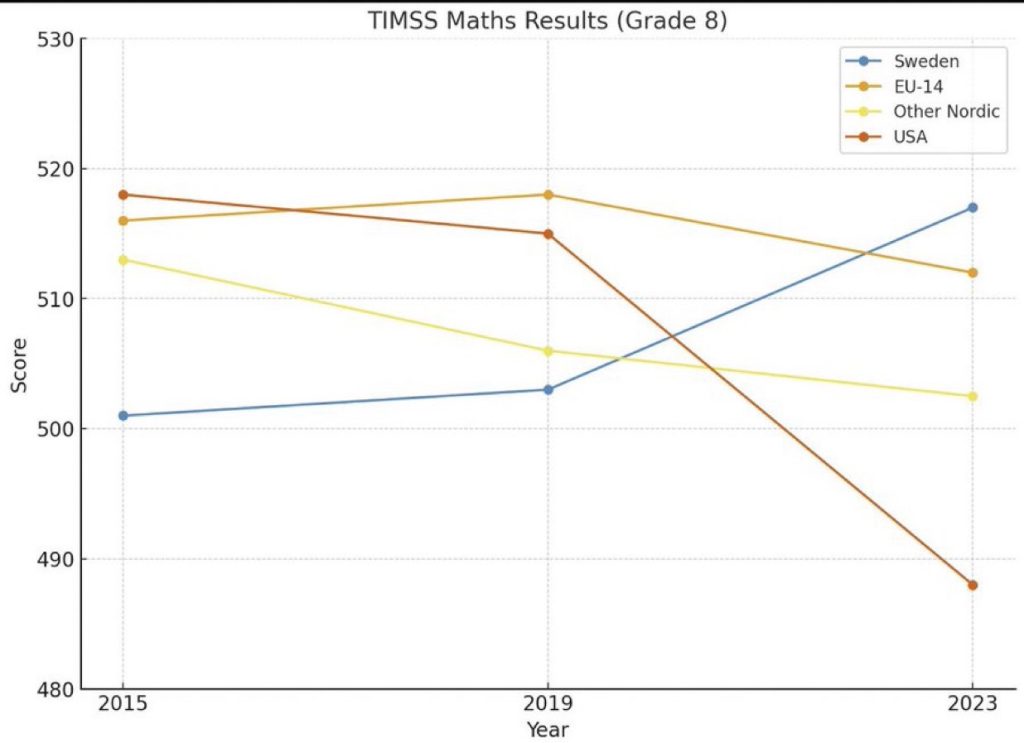
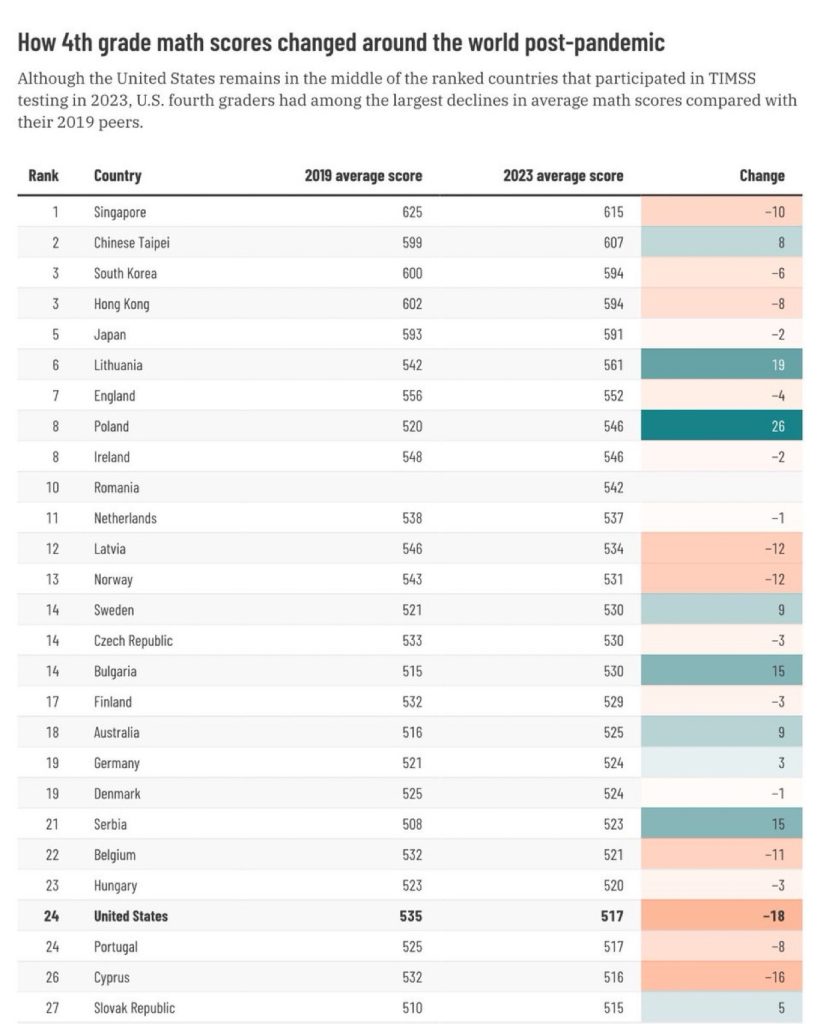
IEA’s TIMSS 2023 is the eighth assessment cycle of TIMSS, the Trends in International Mathematics and Science Study. TIMSS 2023 was conducted at the fourth and eighth grades in 64 countries and 6 benchmarking systems. Inaugurated in 1995, TIMSS has been conducted every four years since, providing 28 years of trends in mathematics and science achievement. TIMSS 2023 completes the transition to digital assessment, which began with TIMSS 2019, reflecting the widespread use of technology in schools and society.

Marc Porter Magee

Shocking drop in US math performance on the TIMSS, released today.

Sweden, which famously kept its school open through the pandemic, saw large gains

more:

and

Awful. The US is now ranked 24th globally in math achievement for 4th graders, dropping 18 points since 2019.

Recent actions by @WisconsinDPI and other states to lower standards will only worsen these problems. High expectations are necessary for students to compete globally.

Share

notes on federal taxpayers and student loans

Annie Nova:

Federal student loan borrowers who fall behind on their bills will once again face financial consequences.

After the Covid pandemic-era pause on the payments expired in September 2023, the Biden administration offered borrowers another year in which they would be shielded from the impacts of missed payments.

With that grace period now over, those who don’t pay their student loan bills are at risk of collection activity.

Share

Making the grade? A meta-analysis of academic performance as a predictor of work performance and turnover.

Van Iddekinge, Chad H. Arnold, John D. Krivacek, Sara J. Frieder, Rachel E. Roth, Philip L.

Many organizations assess job applicants’ academic performance (AP) when making selection decisions. However, researchers and practitioners recently have suggested that AP is not as relevant to work behavior as it used to be due to factors such as grade inflation and increased differences between academic and work contexts. The present meta-analysis examines whether, and under what conditions, AP is a useful predictor of work behavior. Mean correlations (corrected for error in the criterion) between AP and outcomes were .21 for job performance (k = 114), .34 for training performance (k = 8), and −.02 for turnover (k = 20). There was considerable heterogeneity in validity estimates for job performance (80% credibility interval [.04, .37]). Moderator analyses revealed that AP is a better predictor of performance (a) for AP measures that are more relevant to students’ future jobs, (b) for professor ratings of AP than for grades and class rank, (c) for samples that include applicants from the same university or from the same major, and (d) for official records of AP than for applicant self-reports. Job relevance was the strongest and most consistent moderator with operational validities in the .30s and .40s for measures that assessed AP in major-specific courses or courses in which students are evaluated on behaviors relevant to their future jobs (e.g., practicum classes). Overall, researchers and organizations should carefully consider whether and how AP is relevant to particular jobs and outcomes, as well as use designs and measures that optimize the predictive value of AP. (PsycInfo Database Record (c) 2024 APA, all rights reserved)

Share

An I.V.F. Mix-Up, a Shocking Discovery and an Unbearable Choice

Susan Dominus:

Alexander would convince himself that everything was fine, only to be walloped once again by the suspicion that May was not his genetic child. Daphna, who was accustomed to calming Alexander’s worries, quickly tired of his nervous jokes about the clinic. Looking back, she realized that her consciousness was working on two levels, that her mind was laboring not to see what was fairly obvious. She often sought reassurance from a baby photo of herself that her mother sent her, in which she closely resembled May. But occasionally, when Daphna looked in the mirror, she would see her own face and think it looked strange — as if there were something wrong with her.

Share

How to Study Mathematics

Lawrence Neff Stout

How is college mathematics different from high school math?

In high school mathematics much of your time was spent learning algorithms and manipulative techniques which you were expected to be able to apply in certain well-defined situations. This limitation of material and expectations for your performance has probably led you to develop study habits which were appropriate for high school mathematics but may be insufficient for college mathematics. This can be a source of much frustration for you and for your instructors. My object in writing this essay is to help ease this frustration by describing some study strategies which may help you channel your abilities and energies in a productive direction.

The first major difference between high school mathematics and college mathematics is the amount of emphasis on what the student would call theory—the precise statement of definitions and theorems and the logical processes by which those theorems are established. To the mathematician this material, together with examples showing why the definitions chosen are the correct ones and how the theorems can be put to practical use, is the essence of mathematics. A course description using the term “rigorous” indicates that considerable care will be taken in the statement of definitions and theorems and that proofs will be given for the theorems rather than just plausibility arguments. If your approach is to go straight to the problems with only cursory reading of the “theory” this aspect of college math will cause difficulties for you.

Share

“In a culture devoid of moral education, generations are growing up in a morally inarticulate, self-referential world”

David Brooks:

Over the past eight years or so, I’ve been obsessed with two questions. The first is: Why have Americans become so sad? The rising rates of depression have been well publicized, as have the rising deaths of despair from drugs, alcohol, and suicide. But other statistics are similarly troubling. The percentage of people who say they don’t have close friends has increased fourfold since 1990. The share of Americans ages 25 to 54 who weren’t married or living with a romantic partner went up to 38 percent in 2019, from 29 percent in 1990. A record-high 25 percent of 40-year-old Americans have never married. More than half of all Americans say that no one knows them well. The percentage of high-school students who report “persistent feelings of sadness or hopelessness” shot up from 26 percent in 2009 to 44 percent in 2021.

Share

This is a talk I gave to incoming first-year students at Berklee College of Music today

Derek Sivers:

#1 : Focus. Disconnect. Do not be distracted.

My favorite part of the movies is the training sequence, where a young Bruce Wayne, Neo, or Kung-Fu Panda goes to a remote location to be trained relentlessly, nonstop, past all breaking points, until they emerge as a master.

The next few years can be your training sequence, if you focus.

Unfortunately you’re not in Siberia. You’re surrounded by distractions.

You’re surrounded by cool tempting people, hanging out casually, telling you to relax.

But the casual ones end up having casual talent and merely casual lives.

Looking back, my only Berklee classmates that got successful were the ones who were fiercely focused, determined, and undistractable.

While you’re here, presidents will change, the world will change, and the media will try to convince you how important it all is.

But it’s not. None of it matters to you now.

Share

Civics: Litigation, Budgets, K-12 Governance and Act 10

Scott Bauer:

The seven unions and three union leaders that brought the lawsuit argued that the law should be struck down because it creates unconstitutional exemptions for firefighters and other public safety workers. Attorneys for the Legislature and state agencies countered that the exemptions are legal, have already been upheld by other courts, and that the case should be dismissed.

But Frost sided with the unions in July, saying the law violates equal protection guarantees in the Wisconsin Constitution by dividing public employees into “general” and “public safety” employees. He ruled that general employee unions, like those representing teachers, can not be treated differently from public safety unions that were exempt from the law.

His ruling Monday delineated the dozens of specific provisions in the law that must be struck. 

Wisconsin Republican Assembly Speaker Robin Vos said he looked forward to appealing the ruling.

“This lawsuit came more than a decade after Act 10 became law and after many courts rejected the same meritless legal challenges,” Vos said in a statement.

——

WMC:

Following the decision, Wisconsin Manufacturers & Commerce (WMC) President & CEO Kurt R. Bauer released the below statement:

“This ruling is wrong on its face and is inconsistent with the law.

“Act 10 is not only constitutional, it is a critical tool for policymakers and elected officials to balance budgets and find taxpayer savings. Thanks to Act 10, the state, local governments and countless school districts have saved billions and billions of dollars – protecting Wisconsinites from massive tax increases over the last decade-plus.

“WMC and our members hope this ruling will be appealed and that Act 10 will be reinstated as quickly as possible.”

——

IRG:

“Reverting back to pre-Act 10 labor relations will upend local government operations. But more devastating is the potential impact to jurisprudence in Wisconsin.  Deferring to Legislative determinations in all but the most extreme cases is a fundamental principle in our tripartite form of government,” said Jake Curtis, General Counsel and Director of the CIO for the Institute for Reforming Government. “Whether one agreed or disagreed with the policy decisions made by the 2011 Legislature, we should all agree it had a rational basis for the decisions it made. Rejecting this key principle will have negative consequences for years to come and upends key separation of powers principles. This decision must not stand.” 

———

Achievement

Much more on Act 10, here.

Share

Only half of Chicago Public Schools’ $10 billion in yearly spending makes it to the classroom

Ted Dabrowski and John Klingner

Here’s one fact Chicagoans should know as the Chicago Teachers Union demands billions more for its massive labor contract: only half of the $10 billion spent at CPS each year makes it to classrooms and instruction. The other $5 billion goes to fund a sprawling bureaucracy of near-empty to half-empty schools, an increasingly bloated administrative staff and ever more debt, driven largely by pensions. All to the union’s benefit.

The fact that just half of CPS’ spending goes to classrooms is based on an analysis by Wirepoints of the district’s 2025 interactive budget and the State Board of Education’s Illinois Report Card. A look at that budget shows that CPS plans to spend, all-in, nearly $9.9 billion in 2025. That includes operational, debt-service and capital spending.

Of that nearly $10 billion, only $5 billion will be spent on the city’s school network – about 51% of the total district spend. The other $5 billion? Pension contributions consume $1.2 billion, debt repayments eat up $800 million and capital spending uses $600 million. The remaining $2.1 billion goes to district administration and support services.

more.

Share

taxpayer funded Wisconsin DPI culture: reduced rigor and always more $

Kaylah Huynh:

State Superintendent Jill Underly wants to put the responsibility of funding schools back on the state, she recently told the Cap Times in an interview.

Underly, who leads the state Department of Public Instruction, is proposing over $4 billion in spending toward schools for the 2025-2027 state budget.

The plans would reimburse 90% of schools’ special education costs, tie taxation limits to inflation, and prioritize spending on mental health, nutrition and teacher retention.

Underly also aims to limit school-related property tax hikes to an average of 1.5% over the next two years by increasing the amount of money school districts are allowed to spend per student. The higher limit would cost the state about $1.2 billion.

The proposal comes after over a quarter of public school districts asked voters in November referendums to raise property taxes to support schools. In Madison, voters approved a pair of school referendums totaling $607 million for operating costs and facilities improvements, the costliest ask among the 121 districts that went to referendum. 

*** No mention of the DPI’s ongoing rigor reduction efforts…. more.

The data clearly indicate that being able to read is not a requirement for graduation at (Madison) East, especially if you are black or Hispanic”

My Question to Wisconsin Governor Tony Evers on Teacher Mulligans and our Disastrous Reading Results

2017: West High Reading Interventionist Teacher’s Remarks to the School Board on Madison’s Disastrous Reading Results 

Madison’s taxpayer supported K-12 school district, despite spending far more than most, has long tolerated disastrous reading results.

“An emphasis on adult employment”

Wisconsin Public Policy Forum Madison School District Report[PDF]

WEAC: $1.57 million for Four Wisconsin Senators

Friday Afternoon Veto: Governor Evers Rejects AB446/SB454; an effort to address our long term, disastrous reading results

Booked, but can’t read (Madison): functional literacy, National citizenship and the new face of Dred Scott in the age of mass incarceration.

When A Stands for Average: Students at the UW-Madison School of Education Receive Sky-High Grades. How Smart is That?

Share

civics: “Trash Joe Biden now to position yourself to seem to welcome all this forthcoming bad news and to offer yourself as the staunch new party of reform”

Ann Althouse Summary:

Try. I see your efforts. They’re so self-serving they underscore the essential problem: political favoritism

More:

“President Biden and President-elect Donald J. Trump now agree on one thing: The Biden Justice Department has been politicized.”

Thanks to the NYT for stating the obvious point obviously.

Share

2024 Word of the Year

Oxford:

Following a public vote in which more than 37,000 people had their say, we’re pleased to announce that the Oxford Word of the Year for 2024 is ‘brain rot’.

Our language experts created a shortlist of six words to reflect the moods and conversations that have helped shape the past year. After two weeks of public voting and widespread conversation, our experts came together to consider the public’s input, voting results, and our language data, before declaring ‘brain rot’ as the definitive Word of the Year for 2024.

Share

Civics: Governance, the FBI and Retribution

Wall Street Journal:

The FBI’s abuses under Mr. Comey were the worst since J. Edgar Hoover. As documented by the Justice Department inspector general and special counsel John Durham, officials lied to the Foreign Intelligence Surveillance Court to get a warrant against Trump campaign official Carter Page. They also lied about the disinformation in the Steele dossier, which was financed by the Hillary Clinton campaign.

Mr. Patel worked for GOP Rep. Devin Nunes on the House Intelligence Committee at the time, and he helped uncover some of these abuses. He contributed to the Nunes Memo that the press criticized but turned out to be largely accurate. The deceit at the time was spread by Democrat Adam Schiff, now a California Senator. Messrs. Nunes and Patel were unfairly maligned.

It no doubt infuriates those who promoted the Russia collusion narrative to see Mr. Patel nominated to run the FBI, but abusing institutions for political purposes inevitably creates a demand for potential payback. The apologists for the Comey FBI and the Russia collusion narrative made a director Patel possible.

Share

Falling enrollment plagues many UW campuses. UW-Green Bay is framing the problem differently

Kelly Meyerhofer:

Jen Jones remembers the meeting well, down to which chair she sat in.

University of Wisconsin-Green Bay administrators huddled together in a meeting room about a decade ago, studying enrollment and financial reports. A new chancellor, Gary Miller, had just started and took a different tack from his predecessor.

“The demographic shift is coming,” Jones, a 25-year employee in the admissions office, recalled Miller saying at the meeting. “We’re going to have to change who we are. We’re going to have to think about how we do higher education differently.”

Share

Civics: “Pieces of territory belong to institutions, not to racial groups”

Noah Smith:

This, I believe, is the key to respecting and honoring Native Americans — not to focus on the tragedies of their past, but to give them the right to build a better future. Tribal lands should definitely have the autonomy to do whatever they want with their lands, including building housing or industry. In fact, we’re starting to see a pattern emerge where Native Americans embrace laissez-faire policies toward industry and manage to poach business from their over-regulated neighbors:

Tesla is ramping up efforts to open showrooms on tribal lands where it can sell directly to consumers, circumventing laws in states that bar vehicle manufacturers from also being retailers in favor of the dealership model…

Mohegan Sun, a casino and entertainment complex in Connecticut owned by the federally recognized Mohegan Tribe, announced this week that the California-based electric automaker will open a showroom with a sales and delivery center this fall on its sovereign property where the state’s law doesn’t apply…The news comes after another new Tesla showroom was announced in June, set to open in 2025 on lands of the Oneida Indian Nation in upstate New York.

This sort of thing could lead to a win-win for the U.S. and Native American tribes. American reindustrialization is being held back by a thicket of procedural requirements and local land-use regulations; if tribes were able to use their special legal status to circumvent those barriers, it could end up benefitting everyone.2 The tribes would get both jobs and the ability to tax local industry; America would get to execute an end run around the NIMBYs that are holding it back.

Share

Chinese researchers indicate diamonds can store data for millions of years

Graeme Hanna:

Research has suggested that diamond-based storage technology could preserve vast amounts of information for up to millions of years. 

The work carried out by a team at the University of Science and Technology of China achieved a new record for storage density in diamonds, at 1.85 terabytes per cubic centimeter.

As impressive as the storage capacity is, the researchers believe this can be eclipsed by the staying power. It has been claimed the diamond system can hold data for millions of years, due to the technique used to encode information within the atomic structure of the diamond.

As published in Nature Photonics, the scientific breakthrough extends beyond the significant density capacity with marked improvement in read times. The team indicated high-speed readout showed a fidelity of over 99%. 

Share

The reproducibility crisis and other problems in science

John Ioannidis Lecture

Share

Court Rejects “Jewish, Zionist” Teachers’ and Parents’ Lawsuit Over Allegedly Anti-Capitalist and Anti-Zionist School Curriculum

Eugene Volokh:

The court rejects plaintiffs’ claims on various grounds, which it discusses in too much detail to render here. But here’s a good big-picture summary of a key part of the court’s concerns:

[B]eyond the particular, claim-specific failures outlined above, it must also be noted that significant First Amendment concerns underlie plaintiffs’ claims and requested relief. In effect, plaintiffs seek to litigate the propriety and legality of a potential curriculum with which they disagree. Their claims thus conflict with the First Amendment in several respects, and are largely barred on that basis as well.

First, plaintiffs’ claims directly implicate the First Amendment rights of the non-District defendants. Plaintiffs take issue with the non-District defendants’ forms of discussion, expression, and petitioning in relation to the challenged curriculum. Notwithstanding plaintiffs’ insistence and disclaimers that they challenge only publicly-funded government activities, plaintiffs seek to have this court impose restrictions on the non-District defendants’ protected speech. (Seee.g.id., Prayer for Relief at ¶ 6) (requesting an injunction “prohibiting all Defendants from using the elements of the LESMC at issue in this case … in any training sessions funded by public funds, or for which salary points are awarded by LAUSD”). In particular, plaintiffs seek to have the court suppress any speech by the non-District defendants in teacher-training sessions that might involve the use of “elements” of the challenged curriculum.

Share

On Abortion

Anna Lulis:

“You can try to kill off everyone with Down syndrome by using abortion, but you won’t be any closer to a perfect society. You will just be closer to a cruel, heartless one.”

Charlotte Helene Fien pleads for the protection of unborn children with an extra chromosome at the UN.

Share

DPI dragging heels on science-based literacy instruction Taxpayer funded Wisconsin

Leila Fletcher and Sandy Flores Ruiz

We are concerned that Wisconsin’s Department of Public Instruction seems less than committed to the reforms outlined in Act 20. It’s been over a year since Gov. Tony Evers signed Act 20, dubbed “the reading bill.”

Act 20 looks to address our state’s dismal reading scores with science-based literacy instruction. Legal and bureaucratic snags have slowed progress. But despite delays, ACT 20 remains a ray of hope for this generation of kids.

According to some literacy experts and proponents of science of reading, Wisconsin DPI is choosing the wrong side of history. In her State of Education address at the Capitol, DPI superintendent Jill Underly steered clear of specifics about reading. She didn’t say supporting Act 20 and the science of reading was a priority.

DPI seems more focused on other things. Underly has faced heated criticism after announcing new labels for the proficiency categories used in statewide tests. DPI then lowered the cut scores associated with the new categories, effectively lowering academic standards.

In a recent story in The Capital Times, education reporter Kayla Huynh reports on DPI’s changes to the Wisconsin Forward Exam and how it’s scored. Some education advocates see lowered expectations for student achievement and unnecessary changes that make it difficult to measure student progress year over year.

——

Legislation and Reading: The Wisconsin Experience 2004-

——-

The data clearly indicate that being able to read is not a requirement for graduation at (Madison) East, especially if you are black or Hispanic”

My Question to Wisconsin Governor Tony Evers on Teacher Mulligans and our Disastrous Reading Results

2017: West High Reading Interventionist Teacher’s Remarks to the School Board on Madison’s Disastrous Reading Results 

Madison’s taxpayer supported K-12 school district, despite spending far more than most, has long tolerated disastrous reading results.

“An emphasis on adult employment”

Wisconsin Public Policy Forum Madison School District Report[PDF]

WEAC: $1.57 million for Four Wisconsin Senators

Friday Afternoon Veto: Governor Evers Rejects AB446/SB454; an effort to address our long term, disastrous reading results

Booked, but can’t read (Madison): functional literacy, National citizenship and the new face of Dred Scott in the age of mass incarceration.

When A Stands for Average: Students at the UW-Madison School of Education Receive Sky-High Grades. How Smart is That?

Share

notes on declining math rigor

Anna Stokke:

Letter in today’s Winnipeg Free Press from @umanitoba prof Darja Barr. “The MB govt’s decision to eliminate all subject-area requirements for pre-service teachers is a big miss — from misinterpreted research, to misrepresented contexts, misguided policy and a misled public.”

—-

A big math mistake

Re: Walking in the right direction on math (Think Tank, Nov. 25); Mathematics education of Manitoba teachers should be based on research (Think Tank, Nov.

13)

I am deeply troubled by the policy changes to teacher content requirements made recently, and what has been written about these changes in the press.

In recent opinion pieces, both Martha Koch and Thomas Falkenberg describe teacher candidates as being “forced” to take “university-level” math courses, and they claim research supports the elimination of teacher content requirements.

Not only do I take issue with making such sweeping generalizations and public policy changes from the research they cite but, more importantly, they present a misleading situation.

Since the six-credit-hour subject requirements were introduced, math departments across the province carefully developed math content courses specifically for K-8 teachers, which cover content such as triangle properties, areas and volumes, and other topics that relate directly to K-8 math classrooms. I have yet to see these courses mentioned in articles by my colleagues in education, though they are there to build exactly the type of

“mathematical knowledge for teaching” that their cited research strongly supports and have been taken successfully by hundreds of their students.

It is not unusual for math departments to develop and teach courses tailored for students for other faculties — we have specialized courses for engineering, business, arts, nursing, social work and education.

As to whether I am qualified to speak on this issue, I hold post-graduate degrees in mathematics and in education — including a PhD in math education – and received numerous teaching and outreach awards.

Thave taught math to thousands of students at University of Manitoba for almost 20 years. I have taught courses for both the mathematics department and the faculty of education. I work extensively with K-12 math teachers and I see firsthand on a daily basis in my classrooms the challenges we face in addressing a provincial math crisis.

Many students struggle with basic math, have negative attitudes about math or suffer from math anxiety. The most effective way to reduce math anxiety and foster positive attitudes about math — for both teachers and students

— is to increase teachers’ math knowledge for teaching, which is what our courses were designed to do.

The Manitoba government’s decision to eliminate all subject-area requirements for pre-service teachers is a big miss – from misinterpreted research, to misrepresented contexts, misguided policy and a misled public.

As someone who teaches hundreds of math students every year and as a mother to two small children about to enter our public school system, I believe it is a serious mistake and the consequences could be disastrous for Manitoba. I urge everyone to make their voices heard on this important and impactful issue.

Darja Barr

Winnipeg

Share

Computing with Time: Microarchitectural Weird Machines

By Thomas S. Benjamin, Jeffery A. Eitel, Jesse Elwell, Dmitry Evtyushkin, Abhrajit Ghosh, and Angelo Sapello

Side-channel attacks, such as Spectre, rely on properties of modern CPUs that permit discovery of microarchitectural state via timing of various operations. The Weird Machine concept is an increasingly popular model for characterization of execution that arises from side effects of conventional computing constructs. In this work, we introduce microarchitectural weird machines (µWM), code constructions that allow performing computation through the means of side effects and conflicts between microarchitectual entities such as branch predictors and caches. The results of such computations are observed as timing variations in the execution of instructions that interact with these side effects. We demonstrate how µWMs can be used as a powerful obfuscation engine where computation operates using events unobservable to conventional anti-obfuscation tools based on emulation, debugging, and static and dynamic analysis techniques. We present a practical example in which we use a µWM to obfuscate malware code such that its passive operation is invisible to an observer with full power to view the architectural state of the system until the code receives a trigger. When the trigger is received, the malware decrypts and executes its payload. To show the effectiveness of obfuscation, we demonstrate its use in the concealment and subsequent execution of a payload that creates a reverse shell. In the full version of this work, we also demonstrate a payload that exfiltrates a shadow password file. We then demonstrate the generality of μWMs by showing that they can be used to reliably perform non-trivial computation by implementing a SHA-1 hash function.

Share

civics: “debanking”

Marc Andreessen:

More. and.

“Apple Lamps” timeline:

2011-2012:
The Obama administration targets the online poker industry, pressuring banks to cut off their services to poker companies.

2013:

  • Operation Choke Point 1.0 begins. The Department of Justice (DOJ), in coordination with the Federal Deposit Insurance Corporation (FDIC) and the Office of the Comptroller of the Currency (OCC), initiates a campaign to combat fraud by targeting banks that service “high-risk” industries, including payday lenders, firearms manufacturers, and adult entertainment businesses.
  • The DOJ designates 30 specific merchant categories as “high-risk,” leading banks to preemptively cut ties with many companies and individuals within these sectors, even those operating legally.
  • Michael Bresnick, executive director of Obama’s Financial Fraud Enforcement Task Force, emphasizes the strategy of targeting financial institutions and payment processors as “choke points” to combat fraud.

2014:

  • Concerns grow about the chilling effect of Operation Choke Point on legal businesses, with banks facing increased scrutiny and pressure from regulators.
  • The House Judiciary Committee launches an investigation into Operation Choke Point, highlighting the potential for abuse and the lack of transparency in the program.

Balaji:

Remember that Warren built an anti-crypto army. So of course she was willing to unbank companies! Her goal was to block you from escaping control. And she almost succeeded, if not for democracy.

Share

an update to the Madison School Forest

Abbey Machtig:

After six decades of housing students and campers on overnight trips, the four cabins in the Madison school forest will be replaced next year.

Located about 20 miles south of Madison near Verona, the Madison School District owns more than 300 acres of land designated for use as a school forest — one of 255 registered school forests in Wisconsin. But after decades of use, the sleeping cabins within the forest are barely functional.

Share

How to raise children with grit

Scott:

The concept of ‘grit’ has been popularised by psychologist and author, Angela Duckworth

As part of her research, Duckworth conducted studies of high-achieving individuals in various fields ranging from business to education and the military. She was looking for common characteristics or personality traits that could be used as a predictor of success. 

After extensive research, she concluded that there is one characteristic that they almost all had in common and she has labelled that characteristic as GRIT.

Duckworth defines grit as ‘passion and perseverance for long-term goals’. 

It’s essentially the ability to stick at something for a long time, even when the going gets tough. 

Personally, I associate grit with resilience and it’s a trait that I deeply admire in other people. It’s something I try to display myself and a characteristic that I hope to cultivate in my children. 

I was therefore very interested to see if this was something that can be taught and if so, how.

Share

Meet California’s most neglected group of students with special needs: the gifted ones

Karin Klein:

Schools have generally been working hard to meet the special educational needs of an array of students — those with learning disabilities, those learning English, those with behavioral issues and those whose households struggle with poverty. But they have widely neglected one major group of students with special needs: the academically gifted.

Many school districts around the country have dropped programs for students who catch on quickly. The trend toward eliminating or scaling back such programs started about 15 years ago. But it picked up steam in 2021, when the Black Lives Matter movement made schools reckon with the discomfiting fact that they were far less likely to identify Black and Latino as gifted than they were white and Asian students.

Part of the problem was that the original purpose of gifted programs had been lost in parental competition for prestige and advantage. Unlike other special-education categories, the gifted label was coveted by parents. Classes and sometimes entire schools for gifted students often had richer curricula and more resources. They became classrooms for high achievers rather than for students properly defined as gifted.

Share

Maths in Computer Science. What I wish I knew before starting university, part 2

University of Sheffield:

Machine Learning and by extension artificial intelligence has so many applications that this blog-post could be a dictionary, it can be used to help us solve abstract problems like helping healthcare providers to treat patients, to speech recognition (in fact, if you own an Alexa, Google Home, or even a normal smart-phone, you’ve probably experienced speech recognition in your day-to-day life!) 

The basis of all artificial intelligence and machine learning is treating things like probabilities. Understanding the basics of how to use probabilities can be incredibly useful when you’re doing more detailed machine learning and artificial intelligence later on in your course.

To get a refresher, I’d recommend looking at the university MASH (Mathematics and Statistics Help) refresher for Probability 1 and Probability 2

It may seem strange, but understanding things like probability of dice rolls, means you can understand things like object detection and deeper machine learning concepts! 

Share

civics: Nearly 70 percent of the Harris campaign’s known total spending went to just four media consulting firms

Andrew Kerr

Vice President Kamala Harris’s campaign directed nearly $600 million to just four media consulting firms with deep ties to the Democratic establishment, Federal Election Commission records show.

The latest available FEC data show the Harris campaign exceeded $880 million in total spending as of October 16, though that number is expected to balloon to $1.5 billion after the Harris campaign files its post-election FEC report on December 5. Seventy percent of the campaign’s known total spending flowed through four firms: Media Buying & Analytics, Gambit Strategies, Bully Pulpit Interactive, and Dupont Circle Strategies.

Together, these four Democratic firms were largely responsible for distributing Harris’s campaign messaging across the nation—an effort that ultimately saw Harris lose all seven swing states and the popular vote but directed huge sums of donor money the firms’ way.

Share

Civics: “My contempt for the state is infinite”

The Economist:

What is fascinating is the philosophy behind the figures. Mr Milei is often wrongly lumped in with populist leaders such as Mr Trump, the hard right in France and Germany or Viktor Orban in Hungary. In fact he comes from a different tradition. A true believer in open markets and individual liberty, he has a quasi-religious zeal for economic freedom, a hatred of socialism and, as he told us in an interview this week, “infinite” contempt for the state. Instead of industrial policy and tariffs, he promotes trade with private firms that do not interfere in Argentina’s domestic affairs, including Chinese ones. He is a small-state Republican who admires Margaret Thatcher—a messianic example of an endangered species. His poll ratings are rising and, at this point in his term, he is more popular in Argentina than his recent predecessors were.

Make no mistake, the Milei experiment could still go badly wrong. Austerity has caused an increase in the poverty rate, which jumped to 53% in the first half of 2024 from 40% a year earlier. Mr Milei could struggle to govern if resistance builds and the Peronist opposition is better organised. Investor confidence will be tested if he finally removes capital controls and shifts an overvalued peso to a flexible exchange-rate regime: a currency slump could test nerves and push inflation back up. Mr Milei is an eccentric who could become distracted by culture wars over gender and climate change, and thus neglect his core mission of restoring Argentina’s economy to growth.

Share

University and State: Like church and state, they should be separated

Arnold Kling:

Should we be in favor of government taking an active role in shaping higher education?  Scott Yenor writes,

states build universities to achieve certain goals—to gain informed citizens, cultivate an appreciation for the civilization, advance scientific progress. They have provided money and infrastructure to achieve these goals. States can and must demand that its goals be achieved. State legislatures and boards of trustees should eagerly seek to ensure that the public’s legitimate concern about the nature of education is vindicated.

Noah Gould writes,

When the funding source shifts to the state, educational institutions become oriented toward pleasing government officials. Professors who do not fit the narrow ideological band of those who are in power today become liabilities to politicians who are at the whims of the election cycle.

They are writing in the context of a debate over the role of government officials in general, and state legislators in particular, in addressing ideological bias in higher education.

It seems odd to claim that universities are the way they are because they are “pleasing government officials.” It seems to me that they are way too far to the left for that to be the case. 

I am fond of saying that government involvement in an industry typically consists of subsidizing demand and restricting supply. In the case of higher education, supply is restricted by requiring schools to be accredited, and then turning the accreditation process over to the incumbent institutions. Naturally, this leads to a strong barriers to entry.

To subsidize demand, the government provides all sorts of loans and grants to students and faculty. Higher education is one of the most powerful lobbies in the country. Because the public is lulled by the non-profit status of universities, there is no outcry over “Big Higher Ed” the way that there is about Big Pharma or Big Tech or Big Finance.

Universities claim to be essential to upward mobility. They have lobbied for “college for everyone” as a goal. I feel sorry for anyone who buys into this.

Share

Notes on the Ontario Teacher Shortage

Allison Jones:

Ontario is staring down a teacher shortage as retirements and student enrolment are both on the rise, and the Ministry of Education expects the situation will start to get even worse in 2027.

The warning is contained in a series of briefing documents for the new minister of education, obtained by The Canadian Press through a freedom-of-information request.

Many school boards in Ontario and elsewhere are experiencing challenges recruiting and retaining enough qualified teachers, the document says, and in Ontario the issue is particularly felt in areas such as French and tech education.

Share

Swapping the study of Shakespeare for working-class writers simply reinforces stereotypes

Tomiwa Owolade

No one could put DH Lawrence in a box. He was born to a working-class mining family in Nottinghamshire but roamed the world, from Europe to North America, south Asia to Australia, with his aristocratic German wife. Over 20 years, he published 12 novels, multiple short stories and poems and an assortment of non-fiction texts, from travel books to literary criticism. He never suffered from writer’s block.

As Adrian Wooldridge puts it in his history of meritocracy, The Aristocracy of Talent, there was a time when “the Labour Party was the party of merit rather than levelling, and opportunity rather than equality”. The 20th century was a tribute to such a Labour Party: people from provincial backgrounds became acclaimed novelists, rock stars, broadcasters, even prime ministers.

But there is a tendency among some teachers and experts today towards another goal with education. That it should be relatable. This thinking regards the education system as exclusive, obsessed with subjects that children from disadvantaged backgrounds cannot relate to because they have never had experience of them.

Share

“An enormous bureaucracy that drains resources and drives up the already astronomical price of college”

Steve McGuire summary:

“If someone wanted to find a way to destroy American universities, they wouldn’t be able to find a better tool than D.E.I. An enormous bureaucracy that drains resources and drives up the already astronomical price of college while contributing next to nothing to the advancement of actually underprivileged students. It has a profoundly negative effect on campus life by turning it into victimhood Olympics. Through its influence on hiring it actively works to exclude people on both ideological and racial grounds, and it further tilts the already wildly imbalanced campus politics. Moreover, as this article demonstrates, by trying to infuse every aspect of teaching and research with DEl considerations it further erodes the distinction between activism and scholarship and remakes entire disciplines in its shape (and not for the better). Finally, by politicizing the university it undermines the already problematic standing of higher education among the American public. As I said, one of the most pernicious things ever to happen to American higher education.”

Share

“I’ll concede that loving freedom of speech is a specific viewpoint”

Ann Althouse:

That article asserts that “Elon Musk’s X is primarily a political project he is using to boost, or stifle, specific viewpoints and help his friends.” But The Onion’s desire to purchase the account that Infowars stuffed with speech over the years is all about stifling its specific viewpoint. The Onion has its own X account, but it wants the place that Infowars built up so it can stomp out that speech — rewrite it into a parody of itself. It could do that parody on a newly created account and thus give us more speech, more debate. 

So who’s more against freedom of speech here? It seems to me that X is protecting it.

—-

X’s Objection to the Onion Buying InfoWars Is a Reminder You Do Not Own Your Social Media Accounts

Share

Drain the Swamp

The recent election is the product of a decades-long struggle in American politics that has intensified since 2016. The election produced a victory for the man who caused the intensification, Donald Trump. He caused it by convincing a people, jaded from broken promises, that he would “drain the swamp.” 

He also convinced the people who inhabit the swamp, and they have scorched the earth to stop him. He has been canceled, derided, slandered, libeled, investigated, searched, impeached, arrested, prosecuted, tried, convicted, shot, and yet…reelected!

Now the battle will begin anew. What will it be like? There are so many problems. The border. Crime. Inflation. Education. War. Ukraine. China. Hamas/Hezbollah/Iran. Debt stacked to the far reaches of a SpaceX mission. Which matters most?

Last February, I paid a visit to Speaker of the House Mike Johnson. He might be, I told him, on the threshold of a historic opportunity. It may become possible to restore constitutional government in place of the administrative or bureaucratic state that has almost overtaken it. He replied that he prayed about that every day.

Share

Schooling Steeped in Gratitude

Frederick Hess:

It’s been a helluva fall. But it’s finally Thanksgiving, which means it’s time for some gratitude. Indeed, those in and around American education should be steeped in gratitude for the legacy that’s been gifted to us. Now, I know how old school that sounds—especially in an era when just a third of Gen-Z says the U.S. is a fair society and less than a third of high school seniors think their nation is the best country in the world. I mean, you needn’t look very hard to find curricular materials that depict Thanksgiving as yet one more instance of settler colonialism.

Old school or not, though, gratitude is foundational to healthy schools and civic institutions. Mike McShane and I discussed this at length earlier this year in our book, Getting Education Right. This seems like the perfect time to share a bit about our appreciation for the legacy we’ve all inherited. With your indulgence, I’m just going to go ahead and share an extended passage from the book. We wrote:

Share

Notes on politics, federal taxpayer funds and the department of Education

Corey DeAngelis:

“I don’t, I mean, my members don’t really care about whether they have a bureaucracy of the Department of Education or not. In fact, Al Shanker and the AFT in the 1970s were opposed to its creation!”

Share

Civics: Number of Single-Party State Congressional Delegations Reaches 70+ Year High

By Dr. Eric Ostermeier

The 119th Congress will have the most states represented by just one party on Capitol Hill since the 83rd Congress and largest number of all-GOP delegations since the 71st

Recent Smart Politics reports have highlighted electoral trends signaling the demise of competitive, battleground states, such as the 119th Congress setting a record low number of split U.S. Senate delegations and the Democratic and Republican parties currently owning record presidential winning streaks in 38 states.

Additionally, when the 119th Congress convenes in five-plus weeks, it will do so with 19 state delegations comprised only of U.S. Representatives and U.S. Senators from the same political party – the largest number of states since the 83rd Congress convened 72 years ago in 1953.

This marks an increase of three states with homogeneous representation since the 118th Congress – all in the Republican column.

Share

civics: “no labels” election litigation

Michael Scherer

“These operatives had the gall to say they were fighting to protect our democracy. In reality, they undermined it at every turn…”

“… with frivolous lawsuits, character assassination, and outright lies designed to prevent No Labels from exercising our constitutional right to get ballot access. If you are wondering why Americans are losing faith in our democracy and so many of our country’s self-anointed elites, this is Exhibit A.”

Now leaders of No Labels are fighting back in three federal courtrooms with a sprawling legal-discovery effort aimed at exposing the secret machinations they think led to their project’s demise. Leaders of the moderate Democratic group Third Way and of Investing in US, a political operation funded by LinkedIn co-founder Reid Hoffman, are fighting to limit the document production.

But documents already unsealed by the courts reveal remarkable details about private proposals for a wide range of hard-nosed tactics that would go beyond public efforts like ads, op-eds and meetings to discourage the No Labels campaign. The documents include emails exchanged between various Democratic strategists involved with efforts to oppose No Labels.

A separate “Direct Action Campaign” proposal, which was never fully adopted, called for the personal harassment of No Labels founder Nancy Jacobson and her husband, Mark Penn, a former adviser to Bill. and Hillary Clinton.

The proposal to “socially stigmatize” Jacobson and Penn, according to documents revealed in court, included plans to hire clowns “to hangout on their block” in the Georgetown area of D.C., post fliers in the neighborhood attacking the couple, send a “truck carrying musical performers” to wake them up at 6 a.m., and fly banner planes over Harvard University’s graduation attacking Penn, who does a poll for the university as chair of the Harris Poll and CEO of the marketing company Stagwell. Penn did not play a role in the No Labels. presidential bid, according to the group.

——

more.

—-

Matt Taibbi:

“We can just rig our own poll to make it look as shit as possible…”

“Block signature-gathering…”

“Make [them] seem like they might be totally crazy/right-wing wackos to mid-low-info voters…”

“Hijacking their ballot line and pushing extremist candidates to muddy [their] brand…”

The above quotes are just a few excerpts from incredible documents made public after a long court fight. Details of a plan to “shun,” “stigmatize,” and “destroy” the third party No Labels suggest a Rosetta Stone of corruption, showing groups aligned with the Democratic Party using dirty tricks and elaborate fakery to attack anyone in their electoral path, all while presenting themselves as “pro-democracy” forces.

When filed a year ago on December 4, 2023, No Labels vs. No Labels seemed a picayune trademark dispute. It concerned No Labels, a political alternative founded in 2010 by longtime Democratic fundraiser Nancy Jacobson and backed by since-passed former Senator Joe Lieberman. Armed with $70 million and plans for “nationwide” ballot access, No Labels was whispered about early in the cycle as a potentially serious threat to the Democrats’ election chances, especially in a race with widespread diffidence regarding the two likely nominees, Joe Biden and Donald Trump. The Wall Street Journal article about them from July 2023 was headlined, “A Mysteriously Financed Group That Could Upend a Biden-Trump Rematch.”

Openly talking about “deterring” other candidacies on principle, or stopping a third party from “successfully signature gathering” (as they did in a different memo), is striking given the Democrats’ stance on other voting access issues.

“Once we backed out, it’s like, all right, let’s go kill off Bobby Kennedy,” said No Labels chief strategist Ryan Clancy. “Some of these same people before were saying, let’s go kill off Dean Phillips.”
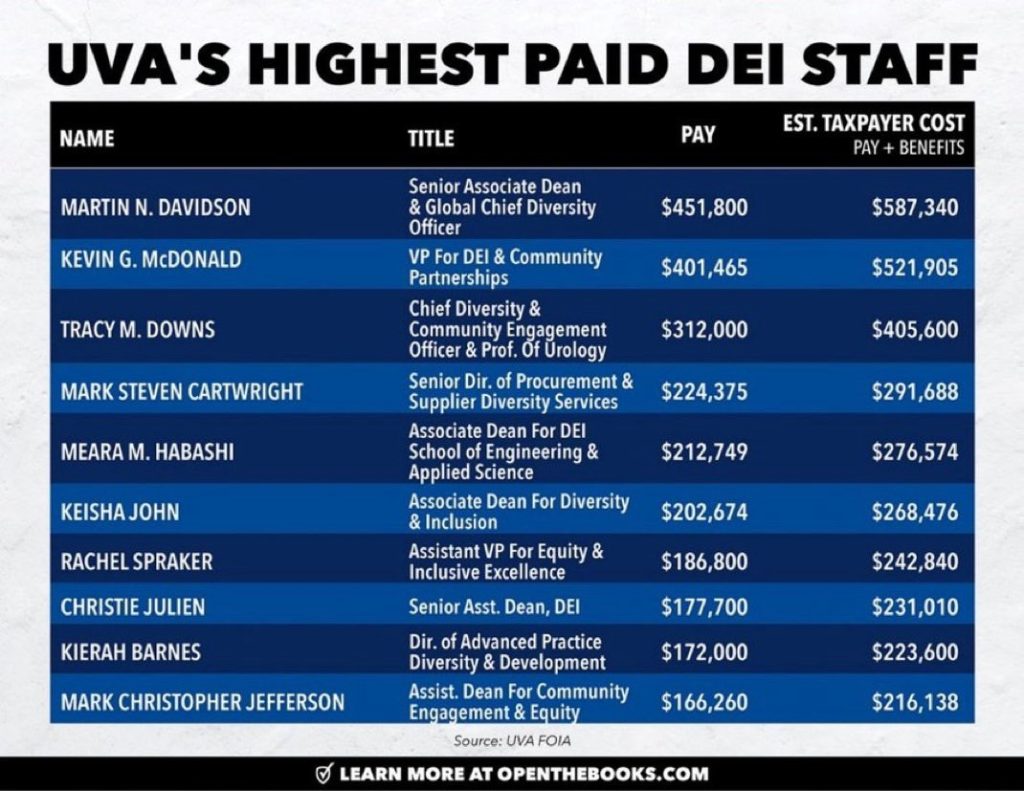
Share

The ‘Genesis’ of today’s military recruiting crisis

Irene Loewenson and Geoff Ziezulewicz:

Lt. Kennedy went on to command a patrol torpedo boat that a Japanese warship sheared in half during World War II, and he later received a Purple Heart and Navy and Marine Corps Medal.

In recent decades, the lies told to enlist haven’t approached those extremes.

Nonetheless, fudging medical histories has been a key step on many troops’ path from applicant to recruit, according to a group of active-duty military recruiters who spoke with Military Times for this story.

“What it takes to get in the Army is, quite frankly, a lot of fraud and perjury,” one recruiter said.

Share

What the ACT Reveals about College Readiness in Reading

ACT

Based on 2005 ACT-tested high school graduates, it appears that only about half of our nation’s ACT-tested high school students are ready for college-level reading. What’s worse, more students are on track to being ready for college-level reading in eighth and tenth grade than are actually ready by the time they reach twelfth grade.

College readiness—the level of preparation students need in order to be ready to enroll and succeed without remediation in credit-bearing entrylevel coursework at a two- or four-year institution, trade school, or technical school—is currently inadequate and should be an expectation for all high school students.

It is also recognized today that the knowledge and skills needed for college are equivalent to those needed in the workplace (American Diploma Project, 2004; Barth, 2003). We and others have documented that improving college and workforce readiness is critical to developing a diverse and talented labor force that will help ensure our nation’s economic competitiveness in a growing global economy (Callan & Finney, 2003; Cohen, 2002; Somerville & Yi, 2002).

Share

Judge Rules in Favor of School That Gave Student a Bad Grade for Using AI

Todd Feathers:

Rather than failing to make school policies on AI clear, Levenson wrote, the Hingham High School A.P. English Language teacher gave a lesson on academic integrity and expectations for the use of AI during the first week of a class that the Harris’s son was enrolled in. She also sent students a document that instructed them not to use AI without permission or to copy and paste blocks of text into assignments.

While their request for a preliminary injunction was denied and Levenson doesn’t appear particularly convinced by their arguments, the Harris’s lawsuit against the Hingham school committee remains alive.

Share

Runners say indoor track inadequate compared to the Shell, other Big 10 schools

Corrine Hess:

The Madison running community is urging the University of Wisconsin-Madison to alter its plans for the new football practice facility on campus that includes a smaller indoor track than the one that stood for nearly 70 years. 

In August, UW-Madison demolished the aging Camp Randall Memorial Sports Center, commonly known as the “Shell,” to build a new indoor football field, strength and conditioning center and indoor track. 

The $285 million project is one of the largest in UW Athletics history. 

Share

“Traditional teacher-directed instruction is linked to higher math scores on the international PISA exam, student-oriented instruction with lower math scores”

Joanne Jacobs’ summary:

They analyzed the 2012 PISA exam, which includes questions on how math is taught, as well as demographic information. That made it possible to control for socioeconomic status, family structure, use of the test language at home and immigrant status.

Comparing similar students, math instruction makes a meaningful difference in student learning, they conclude. Lower achievers were helped the most by teacher-directed instruction, but high achievers also did better.

Biggs provides details on what’s most and least effective on Substack.

Share

Politicians’ five-step guide for making parents think all’s well in Illinois schools; Wisconsin, too

Ted Dabrowski and John Klingner

Illinois’ educational establishment has been doing it for more than five decades. Year after year they’ve automatically advanced kids that can’t read or do math at grade level. They’ve graduated kids that are nowhere near proficiency levels on the SAT. And they always tell parents all is well. 

They just did it again this month when the State Board of Education and Gov. J.B. Pritzker announced the new state 2024 education results. This time to give the illusion of success, they conflated record graduation rates with improved elementary scores. Gov. Pritzker told parents: “This year’s report card shows we’ve reached the highest grad rate in 14 years at 87.7% AND the highest-ever proficiency rate in English Language Arts in grades 3-8.”

Tricky. When bragging about record graduation rates, it’s not elementary scores but rather high school SAT scores that matter. And those SAT scores are at or near all-time lows. Student reading proficiency statewide is down nearly 9 percentage points and math is down by over 10 points compared to 2017 when Illinois began using the SAT. 

Note that the scores on the SAT – a requirement for all juniors in Illinois – were trending down even before the pandemic began.

——

Taxpayer Funded Wisconsin DPI: “There is major score inflation

Share

After failed referendums, Mauston school district considers dissolving

Hope Kirwan:

“It’s so enrollment driven, which is a challenge in rural areas,” Heesch said. “You’re seeing declining enrollments, your revenues are either flat or decreasing based on those enrollments, while your expenditures, especially through an inflationary period, have increased dramatically.”

——

Patrick McIlheran:

The story hints at the real problem, which is the district’s falling enrollment. Per DPI figures, Mauston has about 11% fewer kids now than 20 years ago.

Share

Academe’s Divorce From Reality

William Deresiewicz:

The politics of the academy have been defeated. Its ideas, its assumptions, its opinions and positions — as expressed in official statements, embodied in policies and practices, established in centers and offices, and espoused and taught by large and leading portions of the professoriate — have been rejected. This was already evident before November 5. It can now no longer be denied.

Some data points. A post-election survey from Blueprint, a Democratic polling firm, discovered that, among reasons not to vote for the Democratic presidential nominee, “Kamala Harris is focused more on cultural issues like transgender issues than helping the middle class” ranked third, after only inflation and illegal immigration. Among swing voters, it ranked

more.

Share

Instructing Animosity: How DEI Pedagogy Produces the Hostile Attribution Bias

NCRI:

DEI programs purport to cultivate inclusive environments for people from diverse backgrounds and encourage greater empathy in interpersonal interactions. A key component of DEI offerings lies in diversity pedagogy: Lectures, trainings and educational resources ostensibly designed to educate participants about their prejudice and bias in order to eliminate discrimination 1 (Iyer, 2022). As institutions across corporate and educational sectors increasingly embed Diversity, Equity, and Inclusion (DEI) into their foundational strategies, it is crucial to evaluate the effectiveness of common aspects of this pedagogy.

A 2023 study by the Pew Research Center 2 found that 52% of American workers have DEI meetings or training events at work, and according to Iris Bohnet, a professor of public policy at Harvard Kennedy School, $8 billion is spent annually on such programs. 3 Despite widespread investment in and adoption of diversity pedagogy through lectures, educational resources, and training, assessments of efficacy have produced mixed results.

A meta-analysis by Paluck et al. (2021) found that too few studies in the field have investigated real-world impact on “light-touch” interventions or seminars and training programs. 4 Taken together, the limited evidence suggests that some DEI programs not only fail to achieve their goals but can actively undermine diversity efforts. Specifically, mandatory trainings that focus on particular target groups can foster discomfort and perceptions of unfairness 5 (Burnett and Aguinis, 2024). DEI initiatives seen as affirmative action rather than business strategy can provoke backlash, 6 increasing rather than reducing racial resentment 7 (Kidder et al., 2004; Legault et al. (2001). And diversity initiatives aimed at managing bias can fail, sometimes resulting in decreased representation and triggering negativity among employees 8 (Leslie, 2019; Kalev, Dobbin, & Kelly, 2006). In other words, some DEI programs appear to backfire.9

Share

“Wisconsin has more regulations per capita than our neighbors”

Lucas Vebber:

A @WILawLiberty study a few years ago found that WI has more regulations per capita than our neighbors. W/more than 161,000 restrictions, the WI admin code increases poverty, income inequality, leads to fewer business, costs jobs, and raises prices.

The unelected bureaucracy is crushing us, Wisconsin: we need to make Article IV of our state constitution great again!

Share

8th grade algebra notes

Jill Barshay:

Like learning to read by third grade, taking eighth grade math is a pivotal moment in a child’s education. Students who pass Algebra 1 in eighth grade are more likely to sign up for more advanced math courses, and those who pass more advanced math courses are more likely to graduate from college and earn more money. “Algebra in eighth grade is a gateway to a lot of further opportunities,” said Dan Goldhaber, an economist who studies education at the American Institutes for Research, in a recent webinar.

Researchers are trying to understand why so few Black and Hispanic students and low-income students of all races are making it through this early gate. While 25 percent of white students passed algebra in eighth  grade in 2021, only 13 percent of Black students did, according to the most recent data from the U.S. Department of Education.

Share

Those correction notices, in full. (Yes, it’s possible to directly admit and learn from error.)

Andrew

In light of our recent discussion of the unwillingness of authors of published papers to acknowledge their mistakes, I thought I’d post the four correction notices that I’ve felt the need to issue.

From 1999, correcting a paper that appeared in 1993:

Share

“Nearly half of UW–Madison’s $1.7 billion in total research expenditures comes from federal awards”

news.wisc.edu

Nearly half of UW–Madison’s $1.7 billion in total research expenditures comes from federal awards, from agencies such as NSF, the National Institutes of Health and the Department of Defense.

Chancellor Mnookin and the Office of the Vice Chancellor for Research have prioritized improvements to the university’s annual research expenditures.

“UW–Madison’s research success, as evidenced by the HERD Survey, includes collaborative efforts to connect faculty to more funding opportunities,” says Vice Chancellor for Research Dorota Brzezinska. “We are increasing campus engagement with our partners and fostering an entrepreneurial environment that supports our commitment to advancing scientific discovery and facilitates researchers moving their innovations from lab to marketplace. We are seeing increased support for research into Alzheimer’s, childhood asthma, combating the fentanyl crisis, and traumatic brain injuries. We are combining data-driven diagnostics and innovative technologies to develop highly targeted cancer treatments with investments in areas such as precision medicine.”

Share