School Information System

Chicago virtual teaching data….

Nathan Hoffman:

Chicagi schools data show significant percentages of teachers failed to have a full school week of login activity on the remote learning platforms utilized by the district. What were these teachers doing on days they didn’t log in?

Share

Families deserve financial support for at-home schooling

Will Flanders:

The debate over how, and if, school will resume in-person this fall is taking center stage in communities across the country. Many major districts have already announced they intend to remain closed, at least to start the school year. And in Wisconsin, the Department of Public Instruction’s guidelines for reopening account for wide array of school options, from full in-person instruction to fully virtual.

Every school and school district will have to make the best decision possible given their circumstances and the threat of the virus. But if the 2020-21 school year is to look like the spring of 2020 —with widespread building closures and instruction occurring virtually — parents deserve access to at least some of the money dedicated towards schools each year.

Evidence is growing that the time out of school is exacerbating existing educational gaps for low-income and minority students. In Los Angeles, data analysis from the spring has found that Black, Latino and low-income students were less likely to participate in online learning activities than their peers. In Texas, when students were doing online coursework, math progress decreased by 56% from January to the end of semester for pupils in low-income ZIP codes.

Share

The Models Were Wildly Wrong about Reopening Too

Phillip Magness:

Most of the United States entered into a tepid reopening from the COVID lockdowns in mid-May. Although the reopening process has advanced through an interminable succession of bureaucratic phases with most of the country remaining under varying degrees of restriction as of mid-July, the reopening process has remained under sustained criticism from the media and a segment of the epidemiology profession since the moment it started.

Back on May 24th the epidemiology team at Imperial College London (ICL) published a study that expanded on their now-notorious COVID-19 model. Donald Trump and UK Prime Minister Boris Johnson both cited the apocalyptic projections of this report and its lead author Neil Ferguson back in March to justify their decisions to lock everything down.

The follow-up ICL paper from May attempted to model the effects of reopening in 5 US states: New York, Massachusetts, California, Washington, and Florida. In all five cases, the Imperial College team predicted an aggressive rebound of COVID-19 fatalities under even the most modest relaxation of stay-at-home policies and practices.

To illustrate this pattern, the ICL team presented three scenarios based on the expected change in human mobility in each state after the lifting of lockdown restrictions. The first scenario kept the lockdowns in place, assuming that mobility would remain constant at its severely reduced post-lockdown rate. Under the other two scenarios, the ICL team assumed a 20% and 40% increase of mobility corresponding with the reopening process.

Share

Most Americans say social media companies have too much power, influence in politics

Monica Anderson:

A majority of Americans think social media companies have too much power and influence in politics, and roughly half think major technology companies should be regulated more than they are now, according to a new Pew Research Center survey that comes as four major tech executives prepare to testify before Congress about their firms’ role in the economy and society.

Many taxpayer supported K-12 school districts use social media services, including Madison.

Share

Image “Cloaking” for Personal Privacy

Fawkes:

2020 is a watershed year for machine learning. It has seen the true arrival of commodized machine learning, where deep learning models and algorithms are readily available to Internet users. GPUs are cheaper and more readily available than ever, and new training methods like transfer learning have made it possible to train powerful deep learning models using smaller sets of data.

But accessible machine learning also has its downsides as well. A recent New York Times article by Kashmir Hill profiled clearview.ai, an unregulated facial recognition service that has now downloaded over 3 billion photos of people from the Internet and social media, using them to build facial recognition models for millions of citizens without their knowledge or permission. Clearview.ai demonstrates just how easy it is to build invasive tools for monitoring and tracking using deep learning.

So how do we protect ourselves against unauthorized third parties building facial recognition models to recognize us wherever we may go? Regulations can and will help restrict usage of machine learning by public companies, but will have negligible impact on private organizations, individuals, or even other nation states with similar goals.

Share

Civics: Twitter says it’s cracking down on QAnon conspiracy theory

Zen Soo;

Twitter says it is cracking down on accounts and content related to QAnon, the far-right U.S. conspiracy theory popular among supporters of President Donald Trump.

The measures include banning accounts associated with QAnon content, as well as blocking URLs associated with it from being shared on the platform. Twitter also said that it would stop highlighting and recommending tweets associated with QAnon.

“We’ve been clear that we will take strong enforcement action on behavior that has the potential to lead to offline harm,” the company said in a tweet late Tuesday.

Accounts that are “engaged in violations of our multi-account policy, coordinating abuse around individual victims, or are attempting to evade a previous suspension” will be suspended permanently, Twitter said.

Notes and links on the first amendment.

Share

Madison’s taxpayer supported K-12 schools may receive an additional $3.9M in redistributed federal tax dollars amidst fall 2020 referendum plans

Logan Wroge:

The Madison School District is eligible for up to $3.9 million.

It’s the only district in Dane County that is eligible for money from this specific pot in the CARES Act.

Costs continue to grow for local, state and federal taxpayers in the K-12 space, as well:

Let’s compare: Middleton and Madison Property taxes:

Madison property taxes are 22% more than Middleton’s for a comparable home, based on this comparison of 2017 sales.

Fall 2020 Administration Referendum slides.

(Note: “Madison spends just 1% of its budget on maintenance while Milwaukee, with far more students, spends 2%” – Madison’s CFO at a fall 2019 referendum presentation.)

MMSD Budget Facts: from 2014-15 to 2020-21 [July, 2020]

Property taxes up 37% from 2012 – 2021.

MMSD Budget Facts: from 2014-15 to 2020-21
1. 4K-12 enrollment: -1.6% (decrease) from 2014-15 to projected 2020-21
2. Total district staffing FTE: -2.9% (decrease) from 2014-15 to proposed 2020-21
3. Total expenditures (excluding construction fund): +15.9% +17.0% (increase) from 2014-15 to proposed 2020-21
4. Total expenditures per pupil: +17.8% +19.0%(increase) from 2014-15 to proposed 2020-21
5. CPI change: +10.0% (increase) from January 2014 to January 202
6. Bond rating (Moody’s): two downgrades (from Aaa to Aa2) from 2014 to 2020
Sources:
1. DPI WISEdash for 2014-15 enrollment; district budget book for projected 2020-21 enrollment
2. & 3.: District budget books
5. Bureau of Labor Statistics (https://www.bls.gov/data/)
6. Moody’s (https://www.moodys.com/)

– via a kind reader (July 9, 2020 update).

2017: West High Reading Interventionist Teacher’s Remarks to the School Board on Madison’s Disastrous Reading Results

Madison’s taxpayer supported K-12 school district, despite spending far more than most, has long tolerated disastrous reading results.

My Question to Wisconsin Governor Tony Evers on Teacher Mulligans and our Disastrous Reading Results

“An emphasis on adult employment”

Wisconsin Public Policy Forum Madison School District Report[PDF]

Booked, but can’t read (Madison): functional literacy, National citizenship and the new face of Dred Scott in the age of mass incarceration

Share

La La Land Congress Wants To Give Billions To Public Schools To Stay Closed

Joy Pullman:

When schools shut down this spring, Congress sent them $31 billion — nearly half its annual schools outlay — for sanitation and online learning, even though students weren’t in schools to theoretically contaminate them and online learning barely happened for millions of children. The vast majority of this money has not even reached schools yet.

Nevertheless, the Wall Street Journal reportsthat education special interests are demanding, through their Democrat representatives, nearly half a trillion in additional deficit spending for the fall without requiring schools to operate. Yes, you read that right: Democrats want nearly $430 billion extra to put kids in the equivalent of Khan Academy online math lessons. Did I mention that Khan Academy is free? And that the ask to duplicate it is 600 percent more than annualfederal spending on K-12?

“There is absolutely no way that federal funds included in the next COVID relief package…will reach schools in time to open in August and September,” notes Inez Feltscher. “Due to bureaucratic inertia and the requisite multiple rounds of paperwork, new federal COVID-response funds are unlikely to reach schools before 2021.”

Even though schools haven’t spent a fraction of their existing coronavirus loot, Republicans are also on board with larding on more. They merely want to inflate federal K-12 spending by 150 percent, $105 billion. In case you were concerned that Congress isn’t spending the next generation’s money fast enough while neglecting to ensure schools prepare the nation’s young to gratefully contribute to their country, WSJ reports neither side will even require schools to operate to have their federal funds increased by several magnitudes:

Costs continue to grow for local, state and federal taxpayers in the K-12 space, as well:

Let’s compare: Middleton and Madison Property taxes:

Madison property taxes are 22% more than Middleton’s for a comparable home, based on this comparison of 2017 sales.

Fall 2020 Administration Referendum slides.

(Note: “Madison spends just 1% of its budget on maintenance while Milwaukee, with far more students, spends 2%” – Madison’s CFO at a fall 2019 referendum presentation.)

MMSD Budget Facts: from 2014-15 to 2020-21 [July, 2020]

Property taxes up 37% from 2012 – 2021.

MMSD Budget Facts: from 2014-15 to 2020-21
1. 4K-12 enrollment: -1.6% (decrease) from 2014-15 to projected 2020-21
2. Total district staffing FTE: -2.9% (decrease) from 2014-15 to proposed 2020-21
3. Total expenditures (excluding construction fund): +15.9% +17.0% (increase) from 2014-15 to proposed 2020-21
4. Total expenditures per pupil: +17.8% +19.0%(increase) from 2014-15 to proposed 2020-21
5. CPI change: +10.0% (increase) from January 2014 to January 2020
6. Bond rating (Moody’s): two downgrades (from Aaa to Aa2) from 2014 to 2020
Sources:
1. DPI WISEdash for 2014-15 enrollment; district budget book for projected 2020-21 enrollment
2. & 3.: District budget books
5. Bureau of Labor Statistics (https://www.bls.gov/data/)
6. Moody’s (https://www.moodys.com/)

– via a kind reader (July 9, 2020 update).

Share

The Latest in School Segregation: Private Pandemic ‘Pods’

Clara Totenberg Green:

As school districts across the nation announce that their buildings will remain closed in the fall, parents are quickly organizing “learning pods” or “pandemic pods” — small groupings of children who gather every day and learn in a shared space, often participating in the online instruction provided by their schools. Pods are supervised either by a hired private teacher or other adult, or with parents taking turns.

At face value, learning pods seem a necessary solution to the current crisis. But in practice, they will exacerbate inequities, racial segregation and the opportunity gap within schools. Children whose parents have the means to participate in learning pods will most likely return to school academically ahead, while many low-income children will struggle at home without computers or reliable internet for online learning.

As a social emotional learning specialist, I know how important connection, community and socialization are for children and adults. I also know that parents are being crushed under the weight of having to simultaneously parent, work, and teach their children. Nowhere is the anxiety, fear and devastation that is gripping our country more evident than in our education system. The appeal of learning pods is immense. For parents who need to work and can’t supervise their children’s learning, joining a pod may feel like the only way they can educate their kids and keep their jobs.

Based on what I’ve seen online, the learning pod movement appears to be led by families with means, a large portion of whom are white. Paradoxically, at a time when the Black Lives Matter movement has prompted a national reckoning with white supremacy, white parents are again ignoring racial and class inequality when it comes to educating their children. As a result, they are actively replicating the systems that many of them say they want to dismantle.

Take the school where I work, a racially and economically diverse public elementary school in the heart of Atlanta. It’s a gentrifying school within a gentrifying neighborhood. The building is bordered by half-a-million-dollar homes on one side, and low-income apartments on the other, where a large portion of our Black students live.

2017: West High Reading Interventionist Teacher’s Remarks to the School Board on Madison’s Disastrous Reading Results

Madison’s taxpayer supported K-12 school district, despite spending far more than most, has long tolerated disastrous reading results.

My Question to Wisconsin Governor Tony Evers on Teacher Mulligans and our Disastrous Reading Results

“An emphasis on adult employment”

Wisconsin Public Policy Forum Madison School District Report[PDF]

Booked, but can’t read (Madison): functional literacy, National citizenship and the new face of Dred Scott in the age of mass incarceration

Share

The fashionable alternative to reopening schools defies logic

Karol Markowicz:

As New York City schools grapple with how to handle a virus that has an under 1 percent infection rate in children, parenting boards frequented by the educated, monied-but-not-so-monied-as-to-send-their-kids-to-private-school set, are forming ‘pods’. A ‘pod’ will be a small group of children, usually no more than five, who will meet at each other’s homes in lieu of traditional schooling in September. You, and four other families in your same tax bracket, will hire a teacher to educate the five children in the pod. Parenting boards are overwhelmed with requests for these tutors. The families will agree to only interact with each other: an absurd and impossible promise that will surely be broken. 

We’re in a time where there is a ‘right’ opinion on everything, and every other opinion is stupid and likely racist. The right opinion right now is that it would be just crazy to open schools in New York City in the fall. This is despite the fact that every other country is opening schools and New York’s governor is on a prolonged victory tour on late night television for his celebrated handling of the COVID crisis…which resulted in the death of 32,000 New Yorkers. 

If you’re a parent who is pushing to open schools, well, you don’t care about the lives of teachers. Those sending their kids to private schools which plan to open must love their kids less than the podders. Pods have become the only acceptable way to educate your children this fall.

Share

Americans tune in to ‘cancel culture’ — and don’t like what they see

Ryan Lizza:

Age is one of the most reliable predictors of one’s views. Members of Generation Z are the most sympathetic to punishing people or institutions over offensive views, followed closely by Millennials, while GenXers and Baby Boomers have the strongest antipathy towards it. Cancel culture is driven by younger voters. A majority (55%) of voters 18-34 say they have taken part in cancel culture, while only about a third (32%) of voters over 65 say they have joined a social media pile-on. The age gap may partially explain why Ernest Owens, a millennial journalist, responded to Obama’s criticism with a New York Times op-ed that amounted to a column-length retort of “OK, boomer.”

The poll also suggests that the public at large is more forgiving than the gladiators on social media. When asked about controversial or offensive statements from public figures, the longer ago the comment was made the less likely it mattered. Fifty-four percent said that a problematic statement made a year ago was likely to “completely” or “somewhat” change their opinion of the person, versus 29% who said it would “change a little bit” or “not change at all.”

For statements as far back as 15 years ago the results were almost reversed: 26% said there would be a change versus 53% who said there would be little or no change.

Share

Civics: a tale of two arsonists

Washington Free Beacon:

Mattis and Rahman are high achievers: He is a Princeton and NYU Law grad with a corporate legal job, and she graduated from Fordham Law after spending a summer in “occupied Palestine.” These credentials, of course, didn’t protect them from federal charges after they lobbed Molotov cocktails into an NYPD patrol car, but their defenders now cite them in pleas for leniency and special treatment, both in the courtroom and in the press.

Both were bailed out, with Rahman’s release guaranteed by an Obama-administration alumna who called Rahman her “best friend.” The duo have received friendly coverage in the Intercept, CNN, and NPR. All emphasized the young lawyers’ sterling credentials, echoing a letter signed by hundreds of NYU alumni in their defense.

Compare that with the story of Isaiah Willoughby, a Washington resident now facing federal charges for attempting to burn down a Seattle police station. Willoughby is a former foster kid and a small-time entrepreneur who once ran a quixotic campaign for city council. He also has a rap sheet a mile long.

Willoughby’s case, unlike that of his well-heeled counterparts, has received little attention in the liberal media. He remains in federal lockup, according to Bureau of Prisons records.

Our view—and the Justice Department’s—is that the cases deserve equal treatment.

It is telling that the anti-police left has made Mattis and Rahman their leniency cause célèbre, citing their elite credentials while crowing simultaneously about inequity in the criminal justice system.

Share

PC Culture is Destroying Creative Freedom

SG Cheah:

Totalitarian regimes — from Germany’s Third Reich to the Soviet Union to Communist China— have consistently imposed censorship on the freedoms of thought and expression of their citizens. And today, we can witness the same pattern repeated here in America through “cancel culture.”

Hailing from a country where freedom of speech is widely prohibited, I can tell you this: once you have lived for years under conditions of censorship and you now have complete freedom of expression, you do not want to go back to censorship. And yet here I am, watching as America falls more and more into self-censorship. 

Self-Censorship in America

Censorship starts when we don’t allow others around us to speak as they want. The recent resignation of opinion columnist and editor Bari Weiss from the New York Times illustrates this growing problem of censorship through the pressure of the online mob. As she stated in her open letter of resignation, the Twitter mob has become the ultimate arbiter in what can and can’t be expressed openly.

Share

EFF’s new database reveals what tech local police are using to spy on you

Charlie Osborn:

The Electronic Frontier Foundation (EFF) has debuted a new database that reveals how, and where, law enforcement is using surveillance technology in policing strategies. 

Share

Milwaukee schools with approved plans will be allowed to reopen this fall

Alison Dirr, Annysa Johnson and Genevieve Redsten:

Schools in the city of Milwaukee that have approved plans will be allowed to reopen in the fall under a new order the city’s Health Department expects to issue either this week or next.

Limits on capacity and a focus on ensuring that necessary accommodations are made for people who are high risk will be part of the order, Milwaukee Health Commissioner Jeanette Kowalik said during a virtual news conference Tuesday.

The announcement comes after private school leaders and the advocacy group School Choice Wisconsin said they were blindsided after the city changed the metric for reopening, effectively barring them from returning to schools until the city reached Phase 5 of its reopening plan.

The confusion frustrated schools that had been investing time and money into ways to open safely and left parents with uncertainty weeks before schools began.

Share

WILL Urges Madison West High School to Reconsider Racially Segregated Group Discussions

Wisconsin Institute for Law & Liberty, via a kind email:

Madison West High School students were separated by race for group discussions
The News: The Wisconsin Institute for Law & Liberty (WILL) issued a letter to administrators at Madison West High School urging the school to reconsider a series of school-sponsored racially segregated Zoom discussions. In recent weeks, West High School hosted virtual discussions on race and current events where students were segregated into one for white students and one for students of color. The discussions may violate federal law.

The Quote: WILL President and General Counsel Rick Esenberg said, “It is head-spinning that a public school in Wisconsin would adopt racial segregation as a tool to confront racism in the twenty-first century. It is an affront to the hard-fought progress our country has made. Madison West ought to reverse course immediately and reject this unmistakably bad idea.”

Background: Madison West High School recently hosted “virtual discussion spaces” on race and current events for students and staff. But the high school took the unusual step of segregating the discussions by race: one for “white students” and one for “students of color.” An email from school officials encouraged students to “Please join the Zoom space where you most closely identify.”

These racially segregated discussion groups may constitute a federal Title VI violation. Title VI of the federal Civil Rights Act of 1964 generally prohibits “discrimination” “on the ground of race, color, or national origin” in federally funded programs, including schools. The Department of Education’s implementing regulations further make clear that schools covered by Title VI may not “[s]ubject an individual to segregation or separate treatment in any matter related to his receipt of any service … or other benefit.”

WILL intends to closely monitor this situation and hopes for a prompt response from Madison West High School administrators.

Madison West High School notes and links:

English 10

Small Learning Communities

2017: West High Reading Interventionist Teacher’s Remarks to the School Board on Madison’s Disastrous Reading Results

Booked, but can’t read (Madison): functional literacy, National citizenship and the new face of Dred Scott in the age of mass incarceration

Share

Commentary on Madison’s Taxpayer Supported K-12 Schools, parents and online learning

Scott Girard:

Harper and other parents who spoke with the Cap Times in the days following the decision said they hoped for more direct interaction with teachers and that the schedule or plans for their students could be communicated a week or two at a time.

During a press conference following the virtual plan announcement, Belmore said MMSD is “working really hard” on how to make the experience better this fall. Assistant superintendent for teaching and learning Lisa Kvistad said they would provide professional development focused on “multiple areas,” and hoped staff would be able to have more live instruction or availability along with projects or assignments for students on their own time.

“We learned a lot from the surveys from parents, teachers and staff about how to make virtual learning more robust when we go back in the fall,” Kvistad said. “So we’re designing clearer roles and responsibilities, we’re looking at how to manage and organize adults in the building to provide rigorous support, we are talking about how to pay attention to the social-emotional wellness of children … and we are also planning on how we can support teacher teams as they work together and deliver synchronous and asynchronous learning to students during the course of the week.”

Kerry Zaleski and Abdul Thoronka moved their incoming sixth-grader to the Wisconsin Virtual Academy for the year because “the infrastructure and everything is already there,” but their incoming sophomore daughter will remain at East High School. Thoronka was briefly laid off from his job in the spring, as well, so he was able to help his then-fifth-grader through learning, while their daughter was able to remain mostly independent.

It would be useful to evaluate teacher, parent and student use of the District’s portal: Infinite Campus…..

Share

Private Schools Are Adapting to Lockdown Better Than the Public School Monopoly

Corey DeAngelis:

More than 120,000 American schools have closed since March, a change affecting more than 55 million students. As we approach August, an intense debate about reopening schools has been brewing. One side argues that schools should reopen so that families can return to work and children can receive the education taxpayers have paid for. The other side says that schools cannot reopen safely without $116 billion more in federal funding, on top of the $13 billion already allocated to states to reopen schools.

This debate wouldn’t be so contentious if we funded students instead of school systems. The funding could follow children to wherever their families feel they would receive an effective education, be it a district-run school, a charter school, a private school, or a home setting. In that situation, if an individual school decided not to reopen—or if it reopened unsafely or inadequately—families could take their children’s education dollars elsewhere.

That is how food stamp funding currently works. If a neighborhood grocery store refuses to reopen, it may be inconvenient, but families wouldn’t be devastated; they could take their money elsewhere. Imagine if you were forced to pay your neighborhood Walmart the same amount of money each week regardless of whether they provided your family with any groceries. The store would have little incentive to reopen in an effective or timely manner.

It sounds absurd. But you have essentially just imagined today’s compulsory K–12 school system.

And it’s even worse than that. Even if the institution were required to provide goods and services through online or other platforms, it would still have weak incentives to get things right, because families would still be powerless.

Share

Race, Postoperative Complications, and Death in Apparently Healthy Children

Olubukola O. Nafiu, MD, FRCA, MS, Christian Mpody, MD, PhD, MPH, MBA, Stephani S. Kim, MPH, PhD, Joshua C. Uffman, MD, MBA, Joseph D. Tobias, MD:

OUND: That African American (AA) patients have poorer surgical outcomes compared with their white peers is established. The prevailing presumption is that these disparities operate within the context of a higher preoperative comorbidity burden among AA patients. Whether these racial differences in outcomes exist among apparently healthy children (traditionally expected to have low risk of postsurgical complications) has not been previously investigated.

METHODS: We performed a retrospective study by analyzing the National Surgical Quality Improvement Program–Pediatric database from 2012 through 2017 and identifying children who underwent inpatient operations and were assigned American Society of Anesthesiologists physical status 1 or 2. We used univariable and risk-adjusted logistic regression to estimate the odds ratios and their 95% confidence intervals (CIs) of postsurgical outcomes comparing AA to white children.

Share

Schools Are Closing Not Because They Should, But Because They Can

Auguste Meyrat:

Nevertheless, studies show that children, and even the teachers, are not seriously threatened by COVID, such that they have more of a chance of dying from the seasonal flu. As White House Press Secretary Kayleigh McEnany stated, “The science is very clear on this…the science is on our side here. We encourage our localities & states to just simply follow the science. Open our schools.” Indeed, the political leaders and unions calling for school closings are largely following their feelings, not science. Not even a majority of the public supports this, as shown in a recent Gallup poll.

Additionally, the online model for learning simply doesn’t work as well as face-to-face instruction, and American students are falling behind. While the hope is that today’s tech-savvy youth will log in to their computers, watch their video lectures, and create amazing projects with peers using Zoom, the reality is that most kids rarely log in to do anything yet receive a passing grade anyway.

Another year of this, explains Joy Pullmann, will set American “kids back in math by a year or two … [and] will short our economy tens of trillions of dollars.” In today’s world, the American economy will not be able to compete with the rest of the world with an undereducated workforce with insufficient math or reading skills.

The scientific data and the “essential” nature of a good education in today’s economy are the likely reasons other countries have already opened their schools. Not only are nations that took a more laissez-faire response to COVID-19 doing this — countries like Sweden — but also ones that took stricter measures like France, Taiwan, Germany, South Korea, and even Canada. Somehow, proponents of school closures have to believe that U.S. students are more at risk than their neighbors up north.

Commentary on 2020 K-12 Governance and opening this fall.

Share

A Taxonomy of Fear

Emily Yoffe:

We live in a time of personal timorousness and collective mercilessness. 

There might seem to be a contradiction between being fearful and fearless, between weighing every word you say and attacking others with abandon. But as more and more topics become too risky to discuss outside of the prevailing orthodoxies, it makes sense to constantly self-censor, feeling unbound only when part of a denunciatory pack. 

Institutions that are supposed to be guardians of free expression—academia and journalism in particular—are becoming enforcers of conformity. Campuses have bureaucracies that routinely undermine free speech and due process. Now, these practices are breaching the ivy wall. They are coming to a high school or corporate HR office near you.

The cultural rules around hot button issues are ever-expanding. It’s as if a daily script went out describing what’s acceptable, and those who flub a line—or don’t even know a script exists—are rarely given the benefit of the doubt, no matter how benign their intent. Naturally, people are deciding the best course is to shut up. It makes sense to be part of the silenced majority when the price you pay for an errant tweet or remark can be the end of your livelihood.

Share

Ex-Google CEO Eric Schmidt is working to launch a university that would rival Stanford and MIT and funnel tech workers into government work

Katie Canales:

Ex-Google CEO Eric Schmidt wants to help funnel tech talent into government work.

According to a report from OneZero’s Dave Gershgorn, Schmidt is teaming up with former Deputy Secretary of Defense Robert Work to form a federal commission and kick off a university called the US Digital Service Academy that would train new classes of coders for the US.

The school would offer degrees and coursework for digital skills such as cybersecurity and artificial intelligence. According to the report, the new academy has the backing of the National Security Commission on Artificial Intelligence, an agency launched by Congress in 2018 to help the US prioritize artificial intelligence in response to China’s advancement in that arena.

The organization voted unanimously Monday to recommend the university to Congress. Commissioner and former head of the Federal Communications Commission Mignon Clyburn also emphasized during the Monday hearing the need for inclusion when recruiting students to the school.

Share

Data Visuslization Catalogue

Dataviz:

The Data Visualisation Catalogue is a project developed by Severino Ribecca to create a library of different information visualisation types.

Originally, this project was a way for me to develop my own knowledge of data visualisation and create a reference tool for me to use in the future for my own work. However, I felt it would also be beneficial to both designers and also anyone in a field that requires the use of data visualisation.

Each visualisation method was added bit-by-bit, as I individually researched each method, to find the best way to explain how it works and what it is best suited for.

Most of the data visualised in the website’s example images is dummy data.

Share

Civics: Planned Parenthood in N.Y. Disavows Margaret Sanger Over Eugenics

Nikita Stewart:

But her legacy also includes supporting eugenics, a discredited belief in improving the human race through selective breeding, often targeted at poor people, those with disabilities, immigrants and people of color.

“The removal of Margaret Sanger’s name from our building is both a necessary and overdue step to reckon with our legacy and acknowledge Planned Parenthood’s contributions to historical reproductive harm within communities of color,” Karen Seltzer, the chair of the New York affiliate’s board, said in a statement.

The group is also talking to city leaders about replacing Ms. Sanger’s name on a street sign that has hung near its offices on Bleecker Street for more than two decades.

The actions thrust Ms. Sanger onto a growing list of historical figures whose legacies are being re-evaluated amid both widespread protests against systemic racism and a pandemic that has exposed racial and economic inequalities in health care services.

Notes and links on Margaret Sanger.

Share

Colleges Face A No-Win Dilemma: To Cut Or Not to Cut Tuition?

Chronicle:

Amid all the uncertainty of the Covid-19 pandemic for higher education, two things are becoming clear. Most students yearn to come back to campus in the fall, in spite of the risks. And if, instead, students wind up receiving online instruction come September, they don’t want to pay full tuition.

These two factors are driving the decision-making of millions of students and their families. In response, many institutions are frantically making elaborate and expensive plans to open up classrooms and dorms, in part because they feel like they have to. Surveys show that an overwhelming majority of students don’t want to pay full cost for another semester of Zoom meetings, and that some incoming freshmen who have been admitted to colleges that choose to extend online learning into the fall might defect to colleges that decide to open their campuses. Substantially fewer students equals plunging tuition revenue, which equals financial disaster at a time when many colleges are already at the fiscal brink.

Colleges that are going with online instruction are playing it safe with the virus, but running the risk of losing enrollment — and tuition revenue — to institutions that promise a semester with dorms and classmates and maybe even a little fun.

Share

Boy, 16, was given estrogen for behavioral disorder while in L.A. juvenile hall, suit alleges

James Queally:

A 16-year-old boy being held at a Los Angeles County juvenile hall developed enlarged breasts after he was prescribed estrogen to treat a behavioral disorder, a move that baffled doctors who said the treatment defied medical logic, according to a lawsuit filed last month.

The teen, whose identity is being withheld because of his age, was diagnosed with oppositional defiant disorder, or ODD, two days after he was arrested and housed at Eastlake Juvenile Hall in June 2019, the lawsuit said. Medical records reviewed by The Times show that the teen’s testosterone levels were “slightly high” when the doctor who diagnosed him prescribed daily doses of estrogen.

Estrogen regulates the development of female sexual characteristics and reproduction. Men produce the hormone at much lower levels.

Share

A Teenager Didn’t Do Her Online Schoolwork. So a Judge Sent Her to Juvenile Detention.

Jodi Cohen:

One afternoon in mid-June, Charisse* drove up to the checkpoint at the Children’s Village juvenile detention center in suburban Detroit, desperate to be near her daughter. It had been a month since she had last seen her, when a judge found the girl had violated probation and sent her to the facility during the pandemic.

The girl, Grace, hadn’t broken the law again. The 15-year-old wasn’t in trouble for fighting with her mother or stealing, the issues that had gotten her placed on probation in the first place.

She was incarcerated in May for violating her probation by not completing her online coursework when her school in Beverly Hills switched to remote learning.

Because of the confidentiality of juvenile court cases, it’s impossible to determine how unusual Grace’s situation is. But attorneys and advocates in Michigan and elsewhere say they are unaware of any other case involving the detention of a child for failing to meet academic requirements after schools closed to help stop the spread of COVID-19.

Share

Why our public health leaders didn’t push face masks early and are now regretting it

Andy Larsen:

In a recent Pew survey of American adults, 65% said they wore a mask all or most of the time when inside of stores or businesses. However, only 44% said they thought that all or most of the people in their community wore a mask.

Why are so many Americans not wearing one? To answer that question, I’m going to ask another.

Do you remember the book “Natural Cures ‘They’ Don’t Want You to Know About?”

Written and self-published by Kevin Trudeau, it was a compendium of alternative medicine that was wildly popular in the mid-2000s. My family had a copy, and we certainly weren’t alone. In one three-week period in 2005, it was outsold only by the latest “Harry Potter” book, reaching No. 1 on The New York Times bestseller list for weeks.

Share

What To Read Instead Of ‘White Fragility’

Mark Hemingway:

First, an accusation of racism is made. It goes without saying that it is accurate – how could it not be, when virtually every institution and norm in modern America is an instrument of white supremacy?

At this point, a lot of people merely yield or acquiesce to the will of their accuser out of misplaced guilt or fear of the reputational harm that comes with being branded a racist. If you are foolhardy enough to raise questions of the accuser about the veracity of the complaint, or are merely confused about what’s being alleged, a discussion will not ensue. There will be variations of the same theme: “I AM TIRED. AND EXHAUSTED trying to explain your white privilege to you. DO THE WORK.”

What does “do the work” even mean? Well, if you want to go down the academic rabbit-hole from which this emerged, in neo-Marxian critical theory argot the term of art is “praxis.”

In his late-phase Marxism, Jean Paul Sartre defined “praxis” as the transformation of the world in accordance with a specific ideological end. So when you’re told “do the work,” leftists don’t mean any kind of personal development that would allow for unique circumstances, individual understanding, and personal agency. They have a very specific program in mind for you to follow.

Share

Carthage College proposal to lay off faculty draws protest from students

Daphne Chen:

Citing rising costs and changing student interests, Carthage College announced plans to eliminate up to 20% of faculty and restructure 10 academic departments last week, blindsiding some students who said the move “betrays” the institution’s identity as a liberal arts college.

Carthage Provost David Timmerman called the move “difficult but necessary.”

“Student interest is shifting, and they’ve been voting with their feet for the last 10 years,” Timmerman said. “In some cases, some departments have had higher numbers of faculty needed than students.”

Share

Online classes are not worth cost of full tuition

Hope Mahood:

University life is going to look very different this fall, and as faculty scramble to work social distancing into their “campus culture,” students will be left paying the price for a half-baked education.

With exceptions for science labs, fine arts studios and a few small tutorials — Ontario’s university courses will run online this fall, either asynchronously through pre-recorded lectures and Powerpoints or through the video conferencing app Zoom. And tuition fees won’t be going down a cent.

The schools claim that, despite these changes in delivery, they will still provide “exceptional education and engaging experiences” and the calibre of their courses will remain the same. But who are they kidding?

Costs continue to grow for local, state and federal taxpayers in the K-12 space, as well:

Let’s compare: Middleton and Madison Property taxes:

Madison property taxes are 22% more than Middleton’s for a comparable home, based on this comparison of 2017 sales.

Fall 2020 Administration Referendum slides.

(Note: “Madison spends just 1% of its budget on maintenance while Milwaukee, with far more students, spends 2%” – Madison’s CFO at a fall 2019 referendum presentation.)

MMSD Budget Facts: from 2014-15 to 2020-21 [July, 2020]

Property taxes up 37% from 2012 – 2021.

MMSD Budget Facts: from 2014-15 to 2020-21
1. 4K-12 enrollment: -1.6% (decrease) from 2014-15 to projected 2020-21
2. Total district staffing FTE: -2.9% (decrease) from 2014-15 to proposed 2020-21
3. Total expenditures (excluding construction fund): +15.9% +17.0% (increase) from 2014-15 to proposed 2020-21
4. Total expenditures per pupil: +17.8% +19.0%(increase) from 2014-15 to proposed 2020-21
5. CPI change: +10.0% (increase) from January 2014 to January 2020
6. Bond rating (Moody’s): two downgrades (from Aaa to Aa2) from 2014 to 2020
Sources:
1. DPI WISEdash for 2014-15 enrollment; district budget book for projected 2020-21 enrollment
2. & 3.: District budget books
5. Bureau of Labor Statistics (https://www.bls.gov/data/)
6. Moody’s (https://www.moodys.com/)

– via a kind reader (July 9, 2020 update).

Share

“And it turns out I was right — the ‘two-thirds’ claim is not true. Not even close.”

Unherd:

We know that political bias warps cognition, sometimes catastrophically, and this is, I think, an example of that in action. Lepore read Feldman’s research and she misunderstood part of it, despite being an exceptionally intelligent person. Like many other Left-leaning Democrats, she is convinced that police brutality is a huge, under-acknowledged problem in the United States, and she therefore jumped to the conclusion that this wildly inflated ‘two-thirds’ figure was plausible.

The staff at the New Yorker who read her piece also, we must assume, considered it to be plausible. The sentence was printed and, as of the time of writing, has not been corrected. There has been no uproar on social media. I reached out to both the New Yorker and Feldman for comment, and have not received replies.

A small, troubling example of the effect of political bias on journalism.

Share

Harrison Bergeron University

William Jacobson:

Yesterday I posted about the proposed elimination of “blind auditions” for symphony orchestras, so that race and gender could be used as selection criteria to help diversify orchestra musicians. It would be the elimination of what previously was a meritocracy:

For decades leading symphony orchestras have used “blind auditions” to hire musicians. That is, the musicians are not seen at all, only their music is heard. That way, implicit or explicit racial, ethnic, or gender bias cannot enter into the hiring decision, only the quality of the music. It is as close to a pure meritocracy as I can imagine….

The desire to move away from “blind auditions” hurts people who otherwise would have been chosen based on the quality of their music, or in other contexts, their academic performance on standardized tests and other objective measurements….

I mentioned in that regard that this overt intent to discriminate was, in campus-speak, called “equity,” which is the opposite of equal opportunity:

On campus, this is called “equity,” a euphemism for racial, gender and other discrimination. It’s the opposite of equal opportunity, it’s demanding equal results even if it means discriminating against some people on the basis of race, ethnicity or other immutable factors. It’s the core driving the “antiracism” movement on campus. When campus activists and administrators say “equity” (as opposed to “equality”), what they really mean is discrimination based on race to achieve a desired racial outcome.

As mentioned previously, the suggested Cornell summer reading and discussion topic is How to Be AntiRacist, which seems to be the roadmap used to develop the proposed compulsory racial activism for faculty, students, and staff. Here’s a key concept from How to Be AntiRacist:

Share

A new intelligentsia is pushing back against wokeness

Batya Ungar-Sargon:

William Lloyd Garrison, one of the United States’ most important abolitionists, lived with a bounty on his head for much of his life. His newspaper, The Liberator, advocated for an immediate end to slavery, and he faced down a lynch mob more than once for his writing. One of his avid readers was a formerly enslaved person who went by the name of Frederick Douglass. “His paper took its place with me next to the bible,” Douglass wrote of The Liberator in his memoir.

The two met at an abolitionist meeting in 1841 after Douglass stood up and described to the white crowd what it was like to live as someone else’s property. It was a powerful address, though Douglass, only three years removed from slavery, was so nervous he later couldn’t remember what he had said. Garrison became his mentor, retaining Douglass as a representative of the Anti-Slavery Society, publishing Douglass’s work, encouraging his book and sending him around the country to speak about the evils of slavery.

But the two had a bitter falling out in 1847 over the United States Constitution. Garrison believed that the document was pro-slavery, “the formal expression of a corrupt bargain made at the founding of the country and that it was designed to protect slavery as a permanent feature of American life,” writes Christopher B. Daly in “Covering America: A Narrative History of a Nation’s Journalism.”

Douglass initially agreed. But by the time he published “My Bondage and My Freedom,” he had reconsidered, and believed that “the constitution of the United States not only contained no guarantees in favor of slavery, but, on the contrary, it is, in its letter and spirit, an anti-slavery instrument, demanding the abolition of slavery as a condition of its own existence, as the supreme law of the land.”

Share

Reinforcement Learning Under Moral Uncertainty

Adrien Ecoffet, Joel Lehman:

An ambitious goal for artificial intelligence is to create agents that behave ethically: The capacity to abide by human moral norms would greatly expand the context in which autonomous agents could be practically and safely deployed. While ethical agents could be trained through reinforcement, by rewarding correct behavior under a specific moral theory (e.g. utilitarianism), there remains widespread disagreement (both societally and among moral philosophers) about the nature of morality and what ethical theory (if any) is objectively correct. Acknowledging such disagreement, recent work in moral philosophy proposes that ethical behavior requires acting under moral uncertainty, i.e. to take into account when acting that one’s credence is split across several plausible ethical theories. Inspired by such work, this paper proposes a formalism that translates such insights to the field of reinforcement learning. Demonstrating the formalism’s potential, we then train agents in simple environments to act under moral uncertainty, highlighting how such uncertainty can help curb extreme behavior from commitment to single theories. The overall aim is to draw productive connections from the fields of moral philosophy and machine ethics to that of machine learning, to inspire further research by highlighting a spectrum of machine learning research questions relevant to training ethically capable reinforcement learning agents.

Share

Watertown School District looks to open Sept. 1 with face-to-face learning

Ed Zagorski:

Imagine a world where Johnny needs a ride every morning and afternoon to and from Webster Elementary School to alleviate the number of children on the school buses.

And once Johnny arrives at the his elementary school, he must wait for a a teacher or another staff member to takes his temperature. If his temperature is 100 degrees or higher or if Johnny exhibits any symptoms related to COVID-19, he will be escorted to an isolation area to return home. If Johnny’s temperature is normal, he may be allowed to visit his locker at the beginning and end of the school day.

If he grows thirsty before his first class, he won’t need to pull down his face mask to sip from the blubber. He and his classmates are only allowed to fill their water bottles there.

If he needs to talk to his teacher before class begins, it will most likely be through a plastic partition keeping him and his teacher at a safe distance from each other.

These possibilities may became a reality if a draft by Watertown Unified Schools District Administrator Cassandra Schug passes the full school board at its next meeting July 27.

Share

Is College Still a Good Investment?

Kaitlin Pitsker
:

A recent study from the Federal Reserve Bank of St. Louis suggested that the value of a college education has declined. Is college still worth the cost? For the average person, college is still overwhelmingly a good decision. But like any investment, there are risks. The potential negative consequences are greater now than they were for previous generations. Not only are you taking time out from the labor market, but you’re paying more to attend college. Plus, many students are taking out debt that’s nearly impossible to discharge in bankruptcy. But the biggest risk is not graduating, because you still have the debt but don’t have a degree.

Do workers who graduate with a bachelor’s degree still out-earn workers without a college degree? Yes, but the price of attending college has gone up, so the net return of a college degree has gone down a little bit. Still, over a lifetime, college graduates earn about $900,000 more relative to high school graduates. Even if you discount that figure to take into account the types of students who go to college, the “opportunity cost” of not being in the labor force and other factors, the net value of a college degree is still about $350,000 over your lifetime compared with a high school degree.

Share

GPT-3

Slogancontagion:

I don’t know why nobody is talking about this, but AIDungeon’s ‘Dragon’ model is the largest version of GPT-3 retrained on text adventure game logs. But here’s the thing, all you have to do is select the fantasy mode and say “You, in order to kill the evil dragon menacing the kingdom of Larion, decide to head to the all-knowing Oracle who answers questions with depth and precision”. I’ve been spamming it with psychopharmacology and front-end web dev questions for the past 3 days, I’m using the 7 day trial but for $6/wk, it’s worth it.

Here’s everything I’ve tested it on, with the full text dump in pastebin below. I started with general knowledge questions, then got down to poetry. If you’re only interested in the latter then scroll a quarter of the way down.

Notes and links on GPT-3.

Share

Nordic Study Suggests Open Schools Don’t Spread Virus Much

Kati Pohjanpalo and Hanna Hoikkala:

Scientists behind a Nordic study have found that keeping primary schools open during the coronavirus pandemic may not have had much bearing on contagion rates.

There was no measurable difference in the number of coronavirus cases among children in Sweden, where schools were left open, compared with neighboring Finland, where schools were shut, according to the findings.

Commentary on 2020 K-12 Governance and opening this fall:

Unfortunately, the Madison School District announced Friday it will offer online classes only this fall — despite six or seven weeks to go before the fall semester begins. By then, a lot could change with COVID-19, the disease caused by the novel coronavirus. Dane County recently and wisely implemented a mask requirementfor inside buildings that aren’t people’s homes. That should help ease the spread of COVID-19, making it safer for in-person classes.

The AAP recently stressed that “the preponderance of evidence indicates that children and adolescents are less likely to be symptomatic and less likely to have severe disease resulting” from COVID-19. They also appear less likely to contract and spread the infection.

Let’s compare: Middleton and Madison Property taxes:

Madison property taxes are 22% more than Middleton’s for a comparable home, based on this comparison of 2017 sales.

Fall 2020 Administration Referendum slides.

(Note: “Madison spends just 1% of its budget on maintenance while Milwaukee, with far more students, spends 2%” – Madison’s CFO at a fall 2019 referendum presentation.)

MMSD Budget Facts: from 2014-15 to 2020-21 [July, 2020]

Property taxes up 37% from 2012 – 2021.

MMSD Budget Facts: from 2014-15 to 2020-21
1. 4K-12 enrollment: -1.6% (decrease) from 2014-15 to projected 2020-21
2. Total district staffing FTE: -2.9% (decrease) from 2014-15 to proposed 2020-21
3. Total expenditures (excluding construction fund): +15.9% +17.0% (increase) from 2014-15 to proposed 2020-21
4. Total expenditures per pupil: +17.8% +19.0%(increase) from 2014-15 to proposed 2020-21
5. CPI change: +10.0% (increase) from January 2014 to January 2020
6. Bond rating (Moody’s): two downgrades (from Aaa to Aa2) from 2014 to 2020
Sources:
1. DPI WISEdash for 2014-15 enrollment; district budget book for projected 2020-21 enrollment
2. & 3.: District budget books
5. Bureau of Labor Statistics (https://www.bls.gov/data/)
6. Moody’s (https://www.moodys.com/)

– via a kind reader (July 9, 2020 update).

2017: West High Reading Interventionist Teacher’s Remarks to the School Board on Madison’s Disastrous Reading Results

Madison’s taxpayer supported K-12 school district, despite spending far more than most, has long tolerated disastrous reading results.

My Question to Wisconsin Governor Tony Evers on Teacher Mulligans and our Disastrous Reading Results

“An emphasis on adult employment”

Wisconsin Public Policy Forum Madison School District Report[PDF]

Booked, but can’t read (Madison): functional literacy, National citizenship and the new face of Dred Scott in the age of mass incarceration

Share

Middleton-Cross Plains School District extends contract for police in schools

Emily Hamer:

Breaking away from Madison’s recent decision to remove police officers from its schools, the Middleton-Cross Plains School Board on Monday voted to extend its contract for school resource officers.

Citing the need for relationship building between officers and students and protection from school shootings, the board voted unanimously to re-approve the contract with the Middleton Police Department. But board members said the district would conduct a “comprehensive evaluation” of the program.

The board had already approved on June 22 contracts with Middleton and the village of Cross Plains to continue stationing officers at Middleton High School and Kromrey and Glacier Creek middle schools. Middleton officers have been at the high school and Kromrey for some 30 and 20 years, respectively.

Let’s compare: Middleton and Madison Property taxes:

Madison property taxes are 22% more than Middleton’s for a comparable home, based on this comparison of 2017 sales.

Fall 2020 Administration Referendum slides. (

(Note: “Madison spends just 1% of its budget on maintenance while Milwaukee, with far more students, spends 2%” – Madison’s CFO at a fall 2019 referendum presentation.)

MMSD Budget Facts: from 2014-15 to 2020-21 [July, 2020]

Property taxes up 37% from 2012 – 2021.

MMSD Budget Facts: from 2014-15 to 2020-21
1. 4K-12 enrollment: -1.6% (decrease) from 2014-15 to projected 2020-21
2. Total district staffing FTE: -2.9% (decrease) from 2014-15 to proposed 2020-21
3. Total expenditures (excluding construction fund): +15.9% +17.0% (increase) from 2014-15 to proposed 2020-21
4. Total expenditures per pupil: +17.8% +19.0%(increase) from 2014-15 to proposed 2020-21
5. CPI change: +10.0% (increase) from January 2014 to January 2020
6. Bond rating (Moody’s): two downgrades (from Aaa to Aa2) from 2014 to 2020
Sources:
1. DPI WISEdash for 2014-15 enrollment; district budget book for projected 2020-21 enrollment
2. & 3.: District budget books
5. Bureau of Labor Statistics (https://www.bls.gov/data/)
6. Moody’s (https://www.moodys.com/)

– via a kind reader (July 9, 2020 update).

Share

Commentary on the Madison School District’s hiring and lay-off policies

Logan Wroge:

The district is proposing qualifications include: scores on the state’s Educator Effectiveness evaluation, cultural competency, experience, academic credentials and certifications, proficiency in a second language, and seniority.

Several board members said elevating qualifications as a determining factor — instead of having layoffs based solely on seniority as they are now — would allow the district to better retain teachers of color hired in recent years, break the status quo and promote racial justice.

Board member Ali Muldrow said she’s heard from a lot of people who are “deeply critical of this decision.”

Under a seniority-based system, though, she said “people of color are the last hired and the first fired.”

Teachers unions in largest districts call on Wisconsin Governor Tony Evers to require schools start virtually

2017: West High Reading Interventionist Teacher’s Remarks to the School Board on Madison’s Disastrous Reading Results

Madison’s taxpayer supported K-12 school district, despite spending far more than most, has long tolerated disastrous reading results.

My Question to Wisconsin Governor Tony Evers on Teacher Mulligans and our Disastrous Reading Results

“An emphasis on adult employment”

Wisconsin Public Policy Forum Madison School District Report[PDF]

Commentary on K-12 Governance and fall 2020 plans.

Booked, but can’t read (Madison): functional literacy, National citizenship and the new face of Dred Scott in the age of mass incarceration

Share

For My Son To Be An Engineer, I Have To Pay An Oklahoma Public College To Push Segregation

Jenni White:

Although American colleges and universities once turned out thinkers bright enough to put men on the moon, they have rapidly descended from citadels of knowledge into crybaby kingdoms where emotional identity is prized and knowledge is rarer than gold.

Since pulling our kids out of public elementary to homeschool them, sending them to leftist colleges wasn’t at the top of our list of desires as parents. After years of studying public education and witnessing firsthand the indoctrination happening even at the elementary level, we didn’t want our kids participating in the nonsense that has become higher ed if we could avoid it.

Unfortunately, since electrical engineers are rarely apprenticed, college became a necessary evil for our oldest son, so he enrolled at a local university. Obvious problems began early.

The hoops he had to jump through to get enrolled in classes with the toothless specter of COVID-19 hovering were ridiculous. He was told he had a scholarship, but it took nearly a month of emails and phone calls ping-ponging him between numerous people to find out exactly what that was and how it would be applied to his tuition.

The number of virus-related emails have been obnoxious, and even though Oklahoma has relatively few COVID-19 cases and very few deaths, he’ll be required to wear a mask on campus in any “common spaces” for the foreseeable future.

Share

K-12 Tax, Referendum & Spending Climate

Rebecca Martinson:

Every day when I walk into work as a public-school teacher, I am prepared to take a bullet to save a child. In the age of school shootings, that’s what the job requires. But asking me to return to the classroom amid a pandemic and expose myself and my family to Covid-19 is like asking me to take that bullet home to my own family.

I won’t do it, and you shouldn’t want me to.

I became an educator after a career as a nurse. I teach medical science and introduction to nursing to 11th and 12th graders at a regional skills center that serves students from 22 different high schools in 13 different school districts.

My school district and school haven’t ruled out asking us return to in-person teaching in the fall. As careful and proactive as the administration has been when it comes to exploring plans to return to the classroom, nothing I have heard reassures me that I can safely teach in person.

Share

What scientists know about the inner workings of the pathogen that has infected the world

Mark Fischetti:

In the graphics that follow, Scientific American presents detailed explanations, current as of mid-June, into how SARS-CoV-2 sneaks inside human cells, makes copies of itself and bursts out to infiltrate many more cells, widening infection. We show how the immune system would normally attempt to neutralize virus particles and how CoV-2 can block that effort. We explain some of the virus’s surprising abilities, such as its capacity to proofread new virus copies as they are being made to prevent mutations that could destroy them. And we show how drugs and vaccines might still be able to overcome the intruders. As virologists learn more, we will update these graphics on our Web site 

Share

Claude Shannon Documentary

Bit Player:

Notes and links on Claude Shannon.

Share

Education or Indoctrination?

Frederick M. Hess:

What is to be done?

The campus orthodoxy that grips so many institutions of higher education is a daunting problem, stifling critical thought and sowing doubts about how much faith we can have in the integrity of scholarship on vital questions of social import. What, if anything, can or should be done about this? Last week, in his inimitable, five-thumbed style, President Trump tackled the issue.

The president tweeted, “Too many Universities and School Systems are about Radical Left Indoctrination, not Education. Therefore, I am telling the Treasury Department to re-examine their Tax-Exempt Status and/or Funding, which will be taken away if this Propaganda or Act Against Public Policy continues. Our children must be Educated, not Indoctrinated!”

Far from providing a simple answer to a complicated question, though, the president wound up raising a crucial question: Just how does one draw the line between indoctrination and education, anyway?

Share

National Association of Scholars – The Effects of Proposition 209 on California: Higher Education, Public Employment, and Contracting: 2020 Update

David Randall:

In 1996, Californians overwhelmingly approved Proposition 209 that prohibited all state agencies from using anyone’s race, ethnicity, or gender to discriminate against them or give them preference in university admissions, public employment, or competition for a state contract.

Those who opposed Proposition 209 predicted that ending racial or gender favoritism would result in sharp declines in black and Hispanic college enrollments, setbacks for women in public employment, reduced funds for cancer detection centers and domestic violence shelters, or other alarmingly negative effects.

This article compares such dire predictions with documentary evidence provided by the State Personnel Board, the Department of Finance, the University of California (UC), and California State University (CSU). It relies on data concerning admissions, retention, and graduation of undergraduates from the CSU system and the UC and reviews faculty hiring patterns within both systems. Other tables compare the numbers of white, black, Hispanic, males and females employed in a variety of California state agencies in 1997, after Proposition 209 was approved, nine years later in 2006, and then in 2009/2010, 2014, and 2018.

These statistics document the progress made towards social justice under Proposition 209 and may encourage voters in other states who want to assure that preferential treatment (regardless of whatever else it may euphemistically be called) becomes a thing of the past in the operation of their respective state governments.

Notes and links on California Proposition 209:

Proposition 209 (also known as the California Civil Rights Initiative or CCRI) is a California ballot proposition which, upon approval in November 1996, amended the state constitution to prohibit state governmental institutions from considering race, sex, or ethnicity, specifically in the areas of public employment, public contracting, and public education. Modeled on the Civil Rights Act of 1964, the California Civil Rights Initiative was authored by two California academics, Glynn Custred and Tom Wood. It was the first electoral test of affirmative action policies in North America.

Share

U.S. could redirect funds to schools that don’t close during pandemic

Susan Heavey:

“If schools aren’t going to reopen, we’re not suggesting pulling funding from education but instead allowing families … (to) take that money and figure out where their kids can get educated if their schools are going to refuse to open,” Betsy DeVos told Fox News in an interview.

DeVos, a proponent of private and religious education who has long pushed “school choice,” gave no details on the plan.

U.S. schools are scrambling to prepare for the academic year even as the surging pandemic has topped 3 million confirmed cases. President Donald Trump has accused those cautious about his call for reopening schools fully of attacking him politically, but he has not disclosed a federal plan to coordinate the effort.

Local administrators must weigh the needs of children, families, teachers and staff. In addition to health concerns about the highly contagious and potentially fatal disease, the economic consequences are vast. Many working parents rely on schools for child care as well as education.

It was unclear how the administration planned to redirect federal education dollars. The U.S. Congress would have to approve any change, which would likely face resistance by Democrats who control the House of Representatives.

House Speaker Nancy Pelosi said everyone wants to open schools “but it must be safe for the children.”

Teachers unions in largest districts call on Wisconsin Governor Tony Evers to require schools start virtually

2017: West High Reading Interventionist Teacher’s Remarks to the School Board on Madison’s Disastrous Reading Results

Madison’s taxpayer supported K-12 school district, despite spending far more than most, has long tolerated disastrous reading results.

My Question to Wisconsin Governor Tony Evers on Teacher Mulligans and our Disastrous Reading Results

“An emphasis on adult employment”

Wisconsin Public Policy Forum Madison School District Report[PDF]

Commentary on K-12 Governance and fall 2020 plans.

Booked, but can’t read (Madison): functional literacy, National citizenship and the new face of Dred Scott in the age of mass incarceration

Share

Teachers unions in largest districts call on Wisconsin Governor (& former DPI Leader) Tony Evers to require schools start virtually

Annysa Johnson & Molly Beck:

Teachers unions in the state’s five largest school districts are calling on Gov. Tony Evers and the state’s top health and education leaders Monday to require schools to remain closed for now and to start the school year online only, arguing the threat from the coronavirus remains too high for students and staff to safely return.

The unions voiced their concerns in a letter to Evers, Superintendent of Public Instruction Carolyn Stanford Taylor and Department of Health Services Secretary Andrea Palm, saying the virus is “surging across Wisconsin” and that the state has among the fewest restrictions in place to contain its spread.

Gov. Tony Evers wears a face mask during a Tuesday briefing with reporters on the state's response to the coronavirus pandemic.

“I’m looking at the state of Wisconsin, county by county right now, and you have a high (coronavirus) activity level in all but about 10 counties,” said Amy Mizialko, president of the Milwaukee Teachers’ Education Association, who signed the letter alongside union presidents in the Madison, Green Bay, Racine and Kenosha districts.

“We want Gov. Evers to get in the ring and stay in the ring,” she said. “And we believe Secretary Palm has the authority to (order) a virtual start of the school year until there is clear containment and control of the virus.”

Spokeswomen for Evers did not respond to emails from the Milwaukee Journal Sentinel Sunday and Monday seeking the governor’s reaction. 

Evers has said in recent weeks that he would not be issuing an order to shut down schools ahead of the fall semester or if health officials find outbreaks tied to classroom instruction.

He said he’d rather see local health officials take steps to quarantine individual classrooms or schools than issue another statewide order shuttering school buildings.

But the coronavirus outbreak in Wisconsin is worsening with three record-setting days of new cases in the last eight days.

2017: West High Reading Interventionist Teacher’s Remarks to the School Board on Madison’s Disastrous Reading Results

Madison’s taxpayer supported K-12 school district, despite spending far more than most, has long tolerated disastrous reading results.

My Question to Wisconsin Governor Tony Evers on Teacher Mulligans and our Disastrous Reading Results

“An emphasis on adult employment”

Wisconsin Public Policy Forum Madison School District Report[PDF]

Commentary on K-12 Governance and fall 2020 plans.

Booked, but can’t read (Madison): functional literacy, National citizenship and the new face of Dred Scott in the age of mass incarceration

Share

Wisconsin Lutheran High School teachers and parents protest health department’s directive to keep schools closed

Meg Jones:

Wisconsin Lutheran High School Conference teachers and students who expected to walk in their school buildings and finally return to classes next month protested on Sunday a City of Milwaukee Health Department directive that all schools will start with virtual learning.

The group of around 100 parents, teachers and students walked to Milwaukee Mayor Tom Barrett’s home to speak to him about the health department quietly enacting stricter guidelines for when in-person classes may resume.

Brian Gottschalk, a Wisconsin Lutheran High School math teacher, said in-person education is important and teaching upper-level mathematics courses such as calculus is much better in actual classrooms instead of virtual ones.

“We should have the opportunity to open up schools. Yes, we can do it virtually but we did surveys with kids and their parents and they want to come back to school,”  Gottschalk said as he walked from Wick Park to the mayor’s house.

Gottschalk said he and other Wisconsin Lutheran High School teachers were already preparing their curriculum for the fall semester to begin Aug. 19 in person. Now they’re scrambling to retool their syllabi and coursework.

Related: Teachers unions in largest districts call on Wisconsin Governor Tony Evers to require schools start virtually

Share

An invisible hand: Patients aren’t being told about the AI systems advising their care

Rebecca Robins and Erin Brodwin:

Since February of last year, tens of thousands of patients hospitalized at one of Minnesota’s largest health systems have had their discharge planning decisions informed with help from an artificial intelligence model. But few if any of those patients has any idea about the AI involved in their care.

That’s because frontline clinicians at M Health Fairview generally don’t mention the AI whirring behind the scenes in their conversations with patients.

At a growing number of prominent hospitals and clinics around the country, clinicians are turning to AI-powered decision support tools — many of them unproven — to help predict whether hospitalized patients are likely to develop complications or deteriorate, whether they’re at risk of readmission, and whether they’re likely to die soon. But these patients and their family members are often not informed about or asked to consent to the use of these tools in their care, a STAT examination has found.

Share

Wokeness Comes For Charters

Max Eden:

Black and Hispanic students should not work hard or be nice. If you believe that doing so would be to their advantage, that’s probably a sign that you haven’t adequately grappled with your internalized white supremacism and anti-Blackness.

So suggests, at least, the founder and CEO of KIPP, America’s largest and arguably most successful charter school network, which operates 242 schools serving about 100,000 students.

A decade ago, charter schools were a rare bipartisan bright spot. Conservatives liked them because they demonstrated that choice and competition can drive superior results. Liberals liked them because they demonstrated that well-run programs could change the life trajectory of disadvantaged students. What distinguished KIPP from traditional public schools was its ethos: high expectations for academic achievement, strict standards for discipline, and an unflagging insistence that their students had the power to shape their destinies. All this was encapsulated in its pithy slogan: “Work Hard. Be Nice.”

Share

A Declaration of Independence by a Princeton Professor

Joshua T Katz:

In Congress, on July 4th, 1776, came the “unanimous Declaration of the thirteen united States of America.” Signed by 56 men, many of whom were considered national heroes just a few minutes ago, it opens with a long and elegant sentence whose first words every American child knows, or used to: “When in the Course of human events…” In Princeton, New Jersey, on July 4th, 2020, just two hours after my family and I sat around the festive table and read the Declaration aloud in celebration, a group of signatories now in the hundreds published a “Faculty Letter” to the president and other senior administrators at Princeton University.

This letter begins with the following blunt sentence: “Anti-Blackness is foundational to America.” One important difference between the two documents might wrongly be dismissed as merely cosmetic. In 1776 there were “united States” but there was not yet the “United States”; in these past two months, by contrast, at a time when we are increasingly un-united, “black” has become “Black” while “white” remains “white.”

I am friends with many people who signed the Princeton letter, which requests and in some places demands a dizzying array of changes, and I support their right to speak as they see fit. But I am embarrassed for them. To judge from conversations with friends and all too much online scouting, there are two camps: those cheering them on and those who wouldn’t dream of being associated with such a document. No one is in the middle. If you haven’t yet read it, do so now. Be warned: it is long.

A Princeton faculty letter calls for eliminating academic freedom via a committee that would review all publications for racist thought (racist defined by the committee). It was issued on….July 4th. https://t.co/VeU9LICqbR

— Zaid Jilani (@ZaidJilani) July 6, 2020

There are four reasons why colleagues might have signed the letter.

Share

I was supposed to be the expert. But when Covid-19 hit, I didn’t know what to say.

Hunter Gardner:

Homer’s Iliad — what some consider the origin of European literature — begins with a plague. In the epic, which I was teaching as part of an upper-level Greek course just months ago, the destructive power of disease parallels that of war itself: Apollo, lord of the silver bow, sheds arrows of pestilence throughout the Greek camp, “laying low” countless soldiers “thick and fast.” The anonymity of the dead and dying sets a pallid backdrop for a battle that, within the poem’s narrative, has not even begun.

As countless interpretations have stressed, Homer’s plague exists in a metaphorical relationship with the war — the siege of Troy — that is the subject of the poem. The epidemic afflicting the unnamed soldiers serves to highlight the disease of discord infecting the “best” of the Greeks, the military commanders. As infirmity wrecks the human bodies of soldiers, we are prompted to reflect on dysfunction within the body politic of the loosely construed Greek alliance. (Does this sound eerily familiar?)

Early in the spring-2020 semester, I had planned to say quite a bit about Homer’s figurative use of disease and the literary tradition it initiated. But as we concluded February in exhausted anticipation of spring break, Covid-19 made the artistry of that metaphor abruptly beside the point. It seemed — and still seems — futile to talk about what plague means in the history of human discourse when plague quite literally is the current defining condition of homo sapiens.

Share

Commentary on 2020 K-12 Governance and opening this fall

Wisconsin State Journal:

Unfortunately, the Madison School District announced Friday it will offer online classes only this fall — despite six or seven weeks to go before the fall semester begins. By then, a lot could change with COVID-19, the disease caused by the novel coronavirus. Dane County recently and wisely implemented a mask requirementfor inside buildings that aren’t people’s homes. That should help ease the spread of COVID-19, making it safer for in-person classes.

The AAP recently stressed that “the preponderance of evidence indicates that children and adolescents are less likely to be symptomatic and less likely to have severe disease resulting” from COVID-19. They also appear less likely to contract and spread the infection.

The Madison teachers union last week demanded online classes only until Dane County goes at least 14 straight days without new COVID-19 cases. That might be best for older teachers with underlying health conditions making them more susceptible to the pandemic. But it’s definitely not best for our children. The district should reject such a rigid standard that fails to consider the needs of our broader community.

Lower-income students, who are disproportionately of color, are less likely to succeed with online schooling if they have fewer resources at home — and if their parents can’t work remotely because of front-line jobs.

The Madison School Board should have waited to see how COVID-19 plays out this summer. That’s what other school districts, such as Chicago, are doing. It’s possible the plan that Madison schools outlined to parents recently could have worked in September. That called for half of students to attend two days of in-person classes each week, with the other half of students attending two different days.

Let’s compare: Middleton and Madison Property taxes:

Madison property taxes are 22% more than Middleton’s for a comparable home, based on this comparison of 2017 sales.

Fall 2020 Administration Referendum slides. (

(Note: “Madison spends just 1% of its budget on maintenance while Milwaukee, with far more students, spends 2%” – Madison’s CFO at a fall 2019 referendum presentation.)

MMSD Budget Facts: from 2014-15 to 2020-21 [July, 2020]

Property taxes up 37% from 2012 – 2021.

MMSD Budget Facts: from 2014-15 to 2020-21
1. 4K-12 enrollment: -1.6% (decrease) from 2014-15 to projected 2020-21
2. Total district staffing FTE: -2.9% (decrease) from 2014-15 to proposed 2020-21
3. Total expenditures (excluding construction fund): +15.9% +17.0% (increase) from 2014-15 to proposed 2020-21
4. Total expenditures per pupil: +17.8% +19.0%(increase) from 2014-15 to proposed 2020-21
5. CPI change: +10.0% (increase) from January 2014 to January 2020
6. Bond rating (Moody’s): two downgrades (from Aaa to Aa2) from 2014 to 2020
Sources:
1. DPI WISEdash for 2014-15 enrollment; district budget book for projected 2020-21 enrollment
2. & 3.: District budget books
5. Bureau of Labor Statistics (https://www.bls.gov/data/)
6. Moody’s (https://www.moodys.com/)

– via a kind reader (July 9, 2020 update).

2017: West High Reading Interventionist Teacher’s Remarks to the School Board on Madison’s Disastrous Reading Results

Madison’s taxpayer supported K-12 school district, despite spending far more than most, has long tolerated disastrous reading results.

My Question to Wisconsin Governor Tony Evers on Teacher Mulligans and our Disastrous Reading Results

“An emphasis on adult employment”

Wisconsin Public Policy Forum Madison School District Report[PDF]

Booked, but can’t read (Madison): functional literacy, National citizenship and the new face of Dred Scott in the age of mass incarceration

Share

K-12 Tax, Spending & Referendum Climate: Minimum wage workers cannot afford rent in any U.S. state

Alicia Adamczyk:

Full-time minimum wage workers cannot afford a two-bedroom rental anywhere in the U.S. and cannot afford a one-bedroom rental in 95% of U.S. counties, according to the National Low Income Housing Coalition’s annual “Out of Reach” report

In fact, the average minimum wage worker in the U.S. would need to work almost 97 hours per week to afford a fair market rate two-bedroom and 79 hours per week to afford a one-bedroom, NLIHC calculates. That’s well over two full-time jobs just to be able to afford a two-bedroom rental.

Fall 2020 Administration Referendum slides. (

(Note: “Madison spends just 1% of its budget on maintenance while Milwaukee, with far more students, spends 2%” – Madison’s CFO at a fall 2019 referendum presentation.)

MMSD Budget Facts: from 2014-15 to 2020-21 [July, 2020]

Property taxes up 37% from 2012 – 2021.

MMSD Budget Facts: from 2014-15 to 2020-21
1. 4K-12 enrollment: -1.6% (decrease) from 2014-15 to projected 2020-21
2. Total district staffing FTE: -2.9% (decrease) from 2014-15 to proposed 2020-21
3. Total expenditures (excluding construction fund): +15.9% +17.0% (increase) from 2014-15 to proposed 2020-21
4. Total expenditures per pupil: +17.8% +19.0%(increase) from 2014-15 to proposed 2020-21
5. CPI change: +10.0% (increase) from January 2014 to January 2020
6. Bond rating (Moody’s): two downgrades (from Aaa to Aa2) from 2014 to 2020
Sources:
1. DPI WISEdash for 2014-15 enrollment; district budget book for projected 2020-21 enrollment
2. & 3.: District budget books
5. Bureau of Labor Statistics (https://www.bls.gov/data/)
6. Moody’s (https://www.moodys.com/)

– via a kind reader (July 9, 2020 update).

Share

What happens when a kumbaya office culture meets the business realities of a pandemic?

Erin Griffith:

Start-ups that sell everything from mattresses to data-warehousing software have long used “making the world a better place”-style mission statements to energize and motivate their workers. But as the economic fallout from the coronavirus persists, many of those gauzy mantras have given way to harsh realities like budget cuts, layoffs and bottom lines.

That now puts companies with a “commitment” culture at the highest risk of losing what made them successful, said Ethan Mollick, an entrepreneurship professor at the University of Pennsylvania’s Wharton School.

Share

Wokeness @ West Point

Rod Dreher:

I received the following e-mail today from an alumnus of the United States Military Academy at West Point. I am redacting the reader’s name to protect privacy:

I hate to pile on to the theme of academics at prominent universities attempting to shut down intellectual inquiry in the name of anti racism, but this is another example of the trend that needs some wider exposure.  The Left wing mob is coming for the service academies, and by extension, our nation’s very ability to defend itself from external enemies.  As a West Point graduate (class of 2017) and a longtime reader of your blog, I thought I should bring this to your attention as yet another example of the madness that is afflicting our country’s elite classes.

This letter needs some background explanation.  It’s not like the Princeton Putsch that you described.  The faculty at West Point are probably the most conservative of any public university in the country.  I can attest to the academic openness and respect for free debate during my time at the school (2013-2017).  The student body is (or was) generally conservative in an institutional sense.  They are not right-wing fire-breathers.  Cadets were pretty evenly divided about Donald Trump’s election.  From what I could observe, so were the faculty.  The Academy’s response to the unrest that has torn the United States apart in the last few months–spearheaded, I might add, by Lieutenant General Darryl Williams, the Academy’s first black Superintendent–was measured and appropriate for the amount of division in our country.  This is not an attempt by people currently in power to shut down debate by other academics.

It is quite the opposite.  It is an effort by young leaders in the United States Army to force the Academy to bow to the Woke Cult and make the Anti-Racism the central feature of the Academy’s curriculum. This policy statement was apparently drafted by a group of recent Academy graduates (classes of 2018 and 2019).   These graduates all came from the top tier of the ranks of the Academy’s cadet leaders.  Two recent valedictorians and First Captains signed this manifesto.  (Other past First Captains include Douglas MacArthur, John J. Pershing, and William C. Westmoreland.)  The other cadets all held high-ranking positions within the Corps of Cadets.  They are the cream of the crop of the Army’s future leaders, the guys and gals that will become generals one day and will be expected to lead America’s sons and daughters in combat.

Their actions are akin to those of the Red Guards in Maoist China.  They are agitating to tear the Academy apart from the ground up and reorient its mission around Anti-Racism.  The fact that our country’s future leaders believe in this nonsense is a sign that our military is in trouble, and cannot be relied upon either to defend our country or to safeguard the interests of all Americans in the performance of their duties.

I don’t expect you to read this entire document or understand completely what’s going on here, but the plain English of it is easy enough for everyone to understand.  Even so, I’ll add in a few notes for context on this document.

I knew some of these cadets personally and professionally in the performance of my duties, but not well enough to be able to speculate about their motives.  The document is filled with concrete policy proposals to address what its authors see as a major problem at West Point.  The effect of these policy proposals is to cede control of the Academy’s entire curriculum from the ground up to black cadets in the name of Anti-Racism.  It is replete with so-called ‘examples’ of racism at the Academy, but most fall apart on close inspection.  Minimally they do not substantiate the charge that West Point needs to be fundamentally reformed to address it.  I interpret most of these anecdotes as pure innuendo and hearsay, totally devoid of context, and not indicative of an institutional problem (they were nearly all sourced from an online anonymous survey).  They would not pass muster for any journalist attempting to investigate them.  It is filled with buzzwords about ‘heteronormativity’, ‘Protestants’, ‘imperialism’, ‘Christianity,’ ‘white supremacy’, ‘Black bodies,’ and the like. I doubt that the writers of this document know anything at all about any of these things, but of course that will not abate their righteousness in pursuit of their holy cause.

This document as a whole constitutes wholesale moral blackmail of the Academy, its graduates, and its present-day leadership.  It consists almost entirely of a recitation of black grievances against whites, with a few token gestures to ‘Latinx’ and ‘Asian’ minorities, but nothing more, probably because it didn’t occur to the writers of this document that there might be more to American history than their single-minded focus on racism.  I should note that the Academy is currently led by a black man (LTG Williams, himself a graduate with many years of honorable service) and that the Corps of Cadets itself has been led by black people (Simone Askew in 2018 and EJ Coleman in 2016) twice in the last five years.  Black cadets are represented at the Academy in greater numbers than their proportion of the population.  Of course, none of this is enough for the Woke Mob.

Share

Bloomberg EIC Micklethwait: We publish too many mediocre and long enterprise stories

Chris Roush:

The key person to think about is the reader. They are busy people — who normally read only one screen or a story and SELDOM read more than two screens. (A screen typically is around 300 words, though a lot depends on the illustrations.) That does not mean no long stories. As I have said before, a long story on a complicated topic can save readers time if it replaces the need to read a lot of short ones. We need to do pieces that join the dots. And everybody will always read something long of it is fascinating. Some of our most-read stories are from Businessweek. But is has to be good enterprise. Some of our enterprise stories at the moment should really have been Blasts — and a few should just have been spiked.

In general our readers either want to have a quick piece of information or something that justifies the longer read. A good rule of thumb is that stories should either be shorter than 400 words or longer than 900. You either have a simple news story or a single observation (in which case go short) or a yarn or a chance to explain something very complicated (in which case go long). But taking 700 words or 800 words to make a single point will just annoy readers.

Share

K-12 Tax, Referendum & Spending Climate: Flight to suburbs boosts U.S. homebuilding

Lucia Mutukani:

“The numbers also verify that many people are leaving, or planning to leave, big cities as telecommuting becomes the norm for many businesses.”

Housing starts increased 17.3% to a seasonally adjusted annual rate of 1.186 million units last month, the Commerce Department said. The percentage gain was the largest since October 2016. Data for May was revised up to a 1.011 million-unit pace from the previously reported 974,000.

Still, homebuilding remains 24.3% below its February level. The South and the West accounted for about 75% of housing starts last month. Economists polled by Reuters had forecast starts increasing to a rate of 1.169 million units.

Let’s compare: Middleton and Madison Property taxes:

Madison property taxes are 22% more than Middleton’s for a comparable home, based on this comparison of 2017 sales.

Fall 2020 Administration Referendum slides. (

(Note: “Madison spends just 1% of its budget on maintenance while Milwaukee, with far more students, spends 2%” – Madison’s CFO at a fall 2019 referendum presentation.)

MMSD Budget Facts: from 2014-15 to 2020-21 [July, 2020]

Property taxes up 37% from 2012 – 2021.

MMSD Budget Facts: from 2014-15 to 2020-21
1. 4K-12 enrollment: -1.6% (decrease) from 2014-15 to projected 2020-21
2. Total district staffing FTE: -2.9% (decrease) from 2014-15 to proposed 2020-21
3. Total expenditures (excluding construction fund): +15.9% +17.0% (increase) from 2014-15 to proposed 2020-21
4. Total expenditures per pupil: +17.8% +19.0%(increase) from 2014-15 to proposed 2020-21
5. CPI change: +10.0% (increase) from January 2014 to January 2020
6. Bond rating (Moody’s): two downgrades (from Aaa to Aa2) from 2014 to 2020
Sources:
1. DPI WISEdash for 2014-15 enrollment; district budget book for projected 2020-21 enrollment
2. & 3.: District budget books
5. Bureau of Labor Statistics (https://www.bls.gov/data/)
6. Moody’s (https://www.moodys.com/)

– via a kind reader (July 9, 2020 update).

2017: West High Reading Interventionist Teacher’s Remarks to the School Board on Madison’s Disastrous Reading Results

Madison’s taxpayer supported K-12 school district, despite spending far more than most, has long tolerated disastrous reading results.

My Question to Wisconsin Governor Tony Evers on Teacher Mulligans and our Disastrous Reading Results

“An emphasis on adult employment”

Wisconsin Public Policy Forum Madison School District Report[PDF]

Booked, but can’t read (Madison): functional literacy, National citizenship and the new face of Dred Scott in the age of mass incarceration

Share

Teachers and school climate

Caroline O’Donovan:

This spring, a teacher in Dallas was invited to the high school graduation of the first class of students she had taught when she became a teacher a little over a decade ago — but the ceremony was canceled because of the coronavirus pandemic. Now, just a couple months later, facing an uncertain plan for reopening schools, she’s applying for jobs in the private sector and considering quitting teaching altogether.

“At this point, if anybody were to offer me something, I would rather do that than risk my health,” she said.

Typically, the Dallas-based teacher, who requested anonymity to protect her job, teaches 25 elementary-age students in a small classroom with windows that don’t open. She has major reservations about going back, but in Texas, where cases of the coronavirus are surging and some hospitals are running out of beds, it’s illegal for teachers to strike, and those who break their contracts can lose their teaching certification altogether.

Share

UW-Madison is training ‘co-conspirators’ to fight ‘white supremacy’

David Blaska:

Now UW-Madison Chancellor Rebecca Blank is mandating “cultural competency” workshops for incoming undergraduate students. (Story here.) That’s approximately 7,500 new social justice warriors ready for action, every year. Good luck skipping mandatory thought control if you want to get that expensive sheepskin.

UW-Madison has been plying its impressionable students with the ideology of hate and division for at least the last nine years, at least, only on a more voluntary basis. The university inaugurated its Engagement, Inclusion, Diversity (EID) program in 2011 to help “our communities and country grapple with the consequences of police brutality, white supremacy, and systemic racism.”

Share

Budget ‘Bloodbath’ As University Of Akron Lays Off 23% Of Full-Time (Including Tenured) Faculty Due To COVID-1

Chronicle:

The University of Akron plans to cut 10 percent of its total staff, including nearly 100 full-time faculty members — the latest sign that the Covid-19 pandemic is set to take a severe toll on the higher-education work force.

The university’s Board of Trustees voted unanimously on Wednesday to eliminate 178 positions, including 96 unionized faculty members and 82 staff and contract professionals through layoffs. Taking into account previous layoffs and voluntary retirements, the university has eliminated about 23 percent of its unionized full-time faculty since the pandemic began. The university says the reductions in personnel have saved it $16.4 million — 5 percent of its budget for the 2020 fiscal year. …

Share

Milwaukee Public Schools plan fall virtual classes

Annysa Johnson:

The Milwaukee Public Schools board on Thursday approved a $90 million plan to start the school year online and gradually return to the classroom once the threat of coronavirus has subsided.

Superintendent Keith Posley said the plan will remain fluid depending on how the pandemic unfolds over the coming months.

“We know students want to go back to school. Educators want to go back to school. Parents and families want their children back in school. But we have to be safe,” he said. “We can make up school hours for our students to make up their lessons. But we can’t bring a lost life back.”

The vote followed hours of testimony by parents, many of whom supported the plan and others who objected, saying they would have to choose between their jobs and their children’s education, and even threatening in some cases to pull their students out of the district if it went through with the plan.

Several were skeptical of MPS’ ability to provide quality instruction online, given its slow and inconsistent ramp-up of virtual learning when schools closed in spring.

Share

Madison’s taxpayer supported schools need to fix its transparency problem if it wants voters’ trust (achievement?)

Dave Zweifel:

If the Madison School Board hopes to convince the district’s voters to approve two referendums totaling $350 million this fall, it might be wise for it and the school district it governs to stop playing games with our long tradition of open government.

At the same meeting this week where the board authorized a $317 million referendum to renovate and repair the district’s four high schools and another $33 million measure to permanently raise the district’s budget, it also kept the employment contract for its new superintendent a secret until after it was signed.

In other words, the board didn’t want any feedback from the public on the merits of a contract for one of the area’s most important and highest-paying public jobs.

This was a departure from just a few months ago when the board hired Matthew Gutiérrez who wound up withdrawing because of the COVID-19 pandemic’s impact on the Texas district he currently is still serving. His contract was made public in advance and open to comment, giving the public the transparency it deserves from all governmental bodies.

2017: West High Reading Interventionist Teacher’s Remarks to the School Board on Madison’s Disastrous Reading Results

Madison’s taxpayer supported K-12 school district, despite spending far more than most, has long tolerated disastrous reading results.

My Question to Wisconsin Governor Tony Evers on Teacher Mulligans and our Disastrous Reading Results

“An emphasis on adult employment”

Wisconsin Public Policy Forum Madison School District Report[PDF]

Booked, but can’t read (Madison): functional literacy, National citizenship and the new face of Dred Scott in the age of mass incarceration

Share

Survey: Majority of Minnesota parents are OK with school reopening, disliked distance learning

Erin Golden:

A majority of Minnesota parents who responded to a survey from the state Department of Education say they are comfortable sending their children back to school this fall — though more than a third remain uncomfortable with or unsure about the idea of reopening schools amid the COVID-19 pandemic.

The department’s informal online survey, which was open between June 15 and July 6, attracted more than 130,000 responses and was offered in English, Hmong, Spanish and Somali. It included questions on school reopening and on families’ experiences with distance learning this spring, after schools shut down.

Share

Straight Up Conversation: The Guy Who’s Teaching Professors to Teach

Rick Hess:

Rick: So, what exactly is ACUE?

Jonathan: Rick, we’ve got the best higher education institutions in the world, and our professors are experts in their subjects. But it’s an open secret that hardly any college educators are prepared to teach with proven approaches. Certainly not in a comprehensive and intentional way. It’s hard to believe, really, given the intense focus in K-12 over recent decades on instruction and educator preparation. Surely college freshmen can benefit as much from effective teaching practices as high school seniors.

So that’s what we’re addressing. ACUE is a company we launched six years ago, in collaboration with college and university leaders, faculty, and experts in college pedagogy. Our mission is student success through quality instruction. We prepare faculty to teach with proven approaches. We award the only nationally recognized credential in effective college instruction endorsed by the American Council on Education (ACE). We’ve published a dozen studies showing stronger and more equitable achievement among students taught by ACUE credentialed educators. No surprise—good teaching matters.

Rick: How did this all get started?

Jonathan: Like a lot of things, out of conversations with friends. They included Matt Goldstein, who was chancellor of the CUNY system; Eduardo Padron, who just retired as president of Miami-Dade College; Molly Broad, who led the UNC System; Andy Stern, president emeritus of the Service Employees International Union; and others. Our thinking went something like this: College graduation rates are not where they should be. Of the millions attending college for the first time, only 60 percent earn a bachelor’s degree in six years. At community colleges, it’s only 32 percent in three years. The figures are worse for first-generation, low-income, and other underserved groups.

Higher ed has responded to all this with a “student success” agenda emphasizing access and affordability and out-of-class interventions like advising, supplemental instruction, and digital nudges. But none of this gets to the heart of the matter: quality teaching and learning. We knew we could help many more students succeed by strengthening the quality of instruction with practices shown to promote engagement, persistence, and learning.

Rick: So, what does the training actually look like?

Share

“Orthodox Privilege”

Paul Graham:

There has been a lot of talk about privilege lately. Although the concept is overused, there is something to it, and in particular to the idea that privilege makes you blind — that you can’t see things that are visible to someone whose life is very different from yours.

But one of the most pervasive examples of this kind of blindness is one that I haven’t seen mentioned explicitly. I’m going to call it orthodox privilege: The more conventional-minded someone is, the more it seems to them that it’s safe for everyone to express their opinions.

It’s safe for them to express their opinions, because the source of their opinions is whatever it’s currently acceptable to believe. So it seems to them that it must be safe for everyone. They literally can’t imagine a true statement that would get them in trouble.

And yet at every point in history, there were true things that would get you in terrible trouble to say. Is ours the first where this isn’t so? What an amazing coincidence that would be.

Surely it should at least be the default assumption that our time is not unique, and that there are true things you can’t say now, just as there have always been. You would think. But even in the face of such overwhelming historical evidence, most people will go with their gut on this one.

Share

Taking Back the Academy

Stanley Kurtz:

Our colleges and universities seem to have crossed some invisible line beyond which lies de facto transformation into indoctrination camps. The illiberal impulses that have undone our universities, moreover, are now spilling into the culture at large and tearing the nation apart. After six decades of disastrous decline, culminating in today’s woke revolution, is it too late now to save the academy? Or has the very scale and visibility of the calamity spawned by decades of campus multiculturalism and political correctness (now invoked with terms ranging from “intersectionality” to “cancel culture”) created an opening for restoration? The answer begins from the essential point that systematically reforming a massive, wealthy, powerful, and deeply entrenched economic and cultural sector like the academy requires an ambitious and well-thought-out strategy, whereas the academy’s critics have devised nothing of the sort. I’m not sure we even realize that a plan is both necessary and absent. For some, the seeming invulnerability of the academy to reform—insulated as it is from public pressure by tenure, massive government subsidies, and cultural heft—discourages systematic strategizing. Others write op-eds that analyze, expose, and exhort (this was me—and a great many others—until I realized that the academy’s decline was only accelerating, and that op-eds alone are useless). Still others await a deus ex machina: higher education’s economic bubble will burst (it’s been decades since this hope was floated, and it hasn’t happened); alumni will withhold donations (they don’t); the silent majority of classically liberal faculty will finally reassert authority (they never did, and their majority is gone now); or maybe a sympathetic American president will tweet out some solution (this will never be more than a partial success in the absence of a broader strategy). Lately, some have suggested defunding the academy, as if an army of angry conservatives could actually pull that off. That gravely underestimates the forces protecting the academy from such assaults.

Share

Madison Teachers Inc. demands virtual school to start year

Scott Girard:

Madison Teachers Inc. is demanding the Madison Metropolitan School District begin the 2020-21 school year virtually amid the ongoing coronavirus pandemic.

In a press release Thursday, MTI asked district leadership to make five commitments:

  • All virtual learning for the first quarter of the school year and until health officials report zero new cases for 14 consecutive days

  • A larger operating referendum on the November ballot

  • Fund in-person safety supplies and protocols when return is possible

  • Assure all students have age-appropriate electronic devices and access to the internet prior to Sept. 1

  • Share leadership with employee representatives and the school community by “being transparent before making decisions on matters of significance.”

2017: West High Reading Interventionist Teacher’s Remarks to the School Board on Madison’s Disastrous Reading Results

Madison’s taxpayer supported K-12 school district, despite spending far more than most, has long tolerated disastrous reading results.

My Question to Wisconsin Governor Tony Evers on Teacher Mulligans and our Disastrous Reading Results

“An emphasis on adult employment”

Wisconsin Public Policy Forum Madison School District Report[PDF]

Booked, but can’t read (Madison): functional literacy, National citizenship and the new face of Dred Scott in the age of mass incarceration

Share

Analysis: Teaching intolerance in the guise of promoting tolerance

Robert Woodson, Sr.

A middle-school teacher in suburban Virginia confided in a friend about a troubling incident that was causing her nightmares. She had touched a student’s sleeve when telling him to quiet down, and he told her: “Take your F— hands off me, old woman, or I’ll smash your face through a window.” She said she wouldn’t bring the incident to the principal’s attention because he was under pressure to reduce suspensions in the school and that a book called “Don’t Kick Them Out” was required reading for his teachers.

As in all other school districts throughout the nation, the school where she taught had received a mandate from the Department of Education under the Obama Administration to reduce the racial disparity in suspension rates, which were three times higher for black students than for whites. In response, throughout the country, the method to do this was not to address and change the violent and antisocial behavior of students, but to target the presumed bigotry and discrimination on the part of the teachers.

This methodology was in sync with the dominant narrative of the powerful race-grievance industry that any racial disparity was evidence of racism. This conviction is held in abeyance only in the sports arena, where the fact that black males, who make up 6 percent of the population yet account for more than 70% of the players of the NBA and NFL, is a disparity that is attributed to their skill and talent.

“Don’t Kick Them Out” was amateurish, lacked logical structure and was riddled with grammatical errors and pretentious language. Its key merit was that it took to task the all-purpose villains of white privilege and institutional racism. Included in its guidance were comments such as this: “If a student uses profanity, why would we suspend him? He has proven that he has a limited vocabulary.” Others have held that penalizing youths for swearing is “linguistic racism.”

The aggressive student who had threatened the middle-school teacher was not reprimanded. Just weeks later, he was among a cohort of young thugs who cornered a learning-disabled boy in the bathroom and “beat him to a pulp” with a sink they had torn from the wall.

The sophomoric product of “Don’t Kick Them Out” pales in comparison to the polished power-points and finely honed workshops and conferences produced by the San Francisco-based Pacific Education Group (PEG), a company that has been given contracts with more than 50 school districts and has raked in millions of dollars for its slick productions. PEG plies its anti-white-privilege products with euphemistic titles such as “cultural competency training,” “courageous conversations” and “restorative justice” programs, in which teachers are told they are largely to blame for bad behavior of black students because they “misinterpret” African American culture.

Share

Analysis: Madison school district’s lenient discipline policy is a dismal failure

Dave Daley:

In 2013, the Madison school district had a zero-tolerance policy for misbehavior. Suspension was almost automatic for most violations. When Cheatham became superintendent that year, she was determined to bring down suspension and expulsion rates that she felt unfairly affected black students.

Black students made up 62% of expulsions for the previous four years compared to only 19% for white kids in a district where black students were just under 20% of the population. “Racial equity” became Cheatham’s mantra. 

She was convinced the district’s zero-tolerance approach was partly to blame — it did not give a troubled student the opportunity to learn from misbehavior or for the school to learn what was behind the bad conduct and find ways to help. 

So in 2014, Cheatham, who is white, implemented her Behavior Education Plan (BEP) geared to helping students learn positive behavior to keep them in the classroom. The district would use options such as an in-class suspension or mediation with a “restorative justice” circle to try to talk through the bad conduct with the student and the students’ peers and teachers. 

The BEP also would be “culturally responsive” — that is, take into consideration the fact that poor, black kids in challenging circumstances can behave differently than their white peers.

Mueller-Owens believed in and fervently promoted Cheatham’s discipline agenda.

“The dominant culture lacks an understanding of how other cultures interact with each other,” he told a Madison Commons writer in 2018, explaining why black students were suspended at higher rates than white kids. “The BEP comes from a heart of justice.”

Others disagreed. Some teachers and observers felt the BEP made it difficult to keep order in the classroom, gave the upper hand to students disinterested in learning and even put teachers in danger. 

Worse, some argued, the classroom disruptions were hurting black students the most — a group already struggling to close the achievement gap with white students.

One of the policy’s sharpest critics is Peter Anderson, a highly regarded Madison liberal who is leading a campaign to toughen classroom discipline. 

“The way that Dr. Cheatham chose to implement the Behavior Education Plan had the effect of undermining teachers, the end result of which — if nothing changes — will be a failed Madison school system, in which it is the at-risk students who will be trapped,” Anderson wrote in an email to the Badger Institute.

“White guilt and black rage are a toxic mix that helps nobody,” he continued, adding that with biracial grandchildren in the Madison schools, he’s “very concerned for what these policies mean both for the disadvantaged kids these efforts are supposedly intended to protect and for the future of public schools in racially diverse metropolitan areas.”

“Continuing Cheathamism cheats the black kids it purports to champion,” Anderson, founder of Wisconsin’s Environmental Decade (now Clean Wisconsin), concluded in a January blog post.

2005: Gangs & School Violence forum audio / video.

2017: West High Reading Interventionist Teacher’s Remarks to the School Board on Madison’s Disastrous Reading Results

Madison’s taxpayer supported K-12 school district, despite spending far more than most, has long tolerated disastrous reading results.

My Question to Wisconsin Governor Tony Evers on Teacher Mulligans and our Disastrous Reading Results

“An emphasis on adult employment”

Wisconsin Public Policy Forum Madison School District Report[PDF]

Booked, but can’t read (Madison): functional literacy, National citizenship and the new face of Dred Scott in the age of mass incarceration

Share

Milwaukee plan for bringing students and teachers back to classrooms would start school year with virtual learning, cost $90 million

Annysa Johnson:

Tens of thousands of students who attend Milwaukee public schools would start the school year online and gradually return to the classroom once the threat of the coronavirus has subsided, under a $90 million plan proposed by the administration on Monday. 

MPS school board members are expected to take up the proposal at a special board meeting Thursday.

The plan calls for students to return via virtual platforms on Aug. 17 or Sept. 1, depending on their school calendar. The online phase is projected to last 30 to 45 days, after which students would alternate two days in school and three online at home, and then fully return to classes once that was deemed safe.

Share

Was a PhD necessary to solve outstanding math problems?

Greater Wrong:

This is my second post investigating whether a terminal degree is practically ~necessary for groundbreaking scientific work of the 20th century.

Mathematics seems like a great field for outsiders to accomplish groundbreaking work. In contrast to other fields, many of its open problems can be precisely articulated well in advance. It requires no expensive equipment beyond computing power, and a proof is a proof is a proof.

Unlike awards like the Nobel Prize or Fields Medal, and unlike grants, a simple list of open problems established in advance seems immune to credentialism. It’s a form of pre-registration of what problems are considered important. Wikipedia has a list of 81 open problems solved since 1995. ~146 mathematicians were involved in solving them (note: I didn’t check for different people with the same last name). I’m going to randomly choose 30 mathematicians, and determine whether they got a PhD on or prior to the year of their discovery.

The categories will be No PhD, Partial PhD, PhD, evaluated in the year they solved the problem. In my Boyle’s desiderata post, 215 (13%) of the inventors had no PhD. I’d expect mathematics to exceed that percentage.

Share

Madison School Board approves a substantial tax and spending hike fall 2020 referendum

Scott Girard:

If approved, the district would be able to exceed the revenue limit by $6 million in 2020-21, an additional $8 million in 2021-22, another $9 million in 2022-23 and finally another $10 million in 2023-24. The referendum would allow the district to surpass the revenue limit by that total of $33 million in perpetuity thereafter.

Property owners would see an increase of $59 per $100,000 of value in year one, according to the district’s presentation. By 2023-24, the cumulative increase in the operating referendum as well as an increasing mill rate impact of the capital referendum would bring that to $151 per $100,000 of property value above the current taxes that go to the school district.

Board members and staff said the pandemic has only added to the need for additional funding in the fall and in future years, with the long-term effects still largely unknown. Board member Cris Carusi clarified that they can amend the amount of the operating referendum until Aug. 17, in case they find out there are large cuts from the state.

The $33 million operating referendum would help the district offset any coronavirus-related state budget cuts this year and work on some of its Strategic Equity Projects.

While Gov. Tony Evers has said he hopes a Budget Repair Bill isn’t necessary amid predicted state revenue losses, the School Board voted to hedge against that possibility with further cuts in its preliminary budget approved last month. That meant removing most of the previously planned salary increase for staff.

Logan Wroge:

Belmore added the “community’s appetite for referenda hasn’t lessened in the wake of the health crisis we’re going through, but rather we’re learning that our public schools and the safety and academic achievement of our kids is more important now than ever.”

If both referendums pass — and the board uses its entire spending authority under state law — the owner of an average-value Madison home, now estimated at $311,500, could expect to pay $480 more in property taxes a year by 2023-24.

For more than a year, the district has crafted plans on how to redesign the high schools, solicited feedback on the highest needs at the decades-old buildings — the newest of which was built in 1965 — and hired developer J.H. Findorff and Son as the construction manager.

Fall 2020 Administration Referendum slides. (

(Note: “Madison spends just 1% of its budget on maintenance while Milwaukee, with far more students, spends 2%” – Madison’s CFO at a fall 2019 referendum presentation.)

MMSD Budget Facts: from 2014-15 to 2020-21 [July, 2020]

Property taxes up 37% from 2012 – 2021.

MMSD Budget Facts: from 2014-15 to 2020-21
1. 4K-12 enrollment: -1.6% (decrease) from 2014-15 to projected 2020-21
2. Total district staffing FTE: -2.9% (decrease) from 2014-15 to proposed 2020-21
3. Total expenditures (excluding construction fund): +15.9% +17.0% (increase) from 2014-15 to proposed 2020-21
4. Total expenditures per pupil: +17.8% +19.0%(increase) from 2014-15 to proposed 2020-21
5. CPI change: +10.0% (increase) from January 2014 to January 2020
6. Bond rating (Moody’s): two downgrades (from Aaa to Aa2) from 2014 to 2020
Sources:
1. DPI WISEdash for 2014-15 enrollment; district budget book for projected 2020-21 enrollment
2. & 3.: District budget books
5. Bureau of Labor Statistics (https://www.bls.gov/data/)
6. Moody’s (https://www.moodys.com/)

– via a kind reader (July 9, 2020 update).

2017: West High Reading Interventionist Teacher’s Remarks to the School Board on Madison’s Disastrous Reading Results

Madison’s taxpayer supported K-12 school district, despite spending far more than most, has long tolerated disastrous reading results.

My Question to Wisconsin Governor Tony Evers on Teacher Mulligans and our Disastrous Reading Results

“An emphasis on adult employment”

Wisconsin Public Policy Forum Madison School District Report[PDF]

Booked, but can’t read (Madison): functional literacy, National citizenship and the new face of Dred Scott in the age of mass incarceration

Share

“We know best”: Madison School Board approves superintendent contract before it becomes public

Logan Wroge:

The Madison School Board approved a contract Monday to hire a Minnesota school administrator as the next superintendent before releasing details of the agreement to the public.

That’s a change from how the board handled the hiring process for its first choice for superintendent — who later backed out of the job — in February. This time, the contract with Carlton Jenkins, superintendent of Robbinsdale Area Schools in suburban Minneapolis, was not made public before the board unanimously approved the agreement during a special board meeting.

Jenkins, who is in his fifth year leading the Robbinsdale schools, will make $272,000 annually. The two-year contract will automatically renew for a third year unless the board chooses otherwise. Jenkins, 54, will be Madison’s first Black superintendent. He first day on the job will be Aug. 4.

District spokesman Tim LeMonds said in an email Jenkins is “not an official employee of the district until the contract is voted on,” adding Madison is “one of very few districts that publicly posts contracts.”

LeMonds also said the district is “not required to make a contract public until it is ratified by the board.” The contract was emailed to reporters soon after the vote.

A contract with Seguin, Texas, superintendent Matthew Gutierrez was publicly available before the board voted on Feb. 3 to approve that agreement.

Scott Girard:

The pay is more than what was agreed upon with Matthew Gutierrez, who was hired in an earlier search this year but rescinded his acceptance amid the COVID-19 pandemic. Gutierrez would have been paid $250,000.

2017: West High Reading Interventionist Teacher’s Remarks to the School Board on Madison’s Disastrous Reading Results

Madison’s taxpayer supported K-12 school district, despite spending far more than most, has long tolerated disastrous reading results.

My Question to Wisconsin Governor Tony Evers on Teacher Mulligans and our Disastrous Reading Results

“An emphasis on adult employment”

Wisconsin Public Policy Forum Madison School District Report[PDF]

Booked, but can’t read (Madison): functional literacy, National citizenship and the new face of Dred Scott in the age of mass incarceration

Share

“The Most Intolerant County in America (and the Most Tolerant City)”

Jon Miltimore:

The Atlantic recently asked PredictWise, an analytics firm, to rank US counties based on partisan prejudice (“affective polarization”). The results are now in, and they are fascinating.

The most intolerant country was not Rabun County in northeastern Georgia, where the film Deliverance was shot. Nor was it in Albany County, Wyoming, where Matthew Shepard was killed. And it was not in Tallahatchie County, Mississippi, where Emmett Till was lynched more than a half-century ago.

The most politically intolerant county in the United States, The Atlantic says, appears to be Suffolk County, Massachusetts.

Suffolk County and America’s Most Politically Intolerant

Suffolk County, part of the Commonwealth of Massachusetts, represents the heart of the Boston-Cambridge-Newton part of New England.

Politically, Suffolk County is about as progressive as America gets.

As of 2016, it had a (mostly white) population of 784,230, all of whom cram into 58 square miles of land surface area. The median family income is about $58,000. It is highly educated, with 44 percent of residents holding a bachelor’s degree or higher, and it is barely a stone’s throw from two of America’s most esteemed universities—Harvard and MIT.

Politically, Suffolk County is about as progressive as America gets. The county’s three congressional districts—the 5th, 7th, and 8th—are represented by progressive Democrats: Rep. Katherine Clark, Rep. Ayanna Soyini Pressley, and Rep. Stephen Lynch. Just 5 percent of county residents identify as Republican. No GOP presidential candidate has claimed Suffolk County since Calvin Coolidge—in 1924.

Share

Beware of Being “Right”

Steve Stosny:

Those afflicted with this terrible but common habit lose sight of behavioral possibilities that would make them feel more valuable when they most need it—when they feel devalued. They grow alienated from their more humane values, which makes them feel progressively less valuable. To compensate, they inflate their egos to fragile proportions, which seem to need more and more power as defense. This dynamic, fueled by the systematic substitution of power for value, leads to what is commonly and erroneously considered the narcissistic constellation of personality disorders.

Covariant with the substitution of power for value is the persistent need to be right while making others wrong. Seeming to be right justifies disrespect, contempt, and other forms of emotional pollution, which spread like wildfire in our electronic age. In addition, they suffer an illusion of certainty. High adrenaline emotions, particularly anger, create profound illusions of certainty, due to their amphetamine effects. The amphetamine effect creates a temporary sense of confidence and certainty, while narrowing mental focus and eliminating most variables from consideration. That’s why you feel more confident after a cup of coffee (a mild amphetamine effect) than before it, and it’s why you’re convinced that you’re right and everyone else is wrong when you’re angry.

Share

Free Thought and Official Propaganda

Bertrand Russell:

Moncure Conway, in whose honour we are assembled today, devoted his life to two great objects: freedom of thought and freedom of the individual. In regard to both these objects, something has been gained since his time, but something also has been lost. New dangers, somewhat different in form from those of past ages, threaten both kinds of freedom, and unless a vigorous and vigilant public opinion can be aroused in defence of them, there will be much less of both a hundred years hence than there is now. My purpose in this address is to emphasize the new dangers and to consider how they can be met.

Let us begin by trying to be clear as to what we mean by “free thought.” This expression has two senses. In its narrower sense it means thought which does not accept the dogmas of traditional religion. In this sense a man is a “free thinker” if he is not a Christian or a Mussulman or a Buddhist or a Shintoist or a member of any of the other bodies of men who accept some inherited orthodoxy. In Christian countries a man is called a “free thinker” if he does not decidedly believe in God, though this would not suffice to make a man a “free thinker” in a Buddhist country.

I do not wish to minimize the importance of free thought in this sense. I am myself a dissenter from all known religions, and I hope that every kind of religious belief will die out. I do not believe that, on the balance, religious belief has been a force for good. Although I am prepared to admit that in certain times and places it has had some good effects, I regard it as belonging to the infancy of human reason, and to a stage of development which we are now outgrowing.

But there is also a wider sense of “free thought,” which I regard as of still greater importance. Indeed, the. harm done by traditional religions seems chiefly traceable to the fact that they have prevented free thought in this wider sense. The wider sense is not so easy to define as the narrower, and it will be well to spend some little time in trying to arrive at its essence.

Share

Should Children Do More Enrichment Activities? Leveraging Bunching to Correct for Endogeneity

Carolina Caetano, Gregorio Caetano and Eric Reed Nielsen:

We study the effects of enrichment activities such as reading, homework, and extracurricular lessons on children’s cognitive and non-cognitive skills. We take into consideration that children forgo alternative activities, such as play and socializing, in order to spend time on enrichment. Our study controls for selection on unobservables using a novel approach which leverages the fact that many children spend zero hours per week on enrichment activities. At zero enrichment, confounders vary but enrichment does not, which gives us direct information about the effect of confounders on skills. Using time diary data available in the Panel Study of Income Dynamics (PSID), we find that the net effect of enrichment is zero for cognitive skills and negative for non-cognitive skills, which suggests that enrichment may be crowding out more productive activities on the margin. The negative effects on non-cognitive skills are concentrated in higher-income students in high school, consistent with elevated academic competition related to college admissions.

Share

Modes, Medians and Means: A Unifying Perspective

John Myles White:

Any traditional introductory statistics course will teach students the definitions of modes, medians and means. But, because introductory courses can’t assume that students have much mathematical maturity, the close relationship between these three summary statistics can’t be made clear. This post tries to remedy that situation by making it clear that all three concepts arise as specific parameterizations of a more general problem.

To do so, I’ll need to introduce one non-standard definition that may trouble some readers. In order to simplify my exposition, let’s all agree to assume that 00=0” role=”presentation” style=”margin: 0px; padding: 0px; vertical-align: baseline; outline: none; font-size: 15px; background-color: transparent; border: 0px; text-decoration: none; display: inline; font-style: normal; font-weight: normal; line-height: normal; text-indent: 0px; text-align: left; text-transform: none; letter-spacing: normal; word-spacing: normal; word-wrap: normal; white-space: nowrap; float: none; direction: ltr; max-width: none; max-height: none; min-width: 0px; min-height: 0px; position: relative; background-position: initial initial; background-repeat: initial initial”>00=0” role=”presentation” style=”margin: 0px; padding: 0px; vertical-align: baseline; outline: none; font-size: 15px; background-color: transparent; border: 0px; text-decoration: none; display: inline; font-style: normal; font-weight: normal; line-height: normal; text-indent: 0px; text-align: left; text-transform: none; letter-spacing: normal; word-spacing: normal; word-wrap: normal; white-space: nowrap; float: none; direction: ltr; max-width: none; max-height: none; min-width: 0px; min-height: 0px; position: relative; background-position: initial initial; background-repeat: initial initial”>00=0. In particular, we’ll want to assume that |0|0=0” role=”presentation” style=”margin: 0px; padding: 0px; vertical-align: baseline; outline: none; font-size: 15px; background-color: transparent; border: 0px; text-decoration: none; display: inline; font-style: normal; font-weight: normal; line-height: normal; text-indent: 0px; text-align: left; text-transform: none; letter-spacing: normal; word-spacing: normal; word-wrap: normal; white-space: nowrap; float: none; direction: ltr; max-width: none; max-height: none; min-width: 0px; min-height: 0px; position: relative; background-position: initial initial; background-repeat: initial initial”>|0|0=0” role=”presentation” style=”margin: 0px; padding: 0px; vertical-align: baseline; outline: none; font-size: 15px; background-color: transparent; border: 0px; text-decoration: none; display: inline; font-style: normal; font-weight: normal; line-height: normal; text-indent: 0px; text-align: left; text-transform: none; letter-spacing: normal; word-spacing: normal; word-wrap: normal; white-space: nowrap; float: none; direction: ltr; max-width: none; max-height: none; min-width: 0px; min-height: 0px; position: relative; background-position: initial initial; background-repeat: initial initial”>|0|0=0, even though |ϵ|0=1” role=”presentation” style=”margin: 0px; padding: 0px; vertical-align: baseline; outline: none; font-size: 15px; background-color: transparent; border: 0px; text-decoration: none; display: inline; font-style: normal; font-weight: normal; line-height: normal; text-indent: 0px; text-align: left; text-transform: none; letter-spacing: normal; word-spacing: normal; word-wrap: normal; white-space: nowrap; float: none; direction: ltr; max-width: none; max-height: none; min-width: 0px; min-height: 0px; position: relative; background-position: initial initial; background-repeat: initial initial”>|ϵ|0=1” role=”presentation” style=”margin: 0px; padding: 0px; vertical-align: baseline; outline: none; font-size: 15px; background-color: transparent; border: 0px; text-decoration: none; display: inline; font-style: normal; font-weight: normal; line-height: normal; text-indent: 0px; text-align: left; text-transform: none; letter-spacing: normal; word-spacing: normal; word-wrap: normal; white-space: nowrap; float: none; direction: ltr; max-width: none; max-height: none; min-width: 0px; min-height: 0px; position: relative; background-position: initial initial; background-repeat: initial initial”>|ϵ|0=1 for all ϵ>0” role=”presentation” style=”margin: 0px; padding: 0px; vertical-align: baseline; outline: none; font-size: 15px; background-color: transparent; border: 0px; text-decoration: none; display: inline; font-style: normal; font-weight: normal; line-height: normal; text-indent: 0px; text-align: left; text-transform: none; letter-spacing: normal; word-spacing: normal; word-wrap: normal; white-space: nowrap; float: none; direction: ltr; max-width: none; max-height: none; min-width: 0px; min-height: 0px; position: relative; background-position: initial initial; background-repeat: initial initial”>ϵ>0” role=”presentation” style=”margin: 0px; padding: 0px; vertical-align: baseline; outline: none; font-size: 15px; background-color: transparent; border: 0px; text-decoration: none; display: inline; font-style: normal; font-weight: normal; line-height: normal; text-indent: 0px; text-align: left; text-transform: none; letter-spacing: normal; word-spacing: normal; word-wrap: normal; white-space: nowrap; float: none; direction: ltr; max-width: none; max-height: none; min-width: 0px; min-height: 0px; position: relative; background-position: initial initial; background-repeat: initial initial”>ϵ>0. This definition is non-standard, but it greatly simplifies what follows and emphasizes the conceptual unity of modes, medians and means.

Constructing a Summary Statistic

To see how modes, medians and means arise, let’s assume that we have a list of numbers, (x1,x2,,xn)” role=”presentation” style=”margin: 0px; padding: 0px; vertical-align: baseline; outline: none; font-size: 15px; background-color: transparent; border: 0px; text-decoration: none; display: inline; font-style: normal; font-weight: normal; line-height: normal; text-indent: 0px; text-align: left; text-transform: none; letter-spacing: normal; word-spacing: normal; word-wrap: normal; white-space: nowrap; float: none; direction: ltr; max-width: none; max-height: none; min-width: 0px; min-height: 0px; position: relative; background-position: initial initial; background-repeat: initial initial”>(x1,x2,,xn)” role=”presentation” style=”margin: 0px; padding: 0px; vertical-align: baseline; outline: none; font-size: 15px; background-color: transparent; border: 0px; text-decoration: none; display: inline; font-style: normal; font-weight: normal; line-height: normal; text-indent: 0px; text-align: left; text-transform: none; letter-spacing: normal; word-spacing: normal; word-wrap: normal; white-space: nowrap; float: none; direction: ltr; max-width: none; max-height: none; min-width: 0px; min-height: 0px; position: relative; background-position: initial initial; background-repeat: initial initial”>(x1,x2,,xn), that we want to summarize. We want our summary to be a single number, which we’ll call s” role=”presentation” style=”margin: 0px; padding: 0px; vertical-align: baseline; outline: none; font-size: 15px; background-color: transparent; border: 0px; text-decoration: none; display: inline; font-style: normal; font-weight: normal; line-height: normal; text-indent: 0px; text-align: left; text-transform: none; letter-spacing: normal; word-spacing: normal; word-wrap: normal; white-space: nowrap; float: none; direction: ltr; max-width: none; max-height: none; min-width: 0px; min-height: 0px; position: relative; background-position: initial initial; background-repeat: initial initial”>s” role=”presentation” style=”margin: 0px; padding: 0px; vertical-align: baseline; outline: none; font-size: 15px; background-color: transparent; border: 0px; text-decoration: none; display: inline; font-style: normal; font-weight: normal; line-height: normal; text-indent: 0px; text-align: left; text-transform: none; letter-spacing: normal; word-spacing: normal; word-wrap: normal; white-space: nowrap; float: none; direction: ltr; max-width: none; max-height: none; min-width: 0px; min-height: 0px; position: relative; background-position: initial initial; background-repeat: initial initial”>s. How should we select s” role=”presentation” style=”margin: 0px; padding: 0px; vertical-align: baseline; outline: none; font-size: 15px; background-color: transparent; border: 0px; text-decoration: none; display: inline; font-style: normal; font-weight: normal; line-height: normal; text-indent: 0px; text-align: left; text-transform: none; letter-spacing: normal; word-spacing: normal; word-wrap: normal; white-space: nowrap; float: none; direction: ltr; max-width: none; max-height: none; min-width: 0px; min-height: 0px; position: relative; background-position: initial initial; background-repeat: initial initial”>s” role=”presentation” style=”margin: 0px; padding: 0px; vertical-align: baseline; outline: none; font-size: 15px; background-color: transparent; border: 0px; text-decoration: none; display: inline; font-style: normal; font-weight: normal; line-height: normal; text-indent: 0px; text-align: left; text-transform: none; letter-spacing: normal; word-spacing: normal; word-wrap: normal; white-space: nowrap; float: none; direction: ltr; max-width: none; max-height: none; min-width: 0px; min-height: 0px; position: relative; background-position: initial initial; background-repeat: initial initial”>s so that it summarizes the numbers,  (x1,x2,,xn)” role=”presentation” style=”margin: 0px; padding: 0px; vertical-align: baseline; outline: none; font-size: 15px; background-color: transparent; border: 0px; text-decoration: none; display: inline; font-style: normal; font-weight: normal; line-height: normal; text-indent: 0px; text-align: left; text-transform: none; letter-spacing: normal; word-spacing: normal; word-wrap: normal; white-space: nowrap; float: none; direction: ltr; max-width: none; max-height: none; min-width: 0px; min-height: 0px; position: relative; background-position: initial initial; background-repeat: initial initial”>(x1,x2,,xn)” role=”presentation” style=”margin: 0px; padding: 0px; vertical-align: baseline; outline: none; font-size: 15px; background-color: transparent; border: 0px; text-decoration: none; display: inline; font-style: normal; font-weight: normal; line-height: normal; text-indent: 0px; text-align: left; text-transform: none; letter-spacing: normal; word-spacing: normal; word-wrap: normal; white-space: nowrap; float: none; direction: ltr; max-width: none; max-height: none; min-width: 0px; min-height: 0px; position: relative; background-position: initial initial; background-repeat: initial initial”>(x1,x2,,xn), effectively?

To answer that, we’ll assume that s” role=”presentation” style=”margin: 0px; padding: 0px; vertical-align: baseline; outline: none; font-size: 15px; background-color: transparent; border: 0px; text-decoration: none; display: inline; font-style: normal; font-weight: normal; line-height: normal; text-indent: 0px; text-align: left; text-transform: none; letter-spacing: normal; word-spacing: normal; word-wrap: normal; white-space: nowrap; float: none; direction: ltr; max-width: none; max-height: none; min-width: 0px; min-height: 0px; position: relative; background-position: initial initial; background-repeat: initial initial”>s” role=”presentation” style=”margin: 0px; padding: 0px; vertical-align: baseline; outline: none; font-size: 15px; background-color: transparent; border: 0px; text-decoration: none; display: inline; font-style: normal; font-weight: normal; line-height: normal; text-indent: 0px; text-align: left; text-transform: none; letter-spacing: normal; word-spacing: normal; word-wrap: normal; white-space: nowrap; float: none; direction: ltr; max-width: none; max-height: none; min-width: 0px; min-height: 0px; position: relative; background-position: initial initial; background-repeat: initial initial”>s is an effective summary of the entire list if the typical discrepancy between s” role=”presentation” style=”margin: 0px; padding: 0px; vertical-align: baseline; outline: none; font-size: 15px; background-color: transparent; border: 0px; text-decoration: none; display: inline; font-style: normal; font-weight: normal; line-height: normal; text-indent: 0px; text-align: left; text-transform: none; letter-spacing: normal; word-spacing: normal; word-wrap: normal; white-space: nowrap; float: none; direction: ltr; max-width: none; max-height: none; min-width: 0px; min-height: 0px; position: relative; background-position: initial initial; background-repeat: initial initial”>s” role=”presentation” style=”margin: 0px; padding: 0px; vertical-align: baseline; outline: none; font-size: 15px; background-color: transparent; border: 0px; text-decoration: none; display: inline; font-style: normal; font-weight: normal; line-height: normal; text-indent: 0px; text-align: left; text-transform: none; letter-spacing: normal; word-spacing: normal; word-wrap: normal; white-space: nowrap; float: none; direction: ltr; max-width: none; max-height: none; min-width: 0px; min-height: 0px; position: relative; background-position: initial initial; background-repeat: initial initial”>s and each of the xi” role=”presentation” style=”margin: 0px; padding: 0px; vertical-align: baseline; outline: none; font-size: 15px; background-color: transparent; border: 0px; text-decoration: none; display: inline; font-style: normal; font-weight: normal; line-height: normal; text-indent: 0px; text-align: left; text-transform: none; letter-spacing: normal; word-spacing: normal; word-wrap: normal; white-space: nowrap; float: none; direction: ltr; max-width: none; max-height: none; min-width: 0px; min-height: 0px; position: relative; background-position: initial initial; background-repeat: initial initial”>xi” role=”presentation” style=”margin: 0px; padding: 0px; vertical-align: baseline; outline: none; font-size: 15px; background-color: transparent; border: 0px; text-decoration: none; display: inline; font-style: normal; font-weight: normal; line-height: normal; text-indent: 0px; text-align: left; text-transform: none; letter-spacing: normal; word-spacing: normal; word-wrap: normal; white-space: nowrap; float: none; direction: ltr; max-width: none; max-height: none; min-width: 0px; min-height: 0px; position: relative; background-position: initial initial; background-repeat: initial initial”>xi is small. With that assumption in place, we only need to do two things: (1) define the notion of discrepancy between two numbers, xi” role=”presentation” style=”margin: 0px; padding: 0px; vertical-align: baseline; outline: none; font-size: 15px; background-color: transparent; border: 0px; text-decoration: none; display: inline; font-style: normal; font-weight: normal; line-height: normal; text-indent: 0px; text-align: left; text-transform: none; letter-spacing: normal; word-spacing: normal; word-wrap: normal; white-space: nowrap; float: none; direction: ltr; max-width: none; max-height: none; min-width: 0px; min-height: 0px; position: relative; background-position: initial initial; background-repeat: initial initial”>xi” role=”presentation” style=”margin: 0px; padding: 0px; vertical-align: baseline; outline: none; font-size: 15px; background-color: transparent; border: 0px; text-decoration: none; display: inline; font-style: normal; font-weight: normal; line-height: normal; text-indent: 0px; text-align: left; text-transform: none; letter-spacing: normal; word-spacing: normal; word-wrap: normal; white-space: nowrap; float: none; direction: ltr; max-width: none; max-height: none; min-width: 0px; min-height: 0px; position: relative; background-position: initial initial; background-repeat: initial initial”>xi and s” role=”presentation” style=”margin: 0px; padding: 0px; vertical-align: baseline; outline: none; font-size: 15px; background-color: transparent; border: 0px; text-decoration: none; display: inline; font-style: normal; font-weight: normal; line-height: normal; text-indent: 0px; text-align: left; text-transform: none; letter-spacing: normal; word-spacing: normal; word-wrap: normal; white-space: nowrap; float: none; direction: ltr; max-width: none; max-height: none; min-width: 0px; min-height: 0px; position: relative; background-position: initial initial; background-repeat: initial initial”>s” role=”presentation” style=”margin: 0px; padding: 0px; vertical-align: baseline; outline: none; font-size: 15px; background-color: transparent; border: 0px; text-decoration: none; display: inline; font-style: normal; font-weight: normal; line-height: normal; text-indent: 0px; text-align: left; text-transform: none; letter-spacing: normal; word-spacing: normal; word-wrap: normal; white-space: nowrap; float: none; direction: ltr; max-width: none; max-height: none; min-width: 0px; min-height: 0px; position: relative; background-position: initial initial; background-repeat: initial initial”>s; and (2) define the notion of a typical discrepancy. Because each number xi” role=”presentation” style=”margin: 0px; padding: 0px; vertical-align: baseline; outline: none; font-size: 15px; background-color: transparent; border: 0px; text-decoration: none; display: inline; font-style: normal; font-weight: normal; line-height: normal; text-indent: 0px; text-align: left; text-transform: none; letter-spacing: normal; word-spacing: normal; word-wrap: normal; white-space: nowrap; float: none; direction: ltr; max-width: none; max-height: none; min-width: 0px; min-height: 0px; position: relative; background-position: initial initial; background-repeat: initial initial”>xi” role=”presentation” style=”margin: 0px; padding: 0px; vertical-align: baseline; outline: none; font-size: 15px; background-color: transparent; border: 0px; text-decoration: none; display: inline; font-style: normal; font-weight: normal; line-height: normal; text-indent: 0px; text-align: left; text-transform: none; letter-spacing: normal; word-spacing: normal; word-wrap: normal; white-space: nowrap; float: none; direction: ltr; max-width: none; max-height: none; min-width: 0px; min-height: 0px; position: relative; background-position: initial initial; background-repeat: initial initial”>xi produces its own discrepancy, we’ll need to introduce a method for aggregating the individual discrepancies to order to say something about the typical discrepancy.

Share

Project: Roman roads diagrams

Sasha Trubetskoy:

The Roman roads diagram project is a series of maps driven by an unconventional idea: what if we represented Ancient Rome’s famed road network in the style of a modern transit map?

So far I’ve made five diagrams (below). Click for more information.

You can see how my style has evolved since I made the first map back in 2017. My ultimate goal is to make a book out of these. I’ll probably have to redesign a few of them.

Share

Face masks versus shields in schools: Doctors weigh in

Sophie Bolich:

With the start of the school year rapidly approaching amid a recent uptick in coronavirus cases, healthcare professionals, parents and school administrators are weighing the best options for returning to school in the fall.

Options include limiting class size, a modified schedule, restricting access to community areas such as playgrounds, daily temperature checks and the use of PPE, such as face masks or shields.

Brian Ellison, business development manager at Midwest Prototyping, said that face shields in particular have drawn interest from local school administrators, especially private schools.

In March, Ellison partnered with Lennon Rodger, director of the Engineering Design Innovation Lab at UW–Madison, and Jesse Darley, a mechanical engineer at Madison design firm Delve, to create a face shield prototype using easily accessible materials. The team named the open source design the Badger Shield.

Since then, the project has expanded to include other forms of PPE. Recently, Badger Shield saw an increase in demand for pediatric-sized shields, which could be used alone or in conjunction with face masks if and when kids return to the classroom.

Share

The World That Twitter Made

T Greer:

Allow me to explain something important about Twitter.

 This something is obvious to anyone with more than 10,000 followers on the platform but not so readily apparent to those with only 500 or so. My girlfriend is in the latter category, and she struggles to understand my animus for for it. The difference in follower counts partially explains the gap. But she also came to America’s public sphere late, and never really experienced the world before twitter. That was the public sphere of blogs and forum posts, not tweets and retweets. She can be happy with what she has: she knows of nothing of what was lost. 

In many ways the twitter experience of the user with a low follower account is somewhat similar to the experience of the old blogosphere. Many of my readers came to the internet in the 2010s; before I proceed with this point it is probably sketching out just what the internet was like in the world before them. That internet was organized differently. Facebook, Twitter, Tumblr, Medium, Reddit, and Instagram either did not exist then or were the preserve of teenagers and university age students. Those platforms were for flirting and goofing off and gossiping behind your parents back. People who wanted to discuss bigger things—culture, art, history, science, business, politics, or what have you—went to the blogs. Well, the blogs and the forums. 

Share

That feeling when the news archives read like today’s front page

Alan Borsuk:

They make for timely reading. Among the news stories I found:  

Then: Sept. 7, 1976, The Milwaukee Journal. This was the first day of court-ordered desegregation of Milwaukee Public Schools. I organized the newspaper’s coverage that day. The hope was that this was “the beginning of an exciting new era in Milwaukee education,” as one story put it. Which, of course, isn’t an accurate way to describe the era since then. Desegregation overall in the Milwaukee area has been limited, at best, and, by some measures, segregation of Black students particularly has increased in recent years.       

Now: The Milwaukee School Board passed a resolution in June calling for a new effort to desegregate schools across the Milwaukee area. Good luck.  

Then: Sept. 26, 1986, The Milwaukee Journal. I wrote a story that focused on the sharply differing levels of educational success of kids in the suburbs and kids in the city. I quoted John Witte, a University of Wisconsin-Madison professor: “To the extent that education achievement is equated with life chances, these two groups face very unequal opportunities.”     

Now: Yup.  

Then: April 19, 1995, the Milwaukee Journal Sentinel, with a large front page headline, “Fuller quits.” After almost four years as superintendent of MPS, Howard Fuller resigned, saying the system was too mired in the status quo to make necessary changes.

2017: West High Reading Interventionist Teacher’s Remarks to the School Board on Madison’s Disastrous Reading Results

Madison’s taxpayer supported K-12 school district, despite spending far more than most, has long tolerated disastrous reading results.

My Question to Wisconsin Governor Tony Evers on Teacher Mulligans and our Disastrous Reading Results

“An emphasis on adult employment”

Wisconsin Public Policy Forum Madison School District Report[PDF]

Booked, but can’t read (Madison): functional literacy, National citizenship and the new face of Dred Scott in the age of mass incarceration

Share

Edgewood professors appeal eliminated positions, defend ethnic studies

Yvonne Kim:

Edgewood College professors whose positions were eliminated in late May are awaiting final board review after appealing their cases, which they say are reflective of larger restructuring concerns.

After three tenured and three tenure-track professors were notified May 27 that their positions would be eliminated as a step to “align faculty and staff positions with changing student needs,” two accepted voluntary separation packages. The other four, however, contacted the American Association of University Professors, which sent a letter June 10 to Edgewood President Andrew Manion saying the announcements violate AAUP’s regulations and do not prove “adequate cause” for terminating the appointments. 

Nine days later, elected faculty members of the Academic Rank Committee seconded the AAUP’s claims. Without “adequate cause,” the college can only remove faculty due to financial exigency or discontinuation of an academic program — neither of which the committee said is applicable.

“(We) understand the financial position facing the College, but actions such as these which are contrary to the Faculty Association by-laws open the College community to the potential for damaging and expensive consequences and may adversely impact the College’s mission to serve the students,” the committee wrote in the letter.

Manion has not responded to the letter. He began his role as president in June of this year, facing enrollment declines of over 20% in recent years.

Share

THE BOURNE COLLECTION: ONLINE SEARCH IS OLDER THAN YOU THINK!

Marc Weber:

The real history is longer and richer. Full-text online search was prototyped in the early 1960s—partly through Charlie’s work – and commercialized by decade’s end. But pre-computer machine-aided search goes all the way back to punched card sorters. These were conceived in the 1830s and built in the 1890s, during a period of huge advances in card catalogs and other manual retrieval techniques. Real-time, interactive search was pioneered in the 1920s with Emmanuel Goldberg’s microfilm “search engine,” built into a desk.

By the late 1950s, manufacturers were selling a Rube Goldbergian mix of different storage and retrieval technologies to governments, corporations and the military: Rapid Selectors capable of searching 330 pages per second on microfilm, magnetic media or microfilm integrated into punched cards, and various futuristic looking viewers. Some were already computer controlled, and major conferences were starting up around how computers would soon revolutionize the entire field.

Share

Grafton School District loses appeal, must reimburse parent for private school tuition

Annysa Johnson:

The Grafton School District must reimburse a mother who spent $78,000 a year in tuition, plus expenses, for her son to attend a private boarding school that specializes in learning disabilities, a federal judge in Milwaukee said Wednesday.

In issuing the order, U.S. District Judge Lynn Adelman upheld a 2019 decision by Administrative Law Judge Sally Pederson who ruled the district had failed to provide a now-18-year-old student with the free and appropriate public education required by state and federal law.

“We’re thrilled,” said Jeffrey Spitzer-Resnick, a longtime civil and disability rights attorney, who represented the family. “My client is looking forward to being reimbursed.”

He said the district owes the mother at least $260,000 for tuition, travel expenses, attorney’s fees and interest. 

The mother who, like her son, is identified in the court records only by initials, said they were pleased with the decision and hope it improves services for other students with disabilities.

Share

Watch stories about childhood memories and children

Evan Roberts:

or many, experiences as a child greatly effect the choices of adulthood. From how a child is raised to how parents handle raising their own children, and even the decision to bring a new member into a family, the choices we make for our future can be influenced by what has happened in our past.

Often it is only through reflection that clarity emerges, whether that be self-reflection or sharing stories with others. On July 9 five Americans, including me, will join Storytellers Project LIVE, In Your House! to share true, first-person stories from their lives, each story dealing with the world of kids.

“Kid Stories” will be a show for adults about childhood and children.

The show will be livestreamed at 8 p.m. EDT on the Storytellers Project’s Facebook page and YouTube channel.

Share

7.13.2020 Madison School District Fall Referendum Presentation Deck

Administration PDF:

Proposed Question 1:

Shall the Madison Metropolitan School District, Dane County, Wisconsin be authorized to exceed the revenue limit specified in Section 121.91, Wisconsin Statutes, by $6,000,000 for 2020-2021 school year; by an additional $8,000,000 (for a total $14,000,000) for 2021-2022 school year; by an additional $9,000,000 (for a total of $23,000,000) for the 2022-23 school year; and by an additional $10,000,000 (for a total of $33,000,000) for the 2023-2024 school year and thereafter, for recurring purposes consisting of operational and maintenance expenses?

“Unknown revenues from the state…
Now more than ever public education funding is at risk and local control will matter.”

Question 2:

Shall the Madison Metropolitan School District, Dane County, Wisconsin be authorized to issue pursuant to Chapter 67 of the Wisconsin Statutes, general obligation bonds in an amount not to exceed $317,000,000 for the public purpose of paying the cost of a school building and facility improvement project consisting of: renovations and additions at all four high schools, including safety and security improvements, plumbing/heating and cooling, science labs and classrooms, athletic, theatre, and environmental sustainability improvements; land acquisition for and construction of a new elementary school located near Rimrock Road to relocate an existing elementary school; remodeling the district owned Hoyt School to relocate Capital High; and acquisition of furnishings fixtures and equipment?

The presentation deck failed to include:

1. Total tax & spending changes over time.

From a kind reader, posted at mmsdbudget:

MMSD Budget Facts: from 2014-15 to 2020-21 [July, 2020]

Property taxes up 37% from 2012 – 2021.
1. 4K-12 enrollment: -1.6% (decrease) from 2014-15 to projected 2020-21

2. Total district staffing FTE: -2.9% (decrease) from 2014-15 to proposed 2020-21

3. Total expenditures (excluding construction fund): +15.9% +17.0% (increase) from 2014-15 to proposed 2020-21

4. Total expenditures per pupil: +17.8% +19.0%(increase) from 2014-15 to proposed 2020-21

5. CPI change: +10.0% (increase) from January 2014 to January 2020

6. Bond rating (Moody’s): two downgrades (from Aaa to Aa2) from 2014 to 2020

Sources:
1. DPI WISEdash for 2014-15 enrollment; district budget book for projected 2020-21 enrollment
2. & 3.: District budget books
5. Bureau of Labor Statistics (https://www.bls.gov/data/)
6. Moody’s (https://www.moodys.com/)
– via a kind reader (July 9, 2020 update).

2. A comparison of Madison’s maintenance spending vs other taxpayer supported school districts.

“Madison spends just 1% of its budget on maintenance while Milwaukee, with far more students, spends 2%” – Madison’s CFO at a fall 2019 referendum presentation.

3. Enrollment forecasts.

4. Achievement and spending information; “bang for the buck”.

5. Substantive property tax burden between school districts. The included mill rate comparison is one part of the equation.
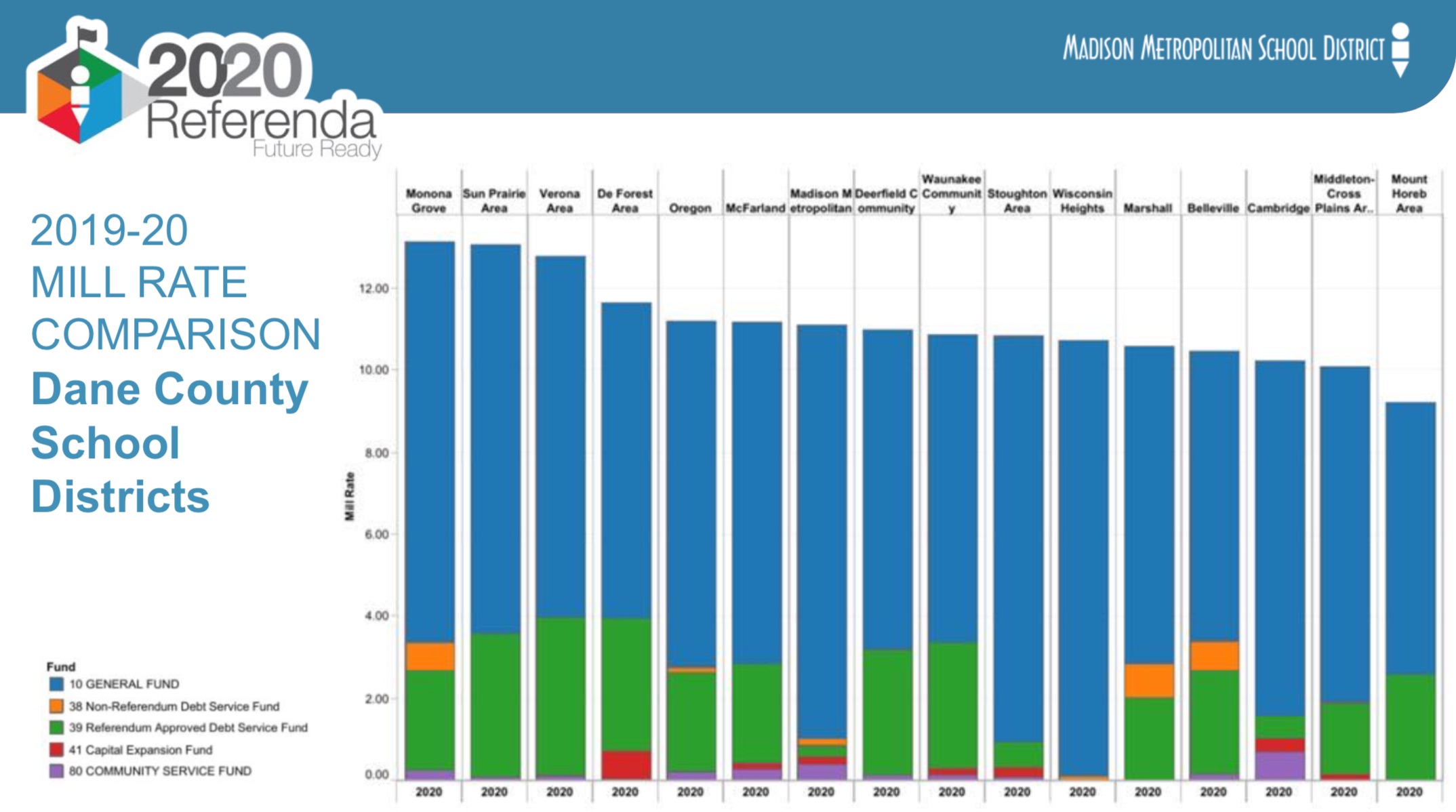
Changes in assessed value, redistributed state and federal taxpayer fund changes and spending growth data have gone missing.

2017: West High Reading Interventionist Teacher’s Remarks to the School Board on Madison’s Disastrous Reading Results

Madison’s taxpayer supported K-12 school district, despite spending far more than most, has long tolerated disastrous reading results.

My Question to Wisconsin Governor Tony Evers on Teacher Mulligans and our Disastrous Reading Results

“An emphasis on adult employment”

Wisconsin Public Policy Forum Madison School District Report[PDF]

Booked, but can’t read (Madison): functional literacy, National citizenship and the new face of Dred Scott in the age of mass incarceration

Share

Here’s a List of Colleges’ Plans for Reopening in the Fall

The Chronicle:

Below is our list of colleges that have either disclosed their plans or set a deadline for deciding. New additions include Bennett College, Canisius College, Dillard University, Empire State College, Keene College, Mills College, and Saint Joseph’s College of Maine. Among the colleges with status updates are Franklin & Marshall College, Pepperdine University, and West Chester University.

Add your college to the tracker or tell us if its plans are different than reported below. Use this form and provide a relevant link if you want your institution to be included.

Share

Letter on Civil Rights

US Department of Education:

We have been deeply affected by the recent events that have contributed to racial discord and strife throughout our country. Like so many of you, we continue to be concerned about the impact of these events on our children and on the future of our country. Racism has no place in our nation or in our schools. In each generation, ordinary Americans have fought to secure equality in our laws and in our lives. Their hard- earned victories enshrined equal protection in our Constitution and banned discrimination in our schools, workplaces, and public facilities. Next week, on July 2nd, we commemorate one of those landmark achievements as we celebrate the 56th anniversary of the Civil Rights Act of 1964. This anniversary is a timely reminder to mark our society’s progress and to strengthen our resolve to realize the law’s full promise: racial equality for all.

Title VI of the Civil Rights Act of 1964 (Title VI) prohibits entities receiving federal funds, including our nation’s schools, from discriminating based on race, color, or national origin. For decades, the Department of Education’s Office for Civil Rights (OCR) has worked to investigate race discrimination faced by students. Each day, we work to ensure all students have equal educational opportunities regardless of race, color, or national origin.

Now, more than ever, OCR is committed to ensuring that no student is treated differently because of the color of their skin. In the last three fiscal years alone, OCR has entered into 520 resolution agreements requiring schools to make changes to address racial discrimination concerns (a 16% increase as compared to the three prior fiscal years). Of these resolution agreements, 164 addressed racial harassment (a 27% increase as compared to the three prior fiscal years), and 50 resolved racial bias in school discipline (a 108% increase as compared to the three prior fiscal years).

Share

“They won’t be critical thinkers.”

David Choi:

“It was because I recognized that unless we are giving opportunity and a quality education to the young men and women in the United States, then we won’t have the right people to be able to make the right decisions about our national security,” McRaven said. “They won’t have an understanding of different cultures. They won’t have an understand of different ideas. They won’t be critical thinkers.”

“So we have got to have an education system within the United States that really does teach and educate young men and women to think critically, to look outside their kind of small microcosm because if we don’t develop those great folks, then our national security in the long run may be in jeopardy,” McRaven added.

McRaven recommended the US develop a “culture of education” within communities, particular those where residents believe they cannot afford an education or where they think their children aren’t “smart enough.”

2017: West High Reading Interventionist Teacher’s Remarks to the School Board on Madison’s Disastrous Reading Results

Madison’s taxpayer supported K-12 school district, despite spending far more than most, has long tolerated disastrous reading results.

My Question to Wisconsin Governor Tony Evers on Teacher Mulligans and our Disastrous Reading Results

“An emphasis on adult employment”

Wisconsin Public Policy Forum Madison School District Report[PDF]

Booked, but can’t read (Madison): functional literacy, National citizenship and the new face of Dred Scott in the age of mass incarceration

Share

How one woman’s stolen identity exposed a system of exam fraud

Yvette Tan:

This week around 10 million students across China have sat the Gaokao – a college entrance exam which determines their entire future.

Hanging over their heads, though, is the recent revelation that hundreds of other students before them were victim to an identity theft scandal which saw them robbed of their results.

For Chen Chunxiu, it was an exam that could change everything. Doing well in the Gaokao meant the farmer’s daughter had a shot of getting into her dream university. Failing meant it would remain just that – a dream.

She failed.

Denied admission to college, she took up various jobs – a factory worker, a waitress – before eventually becoming a kindergarten teacher.

But 16 years later, she found to her shock that she had, in fact, earned a place at the Shandong University of Technology – and enrolled there.

But it hadn’t been her. Her score – and in fact, her entire identity – was stolen by a girl whose relatives had pulled strings to make this happen.

Share

155-ACRE COLLEGE CAMPUS

Malta Auctions:

Details:

  • Green Mountain College, One Brennan Circle, Poultney, Rutland County, VT 05764

  • Located on the Vermont/New York Border in the Southern Vermont Lakes Region

  • 40 Minutes to Lake George, 75 Minutes to Albany; 3.5 Hours to Boston; 4 Hours to New York City; 3 Hours to Montreal

  • Magnificent 155 Acre Campus Improved with 22 Buildings of High-End Brick & Slate Construction

  • Turn-Key Opportunity – Equipped/Furnished

  • Campus Received a Perfect “Green Rating” by Princeton Review’s Green Honor Roll

  • Wood-Fueled Biomass Steam Heat System. Built in 2010 at a Cost of $5,800,000

  • Skiing, Hiking & Bike Trails on and/or Nearby Property

  • Potential Alternative Uses Include Religious Compound, Assisted Living, Housing, Summer Camp, Addiction Retreat and Many Others
     

Share

Kids won big in school choice ruling

Ross Izard:

Last week, the Supreme Court of the United States issued a landmark ruling invalidating the use of state constitutional “Blaine Amendments” to bar faith-based schools from participating in K-12 scholarship programs. That ruling removes the largest legal impediment to private school choice in three dozen states and throws open the doors of opportunity for millions of students nationwide.

But while the historic decision in Espinoza v. Montana Department of Revenue hinged on a scholarship program in Montana, it also represented the finale of a long and bloody fight right here in Colorado.  

Three years ago, almost to the day, what would become one of the most pivotal school board races in America was taking shape in Douglas County. At the core of that election was Douglas County School District’s first-of-its-kind local K-12 private school choice program, which would have allowed up to 500 students to attend an approved private school of their choosing with a district-funded scholarship. 

Share

Scamocracy in America

Angela Codevilla:

Over the past fifty years the rules of public and even of private life in America have well-nigh reversed, along with the meaning of common words, e.g. marriage, merit, and equality. Social inequality, even more than economic, has increased as personal safety and freedom have plummeted. People are subject to arbitrary power as never before. No one voted for these changes. Often, as with the negation of the Defense of Marriage Act and of the referendum-approved California constitutional provision to the same effect, these reversals expressly negated law. Just as often, as in the case of our mounting restrictions on freedom of speech, they have happened quite outside any law. Altogether, they have transformed a constitutional republic into an oligarchy at war with itself as well as with the rest of society. The U.S. Constitution and the way of life lived under it are historical relics.

Our ruling class transformed America’s regime by instituting a succession of scams, each of which transferred power and wealth to themselves. These scams’ blending into one another compel us to recognize them, individually and jointly, as the kind of governance that Augustine called “magnum latrocinium,” thievery writ large. Thievery of power even more than of money—colloquially, scamocracy.

Neither Aristotle nor anybody else ever counted scamocracy in their category of regimes because rule by fraud exists naturally only as regimes reach the terminal stages of their corruption.

Power over substance

Share

Children’s Well-Being Goes Hand in Hand With Their Dads’ Mental Health

Catherine Wade and Julie Green:

We know from recent research that children whose mothers are depressed may respond differently to stress, have altered immunity and be at greater risk of psychological disorders. This work adds to the body of research showing children can be affected in negative and long-term ways by their mothers’ mental ill-health.

But what about dads?

Men’s mental health is more on the societal radar these days – but less so in terms of fatherhood. This area has been relatively under-researched. So how important is a father’s mental health to the way thier child grows and develops? Very important, as it turns out.

Share

Mathematician Has Created a Teaching Method That’s Proving There’s No Such Thing as a Bad Math Student

Jenny Anderson:

Math is a notoriously hard subject for many kids and adults. There is a gender gap, a race gap, and just generally bad performance in many countries.

John Mighton, a Canadian playwright, author, and math tutor who struggled with math himself, has designed a teaching program that has some of the worst-performing math students performing well and actually enjoying math. There’s mounting evidence that the method works for all kids of all abilities.

As of 2017, his program, JUMP (Junior Undiscovered Math Prodigies) Math, is being used by 15,000 kids in eight US states (it is aligned with the Common Core), more than 150,000 in Canada, and about 12,000 in Spain. The US Department of Education found it promising enough to give a $2.75 million grant in 2012 to Tracy Solomon and Rosemary Tannock, cognitive scientists at the Hospital for Sick Children and the University of Toronto, to conduct a randomized control trial with 1,100 kids and 40 classrooms. The results, due out in late 2017, hope to confirm previous work the two did in 2010, which showed that students from 18 classrooms using JUMP progressed twice as fast on a number of standardized math tests as those receiving standard instruction in 11 other classrooms.

Share

Carlton Jenkins is named Madison’s next K-12 Superintendent

Scott Girard:

Carlton Jenkins said moving to work in the Madison Metropolitan School District would be like “going home.”

One of two finalists to become the district’s next superintendent, Jenkins was an associate principal at Memorial High School in 1993 and earned his doctorate at the University of Wisconsin-Madison. Throughout the day Tuesday, the Robbinsdale School District superintendent spoke with students and staff via video, interviewed with the School Board and participated in a community Q and A session on Facebook Live.

“You will have a superintendent, if you select me, that comes here unapologetically knowing and loving Madison,” Jenkins said. “I am a Badger through and through.”

The School Board announced Jenkins and Oak Park Elementary School District 97 superintendent Carol Kelley as finalists last Thursday. After both interview this week, the board will deliberate in closed session Thursday.

Those who have thoughts on the choice can submit comments on the district’s website by 11 a.m. Thursday. To leave comments on Jenkins, visit mmsd.org/jenkins. Kelley’s community Q and A will be 7:15 p.m. Wednesday night.

The district’s timeline for a hire outlines a potential August start date.

Logan Wroge:

Carlton Jenkins will become the next superintendent of the Madison School District, returning to the city where he started his administrative career in education more than 25 years ago.

The Madison School Board announced Friday it chose Jenkins, superintendent of Robbinsdale Area Schools in suburban Minneapolis, as the permanent leader of the Madison School District. He will be the first Black superintendent of Madison.

He starts the job Aug. 4.

In a second search to fill the superintendent vacancy after the initial pick fell through this spring, the board opted to go with Jenkins, 54, over the other finalist Carol Kelley, a superintendent of the Oak Park Elementary School District 97 in Illinois.

“I speak for everyone on the Board when I say that we are very excited to share this news with our community,” Board President Gloria Reyes said in a statement.

Jenkins received a Ph.D. in educational leadership and policy analysis from UW-Madison in 2009 and a master’s degree in educational administration from the university in 1993.

Related:

2013 – 2019: Jennifer Cheatham and the Madison experience.

2017: West High Reading Interventionist Teacher’s Remarks to the School Board on Madison’s Disastrous Reading Results

Madison’s taxpayer supported K-12 school district, despite spending far more than most, has long tolerated disastrous reading results.

My Question to Wisconsin Governor Tony Evers on Teacher Mulligans and our Disastrous Reading Results

“An emphasis on adult employment”

Wisconsin Public Policy Forum Madison School District Report[PDF]

Booked, but can’t read (Madison): functional literacy, National citizenship and the new face of Dred Scott in the age of mass incarceration

Share