School Information System

Who Should Be the Voice of Autism?

Laura McKenna:

Has the Neurodiversity Movement Forgotten The Most Disabled and Their Parents?

When Ian was three, the local school district sent him to a neurologist to see why he couldn’t talk. After a few background questions for me about my pregnancy and his birth, she turned to Ian, and said, “okay, let’s see what’s going on here.” She pulled out a wooden puzzle with a dozen barnyard animals and dumped them on ground. I smiled and said, “wait until you see this.” 

Ian glanced down at the puzzle pieces of the cow and the dog, picked up one by the little peg, and slapped into the wooden puzzle board without hesitating or jiggling the piece to fit it into place. Slap. And it was in. And then he did it again and again. Fast and perfect, without looking at us once to register our reaction and without any comments at all. I handed him a candy reward.

“Wow,” said the neurologist. At the end of the appointment, she said that he couldn’t talk because he was smart. (Yes, doctors really did say that twenty years ago.) As we later learned, Ian is smart, and he’s also autistic. But autism looks differently in every person, and few have Ian’s combination of strengths and weaknesses. 

In a viral article for The Free Press — Bari Weiss’s substack — Jill Escher writes that the neurodiversity movement, which celebrates autism and normalizes it, has done real damage to her family. Escher say that those autism advocates do not speak for her or her two profoundly autistic adult-children, completed derailed the effort to find causes of autism, and distracted from the real desperate need to create programs for adults with autism

The neurodiversity movement, which gathered steam in 2010, maintains that autism is not a disability, but a feature of normal human variation, and in some cases, an evolutionary advantage. I once joked described that this movement should be renamed, Woke Autism, but they’ve been very successful in reshaping the terms of the debate and even transformed advocacy at the mega-foundation, Autism Speaks.

Share

PYLUSD board votes to leave the California School Board Association

Annika Bahnsen

PlacentiaYorba Linda Unified will leave the California School Boards Association, a statewide coalition that provides school districts with training, advocacy and policy analysis assistance, a school board majority decided Tuesday, Aug. 8.

PYLUSD will be the only district in Orange County that is not a member of the CSBA. According to the CSBA’s website, more than 96% of California school district . . .

Share

8 Ways Journalists Can Access Academic Research for Free

Denise-Marie Ordway

Resourceful journalists find other ways to get that information. Here are eight of them.

1. Go to the Library

Public libraries often subscribe to academic journals and anyone with a library card can read them. The good news for busy journalists is some libraries allow their users to access online databases of peer-reviewed research from any location.

US colleges and universities provide online access to academic journals through their academic libraries. State university libraries generally are open to the public. Private institutions often extend library privileges to alumni.

2. Ask Academic Journals for a Free Account

Many of the most popular journals give journalists complimentary access, although some limit free accounts to journalists covering specific topics or beats. The American Economic Association (AEA), for instance, offers news media professionals free access to all eight of its journals, including the American Economic Review. You can request an account through the association’s press page.

Share

Ramaswamy proposes raising voting age to 25, unless people serve in military or pass a test

Meg Kinnard;

Republican presidential hopeful Vivek Ramaswamyon Thursday voiced support for changing the overall U.S. voting age to 25, unless younger Americans fulfill at least six months of service in the military or as a first responder — or pass the same citizenship test administered to those seeking to become naturalized citizens.

Ramaswamy’s campaign announced the biotech entrepreneur and “anti-woke” activist’s push for a U.S. Constitutional amendment promoting “civic duty voting,” which he announced in a news release and detailed during a campaign event in Urbandale, Iowa.

Revising the Constitution is no simple task, requiring overwhelming support in Congress and in state legislatures. Still, Ramaswamy said in his release that the “absence of national pride is a serious threat to the future of our country” and argued his proposal “can create a sense of shared purpose and responsibility amongst young Americans to become educated citizens.”

On Twitter during his Iowa event, Ramaswamy acknowledged, “I understand not everyone will like this proposal and that it will take persuasion to convince many of its merits, but I’m ready to take that on.”

Share

Millions of kids are missing weeks of school as attendance tanks across the US

BIANCA VÁZQUEZ TONESS

Across the country, students have been absentat record rates since schools reopened during the pandemic. More than a quarter of students missed at least 10% of the 2021-22 school year, making them chronically absent, according to the most recent data available. Before the pandemic, only 15% of students missed that much school. 

All told, an estimated 6.5 million additional students became chronically absent, according to the data, which was compiled by Stanford University education professor Thomas Dee in partnership with The Associated Press. Taken together, the data from 40 states and Washington, D.C., provides the most comprehensive accounting of absenteeism nationwide. Absences were more prevalent among Latino, Black and low-income students, according to Dee’s analysis.

The absences come on top of time students missed during school closures and pandemic disruptions. They cost crucial classroom time as schools work to recover from massive learning setbacks.

Absent students miss out not only on instruction but also on all the other things schools provide — mealscounseling, socialization. In the end, students who are chronically absent — missing 18 or more days a year, in most places — are at higher risk of not learning to read and eventually dropping out. 

“The long-term consequences of disengaging from school are devastating. And the pandemic has absolutely made things worse and for more students,” said Hedy Chang, executive director of Attendance Works, a nonprofit addressing chronic absenteeism.

Related: Taxpayer funded Dane County Madison public health mandates and closed schools.

“Well, it’s kind of too bad that we’ve got the smartest people at our universities, and yet we have to create a law to tell them how to teach.”

The data clearly indicate that being able to read is not a requirement for graduation at (Madison) East, especially if you are black or Hispanic”

My Question to Wisconsin Governor Tony Evers on Teacher Mulligans and our Disastrous Reading Results

2017: West High Reading Interventionist Teacher’s Remarks to the School Board on Madison’s Disastrous Reading Results 

Madison’s taxpayer supported K-12 school district, despite spending far more than most, has long tolerated disastrous reading results.

“An emphasis on adult employment”

Wisconsin Public Policy Forum Madison School District Report[PDF]

WEAC: $1.57 million for Four Wisconsin Senators

Friday Afternoon Veto: Governor Evers Rejects AB446/SB454; an effort to address our long term, disastrous reading results

Booked, but can’t read (Madison): functional literacy, National citizenship and the new face of Dred Scott in the age of mass incarceration.

When A Stands for Average: Students at the UW-Madison School of Education Receive Sky-High Grades. How Smart is That?

Share

Freedom of Speech and the Milwaukee Teacher Union

Share

Hard lessons from a veteran homeschooler

Larissa Phillips

If it wasn’t the Covid closures, maybe it was the recording of a contentious school board meetingthat went viral. Or a TikTok video posted by a woke teacher. Or perhaps the relentless reports of declining academic standards. Given the heated discourse around almost every aspect of public education, it’s hardly surprising that more and more families are opting out. According to the Census Experimental Household Pulse survey, in the last three years, the families of 1.8 million children made the switch, totaling 4.3 million American children homeschooled in 2022. The growth is steady and expected to continue. But glib calls to jump ship gloss over some persistent challenges inherent in homeschooling.

I discovered these challenges firsthand thirteen years ago when my family moved from Brooklyn to rural upstate New York and began homeschooling our kids, then six and eleven. We were less motivated by school board battles or declining academic standards than a general dissatisfaction with the one-size-fits-all classroom model. In Brooklyn, my kids had gone to a lively, sought-after public school that emphasized project-based learning within an otherwise traditional classroom. Even that school had been a poor fit for my quirky older child. I thought he was neither nurtured to his full potential nor assisted in his difficulties coping with the rhythms of the school day. My younger child was sociable, poised, and academically adept, which meant she was often ignored by teachers and partnered with difficult kids to keep them focused. The fault, I thought, lay not in the choice of teachers or curriculum, but in the very concept of assembly-line education for children, a common complaint of homeschooling enthusiasts. Coloring my opinion was the memory of my own uninspiring school years. We were ready for something different. We jumped in.

Share

Civics: “For the second time in three years, the Bezos’ Washington Post has quietly “updated” one of the most consequential fact checks in the history of American politics”

Paul Sperry:

The original article by the Washington Post’s chief fact checker, Glenn Kessler, was published the same day as the New York Post’s pre-election scoop revealing that Joe Biden had attended a 2015 dinner with a top executive of a Ukrainian energy firm, Burisma, which was paying his son $83,000 per month. Kessler’s fact-check involved interviews with a host of Biden aides who vehemently disputed the vice president’s attendance at the dinner and advanced the theory that the source of the information – a laptop Hunter had abandoned at a Delaware repair shop – was untrustworthy and possibly a Russian plant.

That conspiracy theory was quickly embraced by 51 former intelligence officials, who signed an open letter dismissing the New York Post’s scoop as having “all the classic earmarks of a Russian information operation.” This letter and the Washington Post fact check were used by the Biden campaign, other media outlets, and social media platforms to discredit the information contained on the laptop in the final days of the campaign. The article, Kessler would later boast, was “one of the most read articles in our 13-year history” of the fact-checking feature.

But Kessler’s fact check has not aged well. Just last week Hunter Biden’s former business partner, Devon Archer, testified before Congress that the article was “not correct reporting.” Instead of retracting the article – as the Post did with some of its debunked Russiagate coverage – or running a straightforward correction, the paper has appended a series of “updates” to its reporting.

More, here.

Share

Notes on the university of California’s incoming class demographics

David Mastio

This fall, the University of California system is growing its freshman class by 3,017 slots from 85,268 students to 88,285. Black students aren’t getting a single one of the new slots according to preliminary University of California data analyzed by The Center Square.

  • Hispanics gained 1,435 slots in the newly expanded freshman class.
  • Whites gained 982 spots in the class.
  • Asian Americans grew by 359 positions.
  • Native Americans obtained 60 additional admissions.

African-Americans remained exactly the same with 4,855 spots in the freshman class in 2022 and 2023 while their percentage of those admitted to the freshman class declined 17% from 6% of all incoming freshmen in 2022 to 5% of freshmen in 2023. If Blacks had remained the same proportion of the class, they would have gained more than 150 seats in freshman classrooms.

Share

Katherine Koonce:

Jimmy Ewing:

It worked like this: an enterprising homeschool mom compiled a list of all the moms’ home phone lines because nobody, except rich dads, had cell phones. She would take that list to Kinko’s and make duplicates to distribute at the next homeschool gathering. When something interesting happened, whoever discovered the interesting thing would call the next person on the list and tell her all about that thing with breathless abandon. At no point were dads involved, ever. A man’s voice on the other end of the line would have caused panic and a run on the local banks. Thus, the dissemination of vital information was effected and dads were kept entirely in the dark for as long as possible. 

Unfortunately, hardly anyone owned answering machines until well into the 90s, so number 6 on the list might be forced to skip number 7 and go straight to 8 who sent her to 10 because she knew 9 was out of town and 7 had kids with strep. This went on in a round-robin format until, finally, the voice on the other end of the line said “Yes, I know about the thing; I’m the one who initiated the phone tree.” It was pure chaos. This phenomenon is likely being actively studied in laboratory rats today. I don’t know. 

Fortunately for me, Katherine Koonce’s generous offer to teach literature to homeschoolers trickled through the phone tree to my house, and I was sent up to the front lines. I have no idea what could possibly have possessed her to want to help us, but she did, and to say that the impact she had on my life was “profound” would be a dramatic understatement.

Share

Dual Enrollment

Share

Few Wisconsin colleges consider legacy in admissions decisions. But some offer scholarships

Kelly Meyerhofer:

In Wisconsin, few colleges and universities consider “legacy” status in admissions decisions, according to a Milwaukee Journal Sentinel review. And because most Wisconsin schools accept far more students than they reject, it’s likely many legacy students would have gotten in regardless of their family’s history of attendance.

But there’s another way in which legacy can benefit already advantaged students: Some schools offer scholarships specifically for students with a family member who graduated from there. At least 13 Wisconsin institutions do, according to the news organization’s review of 28 school scholarship websites.

Richard Kahlenberg, a nonresident scholar at Georgetown University and longtime critic of legacy preference, called legacy scholarships “equally troubling.” He urged institutions to phase them out, especially if scholarship criteria don’t consider other factors, too, such as financial need.

“To the extent that (schools are) trying to diversify in new ways after the Supreme Court ruling, then having a scholarship for legacy students seems counterproductive,” he said.

Share

‘These Places Are Just Devouring Money.’ Then they passed the bill along to students

Melissa Korn, Andrea Fuller and Jennifer S. Forsyth

The nation’s best-known public universities have been on an unfettered spending spree. Over the past two decades, they erected new skylines comprising snazzy academic buildings and dorms. They poured money into big-time sports programs and hired layers of administrators. 

Then they passed the bill along to students.

The University of Kentucky upgraded its campus to the tune of $805,000 a day for more than a decade. Its freshmen, who come from one of America’s poorest states, paid an average $18,693 to attend in 2021-22. 

Pennsylvania State University spent so much money that it now has a budget crisis—even though it’s among the most expensive public universities in the U.S. 

The University of Oklahoma hit students with some of the biggest tuition increases, while spending millions on projects including acquiring and renovating a 32,000-square-foot Italian monastery for its study-abroad program.

The spending is inextricably tied to the nation’s $1.6 trillion federal student debt crisis. Colleges poured out money in part by raising tuition prices, leaving many students with few options but to take on more debt. That means student loans served as easy financing for university projects.

“Students do not have the resources right now to continue to foot the bill for all of the things that the university wants to do,” said Crispin South, a 2023 Oklahoma graduate. “You can’t just continue to raise revenue by turning to students.”

Rather, they raised prices far beyond what was needed to fill the hole. 

For every $1 lost in state support at those universities over the two decades, the median school increased tuition and fee revenue by nearly $2.40, more than covering the cuts, the Journal found.

Share

K-12 Governance and Transparency: Livingston New Jersey School Board

Share

Its most recent term was a credit to the institution, not the abomination its critics allege.

Conor Friedersdorf

Though accused of naked partisanship, the Court handed down multiple significant rulings where justices appointed by presidents of different parties were in the majority and minority together. Multiple majority decisions featured GOP-appointed justices ruling against the actions of GOP legislators. The Court generally ruled in ways that were consistent with the popular will, not at odds with it. (Polls aggregated by The New York Times suggest that just one ruling strayed significantly from public opinion––a case that recognized the Environmental Protection Agency’s statutory jurisdiction over permanent bodies of water while ruling that the Clean Water Act does not give it jurisdiction over wetlands.)

As for ideology, the Court’s judicial reasoning and outcomes alike suggest majorities that are more informed by small-l liberal values than the “right wing” or “extremist” values some antagonists allege. The justices safeguarded election integrity and voting rights in decisions that many Democrats cheered. And in two of the decisions that progressives complained about most, the Court stopped two powerful institutions from flagrantly discriminating against a racial-minority group and reined in a president who willfully exceeded his lawful authority by forgiving debt in a way that transferred wealth, overall, from poorer Americans to richer Americans.

Taken together, the majority decisions of 2023 reflected the justices reasoning their way to legally defensible and practically workable conclusions, whether or not you happen to agree with them. Nothing about those rulings provides any basis at all for calling the legitimacy of the Court into question, and those doing so are being as misleading as they are shortsighted and imprudent.

Share

Civics: Lawfare and taxpayer funded censorship

Share

Civics: Governance & Lawfare

Share

With all due respect to the former VP, the reason the people don’t trust the government is because the government doesn’t trust the people.

Share

How MIT Helped Develop Tech for a Chinese Company That Surveils Uyghurs

Thomas McKenna:

The Massachusetts Institute of Technology used funding from a twice-sanctioned Chinese company to advance components of facial recognition technology, which its Chinese benefactor has reportedly used to track and imprison Uyghurs, a Washington Free Beacon review found.

China’s largest facial recognition company, SenseTime, donated an undisclosed amount of money to MIT in 2018. Twenty of the 22 research papers that donation funded, the Free Beacon found, focused on or mentioned “neural networks,” which are used in facial recognition technology. Fourteen of the papers, meanwhile, covered image data or image recognition algorithms. Two researchers associated with Zhejiang University, which works on classified projects for the Chinese military, co-authored one paper with MIT researchers on “artificial neural networks.”

While it’s unclear how SenseTime may have used the research it funded, the company’s facial recognition technology has reportedly helped China commit genocide. SenseTime’s tech is part of a “vast, secret system” the Chinese use to “track and control” Uyghurs, the New York Times reported in 2019. The Trump administration that year blacklisted SenseTime for its role in the “repression, mass arbitrary detention and high-technology surveillance” of Uyghur Muslims in Xinjiang, preventing it from receiving technology or exporting it to the United States. Two years later, in 2021, the Biden administration banned U.S. investment in SenseTime.

Share

We took care of our kids’ — but they lost a year in reading, math

Joanne Jacobs:

Juab School District in Utah focused on supporting students emotionally when schools reopened in fall of 2020. “We took care of our kids,” said Royd Darrington, assistant superintendent for Juab Schools. “I’ll be honest, academics was not at the forefront of what we were pushing our teachers to push to their students. It really wasn’t. It was, how do we build a sense of community?”

Wasatch School District, 100 miles away, focused on academics and continuity. “Our academic goals did not change one bit throughout the pandemic,” said Superintendent Paul Sweat. Extra Covid funding went for teacher training.

Share

Responses to the chancellor’s DEI questionnaire reveal muddled thinking and possible violations of the law.

Ashlynn Warta:

In July of 2020, UNC-Chapel Hill’s chancellor sent an email to the university’s leadership cabinets requesting responses to three questions regarding “structural racism.” Through public records requests, the Martin Center obtained a copy of the many responses submitted over the following days by Chapel Hill’s academic and administrative units. Our previous article on this subject introduced the chancellor’s DEI questionnaire and examined some of the more extreme proposals supplied by respondents. Below, we look in greater detail at the “solutions” proposed by Chapel Hill’s various divisions and schools.

The questions posed by Chancellor Guskiewicz were as follows:

1. What are the strengths and weaknesses of Carolina’s scholarly, co‐curricular, administrative and service efforts to identify and eliminate structural racism on our campus and beyond?

2. What should we be doing/what can you do to stand against structural racism and stand for equity within our/your school/unit?

3. How can we learn from and partner with other schools/units, institutions, organizations or communities in the region to be agents of change against structural racism?

The original email was sent to 40 people and garnered 38 responses. Those who submitted responses included (but were not limited to) the UNC Eshelman School of Pharmacy, the Kenan-Flagler Business School, the School of Information and Library Science, the UNC School of Government, the Office of the Provost, the UNC School of Nursing, the UNC School of Medicine, the Hussman School of Journalism and Media, and the UNC School of Law.

Nearly all of the replies to Chancellor Guskiewicz’s questions were long-winded word salads.

Share

Calling Josh Shapiro’s Voucher Bluff: A union leader and a Democrat give new hope for a school choice bill in Pennsylvania.

Wall Street Journal:

Pennsylvania Gov. Josh Shapiro disappointed thousands of parents on Thursday when he vetoed a $100 million voucher proposal he had supported before caving to unions and the Democratic-run House. But a pair of defections from anti-voucher ranks suggest the scholarships aren’t dead if Republicans use their legislative leverage.

Share

SURVEY: Americans support merit-based college admission practices

Jared Gould:

With the Supreme Court recently banning the use of affirmative action in college admissions, some Americans are exploring alternative approaches to diversify university campuses, with some even supporting a shift toward income-based admissions.

A recent Intelligent.com survey involving 1,095 American respondents reveals that 1 in 3 Americans support the idea of college admissions taking an applicant’s socioeconomic status into account.

Support for using socioeconomic background hinges on the idea that lower-income students face greater educational challenges, lessening a poorer applicant’s chance of being admitted into college.

Share

Massachusetts’ Governor Vetoes Reading Recovery $pending

Notes and links on Reading Recovery (Madison is a long time user).

Share

“This feels different because people are tricked into thinking that it can think.”

Scott Girard:

“I think that calculators are more similar to spellcheck than this,” said Edgerton High School English teacher Sue White. “This feels different because people are tricked into thinking that it can think.”

ChatGPT, which can be accessed online, allows users to ask a question or submit a prompt and receive an artificial intelligence-generated response. The language model, launched in November, is “capable of generating human-like text based on context and past conversations,” according to its developer, OpenAI.

Mars Subola, who teaches English at Madison East High School, described themself as somewhat naive about the artificial intelligence chatbot throughout the last school year. That changed in the year’s final weeks, as Subola noticed a “huge influx of writing that just didn’t seem like my kids’ writing.”

Subola discovered that more than a dozen students had ChatGPT write their papers for them.

“It just kind of felt like … they didn’t have the trust in themselves or in myself that we could create a solution to whatever problem they were facing,” Subola said. “They didn’t have to resort to ChatGPT and it just felt like these are really, really, really talented, intelligent, skilled writers who found a way out, I guess.”

Share

Taxpayer funded k-12 surveillance

Share

A trove of emails, Slack messages, and other documents reveal Fauci’s behind-the-scenes involvement. ‘Tony doesn’t want his fingerprints on origin stories.’

David Zweig:

On April 17, 2020, with much of the country still in some form of lockdown and news of overwhelmed hospitals dominating the headlines, Dr. Anthony Fauci, then a member of the President’s Coronavirus Task Force, was asked a question toward the end of a White House press briefing: Was there a possibility that this novel virus came from a lab in Wuhan, China?

“There was a study recently,” Fauci said confidently, “where a group of highly qualified evolutionary virologists looked at the sequences there and the sequences in bats as they evolve, and the mutations that it took to get to where it is now is totally consistent with a jump of a species from an animal to a human.” In other words, it wasn’t from the lab.

This moment set the template for much that would follow from Fauci over the next three years. That is, evasion, deception, and misdirection about his support of high-risk virology research and its connection to the possibility that a lab leak in Wuhan caused a worldwide catastrophe.

Fauci, who was the face of the public health community during the crisis, pushed the idea that the evidence strongly indicated that the virus was just a tragic, natural occurrence. He insisted, repeatedly, that an epidemic that started in Wuhan was unlikely to have been the result of an escape from the Wuhan Institute of Virology (WIV). 

But Fauci had an incentive to arrive at his conclusion about the deadly pandemic that started in Wuhan. The WIV was known for doing high-risk virology research studying and manipulating coronaviruses. Fauci, as head of the National Institute of Allergy and Infectious Diseases for almost 40 years, had funded such research at the WIV.

Fauci’s posture—dismissive toward the theory of the lab leak, and later, condescending toward those who entertained it—set what became the accepted narrative about the origins of the pandemic. It was a narrative that was parroted by the government, public health officials, and the media, and even enforced by social media platforms at the request of the Biden White House.

But last month, a trove of explosive emails and other documents were released by the U.S. House Select Subcommittee on the Coronavirus Pandemic. These revealed evidence of Fauci’s and other officials’ behind-the-scenes involvement with scientists and journalists, demonstrating their efforts to quash the lab leak theory.

Share


The Disparate Impacts of College Admissions Policies on Asian American Applicants

Joshua Grossman, Sabina Tomkins, Lindsay C. Page, and Sharad Goel.

we estimate the odds that Asian American applicants were admitted to at least one of the schools we consider were 28% lower than the odds for white students with similar test scores, grade-point averages, and extracurricular activities. The gap was particularly pronounced for students of South Asian descent (49% lower odds). We trace this pattern in part to two factors. First, many selective colleges openly give preference to the children of alumni, and we find that white applicants were substantially more likely to have such legacy status than Asian applicants, especially South Asian applicants. Second, after adjusting for observed student characteristics, the institutions we consider appear less likely to admit students from geographic regions with relatively high shares of applicants who are Asian.

Commentary.

Share

The Enrichment side of the “Accelerate vs Enrich” dichotomy in math education for kids who love math.

Sebastian Gutierrez:

Math is amazing in that there is a very clear learning path from 6 years old until a Math Ph.D. qualification exam, with everything in between.

So when you start to help a kid who loves math, do more math, it is very easy to start accelerating your kid down the math path from arithmetic to Calculus and beyond.

If you’re not familiar with it, it’s basically arithmetic all the way to pre-algebra, then algebra, geometry, algebra II, trigonometry, pre-calculus, and then calculus. You can more in-depth information about the USA’s  Common Core State Standards for Mathematics (PDF, Nov 2022) in the linked document.

This works great until the kid starts to get too far ahead of the school and then your kid runs into a bunch of related problems:

Share

Newer research suggests it’s better to guess before Googling

by JILL BARSHAY

Around 370 B.C., Plato wrote that his teacher Socrates fretted that writing things down would cause humans to become ignorant because they wouldn’t have to memorize anything. (Ironically, the only reason we know this is because it was written down in Plato’s “Phaedrus,” still available today.)  

Albert Einstein argued the opposite in 1921. “It is not so very important for a person to learn facts,” the Nobel laureate said, according to his biographer Philipp Frank. “The value of an education in a liberal arts college is not the learning of many facts but the training of the mind to think something that cannot be learned from textbooks.”

But neither of these great thinkers could anticipate how the debate would play out in the Age of Google. Not long after the search engine company was founded in 1998, psychologists began to wonder how the ability to have so much information instantly available was changing our brains. A seminal 2011 paper established the so-called “Google effect,” our tendency to forget information that we can easily look up on the internet.

The researchers didn’t actually study how people use Google or any internet search engine. Instead they drafted a list of trivia items, such as the fact that an ostrich’s eye is bigger than its brain. Then, in a series of experiments, they documented how university students were less likely to recall these facts when they thought they had saved them in a computer file for future reference. Students who were told they wouldn’t be able to refer to the trivia later did much better on recall assessments.

Share

Civics, free speech and litigation

Eugene Volokh:

“Unfairly treated,” I take it, means in context treated in ways that the law recognizes as unfair and therefore civilly actionable. Who might benefit from that? (I focus here on American law, since that’s the only sort of law I know.)

[1.] Many people are unaware of this, but many states, counties, and cities ban even private employers from firing or otherwise disciplining their employees based on the employees’ speech or political activity. What’s covered varies widely: Some jurisdictions protect a very broad range of speech; others protect “political activity” defined broadly enough to protect a wide range of speech related to political matters; others protect only election-related speech (whether about candidates or ballot measures). There’s a map available here, and I also tried including it in this post (right after this paragraph), but a glitch is keeping it from appearing for at least some readers.

I lay out many such statutes in Private Employees’ Speech and Political Activity: Statutory Protection Against Employer Retaliation (2012) (note that Utah has since enacted such a statute), and discuss the policy arguments for and against such statutes in Should the Law Limit Private-Employer-Imposed Speech Restrictions?(2022). It’s also possible that a federal statute would protect people who Tweeted for or against political candidates, though that’s not clear (see pp. 320-24 of my 2012 article).

Share

Ex-Madison schools spokesman retaliated against employees, report says

Scott Girard:

The complaint was made public in May following a public records request by NBC15 reporter Elizabeth Wadas, whom LeMonds allegedly said was “quickly becoming the sleaziest journalist in Madison” and whom he called “a pig of a journalist.” LeMonds tried to fight the release of the complaint, which was responsive to Wadas’ records request, in court, arguing it did not meet the balancing test for what the public needed to know compared with the damage it would cause.

A judge ruled against him, however, and the documents related to the initial investigation were released in late May.

He remained working in his role until mid-June, when he was placed on paid leave. The letter placing him on leave, dated June 12, was also provided as part of Tuesday’s released records.

Chris Rickert:

The staff also told district investigators that LeMonds frequently expressed his disdain toward certain reporters, all of them women.

On Oct. 6, 2022, he allegedly told members of the district’s communications department that there was “no way” he would respond to three interview requests from an unnamed reporter, described as a woman of color, because he “didn’t like her.” In that same meeting, he asked staff to share any negative experiences they had with former Wisconsin State Journal reporter Elizabeth Beyer, whom he called “a horrible human being.”

He also reportedly called WMTV (Ch. 15) reporter Elizabeth Wadas “a pig of a journalist,” who was “quickly becoming the sleaziest journalist in Madison.”

LeMonds in June pointed to the district’s initial investigation findings as proof absolving him of the claims. Two months earlier he’d sued his employer to prevent the release of the records including those claims. That bid was denied in late May.

Legislation and Reading: The Wisconsin Experience 2004

“Well, it’s kind of too bad that we’ve got the smartest people at our universities, and yet we have to create a law to tell them how to teach.”

The data clearly indicate that being able to read is not a requirement for graduation at (Madison) East, especially if you are black or Hispanic”

My Question to Wisconsin Governor Tony Evers on Teacher Mulligans and our Disastrous Reading Results

2017: West High Reading Interventionist Teacher’s Remarks to the School Board on Madison’s Disastrous Reading Results 

Madison’s taxpayer supported K-12 school district, despite spending far more than most, has long tolerated disastrous reading results.

“An emphasis on adult employment”

Wisconsin Public Policy Forum Madison School District Report[PDF]

WEAC: $1.57 million for Four Wisconsin Senators

Friday Afternoon Veto: Governor Evers Rejects AB446/SB454; an effort to address our long term, disastrous reading results

Booked, but can’t read (Madison): functional literacy, National citizenship and the new face of Dred Scott in the age of mass incarceration.

When A Stands for Average: Students at the UW-Madison School of Education Receive Sky-High Grades. How Smart is That?

Share

Commentary on yet another Madison k-12 Superintendent Search

Scott Girard:

Community members can now weigh in on the type of leader they’d like as the next Madison Metropolitan School District superintendent.

The district’s website now includes a “leadership profile” survey that will help the Madison School Board and its consultant on the search, Alma Advisory Group, develop a job description for the position when it’s posted this fall. Alma will also hold focus groups in early October with staff and “other stakeholders.”

The 14-question survey, open until early October, asks respondents to rate on a 1-5 scale the importance of various listed priorities for a superintendent and skills required for someone in the position.

Priorities listed on the survey include developing leaders, maintaining district financial health, closing the achievement gap, meeting student social and emotional needs, preparing students for college or careers, supporting staff, improving academic performance and ensuring student safety.

Legislation and Reading: The Wisconsin Experience 2004

“Well, it’s kind of too bad that we’ve got the smartest people at our universities, and yet we have to create a law to tell them how to teach.”

The data clearly indicate that being able to read is not a requirement for graduation at (Madison) East, especially if you are black or Hispanic”

My Question to Wisconsin Governor Tony Evers on Teacher Mulligans and our Disastrous Reading Results

2017: West High Reading Interventionist Teacher’s Remarks to the School Board on Madison’s Disastrous Reading Results 

Madison’s taxpayer supported K-12 school district, despite spending far more than most, has long tolerated disastrous reading results.

“An emphasis on adult employment”

Wisconsin Public Policy Forum Madison School District Report[PDF]

WEAC: $1.57 million for Four Wisconsin Senators

Friday Afternoon Veto: Governor Evers Rejects AB446/SB454; an effort to address our long term, disastrous reading results

Booked, but can’t read (Madison): functional literacy, National citizenship and the new face of Dred Scott in the age of mass incarceration.

When A Stands for Average: Students at the UW-Madison School of Education Receive Sky-High Grades. How Smart is That?

Share

Civics: The Media-Democrat Party Fusion

Victor Davis Hanson:

We are in the midst of one of the most radical revolutions in American history. It is as far-reaching and dangerous as the turbulent years of the 1850s and 1860s or the 1930s. Every aspect of American life and culture is under assault, including the very processes by which we govern ourselves, and the manner in which we live.

The Revolution began under the Obama administration that sought to divide Americans into oppressed and oppressors, and then substitute race for class victimization. It was empowered by the bicoastal wealth accrued from globalization, and honed during the COVID lockdown, quarantine-fed economic downturn, and the George Floyd riots and their aftermath. The Revolution was boosted by fanatic opposition to the presidency of Donald Trump. And the result is an America that is unrecognizable from what it was a mere decade ago.

Here are 10 upheavals that the Left has successfully wrought.

Free expression. In large swatches of American society—particularly the corporation, the media, the government, the public schools, and the university—it is suddenly dangerous to speak freely. At a DEI workshop, politely object that “whiteness” does not account for all the challenges of “marginalized peoples,” and you will become either ostracized, reprimanded, or perhaps fired.

Suggest to a class that man-made climate change and the state remedies for it, are still under debate—and your career and livelihood are endangered. In 2020, state that Covid lockdowns would do more eventual damage than the virus—and your career was through. Express doubt that there are more than two biological sexes, and if an athlete or high school principal you will be shunned or rendered professionally inert.

The government, in league with social media, censors the news. “Liberal” universities often first require McCarthy-era type “diversity” statements for one to be hired. Commissars review syllabi to spot incorrect or improper speech or insufficient DEI zeal.

The Left now seeks to modify the First Amendment, and its empowerment of “hate speech,” defined as most anything impeding the progressive project. The state and the universities properly issue word lists of approved vocabularies.

The old ACLU or Sen. Church Committee would now probably be deemed rightwing. The methodologies of Joseph McCarthy and J. Edgar Hoover are the preferred models, once they were rebooted to the right cause.

Share

Conservatives need a national agenda that reclaims American institutions from the Left.

Christopher Rufo:

America is trapped in the loop of 1968. The politics of that fateful year have set the patterns and bounds of our national life for decades.

It’s as though we have lived an endless recurrence: the Black Panther Party reappears as the Black Lives Matter movement; the Weather Underground pamphlets launder themselves into academic papers; the Marxist-Leninist guerrillas trade in their bandoliers and become managers of an elite-led revolution in manners and mores. The ideology, narrative, and aesthetics of the left-wing social movements of that earlier time, though now often degraded through cynicism and repetition, have maintained the position of a jealous hegemon.

The cultural revolution that began a half-century ago, now reflected in a deadening sequence of acronyms—CRT, DEI, ESG, and more—has increasingly become our new official morality. Many conservatives have made an uneasy peace with this transformation of values, even as the culture around them has, in many places, collapsed.

This attitude no longer suffices. It is time to break the loop of 1968. We need a counterrevolution.

This is the word that haunts the revolutionary mind. The French Revolution fell to the forces of Thermidor; the Revolution of 1848 fell to the empire of the bourgeoisie; the Bolshevik Revolution fell to the democratic-capitalists, the imperialist-backed juntas, and the forces of global capitalism. Marx himself viewed counterrevolution as an overwhelming threat. “Every important part of the revolutionary annalsfrom 1848 to 1849 bears the heading: Defeat of the revolution!” he lamented.

The urgent task for the political Right today is to comprehend the dynamics of revolution and counterrevolution and to create a strategy for dislodging the New Left ideology of 1968, which has solidified control over the most fundamental structures of American society. The challenge must be met not solely in the realm of policy debate but on the deepest political and philosophical grounds.

Share

Limiting Property Taxes

Committee to unleash prosperity

In the last fifty years, California has done ONE thing right. In 1978, against the advice of almost all the politicians in BOTH parties, almost two-thirds of CA voters approved Howard Jarvis’s Proposition 13 – which constitutionally capped runaway property rate increases. This tax revolt launched the big California Miracle of the 1980s and 1990s. Of course, thanks to the highest income and sales taxes in the country, California’s economy has stalled out, and now there are renewed calls from Democrats to repeal Prop. 13.

A new study by Laffer Associates and CTUP shows the damage of property taxes. When property taxes rise, home values fall because the higher taxes get capitalized into the value of the house.

Share

$pending more on ? And paying teachers less

Share

$pending more for less

Mike Lofgren:

This story of high prices and poor outcomes is true almost across the board for vital services, and there is none more vital than health care. The U.S. spends 17.8 percent of GDP on health care, nearly twice as much as the average OECD country. Health spending per person in America is almost twice as high as in the next most expensive country, Germany, and four times higher than in South Korea.

Does that high cost lead to better health? It does not. Probably the best proxy for the adequacy of health care is longevity; according to the UN, the U.S. ranks No. 70 out of 227 sovereign or semi-sovereign state entities. That’s below most European NATO members, South Korea, Japan and Israel, just to name three countries the U.S. has pledged to defend militarily, at potentially huge expense. It’s also below China.

As expected, lower longevity has implications for many other statistics, such as infant mortality; America’s ranking among developed countries is abysmal: “U.S. maternal mortality in 2020 was over 3 times the rate in most of the other high-income countries.” So much for the pro-life charade of the religious right. 

During World War II, American GIs were generally taller than their counterparts from other countries, thanks to better nutrition. Today, Americans are bigger in a different sense, with the highest rate of obesity in the developed world.

Notes and links on MTEL.

Legislation and Reading: The Wisconsin Experience 2004

“Well, it’s kind of too bad that we’ve got the smartest people at our universities, and yet we have to create a law to tell them how to teach.”

The data clearly indicate that being able to read is not a requirement for graduation at (Madison) East, especially if you are black or Hispanic”

My Question to Wisconsin Governor Tony Evers on Teacher Mulligans and our Disastrous Reading Results

2017: West High Reading Interventionist Teacher’s Remarks to the School Board on Madison’s Disastrous Reading Results 

Madison’s taxpayer supported K-12 school district, despite spending far more than most, has long tolerated disastrous reading results.

“An emphasis on adult employment”

Wisconsin Public Policy Forum Madison School District Report[PDF]

WEAC: $1.57 million for Four Wisconsin Senators

Friday Afternoon Veto: Governor Evers Rejects AB446/SB454; an effort to address our long term, disastrous reading results

Booked, but can’t read (Madison): functional literacy, National citizenship and the new face of Dred Scott in the age of mass incarceration.

When A Stands for Average: Students at the UW-Madison School of Education Receive Sky-High Grades. How Smart is That?

Share

You Need a Better Where-to-Play/How-to-Win

Roger Martin:

But you can do it yourself. “I’m just too busy” is a profoundly unpleasant feeling. But it is also very unproductive. It is bad for you and bad for those around you.

Remember that strategy is what you do not what you say. So, even if you don’t think of yourself as having a personal Playing to Win strategy, step back and reverse engineer what it actually is based on what you actually do. Use your calendar application to figure out your real WTP.

Share

Open records and the taxpayer supposed Madison School District

WILL:

The Wisconsin Institute for Law & Liberty (WILL) has settled a landmark open records lawsuit with the Madison Metropolitan School District (MMSD), securing thousands of dollars in punitive damages and reforms to how the school district processes open records. This is a major victory for government transparency and the equal treatment of all students in Wisconsin. WILL was represented by the Wisconsin Transparency Project.

The Quotes: Dan Lennington, WILL Deputy Counsel, stated, “A whistleblower notifed us in early 2022 that MMSD had a racially discriminatory policy of treating black students more favorably than students of other races. MMSD stonewalled for over a year. Now they’ve paid the price, disavowed the policy, and committed to significant reforms. This is a huge victory for transparency.”

Cory Brewer, WILL Associate Counsel, added, “Institutions funded by taxpayers cannot ignore members of the public who seek answers. WILL is prepared to hold school districts accountable for their actions—our lawsuits reflect that.”

Details of the Agreement: MMSD will pay $18,000, including $7,386 in attorney fees and court costs and the remainder in punitive damages. Because of the litigation, MMSD has agreed to take the following additional steps:

Share

Reducing Rigor: Massachusetts’ teacher union edition

James Vaznis:

The Massachusetts Teachers Association’s board of directors voted unanimously Sunday to support a ballot question that would drop the requirement that high school students pass MCAS exams in order to graduate — a move that will allow the union to spend money and other resources to win over voters.

The vote came four days after union memberssubmitted a proposed ballot question to the state’s Attorney General’s Office for the 2024 election cycle. The question calls for eliminating the MCAS graduation requirement, established under the 1993 Education Reform Act, and instead allow students to receive diplomas by completing coursework that is consistent with the state’s academic standards and curriculum frameworks upon which the MCAS is based.

Notes and links on MTEL.

Legislation and Reading: The Wisconsin Experience 2004

“Well, it’s kind of too bad that we’ve got the smartest people at our universities, and yet we have to create a law to tell them how to teach.”

The data clearly indicate that being able to read is not a requirement for graduation at (Madison) East, especially if you are black or Hispanic”

My Question to Wisconsin Governor Tony Evers on Teacher Mulligans and our Disastrous Reading Results

2017: West High Reading Interventionist Teacher’s Remarks to the School Board on Madison’s Disastrous Reading Results 

Madison’s taxpayer supported K-12 school district, despite spending far more than most, has long tolerated disastrous reading results.

“An emphasis on adult employment”

Wisconsin Public Policy Forum Madison School District Report[PDF]

WEAC: $1.57 million for Four Wisconsin Senators

Friday Afternoon Veto: Governor Evers Rejects AB446/SB454; an effort to address our long term, disastrous reading results

Booked, but can’t read (Madison): functional literacy, National citizenship and the new face of Dred Scott in the age of mass incarceration.

When A Stands for Average: Students at the UW-Madison School of Education Receive Sky-High Grades. How Smart is That?

Share

The Great Home-Schooling Revolution

Jeff Davidson

With school about to commence around the country, in two to four weeks, a friend mentioned that her granddaughter has been home-schooled for her whole academic career. She is currently in her 9th year, yet, by all indications, she is academically on par with most high school seniors. 

Curiously, when the young lady sought to visit the local high, the principal was intentionally obstructive. What, pondered the grandmother, could the principal want to hide? How confronting might a one-hour visit be?

Maybe what he has to hide is classrooms filled with posters and charts designed to indoctrinate children to accept far Leftist views. He might wish to conceal indications of acceptance of “The 1619 Project,” a rainbow flag, and demeaning references to Donald Trump, white males, or Conservatives. In seconds, perhaps, an objective visitor could see the degree to which classrooms have become indoctrination centers.

He might wish to hide beleaguered teachers, belligerent students, and class room decorum in the gutter. Who knows?

“Well, it’s kind of too bad that we’ve got the smartest people at our universities, and yet we have to create a law to tell them how to teach.”

The data clearly indicate that being able to read is not a requirement for graduation at (Madison) East, especially if you are black or Hispanic”

My Question to Wisconsin Governor Tony Evers on Teacher Mulligans and our Disastrous Reading Results

2017: West High Reading Interventionist Teacher’s Remarks to the School Board on Madison’s Disastrous Reading Results 

Madison’s taxpayer supported K-12 school district, despite spending far more than most, has long tolerated disastrous reading results.

“An emphasis on adult employment”

Wisconsin Public Policy Forum Madison School District Report[PDF]

WEAC: $1.57 million for Four Wisconsin Senators

Friday Afternoon Veto: Governor Evers Rejects AB446/SB454; an effort to address our long term, disastrous reading results

Booked, but can’t read (Madison): functional literacy, National citizenship and the new face of Dred Scott in the age of mass incarceration.

When A Stands for Average: Students at the UW-Madison School of Education Receive Sky-High Grades. How Smart is That?

Share

Oberlin College Sues Insurers For Refusing To Cover $36 Million It Paid Gibson’s Bakery For Defamation And Other Torts

William Jacobson:

Along the way, for those of you paying careful attention, a controversy bubbled up as to whether the college’s insurers would cover the verdict. We covered the potential dispute on June 9, after the $11 million compensatory verdict, but before the $33 million (eventually reduced) punitive verdict, EXCLUSIVE: Oberlin College insurer likely to reject coverage for Gibson Bakery $11 million verdict:

A jury has awarded Gibson’s Bakery and its owners $11 million in compensatory damagesagainst Oberlin College, for libel, intentional interference with business, and intentional infliction of emotional distress. The punitive damage hearing next week could add another $22 million, bringing the total to $33 million….

An obvious question, and one a lot of people have been asking, is whether the college has liability insurance to cover the verdict.

Based on court filings obtained by Legal Insurrection Foundation, it appears that the insurer, Lexington Insurance Company, is likely to disclaim coverage for the intentional torts which gave rise to the verdict.

The likelihood of refusal to cover the verdict was revealed in a May 1, 2019, Motion to Intervene (pdf.)(full embed at bottom of post) filed by Lexington Insurance Company.

The purpose of the motion, according to Lexington, was “for the limited purpose of submitting interrogatories to the jury in order to determine facts at issue in this action that would impact coverage under its policy.”

Share

The Tragedy of Being a New Mom in America

Anna Mutoh:

Jaclyn Ohmer couldn’t wait to have a baby. Before she was pregnant, she bought onesies and beagle-shaped booties. She and her husband, her high-school sweetheart, found out they were having a son and prepared a Star Wars-themed baby room. The 26-year-old from Parma, Ohio, was ready for his arrival.

Things got harder after he was born in June of last year. Ohmer loved him but she often felt sad. She grew anxious waiting for his next cry. She wasn’t sure she was fit to be a mom.

When he was shrieking one day, Ohmer had a terrifying thought: “If I put my hand over his mouth, he will be gone. He wouldn’t have to live with me, or go through this.”

She became increasingly fearful of hurting her baby—and more convinced that her family would be better off without her. Ohmer tried to seek help, but help was hard to find.

Researchers estimate that one in five new mothers in the U.S. suffers from mood and anxiety disorders during pregnancy and up to a year after giving birth—about 800,000 mothers every year. Yet studies show that a large majority of women who suffer from maternal mental-health disorders aren’t able to get help.

A major cause is the piecemeal nature of the U.S. healthcare system, where no one medical professional takes responsibility for new mothers and their mental health. Obstetricians, usually the first medical point of contact for new mothers, often don’t specialize in it. Pediatricians focus on the children. Many women seeking help go from doctor to doctor, who struggle to find care amid a shortage of mental-health specialists.

Share

Why ChatGPT Is Getting Dumber at Basic Math

Josh Zumbrun:

Since becoming widely available to the public last year, artificial-intelligence chatbots have dazzled people who experimented with them, kicked off a global development race and even contributed to the strike in Hollywood over their impact on writers and actors.

AI tools have also generated fear that they will inexorably improve and threaten humanity. OpenAI’s ChatGPT debuted to the public in November, sparking the current frenzy, followed by Chat GPT-4 in March, meant to be more powerful than its predecessor.

But new research released this week reveals a fundamental challenge of developing artificial intelligence: ChatGPT has become worse at performing certain basic math operations.

The researchers at Stanford University and the University of California, Berkeley said the deterioration is an example of a phenomenon known to AI developers as drift, where attempts to improve one part of the enormously complex AI models make other parts of the models perform worse.

“Changing it in one direction can worsen it in other directions,” said James Zou, a Stanford professor who is affiliated with the school’s AI lab and is one of the authors of the new research. “It makes it very challenging to consistently improve.”

Share

Media Climate

Philip Greenspuni:

At least five of the folks with whom I chatted in the San Francisco Bay Area recently noted that the ocean water near Florida had been heated up to more than 100 degrees. When I asked them what part of the Florida shoreline was plagued with this scalding water, they couldn’t answer precisely. Their conjectures ranged from a few miles out to sea from Miami to maybe right near a popular beach.

For all of these loyal Followers of Science, one of whom has a Ph.D. in physics, the source was “101°F in the Ocean Off Florida: Was It a World Record?” (New York Times, July 26, 2023):

The reading from a buoy off Florida this week was stunning: 101.1 degrees Fahrenheit, or just over 38 Celsius, a possible world record for sea surface temperatures and a stark indication of the brutal marine heat wave that’s threatening the region’s sea life.

So it’s “off Florida” and therefore out into the open sea, right? A Marvel-style villain heated up part of the open ocean to over 101 degrees and, with a little more climate change, it is easy to imagine this hitting 213 degrees F, the boiling point for sea water. (In other words, New Yorkers with money should not follow their former neighbors and move to Florida because the risk of being boiled alive at the beach is real.)The best-known beach in Florida is Miami Beach. Is it 101.1 degrees in the water there? seatemperature.net says that, around the time that the NYT raised the alarm, it was a degree or two hotter than the average for previous years:

Share

Civics: Campaign 24 and Lawfare

Matt Taibbi:

Incumbent Joe Biden not only has the lowest approval rating in history — he “shouldn’t” be this unpopular “but he is,” mused a mortified Washington Post — but as of Monday, when his son’s former partner Devon Archer testified in Congress, he appeared to be careening toward withdrawal due to impairment, scandal, or both. As dire as Trump’s legal situation may be, the political panic on the blue side is as striking. CNN’s numbers guru Harry Enten woke up Democrats yesterday with a piece explaining that Trump “is in a better position to win the general election than at any point during the 2020 cycle and almost at any point during the 2016 cycle.” Enten cited a “number of surveys showing Trump either tied or ahead of Biden,” a situation he called “arguably… more amazing.” 

It’s not amazing at all, but papers like the New York Times and Washington Post keep pounding the idea that it is. These outlets are suddenly filled with baleful criticisms of Biden, appearing to notice flaws for the first time. Pamela Paul in the Times compared her dread feelings about a Biden-Trump rematch to Lars Von Trier’s film, Melancholia, whose premise is an inexorable collision of a rogue planet with Earth. As if surprised, Paul wrote that Biden “appeared to actually wander off a set on MSNBC after figuratively wandering through 20 minutes of the host Nicolle Wallace’s gentle questions.”

Share

Vivek Ramaswamy, the youngest GOP presidential candidate, wants civics tests for young voters 18 to 24

Emma Nicholson:

Millennial Republican and biotech CEO Vivek Ramaswamy is running as the youngest candidate in his party’s presidential primary, a fact he often mentions at his campaign events. 

“Take it from me as a young person — I’m 37 years old. I was born in 1985. I truly hope and pray and believe that my best days may still be ahead of me,” he said at the Faith and Freedom conference in Washington, D.C. in June.

Though he’s campaigning as the “young” candidate, Ramaswamy would like to make it a little harder for the nation’s youngest voters to cast a ballot.

The tyrany of low expectations: Massachusetts’ Teachers Union Ballot initiative to eliminate high school graduation requirement

Share

Eight Months Pregnant and Arrested After False Facial Recognition Match

Kashmir Hill:

Porsha Woodruff was getting her two daughters ready for school when six police officers showed up at her door in Detroit. They asked her to step outside because she was under arrest for robbery and carjacking.

“Are you kidding?” she recalled saying to the officers. Ms. Woodruff, 32, said she gestured at her stomach to indicate how ill-equipped she was to commit such a crime: She was eight months pregnant.

The Wayne County prosecutor, Kym Worthy, considers the arrest warrant in Ms. Woodruff’s case to be “appropriate based upon the facts,” according to a statement issued by her office.

Share

The Teachers Union Counterattack

Wall Street Journal:

No victory is permanent in politics, especially not against the entrenched power of teachers unions. In the latest demonstration, the National Education Association is dumping money into Nebraska to reverse the state’s modest school choice program.

Nebraska’s Legislature this year created K-12 scholarships worth about $5,000 each with an initial cap of $25 million. Like similar programs in other states, they are funded by individual or corporate donors who receive dollar-for-dollar tax credits for their contributions. Parents can use the money for the school of their choice.

Trigger the union counterattack. In June a group called Support Our Schools Nebraska launched a petition to repeal the scholarships via referendum on the November 2024 ballot. The group has received $800,000 from the National Education Association and $262,000 from the Nebraska affiliate, the Nebraska Examiner reported in early July.

Signatures from 5% of registered voters—more than 60,000—would be enough to put the measure on the ballot. Signatures from 10% could put a stop to the program in the meantime. The group has until the end of August to collect signatures. The scholarship program is scheduled to begin in 2024.

The union says the scholarships will defund district schools. But the Legislature also allocated hundreds of millions of dollars more to public education this year, and districts won’t lose money unless, over time, they lose students.

Share

The Gamification of Reading Is Changing How We Approach Books

Greta Rainbow:

One summer, I waged a war with my best friend over a famous book about friendship. It wasn’t the content of Elena Ferrante’s Neapolitan novel that divided us but how we proved that we loved it. We did so the way we have since our teens: logging page-count progress, leaving pithy reviews, and reading theories from strangers, all on Goodreads. I felt clever and motivated and anxious, but ultimately an arbitrary pressure clouded the actual words on the page — I had to wonder: What was I reading for anymore?

The secondary social engagement is entangled with the actual act of reading, for me and 125 million other people. Since its launch in 2007, the “world’s largest site for readers” has transformed the consumption of books. Right now, book sales in the U.S. are the highest they’ve ever been. A prolonged period of forced isolation is one proposed cause; so is the rise in easy content creation (meaning #BookTok). There’s a desire stirring in our culture, both in reaction to the digitization of life and in line with the trendy factor that digital platforms foster, to be seen as someone who reads overshadowing the reading itself.

Share

Rich Parents and Student Admissions

The Economist:

Just 6% of American undergraduates attend colleges that accept less than a quarter of their applicants, leaving the vast majority unaffected. Moreover, most academic analyses of the socioeconomic impact of a bachelor’s degree from highly selective colleges have failed to quantify just what it is that they add. Although these universities’ alumni do have unusually high incomes after leaving college, they also had unusually strong high-school qualifications before they went.

Share

America’s Fiscal Time Bomb Ticks Even Louder

Spencer Jakab:

“Everybody who reads the newspaper knows that the United States has a very serious long-term fiscal problem.”

That wasn’t a quote by some financial talking head in the aftermath of Fitch’s downgrade of America’s credit rating on Tuesday. It was a reaction by then chairman of the Federal Reserve Ben Bernanke the last time a major rating agency took that action back in August 2011. Investors could google hundreds of such warnings over the decades and conclude that the hand-wringing is best ignored or even viewed as a buying opportunity.

For example, a funny thing happened when Standard & Poor’s shocked the financial world 12 years ago: Stocks plunged, getting close to an official bear market, yet investors rushed to buy bonds, the very thing that had supposedly become more risky. Stocks remained unsettled for another couple of months, but an 11-year bull market marched onward.

Investors are drawing false comfort from the past and from the perception that fiscal scolds have cried wolf so often.

True, Treasurys remain the most liquid, coveted asset on earth and the risk-free bedrock off which everything else is priced. And, aside from the temporary plunge in stocks back in 2011, America’s fiscal excess has rarely been an immediate pocketbook issue for its citizens. Fitch’s warning comes at a time when it is getting harder to ignore, though.

Share

K-12 Tax & Spending Climate: SALT Deduction Cap Vexes GOP After Vexing Democrats After Vexing GOP

Richard Rubin:

*Any county within the district that averages over $1,000 in SALT deductions per filed federal tax return in 2018.

While Smith’s bill doesn’t address the SALT cap, it would temporarily expand the standard deduction for individuals. That would make the $10,000 limit less important for some households.

Smith, who leads the House Ways and Means Committee, said he has been meeting with Republicans from high-tax states and is confident he has enough votes to get his bill through the House after Congress’s summer break. It appears unlikely to become law as written. Democrats are open to business-tax changes but also want to expand the child tax credit in ways that Republicans oppose.

Smith suggested that SALT cap changes could be possible in an end-of-year bipartisan bill—but not now.

“You don’t vote against a bill because of what’s not in it,” Smith said.

The SALT fight has dogged lawmakers for years. In 2017, House Republicans considered eliminating the deduction before settling on the $10,000 cap. The House passed that bill with 12 Republicans opposed, but Smith and House Speaker Kevin McCarthy (R., Calif.) don’t have that cushion now with their 222-212 majority.

Share

For America to regain its social mobility, its top universities need to follow the data and stop practicing the kind of elitist discrimination that much of Europe has abandoned.

Adrian Wooldridge:

Sometimes a nation’s most cherished idea about itself can act like a slow poison. That is what happened in Britain after the Second World War with the idea that Britain remained a great power. This folie de grandeur not only produced the debacle of Anglo-French Suez intervention in 1956. It prevented Britain from becoming a founding member of the European Union (and thereby shaping it in a more liberal direction) and distracted it from the labor of rebuilding the economy.

The equivalent across the Atlantic is the idea that America is the world’s greatest meritocracy — and a living rebuke to the closed aristocratic societies of the Old World. This assumption was reasonable in the 19th century when millions of immigrants fled class-bound Europe in search of wealth and opportunity. It was a reasonable assumption for much of the 20th century — particularly after the Second World War — when an expanding economy created the world’s biggest middle class.

Share

Global investment vampires have positioned themselves to suck our libraries dry

Karawynn Long

For about a decade now, OverDrive has provided users with digital library access two ways: through its website (individual library portals hosted on overdrive.com) and its mobile apps (OverDrive and Libby). I’ve always gone the web route myself — at first because it was the only option, before the app was built; later deliberately avoiding the app in order to reduce the amount of surveillance data collected.3

Which is why I noticed almost immediately when, at the beginning of May, an important feature disappeared from all OverDrive web portals: the ability to recommend a book to your library’s buyers.

Share

American universities have an incentive to seem extortionate

The Economist:

The consensus view is that America has a college-affordability crisis and things are getting worse. According to the Heritage Foundation, a conservative think-tank, “college costs are out of control”. Bernie Sanders, a senator from Vermont, and other progressives have pushed for free college and loan-forgiveness for years. The White House attempted a costly bail-out of student borrowers which the Supreme Court recently declared unconstitutional. Both sides are telling a similar tale. But it does not reflect reality. Most undergraduate degrees in America are actually affordable, and in many cases going to college is actually getting cheaper.

Share

Civics: “the FBI found it was the FBI”

Share

Commentary on education governance

Share

The impact of suspension policy on student safety

Will Flanders and Amellia Wedward:

Federal intervention in school discipline policy became an issue of increasing importance beginning during the Obama administration. Based on the argument that differences in the rates of discipline for students of different racial groups was evidence of racism, the administration issued a “Dear Colleague” letter informing school districts that they needed to work to reduce gaps in suspensions for those of different racial backgrounds.

A reprieve of sorts occurred during the Trump administration, with the “Dear Colleague” letter eventually being rolled back. But, under President Biden, we are likely to see similar, or even more stringent, federal intervention. What, then, was the result of previous interventions under Obama? This report seeks to answer that question through the prism of Milwaukee Public Schools (MPS), which was subject to an inquiry from the Department of Education’s Civil Rights Division, and eventually entered into an agreement with them to reduce disparate suspension outcomes.

We combine several data sets in this analysis. Data from the Wisconsin Department of Public Instruction on suspension rates at the school level is combined with data from a UW-Milwaukee survey of students on how safe they feel in their school.
Among the key takeaways from this study:

• Suspension Rates Declined in Milwaukee After MPS Agreement. While suspension rates increased in Milwaukee for several years,there was an immediate decline following an agreement between MPS and the Civil Rights Division of the Department of Education.

• Reduced Suspension for African American Students Resulted in Lower Reports of Safety. When suspension rates for AfricanAmerican students fell, the share of students reporting that they feel unsafe in their school’s hallways went up.

• Suspension Rates for Other Student GroupsChange in a more “normal” manner.Among all students and Hispanic students,higher suspension rates occur in schools wherestudents report feeling less safe.

• African American Students Suffer theMost. African American students are heavilyconcentrated in schools with other AfricanAmericans, meaning other African Americanstudents bear the brunt of lax discipline practices.

This research has important implications for policy makers at both the state and federal level. It shows there are real-world, negative implications from applying political correctness to school discipline standards. Moreover, students in the group that is ostensibly meant to be helped by relaxed discipline are actually the most likely to be harmed.

Share

Civics: Taxpayer supported Censorship – Facebook and Biden White House Edition

Related:

the book “Weapons of math destruction“.

Supporting more censorship and “guardrails” – US Senator Tammy Baldwin.

Share

UC faculty speak out against reduced math rigor

Wesley Crocket:

Faculty members in the University of California (UC) system have begun to speak out against their campuses’ adoption of lower math standards in order to bolster diversity, equity, and inclusion (DEI).

The controversy surrounds a policy enacted by a UC committee in 2020, which changed the admissions requirements for high school applicants in order “to expand course offerings beyond the traditional sequence of math courses that may lead students into the ‘race to calculus,’ to be more inclusive of new and innovative advanced math courses (e.g., data science), and to address equity issues.”

Math forum audio/video.

Singapore Math

Connected Math

Discovery Math

Remedial math

Madison’s math review task force.

Share

The Obama Factor: A Q&A with historian David Garrow

David Samuels:

There is a fascinating passage in Rising Star, David Garrow’s comprehensive biography of Barack Obama’s early years, in which the historian examines Obama’s account in Dreams from My Father of his breakup with his longtime Chicago girlfriend, Sheila Miyoshi Jager. In Dreams, Obama describes a passionate disagreement following a play by African American playwright August Wilson, in which the young protagonist defends his incipient embrace of Black racial consciousness against his girlfriend’s white-identified liberal universalism. As readers, we know that the stakes of this decision would become more than simply personal: The Black American man that Obama wills into being in this scene would go on to marry a Black woman from the South Side of Chicago named Michelle Robinson and, after a meteoric rise, win election as the first Black president of the United States.

Yet what Garrow documented, after tracking down and interviewing Sheila Miyoshi Jager, was an explosive fight over a very different subject. In Jager’s telling, the quarrel that ended the couple’s relationship was not about Obama’s self-identification as a Black man. And the impetus was not a play about the American Black experience, but an exhibit at Chicago’s Spertus Institute about the 1961 trial of Adolf Eichmann.

At the time that Obama and Sheila visited the Spertus Institute, Chicago politics was being roiled by a Black mayoral aide named Steve Cokely who, in a series of lectures organized by Louis Farrakhan’s Nation of Islam, accused Jewish doctors in Chicago of infecting Black babies with AIDS as part of a genocidal plot against African Americans. The episode highlighted a deep rift within the city’s power echelons, with some prominent Black officials supporting Cokely and others calling for his firing.

In Jager’s recollection, what set off the quarrel that precipitated the end of the couple’s relationship was Obama’s stubborn refusal, after seeing the exhibit, and in the swirl of this Cokely affair, to condemn Black racism. While acknowledging that Obama’s embrace of a Black identity had created some degree of distance between the couple, she insisted that what upset her that day was Obama’s inability to condemn Cokely’s comments. It was not Obama’s Blackness that bothered her, but that he would not condemn antisemitism.

No doubt, Obama’s evolving race-based self-consciousness did distance him from Jager; in the end, the couple broke up. Yet it is revealing to read Obama’s account of the breakup in Dreams against the very different account that Jager offers. In Obama’s account, he was the particularist, embracing a personal meaning for the Black experience that Jager, the universalist, refused to grant. In Jager’s account, the poles of the argument are nearly, but not quite, reversed: It is Obama who appears to minimize Jewish anxiety about blood libels coming from the Black community. His particularism mattered; hers didn’t. While Obama defined himself as a realist or pragmatist, the episode reads like a textbook evasion of moral responsibility.

Perhaps the most revealing thing about Jager’s account of her fight with Obama, though, is that not one reporter in America bothered to interview her before David Garrow found her, near the end of Obama’s presidency.

Share

Minnesota is losing more college students than it attracts, a troubling trend

Jessie Van Berkel and MaryJo Webster:

College students make up nearly two-thirds of the state’s annual net loss in domestic migration. Drawing people from across the U.S. and internationally is increasingly essential to maintain the state’s population and economy as birth rate declines. Within 20 years, Minnesota is expected to have more residents die each year than are born.

Minnesota saw a net loss of about 156,000 young adults to other states between 2006 and 2021, O’Neil said.

“As we think about ways to stabilize and grow our workforce, that really has to be part of the solution and part of the equation,” O’Neil said. “It just is where the numbers are.”

Long and her twin sister, Abby, are staying with their parents for the summer and enjoy biking around the Twin Cities. But both said Minnesota feels a little too nostalgic, the cities a little too familiar.

Share

Discourse

Share

Notes on the utility of college

Joanne Jacobs:

The U.S. could close the college readiness gap — if the college-going rate keeps falling, writes Fordham’s Michael Petrilli. Of course, that only works if it’s the unprepared, unmotivated young people who opt out, but not those with a decent chance of success.

“Higher education usually pays off — but only for students that exit college with degrees or other valuable credentials,” writes Petrilli. Those who try and fail end up with “debt and regret.”

“College for all” is over. Wary of high college costs and high dropout rates, more high school graduates have noticed the “strong labor market for less-educated workers,” the Wall Street Journal reported in May.

Share

A teacher, a sexual abuse allegation and a botched investigation: ‘4 lives altered forever’ by David Villareal in Green Bay School District

Danielle DuClos:

The Green Bay Press-Gazette found that, instead of conducting a thorough inquiry into the allegation, the Green Bay School District botched an investigation and kept Villareal in the classroom — until another girl came forward four years later.

Experts say these missteps included asking the child to recount what happened in front of Villareal and closing the investigation without interviewing other students.

The Press-Gazette also found gaps in the county’s child welfare system and state reporting laws that kept the extent of Villareal’s abuse in the dark.

Because Brown County Child Protection Services failed to notify police about the girl’s allegation, police didn’t investigate her complaint at the time. 

A loophole in state law also meant the Wisconsin Department of Public Instruction, which had the power to conduct its own investigation and revoke Villareal’s teaching license, wasn’t notified.

Share

Clarksville-Montgomery County School System provided staff with training that taught “white” and “Christian” people are privileged while a “person of color” and someone who is “polyamorous” are oppressed

Parents defending education:

Parents Defending Education submitted a public records request to the Clarksville-Montgomery County School System for material regarding the district’s 2023 “Engage” professional learning conference. PDE received a presentation from the district titled “The World Needs More Purple People” from the conference that is about “using DEI (Diversity, Equity and Inclusion) to connect.” The presentation tells district staff that they have a “clear target” to “respond appropriately when encountering racial and cultural bias, helping those around me feel seen and heard.”

The presentation has a “privilege” and “oppression” chart. This chart labels “white,” “men, cisgender,” “heterosexual,” and “Christian” as having a “privilege status.” The chart then labels “person of color,” “women, trans, nonbinary, genderqueer,” “LGBQ+, polyamorous, asexual, aromantic,” and “Muslim, Eastern, Pagan, Jewish, Hindu, Sikh, Buddhist, etc.” as having an “oppression status.”

Share

Commentary on taxpayer funded K-12 Choice

Ashley Rogers Berner

First, rigorous, knowledge-building contentworks. Across the K–12 continuum, mastery of rigorous content exercises an independent, positive impact on young people’s opportunities. When American schools fail to provide this, they are leaving one of the most powerful levers off the table.

In practice, this means that while a wide variety of public and private schools should be eligible for public funding and free to operate as they see fit, all should be held accountable for covering a basic corpus of knowledge. Mastery of this content should be assessed in all schools through rigorous exams, the results of which provide clear signals to parents and teachers about each student’s strengths and weaknesses, and to the public about each school’s.

Second, parents need help. A hands-off approach leaves too many parents behind. Many well-resourced families can navigate the choices and identify high-powered options. But almost 40% of parents in urban contexts are functionally illiterate, with limited social networks. Surveys of parents in high-choice systems, and research on individual voucher programs like Washington, D.C.’s, show that parents newly empowered to exert agency on behalf of their children’s education face a steep learning curve. As one of the country’s foremost scholars of educational opportunity Patrick Wolf put it, parents don’t need information—“they need a person.” Nonprofits are springing up in the United States to fill this person-to-person need, but some pluralistic countries build “parent navigators” in from the beginning.

Furthermore, as conservatives increasingly acknowledge, the market logic that works so well for commodities can falter when applied to more complex contexts. We humans can get attached to people, places, and things that do not serve us well—including schools. Conversely, markets eagerly dispose of things to which we might rightly be attached. Closing a school may be the right thing for any number of reasons, but it inevitably leads to collective grief, anxiety, and sometimes outright resistance from community leaders or lobbyists. Kevin Huffman, commissioner of education for Tennessee from 2011–2015, tells a harrowing story of what he called his “abject failure” to shut down “the worst performing [charter] school in Tennessee,” in the face of such pressures.

Share

Civics: Statement on Wisconsin Supreme Court Justices’ Unauthorized Action

Chief Justice Annette Kingsland Ziegler

Madison, Wisconsin (August 2, 2023) – The unauthorized action taken today by some of my colleagues firing Director of State Courts Randy Koschnick is flawed procedurally, legally, and on its merits. As Chief Justice, I contemplated actions I might take to attempt to stop this unauthorized action, but given my colleagues reckless conduct, other court emplovees would also become victims of this unauthorized action. I say this because it would be other court employees who would suffer the consequences of choosing to follow my directive over following the demand of four justices. And these valued employees may then be at risk of losing their jobs. Our valued employees would be put in a lose-lose situation, and I can’t risk putting the jobs of more employees of the court in jeopardy.

We are a collegial court, not a court of four. I expect better of my colleagues. A vote of four may dictate decisions of our court, but those votes are taken during formally noticed court conferences scheduled by the Chief Justice; no such conference has occurred. This action is procedurally flawed in at least that respect. It is also not how a collegial court decides matters and is dysfunctional at best. Court conferences are not just window dressing.

They are part of the deliberative process, and that deliberative process has been completely usurped by this overreach today. Apparently several of my colleagues do not think court conferences are necessary to conduct court business when there is a preordained determination. Their actions today effectively silence those members of the court who have not been privy to these secret discussions.
This unauthorized action is also legally flawed for a number of reasons. Seemingly, the unauthorized action to fire Director Koschnick was made without regard for the Constitution, case law, or supreme court rules which address who can fill such a position of public trust. Moreover, as I stated earlier, this decision impacts more than Director Koschnick. It impacts the many valued, devoted, hardworking employees in the court system who are likely left wondering who and what is next? Our courts deserve stability.

This type of action has never occurred simply because a new justice secures a new majority, whether liberal or conservative. Certainly, when former Justice Michael Gableman won his seat in 2008, the court did not fire then-Director of State Courts A. John Voelker. In fact, Mr. Voelker stayed on for many years until he resigned after accepting a position with the Department of Employee Trust Funds in the summer of 2014.

On the merits, this decision is unwise. Director Koschnick has completed 18 years of judicial service in a court of general jurisdiction, and was the administrative head of District 3 for five years as chief judge. He was a well-respected lawyer who served the public before becoming a judge. He has served as Director of State Courts since August 1, 2017. He has done his job well, and he is someone I depend on to fulfill his role in a non-partisan, non-political manner. He has had only what is best for the court system in mind when he acting as director. For example, I have prioritized a mental health initiative to address the significant mental health needs of the many people in Wisconsin who enter the court system. He has been devoted to undertaking these efforts with me. He was instrumental in planning and helping to coordinate the Chief Justice’s Summit on Mental Health which took place in Madison on April 21, 2023. In addition, Director Koschnick has largely resolved the longstanding court reporter shortage crisis in the Wisconsin circuit courts. Moreover, he has been honored by the State Bar of Wisconsin for his innovative efforts to keep the courts running during COVID. He has always conducted himself with dignity and respect and is an asset to me as Chief Justice, and to the entire court system.

And what is the rush to fire Director Koschnick? What is the purpose of doing such an unauthorized action as the first order of business for the 2023-24 term? I have not been made aware of any urgent issues that would require the immediate removal of Director Koschnick. Whether there are requisite votes to do so is not a reason to eliminate input from all members of the court in conference, properly noticed by the Chief Justice. Allowing all seven justices the opportunity to be heard and having the benefit of thoughtful discussion and debate before a formal vote is taken is key to a properly functioning court.

Allowing all seven justices the opportunity to be heard and having the benefit of thoughtful discussion and debate before a formal vote is taken is key to a properly functioning court.

Even as Chief Justice, I have only one vote. The court’s action today violates the Wisconsin Constitution which endows the Chief Justice with administrative authority.The authority of the Chief Justice is being undermined and eroded unlike any time in this court’s history. The court has had different shifts in make-up over the years, but this lack of respect for longstanding institutional process is reckless.To say that I am disappointed in my colleagues is an understatement. My colleagues unprecedented dangerous conduct is the raw exercise of overreaching power. It is shameful. I fear this is only the beginning.

###
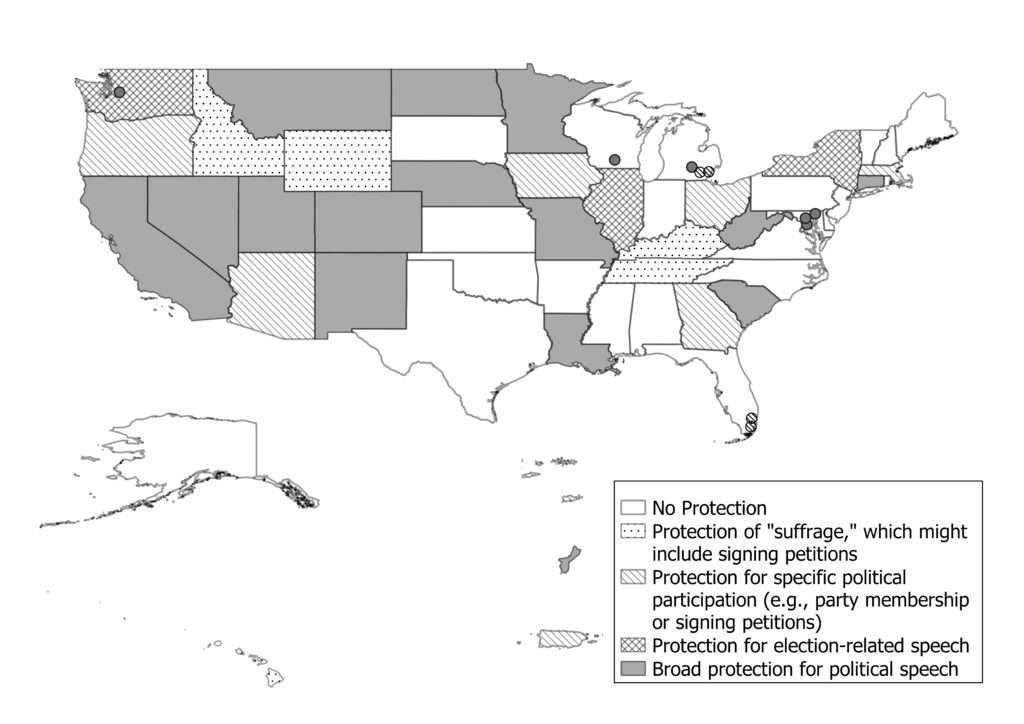
Share

Black Lives In Madison, August 1963

WORT-FM

On the 15th, the State Journal summarizes the ambiguous nature of discrimination which the dozen or so Black pupils face in the 10,000-student strong city school system under the headline “Bias in Schools? No and Yes.” Around that time, the school board reveals it wants to build a junior high school in South Madison, probably at the corner of Magnolia Lane and Cypress Way. It would be part of a $9 million building program, which school superintendent Robert Gilberts says will meet the city’s needs until 1971.

And there’s little ambiguity in the State Journal’s final report on August 25, under the headline “Clergy Call Race Moral Problem.”

The Cap Times surveys the employment situation on the seventh, under the headline: Madison Negroes Make Minor Dents in Local Job Bias / Few Firms Change Policy.  It reports that CUNA now has six black employees including a journeyman printer, administrative assistant, and assistant director of accounting, and that three of the city’s four department stores employ Blacks, including one store with six Black women operating the elevators. There are no Black clerks in the city supermarkets.

Two days later, it gets personal, under the headline Colson Aiming NAACP Drive At Monied Society / Portrait of a Rights Leader. It reports that Marshall Colston, president of the Madison branch of the venerable civil rights organization, is a mild-mannered militant who “has been honing the local NAACP chapter into a fine cutting tool to carry Negro protests to the unsullied and money heights of Madison society.” Among the initiatives of the 36-year-old state welfare supervisor – a strong local ordinance banning bias in employment and housing. And the activist has little patience for his organization’s more cautious members – especially middle-age whites who joined the group as a liberal gesture while it was devoted to “aimless, meandering” policies.

Share

The New Hires of 2023 Are Unprepared for Work

Douglas Belkin, Ben Chapman and Ben Kesling:

Roman Devengenzo was consulting for a robotics company in Silicon Valley last fall when he asked a newly minted mechanical engineer to design a small aluminum part that could be fabricated on a lathe—a skill normally mastered in the first or second year of college.

“How do I do that?” asked the young man.

So Devengenzo, an engineer who has built technology for NASA and Google, and who charges consulting clients a minimum of $300 an hour, spent the next three hours teaching Lathework 101. “You learn by doing,” he said. “These kids in school during the pandemic, all they’ve done is work on computers.”

The knock-on effect of years of remote learning during the pandemic is gumming up workplaces around the country. It is one reason professional service jobs are going unfilled and goods aren’t making it to market. It also helps explain why national productivity has fallen for the past five quarters, the longest contraction since at least 1948, according to the U.S. Labor Department.

The shortcomings run the gamut from general knowledge, including how to make change at a register, to soft skills such as working with others. Employers are spending more time and resources searching for candidates and often lowering expectations when they hire. Then they are spending millions to fix new employees’ lack of basic skills. 

Talent First, a business-led workforce-development organization in Grand Rapids, Mich., is encouraging employers to stop trying to hire based on skill. Instead, hiring managers should look for a willingness to learn, said President Kevin Stotts.

“Employers are saying, ‘We’re just trying to find some people who could fog the mirror,’ ” Stotts said.

Legislation and Reading: The Wisconsin Experience 2004

“Well, it’s kind of too bad that we’ve got the smartest people at our universities, and yet we have to create a law to tell them how to teach.”

The data clearly indicate that being able to read is not a requirement for graduation at (Madison) East, especially if you are black or Hispanic”

My Question to Wisconsin Governor Tony Evers on Teacher Mulligans and our Disastrous Reading Results

2017: West High Reading Interventionist Teacher’s Remarks to the School Board on Madison’s Disastrous Reading Results 

Madison’s taxpayer supported K-12 school district, despite spending far more than most, has long tolerated disastrous reading results.

“An emphasis on adult employment”

Wisconsin Public Policy Forum Madison School District Report[PDF]

WEAC: $1.57 million for Four Wisconsin Senators

Friday Afternoon Veto: Governor Evers Rejects AB446/SB454; an effort to address our long term, disastrous reading results

Booked, but can’t read (Madison): functional literacy, National citizenship and the new face of Dred Scott in the age of mass incarceration.

When A Stands for Average: Students at the UW-Madison School of Education Receive Sky-High Grades. How Smart is That?

Share

The tyrany of low expectations: Massachusetts’ Teachers Union Ballot initiative to eliminate high school graduation requirement

James Vaznis:

The ballot initiative would allow students to graduate “by satisfactorily completing coursework that has been certified by the student’s district as showing mastery of the skills, competencies, and knowledge contained in the state academic standards and curriculum frameworks in the areas measured by the MCAS high school tests.”

A small group of union activists, parents, and high school graduates filed a ballot initiative Wednesday, with the backing of the state’s largest teachers union, that would end a state provision requiring students to pass the MCAS tests to graduate, setting up a potentially costly election fight.

Currently, high school students must pass Massachusetts Comprehensive Assessment System exams in English, math, and science to graduate. More than 700 high school students a year typically don’t receive a diploma because they didn’t meet that requirement, according to state data. Instead, they received “certificates of attainment,” which are given to students who only satisfied local graduation requirements. However, many educators say a number of students who don’t pass MCAS ultimately drop out.

The ballot question is the MTA’s latest effort to end the graduation requirement. Earlier this year, the MTA and other unions had legislation introduced on Beacon Hill that would end the graduation requirement.

Groups, such as the Massachusetts Business Alliance for Education, have been aggressively fighting the unions’ efforts.

“MCAS is a crucial instrument for measuring students’ vital signs to make sure they’re getting the education they deserve and that they need to be successful after high school,” the business alliance said in a statement.

Notes and links on MTEL.

Legislation and Reading: The Wisconsin Experience 2004

“Well, it’s kind of too bad that we’ve got the smartest people at our universities, and yet we have to create a law to tell them how to teach.”

The data clearly indicate that being able to read is not a requirement for graduation at (Madison) East, especially if you are black or Hispanic”

My Question to Wisconsin Governor Tony Evers on Teacher Mulligans and our Disastrous Reading Results

2017: West High Reading Interventionist Teacher’s Remarks to the School Board on Madison’s Disastrous Reading Results 

Madison’s taxpayer supported K-12 school district, despite spending far more than most, has long tolerated disastrous reading results.

“An emphasis on adult employment”

Wisconsin Public Policy Forum Madison School District Report[PDF]

WEAC: $1.57 million for Four Wisconsin Senators

Friday Afternoon Veto: Governor Evers Rejects AB446/SB454; an effort to address our long term, disastrous reading results

Booked, but can’t read (Madison): functional literacy, National citizenship and the new face of Dred Scott in the age of mass incarceration.

When A Stands for Average: Students at the UW-Madison School of Education Receive Sky-High Grades. How Smart is That?

Share

Thoughts on education, age segregation, and politics

Glenn Reynolds:

Why is the “party of youth” run by old people?

There’s an amusing piece on British Labourite Jeremy Corbyn’s economic policies that makes an important point about age groupings in modern society and politics.  I’m not sure where it’s from originally, as it’s one of those things that just float around, though it’s obviously from a British magazine.  I couldn’t find it via Google. 

But that’s not important. It speaks for itself. Here it is:

Share

A fun, wide-ranging conversation with Nick Gillespie of the acclaimed libertarian magazine

Matt Taibbi:

Even before the news media business went fully off the rails in recent years, Reason always stood out as a publication unafraid to take unconventional stances or report on controversial issues. I’ve always been a fan, and was glad to get a chance at Freedom Fest in Memphis to sit down with the magazine’s famed former editor, Nick Gillespie, for a wide-ranging talk about censorship, the changing political landscape, and how press coverage in recent years has started to resemble Three’s Company. Thanks to Nick and to Reason for the invitation.

Share

John Hindraker:law Enforcement and Race

Enter David Zimmer. David is a veteran of 33 years in the Hennepin County Sheriff’s office, from which he retired as a Captain. He now works for American Experiment as a Policy Fellow in Law Enforcement and Criminal Justice. David went through the painstaking work of analyzing the BCA’s offender data and comparing it with arrest, prosecution, conviction, sentencing and incarceration data, which come from various sources. What he found should put to rest forever the theory that law enforcement in states like Minnesota is biased against blacks. 

The BCA offender data show that blacks commit serious crimes at a per capita rate ten times that of whites. That proportion is followed from arrests through incarceration, except that David’s analysis finds that Minnesota’s criminal justice system discriminates–in a statistical sense–against whites, as compared with blacks.

The report is here. Some might find it boring, as it consists largely of statistical analysis and charts and graphs. But if you enjoy seeing a liberal narrative dismantled brick by brick, David’s report is for you.

We issued a press release on David’s report, but shockingly, neither the Minneapolis Star Tribune nor any other liberal news outlet took us up on the opportunity to interview Zimmer, or published any reference to the report. That’s OK. We know whose side those outlets are on. They are on the side of the perpetrators of serious crimes, not the victims. David’s report concludes with the fact that the victims of serious crime line up the same as the perpetrators–on a per capita basis, victims are ten times as likely to be black. So the liberals are hurting those they pretend to care about.

Share

The Banality of Student Loans

Oren Cass:

The mythology of “college for all” has produced a perverse financing system for higher education. Because policymakers regarded a college education as necessary to opportunity, they made it a public obligation to facilitate any student attending any school, regardless of cost. Because they regarded a degree as sufficient for success, they presumed that the return on investment would always be high. And having granted “education” a sacred status unlike other goods and services, they gave the associated debt a sacred status as well: not to be discharged in bankruptcy.

The results have been disastrous. College costs skyrocketed, fueled by government subsidies designed to grow right along with tuition. Young Americans and their families were encouraged to assume whatever debt necessary—by not only policymakers promoting their loan programs, but also a culture that equated the practice with “investing in your future” and institutions that cashed the checks upfront and were never held accountable. In how manymovies does the teenager, discovering his family’s financial troubles, concede gloomily that he can abandon his first-choice school and attend the state university nearby, only for a determined parent to insist, no, we will find a way?

In reality, meanwhile, students are more likely to drop out of college or else land in a job that does not require their degree than they are to graduate into a career. Research suggests that, for men, the selectivity of their school has no effect on future earnings; for women, more selective schools lead to more hours worked and lower marriage rates. The United States spends more than $25K per student—second only to Luxembourg among developed economies and more than twice the $10K–$11K spent in countries like Denmark, France, and Germany. And student loan debt has become the nation’s largest form of non-mortgage debt, sextupling from $260 billion in 2004 to $1.53 trillion at the start of 2020, by which point the U.S. Department of Education reported that about 20% of borrowers were in default.

“Why is a household with relatively high student loan debt more deserving of government beneficence than a household with relatively high credit card debt, or with an auto loan it is struggling to pay off?”

Share

The best predictor of happiness in America? Marriage

W. Bradford Wilcox & David Bass:

A new survey found a 30-percentage point happiness divide between married and unmarried Americans

Americans who are married with children are now leading happier and more prosperous lives, on average, than men and women who are single and childless.

Is that statement surprising? In an age that prizes individualism, workism, and a host of other self-centric “isms” above marriage and family, it may well be. But the reality is that nothing currently predicts happiness in life better than a good marriage. 

This truth is borne out yet again in new research from the University of Chicago, which found that marriage is the “the most important differentiator” of who is happy in America, and that falling marriage rates are a chief reason why happiness has declined nationally. The research, surveying thousands of respondents, revealed a startling 30-percentage-point happiness divide between married and unmarried Americans. This happiness boost held true for both men and women.

“Marital status is and has been a very important marker for happiness,” researcher Sam Peltzman concludes. “The happiness landslide comes entirely from the married. Low happiness characterizes all types of non-married. No subsequent population categorization will yield so large a difference in happiness across so many people.”

Share

It turns out the percentage of the globe that burns each year has been declining since 2001.

Bjorn Lomborg:

One of the most com­mon tropes in our in­creas­ingly alarmist cli­mate de­bate is that global warm­ing has set the world on fire. But it hasn’t. For more than two decades, satel­lites have recorded fires across the plan­et’s sur­face. The data are un­equiv­o­cal: Since the early 2000s, when 3% of the world’s land caught fire, the area burned an­nu­ally has trended down­ward.

Share

We can save what matters about writing—at a price

Ted Underwood:

It’s beginning to sink in that generative AI is going to force professors to change their writing assignments this fall. Corey Robin’s recent blog post is a model of candor on the topic. A few months ago, he expected it would be hard for students to answer his assignments using AI. (At least, it would require so much work that students would effectively have to learn everything he wanted to teach.) Then he asked his 15-year-old daughter to red-team his assignments. “[M]y daughter started refining her inputs, putting in more parameters and prompts. The essays got better, more specific, more pointed.”

Perhaps not every 15-year-old would get the same result. But still. Robin is planning to go with in-class exams “until a better option comes along.” It’s a good short-term solution.

In this post, I’d like to reflect on the “better options” we may need over the long term, if we want students to do more thinking than can fit into one exam period.

Share

Civics: Election Litigation

Share

Wikipedia: From Democratized Knowledge to Left-Establishment Propaganda

Glenn Greenwood & Larry Sanger:

Share

What the new Ivy+ admissions paper really shows

Matthew Yglasias

The student bodies at America’s top colleges are overwhelmingly skewed toward children of the affluent. 

Looking at the Ivy+ set of colleges — the eight Ivy League schools plus MIT, Chicago, Duke, and Stanford — a staggering 42% of the class is drawn from households in the top 5% of the income distribution. And though these schools account for just 0.8% of all American college students, they generated 11.6% of current CEOs, 26% of the staff of the New York Times and Wall Street Journal, and 71.4% of recent Supreme Court justices. This relatively narrow bottleneck for entry into the American elite is a powerful replicator of socioeconomic privilege. So when the Opportunity Insights project documented in a recent paper that students from the richest households are much more likely to be admitted to these schools than other students with similar test scores, it was a blockbuster finding even though it didn’t exactly surprise people. 

This chart published in the New York Times based on the research, in particular, went extremely viral.

Share

Estimating Individual Guidance Counselors’ Effects on Educational Attainment

Christine Mulhern:

Guidance counselors are a common school resource for students navigating complicated and consequential education choices. I provide the first causal estimates of individual coun- selors’ effects on high schoolers, using quasi-random counselor assignment policies in Mas- sachusetts. I find that counselors vary substantially in their effectiveness at increasing stu- dents’ high school graduation rates and college attendance, selectivity and persistence. Coun- selors’ effects on educational attainment are similar in magnitude to teachers’ effects, but they flow through improved information and direct assistance, rather than through improved cog- nitive or non-cognitive skills. Counselor effectiveness is most important for low-achieving and low-income students, perhaps because these students are most likely to lack other sources of information and assistance. Good counselors tend to improve all measures of educational attainment but some specialize in improving high school behavior while others specialize in increasing selective college attendance. Improving access to effective counseling may be a promising way to increase educational attainment and close socioeconomic gaps in education.

Share

Why Elite Colleges Do Affirmative Action For the Rich

Eric Levitz:

There are more high-school graduates qualified to attend an elite American college than there are admissions slots at such schools. As a result, our nation’s top universities must perennially find ways of distinguishing meritorious applicants who are worthy of admission from equally meritorious applicants who are not. One way they’ve done this is to take equity into account. Faced with an applicant from a comfortable middle-class background and another equally qualified applicant who grew up in poverty, universities have tended to favor the latter. Similarly, top schools have historically used membership in an underrepresented racial or ethnic group as a tiebreaker. But the Supreme Court recently ruledthat those sorts of racial preferences violate the Constitution.

Share

Experts and the Power of Self-Deception

Robert Graboyes:

“I don’t dismiss experts. I simply don’t worship them. I don’t wish to grant them authoritarian power. And, out of a sense of risk-aversion and a knowledge of history, I want them kept on short leashes. As I wrote sometime back, science is a fine expert witness and a bloody dangerous judge.”

Experts are ordinary human beings, with all the fallibilities that come with membership in our species. Like everyone else, experts sometimes suppress truth and disseminate falsehoods for self-preservation or personal gain. Sometimes, they do so in service to some larger cause. Experts, short on time or resources, may cut corners, publishing information they hope is correct, while knowing it may not be. In all these situations, the expert knows his or her information is or may be false. 

More interesting, more likely, and more dangerous are those situations where the expert sincerely believes his or her falsehoods to be correct, owing to the lure of self-deception. Paul Simon’s “The Boxer” sings:

Share

Wisconsin Gov. Tony Evers took down a public records tracking website 4 years ago and never put it back up

Tyler Katzenberger

Data from the governor’s office showed Evers’ administration during his first term took more time to complete open records requests than Walker’s administration did during his second term. Evers’ office on average completed requests in 38 days compared to 33 days under Walker’s office, though Evers’ office handled approximately 40% more requests and did not include some routine requests from journalists in tabulations.

Bill Lueders, president of the Wisconsin Freedom of Information Council, urged Evers to revive the website. He hoped a new transparency initiative would improve response times, which he said are “worse now than ever.”

Share

“The decision, by Judge Colleen McMahon of United States District Court in Manhattan, was scathing in its description of the methods used by the F.B.I. in its pursuit of the three”

Jesse McKinley

A federal judge on Thursday ordered the “compassionate release” of three Hudson Valley men who were part of a group known as the “Newburgh Four” after finding that F.B.I. agents had used an “unscrupulous operative” to persuade them to join a plot to blow up synagogues and bring down military planes more than a decade ago.

The decision, by Judge Colleen McMahon of United States District Court in Manhattan, was scathing in its description of the methods used by the F.B.I. in its pursuit of the three — Onta Williams, Laguerre Payen and David Williams — calling the plot in which they were convicted ofparticipating in 2010 “an F.B.I.-orchestrated conspiracy.”

Share

Civics: Say Goodbye to Permissionless Travel

Matt Welch:

Before you start shaking your fist at freedom-hating Eurocrats, know that ETIAS is the belated continental answer to a system the U.S. has imposed on residents of friendly countries since 2009, called the Electronic System for Travel Authorization, or ESTA. Like ETIAS, ESTA is a response to 21st-century terrorist attacks and combines modest fees ($21) with less-than-instantaneous turnaround times (a promised 72 hours). Both either tweak or torpedo (depending on your point of view) the notion of reciprocal “visa waiver” travel between high-trust countries.

U.S. passports have long been given the red carpet treatment worldwide, due to the country’s economic heft and traditional leadership role in negotiating down international barriers to the movement of people (and goods). That latter ethic began to deteriorate after the Cold War, with the rise of bipartisan anti-illegal immigration politics in the early 1990s, and then in earnest after Saudi nationals pulverized the World Trade Center with highjacked planes on September 11, 2001.

The Implementing Recommendations of the 9/11 Commission Act of 2007 mandated that travelers from Visa Waiver countries (which now number 40) submit an application using a machine-readable passport, volunteer plenty of personal information, and answer correctly a series of potentially disqualifying questions. As some of us mentioned at the time, “Whatever we impose on the world, the world will get around to imposing on us.”

We have since imposed still more restrictions, which many Europeans are discovering this summer to their chagrin. First was the 2015 exclusion (backed by several libertarian-leaning legislators) of dual nationals of both an existing Visa Waiver country and of either Iran, Iraq, Sudan, or Syria, as well as anyone (aside from those in selected professions) who had visited any of those countries since 2011. Then in 2016, the Department of Homeland Security (DHS) added Libya, Somalia, and Yemen to the list.

Share

Illegal medical lab discovered near Fresno

Juanita Adame:

“There was a special room that was built housing about 1000 white lab mice,” Zieba explained.

What they found was absolutely terrifying.

“Through their statements that they were doing some testing on laboratory mice that would help them support, developing the COVID test kits that they had on-site,” Prado said.

Health officials discovered nearly 1,000 lab mice, 200 of which were already dead.

Also found were thousands of vials, many of which contained biohazardous materials including human blood, and other unknown substances.

“A lot of these labels have been removed from bottles so there was only so much testing. We could do those chemicals,” Prado continued.

According to court documents officials with the Centers for Disease Control tested what they could and determined that at least 20 potentially infectious viral, bacterial, and parasitic agents were present including E. Coli, malaria, and even COVID.

“I think because of that swift action that was taken we had been able to maintain public safety this entire time,” Prado explained.

Over the course of several weeks, officials with local, state, and federal agencies worked to remove the materials from the location

Share

US Spies Are Lobbying Congress to Save a Phone Surveillance ‘Loophole’

Dell Cameron:

An effort by United States lawmakers to prevent government agencies from domestically tracking citizens without a search warrant is facing opposition internally from one of its largest intelligence services.

Republican and Democratic aides familiar with ongoing defense-spending negotiations in Congress say officials at the National Security Agency (NSA) have approached lawmakers charged with its oversight about opposing an amendment that would prevent it from paying companies for location data instead of obtaining a warrant in court.

Introduced by US representatives Warren Davidson and Sara Jacobs, the amendment, first reported by WIRED, would prohibit US military agencies from “purchasing data that would otherwise require a warrant, court order, or subpoena” to obtain. The ban would cover more than half of the US intelligence community, including the NSA, the Defense Intelligence Agency, and the newly formed National Space Intelligence Center, among others.

Share

Allowing more unsupervised free play is among the most powerful and least expensive ways to bring down rates of mental illness

Jon Haidt & Peter Gray:

The central idea of my forthcoming book, The Anxious Generation, is that we have overprotected children in the real world, where they need a lot of free play and autonomy,while underprotecting them online, where they are not developmentally ready for much of what happens to them. Much of my thinking about the importance of free play comes from Peter Gray, a professor of psychology at Boston College who is one of the world’s leading experts on the psychology of play. See his powerful TED talk, where he lays out the evolutionary origins of play—a necessity for all young mammals. He then shows how we have systematically deprived children of free play since the 1970s and shows that adolescents’ mental health has declined substantially over the same period. He notes that this is a correlation, not proof of causation, although experiments with animals support the claim that play deprivation causes anxiety and poor social development.

Peter gave that talk in 2014. Since then, the mental health of children and adolescents has worsened, and evidence has increased showing that Peter was correct. Peter recently published a major review article in the Journal of Pediatrics titled Decline in Independent Activity as a Cause of Decline in Children’s Mental Well-being: Summary of the Evidence. I think it’s among the most important essays ever written on play. I was planning to write a summary of the article for the After Babel Substack, but a few days ago, I got Peter’s own summary of the article, which he posted on his new Substack, Play Makes Us Human, which you can find and subscribe to here:

Share