School Information System

Curious Math Rhetoric

Share

Commentary on Florida Teacher Union climate

Caleb Ecarma:

This two-pronged attack against educators and their union advocates, argues Pringle, the NEA president, is part of an overarching plot to make public schools more and more dysfunctional—therefore eroding community trust in them—before increasingly privatizing the system. “They’re systematically trying to pollute our schools and sow division within the labor movement and within communities,” she says. “This is just a part of their playbook.”

Share

Long term study of “reading recovery”; Madison was/is a long time user…

the report.

“Well, it’s kind of too bad that we’ve got the smartest people at our universities, and yet we have to create a law to tell them how to teach.”

The data clearly indicate that being able to read is not a requirement for graduation at (Madison) East, especially if you are black or Hispanic”

My Question to Wisconsin Governor Tony Evers on Teacher Mulligans and our Disastrous Reading Results

2017: West High Reading Interventionist Teacher’s Remarks to the School Board on Madison’s Disastrous Reading Results 

Madison’s taxpayer supported K-12 school district, despite spending far more than most, has long tolerated disastrous reading results.

“An emphasis on adult employment”

Wisconsin Public Policy Forum Madison School District Report[PDF]

WEAC: $1.57 million for Four Wisconsin Senators

Friday Afternoon Veto: Governor Evers Rejects AB446/SB454; an effort to address our long term, disastrous reading results

Booked, but can’t read (Madison): functional literacy, National citizenship and the new face of Dred Scott in the age of mass incarceration.

When A Stands for Average: Students at the UW-Madison School of Education Receive Sky-High Grades. How Smart is That?

Share

Centralized empathy and the philanthropic calculation debate: “man plans, God laughs”

Robert Graboyes:

The greatest economics lesson of all may reside in the Yiddish expression, “Der mensch tracht, un Gott lacht” (“Man plans, and God laughs.”)That, writ small, is the message of Friedrich Hayek’s broadsides against central planning in The Fatal Conceit and “The Use of Knowledge in Society.” The latter was one of the most influential economic essays of the 20th century, and in a gentler time, when philosophical adversaries actually listened to one another (some, at least), a significant number of socialists and would-be planners found the anti-socialist Hayek’s arguments persuasive (or at least informative). Hayek dedicated his The Road to Serfdom “to the socialists of all parties,” and he wrote that dedication with respect. Hayek, ever-generous of spirit, had no interest in “owning the libs.”

In recent years, the impulse to apply central planning techniques to charitable endeavors has taken form in the Effective Altruism (EA) movement. The movement has been defined by its own adherents as: 

“Effective altruism is a research field and practical community that aims to find the best ways to help others, and put them into practice.” 

Ostensibly, the idea is to think systematically about charity, to develop metrics concerning the relative effectiveness of different charitable outlets, and to use those metrics to apply cost-effectiveness analysis to help allocate resources across charitable institutions. Both the goal and the mathematical approach of EA appeal to me as an economist, but I’m always aware of economists’ chronic overconfidence in the ability of mathematical tools, created and operated by a clerisy of “experts,” to optimize over complex human behavior.

Share

Notes on Milwaukee’s latest pension disaster

2002 Milwaukee pension scandal primer:

The pension scandal that broke in 2002 brought county government to its knees, forcing politicians from office and saddling taxpayers with massive unexpected costs that harmed parks, transit and social services.

Now, in a final chapter, a major civil lawsuit will put major players on the witness stand for the first time.

Here’s a roadmap for understanding the trial:

What’s at stake?

  • Money: Milwaukee County claims up to $900 million in higher costs linked to the 2000-’01 pension deal. A big win could alleviate some of the county’s stressed finances. The county claim comes as Mercer Inc., the county’s pension numbers cruncher, and its parent firm Marsh and McLennan Companies face another huge pension lawsuit by the state of Alaska. Also, Marsh and McLennan carry no insurance to cover employee errors – making a loss even more painful.
  • Careers: A win would help County Executive Scott Walker build political capital that could come in handy for his run for governor. A win would also help former County Executive F. Thomas Ament and some current and former county supervisors claim vindication, after years of public scorn over the pension scandal.
  • Closure: After six years of angst, political turmoil and public opprobrium over the county pension deal, the case could shed new light on the deal’s origins, who deserves blame and an ultimate accounting of its costs.

The stage: Federal Courthouse, 517 E. Wisconsin Ave.

The basics: Jury selection begins Monday, May 4. Testimony expected to last about four weeks. No photo, video or audio coverage is allowed under federal rules.

Back to top

Share

Minnesota Drops Race Requirements Excluding Whites From Summer Program After Equal Protection Project Complaint

William Jacobson:

On Sunday night, May 21, 2023, I wrote about the Civil Rights Complaint filed by the Equal Protection Project of Legal Insurrection Foundation regarding a summer researh internship program at the University of Minnesota that excluded white students, Non-Whites Only U. Minnesota Summer Research Program Challenged By Equal Protection Project.

Share

Notes on book bans and the Bezos Washington Post

more:

My perspective is just as relevant and important as Ruth Marcus’s or Dahlia Lithwick’s, two former Politics and Prose speakers whose anti-Kavanaugh books were featured prominently in the store. Another speaker was Joan Biskupic, CNN Supreme Court reporter and the author of an anti-Kavanaugh book called Nine Black Robes.

My book is also one of the only honest retellings of Kavanaugh’s confirmation battle. Knowing that the Stasi media and the corrupt liberal politicians would lie about anything that came out of my mouth, I purposely controlled my own narrative. I wrote in detail about the criminality of those who tried to destroy Kavanaugh’s character — and mine.

It’s as good a case as any for a spot on a display row — especially at a liberal bookstore. Bookstores like P & P were once the fearless places where you were able to get edgy and bizarre books. When I was in college in D.C. in the 1980s, the big three cutting-edge books were Tropic of Cancer by Henry Miller, Naked Lunch by William S. Burroughs, and Lolita by Vladimir Nabokov.

Share

Preliminary Injunction Against “Disparag[ing]” or “Frivolous” Claims About School Board or Employees …

Eugene Volokh:

From Livingston Parish School Bd. v. Kellett, decided Thursday by the Louisiana Court of Appeal (Judge Allison Penzato, joined by Judges Duke Welch & Walter Lanier):

[T]he School Board discovered that Ms. Kellett, the mother of a child attending Live Oak Elementary School, “repeatedly concealed” electronic devices in her child’s clothing or personal belongings in November 2019. Ms. Kellett purportedly used these devices to “intercept communications by and between faculty, students, and others in the school and/or classroom during school hours and while on school property.” One such device, an AngelSense, had GPS capability to track the child’s whereabouts and also allowed verbal communications between Ms. Kellett and her child. The School Board obtained a temporary restraining order (TRO) on January 27, 2020, then a preliminary injunction on April 8, 2020, prohibiting Ms. Kellett’s use of these devices on school property.

The School Board also accused Ms. Kellett of being critical of the School Board and publicly discussing “her child’s special needs” and individual education plan with the media. Ms. Kellett allegedly maintained a “live web blog and other ongoing social media posts” that involved discussion and disclosure of information related to the School Board, the special education program, and other identified individuals. According to the School Board, these posts have “caused concern for parents of other [Livingston Parish School System] students and have defamed and slandered the reputations of [the School Board] and Live Oak Elementary staff.” The January 27, 2020 TRO and April 8, 2020 preliminary injunction addressed this additional complaint by the School Board. Pertinently, the April 8, 2020 preliminary injunction enjoined, restrained, and prohibited Ms. Kellett from:

… d) … engaging in any form of written, verbal, or physical displays of hostility, anger, or disparagement, and/or from making threats of any physical assault, and/or any disorderly conduct that results in fear or disruption of activities through hostile and inappropriate behavior toward any LPSB [Livingston Parish School Board] member, administrator, faculty or staff at Live Oak Elementary School and/or on any LPSS [Livingston Parish School System] public school bus or other school property, and/or while participating in any educational or other school related business or function, including but in no way limited to any Individual Education Plan (IEP) or Individual Health Plan (IHP) meetings or evaluations required to facilitate the minor child’s special education and health care needs;

f) … making or publishing and/or from engaging in any activity to make, disseminate, publish or broadcast defamatory, slanderous, libelous, frivolous and/or fraudulent claims or statements concerning [the School Board], its faculty, staff and employees, as defined by R.S. 14:47-48, 13:3381(B), directly or by her enlisting the assistance of any other person(s) on her behalf ….

The School Board argues that false statements, like Ms. Kellett’s accusations against the School Board and its employees, which purportedly include allegations of criminal conduct, are not constitutionally protected free speech. Worse, it asserts, the words uttered by Ms. Kellett are defamatory per se. In Kennedy v. Sheriff of East Baton Rouge (La. 2006), the Louisiana Supreme Court recognized that words that expressly or implicitly accuse another of criminal conduct, or which by their very nature tend to injure one’s personal or professional reputation, without considering extrinsic facts or circumstances, are considered defamatory per se. “When a plaintiff proves publication of words that are defamatory per se, falsity and malice (or fault) are presumed, but may be rebutted by the defendant.” Thus, before liability can be imposed for the publication of words that are defamatory per se, the defendant must be given an opportunity to rebut the presumption.

Share

Democracy Perception Index

Alliance of Democracies:

The Democracy Perception Index (DPI) is the world’s largest annual study on democracy, conducted by Latana in collaboration with the Alliance of Democracies, to monitor attitudes towards democracy from around the world.

Share

Where Do Great Ideas Come From?

The Generalist:

The great business theorist Peter Drucker didn’t think all that much of ideas. “Ideas are cheap and abundant,” the management expert said, “What is of value is the effective placement of those ideas into situations that develop into action.” 

Drucker’s position is a common one. Across academia and industry, plenty of fine thinkers have made equivalent statements, arguing that real value resides in effective implementation, not ideation. The prolific executive brings most value to the world, this thesis goes, rather than the unproductive theorist. 

Though there’s wisdom in Drucker’s words, he is wrong in his assessment of ideas. Ideas are not cheap, not the valueless things the Austro-American characterizes them as. Certainly, ideas cannot impact society without “effective placement,” but there would be nothing to “place” without them. They are the seed of all progress, the beginning of every great invention. The fibers of our clothing, refrigeration of our food, design of our medicines, and architecture of our computer chips all began as ideas, or more accurately, a series of ideas stacked on top of each other, finely balanced. 

Nor are ideas abundant. Indeed, there is evidence they are growing rarer by the year. A Stanford University study titled “Are Ideas Getting Harder to Find?” detailed how “research effort is rising substantially while research productivity is declining sharply.” For example, maintaining Moore’s Law – which predicts the doubling of transistors on a computer chip every two years – has required massive increases in research efforts. Compared to the 1970s, 18x more researchers are needed to continue its trajectory, with productivity slipping. The study documents similar slumps in other industries like agriculture and healthcare. 

The decrement of ideas makes their study all the more important. Rather than diminishing them, we should seek to understand better how, where, and by who they are created. What incentives encourage originality? Who should you hire to boost an organization’s innovation? And how do you harness the abilities of a collective?

Share

Notes on competent leadership

L. (Tex) Leugner

At the 2015 election enough Canadians voted to elect a man to the highest office in the land who had previously accomplished nothing more that inherit a name, thus confirming that Canada has a far more serious problem.

The danger to Canada is not only Justin Trudeau, but a citizenry capable of entrusting an incompetent man with the job of Prime Minister.

What is truly frightening is that it will be far easier to limit and undo the corrupt actions of Trudeau than to restore the necessary common sense and good judgment to an ignorant, unthinking electorate unwilling to research economic facts and elect such a jackass in the first place.

The problem therefore is much deeper and far more serious than just Mr. Trudeau, who is only a symptom of what ails this once great country. Blaming this unaccomplished, undistinguished hypocrite for the economic malaise he foisted on Alberta should not blind anyone to the stupidity of the majority of Canadian voters who elected this unpatriotic, treasonous, corrupt scoundrel in the first place.

Share

Curious (false claims) reporting on legacy k-12 schools, charter/voucher models and special education

Wisconsin coalition for education freedom:

Wisconsin Watch has released its third article in a series attempting to discredit the great work choice programs do in Wisconsin. Their latest article misrepresents admission policies of choice schools while ignoring the fact that public schools often engage in admission practices that would be illegal for schools participating in the state’s choice programs.
Wisconsin Watch is again making false claims.

  • In their most recent article, Wisconsin Watch again misrepresents school choice admission practices and now adds a false narrative that schools “expel” students with disabilities at will. Their claims don’t match reality, nor is a single example provided.
  • Fact: Schools in Wisconsin’s choice programs may not discriminate against any eligible family based on a student’s disability.i
  • As with many individual public schools, individual private schools are not required to provide a full range of disability services. Parents who choose to enroll their student do so only after being fully informed of available services.
    Some Wisconsin public schools have admissions processes that would be illegal for private choice schools.
  • Public school districts often have specialty public schools, in addition to their residentially assigned schools. Public schools are permitted to create admission requirements for these schools.
  • Public schools having admission requirements is not a new phenomenon, with the practice being documented in Wisconsin for decades.ii (Link)
  • Today, specialty schools like those in Milwaukeeiii (Link) use a points system to admit students based on their report card scores, attendance, standardized test scores, and an essay. In Green Bay,iv (Link) students must complete a test for admission to a school for the gifted.
    1
  • Choice schools must admit students on a random basis if there is excess demand with few exceptions, primarily related to being in the same family as an existing student.v (Link)
    Public schools reject students in the public school full-time open enrollment program.

Phoebe Petrovic:

As an advocacy specialist at Disability Rights Wisconsin, Joanne Juhnke regularly finds herself on the phone with parents concerned about their children’s treatment at school.

Most complaints concern public schools, which enroll the majority of students. State funding for special education has shrunk, forcing districts to struggle to provide services, and disparate treatment of students with disabilities at public schools persists. But in public school, families have a state body to appeal to: the Department of Public Instruction.

DPI is far less helpful in disputes with private schools, which under state law can legally discriminate against students who need certain disability accommodations — or even kick them out. This applies even to private schools that receive taxpayer-funded tuition vouchers to educate students.

The calls Juhnke receives from voucher families often contain the same story. A family has enrolled a child with disabilities in a private school. Administrators have begun pressuring the student to leave or have kicked them out, something public schools cannot do. The parents are shocked. They’re sure the schools can’t do that.

Many times, Juhnke has to tell them: Yes, they can.

“You went into this school choice program thinking that you were the one, as the parents, who have the choice,” she said. “Really, on the other end, the school holds more choice cards than you do, and you’re coming out on the wrong side of that.”

I find the timing of Wisconsin Watch’s articles curious, amidst budget season. Ideally, the writer might dive deep and wide into the effectiveness of our well funded k-12 system. Reading would be a terrific place to start.

This Wisconsin Watch article was referenced in a recent St Marcus (Milwaukee) podcast. St Marcus operates an extraordinarily successful choice school on the City’s near north side. Read more, here.

Governor Evers’ most recent budget proposals have attempted to kill One City Schools’ charter authorization…

“Well, it’s kind of too bad that we’ve got the smartest people at our universities, and yet we have to create a law to tell them how to teach.”

The data clearly indicate that being able to read is not a requirement for graduation at (Madison) East, especially if you are black or Hispanic”

My Question to Wisconsin Governor Tony Evers on Teacher Mulligans and our Disastrous Reading Results

2017: West High Reading Interventionist Teacher’s Remarks to the School Board on Madison’s Disastrous Reading Results 

Madison’s taxpayer supported K-12 school district, despite spending far more than most, has long tolerated disastrous reading results.

“An emphasis on adult employment”

Wisconsin Public Policy Forum Madison School District Report[PDF]

WEAC: $1.57 million for Four Wisconsin Senators

Friday Afternoon Veto: Governor Evers Rejects AB446/SB454; an effort to address our long term, disastrous reading results

Booked, but can’t read (Madison): functional literacy, National citizenship and the new face of Dred Scott in the age of mass incarceration.

When A Stands for Average: Students at the UW-Madison School of Education Receive Sky-High Grades. How Smart is That?

Share

Commentary on lockdowns and their implications

Related: “mandates” from unelected officials at taxpayer supported Dane County Madison Public Health.

Share

SATs are out. Published ‘research’ is in, but it’s pay to play

Joanne Jacobs:

Test scores are out. Everyone’s got an A average. The “community service” trip to Mexico and the start-your-own-charity gambit are ho-hum.

Ambitious parents are paying to get a published “research” project on their teenagers’ college applications, report Daniel Golden and Kunal Purohit for ProPublica and the Chronicle of Higher Education.

Share

The Student-Loan Payment Pause Led Borrowers to Take on More Debt

Michael Dinerstein, Constantine Yannelis and Ching-Tse Chen:

We evaluate the effects of the 2020 student debt moratorium that paused payments for student loan borrowers. Using administrative credit panel data, we show that the payment pause led to a sharp drop in student loan payments and delinquencies for borrowers subject to the debt moratorium, as well as an increase in credit scores. We find a large stimulus effect, as borrowers substitute increased private debt for paused public debt. Comparing borrowers whose loans were frozen with borrowers whose loans were not frozen due to differences in whether the government owned the loans, we show that borrowers used the new liquidity to increase borrowing on credit cards, mortgages, and auto loans rather than avoid delinquencies. The effects are concentrated among borrowers without prior delinquencies, who saw no change in credit scores, and we see little effects following student loan forgiveness announcements. The results highlight an important complementarity between liquidity and credit, as liquidity increases the demand for credit even as the supply of credit is fixed.

Additional commentary.

Share

Wisconsin has a higher percentage of prisoners incarcerated for crimes they committed as youth than any state except Louisiana

Alexander Shur:

One of them was a bipartisan measure, 2013 Assembly Bill 387, which proposed giving juvenile court jurisdiction over 17-year-olds alleged to have committed nonviolent offenses.

The bill received approval in a Senate and Assembly committee then stalled, never receiving a floor vote in either chamber.

As it stalled, Thompson, who was no longer in office, penned a Wisconsin State Journal op-ed urging its passage, saying the measure was “good policy, and makes sense for the future of Wisconsin.”

A similar proposal came back two years later as 2015 SB 280, a bipartisan measure that most Wisconsin lawmakers signed on to. But Republican interest in the measure dropped off after conservative radio host Mark Belling said the measure was soft on crime, calling the measure’s supporters “legislative sellouts.”

“Well, it’s kind of too bad that we’ve got the smartest people at our universities, and yet we have to create a law to tell them how to teach.”

The data clearly indicate that being able to read is not a requirement for graduation at (Madison) East, especially if you are black or Hispanic”

My Question to Wisconsin Governor Tony Evers on Teacher Mulligans and our Disastrous Reading Results

2017: West High Reading Interventionist Teacher’s Remarks to the School Board on Madison’s Disastrous Reading Results 

Madison’s taxpayer supported K-12 school district, despite spending far more than most, has long tolerated disastrous reading results.

“An emphasis on adult employment”

Wisconsin Public Policy Forum Madison School District Report[PDF]

WEAC: $1.57 million for Four Wisconsin Senators

Friday Afternoon Veto: Governor Evers Rejects AB446/SB454; an effort to address our long term, disastrous reading results

Booked, but can’t read (Madison): functional literacy, National citizenship and the new face of Dred Scott in the age of mass incarceration.

When A Stands for Average: Students at the UW-Madison School of Education Receive Sky-High Grades. How Smart is That?

Share

The California Reparations Commission Fails State History

Will Swaim

California’s reparations commission has determined that slavery, as opposed to disastrous policies advanced by the political establishment for decades, is the real reason for present-day black poverty in the state. In just a few weeks, the legislature that created the task force will take up the commission’s proposal, which calls for payments to black residents of upwards of $1.2 million.

Share

Civics: Bezos Washington Post Correction

Marc Thiessen:

correction

An earlier version of this column incorrectly identified the Trump campaign as the target of an FBI FISA warrant application. The warrant application was for former Trump campaign adviser Carter Page. It also implied that the FBI’s statements to special counsel John Durham regarding its doubts about case were made before the investigation started; they were made after it had begun. The earlier version also should have described the respondents to a question about the mainstream media from a New York Times-Siena College poll as “among those who say democracy is under threat.” This version has been updated.

Share

UW-Madison Grad student and union efforts

David Blaska:

The UW-Madison branch of Workers Strike Back met here late last month and plastered the campus with their signage. Their pitch is a “demand” for a yearly salary of $50,000.

These are graduate degree students who help their professors grade papers, lead classes, and work at the lab. UW-Madison’s 5,400 graduate research and teaching assistants already make between $21,115 and $28,388 a year. That doesn’t count the $12,000 we pay toward their graduate school tuition, and $7,500 worth of health insurance. Plus a free bus pass, on-campus parking, access to the university health clinic, child care, no heavy lifting, yadda yadda. 

You wanna make a college degree even more unaffordable, go for it! The Werkes thinks graduate students should suffer for their art. A teaching assistantship is not a career, it’s a rung on a ladder!

Workers Strike Back is Kshama Sawant

Ms. Sawant announced that “Workers Strike Back will be launched in early March in cities around the country.” Sawant offers the usual grab bag of grievances: “Fight racism, sexism & all oppression! Quality affordable housing & free healthcare for all! No more sellouts! We need a new party.” Oh, and “Free abortions!”

A rapacious and parasitic capitalist class has amassed untold fortunes off the labor of billions of workers. But their system is in deep crisis, and it cannot sustain itself. Capitalism needs to be overthrown. We need a socialist world.— Kshama Sawant

Share

Race segregation at Evanston Township High School

Share

Notes on z-library

Ernesto Van der sar

Library has become the go-to site for many readers in recent years by providing access to millions of books, without charging a penny.

The site’s continued ability to do so was put to the test late last year when U.S. law enforcement seized over 200 domain names connected to the site. Two alleged Z-Library operators were arrested as part of a criminal investigation. 

Despite being in the crosshairs of law enforcement, Z-Library has no intention of throwing in the towel. The site remained accessible through the dark web and later made a full comeback. When the U.S. authorities seized more domains earlier this month, it still didn’t budge.

Share

Campus free speech censorship: Hunter College edition

Jonathan Turley

It is obvious that the display is not just triggering for Rodríguez’s students given the professor’s unhinged response. It is all part of an anti-free speech movement that seeks to treat speech as harmful. Once this foundation is laid, any speech can then be curtailed or denied for the protection of others.

This is unfortunately not surprising. Years ago, most of us would have been shocked as we were by the conduct of University of Missouri communications professor Melissa Click who directed a mob against a student journalistcovering a Black Lives Matter event. (Click was later hired by Gonzaga University). Since that time, we have seen a steady stream of professors joining students in shouting down, committing property damageparticipating in riotsverbally attacking students, or even taking violent action in protests. Others like Fresno State University Public Health Professor Dr. Gregory Thatcher recruited students to destroy pro-life messages. At University of California- Santa Barbara, professors actually rallied around a professor who physically assaulted pro-life advocates and tore down their display.

As has been the case in many of these incidents, Rodríguez was supported by others at the college in violently opposing dissenting viewpoints. The group CUNY For Abortion Rights declared support for Rodríguez and said that she was “justified” in her actions. Her trashing of the display was presented after an effort to “constructive[] critique” the students’ exhibit. Furthermore, she is portrayed as acting only after she “correctly assessed the damage” the exhibit was doing to Hunter College’s “learning environment.”

Share

A “Wisconsin Watch” look at Voucher schools; DPI heavy, no mention of $pending or achievement…

Phoebe Petrovic

As an advocacy specialist at Disability Rights Wisconsin, Joanne Juhnke regularly finds herself on the phone with parents concerned about their children’s treatment at school. 

Most complaints concern public schools, which enroll the majority of students. State funding for special education has shrunk, forcing districts to struggle to provide services, and disparate treatment of students with disabilities at public schools persists. But in public school, families have a state body to appeal to: the Department of Public Instruction.

DPI is far less helpful in disputes with private schools, which under state law can legally discriminate against students who need certain disability accommodations — or even kick them out. This applies even to private schools that receive taxpayer-funded tuition vouchers to educate students.

The calls Juhnke receives from voucher families often contain the same story. A family has enrolled a child with disabilities in a private school. Administrators have begun pressuring the student to leave or have kicked them out, something public schools cannot do. The parents are shocked. They’re sure the schools can’t do that. 

Many times, Juhnke has to tell them: Yes, they can. 

“You went into this school choice program thinking that you were the one, as the parents, who have the choice,” she said. “Really, on the other end, the school holds more choice cards than you do, and you’re coming out on the wrong side of that.”

Share

England and the Phonics Debate

Nick Gibb:

The modern debate about how to teach children to read was triggered in 1955 by the publication in America of Why Jonny Can’t Read. Rudolph Flesch’s book told the story of a 12-year-old who was failing at school because his reading was so poor.

Flesch attributed Jonny’s struggle to the fact he had been taught to read with a method known as “look and say”, in which children repeat common words until they recognise them on sight. “The teaching of reading never was a problem anywhere in the world,” Flesch wrote, “until the United States switched to the present method in 1925”.

Look and say replaced phonics — a system of teaching children the sounds of the alphabet and how to blend those sounds

Share

A foreign correspondent with ties to the Company [the CIA] stood a much better chance than his competitors of getting the good stories.”

Carl Bernstein:

Often the CIA’s relationship with a journalist might begin informally with a lunch, a drink, a casual exchange of information. An Agency official might then offer a favor—for example, a trip to a country difficult to reach; in return, he would seek nothing more than the opportunity to debrief the reporter afterward. A few more lunches, a few more favors, and only then might there be a mention of a formal arrangement — “That came later,” said a CIA official, “after you had the journalist on a string.”

Another official described a typical example of the way accredited journalists (either paid or unpaid by the CIA) might be used by the Agency: “In return for our giving them information, we’d ask them to do things that fit their roles as journalists but that they wouldn’t have thought of unless we put it in their minds. For instance, a reporter in Vienna would say to our man, ‘I met an interesting second secretary at the Czech Embassy.’ We’d say, ‘Can you get to know him? And after you get to know him, can you assess him? And then, can you put him in touch with us—would you mind us using your apartment?”‘

Formal recruitment of reporters was generally handled at high levels—after the journalist had undergone a thorough background check. The actual approach might even be made by a deputy director or division chief. On some occasions, no discussion would he entered into until the journalist had signed a pledge of secrecy.

“The secrecy agreement was the sort of ritual that got you into the tabernacle,” said a former assistant to the Director of Central Intelligence. “After that you had to play by the rules.” David Attlee Phillips, former Western Hemisphere chief of clandestine services and a former journalist himself, estimated in an interview that at least 200 journalists signed secrecy agreements or employment contracts with the Agency in the past twenty‑five years. Phillips, who owned a small English‑language newspaper in Santiago, Chile, when he was recruited by the CIA in 1950, described the approach: “Somebody from the Agency says, ‘I want you to help me. 1 know you are a true‑blue American, but I want you to sign a piece of paper before I tell you what it’s about.’ I didn’t hesitate to sign, and a lot of newsmen didn’t hesitate over the next twenty years.”

Share

“stop confusing performance with competence”

Glenn Zorpette:

Rapid and pivotal advances in technology have a way of unsettling people, because they can reverberate mercilessly, sometimes, through business, employment, and cultural spheres. And so it is with the current shock and awe over large language models, such as GPT-4 from OpenAI.

It’s a textbook example of the mixture of amazement and, especially, anxiety that often accompanies a tech triumph. And we’ve been here many times, says Rodney Brooks. Best known as a roboticsresearcher, academic, and entrepreneur, Brooks is also an authority on AI: he directed the Computer Science and Artificial Intelligence Laboratory at MIT until 2007, and held faculty positions at Carnegie Mellon and Stanford before that. Brooks, who is now working on his third robotics startup, Robust.AI, has written hundreds of articles and half a dozen books and was featured in the motion picture Fast, Cheap & Out of Control. He is a rare technical leader who has had a stellar career in business and in academia and has still found time to engage with the popular culture through books, popular articles, TED Talks, and other venues.

Share

A letter on DIE culture

Flag officers 4 America:

 “Diversity, equity, and inclusion” (DEI) divides rather than unites our military and society. DEI’s principles derive from critical race theory, which is rooted in cultural Marxism, where people are grouped into identity classes (typically by race), labeled as “oppressed” or “oppressors,” and pitted against each other.  

Join with the other flag officers fighting for America and sign this letter demanding Congress stop this practice infecting the U.S. military.

Share

Love It or Hate It, the Science of Reading Gains Traction in Schools

Andrew Bauld

In 2018, Anders Rasmussen arrived as principal of Wood Road Elementary School in Ballston Spa, NY, in his words, a “reading neophyte.” A former high school English teacher and assistant principal, Rasmussen came to the new job with a basic background in elementary reading curriculum and a readiness to learn what was working at his new school and what needed revamping.

What he heard from teachers was that there was a need to rethink the way reading was taught.

“What that started for me was a real effort to understand reading and how we teach it,” Rasmussen says.

Until then, the district had used an amalgamation of several different reading programs to provide a balanced literacy approach to reading instruction.

The concept of balanced literacy appeared in the 1990s, a curriculum meant to appease two camps in the long-feuding reading wars—those favoring explicit phonics instruction on one side; on the other, whole language advocates who believed simply exposing kids to a lot of books would get them to learn to read naturally.

Critics of balanced literacy say the approach, which emphasizes student choice, independent reading, and small group work along with some phonics, fails to incorporate the science of reading and the wealth of research that reading experts, especially cognitive scientists, have produced over the last few decades.

Rasmussen hadn’t been trained in any one program, so he immersed himself in everything recent studies said about how kids learn to read. He came away convinced there was a clear pathway to get students reading on grade level.

Share

How home schooling can challenge our beliefs about education

Philip Ball:

This September my eldest daughter starts secondary school, a prospect that, like many parents, I regard with a mixture of excitement, pride and trepidation. But when she heads off, it will be a bigger change for my partner and I than for many others—because for the past two years we have been schooling her and her sister ourselves. When I tell people that we have been home-educating my children, a common response is: “I could never do that!” It’s pitched somewhere between an awestruck, “I could never imagine being able to do that!” and a horrified, “I would never do that!” Homeschooling is generally perceived to be both hard and risky. I won’t pretend it’s easy. My partner and I were constantly juggling schedules so that one of us was free, if not to be “teaching” then to be ferrying the children between activities. And practicalities aside, there’s a constant inner voice: “Do you really know what you’re doing?” (Answer: of course not.) But having had previous experience of several schools, both state and independent, I know that many of the worries about children’s education—Are the kids happy? Do they have friends? Are they keeping up?—are the same, whether they are taught at home or in a school. The difference is that we have more chance of doing something about it. Anxieties about children’s education and well-being have become pathological for many parents, and the school system is a big part of the cause. The fixation on choice and constant assessment has created a mad scramble to get to the top of the pile, without, to my mind, any overall improvement in education—possibly quite the reverse. Instead, the results are insecurity for parents and institutions alike—panic, constant tinkering with curricula and teaching methodologies, and an obsession with ranking and tests. These are not just interfering with education but subverting its purpose.

“Many British parents express surprise when they discover that they have a right to home-educate” 

Home education offers an alternative. But while freedom from the madness of SATs, fronted adverbials, catchment areas and league tables is tremendously relieving, we’re not really fleeing oppressive schools and “bad teachers” (trying to teach kids yourself only increases your respect for teachers). We just figured our children might be happier this way. As Fiona Nicholson, who runs the home-education website edyourself.org, says, one of the main benefits is “taking charge of your own life.” It is rewarding, exciting, scary and frustrating. It wouldn’t—probably couldn’t—work for everyone. And perhaps it’ll never work unless you accept that there are no perfect answers. In my experience the greatest satisfaction comes from having to decide for yourself (and of course for your child) what a “good education” really means, and to figure out how to get somewhere close to delivering it. That might sound hubristic. Isn’t this, after all, what teachers are trained to do? Sadly, many teachers will tell you that it is not. Their training in child development is minimal, and there is scant opportunity to put such insight as they develop into practice while maintaining order in class and marching through the national curriculum. If you think home education is grossly presumptuous about what goes on in schools, consider that many of the parents I know who home-educate are teachers. They do it precisely because they do know what goes on. The arguments for a role for homeschooling are not just about rights and responsibilities for giving children an education. They are about what education should be. While some teachers, educationalists and most education ministers believe they know the answer already, many employers, university lecturers and developmental psychologists are less convinced. The world that young people enter on leaving school is profoundly different from what it was several decades ago. Homeschooling offers one way to think differently about the requirements and objectives, and can catalyse an urgent and overdue debate. What is an education? It is a question I have been forced to confront and one that should be asked more widely.

Share

Commentary on “science and misinformation”

Fiona Fox:

And remember, misinformation is not confined to anti-vaxxers on social media. On Friday night, I was dealing with a BBC story suggesting the government had lifted a ban on animal testing of cosmetics. On Tuesday night, I was dealing with the breaking news of the first UK babies born with mitochondrial replacement therapy – headlines again called the technique ‘Three-Parent Babies’. For weeks now, the media have been carrying opinion piece after opinion piece from those who feel that AI is a dystopian nightmare that may destroy humanity, and all research should be paused. And last week, the science community had to balance their huge excitement about a second promising Alzheimer’s drug with a responsibility to not raise false hopes of patients. All of these stories are stoking public and media debate. All need scientific experts to ensure they are properly understood.

I’ll finish with the good news. We don’t have to first earn the public’s trust, or battle widespread public scepticism. Poll after poll show that scientists are right up at the top of the groups most trusted to tell the truth, with over 80% trust levels that are the envy of politicians and journalists alike.

So, we are in a good position – we don’t need to sit around working out who has a trusted voice. You are here in this room. You already have the trust. But that’s only the beginning. That trust has been hard won, and from a public who now expect nothing less than scientists being seen and heard in every media story that affects them, from nuclear power and gene-edited food, to vaccines and vaping. When campaigners are pulling them one way and politicians the other, it’s you that they look to for the unbiased truth – always speaking plainly and admitting uncertainties, never playing politics or ideologies, never ducking a question. If that hard-won public trust in science is to be maintained, scientists need to show at every opportunity that they deserve it.

Share

Civics: Legacy Media and access journalism

Share

Hong Kong student arrested over comments made on social media while in Japan

Karen Kaneko:

Amid growing fears of China’s crackdown on free speech, a Hong Kong student studying at a Japanese university was arrested upon returning home last month over comments made on social media during her time in Japan.

The student, who allegedly violated the Hong Kong national security law, is believed to be the first person apprehended under the law for actions committed in Japan, Jiji Press reported.

The student reportedly said on Facebook that “Hong Kong’s independence is the only way” two years ago when she was studying in Japan. The Hong Kong police arrested her when she went back to renew her identification document, alleging that she encouraged divisions in the country, according to the report.

According to Tomoko Ako, a professor of sociology at the University of Tokyo, the Hong Kong student — who is not a student at that university — is the girlfriend of one of her own students, and is currently at home on bail. According to Jiji, the Hong Kong student’s passport has been confiscated, preventing her from returning to Japan to continue her studies.

Share

Civics: Media Veracity

Share

Civics: Musk, Soros and the End of the Media

Tom Luongo:

And that reason is simple. Musk’s real heresy wasn’t returning something closer to free speech to Twitter. It was proving that the company could operate on 20% of its old budget and one-quarter of its staff.

That 80% cost reduction didn’t just equate to stabilizing the company, it freed it from the tyranny of the advertiser.

Musk doesn’t need advertising on Twitter the way Twitter needed advertising before him. The company wasn’t being run as a profit center measured in dollars. 

Twitter was a loss leader for tyrants. The legacy media conglomerates are their policy makers and the ad executives their thought policemen.

Musk is now turning the entire cost structure of news media on its head. It was always going to happen, he just ripped the last band-aid off exposing the rot underneath.

The media companies and their advertising control model worked so well for so long because it costs billions to run a broadcast network. The on-air talent, the producers, the studio, cameras, travel, etc. are expensive folks. FOX’s makeup budget alone is more than my annual operating costs.

No wonder they just fired Laura Ingraham, too.

Have you seen the 25-54 demo ratings?

The media companies had to depend on the kindness of strangers to even stay in business.

Today most of the distribution has been decentralized, i.e. Twitter and personal ISP fees. Physical production tools are cheap. Bandwidth is cheaper. The overhead of running a small broadcast company with a private subscription model is a far lower percentage of top-line revenue than any big network.

Share

Notes on Mississippi’s k-12 reading growth (while Wisconsin tolerated disastrous results)

Alex Tabarrok:

In 2002, Florida adopted a phonics based reading strategy due to Charlie Crist. Scores started to rise. Other southern states started to following suit, including Mississippi long deried as the worst in the nation.

APNews: Mississippi went from being ranked the second-worst state in 2013 for fourth-grade reading to 21st in 2022. Louisiana and Alabama, meanwhile, were among only three states to see modest gains in fourth-grade reading during the pandemic, which saw massive learning setbacks in most other states.

Legislation and Reading: The Wisconsin Experience 2004-

Share

A school field trip

Share

The Longhouse

Lom3z

The historical longhouse was a large communal hall, serving as the social focal point for many cultures and peoples throughout the world that were typically more sedentary and agrarian. In online discourse, this historical function gets generalized to contemporary patterns of social organization, in particular the exchange of privacy—and its attendant autonomy—for the modest comforts and security of collective living.

The most important feature of the Longhouse, and why it makes such a resonant (and controversial) symbol of our current circumstances, is the ubiquitous rule of the Den Mother. More than anything, the Longhouse refers to the remarkable overcorrection of the last two generations toward social norms centering feminine needs and feminine methods for controlling, directing, and modeling behavior. Many from left, right, and center have made note of this shift. In 2010, Hanna Rosin announced “The End of Men.” Hillary Clinton made it a slogan of her 2016 campaign: “The future is female.” She was correct.

As of 2022, women held 52 percent of professional-managerial roles in the U.S. Women earn more than 57 percent of bachelor degrees, 61 percent of master’s degrees, and 54 percent of doctoral degrees. And because they are overrepresented in professions, such as human resource management (73 percent) and compliance officers (57 percent), that determine workplace behavioral norms, they have an outsized influence on professional culture, which itself has an outsized influence on American culture more generally.

Richard Hanania has shown how the ascendance of the Civil Rights legal regime, and its transformation into the HR bureaucracy that manages nearly all of our public and private institutions, enforces the distinctly feminine values of its overwhelmingly female workforce. Thomas Edsall makes a similar case in the New York Times, emphasizing how female approaches to conflict and competition have become normative among the professional class. Edsall quotes evolutionary biologist Joyce Benenson’s summary of those approaches:

Share

Politcs and outcomes

Share

Today’s blacklisted American: 12-year-old sent home from school twice for understanding the 1st amendment better than his teachers

Robert Zimmerman:

….came to Nichols Middle School in Massachusetts on March 21, 2023 wearing a T-shirt with the words “There are only two genders” on the front, two teachers pulled him from class and told him he would have to remove the shirt or he couldn’t return to class. He refused, and so his father came to pick him up.

The teachers claimed he was causing a disruption, that some other unnamed students felt unsafe seeing the shirt. Liam however had experienced the exact opposite. Not only did he hear no complaints, he found many other students telling him they liked the shirt and wanted one for themselves.

Share

In Defense of Professor Scott Gerber

Peter Wood:

elissa Baumann, President of Ohio Northern University, after she and Law School Dean Charles Rose initiated an investigation of Professor Scott Gerber. The university has so far refused to explain to the Professor what deed caused his banning and forced removal from campus. This is a clear abuse of process and of the Professor’s rights. Professor Gerber has detailed his experience in a Wall Street Journal op-ed.

We have sent the following letter to Dr. Melissa J. Baumann, President of Ohio Northern University.


Dr. Melissa J. Baumann
President Ohio Northern University
525 South Main Street
Ada, Ohio 45810

May 14, 2023

Dear President Baumann:

I am writing on behalf of Professor Scott Gerber, a member of the National Association of Scholars and professor of law at Ohio Northern University. NAS is an organization of professors, administrators, graduate students, teachers and independent scholars who share our mission focused on the traditional liberal arts in undergraduate education, to traditional standards of academic freedom and free expression on campuses, and to the observance of objective, uniform standards of due process in procedures relating to academic disciplinary matters.

I am appalled by the treatment ONU’s senior administrators have meted out to Professor Gerber. His account published in The Wall Street Journal and the statement issued by FIRE are powerful indictments of the unfairness, callousness, and abuse of process that ONU has exhibited—I would say “in this case,” but in fact there is no case. As far as we on the outside can tell, there was only administrative whim.

I have known Professor Gerber for many years, and I know him to be sharp-witted and undeterred by pressures to conform himself to reigning ideology. He speculates in his WSJ op-ed that his criticisms of ONU’s diversity, equity, and inclusion policies may have prompted the effort to purge him from the faculty. While that seems likely, we don’t know. But whatever motivated the administration to take this action, the manner of taking it is inexcusable. What could possibly justify interrupting a professor’s class in order to take him under escort to the dean? In the real world we call this bullying. Then to demand his capitulation on the spot without naming charges or following the university’s written procedures? In the real world we call this contempt and intimidation.

Share

“Even the ancients warned that democracies can degenerate toward autocracy in the face of fear”

Taxpayer supported mandates via unelected administrators: Dane County Madison Public Health.

Share

Gender Education Program Normalizes ‘Adam Identifying as Eve’ at Chicago Jewish Day School

Florian Sohnke:

Sixth grade Jewish day school curriculum “drives a wedge between parents and children” around gender identity

Bernard Zell Anshe Emet Day School, an elite Jewish day school on the North Side of Chicago which is accredited by the National Association of Independent Schools, has mandated “controversial ideology” as part of its gender education program for middle schoolers as early as sixth grade, Chicago Contrarian has learned.

A long-time “BZ parent” who describes himself as a “committed Jew and devout liberal” told Contrarian that the school’s “Human Growth & Development” program in sixth grade instructs kids that they can choose their own gender alongside “a decidedly non-kosher smorgasbord of sexual identities.”

The initiative is “driving a wedge between parents and students,” the parent notes, by “appropriating, without parental consent, for BZ’s teachers the final say on parenting and acceptable beliefs around these topics.”

This parent notes that he decided “not to share his name on-the-record” because he has “every expectation that the teachers and HS counseling staff would surreptitiously undermine my children’s applications to high school if they were to find out.”

According to the parent, Zell is using material with students from TSER or Trans Student Educational Resources to suggest that gender identity “is fluid” and can include not only “female/woman/girl” and “male/man/boy” but also “other gender(s)” as well. This BZ parent went on to say: “My child accused me of being ‘transphobic’ when I relayed the fact that some biologists take the position that sex is a fact based on chromosomes.”

Share

K-12 tax & spending climate: “We remain concerned that our electricity rates are higher than nearly all other Midwest states and that our utilities are earning profits well above what they need.”

Chris Rickert:

In the Madison area, MGE is proposing to increase electricity rates by 3.75% and gas rates by 2.56% in 2024. MGE spokesperson Dana Brueck said increased electricity revenues would go toward solar and grid-modernization projects, while increased gas revenues would go toward modernizing the distribution system and covering the cost of uncollected bills, such as those seen during the pandemic.

“We are sensitive to any rate impacts on customers,” Brueck said in a statement, “which is why we continue to work hard to contain costs throughout the organization while advancing cleaner energy for the benefit of all customers.”

Under the utility’s plan, the monthly electric bill for the typical user would rise from $98 this year to $103 in 2024. From 2016 through 2025, the typical customer would see an average 1.5% increase in their gas bills, she said.

Alliant Energy subsidiary Wisconsin Power and Light — which provides service to much of the area outside of Madison, stretching from Plainville south to Monroe — is asking for a 14.25% increase in electric rates, but a requested surcharge related to higher-than-anticipated fuel costs would bump that up to 18.4%, CUB said.

It’s also seeking a 6.3% increase in its natural gas rates, CUB said.

Share

The Post Office Is Spying on the Mail. Senators Want to Stop It

Dell Cameron:

EACH YEAR, AT the request of police and intelligence agents across the country, the United States Postal Service conducts surveillance on physical pieces of mail going to and from the homes and businesses of tens of thousands of Americans, a group of United States senators says. 

To initiate this surveillance, the department or agency has at least one hurdle to climb. First, they must submit the request in writing. Then … well, nothing. That is the entire hurdle. 

In practice, this serves less as an evidentiary threshold than an IT ticketing system. For more than a handful of senators, that’s unacceptable. And in a letter today to the nation’s chief postal inspector, Gary Barksdale, the group explains why: “There is a long history of documented abuses of postal surveillance.”

Share

Civics: “The Durham report is a damning indictment of the FBI — and the media”

Marc A. Thiessen

It was the Clinton campaign and the Democratic National Committee that funded the Steele dossier, which relied on a Russian with suspected ties to Russian intelligence. The FBI then included the dossier as part of the materials it used to investigate Trump, paralyzing our country, undermining a newly elected president for two years while costing tens of millions of dollars — all over what ended up being a conspiracy theory.

Commentary.

Share

The dumbest demographic in America is driving our media.

Hamilton Nolan:

There is nothing that the public (you, and me, inclusive) loves to do more than to complain about the cheap, unserious nature of the media, while also being the cause of that. “The press should be writing about serious issues—not this celebrity garbage and lifestyle fluff and ginned-up controversies,” the public often says. Then you look at the numbers. Nobody reads the serious stories and everyone reads the fluff. The most you can hope for is that publications will be enlightened enough to use the garbage to enable the good reporting. And indeed, that’s how it is. The Iraq bureau is paid for by the Styles section. The public, generally speaking, gets what it wants, even if they don’t admit it. 

There are nuances to this though. Sometimes, the public wants something—local news, for example—but they can’t have it because the economic model that delivered it is broken, and nobody has come up with a new one that works yet. When every newspaper amounted to a local advertising monopoly with huge profit margins, as was the case for most of the 20th century, there was a lot of local news coverage, because the publications in each city were rich. Then the internet came around and huge tech platforms diverted most of the ad money into their own pockets and local newspapers saw their revenue dry up and now, there is little local news. It’s a journalism problem, and a civic problem, caused by an economic problem. (The solution to this is to either tax tech companies to fund journalism or just have the government fund journalism directly. That is not exactly the subject of this post, though.) 

Ever since the internet smashed print media and Google and Facebook et al smashed the economic model for online media, we’ve all been caught in a period of casting-about. Entrepreneurs and media thinkers cast about for ideas of how to fix the broken model, and then they cast about for funders to give them the money to try it. The production of journalism in America depends to a remarkable degree on fooling rich people into thinking it’s a good idea to fund some publication, and then feverishly publishing as much stuff as possible before the rich person figures out that journalism is not a good investment. 

An unfortunate consequence of this, though, is the profusion of publications designed from the ground up to appeal to the demographic of “business people who incorrectly imagine themselves to be ideas people.” That’s who the funders are, and to get the funding the funders need to like the pitch. This sort of publication can hire great journalists and can do good reporting, but its reporting must be forced into an execrable Powerpoint-style package in order to catch the eye of media investors whose brains, after years of abuse by capital, are unable to process anything more languorous than a pitch deck. Say what you will about Gawker (dead) and Buzzfeed (dying) and Vice (bankrupt), but the era of online media defined by those companies was full of all types of whimsy and radicalism that was the downstream effect of a wave of money that fueled the hiring of thousands of young writers and gave them unprecedented freedom. (The freedom was purely due to the fact that tons of content had to be produced to fill the maw of the internet. Any socially redeeming qualities were a side benefit.)

Share

Legislation and Reading: The Wisconsin Experience 2004-

Emily Hanford notes the “surge in legislative activity” amidst our long term, disastrous reading results [link].


via NAEP 4th grade results 1992-2022.

Longtime SIS readers may recall a few of these articles, bookmarking our times, so to speak:

2004: [Link]

“In 2003, 80% of Wisconsin fourth graders scored proficient or advanced on the WCKE in reading. However, in the same year only 33% of Wisconsin fourth graders reached the proficient or advanced level in reading on the NAEP.”

2005: [Link]

“According to Mr. Rainwater, the place to look for evidence of a closing achievement gap is the comparison of the percentage of African American third graders who score at the lowest level of performance on statewide tests and the percentage of other racial groups scoring at that level. He says that, after accounting for income differences, there is no gap associated with race at the lowest level of achievement in reading.”

2008: “Schools should not rely on only WKCE data to gauge progress of individual students or to determine effectiveness of programs or curriculum”

2010: When A Stands for Average: Students at the UW-Madison School of Education Receive Sky-High Grades. How Smart is That?

2010: WEAC $1.57M !! for four state senators.

2011: A Capitol Conversation:

1. How teachers are taught. In Wisconsin as in much of the US, prospective teachers are not exposed to modern research on how children develop, learn, and think. Instead, they are immersed in the views of educational theorists such as Lev Vygotsky (d. 1934) and John Dewey (d. 1952). Talented, highly motivated prospective teachers are socialized into beliefs about children that are not informed by the past 50 years of basic research in cognitive science and cognitive neuroscience.

Wisconsin adopted MTEL for elementary reading teachers only. Our version is known as the Foundations of Reading Test…

2013: Alan Borsuk:

The Massachusetts test is about to become the Wisconsin test, a step that advocates see as important to increasing the quality of reading instruction statewide and, in the long term, raising the overall reading abilities of Wisconsin students. As for those who aren’t advocates (including some who are professors in schools of education), they are going along, sometimes with a more dubious attitude to what this will prove.

2017: Foundations of Reading Test Results

May 2013 – August 2014 (Test didn’t start until January 2014, and it was the lower cut score): 2150 pass out of 2766 first time takers = 78% passage rate .xls file

September 2014 – August 2015 (higher cut score took effect 9/14): 2173/3278 = 66%

September 2015 – August 2016: 1966/2999 = 66%

September 2016 – YTD 2017: 1680/2479 = 68%

2017 [3 minute transcript]:

2018: Wisconsin DPI efforts to weaken the Foundations of Reading Test for elementary teachers.

Also, 2018: “We set a high bar for achievement,” DPI spokesman Tom McCarthy said.

Still 2018: Alan Borsuk:

But consider a couple other things that happened in Massachusetts: Despite opposition, state officials stuck to the requirement. Teacher training programs adjusted curriculum and the percentage of students passing the test rose.

More 2018: “The data clearly indicate that being able to read is not a requirement for graduation at (Madison) East, especially if you are black or Hispanic”

2019: My Question to Wisconsin Governor Tony Evers on Teacher Mulligans and our Disastrous Reading Results.

2019, continued – Alan Borsuk:

The latest report on reading was really bad. here are some possible solutions. Mississippi got a lot of attention when the NAEP scores were released. It was the only state where fourth grade reading scores improved. Mississippi is implementing a strong requirement that teachers be well-trained in reading instruction. Massachusetts did that in the 1990s and it paid off in the following decade.

2020: Booked, but can’t read (Madison): functional literacy, National citizenship and the new face of Dred Scott in the age of mass incarceration

2021: Wisconsin DPI Superintendent Jill Underly:

All right. Um, as far as the Foundations of Reading (FORT) test is concerned, I would support eliminating it. And I’ll tell you why. I believe it’s an unnecessary hoop. Um, it makes it difficult and much harder for people to become teachers, particularly when we are already struggling. Right. With recruiting and retaining teachers.

2021: Wisconsin Governor Evers vetoes AB446 and SB454 (Friday afternoon):

The bill would mandate school boards and independent charter schools to assess the early literacy skill of pupils in four-year-old kindergarten to second grade using repeated screening assessments throughout the year and to create a personal reading plan for each pupil in five-year-old kindergarten to second grade who is identified as at-risk. It would also mandate the Department of Public Instruction establish and maintain lists of approved fundamental skills screening assessments, universal screening assessments, and diagnostic assessments on its Internet site based on alignment with model academic standards in reading and language arts, and a mandatory minimum sensitivity rate and specificity rate.

2022:

“They cite a half-century of research that shows phonics — sound it out exercises that are purposefully sequenced — is the most effective way to teach reading, along with books that build vocabulary and depth. With brain science steadily adding to that evidence, there is a sense — at least for many in the education establishment — that the debate over early reading instruction may be ebbing. Phonics is ascendant.

“When Professor Calkins was asked what changed her mind about the science of reading, she cited, without defensiveness, several experts who have criticized her work: Professor Seidenberg, author of the influential book “Language at the Speed of Sight,” and Emily Hanford. – Dana Goldstein

2022: 2. I can’t recommend highly enough a book I keep on my desk in reaching distance: “Language at the Speed of Sight” by @markseidenberg

2022: Sold a Story Podcast:

There’s an idea about how children learn to read that’s held sway in schools for more than a generation — even though it was proven wrong by cognitive scientists decades ago. Teaching methods based on this idea can make it harder for children to learn how to read. In this podcast, host Emily Hanford investigates the influential authors who promote this idea and the company that sells their work.

2023: Wisconsin Legislative hearing on our long term, disastrous reading results: “Well, it’s kind of too bad that we’ve got the smartest people at our universities, and yet we have to create a law to tell them how to teach.”

2023: Further attempts to kill our only teacher content knowledge requirement: elementary reading “!”. Corrinne Hess:

“Only 54 percent of first-time Teacher test takers passed for the 2020-21 school year. That’s down from 66 percent in 2014-15”

2024: Ongoing Wisconsin Literacy Legislation Litigation…. Governor Evers’ partial veto – (mind the Governor’s mulligans)

2024, continued: “Taxpayer Funded Wisconsin DPI Should Stop Playing Games with Childhood Literacy”

2024: Did taxpayer funded Wisconsin DPI Superintendent Underly Juice Test Scores for Reelection?

2025: Why was Jill Underly re-elected?

2025: Fast Lane Literacy. Back story

2026: Legislative letter to Jill Underly, DPI Superintendent.

2026: My Question to Wisconsin Governor Tony Evers

2026: “(Kaylee) Jackson believes Wisconsin will see impacts of Act 20 on test scores within six to eight years based on what she has observed in other states – link

Share

Baking Censorship into software: OpenAI told DC company it can’t pitch using ChatGPT for politics

Louise Matsakis

OpenAI told a leading company that provides data to Washington lobbyists and policy advocates that it can’t advertise using ChatGPT for politics.

The booming Silicon Valley startup took action after the Washington, D.C., company, FiscalNote, touted in a press release that it would use ChatGPT to help boost productivity in “the multi-billion dollar lobbying and advocacy industry” and “enhance political participation.”

Afterward, those lines disappeared from FiscalNote’s press release and were replaced by an editor’s note explaining ChatGPT could be used solely for “grassroots advocacy campaigns.”

A FiscalNote spokesperson told Semafor it never intended to violate OpenAI’s rules, and that it deleted that text from its press release to “ensure clarity.”

Share

Civics: notes on our de facto state media

Matt Taibbi:

I read Special Counsel John Durham’s “Report on Matters Related to Intelligence Activities and Investigations Arising Out of the 2016 Presidential Campaigns” yesterday in a state I can only describe as psychic exhaustion. As Sue Schmidt’s “Eight Key Takeaways” summary shows, the stuff in this report should kill the Trump-Russia conspiracy theory ten times over, but we know better than that. This story never dies. Every time you shoot at it, it splits into six new deep state fantasies.

I’ve given up. Nearly seven years ago this idiotic tale dropped in my relatively uncomplicated life like a grenade, upending professional relationships, friendships, even family life. Those of us in media who were skeptics or even just uninterested were cast out as from a religious sect — colleagues unironically called usdenialists” — denounced in the best case as pathological wreckers and refuseniks, in the worst as literal agents of the FSB.

Paul Thacker:

For years, Twitter executives provided favored access to a pack of select technology and “disinformation” reporters, giving them insider entrée to new products, responding quickly to their reporting needs to identify and suspend “disinformation” accounts—even helping one Washington Post reporter shut down an account that delved into her background as a wealthy child of privilege who attacked conservatives. In another example, CNN reporters requested that Twitter alter their algorithm to create a “read only mode” to guard them from criticism.

By changing Twitter’s culture and firing the majority of employees, Musk severed these ties between Twitter executives and privileged journalists—relationships that were so close one executive referred to some journalists as “our reporters.” Reporters who were close to Twitter, returned the favor to company executives by giving them positive press—even helping the company deal with lawmakers by relaying drafts of pending bills and providing advice on product development.

“Our DC-based tech reporters have gotten advance copies of at least five draft House bills that may get introduced today or early next week that would make changes to federal law and give more power to regulators,” wrote one Twitter executive in a June 2021 email. “This is in line with what we’re hearing about the Biden administration’s priorities to address antitrust concerns.”

In a separate example, Twitter held a meet-and-greet with their “news partners” in New York City later that same year to “solidify key relationships, encourage intel sharing, and, more broadly, help to reinforce comm’s network of trusted reporters.” Reporting back on the meeting, Twitter’s Elisabeth Busby wrote that journalists were “excited to meet” and profiled each reporter’s needs and what Twitter might expect in return.

“Please keep this information close hold,” Busby emailed.

In her report, Busby provided detailed insight into Twitter’s relationship with multiple journalists—many who work in the “disinformation” space and who are now some of Elon Musk and Twitter’s greatest online critics

Share

K-12 Tax & $pending climate: Chicago tax increases

Share

San Francisco’s math “de-tracking” program

Share

Set up to fail: In real life, you’ve got to show up and do the workSet up to fail: In real life, you’ve got to show up and do the work

Joanne Jacobs:

“Equitable grading” is supposed to be fairer to students who have trouble completing homework, getting to school on time and studying for tests, writes Sara Randazzo in the Wall Street Journal.

Typically, students get multiple opportunities to retake tests and complete assignments. If they never turn in work, the minimum grade is 50 percent, so they don’t give up on earning a passing grade for the course. Students don’t lose points for behaviors such as poor attendance or get extra credit for good behavior.

School systems across the country, including the giant Clark County, Nevada district, which includes Las Vegas, are going “equitable,” writes Randazzo.

At first, Las Vegas English teacher Laura Jeanne Penrod liked the idea of evaluating students on end-of-course mastery rather than their ability to meet deadlines. However, she noticed even her 11th-grade honors students aren’t brainstorming and writing rough drafts of essays the way they used to. Few teenagers have the “intrinsic motivation” to work harder than they have to, she said.

Share

‘Mississippi miracle’: Kids’ reading scores have soared in Deep South states; Wisconsin lags…

Sharon Luyre:

It’s a cliché that Kymyona Burk heard a little too often: “Thank God for Mississippi.”

As the state’s literacy director, she knew politicians in other states would say it when their reading test scores were down — because at least they weren’t ranked as low as Mississippi. Or Louisiana. Or Alabama.

Lately, the way people talk about those states has started to change. Instead of looking down on the Gulf South, they’re seeing it as a model.

Mississippi went from being ranked the second-worst state in 2013 for fourth-grade reading to 21st in 2022. Louisiana and Alabama, meanwhile, were among only three states to see modest gains in fourth-grade reading during the pandemic, which saw massive learning setbacksin most other states.

The turnaround in these three states has grabbed the attention of educators nationally, showing rapid progress is possible anywhere, even in areas that have struggled for decades with poverty and dismal literacy rates. The states have passed laws adopting similar reforms that emphasize phonics and early screenings for struggling kids.

“In this region, we have decided to go big,” said Burk, now a senior policy fellow at ExcelinEd, a national advocacy group.

These Deep South states were not the first to pass major literacy laws; in fact, much of Mississippi’s legislation was based on a 2002 law in Florida that saw the Sunshine State achieve some of the country’s highest reading scores. The states also still have far to go to make sure every child can read.

“Well, it’s kind of too bad that we’ve got the smartest people at our universities, and yet we have to create a law to tell them how to teach.”

The data clearly indicate that being able to read is not a requirement for graduation at (Madison) East, especially if you are black or Hispanic”

My Question to Wisconsin Governor Tony Evers on Teacher Mulligans and our Disastrous Reading Results

2017: West High Reading Interventionist Teacher’s Remarks to the School Board on Madison’s Disastrous Reading Results 

Madison’s taxpayer supported K-12 school district, despite spending far more than most, has long tolerated disastrous reading results.

“An emphasis on adult employment”

Wisconsin Public Policy Forum Madison School District Report[PDF]

WEAC: $1.57 million for Four Wisconsin Senators

Friday Afternoon Veto: Governor Evers Rejects AB446/SB454; an effort to address our long term, disastrous reading results

Booked, but can’t read (Madison): functional literacy, National citizenship and the new face of Dred Scott in the age of mass incarceration.

When A Stands for Average: Students at the UW-Madison School of Education Receive Sky-High Grades. How Smart is That?

Share

Legal group charged $11K for Sun Prairie School FOIA

Joshua Nelson:

A Wisconsin school district charged a legal group over $11K to fulfill their open records request regarding an incident that involved a transgender woman allegedly violating the privacy rights of four other female students.

The Wisconsin Institute of Law and Liberty (WILL) on April 19, 2023, wrote a letter to the Sun Prairie Area School District [SPASD] claiming that they have not “adequately” addressed a violation of students’ privacy rights after a transgender woman walked into a shower with four high school freshmen girls inside of it. Additionally, the letter consisted of an open records request. 

According to the letter, titled “Serious Violation of Girls’ Privacy Rights in Sun Prairie East Locker Room,” four Sun Prairie East High School freshmen girls were disturbed when an alleged “undressed” 18-year-old transgender woman came into the locker room and got into the showers with the girls.

Share

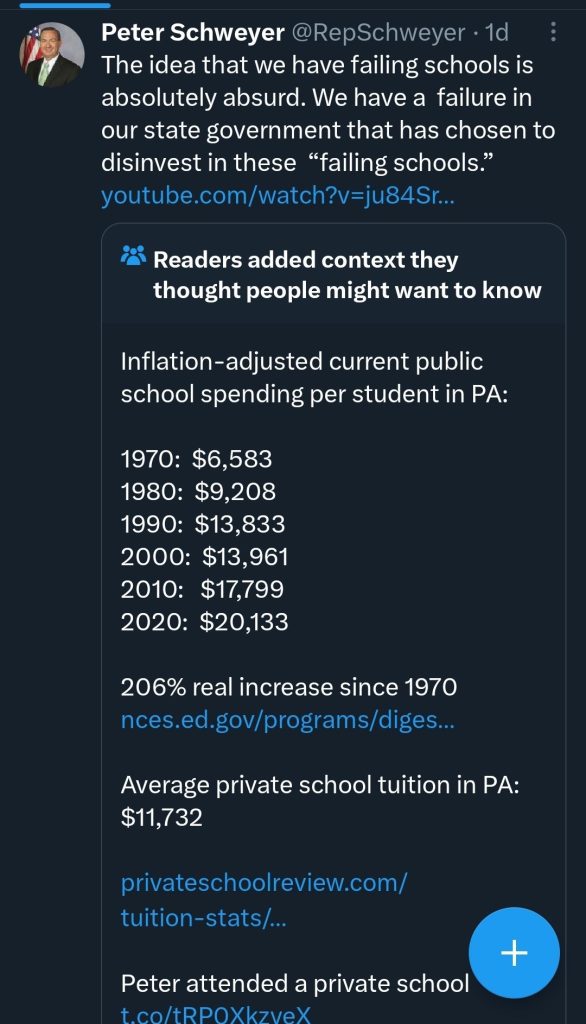
Commentary on $ and k-12 outcomes

Matt Barnum

Eric Hanushek, a leading education researcher, has spent his career arguing that spending more money on schools probably won’t make them better. 

His latest research, though, suggests the opposite. 

The paper, set to be published later this year, is a new review of dozens of studies. It finds that when schools get more money, students tend to score better on tests and stay in school longer, at least according to the majority of rigorous studies on the topic

More.

Madison, despite spending far more than most taxpayer supported k-12 systems, has long tolerated disastrous reading results.

Share

Amor Eterno

Skip Hollandsworth:

It was at that moment, Kim would later tell me, that she had a feeling—“something like a mother’s intuition, a voice speaking to me,” she said—that she should withdraw Lexi from school for the rest of the day. Maybe, she thought, she would take her to the Dairy Queen for one of Lexi’s favorite treats, a mint-chocolate-chip Blizzard, to celebrate the end of another successful school year.

Share

Parents Don’t Understand How Far Behind Their Kids Are in School

Tom Kane and Sean Reardon

Parents have become a lot more optimistic about how well their children are doing in school.

In 2020 and 2021, a majority of parents in the United States reported that the pandemic was hurting their children’s education. But by the fall of 2022, a Pew survey showed that only a quarter of parents thought their children were still behind;  another study revealed that more than 90 percent thought their child had already or would soon catch up. To hear parents tell it, the pandemic’s effects on education were transitory.

Are they right to be so sanguine? The latest evidence suggests otherwise. Math, reading and history scores from the past three years show that students learned far less during the pandemic than was typical in previous years. By the spring of 2022, according to our calculations, the average student was half a year behind in math and a third of a year behind in reading.

Share

Whether deflecting an awkward moment or lightening the mood in an argument, affecting an accent has become a Gen Z verbal tic

Alaina Demopoulos

Americans have long been called out for their phony British accents – think Madonna in her Guy Ritchie era, or the friend who just came home from studying abroad in London. But Gen Z has embraced bad imitations of Cockney slang or a Yorkshire dialect, using obviously fake, theatrical voices to make light of low-grade daily dramas.

What’s behind the trend? Green, who is 26 and appeared on the US version of Love Island, blames it on her love for the original UK dating show.

“The accent really took over when I started watching the show,” she said. “It blew the accent the fuck up, and everyone was obsessed with their cute little sayings, like ‘doing bits’.” (For the uninitiated, that means getting intimate but not having sex.)

It’s not just Love Island: “fake British accent” videos have over 188,000 views on TikTok, where young people say they use the voice whenever they feel uncomfortable.

Asher Lieberman, a 21-year-old college student and content creator from Miami, said he picked his voice up from watching old X Factor auditions on YouTube.

Share

The Education Department Helps Combat Woke Discrimination

Stanley Goldfarb and Mark J. Perry:

The Education Department’s Office for Civil Rights is no conservative bastion. Staffed mostly by liberal career attorneys, and situated within one of the government’s most aggressively woke departments, it is charged with upholding federal antidiscrimination laws in education, including Title VI and Title IX. OCR is required by law to investigate complaints of discrimination at educational institutions that receive federal financial assistance. The office is rejecting much of what higher education is attempting to do at the behest of woke ideologues.

Consider so-called racial affinity groups, a common woke initiative. These segregated entities, which many campuses have attempted to introduce, are open only to students of a specific race. An April article in the New England Journal of Medicine praised the separation of medical students by race while calling for the establishment of white-only affinity groups whose members would be “held accountable.” The authors also cast affinity groups for black medical students as protecting them from “otherwise-common denial, gaslighting . . . and White fragility.” This toxic language harks back to segregationists’ claims that separating whites and blacks benefitted both groups.

Such blatant racial discrimination is precisely what Title VI of the Civil Rights Act of 1964 outlaws—and what OCR was created to stop. In October 2022, we filed a complaint challenging the racial affinity groups at the University of California, San Francisco’s School of Medicine, the institution at the heart of the New England Journal of Medicine article. OCR opened an investigation, prompting the university to cancel its racial affinity groups before the investigation could conclude. OCR pressured the university to agree that if affinity groups return, they will be open to medical students of all races. Something similar happened when we submitted a Title VI complaint against Harvard’s T.H. Chan School of Public Health. In both cases, OCR effectively ruled that racial affinity groups are illegal.

Share

Diverse Group of Organizations, Law Professors Call on Supreme Court to Hear Case of Grandmother Arrested for Criticizing Local Government Officials

Dan King:

At the end of April, IJ filed a petition for certiorari with the U.S. Supreme Court asking it to reverse the Fifth Circuit’s ruling providing qualified immunity to a mayor and a police chief who threw a 72-year-old grandmother in jail, after she criticized a city manager, their ally.  

Since then, five groups consisting of public interest organizations, renowned advocates, and acclaimed scholars filed their own briefs asking the Supreme Court to grant review and overturn this grievously wrong decision.   

“The outpouring of support has been absolutely remarkable,” said IJ Attorney Anya Bidwell. “This has been such a morale boost for Sylvia Gonzalez, our client, who’s been terribly hurt by this whole experience. In addition, it has shown that we’re absolutely right in our interpretation of the law.” 

Sylvia was arrested in 2018 after she petitioned her government to remove the city manager. As it turns out, the city manager had powerful friends determined to ensure that Sylvia and others opposing the powers that be knew their place. To punish Sylvia for speaking out, the mayor and the police chief engineered an arrest of the 72-year-old grandmother. Her offense? She supposedly tried to steal the petition to remove the city manager that she herself championed.

Share

Game: “content moderation” or censorship

Mike Masnick:

Enter: Moderator Mayhem. It’s a browser-based mobile game, and you will learn that you have to make your moderation decisions by swiping left (take down) or right (keep up), and try to align content with the policies of the company (a fictional review site called TrustHive). Of course, users of your site may not like your decisions. They might appeal the decisions, and you might realize you missed some important context (or not!). Your manager might disagree with your decisions, and might not think you’re suited for the job. Your CEO might have his own views on how your moderation is going. So might the media.

Share

Civics: Notes on US state media

Jonathan Turley:

Below is my column in The Hill on the continued media blackout on evidence of influence peddling and corrupt practices by the Biden family. The coverage of the recent disclosure of dozens of LLCs and bank accounts used to funnel up to $10 million to Biden family members captured the growing concerns over a de facto state media in the United States. Under the current approach to journalism, it is the New York Times that receives a Pulitzer for a now debunked Russian collusion story rather than the New York Post for a now proven Hunter Biden laptop story.

Here is the column:

This week, Rep. Byron Donalds (R-Fla.) tried to do the impossible. After he and his colleagues presented a labyrinth of LLC shell companies and accounts used to funnel as much as $10 million to Biden family members, Donalds tried to induce the press to show some interest in the massive corruption scandal. “For those in the press, this easy pickings & Pulitzer-level stuff right here,” he pleaded.

The response was virtually immediate. Despite showing nine Biden family members allegedly receiving funds from corrupt figures in Romania, China and other countries, The New Republic quickly ran a story headlined “Republicans Finally Admit They Have No Incriminating Evidence on Joe Biden.”

For many of us, it was otherworldly. A decade ago, when then-Vice President Joe Biden was denouncing corruption in Romania and Ukraine and promising action by the United States, massive payments were flowing to his son Hunter Biden and a variety of family members, including Biden grandchildren.

Share

Civics: Notes on US state media

Jonathan Turley:

Below is my column in The Hill on the continued media blackout on evidence of influence peddling and corrupt practices by the Biden family. The coverage of the recent disclosure of dozens of LLCs and bank accounts used to funnel up to $10 million to Biden family members captured the growing concerns over a de facto state media in the United States. Under the current approach to journalism, it is the New York Times that receives a Pulitzer for a now debunked Russian collusion story rather than the New York Post for a now proven Hunter Biden laptop story.

Here is the column:

This week, Rep. Byron Donalds (R-Fla.) tried to do the impossible. After he and his colleagues presented a labyrinth of LLC shell companies and accounts used to funnel as much as $10 million to Biden family members, Donalds tried to induce the press to show some interest in the massive corruption scandal. “For those in the press, this easy pickings & Pulitzer-level stuff right here,” he pleaded.

The response was virtually immediate. Despite showing nine Biden family members allegedly receiving funds from corrupt figures in Romania, China and other countries, The New Republic quickly ran a story headlined “Republicans Finally Admit They Have No Incriminating Evidence on Joe Biden.”

For many of us, it was otherworldly. A decade ago, when then-Vice President Joe Biden was denouncing corruption in Romania and Ukraine and promising action by the United States, massive payments were flowing to his son Hunter Biden and a variety of family members, including Biden grandchildren.

Share

A deep dive into book banning rhetoric

Share

Civics: Notes on US state media

Jonathan Turley:

Below is my column in The Hill on the continued media blackout on evidence of influence peddling and corrupt practices by the Biden family. The coverage of the recent disclosure of dozens of LLCs and bank accounts used to funnel up to $10 million to Biden family members captured the growing concerns over a de facto state media in the United States. Under the current approach to journalism, it is the New York Times that receives a Pulitzer for a now debunked Russian collusion story rather than the New York Post for a now proven Hunter Biden laptop story.

Here is the column:

This week, Rep. Byron Donalds (R-Fla.) tried to do the impossible. After he and his colleagues presented a labyrinth of LLC shell companies and accounts used to funnel as much as $10 million to Biden family members, Donalds tried to induce the press to show some interest in the massive corruption scandal. “For those in the press, this easy pickings & Pulitzer-level stuff right here,” he pleaded.

The response was virtually immediate. Despite showing nine Biden family members allegedly receiving funds from corrupt figures in Romania, China and other countries, The New Republic quickly ran a story headlined “Republicans Finally Admit They Have No Incriminating Evidence on Joe Biden.”

For many of us, it was otherworldly. A decade ago, when then-Vice President Joe Biden was denouncing corruption in Romania and Ukraine and promising action by the United States, massive payments were flowing to his son Hunter Biden and a variety of family members, including Biden grandchildren.

Share

“Doctors said that they would stop such medical interventions. Whistleblower documents prove that they haven’t”

Christopher Rufo:

Last spring, executives at Texas Children’s Hospital announced that they would cease performing transgender medical procedures on children, citingpotential legal and criminal liability. The hospital’s chief pediatrician, Catherine Gordon, an advocate for “gender-affirming therapy,” abruptly resigned.

I have obtained exclusive whistleblower documentsshowing that, despite its public statements, the Houston-based children’s hospital—the largest in the United States—has secretly continued to perform transgender medical interventions, including the use of implantable puberty blockers, on minor children. (When reached via email, hospital spokeswoman Kelley Carville responded: “We have no comment.”)

As an institution, Texas Children’s Hospital (TCH) has openly promoted “gender-affirming care” to its physicians. In January of this year, TCH and Baylor College of Medicine, which works in partnership with the children’s hospital, hosted a “pediatric grand rounds” presentation titled “Medical and Psychological Care of Gender-Diverse Youth,” describing the process of sex-change interventions, from puberty blockers to cross-sex hormones to genital surgeries.

According to this presentation, TCH and Baylor College of Medicine encouraged doctors to begin treatment with puberty blockers and hormones during adolescence, and then consider surgeries, including breast removal and genital reconstruction, in adulthood—though the presenters explained that some surgical procedures could be appropriate for “adolescents on [a] case-by-case basis.”

Share

Notes on the state of US Civics

Share

Notes on the 2023-2024 Madison Superintendent Search

Scott Girard:

Madison School board members indicated interest in the longer of two search timelines presented to them Monday by consultant Alma Advisory Group. Alma CEO Monica Santana Rosen spoke to the board at a meeting for the first time since board members chose the firmfrom a field of three finalists to lead the search process, paying $95,000 for Alma’s services.

Monday’s presentation included two potential timelines for the search, a result of Superintendent Carlton Jenkins announcing his retirement in early February.

The timeline that a majority of board members indicated support for during discussion includes community input in the fall, with planning done over the summer. That will have a final candidate chosen in March 2024, with the person likely to take over the role in summer 2024.

“This is a process you should do if you’re feeling that a longer timeframe may give you better stakeholder engagement, if you’re feeling that your current interim is able to stay through the end of the school year and can support any sort of stability and strengthening of the organization, potentially readying the organization for your next leader,” Rosen told the board.

The board selected retired longtime MMSD educator Lisa Kvistad as the interim last month. Board member Ali Muldrow said that choice helped her comfort level with the longer timeline.

“Well, it’s kind of too bad that we’ve got the smartest people at our universities, and yet we have to create a law to tell them how to teach.”

The data clearly indicate that being able to read is not a requirement for graduation at (Madison) East, especially if you are black or Hispanic”

My Question to Wisconsin Governor Tony Evers on Teacher Mulligans and our Disastrous Reading Results

2017: West High Reading Interventionist Teacher’s Remarks to the School Board on Madison’s Disastrous Reading Results 

Madison’s taxpayer supported K-12 school district, despite spending far more than most, has long tolerated disastrous reading results.

“An emphasis on adult employment”

Wisconsin Public Policy Forum Madison School District Report[PDF]

WEAC: $1.57 million for Four Wisconsin Senators

Friday Afternoon Veto: Governor Evers Rejects AB446/SB454; an effort to address our long term, disastrous reading results

Booked, but can’t read (Madison): functional literacy, National citizenship and the new face of Dred Scott in the age of mass incarceration.

When A Stands for Average: Students at the UW-Madison School of Education Receive Sky-High Grades. How Smart is That?

Share

Wisconsin students missed nearly a month of school last year

Corrinne Hess:

Since the pandemic, fewer Wisconsin students have reliably made it to school. The state’s attendance rate reached a new low of 91 percent last year and chronic absenteeism continues to be an issue, with more than 22 percent of students missing at least a month of school. 

The picture is even more grim for high school students. The latest state data shows more than a quarter — 26 percent — of Wisconsin high school students missed a month of the 2021-2022 school year.  

A student is considered chronically absent when they attend less than 90 percent of school days. The overall attendance rate for Wisconsin high school students was 89.7. Milwaukee Public Schools high school students attended only 70 percent of the time.

Attendance is an important measure of student engagement and a predictor of future achievement, dropout or late graduation. And attendance rates have been dropping since the COVID-19 pandemic began.

School avoidant behavior, also called school refusal, is when a school-age child refuses to attend school or has difficulty being in school for the entire day. Several mental health experts told USA TODAY it has become a crisis that has gotten worse since the COVID-19 pandemic.

“Well, it’s kind of too bad that we’ve got the smartest people at our universities, and yet we have to create a law to tell them how to teach.”

The data clearly indicate that being able to read is not a requirement for graduation at (Madison) East, especially if you are black or Hispanic”

My Question to Wisconsin Governor Tony Evers on Teacher Mulligans and our Disastrous Reading Results

2017: West High Reading Interventionist Teacher’s Remarks to the School Board on Madison’s Disastrous Reading Results 

Madison’s taxpayer supported K-12 school district, despite spending far more than most, has long tolerated disastrous reading results.

“An emphasis on adult employment”

Wisconsin Public Policy Forum Madison School District Report[PDF]

WEAC: $1.57 million for Four Wisconsin Senators

Friday Afternoon Veto: Governor Evers Rejects AB446/SB454; an effort to address our long term, disastrous reading results

Booked, but can’t read (Madison): functional literacy, National citizenship and the new face of Dred Scott in the age of mass incarceration.

No When A Stands for Average: Students at the UW-Madison School of Education Receive Sky-High Grades. How Smart is That?

Share

Notes on Madison’s taxpayer supported K-12 school district $pending priorities; $597.9 million budget…

Scott Girard:

This year, the two sides are about $11.7 million apart, with MMSD offering a 3.5% increase in its draft budget and MTI, the teachers union, asking for the maximum 8%. MTI, as it did last year, has rallied and spoken out publicly about its concerns should the district remains at 3.5%, including intensifying the district’s ongoing staff shortage.

District officials have said the 3.5% is the best they can do right now amid uncertainty surrounding the state budget and long-term fiscal challenges like decreasing enrollment and the coming end of federal COVID-19 aid.

Below, the Cap Times explains the numbers behind the disagreement. (Budget deep dive)

“Well, it’s kind of too bad that we’ve got the smartest people at our universities, and yet we have to create a law to tell them how to teach.”

The data clearly indicate that being able to read is not a requirement for graduation at (Madison) East, especially if you are black or Hispanic”

My Question to Wisconsin Governor Tony Evers on Teacher Mulligans and our Disastrous Reading Results

2017: West High Reading Interventionist Teacher’s Remarks to the School Board on Madison’s Disastrous Reading Results 

Madison’s taxpayer supported K-12 school district, despite spending far more than most, has long tolerated disastrous reading results.

“An emphasis on adult employment”

Wisconsin Public Policy Forum Madison School District Report[PDF]

WEAC: $1.57 million for Four Wisconsin Senators

Friday Afternoon Veto: Governor Evers Rejects AB446/SB454; an effort to address our long term, disastrous reading results

Booked, but can’t read (Madison): functional literacy, National citizenship and the new face of Dred Scott in the age of mass incarceration.

No When A Stands for Average: Students at the UW-Madison School of Education Receive Sky-High Grades. How Smart is That?

Share

You Have No Idea How Much We’re Using ChatGPT.

Owen Kichizo Terry

Look at any high school or college academic integrity policy, and you’ll find the same message: submit work that reflects your own thinking, or face discipline. A year ago, this was just about the most common-sense rule on Earth. Today, it’s laughably naive.

There’s a remarkable disconnect between how those with influence over education systems –– teachers, professors, administrators –– think students use generative AI on written work and how we actually use it. As a student, the assumption I’ve encountered among authority figures is that if an essay is written with the help of ChatGPT, there will be some sort of evidence –– the software has a distinctive “voice,” it can’t make very complex arguments (yet), and there are programs that claim to detect AI output. This is a dangerous misconception. In reality, it’s very easy to use AI to do the lion’s share of the thinking while still submitting work that looks like your own. Once this becomes clear, it follows that massive structural change is needed if our schools are going to keep training students to think critically.

Share

The Human Immunome Project is one of the most ambitious projects in biology, and it could transform human health.

David Cox:

The scale of this challenge is exponentially greater than the Human Genome Project, the international effort to sequence all 3 billion base pairs in human DNA and map all 20,000 human genes, which took more than a decade to complete. The data in the human immunome is millions of times larger and vastly more complex. It does not merely include the legions of lymphocytes, neutrophils, and monocytes/macrophages, which biologists have pieced together and studied over many decades, but all of the interactions these cells have, over a person’s life, with pathogens, toxins, and the consequences of their diet and lifestyle.

How all of this shapes an individual’s immunity does not just vary from person to person based on their genetics and exposures but is constantly shifting over the course of their lifetime.

Share

A $55,000 Fashion Education Now Means Learning to Make Chic Outfits for Roblox Avatars

Sarah E. Needleman:

Younger generations are increasingly using avatars to represent themselves in the digital realm, and half of Gen Zers change their avatars’ clothing at least weekly, according to a study by Parsons and videogame-company Roblox.

“We dress in the physical world and we dress in the digital world,” Ben Barry, Parsons’ dean of fashion, said in a recent panel discussion. “We are in a new era,” he added.

So these days, some aspiring fashion designers are more interested in making dapper duds for those digital muses than actual models.

The more-than-a-century-old Parsons School boasts big-name fashion-industry alumni, including Marc Jacobs, Tom Ford, Anna Sui and Donna Karan, and it is where the first few seasons of the hit reality show “Project Runway” were filmed.

Parsons added an avatar-design course called “Collab: Roblox” this semester through a partnership with Roblox, which operates in the so-called metaverse with thousands of games and occasional concerts. Its users, many still in high school or younger, appear as avatars they can dress up in countless ways. The new course teaches students how to make digital clothing for those figures on the Roblox platform. No scissors, measuring tape or pouty-lipped supermodels are required.

Share

Civics: FBI

Share

K-12 Tax & Spending Climate: a Milwaukee Bankruptcy?

Maciver:

Wisconsin lawmakers are fast tracking a plan to bailout Milwaukee to prevent it from declaring bankruptcy. AB245 was introduced earlier this month and it’s already scheduled for a floor vote on May 17th.

Lawmakers claim if Milwaukee declared bankruptcy, it would be devastating for everyone in Wisconsin if that happened. They point to Detroit‘s 2013 bankruptcy as proof. That caught our attention at the MacIver Institute. We wanted to know, how exactly did Detroit’s bankruptcy affect the rest of Michigan?

Did Detroit’s bankruptcy affect Michigan’s bond rating? Did Michigan lose population because of Detroit’s bankruptcy? Did MIchigan lose industry because of Detroit’s bankruptcy?

The answers to those questions could provide critical insight into what might happen if Milwaukee declared bankruptcy. Like Milwaukee, it’s the largest city in a midwestern state with a strong manufacturing background. Michigan tried everything to bail Detroit out of its self-made financial problems, including several revenue raising options not available to any other city in the state, direct intervention, and eventually allowing it to declare bankruptcy. Wisconsin is starting down that same path with Milwaukee. It is currently trying to give Milwaukee the ability to raise a special 2% sales tax available to no other local government in the state.

Share

Trust the Science? The Use of Outdated Reading Curricula in Wisconsin Schools

Will Flanders and Matt Levene:

Forward Exam scores show that Wisconsin students are struggling in reading. Currently statewide, only about 36.8% of students scored proficient or higher on the Forward Exam, meaning the majority of students are falling behind. Reading problems cut across all socioeconomic and racial lines. Much attention has been focused on the “Science of Reading,” and the persistence of reading curricula around the state that are not focused on these metrics. The Science of Reading is a ‘back to the basics’ approach that is focused on learning phonics, increasing vocabulary, and sounding out words rather than the context-clue based “guessing” techniques that have become popular in recent decades. Until now, it has not been possible to take a statewide look at what curricula districts are using for reading, and whether this choice has a relationship to student outcomes.

This paper takes advantage of a new dataset available from the Department of Public Instruction that details the curricula used in each district around the state. We correlate reading outcomes on the Forward Exam with some two of the most widely criticized curricula that rely on “Whole Language” techniques—Lucy Calkins and Fountas and Pinnell.

Key takeaways include:

Whole Language techniques are still in wide use. About 44% of schools around Wisconsin under the high school level are still using Lucy Calkins and/or Fountas and Pinnell.

Use of Lucy Calkins is correlated with lower proficiency. Controlling for a number of other factors that are known to affect reading scores, the use of Lucy Calkins is correlated with about a 2.1% decline in ELA proficiency. No relationship was found with Fountas and Pinnell, possibly due to lower usage rates.

Combined, use of either curriculum is correlated with lower proficiency. Controlling for a number of other factors known to affect reading scores, the use of Lucy Calkins or Fountas and Pinnell is correlated with 2.7% lower reading scores.
Policymakers should consider adopting best practices from the Science of Reading. States like Mississippi have seen significant jumps in reading proficiency by moving away from Whole Language methods to science-based methods. The evidence here suggests Wisconsin could benefit from doing the same.

A list of district-level reading curricula is available on WILL’s School Scorecard. Visit https://will-law.org/school-scorecard/ to see what is in use in your community.

“Well, it’s kind of too bad that we’ve got the smartest people at our universities, and yet we have to create a law to tell them how to teach.”

The data clearly indicate that being able to read is not a requirement for graduation at (Madison) East, especially if you are black or Hispanic”

My Question to Wisconsin Governor Tony Evers on Teacher Mulligans and our Disastrous Reading Results

2017: West High Reading Interventionist Teacher’s Remarks to the School Board on Madison’s Disastrous Reading Results 

Madison’s taxpayer supported K-12 school district, despite spending far more than most, has long tolerated disastrous reading results.

“An emphasis on adult employment”

Wisconsin Public Policy Forum Madison School District Report[PDF]

WEAC: $1.57 million for Four Wisconsin Senators

Friday Afternoon Veto: Governor Evers Rejects AB446/SB454; an effort to address our long term, disastrous reading results

Booked, but can’t read (Madison): functional literacy, National citizenship and the new face of Dred Scott in the age of mass incarceration.

No When A Stands for Average: Students at the UW-Madison School of Education Receive Sky-High Grades. How Smart is That?

Share

K-12 tax & spending climate: US budget growth update (and borrowing)

Share

A Mathematician’s Lament

Paul Lockhart:

As for the primary and secondary schools, their mission is to train students to use this language— to jiggle symbols around according to a fixed set of rules: “Music class is where we take out our staff paper, our teacher puts some notes on the board, and we copy them or transpose them into a different key. We have to make sure to get the clefs and key signatures right, and our teacher is very picky about making sure we fill in our quarter-notes completely. One time we had a chromatic scale problem and I did it right, but the teacher gave me no credit because I had the stems pointing the wrong way.”

In their wisdom, educators soon realize that even very young children can be given this kind of musical instruction. In fact it is considered quite shameful if one’s third-grader hasn’t completely memorized his circle of fifths. “I’ll have to get my son a music tutor. He simply won’t apply himself to his music homework. He says it’s boring. He just sits there staring out the window, humming tunes to himself and making up silly songs.”

Share

Citing President Dwight Eisenhower’s concern for the ties between government funding and higher education, Giordano writes that the fear ‘has become a reality.’

Elaine Gunthorpe:

In his recent Fox News op-edCampus ReformHigher Education Fellow Nicholas Giordano discusses the “unholy alliance” forming between government bureaucrats and the academic elites. 

Citing President Dwight Eisenhower’s concern for the ties between government funding and higher education, Giordano writes that the fear “has become a reality.”

“[T]hroughout the country, professors on college campuses have been recruited to develop tools for monitoring and restricting discourse, betraying the values of free speech,” Giordano writes, pointing to an example from Wisconsin.   

“[T]he University of Wisconsin has been awarded a $5 million grant by the National Science Foundation (NSF),” Giordano explains, “to develop a system that can detect and ‘strategically correct’ what the government perceives as misinformation relating to COVID, elections, and vaccines.”

He goes on to elaborate:

Share

Federal Spending Soars, Revenue Falls

Wall Street Journal:

April is typically the best month for the federal fisc because it’s the tax payment deadline for the previous year. But this year the April budget surplus fell by $135 billion from a year earlier. Including adjustments for timing shifts in federal outlays, the decline was $274 billion, or 73% from April 2022.

That portends bigger budget deficits for the rest of the fiscal year. The deficit for the first seven months is already $928 billion, or 236% higher than in 2022 with timing adjustments. Keep in mind that this is happening when the economy is still growing and the unemployment rate is still low.

The big culprit is spending, which is up 12% in the first seven months or nearly $400 billion, including timing adjustments. Entitlements are up 11% and education spending owing to student-loan changes is up 56%. Chalk this up to the spending pipeline enacted by the last Congress that has years to go unless it’s pared back by this Congress.

And get this: Interest on the national debt rose 40%, or $107 billion, and is already $374 billion for the first seven months. That’s what happens when interest rates rise 500 basis points in a year to fight the inflation that runaway federal spending helped to ignite.

Share

On “Cognitive Endurance”

Christina Brown, Supreet Kaur, Geeta Kingdon, and Heather Schofield

Schooling may build human capital not only by teaching academic skills, but by expanding the capacity for cognition itself. We focus specifically on cognitive endurance: the ability to sustain effortful mental activity over a continuous stretch of time. As motivation, we document that globally and in the US, the poor exhibit cognitive fatigue more quickly than the rich across field settings; they also attend schools that offer fewer opportunities to practice thinking for continuous stretches. Using a field experiment with 1,600 Indian primary school students, we randomly increase the amount of time students spend in sustained cognitive activity during the school day—using either math problems (mimicking good schooling) or non-academic games (providing a pure test of our mechanism). Each approach markedly improves cognitive endurance: students show 22% less decline in performance over time when engaged in intellectual activities—listening comprehension, academic problems, or IQ tests. They also exhibit increased attentiveness in the classroom and score higher on psychological measures of sustained attention. Moreover, each treatment improves students’ school performance by 0.09 standard deviations. This indicates that the experience of effortful thinking itself—even when devoid of any subject content—increases the ability to accumulate traditional human capital. Finally, we complement these results with quasi-experimental variation indicating that an additional year of schooling improves cognitive endurance, but only in higher-quality schools. Our findings suggest that schooling disparities may further disadvantage poor children by hampering the development of a core mental capacity.

Share

Minhyong Kim is leading a new initiative called Mathematics for Humanity that encourages mathematicians to apply their skills to solving social problems.

Philip Amman:

I think, first of all, primarily, we’re training them for their own sake, not for ours. Of course, community benefits will come out of the situation in some way. But mostly, it’s about their individual fulfillment that we’re here for when we’re educating them. How they find meaning in life, it’s up to them.

Secondly, I think mathematical sophistication is very important in understanding the world at present in many possible ways. You definitely need to have a sophisticated mathematical view that you combine with other things to understand the world. Now, if there are a lot of such people in society, then people who teach and produce new mathematics, it’s hard to think that they wouldn’t benefit from it. If, in other words, you have a mathematically sophisticated society, the status of the people who are specialists in mathematics [will improve].

Share

America’s higher education institutions preach social justice while running on the exploitation of adjunct workers

Dick Bauer:

During the pandemic, this same university chose not to send its foreign students to their native homes during the two-year period of the COVID pandemic. The reason: The F2F tuition the school was charging the students (and this school was in the top 100 in Forbes magazine for their graduate school) was three times the in-state or U.S. citizen tuition. Sending foreign students home would eliminate a very lucrative revenue source. 

Additionally, such foreign nationals were required, according to the school’s pandemic-era policies, to attend at least three classes in-person each semester to maintain matriculation status and keep their student visas. That meant that there needed to be instructors on campus to teach these classes, but of course the full-time faculty could not be forced to endanger themselves by breaking COVID lockdown rules. So it was left to adjuncts like myself, who did not receive any medical insurance from the school, to drive to campus to hold in-person classes for these high-revenue students.

Despite teaching as many as eight courses in one term, I was never offered any of the benefits that are customarily associated with a full-time academic salary in America. Some schools have elected to restrict the hours adjunct faculty are allowed to work in order to avoid the Affordable Care Act requirement that would otherwise require them to provide health insurance to their employees. According to AdjunctNation, more than 200 schools set limits on adjunct working hours. Adjuncts typically earn between $20,000 and $25,000 annually, while the average salary for full-time instructors is $84,300, according to the American Association of University Professors.

Some adjuncts cobble together a full-time teaching schedule by offering classes at more than one university—as many as three or four. However, professors who “moonlight” at multiple colleges rarely earn the same salary or benefits as full-time instructors.

Share

Open source Education

Share

Barrington schools settle with teachers fired over COVID vaccination

Antonia Noori Farzan

The Barrington School Committee has reached a settlement with three teachers who were fired for refusing to be vaccinated against COVID-19.

Brittany DiOrio, Stephanie Hines and Kerri Thurber will each receive a payment of $33,333, a spokesperson for the school district announced Thursday in a news release. Additionally, they will receive back pay: $65,000 for Hines, $128,000 for Thurber and $150,000 for DiOrio. The three teachers’ legal counsel will receive $50,000 in attorney’s fees.

Share

Free speech, racial equity battles play out on Wisconsin campuses

Todd Richmond:

In just the past two weeks, the state’s top Republican announced a push to defund the University of Wisconsin System’s diversity efforts — a move the Democratic governor lambasted as ridiculous. A student from UW-Madison posted racial slurs online, triggering bitter protests but no announced discipline. And a state medical college canceled a diversity symposium featuring Republican U.S. Sen. Ron Johnson out of concerns the discussion would be too disruptive, resulting in cries of bias from conservatives.

Amid that backdrop, Republican legislative leaders are set to hold a hearing Thursday with only invited speakers to discuss “how the lack of free speech and intellectual diversity on college campuses affects the quality of higher education.” The speakers include John Sailer, policy director at the National Association of Scholars, a conservative group that advocates against diversity policies, and Tim Higgins, a former UW regent appointed by former Republican Gov. Scott Walker.

“I think people are talking about viewpoint diversity as being as important or more important than other types of diversity,” said Republican Rep. David Murphy, chairman of the state Assembly’s colleges committee, who will preside over the hearing. “And I think (diversity efforts aren’t) showing any benefits.”

Share

The Parents Who Fight the City for a “Free Appropriate Public Education”

Jessica Winter:

Travis came to live at his ninth home the day before he started kindergarten. When his new foster parents, Elizabeth and Dan, enrolled Travis at their neighborhood public school, in a rapidly gentrifying neighborhood in Brooklyn, they learned that Travis was eligible for special-education services. (Some names in this story have been changed.) Several languages had been spoken in Travis’s past homes, which had included foster-care placements and homeless shelters, and he had not begun speaking until he was three and a half. A neuropsychiatric evaluation of Travis, conducted when he was four, estimated that he had a grasp of twenty words; it also noted that he still wore pull-up diapers and “tends to speak very loudly to his peers.”

Elizabeth noticed a line in Travis’s paperwork that read “Disability Classification,” and, next to it, the initials “E.D.” The school’s principal told her that they stood for “emotional disturbance.” Elizabeth and Dan, who later adopted Travis and his infant brother, Kieran, did not yet know that Travis had suffered abuse and neglect in previous homes. Nor did they know that Travis had been kicked out of two preschools for violent behavior. But, Elizabeth told me, “it was almost immediately apparent that he had aggressive and violent coping skills. That was how he interacted with the world, because that was how the world had interacted with him.”

That fall, when Elizabeth visited Travis’s kindergarten classroom for her first parent-teacher conference, one of the teachers gestured toward a comfy reading nook, piled with pillows. “See that calm-down corner? We built that for Travis,” the teacher said. Elizabeth, who is a stay-at-home mother, began receiving frequent calls about Travis acting out at school: tantrums, hitting other children, throwing books. A behavioral paraprofessional was assigned to Travis, but the incidents persisted. “We started getting calls like, ‘There’s a field trip coming up, and it would probably be best if Travis stayed home.’ Or, ‘Could he not come into school tomorrow? It would just be easier,’ ” Elizabeth said.

Share

“noted the divergence between students’ academic assessments and graduation rates”

Melissa Whitler:

“If graduation rates are going up, are our children prepared for life after school?” El-Amin asked at the board meeting. 

Interim Superintendent Rochelle Cox said that this is one of the reasons why the intervention triads will be at middle and high schools, and not just in elementary grades, next year. 

“I want every parent out there of an eleventh grader or tenth grader or ninth grader to know that there is support next year if their student is struggling in reading or math,” Cox said.

Cox also said that within high schools, there are many accommodations happening for students who are struggling with basic literacy and numeracy in other content areas. 

Senior Academic Officer Aimee Fearing explained that the district is currently auditing high school courses to determine whether or not they meet all State standards. As part of that process, she said the district has already told at least one high school, “You are assigning graduation credit for a course that we don’t believe meets State standards.”

Share

Notes on DIE $pending at the University of Wisconsin

David Blaska:

Requiring prospective employees to attest to their DEI faithis a prohibited political test, President Rothman told legislators. “If people think we are imposing litmus tests on them at that stage in the employment process, we are not being inclusive,” he said. “We need to be inclusive.”

Doubtless, the UW system boss was responding to Assembly Speaker Robin Vos, who threatens to reduce system funding by the $16 million spent annually on DEI enforcement. 

“I have heard from people who have had to fill out DEI statements to apply for a UW job and graduate students who have had to admit to their white privilege. This is preposterous!” — Assembly Speaker Robin Vos

Share

Fake scientific papers are alarmingly common

Jeffrey Brainard:

His findings underscore what was widely suspected: Journals are awash in a rising tide of scientific manuscripts from paper mills—secretive businesses that allow researchers to pad their publication records by paying for fake papers or undeserved authorship. “Paper mills have made a fortune by basically attacking a system that has had no idea how to cope with this stuff,” says Dorothy Bishop, a University of Oxford psychologist who studies fraudulent publishing practices. A 2 May announcement from the publisher Hindawi underlined the threat: It shut down four of its journals it found were “heavily compromised” by articles from paper mills.

Sabel’s tool relies on just two indicators—authors who use private, noninstitutional email addresses, and those who list an affiliation with a hospital. It isn’t a perfect solution, because of a high false-positive rate. Other developers of fake-paper detectors, who often reveal little about how their tools work, contend with similar issues.

Still, the detectors raise hopes for gaining the advantage over paper mills, which churn out bogus manuscripts containing text, data, and images partly or wholly plagiarized or fabricated, often massaged by ghost writers. Some papers are endorsed by unrigorous reviewers solicited by the authors. Such manuscripts threaten to corrupt the scientific literature, misleading readers and potentially distorting systematic reviews. The recent advent of artificial intelligence tools such as ChatGPT has amplified the concern.

Share

Stanford’s “Diversity, Equity, Inclusion & Belonging (DEIB) Content Style Guide”

Steven McGuire:

The guide states that “it is not intended to constrain the academic freedom or free speech rights of members of the Stanford community,” but it takes positions on topics that remain matters of public and academic controversy, and it is part of the university’s official “Identity Guide.”

The entry for “gender, gender identity” says that “Not all people fall under one of two categories for sex or gender, according to leading medical organizations, so avoid using both sexes, either sex, or opposite sexes to encompass all people.” Colin Wright, an evolutionary biologist, maintains that sex is binary, as do many other scientists and doctors. Should a university communications office be canonizing beliefs that may well be pseudoscientific?

Share

Notes on “substitutions”

Alex Tabarrok

The misunderstanding came from thinking that we need every user of fuel to find substitutes. Not at all! In reality, as fuel prices rise, those with the lowest substitution costs will switch first, freeing up fuel for users who have more difficulty finding alternatives. Just one industry with favorable substitution possibilities, combined with a few moderately adaptable industries, can produce a significant overall effect. Moreover, there are nearly always some industries with viable substitution options. To see why reverse the usual story and ask, if fuel prices fell by 50% could your industry use more fuel? And if fuel prices fell by 50% are their industries that could switch into the now cheaper fuel?

People often find it easier to imagine new uses rather than ways to reduce existing consumption. However, it is typically the new uses that are scaled back first. Tyler and I illustrate this with our jet and rubber ducky graph. Although jet aircraft won’t shift away from oil even at high prices, rubber (actually plastic) duckies, which are made from oil, can find substitutes–wood, for example–when oil prices rise. And if plastic ducky manufacturers cannot find substitutes, they go out of business, freeing up more oil for other uses. In this way, the market identifies the least valuable goods to cease production, another kind of substitution.

Share

Offices and Officers of the Constitution, Part III: The Appointments, Impeachment, Commissions, and Oath or Affirmation Clauses

Seth Barrett Tillman and Josh Blackman

This Article is the third installment of a planned ten-part series that provides the first comprehensive examination of the offices and officers of the Constitution. The first installment introduced the series. The second installment identified four approaches to understand the Constitution’s divergent “Office”- and “Officer”-language. This third installment will analyze the phrase “Officers of the United States,” which is used in the Appointments Clause, the Impeachment Clause, the Commissions Clause, and the Oath or Affirmation Clause.

This Article proceeds in six sections. Section I describes our methodology, which includes textualism, original public meaning originalism, original methods originalism, and consideration of historical practices during the founding-era and later-in-time. Section II explains that the phrase “Officers of the United States” is defined by the Appointments Clause. This phrase refers to appointed positions in the Executive and Judicial Branches. Our position here is supported by the drafting history of the Appointments Clause, as well as Supreme Court precedent. Section III turns to the Impeachment Clause, which applies to “civil Officers of the United States.” This latter category refers to non-military appointed positions in the Executive Branch and Judicial Branch. Members of Congress, as well as appointed positions in the Legislative Branch, are not “civil Officers of the United States,” and therefore such positions cannot be impeached.

Share

K-12 Tax & Spending Climate: Priorities

Share

Promoting the Western canon shouldn’t only be a Republican talking point.

Cornel West and Jeremy Wayne Tate:

Gov. Ron DeSantis just gave a welcome boost to the classical-education movement. He signed legislation allowing high-school students to qualify for Bright Futures scholarships, a state fund for college education, by submitting scores from the Classic Learning Test instead of the SAT alone.

This move will likely be portrayed, wrongly, as partisan and conservative. But the greatest works of civilization have always been about spurring—not preventing—radical change. They teach us about the revolutionary ideas of the past and help us better understand the present. The richest ideas of what it means to be human are those that have stood the test of time.

Many of the seminal works of literature, history, philosophy, science and theology were revolutionary in their respective ages. Turn the pages of Galileo Galilei’s “Two New Sciences” and you’ll experience the alteration of humanity’s view of itself in relation to the heavens. By disproving the then-common belief that the planets revolved around the Earth rather than the sun, Galileo laid the foundation for modern science. Isaac Newton, swept aside what remained of the Old World’s scientific superstitions—only to find himself upstaged two centuries later by Albert Einstein’s “Relativity.”

Like revolutionary ideas today, the ideas of yesterday were provocative and, in many cases, much more consequential. Galileo was put on trial because he upset the status quo. In the 13th century, Bishop Stephen Tempier of Paris condemned key works of theologian Thomas Aquinas for being too radical. Soviet dissident Alexander Solzhenitsyn and civil-rights activist Martin Luther King Jr. were imprisoned for their views. In colonial America, James Madison and his co-authors feared printing their names on the Federalist Papers, so they hid under aliases. Even the most mild-mannered of philosophers stirred trouble for thinking against the grain. Plato watched his great teacher Socrates put to death for his teachings.

Share

“An emphasis on adult employment”

“Well, it’s kind of too bad that we’ve got the smartest people at our universities, and yet we have to create a law to tell them how to teach.”

The data clearly indicate that being able to read is not a requirement for graduation at (Madison) East, especially if you are black or Hispanic”

My Question to Wisconsin Governor Tony Evers on Teacher Mulligans and our Disastrous Reading Results

2017: West High Reading Interventionist Teacher’s Remarks to the School Board on Madison’s Disastrous Reading Results 

Madison’s taxpayer supported K-12 school district, despite spending far more than most, has long tolerated disastrous reading results.

“An emphasis on adult employment”

Wisconsin Public Policy Forum Madison School District Report[PDF]

WEAC: $1.57 million for Four Wisconsin Senators

Friday Afternoon Veto: Governor Evers Rejects AB446/SB454; an effort to address our long term, disastrous reading results

Booked, but can’t read (Madison): functional literacy, National citizenship and the new face of Dred Scott in the age of mass incarceration.

No When A Stands for Average: Students at the UW-Madison School of Education Receive Sky-High Grades. How Smart is That?

Share

Wisconsin’s long term, disastrous reading results

“Well, it’s kind of too bad that we’ve got the smartest people at our universities, and yet we have to create a law to tell them how to teach.”

The data clearly indicate that being able to read is not a requirement for graduation at (Madison) East, especially if you are black or Hispanic”

My Question to Wisconsin Governor Tony Evers on Teacher Mulligans and our Disastrous Reading Results

2017: West High Reading Interventionist Teacher’s Remarks to the School Board on Madison’s Disastrous Reading Results 

Madison’s taxpayer supported K-12 school district, despite spending far more than most, has long tolerated disastrous reading results.

“An emphasis on adult employment”

Wisconsin Public Policy Forum Madison School District Report[PDF]

WEAC: $1.57 million for Four Wisconsin Senators

Friday Afternoon Veto: Governor Evers Rejects AB446/SB454; an effort to address our long term, disastrous reading results

Booked, but can’t read (Madison): functional literacy, National citizenship and the new face of Dred Scott in the age of mass incarceration.

No When A Stands for Average: Students at the UW-Madison School of Education Receive Sky-High Grades. How Smart is That?

Share

Recently, Soros Funded Wisconsin Watch released articles criticizing the Wisconsin parental choice programs and incorrectly claiming that private schools may “discriminate.

Will-Law

Recently Wisconsin Watch released articles criticizing the Wisconsin parental choice programs and incorrectly claiming that private schools may “discriminate.” This memo provides resources and information about the false claims made in the article and talking points to refute them. 

The claims that private schools may “discriminate” are false. 

These claims are false. Wisconsin Watch claims that federal law “allows religious entities to discriminate against LGBTQ+ students” and that schools in the parental choice program may discriminate against LGBTQ+ students or those with disabilities “once that student is enrolled.” 

Private schools are governed by different laws than public schools.  There are specific prohibitions of discrimination that apply to private schools participating in the parental choice program. For example, Wisconsin law requires private schools in the choice programs to do a blind admission process. Schools are not permitted to create barriers for enrollment for student based on anything other than the DPI application and income verification forms. Private schools are allowed to give existing students and their siblings eligibility preferences.  

Private schools are not permitted to “discriminate” against students with disabilities. 

The Obama Administration began a misguided investigation into private schools in the Milwaukee Parental Choice Program in 2011. DPI, at that time, correctly stated that private schools in the program have a different legal standard to serve students with disabilities. Despite a three-year investigation, there were no instances of discrimination found

Private schools have a different legal standard than public schools for students with disabilities. 

Public schools are subject to several state and federal laws regarding the education of students with disabilities including the requirement that public school districts may not deny any student access to a “Free and Appropriate Public Education” and receive specific funds to educate children with disabilities. Even within public school districts, not all individual schools are required to provide a full range of special education services.

Private schools must meet a different legal standard. Section 504 of the Rehabilitation Act and the Title III of the Americans with Disability Act (ADA) set forth requirements for private schools. 

Title III of the ADA requires private schools to make “reasonable modifications” for individuals with disabilities to access the facility and prohibits private schools from discriminating against individuals based on their disability. Changes to accommodate may not fundamentally alter the nature of the goods and services provided by the private school or impose an undue financial or administrative burden on the private school. Similarly, Section 504 requires private schools to make “minor adjustments” for individuals with disabilities to access the facility. Private schools may consider  the nature of the program provided and the expense of accommodations sought when serving individuals with disabilities under Section 504. 

Furthermore, private schools participating in the Wisconsin Special Needs Scholarship Program, to specifically serve students with disabilities, must meet with families to complete an agreement to discuss the educational needs of each student and to explain special education resources available at the school. Participating private schools are also required to provide reports to parents about student progress.

The Wisconsin Watch articles do not specifically claim a private school violated the federal laws regarding students with disabilities. 

Private schools in Wisconsin serve hundreds of students with disabilities.

Academic research found that private schools in Wisconsin parental choice programs serve many students with disabilities. Reported disability rates are often lower because choice schools lack the financial incentive public schools have for identification.

This is further supported by the growing participation in the Special Needs Scholarship Program, a state-funded program to give students with disabilities funding to attend a private school of their choice. Since the program’s creation in 2015, participation has grown by 815%, from 215 to 1,986 students. 

Private schools in the choice program welcome all students. 

Private schools in the choice program choose to participate in the program, with full knowledge that they are opening their doors to students and families from all different backgrounds and beliefs. Many of these schools participate because they want to serve as many students as possible. 

Private schools in the choice program may not require participation in religious classes. 

Once enrolled, all students are subject to the policies of the school, religious policies included. If families disagree with the religious beliefs of the school, state law permits families to opt their children out of religious instruction. 

Additionally, the choice program is a voluntary program that empowers families to choose the school that best fits their child’s needs. Families are always free to choose to send their children to a school that matches their values.

Religious schools have a constitutional protection to serve students based on their beliefs. 

The U.S. Constitution protects the free exercise of religion. This allows religious schools to teach and make decisions based on their religious beliefs. For private, religious schools, this includes decisions relating to policies and procedures at the school. 

Both the Wisconsin Supreme Court and U.S. Supreme Court have determined that parental choice programs are legal. 

The claims that taxpayer dollars should not go to schools that enforce their religious beliefs has been litigated both in Wisconsin and most recently in the U.S. Supreme Court. The U.S. Supreme Court has made clear that if states choose to create and provide a parental choice program the state may not discriminate against faith-based schools and may not bar students from using public funds to attend religious schools. 

With private schools, the choice ultimately lies with the student, parent, and family. 

All families deserve to access high-quality schools that meet their child’s needs. Far too many families are stuck in their assigned public schools, but school choice provides families with the option to attend the school that is the best fit for their child.

Ultimately, parents and students have every right to go to a school that matches their moral convictions.  The whole idea behind school choice is if a parent or student is upset with how a school is run, then they can in fact go somewhere else and take their money with them. 

For additional questions, please contact:

Nic Kelly, kelly@parentchoice.org

Libby Sobic, libby@will-law.org

Notes and links on “Wisconsin Watch

“Well, it’s kind of too bad that we’ve got the smartest people at our universities, and yet we have to create a law to tell them how to teach.”

The data clearly indicate that being able to read is not a requirement for graduation at (Madison) East, especially if you are black or Hispanic”

My Question to Wisconsin Governor Tony Evers on Teacher Mulligans and our Disastrous Reading Results

2017: West High Reading Interventionist Teacher’s Remarks to the School Board on Madison’s Disastrous Reading Results 

Madison’s taxpayer supported K-12 school district, despite spending far more than most, has long tolerated disastrous reading results.

“An emphasis on adult employment”

Wisconsin Public Policy Forum Madison School District Report[PDF]

WEAC: $1.57 million for Four Wisconsin Senators

Friday Afternoon Veto: Governor Evers Rejects AB446/SB454; an effort to address our long term, disastrous reading results

Booked, but can’t read (Madison): functional literacy, National citizenship and the new face of Dred Scott in the age of mass incarceration.

No When A Stands for Average: Students at the UW-Madison School of Education Receive Sky-High Grades. How Smart is That?

Share

“an overwhelming 74 percent thought that race or ethnicity should not be a factor in college admissions”

Ray Teixeira

Democrats are very shaky indeed on the idea of merit today but that wobbliness goes back quite a way to the origins of affirmative action as a tool for allocating jobs and school admissions. As it evolved in practice, affirmative action became bound up with preferences based on race (later also on gender) that were used to override allocations based on conventional measures of merit. While these practices have been with us for a long time, they have never been popular. Voters have been stubbornly resistant to the idea that it’s fair to allocate sought-over slots on the basis of race rather than merit.

This is true today as the Supreme Court prepares to render a decision next month on affirmative action in higher education as practiced byHarvard and the University of North Carolina. The Harvard case turns particularly on whether Asians have been discriminated against in admissions to that college. Given the proclivities of the Court and the blindingly obvious pattern of such discrimination—denying it seems as plausible as professing one’s belief in the Easter Bunny—it is a safe bet that the Court will decide against the universities. In so doing, the Court will find itself on the good side of public opinion and Democrats, who will no doubt denounce the decision in histrionic terms, will find themselves very much on the wrong side.

In typical polling from Pew in 2022, just 7 percent of the public thought high school grades should not be a factor in college admissions and a mere 14 percent thought standardized test scores should not be a factor. But an overwhelming 74 percent thought that race or ethnicity should not be a factor in college admissions.

Share

Censorship at Northwestern

Jonathan Turley:

Northwestern University has long been a school hostile to free speech. My alma mater was ranked 197 out of 203 universities for free speech in a major survey by FIRE. (Fortunately, my other alma mater, the University of Chicago, was ranked number one for free speech). This month showed why Northwestern developed a reputation for speech intolerance and a lack of ideological diversity. Northwestern University’s Associated Student Government suspended the funding for the College Republicans due to objections to posters for an event featuring writer and critical race theory critic James Lindsay. The justification was a poster featuring a skull and crossbones, an objection that seemed more of a pretense than a principle. This move reportedly came after Lindsay’s speech was the subject of protests on campus.According to the Daily Northwestern, one of the posters displayed a skull and crossbones that was superimposed over the LGBT Pride flag. ASG co-president, Molly Whalen, seemed disappointed that the group did not have the power to ban Lindsay but took solace from the fact that they could deny the Republicans any funding:

“We can’t prevent a speaker from coming to campus as student government. That’s done by administration. We focused on the part that we could control, which is student group conduct and student group finances.”

It is doubtful that other groups from the College Democrats to Black Lives Matter to pro-choice groups would be sanctioned for using the common symbol to express their opposition to the MAGA movement or racism or pro-life positions.

Share