School Information System

Naval Communication

New York Times: Sunday, July 5, 1998
“News of the Week in Review” p. 7
What follows is a transcript of an actual radio conversation between a U.S. naval vessel and Canadian authorities off the coast of Newfoundland:
Canadians: Please divert your course 15 degrees south to avoid a collision.
Americans: Recommend you divert your course 15 degrees to the north to avoid a collision.
Canadians: Negative. You will have to divert your course 15 degrees to the south to avoid a collision.
Americans: This is the captain of U.S. Navy ship. I say again, divert your course.
Canadians: No. I say again, divert your course.
Americans: This is the Aircraft Carrier U.S.S. Lincoln, the second largest ship in the United States Atlantic Fleet. We are accompanied by three cruisers, three destroyers, and numerous support vessels. I demand that you change your course 15 degrees north. I say again, that’s one five degrees north, or counter-measures will be undertaken to ensure the safety of this ship.

Canadians
: This is a lighthouse. Your call.

Share

Private Schools Say They’re Thriving in Downturn

Winnie Hu & Alison Leigh Cowan:

Private schools across New York City say they are thriving this fall, with record numbers of applicants and no significant decline in donations. Yet almost daily, even brand-name schools are finding that they have to reassure jittery parents about shrinking endowments and dispel rumors that requests for financial aid are pouring in, and that economically squeezed families are pulling their children out and enrolling them in public schools.
Trinity’s interim head of school, Suellyn P. Scull, issued a letter taking issue with recent news reports that 45 families had given notice that they were leaving. Trinity, among the most competitive schools in the city, received 698 applications for the 60 kindergarten spots in this year’s class.
The school is not yet releasing admission numbers for next year’s class, but Ms. Scull wrote, “This year’s admissions season has been perhaps busier than usual, and to date we have had no reports of families planning to leave us.”
But the shrinking economy is taking a toll on investment returns at Trinity, whose endowment has fallen to $40 million from $50 million in July, and at other private schools, affecting what they can spend on programs and activities. “There’s no way of escaping it,” said Lawrence Buttenwieser, a former trustee at Dalton. “If it happens at Harvard, it will happen to everybody.”

Share

Can She Save Our Schools? Michelle Rhee

Amanda Ripley:

In 11th grade, Allante Rhodes spent 50 minutes a day in a Microsoft Word class at Anacostia Senior High School in Washington. He was determined to go to college, and he figured that knowing Word was a prerequisite. But on a good day, only six of the school’s 14 computers worked. He never knew which ones until he sat down and searched for a flicker of life on the screen. “It was like Russian roulette,” says Rhodes, a tall young man with an older man’s steady gaze. If he picked the wrong computer, the teacher would give him a handout. He would spend the rest of the period learning to use Microsoft Word with a pencil and paper.
One day last fall, tired of this absurdity, Rhodes e-mailed Michelle Rhee, the new, bold-talking chancellor running the District of Columbia Public Schools system. His teacher had given him the address, which was on the chancellor’s home page. He was nervous when he hit SEND, but the words were reasonable. “Computers are slowly becoming something that we use every day,” he wrote. “And learning how to use them is a major factor in our lives. So I’m just bringing this to your attention.” He didn’t expect to hear back. Rhee answered the same day. It was the beginning of an unusual relationship.
The U.S. spends more per pupil on elementary and high school education than most developed nations. Yet it is behind most of them in the math and science abilities of its children. Young Americans today are less likely than their parents were to finish high school. This is an issue that is warping the nation’s economy and security, and the causes are not as mysterious as they seem. The biggest problem with U.S. public schools is ineffective teaching, according to decades of research. And Washington, which spends more money per pupil than the vast majority of large districts, is the problem writ extreme, a laboratory that failure made. (See pictures of a diverse group of American teens.)

Related: Nurith Aizenman:

“It was a very hard decision,” Rhee said of her vote. “I’m somewhat terrified of what the Democrats are going to do on education.”
No word on whether the intermediary was Jason Kamras, a top Rhee aide who advised the Obama campaign on education issues.
Now that Obama has won office, Rhee has reasons for both hope and alarm.
Before clinching the nomination, Obama bucked the National Education Association to introduce a Senate bill that would reward teachers according to the sort of statistically-based rating system Rhee champions. In his book “The Audacity of Hope,” Obama also stressed the need for linking increased teacher pay to greater accountability. And in his last debate with McCain, Obama even praised Rhee, describing her as “a wonderful new superintendent … who’s working very hard with the young mayor … who initiated, actually supports, charters.” (Rhee said she slept through that moment.)

Share

Become an AP Exam Reader

The College Board, via email:

In June, AP teachers and college faculty members from around the world gather in the United States for the annual AP Reading. There they evaluate and score the free-response sections of the AP Exams. AP Exam Readers are led by a Chief Reader, a college professor who has the responsibility of ensuring that students receive grades that accurately reflect college-level achievement. Readers describe the experience as an intensive collegial exchange, in which they can receive professional support and training. More than 10,000 teachers and college faculty participated in the 2008 Reading. Secondary school Readers can receive certificates rewarding professional development hours and Continuing Education Units (CEUs) for their participation in the AP Reading. In addition, Readers are provided an honorarium of $1,555 and their travel expenses, lodging, and meals are reimbursed.
Readers are particularly needed for the following AP courses:
Chinese Language and Culture
Japanese Language and Culture
World History

Share

Dane County Youth Entrepreneurs in Science Contest

Wisconsin Technology Council:

What is Dane County YES?
Youth Entrepreneurs in Science, or Dane County YES, is a youth version of the successful Governor’s Business Plan Contest, which recently completed its fifth year. YES will bring Dane County youth, educators and people working in the region’s commercial tech sectors together in a contest forum. Contestants will be challenged to develop innovative tech-based business solutions across a broad range of technologies.
What’s the goal of a business plan contest for young people?
It will help young people learn how science and technology innovations can be developed into solid business plans. This multi-stage, primarily online contest will help middle- and/or high-school students to better envision careers in science and technology, and especially where those disciplines intersect with the creation and growth of businesses.
We’ll interpret a tech-based business plan broadly. For example, a web-based business may qualify.

Share

Will Fitzhugh’s Madison Talk – Audio


Author, publisher, entrepreneur and good guy Will Fitzhugh recently visited Madison. Listen to the 90 minute event via this 41MB mp3 audio file [CTRL-Click to Download]. (Please note that the audio level varies a bit during the talk – sorry). Video version is available here.
I’d like to thank www.activecitizensforeducation.org, www.madisonunited.org and supporters who wish to remain anonymous for making Will’s visit a reality.

Share

The Sidwell Choice: The Obama Family Leads by Example

Wall Street Journal Editorial:

Michelle and Barack Obama have settled on a Washington, D.C., school for their daughters, and you will not be surprised to learn it is not a public institution. Malia, age 10, and seven-year-old Sasha will attend the Sidwell Friends School, the private academy that educates the children of much of Washington’s elite.
Vice President-elect Joe Biden’s grandchildren attend Sidwell — as did Chelsea Clinton — where tuition is close to $30,000 a year. The Obama girls have been students at the private University of Chicago Laboratory Schools, where tuition runs above $21,000. “A number of great schools were considered,” said Katie McCormick Lelyveld, a spokeswoman for Mrs. Obama. “In the end, the Obamas selected the school that was the best fit for what their daughters need right now.”
Note the word “selected,” as in made a choice. The Obamas are fortunate to have the means to send their daughters to private school, and no one begrudges them that choice given that Washington’s public schools are among the worst in America.

Share

Ecuador exchange enhances Madison Country Day School

Pamela Cotant:

A recent visit by six exchange students from Ecuador enhanced the global view embraced by Madison Country Day School.
The students stayed for two weeks, attending classes at the private school for pre-kindergarten through 12th grade in the town of Westport and staying with students’ families.
They also shared aspects of their culture, in part by dancing at the school’s weekly assembly.
“It’s just one facet of the whole international program here,” said Fabian Fernandez, a sophomore at Madison Country Day School. “The whole culture exchange — it really shakes you out of a routine … . You can really become a member of the global community.”
Some students from the school here have visited Colegio Britanico Internacional, a school in Quito, Ecuador.

Share

Community Input on Math Task Force Recommendations – SAVE THE DATES!

Hi – there will be 2 community input forums to gather input from the community on the recommendations of the Math Task Force. The report of the MTF can be found at:
http://www.mmsd.org/boe/math/
The forums are scheduled for:
Monday, December 8 from 6:00-8:00pm at Memorial High School
Tuesday, December 9 from 6:00-8:00pm at LaFollette High School
I am not sure of the format yet but know this is a busy time of year so wanted to give you an opportunity to mark your calendars if you plan on attending on of the forums. I’ll send more information when available.
Arlene

Share

Academic Decathlon faces coach shortages

Erin Richards:

It’s early in the season for Academic Decathlon, but several previously successful Milwaukee-area schools are already out of the game.
The problem isn’t a lack of smarts for the battle of the brains between school teams – it’s a lack of coaches.
Wisconsin Academic Decathlon last week announced the 60 schools that advanced to the regional competition on Jan. 9. Officials from previously successful institutions that failed to make the list – Nicolet, Wauwatosa West, Bay View and Kettle Moraine high schools – said they didn’t field teams because they couldn’t find coaches to lead the groups.
“Funding has been easier to get than teachers,” state Academic Decathlon Director Mollie Ritchie said. “Usually a school drops its program because a coach left or retired.”
For schools around Milwaukee, and Rhinelander High School in northern Wisconsin, filling the shoes of a coach who left or gave up the position has posed problems because of the nature of the job – a time consuming, seven-month commitment if the team is successful, not counting hours inevitably spent fund raising.

Share

Academic Credit for Sports in Texas

Terrence Stutz:

The proposal, which could go into effect as early as next school year, would allow four years of sports to count as elective credits toward graduation instead of the current maximum of two years.
The board’s 10-5 vote followed often emotional debate, with both Dallas members – Republican Geraldine Miller and Democrat Mavis Knight – voting no.
Supporters said the move would keep kids in school and spur them to do well in academic courses. Critics charged that the plan would de-emphasize academics and return to the days of “football comes first.”
Ms. Miller was among the most vocal opponents, insisting the plan would “completely dismantle” many of the education reforms enacted in Texas over the last two decades.
“This takes us back to the way things used to be,” she said. “Our school reform movement put everything in perspective, with academics coming first. Now, we are opening the door to water down all the efforts we have made to strengthen standards in our schools.”
But Craig Agnew, the Brenham High School coach and teacher who petitioned the board to adopt the rule, said an “unfair burden” exists for student athletes who must meet stringent course requirements to retain their athletic eligibility.

Share

You are Invited: Varsity Academics in Madison Tonight, 11/19 @ 7:00p.m.

Wednesday, November 19, 2008; 7:00p.m. in Madison. [PDF Flyer]
Lecture Hall 1345
Health Sciences Learning Center (HSLC)
750 Highland Avenue Madison, WI [Map]

We hope that Mr. Fitzhugh’s appearance will create new academic opportunities for Wisconsin students.

Parking

Metered parking is available at the University Hospital (UWHC) Patient/Visitor Lot [Map], just south of the HSLC. Free parking is available in Lot 85, across the street from the HSLC and next to the Pharmacy Building at 2245 Observatory Drive [Map].

About the Speaker:

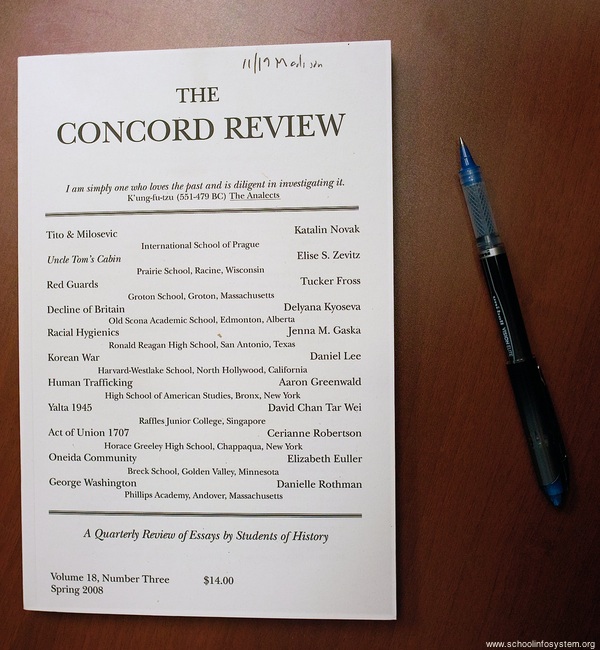
Low standards led Will Fitzhugh to quit his job as a history teacher in 1987 and begin publishing the journal [The Concord Review] out of his home in Concord, Mass.

Concerned that schools were becoming anti-intellectual and holding students to low standards, he thought the venture could fuel a national–even international–interest in student research and writing in the humanities.
“As a teacher, it is not uncommon to have your consciousness end at the classroom wall. But I came to realize that there was a national concern about students’ ignorance of history and inability to write,” he said.
During his 10 years of teaching at Concord-Carlisle High School, the 62-year-old educator said in a recent interview, he always had a handful of students who did more than he asked, and whose papers reflected serious research.

Those students “just had higher standards, and I was always impressed by that,” Mr. Fitzhugh said. “I figured there have got to be some wonderful essays just sitting out there. I wanted to recognize and encourage kids who are already working hard, and to challenge the kids who are not.”

Fitzhugh will discuss the problems of reading, writing and college readiness at the high school level. There will be an extended discussion period.

For more information, or to schedule some time with Mr. Fitzhugh during
his visit, contact Jim Zellmer (608 213-0434 or zellmer@gmail.com), Lauren Cunningham (608 469-4474) or Laurie Frost (608 238-6375).

Share

Bill Gates: “breaking large high schools into smaller units, on its own guaranteed no overall success”

Via a kind reader’s email:

Excerpt: “A main strategy of the schools, breaking large high schools into smaller units, on its own guaranteed no overall success, Gates said.
He said the New York City small schools were an example of successes in raising high school graduation rates — but a disappointment in that their graduates were no likelier than any city student to be prepared to go onto college.
Gates said the small number of successful schools did well not because they were structured as small schools, but because they enacted many different innovations: improved teaching quality, a longer school day, innovative instructional tools, a focus on tracking student achievement data.”

The implementation of “Small Learning Communities” in Madison has not been without controversy.

Share

Social Security Administration looks at Dallas schools’ practice of issuing fake numbers

Tawnell Hobbs:

he Social Security Administration is looking into DISD’s practice of issuing fake Social Security numbers to employees hired from foreign countries and will determine whether a formal investigation is needed, Wes Davis, the agency’s spokesman in Dallas, said Friday.
Mr. Davis said the review would look at whether there was any criminal intent by the Dallas Independent School District and whether further investigation or prosecution is called for by the U.S. attorney’s office. He said he hasn’t heard of any other school districts issuing false Social Security numbers.
Richard Roper, U.S. attorney in Dallas, said he could not comment on whether his agency would investigate the matter.
DISD had been issuing the fake numbers – some of which had already been assigned to people elsewhere – for several years before ending the practice this past summer. The false numbers were issued to get the foreign citizens – mostly teachers brought in on visas to teach bilingual classes – on the payroll quickly.

Share

BIBLIOPHOBIA
Will Fitzhugh in Madison 11/19 @ 7:00p.m.

Madison meeting details here
The Boston Globe reported recently that Michelle Wie, the 16-year-old Korean-American golfing phenomenon, not only speaks Korean and English, but has also taken four years of Japanese, and is beginning to study Mandarin. She is planning to apply early to Stanford University. I would be willing to bet, however, that in high school her academic writing has been limited to the five-paragraph essay, and it is very likely that she has not been assigned a complete nonfiction book.
For the last two years, and especially since the National Endowment for the Arts unveiled the findings of its large ($300,000) study of reading of fiction in the United States, I have been seeking funding for a much smaller study of the assignment of complete nonfiction books in U.S. public high schools. This proposed study, which education historian Diane Ravitch has called “timely and relevant,” has met with little interest, having so far been turned down by the National Endowment for the Humanities as well as a number of foundations and institutes both large and small.
Still, I have a fair amount of anecdotal evidence some of it from people who would be quite shocked to hear that high school English departments were no longer assigning any complete novels that the non-assignment of nonfiction books on subjects like history is unremarkable and, in fact, accepted.
A partner in a law firm in Boston, for instance, told me there was no point in such a study, because everyone knows history books aren’t assigned in schools. This was the case, he said, even decades ago at his own alma mater, Phillips Academy in Andover, Massachusetts, where he was assigned only selections, readings, and the like, never a complete book. A senior fellow at the Manhattan Institute, said when I lamented that I couldn’t find anyone who agrees that high school students should read at least one nonfiction book, “The only hope is parents introducing their kids to reading, and that’s a mighty slim hope.”

(more…)

Share

DeForest High To Reopen After Threat Closed School Tuesday

Channel3000:

DeForest Area High School was closed Tuesday after school officials found a threatening note, but officials said the school will reopen on Wednesday.
Officials said that the note, which was found on Monday afternoon in the school, said that there would be a bomb in a boys’ restroom.
School officials, along with the DeForest Police Department, were unable to determine whether the threat had merit. As a precaution, officials made the decision to cancel all classes, events and after-school activities Tuesday at the high school.
On Tuesday, the DeForest police, along with school administrators and a canine unit from the University of Wisconsin-Madison, searched the entire high school and grounds, and did not find any signs of explosive devices. Based on the search and the status of the investigation, school officials and law enforcement personnel said they feel confident that they can reopen the school Wednesday.

Share

LA Private Schools Feel The Pinch

Carla Rivera:

At the private New Roads School in Santa Monica, 20 families decided not to re-enroll in the fall because of financial nervousness.
At Loyola High School near downtown, 40 families have come forward since the beginning of the school year seeking financial aid to help cover tuition costs, even as the school’s endowment — heavily invested in equities — has taken a battering in the financial market.
Pacific Hills School in West Hollywood is creating flexible payment schedules for some families and is tightening its own belt with an eye toward more tough times ahead.
The economic meltdown that has ravaged many banks and homeowners is also affecting private schools in Los Angeles and nationwide, forcing educators to revise budgets, plan extra fundraising appeals and brace for possible lower enrollments next year. The distress comes at a time when some independent schools already have seen potential students gravitate to public charter schools, which are free and offer some of the same advantages of private campuses.

Share

Charter School Fights for Funding

AP:

Advocates of a new charter school in this city’s Potowomut neighborhood are fighting for state help after winning a $750,000 federal grant.
Backers of the proposed Nathanael Greene/Potowomut Academy of Technology and Humanities said they were disappointed with budget cuts the state Board of Regents budget made to charter schools.
The group is vowing to pressure lawmakers to include funding for the school in the state budget.

Share

Paterson Says NY Schools and Medicaid Will Face Cuts

Danny Hakim:

Gov. David A. Paterson said in an interview on Sunday that he would almost certainly seek billions of dollars in cuts to Medicaid, as well as midyear reductions in school aid, to address New York’s worsening fiscal condition.
He also said he expected to urge labor unions to reopen the contracts they have struck on behalf of public employees as a way to avoid or decrease layoffs.
Such a step is reminiscent of measures taken by New York City in the financial crisis of the 1970s or moves made more recently by the Big Three domestic automakers to reduce their labor costs after years of granting steady raises and comprehensive health and pension benefits.
Those same types of wage and benefit concessions have long weighed on New York, though the catalyst for the state’s current predicament has been the collapse in tax revenue from Wall Street.

Share

20,000 Milwaukee Students Now Use Vouchers

Alan Borsuk:

The number of Milwaukee children attending private schools using publicly funded vouchers has crossed 20,000 for the first time, according to data released by the Wisconsin Department of Public Instruction.
At the same time, the number of students in the main roster of Milwaukee Public Schools elementary, middle and high schools has fallen below 80,000 for the first time in well over a decade and declined for at least the 10th year in a row.
Amid a host of other factors shaping the school landscape in Milwaukee, those two trends point to some of the key stresses and looming issues for both MPS, which remains one of the nation’s larger school systems, and the voucher program, the largest, oldest and arguably most significant urban school voucher program in the United States.
For MPS, declining enrollment means greater financial pressure, a need to close school buildings and a continual search for ways to attract students and raise overall levels of achievement.
For the voucher program, the increase means the state-imposed cap on its size is coming into view, and issues related to the property-tax impact of the funding program are becoming more urgent. In addition, with Democrats having gained control of the state Legislature, efforts to impose more regulations on schools with voucher students are likely to become much more serious.
Nationwide, the momentum behind support for voucher programs such as the one in Milwaukee has been limited, and most likely has lost further steam with the election of Sen. Barack Obama to be president. Although Obama favors charter schools – generally, independent publicly funded schools that have more public accountability than private schools – he has not favored vouchers, and the Congress, controlled firmly by Democrats, is not going to support such plans either.

Somewhat related: A Madison School District enrollment analysis discloses an increase in outbound open enrollment.

Share

Civic Spirit Shines in School Vote

Wisconsin State Journal Editorial:

It also says something about Madison that, despite a troubled economy, people still felt they could afford to pay more. No other school referendum across the state passed with such a big majority — and many failed.
By more than a 2-1 margin, voters gave Madison schools permission to spend millions more than the state would otherwise allow.
The public seemed to recognize the difficult predicament the district is in. And good vibes from the historic election of Barack Obama framed every question on Tuesday’s ballot with a theme of hope.
Another factor in the school district’s favor was the vote of the many residents who don’t directly pay property taxes because they’re in college or rent apartments.

Share

Politics holds new role in high school classrooms

Greg Toppo:

Tuesday’s historic election of Barack Obama was, to most onlookers, a watershed event — a political game-changer, a passing of the generational torch and a defining moment in American race relations.
To the students in Gil Stange’s second-period AP Economics class at Towson High School, it was a chance to test a theory: What if the Republican candidate had been the African American and the Democrat the 72-year-old white guy?
“Is it really overcoming race?” asked Allison Rich, 17, dressed in a bright-red University of New Hampshire sweatshirt. “Or is it just a party issue?”
As the results of the election sank in Wednesday, teachers in high school classrooms across the USA found themselves debriefing a group of young people who are, by all accounts, more informed and civic-minded than any in recent memory. They came of age after 9/11, after all.

Share

November 2008 Madison School District Referendum Watch List Report Card

Active Citizens for Education presents this “Watch List Report Card” as a means of reporting relevant information, facts and analyses on topics appropriate for consideration by taxpayers in voting on the Madison Metropolitan School District referendum question November 4, 2008. This document is dynamic in nature, thus it is updated on a regular basis with new information and data. Questions, analyses, clarifications and perspectives will be added to the entries as appropriate. Review Ratings will be applied to report the progress (or lack thereof) of the Board of Education and Administration in its plans, data, information, reports and communications related to the referendum.
Complete PDF Document. Madison School District Revenue Summary 2005-2011 PDF

Share

Wisconsin School District’s Global Financial Gamble in “Synthetic Collaterilized Debt Obligations”

Charles Duhigg & Carter Dougherty:

On a snowy day two years ago, the school board in Whitefish Bay, Wis., gathered to discuss a looming problem: how to plug a gaping hole in the teachers’ retirement plan.
It turned to David W. Noack, a trusted local investment banker, who proposed that the district borrow from overseas and use the money for a complex investment that offered big profits.
“Every three months you’re going to get a payment,” he promised, according to a tape of the meeting. But would it be risky? “There would need to be 15 Enrons” for the district to lose money, he said.
The board and four other nearby districts ultimately invested $200 million in the deal, most of it borrowed from an Irish bank. Without realizing it, the schools were imitating hedge funds.
Half a continent away, New York subway officials were also being wooed by bankers. Officials were told that just as home buyers had embraced adjustable-rate loans, New York could save money by borrowing at lower interest rates that changed every day.

SIS Links. NPR covers the story here. Madison Assistant Superintendent for Business Services Erik Kass held the same position at the Waukesha School District, which was involved in this investment strategy.

Share

Parents cool to short-term solutions for overcrowding at Leopold

Kurt Gutknecht, via a kind reader’s email:

A temporary solution to concerns about Leopold Elementary School will be announced by June 2009, according to Daniel Nerad, superintendent of the Madison Metropolitan School District.
Nerad, members of the school board and other officials held what Nerad called “an engagement session” at Leopold on Oct. 20. About 100 parents attended the session, part of what Nerad called an effort to find “a short-term solution to find a long-term solution.”
But a show of hands after the meeting indicated most of those attending the session opposed the proposed short-term solution, which would involve transferring fifth graders to Cherokee and Wright middle schools.
“I’m confident it (the short-term solution) would work for two years,” Nerad said.
Nerad conceded that the short-term plan would address crowding but not another concern of parents- the high proportion (68 percent) of low-income students at Leopold. The long-term plan would tackle that issue, he said.

Much more on Leopold here.

Share

The New WEAC

George Lightbourn:

This is an especially timely discussion as control of the Wisconsin Legislature hangs in the balance with the upcoming fall election. While it is widely believed that the state Senate will remain in Democratic hands, the Assembly is altogether another matter. With a mere five vote majority and a nation anxious to blame Republicans for both the war in Iraq as well as the weak economy, Republican retention of an Assembly majority is definitely in play. If the Assembly were to tumble into Democratic hands, Democrats would control all of state government. At long last, the thinking goes, WEAC will rise up and ensure its minions in the Capitol do what they have promised; expunge the QEO from state law books.
But is that the case? Maybe not. That picture might have been clear a few years ago, but it is less clear today.
The QEO Through Time
To understand the roots of the popular caricature of WEAC, a short history lesson is in order. As we close in on a generation under the QEO, it is easy to forget what life was like before Tommy Thompson signed the QEO into law. In the 1980s and into the early 1990s a statewide furrowing of the brow and wringing of hands occurred every Christmas season when local governments slid property tax bills into our mailboxes. In 1989 school taxes rose 9% followed by a 9.4% increase in 1990 and a 10% jump in 1991. The last straw came in 1993 when schools added 12.3% to the property tax bill. Of course every year the school tax was layered on top of the tax bill from cities, villages and town so property taxes were routinely increasing at double-digit rates.
While property taxes might not have stirred the public psyche as much as say the Vietnam War had, it was close. Every state budget discussion started and ended with property taxes. It was the third rail of Wisconsin politics. The property tax discussion drove a wedge between Democrats and Republicans; it caused short fuses between state and local governments and between general governments and schools. And everyone understood who was operating the jack that kept ratcheting up property taxes: it was teachers.
No, it wasn’t just teachers, it was WEAC. What generations of teachers had known as a helpful service organization, overnight had assumed the pale of a hard-line labor union. It was as though WEAC had undergone its own version of the Invasion of the Body Snatchers. The side of the organization that provided teacher services was taken over by the union side. Overnight it became clear that nothing mattered to the staff at WEAC if it didn’t entail: raising teacher pay, protecting jobs, or improving working conditions. This was the familiar mantra of every labor union from the autoworkers to air traffic controllers.

Share

A look at Madison Memorial’s Small Learning Communities

Andy Hall:

In 2000, Memorial became the first Madison school to land one of the U.S. Department of Education grants. It was awarded $438,000 to create its neighborhood social structure. West High School became the second, winning a $500,000 grant in 2002 and reorganizing its ninth and 10th grades around core courses.
In August, district officials were thrilled to learn the district was awarded $5.5 million over five years for its four major high schools — Memorial, West, La Follette and East — to build stronger connections among students and faculty by creating so-called “small learning communities” that divide each high school population into smaller populations.
Officials cite research showing that schools with 500 to 900 students tend to be the most effective, and recent findings suggest that students at schools with small learning communities are more likely to complete ninth grade, less likely to become involved in violence and more likely to attend college after graduation. However, the latest federal study failed to find a clear link between small learning communities and higher academic achievement.
Each Madison high school will develop its own plan for how to spend the grant money. Their common goals: Make school feel like a smaller, friendlier place where all students feel included. Shrink the racial achievement gap, raise graduation rates, expand the courses available and improve planning for further education and careers.
The high schools, with enrollments ranging from 1,600 to 2,000 students, are being redesigned as their overall scores on state 10th grade reading and math tests are worrisome, having declined slightly the past two years.

Share

THE REAL WEALTH OF THE NATION; Green Charter School Conference – Madison 11/7 – 11/8

Tia Nelson:

Wisconsin has long been an incubator for prescient ideas about the connection between human society and the natural environment.
John Muir’s boyhood in the backwoods near Portage, Wis., provided a foundation for his early leadership in a dawning environmental protection movement.
A Sand County Almanac, Aldo Leopold’s description of the area around his Sauk County, Wis., home, has inspired natural stewardship throughout the world and is required reading for anyone with an interest in conservation.
My father, the late U.S. Sen. Gaylord Nelson, launched the first Earth Day on April 22, 1970, as an annual day of observance and nationwide teach-in about environmental issues because he recognized the significance of educating children and young adults about the natural world.
Today, as we reap the effects of pernicious economic activity, a failing energy policy and atmospheric warming, I find my father’s words both foreboding and reassuring:
“Forging and maintaining a sustainable society is The Challenge for this and all generations to come. At this point in history, no nation has managed to evolve into a sustainable society. We are all pursuing a self-destructive course of fueling our economies by drawing down our natural capital–that is to say, by degrading and depleting our resource base–and counting it on the income side of the ledger. … [T]he real wealth of a nation is its air, water, soil, forests, rivers, lakes, oceans, scenic beauty, wildlife habitats, and biodiversity.”
Papa often talked about the importance of raising the next generation with environmental ethics so they make informed decisions about the use of our natural resources, which are the authentic foundation of a healthy economy. Imagine a robust and equitable economy with clean and abundant energy resources, sustainably managed farms and forests, where innovation and green jobs give us healthy choices that can lead us to a better future.

(more…)

Share

Wisconsin Forum on Special Education 11/17/2008 in Madison

Via a kind reader’s email:

The State Superintendent’ s Council on Special Education will be holding a public forum to gather input on matters related to special education in Wisconsin. Information obtained will be used by the Council in advising the Department of Public Instruction on matters affecting the education of Wisconsin ‘s children and youth with disabilities.
This public forum will be held Monday evening, November 17, 2008 from 5:00 to 7:00 PM at the Madison Marriott West, Salon D (1313 John Q. Hammons Drive Middleton, Wisconsin; 608/831-2000).
Should you have any questions related to this public forum, do not hesitate to contact Chair Myrah at gary.myrah@pwssd.k12.wi.us or (262) 268-6079.

Share

Pint-Size Politicians Channel McCain, Obama in School Elections

Ellen Gamerman:

‘Change’ Factors Big in Tykes’ Talking Points; A Third-Grader’s Economic Platform
In his recent stump speech, Thomas Fleming took a stand against nuclear power, violence, weapons and war. He told voters there was no greater honor than serving them and requested their support. “I ask nothing in return except a better America,” he said.
Then the 8-year-old candidate, dressed in his Cub Scout uniform, sang a song from “The Simpsons,” waved his fists over his head and rejoined his fellow third-graders in the cafeteria at Altruria Elementary School in Bartlett, Tenn. Thomas, who won the election, serves as the student council sergeant-at-arms when he isn’t busy practicing piano or dancing like a robot.

Share

NAEP Writing Assessment 2011

An Interview with Will Fitzhugh: About Assessing Writing EdNews.org Houston, Texas, 24 January 2007
Michael F. Shaughnessy Senior Columnist EdNews.org:

1) I understand that you have just finished a stint on the ACT/NAGB Steering Committee for the 2011 NAEP (National Assessment of Educational Progress) Writing Assessment. What was that like? (And what does NAGB stand for?)
WF: NAGB is the National Assessment Governing Board, which runs the NAEP, “America’s Report Card,” as they say. I was glad that Diane Ravitch recommended me for the Steering Committee for the new national writing assessment scheduled for 2011. I was very impressed with the intelligence and competence of Mary Crovo, representing NAEP, and Rosanne Cook, who is running the project for American College Testing. Many people on the Committee were from the National Council of Teachers of English and the College Composition world, which have little interest in having students read history books or write history research papers. In fact that world favors, or has favored in the past, personal and creative writing and the five-paragraph essay, which do a terrible job of preparing high school students for the nonfiction books and the academic term papers most will be asked to cope with in college.
2) Given the paucity of writing that goes on in the high schools of America, is it really fair to ask high school students to engage in a robust writing assessment?
WF: It would not be fair to ask high school students to play in a football game if they hadn’t had an opportunity for lots of practice, and it is very hard to ask high school students to do the sort of academic expository writing they should be doing if they have never done it in all their years in school. But we need to start somewhere. Every high school student does not need to be able to play football, but they all need to be able to read nonfiction books and write serious term papers.
3) On the other hand, since so much of the college experience is writing, are high school teachers doing students a disservice by NOT requiring more writing?
WF: High school teachers would make terrible football coaches and their teams would lose most if not all of their games, if the teacher/coaches did not have time to practice their teams. We take football seriously, and we take band seriously, so ample time and money are made available to produce the best teams and the best bands the high school can manage. We allow really no time for a public high school teacher to work with students on heavy-duty term papers. We don’t make time for them, because we don’t think they are that important. Not as important as drama practice, yearbook, chorus, debate or a host of other activities. As a result our high school students are, once again, ill-prepared for college reading and writing. AP courses in history do not require, in most cases, that students read a complete nonfiction book, and most of the AP teachers say they don’t have time to ask the student to write a research paper, because they “have to get students ready for the AP Exam.”

(more…)

Share

Buttons: The Sequel

Stanley Fish:

Last week’s column about the propriety or impropriety of teachers wearing campaign buttons in class provoked many questions, and today I would like to respond to those that were asked most often.
Some of the questions concerned the psychology of students. Several respondents scoffed at the likelihood of students being influenced by their teachers at all: “Prof. Fish’s belief in the power of faculty to influence students’ political choices is touching, but not borne out by research” (David Taylor).
But whatever the research disclosed would be irrelevant to the professional issue: is it a part of an instructor’s job to let students (susceptible or not) know what his or her political preferences are? What pedagogical purpose does such self-revelation serve?
Jason D’Cruz has an answer to that question. He believes that “when students know exactly what their professor’s political commitments are, they are in a better position to evaluate the points of view from which their teacher’s ideas arrive.”

Share

Fly Your Ideas Contest

Airbus Fly Your Ideas:

Welcome to the Airbus Fly Your Ideas challenge, a global competition designed to encourage innovative thinkers to develop ideas that can shape the future of aviation and deliver a further reduction in the industry’s impact on the environment.
The competition is open to college and university students from around the world, studying a degree, Masters or PHD in any academic discipline, from engineering to marketing, business to science and philosophy to design.
Airbus is offering €30,000 for the team whose idea demonstrates the greatest short or long term potential to reduce the impact of our industry on the environment, as well as a range of other prizes available throughout the competition (see Prizes for more information).

Share

In wake of turmoil, Madison Memorial students seek solutions

Mark Pitsch:

More parental involvement. Peer-to-peer mentoring. Community programs.
Those are some of the ideas students, parents and others offered in the wake of a fight at Memorial High School last week between black and Latino students and early closure of the school Friday amid rumors of a gun at the school.
Tim Maymon, whose two teenagers attend Memorial and who had another graduate this year, said he believes the school is safe, that his children aren’t in danger and that the racial tension is limited to small groups of students.
But he also said some students — including those involved in the altercation last week — aren’t getting proper parental guidance.
“The two groups need more parental control,” Maymon said. “There’s a lot of people promoting their kids to fight and be stupid. Any smart parent would want to see their kids be safe and egging them on to fight is not safe.”

Share

Math mistake sees hundreds of Dallas teachers laid off

CNN:

“Today is a day of tremendous sadness throughout the district,” Dallas Independent School District Superintendent Michael Hinojosa said in a written statement.
“These teachers and counselors are people who devoted themselves to helping Dallas students, and we will do everything within our power to help them find new jobs.”
The district laid off 375 teachers and 40 counselors and assistant principals Thursday, and transferred 460 teachers to other schools within the district.
The deficit was caused by a massive miscalculation in the budget, CNN affiliate WFAA-TV reported.

Share

Madison’s Memorial High School Closes Early Today Amid Safety Concerns

Channel3000:

Students at James Madison Memorial High School in Madison were let out early on Friday amid ongoing safety concerns, according to a Madison Metropolitan School District spokesman.
There was increased police presence at the school and officials postponed an early lunch on Friday, according to Ken Syke.
The students were released at 12:55 p.m. Officials said that buses will be there to pick up students.
They said that all of the schools extracurricular activities are scheduled, but there will be an extra police presence at each event.
Syke said that no incidents occurred at the school on Friday, but that officials are concerned about safety after a fight broke out at the school earlier this week. The fight apparently involving two groups of students on Thursday and seven students were ultimately arrested.

Sandy Cullen has more along with WKOW-TV and NBC-15. Madison School District statement.
Related: Gangs & School Violence Forum Audio & Video and police calls near Madison high schools 1996-2006.

Share

Earth Science Week

2008:

AGI is pleased to announce the theme of Earth Science Week 2008: “No Child Left Inside.” Being held October 12-18, Earth Science Week 2008 will encourage young people to learn about the geosciences by getting away from the television, off the computer, and out of doors.
AGI hosts Earth Science Week in cooperation with sponsors as a service to the public and the geoscience community. Each year, local groups, educators, and interested individuals organize celebratory events. Earth Science Week offers opportunities to discover the Earth sciences and engage in responsible stewardship of the Earth. The program is supported by the U.S. Geological Survey, NASA, the National Park Service, the AAPG Foundation, and other geoscience groups.

Share

Police: Fight At Memorial High School Leads To 7 Arrests

Channel3000:

A fight involving two groups of students at Memorial High School has led to the arrest of seven students, Madison police said.
Madison police responded to a fight a Memorial High school around 9:11 a.m. on Thursday.
The fight involved two groups of students and during the incident, a 16-year-old girl was knocked to the floor and is believed to have lost consciousness, according to police.
Another student is accused of battering the girl when she was knocked down. The girl suffered abrasions but did not require hospitalization.
A 17-year-old girl has been arrested and tentatively charged with substantial battery and disorderly conduct.

Related: Police calls near Madison high schools: 1996-2006.

Share

ACE Update on the November 2008 Madison Referendum, Information Session Tonight

REMINDER: The MMSD district is holding its second of four “Information Sessions” regarding the referendum tonight (Thursday, October 16), 6:30 pm, Jefferson Middle School. You are urged to attend.
The Madison Metropolitan School District seeks approval of the district taxpayers to permanently exceed the revenue cap for operations money by $13 million a year. In the meantime, to establish that new tax base over the next three years, a total of $27 million in more revenue will have been raised for programs and services. The district has also projected there will continue to be a ‘gap’ or shortfall of revenue to meet expenses of approximately $4 million per year after the next three years, thereby expecting to seek approval for additional spending authority.
Whereas, the Board of Education has staked the future of the district on increased spending to maintain current programs and services for a “high quality education;”
Whereas, student performance on the Wisconsin Knowledge and Concepts Exams has languished at the 7, 8, and 9 deciles (in comparison with the rest of the state’s schools where 1 is the highest level and 10 is the lowest) in 4th, 8th and 10th grade reading, math, science, social studies and language arts exams for the past five years. The total percentage of MMSD students performing at either “proficient” or “advanced” levels (the two highest standards) has consistently ranged in mid 60%s to mid 70%s;
Whereas, the district Drop Out Rate of 2.7% (2006-07) was the highest since 1998-99. With the exception of two years with slight declines, the rate has risen steadily since 1999.
Whereas, the Attendance Rate for all students has remained basically steady since 1998-99 in a range from 95.2% (2005-06) to a high of 96.5% (2001-02);
Whereas, the district Truancy Rate of students habitually truant has risen again in the past three years to 6.0% in 2006-07. The truancy rate has ranged from 6.3% (1999-2000) to 4.4% in 2002-03;
Whereas, the district total PreK-12 enrollment has declined from 25,087 (2000-01) to its second lowest total of 24,540 (2008-09) since that time;
Whereas, the district annual budget has increased from approximately $183 million in 1994-1995 (the first year of revenue caps) to approximately $368 million (2008-09);
Whereas, the board explains the ‘budget gap’ between revenue and expenses as created by the difference between the state mandated Qualified Economic Offer of 3.8% minimum for salary and health benefits for professional teaching staff and the 2.2% average annual increases per student in the property tax levy. The district, however, has agreed with the teachers’ union for an average 4.24% in annual increases since 2001;
Whereas, the district annual cost per pupil is the second highest in the state at $13,280 for the school year 2007-08;
The Madison Metropolitan School District seeks approval of the district taxpayers to permanently exceed the revenue cap for operations money by $13 million a year. In the meantime, to establish that new tax base over the next three years, a total of $27 million in more revenue will have been raised for programs and services. The district has also projected there will continue to be a ‘gap’ or shortfall of revenue to meet expenses of approximately $4 million per year after the next three years, thereby expecting to seek approval for additional spending authority.
Whereas, the Board of Education has staked the future of the district on increased spending to maintain current programs and services for a “high quality education;”
Whereas, student performance on the Wisconsin Knowledge and Concepts Exams has languished at the 7, 8, and 9 deciles (in comparison with the rest of the state’s schools where 1 is the highest level and 10 is the lowest) in 4th, 8th and 10th grade reading, math, science, social studies and language arts exams for the past five years. The total percentage of MMSD students performing at either “proficient” or “advanced” levels (the two highest standards) has consistently ranged in mid 60%s to mid 70%s;
Whereas, the district Drop Out Rate of 2.7% (2006-07) was the highest since 1998-99. With the exception of two years with slight declines, the rate has risen steadily since 1999.
Whereas, the Attendance Rate for all students has remained basically steady since 1998-99 in a range from 95.2% (2005-06) to a high of 96.5% (2001-02);
Whereas, the district Truancy Rate of students habitually truant has risen again in the past three years to 6.0% in 2006-07. The truancy rate has ranged from 6.3% (1999-2000) to 4.4% in 2002-03;
Whereas, the district total PreK-12 enrollment has declined from 25,087 (2000-01) to its second lowest total of 24,540 (2008-09) since that time;
Whereas, the district annual budget has increased from approximately $183 million in 1994-1995 (the first year of revenue caps) to approximately $368 million (2008-09);
Whereas, the board explains the ‘budget gap’ between revenue and expenses as created by the difference between the state mandated Qualified Economic Offer of 3.8% minimum for salary and health benefits for professional teaching staff and the 2.2% average annual increases per student in the property tax levy. The district, however, has agreed with the teachers’ union for an average 4.24% in annual increases since 2001;
Whereas, the district annual cost per pupil is the second highest in the state at $13,280 for the school year 2007-08;

(more…)

Share

Baylor Rewards Freshmen Who Retake SAT

Sara Rimer:

Baylor University in Waco, Tex., which has a goal of rising to the first tier of national college rankings, last June offered its admitted freshmen a $300 campus bookstore credit to retake the SAT, and $1,000 a year in merit scholarship aid for those who raised their scores by at least 50 points.
Of this year’s freshman class of more than 3,000, 861 students received the bookstore credit and 150 students qualified for the $1,000-a-year merit aid, said John Barry, the university’s vice president for communications and marketing.
“We’re very happy with the way it worked out,” Mr. Barry said in a telephone interview. “The lion’s share of students ended up with the $300 credit they could use in our bookstore. That’s not going to make or break the bank for anybody. But it’s sure been appreciated by our students and parents.”
The offer, which was reported last week by the university’s student newspaper, The Lariat, raised Baylor’s average SAT score for incoming freshmen to 1210, from about 1200, Mr. Barry said. That score is one of the factors in the rankings compiled by U.S. News & World Report.

Share

Texas District Wins Prize for Schools

Sam Dillon:

The Brownsville Independent School District in Texas won what may be the nation’s most important prize for excellence in urban education on Tuesday, the same day that Texas authorities announced that the district had failed to meet achievement targets for two years under the federal No Child Left Behind law.
Erica Lepping, a spokeswoman for the foundation that administers the $1 million Broad Prize for Urban Education, said the 10-member prize jury, which included two former secretaries of education, was aware that Brownsville had missed its testing targets under the federal law last year but had considered many other academic quality indicators in making its choice.
A vast majority of the nation’s largest urban districts, including three of the four runners-up for this year’s Broad prize, also failed to meet the federal law’s annual targets, Ms. Lepping said.

Share

Wisconsin State & School Finance Climate Update

I recently had an opportunity to visit with Todd Barry, President of the Wisconsin Taxpayers Alliance [29 minute mp3]. A summary of this timely conversation follows:
[2:25] Post Retirement Liabilities: Milwaukee Public Schools Post Retirement Health Care Liabilities: $2.2 to $2.5 billion
[3:01] Wisconsin’s $2.44 Billion structural deficit. The State debt load ($4billion to $9billion from 2000 to 2007) is now among the top 10.
[7:48] On property values and assessment changes. Two years ago, property values grew 9%, last year 6%, 3% this year with most of the recent growth coming from commercial properties.
[8:57] Wisconsin Income Growth: Per Capita personal income “The canary in the mineshaft” and how we lag the national average by 6% or more.
Why?
The population is aging. Senior population will double by 2030. School age population is stagnant.
Employment growth peaked before the nation (04/05)
Wisconsin wages per worker is about 10% less than the national average. 1969; 4% below national average, 1980’s; 10 or 11% below national average. Wisconsin wagers per worker are now 14% below national average. We’ve been on a 40 year slide.
We’ve hid this because the labor force participation of women has increased dramatically.
Wisconsin is losing corporate headquarters.
[18:18] What does this all mean for K-12 spending?
“If there is going to be growth in any state appropriation,it is going to be schools and Medicaid“. The way the Legislature and Governor have set up these two programs, they are more or less on auto-pilot. They will grab whatever money is available and crowd out most everything else. So you get this strange situation where state aid to schools has tripled in the last 25 years while funding for the UW has barely doubled. That sounds like a lot, but when you look at it on a year by year basis, that means state funding for the University of Wisconsin System has grown less than the rate of inflation on an annual average basis while school aids has outpaced it (inflation) as has Medicaid.”
Is there anything on the horizon in terms of changes in school finance sources? A discussion of shifting state school finance to the sales tax. “It’s clear that in states where state government became even more dominant (in K-12 finance) than in Wisconsin, the net result, in the long run, was a slowing of state support for schools. The legislature behaves like a school board, micromanaging and mandating. California is the poster child.
[20:52] On why the Madison School District, despite flat enrollment and revenue caps, has been able to grow revenues at an average of 5.25% over the past 20 years. Barry discussed: suburban growth around Madison, academic competition amongst Dane County high schools. He discussed Madison’s top end students (college bound kids, kids of professionals and faculty) versus the “other half that doesn’t take those (college entrance) tests” and that the “other half” is in the bottom 10 to 20% while the others are sitting up at the top on college entrance exams.
[23:17]: This is a long way of saying that Madison has made its problem worse and has put itself on a course toward flat enrollment because of social service policies, school boundary policies and so forth that have pushed people out of the city.
[23:42] “If there is a way within state law to get around revenue caps, Madison has been the poster child”. Mentions Fund 80 and frequent and successfully passing referendums along with Madison’s high spending per pupil.
People think of the Milwaukee Public Schools as a high spending District. When you really look start to dig into it, it is above average, but Madison is way out there compared to even MPS. People argue that argue that MPS is top heavy in terms of administrative costs per student, Madison actually spends more in some of those categories than Milwaukee. (See SchoolFacts, more)
[26:45] On K-12 School finance outlook: The last time we blew up the school finance system in Wisconsin was in 1994. And, it happened very quickly within a span of 2 to 3 months and it had everything to do with partisan political gotcha and it had nothing to do with education.
[28:26] “Where are the two bastians of Democratic seats in the legislature? Madison and Milwaukee. Madison is property rich and Milwaukee is relatively property poor. Somehow you have to reconcile those two within a Democratic environment and on the Republican side you have property rich suburbs and some very property poor rural districts.

Share

2008 Madison Schools’ Referendum – Key Issues

1. Mortgage on future property with permanent increase: Asking taxpayers to refinance/mortgage their futures and that of the school district with a permanent increase of $13 million yearly for the operations budget. It has been stated the district needs the money to help keep current programs in place. It is expected that even after 3 years of this referendum totaling $27 million, the Board is projecting a continued revenue gap and will be back asking for even more.
2. No evaluation nor analysis of programs and services: The Board will make budget cuts affecting program and services, whether or not this referendum passes. The cuts will be made with no assessment/evaluation process or strategy for objective analyses of educational or business programs and services to determine the most effective and efficient use of money they already have as well as for the additional money they are asking with this referendum.
3. Inflated criteria for property value growth: The dollar impact on property to be taxed is projected on an inflated criteria of 4% growth in property valuation assessment; therefore, reducing the cost projection for the property tax levy. The growth for property valuation in 2007 was 3.2% and for 2008 it was 1.0%. Given the state of the economy and the housing market, the growth rate is expected to further decline in 2009. [10/13 Update: The above references to property valuation assessment growth are cited from City of Madison Assessor data. See ACE document “Watch List Report Card” [2008 Referendum Watch List 755K PDF] for State Department of Revenue citations for property valuation base and growth rate used for determination of MMSD property tax levy.]
4. No direct impact on student learning and classroom instruction: There is District acknowledgement of a serious achievement gap between low-income and minority student groups compared with others. There are no plans evident for changing how new or existing money will be spent differently in order to have an impact on improving student learning/achievement and instructional effectiveness.
5. Lack of verification of reduction in negative aid impact on taxes: District scenarios illustrating a drastic reduction in the negative impact on state aids from our property-rich district is unsubstantiated and unverified, as well as raising questions about unknown possible future unintended consequences. The illustrated reduction is from approximately 60% to 1% results by switching maintenance funds from the operations budget and 2005 referendum proceeds to a newly created “Capital Expansion Fund–Fund 41” account. [Update: 10/13: The reduction in the negative aid impact will take affect regardless of the outcome of the referendum vote. See the ACE document “Watch List Report Card” [2008 Referendum Watch List 755K PDF] for details.]

(more…)

Share

Sun Prairie Acadamic Decathlon team plans road trip

Pamela Cotant:

This year the theme for the Academic Decathlon curriculum is Latin America with a focus on Mexico and two area teams plan to go right to the source to study it.
About a dozen members from each of the Wisconsin Academic Decathlon teams at the high schools in Sun Prairie and McFarland will visit Mexico City from Oct. 29 to Nov. 3.
Participants agree that the trip is about more than just a great way to gather information outside of their regular meetings.
“It’s a really good team bonding time,” said Scott LaWall, a senior at Sun Prairie High School. “During the school year, just (meeting) after school, it’s difficult to really get to know your teammates.”

Share

Parents upset that Arlington school sex assault case wasn’t reported earlier

Chris Hawes:

A suspect was put in custody Friday but many parents of children at Coble Middle School say that’s not the issue. They’re outraged they weren’t told an assault had taken place on campus.
Parents lining up to pick up their children Friday received something else – a letter. The more they read, the more disturbed they became: A young girl reported she was sexually assaulted at school.
But two weeks passed before the children were told what was going on. The school says they had to protect the investigation.
Counselors handed out the letter in the car lane. The letter detailed the reported the sexual assault of a 13-year-old girl on campus, during school.
“He had a valid reason to be on campus and chose to pull this girl into a locker room and sexually assault her,” said Lt. Blake Miller from Arlington police.
But even more disturbing to one father was the date of the crime, Sept. 26.

Share

Computer data breach at South Tahoe High School

AP:

A South Tahoe High School student has been arrested on suspicion of hacking into the school’s computer system, school officials said.
District administrators said they found a security breach in one of the computers last week, and the 17-year-old boy may have accessed sensitive information regarding staff and students.
The student was suspended after the discovery and arrested Wednesday after a follow-up investigation by police.
The exposure appears to be limited to the school’s internal student information system, according to a district news release.

Share

Wisconsin Districts had some warnings about risky investments, documents show

Amy Hetzner:

Five Wisconsin school districts suing over millions of borrowed dollars they invested to help pay retiree benefits were given some warnings of the risks involved in the transactions, documents show.
At least one document appears to contradict one contention in the lawsuit filed Sept. 29.
But it remains unclear how much school officials were told about transactions they undertook in 2006 in which they poured $200 million into collateralized debt obligations, financial instruments at the center of the global economic meltdown.
The districts — Kenosha, Kimberly, Waukesha, West Allis-West Milwaukee and Whitefish Bay — allege they were misled by two financial institutions that promoted the investments: Stifel, Nicolaus & Co. Inc. of St. Louis and Royal Bank of Canada.

Share

What’s in a Grade & An Update on Madison’s Standards Based Report Card Scheme

Stafford Palmieri:

The red pen. In our still largely decentralized public school system, it’s no big surprise that this old-fashioned instrument of ill repute gets starkly different treatment from district to district and state to state. Three locales, in fact, have recently reopened the question, “what’s in a grade”–and come up with very different answers. Perhaps by evaluating these recent conversations, we can imagine what standard GPAs might look like.
Fairfax County, Virginia, parents are outraged that their children must score a 94 to receive an A. Neighboring counties give As for a mere 90, they argue, and they and their kids are being unfairly penalized when competing for college admission, national merit awards, even a lower car insurance bill. Parents have taken up arms in hopes that extended pressure on the district to follow the example of nearby school systems will lead to a lower bar; Fairfax is contemplating doing so.
Fairfax’s one-county crusade against grade inflation is probably sacrificing its students on the altar of its ideals, as parents allege, and remedying that problem is not difficult. Despite cries of the old “slippery slope,” shifting the letter-number ratio to match neighboring counties will ultimately benefit Fairfax students (in the short term at least) when it comes to college admissions and the like.
Pittsburgh has tackled the other end of the grading spectrum. All failing grades (those of 50 or below) will henceforth be marked down as 50 percent credit in grade books. Long on the books but only recently enforced, this policy, the district claims, is simply giving students a better chance to “catch up” in the next quarter since quarters are averaged into semester and yearlong grades. “A failing grade is still a failing grade,” explains district spokeswoman Ebony Pugh. Seems not to matter if it’s a 14 or a 49. Round up to 50.

Locally, the Madison School District is implementing “Standards Based Report Cards” in the middle schools.
I’ve wondered what the implementation of this initiative tells parents, citizens and taxpayers, not to mention students about the new Superintendent? See his memo on the subject here. More here.
The State of Wisconsin’s standards are changing, according to this Department of Public Instruction. Peter Sobol’s post on the WKCE’s suitability for tracking student progress is illuminating:

… The WKCE is a large-scale assessment designed to provide a snapshot of how well a district or school is doing at helping all students reach proficiency on state standards, with a focus on school and district-level accountability. A large-scale, summative assessment such as the WKCE is not designed to provide diagnostic information about individual students. Those assessments are best done at the local level, where immediate results can be obtained. Schools should not rely on only WKCE data to gauge progress of individual students or to determine effectiveness of programs or curriculum.

Much more on report cards here.

Share

Adolescent Anxiety: The Musical

Bruce Weber:

He was never much of a student, but Jason Robert Brown was a precocious kid. Growing up in Monsey, N.Y., about an hour north of Manhattan, he became enthralled by music at age 4, was taking lessons at 5. At his first recital — age 6 — he not only outplayed his teacher’s other students, he also supplied the verbal patter of a natural entertainer.
“He just started chatting with the audience,” his mother, Deborah Brown, recalled. “I was floored. Nobody knew where it came from.”
Once, before he could write in script, he filched a checkbook from one of his parents, wrote out a check and sent it to a mail-order record club. Fortunately he didn’t get all the particulars right, and the check was returned because it was unsigned. Teachers plucked him from third grade and plopped him into the fourth, not because of straight A’s but because he wasn’t paying attention.
“He was good in everything, but if it wasn’t music, he didn’t do the work,” said Mrs. Brown, a former English teacher.

Share

Starting Over (Again) in New Orleans

Caitlin Corrigan:

Aug. 29, 2008, marked the end of the second week of my second year teaching at Craig Elementary school, one of nearly 35 public schools that make up the Recovery School District, a state run system created in 2005 to reform New Orleans’ failing schools.
The date had a much greater significance for my students and our city, of course — it was both the three year anniversary of Hurricane Katrina’s devastating landfall, and the day before Mayor C. Ray Nagin would declare a mandatory evacuation in preparation for what could be “the storm of the century,” Hurricane Gustav.
As we neared dismissal that day, my students buzzed around the wooden shelves that housed their binders of classwork.

Share

Leopold fifth-graders would go to two middle schools under district plan to reduce crowding

Click to view a map displaying Leopold and nearby schools.

Tamira Madsen:

Five days after Madison Metropolitan School District and Madison School Board officials learn if voters approved a referendum to help finance the district budget, they’re expected to vote on options to ease overcrowding at Leopold Elementary.

Wisconsin State Journal & The Madison School District:

A long-term plan for coping with Leopold Elementary’s crowded classrooms would be delayed until June, and the school’s fifth graders would be shuttled to two middle schools for two years under a proposal released today by Madison schools Superintendent Daniel Nerad.
In a report to the Madison School Board, Nerad acknowledged that residents living in the Leopold area on Madison’s South Side would prefer that a new school be built in the area.
However, he recommended the stopgap measures while delaying the long-term plan, which had been expected to be announced this fall. District officials have been studying the problem since April.
Under Nerad’s plan, Leopold’s fifth graders would attend Cherokee and Wright middle schools in the 2009-10 and 2010-11 school years. About three-fourths of the fifth graders would be sent to Cherokee.

Distance from Leopold Elementary to:

Much more on Leopold here.

Share

Parents Give Up Youths Under Law Meant for Babies

Erik Eckholm:

The abandonments began on Sept. 1, when a mother left her 14-year-old son in a police station here.
y Sept. 23, two more boys and one girl, ages 11 to 14, had been abandoned in hospitals in Omaha and Lincoln. Then a 15-year-old boy and an 11-year-old girl were left.
The biggest shock to public officials came last week, when a single father walked into an Omaha hospital and surrendered nine of his 10 children, ages 1 to 17, saying that his wife had died and he could no longer cope with the burden of raising them.
In total last month, 15 older children in Nebraska were dropped off by a beleaguered parent or custodial aunt or grandmother who said the children were unmanageable.

Share

Hartland Arrowhead Honored for Best High School Musical

Channel3000:

A Wisconsin high school will receive an award Thursday for producing the best high school musical in the nation.
Arrowhead High School about 30 miles west of Milwaukee is being honored for last year’s production of “Cats.”
The school has spent the past decade developing a musical theater program so strong students joke the Broadway Company is a varsity sport. Its graduates have gone on to major in music at Harvard University, Lawrence University and the Chicago College of the Performing Arts.

Share

Arts Task Force to present findings and recommendations to Madison School Board: Presentation at 6 pm, Monday, October 6, 2008

Doyle Administration Building, 545 West Dayton Street, Madison [Map]

“The arts are not a luxury; they are essential”. State Supt. of Public Instruction Elizabeth Burmaster
Being concerned about the effect of cuts to funding, staffing and instruction time on arts education and the effect of these cuts on low-income students and students of color, the Madison Metropolitan School District’s (MMSD) Board of Education formed the district’s Fine Arts Task Force in January 2007 to respond to three charges:

  1. Identify community goals for Madison Metropolitan School District K-12 Fine Arts education including curricular, co-curricular and extra-curricular.
  2. Recommend up to five ways to increase minority student participation and participation of low-income students in Fine Arts at elementary, middle and high school levels.
  3. Make recommendations regarding priorities for district funding of Fine Arts.

Members of the Task Force will present the findings and recommendations to the MMSD School Board on Monday, October, 6, 2008, at 6:15 pm, in the McDaniels Auditorium of the Doyle Administration Building, 545 West Dayton Street, Madison.
Students, parents and the general public are encouraged to attend to show support for the role of the arts in ensuring a quality education for every MMSD student. Attendees can register in support of the report at the meeting.
Nineteen community members, including 5 MMSD students, were appointed by the School Board to the Task Force, which met numerous times from February 2007 through June 2008. The Task Force received a great deal of supportive assistance from the Madison community and many individuals throughout the 16 month information gathering and , deliberation process. More than 1,000 on-line surveys were completed by community members, parents, artists, arts organizations, students, administrators and teachers, providing a wealth of information to inform the task force?s discussions and recommendations.
The full Task Force report and appendices, and a list of Task Force members, can be found at http://mmsd.org/boe/finearts/.
Fine Arts Task Force Report [1.62MB PDF] and appendices:

For more information, contact Anne Katz, Task Force co-chair, 608 335 7909 | annedave@chorus.net.

Share

More Online Education Options: Now from Wharton High School @ U of Pennsylvania

Knowledge @ Wharton High School, via a kind reader email:

Knowledge@Wharton High School is an interactive site for high school students interested in finding out more about the world of business. It’s a subject that touches your lives in many ways — from the malls you shop and the plastics you recycle to the entrepreneurs, sports managers, fashion designers, stock brokers, artists and other leaders that you might become. At KWHS, you will find features about the companies you know and the people who run them, games to improve your financial skills and test your commitment to a greener marketplace, tools to explain how business works, and podcasts and videos that spotlight the world’s most creative and colorful people. As part of a network of global online business publications published by The Wharton School at the University of Pennsylvania, KWHS will show you how your ideas can change the world.

Related: Credit for non-Madison School District courses:

In the agreement announced Tuesday, there were no program changes made to the current virtual/online curriculum, but requirements outlined in the agreement assure that classes are supervised by district teachers.
During the 2007-08 school year, there were 10 district students and 40 students from across the state who took MMSD online courses.

Share

Owl Creek neighborhood raises red flags for city, schools

Sandy Cullen:


The first thing the school principal noticed was the large number of new students coming from a tiny, isolated neighborhood that didn’t exist two years ago.
Then it was the repeated fights — which would begin on the bus ride home, fester in the neighborhood, then come back to school the next day, said Glendale Elementary School Principal Mickey Buhl.
And there were other troubling signs — youngsters shaving their eyebrows and cutting their hair in ways that Buhl said indicated flirtation with the idea of gangs. Glendale staff who went to the Owl Creek neighborhood, off Voges Road on the southeast side near McFarland, saw an unfinished development sandwiched between two industrial parks and far from stores, social services and bus lines.
Madison police also noticed problems. From March 1 to June 30 of this year, police responded to 81 calls for service, ranging from theft to battery, in the tiny development, said Lt. Carl Strasburg.

Related: Police calls near Madison area high schools: 1996-2006.

Share

Wisconsin “School Lawsuit Facts” Site Posted by PR Firm

“School Lawsuit Facts”:

MILWAUKEE, WI, September 30, 2008 . . . Five Wisconsin school districts (the “Districts”) filed suit in Milwaukee County Circuit Court yesterday seeking to rescind their $200 million investment with Stifel Nicolaus & Company, Inc. (“Stifel”) and the Royal Bank of Canada (“RBC”). They allege $150 million in losses to date.
The Districts contend Stifel and RBC either knowingly or negligently misrepresented and omitted crucial details in transactions made by the Districts to secure funding for their Other Post-Employment Benefit (OPEB) liabilities by failing to disclose or concealing their true risks. The Districts contend such investments were unsuitable for a public trust fund. They further allege Stifel and RBC collected large fees and realized massive cost savings while effectively positioning the Districts as guarantors of an ultra-risky portfolio of assets.
The school districts include: Kenosha Unified School District; Kimberly Area School District; School District of Waukesha; West Allis – West Milwaukee School District and Whitefish Bay School District. In addition to Stifel Nicolaus and RBC, the school districts have also included James M. Zemlyak of Elm Grove in the complaint. During the time of the transaction Zemlyak was the Chief Financial Officer and Co-Chief Operations Officer for Stifel.

Madison Assistant Superintendent of Business Services Erik Kass was most recently with the Waukesha School District. Amy Hetzner and Paul Soglin have more.
Roger Frank Bass on Two Crises: Wall Street & Education:

One, $700 billion is peanuts. Low-end estimates of educational outlays are more than $400 billion per year — that’s $5.2 trillion during a child’s K-12 education, more than seven times what the government will spend to prop up “free” enterprise. (The Global Movement for Children, using United Nations data, states that the 80 million children not receiving education could be schooled for about $15 billion per year.) And, like our financial institutions, U.S. education performs less well than in virtually all developed countries despite per-student outlays that are some of the highest anywhere. In military terms, this is a clear and present danger.
Along with bankrolling failures, the parallels include lax oversight. Just as Wall Street was craftily packaging collateralized debt obligations and hedge funds, state- and local-education agencies were bundling worthless test scores into triple-A public relations.
Just as the Securities and Exchange Commission and other regulatory agencies failed to monitor their charges, Departments of Public Instruction and those responsible for our children’s education never demanded the transparency needed to evaluate the substandard data behind ever riskier instructional methods. When a stock market falls apart, at least we can pick ourselves up and keep going. When education falls apart, we won’t have the intellectual capital to move forward. Economic growth begins with knowledge, not money. Ask India.

These events provide timely and useful dinner conversation fodder with our children:

  • “What do you think happened to the baby-sitting money deposited into the bank yesterday?”
  • “What will you do one day if the money is not there?”
  • “Where does the money come from?”
Share

SAT: If You Can’t Beat Them, Join Them

Scott Jaschik:

For decades, critics of standardized testing — and especially of the SAT – have said that these examinations fail to capture important qualities, resulting in admissions systems that favor certain groups over others, while failing to represent test takers’ full identities. And generally, these critics have said, the qualities that the SAT is best at identifying are those that wealthy white students are more likely than others to possess.
On Saturday at the annual meeting of the National Association for College Admission Counseling, the College Board — the creator and defender of the SAT — said pretty much what critics have been saying all along. The board presented the most detailed results yet of new approaches to standardized tests that would measure non-cognitive qualities and could become what some have called the “SAT III.”
Thus far, the board has found that there are specific non-cognitive qualities that relate to college success, and that these qualities can be measured. Further, board research suggests that if the admissions process included these qualities in addition to traditional measures, black and Latino enrollments would increase significantly while white and Asian enrollments would drop — the latter significantly at the most competitive colleges.

Share

Sun Prairie teacher with creative approach to reading honored

Pamela Cotant:

Sandra Kowalczyk’s creative approach to helping students read is evident when you walk into her classroom at Patrick Marsh Middle School in Sun Prairie.
Kowalczyk, who has traveled to 55 countries in five continents, decorated her room with a variety of artifacts such as wood carvings and masks from Ghana, batik sarongs from Malaysia and Indonesia, mud paintings from the Ivory Coast, mola cloth from Panama, puppets from India and books from around the world.
“My philosophy is build interest, give them background,” said Kowalczyk, who was named the Wisconsin Middle/Junior High School Teacher of the Year.
As Teacher of the Year, she received $3,000 from Sen. Herb Kohl, D-Wis., through the Herb Kohl Educational Foundation. She was recognized by state Superintendent Elizabeth Burmaster along with the other three 2008-09 Teachers of the Year during the recent State of Education speech and awards ceremony at the Capitol.

Share

Madison School Referendum Training 10/2/2008

Via a Matt Calvert email:

Community and Schools Together

Referendum Training
Thursday, October 2, 2008
7:00 PM (We’ll be done at 8 so you can catch most of the v.p. debate)
MTI Conference Room
821 Williamson St. (parking available)
Familiarize yourself with the details of the referendum.
Get information to share with others.
Sign up for opportunities to meet with groups or staff tables before the November election.
RSVP to Matt Calvert at 255-9417 or calvert.matthew@gmail.com

Share

DCPAC Dan Nerad Meeting Summary

A video tape of the entire presentation and discussion with Dr. Nerad may be viewed by visiting this internet link: https://www.schoolinfosystem.org/archives/2008/09/ madison_superin_10.php

Dan Nerad opened his remarks by stating his commitment to efforts for always continuing change and improvement with the engagement of the community. He outlined four areas of focus on where we are going from here.

  1. Funding: must balance district needs and taxpayer needs. He mentioned the referendum to help keep current programs in place and it will not include “new” things.
  2. Strategic Plan: this initiative will formally begin in January 2009 and will involve a large community group process to develop as an ongoing activity.
  3. Meet people: going throughout the community to meet people on their own terms. He will carefully listen. He also has ideas.
  4. Teaching and learning mission: there are notable achievement gaps we need to face head-on. The “achievement gap” is serious. The broader mission not only includes workforce development but also helping students learn to be better people. We have a “tale of two school districts” – numbers of high achievers (including National Merit Scholars), but not doing well with a lot of other students. Low income and minority students are furtherest away from standards that must be met. Need to be more transparent with the journey to fix this problem and where we are not good. Must have the help of the community. The focus must be to improve learning for ALL kids, it is a “both/and” proposition with a need to reframe the issue to help all kids move forward from where they are. Must use best practices in contemporary assessment, curriculum, pedagogy and instructional methods.

Dr. Nerad discussed five areas about which he sees a need for community-wide conversations for how to meet needs in the district.

  1. Early learning opportunities: for pre-kindergarten children. A total community commitment is needed to prevent the ‘achievement gap’ from widening.
  2. High schools: How do we want high schools to be? Need to be more responsive. The curriculum needs to be more career oriented. Need to break down the ‘silos’ between high school, tech schools and colleges. Need to help students move through the opportunities differently. The Small Learning Communities Grant recently awarded to the district for high schools and with the help of the community will aid the processes for changes in the high schools.
  3. School safety: there must be an on-going commitment for changes. Nerad cited three areas for change:

    a. A stronger curriculum helping people relate with other people, their differences and conflicts.

    b. A response system to safety. Schools must be the safest of sanctuaries for living, learning and development.

    c.Must make better use of research-based technology that makes sense.

  4. Math curriculum and instruction: Cited the recent Math Task Force Report

    a. Good news: several recommendations for curriculum, instruction and policies for change.

    b. Bad news: our students take less math than other urban schools in the state; there are notable differences in the achievement gap.

  5. Fine Arts: Cited recent Fine Arts Task Force Report. Fine arts curriculum and activities in the schools, once a strength, has been whittled away due to budget constraints. We must deal with the ‘hands of the clock’ going forward and develop a closer integration of the schools and community in this area.

(more…)

Share

At Amherst college, 1% of first-year students have landlines, 99% have Facebook accounts

Clive Thompson:

Peter Schilling — the director of information technology at Amherst College — crunched the numbers on the technological habits of this year’s incoming class, and discovered some fascinating stuff. He’s published it online as the “IT Index“, crafted in the style of a Harper’s Index, and it’s an intriguing snapshot of some of the technologically-driven behavioral changes that will mark the next generation.
Below are a few of my favorite stats, culled from the list. As you read, keep in mind that this incoming class has 438 students in it:

Share

Wisconsin State Tax Based K-12 Spending Growth Far Exceeds University Funding

via WISTAX

WISTAX published a fascinating chart in their most recent issue of FOCUS [Page 1, Page 2]:

However, the state pledge to provide two-thirds of schools revenues in 1996-97 changed the budget landscape. By 2006-07, state-tax support for the UW System had almost doubled during Ihe 25 years prior. However, inflation (CPI, up 115%). school aids/credits (320%). and overall slate GPR expenditures (222%) rose more.

Related:

Further proof that there is no free lunch. The ongoing calls for additional state redistributed tax dollars for K-12 public education will likely have an effect on other programs, as this information illustrates. I do think that there should be a conversation on spending priorities.

Share

Madison Schools “Individual Endowments”

Foundation for Madison Public Schools:

The Foundation for Madison’s Public Schools developed the Individual School Endowment Initiative, which is unique in the country. This initiative was designed to build an endowment fund for each of the 48 schools in the district. Through the generosity of John Taylor and the Clay-Price Fund, each school was offered a challenge grant of $5,000. Schools needed to raise $5,000 toward the establishment of an endowment fund in order to earn the $5,000 match and establish their $10,000 Individual School Endowment Fund. We are thrilled to announce that as of June, 2007, all 48 schools had met the match and established endowment funds. 32 schools have endowment fund balances greater than $20,000 and 6 schools have over $50,000 in their endowments. This initiative has raised over $1.45 million and endowment balances continue to grow. Our long-term goal is to see every school have a $50,000 endowment as well as a mutually beneficial relationship with a community partner. To that end, we have established our Adopt-A-School Program.

2008 FMPS Grants:

$10,000
Madison – Our History
Dept of T/L
This proposal would support the completion of Phase II of this project to write a book, Madison-City of Four Lakes, Our History and Our Home and the accompanying curriculum for third grade history instruction for Madison schools. Phase II includes funding for the graphic artist to complete the layout for the book and printing 2000 copies and the web based construction.
$9,120
AVID Summer Training
East High School
AVID is a program designed to provide underachieving and underserved populations training for skills they will need to be successful in advanced level high school courses and four year college programs. This grant would support summer training for teachers at the AVID institute.
$9,900
Literacy Initiative Grant
East High School
This proposal would fund 5 and 1/2 days of training for 12 East High teachers to learn content area reading strategies across all major content areas. The professional development is part of a sustained coordinated effort to improved literacy at East. Funds would also support some of the materials necessary to implement literacy instruction.

Share

Use of School Budgets in State Funding Lawsuit Questioned

Laura Diamond:

Gov. Sonny Perdue has asked the attorney general’s office to determine whether school districts can use state and local school money to pay for a lawsuit over how Georgia funds education.
The Consortium for Adequate School Funding in Georgia, a group of about 50 mostly rural systems, filed the suit in 2004. The trial was scheduled to begin next month, but the group withdrew the action last week after the case was assigned to a new judge. Consortium leaders, who argue insufficient state funding has resulted in low student achievement, said they will file a new lawsuit.
In a letter Perdue sent to the attorney general’s office Tuesday, he cited a provision in the state constitution that requires school money be spent on schools, academics and support programs.
“Taxpayers in these school districts need to know that their education tax dollars have been used to pay lawyers suing the state instead of in their children’s classrooms,” Perdue said Thursday in a news release. “My hope is that in the future decisions on school funding will be made through the public policy process, not in a courtroom where the plaintiffs’ lawyers are paid with local education tax dollars to battle defense lawyers paid with state tax dollars.”

Share

You say “accountability,” I say “longitudinal study”

Milwaukee’s Public Policy Forum:

In a report released last week that did not get press other than a post on the education blog of the Journal Sentinel, the Legislative Audit Bureau rehashed the first-year findings of the School Choice Demonstration Project’s study of the Milwaukee Parental Choice Program (MPCP). Interestingly, the Bureau found the study’s data cannot provide information about performance in individual schools. In response, a prominent school choice lobbying group has called for test scores to be reported annually on a school-by-school basis.
The overall findings, released last February, were not as positive as education reform supporters had anticipated. The Audit Bureau re-analyzed the data and confirmed these findings. For example, the sample of choice students in the private schools had lower reading scores on state standardized tests than a matched sample of MPS students at three of six grade levels. At all six grade levels tested, the private school students scored lower than a random sample of MPS students. In nearly all cases, however, the differences were not statistically significant.

Share

“Data Driven” Education Research

Javier Hernandez:

Roland G. Fryer Jr., a Harvard economist, has often complained that while pharmaceutical companies have poured billions of dollars each year into studying new drugs and Boeing devoted $3 billion to develop the 777 jet, there has been little spent on efforts to scientifically test educational theories.
Now Dr. Fryer has quit his part-time post as chief equality officer of the New York City public schools to lead a $44 million effort, called the Educational Innovation Laboratory, to bring the rigor of research and development to education. The initiative will team economists, marketers and others interested in turning around struggling schools with educators in New York, Washington and Chicago.
Backed by the Broad Foundation, founded by the billionaire philanthropist Eli Broad, and other private groups, the research is intended to infuse education with the data-driven approach that is common in science and business, Dr. Fryer said. He compared the current methods of educational research to the prescriptions of an ineffective doctor.

Share

Weekly Update

This past week on the board I have moved in varied circles, hopefully which may lead our district in a new and better direction as we improve our connections with the broader community.
Early in the week the Madison Board of Education approved the submission of two resolutions for the state school board association’s annual meeting. I was happy to be an author of one and to get assistance from the Middleton/Cross Plains board on the second.
One meeting that I’m always happy to attend is with community organizers and childcare providers working to bring quality early childhood education to all students in Madison. We met at a local business, Ground Zero coffee shop, and enjoyed much in the way of conversation and goal-setting. If you would like to learn how to get involved in this effort feel free to contact me and I will put you in touch with some great people working on behalf of young children and through an investment in our future.
In addition, I may start holding listening sessions at local businesses to better communicate with the community.
Personal blog, RSS Feed.

Share

Madison High School Students Organize and Push Referendum

Tamira Madsen:

Kaley Stroup has seen the impact school budget cuts have had on classmates and friends at La Follette High School.

Officials at La Follette were forced to drop the Italian language program from the curriculum for the 2008-09 school year, and students had to scramble to restructure their class schedules.

Stroup said elimination of the courses put many seniors like her in a tough situation when thinking ahead to college.

“Their schedules are messed up now because colleges want you to have four years of the same foreign language, and they’ve had to switch to French and Spanish, and it’s thrown things off for them,” Stroup said.

She is part of a group of Madison Metropolitan School District students intent on bolstering community approval for the school referendum so deeper budget cuts won’t have to be made going forward. Leaders of the group hope to have some two dozen students getting out the word about voting “yes” on Nov. 4.

Much more on the 2008 Madison Referendum here.

Share

“Let’s You and Him Fight over School Vouchers”

Political Insider:

David Poythress called. The only announced Democratic candidate for governor wanted to pick a fight with Eric Johnson over school vouchers.
“To re-direct public money from public education into unregulated private entities with the magical expectation that somehow the private sector was going to remedy all the education problems in the state — that’s just wrong. It’s not going to happen,” Poythress said.
Johnson, currently the Senate president pro tem, has seized on the voucher issue as a likely ticket to the Republican nomination for lieutenant governor in 2010.
To set the stage:

Share

Officials Propose Large Scale Changes to the Milwaukee Public Schools

Alan Borsuk:

A chancellor who would coordinate all the schools in town, including private schools and universities?
Clamping down on busing of Milwaukee Public Schools students, high salaries in central office and other high-cost items?
Creating new programs to get disruptive students out of classrooms?
Ideas were flying Monday as the spotlight continued to shine on MPS and its financial problems.
In its specifics, the proposal endorsed by School Board members on a 6-3 vote last week to explore dissolving MPS may or may not go forward. A meeting Thursday night at which the board will consider it formally is the next main event.

Share

Youth express ideas and dreams through art

A. David Dahmer:

Art and working with young minds are two of Sheba McCants’ passions in life. Through mural making, she has been able to combine those two passions to make a difference in the lives of some Madison-area girls.
McCants has teamed up with Madison SOS (Speak Out Sister) to create a community mural that reflects and celebrates local teen girls’ vision for the future of their city. The Mural Unveiling Celebration — the culmination of six weeks of hard work on a 32-foot wall — will take place on Friday, Sept. 26, at the Wisconsin Youth and Family Center, 1201 McKenna Blvd.
The idea for the mural hatched about a year ago, when McCants, who works for the Urban League of Greater Madison by day, and Natalia Thompson, who is the project coordinator for Madison SOS, were talking about working on a project together. “We sent out e-mails to a lot of different people and the Wisconsin Youth and Family Center responded and said that they would love to have a mural in their gymnasium,” McCants says. “Natalia was the grant writer and has helped me facilitate and coordinate the project. She has been huge, in terms of getting this all together
This summer, McCants and other high school artists have created a design for the mural that expresses the young ladies’ ideas and dreams — and then spent six weeks learning about the art of mural making, painting, and having fun with other girls who love art.

Share

Nobody’s Waiting to Bail the Milwaukee Public Schools Out

Eugene Kane:

In a week when America’s financial markets experienced a meltdown, perhaps it shouldn’t have been that surprising to learn Milwaukee Public Schools was also apparently in dire financial straits.
Last week, a shake-up of major Wall Street firms sent shock waves through the stock market. The federal government announced a risky, multibillion-dollar bailout of endangered institutions amid concerns about the worst financial crisis in decades. With all that turmoil afoot, it was almost anticlimactic to learn the School Board had voted to look into ways to dissolve the public school system because of increasing financial problems.
Yes, that’s right; dissolve it.
Most folks knew things were bad at MPS; nobody suspected it was that bad. At least one board member, Michael Bonds, still isn’t convinced.
“I was outraged,” said Bonds, who left the room shortly after a 6-3 vote by MPS board members to consider options for dissolving the state’s largest school district. “Yes, that’s why I left the room.”

Share

Georgia School districts try to avoid ‘outspoken’ judge

Bill Torpy:

A consortium of rural school districts suing the state to change its funding formula withdrew its long-running case from Fulton last week and said it would refile it in another venue after it was reassigned to Schwall.
“We have been transferred to a judge who is new to the subject, and we have a judge whose political views are well-known,” said Joe Martin, the group’s executive director and a Democrat who has run for state school superintendent. “We could barrel ahead, but it is unlikely we would get a fair hearing” because of his political connections.
Gov. Sonny Perdue, who is fighting the school suit, appointed Schwall to the bench after Judge Roland Barnes was allegedly shot to death by Nichols in 2005. Perdue lashed out at the group’s “transparent attempt at forum shopping.”
Schwall, in an e-mail to The Atlanta Journal-Constitution, said: “The integrity of our judicial system depends on a judge’s ability to make decisions based upon the law and the facts presented, not upon politics or any other outside influence.”

Share

Engaging students in discussion on the achievement gap

A. David Dahmer:

Two hundred students from 23 school districts across the country will convene in Madison for the annual Minority Student Achievement Network (MSAN) Student Conference Sept. 24-27. This year’s theme will be “Futura De La Juventud: Laying Foundation, Affirming Our Identity, Building Relationships.”
“One of the things that the conference is really focused on is engaging the kids in discussion about the achievement gap and what barriers that students of color face in their school environment,” says Lisa Black, special assistant to the Superintendent for Race & Equity and the planning chair for the MSAN Conference. “Our goals really are to increase access to post-secondary options.”
African American and Latino students from around the country will gather at Monona Terrace to share experiences and develop strategies for improving student academic achievement and school climate in their home districts.
Black stresses that the students have really taken ownership of the planning for the conference.
“The students really set the agenda. We shared with them what MSAN is all about and they studied the gap and all the data in the district, and they are taking it from there,” she says. “It’s important that their voices and views are heard, and [that] it’s not always adults setting the agenda.”
Each year, MSAN holds a student conference in a different city across the United States where teams of students of member district schools engage in discussion and plan for follow up activities related to improving the effectiveness of their schools in educating African American and Latino youth.

Share

What Happens When a School District Fails?

Jessica Calefati:

Students, families, and educators in Georgia still are struggling to make sense of how a school district recently lost its accreditation and what impact the ruling will have on the students’ chances of getting into competitive colleges. The Southern Association of Colleges and Schools, one of the nation’s major accrediting agencies, revoked the Clayton County school system’s accreditation in late August after the district’s leaders failed to achieve eight of nine mandates for improvement set by SACS in February. Some of the unmet mandates include establishment of a responsible school board, removal of outside influences that disrupt the district’s ability to function, and adherence to a code of ethics.
SACS Chief Executive Officer Mark Elgart said the board’s problems permeated the system, but that dysfunction did not directly affect the quality of learning offered by the 50,000-student district located just south of Atlanta. Revocation of accreditation, he said, was the only way to prevent further damage to that system. The last school system to lose its accreditation in the United States was Florida’s Duval County in 1969.

Share

Wisconsin Governor Doyle Wants a Study of the Milwaukee Public Schools

Alan Borsuk:

Gov. Jim Doyle called Friday for “a complete evaluation of exactly where MPS is” as a first step toward any action by state government to do more for Milwaukee schools or change the way the school system is run.
“The School Board has really opened this up now,” Doyle said, referring to a surprising 6-3 vote by Milwaukee School Board members Thursday night in favor of exploring the dissolving of Milwaukee Public Schools, which is under financial pressure. Such a step might leave responsibility for Milwaukee schools in the state’s lap.
“I take this vote very seriously by the board and, if they are moving in this direction at all, it can only be done through state law,” Doyle said in an interview. “I think we need — everybody needs — to have a good clear understanding of where exactly the Milwaukee schools are.”
He said he wants to know whether MPS is making the best use of the money it has. He expects to announce plans for conducting such an evaluation next week.
“You can’t just sort of speculate that maybe we’re going to dissolve and have the state just sort of stand there,” Doyle said. “We have to be prepared.”

Share

Milwaukee Considers Dissolving School District

Alan Borsuk:

The Milwaukee School Board voted Thursday night to begin looking into dissolving the Milwaukee Public Schools system.
The completely unexpected 6-to-3 vote followed a gloomy assessment of the short- and long-term financial situation of MPS from Superintendent William Andrekopoulos and several board members.
The resolution called for the administration to examine state and federal guidelines for dissolving the school district and who would be responsible for educating children in Milwaukee if that happened.
Voting for the resolution were board members Danny Goldberg, Jennifer Morales, Jeff Spence, Bruce Thompson, Terry Falk and Tim Petersons. Voting against were Peter Blewett, Michael Bonds and Charlene Hardin.
While it is extremely far from this step to MPS going out of business — and the action might turn out to be largely a symbolic protest of the MPS financial situation — it was by far the board’s most dramatic reaction to the pressures it is under. Those pressures include wide demands for better student achievement, a tightening money vise and the strong prospect of a double-digit increase in the property tax levy to be imposed this fall.
“We have ample evidence the current model is going to move us to ruination sooner or later,” Goldberg said.

Share

Madison Superintendent Dan Nerad’s Remarks at a Dane County Public Affairs Council Event

Watch the 70 minute presentation and discussion or listen to this 29MB mp3 file

I took a few notes (with apologies for their brevity):

Dan Nerad:

Revisit strategic plan in January with local stakeholders. Preferred to lead with strategic plan but budget came first.
Hopes (MMSD) literacy programs are maintained.
He wants to listen to the community.
The District’s mission is teaching and learning.
The District has several strengths and some notable weaknesses, including achievement gaps.
Schools have a broader mission than workforce development, including helping students be good people.
Achievement gap is a significant issue. There is a compelling need to face an issue that affects Madison’s viability. These are not quick fix kind of issues. We need to talk more openly about this.
If I speak openly, I hope that people will be supportive of public education.
He wishes to reframe conversation around improvements for all students.
Five areas of discussion:

  1. 4k community conversation
  2. SLC grant (More here).  Use the grant to begin a conversation about high schools. The structure has been in place for over 100 years. Discussed kids who are lost in high school.
  3. Curriculum can be more workforce based. Green bay has 4 high schools aligned with careers (for example: Health care).
  4. Revisit school safety
  5. Curriculum
    – safety plan and response system
    – schools should be the safest place in the community
    – technology is not the complete answer
    math task force; Madison high school students take fewer credits than other Wisconsin urban districts
    – reaffirms notable  math achievement gap

  6. Fine Arts task force report: Fine arts help kids do better academically,

Erik Kass, Assistant Superintendent of Business Services:

Discussed budget gaps.
Plans to review financial processes.
He previously worked as a financial analyst.
Goal is to provide accurate, honest and understandable information.

Jonathan Barry posed a useful question (46 minutes) on how the current MTI agreement prohibits participation in alternative programs, such as Operation Fresh Start (“nobody shall educate that is not a member of Madison Teachers”). Barry mentioned that a recent United Way study referenced 4,000 local disconnected youth (under 21). This topic is relevant in a number of areas, including online learning and credit for non-MMSD courses. This has also been an issue in the local lack of a 4K program.

Share

Madison’s Leopold Elementary School’s Overcrowding in the News

Click to view a map displaying Leopold and nearby schools.

Tamira Madsen:

Five days after Madison Metropolitan School District and Madison School Board officials learn if voters approved a referendum to help finance the district budget, they’re expected to vote on options to ease overcrowding at Leopold Elementary.
And those fixes, especially the long-range ones, won’t be cheap.
Overcrowding at the largest elementary school in the district has been a hot-button topic the past several years, and the School Board has put the issue at the top of its priority list. Leopold had 718 students last year (new figures aren’t available yet), making it more than double the size of many district elementary schools and larger even than all but one middle school.
A decision can’t come quickly enough for the Leopold community, as evidenced by the 130 parents, teachers and faculty who attended a meeting Sept. 9 at the school. District officials were there to outline a variety of options (see them at www.mmsd.org/boe/longrange) they’re considering for the south Madison school located on Post Road.

Distance from Leopold Elementary to:

Share

An Email to Madison Superintendent Dan Nerad on Credit for non MMSD Courses

Dear Superintendent Nerad:
I was rather surprised to learn today from the Wisconsin State Journal that:
“The district and the union also have quarreled over the role of MTI members in online learning for seven years. Under the new agreement, ANY (my emphasis) instruction of district students will be supervised by Madison teachers. The deal doesn’t change existing practice but confirms that that practice will continue.”
You are quite new to the MMSD. I am EXTREMELY disappointed that you would “cave in” to MTI regarding a long-standing quarrel it has had with the MMSD without first taking the time to get input from ALL affected parties, i.e., students and their parents as well as teachers who might not agree with Matthews on this issue. Does this agreement deal only with online learning or ALL non-MMSD courses (e.g., correspondence ones done by mail; UW and MATC courses not taken via the YOP)? Given we have been waiting 7 years to resolve this issue, there was clearly no urgent need for you to do so this rapidly and so soon after coming on board. The reality is that it is an outright LIE that the deal you just struck with MTI is not a change from the practice that existed 7 years ago when MTI first demanded a change in unofficial policy. I have copies of student transcripts that can unequivocally PROVE that some MMSD students used to be able to receive high school credit for courses they took elsewhere even when the MMSD offered a comparable course. These courses include high school biology and history courses taken via UW-Extension, high school chemistry taken via Northwestern University’s Center for Talent Development, and mathematics, computer science, and history courses taken at UW-Madison outside of the YOP. One of these transcripts shows credit for a course taken as recently as fall, 2005; without this particular 1/2 course credit, this student would have been lacking a course in modern US history, a requirement for a high school diploma from the State of Wisconsin.
The MMSD BOE was well aware that they had never written and approved a clear policy regarding this matter, leaving each school in the district deciding for themselves whether or not to approve for credit non-MMSD courses. They were well aware that Madison West HAD been giving many students credit in the past for non-MMSD courses. The fact is that the BOE voted in January, 2007 to “freeze” policy at whatever each school had been doing until such time as they approved an official policy. Rainwater then chose to ignore this official vote of the BOE, telling the guidance departments to stop giving students credit for such courses regardless of whether they had in the past. The fact is that the BOE was in the process of working to create a uniform policy regarding non-MMSD courses last spring. As an employee of the BOE, you should not have signed an agreement with MTI until AFTER the BOE had determined official MMSD policy on this topic. By doing so, you pre-empted the process.
There exist dozens of students per year in the MMSD whose academic needs are not adequately met to the courses currently offered by MTI teachers, including through the District’s online offerings. These include students with a wide variety of disabilities, medical problems, and other types of special needs as well as academically gifted ones. By taking appropriate online and correspondence courses and non-MMSD courses they can physically access within Madison, these students can work at their own pace or in their own way or at an accessible location that enables them to succeed. “Success for all” must include these students as well. Your deal with MTI will result in dozens of students per year dropping out of school, failing to graduate, or transferring to other schools or school districts that are more willing to better meet their “special” individual needs.
Your rush to resolve this issue sends a VERY bad message to many families in the MMSD. We were hoping you might be different from Rainwater. Unfortunately, it says to them that you don’t really care what they think. It says to them that the demands of Matthews take primarily over the needs of their children. Does the MMSD exist for Matthews or for the children of this District? As you yourself said, the MMSD is at a “tipping point”, with there currently being almost 50% “free and reduced lunch” students. Families were waiting and hoping that you might be different. As they learn that you are not based upon your actions, the exodus of middle class families from the MMSD’s public schools will only accelerate. It will be on your watch as superintendent that the MMSD irreversibly turns into yet another troubled inner city school district. I urge you to take the time to learn more about the MMSD, including getting input from all interested parties, before you act in the future.
VERY disappointingly yours,
Janet Mertz
parent of 2 Madison West graduates
Tamira Madsen has more:

“Tuesday’s agreement also will implement a measure that requires a licensed teacher from the bargaining unit supervise virtual/online classes within the district. The district and union have bickered on-and-off for nearly seven years over the virtual/online education issue. Matthews said the district was violating the collective bargaining contract with development of its virtual school learning program that offered online courses taught by teachers who are not members of MTI.
In the agreement announced Tuesday, there were no program changes made to the current virtual/online curriculum, but requirements outlined in the agreement assure that classes are supervised by district teachers.
During the 2007-08 school year, there were 10 district students and 40 students from across the state who took MMSD online courses.
Though Nerad has been on the job for less than three months, Matthews said he is pleased with his initial dealings and working relationship with the new superintendent.
“This is that foundation we need,” Matthews said. “There was a lot of trust level that was built up here and a lot of learning of each other’s personalities, style and philosophy. All those things are important.
“It’s going to be good for the entire school district if we’re able to do this kind of thing, and we’re already talking about what’s next.”

Share

The Death of WKCE? Task Force to Develop “Comprehensive Assessment System for Wisconsin”

The Wisconsin Department of Public Instruction [150K PDF], via a kind reader’s email:

Wisconsin needs a comprehensive assessment system that provides educators and parents with timely and relevant information that helps them make instructional decisions to improve student achievement,” said State Superintendent Elizabeth Burmaster in announcing members of a statewide Next Generation Assessment Task Force.
Representatives from business, commerce, and education will make recommendations to the state superintendent on the components of an assessment system that are essential to increase student achievement. Task force members will review the history of assessment in Wisconsin and learn about the value, limitations, and costs of a range of assessment approaches. They will hear presentations on a number of other states’ assessment systems. Those systems may include ACT as part of a comprehensive assessment system, diagnostic or benchmark assessments given throughout the year, or other assessment instruments and test administration methods. The group’s first meeting will be held October 8 in Madison.

A few notes:

.

Share

Future of ‘No Child’ Left Behind

Maria Glod:

For the next president, one of the first domestic challenges will be to reshape the No Child Left Behind law, hailed six years ago as a bipartisan solution to America’s education troubles.
But in their race for the White House, Sens. John McCain (R-Ariz.) and Barack Obama (D-Ill.) are distancing themselves from what has become a tainted brand.
Education experts say the candidates have offered, at best, a fuzzy vision for the future of the No Child Left Behind law. Obama pledges to “fix the failures” of the law, while McCain seeks to avoid mention of it.

Share

Madison CAST November, 2008 Referendum Neighborhood & PTO Newsletter

We are asking if you would put this in your school newsletters and share it with your members as we need your help to spread the word about the referendum to your friends and neighbors. Please feel free to share the attached with your neighborhood newsletters as well.
Jackie Woodruff jkwoodruff@charter.net
Communites and Schools Together Treasurer
On November 4, 2008 voters in the Madison school district will decide on a funding referendum that is crucial to the future of our children and our community.
Good schools are the backbone of a healthy community. Our public schools are essential for expanding prosperity, creating opportunity, overcoming inequality, and assuring an informed, involved citizenry. Madison’s public schools have been highly successful and highly regarded for many years. We’ve learned that quality public education comes from well-trained teachers, the hard work of our students and teachers, and also from a steady commitment from the community at large.
After several public forums, study, and deliberation, the Board of Education has unanimously recommended that our community go to referendum, to allow the board to budget responsibly and exceed the revenue caps for the 2009-2012 school years. The referendum is a compromise proposal in that it seeks to offset only about 60% of the estimated budget shortfall in order to keep tax increases low.
The projection is that school property taxes would increase by less than 2%. Even with increased property values and a successful referendum, most property owners will still pay less school property taxes than they did in 2001.
Most importantly, this November 4th, the voters in Madison can recommit to public education and its ideals by passing a referendum for the Madison Metropolitan School District.
Thank you so much for your work and support for Madison’s Public Schools, Communities and Schools Together (CAST) – a grassroots organization devoted to educating and advocating on behalf of quality schools — needs your help in support of the November referendum. We need volunteers to help distribute literature, put up yard signs, host house parties for neighbors, write letters to the editor–but most of all we need your support by voting YES on the referendum question.
Keep our schools and communities strong by supporting the referendum. To learn more, donate to the campaign or get involved–visit Community and Schools Together (CAST) at www.madisoncast.org.

Share

Beyond “No Child”

Anthony Brooks, Jeremy Miller, Seppy Basili, Sara Mead and Jordan Meranus:

How to improve under-achieving schools in America’s poorest communities has vexed policy makers for generations. President Bush’s No Child Left Behind law insists on accountability. But critics charge it encourages teaching to the test at the expense of real learning.
The law still sparks a loud argument — but as one of our guests today writes in the current issue of Harper’s magazine, there’s debate that test-prep companies such as Kaplan are profiting handsomely from the federal mandate to test, and test, and test again.

Share

Talking with Jeremy Miller, Author of “Tyranny of the Test”

Benjamin Austen:

Jeremy Miller is the author of “Tyranny of the Test,” the September cover story. The article, which explains how No Child Left Behind has changed the structure of our schools-and how “teaching the test” takes more away from students than it gives-was based on his years of experience working as a test-prep “coach” for Kaplan, Inc. Associate Editor Ben Austen follows up with Jeremy Miller now that the issue is on newsstands.
1. At some point last year, you decided you wanted to write about working for Kaplan in New York City’s public schools. This kind of reporting, in which the participant’s journalistic intentions are not made explicit, is always complicated. But the issues here seemed to be compounded by your background as a full-time classroom teacher and by your desire to succeed at a job that you increasingly saw as problematic. What were some of the difficulties you faced in reporting this story?

Share

Accounting change may aid November 2008 Madison referendum

Andy Hall:

More than 60 Wisconsin school districts got an earlier start than Madison did in instituting a bookkeeping change that potentially saves local property owners millions of dollars in taxes.
But led by a new superintendent and business manager, Madison last month adopted the accounting measure — a move that school officials hope will strengthen community support for a Nov. 4 referendum.
The referendum will ask voters for a three-year series of permanent tax increases to generate $13 million to avert multimillion-dollar budget cuts.

Much more on the November 2008 referendum here.

Share

Madison School District & Teacher’s Union Near “Comprehensive Settlement” of Old Grievances

Andy Hall:

The Madison School District and Madison Teachers Inc., the teachers union, may be nearing a wide-ranging settlement on staffing issues that have divided them for up to eight years.
“I would say it is a big deal and that’s about all I can tell you at the moment,” MTI Executive Director John Matthews said Friday afternoon. “I just feel compelled to keep my mouth shut. That’s the agreement I reached with the superintendent so I’m not going to violate it.”
Matthews said he expects to announce details at a news conference early next week with Madison schools Superintendent Daniel Nerad.

Share

Bellevue, WA Teacher Strike: District Offers Teachers a 5% Raise over 3 Years

Lynn Thompson:

The Bellevue School District increased its salary offer to teachers in a late-night bargaining session Thursday.
The total pay raise would be 5 percent over the three-year contract.
Union officials praised the move and said they planned to hold an “optimism” rally at Crossroads Park in Bellevue today while bargaining was expected to continue.
“It’s a move in the right direction,” said Michele Miller, Bellevue Education Association president.
The school district initially offered teachers 3 percent in wage increases over the three-year contract but raised the offer to 4.5 percent last week, saying the increase was contingent on voter approval of a levy in the third year of the contract.

Bellevue, WA Teacher Salary Schedule with 2008-2009 District Offer: 16k PDF
Curriculum is also an issue in this strike [32K PDF]:

Language Arts 4th – 12th grade: Many teachers believe there far too few lessons on punctuation and grammar. You cannot add lessons in these areas, since that might supplant the scripted lesson goal of the day.

Middle School Math: Since the district only allows one level of math at each grade in Middle School, there are many bored and overwhelmed students simultaneously stuck in the same class. The District’s current curriculum proposal wouldn’t allow a teacher to develop entirely new topics of instruction to engage the bored students. Additionally, while teachers would be allowed to make small adjustments for struggling kids, they couldn’t use those changes the following year without the approval of the Curriculum Department.

Certainly, Math and writing skills are fertile ground for curriculum controversy.
I asked Madison’s three superintendent candidates earlier this year if they supported a “top down” curricular approach or, simply hiring the best teachers. It’s hard to imagine a top down approach actually working in a large organization.

Share

WHERE WE STAND: America’s Schools in the 21st Century

Via a kind reader’s email:

Monday, September 15th
9:00 p.m. on Milwaukee Public Television (Channel 10)
11:00 p.m. on Wisconsin Public Television stations
In 1995, America’s college graduation rate was second in the world. Ten years later, it ranked 15th. As so many nations around the world continue to improve their systems of education, America can no longer afford to maintain the status quo. In an ever-changing, increasingly competitive global economy, is the U.S. doing all it can to prepare its students to enter the workforce of the 21st century and ensure our country’s place as a world leader?
WHERE WE STAND: America’s Schools in the 21st Century examines the major challenges for U.S. schools in the face of a changing world. Divided into five segments, topics include globalization; measuring student progress; ensuring that all students achieve; the current school funding system, and teacher quality.
WHERE WE STAND is airing at a critical time in our country’s history. Along with its companion website and a variety of dynamic outreach activities across the country, the program will inspire a national dialogue in the weeks prior to the November elections. Nationally recognized education experts and leading proponents of educational reform will put these examples in context. They include Geoffrey Canada, CEO of the Harlem Children’s Zone; Diane Ravitch, education historian; Wendy Puriefoy, President of Public Education Network; Chester Finn, Senior Fellow at the Hoover Institute; Rick Hess, Director of Education Policy Studies, AEI; Michael Rebell, Executive Director of the Campaign for Educational Equity; and Sharon Lynn Kagan, Associate Dean for Policy, Teacher’s College at Columbia University.

(more…)

Share

School District Steps Back from Controversial Math Curriculum

Janese Heavin via a kind reader’s email:

Columbia Public Schools’ chief academic officer said the district is ready to compromise with the community when it comes to elementary math. But Sally Beth Lyon, who oversees district curricula, stopped short of saying concepts-based math would be replaced by a more traditional program.
“We’re going to figure out how to get something done so we can all move forward,” she told the Tribune. “We’re still at the table and will discuss the best way to move forward and include and acknowledge the community concerns we’re hearing.”
Lyon’s comments followed last night’s Board of Education meeting, where board member Ines Segert accused the district of appointing people to district math committees who are biased toward investigative math programs and not appointing mathematicians who favor more traditional math instruction.
Segert cited three University of Missouri math education professors who serve on district committees and have received grant funds to train Columbia teachers how to use concepts-based math materials. “They instruct teachers in a certain ideology that happens to be used in these textbooks we have in class,” said Segert, a vocal advocate of returning traditional math to classrooms.

Related:

Lyon’s comments followed what was almost a scolding from board member Ines Segert during last night’s board meeting. Segert criticized the district for appointing math education professors on math committees who seem to benefit from investigative math curriculum. She also accused the district of giving people incomplete data and summaries that skew results to justify current practices.
Lyon denied that anyone making curricula decisions receive district dollars. Any grant money they get comes from federal and state sources, she said.

Related: Madison School District Math Task Force Discussion.

Share

Stained-glass window will honor school library aide

Andy Hall:

One year ago today, as she walked across Cherokee Drive to her job, school library assistant Becky Sue Buchmann was killed by a motorist dropping off his son at Cherokee Middle School.
Buchmann, 48, parked across the street from the Near West Side school on Cherokee Drive — a common practice for staff at the school — and was hit as she walked across to the school mid-block.
Since then, students and staff have raised thousands of dollars to build a stained glass window in her honor, but the traffic patterns outside the school remain unchanged.

Share

Memorial, West top state in National Merit semifinalists

Tamira Madsen:

Students from Madison Memorial and Madison West continued a tradition of academic excellence among their peers in Wisconsin, as semifinalists were announced Wednesday for the 2009 National Merit Scholarships. Twenty-six students each from Memorial and West qualified in the prestigious nationwide competition, the most students from any other high school in the state.
Among other Madison schools, eight students qualified from Edgewood, six from East, two from La Follette and one home-schooled student also qualified, for a total of 60 National Merit semifinalists from the city.
It’s the sixth year in a row that at least 60 or more district students have qualified at the semifinalist level. Sixty-two students qualified in 2007, 67 in 2006 and 60, 69 and 67 students the three preceding years.
Superintendent Dan Nerad said he was pleased to learn about the students’ achievements.
“It’s very exciting,” Nerad said in a telephone interview. “First of all, I think it’s a remarkable performance for these students, and obviously, we’re proud of their performance. The kids in the school district are high-performing kids, once again, we continue to see how they’re doing.

Share

Public TV documentary details Green Bay East High School shooting threat in 2006

Warren Gerds:

Coming at a difficult topic from many angles, a new TV documentary examines the 2006 threats of violence against Green Bay East High School.
“Any School, Any Time” is a compelling hour.
It seeks balance and perspective in a case where deadly harm appears to have been averted.
Everything is told through a sophisticated technique that uses no narration, which could take on a slant. Rather, only the voices of people interviewed or recorded in news conferences, court or jail are heard.
Also, instead of quick sound bites, key people are allowed to be heard at length so explanations are fleshed out. This includes the Brown County district attorney, a representative of the U.S. Secret Service, Green Bay police chief, defense attorneys, a forensic psychiatrist and presiding judge.

Share

Colorado Amendment 59: does it shore up education or undermine TABOR?

Benry Morson:

It seemed like a good idea at the time.
Amendment 23, approved by voters in 2000, required funding increases to raise the state’s support for public schools to the national average.
But when Colorado’s economy soured in the early part of this decade, legslators found themselves slashing other programs — such as health care and higher education — to keep the promise to public schools.
Amendment 59 on the Nov. 4 ballot would resolve that problem in the future by creating a savings account for schools to be filled when economic times are good and spent when times are bad.
During those lean years, the legislature balanced the budget with “a lot of baling wire and duct tape,” said House Speaker Andrew Romanoff. “This (Amendment 59) is a much more responsible way to balance the budget.”

Share

Madison West senior nearly wins reality show

Gayle Worland:


Madison West High School senior Tierney Chamberlain nearly made it to the top of the class Monday night in the ABC reality TV series “High School Musical: Get in the Picture.”
Chamberlain, 17, was runner-up to first-place winner Stan Carrizosa of Visalia, Calif., in the show, a prime-time spinoff to Disney’s phenomenally successful “High School Musical” film series. The TV finale was taped late this summer in Los Angeles; Chamberlain watched it at home in Madison with her family and a few friends, she said after the broadcast.
In her first solo performance on Monday’s show, Chamberlain, wearing a red full-length dress, sang a jazzy rendition of “Somewhere Over The Rainbow” — a performance she was happy with, she told show host Nick Lachey after the song.
“I think I made my mom cry,” she said, as cameras briefly cut away to shots of her family in the audience.

Share

We scrutinize MPS because we care about the community

Thomas Koetting:

Q. It seems sometimes that the Journal Sentinel does nothing but bash the Milwaukee Public Schools. There are a lot of people working for MPS who work hard to make a difference in kids’ lives. They are writing grant proposals to make it possible for kids to attend camps they couldn’t otherwise attend, and creating programs to keep kids involved in school and off the streets. As a former camp counselor and volunteer in the classroom, I know how important these things are.
A. I share your concern that our coverage can seem, at times, negative – not just about MPS, but about any number of community institutions we cover. It is an issue we talk about a great deal because we don’t just report on this area – we live here ourselves. What I would ask you to think about is that what drives us to report what may seem like a negative story is actually our concern, our passion, for our community.
When we write about a school board member going to a convention but never attending its sessions, it is because that money could have been used to improve the educational experience of students and teachers. When we write about the failure of the $102 million Neighborhood Schools Initiative building plan, it is because that money could have been used for other projects to transform the lives of students, teachers and staff alike. When we write about the district receiving a low level of funding to educate disabled children, it is because other districts seem to be taking better advantage of available money to improve the lives of children who already face so many challenges.

Share