School Information System

High school teams make it as complicated as they can for Rube Goldberg contest

Stanley Miller:

They built them out of pulleys and levers and ramps and marbles.
Small plastic toys flew, water flowed, dominoes dropped, mousetraps snapped, and, when all was said and done, an incandescent light bulb was switched off and energy-efficient light-emitting diodes were turned on.
That, after all, was the goal of the regional Rube Goldberg Machine Contest on Friday at Discovery World, where more than a dozen high school teams showed off their contraptions, which were designed to complete the simple task of turning off one light and activating another in at least 20 steps.
The team from Pius XI High School did it in 48 steps, culminating in a light bulb representing the sun setting over a tabletop football stadium and banks of LEDs in the scoreboard blazing to life.
Of course, the crowd went wild.
“We run everything, and all of the work is done outside of school,” said Patrick Kessenich, a Pius junior and co-captain of the 14-student team. “It’s fun to be independent, and it’s just great to get together with friends and do something fun.”

Share

West High School presents Stephen Sondheim’s “Into the Woods”

An ambivalent Cinderella? A blood-thirsty Little Red Riding Hood? Prince Charming with a roving eye? A Witch… who raps? They’re all among the cockeyed characters in James Lapine and Stephen Sondheim’s fractured fairy tale “Into the Woods.” When the Baker and his Wife learn they’re cursed with childlessness, they embark on a quest for the special objects required to break the spell ­ swindling, lying and stealing from Cinderella, Little Red, Rapunzel, and Jack (of beanstalk fame). One of Sondheim’s most popular works, this timeless yet relevant piece is a rare modern classic.
Performance and ticket information:
March 6, 7, 13 and 14 • 7:30 pm • West High Auditorium
Tickets are $8 for students and $10 for adults
Buy your tickets online now at www.seatyourself.biz/mwhs
Please join the West HS community in a celebration of the arts in our schools. This year’s cast is exceptionally talented and a Sondheim musical is always a treat. “Into the Woods” is a production not to be missed!
Note: “Into the Woods” is not appropriate theater fare for elementary school and younger, less mature middle school children; however, do not worry if you’re child’s class is going to the school performance on March 10. They are only doing the first act for that performance and the first act is delightfully appropriate for young audiences.

Share

Congress in the Classroom 7/27/2009 to 7/30/2009: Pelkin, IL

The Dirksen Center, via a Cindy Koepel email:

What is Congress in the Classroom®?
Congress in the Classroom® is a national, award-winning education program now in its 17th year. Developed and sponsored by The Dirksen Congressional Center, the workshop is dedicated to the exchange of ideas and information on teaching about Congress. The Center will join with the new Institute for Principled Leadership in Public Service in conducting the workshop.
Who Should Attend?
Congress in the Classroom® is designed for high school or middle school teachers who teach U.S. history, government, civics, political science, or social studies. Forty teachers will be selected to take part in the program.
What Will I Learn?
Although the workshop will feature a variety of sessions, the 2009 program will focus on two themes: (1) developments in the 111th Congress, and (2) new resources for teaching about Congress.
Throughout the program, you will work with subject matter experts as well as colleagues from across the nation. This combination of firsthand knowledge and peer-to-peer interaction will give you new ideas, materials, and a professionally enriching experience.
“Until now so much of what I did in my class on Congress was straight theory–this is what the Constitution says,” noted one of our teachers. “Now I can use these activities and illustrations to help get my students involved in the class and at the very least their community but hopefully in the federal government. This workshop has given me a way to help them see how relevant my class is and what they can do to help make changes in society.”
In sum, the workshop consists of two types of sessions: those that focus on recent research and scholarship about Congress (and don’t always have an immediate application in the classroom) and those geared to specific ways to teach students about the federal legislature.

Share

Waunakee School District may break off Spanish as a separate class

Gena Kittner:

Heather Lawnicki — Señora Lawnickci to her students — sweeps into her fourth-grade classroom at Heritage Elementary and immediately leads students in singing “Buenas tardes,” a popular Spanish tune that gets the children primed to think and speak in Spanish.
The clock is ticking and there’s no time to waste: Lawnicki has just 30 minutes to cover lessons in both Spanish and social studies — on this day “los indios” of Wisconsin, the Indians.
While Lawnicki, who is fluent in both Spanish and Portuguese, delivers most of the instruction in Spanish, she often needs to repeat her questions in English. The children, who appear to have a general grasp of the language, sometimes answer in kind until Lawnicki prompts them to respond in Spanish.

Share

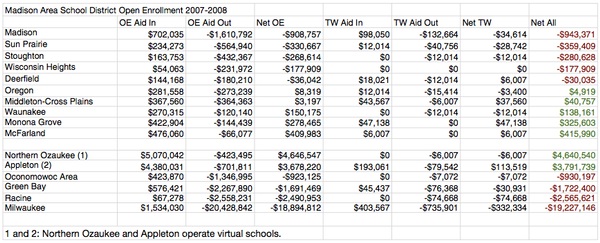
Madison School District’s Outbound Open Enrollment for 2009/2010

648 (2.68% of the District’s enrollment) students open enrolled out for the 2009/2010 school year. 217 high school, 127 middle school and 304 elementary students. [704K PDF: pages 14, 15 and 16]
More on the history of Wisconsin open enrollment, here. Enrollment numbers drive a school district’s tax and spending authority. Wisconsin Open Enrollment website.

Share

In Md. and Va., Signs Of the Tough Times: A 2.8% Reduction in Spending

Nelson Hernandez & Theresa Vargas:

The Prince George’s County Board of Education last night approved a $1.6 billion budget that eliminates almost 800 jobs, while Arlington County’s schools chief unveiled the first budget of his 12-year tenure with a reduction in total spending.
The actions showed anew how the economic recession is hitting home for Washington area school systems.
The Prince George’s board unanimously endorsed a spending plan for the 128,000-student system that omits cost-of-living raises and some seniority-based salary increases for employees. The budget also rolls back several programs begun during the 2 1/2 year tenure of superintendent John E. Deasy, who left in December for another job.
Among other cuts, the budget developed by Interim Superintendent William R. Hite Jr. eliminates 144 positions for parent liaisons, who act as a bridge between parents and school staff. Two programs to bolster academic performance will be reduced. An initiative to split school administration into nine zones will be modified to five zones, and a program to train 10 resident principals will be eliminated.

Arlington does a nice job of keeping their current and historical budgets on one easy to use page. Madison’s budget information page.

Share

A Summary of the Madison School District’s Strategic Planning Process

This PDF document [1MB] summarizes some of the work to date from the Madison School District’s strategic planning process. TJ Mertz posted some additional links here.

Share

Charter Schools a Vice?

Mary Wiltenburg:

Obama may love charter schools, Georgia may be on the fence, but St. Louis school leaders see charter schools as a vice. While researching our upcoming story about the International Community School and charter school facilities, I learned that last year, as the leaders of St. Louis public schools prepared to sell a bunch of empty school buildings, the district barred certain unwanted buyers: “liquor stores, landfills, distilleries, as well as shops that sell “so-called ‘sexual toys,’ ” writes St. Louis Post-Dispatch reporter David Hunn. “They also blackballed charter schools.”
This despite the city’s 17 public charter schools and 9,500 charter students – and eight new charters expected to open by fall 2010 – writes Bill Schulz of the National Alliance for Public Charter Schools. “Porn shops and liquor stores and charter schools, oh my!” he quipped.
Huhn reports: ” ‘We tried to buy three,’ said Susan Uchitelle, board member at Confluence Academy, a charter school with three campuses and 2,700 students in St. Louis. ‘We finally just gave up…. It was made very clear they weren’t going to sell to us. They’d show them to us. They’d let us walk through them. But then they’d take them off the market.’ “

Share

Killing DC Vouchers

Wall Street Journal:

President Obama made education a big part of his speech Tuesday night, complete with a stirring call for reform. So we’ll be curious to see how he handles the dismaying attempt by Democrats in Congress to crush education choice for 1,700 poor kids in the District of Columbia.
The omnibus spending bill now moving through the House includes language designed to kill the Opportunity Scholarship Program offering vouchers for poor students to opt out of rotten public schools. The legislation says no federal funds can be used on the program beyond 2010 unless Congress and the D.C. City Council reauthorize it. Given that Democrats control both bodies — and that their union backers hate school choice — this amounts to a death sentence.
Republicans passed the program in 2004, with help from Democratic Senator Dianne Feinstein, and it has been extremely popular. Families receive up to $7,500 a year to attend the school of their choice. That’s a real bargain, given that D.C. public schools spend $14,400 per pupil on average, among the most in the country.
To qualify, a student’s household income must be at or below 185% of the poverty level. Some 99% of the participants are minority, and the average annual income is $23,000 for a family of four. A 2008 Department of Education evaluation found that participants had higher reading scores than their peers who didn’t receive a scholarship, and there are four applicants for each voucher.

Share

Two Madison students in finals of prestigious Intel Science Talent Search

Doug Erickson:

Two Madison teenagers have landed among the 40 finalists in the country’s top science competition for high school students, a rare twofer for a public school district.
West senior Gabriela Farfan and Memorial senior Suvai Gunasekaran will compete next month in Washington, D.C., for hundreds of thousands of dollars in prizes in the Intel Science Talent Search.
“It’s impressive,” said John Kalvin, an Intel manager in Chicago, referring to the double finalists from one district. “It’s a testament to the kind of teaching taking place here — and the talent here.”
Farfan, 18, a mineral and gemstone collector, broke new ground in trying to determine why a type of feldspar known as Oregon sunstone appears red when viewed from one angle and green when viewed from another. Gunasekaran, 18, focused on developing new methods to inhibit bacterial biofilm growth on the surface of implanted medical devices.
Each student already has won $5,000 and a laptop computer as a finalist.

Share

Experts Wonder How Education Goals Will Be Met

Robert Tomsho, John Hechinger & Laura Meckler:

President Barack Obama laid out new national goals Tuesday aimed at boosting high school and college graduation rates, but left education experts wondering on how he intends to reach his targets, and how much he is prepared to spend on them.
In his address to Congress, the president signaled a shift in federal education policy toward improving the skills of adults and work-force entrants, following an intense focus on boosting younger students’ reading and mathematics attainment under the No Child Left Behind law, the centerpiece of the Bush administration’s schools agenda.
Some observers had believed that education would stay on the back burner early in the Obama administration while the president grappled with the economic crisis. But the subject made it to the top tier of the address to Congress partly because Mr. Obama believes he must send Americans a message about the importance of education.
“Of the many issues, this is one where he feels the bully pulpit needs to be used,” a White House official said Wednesday.
In his speech Tuesday night, Mr. Obama said “dropping out of high school is no longer an option” and set a goal of the U.S. having the highest proportion of college graduates in the world by 2020.
According to the Paris-based Organization for Economic Cooperation and Development, which tracks college-going among its 30 member countries, the U.S., at 30%, is tied for sixth place in college graduation among those 25 to 34 years of age, 2006 data show, behind such countries as Norway, South Korea and the Netherlands. OECD data suggest that the U.S. was No. 1 until around 2000, but has lost its edge as other countries have stepped up their efforts to promote higher education.
Kevin Carey, policy director of the Education Sector, a nonprofit Washington, D.C., think tank, said the U.S. hasn’t been slipping but other countries have been improving. Regaining our former top position represents “a pretty reasonable goal,” he says. “It’s not moon-shot level.”

Share

Straddling the Democratic Divide

Richard Colvin:

Rift in Democratic Party over the nation’s education reform agenda is growing. One side backs strong accountability through reforms, the other looks to augment the current system with social support programs.
Secretary of Education Arne Duncan’s Senate confirmation hearing in January was thick with encomiums. He was praised by Democrat Tom Harkin of Iowa for the “fresh thinking” he brought to his post as Chicago schools chief for seven years. Republican Lamar Alexander, education secretary under George H. W. Bush, told Duncan he was the best of President Barack Obama’s cabinet appointments. Ailing Massachusetts senator Ted Kennedy, in written comments entered into the record, praised Duncan for having “championed pragmatic solutions to persistent problems” and for lasting longer in Chicago than most urban superintendents.
The warm greetings given by both Republicans and Democrats on the committee reflect Duncan’s reputation as a centrist in the ideologically fraught battles over education reform. He has received national attention for moves favored by reformers, such as opening 75 new schools operated by outside groups and staffed by non-union teachers; introducing a pay-for-performance plan that will eventually be in 40 Chicago schools; and working with organizations, including The New Teacher Project, Teach For America, and New Leaders for New Schools, that recruit talented educators through alternatives to the traditional education-school route.
At the same time, Duncan maintained at least a cordial working relationship with the Chicago Teachers Union, and both the National Education Association (NEA) and the American Federation of Teachers (AFT) backed his nomination. He supported the No Child Left Behind law (NCLB), but also called for dramatic increases in spending to help schools meet the law’s targets, and additional flexibility for districts like his own. In nominating Duncan, Obama said, “We share a deep pragmatism about how to go about this. If pay-for-performance works and we can work with teachers so it doesn’t feel like it’s being imposed upon them…then that’s something that we should explore. If charter schools work, try that. You know, let’s not be clouded by ideology when it comes to figuring out what helps our kids.”

Share

Charter school opponents, watch out

Mary Wiltenburg:

In his address to Congress last night President Obama promised: “We will expand our commitment to charter schools.” Today, as the blogosphere buzzes over the speech, education watchers and International Community School teachers alike are taking that commitment seriously.
Calling it “one of the most important lines in President Obama’s speech,” Kevin Carey, writing for the Chronicle of Higher Education’s blog Brainstorm, discussed the power presidents have to refocus public education debates. Just as President Bush’s focus on testing and accountability all but killed a debate about vouchers that had raged since the Reagan administration, so, Carey argued, “Obama’s forceful position on charter schools is likely to have the same effect.” Charter school opponents, he wrote: “You’re in for a long eight years.”
At Politico’s blog The Arena, education heavy-hitters weighed in for and against.
“President Obama’s enthusiasm for charter schools is baffling. Doesn’t he realize that they are a deregulation strategy much beloved by Republicans?” wrote NYU education historian Diane Ravitch, “If he thinks that deregulation is the cure for American education, I have some AIG stock I’d like to sell him.”
Steven G. Calabresi, a law professor at Northwestern University, was ready to get down to brass tacks. “[The] key,” he wrote, “is to switch to funding public schools out of statewide collected taxes instead of funding them out of local property taxes and creating many, many more charter school and private schools where students can cash in the education credit or voucher that their stateought to give them.”

Share

Moscow Math Festival for 6th and 7th Graders

Click on the photo to view a larger version.

Here are the problems from this past Sunday’s Moscow Math Festival for Grade 6 [PDF] (1,275 participants) and Grade 7 [PDF] (888 participants), along with a few photos (the competition was held at Moscow State University, using three buildings).

Share

Environmentally focused boarding school faces new challenge

http://www.jsonline.com/news/education/40064302.html:

Dramatic changes to a 7-year-old environmentally focused North Woods boarding school have alumni up in arms and parents frantic about finding new schools for their children.
Administrators for Conserve School in Land O’Lakes announced in January they were laying off about half the school’s 60-member staff as they begin transitioning to a “semester school” model, where students from other high schools attend for half their junior year.
The blame for the drastic alteration was placed on market conditions that have challenged the future of the young school’s $180 million endowment.
But parents, pointing out that the amount of the endowment puts the 145-student school on a per-pupil par with the likes of prestigious Northeast boarding schools Phillips Exeter Academy and Groton School, question the motives of the Chicago steel executives charged with running Conserve.
“My gut tells me, along with a number of other people, is what they are trying to do is they don’t want to run a school,” said Bill Meier, who has a sophomore son enrolled at Conserve. “It’s a pain in the rear to them.”
Meier and other parents have requested Conserve School trustees and administrators meet with them and a mediator to find a way to continue running it as one of only three boarding schools in the state.
Their efforts might be too late.
Conserve Headmaster Stefan Anderson said the school was not likely to stick with the four-year college preparatory academy model. The school already has contacted 80 other schools about the possibility of taking freshmen and sophomores who cannot stay during Conserve’s transition year, he said.

Share

State by State Summary of Additional Federal Tax Dollar Education Spending

US Department of Education:

These tables (last updated 02/19/2009), in PDF [40KB] and MS Excel [77KB] show preliminary State allocations for Department of Education programs under the American Recovery and Reinvestment Act (ARRA). Funds under most of these programs can be used over 2 or more fiscal years. Amounts shown on these tables do not include the funds that will be allocated under the annual FY 2009 appropriation.
There are three additional State formula-allocated programs that received funds in the ARRA and will be added to the tables in the near future.
A table estimating State amounts for Federal Pell Grants follows the “Grand Total” table for State allocations from other programs.

Share

Beautiful Minds

Joyce Kam:

There is a disconnect between high school and university that often catches out those unprepared for academic rigour. Not any more. Not if you are smart. Hong Kong University of Science and Technology is inviting top high-school students worldwide to spend three weeks on its campus for a crash course interspersed with liberal doses of fun.
Its Talented Youth Summer Program aims to give students a foretaste of university life, cultivating essential university habits such as academic absorption and reflection, as well as insight into what makes the city tick.
“Programs for gifted children are rare in Hong Kong (administrative region, China), so we wanted to launch a pilot scheme since we have the right resources,” said Helen Wong Hom- fong, the program’s associate director. “We welcome students from all disciplines as long as they are willing to be challenged academically.”
The university will, of course, be going all out to make a suitable impression on the bright young minds by relying on its traditional strengths, with Wong saying the program’s main focus will be on the roles of science and technology throughout the history of civilization as they have always been the driving force.
“The curriculum consists of one core course on the main theme and one elective course, in addition to city tours and a talent show,” she said.

Share

Madison Kindergarten Registration Begins Monday

The Capital Times:

Parents, it’s time for your pre-schoolers to begin becoming schoolers.
Kindergarten registration is set for Monday, March 2, from 1-6 p.m. at all Madison Metropolitan School District elementary schools.
Parents or guardians should register their child at the school he or she will attend. To be eligible for kindergarten, a child must be five years old by Sept. 1, 2009.
When registering, show proof of age for the child (birth certificate, baptismal record, medical assistance card), proof of residency (utility bill, lease, mortgage) and an immunization record.

Share

Madison School District Elementary Parent Survey

via a kind reader’s email:

You are invited to participate in the MMSD climate survey for elementary parents. Your feedback is important. Please click the link below to begin the survey.
http://www.zoomerang.com/Survey/?p=U2BJLUT3TE6U

Share

Bethel Lutheran Church looks at opening a downtown school

Samara Kalk Derby:

Developer Randy Alexander has been a member of Bethel Lutheran Church [Map] downtown for eight years. He grew up with a strong faith-based culture and says having a moral compass is critical for raising children.
“And where better to do that than in a Christian school?” he asked.
That’s a big part of why Alexander is part of a church committee to study the market feasibility of a kindergarten through fifth-grade school at the downtown church, 312 Wisconsin Ave. [Map] It’s familiar territory for Alexander, whose Alexander Co. specializes in urban infill projects. It recently developed the Capitol West condominiums downtown and is building the Novation Campus business park in Fitchburg.
If Bethel decides to go ahead and start a school, it would become one of about 30 private elementary schools in the Madison area, most of them religiously affiliated.
Matthew Kussow, executive director of the Wisconsin Council of Religious and Independent Schools, said the dismal economy is an obstacle for anyone looking to start a school now. Overall, state private school enrollment for the 2008-09 school year saw a slight decline, he said.
“We are sort of bracing ourselves for a steeper decline for 2009-2010 as the full effects of this economy are being felt,” Kussow said, adding that he won’t know specifically until the spring how many kids are re-enrolling in non-public schools. There are about 900 of them in the state, and they historically enroll about 10 percent of the total student body.
But Kussow also said that in general, private religious schools have a built-in following. So if Bethel identifies a need and believes it can get enough kids to start the school, in the long run, a church school is usually very successful, he said.

More choices are a good thing.

Share

Banging on the PK-16 Pipeline

Jay Matthews:

Why am I so ill-tempered when I read a sensible report like “Bridging the Gap: How to Strengthen the Pk-16 Pipeline to Improve College Readiness”?
The authors, Ulrich Boser and Stephen Burd, know their stuff. The sponsoring organization, New America Foundation, has a great reputation. (Bias alert: It also employs one of my sons as a senior fellow, but he does California politics and direct democracy, not national education policy.)
My problem is that smart and industrious experts like Boser and Burd often unearth startling facts but don’t follow through. “Bridging the Gap,” available at Newamerica.net, details the large percentage of first-year college students in remedial courses and the duplication in federal college preparation programs. This is interesting information of which few people are aware.
But their recommendations follow the standard line: Let’s have more meetings and spend more money. Example: “We recommend that the federal government provide states with incentives to come together and adopt national college and work-readiness standards in math, science and the language arts.”
Or: “The federal government should work directly with states to foster partnerships between high schools and postsecondary institutions to smooth the transition between high school and college.”
You might think that sounds reasonable. I think it misses an opportunity. Why not harness the energy and ambition of a new president to shake things up?
The Obama administration doesn’t have much money to spend getting more students ready for college. The Education Department’s $100 billion in stimulus funds will mostly go to less sophisticated projects that create jobs fast.

Share

Does state ask less of schools? Report says Wisconsin has laxer education standards than other states

Alan Borsuk:

Attention, school officials around the country: If your school is having trouble meeting standards for adequate progress, consider moving the whole operation to Wisconsin.
That was the implication of a study released this week comparing the way 28 states treat the same performance results from schools. More of the 36 schools in the study would be rated as making “adequate yearly progress” in Wisconsin than in any other state. Two schools in the study would be regarded as making adequate progress only in Wisconsin, the report says.
“Although schools are being told that they need to improve student achievement in order to make AYP under the law, the truth is that many would fare better if they just moved across state lines,” the report says.
And Wisconsin would be the place to go.
The report, titled “The Accountability Illusion,” was issued by the Thomas B. Fordham Institute, an education think tank generally regarded as right of center. The foundation supports having national standards for accountability that are consistent from state to state and said the results of the study show the wide variation in how demanding states are when it comes to school quality.

Share

A New Day for School Reform

New York Times Editorial:

Congress took a potentially transformative step when it devoted $100 billion in the stimulus package to education. Carefully targeted, this money could revive the reform efforts that began promisingly with President Bush’s No Child Left Behind Act of 2002 — but later languished when his administration buckled under to political pressures from state officials.
Arne Duncan, the new education secretary, will need to resist those pressures. The Bush administration allowed states to phony-up statistics on everything from graduation rates to student achievement to teacher training and state education standards. As a result, the country has yet to reach not only the goals that were clearly laid out in the law but also farsighted education reforms dating to the mid-1990s.
The stimulus package, including a $54 billion “stabilization” fund to protect schools against layoffs and budget cuts, is rightly framed to encourage compliance. States will need to create data collection systems that should ideally show how children perform year to year as well as how teachers affect student performance over time. States will also be required to improve academic standards as well as the notoriously weak tests now used to measure achievement — replacing, for instance, the pervasive fill-in-the-bubble tests with advanced assessments that better measure writing and thinking.

Share

NYU Students Protest, Seek University Financial Transparency

Sean Hennessey:

Dozens of students who barricaded themselves inside a New York University cafeteria have rejected the possibility of leaving the building as negotiations with school officials continue into Friday morning.
Members of the coalition Take Back NYU! have been occupying the cafeteria of the Helen & Martin Kimmel Center for University Life for more than 24 hours.
A spokeswoman for the students said that NYU told them that they could face expulsion or arrest if they didn’t leave the building by 1 a.m. Friday.
A crowd outside the building scuffled with police officers about a half hour after the deadline.
The students are calling for a series of changes, including increased transparency of the school’s finances. They want full budget and endowment disclosure, affordable education, and increased student participation in the university’s operation.

Share

Dane County Transition School Pay it Forward Campaign 2/23/2009

via a Judy Reed email:

On behalf of all of us at Dane County Transition School (DCTS), I would like to take this opportunity to personally invite you to attend the launch of the DCTS Pay It Forward campaign on February 23, 2009 at 10am at the Villager Mall, 2234C South Park Street. Steve Goldberg from CUNA Mutual Group, students from DCTS, VISTA’s Dustin Young and Dean Veneman from the Alexander Foundation will each speak at the Pay If Forward launch.
The Pay It Forward Initiative is a national movement with a very simple concept: do one kind deed for three people and ask each of those people to Pay It Forward by doing another kind deed for three other individuals. Simple. DCTS believes we can make the world a better place one kind deed at a time and the more people who believe, the larger difference we can make.
DCTS would like to celebrate with all of the Partners who believe in the concept of Pay It Forward and in promoting this altruistic effort. (See attached banner for detail listing of over 80 Partners) Imagine all those kind acts and smiles that will begin right here in the Villager Mall.
DCTS has always been a school that believes in the promise of each individual and in the power of good deeds, which is why DCTS is formally launching this Pay It Forward campaign. We truly hope that you can join us for this unique event!
Sincerely,
Judy Reed, Principal
Dane County Transition School – 2326 South Park Street – Madison, WI
(608) 698-6321 – www.dcths.org

Share

Chamber: Teacher quality key in improving schools

Nashville Business Journal:

The Nashville Area Chamber of Commerce released its 16th annual education report card Thursday, saying teacher quality is one of the most important factors in raising student achievement.
The chamber brings together business people and citizens each year to assess the school system.
Metro schools has missed the required No Child Left Behind benchmarks five times in the past six years. That moved the school system into “restructuring” from “corrective action” under the federal act, one year away from a possible state takeover.
The Education Report Card Committee said it was encouraged to see Metro offering a modest incentive pay plan to help recruit teachers in hard-to-staff subjects, as well as Mayor Karl Dean’s recruitment of two national nonprofits, The New Teacher Project and Teach for America, to bring new talent into the classrooms.
While there were some improvements in 2008, the committee said the city cannot have another year of waiting for a common vision for the standards the schools want to reach.
The chambers recommendations include:

Share

Fernandez & Evers Advance in the Wisconsin DPI Superintendent Race

AP:

Evers won the endorsement of the 98,000-member state teachers union, the Wisconsin Education Association Council, which paid for TV ads on his behalf. Evers was the only one of the five to pay for his own ads.
“I believe that my message of experience has played well so far,”
Evers said. “I won the primary and I anticipate that we’ll just work hard to get the message out. I believe that people do believe experience matters.”
Fernandez, who has often been at odds with the state education department over virtual schools, reveled in the fact that she didn’t get the WEAC endorsement, touting it as another sign of her being outside the state education bureaucracy.
Fernandez was the only one of the five candidates without any professional education experience. A former nurse, she recently stepped down as president of the Wisconsin Coalition of Virtual School Families.
“Some people have dismissed me as just a mom on a mission, but that’s a label I’ll be wearing as a badge of honor,” Fernandez said. She pledged to overcome WEAC’s financial backing of Evers with a broad base of support that taps into teachers, parents and students across the state.
“We’re hearing that there’s a great hunger out there for our message that higher standards without higher taxes is what they want,” she said.
Her campaign called for reforming the state education department, enacting changes to allow for teacher merit pay and protecting alternative education options such as virtual schools, home schooling and Milwaukee’s school choice voucher program.
Evers, the deputy under retiring Superintendent Libby Burmaster for the past eight years, emphasized his 34 years of education experience during the campaign. Opponents criticized him as a status-quo insider candidate, while Evers countered he was the best-grounded to initiate reforms, particularly in the Milwaukee schools.

Share

McFarland High School Recognized by the National Council of Teachers of English

McFarland High School [Map] Principle Jim Hickey, via email:

You might note that McFarland High School’s (a public high school) student anthology, Driftwood received the Superior rating from the National Council of Teachers of English. Congratulations to Edgewood HS on the top of award. We too are proud of being one of three schools receiving this award in the State.

Share

Wisconsin Open Enrollment for ’09/10 Closes 2/20/2009


Details available in this .xls file from the Wisconsin DPI.
A few links as the open enrollment period draws to a close:

Via a kind reader’s email.

Share

Math teacher awaits verdict in fraud trial

Alica Lozano:

Sipping a cup of coffee in the Los Angeles courthouse where he is on trial for fraud, math teacher Matthias Vheru said all he wanted to do was write the best algebra book possible to help his students and those of his colleagues.
“I spent my life trying to help underachieving kids,” said Vheru, wearing a tie with a mathematical equation that read: 2 teach is 2 touch life 4 ever. “I’m just trying to make the language of math easy to understand.”
Prosecutors, however, say Vheru is a crafty entrepreneur who illegally reaped nearly $1 million by conning the Los Angeles Unified School District into ordering 45,000 copies of his textbook without revealing his financial interest in the transaction.
A federal court jury is deliberating whether Vheru, a 20-year L.A. Unified veteran, is guilty of crimes that could send him to prison for up to 10 years.
According to prosecutors, Vheru, 53, saw a chance to make some extra cash by defrauding L.A. Unified in 2004 while he served as interim director of mathematics.
“He’s not charged with being a bad teacher,” Assistant U.S. Atty. Paul Rochmes told jurors in his closing arguments last week. “This is a case about deception.”
Prosecutors allege that Vheru misappropriated $3.7 million of the district’s money to purchase his books. He did so, they allege, by circumventing L.A. Unified’s guidelines and using federal funds earmarked to assist non-English-speaking students. Prosecution experts testified that although Vheru’s book is appropriate for English speakers, it could be difficult to understand for those without a strong command of the language.

Share

For Education, Stimulus Means Dollars and Risk

Sam Dillon:

The $100 billion in emergency aid for public schools and colleges in the economic stimulus bill could transform Arne Duncan into an exceptional figure in the history of federal education policy: a secretary of education loaded with money and the power to spend large chunks of it as he sees fit.
Upon meeting department employees last month, Arne Duncan, the new education secretary, asked them to call him by his first name. “My name is Arne,” he said. “It’s not Mr. Secretary.”
But the money also poses challenges and risks for Mr. Duncan, the 44-year-old former Chicago schools chief who now heads the Department of Education.
Mr. Duncan must develop procedures on the fly for disbursing a budget that has, overnight, more than doubled, and communicate the rules quickly to all 50 states and the nation’s 14,000 school districts. And he faces thousands of tricky decisions about how much money to give to whom and for what.
“It’ll be wonderful fun for a time for his team — it’ll be like Christmas,” said Chester Finn, a former Department of Education official who has watched education secretaries or commissioners come and go here since the mid-1960s. “But the thing about discretionary spending is that it makes more people angry than it makes happy.”

Share

2009 Wisconsin Department of Instruction (DPI) Superintendent Candidates: Primary Election Tuesday 2/17/2009

Five candidates are on the statewide primary ballot this Tuesday, February 17, 2009. One of them will replace outgoing Superintendent Libby Burmaster. The candidates are

Wisconsin voter information, including polling locations can be found here. Much more on the Wisconsin DPI here. Wisconsin’s curricular standards have been criticized for their lack of rigor.

Share

Stimulus Includes $5 Billion Flexible Fund for Education Innovation

Maria Glod:

Education Secretary Arne Duncan would have $5 billion under the stimulus bill to back new approaches to improve schools, a fund that could prod states to raise standards and reward top teachers as the Obama administration presides over a massive infusion of federal education aid.
The Race to the Top Fund, as Duncan calls it, is part of about $100 billion the bill would channel to public schools, universities and early childhood education programs nationwide, helping stave off teacher layoffs, keep class sizes in check and jump-start efforts to revamp aging schools.
But the windfall also could mark the beginning of a deeper transformation of schools seven years after the No Child Left Behind law mandated an expansion of testing and new systems for school accountability.

Share

Federal Tax Dollar Bailout Funds Sought for Five Wisconsin School Districts

Amy Hetzner:

First came the banks, then came the car manufacturers, now federal assistance is being sought for five Wisconsin school districts that made bad investments.
At the urging of the Kenosha Education Association, U.S. Rep. Paul Ryan and Sen. Russ Feingold have forwarded to the Treasury Department and Federal Reserve Bank a request that the government buy $200 million worth of “troubled assets” purchased by the districts in 2006.
KEA Executive Director Joseph Kiriaki said he hoped that the same Troubled Asset Relief Program that has spent billions of dollars buying the toxic debt and stock of financial institutions can help local schools, as well.
“It’s one public entity to another,” Kiriaki said.
In his letter to Wisconsin lawmakers, Kiriaki notes that the school districts purchased the same type of investment, known as collateralized debt obligations, that the Federal Reserve Bank of New York took off the books of American International Group last year.

Fascinating that they are referencing the AIG bailout. Much more on the stimulus/splurge here and the Treasury Department’s latest plan here.
The Washington Post posted a useful graphic on the stimulus package.

Share

A Useful Comparison of the House / Senate Splurge/Stimulus Bills

Josh Tauberer @ Govtrack.us:

One of the concrete benefits of open government data is that third parties can use the data to do something useful that no one in government has the mandate, resources, or insight to do. If you think what I am about to tell you below is cool, and helpful, then you are a supporter of open government data.
On my site GovTrack, you can now find comparisons of the text of H.R. 1, the stimulus bill, at different stages in its legislative life — including the House version (as passed) and the current Senate version (amendment 570).
The main page on GovTrack for HR 1 is:
http://www.govtrack.us/congress/bill.xpd?bill=h111-1
Here’s a direct link to the comparison:
http://www.govtrack.us/congress/billtext.xpd?bill=h111-1&version=as2&compareto=eh&view=side
Comparisons are possible between any two versions of the bill posted by GPO. Comparisons are available for any bill.
If you find this useful, please take a moment to consider that something like this is possible only when Congress takes data openness seriously. When GPO went online and THOMAS was created in the early 90s, they chose good data formats and access policies (mostly). But the work on open government data didn’t end 15 years ago. As “what’s hot” shifts to video and Twitter, the choices made today are going to impact whether or not these sources of data empower us in the future, whether or not we miss exciting opportunities such as having tools like the one above.
(Thanks to John Wonderlich and Peggy Garvin for some side discussion about this before my post. GovTrack wasn’t initially picking up the latest Senate versions because GPO seems to have gone out of its way to accommodate posting the latest versions before they were passed by the Senate, which is great, but caught GovTrack by surprise.)
Josh Tauberer

Share

Reforming schools starts with audits

School district audits need to be independent

Dennis Willard:

In one of his more significant, although slightly flawed, education reform initiatives, Gov. Ted Strickland wants school districts to undergo annual financial and operational performance audits.
”Just as we provide an academic report card for our schools, we will provide parents, public officials and taxpayers an annual fiscal and operational report card for every school district. That means that when we send districts funding to help students who need additional attention and instruction, we will now be able to track our dollars to see that they directly reach those students,” Strickland said in his third State of the State address.
This is a great idea on a number of levels.
Parents and homeowners would be able to determine whether their district is making the grade on spending. For years, the Ohio Department of Education has issued academic report cards for districts.
Yes, at times, woeful news in the audits would make it more difficult for superintendents and school board members to ask voters to pass levies.
On the other hand, fiscal and operational performance audits would help districts identify and correct spending problems.

Share

Madison Math Task Force Report Public Session: February 11, 2009 @ Cherokee Middle School

The Cherokee PTO [Map] is hosting a discussion of the Madison School District’s Math Task Force Report this Wednesday evening, February 11, 2009 in the Library.
Much more on the Math Task Force report here.

Share

Is it ‘merit pay’ if nearly all teachers get it?

Emily Johns:

A state program meant to give only effective Minnesota teachers merit pay raises instead appears to be rewarding nearly all the teachers participating in it with more money.
The program, called “Q Comp,” is one of Gov. Tim Pawlenty’s top initiatives to improve schools, and many educators say it is strengthening teacher evaluations and training. But others are questioning whether Q Comp has just become a cash handout.
In 22 school districts whose Q Comp practices were examined by the Star Tribune, more than 99 percent of teachers in the program received merit raises during the most recent school year.
Only 27 of the roughly 4,200 teachers eligible did not get a pay raise.
The state gave schools $64 million to spend on Q Comp, which stands for quality compensation, during the 2007-08 school year. Pawlenty is now proposing to increase spending on the program by $41 million next year. But some lawmakers are questioning that step.
“Why should we expand it statewide when there is no evidence that it’s improving anything?” asked Rep. Mark Buesgens, R-Jordan.
“Let’s quit the charade, let’s give every district another $300 per pupil, and quit bluffing.”
Pawlenty’s spokesman Brian McClung defended the program Friday as “a move towards greater emphasis on student achievement and the measures that lead to [it].” He added, “Ideally Q Comp would demand more, but we had to compromise with a Legislature that was uncomfortable going further.”
Test data suggest that, so far, students in school districts in at least their third year of Q Comp have not shown more improvement in reading and math than students in schools not participating in the program.
The Minnesota Department of Education asserts that it is too early in the program’s life to make substantive comparisons about how Q Comp is affecting student achievement. In a statement Friday, Education Commissioner Alice Seagren said the department has faith in the program.
“We believe that Q Comp will lead to higher levels of student achievement, students who are college-and-work ready upon graduation, and a larger supply of qualified workers for our state’s employers,” she said.
School superintendents, meanwhile, say the money involved–up to $260 per pupil this year–has been a major draw in an era of budget cuts.

(more…)

Share

Smaller school districts looking to consolidation

Gena Kittner:

Three area school districts in need of building renovation or expansion are taking very tentative steps toward consolidation — a touchy topic for residents worried about losing a community’s identity.
The Belleville, Monticello and New Glarus school districts, located in Dane and Green counties, are asking the state Department of Public Instruction for $10,000 to study the idea of combining their programs and student populations.
“I think it’s just a case of having a nice discussion and getting solid, objective information,” said Randy Freese, superintendent for the Belleville School District.
Facing continued tight budgets, districts around the state will be looking at options to save money, and “investigating consolidation is definitely one of those options,” said Patrick Gasper, DPI spokesman. “I think we’ll see more people looking into it.”
Using money approved as part of the 2007-09 state budget, the DPI has funded grants for at least eight other district groups, including Pecatonica and Argyle in Lafayette and Iowa counties.

Share

Madison Strategic Planning Short Video

MMSDTV posted a short video clip on the Madison School District’s recent Strategic Planning Process.

Share

On Milwaukee’s Education Splurge: “Money for Unneeded Schools”

Wall Street Journal:

To understand the problem with the stimulus bill, it helps to focus on specific parts. Take the $142 billion for schools, which is nearly double the total outlays of the Department of Education in 2007. Now consider that much of this cash would go to public-school systems that don’t even need the money for its earmarked purposes.
The Milwaukee Public School system, for example, would receive $88.6 million over two years for new construction projects under the House version of the stimulus — even though the district currently has 15 vacant school buildings and declining enrollment. Between 1990 and 2008, inflation-adjusted MPS spending rose by 35%, per-pupil spending increased by 36% and state aid grew by 58%. Over the same period, enrollment fell by a percentage point and is projected to continue falling, leaving the system with enough excess capacity for some 22,000 students.
Download Opinion Journal’s widget and link to the most important editorials and op-eds of the day from your blog or Web page.
“In general, MPS facilities have been described by school officials as being in good to better-than-good condition,” reports the Milwaukee Journal Sentinel. “The kind of situations that create urgent needs for renovation or new construction in some cities have not been on the priority list for MPS officials in recent years.”

Much more on the splurge here.

Share

New Berlin teen accused of using Facebook for sexual blackmail

Jacqui Seibel and Mark Johnson:

A former New Berlin Eisenhower student was accused Wednesday of a pattern of manipulation and deception using the social networking site Facebook to coerce male schoolmates into sexual encounters.
Anthony R. Stancl, 18, posing as a female on Facebook, persuaded at least 31 boys to send him naked pictures of themselves and then blackmailed some of the boys into performing sex acts under the threat that the pictures would be released to the rest of the high school, according a criminal complaint.
All 31 boys attend New Berlin Eisenhower Middle/High School, said Waukesha County District Attorney Brad Schimel.
The sexual assaults occurred in a bathroom at the high school, the school parking lot, a New Berlin Public Library restroom, Valley View Park, Malone Park, Minooka Park and at some of the victims’ homes.
At least seven boys, 15 to 17, were forced into performing sex acts, Schimel said. The incidents occurred from spring 2008 until the time of Stancl’s arrest in November. Stancl had 300 photos and movie clips on his computer of boys from the school, ages 13 to 19, Schimel said.

Share

Madison School District Departing Parent Surveys

Via a kind reader’s email. Three surveys for families that have left the Madison School District for the following destinations [PDF]:

Related Links:

The Madison School District’s tax and spending authority is based on its enrollment.

Share

Google and Nasa back ‘singularity’ school for when technology overtakes humans

Caroline Gammell:

The Singularity University will be based at the space programme’s Ames campus in Silicon Valley, USA.
Its chancellor will be the controversial futurist Ray Kurzweil, whose 2005 book The Singularity is Near inspired the name of the school.
He believes that the rapid rise of technology will enable machines in the near future to use artificial intelligence to make themselves cleverer than humans.
Critics of singularity believe such sophisticated technology could end up being a threat to man.
But Mr Kurzweil said it was important to realise the potential of technological development: “The law of accelerating returns means technology eventually will be a million more times powerful than it is today and cause profound transformation.”
Singularity University will accept 30 graduate students in its first intake this summer, increasing to 120 next year.
Despite its name, the college is not an accredited university but will offer nine-week courses exploring ways to ensure technology improves mankind’s plight instead of harming it.

Share

In Black History Month, One-Room School Opens to Offer Lessons

Jennifer Buske:

A 19th-century school that served Prince William County’s African American population opens for public tours today in honor of Black History Month.
The Lucasville School, at 10516 Godwin Dr. in the Manassas area, will be open every weekend this month from noon to 4 p.m. The one-room school was the only one in the county solely for African Americans, said Robert Orrison, a historic site manager for the county. A few one-room schools that served whites remain, but most have been converted into homes.
“We opened the school up last February,” Orrison said. “It’s a great place to learn about segregated schools and how education was done in the 19th and early 20th century.”
Built in 1885, the Lucasville School served children in grades one through six until 1926, Orrison said. About 20 to 25 students of different ages would pack into the building each year to learn from a single instructor. The school was filled with benches, not desks, Orrison said, and blackboards were made of pieces of plywood painted black, unlike at white schools, where students had blackboard slates.

Share

Madison School District Survey for Parents Who Have Left

via a kind reader’s email:

Superintendent Dan Nerad is conducting a survey of families who left the MMSD and invites your participation.
If you opted to not enroll your child/children in their MMSD school — if they attend private school, you home school or you moved out of the District — or you are strongly considering the same and you are willing to participate in this survey, please let Superintendent Nerad know. Send your contact information to his assistant, Ann Wilson (awilson@madison.k12.wi.us or 608 663-1607).

Related: Wisconsin Open Enrollment begins February 2, 2009.

Share

Madison School District’s Strategic Planning Process, An Update


I was honored to be part of the Madison School District’sStrategic Planning Process” this weekend. More than 60 community members, students, parents, board members and district employees participated.
The process, which included meetings Thursday (1/29/2009) from 8 to 6 Friday (1/30/2009) from 8 to 5 and Saturday (1/31/2009) from 8 to 12, thus far, resulted in the following words:
MMSD Mission Statement (1/30/2009):

Our mission is to cultivate the potential in every student to thrive as a global citizen by inspiring a love of learning and civic engagement, by challenging and supporting every student to achieve academic excellence, and by embracing the full richness and diversity of our community.

Draft Strategic Priorities
1. Student:
We will eliminate the achievement gap by ensuring that all students reach their highest potential. To do this, we will prepare every student for kindergarten, create meaningful student-adult relationships, and provide student-centered programs and supports that lead to prepared graduates. (see also student outcomes)
2. Resource/Capacity:
We will rigorously evaluate programs, services and personnel through a collaborative, data-driven process to prioritize and allocate resources effectively and equitably, and vigorously pursue the resources necessary to achieve our mission.
3. Staff
We will implement a formal system to support and inspire continuous development of effective teaching and leadership skills of all staff who serve to engage our diverse student body while furthering development of programs that target the recruitment and retent ion of staff members who reflect the cultural composition of our student body.
4. Curriculum
We will revolutionize the educational model to engage and support all students in a comprehensive participatory educational experience defined by rigorous, culturally relevant and accelerated learning opportunities where authentic assessment is paired with flexible instruction.

5. Organization/Systems:

We will proudly leverage our rich diversity as our greatest strength and provide a learning environment in which all our children experience what we want for each of our children. We will:

  • Provide a safe, welcoming learn ing environment
  • Coordinate and cooperate across the district
  • Build and sustain meaningful partnerships throughout our community
  • Invite and incorporate (require) inclusive decision-making
  • Remain accountable to all stakeholders
  • Engage community in dialogue around diversity confront fears and misunderstandings
Share

California Plans to Reduce Education Spending

Jordan Rau & Evan Halper:

Although lawmakers continue to argue over how to resolve the state’s fiscal crisis, they already have endorsed $6 billion in spending cuts that provide a painful preview of what is likely to be in store for Californians.
The proposed cuts would mean that money for the state’s university systems would decrease. Transportation and schools would take a hit. Funds for regional centers that help treat developmental disabilities in babies and toddlers would decline. Cash to help the elderly, blind and disabled keep up with rising food costs would be slashed.
None of these cuts has been enacted. But the fact that they were included in the fiscal plan that Democrats passed last month — and have been separately backed by Republicans — ensures that they will be at the top of the list when lawmakers finally decide how to bridge a budget gap projected to exceed $40 billion within a year and a half.

Share

Wisconsin school open enrollment starts February 2, 2009

AP:

Wisconsin parents who want to send their children to a school outside the district in which they live can start applying Feb. 2.
The open enrollment period for next school year ends three weeks later on Feb. 20.
The program has grown in popularity since it started in the fall of 1998. Only about 2,400 students participated that school year. But last year, nearly 26,000 did.
Parents interested in enrolling their children are encouraged to do so online at the Department of Public Instruction’s Web site. Parents will be notified April 10 about whether their request has been approved or denied.

Share

Informational Community Sessions on the Madison Fine Arts Task Force

Tuesday March 10, 2009 6 to 8p.m.
Memorial High School – Wisconsin Neighborhood Center [Map]
Thursday March 12, 2009 6 to 8p.m.
LaFollette High School in the LMC [Map]
The Madison Metropolitan School District (MMSD) will be sharing the recommendations of the Fine Arts Task Force. We are cordially inviting you to attend one or both of these sessions.
The focus of each session will be a presentation of the findings and recommendations of the Fine Arts Task Force followed by an opportunity for discussion. The Executive Summary and complete Fine Arts Task Force Report can be found at http://www.mmsd.org/boe/finearts/.
We are looking forward to sharing this information with you and hearing your thoughts about the research and recommendations provided by the Fine Arts Task Force.
Feedback from sessions and the recommendations from the Fine Arts Task Force will assist in improving the MMSD K-12 Fine Arts program and opportunities for our students,
If you have any questions or comments, please contact Julie Palkowski at jpalkowski@madison.k12.wi.us
Lisa Wachtel
Executive Director of Teaching and Learning
Julie Palkowski
Coordinator of Fine Arts
Please share this information with others that may be interested in attending these sessions and/or sharing their comments.

Share

Gates on Small Learning Communities (SLC): “small schools that we invested in did not improve students’ achievement in any significant way”

Nicholas Kristof:

In the letter, Mr. Gates goes out of his way to acknowledge setbacks. For example, the Gates Foundation made a major push for smaller high schools in the United States, often helping to pay for the creation of small schools within larger buildings.
“Many of the small schools that we invested in did not improve students’ achievement in any significant way,” he acknowledges. Small schools succeeded when the principal was able to change teachers, curriculum and culture, but smaller size by itself proved disappointing. “In most cases,” he says, “we fell short.”
Mr. Gates comes across as a strong education reformer, focusing on supporting charter schools and improving teacher quality. He suggested that when he has nailed down the evidence more firmly, he will wade into the education debates.
“It is amazing how big a difference a great teacher makes versus an ineffective one,” Mr. Gates writes in his letter. “Research shows that there is only half as much variation in student achievement between schools as there is among classrooms in the same school. If you want your child to get the best education possible, it is actually more important to get him assigned to a great teacher than to a great school.”

I could not agree more. Rather than add coaches and layers of support staff, I’d prefer simply hiring the best teachers (and paying them) and getting out of the way. Of course, this means that not all teachers (like the population) are perfect, or above average!
Much more on Small Learning Communities here.
On Toledo’s SLC initiative.

Share

ACLU to sue Minneapolis charter school that caters to Muslims

Randy Furst & Sarah Lemagie:

The Minnesota ACLU has filed suit against TIZA, a charter school in Inver Grove Heights and Blaine, claiming it is promoting the Muslim religion.
The American Civil Liberties Union of Minnesota filed suit Wednesday against a publicly funded charter school alleging that it is promoting the Muslim religion and is leasing school space from a religious organization without following state law.
The suit was filed in U.S. District Court in Minneapolis against Tarek ibn Ziyad Academy, known as TIZA, and the Minnesota Department of Education, which the ACLU says is at fault for failing to uncover and stop the alleged transgressions. The suit names the department and Alice Seagren, the state education commissioner, as co-defendants.

Share

$3.77 million grant from Gates Foundation to help fund Dallas ISD academic database

Tawnell Hobbs:

The Bill & Melinda Gates Foundation will announce a nearly $3.8 million grant today to help fund a mega-database that provides Dallas school educators instant access to student information – from preschool to graduation.
The Dallas Independent School District began testing the database last year. It allows educators to access “real time” student academic information and helps them watch for learning patterns. The system also holds other district-related data, such as student and teacher absences.
The Michael & Susan Dell Foundation got the data system off the ground last year with a $5 million donation to the Dallas Education Foundation, a nonprofit group created in 2006 to raise money to benefit DISD.
Today’s grant of $3.77 million will be distributed over three years to DISD to help build onto the current system. The donation is among more than $22 million in grants that the Gates Foundation is announcing today for research and data systems for schools and a number of education organizations.
The Gates Foundation has invested $4 billion in improving schools and providing scholarships to students since 2000, according to foundation officials.

Share

Milwaukee Schools Chief plans to leave in June 2010

Alan Borsuk:

Milwaukee School Superintendent William Andrekopoulos and the School Board agreed Tuesday night to extend his contract to June 30, 2010 – at which point he expects to end his lengthy run in the job.
After a closed session that took less than 90 minutes, the board voted 8-0 to give Andrekopoulos the additional 15 months he asked for. His current contract expires March 23.
Andrekopoulos will be 62 at the end of the 2009-’10 school year and will be finishing eight years as superintendent, one of the longest runs currently among urban school chiefs in the country. He succeeded Spence Korté as superintendent in August 2002.
The board and Andrekopoulos agreed that the contract extension will include provisions that would pave the way for him to help with the transition to a new superintendent. That could include having him stay on in some capacity for a limited time beyond July 1, 2010.

Share

Word Cloud Analysis of Obama’s Inaugural Speech Compared to Bush, Clinton, Reagan, Lincoln’s

Marshall Kirkpatrick:

Barack Obama was just sworn in as President of the US and though he stumbled in repeating his oath, the speech that followed was delivered flawlessly and was widely praised around the web. (Several readers have told us that it wasn’t Obama that stumbled, it was Justice Roberts.) There were quite a few concepts discussed that we suspect haven’t been a part of past inaugural speeches. What words were used most often? We ran the full text of the speech through tag cloud generator Wordle.net for one view of the event, and just for the sake of historical context we ran George W. Bush’s second inaugural speech through as well. Update: After one reader suggested it, we’ve also added word clouds from Bill Clinton’s second inaugural speech and Reagan’s first below. Second update: By reader request, we’ve added Lincoln’s first and second inaugural speeches as well.
The most common words in the Obama and Bush speeches were dramatically different.

Share

States Weigh Cuts to Merit Scholarships

Robert Tomsho:

As they grapple with crippling budget shortfalls, states are weighing whether to cut back on merit-aid scholarship programs that benefit hundreds of thousands of college students every year.
Since the early 1990s, more than 15 states have launched broad-based programs that offer students scholarships and tuition breaks based solely on grades, class rank and test scores. Supporters say such programs boost college-enrollment rates and help persuade high achievers to remain in their home states. Critics maintain that the programs siphon aid money away from students with financial need in favor of some who probably could have afforded college without the help.
The National Association of State Student Grant and Aid Programs, an organization of agencies responsible for state financial-aid programs, says merit grants accounted for $2.08 billion, or 28%, of all state-sponsored grants awarded in its latest tally, covering the 2006-2007 academic year. That’s up from $458.9 million in 1996-1997, when merit-aid accounted for about 15% of all state grants.
But the economic crisis has raised fears that such growth may be unsustainable, as tax revenue plunges and legislatures make drastic cuts to other state programs. And the pinch comes just as layoffs and investment losses affecting millions of families are likely to boost demand for financial aid based on need.

Share

Madison’s Leopold Elementary could add dual-language program in fall

Tamira Madsen:

Madison Metropolitan School District officials will unveil plans to offer a dual-language program at Leopold Elementary beginning next fall.
The new curriculum for the south side school would include education in English and Spanish, and discussion of the plan is anticipated at a Madison School Board meeting on Feb. 2.
Three sections of kindergarten classes with approximately 48 children will become part of the program, which will progress one grade level each school year until the program’s initial students finish fifth grade. The school will join east side’s Nuestro Mundo as the second public school in the Madison Metropolitan School District to offer a dual-language program. Nuestro Mundo, a charter school, has been in operation for five years.
Eight of Leopold’s 44 classrooms are bilingual, and the school is a perfect fit for the immersion program, according to Assistant Superintendent Sue Abplanalp.
“We know the benefits of dual-immersion programming,” Abplanalp said. “This is a perfect place to begin such a program because we know could get the enrollment that we need to make it a viable program for the future.
“We want native speaking Spanish children as well as non-native Spanish children, and that’s the population that is at that building,” she said.

Share

Advanced Math Courses at UW-Madison for High School Students

Tonghai Yang, via email:

Math 234 (Calculus III, after Calculus BC) this Fall on MWF 7:45-8:35am to accomodate advanced High School Students in Madison area so that they can take this course without missing too many their regular school work.
We did it last semester for the first time and had excellent reception from high school students attended (about 20). Another 20 were regular college students. I am teaching this course next Fall.
We will also offer
Math 340 (Linear Algebra) during Spring 2010 onMWF 7:45-8:35am for the same reason. Dr. Meyer will teach this course.

Share

Madison’s Cherokee PTO/Math Meeting Cancelled Tonight

Weather conditions have caused this evening’s Cherokee Middle School PTO/Math Meeting to be cancelled. The event will be rescheduled soon, hopefully in February.
Much more on the Madison School District’s Math Task Force Report here.

Share

Records show Waunakee School District didn’t slow drinking party investigation

Matthew DeFour:

In the weeks following an underage drinking party near Waunakee in September 2007, rumors swirled about why the School District didn’t move more quickly to discipline football players who were involved.
Though the insinuation in some circles was school officials were dragging their feet to keep Waunakee at full strength in the playoffs, recently released documents show the district investigation was delayed at the insistence of a Dane County sheriff’s detective investigating criminal activity at the party.
State law allows law enforcement agencies to release reports that could help school officials discipline students, but individual police departments set their own policies and not everyone agrees on the best policy.
If a police agency is stingy with how it chooses to share information, it can delay the school’s ability to mete out swift punishment intended to deter underage drinking in the first place.
In the case of the Waunakee football players, the district got mixed messages from the Dane County Sheriff’s Office.

Share

The Madison School District’s 2009 Strategic Planning Team

Members include:
Abplanalp, Sue, Assistant Superintendent, Elementary Schools
Alexander, Jennifer, President, Chamber of Commerce
Atkinson, Deedra, Senior Vice-President, Community Impact, United Way of Dane County
Banuelos, Maria,Associate Vice President for Learner Success, Diversity, and Community Relations, Madison Area Technical College
Bidar-Sielaff, Shiva, Manager of Cross-Cultural Care, UW Hospital
Brooke, Jessica, Student
Burke, Darcy, Elvehjem PTO President
Burkholder, John, Principal, Leopold Elementary
Calvert, Matt, UW Extension, 4-H Youth Development
Campbell, Caleb, Student
Carranza, Sal, Academic and Student Services, University of Wisconsin
Chandler, Rick, Chandler Consulting
Chin, Cynthia, Teacher, East
Ciesliewicz, Dave, Mayor, City of Madison
Clear, Mark, Alderperson
Cooper, Wendy, First Unitarian Society
Crim, Dawn, Special Assistant, Academic Staff, Chancellor’s Office, University of Wisconsin-Madison
Dahmen, Bruce, Principal, Memorial High School
Davis, Andreal, Cultural Relevance Instructional Resource Teacher, Teaching & Learning
Deloya, Jeannette, Social Work Program Support Teacher
Frost, Laurie, Parent
Gamoran, Adam Interim Dean; University of Wisconsin School of Education
Gevelber, Susan, Teacher, LaFollette
Goldberg, Steve, Cuna Mutual
Harper, John, Coordinator for Technical Assistance/Professional Development, Educational Services
Her, Peng,
Hobart, Susie, Teacher, Lake View Elementary
Howard, James, Parent
Hughes, Ed, Member, Board of Education
Jokela, Jill, Parent
Jones, Richard, Pastor, Mt. Zion Baptist Church
Juchems, Brian, Program Director, Gay Straight Alliance for Safe Schools
Katz, Ann, Arts Wisconsin
Katz, Barb, Madison Partners
Kester, Virginia, Teacher, West High School
Koencke, Julie, Information Coordinator MMSD
Laguna, Graciela, Parent
Miller, Annette, Community Representative, Madison Gas & Electric
Morrison, Steve, Madison Jewish Community Council
Nadler, Bob, Executive Director, Human Resources
Nash, Pam, Assistant Superintendent for Secondary Schools
Natera, Emilio, Student
Nerad, Dan, Superintendent of Schools
Passman, Marj, Member, Board of Education
Schultz, Sally, Principal, Shabazz City High School
Seno, Karen,Principal, Cherokee Middle School
Sentmanat, Jose, Executive Assistant to the County Executive
Severson, Don, Active Citizens for Education (ACE)
Steinhoff, Becky, Executive Director, Goodman Community Center
Strong, Wayne, Madison Police Department
Swedeen, Beth, Outreach Specialist, Waisman Center
Tennant, Brian, Parent
Terra Nova, Paul, Lussier Community Education Center
Theo, Mike, Parent
Tompkins, Justin, Student
Trevino, Andres, Parent
Trone, Carole, President, WCATY
Vang, Doua, Clinical Team Manager, Southeast Asian Program / Kajsiab House, Mental Health Center of Dane County
Vieth, Karen, Teacher, Sennett
Vukelich-Austin, Martha, Executive Director, Foundation for Madison Public Schools
Wachtel, Lisa, Executive Director of Teaching and Learning
Zellmer, Jim, Parent
Much more here.
The Strategic Planning Process Schedule [PDF]

Share

Charter Schools Can Close the Education Gap
It is not acceptable for minority students to be four grade levels behind.

Joel Klein & Al Sharpton:

Dear President-elect Barack Obama,
In the afterglow of your election, Americans today run the risk of forgetting that the nation still faces one last great civil-rights battle: closing the insidious achievement gap between minority and white students. Public education is supposed to be the great equalizer in America. Yet today the average 12th-grade black or Hispanic student has the reading, writing and math skills of an eighth-grade white student.
That appalling four-year gap is even worse in high-poverty high schools, which often are dropout factories. In Detroit, just 34% of black males manage to graduate. In the nation’s capital — home to one of the worst public-school systems in America — only 9% of ninth-grade students go on to graduate and finish college within five years. Can this really be the shameful civil-rights legacy that we bequeath to poor black and Hispanic children in today’s global economy?
This achievement gap cannot be narrowed by a series of half-steps from the usual suspects. As you observed when naming Chicago superintendent Arne Duncan to be the next secretary of education, “We have talked our education problems to death in Washington.” Genuine school reform, you stated during the campaign, “will require leaders in Washington who are willing to learn from students and teachers . . . about what actually works.”
We, too, believe that true education reform can only be brought about by a bipartisan coalition that challenges the entrenched education establishment. And we second your belief that school reformers must demonstrate an unflagging commitment to “what works” to dramatically boost academic achievement — rather than clinging to reforms that we “wish would work.”

Share

On a Milwaukee School Board Member’s Trip

Daniel Bice:

To anyone who would dismiss School Board member Charlene Hardin’s junket to Philadelphia as an insignificant amount of money, Karen Ruehl would suggest a visit to her school.
Ruehl, a 33-year veteran of Milwaukee Public Schools, is the librarian at the Milwaukee High School of the Arts.
Her library is in desperate need of help. She has repeatedly asked her boss at the city arts school to drop a few dollars to allow her to make improvements to it for the benefit of the students.
But nearly all of her proposals have been rejected, she has been told, because there was no money.
Ruehl is now having trouble squaring her experience with the news that her school blew thousands of dollars to send Hardin and a secretary to a national conference in Philadelphia last summer – a series of meetings that the pair ultimately skipped. Hardin, who was bumped off the spring ballot last week, is now under investigation by her colleagues on the board.
“I saw that money, and I thought, ‘That should have been for me,’ ” Ruehl said Friday from the school library.
A portion of the funds used to pay for Hardin’s excursion could have gone to buy, for instance, arts-related magazines. Earlier this school year, Ruehl asked for but didn’t get $600 worth of such periodicals.

Share

A Charter Setback in Florida

Wall Street Journal:

As Chicago schools chief, Arne Duncan has found innovative ways to skirt the restrictive cap on the number of charter schools that can operate in Illinois, thus expanding opportunities for low-income kids. So it’s instructive to contrast Mr. Duncan’s can-do attitude with that of Florida Governor Charlie Crist, whose inaction last week handed a victory to opponents of school choice.
On December 2 a Florida District Court struck down a law that created the Florida Schools of Excellence Commission, an alternative authorizer of charter schools formed in 2006 under Governor Crist’s predecessor, Jeb Bush. The state had 30 days to appeal to the Florida Supreme Court but let the deadline pass last week.
Download Opinion Journal’s widget and link to the most important editorials and op-eds of the day from your blog or Web page.
The upshot is that only local school boards will be able to authorize charter schools, creating a fox-in-the-hen-house situation in which the same institutions that most oppose school choice will be in a position to block its expansion. Charter schools compete with district schools for students and teachers. And the teachers unions that control the traditional public school system fear that more charters mean smaller school districts and fewer dues-paying union jobs.

Locally, the Studio School charter initiative was killed by a slight Madison School Board majority.

Share

Madison Math Task Force Public Session Wednesday Evening 1/14/2009

The public is invited to attend the Cherokee Middle School PTO’s meeting this Wednesday, January 14, 2009. The Madison School District will present it’s recent Math Task Force findings at 7:00p.m. in the Library.
Cherokee Middle School
4301 Cherokee Dr
Madison, WI 53711
(608) 204-1240

Notes, audio and links from a recent meeting can be found here.
A few notes from Wednesday evening’s meeting:

  • A participant asked why the report focused on Middle Schools. The impetus behind the effort was the ongoing controversy over the Madison School District’s use of Connected Math.
  • Madison’s math coordinator, Brian Sniff, mentioned that the District sought a “neutral group, people not very vocal one end or the other”. Terry Millar, while not officially part of the task force, has been very involved in the District’s use of reform math programs (Connected Math) for a number of years and was present at the meeting. The 2003, $200,000 SCALE (System-Wide Change for All Learners and Educators” (Award # EHR-0227016 (Clusty Search), CFDA # 47.076 (Clusty Search)), from the National Science Foundation) agreement between the UW School of Education (Wisconsin Center for Education Research) names Terry as the principal investigator [340K PDF]. The SCALE project has continued each year, since 2003. Interestingly, the 2008 SCALE agreement ([315K PDF] page 6) references the controversial “standards based report cards” as a deliverable by June, 2008, small learning communities (page 3) and “Science Standards Based Differentiated Assessments for Connected Math” (page 6). The document also references a budget increase to $812,336. (additional SCALE agreements, subsequent to 2003: two, three, four)
  • Task force member Dr. Mitchell Nathan is Director of AWAKEN [1.1MB PDF]:

    Agreement for Releasing Data and Conducting Research for
    AWAKEN Project in Madison Metropolitan School District
    The Aligning Educational Experiences with Ways of Knowing Engineering (AWAKEN) Project (NSF giant #EEC-0648267 (Clusty search)) aims to contribute to the long-term goal of fostering a larger, more diverse and more able pool of engineers in the United States. We propose to do so by looking at engineering education as a system or continuous developmental experience from secondary education through professional practice….
    In collaboration with the Madison Metropolitan School District (MMSD), AWAKEN researchers from the Wisconsin Center for Educational Research (WCER) will study and report on science, mathematics, and Career and Technical Education (specifically Project Lead The Way) curricula in the district.

  • Task force member David Griffeath, a UW-Madison math professor provided $6,000 worth of consulting services to the District.
  • Former Madison Superintendent Art Rainwater is now working in the UW-Madison School of Education. He appointed (and the board approved) the members of the Math Task Force.

Madison School Board Vice President Lucy Mathiak recently said that the “conversation about math is far from over”. It will be interesting to see how this plays out.
I am particularly interested in what the ties between the UW-Madison School of Education and the Madison School District mean for the upcoming “Strategic Planning Process” [49K PDF]. The presence of the term “standards based report cards” and “small learning communities” within one of the SCALE agreements makes me wonder who is actually driving the District. In other words, are the grants driving decision making?
Finally, it is worth reviewing the audio, notes and links from the 2005 Math Forum, including UW-Madison math professor emeritus Dick Askey’s look at the School District’s data.
Related: The Politics of K-12 Math and Academic Rigor.

Share

Madison School Board Discusses its Open Enrollment Policy

One of the items on Monday evening’s (12 January, 2009) agenda includes the District’s Open Enrollment Policy [344K PDF]. Pages 5 to 7 discuss policies covering those transfering out of the Madison school district. The proposed policy change (page 6) appears to eliminate the rejection of requests based on race, an issue that was addressed in recent legal actions. Virtual schools have been another controversial aspect of open enrollment.

Share

Dane County schools tighten security measures

Andy Hall:

The Verona School District is planning to become the first in Dane County to lock all doors at some schools and require visitors to appear on camera to receive permission to enter, and the first to require that high school students display identification badges at all times. Many students support the moves, even as others question whether they’re really needed in the community that calls itself “Hometown, USA.”
In Middleton, educators are deep into discussions that could lead to asking taxpayers for $3.5 million for cameras, other equipment and remodeling projects to tighten security at their 10 schools. Madison school officials have begun a major review of security measures that by spring could lead to proposals to control the public’s access to that district’s 48 schools.
These are signs that despite tight budgets, Wisconsin educators are pushing ahead in their efforts to keep schools safe — efforts that took on added urgency with the 2006 slaying of Weston High School principal John Klang by a student, and other tragedies across the nation.

Related: Gangs & School Violence forum and police calls near Madison high schools: 1996-2006.

Share

Madison Math Program Public Input Session

The Madison School District Administration held a public input session on the recent Math Task Force report [3.9MB PDF] last evening at Memorial High School. Superintendent Dan Nerad opened and closed the meeting, which featured about 56 attendees, at least half of whom appeared to be district teachers and staff. Math Coordinator Brian Sniff ran the meeting.
Task force member and UW-Madison Professor Mitchell Nathan [Clusty Search] was in attendance along with Terry Millar, a UW-Madison Professor who has been very involved in the Madison School District’s math programs for many years. (Former Madison Superintendent Art Rainwater recently joined the UW-Madison Center for Education Research, among other appointments). UW-Madison Math professor Steffen Lempp attended as did school board President Arlene Silveira and board members Ed Hughes and Beth Moss. Jill Jokela, the parent representative on the Math Task Force, was also present.
Listen via this 30MB mp3 audio file. 5.5MB PDF Handout.
Related:

Share

LA’s Tioga High students push to recall school board

Richard Paddock:

Reporting from Groveland, Calif. — When the school board in this rural community voted to get rid of popular math teacher Ryan Dutton in September, the students at Tioga High School were so upset, the entire school boycotted class the next day. Then they decided to save his job.
What started as a civics class project soon became much more: a campaign to remove all five board members of Big Oak Flat-Groveland Unified School District.
Believing in their teacher, the students organized a petition drive to hold a recall election in this sparsely populated district near Yosemite National Park. With the help of parents, teachers and even their principal, the campaign turned in about 1,200 signatures last week for each board member — 910 were needed to call a special election. The students expect to learn this week whether the recall qualifies. If so, an election will be held in May.
Dutton, 31, a former professional football player, lost his job over allegations that he cheated in a course he took last spring at Cal State Fresno. The university cleared him and apologized for “any misunderstanding,” but the board has refused to reinstate him.
“We didn’t like what was happening in our district,” said Elise Vallotton, Tioga student body president and president of the newly formed Students for a Better School District. “Many of us stood up at board meetings and explained our point of view. Obviously, they weren’t listening. They didn’t do anything to try and help us, and that’s why we started the recall.”

Share

A New Indoor Pool/Parking Complex at Madison West High School?

A proposed $17,624,450 eight lane indoor pool, diving well, fitness center, community activity/wellness pool and a two-level parking deck for Madison West High School was on Monday evening’s Madison School Board agenda [441K PDF].
I found this interesting and wondered if funding might come from an earmark (McCain / Feingold on earmarks), or possibly the Obama stimulus (the “splurge”, or borrowing on our grandkids credit cards).
Madison Mayor Dave Cieslewicz’s wishlist (it includes $14,000,000 for “public pools at Warner Park and Reindahl”, but no funds for this, as far as I can see).
I have not seen the details of Wisconsin Governor Jim Doyle’s “stimulus” list.
It will be interesting to see how this plays out, in light of the District’s strategic plan, academic priorities, other high school facilities and how the operating costs are covered.
Listen to the discussion: 23MB mp3 audio fileDoug Erickson.

Share

Mathmetician The Best Job in the US; Madison Math Task Force Community Meetings Tonight & Tomorrow

Sarah Needleman:

Nineteen years ago, Jennifer Courter set out on a career path that has since provided her with a steady stream of lucrative, low-stress jobs. Now, her occupation — mathematician — has landed at the top spot on a new study ranking the best and worst jobs in the U.S.
“It’s a lot more than just some boring subject that everybody has to take in school,” says Ms. Courter, a research mathematician at mental images Inc., a maker of 3D-visualization software in San Francisco. “It’s the science of problem-solving.”
The study, to be released Tuesday from CareerCast.com, a new job site, evaluates 200 professions to determine the best and worst according to five criteria inherent to every job: environment, income, employment outlook, physical demands and stress. (CareerCast.com is published by Adicio Inc., in which Wall Street Journal owner News Corp. holds a minority stake.)
The findings were compiled by Les Krantz, author of “Jobs Rated Almanac,” and are based on data from the U.S. Bureau of Labor Statistics and the Census Bureau, as well as studies from trade associations and Mr. Krantz’s own expertise.
According to the study, mathematicians fared best in part because they typically work in favorable conditions — indoors and in places free of toxic fumes or noise — unlike those toward the bottom of the list like sewage-plant operator, painter and bricklayer. They also aren’t expected to do any heavy lifting, crawling or crouching — attributes associated with occupations such as firefighter, auto mechanic and plumber.
The study also considers pay, which was determined by measuring each job’s median income and growth potential. Mathematicians’ annual income was pegged at $94,160, but Ms. Courter, 38, says her salary exceeds that amount.

Related:

Parents and citizens have another opportunity to provide input on this matter when Brian Sniff, Madison’s Math Coordinator and Lisa Wachtel, Director of Madison’s Teaching & Learning discuss the Math Report at a Cherokee Middle School PTO meeting on January 14, 2009 at 7:00p.m.

Share

Five running for state schools chief

Scott Bauer:

Five people are vying to become the next superintendent of education in Wisconsin, a position that will help shape education policy in the state for the next four years.
The five come from a variety of backgrounds — one is a school superintendent, two are college professors, one is a virtual schools leader, and another is the deputy superintendent.
Tuesday is the deadline for those who want to run for the position to file signatures with the state. It’s also the deadline for all other spring elections, including judicial openings and the state Supreme Court.
The field for the education secretary race and any other with more than two candidates will be narrowed to two in a Feb. 17 primary. The election is April 7. The new education secretary takes over July 1 for Libby Burmaster, who decided against seeking a third term.
The state superintendent is largely an administrative post, with little actual power over setting policy, but able to use the position to advocate for their priorities across the state.
The superintendent is responsible for governing Wisconsin’s public schools, administering state and federal aid, and offering guidance to teachers and administrators. The superintendent also crafts a spending request every two years to run the agency and provide state aid to public schools, which is subject to approval by the Legislature.
Despite the diverse field seeking the post this year, all five candidates agree on many issues such as the need for reform statewide, changes to the No Child Left Behind Law, and improving Milwaukee schools. But they also disagree on major areas, such as the need to repeal a law affecting teacher salaries, that could play a major factor in who wins.

The candidates:

Share

The Big Cram for Hunter High School

Javier Hernandez:

While their friends played video games in pajamas or vacationed in the tropics, a dozen sixth graders spent winter break at Elite Academy in Flushing, Queens, memorizing word roots. Time was ticking as they prepared to face the thing they had talked about, dreamed about and lost sleep over for much of the past year: the Hunter College High School admissions exam, a strenuous three-hour test that weeds out about 90 percent of those who take it.
On Wednesday, the final day of test-prep boot camp before the Jan. 9 exam, there seemed to be nothing more terrifying to these 11-year-olds than the risk of failure.
Some had taken up coffee; others, crossword puzzles and cable news shows to glean vocabulary words. A few of their parents had hired private tutors and imposed strict study hours, and several had paid up to $3,000 for a few months of English and math classes at Elite, a regimen modeled on the cram schools of South Korea, China and Japan.
The five girls and seven boys at Elite on Wednesday seemed to delight in their onerous routine, unwilling or unable to imagine life any other way.

Share

High school football stars on display

Diane Pucin:

On Sunday, ESPN will televise the Under Armour High School All-America High School football game from the Florida Citrus Bowl in Orlando at 5 p.m. PT.
USC and UCLA fans will be able to see several players who have committed to their teams.
For the Trojans, playing on the White team: Santa Ana Mater Dei quarterback Matt Barkley; Calhoun (S.C.) County wide receiver Alshon Jeffrey; and Agoura High offensive lineman Kevin Graf.
For the Bruins, also playing on the White team: Rancho Cucamonga Los Osos quarterback Richard Brehaut; Carson High receiver Morrell Presley; and Kapolei, Hawaii, offensive lineman Stan Hasiak.

Share

Report outlines cost-savings, no new revenues for Massachusetts education

James Vaznis:

The governor’s ambitious overhaul of public education — from universal preschool to free community college — appears likely to be placed on hold, as the state grapples with a massive budget deficit that could lead to funding cuts for local school districts.
An education finance committee that was appointed by the governor last summer said today that the economic downturn is preventing it from recommending any immediate measures to raise revenue to pay for the governor’s plan. Instead, the committee recommended modest cost-saving measures that could yield $550 million.
“The commission recognized that the state is facing completely different fiscal realities than were contemplated this past summer,” according to a report released today by the commission. “The most recent estimates for the fiscal year 2010 budget predict a deficit of between $2 and $3 billion dollars. … The commission’s deliberations, therefore, concentrated on the urgent need to find opportunities for cost savings and to maintain support for our education system in a time of inadequate resources.”
The cost-saving measures focus heavily on encouraging local school districts to pool together resources to increase their ability to negotiate better purchase prices for things such as health insurance, energy contracts, and classroom supplies as well as share some administrative jobs.

Share

Madison School District seeks input on proposed math changes

Andy Hall:

A series of potentially controversial proposals will be outlined next week as residents are invited to help shape how math is taught in the Madison School District.
Among the recommendations from a task force that recently completed a one-year study:
• Switch to full-time math teachers for all students in grades five through eight.
• The math task force’s executive summary and full report
• Substantially boost the training of math teachers.
• Seriously consider selecting a single textbook for each grade level or course in the district, rather than having a variety of textbooks used in schools across the district.
The task force was created in 2006 by the Madison School Board to independently review the district’s math programs and seek ways to improve students’ performance.

Related links:

Share

Striking Against Students Why Pennsylvania leads the nation in teacher walkouts

Wall Street Journal Editorial:

Teachers unions routinely claim that the interests of students are their top priority. So we would be interested to hear how the Pennsylvania affiliate of the National Education Association explains the proliferation of teacher walkouts in the middle of the school year.
According to a recent study by the Allegheny Institute, Pennsylvania is once again the worst state in the country for teacher strikes. No less than 42% of all teacher walkouts nationwide occur in the Keystone State, leaving kids sidelined and parents scrambling to juggle work and family, potentially on as little as 48 hours notice required by state law.
The strikes take place despite the state’s ranking in the top 20% nationwide for teacher salaries in 2006-2007 — the most recent data available — with an average of $54,970. Those paychecks go even further when adjusted for the state’s cost of living compared to top-spending school districts in places like California.

Share

Judge Blocks California’s 8th Grade Algebra Plans

Samantha Young:

A judge on Friday blocked a plan to make California the first state in the nation to require algebra testing for all eighth-graders.
The ruling sidelines an ambitious mandate approved by the state Board of Education in July after Gov. Arnold Schwarzenegger recommended it over the concerns of California’s school superintendent and education groups.
The board pushed through the effort in order for the state to meet federal testing requirements or face losing up to $4.1 million in funding. The mandate would have affected students in the 2011-12 school year.
But the California School Boards Association and the Association of California School Administrators sued in September to overturn the requirement. They questioned whether the state had the money, staff and training to comply with the state board’s decision.

Share

Obama’s Education Secretary is a “Diplomatic Reformer”

The Economist:

DURING the election campaign the economy submerged most talk of education. But beneath the surface, a debate churned between the self-proclaimed reformers and the teachers’ unions. By choosing Arne Duncan, Chicago’s schools chief and one of his own basketball buddies, Barack Obama this week has managed to please both sides.
School reformers had been edgy for weeks, noting that Mr Obama’s transition team included Linda Darling-Hammond, an education professor at Stanford University. Ms Darling-Hammond is a vocal critic of No Child Left Behind (NCLB), the federal law that promotes testing and accountability. Many feared that she would nudge Mr Obama towards the unions or even become education secretary herself.
If Ms Darling-Hammond represented one end of the debate, at the other extreme were Joel Klein and Michelle Rhee, chancellors of the school systems of New York and Washington, DC, respectively. Both have supported charter (independently-run but government-funded) schools and paying teachers by results. Both have championed tough accountability. But both have infuriated unions, and Mr Obama has opted not to pick a fight.

Share

School Choice Group Recruits 10,000 New Supporters in Just Five Weeks

MarketWatch:

More than 10,000 people signed up to join a coalition supporting school vouchers and scholarship tax credit programs over the past five weeks, the Alliance for School Choice announced today. The Alliance, a nonprofit organization headquartered in Washington, D.C., had anticipated reaching its goal of recruiting 10,000 new supporters by the end of January.
The new supporters are members of the School Choice Works campaign, which officially launched in mid-November. Membership in School Choice Works is free. School Choice Works is the first national interactive and social media campaign launched by the coordinated school choice movement. More information is available at www.LetParentsChoose.org.
The Alliance, which is the nation’s largest organization promoting school choice, provides members with free bumper stickers, e-mail action updates, free news magazines, and information on how they can help promote education reform in their states.
“The quick and overwhelming success of this campaign is testament to the strength of support for school choice across the country,” said Andrew Campanella, national campaign director for the School Choice Works project. “We look forward to continuing to recruit individuals who want to make a difference in education reform in their states.”

Share

Obama Education Pick Backs Test-Heavy Regime

John Hechinger, Janet Adamy & Robert Tomsho:

The Obama administration’s selection of Chicago schools chief Arne Duncan as education secretary signals an intent to maintain a rigorous system of standardized tests in public schools, while experimenting with reforms disliked by unions, such as teacher merit pay.
In announcing the appointment Tuesday at a Chicago news conference, President-elect Barack Obama said he and Mr. Duncan share a “deep pragmatism” and a willingness to tap ideas often associated with conservatives. “Let’s not be clouded by ideology when it comes to figuring out what helps our kids,” Mr. Obama said.
Mr. Duncan’s “strength is really his openness to ideas and a real interest in data and how things are working,” said John Easton, executive director of the Consortium of Chicago School Research, a University of Chicago program that has studied the city’s schools.
One of Mr. Duncan’s first tasks will be deciding what to do about the federal No Child Left Behind law, enacted in 2002, and now due for reauthorization. The statute, which has divided educators, requires all students to be proficient in math and reading by 2014. Schools that don’t make adequate progress on tests measuring student achievement face sanctions.

Share

Obama’s Education Choice:

Wall Street Journal Editorial:

Barack Obama has chosen Chicago schools chief Arne Duncan to be his Secretary of Education. As scarred veterans of the school-reform wars, we applaud the choice with great caution.
We’ve long said there is no more urgent domestic issue than the collapsed state of inner-city education. Going back to the Clinton Presidency, we have argued on behalf of vouchers that would let parents of students in the poorest public schools have the same shot at a sound education as do more affluent children, such as those of Mr. Obama. The opposition from public teachers’ unions to this or almost any significant reform is legendary. Thus, we listened closely when Senator Obama said nearly nothing during the campaign that would offend the unions, mostly urging more spending on preschool and after-school programs.
We now read that Mr. Duncan is an ardent proponent of public charter schools, though probably not of vouchers for private schools. Chester E. Finn Jr., the president of the Thomas B. Fordham Institute and a frequent contributor to this page on school reform, likes Mr. Duncan. “He’s a proven and committed and inventive education reformer,” Mr. Finn wrote yesterday on the Institute’s blog, “not tethered to the public-school establishment and its infinite interest groups.”

Share

An Update on Madison’s Small Learning Community / High School “Redesign” Plans

The Madison School Board recently received a presentation (25mb mp3 file) from the Administration on its plans for High School “redesign” and the use of the $5,500,000 Small Learning Community grant funded by our federal tax dollars. Assistant Superintendent Pam Nash along with representatives from the four large high schools participated in the discussion. The Board asked some interesting questions. President Arlene Silveira asked how this initiative relates to the District’s “Strategic Planning Process”? Vice President Lucy Mathiak asked about opportunities for advanced students.
Related:

The interesting question in all of this is: does the money drive strategy or is it the other way around? In addition, what is the budget impact after 5 years? A friend mentioned several years ago, during the proposed East High School curriculum change controversy, that these initiatives fail to address the real issue: lack of elementary and middle school preparation.

Share

Menomonee Falls Superintendent Dr. Keith Marty to Facilitate Madison’s “Strategic Planning Process”

A recent Madison School Board meeting discussed the planned “Strategic Review” 10MB mp3 audio. Superintendent Dan Nerad mentioned that he planned to retain Menomonee Falls Superintendent Dr. Keith Marty to facilitate the process. Links:

Board members asked the Superintendent about committee staffing (public & staff names), timing and funding.

Share

Some K-12 Schools Cutting Costs

Anne Marie Chaker:

As state governors warn of significant shortfalls in their budgets, many schools districts are facing the biggest cutbacks they’ve seen in decades. And in some cases, they’re already slashing.
In Virginia, the Fairfax County school district is considering everything from increasing class sizes to eliminating certain high-school sports starting next fall. In Florida, the Broward County School District is looking at thousands of layoffs and eliminating certain courses and activities. The Seattle School District is even considering shuttering certain schools. This year, the Los Angeles Unified School District has already reduced 600 administrative jobs at headquarters and delayed textbook purchases.
These moves have fired up parents. Julie Jackson, the parent of a fourth-grader at Kettering Elementary School in Long Beach, Calif., says parents there have for several years been raising money for salaries, supplies and programs that the state should be paying for in the first place. She and other parents are petitioning the governor and members of the state legislature to stop any further cuts. “The parents are now at a breaking point,” the petition states.
Among the forces behind the shortfalls: Job losses are cutting into state income-tax revenue; the erosion of home values is hurting property-tax revenue; and the drop in consumer spending reduces revenue from sales tax. As a result, 37 states are projecting midyear shortfalls this fiscal year, according to a survey by the Center on Budget and Policy Priorities. That is compared with only seven a year ago. Based on how things are going, the center estimates that total state budget gaps for next fiscal year will likely be around $100 billion, almost 10 times what it was last fiscal year, according to Elizabeth McNichol, senior fellow at the Washington D.C.-based center.

Share

Uncertainty on Obama Education Plans

Sam Dillon:

As President-elect Barack Obama prepares to announce his choice for education secretary, there is mystery not only about the person he will choose, but also about the approach to overhauling the nation’s schools that his selection will reflect.
Despite an 18-month campaign for president and many debates, there remains uncertainty about what Mr. Obama believes is the best way to improve education.
Will he side with those who want to abolish teacher tenure and otherwise curb the power of teachers’ unions? Or with those who want to rewrite the main federal law on elementary and secondary education, the No Child Left Behind Act, and who say the best strategy is to help teachers become more qualified?
The debate has sometimes been nasty.
“People are saying things now that they may regret saying in a couple of months,” said Jack Jennings, a Democrat who is president and chief executive of the Center on Education Policy in Washington. “Unfortunately, they’re all friends of mine, which makes it awkward.”

Share

Madison West’s Natalia Thompson earns top Girl Scout honors

The Capital Times:

Awards continue for Natalia Thompson of Madison, who was named as one of the Girl Scouts of USA top 10 Girl Scout Gold Award recipients, which makes her one of the nation’s 2008 Young Women of Distinction for extraordinary leadership through the recipients’ remarkable community action projects.
Only 5 percent to 6 percent of girls involved in the Scouts receive the award, considered the organization’s highest achievement. Thompson and the other nine winners were honored at the 2008 Girl Scout National Council Session in Indianapolis.
Kathy Cloninger, who heads the Girl Scouts of USA, said Thompson and the other award winners are “outstanding examples of the kind of leadership Girl Scouts are capable of.”

Share

State of the Art
OLIVE GARDEN ASKS KIDS HOW TO USE THE INTERNET TO BETTER THEIR COMMUNITIES

Olive Garden’s 13th-annual Pasta Tales essay contest begins October 6, 2008
Kids and teens lead the digital revolution, sharing their ideas online every day. Now Olive Garden wants them to channel that knowledge and creativity to make a difference in their local communities. This year, Olive Garden’s 13th-annual Pasta Tales essay writing contest asks students in first through 12th-grade: “How would you use the Internet to change your community for the better?” The grand prize winning essay is worth a three-day trip to New York and a $2,500 savings bond.
Beginning Monday, Oct. 6 through Friday, Dec. 19, Olive Garden will accept essays of 50 to 250 words from students in the U.S. and Canada. Entry forms and complete rules will be available beginning Oct. 6 at local Olive Garden restaurants or by logging on to www.olivegarden.com/company/community/pasta_tales_entries.asp
The grand prize is a trip to New York, dinner at the Olive Garden in Times Square and a $2,500 savings bond. A winner also will be chosen in each grade category and will receive a $500 savings bond and a family dinner at their local Olive Garden.

(more…)

Share

On Changing the High School “Challenge Index”

Jay Matthews:

The minute I saw that Coolidge High School in the District had given a startling 750 Advanced Placement tests last May, and that only 2 percent of those exams had received passing scores, I knew I was in trouble.
For 10 years I have been ranking high schools based on participation in AP, International Baccalaureate and other college-level exams. I call this the Challenge Index. It is the system used by Newsweek in its annual list of top high schools and by The Washington Post in its annual ratings of all Washington area schools, published today in The Post Extra sections and on washingtonpost.com.
Every year I receive thousands of e-mails about these lists, and my refusal to include test scores in the ranking calculations. Some readers praise me for recognizing schools that work hard to prepare students from poor families for college-level courses and tests, even if their scores aren’t good. Others denounce me for giving high ratings to schools full of such students, because many people think low scores should disqualify a school from appearing on anybody’s best schools list.

Share

Blueprint for Change

The Wisconsin Way 686K PDF:

Even more troubling are two sobering facts. First, Wisconsin continues to experience a net loss of college degree earning workers, leaving our work force trailing the national average in terms of the number of people in our work force with a college degree. Second, of the 10 fastest growing jobs in Wisconsin, nine only require a high school degree or less. All of which makes clear that, unless we can take steps now to change these trends, future revenue streams from the existing income tax structure will be limited by a comparatively smaller work force earning comparatively less robust wages.

Steven Elbow & J.E. Espino have more.

Share

High School Elites (no HS history scholars need apply)

$100,000 WINNERS ANNOUNCED IN THE 2008 SIEMENS COMPETITION IN MATH, SCIENCE & TECHNOLOGY
TEXAS AND NORTH CAROLINA STUDENTS TACKLE LIFESAVING RESEARCH IN CHEMISTRY AND GENETICS, TAKING HOME THE GRAND PRIZE AT NATION’S PREMIER HIGH SCHOOL SCIENCE COMPETITION
$100,000 WINNERS ANNOUNCED IN THE 2008 SIEMENS COMPETITION IN MATH,SCIENCE & TECHNOLOGY
Wen Chyan of Denton, Texas, Wins Individual Grand Prize;
Sajith M. Wickramasekara of Raleigh, North Carolina and Andrew Y. Guo of Cary, North Carolina, Win Team Grand Prize
NEW YORK, NY, December 8, 2008 – The nation’s brightest minds and the innovators of tomorrow bravely took on groundbreaking research of life-threatening infections and deadly side effects of chemotherapeutics. As a result, Wen Chyan and the team of Sajith M. Wickramasekara and Andrew Y. Guo were named $100,000 Grand Prize winners in the 2008 Siemens Competition in Math, Science & Technology. The prestigious Siemens Competition, a signature program of the Siemens Foundation, is administered by the College Board. The annual awards were presented this morning at New York University, host of the Siemens Competition National Finals.
Wen Chyan, a senior at Texas Academy of Mathematics and Science in Denton, Texas, won the $100,000 scholarship in the individual category for chemistry research on combating hospital-related infections. Sajith M. Wickramasekara and Andrew Y. Guo, both seniors at North Carolina School of Science and Mathematics in Durham, North Carolina, won the $100,000 prize in the team category, which they will share equally, for genetics research of chemotherapy. The three science superstars have an exciting journey ahead; they will ring The Closing Bell™ at the New York Stock Exchange in February among other honors.
“These remarkable students have achieved the most coveted and competitive high school science recognition in the nation,” said Thomas McCausland, Chairman of the Siemens Foundation. “There is no doubt that these scholars will change the world, starting right now, with their passion for math and science,” he said.
The national finals were judged by a panel of nationally renowned scientists and mathematicians headed by lead judge Dr. Joseph Taylor, winner of the Nobel Prize in Physics and James S. McDonnell Distinguished University Professor of Physics, Emeritus, Princeton University. Eighteen national finalists competed in this year’s national finals, including six individuals and six teams. The finalists previously competed at one of six regional competitions held at leading research universities throughout the month of November.

(more…)

Share

Will Fitzhugh Live in Madison

Michael Shaughnessy:

) Will, you recently gave a talk in Madison, Wisconsin, and now, with the miracle of technology, interested others can hear your presentation live at https://www.schoolinfosystem.org/archives/2008/11/william_fitzhug.php
First of all, were you warned that your speech was going to be taped and secondly, did you think it would be made available to the general population?
I knew it would be videotaped, and now that I am 72, and hear “Time’s winged chariot hurrying near,” I don’t mind who sees it, although it seems likely that few in “the general population” will bother with it.

Share

Scarsdale Adjust to Life Without Advanced Placement Classes

Winnie Hu:

The Advanced Placement English class at Scarsdale High School used to race through four centuries of literature to prepare students for the A.P. exam in May. But in this year’s class, renamed Advanced Topics, students spent a week studying Calder, Pissarro and Monet to digest the meaning of form and digressed to read essays by Virginia Woolf and Francis Bacon — items not covered by the exam.
A similarly slowed-down pace came at a cost for some students in one of Scarsdale’s Advanced Topics classes in United States history; it was still in the 1950s at the time of the exam, whose main essay question was on the Vietnam War.
Sarah Benowich, a senior, said that the A.T. approach had improved her writing but that she would have liked more dates and facts worked in. Despite studying Advanced Placement exam review books on her own, she still felt “shaky on some of the more concrete details,” she said.
A year after Scarsdale became the most prominent school district in the nation to phase out the College Board’s Advanced Placement courses — and make A.P. exams optional — most students and teachers here praise the change for replacing mountains of memorization with more sophisticated and creative curriculums.

Share

Los Angeles Superintendent Takes a Buyout

Howard Blume, Jason Song and Mitchell Landsberg:

Under pressure by civic leaders and members of his own school board, Los Angeles Schools Supt. David L. Brewer announced Monday that he would leave his post rather than drag the district through a racially divisive fight.
The Los Angeles Unified School District Board of Education is expected to hash out the final details of an exit package today for Brewer, the retired Navy vice admiral who was supposed to bring military know-how and a deep passion for education to the job of running the nation’s second-largest school district.
“As an African American, I’ve experienced my share of discrimination,” he told reporters, school board members and district employees Monday. “I know what it looks like, smells like, and the consequences.”
“Although this debate is disconcerting and troubling, it must not become an ethnic issue. When adults fight, it can manifest itself in our children,” said Brewer, the district’s second African American superintendent. “This must not become an ethnic or racial battle that infests our schools, our campuses, our playgrounds. This is not about settling an old score; this must be about what is best for every LAUSD student.”

Share

Siemens Competition Winners Announced

Amanda Fairbanks:

Practical advances in medicine ruled the day in the Siemens Competition in Math, Science and Technology, one of the nation’s most coveted student science awards, whose winners were announced Monday morning at New York University.
While highly regarded, a Tamari lattice, a mathematical structure, and Bax and Bak, two proteins, lost out to a project by Wen Chyan, 17, a senior at the Texas Academy of Mathematics and Science in Denton, Tex. Mr. Wen won the top individual prize — a $100,000 scholarship — for research on fighting hospital-related infections with antimicrobial coatings for medical devices.
For genetics research that has the potential to identify new chemotherapeutic drugs and improve existing ones, Sajith M. Wickramasekara and Andrew Y. Guo, both 17 and seniors at the North Carolina School of Science and Mathematics in Durham, N.C., took home $50,000 each — the top team prize.
Trailing not far behind, four high school seniors in the New York region won a total of $100,000 in scholarships.

Share

A Retired Teacher on Governance, Administrators and Education Flavor of the Month Theories

James Behrend:

Extraordinary times command extraordinary measures and grant extraordinary opportunities. Our state’s budget crisis calls already for kids and schools to sacrifice. It does not have to be. This is Olympia’s chance to substantially improve our entrenched education system and save some money.
Here are three problems Olympia must tackle to make a real difference:
1. Washington taxpayers support 295 independent school districts. Each district is top-heavy with too many administrators: superintendents, assistant superintendents, executive directors, curriculum directors, special ed directors, human resources directors, finance directors, transportation directors, purchasing directors and other nonteaching executives.
2. The second problem is lack of stability. Administrators introduce too often “new” educational theories. With each new administrator come new ideas. What was the silver bullet in education one year ago is toxic with a new principal or new superintendent.
I experienced over a period of 12 years changes from a six periods day to a four periods “block system” (several years in the planning). After starting the block, my school planned for two years to establish five to six autonomous Small Schools, but only one was eventually organized. In the midst of those disruptive changes, Best Practices was contemplated but never enacted; special ed and ESL students were mainstreamed, and NovaNet, a computerized distant learning, was initiated with former Gov. Gary Locke present and praising our vision. Finally, all honors classes were abandoned and differentiated instruction was introduced.
Eventually, all these new methods were delegated to the trash heap of other failed educational experiments. By 2008, the school was where it had been in 1996, minus some very good teachers and more than a few dollars.
3. The third problem is the disconnect between endorsements and competency. A sociology major gets a social sciences endorsement from the Office of Superintendent of Public Instruction and may teach history, or math, or Spanish. A PE teacher may instruct students in English literature or history. A German or English teacher may teach U.S. history.

Share

Washington Teacher’s Union Settles Campaign Finance Lawsuit

Amy Rolph:

After eight years and several go-rounds in court, Washington’s teacher and school employee union will pay $975,000 to settle a campaign finance lawsuit.
The Washington Education Association was accused in 2000 of illegally spending nonmember fees on political campaigns. The lawsuit, instigated by a complaint from the Evergreen Freedom Foundation, has bounced through several levels of court — most recently the U.S. Supreme Court, which ruled that states can force public-sector unions to get workers’ approval before spending dues on politics.
But the Legislature modified Washington’s law in 2007, effectively reducing the influence of that provision by stating unions can use dues on political spending provided they have sufficient general-treasury funding from other sources.
The WEA reached a settlement with the state Attorney General’s Office on Wednesday, agreeing to pay the state $735,000 and return $240,000 to nonmembers who paid fees from the academic years starting in 2003 and ending in 2007. During that time the WEA’s political action committee spent more than $2.7 million on state political races, with most of the money going to Democratic candidates and causes.

Share

After Quake, Parents In China Start Over

Mei Fong:

Ten days after his daughter died in May’s earthquake, Zhu Jianming thought of having another child. Five weeks later, he had a reverse vasectomy, paying for it in part with money he received from the government.
Now, the lean miner, who is 50 years old, and wife Lu Shuhua, 45, are trying to conceive again. Though still mourning, the aging couple felt they had to move quickly if they wanted to start a new family. “If we don’t try now, we will totally miss the chance,” Mr. Zhu says
Moving fast is something of a specialty for China, a nation that has sprung from the poverty of the Cultural Revolution to being the world’s fourth-largest economy in a single lifetime. So it is with many of the survivors of the Sichuan earthquake, which left nearly 90,000 people dead or missing. The most devastating natural disaster to hit China in three decades, the quake was one of several big challenges to the Chinese leadership in a tumultuous year that included protests in Tibet, the Olympic Games in Beijing and an economic slowdown that is erasing thousands of factory jobs.

Share

Seeking a Corwin Kronenberg Contact

Gayle Strawn emailed asking if anyone has contact information for Corwin Kronenberg
Contact Gayle at gstrawn@franchisetimes.com or 612-767-3203

Share

Community Forum – Math Task Force Recommendations

There will be 2 forums to receive community feedback on the Math Task Force report/recommendations.
* Monday, December 8 – 6:00-8:00pm at Memorial High School
* Tuesday, December 9 – 6:00-8:00pm at La Follette High School
There will be a brief presentation on the task force recommendations, followed by a break-out session for community feedback and comments.
The Superintendent will use the feedback and comments in developing his recommendations for the Board.
As a reminder, the Math Task Force info can be found at http://www.mmsd.org/boe/math/
Thank you.
Arlene

Share