School Information System

Plugging the Hole in State Standards

E.D. Hirsch, Jr. [300K pdf]:

Like other forward-looking organizations, the American Federation of Teachers believes that we need to have better state standards if we are truly going to improve K-12 education. I’ve earnestly stated that same view. That’s no doubt why I’ve been invited to write on this subject.
I’m genuinely flattered. But after living with this question for more than two decades, my views have become so definite (some might say extreme) that I decided to conceive of this piece as a guest editorial where no one should think I am speaking for anyone but myself. That will allow me to speak my mind, which will I hope be more useful to readers than an attempt to find and express a consensus view on behalf of American Educator and the AFT on this controversial subject.
E. D. Hirsch, Jr., is professor emeritus at the University of Virginia and author of many articles and books, including the bestselling Cultural Literacy and The Schools We Need. He is a fellow of the Academy of Arts and Sciences and founder of the Core Knowledge Foundation. His most recent book is The Knowledge Deficit: Closing the Shocking Education Gap for American Children.
The subject is controversial in part because some teachers do not like explicit subject-matter standards. In my own state of Virginia, some teachers are quite annoyed with me personally because many years back my writings influenced the Virginia Board of Education when they introduced the “Virginia Standards of Learning”—the much debated, often dreaded SoLs. But let me say to those teachers, and to other teachers, that the state did not pay attention to what my colleagues and I said back in 1988. We said that subject-matter standards and tests of them should be just two prongs of a four-pronged policy. Standards and tests needed to be accompanied by good teacher training in the subject matter specified in the standards and by good classroom materials that clearly indicate what to teach, but not how to teach it. The last two prongs have never come properly into existence in Virginia, nor to my knowledge in any other state. Moreover, the Virginia standards (not to mention the tests) are not nearly as good as they should be. other state standards are even worse. No wonder there is such dissatisfaction!
But many teachers I have talked to have agreed that they would very much prefer to work in a more coherent system, one that ensured that students who entered their classrooms were adequately prepared.

Thanks to a reader for mentioning this article.

Share

Unready Soon Quit College

Matt Krupnick:

It’s the second week of school, and Phil Farmer’s pre-algebra class at Diablo Valley College already has empty seats.
His roll call brings silence after several names. Call it a result of the January rain, or even of the agonizing early semester parking space hunt, but definitely call it a problem.
Statistically, it’s safe to say that only 30 percent to 40 percent of Farmer’s students will advance to basic algebra.
Community colleges nationwide labor under the weight of ill-prepared students. Some colleges estimate that nearly every student is unprepared in math, reading or writing — or all three.
Consider the sheer magnitude of California’s problem:

  • Nearly 670,000 California college students were enrolled in basic English and math courses last year, with additional students in remedial reading courses and English-as-a-second-language classes. It’s estimated that far more students need remedial work but don’t enroll, and half the remedial and second-language students leave school after their first year.
  • One in 10 students at the lowest remedial levels — community colleges sometimes have up to five courses below the lowest college-level course — reaches a college-level course in that subject. The numbers are worse for black and Latino students.
  • Nearly three-quarters of the students who take placement tests are directed to remedial math courses, compared with 9 percent being placed in college-level courses.

Share

Are Hard-Working Chinese Kids A Model for American Students?

Li Yuan:

In November 2006, Jack Li’s father, a longtime Caterpillar employee in Beijing, was transferred to Peoria, Ill. Jack enrolled in high school as a ninth-grader. His parents, good friends of mine for almost a decade, weren’t particularly worried about their son adapting to a new school in a foreign country — at least not academically. They believed that China has better K-12 education than the U.S.
Jack didn’t disappoint them: Three months later, he scored high enough on the SATs to put him in the top 3% in math and well above-average in writing and reading. Last fall, he transferred to Illinois Mathematics and Science Academy, a college-prep program for Illinois students. He took advanced chemistry last semester and will study basic calculus next semester.
Chinese students like Jack are examples of why Microsoft’s Bill Gates asked Congress today to spend more to improve American education in math and science. Unless more students can be attracted to those subjects, Mr. Gates warned, the U.S.’s competitive advantage will erode and its ability to create high-paying jobs will suffer.
I know many Americans don’t believe him. They argue that American kids may not be as good at math and science as Chinese and Indian kids, but they’re more well-rounded. But that’s increasingly untrue. For example, Jack isn’t your stereotypical Chinese nerd. He’s the captain of IMSA’s sophomore basketball team and tried out for the tennis team today.

Share

“Why Our Children Isn’t Learning”

Radley Balko:

Because their educators waste time on crap like this:

To soothe the bruised egos of educators and children in lackluster schools, Massachusetts officials are now pushing for kinder, gentler euphemisms for failure.
Instead of calling these schools “underperforming,” the Board of Education is considering labeling them as “Commonwealth priority,” to avoid poisoning teacher and student morale.
Schools in the direst straits, now known as “chronically underperforming,” would get the more urgent but still vague label of “priority one.”
The board has spent parts of more than three meetings in recent months debating the linguistic merits and tone set by the terms after a handful of superintendents from across the state complained that the label underperforming unfairly casts blame on educators, hinders the recruitment of talented teachers, and erodes students’ self-esteem.

Share

Mathematics: Let’s Talk About Figures


The Economist:

The eternal language of numbers is reborn as a form of communication that people all over the world can use—and, increasingly, must use
BRILLIANCE with numbers is a curious thing. Paul Erdos, a Hungarian who died in 1996, used to travel the world and stop briefly at the offices and homes of fellow mathematicians. “My brain is open,” he would announce as, with uncanny intuition, he suggested a problem that, without realising it, his host was already half-way to solving. Together they would find the solution.
In a discipline-wide joke, grateful mathematicians still use “Erdos numbers” to indicate how close they were to contact with the great man: “Erdos 1” describes his co-authors, “Erdos 2” indicates their co-authors, and so on. And in all seriousness, the fruits of Erdos’s 83-year life include more than 1,500 jointly authored publications, and a network that extends via his collaborators not only into most areas of mathematics but into many other fields—physics, biology, linguistics and more.

Share

Living in a Post-National Math Panel World

Barry Garelick:

The British mathematician J. E. Littlewood once began a math class for freshmen with the following statement: “I’ve been giving this lecture to first-year classes for over twenty-five years. You’d think they would begin to understand it by now.”
People involved in the debate about how math is best taught in grades K-12, must feel a bit like Littlewood in front of yet another first year class. Every year as objectionable math programs are introduced into schools, parents are alarmed at what isn’t being taught. The new “first-year class” of parents is then indoctrinated into what has come to be known as the math wars as the veterans – mathematicians, frustrated teachers, experienced parents, and pundits – start the laborious process of explanation once more.
It was therefore a watershed event when the President’s National Mathematics Advisory Panel (NMP) held its final meeting on March 13, 2008 and voted unanimously to approve its report: Foundations for Success: The Final Report of the National Mathematics Advisory Panel.

National Math Panel.

Share

Teacher’s high standards help kids tackle math

Marty Roney:

Failure is not an option in Linda Jarzyniecki’s math classes. If Jarzyniecki needs to give a pep talk or threaten to call parents to get the job done, then so be it.
“Students come into my class hesitantly,” says Jarzyniecki (Jar-za-NEEKY), or “Mrs. J.,” who teaches advanced algebra, trigonometry and calculus at Greenville High. “I want to challenge my students, but I want them to experience some success so they don’t become discouraged and they remain in mathematics.”
Mrs. J. faces challenging demographics. Greenville High is a school with about 750 students in a rural central Alabama town of about 8,000. The median income for a family of four is about $25,000 a year, according to Census figures, and 69% of the students qualify for free or reduced-price lunch.
“Despite the high poverty rate our children live with, many students are diligent, industrious young people who have a goal to complete a two- or four-year college or technical school,” she says. But they often feel pressure to work to help support the family.

Share

“America’s Math Education System is Broken”

Maria Glod:

The National Mathematics Advisory Panel was convened by President Bush in April 2006 to address concerns that many of today’s students lack the math know-how needed to become tomorrow’s engineers and scientists. The 24-member panel of mathematicians and education experts announced recommendations to improve instruction and make better textbooks and even called on researchers to find ways to combat “mathematics anxiety.”
Larry R. Faulkner, panel chairman and former president of the University of Texas at Austin, said the country needs to make changes to stay competitive in an increasingly global economy. He noted that many U.S. companies draw skilled workers from overseas, a pool he said is drying out as opportunities in other countries improve.
“The question is, are we going to be able to get the talent?” Faulkner said in a briefing before the report’s release. “And it’s not just a question of economic competitiveness. In the end, it’s a question of whether, as a nation, we have enough technical prowess to assure our own security.”

Google News. Math Forum audio / video.
Joanne rounds up a few more links.

Share

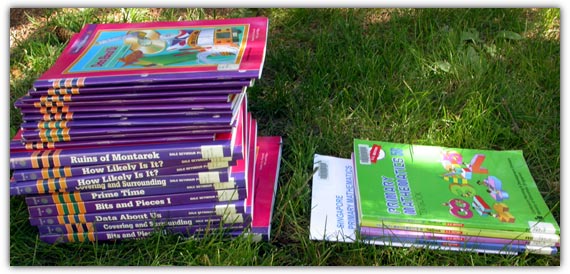
At L.A. school, Singapore math has added value

Mitchell Landsberg:

In 2005, just 45% of the fifth-graders at Ramona Elementary School in Hollywood scored at grade level on a standardized state test. In 2006, that figure rose to 76%. What was the difference?
If you answered 31 percentage points, you are correct. You could also express it as a 69% increase.
But there is another, more intriguing answer: The difference between the two years may have been Singapore math.
At the start of the 2005-06 school year, Ramona began using textbooks developed for use in Singapore, a Southeast Asian city-state whose pupils consistently rank No. 1 in international math comparisons. Ramona’s math scores soared.
“It’s wonderful,” said Principal Susan Arcaris. “Seven out of 10 of the students in our school are proficient or better in math, and that’s pretty startling when you consider that this is an inner-city, Title 1 school.”
Ramona easily qualifies for federal Title 1 funds, which are intended to alleviate the effects of poverty. Nine of every 10 students at the school are eligible for free or reduced-price lunches. For the most part, these are the children of immigrants, the majority from Central America, some from Armenia. Nearly six in 10 students speak English as a second language.

Joanne has more.

Share

How to Fix K-12 Education

David Bessoud:

This month, I want to use this forum to publicize a report that came out last fall with solid advice for how to improve our schools. As we think about K-12 mathematics education, as we engage in the debate of what should succeed No Child Left Behind, I believe that this report provides a useful, research-based framework in which to situate that debate. And I believe that this report has implications for how we think about mathematics teaching in our colleges and universities, a topic to which I shall return in later columns.
The report in question was issued by McKinsey & Company in September, 2007, How the world’s best-performing school systems come out on top [1]. Their procedure was straight-forward. They took the ten top-performing countries according to the OECD’s Programme for International Student Assessment (PISA): Australia, Belgium, Canada, Finland, Hong Kong, Japan, Netherlands, New Zealand, Singapore, and South Korea, and asked what practices are common among them. They tested their conclusions by comparing these practices with those in the US school systems that have seen the most dramatic increase in National Assessment of Educational Progress (NAEP) or TIMSS scores or have been consistent finalists for the Broad Prize for Urban Education. These school systems are Atlanta, Boston, Chicago, New York, and Ohio.
None of their conclusions should be surprising. The three practices that they identified are on most people’s lists of what they would like to see. What is eye-opening is how effective these practices can be and how important it is to focus on them. In my own paraphrase, they are

  1. Recruit teachers from among the most highly literate and numerate college students.
  2. Support teachers with continual coaching, peer-mentoring, and professional development.
  3. Have clear standards for system performance, intervene quickly and effectively when problems arise, and allocate resources so that those with the greatest need get the most support.

Share

High Schools Add Classes Scripted by Corporations
Lockheed, Intel Fund Engineering Courses

Anne Marie Chaker:

In a recent class at Abraham Clark High School in Roselle, N.J., business teacher Barbara Govahn distributed glossy classroom materials that invited students to think about what they want to be when they grow up. Eighteen career paths were profiled, including a writer, a magician, a town mayor — and five employees from accounting giant Deloitte LLP.
“Consider a career you may never have imagined,” the book suggests. “Working as a professional auditor.”
The curriculum, provided free to the public school by a nonprofit arm of Deloitte, aims to persuade students to join the company’s ranks. One 18-year-old senior in Ms. Govahn’s class, Hipolito Rivera, says the company-sponsored lesson drove home how professionals in all fields need accountants. “They make it sound pretty good,” he says.
Deloitte and other corporations are reaching out to classrooms — drafting curricula while also conveying the benefits of working for the sponsor companies. Hoping to create a pipeline of workers far into the future, these corporations furnish free lesson plans and may also underwrite classroom materials, computers or training seminars for teachers.
The programs represent a new dimension of the business world’s influence in public schools. Companies such as McDonald’s Corp. and Yum Brands Inc.’s Pizza Hut have long attempted to use school promotions to turn students into customers. The latest initiatives would turn them into employees.

Share

The Whole Child

Here in Massachusetts these days, we are hearing more and more from the Governor and educators about “The Whole Child.” They say we should be sure, in our schools, not to get distracted from a focus, in a holistic way, on the whole child.
I have heard about this “whole child,” but I have yet to have anyone explain what that could mean. I know that it has been said, of boys, for instance, that they are made of “snakes and snails and puppy dogs’ tails,” and of girls, that they are mostly “sugar and spice and everything nice,” but I can’t believe that completes the inventory.
Each student may be considered from a neuro-psychological, socio-economic, philosophical, dental, muscular-skeletal, ethnic, spiritual, academic, motivational, personality configuration, family, allergic, drug-resistant, blood-type, intellectual, gastrointestinal and athletic point of view, among a large group of other perspectives.
This raises the question of what parts of the whole child the school might be best qualified and equipped to work with? Surely no imaginable set of teachers, nurses, hall monitors, principals, bus drivers, coaches, and so on can deal with all the various characteristics of each human being who comes as a student to their school.
It would appear that a school and its staff might have to choose which aspects of the whole child should be their focus. In recent decades, self-esteem, tolerance, social consciousness, respect for differences, and environmental awareness have taken up a good deal of time in the schools. Perhaps as a consequence, our students tend to be in-numerate and a-literate. The Boston Globe reports today that: “37 percent of public high school graduates who enter public higher education may not be ready.”

(more…)

Share

Much more on Finland’s Education System

A reader emailed these links regarding the recent article on Finland’s education system:

  • The PISA survey tells only a partial truth of Finnish children’s mathematical skills:

    The results of the PISA survey (http://www.jyu.fi/ktl/pisa/) have brought about satisfaction and pride in Finland. Newspapers and media have advertised that Finnish compulsory school leavers are top experts in mathematics.
    However, mathematics teachers in universities and polytechnics are worried, as in fact the mathematical knowledge of new students has declined dramatically. As an example of this one could take the extensive TIMSS 1999 survey, in which Finnish students were below the average in geometry and algebra. As another example, in order not to fail an unreasonably large amount of students in the matriculation exams, recently the board has been forced to lower the cut-off point alarmingly. Some years, 6 points out of 60 have been enough for passing.
    This conflict can be explained by pointing out that the PISA survey measured only everyday mathematical knowledge, something which could be – and in the English version of the survey report explicitly is – called “mathematical literacy”; the kind of mathematics which is needed in high-school or vocational studies was not part of the survey. No doubt, everyday mathematical skills are valuable, but by no means enough.

  • Severe shortcomings in Finnish mathematics skills:

    Basic school teacher Antero Lahti expressed (HS 28.2.) the opinion that the concern of over 200 university teachers for the mathematics teaching (HS 17.2.) were merely academic criticism.
    In fact, about one half of those signing are teachers at polytechnics (universities of applied sciences) and technical universities. They do not teach “academic” mathematics but mathematics needed in technical practice and engineering sciences. Over 12 000 students start engineering studies yearly.
    The mathematics skills of new engineering students have been systematically tested during years 1999-2004 at Turku polytechnic using 20 mathematical problems. One example of poor knowledge of mathematics is the fact that only 35 percent of the 2400 tested students have been able to do an elementary problem where a fraction is subtracted from another fraction and the difference is divided by an integer.
    If one does not know how to handle fractions, one is not able to know algebra, which uses the same mathematical rules. Algebra is a very important field of mathematics in engineering studies. It was not properly tested in the PISA study. Finnish basic school pupils have not done well in many comparative tests in algebra (IEA 1981, Kassel 1994-96, TIMSS 1999).

Share

Is Reform Math a Big Mistake?

Via a Linda Thomas email:

Flash cards are out. Math triangles are in.
Mrs. Potter grabbed a chunky stack of flashcards, stood in front of the classroom and flipped through them every day when I was in second grade: 6 + 6 = blank, 7 + 3 = blank, 5 + 6 = blank. In unison, we responded 12, 10, 11. Our robotic pace slowed a bit when she held up subtraction cards.
That’s so old school.
The triangles my second-grade son brought home from school this year have plus and minus signs in the middle, with one number on each point. Students learn number families. For example, on a triangle of 6, 8 and 14 students see that 6 + 8, 8 + 6, 14 – 6 and 14 – 8 are all related.
Math triangles are part of the reform math curricula taught in more than one quarter of the nation’s schools. (See article “Math Wars” for a history of U.S. math education.) Seattle’s public elementary and middle schools teach reform math. This month the Seattle School Board will hear a recommendation for a new high school math curriculum that will be reform based. A key feature of this type of instruction is an emphasis on concepts, as opposed to computations.
In a traditional classroom, solving 89 + 21 involves lining the numbers up, carrying the one and arriving at 110 as the answer. Students learning reform math would think about the problem and reorganize it in several ways: 80 + 20 + 10, or 80 + 30, or 90 + 20. Same answer, different method.

Share

Final Meeting of the National Math Panel

Ednews:

March 13, 2008
Longfellow Middle School
Fairfax, VA
Registration (first-come, first-served basis)
We are now taking registrations for guests who would like to attend the final meeting of the National Math Panel.
Please note: There will be no public comments session at this meeting as the Panel will be adopting and releasing its Final Report.
Location:
Longfellow Middle School, 2000 Westmoreland Street, Falls Church, Virginia 22043
OnThursday, March 13 the Panel will complete its work by adopting and releasing the Final Report.

Share

Madison United for Academic Excellence meeting on MMSD Math

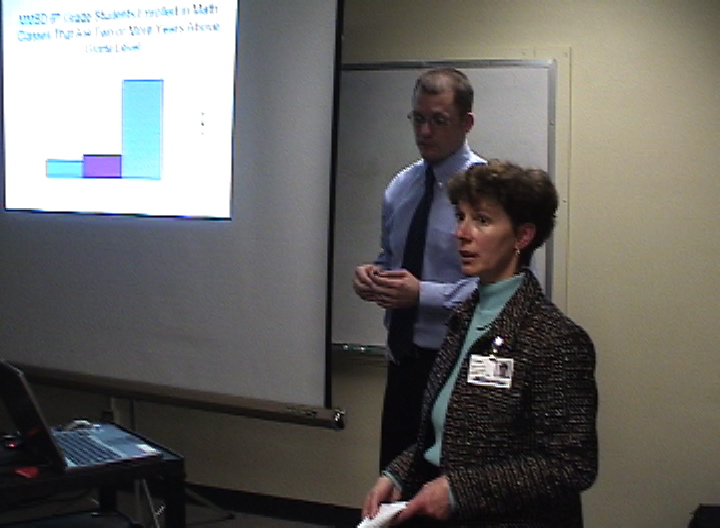
The Madison United for Academic Excellence (MUAE) meeting of 21 February 2008 offered a question and answer session with Welda Simousek, TAG coordinator, Lisa Wachtel, Director of Teaching and Learning, and Brian Sniff, Math Coordinator, each of MMSD.


QT Video
The video of the meeting is about 1 hours and 30 minutes long, but does not include the last 15 minutes of a spirited discussion. Click on the image at left to watch the video. The video will play immediately, while the file continues to download.

The topics covered during remarks and the question and answer sessions are

  • Middle School Math Assessment
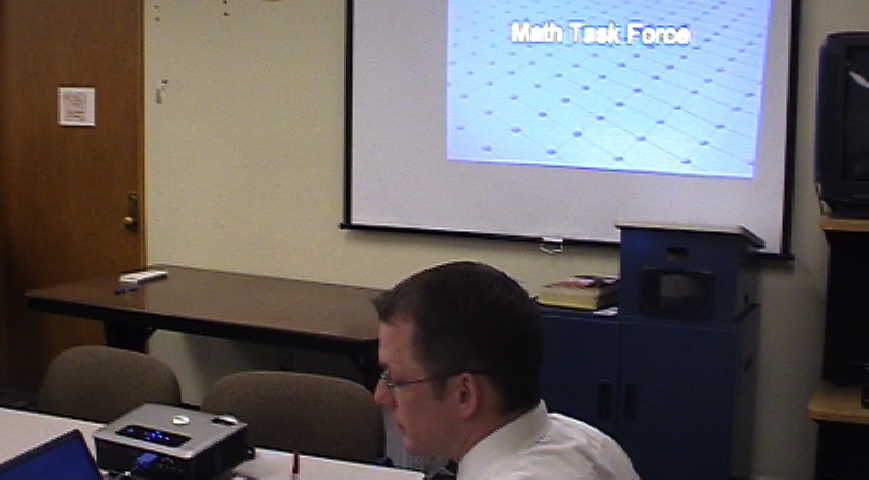
  • Math Task Force
  • Teacher Certifications in Math
  • Connected Math Curriculum in Middle Schools
  • High School Math Curriculum and variations among schools

The slide materials for Lisa’s and Brian’s presentation are included in Powerpoint format and PDF format. (Thanks to Brian for sending).
The handouts from this presentation (thanks to Welda): In-STEP Teacher Checklist, 2007-8 Middle School Math Assessment – Draft, Math Assessment Report.
NB: The last slides discussed during this meeting are slides numbered 15 and 16 (Math Physics, Math Chemistry, respectively). These latter slides prompted the spirited discussion mentioned above, but is not part of the video. Slides 17-19 were neither discussed nor displayed.

Share

New Math Textbooks Irk Some Parents

Ian Shapira:

Greg Barlow, an Air Force officer in the defense secretary’s office at the Pentagon, was helping his 8-year-old son, Christian, one recent night with a vexing problem: What is 674 plus 249?
The Prince William County third-grader did not stack the numbers and carry digits from one column to the next, the way generations have learned. Applying lessons from his school’s new math textbook, “Investigations in Number, Data, and Space,” Christian tried breaking the problem into easier-to-digest numbers.
But after several seconds, he got stumped. He drew lines connecting digits, and his computation amounted to an upside-down pyramid with numbers at the bottom. His father, in a teacherly tone, nudged him toward the old-fashioned method. “How would you do that another way?” Barlow asked.
In Prince William and elsewhere in the country, a math textbook series has fomented upheaval among some parents and teachers who say its methods are convoluted and fail to help children master basic math skills and facts. Educators who favor the series say it helps young students learn math in a deeper way as they prepare for the rigors of algebra.
The debate over “Investigations in Number, Data, and Space,” a Pearson School series used in thousands of elementary classrooms, including some in Arlington, Fairfax, Loudoun and Howard counties, is one of the newer fronts in the math wars. Such battles over textbooks and teaching methods are fueled in part by the anxieties of parents who often feel powerless over their children’s education, especially in subjects they know.
The curriculum, introduced in the 1990s and updated in a second edition issued last fall, offers one answer to the nation’s increasingly urgent quest for stronger elementary math education. The nonprofit organization TERC, based in Cambridge, Mass., developed “Investigations” with support from the National Science Foundation.

Related Links:

Share

The Knowledge Connection

ED Hirsch, Jr:

Consider the eighth-grade NAEP results from Massachusetts, which are a stunning exception to the nationwide pattern of stagnation and decline. Since 1998, the state has improved significantly in the number of eighth-graders reading at the “proficient” or “advanced” levels: Massachusetts now has the largest percentage of students reading at that higher level, and it is No. 1 in average scores for the eighth grade. That is because Massachusetts decided in 1997 that students (and teachers) should learn certain explicit, substantive things about history, science and literature, and that students should be tested on such knowledge.

E.D. Hirsch Jr. is an author, most recently of “The Knowledge Deficit,” and chairman of the Core Knowledge Foundation.

Share

Fifty Years of Math

Rather politically incorrect, but certainly on point with respect to fuzzy math. I continue to find to be amazed at the number of high school kids who cannot make change. Via instapundit.

Share

One Dad’s Campaign to Save America

Jay Matthews:

Bob Compton may be wrong about American students losing out to our hard-working Indian and Chinese competitors, but he is astonishingly sincere in his views. Even if his country doesn’t react to the international threat, he will. He has hired special tutors for his daughters, even though they already have top grades at a premier private school.
Compton, 52, is a high-tech entrepreneur and investor based in Memphis. His documentary film, “Two Million Minutes,” has become a key part of a campaign known as ED in ’08, which aims to push the next president toward big changes in U.S. schools. Compton and the ED in ’08 backers, including billionaire Bill Gates, support the growing movement for more instructional and study time. Compton’s message is that American kids are wasting much of their four years of high school–about 2 million minutes–on sports and jobs and television while Chinese and Indians are studying, studying some more and then checking in with their tutors to see what they still need to study.
I am not friendly to Compton’s argument. I think the Chinese and Indian threat to the American economy is a myth. I have been convinced by economists who argue that the more prosperous they are, the more prosperous we are, since they will have more money to buy our stuff. I also believe that prosperity in previously troubled countries such as China and India promotes democracy and peace.
I do, however, like Compton a lot, and agree with him that our high schools need to be much better–not in order to beat the international competition but to end the shame of having millions of low-income students not getting the education they deserve. I admire a dad who applies his arguments to his own life in ways I never would. He is significantly increasing the amount of time his children are devoting to their studies, whether they like it or not.

Share

Ballard Visits Madison

Robert Ballard spoke at Saturday’s Friends of UW Hospital & Clinic’s dinner. Ballard provided an interesting look at his work over the decades, which included some interesting education related comments:

  • The joint Woods Hole – MIT Program apparently serves mostly foreign PhD. students (“we are educating our competitors”), which lead to
  • The Jason Project,
  • an attempt to create science and engineering interest in middle school students. Ballard said that if we’ve not generated such interest by the 8th grade, it is too late.
Share

“A Modest Proposal for the Schools:”
Eliminate local control

A provocative title for a must read. It addresses a number of issues, from local outsize influence on school boards to Wisconsin’s low state standards:

Congress erred big-time when NCLB assigned each state to set its own standards and devise and score its own tests … this study underscores the folly of a big modern nation, worried about its global competitiveness, nodding with approval as Wisconsin sets its eighth-grade reading passing level at the 14th percentile while South Carolina sets its at the 71st percentile.

Matt Miller via a kind reader’s email:

It wasn’t just the slate and pencil on every desk, or the absence of daily beatings. As Horace Mann sat in a Leipzig classroom in the summer of 1843, it was the entire Prussian system of schools that impressed him. Mann was six years into the work as Massachusetts secretary of education that would earn him lasting fame as the “father of public education.” He had sailed from Boston to England several weeks earlier with his new wife, combining a European honeymoon with educational fact-finding. In England, the couple had been startled by the luxury and refinement of the upper classes, which exceeded anything they had seen in America and stood in stark contrast to the poverty and ignorance of the masses. If the United States was to avoid this awful chasm and the social upheaval it seemed sure to create, he thought, education was the answer. Now he was seeing firsthand the Prussian schools that were the talk of reformers on both sides of the Atlantic.
In Massachusetts, Mann’s vision of “common schools,” publicly funded and attended by all, represented an inspiring democratic advance over the state’s hodgepodge of privately funded and charity schools. But beyond using the bully pulpit, Mann had little power to make his vision a reality. Prussia, by contrast, had a system designed from the center. School attendance was compulsory. Teachers were trained at national institutes with the same care that went into training military officers. Their enthusiasm for their subjects was contagious, and their devotion to students evoked reciprocal affection and respect, making Boston’s routine resort to classroom whippings seem barbaric.
Mann also admired Prussia’s rigorous national curriculum and tests. The results spoke for themselves: illiteracy had been vanquished. To be sure, Prussian schools sought to create obedient subjects of the kaiser—hardly Mann’s aim. Yet the lessons were undeniable, and Mann returned home determined to share what he had seen. In the seventh of his legendary “Annual Reports” on education to the Commonwealth of Massachusetts, he touted the benefits of a national system and cautioned against the “calamities which result … from leaving this most important of all the functions of a government to chance.”
Mann’s epiphany that summer put him on the wrong side of America’s tradition of radical localism when it came to schools. And although his efforts in the years that followed made Massachusetts a model for taxpayer-funded schools and state-sponsored teacher training, the obsession with local control—not incidentally, an almost uniquely American obsession—still dominates U.S. education to this day. For much of the 150 or so years between Mann’s era and now, the system served us adequately: during that time, we extended more schooling to more people than any nation had before and rose to superpower status. But let’s look at what local control gives us today, in the “flat” world in which our students will have to compete.
The United States spends more than nearly every other nation on schools, but out of 29 developed countries in a 2003 assessment, we ranked 24th in math and in problem-solving, 18th in science, and 15th in reading. Half of all black and Latino students in the U.S. don’t graduate on time (or ever) from high school. As of 2005, about 70 percent of eighth-graders were not proficient in reading. By the end of eighth grade, what passes for a math curriculum in America is two years behind that of other countries.
Dismal fact after dismal fact; by now, they are hardly news. But in the 25 years since the landmark report A Nation at Risk sounded the alarm about our educational mediocrity, America’s response has been scattershot and ineffective, orchestrated mainly by some 15,000 school districts acting alone, with help more recently from the states. It’s as if after Pearl Harbor, FDR had suggested we prepare for war through the uncoordinated efforts of thousands of small factories; they’d know what kinds of planes and tanks were needed, right?
When you look at what local control of education has wrought, the conclusion is inescapable: we must carry Mann’s insights to their logical end and nationalize our schools, to some degree. But before delving into the details of why and how, let’s back up for a moment and consider what brought us to this pass.

Related:


Share

Milwaukee Hiring 200+ Teachers for Reading & Math

Alan Borsuk:

Milwaukee Public Schools is hiring more than 200 new teachers and undertaking more than $16 million in new spending for the second semester, with the goals of improving students’ reading and math abilities and improving high school programs.
Frequently using the phrase “a sense of urgency,” Superintendent William Andrekopoulos said this week that the unusual midyear shakeup in the status quo in many MPS schools is causing stresses in some parts of the system and on many adults but will benefit children.
Speaking about a new program to teach reading to older students who are reading poorly, he said: “We’ve done something we haven’t done before, create a sense of urgency around improving children’s reading. . . . Sometimes, if that makes people uncomfortable, so be it.”
The initiatives are clearly stretching the capacity of the system, from the central office, which is scrambling to hire teachers, to individual schools, where sometimes major changes in schedules are being made at midyear and with short deadlines for implementation.
In part because of the new programs, MPS has an unusual number of teaching positions available – 397 such openings were listed on the system’s Web site as of Monday, the most recent update. That equals about 7% of all teaching jobs in the district. Andrekopoulos said that without the new jobs included, the total openings would not be so unusual for this time of year.

Share

Intel Science Contest Finalists: One Student from Wisconsin’s Appleton East

Science Talent Search:

Matthew Michael Wage, 17, of Appleton, submitted an Intel Science Talent Search mathematics project that extended earlier results on arithmetic functions. The starting point for Matt’s project in number theory is Lehmer’s Conjecture, still open, that an arithmetic function defined by Ramanujan, the tau-function, is nonzero at each natural number n. Murty, Murty and Shorey showed that tau takes on any given value only finitely often. Matt extends this result to a wider class of arithmetic functions, sometimes at the cost of adding restrictions to the choice of n. Matt attends Appleton High School East where he is active in varsity football, varsity tennis and the ping pong club. Matt has won regional competitions in math, and his volunteer efforts as a coach helped the school’s math team earn the top rank in the state. He also enjoys playing chess, bridge and guitar. Matt’s quest for understanding the world around him has fueled his passion to learn everything from ideal gas laws to the propaganda genius of Genghis Khan. The son of Michael Wage and Kathy Vogel, Matt plans to study mathematics and medicine and pursue a career as a physician or mathematician.

Amanda Fairbanks has more.

Share

Virginia Parents Resist Math “Investigations” Curriculum

Ian Shapira:

A group of Prince William County parents is mounting a campaign to repeal a new elementary school math curriculum, using an Internet discussion group and an online petition to gather support and fuel criticism.
The group, whose members include parents from such elementary schools as Westridge, Ashland and Springwoods as well as teachers from various schools, plans to present the Prince William County School Board in February with its petition, which has about 500 names. Parents in the group, whose Web site ( http://www.pwcteachmathright.com) lists several of their complaints, say that the Investigations curriculum is putting their children behind grade level and is too convoluted.
The group’s formation comes right after the school system presented a year-long study of the curriculum that showed 80 percent of second-graders and 70 percent of first-graders are proficient on all 10 subtests of the Stanford Diagnostic Mathematics Test. The school system wants to continue studying the program and incorporate data from student performance on the state Standards of Learning exams.
School Board member Julie C. Lucas (Neabsco) said in an interview that she wants to examine the program inside a classroom to assess its effectiveness. She added that she has been hearing positive reviews from at least one principal in her district but that she wants to withhold making public comments until she visits schools.
The Investigations program has been undergoing a phased-in implementation since the School Board adopted its materials in 2006. In the 2006-07 academic year, kindergarten through second grade started the program; this year, third-graders began it; and next year, fourth-graders will use the material.
Investigations teaches children new ways of learning mathematics and solving problems. For instance, a student may not need to learn how to add 37 and 23 by stacking the figures on top of each other, and carrying the numbers. They may learn to add up the tens and then combine the seven and three to arrive at 60.

Related:

  • Math Forum Audio / Video
  • Madison School District’s Math Task Force
  • Clusty Search: Math Investigations
  • Teaching Math Right website:

    Why this website?
    …Because our children – ALL children – deserve a quality mathematics education in PWCS!!
    In 2006 PWCS directed mandatory implementation of the elementary school mathematics curriculum TERC – “Investigations in Number, Data, and Space” in all PWCS elementary schools. The traditional, proven, successful mathematics program was abandoned for a “discovery learning” program that has a record of failure across the country.
    Of all the VA Department of Education approved elementary math text/materials, “Investigations” least adequately supports the VA Standards of Learning. Yet it was somehow “the right choice” for PWCS children. Parents of 2nd and 3d graders are already realizing the negative impact of this program in only a year and a half’s worth of “Investigations.” Children subjected to this program end up two years behind where they should be in mathematics fluency and competency by the end of 5th grade. PWCS is committed to experimenting with our children’s future. We think our children and our tax dollars deserve better.

Share

Math 234 at the University of Wisconsin Madison for High School Students

Via Ted Widerski’s email:

The UW Math dept has decided to offer a section of Math 234 (3rd semester Calculus) at 7:45 am in the fall of 2008. This course will be taught by Professor Andreas Seeger and will meet at 7:45 – 8:35 on MWF for 3 credits. The UW has chosen this time as being somewhat convenient for high school students, as many students can take this course and return to their high school in time for 2nd period.
Madison Schools have 26 students in grades 11 or below that will be completing Calculus II this year. Combined with students in neighboring school districts, there is a possibility that a large percentage of the class will be made of area high school students.
For those students that plan to elect this course, each District has a deadline for accessing the Youth Options [Clusty | Google] program. In Madison, that deadline is March 1. Therefore, I would encourage you to speak with students and parents in your building and make them aware of this opportunity. Also, please pass on this info to other key people in your building such as guidance counselors, math department chairs and Calculus teachers.
If you have questions or concerns, feel free to contact me.
Ted Widerski
Talented and Gifted Resource Teacher
Madison Metropolitan School District
545 W Dayton Street
Madison, WI 53703
(608)442-2152

Related: Credit for non-mmsd courses.

Share

Ed schools put diversity before math

Jay Greene & Catherine Shock:

A good education requires balance. Students should learn to appreciate a variety of cultures, sure, but they also need to know how to add, subtract, multiply, and divide. Judging from the courses that the nation’s leading education colleges offer, however, balance isn’t a goal. The schools place far more emphasis on the political and social ends of education than on the fundamentals.
To determine just how unbalanced teacher preparation is at ed schools, we counted the number of course titles and descriptions that contained the words “multiculturalism,” “diversity,” “inclusion,” and variants thereof, and then compared those with the number that used variants of the word “math.” We then computed a “multiculturalism-to-math ratio”—a rough indicator of the relative importance of social goals to academic skills in ed schools. A ratio of greater than 1 indicates a greater emphasis on multiculturalism; a ratio of less than 1 means that math courses predominate. Our survey covered the nation’s top 50 education programs as ranked by U.S. News and World Report, as well as programs at flagship state universities that weren’t among the top 50—a total of 71 education schools.
The average ed school, we found, has a multiculturalism-to-math ratio of 1.82, meaning that it offers 82 percent more courses featuring social goals than featuring math. At Harvard and Stanford, the ratio is about 2: almost twice as many courses are social as mathematical. At the University of Minnesota, the ratio is higher than 12. And at UCLA, a whopping 47 course titles and descriptions contain the word “multiculturalism” or “diversity,” while only three contain the word “math,” giving it a ratio of almost 16.

Share

SVLG, Intel Join to Help Bay Area Teachers with Math Education

Jessie Mangaliman:

If mathematics is like a foreign language, then those who teach the subject ought to be fluent.
That is the goal of an intensive pilot program by the Silicon Valley Leadership Group and Intel that aims to improve the math skills of students in underperforming Bay Area elementary and middle schools.
Helping students means helping their teachers first – and that includes some veteran educators.
Take Marivic Walch of Bishop Elementary School in Sunnyvale, who has been teaching for seven years and describes herself as a “math queen.”
“I had many aha moments,” she said.
Modeled after a successful program in Vermont, the 80-hour pilot course taught 38 Bay Area teachers in the past four months how to improve their skills from basic math all the way to algebra. The program is set to expand in 2008, more than doubling its scope, training 100 teachers in 20 schools in San Jose, Gilroy, Redwood City, Foster City, Newark and San Francisco.
“The idea is to turn this into a fluency training in the language of math,” said Mark Pettinger, external affairs manager for Intel. “This is meant for teachers who are good teachers.”

Share

Pushing and Shoving Our Schools into College Readiness

Donna Garner:

Our nation’s classrooms no longer emphasize substantive expository and persuasive writing built upon strong foundational knowledge. This dumbing down of students’ writing and reading is one of the main reasons that students are not ready for college after graduating from our high schools.
During this last decade, public-school teachers have been forced to teach the personal victimization narrative (with an emphasis on “voice”) to get their students ready for the state-mandated tests which contain writing prompts such as “the importance of understanding your heritage,” “a time you made an important choice,” “the importance of accepting others as they are,” “the affect someone you admire can have on your life,” “whether it is important to seek friendships with people who are different from you,” or “the importance of participating in an activity you enjoy.”
Students have been taught that they will get a higher score on these writing prompts if they will build up a dramatic social injustice, victimization essay even if the personal references are bogus. Correct grammar, spelling, usage, punctuation, and capitalization are not factored into the final score so long as they do not “disrupt” communication; and if the student makes a high enough score on his essay, the questions on the multiple-choice editing/revising section count very little.

Share

Study: Early academics indicate future successes

Phillip Swarts:

An understanding of basic math and reading is a better indicator of future academic success than behavior is in preschool and kindergarten students, according to a recent study led by a Northwestern professor.
SESP professor Greg Duncan led an 11-person team in a four-year study researching factors affecting how well students do in school.
“We were interested in assessing the relational predictive power of various skills … kids had when they entered school,” Duncan said.
The researchers studied students entering school, looking at their academic performance, sociability and the number of fights they were involved in. They looked at data for students, in some cases up to seventh grade, and found that those who mastered elementary math and literacy skills early on were more likely to succeed in school, regardless of behavior, than those who were well-behaved but didn’t master academics. The study controlled for economic and family factors.

Share

More time in class equals better math skills

Greg Toppo:

The idea that more time in school produces better results could get a small boost today with the release of international data from the Brookings Institution. The study finds adding 10 minutes of math instruction to an eighth-grader’s day translates into a jump in math skills.
The findings come as a handful of states and school districts experiment with packing more minutes into the school day and, in a few cases, more days into the year.
The study, which examined eighth-grade math scores in 20 countries, found that five of seven that added instructional minutes from 1995 to 2003 showed improved skills. Of the 13 countries that subtracted time, 10 got worse results. The three exceptions were Latvia, the Netherlands and the USA.
Most U.S. eighth-graders got 45 minutes of daily math instruction in 2003, down from 49 in 1995, but their scores on the Trends in Mathematics and Science Survey improved slightly. Researcher Tom Loveless says that is an anomaly, and more time in class could help boost scores. But even 450 more minutes of math, or two weeks’ worth, would shrink the gap between the USA and top-scorer Singapore by less than 5%, he says.

Share

Just Another Big Con: The Crisis in Mathematics and Science Education

Dennis Redovich:

What is the rationale for all United States high students passing three advanced courses in math and science to receive a high school diploma? What is the rationale for “all” high school graduates satisfying the requirements for admission to a four-college program? There is none!
The United States is the uncontested leader of the world in scientific research in respect to published accomplishments, Nobel Prizes, volume of research and expenditures on scientific research. The United States is the leader of the world in technology and the unchallenged leader of the world in the global economy. The United States dominates the world because of its educational systems, including K-12 public education, post-secondary colleges and universities that produce the most highly educated, productive and successful workforce in the world.

Share

Studying math in high school = success in college

Andrew Freeman, via a reader’s email:

Encouraging teens to drive safely, honor a curfew, or simply make good choices is an enormous task. However, there’s something else parents should add to their list — something that can open many opportunities for high school students: persuade them to take advanced math.
Trust me. I know how hard it can be to convince high school students of the importance of taking a course they may not want, particularly when many seem to have an aversion to this subject. However, as a college admissions professional, I’ve seen the difficulties students experience without an adequate math background. I’ve seen how the lack of math skills limits their choices.
Chances are your son or daughter may not want to put down the video game remote to pick up a scientific calculator. They may even believe their deepest aspirations don’t require a lot of math. However, the reality is that more than 50 percent of students change their majors at least once. So, even if the major they choose now doesn’t require advanced math, the odds are good the one they pick later probably will.
And that’s not the only good reason for improving math skills. In high school, you get up to 40 weeks to learn the material. In college, you get about 15. Students who enter college without the necessary math skills are often required to take non-credit skill-building courses. This extra review could mean a crammed first semester schedule or an additional semester in college.
Math doesn’t have to be a teenager’s nightmare. Encourage them to ask questions in class, stay for help, find a tutor, access math Web sites, take advantage of WXXI’s Homework Hotline or find out if your school offers math-specific study halls.

Share

Millar: Improving education in math and science

Terry Millar:

Improvement in math and science education is a priority in Madison, as it is across the nation.
Science, technology, engineering and math (STEM) training is not only of growing importance to our technology-dependent society, these disciplines also represent esthetically compelling advances in human knowledge that all students should have the opportunity to appreciate.
Since 2003, UW Madison and the Madison School District have been involved in a unique partnership, funded by the National Science Foundation, to reform science and math education from kindergarten through graduate school.
Preliminary results are encouraging. This five-year endeavor, SCALE — System-wide Change for All Learners and Educators — has partners that include three universities and large school districts in Madison, Los Angeles, Denver and Providence, R.I. The NSF made exploring new forms of partnership its key feature.
Improving STEM education has proven resistant to traditional “you do your thing, I ‘ll do mine ” approaches. SCALE ‘s successes underscore the wisdom of NSF ‘s emphasis on partnership.
SCALE incorporates research on student learning and teacher professional development. SCALE puts premiums on increasing teachers ‘ STEM subject matter knowledge and boosting their teaching skills.
In one preliminary study, teachers showed a significant increase in content knowledge after attending SCALE science professional development institutes in Los Angeles.
SCALE partners believe the most important resource in a school is its teachers, an idea that has not always been central to reform. However, the final measure of effectiveness is increased student understanding and performance. In 2009-2010, a randomized study involving 80 elementary schools in Los Angeles will provide definitive data on SCALE ‘s impact on student performance in science.

Links:

(more…)

Share

‘Checkbook Math’ Increasingly Rare

Daniel de Vise:

In her final year at James Hubert Blake High School in Silver Spring, Amber Rountree chose to take consumer math, a course designed to teach students how to balance a checkbook and shop for a home loan. She rates it the easiest math class she has taken in high school but also the most useful.
Once a common course offering, consumer math is being phased out as school systems raise their expectations of how much math students should know when they graduate. Twenty or 30 years ago, Algebra I might have sufficed. Today, that course is regarded as an absolute minimum, a gateway to Advanced Placement study and college. Students routinely take it in middle school.
That leaves consumer math and other “checkbook math” classes relegated to a handful of schools, mostly in poor communities. College-bound students generally avoid the class, reasoning that it would look bad on a transcript.
“In a lot of places, this course has been a dead-end street,” said Francis “Skip” Fennell, president of the National Council of Teachers of Mathematics in Reston.
The gradual elimination of the course from high schools comes as lawmakers, corporate leaders and many parents are decrying the financial illiteracy of the young. Fourteen states, including Virginia, have created new mandates for personal finance

Share

National Math Panel Unveils Draft Report

Sean Cavanagh:

Students’ success in mathematics, and algebra specifically, hinges largely on their mastering a focused, clearly defined set of topics in that subject in early grades, the draft report of a federal panel concludes.
The long-awaited report of the National Mathematics Advisory Panel is still very much in flux. Members of the White House-commissioned group staged their 10th, and what was supposed to be their final, meeting in a hotel here Nov. 28, though they indicated that numerous revisions to the document are yet to come.
The panel spent most of a day debating and rewriting a 68-page draft of the report. The draft makes recommendations and findings on curricular content, learning processes, training and evaluation of teachers, instructional practices, assessment, and research as those topics apply to math in grades pre-K through 8.
“International and domestic comparisons show that American students have not been succeeding in the mathematical part of their education at anything like a leadership level,” the report says. “Particularly disturbing is the consistent finding that American students achieve in mathematics progressively more poorly at higher grades.”
The 19-member panel has reviewed an estimated 18,000 research documents and reports as part of its work, which began in 2006. But its draft document also bemoans the paucity of available research in several areas of math—including instruction and teacher training. Government needs to do more, it says, to support research with “large enough samples of students, classrooms, teachers, and schools to identify reliable effects.”
The draft attempts to define the core features of a legitimate school algebra course as opposed to one, the panelists said, that presents watered-down math under that course title. Topics in an algebra course should include concepts such as symbols and expressions, functions, quadratic relations, and others, it notes.
The working report also spells out specific concepts in math that are too often neglected in pre-K through grade 8 math instruction generally, such as fractions, whole numbers, and particular elements of geometry and measurement.
“We don’t spend enough time on them and we don’t assess them,” panel member Camilla Persson Benbow, an educational psychologist at Vanderbilt University in Nashville, Tenn., said of fractions. “[They’re] really not well mastered by schoolchildren.”
In arguing in behalf of a more focused curriculum in elementary and middle schools, the panel lists several “benchmarks for critical foundations” in prekindergarten through 8th grade math, leading to algebra. The goal is to develop fluency with fractions, whole numbers, and other topics. The panel drew from a diverse assortment of documents, including the 2006 “Curriculum Focal Points,” published by the National Council of Teachers of Mathematics, as well as Singapore’s national standards and a number of U.S. state math standards.

National Mathematics Advisory Panel Website

Share

The Secret Gripes of Professor Klein: An AP-IB Drama

Jay Matthews:

David Klein, a mathematics professor at California State University at Northridge, says he was pleased to review Advanced Placement and International Baccalaureate math courses for the Thomas B. Fordham Institute. He respects institute President Chester E. “Checker” Finn Jr., a longtime leader in the movement to improve U.S. schools. Among the views Klein shares with Finn is that overuse of calculators can interfere with students’ mastery of analytical skills.
But their collaboration on Fordham’s analysis of AP and IB did not turn out the way either of them hoped.
On June 4, Klein submitted his report on two courses, AP Calculus AB and IB Mathematics SL. Klein’s analysis of AP and IB math was more negative and his grades lower than what the experts on AP and IB English, history and biology courses submitted to Fordham. He would have given the AP math course a C-plus and the IB math course a C-minus. The other reviewers thought none of the courses they looked at deserved anything less than a B-minus.
Still, Klein says, he got no indication from the Fordham staff of any problems until the edited version of his material came back to him for review on Sept. 28, a week before the deadline for completing the report. Many of what he considered his strongest points, he discovered, had been deleted. He had Fordham remove his name as a co-author of the report, “Advanced Placement and International Baccalaureate: Do They Deserve Gold Star Status?” which was released Nov. 14.
After agreeing to the name removal, Finn told Klein in an e-mail: “I imagine we’ll also reduce your overemphasis on calculator use and probably change the grades (upward). Thanks, tho, for your help.” Klein’s grade of C-plus for AP was not changed, but his grade of C-minus for IB got a big jump to a B-minus, meaning the report was saying that IB math was better than AP math, the opposite of what Klein had said.

Related:

Share

John Kao has a plan to help U.S. compete, regain foothold in science and technology

Heidi Benson:

As important, is the state of science and math education, particularly in the early grades, where young students’ abilities have been in a steady decline. The slip results as much from failings in government priorities as from income and class inequities, Kao believes.
“We are allowing the vagaries of income disparity to waste generations of potential innovators,” he says. “In U.S. schools serving low-income students, 30 percent of junior high mathematics teachers majored in math in college.” In China, the majority of math and science teachers at all levels have advanced degrees in their subjects.

Related: Math Forum | Math Task Force.

Share

U.S. students ‘middle of the pack’ compared with world


Click for a larger version of this image.

Greg Toppo:

Educators and politicians these days make a point of saying that U.S. schoolchildren aren’t just competing locally for good, high-paying jobs — they’re competing globally.
A detailed study lets them know just how well kids may do if they really compete globally someday — and it’s not exactly pretty.
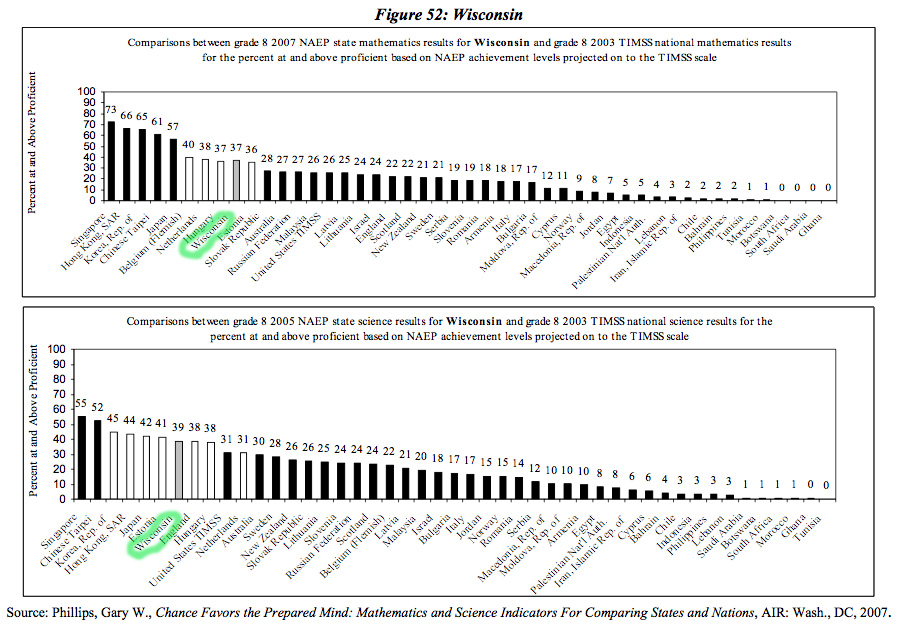
Crunching the most recent data from a pair of U.S. and international math and science exams for middle-schoolers, Gary Phillips, a researcher at the non-profit American Institutes for Research (AIR), a non-partisan Washington think tank, finds a decidedly mixed picture: Students in most states perform as well as — or better than — peers in most foreign countries.
But he also finds that even those in the highest-scoring states, such as Massachusetts and Minnesota, are significantly below a handful of top-scoring nations such as Singapore, Hong Kong, South Korea, Taiwan and Japan.

1.9MB PDF Report:

In mathematics, students in 49 states and the District of Columbia are behind their counterparts in Singapore, Hong Kong, South Korea, Taiwan and Japan. Students in Massachusetts are on a par with Japanese students, but trail the other four nations. In science, students in Massachusetts, Minnesota, Montana, New Hampshire, North Dakota, South Dakota, Vermont and Wisconsin trail only students in Singapore and Taiwan, while performing equal or better than students in the other 45 countries surveyed.
“More than a century ago Louis Pasteur revealed the secret to invention and innovation when he said ‘chance favors the prepared mind’. The take away message from this report is that the United States is loosing the race to prepare the minds of the future generation,” said Dr. Phillips.
Students in the District of Columbia had the lowest U.S. performance in mathematics (they did not participate in the science test). In math, the average D.C. student is at the Below Basic level, putting them behind students in 29 countries and ahead of those in 14 countries. In science, nine states are at the Below Basic level: Florida, Arizona, Louisiana, Nevada, New Mexico, Alabama, Hawaii, California and Mississippi.

Clusty Search: National Assessment of Educational Progress (NAEP) | Trends in International Mathematics and Science Study (TIMMS)

Share

Math Task Force Working Group Meeting Notice

Notice of Madison School Board Meetings
Week of November 12, 2007

Thursday, November 15
1025 West Johnson Street
Madison, WI 53706
Room 247
Math Task Force – Student Achievement and Data Working Group
9:00 a.m.
1. Introductions and Review of Agenda
2. Main Questions to be Answered by Data for the Mathematics Task Force and the Priority of the Questions
3. Data Sources and Availability
4. Necessary Resources to Produce the Needed Analyses
5. Adjournment Education Sciences Bldg.

Share

Dane County, WI AP High School Course Comparison

A quick summary of Dane County, WI High School 2007-2008 AP Course Offerings (source – AP Course Audit):

  • Abundant Life Christian School (3 Courses)
  • Cambridge (1)
  • DeForest (7)
  • Madison Country Day (International Baccalaureate – IB. However, Madison Country Day is not listed on the approved IB World website.)
  • Madison East (11)
  • Madison Edgewood (11)
  • Madison LaFollette (10)
  • Madison Memorial (17)
  • Madison West (5+1 2nd Year Calculus which “prepares students for the AP BC exam”)
  • Marshall (5)
  • McFarland (6)
  • Middleton – Cross Plains (7)
  • Monona Grove (7)
  • Mount Horeb (5)
  • Oregon (9)
  • Sauk Prairie (10)
  • Stoughton (6)
  • Sun Prairie (13)
  • Verona (10)
  • Waunakee (6)
  • Wisconsin Heights (6)

Links and course details are available here.
Related: Dual Enrollment, Small Learning Communities and Part and Full Time Wisconsin Open Enrollment.
Via a kind reader’s email.

Share

Columbia (Missouri) Parents for Real Math

Math Excellence in Columbia Missouri Public Schools:

To: Columbia Public Schools Board of Education and Superintendent Phyllis Chase
An increasing number of parents and community leaders have expressed concern about the various math curricula currently used in the Columbia Public Schools (CPS). These experimental math programs go by the names of Investigations (TERC), Connected Math (CMP) and Integrated Math (Core Plus) and they emphasize “self-discovery” over mathematical competency. We are concerned because these curricula have been discredited and abandoned in other regions of the country after they failed to deliver demonstrable results. The failed curricula are currently the only method of instruction in the elementary grades and middle schools. At higher grade levels, CPS has actively discouraged students from enrolling in math courses that place more emphasis on widely accepted standard methods. And, while implementing and evaluating these programs, the Columbia School District did not provide open access to meetings or adequately consider the concerns of professional mathematicians, parents and community leaders.
Therefore, we, the undersigned, would like to express our deep concern with the following issues and to propose that the Columbia School District adopt the following goals:
1. Protect the right of students to become computationally fluent in mathematics. We expect students to receive direct instruction in standard algorithms of all mathematical operations and laws of arithmetic so that they can master the skills that allow fast, accurate calculation of basic problems. This goal cannot be met with the current Investigations/TERC math curriculum for lower grade levels.
2. Ensure that math instruction is flexible enough to allow for various learning styles and is age and grade-level appropriate. The elementary level should focus on math standards that will build a solid base of mathematical skills for ALL students. Middle school curricula should build a bridge between the fundamental arithmetic learned in elementary school and the more abstract concepts taught in high school. At both the elementary and middle school levels the curricula should allow teachers the flexibility to meet the needs of all types of learners. This goal cannot be met with the Connected Math program currently used in middle and junior high schools.

Related: Columbia Parents’ blog site, which offers a number of useful posts. [RSS]
Math Forum Audio / Video.
Via a reader.

Share

“Math Power: How to Help Your Child Love Math Even If You Dont’

“Math Power: How to Help Your Child Love Math Even If You Dont’,” the only
book by a mathematician written for parents of children aged 1-10, is
about to go out of print for the second time. Both times the publisher
sold its trade books to another publisher just as it was published, so
none of the four publishers made any effort to publicize it. This time,
however, I have a good offer to buy the remaining copies. I really want
it to get into as many libraries as possible — and many hands. There
are many copies left.
If you can get a library to offer me a thank you note and give me the
address, I will send that library an autographed copy free for the tax
deduction. If you want an autographed copy, I will be glad to send you a
copy for $10. The price on the cover is $19.95, and it’s fine to resell
them at this time. If you can find an outlet or use them yourself, I can
send a box of 18 books for $140. (No autographs on those books because
they will be inside the box.) There are MANY boxes available.
“Math Power” had excellent reviews from both sides of the “Math Wars” when
it first appeared in 1997, and another from “The Library Journal,” but
without some publisher publicity, books don’t sell. It may be that math
is not a popular subject in this culture; there is other evidence.

(more…)

Share

When getting all the attention is not the intention

Laura Shumaker:

“I’m ready now.”
I turned to look at my son Matthew, who is 21 and autistic. He stood in the doorway of the kitchen looking pleased with himself, wearing grass-stained socks and sandals and a clean striped shirt tucked into shorts cinched up high with a belt. His handsome face was clean, but there were several spots he had missed while shaving that morning. His sandy blond hair was combed straight forward in a most unflattering “Dumb and Dumber” sort of way.
“All right,” I said, “just comb your hair to the side and do a quick shave and we’ll be on our way.”
If I could just dress Matthew myself, he would look great, but I had to respect his desire to be treated like a regular 21-year-old.

Share

Madison Math Task Force Expands

I’ve learned that parent and activist Jill Jokela and LaFollette High School Physics Teacher Charles Chapin will be named to the Math Task Force this evening.
Much more on the Madison Math Task Force here.

Share

Hand-Held Calculators’ Milestone Number

Michael Alison Chandler:

In a darkened Algebra II classroom, all eyes were on an illuminated graphing calculator projected three feet high on the white board as students studied a series of graphs and talked about absolute value functions.
The weightless image of a TI-84 Plus Silver Edition graphing calculator is a far cry from early typewriter-size calculators that weighed 55 pounds and plugged into an outlet. This year marks the 40th anniversary of the moment that revolutionized not only the calculator but also the way students learn math. It was 40 years ago that three Texas Instruments scientists shrank that monstrosity and created the hand-held calculator.
To mark the milestone, the Texas company donated some historic hand-helds to the Smithsonian’s National Museum of American History last week as symbols of change in the United States. The devices will go alongside the table Thomas Jefferson used when he wrote the Declaration of Independence and the top hat Abraham Lincoln wore when he was assassinated.
In math classrooms, calculators mechanized finger counting, pencil-and-paper calculations and slide rules. Elementary students weaned on Little Professor calculators that can add, subtract, multiply and divide move on to graphing calculators in later grades. Future students will use programmable devices that show algebraic formulas, graphs and word problems on the same screen.

Share

SAS CEO Blasts Old-School Schooling; The War of Minds

James Goodnight:

But that clear and present danger is not here today. It’s a slowly growing problem that we haven’t really faced up to, that we are rapidly losing our lead in this war for minds. The Cold War is over. The arms race is over. It’s now a mind race.
Countries like China, India, and Korea have invested heavily in education over the last decade. They are now producing more scientists and engineers than we are. It is my concern that as we look to the future, innovation is going to come from the other side of the world.
Lacking a clear and present danger, the American education system is not mobilizing to support science, technology, engineering and math. Today’s generation of kids is the most technology savvy group that this country has ever produced. They are born with an iPod in one hand and a cell phone in another. They’re text messaging, e-mailing, instant messaging. They’re on MySpace, YouTube & Google. They’ve got Nintendo Wiis, Game Boys, Play Stations.
Their world is one of total interactivity. They’re in constant communication with each other, but when they go to school, they are told to leave those “toys” at home. They’re not to be used in school. Instead, the system continues teaching as if these kids belong to the last century, by standing in front of a blackboard.
Education has not changed, and that’s a problem. It was a good system when I came through, but today’s kids have changed, and that’s the part that educators are not realizing. It’s the kids that have changed, and our education system needs to change along with them.

Slashdot discussion.

Share

A return to traditional math

Kris Sherman:

Tacoma’s eighth-through-12th-grade algebra, geometry, pre-calculus and calculus students are cracking open new math textbooks worth more than half a million dollars. It’s the fourth math series to be used in the city’s high schools in the last seven years.
“Like everybody else, we’re in a constant quest to find that program that’s going to best work to get kids to standard,” assistant superintendent Michael Power said.
School district officials believe the new curriculum is easier to use, better aligned with local and state standards and gives kids a higher chance at success than previous math program.
“We weren’t getting the growth (in achievement) that we wanted to see,” said secondary math facilitator Patrick Paris. “Our scores at the high school level were relatively flat.”
Administrators realized early this year that the Saxon math program implemented last fall wasn’t working out in the upper grades. They asked a curriculum review team to find a replacement.
The team scrutinized available programs for high school study before settling on the Prentice Hall algebra-geometry-algebra series of texts and Houghton Mifflin pre-calculus and calculus books.
The School Board approved the $530,000 plus tax and shipping purchase Aug. 23.
Saxon math remains in the lower grades, where its back-to-basics approach is credited, in part, with helping raise scores this year.

Share

NAEP Math Results: Ohio and Wisconsin Comparison

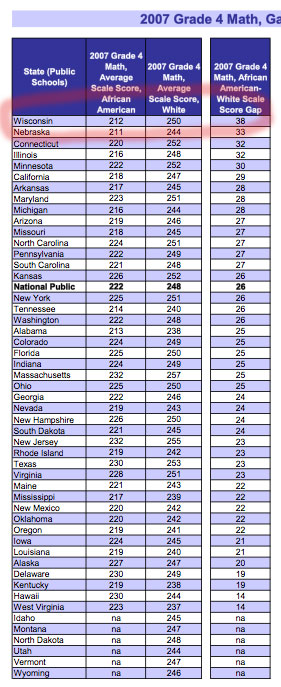
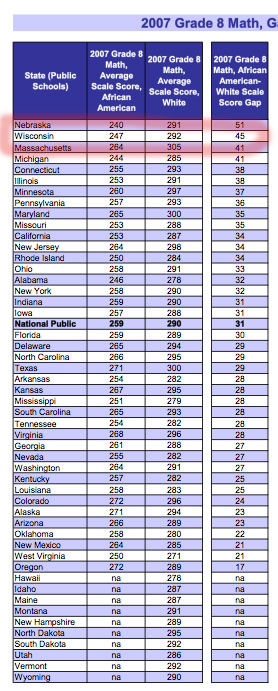
The 2007 NAEP results have just been released. There are many interesting results one can learn by looking at this data. In addition to the very serious racial gap in Wisconsin which has been commented on by The Educational Trust [Grade 4 Math NAEP Analysis | 80K PDF ] [Grade 8 Math NAEP Analysis | 80K PDF] and the Wisconsin Department of Public Instruction [172K PDF], there are strong indications of other problems in mathematics education in Wisconsin. Consider the following data comparing results for whites and blacks in Ohio and Wisconsin from the first year NAEP results were given by states and the 2007 results. As background, 12 points on NAEP is generally thought to be about the change from one year to the next on a given test. This is not a good estimate when looking over 15 to 17 years, since part of the rise in the test score likely came from changes made in textbooks and in what teachers teach because of the change in the NAEP Framework in the early 1990s.


For example, in Trends in Mathematics and Science Study, TIMSS, fourth grade math was tested in 1995 and 2003, and the results were flat while the NAEP results went up enough to allow statisticians to conclude the increase was statistically significant.


I assume that some of the rise in NAEP over this period is because students are learning more about the topics covered in NAEP, but that this is not the only
reason for the rise in NAEP scores.


The data below is comparison data between the results in two states at two different years, so the point estimate for a year of schooling seems to be a reasonable guideline. If so, Wisconsin has lost about a year to Ohio. Something needs to be done about this.

NAEP Fourth Grade Mathematics
Whites 1992 2007
Wisconsin 233 250
Ohio 222 250 Ohio gained 11 points on Wisconsin
Blacks 1992 2007
Wisconsin 195 212
Ohio 194 225 Ohio gained 14 points on Wisconsin
NAEP Eighth Grade Mathematics
Whites 1990 2007
Wisconsin 279 292
Ohio 268 291 Ohio gained 10 points on Wisconsin
Blacks 1990 2007
Wisconsin 236 247
Ohio 233 258 Ohio gained 14 points on Wisconsin

Share

“Why are You Sweating?”

Teacher Lance Chapman:

I asked all 140 of my eighth-grade students to divide 10 by 2. Just eight of them wrote down 5.
I knew my students would need remedial work, but I had no idea it would be to this extent. One of the first standards for eighth-grade physical science is manipulating this equation: speed equals distance divided by time (S = D/T). This is a foundation for upper-level skills in physical science. Next come velocity, acceleration, and gravity. I knew that many of my eighth-grade students would have trouble converting fractions into decimals, but I never fathomed that 10 divided by 2 would give so many of them trouble.
They made comments such as, “Mr. Chapman, this is science class, not math class. I hate math.” Almost half of the first periodic assessment given in November will be based on division, multiplication, and addition to solve for a scientific term. Division remedial work was a must.

Share

Happy Birthday, Sputnik.
Fifty years ago, a small Soviet satellite was launched, stunning the U.S. and sparking a massive technology research effort. Could we be in for another “October surprise”?

Gary Anthes:

Quick, what’s the most influential piece of hardware from the early days of computing? The IBM 360 mainframe? The DEC PDP-1 minicomputer? Maybe earlier computers such as Binac, ENIAC or Univac? Or, going way back to the 1800s, is it the Babbage Difference Engine?
More likely, it was a 183-pound aluminum sphere called Sputnik, Russian for “traveling companion.” Fifty years ago, on Oct. 4, 1957, radio-transmitted beeps from the first man-made object to orbit the Earth stunned and frightened the U.S., and the country’s reaction to the “October surprise” changed computing forever.
Although Sputnik fell from orbit just three months after launch, it marked the beginning of the Space Age, and in the U.S., it produced angst bordering on hysteria. Soon, there was talk of a U.S.-Soviet “missile gap.” Then on Dec. 6, 1957, a Vanguard rocket that was to have carried aloft the first U.S. satellite exploded on the launch pad. The press dubbed the Vanguard “Kaputnik,” and the public demanded that something be done.
The most immediate “something” was the creation of the Advanced Research Projects Agency (ARPA), a freewheeling Pentagon office created by President Eisenhower on Feb. 7, 1958. Its mission was to “prevent technological surprises,” and in those first days, it was heavily weighted toward space programs.
Speaking of surprises, it might surprise some to learn that on the list of people who have most influenced the course of IT — people with names like von Neumann, Watson, Hopper, Amdahl, Cerf, Gates and Berners-Lee — appears the name J.C.R. Licklider, the first director of IT research at ARPA.
Armed with a big budget, carte blanche from his bosses and an unerring ability to attract bright people, Licklider catalyzed the invention of an astonishing array of IT, from time sharing to computer graphics to microprocessors to the Internet.

Share

U.S. Set to Offer Math Grants Modeled on Reading First

Sean Cavanagh:

A year and a half ago, President Bush proposed the creation of a new federal mathematics effort that would offer millions of dollars in grants to school districts to adopt proven strategies for improving classroom instruction in that subject.
Last month, federal lawmakers gave the president what he was looking for—with some differences.
Administration officials had pictured the new program, called Math Now, as being modeled on Reading First, the $1 billion-a-year federal effort that provides money for research-based improvements in reading instruction in the early grades.
But in the end, Congress’ vision differed. Math Now—included as part of a broader piece of legislation to support math and science education and research known as the America COMPETES Act, which Mr. Bush signed into law Aug. 9—is authorized to receive less half the amount the administration had wanted: $95 million a year, not $250 million.

Share

Washington State’s Math Standards Review

Donna Gordon Blankinship:

The board’s executive director, Edie Harding, said public comment required some changes to a draft report the committee circulated last month, but the basic message is the same: The state needs tougher math standards and clearer guidance for teachers, parents and students.
The draft report called for putting more emphasis on learning the mechanics of math, but Harding said the math committee learned during public hearings around the state that people thought the report came on too strong concerning memorizing basic math facts.
Washington does need to re-emphasize the mechanics of math, but not give up on teaching students how to apply what they learn and to understand how math ideas fit together, Harding said.
The report, written by Linda Plattner of the Maryland-based educational research firm Strategic Teaching, which was hired by the state to assess its math expectations, also emphasizes the need to simplify grade level expectations and to set priorities for the state’s math standards.
“That should help teachers as well as kids,” Harding said.
The focus groups also taught the math committee that they need to include a math educator in their review committee so they can hear from a teacher if the standards will work in the classroom.

Strategic Teaching Draft Report: 650K PDF:

The bottom line is that Washington’s math standards need to be strengthened. If mathematics is the gateway to student success in higher education and the workplace, Washington is getting too few of its students to and through the door.
Compared to other higher-achieving states and countries, Washington is not expecting enough of its students. There is insufficient emphasis on key mathematical content. Some key math should be taught earlier in a student’s schooling, and some key math is simply missing. Washington does not provide sufficient clarity in its math expectations and does not ensure that Washington students learn the critical algorithms — math rules — that they need to succeed.
And the standards do not provide sufficient clarity of how well students are expected to learn math. For example, the standards often call for student “understanding” rather than a demonstration that a student can actually use the math to calculate, estimate, or solve a problem.
This is a harsh assessment. To be sure, there are good qualities in Washington’s mathematics standards including well-defined and developed mathematical processes and some well-developed strands, such as Algebra in the elementary years.

The Madison School Board instructed Superintendent Art Rainwater to conduct an “Independent Math Review” as part of his annual review process. Proposed Math Review Task Force [outline] (which did not obtain the required NSF funding).
I found it interesting and useful that Strategic Teaching included a discussion “on higher achieving states and countries” acknowledging the fact that our next generation is not competing with students from only from Racine or Green Bay, but those from Helsinki, Bangalore, Moscow and many other communities around the world.

Share

Teaching to the Test in Maryland

Joanne Jacobs:

But in pre-NCLB (No Child Left Behind) days, Tyler Heights students weren’t critical thinkers and creative writers: Only 17 percent passed the MSA in 2000. Many went on to fail in middle school and drop out of high school.
Principal Tina McKnight, a fanatically hard-working woman, started the turnaround in 2000. Superintendent Eric Smith brought in Saxon Math and Open Court, a phonics-first reading curriculum that tells teachers — often inexperienced — exactly what to say.
Because it has so many poor students, Tyler Heights gets extra funding to pay for very small classes and a variety of pullout programs for students who aren’t doing well. Half the third-grade class receives some kind of special help.

Share

US Drops Out of International Math & Science Study (TIMMS)

Peg Tyre:

Americans took note when Bill Gates said last spring that American schools needed to beef up science and math standards if the country was going to maintain a competitive edge in the new century. So did Congress, which last week approved legislation called the America COMPETES (Creating Opportunities to Meaningfully Promote Excellence in Technology, Education and Science) Act, which carves out a whopping $43.6 billion for science education and research.
So why did the federal government quietly decide last year to drop out of an international study that would compare U.S. high-school students who take advanced science and math courses with their international counterparts?
The study, called TIMSS (Trends in Mathematics and Science Study) Advanced 2008, measures how high-school seniors are doing in algebra, geometry, calculus and physics with students taking similar subjects around the globe. In the past, the American results have been shockingly poor. In the last survey, taken in 1995, students from only two countries—Cyprus and South Africa—scored lower than U.S. school kids.

Joanne has more.

Share

Finding the equation for math education

Minnesota Public Radio:

While the math scores in the recently released Minnesota Comprehensive Assessments-Series II are slightly higher than last year’s scores, they’re still not very encouraging. Midday explores what these scores mean for math education, how students learn math and the state of our math curriculum?
GUESTS
Ken Vos: professor of education at the College of St. Catherine
Karen Teff: Deer River math teacher

Share

CUNY Plans to Raise Its Admissions Standards: “the math cutoff would be raised first because that was where the students were “so woefully unprepared””

Karen Arenson:

The City University of New York is beginning a drive to raise admissions requirements at its senior colleges, its first broad revision since its trustees voted to bar students needing remedial instruction from its bachelor’s degree programs nine years ago.
In 2008, freshmen will have to show math SAT scores 20 to 30 points higher than they do now to enter the university’s top-tier colleges — Baruch, Brooklyn, City, Hunter and Queens — and its six other senior colleges.
Students now can also qualify for the bachelor’s degree programs with satisfactory scores on the math Regents examination or on placement tests; required cutoffs for those tests will also be raised.
Open admissions policies at the community colleges will be unaffected.
“We are very serious in taking a group of our institutions and placing them in the top segment of universities and colleges,” said Matthew Goldstein, the university chancellor, who described the plan in an interview. “That is the kind of profile we want for our students.”
Dr. Goldstein said that the English requirements for the senior colleges would be raised as well, but that the math cutoff would be raised first because that was where the students were “so woefully unprepared.”

Speaking of Math, I’m told that the MMSD’s Math Task Force did not obtain the required NSF Grant. [PDF Overview, audio / video introduction] and Retiring Superintendent Art Rainwater’s response to the School Board’s first 2006-2007 Performance Goal:

1. Initiate and complete a comprehensive, independent and neutral review and assessment of the District’s K-12 math curriculum. The review and assessment shall be undertaken by a task force whose members are appointed by the Superintendent and approved by the BOE. Members of the task force shall have math and math education expertise and represent a variety of perspectives regarding math education.

Share

2007 International Math Olympiad Results

Hanoi:

VietnamNet Bridge has more.

Share

“Fuzzy Math” War in Seattle

Rachel Tuinsta:

Educators and parents say it’s a debate between conceptual vs. computational math.
It’s a battle centered around curriculum, teaching materials and textbooks with the question on everyone’s mind: What is the best way for students to learn math?
The debate has spurred Eastside parents to sign petitions and lobby district officials for changes; some even have decided to run for school board.
What most students are learning in Eastside classrooms and across the nation is known as “conceptual” math, sometimes called new math, or what Killeen and other parents call “fuzzy” math.
In elementary grades, it focuses more on the “why,” not just the “how.” Students are asked to explain what the numbers mean, not just what the correct answer is. They are shown different ways to do the same problem and are encouraged to find their own methods.
But some parents say this method is shortchanging children, leaving them without a solid foundation in basic math concepts.

Share

Rural Teachers Trained to Pass Along Math and Science Knowledge to Peers

Seean Cavanagh:

Taking a job as a mathematics or science teacher in rural Kentucky or Tennessee is an appealing career choice for educators who grew up in those communities. It’s stable work, which means a lot in farming and mining towns where jobs are scarce. It pays well, in an area where the cost of living is cheap. And it allows some young educators to work in the same schools where their parents and grandparents once taught.
But persuading math and science teachers from big cities and suburbs to move to isolated communities lacking in cultural amenities is a much tougher sell.
“We’re small,” said Kristal Harne, an elementary school math and science teacher from Liberty, Ky., population 1,897. “We don’t even have a Wal-Mart.”

Share

2007 International Mathematical Olympiad – Hanoi

hanoi42007zmetro.jpg
VietNamNet:

The organizing board said around 600 contestants from 100 countries and territories will take part in the IMO.
The organisation of the IMO aims to encourage students to study mathematics and create favourable conditions for countries to exchange information on the curriculum in schools.

48th International Mathematical Olympiad website. International Math Olympiad Website. US Site. MATC’s math club.
Photo taken at the Hanoi Temple of Literature.

Share

Preparing STEM Teachers: The Key to Global Competitiveness

Sean Cavanaugh 884K PDF:

The document, produced by the Washington-based American Association of Colleges for Teacher Education, provides descriptions of 50 teacher-education programs around the country. Although the report does not identify any single program or approach as most effective in swelling the ranks of math and science teachers, it says that more institutions are establishing stronger ties between colleges of education, which focus on teacher preparation, and academic programs, which are devoted to training undergraduates in specific academic subjects.
Barriers between those academic departments sometimes prevent talented math and science undergraduates from considering teaching careers, advocates for improved teaching have argued. Those intrauniversity divides also make it more difficult for aspiring teachers to obtain vital content knowl-edge in math and science before entering the classroom, some say.

Share

Idaho Evaluating Math Ed

Joshua Palmer:

In an effort to prepare students for the rigors of increasing math requirements, the Idaho State Department of Education is re-evaluating the way schools teach and assess student proficiency in mathematics.
The Idaho Legislature approved $350,000 in research funding earlier this year, which paid for the development of a task force to examine issues such as various assessment methods, teacher training and remedial opportunities for students who struggle in mathematics.
The department will ask lawmakers in the 2008 legislative session to approve funding for the changes it will likely propose in math education and assessment.
Cindy Johnstone, mathematics coordinator for the state department, said the changes are part of the state’s math initiative, which was implemented to improve student proficiency in mathematics.
In Idaho and throughout the nation, math scores are steadily falling in elementary and middle schools – a problem that has forced high schools to devote more resources to math remediation.

Much more on math, here.

Share

Madison Math Task Force Meetings Today and Wednesday

Week of June 11, 2007
Tuesday, June 12
9:00 a.m. Math Task Force
1. Introduction of Task Force Members
2. Madison Metropolitan School District (MMSD) Math Instructional System
3. Next steps on How to Proceed and Timeline
4. Adjournment
Wisconsin Center for Education Research
1025 West Johnson St.
Madison, WI 53706 [map]
13th Floor Conference Room
Wednesday, June 13+
9:00 a.m. Math Task Force
1. Approval of Minutes dated June 12, 2007
2. Next Steps for How to Proceed and Timeline
3. Background Information from the Madison School Board to Address the Charge to the Task Force
4. Assignment of Tasks
5. Schedule of Future Meetings
6. Adjournment
Wisconsin Center for Education Research
1025 West Johnson St.
Madison, WI 53706 [map]
13th Floor Conference Room

Share

Schools streamline how math is taught: Same textbooks, same lessons, at the same time

Via a reader, interested in this issue:

Jessica Blanchard:

When Seattle elementary-schoolers open their math textbooks this fall, they’ll all be on the same page — literally.
In an attempt to boost stagnant test scores, elementary teachers will start using the same math textbooks and materials and covering lessons at the same time as their colleagues at other Seattle elementary schools, the School Board decided Wednesday.
“It’s clear to me that the math adoption is long overdue, and Seattle desperately needs a consistent and balanced approach,” board member Brita Butler-Wall said.
Lessons will now be taught using the conceptual “Everyday Math” books, which help students discover algorithms on their own and explore multiple ways to solve problems, and the more traditional “Singapore Math” books, which help hone students’ basic computation skills through repetition and problem solving. Teachers will follow the district’s guidelines for the order the lessons would be taught.

Share

MMSD Paid Math Consultant on Math Task Force

mmsdmathconsult.jpg
Click to view MMSD Accounting Details.
A number of questions have been raised over the past few years regarding the Madison School District’s math curriculum:

  • West High Math Teachers:

    Moreover, parents of future West High students should take notice: As you read this, our department is under pressure from the administration and the math coordinator’s office to phase out our “accelerated” course offerings beginning next year. Rather than addressing the problems of equity and closing the gap by identifying minority math talent earlier, and fostering minority participation in the accelerated programs, our administration wants to take the cheaper way out by forcing all kids into a one-size-fits-all curriculum.

  • Dick Askey:

    Madison and Wisconsin 8th Grade Math Data

  • Math Forum Video, Notes and Links.

The Madison School Board’s most recent Superintendent evaluation process included the requirement (board minutes) that a math task force be formed to review the District’s curriculum. Details. The Board discussed this requirement on April 16, 2007 (Video and links) (Minutes)
The Task force includes David Griffeath, who, according to this document, provided by a reader, has been a paid math consultant for the Madison School District.

35 members of the UW-Madison Math Department sent an open letter to Madison School Board and Superintendent regarding the District’s math coordinator position.
Related: Take the Math Homework Survey – via Joanne

Share

Washington Delays Math, Science Graduation Requirements

Donna Gordon Blankinship:

Gov. Chris Gregoire on Tuesday delayed until 2013 a requirement that students pass the math and science portions of a high stakes exam in order to graduate from high school.
She also liberally applied her veto pen to four large sections of the bill overhauling the Washington Assessment of Student Learning exam.
Gregoire said she would have preferred to delay the math and science WASL graduation requirement only until 2012.
She eliminated the sections of the WASL-overhaul bill that would have established end-of-course exams, regional appeals, a special exemption for students learning English as a second language and the clause declaring an emergency.

Share

Microsoft Unveils Math 3.0 and Latest ACT Report: Rigor at Risk….

PRNewswire:

According to an independent survey commissioned by Microsoft Corp., 77 percent of teachers and 73 percent of parents claim math and science are the most difficult homework subjects for students, yet only 36 percent of parents feel capable to help their children. While parents and teachers struggle to find the time or knowledge to provide their kids with adequate assistance in math and science, students can grow frustrated by the lack of resources and the amount time it may take to find relevant guidance in these difficult subjects. To address these issues, Microsoft has developed a low-cost, comprehensive resource for middle school, high school and entry-level college students.
Today Microsoft releases Microsoft® Math 3.0, a new software solution designed to help students complete their math and science homework more quickly and easily while teaching important fundamental concepts. Microsoft Math 3.0 features an extensive collection of capabilities to help students tackle complicated problems in pre-algebra, algebra, trigonometry, calculus, physics and chemistry, and puts them all in one convenient place on the home PC. Similar to a hired tutor, Microsoft Math 3.0 is designed to help deepen students’ overall understanding of these subjects by invoking a full-featured graphing calculator and step-by-step instructions on how to solve difficult problems.

Related, maybe? Karen Arenson:

Only one-quarter of high school students who take a full set of college-preparatory courses — four years of English and three each of mathematics, science and social studies — are well prepared for college, according to a new study of last year’s high school graduates released today by ACT, the Iowa testing organization.
The report analyzed approximately 1.2 million students who took the ACT college admissions test and graduated from high school last June. The study predicted whether the students had a good chance of scoring C or better in introductory college courses, based on their test scores and the success rates of past test takers.
The study concluded that only 26 percent were ready for college-level work in all four core areas, while 19 percent were not adequately prepared in any of them.

ACT Report: Rigor at Risk: 350K PDF

Share

Radical Math in the NYC Department of Education

Sol Stern:

Late last month, over 400 high school math teachers and education professors gathered in Brooklyn for a three-day conference, titled “Creating Balance in an Unjust World: Math Education and Social Justice.” Prominently displayed on the official program’s first page was a passage from Paulo Freire, the Brazilian Marxist educator and icon of the teaching-for-social-justice movement: “There is no such thing as a neutral education process. Education either functions as an instrument which is used to . . . bring about conformity or it becomes the practice of freedom, the means by which men and women deal critically and creatively with reality and discover how to participate in the transformation of our world.”
The conference’s organizers left nothing to the imagination about their leftist agenda. At many of the conference’s 28 workshops, math teachers proudly demonstrated how they used classroom projects to train students in seeing social problems from a radical anticapitalist perspective. At a plenary session, Professor Marilyn Frankenstein of the University of Massachusetts’ math education department proclaimed that elementary school teachers should not use traditional math lessons, in which students calculate, say, the cost of food. Rather, the teachers should make clear that in a truly “just society,” food would “be as free as breathing the air.”
New York City’s Department of Education insists that the radical math conference was perfectly appropriate. In fact, as I recently learned, the whole affair got rolling with the assistance of the DOE, which gave a financial grant to the conference’s principal organizer, Jonathan Osler. Osler is a math teacher at El Puente Academy, a small “social-justice” high school in Brooklyn. In 2005, he and two math teachers from other schools applied for the DOE’s Zone Teacher Inquiry Grants Program. Their application proposed “the creation of a system to bring together NYC math teachers to share ideas, curriculum, resources, and experiences integrating issues of social justice into math classes.” Some of the social justice issues that math classes could explore: “Check-cashing locations ripping off poor people. H&R Block and Jackson Hewitt ripping off poor people. Foreclosure agencies ripping off poor people. Issues of joblessness, homelessness, incarceration, lack of funding for education, excessive funding for war. . . . The list goes on and on.”

Share

Teachers Must be Up for Count

Via a reader’s email; Solomon Friedberg:

Mathematics is crucial in the modern world. It is the foundation of modern science and engineering, and the prerequisite to any number of careers. Children’s formal learning of mathematics occurs throughout elementary school, and their success or failure at this level will have an impact on the entire rest of their lives.
Thus it is vital that elementary teachers be well-prepared to teach mathematics.
You would think that all elementary teachers know elementary math. After all, they are college graduates. Unfortunately, you’d be wrong. For example, mathematics educator Liping Ma, a senior scholar at the Carnegie Foundation for the Advancement of Teaching, reports that only 43 percent of a group of “above average” U.S. elementary teachers chosen for their interest in math could carry out a simple calculation involving division of fractions.
Moreover, teaching elementary school math requires more than simply knowing how to do elementary school math. Teachers must be able to present mathematics as a coherent body of knowledge rather than a bunch of arbitrary rules, to recognize and address a range of misconceptions, to encourage mathematical thinking and develop student self-confidence. They need to know elementary math well enough to teach it in all its subtlety.
In Ma’s study, only 4 percent of U.S. teachers were able to write a story problem that corresponded to the division of fractions problem. If that’s the case, how can they teach this subject well?

(more…)

Share

Parents & Math

Joanne Jacobs:

KitchenTableMath and Text Savvy aren’t happy with the Education Department’s advice to parents on teaching children math:

Try to be aware of how your child is being taught math, and don’t teach strategies and shortcuts that conflict with the approach the teacher is using.

There are many reasons parents might be interested in their children’s math program(s), including this discussion of math scores. Math Forum audio / video.

Share

Math conference: Meeting the Needs of Diverse Learners

From Diana Kasbaum, Mathematics Consultant & School Improvement Consultant, Title I and School Support Team, WI Department of Public Instruction

This is a reminder that the WI Mathematics Council’s Annual Conference (May 2-4) is fast approaching and will provide valuable opportunities to schools and districts using Title I funding for mathematics. As noted below, the Wednesday pre-conference focus is ‘Meeting the Needs of Diverse Learners’ and will focus on ELL, Special Education and Gifted & Talented. The information will be valuable to those who work with Title I students. There are also keynote and sectional presentations about interventions, struggling learners, special education and Title I at the conference on Thursday and Friday.
Additional information can also be found at: http://wismath.org/GL.html.
If you have further questions about Title I mathematics, please feel free to contact me: Diana.Kasbaum@dpi.state.wi.us.

Share

MMSD Math Review Task Force Introduction and Discussion

The Madison School District’s Math Task Force was introduced to the School Board last night. Watch the video or listen to the mp3 audio.
Background Links:


6th Grade Textbooks: Connected (left) and Singapore Math.
UPDATE: A reader emailed this:

I noticed that there were 10 student books in the 6th grade pile for CMP. That was surprising since there are only 8 in publication. Then I looked at the teacher editions and noticed there were 10 as well. There are two copies of both How Likely is It? and Covering and Surrounding.
The statement, “A quick look at the size of the Connected Math textbooks compared to the equivalent Singapore Math course materials illustrates the publisher and author interests in selling these large volumes irrespective of curriculum quality and rigor (not to mention the much larger potential for errors or the lost trees….)” is following the picture in one of the discussions. Taking a look at the Singapore Math website It appears that in addition to the 2 textbooks pictured and student workbooks pictured, there are Intensive Practice books, Extra Practice Books, and Challenging Word Problems books, as well as other resources. Also, the white book on the bottom of the pile appears to be an answer key. There are also teacher guides for 6A and 6B that are not in the picture.
I’m not suggesting the statement above is false, I would just like to point out that the picture being used is not an accurate comparison. I hope you find this information valuable.

Share

Math task force named

According to Arlene Silveira, the superintendent named the following members of a math task force:

Merle Price (co-chair): an adjunct faculty member in education policy at Cal State University, Northridge. A former high school principal and deputy superintendendt for Los Angeles Unifed School District.
Jim Lewis (co-chair): professor of mathematics at University of Nebraska, Lincoln. Was department for 15 years and has numerous NSF grants, including funding to improve mathematics education.
Neither co-chair has been directly involved in NCTM-based curricula implementation, in the interest of impartiality.
Other members:
Norman Webb, mathematics educator and evaluator
Martha Alibali, cognitive scientist
David Griffeath, mathematician
Eric Knuth, math education researcher
Mitchell Nathan, cognitive scientist
Ken Zeichner, university teacher education expert
A K-12 teacher and a parent are still to be named.

Arlene added:

No MMSD employee is on the task force, in the interest of impartiality. Lisa Wachtel and Brian S. will serve as point people for the task force if information or data is needed for the district.
The Board will be responsible for setting the direction of the task force and making decisions on “branch points” in the process. The community will be involved.

Share

On Math Reform

Barry Garelick:

If one could make a case against the perpetrators of reform math—complete with arrests and jail time—showing that such programs are a form of child abuse, the math wars would cease in a matter of days. As it is, however, reasoned arguments from those who oppose the reform programs haven’t seemed to carry much weight, as the programs seem to proliferate in school after school across the U.S. And in a recent Education Week column, Mr. T.C. O’Brien seems quite content to skewer those who criticize the reform programs, resorting at times to borderline name-calling, and laying blame in large part on mathematicians. It seems that mathematicians’ call for math to be in math textbooks and that such math be is an artifact of purism and backwards thinking.
Ordinarily I would ignore such a diatribe. But I believe there have been too few rebuttals to this type of editorial which Education Week seems only too happy to publish. Take for example this statement: “The National Mathematics Advisory Panel, established by the Bush administration in April of last year, has been meeting to discuss the improvement of achievement in mathematics in the schools. A good portion of its members have no experience in mathematics, no experience teaching children, or both.”

More on Garelick

Share

Science, math deficit holds back state

Shirley Dang
CONTRA COSTA TIMES
Amid the whir of an overhead projector, Concord High School biology teacher Ellen Fasman sketched out the long, chubby legs of an X-shaped chromosome with her erasable marker.
“What do you remember from seventh grade about mitosis?” she asked the class.
Her question on cell division met with blank stares. From underneath his baseball cap in the back of the room, sophomore Vincent Thomas muttered in confusion.
“Wait, I don’t get this,” Thomas said. “We learned this in seventh grade?”
Even in her college prep biology class, students come less and less prepared each year, Fasman said.
“They’re every bit as bright as they’ve ever been,” said Fasman, who has taught for 16 years. However, they increasingly come hampered by smaller vocabularies, lacking knowledge of basic cell biology and unable to deal with fractions, she said.
“Their math skills are rather poor,” Fasman said. “When we do the metric system at the beginning of the year, it’s a killer for them. When we get into genetics, sometimes it’s hard for them, understanding ratios.”
American students — particularly those in California — come up short in math and science.

Share

Growing Trend Toward Eighth Grade Algebra

Jay Matthews:

Experts say the trend toward early algebra is driven by more rigorous teaching and a commitment to providing greater access to a course that provides a crucial foundation for further study in math and science. Algebra, they say, opens doors. That can be especially important at schools such as Gunston Middle, where about half of the students are economically disadvantaged.
“We work to identify and support students so that they can move ahead as they are successful, and we sometimes make moves mid-year,” Allen said. “Many kids move ahead in elementary school, but many of our students make the leap in sixth or seventh grade.”
Some skeptics worry that kids are being rushed and the math curriculum is being watered down.

Share

Why Illinois Test Scores Went Up?: Changing the Test or Academic Improvements?

Via a reader looking at this issue: Stephanie Banchero, Darnell Little and Diane Rado:

Illinois elementary school pupils passed the newly revamped state achievement exams at record rates last year, but critics suggest it was more the result of changes to the tests than real progress by pupils.
State and local educators attribute the improvement to smarter pupils and teachers’ laser-like focus on the state learning standards—the detailed list of what pupils should know at each grade level. They also say that the more child-friendly exams, which included color and better graphics, helped pupils.
But testing experts and critics suggest that the unprecedented growth is more likely the result of changes to the exams.
Most notably, the state dramatically lowered the passing bar on the 8th-grade math test. As a result—after hovering at about 50 percent for five years—the pass rate shot up to 78 percent last year.
While the number of test questions remained generally the same, the number that counted on pupil scores dropped significantly.

Kevin Carey criticized Wisconsin’s “Statistical Manipulation of No Child Left Behind Standards“. The Fordham Foundation and Amy Hetzner have also taken a look at this issue.

Share

Online Mathematics Textbooks

George Cain:

The writing of textbooks and making them freely available on the web is an idea whose time has arrived. Most college mathematics textbooks attempt to be all things to all people and, as a result, are much too big and expensive. This perhaps made some sense when these books were rather expensive to produce and distribute–but this time has passed.
A few years ago when I first posted a list of mathematics textbooks freely available on line, there existed only a handful of such books. Now there are many. The list here has grown and grown and is perhaps in serious need of some kind of organization into topics. There are also now many other sites at which there are links to on-line mathematics books and lecture notes. This site is far from comprehensive and I have considered abandoning it. Many people, however, still seem to find it useful, and so I shall continue to maintain it for a while.

Share

Closing the Math Gap

Milwakee Journal-Sentinel Editorial:

Too many grads of the Milwaukee Public Schools wind up in remedial classes in math when they pursue college. Key educational leaders in the city have come up with a proven plan to reverse this alarming trend – a plan Gov. Jim Doyle has proposed to finance with $15 million in state money as part of his $80 million financial package to help Milwaukee over two years.
Raising math achievement in the state’s sole big city is all the more reason to support that package. Math proficiency among workers can attract good jobs to Milwaukee. And the better the city does economically, the better the state does.

The “Math Coach” model mentioned by the J-S is also under discussion in Madison.

Share

Outline of math task force

I believe that the school board voted to move forward on the superintendent’s recommendation to form a math task force. The board asked the administration to:
Initiate and complete a comprehensive, independent and neutral review and assessment of the District’s K-12 math curriculum.

· The review and assessment shall be undertaken by a task force whose members are appointed by the Superintendent and approved by the BOE. Members of the task force shall have math and math education expertise and represent a variety of perspectives regarding math education.
· The task force shall prepare and present to the BOE a preliminary outline of the review and assessment to be undertaken by the task force. The outline shall, at a minimum, include: (1) analysis of math achievement data for MMSD K-12 students, including analysis of all math sub-tests scores disaggregated by student characteristics and schools; (2) analysis of performance expectations for MMSD K-12 students; (3) an overview of math curricula, including MMSD’s math curriculum; (4) a discussion of how to improve MMSD student achievement; and (5) recommendations on measures to evaluate the effectiveness of MMSD’s math curriculum. The task force is to present the preliminary outline and a timeline to the BOE for comment and approval.
· The task force is to prepare a written draft of the review and assessment, consistent with the approved preliminary outline. The draft is to be presented to the BOE for review and comment.
· The task force is to prepare the final report on the review and assessment.

More details of the superintendent’s plans are here.

Share

“No Need to Worry About Math Education”

From a reader involved in these issues, by Kerry Hill: Demystifying math: UW-Madison scholars maintain focus on effective teaching, learning

Tuesday, January 30, 2007 – By Kerry Hill
New generation of Math Ed
Many people still see mathematics as a difficult subject that only a select group of students with special abilities can master. Learning math, they believe, consists of memorizing facts and mastering the application of complicated concepts and procedures.
“That’s simply not true,” says Thomas Carpenter, who has plenty of research to justify his succinct rebuttal.
A pioneering cohort of education researchers at UW-Madison – led by Carpenter, Thomas Romberg, and Elizabeth Fennema, all emeriti professors in the Department of Curriculum and Instruction – have shown, for instance, that children of all abilities enter school with an informal base of mathematical knowledge that enables them to learn more substantive material than traditionally taught.

(more…)

Share

The Declining Quality of Mathematics Education in the US

Leland McInnes:

Mathematics education seems to be very subject to passing trends – surprisingly more so than many other subjects. The most notorious are, of course, the rise of New Math in the 60s and 70s, and the corresponding backlash against it in the late 70s and 80s. It turns out that mathematics education, at least in the US, is now subject to a new trend, and it doesn’t appear to be a good one.
To be fair the current driving trend in mathematics education is largely an extension of an existing trend in education generally. The idea is that we need to cater more to the students to better engage them in the material. There is a focus on making things fun, on discovery, on group work, and on making things “relevant to the student”. These are often noble goals, and it is something that, in the past, education schemes have often lacked. There is definitely such a thing as “too much of a good thing” with regard to these aims, and as far as I can tell that point was passed some time ago in the case of mathematics.

Share

The Baltimore Algebra Project

Sherrilyn Ifill:

was recently trying to list the 10 most encouraging initiatives by black people in 2006 and I thought I’d share one with you. It’s the Baltimore Algebra Project, a group of African American inner-city teens who’ve evolved from tutors to activists in an effort to force change in the failing Baltimore City School system. The Algebra Project, many of you may know, was created by the brilliant soft-spoken civil rights activist and organizer Robert Moses, who left the U.S. to live in Africa, in the 1960s. When Moses returned to the U.S., he became convinced that the abysmal performance of African American students in math and science are a major barrier to full citizenship and empowerment. He created a program designed to help African American students excel in math in science. There are Algebra Projects in several U.S. cities. The Baltimore Algebra Project began as a tutoring program, but the young people in the project – students at many of the city’s struggling schools – have become increasingly more activist over the past 3 years. Finally, frustrated at continuing inequities in the school system, the Project announced the launch of “Freedom Fall” [fascinating – more at Clusty] this past September. They marched on the headquarters of the school board, and in a stroke of courage and brilliance created an alternative school board, called the Freedom Board.

Share

Math Education: An Inconvenient Truth

Watch an excellent explanation of current math instruction and alternatives to it. I’ve never before seen such clear demonstrations of current math education. It really helps make the current math controversies much more concrete. Go to You Tube.

Share

Singapore Math is a plus for South River students

Chandra M. Hayslett:

It’s also different from American math in that fewer topics are taught in an academic year, giving the instructor the opportunity to teach the concept until it is mastered. “There’s a tendency in the United States to teach a topic, then it’s never seen or heard from again,” said Jeffery Thomas, president of SingaporeMath.com Inc., the official distributor of the math books based in Oregon City, Ore.
The American Institute for Research, one of the largest behavioral and social science research organizations in the world, says Singapore Math is better than American math because Singapore’s textbooks provide a more thorough understanding of concepts, while traditional American math books barely go beyond formulas and definitions. Before someone in Singapore can become a teacher, she must demonstrate math skills superior to her American counterparts, according to the AIR, which is based in Washington, D.C. Additionally, Singapore offers an alternative math framework for low-performing students, but at a slower pace and with greater repetition.

Share

Madison School Board Discusses an Independent Math Curriculum Review

The Madison School Board’s 2006/2007 Goals for Superintendent Art Rainwater included the “Initiatiation and completion of a comprehensive, independent and neutral review and assessment of the District’s K-12 math curriculum”. Watch the discussion [Video] and read a memo [240K PDF] from the Superintendent regarding his plans for this goal. Much more here and here.
Barbara Lehman kindly emailed the Board’s conclusion Monday evening:

It was moved by Lawrie Kobza and seconded by Ruth Robarts to approve the revised plan for implementation of the Superintendent’s 2006-07 goal to initiate and complete a comprehensive, independent, and neutral review and assessment of the District’s K-12 math curriculum as presented at this meeting, including extension for completion of the evaluation to the 2007-08 school year. The Board of Education shall receive a report in 2006-07 with analysis of math achievement data for MMSD K-12 students, including analysis of all math sub-test scores disaggregated by student characteristics and schools in addition to reports in subsequent years. Student representative advisory vote * aye. Motion carried 6-1 with Lucy Mathiak voting no.

Share

1989-2006 Math Comparison: Are Students Better Now?

math8906.jpg
W. Stephen Wilson [75K PDF]:

Professors are constantly asked if their students are better or worse today than in the past. This paper answers that question for one group of students.
For my fall 2006 Calculus I for the Biological and Social Sciences course I administered the same final exam used for the course in the fall of 1989. The SAT mathematics (SATM) scores of the two classes were nearly identical and the classes were approximately the same percentage of the Arts and Sciences freshmen. The 2006 class had significantly lower exam scores.
This is not a traditional research study in mathematics education. The value of this study is probably in the rarity of the data, which compares one generation to another.
….
Nineteen eighty-nine is, in mathematics education, indelibly tied to the National Council of Teachers of Mathematics’ publication, Curriculum and Evaluation Standards for School Mathematics (1989), which downplayed pencil and paper computations and strongly suggested that calculators play an important role in K-12 mathematics education. My 2006 students would have been about two years old at the time of this very influential publication, and it could easily have affected the mathematical education many of them received. Certainly, one possibility is that mathematics preparation is down across the country, thus limiting the pool of well prepared college applicants.

Wilson is a Professor of Mathematics at Johns Hopkins University.

Share

Middle and Elementary School Mathfests

Ted Widerski, via email:

I would like to thank the many of you that have supported our efforts to bring together our many promising young mathematicians for a day of comaraderie and competition. Many of you have offered kind words, your help, or your $$. All are greatly appreciated!
As a result of your support, we will be holding a Middle School Mathfest on February 21st and Elementary (East & West) Mathfests on March 2nd and 12th.
We are currently planning the events, but the schedule will include a talk from a math professor, learning about a challenging math topic, and individual and team contests.
At the elementary level, the school will be asked to choose a team consisting of a total of eight 4th and 5th graders. For middle schools, the TAG department collaborated with learning coordinators to select students.
For the math competition, we’d love to have a celebrity team join us. Perhaps, TV personalities, UW athletes, the mayor, etc. If anyone would like to take on such a cause and has some connections, it would be great!
We would like to run a first-class event for these first-class students. Additional funds could be used. If any group or individual wishes to contribute, please contact Ted Widerski, TAG Resource Teacher at twiderski@madison.k12.wi.us or at 663-5221.

Share

Reduced Math Rigor

Wilfried Schmid:

What is 256 times 98? Can you do the multiplication without using a calculator? Two thirds of Massachusetts fourth-graders could not when they were asked this question on the statewide MCAS assessment test last year.
Math education reformers have a prescription for raising the mathematical knowledge of schoolchildren. Do not teach the standard algorithms of arithmetic, such as long addition and multiplication, they say. Let the children find their own methods for adding and multiplying two-digit numbers! For larger numbers, let them use calculators! One determined reformer puts it decisively: “It’s time to acknowledge that continuing to teach these skills (i.e., pencil-and-paper computational algorithms) to our students is not only unnecessary, but counterproductive and downright dangerous.”
Mathematicians are perplexed, and the proverbial man on the street, when hearing the argument, appears to be perplexed as well: improve mathematical literacy by downgrading computational skills?
Yes, precisely, say the reformers. The old ways of teaching mathematics have failed. Too many children are scared of mathematics for life. Let’s teach them mathematical thinking, not routine skills. Understanding is the key, not computations.
Mathematicians are not convinced. By all means liven up the textbooks, make the subject engaging, include interesting problems, but don’t give up on basic skills! Conceptual understanding can and must coexist with computational facility – we do not need to choose between them!

Much more, here.

Share

Financially Support Madison Schools’ Math Festival

Ted Widerski:

The Talented and Gifted Division of MMSD is busy organizing ‘MathFests’ for strong math students in grades 4 – 8. These events are planned to provide an opportunity for students to interact with other students across the city who share a passion for challenging mathematics. Many of these students study math either online, with a tutor, by traveling to another school, or in a class with significantly older students.
These events will be hosted by Cuna Mutual Insurance and American Family Insurance. Students will have an opportunity to learn math in several ways: a lecture by a math professor, group learning of a new concept, and individual and small group math contests. Over 300 students from 38 schools will be invited to participate.
The funding for this project is challenging as there are no significant MMSD funds available. A plea for funding in the last several weeks has resulted in gifts totaling about $1000. Those gifts will guarantee that the middle school Mathfest will be held on Wednesday, February 21st.
In order to hold the Elementary MathFests on each side of Madison would require additional donations. Gifts totaling $1600 would provide the necessary support to provide 200 students with a very special experience. If anyone or any group would like to contribute, it would be most appreciated. Please contact me: Ted Widerski, TAG Resource Teacher at: twiderski@madison.k12.wi.us
Thank you for supporting this math event.

Share

Why You Should Learn Algebra

David Eggenschwiler:

EVERY YEAR, as many California high school seniors struggle with basic algebra, which is required for graduation, Times readers complain, “Who needs it? How many students will ever use it?” Well, I use it every day; I’m using it now, even though I haven’t worked an algebraic equation since my son was in the seventh grade several years ago.
Mathematics and science are unnatural practices. As physics professor Alan Cromer has brutally and elegantly written, “the human mind wasn’t designed to study physics,” and of course mathematics is the language of physics. “Design” here does not indicate an intelligent designer, which would suggest a creator with a math phobia. Rather it indicates evolutionary processes by which the human brain and mind have come to be what they are.
During the approximately 2 million years that it took for our Homo forebears to progress from habilis to sapiens, they had little use for mathematical reasoning abilities. Their sapientia seems to have been more suited in a good Darwinian sense to the immediate demands of their survival, such as eating, mating and avoiding premature death. Whether for good or ill, as time may tell, our situations have changed much in the last few thousand years, and so have demands on our poor, lagging minds. I don’t mean only the obvious and oft-repeated claim that technical jobs require greater skills. That is clear enough in auto mechanics and computer programming. I mean the need to think abstractly, systematically and rationally in various ways.

Share

25 Year Old KIPP Teacher’s Math Program

Jay Matthews:

But one of the secrets of KIPP’s success in attracting the brightest young teachers and raising achievement for low-income children throughout the country is its insistence on letting good teachers decide how they are going to teach. KIPP principals, such as Johnson, have the power to hire promising young people such as Suben and let them follow their best instincts, as long as the results — quality of student work, level of student classroom responses, improvement in standardized test scores — justify the teacher’s confidence in her approach.
Johnson and Schaeffler were variously startled, amused and intrigued by Suben’s determination to do math her way. They say they are also very pleased with the results, which justify both the hiring of Suben and the KIPP insistence on lively engagement of every child in class.

Share

Madison United for Academic Excellence, 12-December-2006 Presentation

The Madison United for Academic Excellence (MUAE) meeting of 12-December-2006 offered a Question and Answer session with Madison Director of Teaching and Learning, Lisa Wachtel, and Brian Sniff, District K-12 Math Coordinator.
A list of questions was prepared and given to the speakers in advance so they could address the specific concerns of parents.

The video

QT Video
of the meeting is 130MB, and 1 hour and 30 minutes long. Click on the image at left to watch the video.
The video contains chapter headings which allow quick navigation to sections of the meeting. The video will play immediately, while the file continues to download.

The topics covered during remarks and the question and answer sessions were accompanied by a PowerPoint presentation (here in PDF format), highlights of which are

  • Changing demographics in the school district
  • Listing of Superintendent’s Goals for comprehensive review, as set by the Board of Education
  • K-5 Math Standards, Resources, and role of Teaching and Learning
  • Professional development for K-5 teachers
  • 5th Grade Math Assessment Pilot project for advanced students
  • Middle school math, 6th to 8th grade
  • Math certification of middle school math teachers, with an extended discussion of the statistic that only 5% of middle school math teachers are math certified,
    comparing Wisconsin to bordering states
  • WKCE tests and testing in general
  • Discussion by audience of recent studies and trends in math preparation for college
Share

Washington Governor Wants More Math

David Ammons:

Gov. Chris Gregoire urged lawmakers Monday to plow nearly $200 million into Washington’s classrooms to help students who are struggling with math and science.
The governor’s sweeping proposal includes smaller middle school and high school math and science classes, recruiting hundreds of new math and science teachers, offering master teachers up to $10,000 in annual pay bonuses and expanding tutoring and other help for struggling students. She also wants to beef up local districts’ curriculum to “world-class” standards and then design achievement tests accordingly.

Share

A Study of Core-Plus Students Attending Michigan State University

Janet Mertz recently mentioned (along with UW Placement’s James Wollack recently) this paper by Richard Hill & Thomas Parker [750K PDF]:

The latest, December 2006 issue of the American Mathematical Monthly, an official publication of the Mathematical Association of America, contains an 18-page article entitled “A study of Core-Plus students attending Michigan State University” by Richard Hill and Thomas Parker, professors at MSU who teach pre-service high school math teachers.
They state that, “as the implementation progressed, from 1996 to 1999, Core-Plus students placed into, and enrolled in, increasingly lower level courses; this downward trend is statistically robust (p<.0005). The percentages of students who (eventually) passed a technical calculus course show a statistically significant (p<.005) decline averaging 27 percent a year; this trend is accompanied by an obvious and statistically significant increase in percentages of students who placed into low-level and remedial algebra courses. The grades the Core-Plus students earned in their university mathematics courses are also below average, except for a small group of top students. ACT scores suggest the existence but not the severity of these trends."

Core-Plus is used in some Madison High Schools. Much more on math here.

Share

Don’t like math? UW-O asks ‘why not?’

Ben Perlman & Pamela Buechel:

For many college students, high school math is but a distant memory of derivative functions and playing games on graphing calculators.
When a professor mentions that certain math skills are necessary for his class, it sends the lecture hall into a frenzy of questions and worry. It seems that math, more than any other subject, is lost in the student’s transition from high school to college.
With a $69,000 grant, University of Wisconsin-Oshkosh geology professor Jennifer Wenner intends to figure out why.
“There are a couple of hypotheses,” Wenner said. “From my own experience, some people get it in their head that they can’t do math, and they get this block about it.”

Share

Math failures – haven’t we heard this before?

Roberta M. Eisenberg:

As controversies rage about the best way to teach math and whether students should be allowed to use calculators — incidentally, the State Education Department on Dec. 1 declared that calculators will now be considered teaching materials, like textbooks, and schools must provide them to students — the real question is why children in this country are not better at learning math. Is it the curriculum? Is it the equipment? Is it the tests? And, haven’t we heard all this before?
In 1957, the Russians sent up Sputnik, stealing a march in the space race, and the United States decided that something had to be done, in a hurry, about math and science instruction in this country. Thus were born National Science Foundation grants to teachers of math and science so that they might get master’s degrees in their subjects rather than in education. A generation of teachers excitedly brought their advanced knowledge back to their classrooms.
Also in the early ’60s, the so-called New Math was influencing curricula across the country. The result was an emphasis on concepts to the detriment of the basics. Naturally, there was an eventual backlash when parents could no longer understand their children’s homework.
By the ’70s, teachers in middle and high schools were noticing that students were getting weaker on their recall of times tables and other basics. This could not then be blamed on calculators because there were no calculators yet in general use.

More on math here.

Share

New Math Curriculum Draws Complaints


Connected Math textbooks for one year and the equivalent Singapore Math version.
Brandon Lorenz:

A recent meeting at Central Middle School attracted about 50 people to discuss concerns with the district’s Connected Mathematics Project, a new constructivist approach that was introduced in sixth, seventh and eighth grades this year.
Another meeting for parents is scheduled for Dec. 13 at Horning Middle School.
Such new math programs rely on more hands-on activities and problem-solving skills than traditional programs.
Speaking with Zaborowski, Lynn Kucek said she was worried the math program would make it more difficult for her daughter, who does well in other subjects, to get into college.

More on Connected Math and the recent Math Forum.

Share

Do Math Topics Lead to Better Instruction?

Daniel de Vise:

It says the typical state math curriculum runs a mile wide and an inch deep, resulting in students being introduced to too many concepts but mastering too few, and urges educators to slim down those lessons.
Some scholars say the American approach to math instruction has allowed students to fall behind those in Singapore, Japan and a dozen other nations. In most states, they say, the math curriculum has swelled into a thick catalogue of skills that students are supposed to master to attain “proficiency” under the federal No Child Left Behind mandate.

Math Forum audio / video

Share