School Information System

Wisconsin Math, reading proficiency are much higher on state exams than on federal

Amy Hetzner:

Wisconsin students continue to fare far better on the state’s standardized tests than they do on those given by the federal government, according to a new analysis that raises questions about what it means to be “proficient.”
About 70% to 85% of Wisconsin students were considered proficient or better on the state’s reading and math tests for the 2005-’06 school year. Yet only 33% to 40% of the state’s fourth- and eighth-graders scored at least proficient on the most recent National Assessment of Educational Progress in those subjects, according to the study by the Wisconsin Taxpayers Alliance.
The state was one of 16 in the country that had a proficiency gap of 45 to 55 percentage points, the Taxpayers Alliance found. Several states, such as Oklahoma and Mississippi, had even larger differences between the percentage of students considered proficient by their states as opposed to the federal government.
“It just creates confusion,” said Dale Knapp, research director for the Taxpayers Alliance. “We want a sense of what our students know, where they sort of stand. And we’re really getting two different answers that are very different answers.”
The blame doesn’t necessarily fall on the Wisconsin Knowledge and Concepts Examinations, said Tony Evers, deputy superintendent of the state Department of Public Instruction, which administers the tests annually.
“Math is the same in Madison as it is in Missouri as it is in Mumbai.” – Michael Petrilli,
Thomas B. Fordham Foundation, a group that has raised the idea of national standards
“What that ought to be is a big signal to the folks in Wisconsin that they really need to evaluate the rigor of their standards and their assessment.” – Daria Hall, Education Trust

More on the Fordham Foundation’s report and EdTrust. Finally, WISTAX offers a free report on testing.

Share

NYT Letters: The New New Math: Back to Basics

NYT Letters to the Editor regarding “As Math Scores Lag, a New Push for the Basics“:

s a middle school tutor, I’m always amazed at the pride many schools feel because their middle school curriculum includes topics in pre-algebra/algebra. This sounds like good news until it becomes clear that it’s not pre-algebra that students find problematic: it’s basic arithmetic.
Enabling students to have rote facts at their fingertips endows them with great self-confidence and permits them to take risks with subsequent higher-thinking math skills. This self-confidence eliminates that “fear” of math that prevails in our culture.
When I was an elementary school student in the 1950s, what was drilled daily in the classroom was reinforced nightly with numerous homework problems.
This is a technique that not only allows students to master the math basics, it also instills a sense of self-esteem gained through accuracy, precision and academic discipline.
E. S. Goldberg
Miami, Nov. 14, 2006
————
I was an educator in New York City for 31 years, and in my educational lifetime as dean of a Manhattan high school, a teacher in several junior and senior high schools and in summer and afternoon school tutorial programs, and a night adult-school teacher, I was involved in many new teaching programs.
Education is not an activity to promote politically correct reforms. Education is a process by which students are taught fundamentals in a structured environment with the least amount of distractions and political or doctorate-minded invasions.
The outrageous proposals to substitute the basics will always be with us, and the smart thing to do is not to waste the good taxpayer’s patience or money.
John A. Manicone
Port St. Lucie, Fla., Nov. 14, 2006

(more…)

Share

On Math Rigor

Teacher Ms. Cornelius:

Well, I teach high school kids, and I’ve sat through about five hundred IEP meetings. I have sat through meetings for kids in middle school and then meetings for the same kids in high school. And there’s one thing I can tell you.
In five years, their goals had not changed one bit. In middle school, they were only expected to do 70% of their homework at 70% accuracy, and in high school, they were still only expected to do 70% of their homework with 70% accuracy. And for those of you who are reaching for your calculators because of the New New Math, that means that they only had to get 49% of their math work correct. Ever. Now if one were to bring this up before an IEP meeting, one will get looked at in much the same way that people avert their eyes at the sight of road kill.
This does not equate to proficiency in a one-size-fits-all world.

Alison Kepner has more.

Share

“Too Little Math in Math?”

Lynn Thompson:

But they strongly believe that their math textbooks should include actual math.
Donald’s “Connected Mathematics” book at Harbour Pointe Middle School in Mukilteo asks him to arrange a list of 20 cities in order of their populations, all in the tens of millions.
Yes, he concedes, he must recognize differences among numbers, but it’s a pretty low-level task for a bright sixth-grader, about as challenging as alphabetizing words.
But check out the next activity: Locate the cities on a map.
“That’s not math,” Donald protests. “That’s geography.”
The Chacon-Taylor children and their parents, Hugh Taylor and Monique Chacon-Taylor, are among Snohomish County families raising questions about the effectiveness of widely used math textbooks that encourage discovery and writing about math, but de-emphasize basics such as multiplication and long division.
They’ve joined other Washington parents in an organization called Where’s the Math? that’s calling on the state Office of Superintendent of Public Instruction (OSPI) to rewrite its K-12 math standards, select more effective textbooks and re-examine the math content of the Washington Assessment of Student Learning (WASL)
The calls for rethinking the state’s math education come amid signs that the present system is failing large numbers of students. Just 51 percent of 10th-graders and 59 percent of fourth-graders passed the math section of the WASL in the spring. About 29,000 juniors haven’t passed the WASL math test, which they must do to graduate in spring 2008..

The Madison School District uses Connected Math in middle school. Many links and notes on math, including the recent Math Forum audio/video.

Share

Board proposes goals for superintendent

According to the agenda for the Board of Education meeting on November 20, 2006:

It is recommended that the Board approve the 2006-07 goals for the Superintendent that require the Superintendent to:
a. Initiate and complete a comprehensive, independent and neutral review and assessment of the District’s K-12 math curriculum.

  • The review and assessment shall be undertaken by a task force whose members are appointed by the Superintendent and approved by the BOE. Members of the task force shall have math and math education expertise and represent a variety of perspectives regarding math education.
  • The task force shall prepare and present to the BOE a preliminary outline of the review and assessment to be undertaken by the task force. The outline shall, at a minimum, include:
    1. analysis of math achievement data for MMSD K-12 students, including analysis of all math sub-tests scores disaggregated by student characteristics and schools;
    2. analysis of performance expectations for MMSD K-12 students;
    3. an overview of math curricula, including MMSD’s math curriculum;
    4. a discussion of how to improve MMSD student achievement; and
    5. recommendations on measures to evaluate the effectiveness of MMSD’s math curriculum. The task force is to present the preliminary outline and a timeline to the BOE for comment and approval.
  • The task force is to prepare a written draft of the review and
    assessment, consistent with the approved preliminary outline. The draft is to be presented to the BOE for review and comment.
  • The task force is to prepare the final report on the review and assessment.

(more…)

Share

National Council of Teachers of Math Changes Course on Teaching Math Fundamentals

SEATTLE — For the second time in a generation, education officials are rethinking the teaching of math in American schools.
The changes are being driven by students’ lagging performance on international tests and mathematicians’ warnings that more than a decade of so-called reform math — critics call it fuzzy math — has crippled students with its de-emphasizing of basic drills and memorization in favor of allowing children to find their own ways to solve problems.
At the same time, parental unease has prompted ever more families to pay for tutoring, even for young children. Shalimar Backman, who put pressure on officials here by starting a parents group called Where’s the Math?, remembers the moment she became concerned.
“When my oldest child, an A-plus stellar student, was in sixth grade, I realized he had no idea, no idea at all, how to do long division,” Ms. Backman said, “so I went to school and talked to the teacher, who said, ‘We don’t teach long division; it stifles their creativity.’ ”
As Math Scores Lag, a New Push for the Basics

Share

As Math Scores Lag, a New Push for the Basics

Erin O’Connor:

And parents shouldn’t only be concerned about math instruction. They should be looking hard at the reading and writing parts of their kids’ educations, too. Are they learning grammar? Can they spell? Punctuate? Understand what they are reading? Most of the Ivy League English majors whose writing I grade have trouble in these areas, which suggests to me that most everyone their age does. I tend to assume that the students I see are among the most linguistically competent students of their generation–but there are still a lot of issues with things such as run-on sentences, comma splices, murky phrasing, limited vocabulary, dangling modifiers, spelling, and so on. That’s the legacy of a pedagogical attitude toward literacy that mirrors the one the mother above encountered when she inquired why her son wasn’t being taught basic math skills. When I taught high school English in a boarding school a couple of years ago, I found that a great many students there had abysmal language skills. Some bordered on functional illiteracy. When I asked whether the school taught grammar at any point, the head of school told me that teaching grammar thwarted students’ creativity and stifled their interest in reading. The utter inadequacy of that outlook really hits home when you realize that it amounts to lying to parents and kids about their kids’ abilities, and that it involves sending kids off to college without the skills they will need to succeed there.

Tamar Lewin:

For the second time in a generation, education officials are rethinking the teaching of math in American schools.
The changes are being driven by students’ lagging performance on international tests and mathematicians’ warnings that more than a decade of so-called reform math — critics call it fuzzy math — has crippled students with its de-emphasizing of basic drills and memorization in favor of allowing children to find their own ways to solve problems.
At the same time, parental unease has prompted ever more families to pay for tutoring, even for young children. Shalimar Backman, who put pressure on officials here by starting a parents group called Where’s the Math?, remembers the moment she became concerned.
“When my oldest child, an A-plus stellar student, was in sixth grade, I realized he had no idea, no idea at all, how to do long division,” Ms. Backman said, “so I went to school and talked to the teacher, who said, ‘We don’t teach long division; it stifles their creativity.
Grass-roots groups in many cities are agitating for a return to basics. Many point to California’s standards as a good model: the state adopted reform math in the early 1990s but largely rejected it near the end of the decade, a turnaround that led to rising math achievement.
“The Seattle level of concern about math may be unusual, but there’s now an enormous amount of discomfort about fuzzy math on the East Coast, in Maine, Massachusetts and Pennsylvania, and now New Jersey is starting to make noise,” said R. James Milgram, a math professor at Stanford University. “There’s increasing understanding that the math situation in the United States is a complete disaster.”

Notes and links here. More comments. Joanne has more on “word problems“.

Share

School math books, nonsense, and the National Science Foundation

David Klein:

Problem: Find the slope and y-intercept of the equation 10 = x – 2.5.
Solution: The equation 10 = x – 2.5 is a specific case of the equation y = x – 2.5, which has a slope of 1 and a y-intercept of –2.5.
This problem comes from a 7th grade math quiz that accompanies a widely used textbook series for grades 6 to 8 called Connected Mathematics Program or CMP.[1] The solution appears in the CMP Teacher’s Guide and is supported by a discussion of sample student work.
Richard Askey, a mathematician at the University of Wisconsin at Madison, reported, “I was told about this problem by a parent whose child took this quiz. The marking was exactly as in the text.”[2] Students instructed and graded in this way learn incorrect mathematics, and teachers who know better may be undermined by their less informed peers, armed with the “solution.” This example is far from the only failing of CMP. Among other shortcomings, there is no instruction on division of fractions in the entire three year CMP series, and the other parts of fraction arithmetic are treated poorly.[3]
Is CMP just an anomaly? Unfortunately not. CMP is only one of more than a dozen defective K-12 math programs funded by the National Science Foundation. More specifically, the NSF programs were created and distributed through grants from the Education and Human Resources (EHR) Division within the NSF. In contrast to the NSF’s admirable and important role in supporting fundamental scientific research, the EHR has caused, and continues to cause, damage to K-12 mathematics education.

Notes and links on math curriculum. Audio / Video from the recent math forum.
Connected Math is widely used within the Madison School District resulting in no small amount of supplementing by teachers, students and parents.

Share

Nations With ‘Happy’ Students Post Poorer Scores

A nation full of students who enjoy mathematics and feel confident in the subject is not necessarily a nation that scores high on international math tests, a report being released this week concludes.
The report from the Brookings Institution suggests, in fact, that the so-called “happiness factor” in math may be inversely related to achievement. In countries where students express high levels of math confidence and enjoyment, it says, students tend to score below average on international math exams in 4th and 8th grades, and vice versa.
Students in the United States are among the world’s happiest, though their average scores are higher than those for most countries that rate strongly on the “happiness” scale.
By Debra Viadero, in Education Week, published October 18, 2006

(more…)

Share

Madison School Board Math Curriculum Discussion with the Superintendent

Video | Audio

School Board members that ask questions are essential to public confidence in and strong oversight of our $332m+ district. Monday evening’s Superintendent review discussion with respect to the district’s controversial math curriculum was interesting in this respect. Watch the video or listen to the mp3 audio file. The math related discussion starts about 24 minute into the video and ends at about the one hour mark.

3 School Board seats are up for election in April, 2007. These meetings demonstrate the need for candidates with strong leadership and governance abilities with respect to the most important issues for our next generation: a world class curriculum.

Share

Maybe Math isn’t Supposed to be Fun: Just Cutting to the Chase is a Better Approach

Ben Feller:

Children who are turned off by math often say they don’t enjoy it, they aren’t good at it and they see little point in it. Who knew that could be a formula for success?
The nations with the best scores have the least happy, least confident math students, says a study by the Brookings Institution’s Brown Center on Education Policy.
Countries reporting higher levels of enjoyment and confidence among math students don’t do as well in the subject, the study suggests. The results for the United States hover around the middle of the pack, both in terms of enjoyment and in test scores.
In essence, happiness is overrated, says study author Tom Loveless.”We might want to focus on the math that kids are learning and just be a little less obsessed with the fact that they have to enjoy every minute of it,” said Loveless, who directs the Brown center and serves on a presidential advisory panel on math.
“The implication is not Let’s go make kids unhappy,'” he said. “It’s Let’s give kids better signals as to how they’re performing, relative to the rest of the world.'”
Other countries do better than the United States because they seem to expect more from students, he said. That could also explain why high performers in other nations express less confidence and enjoyment in math.

Share

“Far too Fuzzy Math Curriculum is to Blame for Declining NYC Test Scores”

Elizabeth Carson:

Here’s a math problem for you: Count the excuses people are trotting out for why schoolkids in New York City and State did poorly in the latest round of math scores. The results showed just 57% of the city’s and 66% of the state’s students performing at grade level – and a steady decline in achievement as kids got older.
It’s about family income, said an article in The New York Times. “The share of students at grade level in affluent districts was more than twice as big as in impoverished urban districts.”
It’s about unfair funding levels, said state education Secretary Richard Mills.
It’s about class size, said activist Leonie Haimson.
Wrong again, claimed other observers. The real culprit was a new test.
If, like me, you’re running out of fingers – and patience – there’s a reason. Nobody spinning the test scores is zeroing in on the single biggest reason math achievement in New York City and state lags and will continue to lag: Our schools use a far-too-fuzzy curriculum that fails to give kids rigorous instruction in the basics.
In New York City, the program required in the vast majority of schools is called Everyday Mathematics. Chancellor Joel Klein swears by it. If you ask administrators to explain it, they’ll use just enough jargon to make it sound decent.
But the truth is, Everyday Math systematically downplays addition, subtraction, multiplication and division, which everyone knows are the foundations for all higher math. Instead of learning those basic four operations like the backs of their hands, students are asked to choose from an array of alternative methods, such as an ancient Egyptian method for multiplication. Long division is especially frowned upon.

Everyday Math is used in the Madison School District. Much more on Math curriculum and politics here. Via Joanne.
Carson is Co-Founder and Executive Director of NYC Hold:

The performance of American students in mathematics is mediocre at best. In many cases, mathematics instruction is not serving our children’s best interests. In order to help all students achieve success in school mathematics courses, have access to adequate preparation for the broadest options in high school math and science courses, and the opportunity to advance into mathematics based college courses and careers, it is important to examine the direction of recent attempts at mathematics education reform.

More on Everyday math.

Share

Tests & Results: New York State Elementary & Middle Mathematics

New York State Education Department:

Share

The Mathematics Education of Elementary School Teachers

Jim Lewis:

The Mathematical Education of Teachers [268K PDF] recommends that the mathematical education of teachers be viewed as a partnership between mathematics faculty and mathematics education faculty and further recommends that there needs to be more collaboration between mathematics faculty and school mathematics teachers. We will report on The Mathematics Semester at the University of Nebraska-Lincoln, a partnership that resulted from Math Matters, a NSF-CCLI grant.

Also: Math in the Middle Institute Partnership [PDF]

Share

Teaching Math, Singapore Style

The countries that outperform the United States in math and science education have some things in common. They set national priorities for what public school children should learn and when. They also spend a lot of energy ensuring that every school has a high-quality curriculum that is harnessed to clearly articulated national goals. This country, by contrast, has a wildly uneven system of standards and tests that varies from place to place. We are also notoriously susceptible to educational fads.
Editorial, New York Times, September 18, 2006

(more…)

Share

Report Urges Changes in the Teaching of Math in U.S. Schools

In a major shift from its influential recommendations 17 years ago, the National Council of Teachers of Mathematics yesterday issued a report urging that math teaching in kindergarten through eighth grade focus on a few basic skills.
If the report, ”Curriculum Focal Points,” has anywhere near the impact of the council’s 1989 report, it could signal a profound change in the teaching of math in American schools. It could also help end the math curriculum struggles that for the last two decades have set progressive educators and their liberal supporters against conservatives and many mathematicians.
Article by Tamar Lewin, New York Times, September 13, 2006

(more…)

Share

Algebra Basics Website

Show me how, Now“.

Share

Reality Check 2006: How Principals and Superintendents See Public Education Today

Jean Johnson, Ana Maria Arumi and Amber Ott [350K PDF]:

It’s probably natural for leaders of organizations to be upbeat about their institutions, and the nation’s school children might not be well-served by superintendents and principals who see public schools as places of disappointment, failure and ineptitude. Even so, the positive, almost buoyant outlook of school leaders nationwide captured in this fourth installment of Reality Check 2006 may come as something of a surprise to reformers and critics, including regulators enforcing No Child Left Behind. In many respects, local school leaders seem to operate on a very different wavelength from many of those aiming to reform public schools. The two groups have different assumptions about how much change today’s public schools really need. Even when they see the same problems, they often seem to strive for different solutions.
To most public school superintendents – and principals to a lesser extent – local schools are already in pretty good shape. In fact, more than half of the nation’s superintendents consider local schools to be “excellent.” Most superintendents (77 percent) and principals (79 percent) say low academic standards are not a serious problem where they work. Superintendents are substantially less likely than classroom teachers to believe that too many students get passed through the system without learning. While 62 percent of teachers say this is a “very” or “somewhat serious” problem in local schools, just 27 percent of superintendents say the same.

Some highlights:

  • 93% of superintendents, and 80% of principals, think public schools offer a better education than in the past, and most (86% and 82%) think the material is harder.
  • Despite the call from the business community for a great focus on science/math, 59% of superintendents and 66% say that the statement “kids are not taught enough science and math” is not a serious problem in their schools.
  • 77% of superintendents and 79% of principals say that the statement “academic standards are too low, and kids are not expected to learn enough” is not a serious problem in their schools.
  • 51% of superintendents say that local schools are excellent; 43% say they are good.
  • Only 27% of superintendents, compared with 62% of teachers, say it’s a serious problem that too many students get passed through the system without learning.
  • 76% of superintendents and 59% of principals, compared with 33% of high school teachers, say that students graduating from middle school have the reading, writing, and math skills needed to succeed in high school.

Via Brett.

Share

Math Organization Attempts to Bring Focus to Subject

Sean Cavanagh:

More than 15 years after its publication of influential national standards in mathematics, a leading professional organization has unveiled new, more focused guidelines that describe the crucial skills and content students should master in that subject in elementary and middle school.
The National Council of Teachers of Mathematics last week released “Curriculum Focal Points for Prekindergarten Through Grade 8 Mathematics,” a document that supporters hope will encourage the polyglot factions of state and local school officials, textbook publishers, and teachers to set clearer, more common goals for math learning.
While the report is being published by the NCTM, it was reviewed by numerous math experts from across the country, some of whom have strongly disagreed with the organization’s past positions on essential skills. The new document reflects an attempt to overcome those conflicts and focus on a number of crucial, agreed-upon concepts.
“I would hope that this has a large impact, because I believe it gets it right,” said R. James Milgram, a Stanford University mathematics professor and a critic of the math organization’s previously issued national standards. He was one of 14 individuals who provided an outside, formal review of the document. “I would like to hope that this represents a new era of cooperation,” he added. “I hope that what this represents is an end to the math wars.”

Much more here and here.

Share

Miracle Math

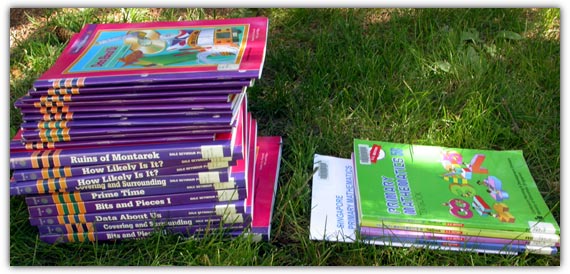
Typical of many math textbooks in the U.S., this one is thick, multicolored,and full of games,puzzles,and activities,to help teachers pass the time, but rarely challenge students. Singapore Math’s textbook is thin, and contains only mathematics — no games. Students are given briefexplanations, then confronted with problems which become more complex as the unit progresses.

ednext20064_38b.jpg


Barry Garelick [232K PDF]:

It was another body blow to education. In December of 2004, media outlets across the country were abuzz with news ofthe just-released results of the latest Trends in International Mathematics and Science Study (TIMSS) tests. Once again despite highly publicized efforts to reform American math education (some might say because of the reform efforts) over the past two decades, the United States did little better than average (see Figure 1). Headquartered at the International Study Center at Boston College and taken by tens of thousands of students in more than three dozen countries, TIMSS has become a respected standard of international academic achievement. And in three consecutive TIMSS test rounds (in 1995, 1999,and 2003), 4th- and 8th-grade students in the former British trading colony of Singapore beat all contenders, including math powerhouses Japan and Taiwan. United States 8th graders did not even make the top ten in the 2003 round; they ranked 16th. Worse, scores for American students were, as one Department of Education study put it,”among the lowest of all industrialized countries.”

Share

Teaching Math, Singapore Style

NY Times Editorial:

The countries that outperform the United States in math and science education have some things in common. They set national priorities for what public school children should learn and when. They also spend a lot of energy ensuring that every school has a high-quality curriculum that is harnessed to clearly articulated national goals. This country, by contrast, has a wildly uneven system of standards and tests that varies from place to place. We are also notoriously susceptible to educational fads.
One of the most infamous fads took root in the late 1980’s, when many schools moved away from traditional mathematics instruction, which required drills and problem solving. The new system, sometimes derided as “fuzzy math,’’ allowed children to wander through problems in a random way without ever learning basic multiplication or division. As a result, mastery of high-level math and science was unlikely. The new math curriculum was a mile wide and an inch deep, as the saying goes, touching on dozens of topics each year.

Much more, here.

Share

North Carolina & Math Standards

Todd Silberman:

Despite North Carolina students’ steady improvement in reading and math, their performance on state end-of-grade tests has been far better than on the National Assessment of Educational Progress. In fact, North Carolina stands out because of the wide gap between results on the state and national tests.
In 2005, about 84 percent of North Carolina eighth-graders earned proficient or better scores on state math tests; 32 percent were proficient or advanced on the national math test. Only West Virginia showed a sharper difference.
“When you see the huge disparity that you do between proficiency levels [on state and national tests], at least part of it is about rigor,” said Ross Weiner, policy director for the Education Trust, a Washington group that advocates for poor and minority students. “North Carolina has a bigger difference than most other states. That raises questions about expectations and whether North Carolina’s standards are high enough to demonstrate that students are learning what they need to know.”

More on “how states inflate their progress under No Child Left Behind“.

Share

Math Wars Earthquake

Tamar Lewin:

In a major shift from its influential recommendations 17 years ago, the National Council of Teachers of Mathematics yesterday issued a report urging that math teaching in kindergarten through eighth grade focus on a few basic skills.
If the report, “Curriculum Focal Points,” has anywhere near the impact of the council’s 1989 report, it could signal a profound change in the teaching of math in American schools. It could also help end the math curriculum struggles that for the last two decades have set progressive educators and their liberal supporters against conservatives and many mathematicians.
At a time when most states call for dozens of math topics to be addressed in each grade, the new report sets forth just three basic skills for each level. In fourth grade, for example, the report recommends that the curriculum should center on the “quick recall” of multiplication and division, the area of two-dimensional shapes and an understanding of decimals. It stopped short of a call for memorization of basic math facts.
The 1989 report is widely seen as an important factor nudging the nation away from rote learning and toward a constructivist approach playing down memorization in favor of having children find their own approaches to problems, and write about their reasoning.
“It was incredibly influential,” said Chester E. Finn Jr., a Department of Education official in the Reagan administration. “More than half the states explicitly acknowledged it in devising their own standards. This report is a major turnaround.”

Lewin’s article references a 2005 document: “10 myths of NCTM (Fuzzy) Math“.
NCTM source materials and related links here.

Share

Return to Basics in Teaching Math

Critics of “Fuzzy” Methods Cheer Educators’ Findings; Drills Without Calculators. Taking Cues from Singapore.
John Hechinger:

The nation’s math teachers, on the front lines of a 17-year curriculum war, are getting some new marching orders: Make sure students learn the basics.
In a report to be released today, the National Council of Teachers of Mathematics, which represents 100,000 educators from prekindergarten through college, will give ammunition to traditionalists who believe schools should focus heavily and early on teaching such fundamentals as multiplication tables and long division.
The council’s advice is striking because in 1989 it touched off the so-called math wars by promoting open-ended problem solving over drilling. Back then, it recommended that students as young as those in kindergarten use calculators in class.
Those recommendations horrified many educators, especially college math professors alarmed by a rising tide of freshmen needing remediation. The council’s 1989 report influenced textbooks and led to what are commonly called “reform math” programs, which are used in school systems across the country.
Francis Fennell, the council’s president, says the latest guidelines move closer to the curriculum of Asian countries such as Singapore, whose students tend to perform better on international tests. There, children focus intensely on a relative handful of topics, such as multiplication, division and algebra, then practice by solving increasingly difficult word and other problems. That contrasts sharply with the U.S. approach, which the report noted has long been described as “a mile wide and an inch deep.”
If school systems adopt the math council’s new approach, their classes might resemble those at Garfield Elementary School in Revere, Mass., just north of Boston. Three-quarters of Garfield’s students receive free and reduced lunches, and many are the children of recent immigrants from such countries as Brazil, Cambodia and El Salvador.
Three years ago, Garfield started using Singapore Math, a curriculum modeled on that country’s official program and now used in about 300 school systems in the U.S. Many school systems and parents regard Singapore Math as an antidote for “reform math” programs that arose from the math council’s earlier recommendations.
The Singapore Math curriculum differs sharply from reform math programs, which often ask students to “discover” on their own the way to perform multiplication and division and other operations, and have come to be known as “constructivist” math.

Links:

Strong parent and teacher views on the MMSD’s math strategy may well spill over to non-support for referendums and incumbent board members, particularly in light of increasing UW Math Department activism on this vital matter.

Share

Learning to Teach Math

“John Dewey”:

I am in a class in which the teacher is, shall we say, an adherent of the National Council of Teachers of Mathematics (NCTM) and its standards. In fact, the NCTM standards and our understanding of same make up a portion of the syllabus. Our first assignment is a comparison of those standards with the math standards for the state in which we reside for a particular “content standard”, grade level, and “process standard. The content standard describes what students are supposed to learn. The process standard describes how they are supposed to learn it. I got assigned Geometry/11th grade/representation. “What is ‘representation’?” I hear you asking. Expressing things in different ways, I think. You can use a graph to express a function, or a table of values, or a formula, for example. Which one is best to analyze the problem at hand, I think is what they’re getting at but they go on and on in the standards, bringing in all sorts of ways to show things which might be good things to mention as an aside, but to devote so much class time to it supplants the basics that they are supposed to be learning. (And which educationists think is mundane, and mind numbing.)

Joanne has more. John Dewey background.

Share

Student Math & Writing Skills

I have a friend that teaches at MATC–she tells me that she is shocked at the lack of math and writing ability of the Madison high school students coming to MATC’s two year technical programs. MATC is very important to Wisconsin’s future. What is happening at the high school level that these students are not prepared properly? Anyone have any thoughts?

Share

The Math Was Complex, the Intentions, Strikingly Simple

George Johnson:

Last week, a reclusive Russian topologist named Grigory Perelman seemed to be playing to type, or stereotype, when he refused to accept the highest honor in mathematics, the Fields Medal, for work pointing toward the solution of Poincaré’s conjecture, a longstanding hypothesis involving the deep structure of three-dimensional objects. He left open the possibility that he would also spurn a $1 million prize from the Clay Mathematics Institute in Cambridge, Mass.
Unlike Brando turning down an Academy Award or Sartre a Nobel Prize, Dr. Perelman didn’t appear to be making a political statement or trying to draw more attention to himself. It was not so much a medal that he was rejecting but the idea that in the search for nature’s secrets the discoverer is more important than the discovery.
“I do not think anything that I say can be of the slightest public interest,” he told a London newspaper, The Telegraph, instantly making himself more interesting. “I know that self-promotion happens a lot and if people want to do that, good luck to them, but I do not regard it as a positive thing.”

Nadejda Lobastova has more. Poincaré Conjecture

Share

Sensenbrenner on Connected Math

Running some searches recently, I came across this April, 2004 article by Lee Sensenbrenner on Connected Math. The words remain timely more than two years later:

A seventh-grader at a Madison middle school is posed with the following situation: A gas station sells soda in three sizes. A 20-ounce cup costs 80 cents, a 32-ounce cup is 90 cents and a 64-ouncer goes for $1.25.
The first question, which appeared in similar form on a recent exam, is as traditional as any mathematical story problem: What size offers the most soda for the money?
But the second question carries the spirit of the Connected Math Program, which has developed strong undercurrents of controversy – both here and nationally – and plays prominently in one of the Madison School Board races Tuesday.
This question asks: If the gas station were to offer an 84-ounce Mega Swig, what would you expect to pay for it?
There’s really no concrete answer. A student, for instance, could argue that the 84-ouncer would cost what the 20-ounce and 64-ounce cups cost together. Another student could say that soda gets cheaper with volume, and then choose an answer based on some per-ounce price slightly less than what was given for the 64-ounce drink.
For the people fighting an impassioned battle over Connected Math, the differences between question number one and question number two are not subtle or inconsequential.
On one side, those who support Connected Math say that engaging students by presenting problems as real-life scenarios – often with no absolute solution or single path to arrive at an answer – fosters innovation and forces students to explain and defend their reasoning as they discover mathematical concepts.
The other side says the approach trades the clear, fundamental concepts of math, distilled through thousands of years of logical reasoning, for verbiage and vagary that may help students learn to debate but will not give them the foundation they need for more advanced mathematical study.

Many links and articles on math can be found here. The recent Math Forum is also worth checking out, along with a discussion of the District’s math performance.

I’m told that the MMSD’s math curriculum will be getting some attention this fall. We’ll see (35 of 37 UW Math Faculty Open Letter on Math).

My largest concern with Connected Math – having read some of the books is that we’re training the students to be consumers, not creative types (figure out the phone bill, count the cheerios, buy a soda, etc.). TeacherL made a great point recently: We can choose to be consumers or we can choose to be citizens. I know which one I think will provide the stronger future for our country.”

Share

Math Disaster

NYC Teacher Bruce Winokur:

Teaching mathematics has been my profession in New York City public schools since 1969, first at I.S. 201 in District 5, then at J.H.S. 17 in District 2, and since 1983, at Stuyvesant High School. I’m also the father of a 10-year-old daughter who attends District 2 schools and a member of an organization, Nychold (nychold.com), dedicated to bringing sanity to math education.
I’m a firm believer in public education, the great equalizer. Sadly, over the past 10 years, I’ve witnessed how badly things can go wrong. I am referring specifically to the constructivist math curricula that abound in our city public schools in general and more specifically in District 2, where I live, teach, and raise my daughter.
Constructivist curricula, such as TERC and CMP, forsake algorithms, postulates, and theorems (the foundation of math) as well as teacher-centered learning. Instead, they have students working among themselves in groups, loosely guided by the teacher in a drawn out attempt to “discover” math truths.
In my Upper East Side neighborhood, an incredible number of intelligent young students from the fourth grade and up are seeing private math tutors. Many of these are not the type of children who would normally struggle in arithmetic or elementary algebra. As a result of the way they’re taught elementary math, they find themselves unable to do real math. When they’re taught math in a more traditional way by their tutors, they invariably find themselves relieved and highly critical of the way they’ve been taught mathematics.
At Stuyvesant, we have a disproportionate number of freshmen from District 2 taking our introductory algebra course. Most Stuyvesant students have already completed that course before they enter our school. The ratio of District 2 students to non-District 2 students in those classes is close to twice that same ratio in the freshman class as a whole.

Share

ACT scores are best in 20 years, with a catch, MMSD Curriculum & Upcoming Elections

The issue of curriculum quality and rigor continues to generate attention. P-I:

The good news is that the high school class of 2006 posted the biggest nationwide average score increase on the ACT college entrance exam in 20 years and recorded the highest scores of any class since 1991.
The bad news is that only 21 percent of the students got a passing grade in all four subject areas, including algebra and social science.
“The ACT findings clearly point to the need for high schools to require a rigorous, four-year core curriculum and to offer Advanced Placement classes so that our graduates are prepared to compete and succeed in both college and the work force,” Education Secretary Margaret Spellings said in Washington, D.C.

Alan Borsuk has more:

Wisconsin high school graduates are better prepared to succeed in college than students nationwide – but that means only that more than 70% of state students are at risk of having trouble in one or more freshman-level subjects while the national figure is almost 80%, according to ACT, the college testing company.
The message still isn’t getting across,” Ferguson said in a telephone news conference. If students want to go to college and do well, they have to take high school seriously and take challenging courses, he said.
ACT results showed that students who took at least four years of English and three years each of math, science and social studies in high school did substantially better on the tests (22.9 in Wisconsin, 22.0 nationwide) than those who took lighter loads in those core areas (21.0 and 19.7, respectively).
Elizabeth Burmaster, Wisconsin’s superintendent of public instruction, said she believes that if schools in Wisconsin stay focused on efforts such as early childhood education and small class sizes in the early grades, combined with strong academic programs in middle school and high school, achievement will go up and racial and ethnic gaps will close.

Individual state data is available here.
Burmaster’s statement, along with the ACT information will increase the attention paid to curriculum issues, such as the ongoing questions over the Madison School District’s math program (See UW Math professor Dick Askey’s statement on the MMSD’s interpration and reporting of math scores). Will we stick with the “same service” approach? This very important issue will be on voters minds in November (referendum) and again in April, 2007 when 3 board seats are up for election. See also the West High School Math Faculty letter and a recent open letter to the Madison School District Board and Administration from 35 of the 37 UW Math Department faculty members. Vaishali Honawar has more.
The Madison School District issued a press release on the recent ACT scores (68% of Wisconsin high school graduates took the ACT – I don’t know what the MMSD’s percentage is):

Madison students who took the 2006 ACT college entrance exam continued to outperform their state and national peers by a wide margin, and the scores of Madison’s African-American test takers increased significantly. Madison students’ composite score of 24.2 (scale of 1 to 36) was higher for the 12th straight year than the composite scores of Wisconsin students and those across the nation (see table below). District students outscored their state peers by 9% (24.2 vs. 22.2,) and their national peers by 15% (24.2 vs. 21.1).
Compared to the previous year, the average ACT composite score among the district’s African-American students increased 6% — 18.8 vs. 17.7 last year. The gap between district African-American and white student ACT scores decreased this year. The relative difference this year was 24% (18.8 vs. 24.8) compared to 30% last year.
Scores also increased this year for the district’s Asian students (22.1 to 23.0) and Hispanic students (21.5 to 21.8).

The Madison School District recently published this summary of student performance vs other similar sized and nearby districts (AP, ACT and WKCE) here. Madison’s individual high schools scored as follows: East 22.9, LaFollette 22.1, Memorial 25.1 and West 25.5. I don’t have the % of students who took the ACT.

I checked with Edgewood High School and they have the following information: “almost all students take the ACT” and their composite score is “24.4”. Lakeside in Lake Mills averaged 24.6. Middleton High School’s was 25 in 2005. Verona High School’s numbers:

222 students took the ACT in 2005-2006.
Our composite score was 23.6 compared to the state at 22.2
87% of test takers proved college ready in English Composition (vs. 77%)
66% of test takers proved college ready in College Algebra (vs. 52%)
77% of test takers proved college ready in Social Science (vs. 61%)
45% of test takers proved college ready in Biology (vs. 35%)
37% of test takers proved college ready in all four areas (vs. 28%)
(#) as compared to the state %

Waunakee High School:

Score HS Mean (Core/Non-Core)
Composite 23.3 (24.3/21.5)
English 22.5 (23.9/19.5)
Mathematics 23.2 (24.2/21.8)
Reading 23.3 (24.1/21.5)
Science 23.7 (24.4/22.7)

McFarland High School’s 2006 Composite average was 23.7. 110 students were tested.
UPDATE: A few emails regarding these results:

  • On the Waunakee information:

    In the Waunakee information I sent to Jim Z, our mean for the Class of 2006 comes first, followed by the core/non-core in parentheses. So, our mean composite score for our 157 seniors who sat for the ACT was 23.3, the mean composite for those completing the ACT suggested core was 24.3, the mean composite for those who did not complete the core was 21.5.
    With ACT profile reports, the student information is self-reported. It’s reasonably accurate, but some students don’t fill in information about course patterns and demographics if it is not required.
    Please let me know if there are any other questions.

  • McFarland data:

    It appears that Jim Z’s chart comparing scores uses Waunakee’s “Core score” as opposed to the average composite that the other schools (at
    least McFaland) gave to Jim Z.. If Jim Z. wishes to report average “Core” for McFarland it is 24.5. Our non-core is 22.2 with our average composite 23.7.

  • More on the meaning of “Core”:

    Probably everyone is familiar with the ACT definition of core, but it’s 4 years of English, and three years each of math, science, and social studies. ACT is refining their position on what course patterns best position a student for undergraduate success, however.

Additional comments, data and links here
Share

Governing Board Revamps Mathematics NAEP For 12th Graders

Sean Cavanagh:

he board that sets policy for the National Assessment of Educational Progress has revised the blueprint for the 12th grade mathematics version of the influential exam, in an attempt to make the test better reflect the skills that students need for college and highly skilled jobs.
The changes, approved Aug. 4, are expected to make the math test more challenging in some areas, through the addition of more-complex algebraic concepts, trigonometry, and a stronger emphasis on mathematical reasoning and problem-solving, officials associated with the board say. Those revisions could also shape individual states’ math standards, which are often influenced by the content of the NAEP frameworks.
The National Assessment Governing Board, the independent entity that directs NAEP, unanimously agreed to make the changes at its quarterly meeting here. The board has spent about two years on the project.
“What we’re doing here is not unique to NAEP. It is what society is demanding,” said Sharif M. Shakrani, a professor of psychometric testing at Michigan State University in East Lansing, who consulted on changes to the framework. “We need to judge what students know and where they are weak.”

Share

Good, Bad News on the Math Front

Karen Rouse:

When results are broken down by race, just 10 percent of black and Latino sophomores in Colorado schools are proficient in math; 90 percent are not.

Those scores are “scary,” said Jenna Fleur Lin, a math teacher who tutors high school students in the Cherry Creek School District and runs a free week-long math and science camp at an inner-city Denver church.

“What it means is you have a huge population that’s not going to function properly,” Lin said.

Moloney said one problem is that, unlike elementary and middle school students, high schoolers have the freedom to choose many of their own courses.
“Are minority youngsters being channelled into challenging programs or are you being (steered) to diminished programs?” he said.
Lin said she believes many students don’t have a solid foundation in math in elementary school.
They are just learning to do calculations but they don’t understand how to

Share

Math Camps Spread for Kids Who Can’t Get Enough

John Hechinger:

A college math student might grapple with this topic in an advanced elective. Ryan was stretching his elementary-school mind at MathPath, perhaps the nation’s toughest summer camp for numerical prodigies.
Math camps are multiplying in part because families are seeking an edge in competitive college admissions and worry about the quality of U.S. math instruction. Last summer, parents paid $280 million to send 120,000 children to academic summer camps, with math among the most popular subjects, according to Eduventures, a Boston research firm, which estimates enrollment is climbing 10% a year. Sylvan Learning Centers, the big tutoring company, says participation in summer math programs, including day camp, jumped 23% last year — twice the rate of other subjects.
The American Mathematical Society counts two dozen “challenging summer math programs” — twice as many as seven years ago. Most focus on high-school students. MathPath caters only to middle-school kids, age 10 to 14. It is also smaller — and more selective — than some better known programs.
About 80,000 kids in second through eighth grade, for example, take part in the annual “talent search” run by Johns Hopkins University’s Center for Talented Youth. Through the search, about 70% qualify for summer camps across the country and some 10,000 enroll in a given year.

Another example of the “Brave New World” referenced in Marc Eisen’s recent words. Neal Gleason comments.
Links: MathPath, Johns Hopkins Center for Talented Youth.

Share

Not to Worry: Neal Gleason Responds to Marc Eisen’s “Brave New World”

Neal Gleason in a letter to the Isthmus Editor:

I have long admired Marc Eisen’s thoughtful prose. But his recent struggle to come to grips with a mutli-ethnic world vvers from xenophobia to hysteria (“Brave New World”, 6/23/06). His “unsettling” contact with “stylish” Chinese and “turbaned Sikhs” at a summer program for gifted children precipitated first worry (are my kids prepared to compete?), And then a villain (incompetent public schools).
Although he proclaims himself “a fan” of Madison public schools, he launches a fusillade of complaints: doubting that academic excellence is high on the list of school district pirorities and lamentin tis “dubious maht and reading pedagogy.” The accuracy of these concerns is hard to assess, because he offers no evidence.
His main target is heterogeneous (mixed-ability) classes. He speculates that Madison schools, having failed to improve the skills of black and Hispanic kids, are now jeopardizing the education of academically promising kids (read: his kids) for the sake of politically correct equality. The edict from school district headquarters: “Embrace heterogeneous classrooms. Reject tracking of brighter kids. Suppress dissent in the ranks.” Whew, that is one serious rant for a fan of public schools.

(more…)

Share

Pittsburgh Outsources Curriculum

Joanne Jacobs:

Pittsburgh has hired a private company to write a coherent curriculum for city schools, reports the Post-Gazette.
Because course content is uneven and out of sync with state standards, the Pittsburgh Public School district is paying New York-based Kaplan K12 Learning Services $8.4 million to write standardized curricula for grades six through 12.
. . . Teachers in other districts have complained that Kaplan’s detailed curriculum turned them into automatons and deprived them of time to cover material in adequate detail or help students with individual needs.
. . . Pittsburgh school officials cite an urgent need to bring coherence and rigor to what’s taught and tested in the district’s classrooms.

Interesting. Perhaps an RFP looking for different ideas might be useful. Public and private organizations could respond. One only has to look at the “Cathedral and the Bazaar” to see the power of a community vs a top down approach. Leadership, particularly that which embraces the community is critical – as Lucy Mathiak recently pointed out:

Later, she added: “I think one of the fundamental questions facing our district is whether we treat parents as resources or problems. Any parent who is concerned about safety, discipline or academic issues needs to feel confident that their concerns are going to be heard. We have to court the parents. The future of our schools depends on their confidence that we are working as partners with them.”

Here’s a parent’s perspective on curriculum and school climate. Another. A vast majority of the UW Math Department’s perspective (35 of the 37 signed this letter). Marc Eisen offers still another perspective.

Share

Half of State Tests Don’t Draw on State Standards, AFT Study Finds

Education Week:

Only 11 states met the union’s criteria for strong standards and tests that “align” with them, it says, and 20 states “have much work to do”—beefing up their standards, matching up tests with standards, or showing what they have done online.
“The systems in those states aren’t smart enough yet to bear the weight of the accountability functions they are asked to serve,” said Antonia Cortese, the AFT’s executive vice president. As one example of such a function, she cited the “in need of improvement” label applied to schools if they don’t meet measures of adequate yearly progress, or AYP. The label triggers a series of consequences for the schools.
In their study, the AFT researchers looked for standards to be clear, explicit by grade level, and rooted in the knowledge and skills for the particular subject, as well as accessible on the Web. Similarly, documentation of the relationship between the standards and the tests had to be available online.
The researchers contend that such “transparency” helps teachers do their jobs and builds trust in the system among educators and the public.
The union, which from 1995 to 2001 published an annual report evaluating states’ academic standards, found significant progress on that front. The standards that relate to NCLB testing are more specific and more often set out by grade levels—a help to teachers and test-makers—than the across-the-board standards examined five years ago, the report says. The progress is particularly noteworthy because of the pressure on state education departments to respond quickly to the sweeping federal law’s mandates, which include annual tests in reading and mathematics in grades 3-8 and once in high school and, starting next year, three tests of science spread across grade levels.

Full PDF study can be found here. The report noted that only 1 to 25% of Wisconsin’s state tests aligned to “strong content standards”.

Share

What to do About Homework….

Dan Green:

There is an interesting post and series of comments about homework at The Daily Grind.
I agree that homework needs to be assigned every class period. But, like every teacher, I’ve struggled with how to best hold students accountable for not just completing it, but understanding it. In our freshmen math courses (Algebra 1, Numeracy), we give students full credit on an assignment if it is completed and turned in on time (we don’t assess it for correctness at all). We also don’t accept late work, unless students have an excused absence. The purpose of this is to build the ethic of doing homework and turning it in – as many students seem to come to high school with out having done much – if any – homework in the past. We are pretty successful at getting students to turn in their work by the end of freshman year. Getting them to really think about it, try hard on questions they don’t understand, and seek help when they have difficulties is another thing altogether.

Share

Public vs. Private School

NY Times Editorial:

The national education reform effort has long suffered from magical thinking about what it takes to improve children’s chances of learning. Instead of homing in on teacher training and high standards, things that distinguish effective schools from poor ones, many reformers have embraced the view that the public schools are irreparably broken and that students of all kinds need to be given vouchers to attend private or religious schools at public expense.
This belief, though widespread, has not held up to careful scrutiny. A growing body of work has shown that the quality of education offered to students varies widely within all school categories. The public, private, charter and religious realms all contain schools that range from good to not so good to downright horrendous.
What the emerging data show most of all is that public, private, charter and religious schools all suffer from the wide fluctuations in quality and effectiveness. Instead of arguing about the alleged superiority of one category over another, the country should stay focused on the overarching problem: on average, American schoolchildren are performing at mediocre levels in reading, math and science — wherever they attend school.

Share

Math & Science Teacher Supply & Demand

LA Times Editorial:

L.A. Unified plans to spend millions to train, recruit and keep math and science teachers, who are a hot commodity nationwide.
Recognizing the critical need to boost math and science test scores, the Los Angeles Unified School District has taken several steps — including offering bonuses — to attract and keep teachers in those fields at the district’s neediest schools.

Share

Who is to Blame?

Walter Williams:

Let’s look at the recent “Nation’s Report Card,” published annually by the U.S. Department of Education’s National Center for Education Statistics.
Nationally, in reading, only 13 percent of black fourth graders, and 11 percent of black eighth graders score as proficient. Twenty-nine percent achieve a score of “basic,” defined as a partial knowledge and skills needed to be proficient in the grade. Fifty-nine percent score below basic, lacking necessary knowledge and skills. It’s the same story for black eighth graders, with 40 percent scoring basic and 49 percent below basic.
In math, it’s roughly the same story. For black fourth graders, 12 percent score proficient, 47 percent score basic and 40 percent below basic. For black eighth graders, 8 percent score proficient, while 33 percent score basic and 59 percent score below basic; however, 1 percent of black fourth graders and eighth graders achieved an advanced score in math.
Teachers and politicians respond to this tragic state of affairs by saying more money is needed. The Washington, D.C., school budget is about the nation’s highest with about $15,000 per pupil. Its student/teacher ratio, at 15.2 to 1, is lower than the nation’s average. Despite this, black academic achievement in D.C. is the lowest in the nation. Reading scores for D.C.’s fourth-grade black students are: 7 percent proficient, 21 percent basic and 71 percent below basic. For eighth-graders, it’s 6 percent proficient, 33 percent basic and 58 percent below basic.

Share

US Dept of Education: Academic Competitiveness Grants

US Department of Education:

Participation in a rigorous secondary school program of study may qualify a postsecondary student to receive an ACG, if otherwise eligible. The Secretary recognizes at least one rigorous secondary school program of study for each state annually. States may submit proposals for recognition or may elect to accept rigorous secondary school programs of study pre-recognized by the Secretary. The following are recognized rigorous secondary school programs of study for each state for the 2006-07 award year.

Wisconsin [PDF]:

  • A set of courses similar to the State Scholars Initiative
  • Advanced Placement (AP) or International Baccalaureate (IB) courses and test
    scores.

  • Wisconsin Coursework Requirements.
  • Wisconsin Dual Enrollment Program.
Share

A better math idea? Check the numbers

Robert Miller:

He created Reasoning Mind because he had a dismal opinion of American education, from kindergarten through high school.
This Web-based math program “does not merely incorporate technology into teaching. It is based in technology and capitalizes on the power of technology to deliver information and content,” Dr. Alexander R. “Alex” Khachatryan said.
The results from a pilot program during the 2005-06 school year were impressive. At-risk students at a Houston school and advanced math students at a school in College Station were introduced to Reasoning Mind.
“At the inner-city school, the test group’s average improvement from the pre-test to the post-test was 67 percent, while the control group improved 6 percent,” Dr. Khachatryan said.
“The test group students also demonstrated extraordinary results – a 20 percent higher passing rate – on the Texas Assessment of Knowledge and Skills test, despite the fact that only three out of 48 problems directly checked students’ knowledge of the two math units covered by RM in the pilot,” he said.

Reasoning Mind website.

Share

“Why Should I Learn Math”

Dan Greene:

The average incoming level for our freshmen is around 5th grade. Our mission is to get them to a 4-year college. This requires not just development of their academic skills, but it also requires a shift in their thinking and self-perception. Our students come in with comparable literacy levels; however, in our society, it seems much clearer to people that being able to read and write is an essential skill. There are plenty of well-educated people who happily admit that they can’t do math, but none that laugh about their inability to read a book.

Share

High School Math Teacher’s Blog

Dan Greene, a San Jose, CA high school math teacher maintains a blog whose purpose is to “help generate and share ideas for teaching high school math concepts to students whose skills are below grade level.”.

Share

Math and Science Education In a Global Age: What the U.S. Can Learn from China

The Asia Society:

This report takes an incisive look at what U.S. education leaders can learn from China’s success in math and science education. From a comparative perspective, it evaluates complementary strengths and weaknesses in the two education systems. The report also outlines areas of potential collaboration so that both the U.S. and China can build and sustain excellence in math and science.

35 Page report: 267K PDF File.

The Asia Society has an extensive set of teacher and student resources.

Share

Chinese Medicine for American Schools

Nicholas Kristof follows up Marc Eisen’s recent words on a world of competition for our children:

But the investments in China’s modernization that are most impressive of all are in human capital. The blunt fact is that many young Chinese in cities like Shanghai or Beijing get a better elementary and high school education than Americans do. That’s a reality that should embarrass us and stir us to seek lessons from China.
On this trip I brought with me a specialist on American third-grade education — my third-grade daughter. Together we sat in on third-grade classes in urban Shanghai and in a rural village near the Great Wall. In math, science and foreign languages, the Chinese students were far ahead.
My daughter was mortified when I showed a group of Shanghai teachers some of the homework she had brought along. Their verdict: first-grade level at a Shanghai school.
Granted, China’s education system has lots of problems. Universities are mostly awful, and in rural areas it’s normally impossible to hold even a primitive conversation in English with an English teacher. But kids in the good schools in Chinese cities are leaving our children in the dust.

(more…)

Share

Brave New World: Are our kids ready to compete in the new global economy? Maybe not

Marc Eisen:

Most of us have had those eerie moments when the distant winds of globalization suddenly blow across our desks here in comfortable Madison. For parents, it can lead to an unsettling question: Will my kids have the skills, temperament and knowledge to prosper in an exceedingly competitive world?
I’m not so sure.
I’m a fan of Madison’s public schools, but I have my doubts if such preparation is high on the list of school district priorities. (I have no reason to think things are any better in the suburban schools.) Like a lot of parents, I want my kids pushed, prodded, inspired and challenged in school. Too often — in the name of equity, or progressive education, or union protectionism, or just plain cheapness — that isn’t happening.

(more…)

Share

Analysis of Connected Math and Core Plus Textbooks

A reader deep into math issues emailed these two reviews of curriculum currently used within the Madison School District:

  • Connected Math (Middle School); R. James Milgram:

    The philosophy used throughout the program is that the students should entirely construct their own knowledge and that calculators are to always be available for calculation. This means that

    • standard algorithms are never introduced, not even for adding, subtracting, multiplying and dividing fractions
    • precise definitions are never given
    • repetitive practice for developing skills, such as basic manipulative skills is never given. Consequently, in the seventh and eighth grade booklets on algebra, there is no development of the standard skills needed to solve linear equations, no practice with simplifying polynomials or quotients of polynomials, no discussion of things as basic as the standard exponent rules
    • throughout the booklets, topics are introduced, usually in a single problem and almost always indirectly — topics which, in traditional texts are basic and will have an entire chapter devoted to them — and then are dropped, never to be mentioned again. (Examples will be given throughout the detailed analysis which follows.)
    • in the booklets on probability and data analysis a huge amount of time is spent learning rather esoteric methods for representing data, such as stem and leaf plots, and very little attention is paid to topics like the use and misuse of statistics. Statistics, in and of itself, is not that important in terms of mathematical development. The main reason it is in the curriculum is to provide students with the means to understand common uses of statistics and to be able to understand when statistical arguments are being used correctly.

  • Core Plus (some high schools); R. James Milgram and Kim Mackey:

    In a recent issue of the NCTM Dialogues, Prof. R. Askey comments on a particular and remarkably inept misunderstanding in CorePlus, of some basic methods in probability Prof. R. Askey’s comments on a problem with Core Plus.
    Recently, Core Plus has begun to appear in the Minnesota High Schools, with the usual results, including servere questions from parents and the withdrawal of a significant number of students from the school system. This has also prompted a number of independent analyses of the program by other professional mathematicians. Here are the comments of Larry Gray, a Professor of Mathematics at the University of Minnesota. A Sample List of Mathematical Errors in the Core Plus program.

Share

“The Mathematics Pre-Service Teachers Need to Know”

R. James Milgram 15MB e-book pdf:

It has long been felt that the mathematical preparation of pre-service teachers throughout the country has been far too variable, and often too skimpy to support the kind of outcomes that the United States currently needs. Too few of our K – 12 graduates are able to work in technical areas or obtain college degrees in technical sub jects. This impacts society in many and increasingly harmful ways, and it is our failure in K – 8 mathematics instruction that is at the heart of the problem.
This is especially true when we compare outcomes in the United States with outcomes in countries that do a better job of teaching mathematics, countries such as Poland, Hungary, Bulgaria, Romania, Singapore, China, and Japan, to name a few.
It has also been increasingly recognized that if we are to improve our performance in K – 8 mathematics instruction, pre-service teachers should take focused, carefully designed courses directly from the mathematics departments, and not, as is often the case, just a single math methods course taught in the Education School. A focused two year sequence in the basic mathematics teachers have to know is the minimal mathematics sequence that pre-service teachers need in order to to successfully teach students in K – 8.

Share

Are Mathematicians Smarter Than Math Teachers?

Are Mathematicians Smarter Than Math Teachers?June 6, 2006 04:45 PM
Maybe. But math teachers know things that are (1) useful for teaching math and (2) difficult for non-teaching mathematicians to grasp, according to Deborah Loewenberg Ball, a University of Michigan researcher who spoke recently to a gathering of AFT leaders and staff.
Here’s an example of a task* at which math teachers outperform mathematicians.
Three students were asked to multiply 35 by 25. The answer is 875. Each came up with the wrong answer, but for different reasons. (Click on the links to see if you can figure out the thinking behind the errors.)
Ball reports that math teachers were much better than mathematicians at identifying where students went wrong–an important fact to know to help put students back on track.
In “Knowing Mathematics for Teaching: Who Knows Mathematics Well Enough To Teach Third Grade, and How Can We Decide?” a 2005 article in American Educator, Bell and co-authors Heather C. Hill and Hyman Bass conclude that there is a body of knowledge math teachers need to be effective. They created test questions that captured this body of knowledge, tested teachers, and used the results to accurately predict which teachers’ students would learn more.
Ball told AFT leaders that the finding that there is a body of knowledge teachers need to have to teach math can be extended to other subjects. As the drumbeat for “content knowledge” becomes louder and louder, this research answers the questions “Which content?” “Which knowledge?”
*Ball notes that this type of thinking, error analysis, is not only a teacher thing but an important area of mathematics
Posted by John on June 6, 2006 04:45 PM | Permalink
Comments
Understanding the source of error is very important. A math teacher needs to have extensive experience analyzing mistakes. This requires a strong, strong handle on arithmetic.
But I would be careful before dismissing the math professors. They don’t teach, that is true. They don’t know error analysis, and some other things math teachers need.
But when they get outraged, there is usually a reason. Such as not teaching standard algorithms at all. Avoiding fractions. Not teaching long division. Placing so much emphasis on concept that skill is overlooked (each year I get incoming freshmen from a progressive district who have a real solid understanding of what multiplication is, the variety of meanings it might have, etc, but who have difficulty with facts, eg, 7 x 8.)
Pedagogy and content are both important. Some of the education people and the ‘modern’ curricula privilege pedagogy over content. Back to basics folks tend to emphasize content and ignore pedagogy. Good math teachers, experienced math teachers, we know that we need to pay attention to both and defend our work from either extreme.

Share

Superintendent Rainwater’s Reply Regarding the Math Coordinator Position

Madison Metropolitan School District Superintendent Art Rainwater replied via email to our “Open letter about Math Coordinator position at MMSD“:

On Wed, 31 May 2006, Art Rainwater wrote:
Dear Steffen and others;
Thank you for sharing your concens.
The District has always employed outstanding curriuclum leaders in our Teaching and Learning Department. Mary Ramberg has been a leader in Teaching and Learning as have Lisa Wachtel in Science and Mary Watson Peterrson in Literacy and Language Arts.
Please rest assured that I. even more than you, am committed to employing the best possible math corrdinator. The minimum requirements posted are exactly what they say. They are minimum requirements and failure to meet the requirements eliminates the person from consideration immedately without even a further paper screen. Our district has a hiring process that has served us vrey well over the years and this is only the first part of that process.
The breadth and depth of knowledge of mathematics is obviously one of two key components in determining who will be the final pick for this position. However, equally important in the decision is the breadth and depth of pedogogical knowledge. Both of these will be given equal weight and I will not employ anyone who does not have both.
Art Rainwater

My reply:

Dear Art,
Thanks for your prompt reply.
What caused all of us to write/sign this letter is that the posted job ad does precisely NOT require what we consider two MINIMUM requirements for this position, namely (and I repeat):

  1. subject knowledge equivalent to a strong bachelor’s degree in mathematics, and
  2. teaching experience at the highest level in the high school curriculum.

I do hope that the school board and the district administration will RESTRICT its search to ONLY candidates meeting these two MINIMUM requirements.
Thanks for your attention!
Steffen

Share

Open letter about Math Coordinator position at MMSD

OPEN LETTER:
Dear Members of the School Board, dear Superintendent Rainwater,
We are writing to strongly urge that the new Coordinator of Mathematics have the depth of knowledge of mathematics that we believe is essential for the position. While we are obviously concerned about the preparation of students entering the University, our concerns are much broader than that. The new Coordinator must have a high level of understanding of both mathematical content and pedagogy to independently navigate through the controversies that surround the established standards and published curricula. These “navigational skills” are essential if we are to achieve a program for the Madison school system that meets the needs and aspirations of all the students in the system.

(more…)

Share

Common Ground In Math Wars

“Finding Common Ground in the U.S. Math Wars”, Science Magazine, May 19, 2006 describes the 18-month effort initiated by Richard Schaar, mathematician and former president of Texas Instruments, to bridge the gap between professional mathematicians, and math educators. Leaving many issues still to be addressed, the following is their initial statements:


Fundamental Premises
All students must have a solid grounding in mathematics to function effectively in today’s world. The need to improve the learning of traditionally underserved groups of students is widely recognized; efforts to do so must continue. Students in the top quartile are underserved in different ways; attention to improving the quality of their learning opportunities is equally important. Expectations for all groups of students must be raised. By the time they leave high school, a majority of students should have studied calculus.

  • Basic skills with numbers continue to be vitally important for a variety of everyday uses. They also provide crucial foundation for the higher-level mathematics essential for success in the workplace which must now also be part of a basic education. Although there may have been a time when being to able to perform extensive paper-and-pencil computations mechanically was sufficient to function in the workplace, this is no longer true. Consequently, today’s students need proficiency with computational procedures. Proficiency, as we use the term, includes both computational fluency and understanding of the underlying mathematical ideas and principles.
  • Mathematics requires careful reasoning about precisely defined objects and concepts. Mathematics is communicated by means of a powerful language whose vocabulary must be learned. The ability to reason about and justify mathematical statements is fundamental, as is the ability to use terms and notation with appropriate degrees of precision. By precision, we mean the use of terms and symbols, consistent with mathematical definitions, in ways appropriate for students at particular grade levels. We do not mean formality for formality’s sake.
  • Students must be able to formulate and solve problems. Mathematical problem solving includes being able to (a) develop a clear understanding of the problem that is being posed; (b) translate the problem from everyday language into a precise mathematical question; (c) choose and use appropriate methods to answer the question; (d) interpret and evaluate the solution in terms of the original problem, and (e) understand that not all questions admit mathematical solutions and recognize problems that cannot be solved mathematically.

For further elaboration, see Common Ground


Last month, NCTM (National Coucil of Teachers of Mathematics) endorsed a short list of skills, by grade, that every grade and middle school student must master. These “Curriculum Focal Points” are an attempt to correct the “mile-wide, inch-deep” curricula in most schools, which leave most student incapable and ill-prepared for further work in mathematics, science and engineering disciplines. The Focal Points document has not be published at this time.


But, to place these “improvements” into perspective, no one expects these initiative to make improvements by themselves. Further, UC-Berkeley Math Prof Hung-Hsi Wu says “Better mathematics education won’t take place in the next 10 years, I think it will take 30 years.”

Share

Connected Math in Olympia, WA

Education Wonks:

After a number of parents and teachers objected, the school board of Olympia, Washington, has ignored an administrative recommendation to adopt a constructivist math program for their middle schoolers:

Connected Math and the Madison School District was discussed at a recent math forum (audio / video).
UW Emeritus Math Professor Dick Askey wrote a followup article on test scores and the local math curriculum.
The MMSD is currently looking for a “Coordinator of Mathematics“.
Clusty Connected Math Search.

Share

Polite Agreement or Something We Can Use?

Barry Garelick:

Education Secretary Spellings recently announced the formation of a presidentially appointed panel that was formed to address math teaching. According to the charter of this panel, one of its purposes is “to foster greater knowledge of and improved performance in mathematics among American students.” The panel is charged with producing a report in two years, which must contain recommendations pertaining to how math instruction can be improved in the U.S. In particular, the report must address the skills necessary for students to acquire competence in algebra and to prepare them for higher levels of mathematics.
The workings of the panel are not the type of thing that makes the front page of newspapers, the top story on TV news, or what is talked about in the local cafes. To hear about this you need to drop in to the blogs (like Edspresso), or the various list serves on the internet devoted to math education. There you will notice some discomfort among those who think that the way math is currently taught and the present crop of math texts being used in the U.S. is just fine. They have openly expressed dismay at the inclusion on the panel of people who have been vocal critics of reform math, stating “This panel is filled with hacks, toadies and stooges. Can you say ‘show trial’, children? Have you ever seen the old reels of the Communist Party Congresses in Moscow?” Allegations of pre-conceived conclusions then follow.

Share

Job: MMSD Coordinator of Mathematics

Madison Metropolitan School District:

Lead K-12 mathematics programming; develop and promote documents defining the mathematics program and expectations; organize and promote professional development opportunities; seek and implement research-based best practices in mathematics education; serve on various district and Teaching & Learning committees and task forces; create, recommend and administer budget for mathematics curriculum coordination; coordinate Evaluation of Learning Materials in mathematics; serve as District liaison with state, private, professional, city, and local mathematics groups and organizations; seek and develop relationships with institutions of higher education to coordinate inservice and preservice mathematics education; collaborate with other District departments to ensure all students have the opportunity to learn standards-based mathematics; develop and promote standards-based assessment tools and practices; analyze District mathematics student achievement data and use the data to inform action plans; supervise and evaluate instructional resource teacher staff and program assistant; author grant applications; coordinate mathematics grants; support District Improvement Plans, decisions and initiatives; demonstrate evidence of cultural competence.

Additional MMSD jobs can be found here.

Share

Ex University President to Lead US Math Panel

Diane Jean Schemo:

The Bush administration has named a former president of the University of Texas at Austin to lead a national panel to weigh in on the math wars playing out across the country. The politically fraught battle pits a more free-form approach to teaching math against the traditional method that emphasizes rules and formulas to solve number problems.
In traditional math, children learn multiplication tables and specific techniques for calculating 25 x 25, for example. In so-called constructivist math, the process by which students explore the question can be more important than getting the right answer, and the early use of calculators is welcomed.
According to a 2005 study by ACT, the college entrance exam organization, only 40 percent of high school seniors were ready to take the most basic college-level algebra course.

More on the National Math Panel.

Share

Numbers Don’t Lie

Martha Stark:

I believe in the power of numbers. I don’t know when my belief in numbers began. Perhaps when I was a child. My high school dropout, bookkeeper dad came home each week to tell us that he had played the numbers — my neighborhood’s equivalent of lotto but lots more complex.
Dad would convert every thought and dream to a number with help from his trusty dream book. You had a dream about mice? Consult the book. “That’s a 12, 17 or 21. What was the mouse doing — climbing out of a garbage can? Well climbing is a 21, 34, or 42 and garbage is a 17, 39, or 32. So, let’s play 12 and 21 (the reverse of each other), 17 (it appeared twice), and 34, the year your mom was born.”

Share

MSRI Workshop on Equity in Math Education

This is to briefly summarize from my point of view what went on at the MSRI workshop on equity in math education last week. (Vicki was also there and may wish to give her side of the story so you get a more complete picture. It was a very broad workshop, 13 hours a day for 3 days. The web site is down right now, but you can view a cached version here.)
The charge of the workshop was to brainstorm solutions to the underrepresentation of (racial and ethnic) minorities in mathematics and mathematics courses which frequently serve as gatekeepers to other areas.
The participants were thus rather heterogeneous, policy-makers, mathematics educators, mathematicians and teachers, including several groups of young people from various projects who serve as mentors and tutors in mathematics.
The talks and presentations were thus rather mixed, from talks by a law professor about constitutional issues on education to examples of math games played by young tutors and an actual 9th grade math class right with 22 students from a nearby high school right in front of all participants.
There were also some chilling descriptions of the abominable conditions at some schools serving mostly black and native American students.
The usual disagreements between research mathematicians and math educators were not brought to the surface much, but were brought up in many personal conversations during breaks and meals. However, there was general agreement that the underrepresentation of minorities is a serious national problem, and that more resources and better teachers are crucial to its solution.
However, no firm solutions or consensus emerged.
The two things I took away from the workshop are:

  1. the need for more math content by math teachers, mainly at the elementary and middle school teachers, and
  2. a small but important comment by a representative from the American Indian Science and Engineering Society: Asked about cultural sensitivity in math classes for her students, she answered that even though there are some issues around this, but in the end, her students need to learn “main-stream” mathematics in order to succeed, not take watered down courses; and the earlier this starts, the more beneficial it will be to her students.
Share

Mathcounts National Championship

Tara Bahrampour:

It wasn’t quite a Miss America pageant, but it had a gusto of its own. To the beat of rock music, more than 200 middle schoolers in T-shirts adorned with pi symbols or jokes about binary numbers jogged into a Crystal City hotel conference hall yesterday, waving and holding up signs identifying their home states.
The 57 teams — from every state, plus the District, the U.S. territories and military or State Department schools around the world — had spent the day vying for the MathCounts national championship, and they were about to find out which four-member team had won.

Madison area middle schools that participated included Hamilton (Madison), Jefferson (Madison), Eagle (Fitchburg), Badger Ridge (Verona) and Madison Country Day School (Waunakee). Mathcounts website.

Share

The Deification of Mathematics

The Economist:

Google constantly leaves numerical puns and riddles for those who care to look in the right places. When it filed the regulatory documents for its stockmarket listing in 2004, it said that it planned to raise $2,718,281,828, which is $e billion to the nearest dollar. A year later, it filed again to sell another batch of shares—precisely 14,159,265, which represents the first eight digits after the decimal in the number pi (3.14159265).
The mathematics comes from the founders, Sergey Brin and Larry Page. The Russian-born Mr Brin is the son of a professor of statistics and probability and a mother who works at NASA; Mr Page is the son of two computer-science teachers. The breakthrough that made their search engine so popular was the realisation that the chaos of the internet had an implicit mathematical order. By counting, weighting and calculating the link structures between web pages, Messrs Page and Brin were able to return search results more relevant than those of any other search engine.

Share

Seattle School Board Puts off Decision on Math Textbooks

Jessica Blanchard:

New math textbooks for Seattle middle- and high-school students are on hold.
Concerned that it may cost too much and not produce results, School Board members have delayed a decision to allow more time to study the issue.
At stake is whether the district adopts a single style of teaching math that focuses more on understanding concepts than honing computation skills — a prospect that has sparked debate among parents, teachers and administrators.

Share

Math or Technology: Take Your Pick

Sarah Natividad:

Recently Utah schools have been given an F for technology use in the classroom (or lack thereof). This is one area I hope Utah continues to fail in. Technology has been touted as a fabulous tool for teaching math and other subjects, but it’s not. Technology teaches technology; you still have to learn math separately if you want to know math too.

I agree. The basics come first – technology, which changes frequently and may not always be appropriate (see Powerpoint, and here.)

Share

Connecting Math with Literature

MathandText:

To visit the Exhibit Hall at an NCTM conference is an infuriating activity for me, but I can’t avoid it. I am charged with checking out the competition.

Via Joanne.

Share

More thoughts on math teacher training

Jo Anne Cobasko:

“A small cadre of math specialists is helping teachers with instruction and curriculum.”
While it sounds promising that “math specialists” will be helping teachers with instruction and curriculum, the converse may be likely to occur.
In the following excerpt from “Why Johnny Can’t Calculate” (Los Angeles Times, September 26, 2005–link here), CSU-Northridge mathematics professor David Klein and high school teacher Jennifer Marple have detailed how the “experts” responsible for professional development for LAUSD often fail to deliver.
The district requires math teachers to attend in-service meetings to learn more math and better ways to teach it. No one would quarrel with those goals, but the quality of professional development programs is often so poor that they are likely to cause more harm than good.

Share

Seattle’s Teaching of Math adds up to Much Confusion

Jessica Blanchard:

Rick Burke remembers looking at his elementary-school daughter’s math homework and wondering where the math was.
Like many Seattle schools, his daughter’s school was teaching “reform” math, a style that encourages students to discover math principles and derive formulas themselves. Burke, an engineer, worried that his daughter wasn’t learning basic math skills.
“It was a lot of drawing pictures and playing games,” he said. “Her whole first-grade year was pretty much a lateral move.”
So for the past few years, Burke and his wife have been tutoring their three children after school — and this fall, they plan to switch them to North Beach Elementary, which uses a more traditional approach to math.

Sarah Natividad adds:

The biggest problem is that the teachers currently in service never learned enough math to begin with, and so can’t be expected to teach what they don’t already know. We only think our teachers know math because they know just as little math as we do. If you want to know how scarily ignorant of math our teachers are, I suggest reading Liping Ma’s Knowing and Teaching Elementary Mathematics for a start.
I’ve written about this on my own blog, and I’m not just talking out of my butt here. I’ve taught math to these potential teachers. They lack the prerequisite skills to pass a college algebra class. You can tell who in the class is in the Elementary Education program; they’re the ones sitting in the back row, getting a D on every exam because they have to use a calculator to do three times two (and they think this is normal). So when Bob Brandt of Bellevue says “How do you know three times two equals six? Any idiot knows that,” I would counter that an exceptional idiot must be teaching his kids math. We’ve raised an entire generation of teachers who don’t even know enough about math to know that they are ignorant of it.

D-Ed Reckoning touches on math as well.

Share

The heterogeneous debate: Some say best students get short shrift

Sandy Cullen:

Some parents say the Madison School District’s spending cuts, combined with its attempts to close the achievement gap, have reduced opportunities for higher-achieving students.
Jeff Henriques, a parent of two high-achieving students, said one of the potential consequences he sees is “bright flight” – families pulling students with higher abilities out of the district and going elsewhere because their needs aren’t being met.
One of the larger examples of this conflict is surfacing in the district’s move toward creating “heterogeneous” classes that include students of all achievement levels, eliminating classes that group students of similar achievement levels together.
Advocates of heterogeneous classes say students achieving at lower levels benefit from being in classes with their higher-achieving peers. But some parents of higher-achieving students are concerned their children won’t be fully challenged in such classes – at a time when the amount of resources going to talented and gifted, or TAG, programs is also diminishing.

Check out Part I and Part II of Cullen’s series.
Watch Professor Gamoran’s presentation, along with others related to the homogeneous / heterogeneous grouping debate here. Links and commentary and discussion on West’s English 10. Jason Shepherd took a look at these issues in his “Fate of the Schools” article.

Share

Madison Schools Make Effort to Close the Achievement Gap

Sandy Cullen:

Working in conjunction with the Schools of Hope project led by the United Way of Dane County, the district has made progress in third-grade reading scores at the lowest achievement levels. But racial and income gaps persist among third-graders reading at proficient and advanced levels.
Other initiatives are taking place in the middle and high schools. There, the district has eliminated “dead-end classes” that have less rigorous expectations to eliminate the chance that students will be put on a path of lower achievement because they are perceived as not being able to succeed in higher-level classes.
In the past, high school students were able to take classes such as general or consumer math. Now, all students are required to take algebra and geometry – or two credits of integrated mathematics, combining algebra, statistics and probability, geometry and trigonometry – in order to graduate.
One of the district’s more controversial efforts has been a move toward “heterogeneous” classes that include students of all achievement levels, eliminating classes that group students of similar achievement levels together.
Advocates of heterogeneous classes say students who are achieving at lower levels benefit from being in classes with their higher-achieving peers. But others say the needs of higher-achieving students aren’t met in such classes.
And in addition to what schools are already doing, Superintendent Art Rainwater said he would like to put learning coaches for math and reading in each of the district’s elementary schools to improve teachers’ ability to teach all students effectively.

The first part of Cullen’s series is here.

Share

Promises Betrayed

Five years ago we moved to Madison. A big factor in this decision was the expectation that we could rely on Madison public schools to educate our children. Our eldest went through West High School. To our delight the rigorous academic environment at West High transformed him into a better student, and he got accepted at several good public universities.
Now we are finding this promise betrayed for our younger children. Our elementary school appears to be sliding into disarray. Teachers and children are threatened, bullied, assaulted, and cursed at. Curricula are dumbed down to accommodate students who are unprepared for real school work. Cuts in special education are leaving the special needs kids adrift, and adding to the already impossible burdens of classroom teachers. To our disappointment we are forced to pull one child out of public school, simply to ensure her an orderly and safe learning environment.
Unless the School Board addresses these challenges forcefully and without obfuscation, I am afraid a historic mistake will be made. Madison schools will slip into a vicious cycle of middle class flight and steady decline. The very livability of our city might be at stake, not to mention our property values.
To me the necessary step is clear. The bottom five to ten percent of students, and especially all the aggressive kids, must be removed from regular classes. They should be concentrated in separate schools where they can receive the extra attention and intensive instruction they need, with an option to join regular classes if they are ready.

(more…)

Share

Math Rebellion Up North: Ashland Students Favor New Algebra Course, Fewer Enroll in Core Plus

Kevin O’Brien:

An overwhelming majority of Ashland students who were given the choice between traditional math and the Core Plus curriculum decided to take algebra I courses next school year, according to a report given Monday by Ashland High School Principal Steve Gromala.
In a report to the Ashland School Board, it was noted that 83 percent of students signed up for algebra I, which was offered for the first time in several years after parents and board members demanded an alternative to the Core Plus curriculum.
A total of 170 students, including 115 incoming freshmen and 55 of next year’s sophomores, enrolled in the newly offered algebra I course for the 2006-07 school year. By comparison, 34 students enrolled in Core Plus 1.
The addition of algebra I next school year is the first step toward offering a dual-track math curriculum that will allow incoming freshmen to choose between algebra classes and Core Plus. Additional classes such as geometry, algebra II and pre-calculus will be added in future years as students advance.

(more…)

Share

Trends in International Mathematics & Science Study

Institute of Educational Sciences:

The new TIMSS 1999 Video Study report on eighth-grade science teaching examines how students in 5 countries, including the United States, experience science as it is actually taught.

Share

A Study of Core Plus Mathematics Students Attending Michigan State University

Richard O. Hill and Thomas H. Parker: Department of Mathematics – Michigan State University [Complete Study: PDF]:

One measure of the effectiveness of a high school mathematics program is the success students have in subsequent university mathematics courses. As part of a large-scale study of Michigan students, we analyzed the records of students arriving at Michigan State University from four high schools which adopted the Core-Plus Mathematics program. Those students placed into, and enrolled in, increasingly lower level courses as the implementation progressed; the downward trend is statistically very robust (p < .0005). The grades these students earned in their university mathematics courses were also below average (p < .01). ACT scores suggested the existence but not the severity of these trends. Over the past two decades there has been a growing awareness of the inadequacy of the mathematical skills of American high school graduates. That was the assessment of the 1983 report A Nation at Risk [9]. Many subsequent studies point to the same conclusion. The most recent National Assessment of Educational Progress (NAEP) Report [2] concluded that only 17 percent of US twelfth graders were proficient at mathematics (1). International comparisons also indicate a relatively low level of mathematics achievement by US high schoolstudents. The Third International Mathematics and Science Study (TIMSS) assessed the ‘Mathematics Literacy’ of end-of -secondary students in 22 countries and found that US students statistically outperformed only two countries, Cyprus and South Africa [13]. Related studies suggest that the mathematics courses taken by American high school students are often at a lower level than those taken by their international peers, and that US high schools are offering a wide assortment of courses which lack the focus and coherence found in many foreign curricula [14]. This situation has been of particular concern on college and university campuses, where large numbers of students require remedial courses to bring their mathematical knowledge and skills up to what is required for college-level mathematics and science courses.

Share

Educational Flatline in Math and Reading Bedevils USA

Greg Toppo:

Despite nearly 30 years of improvements in U.S. children’s overall quality of life, their basic academic skills have barely budged, according to research led by a Duke University sociologist.
The “educational flatline,” as measured by scores on math and reading exams, defies researchers’ expectations, because other quality-of-life measures, such as safety and family income, have improved steadily since 1975.
More recently, even areas that had worsened in the 1970s and 1980s, such as rates of teen suicide, have improved dramatically, so researchers had expected that education improvements would soon follow. They didn’t.

2006 Child Well-Being Results.
The Educational Flatline, Causes and Results:The Education Flatline: Causes and Solutions

Share

Schools Cut Back Subjects to Push Reading and Math

Sam Dillon:

Thousands of schools across the nation are responding to the reading and math testing requirements laid out in No Child Left Behind, President Bush’s signature education law, by reducing class time spent on other subjects and, for some low-proficiency students, eliminating it.
Schools from Vermont to California are increasing — in some cases tripling — the class time that low-proficiency students spend on reading and math, mainly because the federal law, signed in 2002, requires annual exams only in those subjects and punishes schools that fall short of rising benchmarks.
The changes appear to principally affect schools and students who test below grade level.

Share

Considering the Future of Madison Schools

Marc Eisen:

Unless you have a kid in the Madison schools, many of the issues discussed by the four Madison school board candidates in our weekly Take-Home Test may not strike a familiar chord.
That’s why we asked our schools reporter Jason Shepard to provide an overview in this week’s Isthmus of the trends buffeting the 24,000-student district. The cover story is: The Fate of the Schools: Will the Madison district sink or swim? April 4th elections could prove pivotal.

As you’ll read, the growing number of poor students, decreased state funding and nasty board infighting provide a sobering context for the election.

Shepherd has written the definitive piece for the April 4, 2006 election. Pick up the current Isthmus and have a look or view the article online here. I’ve placed two charts from the article below (click continue reading….. if you don’t see them).

(more…)

Share

Why You Should Choose Math in High School

Espen Andersen, Associate Professor, Norwegian School of Management and Associate Editor, Ubiquity:

[The following article was written for Aftenposten, a large Norwegian newspaper. The article encourages students to choose math as a major subject in high school – not just in preparation for higher education but because having math up to maximum high school level is important in all walks of life. Note: This translation is slightly changed to have meaning outside a Norwegian context.]
Why you should choose math in high school
A recurring problem in most rich societies is that students in general do not take enough math – despite high availability of relatively well-paid jobs in fields that demand math, such as engineering, statistics, teaching and technology. Students see math as hard, boring and irrelevant, and do not respond (at least not sufficiently) to motivational factors such as easier admission to higher education or interesting and important work.

Share

Providence School forum will explore fresh approach to math

Linda Borg writing in the Providence Journal:

Michael Lauro, the district’s new math coordinator, will discuss plans for a curriculum called FASTT Math.
PROVIDENCE – Osiris Harrell, an outspoken critic of the school district’s math curriculum, has invited parents and school officials to a meeting March 22 to discuss the effectiveness of the math program.
The forum will be held from 6 to 8 p.m. at the Federal Hill House, 9 Cortland St., Providence.
Michael Lauro, the district’s new math coordinator, will discuss plans for a fresh approach to math called FASTT Math. The district is considering trying it on a limited basis next year.
Harrell has met with Lauro to discuss his concerns about the current math program and to agree on how to work together, according to school spokeswoman Maria Tocco.
Harrell, in a recent interview with The Providence Journal, said he was distressed by the district’s approach to math instruction, a program called Math Investigations that teaches students how to think about problem-solving rather that drilling them in the basics. The district adopted it in 2003 at the urging of then-Supt. Diana Lam.

(more…)

Share

Improving math ed — Bush right about that, But where are the teachers coming from?

Jonathan David Farley:

In his State of the Union address in January, President Bush stressed the importance of improving math education. He proposed to “train 70,000 high school teachers to lead advanced placement courses in math and science, bring 30,000 math and science professionals to teach in classrooms, and give early help to students who struggle with math.”
But where will these teachers come from? And will the training of teachers be sufficient to increase the number of students choosing math and science careers? And why does all this matter?
Because mathematics is the foundation of the natural sciences. It is no coincidence that Isaac Newton, the man who formulated the law of gravitational attraction that revolutionized our understanding of the universe, was also the man who popularized the calculus. And the natural sciences, however pure, are what give us airplanes, cable TV and the Internet.
In the 2003 Program for International Student Assessment, a test that measures math literacy, American 15-year-olds performed worse than their peers in 23 countries, as well as those in Hong Kong. It’s not hard to see why. According to the National Council of Teachers of Mathematics, 40 percent of the nation’s middle school math teachers do not have the equivalent of an undergraduate minor in math. The average starting salary of a teacher is only $30,000, whereas the average starting salary for a recent college graduate in computer science or engineering is $50,000.

Jonathan Farley is a professor in the Department of Mathematics and Computer Science at the University of the West Indies, Jamaica, and a CISAC science fellow.

Share

California Math Standards

California Department of Education (pdf):


A high-quality mathematics program is essential for all students and provides every student with the opportunity to choose among the full range of future career paths. Mathematics, when taught well, is a subject of beauty and elegance, exciting in its logic and coherence. It trains the mind to be analytic—providing the foundation for intelligent and precise thinking.
To compete successfully in the worldwide economy, today’s students must have a high degree of comprehension in mathematics. For too long schools have suffered from the notion that success in mathematics is the province of a talented few. Instead, a new expectation is needed: all students will attain California’s mathematics academic content standards, and many will be inspired to achieve far beyond the minimum standards.
The content standards identify what all students in California public schools should know and be able to do in mathematics at each grade level. The standards emphasize computational and procedural skills, conceptual understanding, and problem solving. The standards are organized by grade level and are presented in five strands up to grade seven: number sense, algebra and functions, measurement and geometry; statistics, data analysis, and probability; and mathematical reasoning. The mathematics studied in grades eight through twelve falls naturally under the discipline headings of algebra, geometry, etc.

Additional standards and frameworks are posted here.

Share

Keep Focus on Math and Science

Wisconsin State Journal Editorial:

The United States is falling behind China and India in producing scientists and mathematicians, raising serious questions about America’s economic future.
While the national scene is troubling, Wisconsin enjoys some bright spots.
State students consistently score above the national average on the ACT college admissions test, especially in math and science. An increasing number 69 percent of 2005 graduates took the test.
To compete in the global knowledge-based economy, Wisconsin must continue its commitment to math and science education and encourage more students to take related courses.

There’s been a great deal of discussion on these issues here.

Share

April 2004 West High School Math Teacher Letter

Susan Lochen, Madison West High School (co-signed by other West math teachers: Janice Cis, Keith Knowles, Carol Michalski, Jackie Hubbard, Daniel Boyland, Artie L. Orlik, Stephen Lang, Stephen Land, Tim Goldsworthy):

Moreover, parents of future West High students should take notice: As you read this, our department is under pressure from the administration and the math coordinator’s office to phase out our “accelerated” course offerings beginning next year. Rather than addressing the problems of equity and closing the gap by identifying minority math talent earlier, and fostering minority participation in the accelerated programs, our administration wants to take the cheaper way out by forcing all kids into a one-size-fits-all curriculum.
It seems the administration and our school board have re-defined “success” as merely producing “fewer failures.” Astonishingly, excellence in student achievement is visited by some school district administrators with apathy at best, and with contempt at worst. But, while raising low achievers is a laudable goal, it is woefully short-sighted and, ironically, racist in the most insidious way. Somehow, limiting opportunities for excellence has become the definition of providing equity! Could there be a greater insult to the minority community?

I’d forgotten (unfortunately) about this letter. School Board Seat 1 candidate Maya’s post below included a link to these words. The current school board majority has not addressed these critical questions….

Share

“You can learn and I’m not going to let you not learn.”

Madison School Board Seat 1 Candidate Maya Cole:

From his book, Innumeracy, Mathematical Illiteracy And Its Consequences, John Allen Paulos defines innumeracy as, “…an inability to deal comfortably with the fundamental notions of number and chance, [it] plagues far too many otherwise knowledgeable citizens.”
Paulos goes on to state that, “[i]n an increasingly complex world full of senseless coincidence, what’s required in many situations in not more facts—we’re inundated already—but a better command of known facts, and for this a course in probability is invaluable…Probability, like logic, is not just for mathematicians anymore. It permeates our lives.”
Finally, Paulos concludes, “I’m distressed by a society which depends so completely on mathematics and science and yet seems so indifferent to the innumeracy and illiteracy of so many of its citizens; with a military that spends more than one quarter of a trillion dollars each year on ever smarter weapons for ever more poorly educated soldiers; and with the media which invariably become obsessed with this hostage on an airliner, or that baby who has fallen into a well, and seems insufficiently passionate when it comes to addressing problems such as urban crime, environmental deterioration, or poverty.”
So where do we start?
Math curriculum.
That’s right, we start with math. The complicated and controversial topic of many school districts; but one that I hope, can be dicussed at every school board forum in the next few weeks.
A very lively discussion of the math curriculum in the Madison Metropolitan School District ensued recently at a forum held with University math professors, the school of Education, the general public and the MMSD administration. (You can watch the video below.)

Share

French Math Teacher Covers Structure Of Derivatives; Banks Clamor for ‘Quants’

Carrick Mollenkamp and Charles Fleming:

As a result, banks are hiring an increasing number of recruits who understand derivatives. Inside banks, they are known as “quantitative analysts,” or “quants” for short. They are able to marry stochastic calculus — the study of the impact of random variation over time — with the realities of financial trading.
Derivatives are financial contracts, often exotic, whose values are derived from the performance of an underlying asset to which they are linked. Companies use them to help mitigate risk. For example, a company that stands to lose money on fixed-rate loans if rates rise can mitigate that risk by buying derivatives that increase in value as rates rise. Increasingly, investors are also using derivatives to make big bets on, say, the direction that interest rates will move. That carries the possibility of large returns, but also the possibility of large losses.
The 75 or so students who take Ms. El Karoui’s “Probability and Finance” course each year are avidly sought by recruiters. Three years ago, Joanna Cohen, a specialist in quant recruitment at Huxley Associates in London traveled to Paris to meet Ms. El Karoui to ensure her search firm was in the loop when students hit the job market. Today, Ms. Cohen says she carefully checks résumés with Ms. El Karoui’s name to make sure applicants aren’t overstating their interaction with the professor.

Share

Madison Schools’ Board of Education Candidate Take Home Test: Week 7

Isthmus:

There’s no doubt that Isthmus has the juice in this campaign. The traditional daily newspapers haven’t covered any substantive issues in this race. I’d like to see some links/words that contrast my opinion on their lack of “beef” (Have they attended any forums?). Focusing on personalities is a simple, self made “pass” that avoids issues critical to our children:

  • World Class Curriculum; ineffective curriculum choices can place a lifelong tax on our children. Ironic, from a community that includes the University of Wisconsin.
  • Leadership that can pass referenda (will the current approach and personalities be successful?)
  • Transparency with respect to the District’s growing $321M+ budget. Again, will the current approach pass the necessary referenda?

Isthmus’s work represents the best of local journalism. Rather amazing, given the resources they have vs the enormous dailies. Interestingly, the Fitchburg Star has posted some useful articles as well.
The Memorandum to Local Media represented one attempt to at least look at the issues rather than simply compare and contrast personalities.

Share

Do the Math

Joanne Jacobs:

Columnist Richard Cohen isn’t the first to advise young people not to bother about learning math. In 2003, WOAI in San Antonio asked a selection of adults — a radio DJ, a school board president, a councilman and a former judge — to take Texas’ new TAKS test, a graduation requirement. The school board president got an A in English and a B in math. Everyone else flunked the math. DJ Jamie Martin tells students not to worry.
“Kids did you hear me? You don’t need to learn math like me. You can still be successful and do bad on math.”
Despite the grammatical error, she scored a B in English.
More than half of San Antonio’s 11th graders failed on their first try.
Educators say they saw the same kind of failure rates and complaints when they introduced the TAAS test. By the time it was retired, those teachers say, the TAAS test was considered too easy.
Adults who’ve been away from the classroom for years are bound to be rusty on their “vertices and vortexes,” not to mention “the little numbers.” If they needed to pass the test to get ahead, they’d study and learn. San Antonio students can do that too. They’re more likely to be successful if they can do the math. Not everybody can grow up to work in the innumerate media.

Share

Singapore Math Program Used In Madison

Justin Ware:

“And that’s what’s so exciting about the program for the kids,” said Luke Felker, Madison Country Day School, “is that through some solid work at the beginning, they begin to realize that they can do a lot of this in their heads.”
Felker says the program also focuses more on depth, than it does covering a variety of math lessons, making it easier for the kids to retain what they learn.
Retired UW professor Richard Askey says the Singapore program is highly successful, but it isn’t the only way to properly teach math.
“It’s possible to do it in other ways,” said Askey. “Japanese elementary schools are not exactly the same as the Singapore, and they’re done carefully.”
Askey says US schools haven’t been teaching math ‘carefully.’

Share

Madison and Wisconsin Math Data, 8th Grade

At a meeting on February 22 (audio / video), representatives of the Madison Metropolitan School District presented some data [820K pdf | html (click the slide to advance to the next screen)] which they claimed showed that their middle school math series, Connected Mathematics Project, was responsible for some dramatic gains in student learning. There was data on the percent of students passing algebra by the end of ninth grade and data from the state eighth grade math test for eight years. Let us look at the test data in a bit more detail.

All that was presented was data from MMSD and there was a very sharp rise in the percent of students scoring at the advanced and proficient level in the last three years. To see if something was responsible for this other than an actual rise in scores consider not only the the Madison data but the corresponding data for the State of Wisconsin.

The numbers will be the percent of students who scored advanced or proficient by the criteria used that year. The numbers for Madison are slightly different than those presented since the total number of students who took the test was used to find the percent in the MMSD presented data, and what is given here is the percent of all students who reached these two levels. Since this is a comparative study, either way could have been used. I think it is unlikely that those not tested would have had the same overall results that those tested had, which is why I did not figure out the State results using this modification. When we get to scores by racial groups, the data presented by MMSD did not use the correction they did with all students ( All 8th grade students in both cases)

MMSD Wisconsin
Oct 97 40 30
Feb 99 45 42
Feb 00 47 42
Feb 01 44 39
Feb 02 48 44
Nov 02 72 73
Nov 03 60 65
Nov 04 71 72

This is not a picture of a program which is remarkably successful. We went from a district which was above the State average to one with scores at best at the State average. The State Test was changed from a nationally normed test to one written just for Wisconsin, and the different levels were set without a national norm. That is what caused the dramatic rise from February 2002 to November 2002. It was not that all of the Middle Schools were now using Connected Mathematics Project, which was the reason given at the meeting for these increases.

It is worth looking at a breakdown by racial groups to see if there is something going on there. The formats will be the same as above.

Hispanics
MMSD Wisconsin
Oct 97 19 11
Feb 99 25 17
Feb 00 29 18
Feb 01 21 15
Feb 02 25 17
Nov 02 48 46
Nov 03 37 38
Nov 04 50 49
Black (Not of Hispanic Origin)
MMSD Wisconsin
Oct 97 8 5
Feb 99 10 7
Feb 00 11 7
Feb 01 8 6
Feb 02 13 7
Nov 02 44 30
Nov 03 29 24
Nov 04 39 29
Asian
MMSD Wisconsin
Oct 97 25 22
Feb 99 36 31
Feb 00 35 33
Feb 01 36 29
Feb 02 41 31
Nov 02 65 68
Nov 03 55 53
Nov 04 73 77
White
MMSD Wisconsin
Oct 97 54 35
Feb 99 59 48
Feb 00 60 47
Feb 01 58 48
Feb 02 62 51
Nov 02 86 81
Nov 03 78 73
Nov 04 88 81

I see nothing in the demography by race which supports the claim that Connected Mathematics Project has been responsible for remarkable gains. I do see a lack of knowledge in how to read, understand and present data which should concern everyone in Madison who cares about public education. The School Board is owed an explanation for this misleading presentation. I wonder about the presentations to the School Board. Have they been as misleading as those given at this public meeting?

Richard Askey

Share

Lost in Numbers

Ms. Cornelius (an anonymous AP History high school teacher):

All of my grades are based on percentages. I’m not one of these teachers who wants to convert someone’s scores in my head, so I just weight grades differently. But all grades are based on 100 possible points. I can tell at a glance how a student is doing this way.
But this habit often makes it interesting when students are trying to figure out their grades on quizzes. I usually have a rather simple number of questions in terms of being able to calculate grades easily: 5, 10, 12, 20, 25, or 33 items. As I watched several of my AP students struggle with figuring out their grades, I had to suppress a groan of frustration. It was a 20 item quiz– therefore each question would be worth 5 points, right? Young Frederick wanted to pull out his calculator to figure out what his score would be if he missed 7.
“No calculator. You can do this,” I urged.
He couldn’t begin to figure out how to determine his grade without a calculator. He is 16 years old and taking pre-calculus and other college-track classes (I never took a course beyond algebra 2, much to my chagrin). He doesn’t immediately know that 7×5=35, and then subtract 35 from 100, nor can he figure out that 13×5=65. As a matter of fact, he stumbled over the 100-35 part and insisted the answer was 75.
It is obvious that his only problem is NOT that he didn’t do his reading for my AP US history class carefully enough last night. His problem begins with a basic innumeracy. Of course, many would say that he is a victim of a larger educational trend which I pray to God is finally being placed on the pyre of idiotic educational theories: that rote memorization is bad, bad, baddety bad bad.

Share

Math Forum Audio / Video and Links

Video and audio from Wednesday’s Math Forum are now available [watch the 80 minute video] [mp3 audio file 1, file 2]. This rare event included the following participants:

The conversation, including audience questions was lively.

(more…)

Share

“Less May be More with Math Curriculum”


Jamaal Abdul-Alim:

The books are distributed by an Oregon-based company known as SingaporeMath.com, which counts a private school in Madison as the first of its growing number of clients.
The biggest difference between math instruction in Singapore – a city-state with a population of about 4.4 million – and the United States is a simple premise: Less is more.
Students in Singapore are introduced to roughly half the number of new math topics a year as students in the United States are. Experts and policy analysts say Singapore’s emphasis on depth over breadth is a formula for success.
The thicker the textbooks and the greater the volume of math topics introduced a year, the less likely American students and teachers are to achieve similar results, says Alan Ginsburg, director of the policy and program studies service at the U.S. Department of Education.

More on the Connected Math / Singapore Math textbook photos.

Madison Country Day School was the first US school to purchase Singapore Math textbooks, in 1997, according to this article.

Share

Lending a Brain

Inside Higher Ed:

With scientific expertise sweeping the globe, the next generation of American scientists and engineers are going to face unprecedented competition, and college is too late to begin preparing them for it, according to the National Science Board.
The board released its “Science and Engineering Indicators, 2006″[pdf] report Thursday. The report, which focused on elementary and secondary education, cast a foreboding tone. According to the report, while the scores of American students on national math assessments have risen slightly in recent years, the same cannot be said for science. According to the 2003 Trends in International Mathematics Science Study , fourth and eighth graders in the United States performed better in math and science than the international average of industrial nations, but improvement since 1995 was modest for eighth graders, and fourth graders took a slight step backward.
Even a fourth grade student who is getting his or her first exposure to science might already be left in the starting blocks, according to Jo Ann Vasquez, a National Science Board member and the lead author of the report. “[Kids] have to get science by third grade,” she said, “or that wonderment disappears.”

Share

A Formula for Failure in L.A. Schools

This is from a recent article in the Los Angeles Times. I was alerted to it by the Daily Howler blog http://www.dailyhowler.com/. I mention this because that site has had some great education coverage lately and will soon be launching an all-education companion blog.
http://www.latimes.com/news/education/la-me-dropout30jan30,0,3211437.story?coll=la-news-learning
THE VANISHING CLASS
A Formula for Failure in L.A. Schools
Because they can’t pass algebra, thousands of students are denied diplomas. Many try again and again — but still get Fs.
By Duke Helfand
Times Staff Writer
January 30, 2006
Each morning, when Gabriela Ocampo looked up at the chalkboard in her ninth-grade algebra class, her spirits sank.
There she saw a mysterious language of polynomials and slope intercepts that looked about as familiar as hieroglyphics.
She knew she would face another day of confusion, another day of pretending to follow along. She could hardly do long division, let alone solve for x.
“I felt like, ‘Oh, my God, what am I going to do?’ ” she recalled.
Gabriela failed that first semester of freshman algebra. She failed again and again — six times in six semesters. And because students in Los Angeles Unified schools must pass algebra to graduate, her hopes for a diploma grew dimmer with each F.
Midway through 12th grade, Gabriela gathered her textbooks, dropped them at the campus book room and, without telling a soul, vanished from Birmingham High School.
Her story might be just a footnote to the Class of 2005 except that hundreds of her classmates, along with thousands of others across the district, also failed algebra.
Of all the obstacles to graduation, algebra was the most daunting.
The course that traditionally distinguished the college-bound from others has denied vast numbers of students a high school diploma.
“It triggers dropouts more than any single subject,” said Los Angeles schools Supt. Roy Romer. “I think it is a cumulative failure of our ability to teach math adequately in the public school system.”

(more…)

Share

Life Without Algebra

Joanne Jacobs rounds up a number of links:

Mathphobe Richard Cohen advises a girl who’s flunked algebra six times that the subject is useless in later life since “most of math can now be done by a computer or a calculator,” while “no computer can write a column or even a thank-you note — or reason even a little bit.”

Gabriela, sooner or later someone’s going to tell you that algebra teaches reasoning. This is a lie propagated by, among others, algebra teachers. Writing is the highest form of reasoning. This is a fact. Algebra is not. The proof of this, Gabriela, is all the people in my high school who were whizzes at math but did not know a thing about history and could not write a readable English sentence. I can cite Shelly, whose last name will not be mentioned, who aced algebra but when called to the board in geography class, located the Sahara Desert right where the Gobi usually is. She was off by a whole continent.

if that’s the kind of reasoning taught by writing, I’ll take algebra.

Share

Secrets of Graduating from College

Jay Matthews:

The first Toolbox provided the most powerful argument by far for getting more high school students into challenging courses, my favorite reporting topic. Using data from a study of 8,700 young Americans, it showed that students whose high schools had given them an intense academic experience — such as a heavy load of English courses or advanced math or Advanced Placement — were more likely to graduate from college. It has been frequently cited by high school principals, college admissions directors and anyone else who cared about giving more choices in life to more students, particularly those from low-income and minority families.
The new Toolbox is 193 pages [pdf] of dense statistics, obscure footnotes and a number of insightful and surprising assessments of the intricacies of getting a college degree in America. It confirms the lessons of the old Toolbox using a study of 8,900 students who were in 12th grade in 1992, 10 years after the first group. But it goes much further, prying open the American higher education system and revealing the choices that are most likely to get the least promising students a bachelor’s degree.

(more…)

Share

Would You Take the Bird in the Hand, or a 75% Chance at the Two in the Bush?

Virginia Postrel:

Would you rather have $1,000 for sure or a 90 percent chance of $5,000? A guaranteed $1,000 or a 75 percent chance of $4,000?
In economic theory, questions like these have no right or wrong answers. Even if a gamble is mathematically more valuable — a 75 percent chance of $4,000 has an expected value of $3,000, for instance — someone may still prefer a sure thing.
People have different tastes for risk, just as they have different tastes for ice cream or paint colors. The same is true for waiting: Would you rather have $400 now or $100 every year for 10 years? How about $3,400 this month or $3,800 next month? Different people will answer differently.

Share

Teach Math Procedures as a First Step to Conceptual Understanding

Stanford’s Keith Devlin, via Joanne Jacobs:

. . . professional mathematicians, scientists and engineers, want the schools — the pipeline that keeps those professions supplied with new personnel — to ensure student mastery of numerical, algebraic and computational skills. “We don’t want to spend our time having to reteach the incoming students how to add fractions!” is a common refrain heard in university science and engineering departments.
Basic skills are not all they want, but they don’t want them left out or de-emphasized.
Ranged against them (again, broadly speaking) is the mathematics education community, which argues that a focus on procedural skills is misplaced, and that the primary aim of school mathematics education should be to produce conceptual understanding. “If students understand the concepts, they can pick up any skills they need easily enough, as and when they need them.”
As a professional mathematician, I often have to learn a new part of my subject. Every time I have to go through the same process: Start by learning the rules, then practice using the rules, and keep practicing until understanding develops. Practically every professional mathematician, scientist, or engineer I have spoken to has said more or less the same. Understanding follows experience.

Share

Math Forum: Wednesday 2.22.2006 7:00p.m.

There’s been no shortage of discusion regarding math curriculum. Rafael Gomez’s latest event, this Wednesday’s Math Forum should prove quite interesting. The event will be at the Doyle Administration Building (McDaniels Auditorium) [Map] from 7:00 to 8:00p.m. Participants include:

The general format follows:

  1. Each Speaker presents their passion and views about math as subject matter in the school setting
    • views will be decoded into a scope and sequence of curr. in the middle school
    • views about the math program at MMSD
  2. Discussion: Questions relative to a scope and sequence as well as developmental stages of a middle school student
  3. Audience Questions

The Forum’s goal is to provide an informative event for parents and other interested parties.

Share

More on the CMP Math Curriculum

Celeste Roberts:

The problems with CMP go far beyond failing to reach parents. One big problem is that the edifice of mathematics is so huge. Think of how long it took mathematicians to discover all of it. When one tries to use the discovery paradigm as the sole model for math lessons, all of the time available is spent in discovery process of basic concepts. There isn’t time for more than a cursory look at any topic. There isn’t any work on hard problems related to basic concepts. There isn’t time to master computational aspects of basic concepts. Everyone learns 1/2 + 1/4, but no one learns how to find the least common denominator of 1/14 and 1/35. The people who promote a constructivist approach to math set up a false dichotomy between traditional math which teaches one to memorize formulas and tables of computations, and discovery math which teaches one to really understand how math works. I actually had a TAG resource teacher say this to me very patronizingly. “We don’t teach math anymore the way that YOU learned it. Now children really understand math when they learn it.” Excuse me, but traditional math was never like that. Tradtional math presents concepts AND teaches understanding of concepts. One learns formulas AND why they work. One also does large numbers of progressively more difficult computations to become skilled at them. The problem with traditional math is that large numbers of students don’t understand the concepts as presented and try to get by with memorizing and manipulating formulas which they don’t understand. They also don’t master the computational aspects and try to make up for this deficit by using calculators inappropriately.

(more…)

Share

More Math Links

  • Ben Feller:

    Science and math have zoomed to the top of the nation’s education agenda. Yet Amanda Cook, a parent of two school-age girls, can’t quite see the urgency.
    “In Maine, there aren’t many jobs that scream out ‘math and science,'” said Cook, who lives in Etna, in the central part of the state. Yes, both topics are important, but “most parents are saying you’re better off going to school for something there’s a big need for.”
    Nationwide, a new poll shows, many parents are content with the science and math education their children get – a starkly different view than that held by national leaders.

  • Celia R. Baker:

    Dissatisfaction with math curriculum in Alpine School District might seem like a local issue. It isn’t.
    Alpine’s math wars made the area ground zero for the explosion of charter, home and private schools in Utah, and the discord continues to drive legislation regarding school choice.
    Eagle Mountain resident Doug Cannon, father of seven, became concerned about Alpine’s math curriculum soon after the district adopted the “Investigations” math program in its elementary schools in 2001.
    The textbook series is meant to improve students’ understanding of math through discovery of math concepts. As originally implemented, it downplayed rote learning and memorization of traditional algorithms such as times tables.

Share

The Boy Who Couldn’t Find 8 x 7

Karin Klein:

What struck me was that the reasons why Johnny can’t do algebra in L.A. today are remarkably similar to why Johnny Patrello couldn’t do algebra almost four decades ago in Yonkers, N.Y.
Johnny and I were brought together by Mrs. Elizabeth Bukanz, the algebra teacher. Mrs. Bukanz wore her sandy hair in a frizzy French twist and her glasses on a chain. But she was gentle and smiling, and she had passion — at least for what she called “the beauty of algebra.” I, too, loved its perfect logic and tidy solutions, so unlike my messy teenage life.
But Johnny was deaf to algebra’s siren song. He was flunking, and Mrs. Bukanz hoped that if I used my study halls to tutor him, he might score at least 65% on the New York State Regents exam. Passing the exam allowed even failing students to move on to high school, which started in 10th grade; otherwise, Johnny would be left behind.

Via Joanne

Share