“I was working in New York’s “Silicon Alley” when it happened, and I immediately recognized it as a major escalation in the culture war. It was a warning that the Leviathan of technocracy did not care how well I did, how hard I worked, or how well I treated others. Ideological conformity to the top-down, programmatic transformation of the country that was rapidly taking place was all that mattered. If I was unwilling to affirm the current thing dictated according to the whims of “progress,” I was an enemy of humanity and an enemy of America. And my beliefs, no matter how ancient, innocent, and valid, must bow to the will of Leviathan, or the digital swarm would descend upon me. In fact, the higher I rose, the harder opponents would hunt for an excuse to throw me, like Belteshazzar, to the lions.”
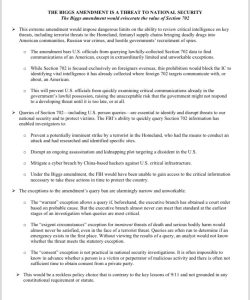
THE BIGGS AMENDMENT IS A THREAT TO NATIONAL SECURITY
The Biggs amendment would eviscerate the value of Section 702
This extreme amendment would impose dangerous limits on the ability to review critical intelligence on key threats, including terrorist threats to the Homeland, fentanyl supply chains bringing deadly drugs into American communities, Russian war crimes, and hostile governments’ recruitment of spies.
The amendment bars U.S. officials from querying lawfully-collected Section 702 data to find communications of an American, except in extraordinarily limited and unworkable exceptions.
While Section 702 is focused exclusively on foreigners overseas, this prohibition would block the IC to identifying vital intelligence it has already collected where foreign 702 targets communicate with, or about, an American.
This will prevent U.S. offficials from quickly examining critical communications already in the government’s lawful possession, raising the unacceptable risk that the government might not respond to a developing threat until it is too late, or at all.
Queries of Section 702-including U.S. person queries are essential to identify and disrupt threats to our national security and to protect victims. The FBI’s ability to quickly query Section 702 information has enabled investigators to:
Prevent a potentially imminent strike by a terrorist in the Homeland, who had the means to conduct an attack and had researched and identified specific sites.
Disrupt an ongoing assassination and kidnapping plot targeting a dissident in the U.S.
Mitigate a cyber breach by China-based hackers against U.S. critical infrastructure.
Under the Biggs amendment, the FBI would have been unable to gain access to the critical information necessary to take these actions in time to protect the country.
The exceptions to the amendment’s query ban are alarmingly narrow and unworkable.
The “warrant” exception allows a query if, beforehand, the executive branch has obtained a court order based on probable cause. But the executive branch almost never can meet that standard at the earliest stages of an investigation when queries are most critical.
The “exigent circumstances” exception for imminent threats of death and serious bodily harm would almost never be satisfied, even in the face of a terrorist threat. Queries are often run to determine if an emergency exists in the first place. Without viewing the results of a query, an analyst would not know whether the threat meets the statutory exception.
The “consent” exception is not practical in national security investigations. It is often impossible to know in advance whether a person is a victim or perpetrator of malicious activity and there is often not sufficient time to obtain consent from a private party.
This would be a reckless policy choice that is contrary to the key lessons of 9/11 and not grounded in any constitutional requirement or statute.
A couple of people, both of whom I respect a great deal, asked me for a First Amendment analysis of the students’ trying to orate about the Israel-Palestine conflict at the class party at Berkeley Dean Erwin Chemerinsky’s home. Happy to oblige!
[1.] Some people have argued that the party was a public law school function, and thus not just a private event. I’m not sure that’s right—but I don’t think it matters.
Even if Berkeley law school put on a party for its students in a law school classroom, students still couldn’t try to hijack that for their own political orations. Rather, much government property is a “nonpublic forum”—a place where some members of the public are invited, but which is “‘… not by tradition or designation a forum for public communication'” (Minnesota Voters Alliance v. Mansky (2018), quoting a leading 1983 case).
In a nonpublic forum, the government acting as proprietor may impose restrictions so long as they are “reasonable and viewpoint-neutral.” (The restrictions need not be content-neutral, by the way, so long as they are viewpoint-neutral; and I expect that Dean Chemerinsky wouldn’t have tolerated this sort of political speechmaking at their dinner by anyone.)
This is because the government has the “power to preserve the property under its control for the use to which it is lawfully dedicated.” If the place is a room opened up to students for listening to a lecture, or if it’s open for dinner or lunch or a party, people have no First Amendment right to bring microphones and take the event over for their own political diatribes.
Only three campuses — Madison, LaCrosse and Stout — were projected to generate enough revenue to meet expenses.
Stay informed on the latest news
Sign up for WPR’s email newsletter.
On Thursday, the UW system released updates from an external review into the finances at seven of the universities with projected deficits.
The reports completed by the firm Deloitte point to fiscal headwinds, including falling enrollment, struggles to retain students, and the end of federal COVID-19 aid.
And, as Universities of Wisconsin President Jay Rothman noted, Wisconsin ranks 42nd in the nation when it comes to state funding for public universities.
“While we will do our part on the expense side of the ledger, it is ultimately up to the state to decide whether it wants and can afford a weakened universities of Wisconsin,” said during a news conference on Thursday.
Patrick Moriarty sat expectantly in a plastic chair in his Brighton driveway at 3:20 p.m. on Monday as the sky darkened, the moon slipping in front of the sun behind a blanket of clouds.
“How do you guys like this?!” he said to the crowd surrounding him, who weren’t neighbors or coworkers but about 100 former students of his from decades ago. A chorus of oh’s and ah’s arose from the group, one commenting on the 360 sunset effect still visible even in the dark while another tried quickly to turn off their brightened cell phone screen.
It was a pinnacle moment for the former Webster science teacher, who’d spent over a decade sharing his passion for all things celestial with 14- and 15-year olds, and telling them to meet him in 2024 for the total solar eclipse bound for Rochester.
Moriarty, now 68, never thought a bunch of them would actually show up at his Brighton home for the occasion.
Twenty-six percent of students who started ninth grade in 2009 didn’t go on to enroll in college, and another 40 percent enrolled but didn’t finish a certificate or degree within eight years, the longitudinal study found.
Of those who ever enrolled in college, 60 percent completed a certificate or degree.
Not surprisingly, students from affluent families were more likely to enroll in college and complete degrees.
The conservatives, when they feel the bumps under their seats and realize the train is not on rails, feel each bump as a problem to be solved. DEI is a problem to be solved. Mass migration is a problem to be solved. The fentanyl epidemic is a problem to be solved.
Yet not only are the conservatives’ solutions wildly, fantastically disproportionate – by orders of magnitude – to these problems, they are not the real problems. They are only symptoms of the real problem – that our country is lost in history. There are no rails. There never were any.
But your quixotic, but energetically and even brilliantly conducted, fight against just one of these symptoms, in which even when your sword goes home and sinks to the hilt, you only demonstrate what a pinprick it is to this Brobdignagian monster, serves a different purpose. You are not defeating the enemy. You are only revealing it – showing everyone that the monster is real, and brave and capable men can fight it. Let us learn to fight it well – and let us learn to make it show its face. I complain, but I do not know of – for now – a better way.
Rufo: Let’s begin by clearing up some misconceptions. First, we have different objectives. Your goal seems to be accelerating the cycle of regimes from democracy to monarchy. My goal is to halt and reverse political decomposition and return to the beginnings of the republic — counter-revolution.
We also have a deep disagreement over the nature of history. You argue that there are no rails, no destiny, no divinity, and nothing beyond human contingency. This nihilistic argument creates considerable problems for you because it eliminates all possibility of making normative judgments. What is the ground of your convictions? What is the telos of your political system? And, if America is ordinary, contingent, and accidental, why care about its future at all?
My conviction is that there is a logical structure to human nature and, consequently, a structure of political order. The American founders were not ordinary politicians, but men of extraordinary vision and virtue who solved the core political problem posed by classical political philosophy and thereby created the most secure, free, and virtuous republic in history, with unprecedented innovations in commerce, technology, and the arts. You ridicule the category of “problems to be solved,” but pragmatism is the Anglo-American political spirit.
I see in your pessimism an excuse for inaction. I am grateful that you recognize that my work is valuable in “revealing the enemy” and that “brave and capable men can fight it.” This is enough. I have no illusion that my work alone will topple the regime. But I am doing what I can to contribute to that possibility in the future. Small victories yield new insights and open up new lines of action. Politics is not an abstraction; real-world fights generate greater practical knowledge than idle fantasies.
There is pushback to the University of Wisconsin’s decision to make the SAT and ACT optional for students for the next few years.
State Sen. Duey Striebel, R-Cedarburg, on Tuesday said the plan to accept students’ high school grades only is short-sighted and politically motivated.
“Proponents of test-optional policies claim that standardized tests are biased, and that making them optional will help improve diversity on college campuses while addressing ‘systemic inequities’ in the world of higher education. This theory continues to be disproven, with numerous scholars noting that required testing can actually help identify disadvantaged students who have the potential to succeed in higher education,” Stroebel said.
UW regents approved an extension of the test-option policy. The university will not require the SAT or the ACT until at least the fall of 2027.
Is 2024 finally the year that journalists dig deep into the pervasive problem of serial sexual predators in schools — and that school systems tighten up their incredibly lax procedures?
If so, Business Insider’s Matt Drange will have had lots to do with it.
Two years ago, Drange published a scathing story about a beloved teacher who had been an active sexual predator at Drange’s own high school while he was a student.
Then last fall, Drange produced a follow-up story about a cluster of sexual predators who had been active at the same school over decades. And late last year, Drange came out with a third, national-level piece that described a widespread problem with serial sexual predators in schools — enabled by lax state laws, feeble district enforcement, and the use of Hollywood-style nondisclosure agreements that kept things hush-hush.
In his first news conference in Madison since being named the public schools’ new superintendent, Joe Gothard vowed to be an engaged leader and said he wasn’t afraid to make changes.
“I think that we’ve got to be very deliberate. I think we’ve got to be very open with our community around where our challenges are, report frequently about progress that we’re making and not be afraid at all to say, ‘You know what, we’re not making a mark here; we need to make a change here,'” he said.
Gothard shared his top priorities for the district with administrators and Madison School Board members during a news conference Thursday at Thoreau Elementary School on Madison’s Near West Side. Gothard, who is the outgoing superintendent of Saint Paul Public Schools in Minnesota, has been in Madison since Monday visiting schools and meeting staff.
The flip side of the classic game, called Scrabble Together, will include helper cards, use a simpler scoring system, be quicker to play and allow people to play in teams.
“The makers of Scrabble found that younger people, Gen Z people, don’t quite like the competitive nature of Scrabble,” Gyles Brandreth, who co-hosts the language podcast Something Rhymes With Purple, told BBC Radio 4 Today. “They want a game where you can simply enjoy language, words, being together and having fun creating words.”
It is true that total teacher compensation has declined since 2010, but more nuance is needed.
1) A significant portion of that decline is in fringe benefits, which Act 10 mandated teachers contribute to as most all private sector employees must. (1/2)
Teacher supply has gone up, which pushes pay down. We have 1,805 more teachers than 2010 but 48,458 fewer students. The same ratio as “the good, old days” would free up funds to give every teacher a $5,368 raise.
Property taxes and home-maintenance costs are climbing in much of the country. Non-mortgage costs including property taxes, maintenance, utilities and insurance make up more than half of homeowners’ overall costs, according to a 2022 analysis by Fannie Mae economists.
Contemporary Islam is not known for its engagement in the modern scientific project. But it is heir to a legendary “Golden Age” of Arabic science frequently invoked by commentators hoping to make Muslims and Westerners more respectful and understanding of each other. President Obama, for instance, in his June 4, 2009 speech in Cairo, praised Muslims for their historical scientific and intellectual contributions to civilization:
It was Islam that carried the light of learning through so many centuries, paving the way for Europe’s Renaissance and Enlightenment. It was innovation in Muslim communities that developed the order of algebra; our magnetic compass and tools of navigation; our mastery of pens and printing; our understanding of how disease spreads and how it can be healed.
Such tributes to the Arab world’s era of scientific achievement are generally made in service of a broader political point, as they usually precede discussion of the region’s contemporary problems. They serve as an implicit exhortation: the great age of Arab science demonstrates that there is no categorical or congenital barrier to tolerance, cosmopolitanism, and advancement in the Islamic Middle East.
“The longer schools were closed, the more students fell behind,” the Times’ authors wrote.
Take, for instance, Madison, which reopened in-person learning in spring 2021, one of the two last districts in Wisconsin to do so, and nearby Verona, open from the start of the school year. From 2019 to 2022, researchers found, Madison kids lost more than half a grade level in math. Verona kids gained a quarter grade. In the year since, from 2022 to 2023, Madison’s children have begun to recover, but Verona’s have pulled ahead at about five times Madison’s pace.
Districts vary according to many factors, researchers and the Times caution, but the pattern now is clear. The paper quoted an infectious disease specialist who helped write the American Academy of Pediatrics’ guidance on reopening schools: “We probably kept kids out of school longer than we should have,” he said.
And for what? The Times signals it’s now safe to wonder that, too, quoting an eminent Covid response doctor at a prominent hospital as saying that a consensus of respectable doctors has “generally agreed that school closures were not an important strategy in stemming the spread of Covid.”
The argument against smartphones and social media is familiar and repetitive: they steal our time, harvest our attention, farm our data. Tech companies are called attention merchants and algorithmic exploiters; we are all supposed to be hooked on dopamine which is immiserating us. And now the psychologist Jonathan Haidt is promoting the idea that smartphones and social media have “rewired” the brains of a generation of children, which makes them depressed and anxious. The recent rise in rates of suicide and self-harm among young people are beng blamed on phones and social media.
But Haidt’s claims are not uncontroversial. And more broadly, we need to account for the many benefits of smartphones. New technology is never a simple good. The idea that technology brings disruption is a cliche for good reason. People in the past were hostile to all sorts of mundane technology, like bicycles and water drainage. The question is not whether phones and social media are good or bad, but what the net effects are, who gains and loses, and how we ought to manage them.
Do we really believe that the effects of this new technology are so different to, say, the arrival of landline phones and cars?
We will review several examples which, taken together, establish a pattern of careless scholarship at best or, at worst, academic misconduct.
In a 2021 paper titled “The Antebellum Roots of Distinctively Black Names,” Cook copied-and-pasted verbatim language from Charles Calomiris and Jonathan Pritchett, without using quotation marks when describing their findings, as required. Here is the original passage from Calomiris and Pritchett:
During this time, New Orleans was the largest city in the South and the site of its largest slave market. Unlike states with a common law tradition, Louisiana treated slaves like real estate, and slave sales had to be recorded and notarized in order to establish title (Louisiana 1806, section 10). Today, the records of many of these slave sales may be found in the New Orleans Notarial Archives and the New Orleans Conveyance Office. Because of the availability of these records and the size of the market, New Orleans is the best source for data on slave sales within the United States.
Here is Cook’s paper, which, though it cites Calomiris and Pritchett, lifts their language verbatim, which we have marked in italics, substituting only the word “slaves” with the politically correct phrase “the enslaved”:
Unlike states with a common law tradition, Louisiana treated the enslaved like real estate, and slave sales had to be recorded and notarized in order to establish title (Louisiana 1806 section 10). Today the records of many of these slave sales may be found in the New Orleans Notarial Archives and the New Orleans Conveyance Office. Because of the availability of these records and the size of the market, New Orleans is the best source for data on slave sales within the United States. [ . . . ]
During this time New Orleans was the largest city in the South and the site of its largest slave market.
She does something similar in her October 2021 paper,“Closing the Innovation Gap In Pink and Black,” which, despite significant government subsidies and years spent on it by Cook, summarized the work of researchers Charles Becker, Cecilia Elena Rouse, and Mingyu Chenby copying roughly 70 words without quotes.
This appears to be a violation of the standards in Michigan State University’s guidebook, which states that authors must paraphrase or add direct quotations to verbatim passages. “It is your responsibility to make certain that you understand the difference between quoting and paraphrasing, as well as the proper way to cite and delineate quoted material,” the guidebook reads.
In multiple papers, Cook also appears to have copied language from her own prior papers, or those of coauthors, without proper attribution.
I agree with Sheryl Sandberg’s niece, Maya Bodnick, that Harvard should conduct a systematic review of all scholars, then break down the results by field, race, and sex, so we can have a comprehensive picture of any disparities. This is a great suggestion from The Crimson.
For years, we have discussed the failure of universities to take actions against faculty and students shutting down events or acting unlawfully, including faculty guilty of criminal assault. Now, Vanderbilt has expelled three students after anti-Israel protests, including Jack Petocz, a political activist recognized by the White House and featured prominently in the New York Times and other news outlets.
Caitlin Clark is the face of the Iowa Hawkeyes women’s basketball team. She is known for breaking NCAA records in 2022 as a junior and 2023 as a senior. She has come a long way since she was a kid reaching for and achieving her basketball dreams.
From the young age of five, Caitlin Clark has always been gifted. Growing up in Des Moines, Iowa, she played against her older cousins. At first, it was challenging for her, but she quickly began to outplay her cousins. “It’s just marvelous to remember that she’s wired special. Sometimes, there are special athletes that God created, and Caitlin Clark is one of those,” said her grandpa who was also her coach when she was little. By the time she was a senior at West Des Moines Catholic, Caitlin had multiple offers, establishing her as one of the top seniors in her graduation class. During her senior year, Caitlin had offers from top schools such as Texas, Oregon, Florida, and the University of Iowa. She ended up committing to Iowa where she has been doing unbelievable things as their star player. The Iowa Hawkeyes made it to the championship in 2022 but were sadly defeated by the LSU Tigers 102-85.
Caitlin has already become a legend in NCAA basketball. She had the first-ever 40-point triple-double in NCAA history, including men’s basketball. The Iowa Hawkeyes’ season had not even started when Caitlin Clark and her team broke a record. In the summer of 2023 during their pre-season game against DePaul, Caitlin Clark’s Hawkeyes broke the attendance record for Women’s NCAA basketball. The Hawkeyes exhibition game almost doubled the attendance record with 55,646 people, with the old record being 29,619 people in 2002. She broke 3,000 career points against Iowa State on December 6th, making her the 15th female in Division 1 basketball to achieve this goal. She now holds the all-time scoring record for Iowa.
Unlike TikTok, Gauth is an educational app, designed specifically to help users with their homework. To use it, you take a photo of a homework assignment — like a sheet of math problems, for example — and watch as AI solves the problems for you. Upon downloading the app, the first prompt you receive is a request for permission to use the camera. The app appears similar to a China-based ByteDance app known as “Hippo Learning.”
In addition to AI help, Gauth also offers a paid “Plus” version, which connects students with tutors in a given subject area. “We have fifty thousands of experts and dedicated experts ready to help you 24/7 with multiple subjects,” says the app description in the Apple app store. Gauth solicits tutors through a website, gauthexpert.com, where it offers payment of up to $1500 per month for tutors with expertise in math, chemistry, physics, or biology. ByteDance spokesperson Mike Hughes told Forbes that tutors are based in the United States, India, the Philippines and portions of Africa.
Gauth also offers a set of homework timers and reminders and other fun features, including an animated “Personal AI Study Buddy” and a selection of lofi beat soundtracks. There is also a system of “points” that can be used for in-app purchases; you can buy points with cash or accrue them by watching ads. There is a “targeted ads” toggle in your settings, which is auto-set to “off.”
Using employment records on all public-school teachers in Wisconsin linked to individual student information on achievement and demographics from the Wisconsin Department of Public Instruction, I first document how teacher salaries changed in flexible-pay and seniority-pay districts in the aftermath of the reform. After the expiration of districts’ collective bargaining agreements, salary differences among teachers with similar seniority and credentials emerged in flexible-pay districts, but not in seniority-pay districts. Before the passage of Act 10, such teachers would have been paid the same. These newly emerging differences are related to teachers’ effectiveness: Teachers with higher value-added (individual contributions to the growth in student achievement, as measured by standardized test scores) started earning more in flexible-pay districts. This finding is striking considering that school districts in Wisconsin neither calculate value-added nor use it to make any human-resources decisions. School and district administrators appear to be able to identify an effective teacher when they see one.
Does Flexible Pay Attract Better Teachers?
Changes in teachers’ pay arrangements after the expiration of the collective bargaining agreements changed teachers’ incentives to stay in their district or to move, depending on the teachers’ effectiveness and the pay plan in place in their district of origin. Because flexible-pay districts compensate teachers for their effectiveness and seniority-pay districts only reward them for seniority and academic credentials, teachers with higher effectiveness should want to move to flexible-pay districts, whereas teachers with lower effectiveness and higher seniority should want to move to seniority-pay districts.
The data confirm these hypotheses. The rate of cross-district movement more than doubled after Act 10, with most moves occurring across districts of different type (flexible-pay vs. seniority-pay). Teachers who moved to a flexible-pay district after a collective bargaining agreement expired were more than a standard deviation more effective, on average, than teachers who moved to the same districts before the expiration; these teachers also had lower seniority and academic credentials and enjoyed a significant pay increase upon moving. The effectiveness of teachers moving to seniority-pay districts, on the other hand, did not change. and these teachers did not experience any change in pay.
I hate student loan forgiveness because to me it’s a fundamental question of values. I believe in hard work, personal responsibility, sacrifice, individualism and even some stoicism. Paying off loans is about getting something for nothing and it rewards the savers and the spendthrifts, the careful planners and the careless, alike. It treats people as members of groups instead of as people with individual circumstances. And nobody who is demanding this will say “thank you” if they get it. For some reason they seem to think it’s owed to them.
Stanford University’s Faculty Senate will weigh dueling motions this week about whether to rescind its 2020 condemnation of Scott W. Atlas, a Hoover Institution senior fellow who was an adviser to former President Donald Trump about Covid-19.
At the height of the pandemic, the Faculty Senate passed a resolution criticizing Atlas for promoting “a view of Covid-19 that contradicts medical science.” It cited his remarks that discouraged mask-wearing and that encouraged Michiganders to “rise up” against their governor in response to public-health measures, among others. The November 2020 resolution, which was approved by 85 percent of the senate membership and drew national attention, characterized Atlas’s behavior as “anathema to our community, our values, and our belief that we should use knowledge for good.”
Wisconsin voters were asked to approve more than 100 school district referendums in February and April.
But with an approval rate of only 60 percent, voter fatigue appears to have set in.
Voter approval rates of school district referendums hovered around 50 percent for most of the late 2000s and early 2010s. Starting in 2012, however, voters approved referenda in greater numbers, with the passage rate peaking at about 90 percent in 2018, according to a recent report from the Wisconsin Policy Forum.
“Over the past several years, approval rates have trended downward,” the report says. “After slight declines in both 2020 and 2022, the 60.2 percent passage rate for 2024 school district referenda so far is the lowest in a midterm or presidential year since 2010.”
That’s a far cry from four years ago when the MPS referendum passed by nearly 80 percent.
The Mukwonago Area School District asked voters to approve $102 million. The money would have been used to build a new middle school and add K-4 classrooms.
In a video posted before the election, Park View Middle School Principal Luke Spielman described congested hallways and classrooms. And showed videos of aging pipes and outdated music and physical education spaces.
A simple fact about education in the United States trumps all others, yet has been largely overlooked in the education reform era and contributed to its disappointing underperformance: it takes nearly four million women and men to staff America’s K–12 classrooms. A number that large, by definition, means that teachers will be people of average abilities and sentience—not saints, not superstars, and, more pertinently, not the cognitive elite, who do not exist in sufficient numbers to staff more than a fraction of America’s classrooms. At the same time, it is not an overstatement to say that the ever-increasing demands placed on the average teacher make the job nearly impossible to do well, consistently, or sustainably. The reluctance even to cite, let alone address, this mismatch of expectations and abilities contributes to the mediocre performance of education in the United States, which has not changed significantly or satisfactorily since A Nation at Risk warned that “the educational foundations of our society are presently being eroded by a rising tide of mediocrity that threatens our very future as a Nation and a people.”
If teacher capacity is unlikely to change, then what must change is the teacher’s job. If the education reform movement is to regain its momentum and moral authority, becoming not merely a disruptive force but an effective one, it must reinvent itself as a practice-based movement that is clear-eyed and candid about human capital and system capacity, committed not to transforming the teacher workforce but to making teaching doable by the existing workforce and those likely to enter the profession in the future.
At the same time, candor requires acknowledging that this transformation can’t be speedily or satisfactorily addressed, even if taken up with urgency. Education policy is a weak lever to change classroom practice. Enduring change requires shifts in the culture of teaching, which is notoriously slow to evolve, resistant to change, and skeptical—even cynical—about reform. For a 2017 study published by the National Council of Professors of Educational Administration, Wartburg College professor Richard Snyder interviewed a series of teachers with more than twenty years in the field to understand their perspectives on reforms and change. One teacher, who was aggravated with changes to class schedules, often ignored new directives from administrators. “In fact, Mr. Booker—a social studies teacher with over 30 years of experience—acknowledged giving ‘lip service’ to numerous initiatives, then returning to his own classroom intent on accomplishing intellectual discourse through interactive lecture.” Other teachers criticized increased top-down control, whether it be from Common Core State Standards or area education agency (AEA) consultants. Concerned about her loss of autonomy, Mrs. Rittmeyer stated:
Four members of the Whitnall School Board are being investigated for allegedly violating Wisconsin’s Open Meetings Law.
LuAnn Bird, a Hales Corner resident, filed the complaint last month with the Milwaukee County District Attorney’s office.
The complaint alleges school board President Jason Craig, Vice President Cassie Rainer, Clerk Rachel Scherrer and Treasurer Karen Mikolainis conducted board business on the private Facebook group “Whitnall Watchdog” starting in April 2023.
The conservative sites allege that the group spent “only about $263,000 on its stated mission of electing candidates from Generation Z to office combined with donations to other Democrat Party committees and groups—and instead spent more than $1.4 million on disbursements to themselves for payroll and to political consulting firms and legal fees, in addition to travel and entertainment expenses like hotels, flights, and meals.”
However, it spent reportedly spent more than $1,314,000 on travel and related expenses while giving $80,000 to the Elias Law Group.
Previously, when allegations of self-dealing and accounting improprieties were raised with regard to Black Lives Matter, the group’s attorney, Elias, immediately stood out for many. Elias resigned from his “key role” with BLM as the scandal exploded.
Some teachers are leaning on software called Writable that uses ChatGPT to help grade papers but is “tokenized,” so essays do not include any personal information, and it’s not shared directly with the system.
Teachers upload essays to the platform, which was recently acquired by education company Houghton Mifflin Harcourt, which then provides suggested feedback for students.
Other educators are using platforms such as Turnitin that boast plagiarism detection tools tohelp teachers identify when assignments are written by ChatGPT and other AI. But these types of detection tools are far from foolproof; OpenAI shut down its own AI-detection tool last year due to what the company called a “low rate of accuracy.”
Setting standards
Some schools are actively working on policies for both teachers and students. Alan Reid, a research associate in the Center for Research and Reform in Education (CRRE) at Johns Hopkins University, said he recently spent time working with K-12 educators who use GPT tools to create end-of-quarter personalized comments on report cards.
But like Layne, he acknowledged the technology’s ability to write insightful feedback remains “limited.”
Beginning in 2025, Hardy Williams High students will be prepared for careers at CHOP — from patient-facing roles such as medical assistants to operations jobs such as information technology workers, and hospital administration positions — then walk right into full-time jobs in the hospital system as soon as they graduate.
Along the way, they’ll have access to hands-on CHOP resources and paid internships, and will have career supports once they graduate.
The partnership matches with the revised mission of Mastery, the Philadelphia-based network of 14,000 students in 24 schools.
“There are multiple entry points that students and families can choose on the pathway to a family-sustaining wage, a career,” said Saliyah Cruz, Mastery’s chief equity officer.
The News: The Wisconsin Institute for Law & Liberty (WILL) released its latest report, Piercing the Fog: Shedding Light on School District Referenda in Wisconsin, which uncovers various transparency problems with Wisconsin’s referendum process that costs taxpayers millions of dollars every single year. The report also calls for significant reform to Wisconsin’s referendum process to give voters more complete information when deciding.
The Quotes: WILL Research Director, Will Flanders, stated, “Using referendums to fund school districts is not going away, but for voters to make smart decisions, they must be armed with all necessary information. Our report highlights the grave transparency concerns that exist in Wisconsin’s current process while outlining policy changes to ensure voters are fully informed. Ultimately, with the changes we proposed, referenda can be an important tool for direct democracy when used properly.”
Additional Background: More than 90 school districts around Wisconsin went to referendum in the 2024 spring elections, with 58.8% passing. The role of referenda in funding Wisconsin schools has been the subject of debate for many years. Some argue that referenda are necessary for school districts to keep their doors open, while others make the case that they are examples of wasteful spending that take advantage of voter sentiments in favor of funding education.
WILL’s report provides an overview of how referenda have been used historically around the state, and then highlights three ways that school districts around Wisconsin are “gaming the system.” We then make suggestions for what policy makers can do about it.
It’s almost as if Maddow doesn’t know that all these billions are owed to the U.S. Treasury & not to banks . . . as if she doesn’t know that Democrats cut the banks out during the Obama years in order to “protect borrowers.”
The First Amendment demands much more. If we are to have a free press, as guaranteed by the Constitution, then State Bar employees may not bully and intimidate reporters, as they have here.
Thus, long-term real interest rates might remain high persistently, partly because of perceptions of inflation risk, partly because of quantitative tightening and partly because the fiscal deficits of many countries are expected to remain large. All this threatens to create a vicious circle in which high perceptions of risk raise interest rates above likely growth rates, thereby making fiscal positions less sustainable and keeping risk premia high. Elevated fiscal debt also worsens the threat of a “bank-sovereign nexus”, in which weak banks cause concern about the ability of sovereigns to rescue them and vice versa.
Arguably, the situation of the US is the most significant of all. In The Budget and Economic Outlook: 2024 to 2034, the non-partisan Congressional Budget Office notes that “debt held by the public rises each year in relation to the size of the economy, reaching 116 per cent of GDP in 2034 — an amount greater than at any point in the nation’s history. From 2024 to 2034, increases in mandatory spending and interest costs outpace declines in discretionary spending and growth in revenues and the economy, driving up debt. That trend persists, pushing federal debt to 172 per cent of GDP in 2054.”
Only a brave economist could insist that this can continue forever. At some point, surely, Stein’s law would bite: investor resistance to further rises in debt would jump and then monetisation, inflation, financial repression and a global monetary mess would ensue.
Here are three relevant facts for the US: first, by 2034, mandatory federal spending is forecast to reach 15.1 per cent of GDP against total federal revenue of a mere 17.9 per cent; second, federal revenue was just 73 per cent of outlays in 2023; and, third, the primary balance has been in consistent deficit since the early 2000s. All this shows how immensely difficult it will be to bring overall deficits under control.
Uri Berliner, a veteran at the public radio institution, says the network lost its way when it started telling listeners how to think.
An open-minded spirit no longer exists within NPR, and now, predictably, we don’t have an audience that reflects America.
That wouldn’t be a problem for an openly polemical news outlet serving a niche audience. But for NPR, which purports to consider all things, it’s devastating both for its journalism and its business model.
Like many unfortunate things, the rise of advocacy took off with Donald Trump. As in many newsrooms, his election in 2016 was greeted at NPR with a mixture of disbelief, anger, and despair. (Just to note, I eagerly voted against Trump twice but felt we were obliged to cover him fairly.) But what began as tough, straightforward coverage of a belligerent, truth-impaired president veered toward efforts to damage or topple Trump’s presidency.
Persistent rumors that the Trump campaign colluded with Russia over the election became the catnip that drove reporting. At NPR, we hitched our wagon to Trump’s most visible antagonist, Representative Adam Schiff.
Schiff, who was the top Democrat on the House Intelligence Committee, became NPR’s guiding hand, its ever-present muse. By my count, NPR hosts interviewed Schiff 25 times about Trump and Russia. During many of those conversations, Schiff alluded to purported evidence of collusion. The Schiff talking points became the drumbeat of NPR news reports.
But when the Mueller report found no credible evidence of collusion, NPR’s coverage was notably sparse. Russiagate quietly faded from our programming.
It is one thing to swing and miss on a major story. Unfortunately, it happens. You follow the wrong leads, you get misled by sources you trusted, you’re emotionally invested in a narrative, and bits of circumstantial evidence never add up. It’s bad to blow a big story.
All Chicago Public Schools will get teacher positions based on a set formula that favors high-poverty schools and eliminates extra money historically given to magnet and selective enrollment programs and schools.
But CPS CEO Pedro Martinez emphasized that overall magnet and selective enrollment schools will not be hurt. “What we are seeing is that there is no disproportionate impact on any one set of schools,” he said.
Principals received their school budgets for next year on Monday. The school district has yet to release the school budgets to the press and, at this point, does not plan to until later in the process. This breaks from tradition.
These are the first school budgets under a new funding formula that shifts to focusing on the needs of schools, rather than enrollment.
Birth rates in the developed world are below replacement levels and global fertility is not far behind. Sub-replacement fertility leads to exponentially decreasing population. Our best models of economic growth suggest that a shrinking population causes economic growth and technological progress to stop and humanity to stagnate into extinction.
One theory of fertility decline says it’s all about opportunity costs, especially for women. Rising labor productivity and expanded career opportunities for potential parents make each hour of their time and each forgone career path much more valuable. Higher income potential also makes it cheaper for parents to gain utility by using financial resources to improve their children’s quality of life compared to investing time in having more kids. Simultaneously, economic growth raises the returns to these financial investments in quality (e.g education).
In addition to higher incomes, people today have more diverse and exciting options for leisure. DINKs can go to Trader Joes and workout classes on the weekend, play video games, watch Netflix, and go on international vacations.
Most bibliophiles would agree to this maxim: the older the book, the better. If so, a forthcoming lot at Christie’s offers the chance of a lifetime as the auctioneer is selling the oldest tome you are ever likely to see.
The oldest known book in private hands is one of two lots at the auction that can be said to be among the most important texts in the history of early Christianity.
Eugenio Donadoni, a senior specialist in books and manuscripts at Christie’s, said the texts were of “huge international significance”, adding: “They are really important touchstones in charting early Christianity.”
The importance of explicit and systematic instruction has become a central element of discussions of effective instruction (e.g., National Reading Panel, 2000). Direct Instruction (DI), developed by Siegfried Engelmann and his collaborators beginning in the 1960s, is often cited as an example. Over the past half century the corpus of DI curricular materials has grown as has the literature evaluating its effectiveness. This article presents a quantitative analysis of this effectiveness literature. Although the term direct instruction (lower case and sometimes referred to as “little di”) has been used to refer to a broad set of educational programs that incorporate elements of systematic or explicit instruction, our focus is only on Direct Instruction (capitalized) in the Engelmann–Becker tradition (Engelmann & Colvin, 2006).
For decades, nobody in Wisconsin’s Capitol dared to say it out loud: Wisconsin had an unsustainable number of institutions of higher learning.
The 2015-16 Blue Book, for example, listed 66 of them: 13 University of Wisconsin System four-year campuses, 13 two-year UW colleges, 16 technical colleges, 18 private colleges and universities, and six technical and professional institutions.
That total didn’t include three theological seminaries and two tribal colleges.
Nobody knows what the number will be in 2025, because one of the most important trends of the last few years is the downsizing of Wisconsin’s public and private universities and colleges.
The author’s efforts to place responsibility for Ohio’s reading struggles into my lap, however, are unwarranted. He writes, “A recent survey from the Ohio Department of Education and Workforce found that two of the most popular curricula statewide are Fountas and Pinnell’s Classroom and Lucy Calkins’ Units of Study,” and he goes on to denigrate both.
The truth is, however, that the same survey showed that just 6% of Ohio’s schools identify Units of Study as their curriculum. Eight times that number of schools — 395 districts — cite Heggerty’s Phonemic Awareness Curriculum, six times that number, Fundations, and three times the number use the basal textbook “Reading Wonders.” How can a curriculum used by only 6% of Ohio’s schools be responsible for the state’s literacy woes?
My curriculum has been continually developed and refined for 40 years, informed by classroom-based research, by rich assessments of children and by scholarship, results that have been verified through a careful study by the American Institute of Research. The data overwhelmingly indicate that schools partnering with us demonstrate meaningful improvements in student performance and that improvements deepen over time.
And this is also true for Ohio schools that use Units of Study. Many that report using the curriculum far outperform the state average. In fact, if you average the results obtained by all 48 schools that reported using Units of Study, third-grade reading proficiency in those schools outperforms Ohio’s 2022-2023 state average by 7.44%.
Contrary to the author’s assertion, I have never bypassed phonics. It is ludicrous to suggest that I want children to open a book and guess wildly at the words. I’d be happy to walk anyone through the newest edition of Units of Study in K-2 Reading to show how it incorporates the instructional practices promoted by the science of reading. The same cannot be said of many of the curricula, per an in-depth analysis from University of Connecticut Professor Rachael Gabriel, on that state’s short list of approved curricula, which share much overlap with Ohio’s curricula list.
On Monday, April 8, hundreds of schools across North America, from Texas to Ontario, are closing in order to protect pupils from sustaining lifelong injuries—from the sun.
Just after 11 a.m. local time, a complete solar eclipse will begin over the Pacific coast of Mexico. Its “path of totality”—the areas where the sun will be entirely blotted out—will pass through 13 U.S. states, before ending off the coast of Newfoundland, Canada. In these regions, schools face a dilemma: Is the eclipse a learning opportunity for kids—or a threat?
“The solar eclipse offers a rare educational occasion,” Natalie Jameson, an educator in Canada’s Prince Edward Island, admitted last month. “But prioritizing safety is crucial.”
And so, classes in her district will end two hours early to ensure “students will be home safely” before the start of the eclipse.
The decision, her department added, was made “out of an abundance of caution.”
^ Why are interest payments suddenly spiking? Because the bill for QE is coming due. Either die by high inflation or high rates. Or both.
Why is the country issuing debt at emergency levels, without acknowledging it’s an emergency? Because that’s the only thing that can keep this fake economy afloat through the 2024 election.
^ Why is China the world’s #1 trade partner on just about every physical good? Because the US only exports (a) printed money and (b) technology. Anyway, I could keep going, with literally dozens of graphs like this. But X only allows four per post.
3) On the topic of whether it’s a country with a “turbulent history of…violence”, the level of drug addiction, violent crime, homeless encampments, squatters, road blockages, and massive BLM/Hamas mobs swarming the streets has obviously spiked in recent years.
2020 didn’t represent a one-off, it’s a preview of what is to come, particularly in Blue America. Crime statistics are systematically faked — in San Francisco, you can actually see some dashboards where things like car ticketing have gone to zero — so we don’t have an accurate picture.
Until you see undeniable things like stores closing and people moving out of blue states. And then blue politicians yell at those companies, and try to stop them from moving out. This is systematic: blues always disable the warning lights that tell you we’re crashing into the ground, just like the mortgages labeled AAA in 2008, just as a mosquito anesthetizes you before drinking your blood, just as a snake evolves to employ camouflage before it strikes. Alongside lawfare, faking the stats is a core competency of both communist reds and woke blues.
From the Baltimore bridge collapse to chaos at Boeing, what look like discrete problems are in fact part of a wider dysfunction. The case in point here is Boeing, which was allowed to purchase the only other US domestic producer of commercial aircraft, McDonnell Douglas, in 1997. As United Airlines chief executive Scott Kirby recently noted, innovation and quality have been on the decline ever since. Research and development budgets have gone down relative to Airbus, while share buybacks have gone up. Massive outsourcing resulted in highly complex and vulnerable supply chains. Workforce training languished, as labour was tallied as a cost not an asset.
Meanwhile, as Federal Trade Commission chair Lina Khan pointed out in a March speech warning against the dangers associated with promoting national champions, concentration and financialisation in the airline industry have not only led to safety issues — they have also cost US taxpayers a bundle, and created economic vulnerability rather than stability or security. One could say the same thing about America’s inability to build its own ships, or figure out how to work with allies to do so. Likewise the failure to understand all the domestic and foreign policy levers that must be pulled in order to accomplish the clean energy transition.
“The sickest thing of all, we had a key guy on the Trade Commission leave and go to the other side in the middle of negotiation. He knew the plans, the strategy, the details. As far as I’m concerned, that’s economic treason.”
A two-decade pursuit of vanity projects has left many local authorities in China in a deep morass of debt, with their status as “the largest local defaulters” not only having a knock-on effect on private businesses, but also adding to a grass-roots governance crisis, an academic has warned.
Feng Chuan, an associate professor at Wuhan University’s School of Political Science and Public Administration, called for greater efforts to rebuild social trust and business confidence after finding that officials, residents, local government financing vehicles (LGFVs), contractors and banks had been caught in the debt limbo.
“Credit overdraw systematically occurs … tearing apart the fundamental trust system that upholds social governance order,” he wrote in an article published last month on news portal NetEase.
Alumni and ardent supporters of the private, Methodist-affiliated college watched a long, slow roller coaster ride that seemed to have more deep dives than upward climbs over 50 years.
“Birmingham-Southern was always a fragile institution since it lost the backing of the big industrial Stockham family,” said former New York Times Executive Editor Howell Raines, a BSC graduate and author of the novel “Whiskey Man” and the Civil War history “Silent Cavalry.”
Birmingham-Southern College’s string of bad fortune dates to the 1970s and includes the murder of a student that prompted the building of a fence around campus, a national scandal after church arsons committed by three former students in 2006 that detoured fundraising efforts to rebuild burned churches, and extensive financial mismanagement that caused multi-million-dollar budget shortfalls and plunged the college deep in debt, draining its endowment.
It appears that confusion expressed by many of us is shared by Judge Reyes.
Judge Reyes noted the obvious: “There’s a person in jail right now because you all brought a criminal lawsuit against him because he did not appear for a House subpoena.” The DOJ demanded six months in prison. Navarro is now serving a four-month sentence.
What Lula and de Moraes are doing is an outrageous violation of Brazil’s constitution and the United Nations Declaration of Human Rights.
At this moment, Brazil is not yet a dictatorship. It still has elections and the Brazilian people have other means at their disposal to confront authoritarianism.
But the Federal Supreme Court and the Superior Electoral Court are directly interfere in those elections through censorship.
Three days ago I published the Twitter Files for Brazil. They show that Moraes has violated the Brazilian Constitution. Moraes illegally demanded that Twitter reveal private information about Twitter users who used hashtags he considered inappropriate. He demanded access to Twitter’s internal data, violating the platform’s policy. He censored, on his own initiative and without any respect for due process, posts on Twitter by parliamentarians from the Brazilian Congress. And Moraes tried to turn Twitter’s content moderation policies into a weapon against supporters of then-president Jair Bolsonaro.
Sabine Hossenfelder today posted a new video on youtube which everyone in theoretical physics should watch and think seriously about. She tells honestly in detail the story of her career and experiences in academia, explaining very clearly exactly what the problems are with the conventional system for funding research and for training postdocs.
After a string of postdocs requiring moving and living far from her husband, she decided she needed to move back to Germany and applied for a grant to fund her research (I believe for this project). This is how she describes the situation:
At this point I’d figured out what you need to put into a grant proposal to get the money. And that’s what I did. I applied for grants on research projects because it was a way to make money, not because I thought it would leave an impact in the history of science. It’s not that was I did was somehow wrong. It was, and still is, totally state of the art. I did what I said I’d do in the proposal, I did the calculation, I wrote the paper, I wrote my reports, and the reports were approved. Normal academic procedure.
But I knew it was bullshit just as most of the work in that area is currently bullshit and just as most of academic research that your taxes pay for is almost certainly bullshit. The real problem I had, I think, is that I was bad at lying to myself. Of course, I’d try to tell myself and anyone who was willing to listen that at least unofficially on the side I would do the research that I thought was worth my time but that I couldn’t get money for because it was too far off the mainstream. But that research never got done because I had to do the other stuff that I actually got paid for.
In February, Hindenburg Research, the most famous short-selling fund in the world, put out a research report titled: Renovaro BioSciences: A Worthless AI Shell Game With A Murderous Magician Past
Renovaro, previously known as Enochian BioSciences, is a biotech firm focusing on cancer and infectious diseases, recently merged with AI company GEDi Cube, valuing Renovaro at approximately $567 million.
The most scandalous thing here is that the co-founder of this biotech firm hired a hitman:
CEO Mark Dybul, who has worked with Anthony Fauci and held significant positions in global health, joined the company in 2017. The company’s co-founder, Serhat Gumrukcu, was praised for his innovative work but was charged in 2022 for hiring a hitman in a scam-related murder.
But he also fabricated his academic history,
A week after the indictment, on June 1st, 2022, we released a report showing how “Doctor” Gumrukcu had faked his entire academic history, including forging his Russian medical degrees. In reality, Gumrukcu was a Turkish magician who had fled Turkish authorities after being charged over allegations that he faked being a doctor to steal money from a terminally ill cancer patient.
These fabricated credentials might be enough for an academic scandal in its own right, but that is not the focus of this scandal for our purposes.
I am including this story because a reader sent me a note saying:
‘‘I am bringing it to your attention because of their CEO, Mark Dybul. Given the history in the article, I am STUNNED to see that he is STILL a professor at Georgetown University’’
So I will oblige and highlight the professor in question:
The highest effective rates among metro areas with a population of at least 1 million in 2023 were in Chicago, IL (1.84 percent); Rochester, NY (1.77 percent); Hartford, CT (1.76 percent); Cleveland, OH(1.66 percent) and Columbus, OH (1.45 percent).
The lowest effective rates in 2023 were in Daphne-Fairhope, AL (0.27 percent); Salisbury, MD (0.30 percent); Honolulu, HI (0.31 percent); Knoxville, TN(0.32 percent) and Tuscaloosa, AL (0.32 percent).
Aside from Honolulu, the lowest rates among metro areas with a population of at least 1 million in 2023 were in Phoenix, AZ (0.38 percent); Nashville, TN (0.45 percent); Las Vegas, NV (0.48 percent) and Salt Lake City, UT (0.49 percent).
We needed to bypass obstacles like Congress, law-making, and budgets. Over the next few weeks, a three-step plan took shape.
Step one: My team found a couple sentences in the 20-year-old HEROES law, written to give military personnel a break on student loans when they were deployed post-9/11. Well, we took those phrases, pretended they applied to the pandemic (which was still, totally, completely raging), and said borrowers wouldn’t have to repay $500 billion in student loans. MAGA Republicans sued, the MAGA Supreme Court had to stop us, and the game was afoot.
Step two: Once we’d planted the idea that we could give out free money, we set out on two parallel paths. We started “forgiving” borrowers on a piecemeal basis. A few billion dollars here and there didn’t seem all that newsworthy compared to our HEROES ploy, but it let the president keep sending emails to borrowers telling them he was giving them free money. (That made the president very happy.) Meanwhile, we rewrote Income-Driven Repayment to quietly turn student lending into a vast new entitlement, one that would eventually let us give away trillions of dollars without worrying about Congress or budgets.
A few years ago, officials at Palo Alto Unified noticed that one district high school was giving out far fewer D’s and F’s than previously, instead giving students a “no mark,” which allowed additional time to complete assignments or take exams.
But teachers there weren’t giving all students that second chance for a better grade. They were disproportionately giving it to white and Asian American students. Black and brown students were still getting D’s and F’s.
“It was glaring,” said Superintendent Don Austin. “That really spoke to who was getting the opportunity for more time and second chances.”
Based on data from the @AAMCtoday, the MCAT of the average black medical student (505.7/66th percentile) is one standard deviation below the average Asian (514.3/88th percentile) and white student (512.4/83rd percentile). Also, the GPA of the average black student (3.59) is below the average GPA of Asians (3.83) and whites (3.80) at an extremely statistically significant level.
Ranga Dias, the physicist at the centre of the room-temperature superconductivity scandal, committed data fabrication, falsification and plagiarism, according to a investigation commissioned by his university. Nature’s news team discovered the bombshell investigation report in court documents.
The 10-month investigation, which concluded on 8 February, was carried out by an independent group of scientists recruited by the University of Rochester in New York. They examined 16 allegations against Dias and concluded that it was more likely than not that in each case, the physicist had committed scientific misconduct. The university is now attempting to fire Dias, who is a tenure-track faculty member at Rochester, before his contract expires at the end of the 2024–25 academic year.
The investigation report (see Supplementary information) and numerous other documents came to light as the result of a lawsuit that Dias filed against the university in December last year. Dias submitted a grievance to Rochester over its decision to remove his students last August, but the university refused to hear the grievance on the grounds that it did “not relate to academic freedom”. The physicist’s lawsuit claims that this response was unreasonable. A university spokesperson declined to comment on the specifics of ongoing litigation and personnel matters, but emphasized that Rochester is “vigorously defending its course of action”.
The number of tenured faculty in the University of Wisconsin System has fallen roughly in line with the decrease in student enrollment since 2015 — the year a legislative decision to take tenure guarantees out of state statute unleashed a torrent of blowback from professors who called the move by Republican legislators “destructive” and “remarkably chilling” and like “a death in the family.”
A look back at what has happened to tenured faculty since then uncovered no deaths.
Or even much use of the replacement policy that was passed by the Board of Regents.
The numbers of tenured professors in the System decreased approximately 8% — from 4,561 to 4,209, according to the Legislative Fiscal Bureau — between the 2016-17 school year and 2021-22. Student enrollment was down 9% over the same time period.
Evidence in retrospect shows that the much-derided change in tenure protection — which took place in stages, first in the Legislature and then at the Board of Regents, in 2015 and 2016 — has had very little impact at all in the eight or nine years since then.
Keirans used Woods’ identity “in every aspect of his life,” including obtaining employment, insurance and official documents, and even paying taxes under the name, according to a plea agreement signed by Keirans.
In 1990, Keirans obtained a fraudulent Colorado identification card with Woods’ name and birthday. He used the ID to get a job at a fast-food restaurant and to get a Colorado bank account. He bought a car for $600 in 1991, using Wood’s name, with two $300 checks that bounced.
He drove the stolen car to Idaho, where it broke down and he abandoned it. He withdrew all his money from the Colorado bank using an ATM in Idaho and left the state. An arrest warrant was issued for Woods in Colorado because of the stolen car, though documents don’t indicate whether Woods was arrested at that time.
It wasn’t the first time Keirans had stolen a car. When he was 16, he stole a car after running away from his adoptive parents’ home in San Francisco. He was arrested at the time in Oregon, under his own name, but never appeared in court, according to court documents.
Daniel has been a top 5 baby name twice since 2000. There are over 1.5 million Daniels in the United States (and almost 100,000 last-name Danielses). There are who knows how many Dans, Dannies, and Daniellas out there. “Daniel” is, by any way you slice it, a very modern name.
When you can assume that your audience holds the same beliefs you do, you can relax a little and use more normal means of talking to it; when you have to assume that it does not, then you have to make your vision apparent by shock—to the hard of hearing you shout, and for the almost-blind you draw large and startling figures. – Flannery O’Connor, Mystery and Manners
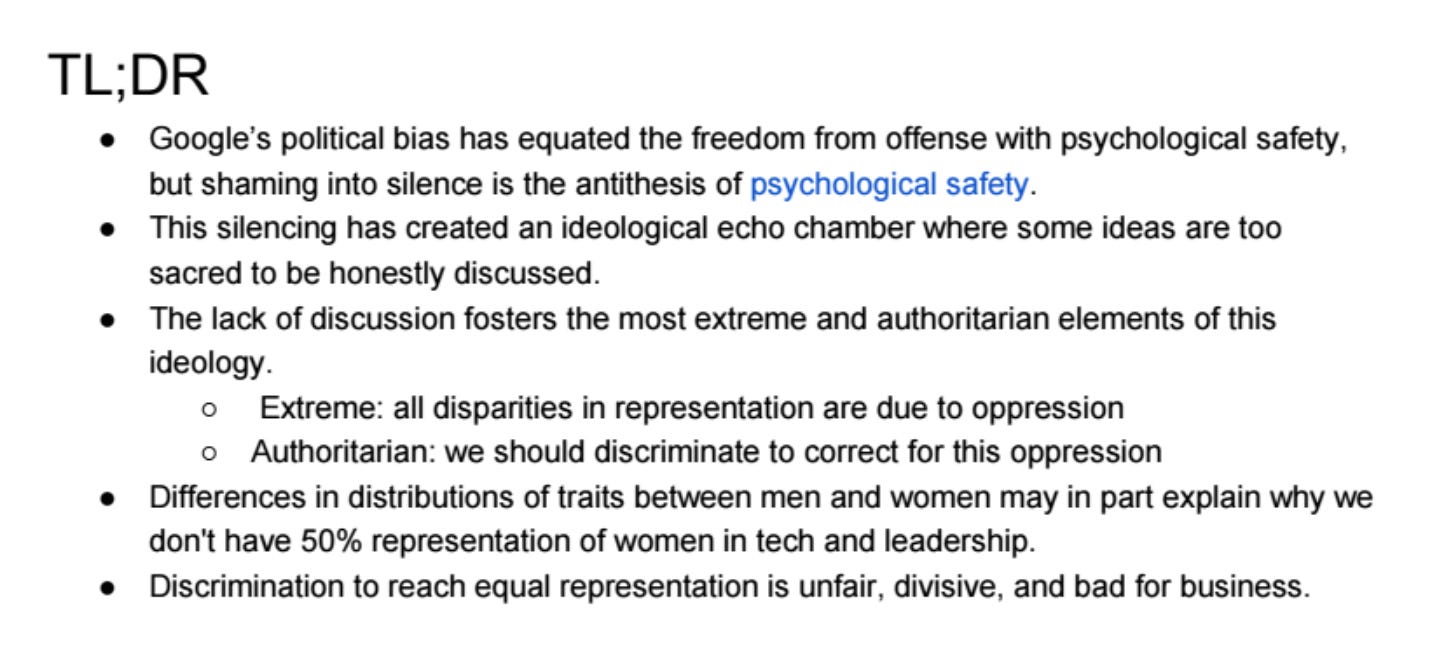
A few years ago, a software engineer at Google named James Damore published an internal memo—in response to a mandatory diversity training program he attended—titled “Google’s Ideological Echo Chamber”.
Damore, by all conceivable metrics the kind of competent, curious engineer that tech companies pay mountains of money to retain, made the unforgivable mistake of essentially asking: “Hey, what if Reality—and not targeted misogyny—accounts for the fact that more men than women work in tech? Also, why does it feel like I could get fired for asking this?”
A screenshot of Damore’s own tl;dr at the beginning of the memo.
He was, of course, fired less than three months later for “[advancing] incorrect assumptions about gender” and for raising a perspective that “is not a viewpoint that I or this company endorses, promotes, or encourages,” said Danielle Browne, Google’s VP of Diversity, Integrity, and Governance.
——
The Vibe Shift I’m talking about is the speaking of previously unspeakable truths, the noticing of previously suppressed facts. I’m talking about the give you feel when the walls of Propaganda and Bureaucracy start to move as you push; the very visible dust kicked up in the air as Experts and Fact Checkers scramble to hold on to decaying institutions; the cautious but electric rush of energy when dictatorial edifices designed to stifle innovation, enterprise, and thought are exposed or toppled.
Fundamentally, the Vibe Shift is a return to—a championing of—Reality, a rejection of the bureaucratic, the cowardly, the guilt-driven; a return to greatness, courage, and joyous ambition.
When just papered over the festering rot of systems that are same structures, policies, culture, and in many cases people who brought us here. Why would one expect any difference in outcome?
We lied to each other. We lied to Congress. We lied to the world. From Arkansas to AUKUS, this moment will have impact.
Eventually the music will stop. We are now on the second generation of leaders who have been happy to ignore this systemic failure of performance as if it is a force of nature to endure, and not a creation of man that can be changed.
If you are waiting for the uniformed leadership to speak clearly on this, you simply have not been paying attention.
If you think the Executive Branch leadership will address this, you have not been awake the last 26-months.
The only solution to this wholesale institutional failure will be in Congress. It will need the will, power, and wisdom to do what Alexander did in Gordium, and be content to do it making no friends, and receiving no personal benefit or fame.
A federal judge tore into the Justice Department on Friday for blowing off Hunter Biden-related subpoenas issued in the impeachment probe of his father, President Joe Biden, pointing out that a former aide to Donald Trump is sitting in prison for similar defiance of Congress.
U.S. District Judge Ana Reyes, a Biden appointee on the federal District Court in Washington, spent nearly an hour accusing Justice Department attorneys of rank hypocrisy for instructing two other lawyers in the DOJ Tax Division not to comply with the House subpoenas.
Northland College in Ashland declared a financial emergency on Thursday, buying another two weeks to raise enough funds and make changes to avoid closure.
On March 12, college leaders announced the campus needed to raise $12 million by April 3 to avoid closing its doors, saying it had insufficient resources to continue operations. Since then, the college has raised around $1.5 million from more than 900 donations.
The Northland Board of Trustees voted to declare financial exigency, which means the financial crisis requires immediate steps to resolve. Now, they plan to make a final decision in two weeks. Ted Bristol, the board’s chair, told WPR the decision came in response to the extraordinary effort of the community, faculty, staff and others.
“We really wanted to take another look at our options, and we were also, frankly, deeply reluctant to make a decision to close,” Bristol said. “During the past three weeks, we recognize this widespread commitment to help, and we decided that we really wanted to explore this further to see if there still might be a path forward.”
In truth, the crisis was a collision of multiple issues: racial tension, union power, the respectful treatment of queer and trans kids, and the place of religion in schools—not to mention the aftermath of the covid-19 pandemic and what it has done to the fabric of civic life in the U.S. The public schools in Amherst were slow to return to pre-pandemic normalcy; they reopened for a mix of in-person and remote learning in April, 2021, only after they were forced to by the state of Massachusetts. “We had physicians, psychiatrists, social workers, and parents writing to us in despair about the impact that remote learning was having on the emotional and mental health of the children in our community,” Allison Bleyler McDonald, a former school-committee member, told me. Leaders of the Amherst teachers’ union “refused to even speak to us about the possibility of opening up schools and classrooms,” she said.
Talking to people in town, one gets the sense that the discord of that period has never fully gone away. “Things really ramped up with covid,” Ben Herrington, who is also a former member of the school committee, told me. “The language changed. People became comfortable with being blatantly hostile. We were no longer having normal conversations.” Several people told me about an incident from the fall of 2021, when the school committee approved a policy that would have allowed some unvaccinated staffers into school provided that they wore masks. In response, McDonald said, the union’s president at the time, Lamikco Magee, “accused us of wanting to inflict genocide on teachers.” (Magee denies invoking genocide.)
The ongoing fight in Amherst seems to press against every bruise that public schools have sustained in recent years, and the continued fallout—multiple investigations, resignations, a persistent leadership vacuum in the schools—doesn’t inspire confidence in our collective capacity to work through the inevitable frictions of a pluralistic society. Even in a liberal and largely affluent district, certain conflicts and tensions have come to feel irresolvable. As one person I spoke to in town told me, “The left is eating its own all over the country—it’s not just Amherst.”
All those things happened in 1894. If you think people hate “tech billionaires” now: they reallyhated railroad executives back then. The hatred exploded into riots when the strike happened. Railroad workers all over the country refused to allow any train with Pullman cars to run, and the railroads refused to break their contracts with Pullman and eliminate them. The rail barons also wanted to maintain ranks against the American Railway Union. Eugene Debs tried to escalate even further and call a general strike of all labor, everywhere. That didn’t happen.
The Government’s Response
The US Attorney General, Richard Olney, said the country was on “the ragged edge of anarchy.” Imagine if the Internet went down for weeks: that’s what railroads meant in late 19th Century America. The Pullman strike disrupted the entire country, but in the end it was defeated completely, and its leader, Eugene Debs, went to jail.
George Pullman refused to even meet with the union, let alone accede to their demand for arbitration, despite the appeals of the Mayor of Chicago and the Governor of Illinois. Somehow he got away with it and the strike failed. Nowadays, we have the National Labor Relations Board, political leaders routinely mediate disputes, and unions are a fact of life. Back then, there was none of that. Arguably, the failed Pullman strike was a leading cause of the labor reforms in the 1930’s, although Eugene Debs died too soon to see them.
Google has agreed to delete billions of records and submit to some restrictions on its power to track users, under the terms of a proposed legal settlement.
The deal aims to resolve a class action lawsuit brought in the US in 2020, which had accused the tech giant of invading people’s privacy by collecting user data even when they were browsing in “private mode”.
Meanwhile, average hourly earnings in the US have increased 21% over the past 4 years (+4.9% per year). Why many Americans feel like they’re falling behind.
Robert F. Kennedy Jr on the DNC Paying Homeless People to Protest Outside His Event
“I was very happy today to see the protesters outside. When our staff interviewed them they said, ‘Yeah, we were all paid to be here.’ And their posters were all written by the same guy…But I’m glad because I’m glad that the DNC and the White House are finally doing something to help poor people in this country.”
Rapid relative wage growth at the bottom of the distribution reduced the college wage premium and counteracted nearly 40% of the four-decade increase in aggregate 90-10 log wage inequality. Wage compression was accompanied by rapid nominal wage growth and rising job-to-job separations—especially among young non-college (high school or less) workers. Comparing across states, post-pandemic labor market tightness became strongly predictive of real wage growth among low-wage workers (wage-Phillips curve), and aggregate wage compression. Simultaneously, the wage-separation elasticity—a key measure of labor market competitionrose among young non-college workers, with wage gains concentrated among workers who changed employers. Seen through the lens of a canonical job ladder model, the pandemic increased the elasticity of labor supply to firms in the low-wage labor market, reducing employer market power and spurring rapid relative wage growth among young noncollege workers who disproportionately moved from lower-paying to higher-paying and potentially more-productive jobs.
The Supreme Court heard oral arguments last month in the momentous case of Murthy v. Missouri. At issue is the constitutionality of what government authorities did to censor speech that departed from preferred narratives.
Justice Ketanji Brown Jackson posed a hypothetical to Louisiana Solicitor General J. Benjamin Aguiñaga: “Suppose someone started posting about a new teen challenge that involved teens jumping out of windows at increasing elevations. . . . Kids all over the country start doing this. There is an epidemic. Children are seriously injuring or even killing themselves in situations. Is it your view that government authorities could not declare those circumstances a public emergency and encourage social media platforms to take down the information that is instigating this problem?”
America needs more plumbers, and Gen Z is answering the call.
Long beset by a labor crunch, the skilled trades are newly appealing to the youngest cohort of American workers, many of whom are choosing to leave the college path. Rising pay and new technologies in fields from welding to machine tooling are giving trade professions a face-lift, helping them shed the image of being dirty, low-end work. Growing skepticism about the return on a college education, the cost of which has soared in recent decades, is adding to their shine.
Enrollment in vocational training programs is surging as overall enrollment in community colleges and four-year institutions has fallen. The number of students enrolled in vocational-focused community colleges rose 16% last year to its highest level since the National Student Clearinghouse began tracking such data in 2018. The ranks of students studying construction trades rose 23% during that time, while those in programs covering HVAC and vehicle maintenance and repair increased 7%.
“It’s a really smart route for kids who want to find something and aren’t gung ho on going to college,” says Tanner Burgess, 20, who graduated from a nine-month welding program last fall.
There is no credible evidence that puberty blockers function as suicide-prevention measures. Finland’s top gender clinician has called the suicide narrative “purposeful disinformation” and “dangerous.” For all these reasons, health authorities in a growing number of countries, including some of the most LGBT-friendly, are now prioritizing talk therapy.
I am hoping you can set the stage. In general terms, what is happening at Boeing?
Insider: At its core, we have a marginalization of the people who build stuff, the people who really work on these planes.
In 2018, the first 737 MAX crash that happened, that was an engineering failure. We built a single-point failure in a system that should have no single-point failures. The second crash that followed—we cannot say this from a legal standpoint, with the FAA—looked like pilot error. But, in any case, a company cannot survive two crashes from a single aircraft type. Then-CEO Dennis Muilenburg defended the company in front of Congress, defended the engineering, defended the work—and that protected the workforce, but it also prodded the board and stoked public fear, which resulted in a sweeping set of changes that caused huge turnover in talent.
So, right now, we have an executive council running the company that is all outsiders. The current CEO is a General Electric guy, as is the CFO whom he brought in. And we have a completely new HR leader, with no background at Boeing. The head of our commercial-airplanes unit in Seattle, who was fired last week, was one of the last engineers in the executive council.
The headquarters in Arlington is empty. Nobody lives there. It is an empty executive suite. The CEO lives in New Hampshire. The CFO lives in Connecticut. The head of HR lives in Orlando. We just instituted a policy that everyone has to come into work five days a week—except the executive council, which can use the private jets to travel to meetings. And that is the story: it is a company that is under caretakers. It is not under owners. And it is not under people who love airplanes.
In this business, the workforce knows if you love the thing you are building or if it’s just another set of assets to you. At some point, you cannot recover with process what you have lost with love. And I think that is probably the most important story of all. There is no visible center of the company, and people are wondering what they are connected to.
…
DEI is the drop you put in the bucket, and the whole bucket changes. It is anti-excellence, because it is ill-defined, but it became part of the culture and was tied to compensation. Every HR email is: “Inclusion makes us better.” This kind of politicization of HR is a real problem in all companies.
If you look at the bumper stickers at the factories in Renton or Everett, it’s a lot of conservative people who like building things—and conservative people do not like politics at work.
The radicalization of HR doesn’t hurt tech businesses like it hurts manufacturing businesses. At Google, they’re making a large profit margin and pursuing very progressive hiring policies. Because they are paying 30 percent or 40 percent more than the competition in salary, they are able to get the top 5 percent of whatever racial group they want. They can afford, in a sense, to pay the “DEI tax” and still find top people.
Eva Edl, Eva Zastrow, James Zastrow, and Paul Place had charges brought against them for being part of a peaceful protest on March 5, 2021. They gathered on the second floor of an office building in the hallway outside the Carafem Health Center Clinic. The group prayed, sang hymns, and urged women showing up to the clinic to not get abortions.
It seems as though Edl, the Zastrows and Place violated the FACE Act (Freedom of Access to Clinic Entrances) of 1994. They face up to a year in prison and thousands of dollars of fines. Their sentencing is on July 30, 2024.
$1 million to build “a network of intergenerational, trauma-informed waterfront green spaces,” won by Rep. Ayanna Pressley (D-Mass.). The project had previously won $792,000 more in a 2022 earmark. Do we ask the obvious? How exactly does trauma dictate a park design?
$1 million for the San Antonio College Empowerment Center, which runs an Undocumented Student Support Program to help immigrants enroll in the school. The sponsor is Rep. Greg Casar (D-Texas), who is closer to the illegal immigration crisis than most, but wants to create a college education magnet for them.
$850,000 to create jobs and affordable housing near George Floyd Square in Minneapolis, won by Rep. Ilhan Omar (D-Minn.). The square was reportedly a “no-go” zone for police amid the riots following Floyd’s death. Now, Omar saysthat “added to the stress faced by the community and increased the need for support and stability in housing and commerce.” In other words, federal taxpayers need to step in and clean up the damage.
Following last week’s 2 a.m. passage of the final six spending bills for this year, the Squad’s total ticked up from $218 million to $224.1 million—all borrowed against our enormous national debt. The two “minibus” packages this month alone contained 215 earmarks from these eight individuals.
Prices for hundreds of grocery items have increased more than 50% since 2019 as food companies raised their prices. Executives have said that higher prices were needed to offset their own rising costs for ingredients, transportation and labor. Some U.S. lawmakers and the Biden administration have criticized food companies for using tactics such as shrinkflation, in which companies shrink their products—but not their prices.
Home of America’s most progressive policies, from criminal justice to vehicle emissions, California serves a unique role as a punchbag for right-wing politicians. Every few years it becomes fashionable to declare that it is a failed state, or that the California dream is turning into a nightmare. This rhetoric is often overblown: in terms of pure economic heft California remains the most powerful American state. But for all its continuing prowess in innovation (not least in artificial intelligence), California again appears to be entering one of its periodic rough patches.
The state faces three overlapping challenges: rising unemployment, growing fiscal strains and population outflows. All of these should abate over time, but for now they mark out California as a pocket of relative weakness in an otherwise robust American economy.
Pressure is mounting on two universities to change the way they train on-the-job educators to teach reading.
The Ohio State University in Columbus and Lesley University near Boston both run prominent literacy training programs that include a theorycontradicted by decades of cognitive science research. Amid a $660 million effort to retrain teachers that’s underway in 36 states, other academic institutions are updating their professional development. Yet Ohio State and Lesley are resisting criticism and standing by their training.
For decades, their Literacy Collaborative programs deemphasized teaching beginning readers how to sound out words. These programs do cover some phonics, but they also teach that students can use context clues to decipher unfamiliar words. Studies have repeatedly shown that guessing words from context is inefficient, unreliable and counterproductive. Twelve states have effectively banned school districts from using that flawed approach.
The approach, sometimes called “cueing,” originated in the 1960s in the United States and New Zealand, and was popularized in American reading instruction by Gay Su Pinnell and Irene Fountas, professors at the two universities. Pinnell, who is now retired, founded OSU’s Literacy Collaborative, and Fountas founded and still directs Lesley’s Center for Reading Recovery & Literacy Collaborative.
As if they took a cue from @FountasPinnell, @OhioState won’t speak publicly, lucky for us @lesley_u took their cue from Calkins and shared their adoration for @rrcna_org and how they haven’t altered how they teach future teachers how to read, but rather how teach them to be “politically savvy.”
Fascinating maps of referendum results! Support for the referendum was moderately correlated with race (won in most majorty white wards) but even more strongly correlated with (not) having kids. In wards where 20% or less of residents have children, the referendum overwhelmingly passed with ~2/3 of the vote. Wards where more than 40% have kids? Lost by nearly 5 points.
In other words, the referendum was most popular in the parts of the city with the fewest children, and in the parts of the city with the most white, affluent residents.
I know most here are happy about the referendum-I myself voted “yes.” Regardless, these figures do say a lot – and if you’re not thinking long and hard about the implications and the work/listening we have to do going forward to best serve our Milwaukee community…l’d ask yourself why that is.
Referendum vote by the share of households wit lose size corresponds to the number of votes cast.
Sen. Larson leaves out a key out key point that makes his message misleading: school districts also get local funding. This takes the per pupil amount above the average voucher ($10,573) in every district. Below is the pupil spending in all districts. All are above voucher.
A relatively new report outlines how universities nationwide have signed over students’ private FERPA data to a third-party vendor that reviews their personal information to help study college students’ voting trends.
The nine-page report describes how a national voting study run out of Tufts’ Institute for Democracy in Higher Education gets university administrators from across the country to agree to release students’ Family Educational Rights and Privacy Act, or FERPA, enrollment data from the National Student Clearinghouse, where its kept, to a voter data company.
“This is an extraordinary violation of student privacy and is not consistent with FERPA,” said Heather Honey, an investigator with Verity Vote, in a recent interview with The College Fix.
Verity Vote is an organization that works to ensure government transparency, including election integrity issues, she said, and published its findings on the student voting issue in July 2023.
At issue is Tufts’ institute’s National Study of Learning, Voting, and Engagement, launched during the Obama administration in response to a “call to action,” the report states.
Last week, I did something unorthodox. I asked teachers to message me directly via X (formerly known as Twitter) to vent their frustrations. Within hours, I received almost 200 messages expressing not only frustration, but also hope, humor, fatalism, and quite a bit of hesitancy to converse with a complete stranger on the internet. Without a doubt, these messages represent a very thin slice of the teaching workforce, but a thin slice supplies at least a taste of the whole pie.
Responses ranged from expected complaints about low pay to idiosyncratic observations about processed school breakfasts. Teachers have a lot on their minds. That few mentioned politics surprised me. Considering I aimed my invitation to conservative teachers specifically, I expected laments over liberal dogma and progressive pieties to abound. And certainly, some teachers mentioned such things, but these were a minority.
Instead, one theme surfaced over and again, illustrated by these two examples:
“Our school isn’t safe. The energy in the hallways feels like something is going to happen at any moment. Fights are constant with little consequence.”
“We allow behavior that would not be acceptable in any public square. Teachers are cussed out, threatened, disrespected with no consequences. The general public doesn’t understand the crisis we are in. It’s embarrassing. It’s tragic.”
After hours spent reading through these lamentations and conversing with some of the teachers who sent them, it seems there’s a deeper issue here than a mere lack of consequences. Students lack accountability of any kind. Teachers face an ever-mounting list of responsibilities and pressures, while students face ever fewer.
That Ehrlich made a bundle on wrong predictions isn’t such a big deal — we’ve had dozens of doomsaying futurists who’ve cashed in on fears that never materialized.
The problem is people listened to him.
Across the world, governments adopted population-trimming policies, from massively subsidized birth control to promoting two-worker households to China’s draconian “one child” policy, in which each couple was allowed only one child.
That has left China with crippling demographic problems just as it hopes to burst forth as a superpower on the global scene; it’s now trying to encourage people to have more babies, as its leadership realizes it’s hard to be a superpower when your military-age population is shrinking (and, as only children, too valued by their parents to safely be employed as cannon fodder), your elderly population is growing and your society is stagnating.
Debt is rising more quickly in the United States than most people would prefer. This is happening in part because the U.S. current account deficit and the country’s high level of income inequality distort the structure and amount of American savings.
Many Americans are worried about the seemingly inexorable rise in U.S. debt, whether government debt, household debt, or business debt. They are right to be concerned. Rapidly rising debt is a problem not just in the United States but in many other countries too, including China, parts of Europe, and most of the developing world. In today’s environment, it seems, reasonable levels of economic growth cannot be achieved unless boosted by even faster growth in debt.
With so much debt in the world, and with debt levels rising so quickly, people tend to think that economists have studied this issue deeply and fully understand it. But there continues to be a great deal of confusion about debt and about whether and why excessive debt levels can harm growth prospects. To try to address these issues, this blog post is divided into two parts. The first part discusses debt and some of the conditions under which it affects the prospects for economic growth.
——
The article quotes Yellen as saying: “People like me grew up with the view: If people send you cheap goods, you should send a thank-you note. That’s what standard economics basically says,” she said. “I would never ever again say, ‘Send a thank-you note.’ ”
But what if I told you that the people in the political and media classes are the ones who are polarized—in fact, they are the onlyones who are so polarized?
This is obvious to most Americans, even—perhaps especially—to those who have neighbors or friends or colleagues who vote differently than they do. Regular Americans know we are more united than divided on the issues that are supposedly tearing us apart.
Democrats portray conservatives as characters out of The Handmaid’s Tale, and Republicans portray liberals as “baby killers.” Yet two-thirds of Americans agree that abortion should be rare and also legal.
Democrats like to tell us that Republicans are gung ho on school shootings, and Republicans are fond of saying Democrats want to steal our guns. Yet 61 percent of usbelieve that the Second Amendment should stand, but it’s too easy to get a gun.
Democrats tell us Republicans hate gays and Republicans tell us that Democrats want every child to be queer. Yet average Americans believe that sex is determined at birth and that trans people should be protected from discrimination, though when it comes to sports, trans people should compete on teams that match the sex they were born with. This is how six in ten of us feel.
The partisan claims of a polarized America ring especially false to working-class Americans. This is because—unlike the college-educated elites who run the country—they don’t identify with the full list of policy proposals produced by either party.
In a mandatory course on “structural racism” for first-year medical students at the University of California Los Angeles, a guest speaker who has praised Hamas’s Oct. 7 attack on Israel led students in chants of “Free, Free Palestine” and demanded that they bow down to “mama earth,” according to students in the class and audio obtained by the Washington Free Beacon.
Lisa “Tiny” Gray-Garcia, who has referred to the Oct. 7 terrorist attacks as “justice,” began the March 27 class by leading students in what she described as a “non-secular prayer” to “the ancestors,” instructing everyone to get on their knees and touch the floor—”mama earth,” as she described it—with their fists.
At least half of the assembled students complied, two students said. Gray-Garcia, a local activist who had been invited to speak about “Housing (In)Justice,” proceeded to thank native tribes for preserving “what the settlers call L.A.,” according to audio obtained by the Free Beacon, and to remind students of the city’s “herstory.”
The prayer also included a benediction for “black,” “brown,” and “houseless people” who die because of the “crapatalist lie” of “private property.”
“Mama earth,” Gray-Garcia told the kneeling students, “was never meant to be bought, sold, pimped, or played.”
So began a long and looney lecture that shocked some students at the elite medical school and has led to calls for an investigation. Wearing a keffiyeh that covered her entire face, Gray-Garcia, a self-described “poverty scholar,” led the class in chants of “Free, Free Palestine” as faculty and staff looked on in silence, according to people in the course and contemporaneous text messages reviewed by the Free Beacon.
As an agnostic, I have spent most of my life thinking about the decline of faith in America in mostly positive terms. Organized religion seemed, to me, beset by scandal and entangled in noxious politics. So, I thought, what is there really to mourn? Only in the past few years have I come around to a different view. Maybe religion, for all of its faults, works a bit like a retaining wall to hold back the destabilizing pressure of American hyper-individualism, which threatens to swell and spill over in its absence.
More than one-quarter of Americans now identify as atheists, agnostics, or religiously “unaffiliated,” according to a new survey of 5,600 U.S. adults by the Public Religion Research Institute. This is the highest level of non-religiosity in the poll’s history. Two-thirds of nonbelievers were brought up in at least nominally religious households, like me. (I grew up in a Reform Jewish home that I would describe as haphazardly religious. In kindergarten, my parents encouraged my sister and me to enthusiastically celebrate Hanukkah—and, just as fervently, to believe in Santa Claus.) But more Americans today have “converted” out of religion than have converted to all forms of Christianity, Judaism, and Islam combined. No faith’s evangelism has been as successful in this century as religious skepticism.
Never miss a story. Start your free trial.
Uncompromising quality. Enduring impact. Your support ensures a bright future for independent journalism.
America’s national debt is skyrocketing to historic levels, as the partisan divide over how much voters care about the issue is greater than ever.
By the end of fiscal 2025, federal debt held by the public will add up to $29.7 trillion, the Congressional Budget Office reports, exceeding America’s gross domestic product.
National debt is a responsibility shared by both of the presidential candidates, yet it’s much more of a concern for Republicans than Democrats, at least according to one recent survey.
In the US, nonprofits’ assets have grown 16-fold since 1980. In 2020, nonprofits brought in $2.62 trillion in revenues, constituting more than five per cent of the US economy. Ironically, foundations that are funded with the great fortunes of Henry Ford, John D Rockefeller and John D MacArthur, all right-wing figures, have become some of the key financiers of ‘progressive’ causes.
Long before Gmail became smart enough to finish your sentences, Google’s now-ubiquitous email service was buttering up the public for a fate that defined the internet age: if you’re not paying for the product, you are the product.
When Gmail was announced on April 1, 2004, its lofty promises and the timing of its release reportedly had people assuming it was a joke. It wasn’t the first web-based email provider — Hotmail and Yahoo! Mail had already been around for years — but Gmail was offering faster service, automatic conversation grouping for messages, integrated search functions and 1GB of storage, which was at the time a huge leap forward in personal cloud storage. Google in its press release boasted that a gigabyte was “more than 100 times” what its competitors offered. All of that, for free.
Except, as Gmail and countless tech companies in its wake have taught us, there’s no such thing as free. Using Gmail came with a tradeoff that’s now commonplace: You get access to its service, and in exchange, Google gets your data. Specifically, its software could scan the contents of account holders’ emails and use that information to serve them personalized ads on the site’s sidebar. For better or worse, it was a groundbreaking approach.
“Depending on your take, Gmail is either too good to be true, or it’s the height of corporate arrogance, especially coming from a company whose house motto is ‘Don’t Be Evil,’” tech journalist Paul Boutin wrote for Slate when Gmail launched. (Boutin, one of its early media testers, wrote favorably about Google’s email scanning but suggested the company implement a way for users to opt out lest they reject it entirely.)
Editor’s Note: This is an updated version of an article from Dec. 15, 2009, written shortly after Dr. Borlaug passed away. It features a new introduction and is written to honor the man who would have been 110 years old on March 25, 2024.
In the winters, I spend my time officiating high school wrestling. Last year, while going through my pre-meet duties, I noticed a wrestler with the last name Borlaug. I asked him if he knew who Norman Borlaug was and was delighted to learn that wrestler was his great-nephew.
The coach of Borlaug’s great nephew, a high school civics and history teacher, overheard our conversation and asked, “Who’s Norman Borlaug?”
That’s a typical response whenever I mention him. In fact, I didn’t learn of him until after completing my college degree. It’s a shame how few people know the name or the remarkable achievements of the man who took action to feed the world’s population at a time when much of the scientific establishment believed we were on the verge of an inevitable global famine.