School Information System

k-12 tax & $pending climate: “At $172 billion,* Illinois has the nation’s biggest pension shortfall by far”

Ted Dabrowski and John Klingner:
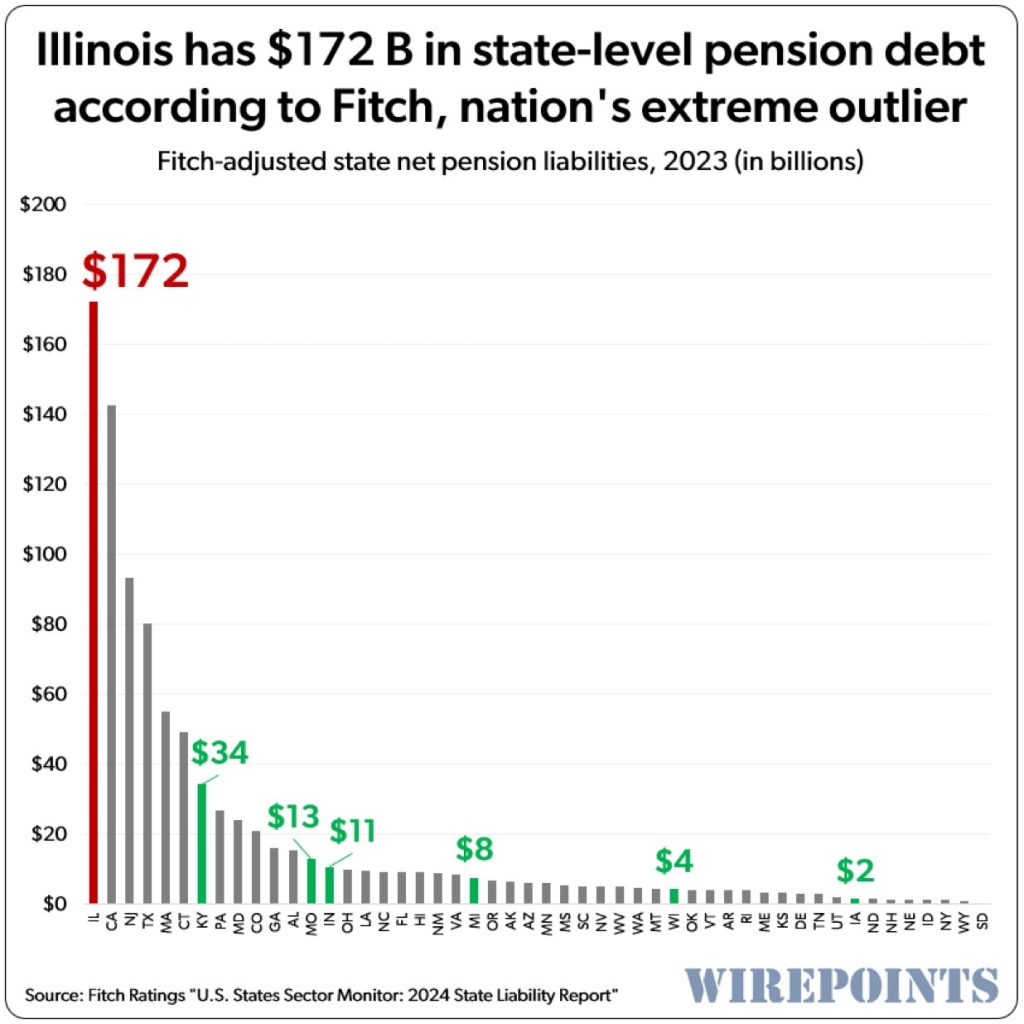
It’s the only reasonable conclusion. Illinois politicians who continue to oppose pension reform via a constitutional amendment should be booted from office. The latest state-by-state pension report from Fitch Ratings demonstrates why. 

At $172 billion,* Illinois has the nation’s biggest pension shortfall by far, the agency says. Fitch also calculates that Illinois’ pension debt as a share of its economy is the largest in the country. Either way, Illinois is the nation’s extreme outlier.

To get an idea of just how out of whack Illinois is, consider the pension shortfalls of its neighbors. Indiana’s is just $11 billion. Michigan’s, $8 billion. Wisconsin’s, $4 billion. Iowa’s, $2 billion.
Share

“Vanquishing Washington’s bloated education bureaucracy will be a knock-down drag-out fight that Ms. McMahon may be well-suited for”

Wall Street Journal:

The Biden Administration has effectively turned the Education Department into an arm of the teachers unions and cultural left. Ms. McMahon’s top priorities will be ending student loan write-offs, rolling back the department’s Title IX regulation, devolving school control to the states and promoting alternative education pathways.

Start with stanching red ink in the $1.6 trillion federal student loan program. The Biden team has unilaterally canceled more than $175 billion in debt, which doesn’t include the cost of its pandemic forbearance and SAVE plan. The latter eliminates payments for four million borrowers and reduces them for others by hundreds of dollars a month.

The Congressional Budget Office estimates that about 25% of student debt disbursed over the next decade will be written off mainly because of the SAVE and Obama income-based repayment plans. While federal courts have put the SAVE plan on hold, the Biden team has suspended required payments for eight million borrowers already enrolled.

Scrapping the SAVE plan and requiring borrowers to resume making payments will no doubt provoke an outcry on the left. But the free lunch can’t continue forever, and it’s unfair to Americans who didn’t attend college or repaid their loans. More young Americans are deciding college isn’t worth it, and why should they have to subsidize degrees in community organizing?

Share

Civics: “Nonprofits Are Making Billions off the Border Crisis”

Madeleine Rowley

“The amount of taxpayer money they are getting is obscene,” Charles Marino, former adviser to Janet Napolitano, the secretary of the Department of Homeland Security under Obama, said of the NGOs. “We’re going to find that the waste, fraud, and abuse of taxpayer money will rival what we saw with the Covid federal money.”

The Free Press examined three of the most prominent NGOs that have benefited: Global Refuge, Southwest Key Programs, and Endeavors, Inc. These organizations have seen their combined revenue grow from $597 million in 2019 to an astonishing $2 billion by 2022, the last year for which federal disclosure documents are available. And the CEOs of all three nonprofits reap more than $500,000 each in annual compensation, with one of them—the chief executive of Southwest Key—making more than $1 million.

Share

1 dataset 100 Visualizations

Dataviz

Can we come up with 100 visualizations from one simple dataset?

As an information design agency working with data visualization every day, we challenged ourselves to accomplish this using insightful and visually appealing visualizations.

We wanted to show the diversity and complexity of data visualization and how we can tell different stories using limited visual properties and assets.

Share

“4 in 10 Chicago Public Schools teachers were ‘chronically absent’ last year from a job with a median salary of $95,000”

Chicago Tribune:

By any measure, Chicago Public Schools teachers are extraordinarily well paid given the norms of their profession.

The median salary for a CPS teacher is nearly $95,000. That’s 21% more than teachers make in Cook County’s suburbs, where median pay is $78,000. What’s more, CPS says it pays its teachers more than any other large school district in the nation, and that’s before whatever increases they get in union contract negotiations that are ongoing.

The Chicago Teachers Union continues to demand 9% annual raises, an outlandish ask, and is growing ever more shrill as CPS CEO Pedro Martinez and his administration try to hold the line on behalf of Chicago’s beleaguered taxpayers and in the face of heavy pressure from Mayor Brandon Johnson to give CTU everything it wants. The impasse is headed next month for a neutral fact-finder, who will hear both sides out and produce a report in January.

These are the first steps toward a potential teachers strike, which could occur as soon as February.

——-

John Arnold:

Chicago teachers get 78 days off and yet 41% are deemed chronically absent for missing 10+ days of work. With median pay of $95k (2nd highest in country), demands for 9% annual raises, and lousy outcomes, even the Chicago Tribune editorial board is fed up.

——-

Meanwhile, Milwaukee:

“Maybe it has to broken apart. Maybe we have to have somebody take it over. Maybe we have to do something dramatically different, because what they’re doing now certainly doesn’t seem to be working.” – Speaker Robin Vos on Milwaukee Public Schools (MPS)

Share

School Predator Teacher Data

Google sheet.

more.

Share

Archaeological findings suggest alphabetic writing may be some 500 years older than other discoveries 

Hannah Robbins

What appears to be evidence of some of the oldest alphabetic writing in human history is etched onto finger-length, clay cylinders excavated from a tomb in Syria by a team of Johns Hopkins University researchers.

The writing, which is dated to around 2400 BCE, precedes other known alphabetic scripts by roughly 500 years, upending what archaeologists know about where alphabets came from, how they are shared across societies, and what that could mean for early urban civilizations, according to the researchers.

“Alphabets revolutionized writing by making it accessible to people beyond royalty and the socially elite. Alphabetic writing changed the way people lived, how they thought, how they communicated,” said Glenn Schwartz, a professor of archaeology at Johns Hopkins University who discovered the clay cylinders. “And this new discovery shows that people were experimenting with new communication technologies much earlier and in a different location than we had imagined before now.”

Share

What are we paying for in teacher training?

Greg Ashman:

From October 20 to November 4, 2024, I ran a Google Forms survey about teacher training. I promoted this survey via my own social media accounts on SubstackXFacebook and LinkedIn. The survey collected no names, email addresses, dates of birth or any other key identifying data. Instead, it asked participants about their experiences training. Overall, there were 1045 responses of which 378 were from those who stated they trained in Australia and 143 were from those who stated they trained in Australia from 2014 onwards. I wanted to see how the Australian experience compared with the experience worldwide on a number of issues. I was also interested to find out whether the situation had changed in recent years.

I anticipate this being the first of a few posts on the topic and I only intend to present initial highlights here. I probably have enough responses from England to analyse those separately. There are also some questions specific to primary education that I will not report on in this post.

This is not meant to be a piece of peer-reviewed research, just a survey of my various groups of followers and their networks. I have not tried to compute margins of error or any other such statistics because the data is probably not rigorous enough to justify such an analysis.

Learning styles

I asked respondents whether they recalled learning styles being discussed during the university component of their course. 69% of all those surveyed recalled learning styles being discussed and 72% of those who stated they were trained in Australia recalled learning styles being discussed. Of those who stated they were trained in Australia in the last ten years, 83%recalled learning styles being discussed.

Is this a concern or a good thing? Learning styles are a classic neuromyth. Although people will express a preference to learn via one particular mode or another, a review of the educational psychology literature does not support the idea of tailoring teaching to specific learning styles. So, it could be a good thing if all these teacher training courses were discussing learning styles as an example of a myth about teaching.

Share

Stanford expert on ‘lying and technology’ accused of lying about technology

Stephen Council

In an bizarre twist, a Stanford University expert who studies misinformation appears to have created some of his own — while under oath.

Is this SF restaurant’s $180 11-course dining experience worth it?

On Nov. 1, Jeff Hancock, a well-known and oft-cited researcher who leads the Bay Area school’s Social Media Lab, filed an expert declaration in a Minnesota court case over the state’s new ban on political deepfakes. Republicans have sued to block the ban, arguing it’s an unconstitutional limit on free speech. Hancock defended the law in his declaration, explaining how artificial intelligence makes it easier to fabricate videos and discussed deepfakes’ psychological impacts. But he seems to have made an ironic mistake.

Hancock cited 15 references in his declaration, mostly research papers related to political deepfakes and their impacts. Two of the 15 sources do not appear to exist. The journals he cites are real, as are some of the two citations’ authors, but journal archivesshow no sign of either paper. The actual journal pages referenced by Hancock have different articles. SFGATE was unable to find the cited papers on Google Scholar, either. 

Share

notes on Minnesota DFL and school choice

Sara Spafford Freeman:

Got a read out from Rep Long’s meeting w/MPS & NONE of this is going to happen. But the DFL is poised to abolish school choice, so they’ve officially lost the plot on public ed. We save this system by INVESTING in it, not by limiting families’ choices – is a hill I’ll die on.

Share

“There can be a cost to publishing neurotic, untrue ideas”

Rebecca Ryan:

Research in economics and psychology shows that individuals are sensitive to cues about economic conditions in ways that affect attitudes, beliefs, and behavior. We provide causal evidence that parents’ beliefs about economic mobility prospects shape parental investments of time and money in children. To do so we conduct an on-line information experiment with ~ 1,000 socioeconomically diverse parents of children ages 5-15. The information treatment aimed to manipulate parents’ beliefs in the possibility for future upward (downward) economic mobility in US society. The experimental results yield three conclusions. First, parents are highly sensitive to signals about future economic mobility prospects. Second, parents who are induced to believe in the likely possibility of future upward mobility increase their beliefs about the return on their own investments of time and money. Using a novel measure of time investment we developed, these parents also increase their time investments in the service of boosting children’s skill. Finally, they report being more willing to pay for resources that would boost their child’s skill development. Third, these patterns are true for economically advantaged and disadvantaged families alike. We discuss the implication of these results in terms of reports showing that Americans are losing faith in “The American Dream.”

more.

Share

k-12 Tax & $pending climate: federal debt….

DOGE:

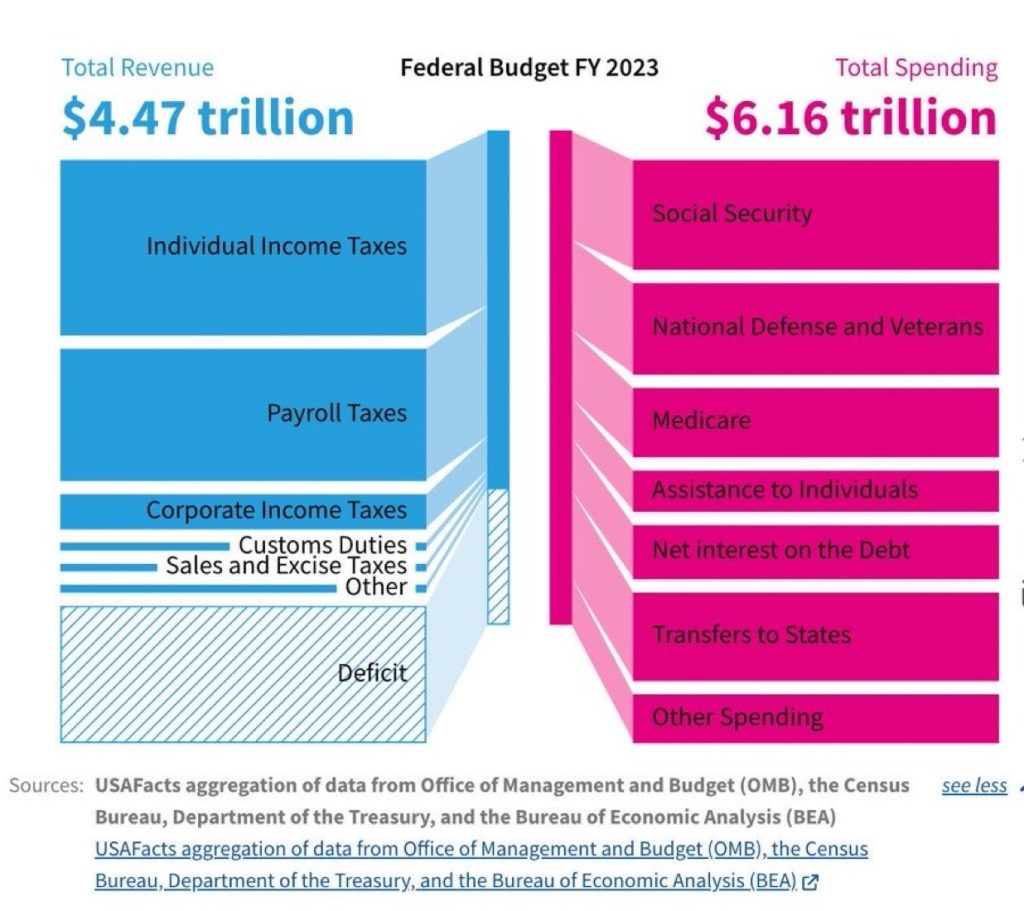
In FY2023, the U.S. Government spent $6.16. trillion while only bringing in $4.47 trillion.

The last budget surplus was in 2001.

This trend must be reversed, and we must balance the budget.

Vivek:

The U.S. government spends 37% more than it makes, with ~$36TN in national debt. Consider the analogy on an individual scale: a family that makes $80k/year while spending $110k, with a $525k mortgage & $35k car loan requiring $30k+/year in interest payments. It’s not sustainable.

Share

Private School Labeler on Bluesky

Simon Willison:

The feature was designed for moderation, but this labeler subverts it by displaying labels on accounts belonging to British public figures showing which expensive private school they went to and what the current fees are for that school.

Share

Civics: “The Cowardice of Modern Journalism”

Mark Judge:

Baron spends a good part of Collision of Power writing about the Kavanaugh nomination. He mentions me when he cites a letter that Blasey Ford had written saying that Kavanaugh “with the assistance of a friend, Mark G. Judge,” had been involved in her assault. 

Had Baron read my book or any of the many columns I’ve written about the ordeal, he would know that even something as small as Ford referring to me as “Mark G. Judge” is a tell. Mark G. Judge was a byline I used when I was a younger journalist. Ford’s casual use of it in that letter suggests that someone was doing opposition research about me and Brett, not referring to someone she actually knew. It’s a small detail, maybe lost in the fact that Ford could not remember the “when” or the “where” of the alleged attack, but it is something Woodward and Bernstein would have noticed.

In my book The Devil’s Triangle, I reveal the opposition researchers Ford was working with, how the idea that she was a “reluctant witness” is a lie, and take The Washington Post apart piece by piece. Baron does not have the integrity to mention a single article I have written on the subject. He does not mention my book. He does heap praise on Emma Brown, the Post reporter who broke the Blasey Ford story. Baron writes: “The Post’s reporter, Emma Brown, had focused single-mindedly on getting the facts right and checking out Ford’s account as best she could under the circumstances at the time.”

Wrong. In The Washington Post piece published by Brown on Sept. 16, 2018, there was also no mention of Leland Keyser. Keyser was a close friend of Ford’s, who Ford claimed was present at the party where the alleged assault took place. Brown omitted Keyser from her story. Kimberly Strassel at The Wall Street Journalnoticed this and asked: “Why is there no mention of Leland Keyser in the official Post piece? Why didn’t Postreporter Emma Brown mention Keyser, who according to Ford was at the party in question?”

On Sept. 22, almost a week later, The Washington Postanswered. From Fox News :

Share

U.S. women are outpacing men in college completion, including in every major racial and ethnic group

Kiley Hurst:

The share of young women with a bachelor’s degree has increased by 22 percentage points since 1995, from 25% to 47%. Over the same period, men have seen a smaller increase (12 points, from 25% to 37%).

2021 Pew Research Center survey asked Americans without a bachelor’s degree why they chose not to seek one – and found some gender differences in the responses. For example, men without a bachelor’s degree were more likely than women to say they just didn’t want to get one. In turn, women without a bachelor’s degree were more likely than men to say they couldn’t afford a four-year degree.

Gender gaps in college completion by race and ethnicity

White, Black, Hispanic and Asian women between the ages of 25 and 34 are all more likely than their male counterparts to have a bachelor’s degree. But some groups have made more gains over time than others.

Share

The Calkins Legacy

Maryellen MacDonald & Mark Seidenberg

Calkins became a lightning rod because she represented the sheer intransigence of educators in the face of evidence that their methods for teaching reading were ineffective and ill-conceived. 

Calkins has now conceded that problems with her approach discussed in Emily Hanford’s Sold a Story were real. The problems were not small ones. Calkins grossly underestimated the extent to which beginning readers need instruction about how print represents sound and meaning. She instead encouraged the strategy of guessing words from context, a slow, error-prone process often employed by poor readers. Calkins erred in taking this as the path to becoming a skilled reader, which made the task more difficult. Her approach was also wholly inadequate in addressing the needs of children who struggle to read because of dyslexia or other conditions that interfere with learning.  

The Calkins curriculum could nonetheless be sufficient for some children: those who were taught basic skills at home, in pre-K, or by a tutor. For such children, any curriculum that didn’t extinguish their interest in reading would suffice. Calkins’ approach was insufficient for the rest, who don’t have the luxury of extra reading instruction outside of school. By failing to provide adequate instruction in school and outsourcing basic skills instruction to the home, the Calkins approach and other Whole Language/Balanced Literacy curricula magnified the impact of socioeconomic factors that underlie “achievement gaps”. 

Share

Sun Prairie principal resigned after investigation into misconduct, school board says

Kyle Jones

Former Sun Prairie East High School Principal Renee Coleman resigned following an investigation into her conduct, the Sun Prairie Area School District Board of Education said Friday.

The third-party investigation, carried out by MWH Law Group’s Attorney Emery Harlan, was initiated following a complaint about Coleman’s conduct in a press box during a staff convocation on Aug. 27.

According to the district, the investigation found that Coleman made inappropriate comments throughout the convocation, “including during the National Anthem, student performance, and speeches.”

Coleman allegedly made inappropriate comments about SPASD Superintendent Brad Saron and used a slur when referring to students performing a dance routine.

——

The money quote from the now-former principal at Sun Prairie East high school: 

“I cannot be fired because I am black.”

Wrong, again, Renee Coleman. (O.K., you were pressured to resign, so as to avoid possible litigation. But the result is the same.)

Share

US News Ranks Five Madison Schools

Abbey Machtig:

Shorewood Hills, Van Hise and Randall elementary schools all scored in the top 30 for their grade level, as did Hamilton Middle School and West High School.

Additionally, Marquette and Stephens elementary schools and Spring Harbor Middle School ranked in the top 10% statewide in their grade levels.

“These recognitions directly reflect our focus on students and commitment to helping them achieve their potential,” Madison School District Superintendent Joe Gothard said in a statement. “The hard work of students and staff across the district helps ensure that learners at all of our schools are best positioned for success in whatever they choose to pursue.”

Share

“ROAD TRIP: The Most Anti-Voucher County in Kentucky (and it voted for Trump 80-20)”

David Pepper:

It lost in all 120 counties. And by 60-40 or worse in all but 9 of those counties. And—it did the worst in Kentucky’s smallestcounty: Robertson County. Population, 2,033 (as of 2023). It lost there 74-26!

Share

TL/DR

Timur Kuran:

For articles in academic journals, the distribution is similar. More than half of all articles are never read by anyone other than the author, the editor, and the journal’s reviewers. And a vast majority of all downloads are for a mere 1% of the articles.

Share

“But no study by that name appears in that journal”

Christopher Ingraham:

At the behest of Minnesota Attorney General Keith Ellison, Hancock recently submitted an affidavit supporting new legislation that bans the use of so-called “deep fake” technology to influence an election. The law is being challenged in federal court by a conservative YouTuber and Republican state Rep. Mary Franson of Alexandria for violating First Amendment free speech protections.

Hancock’s expert declaration in support of the deep fake law cites numerous academic works. But several of those sources do not appear to exist, and the lawyers challenging the law say they appear to have been made up by artificial intelligence software like ChatGPT.

For instance, the declaration cites a study titled “The Influence of Deepfake Videos on Political Attitudes and Behavior,” and says that it was published in the Journal of Information Technology & Politics in 2023. But no study by that name appears in that journal; academic databases don’t have any record of it existing; and the specific journal pages referenced contain two entirely different articles.

Share

Madison Schools Keep Failing

Dave Cieslewicz

To quote a Wisconsin State Journal story on test scores that were released yesterday: “The four specific categories used to calculate the district’s overall achievement score all declined in comparison with last year’s school report card. Graduate rates fell slightly, while chronic absenteeism, or the percentage of students that miss at least 10% of school, increased. Performance and growth among the district’s target student groups also declined.”

None of that is really news. MMSD has been way underperforming for years. And yet, Madison voters overwhelmingly approved two referendums that will authorize $507 million in capital improvements and another $100 million in operational spending, which will continue forever. The average taxpayer will shell out another $1,300 or so in a few years. 

I wasn’t surprised that the referendums passed, but I was surprised at the margins. At around 70%, that’s about the same as the last set of referendums from a few years ago, despite the poor performance and despite the fact that these represent record property tax increases at a time when affordable housing is a top issue.

——

The data clearly indicate that being able to read is not a requirement for graduation at (Madison) East, especially if you are black or Hispanic”

My Question to Wisconsin Governor Tony Evers on Teacher Mulligans and our Disastrous Reading Results

2017: West High Reading Interventionist Teacher’s Remarks to the School Board on Madison’s Disastrous Reading Results 

Madison’s taxpayer supported K-12 school district, despite spending far more than most, has long tolerated disastrous reading results.

“An emphasis on adult employment”

Wisconsin Public Policy Forum Madison School District Report[PDF]

WEAC: $1.57 million for Four Wisconsin Senators

Friday Afternoon Veto: Governor Evers Rejects AB446/SB454; an effort to address our long term, disastrous reading results

Booked, but can’t read (Madison): functional literacy, National citizenship and the new face of Dred Scott in the age of mass incarceration.

When A Stands for Average: Students at the UW-Madison School of Education Receive Sky-High Grades. How Smart is That?

Share

Top Public Policy Programs Have Almost No Conservative Faculty

Frederick Hess and Riley Fletcher:

Given that, do the faculty in these schools, charged with preparing students for public service and equipping them to navigate charged public debates, reflect the breadth of American thinking on government and policy?

Schools of public policy are explicitly charged with preparing their students to play significant roles in public life. That’s the job. Four decades ago, Aaron Wildavsky, founding dean of UC–Berkeley’s Goldman School of Public Policy, explained that institutions like his “were designed to be organizations that would do for the public sector what business schools had done for the private sector”—namely, supply graduates who staff public bureaucracies and provide educated leadership.[2] As Harvard University president Derek Bok put it a half-century ago, programs like his institution’s famed Kennedy School of Government exist “to prepare a profession of public servants” who can “occupy influential positions in public life.”[3]

Policy schools make clear that they see this as their mission. Syracuse’s Maxwell School says that it is helping to “prepare new generations of leaders with an expansive foundation of knowledge and a socially responsible mindset.”[4] Matthew Auer, dean of the University of Georgia’s School of Public and International Affairs, holds that his school is “training two generations of leaders who, if we get it right, will preserve and strengthen our democracy.”[5] The University of Michigan’s Ford School aims to “inspire and prepare diverse leaders grounded in service, conduct transformational research, and collaborate on evidence-based policymaking to take on our communities’ and the world’s most pressing challenges.”[6]

Share

civics: “The ‘Family Ties’ star, who came out swinging against wokeness after the election, speaks for a generation tired of being told what to think”

Peter Savodnik

Three days after the election, Justine Bateman, the former Family Ties star, catapulted herself into the political muck with a tweetstorm to her 140,000 followers that began: “Decompressing from walking on eggshells for the past four years.” 

She continued: “Common sense was discarded, intellectual discussion was demonized. . . Complete intolerance became almost a religion and one’s professional and social life was threatened almost constantly. Those that spoke otherwise were ruined as a warning to others. Their destruction was displayed in the ‘town square’ of social media for all to see.”

In other words, she said out loud the thing everyone has been thinking.

The tweetstorm went viral, and her followers more than doubled. People responded on X with tweets like: “A long war just ended and I’m finally home” and “It’s okay to be normal.”

Share

Too many master’s courses are expensive and flaky

the Economist:

For young people with big ambitions, bagging a measly bachelor’s degree no longer seems enough. Students in America have been rushing into postgraduate courses, even as demand for higher education among the general public has declined. These days nearly 40% of university-educated Americans boast at least two degrees. In Britain a surge in demand from foreign students has created a huge boom in postgraduate education. Universities there now dole out four postgraduate qualifications for every five undergraduate ones.

Master’s degrees lasting one or two years are the biggest draw. These courses are necessary for jobs, such as teaching in academia, that are appealing even if poorly paid. Yet many of the people who enroll in postgraduate study are taking part in an educational arms race. Now that undergraduate degrees are common, goes the thinking, it takes extra credentials to get ahead. The hope is that advanced qualifications will boost all manner of careers.

Share

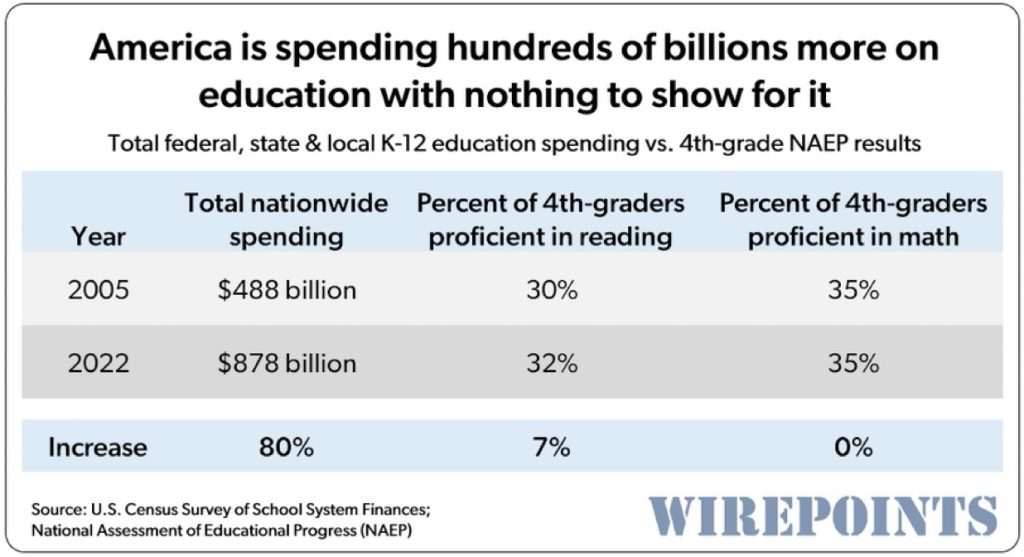
notes on k-12 taxpayer spending and outcomes

Ted Dabrowski

The national political class is going crazy over several of President-elect Donald Trump’s cabinet picks. Matt Gaetz, Trump’s pick for Attorney General, and Pete Hegseth, chosen to head the Defense Department, come to mind. Now comes the latest controversial pick: Trump’s choice of Linda McMahon for Secretary of Education.

They bemoan her lack of experience and expertise in education, but is “expertise” at the DOE really what the country’s students need?

We have no particular insight on McMahon and she doesn’t have a deep education record for us to review. But what we do have is the record of the experts that have been running education for decades. And the record is a disaster anyway you cut it – at the national level, the Illinois level, and the city level, namely Chicago.

more.

Share

Early-twentieth-century cold bias in ocean surface temperature observations

Sebastian Sippel, Elizabeth C. Kent, …Reto Knutti:

The observed temperature record, which combines sea surface temperatures with near-surface air temperatures over land, is crucial for understanding climate variability and change1,2,3,4. However, early records of global mean surface temperature are uncertain owing to changes in measurement technology and practice, partial documentation5,6,7,8, and incomplete spatial coverage9. Here we show that existing estimates of ocean temperatures in the early twentieth century (1900–1930) are too cold, based on independent statistical reconstructions of the global mean surface temperature from either ocean or land data. The ocean-based reconstruction is on average about 0.26 °C colder than the land-based one, despite very high agreement in all other periods. The ocean cold anomaly is unforced, and internal variability in climate models cannot explain the observed land–ocean discrepancy. Several lines of evidence based on attribution, timescale analysis, coastal grid cells and palaeoclimate data support the argument of a substantial cold bias in the observed global sea-surface-temperature record in the early twentieth century. Although estimates of global warming since the mid-nineteenth century are not affected, correcting the ocean cold bias would result in a more modest early-twentieth-century warming trend10, a lower estimate of decadal-scale variability inferred from the instrumental record3, and better agreement between simulated and observed warming than existing datasets suggest2.

Ryan Maue:

This “data discrepancy” in ocean temperatures from 1900-1940 is not tiny at all, but majorly impacts (greatly decreases) the warming trend of the 20th Century.

Share

The First Virtual Meeting Was in 1916

Allison Marsh:

At 8:30 p.m. on 16 May 1916, John J. Carty banged his gavel at the Engineering Societies Building in New York City to call to order a meeting of the American Institute of Electrical Engineers. This was no ordinary gathering. The AIEE had decided to conduct a live national meeting connecting more than 5,000 attendees in eight cities across four time zones. More than a century before Zoom made virtual meetings a pedestrian experience, telephone lines linked auditoriums from coast to coast. AIEE members and guests in Atlanta, Boston, Chicago, Denver, New York, Philadelphia, Salt Lake City, and San Francisco had telephone receivers at their seats so they could listen in. 

The AIEE, a predecessor to the IEEE, orchestrated this event to commemorate recent achievements in communications, transportation, light, and power. The meeting was a triumph of engineering, covered in newspapers in many of the host cities. The Atlanta Constitution heralded it as “a feat never before accomplished in the history of the world.” According to the Philadelphia Evening Ledger, the telephone connections involved traversed about 6,500 kilometers (about 4,000 miles) across 20 states, held up by more than 150,000 poles running through 5,000 switches. It’s worth noting that the first transcontinental phone call had been achieved only a year earlier. 

Share

Notes on the Politification of Scientific American

Jesse Singal:

Earlier this week, Laura Helmuth resigned as editor in chief of Scientific American, the oldest continuously published magazine in the United States. “I’ve decided to leave Scientific American after an exciting 4.5 years as editor in chief,” she wrote on Bluesky. “I’m going to take some time to think about what comes next (and go birdwatching), but for now I’d like to share a very small sample of the work I’ve been so proud to support (thread).”

Helmuth may in fact have been itching to spend more time bird watching—who wouldn’t be?—but it seems likely that her departure was precipitated by a bilious Bluesky rant she posted after Donald Trump was reelected.

In it, she accused her generation, Generation X, of being “full of fucking fascists,” complained about how sexist and racist her home state of Indiana was, and so on. 

“Fuck them to the moon and back,” she said of the dumb high school bullies supposedly celebrating Trump’s victory.

Whether or not Helmuth’s resignation was voluntary, it should go without saying that a few bad social media posts should not end someone’s job. If that were the whole story here—an otherwise well-performing editor was ousted over a few bad posts—this would arguably be a case of “cancel culture,” or whatever we’re calling it these days.

More.

Share

Madison schools Superintendent Gothard accused of misusing COVID relief in St. Paul

Kayla Huynh:

Two former colleagues of Madison schools Superintendent Joe Gothard are accusing him of directing the misuse of federal COVID-19 relief funds during his tenure leading St. Paul Public Schools.

According to a draft complaint against the St. Paul school district, where Gothard worked before coming to Madison in May, Gothard and his leadership team “unlawfully” used public funds for staff bonuses and to fill the Minnesota district’s $43 million budget deficit. 

Marie Schrul, the St. Paul school district’s former chief financial officer, and Curtis Mahanay, former business systems support manager, filed the lawsuit Wednesday morning in Ramsey County District Court. The two were fired in 2022 for raising concerns about mismanagement of the district’s finances, they argue in the draft complaint.

The complaint claims Gothard in 2022 convened 300 district leaders for an invite-only party where the food trucks alone cost $10,000 in public funds. Minnesota law requires that public funds must serve a “public purpose.” 

Share

The Business-School Scandal That Just Keeps Getting Bigger

Daniel Engber

For anyone who teaches at a business school, the blog post was bad news. For Juliana Schroeder, it was catastrophic. She saw the allegations when they first went up, on a Saturday in early summer 2023. Schroeder teaches management and psychology at UC Berkeley’s Haas School of Business. One of her colleagues—­­a star professor at Harvard Business School named Francesca Gino—­had just been accused of academic fraud. The authors of the blog post, a small team of business-school researchers, had found discrepancies in four of Gino’s published papers, and they suggested that the scandal was much larger. “We believe that many more Gino-authored papers contain fake data,” the blog post said. “Perhaps dozens.”

The story was soon picked up by the mainstream press. Reporters reveled in the irony that Gino, who had made her name as an expert on the psychology of breaking rules, may herself have broken them. (“Harvard Scholar Who Studies Honesty Is Accused of Fabricating Findings,” a New York Times headline read.) Harvard Business School had quietly placed Gino on administrative leave just before the blog post appeared. The school had conducted its own investigation; its nearly 1,300-page internal report, which was made public only in the course of related legal proceedings, concluded that Gino “committed research misconduct intentionally, knowingly, or recklessly” in the four papers. (Gino has steadfastly denied any wrongdoing.)

Share

civics: “How Barack Obama, Nancy Pelosi and the Democratic establishment sealed the fate of the progressive regime they sought to renew”

John Gray:

The collapse of the liberal order comes chiefly from overreach by American liberals. The charade in which Biden was ousted illustrates their fatal weakness. They believe their own legends. The Harris who campaigned for the presidency, less credible as a candidate than Biden, was a media simulacrum which evaporated on the night of the election. The Democrat insiders who invented the Harris facade, led by Barack Obama and Nancy Pelosi, sealed the fate of the regime they sought to renew.

Perpetual wars were a big part of liberal overreach. The campaigns in Afghanistan and Iraq were fiascos that destroyed public support for overseas military intervention, probably for a generation. For many who voted for him, Trump was an anti-war candidate. If he sticks to a realist, transactional foreign policy, it will avoid ruinous neoconservative crusades, but may also generate further conflict. He will surely seek vengeance against Iran for its apparent involvement in a plot to assassinate him. With Putin emboldened by a dirty peace in Ukraine, a wider European war becomes more likely. The Baltic states and Poland are actively preparing for such an eventuality. Whatever happens in Europe, Trump may not much care.

——-

More.

Share

As number of Chinese students in US keeps falling, Indians move to top of list

Bochen Han:

India has overtaken China as the top source for international students in the US for the first time in about 15 years, according to new data released on Monday.

A total of 331,602 Indians studied in the US during the 2023-24 school year, compared with 277,398 Chinese, according to the latest annual survey by the Institute of International Education (IIE), a report sponsored by the US State Department. Indian students saw a 23 per cent increase from the previous academic year, while Chinese students saw a 4 per cent decrease.

Chinese students had been the largest foreign group since the 2009-10 school year, but their numbers have steadily declined from 2019-20 onward. That academic year, there were 372,532 Chinese studying in the US.

Meanwhile, Indian students have seen a steady growth in numbers since the 2020-21 academic year, with the total for 2023-24 about twice as large as it was then.

Share

politics and vouchers in North Carolina

by Jennifer Berry Hawes and Mollie Simon

Private schools across the South that were established for white children during desegregation are now benefiting from tens of millions in taxpayer dollars flowing from rapidly expanding voucher-style programs, a ProPublica analysis found.

In North Carolina alone, we identified 39 of these likely “segregation academies” that are still operating and that have received voucher money. Of these, 20 schools reported student bodies that were at least 85% white in a 2021-22 federal surveyof private schools, the most recent data available.

Those 20 academies, all founded in the 1960s and 1970s, brought in more than $20 million from the state in the past three years alone. None reflected the demographics of their communities. Few even came close.

Northeast Academy, a small Christian school in rural Northampton County on the Virginia border, is among them. As of the 2021-22 survey, the school’s enrollment was 99% white in a county that runs about 40% white.

Share

memo to the Chicago Mayor

chicago Teachers Union

As you are aware, the CTU-CPS contract expired on June 30. CTU submitted a comprehensive proposal to CPS and CEO Pedro Martinez on April 16. The union’s proposals align with both the report on education issued by your mayoral transition committee last year and with the 5year strategic plan adopted by the Chicago Board of Education earlier this year. Our contract proposals are a blueprint for how those plans can be implemented and how the following shared goals are realized: (1) every child in Chicago should be able to attend a fully-staffed, fullyresourced neighborhood school that provides them with the same education, enrichment, and extracurricular opportunities as if they lived in a suburb 10 miles to the North, South, or West of the city; and (2) CPS must be a district that can develop, attract, recruit, and retain a diverse workforce of educators, reflective of the district’s school communities, who are provided the resources necessary to sustain a career in service to Chicago’s students.

Never before have Chicago’s teachers union, Board of Education and mayor held such a shared vision for Chicago Public Schools. Despite these commonalities, CEO Martinez has slowwalked negotiations, and Chicago’s educators have been without a contract for 5 months.

We are now at a critical juncture that requires your intervention to ensure that the Board of Education enshrines the commitments to transform public education that the people of the city. of Chicago elected you to carry out.

The CTU has been heartened to see the current, newly appointed Board of Education members take courageous stands to help the school district course correct on a number of issues. At its November 14 meeting, the Board adopted a resolution calling on Acero Charter schools to maintain the seven (7) campuses that earlier this fall it proposed to close. Up until the November Board meeting, CPS leadership had appeared content to allow Acero to go ahead with its plans, continuing a long history of prioritizing the “rights” of charter corporations over those of the students and families, despite the devastating impacts it would have on 2,000 predominantly Latine students, their families, and nearly 250 educators.

Share

Taxpayer Funded Wisconsin DPI: “There is major score inflation”

Quinton Klabon:

84% of schools are 3 stars or above and 93% of districts are.

We need report cards that accurately judge schools based on our national performance. Report cards change again next year, so that is the perfect opportunity.

…..

DPI suppressed insanity from lowering test score standards, though it led to some bizarre ratings for middle-class schools.

much more on the DPI, here.

Parody:

In order to reach an agreement, CTU is prepared to make the following concessions:

1) All CTU members will send their kids to CPS schools
2) We pledge that all schools will attain a minimum reading proficiency rate of 10%

In return, we want coed football and no math tests.

——-

Our govt’s decision to remove all subject area requirementsfor teachers will make things worse.

The data clearly indicate that being able to read is not a requirement for graduation at (Madison) East, especially if you are black or Hispanic”

My Question to Wisconsin Governor Tony Evers on Teacher Mulligans and our Disastrous Reading Results

2017: West High Reading Interventionist Teacher’s Remarks to the School Board on Madison’s Disastrous Reading Results 

Madison’s taxpayer supported K-12 school district, despite spending far more than most, has long tolerated disastrous reading results.

“An emphasis on adult employment”

Wisconsin Public Policy Forum Madison School District Report[PDF]

WEAC: $1.57 million for Four Wisconsin Senators

Friday Afternoon Veto: Governor Evers Rejects AB446/SB454; an effort to address our long term, disastrous reading results

Booked, but can’t read (Madison): functional literacy, National citizenship and the new face of Dred Scott in the age of mass incarceration.

When A Stands for Average: Students at the UW-Madison School of Education Receive Sky-High Grades. How Smart is That?

Share

“The Misery of Diversity”

Resul Cesur & Sadullah Yıldırım

Evolutionary accounts assert that while diversity may lower subjective well-being (SWB) by creating an evolutionary mismatch between evolved psychological tendencies and the current social environment, human societies can adapt to diversity via intergroup contact under appropriate conditions. Exploiting a novel natural experiment in history, we examine the impact of the social environment, captured by population diversity, on SWB. We find that diversity lowers cognitive and hedonic measures of SWB. Diversity-induced deteriorations in the quality of the macrosocial environment, captured by reduced social cohesion, retarded state capacity, and increased inequality in economic opportunities, emerge as mechanisms explaining our findings. The analysis of first- and second-generation immigrants in Europe and the USA reveals that the misery of home country diversity persists even after neutralizing the role of the social environment. However, these effects diminish among the second generation, suggesting that long-term improvements in the social environment can alleviate the burden of diversity. Finally, in exploring whether human societies can adapt to diversity, we show evidence that diversity causes adopting cultural traits (such as establishing stronger family ties, assigning greater importance to friendships, and adopting a positive attitude towards competition) that can mitigate the misery of diversity. These results survive an exhaustive set of robustness checks.

——

More.

Share

insurance

Alex Tabarrok:

In our new Marginal Revolution Podcast Tyler and I talk insurance, the history of insurance, the economics of insurance, the prospects for new types of insurance and more. Did you know that life insurance was once considered repugnant and was often illegal?

Tyler and I were both surprised how little good work there is on insurance. Here’s Tyler:

Share

How Public Key Cryptography Really Works, Using Only Simple Math

Kristina Armitage:

To understand how this works, it’s easier to think of the “keys” not as objects that fit into a lock, but as two complementary ingredients in an invisible ink. The first ingredient makes messages disappear, and the second makes them reappear. If a spy named Boris wants to send his counterpart Natasha a secret message, he writes a message and then uses the first ingredient to render it invisible on the page. (This is easy for him to do: Natasha has published an easy and well-known formula for disappearing ink.) When Natasha receives the paper in the mail, she applies the second ingredient that makes Boris’ message reappear.

In this scheme, anyone can make messages invisible, but only Natasha can make them visible again. And because she never shares the formula for the second ingredient with anyone — not even Boris — she can be sure the message hasn’t been deciphered along the way. When Boris wants to receive secret messages, he simply adopts the same procedure: He publishes an easy recipe for making messages disappear (that Natasha or anyone else can use), while keeping another one just for himself that makes them reappear.

Share

Your child may not be doing as well in school as you think. State lowered bar

Will Flanders and Kyle Koenen

This past summer, behind closed doors and under a veil of secrecy that even included the signing of a non-disclosure agreement, the Wisconsin Department of Public Instruction, quietly took several steps that will lower academic standards for Wisconsin’s students – all with zero input from parents or lawmakers. These unilateral decisions by State Superintendent Jill Underly will not only impact how schools are assessed but will ultimately leave parents in the dark about their child’s progress.   

The previous standards were implemented in 2012 under Gov. Tony Evers, who was then serving as DPI Superintendent, with bipartisan support. These standards aligned Wisconsin with the National Assessment of Educational Progress (NAEP) and were designed to assess whether students were ready for college and careers. But now, a much lower bar has been created in Wisconsin and NAEP alignment is gone.

Lowered standards can create false sense of academic progress

For example, on the most recent round of the NAEP, about 32% of Wisconsin 8th graders were found to be proficient in reading.  This is comparable to the 36% who were found to be proficient on the 2022-23 Forward Exam. But proficiency among this group jumped to 48.4% in 2023-24 on the state exam, creating a 16-percentage point gap.  Even Evers has openly criticized these new lowered standards, stating that he believes, “We need to have as high of standards as possible.” 

Share

Hidden Persuaders: LLMs’ Political Leaning and Their Influence on Voters

Yujin Potter, Shiyang Lai, Junsol Kim, James Evans, Dawn Song

How could LLMs influence our democracy?

We investigate LLMs’ political leanings and

the potential influence of LLMs on voters

by conducting multiple experiments in a U.S.

presidential election context. Through a vot-

ing simulation, we first demonstrate 18 open-

and closed-weight LLMs’ political preference

for a Democratic nominee over a Republican

nominee. We show how this leaning towards

the Democratic nominee becomes more pro-

nounced in instruction-tuned models compared

to their base versions by analyzing their re-

sponses to candidate-policy related questions.

We further explore the potential impact of

LLMs on voter choice by conducting an exper-

iment with 935 U.S. registered voters. During

the experiments, participants interacted with

LLMs (Claude-3, Llama-3, and GPT-4) over

five exchanges. The experiment results show a

shift in voter choices towards the Democratic

nominee following LLM interaction, widening

the voting margin from 0.7% to 4.6%, even

though LLMs were not asked to persuade users

to support the Democratic nominee during the

discourse. This effect is larger than many pre-

vious studies on the persuasiveness of political

campaigns, which have shown minimal effects

in presidential elections. Many users also ex-

pressed a desire for further political interaction

with LLMs. Which aspects of LLM interac-

tions drove these shifts in voter choice requires

further study. Lastly, we explore how a safety

method can make LLMs more politically neu-

tral, while raising the question of whether such

neutrality is truly the path forward.

Share

Birth Outcomes After 33 Weeks

Joshua Mandel:

Share

A trend colleges might not want applicants to notice: It’s becoming easier to get in

Jon Marcus:

This comes after a period of steadily increasing competition to get into college since around the turn of the millennium, which aggravated fears among students and their families that they’d be rejected by the institutions of their choice. Widely reported impossibly low single-digit acceptance rates at the nation’s most highly selective universities and colleges only made that apprehension worse.

Not surprisingly, 45 percent of 18- to 29-year-olds think it’s harder to get into college than it was for their parents’ generation, a survey by the Pew Research Center found.

In fact, 87 percent of nonprofit four-year colleges in 2022 took half or more of the students who applied to them, up from 80 percent in 2012, the AEI study found.

Share

Why I’m Glad I Didn’t Choose My Freshman Roommate

Rich Cohen:

In the summer before my freshman year of college in 1986, I waited for the letter that would bring news of my roommate, anxious to learn who fate had chosen to be possibly my new best friend, or my new worst enemy.

But that’s not what my son Nate did. Last spring, as a second-semester high-school senior, he was unwilling to test his luck. He used social media to identify, track, contact, court and bag an ideal roommate, a kid with proclivities that would fit his own like a fancy leather driving glove. An increasing number of incoming freshmen are curating that once unpredictable initiation into college life. The traditional method of simply spinning the wheel has become less common.

Much is gained as a result. For Nate, it’s meant a clean, harmonious living space—no Metallica poster to shout down his art print. A sensible wake-up time—early but not too early. Nate shares a major with his roommate and a sensibility. They come from the same kind of town in the same part of America. They don’t fight about music or politics.

Share

New reading laws sweep the nation following Sold a Story

Christopher Peak:

For decades, schools all over the country taught reading based on a theory cognitive scientists had debunked by the 1990s. Despite research showing it made it harder for some kids to learn, the concept was widely accepted by most educators — until recent reporting by APM Reports.

Now, state legislators and other policymakers are trying to change reading instruction, requiring it to align with cognitive science research about how children learn to read. Several of them say they were motivated by the Sold a Story podcast.  

Half of the states have now passed laws to change the way reading is taught since Sold a Story was released in 2022. At least four other states considered similar efforts.

The surge in activity is part of a wave of science of reading laws that began in 2013. But since Sold a Story, that trend has accelerated. Lawmakers have responded to the podcast by taking a closer look at what curriculum schools are buying, and, in some states, attempting to outlaw specific teaching methods.

The legislative efforts come at a time when fourth grade reading scoresin the United States have declined consistently since 2015, according to a nationwide achievement measurement conducted by the National Center for Educational Statistics.  

Many parents know the struggle firsthand. Aaron Freeman grappled with why his sons were struggling to learn how to read. His youngest son, Cooper, said he felt like he was “running in the dark,” directionless and alone when he opened a book. When the Freeman family listened to the Sold a Story podcast, Aaron Freeman was left feeling heartbroken and enraged.  

———

Our govt’s decision to remove all subject area requirementsfor teachers will make things worse.

The data clearly indicate that being able to read is not a requirement for graduation at (Madison) East, especially if you are black or Hispanic”

My Question to Wisconsin Governor Tony Evers on Teacher Mulligans and our Disastrous Reading Results

2017: West High Reading Interventionist Teacher’s Remarks to the School Board on Madison’s Disastrous Reading Results 

Madison’s taxpayer supported K-12 school district, despite spending far more than most, has long tolerated disastrous reading results.

“An emphasis on adult employment”

Wisconsin Public Policy Forum Madison School District Report[PDF]

WEAC: $1.57 million for Four Wisconsin Senators

Friday Afternoon Veto: Governor Evers Rejects AB446/SB454; an effort to address our long term, disastrous reading results

Booked, but can’t read (Madison): functional literacy, National citizenship and the new face of Dred Scott in the age of mass incarceration.

When A Stands for Average: Students at the UW-Madison School of Education Receive Sky-High Grades. How Smart is That?

Share

Notes on Madison’s successful fall 2024 tax & $pending increase referendum

By Keegan Kyle and Brandon Raygo

Voters all across the communities and neighborhoods in the Madison Metropolitan School District widely supported the district’s two referendums this month that will raise property taxes for decades. (more)

But in the affluent village of Maple Bluff, on the eastern shore of Lake Mendota, voters expressed more aversion to hiking taxes for public schools. A narrow majority of voters in the village backed one referendum and rejected the other.

Elsewhere in the school district, voters typically supported the school district’s $507 million facilities referendum by a comfortable margin and its $100 million operations referendum by a lower degree — although still well above a majority.

——-

Our govt’s decision to remove all subject area requirementsfor teachers will make things worse.

The data clearly indicate that being able to read is not a requirement for graduation at (Madison) East, especially if you are black or Hispanic”

My Question to Wisconsin Governor Tony Evers on Teacher Mulligans and our Disastrous Reading Results

2017: West High Reading Interventionist Teacher’s Remarks to the School Board on Madison’s Disastrous Reading Results 

Madison’s taxpayer supported K-12 school district, despite spending far more than most, has long tolerated disastrous reading results.

“An emphasis on adult employment”

Wisconsin Public Policy Forum Madison School District Report[PDF]

WEAC: $1.57 million for Four Wisconsin Senators

Friday Afternoon Veto: Governor Evers Rejects AB446/SB454; an effort to address our long term, disastrous reading results

Booked, but can’t read (Madison): functional literacy, National citizenship and the new face of Dred Scott in the age of mass incarceration.

When A Stands for Average: Students at the UW-Madison School of Education Receive Sky-High Grades. How Smart is That?

Share

notes on a proposed Madison charter high school

Kayla Huynh:

“If they don’t go to college, they should be able to walk right into a well-paid career. The No. 1 thing is to really work with these kids to help them find a career that they will enjoy,” McKenzie said. “These are all things that are directed at attacking the cycle of poverty.” 

The Madison School Board plans to vote early next year whether to authorize the school. McKenzie said it could open as soon as fall 2026. The school’s proposal says it aims to enroll 150 freshmen in the first year and expand to 600 ninth through 12th graders by 2029.

The school was initially set to be named Pathway Career and College Academy. McKenzie said organizers changed the name because the Madison school district already has a workforce program, which “wasn’t particularly successful,” under the same name.

—-

Our govt’s decision to remove all subject area requirementsfor teachers will make things worse.

The data clearly indicate that being able to read is not a requirement for graduation at (Madison) East, especially if you are black or Hispanic”

My Question to Wisconsin Governor Tony Evers on Teacher Mulligans and our Disastrous Reading Results

2017: West High Reading Interventionist Teacher’s Remarks to the School Board on Madison’s Disastrous Reading Results 

Madison’s taxpayer supported K-12 school district, despite spending far more than most, has long tolerated disastrous reading results.

“An emphasis on adult employment”

Wisconsin Public Policy Forum Madison School District Report[PDF]

WEAC: $1.57 million for Four Wisconsin Senators

Friday Afternoon Veto: Governor Evers Rejects AB446/SB454; an effort to address our long term, disastrous reading results

Booked, but can’t read (Madison): functional literacy, National citizenship and the new face of Dred Scott in the age of mass incarceration.

When A Stands for Average: Students at the UW-Madison School of Education Receive Sky-High Grades. How Smart is That?

Share

“The government’s change to teacher certification regulations will tarnish the reputations of the many outstanding teachers in our province and will devalue an education degree.”

Anna Stokke shares:

Education professor Martha Koch made several head-scratching claims in her Free Press piece, including the assertion that prospective K-8 math teachers are best served by avoiding university-level math courses. As chair of the department of mathematics and statistics at the University of Winnipeg, I would like to address these claims.

Extraordinary claims require extraordinary evidence, and the onus is now on Koch to provide the research supporting her claims.

Education researchers are notorious for making bold claims based on poor research methodologies or passing off opinion as genuine research. Their chokehold on the education system may be why Manitoba students are struggling in the first place. Teachers, parents and the public should be wary of education claims that sound far-fetched or counterintuitive.

Mathematics is not the only subject that has been cut from the requirements for future K-8 teachers: science, English/French, and history/geography requirements have also been eliminated. At least professors of education are not (yet!) arguing that taking English at university will make you a worse English teacher. That argument would be ludicrous on its face, yet professors of education think they can dupe the public when it comes to math.

I would like to stress that future K-8 teachers are not being forced to take courses like calculus at university. Our department offers specialized courses that help K-8 education students understand the math curriculum they will need to teach. Similar courses are offered by the math departments at all universities in Manitoba. Teachers need strong content knowledge in the subjects they teach; pedagogy courses from education faculties are not sufficient.

The government’s change to teacher certification regulations will tarnish the reputations of the many outstanding teachers in our province and will devalue an education degree. The Manitoba government needs to reverse course on this backwards policy. The children in this province, especially those whose parents lack the resources to correct for bad educational policies, will be the ones to pay the price.

Narad Rampersad

Winnipeg

Share

“These kids are not in a mood to tolerate NE weirdness anymore”

kale Zelden:

I’ve taught at a New England prep school for nearly 20 years. Families have been laser focused on top tier colleges, most of which are up here.

Except for a very few exceptional candidates, this has changed.

Dramatically.

There is another “great migration” happening, as a steady flow of middle and upper middle-class children of the meritocratic class have decided to go to college in the spirit of normalcy.

10 years ago a kid or two went south. Maybe

Share

Is Everybody Cheating?

Joanne Jacobs:

Cheating has become the norm on college campuses, professors tell Beth McMurtrie, who reports for the Chronicle of Higher Education.

Students use AI to cheat on information discussion boards, says Amy Clukey, an associate English professor at the University of Louisville. They cheat on essays.

A few weeks ago, she emailed a student to say that she knew the student had cheated on a minor assignment with AI and if she did it again, she would fail the course. Clukey also noted there were several missed assignments. The student replied to “sincerely apologize,” said she was “committed to getting back on track,” and that she regretted “any disruption [her] absence or incomplete work may have caused in the course.” But her next paper was essentially written by artificial intelligence. Curious, Clukey asked ChatGPT to write an email apologizing to a professor for plagiarism and missed work. . . “It spit out an email almost exactly like the one I had gotten.”

“Professors in writing-intensive courses, particularly those teaching introductory or general-education classes” say “AI abuse has become pervasive,” writes McMurtrie. “Clukey said she feels less like a teacher and more like a human plagiarism detector, spending hours each week analyzing her students’ writing to determine its authenticity.”

Share

Notes on the US News High School Rankings

Cailey Gleeson:

Whitefish Bay High School has been named Wisconsin’s best high school, according to U.S. News & World Report’s 2025 rankings.

The publication analyzed about 25,000 public high schools — ultimately ranking nearly 17,660 — across the U.S. for this year’s edition of its annual rankings.

High schools were assessed on college readiness, state assessment proficiency, state assessment performance, underserved student performance, college curriculum breadth and graduation rate.

High schools are given a national rank, unlike the publication’s elementary and middle school rankings.

Share

Chanel dips oar into sport with Oxford-Cambridge boat race tie-up

Josh Noble:

The annual boat race between Oxford and Cambridge universities is to be renamed after a designer watch as part of a multiyear tie-up with Chanel, in what is the French fashion house’s first foray into sport sponsorship. 

From next year, the annual rowing contest will be rebranded as “The Chanel J12 Boat Race”, taking on the name of a high-end timepiece produced by the privately owned luxury goods company.

Chanel will replace Gemini, a cryptocurrency exchange founded by the Winklevoss twins, as the event’s title partner and become its official timekeeper.  

Share

civics: “I don’t think there is space for individual thought on the left”

Peter Thiel via Bari Weiss:

On the surface, Thiel is someone who seems full of contradictions. He is a libertarian who has found common cause with nationalists and populists. He likes investing in companies that have the ability to become monopolies, and yet Trump’s White House wants to break up Big Tech. He is a gay American immigrant, but he hates identity politics and the culture wars. He pays people to drop out of college, but, in this conversation at least, still seems to venerate the way that the Ivy Leagues are an indicator of intelligence.

But perhaps that’s the secret to his success: He’s beholden to no tribe but himself, no ideology but his own. And why wouldn’t you be when you make so many winning bets? From co-founding the e-payment behemoth PayPal and the data analytics firm Palantir (which was used to find Osama bin Laden) to being the first outside investor in Facebook, Thiel’s investments—in companies like LinkedIn, Palantir, and SpaceX, to name a few—have paid off big time.

His most recent bet—helping his mentee J.D. Vance get elected as senator and then on the Trump ticket as vice president—seems also to have paid off. The next four years will determine just how high Thiel’s profit margin will be.

Today: Thiel explains why so many of his peers have finally come around to Trump; why he thinks Kamala—and liberalism more broadly—lost the election; and why the Trump 2.0 team will be better than last time, with antiestablishment figures who are willing to rethink the system. We talk about the border, trade deals, student debt, Israel and foreign policy, the rise of historical revisionism, the blurry line between skepticism and conspiracy, and his contrarian ideas about what we might face in a dreaded World War III.

——

Civics & Free Speech: “The problem is America has the most useless aristocrats in history

Share

Milwaukee stiff-arms cops in schools as allegations of robbery and assault mount

Mark Lisheron:

Through a formal records request, the Badger Institute also was able to determine the district spent at least $15,000 to send school officials on three fact-gathering trips in October, November and December 2023 to schools in Atlanta and Macon, Georgia, and in Washington, D.C.

Nine school officials, including former Superintendent Keith Posley and Instructional Leadership Director Miguel Sanchez, were joined on two of the trips by Steve Lubar, executive director of the Administrators and Supervisors Council, representing MPS principals, assistant principals, and supervisors.

Police Chief Jeffrey Norman and Assistant Chief Steven Johnson were part of the group that went to Atlanta and Macon on Nov. 30-Dec. 1, according to the documents. But expenses for Lubar, Norman and Johnson were not paid by the district, the documents said. 

Each of the trips included visits to various high schools and elementary schools and their public safety command centers, and the command and dispatch centers for each of those police districts, according to the documents.  

Share

How can we develop transformative tools for thought?

Andy Matuschak and Michael Nielsen

We believe now is a good time to work hard on this vision again. In this essay we sketch out a set of ideas we believe can be used to help develop transformative new tools for thought. In the first part of the essay we describe an experimental prototype system that we’ve built, a kind of mnemonic medium intended to augment human memory. This is a snapshot of an ongoing project, detailing both encouraging progress as well as many challenges and opportunities. In the second part of the essay, we broaden the focus. We sketch several other prototype systems. And we address the question: why is it that the technology industry has made comparatively little effort developing this vision of transformative tools for thought?

Share

The case against student use of computers, tablets, and smartphones in the classroom

Jared Cooney Horvath:

When smartphones and social media platforms swept into teens’ lives in the early 2010s, schools experienced their own digital revolution, with 1-to-1 laptops, tablets, and iPads becoming staples in classrooms across the Western world. (1-to-1 means one device for every student.) A decade later, the revolutionary optimism is fading. OneOECD review found that most educational technology (EdTech) has not delivered the academic benefits once promised. Meanwhile, global test scores in math, science, and reading have been plummeting, as you can see in Figure 1 below. These trends were exacerbated by the COVID-19 pandemic, but they began in the early 2010s, just as digital devices were being placed on students’ desks. 

Share

K-12 Tax & Spending Climate: Public unions and housing mandates sock a San Francisco Bay area town

Wall Street Journal:

Portola Valley officials last week raised alarms about dwindling cash reserves owing to rising expenses tied to a new sheriff’s contract and the state’s affordable housing mandate. The town of about 4,500 has about $1.6 million in general reserves, nearly all of which is committed to paying retiree benefits.

Like many small towns, Portola Valley relies on its adjoining county sheriff’s office to provide public safety. The San Mateo County sheriff’s union negotiated a rich new labor agreement in 2022 whose costs are being passed on to localities. Portola Valley’s sheriff’s payments are set to increase to $2.1 million next year from about $1 million in 2021.

Other employment costs are also soaring as the town is paying millions for consultants to comply with California’s affordable housing mandate. Homes in the town are worth $3.8 million on average. The state has threatened to withhold federal and state grants if Portola doesn’t rezone land to accommodate multi-family housing. This, by the way, is the essence of Kamala Harris’s housing plan: Leverage taxpayers dollars to compel states and localities to build more low-income housing.

Share

Reverse amendments to the Education Act that lower standards for teacher certification

change.org:

Important note:  This is the online republication of a paper petition that is being circulated in Manitoba.  As per the general petition guidelines for presenting to the Legislative Assembly of Manitoba, the paper petition will be submitted to the Legislative Assembly of Manitoba.

If you have the opportunity, it is important that you please sign both the paper petition and the change.org petition.

1.  Ensuring that teachers have a robust background in the subjects they teach is essential for maintaining high-quality education and fostering well-rounded learning experiences for all Manitoba students.

2. The recent amendments by the Province of Manitoba to the Teaching Certificates and Qualifications Regulation under The Education Administration Act have significantly lowered the standards for subject-area expertise required for teacher certification.

Share

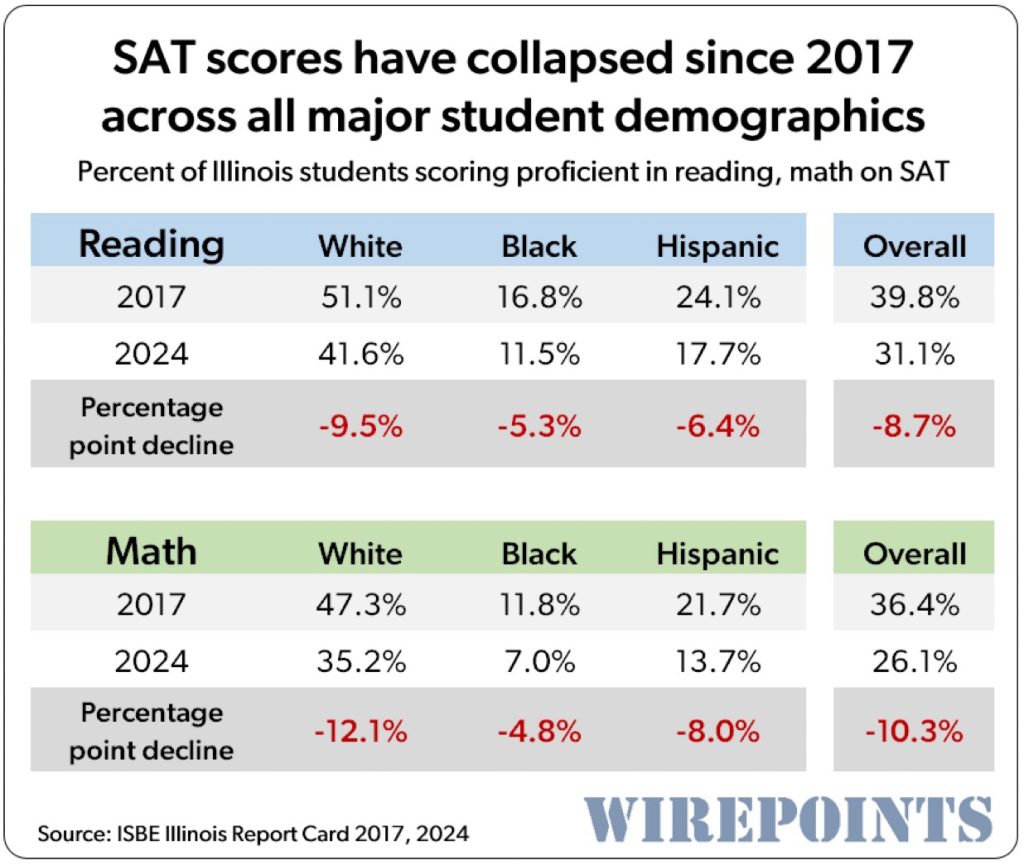
Illinois k-12 ed spending in 2017 = $33B (local, state, fed). 7 years later, $44 B+.

wire points

Now look at the SAT results as reported by the state, and how much they are down since 2017.

Property taxes up, up, up. Outcomes tragic. Zero accountability. Via @Wirepoints

——

Our govt’s decision to remove all subject area requirementsfor teachers will make things worse.

The data clearly indicate that being able to read is not a requirement for graduation at (Madison) East, especially if you are black or Hispanic”

My Question to Wisconsin Governor Tony Evers on Teacher Mulligans and our Disastrous Reading Results

2017: West High Reading Interventionist Teacher’s Remarks to the School Board on Madison’s Disastrous Reading Results 

Madison’s taxpayer supported K-12 school district, despite spending far more than most, has long tolerated disastrous reading results.

“An emphasis on adult employment”

Wisconsin Public Policy Forum Madison School District Report[PDF]

WEAC: $1.57 million for Four Wisconsin Senators

Friday Afternoon Veto: Governor Evers Rejects AB446/SB454; an effort to address our long term, disastrous reading results

Booked, but can’t read (Madison): functional literacy, National citizenship and the new face of Dred Scott in the age of mass incarceration.

When A Stands for Average: Students at the UW-Madison School of Education Receive Sky-High Grades. How Smart is That?

Share

“Medicine need to examine how scientists may have contributed to the polarization of the use of science”

Colin Wright:

The president of the National Academy of Sciences, Marcia McNutt, has published welcome an essay promising to remain politically neutral and mitigate the political polarization of science.

Some notable quotes from the article:

“[S]cientists need to better explain the norms and values of science to reinforce the notion—with the public and their elected representatives—that science, at its most basic, is apolitical… Whether conservative or liberal, citizens ignore the nature of reality at their peril.”

“Scientists should better explain the scientific process and what makes it so trustworthy, while more candidly acknowledging that science can only provide the best available evidence and cannot dictate what people should value.”

Share

civics: Notes on taxpayer funded censorship

Brendan Carr

Facebook, Google, Apple, Microsoft & others have played central roles in the censorship cartel.

The Orwellian named NewsGuard along with “fact checking” groups & ad agencies helped enforce one-sided narratives.

Share

K-12 Governance Climate: Accountability

David Sacks:

This is without a doubt, the most succinct and accurate explanation by @DavidSacks of why what Donald Trump is trying to do is actually going to restore democracy and not bring about a dictatorship.

more.

Face unrealized gains wealth tax bill of many x my annual net salary. ofc the company is loss making and all the investors have preference shares so I can’t take out any money.

Share

Over the past 15 years, more than 7,000 secondary schools have sent at least one student to Harvard.

Harvard Crimson

These schools span every American state, dozens of countries from around the globe, and every kind of institution imaginable. They are small, private high schools nestled in Manhattan’s Upper East Side and Midwestern public schools with thousand-person graduating classes; international schools set a thousand miles from Cambridge and high schools a short walk from Harvard Yard.

For many of these schools, to send a student to Harvard is a blip, a rare anomaly in an obscure and lofty admissions process.

more.

Share

“It’s a problem when schools accept the worldview of that dyspeptic rump”

Rick Hess:

Now that we’ve had a few days to digest last week’s election results, let’s talk about what they mean for education. Rather than wade into policy wonkery, though, I want to discuss the implications for the zeitgeist that’s shaped K–12 schooling over the past half-decade or more—one that’s featured an embrace of progressive nostrums regarding racial identity, diversity, equity, social justice, gender, and inclusion. My bottom line is that Donald Trump is, in important ways, a vehicle for a cross-section of Americans to push back against the kinds of out-of-touch dogmas that I believe have fueled so many culture clashes over the past half-decade, especially around schools.

I want to be straight about where I’m coming from. Unlike most in the realms of education leadership, research, and advocacy, I’m firmly on the right. While I’m no great fan of President-elect Trump, I was heartened by Tuesday’s results, which included Republican victories in the Senate and, as I write, likely the House. I believe they hold big opportunities for educators across the board. Given that perspective, I’ll share a few thoughts that may (or may not) be useful to those in our field who feel very differently about what to make of those outcomes.

Share

civics: “When the woke police come at you, you don’t even get your Miranda rights read to you.”

mark Judge

Like the rest of the mainstream media, Dowd’s a hypocrite. Six years ago she was happy to pronounce people guilty with no trial and no Miranda rights and no due process. Specifically, I’m wondering if Dowd has the courage to take back her hits on Brett Kavanaugh and me. Dowd declared Kavanaugh guilty in 2018. When Kavanaugh was accused by Christine Blasey Ford of sexual assault at a 1982 party when they were teenagers, Dowd tossed aside due process. She was the worst of the woke.

Dowd’s strategy was to compare Blasey Ford to Anita Hill, and claim that the conservative media was unfairly smearing Ford. “We are still watching a bookish university professor from the West,” Dowd wrote, “who tried to anonymously report an alleged blight on the character of a man about to ascend to a lifetime of power, get smeared as a demanding, mixed-up, uptight, loony fantasist.” You’ve gotta love that “bookish university professor from the West” bit.

“Dr. Blasey is dealing with some demonic forces not in play with Professor Hill,” Dowd wrote. “A vicious partisan internet that drove her out of her house and being discredited not merely by the White House but personally by a president who has bragged on tape about his history of sexual assault, who has consistently defended predators such as Roger Ailes, Bill O’Reilly and Roy Moore, and who is advised by the same man who enabled Ailes’s loathsome behavior at Fox News.”

Like the rest of her media colleagues, Dowd has shown no interest in the other side of the story. In 2018 I was dragged into the Kavanaugh battle when Christine Blasey Ford claimed I was in the room when Kavanaugh assaulted her. I have no memory of the alleged attack. Moreover, I have a lot of evidence that suggests that the Blasey claim was, as Kavanaugh said, a well-funded and orchestrated political hit.

Share

civics: A call for reporters who truly report

hunter Baker:

In one of the weirder sci-fi novels of all time, Stranger in a Strange Land, author Robert Heinlein introduced a social innovation. One of the book’s characters holds a special designation as the “fair witness.” By way of demonstration, someone asks the fair witness what color a particular house is. She answers by naming the color on the side of the house she can see. Most people would say “The house is blue” or “The house is white,” but Heinlein’s fair witness only describes what she can count on, which is the visible side. It’s an interesting idea to ponder.

Donald Trump has been elected president for a second time. His first term met with media opposition greater than anyone has seen in recent memory. The Washington Post went so far as to adopt the slogan “Democracy Dies in Darkness.” In explaining his decision for the Post to withhold any presidential endorsement this year, owner Jeff Bezos pointed to a decline in public trust as a major problem for outlets such as his. Trump is back. Will the media double down or take the opportunity to regain lost trust and once again become indispensable to public discourse?

Share

“The hidden world of special education settlements in Massachusetts”

www:

It had all come down to this, she thought, signing her name in careful script.

The years of agony endured by her son, who, at 11, still couldn’t read or write. The antidepressants the boy had been prescribed in a desperate attempt to salve his battered self-esteem. The thousands of dollars they’d scraped together for expert testing, to prove what their son’s severe learning disability required. The tedious and maddening back-and-forth between their lawyer and the one employed by the boy’s suburban Boston school district — the bargaining that yielded the document she had just signed.

Share

Texas Clinches a School-Choice Majority

Wall Street Journal:

Republicans won 88 total House seats, and some who aren’t “hard core” may support Mr. Abbott’s plan. The GOP state Senate improved its school-choice majority, too, with the victory of Adam Hinojosa over incumbent Democrat Morgan LaMantia. Texas is now poised this spring to pass its first private school choice program, and the nation’s largest, serving some five million students.

It’s a hard-fought win for Mr. Abbott, who made Republican opponents of his plan pay a political price. Twenty-one of them joined Democrats last fall to vote down his bill for scholarships worth about $10,000, plus billions in public-school funding. The Governor vowed to go after those who ran for re-election.

During the GOP primaries, Mr. Abbott endorsed 11 pro-school choice challengers. Eight won, and last week all eight were officially elected, along with other school-choice candidates the Governor backed in open races. One Republican incumbent who was ousted in his primary, Steve Allison in district 121, later endorsed the Democrat running for his seat in the general election. But Marc LaHood, the Republican backed by Mr. Abbott, won handily, 52.6% to 47.4%.

Share

civics: “They actually wrote that our problem was we didn’t weight results” 

Matt Taibbi:

The Times ended its screed against RCP’s “scarlet-dominated” electoral map projection by quoting John Anzalone, Joe Biden’s former chief pollster, who said: “There’s a ton of garbage polls out there.” But being called “garbage” in America’s paper of record was nothing compared to what happened to RCP at Wikipedia.

Six months ago, when former Wikipedia chief Katherine Maher became CEO of NPR, video emergedof her talking about strategies at Wikipedia. She said the company eventually abandoned its “free and open” mantra when she realized “this radical openness… did not end up living into the intentionality of what openness can be.” Free and open“recapitulated” too many of the same “power structures,” resulting in too much emphasis on the “Western canon,” the “written tradition,” and “this white male, Westernized construct around who matters.”

Share

Notes on closing a Wauwatosa School

Lucas Vebber:

Wauwatosa Stem, ranked the 5th best elementary school in Wisconsin, is being phased out and closed down by the Wauwatosa school board.

Insane.

Share

Insiders weigh replacement standard after Massachusetts’ high school graduation test vote

Sam Drysdale:

After voters overwhelmingly cast their ballots to eliminate the requirement that Massachusetts high school students pass the MCAS exam in order to receive a diploma, the question of whether the state will pursue a new statewide standard in the exams’ place — and what, exactly, that would look like — looms over the upcoming legislative session.

Education insiders said this week that conversations about implementing new education standards in wake of Question 2’s passage are already happening, and those who had campaigned against the initiative are pushing for an urgent solution.

Gov. Maura Healey, who opposed the MCAS question, told reporters on Wednesday that the Board of Elementary and Secondary Education will further update regulations.

“It’s time for us to continue what, frankly, was started before the election, which was to figure out the new path forward, and what is the new model for a really uniform standard,” Healey said. “Because, again, my position is we shouldn’t have different expectations for students depending on which ZIP code they’re in. There should be a uniformity to our expectations.”

more.

Share

“These new standards mean that eighth-grade teachers will not need to have taken English, French, geography, history or math at the university level”

via Anna Stokke:

Distressing changes

Re: Teachers need subject expertise (Think Tank, Nov. 12)

I’m writing, as a parent and as an educator, in support of my colleague Anna Stokke’s Monday op-ed. Having spent two decades teaching post-secondary students in Manitoba, I am distressed, to say the least, to hear about the revisions to Manitoba’s teacher certification requirements.

While most of the discussion has focused on math education, which I can only speak to as a recipient, l’d like to emphasize that math is only one of the requirements being eliminated. These new standards mean that eighth-grade teachers will not need to have taken English, French, geography, history or math at the university level.

With all due respect to my colleagues in the faculty of education, knowing how to communicate content is not, and cannot be, a replacement for an understanding of the topic itself. Good teachers need both the ability to teach and the knowledge that underpins the subjects that they teach. A middle-school math teacher may not need to teach division in base-4, but understanding how division works, rather than just the mechanics of doing long division, can’t help but make them a better teacher.

Manitoba has a teacher staffing crisis, we are told. Rather than working to make K-8 education a field that attracts the best possible candidates, the government has decided that it would be easier and, no doubt, cheaper, to lower the standards of who is teaching our children.

It’s a devil’s bargain, and our children will be the ones to pay the price.

Brandon christopher

Winnipeg

——-

My colleague, political science professor Felix Mathieu, discussing the MB govt removing all subject requirements for teacher certification on Le telejournal Manitoba ~15:00

———

2007 math forum audio video 

Connected Math

Discovery Math

Singapore Math

Remedial math

Madison’s most recent Math Task Force

When A Stands for Average: Students at the UW-Madison School of Education Receive Sky-High Grades. How Smart is That?

Share

50-0 in a rare unanimous roll-call vote to discard the tax hike

jake Sheridan:

The Chicago City Council emphatically voted down Mayor Brandon Johnson’s plan to hike property taxes by $300 million Thursday, creating a yawning hole in the city’s 2025 budget that must now be closed.

Aldermen voted 50-0 in a rare unanimous roll-call vote to discard the tax hike in a special meeting that lasted just minutes and included no debate. The council’s decisive rejection gives aldermen leverage they have rarely enjoyed in ongoing budget negotiations: Whatever comes next, it won’t be Johnson’s original plan.

The property hike proved wildly unpopular with constituents, aldermen have said. But its demise forces the council and mayor to now come up with new answers. While many aldermen joined the mayor to argue Chicago must find new revenue and avoid layoffs, others said the body must make major budget cuts.

“The only way you are going to make real structural reform here is by making some deep cuts,” downtown Ald. Brendan Reilly, 42nd, said after the vote.

Share

Eyes on Reading: Maryland State Superintendent Carey Wright in Conversation with Emily Hanford 

Planet Word:

Join Planet Word and our journalist-in-residence, Emily Hanford, for a candid conversation with Maryland State Superintendent of Schools, Dr. Carey Wright. Their discussion will explore Dr. Wright’s vision for Maryland schools and lessons she brings from her success in implementing evidence-based literacy practices in Mississippi.

Under her leadership, Mississippi fourth graders made enormous strides on both the reading and math sections of the National Assessment of Educational Progress, a test commonly referred to as the Nation’s Report Card. With Maryland, one of the richest states in the U.S., having experienced a steady decline in achievement, change is certainly called for. Don’t miss this opportunity to hear from one of education’s most dynamic leaders and participate in what’s sure to be a lively audience Q&A.

Share

“ai” therapy

Justine Moore:

A PhD student used both Claude and Gemini as an AI therapist.

She vented her frustrations around getting a cancer diagnosis, and joked about how much it was costing the healthcare system.

The difference in responses is staggering.

Share

The Beginner’s Guide to Visual Prompt Injections

Lakera:

What is a Visual Prompt Injection?

Prompt injections are vulnerabilities in Large Language Models where attackers use crafted prompts to make the model ignore its original instructions or perform unintended actions. 

Visual prompt injection refers to the technique where malicious instructions are embedded within an image. When a model with image processing capabilities, such as GPT-V4, is asked to interpret or describe that image, it might act on those embedded instructions in unintended ways. 

Share

How a stubborn computer scientist accidentally launched the deep learning boom

Timothy Lee:

During my first semester as a computer science graduate student at Princeton, I took COS 402: Artificial Intelligence. Toward the end of the semester, there was a lecture about neural networks. This was in the fall of 2008, and I got the distinct impression—both from that lecture and the textbook—that neural networks had become a backwater.

Neural networks had delivered some impressive results in the late 1980s and early 1990s. But then progress stalled. By 2008, many researchers had moved on to mathematically elegant approaches such as support vector machines.

I didn’t know it at the time, but a team at Princeton—in the same computer science building where I was attending lectures—was working on a project that would upend the conventional wisdom and demonstrate the power of neural networks. That team, led by Prof. Fei-Fei Li, wasn’t working on a better version of neural networks. They were hardly thinking about neural networks at all.

Rather, they were creating a new image dataset that would be far larger than any that had come before: 14 million images, each labeled with one of nearly 22,000 categories.

Li tells the story of ImageNet in her recent memoir, The Worlds I See. As she worked on the project, she faced plenty of skepticism from friends and colleagues.

Share

Graduate degrees are overrated

Daniel Lemire:

Though I have many brilliant graduate students, I love working with undergraduate students. And I am not at all sure that you should favor people with graduate degrees, given a choice. Many graduate students tend to favor abstraction over practical skills. They often have an idealized view of the world. Moreover, these students are often consumed by research projects, theses, or dissertations, and the publication of scientific articles, which limits their time for concrete actions. On the other hand, undergraduate students, in my experience, show more enthusiasm for concrete and useful projects, even if they are not prestigious at first glance.

Share

The Giant Supercomputer Built to Transform an Entire Country—and Paid For by Ozempic

Ben Cohen:

When she decided to uproot her life and move halfway across the world to run a company in a place where she had never lived, Nadia Carlsten wasn’t really sure what to expect.

But the American engineer with a passion for technology management definitely wasn’t expecting to be treated like a celebrity.

“I feel like the most popular person wherever I go,” Carlsten says. “I can just start the conversation with: I have over 1,500 GPUs—and everyone wants to talk to me.”

Carlsten has precisely 1,528 of the most powerful graphics-processing units on the planet because she just started as the chief executive of the Danish Centre for AI Innovation. The new company was built to run Denmark’s national AI supercomputer, which opened last week with a glitzy launch party where Carlsten was once again the center of attention.

Share

notes on the taxpayer funded Wisconsin DPI and reporting veracity

Quinton Klabon:

DID YOU KNOW
…schools had until September to obligate ~$1.49B in federal aid?
…DPI lists ~$13.1M outstanding and ~$300K over the limit, despite the deadline?
…details on evidence-based line items have been broken since May?
Schools (probably) did their jobs. Hurry up, DPI!

Share

“The city has been providing almost $1 billion in subsidies annually to the schools in addition to the schools receiving 56% of all property taxes”

Paul Vallas:

Easy solution to avoid Mayor’s $300 million property tax increase without eliminating the  2,476 Police and 646 Firefighter and EMS positions he threatened: Reduce city subsidies to the schools by an amount equal to the annual TIF “WINDFALL” which would save the city $300 mil.

Schools don’t lose property tax revenues to TIF’s because their property tax rate rises to meet their levy request. City Council should also not pay the $170 million school district employee contribution to the school districts municipal pension fund employees.

The city has been providing almost $1 billion in subsidies annually to the schools in addition to the schools receiving 56% of all property taxes. That money is not finding its way into the classroom as only 54% of the $30,000 per student the district spends ends up in the schools.

Note that while Firefighters and Paramedics await their pay increase, the last teacher contract raised CTU member salaries 24-50%, hired 9,000 more employees and has ONE employee for every 7.6 students.

Share

How the Ivy League Broke America

David Brooks:

And then a small group of college administrators decided to blow it all up. The most important of them was James Conant, the president of Harvard from 1933 to 1953. Conant looked around and concluded that American democracy was being undermined by a “hereditary aristocracy of wealth.” American capitalism, he argued, was turning into “industrial feudalism,” in which a few ultrarich families had too much corporate power. Conant did not believe the United States could rise to the challenges of the 20th century if it was led by the heirs of a few incestuously interconnected Mayflower families.

So Conant and others set out to get rid of admissions criteria based on bloodlines and breeding and replace them with criteria centered on brainpower. His system was predicated on the idea that the highest human trait is intelligence, and that intelligence is revealed through academic achievement.

By shifting admissions criteria in this way, he hoped to realize Thomas Jefferson’s dream of a natural aristocracy of talent, culling the smartest people from all ranks of society. Conant wanted to create a nation with more social mobility and less class conflict. He presided during a time, roughly the middle third of the 20th century, when people had lavish faith in social-engineering projects and central planning—in using scientific means to, say, run the Soviet economy, or build new cities like Brasília, or construct a system of efficiency-maximizing roadways that would have cut through Greenwich Village.

When universities like Harvard shifted their definition of ability, large segments of society adjusted to meet that definition. The effect was transformative.

In trying to construct a society that maximized talent, Conant and his peers were governed by the common assumptions of the era: Intelligence, that highest human trait, can be measured by standardized tests and the ability to do well in school from ages 15 to 18. Universities should serve as society’s primary sorting system, segregating the smart from the not smart. Intelligence is randomly distributed across the population, so sorting by intelligence will yield a broad-based leadership class. Intelligence is innate, so rich families won’t be able to buy their kids higher grades. As Conant put it, “At least half of higher education, I believe, is a matter of selecting, sorting, and classifying students.” By reimagining college-admissions criteria, Conant hoped to spark a social and cultural revolution. The age of the Well-Bred Man was vanishing. The age of the Cognitive Elite was here.

KEY FINDINGS:
1. Ivy League payments and entitlements cost taxpayers $41.59 billion over a six-year period (FY2010-FY2015). This is equivalent to $120,000 in government monies, subsidies, & special tax treatment per undergraduate student, or $6.93 billion per year.

2. The Ivy League was the recipient of $25.73 billion worth of federal payments during this period: contracts ($1.37 billion), grants ($23.9 billion) and direct payments – student assistance ($460 million).

Share

“in which she insisted teachers shouldn’t take math”

Anna Stokke

In answer to Martha Koch’s opinion piece, “absolutely,” and I say that as a scientist with 40 years of experience in the biology of behaviour, but the crackpot ideas of self-described “researchers” that have held sway for the last 30 years with respect to influencing educational policy are the least reliable basis for advice to policy makers.

There is nothing less adequate than a self-professed expert saying “research shows” without actually describing the methodology for data acquisition, analytical framework and actual results, which, in the contemporary education context (the last 30 years) are worse literacy and numeracy outcomes precisely because the wrong people with unsupportable ideas that fly in the face of 2,000 years of contemporary, empirical experience in how humans learn have got hold of policy makers’ ears.

The fact is that literacy and numeracy have declined precipitously and disastrously, as many parents will attest. That debacle, to which Koch and her ilk have contributed, will take a long time to correct, and it is children and their futures at stake.

Robert Anderson

RM of Brokenhead

———-

more.

In her recent article, education professor Martha Koch claims the education courses future teachers take in the faculty of education are more useful than the subject-specific courses they took in their undergraduate degrees.

As someone with 25 years of teaching experience in the public school system, I must respectfully disagree. The subject-specific courses that I took in my undergraduate degree were much more helpful in my teaching career than the useless education courses offered by the faculty of education.

Don’t just take my word for it. Ask any teacher how they felt about their bachelor of education program. Chances are they will praise their teaching practicum where they worked in real classrooms with real students, but they will dismiss most of their required courses as useless theory. It would be a huge mistake to rely on education faculties to fill in the gaps that will inevitably arise from the lower admission standards for future teachers introduced by the current government.

Michael Zwaagstra

Steinbach

——-

2007 math forum audio video 

Connected Math

Discovery Math

Singapore Math

Remedial math

Madison’s most recent Math Task Force

When A Stands for Average: Students at the UW-Madison School of Education Receive Sky-High Grades. How Smart is That?

Share

Civics: “The depth of the 2024 defeat brings tough questions about a base built around identity groups”

jonathan Martin:

First, they must recognize that they unwittingly seeded the ground for Trump’s revival. Their leftward acceleration under his presidency handed him the fodder he needed to portray the opposition as radical.

The shift was well-meaning and even understandable — Democrats wanted to redouble their commitment to those under duress at a time of threat — but it was political malpractice. Look no further than Harris’ now-famous support of trans surgery for prisoners. That was a commitment she made in 2019 because she and her advisers thought core Democrats wanted such purity. In truth, they simply wanted to beat Trump — which Joe Biden wisely recognized — but most others in the party misread the moment.

Share

civics: Comparing the Supreme Courts of Wisconsin and its Neighbors—2023-24

Alan Ball

Years have passed since our last comparison of midwestern supreme courts, so let’s return for a look at four indicators: (1) the number of decisions filed; (2) the length of these decisions; (3) the number of separate opinions; and (4) the distribution of vote margins.  As Minnesota and Iowa once served as the starting point for these posts, we’ll begin again with them.

Number of decisions
Previous posts found that the justices in Minnesota and Iowa issued much larger volumes of decisions than did their colleagues in Wisconsin, and this gap became enormous in 2023-24 due to the surprising plunge in the number of decisions filed last term in the Badger State.  As shown in Table 1, the totals for Minnesota and Iowa were more than six times the output in Wisconsin.[1]

Share

The WIRED Guide to Protecting Yourself From Government Surveillance

Andy Greenberg & Lily Hay Newman:

Your communications and the data on your devices are far from the only sensitive digital records you’re constantly creating. You’re also leaving behind a trail of breadcrumbs on the paths you take around the internet—paths that are all too visible to your internet service provider and the websites you visit, and which can be highly revealing to anyone building a profile of you and your behavior.

“For me, I always say it’s important to remember you’re not ‘going to’ a website,” says Matt Mitchell, founder of CryptoHarlem, a security and privacy training and advocacy nonprofit. “You’re opening a door, and just like if you open your door, people can see you, and they can see behind you.”

Share

A reevaluation of screens in schools

Amy Tyson:

So, what should the role of iPads, Chromebooks, or mobile education gaming be in the classroom? In an era when test scores are declining, how much have these technologies really contributed to student learning? Have the distraction effects of these devices overwhelmed the educational benefits? And at what age should these devices and programs be introduced? 

To find answers to these questions, we invited Amy Tyson to write for us. Amy is a co-founder of Everyschool, an organization dedicated to making schools smarter, happier, and healthier through digital wellness. Amy offers a comprehensive analysis of the current landscape of screens in schools, addressing five major myths that fuel some of the device misuse and overuse in classrooms today. She also provides a clear, actionable roadmap for schools to adopt smarter, more effective technology practices that empower students to thrive in the 21st century.

Share

EY fires staff who took multiple online training courses at once

Stephen Foley:

EY has fired dozens of US staff for what the accounting and consulting firm called cheating on professional training courses, sparking an internal debate about business ethics and the limits of multitasking.

The dismissals took place last week after an investigation found that some employees had attended more than one online training class at a time during the “EY Ignite Learning Week” in May.

Several of the fired employees told the Financial Times they did not believe they were violating EY policy and were just trying to take advantage of interesting sessions that ranged from “How strong is your digital brand in the marketplace?” to “Conversing with AI, one prompt at a time”.

The sessions counted towards the 40 continuing professional education credits that EY required employees to complete in a year. The firm determined that watching two at a time amounted to an ethical breach.

“Our core values of integrity and ethics are at the forefront of everything we do,” EY said. “Appropriate disciplinary action was recently taken in a small number of cases where individuals were found to be in violation of our global code of conduct and US learning policy.”

Share

How tech beat woke and elected Trump

James Poulos:

As an orange sun rises over a deeply reddened nation, the woke left isn’t out, but it most certainly is down.

And while millions of Americans played a part, responsibility for the death of the woke regime rests in a small set of hands.

Neither conservatism, libertarianism, nor any other -ism killed the woke vibe.

Tech did.

As the woke regime intended to permanently transform America and the American people by spiritually commanding and controlling tech, this fact bears close examination.

Share

Providence Public School District admits student vaccine records, driver’s licenses were stolen in cyberattack

Steph Machado:

The Providence Public School District has acknowledged that personal student information was stolen in a cyberattack in September, including vaccination records, special education details, and driver’s license numbers.

The new disclosure on what type of student data was stolen was disclosed in a letter to families over the long Veterans Day weekend. The district had previously said “there is no evidence that any personal information for students has been impacted,” but later reversed course.

Share

WEAC endorsed candidates won 79% of races they contested in 2023 according to an analysis from

WILL

School board elections have a big impact on the day-to-day lives of Wisconsin families. Yet they are decided in the least democratic elections. Today, WILL is releasing a new policy report with a proposal to solve this problem.

Spring elections have an average turnout of 28% in the last decade, compared to Fall elections where turnout averages more than 66%. In 2024, turnout was 73%.  This means about 45% fewer Wisconsinites have their voices heard on school boards.

Report:

The News: In our new report, Enhancing Democracy: The Benefits of Holding School Board Elections in the Fall, the Wisconsin Institute for Law & Liberty (WILL) highlights how moving school board races to November could bolster public interest in local school board governance. Currently held in April, these “off-cycle” elections suffer from low voter turnout and often lack representative engagement. Shifting these elections to November would align them with higher-turnout cycles, fostering broader public involvement and more balanced representation. 

The Quotes: WILL Research Director, Will Flanders, stated, “People across the political spectrum should support the goal of increasing participation in our local elections. Local school boards make decisions every day that often impact our lives more than who occupies the White House. By moving these elections to November, we can ensure more voters can have a voice in these decisions, ensuring greater accountability.” 

——-

Our govt’s decision to remove all subject area requirementsfor teachers will make things worse.

The data clearly indicate that being able to read is not a requirement for graduation at (Madison) East, especially if you are black or Hispanic”

My Question to Wisconsin Governor Tony Evers on Teacher Mulligans and our Disastrous Reading Results

2017: West High Reading Interventionist Teacher’s Remarks to the School Board on Madison’s Disastrous Reading Results 

Madison’s taxpayer supported K-12 school district, despite spending far more than most, has long tolerated disastrous reading results.

“An emphasis on adult employment”

Wisconsin Public Policy Forum Madison School District Report[PDF]

WEAC: $1.57 million for Four Wisconsin Senators

Friday Afternoon Veto: Governor Evers Rejects AB446/SB454; an effort to address our long term, disastrous reading results

Booked, but can’t read (Madison): functional literacy, National citizenship and the new face of Dred Scott in the age of mass incarceration.

When A Stands for Average: Students at the UW-Madison School of Education Receive Sky-High Grades. How Smart is That?

Share

“MPS (Minneapolis) will likely have to borrow $ to make payroll in the next FY”

Sara Spafford Freeman:

Watching MPS sleepwalk into SOD is painful. Revenue estimates continue to be lowered – even since the original pro forma was presented 10-15. And expense forecasts keep getting higher – in no small part b/c of how (unrealistically) the dist fcsts cost increases. (1)

Share

Election Results Set Stage For Further Expansion Of School Choice

Patrick Gleason:

There is much for both political parties to learn from the results of the 2024 election. The take-aways being gleaned involve political lessons, as well as many that pertain to policy. Such post-election analysis, however, often misses the mark. Take the November 6 Governing Magazine article, which reported that school choice “fared poorly” in the 2024 elections. Many would beg to differ with that conclusion, starting with Texas Governor Greg Abbott (R) and millions of voters across the nation’s second most populous state.

Opponents of school choice are pointing to Kentucky voters’ decision to reject Amendment 2, a ballot measure that would’ve allowed tax dollars to go to non-government schools, as evidence of public skepticism about programs that expand school choice. There were many other results in the 2024 election, however, that contradict such claims. In fact, some outcomes from the 2024 election indicate that not only is demand for school choice high, the political salience of the issue is as potent as ever.

Rick Esenberg:

Nice mention of @WILawLiberty Here’s the ineluctable fact. Funding for public schools is on a long term and substantial upward trend in real terms. Choice does not “gut” public schools and, when controlling for the relevant variables, it generally delivers more. But no sector wars. We ought to focus on public and private schools that work and get more of that; rather than having adults engage in turf wars to increase their piece of the pie.

Share

literacy crisis backstory and perhaps more on Caulkins

Helen Lewis:

But now, at the age of 72, Calkins faces the destruction of everything she has worked for. A 2020 report by a nonprofit described Units of Study as “beautifully crafted” but “unlikely to lead to literacy success for all of America’s public schoolchildren.” The criticism became impossible to ignore two years later, when the American Public Media podcast Sold a Story: How Teaching Kids to Read Went So Wrongaccused Calkins of being one of the reasons so many American children struggle to read. (The National Assessment of Educational Progress—a test administered by the Department of Education—found in 2022 that roughly one-third of fourth and eighth graders are unable to read at the “basic” level for their age.)

In Sold a Story, the reporter Emily Hanford argued that teachers had fallen for a single, unscientific idea—and that its persistence was holding back American literacy. The idea was that “beginning readers don’t have to sound out words.” That meant teachers were no longer encouraging early learners to use phonics to decode a new word—to say cuhahtuh for “cat,” and so on. Instead, children were expected to figure out the word from the first letter, context clues, or nearby illustrations. But this “cueing” system was not working for large numbers of children, leaving them floundering and frustrated. The result was a reading crisis in America.

——

more.

Quinton Klabon:

Both the academic and personal components make this worth reading.

But 2 of my least favorite education things are high-income schools that underachieve via flawed instruction saying, “But we have high scores!” and adults who copy Dead Poets Society instead of Stand And Deliver.

Our govt’s decision to remove all subject area requirementsfor teachers will make things worse.

The data clearly indicate that being able to read is not a requirement for graduation at (Madison) East, especially if you are black or Hispanic”

My Question to Wisconsin Governor Tony Evers on Teacher Mulligans and our Disastrous Reading Results

2017: West High Reading Interventionist Teacher’s Remarks to the School Board on Madison’s Disastrous Reading Results 

Madison’s taxpayer supported K-12 school district, despite spending far more than most, has long tolerated disastrous reading results.

“An emphasis on adult employment”

Wisconsin Public Policy Forum Madison School District Report[PDF]

WEAC: $1.57 million for Four Wisconsin Senators

Friday Afternoon Veto: Governor Evers Rejects AB446/SB454; an effort to address our long term, disastrous reading results

Booked, but can’t read (Madison): functional literacy, National citizenship and the new face of Dred Scott in the age of mass incarceration.

When A Stands for Average: Students at the UW-Madison School of Education Receive Sky-High Grades. How Smart is That?

Share

Robin: fund “free college” using University Endowments

Bill Ackman

This is a great idea which will wake up our elite universities from their stupor.

Share

Massachusetts’s wealthiest school districts are also, strangely, the most likely to stick with a reading curriculum the state frowns on

Naomi Martin and Mandy McLaren:

At school, she panics if she has to read aloud. She’s a conscientious student and keeps her grades up, but it isn’t easy; at times she has such trouble synthesizing the novels she reads in English class, she Googles plot summaries to remind herself of what happened. Even in math, word problems are thickets.

Madison von Mering, a driven 16-year-old who loves field hockey and sailing, is not a strong reader. As a young child, she was never correctly taught how to sound out unfamiliar words.

——-

More.

Our govt’s decision to remove all subject area requirementsfor teachers will make things worse.

The data clearly indicate that being able to read is not a requirement for graduation at (Madison) East, especially if you are black or Hispanic”

My Question to Wisconsin Governor Tony Evers on Teacher Mulligans and our Disastrous Reading Results

2017: West High Reading Interventionist Teacher’s Remarks to the School Board on Madison’s Disastrous Reading Results 

Madison’s taxpayer supported K-12 school district, despite spending far more than most, has long tolerated disastrous reading results.

“An emphasis on adult employment”

Wisconsin Public Policy Forum Madison School District Report[PDF]

WEAC: $1.57 million for Four Wisconsin Senators

Friday Afternoon Veto: Governor Evers Rejects AB446/SB454; an effort to address our long term, disastrous reading results

Booked, but can’t read (Madison): functional literacy, National citizenship and the new face of Dred Scott in the age of mass incarceration.

When A Stands for Average: Students at the UW-Madison School of Education Receive Sky-High Grades. How Smart is That?

Share

Seattle School Board president faces recall effort over handling of school closures

Sami West

As Seattle Public Schools faces continued public backlash over proposed school closures, a group of parents is attempting to recall board President Liza Rankin.

In court documents filed with King County, the group argues Rankin adopted a “rushed and improper” school closure process and repeatedly failed to “provide transparency and community engagement on decisions critical to the well-being of the district.”

The parents also contend Rankin failed to uphold her duties as a school board member to adequately oversee the district and “ensure the district delivers student educational outcomes.”

“As Board President, Liza Rankin must uphold the highest standards in public office, especially in a time of urgent crisis like that which Seattle Public Schools now faces,” Ben Gitenstein, one of the petitioners, said in a statement. “Instead, Rankin has committed violations that have worsened our district’s crisis.”

——

3 Baltimore schools, including 2 charters, recommended for closure

Madison citizens just passed a major bricks and mortar expansion amidst flat/declining enrollment, and buildings with substantial extra space.

Share

Election Results Set Stage For Further Expansion Of School Choice

Patrick Gleason

There is much for both political parties to learn from the results of the 2024 election. The take-aways being gleaned involve political lessons, as well as many that pertain to policy. Such post-election analysis, however, often misses the mark. Take the November 6 Governing Magazine article, which reported that school choice “fared poorly” in the 2024 elections. Many would beg to differ with that conclusion, starting with Texas Governor Greg Abbott (R) and millions of voters across the nation’s second most populous state.

Opponents of school choice are pointing to Kentucky voters’ decision to reject Amendment 2, a ballot measure that would’ve allowed tax dollars to go to non-government schools, as evidence of public skepticism about programs that expand school choice. There were many other results in the 2024 election, however, that contradict such claims. In fact, some outcomes from the 2024 election indicate that not only is demand for school choice high, the political salience of the issue is as potent as ever.

Share

Town-by-town analysis: Income split seen in MCAS ballot question

By Mandy McLaren, Ryan Huddle and Neena Hagen

Question 2 supporters, including the influential Massachusetts Teachers Association, had argued the MCAS graduation requirement unfairly penalized students with disabilities and those still learning English. About 700 students, primarily from those two groups, fail annually to earn a diploma because of their MCAS scores, according to state data.

Opponents, meanwhile, said the requirement, which first applied to the class of 2003, raised the bar for education in the Commonwealth by setting a common standard for all students to meet. Business leaders largely opposed Question 2, pointing to research showing the correlation of strong MCAS scores and future earnings in the labor market.

Supporters of Question 2 trounced opponents particularly in western Massachusetts, with several towns west of the Quabbin Reservoir, including Shutesbury, Northampton, Wendell, Easthampton, and Montague, posting the night’s largest victory margins, with roughly 3 in 4 voters there casting ballots in support of the measure. Question 2 also saw strong support in Holyoke, a district whose students were disproportionately affected by the graduation requirement, with 73 percent voting in favor of ending the high-stakes mandate.

Share

On Large Language Models in National Security Applications

William N. Caballero, Phillip R. Jenkins

The overwhelming success of GPT-4 in early 2023 highlighted the transformative potential of large language models (LLMs) across various sectors, including national security. This article explores the implications of LLM integration within national security contexts, analyzing their potential to revolutionize information processing, decision-making, and operational efficiency. Whereas LLMs offer substantial benefits, such as automating tasks and enhancing data analysis, they also pose significant risks, including hallucinations, data privacy concerns, and vulnerability to adversarial attacks. Through their coupling with decision-theoretic principles and Bayesian reasoning, LLMs can significantly improve decision-making processes within national security organizations. Namely, LLMs can facilitate the transition from data to actionable decisions, enabling decision-makers to quickly receive and distill available information with less manpower. Current applications within the US Department of Defense and beyond are explored, e.g., the USAF’s use of LLMs for wargaming and automatic summarization, that illustrate their potential to streamline operations and support decision-making. However, these applications necessitate rigorous safeguards to ensure accuracy and reliability. The broader implications of LLM integration extend to strategic planning, international relations, and the broader geopolitical landscape, with adversarial nations leveraging LLMs for disinformation and cyber operations, emphasizing the need for robust countermeasures. Despite exhibiting “sparks” of artificial general intelligence, LLMs are best suited for supporting roles rather than leading strategic decisions. Their use in training and wargaming can provide valuable insights and personalized learning experiences for military personnel, thereby improving operational readiness.

Share