School Information System

WEAC Falls Below 40,000 Active Members

Mike Antonucci:

changed nothing, and Scott Walker is running for President of the United States.

In June 2012, it didn’t require a crystal ball to write , “Now that the recalls are over, we’re likely to see a WEAC in a few years that’s no better than half what it was at its peak.”

That day is here. WEAC’s 2015 membership numbers show an organization with fewer than 50,000 total members, and fewer than 40,000 who are currently employed in Wisconsin’s public school system. The downward spiral is so pronounced the union cut dues by $60 , but it does not seem to have reversed its fortunes.

Despite the rosy picture NEA attempted to paint earlier this month , the union still faces enormous membership problems, with only a handful of state affiliates slowly returning to health. I will have the full story in today’s communiqué.

Related: $1.57m for four senators.

Share

K-12 Tax & Spending Climate: US Median Household Income Lower Than 1996..

Economist

Taken as a whole, Ms Clinton’s plan is an eclectic grab-bag. It is as if her advisors brainstormed every possible policy to boost wages, and then kept them all. Some—such as greater investment in skills and infrastructure—are welcome. Wages, ultimately, reflect workers’ productivity. Ms Clinton is also right that the impact of technology on the labour market presents a huge and perplexing challenge for policymakers. But greater union power and more protectionism are comfort-blanket polices for which the economy—and most Americans—would pay a price in the long-run. Ms Clinton’s speech contained plenty of ideas. Perhaps when Mr Sanders exits the stage, some of the duds will be dropped.

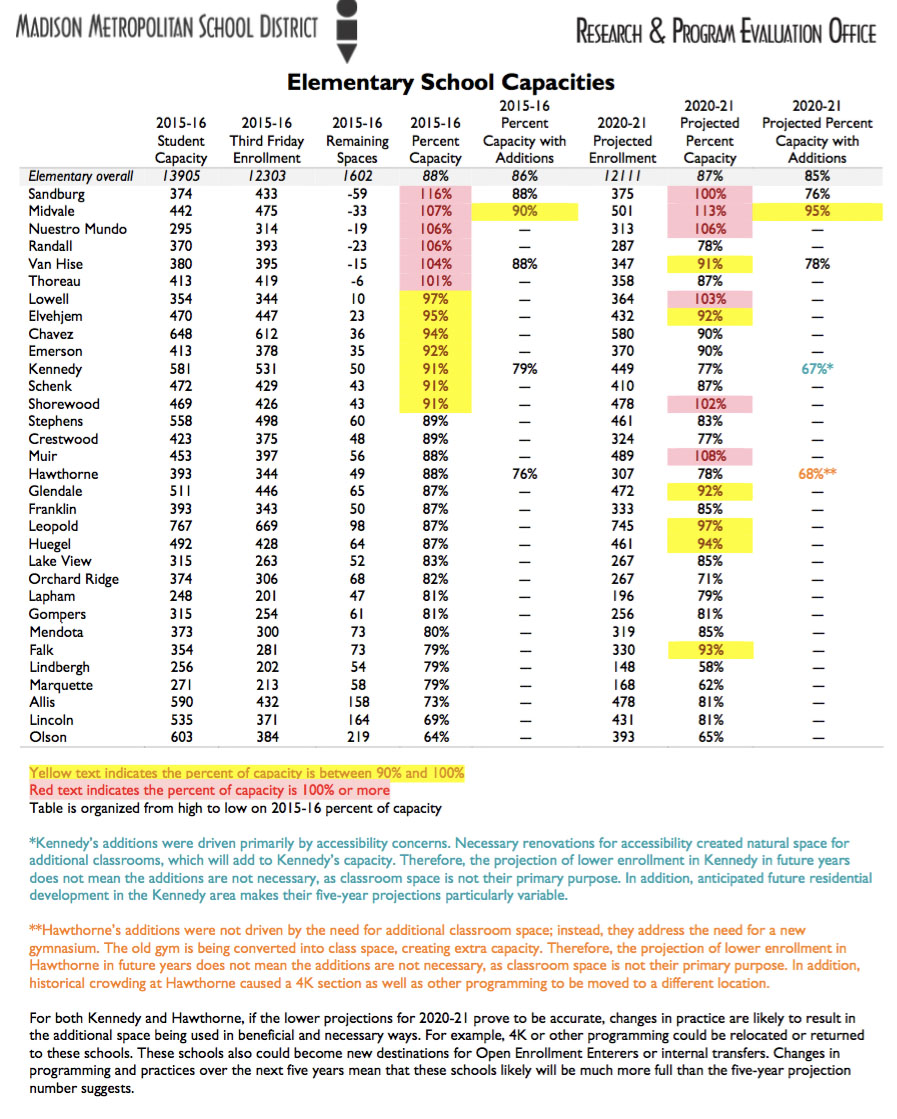
Madison, which spends double the national average per student, plans to increase property taxes by 5% this fall.

Share

Winning formula: USA tops International Math Olympiad for first time in 21 years

Michael Miller:

Thirty-five years later, America pulled off another stunning upset this week.

But this victory involved integers, not ice skates, and was waged not by hulking Cold Warriors but by teens.

Team America has finally retaken the International Mathematical Olympiad crown. The victory this week was a historic comeback.

If winning a youth math competition seems less important than vanquishing the Soviets back in 1980, consider this: the last time America won the IMO was 1994. Back then, Bill Clinton was president and Ace of Base was top of the pop charts.

Share

The quiet rebellion taking place in business schools

The Conversation:

If you ask most people what goes on in business schools, they would probably assume that a bunch of pointy heads tell other pointy heads how to read spreadsheets. Push a bit further and you might get some stories about foreign students, shiny buildings and courses that teach people how to be bastards and make lots of money. The financial crisis has often enough been blamed on business schools too for the ways that they spread the gospel of selfishness. But an odd thing is happening beneath the glass atrium – the academics are rebelling.

All around the world, the business school is now the fastest growing part of higher education. In many countries, particularly the UK, its expanding revenues are compensating for a decline in state funding and ensuring that the history department stays open.

Share

How Libraries Can Compete With Google and Amazon

Sonali Kohli:

But the reach of the Queens Library extends beyond the walls of its 65 physical branches. Dotting the borough are thousands of New Yorkers logged into their own mini-libraries, using the library’s mobile app to do research for homework, or the WiFi hotspots they checked out to fill in the holes in broadband access at home, or accessing e-books on one of the libraries’ tablets they can take home.

Throughout the country, library initiatives are emerging to keep up with technological advances. And libraries are finding that one population they can serve better than anyone else is low-income Americans.

Share

Republicans and Teachers Unions

Jonathan Chait:

In 2010, Diane Ravitch, an activist for the most militantly anti-reform wing of the teachers-union movement, wrote a Wall Street Journal op-ed proposing that Republicans use their newfound control of the House of Representatives to roll back the Obama administration’s education reforms. Since then, the union backlash against the Obama administration’s agenda has gained force. Yesterday, it manifested itself in a Senate vote in which Republicans and the unions worked in more open cooperation – against the Obama administration and civil-rights groups allied with it – than at any time in the past.

You should read Libby Nelson’s terrific explanation of the dynamics behind the vote. The gist of the alliance is that both the Republicans and the unions want to reduce the federal government’s ability to direct the course of education policy. Nelson detected an interesting rhetorical confluence:

Sen. Lamar Alexander, the Tennessee Republican who now leads the Senate education committee, has a favorite epithet for how Duncan has used his power. Alexander is fond of saying that Duncan created a “national school board.”
Eskelen García echoed Alexander, hardly an ideological ally, in a Thursday interview. “Nobody elected the education secretary to be the national superintendent of schools or the national school board,” she said.

Share

Ron Johnson hosts hearing on voucher schools amid federal probe

Erin Richards:

In an interview Monday at St. Marcus School, a voucher school at 2215 Palmer St., Johnson said a staffer brought the investigation to his attention, which prompted him to write letters to U.S. Attorney Loretta Lynch this summer, asking for evidence of the basis of their investigation.

The department has declined to comment, saying the investigation is ongoing.

Johnson, who was the only member of his committee at the hearing, said he invited other members to attend and bring witnesses, but all declined.

The official speaker list, then, included pro-voucher witnesses chosen by Johnson, including two former students of voucher schools: Justice Shorter, a graduate of Messmer High School who’s now in graduate school, and Diana Lopez, a graduate of St. Anthony High School who is headed to Yale. It also included Bob Smith, former principal of Messmer; John Witte, professor emeritus at the University of Wisconsin-Madison; and Richard Komer, senior attorney at the Institute of Justice.

“While participating in the parental choice program, I received the same voucher as all students, which didn’t account for the extra costs of my visual impairment,” said Shorter.

Komer said the justice department held on to the disability rights complaint in 2011 instead of referring it to the Department of Education, as is custom.

Share

The Risky Eclipse of Statisticians

Hacker Rank:

If statisticians have historically been leaders of data, why was there a need for a brand new breed of data scientists? While the world is exploding with bounties of valuable data, statisticians are strangely working quietly in the shadows. Statistics is the science of learning from data, so why aren’t statisticians reigning as kings of today’s Big Data revolution?

In 2009, when Google was still fine tuning its PageRank algorithm based on the statistical innovation Markov Chain, Google’s Chief Economist Hal Varian declared statistician as the sexiest job of the decade. We’re about halfway through, and it seems that Varian missed the target.

“Professional statisticians are milling at the back of the church, mesmerized by the gaudy spectacle of [Big Data] before them.” – David Walker, statistician, Aug 2013.

Share

An iPad gave my son with disabilities a voice – and changed his life

Kathy Bell:

For most of us, our voices emanate from our own vocal chords. For Kevin, our 20-year-old son with Mowat Wilson Syndrome – a developmental disability – his words are battery-charged, delivered by an app and wrapped protectively in royal blue silicone. And we love his voice.

By the age of two, we knew that Kevin had severe language issues. We held onto the hope that, by age 10 – an important milestone in speech development – he would have words with which to communicate. Perhaps it was naïve on our part; it didn’t happen. When he was 13, we accepted what limited progress he had made, stopped thinking about what he could not do and focused on the everyday things he could achieve.

Share

Syria-Isis Westerners fighting for Kurds disillusioned with YPG’s ‘school trip with guns’ tactics

Sofia Barbarani:

A number of them were recently involved in the retaking of Tel Abyad on 15 June – an Arab-majority border town in northern Syria. The move, which was seen as a setback for IS, was hailed as a major victory for the Kurds, who were able to open a corridor through the town and connect two of their three autonomous cantons: Jazeera and war-torn Kobani.

Share

NJ: “No Contracts, No Step Salary Increase”

John Reitmeyer:

Gov. Chris Christie has taken an aggressive approach to dealing with public workers and their unions since taking office in early 2010. He’s encouraged voters to reject school budgets in communities where teachers weren’t accepting pay freezes, pushed to change civil-service rules, and signed legislation that forced employees to pay more toward to their pensions and health benefits.

Now that Christie has joined the 2016 GOP presidential primary field, his administration is taking another tough stance. It recently told thousands of union members whose contracts expired June 30 that they won’t be receiving annual incremental pay increases while there’s no new deal in place.

In the past, the unions say workers have generally received their annual increases if their performance merited the bump — even without a contract in place.

Christie’s freeze affects state office workers, college professors, corrections officers, and other groups of public workers who haven’t yet reached the top of their pay scales.

Public-worker unions have been responding to the Christie administration’s new position on pay increments — something many view as a pressure tactic — by filing administrative grievances and at least one union, Policemen’s Benevolent Association Local 105, has filed suit in Superior Court.

Lance Lopez, the president of PBA Local 105, said the Christie administration’s freeze affects 3,700 members of his union. The prior agreement with the state said that the rules established under a contract that expired on June 30 would be extended for a year if no new agreement was reached, he said. And the union would have had to have been informed in writing by February 1, 2015 of any change, which didn’t occur, he added.

Share

Feds: Most States Failing To Meet Special Ed Obligations

Michelle Diamont:

their obligations under special education law.

The U.S. Department of Education says that just 19 states qualified for the “meets requirements” designation for the 2013-2014 school year. The rest of states were classified as “needs assistance” or “needs intervention.”

Under the Individuals with Disabilities Education Act, the Education Department must evaluate states annually on their efforts to implement special education programs.

The ratings carry significant weight. If a state fails to meet requirements for two or more years, the Department of Education must take enforcement action, which can include a corrective action plan or withholding funds, among other steps.

This is the second year that the Education Department has relied on stricter measures to assess compliance.

Share

“Hard to make comparisons across years” 

Alex Scharaschkin:

The exams are finished and GCSE and A-level students are heading off for summer. But there are 12 weeks – and a lot of work – from “pens down” to results day

Did you hear that noise? It’s the sound of thousands of students collectively breathing a sigh of relief. If April is the cruellest month, then July is the most anticipated. The end of GCSE and A-level exams marks a rite of passage, a time for reflection, celebration – and, for some, panic. After candidates have put down their pens, examiners – usually teachers by day – remain holed up in studies, marking.

Related: WKCE.

Share

Why the “Every Child Achieves Act” Needs a Little More Tweaking

Laura Waters:

Marianne Lombardo at Education Reform Now looks at the recent report on NAEP scores from the National Center for Education Statistics. Results show that many states have standards that are less ambitious than the concepts tested, especially in 4th grade reading. While, she says, “NAEP frameworks and benchmarks are established by the National Assessment Governing Board and are based on the collaborative input of a wide range of experts and participants in the United States government, education, business, and public sectors,” states set their own standards when creating course objectives.

These standards range across a spectrum from “Basic” to “Proficient.” Remember, most, if not all, of the data derives from pre-Common Core days. So, for instance, while New York State consistently sets its standards on the high end of proficient for all areas – 4th grade reading and math; 8th grade reading and math – “most states set standards equivalent to the “Basic” range in the national assessment. “

Share

Sen. Mike Lee Added a Free-Range Kids Clause to Major Federal Legislation

Lenore Skenazy:

Libertarian-leaning Republican Sen. Mike Lee (R-Utah), a supporter of the Free-Range Kids movement, has proposed groundbreaking federal legislation to protect the rights of kids who want to walk to school on their own.

That’s right: a Free-Range Kids provision made its way into the Every Child Achieves Act, a reauthorization of major federal law that governs funding and regulation of elementary education in the United States. The Free-Range Kids portion of the law would permit kids to walk or ride their bikes to school at an age their parents deem appropriate, without the threat of civil or criminal action.

Laws like this one could prevent—or at least deter—local officials from waging harassment campaigns against parents who want give their kids some autonomy. If this had been the law of the land when the Meitivs allowed their kids to walk home by themselves in Maryland, it might have forestalled the whole shebang. (Though, admittedly, the kids were coming back from the park, not school.)

A rather sad commentary on the nanny state.

Share

Law School Scholarships Foist Surtax On The Neediest Students

Aaron Taylor:

The ABA Task Force on the Financing of Legal Education recently released its report identifying factors driving the high costs of legal education. One factor cited by the task force was law school scholarship policies based on high Law School Admis­sion Test scores, instead of financial need. These policies contribute in large part to high levels of law student debt, particularly among first-generation students. Worse yet, they result in the neediest students paying a tuition premium — a “merit surtax,” if you will — that subsidizes the attendance of their wealthier peers.

An analysis of data from the 2014 administration of the Law School Survey of Student Engagement charts how this phenomenon unfolds. The purpose of the analysis was to identify trends relating to the law school experience that were attributable to socioeconomic factors. … We found that average LSAT scores increased as parental education increased.

Share

Mapping Lexical Spread in American English

Jack Grieve:

New words are regularly identified by lexicographers, linguists, and the media, but very little is known about how new words spread across time and space.

This is primarily because we haven’t had access to sufficiently large geo-coded and time-stamped corpora to identify and map words as they spread (although see Eisenstein et al., 2014).

Share

Linear Algebra for Data Scientists

Alex Woods:

It’s important to know what goes on inside a machine learning algorithm. But it’s hard. There is some pretty intense math happening, much of which is linear algebra. When I took Andrew Ng’s course on machine learning, I found the hardest part was the linear algebra. I’m writing this for myself as much as you.

So here is a quick review, so next time you look under the hood of an algorithm, you’re more confident. You can view the iPython notebook (usually easier to code with) on my github.

Share

The DOJ is investing millions of dollars in research to spy on students at public schools nationwide

Privacy SOS:

The Department of Justice’s National Institute for Justice funds law enforcement research to the tune of tens of millions of dollars each year. The full list of grants, posted each year, is a valuable insight into future of law enforcement trends in the United States. NIJ funding for 2014 appears to have primarily focused on two issue areas: school safety and clearing DNA backlogs at police departments across the country.

Among the dozens of projects that focus on school safety, there are some that appear progressive, at least judging from the limited amount of information available online. But while a slice of the funding explicitly aims to examine and interrupt the school to prison pipeline using restorative justice methodologies, a lot of the money is going toward research that will probably further entrench disparate outcomes based on race in the criminalizing trend in school discipline.

One of those projects is a City of Chicago Board of Education program called “Connect and Redirect to Respect (CRR),” which aims “to use social media monitoring to identify and connect youth to behavioral interventions.” In other words, the DOJ is giving $2.1 million dollars to the Chicago public schools to conduct research on how spying on student social media can impact school discipline. In New York, police spying on youth social media has resulted in the criminalization of speech.

Share

Former Memorial High School math whiz coaches Team USA to big international win

Doug Erickson:

A math team coached by a Madison Memorial High School graduate is getting praise from President Barack Obama and many others following its David-vs.-Goliath victory over China this week in the International Mathematical Olympiad.

The team of six teenagers, led by coach Po-Shen Loh, 33, topped more than 100 countries during the 10-day competition in Thailand.

The U.S. had not won the competition in 21 years, leading the White House to tweet celebratory congratulations and a “Go Team USA!”

As a high school math whiz, Loh attained considerable acclaim and won numerous state and national honors.

He twice represented Wisconsin in the national MathCounts competition and competed on Team USA in the 1999 International Math Olympiad.

He is now an associate professor of math at Carnegie Mellon University in Pittsburgh.

Share

Closure Concerns and Financial Strategies: a Survey of College Business Officers

Kelli Woodhouse:

The 2015 Survey of College and University Business Officers, Inside Higher Ed and Gallup’s fifth such study, reveals that as institutions deal with financial concerns, they are using some strategies, like increasing enrollment, more widely than more unpopular methods of trimming the budget. And that’s not necessarily to the benefit of struggling colleges, analysts interviewed for this article say.

In the survey, 64 percent of business officers this year strongly agreed or agreed that their financial model is sustainable over the next five years, compared to 62 percent last year. That confidence drops to 42 percent over 10 years, roughly similar to last year’s response of 40 percent.

Share

Bing plans to include school ratings in search results

Bing blog:

If you have kids, we don’t have to tell you that the quality and accessibility of schools near your new home can be just as important as the home itself. Found the perfect home on Bing? Click on one of the local schools in the answer to see key information. You’ll see the GreatSchools rating and community score at the top, and details including contact information, student-to-faculty ratios, enrollment, as well as rankings and academic indicators for high schools.

Share

Parents Dedicate New College Safe Space In Honor Of Daughter Who Felt Weird In Class Once

The Onion:

In an effort to provide sanctuary for Lynnfield College students exposed to perspectives different from their own, a new campus safe space was dedicated Wednesday in honor of Alexis Stigmore, a 2009 graduate who felt kind of weird in class one time.

Addressing students at the dedication ceremony, parents Arnold and Cassie Stigmore noted that while the college had adequate facilities to assist victims of discrimination, abuse, and post-traumatic stress, it had until now offered no comparable safe space for students, like their beloved daughter, who encounter an academic viewpoint that gives them an uncomfortable feeling.

“When our Alexis felt weird after hearing someone discuss an idea that did not conform to her personally held beliefs, she had no place to turn,” said Arnold Stigmore, standing outside the $2 million space that reportedly features soothing music, neutral-colored walls, oversized floor cushions, fun board games, and a variety of snacks. “God forbid any of you, in your years at this institution, are ever confronted with an opinion you do not share. But if you are, you will have a refuge on this campus.”

Share

Teachers’ New Homework: a ‘Watchman’ Plan

Leslie Brody & Jennifer Maloney:

The release Tuesday of Harper Lee’s “Go Set a Watchman” gave English teachers some tricky summer homework: how to reframe their lessons on “To Kill a Mockingbird” now that its moral center, Atticus Finch, has been depicted as a racist.

Many teachers said they are excited that this twist adds a thought-provoking dimension to the classic and will lead to valuable classroom discussions of flawed heroes, bigotry and the fact that Ms. Lee’s father, the model for Atticus, abandoned his segregationist views later in life, as the author worked on revising “Mockingbird.”

Some said these issues would be especially resonant after a year of protests around the country against police killings in confrontations with unarmed black men, South Carolina’s Confederate flag controversy and other racially charged news.

Share

UK Home Secretary proposes tougher rules for student visas

Chris Cook:

Home Secretary Theresa May is looking into tougher rules for visas for overseas university students, BBC Newsnight has learned.

The proposals would require students to have more financial savings on arrival.
In a confidential letter to other ministers, she argues that universities should “develop sustainable funding models that are not so dependent on international students”.

The Home Office refuses to comment on leaked documents.

Student migration is a significant political problem for the government, which has a target of reducing net immigration to below 100,000 people per year.

Share

Early childhood education by MOOC: Lessons from Sesame Street

Melissa Kearney & Phillip Levine:

Early childhood education has important effects on the academic readiness and ultimate life chances of children. This column examines how the introduction of the educational television show Sesame Street in the US affected primary school outcomes for disadvantaged children. Those from counties that had better access to the broadcast had superior educational outcomes through their early school years. These effects were particularly pronounced for black, non-Hispanic children, and those living in economically disadvantaged areas. The extremely low cost per child of such interventions make them ideal for addressing educational inequality in childhood.

Share

Moxie Marlinspike: The Coder Who Encrypted Your Texts

Danny Yadron:

In the past decade, Moxie Marlinspike has squatted on an abandoned island, toured the U.S. by hopping trains, he says, and earned the enmity of government officials for writing software.

Mr. Marlinspike created an encryption program that scrambles messages until they reach the intended reader. It’s so simple that Facebook Inc.’s WhatsApp made it a standard feature for many of the app’s 800 million users.

The software is effective enough to alarm governments. Earlier this year, shortly after WhatsApp adopted it, British Prime Minister David Cameron called protected-messaging apps a “safe space” for terrorists. The following week, President Barack Obama called them “a problem.”

Share

U.S. Universities — Not So Innocent Abroad?

Peter Berkowitz:

American universities are enjoying boom times abroad. Many of the most prestigious have established branch campuses overseas and launched collaborations with foreign governments and institutions of higher education, particularly in Asia and the Middle East. While numerous programs deal with science and technology, of special interest are undertakings to bring the advantages of liberal education to countries that do not protect liberty of thought and discussion.

The tension is real and the stakes large. In an age in which developments in transportation and communication have intertwined national economies to an unprecedented extent, it is to be expected that American educators would seek to disseminate liberal education around the world—to enhance their reputations, improve their bottom lines, and benefit America by fostering knowledge of the principles, and cultivating the spirit, of freedom.

Share

Clemson’s New Plan

C. Bradley Thompson:

America’s universities are collapsing into a miasma of nihilism, postmodernism, political correctness, multiculturalism, affirmative action, bureaucratization, and skyrocketing costs—and no one seems able to do anything about it. With the exception of a few “Great Books” colleges, the overarching vision of higher education that once sustained the West for centuries seems all but dead.

American higher education is now defined by an aimless mish-mash of courses on trivial topics that present no clear view of what a human being must know in order to be considered liberally educated. The result: the liberal arts have been gutted and repackaged to serve various ideological and political interests.

Share

One Boy’s Death Draws Renewed Attention to Chicago’s Street Violence

Michelle Hackman & Mark Peters:

The death of a 7-year-old boy during another Fourth of July weekend marred by multiple murders and dozens of shootings here is bringing renewed attention to the difficulty of curbing street violence in the nation’s third-largest city.

Amari Brown was shot shortly before midnight on July 4 as he watched fireworks on Chicago’s West Side, one of seven homicides and 34 shooting incidents here from Friday evening through Sunday, according to city officials.

His family is preparing for the funeral of a boy who they say loved cars and candy and would have started second grade this fall, while police say they suspect that his father’s alleged gang ties may have been a factor in the shooting.

“Something good’s got to come out of Amari dying on the street like a dog,” said Vedia Hailey, the boy’s maternal grandmother.

Share

UW professor under fire for tweeting at incoming freshmen

Karen Herzog:

An outspoken University Wisconsin-Madison professor has tweeted herself into a world of controversy.

Sara Goldrick-Rab is under fire for finding future Badgers on Twitter and essentially encouraging them to take their money elsewhere — as well as for comparing Gov. Scott Walker to Adolf Hitler.

College Republicans blasted her on Wednesday, and on Thursday, Goldrick-Rab was rebuked by UW-Madison’s faculty governing group in a withering statement that said she hurt both academic freedom and the university “with inaccurate statements and misrepresentations.”

Goldrick-Rab is a tenured professor of educational policy studies and sociology with a national profile in both her field of research and the ongoing debate over faculty tenure at Wisconsin public universities. She has openly that said she’s looking for another job because she believes academic freedom is in jeopardy in Wisconsin.

Goldrick-Rab acknowledges that she searched Twitter for future Badgers. The prolific Twitter-user says she just wanted to inform them of changes to faculty tenure and shared governance that were about to become part of state law — changes that she believes would hurt the quality of their education, but that the university wasn’t telling them about.

While some future Badgers thanked her, a group who had just graduated from a Kenosha high school took exception. One of them contacted the College Republicans of UW-Madison, who called on the university Wednesday to address it — more than a month after the Twitter contact occurred.

It’s fine to engage those with different viewpoints in a respectful way, when they are interested in having a discussion, Anthony Birch, chairman of the young Republicans group, told the Milwaukee Journal Sentinel.

Share

New york City Pre-k Acceptance Letters

Elizabeth Bradley:

Guardian,

We are pleased to offer your child a pre-kindergarten placement for the 2015-2016 school year at:

Digester Eggs, Newtown Creek, Brooklyn

To accept this placement, please gather proofs of identification and immunization and proceed to the corner of Greenpoint and Humboldt Streets. There you will be met by Anubis, jackal-headed guide of souls and Guardian of the Scales. He will weigh the heart of each student: those deemed lighter than an ostrich feather may continue on to registration at the Eggs. Those deemed heavier or in possession of non-organic cheddar bunnies will be eaten by Ammit, Devourer of the Dead, at the nearby Lake of Fire.

Share

Remedial college classes: A view from the high school side

Jay Bullock:

MPS and the legislature can’t fix this, as the problem is much larger than this city or this state. And it goes against the grain of what I and much of the rest of the district believes, that there’s a benefit of going through the application and admission process and going through the rigors of university life. Though I know many of my students would be better suited by a two-year degree or other post-high school training program, I want to see them apply to a real college because it’s a good experience for them.

Second, a D is still passing. MPS hasn’t released recent data that I’ve found, but before the state report card system, the district put out its own report cards. These always showed that the mean grade point average for high school students was around 1.0. D students can pass classes, accumulate credits and graduate just fine while remaining demonstrably below average.

The state – thankfully – does not have a high-stakes graduation exam that students must pass before earning their diplomas, or for that matter any other specific set of standards that must be met before the end of high school. The exception is the mandatory civics test that goes into effect this coming school year, but that is hardly going to be a barrier to graduation the way it’s written into law. In any case, it wouldn’t tell us a thing about whether students will need math or English remediation in college.

Without such standards, schools are able to send below average, D students on into their adult lives. Which is good for those of us who would rather not be teaching 40-year-old high school students who never passed English 10, but bad for universities who enroll them into their programs.

Share

Uber for disembodied companionship

Remains of the day:

It’s hard to put a price on love. But Crowdsource did. It’s worth a whopping five cents. That’s how much I got paid to write each of these texts.

If I spent an hour answering texts, and took the full five minutes to write each one, I’d be making 60 cents an hour, far below the minimum wage. This is legal because all the workers on the platform are classified as independent contractors rather than employees. “Contributors have a tremendous amount of control over their decisions—for example, when to perform a task, when to complete it, and even if they want to complete it at all,” said Jeffrey H. Newhouse, an employment lawyer at Hirschler Fleischer, by email. “That means the contributor isn’t an employee and, as a result, employee protections like the minimum wage don’t apply.”

Share

Crossing State Lines: Where Are Students Going to College?

Brian Meager:

Last week we dove into the data to help explain where out-of-state students come from. We found that the number of out-of-state and international students attending elite public institutions is on the rise, and that at some public institutions, the number of out-of-state students outnumbers in-state students.

A comment on that post got us thinking. The comment came from a parent whose son is from California and decided to attend a university in Alabama. She mentioned how happy she is with his college choice and that he’s having a wonderful experience there, which is great, considering how few students from California study in Alabama. We know that in California, the number of students that stay in the state versus those that leave is about 8 to 1, according to the latest year of available data. In fact, in the state of Alabama, only 393 of the freshmen students are from California.

Share

Lies, Lies, Damn Lies: Enough With NEA’s Lies About “Test and Punish”

Kati Haycock:

If there has been unanimous agreement on anything during the process for renewing the Elementary and Secondary Education Act it is this: School ratings systems should no longer be just about performance on standardized tests.

Indeed, every version of the new law in both the House and Senate has required states to broaden the measures on which schools are evaluated. In looking at high schools, for example, states might also consider the proportions of students completing a full college- and career-preparatory curriculum; the numbers successfully completing Advanced Placement and International Baccalaureate courses; and even results from surveys of parents, educators, and students.

So imagine the surprise of the broad coalition of national civil rights, disabilities, and business organizations when their proposal to require schools to act whenever any group of children is not progressing on a combination of those measures was immediately labeled by the National Education Association as a “preservation of the test and punish culture of No Child Left Behind through a backdoor Adequate Yearly Progress-type (AYP) approach.”

Share

England will not take part in OECD’s ‘Pisa for universities’

John Morgan:

England will not take part in the Organisation for Economic Cooperation and Development’s project to measure learning outcomes of graduates around the world, delivering a blow to the plan.

The OECD had described the Assessment of Higher Education Learning Outcomes project, seen as a potential university-level equivalent of the organisation’s Pisa tests in schools, as having the potential to transform the hierarchy of world higher education.

Earlier this year, the OECD asked member nations to indicate whether they wished to take part in a full “main study”, following a pilot of the project.

But the Department for Business, Innovation and Skills has declined the chance of taking part and will instead prioritise work in England to develop measures of learning gain, likely to figure in the teaching excellence framework.

David Willetts, the former universities and science minister, had previously suggested that Ahelo could potentially be used by government as a metric to help judge teaching quality at universities.

A BIS spokesman said: “We have responded [to the OECD] and won’t be taking part in the Assessment of Higher Education Learning Outcomes project.

Share

A gentle introduction to statistical relational learning: maths, code, and examples

Philippe Desjardins-Proulx:

Statistical relational learning is a branch of machine learning (A.I.) devoted to unify probability theory and logic. I’ll write another post later to explain the motivation and a bit of history of this fascinating branch of study, but here I want to focus on a concrete example, with detailed maths and code.

The approach to statistical relational learning explained here is called Markov logic network (MLN), discovered in 2006 by Richardson and Domingos. Their paper has a nice simple example of MLN applied to the relationship between smoking and cancer. However, it’s a bit hard to follow unless you’re used to read papers on both logic and probabilistic graphical models. In this post, I will mostly follow their smoking/cancer example, but I will try to be much more explicit. I’ll also do a demonstration with Manticore, a small implementation I wrote for playing with statistical relational models.

Share

Sick kids, desperate parents, and the battle for experimental drugs

Sylvia By Sylvia Pagan Westphal:

JENN MCNARY KNOWS ANGER. It has overcome her often, and with the ravaging might that only a mother knows when her child is dying. Except in her case, it’s not one son but two who face a death sentence.

At 34, McNary’s face still has the glow of youth, and it lights up when she talks about all four of her kids, although she knows she has given most of her life, her energy, and all of her fight to her two oldest. As McNary sits in the kitchen of her modest apartment in Pembroke, her eyes harden as she remembers the moment a few years back when she realized there was something worse than knowing both of her children would die — knowing there was something out there that could help them, but that only one of them could have.

Share

Private school education could be poor investment, research shows

Richard Adams:

A private school education may be a poor investment, according to research commissioned by a firm of stockbrokers that shows rapid growth in independent school fees outstripping the incomes of middle class professionals. The research, published by investment advisers Killik & Co, says the £236,000 paid by parents of a day pupil would, if invested, return nearly £800,000 over the child’s lifetime – enough to pay for university, put down a substantial deposit on a house and leave £500,000 for retirement.

Share

Open Mathematics

Imaginary:

IMAGINARY is your place for open and interactive mathematics. Join a worldwide community of math enthusiasts!

Share

First Year University Expenses (Canada)

Bo Peng:

1. Tuition
Tuition is easily the largest incurred expense. The costs varies across programs, schools, and location in Canada. The average undergraduate tuition increases by about 3% each year for domestic students and 6% for international students.

View undergrad tuition costs spreadsheet here: https://goo.gl/aKML14
I’ve compiled a spreadsheet of undergraduate tuition costs (thanks to Stats Canada). These numbers give you a pretty accurate amount that you should expect to pay. All of these numbers assume you are a domestic student enrolled in a full course load. International students should expect to pay between $20,000 to $40,000 for tuition per year.

Programs like arts, humanities and science are regulated, which means all schools in Ontario charge a similar amount of $6,000 – $6,500. Engineering, math and computer science programs should be very close as well, though some schools attract higher fees. For example, York Engineering charges $8,800, whereas Waterloo & U of T Engineering charges about $13,000 (the average in Ontario is $10,500).

Share

The Teachers Union Votes Hillary

Wall Street Journal:

While the media chase the Bernie Sanders rallies, keep your eye on the political crowds that matter. On Saturday the American Federation of Teachers (AFT) endorsed Hillary Clinton—16 months before Election Day.

This counts in the fight for the Democratic Party nomination because the 1.6 million member union boasts it can make a million phone calls and knock on 500,000 doors. Bernie’s Birkenstock irregulars can’t match that political…

Share

A New Look at Apprenticeships as a Path to the Middle Class

Nelson Schwartz:

With its gleaming classrooms, sports teams and even a pep squad, the Apprentice School that serves the enormous Navy shipyard here bears little resemblance to a traditional vocational education program.

And that is exactly the point. While the cheerleaders may double as trainee pipe fitters, electricians and insulators, on weekends they’re no different from college students anywhere as they shout for the Apprentice School Builders on the sidelines.

But instead of accumulating tens of thousands of dollars in student debt, Apprentice School students are paid an annual salary of $54,000 by the final year of the four-year program, and upon graduation are guaranteed a job with Huntington Ingalls Industries, the military contractor that owns Newport News Shipbuilding.

“There’s a hunger among young people for good, well-paying jobs that don’t require an expensive four-year degree,” said Sarah Steinberg, vice president for global philanthropy at JPMorgan Chase. “The Apprentice School is the gold standard of what a high-quality apprenticeship program can be.”

Share

What Did Race to the Top Accomplish

Joanne Weiss & Frederick Hess:

Race to the Top was the Obama administration’s signature education initiative. Initially greeted with bipartisan acclaim, it has figured in debates about issues ranging from the Common Core to teacher evaluation to data privacy. Five years have passed since the U.S. Department of Education announced the winners in the $4 billion contest. What can the competition and its aftermath teach us about federal efforts to spur changes in schooling?

Joanne Weiss, former chief of staff to U.S. Secretary of Education Arne Duncan and director of the federal Race to the Top program, argues that the initiative spurred comprehensive improvements nationwide and in numerous policy areas, among them standards and assessments, teacher evaluation methods, and public school choice. Frederick M. Hess, director of education policy studies at the American Enterprise Institute, whose books include Carrots, Sticks, and the Bully Pulpit: Lessons from a Half-Century of Federal Efforts to Improve America’s Schools, contends that the competition rewarded mainly grant-writing prowess and that policymakers should be wary of top-down efforts to spur innovation.

Share

The new trend in validating top students: Make them all valedictorians

Moriah Bollingit

But at Arlington’s Washington-Lee High School this year, there were 117 valedictorians out of a class of 457. At Long Beach Polytechnic in California, there were 30. And at some schools — including North Hills High outside of Pittsburgh and high schools in Miami — there were none.

The nation’s high schools are changing the way they recognize top students, struggling to balance praise for them while also quelling unhealthy competition among classmates as the college application process grows more cutthroat.

The result? Some say schools have deflated the meaning of a well-earned and time-honored accolade while also vexing college admissions officers, who don’t know if a student finished first or 100th in the class. Others say getting rid of valedictorians entirely allows students to focus on their achievements without worrying about where they fall in the pecking order.

Share

Pols’ High Anxiety Over Higher Ed

Ramesh Ponnuru

In particular, progressives want to use increased federal funding as leverage to get schools to act the way federal policymakers want them to. Thus President Barack Obama’s proposal to spend $60 billion to eliminate tuition at community colleges that “adopt promising and evidence-based institutional reforms to improve student outcomes.” A related idea is to have the government publish ratings for colleges, the better to make them responsive to the desires of Washington. The progressive approach exposes newer players, such as for-profit schools, to special scrutiny.

Conservatives, on the other hand, increasingly favor policies that provide new options for students: new educational institutions, new financing methods and new information for evaluating them. Rubio wants to liberalize accreditation rules to break up what he calls the higher-education “cartel.” He wants to make it easier for private institutions to extend student loans in return for a share of students’ future income. He thinks vocational education should get a greater share of federal funds. He thinks prospective students should have access to data about how well graduates of specific college programs fare at getting jobs. And he wants higher-education institutions, whether new or old, for-profit or not, to be accountable to customers rather than to the government.

Share

K-12 Tax & Spending Climate: Suburbs vs. Urban Markets

Joel Kotkin:

Some suggest that the trends of the first decade of this century already are passé, and that more Americans are becoming born-again urbanistas. Yet after a brief period of slightly more rapid urban growth immediately following the recession, U.S. suburban growth rates began to again surpass those of urban cores. An analysis by Jed Kolko, chief economist at the real estate website Trulia, reports that between 2011 and 2012 less-dense-than-average Zip codes grew at double the rate of more-dense-than-average Zip codes in the 50 largest metropolitan areas. Americans, he wrote, “still love the suburbs.”

What is also missed by the Obama administration and its allies is the suburbs’ growing diversity. If HUD wants to start attacking these communities, many of their targets will not be whites, but minorities, particularly successful ones, who have been flocking to suburbs for well over a decade.

This undermines absurd claims that the suburbs need to be changed in order to challenge the much detested reign of “white privilege.” In reality, African-Americans have been deserting core cities for years, largely of their own accord and through their own efforts: Today, only 16 percent of the Detroit area’s blacks live within the city limits.

These trends can also be seen in the largely immigrant ethnic groups. Roughly 60 percent of Hispanics and Asians, notes the Brooking Institution, already live in suburbs. Between the years 2000 and 2012, the Asian population in suburban areas of the nation’s 52 biggest metro areas grew by 66 percent, while that in the core cities expanded by 35 percent. Of the top 20 areas with over 50,000 in Asian population, all but two are suburbs.

Related: Where have all the students gone?

Share

Winners and 5 Losers Under the Every Child Achieves Act

Chad Aldeman:

As the Senate continues its debate on the Every Child Achieves Act, a bill to replace No Child Left Behind, I took some time to sort through winners and losers under the bill. Here are my top 5 winners and losers:

Winners:

State bureaucrats, legislatures, education chiefs, and governors: This bill is fundamentally about giving more power to states. The various state actors would have pretty much an unfettered reign over how they spent billions of federal dollars.

Teachers unions: The bill includes no requirements on teacher or principal evaluation systems, a win for teachers unions that have campaigned against them. And, although the bill does not reduce the number of federally required assessments, it puts decisions about what to do (or not) about low-performing schools in the hands of states, where unions have more political clout.

State policy organizations like PIE-Net members and ALEC: As states decide what to do on education policy, state-based policy organizations on both the Left and the Right will take on an outsized role in driving their preferred reforms.

Share

Proposed South Side Milwaukee Voucher High School

Matt Kullig:

Ramirez has not said whether his proposed St. Augustine Preparatory Academy would participate in the Milwaukee Parental Choice Program, but opponents have predicted the school would elect to educate students using taxpayer-funded vouchers and compete directly with the public schools for state education dollars.

Ramirez said the goal of the school is to change the outlying community.

“Our main goal is to change Milwaukee,” Ramirez said. “We want to make (the south side) a better place to live.”

Ramirez, executive chairman of Waukesha-based Husco International, said the legacy of the school, if built, will be graduates who can positively impact the community for years to come. He said he is “very confident” the area will be rezoned when a city committee meets Thursday.

Ramirez, who has financially supported private voucher schools and charter schools, noted an extensive waitlist at two other south side schools, Ronald Reagan High School and Carmen High School of Science and Technology. Reagan is a high-performing Milwaukee public school. Carmen is an independent charter authorized by MPS.

Union critical of plan

The Milwaukee Teachers’ Education Association, the teacher’s union, criticized Ramirez’s efforts by saying the school would be a drain on public schools. MTEA president Kim Schroeder said the school wouldn’t be beneficial to the community.

“No taxpayer dollars should be used to build another private voucher or charter school in our city,” Schroeder said in a statement. “Taxpayer-funded private schools drain opportunities and resources from the public schools that students and families depend upon.”

Share

We mean business on K-12 education

John Engler & Thomas Donahue:

The government can also exercise accountability without the federal mandates of NCLB that were disliked by many school systems—and those mandates must go. But it remains in the national interest for progress to be measured for all students. The results should be released, and parents and taxpayers should be told the truth about our education system. Finally, schools must take action to help students and groups of students that are falling behind the academic goals set by states.

Despite the progress both the House and Senate bills make in a number of areas, lawmakers can do more in supporting students who need the most academic help. The House and Senate bills do not do enough to direct funding to schools and students—and groups of students, including minorities and disabled children—that have not met state academic goals. In both bills, schools could fail to meet their own state’s goals for their students year after year, after year, and never be required to take any action. To us, that is simply unacceptable.

Share

Youthful Folly

The Economist:

THE REBECCA SCHOOL for autistic children occupies all five floors of a building in midtown Manhattan. Its rooftop playground has a fine view of the Empire State Building. It features colourful classrooms and lots of places for children to lie down and recover from the sensory overload often suffered by autistic people. “My body doesn’t feel safe,” says one boy curled up in a corridor, asking to be left alone.

Share

Learning a foreign language a ‘must’ in Europe, not so in America

Kat Devlin:

Studying a second foreign language for at least one year is compulsory in more than 20 European countries. In most European countries, students begin studying their first foreign language as a compulsory school subject between the ages of 6 and 9, according to a 2012 report from Eurostat, the statistics arm of the European Commission. This varies by country and sometimes within a country, with the German-speaking Community of Belgium – one of the three federal communities of Belgium– starting its 3-year-olds on a foreign language, but parts of the United Kingdom (excluding Scotland) waiting until age 11.

Share

Student’s Dilemma, a riff of the Prisoner version with extra credit

Flowing Data:

By way of Chris Volinsky, a quiz dilemma for students who want extra credit. It’s a variation on the Prisoner’s Dilemma, a popular game theory example that uses two criminals instead of students and lesser jail time instead of extra credit.

What’s your answer? I take the two.

Share

Law seeks answers on Wisconsin high school grads who need remedial classes

What can or should be done?

Jagler is a Republican member of the state Assembly from Watertown. He said he got interested in this when he heard about students who graduated from high school in good standing, enrolled at a UW campus, took placement tests and were assigned to remedial courses. He said one parent asked him, “What happened? My kid has to take remedial math?”

Yup. In December 2013, UW officials released a report that showed that almost a quarter of students systemwide were required to take remedial courses. About 20% were assigned to math remediation and a bit under 10% to English remediation (the numbers overlap because some need both).

The math figure was at 20% in 1990, but it trended down to about 10% by 2000 before heading back up to the one-in-five mark by 2007. It stayed there in following years.

At some campuses, and for graduates of some high schools, the remedial percentage is surely lower. And for some it is much higher. The 2013 report showed the remedial rate at UW-Madison was less than 1%.For UW-Milwaukee, it was almost 37% and for UW-Parkside, it was over 65%.

Jagler has an additional question: How come so little is known about this? UW officials have compiled reports on remediation, and they have detailed their work dealing with it. But the issue gets little attention, the data is not widely known and results haven’t improved much. What this means and what can be done have been rather quiet issues.

Jagler became the lead sponsor of a little-noted bill that was approved by both houses of the Legislature and signed a few days ago by Gov. Scott Walker that calls for UW administrators to determine which public high schools (including charter schools, but not private schools) send into the UW system more than six graduates in any given year who need remedial math and/or English.

The new law calls for UW to send a report on what schools make that list to appropriate legislative committees and to the state superintendent of public instruction. (Department of Public Instruction officials asked during the legislative process to be included in the law since they, too, wanted to see the list.)

Share

Higher Education & The Reproduction of Social Elites

Discover Society:

There has been much public and media commentary on the financial crisis of 2008, the subsequent years of austerity, and the current banking system’s dubious practices, with discussions of how to tackle these issues continuing to dominate political discourse during the run up to May’s General Election. Yet, despite all this, financial elites continue to thrive in the City of London, reproducing their privilege while others struggle with the impact of austerity cuts and the reduced economic value of less valued forms of employment.

It is widely acknowledged that inequalities within UK society are increasing, with fewer people appropriating a greater proportion of the wealth and a widening chasm forming between the financial elite and the rest of society. A piece by Lisa McKenzie in April’s Discover Society illustrated powerfully how this growing inequality is experienced by those at the bottom of the income distribution and living in and around the City of London, with some facing forced eviction to make way for luxury housing for the wealthy, and others forced to use ‘poor doors’ to access their social housing within these opulent new developments.

Share

Wisconsin schools chief urges Scott Walker to veto education measures

Erin Richards:

Education issues have been some of the most controversial elements of the 2015-’17 state budget. The proposal calls for allowing much more public money to flow to private, mostly religious schools while keeping public school funding mostly flat. Public schools would see a modest increase in funding in the second year of the budget, but it’s under the rate of inflation.

Walker indicated in a radio address Thursday that the budget would lower property taxes and provide more money for K-12 education.

Some of the measures Evers is recommending Walker veto include:

■The Opportunity Schools and Partnership Program. That’s the Milwaukee “takeover” plan, which would allow Milwaukee County Executive Chris Abele to appoint a person to oversee up to five failing Milwaukee public schools each year. The schools would answer to that individual, instead of the Milwaukee School Board, and would likely result in more independent, nonunion charter school management companies running the schools.

Advocates say it’s time for undertaking a dramatically different strategy to address performance at the underachieving schools. Critics argue for local control, saying the measure would take power away from the elected Milwaukee School Board to address and resolve issues.

“Every other district in the state enjoys that privilege — this proposal would rob the MPS community of that right,” Evers wrote, adding that authority to close or reorganize schools would be placed in the hands of a single individual who would not have to answer to the MPS community.

Rather ironic. The DPI presided over decades of mediocrity via the WKCE…

Share

Are small, private online courses the future of higher education in America?

James Poulous:

Just a few years ago, a huge vogue erupted among higher-ed administrators for MOOCs, or Massive Open Online Courses. Anant Agarwal, president of the online education company edX, at the time made a bold vow: “Online education will change the world.”

After the educational elite launched these seemingly visionary programs, however, their enthusiasm was swiftly curbed. As Stephanie Garlock observes in the new issue of Harvard Magazine, The New York Times dubbed 2012 “The Year of the MOOC,” but before 2013 was out, The Washington Post was asking if MOOCs were “already over.”

Share

Course on Graphic Novels Doesn’t Need a Warning, Professor Decides

Andy Thomason:

A literature course including four graphic novels that one student found offensive won’t get a disclaimer after all. The Redland Daily Facts reports that the professor at Crafton Hills College has decided not to add a warning to the syllabus about the graphic novels’ content.

Complaints from a student and her parents last month prompted the community college’s president to announce that the professor, Ryan Bartlett, had agreed to alter the syllabus in an effort to “avoid this situation in the future.” The student, Tara Shultz, took issue with four books: Fun Home, by Alison Bechdel; Y: The Last Man, Vol. 1, by Brian Vaughan; The Sandman, Vol. 2: The Doll’s House, by Neil Gaiman; and Persepolis, by Marjane Satrapi.

Share

Just 16 per cent of the world’s population lives on incomes above the US poverty line

Shawn Donnan and Sam Fleming in Washington:

The Pew researchers, however, found that even taking its broadest definition and counting those living on between $10 and $100 a day, just 1.7bn people could be considered middle class at the end of the first decade of this century.

“The global middle class is smaller than we think, it is less well off than we think, and it is more regionally concentrated than we think,” said Rakesh Kochhar, the lead author.

Globally, Pew said, 71 per cent of the world’s population still ranked as poor or low-income in 2011, the latest year for which all global data are available, compared with 79 per cent in 2001.

Share

How pushy Chinese parents get their kids in the best schools

The Economist:

INSIDE the red-lacquered door of No. 39 Wenhua Lane in central Beijing is an old-style single-storey home built around a small courtyard. Its owner, an elderly man in a vest, sits on an upturned bucket near a jumble of cooking pots; a pile of old cardboard rests atop a nearby shed. Next to the man, two estate agents hover at the entrance to a room just big enough for a bed, a wardrobe and a rickety desk. They say it costs 3.9m yuan ($630,000). At 353,990 yuan per square metre, this makes it pricier than posh digs around New York’s Central Park—and it does not even have its own bathroom and kitchen. It is, however, close to the state-run Beijing No. 2 Experimental Primary School, one of the best in the city.

Share

Education, Intelligence, and Attitude Extremity

Michael Makowsky & Stephen Miller:

Education and general intelligence both serve to inform opinions, but do they lead to greater attitude extremity? We use questions on economic policy, social issues, and environmental issues from the General Social Survey to test the impact of education and intelligence on attitude extremity, as measured by deviation from centrist or neutral positions. Using quantile regression modeling, we find that intelligence is a moderating force across the entire distribution in economic, social, and environmental policy beliefs. Completing high school strongly correlates to reduced extremity, particularly in the upper quantiles. College education increases attitude extremity in the lower tail of environmental beliefs. The relevance of the low extremity tail (lower quantiles) to potential swing-voters and the high extremity tail (upper quantiles) to a political party’s core are discussed.

Share

A critique of Higher Education Through the Law of Value

Joss Winn:

The body of work discussed here provides a substantial and original contribution to knowledge in the following ways: By subjecting ‘open education’ to a negative critique based on Marx’s categories of the commodity, value and labour, I reveal fundamental features of the ‘academic commons’ that have not been identified through critiques that neglect the materiality of openness and technology. In order to illustrate this, I examine how ‘hacking’ (out of which the Open Education movement developed) was not only a cultural phenomenon but a form of academic labour that emerged out of the intensification and valorisation of scientific research. I develop this by exploring how ‘value’ is an underlying and mediating imperative in higher education, and illustrate how using a ‘form-analytic’ approach helps us reconceive the social form of knowledge and the roles of teacher and student in a way that most treatments of academic labour fail to do. I also demonstrate how it is possible to go beyond this critique by adopting a position of methodological negativity, against labour rather than from the standpoint of labour, to construct a theory for an alternative to the capitalist university: co-operative higher education. By combining this theoretical and practical work with emerging ideas on ‘open co-operatives’ in other areas, I show how new forms of higher education cannot be based on existing practices of reciprocity based on the production of value, as is often assumed, but rather on a new and directly social form of knowledge production that emerges out of the free association between individuals who recognise that we have much to learn from each other.

Share

Artificial Stupidity

Quentin Hardy:

But if the human race is at peril from killer robots, the problem is probably not artificial intelligence. It is more likely to be artificial stupidity. The difference between those two ideas says much about how we think about computers.

In the kind of artificial intelligence, or A.I., that most people seem to worry about, computers decide people are a bad idea, so they kill them. That is undeniably bad for the human race, but it is a potentially smart move by the computers.

But the real worry, specialists in the field say, is a computer program rapidly overdoing a single task, with no context. A machine that makes paper clips proceeds unfettered, one example goes, and becomes so proficient that overnight we are drowning in paper clips.

In other words, something really dumb happens, at a global scale. As for those “Terminator” robots you tend to see on scary news stories about an A.I. apocalypse, forget it.

Related: Madison’s long term, disastrous reading results.

Share

Philosophical discussions boost pupils’ maths and literacy progress, study finds

Richard Adams:

Philosophical discussions about truth, fairness or kindness appear to give a small but significant boost to the maths and literacy progress of primary school pupils, although experts remain puzzled as to why.

More than 3,000 pupils in 48 state primary schools across England took part in a year-long trial as part of a study named “philosophy for children”, and found that their maths and reading levels benefited by the equivalent of two months’ worth of teaching.

A Durham University evaluation said the results showed faster rates of progress for pupils eligible for free school meals, suggesting that the technique could “be used to reduce the attainment gap in terms of poverty in the short term”.

Share

The rise of the new Crypto War

Eric Geller:

The Crypto Wars

A technological backdoor is a secret portal giving someone access to a secure product, be it a smartphone app, a computer program, or a Web connection. Pure software backdoors let the government directly access systems like Gmail, Facebook, or WhatsApp, and read unencrypted communications. A more complex form of backdoor access involves the government using special keys to decipher encrypted data that it gathered through conventional interception.

Backdoors that rely on encryption keys can either involve a master key for all data flowing across a particular product or keys for individual users that can be plugged into a law-enforcement system to wiretap those people. When a company sets up its system to generate keys for law enforcement—whether for its entire product or for individual users—it holds onto those keys until it is compelled to produce them. This is called key escrow. Here, there is no portal for direct access. Instead, the software code that is written to create the encryption is designed to be able to spit out keys for the government.

Share

N.J. D.O.E. Will Release Teacher Evaluation Database Next Week

Laura Waters:

The New Jersey Department of Education received a bit of flack after its announcement of the first year’s results of using Student Growth Percentiles, as well as Teacher Practice rubrics and Student Growth Objectives, to gauge teacher effectiveness: 97% of N.J. teachers were deemed either effective or highly effective. Can any profession boast such proficiency?

But the results are more granular than that, and next week, on July 15th, the D.O.E. will release a database comprising performance ratings for specific teachers. No names are published, but parents will be able to see how many teachers in each school received ratings of either ineffective, partially effective, effective, and highly effective. They’ll also be able to see principal ratings (by district, not school, to preserve anonymity).

Share

“the widespread denial of educational mediocrity”

Laura Waters:

What’s more troubling is that many middle-class families take this propaganda as gospel and reject efforts to maintain meaningful oversight and accountability.

The Problem Is Us
Now, New Jersey may be an extreme example. We’re die-hard local control fanatics who cherish our small towns and district identities. As such, we adhere to what Rotherham calls the “middle class politics of education” which “means leaving suburban schools alone to rise and fall as they might. This has led to widespread mediocrity and pockets of excellence…and neutering accountability systems to mask uncomfortable bad news about school performance.”

Related: Madison’s long term, disastrous reading results and the Math Forum.

Share

Books

Poemas del río Wang

“When the Communists came, the books were evacuated from the village, and moved into the cave of the Şahdağ. They stood there, in a big pile this high”, the small man raised his hand to the height of his eyes. “But the Communists found them, and they set the whole thing on fire. Before that, the cave was white inside, but since then it has been completely blackened with soot.”

“My grandfather walled our books into a window when the Communists came. He put them in one of the windows, walled it up inside and outside, nobody could see anything. When he came back from the Gulag, because he was a rich sheep owner, a kulak, as they said, and they took him away for ten years, so when he came back, he immediately asked whether the house was still standing. It was, but by then it belonged to the kolkhoz, the kolkhoz office was set up there. In the night, when nobody was looking, he opened the window, and removed the books.”

Share

New Orleans: Building a Strong Teacher Pipeline for Tomorrow’s Schools

Maggie Runyan-Shefa & Michael Stone, via a kind Deb Britt email:

Efforts to Recruit and Retain High-Quality Teachers
Currently, we see our schools and our partners engaged in three key strategies to address this looming teacher gap: 1) alternative pathway partners Teach For America and TNTP are maximizing the number of teachers they recruit, select, and place in New Orleans schools; 2) schools, charter management organizations, and other partners are coordinating efforts to recruit experienced teachers to teach in New Orleans; and 3) some schools have begun to experiment with pay scale adjustments and career ladders in an effort to retain their top performers.

An essential fourth strategy—creating additional pipelines of teachers ready to enter New Orleans classrooms by 2025—will require innovative partnerships and approaches. Fortunately, there is already significant momentum from a broad range of stakeholders who have begun to address this challenge.

Creating Additional Pipelines of Teachers
Over the next 10 years, New Orleans can differentiate itself as a national leader in innovative teacher preparation by creating new pathways to join the profession.
Strong urban residency programs will be one key to preparing new teachers. Evidence suggests that teachers prepared through these year-long residencies are more effective than traditionally trained teachers, and 80 percent remain in the classroom for at least five years.

Share

K-12 Tax & Spending Climate: The Real Value of $100 in Each State

Alan Cole & Scott Drenkard:

This week’s map shows the real value of $100 in each state. Prices for the same goods are often much cheaper in states like Missouri or Ohio than they are in states like New York or California. As a result, the same amount of cash can buy you comparatively more in a low-price state than in a high-price state.

The Bureau of Economic Analysis has been measuring this phenomenon for two years now; it recently published its data for prices in 2013. Using this data, we have adjusted the value of $100 to show how much it buys you in each state.

Share

Iowa school district asking its principals to wear body cameras

Megan Guess:

A school district in southeastern Iowa has purchased 13 small, clip-on cameras that principals and assistant principals will wear during their interactions with students and parents.

The district is one of the first schools to encourage the use of body cameras among administrators, echoing the growth of support for body cameras on police officers in recent months. While police departments across the nation had entertained the idea of using body cameras in their interactions with citizens for years, the fatal shooting of an unarmed black teenager by police in Ferguson, MO last year spurred new support for on-duty officers to wear body cameras, including President Obama, who in December proposed spending $75 million to buy 50,000 body cameras for law enforcement officers. Companies like Taser International said in November that sales of its cameras and storage subscriptions tripled in a year.

Iowa’s Burlington Community School District is not using anything so high-tech—their cameras are $85 video-audio recorders that store footage on SD cards, according to The Des Moines Register. In a phone call with Ars, Jeremy Tabor, the Director of Human Resources for Burlington School District, said people assuming that the school will use these cameras in the same manner as police are wrong. “We don’t want to create a system where we’re monitoring every activity… we just want to make sure that if something happens,” the school has the most information possible.

Share

Can history and geography survive the digital age?

Matthew Reisz:

William Cronon, who is Frederick Jackson Turner and Vilas research professor of history, geography and environmental studies at the University of Wisconsin-Madison, was delivering the first in a new series of British Academy lectures in geography at London’s Royal Geographical Society on 7 July.

He was interested, he told the audience, in “the bridge between the academy and its many publics”. But although history and geography ranked “among the greatest synthesizing disciplines” and could help to “make the world more meaningful, more legible, for everyone”, academics had shown themselves to be far too “old media” and ran the risk of “isolating [them]selves in a pay-wall universe”.

“History has traditionally required long-form prose,” explained Professor Cronon, and it now counted as “the only academic discipline in the United States which still generally requires a monograph for tenure”. At the same time, most students no longer “read for pleasure” and “a growing number of academic administrators come from disciplines which no longer have a use for books”.

Share

A lack of education could be just as dangerous as smoking, study says

Robert Gebelhoff:

Don’t use drugs, stay in school — kids hear this kind of advice all the time. What they don’t hear is that not having a good education could be just as dangerous to their health as smoking.

That’s the takeaway of a new study, published Wednesday in the journal PLOS ONE. The authors of the study calculated the health risks of low educational attainment in the U.S. and found that more than 145,000 deaths could have been prevented in 2010 if adults who did not finish high school had earned a GED or high school diploma — comparable to the mortality rates of smoking.

In addition, another 110,000 deaths in 2010 could have been saved if people who had some college went on to complete their degree.

Related: Madison’s long term, disastrous reading results.

Share

The Secret Lives of Homeless Students

Jessica Sutherland:

Did you know that there are an estimated 1.2 million homeless students in American K-12 schools? For many years, I was one of them. My mother and I lived in the same motel room from kindergarten through third grade; after a few years in a “real” home that ended when I was 11, we spent the next six straight years in a cycle of chronic homelessness in the suburbs of Cleveland, Ohio.

To many people, homelessness evokes images of bums in tent cities, or families sleeping in a station wagon. While we spent our share of time sleeping in a shelter or a car, my childhood homelessness was mostly spent doing what my mother — still, to this day — prefers to call “bouncing around”: living in motel rooms, or sleeping in whatever extra space people could find for us in their homes, for as long as we could stretch our welcome. Occasionally, we’d have an apartment for a few months, but we’d never have any furniture, and we’d always get evicted.

Share

Washington Legislature OKs new budget with rare tuition cuts and pay raises for teachers; Seattle spends $14,716 per student, less than Madison

Joseph O’Sullivan & Katherine Long.

The budget gives a 3 percent cost-of-living raise to K-12 employees over the next two years, plus an additional temporary 1.8 percent increase that expires in 2017. It proposes a slight increase in health-care benefits for K-12 employees, but not enough, the Washington Education Association said, to keep up with rising costs.

Ordway said he expects lawmakers to suspend Initiative 1351. Still, he called the budget “one of the best education budgets in the history of the state.”

Rich Wood, spokesman for the Washington Education Association, said the one-time 1.8 percent pay increase does little to make up for the six years that the state did not pay teachers regular cost-of-living adjustments. Besides a 3 percent cost-of-living increase over the next two years, he said, there is no increase in base pay for teachers.

“People are already joking, and saying, ‘It’s like a tip,’ ” he said.

Seattle’s 2015-2016 $753,100,000 budget [PDF] for 51,175 students and 6,072 staff.

Much more on Madison’s 2015-2016 budget, here.

Share

“I mean, these are people (college students) who – We have failed.”

David Gelernter:

GELERNTER: I guess they have, they’re never ever any shortage of complaints. And it’s true. It’s something one really has to keep in mind that any generation looking back is likely to be wistful and nostalgic on how great it used to be. Of course, we’ve made progress in a million ways. How about dentistry? An obvious example. We’re so much wealthier in the middle class; we take this for granted, but I think of my parents’ generation, the middle class has made enormous progress.

But America-Lite. I’m a teacher of college students. I’m lucky to be at one of the best colleges in the world, at Yale. Our students are as smart as any in the world. They work very hard to get here. They are eager, they’re likable. My generation is getting a chip on its shoulder, we always thought we knew everything about every topic, our professors were morons, and we were the ones who were building the world.

My students today are much less obnoxious. Much more likable than I and my friends used to be, but they are so ignorant that it’s hard to accept how ignorant they are. You tell yourself stories; it’s very hard to grasp that the person you’re talking to, who is bright, articulate, advisable, interested, and doesn’t know who Beethoven is. Had no view looking back at the history of the 20th century – just sees a fog. A blank. Has the vaguest idea of who Winston Churchill was or why he mattered. And maybe has no image of Teddy Roosevelt, let’s say, at all. I mean, these are people who – We have failed.

A professor friend recently commented that “we can no longer rely on the ___________ public schools to teach our children the things they need to know”.

Video.

Share

New Orleans: A City That Works—Together

Jay Altman, via a kind Deb Britt email:

In addition to nurturing our character, early working experiences, including internships, help young people explore career interests and learn about different professions. This career education dimension can play a critical transitional role for young people who are not planning on attending college immediately after graduation. For those who are planning to go on to college, these internships can help provide purpose and direction that will aid college persistence later on.

Young people who have access to a wide range of experiences have a tremendous advantage over those who have a very narrow range of opportunities during their youth. Let’s give the youth of New Orleans that advantage.

What would it take to turn this vision of jobs for learning into a reality? Commitment from people in the city to partner with schools and parents in supporting the development of high school students. We have much more work to do to continue improving the academic programs in our schools, but our schools alone cannot provide the range of opportunities for learning that we should aspire to for our young people. Like-minded people across the city can partner with schools by providing these work and service experiences. The more businesses and organizations contribute to such a partnership, the greater the range of experiences that can be offered and the more young people who can

Share

A Renewed Sense of Hope in New Orleans: Jamar McKneely Talks with Adam Hawf

Adam Hawf & Jamar McKneely, via a kind Deb Britt email:

Adam: That makes you a great person to answer this question: what are the key changes you have seen in education in New Orleans since 2002?

Jamar: In 2002, there were a lot of teachers working extremely hard for the students of Orleans. But, there were two areas that stopped our students from achieving high academic results, in my opinion. One was the lack of autonomy given to leaders to make onsite decisions based on the deficiencies of our students. Second was the lack of strong professional development opportunities to help our teachers process data and develop strategies to help our students learn. Now above all, I think we have a renewed sense of hope when it comes to education. I feel like we have a lot of creative energy where individuals are really fighting for kids. You see so many creative approaches to reaching students—innovative things like personalized learning. Schools have a major focus on data to help students grow academically. Autonomy has made a huge difference for us. Leaders are able to make decisions that are based on the kids’ best interest. And—this part is ironic because I was a member of the teachers union—accountability has replaced tenure and now our teachers have to perform every day for our youth. It is important that we understand that when we’re working with students, every day counts.

Adam: Those are all positive changes. What did we get wrong over the same period?

Share

Accountability and Title I: ESEA Rewrite Could Still Get These Right

Marguerite Roza & Robin Lake, via a kind Deb Britt email:

When the Chairman of the Senate Health, Education, Labor and Pensions Committee, Lamar Alexander (R-TN), recently released a draft bill to reauthorize the Elementary and Secondary Education Act (otherwise known as the No Child Left Behind Act), reaction was swift. At issue is the $14 billion in Title I funds—designed to drive extra money to educate poor, disadvantaged children.

Senator Alexander’s proposal would let dollars follow a student to whatever school he attends and would grant districts greater flexibility in how they use their Title I dollars. Some groups worry about how to guarantee those dollars are well spent. Others are concerned that divvying up funds equally among poor students means that the poorest school systems may not get as much money as they do under the current funding scheme.

These concerns are not insignificant, but they ignore the elephant in the room. And if we tame this elephant, we have the chance to finally turn the tide for poor students.

Share

Cost Disease: Federal Reserve Study: Federal student loans increase tuition, not enrollment

The Week:

A report from the Federal Reserve Bank of New York suggests that federal student aid programs are doing more harm than good. When subsidized federal loans have the effect of “relaxing students’ funding constraints,” universities respond by raising tuition to collect the newly available cash.

The resultant tuition hikes can be substantial: The researchers found that each additional dollar of Pell Grant or subsidized student loan money translates to a tuition jump of 55 or 65 cents, respectively. Of course, the higher tuition also applies to students who don’t receive federal aid, making college less affordable across the board.

Share

Will Our Understanding of Math Deteriorate Over Time?

Lance Fortnow:

Scientific American writes about rescuing the enormous theorem (classification of finite simple groups) before the proof vanishes. How can a proof vanish?

In mathematics and theoretical computer science, we read research papers primarily to find research questions to work on, or find techniques we can use to prove new theorems. What happens to a research area then when researchers go elsewhere?

In a response to a question about how can one contribute to mathematics, Bill Thurston notes that our knowledge of mathematics can deteriorate over time.

Related: Math Forum and “connected math“.

Share

Lies, Truth & Meaning

Mark Schroeder:

Words have meaning. We use them to communicate to one another, and what we communicate depends, in part, on which words we use. What words mean varies from language to language. In many cases, we can communicate the same thing in different languages, but require different words to do so. And conversely, sometimes the very same words communicate different things in different languages. In Estonian, I am told, a zealous germophobe would enjoin us to join her in cleaning the rooms by saying ‘Koristame ruumit!’ But she should take care in expressing this enthusiasm in Finland, for in Finnish this very same sentence means ‘let’s decorate the corpses!’.

One of the most important consequences of differences in meaning, is a difference in truth. It is because ‘tall’ and ‘friendly’ mean different things, that what we say with the sentence ‘Maria is tall’ can be true even though what we say with the sentence ‘Maria is friendly’ is not, or conversely. If we know when what we say with a sentence is true, we therefore know a lot about what it means. Much of our contemporary understanding of linguistic meaning in both philosophy and linguistic semantics exploits this fact, by trying to characterize the meanings of words in terms of their contribution to what would make sentences involving them true.

– See more at: http://blog.oup.com/2015/07/lies-truth-meaning-philosophy/?utm_source=twitter&utm_medium=oupacademic&utm_campaign=oupblog#sthash.7XTt0UDy.dpuf

Share

The Metric Tide

hefce:

The Independent Review of the Role of Metrics in Research Assessment and Management was set up in April 2014 to investigate the current and potential future roles that quantitative indicators can play in the assessment and management of research. Its report, ‘The Metric Tide’, was published in July 2015 and is available below.

The review was chaired by James Wilsdon, professor of science and democracy at the University of Sussex, supported by an independent and multidisciplinary group of experts in scientometrics, research funding, research policy, publishing, university management and research administration. Through 15 months of consultation and evidence-gathering, the review looked in detail at the potential uses and limitations of research metrics and indicators, exploring the use of metrics within institutions and across disciplines.

Share

Common Core Flop/Flip & Flip/Flop

Wheeler Report (PDF):

For this reason, many of us were initially encouraged when you indicated that you would defund Wisconsin’s participation in the Smarter Balanced Assessment Consortium (SBAC) via your proposed 2015-2017 biennial budget. We hoped for substantive movement, at long last, on an issue that affects most children, parents, and teachers in Wisconsin. However, as we read the actual budget language, we became troubled. Despite the defunding of SBAC, nothing in the budget language prohibits the selection or implementation of another Common Core-aligned assessment. Nor does it propose any fiscal plan for the creation or adoption of non- Common Core standards.
As it turns out, we were right to be skeptical.

On April 23rd, the Wisconsin Department of Administration (DoA) issued a Request for Bids (RFB) to replace the SBAC assessments that your proposed budget would ostensibly defund. The RFB was so vague as to which academic standards bidders should use to construct the new assessments that it took two rounds of questions to pin down a definitive answer. On June 5th the truth was irrefutably revealed: For mathematics and English Language Arts (ELA), the State of Wisconsin is telling bidders to write assessments based on the Common Core. Even then, there was clearly an effort to make it difficult to get to the truth. The links provided to the math and ELA standards did not directly contain the standards. Bidders and interested citizens, such as us, had to chase a rabbit trail of links and pages finally to arrive at PDF documents that contained the standards—clearly labeled as Common Core.

March, 2014

More than 100 superintendents and school board members packed a Senate chamber Thursday in opposition to a bill that could derail the transition to new educational standards in Wisconsin.

At issue are the Common Core State Standards, a set of expectations for English and math instruction that most states have adopted and have been implementing for three years.

The debate came as lawmakers hustled to push through — or push aside — a host of measures, with the end of the legislative session in sight. Committees on Thursday approved bills to rewrite election rules and provide more oversight of the deaths of suspects in police custody, while a Senate leader declared a bill to limit so-called living wage rules is dead in his house.

But the hot issue of the day was Common Core.

Many Republican lawmakers fear the standards didn’t get enough input and review when they were written and adopted in 2010. They’re proposing a state standards board that could repeal Common Core and write its own standards.

Superintendents at the Senate Education Committee hearing acknowledged the Common Core standards were not perfect and that they could use more time and resources to implement them. But they argued a new committee would just politicize the process while failing to improve outcomes for students.

“(Common Core) is the basis we need to be able to make local adjustments,” said Jennifer Cheatham, superintendent of the Madison Metropolitan School District.

Share

Public School Educators Get Second Reminder of Ban on Tutoring

Luo Ruiyao:

(Beijing) – The government has again told teachers they are prohibited from tutoring students after class for extra cash, but experts say the latest reminder will have little effect if educators are not paid more.

On July 6, the Ministry of Education reiterated that primary and middle schools and their teachers cannot host or provide tutoring services for pay. Schools and teachers were also warned they cannot cooperate with private tutoring institutions.

Administrators and teachers at public schools could lose their jobs if they are caught violating the ban, the ministry said.

Share

Democratic Presidential Candidate Martin O’Malley racked up $339,200 in loans putting two kids through college. He wants to lighten the load for others.

John Wagner:

Democratic presidential hopeful Martin O’Malley on Wednesday put forward an ambitious five-year goal of allowing students to graduate debt-free from public colleges and universities across the country.

The proposition is deeply personal for O’Malley: Aides say he and his wife have already incurred $339,200 in loans to put the two eldest of their four children through universities. And college affordability was a leading priority for O’Malley during his tenure as Maryland’s governor.

The issue is one being talked about a lot these days by Democrats, including the party’s other White House candidates, as more and more students enter the workforce with hefty debt loads.

Share

Our Universities: The Outrageous Reality

Andrew DelBanco:

Death may be the great equalizer, but Americans have long believed that during this life “the spread of education would do more than all things else to obliterate factitious distinctions in society.” These words come from Horace Mann, whose goal was to establish primary schooling for all children—no small ambition when he announced it in 1848. Others had already raised their sights higher. As early as 1791, exulting in the egalitarian mood of the new republic, one writer declared it “a scandal to civilized society that part only of the citizens should be sent to colleges and universities.”1

How that part has grown is a stirring story. It begins in the colonial period with church-funded scholarships for the sons of poor families. It continued after the Revolution with the founding of public universities such as those of North Carolina and Virginia. In the midst of the Civil War, it was advanced by the Morrill Act, by which Congress set aside federal land for establishing “land-grant” colleges, many of which became institutions of great distinction. By the later nineteenth century, when most colleges still admitted only white men, the cause was advanced again by the creation of new colleges for women and African-Americans.

Share

Young Adults Look to Parents for Financial Education

KSTP:

The results of a new survey released Monday by U.S. Bank stated that many college-age young adults say they have no idea how to keep a budget.

What’s more, they look to their parents for financial education and advice.

The study’s key findings show college students don’t fully understand credit and credit scores. They have a good perspective on saving, the study found, but they need help understanding investments and retirement savings.

According to the survey results, parents are most often mentioned as students’ financial role models.

“They really felt unprepared to talk about the future or to save for the future, had no knowledge of retirement savings whatsoever and many didn’t know that their parents would have to pay back their loan if they didn’t pay their student loan back,” Christine Hobrough, U.S. Bank region market manager in the Twin Cities, said.

Related: Connected Math and the now 10 year old math forum.

Share

The Chinese Mother’s American Dream

Karin Fischer:

Abby Wu and her parents sat side by side on the living-room couch in their apartment. The sun had not yet risen on this chilly December morning, and they would greet one of the most consequential moments in Abby’s young life in their pajamas. Today they would find out if she had been admitted to the college of her dreams, Wellesley, in far-off Massachusetts.

It was the culmination of so much: hours of studying for the SAT, draft after discarded draft of personal essays. And the decision, a dozen years earlier, to enroll Abby in an experimental school where she would have daily English lessons, taught by Westerners.

Share

NEA Approves New Anti-Accountability Items at the Expense of Disadvantaged Kids

Laura Waters:

The U.S. Congress is seemingly close to reauthorizing ESEA, now called the “Every Child Achieves Act.” But the current proposal is overly deferential towards Tea Party-ish members who resent the teeth of federal oversight not only in same-sex marriage but also in education policy. And, in its current people-pleasing mode, this draft of ESEA panders to teacher union loyalists whose determination to undermine any federal role in education policy was on full-frontal display at the recent NEA annual meeting. Delegates there approved three new business items that sacrifice the ability of states to accurately measure student achievement in order to protect teachers’ jobs.

But let’s not be too negative. There’s plenty to like about the Every Child Achieves Act, primarily its retention of annual state testing and disaggregation of data. However, as the Washington Post Editorial Board opines today, its passage “would mark a defeat for the nation’s neediest students”:

Share

How Math Can Defeat Bullies

Conor Friedersdorf:

I could mention my first introduction to Godel’s theorem about the essential incompleteness of mathematics; or my first encounter with the Banach-Tarski theorem in topology showing that a sphere the size of a pea can be decomposed into a finite number of pieces and put back together to get a sphere the size of a basketball; or Russell’s paradox about the set of all sets that do not belong to themselves; or any number of counterintuitive results in probability theory. All of these mathematical ideas excited me in high school and college, but I will concentrate instead on the thrill I felt in elementary school when I saw that the power of simple arithmetic was sufficient to vanquish a bully, my fifth grade teacher. It still evokes the same emotions in me that it did decades ago.

I was about ten years old and enthralled with baseball. I loved playing the game and aspired to be a major league shortstop. (My father played in college and professionally in the minor leagues.) I also became obsessed with baseball statistics and noted that a relief pitcher for the then Milwaukee Braves had an earned run average (ERA) of 135. (The arithmetic details are less important than the psychology of the story, but as I dimly recall, the pitcher had allowed the opposing team to score 5 runs and had got only one batter out. Getting one batter out is equivalent to pitching 1/3 of an inning, 1/27 of a complete 9-inning game––and allowing 5 runs in 1/27 of an inning translates into an ERA of 5/(1/27) or 135.)

Share

Civics! Americans Don’t Know Why We Celebrate 4th of July!

Mark Dice, via a kind reader:

Media analyst Mark Dice asks beachgoers in San Diego, California some basic questions about America’s 4th of July Independence Day celebration and their answers are quite disturbing.

Share

Education Overhaul: “We Are No Longer Living In Prussia” Part 1,456

James Oliphant:

“We do not need timid tweaks to the old system. We need a holistic overhaul,” Rubio said in a policy speech in Chicago. “We need to change how we provide degrees, how those degrees are accessed, how much that access costs, how those costs are paid, and even how those payments are determined.”

The speech was part of a move by the U.S. senator from Florida to raise his visibility on the campaign trail after focusing on Senate business recently. Rubio is one of 14 declared candidates vying to represent the Republican Party in the November 2016 election.

It also gave Rubio the chance to expound on what has become his candidacy’s central theme: preparing America for a future shaped by globalization, automation, and rapid technological change.

Rubio’s remarks were “very much an effort to win the support of middle class, moderate Americans who play a key role in general elections,” said Jesse Rhodes, a professor of political science at the University of Massachusetts Amherst.

Share

Signs that fewer black students are taking calculus in high school

Jill Barshay:

New U.S. high school transcript data show stark and growing racial differences in which students progress to the most advanced math subject in high school: calculus. It appears from this first release of data that, among black students who started high school in 2009, a slightly smaller proportion took a calculus class than four years earlier. And even in the earlier cohort, only about 6 percent of black high school graduates took calculus.

Meanwhile, growing numbers of Asians, whites and Hispanics are taking the subject.

Share

UK Student Research A Casuslty Of The Wassenaar Arrangement

Michael Mimoso:

U.S.-based security researchers may soon be championing the case of Grant Wilcox, a young U.K. university student whose work is one of the few publicly reported casualties of the Wassenaar Arrangement.

Wilcox last week published his university dissertation, presented earlier this spring for an ethical hacking degree at the University of Northumbria in Newcastle, England. The work expands on existing bypasses for Microsoft’s Enhanced Mitigation Experience Toolkit (EMET), free software that includes a dozen mitigations against memory-based exploits. Microsoft has on more than one occasion recommended use of EMET as a temporary stopgap against publicly available zero-day exploits.

Share

Don’t Become a Scientist!

Jonathan Katz

American universities train roughly twice as many Ph.D.s as there are jobs for them. When something, or someone, is a glut on the market, the price drops. In the case of Ph.D. scientists, the reduction in price takes the form of many years spent in “holding pattern” postdoctoral jobs. Permanent jobs don’t pay much less than they used to, but instead of obtaining a real job two years after the Ph.D. (as was typical 25 years ago) most young scientists spend five, ten, or more years as postdocs. They have no prospect of permanent employment and often must obtain a new postdoctoral position and move every two years. For many more details consult the Young Scientists’ Network or read the account in the May, 2001 issue of the Washington Monthly.

As examples, consider two of the leading candidates for a recent Assistant Professorship in my department. One was 37, ten years out of graduate school (he didn’t get the job). The leading candidate, whom everyone thinks is brilliant, was 35, seven years out of graduate school. Only then was he offered his first permanent job (that’s not tenure, just the possibility of it six years later, and a step off the treadmill of looking for a new job every two years). The latest example is a 39 year old candidate for another Assistant Professorship; he has published 35 papers. In contrast, a doctor typically enters private practice at 29, a lawyer at 25 and makes partner at 31, and a computer scientist with a Ph.D. has a very good job at 27 (computer science and engineering are the few fields in which industrial demand makes it sensible to get a Ph.D.). Anyone with the intelligence, ambition and willingness to work hard to succeed in science can also succeed in any of these other professions.

Typical postdoctoral salaries begin at $27,000 annually in the biological sciences and about $35,000 in the physical sciences (graduate student stipends are less than half these figures). Can you support a family on that income? It suffices for a young couple in a small apartment, though I know of one physicist whose wife left him because she was tired of repeatedly moving with little prospect of settling down. When you are in your thirties you will need more: a house in a good school district and all the other necessities of ordinary middle class life. Science is a profession, not a religious vocation, and does not justify an oath of poverty or celibacy.

Share

Why Do Some School Reforms Last?

Larry Cuban:

School reformers seek to fix problems. Many of these “solutions” appear and disappear again and again–as the previous post argued. Yet some past reforms do stick. How come?

In investigating school reforms that have taken place over the last century and a half, I have divided them into incremental and fundamental changes (see here and here). Incremental reforms are those that aim to improve the existing structures of schooling; the premise behind incremental reforms is that the basic structures are sound but need improving to remove defects. The car is old but if it gets fixed it will run well; it has been dependable transportation. It needs tires, brakes, a new battery, and a water pump-incremental changes. Fundamental reforms are those that aim to transform, to alter permanently, those very same structures; the premise behind fundamental reforms is that basic structures are flawed at their core and need a complete overhaul, not renovations. The old jalopy is beyond repair. We need to get a completely new car or consider different forms of transportation-fundamental changes.

If new courses, new staff, summer schools, higher standards for teachers, and increased salaries are clear examples of enhancements to the structures of public schooling, then the introduction of the age-graded school (which gradually eliminated the one-room school) and Progressive educators’ broadening the school’s role to intervene in the lives of children and their families (e.g., to provide medical and social services) are examples of fundamental reforms that stuck.

Share

It’s Summer, but Where Are the Teenage Workers?

Patricia Cohen & Ron Lieber:

Experts are struggling to figure out exactly why. “We don’t know to what extent they’re not working because they can’t find a job, or aren’t interested, or are doing other stuff — like going to summer school, traveling, volunteering, doing service learning,” said Martha Ross, a fellow at the Brookings Institution, a research organization based in Washington.

What is clear is that those who need a job the most are often the least likely to get one. To a large extent, the higher a household’s income, the more likely a teenager is to get a job. Suburbanites have a better shot than city dwellers, and white teenagers face far better odds than blacks, in part because of disappearing federal support for summer jobs.

Share

K-12 Tax & Spending Climate: How the Recession Reshaped the Economy, in 255 Charts

Upshot:

Five years since the end of the Great Recession, the economy has finally regained the nine million jobs it lost. But not all industries recovered equally.

Share