K-12 Influence Climate
Nearly $5 million to Ed Week —-> Revealed: Documents Show Bill Gates Has Given $319 Million to Media Outlets @alexanderrusso https://t.co/vqlW5xCbsp
— Craig Colgan (@CraigColgan) November 18, 2021
Nearly $5 million to Ed Week —-> Revealed: Documents Show Bill Gates Has Given $319 Million to Media Outlets @alexanderrusso https://t.co/vqlW5xCbsp
— Craig Colgan (@CraigColgan) November 18, 2021
Most of the funding for the Wuhan Institute of Virology comes from the Chinese not the American government, after all; so the failure to win the US grant may not have prevented the work being done. More-over, exactly such an experiment had already been done with a different kind of coronavirus by — guess who? — the Wuhan Institute of Virology.
It is almost beyond belief that Dr Daszak had not volunteered this critical information. He played a leading role in trying to dismiss the lab-leak idea as a ‘conspiracy theory’, using his membership of the WHO-China investigation to support the far-fetched theory that the virus reached Wuhan on frozen food.
If the trail to the source of the pandemic leads through Laos, it is possible western countries can find out more. The Chinese government has blocked anybody who tries to get near to the mineshaft in Yunnan where RaTG13 was found. But now that we know the US government was funding virus sampling in Laos, the EcoHealth Alliance should be required to report in full on exactly what was found. Saying ‘Oh, that data belongs to the Chinese now’ is not good enough. American taxpayers funded the work. Belatedly, the US National Institutes of Health has requested more information.
The Wuhan Institute had a database of 22,257 samples, mostly from bats, but took it offline on 12 September 2019, supposedly because somebody was trying to hack into it. The lab has published few details of viruses collected after 2015, so details of any found in Laos since then are presumably in that database. Dr Daszak says he knows what’s there and it’s of no relevance. Yet he refused even to request that the Wuhan Institute release it, despite his close relationship with the scientists in question.
A hearing officer at a Nevada community college has ruled against a professor who saysthe school is trying to fire him for standing against weakening math standards.
In a report issued November 12, Truckee Meadows Community College Special Hearing Officer Vicky Oldenburg found that math Professor Lars Jensen violated several school codes when he protested a new curriculum structure that essentially allows remedial math classes to count for college credit.
The report brings Jensen one step closer to being fired with cause.
The report will now go to a faculty panel that will vote and write up its own recommendation. College President Karin Hilgersom will issue a final decision once she receives both reports.
“We are very disappointed with the conclusions and recommendations in Special Hearing Officer Oldenburg’s report,” Jensen said in an email to The College Fix. “We feel that her report ignored longstanding state and federal precedent protecting faculty speech and academic freedom.”
Jensen, who has been a professor at Truckee Meadows Community College for 22 years, told The Fix that Oldenburg’s report ignored guidelines set for faculty speech in previous decisions handed down by the Nevada Supreme Court and federal Ninth Circuit Court of Appeals.
“This follows a dangerous pattern at TMCC,” Jensen said. “It further underlies the importance that faculty disciplinary panels be subject to outside binding arbitration, which unfortunately is not available at TMCC.”
If you are going to teach slavery in America, you have to teach something like a brief version of the complete history of global slavery; in all time periods. It’ll take about one week. The point is to prevent students from defining it as “something that happened to Black folks”
— Black Parent’s Guide To Classical Education (@A_Allen_Jr) November 17, 2021
When I was at the New York Times, I went to Kenosha to see about this, and it turned out to be not true. The part of Kenosha that people burned in the riots was the poor, multi-racial commercial district, full of small, underinsured cell phone shops and car lots. It was very sad to see and to hear from people who had suffered. Beyond the financial loss, small storefronts are quite meaningful to their owners and communities, which continuously baffles the Zoom-class.
Something odd happened with that story after I filed it. It didn’t run. It sat and sat.
Now it could be that the piece was just bad. I’ve sent in bad ones before, and I’ll do it again. A few weeks after I filed, an editor told me: The Times wouldn’t be able to run my Kenosha insurance debacle piece until after the 2020 election, so sorry.
There were a variety of reasons given—space, timing, tweaks here or there.
Eventually the election passed. Biden was in the White House. And my Kenosha story ran. Whatever the reason for holding the piece, covering the suffering after the riots was not a priority. The reality that brought Kyle Rittenhouse into the streets was one we reporters were meant to ignore. The old man who tried to put out a blaze at a Kenosha store had his jaw broken. The top editor of the Philadelphia Inquirer had to resign in June 2020 amid staff outcry for publishing a piece with the headline, “Buildings Matter, Too.”
Wisconsin’s recently released state report cards for the 2020-21 school year paint a relatively rosy picture: 399 (out of 422) districts “Met”, “Exceeded”, or “Greatly Exceeded” expectations according to the data. But these report cards seem to be whistling past the graveyard of deep problems with student achievement.
Milwaukee Public Schools (MPS) are a great example of this problem. During the 2020-21 school year, reported proficiency rates on the Forward Exam were just 7.3% in English and 4.2% in mathematics. Even accounting for the huge percentage of students that didn’t take the exam, proficiency rates have fallen consistently over the past four years. English/Language Arts proficiency is depicted, but a similar pattern exists for other subjects.
“There is an old saying in journalism: You’re only as good as your sources,” wrote Washington Post fact-checker Glenn Kessler, in a piece about the indictment of “Steele Dossier” source Igor Danchenko. The latter is being set up to take the rap as the dirty Russian rat who hoodwinked poor civic-minded Christopher Steele, the FBI, and the entire American press corps into propping up the biggest hoax since the WMD affair.
Upon questioning by the Attorney General’s Office, Springfield Public Schools admitted that they’ve provided equity training to students in the GO CAPS program for the past three school years. In May of 2021, Springfield Public Schools reported that it had formed a “Culturally Relevant Curriculum Review” and adopted a Culturally Responsible Scorecard to implement a social justice evaluation of core curriculum, including math.
What did that incident tell you about how the school board sees its job?
It demonstrated that the school board was very committed to these types of decisions at the expense of other types of decisions that typically school boards would make. A lot of things that they have taken up have been very directed toward the superintendent and very administrative tasks. At one point, the superintendent threatened to leave and then decided to stay if they stepped back and let him do his job.
So they were making trouble for everyone.
This is a board that likes to stir the pot.
This well-intentioned focus by the school board on more symbolic issues continued through the pandemic. In January, as more kids around the country began returning to classrooms, the San Francisco school board made headlines again—this time for an expensive push to rename schools within the district, all while parents waited impatiently for guidance on reopening.
For a while there have been some schools that the parents and the community and the teachers wanted renamed. And so they created this task force to come up with which schools should be renamed. The idea was any schools associated with a person connected to slavery or oppression would be renamed. The task force then went through every school name and reportedly did their own research to determine whether that person had a connection to slavery or colonization or other types of things. They went down through the list, and out of about 118 schools, they pulled 44 names.
They are caught up in their own drama and playing ‘Boys State’ government,” said the same Democrat. “They think they’re the hottest s— on Earth.”
“I can’t just make a tweet about pop culture without it being ripped apart for underlying messages and hidden meanings.”
Nourhan Mesbah, the College Democrats of America
The controversy began in September when Tasneem Ahmad Al-Michael, a Muslim and former vice president of the CDA abruptly ended his presidential campaign after a 2014 tweet in which he used a racial slur resurfaced, CDA members involved in the election said. He said the subsequent attacks on him and his campaign team prompted him to pull out of the race. “What I said as a 15 year old prior to being in politics was ignorant, inappropriate, and flat out wrong,” Al-Michael said in a text message to POLITICO. “It doesn’t define me, my character, or invalidate the work that I continue to do.”
The school board was able to do this because the Round Rock Independent School District has its own police force, with a three-layer chain of command, patrol units, school resource officers, a detective, and a K-9 unit. The department serves under the authority of the board and, through coordination with other agencies, apparently has the power to order the arrest of citizens in their homes. For many parents, the school board is sending a message: if you speak out against us, we will turn you into criminals. When reached for comment, the school district’s police department confirmed that it initiated the investigation and that “one board member requested details from the RRISD Police” prior to the criminal referral.
Round Rock is not the only school board to resort to repressive tactics to stifle dissent. In Loudoun County, Virginia, for example, where parents have protested against critical race theory and a sexual assault cover-up, the superintendent asked the county sheriff to deploy a SWAT team, riot control unit, and undercover agents to monitor parents at school board meetings. The sheriff refused, telling the superintendent that he had not provided “any justification for such a manpower intensive request,” but the mere attempt was astounding.
Even the FBI, under the direction of Attorney General Merrick Garland, has mobilized to monitor parents at school board meetings and, if necessary, prosecute them under domestic terrorism laws. The National School Boards Association, which had requested the federal intervention in a letter to the Justice Department, was later forced to apologize after state chapters strenuously objected to the tone and content of that letter. Yet the Biden administration has moved forwardwith the effort, creating a task force of federal agents and attorneys to coordinate against parent protesters.
Wisconsin population changes in three maps of minor civil divisions, mostly town, village & city.
Here change in numbers of people reflects that low density areas cover much of the state. Palest areas are +/-50 people then +/-50-100. Urban areas are often over +/-1000
1/n pic.twitter.com/LzN4z2tSAF
— Charles Franklin (@PollsAndVotes) November 18, 2021
US Attorney General Merrick Garland told Congress last month the FBI is not using counter terrorism tactics to tag parents protesting political indoctrination in schools, but a whistleblower says otherwise. On Tuesday, November 17th, the whistleblower’s claims were made public. At the same time, Rhode Island activist Mom Nicole Solas was in Washington, DC speaking out against teaching CRT in schools at a rally on the national mall. Click below to hear the reaction from this diaper changing “domestic terrorist.”
WILL:
School district refuses to respect parents’ decision about transitioning at school
The News: Two sets of Wisconsin parents are suing the Kettle Moraine School District (KMSD) for a policy that facilitates and “affirms” a minor student’s gender transition at school, even over the parents’ objection. The Kettle Moraine School District’s policy violates parents’ constitutional rights to raise their children by taking a major, controversial, and potentially life-altering decision out of parents’ hands. The lawsuit was filed in Waukesha County Circuit Court by the Wisconsin Institute for Law & Liberty (WILL) and Alliance Defending Freedom (ADF).
WILL and ADF filed a notice of claim with the Kettle Moraine School District in May 2021, warning their policy may result in a lawsuit.
The Quotes: WILL Deputy Counsel, Luke Berg, said, “Schools cannot override parents when it comes to decisions about their children. Gender identity transitions are no exception. Schools must defer to parents about what is best for their child.”
“Parents’ rights to direct the upbringing, education, and mental health treatment of their children is one of the most basic constitutional rights every parent holds dear. Yet we are seeing more and more school districts across the country not only ignoring parents’ concerns, but actively working against them,” said ADF Senior Counsel Kate Anderson, director of the ADF Center for Parental Rights. “The parents in this case know and love their daughter and are doing their best to get her the expert care she needs in her battle with anxiety and depression. We are asking the court to respect the serious concerns of these parents by ensuring Kettle Moraine School District swiftly changes its policy that is undermining parents and harming children.”
Background: The Wisconsin (and United States) Constitution recognizes the “inherent right” of parents to “direct the upbringing and education of children under their control.” This means parents are the primary decision-makers with respect to their minor children. But the Kettle Moraine School District adopted a policy that disregards parents’ decision about how their children will be addressed at school.
For years, Cornell University has been an institution of note for those interested in how U.S. academic institutions approach academic freedom, free expression, and ethical challenges in international collaborations. Between the university’s 2018 cancellation of an exchange program in China due to student rights concerns, its creation of guidelines intended to protect academic freedom in global programs, last year’s campus-wide protest against a proposed dual degree program in China, and the university’s decision to move forward with the dual degree program despite the pushback, Cornell has been a campus to watch.
Now, Cornell’s faculty senate has added another chapter to the university’s international engagement dealings with the proposal of a resolution pressing for Cornell’s administration to include faculty input in its future Global Hubs decision-making. As the resolution (and common sense) make clear, universities should be more conscious of core values like free expression and academic freedom while pursuing international expansion.
The resolution, sponsored by nine faculty members, asserts that “Cornell already has a significant footprint in international educational programs” and in some cases “there were serious ethical issues, which remain, that were bypassed in the agreements negotiated . . . that had these relationships come before the faculty senate would have at least received a public airing.” It goes on to explain (emphasis added):
Fetahi, who was one of seven students in Temple’s online MBA program to file a federal lawsuit against the school in the wake of the scandal, enrolled in Fox’s online MBA program in 2015 after about 9 years working in investment banking and in corporate finance and strategy. (He was one of three witnesses called by the prosecution on the first day of testimony. Testimony from two more witnesses – John A. Byrne, founder and editor-in-chief of Poets&Quants, and Christine Kiely, vice dean of graduate and international programs and admissions at Fox, will be covered in a follow-up story.)
Fetahi felt he had reached the ceiling at his current job at SAP, a software company in Pittsburg, and thought an MBA would accelerate his career, he testified. He felt an online program better fit his lifestyle, but wanted a top-tier school with a reputation that would help him compete with job candidates from top business schools.
Representative Jeremy Thiesfeldt:
Moving the goal line on scores doesn’t change the sorry outcomes
Rep. Jeremy Thiesfeldt and the Chairman of Assembly Committee on Education released the following statement on the results of the 2019-20 District and School Report Cards released by the Department of Public Instruction on Nov. 16:
“Wisconsin State Superintendent Jill Underly and the Department of Public Instruction (DPI) have manipulated the 2020-21 District and School Report Card data in ways that mislead the public. Wisconsin parents and taxpayers deserve better. The Department would demonstrate true leadership of our public schools by being focused on teaching children how to read using science and evidence-based methods, instead of massaging data to convince parents that they are doing effective work.”
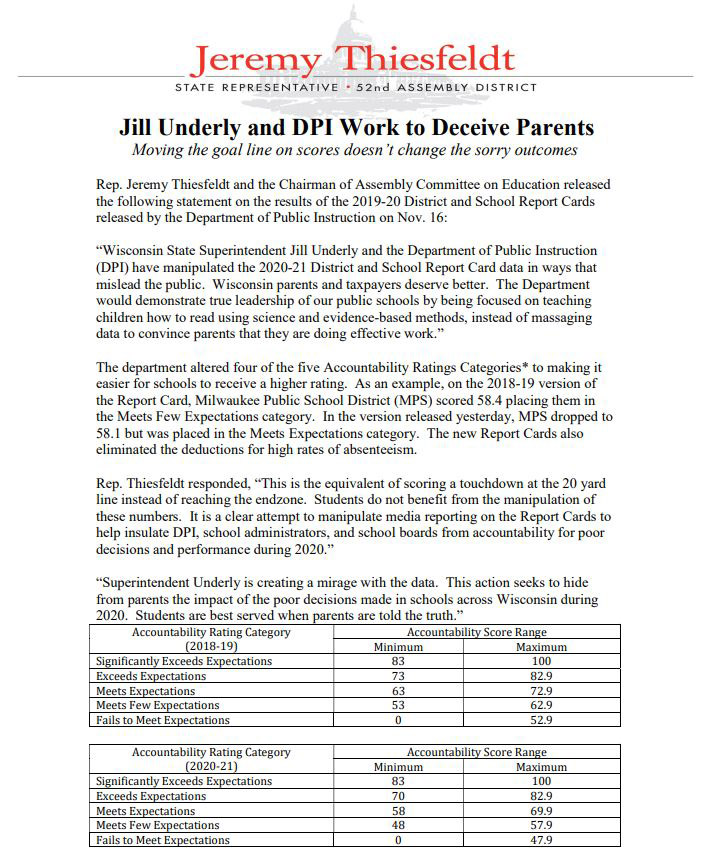
The department altered four of the five Accountability Ratings Categories* to making it easier for schools to receive a higher rating. As an example, on the 2018-19 version of the Report Card, Milwaukee Public School District (MPS) scored 58.4 placing them in the Meets Few Expectations category. In the version released yesterday, MPS dropped to 58.1 but was placed in the Meets Expectations category. The new Report Cards also eliminated the deductions for high rates of absenteeism.
Rep. Thiesfeldt responded, “This is the equivalent of scoring a touchdown at the 20 yard line instead of reaching the endzone. Students do not benefit from the manipulation of these numbers. It is a clear attempt to manipulate media reporting on the Report Cards to help insulate DPI, school administrators, and school boards from accountability for poor decisions and performance during 2020.”
“Superintendent Underly is creating a mirage with the data. This action seeks to hide from parents the impact of the poor decisions made in schools across Wisconsin during
When video-sharing platform Rumble announced in August that it had struck deals with such prominent figures as Glenn Greenwald and Tulsi Gabbard, it marked a significant milestone in the eight-year-old service’s rise. Founded in 2013 by Canadian tech entrepreneur Chris Pavlovski to help “the little guys” stand out in a crowded market dominated by YouTube, Rumble had a modest online presence until late 2020, when it began attracting conservative voices who had experienced YouTube censorship. In just ten months, Rumble’s online viewership has increased 25-fold. The company has attracted funding from prominent venture capitalists and recently completed a series of deals to bring such outspoken voices as Greenwald, Gabbard, and Joe Rogan to the platform.
But Rumble is only the latest online service to find itself profiting from the online censorship wars. Substack, a newsletter platform conceived as a way for ambitious individuals and small publishers to reach an audience cheaply, has seen its subscriber base double in the last few months as prominent writers—including Greenwald, Andrew Sullivan, and Bari Weiss—have moved to the service following censorship run-ins at their old publications. Many writers who have moved to Substack report earning much more than what they’d made before. So lucrative has the self-publishing model become that Substack now finds itself in a price war with Ghost, another player in the online self-publishing game.
The sudden, rapid rise of these services offers a lesson in the link between free markets and free speech. Conceived before the current round of controversies over censorship by online giants Twitter, YouTube, and Facebook, these alternative platforms were initially designed by small entrepreneurs hoping to gain an audience in a market often dominated by corporate players. In just a few months, however, they’ve also emerged as a way around big-tech censorship. In the process, they’re paying handsome dividends to creators, investors, and users.
Alyssa Fowers and Simon Ducroquet:
The House is expected to vote this week on President Biden’s Build Back Better legislation. The social spending bill includes investments in clean energy and affordable child care — but it also includes a $285 billion tax cut that would almost exclusively benefit high-income households over the next five years.
And if the true number of digital subscribers is 7,537, that means 89.9% of Journal Sentinel subscribers are getting the print edition. Which is a disaster. Most print readers are older people who are literally dying out. This is also a demographic that advertisers are less interested in.
Compare this to perhaps the most successful daily paper in the nation, the New York Times. It recently reported that it has nearly 8.4 million total subscriptions, of which 7.6 million are digital. In short less than 10% of its subscribers get the print edition.
Even compared to other Gannett papers, the Journal Sentinel has a dreadfully low percentage of digital readers. In 2019 “Gannett said that its digital-only subscribers totaled 607,000 — less than a third of its print subscribers. At GateHouse [which merged with Gannett] online subscribers make up less than 20 percent of its print circulation,” as the Boston Business Journal reported.
What @ACLU is doing is obvious. While press freedom groups have been vocal in their defense of O’Keefe & Project Veritas’ press freedom rights, ACLU wants to point to this statement if they’re accused of partisanship, while ensuring their liberal donors don’t know they did this. pic.twitter.com/ZBb7btQdn9
— Glenn Greenwald (@ggreenwald) November 17, 2021
The new priority area, target group outcomes, replaced closing achievement gaps. The new priority area, DPI said, sheds additional light on students in schools with low test scores. The measure was designed to help focus support on the learners who need it most, while also improving outcomes for all students, according to DPI.
“I think in the long run this is going to be a positive for students in Wisconsin because I think it is going to guide school improvement efforts more constructively than the old measure,” Schell, who sat on the advisory committee that DPI convened to develop this year’s updated report cards, said of the change.
Scores are based on a 100-point scale and weighted for certain situations, such as a larger focus on academic growth in schools with high poverty rates. Scoring within a certain point range determines what star rating a school receives.
Madison data
For the 2020-21 school year, Madison received an overall score of 70.2 points on a 100-point scale — just over the 70 points needed to attain a four-star rating. The score was down from the 72.3 points the district received in 2018-19.
Up to three years of data are used in assessment-based measures of report cards, according to DPI. Because assessments were not administered in the 2019-20 school year, the 2020-21 report card uses results from the 2020-21, 2018-19 and 2017-18 school years with more weight given to more recent years.
This year’s star rating is as follows:
Spokesperson Tim LeMonds said the district received the data from DPI Tuesday and had not had an opportunity to thoroughly review the information as of Tuesday afternoon.
Of the 44 Madison schools evaluated under the report card system, six were categorized as having significantly exceeded expectations in 2020-21, receiving a five-star rating. That number was down from nine in the 2019-20 school year.
The Department of Public Instruction has changed tests a number of times over the years.
Officials urged caution in interpreting the results given the continuing pandemic. Effects included a sharp increase in the number of students who opted out of state testing, including 50.3% of eligible students on the math and English language arts (ELA) tests in MMSD.
Because no state tests were given in 2019-20, the report cards use 2017-18, 2018-19 and 2020-21.
How low has @WisconsinDPI set the bar for "success"? It considers a school district where 40% of kids can't read or do math at grade level "exceeding expectations". And Madison BRAGS about it. https://t.co/RpBu39sXih @maciverwisc @empowerwi
— Vicki McKenna (@VickiMcKenna) November 17, 2021
Finally, consider a recently published study , in which researchers carried out, under laboratory conditions, several well-controlled experiments with masks. What did they conclude? First, that efficiency varies greatly. Surgical or cloth masks, which are used by the vast majority of people, provide only 10-12% filtration efficiency. Masks known as respirators are more efficient, but none of them achieve more than 60% filtration, even under optimized laboratory conditions.
The second and most important conclusion is that even relatively low room ventilation reduces the accumulation of viral aerosols, and protects as well as the best available masks (N95 and the like). In other words, ventilating a room is still the best way to prevent Covid-19 transmission.
If instead of the obsession with masks, which, as we have seen, are mostly ineffective in the real world and lead to a false sense of security, there were campaigns to improve ventilation in closed spaces, how many Covid-19 transmission events could have been prevented and how many lives would have been saved? Unfortunately, most authorities chose instead the path of mask mandates, despite the lack of trustworthy evidence.
The proposed $2.4 trillion reconciliation bill includes $80 billion for increased Internal Revenue Service (IRS) funding. The Democrats want to beef up the tax agency and expand its powers. The aim is to raise revenues by reducing the tax gap, which is the amount of taxes legally owed but not paid.
The large funding increase would double the IRS workforce, according to the Congressional Budget Office (CBO). About three‐quarters of the increased funding would go toward enforcement.
Supporters think that greater enforcement would be good policy because the expected higher tax revenues would outweigh the cost of higher IRS spending. But that ignores the higher costs that would be imposed on the private sector, including tax compliance burdens and a loss of civil liberties. More aggressive IRS enforcement would mean more paperwork, more lawyer fees, more time consumed on tax matters, and more anguish and uncertainty for taxpayers. It could also result in less privacy and personal financial security. These private costs are difficult to measure, and are usually ignored by policymakers.
With IRS enforcement, there is a trade‐off between the benefits of a lower tax gap and the costs to society of achieving it. If we wanted a tax gap of zero, we could hire an army of IRS agents to routinely search every home and laptop in the nation and impose root‐canal audits on everyone. But people in democracies do not accept that level of government intrusion, and so every tax system has a tax gap.
Students in Wisconsin had two years of disrupted learning because of the COVID-19 pandemic. That’s heightened concerns about Wisconsin’s low reading scores on national assessments — only about 36 percent of Wisconsin fourth graders scored at or above proficient in reading on the most recent National Assessment of Educational Progress.
A bill to assess kids’ reading skills more frequently was vetoedby Gov. Tony Evers this month, but it generated heated debateabout whether the state is doing enough to build kids’ reading skills.
WPR’s WHYsconsin wants to talk to you about how your children are learning to read. What do you want to know about the process? Is there anything you’d share with other parents about your child’s reading education?
The data clearly indicate that being able to read is not a requirement for graduation at (Madison) East, especially if you are black or Hispanic”
2017: West High Reading Interventionist Teacher’s Remarks to the School Board on Madison’s Disastrous Reading Results
Madison’s taxpayer supported K-12 school district, despite spending far more than most, has long tolerated disastrous reading results.
My Question to Wisconsin Governor Tony Evers on Teacher Mulligans and our Disastrous Reading Results
“An emphasis on adult employment”
Wisconsin Public Policy Forum Madison School District Report[PDF]
WEAC: $1.57 million for Four Wisconsin Senators
Friday Afternoon Veto: Governor Evers Rejects AB446/SB454; an effort to address our long term, disastrous reading results
Booked, but can’t read (Madison): functional literacy, National citizenship and the new face of Dred Scott in the age of mass incarceration.
When A Stands for Average: Students at the UW-Madison School of Education Receive Sky-High Grades. How Smart is That?
NCTQ:
Among the four core subjects, the greatest number of test takers pass the mathematics subtest, both on the first-attempt—the focus of this brief—and after multiple attempts (the “best-attempt” pass rate).2 This is surprising, perhaps, given the familiar anecdotes documenting elementary teachers’ math anxiety.
Low performance in social studies cannot be definitively explained, but NCTQ has documented the history and geography coursework taken by prospective teachers, finding little evidence that prospective teachers must take courses that are relevant to the social studies (and science) that is on these tests or that is taught in elementary grades.3
Note that Wisconsin data is “forthcoming”…
Related: Wisconsin Foundations of Reading elementary teacher content knowledge exam and Governor Evers extensive use of teacher mulligans.
“Since the union doesn’t like it, they just file a lawsuit and we cave to them,” Allman said. “I just don’t think it’s right to reinforce that behavior.”RelatedSkyrocketing School Board Recalls Offer Window into Year of Bitter Education Politics
While it was organizing the Allman recall, the union was also gathering signatures for a petition to force a special election for another seat on the board. Trustees had appointed Ty Hume to an open seat, making him the only African American on an all-white board, but the union felt the public had been left out of the process. The union submitted the required number of signatures, and in line with district policy, Hume’s appointment was rescinded and a special election scheduled for November 2021. Hume ran for the seat but was defeated by a union-supported candidate.
The union went for the trifecta by hiring a private investigator to determine whether board President Maureen Muir was living in the district she represented. The private eye found Muir was renting out her home, which was on the market. The union notified the district attorney, but apparently Muir had been spending time at the home of her aging mother-in-law in Lake Tahoe. She sold her house but rented another that was also within the district boundary.
Union President Duncan Brown said the investigator’s services “cost about as much as one of the union’s pizza parties it holds for members,” according to a newspaper report.
[1.] I reviewed them again, and thought I’d post just the factual allegations (which start below at item 3). [UPDATE: The excellent David Lat has more.] As I read them, I found myself comparing them to the tone of the alleged conduct by two of the same administrators (Cosgrove and Eldik) in their interaction with Yale law student Trent Colbert (from TrapHouseGate), so I thought I’d include them alongside; let me know whether you too see a common thread in the tone:
[2.] You might also compare the allegations with the same two administrators’ alleged interaction with Yale law student and chapter Federalist Society president Zack Austin, as reported based on Austin’s account by David Lat:
[3.] Now, to the allegations from the new lawsuit, which relates to DinnerPartyGate rather than TrapHouseGate; I extracted them from the Complaint, but removed the paragraph numbers and merged paragraphs together for readability:
It was subsequently reported in 2019 that Chua had entered a “no-socializing” agreement with the University whereby she agreed to not socialize with students off-campus. Starting in February 2021, both Jane and John became embroiled in Gerken and Cosgrove’s apparent vendetta against Chua.
That month, Jane and John separately attended Zoom “office hours” with Chua to discuss their coursework. These office hours discussions would also cover career discussions and any concerns that Jane or John voiced about the University. In particular, John struggled with what he felt was a lack of institutional support for students of color, which ended with his frustrated resignation from the board of the Yale Law Journal. His resignation received media coverage including on the popular legal blog (particularly among law students) Above the Law. This caused John to face significant hostility at the school.
Chua, having similarly faced such race-based, online-instigated hostility, as well as being one of the few faculty members of color at Yale Law School, was in a unique position to offer John guidance on these issues. Given the sensitive nature of the subject, John and Jane (who was John’s friend and had also faced similar hostility) wished to discuss their issues with Chua in person. To avoid meeting in public to discuss such a sensitive subject, Jane, John, and Chua decided to meet at Chua’s home, which was a common practice amongst Yale faculty members. (In fact, Gerken has met with both Jane and John at Gerken’s own residence on several occasions.)
John and Jane met Chua twice at her home, in February 2021 and March 2021. Both meetings included only John, Jane, and Chua, and no meals were involved.
The Dossier
Unbeknownst to Jane or John at the time, these two meetings somehow became subject of pernicious law school gossip. One of their classmates went so far as to compile a bizarre 20-page document, the Dossier (Ex. A), that purported to document the “secret dinner parties” that Chua was supposedly hosting with John, Jane, and unidentified federal judges. The Dossier eventually gained such wide circulation that it became the subject of investigative reporting from news outlets including The New Yorker, The New York Times, and The Atlantic. The New Yorker described the Dossier as “extremely thin,” and The New York Times anonymously quoted “several” Yale Law professors who had told the newspaper that “they were shocked at how unpersuasive” the Dossier was.
On its face, the Dossier—which refers to Jane and John as “Jane Doe” and “John Doe” in its main text but identifies them by name through exhibited screenshots of text messages—claims that Jane and John had “repeatedly lied” about their experience as students of color at the Law School, and further “repeatedly lied” about the existence of the secret dinner parties, before supposedly admitting their existence to the Dossier’s author either in person or in “self-deleting” text messages. As evidence, the Dossier included a number of text messages, some with Jane or John, none of which consisted of them admitting to any secret dinner parties. On the contrary, in large part they seemed to consist of the Dossier’s author making his own claims in text messages—to Jane, John, and other unidentified friends—about the existence of such parties.
The Dossier also included photos of John’s feet outside in the snow as “evidence” and denounced Jane and John for “deliberately enabling” a “secret atmosphere of favoritism, misogyny, and sexual harassment.”
After all, they were experts, while the president, in their estimation, was an ignoramus, or worse, unfit for office. For example, during Trump’s first impeachment, a parade of senior officials, many serving on the White House’s National Security Council or in the State Department, testified against their boss, making clear that their understanding of Ukraine was superior to his, liberating them to undermine his policies.
But I witnessed the death of democracy up close and personal. President Trump selected me to run the U.S. Agency for Global Media, which is responsible for all government international broadcasting. At a budget of about $850 million a year, USAGM is made up of five broadcasters: Voice of America, Cuba Broadcasting, Middle East Broadcasting Networks, Radio Free Asia, and Radio Free Europe/Radio Liberty. Together, they reach over 350 million people a week in over 70 languages.
I’ve been told that the day after Trump was elected, the senior leadership of USAGM held a meeting to decide how best to block Trump from assuming authority over the agency, as they deemed Trump dangerous and unqualified. The White House selected me in March 2017, two months after President Trump was sworn in. Agency leadership, along with others in the federal bureaucracy and eventually Democrats in the Senate, blocked my confirmation for three years and three months. I finally walked through the door of USAGM in June 2020 for the final eight months of the Trump presidency.
My goal, my only goal, was to return the news services to their legally mandated mission: to report news that is “accurate, objective, and comprehensive” (in the words of the VOA charter, which is U.S. law), and to promote American ideals like democracy and human rights around the world. In this modest, nonpartisan goal, I was doomed from the start. The USAGM permanent bureaucracy was ready to undermine every move of my administration, with the help of their allies in the media, Congress, and the courts, as well as pro bono lawyers. After all, they had been preparing for years while my nomination languished.
To give a few highlights. On my first day, I removed or caused to resign the heads of the five networks, as was my explicit right under law, and as is a common practice among incoming CEOs in the private and public sector. This move was clearly nonpartisan, as I had removed Republicans as well as Democrats, and they were essentially political appointees. The purpose was a clean start. The media portrayed this as “the Wednesday night massacre,” though only five out of 4000 employees left. They repeated their claims that I intended to turn USAGM into “Trump TV,” which they had manufactured the day after the White House selected me in March 2017.
Every subsequent act of my administration was not only blocked, but lied about and used to discredit me personally and the Trump administration generally. My efforts were treated as an attack that merited the strongest counterattack from my purported employees. Out of innumerable examples, let me offer only one.
Related: “They’re all rich, white kids and they’ll do just fine” — NOT!
The Yale Law School administrators at the center of the “traphouse” incident are now the subject of an unrelated lawsuit alleging that they “worked together in an attempt to blackball two students of color from job opportunities as retaliation” for their refusal to make damning statements about a professor. The suit charges that their actions violated the university’s harassment policies, which prohibit the administration from taking “any adverse action” against a person “who has reported a concern” or “participated in an investigation.”
The lawsuit, which was filed in federal court on Monday, alleges that the law school’s dean Heather Gerken, associate dean Ellen Cosgrove, and diversity director Yaseen Eldik retaliated against two students after they refused to “make knowingly and materially false statements” against Amy Chua, a Yale Law professor who has courted, and attracted, controversy.
When the students refused, Gerken and Cosgrove allegedly asked a professor not to offer them a prestigious fellowship—in part by suggesting that both students were untrustworthy. In conversations with the two students, Eldik and Cosgrove also allegedly suggested they would suffer career repercussions for their refusal to comply.
Matthew Ladner:
“How did you go bankrupt?” Bill asked. “Two ways,” Mike said. “Gradually and then suddenly.”
—Ernest Hemingway, The Sun Also Rises
The Arizona Charter School Association has released a new study on one of the last great equity issues to address in a choice-based system: student transport. Arizona has the largest percentage of students attending charters (around 22 percent statewide), in addition to a very active system of district open enrollment and private school choice programs. A majority of Phoenix-area K–8 students attend a school other than the one assigned by zip code, so the importance of being able to travel has never been greater. But just as with the nation as a whole, Arizona’s yellow bus ridership declined pre-pandemic and crashed during the return to in-person schooling.
The paper establishes transport as a crucial equity issue by imagining a young family living at the address of the Arizona Capitol in downtown Phoenix. The family has a seventh grader and a busy schedule. If they rely on the yellow bus, they have a single school option. But if they can make a three-mile roundtrip daily, their universe of choices opens up to five middle schools. If they can stretch that to six-miles, they have nineteen schools to choose from, including multiple options with very high academic and community ratings on GreatSchools and Niche. The school the yellow school bus would take them to, however, has the lowest ratings in the group. This is a problem if the family doesn’t own an automobile or has a work schedule that makes the roundtrip impossible.
The study repeats this exercise in the two previous capitols located in Tucson and Prescott, with similar results: small distances can make a huge difference.
Bellwether Education Partners, in a separate study, found that, nationally in 2017, 54 percent of students got to school in a personally owned vehicle, 32 percent by bus, and only 10 percent by walking or biking. State figures in Arizona show that district bus ridership declined from 32 percent of public-school students transported by district bus in 2012 to 23 percent in 2019, even as statewide costs increased from $191 million to $380 million. National figures also show a decline in district bus ridership before the pandemic.
Which brings us to the “all of the sudden” part of the story. Much of the “gradual” decline nationally and in Arizona involved difficulties in hiring bus drivers. These drivers must have a commercial driver’s license (CDL), and the career options for the holder of such a license steadily improved over time. Amazon, FedEx, Instacart, and others hired more and more CDL holders, gave them full-time work and benefits. So the odd-hour shifts of a part-time district bus driver that typically lacks benefits increasingly struggled in the market.
What do all these outlets have in common? Smith quoted labor historian Nelson Lichtenstein: “But what may be even more significant is the cheerleading, the hope, and the expectation for a labor upsurge that has been manifest ever since scores of eager young journalists descended upon Bessemer, Alabama, last winter to cover the union effort there to organize an Amazon distribution center.”
In case you missed it, the key word in there is “cheerleading.”
A journalist who wants to cheerlead for unions should get a job in a union communications department. It’s the same work with a LOT better pay and benefits than working for a newspaper or internet outlet.
This is a fine sentiment, but it ignores the fact that labor unions are run by a tiny elite in big coastal cities. And they don’t need more help getting their viewpoints in the press.
My Question to Wisconsin Governor Tony Evers on Teacher Mulligans and our Disastrous Reading Results
“An emphasis on adult employment”
Wisconsin Public Policy Forum Madison School District Report[PDF]
WEAC: $1.57 million for Four Wisconsin Senators
Friday Afternoon Veto: Governor Evers Rejects AB446/SB454; an effort to address our long term, disastrous reading results
Booked, but can’t read (Madison): functional literacy, National citizenship and the new face of Dred Scott in the age of mass incarceration.
When A Stands for Average: Students at the UW-Madison School of Education Receive Sky-High Grades. How Smart is That?
So far we’ve talked about the internal workings of the queue. But in real-world systems, you have multiple services that generate workloads for one another, each with its own queue and variable range of performance. Ideally, services will avoid creating excess workloads for other services downstream from them.
The way this is done is known as “backpressure.” This is the process whereby downstream services notify upstream systems when their queues are full. The upstream service then notifies the services upstream from it, and so forth.
The TCP protocol, for instance, generates backpressure with code 503. Thread pools can implement backpressure by simply limiting the size of the pool. Blocking code has backpressure by default on a per-thread basis, which back-propagates naturally through the blocking chain.
But systems like Kafka don’t have backpressure by default. Luckily there are several open source projects that implement backpressure in Kafka, so that the webserver knows when there’s an overload in the system.
The question then is what to do about it. It’s basically a trade-off between latency and error rate. If we don’t return errors, or find an alternative way to shed the excess load, then latency will inevitably increase.
One approach, as we’ve seen, is to cap queue size and shed any job over the limit. This can be done by implementing a queue at the webserver and having the server return an HTTP 503 response for any request over the cap. Alternatively, the server could present a cached version of the results or send the request to a fallback service. However it’s handled, the goal is to remove excess requests from the overloaded queue.
The largest unexamined grey area in education is the space between how teachers act and conceive of their roles (semi-autonomous professionals) and how courts see them (“hired speech” authorized by the state and school boards). https://t.co/9vkPx4e3Zg
— Robert Pondiscio (@rpondiscio) November 15, 2021
I recall asking a group of Superintendent candidates if they preferred hiromgntge best teachers or those who woukd fo as they are told?
Sort of a cathdral vs bazaar question.
They responded in a non decisive manner.
The first thing G told me, between drags on her cigarettes, was that she was a hairdresser. The second thing she told me was she was unvaccinated. She said this no differently than where she was from (born and raised near by), what type of music she liked, how many kids she had (three, all grown) and other introductory small talk.
I was in a bar in rural Massachusetts, sitting outside alone, near the smoking table. I hadn’t asked her any questions, but was clearly an outsider among regulars who talked at me and around me. I don’t remember exactly why she chose to be unvaccinated, but I can guess. I have heard so many versions from people similar to G across the country. So many people who proudly tell you, almost as quickly as they tell you where they are from and their name, that they are unvaccinated.
Maybe it was like what S, an old man in the South Bronx told me, that it would turn him into a Zombie. Or L, a middle-aged woman, in central Pennsylvania that “Miss Bettie from X, a few towns over, she got the shot, had a stroke, died. Same with Miss Bettie’s sister. Shot. Stroke. Died.” Or maybe it was like D in Indianapolis, who said “It is made from the same stuff in rat poison.” Or maybe it was like P in Florence, South Carolina, who said she ‘worked in Y store since this all started, all around people, and I haven’t gotten it. I must have some sorta natural immunity.’
The Occupational Safety and Health Administration (OSHA) “reasonably determined” in June 2020 that an emergency temporary standard (ETS) was “not necessary” to “protect working people from occupational exposure to infectious disease, including COVID-19.” In re AFL-CIO, 2020 WL 3125324, at *1 (D.C. Cir. June 11, 2020). This was not the first time OSHA had done this; it has refused several times to issue ETSs despite legal action urging it do so. See, e.g., In re Int’l Chem. Workers Union, 830 F.2d 369 (D.C. Cir. 1987) (per curiam). In fact, in its fifty-year history, OSHA has issued just ten ETSs.1 Six were challenged in court; only one survived.2
The news is a perilous business. It’s perilous because the first draft of history is almost always somewhat wrong, and needs a second draft, and a third, and so on, over time, until the historian can investigate with more perspective and calm. The job of journalists is to do as best they can, day by day, and respond swiftly when they screw up, correct the record, and move forward. I’ve learned this the hard way, not least in the combination of credulousness and trauma I harbored in the wake of 9/11.
But when the sources of news keep getting things wrong, and all the errors lie in the exact same direction, and they are reluctant to acknowledge error, we have a problem. If you look back at the last few years, the record of errors, small and large, about major stories, is hard to deny. It’s as if the more Donald Trump accused the MSM of being “fake news” the more assiduously they tried to prove him right.
Our university system is a place to encourage and cultivate diversity of thought. Instead, it appears to have turned its back on the values of intellectual diversity and the discussion of differing viewpoints. It is unacceptable that the University of Wisconsin – Madison requires graduate students to take a mandatory class that instills the university’s negative opinion of white students and the idea that students should feel guilty simply because of their race.
It has been brought to my attention that under the guise of violence prevention, UW-Madison has allowed its University Health Services division to push their own political beliefs and agenda on its graduate students through a mandatory “Graduate and Professional Students Preventing and Responding to Sexual and Relationship Violence” course. Students are not only required to take this course and pass with a 100% score in order to enroll in classes but they are also required to agree that whiteness means privilege.
The course states that Critical Race Theory and Critical Race Feminism can help students understand privilege better and “how a regime of white supremacy and its subordination of people of color have been created and maintained in America… not merely to understand the vexed bond between law and racial power but to change it” (Crenshaw, et al. 1995, xiii). The course labels white/Caucasian, Christian, men, middle-or upper class, native English speakers, U.S. citizens, non-disabled, etc., as privileged groups in the United States.
In theory, state laws across the country already affirm parents’ rights to access the instructional materials used in the classroom. But after the Wisconsin Institute for Law and Liberty revealed some Wisconsin school districts were demanding as much as $5,000 to respond to simple public records requests about content in a handful of courses at a handful of schools, state lawmakers recognized that the vague assurances currently on the books offer parents no meaningful rights at all.
Travis Dobson, a parent of two East students and an assistant varsity football coach, said the school is out of control and the building administration is under an all-hands-on-deck situation constantly. He said he has another child who is nearing high school age but he is considering taking his children out of the district if nothing changes.
“The school needs help,” he said. “The kids are scared to death.”
Additional notes.
Speaking Monday via Zoom, Michael Johnson called on the Madison school board to restore school resource police officersthat they had jettisoned in summer 2020. But the school board never got around to forming the ad hoc committee that it had advertised would study school safety. As if school safety needed more study. Here is Michael Johnson:
I firmly believe our schools need mental health officer, counsellors, parent outreach workers and school resource officers to keep schools safe and make sure our kids are learning in a safe environment. In an ideal it would be great not to have school resource officers but we don’t live in an ideal world. …
The data clearly indicate that being able to read is not a requirement for graduation at (Madison) East, especially if you are black or Hispanic”
2017: West High Reading Interventionist Teacher’s Remarks to the School Board on Madison’s Disastrous Reading Results
Madison’s taxpayer supported K-12 school district, despite spending far more than most, has long tolerated disastrous reading results.
My Question to Wisconsin Governor Tony Evers on Teacher Mulligans and our Disastrous Reading Results
“An emphasis on adult employment”
Wisconsin Public Policy Forum Madison School District Report[PDF]
WEAC: $1.57 million for Four Wisconsin Senators
Friday Afternoon Veto: Governor Evers Rejects AB446/SB454; an effort to address our long term, disastrous reading results
Booked, but can’t read (Madison): functional literacy, National citizenship and the new face of Dred Scott in the age of mass incarceration.
When A Stands for Average: Students at the UW-Madison School of Education Receive Sky-High Grades. How Smart is That?
What is happening in our public schools? Tonight I will again be speaking at an event hosted by @RightsParents. Topics include CRT, vaccines, @WILawLiberty‘s litigation & policy work, and lots of time for Q&A – 6PM. Lancaster City Hall, 206 S. Madison Street, Lancaster, WI pic.twitter.com/inSf0kKgDW
— Dan Lennington (@DanLennington) November 16, 2021
Meanwhile, Ali Muldrow announced that she plans to run for re-election to the Madison School Board. 3 board seats are on the February/April 2022 ballot.
A former Madison Superintendent lamented to me some years ago that unlike other similarly sized communities, we lack serious K-12 interest by the business community. I would add most parents to this, as well. The organization operates first to perpetuate what exists.
The data clearly indicate that being able to read is not a requirement for graduation at (Madison) East, especially if you are black or Hispanic”
2017: West High Reading Interventionist Teacher’s Remarks to the School Board on Madison’s Disastrous Reading Results
Madison’s taxpayer supported K-12 school district, despite spending far more than most, has long tolerated disastrous reading results.
My Question to Wisconsin Governor Tony Evers on Teacher Mulligans and our Disastrous Reading Results
“An emphasis on adult employment”
Wisconsin Public Policy Forum Madison School District Report[PDF]
WEAC: $1.57 million for Four Wisconsin Senators
Friday Afternoon Veto: Governor Evers Rejects AB446/SB454; an effort to address our long term, disastrous reading results
Booked, but can’t read (Madison): functional literacy, National citizenship and the new face of Dred Scott in the age of mass incarceration.
When A Stands for Average: Students at the UW-Madison School of Education Receive Sky-High Grades. How Smart is That?
Committee to Protect Journalists:
According to media reports, the FBI seized O’Keefe’s cellphones during a November 6 raid on his home in Mamaroneck, New York, as part of a court-ordered investigation into the theft of a diary belonging to Ashley Biden, U.S. President Joe Biden’s daughter. In a statement, Project Veritas wrote that authorities also raided the apartments and homes of other current and former members of the organization, and confiscated unspecified materials.
Project Veritas acquired the diary in 2020 but turned it over to law enforcement, those media reports said.
Founded by O’Keefe in 2011, Project Veritas is a nonprofit group that conducts exposés on groups it perceives as left-leaning, and has amplified disinformation on topics including COVID-19 vaccines and alleged election fraud, according to the independent nonprofit fact-checking group First Draft.
“While we do not endorse some of the tactics Project Veritas employs, the FBI’s recent raids on the organization’s founder and his associates represent a concerning overreach by law enforcement,” said CPJ U.S. and Canada Program Coordinator Katherine Jacobsen. “The government must provide a clear link between members of Project Veritas and alleged criminal activity before searching their homes for information about source material. Conducting raids without this kind of link sets a dangerous precedent that could allow law enforcement to search and confiscate reporters’ unpublished source material in vague attempts to identify whistleblowers.”
Some pages of the diary were published on a right-wing blog during the 2020 U.S. presidential election campaign, according to those news reports, which said that the Justice Department under the Trump administration first opened an investigation into the theft.
The field of equity, like all other scholarly domains, has developed specific norms that convey authenticity, precision and meaning. Just as the general structure of a business document varies from that of a physics document, so too is the case with an equity document. One example is the inclusion of a “Land and Labor Acknowledgement” like the one below. It is common that discussions in the field of equity begin with the recognition that our current state is built on the land and labor of others in ways that violated the fundamental principles of equity.
A SoCal school board is way overpaying for its superintendent. More than $600K cash/year plus lots benefits.
Even after supe &board are long gone, this shrinking district will continue to pay LIFETIME healthcare for supe &family.
That will come from $ meant for tomorrow’s kids. https://t.co/9O91y0ccPS
— Marguerite Roza (@MargueriteRoza) November 15, 2021
I call it the ruliad. Think of it as the entangled limit of everything that is computationally possible: the result of following all possible computational rules in all possible ways. It’s yet another surprising construct that’s arisen from our Physics Project. And it’s one that I think has extremely deep implications—both in science and beyond.
In many ways, the ruliad is a strange and profoundly abstract thing. But it’s something very universal—a kind of ultimate limit of all abstraction and generalization. And it encapsulates not only all formal possibilities but also everything about our physical universe—and everything we experience can be thought of as sampling that part of the ruliad that corresponds to our particular way of perceiving and interpreting the universe.
We’re going to be able to say many things about the ruliad without engaging in all its technical details. (And—it should be said at the outset—we’re still only at the very beginning of nailing down those technical details and setting up the difficult mathematics and formalism they involve.) But to ground things here, let’s start with a slightly technical discussion of what the ruliad is.
In the language of our Physics Project, it’s the ultimate limit of all rulial multiway systems. And as such, it traces out the entangled consequences of progressively applying all possible computational rules.
While Franglen’s main motivation was to make admissions processes more efficient, he also hoped that it would remove inconsistencies in the way the admissions staff carried out their duties. The idea was that by ceding agency to a technical system, all student applicants would be subject to precisely the same evaluation, thus creating a fairer process.
In fact, it proved to be just the opposite.
Franglen completed the algorithm in 1979. That year, student applicants were double-tested by the computer and human assessors. Franglen found that his system agreed with the gradings of the selection panel 90 to 95 percent of the time. For the medical school’s administrators, this result proved that an algorithm could replace the human selectors. By 1982, all initial applications to St. George’s were being screened by the program.
If their names were non-Caucasian, the selection process was weighted against them. In fact, simply having a non-European name could automatically take 15 points off an applicant’s score.
Within a few years, some staff members had become concerned by the lack of diversity among successful applicants. They conducted an internal review of Franglen’s program and noticed certain rules in the system that weighed applicants on the basis of seemingly non-relevant factors, like place of birth and name. But Franglen assured the committee that these rules were derived from data collected from previous admission trends and would have only marginal impacts on selections.
In December 1986, two senior lecturers at St. George’s caught wind of this internal review and went to the U.K. Commission for Racial Equality. They had reason to believe, they informed the commissioners, that the computer program was being used to covertly discriminate against women and people of color.
The commission launched an inquiry. It found that candidates were classified by the algorithm as “Caucasian” or “non-Caucasian” on the basis of their names and places of birth. If their names were non-Caucasian, the selection process was weighted against them. In fact, simply having a non-European name could automatically take 15 points off an applicant’s score. The commission also found that female applicants were docked three points, on average. As many as 60 applications each year may have been denied interviews on the basis of this scoring system.
I approve of their choices in both cases. But the key thing is: My approval is irrelevant. I don’t give my sons unsolicited advice on courses, majors, or careers. I’ve encouraged them to think for themselves and construct their own life plan. “Every career decision has pros and cons,” I tell them. “You have to live with the consequences, so the responsibility for the decision needs to rest on your own shoulders.”
I’ve seen all around us the negative results of parents giving their children too much advice and heavy-handed guidance. Many of youngsters in our neighborhood, even very talented ones, are burnt out long before they go off to college. Even worse, they feel only half-hearted commitment to their education and future vocation, because they never get to make these choices. You always work harder in pursuing your own agenda, not someone else’s. (By the way, that’s why democracies almost always defeat tyrannies in war—you fight harder when your own freedom is at stake, not just the glory of the dictator.) If your own parents deprive you of agency and self-determination when you’re making key life decisions, you might never recover.
I recently read a fascinating article entitled “How to Work Hard” by Paul Graham. I highly recommend it. Yet I’m not even sure why I read it—because, after all, what could be simpler than the rules for working hard? You put your nose to the grindstone, your feet to the fire, or whatever metaphor you prefer, and just get things done. But Graham makes a brilliant point in this essay.
International-student enrollment in U.S. colleges and universities is showing signs of a rebound this fall after plummeting when the pandemic pushed classes online last year and the Trump administration all but closed the nation’s borders.
An early snapshot of this school year’s enrollment landscape, released Monday by the Institute of International Education and nine partner higher-education associations, shows a 4% increase in international students taking undergraduate, graduate and nondegree courses or in postgraduate Optional Practical Training programs.
That provides a partial recovery from the 15% decline in the 2020-2021 school year, when international enrollment dropped to 914,095, according to a related report published by the Institute and the U.S. State Department. It was the first time the number dipped below one million since the 2014-2015 school year. Declines were sharpest in nondegree offerings like intensive language courses and exchange programs.
His commission presented a map that, by my calculations, would reduce the number of Black Assembly districts from six to two and eliminate one of the two Black Senate districts. Furthermore, the commissioners drew the Latino district that was the center of the 2012 trial at a lower Latino level than the judges rejected at that trial.
This is really a test in this administration of whether they’re going to put their money where their mouth is,” Kirtley said. “If they’re trying to be seen as great champions of press freedom, this is a pretty bad way to start.”
ACLU:
Nevertheless, the precedent set in this case could have serious consequences for press freedom. Unless the government had good reason to believe that Project Veritas employees were directly involved in the criminal theft of the diary, it should not have subjected them to invasive searches and seizures. We urge the court to appoint a special master to ensure that law enforcement officers review only those materials that were lawfully seized and that are directly relevant to a legitimate criminal investigation.”
In 1666, the German polymath Gottfried Wilhelm Leibniz published an enigmatic dissertation entitled On the Combinatorial Art. Only 20 years old but already an ambitious thinker, Leibniz outlined a theory for automating knowledge production via the rule-based combination of symbols.
Leibniz’s central argument was that all human thoughts, no matter how complex, are combinations of basic and fundamental concepts, in much the same way that sentences are combinations of words, and words combinations of letters. He believed that if he could find a way to symbolically represent these fundamental concepts and develop a method by which to combine them logically, then he would be able to generate new thoughts on demand.
The idea came to Leibniz through his study of Ramon Llull, a 13th century Majorcan mystic who devoted himself to devising a system of theological reasoning that would prove the “universal truth” of Christianity to non-believers.
Llull himself was inspired by Jewish Kabbalists’ letter combinatorics (see part one of this series), which they used to produce generative texts that supposedly revealed prophetic wisdom. Taking the idea a step further, Llull invented what he called a volvelle, a circular paper mechanism with increasingly small concentric circles on which were written symbols representing the attributes of God. Llull believed that by spinning the volvelle in various ways, bringing the symbols into novel combinations with one another, he could reveal all the aspects of his deity.
Why are so many tenured professors unhappy with their jobs yet unable to change careers?
Is the chronic morale problem in the humanities — and many allied fields — attributable to tenured professors feeling trapped in positions they no longer want?
Earlier this fall, I wrote about my decision to go on leave (from my tenured post at a midwestern liberal-arts college where I’ve worked for 21 years) in order to write, retrain, and look for new career opportunities in Chicago. The many responses that column received emphasized two themes: how unhappy many professors are (even the lucky ones with tenure), and how those professors feel unable to change their circumstances.
I raised this issue in a recent survey on Twitter: “What makes it so hard to leave academe?” Nearly 200 responses from a self-selected group are not solid data, of course, but they are suggestive and worth reflecting upon:
Few in pakistan would deny that something needs to be done to improve its education system. The country is well behind Bangladesh, India and Iran, and just barely above Afghanistan, in un education rankings. Less than 60% of people over 15 can read and write, having attended school on average for 5.2 years. In Bangladesh, by contrast, the literacy rate is 74%, with 6.2 years of education.
The headline figures hide as much as they reveal. In the country’s elite schools, the children of the wealthy study in English for international exams and set their sights on the world’s best universities. At the other end of the spectrum, 23m children are not in school at all, with girls much less likely than boys to be enrolled. Government schools, where available, have a reputation for rote learning. Private schools of varying quality fill the gap. Many poor families send their children to madrasas, which tend to skip subjects like science and maths. Some are vehicles for extremist ideologies. Imran Khan, the prime minister, calls this divide “educational apartheid” and has vowed to get rid of it.
Research reveals Americans have fears and concerns about AI while embracing a larger role for AI in everyday life. That’s according to the Stevens TechPulse Report: A Perspective on Americans’ Attitudes Toward Artificial Intelligence, a new national poll of 2,200 adults conducted on behalf of Stevens Institute of Technology by Morning Consult. The survey examined Americans’ views on a wide range of AI-related issues. Read the news release.
“As the world and our lives grow increasingly dependent on artificial intelligence, it’s essential to assess its perceived impact, as well as identify gaps in knowledge that need to be addressed,” said Jason Corso, Ph.D., Brinning Professor of Computer Science and Director of Stevens Institute for Artificial Intelligence at Stevens Institute of Technology. “It’s clear from this research that, while people recognize the positives of AI, they also see much to be wary of — based, to some extent, on misunderstandings of the technology and what could help protect against those negative consequences.”
Almost half (48%) of Americans feel the positives of greater AI adoption in everyday life outweigh the negatives, while 29% believe the opposite. A majority also holds the opinion that, in the future, AI should play a greater role in a variety of industries including technology (66%), manufacturing (61%), logistics (58%) and retail (52%).
Despite that enthusiasm, people are far more comfortable with humans, rather than AI, being in charge of performing most jobs and, in general, express a good deal of apprehension and mistrust of the technology.
“There is a significant need for education, well-informed and holistic policy development and ethical leadership in the deployment of rapidly advancing technology.”
“This survey indicates that there is a significant need for education, well-informed and holistic policy development and ethical leadership in the deployment of rapidly advancing technology throughout industry and society,” said Nariman Farvardin, president of Stevens Institute of Technology. “I am delighted that Stevens is playing a leadership role in this space through the Stevens Institute for Artificial Intelligence.”
First grade in particular — “the reading year,” as Miller calls it — is pivotal for elementary students. Kindergarten focuses on easing children from a variety of educational backgrounds — or none at all — into formal schooling. In contrast, first grade concentrates on moving students from pre-reading skills and simple math, like counting, to more complex skills, like reading and writing sentences and adding and subtracting numbers.
By the end of first grade in Texas, students are expected to be able to mentally add or subtract 10 from any given two-digit number, retell stories using key details and write narratives that sequence events. The benchmarks are similar to those used in the more than 40 states that, along with the District of Columbia, adopted the national Common Core standards a decade ago.
“They really grow as readers in first grade, and writers,” Miller said. “It’s where they build their confidence in their fluency.”
But about half of Miller’s class of first graders at Doss Elementary, a spacious, bright, newly built school in northwest Austin, spent kindergarten online. Some were among the tens of thousands of children who sat out kindergarten entirely last year.
More than a month into this school year, Miller found she was spending extensive time on social lessons she used to teach in kindergarten, like sharing and problem-solving. She stopped class repeatedly to mediate disagreements. Finally, she resorted to an activity she used to do in kindergarten: role-playing social scenarios, like what to do if someone accidentally trips you.
The data clearly indicate that being able to read is not a requirement for graduation at (Madison) East, especially if you are black or Hispanic”
2017: West High Reading Interventionist Teacher’s Remarks to the School Board on Madison’s Disastrous Reading Results
Madison’s taxpayer supported K-12 school district, despite spending far more than most, has long tolerated disastrous reading results.
My Question to Wisconsin Governor Tony Evers on Teacher Mulligans and our Disastrous Reading Results
“An emphasis on adult employment”
Wisconsin Public Policy Forum Madison School District Report[PDF]
WEAC: $1.57 million for Four Wisconsin Senators
Friday Afternoon Veto: Governor Evers Rejects AB446/SB454; an effort to address our long term, disastrous reading results
Booked, but can’t read (Madison): functional literacy, National citizenship and the new face of Dred Scott in the age of mass incarceration.
When A Stands for Average: Students at the UW-Madison School of Education Receive Sky-High Grades. How Smart is That?
The 14.5% increase in Part B premiums will take monthly payments for those in the lowest income bracket from $148.50 a month this year to $170.10 in 2022. Medicare Part B covers physician services, outpatient hospital services, certain home health services, medical equipment, and certain other medical and health services not covered by Medicare Part A, including medications given in doctors’ offices.
The Centers for Medicare and Medicaid Services played down the spike, pointing out that most beneficiaries also collect Social Security benefits and will see a cost-of-living adjustment of 5.9% in their 2022 monthly payments, the agency said in a statement. That’s the largest bump in 30 years.
“This significant COLA increase will more than cover the increase in the Medicare Part B monthly premium,” CMS said. “Most people with Medicare will see a significant net increase in Social Security benefits. For example, a retired worker who currently receives $1,565 per month from Social Security can expect to receive a net increase of $70.40 more per month after the Medicare Part B premium is deducted.”
Related: Madison schools approve 8.9% property tax increase for 2021-2022 budget.
“I thought that at some point in time, this might be an inevitability when the district decided to move away from having school resource officers,” said Mike Koval, Madison’s former Police Chief.
Koval is talking about the school district’s decision to remove resource officers from its four high schools last year.
“I think they made a strategically poor long-term answer based on sort of a political knee-jerk reaction,” Koval said.
Some parents and students want resource officers back here inside schools and Madison’s former police chief says resource officers would be a complementary piece of the learning environment.
“Resources officers, they are part of a collaboration team, social workers, school nurses, administration, the officers are very good at de-escalation, proactive engagement, learning and listening to what the dynamics are within the school.”
Michael Johnson, President & CEO of the Boys & Girls Clubs of Dane County, agrees.
There was no discussion about competing programs; no comparison quotes or competitive bids, either. No one asked for data about AVID’s impact on students, or set benchmarks to measure the program’s success. No one mentioned that then-superintendent Phil Ertl had already signed the AVID contract, prior to the board’s approval.
And no one mentioned AVID was compensating the husband of Wauwatosa assistant superintendent Kristin Bowers, whose department recommended and would oversee the program.
A FOX6 investigation including more than 500 pages of public record emails, invoices, contracts and voicemails, along with interviews with current and former Wauwatosa School District employees, reveals Bowers spent years championing the vendor that compensated her husband, even after the district received legal advice calling the relationship a “potential conflict of interest and appearance of impropriety.” Employees hesitant about the program say they felt they couldn’t speak up, with one calling AVID “completely and disingenuously oversold.”
Notes and links on AVID in Madison.
An elite private school paved the way for its students to get inoculated against COVID-19 before nearly all other young children in the Portland area by bringing hard-to-find vaccine directly to school grounds and sponsoring its own clinic.
Catlin Gabel enlisted the help of a doctor granted access to one of the state’s first shipments of vaccine. Then the doctor administered hundreds of kid-sized doses on campus Monday to children ages 5 to 11.
Some teachers objected to a chart in their training that listed different groups as either “experiences privilege” or “experiences oppression.” Christians were privileged, for instance, while non-Christians were oppressed.
Monica Gill, an American history teacher at Loudoun County High School, also objected to an animated video called “The Unequal Opportunity Race,” in which white people get a head start, while people of color must wait and then face obstacle after obstacle.
The video, she said, was an overgeneralization that itself embraced a racial stereotype.
“I didn’t grow up in white privilege,” Ms. Gill said. “I worked hard to get through college, and it wasn’t handed to me by any stretch. It seemed to me that this whole thing they were pushing was very shallow.”
Mr. Prior, a former Trump administration official with two children in the district, wrote a piece in October 2020 for The Federalist, a conservative outlet, in which he raised questions about what he called the “supercharged” antiracism effort.
But Beth Barts, a former school board member, said the effort was worth it.
“Whites are now less than half our student population,” she said. “It was important that we recognize that, and we teach that other voices should also have a place at the table.”
Some people don’t like that, she added. “They felt threatened.”
A reckoning is hitting news organizations for years-old coverage of the 2017 Steele dossier, after the document’s primary source was charged with lying to the FBI.
Why it matters: It’s one of the most egregious journalistic errors in modern history, and the media’s response to its own mistakes has so far been tepid.
Outsized coverage of the unvetted documentdrove a media frenzy at the start of Donald Trump’s presidency that helped drive a narrative of collusion between former President Trump and Russia.
Driving the news: In wake of the key source’s arrest and further reporting on the situation, The Washington Post on Friday corrected and removed large portions of two articles.
Rural Americans “may not be supportive, safe and welcoming.” You “fear driving” when you drive through their territory. But do you know any of these people or are you just prejudiced against them? Where did you learn that prejudice? In the city? And here you are wishing for a more homogeneous society. This is a prime example of how much racism is woven into anti-racism.
Young children seem uniquely, insatiably, marvelously curious, even at risk of life and limb. You might think that this drive to explore helps children to learn so much so quickly. But is it really true that children explore more than grown-ups and that this helps them to learn?
An initial battle damage assessment quickly found that the number of dead was actually about 70.
The Baghuz strike was one of the largest civilian casualty incidents of the war against the Islamic State, but it has never been publicly acknowledged by the U.S. military. The details, reported here for the first time, show that the death toll was almost immediately apparent to military officials. A legal officer flagged the strike as a possible war crime that required an investigation. But at nearly every step, the military made moves that concealed the catastrophic strike. The death toll was downplayed. Reports were delayed, sanitized and classified. United States-led coalition forces bulldozed the blast site. And top leaders were not notified.
The Defense Department’s independent inspector general began an inquiry, but the report containing its findings was stalled and stripped of any mention of the strike.
“Leadership just seemed so set on burying this. No one wanted anything to do with it,” said Gene Tate, an evaluator who worked on the case for the inspector general’s office and agreed to discuss the aspects that were not classified. “It makes you lose faith in the system when people are trying to do what’s right but no one in positions of leadership wants to hear it.”
Mr. Tate, a former Navy officer who had worked for years as a civilian analyst with the Defense Intelligence Agency and the National Counterterrorism Center before moving to the inspector general’s office, said he criticized the lack of action and was eventually forced out of his job.
ew in bangladesh would deny that their country has had remarkable success at getting kids into classrooms. Four decades ago less than a third of children finished primary school. Today, 80% do. Before the pandemic, more Bangladeshi girls than boys attended high school. In India and Pakistan, the reverse is true.
Improving the quality of education has proved trickier. More than half of Bangladeshi ten-year-olds in school are not proficient in reading, according to the World Bank, and more than a quarter of those aged between 15 to 24 are not in education, employment or training. A year and a half of pandemic-related school closures have made matters worse.
In some respects, unimpressive outcomes have not held back Bangladesh. The economy has been growing at an annual rate of 6% for the past decade, reaching 8% before the pandemic. The two main drivers of growth, the garment industry and remittances from overseas Bangladeshi workers, have boomed. But that is because labour is plentiful and cheap, not because it is skilled. Bangladeshi labourers in the Gulf often earn less than their Indian brethren. Garment workers in Dhaka, the capital, toil for lower wages than rivals in China.
The Scottsdale Unified School District’s administration is scrambling to do damage control after a group of mothers discovered Governing Board President Jann-Michael Greenburg had access to a Google Drive full of personal information, documents, and photos of about 47 people, including children.
An email sent out Wednesday evening by the SUSD’s Communications Office sought to assure families that their personal and educational data is safe. However, the district also solely blamed the discovered digital dossier* site on Mark Greenburg, the father of Jann-Michael Greenburg.
The damage control appears to be too little too late for many parents in the Scottsdale Unified School District, including Amy Carney, a mother of six, who is among those calling for Greenburg to step down.
“I am calling for the immediate resignation of our board president Jann-Michael Greenburg. We cannot allow anyone in a leadership position to secretly compile personal documents and information on moms and dads who have dared speak out publicly or on social media about their grievances with the district,’ said Carney, who is running for a seat on the Scottsdale Governing Board in November 2022.
This is Rhode Island @GovDanMcKee last night at a Gala — just hours after he extended The State of Emergency in Rhode Island for the sole purpose to keep children masked in schools. Fact: the V doesn’t prevent transmission. Where is our General Assembly?#abuse #UNMASKOURCHILDREN pic.twitter.com/419q0U32Br
— Jody Stone (@TheStonesEG) November 14, 2021
Related: Dane County Madison Public Health mandates, lawfare and litigation.
CRFB:
The current version of the Build Back Better Act under consideration in the House would increase the state and local tax (SALT) deduction cap from $10,000 to $80,000 through 2026 while increasing the child tax credit from $2,000 per child to $3,000 per child (and $3,600 per child under 6) for 2022 and make it fully refundable. As we have pointed out many times, there is no such thing as progressive SALT cap relief. Roughly 98 percent of the benefit increase would accrue to those making more than $100,000 per year, with more than 80 percent going to those making over $200,000.
One way to illustrate this distribution is to compare the benefit of SALT cap relief to the benefit of the expanded child tax credit. Under the current House bill, most high-income households will receive more tax cuts from SALT cap relief than low-income and middle-class households will receive from the expanded child tax credit.
The below graph illustrates the tax benefit of a family of four in Washington, D.C. next year. We find that a household making $1 million per year will receive ten times as much from SALT cap relief as a middle-class family will receive from the child tax credit expansion.
— Parents of students attending Madison East High School have organized over the past week to provide a visible support system for students in the wake of massive fights Monday and higher-than-normal behavioral incidents throughout the school year.
It started with a Facebook post from Antoinette Kendricks following multiple fights Monday that resulted in two students being cited and five in the hospital to be treated for pepper spray, after more than a dozen Madison police officers used pepper spray to break up the fights.
She called on parents to step up and help organize for the students: enough was enough.
“My motto is it takes a village,” she told News 3 Now on Friday. “But also, the truth of the matter is: can’t no one control our kids the way we control our kids.”
Every day since Monday, parents have responded. With the help of her friend Noelle Brusky, who’d been talking with school officials about ways parents could help, they’ve used a private Facebook group of East High parents to help organize.
Now, they’re coordinating daily to ensure a dozen or so parents can be visible and present on school grounds over the lunch hour and when classes dismiss for the day. MMSD’s spokesperson Tim LeMonds estimates about 90% of behavioral incidents this year have been happening over the open lunch hour when students are able to leave the campus.
“The data clearly indicate that being able to read is not a requirement for graduation at (Madison) East, especially if you are black or Hispanic”
2017: West High Reading Interventionist Teacher’s Remarks to the School Board on Madison’s Disastrous Reading Results
Madison’s taxpayer supported K-12 school district, despite spending far more than most, has long tolerated disastrous reading results.
My Question to Wisconsin Governor Tony Evers on Teacher Mulligans and our Disastrous Reading Results
“An emphasis on adult employment”
Wisconsin Public Policy Forum Madison School District Report[PDF]
WEAC: $1.57 million for Four Wisconsin Senators
Booked, but can’t read (Madison): functional literacy, National citizenship and the new face of Dred Scott in the age of mass incarceration.
When A Stands for Average: Students at the UW-Madison School of Education Receive Sky-High Grades. How Smart is That?
Don’t get me wrong on this: I believe those who originated these policies were well meaning. They wanted to integrate more African Americans into the mainstream as quickly as possible. They thought they were trying to get beyond race. But there were early warning signs that race-preferential admissions policies were causing students to become preoccupied with race rather than get beyond it. Those warnings were largely ignored.
One such warning came from the demands—starting in the late 1960s—for racial separatism on campus. African American students who were part of affirmative action programs at schools like Cornell, MIT and Yale demanded separate dormitories. As time went on the demands included separate student lounges, and separate graduation ceremonies, and sometimes specially designed academic departments or programs.
Bad sign. Things were going in the opposite direction from what was intended—and would eventually devolve into demands for safe spaces.
In a way we can all understand why one university after another gave into such calls. Saying yes is so much easier than saying no. It keeps the peace. Saying yes to pressure for further race-preferential admissions and faculty hiring was also easy. But it has created long-term problems that are harder to solve now than they would have been decades ago. Not surprisingly, the demands for separate dorms and lounges, and safe spaces spread to Latino students, American Indian students and now Asian students too.
Here’s the most important point I want to make tonight: Some people think that given all the affirmative action that has occurred over the last 50-plus years, our current preoccupation with race is somehow surprising. “Haven’t we been doing enough?” they might ask. But our current situation didn’t happen despite the race-preferential admissions policies. They happened in significant part because of race-preferential admissions.
Jill Barshay, Hillary Flynn, Chelsea Sheasley, Talia Richman, Dahlia Bazzaz and Rebecca Griesbach:
More than a dozen studies have documented that students, on average, made sluggish progress in reading during the pandemic. Estimates of just how sluggish vary. Consulting firm McKinsey & Company calculated that U.S. students had lost the equivalent of almost half a school year of reading instruction. An analysis of test scores in California and South Carolina found that students had lost almost a third of a year in reading. A national analysis of the test scores of 5.5 million students calculated that in the spring of 2021 students in each grade scored three to six percentile points loweron a widely used test, the Measures of Academic Progress or MAP, than they did in 2019.
Reading achievement has even fallen in the state that ranks the highest in the nation in reading: Massachusetts. Students in grades 3 through 8 slid 6 percentage points in reading on state tests in the spring of 2021 compared to 2019.
The data clearly indicate that being able to read is not a requirement for graduation at (Madison) East, especially if you are black or Hispanic”
2017: West High Reading Interventionist Teacher’s Remarks to the School Board on Madison’s Disastrous Reading Results
Madison’s taxpayer supported K-12 school district, despite spending far more than most, has long tolerated disastrous reading results.
My Question to Wisconsin Governor Tony Evers on Teacher Mulligans and our Disastrous Reading Results
“An emphasis on adult employment”
Wisconsin Public Policy Forum Madison School District Report[PDF]
WEAC: $1.57 million for Four Wisconsin Senators
Booked, but can’t read (Madison): functional literacy, National citizenship and the new face of Dred Scott in the age of mass incarceration.
When A Stands for Average: Students at the UW-Madison School of Education Receive Sky-High Grades. How Smart is That?
NAEP scores were not good! We heard from Morgan Polikoff, Marguerite Roza, and Sandy Kress with thoughts on why. Today Denise Forte, CEO of the Education Trust weighs in:
NAEP Is Telling Us Again That It’s Past Time to Close Long-Standing Resource Gaps By Denise Forte
Those who study educational disparities know that money matters in education. And it’s not just about how much money is allocated, it’s about resource equity, that is, how effectively state and district leaders spend their funds and whether funds are distributed equitably.
From this perspective, the story behind this year’s lackluster NAEP results began nearly a decade ago. The eighthgraders whose test results were captured by NAEP’s long-term assessment were born right before the Great Recession. They started kindergarten around 2012-13 as federal relief dollars for schools dried up, impacting the very factors that are essential to ensuring a high-quality learning experience.
Consider that state preschool program access and quality declined as a result of the economic downturn and have yet to return to pre-recession trends. Also, between 2008 and 2012, the K-12 public education system lost nearly 300,000 jobs, the largest reduction in our nation’s history. Of the jobs lost, more than 120,000 belonged to elementary and secondary teachers with layoffs disproportionately affecting schools serving students of color and students from low-income backgrounds.
Even when district leaders were able to reinstate classes and programs that were reduced or eliminated during the recession, there were teacher shortages, especially in math, science, and special education. It has taken years to begin rebuilding the teacher workforce. Yet, the nation still has fewer public school teachers today than it did in 2008 and remains a long way from developing a racially and culturally diverse workforce that reflects the diversity of the student population.
The lengthy 2020-2021 remote experience that Madison’s K-12 students endured made me wonder how the taxpayer funded school district is performing with online services.
I was part of a group that reviewed the District’s acquisition of “Infinite Campus” software in the 2000’s. Having been through many software implementations, I asked the District’s then IT/Chief Information Officer if teachers and staff would be required to use this system, as part of their day to day jobs?
“No”.
I asked how they planned to successfully implement the system?
“with great care”.
I then suggested that they forego the purchase and not spend the money (million$ over time) if the system was not made part of everyone’s job.
How did it go?
2010 Madison School District Usage Report. More.
2012 Infinite Campus Usage Referendum.
2012 Madison Teachers, Inc:
As the District contemplates consequences for those teachers who are not using Infinite Campus, MTI has heard from several members about the difficulty in meeting this District expectation.
2013: Infinite Campus To Cover Wisconsin? DPI Intends to Proceed
Fast forward to 2020. I sent an open records request to the Madison School District on 28 July 2020 requesting the following:
Number of distinct teachers who login daily, weekly and monthly
Number of assignments created weekly
Number of report cards created and updated weekly
Number of distinct parents who login daily, weekly and monthly
Number of distinct students who login daily, weekly and monthly
Total Infinite Campus license, hosting and maintenance costs (2019-2020)
I received the following on 14 September 2021, from Mankah Mitchell:
Number of distinct teachers who login daily, weekly and monthly
- On average, 1,558 unique staff members logged in to Infinite Campus each day in the 2019-20 school year in MMSD.
- On average, 2,885 unique staff members logged in to Infinite Campus each week in the 2019-20 school year in MMSD.
- On average, 3,527 unique staff members logged in to Infinite Campus each month in the 2019-20 school year in MMSD.
Number of assignments created weekly
MMSD teachers created a total of 236,650 assignments in Infinite Campus during the 2019-20 school year. MMSD teachers created an average of 6,396 assignments per week in Infinite Campus.
Number of report cards created and updated weekly
- (In the 2019-20 school year…)13,502 elementary (4K-5th grade) students received 2 report cards each, for an estimated total of 27,004 Elementary report cards.
- 5,486 middle school students received 2 report cards each, for an estimated total of 10,972 report cards. In some cases, students also received quarterly progress reports, totaling a maximum possible count of 21,944 quarterly progress reports and report cards combined.
- 7,891 high school students received 2 report cards each, for an estimated total of 15,782 report cards. In some cases, students also received quarterly progress reports, totaling a maximum possible count of 31,564 quarterly progress reports and report cards combined.
Number of distinct parents who login daily, weekly and monthly
- On average, 42 unique parents logged in to Infinite Campus each day in the 2019-20 school year.
- On average, 133 unique parents logged in to Infinite Campus each week in the 2019-20 school year.
- On average, 256 unique parents logged in to Infinite Campus each month in the 2019-20 school year.
Number of distinct students who login daily, weekly and monthly
- On average, 2,671 unique students logged in to Infinite Campus each day in the 2019-20 school year.
- On average, 6,608 unique students logged in to Infinite Campus each week in the 2019-20 school year.
- On average, 9,295 unique students logged in to Infinite Campus each month in the 2019-20 school year.
Total Infinite Campus license, hosting and maintenance costs (2019-2020)
MMSD spent a total of $149,140.92 on Infinite Campus in the 2019-2020 school year.
## The linked pdf report, includes some interesting notes, as well.
I remain interested in this topic for several reasons:
Related (2011): On the 5-2 Madison School Board No (Cole, Hughes, Moss, Passman, Silveira) Madison Preparatory Academy IB Charter School Vote (Howard, Mathiak voted Yes) [rejected].
And, my 2012 conversation with Henry Tyson.
The Madison Metropolitan School District expects to continue its mask mandate at least through the end of its second quarter Jan. 21.
Superintendent Carlton Jenkins sent a quarterly health and safety update to parents Thursday afternoon outlining that and other guidance updates. That would put the requirement nearly two months beyond the anticipated end of Public Health Madison & Dane County’s mask mandate, which expires Nov. 27.
PHMDC said in its order announcement last week it did not expect to issue a new mandate beyond that at this time.
Portage public school leaders are touting several changes this year that they say should help improve student scores and meet other goals.
Schools across the district are releasing students two hours early every Friday to give teachers time to collaborate with each other and look at data to help inform what they’re teaching and how.
“It’s a paradigm shift,” Bartels Middle School Principal Tim Rueth said of professional learning communities, or PLCs, during a school board meeting last month. “Someday when I give my retirement speech, I think this is really going to be one of the biggest changes I’ve seen over 30-plus years of education. This truly changes the way that we do things in schools.”
Michael Johnson, president and CEO of the Boys & Girls Clubs of Dane County, said the conflicts are likely driven by a combination of factors, including the city and school district’s move to pull police officers, known as school resource officers, or SROs, out of the high schools without a solid plan for what to do without them; students being away from school so long due to the COVID-19 pandemic; youths dealing with a host of problems, including trauma, made worse by the pandemic; issues from the community spilling over into the schools; and some youths losing hope.
One third of Boys & Girls Clubs of Dane County staff are working in Madison’s schools, Johnson said, giving the organization firsthand awareness of the issues that are playing out.
Wracked by on-going fighting in Madison’s public schools, the board of education is meeting in special session Monday 11-15-21 at 5 p.m. It can be livestreamed on the Madison School Board YouTube page. Live virtual comment sign-up begins at 4:30 p.m.E-mail comments beginning today. Instructions here. (Do not be so foolish as to list your street address. Just type a generic word.) The school board plans to go into closed session sometime during Monday’s meeting.
The data clearly indicate that being able to read is not a requirement for graduation at (Madison) East, especially if you are black or Hispanic”
2017: West High Reading Interventionist Teacher’s Remarks to the School Board on Madison’s Disastrous Reading Results
Madison’s taxpayer supported K-12 school district, despite spending far more than most, has long tolerated disastrous reading results.
My Question to Wisconsin Governor Tony Evers on Teacher Mulligans and our Disastrous Reading Results
“An emphasis on adult employment”
Wisconsin Public Policy Forum Madison School District Report[PDF]
WEAC: $1.57 million for Four Wisconsin Senators
Booked, but can’t read (Madison): functional literacy, National citizenship and the new face of Dred Scott in the age of mass incarceration.
When A Stands for Average: Students at the UW-Madison School of Education Receive Sky-High Grades. How Smart is That?
As parents militated, the school district issued a weak statement that copped to stupidity rather than malice: “There was no indication from the book’s description that it contained graphic illustrations.” In other words, not a single librarian and or administrator had actually peeked at the pages. Little wonder why “I don’t think parents should be telling schools what they should teach” turned out to be a losing slogan for Virginia Democratic candidate Terry McAuliffe.
In the end, the school removed the book from its shelves. But parents are still angry; some are even pushing for legislation to criminally prosecute library and school officials who expose their children to sexually explicit material. They don’t believe that Gender Queer’s circulation was accidental because this is not the first incident.
South of Keller, the Lake Travis Independent School District recently banned Ashley Perez’s book Out of Darkness after parents discovered that it contained graphic descriptions of anal sex between teenagers. The novel blends Critical Race Theory—the characters live in the snares of a cruel white society—and literary pornography. The book was available in at least two Texas middle schools, Hudson Bend and Bee Cave. An upset mother read explicit passages from the book during a COVID-related school board meeting, and it was only after video of her speech went viral that administrators were pressured to act.
Parents believe they have few institutional allies in the war for the hearts and minds of their kids. Republican politicians like to provide comments and issue strongly worded letters once a story makes headlines. But when the media doesn’t care, it seems that neither do they. Kris Kittle can’t even get Republican officials to return her calls. The mother of a Keller school district student, Kittle is also an adjunct professor at Dallas Baptist University with a Ph.D. in higher education.
A group of mothers in the Scottsdale Unified School District community are questioning an online dossier that has digital connections to school board President Jann-Michael Greenburg and his father, Mark.
The Greenburgs deny any involvement or knowledge of the Google Drive in question, however the active link to the site was made private around 11 a.m. Nov. 9, after Independent Newsmedia called the family.
The digital dossier is housed on Google Drive and contains content, including photos of district parents and at least one minor, personal financial documents, including professional certifications, and mortgage statements.
The Google Drive shows these people linked to the account:
In addition, the Google Drive’s settings allowed for “anyone with a link” to access documents.
Content and documents obtained by Independent Newsmedia show those behind the Google Drive are tracking people in public places and keeping documentation.
In other words, parents began leaving the city and particularly the Department of Education’s schools even before COVID. More would have chosen charter schools if not for the unconscionable cap on them; instead, many parents had to leave the city entirely.
Of course, the bottom fell out of the DOE’s kindergarten enrollment during the pandemic, dropping 5.5 percent in a single year. Private and religious schools were down by 0.9 percent and charter schools stayed virtually unchanged — capped by the state Legislature.
What happened this year? Only the DOE knows — and it’s not talking.
It is not a controversial statement to say that the debate over critical race theory in schools has shed more heat than light. This is not surprising. When a relatively obscure and arcane academic field suddenly becomes a high-profile political football, hotly debated on cable news shoutfests, it is almost certainly because it has been reduced to bumper-sticker simplicity. That said, it is not too much to expect prestige media to bring to bear a bit more sobriety and subtlety. Explaining complicated issues to interested non-experts is their job.
Thus it’s disappointing to share the findings of a new report from my AEI colleague Rick Hess, who took a look at exactly how the media has been covering CRT. Armchair media critics tend to natter on about media bias, but Rick’s report surfaces a more troubling issue about media completeness. He found that coverage about critical race theory has tended to focus on what is not controversial (notably whether or not schools should teach about racism and slavery), while eliding almost entirely its most inflammatory facets—specifically, CRT’s rejection of ideas and principles that are foundational to Western thought and values. This matters because it creates conditions wherein even fair-minded and diligent news consumers can be led astray.
Rick examined all the CRT articles published by four major newspapers (the New York Times, Washington Post, Wall Street Journal, and USA Today) and three influential education press outlets (Education Week, the 74, and Chalkbeat) from September 2020 to August 2021.
There’s a lot to dislike about the increasingly pervasive surveillance state, but a little of its danger is offset when the forces of officialdom are themselves captured by the all-seeing eye. All too often, official versions of events turn out to be completely at odds with video and audio records of what actually happened. Given stark discrepancies between some police reports about searches and arrests and video footage of the same events, it’s difficult to avoid the suspicion that the powers-that-be habitually lie about their conduct.
In New York, David Yezek is suing police in a case that explains just why drug dealers would install video cameras that watch them going about their business: because they know cops all too well. Yezek’s surveillance system caught more than him growing and selling cannabis (allegedly—the police never had the stuff tested); it also recorded police violating his rights and fabricating a story after the fact. According to WIVB, which obtained video-recorded depositions in the lawsuit:
A bipartisan group of House lawmakers has introduced a bill that would require online platforms to let users opt out of having personal data-driven algorithms select the content they see, according to a copy of the text shared exclusively with Axios.
Driving the news: Recent revelations about Facebook’s internal research findings have renewed lawmaker interest in bills that seek to give people more of a say in how algorithms shape their online experiences.
Why it matters: The bill shows that anger over how platforms use their algorithms to target users with specialized content is a bipartisan issue with momentum on Capitol Hill.
Several Wisconsin Department of Public Instruction (DPI) employees are calling on the agency to dismantle the new Office of Partnerships and Equitable Practices (PEP) because it was created “haphazardly” with no input from people of color in the department — or even the people assigned to run and staff the new office.
DPI officials acknowledge that the new office, intended to focus on equity, was established in September not by announcing the opening and recruiting a new equity director, but by reassigning Director of Teaching and Learning Tamara Mouw to lead it and assigning two employees from other teams to staff it — none of whom even applied for their new jobs.
State Sen. Kathleen Bernier (R-Chippewa Falls) was a leader of the advocates for the screening plan. “We can’t afford to not change business as usual because our children are suffering,” she said in an interview. She called the argument that there was not enough funding for what the bill called for “bogus.”
State Rep. LaKeshia Myers (D-Milwaukee), one of the Democrats who supported the bill, has worked as an educator for many years. She saw better screening as a start on addressing problems. “We’ve got to do something, we’ve got to do something,” she said during a legislative hearing.
The political dynamics of what happened with the proposal were inescapable. But the overall reading picture for Wisconsin students is also clear.
Bernier said she would keep fighting on reading issues. She said, “I’m not going to let the governor off the hook.”
Friday Afternoon Veto: Governor Evers Rejects AB446/SB454; an effort to address our long term, disastrous reading results
One of the defining characteristics of in-person learning in 2020/21 was the difference in urban and non-urban learning plans. We took a look at the Top 50 metro areas and measured the in-person learning index for their city school district, and compared it to the rest of the country. The following chart is weighted for student population over the course of the year.
he Wisconsin Association of School Boards announced Tuesday it will withdraw its participation from the National School Boards Association after the national group issued and then rescinded a letter to President Joe Biden characterizing threats school board members across the country have received as “domestic terrorism.”
According to a notice sent out to WASB members on Tuesday, the state association’s board of directors voted Friday to withdraw the association’s participation in NSBA programs and activities.
“The board did not take this action lightly,” the email read. “Unfortunately, the NSBA needlessly caused substantial controversy this fall, which has negatively impacted relationships among school boards, parents and community members.”
“Those actions do not align with WASB policies and programs nor its mission to support, promote and advance public education,” the note continued.
In September, the NSBA sent a letter to Biden that said public schools and education leaders are “under immediate threat.” The letter pointed to an increase in threats made by the public toward public school officials and asked Biden to use federal agencies to investigate and protect those officials.
Will:
Regulations stifle growth. A recent study estimated that federal regulatory growth from 1997 to 2015 is associated with 85,281 more people living in poverty in Wisconsin, 3.2% higher income inequality in the state, 170 fewer businesses annually, 2,620 lost jobs annually, and 7.35% higher prices.
As Minding the Campus readers are all too aware, these are dark times in higher education. Political correctness and an enforced far-left ideology (complete with loyalty oaths, departmental diversity commissars, Red Guard-style cancel culture mobs, and cowardly administrators and regents) have created an environment where intellectual rigor and academic freedom are dismissed as the products of white patriarchy, rather than revered as the bedrock of academe’s central mission: the disinterested pursuit of truth. Even when faculty and alumni have tried to stem this tide (such as with the endowment of a “First Amendment Center” at the University of Texas Law School and efforts to open a privately-endowed “Liberty institute” at UT), university administrators have repeatedly shown that while they will piously pay lip service to the principles of liberal education, they are ultimately either unwilling to stand up for such principles or were never actually in favor of them in the first place.
This situation has led many of us to simply cut tieswith our alma maters, considering them to be “too far gone” for any meaningful chance for reform. But for those of us who received a classic liberal education—grounded in multi-disciplinary coursework emphasizing reasoning and intellectual rigor—ceding the battle completely is unthinkable. But what can be done?
One answer comes from Dr. Pano Kanelos, who yesterday nailed a thesis to the virtual doors of universities across the country:
We are done waiting for the legacy universities to right themselves. And so we are building anew.
Dr. Kanelos left his position as president of St. John’s College, Annapolis to move to Austin, Texas, and with a host of other scholars, academics, and philanthropists has announced the founding of the University of Austin (UATX), a new university devoted to “the fearless pursuit of truth.” In a tour de force manifesto published yesterday on Bari Weiss’s Substack blog (read the whole thing!), he laid out the all-too-common examples of how higher education has become completely unmoored from its foundations, ultimately concluding:
To mark the publication of a new German book about President Xi Jinping at the apparent behest of Chinese diplomats.
Confucius Institutes at two German universities had planned online presentations of the book, Xi Jinping — The Most Powerful Man in the World by Adrian Geiges, Stern magazine’s longtime China correspondent, and Stefan Aust, former editor-in-chief of news magazine Der Spiegel.
But the book’s publisher, Piper Verlag, said the events had been “cancelled at short notice, due to Chinese pressure”. The company said that the Chinese consul in Düsseldorf, Feng Haiyang, had allegedly intervened personally to axe one of the events, which was to be held at Duisburg-Essen University.
Piper Verlag quoted an employee of the Confucius Institute as saying that “one can no longer talk about Xi Jinping as a normal person — he should not be touched or spoken about”.
In 2017, state lawmakers did require school districts to adopt financial literacy academic standards. It’s up to each district to decide how to implement them, leading to a wide variation across the state.
In some districts, a teacher trained in personal finance teaches a stand-alone course. In others, the material is sprinkled in economics, business and technology, or family and consumer science classes.
It’s essential that young people get this education, said David Mancl, director of the state’s Office of Financial Literacy within the Department of Financial Institutions.
“People are going to be dealing with money sooner or later in their lives and what they don’t know about money can hurt them,” he said.
Where did the droplet/airborne distinction come from? It was based on observations regarding proximity. Most respiratory viruses, including the flu, are usually passed among people in relatively close contact.
But then there are pathogens like the measles virus, which can also infect people at greater distances: A U.S. measles outbreak in the 1990s, for example, happened at an international sports event held in a domed stadium.
The droplet-borne/airborne categories emerged to explain those differences in viral transmission.
However, Klompas said, it’s really other factors that are key — such as ventilation. Even airborne pathogens rapidly become “diluted” in a well-ventilated area, which lowers the risk of infection.
In a pandemic-era study of train passengers, people seated next to someone with an asymptomatic COVID-19 infection were 10 times as likely to become infected as passengers who were three seats away.
Poor ventilation, though, lowers the protection afforded by distance, Klompas said.
Related: Dane County Madison public health.
Where did the droplet/airborne distinction come from? It was based on observations regarding proximity. Most respiratory viruses, including the flu, are usually passed among people in relatively close contact.
But then there are pathogens like the measles virus, which can also infect people at greater distances: A U.S. measles outbreak in the 1990s, for example, happened at an international sports event held in a domed stadium.
The droplet-borne/airborne categories emerged to explain those differences in viral transmission.
However, Klompas said, it’s really other factors that are key — such as ventilation. Even airborne pathogens rapidly become “diluted” in a well-ventilated area, which lowers the risk of infection.
In a pandemic-era study of train passengers, people seated next to someone with an asymptomatic COVID-19 infection were 10 times as likely to become infected as passengers who were three seats away.
Poor ventilation, though, lowers the protection afforded by distance, Klompas said.
Related: Dane County Madison public health.
Most Texans, however, know him as a coach. He is almost certainly the best in high school football today. He is arguably the greatest of all time. (He might have to settle for second-best when it comes to coaches, at any level, produced by Jefferson, thanks to class of ’61 grad and Pro Football Hall of Famer Jimmy Johnson.) Now 58, Dodge will retire after this season—his eighth at Westlake—and he hopes to capture a third consecutive state title along the way. He’s already won six in his coaching career, and if his team remains undefeated through the playoffs, he’ll retire with a high school win-loss record of 234–72. On paper, the Chaparrals are favored to do just that, led by Clemson-bound Cade Klubnik, the nation’s top high school quarterback and the latest in a line of Dodge-mentored signal-callers that includes NFL players Chase Daniel and Sam Ehlinger, along with former Alabama star Greg McElroy.
Two of the nation’s most popular early literacy programs that have been at the center of a debate over how to best teach reading both faced more new critiques in the past few weeks, receiving bottom marks on an outside evaluation of their materials.
EdReports—a nonprofit organization that reviews K-12 instructional materials in English/language arts, math, and science—published its evaluation of Fountas and Pinnell Classroom Tuesday, finding that the program didn’t meet expectations for text quality or alignment to standards. The release comes on the heels of the group’s negative evaluation last month of the Units of Study from the Teachers College Reading and Writing Project, another popular early reading program.
Together, the two reports received the lowest ratings EdReports has given for K-2 curricula in English/language arts, and they’re among the three lowest for ELA in grades 3-8.
Since 2011, the state generally has restricted the percentage increase in municipal and county property taxes used for operations to a community’s rate of net new construction, which at the statewide level has been below 1.7% since 2008. The state has also limited revenues for school districts, including property taxes, and made cuts to property taxes for technical colleges and personal property while also repealing the state levy. In addition, the state passed a series of income tax cuts since 1999, including decreases in marginal rates, the elimination of one tax bracket, the exemption of Social Security income from taxation as well as most income from manufacturing and agricultural production, decreases in capital gains taxes, and numerous other changes.
Those reasons help explain why property and income taxes have dropped as a percentage of personal income. As we recently noted, however, a rise in both school referenda to exceed property tax limits and the growing use of levies for debt payments has put upward pressure on property taxes in recent years.
After dropping far below the top 10 among states over the past two decades – a clear trend – Wisconsin’s tax burden may be more difficult to interpret in upcoming post-pandemic Census data. On the one hand, state corporate tax collections rose substantially the past three years because of factors such as changes in the federal tax code and expanded state auditing. Income and sales tax collections also have been boosted by several rounds of federal pandemic relief to individuals and businesses; particularly in fiscal 2021, that has led to an increase in state tax collections. However, it remains to be seen whether the actual tax burden will rise given the strong growth in personal income in both 2020 and 2021 due to the COVID relief measures.
Going forward, the 2021-23 budget signed by Governor Tony Evers in July included more than $1 billion in state income tax cuts in fiscal year 2022 alone. The budget also included substantial state funding increases for schools that should translate into lower K-12 property taxes.
Madison continues to grow spending, recently approving an 8.9% property tax increase.
The changes Moreno embraced are part of a growing trend in which educators are moving away from traditional point-driven grading systems, aiming to close large academic gaps among racial, ethnic and economic groups. The trend was accelerated by the pandemic and school closures that caused troubling increases in Ds and Fs across the country and by calls to examine the role of institutionalized racism in schools in the aftermath of the murder of George Floyd by a police officer.
Los Angeles and San Diego Unified — the state’s two largest school districts, with some 660,000 students combined — have recently directed teachers to base academic grades on whether students have learned what was expected of them during a course — and not penalize them for behavior, work habits and missed deadlines. The policies encourage teachers to give students opportunities to revise essays or retake tests to show that they have met learning goals, rather than enforcing hard deadlines.
“It’s teaching students that failure is a part of learning. We fall. We get back up. We learn from the feedback that we get,” said Alison Yoshimoto-Towery, L.A. Unified’s chief academic officer.
Traditional grading has often been used to “justify and to provide unequal educational opportunities based on a student’s race or class,” said a letter sent by Yoshimoto-Towery and Pedro A. Garcia, senior executive director of the division of instruction, to principals last month.
“By continuing to use century-old grading practices, we inadvertently perpetuate achievement and opportunity gaps, rewarding our most privileged students and punishing those who are not,” their letter said, quoting educational grading consultant Joe Feldman.
To examine the grade-inflation hypothesis, they found “a public liberal arts college that required the same core courses and nearly identical end-of-course exams over a period of 12 years.” In two required science courses, exam scores held steady, while grades rose. “The school’s graduation rate grew to 85.9 percent from 83.1 percent during that time, and students’ grade-point averages increased to 3.02 from 2.77.”
Why did grades and graduation rates rise?
Denning and colleagues suggest the policy focus on college completion, sometimes coupled with funding incentives, could be responsible.
In addition, “instructors who give students higher grades receive better teaching evaluations and high-grading departments typically tend to have larger enrollments,” they write.
Lowering standards is “a low-cost way to increase graduation rates,” they write. But grade and degree inflation has long-term costs. An inflated degree will be worth less in the job market.
