School Information System

Madison’s Superintendent Search: Public Input

The public has an opportunitiy to provide input regarding qualities sought for the new Superintendent:

  • 9/19/2007; 7:00p.m. at Memorial High School (Auditorium) [Map]
  • 9/20/2007; 7:00p.m. La Follette High School (Auditorium) [Map]

I passed along a few general thoughts earlier today:

  • Candor
    An organization’s forthrightness and philosophy is set from the top.
    I cited examples including: the past method of discussing referendum costs without the effect of negative aid (reduction in state aids that requires increased local property taxes), parsing math and reading test results, structural deficits and collecting data on new initiatives to determine their validity and utility [RSS]. Public/Taxpayer confidence in our $340M+ school district is critical to successful future referendums.

  • Interact with our rich community
    Madison offers an unprecedented financial and intellectual environment for someone willing to seize the opportunity.

  • Raise academic expectations via a substantive, world class curriculum
    We do our students no favors by watering down curricular quality.

Susan Troller has more.

Share

What do you want in a Madison schools superintendent?

Andy Hall:


Wanted: Superintendent for Madison School District, Wisconsin’s second-largest school system, responsible for about 24,000 students, 3,700 employees and a $340 million budget.
Pay negotiable. Current superintendent, Art Rainwater, receives a salary of $190,210.
Women and minorities are encouraged to apply. While historical records are incomplete, district observers believe that except for Cheryl Wilhoyte, who served from 1992 to 1998, the superintendents who have served since the position was created in 1855 have been white males.

Provide your input here.

Share

Volunteers Sought for Area Schools

Nicholas Heynen:


Verona elementary school students who participated in the United Way of Dane County-led Schools of Hope tutoring program showed better-than-expected improvement in reading and class-participation last year, according to program organizers who are kicking off a major volunteer recruitment effort this week.
The Schools of Hope program began in 1995 in Madison as a journalism project by the Wisconsin State Journal and WISC-TV (Ch. 3) examining Madison ‘s public schools, and it grew into a countywide effort to reduce racial disparities in achievement patterns. Schools of Hope provides reading and math tutoring for children from preschool through fifth grade.
In 2005, the program expanded to Sun Prairie, and in 2006, it expanded to four Verona-area schools. There, organizers said two-thirds of the 30 third-grade students who received tutoring for the full year showed significantly greater progress on their Measure of Academic Progress reading tests than anticipated. The MAP is a national nonstandardized test that measures individual academic improvement in students.
Also in 2006, the United Way reported that the percentage of third-grade minority students in participating Madison-area schools who had below-average reading ability had declined from 28.5 percent to 5.5 percent from 1995 to 2005.
According to evaluations from participating Verona schools, 95 percent of school staff felt the program contributed to student success, and all staff expressed a wish to continue to work with volunteer tutors this year.
Such results, coupled with the enthusiasm of teachers, parents and volunteers for the program, has fueled the expansion of the program to almost 30 schools in Madison, Sun Prairie and Verona.

Share

Kobza decides to not run for school board next year

Andy Hall:

Madison School Board Vice President Lawrie Kobza announced Monday that she won’t seek re-election, and retired teacher Marj Passman immediately jumped into the race to succeed her.
Kobza’s move guarantees that the board will gain two new members in the April 1 election.
“I’ve very much appreciated the opportunity to serve on the School Board, but I have a number of other personal and professional interests which I would like to explore and I just need more time in the week to do so,” Kobza wrote in an e-mail to Board President Arlene Silveira, schools Superintendent Art Rainwater and reporters.
Kobza, a lawyer, will leave the board after serving a single three-year term.

Susan Troller:

Madison School Board Vice President Lawrie Kobza announced this morning that she will not seek re-election in next spring’s School Board race.
Elected to her first term on the board in 2005, Kobza joins longtime board member Carol Carstensen in announcing that she will not run again.
In an e-mail this morning, Kobza said she has a number of personal and professional interests that she hopes to explore and needs the time to do so.
Two candidates, Marj Passman and Ed Hughes, have announced that they will seek slots on the seven-member School Board.

Share

The HOPE (Having Options in Public Education) Coalition

The HOPE (Having Options in Public Education) Coalition is a grassroots group of concerned parents, educators, and community members who believe creating and sustaining new educational options would strengthen MMSD. New options in public schools would benefit students, families, teachers, and our community. Options are needed because “one size does not fit all”! The diversity of students’ backgrounds and learning styles requires a diversity of learning models.
The HOPE Coalition met last week to discuss the superintendent search. We found 3 characteristics to be important for our incoming superintendent. Using the points below, and/or your own words, please make your voice heard! You may copy and paste the below paragraphs if you are pressed for time. The superintendent should:

  • be an innovative problem solver. The candidate should have a demonstrated record of running a district that has successfully implemented new ideas and creative approaches (charter schools, magnet schools, 4K, etc.) to serve a diverse population of learners. The new superintendent should be committed to offering a variety of educational models within public schools so that families have options that can address the needs of students with a wide range of strengths, interests and learning styles.
  • demonstrate a collaborative leadership style. The candidate should have a history of fostering open, frequent communication with parents and other taxpayers; non-profit organizations; university faculty; and city, county and state government officials. The new superintendent should build collaborative partnerships that bring parents, teachers and community members together for the benefit of students.
  • cultivate a climate of less centralized authority throughout MMSD. The candidate should empower staff both at the district and individual school sites, giving them the authority to use their specific expertise to its fullest potential. The superintendent should allow local school administrators the flexibility to run their school, in collaboration with teachers, so that it most effectively addresses the needs of the students and families that it serves. School-based decisions may involve curriculum, budgeting, staffing, extracurricular programming, etc.

Make your voice heard…
… to the Board! Email them all (comments@madison.k12.wi.us) or contact them individually (go to www.mmsd.org/boe and scroll down to find contact information). This may be the most influential means of sharing your opinion!
… to the consultants hired for the search! Complete their survey by going to www.mmsd.org/topics/supt and scrolling down to find the link to it. You will also find information about the community input sessions. Please attend one! and tell us your impression of how successful it was.
Encourage friends, neighbors, and coworkers to make their voices heard too! Please contact Sarah Granofsky (s.granofsky@gmail.com) or Lauren Cunningham (cunningham.lauren@sbcglobal.net) with any questions or suggestions, or if you would like to learn more about HOPE for Madison.

Share

West HS English 10: Request for Data

Here is an email I sent to the BOE, asking them to request important outcome data for West HS’s English 10 initiative. Embedded in the email is my own request for such data. As both a content and a process issue, I should think this would be of interest to all SIS readers. By all means, feel free to write to these people with your own request. –LAF
August 22, 2007
Dear BOE (especially Performance and Achievement Committee members Kobza, Winston and Cole):
Please see my email below to various people involved with the West HS English 10 initiative. Thank you for taking the appropriate and expected responsibility to obtain these data and make them public. We need to know if the things we are doing to our high school students are actually having the desired impact, in part, to guard against our doing things for our own misguided adult reasons (things like politics and stubborn pride).
I should think that the gap-closing effectiveness (or lack thereof) of a core course in 10th grade English at one of our four high schools would be of significant interest to community members throughout the District, including parents, teachers and students at the other three high schools … and especially members of our School Board.
Many thanks,
Laurie
Date: Wed, 22 Aug 2007 08:42:39 -0500
To: hlott@madison.k12.wi.us,mbking1@wisc.edu,eholmes@madison.k12.wi.us,pnash@madison.k12.wi.us,arainwater.k12.wi.us
From: “Laurie A. Frost”
Subject: English 10 early results request
Dear All:
One of the primary reasons for the implementation of English 10 at West High School was concern about the failure of some groups of West students to take rigorous English electives in their upper class years.
Can you please send me the data regarding the English electives chosen by this year’s 11th graders when they registered for classes six months ago? (Needless to say, I would also like to see the English elective data for the past few years, so that a meaningful comparison can be made between the choices of English 10-era versus pre-English 10-era students.)
This is the first group of West students to take English 10, so a look at the early results of the curricular initiative seems appropriate, as does sharing that information with the West community. I assume that the data are appropriately disaggregated by race and SES, given your concerns and your hypotheses about the impact of the new core course.
Many thanks.
Laurie Frost
West HS parent

Share

Top Online Learning Resources

Jose Fermoso:

Want an education? Open up a browser. With the information available online, you could probably get a complete education without ever leaving your house.
But for more traditional students, as well as their parents and teachers, it can be tricky to find online information that is safe, relevant and age-appropriate. You don’t want your kids to jump knee-deep into DNA sequences if they haven’t even reached their third grade Mesozoic-era workshop.
Here is Wired News’ selection of the best educational resources on the net. Sure, the sites on this list aren’t going to replace Wikipedia or Google, or even a trip to the local public library. But if it’s education you want, and you’re at a computer, these sites are great places to start.

Share

District SLC Grant – Examining the Data From Earlier Grants, pt. 2

An earlier posting examined the results of the small school initiative at Memorial high school. This post aims to examine West’s SLC grant. Similar to the Memorial grant, the goal of West’s SLC grant was to reduce the achievement gap and to increase students’ sense of community.
The final report is a major source of frustration for anyone who values data analysis and statistics. Essentially, there are no statistics reported. The data is presented in figures that are cluttered and too small, which makes them difficult to interpret. Changes over time are discussed as trends without any sort of statistical tests being reported. Most of the data presented are no more detailed than what anyone can pull off the DPI web site.
Before examining the impact of West’s restructuring on student achievement and on students’ connection to the school, it is necessary to identify just a few of the components of the West proposal that were never enacted:

  • “C.2.c Advocate Mentor. Each student will have an adult advocate from their learning community (LC) who stays with them through their years at West. Students will meet weekly with their advocate to review academic progress and attendance, preview the upcoming week, discuss school or personal issues, etc.” A rather ambitious aspect of the proposal, and considering District finances a totally unrealistic proposal. It was not implemented.
  • “C.2.d. Academic/Career Pathways. Beginning early in freshman year, each student will work with their LC guidance counselor and parent(s) to develop an Individualized Graduation Plan (IGP) that includes (1) personal, academic, and career/avocation exploration goals, and (2) academic coursework and learning experiences beyond the classroom that help students achieve these goals. Updated periodically, the IGP will be based on the student’s academic record and a current assessment of their skills and competencies, intellectual interests, and personality.” As far as I know, this never happened, at the very least parents were never involved.
  • “C.5.e. Strategies for securing/maintaining staff, community, and parent buy-in. … We will provide frequent formal (e.g., surveys, focus groups) and informal chances for staff and other stakeholders to raise concerns with the project leadership (Principal and hired project staff).” Parents were never surveyed and the only focus groups that I am aware of were two meetings conducted following parents’ uproar over English 10
    “The SLC Coordinator will also provide frequent progress reports through a variety of school and community-based media (e.g., special staff newsletter and memos from the principal; school newsletter sent home; media coverage of positive developments, etc.). Also our community partners will serve as ambassadors for the project via communications to their respective constituencies.” There were two presentations to the PTSO summarizing the results of the grant. I am not aware of anything in the school newsletter or in the “media” that reported on the results of the restructuring.
  • “E.1 Overall Evaluation Strategy
    Third-Party Evaluator. … He will develop survey instruments and analyze the formative and summative data described below, and prepare annual reports of his findings for all stakeholder groups. Parents (one of the stakeholders) never received annual reports from the evaluator, and I have no idea about what surveys were or were not developed
    Also the outcome data for West will be compared to the same data elements for a school with similar demographic characteristics that is not restructuring into learning communities.” Rather than comparing West’s outcome data to a comparable school, the final report compares West’s data to the District’s data.
  • Finally, one of the goals of the grant (2.f. Parent Participation) was to increase the % of parents of color who attend school functions. This data was to come from attendance logs collected by the LC Assistant Principals. This objective is not even listed as one of the goals on the Final Report, and if attendance at PTSO meetings is any indicator, the SLC grant had no impact on the participation of parents of color. It is interesting to note that the recently submitted high school redesign grant does not include any efforts at increasing parental participation. Given the extensive literature on the importance of parental involvement, especially for low income students (see the recent meta analysis by Jeynes (2007) in Urban Education, Vol. 42, pp. 82-110), it is disappointing to see that the District has given up on this goal.

On to the data…

(more…)

Share

District SLC Grant – Examining the Data From Earlier Grants, pt. 1

The Madison Metropolitan School District (MMSD) recently submitted a five year, $5 million grant proposal to the US Department of Education (DOE) to support the creation of Small Learning Communities (SLCs) in all four high schools (See here for post re. grant application). While the grant proposal makes mention of the two smaller SLC grants the district received earlier, there is no examination of the data from those two projects. One would think that DOE would be curious to know if MMSD’s earlier efforts at creating SLCs had produced the desired results before agreeing to provide further funding. Furthermore, one would think it important to examine if the schools implemented the changes that they proposed in their applications. It is my intention to provide some of that analysis over the course of several posts, and I want to encourage other community members to examine the Memorial grant proposal and final report and the West grant and final report themselves.
We begin by examining Memorial High School’s SLC grant which was funded from 2000-2003. Memorial’s SLC grant is a good place to start, not only because it was the first MMSD SLC grant, but because they lay out clearly the outcome measures that they intend to evaluate and their final report provides hard numbers (as opposed to graphics) over a number of years before and after the implementation of the SLC grant. Memorial had two goals for their SLC grant: 1) to reduce the achievement gap and 2) to increase students’ connectedness to the school.
Examining student achievement suggests mixed results for Memorial’s restructuring. Student GPA’s indicate a slight narrowing of the achievement gap for African American students and essentially no change for Hispanic students when compared to their fellow white students over the period of the grant.

Difference Between
2000
2001
2002
2003
White & African American
1.35
1.35
1.16
1.24
White & Hispanic
0.75
0.87
0.74
0.79

Student WKCE performance can be considered an external indicator of student success, and these data indicate no change in the proportion of students scoring at the Proficient and/or Advanced levels, an especially noteworthy result given that the criteria for the WKCEs were lowered in 2002/03 which was the last year of the grant. I’ve included data up through this past school year since that is available on the DPI website, and I’ve only presented data from math and reading in the interests of not overloading SIS readers.

WKCE 99/2000 2000/01 2001/02 2002/03 2003/04 2004/05 2005/06 2006/07
Reading                
African American
45.09
54.90
36.00
33.00
40.5
45.8
42.9
29.8
Hispanic
63.16
80.00
47.00
54.00
53.6
51.7*
53.1*
29.3*
White
93.33
85.55
86.00
89.00
90.2
86.2
89.0
84.2
Low Income
53.33
56.36
36.00
36.00
32.9
40.7
43.7
25.7
Not Low Income      
88.00
86.9
84.7
89.8
80.2
Math                
African American
18.00
27.45
20.00
29.00**
39.2
32.2
27.3
39.4
Hispanic
42.11
40.00
33.00
49.00
42.9
62.1*
59.4*
36.2*
White
77.44
76.48
68.00
90.00
89.7
89.3
89.0
86.4
Low Income
18.64
16.37
16.00
29.00**
29.4
38.4
38.7
35.7
Not Low Income      
90
85.8
86.9
89.2
84.2

* note. data for Hispanic students includes 4 Native American students in 03/04 and 2 in the following two years
** note. DPI actually reports higher percentages of students scoring proficient/advanced: 34% and 37% respectively for these two cells
The data from DPI looking at ACT test performance and percentage of students tested does not suggest any change has occurred in the last 10 years, so the data presented here would suggest that Memorial’s SLC restructuring hasn’t had any effect on the achievement gap, but what about the other goal, student connectedness?

(more…)

Share

Best And Worst School Districts For The Buck

Via a reader email: Christina Settimi:

More spending doesn’t necessarily buy you better schools. With property taxes rising across the country, we took a look at per-pupil spending in public schools and weighed it against student performance–college entrance exam scores (SAT or ACT, depending on which is more common in the state), exam participation rates and graduation rates.
Winners in this rating system are counties whose schools deliver high performance at low cost. The losers spend a lot of money and have little to show for it.
Marin County, Calif., provides the best bang for the buck. In 2004 Marin spent an average of $9,356 ($6,579 adjusted for the cost of living relative to other metro areas in the U.S.) per pupil, among the lowest education expenditures in the country. But in return Marin delivered results above the national average: 96.8% of its seniors graduated, and 60.4% of them took the SAT college entrance exam and scored a mean 1133 (out of 1600). The others in the top five are Collin, Texas; Hamilton, Ind.; Norfolk, Mass.; and Montgomery, Md.
In Pictures: Best And Worst School Districts For The Buck
On the opposite end of the spectrum, Alexandria City, Va., which sits just six miles outside of our nation’s capital, spent $13,730 ($11,404 adjusted) per pupil, but its high schools registered only a 73% graduation rate, with 65.0% of the seniors participating in the SAT for a mean score of 963. According to John Porter, assistant superintendent, Administrative Services and Public Relations for the Alexandria City Public Schools, their graduation rate is reflective of a large number of foreign-born students who may take longer than the traditional four years to graduate. He also noted that their performance measures are rising, along with their expenditures. Per-pupil spending in Alexandria City is now over $18,000. Others on the bottom of the list include Glynn, Ga.; Washington, D.C.; Ulster, N.Y.; and Beaufort, S.C.
Using research provided by the Tax Foundation, a nonpartisan tax research group based in Washington, D.C., Forbes began with a list of the 775 counties in the country with populations greater than 65,000 that had the highest average property taxes. From this list we isolated the 97 counties where more than 50% of per-pupil spending contributions comes from property taxes. ( Click Here For Full Rankings)
Since it costs more to educate a student in New York than Alabama, we adjusted expenditures for each metropolitan area based on Economy.com’s national cost of living average. We then chose to compare spending to the only performance measures that can be used to compare students equally across the country. With a nod toward recognizing the importance of education, performance was weighted twice against cost. Performance and cost numbers are county averages; individual school districts within a county can vary greatly.

Dane County ranked 63rd (Other Wisconsin Districts in the Top 97 include: Ozaukee – 16, -43 and Walworth – 91).
Daniel de Vise:

Education scholars and school system officials greeted the study as a flawed answer to a fascinating question: Which school districts deliver the best results for the tax dollars citizens invest?
“The value of this kind of analysis is to remind us that simply pouring more [money] into existing school systems is no formula for producing higher achievement out the other end,” Chester E. Finn Jr., president of the Thomas B. Fordham Foundation, said in an e-mail.
But Finn derided this analysis as “just plain dumb” for failing to consider other factors, such as wealth and parent education, that affect test scores and graduation prospects.
The Forbes study takes the unusual approach of rating school systems from a stockbroker’s perspective — or, more specifically, the perspective of a stockbroker raising a family in the D.C. suburbs. Rather than simply rank them by SAT participation or outcome or graduation rate, it considers all three measures and a fourth, dollars spent.
The endeavor is skewed toward affluent and suburban schools, educators said, because of the focus on local property taxes; wealthier jurisdictions tend to pay a greater share of education costs from their own tax coffers. The top three systems in the resulting ranking are all suburban: Marin County, just north of San Francisco; Collin County, near Dallas; and Hamilton County, outside Indianapolis.

Share

Open Letter to BOE Re. High School Redesign

Dear BOE,
Hi, everyone. We are writing to share a few thoughts about Monday night’s Special Meeting on the High School Redesign and SLC grant. We are writing to you and copying the Superintendent and Assistant Superintendent — rather than writing to them and copying you — in order to underscore our belief that you, the School Board, are in charge of this process.
It seems clear to us that the SLC grant requirements and application process will be driving the District’s high school re-evaluation and redesign. (So much for the “blank slate” we were promised by the Superintendent last fall. With the SLC grant determining many of the important features of the redesign, obviously some redesign possibilities are already off the table — whether or not we are awarded the grant, we might add.)
Given that cold, hard fact, it seems to us essential — ESSENTIAL — that we understand how our local SLC initiatives have fared before we move forward. That is why Laurie asked on Monday night how the community can access the before-and-after SLC data for Memorial and West.
Memorial and West are, in effect, our “pilot projects.” It seems to us that we need to be thoroughly familiar with the results of our pilot projects in order to write the strongest follow-up grant proposal possible. It further seems to us that we need to know if the SLC restructuring programs we have implemented in two of our high schools are achieving their objectives (or not) before we expand the approach to our other high schools (and before we commit to continuing the approach, unchanged, at the first two schools). Let’s not forget that our highest priority is to educate and support our students (not to get grant money). In order to do that as well as we possibly can, we need to know what’s working for us and what’s not working for us. (We imagine the Department of Education will also want to know how our pilot programs have fared before deciding whether or not to give us additional funding.)
The Superintendent said on Monday night that the High School Redesign Committee had “gathered all of the relevant data from each of the four high schools” as part of their early work. And yet, it did not sound like before-and-after SLC restructuring data was part of that effort. We found that very confusing because what data from Memorial and West could possibly be more relevant to the present moment than whether and how their SLC restructuring programs have worked?
With all that as background, we’d like to ask you, the BOE, to:

  1. compile the before-and-after SLC data for both Memorial and West, as well as all progress and final reports that Memorial and West have been required to submit to their granting agency (presumably the DOE);
  2. make those data and reports widely available to the community;
  3. convene two study sessions — a private one for yourselves and a public one for the community — where the background and empirical results for the Memorial and West SLC initiatives are thoroughly reviewed and discussed.
    Based on our reading of the SLC literature, as well as our direct knowledge of the West grant proposal and daily life at West, we think there are a couple of other things we need to know.

  4. We need to know and understand the extent to which the Memorial and West initiatives are consistent with the recommended “best practices” in the SLC literature. Example: the literature recommends a maximum SLC size of 400 students and that students select into their (ideally, content or theme-based) SLC. In contrast to those recommendations, West students are assigned to their (generic, unthemed) SLC based on the first letter of their last name … and there are 500 or more students in each SLC.
  5. We need to know and understand the extent to which Memorial and West are actually doing what they told the DOE they would do in their grants. In general, there is a lot that is promised in the West grant that has never happened. (We are in the process of compiling a detailed list.) Example: a huge and important piece of any successful SLC initiative is communication with and outreach to parents, with the clear goal of increasing parental involvement with the school. At West, responsive communication from the school is so far from the norm, the PTSO leadership had to talk with the principal about the complaints they were receiving. In addition, there has been very little targeted outreach to parents aimed at enhancing involvement. What little there has been (PTSO meetings and other events held off-site, in West attendance area neighborhoods) have had dismal attendance, with no follow-up from the school. Interestingly, we don’t even have PTSO officers for next year!

A final word about Monday night’s meeting —
We found the meeting to be way too structured, to the extent that it prevented open and free-flowing dialogue. Most of what community members were allowed to say had to be in response to things the administration asked, which means the administration controlled the evening’s conversation. There was neither time nor support for audience members to ask what they wanted to ask, or to share their full reactions, concerns and recommendations. Ultimately, it felt like a somewhat shallow gesture of interest in community input, not a genuine desire for real, substantive, collaborative dialogue.
We hope you will make sure that we all have the opportunity to educate ourselves about the details of the Memorial and West SLC initiatives, as well as a chance to have real conversation about the future of our high schools.
As always, thank you.
In partnership,
Laurie Frost and Jeff Henriques
West High School Parents

Share

Ed Hughes to run for Madison school board

Marc Eisen:

The next Madison School Board election is ten long months away, but the first candidate to replace retiring board member Carol Carstensen has already emerged.
Attorney Ed Hughes, 54, an east-side parent activist, says he will seek Carstensen’s seat in the spring 2008 election.
“My interest in the school board started with my frustration over its budgeting process,” he says. “Several years ago, I remember attending a strings concert and wondering why cutting strings kept coming up year after year as a budget option.”
Hughes shares the common perception that the Madison schools are hurt by the state’s current formula for funding education. But be also thinks the school board undercuts public understanding of the district’s plight by not being fully transparent in its budget-making. Hughes feels the board can do a better job of explaining its spending decisions to the public.
“The budgetary issues are paramount,” he says. “The quality of the schools won’t be maintained if we have to cut from $5-to$7 million dollars every year. We’ll have to go referendum, but referendums aren’t easy to pass.”

Ed Blume was correct when he said that “it’s never too early to run for the school board”.

Share

Season of Gratitude

As we begin the last week of the school year, I’d like to encourage everyone to make a point of saying “thank you” to at least one teacher, administrator or other school staff person in the coming few days. Teaching is one of the hardest jobs on the planet. We have some really fine ones in our schools. Take a moment to write a note or an email, make a phone call, or stop by a classroom.

Share

3 Simple Things: Conduct Board Business Differently

  1. Good Health Care at an Affordable Price: Reduce Costs by $12 Million
  2. Put a Lid on the Cookie Jar: Cut Taxes Over $9 Million
  3. Eliminate Chaos: Board Decisions; Priceless: Improve Student Achievement.

MADISON MARKET COMPARITIVE HEALTH CARE COSTS

The bargained contract between the Madison Metropolitan School District and Madison Teachers, Inc. (representing teachers) stipulates health coverage from a ‘preferred provider’ (WPS) and a ‘health maintenance organization’ (GHC).

Bids have not been solicited from health care providers in many years. Comparative monthly premium costs for the employer and the employee in the Madison market:

Plan Single Coverage Family Coverage
Employer Employee Employer Employee
MMSD (WPS) $673.00 $75.00 $1,765.00 $196.00
MMSD (GHC) $365.00 $00.00 $974.00 $00.00
City (Dean) $406.00 $13.09 $1,010.00 $33.00
County (Phys Plus) $385.00 $00.00 $905.00 $33.00
State (Dean) $438.00 $22.00 $1.091.00 $55.00

VIDEO: watch the press conference here. Download the 823K PDF presentation materials.

Share

West HS English 10: Time to Show Us the Data

According to the November, 2005, report by SLC Evaluator Bruce King, the overriding motivation for the implementation of West’s English 10 core curriculum (indeed, the overriding motivation for the implementation of the entire 9th and 10th grade core curriculum) was to reduce the achievement gap. As described in the report, some groups of West students were performing more poorly in English than were other groups of West students. Poor performance was defined as:

  1. not electing to take the more rigorous English electives offered at West during 11th and 12th grade and
  2. failing one or more English classes.

The current West 10th graders — the first class to take English 10 — has almost finished two semesters of the new course. As well, they registered for their 11th grade courses several weeks ago. Seems to me it’s about time to take a look at the early data.
I would like to know what English courses the current 500 or so West sophomores signed up for for next year and if the distribution of their course selections — broken down by student groups — looks significantly different from that of previous 10th grade classes? When final grades come out later this month, I would also like to know what the impact of the first two semesters of English 10 has been on the achievement gap as defined by the “grade earned” criterion.
Thinking about the need to evaluate the impact of English 10 brings to mind the absence of data on English 9 that became so glaringly apparent last year. [English 9 — like English 10, a core curriculum delivered in completely heterogeneous classes — has been in place at West for several years. And yet, according to Mr. King’s report, it is not clear if English 9 has done anything to reduce the achievement gap in English among West students. (More precisely, according to email with Mr. King and others after the SLC report was made public, it is not clear that the impact of English 9 on the achievement gap at West has even been empirically evaluated. Readers may recall that some of us tried valiantly to get the English 10 initiative put off, so that the effect of English 9 could be thoroughly evaluated. Unfortunately, we failed.)] I would like to know what has been done this year to evaluate the impact of English 9 on the gap in achievement between different groups of West HS students.
Bruce (King), Heather (Lott), Ed (Holmes) and Art (Rainwater), I do hope you will soon “show us the data,” as they say, for West’s English 9 and English 10. And BOE, I do hope you will insist on seeing these data asap.
While we’re at it, what do the before-and-after data look like for Memorial’s 9th grade core curriculum? (In contrast to West, Memorial implemented only a 9th grade core curriculum. TAG and Honors classes still begin in 10th grade, as does access to Memorial’s 17 AP classes.)
With the District in the process of applying for a federal grant that may well result in the spread of the West model to the other three comprehensive high schools, we should all be interested in these data.
So should officials in the Department of Education.

Share

SCHOOL BOARD WATCHDOG GROUP TO HOLD NEWS CONFERENCE TUESDAY at 12:15 pm

In reference to current talk about a referenda proposal by the Madison Metropolitan School Board (MMSD), Active Citizens for Education (ACE) will hold a news conference this coming Tuesday, June 5th at 12:15 p.m. at The Coliseum Bar, 232 East Olin Ave, Madison [map].
The group will advance three proposals that the School Board should adopt and initiate in the process of deciding whether or not to place any additional requests before the voters for taxpayer funds or exemptions from the state-imposed revenue caps. The proposal topics are:

  • GOOD HEALTH CARE AT AN AFFORDABLE PRICE
  • PUT THE LID ON THE COOKIE JAR
  • ELIMINATE THE CHAOS OF BOARD DECISIONS

Speakers will include Don Severson, president of ACE, and former Madison Alder Dorothy Borchardt, an activist in school and community issues.
In addition to comments by Severson and Borchardt, there will be five display boards briefly outlining the proposals as well as duplicated handouts. The presentation part of the news conference will last 15 minutes, followed by questions.

Share

An Update

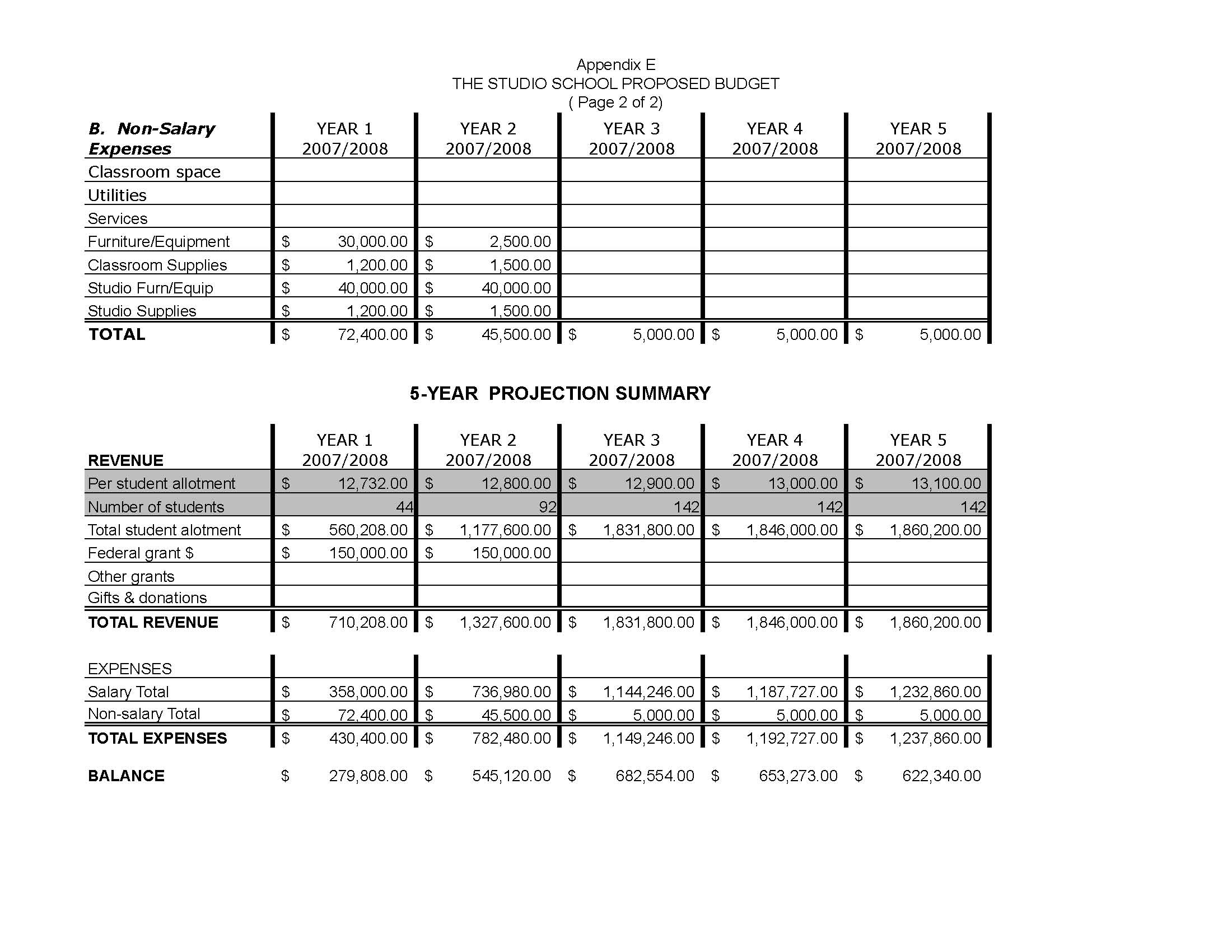
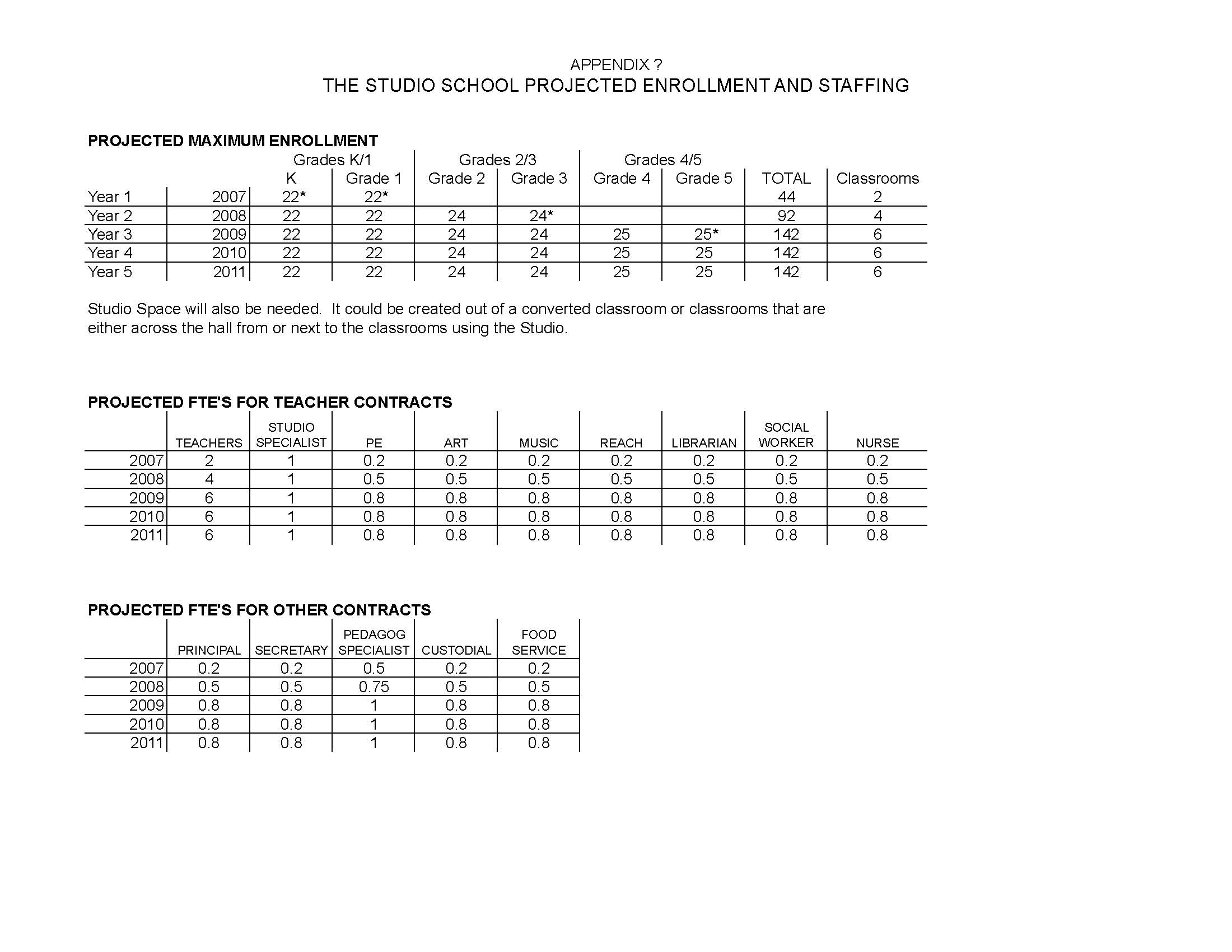
The Studio School Charter School:
In a couple of years I hope to take another try at leading a charter school initiative. I continue to read so much educational research and literature that strongly supports The Studio School concepts. As you know, we spent some time looking into ways to create TSS as a private school but just couldn’t see how it could be affordable to everyone and be sustainable. Even as a sliding-scale-tuition cooperative, there would have to be some tuition paid and that leaves out so many children. It still looks as though a charter school is the best alternative. So maybe there will be some changes in our school district and administrators/ board members will become more actively supportive of charter schools, innovation, and the Studio School concept. Am I overly optimistic?
Programs in my home:
Currently, I’m working with some people to piece together a rather eclectic “menu” of educational programs (art, Spanish, yoga, tutoring, early childhood, etc.) in my home that is licensed for child care for ages 4 – 17. The programs being offered are philosophically aligned with the Reggio Approach – experiential, child-centered, multi-modal learning. I don’t have a final name for this yet but the concept is that of a “learning studio” that offers a variety of enriching programs that will provide children with a variety of “languages” for learning and expressing their ideas. (This summer I am offering an Art & Architecture program for 5-8 year old children on Wednesday mornings and we will be working with recycled materials.) If the “eclectic” studio concept is successful, the plan is to move the program out of my house into a public space in the next year or so. I recently met with someone involved in the Hilldale Mall redevelopment project and a location there might be a possibility down the road. And/or it could be offered through community centers or other neighborhood organizations. It’s also my hope that if I could somehow provide real life examples of the Reggio Approach to teaching and learning, people might be better able to envision the amazing positive impact it could have in an elementary school.
Community Partnerships:
I intend to continue meeting with people who are interested in new educational initiatives and who might want to work together to create programs and schools that include the arts & technology for all Madison children. So I want to keep reaching out to neighborhood groups and community members. Please let me know if you run into any folks who might be interested in talking with me about this and I will be happy to contact them. Thanks
Nancy Donahue
ndonahue@tds.net

Share

Deficit Spending: Declining Madison School District Equity Fund Balance

Fund Balance as Percent of General Fund Expenditures
FY 2000 Thru FY 2006
Source: Wisconsin Taxpayers Alliance
FY 00 FY 01 FY 02 FY 03* FY 04 FY 05 FY 06*
K-8 AVERAGE 22.4% 15.7% 20.3% 18.0% 20.2% 20.0% 18.6%
UHS AVERAGE 24.1% 22.3% 23.6% 21.2% 25.8% 25.4% 22.6%
K-12 AVERAGE 15.2% 23.9% 15.1% 13.8% 14.5% 14.7% 13.4%
MMSD ACTUAL 18.9% 16.4% 12.1% 12.2% 7.7% 7.1% 7.1%
MMSD Budget $252M $333M
Equity Fund (M) $48M $24M


Related:

The Administration used a “salary savings” account to “balance” the budget. When such savings did not materialize, the MMSD’s equity (the difference between an organization’s assets and liabilities) declined.


Interestingly, Madison School Board members Beth Moss, Carol Carstensen and Maya Cole have advocated the continued reduction in the District’s equity as a means to help balance the 2007 / 2008 $339M+ budget. Beth proposed budgeting an additional $2.133M in “salary savings” above the planned $1M while Carol sought $2M and Maya asked for an additional $500K. [Board member proposed 2007/2008 budget amendments 540K PDF]


Finally, several years ago, I received an email from a person very concerned about the “dramatic” decline in the MMSD’s “reserves”, which according to this person were, at one time over $50M. I asked for additional data on this matter, but never heard from that person again.

The equity fund’s decline gives the MMSD less wiggle room over time, and means that we, as a community face decisions related to facilities, staffing and services. Hopefully, the MMSD board and administration can start to consider and implement new approaches, including virtual learning tools and expanded collaboration with community assets like the UW, MATC and others. I hope that we can move beyond the annual “same service approach” and begin to think differently. Peter Gascoyne’s 5 year approach to budgeting is a good place to start

“[Ask] what is the best quality of education that can be purchased for our district for $280 million a year. Start with a completely clean slate. Identify your primary goals and values and priorities. Determine how best to achieve those goals to the highest possible level, given a budget that happens to be $40 million smaller than today’s. Consider everything – school-based budgeting, class sizes, after-school sports, everything.”

A definition of “equity”. 2007 / 2008 $339M+ MMSD Citizen’s Budget

Share

MMSD Budget Proposal Documents: Active Citizens for Education

Share

An open letter to the Superintendent of Madison Metropolitan Schools

Dear Mr. Rainwater:
I just found out from the principal at my school that you cut the allocations for SAGE teachers and Strings teachers, but the budget hasn’t even been approved. Will you please stop playing politics with our children education? It?s time to think about your legacy.
As you step up to the chopping block for your last whack at the budget, please think carefully about how your tenure as our superintendent will be viewed a little more than a year from now when your position is filled by a forward-thinking problem-solver. (Our district will settle for no less.)
Do you want to be remembered as the Superintendent who increased class size as a first step when the budget got tight? Small class size repeatedly rises to the top as the best way to enhance student achievement at the elementary level. Why would you take away one of best protections against federal funding cuts mandated by the No Child Left Behind Act? Rather than increase pupil to teacher ratios, have you checked to see if the pupil to administrative staff ratio has been brought closer to the state-wide average? (In 2002, Madison Metropolitan schools were at 195 children per administrator; the rest of the state averaged 242 children per administrator.) Have the few administrative openings you?ve left unfilled over the past few years actually brought us into line with the rest of the state?

(more…)

Share

I have a few comments on separate courses for students of different abilities

I think that it is important to have opportunities for advanced students to obtain seperate instruction is subjects they excel in. It is my belief that by doing this we don’t sacrifice diversity, we actually increase it.
My logic is as follows. If gifted students are not given the challenge they need in school, they will not achieve as much as they can. If the public schools are not able to provide for these childern, then parents of gifted kids will pull them out of school. Unfortunately, only involved parents with money will have the ability to give their kids the alternative education like private school. Thus, the public schools will be left with few children at the top end of the education spectrum since it can’t provide for them.
My belief that this is true comes from my home town in California. We have one elementary school in a wealthy area that is known to have much better educational opportunities for students. Parents in other districts constantly try to move their children to this school. Due to declining enrollment, other school districts have stopped letting students switch schools. To still provide for the children, the school in the wealthy area became a charter school. Now, parents can move their children there without incident. But, the other public schools are left without their brightest students. If the other public schools could provide for their brightest, the public schools would include all of the students.

(more…)

Share

Petition to Save Our East and North Side Schools

A District-wide petition drive has been started to keep open all of the east and north side schools that are currently being discussed as possible closures and consolidations. To learn more and to sign the petition go to:
http://www.thepetitionsite.com/takeaction/879512194

Share

New revenue for schools

Governor Jim Doyle’s budget proposal includes language that would allow Wisconsin school districts to:

Construct or acquire, borrow funds to construct or acquire, operate and maintain a wind electricity generation facility, and use or sell the electricity generated by the facility, if the school board’s share of the installed capacity of the facility does not exceed 5 megawatts and the school boar incorporates information about the facility in its curriculum. (120.13(18m) WIND ELECTRICITY GENERATORS)

People should contact members of the Joint Committee on Finance to express support for the measure.

Share

“Cooking the Numbers” – Madison’s Reading Program

Joanne Jacobs:

From the Fayetteville, NC Observer:

Superintendent Art Rainwater loves to discuss the Madison Metropolitan School District’s success in eliminating the racial achievement gap.
But he won’t consult with educators from other communities until they are ready to confront the issue head on.
“I’m willing to talk,” Rainwater tells people seeking his advice, “when you are willing to stand up and admit the problem, to say our minority children do not perform as well as our white students.”

Only then will Rainwater reveal the methods Madison used to level the academic playing field for minority students.
This is an odd statement. The racial achievement gap is accepted as an uncomfortable fact everywhere; it is much discussed. No superintendent in the U.S. — except for Rainwater — claims to have eliminated the gap.

Today, Rainwater said, no statistical achievement gap exists between the 25,000 white and minority students in Madison’s schools.
Impressive, but untrue, writes Right Wing Prof, who looked at Madison reading scores across all grades.

I found a graph comparing Madison to five similar districts in Wisconsin, all of which do much better than Madison on fourth-grade reading.

Joanne was in Milwaukee and Madison recently to discuss her book, “Our School“.
Related Links:

Share

“No, My Son Doesn’t ‘Act Black.’ There’s No Such Thing.”

This powerful first-person account by Aleta Payne first appeared in the Washington Post earlier this month. It brought tears to my eyes as I read it in our own Cap Times last night. The piece drives home the multifaceted nature of the achievement gap, underscoring the fact that the search for a single solution is seriously misguided and that we must each do our part.

Sam came home from the overnighter visibly crushed. He curled around his hurt as though he’d been punched in the gut, and he refused to say what had happened. My husband and I fought panic as all the horrible things that might happen to a 14-year-old away from home pounded through our brains. We cajoled and interrogated as he tried to disappear into the living room sofa, until finally, enough of the story emerged to reassure us that our oldest son hadn’t been physically injured. But his suffering was still real.
His friends had asked him why he didn’t act black.

(more…)

Share

“Bitter Medicine for Madison Schools”:
07/08 budget grows 3.6% from 333M (06/07) to $345M with Reductions in the Increase

Doug Erickson on the 2007/2008 $345M budget (up from $333M in 2006/2007) for 24,342 students):

As feared by some parents, the recommendations also included a plan to consolidate schools on the city’s East Side. Marquette Elementary students would move to Lapham Elementary and Sherman Middle School students would be split between O’Keeffe and Black Hawk middle schools.
No school buildings would actually close – O’Keeffe would expand into the space it currently shares with Marquette, and the district’s alternative programs would move to Sherman Middle School from leased space.
District officials sought to convince people Friday that the consolidation plan would have some educational benefits, but those officials saw no silver lining in having to increase class sizes at several elementary schools.
Friday’s announcement has become part of an annual ritual in which Madison – and most other state districts – must reduce programs and services because overhead is rising faster than state-allowed revenue increases. A state law caps property-tax income for districts based on enrollment and other factors.
The Madison School District will have more money to spend next year – about $345 million, up from $332 million – but not enough to keep doing everything it does this year.
School Board members ultimately will decide which cuts to make by late May or June, but typically they stick closely to the administration’s recommendations. Last year, out of $6.8 million in reductions, board members altered less than $500,000 of Rainwater’s proposal.
Board President Johnny Winston Jr. called the cuts “draconian” but said the district has little choice. Asked if the School Board will consider a referendum to head off the cuts, he said members “will discuss everything.”
But board Vice President Lawrie Kobza said she thinks it’s too early to ask the community for more money. Voters approved a $23 million referendum last November that included money for a new elementary school on the city’s Far West Side.
“I don’t see a referendum passing,” she said.

Links: Wisconsin K-12 spending. The 10.5M reductions in the increase plus the planned budget growth of $12M yields a “desired” increase of 7.5%. In other words, current Administration spending growth requires a 7.5% increase in tax receipts from property, sales, income, fees and other taxes (maybe less – see Susan Troller’s article below). The proposed 07/08 budget grows 3.6% from 333M+ (06/07) to $345M (07/08). Madison’s per student spending has grown an average of 5.25% since 1987 – details here.
UPDATE: A reader emails:

The spectre of central city school closings was what prompted some of us to resist the far-west side school referendum. Given the looming energy crisis, we should be encouraging folks to live in town, not at the fringes, strengthen our city neighborhoods. Plus, along with the need to overhaul the way we fund schools, we need a law requiring developers to provide a school or at least the land as a condition to development.

UPDATE 2: Susan Troller pegs the reduction in the increase at $7.2M:

Proposed reductions totaled almost $7.2 million and include increases in elementary school class sizes, changes in special education allocations and school consolidations on the near east side.
Other recommendations include increased hockey fees, the elimination of the elementary strings program and increased student-to-staff ratios at the high school and middle school levels.

UPDATE 3: Roger Price kindly emailed the total planned 07/08 budget: $339,139,282

Share

The Future of Our Schools: The Funding Crisis

The League of Women Voters of Dane County, Dane County PTO’s, Principals and School Boards
Panel Presentation featuring:

Questions to follow presentations
Wednesday, April 11, 2007
7:00 ? 9:30 p.m.
Meriter Main Gate Grand Hall
333 W. Main Street, Madison[map]
(free parking across the street)
All Welcome! Come and Bring a friend!
For more information:
The League of Women Voters of Dane County 232-9447

Share

Help Increase Support for Wisconsin Students of Poverty to Take AP Exams

Below you will find a forward from the Wisconsin Gifted Education listserv. A brief communication from each of us to our state legislators could release money to cover AP exam registration fees for Wisconsin students who qualify for free and reduced lunch. A small change is needed in the wording of a specific state statute in order to release federal dollars for that purpose. Thanks for your help. –LAF

As you know, students are beginning to pay registration fees for the Advanced Placement Exams they are planning to take in May.
In Chapter 120 of “School District Government,” Wisconsin statute 120.12 — “School Board Duties”, item (22) — reads as follows:
ADVANCED PLACEMENT EXAMINATIONS. Pay the costs of advanced placement examinations taken by pupils enrolled in the school district who are eligible for free or reduced – price lunches in the federal school lunch program under 42 USC 1758.
While no one objects to these students having the exam fee paid, the district common funds that are used for this purpose are constantly being reduced. As there are no state aids connected to this legislative requirement, districts are following the statute as an “unfunded mandate”.
The Department of Public Instruction has written a federal grant which would allow a variety of other funds (not just local common funds) to be used for the payment of AP exam fees. The federal grant is on hold pending some immediate action by our legislature to change the wording of the above quoted statute that would allow federal grant money to be awarded to the Department of Public Instruction for the express purpose of reimbursing districts for the AP exam fees of students qualifying for free or reduced lunches. With the current language in the statute, the federal government will not release grant funds for this purpose because thy see it as “supplanting” other resources.
Action is needed immediately since students are NOW registering for those exams and district are required to cover these fees NOW.
Let your legislators know that their immediate action to change the wording of the statute would result in the release of federal grant money to the State of Wisconsin. If no action is taken, the grant money will be lost. The decision is currently on hold, pending legislative action.
Go to http://waml.legis.state.wi.us/ “Who are my Legislators?” to find out who represents you. You will see their email and snail mail addresses. You are advised to send both and always remember to include your home street address so that the legislator realizes that you do live and vote in their district.
Ruth Robinson
Coordinator of Talented & Gifted Education & District Assessment
527 South Franklin Street
Janesville, WI 53548
608-743-5035
608-743-5130 fax

Share

Why Illinois Test Scores Went Up?: Changing the Test or Academic Improvements?

Via a reader looking at this issue: Stephanie Banchero, Darnell Little and Diane Rado:

Illinois elementary school pupils passed the newly revamped state achievement exams at record rates last year, but critics suggest it was more the result of changes to the tests than real progress by pupils.
State and local educators attribute the improvement to smarter pupils and teachers’ laser-like focus on the state learning standards—the detailed list of what pupils should know at each grade level. They also say that the more child-friendly exams, which included color and better graphics, helped pupils.
But testing experts and critics suggest that the unprecedented growth is more likely the result of changes to the exams.
Most notably, the state dramatically lowered the passing bar on the 8th-grade math test. As a result—after hovering at about 50 percent for five years—the pass rate shot up to 78 percent last year.
While the number of test questions remained generally the same, the number that counted on pupil scores dropped significantly.

Kevin Carey criticized Wisconsin’s “Statistical Manipulation of No Child Left Behind Standards“. The Fordham Foundation and Amy Hetzner have also taken a look at this issue.

Share

3/5/2007 Madison School Board Candidate Forum: West High School

The Madison West High School PTSO held a school board candidate forum Monday night. Topics included:

  • Madison High School Comparison
  • A candidate’s ability to listen, interact and work successfully with other board members
  • Past and future referenda support
  • Candidate views on the $333M+ budget for our 24,000 students
  • Extensive conversations on the part of Marj and Johnny to lobby the state and federal governments for more money. Maya wondered how successful that strategy might be given that our own State Senator Fred Risser failed to sign on to the Pope-Roberts/Breske resolution and that there are many school districts much poorer than Madison who will likely obtain benefits first, if new state tax funds are available. Maya also mentioned her experience at the state level via the concealed carry battles.
  • The challenge of supporting all students, including those with special needs. Several candidates noted that there is white flight from the MMSD (enrollment has been flat for years, while local population continues to grow)
  • Mandatory classroom grouping (heterogeneous) was also discussed

I applaud the West PTSO for holding this event. I also liked the way that they handled questions: all were moderated, which prevents a candidate supporter from sandbagging the opposition. I attended a forum last year where supporters posed questions before local parents had the opportunity.
Video and mp3 audio clips are available below. Make sure you have the latest version of Quicktime as the video clips use a new, more efficient compression technique.

(more…)

Share

Marj Passman & Tony Casteneda Discuss The Madison School Board Race

Madison School Board Seat 5 candidate Marj Passman talked with Tony Castañeda recently on WORT-FM. Marj faces Maya Cole in the April 3, 2007 spring election. Marj and Tony discussed health care costs, curriculum, governance, special education, this website, and the Madison School District’s $331M+ budget.
Listen via this 5.7MB mp3 audio file. A transcript will be posted when available.

Share

PTA’s Go Way Beyond Cookies

Winnie Hu:

With many members who stepped out of high-profile careers to become stay-at-home parents, traditional parent-teacher associations (and the similar parent-teacher organizations, or PTOs) have evolved into sophisticated multitiered organizations bearing little resemblance to the mom-and-pop groups that ran bake sales a generation ago.
Last month, the Scarsdale Middle School PTA in Westchester County began posting podcasts of meetings on the Internet as a way to reach more parents, while the PTO at Squadron Line Elementary School in Simsbury, Conn., now has its own reserved parking space at the school. (To raise money for the school playground, parents bid each month for the right to use it.)
And in the Washington suburbs, the Arlington Traditional School PTA developed training manuals with past meeting minutes, treasurer reports, and program evaluations for its six vice presidents last year.

Share

Going to the Mat for WPS

Jason Shephard:

Suzanne Fatupaito, a nurse’s assistant in Madison schools, is fed up with Wisconsin Physicians Service, the preferred health insurance provider of Madison Teachers Inc.
“MTI uses scare tactics” to maintain teacher support for WPS, Fatupaito recently wrote to the school board. “If members knew that another insurance [plan] would offer similar services to WPS and was less expensive — it would be a no-brainer.”
WPS, with a monthly price tag of $1,720 for family coverage, is one of two health coverage options available to the district’s teachers. The other is Group Health Cooperative, costing $920 monthly for a family plan.
During the past year, the Madison school board has reached agreements with other employee groups to switch from WPS to HMO plans, with most of the savings going to boost pay.
In December, the board held a secret vote in closed session to give up its right to seek health insurance changes should negotiations on the 2007-09 teachers contract go into binding arbitration. (The board can seek voluntary insurance changes during negotations.)
“What we’ve done is taken away a huge bargaining chip,” says board member Lucy Mathiak. “Every other major industry and public sector has had to deal with health-insurance changes, and we’ve got a very real $10 million deficit.”
MTI Executive Director John Matthews says other employee unions “made a big mistake” in switching to HMO plans. Matthews has long maintained that WPS provides superior coverage, despite its higher costs and disproportionate number of complaints. And he defends the paycheck he collects from WPS as a member of its board, saying he’s better able to lobby for his teachers.

Much more on this issue, including links, audio and a transcript, here.

Share

Concessions Made in Advance of MTI Negotiations by a Majority of the Madison School Board

It will be interesting to see how voters on February 20 and April 3 view this decision by a majority of the Madison School Board: Should the Board and Administration continue to give away their ability to negotiate health care benefits ($43.5M of the 2006/2007 budge) before MTI union bargaining begins? Read the 2005 MMSD/MTI Voluntary Impasse Agreement [1.1MB PDF; see paragraph’s 2, 10 and 11]. The 2007 version, alluded to in Andy Hall’s article below, will be posted when it sees the light of day.
This is an important issue for all of us, given the MMSD’s challenge of balancing their growing $331M+ budget, while expenses – mostly salaries and benefits – continue to increase at a faster rate. Mix in the recent public disclosure of the district’s $5.9M 7 year structural deficit and I doubt that this is the best approach for our children.
Recently, the Sun Prairie School District and its teachers’ union successfully bargained with DeanCare to bring down future costs for employee health insurance.

Andy Hall, writing in the Wisconsin State Journal asks some useful questions:

But with the Madison School Board facing a $10.5 million budget shortfall, is the board giving away too much with its promises to retain teachers’ increasingly pricey health insurance and to discard its legal mechanism for limiting teachers’ total compensation increase to 3.8 percent?

Yes, School Board Vice President Lawrie Kobza said Saturday, “I feel very strongly that this was a mistake,” said Kobza, who acknowledged that most board members endorse the agreement with Madison Teachers Inc., the teachers union.

State law allows districts to avoid arbitration by making a so-called qualified economic offer, or QEO, by boosting salaries and benefits a combined 3.8 percenter a year.

“To agree before a negotiation starts that we’re not going to impose the QEO and negotiate health care weakens the district’s position,” Kobza said. She contended the district’s rising health-care costs are harming its ability to raise starting teachers’ salaries enough to remain competitive.

The “voluntary impasse resolution” agreements, which are public records, are used in only a handful of Wisconsin’s 425 school districts, according to the Wisconsin Employment Relations Commission.

Four of the 7 current Madison School Board Members were backed by MTI during their campaigns (Arlene Silveira, Carol Carstensen, Shwaw Vang and Johnny Winston, Jr.). Those four votes can continue this practice. Independent School Board members Lawrie Kobza and Ruth Robarts have spoken publicly against the concessions made in advance of negotiations. If you support or oppose this approach, let the board know via email (comments@madison.k12.wi.us), or phone.

Related links, media and transcripts:

  • What’s the MTI Political Endorsement about?:

    In 2006-07 the Madison School district will spend $43.5M on health insurance for its employees, the majority of the money paying for insurance for teachers represented by Madison Teachers, Inc. (MTI) That is 17% of the operating budget under the revenue limits.
    In June of 2007, the two-year contract between the district and MTI ends. The parties are now beginning negotiations for the 2007-09 contract.
    The Sun Prairie School district and its teachers union recently saved substantial dollars on health insurance. They used the savings to improve teacher wages. The parties joined together openly and publicly to produce a statement of the employees health needs. Then they negotiated a health insurance package with a local HMO that met their needs.

  • The MMSD Custodians recently agreed to a new health care plan where 85% of the cost savings went to salaries and 15% to the MMSD.
  • Ruth Robarts discussed concessions in advance of negotiations, health care costs and the upcoming elections with Vicki McKenna recently. [6.5MB MP3 Audio | Transcript]
  • What a Sham(e) by Jason Shephard:

    Last week, Madison Teachers Inc. announced it would not reopen contract negotiations following a hollow attempt to study health insurance alternatives.
    Not to put too fine a point on it, but anyone who suggests the Joint Committee on Health Insurance Issues conducted a fair or comprehensive review needs to get checked out by a doctor.
    The task force’s inaction is a victory for John Matthews, MTI’s executive director and board member Wisconsin Physicians Service.
    Losers include open government, school officials, taxpayers and young teachers in need of a raise.
    From its start, the task force, comprised of three members each from MTI and the district, seemed to dodge not only its mission but scrutiny.

(more…)

Share

My Life and Times With the Madison Public Schools

Up close, the author finds that politics obscure key educational issues
Marc Eisen:

Where’s the challenge?
I’m no different. I want my kids pushed, prodded, inspired, and challenged in school. Too often—in the name of equity, or progressive education, or union protectionism, or just plain cheapness—that isn’t happening in the Madison schools.
Advanced classes are being choked off, while one-size-fits-all classes (“heterogeneous groupings”) are created for more and more students. The TAG staff has been slashed nearly in half (one staffer is now assigned to six elementary schools), and even outside groups promoting educational excellence are treated coolly if not with hostility (this is the fate of the most excellent Wisconsin Center For Academically Talented Youth [WCATY]). And arts programs are demeaned and orphaned.
This is not Tom Friedman’s recipe for student success in the 21st century. Sure, many factors can be blamed for this declining state of affairs, notably the howlingly bad way in which K-12 education is financed and structured in Wisconsin. But much of the problem also derives from the district’s own efforts to deal with “the achievement gap.”
That gap is the euphemism used for the uncomfortable fact that, as a group, white students perform better academically than do black and Hispanic students. For example, 46% of Madison’s black students score below grade level on the state’s 3rd grade reading test compared to 9% of white students.
At East, the state’s 10th grade knowledge-and-concepts test show widely disparate results by race. With reading, 81% of white kids are proficient or advanced versus 43% for black students. The achievement gap is even larger in math, science, social studies, and language arts. No wonder TAG classes are disproportionately white.
Reality is that the push for heterogeneous class grouping becomes, among other things, a convenient cover for reducing the number of advanced classes that are too white and unrepresentative of the district’s minority demographics.

Share

Madison School Board Seat 3 Primary Overview

Susan Troller:

Watch the candidates' video presentations here.

At first glance, the three primary candidates seeking the seat that Shwaw Vang is leaving open on the Madison School Board appear far more similar than different.

Beth Moss, Rick Thomas and Pam Cross-Leone are all married, white, middle class parents of students who attend Madison public schools. Their ages range from 37 to 47, and all bring impressive records of school volunteer work and community involvement to the table.

Major props to Susan Troller and Lee Sensenbrenner for these online interviews:

The Capital Times recently asked the three Madison School Board candidates running in next week’s primary election for Seat 3 to come to our office to discuss their priorities for the Madison district and to participate in a couple of exercises that might offer an unusual glimpse into how they view city schools.
We marked 10 cards with issues that the district has dealt with over the last year and asked the candidates to place them in order, based on what they would most like to protect from cuts. We also gave them a couple of wild cards they could use for items we had not included on the list. Then we asked them to take paper and a packet of crayons and use them to present their ideal classroom. Finally, we asked them to talk about each of these exercises, for which they were given 10 minutes to complete.
Both Pam Cross-Leone and Beth Moss listed class size and competitive salaries as among their top three priorities. Rick Thomas listed his top priority as school safety, and he placed competitive salaries last. Cross-Leone used multiple colors to write about her ideal classroom, while Moss drew a diagram using only a green crayon. Thomas drew a simple picture, with stick figures.
To hear what the candidates had to say, how they ordered their priorities and how they put their crayons to use, click on each of their names listed above.

Links, video interviews and more election information here.
Vote February 20 and April 3, 2007.

Share

Spring 2007 Madison School Board Election Update

I’ve updated the election page with the following information:

Share

Comments on the 2006 Madison Edge School Referendum & Possible Closure of a “Downtown School”

Dan Sebald:

I’m somewhat incredulous about the comments from the Madison School Board President Johnny Winston Jr. in Susan Troller’s article about Monday’s meeting. Do I understand correctly? The School Board packaged the new west side elementary school with two other spending items to ensure its passage as a referendum on last November’s ballot, and now the School Board is reluctant to put forth a referendum to fully fund downtown schools? And they give no reassurance about seeking to keep the downtown school curriculums and class size intact?
And what of these comments about no public outcry? If the public is to do the political footwork to get rid of draconian state-imposed caps, we wouldn’t need a School Board.
From someone who has no vested interest in one’s own children’s education yet recognizes the importance of a solid education for everyone, I say Madison’s school system is in obvious decline.
My opinion is that if the modus operandi is school funding by referendums and we get a referendum for a new school on the edge of the city, then we get a referendum to fund downtown schools.
If that referendum fails, then it fails, which would be a good indication of where priorities in the community lie and also a sad disappointment.
Dan Sebald Madison

This is a fascinating issue, particularly given the folks that lined up to support last fall’s referendum.

Share

Studies Find Benefits to Advanced Placement Courses

Jay Matthews:

In the midst of a national debate over whether Advanced Placement courses place too much pressure on U.S. high school students, a team of Texas researchers has concluded that the difficult courses and three-hour exams are worth it.
In the largest study ever of the impact of AP on college success, which looked at 222,289 students from all backgrounds attending a wide range of Texas universities, the researchers said they found “strong evidence of benefits to students who participate in both AP courses and exams in terms of higher GPAs, credit hours earned and four-year graduation rates.”
A separate University of Texas study of 24,941 students said those who used their AP credits to take more advanced courses in college had better grades in those courses than similar students who first took college introductory courses instead of AP in 10 subjects.

Madison United for Acadmic Excellence has a useful comparison of AP and other “advanced” course offerings across the four traditional Madison high schools. Much more on local AP classes here.
Wisconsin Advanced Placement Distance Learning Consortium.
Verona High School Course Prospectus, including AP.
Middleton High School Course List.
Monona Grove High School Course Catalog [320K PDF]
Sun Prairie High School Courses.
Waunakee High School Course Index.
McFarland High School Course Guide.
Edgewood High School.
Jay Matthews has more in a later article.

Share

The Declining Quality of Mathematics Education in the US

Leland McInnes:

Mathematics education seems to be very subject to passing trends – surprisingly more so than many other subjects. The most notorious are, of course, the rise of New Math in the 60s and 70s, and the corresponding backlash against it in the late 70s and 80s. It turns out that mathematics education, at least in the US, is now subject to a new trend, and it doesn’t appear to be a good one.
To be fair the current driving trend in mathematics education is largely an extension of an existing trend in education generally. The idea is that we need to cater more to the students to better engage them in the material. There is a focus on making things fun, on discovery, on group work, and on making things “relevant to the student”. These are often noble goals, and it is something that, in the past, education schemes have often lacked. There is definitely such a thing as “too much of a good thing” with regard to these aims, and as far as I can tell that point was passed some time ago in the case of mathematics.

Share

More on the Proposed Madison Studio School


The Madison School Board discussed the proposed Madison Studio School recently. Watch the video and read these recent articles:

  • Mayoral Candidates Endorse the Studio School by Susan Troller
  • Board Wants Study of Studio School by Deborah Ziff
  • Don’t Rush Approval of Studio School by John Keckhaver
  • Chafing at Charters by Jason Shephard:

    But citizen praise was matched by district badmouthing. At every stage, district officials exaggerated the potential problems posed by the school, and at no point did they provide evidence that they had worked to resolve them.
    For example, Rainwater wants the 44-student school to have its own full-time principal and secretary, while Studio School backers want to save money by sharing Emerson’s resources.
    Rainwater’s insistence on spending more money, which could torpedo the proposal, left some shaking their heads. Kobza asked whether it would make sense to even consider other charters, as Rainwater’s rules would make them financially unviable.
    Rainwater, amazingly, conceded the point: “I agree that you would never have a charter school” given these requirements, he said.

(more…)

Share

Madison School Board Discusses an Independent Math Curriculum Review

The Madison School Board’s 2006/2007 Goals for Superintendent Art Rainwater included the “Initiatiation and completion of a comprehensive, independent and neutral review and assessment of the District’s K-12 math curriculum”. Watch the discussion [Video] and read a memo [240K PDF] from the Superintendent regarding his plans for this goal. Much more here and here.
Barbara Lehman kindly emailed the Board’s conclusion Monday evening:

It was moved by Lawrie Kobza and seconded by Ruth Robarts to approve the revised plan for implementation of the Superintendent’s 2006-07 goal to initiate and complete a comprehensive, independent, and neutral review and assessment of the District’s K-12 math curriculum as presented at this meeting, including extension for completion of the evaluation to the 2007-08 school year. The Board of Education shall receive a report in 2006-07 with analysis of math achievement data for MMSD K-12 students, including analysis of all math sub-test scores disaggregated by student characteristics and schools in addition to reports in subsequent years. Student representative advisory vote * aye. Motion carried 6-1 with Lucy Mathiak voting no.

Share

Madison Parents’ School Safety Site

Within moments of reading Chris Anderson’s “The Vanishing Point Theory of News“, a link to the Madison Parents’ School Safety Site arrived in my inbox. The site includes a useful set of questions that all parents should use to evaluate their children’s school.
RSS Feed.

Share

Education and Educational Research in an Era of Accountability: Insights and Blind Spots

I am pleased to invite you to a conference on “Education and Educational Research in an Era of Accountability: Insights and Blind Spots“, to be held on February 7-8, 2007, at the Pyle Center [map], near the University of Wisconsin-Madison campus. Attendance is free, and we very much hope that members of the local educational community will be able to attend. The conference is sponsored by the Department of Educational Policy Studies at the University of Wisconsin-Madison. A schedule detailing the presentations is attached.
The conference will examine the impact on schools of the increased accountability, rationalization, and standardization of education symbolized and accelerated by the No Child Left Behind Act. It will also look at recent shifts in educational research that are associated with these trends, out of which a new emphasis on, and a new definition of, “scientific research” have emerged.
The conference will start Wednesday evening, February 7th, with a keynote address by Professor Richard F. Elmore, who is the Gregory R. Anrig Professor of Educational Leadership at the Harvard Graduate School of Education, and Co-Director of the Consortium of Policy Research in Education. Professor Elmore will be introduced by Dean Julie Underwood of the UW School of Education. He is particularly interested in complex efforts at the school level to improve the quality of instruction. He seeks to understand how current state and federal accountability systems can work to support those efforts, as well as how these systems may unintentionally work at cross purposes with school and district level efforts. His recent works include School Reform from the Inside Out and the co-edited Redesigning Accountability Systems for Education.

(more…)

Share

Spring, 2007 Madison School Board Election Update

Some updates regarding the April 3, 2007 (and a Seat 3 primary February 20th, 2007) Spring school board elections:

Much more on the 2007 elections here.

Share

“Do you want innovative public school options in Madison?

If you do, then your support of The Studio School charter school proposal is critical. Please let the school board know. Write letters. Email them [comments@madison.k12.wi.us]. Call them. Attend the meeting on January 22nd! I have heard from a board member that if the “pressure” to vote for opening this school in the fall isn’t strong enough, board members will not vote in favor of this proposal January 29th.
The opportunity to offer this innovative educational option with the possibility of up to $450,000.00 of federal funding over the next two years will not be available to MMSD again.
For more information to find out how to help, community members are invited to join us for our planning group’s general meeting on January 17th (this Wednesday) at 6:30 PM at the Sequoya Branch of the Public Library [Map]. You can also go to our website for more information.

Share

Financially Support Madison Schools’ Math Festival

Ted Widerski:

The Talented and Gifted Division of MMSD is busy organizing ‘MathFests’ for strong math students in grades 4 – 8. These events are planned to provide an opportunity for students to interact with other students across the city who share a passion for challenging mathematics. Many of these students study math either online, with a tutor, by traveling to another school, or in a class with significantly older students.
These events will be hosted by Cuna Mutual Insurance and American Family Insurance. Students will have an opportunity to learn math in several ways: a lecture by a math professor, group learning of a new concept, and individual and small group math contests. Over 300 students from 38 schools will be invited to participate.
The funding for this project is challenging as there are no significant MMSD funds available. A plea for funding in the last several weeks has resulted in gifts totaling about $1000. Those gifts will guarantee that the middle school Mathfest will be held on Wednesday, February 21st.
In order to hold the Elementary MathFests on each side of Madison would require additional donations. Gifts totaling $1600 would provide the necessary support to provide 200 students with a very special experience. If anyone or any group would like to contribute, it would be most appreciated. Please contact me: Ted Widerski, TAG Resource Teacher at: twiderski@madison.k12.wi.us
Thank you for supporting this math event.

Share

Notes and Links on the Madison K-12 Climate and Superintendent Hires Since 1992

Madison Superintendent Art Rainwater’s recent public announcement that he plans to retire in 2008 presents an opportunity to look back at previous searches as well as the K-12 climate during those events. Fortunately, thanks to Tim Berners-Lee’s World Wide Web, we can quickly lookup information from the recent past.
The Madison School District’s two most recent Superintendent hires were Cheryl Wilhoyte [Clusty] and Art Rainwater [Clusty]. Art came to Madison from Kansas City, a district which, under court order, dramatically increased spending by “throwing money at their schools”, according to Paul Ciotti:

In 1985 a federal district judge took partial control over the troubled Kansas City, Missouri, School District (KCMSD) on the grounds that it was an unconstitutionally segregated district with dilapidated facilities and students who performed poorly. In an effort to bring the district into compliance with his liberal interpretation of federal law, the judge ordered the state and district to spend nearly $2 billion over the next 12 years to build new schools, integrate classrooms, and bring student test scores up to national norms.
It didn’t work. When the judge, in March 1997, finally agreed to let the state stop making desegregation payments to the district after 1999, there was little to show for all the money spent. Although the students enjoyed perhaps the best school facilities in the country, the percentage of black students in the largely black district had continued to increase, black students’ achievement hadn’t improved at all, and the black-white achievement gap was unchanged.(1)
The situation in Kansas City was both a major embarrassment and an ideological setback for supporters of increased funding for public schools. From the beginning, the designers of the district’s desegregation and education plan openly touted it as a controlled experiment that, once and for all, would test two radically different philosophies of education. For decades critics of public schools had been saying, “You can’t solve educational problems by throwing money at them.” Educators and advocates of public schools, on the other hand, had always responded by saying, “No one’s ever tried.”

Cheryl Wilhoyte was hired, with the support of the two local dailies (Wisconsin State Journal, 9/30/1992: Search No Further & Cap Times Editorial, 9/21/1992: Wilhoyte Fits Madison) by a school board 4-3 vote. The District’s budget in 1992-1993 was $180,400,000 with local property taxes generating $151,200,00 of that amount. 14 years later, despite the 1993 imposition of state imposed annual school spending increase limits (“Revenue Caps“), the 2006 budget is $331,000,000. Dehli’s article mentions that the 1992-1993 School Board approved a 12.9% school property tax increase for that budget. An August, 1996 Capital Times editorial expressed puzzlement over terms of Cheryl Wilhoyte’s contract extension.
Art, the only applicant, was promoted from Acting Superintendent to Superintendent in January, 1999. Chris Murphy’s January, 1999 article includes this:

Since Wilhoyte’s departure, Rainwater has emerged as a popular interim successor. Late last year, School Board members received a set of surveys revealing broad support for a local superintendent as opposed to one hired from outside the district. More than 100 of the 661 respondents recommended hiring Rainwater.

Art was hired on a 7-0 vote but his contract was not as popular – approved on a 5-2 vote (Carol Carstensen, Calvin Williams, Deb Lawson, Joanne Elder and Juan Jose Lopez voted for it while Ray Allen and Ruth Robarts voted no). The contract was and is controversial, as Ruth Robarts wrote in September, 2004.
A February, 2004 Doug Erickson summary of Madison School Board member views of Art Rainwater’s tenure to date.
Quickly reading through a few of these articles, I found that the more things change, the more they stay the same:

Fascinating. Perhaps someone will conduct a much more detailed review of the record, which would be rather useful over the next year or two.
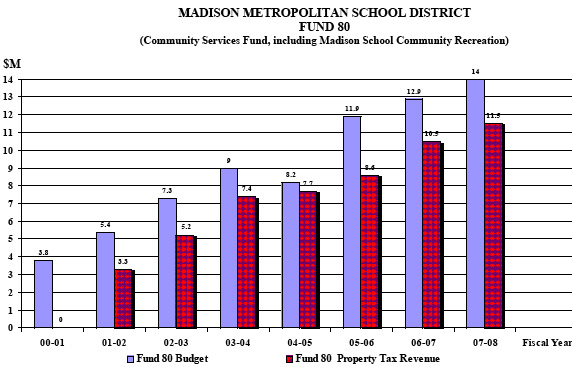
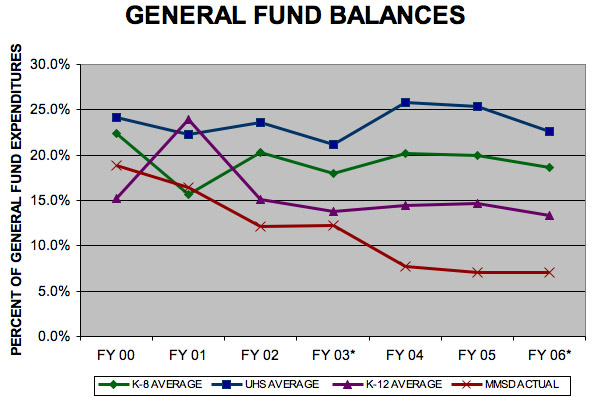
Share

A Call for an Honest State Budget

Wisconsin State Journal Editorial:

Wisconsin’s state government ended the past fiscal year with a giant deficit of $2.15 billion, according to the accounting methods used by most businesses.
But the state’s books show a cozy balance of $49.2 million.
The discrepancy results from years of Wisconsin governors and legislators manipulating the accounting process to hide irresponsible budget decisions.
Those accounting tricks must stop. Wisconsin should begin to hold itself to the more business-like accounting methods used by Wall Street and by 16 other states the Generally Accepted Accounting Principles, known as GAAP.

Wisconsin’s fiscal situation makes it unlikely that there will be substantial changes in state funding for K-12 schools, particularly for rich districts like Madison that spend 23% ($333,000,000 for 24,576 students) more per student than the state average. Current state law penalizes districts that increase local school spending (property taxes) via referendum via reduced state aids. This means that for every $1.00 of new local spending above state revenue growth caps, Madison taxpayers must pay $1.61.
The 2/20/2007 and 04/03/2007 school board election presents an interesting contrast between candidates who believe that the best interests of our children are served by advocating for larger state spending beyond the typical 3.5%+ annual increases in the District’s budget and those who view the likelihood of substantial state changes for rich districts, like Madison as remote and therefore advocate more efficient management of the extraordinary resources we currently have. Health care costs present a useful example of this issue: Inaction [What a Sham(e)] vs discussion and some changes (in this example, 85% of the health care cost savings went to salaries).]

Share

Local School Budget Tea Leaves

The Madison School Board Communication Committee’s upcoming meeting includes an interesting 2007-2009 legislative agenda for state education finance changes that would increase District annual spending (current budget is $333,000,000) at a higher than normal rate (typically in the 3.8% range):

4. 2007-09 Legislative Agenda
a. Work to create a school finance system that defines that resources are necessary to provide students with a “sound basic education.” Using Wisconsin’s Academic Standards (which is the standard of achievement set by the Legislature), coupled with proven research that lays out what is necessary to achieve those standards, will more clearly define what programs and services are required for students to attain success.
b. Support thorough legislative review of Wisconsin’s tax system; examining all taxing.
c. Provide revenue limit relief to school districts for uncontrollable costs (utilities, transportation). [ed: This shifts the risk to local property taxpayers, which has its pros and cons. The definition of “uncontrollable” would be interesting to read.]
d. Allow a local board of education to exceed the revenue limits by up to 2% of the district’s total budget without having to go to referendum. [ed: $6,660,000 above the typical 3.8% annual spending growth: $333,000,000 2006/2007 budget + 3.8% (12,654,000) + 2% (6,660,000) = $19,314,000 increase, or 5.8%]
e. Allow school districts to exceed the revenue limits for security-related expenses by up to $100 per pupil enrolled in the district. [ed: about $2,400,000]
f. Modify the school aid formula so negative tertiary school district (Madison) taxpayers aren’t penalized when the district borrows. (Madison Schools’ taxpayers have to pay $1.61 for every dollar borrowed.) [ed: This will cost other districts money]
g. Improve Medicaid reimbursement from state to school districts (current law allows the state to “skim” 40% of the federal Medicaid reimbursement dollars for school-based services).
h. Support state aid reimbursement for 4-year old kindergarten programs, similar to the reimbursement for 4-year old kindergarten in Milwaukee choice and charter schools.
i. Support increasing state aid for public school transportation costs.
j. Support allowing a declining enrollment school district to use the highest enrollment in a 5-year period for purposes of calculating its revenue limit. [ed: I wonder if the MMSD perceives itself as a growing or declining district, given the attendance projections used to support new schools over the past several years? Perhaps this item is the answer? The current state funding scheme rewards growing districts. Barb Schrank noted the enrollment changes in surrounding districts last fall.]
k. Support additional resources for mandated special education and English as a Second Language programs, currently reimbursed at 28% and 12%, respectively (when revenue limits began, the reimbursement was 45% and 33% respectively).
l. Maintain current law for disbursement of resources from the Common School Fund for public school libraries.
m. Support increase in per meal reimbursement for school breakfast programs.

There are some good ideas here, including a thorough review of Wisconsin’s tax system. Many of these items, if enabled by the state, would result in higher property taxes (Wisconsin is #1 in property taxes as a percentage of the home’s value) for those living in the Madison School District. Any of these changes would likely help address the District’s $5.9M structural deficit.
I trust that there are some additional budget scenarios in play rather than simply hoping the state will change school finance to help the Madison School District (unlikely, given several recent conversations with state political players). Madison already spends 23% more per student than the state average.
Related:

  • A 5 Year Approach to the Madison School District’s Budget Challenges; or what is the best quality of education that can be purchased for our district for $280 million a year?
  • 2007/2008 Madison School District Budget Outlook: Half Empty or Half Full?
  • Budget notes and links
  • Sarah Kidd’s historical charts on District staffing, attendance and spending.
  • Italian Minister of Economy & Finance Tommaso Padoa-Schioppa:

    I now come to the last and conclusive theme of my argument. Controlling expenditure always has to balance technical arguments and constraints, with the legitimate and competing claims (often drawing on very different ideological Weltanschauungen) on the resources managed, directly and indirectly, through the political processes. Balancing the two elements is a difficult exercise, as I experience on a daily basis.
    Political economists have blamed the difficulty on the fact that the time-horizon of a typical political cycle is shorter than the one relevant on average for the society as a whole, in turn leading the legislature to attribute a smaller weight to the long-run implications of public expenditure policies than it would be socially desirable. Empirical evidence shows that discretionary public expenditure tends to rise before the elections irrespective of the political orientation of the incumbent government, and also in spite of the weak evidence of a relation between the size of pre-election spending and the election outcomes. The politicians’ short horizons and the long lag between reforms and their beneficial effects gives rise to a pervasive tension in expenditure control.
    For Faust, the lure of Mephistopheles’ services is greatly enhanced by the fact that the price – albeit a terrible one – is to be paid later. For politicians, the lure of the support obtained through public expenditure is similarly enhanced by the fact that public debt will be paid (o reneged) by next generations, often well after the end of one’s political career. As to myself, having inherited a public debt larger than GDP, and having committed myself and my government to comply with sound fiscal principles, I scarcely can afford even to contemplate the possibility of accepting Mephistopheles’ services.

Tea Leaves.
Update: I recently learned that the MMSD’s Joe Quick wrote this list, which was not voted on by the Madison School Board.

Share

Montessori Goes Mainstream

Jay Matthews:

The American Montessori Society, based in New York, reported 7 percent membership growth in just the past year, and many of the schools are getting ready to celebrate the centennial of the Montessori beachhead.
Once considered a maverick experiment that appealed only to middle-class white families in the States, Montessori schools have become popular with some black professionals and are getting results in low-income public schools with the kind of children on which Montessori first tested her ideas.
The stubborn Italian physician and her contemporary, U.S. philosopher and psychologist John Dewey — who believed that learning should be active — are considered perhaps the most influential progressive thinkers in the modern history of education.

Madison has at least two Montessori schools, here and here.

Share

NCLB and the Stress Between “Bringing up the Bottom and Supporting High End Kids”

A reader involved in these issues emailed this article by Andrew Rotherham:

Second, the story highlights my colleague Tom Toch’s criticism that a lot of tests states are using under NCLB are pretty basic. That’s exactly right. I’m all for better tests, but isn’t that, you know, an indictment of schools that can’t even get kids over a pretty low bar rather than an indictment of the law? In other words, excepting some fine-grained issues around special populations, NCLB can’t be wildly unrealistic in what it demands of schools and really basic at the same time, can it? The story doesn’t sift through that in detail but would be nice if some journo would.* The reality is that we don’t deliver a very powerful instructional program in a lot of schools, and that’s not the fault of NCLB.
……
*Related, there is a tension between high-performing students and low-performing ones in terms of where to put resources and attention. Not completely binary, and plenty of students falling behind today could be high performers in better schools. But still there and mostly talked about in code words rather than forthrightly: Are we as a nation better off really focusing on the millions of kids at the wrong end of the achievement gap even if its suboptimal for kids on the high end? And spare me the rhetoric about how you can easily do both. You can to some extent but constrained resources, carrots and sticks in policy, and time constraints all make tradeoffs a reality.

A few other readers have mentioned that this is a conversation Madison needs to have.

Share

Reading Between the Lines: Madison Was Right to Reject Compromised Program

Jason Shephard:

From the beginning, Mary Watson Peterson had doubts about the motivations of those in charge of implementing federal education grants known as Reading First. As the Madison district’s coordinator of language arts and reading, she spent hundreds of hours working on Madison’s Reading First grant proposal.
“Right away,” she says, “I recognized a big philosophical difference” between Madison’s reading instruction and the prescriptive, commercially produced lessons advocated by Reading First officials. “The exchange of ideas with the technical adviser ran very counter to what we believe are best practices in teaching.”
The final straw was when the district was required to draft daily lesson plans to be followed by all teachers at the same time.
“We’ve got 25,000 kids who are in 25,000 different places,” says Superintendent Art Rainwater. The program’s insistence on uniformity “fundamentally violated everything we believe about teaching children.”
In October 2004, Rainwater withdrew Madison from the federal grant program, losing potentially $3.2 million even as the district was cutting personnel and programs to balance its budget. Rainwater’s decision, made without input from the school board, drew intense criticism and became an issue in last year’s board elections.

From a public policy perspective, the School Board should have discussed the $3.2M, particularly given the annual agony over very small changes in the District’s $333M+ budget.
The further concern over a one size fits all Reading First requirement (“We’ve got 25,000 kids who are in 25,000 different places,” says Superintendent Art Rainwater.) is ironic, given the push toward just that across the District (West’s English 10 [Bruce King’s English 9 report] and the recently proposed changes at East High School).
Barb Williams noted that other “blessed by the District” curriculum are as scripted as Reading First in a December, 2004 letter to Isthmus. More here via Ed Blume and here via Ruth Robarts.
It will be interesting to see what Diana Schemo has to say about Reading First.

Share

Parent Group Seeks Control of High School Repair Budget

Dion Haynes:

“We’re trying to see if a local school can do things that the present school system is too dysfunctional to handle,” said Chuck Samuels, chairman of Wilson’s local school restructuring team, the group of parents and teachers that advises the principal. “From this seed of a pilot project could grow more autonomy for Wilson and for other schools to do the same.”
Last year, Wilson parents and teachers explored the idea of becoming a charter school after becoming frustrated by the central office’s slow response to their maintenance problems and by its move to cut $400,000 from the school’s budget to cover a systemwide shortfall.
To avert the exodus of the highest-performing comprehensive high school from the system, Janey signed an agreement with the Wilson parents and teachers allowing them to devise a proposal for becoming independent of the central office by taking charge of areas such as the budget and teacher hiring.

Share

Madison Studio Charter School: A Final Push – You can Help

Dear Supporters of The Studio School:
As you probably know, we met with the MMSD Board members last Wednesday and are satisfied with how the Board meeting went. Many individuals took the opportunity to speak at the meeting and each of them did a fantastic job! THE OUTCOME OF THE MEETING IS THAT WE NEED TO PREPARE A RESPONSE TO THEIR QUESTIONS and have very limited time to accomplish this since they need to have it by January 18th. So here’s our plan:
We need to put together three short-term task forces:

  1. “money team” to work on the budget and financing
    • Determine what an accurate and detailed representation of costs and revenues would look like and fill in the numbers.
    • Consider creative ways to finance the school with the implementation grant Help! We need more school finance expertise for this one.
    • We still need money to file for tax exempt status ($750) Help! If we could get a/some contributions to cover this cost, we have found an attorney who will file it pro bono…
    • So if we could get a sizable donation to get this school started since the district’s finances are in such a bad state, the Board would be more favorably disposed to our proposal. (This would be added to federal grant funds of $340,000.)
  2. “people team” to reach out to a more diverse population (Kristin Forde is going to organize this.)
    Meet with or provide information to people we haven’t had an opportunity to connect with so we can share information about the school and encourage them to attend the January 22nd meeting to express support and interest in The Studio School Help! We could use some marketing expertise.

  3. “plan team” to develop a clearer description of the school and how it would actually work, including the technology
    Develop a more detailed implementation plan and a clearer representation of how it will operate and look. Help! I can work on this but I would like some people (parents, educators, interested parties) to collaborate with me in order to figure out how to communicate it more clearly.

If you or anyone you know can help out over the next few weeks, please have them contact me. This is our last opportunity to pull it all together and make The Studio School a choice for Madison children – this means that we need to start the new year ready to get it done.
We have made it to this point because of the dedication and hard work of our core planning group and the assistance and support from people like you. We are almost there! A “final push” kickoff meeting is scheduled for January 3rd at 6:00…location to be determined. After that, we have two weeks to get it all done. So please let me know ASAP if you, or someone you know, can lend us a hand.
Thank you for your continued support. We are looking forward to celebrating and sharing our success in February after the final vote on January 29th!
WITH WARM WISHES TO YOU AND YOUR FAMILIES….
Nancy Donahue
218-9338
The Studio School, Inc.

Share

Local Politics: Zig and Zag with the Madison Studio School

Steven Elbow’s Tuesday article in The Capital Times on the proposed Madison Studio School included a rather tantalizing opening quote from organizer Nancy Donahue:

When Nancy Donahue began her effort for a charter school in Madison, she had no idea she would be wading into a world of politics.
“It’s a campaign,” said Donahue, who hopes to have her arts- and technology-oriented Studio School up and running next fall. “And before this I was very apolitical. But I’ve learned if you believe in something you do what you have to do.”

A couple of close observers of Madison’s political tea leaves emailed some additional context:

Former teacher and Progressive Dane education task force member Kristin Forde is a member of the Madison Studio School’s “core planning group”. In the past, Forde has participated in School Board candidate interviews and a Progressive Dane (PD) candidate Forum.
Madison School Board President Johnny Winston, Jr. has been and is supported by PD along with recently elected (in one of the closest local elections in memory – by 70 votes) board member Arlene Silveira.
PD reportedly requires any candidate they endorse to back all of their future candidates and initiatives. [ed: Shades of “with us or against us“. Evidently both Russ Feingold and Barack Obama have not read the memo.]

I find PD’s positions interesting. They recently strongly supported the Linden Park edge school [map] (opposed by a few locals who dislike the sprawl implications, though it handily passed in November, with 69% voting in favor). I do think Madison is behind the innovation curve with respect to online learning and possibly charters. Appleton has 12 charter schools, including an online school.
Background documents:

The timing and politics are a challenge, given the recently disclosed 7 year Madison School District structural deficit which will require larger than normal reductions in the 2007 / 2008 budget increases.
I have very fond memories of Madison’s Preschool of the Arts.
It will be interesting to see if the Studio School supporters endorse PD’s spring, 2007 candidates, which include Johnny Winston, Jr who is standing for re-election.

Share

Madison Studio School Public Hearing Today @ 5:00p.m.

Will you have an opportunity to register SUPPORT for The STUDIO SCHOOL at today’s (5:00pm) public hearing by the Madison School Board?
With the approval of the school board, the public charter school of arts and technology would open next fall in Madison. See more about The STUDIO SCHOOL (SIS Links) here:

Please contact school board members to voice your support for creating this new educational opportunity, within the public school system, for children in Madison. Thank you.

Share

2007 – 2008 Madison School District Budget Discussions Underway

Watch Monday evening’s school board discussion [Video | Download] of the upcoming larger than usual reductions in revenue cap limited increases in the District’s 2007 – 2008 budget (they are larger than normal due to the recently disclosed 7 year structural budget deficit). The 2006 / 2007 budget is $333M+ (it was $245M in 98/99 while enrollment has remained flat, though the student composition continues to change).

Related Links:

Share

07/08 Budget Discussions Begin

Superintendent Art Rainwater sent a memo to the School Board [550K PDF] outlining 10 categories that will be considered as the District prepares a balanced 2007/2008 budget in April, 2007. This budget will be more challenging due to the recently disclosed $6M structural deficit, which means that the reduction in the Distict’s revenue cap limited spending increases in its’ $333M+ budget will be larger than usual. The discussion categories include:

  1. Athletics/Extra Curricular
  2. Consolidate Schools
  3. Teacher/Staff Ratios
  4. Building/Facilities
  5. Reduce Administrative Staffing
  6. Services
  7. Student Services
  8. Curriculum Development and Support
  9. Decrease allocations for instructional supplies/materials/equipment by up to 20%
  10. Eliminate/Reduce District Student Programs/Services
Share

Educators, Parents Eager for an Edge Opt for IB Classes in Grade Schools

Ian Shapira:

Hunting for the best education for her three young children, Traci Pietra fretted about low test scores at her Arlington neighborhood school. Then the principal told her about Randolph Elementary’s affiliation with one of the most prestigious and rapidly growing brands in education: IB.
International Baccalaureate is best known for a high school diploma program geared to the university-bound academic elite. But Pietra and her husband, Peter, were sold on the lesser-known elementary version of IB. Both were attracted to the IB emphasis on global understanding, Pietra said, and added: “He was like, ‘Our kids are going to an Ivy League school, and we need an education that’s going to get them on the right track.’ “

Share

Cardozo High School AP English Teacher Video

olearydcap.jpg
John Poole 5:21 video:

Cardozo High School in Washington, DC, is a national pioneer in introducing Advanced Placement courses to disadvantaged students. It has found ways to build student skills so that they can begin to get passing grades on the AP exams. One of its star AP teachers, Frazier O’Leary, taught the school’s first AP class 10 years ago and, since then, has become a frequent speaker and adviser to school districts around the nation.

Well worth watching.

Share

2007/2008 Madison School District Budget Outlook: Half Empty or Half Full?

Susan Troller’s piece today on the larger than usual reduction in “revenue cap limited” increases (say that quickly) in the Madison School District’s $332M+ 2007/2008 budget is interesting, from my perspective, due to what is left unsaid:

  • The District has been running a “structural deficit for years, revealed only recently after school board Vice President Lawrie Kobza spent considerable time seeking an answer to the question:

    “Why did our equity go down this past year since we, the board, passed a balanced budget in 2005/2006? Why did it go down by $2.8M (about a 1% variance in last year’s $319M+ budget)?

    Superintendent Art Rainwater responded:

    “The way we have attempted to deal with maintaining the quality of education as long as we could was to budget very, very aggressively, realizing that we had an out of fund balance ($5.9M in 2006/2007). We made the decision 7 years ago or so to budget aggressively and try to manage to that budget believing that we would use less fund equity over time than if we set aside a set amount. So that’s been our approach. That fund equity has now come down to the point that we believe we can’t do that any more and we will not bring you a balanced budget that is aggressive particularly where it gets into aggressive on the revenue side in how much efficiency we believe we can budget. So, what the effect of that is to increase the amount you have to pay.

  • I’ve not seen a published figure on how much the District’s equity has declined during this “7 year aggressive” budget posture. The District’s operating budget in 1998/1999 was approximately $245M. The current year’s budget is $332M. Enrollment has remained flat during this time.
  • Madison is a “rich” district, spending 23% more per student than the state average. Madison is also a property tax rich district, with an average property value per student of $775,000 (Appleton is $411K, Milwaukee $267K, Verona 526K and Middleton-Cross Plains $779K) – via SchoolFacts 2006. George Lighbourn’s recent WPRI school finance article is, in my view correct:

    Even the most vocal proponents of change understand the reality that big changes are not in the offing. They know that they are up against the most formidable impediment to change, the printout, that age-old tabulation showing how much money each school district will get out of Madison. Any change that shows dozens of school districts will see a decline in state aid has almost no chance of succeeding.

  • All of this points to the importance of managing the $332M+ budget well, choosing the most effective curriculum and building public confidence for future referendums. I wonder when the public might have learned of the structural deficits (and the District’s dwindling cash equity) had elections gone a different way the past few years (reformers vs old guard)? Learn more about the April, 2007 School Board election.
  • Notes/links:

School finance is a mess. However, the Madison School District’s $332M+ budget provides resources far beyond most public school systems. Throwing up our arms and blaming the state or feds, or ? will not solve anything and certainly does not put our children’s interests first. Transparency, responsibility, creativity, local control (be careful what we wish for with respect to state and federal school finance updates) and wise investments are key to maintaining the community’s remarkable financial and voluntary public education support.

Share

On Wisconsin’s Learning Gap

Alan Borsuk:

The education achievement gaps between African-American and white children in Wisconsin remain among the worst in the United States, according to an analysis released Wednesday by an influential education group.
To a degree that’s good news. That’s better than in 2004, when a similar analysis by the Journal Sentinel showed the proficiency gaps in several key measures between African-American and white children were larger in Wisconsin than in any other state.
Using more recent results of the same series of tests – the National Assessment of Educational Progress – the Education Trust found that in fourth-grade reading and eighth-grade math, Wisconsin was near the bottom of the list, which included the states and the District of Columbia. In eighth-grade math, Nebraska had a bigger gap. In fourth-grade reading, Wisconsin was sixth from worst in gap size and eighth from the bottom when it came to the average score of black students.
The results, said Daria Hall, a senior policy analyst for the organization and the main author of the report, “show just how far Wisconsin has to go in order to ensure that all kids, particularly poor kids and kids of color, are getting equal opportunities to meet high standards.”
Hall – herself a graduate of Milwaukee Public Schools – said Wisconsin should look to states with much smaller gaps and with gaps that have been narrowed in recent years to see what it should do. She named Massachusetts and Delaware as examples.
Massachusetts has eliminated funding gaps between school districts serving high-income and low-income students, she said. But it’s not only about money, she added. The state has created rigorous education standards and accountability systems.
Tony Evers, deputy state superintendent of public instruction, said the analysis showed that the scores of African-American and Latino students in Wisconsin had risen in recent years while the scores of white students stayed flat – which he called “slightly good news.”

Edtrust Wisconsin Report 500K PDF. Edtrust.org.

Share

Spring 2007 School Board Election Update

I’ve added 3 additional declared candidates to the election site, via the City Clerk’s office:

  • Seat 3 (Shwaw Vang’s seat): Pam Cross-Leone vs Beth Moss vs Rick Thomas.
  • Seat 4: Johnny Winston, Jr. (Incumbent)
  • Seat 5 (Ruth Robart’s seat): Maya Cole vs Marj Passman.

Links and notes on running for School Board can be found here. It’s great to see these active citizens participating in our democracy.

Share

Comments on BOE Progress Report for December

Madison School Board President Johnny Winston, Jr. (thanks!) posted a rather remarkable summary of recent activity today. I thought it would be useful to recall recent Board Majority inaction when reviewing Johnny’s words:
It’s remarkable to consider that just a few short years ago, substantive issues were simply not discussed by the School Board, such as the Superintendent’s rejection of the $2M in Federal Reading First Funds (regardless of the merits, $2M is material and there should have been a public discussion).
Reductions in the District’s annual ($332M+ this year) spending increases were thinly discussed (May, 2004).
Today, we know that the School District has been running a structural deficit for years, something previous Board Majority’s were apparently unaware of or certainly never discussed publicly.

(more…)

Share

Important new information about credit for non-MMSD courses issue.

“In preparation for the December 11, 2006 meeting of the BOE’s Performance and Achievement Committee, Assistant Superintendent Pam Nash prepared a memo dated December 5, 2006 along with 10 “exhibit” appendices for distribution to the BOE. “Exhibit 10” is a copy of the “Guidelines for Taking Coursework Outside the District” that she wrote in October, 2006, and I previously posted on SIS. In her memo she states “All the other nine procedures described herein, except this one, are governed by law or Board Policy. This process (her new Guidelines) was created by the MMSD to expand the opportunities for students to take courses outside the MMSD without increasing the costs to the MMSD and without undermining the integrity of the diploma a student receives from the MMSD. The “Guidelines for Taking Coursework Outside the MMSD” is the process and procedure currently used when, for example, a student who wants to take outside courses, but does not have any other option available to him/her. The cost for taking courses under this procedure is the responsibility of the student/parents. The procedure requires pre-approval by the principal and if the student wants credit for taking the course, he/she will receive elective credit if the District does not offer a comparable course. If the District offers a comparable course, the student will not receive credit. The student’s transcript will only include a description of the course, the institution, if any, the date the course was completed, the credit, if any, and the pass/fail grade.”
As I had stated previously on SIS I believe this is a new policy. It is definitely different from the one used in the recent past at Madison West HS in several crucial respects. It has never previously been brought before the BOE for formal approval. At the November 13, 2006 meeting of the Performance and Achievement Committee, I presented Superintendent Rainwater and members of the BOE with a copy of these “Guidelines”. Superintendent Rainwater responded by stating that these Guidelines only apply to “Independent Study” and do not represent a change in policy. I interpreted his comments to mean they are simply a restatement of Board Policy 3545 – Independent Study. However, Nash’s December 5th memo to the BOE quoted above seems to indicate that her “Guidelines” are to be interpreted as a catchall, meant to apply not just to independent study, but to ALL course work not specifically governed by State law or existing MMSD Board Policies, i.e., her exhibits 1-9. In other words, it is to apply as well to UW courses taken outside of the YOP, WCATY courses, online courses such as Stanford’s EPGY taken outside of the InSTEP Program, UW-Extension courses where the District claims to offer a comparable course (even though in a very different format), etc., i.e., a variety of different types of formal course work offered through certified, non-MMSD programs. If so, shouldn’t these “Guidelines” need formal BOE approval as a new Board Policy since, as Nash states in her memo, they are not currently covered under any existing Board Policies?

(more…)

Share

Credit for Non-MMSD Courses: Performance & Achievement Committee Discussion

Please take note that the MMSD BOE’s Performance and Achievement Committee
will be meeting at 5:45 pm on Monday, December 11th. [map]
One of their two agenda items scheduled for that meeting is “Credit for Non-MMSD Courses.”
This is a very important issue for academically gifted students who would like to be able to substitute higher-level, faster-paced, or more-readily-accessible-to-them (e.g., because of transportation problems) courses taken via WCATY, EPGY, APEX, UW, etc. for ones offered by their local middle or high school. It is an important issue for other types of alternative learners (e.g., special ed students, temporarily ill or disabled students) as well. It has taken years to get this topic placed on the BOE’s agenda. This coming Monday may well be our best opportunity to influence MMSD policy relating to this matter.
Thus, I urge ALL of you who are concerned about this issue either (i) to attend this BOE meeting prepared to give a 3-minute speech during the Public Comments period, or (ii) to send an email this week to Art Rainwater, Pam Nash, and all BOE members (via their comments email address) describing why it is important for their students to be permitted to receive credit toward fulfilling graduation requirements for qualified high school- and college-level courses taken at UW, MATC, TAG summer programs, online, or via correspondence.”

Share

High School Redesign Notes

As Arlene has reached out to the community for suggestions about the Redesign of the high schools, let me share a couple of thoughts:

  1. It’s too late. The students that are behind in 5th grade rarely catch up. The 2/3 combinations are by far the worst academic combination for elementary students, yet we continue this practice to save money, and to save SAGE. I understand the pull out combination system is a great way to deal with cost and transient students….but does it really help? Can’t we negotiate with the Union to allow 4 year kindergarten? This is really annoying that we have to bow to the Union for the sacrifice of the lower income students.
  2. The middle school years has a great resource of teachers. My children have had teachers that felt students are undergoing hormonal warfare and felt they should teach less so as not to upset the students. As I quote a teacher my child had in a “Charlie Brown teachers voice”, “Less is more and as long as they learn a couple of concepts during the year I feel I have done my job”. This fortunately is not the normal approach my children have received. Most of the Jr. High teachers have been focused on preparing the students for Memorial. I wonder if this is the model for most of the Jr. High Schools throughout the district?
  3. The district currently has the highest number of National Merit Scholar graduates in the state, I would assume we send hundred of students to college each year and those that are from higher income families do well. I wonder if the problem is less racial gap and not more economic gap. Please follow the link to the following Newsweek article released by the North Carolina Democratic Party….http://ncdp.org/node/1081. This is an article about how North Carolina kept their struggling students, drop out prone students and low income students engaged in high school by offering them an option to attend a local community college (MATC) and receive not only their HS diploma upon graduation but also an associate degree in an area of interest so that staying in school had meaning….and graduating means getting a real job. Currently all we can offer students that graduate from high school is they will have a diploma and they can essentially get the same jobs in this area with or without that diploma….with an associates degree they can make more than their teachers in computer repair, Xerox repair, IT, health associate degrees and others. Please think about raising the standards and the options for the struggling students, not lowering the standards for the top tier students. This IDEA and a proven method could benefit the entire community and raise the standard of living for lower income families. Please read this article.
Share

Former teacher runs for School Board

Susan Troller reports in The Capital Times on school board candidates:

A retired teacher has thrown her hat in the ring as a candidate for the Madison School Board.
Marj Passman, who was active in the recent successful referendum to approve funding for a new elementary school, has announced that she will be a candidate for Ruth Robarts’ open seat on the board. Robarts, who has served as a School Board member since 1997, will not be running again.

(more…)

Share

New Math Curriculum Draws Complaints


Connected Math textbooks for one year and the equivalent Singapore Math version.
Brandon Lorenz:

A recent meeting at Central Middle School attracted about 50 people to discuss concerns with the district’s Connected Mathematics Project, a new constructivist approach that was introduced in sixth, seventh and eighth grades this year.
Another meeting for parents is scheduled for Dec. 13 at Horning Middle School.
Such new math programs rely on more hands-on activities and problem-solving skills than traditional programs.
Speaking with Zaborowski, Lynn Kucek said she was worried the math program would make it more difficult for her daughter, who does well in other subjects, to get into college.

More on Connected Math and the recent Math Forum.

Share

Tax Climate Notes & Links

The arrival of local property tax bills signal the onset of tax season. Accordingly, there has been a number of recent articles on Wisconsin’s tax climate:

  • Barbara Miner: More than 16,000 private properties in Wisconsin pay no property taxes. As a result, everyone else pays more. Why?

    In Milwaukee, for instance, almost 20 percent of the city’s non-governmental property value is exempt from taxes, a big jump from almost 10 percent six years ago. Add in government-owned property such as public schools, fire stations and parks, and the exempt total is more than 33 percent. Figures are similar for many other cities and suburbs in the area.
    Todd Berry has been president of the Wisconsin Taxpayers Alliance since 1994. Berry’s group has done many studies of Wisconsin’s taxes but has never looked at the impact of nonprofit tax exemptions.
    As Berry sheepishly admits, his group is itself exempt and doesn’t pay property taxes on the building it owns in Madison, valued at about $500,000 on its federal tax return. Thus, a group that often does studies exposing high taxes helps add to the tax level for others with its own exemption.

  • Institute for Wisconsin’s Future:

    Contrary to the claims of corporate lobbyists that the state has unreasonably high business taxes, Wisconsin is already a low-tax state for large firms.
    And this means the corporate sector is not making a fair contribution to the cost of maintaining public structures of state and local government, from schools to roads to public safety to the environment.
    To back up these statements, the Institute for Wisconsin’s Future released a mass of data on December 4, 2006, detailing that more than thirty states have higher taxes on corporations and that over 60% of the biggest companies operating in the state paid zero corporate income tax in 2003.

  • Wistax:

    After a drop of 0.5% in December 2005, school taxes this year will rise 5.4% to $3.79 billion. The increase is less than in 2003-04 (7.2%) but over the 1990-2005 median (4.9%) Increased property values helped drop the average tax rate from $8.62 per $1,000 to $8.31. Growth in another state tax credit will help offset the school tax hike.

Inevitably, tax favors are available for certain folks and are often inserted into bills late in the process. The Miller Park exemption is classic:

Restaurants pay taxes but not Friday’s Front Row Sports Grill at Miller Park because everything inside the stadium grounds is exempt.
The exemption for Friday’s particularly galls city officials, not only because another property leaves the tax rolls but because they see it as unfair to other competitors. While the Miller Park restaurant is tax-free, the TGIFriday’s in Greenfield pays property taxes of about $45,000.

Last fall, both Russ Feingold and Herb Kohl voted for a massive, one year large corporate tax giveaway: a 5% tax rate on offshore earnings. What a mess.

Share

Madison Partners for Inclusive Education Presentation to the School Board

The Madison Partners for Inclusive Education presented information to the School Board Monday evening. Watch the 38 minute video.

The clip begins about 5 minutes into the presentation (I missed the first few minutes).

Share

Spring 2007 Madison School Board Election Update

I’ve added two declared candidates to the April 3, 2007 election page:

  • Marj Passman for Seat 5 (Ruth Robarts is retiring)
  • Beth Moss for Seat 3 (Shwaw Vang’s seat)

Johnny Winston, Jr., in seat 4 has announced he is running again, but as of this afternoon, had not declared his candidacy according to the City Clerk’s office.
Check out the video interviews and links from the April, 2004 election; the last time these seats were contested.
Learn more about running for school board here. (updated to reflect the correct seats via Marj’s comments below).

Share

Do Math Topics Lead to Better Instruction?

Daniel de Vise:

It says the typical state math curriculum runs a mile wide and an inch deep, resulting in students being introduced to too many concepts but mastering too few, and urges educators to slim down those lessons.
Some scholars say the American approach to math instruction has allowed students to fall behind those in Singapore, Japan and a dozen other nations. In most states, they say, the math curriculum has swelled into a thick catalogue of skills that students are supposed to master to attain “proficiency” under the federal No Child Left Behind mandate.

Math Forum audio / video

Share

Swaying Seattle’s School Assignments (Boundaries)

Daniel Golden:

In 2004, after the district scrapped race as a factor in assignments because of the legal threat, another group of white parents from the same neighborhood got upset when their children were passed over at the same majority-white school, Ballard High. They were left out not because of race, but because they didn’t live near enough.
This time, the school district quietly backed down when the parents started sending their children to private or suburban schools instead of the struggling, majority-black school to which they’d been assigned. Ballard and other supposedly full schools together took about 100 extra students, most of them white.
Even as parents challenge a government action making room for minorities in highly-regarded schools, the later events in Seattle show another side of the picture: the ways that school-assignment practices can work to the benefit of whites. In Seattle as in other parts of the country, schools sometimes accommodate middle-class parents who push to get their children into coveted schools. When these middle-class parents are predominantly white, as in Seattle, the lobbying can tend to sort more white children into the most desirable schools.

Share

A Campaign for the Civics Curriculum

ABC’s This Week:

The teaching of civics presently in the United States is dismal and startling. It used to be, when I was a kid, that there were classes in civics and you learned not only the checks and balances, but hows and whys and wherefores. And you learned what was the reasoning behind the creation of the Constitution and the Bill of Rights. …
If you think that running a government like ours is, arguably, more complicated than running a pharmaceutical company or an auto company — and it is — then we should train people to the running of the country. …
We want to … define the necessity of civics: What is it and is it necessary? If it’s necessary, is it urgent? And, if it’s urgent, what do we do? And then [we should start] to proceed to literally design classes.
It is time that we simply revive the notion that we can learn how to run the country — and learn not for Republicans and not for Democrats, but learn how to learn the Constitution. The idea of people having power to pursue a notion of happiness or control of their own lives is a new thing and a miracle. America is a miracle.

Agreed. Howard French’s recent article on history illustrates the need for rigor, critical thinking and the ability to ask questions.

Share

Circulate nomination papers now

Candidates for school board elections in the spring could begin circulating nomination papers on December 1.
Get the details at http://www.zmetro.com/election/.

Share

Arlene Silveira Seeks Comments on The Madison School District’s Proposed High School Redesign Process

Arlene Silveira:

Good morning –
As you may have heard, the School Board and district are embarking on a major high school redesign initiative [Discussion & Presentation Audio / Video]. The Superintendent made a presentation at the board meeting last week, giving some background information and outlining the process by which we will gather feedback and evaluate future changes for our high schools. The scope is huge – it involves challenging curriculum, relationship development and development of the skills needed to succeed in a challenging world. What will the new design look like? We don’t know. We are starting with a blank slate. The process will be community-oriented. There will be time for more formal input as the process starts after the holidays. In the meantime, I would like to know your thoughts on the following questions:

  1. What do you think MMSD’s high schools are already doing well?
  2. What are the barriers that keep our high schools from meeting your expectations?
  3. What is your vision for the future of our high schools.

Thanks for your thoughts.
Arlene Silveira

One of the interesting questions discussed during Monday evening’s school board discussion on this issue was the need to address curriculum issues in elementary and middle school so that students arrive in high school prepared. In my view, this should be our first priority.
Paul Tough’s recent article on “What it takes to Make a Student” provides a great deal of useful background information for this discussion.

Share

Additional Notes on “What it Takes to Make a Student”

Joanne Jacobs:

Last night at the Hunt Institute retreat for North Carolina legislators, the former governor, Jim Hunt, handed out copies he’d underlined to everyone there, urging the legislators to “read every word.”
Schools like KIPP and Amistad [Clusty on Amistad] that succeed in educating low-income students tend to do three things well, Education Gadfly points out.

Students are required to be in school longer-much longer-than their peers in traditional public schools.
Pupils are tested, and re-tested, to measure achievement. Lesson plans, teaching strategies, even whole curricula are adjusted based on how well, or poorly, students are learning what they should. Moreover, teachers are closely monitored and constantly working to improve their skills.
Students’ behavior and values are aggressively shaped by school leaders and instructors.
What is complicated, however, is implementing these changes within today’s rule-bound, bureaucratic system, with its collective bargaining constraints, bureaucratic regulations, and the inertia of 100-plus years of public education. It’s no coincidence that all of Tough’s profiled schools are charters, and as such have the freedom to do things differently and take control of their own destinies. In turn, this greater autonomy allows them to attract many top-notch, talented, and energetic teachers who are willing to work long hours for mediocre pay because they yearn for a results-oriented, break-the-rules environment. Replicating this atmosphere in the traditional system would be hard-maybe even impossible. But expanding charter schools–and getting more good ones-is no easy feat, either.

Dennis Doyle adds a few thoughts.

Share

Phantom AP Study Lurks

Jay Matthews:

We yearn so much for data on the Advanced Placement program — a powerful influence on high schools today — that one of the most cited pieces of recent AP research actually does not yet exist, at least in any published form.
This is the report on AP and college science courses by Philip M. Sadler and Robert H. Tai. The only publicly available account of what they found is a Harvard News Office press release with the headline: “High school AP courses do not predict college success in science.” They argue that students who took AP science in high school do not do as well in college science courses as AP advocates say they should, and that taking AP science in high school may hurt science education by letting more students avoid college biology, chemistry and physics.
I might have left this issue alone until Sadler and Tai had their work published, but their conclusions are so provocative that the Harvard press release, and the powerpoint slides they used at a February meeting of the American Association for the Advancement of Science, have already been cited in several news articles and at least one book, Alfie Kohn’s “The Homework Myth.” Kohn is one of the most fastidious writers I know, always checking and footnoting his sources. If he thinks it is okay to cite this study before it is published, then it is time to discuss it in this column, which claims to be on top of all things AP. The Sadler-Tai work deserves close attention for many reasons, one of them being I think it is being given more credence than it deserves, at least in its fetal state.

Share

Education and Entrepreneurship: More Differentiation

Arnold Kling:

The incumbent policy is more of the same. Both parties in Washington champion more government involvement in primary education and more subsidies for existing colleges and universities.
The innovative policy is to support any alternative to our current education system. Ultimately, we would trust consumers to keep the best alternatives and discard the rest.
…….
While politicians champion more homogeneity in education (national standards; send everyone to college), my guess is that what we need is more differentiation. Students are heterogeneous in terms of their abilities, learning styles, and rates of maturation. Putting every student on the same track is sub-optimal for large numbers of young people.
Some students — probably more than we realize — are autodidacts, meaning that they teach themselves at their own pace. One of the brightest students in my high school statistics class simply cannot handle the structure of a school day. He is motivated to learn on his own (he was curious to read my book on health care and asked me for a copy), but he is demotivated by most of his classes.
Some students are not suited for academic study. We speak of the proverbial auto mechanic, but in fact the best career path for many of these students in today’s economy would be in the allied health fields. Unfortunately, this career path is blocked by occupational licensing requirements, which prevent many otherwise capable students from pursuing careers in dental hygiene, physical therapy, or similar professions. If we had the equivalent credentialism at work in auto repair, you would need four years of college plus two or three years of post-graduate education just to work on a car.

Kling website and blog.
Interesting timing. I spoke recently with a Madison parent (pre-K child) who agrees with this sentiment (balancing education power with parents via greater local choice).

Share

Revamping the high schools

Isthmus’ Jason Shepard covers the story:
Curriculum changes halted as district eyes study group
JStanding in front of a giant projection screen with his wireless remote control and clip-on microphone, Madison School Superintendent Art Rainwater on Monday unveiled his grand vision for Madison’s four major high schools. But the real backdrop for his presentation before the Madison school board was the criticism of changes implemented last year at West High and proposed this year at East. Both involved reducing course offerings in favor of a core curriculum for all students, from gifted to struggling.
Rainwater stressed his intention to start from scratch in overhauling all aspects of the education provided at West, East, Memorial and La Follette, whose combined enrollment tops 7,600 students. The move follows consolidation of practices in the city’s elementary and middle schools. But it may prove more challenging, since the high schools have a longstanding tradition of independence.
Over the next two years, Rainwater would like a steering committee of experts to study best practices in high school education. Everything, Rainwater stresses, is on the table: “It’s important we don’t have preconceived notions of what it should be.”
Heterogeneous classes, which until last week were the district’s preferred direction for high school changes, are, said Rainwater, “only one piece” of the redesign. But curriculum changes are clearly going to happen.
“It’s not acceptable anymore to lecture four days a week and give a test on Friday,” Rainwater declared. Teachers must learn how to teach students, rather than teach content.
The 50 parents and teachers in the audience reacted coolly, judging from the comments muttered among themselves during the presentation and the nearly two-hour discussion that followed.
Tellingly, the biggest applause came when board member Ruth Robarts said it was “high time we as a board start talking about high school curriculum.” Robarts chastised Rainwater for not including teachers and parents on the steering committee, which will “reinforce a perception that is not in our favor.” She said the district was giving critics only two options: accept the changes or “come down and protest.”
On Nov. 16, East Principal Alan Harris unveiled plans to eliminate several courses in favor of core classes in ninth and 10th grades. Attendees said the plan was presented as a “done deal.” In e-mails to the board, parents called the plan “short-sighted and misguided,” and one teacher warned: “Don’t do it.”
Rainwater, apparently recognizing the damage to parent and teacher relations, sent a memo to principals last week.
“I am asking you to cease any significant programmatic changes at each of your schools as this community dialogue progresses,” he wrote. “We need a tabula rasa mentality that will allow for a free flow of ideas, an opportunity to solidify trust in our expertise, and a chance at a solid, exciting product at the end.”
The four high schools will remain under their current programs until the steering committee gets to work. Chaired by Pam Nash, deputy superintendent of secondary schools, it will include several district administrators as well as experts from the UW-Madison, Edgewood College and MATC.
Rainwater sought to assure board and audience members that teachers and parents will have ample opportunity for input. His plan calls for three separate periods of public comment, after which subcommittees will make revisions. The school board will then vote on the recommendations after additional hearings and debate.
“You get better input if people have something to react to,” Rainwater said, adding that involving teachers in all stages would be impractical, because it would be difficult to cover their teaching assignments. That comment drew a collective groan from teachers in the audience.
Rainwater’s call for a revamping of the city’s high schools suggests the current approach isn’t working. And that poses a dilemma for school officials. The district likes to tout its record number of National Merit semifinalists and state-leading ACT scores as proof that its high schools are successful. Many parents worry that those high-end benchmarks are under attack.
But Madison’s schools continue to fail countless kids — mostly low-income and minority students. This is a profound challenge hardly unique to Madison, but one that deserves more attention from policymakers.
Research in education, the starting point for Rainwater’s steering committee, offers promising solutions. But the district risks much in excluding teachers from the start, since inevitably they will be on the front lines of any change. And excluding parents could heighten the alienation that has already prompted some middle- and upper-class families to abandon the public schools.
While struggling over details, most board members conceptually support the study. During their discussion Monday, Lawrie Kobza cut to the chase.
“What is the problem we’re trying to solve?” she asked. “And is this how we solve this problem?” Kobza professed not to know the answer. But these are the right questions to ask.
http://www.thedailypage.com/isthmus/article.php?article=4919

Share

Closing the Racial Achievement Gap

On Point, Tom Ashbrook:

By 2014, just eight years from now, the No Child Left Behind Act mandates that there be no racial achievement gap in American education — none. All children — black, white, Hispanic, Asian — will be performing on the same bell curve of test scores.
It’s a tough deadline and a beautiful idea. Trouble is, despite Bush administration claims, most studies show it is not happening.
Test score gaps show up in kindergarten, and just get worse, except where they don’t. There are trend-bucking success stories in this country – remarkable schools where that gap is being closed, child by child.
This hour On Point: we talk with three principals in the trenches who have made it happen in the war on America’s education achievement gap.

Share

Milwaukee Fathers Form Citywide Parent Group

Erin Richards:

Jason Brown doesn’t know what to do if his 14-year-old son doesn’t get into a good high school next year, namely Rufus King or Riverside.
ellow Milwaukee Public Schools parent James West feels equally uneasy about finding that a teacher had given a near-perfect score to what he called a near-incoherent essay by his daughter.
Anthony Drane, who works in a supplemental instruction program at Milwaukee Area Technical College, fears for his children’s futures when he encounters former MPS students who lack basic study skills such as note taking.
The problem, the three fathers have concluded, is not just that Milwaukee’s public schools are in crisis but that there aren’t enough parents like them who are alarmed and trying to do something about it. They hope to change that with the North Milwaukee Parent Association, a citywide group that intends to motivate parents by giving them the knowledge and support to participate in the school system.
The idea, they said, is that empowering Milwaukee’s youths must start with educating their guardians.

Share

11/27/2006 High School Redesign Presentation Materials

Here is a copy of Monday night’s presentation. I amended it to include the listening sessions with the individual schools as the first step in the process. [354K PDF Version] Video here.

Share

Madison School Board: Superintendent’s High School Redesign Presentation & Public Comments [Audio / Video]

Four citizens spoke at Monday evening’s school board meeting regarding the proposed “high school redesign”. Watch or download this video clip.
Superintendent Art Rainwater’s powerpoint presentation and followup board discussion. Watch or download the video.

Links:

Share

Bolstering the School System is Up to Us

Joel Connelly (Seattle):

Three times in the past week, I’ve witnessed parents of young children ponder whether to trust education of their offspring to Seattle Public Schools.
In raising children, however, families cannot afford mistakes. When a young life gets off on the wrong track, its retrofit can get more complicated than putting new rails in a tunnel.
And a city increasingly populated by singles and childless couples badly needs families with children. A disastrous mandatory busing program drove working families from Seattle during the 1970s and ’80s.
Loss of confidence now threatens public schools with an institutional death spiral.
What happens? People use their doubts and subpar average test scores — which shouldn’t mean much to the middle class, given scores’ correlation with poverty — to justify leaving, without really exploring, what is offered by their local school.

The Madison School Board has recently opened a new chapter in it’s governance responsibilities by discussing substantive issues (things that would have never made their agenda two years ago, like rigor, budget details (recently revealed structural deficit) and health care costs, among others). Don’t roll back the clock, run for school board!

Share

New Project to Send Musicians Into Schools

Daniel Wakin:

Two pillars of the classical musical establishment, Carnegie Hall and the Juilliard School, have joined forces to give birth to a music academy whose fellows will go forth and propagate musicianship in New York public schools.
The city’s Education Department is opening its arms to the new program, seeing an inexpensive but valuable source of teaching for a system deprived of comprehensive music training. And the leaders of Carnegie and Juilliard see an opportunity to promote their conviction that a musician in 21st-century America should be more than just a person who plays the notes.
Under the new program elite musicians will receive high-level musical training, performance opportunities at Carnegie Hall and guidance from city school teachers in how to teach music. The fellows will each be assigned to a different school and work there one and a half days a week. They will teach their instruments, or music in general, and give their own pointers to school music teachers.

Share

Activist Parent & Contributor Janet Mertz Named AAAS Fellow

Adam Dylewski (UW Madison):

Five University of Wisconsin-Madison faculty members are among the 449 scientists and engineers to be awarded fellowships from the American Association for the Advancement of Science (AAAS), which were announced this week (Nov. 23).
The AAAS grants the distinction to researchers advancing science and engineering in significant ways. New fellows will be recognized at the Fellows Forum, held during the 2007 AAAS annual meeting in San Francisco on Feb. 17.
UW-Madison faculty elected this year include:
Janet E. Mertz, professor of oncology, for the development of recombinant DNA methods and for the co-discovery of introns, messenger RNA transport elements and mechanisms by which viruses regulate their expression.
The AAAS is the largest scientific society in the world. Founded in 1848, the AAAS publishes the journal Science.

Janet’s SIS posts can be found here.

Share

ARE TAXPAYERS BEING TAKEN FOR A RIDE?

I am still amazed four years later after a transportation department change that was made during a budget crunch timeframe, that not only is the department still lacking the secretarial position, but it increased the salary and benefits level of every player involved in the situation.

  • Are the students, parents and school staff being better served by the Transportation Department’s surplus of a knowledgeable union employee (4 years ago today)?
  • Has the fact that the Transportation Coordinator was promoted to Manager, and the newly hired Transportation Coordinator (a former staff of First Student Bus Co) helped with the enormous amount of phone calls that department receives on a daily basis?
  • Have the homeless students been served with a staff person who stays at the office when a child is lost or not accounted for? (I risked insubordination for “refusing to lose a child in order to force the Board to realize we needed a 3rd person in the department”)

I find it hard to believe knowing that the district is maintaining an employee on staff (not even a union employee) waiting for the position of the transportation secretary, to once again be posted and for her to be hired. Until then, I hear the secretaries in the schools and other district operations saying they can’t get anyone to talk to in the Transportation Dept or that the carriers have been given the go-ahead to make the decisions.

(more…)

Share

New Program in Schools Takes Students From Playwriting to Performance

Campbell Robertson:

There have been programs promoting theater involvement in New York City schools for years, but Fidelity Investments, together with the Viertel/Frankel/Baruch/Routh Group, the Broadway producing team behind “Hairspray” and “Company,” and Leap, a 30-year-old non-profit organization dedicated to arts education, have announced one of the broadest programs yet.
Other organizations, like Theater Development Fund, have programs to involve students in Broadway theater, but this one, which started last month at 10 high schools and junior high schools in the city, aspires to be the most comprehensive. It is a seven-month course involving big-name theater professionals, trips to Broadway shows, playwriting and play producing classes and, for 10 students, a Broadway stage on which their plays will be performed.
“We have never done a program as comprehensive as this,” said Alice Krieger, the associate executive director of Leap.

Share

Madison Schools Superintendent Art Rainwater Halts East High Redesign

Marc Eisen:

The uproar over proposed changes in East High School’s curriculum has apparently prompted Madison School Superintendent Art Rainwater to announce a halt to any plans to change programming at Madison’s four major high schools.

(more…)

Share

More Than English 10: Let’s REALLY Talk About Our High Schools

First, I want to say BRAVO, RUTH, for putting it all together and bringing it on home to us. Thanks, too, to the BOE members who overrode BOE President Johnny Winston Jr’s decision to table this important discussion. Finally, deepest thanks to all of the East parents, students and teachers who are speaking out … and to the many West parents, students and teachers who have also spoken out over the past few years.
As we begin what will hopefully be a thoughtful and thoroughgoing community-wide conversation about what’s going on in our high schools, I’d like to clear up some muddiness about what’s happened at West in the past few years. I think it’s important to have our facts straight and complete. In doing so — and in comparing what’s happened at West to what’s now going on at East — I’d like to draw on the image of an animal experiment (that apparently never happened). In one condition, a frog is put into a bath of cool water, the temperature is gradually raised to boiling, and the frog dies without a struggle. In another condition, a frog is put into a bath of boiling water, immediately jumps out, and lives to tell the tale. As I see it, West was put in the first condition. The administration implemented small changes over the course of several years, with the ultimate goal of turning 9th and 10th grades into two more years of middle school. Students and parents were lulled into thinking that everything was O.K. because, hey, what’s one small change? East, in contrast, has been put in the second condition. There, the administration seems to have the same goal of turning 9th and 10th grade into two more years of middle school, but has introduced all of the changes at once. Like the frog placed in the boiling water, East has been shocked into strong reaction.

(more…)

Share

East High Student Insurrection Over Proposed Curriculum Changes?

Andy Hall:

“This is a discussion killer and it’s an education killer because it’s going to make kids feel uncomfortable,” Collin said Monday of the emerging plan, which would take effect in the fall.
This morning, Collin and other students – he says it may involve 100 of the school’s 1,834 students – plan to protest the planned changes by walking out of the school at 2222 E. Washington Ave. Some may try to meet with Superintendent Art Rainwater at his Downtown office.
East Principal Alan Harris said he’s heard talk of a student protest. Students refusing to attend class would be dealt with for insubordination, he said, and could face suspension, particularly if he determines their conduct is unsafe.
Harris said he’s met with parents, staff members and students, and more private and group meetings are planned, to hear their concerns.
However, Harris said he believes he remains on the right track. East, he said, must change.

Read the extensive discussion on the Madison School District Administration’s High School redesign plans here. The Madison School Board will meet to discuss the proposed high school changes on November 27, 2006.
Related Links:

Share

Academic Blend: A Thoreau Fundraiser

Academic Blend: A Thoreau School Fundraiser

Academic Blend, a 100% Fair Trade Coffee. An insurgent fundraising idea from Thoreau Elementary School’s activist parents. 4 flavors (check out the eyes), $10/pound. Email Rosana Ellman (rellmann@charter.net) to order.

Add your interesting fund raising ideas to this post via the comments. The recently revealed Madison School District’s $6M structural deficit (slightly less than 2% of its $332M budget) places a premium on creative fund raising and expense reduction. The 2007/2008 budget will feature larger than normal reductions in the District’s spending increases, due to the structural deficit.

Share

A bit of Sunshine on the Madison School District’s Budget Process: 2006/2007 Madison School District Budget & $6M “Structural Deficit” Discussions

video here There’s been a fascinating school board discussion over the past few weeks as the 2006/2007 $332M+ Madison schools budget is finalized.

(about 41 minutes into this 61 minute video clip) Lawrie Kobza:

“Why did our equity go down this past year since we, the board, passed a balanced budget in 2005/2006? Why did it go down by $2.8M (about a 1% variance in last year’s $319M+ budget)?

Answer: “Negative expenditure of $6M in salaries (tuition income was down, special ed high incidence aid was down) $5.9M “structural deficit in place”.”

Art Rainwater:

“The way we have attempted to deal with maintaining the quality of education as long as we could was to budget very, very aggressively, realizing that we had an out of fund balance ($5.9M in 2006/2007). We made the decision 7 years ago or so to budget aggressively and try to manage to that budget believing that we would use less fund equity over time than if we set aside a set amount. So that’s been our approach. That fund equity has now come down to the point that we believe we can’t do that any more and we will not bring you a balanced budget that is aggressive particularly where it gets into aggressive on the revenue side in how much efficiency we believe we can budget. So, what the effect of that is to increase the amount you have to pay.

Lawrie Kobza:

We budgeted under this CFO/COO account, we budgeted that we were going to find $6.1M somewhere without saying where, and we didn’t. We found all but 2.7M of that. In this year’s budget, we have the same type of thing. We have budgeted that we’re going to find $5.9M somewhere. So, while we can look at all of our budget items, oh, we’re doing great we’re right on budget for salaries, transportation, for whatever. We can’t just meet our budget, we have to do $5.9M better than our budget. We’re going to take this up in the Finance committee to see if there is a different way we can present some of this, to be able to track it.

Roger Price mentioned that this was not a new item, but was in place when he arrived in the mid 1990’s.

Ruth Robarts asked about a February 2006 consultant’s forecast of the District’s equity versus Roger Price’s Numbers (52 minutes). Ruth also asked about the financial implications of the District’s retirement buyout commitments through 2009. “I’ve been on the Board a long time and did not see in the documents I’ve seen that kind of structural deficit”.
Watch the video here or listen to the mp3 audio.

Bottom Line: Thanks to Lawrie Kobza’s digging, the public knows about the Madison School District’s $6M “structural deficit”. This also means that next year’s balanced budget will require significantly greater reductions in spending increases, or “cost to continue approach” than we’ve seen in the past. It would also be interesting to see how our District’s “equity” or cash reserves have declined over the years.
The good news regarding the budget’s “Fuzzy Math, or the balanced budget that isn’t” (there must be some)? The discussion happened publicly, on MMSDTV, and the community is now aware of looming larger budget changes than we’ve seen in the past. Unfortunately, I’ve seen no mention of this in the traditional media.
Run for school board!

Share

Discontent Brews Over School Changes

Jason Shephard:

Last year, amid the uproar that followed West High School’s replacement of more than a dozen elective offerings with a core curriculum for 10th-grade English, Madison Superintendent Art Rainwater told the school board that such changes would be a “major direction” in the district’s future.
Some people see signs that this shift is now occurring.
Concerns about eliminating course offerings are being aired at East High School, which has traditionally offered an array of elective courses in core subject areas. Principal Alan Harris is expected to unveil the plan at a parent meeting on Thursday; officials declined to release details before then.
“There are a lot of reasons to be concerned,” says Lucy Mathiak, a school board member whose son attends East. “It does sound a lot like the West model, and that’s not what East parents asked for,” especially those who participated in this spring’s planning group called East 2012.

Share

Madison School Board High School Redesign Discussion

The Madison School Board will discuss the Administration’s High School Redesign plans on Monday evening, November 27, 2006, according to their calendar [screenshot]. East High School is holding a meeting this evening on their curriculum changes.

Share

2006/2007 Wisconsin General School Aids for All School Districts

Bob Lang, Director, Wisconsin Legislative Fiscal Bureau [88K PDF]:

In response to requests from a number of legislators, this office has prepared information on the amount of general school aids to be received by each of the 425 school districts in 2006-07. This memorandum describes the three types of aid funded from the general school aids appropriation and the reductions made to general school aid eligibility related to the Milwaukee and Racine charter school program and the Milwaukee parental choice program. The attachment provides data on each school district’s membership, equalized value, shared costs and general school aids payment, based on the October 15, 2006, equalization aid estimate prepared by the
Department of Public Instruction (DPI).
General School Aids
General school aids include equalization, integration (Chapter 220), and special adjustment aids. In 2006-07, $4,722.7 million from the general fund is appropriated for general school aids. Of the total amount of funding provided, including adjustments, 414 school districts are eligible for $4,620.4 million in equalization aid, 28 districts are eligible for $89.0 million in integration aid and 50 districts are eligible for $13.3 million in special adjustment aid.
Equalization Aid.
A major objective of the equalization aid formula is tax base equalization. The formula operates under the principle of equal tax rate for equal per pupil expenditures. In pure form, this means that a school district’s property tax rate does not depend on the property tax base of the district, but rather on the level of expenditures. The provision of state aid through the formula allows a district to support a given level of per pupil expenditures with a similar local property tax rate as other districts with the same level of per pupil
expenditures, regardless of property tax wealth. There is an inverse relationship between equalization aid and property valuations. Districts with low per pupil property valuations receive a larger share of their costs through the formula than districts with high per pupil property valuations.

Madison, with 24,792 students will receive $56,984,764 (17.16% of the $332M+ budget) from the State (via income, sales taxes and fees).
Related Publications:

Share

Tax rates don’t tell the whole story

Dan Benson:

The proposed tax rate, however, is $1.83 per $1,000 of equalized value, down from $1.97 this year. That means the owner of a $250,000 house would save about $35 on the tax bill from the previous year.
“(Vrakas) is calling it a tax decrease because the impact on some homeowners is that their tax bill may go down a couple bucks,” said Christine Lufter, president of the Waukesha Taxpayers League.
Focusing on tax rates is “the most deceptive way of selling a budget. It’s not an indicator of government efficiency,” she said.
Instead, she and Todd Berry, president of the Wisconsin Taxpayers Association, say taxpayers should focus on the entire budget picture.
“Taxpayers should not pay attention to the tax rate. It’s a function of both taxes and (property) values. And in the last 10 to 15 years, when values have been going up at a pretty rapid clip, it becomes almost a no-brainer to drop the tax rate,” Berry said. “Playing games with the tax rate is my No. 1 pet peeve.”

Share