School Information System

More deck-chair shuffling

From the MMSD:

For immediate release
Thursday, April 19, 2007
Six elementary schools to have different principals
Six elementary schools will have different principals next year in a series of transfers and changes within the Madison School District. The principals who are transferring have been at their current schools from four to ten years.
The list of new assignments, by principal, with current school and length of service:
Deborah Hoffman to Lincoln from Franklin (10 yrs.)
Beth Lehman to Hawthorne from Lincoln (6 yrs.)
Catherine McMillan to Franklin from Hawthorne (10 yrs.)
Michael Hertting to Lapham from a leave of absence
Kristi Kloos to Lake View from Lapham (4 yrs.)
Joy Larson to Allis from Marquette (4 yrs.)
Allis Principal Chris Hodge and Gompers Principal Sherrill Wagner will retire this summer, and Lake View Principal Linda Sweeney will take a leave of absence for career exploration. Hertting will come off a similar leave; previously he led Orchard Ridge for five years. Vacancies will be filled within the next few months.
“We believe these assignment changes are good for the students, the staff, the principals and the district,” said Superintendent Art Rainwater. “Last year, we shifted six other elementary principals after stays of similar length.”
Parents at each of the schools were notified yesterday. The changes will take place over the summer in time for the Tuesday, September 4 start of the new school year. Each of the principals will assist her successor in the transition to make it more effective and efficient.

Constant shuffling of principals damages the effectivenss of the MMSD. All the rhetoric about building relationships amounts to nothing but words, when these actions speak louder.
The superintendent named no principal at Marquette. Apparently, he plans to “consolidate” Lapham and Marquette regardless of whether the board votes for it or not.
With the uncertainty and stress about staff cuts and school closings, the changes could not come at a worse time.
Is the superintendent hell-bent on destroying the MMSD?

Share

Seven Ways Not to Pick a Study Abroad Program

Jay Matthews:

I did not give much thought to my college daughter’s plans to spend her spring semester last year in Chile. I did not study the brochures. I did not ask the study abroad office any questions. Neither my wife nor I had ever studied overseas. We had no stories to tell and no expertise to share. We figured this was one area where we would not be our usual overbearing, interfering selves, and let Katie take care of everything.
She did a fine job. But then she was robbed in Santiago. It was at a Starbucks where she liked to study. A young man approached and asked her what was in an espresso coffee. She thought this was an odd question, but he was good-looking and wasn’t until she finished her answer that she realized he had gotten a hand on the strap of her book bag — with wallet, passport, laptop and lots of other good stuff. In another second he was out the door. She never saw him, or her belongings, again.
I got the call that afternoon sitting where I am sitting now, at my computer at work. Katie was upset, but had already contacted the Santiago office of her study abroad program. They were helping her deal with the police and start the frustrating process of replacing everything she had lost.

Share

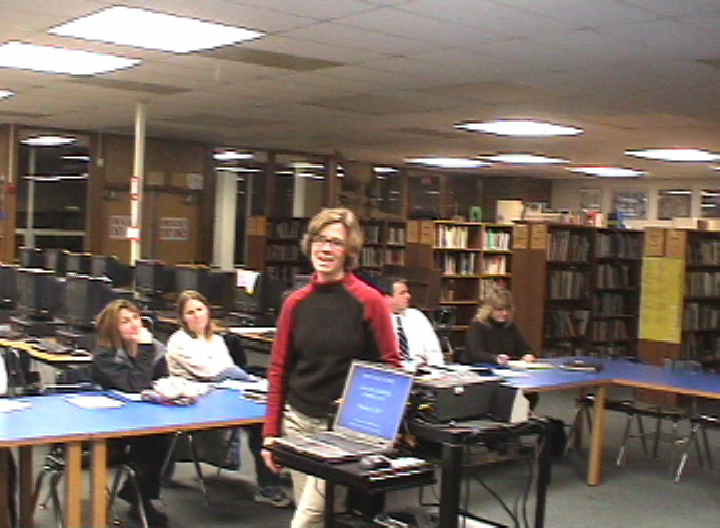
MMSD Math Review Task Force Introduction and Discussion

The Madison School District’s Math Task Force was introduced to the School Board last night. Watch the video or listen to the mp3 audio.
Background Links:


6th Grade Textbooks: Connected (left) and Singapore Math.
UPDATE: A reader emailed this:

I noticed that there were 10 student books in the 6th grade pile for CMP. That was surprising since there are only 8 in publication. Then I looked at the teacher editions and noticed there were 10 as well. There are two copies of both How Likely is It? and Covering and Surrounding.
The statement, “A quick look at the size of the Connected Math textbooks compared to the equivalent Singapore Math course materials illustrates the publisher and author interests in selling these large volumes irrespective of curriculum quality and rigor (not to mention the much larger potential for errors or the lost trees….)” is following the picture in one of the discussions. Taking a look at the Singapore Math website It appears that in addition to the 2 textbooks pictured and student workbooks pictured, there are Intensive Practice books, Extra Practice Books, and Challenging Word Problems books, as well as other resources. Also, the white book on the bottom of the pile appears to be an answer key. There are also teacher guides for 6A and 6B that are not in the picture.
I’m not suggesting the statement above is false, I would just like to point out that the picture being used is not an accurate comparison. I hope you find this information valuable.

Share

In Obesity Wars, A New Backlash
A Western town pushed school kids to eat right and exercise more. Did it go too far? ‘Mr. Coca, do you think I’m fat?’

Anne Marie Chaker:

Brittany Burns, 12 years old, has always been on the heavy side. Last year in fifth grade, neighborhood kids started picking on her at the bus stop, calling her “fatty” and “chubby wubby.” Then someone else piled on: Brittany’s school.
In a letter dated Oct. 2, 2006, the Campbell County School District No. 1 invited “select students” to take part in a fitness and nutrition program set up for some of the district’s most overweight kids. At 5 feet 2 inches tall and 179 pounds, Brittany qualified.
Receiving the letter was “embarrassing,” Brittany says. Her mother, Mindi Story, a clerk at an Albertsons supermarket, says she seethed “pure anger” because, she argues, her daughter’s weight shouldn’t be the school’s concern: “I send her to school to learn math and reading.”
Spurred by a local doctor and an enthusiastic school board, Gillette has banned soda and second helpings on hot meals. This year, it included students’ body-mass index — a number that measures weight adjusted for height — on report cards, and started recommending students like Brittany for after-school fitness programs. It even offers teachers the chance to earn bonuses based on their fitness.

Share

College Freshman Not Ready

Sherry Saavedra:

What students learn in high school doesn’t match with what they need to know as college freshmen, according to a national study released yesterday.
Professors believe high school teachers should cover fewer topics with more depth to prepare students for college. That is one of the findings of the survey by ACT, a nonprofit educational and testing organization.
“A really common complaint from (college) faculty is students not being able to put together a complete sentence properly,” said Erin Goldin, director of the Writing Center, which provides tutoring at Cal State San Marcos.
“When students come in here, . . . I try to explain the rules, but they don’t seem to have learned the structure of a sentence.”

ACT Report.
More here and here

Share

The American Freshman – Forty Year Trends

UCLA – Graduation School of Education:

The nation’s college freshmen are more financially advantaged today than they have been at any point in the last 35 years and come from families with a median income 60 percent higher than the national average, according to a new UCLA report that examined 40 years of data from UCLA’s national survey of entering undergraduates at four-year colleges and universities.
The report, “American Freshmen: Forty-Year Trends 1966–2006,”documents the values and characteristics of college freshmen nationwide and is part of the Cooperative Institutional Research Program administered by the Higher Education Research Institute at UCLA’s Graduate School of Education & Information Studies.
“As colleges and universities continue their financial policies of increasing tuition and fees, we are seeing direct effects on students that come from poorer families,” said José Luis Santos, UCLA assistant professor of education and an author of the report. “Poorer students alter their choices of whether or not to go to college at all, or choose a college based on financial costs and packages. Students from wealthier families can endure greater fluctuations in ‘sticker price’ than poorer students, and as a result, more students entering college come from homes that are increasingly wealthier than the national median income.”
In 2005, entering freshmen came from households with a parental median income of $74,000, 60 percent higher than the national average of $46,326. This represents a 14 percent increase from 1971, whenstudents’ median family income was $13,200, 46 percent higher than the national average of $9,028.

Share

Extra effort could garner two diplomas upon graduation

From a story by Shawanna Robinson in the Daily Journal, Park Hills, Missouri:

Farmington High School Senior Jake Goff will graduate from Farmington High School this May with not only his high school diploma, but an Associate of Arts Degree from Mineral Area College as well.
He is the first of what the district hopes will be many students accomplishing such a feat. The Early College Pathway Program recently received a stamp of approval by both the Farmington R-7 Board of Education and the Mineral Area College Trustees.
The Early College Pathway Program is one where the Juniors and Seniors enrolled would finish their senior year with their high school diploma and either a transcripted 42 (credit hours) general education block from Mineral Area College transferable to most Missouri four-year universities or, such as Goff, with a 62 (credit hours) Associate of Arts degree from Mineral Area College. Goff will actually graduate with 64 credit hours this May.

Share

High School “Better Newspaper Contest”

From the Wisconsin Newspaper Association via the DPI newsletter of State Superintendent Elizabeth Burmaster:

Student journalists are invited to enter their best work, published in their school newspapers during the 2006-07 academic year, in the high school “Better Newspaper Contest,” sponsored by the Wisconsin Newspaper Association (WNA).
The entry deadline is April 16 for awards to be presented in May at end-of-year assemblies. The contest period has been shifted from previous years to allow awards to be presented during the current academic year.
The contest annually recognizes student achievements in high school newspapering. The panel of judges from Wisconsin’s newspapers includes publishers, general managers, editors, reporters, photographers, copy editors and other staffers.
Any student enrolled in a Wisconsin public, parochial or private senior high school may enter. Information is available at WNA Student Newspaper Contest.

Share

Academy makes the improbable possible for teens

A column by Miami Herald writer Leonard Pitts, Jr.

Words tumble to mind by way of description. Words like desolate. Words like tough. Words like hard and mean and grim and sad. Words like dead. Bail bonds and liquor stores are what passes for industry here. Ragged row houses, many boarded and abandoned, crowd one another like strangers in a bus shelter.
Now consider the girl who goes to school here. Danielle Branche, 16, is tiny, has a pretty smile and speaks with self-possession about her dreams.
”When I graduate, I want to go to either Antioch College in Ohio or Point Park University in Pittsburgh, and I want to get my bachelor’s in both dance and business management so I’ll be able to open my own dance company,” she said.
Consider the neighborhood. Consider the child. If they seem not to fit each other, well, that’s the point. Welcome to St. Frances Academy. Welcome to What Works.

Share

An open letter to the Superintendent of Madison Metropolitan Schools

Dear Mr. Rainwater:
I just found out from the principal at my school that you cut the allocations for SAGE teachers and Strings teachers, but the budget hasn’t even been approved. Will you please stop playing politics with our children education? It?s time to think about your legacy.
As you step up to the chopping block for your last whack at the budget, please think carefully about how your tenure as our superintendent will be viewed a little more than a year from now when your position is filled by a forward-thinking problem-solver. (Our district will settle for no less.)
Do you want to be remembered as the Superintendent who increased class size as a first step when the budget got tight? Small class size repeatedly rises to the top as the best way to enhance student achievement at the elementary level. Why would you take away one of best protections against federal funding cuts mandated by the No Child Left Behind Act? Rather than increase pupil to teacher ratios, have you checked to see if the pupil to administrative staff ratio has been brought closer to the state-wide average? (In 2002, Madison Metropolitan schools were at 195 children per administrator; the rest of the state averaged 242 children per administrator.) Have the few administrative openings you?ve left unfilled over the past few years actually brought us into line with the rest of the state?

(more…)

Share

I have a few comments on separate courses for students of different abilities

I think that it is important to have opportunities for advanced students to obtain seperate instruction is subjects they excel in. It is my belief that by doing this we don’t sacrifice diversity, we actually increase it.
My logic is as follows. If gifted students are not given the challenge they need in school, they will not achieve as much as they can. If the public schools are not able to provide for these childern, then parents of gifted kids will pull them out of school. Unfortunately, only involved parents with money will have the ability to give their kids the alternative education like private school. Thus, the public schools will be left with few children at the top end of the education spectrum since it can’t provide for them.
My belief that this is true comes from my home town in California. We have one elementary school in a wealthy area that is known to have much better educational opportunities for students. Parents in other districts constantly try to move their children to this school. Due to declining enrollment, other school districts have stopped letting students switch schools. To still provide for the children, the school in the wealthy area became a charter school. Now, parents can move their children there without incident. But, the other public schools are left without their brightest students. If the other public schools could provide for their brightest, the public schools would include all of the students.

(more…)

Share

2007 West Area Strings Festival Photos, Audio & Video

The Madison Strings Festival was held Saturday. Check out the photos here. A 20 minute video clip: (CTRL click to download) mpeg-4 ipod video | mp3 audio.

Call to action: [PDF] [Petition PDF]

Share

After a Suicide, Privacy on Trial

Elizabeth Bernstein:

As Charles and Debi Mahoney watched six men and six women file into the jury box of a Pennsylvania courtroom one evening last August, they clutched hands and tried to remind themselves why they were in court. “Parents sending their kids off to college need to know that their kids aren’t safe when they think they are,” Mr. Mahoney recalls thinking at the time.
More than four years earlier, their 20-year-old son, Chuck, had hanged himself with his dog’s leash in his fraternity house at Allegheny College, in Meadville, Pa. At their son’s funeral, the Mahoneys learned that his friends and ex-girlfriend had repeatedly warned college administrators and counselors during his last days that Chuck was a danger to himself. The officials and his college therapist had discussed his crisis — but no one had alerted the family.
His parents sued for wrongful death in 2003, alleging that Allegheny should have taken more action at the end — such as breaking their son’s confidentiality to get them involved. One of Chuck’s fraternity brothers who tried to alert school officials, Michael Fischer, testified that seeing his friend’s last days “was like watching a car accident …. We knew something was going to happen. We had to try to stop it.”

Share

“Cooking the Numbers” – Madison’s Reading Program

Joanne Jacobs:

From the Fayetteville, NC Observer:

Superintendent Art Rainwater loves to discuss the Madison Metropolitan School District’s success in eliminating the racial achievement gap.
But he won’t consult with educators from other communities until they are ready to confront the issue head on.
“I’m willing to talk,” Rainwater tells people seeking his advice, “when you are willing to stand up and admit the problem, to say our minority children do not perform as well as our white students.”

Only then will Rainwater reveal the methods Madison used to level the academic playing field for minority students.
This is an odd statement. The racial achievement gap is accepted as an uncomfortable fact everywhere; it is much discussed. No superintendent in the U.S. — except for Rainwater — claims to have eliminated the gap.

Today, Rainwater said, no statistical achievement gap exists between the 25,000 white and minority students in Madison’s schools.
Impressive, but untrue, writes Right Wing Prof, who looked at Madison reading scores across all grades.

I found a graph comparing Madison to five similar districts in Wisconsin, all of which do much better than Madison on fourth-grade reading.

Joanne was in Milwaukee and Madison recently to discuss her book, “Our School“.
Related Links:

Share

Despite ‘Mommy Guilt,’ Time With Kids Increasing

Donna St. George:

Cynthie Bush pulled on her coat and started to say goodbye. She and a friend were taking a night out — three hours in all, for a quick dinner and a PTA event. It was not the kind of thing she did often, with two small children and a full-time job.
But before she could leave her Herndon home, her 4-year-old daughter began to cry for her. For a moment, Bush recalled, she wondered if she should cancel. Her days were already so full. She needed more hours with her children, not fewer.

Share

Finding the Best High Schools, Part Two: Low-Income Stigma

Jay Matthews:

Consider this high-minded conclusion in their report: A successful high school should show high levels of student achievement, graduate almost all of its students and not let any demographic subgroup suffer at the expense of others. In a perfect world, I would not dispute that. But in the real world that means C. Leon King High School in Tampa does not belong on the best schools list because of its high dropout rate and low average test scores, even though Newsweek ranked it 73rd in the country in AP and IB test participation last year.
Asked to comment on the notion that her school ought to be taken off the list, Susie L. Johnson, assistant principal for the school’s IB magnet curriculum, said: “Honestly, that is ridiculous.”
Whoops. Did I say she runs the magnet curriculum? The Education Sector report dismissed magnets, special programs that draw students from outside school boundaries, as a sneaky way for schools like King to look good on the Newsweek list. In fact, it said, a school with a small number of students taking many tests will receive a high Challenge Index score even if it is providing a lousy education to the rest of it students.

More from Sara.

Share

Hard MMSD Budget Still Has Wiggle Room

Scott Milfred:

It’s a contentious fact that has run through so many Madison School Board races and referendums in recent years:
Madison schools spend a lot — $12,111 per student during the 2005-06 school year.
If the district is spending that much, how can it be in crisis?
The answer is complex and a bit murky. Yet a few things are clear.
Liberal Madison has long spent more than most K-12 districts in Wisconsin. This was true before the state adopted school revenue limits in the 1990s, and the caps only reinforced this today.
“When revenue caps went in, everyone was basically frozen in place,” Madison School Superintendent Art Rainwater said Friday. “We do spend more than the state average. But that has been the expectation of our community.”
So why does Madison spend more? Berry points to Madison’s higher number of staff who aren’t teachers. Madison hires a lot of social workers, psychologists, nurses and administrators.
Madison spends more per pupil than Racine, Green Bay and Kenosha — as well as the state average — on student and staff services, administration and building and grounds. And Madison’s non- instructional costs are rising as a percentage of its spending.
“Madison is actually de- emphasizing instruction,” Berry contends.
In addition, Berry suspects Madison is over-identifying students for learning disabilities.

Links: Madison spending, student and staffing history. 2006/2007 MMSD Citizen’s Budget. Carol Carstensen’s thoughts on a 2007 Referendum.

Share

MPIE and MUAE Update

As some of you may recall, back in December, I posted a few questions to the members of Madison Partners for Inclusive Education. As a result of that posting, several members of each group have met a couple of times in order to try and make personal connections and identify areas of shared concern and potential joint advocacy. It is too early to say how that effort is going. I, personally, am ever hopeful that we can find the patience and persistence needed to build a foundation of mutual understanding and trust, a foundation upon which we can ultimately work together for all children.
I would like to share a recent exchange from the MUAE list serve (where MPIE members have been welcome since the get-go — in fact, more than one are longtime MUAE list serve members). In response to a post about one of the BOE candidates, an MPIE member wrote the following:
I would like to clarify something that was misstated in a recent post. Madison Partners for Inclusive Education (MPIE) does NOT promote or endorse COMPLETELY heterogeneous classrooms ALL the time. The group does not think completely heterogeneous classrooms all of the time is in the best interest of children with disabilities. Their website goes on to explain their philosophy: http://www.madisonpartnersforinclusion.org/whatisinclusion.html Thank you for understanding this and clarifying in future posts.

I then replied:
Thanks for the clarification, though I really think we are in agreement on this point. Certainly the inclusion decision for students with disabilities should be a flexible one, based on the specific nature of the disabilities, the specific educational needs, and the family’s preference for their child. Most of us know, for example, about IDEA and the K-12 IEP process. We know, too, that our high schools offer alternative classes and other learning options for those students with disabilities for whom the “regular” classes are not appropriate.
I am sure we get sloppy with our language, at times; but our language errors are surely inadvertent, mostly because — like all parents — we are simply thinking about our own children, whether or not they are thriving, and whether or not their needs are being well met by our schools. We are guilty of being good parents. Nevertheless, we apologize.
The fact is, we do not want much of anything to change for students with disabilities. (We would like to see the state and federal governments pay a larger portion of the tab for special education — can we encourage your group to take the lead on that issue at the local level?). We support all of the flexibility, all of the options, and all of the tailoring of educational programming that goes on for them during their years in the MMSD. MUAE stands absolutely with MPIE on that, as I see it (though obviously I really can’t speak for everyone). We are your partners there.
We ask the same of you.
I wonder, will you be our partners in getting our children’s educational needs met in the same way that the needs of students with disabilities are met? Just as you do not think placement in completely heterogeneous classrooms all of the time is in the best interest of children with disabilities, so do we think such placement is inappropriate for our children. Full days spent in “regular” classrooms does not necessarily meet our children’s educational needs any better than it does your children’s needs. We are told the District is committed to giving each student the appropriate “next level of challenge.” And yet too many of us know (or have) “formerly bright” students who have become turned off to school as a result of too many years of insufficient challenge and chronic boredom. They are miserable. They are in pain. They are not growing well at all. Meanwhile, our advocacy efforts on our children’s behalf are too often met with disdain, deception and complete stonewalling. We do not yet have the same legal foundation on which to stand as you do.
We at MUAE are simply asking for the same flexibility — in thinking, in approach, in educational opportunity and in classroom placement — for the District’s highest potential, highest performing students that students with disabilities experience. Nothing more; nothing less.
Can you and the other MPIE members support us in that position as wholeheartedly as MUAE members support you in yours? (That’s really the question I was asking of you in my SIS post a while back.)
I hope so.

Share

Q: Wisconsin Reading Comprehension Test Changes

Does anyone have solid information about how and when the Wisconsin Reading Comprehension Test has been revised over the years?
One obvious question in comparing scores from 1998 to those in 2005 is how the tests were changed. [NYT Article on Madison’s Reading Program]

Share

Middle schools giving way to K-8 programs

Sarah Carr:

But in choosing to send her children to a middle school, Allen is part of a declining breed of parents in the city.
Next year, Milwaukee Public Schools officials expect about 8,750 middle school students, down about 10% from this school year and nearly 35% from four years ago.
The School District has long planned to put more children of middle school age in kindergarten-through-eighth-grade schools. Over the last few years, the number of K-8 schools has grown from about a dozen to about 60. But recent developments raise the question of whether your run-of-the-mill middle school will survive, particularly in some urban areas.
Milwaukee, Boston, Baltimore, Cleveland and Cincinnati are only a few of the cities that have shifted heavily to K-8s in recent years. In Philadelphia, district leaders have said they plan to phase out middle schools entirely, replacing them with K-8s. Many parents and school officials consider that grade configuration to be safer and more nurturing, particularly in city schools. The trend is more of an urban than a suburban one, and nationally there are still more middle schools than K-8s.

Share

Madison’s Reading Battle Makes the NYT: In War Over Teaching Reading, a U.S.-Local Clash

Diana Jean Schemo has been at this article for awhile:

The program, which gives $1 billion a year in grants to states, was supposed to end the so-called reading wars — the battle over the best method of teaching reading — but has instead opened a new and bitter front in the fight.
According to interviews with school officials and a string of federal audits and e-mail messages made public in recent months, federal officials and contractors used the program to pressure schools to adopt approaches that emphasize phonics, focusing on the mechanics of sounding out syllables, and to discard methods drawn from whole language that play down these mechanics and use cues like pictures or context to teach.
Federal officials who ran Reading First maintain that only curriculums including regular, systematic phonics lessons had the backing of “scientifically based reading research” required by the program.
Madison officials say that a year after Wisconsin joined Reading First, in 2004, contractors pressured them to drop their approach, which blends some phonics with whole language in a program called Balanced Literacy. Instead, they gave up the money — about $2 million, according to officials here, who say their program raised reading scores.
“We had data demonstrating that our children were learning at the rate that Reading First was aiming for, and they could not produce a single ounce of data to show the success rates of the program they were proposing,” said Art Rainwater, Madison’s superintendent of schools.

Much more on Reading First and Madison, here.
Notes & Links:

UPDATE: Joanne Jacobs:

In part one of his response, Ken DeRosa of D-Ed Reckoning provides a reading passage altered to force readers to guess the meaning from context. Struggling this way does not inspire love of reading.
In part two, DeRosa analyzes the statistics to argue Madison students aren’t doing better in reading compared to other Wisconsin students; if anything, they’ve slipped a bit. Because the state reading test was made easier and the cut score for proficiency was lowered, all Wisconsin students look better. However, there was no progress in fourth-grade reading on the federal NAEP test.
With help from Rory of Parentalcation, who’s great at finding data, Ken shows that claims of fantastic progress by black students are illusory. Their scores improved on the easier test at a slightly slower rate than white students. It looks like to me as though blacks nearly caught up in basic skills but remain far behind at the proficient and advanced level. Perhaps someone who knows more statistics than I do — lots of you do — can find flaws in Ken’s analysis.

NYT Letters to the editor. Finally, others have raised questions about the MMSD’s analysis and publication of test score data.
Andrew Rotherham:

Diana Schemo’s NYT story on Reading First is not surprisingly sparking a lot of pushback and outraged emails, especially from the phonicshajeen. But, they have a point. There are problems with Reading First, but this may not be the best example of them at all…but, while you’re there, don’t miss the buried lede in graf eight…it’s almost like Schemo got snowed by all sides at once on this one…

Share

Why Illinois Test Scores Went Up?: Changing the Test or Academic Improvements?

Via a reader looking at this issue: Stephanie Banchero, Darnell Little and Diane Rado:

Illinois elementary school pupils passed the newly revamped state achievement exams at record rates last year, but critics suggest it was more the result of changes to the tests than real progress by pupils.
State and local educators attribute the improvement to smarter pupils and teachers’ laser-like focus on the state learning standards—the detailed list of what pupils should know at each grade level. They also say that the more child-friendly exams, which included color and better graphics, helped pupils.
But testing experts and critics suggest that the unprecedented growth is more likely the result of changes to the exams.
Most notably, the state dramatically lowered the passing bar on the 8th-grade math test. As a result—after hovering at about 50 percent for five years—the pass rate shot up to 78 percent last year.
While the number of test questions remained generally the same, the number that counted on pupil scores dropped significantly.

Kevin Carey criticized Wisconsin’s “Statistical Manipulation of No Child Left Behind Standards“. The Fordham Foundation and Amy Hetzner have also taken a look at this issue.

Share

Menomonee Falls School District Works with Community on 4 Year Old Kindergarten

Amy Hetzner:

When the Menomonee Falls School District opens its doors to a new 4-year-old kindergarten program this fall, private day cares in the village will open theirs to it, too.
Using an idea that’s catching on throughout the state, the district plans to partner with local preschool and child care centers to give 4-year-olds a half-day program that proponents say will give them an educational boost for years to come.
“The goal to all of this is to provide quality 4-year-old services for each and every child who resides in the school district, so when they come to 5-K they’ve got the same kindergarten basis,” said Marlene Gross-Ackeret, Menomonee Falls’ director of pupil services, and one of the key players in its 4-K initiative.
Almost every Wisconsin school district looking to add a new 4-year-old kindergarten program is considering such a collaborative approach, said Jill Haglund, an early-childhood education consultant for the state Department of Public Instruction who estimated that the partnerships exist in about 50 school systems. Even Milwaukee Public Schools collaborates with some community partners, placing its teachers at off-campus sites, despite having its own extensive 4-K programs.

Quite a contrast to the general Madison School District approach with respect to After School and classes taken outside our public school district. More here.

Share

Madison School Board Candidates Address the Achievement Gap

Isthmus continues their excellent candidate take home tests, this week addressing the Madison School District’s achievement gap:

Share

The Kid Spending Spectrum

Eileen Daspin and Ellen Gameran:

With the debate about the country’s wealth gap heating up again, pampered kids provide some of the most dramatic examples, from toddlers in $800 strollers to 10-year-olds with cellphones. But for many families, drawing the line between attentive parenting and extravagance is a tough call; even parents who are relatively strapped will go to great lengths for their children. And though millions can’t afford the government’s child-cost estimate, there is no question that many others are spending far more without viewing it as extreme.
To assess how relatively routine expenses, as well as more excessive ones, can contribute to the total cost of raising a child, The Wall Street Journal deconstructed the government’s approach and recalculated it using a different range of costs.
Escalating kid spending is more rampant among wealthier households, so we used the government’s top-third income bracket as a starting point. We also added some costs that aren’t included in that government calculation, such as college-savings plans, which a growing number of households are setting up for their kids.

Share

Gifted? Autistic? Or Just Quirky?

Maia Szalavitz:

“Paradoxically liberating” is how Phil Schwarz has described his Asperger’s syndrome diagnosis. He was in his late 30s at the time, and he had number of things on his mind: A software developer in Framingham, Mass., Schwarz had been labeled “gifted” as a child and had graduated third in his high school class. For years he had struggled with depression and a feeling that he was not living up to the promise of his past.
What’s more, he had begun to worry about his toddler’s delayed language development and repetitive play style. But he had no idea how the diagnosis that his son Jeremy would receive might affect his own identity.

Share

Marj Passman & Tony Casteneda Discuss The Madison School Board Race

Madison School Board Seat 5 candidate Marj Passman talked with Tony Castañeda recently on WORT-FM. Marj faces Maya Cole in the April 3, 2007 spring election. Marj and Tony discussed health care costs, curriculum, governance, special education, this website, and the Madison School District’s $331M+ budget.
Listen via this 5.7MB mp3 audio file. A transcript will be posted when available.

Share

Better Serving Gifted Students of Poverty

The National Association for Gifted Children (NAGC) has just published the proceedings of their recent conference on high potential learners of poverty. The book is called “Overlooked Gems: A National Perspective on Low-Income Promising Learners” and includes chapters by Donna Ford, Alexinia Baldwin and Paula Olszewski-Kibilius.
To download or order a free copy of “Overlooked Gems,” go to www.nagc.org and click on “New at NAGC: Conference Proceedings.”
Also on the NAGC website, a brief article by Paul Slocumb and Ruby Payne entitled “Identifying and Nurturing the Gifted Poor”. Slocumb and Payne are the authors of “Removing the Mask: Giftedness in Poverty.”
Previous post on academically talented MMSD students of color and poverty: https://www.schoolinfosystem.org/archives/2006/01/theyre_all_rich.php
Article on the negative effects of detracking, especially for high achieving students of color and poverty (cited by U.W. Professor of Sociology and Educational Policy Studies Adam Gamoran, Ph.D., in his chapter “Classroom Organization and Instructional Quality“): “If Tracking is Bad, Is Detracking Better?” by J. E. Rosenbaum (American Educator, 1999).

Share

Kids, the Internet and the End of Privacy: The Greatest Generation Gap since the Rock & Roll

Emily Nussbaum:

As younger people reveal their private lives on the Internet, the older generation looks on with alarm and misapprehension not seen since the early days of rock and roll. The future belongs to the uninhibited.
After a few minutes of this, I turn to Gasaway and ask if he has a Web page. He seems baffled by the question. “I don’t know why I would,” he says, speaking slowly. “I like my privacy.” He’s never seen Hannah’s Facebook profile. “I haven’t gone on it. I don’t know how to get into it!” I ask him if he takes pictures when he attends parties, and he looks at me like I have three heads. “There are a lot of weirdos out there,” he emphasizes. “There are a lot of strangers out there.”
There is plenty of variation among this younger cohort, including a set of Luddite dissenters: “If I want to contact someone, I’ll write them a letter!” grouses Katherine Gillespie, a student at Hunter College. (Although when I look her up online, I find that she too has a profile.) But these variations blur when you widen your view. One 2006 government study—framed, as such studies are, around the stranger-danger issue—showed that 61 percent of 13-to-17-year-olds have a profile online, half with photos. A recent pew Internet Project study put it at 55 percent of 12-to-17-year-olds. These numbers are rising rapidly.

Virginia Postrel has more, including Greg Lukianoff and Will Creeley’s “Facing off over Facebook“:

tudents, be warned: the college of your choice may be watching you, and will more than likely be keeping an eye on you once you enter the hallowed campus gates. America’s institutions of higher education are increasingly monitoring students’ activity online and scrutinizing profiles, not only for illegal behavior, but also for what they deem to be inappropriate speech.
Contrary to popular misconceptions, the speech codes, censorship, and double standards of the culture-wars heyday of the ’80s and ’90s are alive and kicking, and they are now colliding with the latest explosion of communication technology. Sites like Facebook and MySpace are becoming the largest battleground yet for student free speech. Whatever campus administrators’ intentions (and they are often mixed), students need to know that online jokes, photos, and comments can get them in hot water, no matter how effusively their schools claim to respect free speech. The long arm of campus officialdom is reaching far beyond the bounds of its buildings and grounds and into the shadowy realm of cyberspace.

Share

2005 NAEP Grade 12 Reading and Math Scores Released

The Nation’s Report Card via Ed Week:

The proportion of high school students completing a solid core curriculum has nearly doubled since 1990, and students are doing better in their classes than their predecessors did.
But that good news is tempered by other findings in two federal reports released here today. The performance of the nation’s high school seniors on national tests has declined in reading over the past decade, and students are lackluster in mathematics. A third of high school graduates in 2005 did not complete a standard curriculum, which includes four credits of English and three credits each of social studies, math, and science.
The 12th grade reading and math results on the National Assessment of Educational Progress are based on a nationally representative sample of 21,000 seniors at 900 public and private schools who took the tests between January and March of 2005. The report on their performance was accompanied by the latest NAEP transcript study, which analyzes the coursetaking patterns and achievement of high school graduates.
Two-thirds of the 26,000 graduates who were followed for the transcript study also participated in the 2005 NAEP math and science assessments.
No Improvement in Reading
On the reading test, 12th graders’ average score has declined significantly since the first time the test was given in 1992. The test-takers averaged 286 points on a 500-point scale, a 6-point decline over 13 years, but statistically the same score as in 2002. Achievement levels in reading have also declined since 1992; 80 percent of the students tested that year scored at the “basic” level or better, but only 73 percent did so on the 2005 test, the same proportion as in 2002. In addition, the gap in scores between members of minority groups and higher-scoring white students has not narrowed significantly.
In math, the scores are not comparable with those from previous tests since the 2005 test was based on a new framework. Students scored, on average, 150 points on a 300-point scale. Just 61 percent of the 12th graders demonstrated at least basic command of the subject, with 23 percent considered “proficient” and 2 percent “advanced.”
Among 2005 high school graduates, 68 percent completed at least a standard curriculum, while 41 percent took a more challenging course load, and 10 percent took more-rigorous classes. In 1990, just 40 percent of graduates completed at least a standard curriculum, and 36 percent took additional courses, while 5 percent took what was deemed a rigorous course load.

Share

Concessions Made in Advance of MTI Negotiations by a Majority of the Madison School Board

It will be interesting to see how voters on February 20 and April 3 view this decision by a majority of the Madison School Board: Should the Board and Administration continue to give away their ability to negotiate health care benefits ($43.5M of the 2006/2007 budge) before MTI union bargaining begins? Read the 2005 MMSD/MTI Voluntary Impasse Agreement [1.1MB PDF; see paragraph’s 2, 10 and 11]. The 2007 version, alluded to in Andy Hall’s article below, will be posted when it sees the light of day.
This is an important issue for all of us, given the MMSD’s challenge of balancing their growing $331M+ budget, while expenses – mostly salaries and benefits – continue to increase at a faster rate. Mix in the recent public disclosure of the district’s $5.9M 7 year structural deficit and I doubt that this is the best approach for our children.
Recently, the Sun Prairie School District and its teachers’ union successfully bargained with DeanCare to bring down future costs for employee health insurance.

Andy Hall, writing in the Wisconsin State Journal asks some useful questions:

But with the Madison School Board facing a $10.5 million budget shortfall, is the board giving away too much with its promises to retain teachers’ increasingly pricey health insurance and to discard its legal mechanism for limiting teachers’ total compensation increase to 3.8 percent?

Yes, School Board Vice President Lawrie Kobza said Saturday, “I feel very strongly that this was a mistake,” said Kobza, who acknowledged that most board members endorse the agreement with Madison Teachers Inc., the teachers union.

State law allows districts to avoid arbitration by making a so-called qualified economic offer, or QEO, by boosting salaries and benefits a combined 3.8 percenter a year.

“To agree before a negotiation starts that we’re not going to impose the QEO and negotiate health care weakens the district’s position,” Kobza said. She contended the district’s rising health-care costs are harming its ability to raise starting teachers’ salaries enough to remain competitive.

The “voluntary impasse resolution” agreements, which are public records, are used in only a handful of Wisconsin’s 425 school districts, according to the Wisconsin Employment Relations Commission.

Four of the 7 current Madison School Board Members were backed by MTI during their campaigns (Arlene Silveira, Carol Carstensen, Shwaw Vang and Johnny Winston, Jr.). Those four votes can continue this practice. Independent School Board members Lawrie Kobza and Ruth Robarts have spoken publicly against the concessions made in advance of negotiations. If you support or oppose this approach, let the board know via email (comments@madison.k12.wi.us), or phone.

Related links, media and transcripts:

  • What’s the MTI Political Endorsement about?:

    In 2006-07 the Madison School district will spend $43.5M on health insurance for its employees, the majority of the money paying for insurance for teachers represented by Madison Teachers, Inc. (MTI) That is 17% of the operating budget under the revenue limits.
    In June of 2007, the two-year contract between the district and MTI ends. The parties are now beginning negotiations for the 2007-09 contract.
    The Sun Prairie School district and its teachers union recently saved substantial dollars on health insurance. They used the savings to improve teacher wages. The parties joined together openly and publicly to produce a statement of the employees health needs. Then they negotiated a health insurance package with a local HMO that met their needs.

  • The MMSD Custodians recently agreed to a new health care plan where 85% of the cost savings went to salaries and 15% to the MMSD.
  • Ruth Robarts discussed concessions in advance of negotiations, health care costs and the upcoming elections with Vicki McKenna recently. [6.5MB MP3 Audio | Transcript]
  • What a Sham(e) by Jason Shephard:

    Last week, Madison Teachers Inc. announced it would not reopen contract negotiations following a hollow attempt to study health insurance alternatives.
    Not to put too fine a point on it, but anyone who suggests the Joint Committee on Health Insurance Issues conducted a fair or comprehensive review needs to get checked out by a doctor.
    The task force’s inaction is a victory for John Matthews, MTI’s executive director and board member Wisconsin Physicians Service.
    Losers include open government, school officials, taxpayers and young teachers in need of a raise.
    From its start, the task force, comprised of three members each from MTI and the district, seemed to dodge not only its mission but scrutiny.

(more…)

Share

Parenting vs. Poverty

Steven Malanga:

In football, a quarterback’s blind side is the side of the field opposite his throwing arm—the left side of the field for a right-handed quarterback, for instance. One shouldn’t confuse the blind side with a blind spot, which is what our policy-makers and media often have when discussing American poverty: it is a product of our unjust economic system, they say, and we should fight it with redistributive government programs. These experts would do well to read Michael Lewis’s wonderful new football book, The Blind Side. Though the book’s publisher pitches it as a sports story, it’s more notable as a portrait of the social dysfunction that shapes much of America’s inner-city poverty and, by extension, of the reasons that so many government efforts to alleviate that poverty have come to naught.
At the heart of The Blind Side—in fact, occupying more pages than its ostensible subject, the evolution of college and professional football—is the astonishing life story of National Football League–bound Michael Oher. Oher is born into horrific circumstances that give him little chance at succeeding in our society: his mother is a drug addict who, though unable to care for children, has 13 kids by various men, none her husband. Each of these children fends for himself on the mean streets of West Memphis. Oher’s mother collects her welfare check on the first of the month and disappears for ten days or so, stranding the kids without provisions or supervision. Oher recalls going days with nothing to eat or drink except water, begging food from neighbors, and sleeping outdoors.

Share

My Life and Times With the Madison Public Schools

Up close, the author finds that politics obscure key educational issues
Marc Eisen:

Where’s the challenge?
I’m no different. I want my kids pushed, prodded, inspired, and challenged in school. Too often—in the name of equity, or progressive education, or union protectionism, or just plain cheapness—that isn’t happening in the Madison schools.
Advanced classes are being choked off, while one-size-fits-all classes (“heterogeneous groupings”) are created for more and more students. The TAG staff has been slashed nearly in half (one staffer is now assigned to six elementary schools), and even outside groups promoting educational excellence are treated coolly if not with hostility (this is the fate of the most excellent Wisconsin Center For Academically Talented Youth [WCATY]). And arts programs are demeaned and orphaned.
This is not Tom Friedman’s recipe for student success in the 21st century. Sure, many factors can be blamed for this declining state of affairs, notably the howlingly bad way in which K-12 education is financed and structured in Wisconsin. But much of the problem also derives from the district’s own efforts to deal with “the achievement gap.”
That gap is the euphemism used for the uncomfortable fact that, as a group, white students perform better academically than do black and Hispanic students. For example, 46% of Madison’s black students score below grade level on the state’s 3rd grade reading test compared to 9% of white students.
At East, the state’s 10th grade knowledge-and-concepts test show widely disparate results by race. With reading, 81% of white kids are proficient or advanced versus 43% for black students. The achievement gap is even larger in math, science, social studies, and language arts. No wonder TAG classes are disproportionately white.
Reality is that the push for heterogeneous class grouping becomes, among other things, a convenient cover for reducing the number of advanced classes that are too white and unrepresentative of the district’s minority demographics.

Share

A K-12 View from 35,000 Feet

I happened to sit next to the Curriculum Coordinator (20+ years in that District) for a large, growing US School District recently ( north of 100,000 students). I found some of the comments interesting:

  • They cycle through superintendents every 2 to 3 years. The Supers are paid $300K+ with “lots of benefits”.
  • The new super is decentralizing all over the place, pushing control down.
  • They use trailers as enrollment moves around the community.
  • The new super wants to require any children in grades K-3 not reading at grade level to have only one task per day (beyond lunch, recess and PE) – read. This involves tracking.
  • I asked what sort of curriculum they used for reading: Whole language with “lots of phonics”. I asked if they used Reading Recovery. The person said that they evaluated RR but felt it was “far too expensive”.
  • Offer a great deal of IB and AP courses. They also have magnet schools, though the person said that they are less popular now that the district has gone back to neighborhood schools (evidently there was a successful reverse discrimination lawsuit). They have evidently received “a great deal of federal funds” to support IB and AP.
  • 8th graders who cannot read at grade level will go to a different set of curriculum or school than those who are at or above.

This district spends about $7,900 per student annually (Madison is in the $12,500 range).
Interestingly, this is the 2nd time during the past 12 months that I’ve sat next to an educator on their way to a conference sponsored by curriculum publishers.

Share

How Not to Talk to Your Kids: The Inverse Power of Praise

Po Bronson:

But as Thomas has progressed through school, this self-awareness that he’s smart hasn’t always translated into fearless confidence when attacking his schoolwork. In fact, Thomas’s father noticed just the opposite. “Thomas didn’t want to try things he wouldn’t be successful at,” his father says. “Some things came very quickly to him, but when they didn’t, he gave up almost immediately, concluding, ‘I’m not good at this.’ ” With no more than a glance, Thomas was dividing the world into two—things he was naturally good at and things he wasn’t.
For instance, in the early grades, Thomas wasn’t very good at spelling, so he simply demurred from spelling out loud. When Thomas took his first look at fractions, he balked. The biggest hurdle came in third grade. He was supposed to learn cursive penmanship, but he wouldn’t even try for weeks. By then, his teacher was demanding homework be completed in cursive. Rather than play catch-up on his penmanship, Thomas refused outright. Thomas’s father tried to reason with him. “Look, just because you’re smart doesn’t mean you don’t have to put out some effort.” (Eventually, he mastered cursive, but not without a lot of cajoling from his father.)
Why does this child, who is measurably at the very top of the charts, lack confidence about his ability to tackle routine school challenges?
Thomas is not alone. For a few decades, it’s been noted that a large percentage of all gifted students (those who score in the top 10 percent on aptitude tests) severely underestimate their own abilities. Those afflicted with this lack of perceived competence adopt lower standards for success and expect less of themselves. They underrate the importance of effort, and they overrate how much help they need from a parent.

Tom Ashbrook talked with Bronson, Carol Dweck and Bob Younglove. Listen here.

Share

Henok Mehari’s High School Graduation Speech

Henok Mehari’s high school graduation speech at the Notre Dame Education Center:

I was just fourteen years old and a teenager in Ethiopia, when the civil war broke out. I found myself all alone without my mother and father in a hot and dusty refugee camp stuck in the middle of Kenya, struggling to survive. Do you have any idea what life in a refugee camp is like? Let me tell you, it’s hell. Eighty thousand refugees crowded together and doing their best to stay alive survived on just one meal a day suffering in the heat and the dust. No matter how dusty the road, no matter how empty my stomach, I did what I thought was important for me at the time. And I had a crazy dream, but I never gave up hope.

Share

Mentors needed

Would you be willing to serve as an academic mentor for a highly able student who needs the expertise of a trained adult? Mentorships may provide a student with an opportunity to independently research a topic in depth, or to explore and experiment within an academic area of passionate interest. Mentors are needed in math, the visual and performing arts, science, social studies, technology, and writing. We would work with the student’s classroom teachers to find a time each week for you and the student to meet.
If you are interested in serving as a mentor, please email Kerry Berns, MMSD TAG resource teacher, at kberns@madison.k12.wi.us.

Share

Minnesota Governor Proposes $75M for Additional College Prep

Megan Boldt:

In his State of the State speech last month, Pawlenty argued that too many Minnesota students coast through high school with no plan for what they are going to do after graduation.
To combat that, the Republican governor wants lawmakers to give $75 million over the next two years to high schools so they can teach tough courses that clearly relate to future careers or majors and to require every student to earn one year of college credit before they graduate.
He also wants all high school students to take four years of a foreign language and to get workplace training and internships so they can be qualified for jobs at companies that will have to compete in a global economy.

Share

Virtual Schools Are Right for Some Families

Nichole Schweitzer:

As principal of Wisconsin Connections Academy (WCA), the state’s first virtual K-8 school, I see on a daily basis the benefits a standards-based virtual education provides for students from around the state.
Every student has unique learning needs. Some students learn best by reading, others by listening and still others by doing. In the same manner, a traditional school is best for some students and a virtual school is best for others. Wisconsin has been an educational leader for many years, and virtual schools are just one of the ways in which Wisconsin is staying at the forefront of education.
Virtual school teachers work with each student to modify lessons, and generally meet the student’s unique needs and learning style. This personalized approach to education is a good option for students who may be far ahead of or behind their peers, for students who need a more flexible schedule, or for students who learn best outside the walls of a traditional school, such as Jacob Martin.
Jacob is an 8th grade student at WCA. Because of his autism, Jacob benefits from learning in a more personalized setting: his home. Jacob recently wrote an essay about why he likes attending a virtual school, and he explained in his own words why a virtual school works best for him.

Share

Madison Schools’ “Restorative Justice”

“Madison Parent”:

The superintendent, school board president and other school board candidates are already talking as if this were a done deal. But what is “restorative justice,” and what will it mean to have student misconduct addressed with a “restorative justice” approach? A layperson’s online search leads to academic papers in the criminal and juvenile justice area from fields ranging from sociology, social work, philosophy and theology, but not much specific research or data on whether or how “restorative justice” has been found to work as an approach to addressing misconduct in schools. The decision to move away from a discipline-based approach to a “restorative justice” approach will have an immediate, on-the-ground, daily impact on the school climate and educational experience encountered by the students and teachers in our schools, and parents of children in the public schools here may very well have the following questions:

Share

Whole-language Wolves in Sheep’s Clothing

Louisa Moats 324K PDF:

How to Tell When “Scientifically-Based Reading Instruction” Isn’t.
In this practitioners’ guide, renowned reading expert Louisa Moats (author of the American Federation of Teachers’ Teaching Reading Is Rocket Science and an earlier Thomas B. Fordham Foundation report, Whole Language Lives On: The Illusion of “Balanced” Reading Instruction) explains how educators, parents, and concerned citizens can spot ineffective reading programs that surreptitiously hide under the “scientifically-based” banner.
While the field of reading has made enormous strides in recent years—especially with the publication of the National Reading Panel’s landmark report and enactment of the federal Reading First program discredited and ineffectual practices continue in many schools. Although the term “whole language” is rarely used today, programs based on its premises, such as Reading Recovery, Four Blocks, Guided Reading, and especially “balanced literacy,” are as popular as ever. These approaches may pay lip service to reading science, but they fail to incorporate the content and instructional methods proven to work best with students learning to read. Some districts, such as Denver, openly shun research-based practices, while others, such as Chicago, fail to provide clear, consistent leadership for principals and teachers, who are left to reinvent reading instruction, school by school.

Press Release.

Share

Why Johnny can’t read very well and what to do about it

Teacher Thomas Biel:

Juan/Sean/John doesn’t read too well because we don’t teach him how very well. Results from the 2005-’06 Wisconsin Knowledge and Concepts Examinations show that 55% of Milwaukee Public Schools 10th-graders do not read at a proficient level. The majority of our kids have reading problems.
Leaders in the school district, in the Legislature and at the federal level need to take a stand and do something practical, like earmarking funds for literacy wherever literacy is a problem.
We need to go way beyond literacy coaches and in-content-area reading programs to try to solve this problem.
Reading should be made a department in every high school just as math, science and English are, and reading classes should become a part of every high school curriculum.
I’m not saying that we don’t teach reading in the high schools. But, primarily, we teach reading to students who already can read. Those who can’t, or who can’t read well, struggle, and many fail. If they aren’t designated special education or a special needs learner, these students disappear into the cracks of the system.
Typically, the struggling reader who has fallen behind somewhere in his education gets to high school and is expected to take the same English, history, science and math classes as the proficient reader.
The student in junior-year English who reads at a third-grade level but is studying the essays of Ralph Waldo Emerson or “The Fall of the House of Usher” will drown in language he doesn’t understand. The textbooks he has to read for history, science and math will be eight grades beyond his reading level.

(more…)

Share

Studies Find Benefits to Advanced Placement Courses

Jay Matthews:

In the midst of a national debate over whether Advanced Placement courses place too much pressure on U.S. high school students, a team of Texas researchers has concluded that the difficult courses and three-hour exams are worth it.
In the largest study ever of the impact of AP on college success, which looked at 222,289 students from all backgrounds attending a wide range of Texas universities, the researchers said they found “strong evidence of benefits to students who participate in both AP courses and exams in terms of higher GPAs, credit hours earned and four-year graduation rates.”
A separate University of Texas study of 24,941 students said those who used their AP credits to take more advanced courses in college had better grades in those courses than similar students who first took college introductory courses instead of AP in 10 subjects.

Madison United for Acadmic Excellence has a useful comparison of AP and other “advanced” course offerings across the four traditional Madison high schools. Much more on local AP classes here.
Wisconsin Advanced Placement Distance Learning Consortium.
Verona High School Course Prospectus, including AP.
Middleton High School Course List.
Monona Grove High School Course Catalog [320K PDF]
Sun Prairie High School Courses.
Waunakee High School Course Index.
McFarland High School Course Guide.
Edgewood High School.
Jay Matthews has more in a later article.

Share

The Declining Quality of Mathematics Education in the US

Leland McInnes:

Mathematics education seems to be very subject to passing trends – surprisingly more so than many other subjects. The most notorious are, of course, the rise of New Math in the 60s and 70s, and the corresponding backlash against it in the late 70s and 80s. It turns out that mathematics education, at least in the US, is now subject to a new trend, and it doesn’t appear to be a good one.
To be fair the current driving trend in mathematics education is largely an extension of an existing trend in education generally. The idea is that we need to cater more to the students to better engage them in the material. There is a focus on making things fun, on discovery, on group work, and on making things “relevant to the student”. These are often noble goals, and it is something that, in the past, education schemes have often lacked. There is definitely such a thing as “too much of a good thing” with regard to these aims, and as far as I can tell that point was passed some time ago in the case of mathematics.

Share

Madison School Board Discusses an Independent Math Curriculum Review

The Madison School Board’s 2006/2007 Goals for Superintendent Art Rainwater included the “Initiatiation and completion of a comprehensive, independent and neutral review and assessment of the District’s K-12 math curriculum”. Watch the discussion [Video] and read a memo [240K PDF] from the Superintendent regarding his plans for this goal. Much more here and here.
Barbara Lehman kindly emailed the Board’s conclusion Monday evening:

It was moved by Lawrie Kobza and seconded by Ruth Robarts to approve the revised plan for implementation of the Superintendent’s 2006-07 goal to initiate and complete a comprehensive, independent, and neutral review and assessment of the District’s K-12 math curriculum as presented at this meeting, including extension for completion of the evaluation to the 2007-08 school year. The Board of Education shall receive a report in 2006-07 with analysis of math achievement data for MMSD K-12 students, including analysis of all math sub-test scores disaggregated by student characteristics and schools in addition to reports in subsequent years. Student representative advisory vote * aye. Motion carried 6-1 with Lucy Mathiak voting no.

Share

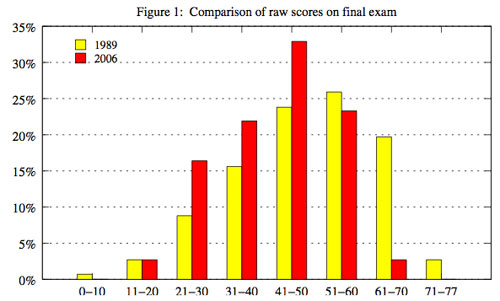
1989-2006 Math Comparison: Are Students Better Now?

math8906.jpg
W. Stephen Wilson [75K PDF]:

Professors are constantly asked if their students are better or worse today than in the past. This paper answers that question for one group of students.
For my fall 2006 Calculus I for the Biological and Social Sciences course I administered the same final exam used for the course in the fall of 1989. The SAT mathematics (SATM) scores of the two classes were nearly identical and the classes were approximately the same percentage of the Arts and Sciences freshmen. The 2006 class had significantly lower exam scores.
This is not a traditional research study in mathematics education. The value of this study is probably in the rarity of the data, which compares one generation to another.
….
Nineteen eighty-nine is, in mathematics education, indelibly tied to the National Council of Teachers of Mathematics’ publication, Curriculum and Evaluation Standards for School Mathematics (1989), which downplayed pencil and paper computations and strongly suggested that calculators play an important role in K-12 mathematics education. My 2006 students would have been about two years old at the time of this very influential publication, and it could easily have affected the mathematical education many of them received. Certainly, one possibility is that mathematics preparation is down across the country, thus limiting the pool of well prepared college applicants.

Wilson is a Professor of Mathematics at Johns Hopkins University.

Share

Early Start in Business Teaches Lessons

Carol Hymowitz:

Many CEOs who have scaled the corporate ladder say their early start in business gave them their best advantage. While many of their classmates socialized, they were punching time cards, earning money and learning management lessons they still use — from how to promote new ideas to organizing work efficiently and handling arduous schedules.

Who can forget the early paper routes, particularly on blustery winter mornings, or cleaning a restaurant’s grease trap…..

Share

Learning the Three R’s – In College

Heather LeRoi:

Should he have learned about such math concepts well before getting to college? Probably.
But the reality is, he hadn’t. And remedial education classes – or developmental coursework, as many colleges prefer to call it these days – offer Lythjohan, who’s considering a career in nursing or business, that second chance.
Lythjohan is far from alone.
According to a 2004 report by the National Center for Education Statistics, 28 percent of incoming freshmen nationwide enrolled in at least one remedial reading, writing or mathematics course at postsecondary institutions in 2000. At public two-year colleges, the figure jumps to 42 percent.

Share

Schools Turn Down the Heat on Homework

Nancy Keates:

Some of the nation’s most competitive schools are changing their homework policies, limiting the amount of work assigned by teachers or eliminating it altogether in lower grades. There also is an effort by some schools to change the type of homework being assigned and curtail highly repetitive drudge work.
The moves are largely at elite schools in affluent areas, including the lower school at Westminster Schools in Atlanta, Gunn High School in Palo Alto, Calif., Harvard-Westlake in Los Angeles and Riverdale Country Day School in New York City. The effort is by no means universal, and in fact some national statistics show that the amount of homework is continuing to grow.
Still, the new policies at such schools are significant because moves by institutions of this caliber are closely watched by educators and often followed.
Seventeen-year-old Jacob Simon endorses the new approach. When he gets home from school, he usually watches sports on TV. But the senior at Gunn High School isn’t slacking off: He’s taking five Advanced Placement courses this year, including calculus and physics. What’s changed is his school’s efforts to — in the words of one of its teachers — “make the homework assignments worthy of our students’ time.” Mr. Simon says, “It’s nice to be able to relax a little.”

Share

Education & Intelligence Series

Charles Murray posted three articles this week on Education and Intelligence, a series that generated some conversation around the net:

  • Intelligence in the Classroom:

    Our ability to improve the academic accomplishment of students in the lower half of the distribution of intelligence is severely limited. It is a matter of ceilings. Suppose a girl in the 99th percentile of intelligence, corresponding to an IQ of 135, is getting a C in English. She is underachieving, and someone who sets out to raise her performance might be able to get a spectacular result. Now suppose the boy sitting behind her is getting a D, but his IQ is a bit below 100, at the 49th percentile.
    We can hope to raise his grade. But teaching him more vocabulary words or drilling him on the parts of speech will not open up new vistas for him. It is not within his power to learn to follow an exposition written beyond a limited level of complexity, any more than it is within my power to follow a proof in the American Journal of Mathematics. In both cases, the problem is not that we have not been taught enough, but that we are not smart enough.

  • What’s Wrong with Vocational School?

    Begin with those barely into the top half, those with average intelligence. To have an IQ of 100 means that a tough high-school course pushes you about as far as your academic talents will take you. If you are average in math ability, you may struggle with algebra and probably fail a calculus course. If you are average in verbal skills, you often misinterpret complex text and make errors in logic.
    These are not devastating shortcomings. You are smart enough to engage in any of hundreds of occupations. You can acquire more knowledge if it is presented in a format commensurate with your intellectual skills. But a genuine college education in the arts and sciences begins where your skills leave off.
    In engineering and most of the natural sciences, the demarcation between high-school material and college-level material is brutally obvious. If you cannot handle the math, you cannot pass the courses. In the humanities and social sciences, the demarcation is fuzzier. It is possible for someone with an IQ of 100 to sit in the lectures of Economics 1, read the textbook, and write answers in an examination book. But students who cannot follow complex arguments accurately are not really learning economics. They are taking away a mishmash of half-understood information and outright misunderstandings that probably leave them under the illusion that they know something they do not. (A depressing research literature documents one’s inability to recognize one’s own incompetence.) Traditionally and properly understood, a four-year college education teaches advanced analytic skills and information at a level that exceeds the intellectual capacity of most people.

  • Aztecs vs. Greeks:

    How assiduously does our federal government work to see that this precious raw material is properly developed? In 2006, the Department of Education spent about $84 billion. The only program to improve the education of the gifted got $9.6 million, one-hundredth of 1% of expenditures. In the 2007 budget, President Bush zeroed it out.
    But never mind. A large proportion of gifted children are born to parents who value their children’s talent and do their best to see that it is realized. Most gifted children without such parents are recognized by someone somewhere along the educational line and pointed toward college. No evidence indicates that the nation has many children with IQs above 120 who are not given an opportunity for higher education. The university system has also become efficient in shipping large numbers of the most talented high-school graduates to the most prestigious schools. The allocation of this human capital can be criticized–it would probably be better for the nation if more of the gifted went into the sciences and fewer into the law. But if the issue is amount of education, then the nation is doing fine with its next generation of gifted children. The problem with the education of the gifted involves not their professional training, but their training as citizens.
    We live in an age when it is unfashionable to talk about the special responsibility of being gifted, because to do so acknowledges inequality of ability, which is elitist, and inequality of responsibilities, which is also elitist. And so children who know they are smarter than the other kids tend, in a most human reaction, to think of themselves as superior to them. Because giftedness is not to be talked about, no one tells high-IQ children explicitly, forcefully and repeatedly that their intellectual talent is a gift. That they are not superior human beings, but lucky ones. That the gift brings with it obligations to be worthy of it. That among those obligations, the most important and most difficult is to aim not just at academic accomplishment, but at wisdom.

Joanne has notes [more], along with Nicholas Lehmann, who comments on Murray’s The Bell Curve: Intelligence and Class Structure in American Life. Technorati search. Clusty Search on Charles Murray. Brad DeLong posts his thoughts as well.

Share

Madison Parents’ School Safety Site

Within moments of reading Chris Anderson’s “The Vanishing Point Theory of News“, a link to the Madison Parents’ School Safety Site arrived in my inbox. The site includes a useful set of questions that all parents should use to evaluate their children’s school.
RSS Feed.

Share

Milwaukee Schools to Ban Cell Phones

Alan Borsuk:

Principals throughout Milwaukee Public Schools were ordered Tuesday to crack down on students carrying cell phones and similar electronic devices inside schools.
Seeking to improve safety after a first semester marred by numerous violent incidents, Superintendent William Andrekopoulos told principals to come up with effective policies banning cell phones, with some exceptions, by Jan. 29, when the second semester starts.
He also announced that students who use cell phones to summon outsiders to a school for reasons that threaten safety will be expelled from school.
In addition, he said that Milwaukee County’s new district attorney, John Chisholm, has agreed to consider charging people involved in violence at schools with felonies. Generally, people involved in fighting have been given municipal disorderly conduct tickets, which Andrekopoulos said was too weak a punishment to be effective.

Share

“Do you want innovative public school options in Madison?

If you do, then your support of The Studio School charter school proposal is critical. Please let the school board know. Write letters. Email them [comments@madison.k12.wi.us]. Call them. Attend the meeting on January 22nd! I have heard from a board member that if the “pressure” to vote for opening this school in the fall isn’t strong enough, board members will not vote in favor of this proposal January 29th.
The opportunity to offer this innovative educational option with the possibility of up to $450,000.00 of federal funding over the next two years will not be available to MMSD again.
For more information to find out how to help, community members are invited to join us for our planning group’s general meeting on January 17th (this Wednesday) at 6:30 PM at the Sequoya Branch of the Public Library [Map]. You can also go to our website for more information.

Share

Wisconsin DPI Ordered to Write Rules Identifying Gifted Children

Amy Hetzner:

The state Department of Public Instruction must write more specific rules for how Wisconsin school districts should identify gifted and talented students, a Dane County circuit judge ordered Friday.
The ruling by judge Michael Nowakowski gave a rare court win to advocates for gifted student education. Yet the judge rejected a request that the DPI create rules detailing what programs districts have to provide to gifted students and provide a more vigorous enforcement of its standards.
Todd Palmer, the New Glarus parent and attorney who filed the suit, called the judge’s ruling “a tremendous victory for gifted students in this state.”
It comes at a time when Palmer and others argue that services for gifted children are in danger because of the twin pressures of school budget constraints and efforts to raise proficiency levels among low-performing students.
Currently, DPI’s rules on identifying students in need of gifted and talented services require only that school districts use “multiple criteria that are appropriate for the category of gifted including intelligence, achievement, leadership, creativity, product evaluations, and nominations.”

Share

Financially Support Madison Schools’ Math Festival

Ted Widerski:

The Talented and Gifted Division of MMSD is busy organizing ‘MathFests’ for strong math students in grades 4 – 8. These events are planned to provide an opportunity for students to interact with other students across the city who share a passion for challenging mathematics. Many of these students study math either online, with a tutor, by traveling to another school, or in a class with significantly older students.
These events will be hosted by Cuna Mutual Insurance and American Family Insurance. Students will have an opportunity to learn math in several ways: a lecture by a math professor, group learning of a new concept, and individual and small group math contests. Over 300 students from 38 schools will be invited to participate.
The funding for this project is challenging as there are no significant MMSD funds available. A plea for funding in the last several weeks has resulted in gifts totaling about $1000. Those gifts will guarantee that the middle school Mathfest will be held on Wednesday, February 21st.
In order to hold the Elementary MathFests on each side of Madison would require additional donations. Gifts totaling $1600 would provide the necessary support to provide 200 students with a very special experience. If anyone or any group would like to contribute, it would be most appreciated. Please contact me: Ted Widerski, TAG Resource Teacher at: twiderski@madison.k12.wi.us
Thank you for supporting this math event.

Share

West High School PTSO Meeting of 08-Jan-2007

The West High School PTSO met on January 8, 2007 with featured guest West teacher Heather Lott,
coordinator for the Small Learning Community grant implementation. The video below only includes Heather Lott’s presentation and questions that followed. It does not include other portions of the meeting such as Dr. Holmes report of the West Principal, nor reports from West PTSO officers.
The video QT Video of the meeting is 117MB, and 1 hour and 27 minutes long. Click on the image at left to watch the video. The video contains chapter headings which allow quick navigation to sections of the meeting. The video will play immediately, while the file continues to download.
Lott presented an overview of the three-year Federal SLC grant (Year 1, 2003-2004; Year 2, 2004-2005; Year 3, 2005-2006), what changes were begun in the year prior and the changes and goals for the 2006-2007 school year, post-SLC grant. She emphasized that the SLC plan would take 7 years to “complete” and that the remaining 4 years would need to be funded. The 3 year federal grant paid her salary and for professional development only. Budget cuts for the 2006-2007 year and continuing fiscal problems in the district will hamper making the desired progress.
When asked how much, minimally, West would need make acceptable progress in the implementation of the SLC plan, Dr. Holmes suggested $20,000.
She also presented data showing discipline improvements and academic achievement improvements over the SLC years.
Discussions also included the topics of differentiation and heterogeneity, and general discussions from parents of incoming West students on the social aspects of the small learning communities.
Slides for Heather Lott’s presentation are in PowerPoint and PDF for your convenience.

Share

Notes and Links on the Madison K-12 Climate and Superintendent Hires Since 1992

Madison Superintendent Art Rainwater’s recent public announcement that he plans to retire in 2008 presents an opportunity to look back at previous searches as well as the K-12 climate during those events. Fortunately, thanks to Tim Berners-Lee’s World Wide Web, we can quickly lookup information from the recent past.
The Madison School District’s two most recent Superintendent hires were Cheryl Wilhoyte [Clusty] and Art Rainwater [Clusty]. Art came to Madison from Kansas City, a district which, under court order, dramatically increased spending by “throwing money at their schools”, according to Paul Ciotti:

In 1985 a federal district judge took partial control over the troubled Kansas City, Missouri, School District (KCMSD) on the grounds that it was an unconstitutionally segregated district with dilapidated facilities and students who performed poorly. In an effort to bring the district into compliance with his liberal interpretation of federal law, the judge ordered the state and district to spend nearly $2 billion over the next 12 years to build new schools, integrate classrooms, and bring student test scores up to national norms.
It didn’t work. When the judge, in March 1997, finally agreed to let the state stop making desegregation payments to the district after 1999, there was little to show for all the money spent. Although the students enjoyed perhaps the best school facilities in the country, the percentage of black students in the largely black district had continued to increase, black students’ achievement hadn’t improved at all, and the black-white achievement gap was unchanged.(1)
The situation in Kansas City was both a major embarrassment and an ideological setback for supporters of increased funding for public schools. From the beginning, the designers of the district’s desegregation and education plan openly touted it as a controlled experiment that, once and for all, would test two radically different philosophies of education. For decades critics of public schools had been saying, “You can’t solve educational problems by throwing money at them.” Educators and advocates of public schools, on the other hand, had always responded by saying, “No one’s ever tried.”

Cheryl Wilhoyte was hired, with the support of the two local dailies (Wisconsin State Journal, 9/30/1992: Search No Further & Cap Times Editorial, 9/21/1992: Wilhoyte Fits Madison) by a school board 4-3 vote. The District’s budget in 1992-1993 was $180,400,000 with local property taxes generating $151,200,00 of that amount. 14 years later, despite the 1993 imposition of state imposed annual school spending increase limits (“Revenue Caps“), the 2006 budget is $331,000,000. Dehli’s article mentions that the 1992-1993 School Board approved a 12.9% school property tax increase for that budget. An August, 1996 Capital Times editorial expressed puzzlement over terms of Cheryl Wilhoyte’s contract extension.
Art, the only applicant, was promoted from Acting Superintendent to Superintendent in January, 1999. Chris Murphy’s January, 1999 article includes this:

Since Wilhoyte’s departure, Rainwater has emerged as a popular interim successor. Late last year, School Board members received a set of surveys revealing broad support for a local superintendent as opposed to one hired from outside the district. More than 100 of the 661 respondents recommended hiring Rainwater.

Art was hired on a 7-0 vote but his contract was not as popular – approved on a 5-2 vote (Carol Carstensen, Calvin Williams, Deb Lawson, Joanne Elder and Juan Jose Lopez voted for it while Ray Allen and Ruth Robarts voted no). The contract was and is controversial, as Ruth Robarts wrote in September, 2004.
A February, 2004 Doug Erickson summary of Madison School Board member views of Art Rainwater’s tenure to date.
Quickly reading through a few of these articles, I found that the more things change, the more they stay the same:

Fascinating. Perhaps someone will conduct a much more detailed review of the record, which would be rather useful over the next year or two.
Share

A Call for an Honest State Budget

Wisconsin State Journal Editorial:

Wisconsin’s state government ended the past fiscal year with a giant deficit of $2.15 billion, according to the accounting methods used by most businesses.
But the state’s books show a cozy balance of $49.2 million.
The discrepancy results from years of Wisconsin governors and legislators manipulating the accounting process to hide irresponsible budget decisions.
Those accounting tricks must stop. Wisconsin should begin to hold itself to the more business-like accounting methods used by Wall Street and by 16 other states the Generally Accepted Accounting Principles, known as GAAP.

Wisconsin’s fiscal situation makes it unlikely that there will be substantial changes in state funding for K-12 schools, particularly for rich districts like Madison that spend 23% ($333,000,000 for 24,576 students) more per student than the state average. Current state law penalizes districts that increase local school spending (property taxes) via referendum via reduced state aids. This means that for every $1.00 of new local spending above state revenue growth caps, Madison taxpayers must pay $1.61.
The 2/20/2007 and 04/03/2007 school board election presents an interesting contrast between candidates who believe that the best interests of our children are served by advocating for larger state spending beyond the typical 3.5%+ annual increases in the District’s budget and those who view the likelihood of substantial state changes for rich districts, like Madison as remote and therefore advocate more efficient management of the extraordinary resources we currently have. Health care costs present a useful example of this issue: Inaction [What a Sham(e)] vs discussion and some changes (in this example, 85% of the health care cost savings went to salaries).]

Share

View from the MMSD Student Senate

At its November 21, 2006, meeting, the MMSD Student Senate discussed many issues of interest to this blog community (e.g., completely heterogeneous high school classes, embedded honors options, etc.). Here is the relevant section from the minutes for that meeting:
Comments and Concerns:

  • regular classes don’t have a high enough level of discussion
  • students who would normally be in higher level courses would dominate heterogeneous class discussions
  • bring students up rather than down
  • honors classes help students who want to excel to do so
  • array of advanced and regular classes in every subject
  • honors and AP classes are dominated by a certain type of students (concerning ethnicity, socio-economic status, neighborhood, family, etc.)
  • honors within regular classes — response to whether or not regular students are an integral part of the class:
      not isolating
      discussion level is still high
      homework is the same (higher expectation for essays; two textbooks)
      teachers don’t cater to one type of student in discussions
  • there’s a risk of losing highly-motivated students to private schools
  • being in a classroom with students of similar skill levels is beneficial
  • teachers teach very differently to honors/advanced/AP students than they do to regular students
  • least experienced teachers are given to students who need the most experienced teachers (new teachers get lowest level classes)
  • sometimes split classes will be divided so that the honors students will be doing work in the front of the classroom while the regular students are doing lab work in the back
  • the problem is with the average classes
  • won’t help anything to cut TAG classes
  • mental divide among students in classes where honors and regular students are in the same classroom
  • more behavioral problems in regular classes (possibly more behavioral problems) à cycle teachers through so that one teacher isn’t stuck with the same type of student for an extended time
  • college is a factor to consider
  • Main problems to bring to BOE:

    • higher standards for all students *
    • division within classes creates too many boundaries *
    • not bad to keep advanced classes in some disciplines *
    • voluntary peer education *
    • colleges consider accelerated course loads (factor to consider) *

    *Group majority

    (more…)

    Share

    Debating the Education of Young Adolescents

    Kate Zernike:

    First, educators created junior high schools, believing preteens needed to be treated like adults. But those students weren’t ready to be treated as high school students, either. So reformers created the concept of middle schools, which were supposed to be a warm bath to ease the transition. Now, an increasing number of schools across the country, including in Baltimore and Philadelphia, are shifting the middle grades back to elementary school.
    But some research suggests that may not be the solution, either. So the age-old issues persist, with some variation from decade to decade: surging hormones make students irritable and sleepy. They struggle to relate to their peers and gain independence from their parents. To hear some parents tell it, one day their babies are innocent elementary schoolers in overalls, the next they’re dressing like Paris Hilton and simulating sex on the middle-school dance floor. How do you solve a problem like adolescence? Is there anything schools can do?
    The move toward middle schools, after the push for junior high that started in the late 19th century, was supposed to create environments that were more serious than the story-hour life of elementary schools, though less impersonal and confidence-zapping than the controlled chaos of high schools.

    Share

    West High School Small Learning Community Presentation 1/8/2007 @ 7:00p.m.

    Madison West Small Learning Community Coordinator Heather Lott is giving a presentation at Monday evening’s PTSO meeting: “SLC Post-Grant Update and Discussion”. Location: Madison West High School LMC [Map] West’s implementation of Small Learning Communities has been controversial due to the move toward a one size fits all curriculum (English 9 and English 10).
    Background Links:

    Loading Clusty Cloud …

    Parents with children potentially on their way to West High School should check out this Monday evening event.

    Share

    Why You Should Learn Algebra

    David Eggenschwiler:

    EVERY YEAR, as many California high school seniors struggle with basic algebra, which is required for graduation, Times readers complain, “Who needs it? How many students will ever use it?” Well, I use it every day; I’m using it now, even though I haven’t worked an algebraic equation since my son was in the seventh grade several years ago.
    Mathematics and science are unnatural practices. As physics professor Alan Cromer has brutally and elegantly written, “the human mind wasn’t designed to study physics,” and of course mathematics is the language of physics. “Design” here does not indicate an intelligent designer, which would suggest a creator with a math phobia. Rather it indicates evolutionary processes by which the human brain and mind have come to be what they are.
    During the approximately 2 million years that it took for our Homo forebears to progress from habilis to sapiens, they had little use for mathematical reasoning abilities. Their sapientia seems to have been more suited in a good Darwinian sense to the immediate demands of their survival, such as eating, mating and avoiding premature death. Whether for good or ill, as time may tell, our situations have changed much in the last few thousand years, and so have demands on our poor, lagging minds. I don’t mean only the obvious and oft-repeated claim that technical jobs require greater skills. That is clear enough in auto mechanics and computer programming. I mean the need to think abstractly, systematically and rationally in various ways.

    Share

    edu2.0

    Web-Based Education for School & Home:

    edu 2.0 is an important concept and the next step in the evolution of education technology. Read more….

    Share

    More Notes on Milwaukee’s Plans to Re-Centralize School Governance

    Milwaukee Journal-Sentinel Editorial:

    Looking for the path to effective education, leaders of the Milwaukee Public Schools have long slogged through the wilderness of school reform only to end up where they started. All used to be centralized at MPS. Then decentralization became the watchword. Now centralization is again in.
    This lunging between two opposite approaches is in a way understandable. Getting big-city school systems to work is no easy task, to judge from the rarity of the accomplishment. Superintendent William Andrekopoulos is right in being dissatisfied with the slow pace of improvement and in searching for ways to step it up. And recentralization does carry the force of logic for decentralized schools that have failed to improve.
    Still, as onetime MPS chief Howard Fuller reminded us when we reached him in New Orleans, where he is consulting, neither centralization nor decentralization is a magic bullet. The key ingredient for great schools are “people committed to do whatever it takes to educate our children.”
    n doing so, MPS must minimize the red tape, which has clogged school operations. Another trick the system must manage is to refrain from hurting the schools that have thrived under decentralization, an example of which is Hamlin Garland Elementary School on Milwaukee’s south side. Borsuk highlighted the school in another article this week.

    Madison appears to be rather centralized, with a push for standardized curriculum, generally lead by downtown Teaching and Learning staff. I often wonder how practical this actually is, given 24,000+ students and thousands of teachers and staff. Perhaps, in 2007 and going forward, the best solution is to support easy to access internet based knowledge tools for teachers where they can quickly review a variety of curriculum (including those not blessed by the central administration) with notes and links from others. This could likely be done inexpensively, given the wide variety of knowledge management tools available today.

    Share

    Spellings Says No Child Left Behind Act on Track

    Amit Paley:

    “We’ve made more progress in the last five years than the previous 28 years,” Spellings said. “Can the law be improved? Should we build on what we’ve done and all of that sort of thing? You bet. But I don’t hear people saying: ‘You know what? We really don’t need to have education for all students.’ ”
    Her remarks come as various groups begin to weigh in on the law and what they believe works and what does not. The No Child Left Behind law is scheduled to be reauthorized by Congress, but it is uncertain when lawmakers will act.
    The Forum on Educational Accountability — a coalition that includes education, religious, civil rights and disability rights groups — said yesterday that the law overemphasizes standardized tests and arbitrary academic targets. The coalition also criticized penalties the law imposes on schools that fail to meet standards.
    “We don’t have to throw out the whole law and make a big political battle,” said Reginald M Felton, a senior lobbyist for the National School Boards Association, a member of the coalition. “But we need to change from the punitive, ‘gotcha!’ kind of approach to actual support for progress.”

    Rotherham has more on NCLB.

    Share

    Education for all is just a bad dream

    Jo Egelhoff:

    Wisconsin is failing minority and low-income students. Plain and simple. Of the 10 issue areas featured in the Post-Crescent’s end-of-year “Editorial Agenda Update,” at least six are critically reliant on our schools performing – performing much better than they do now – and performing better and better around the state, not just here in our cozy, cuddly Fox Cities backyard.
    Think about it. Success in these six important “Issue” areas – labeled by the Post-Crescent as Economic Development, Fiscal Responsibility, Education (of course), Government Accountability, Working Poor, and Citizenship have at their core a well-performing education system.
    Then think about this. According to The Fordham Report 2006: How Well Are States Educating Our Neediest Children?, Wisconsin is doing a dreadful job in closing the achievement gap between the haves and the have-nots. The difference in achievement scores between Wisconsin white and African-American students is in the dead-last position – tied with Minnesota.

    Share

    Trying to Find Solutions in Chaotic Middle Schools

    Elissa Gootman:

    Driven by newly documented slumps in learning, by crime rates and by high dropout rates in high school, educators across New York and the nation are struggling to rethink middle school and how best to teach adolescents at a transitional juncture of self-discovery and hormonal change.
    The difficulty of educating this age group is felt even in many wealthy suburban school districts. But it is particularly intense in cities, where the problems that are compounded in middle school are more acute to begin with and where the search for solutions is most urgent.
    In Los Angeles, the new superintendent, David L. Brewer III, has vowed to transform middle schools as a top priority, and low-performing schools are experimenting with intensive counseling.
    In Philadelphia and Baltimore, school systems are trying to make the middle school problem literally disappear, by folding grades six through eight into K-8 schools. In one Columbia, S.C., school district, all five middle schools have begun offering some form of single-sex classes, on the theory that they promote self-esteem and reduce distractions.

    Share

    Schools Seek and Find Gifted Students

    Daniel de Vise:

    Not every student at Bannockburn is above average. But 70 percent of the third-grade class has been identified as gifted, based on tests and other academic indicators. The school serves one of the largest concentrations in the region of students capable of working beyond their assigned grade, sometimes well beyond.
    “We’re constantly trying to find things to pique their interest,” said Peterson, whose students have lately practiced dividing numbers into 32nds in their heads.
    The bumper crop of gifted children at Bannockburn is a result not of some exclusive magnet program but of Montgomery County’s aggressive policy on identifying academic talent. The county screens every second-grader for extraordinary ability. In most other school systems, it’s left to parents or teachers to initiate the process. Also, Montgomery’s criteria for “giftedness” are unusually broad, covering not just intelligence data but also classroom performance and the impressions of teachers and parents.
    That approach drives up the numbers — 40 percent of Montgomery’s 139,000 students carry the label — and creates a gifted majority at schools such as Bannockburn, which serves an affluent, highly educated neighborhood.

    Share

    Montessori Goes Mainstream

    Jay Matthews:

    The American Montessori Society, based in New York, reported 7 percent membership growth in just the past year, and many of the schools are getting ready to celebrate the centennial of the Montessori beachhead.
    Once considered a maverick experiment that appealed only to middle-class white families in the States, Montessori schools have become popular with some black professionals and are getting results in low-income public schools with the kind of children on which Montessori first tested her ideas.
    The stubborn Italian physician and her contemporary, U.S. philosopher and psychologist John Dewey — who believed that learning should be active — are considered perhaps the most influential progressive thinkers in the modern history of education.

    Madison has at least two Montessori schools, here and here.

    Share

    NCLB and the Stress Between “Bringing up the Bottom and Supporting High End Kids”

    A reader involved in these issues emailed this article by Andrew Rotherham:

    Second, the story highlights my colleague Tom Toch’s criticism that a lot of tests states are using under NCLB are pretty basic. That’s exactly right. I’m all for better tests, but isn’t that, you know, an indictment of schools that can’t even get kids over a pretty low bar rather than an indictment of the law? In other words, excepting some fine-grained issues around special populations, NCLB can’t be wildly unrealistic in what it demands of schools and really basic at the same time, can it? The story doesn’t sift through that in detail but would be nice if some journo would.* The reality is that we don’t deliver a very powerful instructional program in a lot of schools, and that’s not the fault of NCLB.
    ……
    *Related, there is a tension between high-performing students and low-performing ones in terms of where to put resources and attention. Not completely binary, and plenty of students falling behind today could be high performers in better schools. But still there and mostly talked about in code words rather than forthrightly: Are we as a nation better off really focusing on the millions of kids at the wrong end of the achievement gap even if its suboptimal for kids on the high end? And spare me the rhetoric about how you can easily do both. You can to some extent but constrained resources, carrots and sticks in policy, and time constraints all make tradeoffs a reality.

    A few other readers have mentioned that this is a conversation Madison needs to have.

    Share

    Reading Between the Lines: Madison Was Right to Reject Compromised Program

    Jason Shephard:

    From the beginning, Mary Watson Peterson had doubts about the motivations of those in charge of implementing federal education grants known as Reading First. As the Madison district’s coordinator of language arts and reading, she spent hundreds of hours working on Madison’s Reading First grant proposal.
    “Right away,” she says, “I recognized a big philosophical difference” between Madison’s reading instruction and the prescriptive, commercially produced lessons advocated by Reading First officials. “The exchange of ideas with the technical adviser ran very counter to what we believe are best practices in teaching.”
    The final straw was when the district was required to draft daily lesson plans to be followed by all teachers at the same time.
    “We’ve got 25,000 kids who are in 25,000 different places,” says Superintendent Art Rainwater. The program’s insistence on uniformity “fundamentally violated everything we believe about teaching children.”
    In October 2004, Rainwater withdrew Madison from the federal grant program, losing potentially $3.2 million even as the district was cutting personnel and programs to balance its budget. Rainwater’s decision, made without input from the school board, drew intense criticism and became an issue in last year’s board elections.

    From a public policy perspective, the School Board should have discussed the $3.2M, particularly given the annual agony over very small changes in the District’s $333M+ budget.
    The further concern over a one size fits all Reading First requirement (“We’ve got 25,000 kids who are in 25,000 different places,” says Superintendent Art Rainwater.) is ironic, given the push toward just that across the District (West’s English 10 [Bruce King’s English 9 report] and the recently proposed changes at East High School).
    Barb Williams noted that other “blessed by the District” curriculum are as scripted as Reading First in a December, 2004 letter to Isthmus. More here via Ed Blume and here via Ruth Robarts.
    It will be interesting to see what Diana Schemo has to say about Reading First.

    Share

    Middle School Reform Discussions

    Joel Rubin:

    Most frustrating, Chavez-Palmer said, is the difficulty in getting students and parents to follow through on her recommendations for tutoring and other services. At a recent meeting, only 20 parents showed up.
    There is little Chavez-Palmer and the other counselors can do to compel middle school students to work harder. A district policy requiring principals to hold back eighth-grade students who fail to meet minimal standards in English and math is largely ignored, said Collins, the chief instructional officer.
    The small piece of leverage counselors do have over failing students — threatening to ban them from informal graduation ceremonies schools hold for eighth-graders — often does little to sway students.
    “As long as I go on to the ninth grade,” a 14-year-old boy shrugged when Diane-Chavez raised the prospect.
    “You didn’t pass the majority of your classes in seventh grade and went on to eighth. The same will happen this year,” the blunt-talking counselor replied. “But what’s going to happen next year? How many times do you think Huntington Park High School is going to allow you to do this?”

    Share

    Madison Studio School Public Hearing Today @ 5:00p.m.

    Will you have an opportunity to register SUPPORT for The STUDIO SCHOOL at today’s (5:00pm) public hearing by the Madison School Board?
    With the approval of the school board, the public charter school of arts and technology would open next fall in Madison. See more about The STUDIO SCHOOL (SIS Links) here:

    Please contact school board members to voice your support for creating this new educational opportunity, within the public school system, for children in Madison. Thank you.

    Share

    Rigorous Evidence in Educational Practices

    U.S. Department of Education – Research, Statistics and Publications
    In reading studies, reports, and especially, journalists’ impressions and advocacy articles, the paper entitled Identifying and Implementing Educational Practices Supported By Rigorous Evidence: A User Friendly Guide should be required reading.
    It is a well-written 28-page summary of good research design and the problems that can and do occur and the inappropriate conclusions drawn from poorly-designed and implemented research.
    It should certainly stop all of us from merely repeating opinions and articles as though they were true, even when they support our own prejudices.
    I’m reminded of a quote (paraphrased), I believe from John Tukey: “You can lie with statistics, but you can’t tell the truth without statistics.”
    Quoting from the Executive Summary of this report:
    Purpose and Executive Summary
    This Guide seeks to provide educational practitioners with user-friendly tools to distinguish practices supported by rigorous evidence from those that are not.

    The field of K-12 education contains a vast array of educational interventions – such as reading and math curricula, schoolwide reform programs, after-school programs, and new educational technologies – that claim to be able to improve educational outcomes and, in many cases, to be supported by evidence. This evidence often consists of poorly-designed and/or advocacy-driven studies. State and local education officials and educators must sort through a myriad of such claims to decide which interventions merit consideration for their schools and classrooms. Many of these practitioners have seen interventions, introduced with great fanfare as being able to produce dramatic gains, come and go over the years, yielding little in the way of positive and lasting change – a perception confirmed by the flat achievement results over the past 30 years in the National Assessment of Educational Progress long-term trend.
    The federal No Child Left Behind Act of 2001, and many federal K-12 grant programs, call on educational practitioners to use “scientifically-based research” to guide their decisions about which interventions to implement. As discussed below, we believe this approach can produce major advances in the effectiveness of American education. Yet many practitioners have not been given the tools to distinguish interventions supported by scientifically-rigorous evidence from those which are not. This Guide is intended to serve as a user-friendly resource that the education practitioner can use to identify and implement evidence-based interventions, so as to improve educational and life outcomes for the children they serve.

      Table of Contents:

    1. Title Page
    2. Coalition Board of Advisors
    3. Purpose and Executive Summary
    4. Identifying and Implementing Educational Practices Supported By Rigorous Evidence: A User Friendly Guide
    5. I. The randomized controlled trial: What it is, and why it is a critical factor in establishing “strong” evidence of an intervention’s effectiveness.
    6. II. How to evaluate whether an intervention is backed by “strong” evidence of effectiveness.
    7. III. How to evaluate whether an intervention is backed by “possible” evidence of effectiveness.
    8. IV. Important factors to consider when implementing an evidence-based intervention in your schools or classrooms.
    9. Appendix A: Where to find evidence-based interventions
    10. Appendix B: Checklist to use in evaluating whether an intervention is backed by rigorous evidence
    11. References
    Share

    Open Enrollment Gives Special Students More Options

    Amy Hetzner:

    Middle school isn’t an easy time for anybody, but it was especially difficult for Jordan Johnson.
    His fellow students teased him about the cane he used, and his teachers frequently forgot to provide worksheets and other materials in the large type he needed because of a progressive vision loss called retinitis pigmentosa. He would fall behind and frequently lose work, but his parents wouldn’t learn of his problems until quarter grades came out, said his mother, Sally.
    That ended when he transferred to the Waukesha School District, under the state’s open enrollment program, to use the district’s virtual high school, iQ Academies at Wisconsin, which allows students to attend classes via computers set up in their home.
    “Ever since, I’ve been getting pretty good grades,” said Jordan, 16, whose family moved to Hudson recently.

    Share

    Educators, Parents Eager for an Edge Opt for IB Classes in Grade Schools

    Ian Shapira:

    Hunting for the best education for her three young children, Traci Pietra fretted about low test scores at her Arlington neighborhood school. Then the principal told her about Randolph Elementary’s affiliation with one of the most prestigious and rapidly growing brands in education: IB.
    International Baccalaureate is best known for a high school diploma program geared to the university-bound academic elite. But Pietra and her husband, Peter, were sold on the lesser-known elementary version of IB. Both were attracted to the IB emphasis on global understanding, Pietra said, and added: “He was like, ‘Our kids are going to an Ivy League school, and we need an education that’s going to get them on the right track.’ “

    Share

    Cardozo High School AP English Teacher Video

    olearydcap.jpg
    John Poole 5:21 video:

    Cardozo High School in Washington, DC, is a national pioneer in introducing Advanced Placement courses to disadvantaged students. It has found ways to build student skills so that they can begin to get passing grades on the AP exams. One of its star AP teachers, Frazier O’Leary, taught the school’s first AP class 10 years ago and, since then, has become a frequent speaker and adviser to school districts around the nation.

    Well worth watching.

    Share

    More Notes on Re-Thinking K-12

    Amanda Paulson:

    What if the solution to American students’ stagnant performance levels and the wide achievement gap between white and minority students wasn’t more money, smaller schools, or any of the reforms proposed in recent years, but rather a new education system altogether?
    That’s the conclusion of a bipartisan group of scholars and business leaders, school chancellors and education commissioners, and former cabinet secretaries and governors. They declare that America’s public education system, designed to meet the needs of 100 years ago when the workplace revolved around an assembly line, is unsuited to today’s global marketplace. Already, they warn, many Americans are in danger of falling behind and seeing their standard of living plummet.

    Rotherham adds:

    I think we need to think more daringly, yes, but I don’t think we tried everything or nearly hard enough to improve American schools within the current context. But I think that is sort of irrelevant today because the context has changed so much and consequently more of the same amounts to trying to make the current system work to do things we don’t want it to do anymore anyway.

    Locally, dealing with the recently disclosed 7 year structural deficit in the Madison School District’s $332M+ budget will require strong leadership, open minds and the ideas contained in Peter Gascoyne’s words.
    V. Dion Haynes has more.

    Share

    Exploring Alternatives to the Traditional High School

    Share

    On Wisconsin’s Learning Gap

    Alan Borsuk:

    The education achievement gaps between African-American and white children in Wisconsin remain among the worst in the United States, according to an analysis released Wednesday by an influential education group.
    To a degree that’s good news. That’s better than in 2004, when a similar analysis by the Journal Sentinel showed the proficiency gaps in several key measures between African-American and white children were larger in Wisconsin than in any other state.
    Using more recent results of the same series of tests – the National Assessment of Educational Progress – the Education Trust found that in fourth-grade reading and eighth-grade math, Wisconsin was near the bottom of the list, which included the states and the District of Columbia. In eighth-grade math, Nebraska had a bigger gap. In fourth-grade reading, Wisconsin was sixth from worst in gap size and eighth from the bottom when it came to the average score of black students.
    The results, said Daria Hall, a senior policy analyst for the organization and the main author of the report, “show just how far Wisconsin has to go in order to ensure that all kids, particularly poor kids and kids of color, are getting equal opportunities to meet high standards.”
    Hall – herself a graduate of Milwaukee Public Schools – said Wisconsin should look to states with much smaller gaps and with gaps that have been narrowed in recent years to see what it should do. She named Massachusetts and Delaware as examples.
    Massachusetts has eliminated funding gaps between school districts serving high-income and low-income students, she said. But it’s not only about money, she added. The state has created rigorous education standards and accountability systems.
    Tony Evers, deputy state superintendent of public instruction, said the analysis showed that the scores of African-American and Latino students in Wisconsin had risen in recent years while the scores of white students stayed flat – which he called “slightly good news.”

    Edtrust Wisconsin Report 500K PDF. Edtrust.org.

    Share

    Milwaukee Evaluates Online Textbooks & Free Wireless Internet for Students

    Erin Richards:

    Milwaukee Public Schools may go digital with some learning resources as the district selects about $7.7 million worth of new language arts, foreign language, technology education and social studies textbooks.
    With a new wireless network expected to bring free broadband Internet access into the homes of MPS students by next semester, Superintendent William Andrekopoulos said the district could start to “expand its textbook options” and look at more paperless models. But questions remain about if and how the district would make the most necessary resource – computers – available to a largely low-income population of students.
    “This is the first time we’ve started looking at online options, especially with language arts material,” Andrekopoulos said last month, after a School Board committee voted to move forward with the textbook adoption process. The committee’s recommendation was approved by the full board on Nov. 30.
    Aquine Jackson, chief academic officer for MPS, said electronic options could improve some of the literacy curricula that need supplemental resources. At a district-estimated $6.7 million worth of materials, language arts texts for grades K-8 and spelling for grades K-5 constitute the bulk of material that’s up for adoption.

    Share

    A Study of Core-Plus Students Attending Michigan State University

    Janet Mertz recently mentioned (along with UW Placement’s James Wollack recently) this paper by Richard Hill & Thomas Parker [750K PDF]:

    The latest, December 2006 issue of the American Mathematical Monthly, an official publication of the Mathematical Association of America, contains an 18-page article entitled “A study of Core-Plus students attending Michigan State University” by Richard Hill and Thomas Parker, professors at MSU who teach pre-service high school math teachers.
    They state that, “as the implementation progressed, from 1996 to 1999, Core-Plus students placed into, and enrolled in, increasingly lower level courses; this downward trend is statistically robust (p<.0005). The percentages of students who (eventually) passed a technical calculus course show a statistically significant (p<.005) decline averaging 27 percent a year; this trend is accompanied by an obvious and statistically significant increase in percentages of students who placed into low-level and remedial algebra courses. The grades the Core-Plus students earned in their university mathematics courses are also below average, except for a small group of top students. ACT scores suggest the existence but not the severity of these trends."

    Core-Plus is used in some Madison High Schools. Much more on math here.

    Share

    Don’t like math? UW-O asks ‘why not?’

    Ben Perlman & Pamela Buechel:

    For many college students, high school math is but a distant memory of derivative functions and playing games on graphing calculators.
    When a professor mentions that certain math skills are necessary for his class, it sends the lecture hall into a frenzy of questions and worry. It seems that math, more than any other subject, is lost in the student’s transition from high school to college.
    With a $69,000 grant, University of Wisconsin-Oshkosh geology professor Jennifer Wenner intends to figure out why.
    “There are a couple of hypotheses,” Wenner said. “From my own experience, some people get it in their head that they can’t do math, and they get this block about it.”

    Share

    DC Area High School Rankings, 2006

    Jay Matthews:

    The Challenge Index, my system for rating high schools based on college-level test participation, grew from watching a low-income school in East Los Angeles — Garfield High — find ways to challenge average students that most high-income schools never thought of. As The Washington Post unveils its 10th annual Challenge Index rankings of Washington area public schools this week, I want to see how low-income schools in this region are doing.
    The Challenge Index rates each school by taking the number of Advanced Placement, International Baccalaureate or other college-level tests the school gave in 2006 and dividing by the number of seniors who graduated from the school this year. High school educators who have learned, as the teachers at Garfield did, that even average students benefit from AP and IB are more likely to have more students taking those exams and do better on The Post’s list. High school educators who stick with what is still the majority view about AP and IB in America — that the programs are suitable only for top students — do not do so well.
    In many cases, the list defies the conventional wisdom that schools with lots of low-income students are bad and schools with few such students are good. That is not to say that most low-income schools do well on the list. Most do not. Many of their teachers and administrators accept the widespread assumption that their students can’t do AP or IB. But the few schools in poor neighborhoods that break out of this mindset are worth studying.

    Share

    Math failures – haven’t we heard this before?

    Roberta M. Eisenberg:

    As controversies rage about the best way to teach math and whether students should be allowed to use calculators — incidentally, the State Education Department on Dec. 1 declared that calculators will now be considered teaching materials, like textbooks, and schools must provide them to students — the real question is why children in this country are not better at learning math. Is it the curriculum? Is it the equipment? Is it the tests? And, haven’t we heard all this before?
    In 1957, the Russians sent up Sputnik, stealing a march in the space race, and the United States decided that something had to be done, in a hurry, about math and science instruction in this country. Thus were born National Science Foundation grants to teachers of math and science so that they might get master’s degrees in their subjects rather than in education. A generation of teachers excitedly brought their advanced knowledge back to their classrooms.
    Also in the early ’60s, the so-called New Math was influencing curricula across the country. The result was an emphasis on concepts to the detriment of the basics. Naturally, there was an eventual backlash when parents could no longer understand their children’s homework.
    By the ’70s, teachers in middle and high schools were noticing that students were getting weaker on their recall of times tables and other basics. This could not then be blamed on calculators because there were no calculators yet in general use.

    More on math here.

    Share

    School Day Goes Into Overtime

    Nelson Hernandez:

    Starting with the Class of 2009, all Maryland students will be required to pass exams in algebra and data analysis, English, government and biology in order to graduate. All of the students in Guinn’s classroom failed the test in algebra last school year. Her class, part of a new program in Prince George’s County called the Twilight Academy, is meant to give students the extra push they need to pass the tests, known as the High School Assessments, which they will retake in January.
    The county’s performance on the tests has improved, and students can take the tests multiple times. But more than half of the 24,000 freshmen and sophomores in Prince George’s are still at risk of failing to graduate. In the last school year, the county’s passing rate in algebra was 46.1 percent; in biology, 42.5 percent; in government, 55.5 percent; and in English, 45.9 percent. The results were well below state averages. The Prince George’s and Baltimore school systems together accounted for 45 percent of the students who did not pass the algebra test.

    Share

    Public Comments Regarding Credit For Non-MMSD Courses

    Parents Jeff Henriques, Larry Winkler and Janet Mertz appeared in front of the Madison School Board’s Performance & Achievement Committee regarding credit for non-MMSD courses. Watch the video.

    Background here.

    Share

    Comments on BOE Progress Report for December

    Madison School Board President Johnny Winston, Jr. (thanks!) posted a rather remarkable summary of recent activity today. I thought it would be useful to recall recent Board Majority inaction when reviewing Johnny’s words:
    It’s remarkable to consider that just a few short years ago, substantive issues were simply not discussed by the School Board, such as the Superintendent’s rejection of the $2M in Federal Reading First Funds (regardless of the merits, $2M is material and there should have been a public discussion).
    Reductions in the District’s annual ($332M+ this year) spending increases were thinly discussed (May, 2004).
    Today, we know that the School District has been running a structural deficit for years, something previous Board Majority’s were apparently unaware of or certainly never discussed publicly.

    (more…)

    Share

    Financial Literacy Project

    Dan Greene:

    I have the beginnings of an idea for a project to do later in Spring, for the exponential functions unit, in conjunction with our freshman College Readiness classes.
    I was thinking about when I was a freshman in college, and how there were always tables set up by credit card companies who would attract crowds of freshmen with such irresistable items as Citibank t-shirts and Bank of America frisbees. They would give a credit card to just about anyone. There have been lots of reports about how so many college students get into incredible credit card debts because they don’t know how to manage a credit card, and they are preyed on by these vultures.

    Share

    Important new information about credit for non-MMSD courses issue.

    “In preparation for the December 11, 2006 meeting of the BOE’s Performance and Achievement Committee, Assistant Superintendent Pam Nash prepared a memo dated December 5, 2006 along with 10 “exhibit” appendices for distribution to the BOE. “Exhibit 10” is a copy of the “Guidelines for Taking Coursework Outside the District” that she wrote in October, 2006, and I previously posted on SIS. In her memo she states “All the other nine procedures described herein, except this one, are governed by law or Board Policy. This process (her new Guidelines) was created by the MMSD to expand the opportunities for students to take courses outside the MMSD without increasing the costs to the MMSD and without undermining the integrity of the diploma a student receives from the MMSD. The “Guidelines for Taking Coursework Outside the MMSD” is the process and procedure currently used when, for example, a student who wants to take outside courses, but does not have any other option available to him/her. The cost for taking courses under this procedure is the responsibility of the student/parents. The procedure requires pre-approval by the principal and if the student wants credit for taking the course, he/she will receive elective credit if the District does not offer a comparable course. If the District offers a comparable course, the student will not receive credit. The student’s transcript will only include a description of the course, the institution, if any, the date the course was completed, the credit, if any, and the pass/fail grade.”
    As I had stated previously on SIS I believe this is a new policy. It is definitely different from the one used in the recent past at Madison West HS in several crucial respects. It has never previously been brought before the BOE for formal approval. At the November 13, 2006 meeting of the Performance and Achievement Committee, I presented Superintendent Rainwater and members of the BOE with a copy of these “Guidelines”. Superintendent Rainwater responded by stating that these Guidelines only apply to “Independent Study” and do not represent a change in policy. I interpreted his comments to mean they are simply a restatement of Board Policy 3545 – Independent Study. However, Nash’s December 5th memo to the BOE quoted above seems to indicate that her “Guidelines” are to be interpreted as a catchall, meant to apply not just to independent study, but to ALL course work not specifically governed by State law or existing MMSD Board Policies, i.e., her exhibits 1-9. In other words, it is to apply as well to UW courses taken outside of the YOP, WCATY courses, online courses such as Stanford’s EPGY taken outside of the InSTEP Program, UW-Extension courses where the District claims to offer a comparable course (even though in a very different format), etc., i.e., a variety of different types of formal course work offered through certified, non-MMSD programs. If so, shouldn’t these “Guidelines” need formal BOE approval as a new Board Policy since, as Nash states in her memo, they are not currently covered under any existing Board Policies?

    (more…)

    Share

    Credit for Non-MMSD Courses: Performance & Achievement Committee Discussion

    Please take note that the MMSD BOE’s Performance and Achievement Committee
    will be meeting at 5:45 pm on Monday, December 11th. [map]
    One of their two agenda items scheduled for that meeting is “Credit for Non-MMSD Courses.”
    This is a very important issue for academically gifted students who would like to be able to substitute higher-level, faster-paced, or more-readily-accessible-to-them (e.g., because of transportation problems) courses taken via WCATY, EPGY, APEX, UW, etc. for ones offered by their local middle or high school. It is an important issue for other types of alternative learners (e.g., special ed students, temporarily ill or disabled students) as well. It has taken years to get this topic placed on the BOE’s agenda. This coming Monday may well be our best opportunity to influence MMSD policy relating to this matter.
    Thus, I urge ALL of you who are concerned about this issue either (i) to attend this BOE meeting prepared to give a 3-minute speech during the Public Comments period, or (ii) to send an email this week to Art Rainwater, Pam Nash, and all BOE members (via their comments email address) describing why it is important for their students to be permitted to receive credit toward fulfilling graduation requirements for qualified high school- and college-level courses taken at UW, MATC, TAG summer programs, online, or via correspondence.”

    Share

    A few questions for MPIE members …

    I have a few questions for Barb and the other members of MPIE. I hope one or more of them will take the time to answer.
    As I look over the course catalogs for the four high schools, I see that each school has both a Special Education Department and an English as a Second Language Department (although they may not be called exactly that at each school). Each of these departments in each of the four high schools offers an extensive range of courses for students who qualify and need the specialized educational experiences offered within these departments. Many of the courses offered by these departments fulfill graduation requirements and so can be used as curriculum replacement for the “regular” courses.
    Here are my questions:

    1. Does MPIE advocate having the District dismantle the Special Education and English as a Second Language Departments in our high schools? (I assume the answer is “no.”)
    2. Does MPIE advocate having the District deny high school graduation credit for any and all courses offered within these departments, so that truly ALL students will be required to take 9th (and — at West — 10th) grade core courses at our high schools? (Again, I assume the answer is “no.”)
    3. If MPIE advocates full inclusion, why aren’t the answers to the above two questions “yes — absolutely, yes”?
    4. Does MPIE advocate getting rid of all advanced, honors, accelerated, TAG and Advanced Placement classes at our four high schools? In 9th grade? In 10th grade? In all four grades? What is your vision with regard to advanced and accelerated classes?
    5. Please help me understand the logic that says it’s O.K. to have entire departments within each high school devoted to the specialized educational needs of some groups of students (not to mention adjustments to high school graduation requirements designed to meet those students’ needs), but it is not O.K. to have even a few sections of classes aimed at meeting the specialized educational needs of other students? (IMHO, this way of thinking is really best described as a belief in “selective inclusion.”)
    6. Can you see the inherent illogic, inequity and unfairness of that position?
    7. How do you decide which groups of students with specialized educational needs get to have their educational needs met and which groups of students do not?
    8. It seems to me that a big part of the answer to that question should come from the research done from the perspective of the group of students under consideration. Do you agree or disagree with that premise?
    9. Are you aware of the consistency (of findings, of conclusions, of recommendations) within the literature on how best to meet the needs of high performing students (a.k.a. “best practices”)?
    10. Why does MPIE prefer the policy of getting rid of advanced high school classes over the policy of working with all K-8 students (and their families) in such a way as to increase the diversity of the students in those classes?
    11. What do some middle and upper middle class parents of children with special education needs find so threatening about the thought of having their schools meet the educational needs of high ability, high performing, even academically talented students with the same thoughtfulness and commitment that they meet the needs of students with other special educational needs?
    12. Are you aware that MMSD and national data indicate that approximately 20-25% of high school dropouts are academically gifted and have a demonstrated history of high academic performance? (In our District, that number is significantly higher at West HS than at the other three high schools and a disproportionate number of the “high performing” dropouts throughout the District are poor and minority students.) How do you understand those data and what do you think should be done about the situation?
    13. Have you read this American Psychologist article on “the two tails of the normal curve,” co-authored by nationally recognized experts on the educational needs of students in each of the two “tails”? http://psych.wisc.edu/henriques/papers/two_tails.pdf If so, what do you think of it?

    Would any of you would be willing to meet over coffee to talk about how we can work together on these issues and to see if we can find common ground?

    Share

    High School Redesign Notes

    As Arlene has reached out to the community for suggestions about the Redesign of the high schools, let me share a couple of thoughts:

    1. It’s too late. The students that are behind in 5th grade rarely catch up. The 2/3 combinations are by far the worst academic combination for elementary students, yet we continue this practice to save money, and to save SAGE. I understand the pull out combination system is a great way to deal with cost and transient students….but does it really help? Can’t we negotiate with the Union to allow 4 year kindergarten? This is really annoying that we have to bow to the Union for the sacrifice of the lower income students.
    2. The middle school years has a great resource of teachers. My children have had teachers that felt students are undergoing hormonal warfare and felt they should teach less so as not to upset the students. As I quote a teacher my child had in a “Charlie Brown teachers voice”, “Less is more and as long as they learn a couple of concepts during the year I feel I have done my job”. This fortunately is not the normal approach my children have received. Most of the Jr. High teachers have been focused on preparing the students for Memorial. I wonder if this is the model for most of the Jr. High Schools throughout the district?
    3. The district currently has the highest number of National Merit Scholar graduates in the state, I would assume we send hundred of students to college each year and those that are from higher income families do well. I wonder if the problem is less racial gap and not more economic gap. Please follow the link to the following Newsweek article released by the North Carolina Democratic Party….http://ncdp.org/node/1081. This is an article about how North Carolina kept their struggling students, drop out prone students and low income students engaged in high school by offering them an option to attend a local community college (MATC) and receive not only their HS diploma upon graduation but also an associate degree in an area of interest so that staying in school had meaning….and graduating means getting a real job. Currently all we can offer students that graduate from high school is they will have a diploma and they can essentially get the same jobs in this area with or without that diploma….with an associates degree they can make more than their teachers in computer repair, Xerox repair, IT, health associate degrees and others. Please think about raising the standards and the options for the struggling students, not lowering the standards for the top tier students. This IDEA and a proven method could benefit the entire community and raise the standard of living for lower income families. Please read this article.
    Share

    Why the Achievement Gap Persists

    NY Times Editorial:

    The No Child Left Behind education act, which requires the states to close the achievement gap between rich and poor students in exchange for federal aid, has been under heavy fire since it was passed five years ago. Critics, some of whom never wanted accountability in the first place, have ratcheted up their attacks in anticipation of Congressional hearings and a reauthorization process that could get under way soon after the new Congress convenes in January.

    More here.

    Share

    Madison Partners for Inclusive Education Presentation to the School Board

    The Madison Partners for Inclusive Education presented information to the School Board Monday evening. Watch the 38 minute video.

    The clip begins about 5 minutes into the presentation (I missed the first few minutes).

    Share

    Do Math Topics Lead to Better Instruction?

    Daniel de Vise:

    It says the typical state math curriculum runs a mile wide and an inch deep, resulting in students being introduced to too many concepts but mastering too few, and urges educators to slim down those lessons.
    Some scholars say the American approach to math instruction has allowed students to fall behind those in Singapore, Japan and a dozen other nations. In most states, they say, the math curriculum has swelled into a thick catalogue of skills that students are supposed to master to attain “proficiency” under the federal No Child Left Behind mandate.

    Math Forum audio / video

    Share

    Bucking School Reform, A Leader Gets Results

    David Herszenhorn:

    “We are relentless,” Dr. Cashin said in a recent interview. “The secret is clear expectations. Everything is spelled out. Nothing is assumed.” She provides her principals, for instance, with a detailed road map of what should be taught in every subject, in every grade, including specific skills of the week in reading and focus on a genre of literature every month.
    Dr. Cashin is obsessed with writing, and in most of her schools, student work lines the walls — not just the final product but layers of drafts. Even first graders have writing posted on the walls.
    A feature used in every school is the four-square graphic organizer, a worksheet with four boxes like a window pane and a rectangle at its center that helps children develop a five-paragraph essay. Some progressive educators scorn it as a crutch; Dr. Cashin insists that it works.
    While the city’s reading program focuses on story books, Dr. Cashin layers on lots of nonfiction. And, responding to research showing that impoverished children often lack vocabulary and basic facts, she has adopted a curriculum called Core Knowledge, which teaches basics like the principles of constitutional government, events in world history and well-known literature.

    Share

    Swaying Seattle’s School Assignments (Boundaries)

    Daniel Golden:

    In 2004, after the district scrapped race as a factor in assignments because of the legal threat, another group of white parents from the same neighborhood got upset when their children were passed over at the same majority-white school, Ballard High. They were left out not because of race, but because they didn’t live near enough.
    This time, the school district quietly backed down when the parents started sending their children to private or suburban schools instead of the struggling, majority-black school to which they’d been assigned. Ballard and other supposedly full schools together took about 100 extra students, most of them white.
    Even as parents challenge a government action making room for minorities in highly-regarded schools, the later events in Seattle show another side of the picture: the ways that school-assignment practices can work to the benefit of whites. In Seattle as in other parts of the country, schools sometimes accommodate middle-class parents who push to get their children into coveted schools. When these middle-class parents are predominantly white, as in Seattle, the lobbying can tend to sort more white children into the most desirable schools.

    Share

    A Campaign for the Civics Curriculum

    ABC’s This Week:

    The teaching of civics presently in the United States is dismal and startling. It used to be, when I was a kid, that there were classes in civics and you learned not only the checks and balances, but hows and whys and wherefores. And you learned what was the reasoning behind the creation of the Constitution and the Bill of Rights. …
    If you think that running a government like ours is, arguably, more complicated than running a pharmaceutical company or an auto company — and it is — then we should train people to the running of the country. …
    We want to … define the necessity of civics: What is it and is it necessary? If it’s necessary, is it urgent? And, if it’s urgent, what do we do? And then [we should start] to proceed to literally design classes.
    It is time that we simply revive the notion that we can learn how to run the country — and learn not for Republicans and not for Democrats, but learn how to learn the Constitution. The idea of people having power to pursue a notion of happiness or control of their own lives is a new thing and a miracle. America is a miracle.

    Agreed. Howard French’s recent article on history illustrates the need for rigor, critical thinking and the ability to ask questions.

    Share

    One Small Step in the Right Direction at West HS …

    In light of recent events regarding curriculum and other issues in our high schools, there has been a small step in the right direction at West HS. Superintendent Rainwater announced at our 11/29 MUAE meeting that he has been in discussion with West HS Principal Ed Holmes about providing West 9th and 10th graders who are advanced in language arts the opportunity to skip over English 9 and/or English 10. Advanced placement decisions will be based on grades, teacher recommendation, writing samples, WKCE scores, and ACT/SAT scores. Details will be worked out by Mr. Holmes, the West English Department and District TAG staff.
    This small — but important — change brings West more in line with Memorial, the only other high school that has a core English 9 curriculum delivered in completely heterogeneous classes. Every year, four or five academically advanced Memorial freshmen are allowed to go into English 10 — specifically, English 10 Honors. (FYI: Unlike West, Memorial has honors classes in 10th grade; as well, 10th graders can take some of Memorial’s 17 AP classes.) East and LaFollette, of course, have two or three levels of ability/interest-grouped classes for freshman (and sophomore) English — called regular, advanced and TAG at East and regular and advanced at LaFollette — and will continue to have them for at least the next two years.
    If you are the parent of a West area 8th or 9th grader who is advanced and highly motivated in English, you might want to consider having your student take either the ACT or SAT through the Midwest Academic Talent Search (MATS) in order to support a request for single subject acceleration. There is still time to register for the MATS online: http://www.ctd.northwestern.edu/mats/index.html
    IMPORTANT NOTE: As I see it, this development does not in any way mean we should slow down our lobbying efforts vis a vis the BOE and Administration to get them to make West more like the other high schools — in terms of course offerings and other oportunities for academically advanced students — during the two years of the high school redesign study introduced by Superintendent Rainwater at the 11/27 BOE meeting.

    Share