School Information System

The New Affirmative Action

David Leonhardt:

In another time, it wouldn’t have been too hard to guess where Frances Harris would have ended up going to college. She has managed to do very well in very difficult circumstances, and she is African-American. Her high school, in the Oak Park neighborhood of Sacramento, was shut down as an irremediable failure the spring before her freshman year, then reopened months later as a charter school. Midway through high school, her father developed heart problems and became an irritable fixture around the home. She also discovered that he was not actually her biological father. That was a man named Leroy who, when her mother took Harris to see him, simply said his name was George and waited for her to leave. In Harris’s senior year, her mother lost her job at a nursing home and the family filed for bankruptcy.
Harris somehow stayed focused on teenage life. She earned an A-minus average and she distinguished herself as a debater. Her basketball teammates sometimes teased her for using big words, but they also elected her co-captain. As she led me on a tour of her school and her neighborhood one day this summer, she introduced me around with an assured ease that most adults can’t manage, even if her sentences are peppered with “like,” “you know” and “Oh, my God.” Her bedroom in the bungalow she shares with her parents is a masterpiece of teenage energy, the walls covered with her prom-queen tiara, her purple-and-white basketball jersey (No. 3) and photos of her friends. “The hardest part of high school,” she says, “was to be smart and cool at the same time.” She decided her dream college was the University of California, Los Angeles.
Ten or 20 years ago, Frances Harris almost certainly would have been admitted. Her excellent grades might not have even been necessary, because Berkeley and U.C.L.A. — the jewels in the U.C. system — accepted almost all of the African-Americans who met the basic application requirements. To an admissions officer, Harris would have seemed like gold: diversity and achievement, wrapped up in a single kid.

Share

Helicopter Parenting: a Breakdown

Sue Shellenbarger:

Among my many private worries as a parent, I’ve wondered if I hover too much. New research on helicopter parents confirms it: I am one.
I have plenty of company. An estimated 40% to 60% of college parents qualify as helicopter parents, and they come from all socioeconomic groups, based on a thought-provoking study of 75 officials, professors and staff at 15 universities. The study, which is drawing attention on campuses, moves the helicopter-parent debate onto new ground by identifying types of parental hovercraft, ranging from benign to pathological.
There’s room to disagree on the boundaries of healthy parental involvement with college-age students, the focus of the research. Nevertheless, I found the typology a helpful lens for sizing up my parenting. If you’re wondering where you stand, here are a few of the most distinct types:

Share

NAEP Math Results: Ohio and Wisconsin Comparison

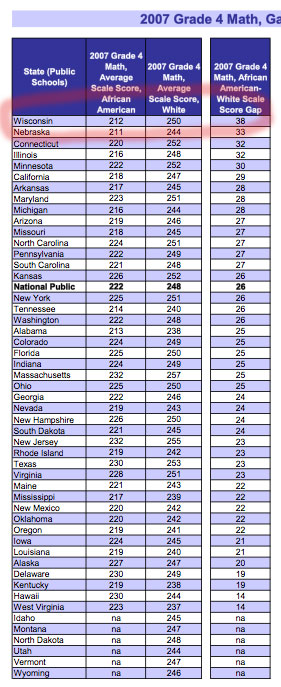
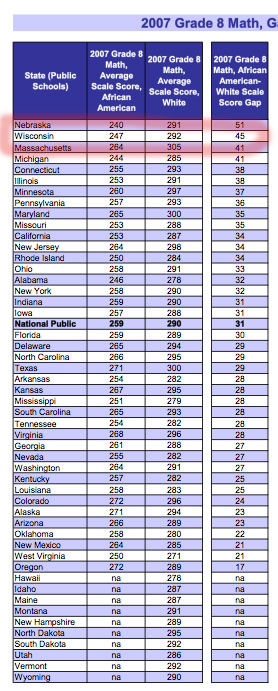
The 2007 NAEP results have just been released. There are many interesting results one can learn by looking at this data. In addition to the very serious racial gap in Wisconsin which has been commented on by The Educational Trust [Grade 4 Math NAEP Analysis | 80K PDF ] [Grade 8 Math NAEP Analysis | 80K PDF] and the Wisconsin Department of Public Instruction [172K PDF], there are strong indications of other problems in mathematics education in Wisconsin. Consider the following data comparing results for whites and blacks in Ohio and Wisconsin from the first year NAEP results were given by states and the 2007 results. As background, 12 points on NAEP is generally thought to be about the change from one year to the next on a given test. This is not a good estimate when looking over 15 to 17 years, since part of the rise in the test score likely came from changes made in textbooks and in what teachers teach because of the change in the NAEP Framework in the early 1990s.


For example, in Trends in Mathematics and Science Study, TIMSS, fourth grade math was tested in 1995 and 2003, and the results were flat while the NAEP results went up enough to allow statisticians to conclude the increase was statistically significant.


I assume that some of the rise in NAEP over this period is because students are learning more about the topics covered in NAEP, but that this is not the only
reason for the rise in NAEP scores.


The data below is comparison data between the results in two states at two different years, so the point estimate for a year of schooling seems to be a reasonable guideline. If so, Wisconsin has lost about a year to Ohio. Something needs to be done about this.

NAEP Fourth Grade Mathematics
Whites 1992 2007
Wisconsin 233 250
Ohio 222 250 Ohio gained 11 points on Wisconsin
Blacks 1992 2007
Wisconsin 195 212
Ohio 194 225 Ohio gained 14 points on Wisconsin
NAEP Eighth Grade Mathematics
Whites 1990 2007
Wisconsin 279 292
Ohio 268 291 Ohio gained 10 points on Wisconsin
Blacks 1990 2007
Wisconsin 236 247
Ohio 233 258 Ohio gained 14 points on Wisconsin

Share

Five Ways to Boost Charter Schools

Jay Matthews:

Sara Mead and Andrew J. Rotherham, two of my favorite educational researchers, have inspired me to save the charter school movement with five brilliant if perhaps too far-sighted suggestions for reform.
The Washington-based think tank Education Sector www.educationsector.org has just published their paper, “A Sum Greater Than the Parts: What States Can Teach Each Other About Charter Schooling.” They may be horrified by what I have done with their facts and insights, but I think my ideas will push charters in the right direction — more good ones and fewer bad ones.
In theory, charter schools are a great idea. There are now more than 4,000 of them with more than 1 million students in 40 states and the District. These independent public schools give smart educators with fresh ideas a chance to show what they can do without the deadening hand of the local school system bureaucracy around their necks. They also give public school parents more choice. The problem is, as one former state charter school official told me, there are a lot of loons out there starting charter schools. We don’t seem to be able to get rid of their loony schools as easily as the original advocates of charter schools promised. That is one reason why charter schools, despite including some of the best public schools I have ever seen, do no better on average than regular public schools in raising student achievement.
Here are my suggestions for fixing that situation, based largely on what I learned from Mead and Rotherham:
1. Stop letting local school boards authorize charters. Mead, a senior research fellow at the New America Foundation, and Rotherham, co-director of Education Sector and a member of the Virginia Board of Education, used a grant from the Annie E.Casey Foundation to analyze reports they oversaw on charter schools in California, Minnesota, Arizona, Ohio, Texas, Colorado, Florida and Michigan and four cities: New York, Indianapolis, Chicago and the District. They conclude that “perhaps the most significant lesson of the charter school movement to date” is that the number and quality of charter schools depend on who does the authorizing and how well they do it. State school boards, universities and independent bodies like the D.C. Public Charter School Board appear to do a better job of authorizing charters than local school boards, which see charters as competition for students, funds and prestige. California, Colorado and Florida have built strong charter systems with local school boards as the prime authorizers, but only by creating alternative authorizers for charter proposals that get turned down by local school boards.

The complete report is available here: Education Sector Reports: Charter School Series
A Sum Greater Than the Parts: What States Can Teach Each Other About Charter Schooling
, by Sara Mead and Andrew Rotherham.

Share

How a Virtual AP Course Changed Her Son

Jay Matthews:

Maria Allen worried about her son Matthew’s prospects in high school and beyond. He had always been regarded as an underachiever by his teachers. He received B’s in middle school with virtually no effort because he did well on what were, she thought, very easy tests.
Every new school year, the Reston mother donned her Super Nag persona, got on his case and tried to turn around his bad habits and attitude. It never worked. By the second quarter, whenever her attention turned to other matters, he stopped working, and his teachers started complaining.
So she was more than a little surprised when Matthew asked if he could take an Advanced Placement biology course online at the beginning of eighth grade, when he was only 14 years old. She knew where he got the idea. His big brother, a high school junior, had signed up for online AP biology so he would have time for other courses during the school day. She laughed. Good joke, Matthew. But he brought it up again. He was serious. Even when she showed him the demanding syllabus on the Web site apexlearning.com, he did not back down.
Well, she thought, why not? Her Super Nag act had not worked. She paid the $600 course fee and waited, without much hope, to see what would happen next.
“Matthew continued to put negligible effort into his middle-school work,” Allen told me, “but in biology, he started to work hard, very hard, in fact. And, even more remarkably, he continued to work hard throughout the year.”
She said he took a full complement of eighth-grade honors courses, but they demanded very little. “Unencumbered by any significant homework,” she said, “Matt had plenty of time available to log on to AP bio for a few hours each evening, and so he often did better on AP quizzes and assignments than my high school junior, who was always swamped with homework and competing deadlines from several other challenging courses.”

Share

Happy Birthday, Sputnik.
Fifty years ago, a small Soviet satellite was launched, stunning the U.S. and sparking a massive technology research effort. Could we be in for another “October surprise”?

Gary Anthes:

Quick, what’s the most influential piece of hardware from the early days of computing? The IBM 360 mainframe? The DEC PDP-1 minicomputer? Maybe earlier computers such as Binac, ENIAC or Univac? Or, going way back to the 1800s, is it the Babbage Difference Engine?
More likely, it was a 183-pound aluminum sphere called Sputnik, Russian for “traveling companion.” Fifty years ago, on Oct. 4, 1957, radio-transmitted beeps from the first man-made object to orbit the Earth stunned and frightened the U.S., and the country’s reaction to the “October surprise” changed computing forever.
Although Sputnik fell from orbit just three months after launch, it marked the beginning of the Space Age, and in the U.S., it produced angst bordering on hysteria. Soon, there was talk of a U.S.-Soviet “missile gap.” Then on Dec. 6, 1957, a Vanguard rocket that was to have carried aloft the first U.S. satellite exploded on the launch pad. The press dubbed the Vanguard “Kaputnik,” and the public demanded that something be done.
The most immediate “something” was the creation of the Advanced Research Projects Agency (ARPA), a freewheeling Pentagon office created by President Eisenhower on Feb. 7, 1958. Its mission was to “prevent technological surprises,” and in those first days, it was heavily weighted toward space programs.
Speaking of surprises, it might surprise some to learn that on the list of people who have most influenced the course of IT — people with names like von Neumann, Watson, Hopper, Amdahl, Cerf, Gates and Berners-Lee — appears the name J.C.R. Licklider, the first director of IT research at ARPA.
Armed with a big budget, carte blanche from his bosses and an unerring ability to attract bright people, Licklider catalyzed the invention of an astonishing array of IT, from time sharing to computer graphics to microprocessors to the Internet.

Share

Madison schools’ lunch period isn’t what it used to be

Andy Hall:

And somehow, in a time window one third the size that many adults take for lunch, 215 young children crowd around picnic-style tables, consume chicken nuggets — or whatever they brought from home — and hustle outside to play.
Squeezed by tight school budgets, the federal No Child Left Behind law and Wisconsin Department of Public Instruction rules on instructional time, the school lunch period isn’t what it used to be in many school districts.
ver the years,” said Frank Kelly, food services director of the Madison School District, who estimates that overall, school lunch periods in the district have been trimmed about 10 minutes over the past 10 years.
“I don’t think people are going to accept anything less than this.”
In fact, in response to complaints from parents four years ago, Madison officials eased the lunch crunch a bit for elementary students by using the last five minutes of the class period before lunch to move students to the cafeteria.
There was talk four years ago of expanding the elementary lunch period to 35 minutes. But the idea was dropped after officials estimated it might cost more than $2 million to pay teachers and lunch supervisors.
“We don’t have much flexibility in extending that,” said Sue Abplanalp, an assistant superintendent who oversees Madison’s elementary schools.
While DPI leaves it up to local officials to determine the length of lunch periods, Madison educators say they believe they attain a decent compromise by giving:
•Elementary students 20 minutes.
•Middle school students 30 to 34 minutes.
•High school students about 35 minutes (except at West High School, where most students get 55 minutes under a plan initiated last year).
Those schedules are typical of what’s found around Wisconsin, said Kelly, who has worked in food service for 31 years.
“For most of our people, it works very well,” Madison schools Superintendent Art Rainwater said.

Share

“Politically Correct Trumps Substance Every Time”

Paul Soglin on Why the Prospects for Madison are so Bleak, Part II:

“Struck by the number of residents who said if things don’t improve soon, they’ll consider moving elsewhere.” Good grief. Its been going on for over a decade and really picked up around 2000. The school enrollment figures clearly show that. And go look at the private schools, bulging at the seams, for confirmation.
That’s OK. This is Madison. All is forgiven. Throw a good party on State Street, recycle a few beer cans, vote to impech Bush-Cheney, and it does not matter that we are losing the city.
Politically correct trumps substance every time.

Related: Barb Schrank on “Where have all the Students Gone?”:

MMSD Lost 174 Students While the Surrounding School Districts Increased by 1,462 Students Over Four School Years. Revenue Value of 1,462 Students – $13.16 Million Per Year*

Share

Schools by Age, Not Address

Amy Hetzner:

Theory” and “experiment” were two ways Waukesha School Board members last week described the district’s move to create two schools focused solely on the lower or upper elementary grade levels.
But staff in schools already organized around such grade levels describe the model another way: child-focused.
“Really, the whole building kind of revolves around those early learners,” said Deb Ristow, principal of Pewaukee Lake Elementary School, which has housed students in kindergarten through third grade since 2002.
Although not as common in southeastern Wisconsin, “grade centers” that serve students for a fraction of their elementary years make up one of every five elementary schools nationwide, according to an analysis by the Educational Research Service. The facilities can be kindergarten-only centers, pre-kindergarten through second- or third-grade buildings or third- through fifth- or sixth-grade schools.

Share

More Parents Take Advantage of Free Tutor Service

Jeffrey Solochek:

When Heather Schaeffer heard she could get free tutoring for her children, she didn’t think twice.
“I said, ‘Thank you, God.’ Because I didn’t read until junior high. My father had to get a second job so I could go to Sylvan,” Schaeffer said Wednesday night, as she attended a tutoring provider fair at Northwest Elementary. “I just raced right over.”
Last year, Schaeffer had no problems getting her son, Sylvester, and daughter, Gretchen, into the federally funded program, a component of the No Child Left Behind Act. In Pasco County, as nationally, just a small percentage of the children eligible for services actually took advantage.
This year, the number of eligible students has grown along with the generally favorable word of mouth. Schaeffer worries that her kids won’t get access to the services that the federal government promises to low-income children who attend schools that don’t make adequate yearly academic progress for three or more years.

Share

High School Football: Silence on Concussions Raises Risks of Injury

Alan Schwarz:

To Kelby Jasmon, there was only one answer. The question: If he received yet another concussion this football season, while playing offensive and defensive line for his high school in Springfield, Ill., would he tell a coach or trainer?
Jasmon, with his battering-ram, freshly buzz-cut head and eyes that danced with impending glory, immediately answered: “No chance. It’s not dangerous to play with a concussion. You’ve got to sacrifice for the sake of the team. The only way I come out is on a stretcher.”
Jasmon, a senior with three concussions on his résumé, looked at two teammates for support and unity. They said the same thing with the same certainty: They did not quite know what a concussion was, and would never tell their coaches if they believed they had sustained one.
Matt Selvaggio, who plays with Jasmon on both lines, said: “Our coaches would take us out in a second. So why would we tell them?”
Many of the 1.2 million teenagers who play high school football are chanting similar war whoops as they strap on their helmets. They either do not know what a concussion is or they simply do not care. Their code of silence, bred by football’s gladiator culture, allows them to play on and sometimes be hurt much worse — sometimes fatally.

Share

Making the Grade: How to Get Your Kid a Good Credit Score

Jonathan Clements:

Like many college kids, my daughter Hannah ended up with a credit-card problem. But it wasn’t the problem I feared.
As students head off to college, many parents worry that their sons and daughters will apply for a fistful of credit cards and amass a heap of debt. Indeed, 42% of freshmen have credit cards, and they carry an average balance of $1,585, according to a study by college lender Nellie Mae.
But in her freshman year, Hannah didn’t rack up a single charge — because she had a heck of a time just getting a card.
• Getting carded. To be honest, I don’t really want Hannah to have a credit card. But I do want her to have a decent credit score. And one of the best ways to earn that score is to get a credit card, charge a small sum each month and then dutifully pay off the balance.

Share

The Achievement Trap: How American is Failing Millions of High-Achieving Students from Lower-Income Families

Groundbreaking report just released by the Jack Kent Cooke Foundation. Here is the September 10, 2007, press release:
MAJOR TALENT DRAIN IN OUR NATION’S SCHOOLS, SQUANDERING THE POTENTIAL OF MILLIONS OF HIGH-ACHIEVING, LOWER-INCOME STUDENTS, NEW REPORT UNCOVERS
Current education policy focused on “proficiency” misses opportunity to raise achievement levels among the brightest, lower-income students
WASHINGTON, DC – A disturbing talent drain in our nation’s schools, squandering the potential of millions of lower-income, high-achieving students each year was exposed today before the U.S. House of Representative’s Education Committee. New research cited at the hearing shows that students who demonstrate strong academic potential despite obstacles that come with low incomes, are currently ignored under No Child Left Behind (NCLB).
Alternative NCLB legislation being debated in the Education Committee hearing today includes provisions that could, for the first time, hold schools accountable for the academic growth of students performing at advanced levels. The report cited in the testimony -Achievement Trap: How America is Failing 3.4 Million High-Achieving Students from Lower-Income Families – is a first-of-its-kind look at a population below the median income level that starts school performing at high levels, but loses ground at virtually every level of schooling and suffers a steep plummet in college.

(more…)

Share

Where in the world is geography?

Leslie Newell Peacock:

None of the students in Dr. Brooks Green’s geography classes last week could tell him where the Strait of Hormuz was. One of his history students said she knew it was in the Middle East — somewhere.
Green, who is a professor at the University of Central Arkansas in Conway, is dismayed by the fact that none of the 46 students he quizzed knew about what some consider the most important spot on earth currently: The narrow sea lane that provides the only passage to the open ocean for the oil from the Persian Gulf states.
If students don’t know where a country is, or a people, how can they understand them?
With the change in the way Arkansas schools are to teach geography, he fears, ignorance over the world we live in is going to get worse.
Thanks to an increased emphasis on world history in middle school (it was previously taught in elementary grades), geography as a stand-alone course has gone out the window. It will now be “embedded” as one of four social studies “strands” (history, economics and civics are the other three) into other classes in grades K-8.

Share

A Lost Art: Instilling Respect

Patricia Dalton:

There’s been a fundamental change in family life, and it has played out over the years in my office. Teachers, pediatricians and therapists like me are seeing children of all ages who are not afraid of their parents. Not one bit. Not of their power, not of their position, not of their ability to apply standards and enforce consequences.
I am not advocating authoritarian or abusive parental behavior, which can do untold damage. No, I am talking about a feeling that was common to us baby boomers when we were kids. One of my friends described it this way: “All my mother had to do was shoot me a look.” I knew exactly what she was talking about. It was a look that stopped us in our tracks — or got us moving. And not when we felt like it.
Now.
These days, that look seems to have been replaced by a feeble nod of parental acquiescence — and an earnest acknowledgment of “how hard it is to be a kid these days.”
In my office, I have seen small children call their parents names and tell them how stupid they are; I have heard adolescents use strings of expletives toward them; and I remember one 6-year-old whose parents told me he refused to obey, debated them ad nauseam and sometimes even lashed out. As if on cue, the boy kicked his father right there in the office. When I asked the father how he reacts at home, he told me that he runs to another room!

Share

West and Memorial lead state in National Merit scholars

Susan Troller:

wo Madison high schools easily outpaced any other high schools in Wisconsin in the number of students who qualified as semifinalists for the 2008 National Merit Scholarships. Thirty-one students at West High School qualified and 24 qualified at Memorial in the prestigious scholarship competition.
Schools with the next highest numbers of semifinalists were Mequon’s Homestead High School in Ozaukee County with 17 semifinalists and the University School of Milwaukee with 16 semifinalists.
Four students at East High, two students at La Follette and one student at Edgewood also qualified for a total of 62 National Merit semifinalists from Madison.
Other Dane County high schools with qualifying students include Middleton (10 students), De Forest (5 students), Monona Grove (3 students), Verona (3 students), Oregon (2 students), Sun Prairie (2 students), Mount Horeb (2 students, including a student who is homeschooled), Deerfield (1 student) and Waunakee (1 student).

Share

Top 3 Ways Parents Can Boost Kids

Judie Kleinmaier:

It’s that time of year — a chance for a fresh start for all students. It’s been a long time since I started a school year, but I remember the anxiety and anticipation: Will it be a good year? What do I have to do to be successful?
With that in mind, I e-mailed principals at three Madison schools and asked them to offer a bit of advice. My question was simple and straightforward: What are the three most important things parents can do to help their kids get off to a good start in school this fall?
Their answers brought to mind a book that was a bestseller in the 1980s: “All I Really Need to Know I Learned in Kindergarten” by Robert Fulghum. The advice from these experienced educators involves a lot of common sense and caring and sharing.
Here are their responses:

Share

West HS English 10: More from Pam Nash

As many of you know, I have been in touch with the District and West HS administration — as well as with our BOE — with a request for “before-and-after” data on the English elective choices of West’s juniors and seniors. The reason for my request is that one of the primary reasons why English 10 was implemented was the concern that some groups of West students were not choosing to take challenging electives in their upper class years. Here are links to my earlier posts:
https://www.schoolinfosystem.org/archives/2007/08/west_hs_english_4.php
https://www.schoolinfosystem.org/archives/2007/08/west_hs_english_5.php
On August 29, I received the following email from Pam Nash:
Laurie-
Our Research and Evaluation staff reported today that the district does not keep course requests and course assignments beyond one year. Therefore, we cannot retrieve information that shows, historically, what English courses were chosen by whom over time.
We will be able to give you this year’s information by the end of next week.
Pam

(more…)

Share

Teens exposed to world of biotech careers through partnership

Bernadette Tansey:

The family culture of Berkeley’s Hernandez clan is a cool blend of Mexican roots and Bay area savvy – jumpy banda music, quinceanera parties, spicy pico de gallo and genetic engineering experiments.
That last part, the biotechnology, has been grafted onto the traditions Roberto and Irma Hernandez brought with them when the family immigrated to California in the late 1980s. Their arrival was timely – a new school program was about to welcome minority and disadvantaged kids to the biotech industry.
Their oldest child, Roberto, was the pioneer at 15 when he took a chance on the unfamiliar subject at Berkeley High School in 1992. Over the years, he has persuaded his brother and two of his three sisters to sign up for the biotechnology classes.
These four children of immigrants are now part of a young generation of biotech initiates whose prospects include some of the best-paying jobs in the Bay Area.
Roberto Hernandez, 30, was one of the first students to join the school program designed to convince disadvantaged kids that biotechnology jobs are a real option for them. The program, Biotech Partners, removes the barriers that often stand between low-income students and the well-compensated positions abounding in their own neighborhoods.
Hernandez and his sister Griselda, 28, work at the sprawling Bayer Healthcare campus in West Berkeley. Their younger brother Jesus just spent the eve of his 17th birthday tossing around terms such as “cell transformation” and “diafiltration” at a celebration for Biotech Partners students like himself who were finishing summer internships.

Biotech Partners Website:

Biotech Partners provides an entry-level biotechnology education and training program dedicated to supporting the San Francisco Bay Area’s robust bioscience industry while providing valuable working skills for local young people.
Biotech Partners has long been recognized as a model for connecting youth who are under-represented in the sciences to the world of biotechnology. A non-profit organization, Biotech Partners owes its success to strong collaboration among local biotechnology companies, secondary school and community college districts, a dedicated core staff and most importantly, the students and their families.

Related: Madison West High School’s Accelerated Biology Program [RSS].

Share

Beloit College’s Mindset List® for the Class of 2011

Beloit College:

Most of the students entering College this fall, members of the Class of 2011, were born in 1989. For them, Alvin Ailey, Andrei Sakharov, Huey Newton, Emperor Hirohito, Ted Bundy, Abbie Hoffman, and Don the Beachcomber have always been dead.
# What Berlin wall?
# Humvees, minus the artillery, have always been available to the public.

Cathy Lynn Grossman has more:

For this fall’s incoming college class, “off the hook” could mean “excellent” or escaping blame, but for sure it has nothing to do with telephones.
“Here’s Johnny!” That’s Jack Nicholson in The Shining, not the intro for Johnny Carson’s monologue, according to today’s 18-year-olds.
Professors had best update their lingo if they want to communicate with the Class of 2011 (on the assumption that anyone actually finishes in four years anymore).
Here to help is the 10th annual Beloit College Mindset List, released today by the small Wisconsin liberal arts college.

Share

West HS English 10: Request for Data — Reply from Pam Nash

I received the following reply to my request for English 10 data from Assistant Superintendent for Secondary Schools Pam Nash:
Date: Fri, 24 Aug 2007 14:27:48 -0500
From: pnash@madison.k12.wi.us>
To: lauriefrost@ameritech.net, eholmes@madison.k12.wi.us, hlott@madison.k12.wi.us, arainwater@madison.k12.wi.us, mbking1@wisc.edu
Laurie-
Mr. Holmes and his staff will do this. Pam
Pamela J. Nash
Assistant Superintendent
for Secondary Schools
Madison Metropolitan School District
(608) 663-1635
(608) 442-2149 (fax)

And here’s what I wrote back:
Date: Fri, 24 Aug 2007 15:21:06 -0500
To: pnash@madison.k12.wi.us, eholmes@madison.k12.wi.us, hlott@madison.k12.wi.us, arainwater@madison.k12.wi.us, mbking1@wisc.edu
From: “Laurie A. Frost”
Subject: Re: English 10 early results request
Cc: asilveira@madison.k12.wi.us, lkobza@boardmanlawfirm.com, lucym@charter.net, jwinstonjr@madison.k12.wi.us, mcole@madison.k12.wi.us, bmoss@madison.k12.wi.us, ccarstensen@madison.k12.wi.us
Thank you, Pam. I will look forward to receiving the data.
I know you all probably see me as a thorn in your side. Please try to understand, I am simply trying to keep you honest with the public … and empirically based.
If the results are positive — if English 10 is associated with a significant change in the target variable of concern (rigor of elective choices in 11th and 12th grade) — wouldn’t you want to know?
And if the results are not positive, wouldn’t you want to know?
Laurie

Share

West HS English 10: Request for Data

Here is an email I sent to the BOE, asking them to request important outcome data for West HS’s English 10 initiative. Embedded in the email is my own request for such data. As both a content and a process issue, I should think this would be of interest to all SIS readers. By all means, feel free to write to these people with your own request. –LAF
August 22, 2007
Dear BOE (especially Performance and Achievement Committee members Kobza, Winston and Cole):
Please see my email below to various people involved with the West HS English 10 initiative. Thank you for taking the appropriate and expected responsibility to obtain these data and make them public. We need to know if the things we are doing to our high school students are actually having the desired impact, in part, to guard against our doing things for our own misguided adult reasons (things like politics and stubborn pride).
I should think that the gap-closing effectiveness (or lack thereof) of a core course in 10th grade English at one of our four high schools would be of significant interest to community members throughout the District, including parents, teachers and students at the other three high schools … and especially members of our School Board.
Many thanks,
Laurie
Date: Wed, 22 Aug 2007 08:42:39 -0500
To: hlott@madison.k12.wi.us,mbking1@wisc.edu,eholmes@madison.k12.wi.us,pnash@madison.k12.wi.us,arainwater.k12.wi.us
From: “Laurie A. Frost”
Subject: English 10 early results request
Dear All:
One of the primary reasons for the implementation of English 10 at West High School was concern about the failure of some groups of West students to take rigorous English electives in their upper class years.
Can you please send me the data regarding the English electives chosen by this year’s 11th graders when they registered for classes six months ago? (Needless to say, I would also like to see the English elective data for the past few years, so that a meaningful comparison can be made between the choices of English 10-era versus pre-English 10-era students.)
This is the first group of West students to take English 10, so a look at the early results of the curricular initiative seems appropriate, as does sharing that information with the West community. I assume that the data are appropriately disaggregated by race and SES, given your concerns and your hypotheses about the impact of the new core course.
Many thanks.
Laurie Frost
West HS parent

Share

Attempts to make schools healthier are faltering

The Economist:

THE proportion of children in America who are overweight has tripled over the past 20 years and now exceeds 17%, according to the Centres for Disease Control and Prevention (CDC). The health problems that this causes include hypertension and type-2 diabetes, formerly known only among the nation’s overweight adult population. A group sponsored by the National Institute on Ageing has warned that this may be the first generation ever to have a shorter lifespan than their parents.
All the while, the proportion of children who take part in daily exercise at high school has dropped from 42% in 1991 to only 28% in 2004, according to the CDC. Snacking has greatly increased; the Government Accountability Office found in 2003 that 99% of America’s high schools now sell snacks and other food as well as providing lunches.
In an attempt to get the problem tackled at local level, Congress in 2004 passed an act directing school districts that get money from the national school-lunch programme to create “wellness” policies by the start of the 2006-07 school year. The districts were told to set standards for nutrition, physical activity and education about good food, then make sure that schools actually implement them.
One year after the deadline, the results are haphazard. School districts’ plans range from a few paragraphs long to more than 25 pages. Some states, like Texas and Arkansas, have pre-emptively set standards for school districts under their jurisdiction, forcing schools to ban fizzy drinks and junk food while increasing the amount of exercise the pupils take. Others offer guidelines rather than mandates, with no repercussions for schools that don’t comply. And in some areas, schools are being eased into change very slowly. Oregon’s legislature passed a bill in June that gives its schools ten years to meet its new physical-education requirements.

Share

Don’t fund Small Learning Community grant sought by MMSD

August 20, 2007
Gregory Dennis
U.S. Department of Education
400 Maryland Avenue, SW., room 3W243 FB6
Washington, DC 20202-6200
Dear Mr. Dennis,
As a long-time advocate for academic excellence in the Madison Metropolitan School District (MMSD, Madison, Wisconsin), I urge the Department of Education to reject the MMSD’s recent application for a Small Learning Centers grant, Smaller Learning Communities Program CFDA #84.215L.
Please visit a popular Madison blog, schoolinfosystem.org, where you will find long threads with comments, questions, and concerns about the grant application, as well as the MMSD’s pilot efforts in small learning centers.
Blog commentators, some of whom as statistics instructors at the University of Wisconsin-Madison, clinical psychologists, and other professionals with advanced degrees, express little support for the MMSD’s implementation of small learning communities.
When people try to get evaluation data from the MMSD on the current small learning communities, the district cannot or will not produce the information. The little available information about the MMSD’s small learning communities does not point to success, but rather to no impact on academic achievement. (See the evaluation on the MMSD Web site by Bruce King, whose services the MMSD wrote into its grant proposal.)
As the MMSD implements small learning schools, it simply amounts to closing the achievement gap by limiting opportunities for academic success of advanced students without raising the academic performance of low-performing ones.
Finally, the MMSD would be better off not to launch a major program change, especially when the current superintendent, the champion for the changes, will leave the district in the summer of 2008.
Sincerely,
Ed Blume

Share

Hours of teaching differ for schools

Amy Hetzner & Alan Borsuk:

Where a student attends public school in the five-county metropolitan Milwaukee area can make a difference of as much as four weeks’ time in the classroom per year, according to data reported to the state.
For the last two school years, the school districts of Burlington, Cudahy, Kettle Moraine, Mukwonago, Slinger, South Milwaukee and Wauwatosa reported that most – if not all – of their schools held classes at least 65 hours longer than the minimum hours set by state law.
Meanwhile, the Oak Creek-Franklin and Waukesha school districts met for the minimum amount of hours, and a large number of schools in the Milwaukee Public Schools system fell below the standard in 2006-’07.
“There’s nothing more important than time with the classroom teacher,” said Tony Evers, deputy superintendent of the state Department of Public Instruction. “And, if that’s continually taken away, the state of Wisconsin would have an obligation that doesn’t happen.”
By and large, most public schools in Milwaukee, Ozaukee, Racine, Washington and Waukesha counties reported similar annual total instructional hours for their students for the past two years, the only years for which data was available from the DPI.

Share

Bringing Diversity to New York Elite High Schools

by Christine Kiernan
Luis Rosario just completed fifth grade but he already thinks about attending an Ivy League college. And he would seem to be on his way. He won first prize in his district’s fifth grade science fair, scored high on the state math test, gets straight A’s and is fascinated by robotic sciences.
His mother, Judith Pena, wanted to get him into a program to prepare him for one of the city’s specialized high schools. Then she learned about the Columbia Secondary School for Math, Science and Engineering. ”This is even better,” she said. And so, next month Luis Rosario will join the first sixth grade class of Columbia Secondary, a new select school in upper Manhattan.
Columbia Secondary is aimed at top students like Luis, students who one would expect to attend an elite public high school. But over the years the so-called specialized schools have not attracted a large number of gifted black and Hispanic students. In fact, over the past decade, the percentage of students from the city’s large black and Hispanic population who attend these select schools has decreased significantly.
Under the banner “strength in diversity,” Columbia Secondary School for Math, Science and Engineering will try to change that. The school, a partnership of the Department of Education and Columbia University, is aggressively recruiting black and Hispanic students and plans to try out new methods to achieve a more equitable racial balance.

Share

Today’s Geography: Classroom to Boardroom

Claudine Bianchi:

Educators have always insisted they not leave out the “three Rs”: reading, writing and arithmetic. That paradigm may be shifting to “three Rs and a G” – and world enterprise is most appreciative.
The “G” is for geography – the science that links a range of interests and information from a variety of cultures based on a visual map. This subject is moving to the forefront of the minds of educators as its utility, later in life, in developing business strategy within public and private sectors around the world becomes more and more evident.
As a nation, the United States has received a clear signal from studies like the 2006 National Geographic/Roper survey, which followed an earlier survey in 2002. In the latest survey, young adults aged 18 to 24 in nine countries were surveyed and the results showed that Americans were outperformed in geographic literacy by young adults in seven countries – Sweden, Germany, Italy, France, Japan, Great Britain and Canada. Only 13% of the Americans surveyed correctly identified Iraq on a map of Asia and the Middle East. Only about half of young Americans were able to locate landmasses such as Japan and India on a global map. And 20% of those surveyed could not find the Pacific Ocean.
But set aside our less-than-satisfactory performance at a Geography Bee, and jump ahead to the terrain of public and private firms where geography has become one of the most powerful weapons in the arsenal. Maybe our educational system does not play out well in a Geography Bee, but you need to look at the extra edge firms are getting when they embrace not just geography, but the story that it tells. With the coming of age of GIS, the geography story becomes one where decisions can be made like never before. Almost anything can be plotted on a map.

Share

The Organized Student

Donna Goldberg:

Denville, N.J.: How to start a preschooler with good organization skills?
Donna Goldberg: That’s a wonderful question. There are ways you can start a preschooler. Actually, organization starts with preschool, and even with toddlers. As parents, we give toddlers a routine of the day. If it’s time to clean up, you say to your child, “now it’s clean up time.” And make your child be a part of that process. While you’ll be doing 99-percent of the cleanup, and the child 1 percent, you’ve set the tone that it’s part of play. After that, it’s usually time for dinner, and after that, it’s usually bath time. After bath time, it’s story book time and then bed. And these are the precursors, children begin to predict and anticipate. They start to understand time.
So to start to repeat routines they will go through the day is the beginning of teaching your children to be organized, because they can anticipate what happens next, and the steps that happen. And that really is what organization is, it’s a step-by-step procedure.

Share

As States Tackle Poverty, Preschool Gets High Marks


Deborah Solomon:

In Washington and statehouses across the country, preschool is moving to the head of the class.
Florida and Oklahoma are among the states that have started providing free preschool for any 4-year-old whose parents want it. Illinois and New York plan to do the same. Hillary Rodham Clinton wants to spend $15 billion over five years on universal preschool funding. Federal Reserve Chairman Ben Bernanke calls preschool one cure for inequality.
The movement represents one of the most significant expansions in public education in the 90 years since World War I, when kindergarten first became standard in American schools. It has taken off as politicians look for relatively inexpensive ways to tackle the growing rich-poor gap in the U.S. They have found spending on children is usually an easy sell.
It took a well-orchestrated campaign to put pre-K on the top of political agendas — and new tactics that didn’t rely on do-gooder rhetoric. Among those working on the issue are the research director of the Federal Reserve Bank of Minneapolis, a billionaire Oklahoma oil man and a foundation executive in Philadelphia.
Their winning pitch: Making pre-K as prevalent as kindergarten is a prudent investment. Early schooling, they say, makes kids more likely to stay in school and turn into productive taxpayers.

Related: The Economics of Preschool.

Share

Gestures Convey Message: Learning in Progress

Rick Weiss:

Susan Wagner Cook stands at the front of a third-grade classroom, an unfinished equation printed neatly on the whiteboard.
4 + 3 + 6 = __ + 6
“I want to make one side,” she says, as her left hand sweeps under the left side of the equation, “equal to the other side,” she continues, now sweeping her right hand under the right side of the equation.
It’s a concept that third-graders are just ready to learn: The total value on one side of an equal sign should equal that on the other.
Some kids get it quickly as Cook goes through her carefully choreographed tutorial. Others take longer. But what none of them know is that they are subjects in an experiment that is helping scientists understand one of the most familiar and yet mysterious components of human behavior: the hand gesture.

Share

Professor pans ‘learning style’ teaching method

Julie Henry:

A leading scientist has dismissed the latest approach to teaching that has been endorsed by the Government and embraced by teachers.
Under the new system children are considered to have different “learning styles” and instead of being taught by the conventional method of listening to a teacher, they should be allowed to wander around, listen to music and even play with balls in the classroom.
But now Baroness Greenfield, the director of the Royal Institute and a professor of pharmacology at Oxford University, has dismissed as “nonsense” the view that pupils prefer to receive information either by sight, sound or touch.
She said that the method of classifying pupils on the basis of “learning styles” is a waste of valuable time and resources.
The approach, first introduced in the United States following research on brain development, is being adopted by an increasing number of schools, colleges and local authorities and forms a key part of the Government’s drive for “personalised learning”. In effect, it dismisses so-called “chalk and talk” teaching as inadequate.

Share

What Autistic Girls Are Made Of

Emily Bazelon:

Caitlyn & Marguerite sat knee to knee in a sunny room at the Hawks Camp in Park City, Utah. On one wall was a white board with these questions: What’s your favorite vacation and why? What’s your favorite thing about yourself? If you could have any superpower, what would it be?
Caitlyn, who is 13, and Marguerite, who is 16 (I’ve used only their first names to protect their privacy), held yellow sheets of paper on which they had written their answers. It was the third day of the weeklong camp, late for icebreakers. But the Hawks are kids with autistic disorders accompanied by a normal or high I.Q. And so the main goal of the camp, run on a 26-acre ranch by a Utah nonprofit organization called the National Ability Center, is to nudge them toward the sort of back and forth — “What’s your favorite video game?” — that comes easily to most kids.
Along with Caitlyn and Marguerite, there were nine boys in the camp between the ages of 10 and 18. They also sat across from one another in pairs, with the exception of one 18-year-old who was arguing with a counselor. “All I require is a purple marker,” the boy said over and over again, refusing to write with the black marker he had been given. A few feet away, an 11-year-old was yipping and grunting while his partner read his answers in a monotone, eyes trained on his yellow paper. Another counselor hurried over to them.

Share

2007 Design Achievement Awards

Adobe Education:

The Adobe® Design Achievement Awards celebrate student achievement that reflects the powerful convergence of technology and creative arts. Winners represent work by some of the most talented and promising student graphic designers, photographers, illustrators, animators, digital filmmakers, and computer artists from the world’s top institutions of higher education.

The student finalists and winners were honored by Adobe and the community during an awards gala and gallery on August 2, 2007 in the de Young Museum in San Francisco.

Share

Cartoonist among role models for high school boys.

Oh, that every one of our high schools had a “AAA” (“African American Achievement”) Team. —LAF
Susan Troller
The Capital Times
8/1/2007
The only guy who can truly hold you back is the guy in the mirror,” cartoonist Robb Armstrong told a group of mostly male, mostly African-American students at La Follette High School on Tuesday.
He is the creator of the nationally syndicated comic strip JumpStart, which focuses on an African-American family and until recently ran in the Wisconsin State Journal. He was in Madison, speaking to members of the African-American Achievement Team, based at La Follette.
Armstrong grew up in a tough West Philadelphia neighborhood with his fiercely ambitious mother and four siblings.
An advocate for education who talks to over 5,000 students a year, Armstrong held his audience spellbound for about an hour as he talked about his family, his friends and the hard choices he had to make to pursue his passion as a cartoonist.

(more…)

Share

District SLC Grant – Examining the Data From Earlier Grants, pt. 1

The Madison Metropolitan School District (MMSD) recently submitted a five year, $5 million grant proposal to the US Department of Education (DOE) to support the creation of Small Learning Communities (SLCs) in all four high schools (See here for post re. grant application). While the grant proposal makes mention of the two smaller SLC grants the district received earlier, there is no examination of the data from those two projects. One would think that DOE would be curious to know if MMSD’s earlier efforts at creating SLCs had produced the desired results before agreeing to provide further funding. Furthermore, one would think it important to examine if the schools implemented the changes that they proposed in their applications. It is my intention to provide some of that analysis over the course of several posts, and I want to encourage other community members to examine the Memorial grant proposal and final report and the West grant and final report themselves.
We begin by examining Memorial High School’s SLC grant which was funded from 2000-2003. Memorial’s SLC grant is a good place to start, not only because it was the first MMSD SLC grant, but because they lay out clearly the outcome measures that they intend to evaluate and their final report provides hard numbers (as opposed to graphics) over a number of years before and after the implementation of the SLC grant. Memorial had two goals for their SLC grant: 1) to reduce the achievement gap and 2) to increase students’ connectedness to the school.
Examining student achievement suggests mixed results for Memorial’s restructuring. Student GPA’s indicate a slight narrowing of the achievement gap for African American students and essentially no change for Hispanic students when compared to their fellow white students over the period of the grant.

Difference Between
2000
2001
2002
2003
White & African American
1.35
1.35
1.16
1.24
White & Hispanic
0.75
0.87
0.74
0.79

Student WKCE performance can be considered an external indicator of student success, and these data indicate no change in the proportion of students scoring at the Proficient and/or Advanced levels, an especially noteworthy result given that the criteria for the WKCEs were lowered in 2002/03 which was the last year of the grant. I’ve included data up through this past school year since that is available on the DPI website, and I’ve only presented data from math and reading in the interests of not overloading SIS readers.

WKCE 99/2000 2000/01 2001/02 2002/03 2003/04 2004/05 2005/06 2006/07
Reading                
African American
45.09
54.90
36.00
33.00
40.5
45.8
42.9
29.8
Hispanic
63.16
80.00
47.00
54.00
53.6
51.7*
53.1*
29.3*
White
93.33
85.55
86.00
89.00
90.2
86.2
89.0
84.2
Low Income
53.33
56.36
36.00
36.00
32.9
40.7
43.7
25.7
Not Low Income      
88.00
86.9
84.7
89.8
80.2
Math                
African American
18.00
27.45
20.00
29.00**
39.2
32.2
27.3
39.4
Hispanic
42.11
40.00
33.00
49.00
42.9
62.1*
59.4*
36.2*
White
77.44
76.48
68.00
90.00
89.7
89.3
89.0
86.4
Low Income
18.64
16.37
16.00
29.00**
29.4
38.4
38.7
35.7
Not Low Income      
90
85.8
86.9
89.2
84.2

* note. data for Hispanic students includes 4 Native American students in 03/04 and 2 in the following two years
** note. DPI actually reports higher percentages of students scoring proficient/advanced: 34% and 37% respectively for these two cells
The data from DPI looking at ACT test performance and percentage of students tested does not suggest any change has occurred in the last 10 years, so the data presented here would suggest that Memorial’s SLC restructuring hasn’t had any effect on the achievement gap, but what about the other goal, student connectedness?

(more…)

Share

“Value Added Assessment” Madison School Board’s Performance & Achievement Committee Looks at “A Model to Measure Student Performance”

Video / 20MB Mp3 Audio

Superintendent Art Rainwater gave a presentation on “Value Added Assessment” to the Madison School Board’s Performance & Achievement committee Monday evening. Art described VAA “as a method to track student growth longitudinally over time and to utilize that data to look at how successful we are at all levels of our organization”. MMSD CIO Kurt Kiefer, Ernie Morgan, Mike Christian and Rob Meyer, a senior scientist at WCER presented this information to the committee (there were two others whose names I could not decipher from the audio).

Related Links:

The fact that the School Board is actually discussing this topic is a positive change from the recent past. One paradox of this initiative is that while the MMSD is apparently collecting more student performance data, some parents (there are some teachers who provide full report cards) are actually receiving less via the report card reduction activities (more here and here). Perhaps the school district’s new parent portal will provide more up to date student data.
A few interesting quotes from the discussion:

45 minutes: Kurt has built a very rich student database over the years (goes back to 1990).
46 Superintendent Art Rainwater: We used to always have the opinion here that if we didn’t invent it, it couldn’t possibly be any good because we’re so smart that we’ve have thought of it before anybody else if it was any good. Hopefully, we’ve begun to understand that there are 15,000 school districts in America and that all of them are doing some things that we can learn from.
47 Art, continued: It’s a shame Ruth (Robarts) isn’t sitting here because a lot of things that Ruth used to ask us to do that we said we just don’t have the tools to do that with I think, over time, this will give us the tools that we need. More from Ruth here and here.
55 Arlene Silveira asked about staff reaction in Milwaukee and Chicago to this type of analysis.
69 Maya asked about how the School Board will use this to determine if this program or that program is working. Maya also asked earlier about the data source for this analysis, whether it is WKCE or NAEP. Kurt responded that they would use WKCE (which, unfortunately seems to change every few years).
71 Lawrie Kobza: This has been one of the most interesting discussions I’ve been at since I’ve been on the school board.

Lawrie, Arlene and Maya look like they will be rather active over the next 8 months.

Share

A Teacher Grows Disillusioned After a ‘Fail’ Becomes a ‘Pass’

Samuel G. Freedman:

Several weeks into his first year of teaching math at the High School of Arts and Technology in Manhattan, Austin Lampros received a copy of the school’s grading policy. He took particular note of the stipulation that a student who attended class even once during a semester, who did absolutely nothing else, was to be given 45 points on the 100-point scale, just 20 short of a passing mark.
Mr. Lampros’s introduction to the high school’s academic standards proved a fitting preamble to a disastrous year. It reached its low point in late June, when Arts and Technology’s principal, Anne Geiger, overruled Mr. Lampros and passed a senior whom he had failed in a required math course.
That student, Indira Fernandez, had missed dozens of class sessions and failed to turn in numerous homework assignments, according to Mr. Lampros’s meticulous records, which he provided to The New York Times. She had not even shown up to take the final exam. She did, however, attend the senior prom.
Through the intercession of Ms. Geiger, Miss Fernandez was permitted to retake the final after receiving two days of personal tutoring from another math teacher. Even though her score of 66 still left her with a failing grade for the course as a whole by Mr. Lampros’s calculations, Ms. Geiger gave the student a passing mark, which allowed her to graduate.

Share

Madison Parents Seek Court Order to Open Enroll into Monona Grove School District

Andy Hall:


Madison resident Allison Cizek, 5, is about to enter kindergarten, but a recent U.S. Supreme Court ruling that restricts the use of race in assigning children to schools may influence which school district she attends.
Allison ‘s parents, Jeff and Jennifer Cizek, filed a petition in Dane County Circuit Court on Thursday seeking an immediate court order that would allow her to attend Taylor Prairie School in the Monona Grove School District this fall.
“I wouldn ‘t be spending money on this if it wasn ‘t important to me, ” Jeff Cizek said Friday evening.
“The color of a person ‘s skin doesn ‘t matter. They should all be treated the same. ”
The family ‘s attempts to transfer Allison from Madison to Monona Grove have been rejected by Madison School District officials who ruled that because she is white, her departure would increase racial imbalance in her Madison school.
Allison ‘s family lives on Madison ‘s Southwest Side in the 2800 block of Muir Field Road. The home is in the Madison School District ‘s Huegel Elementary attendance area.
But her mother teaches in the Monona Grove School District, and last year Allison attended a pre-kindergarten program in that district east of Madison.

Share

How Schools Get It Right

Experienced teachers, supplemental programs are two key elements to helping students thrive
Liz Bowie
Baltimore Sun
July 22, 2007
Tucked amid a block of rowhouses around the corner from Camden Yards is an elementary school with a statistical profile that often spells academic trouble: 76 percent of the students are poor, and 95 percent are minorities.
But George Washington Elementary has more academic whizzes than most of the schools in Howard, Anne Arundel, Carroll and Baltimore counties.
These students don’t just pass the Maryland School Assessment – they ace it. About 46.2 percent of George Washington students are scoring at the advanced level, representing nearly half of the school’s 94 percent pass rate.
An analysis by The Sun of 2007 MSA scores shows that most schools with a large percentage of high achievers on the test are in the suburban counties, often neighborhoods of middle- and upper-middle-class families. But a few schools in poorer neighborhoods, such as George Washington, have beaten the odds.
Statewide, Howard County had the highest percentage of students with advanced scores, and Montgomery and Worcester counties weren’t far behind.
Of the top five elementary schools, two are in Montgomery County, two in Anne Arundel and one in Baltimore County.
Whether they are in wealthy or poor neighborhoods, schools with lots of high-scoring students share certain characteristics. They have experienced teachers who stay for years, and they offer extracurricular activities after school. Sometimes, they have many students in gifted-and-talented classes working with advanced material.

Share

Tests Shouldn’t Be Last Word on State of Writing

Katherine Kersten:

Minnesotans got what seemed like great news on the education front last month. The state Department of Education announced that in 2007, 92 percent of Minnesota 10th-graders and 91 percent of ninth-graders passed a writing test needed to graduate from high school.
Cause for celebration? I must confess to skepticism.
These through-the-roof passage rates don’t square with complaints about recent graduates’ writing skills that I’ve heard from friends who teach college or hire for businesses.
Young people’s shortcomings often range, I’m told, from limited vocabularies to difficulty writing clear, serviceable prose.
Nor do the high passing rates square with other test results. In the 2005 National Assessment of Educational Progress test of eighth-graders, 62 percent of Minnesota eighth-graders tested at basic or below in reading. A basic score denotes only “partial mastery” of the skills necessary for proficient performance.
In order to write well, you have to read well. The low NAEP reading scores suggest that Minnesota’s writing test must be easy.
Plenty of evidence
Evidence of weak writing skills is plentiful. Last fall, for example, nearly 50 percent of students entering Normandale Community College in Bloomington were required to take a remedial, or “developmental,” writing course, according to college spokesman Geoffrey Jones. Such courses merely get students ready for college-level work.
Minnesota isn’t alone in its writing deficit. Today, many kids from across the country — graduates of suburban and private high schools as well as inner-city schools — struggle to craft a logical argument, analyze ideas or otherwise convey their thoughts on paper.

Share

Harvesting Kids

Andrew Gumbel:

When I told some actor friends about my experience, they immediately labeled it a scam. So did officials from the Association of Talent Agents, and from the Screen Actors Guild. What surprised me was how sophisticated the scam was – the company had my children (and, I would imagine, many parents) eating out of its hand before it asked for the money. What I didn’t yet realize, though, was how the scam worked – and how the entire industry essentially relies on shysters and con artists to provide a steady flow of child labor.
Here’s how the system operates. Aly Hartman referred a few times to Parent Guide’s “Burbank office,” but what she was really talking about was a child-actor management company called Kids! Background Talent, which is indeed in the business of finding children work on television and in the movies. Kids! Background Talent charges no upfront fees, other than a refundable $30 registration designed mainly to maintain a modicum of seriousness among its would-be clients.

Share

Learning, Growth and Socialization: A paper presented to the Association of Teacher Educators Summer Conference, Milwaukee: July 29, 2007

UW-Milwaukee Professor Emeritus Martin Haberman (and create of MMTEP):

I recently examined the four most widely used texts sold to faculty in schools of education to teach “learning” to future teachers. The courses these texts are used in are well known to teacher educators. They carry titles such as “Principles of Learning for Teachers,” or “Introduction to Educational Psychology,” or “Learning in Classrooms.” There is no accredited teacher preparation program in the country that does not require at least one such course. There is no state department of education that does not require such courses before they will accredit a college or university as having an approved program of teacher education. No other academic discipline has any where near such total control and influence over the “knowledge” required of future teachers.
As I scanned these texts I asked myself a simple question. If I were a classroom teacher how would the learning theories being presented in these texts help me to deal with the following subgroups in a class of 25 to 35 students:
1.4-6 students feign helplessness regardless of how much the assignments are watered down and never complete assignments.
2.6-8 students need for attention prevents them from staying on task and interferes with the work of others.
3.1-2 students see themselves as having been hurt by teachers and seek revenge regardless of the task or assignment at hand.
4.3-4 students challenge the teacher for control of the classroom
5.6-8 students come to school everyday and function as observers rather than participants. They devote most of their time to observing the interactions ( i.e. the cold or hot war) between the teacher and each of the four student groups cited above.
Ultimately, this group comprises the majority of school dropouts; these are students with very low achievement who declare they quit school because it was”boring.”
6.4-6 officially labeled special needs students with IEP’s.
It is important to understand that the causes of feigned helplessness, the need for constant attention, assurance, control, revenge, or to observe rather than participate cannot be fully explained by psychological constructs.At least a dozen academic disciplines provide valid theoretic and research based constructs that explain these student behaviors. Thinking of classes in real schools comprised of these six subgroups I found little in the texts that explain either why students take on these roles or what a teacher could do to best teach students assuming these roles. But worst of all, I found no connection anywhere in the four texts between the endless lists of recommended behaviors given to prospective teachers and any theory of learning. In a desperate attempt to convince myself that surely these texts on “learning” would have some relevance to the real world I looked up the terms “classroom management” and “discipline” in their glossaries. Each of these volumes consisted of over 300 pages. In each case I found less that two pages of do’s and don’ts dealing with discipline and no connection of these recipes to any theory of learning.The volumes themselves are endless lists of things teachers should do without any connections whatever between their endless admonitions to any psychological theory. The reason for this is simple. The interminable advocacies are not based on or derived from any psychological theory… none.

Martin Haberman Clusty Search.

Share

Best And Worst School Districts For The Buck

Via a reader email: Christina Settimi:

More spending doesn’t necessarily buy you better schools. With property taxes rising across the country, we took a look at per-pupil spending in public schools and weighed it against student performance–college entrance exam scores (SAT or ACT, depending on which is more common in the state), exam participation rates and graduation rates.
Winners in this rating system are counties whose schools deliver high performance at low cost. The losers spend a lot of money and have little to show for it.
Marin County, Calif., provides the best bang for the buck. In 2004 Marin spent an average of $9,356 ($6,579 adjusted for the cost of living relative to other metro areas in the U.S.) per pupil, among the lowest education expenditures in the country. But in return Marin delivered results above the national average: 96.8% of its seniors graduated, and 60.4% of them took the SAT college entrance exam and scored a mean 1133 (out of 1600). The others in the top five are Collin, Texas; Hamilton, Ind.; Norfolk, Mass.; and Montgomery, Md.
In Pictures: Best And Worst School Districts For The Buck
On the opposite end of the spectrum, Alexandria City, Va., which sits just six miles outside of our nation’s capital, spent $13,730 ($11,404 adjusted) per pupil, but its high schools registered only a 73% graduation rate, with 65.0% of the seniors participating in the SAT for a mean score of 963. According to John Porter, assistant superintendent, Administrative Services and Public Relations for the Alexandria City Public Schools, their graduation rate is reflective of a large number of foreign-born students who may take longer than the traditional four years to graduate. He also noted that their performance measures are rising, along with their expenditures. Per-pupil spending in Alexandria City is now over $18,000. Others on the bottom of the list include Glynn, Ga.; Washington, D.C.; Ulster, N.Y.; and Beaufort, S.C.
Using research provided by the Tax Foundation, a nonpartisan tax research group based in Washington, D.C., Forbes began with a list of the 775 counties in the country with populations greater than 65,000 that had the highest average property taxes. From this list we isolated the 97 counties where more than 50% of per-pupil spending contributions comes from property taxes. ( Click Here For Full Rankings)
Since it costs more to educate a student in New York than Alabama, we adjusted expenditures for each metropolitan area based on Economy.com’s national cost of living average. We then chose to compare spending to the only performance measures that can be used to compare students equally across the country. With a nod toward recognizing the importance of education, performance was weighted twice against cost. Performance and cost numbers are county averages; individual school districts within a county can vary greatly.

Dane County ranked 63rd (Other Wisconsin Districts in the Top 97 include: Ozaukee – 16, -43 and Walworth – 91).
Daniel de Vise:

Education scholars and school system officials greeted the study as a flawed answer to a fascinating question: Which school districts deliver the best results for the tax dollars citizens invest?
“The value of this kind of analysis is to remind us that simply pouring more [money] into existing school systems is no formula for producing higher achievement out the other end,” Chester E. Finn Jr., president of the Thomas B. Fordham Foundation, said in an e-mail.
But Finn derided this analysis as “just plain dumb” for failing to consider other factors, such as wealth and parent education, that affect test scores and graduation prospects.
The Forbes study takes the unusual approach of rating school systems from a stockbroker’s perspective — or, more specifically, the perspective of a stockbroker raising a family in the D.C. suburbs. Rather than simply rank them by SAT participation or outcome or graduation rate, it considers all three measures and a fourth, dollars spent.
The endeavor is skewed toward affluent and suburban schools, educators said, because of the focus on local property taxes; wealthier jurisdictions tend to pay a greater share of education costs from their own tax coffers. The top three systems in the resulting ranking are all suburban: Marin County, just north of San Francisco; Collin County, near Dallas; and Hamilton County, outside Indianapolis.

Share

Texas District Makes Gains With Special Education

Christina Samuels:

When leaders of the North East Independent district realized some students weren’t succeeding, they rolled up their sleeves and went to work. The results were dramatic.
The North East Independent School District, serving part of the city of San Antonio, cherishes its image as a diverse system of high-achieving students bound for college. But two years ago, the 61,000-student district received a jolt when 10 of its 61 schools failed to make adequate yearly progress, or AYP, under the federal No Child Left Behind Act. At each, the performance of students with disabilities tipped the scale downward. Four were considered “academically unacceptable” under state standards, a rating that was successfully appealed but still a blow.
Superintendent Richard A. Middleton, who has led the district for 17 years, said the results were demoralizing: “When we have a school that for the large part is very successful, if a smaller cell of student scores creates a low ranking, there’s an air of disbelief and confusion.”
The plan required both a practical and a philosophical change for district professionals. Principals, in partnership with district-level data-coaching teams, dug deeper into student achievement data than they ever had before. All students, particularly those with disabilities, had to be taught the most rigorous classwork teachers believed they could master. Administrators were asked to internalize a belief that all students could learn—no excuses.
Not every school leader was immediately on board. Linda Skrla, an associate professor at Texas A&M University, in College Station, and a graduate school classmate of Ms. Thomas’, gave a presentation to district administrators the summer after the 2005-06 test administration. Along with James J. Scheurich, Ms. Skrla wrote a book called Leadership for Equity and Excellence, contending that unconscious biases can lead administrators to have low expectations for students. The authors urge administrators to confront those biases and institute reforms.

Share

Test for Success, Not Failure, in Education

Richard Rusczyk:

A wide-ranging study of pedagogy could bring about revolutionary advances in education, much as similar studies have brought about changes in medicine, as Gawande documents. Instead, nearly all efforts go into producing yet more new methods.
Why?
I run a small business producing educational materials, so I know well why: No one makes money testing existing procedures (outside of the politically-connected testers, of course, but innovators need not apply), nor by making incremental changes over a generation, even if those incremental changes amount to tremendous benefit to students.

Share

When Discipline Starts a Fight: Pressured to Handle Disabled Children, A School Tries Restraints


Robert Tomsho:

When Eva Loeffler walked into her daughter Isabel’s classroom at Waukee Elementary School on Dec. 15, 2004, she says a male guidance counselor was trying to contain the shrieking 8-year-old by wrapping his arms around hers in a restraint hold.
Isabel, suffering from autism and other disabilities, had a history of aggressive behavior, but Mrs. Loeffler had never seen her so agitated. Her eyes were glazed and her face was red. “She was like a wild animal,” says Mrs. Loeffler, who, at the time, felt sorry for the counselor who had to deal with her daughter in such a state.
That sympathy waned as Mrs. Loeffler and her husband learned all the measures the school district used on Isabel. These included restraint holds by three adults at once and hours in a seclusion room that teachers called “Isabel’s office.” There the girl sometimes wet herself and pulled out her hair, according to documents filed in a 2006 administrative-law case the Loefflers brought against the school district.
In March, the presiding administrative-law judge ruled that the district had violated federal law by educating Isabel in overly restrictive settings and failing to adequately monitor its methods. The district has appealed. Its lawyer, Ronald Peeler, says it used “established educational principles” in addressing Isabel’s problems, and made adjustments when its discipline wasn’t working. “We are not dealing with an exact science here,” says Mr. Peeler.

Share

ABSENT FROM CLASS

There are many important variables to consider in evaluating the causes for academic failure or success in the high school classroom. The training of the teacher, the quality of the curriculum, school safety, availability of books, etc., etc., are extensively studied, and all these have a part to play.
But I would argue that the most important variable in student academic achievement is student academic work, including classroom work. Why do so many of our high school students do so little academic work? Because they can get away with it.
A close study of the academic demands on students in the vast majority of our high school classrooms would disclose, I feel certain, that one of the principal reasons for their boredom is that they really have nothing to do but sit still and wait for the bell.
In most classrooms the chances of a student being called on are slight, and of being called on twice are almost nonexistent. If a student is called on and has not done the reading or other class preparation, most probably the teacher will just call on someone else. There are no real consequences for being unprepared, and as a result many, if not most, students are unprepared, and that also contributes to their boredom.

(more…)

Share

Preparing STEM Teachers: The Key to Global Competitiveness

Sean Cavanaugh 884K PDF:

The document, produced by the Washington-based American Association of Colleges for Teacher Education, provides descriptions of 50 teacher-education programs around the country. Although the report does not identify any single program or approach as most effective in swelling the ranks of math and science teachers, it says that more institutions are establishing stronger ties between colleges of education, which focus on teacher preparation, and academic programs, which are devoted to training undergraduates in specific academic subjects.
Barriers between those academic departments sometimes prevent talented math and science undergraduates from considering teaching careers, advocates for improved teaching have argued. Those intrauniversity divides also make it more difficult for aspiring teachers to obtain vital content knowl-edge in math and science before entering the classroom, some say.

Share

Tutor Vista

www.tutorvista.com:

Our mission is to provide world-class tutoring and high-quality content to students around the world. TutorVista.com is the premier online destination for affordable education – anytime, anywhere and in any subject. Students can access our service from the convenience of their home or school. They use our comprehensive and thorough lessons and question bank to master any subject and have access to a live tutor around the clock. TutorVista helps students excel in school and in competitive examinations.

The Economist:

but TutorVista, an online tuition service, is aimed squarely at customers in the developed world. Mr Ganesh founded the company in late 2005 after spotting that personal tutoring for American schoolchildren was unaffordable for most parents. His solution is to use tutors in India to teach Western students over the internet. The teachers all work from home, which means that the company is better able to avoid India’s high-wage employment hotspots. TutorVista further hammers home its labour-cost advantage through its pricing model. It offers unlimited tuition in a range of subjects for a subscription fee of $100 per month in America (and £50 a month in Britain, where the service launched earlier this year) rather than charging by the hour. Tutors are available around the clock; appointments can be made with only 12 hours’ notice.
It is too early to gauge the impact of the service on educational outcomes, says Mr Ganesh, but take-up is brisk. TutorVista has 2,200 paying subscribers at the moment (most of them in America) and hopes to boost that figure to 10,000 by the end of the year. The company is expected to become profitable in 2008. Even cheaper pricing packages are on the way. Launches of the service are planned for Australia and Canada. Mr Ganesh is also investigating the potential of offering tuition in English as a second language to students in South Korea, where high rates of broadband penetration make the market attractive. Get that right, and China looms as an even bigger prize.

TutorVista, along with Rosetta Stone and other online tools offer practical options for families who seek new learning opportunities unavailable via traditional models. The nearby Oregon school district may add languages to their elementary programs. CyraKnow offers handy “phrase books” for the iPod.

Share

With rise in autism, programs strained

Carey Goldberg:

A decade ago, it took a few months to get a child into Melmark New England, a special school largely for children with autism. Now, the wait can be five years
Boston-area parents, worried their child may be autistic, routinely face delays as long as nine months to confirm the diagnosis — even though current wisdom holds that treatment should begin as early as possible.
And LADDERS, a Wellesley autism clinic, has all but closed its doors to new patients: “We’re backed up well over a year here, and other clinics are struggling the same way,” said Dr. Margaret Bauman, its director.
Statewide, the number of schoolchildren diagnosed with autism has nearly doubled over the last five years, from 4,080 to 7,521, according to soon-to-be-published data from the Department of Education.

Share

Blacks in Fairfax, Montgomery Outdo U.S. Peers in AP

Daniel de Vise:

Black students in Montgomery and Fairfax high schools are far more successful in Advanced Placement testing than their peers in nine of the 10 school systems in the nation with the largest black populations, according to a Washington Post analysis.
Participation in the AP program has more than doubled in 10 years. But this surge in college-preparatory testing has not reached most African American students, according to a review of 2006 exam results in 30 school systems with about 5,000 or more black high school students.
Still, black students in both Montgomery and Fairfax counties passed AP tests in spring 2006 at the rate of more than eight tests for every 100 black students enrolled in the high school grades, the analysis found.
That is far greater than the success rate of African Americans nationwide, who produced about one passing AP test for every 100 students. None of the other school systems studied produced successful AP tests at even half the rate of Maryland’s and Virginia’s largest school systems.

Share

One class, many incredible journeys

Erin Einhorn:

The Daily News spent two months tracking down the 23 kindergarteners who enrolled at Harlem’s PS 36 in 1994. Their journeys illuminate hardships students face in earning their high school degree.
They were smart children who tested into a gifted kindergarten at Harlem’s Public School 36 in 1994, but Lance Patterson and Ronnie Rodriguez would each fall in with the wrong crowd.
Lance would be arrested. Ronnie would join a gang.
Their challenges were similar, but they’ve ended up in very different places. One has a mother who will watch him don a cap and gown this week. The other has a mom who blames herself.
“I should have kept a closer eye on him,” Sandra Lugo said of her son, Ronnie. “I should have been on him maybe a little harder, been a little stricter.”

Share

Birth Order and Intelligence

Petter Kristensen and Tor Bjerkedal:

Negative associations between birth order and intelligence level have been found in numerous studies. The explanation for this relation is not clear, and several hypotheses have been suggested. One family of hypotheses suggests that the relation is due to more-favorable family interaction and stimulation of low-birth-order children, whereas others claim that the effect is caused by prenatal gestational factors. We show that intelligence quotient (IQ) score levels among nearly 250,000 military conscripts were dependent on social rank in the family and not on birth order as such, providing support for a family interaction explanation.

Benedict Carey:

The average difference in I.Q. was slight — three points higher in the eldest child than in the closest sibling — but significant, the researchers said. And they said the results made it clear that it was due to family dynamics, not to biological factors like prenatal environment.
Researchers have long had evidence that firstborns tended to be more dutiful and cautious than their siblings, and some previous studies found significant I.Q. differences. But critics said those reports were not conclusive, because they did not take into account the vast differences in upbringing among families.
Three points on an I.Q. test may not sound like much. But experts say it can be a tipping point for some people — the difference between a high B average and a low A, for instance. That, in turn, can have a cumulative effect that could mean the difference between admission to an elite private liberal-arts college and a less exclusive public one.

Carey’s followup article:

Dr. Trapnell compared this process to the so-called jigsaw approach used in classrooms, in which complex projects are divided up and each child becomes an expert in a particular task and instructs the others.
Younger siblings often have something more to pass on than the tricks of their favorite hobby, or the philosophy behind their social charm. Evidence suggests that younger siblings are more likely than older ones to take risks based on their knowledge and instincts.

Share

Mainstreaming” Trend Tests Classroom Goals

John Hechinger:

The strategy backfired. One morning, Andrea swept an arm along the teacher’s desk, scattering framed photos of Ms. McDermott’s family across the classroom. A glass frame shattered, and another hit a student in the arm. Though no one was hurt, Ms. McDermott says she lost hours of instruction time getting the children to settle down after the disruption.
From the first weeks of school, Ms. McDermott found Andrea’s plight heartbreaking. “No! No! No!” she remembers her student screaming at times. “Want Mommy! Want Mommy!”
“She looked at me, like she was saying, ‘Help me,’ and I couldn’t. How could I possibly give Andrea what she needs?”
Years ago, students like Andrea would have been taught in separate classrooms. Today, a national movement to “mainstream” special-education students has integrated many of them into the general student body. As a result, regular teachers are instructing more children with severe disabilities — often without extra training or support.
This year, Ms. McDermott counted 19 students in her class at Whittier Elementary School. Five had disabilities, including attention deficit disorder and delays in reading and math. The teacher worried that she was failing all her students — especially Andrea. “It used to be a joy to go to work,” she says. “Now all I want to do is run away.”
In Scranton and elsewhere, the rush to mainstream disabled students is alienating teachers and driving some of the best from the profession. It has become a little-noticed but key factor behind teacher turnover, which experts say largely accounts for a shortage of qualified teachers in the U.S.

More on mainstreaming.
Background: Special Education Legal history and a few charts/graphs.

Share

School co-founder, teacher wins scholarship

Erica Perez:

Just before Owen started ninth grade in Texas, she testified against her father, sending him to prison after years of sexual abuse.
She took a risk and wrote that story for an assignment in ninth-grade English class. But her teacher gave her an “F,” telling her not to talk about it.
“Ironically, I ended up teaching ninth-grade English,” Owen said. “I wanted to be different as a teacher. I wanted to be someone that students could talk to.”
Owen went on to do just that, co-founding a school in Milwaukee as a haven for bullied and harassed students. And now, she has won a national scholarship for her efforts, paving the way for her to help others form similar schools across the country.
Owen, who helped start The Alliance School on W. Galena St. in 2005, is one of 38 undergraduate and graduate students in the nation to win scholarships this year from the Point Foundation. The Los Angeles-based non-profit has honored outstanding lesbian, gay, bisexual and transgender students for six years.
While the majority of the students who attend The Alliance School are lesbian, gay, bisexual or transgender, the campus serves any student who struggled in the traditional high school environment because of harassment, intimidation or abuse.

Share

MMSD student/teacher assaults/injuries 2006-2007

Madison Parent:

Details of the data behind the “School assaults, by the numbers” item (thank you, Bill Lueders) in this week’s Isthmus are posted here (sorted by school name), and here (subtotals of incidents by school type). The reports included incidents through June 4, 2007, so any incidents that occurred during the final fortnight of the school year aren’t included. There are a couple of entries whose dates predate the school year and may be typos, but they are replicated as is.

Student-on-student assault/injury information is not included in these reports, nor do these reports include incidents of verbal threats of violence against staff (even those serious enough to result in the issuance of a restraining order). Police were called in only 13 of the 224 incidents. We don’t know whether there is a district-wide policy that requires that all such incidents be reported, and, if there is, whether the policy is followed consistently from school to school. I concur with the commenters at School Information System that this is only a part of the picture, that we need to know more, and that we need to do more.

Share

More on WKCE scores – Missing Students

Chan Stroman posted a valuable and in-depth examination of the District’s WKCE scores, and is it in the spirit of that posting that I would like to share my own little examination of our most recent test results. Rather than focusing on the scores of our students, this is an investigation of the numbers of MMSD students who took the WKCE exams. My intention is to simply present the data and let the reader draw their own conclusions.
This journey began with a question: How did students at West High School do on the WKCE exams now that the school has completed their three year Small Learning Communities grant. A relatively straightforward question that can be addressed by a visit to the DPI web site. However, in the process of looking at West High School’s test data from the Fall of 2006, it was surprising to see that only 39 African American students had been tested. Certainly there had to be more than 39 African American 10th graders at West this year, and if we want WKCE scores to provide an accurate assessment of the
“success” of a school, it is important that there isn’t any bias in which groups of students provide the assessment data.
The District makes available a number of breakdowns of student enrollment data by grade, by school, by ethnicity, by income status, and combinations thereof. However, there is not a breakdown that provides enrollment numbers by school by grade by ethnicity. Thus, if we want to know the number of African American 10th graders at a particular school we have to make an educated guess. We can do that by taking the percentage of African American students enrolled in the school and multiplying that by the number of students in the 10th grade. This gives us a rough estimate of the number of students enrolled. We can then compare that to the number of students who took the WKCE test to estimate the percentage of missing students.
West High School had 517 10th graders enrolled this past year, and 14% of the student body was African American. This suggests that there should be approximately 73 African American 10th graders at West which means that 34 students or 46.6% were not tested. This is very different from the overall proportion of West 10th graders not tested: 14.5% (DPI data show that 442 of the 517 students in the 10th grade were tested this past year). However, this is only one year’s data at one of our high schools. We need to put this data in context if we are to draw any conclusions. So here is the data for the four high schools for the past five years.

High School Year MMSD Enrollment Proportion African American Enrolled Predicted AA 10th Graders African American Tested Total 10th Grade Tested % AA Missing % Total Missing Discrepancy (AA% – Total %)
West 2002/03
624
14%
85.86
73
529
14.99%
15.22%
-0.24%
  2003/04
591
14%
79.45
54
484
32.04%
18.10%
13.93%
  2004/05
523
15%
77.09
68
457
11.78%
12.62%
-0.83%
  2005/06
563
14%
77.91
75
489
3.74%
13.14%
-9.41%
  2006/07
517
14%
72.98
39
442
46.56%
14.51%
32.05%
East 2002/03
598
21%
125.91
85
481
32.49%
19.57%
12.93%
  2003/04
538
22%
116.39
91
437
21.81%
18.77%
3.04%
  2004/05
538
21%
113.54
94
444
17.21%
17.47%
-0.26%
  2005/06
501
23%
114.15
93
443
18.53%
11.58%
6.95%
  2006/07
472
22%
105.64
81
385
23.32%
18.43%
4.90%
La Follette 2002/03
416
12%
50.23
42
373
16.38%
10.34%
6.05%
  2003/04
464
14%
63.72
41
385
35.66%
17.03%
18.63%
  2004/05
427
16%
67.40
50
355
25.81%
16.86%
8.95%
  2005/06
456
17%
79.57
53
389
33.39%
14.69%
18.69%
  2006/07
466
21%
96.88
76
413
21.55%
11.37%
10.18%
Memorial 2002/03
577
14%
80.75
74
502
8.36%
13.00%
-4.64%
  2003/04
612
13%
87.55
74
528
15.47%
13.73%
1.75%
  2004/05
592
15%
92.74
59
491
36.38%
17.06%
19.32%
  2005/06
552
14%
96.48
77
471
20.19%
14.67%
5.52%
  2006/07
542
14%
94.01
94
488
0.01%
9.96%
-9.95%

What about other ways to look at the number of high school students who took the WKCE’s?

(more…)

Share

School assaults, by the numbers

Bill Lueders:

In the 2006-07 school year, there were 224 instances in which staff members in Madison schools were assaulted or injured by students, according to records provided to Isthmus. (This represents a significant increase from 2005-06, when the district tallied 173 such incidents.)
Most occurred in elementary schools, and eight out of nine involved special education students. The incidents are mostly minor — kicks, bites, scratches and such — although 43 required some medical attention. Police were called on nine occasions.
Luis Yudice, the district’s safety coordinator, says the most serious incidents were the two reported recently in Isthmus (Watchdog, 6/8/07), both involving injuries to staff members trying to break up fights.
The most startling revelation is the extent to which a handful of students drive these numbers upward. A single fourth-grader at Chavez Elementary accounted for 41 of this year’s incidents. At the middle school level, a seventh-grader at Sennett and eighth-grader at Cherokee had 19 and 12, respectively. And a ninth-grader at East had 10.
Together, these four students generated 37% of the total assaults for the 24,576-student district. (In 2005-06, a single student at Lowell logged 36 incidents; no one else had more than seven.)

Share

A Graduate of Stanford by Way of a Transfer

Samuel Freedman:

The bridge between past and present, the ligament connecting her five years as an undergraduate, was a scholarship from the Jack Kent Cooke Foundation, one specifically intended for students like Ms. Alcazar who make the leap from a community college to an elite university. In its seven years of operation, the foundation has given $10 million to 249 such recipients.
These students are often immigrants or the children of immigrants, and the first in their families to attend college. Most have gone to community college not because they lack the academic talent for a four-year institution, but because they lack the money. And by the time they would enter a college or university, generally as a junior, much of the available financial-aid money would have been spent enticing incoming freshman to enroll.

Share

Bring Back Geography!

Jerome Dobson:

Quiz after quiz has shown that kids today don’t know where any place is. How often have you heard this lament about “geographic ignorance” or “geographic illiteracy,” as it is commonly called?
Now, take that complaint and turn it around. What does it say about geography? It says geography means knowing where places are. That’s what geographers call “place-name geography.” It’s vital, but it’s the least of what we expect budding geographers to learn.
Geography is more than you think. Geography is to space what history is to time. It is a spatial way of thinking, a science with distinctive methods and tools, a body of knowledge about places, and a set of information technologies that have been around for centuries. Geography is about understanding people and places and how real-world places function in a viscerally organic sense. It’s about understanding spatial distributions and interpreting what they mean. It’s about using technology to study, in the words of the late professor J. Rowland Illick, “why people do what they do where they do it.” Geography is a dimensional science and humanity based on spatial logic in which locations, flows, and spatial associations are considered to be primary evidence of earth processes, both physical and cultural. Its hallmarks are spatial analysis, place-based research (e.g., regional studies, area studies, urban studies), and scientific integration.

More about Jerome Dobson.

Share

La Follette grads set off on life’s roads

Kristin Czubkowski:

While a packed house at the Kohl Center was a far way off, more than a thousand friends and family were in attendance as 370 seniors graduated from La Follette High School Friday night.
La Follette’s ceremony was one of four being held for Madison high schools this weekend, with East High School’s preceding it Friday evening, and Memorial and West’s graduation ceremonies scheduled for Sunday afternoon.
After Kelly Lynaugh, the principal for La Follette’s senior class, gave an introductory speech, two class speakers spoke on the challenges and opportunities their class has been through and will face.
“Today, amidst the celebrations, I am reminded that the world we inherit is a dynamic place, replete with challenges and rewards, and it would be wrong of us to grasp the latter without reflecting on the former,” said class speaker Emily Latorraca.

Share

Commencement Advice: Read and Travel

Alice Furlaud:

Radio reporter Alice Furlaud recounts her experience giving the commencement address to the graduating class of 2007 at Massachusetts’ Chatham High School.

audio

Share

Accelerated Biology Update: “Lies, Damn Lies and Statistics”?

When last I wrote about the status of Accelerated Biology at West HS, I was waiting to hear back from Assistant Superintendent Pam Nash. I had written to Pam on June 8 about how the promised second section of the course never had a chance, given the statistical procedure they used to admit students for next year.
On June 11, I wrote to Pam again, this time including Superintendent Rainwater. I said to them “I do hope one of you intends to respond to [my previous email]. I hope you appreciate what it looks like out in the community. Either the selection system was deliberately designed to preclude the need for two sections (in which case the promise of two sections was completely disingenuous) or someone’s lack of facility with statistical procedures is showing.” I heard back from Art right away. He said that one of them would respond by the end of the week.
On 6/13, he did, indeed, write:

Laurie,
I finally have time to reply to your concerns. In our meeting I agreed that selecting an arbitrary number of 20 students for accelerated biology was not fair. I agreed to examine this and develop a process that would allow all students who meet a set criteria to be provided the accelerated biology class. I used two sections as an example. Obviously it would be just as wrong to set an arbitrary 2 sections as it would be to set 20 as an arbitrary number. Our intent was to set a cut score on the placement test and allow everyone who met the cut score to be enrolled in the class. After reviewing the previous years test data we selected the mean score of the last student admitted over the past several years. I understand that you believe that is not the way to select. However, I am very comfortable with this approach and approved it as the means of selecting who can be enrolled. Thank you for your continued concern about these issues. Please feel free to bring to my attention any other inequities that you see in our curriculum.
Art

I quickly replied, twice. Here is my first reply (6/13):

Quickly, I have one question, Art (and will likely write more later). Each year, four slots are reserved for additional students to get into the Accel Bio class in the fall. These might be students who are new to the District, who didn’t know about the screening test in the spring, or who want to try again.
Were the screening test scores of students admitted into the class in the fall included in the selection system used on this year’s 8th graders?
Thanks,
Laurie

(SIS readers, the reason why it is important to know if the fall scores were included is that it is highly likely that the scores of the students who enter the class in the fall are lower than the cut score used for selection purposes in the spring. It is simply too hard to believe that four students scoring higher than the cut score would magically appear each fall.)
Art wrote back simply (6/13):

There are two slots remaining.

I wrote back again (6/13):

My question is about the set of scores that were used to determine the cut score for this year. Were the scores of students admitted into the class in the fall over the past several years included in the set of scores used to determine this year’s cut score?

Art, parents would like to see all of the test scores from recent years — that is, we would like to see the frequency distribution of all scores for each year, with the cut score indicated and the scores of the fall entires into the class included.
Laurie

Meanwhile, my second initial email (6/13) consisted of a forward to Art of the email he wrote to me on February 12, with a cover line:

Art, see below. FWIW, there is no ambiguity or equivocation in your email here. –L
Date: Mon, 12 Feb 2007 08:04:40 -0600
From: “Art Rainwater”
To: “Laurie A. Frost”
Subject: Re: West HS follow-up: Accelerated Biology
Laurie
We have followed up with Ed and there will be an additional Advanced Biology class.
Art


After seeing a copy of his own email, Art replied (6/13):

Laurie,
Creating two accelerated biology classes solely for the sake of having 40 students taking the class is no different than having a class for 20 students arbitrarily selected. If you feel that I broke some promise to you based on this email I am sorry. The responsibility for these decisions is mine and I am going to make the one that I feel is in the best interest of the district. I believe this decision is fair and removed the arbitrary nature of the previous class selection.
My decision is final.
Art

I have not yet written back, but here is what I will say: “Art, I do feel you broke your promise to me. I also feel you broke your promise to future West HS students. Selection based on high scores is not “arbitrary.” And 40 is no more or less “arbitrary” a number than 20. “Arbitrary” means “for no particular reason.” But you had a reason. For whatever reason, you (or someone) wanted to make sure there was only one section of the class after all. If you (or that same someone) had wanted there to be two sections of the class, then you (or they) would have come up with selection criteria designed to insure that outcome.”
Meanwhile, I forwarded Art’s emails to the three other West parents who attended the meeting with him in January. To a one, we recall the same thing very clearly, that Art agreed there should be a second section of Accelerated Biology at West due to consistently high interest and demand at the school and in order to create greater access to a particular learning opportunity, the same expanded access there is at the other high schools. My best guess is that Art ran into unanticipated and powerful opposition to a second section in some key places at West and so is now changing his story.
In my mind, I keep going back to how poorly the Accelerated Biology screening test was publicized at Hamilton; how the Hamilton staff were told by the West counselors to “downplay” the opportunity to the students; and how that West staff person responded so carefully, “IF there is need for a second section, then the current teacher has been asked to teacher it.” All that, combined with a selection procedure that so clearly guaranteed only one section’s worth of eligible students (a point that no teacher or administrator seems to understand).
Now I’m hearing that at least some parents of students who did not get into the class are reluctant to say anything because they fear repercussions from the West staff.
Mission accomplished? I guess so, though it depends on what your mission is.
Interestingly, today’s SLC grant focus group at West included a long discussion of the fact that we have no PTSO officers for next year and what sort of parental frustration and dissatisfaction with the school might account for that.

Share

Learning from Milwaukee: MPS Leads the Way on High School Innovation

Marc Eisen:

The much-reviled Milwaukee Public Schools (MPS) could be a surprising role model for the Madison school district as it begins formulating a plan to refashion its high schools for the demands of the 21st century.
MPS, which educates a student body that is overwhelming minority and deeply ensnared in the tentacles of poverty, has a horrid record of academic performance.
But MPS’s very desperation has prompted the state’s largest school district to begin experimenting with small specialty high schools that range from 100 to 400 students. This is an intriguing venture.
The schools’ individualized programs, which promise a shared focus and personalized relationships with staff and families, are startlingly diverse.
How about a high school that uses Montessori instructional methods for an international baccalaureate program? Or one that mixes social justice projects with bilingual instruction? Or how about a four-year heaping of Great Books and Advanced Placement courses? Or a school that stresses visual and performing arts? Or one that couples Maasai-inspired African education with community-service projects? Or another that stresses teaching Chinese and Spanish in the context of international business?

Marc raises many excellent points. Absent changes in the generally monolithic (some might say Frederick Taylor, assembly line) approach taken locally, Milwaukee will certainly have a far richer K-12 environment over the next 20 years than Madison.
Much more on the proposed high school redesign here.
A paradox to the proposed high school redesign scheme is it’s failure to address the preparation issues (pre-k, elementary and middle school).

Share

Open Letter to BOE Re. High School Redesign

Dear BOE,
Hi, everyone. We are writing to share a few thoughts about Monday night’s Special Meeting on the High School Redesign and SLC grant. We are writing to you and copying the Superintendent and Assistant Superintendent — rather than writing to them and copying you — in order to underscore our belief that you, the School Board, are in charge of this process.
It seems clear to us that the SLC grant requirements and application process will be driving the District’s high school re-evaluation and redesign. (So much for the “blank slate” we were promised by the Superintendent last fall. With the SLC grant determining many of the important features of the redesign, obviously some redesign possibilities are already off the table — whether or not we are awarded the grant, we might add.)
Given that cold, hard fact, it seems to us essential — ESSENTIAL — that we understand how our local SLC initiatives have fared before we move forward. That is why Laurie asked on Monday night how the community can access the before-and-after SLC data for Memorial and West.
Memorial and West are, in effect, our “pilot projects.” It seems to us that we need to be thoroughly familiar with the results of our pilot projects in order to write the strongest follow-up grant proposal possible. It further seems to us that we need to know if the SLC restructuring programs we have implemented in two of our high schools are achieving their objectives (or not) before we expand the approach to our other high schools (and before we commit to continuing the approach, unchanged, at the first two schools). Let’s not forget that our highest priority is to educate and support our students (not to get grant money). In order to do that as well as we possibly can, we need to know what’s working for us and what’s not working for us. (We imagine the Department of Education will also want to know how our pilot programs have fared before deciding whether or not to give us additional funding.)
The Superintendent said on Monday night that the High School Redesign Committee had “gathered all of the relevant data from each of the four high schools” as part of their early work. And yet, it did not sound like before-and-after SLC restructuring data was part of that effort. We found that very confusing because what data from Memorial and West could possibly be more relevant to the present moment than whether and how their SLC restructuring programs have worked?
With all that as background, we’d like to ask you, the BOE, to:

  1. compile the before-and-after SLC data for both Memorial and West, as well as all progress and final reports that Memorial and West have been required to submit to their granting agency (presumably the DOE);
  2. make those data and reports widely available to the community;
  3. convene two study sessions — a private one for yourselves and a public one for the community — where the background and empirical results for the Memorial and West SLC initiatives are thoroughly reviewed and discussed.
    Based on our reading of the SLC literature, as well as our direct knowledge of the West grant proposal and daily life at West, we think there are a couple of other things we need to know.

  4. We need to know and understand the extent to which the Memorial and West initiatives are consistent with the recommended “best practices” in the SLC literature. Example: the literature recommends a maximum SLC size of 400 students and that students select into their (ideally, content or theme-based) SLC. In contrast to those recommendations, West students are assigned to their (generic, unthemed) SLC based on the first letter of their last name … and there are 500 or more students in each SLC.
  5. We need to know and understand the extent to which Memorial and West are actually doing what they told the DOE they would do in their grants. In general, there is a lot that is promised in the West grant that has never happened. (We are in the process of compiling a detailed list.) Example: a huge and important piece of any successful SLC initiative is communication with and outreach to parents, with the clear goal of increasing parental involvement with the school. At West, responsive communication from the school is so far from the norm, the PTSO leadership had to talk with the principal about the complaints they were receiving. In addition, there has been very little targeted outreach to parents aimed at enhancing involvement. What little there has been (PTSO meetings and other events held off-site, in West attendance area neighborhoods) have had dismal attendance, with no follow-up from the school. Interestingly, we don’t even have PTSO officers for next year!

A final word about Monday night’s meeting —
We found the meeting to be way too structured, to the extent that it prevented open and free-flowing dialogue. Most of what community members were allowed to say had to be in response to things the administration asked, which means the administration controlled the evening’s conversation. There was neither time nor support for audience members to ask what they wanted to ask, or to share their full reactions, concerns and recommendations. Ultimately, it felt like a somewhat shallow gesture of interest in community input, not a genuine desire for real, substantive, collaborative dialogue.
We hope you will make sure that we all have the opportunity to educate ourselves about the details of the Memorial and West SLC initiatives, as well as a chance to have real conversation about the future of our high schools.
As always, thank you.
In partnership,
Laurie Frost and Jeff Henriques
West High School Parents

Share

The Capital City HUES Second Annual Row of Excellence

The Capital City HUES is proud to present the second annual Row of Excellence. This honor is bestowed on seniors of color graduating with a cumulative grade point average of 3.0 or above. Most of our Row members far exceed that minimum threshold. The vast majority of the members of the Row share a measure of their free time working with and helping other students, non-profits, or people who are not able to provide for themselves. The current of community service runs deep in this class. The current of scholarly excellence also runs deep with them. A fair number are members of the National Honor Society. Some are graduating with a 4.0 GPA or are hovering close to that mark. Many excel in athletics and/or the performing arts. All of these students use their time wisely as they prepare for the next stage in their lives.
The Capital City HUES congratulates the members of this Row of Excellence. We wish them the best as they make their way to their future careers. They make us — and this community — proud.

I’d like to offer my personal congratulations to each and every one of these impressive young people. They are an inspiration to us all!

Share

Giving Proper Credit To Home-Schooled

Michael Alison Chandler:

In the pursuit of a homemade high school education, Jay Voris played drums in Guinea, Colin Roof restored a 134-year-old sailboat in Ireland, and Rebecca Goldstein wrote a 600-page fantasy novel and took calculus at the University of Maryland Baltimore County.
The independent-minded Maryland students and two dozen others gathered at a Unitarian Universalist Church in Annapolis one afternoon this month for an alternative graduation ceremony that is becoming more common across the country as home schooling expands. Now the movement is gaining ground in a crucial arena: college admissions.

Share

Will Marquette & Lapham students be safe?

This is a report from the Madison police department on calls to the alternative programs that will be relocated to Lapham and Marquette. [The report had individuals’ names in a few instances, but I deleted them.]
06/07/07 14:48:28 M A D I S O N P O L I C E D E P A R T M E N T
M.M.S.D. CALLS FOR SERVICE / SEPTEMBER 1, 2006 THRU JUNE 7 2007
* * * * * * ALTERNATIVE LEARNING ACADEMY 15 S BREARLY ST * * * * * * * *
CALL DATE TIME CALL TYPE CASE # REPORT OFFIC
DISPATCH NOTES: Y/N?
09/12/2006 11:54 VIOLCRTORD 06-110419 2 STUDENTS PHYSICAL AND VERBAL WERE OUTSIDE 1154,002 Y FAVOU
09/27/2006 12:32 SXASLTCHIL 06-117349 3 STUDENTS REPORTING THEY HAVE BEEN SEXUALLY ASSAULTED, DIDNT Y FAVOU
10/03/2006 14:22 THREATS 06-119989 THREATS REPORT, VICT IN #207, SUSPECT IS IN THE PRINC OFFICE, N WALKE
10/05/2006 09:49 JUV COMPLT 06-120707 CK STUDENT – [Name deleted] 9/27/89 LISTED AS A Y FAVOU
10/20/2006 11:03 WPNS OFFNS 06-127224 SEE 17 IN THE CLUSTER PROGRAMS ROOM TOOK A KNIFE OFF A Y HENNE
10/23/2006 12:45 BATTERY 06-128387 15YOA FEMALE, OUT OF CONTROL. THE FEMALE IS ALSO PREGNANT AND Y COVER
11/06/2006 12:28 AGGR BATT 06-134539 FIGHT OCCURRED BETWEEN 2 STUDENTS ONE HAD A KNIFE 1228,002 Y ZIEGL
11/10/2006 12:47 JUV COMPLT 06-136265 KIDS RETURNING TO SCHOOL FROM A TRIP DOWNTOWN ARE REPORTING AN Y RAMIR
11/20/2006 08:44 JUV COMPLT 06-140009 NO DATA Y FAVOU
11/21/2006 10:36 DRUG INCID 06-140448 NO DATA Y FAVOU
12/12/2006 14:54 DAM PROPTY 06-148289 REPORT DAMAGE TO AUTO. HAVE SUSPECT INFO. IN THE PARKING LOT. N GOEHR
01/19/2007 08:56 THREATS 07-006335 SEE [Name deleted] HERE, NEEDS TO REPORT A THREAT, ANOTHER 0856,002 Y VALEN
01/30/2007 12:42 THREATS 07-010608 THREATS OF VIOLENCE AGAINST A STUDENT-VICTIM OF THE THREAT IS Y MCCON
02/07/2007 09:45 911 DISCNT 07-013478 MISDIAL 0946,004 N HENNE
03/12/2007 12:35 JUV COMPLT 07-026047 2 STUDENTS HAD AN ALTERCATION NO EMS NEEDED GO TO Y COUTT
03/22/2007 13:34 JUV COMPLT 07-030197 JUVENILE DISTURBING. THEY ARE IN THE STAIRWELL RIGHT NOW. N HENNE
03/29/2007 11:36 SUSPCS PRS 07-033232 2 PEOPLE CAME IN,AND TRIED TO GET TO A STUDENT;THEY RAN OUT Y MCCON
04/12/2007 14:41 CHK PERSON 07-038233 17 SAYS A MALE WHO HAS BEEN ABUSING A FEMALE HERE WAS JUST AT N GOEHR
04/16/2007 09:07 JUV COMPLT 07-039735 [Name deleted] IS HERE. THINK THAT SHE MAY BE A RUNAWAY. Y MCCON
04/17/2007 08:39 ASST CITZN 07-040174 THEY HAVE A STUDENT AT SCHOOL TODAY WHO WAS REPORTED BY HIS N MCCON
04/17/2007 09:53 THREATS 07-040202 SEE 17 IN THE OFFICE ABOUT A FEMALE STUDENT WAS THREATENED ON Y MCCON
04/25/2007 12:07 JUV COMPLT 07-043723 SCHOOL REQUEST STUDENT ISSUED FOR HIBITUAL TRUENCY. SHE IS Y MCCON
04/27/2007 08:42 DISTURBANC 07-044457 PLS SEE 17 IN THE OFFICE, REF TO A DISTURBANCE THAT OCCURRED Y FAVOU
05/02/2007 08:49 DISTURBANC 07-046747 COME TO SAPAR FEMALE STUDENT HERE THEY WANT OUT OF THE Y HARLE
05/10/2007 15:12 DISTURBANC 07-050650 HAPPENED ON E WASH/INGERSOLL BY BUS STOP – ONE OF GIRLS IN Y GOEHR
05/16/2007 11:36 DISTURBANC 07-053258 STUDENT OUT OF CONTROL IN THE OFFICE VERY AGITATED 1136,007 Y HENNE
05/18/2007 09:09 ASST FR/PO 07-054161 SMOKE IN THE BUILDING 0909,001 N SLAWE
05/31/2007 11:00 DISTURBANC 07-060205 14YO CAUSING PROBLEMS, VERBAL ONLY AT THIS TIME COME IN MAIN N PAYNE
06/06/2007 08:33 WPNS OFFNS 07-062961 ONE OF THE KIDS SUPPOSEDLY HAS A KNIFE IN SCHOOL HAS NOT N MCCON
06/06/2007 12:26 DRUG INCID 07-063049 HAVE 3 STUDENTS SELLING MARAJUANA WOULD LIKE TO INTERVIEW N HENNE
TOTAL CALLS FOR THIS SCHOOL
COUNT 30
* * * E N D O F R E P O R T * * *

Share

Can D.C. Schools Be Fixed?

After decades of reforms, three out of four students fall below math standards. More money is spent running the schools than on teaching. And urgent repair jobs take more than a year . . .
Dan Keating and V. Dion Haynes:

Yet a detailed assessment of the state of the school system, based on extensive public records, suggests that the challenge is enormous: The system is among the highest-spending and worst-performing in the nation. Kelly Miller is one small example of a breakdown in most of the basic functions that are meant to support classroom learning.
Tests show that in reading and math, the District’s public school students score at the bottom among 11 major city school systems, even when poor children are compared only with other poor children. Thirty-three percent of poor fourth-graders across the nation lacked basic skills in math, but in the District, the figure was 62 percent. It was 74 percent for D.C. eighth-graders, compared with 49 percent nationally.
The District spends $12,979 per pupil each year, ranking it third-highest among the 100 largest districts in the nation. But most of that money does not get to the classroom. D.C. schools rank first in the share of the budget spent on administration, last in spending on teachers and instruction.

Share

Accelerated Biology at West HS Stands Still

I have a friend who is fond of saying “never ascribe to maliciousness that which can be accounted for by incompetence.” These words have become a touchstone for me in my dealings with the Madison schools. I work harder than some people might ever believe to remember that every teacher, administrator and staff person I interact with is a human being, with real feelings, probably very stressed out and over-worked. I also do my best to remember to express gratitude and give kudos where they are due and encourage my sons to do the same. But recent events regarding Accelerated Biology at West HS — and how that compares to things I have heard are happening at one of the other high schools in town — have stretched my patience and good will to the limit.

(more…)

Share

State School Standards Vary Widely in Study

Tamar Lewin:

What students must learn to be deemed academically proficient varies drastically from state to state, the United States Department of Education said today in a report that, for the first time, showed the specific extent of the differences.
The report supports critics who say the political compromise of the federal No Child Left Behind law, President Bush’s signature education initiative, has led to a patchwork of educational inequities around the country, with no common yardstick to determine whether schoolchildren are learning enough.
The law requires that all students be brought to proficiency by 2014, but lets each state set its own proficiency standards and choose its own tests to measure achievement.

Mapping 2005 State Proficiency Standards Onto the NAEP Scales: 433K PDF File:

Under the No Child Left Behind Act (NCLB), states are required to report the percentages of students achieving proficiency in reading and mathematics for grades 3 through 8. For each subject and grade combination, the percentages vary widely across states. For grades 4 and 8, these percentages can be compared to the estimated percentages of students achieving proficiency with respect to the standard established by the National Assessment of Educational Progress (NAEP). Again, large discrepancies are observed. This variation could derive from differences in both content standards and student academic achievement from state to state, as well as from differences in the stringency of the standards adopted by the states. Unfortunately, there is no way to directly compare state proficiency standards because states are free to select the tests they employ and to establish their own performance standards.

More here.

Share

Omaha-Area Districts to Share Revenue, Programs

Christina Samuels:

The new law retains the previous measure’s concept of creating a “learning community” of the 11 districts, located in Douglas and Salpy counties, which educate about 100,000 children.
The goal is for each school to have 35 percent students who are of low socioeconomic status. Students would be able to transfer freely between schools that have space for them, regardless of the district where they live. A paid, 18-member board will oversee specific issues that do not relate to the operations of the individual districts for the learning community.
The state will levy a common tax on the two counties that will be distributed to districts based on enrollment and other needs. Districts will be able to levy their own tax, and another, smaller tax levy will pay for an areawide school construction program.
The plan calls for the creation of “focus schools,” with programs intended to attract students from more than one district. The construction of those boundaryless schools will be part of the duties of the new learning-community board.

Share

Multiplying Benefits of College for Everyone

Jay Matthews:

Many intelligent people don’t think going to college is so important. They send me emails whenever I vent about the need to prepare more low-income students for higher education. They ask a simple, excellent question: Why should college be for everybody?
They say some kids are not capable of succeeding in college. They say some kids don’t want to go to college. They say if everyone went to college, who would do the important non-college jobs, like plumbing and carpentry and auto repair? They say if everyone went to college, we would have a lot of unemployed college graduates–as has happened in some underdeveloped countries–with neither the skills nor the desire to work with their hands.

Share

West HS English 10: Time to Show Us the Data

According to the November, 2005, report by SLC Evaluator Bruce King, the overriding motivation for the implementation of West’s English 10 core curriculum (indeed, the overriding motivation for the implementation of the entire 9th and 10th grade core curriculum) was to reduce the achievement gap. As described in the report, some groups of West students were performing more poorly in English than were other groups of West students. Poor performance was defined as:

  1. not electing to take the more rigorous English electives offered at West during 11th and 12th grade and
  2. failing one or more English classes.

The current West 10th graders — the first class to take English 10 — has almost finished two semesters of the new course. As well, they registered for their 11th grade courses several weeks ago. Seems to me it’s about time to take a look at the early data.
I would like to know what English courses the current 500 or so West sophomores signed up for for next year and if the distribution of their course selections — broken down by student groups — looks significantly different from that of previous 10th grade classes? When final grades come out later this month, I would also like to know what the impact of the first two semesters of English 10 has been on the achievement gap as defined by the “grade earned” criterion.
Thinking about the need to evaluate the impact of English 10 brings to mind the absence of data on English 9 that became so glaringly apparent last year. [English 9 — like English 10, a core curriculum delivered in completely heterogeneous classes — has been in place at West for several years. And yet, according to Mr. King’s report, it is not clear if English 9 has done anything to reduce the achievement gap in English among West students. (More precisely, according to email with Mr. King and others after the SLC report was made public, it is not clear that the impact of English 9 on the achievement gap at West has even been empirically evaluated. Readers may recall that some of us tried valiantly to get the English 10 initiative put off, so that the effect of English 9 could be thoroughly evaluated. Unfortunately, we failed.)] I would like to know what has been done this year to evaluate the impact of English 9 on the gap in achievement between different groups of West HS students.
Bruce (King), Heather (Lott), Ed (Holmes) and Art (Rainwater), I do hope you will soon “show us the data,” as they say, for West’s English 9 and English 10. And BOE, I do hope you will insist on seeing these data asap.
While we’re at it, what do the before-and-after data look like for Memorial’s 9th grade core curriculum? (In contrast to West, Memorial implemented only a 9th grade core curriculum. TAG and Honors classes still begin in 10th grade, as does access to Memorial’s 17 AP classes.)
With the District in the process of applying for a federal grant that may well result in the spread of the West model to the other three comprehensive high schools, we should all be interested in these data.
So should officials in the Department of Education.

Share

A Parent in Prison, a Void at Home

Kari Lydersen:

When 12-year-old Heaven Carr wakes up, her mother is not there to make her breakfast. As the school year ends, Heaven is already sad that her mother will not be around to do the back-to-school shopping come August.
Carr’s mother, Elaine, has been behind bars for five years. Her father, Shaun, who was once jailed himself, does his best to pick up the slack, even as he runs a home remodeling business during the day and a cleaning service at night. But Heaven says it’s not the same.
“There are no services for men in this position — none,” Shaun said. “You’d think that if a man decides to stay with his kids, people would embrace you and help you pull through. But it’s the opposite.”
The stakes are high for Heaven and her three siblings. Those who deal regularly with the incarcerated suggest that 50 to 70 percent of children of imprisoned parents will end up behind bars. Such children are also less likely to do well in school, a growing body of research suggests.

Share

Prime Time is Goal for Madison Speller

Gena Kittner:

Isabel Jacobson remembers every word she was dealt while on stage at the Scripps National Spelling Bee last year, including the word that ended her run in Round 7 — symminct.
This week she’ll return to the national bee in Washington, D.C., with a well-stocked arsenal of spelling bee words and an improved knowledge of foreign words.
At age 14, this is the Madison teen’s last chance to vie in the national bee, where she’ll be one of 286 champion spellers. The semifinal rounds, starting with 90 students, will be televised on Thursday afternoon on ESPN and the finals on ABC that night. She will try to better last year’s run when she tied for 14th.

Share

Van Pao will be green school

The Van Pao Elementary School will be certified for Leadership in Energy and Envrionmental Design (LEED), according to a story from Channel3000:

In spite of the controversy over its name, Vang Pao Elementary is officially under construction.
Ground was broken at the new school site on Wednesday. School board members along with Superintendent Art Rainwater and the building designers all turned the first soil where the school will stand.
The new school will cost $12,923,000. The 86,396-square foot school will have 36 classrooms and house 690 students and 90 teachers. It’s expected to be completed by September 2008.
The green building will be LEED Silver Certified, and will include geothermal day lighting and solar electric panels. The school will be located on Madison’s far West Side off of Valley View Road west of County Highway M on Ancient Oak Lane.

(more…)

Share

2006 MMSD WKCE Scores: A Closer Look

Test scores from the November 2006 Wisconsin Knowledge and Concepts Examination (WKCE) and companion Wisconsin Alternate Assessment (WAA) were released by the state Department of Public Instruction this week. The MMSD press release on Madison students’ scores (“Despite changes and cuts, Madison students test well”) reports the following “notable achievements”:

  1. that reading scores have remained steady and math scores have gone up;
  2. that non-low income MMSD students score better than their non-low income peers statewide;
  3. that a higher percentage of MMSD African-American students perform at the highest proficiency level than do other African-American students across the state as a whole; and
  4. that a consistently higher percentage of MMSD students perform at the highest proficiency level than do students across the state as a whole.

Let’s take a closer look at the PR and the data:

(more…)

Share

Local high school students graduate from Information Technology Academy

On Saturday, June 2, 14 area high school students will receive Certificates of Graduation for completing an intensive information technology training program through the University of Wisconsin-Madison called the Information Technology Academy (ITA).
ITA is a four-year precollege program that provides hands-on training and access to technology for talented students of color and economically disadvantaged students attending Madison public schools. During their four-year ITA experience, the students meet biweekly during the academic year to learn Web design, animation, graphic design and other technology skills. They also participate in two-week technology training camps in the summer, hone their technical skills in short-term internships and strengthen their leadership skills through community service projects. Their learning and development is further enhanced through matches with mentors, who help guide and support students during their involvement with the program.

(more…)

Share

Hosted Lifebits

Jon Udell:

Today my digital assets are spread out all over the place. Some are on various websites that I control, and a lot more that I don’t. Others are on various local hard disks that I control, and a lot more that I don’t. It’s become really clear to me that I’d be willing to pay for the service of consolidating all this stuff, syndicating it to wherever it’s needed, and guaranteeing its availability throughout — and indeed beyond — my lifetime.
The scenario, as I’ve been painting it in conversations with friends and associates, begins at childbirth. In addition to a social security number, everyone gets a handle to a chunk of managed storage. How that’s coordinated by public- and private-sector entities is an open question, but here’s how it plays out from the individual’s point of view.

Share

Trusting, but verifying, your teenager’s use of the Internet

Jon Udell (an interesting guy who now works for Microsoft):

Parents nowadays face tough questions about whether to monitor or (try to) control their kids’ use of the Internet, and if so, how. Although my personal opinion is that trying to restrict access is a losing battle, I understand why the idea is appealing. You’d like your kids to have some maturity and some perspective under their belts before encountering some of what the Internet so readily brings to their attention. When my kids were younger, the Internet was younger too. I guess if they were still that young I’d be wishing I could create a sandbox for them, even though I don’t think you can. But they’re teenagers now, and they have their own computers. For two reasons, activating the parental controls on those computers isn’t the strategy I want to pursue.

There are indeed some passive ways to keep an eye on things.

Share

How to Become a Patient Parent

“Zen Habits“:

I don’t claim to be the world’s most patient parent — but it’s a goal of mine for this year, and it’s something I’m dedicated to becoming. Every parent loses his or her patience — it’s a fact of life. There are no perfect angels when it comes to moms and dads — we all get frustrated or angry and lose it from time to time.
But patience can be developed over time — it’s a habit, and like any other habit, it just takes some focus.
Here’s a list of 10 great tips and methods I’m trying out and experimenting with to help me become a more patient parent:

Share

2007 Challenge Index: Ranking America’s High Schools

Memorial is the only Madison High School in the top 1200 (1084), while Verona ranked 738th.
Washington Post:

The Washington Post Challenge Index measures a public high school’s effort to challenge its students. The formula is simple: Divide the number of Advanced Placement, International Baccalaureate or Cambridge tests a school gave by the number of seniors who graduated in June. Tests taken by all students, not just seniors, are counted. Magnet or charter schools with SAT combined verbal and math averages higher than 1300, or ACT average scores above 27, are not included, since they do not have enough average students who need a challenge.
The rating is not a measurement of the overall quality of the school but illuminates one factor that many educators consider important.

Milwaukee’s Rufus King is Ranked 259th. Marshfield High is ranked 348th. Whitefish Bay is ranked 514th, Shorewood 520th. New Berlin West 604th. Brookfield Central is 616th. Hartland Arrowhead is 706th. Nicolet is 723rd. Verona is 738th. Grafton 810th. Nathan Hale (West Allis) is 854th. Brookfield East is 865th. Greendale is 959th. Riverside University School (Milwaukee) is 959th. Madison Memorial is ranked 1084th. Salem’s Westosha Central is 1113rd. West Bend West is 1172nd while West Bend East is 1184th.
Jay Matthews:

The Challenge Index list of America’s best high schools, this year with a record 1,258 names, began as a tale of just two schools. They were Garfield High School, full of children of Hispanic immigrants in East Los Angeles, and Mamaroneck High School, a much smaller campus serving very affluent families in Westchester County, N.Y. I had written a book about Garfield, and the success of its teachers like Jaime Escalante in giving low-income students the encouragement and extra time they needed to master college-level Advanced Placement courses and tests.
I was finishing a book about Mamaroneck, and was stunned to find it was barring from AP many middle-class students who were much better prepared for those classes than the impoverished students who were welcomed into AP at Garfield. That turns out to be the rule in most U.S. schools — average students are considered not ready for, or not deserving of, AP, even though many studies show that they need the challenge and that success in AP can lead to success in college.
Nearly everyone I met in New York thought Mamaroneck was a terrific school because its parents were rich and its state scores high, even though its building was in bad shape and its policy of reserving AP only for students with top grades made no sense. Nearly everyone I met in Los Angeles thought Garfield was a terrible school because its parents were poor and its state scores low, even though it was doing much more to prepare average and below-average students for college than any other school I knew. It was like rating restaurants not by the quality of their food, but by the bank accounts of their customers.
I was covering Wall Street for The Washington Post at that time, and not liking the job much. My life was ruled by indexes¿the Dow Jones, the Standard & Poor’s. I decided to create my own index to measure something I thought was more important –which schools were giving their students the most value. This would help me show why Garfield, in a neighborhood full of auto-body shops and fast-food joints, was at least as good a school as Mamaroneck, in a town of mansions and country clubs.

Matthews participated in an online chat regarding the Challenge Index. A transcript is available here.
Related: MMSD High School Redesign Committee and West’s English 10 and Bruce King’s Report on West’s SLC (Small Learning Community) Project. Joanne Jacobs on Palo Alto High School’s non-participation.

Share

Students’ rights versus limited means: Special Needs Children and School Budgets

Susan Brink:

The public school enrollment of autistic children, whether born into privileged or impoverished circumstances, has gone from a trickle to a flood. Their legal rights are crashing up against strapped school budgets.
Under two federal laws — the Individuals With Disabilities Education Act and the Rehabilitation Act, both passed in the 1970s and revised over the years — all special-needs children, including those with autism, are entitled to free and appropriate public school educations in the least restrictive environment. And, science shows, the sooner children with autism get treatment, the better their odds of speaking, reading, learning and eventually living independently.
A breakthrough discovery, released Feb. 18 in the online publication of the journal Nature Genetics, could mean that someday medical science might pinpoint the disorder in infancy, or even before birth. Researchers homed in on the genes behind autism, putting an early DNA test within reach.

Share

Helping Overbooked Kids Cut Back

Sue Shellenbarger:

When Debra Cooper’s 6-year-old daughter Taylor resisted taking a family vacation day because she was anxious about missing extracurricular activities, Ms. Cooper decided she was overscheduled and started cutting back.
But stepping off the treadmill wasn’t easy, Ms. Cooper says. When Taylor started coming home after school, there was no one in the neighborhood to play with; other kids were at practices or lessons. Other parents were skeptical, hinting Ms. Cooper was short-changing her daughter. And Taylor herself soon asked to resume some activities. Frustrated, Ms. Cooper wondered, “How do we stop and get off this mommy marathon?”
Written about and discussed for decades, the problem of overscheduled children still looms large. Many parents keep children busy believing that stimulating activities will aid their development; the pattern is most marked among 9- to 12-year-olds. But the trend has gone too far, the American Academy of Pediatrics said in January in the journal “Pediatrics”; kids need more time for free play and family togetherness. Resolving the issue can require some artful life-balancing skills.

Share

Finding Ways to Better School African American Boys
Group Proposes Mentors, Single-Sex Classrooms

Lori Aratani:

A new report by a statewide task force that paints a grim picture of how African American male students are faring in Maryland’s public schools and universities recommends strengthening mentor programs, encouraging more black men to be teachers and providing more academic support for those who need it.
Two of the more controversial proposals are suggestions to place troubled students at black-majority high schools into single-sex classes and to encourage nonviolent offenders to be mentors to students.

Share

A dangerous promise to Wisconsin’s little 8th graders

Jo Egelhoff:

The Wisconsin Covenant. Kind of a spiritual sound to it, don’t you think? Come to the mountaintop, do a couple of thou shalt not’s, hit the books, and you’re set.
It’s great stuff. So Governor Doyle travels all over creation, parts the Red Sea and declares education for all.
Normally, I would hardly notice this showmanship and posturing by the governor. But this Covenant business is upsetting. And here’s why.
First of all, this program of post-secondary education for everybody is by NO means a done deal. It’s one piece of a huge budget proposal that would once again end in deficit, despite extraordinary proposed tax and fee increases. It hasn’t hardly been discussed in Joint Finance, except long enough for the Committee to say “your plan is pretty sparse – please come back when you have more details.”
So come back they did. Last Friday, JFC co-chairs Rhoades and Decker received a letter from Secretary of Administration Morgan. Here are just some of the details.

Share

Why Is Income Inequality in America So Pronounced? Consider Education

Tyler Cowen:

The most commonly cited culprits for the income inequality in America — outsourcing, immigration and the gains of the super-rich — are diversions from the main issue. Instead, the problem is largely one of (a lack of) education.
The extent of outsourcing, for instance, is not yet high enough to have much effect on American wages. Even if a call center is set up in India, this helps American business expand at home. Most generally, the net flow of investment is into the United States, not away from it. It appears that more American jobs are “in-sourced” than outsourced.
Nor should we be distracted by the gains of the top 1 percent. The goal should be to elevate the poor, not knock down the tall poppies. Microsoft has created cheap software and many jobs, and its co-founder, Bill Gates, is giving away most of his fortune.

Share

40 Students Receive Rotary Club Awards

The Cap Times:

Forty Madison high school students will receive Rotary certificates and cash awards to recognize their scholastic achievements and contributions to the city at a ceremony before parents, school officials and Rotary Club members Wednesday afternoon at the Inn on the Park.
The club’s Youth Awards Committee sponsors the annual program and gives awards up to $26,800 from its associated Madison Rotary Foundation.

Share

Microsoft Unveils Math 3.0 and Latest ACT Report: Rigor at Risk….

PRNewswire:

According to an independent survey commissioned by Microsoft Corp., 77 percent of teachers and 73 percent of parents claim math and science are the most difficult homework subjects for students, yet only 36 percent of parents feel capable to help their children. While parents and teachers struggle to find the time or knowledge to provide their kids with adequate assistance in math and science, students can grow frustrated by the lack of resources and the amount time it may take to find relevant guidance in these difficult subjects. To address these issues, Microsoft has developed a low-cost, comprehensive resource for middle school, high school and entry-level college students.
Today Microsoft releases Microsoft® Math 3.0, a new software solution designed to help students complete their math and science homework more quickly and easily while teaching important fundamental concepts. Microsoft Math 3.0 features an extensive collection of capabilities to help students tackle complicated problems in pre-algebra, algebra, trigonometry, calculus, physics and chemistry, and puts them all in one convenient place on the home PC. Similar to a hired tutor, Microsoft Math 3.0 is designed to help deepen students’ overall understanding of these subjects by invoking a full-featured graphing calculator and step-by-step instructions on how to solve difficult problems.

Related, maybe? Karen Arenson:

Only one-quarter of high school students who take a full set of college-preparatory courses — four years of English and three each of mathematics, science and social studies — are well prepared for college, according to a new study of last year’s high school graduates released today by ACT, the Iowa testing organization.
The report analyzed approximately 1.2 million students who took the ACT college admissions test and graduated from high school last June. The study predicted whether the students had a good chance of scoring C or better in introductory college courses, based on their test scores and the success rates of past test takers.
The study concluded that only 26 percent were ready for college-level work in all four core areas, while 19 percent were not adequately prepared in any of them.

ACT Report: Rigor at Risk: 350K PDF

Share

An Update

The Studio School Charter School:
In a couple of years I hope to take another try at leading a charter school initiative. I continue to read so much educational research and literature that strongly supports The Studio School concepts. As you know, we spent some time looking into ways to create TSS as a private school but just couldn’t see how it could be affordable to everyone and be sustainable. Even as a sliding-scale-tuition cooperative, there would have to be some tuition paid and that leaves out so many children. It still looks as though a charter school is the best alternative. So maybe there will be some changes in our school district and administrators/ board members will become more actively supportive of charter schools, innovation, and the Studio School concept. Am I overly optimistic?
Programs in my home:
Currently, I’m working with some people to piece together a rather eclectic “menu” of educational programs (art, Spanish, yoga, tutoring, early childhood, etc.) in my home that is licensed for child care for ages 4 – 17. The programs being offered are philosophically aligned with the Reggio Approach – experiential, child-centered, multi-modal learning. I don’t have a final name for this yet but the concept is that of a “learning studio” that offers a variety of enriching programs that will provide children with a variety of “languages” for learning and expressing their ideas. (This summer I am offering an Art & Architecture program for 5-8 year old children on Wednesday mornings and we will be working with recycled materials.) If the “eclectic” studio concept is successful, the plan is to move the program out of my house into a public space in the next year or so. I recently met with someone involved in the Hilldale Mall redevelopment project and a location there might be a possibility down the road. And/or it could be offered through community centers or other neighborhood organizations. It’s also my hope that if I could somehow provide real life examples of the Reggio Approach to teaching and learning, people might be better able to envision the amazing positive impact it could have in an elementary school.
Community Partnerships:
I intend to continue meeting with people who are interested in new educational initiatives and who might want to work together to create programs and schools that include the arts & technology for all Madison children. So I want to keep reaching out to neighborhood groups and community members. Please let me know if you run into any folks who might be interested in talking with me about this and I will be happy to contact them. Thanks
Nancy Donahue
ndonahue@tds.net

Share

Offered healthy food by servers, school kids take the bait.

Sally Squires:

You know how hard it can be to say no.
But our tendency to accept what we’re offered may have positive value when it comes to encouraging children to choose — and eat — healthier food at school. A new report suggests that there’s a simple, low-cost approach: Just offer it to them.
That’s the conclusion of a pilot program in Guilford, Conn., where school cafeteria servers were trained to ask elementary school students, “Would you like fruit or juice with your lunch?” Ninety percent of the children said yes. What’s more, 80% then consumed the fruit or juice that they put on their trays.
Compare those numbers with students at a nearby school who also participated in the study. At lunch, the same fruit and juice was available, but it wasn’t personally offered to the kids. The difference? Just 60% of these students reached for fruit or juice on their own.
These findings “have pretty significant implications,” says the pilot program’s designer, Marlene Schwartz, director of research and school programs at Yale University’s Rudd Center for Food Policy and Obesity. They suggest, she says, that if the National School Lunch Program were to modify its regulations and had servers actually encourage children to eat fruits and vegetables, their consumption might increase.

Share

Parents are failing the education test

Geoff Colvin:

In a world of rapidly rising standards and economic rewards for knowledge, are some American parents actually hostile to education? In my travels I’m seeing evidence that the answer is yes. It’s just bits and pieces so far but worth our attention, because in a globalizing economy, with the question of the U.S.’s competitiveness feeling more urgent all the time, such a shift would be puzzling – and very bad news.
I was talking some time ago with a group of school superintendents from Maryland. The dominant mood was frustration – a sense that they weren’t making the progress with our kids that they wanted to. A few of the superintendents surprised me by saying they had received complaints from parents who were angry because their kids were being made to learn algebra. Basic objection: “What do they need algebra for? It’s hard!” Just a few days ago I was talking to a middle-school vice principal, this time in Nebraska. She reported the same thing: parents angry over kids having to learn algebra.
Maybe that strikes you the way it did me – as simply unbelievable. Perhaps it’s the education industry trying to blame others for its own failures. But I don’t think so. These school administrators didn’t seem eager to report their experiences and didn’t do so until we’d been talking about U.S. education for some time. More important, their reports fit with other signs I’ve noticed suggesting that some folks really don’t like schools and education – and are surprisingly willing to let the world know how they feel.

Share

Keeping Teens Safe on the Job

Sue Shellenbarger:

If your teenager is looking for a job this summer, as mine is, brace yourself: The employment outlook for teens is among the gloomiest in decades.
This summer’s teen employment rate will match a 57-year low set in 2004 and 2005, predicts Andrew Sum, director of the Center for Labor Market Studies at Northeastern University, based on an analysis of federal data released last week. Just 36.5% of 16- to 19-year-olds will be working, down from 37.1% in 2006 and 45% in 2000, he says, citing increased competition for part-time and temp jobs from older workers and immigrants.

Share

Area students win honors, scholarships

The Capital Times:

‘Tis the season for student honors.
Two students from Madison West and two students from Mount Horeb High School recently took first prizes at the Distributive Education Clubs of America’s 61st conference in Orlando, Fla.
Jacinth Sohi and Payton Larson from Madison West High School were winners in the business law and ethics events at the conference, and Kristen Gower and Jenna Myers of Mount Horeb High School took top honors in the travel and tourism marketing management event.

Share

Other people for new school name

Lieutenant Colonel Oliver North
General George Custer
Kenneth Ley
Governor George Wallace
President Richard Nixon
Vice-president Spiro Agnew
Lt. William Calley
Sadam Hussein
Pol Pot
Idi Amin

Share

Lapham Marquette Statement

There has been bitterness, surprise and resentment over my vote with respect to the Lapham/Marquette consolidation. I would like to let people know why I voted to move the alternative programs to Marquette. I have a mix of emotions several days after the storm and hope you find it helpful to understand the process from my perspective.
I made this decision in the most thoughtful and respectful manner possible. Unfortunately, the process of getting to this vote is more complicated than the moment in time when the board makes a single vote. I hope those of you most affected by this can see how this transpired.
In the past three weeks, Beth Moss and I, as newly elected members of the Board of Education, have met with the staff of MMSD to get up to speed with our current programs. This process takes many, many hours. We have also spoken with teachers, visited schools, gone to public forums, taken calls, studied data, looked at programs with a critical eye and visited with many constituents.

(more…)

Share

Still separate after all these years

The Economist:

LARRY BISIG grew up in Louisville, Kentucky, where he went to Catholic school and where he now runs a local marketing firm. He has seen his local school district’s history from several angles. In 1975, when a court-ordered desegregation drive began, his public-school friends started waking up at five o’clock to be bussed to new schools across town. His Catholic school made reassuring intercom announcements, saying that the public-school buses had arrived safely—despite the violent protests and threats. And he remembers the sudden influx of new students into his own school, as white Protestant families chose a Catholic education for their children rather than sending them to public school with blacks.
By the 1990s, however, the Jefferson County school district, which includes Louisville, was far more racially integrated (see chart). Its public schools had also become much more attractive to the white families who had stayed in the district, and Catholic schools had such a hard time keeping students that Mr Bisig’s marketing firm began working with some of them to handle the stiffer competition. These days, Jefferson County is eager to keep the racially integrated school system it has created. But that integration—which began with a federal court order driven by Supreme Court precedents—is now under threat from the Supreme Court itself.

Share

Reports On School Crimes Are Rare

Daniel de Vise:

The recent announcement that Montgomery County school officials were starting work on an annual report of crimes committed by students and other disciplinary incidents underscored a surprising fact: In this era of heightened concern about school safety, few Washington area school systems regularly report such offenses to the public.
The annual School Safety Report, slated for publication in Montgomery starting in the 2008-09 academic year, will place the county almost alone among Maryland and Northern Virginia school systems in reporting detailed school crime statistics to the public, according to education leaders and lawmakers. In much of this region, as in much of the nation, comprehensive reports on weapons, drugs and sex in individual public schools simply don’t exist.
Among the area’s largest school systems, only Fairfax County reports school crime data online, as part of its searchable database of school report cards. One other county, Anne Arundel, publishes a hard-copy student discipline report with annual crime data for individual schools. School systems in Montgomery, Prince George’s, Howard, Loudoun and Prince William counties publish no such document.
“It’s all theoretically available to the public but rather difficult to obtain,” said Montgomery County Council member Phil Andrews (D-Gaithersburg-Rockville), who has pushed for annual school crime reporting.

Share

Budget Cuts: The Dog that Didn’t Bark

Can anyone explain why the discussion of ways to meet the gap in next year?s school budget has not included any mention of the cost of teachers? salaries and benefits and how much they are expected to go up next year?
The district has projected a budget deficit for next year of $7.9 million. To arrive at this figure, the district has to make some assumption about the costs of salaries and benefits for next year, which necessarily implies an assumption about how much those costs will increase. There seems to be no information available from the district that explains that assumption.
In last week’s Isthmus, Jason Shepard wrote that salaries and benefits are slated to rise 4.7% next year. That figure comes from a five-year budget projection that is available on the district’s web site. However, I have been told that that figure is not accurate. The district’s contract with MTI for next year has not yet been negotiated (bargaining commences on April 25). I have been told that the district wants to keep its budget assumptions about salaries and benefits confidential for now, in order to avoid adversely affecting its bargaining position. The idea is to preserve the possibility that the district could do better in its bargaining than it is now assuming.
This explanation does not seem compelling to me, for a couple of reasons. First, call me a cynic, but I can’t imagine that the very competent folks at MTI cannot figure out what assumptions the district is utilizing, and so those the district is leaving in the dark include everyone except MTI. Second, once the district has gone through the agony of the current round of budget cuts, it will have very little incentive to try to do better in bargaining than the result that it has already planned for.
It seems to me that the cost of salaries and benefits is the dog that didn’t bark in the current discussion of budget cuts. The amount by which those costs will go up next year has a significant impact on the amount of cuts that will be required.

(more…)

Share