School Information System

Arlene Silveira Seeks Comments on The Madison School District’s Proposed High School Redesign Process

Arlene Silveira:

Good morning –
As you may have heard, the School Board and district are embarking on a major high school redesign initiative [Discussion & Presentation Audio / Video]. The Superintendent made a presentation at the board meeting last week, giving some background information and outlining the process by which we will gather feedback and evaluate future changes for our high schools. The scope is huge – it involves challenging curriculum, relationship development and development of the skills needed to succeed in a challenging world. What will the new design look like? We don’t know. We are starting with a blank slate. The process will be community-oriented. There will be time for more formal input as the process starts after the holidays. In the meantime, I would like to know your thoughts on the following questions:

  1. What do you think MMSD’s high schools are already doing well?
  2. What are the barriers that keep our high schools from meeting your expectations?
  3. What is your vision for the future of our high schools.

Thanks for your thoughts.
Arlene Silveira

One of the interesting questions discussed during Monday evening’s school board discussion on this issue was the need to address curriculum issues in elementary and middle school so that students arrive in high school prepared. In my view, this should be our first priority.
Paul Tough’s recent article on “What it takes to Make a Student” provides a great deal of useful background information for this discussion.

Share

Additional Notes on “What it Takes to Make a Student”

Joanne Jacobs:

Last night at the Hunt Institute retreat for North Carolina legislators, the former governor, Jim Hunt, handed out copies he’d underlined to everyone there, urging the legislators to “read every word.”
Schools like KIPP and Amistad [Clusty on Amistad] that succeed in educating low-income students tend to do three things well, Education Gadfly points out.

Students are required to be in school longer-much longer-than their peers in traditional public schools.
Pupils are tested, and re-tested, to measure achievement. Lesson plans, teaching strategies, even whole curricula are adjusted based on how well, or poorly, students are learning what they should. Moreover, teachers are closely monitored and constantly working to improve their skills.
Students’ behavior and values are aggressively shaped by school leaders and instructors.
What is complicated, however, is implementing these changes within today’s rule-bound, bureaucratic system, with its collective bargaining constraints, bureaucratic regulations, and the inertia of 100-plus years of public education. It’s no coincidence that all of Tough’s profiled schools are charters, and as such have the freedom to do things differently and take control of their own destinies. In turn, this greater autonomy allows them to attract many top-notch, talented, and energetic teachers who are willing to work long hours for mediocre pay because they yearn for a results-oriented, break-the-rules environment. Replicating this atmosphere in the traditional system would be hard-maybe even impossible. But expanding charter schools–and getting more good ones-is no easy feat, either.

Dennis Doyle adds a few thoughts.

Share

Phantom AP Study Lurks

Jay Matthews:

We yearn so much for data on the Advanced Placement program — a powerful influence on high schools today — that one of the most cited pieces of recent AP research actually does not yet exist, at least in any published form.
This is the report on AP and college science courses by Philip M. Sadler and Robert H. Tai. The only publicly available account of what they found is a Harvard News Office press release with the headline: “High school AP courses do not predict college success in science.” They argue that students who took AP science in high school do not do as well in college science courses as AP advocates say they should, and that taking AP science in high school may hurt science education by letting more students avoid college biology, chemistry and physics.
I might have left this issue alone until Sadler and Tai had their work published, but their conclusions are so provocative that the Harvard press release, and the powerpoint slides they used at a February meeting of the American Association for the Advancement of Science, have already been cited in several news articles and at least one book, Alfie Kohn’s “The Homework Myth.” Kohn is one of the most fastidious writers I know, always checking and footnoting his sources. If he thinks it is okay to cite this study before it is published, then it is time to discuss it in this column, which claims to be on top of all things AP. The Sadler-Tai work deserves close attention for many reasons, one of them being I think it is being given more credence than it deserves, at least in its fetal state.

Share

Education and Entrepreneurship: More Differentiation

Arnold Kling:

The incumbent policy is more of the same. Both parties in Washington champion more government involvement in primary education and more subsidies for existing colleges and universities.
The innovative policy is to support any alternative to our current education system. Ultimately, we would trust consumers to keep the best alternatives and discard the rest.
…….
While politicians champion more homogeneity in education (national standards; send everyone to college), my guess is that what we need is more differentiation. Students are heterogeneous in terms of their abilities, learning styles, and rates of maturation. Putting every student on the same track is sub-optimal for large numbers of young people.
Some students — probably more than we realize — are autodidacts, meaning that they teach themselves at their own pace. One of the brightest students in my high school statistics class simply cannot handle the structure of a school day. He is motivated to learn on his own (he was curious to read my book on health care and asked me for a copy), but he is demotivated by most of his classes.
Some students are not suited for academic study. We speak of the proverbial auto mechanic, but in fact the best career path for many of these students in today’s economy would be in the allied health fields. Unfortunately, this career path is blocked by occupational licensing requirements, which prevent many otherwise capable students from pursuing careers in dental hygiene, physical therapy, or similar professions. If we had the equivalent credentialism at work in auto repair, you would need four years of college plus two or three years of post-graduate education just to work on a car.

Kling website and blog.
Interesting timing. I spoke recently with a Madison parent (pre-K child) who agrees with this sentiment (balancing education power with parents via greater local choice).

Share

11/27/2006 High School Redesign Presentation Materials

Here is a copy of Monday night’s presentation. I amended it to include the listening sessions with the individual schools as the first step in the process. [354K PDF Version] Video here.

Share

Madison School Board: Superintendent’s High School Redesign Presentation & Public Comments [Audio / Video]

Four citizens spoke at Monday evening’s school board meeting regarding the proposed “high school redesign”. Watch or download this video clip.
Superintendent Art Rainwater’s powerpoint presentation and followup board discussion. Watch or download the video.

Links:

Share

New Project to Send Musicians Into Schools

Daniel Wakin:

Two pillars of the classical musical establishment, Carnegie Hall and the Juilliard School, have joined forces to give birth to a music academy whose fellows will go forth and propagate musicianship in New York public schools.
The city’s Education Department is opening its arms to the new program, seeing an inexpensive but valuable source of teaching for a system deprived of comprehensive music training. And the leaders of Carnegie and Juilliard see an opportunity to promote their conviction that a musician in 21st-century America should be more than just a person who plays the notes.
Under the new program elite musicians will receive high-level musical training, performance opportunities at Carnegie Hall and guidance from city school teachers in how to teach music. The fellows will each be assigned to a different school and work there one and a half days a week. They will teach their instruments, or music in general, and give their own pointers to school music teachers.

Share

Escaping “Average”

Jay Matthews:

But Secondary Education Director James VanSciver and other Seaford educators became convinced that with extra help, many more students could be taking algebra in middle school and college-level courses in high school. Four years ago, they began offering special tutoring, summer classes and Saturday classes. The number of Advanced Placement classes at Seaford High swelled from four to 14.
The focus on helping average students also boosted minority enrollment in the most rigorous classes. The district has about 3,400 students, 40 percent black and slightly more than half white. Through the initiative, administrators found more black students doing well and going on to college.
Julius Mullen, who directs a Saturday program for young African American males in Seaford, said the students discovered they could advance if given more time and the assurance that they had their friends with them. “When expectations are raised, I think students will grab for them if they have the support programs in place,” Mullen said. “They have to see their friends achieving success.”

Share

Wisconsin Math, reading proficiency are much higher on state exams than on federal

Amy Hetzner:

Wisconsin students continue to fare far better on the state’s standardized tests than they do on those given by the federal government, according to a new analysis that raises questions about what it means to be “proficient.”
About 70% to 85% of Wisconsin students were considered proficient or better on the state’s reading and math tests for the 2005-’06 school year. Yet only 33% to 40% of the state’s fourth- and eighth-graders scored at least proficient on the most recent National Assessment of Educational Progress in those subjects, according to the study by the Wisconsin Taxpayers Alliance.
The state was one of 16 in the country that had a proficiency gap of 45 to 55 percentage points, the Taxpayers Alliance found. Several states, such as Oklahoma and Mississippi, had even larger differences between the percentage of students considered proficient by their states as opposed to the federal government.
“It just creates confusion,” said Dale Knapp, research director for the Taxpayers Alliance. “We want a sense of what our students know, where they sort of stand. And we’re really getting two different answers that are very different answers.”
The blame doesn’t necessarily fall on the Wisconsin Knowledge and Concepts Examinations, said Tony Evers, deputy superintendent of the state Department of Public Instruction, which administers the tests annually.
“Math is the same in Madison as it is in Missouri as it is in Mumbai.” – Michael Petrilli,
Thomas B. Fordham Foundation, a group that has raised the idea of national standards
“What that ought to be is a big signal to the folks in Wisconsin that they really need to evaluate the rigor of their standards and their assessment.” – Daria Hall, Education Trust

More on the Fordham Foundation’s report and EdTrust. Finally, WISTAX offers a free report on testing.

Share

More Than English 10: Let’s REALLY Talk About Our High Schools

First, I want to say BRAVO, RUTH, for putting it all together and bringing it on home to us. Thanks, too, to the BOE members who overrode BOE President Johnny Winston Jr’s decision to table this important discussion. Finally, deepest thanks to all of the East parents, students and teachers who are speaking out … and to the many West parents, students and teachers who have also spoken out over the past few years.
As we begin what will hopefully be a thoughtful and thoroughgoing community-wide conversation about what’s going on in our high schools, I’d like to clear up some muddiness about what’s happened at West in the past few years. I think it’s important to have our facts straight and complete. In doing so — and in comparing what’s happened at West to what’s now going on at East — I’d like to draw on the image of an animal experiment (that apparently never happened). In one condition, a frog is put into a bath of cool water, the temperature is gradually raised to boiling, and the frog dies without a struggle. In another condition, a frog is put into a bath of boiling water, immediately jumps out, and lives to tell the tale. As I see it, West was put in the first condition. The administration implemented small changes over the course of several years, with the ultimate goal of turning 9th and 10th grades into two more years of middle school. Students and parents were lulled into thinking that everything was O.K. because, hey, what’s one small change? East, in contrast, has been put in the second condition. There, the administration seems to have the same goal of turning 9th and 10th grade into two more years of middle school, but has introduced all of the changes at once. Like the frog placed in the boiling water, East has been shocked into strong reaction.

(more…)

Share

East High Student Insurrection Over Proposed Curriculum Changes?

Andy Hall:

“This is a discussion killer and it’s an education killer because it’s going to make kids feel uncomfortable,” Collin said Monday of the emerging plan, which would take effect in the fall.
This morning, Collin and other students – he says it may involve 100 of the school’s 1,834 students – plan to protest the planned changes by walking out of the school at 2222 E. Washington Ave. Some may try to meet with Superintendent Art Rainwater at his Downtown office.
East Principal Alan Harris said he’s heard talk of a student protest. Students refusing to attend class would be dealt with for insubordination, he said, and could face suspension, particularly if he determines their conduct is unsafe.
Harris said he’s met with parents, staff members and students, and more private and group meetings are planned, to hear their concerns.
However, Harris said he believes he remains on the right track. East, he said, must change.

Read the extensive discussion on the Madison School District Administration’s High School redesign plans here. The Madison School Board will meet to discuss the proposed high school changes on November 27, 2006.
Related Links:

Share

Black Enrollment in AP Surges in Montgomery; Half Take Some Type of Honors Course

Daniel de Vise:

Montgomery County public schools this year passed a milestone in college preparation: Half of the 9,737 black high school students are enrolled in honors or Advanced Placement courses.
Five years ago, barely one-third of African Americans participated in such classes, despite the county’s reputation as a national leader in college prep. Now, a black student in Montgomery is more likely to take an AP test than a white student elsewhere in the nation.
Kalema took all the honors courses available to her in the ninth grade, then progressed into AP. As a senior, she is taking AP geography, calculus and English literature. She partly credits her counselor, Scott Woo, with her advancement.
“It’s always been Mr. Woo saying, ‘I think you can take this class,’ ” she said.
The county’s achievement is striking because the national surge in Advanced Placement testing has largely left black students behind.
The success of urban schoolteacher Jaime Escalante with a group of minority AP students in East Los Angeles in the 1980s convinced public educators that motivation and hard work might be just as important as standardized test scores in predicting AP success. Over the past few years, that philosophy has become pervasive in the Washington region.
Principals and teachers in Montgomery high schools began looking for reasons to include students in AP courses, rather than reasons to keep them out. The process evolved into a science: All students now take the PSAT, or Preliminary SAT, a strong predictor of AP potential, in the ninth grade. Principals get spreadsheets that allow them to sort students by PSAT score and grade-point average to identify those capable of AP study not enrolled in an AP course.
Kalema was being groomed for AP while still in middle school. She took Algebra I, a high school course, in the eighth grade; the school system has dramatically expanded advanced math study in elementary and middle schools as a pipeline to future AP and IB study.

Montgomery County Public Schools.

Share

Over-Scheduled, Over-Protected Children May Need to Break Out on Their Own

Tim Holt:

Madeline Levine is a Marin psychologist who in her private practice sees a steady stream of overprotected suburban teenagers. (They’re the subject of her best-selling book, “The Price Of Privilege.”) Because of parents’ exaggerated fears, the explorations of these suburban teens are often restricted to a short distance from home, according to Levine. Given this narrow experience, these kids tend to adopt their parents’ fearful view of the world outside their home. As a result, she notes, “they are often denied a sense of real pleasure in exploring and enjoying the world around them.”
Not so for the 60 city kids I interviewed for this article. Urban parents seem to take a different approach from those in the suburbs. With very few exceptions, the high-school-age kids I spoke with seemed to enjoy a great deal of freedom to explore their city. As Phil Halperin, the father of one free-roaming teenage boy, put it, “With all its diversity, San Francisco is a wonderful place for kids to learn how the world really works.”

Share

Admissions Board faces Grade Inflation

Justin Pope:

But in the increasingly frenzied world of college admissions, even Zalasky is nervous about his prospects. He doubts he’ll get in to the University of Wisconsin, a top choice. The reason: his grades.
It’s not that they’re bad. It’s that so many of his classmates’ are so good. Zalasky’s GPA is nearly an A minus, and yet he ranks only about in the middle of his senior class of 543 at Edina High School outside Minneapolis.
That means he will have to find other ways to stand out.
. . . The average high school GPA increased from 2.68 to 2.94 between 1990 and 2000, according to a federal study. Almost 23 percent of college freshmen in 2005 reported their average grade in high school was an A or better, according to a national survey by UCLA’s Higher Education Research Institute. In 1975, the percentage was about half that.
GPAs reported by students on surveys when they take the SAT and ACT exams have also risen — and faster than their scores on those tests. That suggests their classroom grades aren’t rising just because students are getting smarter. Not surprisingly, the test-owners say grade inflation shows why testing should be kept: It gives all students an equal chance to shine.
More than 70 percent of schools and districts analyzed by an education audit company called SchoolMatch had average GPAs significantly higher than they should have been based on their standardized test scores — including the school systems in Chicago, Pittsburgh, Denver, San Bernardino, Calif., and Columbus, Ohio.

Share

More on the Kalamazoo Promise: College for Free

The Kalamazoo Promise program has drawn 985 students to their K-12 system. Jamaal Abdul-Alim recently visited the city to learn more:

The program is as much a social experiment aimed at leveling the playing field of access to higher learning as it is an economic development initiative meant to generate school revenue, boost the economy and reverse the effects of a middle-class flight – some say “white flight” – that began in the 1960s and continued after the 1973 court-ordered desegregation of the city’s public schools.
Students and parents in Kalamazoo believe the program has made children’s educational futures so secure that some have scrapped their college-savings plans to buy household items, such as TVs.
Teachers say students and parents are showing more concern about their children’s performance in school.
Home sales are up, and enrollment in the public school system – roughly 11,000, down 40% from four decades ago – is on the upswing. The 985 new students this school year brought an additional $7.5 million in state aid, and the district hired 50 new teachers. No new taxes were levied because of the promise.

Share

Discontent Brews Over School Changes

Jason Shephard:

Last year, amid the uproar that followed West High School’s replacement of more than a dozen elective offerings with a core curriculum for 10th-grade English, Madison Superintendent Art Rainwater told the school board that such changes would be a “major direction” in the district’s future.
Some people see signs that this shift is now occurring.
Concerns about eliminating course offerings are being aired at East High School, which has traditionally offered an array of elective courses in core subject areas. Principal Alan Harris is expected to unveil the plan at a parent meeting on Thursday; officials declined to release details before then.
“There are a lot of reasons to be concerned,” says Lucy Mathiak, a school board member whose son attends East. “It does sound a lot like the West model, and that’s not what East parents asked for,” especially those who participated in this spring’s planning group called East 2012.

Share

Madison School Board High School Redesign Discussion

The Madison School Board will discuss the Administration’s High School Redesign plans on Monday evening, November 27, 2006, according to their calendar [screenshot]. East High School is holding a meeting this evening on their curriculum changes.

Share

School Quality and the Achievement Gap

Debra Viadero:

Two new studies shed light on how the achievement gaps between groups of students grow as they move from elementary to middle school.
The studies—one by researchers Eric A. Hanushek and Steven G. Rivkin and the other by the Northwest Evaluation Association—both found that black students start out school trailing behind their white counterparts, learn less over the course of the school year, and fall further behind as they progress through school.
But the studies diverge as they try to pinpoint potential causes for those learning gaps.
Mr. Hanushek and Mr. Rivkin, both university-based economists, suggest that the growth in the size of the learning gaps that occur as children move from kindergarten through 8th grade can be explained by certain differences in the schools that black and white children attend.

Links:

Share

Methodology Matters

Edward Glaeser:

Today, the Faculty will begin to take on the central and difficult question of what students should know to graduate from Harvard. The Task Force on General Education has produced a serious and thoughtful answer to this question. It has proposed that the College train students for citizenship in a global society and, to that end, require students to take courses in ten diverse areas from reason and faith to analytical reasoning. I fear, however, that the proposal goes too far in rejecting the Core Curriculum’s “approaches to knowledge” in favor of teaching knowledge itself. Methodology, particularly the scientific approach to human society, should play a prominent role in general education.
Like any self-involved faculty member, I could argue that the proposed program gives too little attention to my own field of economics while spending too much time on other less important disciplines. In extreme fits of economo-centrism, I can certainly convince myself that reading, writing, and breathing are pretty irrelevant relative to understanding the laws of supply and demand. I am not, however, writing this column to argue that my discipline deserves more recognition in general education. Indeed, I do not profess to know how much space in the general education curriculum should be allocated to any field, and I do not know what subjects should be focused on in other fields. I do, however, know that with regards to economics, the report focuses too much on social science topics but too little on social science methodology.

Share

Developing the China Connection Through Education Programs

Oregon Representative Dennis Richardson advocates substantially increasing the number of students studying mandarin [PDF]:

The U.S Department of Education in announcing its role in the National Security Language Initiative reported some statistics:

  • More than 200 million children in China are studying English, a compulsory subject for all Chinese primary school students. By comparison, only about 24,000 of approximately 54 million elementary and secondary school children in the United States are studying Chinese.
  • According to the Center for Applied Linguistics, only 31% of American elementary schools (and 24% of public elementary schools) report teaching foreign languages, and 79% of those schools focus on giving introductory exposure to a language rather than achieving overall proficiency. Richardson/Porter Proposal 10/31/06 4
  • Only 44% of American high school students are enrolled in foreign languages classes as reported by the 2002 Digest of Education Statistics. Of those students, 69% are enrolled in Spanish and 18% in French, with less than 1% of American high school students combined study Arabic, Chinese, Farsi, Japanese, Korean, Russian or Urdu
  • Less than 8% of United States undergraduates take foreign language courses, and less than 2% study abroad in any given year. Foreign language degrees account for only about 1% of undergraduate degrees conferred in the United States.

Although there is no existing report on Chinese language courses in Oregon, some Oregon schools are independently developing their own programs for their students to learn the Chinese language. Portland Public Schools has a Chinese immersion (half day Chinese, half day English) program at Woodstock elementary that started in 1997. In the Fall 2006 semester it doubled in size from one class per grade (25-30 students) to two classes (50-60 students). So far the double class is only kindergarten. One grade will be added each year as the students get older. Some of the students are now in middle school at Hosford Middle School. A high school component will be added at either Cleveland or Franklin High School. The Portland Public Schools may start another Chinese immersion program at another elementary school in the future.

Mandarin is offered at one Madison High School: Memorial. Oregon Business Plan.

Share

As Math Scores Lag, a New Push for the Basics

Erin O’Connor:

And parents shouldn’t only be concerned about math instruction. They should be looking hard at the reading and writing parts of their kids’ educations, too. Are they learning grammar? Can they spell? Punctuate? Understand what they are reading? Most of the Ivy League English majors whose writing I grade have trouble in these areas, which suggests to me that most everyone their age does. I tend to assume that the students I see are among the most linguistically competent students of their generation–but there are still a lot of issues with things such as run-on sentences, comma splices, murky phrasing, limited vocabulary, dangling modifiers, spelling, and so on. That’s the legacy of a pedagogical attitude toward literacy that mirrors the one the mother above encountered when she inquired why her son wasn’t being taught basic math skills. When I taught high school English in a boarding school a couple of years ago, I found that a great many students there had abysmal language skills. Some bordered on functional illiteracy. When I asked whether the school taught grammar at any point, the head of school told me that teaching grammar thwarted students’ creativity and stifled their interest in reading. The utter inadequacy of that outlook really hits home when you realize that it amounts to lying to parents and kids about their kids’ abilities, and that it involves sending kids off to college without the skills they will need to succeed there.

Tamar Lewin:

For the second time in a generation, education officials are rethinking the teaching of math in American schools.
The changes are being driven by students’ lagging performance on international tests and mathematicians’ warnings that more than a decade of so-called reform math — critics call it fuzzy math — has crippled students with its de-emphasizing of basic drills and memorization in favor of allowing children to find their own ways to solve problems.
At the same time, parental unease has prompted ever more families to pay for tutoring, even for young children. Shalimar Backman, who put pressure on officials here by starting a parents group called Where’s the Math?, remembers the moment she became concerned.
“When my oldest child, an A-plus stellar student, was in sixth grade, I realized he had no idea, no idea at all, how to do long division,” Ms. Backman said, “so I went to school and talked to the teacher, who said, ‘We don’t teach long division; it stifles their creativity.
Grass-roots groups in many cities are agitating for a return to basics. Many point to California’s standards as a good model: the state adopted reform math in the early 1990s but largely rejected it near the end of the decade, a turnaround that led to rising math achievement.
“The Seattle level of concern about math may be unusual, but there’s now an enormous amount of discomfort about fuzzy math on the East Coast, in Maine, Massachusetts and Pennsylvania, and now New Jersey is starting to make noise,” said R. James Milgram, a math professor at Stanford University. “There’s increasing understanding that the math situation in the United States is a complete disaster.”

Notes and links here. More comments. Joanne has more on “word problems“.

Share

Just Whose Idea Was All This Testing?

Jay Matthews:

Critics say standardized testing has robbed schools of the creative clash of intellects that make Plato’s dialogues still absorbing. “There is a growing technology of testing that permits us now to do in nanoseconds things that we shouldn’t be doing at all,” said educational psychologist Gerald W. Bracey, research columnist for the Phi Delta Kappan education journal.
Historians call the rise of testing an inevitable outgrowth of expanding technology. As goods and services are delivered with greater speed and in higher quantity and quality, education has been forced to pick up the pace.

Share

Civic, Business Leaders and the Milwaukee Public Schools

Alan Borsuk:

The key players involved – a group that you would not have found at the same table often in the past – are the GMC, which is generally composed of business and civic leaders; the Milwaukee School Board; schools Superintendent William Andrekopoulos; and the Milwaukee Teachers Education Association, the union representing more than 8,000 MPS employees.
Sister Joel Read, the retired president of Alverno College who chairs the Greater Milwaukee Committee’s education committee, said Milwaukee is a risk-averse city and change in MPS would involve risks for everyone, but she was optimistic about what will result from the effort.
“I think there’s a new day here in Milwaukee,” she said.
The effort will begin with more than two dozen meetings beginning this week and running into January with a wide range of people who have stakes in the success of MPS. The meetings will include sessions with teachers, principals, business leaders, parents and philanthropists. There will be a public session in each of the eight school board districts

Share

Txt Speak on Tests

AP:

Text-speak, a second language for thousands of teens, uses abbreviated words and phrases such as “txt” for “text”, “lol” for “laughing out loud” or “lots of love,” and “CU” for “see you.”
The move has already divided students and educators who fear it could damage the English language.
New Zealand’s Qualifications Authority said Friday that it still strongly discourages students from using anything other than full English, but that credit will be given if the answer “clearly shows the required understanding,” even if it contains text-speak.

Tommy Franks issued battle orders in Iraq via Powerpoint [see also Thomas Ricks “Fiasco“]. One can imagine the techniques a future General will use….

Share

School math books, nonsense, and the National Science Foundation

David Klein:

Problem: Find the slope and y-intercept of the equation 10 = x – 2.5.
Solution: The equation 10 = x – 2.5 is a specific case of the equation y = x – 2.5, which has a slope of 1 and a y-intercept of –2.5.
This problem comes from a 7th grade math quiz that accompanies a widely used textbook series for grades 6 to 8 called Connected Mathematics Program or CMP.[1] The solution appears in the CMP Teacher’s Guide and is supported by a discussion of sample student work.
Richard Askey, a mathematician at the University of Wisconsin at Madison, reported, “I was told about this problem by a parent whose child took this quiz. The marking was exactly as in the text.”[2] Students instructed and graded in this way learn incorrect mathematics, and teachers who know better may be undermined by their less informed peers, armed with the “solution.” This example is far from the only failing of CMP. Among other shortcomings, there is no instruction on division of fractions in the entire three year CMP series, and the other parts of fraction arithmetic are treated poorly.[3]
Is CMP just an anomaly? Unfortunately not. CMP is only one of more than a dozen defective K-12 math programs funded by the National Science Foundation. More specifically, the NSF programs were created and distributed through grants from the Education and Human Resources (EHR) Division within the NSF. In contrast to the NSF’s admirable and important role in supporting fundamental scientific research, the EHR has caused, and continues to cause, damage to K-12 mathematics education.

Notes and links on math curriculum. Audio / Video from the recent math forum.
Connected Math is widely used within the Madison School District resulting in no small amount of supplementing by teachers, students and parents.

Share

Is Admissions Bar Higher for Asians at Elite Schools?

Daniel Golden:

Though Asian-Americans constitute only about 4.5% of the U.S. population, they typically account for anywhere from 10% to 30% of students at many of the nation’s elite colleges.
Even so, based on their outstanding grades and test scores, Asian-Americans increasingly say their enrollment should be much higher — a contention backed by a growing body of evidence.
Whether elite colleges give Asian-American students a fair shake is becoming a big concern in college-admissions offices. Federal civil-rights officials are investigating charges by a top Chinese-American student that he was rejected by Princeton University last spring because of his race and national origin.

Share

Chartering Change: The push for alternatives underscores the need for school reform

Jason Shephard:

Many parents are actively researching educational options for their young children. Increasingly, they are expecting more from public schools than the one-size-fits-all model schools have traditionally offered. Across the state, school districts are opening more charter schools and boosting their offerings of online and virtual classes to diversify educational approaches.
Some see these alternatives as necessary for the future of public school districts — especially urban ones struggling to eliminate the racial and income achievement gaps while expanding opportunities for both struggling and high-performing students.
“While the system serves many children well, it doesn’t serve all of them well,” says Senn Brown of the Wisconsin Charter Schools Association. “By recognizing that kids learn differently, and by creating options to serve them, school districts do better for all kids.”

Vince O’Hern has more on Madison School Superintendent Art Rainwater:

Take away the glasses, and Madison Schools Superintendent Art Rainwater bears a passing resemblance to Rodney Dangerfield, the late comedian whose tag line was, “I don’t get no respect.”
The Madison Metropolitan School District has compiled an impressive record of student achievement through the years and has shown heartening progress in reducing the racial performance gap — a gap that has been documented in many districts across the land. But despite this, Rainwater has faced an increasingly restive constituency and a growing public perception, justified or not, that Madison schools are in decline

Share

See a Good Idea. See it Run Into Trouble

Paul Beston:

In 1991, a New York State teacher of the year, John Taylor Gatto, wrote an op-ed for The Wall Street Journal in which he announced his departure from public school teaching after 30 years. He was no longer willing to “hurt kids” in a broken system where political pressure snuffed out worthy efforts for change. By now, he wrote, “even reformers can’t imagine school much different.”
Indeed, the first priority of education reformers is often not success but the preservation of methods with which they are already comfortable. As Harold Henderson writes in “Let’s Kill Dick and Jane,” the American educational establishment possesses “an uncanny ability to transform golden ideas for change — from left, right, or center — into a leaden sludge.” Mr. Henderson, a longtime staff writer for the Chicago Reader, describes the fate of one textbook company — Illinois-based Open Court — as it tried to bring its share of golden ideas to a resistant school system.
The book’s title refers to the basal readers that were once a mainstay in American schools: Dick and Jane, created by advocates of the “Look-Say” theory of reading instruction in which children were taught to memorize the appearance of words at the expense of phonetic understanding. The theory has since been discredited, at least in part by the publication in 1955 of Rudolf Flesch’s best-selling “Why Johnny Can’t Read,” which urged a return to phonics instruction.
Blouke Carus and his wife, Marianne, Americans with strong German roots and a familiarity with the exacting standards of the German gymnasium, read Flesch’s book and formed Open Court in 1962. Together with a small band of dedicated educational theorists and consultants, they created innovative materials with the goal of educating the American masses as rigorously as the elites of Europe. Providing both a history of this remarkable company and a withering portrait of the education culture, Mr. Henderson’s book is more compelling than any lay reader could reasonably expect.

Order “Let’s Kill Dick and Jane: How the Open Court Publishing Company Fought the Culture of American Education. More on Paul Beston. Brett posted a few words on the article.

Share

A Discussion of AP/IB High School Classes

Jay Matthews:

I am collecting the Challenge Index data now. The early returns indicate our local schools will set a record for the number of AP and IB tests being given. In fact, there appears to be no other region in the country that has as high a level of participation in college-level courses and tests.
That, I think, is a good thing. The Washington area is going to look good on most educational measures because it has some of the highest levels of parental income and education. All the research shows that students who come from affluent families with parents who went to college do better in school than students without those factors. But most of our school districts have done something most other U.S. districts have not done. Our districts have opened these challenging courses to all students, not just to those with affluent, well-educated parents. And they have prepared many students from disadvantaged homes so well that they are passing these college-level tests and not only earning college credit but also getting a useful sense of how to handle the heavy reading lists and long final exams that make college, for many students, such a difficult adjustment.
Two large studies in California and Texas have shown that good grades on the three-hour AP tests correlate with higher graduation rates in college. I have interviewed hundreds of AP and IB teachers and students over the past 20 years. They almost all say that the courses and tests are the best academic experiences their high schools have to offer, and they recommend that more high schools use them.

Share

“You Might Help a Teen Avoid Dumb Behavior by Nurturing Intuition”

Sharon Begley:

As adolescents and young adults head into another weekend of (for many) driving too fast, drinking too much, smoking and doing their all to perpetuate the species, at least we know why they engage in self-destructive risk-taking. Adolescents feel invulnerable (“Me, get hurt? No way.”) and drastically underestimate risks (“Come on, what are the chances of getting pregnant the first time — 100 to 1?”).
Except that they don’t.
For 40 years both popular and scholarly wisdom have held that the reason adolescents court risk is twofold: They believe danger bounces off them and they low-ball the chances that it will bring harmful consequences. They have weighed the risk (low), taken stock of their resilience or skill or smarts (excellent) and made the “rational” decision to drag-race down Main Street while inebriated. This explanation implies that when teens do stupid things, it is for rational reasons.
There is a problem with this explanation. “Adolescents don’t tend to underestimate the probability of major risks, nor [do they generally have] feelings of invulnerability,” argues Keith Stanovich of the University of Toronto in the new issue of Psychological Science in the Public Interest.

Share

Should Scarsdale Drop AP?

Jay Matthews:

But at Scarsdale High, my son was told he could not get into the course unless he did well on an entrance test given to every prospective AP U.S. history student. He passed the test, got into the course and did well, as I expected. That was not my problem. What bothered me was the assumption, deeply imbedded in that school and that community, that AP courses should not be used as great learning experiences for all students headed for college, as they were at Garfield, but instead should be used as rewards for good grades and test scores. At Scarsdale High, only the students with the highest entrance test scores, or highest grade-point averages and strongest teacher recommendations, were considered worthy of admission to an AP course. Not surprisingly, this approach reflected the Ivy League college admission system that is such an obsession in Scarsdale and places like it.
I have always been grateful to Scarsdale High’s educators for exposing me to this dysfunctional view of AP because I soon learned that they were not the exception, but the rule. Most U.S. schools, then and now, felt as Scarsdale did that AP should be used as a sorting exercise, not a teaching tool. Eventually, in reaction to what I learned at Scardale, I created the Challenge Index, a way of rating high schools by AP and IB test participation. The index is used by Newsweek for its “America’s Best High Schools” list. Many Scarsdale people don’t like it because it penalizes them for restricting AP admittance. They think the school deserves to be much higher than number 176 on that list.

Share

Grading a School’s Grades

Alan Finder:

Mr. Hartranft, a nuclear engineer who had been forced to retire early because of Parkinson’s disease, came up with what he thinks is a rigorous mathematical model to compare the school’s demanding grading system with more lenient grading in other schools. The model, he and some local school administrators say, is a bold new way to think about grades.
“I’m giving you a G.P.S. navigation system, as opposed to scraps of maps,” Mr. Hartranft said. “If all you have are scraps of maps, which is all that admissions offices get in the existing protocol, then this gives you an overall orientation.”
Mr. Hartranft created an analytical method he calls the g.p.a. plot; it uses national data on grade-point averages and SAT scores to compare national grading norms with those at the local high school. The purpose, he said, is to reduce the variability and subjectivity of grades — and to make it absolutely clear to college admissions offices that a B or B-plus at Simsbury may be the equivalent of an A at most high schools.
Simsbury has included his statistical comparison in its admissions submissions for the last four years. In the suburb just to the north, Granby Memorial High School is using the g.p.a. plot for the first time this fall.
Here in Simsbury, administrators and parents appear satisfied with the results of the model, even though it is unclear whether it has helped increase the number of Simsbury students admitted to elite colleges. Neil Sullivan, the high school’s principal, said the proportion of students admitted by the most selective universities had increased somewhat over the last four years, after dipping slightly when the number of A’s dropped sharply between 1998 and 2001. But the number of A’s given out by Simsbury teachers has also increased in recent years.
He took the scores of 1.5 million students and graphed them against the students’ grade-point averages, as reported by the students on their SAT exams. In a given year, for instance, the analysis might show that on average nationally, students with an A average had a combined SAT score of 1,150, under the old two-part aptitude test. Then he would perform the same comparison for students at Simsbury, where, on average, a student with an A average might have a combined score of 1,220.

Details at hartranft.org.

Share

High School Redesign & Academic Rigor: East High United Meeting 11/9 @ 7:00p.m.

With all of the talk about the district’s high schools going through a redesign process (similar to what the middle schools did last summer), I think it’s important that as many interested people as possible attend the East High United meeting at 7 p.m. on Nov. 9 at East High School [map/directions].
I recently asked principal Alan Harris about English 9 and whether it would continue to be divided into three ability groupings: TAG, Academically Motivated, and regular. I was pleased to find out that they no longer call one section Academically Motivated. Instead, it’s called Advanced.
At any rate, Alan told me that assistant principal David Watkins is the best contact for all information regarding core academics (English, Math, Science, Social Studies). He also told me that they are in the current planning stages for next year and can’t say whether ability groupings will be offered.
Alan stated: “At our East High United meeting on November ninth, at 7:00 we will be discussing our Vision 2012 goals related to high expectations. Advanced classes, TAG programming and curriculum expectations will be a part of this discussion.”
If TAG programming, high expectations, and academic rigor are important to you, please attend this meeting and voice your concerns.
Thank you,
Alan Sanderfoot
H 608.242.7344
E sanderfoot at charter.net

Share

Seeking an equal say in schools’ future

Carla Rivera:

By the end of the day one thing was clear: Parents, teachers and community organizations want an equal say in determining how the district will be remade.
illaraigosa acknowledged as much in his opening remarks to the group of 100 or so people, who represented church groups, businesses, human services agencies, city and county departments, law enforcement, city councils and numerous schools.
“This issue of ‘mayor control’ is a misnomer,” he told the meeting — billed as an education retreat — at the Doheny campus of Mount St. Mary’s College near downtown. “This is the perfect example of a partnership. I don’t need to bring 200 people together if I was just going to do it alone.”

A close observer of the Madison public education scene for a number of years, I’ve seen this tension grow, something reflected in recent referenda results and board elections.
On the one hand, we have statements from top Administrators like “we have the children” to teachers, on the other; staff and parents very unhappy with a top down, one size fits all approach to many issues (see the most recent example of substantive changes without public discussion). Parental interest and influence (the use of the term influence does not reflect today’s current reality) ranges from those who are extremely active with respect to systemic issues and those active for individual children to various stages of participation and indifference.
In 2006, I believe that parents and citizens continue to have a much smaller role in our K-12 public system governance than they should, given our children’s interests and the District’s source of funds such as property taxes, fees, sales and income taxes recycled through state and federal spending. Madison’s school climate is certainly not unique (Nielsen’s Participation Inequality is a good read in this context).
Peter Gascoyne asked some useful questions in response to Gene Hickok’s recent Washington Post piece. I “think” that Hickok was driving in the direction of a much more substantive parental role in education.

Share

Most Young People Entering the U.S. Workforce Lack Critical Skills Essential For Success

Partnership for 21st Century Skills, The Conference Board, Corporate Voices for Working Families and the Society for Human Resource Management:

As the baby boom generation slowly exits the U.S. workplace, a new survey of leaders from a consortium of business research organizations finds the incoming generation sorely lacking in much needed workplace skills — both basic academic and more advanced “applied” skills, according to a report released today.
The report is based on a detailed survey of 431 human resource officials that was conducted in April and May 2006 by The Conference Board, Corporate Voices for Working Families, the Partnership for 21st Century Skills, and the Society for Human Resource Management. Its objective was to examine employers’ views on the readiness of new entrants to the U.S. workforce — recently hired graduates from high schools, two-year colleges or technical schools, and four-year colleges.
“The future workforce is here, and it is ill-prepared,” concludes the report.
The findings reflect employers’ growing frustrations over the preparedness of new entrants to the workforce. Employers expect young people to arrive with a core set of basic knowledge and the ability to apply their skills in the workplace – and the reality is not matching the expectation.

Complete 3.5MB PDF report | PDF Workforce Readiness Report Card

Share

Latest on the Madison School District’s Policy Change Regarding Credit for Non-MMSD Courses

Here is the official wording of the new MMSD policy regarding students taking non-MMSD courses. 78K PDF. See my earlier post on this unpublished change:

A. Taking outside courses (other than Youth Options) if a student wishes to receive credit toward graduation.

  1. The course must be pre-approved by the principal.
  2. The course may only be an elective.
  3. A student may only receive elective credit toward graduation provided the District does not offer a comparable course, if a student receives credit it will be reflected as pass/fail.
  4. Elective credits toward graduation shall be granted in the following manner:

    No more than 1 elective credit per year. No more than 1 elective credit in the same subject. more than 2 elective credits may be applied to the total graduation requirement.

  5. The student’s transcript shall only include a description of the course, the institution, if any, the date the course was completed, the credit, if any, and the pass/fail grade.
  6. No grades will be included as part of a student’s GPA.
  7. All costs related to taking the course shall be the responsibility of the guardian of the student or student.

(more…)

Share

Misunderstood Minds

PBS:

Millions of American children struggle in school daily because of serious learning problems. The causes are often unknown, specific problems can be difficult to pinpoint, and the long-term effects hard to predict.
Research in the field of learning problems took off in the 1960s, when the first federal funds were earmarked to support children with specific learning disabilities. Experts know more now than ever before, but the evolution of that knowledge also parallels the rise of standardized tests and the current era of high-stakes testing. The tension between the demand for academic success and the stubborn reality of a problem makes learning difficulties one of the most contentious topics in an increasingly competitive and educated society.
It comes as no surprise that when a child can’t read or write or pay attention — and when the problem doesn’t go away — parents, educators, experts, and policymakers often collide in an earnest struggle to find answers.
The landscape of learning problems encompasses a range of expert opinions. Different approaches to terminology and treatment reflect that range. Some learning specialists use the phrase “learning differences” to describe cognitive strengths and weaknesses without labels that they believe may erode children’s self-esteem and motivation to succeed. Neurologists and other learning specialists prefer the phrase “learning disabilities” to describe specific neurocognitive breakdowns in otherwise bright children and to underscore the existence of disabling conditions.

Share

Clauses and Commas Make a Comeback: SAT Helps Return Grammar to Class

Daniel de Vise:

Mike Greiner teaches grammar to high school sophomores in half-hour lessons, inserted between Shakespeare and Italian sonnets. He is an old-school grammarian, one of a defiant few in the Washington region who believe in spending large blocks of class time teaching how sentences are built.
For this he has earned the alliterative nickname “Grammar Greiner,” along with a reputation as one of the tougher draws in the Westfield High School English department.
Or, as one student opined in a sonnet he wrote, “Mr. Greiner, I think you’re torturing us.”
Greiner, 43, teaches future Advanced Placement students at the Chantilly school. Left on their own to decide where to place a comma, “they’ll get it right about half of the time,” he said. “But half is an F.”
Ten or 20 years ago, Greiner might have been ostracized for his views or at least counseled to keep them to himself. Grammar lessons vanished from public schools in the 1970s, supplanted by a more holistic view of English instruction. A generation of teachers and students learned grammar through the act of writing, not in isolated drills and diagrams.
Today, Greiner is encouraged, even sought out. Direct grammar instruction, long thought to do more harm than good, is welcome once more

One of my high school English teachers was just like Greiner.

Share

Study Takes a Sharp Look at NYC’s Dropout Rate

Elissa Gootman:

The first comprehensive look at New York City’s failing students has found that nearly 140,000 people from ages 16 to 21 have either dropped out of high school or are already so far behind that they are unlikely to graduate.
The study, which the New York City Department of Education is to present to the State Board of Regents today, for the first time sheds light on a population of students who for decades have been relegated to the shadows of the city’s sprawling school system. The study was conducted by the Parthenon Group, a Boston consulting group, and was paid for with $2.6 million from the Bill and Melinda Gates Foundation.

Lucy Mathiak recently discussed a Madison School District Study that evaluated late 1990’s dropout data:

I think we need to be careful about what we assume when we are talking about students of color in the schools. The children of color in our schools include a growing number of children whose parents, regardless of racial or ethnic identity, are highly educated with degrees ranging from the BA/BS levels to PhD, law, and medical degrees. Many have attended schools or come from communities with high numbers of professionals of African American, Latino/a, Asian American, or American Indian heritage. As our businesses and higher educational institutions hire more diverse professionals, we will see more children of color from middle and upper income families.
Children of color with highly educated parents historically have had trouble getting access to advanced educational opportunities regardless of their academic preparation or ability. And we are seeing a concurrent relocation to private schools, suburbs, and other cities because the parents have every bit as high expectation for their children as any other parents.

I hope there will be an update to this study. Related: The Gap According to Black.

Share

Madison School Board Math Curriculum Discussion with the Superintendent

Video | Audio

School Board members that ask questions are essential to public confidence in and strong oversight of our $332m+ district. Monday evening’s Superintendent review discussion with respect to the district’s controversial math curriculum was interesting in this respect. Watch the video or listen to the mp3 audio file. The math related discussion starts about 24 minute into the video and ends at about the one hour mark.

3 School Board seats are up for election in April, 2007. These meetings demonstrate the need for candidates with strong leadership and governance abilities with respect to the most important issues for our next generation: a world class curriculum.

Share

For Math Students, Self-Esteem Might Not Equal High Scores

Jay Matthews:

It is difficult to get through a day in an American school without hearing maxims such as these: “To succeed, you must believe in yourself,” and “To teach, you must relate the subject to the lives of students.”
But the Brookings Institution is reporting today that countries such as the United States that embrace self-esteem, joy and real-world relevance in learning mathematics are lagging behind others that don’t promote all that self-regard.
onsider Korea and Japan.
According to the Washington think tank’s annual Brown Center report on education, 6 percent of Korean eighth-graders surveyed expressed confidence in their math skills, compared with 39 percent of U.S. eighth-graders. But a respected international math assessment showed Koreans scoring far ahead of their peers in the United States, raising questions about the importance of self-esteem.

1.3mb PDF Full Brookings/Brown Report

Share

If Chartering is the Answer, What was the Question?

Ted Kolderie and Joe Graba, charter school leaders at Education/Evolving urge legislators to expand Wisconsin’s charter school law:

“The Importance of Innovation in Chartering”
Remarks to the Legislative Study Committee on Charter Schools
By Ted Kolderie and Joe Graba, Education/Evolving
October 17, 2006
TED KOLDERIE
Let me try to set the context for the Legislature’s use of the chartering strategy. The ‘Why?’ of anything is important to legislators. It is fair to ask: “If ‘chartering’ is the answer, what was the question?”
The question is: How do we make schooling different enough to motivate the kids who have never learned well in conventional school?
Paul Houston, the head of AASA, has been pointing out how dramatically the signals have been switched for public education. Forever, their charge was access and equity: take everybody; give everybody the opportunity to participate and to learn. Now suddenly the charge is proficiency: The districts are required to see that all children learn.
This is a huge change. The current model of schooling was not built for this. The districts were not built for this. Success with this very different assignment requires major readjustment in the institution.

(more…)

Share

Tests & Results: New York State Elementary & Middle Mathematics

New York State Education Department:

Share

The Mathematics Education of Elementary School Teachers

Jim Lewis:

The Mathematical Education of Teachers [268K PDF] recommends that the mathematical education of teachers be viewed as a partnership between mathematics faculty and mathematics education faculty and further recommends that there needs to be more collaboration between mathematics faculty and school mathematics teachers. We will report on The Mathematics Semester at the University of Nebraska-Lincoln, a partnership that resulted from Math Matters, a NSF-CCLI grant.

Also: Math in the Middle Institute Partnership [PDF]

Share

Narrowing the Field

Elite athletes now dominate many high school teams. As other sports opportunities shrink, average kids lose out.
Shari Roan:

THE long, sweaty summer practices are over. The pep rallies have begun. Fall sports are underway around the nation.
Cory Harkey, 16, is part of the action. The 6-foot-5, 220-pound junior at Chino Hills High School is symbolic of the elite athlete who has come to dominate interscholastic high school sports. He practices to the point of exhaustion almost daily and plays on private club teams to maintain his star status in several sports. He dreams of a college scholarship in basketball or football, and college scouts undoubtedly will scrutinize his potential during the coming year.
Sara Nael, 17, is not part of any team. A senior at the same school, she won’t go near a volleyball game this fall, having failed to make the team as a freshman. She considered trying out for something else but eventually concluded that playing in high school sports “doesn’t look fun.”
The two students represent what is both positive — and distressing — about the state of youth sports today. High school athletes are fitter, more skilled and better trained than ever before. But these top-notch athletes, say many health and fitness experts, have become the singular focus of the youth sports system — while teenagers of average or low ability no longer warrant attention.

Share

How the Torrent of Anti-Americanism Affects Teenagers

Jeff Zaslow:

Knowing that America is hated in many corners of the world, some of our best high-school students have a few requests.
Their school curricula require them to study the French Revolution, which began in 1789. Why, they ask, aren’t they also learning about the Iranian Revolution of 1979?
They’re taught foreign languages — lots of verbs and nouns — but not enough about the cultures where these languages flourish. Why, they ask, are they not given more insight into the politics and religions of those countries?
I learned of these and other concerns last week, when I interviewed about 70 students taking advanced-placement government and international-affairs courses at two suburban Detroit schools. These juniors and seniors — they were the 11- and 12-year-olds of Sept. 11, 2001 — had a good sense of the issues threatening the nation they will inherit. Aware that many of their contemporaries overseas are being taught to hate the U.S., they wonder what confrontations lie ahead when their generation reaches adulthood.

Share

Deal is a Lesson in Education Politics

Bob Sipchen:


Six weeks ago, Deshawn Hill and I walked into Pacific Dining Car and caught a glimpse of democracy in action: A.J. Duffy and Robin Kramer having a late evening chat.
Duffy’s the charmingly cocky boss of Southern California’s biggest teachers union. Kramer is the mayor’s charmingly clever chief of staff. I’ll remind you who Hill is later. For now, let’s stick to the boss and the chief.
Kramer tells me the meeting was a coincidental bump-into-each-other thing. But seeing those two together at the city’s power-broker steak palace resonated with a hunch I’d been harboring: All those months of teachers union squawking about Mayor Antonio Villaraigosa’s plans to take over the Los Angeles Unified School District were mainly for show.
Because he’s a teacher, though, his motives conflict.
Like you, I think good teachers are heroes who deserve more money and respect and smaller classes and more control over what they teach. I understand why many people have a hard time accepting that their kids’ teachers’ interests don’t always overlap with students’ interests. In protecting a teacher’s interests, a union often adds to the bureaucratic bloat.
Since I began reporting this column in January (and in the 17 years I’ve followed my children through L.A. Unified schools) the most righteously frustrated people I’ve met have tended to lash out at two villains: the district bureaucracy and the union to whom so many board members and bureaucrats are beholden.
Even many teachers say privately that they’re disgusted that unions erect barricades against merit pay, charter schools and administrators’ ability to move experienced teachers to the schools at which they’re most needed. Hear enough stories about just how hard it is to fire an utterly incompetent teacher, and you begin to wonder why the public tolerates unelected union power brokers in their children’s lives at all.

Mike Antonucci has much more, including notes from Racine here.

Share

Art Rainwater’s Memo on School Violence

Madison School District Superintendent Art Rainwater:

By now, I’m sure you know that last Friday a 15 year old boy entered Weston School in Cazenovia (Sauk County) and allegedly shot and killed the principal. This incident has stirred in all of us the uneasy realization that this can happen anywhere, at anytime. We mourn the loss of the principal and empathize with the staff, students, families and community members of that school district. We also feel tremendous responsibility for our own students and staff. Last week, our entire staff spent a day talking about the crucial nature that relationships play in our schools. While the primary focus was on issues of race and equity, we also know that we were talking about any student who doesn’t feel connected to the school and valued by an adult. Last Friday after we heard about what happened at Weston High School, we sent to our staff the following reminders:

Notes & Links:

  • Channel3000
  • Clusty News | Google News | Microsoft Live | Yahoo News
  • Rafael Gomez organized a Gangs & School Violence Forum last September [Audio / video / Notes], attended by all Madison High School Principals and local law enforcement representatives. East High grad Luis Yudice also participated. Yudice is the Madison School District’s coordinator of safety and security.
  • Many more links
  • Johnny Winston, Jr.:

    Message from Johnny Winston, Jr., President of the Madison Board of Education
    On behalf of the Madison Board of Education, we send our heartfelt condolences to the Klang family, Weston School district and Cazenovia community.
    In response to this tragedy as well as recent incidents in Green Bay and Colorado, Superintendent Art Rainwater has sent a message to all employees of the Madison Metropolitan School District outlining strategies and effective communication tools between students and adults. He wrote, “The most effective tool we have for preventing violent behaviors at school is building and maintaining a climate of trusting relationships and communication between and among students and adults.” He has also indicated that the Madison Police will increase their presence at our schools for the next week.
    We know that the Madison community joins our school board in support of the Klang family, Weston School district and Cazenovia community. Our thoughts and prayers are with them during this difficult period.

(more…)

Share

Kudos To Harris For Taking School Back

Jenni Gile:

As a former East High School student who lived through four years of closed campus for lunch, and a parent of current East High students — one a freshman, the other a junior — I applaud East High Principal Alan Harris.
I think next year he should be brazen and close campus for lunch for all students, unless they are involved in an off-site program. Ease the hectic lunch schedule of the upperclassmen and set an example for the rest of the city.
Talk about taking back the school! This principal is the best one we have seen since Milt McPike. We are cheering for him in our home.

Share

Top-flight colleges fail civics, study says

Tanya Schevitz:

Seniors at UC Berkeley, the nation’s premier public university, got an F in their basic knowledge of American history, government and politics in a new national survey, and students at Stanford University didn’t do much better, getting a D.
Out of 50 schools surveyed, Cal ranked 49th and Stanford 31st in how well they are increasing student knowledge about American history and civics between the freshman and senior years. And they’re not alone among major universities in being fitted for a civics dunce cap.
Other poor performers in the study were Yale, Duke, Brown and Cornell universities. Johns Hopkins University in Baltimore was the tail-ender behind Cal, ranking 50th. The No. 1 ranking went to unpretentious Rhodes College in Memphis.

Full report can be found at www.americancivicliteracy.org

My high school government teacher, a Vietnam vet, drilled (drilled!) our government’s structure, mechanics and history into my brain.

Share

The Ballad of Big Mike

Michael Lewis:

When he did this, Mitchell opened the book for him. She didn’t care much about football, but she fairly quickly became attached to Michael. There was just something about him that made you want to help him. He tried so hard and for so little return. “One night it wasn’t going so well, and I got frustrated,” Mitchell says, “and he said to me, ‘Miss Sue, you have to remember I’ve only been going to school for two years.”’
His senior year he made all A’s and B’s. It nearly killed him, but he did it. The Briarcrest academic marathon, in which Michael started out a distant last and had instantly fallen farther behind, came to a surprising end: in a class of 157 students, he finished 154th. He had caught up to and passed three of his classmates. When Sean saw the final report card, he turned to Michael with a straight face and said, “You didn’t lose; you just ran out of time.”

From Lewis’s new book: The Blind Side.
Jason Kottke has more.

Share

Schoolmates Made Fun Of Boys Charged in Plot

Kari Lydersen:

Shawn R. Sturtz and William C. Cornell were inseparable, according to friends and acquaintances at Green Bay East High School. They ate lunch together, played with Yu-Gi-Oh game cards during class and played video games after school.
They shared some other things: At 300 pounds each, the two 17-year-old boys felt the verbal barbs and bullying of classmates, and, according to police, each had a fascination with the 1999 attack at Columbine High School near Denver.
Authorities here say that over the past two years, the pair plotted in secret to carry out their own version of the Columbine attack. They stockpiled guns and ammunition and mixed homemade explosives and napalm in Cornell’s large, yellow Victorian house in a leafy neighborhood a few blocks from the high school.
Last week, Sturtz proposed carrying out the plan, which involved shooting guns and setting off explosives in the school while blocking the exits with burning napalm, according to John P. Zakowski, Brown County district attorney.

More here.

Share

6 city students get perfect ACT score

Andy Hall:

They began by seeking balance, and wound up finding perfection.
An unprecedented six Madison School District students attained a perfect score on recent ACT college entrance exams, district officials said Friday.
Just 11 Wisconsin students received a score of 36, the top possible mark, out of 45,500 tested in April and June.
During that period, 178 of 837,000 students nationwide received a perfect composite score in the assessment of English, mathematics, reading and science skills.
“I want to start by saying, ‘Wow!’ ” Pam Nash, the assistant superintendent overseeing Madison’s middle and high schools, told the students, their parents and educators Friday at a celebration at West High School.

More on the ACT scores here and here.
The Badger Herald has more:

Though Nash argued the quality of Madison’s public high schools contributed to the scores, she added natural talent, intelligence and hard work from the six students was also crucial to their success.
“Reading is important, and Madison emphasizes that,” Nash said. “But the kids themselves … chose the academic route.”
But Poppe, a Madison West senior surprised with the outcome of the test, attributes his perfect score to a healthy breakfast and a little practice.
“I did one of the practice tests and made sure to get a good breakfast,” he said. “I think a lot of the classes I took earlier in high school helped, but I think some people are more comfortable in a testing environment.”

Share

Freshman Closed Campus: Praise & Scorn at East

Andy Hall:

Chiengkham Thao says it’s working.
Anna Toman and Moises Diaz think it’s got problems.
They and the 420 or so members of their Madison East High School freshman class find themselves part of a grand experiment — the first Madison high school in at least a dozen years to close its campus.
The school’s 1,400 older students still are allowed to lounge outside during their 30-minute lunch break.
Better yet, they’re able to jump into cars for a dash from 2222 E. Washington Ave. to Burger King, McDonald’s or Taco Bell.
But for East’s freshmen, there’s one choice for lunch — the cafeteria — as school officials attempt to reduce the school’s truancy rate.

Share

Madison School District Policy Change Regarding Credit for Non-MMSD Courses

I emailed this message to the Madison School Board:

A policy change has recently been implemented in the MMSD regarding whether students can receive high school credit for courses offered by the MMSD that they take elsewhere (e.g.’s, via correspondence through UW-Extension, Stanford’s EPGY, and Northwestern’s Letterlinks programs, attendance at UW or MATC, summer programs offered through the Wisconsin Center for Academically Talented Youth and Northwestern’s Center for Talent Development).
Prior to this fall, students could receive high school credit for non-MMSD courses as long as they obtained prior written approval that the courses they planned to take were deemed worthy of high school credit. I have recently learned that this is no longer true. Rather, the only non-MMSD courses that can currently be approved for high school credit are ones in which a comparable course is not offered ANYWHERE in the District.
Why the change in policy?

(more…)

Share

Miracle Math

Typical of many math textbooks in the U.S., this one is thick, multicolored,and full of games,puzzles,and activities,to help teachers pass the time, but rarely challenge students. Singapore Math’s textbook is thin, and contains only mathematics — no games. Students are given briefexplanations, then confronted with problems which become more complex as the unit progresses.

ednext20064_38b.jpg


Barry Garelick [232K PDF]:

It was another body blow to education. In December of 2004, media outlets across the country were abuzz with news ofthe just-released results of the latest Trends in International Mathematics and Science Study (TIMSS) tests. Once again despite highly publicized efforts to reform American math education (some might say because of the reform efforts) over the past two decades, the United States did little better than average (see Figure 1). Headquartered at the International Study Center at Boston College and taken by tens of thousands of students in more than three dozen countries, TIMSS has become a respected standard of international academic achievement. And in three consecutive TIMSS test rounds (in 1995, 1999,and 2003), 4th- and 8th-grade students in the former British trading colony of Singapore beat all contenders, including math powerhouses Japan and Taiwan. United States 8th graders did not even make the top ten in the 2003 round; they ranked 16th. Worse, scores for American students were, as one Department of Education study put it,”among the lowest of all industrialized countries.”

Share

Opting Out of Private School

Nancy Keates:

It’s the lurking fear of every private-school parent: The kid next door is getting just as good an education at the public school — free of charge.
Ben and Courtney Nields of Norwalk, Conn., agonized over the issue last year when they moved their daughter Annie from the New Canaan Country School, set on a 72-acre campus, to a public school for first grade. The move was primarily economic — they have twins entering kindergarten this year and faced tuition bills of $22,500 per child.
“It was like taking your child out of the Garden of Eden,” says Mrs. Nields. But Annie thrived at the school. Her confidence grew and the teacher, say the Nieldses, was phenomenal.
Across the country, some schools and education professionals report a growing movement from private to public. Among the possible reasons: Private-school tuition has grown sharply, while some colleges are boosting the number of students they take from public schools. New studies have suggested that public-school students often tested as well or better than their private school peers. And increasingly, public schools are enriching their programs by holding the same kinds of fund-raisers often associated with private schools, such as auctions and capital campaigns.
“But lately there’s strong anecdotal evidence of frequent movement from private schools to public schools. There are more choices for parents now.”
Some public schools are actively recruiting private-school students. At Torrey Pines Elementary in La Jolla, Calif., Principal Jim Solo began holding monthly tours and meetings for private-school families four years ago. Many students had left for private or charter schools. While he says it was not a main motivator, having students return to the school increased state funding, as the district is paid on a per-pupil basis.

Locally, I’ve seen movement both ways. A number of parents have left over curriculum and climate issues while others have jumped back in because the public schools offer services or curriculum not available in the private school world. Homeschooling is another growing factor.

Share

“Promoting the End of Social Promotion”

Jay Greene and Marcus Winters:

Should the grade-level a student is in be based entirely on how old he is or at least partially on how skilled he is? This is the fundamental question underlying the debate over social promotion — the practice of moving students to the next grade regardless of whether they have acquired the minimal skills covered in the previous grade. Advocates of social promotion suggest that it is best to group students by age rather than by skill. Students who are held back a grade are separated from their age-peers and, the argument goes, this social disruption harms them academically. Opponents of social promotion favor requiring students to demonstrate minimal skills on a standardized test before they receive automatic promotion to the next grade.
Until now the bulk of the research favored social promotion. Most studies found that students who were retained tended to fare less well academically than demographically similar students who were promoted. The problem with this previous research is that it was never entirely clear whether retained students did worse because they were retained or because whatever caused them to be retained led to worse outcomes. This is especially a problem because these previous studies examined retention based on educator discretion. If teachers decide that one student should be retained while another demographically similar student should be promoted, they probably know something about those students that suggests that the promoted student has better prospects than the retained student. When researchers match students on recorded demographic factors they cannot observe or control statistically for what a teacher saw that led that teacher to promote one student while retaining the other.

The complete report is available here.

Share

Technology: “It Can Do More Harm Than Good”

Ryan Boots:

I’ve been something of a cheerleader on the use of new media in the classroom, principally in the form of digital textbooks.  But similar to what we’ve already seen with the calculator, such technology has the potential to inflict damage in the classroom.

Exhibit A: Right Wing Prof flipped his lid a couple of days ago over a math lesson titled "Making Money from Lemons" (produced by Microsoft no less–oh, the irony).  Just one problem: the lesson didn’t actually involve any, you know, math.  Just a bunch of mouse clicks that an orangutan could be trained to perform. 

Exhibit B: Educomputer vendor Steve Hargadon did an interview with author Larry Cuban on his 2001 book "Oversold and Underused: Computers in the Classroom".  I highly recommend all of Hargadon’s post, but I find this paragraph particularly important:

Share

North Carolina & Math Standards

Todd Silberman:

Despite North Carolina students’ steady improvement in reading and math, their performance on state end-of-grade tests has been far better than on the National Assessment of Educational Progress. In fact, North Carolina stands out because of the wide gap between results on the state and national tests.
In 2005, about 84 percent of North Carolina eighth-graders earned proficient or better scores on state math tests; 32 percent were proficient or advanced on the national math test. Only West Virginia showed a sharper difference.
“When you see the huge disparity that you do between proficiency levels [on state and national tests], at least part of it is about rigor,” said Ross Weiner, policy director for the Education Trust, a Washington group that advocates for poor and minority students. “North Carolina has a bigger difference than most other states. That raises questions about expectations and whether North Carolina’s standards are high enough to demonstrate that students are learning what they need to know.”

More on “how states inflate their progress under No Child Left Behind“.

Share

The Midwest Academic Talent Search

Madison United for Academic Excellence (MUAE) is hosting an informational session about the Midwest Academic Talent Search (MATS) program run by the Center for Talent Development (CTD) at Northwestern University.
The MATS provides an opportunity for academically advanced students in grades three through nine to take an out-of-grade-level standardized test. Students in grades three through six may take the Explore test (essentially an ACT designed for eighth graders); students in grades six through eight may take the SAT test; and students in grades six through nine may take the ACT test. For students who routinely hit the ceiling of their district and state level tests, an out-of-grade-level test may be the only way to truly know what they know. Test results may be used for advocacy purposes, as well as to access a wide array of advanced educational experiences across the country.
Our guest speaker for the evening will be Carole Nobiensky, longtime staff member and Director of Programs at the Wisconsin Center for Academically Talented Youth (WCATY).
Please join us on Wednesday, September 27, from 7:00 p.m. to 8:30 p.m. in Room 209 of the Doyle Administration Building, 545 West Dayton Street.

Share

Math Wars Earthquake

Tamar Lewin:

In a major shift from its influential recommendations 17 years ago, the National Council of Teachers of Mathematics yesterday issued a report urging that math teaching in kindergarten through eighth grade focus on a few basic skills.
If the report, “Curriculum Focal Points,” has anywhere near the impact of the council’s 1989 report, it could signal a profound change in the teaching of math in American schools. It could also help end the math curriculum struggles that for the last two decades have set progressive educators and their liberal supporters against conservatives and many mathematicians.
At a time when most states call for dozens of math topics to be addressed in each grade, the new report sets forth just three basic skills for each level. In fourth grade, for example, the report recommends that the curriculum should center on the “quick recall” of multiplication and division, the area of two-dimensional shapes and an understanding of decimals. It stopped short of a call for memorization of basic math facts.
The 1989 report is widely seen as an important factor nudging the nation away from rote learning and toward a constructivist approach playing down memorization in favor of having children find their own approaches to problems, and write about their reasoning.
“It was incredibly influential,” said Chester E. Finn Jr., a Department of Education official in the Reagan administration. “More than half the states explicitly acknowledged it in devising their own standards. This report is a major turnaround.”

Lewin’s article references a 2005 document: “10 myths of NCTM (Fuzzy) Math“.
NCTM source materials and related links here.

Share

Failure to Understand Science is a National Security Issue

Charles Anderson:

A hint of the politicians’ dilemma was buried in a May 10 New York Times-CBS News poll about the performance of U.S. elected officials on a host of policy issues.
Not surprisingly, neither President Bush nor Congress earned high marks. What startled me, though, was the response to this question: “Regardless of how you usually vote, do you think the Republican Party or the Democratic Party is more likely to see to it that gasoline prices are low?”
Fifty-seven percent of the respondents said that the Democrats could keep prices low. Another 14 percent chose the Republicans or both parties. Seventy-one percent of Americans, in other words, see the price of gas as a political issue. This is tantamount to living in a fantasy world and ignoring both the economic law of supply and demand and the accumulating environmental damage caused by our fossil-fuel-dependent economy.
It’s not surprising that many politicians choose to respond to numbers like these with stopgap measures that delay the inevitable reckoning, hoping that something will come up in the meantime. But the root of the problem stretches beyond Washington to an electorate that can’t evaluate science-based statements. It’s time, then, for a sea change in science education in our nation’s schools.
Imagine how politicians would act differently if the public were more knowledgeable about ideas currently considered too arcane for political debate—fossil-fuel supply chains; hidden costs not included in the price we pay for a product; and the chemistry of tailpipe emissions.
That scenario remains imaginary for now, since, by every indication, the public is ill-equipped to evaluate arguments based on such ideas. Adults and children know that pollution is bad for the environment and that trees are good, but they have no idea why experts see the price of gasoline as connected to housing policies, ethanol production, or plug-in hybrids.

Share

High School Dropouts Face Steep Costs

Ben Feller:

Dropping out of high school has its costs around the globe, but nowhere steeper than in the United States.
Adults who don’t finish high school in the U.S. earn 65 percent of what people who have high school degrees make, according to a new report comparing industrialized nations. No other country had such a severe income gap.
Adults without a high school diploma typically make about 80 percent of the salaries earned by high school graduates in nations across Asia, Europe and elsewhere. Countries such as Finland, Belgium, Germany and Sweden have the smallest gaps in earnings between dropouts and graduates.
The figures come from “Education at a Glance,” an annual study by the Paris-based Organization for Economic Cooperation and Development. The report, released Tuesday, aims to help leaders see how their nations stack up.

Share

How Lowering the Bar Helps Colleges Prosper

Daniel Golden:

Twice a year, after reviewing applicants to Duke University, Jean Scott lugged a cardboard box to the office of President Terry Sanford. Together, Ms. Scott, director of undergraduate admissions from 1980 to 1986, and Mr. Sanford pored over its contents: applications from candidates she wanted to reject but who were on his list for consideration because their parents might bolster the university’s endowment. Ms. Scott won some battles, lost others and occasionally they compromised; an applicant might be required to go elsewhere before being taken as a transfer.
“There was more of this input at Duke than at any other institution I ever worked for,” says Ms. Scott, now president of Marietta College in Ohio. “I would have been very pleased to have the best class as determined by the admissions office, but the world isn’t like that.”
Over more than 20 years, Duke transformed itself from a Southern school to a premier national institution with the help of a winning strategy: targeting rich students whose families could help build up its endowment. At the same time, and in a similar way, Brown University, eager to shed its label as one of the weakest schools in the Ivy League, bolstered its reputation by recruiting kids with famous parents. While celebrities don’t often contribute financially, they generate invaluable publicity.

Share

Children from low-income families often suffer exclusion at school

Children from low-income families often suffer exclusion at school
Tuesday, September 05, 2006
BY JOAN MADELEINE DOUGHTY
©2006 Ann Arbor News
Imagine this: You live in Ann Arbor. Your first-grade student comes home from school and tells you the teacher handed out cupcakes today – to every child except yours and two others. Why? “Teacher said I wasn’t on the list of kids who were paid for.”
You call the teacher and are told you never sent in money for daily snacks. The reason you didn’t pay was because you couldn’t. With four mouths to feed, living on disability, you struggle to pay your rent, utilities and food bills. There is no money for extras. And now your child watches, while almost everyone in the class enjoys snacks every day.
Does this really happen in Ann Arbor? It does not. If it did, we would collectively rise in protest. We can’t imagine a teacher who would skip a student when distributing treats just because his or her parent is too poor to pay. In fact, when research showed hungry children had trouble focusing on academics, policy makers universally embraced the concept of free and reduced school breakfast and lunch programs.
Now ask yourself this: Which would a child rather have – a cupcake or school pictures? A bag of chips or a yearbook? Every year in most of our children’s classrooms, teachers hand out school picture packets to some kids, but not others. They give certain children yearbooks, but skip their peers. Why? Because their parents didn’t pay. Sometimes by choice, but more often the reason is financial.

(more…)

Share

Outsourcing Homework

Charles McGrath:

For $9.95 a page she can obtain an “A-grade” paper that is fashioned to order and “completely non-plagiarized.” This last detail is important. Thanks to search engines like Google, college instructors have become adept at spotting those shop-worn, downloadable papers that circulate freely on the Web, and can even finger passages that have been ripped off from standard texts and reference works.
A grade-conscious student these days seems to need a custom job, and to judge from the number of services on the Internet, there must be virtual mills somewhere employing armies of diligent scholars who grind away so that credit-card-equipped undergrads can enjoy more carefree time together.

Share

Reality Doesn’t Meet the Ambitions Of Many Teens

Elizabeth Agnvall:

As parents and guidance counselors encourage high school students beginning the new school year to pursue their dreams, a new study suggests that many of them are setting their sights too high.
Researchers at Florida State University (FSU) studied teens’ educational and occupational plans between 1976 and 2000 and found a widening gap between what teens believe they will do after graduation and their actual achievements, a problem that the study’s authors say can lead to wasted resources, anxiety and distress.
“High school students’ plans for what they will achieve are increasingly distant from what’s likely,” said lead author John Reynolds. The FSU sociology professor said other studies have shown a disconnect between students’ goals and their achievements, but this one shows that the gap has grown in the past 30 years.

Share

TEDTalks: Sir Ken Robinson Talk

Sir Ken Robinson:

is author of Out of Our Minds: Learning to be Creative, and a leading expert on innovation and human resources. (Recorded February, 2006 in Monterey, CA.)

[Video | mp3 Audio | Downloadable video]

Share

Fear is Shaping Our Children

Patricia Pearson:

The helmet perfectly symbolizes childhood today. Nothing is safe, kids should be wary of everything, pass the Ritalin. This phenomenon would be laughable if it weren’t so serious.
“Summertime,” goes that wonderful old song by the Gershwins, “and the livin’ is easy.”
Well, it used to be, anyway. This past one seemed fraught with peril, as they usually do, these days, for parents. Allergies, skin cancer, air pollution, injuries, drownings, heat stroke, West Nile virus … oh my.
Gone are the golden afternoons of my own childhood, when I left the house without a hat, or sun screen, to noodle about on my bike (without a helmet) and play hide-and-seek in the bushes (without benefit of mosquito repellant or pedophile spray) and invariably stayed out until supper (which consisted of fattening foods).
Now, my children cannot exit my home from May through October unless they are dressed in the equivalent of a hazmat suit.

Share

The High Price of Easy Homework

Valerie Ulene:

Two weeks ago, Kerry and Lee Schmelzer left their Montana dream home and relocated to a rental in Reno. Pulling up stakes wasn’t easy, but, they ultimately decided, it had to be done. Their 13-year-old daughter, Emma, needed a new school.
For years, the Schmelzers had struggled to challenge Emma academically at their local public schools. Although some years were better than others, they believed Emma wasn’t getting what she needed. “She learned a lot of things,” says her mom, Kerry. “But she learned them really, really quickly. She spent most of her time waiting around for her classmates to catch up.” In spite of skipping two grades by the ninth grade, Emma remained well ahead of her peers at school, and the family agreed that they needed to make a change.
Last week, Emma began attending the Davidson Academy, a school for profoundly gifted students.
In many respects, Emma’s story is not unusual. The needs of many gifted children are largely overlooked, some educational experts say. Not only does this practice prevent these students from reaching their full academic potential, but it has other surprisingly serious consequences for them as well.
“There is a pervasive myth that gifted kids will be fine on their own,” says Jane Clarenbach, director of public education at the National Assn. for Gifted Children. “I think it’s simply an excuse not to deliver the necessary services.”

Share

At 2-Year Colleges, Students Eager but Unready

Diana Schemo:

At first, Michael Walton, starting at community college here, was sure that there was some mistake. Having done so well in high school in West Virginia that he graduated a year and a half early, how could he need remedial math?
Eighteen and temperamental, Mickey, as everyone calls him, hounded the dean, insisting that she take another look at his placement exam. The dean stood firm. Mr. Walton’s anger grew. He took the exam a second time. Same result.
“I flipped out big time,’’ Mr. Walton said.
Because he had no trouble balancing his checkbook, he took himself for a math wiz. But he could barely remember the Pythagorean theorem and had trouble applying sine, cosine and tangent to figure out angles on the geometry questions.
Mr. Walton is not unusual. As the new school year begins, the nation’s 1,200 community colleges are being deluged with hundreds of thousands of students unprepared for college-level work.
According to scores on the 2006 ACT college entrance exam, 21 percent of students applying to four-year institutions are ready for college-level work in all four areas tested, reading, writing, math and biology.
For many students, the outlook does not improve after college. The Pew Charitable Trusts recently found that three-quarters of community college graduates were not literate enough to handle everyday tasks like comparing viewpoints in newspaper editorials or calculating the cost of food items per ounce.
“It’s the math that’s killing us,’’ Dr. McKusik said.
The sheer numbers of enrollees like Mr. Walton who have to take make-up math is overwhelming, with 8,000 last year among the nearly 30,000 degree-seeking students systemwide. Not all those students come directly from high school. Many have taken off a few years and may have forgotten what they learned, Dr. McKusik said.

Notes and links on math curriculum.

Share

How did this St. Paul 18-year-old ace the SAT and ACT?

Tad Vezner:

arents and teachers call him St. Paul’s low-key whiz kid. Jake Heichert grew up spurning studying, sleeping through the occasional exam — and, most recently, earning a rare pair of perfect scores on the ACT and SAT.
Last week, his family sat around their living room, wondering how it all happened.
Rich and Susan Heichert’s only child received a 2400 on his SAT college assessment test in May. In February he scored a 36 on his ACT. He earned perfect 5s on his Advanced Placement tests in chemistry, U.S. history, and government and politics.
Oh, and calculus, Jake added. Almost forgot.
His parents searched for an explanation.
“Do you study, Jake?” Susan asked.
“We’ve never seen it,” Rich added.
“They told us he might have a learning disability,” Susan said of the day Jake was born, oxygen deprived.

Via Ed Gadfly.

Share

Standard & Poor’s Recognizes 20 Wisconsin Schools for Narrowing Achievement Gaps (including Madison’s Cherokee and Black Hawk)

Standard & Poors “School Matters”:

Standard & Poor’s School Evaluation Services today announced it has identified 20 Wisconsin schools that have significantly narrowed the achievement gap between higher- and lower-performing student groups during the 2003-04 and 2004-05 school years. This is the first year Standard & Poor’s conducted an achievement gap analysis in Wisconsin.
The 20 schools are located in 19 school districts throughout the state. One school district–Madison Metropolitan School District–has two schools that have significantly narrowed at least one achievement gap between student groups. And one of those two schools, was able to narrow the gap among multiple student groups.
Of the 20 Wisconsin schools that have narrowed the achievement gap, one school is recognized for reducing its black-white gap, two schools for narrowing the gap between Hispanic and white students, and 17 schools are recognized for narrowing the gap between economically-disadvantaged students and all students.
Brown Deer Middle School in the Brown Deer School District was the only school recognized for narrowing the achievement gap between its black and white students.
Two schools: Preble High School in the Green Bay Area School District and Cherokee High School in the Madison Metropolitan School District are recognized for narrowing the gap between Hispanic and white students.

More:

  • Summary Findings 108K PDF

  • Wisconsin Schools home page on S & P’s School Matters site.
  • Susan Troller:

    Black Hawk Middle School and Cherokee Middle School were hailed along with 18 other Wisconsin schools for significantly narrowing achievement gaps between groups of students in different demographic groups.
    Madison was the only district to have two schools cited for progress in this area, which has drawn increased scrutiny and concern among educators and parents nationwide over the past decade. In addition, Cherokee was the only school that was able to narrow the gap among multiple student groups.
    “This is a great boost for our staff as we go back to school next week,” Cherokee Principal Karen Seno said. “It’s an absolute recognition of their professionalism, commitment and the effectiveness of their practices.”

Share

Tuition Breaks: Midwest Student Exchange Program

Megan Twohey:

Wisconsin students don’t know it, but they have become eligible for thousands of dollars in tuition breaks at dozens of Midwestern colleges and universities.
The discounts are part of the Midwest Student Exchange Program, a reciprocity agreement that includes Kansas, Michigan, Missouri, Nebraska and North Dakota.

More here.

Share

Millions on The Breakfast Table

Roger Thurow:

Twenty-nine million children, most from low-income families, eat federally funded lunch in school. But only nine million eat school breakfast. To federal and state officials, that gap is a big reason for the persistence of childhood hunger in America.
To entrepreneur Gary Davis, it’s also a business opportunity. Those 20 million unserved breakfasts translate into nearly $2 billion in federal money that could be claimed from school-feeding programs, but has been left on the table each year. In the summer of 2004 Mr. Davis wondered: What if he could get all the children who eat lunch in school to eat breakfast, too?
His answer: a grab-and-go meal of cereal, crackers and fruit juice, in small boxes that could be distributed on buses, in the cafeteria or in the first-period classroom. He launched his product at the beginning of last school year, and by the end, he says he was selling three million of them a month.
Long-neglected, school breakfast is becoming a sought-after market for business. At the same time, that business is driving participation in an underused government social program. Earlier this month, Kellogg Co. began selling its own breakfast-in-a-box to schools, which includes cereal, a Pop-Tart or graham crackers, and juice. Tyson Foods Inc. is adapting its popular lunchtime chicken nuggets and patties into smaller sizes for breakfast. Scores of other companies also are pitching breakfast items to schools.

Share

Fall Referendum Climate: Local Property Taxes & Income Growth

Voters evaluating the Madison School District’s November referendum (construct a new far west side elementary school, expand Leopold Elementary and refinance District debt) have much to consider. Phil Brinkman added to the mix Sunday noting that “total property taxes paid have grown at a faster pace than income”.
A few days later, the US Census Bureau notes that Wisconsin’s median household income declined by $2,226 to $45,956 in 2004/2005. [Dane County data can be viewed here: 2005 | 2004 ] Bill Glauber, Katherine Skiba and Mike Johnson:

Some said it was a statistical blip in the way the census came up with the new figures of income averaged over two years.
“These numbers are always noisy, and you can get big changes from year to year,” said Laura Dresser of the Center on Wisconsin Strategy.
David Newby, head of the state’s AFL-CIO, didn’t make much of the new numbers, either.
“My hunch is (wages) have been pretty stagnant,” he said. “We have not seen major swings.”
Others, though, seized on the data as significant. This is, after all, a big election year, with big stakes, including control of Congress and control of the governor’s mansion in Madison.
U.S. Rep. Mark Green of Green Bay, the Republican candidate for governor, said in a statement that the data showed that “Wisconsin’s families saw just about the biggest drop in their income in the entire country.”
However, Matt Canter, a spokesman for Democratic Gov. Jim Doyle, said the census information “is totally inconsistent with other current indicators,” adding that the Bureau of Labor Statistics shows an increase in average wages.

The complete census report can be found here 3.1MB PDF:

This report presents data on income, poverty, and health insurance coverage in the United States based on information collected in the 2006 and earlier Annual Social and Economic Supplements (ASEC) to the Current Population Survey (CPS) conducted by the U.S. Census Bureau.
Real median household income increased between 2004 and 2005.2 Both the number of people in poverty and the poverty rate were not statistically different between 2004 and 2005. The number of people with health insurance coverage increased, while the percentage of people with health insurance coverage decreased between 2004 and 2005. Both the number and the percentage of people without health insurance coverage increased between 2004 and 2005. These results were not uniform across demographic groups. For example, the poverty rate for non-Hispanic Whites decreased, while the overall rate was statistically unchanged.
This report has three main sections – income, poverty, and health insurance coverage. Each one presents estimates by characteristics such as race, Hispanic origin, nativity, and region. Other topics include earnings of year round, full-time workers; poverty among families; and health insurance coverage of children. This report also contains data by metropolitan area status, which were not included last year due to the transition from a 1990-based sample design to a 2000-based sample design.

I’m certain there will be plenty of discussion on the state household income decline.
Links:

Share

Help for the Child Who Says No to School

Jane Brody:

James, a tall, bright, personable 12-year-old, had been successful socially, athletically and scholastically all through elementary school.
But everything fell apart when he had to move on to a large centralized middle school. Never a morning person, James now had to get up at 6 a.m. instead of 7:30 to catch the bus. Once at school, he had trouble finding his way around and arrived late for many of his classes. Rather than asking for reasons, which included being bullied and hit by several older boys, his teachers simply gave him late marks and detention.
James’s grades plummeted, and his feelings about school crashed with them. He couldn’t sleep at night. He started missing school a few days a week, then found himself unable to go at all. His parents were understanding and spoke to school authorities about his problems, but nothing anyone did seemed to make things better, not even disconnecting the television and computer to reduce the “rewards” of staying home.

Share

Involving Families in High School and College Expectations

Jennifer Dounay [PDF]:

he numbers are astonishing and unfortunately all too familiar – while four in five high school students expect to complete a college degree, fewer than a third will actually emerge from the high-school-to-college pipeline with a baccalaureate six years after high school graduation. A growing number of parents see a college degree as absolutely necessary for their child’s success, and more students believe that they will attain this goal. But the sad fact is that only one in three will complete a college degree. This policy brief examines the troubling gap between educational aspirations, what students (and parents) need to do to achieve those expectations, and what states are doing to better communicate to students and parents the importance of being academically prepared for college and the steps to take to achieve that level of preparation.
Students (and their parents) expect they’ll finish high school and go to college
Most high school students today (and their parents) believe they should – and will – graduate from high school and complete some form of postsecondary education. As the graph below makes clear, this expectation has been rising since 1980 for every racial and socioeconomic group.

Share

Madison Student SAT Results Released

Madison Metropolitan School District [SAT Wisconsin Report – 244K PDF]:

Madison students taking the Scholastic Aptitude Test (SAT) scored significantly above their state and local peers, continuing a trend of more than a decade.
Madison students’ composite score was 1251, well above Wisconsin students’ composite score of 1188 and the national composite of 1021. (See tables below for details.) The composite score combines a student’s math and verbal scores on the test. Each section of the test is worth 800 points.
For the first time, the SAT was expanded to include a writing test, however, several Madison seniors took the SAT prior to the change, so the writing sample is not included in the composite totals. But the 370 Madison students who did take the writing test had a mean score of 599, compared with 577 for state students and 497 nationally.
The participation rate by Madison seniors was 22.6%, down from 24% last year. Only 402 students took the SAT test. Most Madison students take the ACT college entrance exam, with 70% of Madison seniors taking the ACT in 2005-2006.

(more…)

Share

“Refocus education on core subjects”

Representative Debi Towns:

You might recall the legislation I introduced to increase Wisconsin’s high school graduation requirement from two- to three-years of math and science. Based on a recent television ad by Jim Doyle, you might be led to believe that this bill was signed into law.
It wasn’t.
However, the issues of increasing our math and science requirements and the lack of academically prepared high school graduates keeps surfacing. Constituents talk to me about it at their doors and at public forums, and it’s the subject of national publications and state studies:

  • Revamping high school graduation standards to more closely mirror college-entrance requirements and employer needs was a nearly unanimous recommendation of the U.S. Department of Education’s 19-member Commission on the Future of Higher Education this month.
  • The Wisconsin Taxpayers Alliance recently studied the lack of academically prepared students entering the University of Wisconsin System. Almost 17 percent of all UW freshmen took remedial math courses in 2004. At two campuses, more than half the freshmen class needed remedial math instruction. It seems wasteful that our colleges need to spend additional resources preparing students to be there. Among the recommendations of the study was more rigorous exposure in high school curricula.
  • The recently released national ACT college entrance exam scores showed that the majority of ACT-tested graduates are likely to struggle during their first year of college. Only 42 percent of test-takers are expected to earn a C or higher in college algebra, and only 27 percent are prepared enough to succeed in college biology.

I HAVE NEVER claimed that a third year of math and science for all high school graduates was a cure-all. Yet, a refocus on our core academic areas is obviously part of the solution. We need more rigorous high school curricula and the courage to increase our expectations of student performance. We also need to re-focus on the purpose for publicly funded high schools.

Via WisOpinion.

Share

Want to Write? Read

Elon Journalism Professor and Pulitzer Prize Winner Michael Skube:

The schools are no different, even if their stake in creativity is more defensible. And so, in the middle schools and even elementary schools, students scribble away in journals, write skits and sketches, labor over sentences littered with misspelled words (this is called “creative spelling”) and faulty grammar. The aim is not competency in the plain carpentry of prose but self-expression and creativity. It is the Little League of Art. Nothing wrong with self-expression. But it’s worth asking when self-expression devolves into self-spelunking and the preening narcissism evident everywhere on the Internet.
Parents know teenagers can rattle away with ease when instant messaging friends. But for many young people, the expedient baby talk of IM-ing and text-messaging becomes “real” English, as natural as conversation and often a preferred substitute.
Ask them to write straightforward English and you would think it was a second language, even for kids whose ancestors have been here generations. Sentence structure, punctuation, the parts of speech — they are almost completely unfamiliar with any of it. Wanting to sound as if they are someone they are not, college students invariably button their verbal collars, straighten their ties and turn out sentences stiff as starched shirts.

More on Skube.

Share

In Elite NY Schools, a Dip in Blacks and Hispanics, Plus Letters

Elissa Gootman:

More than a decade after the city created a special institute to prepare black and Hispanic students for the mind-bendingly difficult test that determines who gets into New York’s three most elite specialized high schools, the percentage of such students has not only failed to rise, it has declined.
The drop at Stuyvesant High School, the Bronx High School of Science and Brooklyn Technical High School mirrors a trend recently reported at three of the City University of New York’s five most prestigious colleges, where the proportion of black students has dropped significantly in the six years since rigorous admissions policies were adopted.
The changes indicate that even as New York City has started to bridge the racial achievement gap in the earlier grades, it has not been able to make similar headway at top public high schools and colleges. Asian enrollment at all three high schools has soared over the decade, while white enrollment has declined at two of the three schools.

(more…)

Share

Too Few Overachievers

Jay Matthews:

News editors and book publishers are susceptible to Robbins’s argument because many of them live in such places, where family incomes are in the top 5 percent nationally and talk about school stress in rampant. It would be almost a relief to many educators if these families, and their highly motivated students, were typical and overachievement were the greatest threat to high school education today. But the sad truth is quite the opposite.
And what of that overload of AP courses? Newsweek’s annual high school rankings indicate that only 5 percent of U.S. public high schools have students averaging more than one AP test a year. The demands made on our most disadvantaged students in the inner cities, who are almost never mentioned in Robbins’s book, are pitifully below even the low standards for our average suburban neighborhoods. Some educators think this lack of academic challenge is one reason why nearly half of college students eventually drop out.
If they are not doing much homework in high school, what are they up to? The University of Michigan Institute for Social Research collects time diaries from American teenagers. These documents make clear our youth are not taking long walks in the woods or reading Proust. Instead, 15- to 17-year-olds on average between 2002 and 2003 devoted about 3 1/2 hours a day to television and other “passive leisure” or playing on the computer. (Their average time spent in non-school reading was exactly seven minutes a day. Studying took 42 minutes a day.)

Rotherham has more.

Share

Math Disaster

NYC Teacher Bruce Winokur:

Teaching mathematics has been my profession in New York City public schools since 1969, first at I.S. 201 in District 5, then at J.H.S. 17 in District 2, and since 1983, at Stuyvesant High School. I’m also the father of a 10-year-old daughter who attends District 2 schools and a member of an organization, Nychold (nychold.com), dedicated to bringing sanity to math education.
I’m a firm believer in public education, the great equalizer. Sadly, over the past 10 years, I’ve witnessed how badly things can go wrong. I am referring specifically to the constructivist math curricula that abound in our city public schools in general and more specifically in District 2, where I live, teach, and raise my daughter.
Constructivist curricula, such as TERC and CMP, forsake algorithms, postulates, and theorems (the foundation of math) as well as teacher-centered learning. Instead, they have students working among themselves in groups, loosely guided by the teacher in a drawn out attempt to “discover” math truths.
In my Upper East Side neighborhood, an incredible number of intelligent young students from the fourth grade and up are seeing private math tutors. Many of these are not the type of children who would normally struggle in arithmetic or elementary algebra. As a result of the way they’re taught elementary math, they find themselves unable to do real math. When they’re taught math in a more traditional way by their tutors, they invariably find themselves relieved and highly critical of the way they’ve been taught mathematics.
At Stuyvesant, we have a disproportionate number of freshmen from District 2 taking our introductory algebra course. Most Stuyvesant students have already completed that course before they enter our school. The ratio of District 2 students to non-District 2 students in those classes is close to twice that same ratio in the freshman class as a whole.

Share

In competition for students, schools market selves more

Sarah Carr:

“When I first started in education, marketing wasn’t something you even had to do,” said Suzanne Kirby, principal of MPS’ Bell Middle School. Now the south side school has a more strategic effort in place. Kirby cleared her schedule for the summer and invited any prospective family in for a personal tour of the school. She’s also designated the school’s orchestra director “marketing guy” and has given him some time off in his schedule to visit feeder elementary schools.
Bell teacher ElHadji Ndaw says such efforts are important because “if you have fewer students, you have fewer teachers,” and the quality of your programs can deteriorate since so much of school’s funding is tied to the number of students.
Then, “if you get down below 300 students,” he adds, “they think about closing you.”

There are different perspectives on this issue, as Marcia Gevelinger Bastian noted last fall:

Many of us believe that all students and families are valuable to the district and that we should actively work to meet all needs and consider all input. When a family who supports and contributes to a school chooses to leave, that seems so sad. I was hoping that representatives of the district may feel the same way. As for me, I was told “West is not in competition for your children”. Ouch!! I suspect that many in the district do not agree with the spirit of that statement.

Share

Writing Off Reading

Michael Skube:

In our better private universities and flagship state schools today, it’s hard to find a student who graduated from high school with much lower than a 3.5 GPA, and not uncommon to find students whose GPAs were 4.0 or higher. They somehow got these suspect grades without having read much. Or if they did read, they’ve given it up. And it shows — in their writing and even in their conversation.
A few years ago, I began keeping a list of everyday words that may as well have been potholes in exchanges with college students. It began with a fellow who was two months away from graduating from a well-respected Midwestern university.
“And what was the impetus for that?” I asked as he finished a presentation.
At the word “impetus” his head snapped sideways, as if by reflex. “The what?” he asked.
“The impetus. What gave rise to it? What prompted it?”
I wouldn’t have guessed that impetus was a 25-cent word. But I also wouldn’t have guessed that “ramshackle” and “lucid” were exactly recondite, either. I’ve had to explain both. You can be dead certain that today’s college students carry a weekly planner. But they may or may not own a dictionary, and if they do own one, it doesn’t get much use. (“Why do you need a dictionary when you can just go online?” more than one student has asked me.)
As freshmen start showing up for classes this month, colleges will have a new influx of high school graduates with gilded GPAs, and it won’t be long before one professor whispers to another: Did no one teach these kids basic English? The unhappy truth is that many students are hard-pressed to string together coherent sentences, to tell a pronoun from a preposition, even to distinguish between “then” and “than.” Yet they got A’s.
Exit exams have become almost a necessity because the GPA is not to be trusted. In my experience, a high SAT score is far more reliable than a high GPA — more indicative of quickness and acuity, and more reflective of familiarity with language and ideas. College admissions specialists are of a different view and are apt to label the student with high SAT scores but mediocre grades unmotivated, even lazy.

Bill McCoy has more.

Share

Improving School Food

Lisa Belkin:

By any health measure, today’s children are in crisis. Seventeen percent of American children are overweight, and increasing numbers of children are developing high blood pressure, high cholesterol and Type 2 diabetes, which, until a few years ago, was a condition seen almost only in adults. The obesity rate of adolescents has tripled since 1980 and shows no sign of slowing down. Today’s children have the dubious honor of belonging to the first cohort in history that may have a lower life expectancy than their parents. The Centers for Disease Control and Prevention has predicted that 30 to 40 percent of today’s children will have diabetes in their lifetimes if current trends continue.
The only good news is that as these stark statistics have piled up, so have the resources being spent to improve school food. Throw a dart at a map and you will find a school district scrambling to fill its students with things that are low fat and high fiber.
But there is one big shadow over all this healthy enthusiasm: no one can prove that it works. For all the menus being defatted, salad bars made organic and vending machines being banned, no one can prove that changes in school lunches will make our children lose weight. True, studies show that students who exercise more and have healthier diets learn better and fidget less, and that alone would be a worthwhile goal. But if the main reason for overhauling the cafeteria is to reverse the epidemic of obesity and the lifelong health problems that result, then shouldn’t we be able to prove we are doing what we set out to do?

Share

Expanding High School Rigor

Nick Anderson:

To that end, Deasy proposed that by the 2007-08 school year each of the county’s 22 major high schools should offer at least eight AP courses, which are meant to introduce students to college-level study. Currently, AP offerings in the county vary widely. Many high schools have only a few.
The College Board, which oversees the AP program, will help the school system train a new corps of 200 AP teachers over the next year. In addition, the school system plans to expand subsidies for AP test fees to help ensure that needy students take the tests.
“It’s a monumental culture shift,” Deasy said. “AP will be on the tongue of every kid around here before too long.”
Michael Marchionda, a College Board official working on the project, called it “a multiyear effort” to widen student access to AP. “It’s very comprehensive,” he said.
The county school board will consider the plan Thursday and is expected to support it.
“People asked for rigor,” said Chairman Beatrice P. Tignor (Upper Marlboro). “We’ve got rigor.”

Share

Joel Klein on Education Reform

Joel Klein, Chanceller – New York City Department of Education [pdf]. Andrew Rotherham has more:

education reform involves changing a culture that has inhabited our school systems for decades. It is a culture that claims to be in the business of educating children but puts schools, and the people who work in them, at the bottom of the organizational chart. It is a culture that stifles innovation. It is a culture that seeks to preserve the existing arrangements for the adults who work in the system, and, all too often, it does so at the expense of the kids who most need our schools to work for them.
Not to sound like a giddy big think type, but we really are at a transformative time in public education. The pressure to shift to a system that focuses on performance is firmly embedded in public policy and generational shift is taking place in the leadership, teaching, and policymaking communities. Both are enormous challenges but also enormous opportunities. What makes Klein a lightening rod is not that everything he’s tried in New York hasn’t always panned out, it’s that he’s on the edge of this change and so almost regardless of the results he’s going to be catching hell for a while.
The shift from uniformity to differentiation could be the most important over time for the continued success of public education as a broadly supported institution.”

Share

The Expert Mind

Philip Ross:

He thus put in a nutshell what a century of psychological research has subsequently established: much of the chess master’s advantage over the novice derives from the first few seconds of thought. This rapid, knowledge-guided perception, sometimes called apperception, can be seen in experts in other fields as well. Just as a master can recall all the moves in a game he has played, so can an accomplished musician often reconstruct the score to a sonata heard just once. And just as the chess master often finds the best move in a flash, an expert physician can sometimes make an accurate diagnosis within moments of laying eyes on a patient.
But how do the experts in these various subjects acquire their extraordinary skills? How much can be credited to innate talent and how much to intensive training? Psychologists have sought answers in studies of chess masters. The collected results of a century of such research have led to new theories explaining how the mind organizes and retrieves information. What is more, this research may have important implications for educators. Perhaps the same techniques used by chess players to hone their skills could be applied in the classroom to teach reading, writing and arithmetic.
The Drosophila of Cognitive Science
The history of human expertise begins with hunting, a skill that was crucial to the survival of our early ancestors. The mature hunter knows not only where the lion has been; he can also infer where it will go. Tracking skill increases, as repeated studies show, from childhood onward, rising in “a linear relationship, all the way out to the mid-30s, when it tops out,” says John Bock, an anthropologist at California State University, Fullerton. It takes less time to train a brain surgeon.

Share

ACT scores are best in 20 years, with a catch, MMSD Curriculum & Upcoming Elections

The issue of curriculum quality and rigor continues to generate attention. P-I:

The good news is that the high school class of 2006 posted the biggest nationwide average score increase on the ACT college entrance exam in 20 years and recorded the highest scores of any class since 1991.
The bad news is that only 21 percent of the students got a passing grade in all four subject areas, including algebra and social science.
“The ACT findings clearly point to the need for high schools to require a rigorous, four-year core curriculum and to offer Advanced Placement classes so that our graduates are prepared to compete and succeed in both college and the work force,” Education Secretary Margaret Spellings said in Washington, D.C.

Alan Borsuk has more:

Wisconsin high school graduates are better prepared to succeed in college than students nationwide – but that means only that more than 70% of state students are at risk of having trouble in one or more freshman-level subjects while the national figure is almost 80%, according to ACT, the college testing company.
The message still isn’t getting across,” Ferguson said in a telephone news conference. If students want to go to college and do well, they have to take high school seriously and take challenging courses, he said.
ACT results showed that students who took at least four years of English and three years each of math, science and social studies in high school did substantially better on the tests (22.9 in Wisconsin, 22.0 nationwide) than those who took lighter loads in those core areas (21.0 and 19.7, respectively).
Elizabeth Burmaster, Wisconsin’s superintendent of public instruction, said she believes that if schools in Wisconsin stay focused on efforts such as early childhood education and small class sizes in the early grades, combined with strong academic programs in middle school and high school, achievement will go up and racial and ethnic gaps will close.

Individual state data is available here.
Burmaster’s statement, along with the ACT information will increase the attention paid to curriculum issues, such as the ongoing questions over the Madison School District’s math program (See UW Math professor Dick Askey’s statement on the MMSD’s interpration and reporting of math scores). Will we stick with the “same service” approach? This very important issue will be on voters minds in November (referendum) and again in April, 2007 when 3 board seats are up for election. See also the West High School Math Faculty letter and a recent open letter to the Madison School District Board and Administration from 35 of the 37 UW Math Department faculty members. Vaishali Honawar has more.
The Madison School District issued a press release on the recent ACT scores (68% of Wisconsin high school graduates took the ACT – I don’t know what the MMSD’s percentage is):

Madison students who took the 2006 ACT college entrance exam continued to outperform their state and national peers by a wide margin, and the scores of Madison’s African-American test takers increased significantly. Madison students’ composite score of 24.2 (scale of 1 to 36) was higher for the 12th straight year than the composite scores of Wisconsin students and those across the nation (see table below). District students outscored their state peers by 9% (24.2 vs. 22.2,) and their national peers by 15% (24.2 vs. 21.1).
Compared to the previous year, the average ACT composite score among the district’s African-American students increased 6% — 18.8 vs. 17.7 last year. The gap between district African-American and white student ACT scores decreased this year. The relative difference this year was 24% (18.8 vs. 24.8) compared to 30% last year.
Scores also increased this year for the district’s Asian students (22.1 to 23.0) and Hispanic students (21.5 to 21.8).

The Madison School District recently published this summary of student performance vs other similar sized and nearby districts (AP, ACT and WKCE) here. Madison’s individual high schools scored as follows: East 22.9, LaFollette 22.1, Memorial 25.1 and West 25.5. I don’t have the % of students who took the ACT.

I checked with Edgewood High School and they have the following information: “almost all students take the ACT” and their composite score is “24.4”. Lakeside in Lake Mills averaged 24.6. Middleton High School’s was 25 in 2005. Verona High School’s numbers:

222 students took the ACT in 2005-2006.
Our composite score was 23.6 compared to the state at 22.2
87% of test takers proved college ready in English Composition (vs. 77%)
66% of test takers proved college ready in College Algebra (vs. 52%)
77% of test takers proved college ready in Social Science (vs. 61%)
45% of test takers proved college ready in Biology (vs. 35%)
37% of test takers proved college ready in all four areas (vs. 28%)
(#) as compared to the state %

Waunakee High School:

Score HS Mean (Core/Non-Core)
Composite 23.3 (24.3/21.5)
English 22.5 (23.9/19.5)
Mathematics 23.2 (24.2/21.8)
Reading 23.3 (24.1/21.5)
Science 23.7 (24.4/22.7)

McFarland High School’s 2006 Composite average was 23.7. 110 students were tested.
UPDATE: A few emails regarding these results:

  • On the Waunakee information:

    In the Waunakee information I sent to Jim Z, our mean for the Class of 2006 comes first, followed by the core/non-core in parentheses. So, our mean composite score for our 157 seniors who sat for the ACT was 23.3, the mean composite for those completing the ACT suggested core was 24.3, the mean composite for those who did not complete the core was 21.5.
    With ACT profile reports, the student information is self-reported. It’s reasonably accurate, but some students don’t fill in information about course patterns and demographics if it is not required.
    Please let me know if there are any other questions.

  • McFarland data:

    It appears that Jim Z’s chart comparing scores uses Waunakee’s “Core score” as opposed to the average composite that the other schools (at
    least McFaland) gave to Jim Z.. If Jim Z. wishes to report average “Core” for McFarland it is 24.5. Our non-core is 22.2 with our average composite 23.7.

  • More on the meaning of “Core”:

    Probably everyone is familiar with the ACT definition of core, but it’s 4 years of English, and three years each of math, science, and social studies. ACT is refining their position on what course patterns best position a student for undergraduate success, however.

Additional comments, data and links here
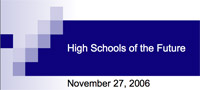
Share

U.S. Pushes the Use of Tutors at Failing Schools

Elaine Korry:

One of the key provisions of the No Child Left Behind law is that children in failing schools should be given extra help in the form of tutoring. Yet millions of students who are eligible for tutoring aren’t getting it. The U.S Education Department is warning school districts that, this fall, they must do a better job of signing families up.

audio. More here.

Share

Growing, Detrimental use of Powerpoint

I previously posted links to articles discussing the inappropriate use of Powerpoint – particularly in lower grades. I’ve been reading Thomas Rick’s “Fiasco” . Ricks’ mentions that Powerpoint was used to draft and communicate battle and reconstruction plans in Iraq:

[Army Lt. General David] McKiernan had another, smaller but nagging issue: He couldn’t get Franks to issue clear orders that stated explicitly what he wanted done, how he wanted to do it, and why. Rather, Franks passed along PowerPoint briefing slides that he had shown to Rumsfeld: “It’s quite frustrating the way this works, but the way we do things nowadays is combatant commanders brief their products in PowerPoint up in Washington to OSD and Secretary of Defense…In lieu of an order, or a frag [fragmentary order], or plan, you get a bunch of PowerPoint slides…[T]hat is frustrating, because nobody wants to plan against PowerPoint slides.”

Yet, Powerpoint is widely used in schools. Garr Reynolds has more.
Some alternatives – outliners that help conceptualize a work prior to expressing it in words. Internet outliners are extraordinarly powerful:

Much more, here.
Don Norman: In Defense of Powerpoint.

Share

Schools Try Elementary Approach To Teaching Foreign Languages

Maria Glod:

School systems across the Washington area are adding foreign language classes in elementary grades in response to a call from government and business leaders who say the country needs more bilingual speakers to stay competitive and even to fight terrorism.
Educators say that the youngest brains have the greatest aptitude for absorbing language and that someone who is bilingual at a young age will have an easier time learning a third or fourth language later on. Compared with adults or even high school students, young children are better able to learn German with near-native pronunciation or mimic the subtle tones of Mandarin.

Share

“Is Our Students Learning?”

Kevin Carey:

Imagine you’re about to put a chunk of your life savings into a mutual fund. Now imagine you peruse the various “best mutual fund” guides on the news rack, only to find they’re all missing crucial pieces of information. The guides list where the fund managers went to college, how much investment capital they’ve attracted, and what kind of “experience” investors had at the annual fund meeting. But they don’t tell you what you most want to know: What the funds’ rates of return have been–or if they’ve ever made a dime for anyone. You might still decide to invest in a mutual fund, but it would be a heck of a crapshoot. And with their scorecard hidden, fund managers wouldn’t be under much pressure to perform, let alone improve.
That imaginary mutual-fund market pretty much shows how America’s higher-education market works. Each year prospective college students and their parents pore over glossy brochures and phone-book-sized college guides in order to decide how to invest their hard-earned tuition money–not to mention four years of their lives. Some guides, like the popular rankings published by U.S. News & World Report, base ratings on factors like alumni giving, faculty salaries, and freshman SAT scores. Others identify the top “party schools,” most beautiful campuses, and most palatial dorms.
But what’s missing from all the rankings is the equivalent of a bottom line. There are no widely available measures of how much learning occurs inside the classroom, or of how much students benefit from their education. This makes the process of selecting a college a bit like throwing darts at a stock table. It also means that colleges and universities, like our imaginary mutual-fund managers, feel little pressure to ensure that students learn. As anyone who’s ever snoozed through a giant freshman psychology 101 lecture knows, sitting in a classroom doesn’t equal learning; knowledge doesn’t come by osmosis.

Related: Washington Monthly’s Annual College Guide.

(more…)

Share

Students Learn from Global Field Trips

Anita Clark:

or some students studying Chinese at Memorial High School, their summer assignment was intense: Spend three weeks in China, conversing with natives and exploring their culture.
“What surprised me is how different the rural area of China is from the big cities,” said Alison Knickelbine, 18, who plans to major in Chinese when she begins college this fall at the University of Hawaii in Manoa.
Nine young people and six adults who made the trip gathered recently for their first reunion, sharing a cake decorated with a Chinese proverb and laughing at memories such as sampling exotic food and planting bamboo in a panda reserve.
Ten young explorers from Sun Prairie’s two middle schools returned last month from the Amazon rainforest in Peru, where they expected to meet pink dolphins, spot umbrella birds and catch piranha.
“The kids learned an enormous amount of science,” said Geri Stenstrup, a teacher at Royal Oaks Elementary who led the trip two summers ago. Next year, she’ll take older teens to Serengeti National Park in Tanzania.
The China trip cost about $3,200 per person. Two students received full scholarships and one a partial scholarship, supported by fundraising projects such as selling Chinese dumplings and egg rolls in the Memorial lunchroom.
The Center for East Asian Studies at UW-Madison paid most costs for the accompanying teachers, and a grant will pay for developing curriculum from the trip.

Share

Good, Bad News on the Math Front

Karen Rouse:

When results are broken down by race, just 10 percent of black and Latino sophomores in Colorado schools are proficient in math; 90 percent are not.

Those scores are “scary,” said Jenna Fleur Lin, a math teacher who tutors high school students in the Cherry Creek School District and runs a free week-long math and science camp at an inner-city Denver church.

“What it means is you have a huge population that’s not going to function properly,” Lin said.

Moloney said one problem is that, unlike elementary and middle school students, high schoolers have the freedom to choose many of their own courses.
“Are minority youngsters being channelled into challenging programs or are you being (steered) to diminished programs?” he said.
Lin said she believes many students don’t have a solid foundation in math in elementary school.
They are just learning to do calculations but they don’t understand how to

Share

Acting White

Donna Ford, Ph.D., and Gilman Whiting, Ph.D., both of Vanderbilt University, are two leading African American education scholars who have dedicated their professional lives to the issue of minority achievement. Professor Ford is a nationally recognized expert in gifted education, multicultural education, and the recruitment and retention of diverse students in gifted education. Professor Whiting is a nationally recognized expert in African American male achievement and under-achievement. Professors Ford and Whiting made a two-part visit to the MMSD earlier this year, the result of an invitation from Diane Crear, recently retired MMSD Special Assistant to the Superintendent for Parent-Community Relations. As part of their program for minority parents, Professors Ford and Whiting talked about the research that attests so clearly to the importance of books in the home, reading to our children, talking with our children in intellectually stimulating ways, and taking an active interest in our children’s educational experience. They also showed the following segment from a June, 1999, episode of ABC’s “20/20.” The segment is entitled “Acting White” and was filmed at our own Madison East High School. It is thought-provoking, to say the least, and generated a lot of discussion amongst those in the audience last March when it was shown. We offer it to SIS readers for their thoughtful consideration.

20/20 Acting White (1999).

2020.jpg

Video

For more on the work of Drs. Ford and Whiting, here are two recent papers:
Ford, D. Y. & Whiting, G. W. (2006). Under-Representation of Diverse Students in Gifted Education: Recommendations for Nondiscriminatory Assessment (Part 1). Gifted Education Press Quarterly, 20(2), 2-6.
Moore, J. L., Ford, D. Y., & Milner, R. (2005). Recruitment Is Not Enough: Retaining African American Students in Gifted Education. Gifted Child Quarterly, 49, 51-67.

Share

The Complex Relationship Between Nature, Nurture, and Intelligence

After the Bell Curve
David L. Kirp
The New York Times
When it comes to explaining the roots of intelligence, the fight between partisans of the gene and partisans of the environment is ancient and fierce. Each side challenges the other’s intellectual bona fides and political agendas. What is at stake is not just the definition of good science but also the meaning of the just society. The nurture crowd is predisposed to revive the War on Poverty, while the hereditarians typically embrace a Social Darwinist perspective.
A century’s worth of quantitative-genetics literature concludes that a person’s I.Q. is remarkably stable and that about three-quarters of I.Q. differences between individuals are attributable to heredity. This is how I.Q. is widely understood — as being mainly “in the genes” — and that understanding has been used as a rationale for doing nothing about seemingly intractable social problems like the black-white school-achievement gap and the widening income disparity. If nature disposes, the argument goes, there is little to be gained by intervening. In their 1994 best seller, “The Bell Curve,” Richard Herrnstein and Charles Murray relied on this research to argue that the United States is a genetic meritocracy and to urge an end to affirmative action. Since there is no way to significantly boost I.Q., prominent geneticists like Arthur Jensen of Berkeley have contended, compensatory education is a bad bet.
But what if the supposed opposition between heredity and environment is altogether misleading? A new generation of studies shows that genes and environment don’t occupy separate spheres — that much of what is labeled “hereditary” becomes meaningful only in the context of experience. “It doesn’t really matter whether the heritability of I.Q. is this particular figure or that one,” says Sir Michael Rutter of the University of London. “Changing the environment can still make an enormous difference.” If heredity defines the limits of intelligence, the research shows, experience largely determines whether those limits will be reached. And if this is so, the prospects for remedying social inequalities may be better than we thought.

Share