School Information System

To Provide Quality Music Education Now, Schools Could Learn From the Past

Allan Kozinn:

School’s out for the holidays, and it’s probably the last thing on anyone’s mind. But in the marginalized world of music education, a good deal of serious thinking needs to be done. Now that Charles Dickens’s Christmas ghosts have made their rounds for the year, perhaps they might be enlisted to provide perspective and encourage some soul-searching.
The crisis of the moment has partly to do with Mayor Michael R. Bloomberg’s announcement last summer that New York City schools would be required to teach the arts, and that principals would be rated annually on their success, much as they are in other subjects. In theory this could put some muscle behind the adventurous curriculum (or blueprint, as it is called) that the city’s Department of Education and a panel of arts consultants drew up in 2004: a kindergarten-through-12th-grade program that envisions choral and instrumental performance, the fostering of musical literacy and the consideration of the role music plays in communities and the world at large. The music proposed for this course was admirably boundary-free, cutting a swath from Beethoven and Puccini through folk songs, spirituals, jazz and pop.
The problem is that the 2004 blueprint is recommended rather than required. Given the paucity of music teachers in the system — there was one music teacher for every 1,200 students in 2006, Education Department officials have said — schools that could execute it in all its glory were few. Exactly how (and how quickly) that can change is unclear.

Share

Study: Early academics indicate future successes

Phillip Swarts:

An understanding of basic math and reading is a better indicator of future academic success than behavior is in preschool and kindergarten students, according to a recent study led by a Northwestern professor.
SESP professor Greg Duncan led an 11-person team in a four-year study researching factors affecting how well students do in school.
“We were interested in assessing the relational predictive power of various skills … kids had when they entered school,” Duncan said.
The researchers studied students entering school, looking at their academic performance, sociability and the number of fights they were involved in. They looked at data for students, in some cases up to seventh grade, and found that those who mastered elementary math and literacy skills early on were more likely to succeed in school, regardless of behavior, than those who were well-behaved but didn’t master academics. The study controlled for economic and family factors.

Share

Students so much more than future cogs in the great GDP machine

Kevin Donnelly:

Judged by the Australian Labor Party’s education policy and subsequent comments by Deputy Prime Minister and Education Minister Julia Gillard, the answer is straightforward. In a recent interview in this paper, Gillard, on being asked the core purpose of her portfolio, replied: “So while my portfolio can be a mouthful, I’ll be happy to be referred to simply as ‘the minister for productivity’.”
Such a utilitarian view of education is mirrored by Labor’s policy document entitled Establishing a National Curriculum to Improve Our Children’s Educational Outcomes, released last February.
The opening paragraph, in justifying the need for a nationally consistent curriculum in core areas such as mathematics, the sciences, English and history, argues: “For Australia to succeed in a highly competitive global economy, our children need to have the best education possible.
“Better education outcomes deliver a real and tangible benefit to our nation’s economy, lifting productivity and allowing people to get better jobs that pay more.”
Referring to a speech by Productivity Commission head Gary Banks, Labor’s national curriculum paper justifies investing more in education by linking raised standards to increased productivity and building human capital. Another paper released early this year, Federalist Paper 2: The Future of Schooling in Australia, written on behalf of state and territory governments, also justifies the needto strengthen standards by linking education to higher economic efficiency and workforce participation.

Share

One in Five US Dropouts May be Gifted

Alison Kepner:

They are bored — so much so that they may not pay attention in class or will act out in frustration.
Some make poor grades, either because they no longer care or because they have spent so many of their younger years unchallenged that when they suddenly face a rigorous course in middle or high school, they don’t know how to study.
They are the nation’s gifted children, those with abilities beyond other children their age. Too many of their abilities, advocates argue, remain untapped by U.S. schools that don’t serve them as they focus instead on lifting low-achieving students to meet the goals of the federal No Child Left Behind law.
Statistically, 20 percent of U.S. school dropouts test in the gifted range, said Jill Adrian, director of family services at the Davidson Institute for Talent Development, a nonprofit founded by philanthropists Bob and Jan Davidson out of a concern that the nation’s most gifted and talented children largely are neglected and underserved.

Related: “They’re all rich, white kids and they’ll do just fine” by Laurie Frost & Jeff Henriques:

Two of the most popular — and most insidious — myths about academically gifted kids is that “they’re all rich, white kids” and that, no matter what they experience in school, “they’ll do just fine.” Even in our own district, however, the hard data do not support those assertions.
When the District analyzed dropout data for the five-year period between 1995 and 1999, they identified four student profiles. Of interest for the present purpose is the group identified as high achieving. Here are the data from the MMSD Research and Evaluation Report from May, 2000:
Group 1: High Achiever, Short Tenure, Behaved
This group comprises 27% of all dropouts during this five-year period.

Share

16 Year Old Mugged Near West High Thursday Evening

Madison Police Department:

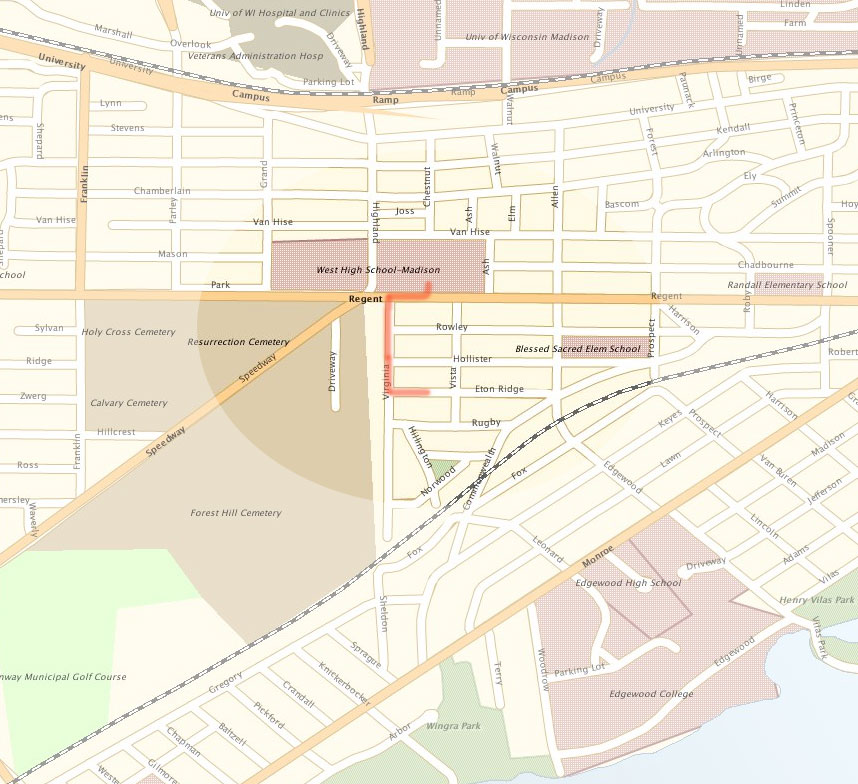
Around 6:26 p.m. on December 20th Madison police responded to the 2300 block of Eton Ridge to meet with a robbery victim. A 16-year-old told police he had just finished basketball practice and was crossing Regent Street when he observed a group of approximately seven individuals. The victim walked from Regent Street to Virginia Terrace [MAP]
to where his car was parked on Eton Ridge. As he neared his vehicle he says three from the group he had noted moments earlier came up quickly behind him. He says perpetrator #1 grabbed him and demanded money. He did not have any money. The victim says #1 next rummaged through his pockets and stole his iPhone.
No weapon was seen, and it is not known whether this robbery and another (case #152841) that happened on N. Mills Street two hours later are connected.

Share

A Few Words on Sports

Sports provide many opportunities for students, often well beyond the physical effort, competition and team building skills. These two articles provide different perspectives on sports, particularly the climate around such activities and the people who give so much time to our next generation.
Matthew Defour:

The Dane County Sheriff ‘s Office has fired Lt. Shawn Haney because he released to the Waunakee School District a report on a September underage drinking party allegedly involving Waunakee High School students.
Lester Pines, attorney for the 21-year veteran of the department who has no previous disciplinary record, said the termination was based on an ethics violation resulting from a “conflict of interest. ”
The sheriff ‘s report described a Sept. 30 incident that led to five people, including a member of the Waunakee High School football team, being charged with various misdemeanors. According to a criminal complaint filed Nov. 13, a witness told sheriff ‘s deputies investigating the party that “the majority of the Waunakee High School football team ” was at the party.
Waunakee School District Superintendent Charles Pursell did not return messages left Tuesday. He previously said several students, including football players, were disciplined in connection with the party and an elementary school teacher ‘s aide accused of hosting the party resigned. He also has said players weren ‘t disciplined before an important playoff game because the district ‘s investigation had not yet determined that any of them attended the party.

Bob Gosman:

The coaching lifer, much like the three-sport varsity athlete, is on its way to extinction.
But walk into a Wisconsin Lutheran boys basketball practice, and it’s obvious there is plenty of life left in that team’s 62-year-old coach.
It has been quite a season for Dale Walz and the Vikings (4-1). Walz picked up his 500th career victory Dec. 7 when the Vikings topped Hartford, 58-47. More good news came Sunday when he learned he will be enshrined in the Wisconsin Basketball Coaches Association Hall of Fame next October.
Walz, in his 35th year as a coach at the prep level, enjoys the game as much as ever. The Vikings play host to Slinger in a big Wisconsin Little Ten Conference game tonight at 7:30.
“I’ve known since college I wanted to be a high school basketball coach,” Walz said. “The challenge is always there. There’s not a day that goes by at any time of the year when I don’t think about basketball.”
Walz, an assistant principal at Wisconsin Lutheran, has remained true to himself while making subtle adjustments to how the game and kids have changed since he ran his first practice at Lakeside Lutheran in 1973.
“He’s still intense, but everybody mellows a little,” said Ryan Walz, Walz’s second-oldest son and the Vikings’ junior varsity coach. “He’s changed with the kids, which is part of the reason he’s coached as long as he has.”

I learned a number of things from my coaches many (!) years ago – including Walz. Those include:

  • the benefit of persistence and a willingness to keep on when most others give up, (I consider this an invaluable lesson),
  • Drive, sometimes bordering on fanaticism 🙂
  • The ability to push your body far beyond what was previously possible – and why that is important for one’s self confidence,
  • Competing against the best is the fastest route to improvement,
  • Duplicity, that is; things are not always black and white. The Waunakee story above reminded me of the fog that is athletic conduct rules (or, cheatingmore), something important to understand as one travels through life,
  • Growing up: the minute I realized that the NFL or NBA was not in my future, I became more interested in lifelong pursuits, including academics.

Looking back to the 1970’s, I am astonished at the level of time and effort my coaches put into a ragtag group of kids. Creating winners out of such raw material is an art.
Update: Susan Lampert Smith:

Boy, that Homecoming drinking party in Waunakee has a hangover that won’t go away.
So far, it’s cost the jobs of a Waunakee teacher’s aide, at whose home the party was allegedly held, and that of a 22-year veteran of the Dane County Sheriff’s Office, who was apparently fired ratting out the miscreants to the WIAA. Of course, that might have been because his son played for the football team of Waunakee’s arch rival, DeForest.
There are some lessons to be drawn from this fiasco: First, it seems that high school sports are just a little too important to people who are old enough to know better.
DeForest wasn’t the only Badger Conference town where people were rubbing their hands together in glee over rumors that, as one witness told the cops, “the majority of the Waunakee High School football team” was at the party. The celebrants hoped the players would get punished and miss some games. But really, why celebrate an event that could have cost lives in drunken-driving crashes?
Share

Madison School Board Votes for More Security Funds

Listen to the discussion [47MB MP3 Audio].

Andy Hall & Brittany Schoep:

“This is one of the most important things we’ve brought before you,” Rainwater told the board. “It is critically needed to ensure our schools continue to be safe.”
“We’re walking a really fine line right now,” School Board President Arlene Silveira said. “I think these positions will really help keep us on the positive side of that line.”
The high school positions are designed to help students with behavior, academic, social, transitional and other problems who can hurt themselves and the learning environment, Memorial High School Principal Bruce Dahmen said.

Susan Troller has more:

In an interview before Monday night’s meeting, Pam Nash, assistant superintendent for high schools and middle schools said, “The number of incidents I deal with in the high schools and middle schools is going up every year. We want to get a proactive handle on it. It’s as simple as that.”
“This is not only important but critical to the future of our schools,” Superintendent Art Rainwater said as he recommended an initial proposal to spend $720,500 for security measures. The money is available through the recently signed state budget, a windfall Madison schools did not know they would get when the Board inked the final budget in October.
The board approved hiring four case managers at East, West, Memorial and La Follette and five positive behavior coaches will be brought on board at O’Keeffe, Sherman, Jefferson, Black Hawk and Whitehorse middle schools.

Related:

Share

Top 10 Education Concerns

Michael Shaughnessy interviews the Washington Post’s Jay Matthews:

7) What do you see as the top ten concerns in education? What are the biggest concerns in the Washington Circle?

My concerns or Washington’s? I will go with mine:

  1. Low standards and expectations in low-income schools.
  2. Very inadequate teacher training in our education schools.
  3. Failure to challenge average students in nearly all high schools with AP and IB courses.
  4. Corrupt and change-adverse bureaucracies in big city districts.
  5. A tendency to judge schools by how many low income kids they have, the more there are the worse the school in the public mind.
  6. A widespread feeling on the part of teachers, because of their
    inherent humanity, that it is wrong to put a child in a challenging situation where they may fail, when that risk of failure is just what they need to learn and grow.

  7. The widespread belief among middle class parents that their child must get into a well known college or they won’t be as successful in life.
  8. A failure to realize that inner city and rural schools need to give students more time to learn, and should have longer school days and school years.
  9. A failure to realize that the best schools–like the KIPP charter schools in the inner cities—are small and run by well-recruited and trained principals who have the power to hire all their teachers, and quickly fire the ones that do not work out.
  10. The resistance to the expansion of charter schools in most school district offices.

Matthews list is comprehensive and on target.

Share

12 Ways to Make Your Kids Financially Savvy

Jonathan Clements:

Ten years after I am dead and gone, I suspect only two people will give much thought to me, and their names are Henry and Hannah.
They’re my legacy, so I hope they thrive — and I sure hope they remember me fondly.
Henry and Hannah are, of course, my children, now ages 15 and 19, respectively. Like any parent, I spend a lot of time thinking about my kids, including how I can best help them financially.
This isn’t simply about coughing up dollars and cents, though the sums involved have been frighteningly large. Rather, what it’s really about is passing along values.
Yes, I want my kids to be financially successful. But mostly, I want them to be competent, contented managers of their own money, so they don’t spend their lives agonizing over their finances and dogged by foolish mistakes.
I am not claiming to have the road map for every parent. We all have different values, different incomes and strong ideas about how best to raise children — and you will likely scoff at some of the things I’ve done. With that caveat, here are a dozen ways I have endeavored to help my kids financially.

Share

Where to Educate Your Child? Madison Area is #2

Via a reader’s email: David Savageau (Contributing Editor of Expansion Management Management):

Three out of 10 of us either work in an educational institution or learn in one. Education eats up 8% of the Gross National Product. Keeping it all going is the biggest line item on city budgets. Whether the results are worth it sometimes makes teachers and parents–and administrators and politicians–raise their voices and point fingers.
In the 1930s, the United States was fragmented into 130,000 school districts. After decades of consolidation, there are now fewer than 15,000. They range in size from hundreds that don’t actually operate schools–but bus children to other districts–to giants like the Los Angeles Unified District, with three-quarters of a million students.
Greater Chicago has 332 public school districts and 589 private schools within its eight counties. Metropolitan Los Angeles takes in 35 public library systems. Greater Denver counts 15 public and private colleges and universities. Moving into any of America’s metro areas means stepping into a thicket of school districts, library systems, private school options and public and private college and universities.

Here are some of their top locations:

  1. Washington, DC – Arlington, VA
  2. Madison, WI
  3. Cambridge-Newton-Framingham
  4. Baltimore -Towson
  5. Akron, OH
  6. Columbus, OH
  7. Albany-Schenectady-Troy, NY
  8. Syracuse, NY
  9. St. Louis, MO
  10. Ann Arbor, MI

The Madison area has incredible resources for our children. The key of course, is leveraging that and being open to working effectively with many organizations, something Marc Eisen mentioned in his recent article. Madison’s new Superintendent has a tremendous opportunity to leverage the community from curricular, arts, sports, health/wellness, financial and volunteer perspectives.
Related:

The Capital Times:

The Madison area, which includes all of Dane County as well as immediately adjoining areas, was awarded A+ for class size and spending per pupil in public schools, and for the popularity of the city’s public library.
The greater Madison area scored an A for being close to a college town and for offering college options.
Private school options in the greater Madison area were graded at B+.
There has been some confusion in the response to the rankings because they lump together numerous school districts — urban, suburban and rural.

Channel3000:

The engineering-based program is just one example of the district’s willingness to bring college-level learning to his high school students. That effort appears to be paying off nationally, WISC-TV reported.
“It reinforces that what we’re trying to do as a district and as an area is working,” said Granberg. “And it’s getting recognized on a national level, not just a local or state level.”
“This is not a community that accepts anything but the best and so that bar is always high,” said Madison Metropolitan School District Superintendent Art Rainwater.
Rainwater also credits the ranking to teacher development programs.
“We spend an awful amount of time and an awful amount of effort working with our teachers in terms of how they deliver instruction to individual children,” said Rainwater.
He said the school district will continue to improve techniques, focusing on the needs of every student.

Share

2007 High School Challenge Index

Washington Post:

The Washington Post Challenge Index measures a public high school’s effort to challenge its students. The formula is simple: Divide the number of Advanced Placement, International Baccalaureate or Cambridge tests a school gave by the number of seniors who graduated in June. Tests taken by all students, not just seniors, are counted. Magnet or charter schools with SAT combined verbal and math averages higher than 1300, or ACT average scores above 27, are not included, since they do not have enough average students who need a challenge.
The rating is not a measurement of the overall quality of the school but illuminates one factor that many educators consider important.

Local schools on the list include: Madison Memorial and Verona

Share

Online teaching tools catching on in traditional schools

Amy Hetzner:

When students from her 10th-grade honors class returned from summer break, Arrowhead High School teacher Kathy Nelson organized an online open-house activity to discuss three novels they had read during their time off.
After six hours, the English teacher at the Hartland school had a 178-page transcript of her students’ dialogue and a new appreciation of the power the remote technology of the Internet can lend to the sometimes intensely interpersonal field of teaching.
“You think of computers as being cold,” she said. “But they were really into some deep topics.”
Even as fully virtual schools face an uncertain future after a state appeals court this week found one such school violated state laws, most of today’s students are more likely to encounter an online learning experience like that practiced in Nelson’s honors English classroom.
Instead of replacing the face-to-face interaction of a brick-and-mortar school with a virtual-school experience, Nelson and other teachers throughout the Milwaukee area are using online discussion boards, textbooks, surveys and collaborative features to extend class time beyond the traditional school day.

Share

Schools Accused of Mainstreaming to Cut Costs

John Hechinger:

For years, Jonathan Schuster’s mother begged the public schools here to put her son in a special program where he could get extra help for his emotional problems. By 11th grade, Jonathan had broken his hand punching a wall and been hospitalized twice for depression — once because he threatened to kill himself with a pocket knife.
But teachers insisted that Jonathan, who suffers from attention deficit disorder, learning disabilities and bipolar disorder, could get by in regular classrooms. His mother, Kathleen Lerch, says the reason was cost. “It was all about the bottom line,” she says. Citing confidentiality, school officials declined to discuss Jonathan’s case but said they seek to provide an appropriate education to all children.
Advocates for the disabled have long promoted the inclusion of special-education children in regular classes, a practice called mainstreaming. Many educators view mainstreaming as an antidote to the warehousing of children with special needs in separate, and often deficient, classrooms and buildings.
Now, some experts and parents complain that mainstreaming has increasingly taken on a new role in American education: a pretext for cost-cutting, hurting the children it was supposed to help. While studies show that mainstreaming can be beneficial for many students, critics say cash-hungry school districts are pushing the practice too hard, forcing many children into classes that can’t meet their needs. Inclusion has evolved into “a way of downsizing special education,” says Douglas Fuchs, a Vanderbilt University education professor.
Districts have a powerful motivation to cut special-education costs. U.S. schools spend almost twice as much on the average disabled student as they do on a nondisabled peer, according to a 2004 federal study. But the study also found that, in recent years, per-student special-education costs rose more slowly than for the general population. One of the likely reasons, researchers found, was cost savings from mainstreaming.

Share

Madison: Missed Opportunity for 4K and High School Redesign

Marc Eisen:

The good news is that the feds refused to fund the school district’s proposal to revamp the high schools. The plan was wrongheaded in many respects, including its seeming intent to eliminate advanced classes that are overwhelmingly white and mix kids of distressingly varied achievement levels in the same classrooms.
This is a recipe for encouraging more middle-class flight to the suburbs. And, more to the point, addressing the achievement gap in high school is way too late. Turning around a hormone-surging teenager after eight years of educational frustration and failure is painfully hard.
We need to save these kids when they’re still kids. We need to pull them up to grade level well before they hit the wasteland of middle school. That’s why kindergarten for 4-year-olds is a community imperative.
As it happens, state school Supt. Elizabeth Burmaster issued a report last week announcing that 283 of Wisconsin’s 426 school districts now offer 4K. Enrollment has doubled since 2001, to almost 28,000 4-year-olds statewide.
Burmaster nailed it when she cited research showing that quality early-childhood programs prepare children “to successfully transition into school by bridging the effects of poverty, allowing children from economically disadvantaged families to gain an equal footing with their peers.”

Related:

Share

Insiders’ Guide to AP and IB

Jay Matthews:

The Washington Post sports pages this weekend were full of detailed analyses of our beloved local football, basketball and baseball teams. It was inside stuff, lapped up by readers like me who care about these sports and love to see the latest numbers.
Why can’t we get that excited about what is happening inside our schools? Okay, watching great teachers explain the mysteries of plate tectonics or cultural assimilation is not as exciting as seeing Todd Collins complete a pass to Ladell Betts for a touchdown. But our schools do have some intriguing statistics, just like sports teams. I spent my weekend using them to look inside several high schools in the Washington area and finding some thrilling surprises.
Last week’s column was about the new best high schools list in U.S. News & World Report, and how it compares to the Challenge Index list in Newsweek. That is, as the economists say, the macro part of the school assessment game, the big picture. Today, I want to look at the micro part, the inside-the-school perspective, aided by the latest Challenge Index rankings of this region’s 186 public high schools, coming out in The Post and on this Web site Thursday.
The Challenge Index ranks schools by their college-level test participation rates — the number of Advanced Placement, International Baccalaureate and other college-credit exams given at each school, divided by the number of graduating seniors. I do not factor in how well students do on those exams in the main rankings, because I have been convinced by successful AP and IB teachers that even students who struggle with the exams are much better off academically than if they did not take a college-level course and test at all.

Share

Madison Schools Consider an Increase in School Safety/Security Spending

Susan Troller:

We are at a point in our high schools and middle schools where we need to take some action to assure the public that our schools remain safe and secure,” Superintendent Art Rainwater said. He noted that public safety had become a significant issue in neighborhoods throughout the city.
But long time board member Carol Carstensen asked to table the proposal, and other board members agreed to put the decision off a week for more study.
“I’m probably going to vote for it,” she said. “But I would like a little more time and more details in the next week.”

Related:

Share

Madison Teachers Protest Larger Class Size

Channel3000:

Many of Madison’s elementary school teachers spoke out to the Madison Metropolitan School District’s Board of Education on Monday night.
Carrying brightly colored signs, the group protested the increased class size for gym, arts and computer classes. The larger related arts classes are known by some as “one and one-half classes,” WISC-TV reported.
District officials started the policy at the elementary level this year to save money.
Some teachers said their students, many of whom come from low-income backgrounds, are getting short-changed.
“I teach in a school with 46 percent or more kids on free or reduced lunch,” said Rhonda Schilling, a music teacher for Thoreau and Hamilton elementary schools. “Many of the kids come from really rough backgrounds, and those are the kids in particular that shine often in the arts. They need that contact time with their teacher.”

Share

Commentary on The Wisconsin Virtual School Ruling

  • State Representative Brett Davis:

    Just as modern technology is allowing many people in our country to work out of their home, innovative public school districts nationwide are allowing students to learn from home via virtual schools without having to attend a traditional brick-and-mortar school. Our education system in Wisconsin utilizes virtual schools, which are changing the way education is delivered to some students. As we prepare our children for the 21st Century workplace, we have to seriously consider the role of virtual schools and how they can enhance student achievement. We must ensure our state laws allow public schools to continue offering this important alternative school setting.
    Virtual schools are not for every student. They certainly are not meant to, and will not, replace traditional brick-and-mortar schools. Virtual schools simply are an option for certain students who learn better outside of the traditional classroom setting. Gifted and talented students, as well as students with special needs, can benefit from this model of learning. To ensure high quality, state licensed teachers monitor a student’s progress, while parents play an active role in the daily education of their child.

  • Mike Plaisted:

    Since first posting about the Court of Appeals decision that eliminated funding for the so-called Wisconsin Virtual Academy (WIVA) last week, I have had a fairly active and interesting comment thread (as has, way on the other side of the issue, Rick Esenberg).
    I spent some time engaging on the comments with some of the usual suspects saying the usual things – Dad29: “In the end, the Leftist State will have unfettered power and control over all its citizens. So the ideology is about control (power.)”; karl marx: “What a surprise!! Mike Plaisted is against children and for the UNION.” There were also the K12 talking-points to deal with on mainstream radio (MSR) and the wing-nut blogs – you know, WEAC is just interested in money and protecting their union hacks in the classrooms; the opinion means we can’t our kids with homework anymore; and blah-di blah blah.

Details: A blow to innovation: The Legislature should ensure that online public schools can continue serving students in Wisconsin.

Share

Madison School Board Debates School Security

WKOW-TV:

The Madison school board on Monday night is set to consider approving a $780,000 plan to tackle problem behavior in middle and high schools.
Principals have been complaining that behavior issues are creeping up, said Assistant Superintendent Pam Nash. That includes everything from running in the hallways to bullying to fighting.
School officials want to hire what amounts to be a behavior coach in its middle and high schools. The staff person would work with students with behavior issues, reaching out to them and contacting their parents or county agencies, as needed.

Channel3000:

At the high school level, the proposal would add four behavior and case managers to work with students who are already having problems, who may be disengaged or disruptive.
At the middle school level, the district wants to add seven and a half positive behavior coordinators who would help teach students how to be better school citizens.
“In our middle schools, I would say if there is one area that we have seen a bit of a shift in behavior, it’s bus behavior,” said Pam Nash, assistant superintendent for Madison Middle and High Schools. “We have more issues on middle school buses than any of us would like. That’s an area, that behavior piece, that we want to target as well.”
Part of the school security proposal would include adding two extra security guards at each of the city’s four high school and installing surveillance and radio equipment at middle schools.

Share

Fixing schools usually fails

Liz Bowie:

Maryland’s attempts to turn around its worst schools in the past several years have largely failed, according to a report by a Washington-based nonprofit education research group.
Of the 76 schools labeled failing for at least five years, only 12, or 16 percent, have improved significantly since 2004, the Center on Education Policy found.
“Even in an advanced state like Maryland, that has tried to deal with these problems for a decade … we just don’t know what to do,” said Jack Jennings, president of CEP.

Share

Casting for Knowledge

Mark Coddington:

Jesus Reyes, a fifth-grader at Dodge Elementary School, stands in front of a green piece of fabric in the school’s library, reading a script he wrote about last week’s Grand Island sewer emergency.
As the camera on a MacBook laptop records him, an image on its screen replaces the fabric with photos Jesus took on a trip to the city’s wastewater plant this week.
Later, a classmate, Dayne Jaros, records an introduction to Jesus’ piece, handing his Internet viewers off to “our on-the-spot reporter, Jesus.”
The end result, an audio and video broadcast accessed over the Internet, is miles beyond kids fiddling around with their parents’ video camera for a school project.
In fact, increasingly elaborate podcasts like Jesus and Dayne’s are giving several area schools a medium for largely self-directed projects that provide a whole new realm to bring writing, reading and listening skills to life.
With podcasts, “learning becomes more than just a grade in the gradebook,” said Jamey Boelhower, who teaches English at Centura public school near Cairo. “It matches the culture and the world they’re growing up in.”
At Lincoln Elementary School, about a dozen students are working on a range of podcasting projects, most of them with only basic staff instruction, said Maura Hendrickson, the school’s integration specialist.

Anne Eisenberg:

These days, students who miss an important point the first time have a second chance. After class, they can pipe the lecture to their laptops or MP3 players and hear it again while looking at the slides that illustrate the talk.
At least two companies now sell software to universities and other institutions that captures the words of classroom lectures and syncs them with the digital images used during the talk — usually PowerPoint slides and animations. The illustrated lectures are stored on a server so that students can retrieve them and replay the content on the bus ride home, clicking along to the exact section they need to review.
When it’s time to cram, the replay services beat listening to a cassette recording of a class, said Nicole Engelbert, an analyst at Datamonitor, a marketing research company in New York.
“Students already have an iPod and they already use them all the time,” she said. “You don’t need to train them.”
Professors who know less than their students do about MP3 players won’t be at a disadvantage, because the systems require little technical skill to operate. “The best lecture-capture solutions simply require the speaker to turn on a mike and push a button to start the recording,” she said. “They are simple to use.”

Share

Just Another Big Con: The Crisis in Mathematics and Science Education

Dennis Redovich:

What is the rationale for all United States high students passing three advanced courses in math and science to receive a high school diploma? What is the rationale for “all” high school graduates satisfying the requirements for admission to a four-college program? There is none!
The United States is the uncontested leader of the world in scientific research in respect to published accomplishments, Nobel Prizes, volume of research and expenditures on scientific research. The United States is the leader of the world in technology and the unchallenged leader of the world in the global economy. The United States dominates the world because of its educational systems, including K-12 public education, post-secondary colleges and universities that produce the most highly educated, productive and successful workforce in the world.

Share

A Vote for Latin: Roma urbs aeterna; Latina lingua aeterna

Harry Mount:

AT first glance, it doesn’t seem tragic that our leaders don’t study Latin anymore. But it is no coincidence that the professionalization of politics — which encourages budding politicians to think of education as mere career preparation — has occurred during an age of weak rhetoric, shifting moral values, clumsy grammar and a terror of historical references and eternal values that the Romans could teach us a thing or two about. As they themselves might have said, “Roma urbs aeterna; Latina lingua aeterna.”*
None of the leading presidential candidates majored in Latin. Hillary Clinton studied political science at Wellesley, as did Barack Obama at Columbia. Rudy Giuliani had a minor brush with the language during four years of theology at Bishop Loughlin Memorial High School in Brooklyn when he toyed with becoming a priest. But then he went on to major in guess what? Political science.
How things have changed since the founding fathers.

Share

Millar: Improving education in math and science

Terry Millar:

Improvement in math and science education is a priority in Madison, as it is across the nation.
Science, technology, engineering and math (STEM) training is not only of growing importance to our technology-dependent society, these disciplines also represent esthetically compelling advances in human knowledge that all students should have the opportunity to appreciate.
Since 2003, UW Madison and the Madison School District have been involved in a unique partnership, funded by the National Science Foundation, to reform science and math education from kindergarten through graduate school.
Preliminary results are encouraging. This five-year endeavor, SCALE — System-wide Change for All Learners and Educators — has partners that include three universities and large school districts in Madison, Los Angeles, Denver and Providence, R.I. The NSF made exploring new forms of partnership its key feature.
Improving STEM education has proven resistant to traditional “you do your thing, I ‘ll do mine ” approaches. SCALE ‘s successes underscore the wisdom of NSF ‘s emphasis on partnership.
SCALE incorporates research on student learning and teacher professional development. SCALE puts premiums on increasing teachers ‘ STEM subject matter knowledge and boosting their teaching skills.
In one preliminary study, teachers showed a significant increase in content knowledge after attending SCALE science professional development institutes in Los Angeles.
SCALE partners believe the most important resource in a school is its teachers, an idea that has not always been central to reform. However, the final measure of effectiveness is increased student understanding and performance. In 2009-2010, a randomized study involving 80 elementary schools in Los Angeles will provide definitive data on SCALE ‘s impact on student performance in science.

Links:

(more…)

Share

OU study looks into how parenting affects teens

AP:

An ongoing study done by the University of Oklahoma Health Sciences Center is examining how parenting and other factors affect the long-term behavior of teenagers.
The “youth asset study” is being funded by the federal Centers for Disease Control and Prevention. Researchers are looking at how 17 “assets,” including parental involvement and religion, factor into teenage behavior.
During the past five years, researchers have interviewed 2,200 Oklahoma City-area children and their parents, looking into risky behaviors and the level of parental involvement. The goal of the $4 million study is to determine which assets strongly correlate with well-adjusted teens and, conversely, those assets that don’t seem to affect teens involved in activities including drug use and sex.
“The most important analysis will be to see how these (behaviors) change over time … and how the presence or absence of assets contributes to those changes,” said principal investigator Roy Oman, an associate professor at the OU College of Public Health.

Complete Report.

Share

Parents are the Problem (WEAC & Wisconsin DPI Sue to Kill the Wisconsin Virtual Academy)

Rose Fernandez, via a reader’s email:

On Tuesday of this week, in a Waukesha courtroom, the state governmental agency responsible for our public schools and a labor union came before the Wisconsin Court of Appeals and pleaded with the judges to keep parents out of public schools. Yes, that’s right. The state and the teachers union are at war with parents and I’m mad as heck about it. (Madder than heck, actually, but trying to keep this blog family friendly).
According to the Department of Public Instruction and the state teachers’ union, parents are the problem. And these bureaucracies know just how to fix it. They want to keep parents, and indeed anyone without a teaching license, out of Wisconsin public schools.
Of course WEAC, the state teachers’ union, likes that idea. Licenses mean dues. Dues mean power.
DPI likes it because ……..well, could it be just because WEAC does?
The lawsuit before the Court of Appeals was filed by WEAC in 2004 in an effort to close a charter school that uses an on-line individualized curriculum allowing students from all over the state to study from home under the supervision of state certified faculty. The school is the Wisconsin Virtual Academy (WIVA). The Northern Ozaukee School District took the bold step of opening this new kind of school in the fall of 2003 after DPI approved their charter. Hundreds of families around the state enrolled their children under open enrollment that first year and mine was one of them. WIVA has grown every year since and this year has more than 800 students.
In January of 2004, WEAC filed their lawsuit against the school and DPI who authorized its existence. Later that year in a stunning reversal DPI switched sides and moved to close its own public school. DPI alleges that parents are too involved in their own children’s education.
That’s right. They argue parents are too involved.
I’ve always thought parental involvement in a child’s education was a good thing. What do I know? I don’t have a teacher’s license.

This issue was discussed extensively by Gregg Underheim during the most recent Wisconsin DPI Superintendent race (April, 2005). Audio / Video here.
Much more on the Wisconsin Virtual Academy. Also check out www.wivirtualschoolfamilies.org.

Share

Teachers draft reform plan

Howard Blume:

In this education nirvana, teachers would decide what to teach and when. Teachers and parents would hire and fire principals. No supervisors from downtown would tell anyone — neither teachers nor students — what to wear.
These are among the ideas a delegation of teachers and their union officers are urging L.A. schools Supt. David L. Brewer to include in the school reform plan he will present to the school board Tuesday.
If Brewer passes on the delegation’s proposals, the union can go directly to the seven-member Board of Education. Employee unions recently have had success in getting the board to overrule the superintendent on health benefits for some part-time workers and on school staffing.
At stake now is the Los Angeles Unified School District’s effort to turn around its 34 most troubled middle and high schools. The data suggests the urgency: As many as three-quarters of the students in these “high priority schools” scored well below grade level across multiple subjects on last year’s California Standards Tests.
Whatever remedy emerges is likely to become a blueprint for widespread reform efforts. Brewer and his team are working on their 11th draft; the drafts have evolved significantly since September because of resistance inside and outside the school system.

Share

My Sorority Pledge? I Swore Off Sisterhood

Kelly Valen:

MY life’s greatest sorrow stems from my inability to feel close to other women. At 41, I’ve cautiously cultivated a few cherished female friendships. But generally I feel a kind of skittish distrust and discomfort when dealing with most women, particularly women in packs.
……
I want to remain optimistic. After all, here I am with three daughters. What am I to teach them? Cautionary tales about men’s harmful proclivities abound. But how do we help our girls navigate the duplicitous female maze? How do we ensure that they behave authentically, respect humanity over fleeting alliances, and squash the nasty tribal instincts that can inflict lifelong distress?

Share

Prufrock’s Gifted Child Information Blog

When I took my first serious history course in college, the president of the university (a history buff himself) spoke to our class and encouraged us to submit our papers to various journals for publication. Being rather inexperienced, it had never occurred to me to submit anything I had ever written to anyone for publication. In my mind, I was “just” a student and couldn’t imagine anyone being interested in what I wrote.
Now it is possible not only for serious college students to publish their work, but it is also possible for serious high school history students to publish the papers that they have researched. The Concord Review gives young people this opportunity. The Review is the only quarterly journal in the world to publish the academic expository research papers of secondary history students. Papers may be on any historical topic, ancient or modern, foreign or domestic.
Many of these young authors have sent reprints of their papers along with their college application materials. Their research has helped them to gain admission to some of the nation’s (and world’’s) best universities.

(more…)

Share

Who’s the Old Guy in the White Nikes?

Nicholas Casey:

Late one spring afternoon last year, a mystery man sat in the back of a creative-writing seminar at Stanford. Evidently a student, he was much older than anyone else in the room. He was wearing a black blazer and white Nikes. He said his name was Phil.
As the days passed, the man’s identity gradually came into focus. The instructor “made several vague allusions to Phil taking off in his private jet,” recalls André Lyon, an English major enrolled in the class. And tales about Michael Jordan found their way into the man’s literary discourse.
After a couple of weeks, a rumor began to circulate that the old dude in the Nikes was Philip H. Knight, the billionaire founder of the world’s largest sportswear company.

Share

Young, Gifted and Skipping High School

Maria Glod:

As Jackie Robson rushed off to Japanese 101, a pink sign on the main door of her college dorm reminded her to sign out. There were more rules: an 11 p.m. curfew, mandatory study hours, round-the-clock adult supervision and no boys allowed in the rooms.
Jackie is 14. She never spent a day in high school.
Like the other super-bright girls in her dorm, the Fairfax County teen bypassed a traditional education and countless teenage rites, such as the senior prom and graduation, to attend the all-female Mary Baldwin College in the Shenandoah Valley.
The school offers students as young as 12 a jump-start on college in one of the leading programs of its kind. It also gives brainy girls a chance to be with others like them. By all accounts, they are ready for the leap socially and emotionally, and they crave it academically.
Last spring, Jackie finished eighth grade at Langston Hughes Middle School in Reston. This fall, she’s taking Psychology 101, Japanese 101, English 101, Folk Dance and U.S. History 1815-1877: Democracy and Crisis.

Share

Unemployment Training (The Ideology of Non-Work Learned in Urban Schools)

Via a kind reader email: Martin Haberman:

For many urban youth in poverty moving from school to work is about as likely as having a career in the NBA.While urban schools struggle and fail at teaching basic skills they are extremely effective at teaching skills which predispose youth to fail in the world of work.The urban school environment spreads a dangerous contagion in the form of behaviors and beliefs which form an ideology.This ideology “works” for youngsters by getting them through urban middle and secondary schools.But the very ideology that helps youth slip and slide through school becomes the source of their subsequent failure.It is an ideology that is easily learned, readily implemented, rewarded by teachers and principals, and supporting by school policies.It is an ideology which schools promulgate because it is easier to accede to the students’ street values than it is to shape them into more gentle human beings.The latter requires a great deal of persistent effort not unlike a dike working against an unyielding sea.It is much easier for urban schools to lower their expectations and simply survive with youth than it is to try to change them.
The ideology of unemployment insures that those infected with it will be unable to enter or remain in the world of work without serious in-depth unlearning and retraining.Urban youth are not simply ill prepared for work but systematically and carefully trained to be quitters, failures, and the discouraged workers who no longer even seek employment.What this means is that it is counterproductive to help urban schools do better at what they now do since they are a basic cause of their graduates living out lives of hopelessness and desperation.
The dropout problem among urban youth–as catastrophic as it is–is less detrimental than this active training for unemployment.We need be more concerned for “successful” youth who graduate since it is they who have been most seriously infected.They have been exposed longest, practiced the anti-work behaviors for the longest period, and been rewarded most.In effect, the urban schools create a pool of youth much larger than the number of dropouts who we have labeled as “successful” but who have been more carefully schooled for failure.

Clusty Search on Martin Haberman. Haberman is a Distinguished Professor of Education at the University of Wisconsin-Milwaukee.

Share

Matching Top Colleges, Low Income Students

Jim Carlton
Wall Street Journal
Last year, when Amherst College welcomed 473 new students to its idyllic campus, 10% of them came from QuestBridge.
But QuestBridge is no elite private school. It’s a nonprofit start-up in Palo Alto, Calif., that matches gifted, low-income students with 20 of the nation’s top colleges. In return, the schools — including Princeton, Yale, Stanford and Columbia — give scholarships to the students and pay QuestBridge for helping to diversify their student bodies.
The program is gaining in popularity because it addresses a growing interest of private and public colleges: increasing the diversity of their student bodies without relying solely on race. Since some states banned racial preferences in college admissions, many public colleges have begun focusing on income as a means to broaden the backgrounds of their students. Private schools, while not bound by the states’ restrictions, are also eager to admit more students from low-income families.
QuestBridge isn’t the only program that helps schools achieve diversity by focusing on the economically disadvantaged. The Posse Program, launched in 1993 by a New York nonprofit, specializes in sending groups of students who already know each other to top colleges. It got its start after the founder, Deborah Biel, discovered that several of the inner-city youth she had worked with in New York had dropped out of college. When she asked why, one responded that he didn’t have his posse with him.
Another program called Mathematics, Engineering, Science Achievement, or MESA, helps recruit low-income students for the University of California, California State University and other California colleges. Upward Bound, a long-running federal program, feeds low-income high-school students into colleges all over the country. And some colleges, including schools that are partnering with QuestBridge, have begun their own recruiting programs for low-income students.
The efforts come as diversity remains elusive, particularly at elite colleges. According to a 2004 study by the Century Foundation, a New York-based research group, at the 146 most selective colleges in the U.S., just 3% of the students came from families that ranked in the bottom 25% in income, while 74% came from the top 25%.

(more…)

Share

What Exactly are Kids Reading in those “Reading Blocks”?

Karin Chenoweth:

Whenever I hear about elementary schools that have cut out social studies and science instruction in order to devote 90 minutes or even two hours a day to reading instruction, my main question is, “What on earth are the kids reading for all that time?”
It’s a rhetorical question because I pretty much know what they are reading—they are reading folk tales, adventure stories, relationship stories, some humor (the author of Captain Underpants must be very wealthy by now). Sometimes they will read some non-fiction, but not usually in any kind of coherent fashion. The kids will read a story about butterflies and then one about bicycles and one about Martin Luther King, Jr. None of this is objectionable, but it is not providing them the real intellectual nutrition children need and crave—a carefully chosen course of reading in science and history that will allow them to understand those stories about butterflies and Martin Luther King, Jr.
The reading blocks kids have been sentenced to are not devoted solely to reading. They often spend an inordinate amount of time on “reading strategies,” which give me a headache just thinking about them—predicting, summarizing, outlining, making text-to-text connections, identifying the “purpose” of reading a particular work—the list goes on and on. Not that there’s anything wrong with any of them, but a little of them goes a long way. The countless hours that are being spent on reading strategies would be much better spent on building the store of background knowledge children need to be able to comprehend sophisticated text, including textbooks, newspapers, magazines, and all the things educated citizens are expected to be able to read.

Watch or listen to a recent Madison speech by Karin Chenoweth.

Share

Certain high schools have a remarkable record of sending their students to elite colleges

Ellen Gamerman:

As college-application season enters its most stressful final stretch, parents want to know if their children’s schools are delivering the goods — consistently getting students into top universities.
It’s a tricky question to answer, but for a snapshot, The Wall Street Journal examined this year’s freshman classes at eight highly selective colleges to find out where they went to high school. New York City private schools and New England prep schools continue to hold sway — Phillips Academy in Andover, Mass., is a virtual factory, sending 19 kids to Harvard this fall — but these institutions are seeing some new competition from schools overseas and public schools that focus on math and science.
The 10 schools that performed best in our survey are all private schools. Two top performers overall are located in South Korea. Daewon Foreign Language High School in Seoul sent 14% of its graduating class to the eight colleges we examined — that’s more than four times the acceptance rate of the prestigious Horace Greeley High School in Chappaqua, N.Y.
No ranking of high schools is perfect, and this one offers a cross-section, rather than an exhaustive appraisal, of college admissions. For our survey, we chose eight colleges with an average admissions selectivity of 18% and whose accepted applicants had reading and math SAT scores in the 1350-1450 range, according to the College Board: Harvard, Princeton, MIT, Williams, Pomona, Swarthmore, the University of Chicago and Johns Hopkins. Some colleges that would otherwise have met our criteria were excluded from our study because information on their students’ high-school alma maters was unavailable. All the colleges in our survey received a record number of applications last year.

Share

The Secret to Raising Smart Kids

Carol Dweck:

Hint: Don’t tell your kids that they are. More than three decades of research shows that a focus on effort—not on intelligence or ability—is key to success in school and in life.
Growing Pains

  • Many people assume that superior intelligence or ability is a key to success. But more than three decades of research shows that an overemphasis on intellect or talent—and the implication that such traits are innate and fixed—leaves people vulnerable to failure, fearful of challenges and unmotivated to learn.
  • Teaching people to have a “growth mind-set,” which encourages a focus on effort rather than on intelligence or talent, produces high achievers in school and in life.
  • Parents and teachers can engender a growth mind-set in children by praising them for their effort or persistence (rather than for their intelligence), by telling success stories that emphasize hard work and love of learning, and by teaching them about the brain as a learning machine.

Share

Update on Credit for non-MMSD Courses, including Youth Options Program:

Madison School Board Performance & Achievement Committee Meeting 11/26/2007At the November 26, 2007 meeting of the MMSD BOE’s Performance and Achievement Committee [18MB mp3 audio], the District’s Attorney handed out a draft of a policy for the District’s Youth Options Program dated November 20, 2007. It is a fine working draft. However, it has been written with rules making it as difficult as possible for students to actually take advantage of this State-mandated program. Thus, I urge all families with children who may be affected by this policy now or in the future to request a copy of this document, read it over carefully, and then write within the next couple of weeks to all BOE members, the District’s Attorney, Pam Nash, and Art Rainwater with suggestions for modifications to the draft text. For example, the current draft states that students are not eligible to take a course under the YOP if a comparable course is offered ANYWHERE in the MMSD (i.e., regardless of whether the student has a reasonable method to physically access the District’s comparable course). It also restricts students to taking courses at institutions “located in this State” (i.e., precluding online courses such as ones offered for academically advanced students via Stanford’s EPGY and Northwestern’s CTD).
The Attorney’s memorandum dated November 21, 2007 to this Committee, the BOE, and the Superintendent outlined a BOE policy chapter entitled “Educational Options” that would include, as well, a policy regarding “Credit for Courses Taken Outside the MMSD”. Unfortunately, this memo stated that this latter policy as one “to be developed”. It has now been almost 6 years (!) since Art Rainwater promised us that the District would develop an official policy regarding credit for courses taken outside the MMSD. A working draft available for public comment and BOE approval has yet to appear. In the interim, the “freeze” the BOE unanimously approved, yet again, last winter has been ignored by administrators, some students are leaving the MMSD because of its absence, and chaos continues to rein because there exists no clearly written policy defining the rules by which non-MMSD courses can be taken for high school credit. Can anyone give us a timetable by which an official BOE-approved policy on this topic will finally be in place?
Links:

Share

In Praise of “Thought Competition” (Writing, Math and other Academic Competitions)

Rebecca Wallace-Segall:

Monday: After a long day at his New York City private school, Ben, 16, heads to my creative writing lab to work on his heartfelt memoir about his parents’ bitter divorce. Tuesday: Alison, 15, rushes from her elite private school in the Bronx to work on her short screenplay about a gifted, mean and eccentric boy. Lily, 13, pops in whenever she can to polish her hilarious short story narrated by an insomniac owl.
Ben, Alison and Lily, along with another few dozen who attend my afterschool writing program, also attend top-notch New York private schools that cost upwards of $25,000 a year. So why, one might wonder, do these kids need an extracurricular creative writing coach? The answer is simple, though twisted: Their schools — while touting well-known athletic teams — are offshoots of the “progressive education” movement and uphold a categorical belief that “thought competition” is treacherous.
Administrators of these schools will not support their students in literary, science or math competitions, including the most prestigious creative writing event in the country: the Scholastic Art & Writing Awards. So we at Writopia Lab help these kids to join the 10,000 young literati from across the country who are hurrying to meet the event’s January deadline, as well as deadlines for other competitions.
For decades now, psychology and pedagogy researchers have been debating the impact of competition on young people’s self-esteem, with those wary of thought competition taking the lead. Most New York parents of public or private school students have felt the awkward reverberations of this trend — which avoids naming winners — when Johnny takes home a certificate for “participation” in the school’s science fair. (Do you hang that one up on the wall?)
But some, and ironically those who attend some of the most desirable schools in the region, feel the reverberations in deeper, more painful ways. “Two years after my son left a school that prohibited him from entering a national math competition,” says one mother, “he still writes angry essays about why the jocks in his former school were allowed to compete throughout the city while he wasn’t allowed to win the same honors for his gifts.” Sam, her son, felt uncool in the eyes of his peers, and undervalued (and sometimes even resented) by the administration.
Mel Levine, a professor at the University of North Carolina and one of the foremost authorities in the country on how children learn, believes the impact of the collaborative education movement has been devastating to an entire generation. When students are rewarded for participation rather than achievement, Dr. Levine suggests, they don’t have a strong sense of what they are good at and what they’re not. Thus older members of Generation Y might be in for quite a shock when they show up for work at their first jobs. “They expect to be immediate heroes and heroines. They expect a lot of feedback on a daily basis. They expect grade inflation, they expect to be told what a wonderful job they’re doing,” says Dr. Levine.

Links:

Share

New York Grades Set Off Debate on Judging Schools


Elissa Gootman & Jennifer Medina:

Not long after Schools Chancellor Joel I. Klein announced plans last year to give grades of A through F to schools, principals at some of New York City’s coveted specialized high schools grew concerned. With the city looking to reward gains among the lowest-achieving students, how would the elite schools be judged?
The principals peppered the administration with ideas for extra credits for their schools: perhaps counting how many Advanced Placement tests students pass or the college credits they accumulate. In the end, the city decided to tie bonus points for these schools to high scores on state Regents exams.
That served the gold-standard Stuyvesant High School well, propelling it from a high B to a comfortable A. But the principal of Brooklyn Technical High School, Randy J. Asher, called the decision “ridiculous,” saying it contradicted a core principle of the report cards: the need to gauge how far students have come, rather than simply how they perform.
“I think we all really came to the table saying, let’s find something fair for schools like ours,” Mr. Asher, whose school earned a B, said in a recent interview. “And I don’t think we succeeded.”

Share

Thinking About Mistakes

Alina Tugend:

On one hand, as children we’re taught that everyone makes mistakes and that the great thinkers and inventors embraced them. Thomas Edison’s famous quote is often inscribed in schools and children’s museums: “I have not failed. I have just found ten thousand ways that won’t work.”
On the other hand, good grades are usually a reward for doing things right, not making errors. Compliments are given for having the correct answer and, in fact, the wrong one may elicit scorn from classmates.
We grow up with a mixed message: making mistakes is a necessary learning tool, but we should avoid them.
Carol S. Dweck, a psychology professor at Stanford University, has studied this and related issues for decades.
“Studies with children and adults show that a large percentage cannot tolerate mistakes or setbacks,” she said. In particular, those who believe that intelligence is fixed and cannot change tend to avoid taking chances that may lead to errors.
Often parents and teachers unwittingly encourage this mind-set by praising children for being smart rather than for trying hard or struggling with the process.
For example, in a study that Professor Dweck and her researchers did with 400 fifth graders, half were randomly praised as being “really smart” for doing well on a test; the others were praised for their effort.
Then they were given two tasks to choose from: an easy one that they would learn little from but do well, or a more challenging one that might be more interesting but induce more mistakes.
The majority of those praised for being smart chose the simple task, while 90 percent of those commended for trying hard selected the more difficult one.
The difference was surprising, Professor Dweck said, especially because it came from one sentence of praise.

Share

Facing Down the Skeptics in Education

Karin Chenoweth:

Whenever I speak about my book, It’s Being Done: Academic Success in Unexpected Schools, I know I will face at least a few skeptics—and sometimes more than a few. They can easily be identified by their questions and comments. For example, they ask whether the schools I profile in the book are magnet schools or in some way select their students. I patiently explain that they don’t. Or, they will say, “I have unions in my school,” as though that would explain why they can’t make any improvements. Since some of the most impressive schools I profile in the book are in New York, Philadelphia, and St. Paul—all places with very powerful and serious teacher unions—I tell them that unions by themselves don’t seem to be an obstacle. Or, they say, “I have a lot of low-income kids in my district,” allowing that fact to speak for itself as an explanation for why their schools are low-performing.
I always answer as fully as I can, but I know that I probably haven’t convinced them that the schools are as I report them to be—high achieving or rapidly improving with student populations that are mostly either students of poverty or students of color or both. I know many people in my audience simply cannot envision schools that are as good as I say they are or educators who are as uncompromising and frank as I portray them.

Chenoweth recently appeared in Madison.

Share

How to Fix Struggling High Schools

Jay Matthews:

I think the people running our high schools, as well we parents, need to stop making compromises that sustain the cycle of failure. Kind and thoughtful educators and parents, such as the ones in Parker’s articles, are trying to get through each day without hurting too many feelings or forcing too many confrontations. When the choice is between letting standards continue to slip or making a scene, few people want to be drama queens, which is too bad.
The best inner-city educators begin each day knowing they are going to have to confront apathy again and again. They shove it away as if it were a kidnapper trying to steal their children. To succeed, a high school like Coolidge needs a unified team of such people, who follow the same standards of regular attendance, daily preparation for school, high achievement and attention and decorum in the classroom.
It sounds impossible, but it’s not. There are inner-city schools right now, including some charter, religious and private schools that operate that way. It takes strength and intelligence and humor and love for young people, and an abhorrence for the limp compromises that have created such sickly schools as Coolidge.
I asked several expert educators how they would fix schools like that. Michael A. Durso, principal of Springbrook High School in Silver Spring, said: “These problems did not occur overnight and will not be resolved easily or in a short time.” Michael Riley, superintendent of the Bellevue, Wash., schools, said: “Anyone who thinks there is a quick fix, that taking a couple of dramatic steps will make this situation better overnight, is kidding himself.”

Share

Time to think global in testing U.S. students

Raymond Scheppach:

Today, it’s less important how students in Iowa or Oregon compare to those in Alabama or Virginia on a national test. What matters most is how students in North Carolina or Texas compare to those in Denmark or Russia, and so on.
In short, educational protectionism is outdated and ignores the realities of the 21st century global economy.
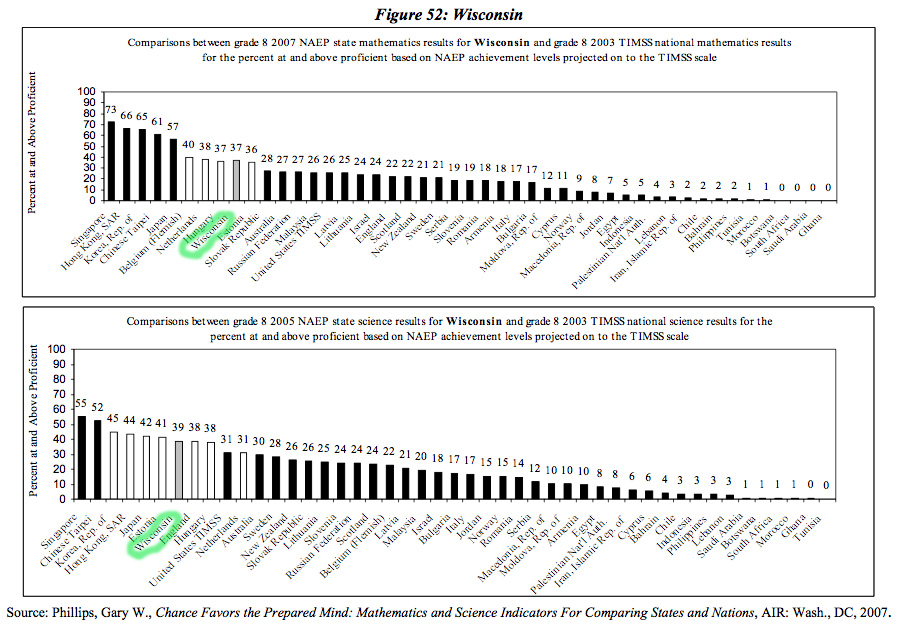
In the Global Competitiveness Report 2007–2008 released last month by the World Economic Forum, the United States again ranked as the world’s most competitive economy. Yet the 2003 Trends in International Mathematics and Science Study (TIMSS) study, administered in 46 countries, found that U.S. eighth-graders ranked 14th in mathematics achievement. And on the 2003 Programme for International Student Assessment (PISA) survey, U.S. students placed below average in math, science and problem-solving among countries belonging to the Organization for Economic Co-operation and Development. This is a major concern because the most important factor in competitiveness is education and training of the labor force. Thus, U.S. education performance today is the best indicator of America’s competitiveness tomorrow.

Share

Madison School District Administration Presentation on High School Redesign

The Madison School viewed a presentation from the Administration Monday evening on their proposed High School redesign. Listen via this mp3 audio file (or watch the MMSDTV Video Archive).
Susan Troller:

“Sometimes institutional history can be a weight around your neck,” Rainwater noted. “This can be an opportunity to bring in new ideas, and new blood,” he added.
Rainwater has said change is necessary because high schools today look and feel much like they have for generations but that students will live and work in a world that has changed dramatically, and which demands new skills and abilities.
He acknowledged that the path was likely to be bumpy, and noted that the plan — which has been developed thus far without public input — recognizes that there are major concerns in the community regarding changes to Madison’s school system.
Some of those concerns include worries about trying to balance resources among students of widely varying abilities, about “dumbing down” the curriculum with inclusive classrooms, the potential for the high schools to lose their unique personalities and concerns that addressing the broad ranges of culture in the district will not serve students well.

Background:

Share

Curriculum Acceleration/Middle School Charter Meeting: November 26 at 11:30 a.m.

A group of parents will be gathering to discuss developing a public school charter (or other educational alternatives) for middle schoolers who need an advanced level and faster pace of instruction (curriculum acceleration). Our first meeting will be Monday, November 26 at 11:30 am for lunch at the Sun Print Cafe, 1 South Pinckney Street [Map], in the US Bank building. If interested, please email Bonnie at pbe@terracom.net.

Share

English, Algebra, Phys Ed … and Biotech

G. Pascal Zachary:

MORE than a decade ago, after George Cachianes, a former researcher at Genentech, decided to become a teacher, he started a biotechnology course at Lincoln High School in San Francisco. He saw the class as way of marrying basic biotechnology principles with modern lab practices — and insights into how business harvests biotech innovations for profit.
If you’re interested in seeing the future of biotechnology education, you might want to visit one of George Cachianes’s classrooms. “Students are motivated by understanding the relationships between research, creativity and making money,” he says.
Lincoln has five biotech classes, each with about 30 students. Four other public high schools in San Francisco offer the course, drawing on Mr. Cachianes’s syllabus. Mr. Cachianes, who still teaches at Lincoln, divides his classes into teams of five students; each team “adopts” an actual biotech company.
The students write annual reports, correspond with company officials and learn about products in the pipeline. Students also learn the latest lab techniques. They cut DNA. And recombine it. They transfer jellyfish genes into bacteria. They purify proteins. They even sequence their own cheek-cell DNA.

Share

Seeking a ‘Gold Standard’ in D.C. Charter Education

Jay Matthews:

In the charter school movement’s endless quest to recruit students, some of the best independent public schools support each other by word of mouth. The KIPP DC: KEY Academy, a high-performing middle school, has sent 15 graduates to Washington Mathematics Science Technology, one of the better charter high schools. But KIPP teachers steer their graduates away from some charter schools.
“If I said which they were, the principals would kill me,” said Susan Schaeffler, KIPP DC’s executive director.
Now, some charter leaders in the city that is a national epicenter for their movement are planning to take the next step in this sifting process. They say they want to create a “gold standard designation,” to publicly identify for the first time which charters are doing the most to raise teaching quality and academic achievement for low-income students.
Ramona Edelin, executive director of the D.C. Association of Chartered Public Schools, likened the initiative to a certification system to show “what high quality really means in terms of children of color from impoverished backgrounds, which is the vast majority of the students charter schools educate here.”

Share

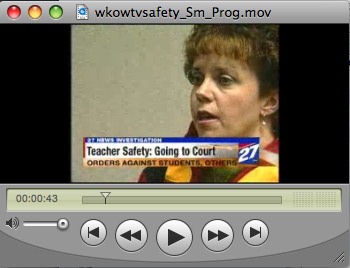
Madison Teacher Safety: Going to Court

WKOWTVWKOW-TV [Watch Video | mp3 Audio]:

February 13 became a tense day in two, separate Madison schools.
Police reports show a fifteen year old student at Memorial High School became angry with special education teacher Tim Droster. Another staff member told officers the student made motions to mimic the act of shooting Droster. The student was arrested.
At Cherokee Heights Middle School, police reports show a thirteen year old student reacted to being denied laptop computer priveleges by posing this question to special education assistant Becky Buchmann: “Did you want me to gun you down?” Juvenile court records show the student had previously shot an acquaintance with a BB gun, and Madison Teachers Inc. (MTI) information stated the student had also brought a BB gun to school and had gang affiliation.
Buchmann went to court and obtained a restraining order against the student.
Droster worked through school officials and his threatening student was given a different school schedule and new conduct rules.
Attorney Jordan Loeb has represented teachers seeking restraining orders to protect themselves in the classroom. “It’s controversial,” Loeb told 27 News.
But Loeb said teachers are no different than someone from any other walk of life when it comes to needing the authority of a judge to insure a threatening person does not cause harm.
“When it’s your safety on the line, you have to do everything you believe is necessary to keep yourself safe.”
Loeb estimated an average of ten teachers and other school staff members per year over the past decade have obtained restraining orders against threatening students and adults in Dane County courts.
But school district statistics show a more than five fold increase in teacher and staff injuries caused by students in the past three years.
In 2003, of 532 injury reports submitted by teachers and staff members, 29 were the result of student assaults.
In 2006, 540 teacher and staff injury reports involved 153 student assaults.
School district spokesperson Ken Syke said the most recent student assault numbers may be inflated by the inclusion of teacher injuries incidental to fights between students.

Related:

Share

‘No Child’ Data on Violence Skewed: Each State Defines “Dangerous School”

Nelson Hernandez:

A little-publicized provision of the No Child Left Behind Act requiring states to identify “persistently dangerous schools” is hampered by widespread underreporting of violent incidents and by major differences among the states in defining unsafe campuses, several audits say. Out of about 94,000 schools in the United States, only 46 were designated as persistently dangerous in the past school year.
Maryland had six, all in Baltimore; the District and Virginia had none.
At Anacostia Senior High School last school year, private security guards working under D.C. police recorded 61 violent offenses, including three sexual assaults and one assault with a deadly weapon. There were 21 other nonviolent cases in which students were caught bringing knives and guns to school. Anacostia is not considered a persistently dangerous school.
One high school in Los Angeles had 289 cases of battery, two assaults with a deadly weapon, a robbery and two sex offenses in one school year, according to an audit by the U.S. Department of Education’s inspector general. It did not meet the state’s definition of a persistently dangerous school, or PDS. None of California’s roughly 9,000 schools has.
The reason, according to an audit issued by the Department of Education in August: “States fear the political, social, and economic consequences of having schools designated as PDS, and school administrators view the label as detrimental to their careers. Consequently, states set unreasonable definitions for PDS and schools have underreported violent incidents.”
Critics of the law, including lawmakers who hope the policy can be changed as part of the reauthorization of No Child Left Behind, say the low number is a sign the legislation is not working.

Share

Madison School District School Security Discussion

Madison School Board: Monday evening, November 12, 2007: 40MB mp3 audio file. Participants include: Superintendent Art Rainwater, East High Principal Al Harris, Cherokee Middle School Principal Karen Seno, Sennett Middle School Principal Colleen Lodholz and Pam Nash, assistant Superintendent for Secondary Schools.
A few notes:

  • First 30 minutes: The City of Madison has agreed to fund police overtime in the schools. Johnny Winston, Jr. asked about supporting temporary “shows of force” to respond to issues that arise. Maya Cole asked what they (Administrators) do when staff choose not to get involved. East High Principal Al Harris mentioned that his staff conducts hall sweeps hourly. Sennett Principal Colleen Lodholz mentioned that they keep only one entrance open during recess.
  • 52 minutes: Al Harris discussed the importance of consistency for staff, students and parents. He has named an assistant principal to be responsible for security. East now has data for the past year for comparison purposes. Additional assistant principals are responsible for classrooms, transitions and athletics.
  • 55 minutes: Art Rainwater discussed District-wide procedures, a checklist for major incidents and that today parents are often informed before anyone else due to cell phones and text messaging.
  • Recommendations (at 60 minutes):
    • Pam Nash mentioned a strong need for increased communication. She discussed the recent West High School community forums and their new personal safety handbook. This handbook includes an outline of how West is supervised.
    • 68 to 74 minutes: A discussion of the District’s equity policy vis a vis resource allocations for special needs students.
    • 77 minutes – Steve Hartley discusses his experiences with community resources.
    • 81+ minutes: Steve Hartley mentioned the need for improved tracking and Art Rainwater discussed perceptions vs what is actually happening. He also mentioned that the District is looking at alternative programs for some of these children. Student Board Representative Joe Carlsmith mentioned that these issues are not a big part of student life. He had not yet seen the new West High safety handbook. Carol Carstensen discussed (95 minutes) that these issues are not the common day to day experiences of our students and that contacts from the public are sometimes based more on rumor and gossip than actual reality.

I’m glad the Board and Administration had this discussion.
Related:

Share

African-American dads and others here size up Bill Cosby’s tough love talk

Pat Schneider:

There’s a crisis among young African-American males in Madison, says Kenneth Black, president of 100 Black Men of Madison.
High school drop-out rates, low employment, a high incidence of jail and prison time — and beneath it all, a growing number of black children growing up without a father.
“It definitely needs to be dealt with,” said Black, a division administrator in the state Department of Veteran Affairs. “There’s a huge void in most of these kids’ lives. They need to see positive African-American role models who are successful in the community. They need to see us,” he said.
100 Black Men of Madison may be best known for its back-to-school backpack giveaway that draws hundreds of children each year, but its bedrock program is mentoring. “Our intent is to get these young men and expose them to the more positive things in life: the Overture, sporting events, UW and places outside our community,” Black said.
Black was among several local African-Americans interviewed for this article who had praise, and some criticism, for the rallying cry to social responsibility raised by comedian Bill Cosby.
“Some people are not happy with Bill Cosby for airing dirty laundry,” said Johnny Winston Jr., a member of the Madison School Board. “But it’s not like he’s saying something we don’t know.”
Barbara Golden, an advocate for children and families in Dane County, said it was good that the discussion opened by Cosby was taking place outside just African-American circles. “We are very much a part of America. What happens to us should be the concern of everybody,” Golden said.
The African-American culture also has a strong influence on mainstream U.S. culture, she noted, noting how white kids’ performances at a recent Madison middle-school talent show borrowed heavily from hip-hop.
“No one can sit and say, ‘This doesn’t affect me,'” she said.
Cosby’s book published last month, “Come On People: On the Path from Victims to Victors” is just the latest round in a years-long confrontation with his fellow African-Americans.

Additional links and notes on Bill Cosby [RSS]

Share

Minnesota’s Science, Technology, Engineering and Mathematics Forums

John Katsantonis:

In the process of researching where the U.S. ranks internationally in science and math education, I discovered that one of the Democratic presidential candidates (the one who’s governor of a Southwestern state) keeps citing our nation’s current rank as No. 29 (or, on a good day, No. 28) after our having been No. 1 throughout the world.
Apparently neither statistic is true, however, which suggest that it may be Bill Richardson himself who needs a bit of remedial math.
This is not the first time our national educational system has been politicized. Fifty years ago, a global scientific effort called the International Geophysical Year (IGY) encompassed 11 Earth sciences: aurora and airglow, cosmic rays, geomagnetism, gravity, ionospheric physics, longitude and latitude determinations (precision mapping), meteorology, oceanography, seismology and solar activity.
The Soviet Union celebrated IGY by launching the first artificial satellite (Sputnik) one month into the event on Oct. 1, 1957. We countered with the discovery of the Van Allen radiation belts and the discovery of mid-ocean submarine ridges, which was an important confirmation of plate tectonics.
Immediately following the successful orbiting of Sputnik, attendant paranoia regarding U.S. loss of the space race converted our collaboration with the country into a major retooling of the nation’s school curricula. The focus would now be on science and mathematics.
It’s impossible to deny a general decline in these areas nationally versus India and a handful of other countries that emphasize science, technology, engineering and mathematics (STEM) education on a cultural level. In recent years, Minnesota has been adamant and resolute about creating and maintaining collaboration between the private and public sectors to improve these areas of learning among K-12 students statewide.

Share

The Power of Birth Order


Jeffrey Kluger:

In 1883, the year Elliott began battling melancholy, Teddy had already published his first book and been elected to the New York State assembly. By 1891—about the time Elliott, still unable to establish a career, had to be institutionalized to deal with his addictions—Teddy was U.S. Civil Service Commissioner and the author of eight books. Three years later, Elliott, 34, died of alcoholism. Seven years after that, Teddy, 42, became President.
Elliott Roosevelt was not the only younger sibling of an eventual President to cause his family heartaches—or at least headaches. There was Donald Nixon and the loans he wangled from billionaire Howard Hughes. There was Billy Carter and his advocacy on behalf of the pariah state Libya. There was Roger Clinton and his year in jail on a cocaine conviction. And there is Neil Bush, younger sib of both a President and a Governor, implicated in the savings-and-loan scandals of the 1980s and recently gossiped about after the release of a 2002 letter in which he lamented to his estranged wife, “I’ve lost patience for being compared to my brothers.”

Share

Excuses are not an option

Alan Borsuk:

There are casual days at Milwaukee College Preparatory School when it comes to what students can wear. Polo shirts (red for almost all the students and yellow for standouts who have earned privileges) are the uniform for those days. Other days, students have to wear blazers and ties.
But there are no casual days at the school when it comes to academics, even down to the kindergartners.
“Let’s go, let’s go, let’s go, let’s go,” eighth-grade math teacher Edward Richerson exhorts his students as a half dozen head toward the blackboard to solve some equations. They’re not moving fast enough for him.
A couple of them falter in their explanations. “What I’ve told you not to do is get lazy on these equations, which is what you’ve done,” Richerson says. If you’re not getting them, it’s not because you’re not smart enough, he says. “Since we are overachievers,” he begins as he tells them why they have to be as picky about the details of the answers as he is.
In a 5-year-old kindergarten class, children do an exercise in counting and understanding sequences of shapes. Four-year-olds are expected to be on the verge of reading by Christmas.
In national education circles, phrases such as “no excuses” and names such as “KIPP” have come to stand for a hard-driving approach to educating low-income urban children, and that includes longer days, strict codes of conduct, an emphasis on mastering basics and a dedication among staff members approaching zeal. The Knowledge Is Power Program, or KIPP, operates 57 schools in cities around the country and has a record that is not perfect but is noteworthy for its success.
Milwaukee College Prep, 2449 N. 36th St., is the prime example in Milwaukee of a no-excuses school. The charter school, which is publicly funded and was chartered through the University of Wisconsin-Milwaukee, is not formally a KIPP school, although it is affiliated with the KIPP movement.

Milwaukee College Preparatory School’s website.

Share

UW-Madison Odyssey Project Video

Watch or download (ctrl-click here for the mp4 file) a 20 minute video on the UW-Madison’s Odyssey Program.

Thanks to Laurie Frost for obtaining this video.

Share

A Discussion of the Madison School District’s Expulsion Process

Madison School Board: Monday evening, November 12, 2007: 45MB mp3 audio file.

Share

U.S. students ‘middle of the pack’ compared with world


Click for a larger version of this image.

Greg Toppo:

Educators and politicians these days make a point of saying that U.S. schoolchildren aren’t just competing locally for good, high-paying jobs — they’re competing globally.
A detailed study lets them know just how well kids may do if they really compete globally someday — and it’s not exactly pretty.
Crunching the most recent data from a pair of U.S. and international math and science exams for middle-schoolers, Gary Phillips, a researcher at the non-profit American Institutes for Research (AIR), a non-partisan Washington think tank, finds a decidedly mixed picture: Students in most states perform as well as — or better than — peers in most foreign countries.
But he also finds that even those in the highest-scoring states, such as Massachusetts and Minnesota, are significantly below a handful of top-scoring nations such as Singapore, Hong Kong, South Korea, Taiwan and Japan.

1.9MB PDF Report:

In mathematics, students in 49 states and the District of Columbia are behind their counterparts in Singapore, Hong Kong, South Korea, Taiwan and Japan. Students in Massachusetts are on a par with Japanese students, but trail the other four nations. In science, students in Massachusetts, Minnesota, Montana, New Hampshire, North Dakota, South Dakota, Vermont and Wisconsin trail only students in Singapore and Taiwan, while performing equal or better than students in the other 45 countries surveyed.
“More than a century ago Louis Pasteur revealed the secret to invention and innovation when he said ‘chance favors the prepared mind’. The take away message from this report is that the United States is loosing the race to prepare the minds of the future generation,” said Dr. Phillips.
Students in the District of Columbia had the lowest U.S. performance in mathematics (they did not participate in the science test). In math, the average D.C. student is at the Below Basic level, putting them behind students in 29 countries and ahead of those in 14 countries. In science, nine states are at the Below Basic level: Florida, Arizona, Louisiana, Nevada, New Mexico, Alabama, Hawaii, California and Mississippi.

Clusty Search: National Assessment of Educational Progress (NAEP) | Trends in International Mathematics and Science Study (TIMMS)

Share

AP vs. IB vs. Neither: A Plea for Peace and Love

Jay Matthews:

Watch out. Tumultuous days are ahead in the war of advocates for college-level high school courses such as Advanced Placement and International Baccalaureate, particularly with the rise of some schools that say their teachers can do a better job without AP or IB.
Insults are flying. Good people could get hurt. I have a peace plan, but first let’s inspect the battlefield.
The AP vs. IB topic on my Admissions 101 discussion group at the Web site has 1,233 posts and more are pouring in. At the same time, educators who want to banish AP from their schools just launched a new Web site, ExcellenceWithoutAP. On Wednesday, the Thomas B. Fordham Institute at edexcellence will release one of the most detailed AP vs. IB comparisons ever: “Advanced Placement and International Baccalaureate: Do They Deserve Gold Star Status?”
The Fordham report looks like a peace-making gesture, since it concludes that both programs “set high academic standards and goals for learning” and provide exams that allow students to “apply their knowledge in creative and productive ways.” But the AP vs. IB combatants will likely squabble over slight differences in the grades Fordham gave AP and IB courses in biology and math. And the ExcellenceWithoutAP people are going to hate the parts of the Fordham report that warn against attempts, like theirs, to make college-level courses in high school more thematic and deny students — at least in Fordham’s view — the solid facts, such as “the names, dates, events, documents and movements important to our history.”
The College Board still dominates the battlefield, with more than 14,000 high schools using its AP program. IB has only about 500. ExcellenceWithoutAP lists about 50 schools that have dropped or never had AP. This is a big jump from the 12 schools identified in this column two years ago. But even this group is made up of schools so small that they produce less that one-fifth of 1 percent of U.S. high school seniors graduating each year.

Share

Montgomery School’s New Take On Ability Grouping Yields Results

Via a reader email – Daniel de Vise:

In a notebook on her desk at Rock View Elementary School, Principal Patsy Roberson keeps tabs on every student: red for those who have failed to attain proficiency on Maryland’s statewide exam, an asterisk for students learning English and squares for black or Hispanic children whose scores place them “in the gap.”
Roberson and the Rock View faculty are having remarkable success lifting children out of that gap, the achievement gap that separates poor and minority children from other students and represents one of public education’s most intractable problems.
They have done it with an unusual approach. The Kensington school’s 497 students are grouped into classrooms according to reading and math ability for more than half of the instructional day.
The technique, called performance-based grouping, is uncommon in the region. Some educators believe it too closely resembles tracking, the outmoded practice of assigning students to inflexible academic tracks by ability.
Educators say Rock View, however, is using the same basic concept to opposite effect, and the results have been positive. While some other Montgomery County schools serving low-income populations have posted higher test scores, few have shown such improvement or consistency across socioeconomic and racial lines.

Joanne has more.

Share

On American School Reform: the pressure for change is coming from parents, which bodes well

The Economist (Los Angeles & New Orleans):

OUTSIDE New York, as usual, it is a different story. Most American mayors look longingly at Michael Bloomberg’s accomplishments and wish they were equally mighty. West of the Mississippi, none has succeeded in seizing control of a school system. Nor are they likely to be able to do so: the early 20th century progressive movement, strongest in the West, severely blunted their powers. “We haven’t had reform from the top here,” says Eli Broad, a Los Angeles philanthropist. “So instead we’re seeing change from the bottom up.”
In the vanguard are charter schools like the Academy of Opportunity [Ask Google Live Yahoo] in south-central Los Angeles. Here 13- and 14-year-olds, almost all of them black or Hispanic, firmly shake your hand and outline their plans to go to Yale and Stanford. They work long hours—from 7.30am to 5pm five days a week, plus four hours every other Saturday. The grind pays off. At the end of their first year in the school just 28% of pupils are proficient or advanced in maths, compared to 48% of pupils elsewhere in California. By the time they leave, three years later, they far outperform their peers.

Share

Drama at East and West

Need a Little Drama in Your Life?
Come support the drama communities at East and West!
At West HS [Map] — “I Hate Hamlet”
Friday, November 9, 7:30
Saturday, November 10, 7:30
Tickets $5.00
At East HS [Map] — “The Crucible”
Thursday, November 15, 7:30
Friday, November 16, 7:30
Saturday, November 17, 2:30 and 7:30
Tickets $5.00

Share

Seeking Parents’ Help in Saving a Great Elementary School Program

The program is a small, mixed-age classroom for first through third graders at the Montessori Children’s House on Madison’s west side, where my eldest child currently attends preschool. It is in danger of being eliminated because of diminishing enrollment. I think that this would be a horrible loss to many academically talented children who would do so well there. They do so many things right there, such as:

  • Nurturing, home-like environment in which intense curiosity is normal
  • Mixed-age classroom, which encourages children to work at their own pace
  • Elegant learning materials
  • Freedom of movement and plenty of outside time
  • Freedom to follow their own intellectual curiosity
  • No busy work
  • No homework (unless the child chooses to keep working on something after school)
  • Emphasis on peace and global citizenship
  • Healthy snacks provided, healthy lunch to be brought from home
  • Parental involvement welcomed (the school is a parent run co-op)

As a small community, it would only take a few more children to keep the program viable. If you are the parent of a child who would benefit from such an environment, would you please look at the school’s website http://www.madisonmontessori.org/programs/elementary/Elem_intro.html
and maybe take some time to observe the classroom?
Our family is committed to public schools, and we know that a school district needs talented kids and engaged families to thrive. This program would allow kids to integrate back into the public schools at a fairly young age, while protecting and nurturing them through a critical period of development.
Upon re-reading this message, it sounds like I’m making a blatant marketing pitch (which, frankly, I am). Please forgive me and understand that my only interest in the program is that it survive so that it is an option for my two children, ages 4 and 1, when they are old enough to need it. I hope that there are a few families here who might find a home there. Sincerely, Dawn M. Rappold [drappold@gmail.com]

Share

“Blowing the Lid Off Reading Achievement”: Putting All the Pieces Together Audio/Video

Karin Chenoweth

mp3 audio file

Drs. Sally and Bennett Shaywitz

mp3 audio file

October 12/13 Conference Information:

Extraordinary progress in understanding the nature of reading and dyslexia, including their neural underpinnings, have direct implications for the earlier and more accurate identification and more effective treatment of dyslexia. This presentation focuses on these discoveries and their translation into clinical practices for overcoming dyslexia and for appreciating the sea of strengths associated with dyslexia.

Click on the photos to watch the video, or download the mp3 audio files.

Share

Video/Audio: Madison United for Academic Excellence Meeting on Charter Schools 10/29/2007

mp3 audio file

Paula Sween and Dory Witzeling from the Odyssey-Magellan charter school for gifted students in grades 3-8 in Appleton and Senn Brown of the Wisconsin Charter Schools Association participated in a recent Madison United for Academic Excellence event. Ms. Sween was one of the founders of the Odyssey-Magellan program. She is currently the TAG Curriculum Coordinator for the Appleton school district. Ms. Witzeling is a teacher and parent at the school.
Click on the photo to view the video.
Share

Dane County, WI AP High School Course Comparison

A quick summary of Dane County, WI High School 2007-2008 AP Course Offerings (source – AP Course Audit):

  • Abundant Life Christian School (3 Courses)
  • Cambridge (1)
  • DeForest (7)
  • Madison Country Day (International Baccalaureate – IB. However, Madison Country Day is not listed on the approved IB World website.)
  • Madison East (11)
  • Madison Edgewood (11)
  • Madison LaFollette (10)
  • Madison Memorial (17)
  • Madison West (5+1 2nd Year Calculus which “prepares students for the AP BC exam”)
  • Marshall (5)
  • McFarland (6)
  • Middleton – Cross Plains (7)
  • Monona Grove (7)
  • Mount Horeb (5)
  • Oregon (9)
  • Sauk Prairie (10)
  • Stoughton (6)
  • Sun Prairie (13)
  • Verona (10)
  • Waunakee (6)
  • Wisconsin Heights (6)

Links and course details are available here.
Related: Dual Enrollment, Small Learning Communities and Part and Full Time Wisconsin Open Enrollment.
Via a kind reader’s email.

Share

Open Source Reading Instruction

free-reading.net:

Free-Reading is an “open source” instructional program that helps teachers teach early reading. Because it’s open source, it represents the collective wisdom of a wide community of teachers and researchers. It’s designed to contain a scope and sequence of activities that can support and supplement a typical “core” or “basal” program.

Via a reader’s email.

Share

If only the good news about Wisconsin education was true

Roger Frank Bass:

Finally, there was some really good news about education. According to the Wisconsin Department of Public Instruction, the percentage of proficient readers in the third grade had increased from 64.8% in 1998 to 87.4% in 2005. And this improvement was broad-based – every minority group advanced substantially.

If only it were true

Deception No. 1: Test questions, their scoring and definitions of “proficiency” changed constantly. The number of test items, the kinds of items (multiple choice vs. short answer) and their content varied every year the test was given. The score needed for proficiency dropped more than 40%, from 50 in 1998 to 29 in 2005.

That sleight of hand entailed complex statistics to estimate how hard the revised test might be for the next crop of third-graders. That estimate, rather than criteria for effective reading, became the cutoff for proficiency. Obviously, even if mathematics could prove that two tests are equally hard, changing the questions every year meant that subsequent tests weren’t assessing the same thing. The tests were apples and oranges, and the mathematics a red herring.

Deception No. 2: Reading skills were less important than student guessing, and the test’s margin of error. Fifty-three of the test’s 58 items were multiple choice with four possible answers. So on average, students guessed 13 answers correctly. In addition, the test’s margin of error was six points.

Now remember, only 29 correct were needed for “proficiency” in 2005. So with 13 for guessing and six for test error, we have 19 of those 29 (65%). And that’s only the beginning. The statistical estimates of proficiency contributed additional error margins that were never added to the students’ scores.

(more…)

Share

Seven Warnings and One Mistake in High School Reform

Jay Matthews:

I receive many reports on how to improve our schools. This is an occupational hazard. Reading them is often confusing, depressing, disorienting and maddening. But there is no help for it. The academic papers, commission recommendations and task force action plans are usually written by some of the smartest experts in the country. They have stuff I need to know, so I plow through them.
It is best that I be vague, however, about what the margins of these reports look like after I have finished with them. I have just gone through, for instance, a paper by two leading experts, W. Norton Grubb of the University of California, Berkeley, and Jeannie Oakes of the University of California, Los Angeles. I looked forward to reading their report, “‘Restoring Value’ to the High School Diploma: The Rhetoric and Practice of Higher Standards. 432K PDF” It was published by the Education and the Public Interest Center at the University of Colorado at Boulder and the Education Policy Research Unit at Arizona State University. They focus on the push for rigor in high schools and argue that the discussion spends too much time on narrow definitions of rigor, based on test scores and demanding courses, and ignores other conceptions, such as more sophisticated levels of understanding and the ability to apply learning in unfamiliar settings.
The authors write well and know their stuff. Nonetheless, here are some of the words I wrote on the margins: “stupid,” “so what?” “no! no!” “recipe for disaster,” “booo!” “who cares?” and a few others I may not quote on a family Web site.
Ordinarily, I would use this column to flay Grubb and Oakes for disagreeing with me on how to fix high schools, my favorite topic. But I am writing this on a lovely Saturday, with the leaves turning and the birds happily washing themselves in the little puddles left by my garden-watering wife. Why don’t I, just this once, write about this report’s good points? They include at least seven astute warnings about sloppy thinking in the high school reform debate. Here they are, plus one mistake in their thinking that I could not resist trashing.

Related:

Share

New Study Gives Hovering College Parents Extra Credit

Jay Matthews:

Despite the negative reputation of “helicopter parents,” those moms and dads who hover over children in college and swoop into their academic affairs appear to be doing plenty of good.
That’s the conclusion of one of the nation’s most respected college surveys in a report, to be released today, that experts call the first to examine the effects of helicopter parenting.
Data from 24 colleges and universities gathered for the National Survey of Student Engagement show that students whose parents were very often in contact with them and frequently intervened on their behalf “reported higher levels of engagement and more frequent use of deep learning activities,” such as after-class discussions with professors, intensive writing exercises and independent research, than students with less-involved parents.

The 2007 National Survey of Student Engagement (NSSE)

Share

The making of a UPS driver
When big brown found that its twentysomething drivers were flunking out in droves, it had a serious problem on its hands: how to train generation y for a hard blue-collar job.

Nadira Hira:

It’s 9:45 A.M., and at 93 degrees and 1,000% humidity, Saddle Brook, N.J., feels more like the Serengeti than suburbia. I’m in a doorless truck, wearing high-waisted shorts, facing a day full of handcarts and heavy boxes. When I arose at 5:45 this morning – an hour I haven’t seen the daytime side of since … ever – the day had something of the adventurous about it. Like more of my Generation Y peers than one might expect, I’d never worn a uniform, or even properly nine-to-fived it for that matter, and here at last was my chance.
UPS would soon fix me, though. At 8:15, after touring the huge open warehouse of concrete and conveyor belts that is UPS’s Saddle Brook center, I met Vincent “Vinny” Plateroti, a UPS “driver service provider,” or DSP – that’s UPS for driver – of 21 years and my escort for the day. At 8:45, we attended the “pre-work communications meeting,” or PCM – UPS for morning meeting – which included reports from the previous day and a short but detailed lecture on hydration.

Share

Report: Parents Taking a More Active Role in Raising Children

STEPHEN OHLEMACHER :

Teachers and politicians have been clamoring for years for parents to get more involved with their children. The message appears to be getting through – at least to some.
Parents are setting greater restrictions on TV watching and are reading more to youngsters than they did a decade ago, the government reported Wednesday.
They are also encouraging more participation in extracurricular activities that focus on education, according to the report.
The findings suggest adults are reacting to a more dangerous world, while parents and students are dealing with increased competition to get into good colleges, experts said.
“Whether it’s a realistic panic or not, things like school shootings or child abductions or pedophile predators, that has a certain group of American parents pretty worried,” said Angela Hattery, a sociology professor at Wake Forest University.

Share

Academic Achievement

By Michael Strand
Critics with a bent for sarcasm, for years, have derided the No Child Left Behind law by giving it what they think is a more descriptive title.
No Child Allowed Ahead, they call it.
And it’s not hard to see why. Newspapers and news magazines across the country have documented state after state and district after district gutting or eliminating millions of dollars in funding for programs for their highest-achieving students, diverting that money into programs for low-achieving students in order to meet the mandates of the law.
“I don’t think we’ve seen a tremendous change in our district, for which I’m grateful,” said Salina School Board president Carol Brandert, who later described the situation as “fortunate.”
If Brandert — a former English teacher well-known for being a stickler for using the right word — is using words that sound oddly passive, there’s a reason.
The question of cutting programs for top students has never come up, she said.
When Kay Scheibler first started heading the gifted program at Salina Central High School, 13 states mandated programs for top students. Today, Kansas is the only state with such a mandate.
“It’s mandated, so we’re not going to see any major changes without some legislative action,” she said.
“We’re unique, one out of 50,” confirmed Kansas Commissioner of Education Alexa Posny.
State law regarding those formally identified by their school as gifted closely parallels that for special education students, even using the same terminology — gifted students have an “Individual Education Plan.”

Share

Revisiting Racial and Ethnic Disparities in Health Outcomes At and After Birth

Sai Ma:

Intergroup differences in health can reflect on and result in unequal life opportunities. In particular, racial and ethnic disparities in birth outcomes have long been a concern for both researchers and policy makers. Differences in health at birth are especially critical because they may lead to disparities in health as well as socioeconomic conditions throughout one’s whole life. This dissertation contributes to three aspects of the existing literature regarding race/ethnicity and birth outcomes: First, it uses a propensity scoring estimation method to reassess the differences in birth outcomes across racial/ethnic groups. The result suggests the use of OLS may not be a practical concern, although propensity score estimation shows its own advantages and thus should be used as sensitivity analysis to complement OLS. Second, an examination of biracial infants shows that father’s race and ethnicity are relatively unimportant, but the presence of unreported fathers has a strong association with birth outcomes, which might be a source of bias in existing data, and a significant signal of potential post-birth health problems. Finally, this research investigates the competing power of different birth outcome measures as predictors of infant mortality. The results show that the importance of risk factors and birth outcome measures varies by race/ethnicity, gender, and time, which suggests a need to tailor prevention and education efforts, especially during the postneonatal period. These results, taken in combination, lead to the conclusion that policy makers need to not only continue focusing on closing the recognized gap between black and other racial/ethnic groups in birth outcomes, but also pay more attention to subpopulations that are traditionally not considered as at risk and certain time periods that are previously regarded as less risky.

Share

A new International Baccalaureate program is raising the game in middle school

Jay Matthews:

The letter published in the Reston Connection four years ago said the program at Langston Hughes Middle School promoted “socialism, disarmament, radical environmentalism, and moral relativism, while attempting to undermine Christian religious values and national sovereignty.”
The Middle Years Program, part of the International Baccalaureate system, was just getting started at Langston Hughes, and it wasn’t the first time an IB program had been slapped around in Fairfax County. W.T. Woodson High School had thrown out its IB courses in 1999, in part because some parents and teachers thought they were too global and played down American history. Syndicated columnist Thomas Sowell reported in 2004 that Fairfax parents were in revolt against IB. It was an exaggeration, but there was enough of a fight to raise concern about the program’s future in the Washington area’s biggest school district.
Some parents and teachers at Langston Hughes, and next door at South Lakes High School, where the MYP continued for ninth- and 10th-graders, distrusted a program invented in Switzerland and alien to what they remembered of their own more traditional middle school days. Other parents and teachers thought the MYP was wonderfully rigorous, with its commitment to global awareness, foreign languages and writing. The differences of opinion appeared to reflect tension between Americans who thought the country was too soft and those who thought the country was too dumb.
Who won? A visit to Langston Hughes this fall reveals that the people favoring smarter students have beaten those fearing foreign influence to an apparently invisible pulp. It is hard to find anyone who even remembers when the school’s unusual curriculum was considered a threat to American values. Instead, past and present Langston Hughes parents are greeting an unexpected jump in SAT scores at South Lakes — the biggest this year in Fairfax County — as proof that they were right to go with the MYP, perhaps the most challenging middle school program in America for non-magnet schools.

Share

A Taste of College Work Provides Just the Spark

Anita Weier
A class started by a UW-Madison professor four years ago to give disadvantaged people a university experience has blossomed, resulting in about 40 of 100 “graduates” going on to college at the University of Wisconsin and elsewhere.
It’s also inspiring the current Odyssey class of 31, who gather every Wednesday night in a classroom at the Harambee Center in south Madison to stimulate their minds and learn literature and writing techniques, as well as history and philosophy.
“These are people who don’t have money but have extraordinary potential. We give them a chance and it’s amazing what can happen,” literature professor Emily Auerbach said before a recent class began. “This gives them a sense of the riches they can find.”

Read more about The Odyssey Project … and consider making an end-of-year contribution.

Share

If You Want Good High School Grades, Move to Texas

Jay Matthews:

Ten years ago, I had the good fortune to win the confidence of two energetic teachers, Cliff Gill and Don Phillips at Mamaroneck High School in Westchester County, N.Y. They told me exactly how they assessed their students.
Gill, a math teacher, was tough. If a student missed two homework assignments, five points were subtracted from the student’s 100-point report card grade. A third missed assignment meant another five points off. Everyone at that school knew how hard it was to get an A in Mr. Gill’s class.
Phillips, a social studies teacher, was easy. He called himself the Great Grade Inflator. If a student with poor writing skills did his best on a paper, Phillips was inclined to give the student just as high a grade as a top student who turned in college-quality work. About 90 percent of the grades in Phillips’s history courses were 90 or above on that 100-point scale.
No one asked Phillips to raise his standards. No one asked Gill to ease up. Grading at Mamaroneck High, as at most of the public high schools I have visited, is considered the teacher’s prerogative, a matter of academic freedom. A teacher who gives many F’s may be pressured to raise some of those grades to keep parents happy, but that is about as far as principals will go in interfering with teachers’ assessment decisions.
Robert M. Hartranft, a retired nuclear engineer in Simsbury, Conn., does not like this at all. He cannot understand why public school administrators, who so often declare their commitment to equal treatment of every student, put up with such outrageous and inexplicable variation in what remains the most important assessments their students get–grades on report cards.

Share

A Principal Who Cracks Down on Stress

Sara Rimer:

It was 6:30 p.m. The lights were still on at Needham High School, here in the affluent Boston suburbs. Paul Richards, the principal, was meeting with the Stress Reduction Committee.
On the agenda: finding the right time to bring in experts to train students in relaxation techniques.
Don’t try to have them teach relaxation in study hall, said Olivia Boyd, a senior. Students, she explained, won’t want to interrupt their work. They were already too busy before or after school for the training.
No one is busier than Josh Goldman. Captain of varsity tennis, president of the Spanish club and a member of the student council and the Stress Reduction Committee, Josh was not able to squeeze in the meeting at all.
Mr. Richards noted his absence wryly. “Josh is a perfect example,” he said. “He’s got a hundred things going on.”

Share

Madison United for Academic Excellence Meeting on Charter Schools

Please join us at the next Madison United for Academic Excellence meeting on Monday, October 29, at 7:00 p.m. in the Wright Middle School LMC, 1717 Fish Hatchery Road. Our guests will be Paula Sween and Dory Witzeling from the Odyssey-Magellan charter school for gifted students in grades 3-8 in Appleton and Senn Brown of the Wisconsin Charter Schools Association. Ms. Sween was one of the founders of the Odyssey-Magellan program. She is currently the TAG Curriculum Coordinator for the Appleton school district. Ms. Witzeling is a teacher and parent at the school.
All are welcome!

Share

Teacher Credentials and Student Achievement in High School: A Cross-Subject Analysis with Student Fixed Effects

Charles T. Clotfeler, Helen F. Ladd and Jacob L. Vigdor [488K PDF]:

We use data on statewide end-of-course tests in North Carolina to examine the relationship between teacher credentials and student achievement at the high school level. The availability of test scores in multiple subjects for each student permits us to estimate a model with student fixed effects, which helps minimize any bias associated with the non-random distribution of teachers and students among classrooms within schools. We find compelling evidence that teacher credentials affect student achievement in systematic ways and that the magnitudes are large enough to be policy relevant. As a result, the uneven distribution of teacher credentials by race and socio-economic status of high school students – a pattern we also document – contributes to achievement gaps in high school.

http://www.caldercenter.org/.

Share

Madison High School Police Calls & Discipline Rates:
Comparing 2001/2002 and 2005/2006

Madison Parent’s School Safety Site:

When there’s violence at school, parents want answers to their questions about school safety. If parents are told “our school is safer than other schools”, where’s the data that supports that vague reassurance? Police call-for-service data (as posted on this site from time to time) is one indicator of school crime, but it’s only part of the picture, and may not be a reliable basis of comparing school to school – or even comparing whether the safety situation in one particular school is improving or deteriorating.
We looked at police call data for East, LaFollette, Memorial and West High Schools in 2001-02, and in 2005-06. (Data notes: This data was obtained by public records request to the Madison Police Department. Due to the format in which the data was provided, the call totals for each school are for calls made to the block in which each school is located, rather than the specific street address of the school. Calls for each year were tallied over a July 1 through June 30 period in order to track the corresponding school years used for comparison below. Variations in school enrollment between the comparison years aren’t reported here since they don’t appear to affect the analysis or conclusions, but that information is readily accessible on the DPI web site. The DPI web site is also the source of the discipline data presented below.)

Share

UK secondary school tests RFID embedded uniforms

Conrad Quilty-Harper:

Hungerhill School, a secondary school in Doncaster, South Yorkshire is running a trial that involves tagging the uniforms of pupils with RFID tags. The tags pull up data including academic performance, the child’s current location, and can even deny access to certain restricted areas — behind the bike shed, perhaps?

Share

Student / Staff Safety Options

Via a reader’s email:

An information page on restraining orders from the Dane County Clerk of Court
The statute for harassment restraining orders is Wis. Stat. sec. 813.125. Clusty / Google / Live / Yahoo
Guide for citizens [PDF].
Madison School District Code of Conduct.

Share

An all-boys school with an unusual Latin focus

Mensah Dean:

AT A BRAND-NEW boys school in the Cobbs Creek section of West Philadelphia, students are saying things they’ve never said before.
Words such as agricola (farmer), femina (woman), patria (fatherland), puella (girl), terra (earth) and silva (woods).
They are inside a classroom where the walls are decorated with maps of ancient Rome, Egypt, Greece and Mesopotamia, and where there’s a poster proclaiming, “Latin didn’t fall with Rome.”
The boys, all African-American, repeat Latin words and phrases after their teacher, Sara Flounders.
During class last week she asked them to copy this, from Ovid, the poet: Saepe creat mollis aspera spina rosas.

Share

A new pathway out of homelessness
Denver’s mentorship program introduces struggling families to volunteers who can model another way of life.

Stephanie Simon:

Arms folded, his chair jammed against the wall, Joe Maestas glowered at the men who could help his family out of homelessness. His wife, Christina, sat at his side, pale and tense.
This meeting was their best chance to escape the filthy motel where they and their four children had lived for two years. A novel city program had offered them $1,200 to move into a decent rental.
But the money came with a catch: For six months, Joe and Christina would have to open their lives to two men assigned to coach the family out of poverty.
The Maestas children warmed to the mentors at once as they all gathered in the break room of Christina’s workplace in mid-March. Corie, 9, drew them a smiling kitty. Domonic, 13, shyly asked for help with his literature homework.
Their father tugged his worn baseball cap down low, so his eyes were nearly hidden. Joe didn’t like anyone presuming to help his family, no matter how good their intentions. “They tell you how to live,” he said.

Share

West High / Regent Neighborhood Crime Discussion

Parents, staff and community officials met Wednesday night to discuss a number of recent violent incidents at and near Madison West High School [map]
I took a few notes during the first 60 minutes:
Madison Alders Robbie Webber and Brian Solomon along with James Wheeler (Captain of Police – South District), Luis Yudice (Madison School District The Coordinator of Safety And Security), Randy Boyd (Madison Metro Security) and West Principal Ed Holmes started the meeting with a brief summary of the recent incidents along with a brief school climate discussion:
James Wheeler:

Police beat officer and Educational Resource Office (ERO) patrol during West’s lunch period.
“There have been complaints from the houses around the school” so MPD increased patrols to “make a statement last week”.
Still a relatively safe neighborhood.
3 arrests at Homecoming.
Made a drug dealing arrest recently.
People do see drug dealing going on and have reported it.
There have been additional violent incidents, especially at the Madison Metro transfer points

Ed Holmes

Behavior is atypical of what we have seen on the past . Perpetrators are new to West.
Emphasized the importance of a safe learning environment.
Make sure there are police and school consequences and that they are severe. These crimes are unacceptable and should not be tolerated.

Randy Boyd (Madison Metro)


60+ bus runs daily for the school system.
There have been some serious fights at the transfer points. Cameras are in place there.
Main problem is confidentiality due to the students age. Can track them via bus passes.
Adding DSL so that the police precinct can monitor the transfer points. Incidents are about the same as last year but the numbers are going up.
Baptist church elders have helped patrol the South Transfer Point. We are looking for more community help.

Luis Yudice

Big picture perspective:
Our community really has changed a lot within the past five years. I sense a great deal of stress within the police department.
Citywide issues
Increasing violence involving girls. He has looked at a lot of data with the District Attorney’s office. Girls are extremely angry.
Angry parents are coming into the schools.
Increasing issues in the neighborhood that end up in the schools. Mentioned South Transfer Point beating and that Principal Ed Holmes mediated the situation at an early stage.
Growing gang violence issue particularly in the east side schools. We do have gang activity at Memorial and West but most of the issues are at Lafollete and East. Dealing with this via training and building relationships
What the school are experiencing is a reflection of what is going on in the community.

Parents:

Parent asked about weapons in school, metal detectors and k9 units.
Response:


Do we have weapons in school? Yes we find knives in all the schools. No guns. Unfortunate fact is that if a kid wants to get their hand on a gun, they can. They are available.

Ed Holmes:

“We took away a gun once in my 18 years”.
I want to get across to the students – if they see something they have to report it. We have 2100 students and 250 staff members.

Parents:

Kids are afraid of the bathrooms
Another lunch assault that has not been reported.
Incidents are much higher than we know because many incidents are not reported.

A parent asked why the District/Police did not use school ID photos to help victims find the perpetrators? Ed Holmes mentioned that District has had problems with their photo ID vendor.

Madison School Board member (and West area parent) Maya Cole also attended this event.

Share

Ten Stupid Ways to Ruin Your College Application

Jay Matthews:

Remember, these are things you should NOT do.
1. Rack up as many extra points as you can for “expressed interest” in your favorite colleges. This particular obsession was new to me. Connolly has encountered applicants who have inundated admissions offices with voicemails, e-mails and snail mail because they have heard that colleges want concrete indications of interest and don’t think you can overdo it. Believe me, you can. “There is a fine line between showing adequate interest in the school and stalking,” Connolly said. “Unsolicited cakes, pies, cookies, sneakers (the old ‘one foot in the door’ trick), a life-sized statue of you holding an acceptance letter, or a painstakingly detailed scale model of the campus clock tower will not make up for a lackluster academic record.” When colleges look for “expressed interest,” that means they hope that you will show up when their college reps visit your school, that you will visit their campuses and sign the visitor logs in their admissions offices and that you will get your application in on time with no loose ends. If you have a legitimate question, they are happy to receive your e-mail or telephone call. Doing more than that just makes you look desperate, and a little scary.
2. Don’t worry about your postings on social networking sites — college admissions officers understand your need for individual expression and will probably never look at them. I know, I know. What you put on Facebook or Myspace is your private business. College officials appear to share that view. They say they do not make a habit of looking up their applicants. But there are enough exceptions to make me think care should be taken when posting photos from your last rollicking beach party. Not everybody loves you. Those who don’t could send anonymous notes to your first-choice school suggesting it inspect a certain Web site. There are no rules that say they can’t.

Share

Gaps broaden the mind

Sebastian Morton-Clark:

If, after leaving school in the early 1990s, you announced to your parents that you were taking some time out from the daily grind and leaving hearth and home to explore the world and broaden your mind, you would most likely have received a pair of horrified stares. This might be followed by a barrage of expletives regarding an expensive education being flushed away, and a stream of invective on a presumed new life of drug taking and trafficking.
A lot has changed in 15 years. Nowadays it is practically taboo to deride the idea of a gap year – to ban your children from taking one is close to abuse. For the majority of 18 to 24-year-olds, a year away from the pressures of the library has become a rite of passage. And whether it be spent conserving watering holes in Tanzania or drinking from them in Australia, the general consensus of clichés is that a break from education provides an opportunity to find oneself and form a wider perspective on life.
But what about taking time off after university before embarking on a career? How do would-be employers feel about all of this time out of the workplace? Are they as keen for their future workforce to be gallivanting around the world, or are those who head straight into the workplace displaying a greater work ethic and therefore more likely to land that top graduate position?

Share

Tough, Sad and Smart

Bob Herbert:

They are a longtime odd couple, Bill Cosby and Harvard’s Dr. Alvin Poussaint, and their latest campaign is nothing less than an effort to save the soul of black America.
Mr. Cosby, of course, is the boisterous veteran comedian who has spent the last few years hammering home some brutal truths about self-destructive behavior within the African-American community.
“A word to the wise ain’t necessary,” Mr. Cosby likes to say. “It’s the stupid ones who need the advice.”
Dr. Poussaint is a quiet, elegant professor of psychiatry who, in public at least, is in no way funny. He teaches at the Harvard Medical School and is a staff member at the Judge Baker Children’s Center in Boston, where he sees kids struggling in some of the toughest circumstances imaginable.

Come On People: On the Path from Victims to Victors – Amazon, Tattered Cover.

Share

Ed Hughes and Marj Passman on Madison’s Small Learning Community Climate and Grant Application

I sent an email to Ed and Marj, both of whom have announced their plans to run for Madison School Board next spring, asking the following:

I’m writing to see what your thoughts are on the mmsd’s high school “reform” initiative, particularly in light of two things:

  1. The decision to re-apply for the US Dept of Education Grant next month
  2. The lack of any public (any?) evaluation of the results at West and Memorial in light of their stated SLC goals?

In other words, how do you feel about accountability? 🙂

They replied:
Marj Passman:

I am generally supportive of small learning communities and the decision to reapply for a Federal grant. Our high schools continue to provide a rich education for most students — especially the college bound – but there is a significant and maybe growing number of students who are not being engaged. They need our attention. The best evidence is that well implemented small learning communities show promise as part of the solution to increasing the engagement and achievement of those who are not being well served, do no harm and may help others also. My experience as a teacher backs up the research because I found that the caring relationships between staff and students so crucial to reaching those students falling between the cracks on any level of achievement are more likely to develop in smaller settings. Some form of small learning communities are almost a given as part of any reform of our high schools and if we can get financial help from the Federal government with this part of the work, I’m all for it.
I think it is important not to overestimate either the problems or the promise of the proposed solutions. The first step in things like this is to ask what is good that we want to preserve. Our best graduates are competitive with any students anywhere. The majority of our graduates are well prepared for their next academic or vocational endeavors. We need to keep doing the good things we do well. If done successfully, SLCs offer as much for the top achieving students as for any group – individual attention, focus on working with others of their ability, close connection to staff, and consistent evaluation.
You also asked about “accountability” and the evaluations of the existing SLCs. Both evaluations are generally positive, show some progress in important areas and point to places where improvements still need to be made. Neither contains any alarming information that would suggest the SLCs should be abandoned. The data from these limited studies should be looked at with similar research elsewhere that supports SLC as part of the solution to persistent (and in Madison) growing issues.
Like many I applauded when all the Board members asked for a public process for the High Schools of the Future project and like many I have been woefully disappointed with what I’ve seen so far. Because of this and the coming changes in district leadership I’d like to see the redesign time line extended (the final report is due in April) to allow for more input from both the public and the new superintendent.
Thanks for this opportunity
Marjorie Passman
http://marjpassmanforschoolboard.com

Ed Hughes:

From what I know, I am not opposed to MMSD re-applying for the U.S. Dept. of Education grant next month. From my review of the grant application, it did not seem to lock the high schools into new and significant changes. Perhaps that is a weakness of the application. But if the federal government is willing to provide funds to our high schools to do what they are likely to do anyway, I’m all for it.
Like you, I am troubled with the apparent lack of evaluation of results at West and Memorial attributable to their small learning communities initiatives. This may seem inconsistent with my view on applying for the grant, but I do not think we should proceed further down an SLC path without having a better sense of whether in fact it is working at the two schools that have tried it. It seems to me that this should be a major focus of the high school redesign study, but who knows what is going on with that. I asked recently and was told that the study kind of went dormant for awhile after the grant application was submitted.
My own thoughts about high school are pointing in what may be the opposite direction – bigger learning communities rather than smaller. I am concerned about our high schools being able to provide a sufficiently rich range of courses to prepare our students for post-high school life and to retain our students whose families have educational options. The challenges the schools face in this regard were underscored last spring when East eliminated German classes, and now offers only Spanish and French as world language options.
It seems to me that one way to approach this issue is to move toward thinking of the four comprehensive high schools as separate campuses of a single, unified, city-wide high school in some respects. We need to do a lot more to install sufficient teleconferencing equipment to allow the four schools to be linked – so that a teacher in a classroom at Memorial, say, can be seen on a screen in classrooms in the other three schools. In fact, views of all four linked classrooms should simultaneously be seen on the screen. With this kind of linkage, we could take advantage of economies of scale and have enough student interest to justify offering classes in a rich selection of languages to students in all four high schools. I’m sure there are other types of classes where linked classrooms would also make sense.
This kind of approach raises issues. For example, LaFollette’s four block system would be incompatible with this approach. There would also be a question of whether there would need to be a teacher or educational assistant in every classroom, even if the students in the classroom are receiving instruction over the teleconferencing system from another teacher in another school. I would hope that these are the kinds of issues the high school re-design group would be wrestling with. Perhaps they are, or will, but at this point there seems to be no way to know.
There are some off-the-top-of-my-head thoughts prompted by your question and by Maya Cole’s post about the high school re-design study. Feel free to do what you want with this response.

Related Links:

Thanks to Ed and Marj for taking the time to share their thoughts on this important matter.

Share

Whatever Happened to the Class of 2005?

V. Dion Haynes and Aruna Jain:

Danielle Chappell had no reason to doubt she was a solid student. She earned decent grades, even scoring some A’s in English and math, while balancing schoolwork with basketball, track and a spot on the dance team.
Then she graduated from Cardozo High School and arrived at the University of Maryland Eastern Shore, where she bombed the placement tests so badly that she had to take remedial English and math. She failed the makeup math course twice before passing it. Low grades overall put her on academic probation. Finally, mid-sophomore year, she was forced to withdraw.

Share

Tough School Propels Inner-City Kids
Charter School’s Long Hours Pay Off With Some of the Best Test Scores in the State

Via a reader’s email, ABC News:

At age 13, Luis Sanchez’s mother kicked him out of the house — permanently — for misbehaving.
“She just brought me to court and was just, like, you know, ‘I don’t want him,'” Luis explains.
The memory hurts. For two weeks he lived on the streets.
A year later, angry and on drugs, he arrived at MATCH in Boston, a high school where school starts at 7:45 a.m. and the day lasts until 5, or even 8 p.m. — late hours required for any kid falling behind.
MATCH, opened its doors in September 2000, aiming to close the achievement gap by preparing inner-city students not just to get a spot in college, but to succeed in college as well.
Like other charter schools, it is a tuition-free, independent public school. MATCH receives two-thirds of its operating support from the state, and must raise the rest privately.
The school is supported by Boston University, which provides use of athletic facilities and allows students to audit courses, and with other colleges, universities and local businesses.
Students are admitted by blind lottery. Almost all of them are minorities, the majority live in poverty, and most arrive at MATCH well behind in math and reading.
MATCH provides a mix of rigorous rules, demanding academics and regular tutoring. The rules are posted everywhere at MATCH. Principal Jorge Miranda says signs dictate, “everything from the dress code, unexcused absences, tardiness, poor posture in class.”

High expectations. One would think, with Madison’s abundant intellectual, community and financial resources, that these kinds of opportunities should be available here.
Related, in Philadelphia.

Share

Notes on Charter/Voucher Options and Public Schools

Scott Elliott:

The program Friday included a tour of some choice schools in Milwaukee. I’ve done tours like this in other places, including Washington, D.C., New Orleans and Michigan. They are always enlightening. We had one especially inspiring visit to a school called the Milwaukee College Preparatory School.
The school began as a Marva Collins concept school (using the teaching strategies of the famous Chicago educator) and has evolved into a K-8 program that seeks to place its graduates in top high schools in Milwaukee and prep schools around the country.
Principal Robert Rauh is a former teacher in a prep school who wanted to take the high expectations and rich curriculum he was used to into poor neighborhoods and challenge low income kids to achieve.

Joanne Jacobs:

A new study concludes that Milwaukee’s voucher program has improved public schools; another study questions the benefits of competition. says improvements leveled off after a few years.
In a forthcoming paper in the Journal of Public Economics, economist Rajashri Chakrabarti, find that public schools were motivated to improve after 1999, when religious schools were allowed to take vouchers and the public schools lost more money for every student who used a voucher to leave.

Share

When a Child Is Afraid to Eat: Coping With Allergy Anxieties

Sara Schaefer Munoz:

In fourth grade, Brentson Duke went grocery shopping with his mom, and when he saw a sign above the aisle that said “peanut butter,” he had a bout of anxiety so severe it set off an asthma attack.
“I tried to talk him through it and said ‘words won’t hurt,’ ” says his mother, Laura, a day-care administrator outside Nashville, Tenn. But soon after that incident two years ago, Brentson grew so anxious he wouldn’t return to the supermarket, and he begged to skip school. His mom says his pediatrician eventually prescribed Valium to control his frequent panic attacks.
The source of Brentson’s anxiety: A couple months before, he had had an allergic reaction to peanuts at school, which made his throat swell and landed him in the emergency room.
As the number of children diagnosed with life-threatening food allergies grows, so does an insidious side effect: the extreme anxiety they can develop around eating, socializing or even a trip to the supermarket. The problems can come after a bad allergic reaction, or simply as children grow old enough to comprehend that their allergy can be fatal.

Share

SilkRoad Project

Yo Yo Ma and Laura Freid:

The Silk Road Project is a not-for-profit arts, cultural and educational organization founded in 1998 by cellist Yo-Yo Ma, who serves as its artistic director, and led by Laura Freid, executive director and CEO. The Project has a vision of connecting the world’s neighborhoods by bringing together artists and audiences around the globe. Inspired by the cultural traditions of the historic Silk Road, the Silk Road Project is a catalyst promoting innovation and learning through the arts.

Curriculum for teachers:

Road Project
Along the Silk Road explores the vast ancient network of cultural, economic, and technological exchange that connected East Asia to the Mediterranean. Students learn how goods, belief systems, art, music, and people traveled across such vast distances, resulting in interdependence among disparate cultures. Yo-Yo Ma has referred to the Silk Road as the “Internet of antiquity,” and by studying this network of trading routes, students not only learn about the historical interconnectedness of people and ideas throughout the world, but also gain a new perspective on contemporary issues of globalization.
Along the Silk Road is a multidisciplinary course of study including materials appropriate for social studies, geography, art and music classes.

Share

SAS CEO Blasts Old-School Schooling; The War of Minds

James Goodnight:

But that clear and present danger is not here today. It’s a slowly growing problem that we haven’t really faced up to, that we are rapidly losing our lead in this war for minds. The Cold War is over. The arms race is over. It’s now a mind race.
Countries like China, India, and Korea have invested heavily in education over the last decade. They are now producing more scientists and engineers than we are. It is my concern that as we look to the future, innovation is going to come from the other side of the world.
Lacking a clear and present danger, the American education system is not mobilizing to support science, technology, engineering and math. Today’s generation of kids is the most technology savvy group that this country has ever produced. They are born with an iPod in one hand and a cell phone in another. They’re text messaging, e-mailing, instant messaging. They’re on MySpace, YouTube & Google. They’ve got Nintendo Wiis, Game Boys, Play Stations.
Their world is one of total interactivity. They’re in constant communication with each other, but when they go to school, they are told to leave those “toys” at home. They’re not to be used in school. Instead, the system continues teaching as if these kids belong to the last century, by standing in front of a blackboard.
Education has not changed, and that’s a problem. It was a good system when I came through, but today’s kids have changed, and that’s the part that educators are not realizing. It’s the kids that have changed, and our education system needs to change along with them.

Slashdot discussion.

Share

Our Schools Must Do Better

Via a reader’s email: Bob Hebert:

I asked a high school kid walking along Commonwealth Avenue if he knew who the vice president of the United States was.
He thought for a moment and then said, “No.”
I told him to take a guess.
He thought for another moment, looked at me skeptically, and finally gave up. “I’m sorry,” he said. “I don’t know.”
The latest federal test results showed some improvement in public school math and reading scores, but there is no reason to celebrate these minuscule gains. We need so much more. A four-year college degree is now all but mandatory for building and sustaining a middle-class standard of living in the U.S.
Over the next 20 or 30 years, when today’s children are raising children of their own in an ever more technologically advanced and globalized society, the educational requirements will only grow more rigorous and unforgiving.
A one- or two-point gain in fourth grade test scores here or there is not meaningful in the face of that overarching 21st-century challenge.
What’s needed is a wholesale transformation of the public school system from the broken-down postwar model of the past 50 or 60 years. The U.S. has not yet faced up to the fact that it needs a school system capable of fulfilling the educational needs of children growing up in an era that will be at least as different from the 20th century as the 20th was from the 19th.
“We’re not good at thinking about magnitudes,” said Thomas Kane, a professor of education and economics at the Harvard Graduate School of Education. “We’ve got a bunch of little things that we think are moving in the right direction, but we haven’t stepped back and thought, ‘O.K., how big an improvement are we really talking about?’ ” Professor Kane and I were discussing what he believes are the two areas that have the greatest potential for radically improving the way children are taught in the U.S. Both are being neglected by the education establishment.

Herbert is spot on. The same old, same old (or, “Same Service”) strategy at ever larger dollar amounts has clearly run its course.
Herbert’s words focus on addressing teacher quality

“Concerned about raising the quality of teachers, states and local school districts have consistently focused on the credentials, rather than the demonstrated effectiveness — or ineffectiveness — of teachers in the classroom.”

, and alternative school models:

The second area to be mined for potentially transformative effects is the wide and varied field of alternative school models. We should be rigorously studying those schools that appear to be having the biggest positive effects on student achievement. Are the effects real? If so, what accounts for them?
The Knowledge Is Power Program (KIPP), to cite one example, is a charter school network that has consistently gotten extraordinary academic results from low-income students. It has worked in cities big and small, and in rural areas. Like other successful models, it has adopted a longer school day and places great demands on its teachers and students.
Said Professor Kane: “These alternative models that involve the longer school day and a much more dramatic intervention for kids are promising. If that’s what it takes, then we need to know that, and sooner rather than later.”

Share

Do Charter Schools Improve Behavior?

Jay Matthews:

More than 1.2 million students are attending more than 4,000 charter schools in 40 states and the District, up from 200,000 students in just 600 charter schools a decade ago. Charters are hot commodities, the public school equivalent of hybrid cars or left-handed relief pitchers. But many people are puzzled why that is so.
Charters are independent public schools that don’t have to follow many school district rules. They can usually choose their own curriculums and hire and fire staff without dealing with the teachers union. Those freedoms are enough to win the support of some parents, but most, I think, also want to know what such schools would do for their children.
That is where the allure of charters becomes harder to figure out. Several studies have shown that, on average, they don’t raise student achievement more than regular public schools with students of similar backgrounds. Yet many charters, even some with mediocre academic records, get lots of applications. What is going on?

Share

A gifted student on ID’ing giftedness

Amy Hetzner:

In addition to hearing testimony at three public hearings in August, the state Department of Public Instruction also accepted written statements through the end of the last month on its proposed changes to the rule guiding the identification of gifted students in Wisconsin [PDF File].
Tucked among those 16 pages of comments was this perspective (with some editing for space):

“I am a fifteen-year-old home schooled student, and currently a full-time special student at the University of Wisconsin-Madison. I spent nine years at EAGLE School of Madison, and one year at James Madison Memorial HS (MMSD).
“I also belong to two organizations for gifted students: Cogito (cogito.org) and Gifted Haven (giftedhaven.net). Cogito is run by the Center for Talented Youth, an organization sponsored by Johns Hopkins University. It is primarily populated by math- and science-oriented kids and teens who live in the United States, and who participated in a talent search in middle school. Membership is by invitation only. (I am not an active member of the community.)

Share

Absent From Class

There are many important variables to consider in evaluating the causes for academic failure or success in the high school classroom. The training of the teacher, the quality of the curriculum, school safety, the availability of books, and so on, are factors studied extensively, and all of them play a part.
But I would argue that the most important variable in student academic achievement is student academic work, including classroom work.
Why do so many of our high school students do so little academic work? Because they can get away with it.

A close study of the academic demands on students in the vast majority of our high school classrooms would disclose, I feel certain, that one of the principal reasons for students’ boredom is that they really have nothing to do but sit still and wait for the bell.
In most classrooms, the chances of a student being called on are slight, and of being called on twice are almost non-existent. If a student is called on and has not done the required reading or other class preparation, most probably the teacher will just call on someone else. There are no real consequences for being unprepared. As a result, many, if not most, students are not contributing in class and that can only deepen their boredom.
By contrast, on the football or soccer field, every player is called on in every practice and in nearly every game. Even for players on the bench, there is a constant possibility that they will be asked to perform at any time. If they don’t know what to do then, the embarrassment and disapproval will be swift and obvious. The same also could be said for high school theater productions, performances of the band or chorus, participation in model United Nations, and most of the students’ other activities.
In extracurricular activities, the student faces a kind of peer pressure to do well that is usually lacking in the classroom. Peers in the classroom may even think it is cool for another student to “get away with” having done no preparation.

(more…)

Share

Family Wins Suit for Autistic Son’s Health Care

NPR (Larry Abramson):

Two years ago, Jacob Micheletti was diagnosed with autism.
His parents say Applied Behavior Analysis (ABA) has transformed their son from a boy who was retreating into darkness into a precocious, gregarious kid.
Jake’s father, Joe Micheletti, who works for the state of New Jersey, assumed the family’s insurance company would cover the treatment costs. They were not, which came as a shock, Micheletti said. So he took the case to the state’s highest court — facing off with fellow co-workers along the way — and won.

Share