School Information System

Third Circuit, Landmark Victories for Student Speech Limit Schools’ Ability To Censor Students Online

Erica Goldberg:

Yesterday, the full court for the United States Court of Appeals for the Third Circuit issued two simultaneous opinions to resolve how much control grade schools and high schools may exercise over their students’ off-campus, online speech. In Layshock v. Hermitage School District and J.S. v. Blue Mountain School District, the 14-judge court delivered two landmark victories for free speech, holding that school officials cannot “reach into a child’s home and control his/her actions there to the same extent that it can control that child when he/she participates in school sponsored activities.” In the cases, two students had been disciplined for creating parody MySpace profiles mocking their respective principals. The Third Circuit held that schools cannot punish students’ online speech simply because it is vulgar, lewd, or offensive. In addition to their impact in the grade school and high school settings, these decisions further solidify the robust free speech rights that must be afforded to college students engaging in online speech.
We previously blogged about Layshock and J.S. last year, when separate three-judge panels of the Third Circuit issued contrary decisions despite the very similar facts in the two cases. In Layshock, the Third Circuit had held that a then-senior in high school could not be suspended, placed in a special education class, and banned from extracurricular activities for a parody MySpace profile which described his principal as being a “big steroid freak” and belittled the size of the principal’s penis, among other insults. In J.S., a different panel of the Third Circuit had held that a then-middle school honor student could be suspended, without violating the First Amendment, for her MySpace profile. J.S.’s profile parodied her principal as stating, “I love children, sex (any kind), dogs, long walks on the beach, tv, being a dick head, and last but not least my darling wife [a guidance counselor at the school] who looks like a man.”

Share

Operations bring smiles back to cleft-palate tots

Lana Lam:

Moments after Mao Dongmei gave birth to her first son, doctors in her hometown of Qidong Lusi in Jiangsu province gave her one piece of advice: get rid of your baby because he is deformed.
“After I gave birth, the doctors suggested I abandon my son because he would not be able to suck on the breast,” 26-year-old Mao said.
Her son, Gu Yanhu, who is now 15 months old, was born with a cleft lip and palate, a congenital deformity that affects one in 600 children born on the mainland.
“But I felt confident that I could look after my baby. I could never abandon him. It was the right choice,” Mao said, as she stroked the dozing toddler after his operation at a charity hospital in Hangzhou run by Operation Smile.

Share

Self-evaluation a key skill students must acquire for effective learning

David Carless

One of the most effective ways students can improve their ability to learn for themselves is through the development of self-evaluative skills.
Self-evaluation is judging the quality of one’s performance and planning strategies for self-improvement.
This is important, because students learn best when taking responsibility for their own progress.
Students must understand what constitutes quality work. Without an appreciation of quality, it is difficult for students to use feedback to improve their performance. Children can develop such skills by being asked to consider what they are learning, and identify strengths and weaknesses in their work.

Share

‘That’s Racist!’ How A Serious Accusation Became A Commonplace Quip

Neda Ulaby:

My editor proposed this story about “that’s racist” after hearing her young son’s friends using it as a joke. Just the night before, it had been a punchline on one of my favorite sitcoms, Parks And Recreation. (Someone calls sorting laundry into whites and darks racist.)
Our sense that “that’s racist” was evolving into a commonplace catchphrase that only occasionally had to do with racism and race was confirmed by conversations with parents, teachers and a website that tracked how it started as an online meme. A video clip from the cult TV show Wonder Showzen showed an African-American kid with the words “that’s racist” underneath. It became a virtual retort on online message boards. People started dropping it into Internet arguments, to quench or inflame them.

Share

Wisconsin Read to Lead Meeting 5-31-2011 – Live Tweet Stream

Chan Stroman:

Wisconsin’s “Read to Lead” Task Force convened for its second meeting last month to address teacher training and reading interventions. Here’s an excellent debrief (via School Information System) from Wisconsin Reading Coalition on the discussion. And here are my notes from the gallery:

Share

New Detroit Schools boss vows to cut everything but corners, sets ‘focus on educating kids’

Associated Press:

After only about a month as top boss of Detroit Public Schools, Roy Roberts, a 72-year-old former General Motors executive and private equity firm founder, is well aware that some people already want him gone.
The district’s new financial manager said he’s OK with that reality, adding that differing opinions have value. His only request: Stay out of the way as he tries to turn around one of the nation’s worst public school systems.
I don’t care what people think about me, really … because I know what parents are going to think,” Roberts told The Associated Press during an interview in his Detroit Midtown office. “They’re going to love it because I’m trying to do the right thing for their children, and you won’t find a parent that doesn’t want that. I’m simply going to look at a system and say ‘What is the best system we can put in place to educate these kids?’ I don’t care about the politics.”
What concerns him, he said, is a massive budget deficit and students who either don’t receive a legitimate education or flee the district in search of one. Those mountainous challenges form the ridge that for decades has left the 74,000-student district on the shadowy side of progress.

Related: Ripon Superintendent Richard Zimman’s speech to the Madison Rotary Club.

Share

On status quo apologists

Joel Klein:

Aaron Pallas, an ed school professor at Teachers College, appears to be unwilling to acknowledge that our public schools are failing to effectively educate huge numbers of our kids, or that there’s much we can do about it. He struggles to debunk existing examples of demonstrable success perhaps fearing that we might otherwise ask why do we keep doing so poorly when we have proof that we can do so much better.
To that end, last week Pallas penned a piece in this column challenging my assertion in a Washington Post op ed that our “schools can get much better results with th[e] same kids than they’re now generally getting.” Employing a locution that I never used, and that cannot fairly be inferred from what I said, he tries to portray my view as placing “the emphasis on what schools can extract from kids.” (His italics.)
No, Professor Pallas, I don’t think knowledge resides in kids and, like iron ore, all we need to do is carefully extract it. What I do think is that our schools, and especially our teachers, need to do a much better job of educating our kids – that is, teaching them the skills and knowledge they will need to be successful in the 21st century. As I put it in my piece, “teachers matter, big time.”

Share

Higher ed bubble?

Steve Hsu:

What are the economic returns from a college degree, net of individual ability? Does college add value, or is it mainly a signaling device (e.g., for intelligence and work ethic)?
Results from two new studies are discussed here and here in the Times.

Share

The Disadvantages of an Elite Education

William Deresiewicz:

It didn’t dawn on me that there might be a few holes in my education until I was about 35. I’d just bought a house, the pipes needed fixing, and the plumber was standing in my kitchen. There he was, a short, beefy guy with a goatee and a Red Sox cap and a thick Boston accent, and I suddenly learned that I didn’t have the slightest idea what to say to someone like him. So alien was his experience to me, so unguessable his values, so mysterious his very language, that I couldn’t succeed in engaging him in a few minutes of small talk before he got down to work. Fourteen years of higher education and a handful of Ivy League degrees, and there I was, stiff and stupid, struck dumb by my own dumbness. “Ivy retardation,” a friend of mine calls this. I could carry on conversations with people from other countries, in other languages, but I couldn’t talk to the man who was standing in my own house.
It’s not surprising that it took me so long to discover the extent of my miseducation, because the last thing an elite education will teach you is its own inadequacy. As two dozen years at Yale and Columbia have shown me, elite colleges relentlessly encourage their students to flatter themselves for being there, and for what being there can do for them. The advantages of an elite education are indeed undeniable. You learn to think, at least in certain ways, and you make the contacts needed to launch yourself into a life rich in all of society’s most cherished rewards. To consider that while some opportunities are being created, others are being cancelled and that while some abilities are being developed, others are being crippled is, within this context, not only outrageous, but inconceivable.

Share

To Curb Childhood Obesity, Experts Say Keep Baby Fat In Check

Linda Thraysbule:

The number of overweight kids and adolescents in the U.S. has almost tripled since the 1980s. That’s pretty troubling, but the Institute of Medicine says we need to be paying more attention to the littlest kids: those under five.
Almost 10 percent of babies and toddlers carry too much weight for their size. And more than 20 percent of children 2 through 5 are already overweight, the IOM says, which could have pretty serious repercussions later in life.
“Contrary to the common perception that chubby babies are healthy babies and will naturally outgrow their baby fat, excess weight tends to persist,” Leann Birch, chair of the IOM’s childhood obesity prevention committee, said in a statement. The committee’s report released today makes some recommendations on what to do about it.

Share

“Better PowerPoints”: Army colonel in Afghanistan fired for criticizing PowerPoint

Tara McKelvey:

Yet Holbrooke is no longer around and the diplomatic surge, like so many other good ideas that have been exported to Afghanistan, has floundered. The country remains awash in chaos, violence, and corruption, and the surge of civilians has hardly made a dent. One of the few things that the Americans have done is to assist Afghan officials in preparations for their presentations before other officials; in other words, as Semple says, “better PowerPoints.”

Related: John Cook:

Wired’s Spencer Ackerman reports that Col. Lawrence Sellin, a 61-year-old Army reservist, has been dismissed from his post in headquarters with NATO’s International Security Assistance Force less than 48 hours after he published an op-ed, via UPI, complaining that the “war consists largely of the endless tinkering with PowerPoint slides to conform with the idiosyncrasies of cognitively challenged generals in order to spoon-feed them information.” Sellin clearly anticipated that his tirade, which NATO says he didn’t clear for publication in advance, would serve as a resignation letter. It opened with, “Throughout my career I have been known to walk that fine line between good taste and unemployment. I see no reason to change that now. Consider the following therapeutic.” He went on to excoriate the meaningless, self-serving, metastasizing military bureaucracy that holds sway in Afghanistan and justifies its existence via PowerPoint slide: “Little of substance is really done here, but that is a task we do well.”

Share

Harvard MBA Program Sees Largest Female Percentage

Associated Press:

Early statistics are showing that this year’s incoming MBA class at the Harvard Business School will have its greater percentage of women.
The school said this week that of the 918 students in the MBA class of 2013, 39 percent will be female. Women comprised 36 percent of the enrolled MBA students in the two previous classes.
School spokesman Brian Kenny said the school’s admissions strategy has evolved over the last several years on trying to find ways to increase diversity
He said Harvard Business School has no fixed targets when it comes to industry, geographical, or gender representation.

Share

Generation FB

Katrin Bennhold:

“My e-mail?” The boy looks at me as if I had just suggested staying in touch by carrier pigeon. “What, you don’t have an email?” I ask, insecure now. “Sure I do. But I only use it for my parents and my grandparents,” he says. “Aren’t you on Facebook?” I am. Phew. Of course I mostly check my Facebook profile when I’m prompted by an e-mail notification, but I don’t tell him that. Trevor Dougherty is 19 and to him, I am a geriatric 36-year-old who belongs to that amorphous generation of people-who-don’t-really-get-social-networking that stretches all the way back to, well, his grandparents.
I met Trevor in January, during a dinner debate on social networking at the World Economic Forum in Davos, where he was by far the youngest and most eloquent speaker on the subject. I have perhaps 100 people in my life I call friends. Trevor has 1,275. At one point he tried to add someone called Trevor in every capital so he would have friends to visit across the world. He chats, posts, tweets and consults “his community” on important decisions: “I’m going to start producing/DJing electronic music. What should my stage name be? #youtellme.”
The encounter made me curious: what does it do to teenagers to be “on” all the time? Are they just doing what we did 20 years ago — gossiping, dating, escaping pubescent solitude — and simply channeling those age-old human urges through this new technology? Or is this technology changing humanity in a more fundamental way? What kind of citizens, voters, consumers, leaders will kids like Trevor grow up to be?

Share

UK Education standards ‘not good enough’ warns former Tesco boss

The UK Telegraph:

Sir Terry, who stepped down from the helm of Britain’s largest private employer earlier this year after 14 years in charge, was addressing an audience of teachers at the Wellington College Festival of Education.
“Standards in schools vary too widely, more widely than you would find in business,” he said.
“The standards in too many schools are simply not good enough.
“The answer is deceptively simple. It is about good leadership in each school, good teachers in each classroom and support in their work by the wider society.”
He said this was often hampered by a “myriad” of well-meaning Government initiatives and a tendency to “micromanage” education, with “too much management, and not enough help or trust”.

Share

Mandarin in the Sun Prairie Schools?

sp-eye:

Remember how Culver and a group of his peeps were going to explore the possibility of an elementary charter school/ Mandarin Chinese immersion program and report back to the board?
Well skip the board and just sign up because we’re hearing that incorporating Mandarin Chinese into the district is a done deal that will occur by the start of the 2012-1 school year.
POINT – COUNTERPOINT ON THE MANDARIN CHINESE PLAN
POINT
Mandarin Chinese? Really? Don’t go screamin’ “xenophobia”, now, but one has to wonder: Is Culver thinking that the economy is tanking so badly that we all should be brushing up on the new landlords’ language? Or is he still trying to catch up with his district administrator buddy in Verona? And why are we worrying about what ANYBODY is up to instead of just focusing on our own kids?
And while we’re on the subject. We’re hoping that the rumors we’re hearing are just that…rumors. ‘Cause we’d be wondering how much it would cost John Q. TaxPayer to develop this little Mandarin Chinese program.

Share

Kaleem Caire’s Speech on the Proposed Madison Preparatory Academy IB Charter School to the Madison Rotary Club

Kaleem Caire, via email:

Based on current educational and social conditions, the fate of boys of color is uncertain. African American and Latino boys are grossly over-represented among young men failing to achieve academic success and are at greater risk of dropping out of school. Boys in general lag behind girls on most indicators of student achievement.

  • In 2009, just 52% of African American boys and 52% of Latino boys graduated on-time from Madison Metropolitan School District compared to 81% of Asian boys and 88% of White boys.
  • In the class of 2010, just 7% of African American seniors and 18% of Latino seniors were deemed “college-ready” by ACT, makers of the standardized college entrance exam required for all Wisconsin universities.

Madison Preparatory Academy for Young Men (Madison Prep) is a public charter school being developed by the Urban League of Greater Madison. Madison Prep will serve as a catalyst for change and opportunity, particularly young men of color. Its mission is to prepare scholars for success at a four year college by instilling excellence, pride, leadership and service. A proposed non-instrumentality charter school located in Madison, Wisconsin and to be authorized by the Madison Metropolitan School District, Madison Prep will serve 420 students in grades 6 through 12 when it reaches full enrollment in 2017-2018.

Watch a video of the speech, here.

Share

New College Board Research on Young Men of Color Stirs Demand for Action

Jamaal Abdul-Alim, via a kind reader’s email

While a panel discussion held by The College Board on Capitol Hill this week was meant to highlight a new report on the lagging rates of educational attainment among non-White men, some of the panelists questioned the need for more research on the subject.
“How much data do we need?” asked panelist Dr. Roy Jones, executive director for the Eugene T. Moore School of Education’s Call Me MISTER Program at Clemson University. (MISTER is an acronym for Mentors Instructing Students Toward Effective Role-models).
His remarks came after a discussion of the new report titled “The Educational Experience of Young Men of Color: A Review of Research, Pathways and Progress,” co-authored by John Michael Lee Jr., a co-panelist and policy director at the College Board’s Advocacy and Policy Center.

Share

Chicago Teachers making house calls?

Kristen Mack and Noreen S. Ahmed-Ullah:

New Chicago schools chief Jean-Claude Brizard expressed support Thursday for the idea of teachers and staff visiting students at home, even in some of the city’s toughest neighborhoods.
At an event Thursday held by United Neighborhood Organization, a community organization that runs charter schools, Brizard said he liked some of the charter network’s ideas, including home visits.
UNO teachers make two home visits per student during the course of a school year. Brizard said if teachers and administrators at Chicago Public Schools each took on 10 home visits, the public school system with 430,000 students could follow the charter network’s lead in some of the city’s most challenging communities.
‘”Our students go there every day,” Brizard said. “Why can’t we?”

Share

A growing number of skeptics wonder whether college is worth the time or the cost

Bill Gross:

A mind is a precious thing to waste, so why are millions of America’s students wasting theirs by going to college? All of us who have been there know an undergraduate education is primarily a four year vacation interrupted by periodic bouts of cramming or Google plagiarizing, but at least it used to serve a purpose. It weeded out underachievers and proved at a minimum that you could pass an SAT test. For those who made it to the good schools, it proved that your parents had enough money to either bribe administrators or hire SAT tutors to increase your score by 500 points. And a degree represented that the graduate could “party hearty” for long stretches of time and establish social networking skills that would prove invaluable later on at office cocktail parties or interactively via Facebook. College was great as long as the jobs were there.
Now, however, a growing number of skeptics wonder whether it’s worth the time or the cost. Peter Thiel, an early investor in Facebook and head of Clarium Capital, a long-standing hedge fund, has actually established a foundation to give 20 $100,000 grants to teenagers who would drop out of school and become not just tech entrepreneurs but world-changing visionaries. College, in his and the minds of many others, is stultifying and outdated – overpriced and mismanaged – with very little value created despite the bump in earnings power that universities use as their raison d’être in our modern world of money.
Fact: College tuition has increased at a rate 6% higher than the general rate of inflation for the past 25 years, making it four times as expensive relative to other goods and services as it was in 1985. Subjective explanation: University administrators have a talent for increasing top line revenues via tuition, but lack the spine necessary to upgrade academic productivity. Professorial tenure and outdated curricula focusing on liberal arts instead of a more practical global agenda focusing on math and science are primary culprits.

Share

Peeking Into Private-School Paranoia

Alexandra Cheney:

At a time when it is harder than ever to secure a kindergarten spot in one of New York City’s elite private schools, Delaware transplants Jeffrey and Samantha Jasinski decided to jettison any decorum and lie their 5-year-old daughter, Beatrice, into a top-flight institution. The couple had tried the traditional route, attending open houses and informational interviews, only to be summarily dismissed by more than a half dozen schools. So they hired a consultant and concocted a complex fabrication. Jeffrey, a computer programmer, suddenly became a renowned poet with a forthcoming collection culled from sexually explicit text messages. With that, the Jasinskis were granted a rare interview with the headmistress at Coventry Day School.
At least, that’s how it all happened in the mind of filmmaker Josh Shelov, whose new movie, “The Best and the Brightest,” takes a satirical look at the lengths to which parents often go to get their children into the city’s private schools.
“I was eager to write something deeply uncensored,” said the first-time director, who based the story on his own experiences trying to get his son into kindergarten about five years ago. He succeeded.

Share

Investing? With Kids? That’s A Good One

Karen Blumenthal:

Amid the frantic pace of daily family life, it seems almost comical to try to find time to discuss investing with our kids.
Honestly, who really wants to talk about mutual funds in the precious time you have when you’re all together?
Yet, many families find a way to share their values about money and investing from generation to generation, whether they’re offering tips on being smart shoppers, making the family budget stretch just enough or opening brokerage or savings accounts for youngsters.
In my Getting Going column, in honor of Father’s Day, I reflected on the lessons I learned from my father and my grandfather.
They came from very different generations, one influenced by the Great Depression, the other by the growth and prosperity of the 1950s and ’60s. One believed in bonds and the other in stocks. Together, they introduced me to the basics of investing–and more importantly, to how to keep the whole process in perspective. While my style is different from either of theirs-( have less tolerance for risk than my dad, but more than my grandfather had-their advice continues to resonate as I plan for my own future.

Share

Colorado Board Of Education Being Sued By Three Civil Liberties Unions

Andrea Rael:

Three civil liberties unions plus some Douglas County parents filed a lawsuit this morning against the authorization of funds by the state treasurer to a lottery program created to subsidize scholarships to private schools–many of which are religious schools.
The national Americans Civil Liberties Union (ACLU) and ACLU of Colorado, Americans United for the Separation of Church and State filed the lawsuit in Denver District Court on behalf of plaintiffs who allege that the Douglas County Pilot Voucher Program disrupts the separation between church and state.
The Douglas County school board-approved Pilot Voucher Program is a scholarship lottery for 500 students to attend one of 19 private schools, but 14 of those schools are religious. In charge of implementing the state’s first ever voucher program is Dr. Christian Cutter, assistant superintendent for the Douglas County School District.

Share

San Francisco losing kids as parents seek schools, homes

Heather Knight:

For Kearsley Higgins, raising a baby in San Francisco was idyllic. She and her husband owned a small two-bedroom house in the Castro, she found plenty of activities for her daughter, Maya, and made friends through an 11-member mothers’ group.
Now as the mother of an almost 4-year-old, with a baby boy due in September, Higgins has left. A year ago, she and her husband, a digital artist, bought a four-bedroom home with a large backyard in San Rafael. Maya easily got into a popular preschool and will be enrolled in a good public elementary school when the time comes.
The other moms in Higgins’ group have moved on, too – to the East Bay, the Peninsula, Michigan and Texas. Just one of the 11 still lives in San Francisco.
“Everyone was very committed to the city when we were starting, and then they all left,” said Higgins, 36, a stay-at-home mom. “You see tons of strollers in the city and people running around with the little ones, but then the vacuum occurs.”

Share

Tuition at some NYC private schools tops $40,000

Associated Press:

With $40,000 you could buy a new Lexus or a foreclosed house in a depressed community. Or you could pay for a year at one of the city’s top private schools.
The Riverdale Country School will charge $40,450 for high school students in the fall, and other schools aren’t far behind. The Hewitt School will charge $38,000, and Ethical Culture Fieldston will charge $37,825.
Added costs such as transportation, books and supplies will bring the total annual tab at several schools up to $40,000.
The figures were reported in The Wall Street Journal on Monday.
According to the Washington, D.C.-based National Association of Independent Schools, the median tuition for a high school senior at the association’s member schools in New York City was $35,475 in the 2010-11 school year. The comparable national figure was $21,695.

Share

Sometimes, the best we can do for kids’ education is to get out of the way and let them do it themselves.

Steve Rankin, via email:

Mikko Utevsky, 17, of Madison, decided to form a student-led chamber orchestra, so he did. Their premiere was June 17 on the UW-Madison campus, and here’s what Mikko had to say to Jacob Stockinger, a classical music blogger from Madison, at the beginning of a week of intensive rehearsal: http://welltempered.wordpress.com/2011/06/15/classical-music-qa-high-school-conductor-mikko-utevsky-discusses-the-madison-area-youth-chamber-orchestra-which-makes-its-debut-this-friday-night-in-vivaldi-beethoven-and-borodin/
Obviously, these kids did not arrive at their musical talents without adult teaching and guidance. Many of them began in their school bands and orchestras. They continue to study with their own teachers and with adult-run orchestras such as WYSO (http://wyso.music.wisc.edu/) and school-based bands and orchestras. As school funding continues to be in jeopardy, and arts programming is first on the chopping block (the MMSD strings program has been under threat of elimination a number of times and has been cut twice since most of these students began, (https://www.schoolinfosystem.org/archives/2007/01/elementary_stri_3.php, https://www.schoolinfosystem.org/archives/2006/05/speak_up_for_st.php, https://www.schoolinfosystem.org/archives/000241.php, https://www.schoolinfosystem.org/archives/2006/05/on_wednesday_ma.php, https://www.schoolinfosystem.org/archives/2006/05/speak_up_for_st_2.php – many more citations available through SIS), the chances for a student-led ensemble such as MAYCO (Madison Area Youth Chamber Orchestra) to continue to thrive are also in jeopardy.

Share

Who cares about American history?

Jeff Jacoby

WHEN THE DEPARTMENT OF EDUCATION last week released the results of the latest National Assessment of Educational Progress — “the Nation’s Report Card” — the bottom line was depressingly predictable: Not even a quarter of American students is proficient in US history, and the percentage declines as students grow older. Only 20 percent of 6th graders, 17 percent of 8th graders, and 12 percent of high school seniors demonstrate a solid grasp on their nation’s history. In fact, American kids are weaker in history than in any of the other subjects tested by the NAEP — math, reading, science, writing, civics, geography, and economics.
How weak are they? The test for 4th-graders asked why Abraham Lincoln was an important figure in US history and a majority of the students didn’t know. Among 8th-graders, not even one-third could correctly identify an advantage that American patriots had over the British during the Revolutionary War. And when asked which of four countries — the Soviet Union, Japan, China, and Vietnam — was North Korea’s ally in fighting US troops during the Korean War, nearly 80 percent of 12th-graders selected the wrong answer.
Historically illiterate American kids typically grow up to be historically illiterate American adults. And Americans’ ignorance of history is a familiar tale.
When it administered the official US citizenship test to 1,000 Americans earlier this year, Newsweek discovered that 33 percent of respondents didn’t know when the Declaration of Independence was adopted, 65 percent couldn’t say what happened at the Constitutional Convention, and 80 percent had no idea who was president during World War I. In a survey of 14,000 college students in 2006, more than half couldn’t identify the century when the first American colony was founded at Jamestown, the reason NATO was organized, or the document that says, “We hold these truths to be self-evident, that all men are created equal.” Numerous other surveys and studies confirm the gloomy truth: Americans don’t know much about history.
Somewhere in heaven, it must all make Harry Truman weep.
He never attended college and had no formal intellectual credentials, but Truman was an avid, lifelong student of history. As a boy he had devoured Plutarch’s Lives and Charles Horne’s four-volume Great Men and Famous Women, developing an intimacy with history that would later become one of his greatest strengths. “When Truman talked of presidents past — Jackson, Polk, Lincoln — it was as if he had known them personally,” the historian David McCullough wrote in his landmark biography of the 33rd president.
Truman may have been exaggerating in 1947 when he told Clark Clifford and other White House aides that he would rather have been a history teacher than president. Yet imagine how different the NAEP history scores would be if more teachers and schools in America today routinely imparted to their students a Trumanesque love and enthusiasm for learning about the past.


Alas, when it comes to history, as Massachusetts educator Will Fitzhugh observes, the American educational system imparts a very different message.
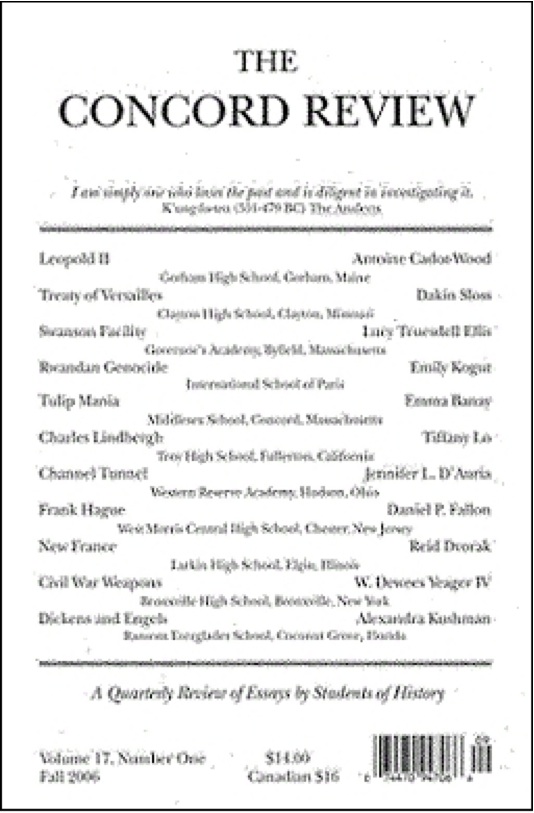
While the most promising high school athletes in this country are publicly acclaimed and profiled in the press and recruited by college coaches and offered lucrative scholarships, there is no comparable lauding of outstanding high school history students. A former public school history teacher, Fitzhugh is the publisher of The Concord Review, a journal he began in 1987 to showcase the writing of just such exceptional student scholars. The review has printed 924 high-caliber research papers by teenagers from 44 states and 39 nations, The New York Times reported in January, winning a few “influential admirers” along the way.
But this celebration of what Fitzhugh calls “Varsity Academics®” amounts to just drops of excellence in the vast sea of mediocrity that is American history education. Another kind of excellence is represented by the National History Club that Fitzhugh launched in 2002 in order to encourage middle and high school students to “read, write, discuss, and enjoy history” outside the classroom. Beginning with a single chapter in Memphis, the club has grown into an independent national organization, with chapters in 43 states and more than 12,000 student members involved in a rich array of history-related activities.
“Our goal,” says Robert Nasson, the club’s young executive director, “is to create kids who are life-long students of history.” He and Fitzhugh have exactly the right idea. But as the latest NAEP results make dismally clear, they are swimming against the tide.
(Jeff Jacoby is a columnist for The Boston Globe).
— ## —
———————–
“Teach by Example”
Will Fitzhugh [founder]
The Concord Review [1987]
Ralph Waldo Emerson Prizes [1995]
National Writing Board [1998]
TCR Institute [2002]
730 Boston Post Road, Suite 24
Sudbury, Massachusetts 01776-3371 USA
978-443-0022; 800-331-5007
www.tcr.org; fitzhugh@tcr.org
Varsity Academics®
www.tcr.org/blog

Share

Stay-at-home fathers are getting much-needed companionship through Hong Kong Dads

Ben Sin:

It’s midday, mid-week in Mid-Levels and a group of middle-aged men are enjoying a few beers together. This part of the day is down time for Rob Daniel, Donald Knapp, Edo Fuijkschot and Chris Lee because they aren’t employed in traditional jobs.
All are stay-at-home dads, full-time fathers, house husbands, Mr Moms or whatever label society has given them. They are meeting when their children are either at school or with the family helper, and their wives have yet to leave work.
The number of men who have quit or scaled back their jobs to take on homemaking duties traditionally ascribed to women forms a miniscule demographic. But their numbers are edging up – at least in the West. According to the United States Census, there were an estimated 160,000 full-time fathers in 2007. That only accounts for about 3 per cent of all stay-at-home parents. Nonetheless, it is triple the 1997 figure. In Britain, a Guardian report estimates there are 250,000 stay-at-home fathers.

Share

Let’s hear it for plain speakers

Harry Eyres:

I think you’ll know what I mean by the “higher guff” – the kind of sonorous and empty talk which often issues from the mouths of heads of state and princes. I heard a classic example recently at a British media awards ceremony from the admirable Prince Felipe of Spain. He was being courteous and diplomatic, praising the links and similarities “between our two great countries”, once imperial powers and once sworn enemies. “We have so much in common,” he enthused; an ironic commentary came from my neighbour, a photographer with a wicked wit: “Yes,” said Michael, “we’re both in deep shit.” The prince can’t have heard this, because he went on: “Indeed, so many of your citizens decide to move to Spain.”
“Yep,” was the uncharitable response from Michael: “All the criminals.”
The rule is that the higher the language soars, unless you’re careful, the more it leaves itself open to attack from below. Shakespeare was the dramatist who knew this best, especially in the excruciating scene from Troilus and Cressida where Thersites provides a scabrous commentary on the seduction of Cressida by Diomedes. “Lechery, lechery, still wars and lechery” is his conclusion: the pretensions of the Trojan war reduced to an itch and a scratch.

Share

Equilibration in progress

Steve Hsu:

The US salary figure for MBAs from “leading schools” seems too low to me. Is this apples to apples? Still, it’s incredible what people are earning in China and India. One private equity guy I know told me they are hiring top talent in Beijing/Shanghai for USD $100k+ these days.

Share

After Home Schooling, Pomp and Traditional Circumstances

Tamar Lewin:

The 26 young men and women, seated in alphabetical order, were nearly silent as they waited for their high school graduation to start. No giggles. No buzz. No camaraderie. And no wonder: they had met just once before, at the rehearsal two weeks earlier where they got their caps and gowns.
They had come on this muggy June evening to the Miami Zoo, past the flamingos and the tiger, for an hourlong ceremony that Gloria Rodriguez, the organizer, proudly called “the very first South Florida home-school graduation ever created.”
Ms. Rodriguez’s “home-school class of 2011” had no prom, no yearbook, no valedictorian. Still, for these students who had sidestepped a traditional education — and especially for their parents — there was “Pomp and Circumstance” and shiny turquoise tassels to shift from one side of a cap to the other.

Share

CDC: 1 in 4 high schoolers drink soda every day

Mike Stobbe:

A new study shows one in four high school students drink soda every day — a sign fewer teens are downing the sugary drinks.
The study also found teens drink water, milk and fruit juices most often – a pleasant surprise, because researchers weren’t certain that was the case.
“We were very pleased to see that,” said the study’s lead author, Nancy Bener of the Centers for Disease Control and Prevention.
Still, a quarter have at least one soda each day. And when other sugary drinks like Gatorade are also counted, the figure is closer to two-thirds of high school students drinking a sweetened beverage every day.
That’s less than in the past. In the 1990s and early 2000s, more than three-quarters of teens were having a sugary drink each day, according to earlier research.

Share

Flaws in my college-for-all fix

Jay Matthews:

I find myself more and more interested in the growing debate over how much and what to teach high school students. I support the side that thinks all students should be given skills that will make them ready for college because the same abilities—to write, read, do math and manage their time–are necessary if they want good jobs or trade school slots after high school.
On the other side are those who think college prep for all is a failed experiment. They say it alienates too many students and must be replaced by vocational programs that get to the heart of what employers want without killing student interest with required essays on the Romance poets and the Federalist papers. A recent report by the Harvard Graduate School of Education, which I trashed here, is the best and most complete recent example of this argument.
I hadn’t encountered any promising efforts to bring the two sides together until I saw a commentary, “Untangling the Postsecondary Debate,” by Mike Rose, professor of social research methodology at UCLA, in the latest Education Week “Diplomas Count” report. He is critical of both sides, but helped me most in understanding where my arguments are weak.

Share

Bilingual education called best of both worlds

Michelle Mitchell

“¿Qué es esto?” Martha Arriola asks her kindergarten class, holding a picture of a bed.
“Cama!” the students respond in unison. “Cah … ahh … mmm … ahh,” they sound out each letter.
Arriola picks one student to find the letters that make those sounds from a group of cards and place them in the right order to spell the word.
Later, she turns an invisible switch on her head. “Click, click click, English time,” she said as the students mimic the gesture.
They repeat the same exercise in English — this time with “bed.”
The class at Coral Mountain Academy is one of about 12 bilingual classes in kindergarten through fourth grade at the Coachella school.

Share

Hardship puts formidable hurdles on the path to scholastic achievement

Alan Borsuk:

“It’s one thing to talk about these issues on high,” says Howard Fuller, who has done that often as one of the nation’s most eloquent and best known education activists.
“But when you get over here on 33rd and Brown . . . ” His sentence trails off. That’s where CEO Leadership Academy is located, and that’s where Fuller has come face to face with how tough it is to achieve high results among exactly the students he most wants to help.
Howard Fuller: Former Milwaukee Public Schools superintendent. Leading advocate for Milwaukee’s private school voucher program. Local and national leader in charter school issues.
Howard Fuller: Hands-on chair of the board of a small high school where test scores for 10th-graders last fall were awful and where the record of success has been plainly disappointing.
A couple years ago, Fuller told me that, as much as he thought he knew about how hard it is to achieve educational success in a high-poverty, urban setting, he didn’t know how hard it really was until he got involved at CEO.

Share

Sex selection and the shortage of women: is science to blame?

Richard Dawkins:

In nature, the balance of males and females is maintained by natural selection acting on parents. As Sir Ronald Fisher brilliantly pointed out in 1930, a surplus of one sex will be redressed by selection in favour of rearing the other sex, up to the point where it is no longer the minority. It isn’t quite as simple as that. You have to take into account the relative economic costs of rearing one sex rather than the other. If, say, it costs twice as much to rear a son to maturity as a daughter (e.g. because males are bigger than females), the true choice facing a parent is not “Shall I rear a son or a daughter?” but “Shall I rear a son or two daughters?”
So, Fisher concluded, what is equlibrated by natural selection is not the total numbers of sons and daughters born in the population, but the total parental expenditure on sons versus daughters. In practice, this usually amounts to an approximately equal ratio of males to females in the population at the end of the period of parental expenditure.
Note that the word ‘decision’ doesn’t mean conscious decision: we employ the usual ‘selfish gene’ metaphorical reasoning, in which natural selection favours genes that produce behaviour ‘as if’ decisions are being made.

Share

College-Readiness Low Among New York State Graduates, Data Show

Sharon Otterman:

Heightening concerns about the value of many of its high school diplomas, the New York State Education Department released new data on Tuesday showing that only 37 percent of students who entered high school in 2006 left four years later adequately prepared for college, with even smaller percentages of minority graduates and those in the largest cities meeting that standard.
In New York City, 21 percent of the students who started high school in 2006 graduated last year with high enough scores on state math and English tests to be deemed ready for higher education or well-paying careers. In Rochester, it was 6 percent; in Yonkers, 14.5 percent.
The new calculations, part of a statewide push to realign standards with college readiness, also underscored a racial achievement gap: 13 percent of black students and 15 percent of Hispanic students statewide were deemed college-ready after four years of high school, compared with 51 percent of white graduates and 56 percent of Asian-Americans.

Share

The Department of Education, Yale, And the New Threat to Free Speech on Campus

Greg Lukianoff:

Yale University’s decision last month to punish a fraternity that made pledges chant offensive slogans was heralded by some as a blow against sexual harassment in the college setting. But it may be the beginning of a new wave of campus censorship of politically incorrect speech. The reason lies in the relationship between the Department of Education’s Office for Civil Rights (OCR), which is in charge of enforcing federal antidiscrimination laws on campus, and the ever-growing ranks of campus bureaucracy.
On April 4, 2011, OCR issued a 19-page letter laying out detailed procedures every university in the country must follow in cases involving claims of sexual harassment or sexual assault. A college that fails to follow these guidelines risks an OCR investigation and the loss of federal funding, a devastating blow for many schools. In the case of Yale, for example, OCR has the power to withhold half a billion dollars in federal funds.

Share

Reinforcing Privilege

The Atlantic

This video has been all over New York-based internet sites in the past few days. But I don’t think it has yet been on any of the Atlantic’s sites, and it is worth another look for “the way we live now” purposes.
It shows a young woman passenger chewing out a train conductor who has asked her to stop talking so loudly on the phone and swearing. OK, I’ve sometimes gotten exasperated with officialdom, and I am glad that no one had a camera running when I did. But the approach the passenger takes is significant, and stunning.

Share

Knowing How to Know

Students in schools of education pay a lot of attention to the problems of learning how to learn, lifelong leaning, and the like. In the absence of much knowledge of history, economics, physics, literature, foreign languages, chemistry, calculus and so on, this can degenerate into what Professor E.D. Hirsch, Jr., calls “How-to-ism,” an absorption in “pedagogy” without any secure foundation in academic knowledge.
It is also the case that most graduates of our schools of education are shocked by the day-to-day problems of managing youngsters with Twitter, popular music, sports, popularity, and Grand Theft Auto on their minds. But it should be noted that it is very hard to get students interested in academic work, for instance history, if the teacher doesn’t know any history herself. This problem causes some number of coaches who teach Social Studies to shy away from the Renaissance in favor of current events, which may seem more approachable both to them and their students. How ’bout those Bruins!
In the meantime, even American students who are Seniors in high school show a pitiful ignorance of the most basic knowledge of the history of their own country, as revealed in the latest National Assessment of Educational Progress report released this month.
In The Knowledge Deficit, E.D. Hirsch, Jr., tried to get across the point that teaching learning skills, for example, which pedagogy graduates are supposed to be good at, does little or nothing for helping students acquire knowledge. He argues that the only way to increase knowledge is to build on a stronger and stronger base of knowledge, not by wasting time on the dubious techniques of “Learning How to Learn.”
I am convinced that one of the reasons even some students who do not require remediation in reading and writing when they get to college still fail to gain a degree after six or eight years, in part go under academically because they do not bring enough knowledge to help them understand what the professor is talking about. Their ignorance makes them feel lost. Some become determined to find the knowledge they have not been given in high school, but too many quit instead.
To be more fair to the education schools, even Harvard has had great difficulty in committing its faculty to teach certain basic areas of knowledge. The faculty tried to avoid arguing over what needed to be taught, so they fell back on allowing each department to teach “the skills” of its discipline, which they believed could be taught with any subject matter (such as that which the professor’s research happened to focus on at the moment).
The problem, as pointed out in an article by Caleb Nelson in The Atlantic called “Harvard’s Hollow Core,” is that “One cannot think like a physicist, for example, without actually knowing a great deal of physics.” Similarly, it is quite hard to think like a historian if you don’t know any history.
So the whole “Learning How to Learn” paradigm collapses of its own emptiness and leads to academic failure for many students who have been offered rubrics, techniques and skills as a substitute for the academic knowledge they would need to survive in college.
The Common Core is offering national goals for knowledge. Others have critiqued their weakness in math, but I would suggest that their goals for reading in history are scarcely challenging for eight graders. Reading The Declaration of Independence and A Letter from the Birmingham Jail is not a waste of time, but for high school students, why not offer Mornings on Horseback, Washington’s Crossing, Battle Cry of Freedom and The Path Between the Seas? In other words, actual history books? I cannot find out when it was decided (or by whom) that American high school students can manage European history, calculus, Latin, chemistry and so on, but cannot be expected to read through even one complete history book? How did our expectations for nonfiction reading (and gathering knowledge thereby) get so dramatically dumbed down? Of course STEM is very important, but even engineers and scientists need to read and write.
To demonstrate how far we have slid down the slope of expectations since Thomas Jefferson’s day, here is an example from The Knowledge Deficit (p. 9):

“In our pre-romantic days, books were seen as key to education. In a 1786 letter to his nephew, aged fifteen, Jefferson recommended that he read books (in the original languages and in this order) by the following authors: [history] Herodotus, Thucydides, Xenophon, Anabasis, Arian, Quintus Curtius, Diodorus Siculus, and Justin. On morality, Jefferson recommended books by Epictetus, Plato, Cicero, Antoninus, Seneca, and Xenophon’s Memorabilia, and in poetry Virgil, Terence, Horace, Anacreon, Theocritus, Homer, Euripides, Sophocles, Milton, Shakespeare, Ossian, Pope and Swift.”

Will Fitzhugh
The Concord Review
17 June 2011
Share

Wisconsin Regents approve B.A.A.S. and mission change

University of Wisconsin System & UW Extension:

The UW System Board of Regents has approved the request by UW Colleges to implement a bachelor of applied arts and sciences (B.A.A.S.) degree that will serve place-bound adults in six Wisconsin communities. The Regents also approved a mission change for UW Colleges related to the B.A.A.S. degree.
The degree still requires accreditation by the Higher Learning Commission, curriculum development by UW Colleges faculty, policy development by the UW Colleges Senate and other administrative requirements.

Share

Kids, Get High Off Drugs, Not Debt. It’s More Fun And People Are Nicer To You When It’s Time To Recover.

Elie Mystal:

Let’s say that instead of taking on huge debts while I was in law school, I had taken up a wicked cocaine habit. Let’s say I had done loads and loads of blow from 2000 to 2007 and then went into a 12-step program. If I had been lucky enough to avoid an overdose or jail, you could argue that things would be better for me right now — even if I had a really serious cocaine problem where I spent my all my disposable income on the drug, and even if I put a good job and a good marriage straight up my nose. If I had been through all that and then wrote an essay about the highs and the lows of doing cocaine throughout my legal career, if I was telling kids that they could overcome a wicked cocaine habit even though the consequences were severe, if I was truthfully telling people that even though I’m trying to stay clean and sober now I’m not “ashamed” of my past life, I’d have nearly everybody in my corner.
Instead, I didn’t have a cocaine habit in law school and beyond. I defaulted on my student debts.
Really, the smart thing to do would have been to default on all my loans, then blame it on the cocaine that I was “powerless” to stop. But instead of playing the victim, I marshaled what autonomous power I had and chose not to pay back my loans in a timely manner. I decided to go down on my own terms, not the terms set out for me in a promissory note.

Share

In Homework Revolt, School Districts Cut Back

Winnie Hu:

After Donna Cushlanis’s son, who was in second grade, kept bursting into tears midway through his math problems, which one night took over an hour, she told him not to do all of his homework.
“How many times do you have to add seven plus two?” Ms. Cushlanis, 46, said. “I have no problem with doing homework, but that put us both over the edge. I got to the point that this is enough.”
Ms. Cushlanis, a secretary for the Galloway school district, complained to her boss, Annette C. Giaquinto, the superintendent. It turned out that the district, which serves 3,500 kindergarten through eighth-grade students, was already re-evaluating its homework practices. The school board will vote this summer on a proposal to limit weeknight homework to 10 minutes for each year of school — 20 minutes for second graders, and so forth — and ban assignments on weekends, holidays and school vacations.

Share

Why We’re Going Back to Single-Sex Dorms

John Garvey:

My wife and I have sent five children to college and our youngest just graduated. Like many parents, we encouraged them to study hard and spend time in a country where people don’t speak English. Like all parents, we worried about the kind of people they would grow up to be.
We may have been a little unusual in thinking it was the college’s responsibility to worry about that too. But I believe that intellect and virtue are connected. They influence one another. Some say the intellect is primary. If we know what is good, we will pursue it. Aristotle suggests in the “Nicomachean Ethics” that the influence runs the other way. He says that if you want to listen intelligently to lectures on ethics you “must have been brought up in good habits.” The goals we set for ourselves are brought into focus by our moral vision.
“Virtue,” Aristotle concludes, “makes us aim at the right mark, and practical wisdom makes us take the right means.” If he is right, then colleges and universities should concern themselves with virtue as well as intellect.
I want to mention two places where schools might direct that concern, and a slightly old-fashioned remedy that will improve the practice of virtue. The two most serious ethical challenges college students face are binge drinking and the culture of hooking up.

Share

Wisconsin Voucher debate reveals deep divisions about public schools

Susan Troller:

As of early afternoon Wednesday the fate of voucher schools in Green Bay is uncertain. Rumors are flying that the proposal to use tax dollars to pay families to send their children to private and religious schools in that city will be pulled from the state budget.
It’s been a hot topic.
The voucher story I posted on Chalkboard last week detailed Green Bay Supt. Greg Maass’ unhappy reaction to both the proposal and the abrupt legislative process that put it in the budget. It definitely struck a nerve, and drew many comments.
Some of the most interesting reactions went well beyond the issue of vouchers and whether public money should be used to fund private schools. They expressed the heart of the debate surrounding public schools, or “government” schools as some folks call them.
Are public schools failing? Who’s to blame? What responsibilities does a civil society owe to children who are not our own? What kind of reforms do parents, and taxpayers, want to see?
Here are some excerpts that are revealing of the divide in the debate:

VHOU812 wrote: …As a consumer of the public (or private) educational institutions, I am demanding more value. If it is not provided, I will push to refuse to purchase and home school. This is not what I want. I want security knowing that I am satisfied with the investment in my children’s education. I don’t get that feeling right now from publc schools, and that is the core of the problem that public schools need to fix. I also see that private institutions, by their nature, can make changes to respond to consumer demands very quickly, and it is clear public schools either can’t, or won’t.

I’m glad Susan posted these comments. Looking at the significant growth in Wisconsin K-12 spending over the past few decades along with declining performance, particularly in reading compels us all: parents, taxpayers, students, teachers, administrators and the ed school community, to think different.
Wolfram’s words are well worth considering: “You have to ask, what’s the point of universities today?” he wonders. “Technology has usurped many of their previous roles, such as access to knowledge, and the social aspects.

Share

Seattle Schools’ Strategic Plan Update

Melissa Westbrook:

Here is the presentation from today’s Work Session on the Strategic Plan with survey results.

Highlights:

  • 5905 responses – 64% family member, 26% teacher or school staff, 1% principals, 5% community, 4% Central Office
  • By zip code – looks like a somewhat even distribution with  NE – 98115 with 528 responses, SE – 98118 with 221 responses, SW – 98136 with 118 responses, West Seattle – 98116 with 182 responses and NW – 98117 with 433 responses.  (There were more zip codes than those.)
  • page 8 has a breakdown of coaches and costs – overall it costs $6.4M for 65.6 coaches  (the salary swings are interesting)
  • Professional development in math, science and reading helping teachers and students – the big answer was …. no opinion.  And, out of the nearly 6,000 responses, only 3443 people answered this question.  Effective/somewhat effective (families-27%/teachers-51%). Ineffective/somewhat ineffective (families-22%/teachers-28%)
  • MAP test results effectiveness.  Effective/Somewhat Effective (families-41%/teachers-33%).  Somewhat effective/ineffective (families-45%/teachers50%).   Out of 6k responses, only 3682 respondents answered.
  • MAP- how many times a year should it be used?  3x- families-30%, teachers-23%, principals-40%.  Hmm, looks like principals like it more than teachers.   2x -families-29%,teachers-30%, principals, 40%.  That’s a lot closer.  And hey, they ARE reducing MAP to two times a year for 2011-2013 (winter and spring)
  • NSAP.   More efficient/somewhat more – families-42%/teachers 23%/principals 55%.   Somewhat less/less efficient – families-27%/teachers-29%/principals-31%. 

Download the Seattle Strategic Plan update, here.

Share

The Secret of Dads’ Success

Sue Shellenbarger:

After dinner at Todd and Jodie Schiermeier’s house in O’Fallon, Ill., it is “tackle Dad” time. That’s when Mr. Schiermeier gets down on the floor with their three children, Rylee, 7, Kinsey, 4, and Jace, 20 months, for a session of “horseback rides and pillow fights and tackle and wrestle,” he says.
It is a stark contract to Ms. Schiermeier’s playtime with the kids, who says she mostly cuddles them or has “a little tickle fight.”
The rough play is already benefiting her older daughter, who is “a little timid,” Ms. Schiermeier says. “She has toughened up a little” playing with her dad. “He is teaching her how to take the blows of life, and to get in there and fight.” All three kids are learning to take turns and work as a team. For Mr. Schiermeier, that is intentional: “I push them to get outside their comfort zones.”

Share

Why Facebook Is Losing U.S. Users

Peter Pachal:

News hit the other day that Facebook may have lost about six million users in the U.S. in one month, according to Inside Facebook, a site that analyzes the social network for developers and marketers. Facebook has close to 700 million users worldwide, so a loss of six million doesn’t sound like much, especially in light of data that suggests the service has been pushing aside regional social sites to conquer large swaths of the developing world, and actually posted a net increase in overall users over the same period.
But a six million user loss is a little more painful when compared to the U.S. user base, which reports say stands around 150 million–or roughly half the population of the country. It’s not crippling, but a four percent reduction isn’t negligible either. At the same time, the same data source suggests the service is experiencing similar losses throughout the Western world in places like Canada, the U.K., and Norway. Could American audiences finally be turning on the social network?
When asked about the report, a Facebook spokesman told PCMag that, “From time to time, we see stories about Facebook losing users in some regions. Some of these reports use data extracted from our advertising tool, which provides broad estimates on the reach of Facebook ads and isn’t designed to be a source for tracking the overall growth of Facebook. We are very pleased with our growth.”

Share

Why Peter Thiel Is Wrong To Pay Students to Drop Out

Peter Cohan:

Stanford Law School grad, Peter Thiel, wants to pay college students to drop out. If typical venture capital odds apply, about 22 of the 24 people who took his $100,000 inducement to drop out and spend two years working in a start-up will fail to build a successful company. For their sake, let’s hope the schools will let them back in.
And based on research from the country’s top-ranked school of entrepreneurship, the world will be better off if those whippersnappers stay in school and get 10 years of experience before launching their start-ups.
Peter Thiel has a mixed investment record but has come out ahead. Thiel made $55 million as a co-founder of online payment service PayPal when he sold his 3.7% stake in the company to eBay (EBAY) shortly after graduating from Stanford Law School. He then became the first major investor, putting $500,000 into Facebook.

Share

“You have to ask, what’s the point of universities today?” he wonders. “Technology has usurped many of their previous roles, such as access to knowledge, and the social aspects.”

The Economist:

“THERE is no dramatic distinction between the processes of the weather and the workings of the human brain,” says Stephen Wolfram, a physicist and the founder of Wolfram Research, a software company. “There isn’t anything incredibly special about intelligence, it’s just sophisticated computational work that has grown up throughout human history.” Dr Wolfram is hardly the first scientist to compare the human brain to a computer. Alan Turing, who helped develop the precursors of today’s programmable computers during the second world war, began considering the possibility of thinking machines in the 1940s. The difference is that Dr Wolfram claims to have succeeded in codifying vast areas of human knowledge and even replicating supposedly uniquely human attributes such as creativity.
“One of my realisations, or maybe it’s just a piece of arrogance, is that the amount of knowledge and data in the world is big, but it’s not that big,” he says. “In astronomy, there’s a petabyte–a million gigabytes–of data about what’s out there in the universe. There are also swathes of data from digital cameras, Twitter feeds and even road-traffic movements. It’s a bit daunting, but I soon realised that the bigger challenge is not the underlying data but the computations that get done on them.”

Share

The 10 Steps To Make Your Kid A Millionaire

William Baldwin:

We’re spending our children’s money. So goes the refrain from people appalled at the government’s deficits. As long as entitlement spending and tax collections continue on their present course, it’s an undeniable truth.
Instead of wringing your hands, do something about it. Make your children so prosperous that they can withstand the Medicare cutbacks and tax increases that lie ahead. Here are ten tactics for boosting the net worth of your offspring.
1 Don’t Overeducate
That master’s degree your son or daughter wants to get may be a bad investment. This heretical thought comes from Laurence Kotlikoff, a Boston University economist who studies earning and consumption patterns. An advanced degree confers a higher salary, but it comes at a high cost, too. It includes tuition, often borrowed, plus a year or more of lost earnings.

Share

OK, So Here’s Who’s Running for Seattle School Board 2011

Riya Bhattacharjee:

I have been trying to find the campaign websites for all the candidates running for Seattle School Board this year (candidate filings closed 5 p.m. Friday), and the final list looks something like this. Two things: there’s like a ton of them and only four open seats; not all of them have a website yet.

Most of the new candidates are running because they are tired of the corruption and cronyism in Seattle Public Schools. Some want to focus on closing the achievement gap and raising test scores. Others are just sick of the influence a plethora of foundations have on education these days.

At least one of the candidates is a reluctant one who says he’s running because he is tired of mediocrity in our schools and the “business as usual approach” of our school board. Another lists this thing as his campaign website. This one sued the district against its new high school math textbooks in 2009.

The incumbents say they are fed up of the same things their challengers are (of course, I mean there can only be so many problems in one district, right?).

Share

‘Parent Trigger’ Laws: Shutting Schools, Raising Controversy

Kayla Webley:

In a bare-bones basement office in Buffalo, N.Y., Katie Campos, an education activist, is plotting a revolution. She and her minuscule staff of the advocacy group Buffalo ReformED are against incredible odds. In less than a week, they are trying to get a controversial law known as the “parent trigger” through the New York legislature. It’s a powerful nickname for game-changing legislation that would enable parents who could gather a majority at any persistently failing school to either fire the principal, fire 50% of the teachers, close the school or turn it into a charter school.
Campos and her group are working with some 4,000 frustrated parents like Samuel Radford III, who refuses to accept that as African Americans, his three sons in Buffalo public schools have only a 25% chance of graduating. Radford voiced his concerns for years but saw no improvement, so rather than continue to wait for the district to act, he became vice president of the District Parent Coordinating Council and threw his support behind passing parent-trigger legislation. “This is our chance to not just confront the problem but be part of the solution,” Radford says. On June 15, Buffalo ReformED plans to fill a bus of parents like Radford and ride to the state capitol, in Albany, to host an informal hearing on the bill and speak to members of the senate and house education committees.

Share

Portraits: Initial College Attendance of Low-Income Young Adults

Institute for Higher Education Policy:

The brief, Portraits: Initial College Attendance of Low-Income Young Adults, experts at the Institute for Higher Education Policy (IHEP) suggest that poverty still matters a great deal in terms of the types of institutions at which young adults are initially enrolling. In particular, they find that low-income students–between ages 18 and 26 and whose total household income is near or below the federal poverty level–are likely to be overrepresented at for-profit institutions and are likely to be underrepresented at public and private nonprofit four-year institutions.

Share

Changing how gifted students think

Jay Matthews:

The Loudoun Academy of Science, a six-year-old public magnet school in Sterling inspired in part by the Thomas Jefferson High School for Science and Technology, already matches that famous school in one vital statistic: Like Jefferson, the Academy of Science each year rejects about 85 percent of applicants.

With 240 students, the academy is one-seventh the size of Jefferson and takes only Loudoun County residents (Jefferson draws from most of Northern Virginia), but it has won glowing reviews from students and has created a research curriculum rare in U.S. secondary education.

“It was completely unlike the standard classroom procedure that I was used to, and I absolutely loved it,” said Carter Huffman, an academy graduate now at MIT. “I have yet to hear of another school that so encourages all of its students to pursue major independent research.”

Elizabeth Asai, another academy graduate, said she and a couple of Yale classmates received university funding this year to design biomedical devices, usually a process daunting to undergraduates. Her friends “were astounded by the ease of presenting our proposal and actually receiving a grant,” she said, but, having attended the Academy of Science, to her “this seemed normal.”

Share

Grading Standards in Education Departments at Universities

Cory Koedel, University of Missouri, via a kind reader’s email:

Students who take classes in education departments at universities receive significantly higher grades than students who take classes in other academic departments. The higher grades awarded by education departments cannot be explained by differences in student quality or by structural differences across departments (i.e., differences in class sizes). The remaining explanation is that the higher grades are the result of lower grading standards. This paper formally documents the grading-standards problem in education departments using administrative grade data from the 2007-2008 academic year. Because a large fraction of the teachers in K-12 schools receive training in education departments, I briefly discuss several possible consequences of the low grading standards for teacher quality in K-12 schools.
There is a large and growing research literature showing that teacher quality is an important determinant of student success (recent studies include Aaronson et al., 2007; Koedel, 2008; Nye et al., 2004; Rivkin et al., 2005; Rockoff, 2004).
But while there is persistent research into a variety of interventions aimed at improving teacher quality, surprisingly little attention has been paid to the primary training ground for K-12 teachers–education departments at universities.
This paper provides an evaluation of the grading standards in these education departments. I show that education students receive higher grades than do students in every other academic discipline. The grading discrepancies that I document cannot be explained by differences between education and non-education departments in student quality, or by structural differences across departments.
The likely explanation is grade inflation.
The earliest evidence on the grading-standards problem in education departments comes from Weiss and Rasmussen in 1960. They showed that undergraduate students taking classes in education departments were twice as likely to receive an “A” when compared to students taking classes in business or liberal arts departments. The low grading standards in education departments, illustrated by these authors over 50 years ago, are still prevalent today.

Share

Commencement Address: The Importance of the Right Question

Clayton Christensen:

To get to the point of graduation, you’ve endured an almost endless sequence of measurements of your intelligence and knowledge, in the form of tests. You have taken more tests than you hope to remember. The role of faculty here and other teachers earlier was to define the questions. Your role, as students, was to provide the right answers.
Many in education, however, have overlooked a frightening fact: finding the right answer is
impossible unless we have asked the right question. Unfortunately our teaching system focuses little attention on teaching us how to ask the right questions. As a scholar, father, and advisor, I have slowly realized that asking the right question is the rare and valuable skill. That done, getting the right answer is typically quite straightforward.
In my remarks today I’d like to describe three instances where people like us have plunged into implementing an answer, without taking the care to define the salient question to which we need good answers. Two are of national scope; the third is personal. My prayer is for each of you – students, graduates, families and faculty – is to see learning to frame questions as a critical part of your work.

Clusty Search: Clayton Christensen.

Share

High school education no longer one-size-fits-all

Maureen Magee:

The caps and gowns haven’t changed much. “Pomp and Circumstance” continues to mark the occasion. And many of those valedictorians are bound to quote “The Road Not Taken.”
Commencement ceremonies have remained virtually unchanged over the years. But don’t be fooled. The high school experience leading up to graduation has never looked so different for American teenagers.
Everything from technology to academic innovations to the lagging economy has influenced high schools and the students they serve — locally and nationwide.
No longer a novelty, independent charter schools will issue a record number of diplomas to students who received a new brand of education — often in some unlikely venues, including shopping malls, museums and an old Navy boot camp.
More students than ever will graduate this year after taking some of their courses online.
And tough economic times have created a rising population of homeless students — and programs and schools designed to educate and help them.

Share

Boot Camp for Boosting IQ

Jonah Lehrer:

Can we make ourselves smarter? In recent decades, scientists have accumulated increasing evidence that our intelligence, at least as measured by the IQ test, is sharply constrained by genetics. Although estimates vary, most studies place the heritability of intelligence at somewhere between 50% and 80%. It’s an uncomfortable fact, but not all brains are created equal.
Which is why there’s so much buzz about a forthcoming study that complicates this assumption. Researchers at the University of Michigan found that it’s possible to boost a core feature of human intelligence through a simple mental training exercise.
In fact, when several dozen elementary- and middle-school kids from the Detroit area used this exercise for 15 minutes a day, many showed significant gains on a widely used intelligence test. Most impressive, perhaps, is that these gains persisted for three months, even though the children had stopped training.

Share

The Class of 2011: Word usage in 40 speeches given at graduations this year.

The New York Times:.

Share

“Fix the Workforce or Die” Bucyrus Finds Skilled Labor in Texas

John Schmid:

Not long ago, Bucyrus International Inc. stood out in Milwaukee as a veritable poster child for business opportunity and expansion. Mayor Tom Barrett singled out chief executive Tim Sullivan in his 2005 “state of the city” address: “Thank you for believing and investing in our city.”
And so it was awkward last week when Sullivan told a packed auditorium of civic leaders that he needed to make a “confession,” something he’s kept quiet for years. Finding qualified, factory-grade welders in an old-line industrial city such as Milwaukee had become arduous to near impossible. Calling himself a “killjoy,” Sullivan said he quietly phoned a few contacts in Texas to see whether the Lone Star State could provide him enough welders who are qualified to piece together the colossal mining machines that Bucyrus ships to India, China and elsewhere around the world.
A delegation of senior Texas government authorities met Sullivan at the airport, including the mayor of the town of Kilgore. In a one-hour lunch, they matched Bucyrus with a ready-to-occupy factory with every possible amenity.
More important, they asked Sullivan exactly what sort of workers he needed. Sullivan said 80 with specific skill. The state gave Sullivan a guarantee that the workers would be waiting when the doors opened at the expansion site in Kilgore. State officials customized a recruitment, training and certification program. One year later, when the expansion site in Kilgore opened its doors, the 80 welders were waiting.
In the two years since then, the Texas site has more than doubled to 184 total workers and plans to keep hiring. And back in Milwaukee, Sullivan has said next to nothing in public about the Kilgore expansion.
“We have a complete disconnect between jobs and education and training,” Sullivan said. In Milwaukee, “we’re a long way” from replicating the feat in Texas.
“There is no stomach in this state to change the curriculum,” he said. “Who is initiating education reform in the state right now? No one.”
Although taxpayer-funded MATC probably is the institution best suited to address the skills mismatch, the tech school cannot bear all the blame for its inability to deliver customized workforce training, Sullivan said.
Many Milwaukee-trained welders simply are not mentally prepared by metro Milwaukee’s grade schools and high schools, Sullivan said.

Share

Los Angeles technical high school is all it should be, but will soon be history

Rick Rojas

It’s located in a grimy and windowless building that it shares with an adult school on the edge of downtown. But to its students and teachers, the Santee Construction Academy is something of an educational utopia.
There are small classes with attentive teachers. A curriculum designed to prepare students for the real world with training for in-demand jobs. An atmosphere that students say is akin to a family.
The campus fits the bill of what some educators and others describe as a model with its career training and staff commitment. Yet, in about two weeks, this program will be history.
It turns out that the same factors that have made the academy successful — despite lukewarm test scores — also made it vulnerable to the sweeping cuts Los Angeles public schools are being forced to make with a tightening budget. The program costs more than $1.5 million to operate.

Share

Is strict parenting better for children? Amy Chua’s memoir about her super-strict parenting style gave us the Tiger Mother; but professor Bryan Caplan is not convinced it’s the best way.

Emine Saner:

Yale law professor, and mother of two girls, Amy Chua gave the world a new type of mother role model in her memoir Battle Hymn of the Tiger Mother: someone who insisted on several hours of music practice every day, banned sleepovers and wasn’t happy with anything less than an A+ for schoolwork. Bryan Caplan, economics professor and father-of-three, whose new book says nature will always win over nurture, is an exponent of “serenity parenting”, the belief that parents should stop hothousing their children. Can either of them change the other’s mind? Emine Saner listens in.
Bryan Caplan: I’m wondering why genes play so little part in your story. You mention them a few times, but there isn’t much about how your kids are the children of law professors and best-selling authors, and this might have something to do with their success.
Amy Chua: My book isn’t about success or biology. It’s just a memoir. I was raised by really strict Chinese immigrant parents and I tried to do the same with my two daughters. It worked in some ways, and not in others.

Share

Time for year-round school in Madison

Chris Rickert:

But after learning of the Madison School District’s failure to adequately boost test scores under No Child Left Behind, I had to wonder: Heat or no heat, what cause for picnicking is there in the advent of a nearly three-month long break from formal learning for brains that, in their youth, are veritable sponges for knowledge?
I’m less worried about my children, who have a standard pair of educated, middle-class parents. They probably won’t make major academic strides over the summer, but they won’t lose much ground or — worse — fill their free time picking up bad habits.
But here’s the thing about the Madison district: Increasingly, its students aren’t like my kids.
They are like the kids who live in the traditionally lower-income, higher-crime Worthington Park neighborhood. These and the kids from the tonier Schenk-Atwood neighborhood where we live share a school, but they don’t necessarily share the same social, educational and financial advantages.

Much more on the oft-criticized WKCE, here and “Schools should not rely on only WKCE data to gauge progress of individual students or to determine effectiveness of programs or curriculum”. It certainly is long past time for a new academic benchmark… Wisconsin students should participate in global examinations, such as TIMSS, among others.

Share

1 in 4 Sun Prairie High School Seniors Graduate with High Honors!! ???

SP-EYE:

A school board member shared the following information which was received from a community member, knowing grade inflation is one of SP-EYE’s hot buttons. The contributor wasn’t identified, but it doesn’t matter. It’s a great comparison from 20 years ago to today. If these numbers are valid (and we have absolutely no reason to suspect they are not), they represent cause for alarm.

Class of 2011 Class of 1991
Total Students 485 300
# on Honor Roll 187* (39%) 24 (8%)
* This is reportedly the lowest in the past 7-8 years!
# new NHS members 80 (16%) 14 (4%)

Sun Prairie High School.

Share

University Administrators Will Outnumber College Faculty by 2014; It’s Already A Reality at UM-Flint

Mark Perry:

According to Malcom Harris writing in n+1:
“And while the proportion of tenure-track teaching faculty has dwindled, the number of managers has skyrocketed in both relative and absolute terms. If current trends continue, the Department of Education estimates that by 2014 there will be more administrators than instructors at American four-year nonprofit colleges. A bigger administration also consumes a larger portion of available funds, so it’s unsurprising that budget shares for instruction and student services have dipped over the past fifteen years.”

Share

Iowa collecting data on students who took community college classes while in high school

Associated Press:

Education officials are collecting data on Iowa students who earn community college credits while in high school to see how well-prepared those students are for college.
According to a new report by the Iowa Department of Education, more than 38,200 high school students in Iowa took classes last year for credit through community colleges, 50 percent more than five years earlier. Those students accounted for more than 25 percent of the enrollment at the state’s community colleges.
The Des Moines Register reported Wednesday that the state hasn’t tracked passing and failing rates, and officials don’t know whether the courses are as tough as those offered at the college level. But state officials are now collecting that information, said Roger Utman, administrator for the Education Department’s Division of Community Colleges and Workforce Preparation.

Share

Public Employee Unions vs. Democratic Governors – Part 93

Mike Antonucci:

d an on-again, off-again relationship with Gov. John Kitzhaber. The Oregon Education Association endorsed his opponent in the Democratic primary, largely because of Kitzhaber’s “performance-based funding” proposal. When Kitzhaber won the nomination, OEA and other public sector unions bet the ranch on him.

Gov. Kitzhaber’s latest proposal is a merger of the state boards dealing with K-12 and higher education, which has caused OEA some heartburn. “I am surprised and disappointed to hear that OEA has changed course and now opposes Senate Bill 909 and a package of modest education reforms that would deliver better results for students, more resources for teachers and more accountability for taxpayer dollars. For them to cling to the status quo is not in the best interest of Oregonians,” said Kitzhaber in a statement.

Meanwhile in California, David Kieffer, the executive director of the state SEIU affiliate announced his opposition to Gov. Jerry Brown’s plan for a special election in September to extend and raise taxes. The state’s public sector unions are interested parties because they would be expected to fund the campaign with dues dollars.

Share

Student Loan Debt: What’s the Worst That Could Happen?

Elie Mystal:

As I’ve mentioned before, I graduated from law school over $150,000 in debt. As many of you know, I haven’t exactly paid all of that money back. Not making payments that first year was all my fault. I wanted to get married, didn’t have a credit card, and was using money that should have been going to my loans to finance my wedding.
After that first year, things got a little out of hand. My debt was being sold, the monthly payments were outrageous, and I wasn’t really paying a lot of attention to the situation during the few times when I was both awake and not billing hours. Then I quit my law firm job, hilarity ensued, and I woke up one day with a credit rating below 550.
I’ve been paying the minimum balances to various collection agencies since 2007 or so. Whatever. My hopes for paying it off or owning property pretty much rest on my ability to hit the lotto. Most likely, I’ll die still owing money for law school. And that will be the story of me.

Share

Peer pressure: Madison La Follette High School youth court program shows potential

Matthew DeFour:

When Madison La Follette High School senior Burnett Reed got into a heated argument with another student during his sophomore year in 2008, he faced a choice.
He could take a disorderly conduct ticket that would stay on his court record. Or he could participate in the school’s new youth court program in which a jury of fellow students would assess the case. He chose youth court and was sentenced to writing an apology letter, tutoring and four hours with a life coach.
He so liked the option he soon became a juror, and now is helping Madison West High School start its own program next year.
“It’s a better way to keep youth out of the system,” Reed said.
The approach has so much potential Madison Municipal Judge Dan Koval wants to start a similar program later this year for adult offenders, particularly those with chronic municipal violations such as retail theft, disorderly conduct, trespassing and other non-criminal offenses.

Share

Wisconsin Governor Walker plans to link job training money, local education reform

John Schmid:

Gov. Scott Walker on Thursday will announce a new policy to disburse hundreds of millions of dollars in federal job training funds each year – and will link the funds to reforms of local education curriculums.
The disclosure came Wednesday morning from Tim Sullivan, chief executive officer of Bucyrus International and the chairman of the Governor’s Council on Workforce Investment, a state advisory panel. Sullivan spoke at a meeting of the Milwaukee 7 economic development group.
Under the current system, federal job training funds, disbursed by multiple federal agencies, are paid directly to five state agencies, which in turn have established formulas to spend their share.

Share

iPhone App: Grades 2

Jeremy & Josh Olson:

Grades shows students what they need to score on their upcoming assignments, tests, and finals in order to get the grade they want. Now with due dates and a handy GPA calculator.

Grades 2 won an award at the recent Apple Developer Conference.

Share

The Cheap Schools Plan

Bruce Murphy:

e are rapidly on course to create a dual-level school system for Wisconsin students. In smaller cities and rural and suburban areas, school systems will continue to spend about $10,000 per pupil. That is a bit less than the national average of $10,499, as a recent Census Bureau report found.
But in big cities such as Milwaukee and Racine, and perhaps in Green Bay and Beloit, more and more students will be educated at choice schools that spend about $6,400 per pupil. These school systems tend to have students who are poorer, more likely to have learning disabilities, and they are typically the most challenging to teach. Yet Gov. Scott Walker and Republican legislators propose to spend less than two-thirds of the average per-pupil spending in other schools in the state and nation.
This situation, I might add, is not simply the fault of Republicans. Many Democrats, in hopes of killing school choice, have adamantly opposed spending more on vouchers in the past, so the per-pupil rate has always been absurdly low. On the other side are Republicans who can’t lose with school choice: It undercuts public schools and lowers the number of teachers union members in cities such as Milwaukee. And it allows them to portray themselves as reformers trying to do something about failing schools.

Share

Rhode Island High Schools Rank Worst in the Country

Dan McGowan:

Rhode Island is one of only a handful of states to not have a single school included in the Washington Post’s annual High School Challenge, a ranking of more than 1,900 high schools throughout the country.
The reason: Rhode Island students are significantly behind the national average when it comes to taking Advanced Placement (AP) exams, and near the bottom of the country when it comes to passing them. In the class of 2010, only 17.9 percent of Ocean State students took an AP exam (compared with 28.3 percent nationally) and just 10.9 passed (compared with 16.9 percent nationally), according to a report issued by the College Board.
According to The Post, the formula used to rank the schools was to “divide the number of Advanced Placement, International Baccalaureate or other college-level tests a school gave in 2010 by the number of graduating seniors.” The goal wasn’t to measure to overall quality of the schools, but simply to track how well they are preparing “average students” for college.

Share

Madison Teachers, Inc. head: Time to get ‘down and dirty’

Matthew DeFour:

“They’re ready,” Matthews said afterward, “to do whatever it takes.”
After 43 years as executive director of Madison Teachers Inc., Matthews is in the spotlight again after encouraging a four-day sick-out that closed school in February. The action allowed teachers to attend protests at the Capitol over Gov. Scott Walker’s proposal to curb collective bargaining by public employees. The matter remains in the courts, but it prompted a hasty contract negotiation between the district and union.
Teachers aren’t happy about some of the changes, and Matthews is preparing for a street fight.
“It’s going to get down and dirty,” Matthews said, alluding to the possibility of more job actions, such as “working the contract” – meaning teachers wouldn’t work outside required hours – if the School Board doesn’t back off changes in the contract. “You can’t continually put people down and do things to control them and hurt them and not have them react.”
Moreover, the latest battle over collective bargaining has taken on more personal significance for Matthews, whose life’s work has been negotiating contracts.

Much more on John Matthews, here. Madison Teachers, Inc. website and Twitter feed.

Share

Social Darwinism

Robin Dunbar:

In May 1846, a year and a half before gold was discovered at Sutter’s Mill, several extended families and quite a few unattached males headed with their caravans from Illinois to California. Due to poor organization, some bad advice, and a huge dose of bad luck, by November the group had foundered in the deep snows of the Sierra Nevada. They came to a halt at what is now known as Donner Pass, and, in an iconic if unpleasant moment in California’s history, they sat out winter in makeshift tents buried in snow, the group dwindling as survivors resorted to cannibalism to avert starvation.
From an evolutionary point of view, what makes the story interesting is not the cannibalism — which, in the annals of anthropology, is relatively banal — but who survived and who did not. Of the 87 pioneers, only 46 came over the pass alive in February and March of the next year. Their story, then, represents a case study of what might be termed catastrophic natural selection. It turns out that, contrary to lay Darwinist expectations, it was not the virile young but those who were embedded in families who had the best odds of survival. The unattached young men, presumably fuller of vigor and capable of withstanding more physical hardship than the others, fared worst, worse even than the older folk and the children.

Share

Utah father spends school year waving at son’s bus

Associated Press:

The world’s most embarrassing father is no more.
Over the course of the 180-day school year, Dale Price waved at the school bus carrying his 16-year-old son, Rain, while wearing something different every morning outside their American Fork home.
He started out by donning a San Diego Chargers helmet and jersey, an Anakin Skywalker helmet, and swim trunks and a snorkel mask, the Daily Herald of Provo and Deseret News of Salt Lake City reported.
Among others, he later dressed up as Elvis, Batgirl, the Little Mermaid, the scarecrow from the Wizard of Oz, Princess Leia, Nacho Libre and Santa Claus. He wore spandex, pleather, feathers, wigs, flips flops, suits, boots, fur, Army fatigues and several dresses, including a wedding dress.
Dale Price said it took a lot of effort to keep up, but he did it to have fun and show his son he really cared about him.

Share

Claims of Discrimination By Milwaukee Public Schools Pop Up Again in ED Drug Case

MacIver News Service:

In March, it was announced with much fanfare that the Milwaukee teachers’ union was dropping it’s controversial Viagra lawsuit against MPS.
However, the MacIver News Service has learned that the effort to force MPS to provide coverage for erectile dysfunction treatments has arisen again, albeit in a different venue.
The Milwaukee Teachers Education Association’s (MTEA) decision earlier this year came just eight months after filing their August of 2010 suit in Milwaukee County Circuit Court wherein they argued that the board’s policy of excluding erectile dysfunction drugs from their health plan coverage was discriminatory against men.

Share

DPI Report: Madison Schools Are Out of Compliance on Gifted and Talented Education

Lori Raihala:

In response, Superintendent Nerad directed West to start providing honors courses in the fall of 2010. West staff protested, however, and Nerad retracted the directive.
Community members sent another petition in July, 2010-this time signed by 188 supporters-again calling for multiple measures of identification and advanced levels of core courses for 9th and 10th graders at West. This time there was no response but silence.
In the meantime, Greater Madison Urban League President Kaleem Caire told us: “The law is there for a reason. Use it.”
So, after years of trying to work with the system, we filed a formal complaint with the DPI in September, 2010. Little did we know what upheaval the next months would bring. In October, the district administration rolled out its College and Career Readiness Plan; teachers at West agitated, and students staged a sit-in. In February, our new governor issued his reform proposal; protesters massed at the Capitol, and school was called off for four days.
In the meantime, the DPI conducted its investigation. Though our complaint had targeted West for its chronic, blatant, willful violations, the DPI extended its audit to the entire Madison School District.

Much more on the Madison parents complaint to the Wisconsin DPI, here.

Share

Are we creating dual school systems with charters, vouchers?

Bill McDiarmid:

Recently I participated in a panel discussion following a showing of the film ” Waiting for Superman .” The film is deeply moving. Only a heart of granite would remain unmoved by the plight of the children and caretakers as they learn they would not get into their schools of choice.
In the discussion, Jim Johnson, a UNC-Chapel Hill Kenan-Flagler Business School professor and founder of the Union Independent School in Durham, made a crucial observation. He noted that the debate around public charter schools versus traditional public schools, or private versus public schools, deflected us from the underlying issue: the plight of children who have no adult advocates.
As Johnson pointed out, despite failing to win a place in their school of choice, the students featured in the film all had a least one adult in their lives who knowledgeably advocated for them and cared deeply about their learning opportunities.

Share

Voucher schools to expand amid questions about their performance

Susan Troller:

If Gov. Scott Walker’s budget is passed with recommendations approved Thursday by the Joint Committee on Finance, there will be more students in more voucher schools in more Wisconsin communities.
But critics of school voucher programs are hoping legislators will look long and hard at actual student achievement benefits before they vote to use tax dollars to send students to private schools. They also suggest that studies that have touted benefits of voucher programs should be viewed with a careful eye, and that claims that graduation rates for voucher schools exceed 90 percent are not just overly optimistic, but misleading.
“The policy decisions we are making today should not be guided by false statistics being propagated by people with a financial interest in the continuation and expansion of vouchers nationwide,” wrote state Rep. Sondy Pope-Roberts, D-Middleton, in a news release Friday.
Pope-Roberts is particularly critical of statistics that school choice lobbyists and pro-voucher legislators are using that claim that 94 percent of school voucher students graduated from high school in four years.
It’s good news, she says, but it tells a very selective story about a relatively small subset of students who were studied. That graduation rate reflects only the graduation rate for students who actually remained in the voucher program for all four years: Just 318 of the 801 students who began the program stayed with it.

Related:

Per student spending differences between voucher and traditional public schools is material, particularly during tight economic times.

Share

Class Struggle: India’s Experiment in Schooling Tests Rich and Poor

Geeta Anand:

Instead of playing cricket with the kids in the alleyway outside, four-year-old Sumit Jha sweats in his family’s one-room apartment. A power cut has stilled the overhead fan. In the stifling heat, he traces and retraces the image of a goat.
In April, he enrolled in the nursery class of Shri Ram School, the most coveted private educational institution in India’s capital. Its students include the grandchildren of India’s most powerful figures–Prime Minister Manmohan Singh and Congress party President Sonia Gandhi.
Sumit, on the other hand, lives in a slum.
His admission to Shri Ram is part of a grand Indian experiment to narrow the gulf between rich and poor that is widening as India’s economy expands. The Right to Education Act, passed in 2009, mandates that private schools set aside 25% of admissions for low-income, underprivileged and disabled students. In Delhi, families earning less than 100,000 rupees (about $2,500 a year) qualify.
Shri Ram, a nontraditional school founded in 1988, would seem well-suited to the experiment. Rather than drill on rote learning, as many Indian schools do, Shri Ram encourages creativity by teaching through stories, songs and art. In a typical class, two teachers supervise 29 students; at public schools nearby, one teacher has more than 50. Three times a day, a gong sounds and teachers and students pause for a moment of contemplation. Above the entrance, a banner reads, “Peace.”

Share

Census reveals plummeting U.S. birthrates

Haya El Nasser & Paul Overberg:

In 1960, the year Helen Cini gave birth to one of her five children, 15 other kids were born on her block here in this quintessential postwar American suburb.
The local obstetrician was so busy he often slept in his car.
Kathy Bachman felt like an oddity when her family moved to Cherry Lane in the Crabtree section of Levittown when she was 5. She was an only child, and “everybody had five or six kids in every house.”
Fast-forward to 2011.

Share

It’s Not About You

David Brooks:

Over the past few weeks, America’s colleges have sent another class of graduates off into the world. These graduates possess something of inestimable value. Nearly every sensible middle-aged person would give away all their money to be able to go back to age 22 and begin adulthood anew.
But, especially this year, one is conscious of the many ways in which this year’s graduating class has been ill served by their elders. They enter a bad job market, the hangover from decades of excessive borrowing. They inherit a ruinous federal debt.
More important, their lives have been perversely structured. This year’s graduates are members of the most supervised generation in American history. Through their childhoods and teenage years, they have been monitored, tutored, coached and honed to an unprecedented degree.
Yet upon graduation they will enter a world that is unprecedentedly wide open and unstructured. Most of them will not quickly get married, buy a home and have kids, as previous generations did. Instead, they will confront amazingly diverse job markets, social landscapes and lifestyle niches. Most will spend a decade wandering from job to job and clique to clique, searching for a role.

Share

Eva Moskowitz, Harlem Success And The Political Exploitation Of Children

Leo Casey:

As educators, one of our defining beliefs is the principle that we do not use the students entrusted in our care as a vehicle for promoting and accomplishing our political agendas. We hold to this core value even when the political agendas we are pursuing involves causes that will better the lives of those young people, such as full funding for day care centers and schools. When communities and families send their young to us to be educated, they trust that we will exercise the authority given to us as teachers responsibly: we do not manipulate young people into political action they do not fully understand, but educate them into the skills and knowledge of democratic citizenship, in order that one day they will be prepared to make and act on their own informed choices of political action.
So when Eva Moskowitz and her Harlem Success Academies turned out students and parents to support the closing of district schools at the February meetings of the Panel for Educational Policy, many of us present were shocked at the way in which 5 year old and 6 year old children were sent to the microphones to speak words they clearly did not understand, put into their mouths by adults who called themselves educators, even as they ignored our most fundamental professional ethics. But if we were paying attention, we would have seen that this crass political exploitation of children is actually a consistent behavior of Moskowitz and Harlem Success.

Share

Cradle to the grave

Irene Jay Liu and Vanessa Ko

A conservative society and ignorance are behind an alarming number of cases of newborn babies being killed by young Hong Kong mothers
It’s a familiar story told too many times, and it has a tragic end.
An unmarried girl secretly gives birth. She is alone; one helpless child burdened with another. In this tale, it is the innocent who perishes, at the hands of the ignorant – a teenage mother.

Share

More insight into new Illinois facilities law from community expert

PURE:

Here’s a great analysis of the new Chicago school facilities law from Jackie Leavy, retired executive director of the late lamented Neighborhood Capital Budget Group.
Jackie and I were members of Paul Vallas’s Blue Ribbon Capital Development Panel, which Vallas dissolved around or about 1997 after Jackie and I (mostly Jackie) began to ask too many questions and actually try to get the group to do what this new law will now force CPS to do.
Here’s what Jackie says today:
Colleagues, Parent and Community Leaders:

Share

Chinese whispers

Tom Meltzer:

A British language teacher claims he can teach people to speak Putonghua in just two days. Can it be done?
”In theory,” says language teacher Paul Noble, forming a steeple with his fingers in true professorial style, “you should learn Chinese today and tomorrow quicker than anyone has ever learned it on the planet.”
In theory, because I’m the first student to take his intensive two-day course in Putonghua, which he is teaching me with his wife, native speaker Chou Kaiti, in the basement of a north London art gallery. If their prototype course works as well as they are hoping, then two days from now I will, as the spiel on Noble’s website boasts, “have learned to speak Chinese the way it is really spoken”.

Share

Special needs kids and options

Hasmig Tempesta:

As the mother of a special needs child and as someone who works professionally with individuals with disabilities, I support Assembly Bill 110, the Special Needs Scholarship Act. The bill would allow the small group of parents whose children’s needs cannot be met by their school district to pursue an appropriate education for their children, just as any parent would want to do.
It is a sad fact that some school districts across this state fail to provide special needs students with the education they require due to lack of funding/resources, specialized training and sometimes willingness. In these few cases, the scholarships would help move these children into a program that meets their needs and prepares them for success.
Our family lives in the Racine Unified School District. We removed our son from the district when he was 3 due to inappropriate, undocumented, unapproved and sustained restraint by teachers at his school. (In 2007, the Journal Sentinel reported on the case, with the state Department of Public Instruction echoing concerns about the school’s use of restraint. Following an investigation, the DPI determined that teachers in the district had improperly used restraint.)

Share

The School Bully Is Sleepy

Tara Parker-Pope:School bullies and children who are disruptive in class are twice as likely to show signs of sleep problems compared with well-behaved children, new research shows.
The findings, based on data collected from 341 Michigan elementary school children, suggests a novel approaching to solving school bullying. Currently, most efforts to curb bullying have focused on protecting victims as well as discipline and legal actions against the bullies. The new data suggests that the problem may be better addressed, at least in part, at the source, by paying attention to some of the unique health issues associated with aggressive behavior.
The University of Michigan study, which was published in the journal Sleep Medicine, collected data from parents on each child’s sleep habits and asked both parents and teachers to assess behavioral concerns. Among the 341 children studied, about a third were identified by parents or teachers as having problems with disruptive behavior or bullying.

Share

Newspaper’s lawsuit seeks sick notes for Madison school teachers during protest

Matthew DeFour:

The Madison School District failed to follow state law when it denied the Wisconsin State Journal access to more than 1,000 sick notes submitted by teachers who didn’t show up for work in February, according to a lawsuit filed by the newspaper Thursday.
The lawsuit, filed in Dane County District Court, asks the court to force the district to release the notes under the state’s open records law, which requires government agencies to release public documents in most circumstances.
The lawsuit says the sick notes are public records because the public has a special interest in knowing how governments discipline employees, who are ultimately responsible to the public.
“We can’t know if things were dealt with appropriately if we can’t see the underlying documents on which decisions were made,” said April Rockstead Barker, the newspaper’s lawyer.
Dylan Pauly, a School District lawyer, declined comment until she had a chance to review the lawsuit.

Share

Why not honors courses for all?

Jay Matthews:

Parents in Fairfax County have proved themselves one of the largest and most powerful forces for innovation in American education. But they have taken a wrong turn in their effort to save the three-track system–basic, honors and AP/IB– in the county’s high schools.
Many Fairfax parents actively oppose the elimination of honors courses in upper high school grades. They don’t want to leave their children with the choice of just the basic course or the college level Advanced Placement or International Baccalaureate version. “Let’s keep choices on the table,” West Potomac High School parent Kate Van Dyck told me.
They can win this fight and keep the honors courses, but it will take some courage and imagination. Instead of insisting on the old three tracks, tell the schools to keep the honors option and eliminate the basic course.

Share

Value of Education – A tale of two college grads

Kimberly Houghton:

Some of New Hampshire’s college graduates are questioning the value of their education while they struggle to find jobs in their fields of study and attempt to become independent adults.
But while the job market is still tough, a recent study by the National Association of Colleges and Employers says it isn’t quite as bad as it was last year and that this year’s graduating class is more likely to have a job offer in hand.
That, however, is not the case for Nate Rowe, who graduated this month from Keene State College with a degree in environmental studies. Rowe has sent out about 75 job applications.
“Most people say that I don’t have the experience needed. The problem is that I can’t get any experience without first getting a job,” said the New Durham resident who has moved back in with his parents until he is able to get a steady paycheck.

Share

Multilingual former spelling champ helps groom state’s best spellers

Gena Kittner:

Jeff Kirsch knows what it’s like to stand on stage at the Scripps National Spelling Bee, and for the last few years he has helped teens from Wisconsin, Minnesota and Colorado make it there.
This year, Kirsch, director of the Spanish and Portuguese Independent Learning program in the UW-Madison division of continuing studies, is coaching two students and is spending this week in Washington, D.C., cheering them on.
In addition to coaching Waunakee’s Parker Dietry this spring, Kirsch has spent about six months tutoring David Phan, a third-time contestant in the national bee from Boulder, Colo.
“Most spellers do have a parent who is actively helping them, but most don’t have a parent who is a former spelling champion who knows multiple languages,” said Kirsch, who knows six languages and can teach spelling patterns and exceptions in Spanish, French, Portuguese, Italian, German and Latin.

Share

Math scholarship started by McFarland woman is rare in bad economy

Matthew DeFour:

In 1964, Sue Kosmo was a high school senior who loved pizza, Pepsi and precalculus, when her parents encouraged her to invest in the stock market.
With a $54 tax return from her part-time bakery job making 75 cents per hour, she bought one share in something familiar — a cola company marketing itself to a younger generation.
Almost half a century and several stock splits later, Kosmo is cashing in her investment, now worth $10,000, to start a scholarship fund at McFarland High School for young women who excel in math.
The story got the attention of executives at Pepsi, which is donating another $10,000 to Kosmo’s scholarship fund.
Local businesses and residents provide more than $1 million a year in scholarships to local college-bound students, though the recent economic downturn has dampened donations somewhat, according to local officials who coordinate local scholarships.

Share

Spelling whiz gains from early successes

Brian Francisco:

Madalyn Richmond seems to have little time for competitive spelling.
First, there is school. Then there are sports: volleyball, basketball, softball and track. And then there is music: piano, saxophone and choir.
But winning a classroom spelling bee when she was in fifth grade “really inspired me, and I studied a whole lot that year,” Maddie, 13, said last week.
She went on to win the Williams County, Ohio, bee in 2009 and finished eighth in The Journal Gazette Regional Spelling Bee. Maddie repeated as county winner as a sixth-grader and finished fifth in the regional bee in 2010.
She captured her third straight county bee this year and won the 17-county regional bee, which is presented by Touchstone Energy Cooperatives and IPFW.

Share

Let me say this about that: Powerpoint in School…..

James Lileks:

Let me say this about that
Daughter comes home from school in the usual mood, with a smile and offhand assurances that school was fine and everything’s fine and so on and so forth, but: for moment I catch her staring into the Void, a shadow on her features, and it’s time for the parental probe: what’s the matter? Oh nothing. C’mon. Something’s the matter. You know I’ll ask until I get it. Nothing’s the matter. i can tell. Nothing – well, there was this one thing.
And so it transpired that she did not get the score in Technology class she thought she deserved, at least relative to the other Powerpoints the kids had done. They had do a PP on an animal. As far as she could tell she had the same amount of content, and applied transitions to the bullet points, which no one else did. Then she said that the kids who got higher marks used all kinds of transitions between the slides, and she only used a fade, so maybe that was it, but that was STUPID.

Share

Statement by State Education Chiefs Supporting the National Council on Teacher Quality’s Review of Colleges of Education

Foundation for Excellence in Education, via a Kate Walsh email:

Today, the following members of Chiefs for Change, Janet Barresi, Oklahoma State Superintendent of Public Information; Tony Bennett, Indiana Superintendent of Public Instruction; Steve Bowen, Maine Commissioner of Education; Chris Cerf, New Jersey Commissioner of Education; Deborah A. Gist, Rhode Island Commissioner of Elementary and Secondary Education; Kevin Huffman, Tennessee Commissioner of Education; Eric Smith, Florida Commissioner of Education; and Hanna Skandera, New Mexico Public Education Department Secretary-Designate, released a statement supporting the National Council on Teacher Quality’s colleges of education review.
“Great teachers make great students. Preparing teachers with the knowledge and skills to be effective educators is paramount to improving student achievement. Ultimately, colleges of education should be reviewed the same way we propose evaluating teachers – based on student learning.”
“Until that data becomes available in every state, Chiefs for Change supports the efforts of the National Council on Teacher Quality to gather research-based data and information about the nation’s colleges of education. This research can provide a valuable tool for improving the quality of education for educators.”

Related: Georgia, Wisconsin Education Schools Back Out of NCTQ Review

Public higher education institutions in Wisconsin and Georgia–and possibly as many as five other states–will not participate voluntarily in a review of education schools now being conducted by the National Council for Teacher Quality and U.S. News and World Report, according to recent correspondence between state consortia and the two groups.
In response, NCTQ and U.S. News are moving forward with plans to obtain the information from these institutions through open-records requests.
In letters to the two organizations, the president of the University of Wisconsin system and the chancellor of Georgia’s board of regents said their public institutions would opt out of the review, citing a lack of transparency and questionable methodology, among other concerns.
Formally announced in January, the review will rate education schools on up to 18 standards, basing the decisions primarily on examinations of course syllabuses and student-teaching manuals.

When A Stands for Average: Students at the UW-Madison School of Education Receive Sky-High Grades. How Smart is That?:
Teacher colleges balk at being rated Wisconsin schools say quality survey from national nonprofit and magazine won’t be fair.

Share

Skin patch could cure peanut allergy

The UK Telegraph:

A revolutionary skin patch that may cure thousands of deadly peanut allergy has been developed by paediatricans.
Researchers believe it presents one of the best possible ways of finding an effective treatment for a life threatening reaction to peanuts.
Developed by two leading paediatricians the device releases minute doses of peanut oil under the skin.
The aim is to educate the body so it doesnt over-react to peanut exposure.
Human safety trials have started in Europe and the United States and it is hoped that the patch could become become available within 3-4 years.
One of its two French inventors, Dr Pierre-Henri Benhamou, said: We envisage that the patch would be worn daily for several years and would slowly reduce the severity of accidental exposure to peanut.

Share

2011 West Point Commencement Speach

Admiral Mike Mullen, Chairman of the Joint Chiefs of Staff:

What I am suggesting is that we in uniform do not have the luxury anymore of assuming that our fellow citizens understand it the same way. Our work is appreciated. Of that, I am certain. There isn’t a town or a city I visit where people do not convey to me their great pride in what we do. Even those who do not support the wars support the troops.
But I fear they do not know us. I fear they do not comprehend the full weight of the burden we carry or the price we pay when we return from battle. This is important, because a people uninformed about what they are asking the military to endure is a people inevitably unable to fully grasp the scope of the responsibilities our Constitution levies upon them. Were we more representative of the population, were more American families touched by military service, like that of the Hidalgos or the Huntoon families, perhaps a more advantageous familiarity would ensue. But we are a small force, rightly volunteers, and less than 1 percent of the population, scattered about the country due to base closings, and frequent and lengthy deployments.
We’re also fairly insular, speaking our own language of sorts, living within our own unique culture, isolating ourselves either out of fear or from, perhaps, even our own pride. The American people can therefore be forgiven for not possessing an intimate knowledge of our needs or of our deeds. We haven’t exactly made it easy for them. And we have been a little busy. But that doesn’t excuse us from making the effort. That doesn’t excuse us from our own constitutional responsibilities as citizens and soldiers to promote the general welfare, in addition to providing for the common defense. We must help them understand our fellow citizens who so desperately want to help us.
As the first chairman of the Joint Chiefs of Staff, General Omar Bradley once said: “Battles are won by the infantry, the armor, the artillery and air teams, by soldiers living in the rains and huddling in the snow. But wars are won by the great strength of a nation, the soldier and the civilian working together.”

Share

Feeling Groggy? Your Brain May Be Half Asleep

Ann Lukits:

Sleep deprivation can make it hard to concentrate. A possible reason is that neurons in different regions of the brain seem to go “off line,” or shut off for brief periods, during forced periods of wakefulness, according to a study of rats published in Nature. U.S. and Italian researchers kept laboratory rats awake for four hours past their normal sleep time by stimulating them with new objects. EEG (electroencephalogram) readings, which test the brain’s electrical activity, were typical of an awake state and the rats moved about freely with their eyes open. However, electrodes implanted in the rat brains showed that some neurons went off line briefly in seemingly wide-awake animals while other neurons remained on. Neuronal off periods increased with prolonged sleep deprivation, impairing the rats’ performance in the routine task of reaching for a sugar pellet. Researchers said these off periods during wakefulness aren’t well understood but they may be a means of conserving energy or part of a restorative process.
Caveat: It’s not clear if the periods of neuronal off-time reflect the capacity of neurons to exist in two states, a phenomenon known as bistability, researchers said.

Share