School Information System

“Anyone Being Educated on the Upcoming Referendum?”

The Daily Page Forum, where Stuart Levitan announced that Art Rainwater and Johnny Winston, Jr. will be on Madison City Cable Channel 12 October 11 from 7 to 8:00p.m.:

It’s not a debate on the referendum, it’s a report on the state of the school system. The referendum will be one of the topics. So, no, not planning on inviting any referendum opponents. But they are welcome, nay, encouraged, to call.

I asked what “Might be on voter’s minds” a few months ago as they consider the 11/7/2006 referendum. Inevitably, voters will take their views on our $332M+ 24,490 student school district with them to the ballot “box”. These views, I think, are generally positive but for math , report cards and some of the other issues I mentioned in August.

More on Stuart Levitan.

Share

Art Rainwater’s Memo on School Violence

Madison School District Superintendent Art Rainwater:

By now, I’m sure you know that last Friday a 15 year old boy entered Weston School in Cazenovia (Sauk County) and allegedly shot and killed the principal. This incident has stirred in all of us the uneasy realization that this can happen anywhere, at anytime. We mourn the loss of the principal and empathize with the staff, students, families and community members of that school district. We also feel tremendous responsibility for our own students and staff. Last week, our entire staff spent a day talking about the crucial nature that relationships play in our schools. While the primary focus was on issues of race and equity, we also know that we were talking about any student who doesn’t feel connected to the school and valued by an adult. Last Friday after we heard about what happened at Weston High School, we sent to our staff the following reminders:

Notes & Links:

  • Channel3000
  • Clusty News | Google News | Microsoft Live | Yahoo News
  • Rafael Gomez organized a Gangs & School Violence Forum last September [Audio / video / Notes], attended by all Madison High School Principals and local law enforcement representatives. East High grad Luis Yudice also participated. Yudice is the Madison School District’s coordinator of safety and security.
  • Many more links
  • Johnny Winston, Jr.:

    Message from Johnny Winston, Jr., President of the Madison Board of Education
    On behalf of the Madison Board of Education, we send our heartfelt condolences to the Klang family, Weston School district and Cazenovia community.
    In response to this tragedy as well as recent incidents in Green Bay and Colorado, Superintendent Art Rainwater has sent a message to all employees of the Madison Metropolitan School District outlining strategies and effective communication tools between students and adults. He wrote, “The most effective tool we have for preventing violent behaviors at school is building and maintaining a climate of trusting relationships and communication between and among students and adults.” He has also indicated that the Madison Police will increase their presence at our schools for the next week.
    We know that the Madison community joins our school board in support of the Klang family, Weston School district and Cazenovia community. Our thoughts and prayers are with them during this difficult period.

(more…)

Share

Remaking the New Orleans School System

Larry Abramson:

Today, there are only about one-third as many students attending the New Orleans public school system as there were before Hurricane Katrina. The system is recovering from the storm, and from a state takeover to address years of failing test scores. As a result, it has been completely remade, and is now being run by a patchwork of charter school organizers, and state and local administrators.

Share

Looking Behind Bad Decisions

Q & A with Max Bazerman:

Why is it that the U.S. federal government allows local communities to give tax dollars to wealthy sports team owners rather than to create better benefits for citizens? Why are organ-donor programs constrained to the point where thousands of Americans die needlessly each year? Why did the South African government take a stand against an effective AIDS treatment drug?
The inability of government to make wise tradeoffs—give up small losses for much larger gain—has been investigated by HBS professor Max Bazerman and his research colleagues for years. Much of this work used economic science and political science to explain drivers behind the crafting of public policy. Now Bazerman and coauthors Jonathan Baron and Katherine Shonk are looking into the psychology of decision making to provide a fuller explanation. Their paper, “Enlarging the Societal Pie through Wise Legislation: A Psychological Perspective,” has been accepted for publication in Perspectives on Psychological Science later this year.
What they found was that psychological science does indeed help explain how governmental decision making is influenced by such forces as parochialism, nationalism, and dysfunctional competition, while also providing tools that foster rational decision making.

Share

Reality Check 2006: How Principals and Superintendents See Public Education Today

Jean Johnson, Ana Maria Arumi and Amber Ott [350K PDF]:

It’s probably natural for leaders of organizations to be upbeat about their institutions, and the nation’s school children might not be well-served by superintendents and principals who see public schools as places of disappointment, failure and ineptitude. Even so, the positive, almost buoyant outlook of school leaders nationwide captured in this fourth installment of Reality Check 2006 may come as something of a surprise to reformers and critics, including regulators enforcing No Child Left Behind. In many respects, local school leaders seem to operate on a very different wavelength from many of those aiming to reform public schools. The two groups have different assumptions about how much change today’s public schools really need. Even when they see the same problems, they often seem to strive for different solutions.
To most public school superintendents – and principals to a lesser extent – local schools are already in pretty good shape. In fact, more than half of the nation’s superintendents consider local schools to be “excellent.” Most superintendents (77 percent) and principals (79 percent) say low academic standards are not a serious problem where they work. Superintendents are substantially less likely than classroom teachers to believe that too many students get passed through the system without learning. While 62 percent of teachers say this is a “very” or “somewhat serious” problem in local schools, just 27 percent of superintendents say the same.

Some highlights:

  • 93% of superintendents, and 80% of principals, think public schools offer a better education than in the past, and most (86% and 82%) think the material is harder.
  • Despite the call from the business community for a great focus on science/math, 59% of superintendents and 66% say that the statement “kids are not taught enough science and math” is not a serious problem in their schools.
  • 77% of superintendents and 79% of principals say that the statement “academic standards are too low, and kids are not expected to learn enough” is not a serious problem in their schools.
  • 51% of superintendents say that local schools are excellent; 43% say they are good.
  • Only 27% of superintendents, compared with 62% of teachers, say it’s a serious problem that too many students get passed through the system without learning.
  • 76% of superintendents and 59% of principals, compared with 33% of high school teachers, say that students graduating from middle school have the reading, writing, and math skills needed to succeed in high school.

Via Brett.

Share

Boulder’s $296.8M Maintenance Referendum

Amy Bounds:

Supporters of Boulder Valley’s measure say the hefty price tag is the result of cuts to the district’s maintenance budget, along with an average building age of 43 years. The combination, they say, has led to schools that are in bad shape.
“We have a lot of old buildings,” school board member Ken Roberge said. “We’ve put our money into the classrooms. We’ve made the trade-off. At some point, you have to do renovation.”
But opponents are skeptical.
Fred Gluck, a school volunteer whose children went through Boulder Valley schools, said he’s campaigning against the measure because he no longer trusts the district to keep its promises.
“I support the schools, the teachers and the kids, but I do not support the district administration,” he said. “It’s a lack of accountability, lack of clear oversight and a lot of money.”
The last Boulder Valley bond issue totaled $63.7 million and was approved in 1998. Voters also approved an $89 million bond issue in 1994 and a $45 million bond issue in 1989.
In the past few years, voters also have said “yes” to a $15 million-a-year tax increase to boost the district’s operating revenue and a transportation tax increase that frees up money for new computers.

Boulder Valley School District links & information.

Share

Press release: MMSD Information sessions about Nov. 7 referendum

The Madison School District will hold four referendum information sessions in advance of the November 7 referendum. The public is invited to attend any of these sessions.
Thurs. October 12 6:30 PM Sennett School 502 Pflaum Rd. 53716 Lecture lab
Tues. October 17 6:30 PM Cherokee School 4301 Cherokee Dr. 53711 LMC
Wed. October 18 6:30 PM Sherman School 1610 Ruskin St. 53704 Cafeteria
Wed. October 25 6:30 PM Jefferson School 101 S. Gammon Rd. 53717 Lecture hall

(more…)

Share

Kudos To Harris For Taking School Back

Jenni Gile:

As a former East High School student who lived through four years of closed campus for lunch, and a parent of current East High students — one a freshman, the other a junior — I applaud East High Principal Alan Harris.
I think next year he should be brazen and close campus for lunch for all students, unless they are involved in an off-site program. Ease the hectic lunch schedule of the upperclassmen and set an example for the rest of the city.
Talk about taking back the school! This principal is the best one we have seen since Milt McPike. We are cheering for him in our home.

Share

Wanted: Strong Crop of School Candidates

Wisconsin State Journal Editorial:

Madison was treated to two lively and competitive races for School Board last spring.
Voters deserve more of the same next spring.
But that will require another strong group of candidates to step forward.
At least one seat on the board will be open because board member Ruth Robarts is retiring after a decade of service. Board president Johnny Winston Jr. has announced he’ll seek re-election. Member Shwaw Vang has not yet said if he’ll seek another term.

Share

9/25/2006 Health Insurance Presentation

On September 25, the Human Resources Committee of the Madison School Board heard a presentation from Robert Butler, a negotiations consultant from the Wisconsin Association of School Boards, about the ever-increasing costs for employee health insurance for school districts. Mr. Butler also recommended steps for the district to take in the future. The committee meets again on Monday, October 30. Board members on the committee are Lawrie Kobza and Shwaw Vang. I am the chair.
Butler’s presentation [269K PDF].

Share

MMSD Referendum Info

The attached document is copied from Vicki McKenna’s web site. Her comments are accurate from the conversations she and I have had and information she has reviewed. There still is a lot more critical information, questions and concerns about the referendum that needs exploration, analysis and ‘airing.’
Here is what I think is some significant additional data:
The District continues to refuse to tell the public (taxpayers) about the TRUE costs of the referendum. The District is only telling us to consider a $23.1 million referendum without telling us the FULL tax burden that includes the approximate 60% (Sixty) additional cost to taxpayers to satisfy the State Equalization (negative aids) obligation. That $23.1 million actually becomes an estimated $37.67 million. The three parts to the referendum question break out as follows:

  1. Linden Park Elementary: Basic of $17.7 million, plus 60% or $10.6 million equals $28.3 million total actual tax burden
  2. Leopold Elementary School Addition: Basic of $2.76 million, plus 60% or $1.65 million equals $4.41 million total actual tax burden
  3. Debt Refinance: Basic of $3.1 million, plus 60% or $1.86 million equals $4.96 million total actual tax burden

Items 2 and 3 are, in effect (back door approach), a referendum to raise the revenue cap by releasing over $800,000 per year from debt obligations in the operations budget to spend in whatever ways the Board of Education chooses. The Board has done no planning as to if, let alone how, this money will be spent on priorities for classroom, instruction and programs and services toward directly affecting student achievement.
I encourage you to share your insights, questions and suggestions.
An Active Citizens for Education (ACE) meeting is scheduled for Thursday, October 5, 7:00 pm, Oakwood Village West. More details to follow. McKenna’s website.

Share

MMSD at Stage 1 in partnerships

As with leadership, Stage 1 on the five-stage chart best describes the MMSD’s partnership development:

Approach in Stage 1
There is no system for input from parents, business, or community.
Status quo is desired for managing the school.
Implementation in Stage 1
Barriers are erected to close out involvement of outsiders. Outsiders are managed for least impact on status quo.
Outcome in Stage 1
There is little or no involvement of parents, business, or community at large. School is a closed, isolated system.

I can see some members of the board nudging the district toward more involvement of parents, but the creep is slow, slow, slow.
The description of implementation clearly describes the administration and the thinking of some board members in my mind. The description explains to me why the superintendent unilaterally returned the two-million-dollar Reading First grant. The recent revelations of bureaucratic impropriety are just after-the-fact rationalizations.
I encourage others to comment on this chart and the previous one. If various school advocates can come to some agreement (or at least understanding of each others’ points of view) on these charts, we might be able to begin some productive dialog that would move the MMSD closer toward Stage 5.

Share

Meet the New Principal

Jason Shepherd:

Good principals must satisfy interest groups and carry out the goals of policymakers. They must master the bureaucracy, feed their teachers’ energy, inspire students and families. They must blend nimbleness with strategic planning, instant pragmatism with sustained idealism.
“The quality of a principal is the single most important factor in a school’s success,” says Superintendent Art Rainwater.
Talk about pressure.
Patrick Delmore, the former principal at O’Keeffe Middle School, knows how hard it can be.
“You might intellectually know the many facets of the job,” he says. “But even if you work pretty efficiently, you find out quickly how important it is to work those extra hours.”

Share

Extending the Class Day

Ledyard King:

Demands for more tests and more academic rigor are spurring schools to consider something that makes most students shudder: more time in class.
Massachusetts is paying for longer days at 10 schools this year. Minnesota is considering whether to add five weeks to the school calendar. A smattering of schools nationwide, including schools in Iowa, North Carolina and California, already have increased the time some students spend in class.
The argument that students should spend more time in school isn’t new.
“A Nation at Risk,” the landmark 1983 report dissecting America’s education challenges, recommended that schools run seven hours (up from about six today) and 200 to 220 days (up from a current average of 180) to accommodate more rigorous instruction. KIPP charter schools, started in 1994, rely on longer days and Saturday school to teach students.
But the argument is gaining support as increased math and English testing required by the federal No Child Left Behind law has forced schools to focus on the basics at the expense of the arts, physical education and recess.

Share

“Robarts Served a Valuable Role”

Wisconsin State Journal Editorial:


The taxpayers of Madison owe Ruth Robarts a big thank you.
Robarts has served on the Madison School Board for a decade, asking pesky questions about how tax dollars are spent and how Madison children are educated.
What she lacked in tact she made up for in candor and an unflinching commitment to changing a school system that, while strong, is too often thin-skinned and resistant to scrutiny.

Perhaps a bit early for the eulogy, but well said. Much more on Ruth here and here

Share

Talking passed each other

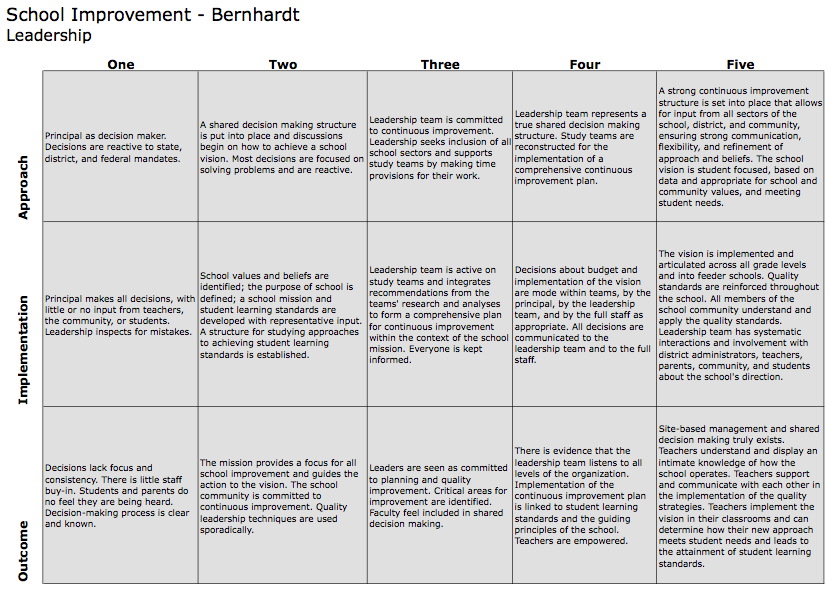
I can make sense out of the tensions between different factions of MMSD advocates by placing their various positions at the different ends of the attached chart on school leadership. (Replace “principal” with “superintendent” and “school” with “district” when reading the chart.)
At stage 1 on the chart,

the Approach is:
[Superintendent] as decision maker. Decisions are reactive to state,
district, and federal mandates;
the Implementation is:
[Superintendent] makes all decisions, with little or no input from teachers, the community, or students. Leadership inspects for mistakes;
the Outcome is:
Decisions lack focus and consistency. There is little staff buy-in. Students and parents do no feel they are being heard. Decision-making process is clear and known.

I feel (and perhaps many other posters do to) that Stage 1 closely describes the MMSD.

(more…)

Share

Punished by CAST?

The pro-referendum group Communities and School Together (CAST) deleted my membership in its list serve, and changed the membership process to require membership approval by a moderator.
I guess that some members of the community are welcome and others aren’t. We’ll see whether CAST lets me rejoin. Probably not.
Should CAST members be banned from schoolinfosystem.org?

Share

Students Aren’t Interchangeable

Patrick Welsh (A high school english teacher):

One of the biggest concerns of parents for the new school year is this: What kind of kids are in my child’s classroom? The answer to this question is particularly difficult for parents of average students, the most forgotten group today.
All parents want their children to be with the nice kids, the bright and well-behaved types who will pull classes up, rather than with kids who will drag them down. In big, economically and ethnically diverse high schools such as mine, T.C. Williams in Alexandria, Va., where there is enormous variation in academic abilities, average kids run the risk of ending up in one of two tracks: in classes full of students with weak skills and lousy attitudes or in so-called advanced courses where they find themselves in over their heads.
A major part of the problem is the anti-tracking movement, which began in the mid-1980s. Since then, tracking has become to education what abortion and gay marriage are to politics — an incendiary topic with fanatics on both sides. So-called progressive teachers and administrators, whose mantra is “every child can learn,” want to do away with tracking.
Good teachers, and fancy sounding course labels such as Advanced Placement or International Baccalaureate, are supposed to raise the level of all students no matter how varied their skills or abilities. In truth, social engineering — mixing of races and ethnic groups in classes — is what many administrators really prize, while giving lip service to academic rigor.
On the other end of the tracking wars are fanatical parents — usually white, in my experience — who think their kids are geniuses, who must be protected from less talented kids and who are entitled to every advantage and resource the school system has to offer.

Joanne has more.

Share

PUTTING FUNDS FROM LEOPOLD REFINANCING INTO THE DISTRICT’S CONTINGENCY FUND IS A WISE MOVE

I would like to address the issue of how the $276,000 from the Leopold refinancing would be handled in the 06-07 school year if the referendum is passed.
The money for the debt service related to the Leopold construction is currently in the Business Services Budget for the District. If the referendum passes, the Board has committed to moving that $276,000 to the District’s contingency fund. Questions have been raised about the wisdom of moving the money to the contingency fund. I believe that is a wise move.
The Board has three options for the funds if the referendum is passed. It can either leave that money in the Business Services budget, it can decide to spend that money in another way, or it can decide to move the money to the contingency fund and potentially use it to soften the budget cuts that will be required for the 2007-08 budget period.
I believe the best course is to put the money in the contingency fund and use it to soften the budget cuts needed for 2007-08 if possible. I don’t believe it is wise to put something back into the 2006-07 budget now – after it was already cut – especially if it is likely that it would need to be cut again in 2007-08.
Putting money in the contingency fund does give the Board discretion on how to spend or not spend the money. Therefore, if 5 out of the 7 Board members believe that the contingency fund is needed in 2006-07 for some unexpected or unbudgeted item, the money could be used for that item. However, and I believe most importantly, the Board could decide not to spend that money at all and use it to address the cuts needed in the 2007-08 budget. If the Board instead determines now to spend that money in 2006-07, that money would not be available to cushion the blow in 2007-08.

Share

Home sales collapse means what for MMSD?

Existing home sales fall for fifth straight month, reports MSNBC.
Though the article reports that Midwest sales have not been hit as hard as other regions, what are the trends for homes in the MMSD?
If home sales slow, does the MMSD need a new West side school at this point in time?
It’s easy to predict a contraction of outlying areas in coming years as high fuel prices (gasoline, heating oil, natural gas) pull people closer to central cities. This possibility also could reduce growth on the fringes of the MMSD — both east and west.

Share

Madison School Board HR Committee: Health Care Costs Discussion

Ruth Robarts, Chair of the Madison School Board’s HR Committee held a meeting last night to discuss health care costs.

Watch the proceedings, or listen [mp3 audio]

Robert Butler’s article is well worth reading “How Can This Continue: Negotating Health Insurance Changes

Parent KJ Jakobson’s remarks, notes and links related to health care costs followed the May, 2005 referenda where two out of three initiatives lost. Local voters will determine the fate of one referendum question this November 7, 2006 (in three parts). Much more on health care here.

Share

Robarts Confirms She Won’t Seek Re-Election

Andy Hall (who’s been busy this week):

Madison School Board member Ruth Robarts confirmed Friday that she won’t seek re-election, ending her sometimes-stormy tenure that over the past decade earned her praise for being a watchdog but also the label of “public enemy No. 1.”
“It is primarily for personal reasons. A decade is a long time to meet every single Monday night,” Robarts said.
Also, she said, governments benefit from the energy of newcomers.

Ruth announced her intention to not seek re-election in Jason Shephard’s spring 2006 article: “The Fate of the Schools“. Ruth has done a tremendous service for the community via her strong, independent voice on the Board. She will be missed. Ruth was instrumental in getting this site rolling.
Johnny Winston, Jr. confirmed that “he’ll be in their swinging” next April. Check out these video interviews of Ruth, Johnny and others in the April, 2004 election.

Share

Freshman Closed Campus: Praise & Scorn at East

Andy Hall:

Chiengkham Thao says it’s working.
Anna Toman and Moises Diaz think it’s got problems.
They and the 420 or so members of their Madison East High School freshman class find themselves part of a grand experiment — the first Madison high school in at least a dozen years to close its campus.
The school’s 1,400 older students still are allowed to lounge outside during their 30-minute lunch break.
Better yet, they’re able to jump into cars for a dash from 2222 E. Washington Ave. to Burger King, McDonald’s or Taco Bell.
But for East’s freshmen, there’s one choice for lunch — the cafeteria — as school officials attempt to reduce the school’s truancy rate.

Share

Audit Finds Education Department Missteps

Ben Feller:

A scorching internal review of the Bush administration’s billion-dollar-a-year reading program says the Education Department ignored the law and ethical standards to steer money how it wanted.
The government audit is unsparing in its view that the Reading First program has been beset by conflicts of interest and willful mismanagement. It suggests the department broke the law by trying to dictate which curriculum schools must use.
Reading First aims to help young children read through scientifically proven programs, and the department considers it a jewel of No Child Left Behind, Bush’s education law. Just this week, a separate review found the effort is helping schools raise achievement.

This audit confirms that Reading First is yet another example of rampant cronyism within President Bush’s administration. MMSD was wise to stand up to federal blackmail by refusing to abandon its successful elementary reading program.
US Education Secretary Margaret Spelling’s statement. The complete Inspector General report [2.9MB PDF].

Share

DPI’s Burmaster Proposes Teacher Bonuses

Alan Borsuk:

State schools Superintendent Elizabeth Burmaster proposed Thursday that Wisconsin provide $5,000 annual bonuses to highly qualified teachers to teach in high-needs schools such as most of those in the Milwaukee Public Schools.
Burmaster also said the next state budget should include $1.6 million for pilot projects in Milwaukee schools that want to extend the school year beyond the conventional 180 days a year; $1 million in grants for arts programs in MPS schools; and significant property tax relief for city of Milwaukee residents through changes in how the voucher school program is funded.
In unveiling her proposals for the two-year state budget that will take effect July 1, Burmaster said Wisconsin should stick to funding two-thirds of the cost of general operation of schools throughout the state, a step that would require an additional $588 million over the two-year period. The state is providing about $5.9 billion in local school aid this year; continuing at the two-thirds level would present a major challenge to an already-stressed budget

Share

Madison School District Policy Change Regarding Credit for Non-MMSD Courses

I emailed this message to the Madison School Board:

A policy change has recently been implemented in the MMSD regarding whether students can receive high school credit for courses offered by the MMSD that they take elsewhere (e.g.’s, via correspondence through UW-Extension, Stanford’s EPGY, and Northwestern’s Letterlinks programs, attendance at UW or MATC, summer programs offered through the Wisconsin Center for Academically Talented Youth and Northwestern’s Center for Talent Development).
Prior to this fall, students could receive high school credit for non-MMSD courses as long as they obtained prior written approval that the courses they planned to take were deemed worthy of high school credit. I have recently learned that this is no longer true. Rather, the only non-MMSD courses that can currently be approved for high school credit are ones in which a comparable course is not offered ANYWHERE in the District.
Why the change in policy?

(more…)

Share

Madison School District Fall Referendum Video

Watch this brief video.

Much more on the November 7 election and referendum here.

Share

Five truths I’ve learned from five weeks of teaching

Elliot H (a 4th grade teacher in Phoenix):

Since I finally have a moment to pause and reflect, I thought I would use one of my infrequent posts to put down some of the things I’ve discovered thus far. In no particular order…
1. The achievement gap is very, very real. Most of my fourth graders don’t know the meaning of simple words like “show” and “pair.” Most can’t do their 2s times-tables. Most read at least a grade level behind. Most have writing skills that could charitably be called atrocious. It’s a miracle that so many of them can find Arizona on a map, because they certainly can’t find anything else (but, to be fair, 7th graders were placing “Europe” in Oregon and “Greenland” in Montana).
Then there’s the one non-special ed. nine-year-old who I last week taught to read the word “the.”
It’s not that they can’t do it. My kids are a bright, energetic, inquistive bunch. Nor is it that they have no prior knowledge — it’s just floating around in shards, unconnected to anything meaningful. I have to ask this question, though: If thirty students have gone through 4 years of many different schools and understand so little, isn’t that a sign that something has gone horribly wrong?

Share

Madison Schools Equity Task Force Discussion [audio / video]

Watch or listen to most of the discussion: Video | 32MB mp3 audio

Susan Troller has more.

Share

Math Organization Attempts to Bring Focus to Subject

Sean Cavanagh:

More than 15 years after its publication of influential national standards in mathematics, a leading professional organization has unveiled new, more focused guidelines that describe the crucial skills and content students should master in that subject in elementary and middle school.
The National Council of Teachers of Mathematics last week released “Curriculum Focal Points for Prekindergarten Through Grade 8 Mathematics,” a document that supporters hope will encourage the polyglot factions of state and local school officials, textbook publishers, and teachers to set clearer, more common goals for math learning.
While the report is being published by the NCTM, it was reviewed by numerous math experts from across the country, some of whom have strongly disagreed with the organization’s past positions on essential skills. The new document reflects an attempt to overcome those conflicts and focus on a number of crucial, agreed-upon concepts.
“I would hope that this has a large impact, because I believe it gets it right,” said R. James Milgram, a Stanford University mathematics professor and a critic of the math organization’s previously issued national standards. He was one of 14 individuals who provided an outside, formal review of the document. “I would like to hope that this represents a new era of cooperation,” he added. “I hope that what this represents is an end to the math wars.”

Much more here and here.

Share

Equity Policy Discussions

Susan Troller:

Deciding which schools should get how many staff members and other resources is a hot topic, and Madison School Board members are tussling over it now.
A majority of board members asked on Monday night to continue the discussion at next week’s meeting, despite board President Johnny Winston Jr.’s reluctance to put the issue on the Sept. 25 agenda.
Winston said the equity issue, which has to do with the fair allocation of resources to students and schools, was too broad to be hurried into discussion. He also said it has the potential to be very divisive. When equity formulas are put in place, some schools gain and some schools lose resources, based on the unique needs of their students.
“It’s a very complex issue,” Winston said.
He is concerned that the board could make hasty changes in how the district’s existing policy is applied, creating “ramifications we don’t fully understand,” he said in an interview today. The district and its financial situation were very different more than a decade ago when the current equity policy was put in place, he said.

Discussion audio and video are available here.

Share

Miracle Math

Typical of many math textbooks in the U.S., this one is thick, multicolored,and full of games,puzzles,and activities,to help teachers pass the time, but rarely challenge students. Singapore Math’s textbook is thin, and contains only mathematics — no games. Students are given briefexplanations, then confronted with problems which become more complex as the unit progresses.

ednext20064_38b.jpg


Barry Garelick [232K PDF]:

It was another body blow to education. In December of 2004, media outlets across the country were abuzz with news ofthe just-released results of the latest Trends in International Mathematics and Science Study (TIMSS) tests. Once again despite highly publicized efforts to reform American math education (some might say because of the reform efforts) over the past two decades, the United States did little better than average (see Figure 1). Headquartered at the International Study Center at Boston College and taken by tens of thousands of students in more than three dozen countries, TIMSS has become a respected standard of international academic achievement. And in three consecutive TIMSS test rounds (in 1995, 1999,and 2003), 4th- and 8th-grade students in the former British trading colony of Singapore beat all contenders, including math powerhouses Japan and Taiwan. United States 8th graders did not even make the top ten in the 2003 round; they ranked 16th. Worse, scores for American students were, as one Department of Education study put it,”among the lowest of all industrialized countries.”

Share

Teaching Math, Singapore Style

NY Times Editorial:

The countries that outperform the United States in math and science education have some things in common. They set national priorities for what public school children should learn and when. They also spend a lot of energy ensuring that every school has a high-quality curriculum that is harnessed to clearly articulated national goals. This country, by contrast, has a wildly uneven system of standards and tests that varies from place to place. We are also notoriously susceptible to educational fads.
One of the most infamous fads took root in the late 1980’s, when many schools moved away from traditional mathematics instruction, which required drills and problem solving. The new system, sometimes derided as “fuzzy math,’’ allowed children to wander through problems in a random way without ever learning basic multiplication or division. As a result, mastery of high-level math and science was unlikely. The new math curriculum was a mile wide and an inch deep, as the saying goes, touching on dozens of topics each year.

Much more, here.

Share

Should for-profit companies run public schools? An entrepreneur and a principal weigh in.

Steven Wilson & George Wood:

Steven F. Wilson
Senior fellow, Harvard’s John F. Kennedy School of Government; founder and former CEO of Advantage Schools
George Wood
Principal, Federal Hocking High School, Stewart, Ohio; director, the Forum for Education and Democracy

Share

Private School Parents Control Board

Destroying Public Schools
New York Times
September 16, 2006
At Odds Over Schools
By BRUCE LAMBERT
LAWRENCE, N.Y.
[This] school district has been changing, house by house, as Orthodox Jewish families have flocked here over the last two decades, gradually at first and then in growing numbers.
While not yet a majority, the Orthodox have nonetheless emerged as the dominant force in a clash of cultures. And the front line in this battle is Lawrence’s once highly regarded public school system.
In each of the last four years, Orthodox voters mobilized to defeat the school budget — one of the longest losing streaks on Long Island. Then in July, they took charge of the school board, though few of the Orthodox send their children to public schools. Out of seven seats, the new majority consists of four Orthodox members and one ally.
[M]any of this district’s Orthodox residents object to paying school taxes that average about $6,000 per home for a system they do not use. Their leaders also complain that more public money should be channeled to the Orthodox day schools, which by law are limited to tax-financed busing, books and special education services.
“We feel invaded,” said an Atlantic Beach delicatessen customer, a self-described non-Orthodox Jew and activist parent who declined to give her name. “We don’t mind them being here, but taking over and shutting down the school system is not the right thing.” (Atlantic Beach is part of the Lawrence school district.)
Experts who track expanding Orthodox neighborhoods around the nation say the conflict in Lawrence has far-reaching implications.
“Other communities are watching Lawrence very closely, for fear they may be next,” said Prof. William B. Helmreich, the director of the Center for Jewish Studies at Queens College. Orthodox adherents “are cohesive, they marshal forces and vote as a bloc,” he said. “It could happen anywhere.”
It has already happened in Rockland County, where Orthodox residents control the East Ramapo school board. Similar strains have arisen over the schools and other services in Lakewood, N.J., home to a large Orthodox population.
“It’s ominous,” said Steven Sanders, a former New York City assemblyman who was chairman of the State Assembly’s Education Committee. “This is not going to be an isolated situation. This is a worrisome trend. The common thread is not religion. The common thread is people who don’t feel invested in educating other people’s children. What do you do when a community is significantly comprised of individuals who don’t have a stake in public schools when they’re already spending for private schools? It’s a fracturing of the social compact.”

Share

Technology: “It Can Do More Harm Than Good”

Ryan Boots:

I’ve been something of a cheerleader on the use of new media in the classroom, principally in the form of digital textbooks.  But similar to what we’ve already seen with the calculator, such technology has the potential to inflict damage in the classroom.

Exhibit A: Right Wing Prof flipped his lid a couple of days ago over a math lesson titled "Making Money from Lemons" (produced by Microsoft no less–oh, the irony).  Just one problem: the lesson didn’t actually involve any, you know, math.  Just a bunch of mouse clicks that an orangutan could be trained to perform. 

Exhibit B: Educomputer vendor Steve Hargadon did an interview with author Larry Cuban on his 2001 book "Oversold and Underused: Computers in the Classroom".  I highly recommend all of Hargadon’s post, but I find this paragraph particularly important:

Share

Math Wars Earthquake

Tamar Lewin:

In a major shift from its influential recommendations 17 years ago, the National Council of Teachers of Mathematics yesterday issued a report urging that math teaching in kindergarten through eighth grade focus on a few basic skills.
If the report, “Curriculum Focal Points,” has anywhere near the impact of the council’s 1989 report, it could signal a profound change in the teaching of math in American schools. It could also help end the math curriculum struggles that for the last two decades have set progressive educators and their liberal supporters against conservatives and many mathematicians.
At a time when most states call for dozens of math topics to be addressed in each grade, the new report sets forth just three basic skills for each level. In fourth grade, for example, the report recommends that the curriculum should center on the “quick recall” of multiplication and division, the area of two-dimensional shapes and an understanding of decimals. It stopped short of a call for memorization of basic math facts.
The 1989 report is widely seen as an important factor nudging the nation away from rote learning and toward a constructivist approach playing down memorization in favor of having children find their own approaches to problems, and write about their reasoning.
“It was incredibly influential,” said Chester E. Finn Jr., a Department of Education official in the Reagan administration. “More than half the states explicitly acknowledged it in devising their own standards. This report is a major turnaround.”

Lewin’s article references a 2005 document: “10 myths of NCTM (Fuzzy) Math“.
NCTM source materials and related links here.

Share

The Not-So-Public Part of the Public Schools: Lack of Accountability

Samuel Freedman:

WHEN Mayor Michael R. Bloomberg and Chancellor Joel I. Klein gained unprecedented power over the vast archipelago of public education in New York more than four years ago, they were the beneficiaries of three beliefs widely held in the city.
The first was that the system of decentralized control, ended after 35 years by the State Legislature in June 2002, had been a misadventure of bureaucratic inefficiency, academic inconsistency and persistent corruption.
The second was that the education program advocated by Mr. Bloomberg’s predecessor, Rudolph W. Giuliani, with its emphasis on steering public money into vouchers for private schools, was too radical for New York.
The final factor was that Mr. Bloomberg, astride a personal fortune, and Mr. Klein, an anti-trust lawyer in the Clinton administration, were so independent and incorruptible they could be trusted to run a system with more than a million students and a budget well into the billions with few, if any, of the traditional forms of government or community oversight.

Share

Texas Gives Teachers in 76 Schools $7M in Bonuses

Ericka Mellon:

Some critics of merit pay argue it puts too much emphasis on standardized tests, but Perry and Texas Education Commissioner Shirley Neeley defended the state’s plan for compensating teachers who prove themselves.
“When you reward excellence, excellence becomes the standard,” Perry said Tuesday at Oleson Elementary in the Aldine Independent School District.
Eleven schools in Houston ISD and two schools in North Forest ISD also are expecting the staff bonuses. Schools had to give at least 75 percent of the bonus money to teachers, but they could include others.
Perry said the bonuses could be as large as $10,000. At Oleson Elementary, the figure was much lower. Some at the campus received $2,800 while others earned $1,100 based on the school’s formula, said Principal Cassandra Cosby.

Share

Return to Basics in Teaching Math

Critics of “Fuzzy” Methods Cheer Educators’ Findings; Drills Without Calculators. Taking Cues from Singapore.
John Hechinger:

The nation’s math teachers, on the front lines of a 17-year curriculum war, are getting some new marching orders: Make sure students learn the basics.
In a report to be released today, the National Council of Teachers of Mathematics, which represents 100,000 educators from prekindergarten through college, will give ammunition to traditionalists who believe schools should focus heavily and early on teaching such fundamentals as multiplication tables and long division.
The council’s advice is striking because in 1989 it touched off the so-called math wars by promoting open-ended problem solving over drilling. Back then, it recommended that students as young as those in kindergarten use calculators in class.
Those recommendations horrified many educators, especially college math professors alarmed by a rising tide of freshmen needing remediation. The council’s 1989 report influenced textbooks and led to what are commonly called “reform math” programs, which are used in school systems across the country.
Francis Fennell, the council’s president, says the latest guidelines move closer to the curriculum of Asian countries such as Singapore, whose students tend to perform better on international tests. There, children focus intensely on a relative handful of topics, such as multiplication, division and algebra, then practice by solving increasingly difficult word and other problems. That contrasts sharply with the U.S. approach, which the report noted has long been described as “a mile wide and an inch deep.”
If school systems adopt the math council’s new approach, their classes might resemble those at Garfield Elementary School in Revere, Mass., just north of Boston. Three-quarters of Garfield’s students receive free and reduced lunches, and many are the children of recent immigrants from such countries as Brazil, Cambodia and El Salvador.
Three years ago, Garfield started using Singapore Math, a curriculum modeled on that country’s official program and now used in about 300 school systems in the U.S. Many school systems and parents regard Singapore Math as an antidote for “reform math” programs that arose from the math council’s earlier recommendations.
The Singapore Math curriculum differs sharply from reform math programs, which often ask students to “discover” on their own the way to perform multiplication and division and other operations, and have come to be known as “constructivist” math.

Links:

Strong parent and teacher views on the MMSD’s math strategy may well spill over to non-support for referendums and incumbent board members, particularly in light of increasing UW Math Department activism on this vital matter.

Share

Advice for (School) Administrators

Ms. Cornelius:

A while back, a friend asked me what advice I would give administrators, since we were discusing advice to new teachers. After having gotten through the first few weeks of school, I am riled up enough now that I’m going to pick up that challenge. So here we go: advice for vice principals, principals, assistant superintendents, superintendents, and any other person who gets to dip their toes into actual policy-making for the educational world.

Share

America on the cusp of education renaissance

Matthew Ladner:

In the past, a lack of data enabled stagnation. Armchair observations of real-estate agents were often the most sophisticated opinions regarding the quality of local schools. Today, online services like www.greatschools.net provide a mountain of comparative testing and parental review data in a few short clicks.
New technologies and practices, such as self-paced computer-based instruction and data-based merit pay for instructors, hold enormous promise which has only begun to be explored. That said, disadvantaged children in KIPP Academy schools, among others, have achieved phenomenal academic results not with new technologies, but rather with old-fashioned “time on task” hard work and extended school days.
In short, we now have the primordial soup of a market for schools.

Via Joanne.
No doubt. I’ve mentioned before that Milwaukee, over the next few decades (despite stops and starts) will have a far richer K-12 climate than Madison. Madison has the resources and community to step things up – I hope we do so (does it have the leadership?).

Share

“Candy isn’t Dandy in Madison Schools”

Susan Lampert Smith:

Expect details of the Madison School District plan in the coming week. Here’s what my sticky fingers were able to pry out of Mary Gulbrandsen, student services director:
Soda pop has already vanished from Madison school vending machines. Candy is no longer sold in school, and in two years, no school group will be allowed to sell candy for fundraising.
(Horde your hockey team candy bars – soon you can sell them on eBay as collectors’ items!)

Share

How Can This Continue: Negotating Health Insurance Changes

Robert Butler[PDF]:

Health insurance has become the most prevalent issue discussed at the bargaining table today. Recent premium increases for school districts with July renewal
dates have focused even more attention on this issue.
Many administrators and board members ask: How can this continue? How do we communicate to our employees, our taxpayers and other interested constituents the effect that our health insurance costs have on our budgets? How do we maintain and, hopefully, expand our educational offerings when our costs for health insurance continue to eat up an ever larger portion of our budget?
There are many factors that have contributed to the high cost of health insurance: utilization of services, demographic trends (such as life expectancy and obesity), healthcare provider consolidation, duplication of services, new products and services, the growing number of uninsured, marketing of prescription drugs, medical malpractice expenses, level of benefits and plan design, among others.
This article will provide insight on how to address items that we can control at the bargaining table: the level of benefits, plan design and consumer behavior. Remember, health insurance is an economic and emotional issue; people don’t always make rational decisions when negotiating over this topic.

Butler is Co-Director of Employee Relations Services, Staff Counsel; Wisconsin Association of School Boards.
Negotiating health care costs with employees is the first item on the Board’s Human Resources Committee agenda: Monday, September 25, 2006 @ 6:00p.m. in the McDaniels Auditorium [map].

Share

The Hidden Cost of Curriculum Narrowing

Craig Jerald [PDF]:

in March, The New York Times published a major education story under the headline “Schools Cut Back Subjects To Push reading and Math.” The article claimed that “thousands of schools across the nation are responding to the reading and math requirements laid out in No Child left Behind […] by reducing class time spent on other subjects and, for some low-proficiency students, eliminating it.”1 The headline appeared “above the fold” in the Sunday edition of the Times, the most valuable and influential real estate in american print journalism.
Predictably, the rest of the media quickly picked up the story in a series of ripples extending outward to other newspapers and magazines to radio and finally to television, cycling back to newspapers in the form of outraged editorials. By the time the story hit the late-night talk shows and drive-time airwaves, commentators had begun to express near hysterical dismay that social studies, science, and the arts were all but disappearing from american schools.
Not so fast. as often happens when complex educational issues encounter the popular media, the extent of the problem was blown out of proportion. The original study on which the Times based its story had actually found that about one third of districts reported that their elementary schools had reduced social studies and science “somewhat” or “to a great extent,” and about one fifth said the same of art and music.

More about the Center for Comprehensive School Reform and Improvement. Via Rotherham.

Share

Madison School District Progress Report

Via a Johnny Winston, Jr. email:

Welcome back to school! I hope you had a wonderful summer. On August 28th the Madison school board approved plans Plan CP2a and Plan CP3a relative to boundary changes that will be necessary if the November 7th referendum to construct an elementary school on the Linden Park site passes or fails. The plan will need to be adjusted depending on enrollment. The board also passed a resolution to place $291,983.75 of the Leopold addition/remodeling monies in the contingency fund of the 2006-07 budget if the referendum passes less the expenses incurred relative to the initial financing of the project
On August 21st, Partnerships, Performance and Achievement and Human Resources convened. The Partnerships Committee (Lucy Mathiak, Chair) discussed strengthening partnerships with parents and caregivers and is working to develop a standard process for administering grants to community partners. Performance and Achievement (Shwaw Vang, Chair) had a presentation on the English-as-a-Second Language Program. Human Resources (Ruth Robarts, Chair) discussed committee goals and activities for 2006-07
On August 14th the board approved a policy that allows animals to be used in the classroom by teachers in their educational curriculum but also protects students that have allergies or other safety concerns. Questions about the November referendum were discussed and an additional JV soccer program at West High school was approved. This team is funded entirely by parents and student fees. The Finance and Operations Committee (Lawrie Kobza, Chair) met to discuss concepts and categories of a document called the People’s Budget that would be easier to read and understand. Lastly, three citizens were appointed to the newly created Communications Committee (Arlene Silveira, Chair): Deb Gurke, Tim Saterfield and Wayne Strong

(more…)

Share

First item on Human Resources Agenda for MMSD: Negotiating health care costs with employees

In August the Human Resources Committee of the Madison School Board—Lawrie Kobza, Shwaw Vang and I–voted unanimously to adopt committee goals for 2006-07 previously presented in this blog.
Human Resources Committee of Madison Board To Set Agenda

Accordingly, Bob Butler, a collective bargaining consultant from the Wisconsin Association of School Boards, will discuss why and how school boards should approach negotiating changes in the cost of employee health insurance plans [How Can This Continue? Negotiating Health Insurance Changes]. The meeting of the Human Resources Committee is currently scheduled for 6:00 p.m. in McDaniels Auditorium on Monday, September 25.

Share

Movement toward “Small Learning Communities” Slowing?

Edwonk:

Hopes were high in this blue-collar town when Lebanon High was broken up into four smaller schools-within-a-school to try to reduce the dropout rate.
At the time, in 2004, the small-schools movement was growing across the country, and it had a powerful backer in Microsoft founder Bill Gates.
But just two years later, criticism from parents and educators has put the future of small schools in jeopardy across the country.
“We made a mistake trying to push autonomy really hard, and the community blew back at us,” said Mark Whitson, a journalism teacher at Lebanon High School. “Parents want us to slow our pace of change until they know what we are doing.”
The small-schools concept calls for dividing large high schools into groups of about 300 students with similar academic interests. (Lebanon was divided into “academies” devoted to communications; farming, natural resources, and health; arts, business, community and family affairs; and engineering and other technical fields.)
The groups then take classes together for four years, with the same teachers. Proponents say students learn more because they and their teachers get to know one another better.

Joanne has more.

Share

Fallacy

Many of you probably read John Stossel’s polemic in the Sunday Wisconsin State Journal (9/3/06). I’d reprint here, but I don’t want to give it a wider readership than it already has. Instead I want to say few words about a central fallacy in the thinking of Stossel (and many others who wish to destroy public education). Contrary to their rhetoric, PUBLIC EDUCATION IS NOT A MONOPOLY.
I’m not talking about the fact that many fine non-public schools thrive (although that’s true), what I want to do is remind people of the important distinctions between the public and private spheres, between government and enterprise (these distinctions aren’t quite the same, but they are close enough for the purposes here). Education is a public matter, a government function because we have for 150 years (more-or-less, depending on the state and locality) we have wanted it that way.
There were and are many good reasons why this is the case. At base, education is – like garbage disposal, safe food and drugs, efficient roads, airline safety, clean water and much else – too important to be left to the vagaries of the market. At one point Stossel quotes an economist praising the “unpredictability” of the market as a source of innovation. That’s fine for producing a better mousetrap, but in schools (as in all the other examples listed) the stakes are too high to let greed be the motive force. I hear “unpredictability” and think of the children in scam voucher schools who lost out so someone could profit. The successes and innovations of capitalism are the successes of greed. The failures of capitalism are the failures of greed. Tainted milk, like bad charter schools in Milwaukee, was profitable; the market did its work by inducing more people to sell tainted milk. It isn’t the all powerful and all wise market that makes sure our children have safe milk — profit is profit, the market doesn’t care — it is the government. Schools were once all private or semi-private, but this – like tainted milk – was not satisfactory and in a democracy things that aren’t satisfactory can be changed.
Democracy is one key to why education is a public matter. If you read the words of those 19th and early 20th century men and women who created and expanded public education, you can sense both their fears and faith. Democratic self-government was a new thing and many scoffed at the idea that “the masses” were capable of the tasks. There was a very real fear of rule by the ignorant mob. But there was also a faith that given the tools their fellow-countrymen (and later women) would be up to the job. The most basic tool was literacy and more broadly education. The state of our political culture may induce many to think that these optimists were wrong about the potential for self-government or perhaps that public education has failed in this mission. I feel that way sometimes, but the republic has survived and the experiment isn’t over. I don’t think we should abandon the basic idea, I think we should work to improve our execution. And since public education is democratically governed (another reason that terming it monopoly is a misnomer), we have the means to make our calls for improvement heard.
Democracy also requires a sense of belonging to the community and the nation. There has long been a tension between the Pluribus and the Unum. America has always been diverse and group identities have threatened to overwhelm a sense of common purpose. When German children went to German schools and Presbyterian children went to Presbyterian schools and rich children went to elite schools and many children went to no school at all (or to charity schools), there was very little to bind them together and much to pull them apart. By making schools public and “common,” the school promoters sought to bolster the Unum. We also struggle with these issues and have arrived in a slightly different place where most of us desire schools to respect group identities, teach respect for group identities (multiculturalism) as well cultivate our commonalities. Finding the balance is not easy and never finished. That cultivating the common is necessary and that the best place to do this is in democratically controlled public schools seems beyond question to me.
Interestingly, capitalism is another reason why public education was considered essential to the health of the nation. There has always been a desire for trained workers and for people to be trained for work, but that isn’t the most interesting or important way that public schools support capitalism. Capitalism is a system of winners and losers. Democracy depends on a rough sense of egalitarianism – “All men are created equal.” So there is another tension here and public education helps resolve it. With free public education, equality becomes “equality of opportunity” and eventually “equality of educational opportunity” (as in the Equal Educational Opportunities Act of 1974). The promise (unfulfilled to a great degree) of equality of opportunity through education further binds the nation together, diffuses the resentments of existing inequalities and provides hope for mobility. Without this, capitalism would be constantly threatened by the “losers.”
Disciples of the market like Stossel rarely address a basic premise of their philosophy and that is that greed and only greed can produce progress and improvement. They see schools that aren’t as good as they should or must be and see “introducing market forces” as the only solution. I don’t hold this dark view of human nature or society. I think that we can be genuinely altruistic; I think that we can work together (cooperation) instead against each other (competition) to produce better schools and a better world. The people who founded public education were far from perfect and filled with self-interested motives, but at the core most shared this belief and I would point to their creation (as imperfect as it is) as evidence that they were right.
TJM

Share

Maryland Teacher Merit Pay

John Wagner:

“Merit pay is obviously something that has been very controversial around the country,” Ehrlich acknowledged to the board, calling his plan “a step in that direction.”
Ehrlich and his aides provided few details yesterday about the scope of the proposed program, saying much remains to be worked out. Ehrlich said he would leave it to local jurisdictions to decide whether to participate.

Phil M and TeacherL recently had a fascinating dialogue regarding merit pay.

Share

Fall Referendum Climate: Local Property Taxes & Income Growth

Voters evaluating the Madison School District’s November referendum (construct a new far west side elementary school, expand Leopold Elementary and refinance District debt) have much to consider. Phil Brinkman added to the mix Sunday noting that “total property taxes paid have grown at a faster pace than income”.
A few days later, the US Census Bureau notes that Wisconsin’s median household income declined by $2,226 to $45,956 in 2004/2005. [Dane County data can be viewed here: 2005 | 2004 ] Bill Glauber, Katherine Skiba and Mike Johnson:

Some said it was a statistical blip in the way the census came up with the new figures of income averaged over two years.
“These numbers are always noisy, and you can get big changes from year to year,” said Laura Dresser of the Center on Wisconsin Strategy.
David Newby, head of the state’s AFL-CIO, didn’t make much of the new numbers, either.
“My hunch is (wages) have been pretty stagnant,” he said. “We have not seen major swings.”
Others, though, seized on the data as significant. This is, after all, a big election year, with big stakes, including control of Congress and control of the governor’s mansion in Madison.
U.S. Rep. Mark Green of Green Bay, the Republican candidate for governor, said in a statement that the data showed that “Wisconsin’s families saw just about the biggest drop in their income in the entire country.”
However, Matt Canter, a spokesman for Democratic Gov. Jim Doyle, said the census information “is totally inconsistent with other current indicators,” adding that the Bureau of Labor Statistics shows an increase in average wages.

The complete census report can be found here 3.1MB PDF:

This report presents data on income, poverty, and health insurance coverage in the United States based on information collected in the 2006 and earlier Annual Social and Economic Supplements (ASEC) to the Current Population Survey (CPS) conducted by the U.S. Census Bureau.
Real median household income increased between 2004 and 2005.2 Both the number of people in poverty and the poverty rate were not statistically different between 2004 and 2005. The number of people with health insurance coverage increased, while the percentage of people with health insurance coverage decreased between 2004 and 2005. Both the number and the percentage of people without health insurance coverage increased between 2004 and 2005. These results were not uniform across demographic groups. For example, the poverty rate for non-Hispanic Whites decreased, while the overall rate was statistically unchanged.
This report has three main sections – income, poverty, and health insurance coverage. Each one presents estimates by characteristics such as race, Hispanic origin, nativity, and region. Other topics include earnings of year round, full-time workers; poverty among families; and health insurance coverage of children. This report also contains data by metropolitan area status, which were not included last year due to the transition from a 1990-based sample design to a 2000-based sample design.

I’m certain there will be plenty of discussion on the state household income decline.
Links:

Share

Making The Grade

Chris Whittle:

Quiz: Of the 10 largest school systems, which have made the best gains in student scores? Answer: Philadelphia and New York. Between 2002 and 2005 for grades K-8, Philly gained 19.5 points in proficiency on the state assessment system, while NYC schools posted a 13-point increase on state exams. Even if you normalize for the different gains made in various states, you get the same rankings: Philly No. 1, NYC No. 2.
In 2002, only 21% of Philadelphia students were proficient. By 2005, that nearly doubled to 40%. At its current pace, Philadelphia will increase the proficiency of its students by more than 25 points across five years. That has life-changing consequences for a quarter of its students: One who would have dropped out might now graduate. Another who would have gotten into college might now get into a better one.
In sharp contrast to years past, most big public school systems are now producing achievement gains. That’s to be applauded, but educational leadership can learn much from two cities with multiyear trajectories two to three times those of their similar-sized peers. Each has managed to put (and keep) together a group of factors that drive academic success, and that others may want to replicate:
..
The fourth success factor may seem at odds with the third. While Messrs. Vallas and Klein believe in a robust, central system to support their schools, they promote educational competition within their cities. Have they concluded that it may not be possible to move to a complete free market of education in the near term; and, in the meantime, the old but improved system should coexist with a bevy of new educational providers? Or do they believe that one major educational provider with multiple smaller competitors is a preferable course that pushes all schools to higher performance levels? Whatever their philosophy, their actions are clear. Mr. Vallas now presides over a district where roughly 25% of schools are charters or managed by private institutions. Mr. Klein has increased the presence of charters and alternative providers — and argued that New York’s legislature should lift the cap on charters. He’s also given unprecedented freedom to a quarter of the sites within his system, those he deems to be most capable of managing their freedom — as long as they agree to be held accountable if their children fail to improve.

More on Chris Whittle.

Share

Fall Referendum: Madison School District Boundary Changes

WKOW-TV:

Regardless how people in Madison vote this November the school board will make boundary changes, forcing some students into new schools. Two options were chosen Monday night to deal with overcrowding. The first option reflects what the district would look like if the referendum passes. The second option on the table is in case it doesn’t pass

Susan Troller:

bout 510 students will move if the new school, located west of County M in a rapidly developing area of new homes, is approved and built. If the referendum fails, over 225 students will move and program changes, including converting art and music rooms to classrooms and increasing class size, will be necessary to gain capacity, said Mary Gulbrandsen, the district’s chief of staff.
School Board members also voted unanimously on Monday to return over $291,000 to the School District’s contingency fund if the referendum passes. That amount represents money already approved to construct the addition at Leopold, which came out of the district’s operating budget.
Board member Lawrie Kobza said she felt the public was asking good questions about the referendum, and that it was the board’s responsibility to work hard to develop good answers.
An area of concern for Kobza is that the proposed new school does little to change the substantial discrepancy between schools with high and low concentrations of low-income students.

Share

“Refocus education on core subjects”

Representative Debi Towns:

You might recall the legislation I introduced to increase Wisconsin’s high school graduation requirement from two- to three-years of math and science. Based on a recent television ad by Jim Doyle, you might be led to believe that this bill was signed into law.
It wasn’t.
However, the issues of increasing our math and science requirements and the lack of academically prepared high school graduates keeps surfacing. Constituents talk to me about it at their doors and at public forums, and it’s the subject of national publications and state studies:

  • Revamping high school graduation standards to more closely mirror college-entrance requirements and employer needs was a nearly unanimous recommendation of the U.S. Department of Education’s 19-member Commission on the Future of Higher Education this month.
  • The Wisconsin Taxpayers Alliance recently studied the lack of academically prepared students entering the University of Wisconsin System. Almost 17 percent of all UW freshmen took remedial math courses in 2004. At two campuses, more than half the freshmen class needed remedial math instruction. It seems wasteful that our colleges need to spend additional resources preparing students to be there. Among the recommendations of the study was more rigorous exposure in high school curricula.
  • The recently released national ACT college entrance exam scores showed that the majority of ACT-tested graduates are likely to struggle during their first year of college. Only 42 percent of test-takers are expected to earn a C or higher in college algebra, and only 27 percent are prepared enough to succeed in college biology.

I HAVE NEVER claimed that a third year of math and science for all high school graduates was a cure-all. Yet, a refocus on our core academic areas is obviously part of the solution. We need more rigorous high school curricula and the courage to increase our expectations of student performance. We also need to re-focus on the purpose for publicly funded high schools.

Via WisOpinion.

Share

Who got the money? Johnny won’t answer.

In using MMSD resources and schoolinfosystem.org to promote his basketball event, Johnny Winston, Jr.’s announcements said:

This year’s proceeds will go toward “The Campaign to Promote Student Achievement and Parent Involvement in Schools.”


I have e-mailed him twice to ask for details about the campaign, and he has not answered. Laurie Frost also raised this question in response to Johnny’s post and received no response.
I searched the online records of the Department of Regulation and Licensing for a charitable organization by that name. Nothing. I searched the records of the Department of Financial Institutions for a corporation by that name. Nothing. I searched the Internet, and the name only appears in the announcements Johnny distributed.
Johnny’s silence makes me wonder whether any such campaign exists, and whether he misused MMSD resources, his political position, and the public’s trust. I hope that I’m wrong.

Share

Math Disaster

NYC Teacher Bruce Winokur:

Teaching mathematics has been my profession in New York City public schools since 1969, first at I.S. 201 in District 5, then at J.H.S. 17 in District 2, and since 1983, at Stuyvesant High School. I’m also the father of a 10-year-old daughter who attends District 2 schools and a member of an organization, Nychold (nychold.com), dedicated to bringing sanity to math education.
I’m a firm believer in public education, the great equalizer. Sadly, over the past 10 years, I’ve witnessed how badly things can go wrong. I am referring specifically to the constructivist math curricula that abound in our city public schools in general and more specifically in District 2, where I live, teach, and raise my daughter.
Constructivist curricula, such as TERC and CMP, forsake algorithms, postulates, and theorems (the foundation of math) as well as teacher-centered learning. Instead, they have students working among themselves in groups, loosely guided by the teacher in a drawn out attempt to “discover” math truths.
In my Upper East Side neighborhood, an incredible number of intelligent young students from the fourth grade and up are seeing private math tutors. Many of these are not the type of children who would normally struggle in arithmetic or elementary algebra. As a result of the way they’re taught elementary math, they find themselves unable to do real math. When they’re taught math in a more traditional way by their tutors, they invariably find themselves relieved and highly critical of the way they’ve been taught mathematics.
At Stuyvesant, we have a disproportionate number of freshmen from District 2 taking our introductory algebra course. Most Stuyvesant students have already completed that course before they enter our school. The ratio of District 2 students to non-District 2 students in those classes is close to twice that same ratio in the freshman class as a whole.

Share

In competition for students, schools market selves more

Sarah Carr:

“When I first started in education, marketing wasn’t something you even had to do,” said Suzanne Kirby, principal of MPS’ Bell Middle School. Now the south side school has a more strategic effort in place. Kirby cleared her schedule for the summer and invited any prospective family in for a personal tour of the school. She’s also designated the school’s orchestra director “marketing guy” and has given him some time off in his schedule to visit feeder elementary schools.
Bell teacher ElHadji Ndaw says such efforts are important because “if you have fewer students, you have fewer teachers,” and the quality of your programs can deteriorate since so much of school’s funding is tied to the number of students.
Then, “if you get down below 300 students,” he adds, “they think about closing you.”

There are different perspectives on this issue, as Marcia Gevelinger Bastian noted last fall:

Many of us believe that all students and families are valuable to the district and that we should actively work to meet all needs and consider all input. When a family who supports and contributes to a school chooses to leave, that seems so sad. I was hoping that representatives of the district may feel the same way. As for me, I was told “West is not in competition for your children”. Ouch!! I suspect that many in the district do not agree with the spirit of that statement.

Share

Expanding High School Rigor

Nick Anderson:

To that end, Deasy proposed that by the 2007-08 school year each of the county’s 22 major high schools should offer at least eight AP courses, which are meant to introduce students to college-level study. Currently, AP offerings in the county vary widely. Many high schools have only a few.
The College Board, which oversees the AP program, will help the school system train a new corps of 200 AP teachers over the next year. In addition, the school system plans to expand subsidies for AP test fees to help ensure that needy students take the tests.
“It’s a monumental culture shift,” Deasy said. “AP will be on the tongue of every kid around here before too long.”
Michael Marchionda, a College Board official working on the project, called it “a multiyear effort” to widen student access to AP. “It’s very comprehensive,” he said.
The county school board will consider the plan Thursday and is expected to support it.
“People asked for rigor,” said Chairman Beatrice P. Tignor (Upper Marlboro). “We’ve got rigor.”

Share

Superintendent’s evaluation

Here’s what the superintendent’s life-time contract language says about the superintendent’s evaluation:

PERFORMANCE EXPECTATIONS: Each year before the first day of school, the Board and superintendent must establish performance expectations for the next year in writing based on his duties and responsibilities under the contract and any other criteria mutally agree upon.
MEASURABLE OUTCOMES: “To the extent possible, all performance expectations shall have measurable outcomes”.
JULY 30 DEADLINE: After setting performance expectations, the Board must meet with the superintendent to discuss his evaluation no later than July 30.
Two types of appraisals are required.
SPECIFIC RESULTS & ACCOMPLISHMENTS BASED ON PERFORMANCE EXPECTATIONS: The written performance expectations must include goals that reflect the superintendent’s priorities for the improvement programs, projects and activities to be undertaken. Prior to meeting with the Board for his evaluation, the superintendent must complete a self-evaluation that summarizes his progress on each goal.
PERFORMANCE CATEGORIES—PLANNING, ORGANIZING, LEADING, SUPERVISING AND JOB KNOWLEDGE: In each category the Board must indicate the type of evidence of performance and data sources that will be used to evaluate the superintendent’s performance.
SURVEYS OF OTHER ADMINISTRATORS: The Board must distribute surveys about the superintendent’s performance in the five categories to individuals who report directly to him and a random selection of other administrators.


Has the board met the contract requirements? No one knows.
Last year Ruth Robarts posted news of the evaluation.

Share

Human Resources Committee of Madison Board To Set Agenda

On Monday, August 21 the Human Resources Committee of the Madison School Board will have its first meeting at 7:00 p.m. in Room 103 of the Doyle Administration Building (545 West Dayton Street).
Following a goal-setting meeting of the Board on June 19, the committee will address a number of important issues, beginning with alternative ways that the district could negotiate health insurance coverage for its employees with the goal of providing the same quality service, higher wages and savings for the district. Committee members this year are Shwaw Vang and Lawrie Kobza. I am the chair.

(more…)

Share

ACT scores are best in 20 years, with a catch, MMSD Curriculum & Upcoming Elections

The issue of curriculum quality and rigor continues to generate attention. P-I:

The good news is that the high school class of 2006 posted the biggest nationwide average score increase on the ACT college entrance exam in 20 years and recorded the highest scores of any class since 1991.
The bad news is that only 21 percent of the students got a passing grade in all four subject areas, including algebra and social science.
“The ACT findings clearly point to the need for high schools to require a rigorous, four-year core curriculum and to offer Advanced Placement classes so that our graduates are prepared to compete and succeed in both college and the work force,” Education Secretary Margaret Spellings said in Washington, D.C.

Alan Borsuk has more:

Wisconsin high school graduates are better prepared to succeed in college than students nationwide – but that means only that more than 70% of state students are at risk of having trouble in one or more freshman-level subjects while the national figure is almost 80%, according to ACT, the college testing company.
The message still isn’t getting across,” Ferguson said in a telephone news conference. If students want to go to college and do well, they have to take high school seriously and take challenging courses, he said.
ACT results showed that students who took at least four years of English and three years each of math, science and social studies in high school did substantially better on the tests (22.9 in Wisconsin, 22.0 nationwide) than those who took lighter loads in those core areas (21.0 and 19.7, respectively).
Elizabeth Burmaster, Wisconsin’s superintendent of public instruction, said she believes that if schools in Wisconsin stay focused on efforts such as early childhood education and small class sizes in the early grades, combined with strong academic programs in middle school and high school, achievement will go up and racial and ethnic gaps will close.

Individual state data is available here.
Burmaster’s statement, along with the ACT information will increase the attention paid to curriculum issues, such as the ongoing questions over the Madison School District’s math program (See UW Math professor Dick Askey’s statement on the MMSD’s interpration and reporting of math scores). Will we stick with the “same service” approach? This very important issue will be on voters minds in November (referendum) and again in April, 2007 when 3 board seats are up for election. See also the West High School Math Faculty letter and a recent open letter to the Madison School District Board and Administration from 35 of the 37 UW Math Department faculty members. Vaishali Honawar has more.
The Madison School District issued a press release on the recent ACT scores (68% of Wisconsin high school graduates took the ACT – I don’t know what the MMSD’s percentage is):

Madison students who took the 2006 ACT college entrance exam continued to outperform their state and national peers by a wide margin, and the scores of Madison’s African-American test takers increased significantly. Madison students’ composite score of 24.2 (scale of 1 to 36) was higher for the 12th straight year than the composite scores of Wisconsin students and those across the nation (see table below). District students outscored their state peers by 9% (24.2 vs. 22.2,) and their national peers by 15% (24.2 vs. 21.1).
Compared to the previous year, the average ACT composite score among the district’s African-American students increased 6% — 18.8 vs. 17.7 last year. The gap between district African-American and white student ACT scores decreased this year. The relative difference this year was 24% (18.8 vs. 24.8) compared to 30% last year.
Scores also increased this year for the district’s Asian students (22.1 to 23.0) and Hispanic students (21.5 to 21.8).

The Madison School District recently published this summary of student performance vs other similar sized and nearby districts (AP, ACT and WKCE) here. Madison’s individual high schools scored as follows: East 22.9, LaFollette 22.1, Memorial 25.1 and West 25.5. I don’t have the % of students who took the ACT.

I checked with Edgewood High School and they have the following information: “almost all students take the ACT” and their composite score is “24.4”. Lakeside in Lake Mills averaged 24.6. Middleton High School’s was 25 in 2005. Verona High School’s numbers:

222 students took the ACT in 2005-2006.
Our composite score was 23.6 compared to the state at 22.2
87% of test takers proved college ready in English Composition (vs. 77%)
66% of test takers proved college ready in College Algebra (vs. 52%)
77% of test takers proved college ready in Social Science (vs. 61%)
45% of test takers proved college ready in Biology (vs. 35%)
37% of test takers proved college ready in all four areas (vs. 28%)
(#) as compared to the state %

Waunakee High School:

Score HS Mean (Core/Non-Core)
Composite 23.3 (24.3/21.5)
English 22.5 (23.9/19.5)
Mathematics 23.2 (24.2/21.8)
Reading 23.3 (24.1/21.5)
Science 23.7 (24.4/22.7)

McFarland High School’s 2006 Composite average was 23.7. 110 students were tested.
UPDATE: A few emails regarding these results:

  • On the Waunakee information:

    In the Waunakee information I sent to Jim Z, our mean for the Class of 2006 comes first, followed by the core/non-core in parentheses. So, our mean composite score for our 157 seniors who sat for the ACT was 23.3, the mean composite for those completing the ACT suggested core was 24.3, the mean composite for those who did not complete the core was 21.5.
    With ACT profile reports, the student information is self-reported. It’s reasonably accurate, but some students don’t fill in information about course patterns and demographics if it is not required.
    Please let me know if there are any other questions.

  • McFarland data:

    It appears that Jim Z’s chart comparing scores uses Waunakee’s “Core score” as opposed to the average composite that the other schools (at
    least McFaland) gave to Jim Z.. If Jim Z. wishes to report average “Core” for McFarland it is 24.5. Our non-core is 22.2 with our average composite 23.7.

  • More on the meaning of “Core”:

    Probably everyone is familiar with the ACT definition of core, but it’s 4 years of English, and three years each of math, science, and social studies. ACT is refining their position on what course patterns best position a student for undergraduate success, however.

Additional comments, data and links here

Share

Growing, Detrimental use of Powerpoint

I previously posted links to articles discussing the inappropriate use of Powerpoint – particularly in lower grades. I’ve been reading Thomas Rick’s “Fiasco” . Ricks’ mentions that Powerpoint was used to draft and communicate battle and reconstruction plans in Iraq:

[Army Lt. General David] McKiernan had another, smaller but nagging issue: He couldn’t get Franks to issue clear orders that stated explicitly what he wanted done, how he wanted to do it, and why. Rather, Franks passed along PowerPoint briefing slides that he had shown to Rumsfeld: “It’s quite frustrating the way this works, but the way we do things nowadays is combatant commanders brief their products in PowerPoint up in Washington to OSD and Secretary of Defense…In lieu of an order, or a frag [fragmentary order], or plan, you get a bunch of PowerPoint slides…[T]hat is frustrating, because nobody wants to plan against PowerPoint slides.”

Yet, Powerpoint is widely used in schools. Garr Reynolds has more.
Some alternatives – outliners that help conceptualize a work prior to expressing it in words. Internet outliners are extraordinarly powerful:

Much more, here.
Don Norman: In Defense of Powerpoint.

Share

People’s Budget: Conceptual Thoughts

Please review and add comments. We’ll be discussing this Monday evening.

Share

Schools Try Elementary Approach To Teaching Foreign Languages

Maria Glod:

School systems across the Washington area are adding foreign language classes in elementary grades in response to a call from government and business leaders who say the country needs more bilingual speakers to stay competitive and even to fight terrorism.
Educators say that the youngest brains have the greatest aptitude for absorbing language and that someone who is bilingual at a young age will have an easier time learning a third or fourth language later on. Compared with adults or even high school students, young children are better able to learn German with near-native pronunciation or mimic the subtle tones of Mandarin.

Share

Pet Policy Approved by the Madison School Board

Channel3000:

After more than a year of debate, the Madison school board finalized a policy regarding animals in the classroom on Monday night.
Board members said it strikes a balance between animals and the health of students.

Susan Troller has more.

Share

Fall Referendum – 3 months to Time Zero

The Madison School District’s Fall $23.5M Referendum Question will be in front of voters 3 months from today. The question asks voters to fund 3 iniatives with a single yes or no vote:

What K-12 issues might be on voter’s minds November 7?

The community has long supported Madison’s public schools via above average taxes and spending (while enrollment has largely remained flat) and initiatives such as the Schools of Hope and the Foundation for Madison Public schools, among many others. The November 7, 2006 question will simply be one of public confidence in the governance and education strategy of the MMSD and the willingness to spend more on the part of local property taxpayers.

UPDATE: Recently elected Madison School Board Member Arlene Silveira posted words seeking input on the Progressive Dane “In the News” blog.

Share

La Follette’s New Principal: John Broome

Susan Troller:

And like Goldilocks finding a perfect fit after several tries, Broome has had experiences – rather positive experiences he is quick to note – in other places that make him especially appreciative of La Follette’s, and the Madison public school district’s unique charms.
As Broome steps into the buzz saw surrounding La Follette’s controversial four-block scheduling system, and a student population that has grown rapidly diverse, he appears not only fearless, but positively ebullient.

Share

Good, Bad News on the Math Front

Karen Rouse:

When results are broken down by race, just 10 percent of black and Latino sophomores in Colorado schools are proficient in math; 90 percent are not.

Those scores are “scary,” said Jenna Fleur Lin, a math teacher who tutors high school students in the Cherry Creek School District and runs a free week-long math and science camp at an inner-city Denver church.

“What it means is you have a huge population that’s not going to function properly,” Lin said.

Moloney said one problem is that, unlike elementary and middle school students, high schoolers have the freedom to choose many of their own courses.
“Are minority youngsters being channelled into challenging programs or are you being (steered) to diminished programs?” he said.
Lin said she believes many students don’t have a solid foundation in math in elementary school.
They are just learning to do calculations but they don’t understand how to

Share

Madison School Board Progress Report for the week of July 31st

Via a Johnny Winston, Jr. Email:

Is it me or is the summer going by way too fast? Very soon the school year will arrive for our students and the board action will mark some changes. On July 17th the Board approved a “wellness policy” that will prohibit the sale of soft drinks at local high schools in favor of milk, diet sodas, bottled water and 100% juices. In addition, it will stop the sale of “junk food” during the school day that put school cafeterias in competition with school stores or vending machines. Some of our students and staff believe that this will hurt school fundraising efforts, however, our board believes that our students are resourceful and will find alternative means for funding. This policy was developed in part because of a federal mandate that all schools nationwide must have a wellness policy…The board also approved “advertising” and “sponsorship” policies. These policies have very clear parameters. Examples of where ads and sponsorship could occur include the district website, newsletters and announcements at sporting events. Given our fiscal challenges, I believe that this is an appropriate policy that I hope will help preserve some of our extra-curricular, arts and sports programs which are often vulnerable to budget cuts… On August 7th the Board will vote on the proposed “Animals in the Classroom” policy and begin the process of evaluating the Superintendent
On August 14th the board will discuss the November 7th referendum and have our regular monthly meeting.

(more…)

Share

High School Rigor: Iowa AP Index and a Michigan School Board Member

The University of Iowa:

Every May a large number of high school students across America take AP exams. In May 2005 over 1.2 million high school students took over 2.1 million AP exams. AP allows students to pursue college-level studies while still in high school. Over 3000 colleges accept AP exam scores for either college credit or placement in higher level courses. AP was developed by The College Board and is one of the most successful and respected academic programs in the nation.
There have been numerous studies and articles proclaiming the advantages of AP. AP test scores have been found to be very good predictors of college grades and college graduation. A National Center for Educational Accountability study (2005) indicated that passing AP exams shows a strong and consistent relationship to college graduation rates. Recently, there has been considerable reporting on the benefits of AP courses and exams for minority students and students from poverty backgrounds. Such students exceed their educators’ expectations on AP (when given the opportunity). AP tests and minority students were made famous with the movie “Stand and Deliver” portraying the high success of inner-city Latino students on the AP Calculus exam.
While there is some controversy over AP (e.g., too much material covered in a short time; more breadth than depth) there is strong agreement (backed by research) by educators that AP courses and exams are a rigorous and meaningful indicator of academic preparation for college. Also, AP exams provide a uniform standard of academic accomplishment across geography, economic status, ethnicity and school size. AP exams cover 34 subject areas and exams are scored on a scale of 1-5, with 5 considered top level work (a grade equivalent of an “A”) in a corresponding college course. A score of 3 or better is often accepted for either college credit or placement.

(more…)

Share

Math Camps Spread for Kids Who Can’t Get Enough

John Hechinger:

A college math student might grapple with this topic in an advanced elective. Ryan was stretching his elementary-school mind at MathPath, perhaps the nation’s toughest summer camp for numerical prodigies.
Math camps are multiplying in part because families are seeking an edge in competitive college admissions and worry about the quality of U.S. math instruction. Last summer, parents paid $280 million to send 120,000 children to academic summer camps, with math among the most popular subjects, according to Eduventures, a Boston research firm, which estimates enrollment is climbing 10% a year. Sylvan Learning Centers, the big tutoring company, says participation in summer math programs, including day camp, jumped 23% last year — twice the rate of other subjects.
The American Mathematical Society counts two dozen “challenging summer math programs” — twice as many as seven years ago. Most focus on high-school students. MathPath caters only to middle-school kids, age 10 to 14. It is also smaller — and more selective — than some better known programs.
About 80,000 kids in second through eighth grade, for example, take part in the annual “talent search” run by Johns Hopkins University’s Center for Talented Youth. Through the search, about 70% qualify for summer camps across the country and some 10,000 enroll in a given year.

Another example of the “Brave New World” referenced in Marc Eisen’s recent words. Neal Gleason comments.
Links: MathPath, Johns Hopkins Center for Talented Youth.

Share

Not to Worry: Neal Gleason Responds to Marc Eisen’s “Brave New World”

Neal Gleason in a letter to the Isthmus Editor:

I have long admired Marc Eisen’s thoughtful prose. But his recent struggle to come to grips with a mutli-ethnic world vvers from xenophobia to hysteria (“Brave New World”, 6/23/06). His “unsettling” contact with “stylish” Chinese and “turbaned Sikhs” at a summer program for gifted children precipitated first worry (are my kids prepared to compete?), And then a villain (incompetent public schools).
Although he proclaims himself “a fan” of Madison public schools, he launches a fusillade of complaints: doubting that academic excellence is high on the list of school district pirorities and lamentin tis “dubious maht and reading pedagogy.” The accuracy of these concerns is hard to assess, because he offers no evidence.
His main target is heterogeneous (mixed-ability) classes. He speculates that Madison schools, having failed to improve the skills of black and Hispanic kids, are now jeopardizing the education of academically promising kids (read: his kids) for the sake of politically correct equality. The edict from school district headquarters: “Embrace heterogeneous classrooms. Reject tracking of brighter kids. Suppress dissent in the ranks.” Whew, that is one serious rant for a fan of public schools.

(more…)

Share

“Teachers’ dissatisfaction with Leopold principal reaches boiling point”

Kurt Gutnecht writing in the Fitchburg Star: [96K PDF]

The management of Principal Mary Hyde has prompted a near revolt among teachers and staff members at Leopold Elementary School.
Discontent among teachers has been simmering for years and came to the forefront recently when Hyde, who’s been principal at the school for six years, decided to terminate a shared teaching arrangement that had previously been praised by Hyde and others.
Sue Talarczyk, who has had such an arrangement with Sue Wagner for seven years, unsuccessfully sought a fuller explanation for Hyde’s decision. Ninety-one teachers and staff members at the school signed a petition asking Hyde to reconsider the termination.
Appeals to district administrators to review Hyde’s decision were also unsuccessful.
Several teachers characterized Hyde as insensitive, intimidating and inconsiderate. All except Talarczyk asked to remain anonymous for fear of retribution.
Teachers interviewed for this article said Hyde made decisions unilaterally, without weighing the opinions of teachers and staff members. had actively solicited parents’support.

Share

Community service levies climb since cap lifted

Five years after state legislators released them from state-imposed revenue caps, school districts’ community service tax levies have nearly tripled, reaching $49 million this year.
The rampant growth in these property taxes – earmarked for community-based activities – took place as the total levies for schools statewide rose by 22.7%.
That has raised concerns about school districts skating around revenue limits and has prompted one lawmaker to request an audit of the program.
State Rep. Debi Towns (R-Janesville) said she is curious why property taxes that pay for recreational and community activities offered by school districts have grown so much since the 2000-’01 school year. In that time, the number of school districts raising taxes for such services has doubled to 240.
“I’m not saying anyone’s misspending. I’m just saying the fund has grown tremendously, and the purpose never changed,” said Towns, chairman of the Assembly Education Committee. In November, Towns called for the Legislative Audit Bureau to study how select school districts use their community service levies.
“So that, of course, leads to a natural questioning of what are they doing differently now than they were doing before,” she said.
The growth in the community service levies is expected to continue next year.
Arts, police, pools
Already, Milwaukee Public Schools has launched a arts education program through its recreation centers that it expects to fund with $1 million in community service funds. The Mukwonago School District plans to keep a police officer in its high school, despite the recent loss of a grant, with a $60,000 boost in property taxes from its community service levy.
The Menomonee Falls School District, which has not raised its levy for recreation and community activities in more than a decade, is counting on a $180,000, or 63%, increase next school year to continue operating one of its two pools.
School administrators say they have a simple explanation for why they are turning to their community service levies more now than they did when they were capped – it didn’t matter before. Because both the general and community service funds were restricted by revenue caps and eligible for state aid, it was simply an accounting preference whether a district paid for it from one fund or the other.
Athletics or academics?
But once the Legislature removed the caps on the community service levies for the 2000-’01 school year and gave school districts an opportunity to keep their recreational activities from conflicting with educational programs, more took advantage of it.
“I think – when you look at districts across the state – that’s really what caused the jump,” said Art Rainwater, superintendent of the Madison Metropolitan School District, which in 2005-’06 had the largest community service levy in the state.
Like some of the bigger community service funds, Madison’s supports a full recreation department with adult and youth programming. But it also helps pay for television production activities, after-school activities, a gay and lesbian community program coordinator and part of a social worker’s time to work with low-income families, Rainwater said.

The School District’s community service levy is expected to grow to $10.5 million in the coming school year. In contrast, the same levy for Milwaukee Public Schools – which serves nearly four times as many children in its educational programs – is expected to reach $9.3 million, said Michelle Nate, the district’s director of finance.
Although the state Department of Public Instruction has issued guidelines to school districts on how they should use their community service levies, it leaves it up to local residents to decide whether their school boards do so wisely and legally.
In the Greendale School District, which at $990,000 had the sixth-largest community service levy in the state last school year, business manager Erin Gauthier-Green acknowledges that her school system has gotten good use out of the fund.
But she also said the School District plans to reduce the property taxes it levies for community services by $300,000 next year now that it has completed some repair projects and before taxpayers complain.
“We know it can be a hot-button issue,” Gauthier-Green said.
By AMY HETZNER
ahetzner@journalsentinel.com
July 22, 2006


Share

ED.Gov: New Report Shows Progress in Reading First Implementation and Changes in Reading Instruction

US Department of Education:

Children in Reading First classrooms receive significantly more reading instruction and schools participating in the program are much more likely to have a reading coach, according to the Reading First Implementation Evaluation: Interim Report, released today by the U.S. Department of Education. The report shows significant differences between what Reading First teachers report about their instructional practices and the responses of teachers in non-Reading First Title I schools, which are demographically similar to the Reading First schools.
“The goal of Reading First is to help teachers translate scientific insights into practical tools they can use in their classrooms,” Secretary Spellings said. “The program is helping millions of children and providing teachers with high-quality, research-based support. As we push towards our ultimate goal of every child reading and doing math on grade level by 2014, Reading First is a valuable help to our efforts.”
The report shows Reading First schools appear to be implementing the major elements of the program as intended by the No Child Left Behind legislation. Reading First respondents reported that they made substantial changes to their reading materials and that the instruction is more likely to be aligned with scientifically based reading research; they are more likely to have scheduled reading blocks and spend more time teaching reading; they are more likely to apply assessment results for instructional purposes, and they receive professional development focused on helping struggling readers more often than non-Reading First Title I schools in the evaluation.

Reading First funds, subject to some controversy, were rejected by the Madison School District a few years ago. UW’s Mark Seidenberg wrote a letter to Isthmus addressing reading last year (.doc file). More on Seidenberg.
Madison School Board Superintendent Art Rainwater wrote an email responding to a Wisconsin State Journal’s Editorial.

Share

One classroom, many classes

Kate Grossman:

“There are high expectations” for the top students, “and expectations that we’ll perform miracles on the low end.” — Third-grade teacher Natalie Brady
In the first six weeks of school, Leigha Groves, whose daughter is one of Brady’s top students, asks for a syllabus repeatedly and meets with Brady several times. Early on, she only saw math homework coming home and dismissed it as simple.
“When you hear the University of Chicago, you know they want the best, but it’s not a gifted program,” says Groves, a 39-year-old police officer and college grad. “I wondered where the challenge would come from.”
Her daughter, Aleigha, transferred from a gifted program at South Loop elementary. Groves also wanted her daughter with more black students.
Nicole Miller says she thinks her son is changing, for the worse

Share

“Community Services Levies Climb Since Caps Lifted”

Amy Hetzner:

Lawmaker requests audit as school districts across state raise taxes to support programs.
Five years after state legislators released them from state-imposed revenue caps, school districts’ community service tax levies have nearly tripled, reaching $49 million this year.
The rampant growth in these property taxes – earmarked for community-based activities – took place as the total levies for schools statewide rose by 22.7%.
That has raised concerns about school districts skating around revenue limits and has prompted one lawmaker to request an audit of the program.
State Rep. Debi Towns (R-Janesville) said she is curious why property taxes that pay for recreational and community activities offered by school districts have grown so much since the 2000-’01 school year. In that time, the number of school districts raising taxes for such services has doubled to 240.
“I’m not saying anyone’s misspending. I’m just saying the fund has grown tremendously, and the purpose never changed,” said Towns, chairman of the Assembly Education Committee. In November, Towns called for the Legislative Audit Bureau to study how select school districts use their community service levies.

The Madison School District’s Community Service “Fund 80” has grown significantly over the past few years. Lucy Mathiak summarized Fund 80’s tax and spending increases here ($8.5M in 2005/2006, up from $3.5M in 2001/2002 – Milwaukee’s 05/06 tax levy was slightly less: $8M). Carol Carstensen notes that Fund 80 is worth our support.
Much more on Fund 80 here.

Share

Pittsburgh Outsources Curriculum

Joanne Jacobs:

Pittsburgh has hired a private company to write a coherent curriculum for city schools, reports the Post-Gazette.
Because course content is uneven and out of sync with state standards, the Pittsburgh Public School district is paying New York-based Kaplan K12 Learning Services $8.4 million to write standardized curricula for grades six through 12.
. . . Teachers in other districts have complained that Kaplan’s detailed curriculum turned them into automatons and deprived them of time to cover material in adequate detail or help students with individual needs.
. . . Pittsburgh school officials cite an urgent need to bring coherence and rigor to what’s taught and tested in the district’s classrooms.

Interesting. Perhaps an RFP looking for different ideas might be useful. Public and private organizations could respond. One only has to look at the “Cathedral and the Bazaar” to see the power of a community vs a top down approach. Leadership, particularly that which embraces the community is critical – as Lucy Mathiak recently pointed out:

Later, she added: “I think one of the fundamental questions facing our district is whether we treat parents as resources or problems. Any parent who is concerned about safety, discipline or academic issues needs to feel confident that their concerns are going to be heard. We have to court the parents. The future of our schools depends on their confidence that we are working as partners with them.”

Here’s a parent’s perspective on curriculum and school climate. Another. A vast majority of the UW Math Department’s perspective (35 of the 37 signed this letter). Marc Eisen offers still another perspective.

Share

Learnings Per Share

Denis Doyle:

If education is funded without measuring results decisions are based on impulse and sentiment, a risky business that. Yet if education is to be funded on results we need a high degree of social consensus on what results are desirable (and measurable).
As it happens, this sentiment does not respect party lines. Former Minnesota DFL Senator John Brandle famously said – more than 20 years ago – “there will be more dollars for education when there is more education for the dollar.”
Conceptually, the task is straightforward: identify what value schooling adds and measure it. While most people associate the value add of schooling with academic progress, there is also a social dimension, ranging from socialization to custodial care. These too can be measured.
Take year ‘round schooling as an example. Students who attend 240 days (rather than the typical US 180-day year) are likely to escape “summer learning loss.” While preliminary evidence suggests that with poor children in particular, summer learning loss is diminished significantly with year ‘round schooling, it is an empirical question. Risk-taking school districts could offer year ‘round schooling on a pilot basis and measure what happens – who enrolls, how popular is the program, and what are the results? (One prediction: working parents will love it.)
Alternately, 13 180-day years equals 2,340 days from K to graduation. Taken in 240 day installments, a typical student could graduate in 10 rather than 13 years. This too is an empirical question. Are there answers? Certainly Japanese experience suggests that there is. The Japanese school year is 240 days long and the typical graduate (after 13 years) is reputed to have completed the equivalent of two years of a good American college.
What business or industry would close for one-third of the year? What other human capital intensive activity — health care facility, for example — would shut its doors one-third of the year?

Share

“Education Just a Click Away”

Mindy Hagen:

In South Carolina, several large school districts such as Richland 2 and Lexington 1 offered online courses. For example, Richland 2’s virtual school employed 27 teachers and had students register for a total of 559 online courses last year, said Margaret Walden, the district’s instructional technology coordinator.
Despite the efforts of individual districts, no statewide program existed to help students in rural areas keep pace.
“This levels the playing field,” Appleby said. “These online courses are available to any student in any district in the state.”
The virtual school has been able to cut down on costs by relying on the same technical software used by teachers for online professional development.
Students at Charleston high schools such Academic Magnet and North Charleston have experience with online courses, but the state’s program will expand access, district spokeswoman Mary Girault said.

Share

Comparing Low Income with Teacher Attributes

The question was recently asked on this site as to how teacher experience compared with poverty levels by school. Using the 2004-05 school data provided in the 2005-06 detailed budget, I compared low-income percentages with: number of years’ experience; % of teachers with advanced degrees; student / teacher ratio. Below are summary charts for all schools in the MMSD.

The first chart compares each school’s low-income percentage with the average number of years of experience their teachers have. Each pink data point represents a different school within the district. For example, the highest point on the chart represents Schenk Elementary School, which had 51% low-income (reading from the x-axis), and an average teachers’ experience of 22.8 years (reading from the y-axis). The black line is the Excel-generated trend line depicting the relationship between teacher experience and school poverty levels. Notice that the points in the chart are widely scattered – they are not closely surrounding the trend line. This dispersion implies a very weak relationship between teacher experience and poverty levels. The very weak relationship that does exist suggests teacher experience declines slightly as low-income levels increase. The oft-stated lament in this country is that as teachers become more experienced, they gravitate toward the “easier” schools with fewer low-income kids. In the MMSD at least, that gravitation appears to be occurring at a remarkably slow rate.

(more…)

Share

Public vs. Private School

NY Times Editorial:

The national education reform effort has long suffered from magical thinking about what it takes to improve children’s chances of learning. Instead of homing in on teacher training and high standards, things that distinguish effective schools from poor ones, many reformers have embraced the view that the public schools are irreparably broken and that students of all kinds need to be given vouchers to attend private or religious schools at public expense.
This belief, though widespread, has not held up to careful scrutiny. A growing body of work has shown that the quality of education offered to students varies widely within all school categories. The public, private, charter and religious realms all contain schools that range from good to not so good to downright horrendous.
What the emerging data show most of all is that public, private, charter and religious schools all suffer from the wide fluctuations in quality and effectiveness. Instead of arguing about the alleged superiority of one category over another, the country should stay focused on the overarching problem: on average, American schoolchildren are performing at mediocre levels in reading, math and science — wherever they attend school.

Share

Parents Want Tougher Policy on Sex Offenses

Susan Troller:

Nancy Greenwald, an attorney and one of the parents involved in the complaint, urged the board to accept Superintendent Art Rainwater’s recommendation that Vazquez be fired and to turn over all relevant files to the Wisconsin Department of Public Instruction, which has begun an investigation that could lead to the revocation of Vazquez’s teaching license.
In addition, Greenwald said, “We need you to do more. We urge you to step in and turn this administration around. From the beginning, the administration tried to push this complaint under the rug.”
Kelly Fitzgerald, PTO president at Jefferson, said in an interview after the meeting: “It has been arduous and painstaking. That it took this long for the administration to recommend removing this teacher is obscene.”
Board member Lucy Mathiak, chair of the district’s Partnerships Committee, said that supporting and enhancing relationships with parents would be a priority for her committee.
Later, she added: “I think one of the fundamental questions facing our district is whether we treat parents as resources or problems. Any parent who is concerned about safety, discipline or academic issues needs to feel confident that their concerns are going to be heard. We have to court the parents. The future of our schools depends on their confidence that we are working as partners with them.”

WKOW-TV has more:

Parent Nancy Greenwald is still troubled about what it took to get Vazquez out of the classroom.
“We found the system seriously flawed.”
Greenwald and other parents say school investigators originally failed to connect the dots of Vazquez’s alleged pattern of sexual harassment.

Sandy Cullen:

“The recommendation finally reached after 13 months included an independent investigation and an evaluation by a psychotherapist who was asked to determine whether or not Mr. Vazquez poses a danger to our children,” Greenwald said, adding that if the psychotherapist’s evaluation “is one reason for the superintendent’s recommendation, as we believe it is, then the initial dismissal of our concerns by the administration was not only wrong, it was dangerously wrong.”
“It should not take the yearlong efforts of a large group of parents that happens to include two attorneys to get the administration to do the right thing,” Greenwald said. “Students who are the victims of sexual harassment are often vulnerable, needy children with little support at home. Who’s going to protect them?”

Share

Madison School Board Superintendent Review Discussion

The Madison School Board discussed the Superintendent review process Monday evening. 46MB Video | 7MB MP3 Audio. The discussion included references to curriculum.

Share

Madison School Board Wellness Presentation / Discussion

Monday evening’s Madison School Board meeting included a discussion of the proposed Nutrition Policy. 84MB Video | 13MB MP3 Audio.

Share

Madison School Board Passes a New Advertising Policy

WKOW-TV:

he Madison Metro School District’s “no advertising” policy is now a thing of the past. Tonight they voted unanimously to allow some advertising at certain venues. They say in the face of limited resources and cutting programs, the district needs to find ways of generating revenue outside the taxpayer.
“The district right now has a menu of things to look at…the website…not really targeting toward kids, but targeting toward the community that would be sporting events, that would be community events that we have,” says board president Johnny Winston Jr.

Share

Don Severson / Vicki McKenna Discussion on Local School Climate, the School District Budget and the Fall Referendum

WIBA’s Vicki McKenna and Active Citizens for Education’s Don Severson discussed a variety of topics today, including Judy Newman’s series on Madison’s changing economic landscape, the Madison School District’s budget process and the planned November referendum for a new far west side school, Leopold Elementary school expansion and debt consolidation. 17MB MP3 audio.

Share

Board and committee goals – 2006

Johnny Winston, Jr. provided a summary of the board’s June 19th discussion of board and committee goals.
I found two of the board’s priorities particularly noteworthy.
One priority under Performance and Achievement reads:

Math and Literacy and Curriculum
• Review the appropriateness of the goal of completion of algebra and geometry in high school in view of test scores in math (and sub categories) at 4th and 10th grades
• Develop specific, measurable goals regarding the district’s strategic priorities: “offering challenging, diverse and contemporary curriculum and instruction”
– Include input from community
• Initiate public discussion and dissemination of MMSD information that explains:
– What curriculum is used and why
– Evidence base for choosing curriculum and teaching methodologies
– Evaluation of student outcomes associated with changes/use of specific curriculum/methodologies
• Curricular review with input from parents and K-12 post secondary educators and employers
• Cost effectiveness of reading recovery
• Math curriculum
• Review math and reading curriculum to assess impact on high school

(more…)

Share

Moving Away from Uniformity

Frederick Hess & Andrew Rotherham:

Perhaps the most encouraging trend in public education today is the growing willingness of educators and policymakers to embrace choices and customization, while turning away from the notion of one-size-fits-all corporatism that dominated 20th century school reform. In education, though, no good deed long goes unpunished. In a barely coherent 5-2 decision, Florida’s Supreme Court used recklessly broad language to overturn the state’s private school voucher program. In doing so, it set an unfortunate precedent that stretches far beyond the question of school choice.
Florida’s Opportunity Scholarship program is the oldest, and smallest, of three private-school choice plans in Florida and has been the focal point of the legal and political battle between school choice proponents and opponents in Florida. In deciding to declare the program unconstitutional, the court read the constitutional requirement that the state provide a “uniform, efficient, safe, secure, and high quality system of free public schools that allows students to obtain a high quality education” as decreeing a constitutional “uniformity” in operations. The decision was greeted with great fanfare by the National School Boards Association, the NAACP, and the teachers unions.

Rotherham has more.

Share

Best Practices Studies

National Center for Educational Accountability:

This report explores the possibility of reaching higher standards for all students in all schools and suggests the principles and practices for doing so. Of course, moving any school system from knowing what high-performing systems do, to doing what high-performing systems do is a complex process. Strong agreement about what high-performing systems do will begin to bring some order to that process.
One practice, which relates to the Framework theme of Curriculum and Academic Goals, is the pursuit of rigorous course content across a broad range of academic levels in high-performing schools. This includes higher expectations for the work of students characterized as “average” or “below average,” more aggressive efforts to enroll borderline students in advanced classes, and more frequent access to the school’s top teachers for average students. At Dr. Michael M. Krop Senior High School in Florida, educators said that the “culture of high expectations is applied to students at all performance levels, not just to the academically advanced.” Students in all academic courses expect homework assignments that require approximately two hours of time each day to complete for each class.

via Joanne.

Share

Upper Grades, Lower Reading Skills

Lori Aratani:

The Alliance for Excellent Education, a Washington-based education policy research and advocacy group, estimates that as many as 6 million middle and high school students can’t read at acceptable levels. It’s an issue for students well above the bottom of the class. A report released in March that looked at the reading skills of college-bound students who took the ACT college entrance exam found that only 51 percent were prepared for college-level reading.
“That is what is the most startling and troubling,” said Cyndie Schmeiser, ACT’s senior vice president of research and development. “The literacy problem affects all groups — not exactly in the same ways, but it’s affecting all groups regardless of gender, income or race.”

Alliance for Excellent Education Adolescent Literacy Site.

Share

Soglin on Allied Drive, Gangs

Former Madison Mayor Paul Soglin:

he future for Allied Drive and the City of Madison appears bleak. WMTV-15 reported two nights ago:
Allied Drive Crowds a Growing Concern for Police
Madison police say they have needed to call for backup three times within the last week due to troublesome crowds of people in the Allied Drive neighborhood. And that’s draining resources from other parts of the city.
Police report groups of 20 to 80 people shouting, sometimes pounding on squad cars while officers try to make an arrest…
This report is not from Milwaukee, or even the Town of Madison but the city of Madison, the self-avowed hotbed of progressive leadership. For those interested in verbose, lengthy analysis, go to Waxingamerica.com to any of my posts under the category of gangs.

Last Fall’s Gangs and School Violence Forum is a must watch (listen – mp3 audio). Participants included representatives from law enforcement, principals and county/state service employees.
Forum notes can be found here along with a number of background links

Share

Home starts here remain weak

Home building in Dane County remains the weakest it has been this century, according to the latest figures from MTD Marketing.
There were just 129 permits issued for single-family homes and duplexes here in June, well below the 222 last year and at least 39 below every June since 1999, the earliest year for which MTD reported figures. The June permits did have a record average value of $243,038. The average square footage was 2,357, behind only the 2,379 a year ago.
Year-to-date through June, there were 822 permits in Dane County, 414 below a year ago and at least 167 below every year since 1999. This year’s permits had a record average value of $250,444, up from the prior record of $239,166 a year ago. The average square footage was a record 2,480, edging out the 2,477 in 2004.
From The Capital Times, July 10, 2006

Share

“Competition the Cure for Health Care”

Harvard Business School Working Knowledge:

Last month HBS Working Knowledge offered an excerpt from Redefining Health Care: Creating Value-Based Competition on Results, by Harvard Business School professor Michael E. Porter and Elizabeth Olmsted Teisberg. The U.S. healthcare system is dysfunctional, a Rube Goldberg contraption that rewards the wrong things and doesn’t create value for the consumer. In this Q&A, Porter discusses his research.
Roger Thompson: What went wrong with the American model? On paper it looks ideal. It’s private, it’s competitive, yet it doesn’t seem to work.
Michael E. Porter: The United States has a system with the wrong kind of competition, on the wrong things. Instead, we have a zero-sum competition to restrict services, assemble bargaining power, shift the cost to others, or grab more of the revenue versus other actors in the system.
Zero-sum competition does not create value; it can actually destroy value by adding administrative costs and leads to structures involving health plans and providers and other actors, which are misaligned with patient value. In a world of zero-sum competition, for example, providers will consolidate into provider groups to gain clout against insurers. But, as we point out in our book, the provider group doesn’t create any value, but value is not created by breadth of services but excellence in particular medical conditions.

NPR’s OnPoint recently interviewed Harvard’s Michael Porter: [20MB MP3 Audio]
Health care expenses have been much discussed with respect to the Madison School District’s $332M+ budget.

Share

US Dept of Education: Academic Competitiveness Grants

US Department of Education:

Participation in a rigorous secondary school program of study may qualify a postsecondary student to receive an ACG, if otherwise eligible. The Secretary recognizes at least one rigorous secondary school program of study for each state annually. States may submit proposals for recognition or may elect to accept rigorous secondary school programs of study pre-recognized by the Secretary. The following are recognized rigorous secondary school programs of study for each state for the 2006-07 award year.

Wisconsin [PDF]:

  • A set of courses similar to the State Scholars Initiative
  • Advanced Placement (AP) or International Baccalaureate (IB) courses and test
    scores.

  • Wisconsin Coursework Requirements.
  • Wisconsin Dual Enrollment Program.
Share

Clear, high goals help schools close the achievement gap

Kati Haycock, interviewed by Alan Borsuk:

Q. The gap is a huge issue in Milwaukee. What would you do if you had full power to do something about things here?
A. When we look at the districts that are making the biggest gains, in terms of both overall achievement and narrowing gaps between groups, what seems to set them apart is their focus. They have very, very clear and high goals for kids. They focus a lot on instruction.

More on Kati Haycock.

Share

Friedman on Public School Centralization and Vouchers

Bob Sipchen:

“The schooling system was in much better shape 50 years ago than it is now,” says Friedman, his voice as confident as reinforced concrete.
A big fan of freedom, Friedman objects to public schools on principle, arguing — as he says most classic liberals once did — that government involvement by nature decreases individual liberty. But it’s the decline of schooling at the practical level, especially for the poor, that seems to exasperate him.
Friedman puts much of the blame on centralization.
“When I went to elementary school, a long, long time ago in the 1920s, there were about 150,000 school districts in the United States,” he says. “Today there are fewer than 15,000, and the population is more than twice as large.”
“It’s very clear that the people who suffer most in our present system are people in the slums — blacks, Hispanics, the poor, the underclass.”
When I ask him about the “achievement gap” separating low-scoring black and Latino students from better-scoring whites and Asians, he blames my “friends in the union.”
“They are running a system that maximizes the gap in performance. . . Tell me, where is the gap between the poor and rich wider than it is in schooling? A more sensible education system, one that is based on the market, would stave off the division of this country into haves and have-nots; it would make for a more egalitarian society because you’d have more equal opportunities for education.
Jonathan Kozol, author of “Savage Inequalities” and other books of education journalism, has noted that the parents who whine that “throwing money at education” doesn’t solve the problem are usually those spending $15,000 or $30,000 a year to send their kids to private schools. I ask Friedman about the obvious implications of that.
“In the last 10 years, the amount spent per child on schooling has more than doubled after allowing for inflation. There’s been absolutely no improvement as far as I can see in the quality of education. . . . The system you have is like a sponge. It will absorb the extra money. Because the incentives are wrong.

Additional LAT comments on this article.

Share

Madison School Board “Progress Report” Week of July 3rd

Via a Johnny Winston, Jr. email:

Welcome to the week of July 3rd edition of the Madison school board’s “Progress Report.” I hope everyone is enjoying the summer
First, upcoming business…On Monday July 10th several committees of the board are meeting: Partnerships at 5 p.m.; Finance & Operations at 6 p.m.; Communications at 7 p.m. and Long Range Planning at 8 p.m
The general meeting on July 17th will include a drama performance from youth involved in MSCR arts program
Next, a few notes on what was accomplished last month
On June 19th the board held a “brainstorming session” to discuss future district directions. This included developing agenda items for the board and committees. For the ‘06-‘07 school year, the entire board will focus on: 1) Attendance, Dropouts, Truancy and Expulsions; 2) Budget Process; 3) Math & Literacy; and 4) Equity. Many items were discussed for committee agendas and the committees themselves will prioritize them
On June 22nd the board approved a one year total package increase of 3.98% for MMSD administrators with 2.18% of that increase going to base salary. The district will investigate whether the current level of health insurance benefits can be provided at a lower cost, which would result in cost savings
Upcoming agenda items include: Food/Wellness; Animals in the Classroom; and Advertising & Sponsorship policies; and the Superintendent’s Evaluation.

(more…)

Share

The School Testing Dodge

NY Times Editorial:

Many of the nations that have left the United States behind in math and science have ministries of education with clear mandates when it comes to educational quality control. The American system, by contrast, celebrates local autonomy for its schools. When Congress passed the No Child Left Behind Act, it tried to address the quality control problem through annual tests, which the states were supposed to administer in exchange for federal dollars. But things have not quite worked out as planned.
A startling new study shows that many states have a longstanding tradition of setting basement-level educational standards and misleading the public about student performance. The patterns were set long before No Child Left Behind, and it will require more than just passing a law to change them.
Policy Analysis for California Education (PACE), a research institute run jointly by Stanford and the University of California, showed that in many states students who performed brilliantly on state tests scored dismally on the federal National Assessment of Educational Progress, which is currently the strongest, most well-respected test in the country.
The study analyzed state-level testing practices from 1992 to 2005. It found that many states were dumbing down their tests or shifting the proficiency targets in math and reading, creating a fraudulent appearance of progress and making it impossible to tell how well students were actually performing.

Read Wisconsin’s “Broad interpretation of how NCLB progress can be “met” through the WKCE”, Alan Borsuk’s followup article, including Wisconsin DPI comments and UW Math Professor Dick Askey’s comments on “Madison and Wisconsin Math Data, 8th Grade“.

PACE Report: Is the No Child Left Behind Act Working? “The Reliability of How States Track Achievement” [PDF]
Andrew Rotherham has more.

Share

Sun Prairie Cuts Health Care Costs & Raises Teacher Salaries – using the same Dean Healthcare Plan

Milwaukee reporter Amy Hetzner:

A change in health insurance carriers was achieved by several Dane County school districts because of unique circumstances, said Annette Mikula, human resources director for the Sun Prairie School District.
Dean Health System already had been Sun Prairie’s point-of-service provider in a plan brokered by WEA Trust, she said. So, after WEA’s rates increased nearly 20% last year and were projected for a similar increase this year, the district negotiated a deal directly with Dean.
When the Dean plan goes into effect Sept. 1, the district’s premiums will drop enough that it can offer a starting salary $2,000 above what it paid last school year and yet the health plan will stay the same, Mikula said. Several other Dane County districts also have switched to Dean.
“I don’t see that our teachers made a concession because really the only thing that’s changing in theory is the name on the card,” she said. “But for the name on the card not to say WEA is huge.”
According to the school boards association, fringe benefits made up 34% of the average teacher’s compensation package in the 2004-’05 school year vs. 24% less than two decades before.

Sun Prairie School District website.

Jason Shephard noted earlier this year that the most recent attempt by the Madison School District to evaluate health care costs was a “Sham(e)”:

Last week, Madison Teachers Inc. announced it would not reopen contract negotiations following a hollow attempt to study health insurance alternatives.
Not to put too fine a point on it, but anyone who suggests the Joint Committee on Health Insurance Issues conducted a fair or comprehensive review needs to get checked out by a doctor.
The task force’s inaction is a victory for John Matthews, MTI’s executive director and board member Wisconsin Physicians Service.
Losers include open government, school officials, taxpayers and young teachers in need of a raise.
From its start, the task force, comprised of three members each from MTI and the district, seemed to dodge not only its mission but scrutiny.
Hoping to meet secretly until Isthmus raised legal questions, the committee convened twice for a total of four hours – one hour each for insurance companies to pitch proposals.
No discussion to compare proposals. No discussion about potential cost savings. No discussion about problems with WPS, such as the high number of complaints filed by its subscribers.

The Madison School Board recently discussed their 2006/2007 goals (my suggestsions). The Wisconsin State Journal noted that there are some early positive signs that things might change.

Share