School Information System

More Discussion on Spending & Education Quality

Ryan Boots:

From time to time I’ve mentioned the disastrous Kansas City experiment, which tends to be a rallying point for those who dare to contradict the Kozol doctrine that increased spending will cure all that ails American education. Looks like somebody didn’t get the memo, because we have a Kansas City for the new millennium:

Boots references George Stratigos, President of the Marin city School District – blog.

Gregory Kane:

In the 40th anniversary of the beginning of the Black Power movement in the United States, there is no clearer indication of black power’s failure than in urban school systems like Baltimore’s that are run by Democrats. Washington, D. C. schools are some of the worst in the country. Democrats run D.C.
In the Manhattan Institute study, Baltimore’s graduation rate was 91st of the country’s 100 largest school systems. But Detroit’s — another city run by Democrats — was 98th. In both Baltimore and Detroit, most of those Democrats are black who are supposed to be exercising black power to improve conditions for black folks.

– via Rotherham.

Share

LA’s Muddled Governance

LA Times Editorial:

A.J. DUFFY’S SUPPORT OF the mayor’s plan to reorganize the management of Los Angeles’ schools hardly qualifies as news. Duffy is president of the school district’s teachers union, which would gain even more power under the plan. But Duffy did propose a novel argument Wednesday in Sacramento, testifying in support of the bill that would authorize the restructuring.
A weakened school board, as beholden to UTLA as ever, makes an ideal negotiating partner for a powerful union. A superintendent who isn’t answerable to the board gives the union enough wiggle room to continually challenge district policy. A situation in which no one is dominant provides a perfect opportunity for the strongest player to emerge as the leader of the district. And UTLA is a strong, well-financed player. No wonder Duffy likes this deal so much.

Share

Chinese Medicine for American Schools

Nicholas Kristof follows up Marc Eisen’s recent words on a world of competition for our children:

But the investments in China’s modernization that are most impressive of all are in human capital. The blunt fact is that many young Chinese in cities like Shanghai or Beijing get a better elementary and high school education than Americans do. That’s a reality that should embarrass us and stir us to seek lessons from China.
On this trip I brought with me a specialist on American third-grade education — my third-grade daughter. Together we sat in on third-grade classes in urban Shanghai and in a rural village near the Great Wall. In math, science and foreign languages, the Chinese students were far ahead.
My daughter was mortified when I showed a group of Shanghai teachers some of the homework she had brought along. Their verdict: first-grade level at a Shanghai school.
Granted, China’s education system has lots of problems. Universities are mostly awful, and in rural areas it’s normally impossible to hold even a primitive conversation in English with an English teacher. But kids in the good schools in Chinese cities are leaving our children in the dust.

(more…)

Share

Racine Health Care Costs & Teacher Layoffs

Scott Niederjohn [PDF]:

Facing a budget shortfall of $7.2 million this year, the Kenosha school district asked each of their labor groups to switch their health insurance provider from the WEA Trust to Minneapolis-based United Healthcare. The coverage offered by United Healthcare has the same benefits and cost sharing provisions as the WEA Trust plan currently used by the district’s employees. All of the labor groups within the district, except for the teacher’s union, chose to make this change and save the district over $3 million in benefit costs. Another $3 million would have been saved if the teacher’s had switched to this identical insurance plan as opposed to remaining with the union owned insurance provider.
The most remarkable part of this story is that because the teachers chose not to make this switch, the district has been forced to layoff 40 teachers to alleviate their budget shortfall.

Share

Early signs of positive change on Madison School board

The editorial board of the Wisconsin State Journal credits the election of Lawrie Kobza, Lucy Mathiak and Arlene Silveira for helping the Madison School board to begin to move in new directions.
New blood betters School Board

Share

Brave New World: Are our kids ready to compete in the new global economy? Maybe not

Marc Eisen:

Most of us have had those eerie moments when the distant winds of globalization suddenly blow across our desks here in comfortable Madison. For parents, it can lead to an unsettling question: Will my kids have the skills, temperament and knowledge to prosper in an exceedingly competitive world?
I’m not so sure.
I’m a fan of Madison’s public schools, but I have my doubts if such preparation is high on the list of school district priorities. (I have no reason to think things are any better in the suburban schools.) Like a lot of parents, I want my kids pushed, prodded, inspired and challenged in school. Too often — in the name of equity, or progressive education, or union protectionism, or just plain cheapness — that isn’t happening.

(more…)

Share

Local Population Growth, Student Numbers and Budget Implications

Wisconsin State Journal Editorial:

Imagine what would have happened if a city the size of Beloit had sprung up in Dane County over the past five years.
That’s almost what happened. Dane County’s population grew by 31,580 from 2000 to 2005, according to U.S. Census Bureau estimates released last week.
No other Wisconsin county gained as many people.
The population increase extended a trend. Over the past 15 years Dane County has gained 91,000 people, almost equal to the population of Kenosha, Wisconsin’s fourth largest city. Projections call for the growth to continue.

Barb Schrank:

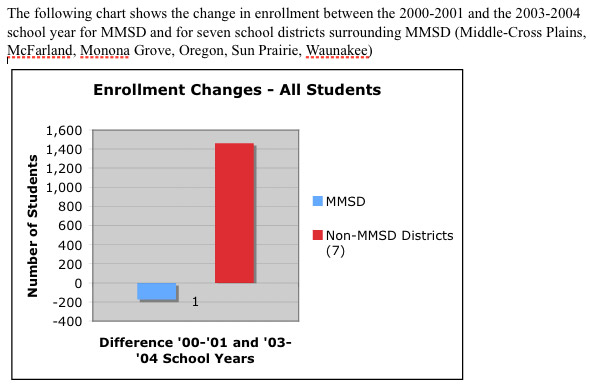
MMSD Lost 174 Students While the Surrounding School Districts Increased by 1,462 Students Over Four School Years. Revenue Value of 1,462 Students – $13.16 Million Per Year*
MMSD reports that student population is declining. From the 2000-2001 school year through the 2003-2004 school year, MMSD lost 174 students. Did this happen in the areas surrounding MMSD? No. From the 2000-2001 through the 2003-2004 school year, the increase in non-MMSD public school student enrollment was 1,462 outside MMSD.
The property tax and state general fund revenue value of 174 students is $1.57 million per year in the 2003-2004 MMSD school year dollars (about $9,000 per student). For 1,462 students, the revenue value is $13.16 million per year. Put another way, the value of losing 174 students equals a loss of 26-30 teachers. A net increase of 1,462 students equals nearly 219 teachers. There are more subtleties to these calculations due to the convoluted nature of the revenue cap calculation, federal and state funds for ELL and special education, but the impact of losing students and not gaining any of the increase of students in the area is enormous.

Share

Edwize on the Poor Track Record of Small Learning Communities

Maisie adds notes and links to the recent Business Week interview with Bill and Melinda Gates on their Small Learning Community High School initiative (now underway at Madison’s West High chool – leading to mandatory grouping initiatives like English 10):

Business Week has a cover story this week about Bill and Melinda Gates’ small schools efforts. The story starts in Denver, where the Gates folks made a mess of breaking up that city’s lowest-performing school, “a complete failure,” in the Denver superintendent’s words. Summarizing reporters’ visits to 22 Gates-funded schools around the country, the article finds that “while the Microsoft couple indisputably merit praise for calling national attention to the dropout crisis and funding the creation of some promising schools, they deserve no better than a C when it comes to improving academic performance…Creating small schools may work sometimes, but it’s no panacea.”
The article points to some real successes. Some are in New York City, and the article says part of the reason for the success is Gates’ partnership with New Visions for Public Schools, which has been in the small-schools business a lot longer than Bill and Melinda. Mott Haven Village Prep HS [pdf] is one example. But of all the Gates schools in NYC, the report says one-third had ineffective partnerships, many have rising “social tensions,” and suspensions have triped in the new schools over the last three years to reach the system average.
We are never snippy but we told you so. The UFT’s 2005 Small Schools Task Force found too many of the Gates-funded small schools have been started with little planning, inexperienced leadership, minimal input from staff or stakeholders and no coherent vision. Some are little more than shells behind a lofty–sometimes ridiculously lofty–name.

Share

Change

Some interesting changes in the Madison School Board’s Governance this week:

  • Renewed administrator contracts for one year rather than the customary two years. Via Sandy Cullen:

    The administration had proposed a two year wage and benefit package for administrators, but School Board President Johnny Winston Jr. said board members did not want to be locked into increases for a second year.
    The 3.98 percent increase for the 2006-07 school year – which includes a base salary increase of 2.18 percent – is equal to what teachers received last year and is the maximum allowed under the state’s Qualified Economic Offer, or QEO, Rainwater said.

    Administrator compensation and contract term been discussed previously.

  • Voted (7 – 0) to use the low bid architect for the planned Linden school (some $200K less than the Administration’s suggested award winner based on points). Construction of Linden is part of a planned November 2006 referendum.
  • Began to address health care costs – via Sandy Cullen:

    The Madison School Board on Thursday took what members hope will be a first step toward lowering health-care costs for district employees.
    In unanimously approving a 3.98 percent increase in wages and benefits for administrators for the 2006-07 school year, board members also reserved the right to make changes in health insurance providers that would offer the same level of coverage at a lower cost to the district. Cost savings would be used for salary increases for administrators and other district needs.

The Wisconsin State Journal has more:

Voters sought change in recent Madison School Board races, and they are getting the first positive stirrings of it.
There are fewer long, tedious speeches and less of the factionalism that has marred board work in past years. There is more substantial questioning and less contentiousness. Split votes don’t have to lead to finger pointing and personal attacks.
And last week the board took a first step toward lowering health care costs.
Lawrie Kobza has spearheaded the shift since her election a year back. And rookie board members Lucy Mathiak and Arlene Silveira, who took office last month, seem to be helping.

Share

Need based School Funding Formula Disputed

Peter Gascoyne made an excellent point in recent comment regarding “No free lunch”. In other words, a change that’s positive in one area may not be all that great for others. Beverly Creamer notes that Hawaii is implementing a new Weighted Student Formula that is not without controversy:

A new controversy is shaping up over how money is divided among the state’s public schools under a formula based on student need.
Small and rural schools were expected to suffer staggering monetary losses under a new Weighted Student Formula that will take effect with the new school year July 27. And even though the losses were averted with an extra $20 million from the Legislature, the outcry over the expected impact on small and rural schools generated widespread concern.
Now, a special Department of Education committee charged with re-examining the formula has proposed a key change intended primarily to address wide discrepancies in funding between the largest and smallest schools.
Under the plan, each school would receive a base amount — or “foundation grant” — to assure that each could afford essential positions. The foundation grants would amount to about 25 percent of total school funding, leaving much less to be divided according to student need.

Share

How to Create a Hydra

Mike Antonucci:

You learn all you need to know about education policy in California when you understand that both a Republican governor and a Democratic big-city mayor are compelled to negotiate behind closed doors with the bosses of a private enterprise – the teachers’ union – but are in no way obligated to solicit the views of the public, who will pay the price for such grand schemes.
The Los Angeles Times editorial page got it exactly right this morning: “Consider a school whose students are failing at math. Who could responsible parents see to address the problem? The teachers picked the curriculum, but they can’t be voted out of office. The school didn’t decide its budget; the superintendent did that. But both the board and the mayor have a say in it. The board can’t hire and fire the superintendent on its own; the mayor can say the board selects the superintendent. And because the board loses power in this deal, it has little interest in seeing it succeed.”

Share

2006 / 2007 Madison Middle School Changes

Madison Metropolitan School District June 22, 2006 memorandum on 06/07 middle school changes.
[pdf version]

Share

“The Secret to Partnering with Business”

The Dehaviland Blog:

I’ve been thinking through my experiences with such partnerships, wondering what the common thread is – what do businesses want to hear from nonprofits who come calling for support? What’s the one thing (if there is one thing) that, more than anything else, will give you the best shot at establishing the partnerships you want?
And in the spirit of the quote above, I think I’ve found the answer – the thing that opens the door to limitless opportunity for any school or nonprofit organization that takes it to heart. Just one word.

Share

A Look at Johnny Winston’s 6 Weeks As President of the Madison School Board

Susan Troller:

At a brainstorming workshop meeting Monday night organized by Winston, School Board members outlined ideas and priorities for the next year. While there was some initial grumbling about process, within a couple of hours, dozens of ideas had been presented, organized and prioritized.
By the end of the evening, four subject areas were chosen as priorities: fair allocation of resources to schools, the budget process, attendance issues and academic performance.

Share

How Schools Pay a (Very High) Price for Failing to Teach Reading Properly

Brent Staples:

Imagine yourself the parent of an otherwise bright and engaging child who has reached the fourth grade without learning to read. After battling the public school bureaucracy for what seems like a lifetime, you enroll your child in a specialized private school for struggling readers. Over the next few years, you watch in grateful amazement as a child once viewed as uneducable begins to read and experiences his first successes at school.
Most parents are so relieved to find help for their children that they never look back at the public schools that failed them. But a growing number of families are no longer willing to let bygones be bygones. They have hired special education lawyers and asserted their rights under the federal Individuals With Disabilities Education Act, which allows disabled children whom the public schools have failed to receive private educations at public expense.
Federal disability law offers public school systems a stark choice: The schools can properly educate learning-disabled children — or they can fork over the money to let private schools do the job.

More on Brent Staples.

Share

School Board better, newbies say

Sandy Cullen:

“It is a new direction,” said Mathiak, who echoed Kobza’s call for changes in the board’s decision-making and budget processes in unseating 12-year board veteran Juan Jose Lopez.
Mathiak had recommended many of the areas in which administrative cuts were made. “It’s a start toward taking ownership and leadership for the types of things that have to happen,” she said.
Mathiak joins Kobza, who unseated incumbent Bill Clingan, and Ruth Robarts, now in her ninth year on the board, as advocates for changing what some critics negatively describe as the status quo. On several successful budget amendments, they were joined by Shwaw Vang, who is in his sixth year on the board, for a 4-3 majority.

Ruth Robarts raised a powerful point in her comments “she is concerned committees might be restricted from taking up issues not supported by a majority of board members.“. I hope this is not the case. The Board majority has been criticized for not addressing some of the more challenging issues over the past few years, like health care, the Superintendent’s review (something not done from 2002 to 2005!), the effectiveness of the District’s curriculum strategy and a variety of budget topics, among others. Improved communication includes actually discussing substantive topics.
It will be interesting to see what topics are addressed by the Madison School board over the next 9 months (I posted some ideas on goals here). Voters will be watching as they consider the fall referendum and April, 2007 election for 3 seats (Robarts, Vang and Winston’s seats).

Share

June 12th School Board Update – End of School Year

Via a Johnny Winston, Jr. email:

The Madison School Board has been (and will be) very busy. At the June 12th meeting the board voted to go to referendum on November 7th for a new elementary school on the far Westside of Madison, Leopold Addition and refinancing of existing debt. The total amount of the referendum is $23.5 million. If approved, it would represent about a $21 increase in property taxes for the next 20 years on the average $239,449 home.
The June 5th meeting was devoted to discussing the possible referendum items.
On May 31st the board passed the $333 million dollar budget for the 2006-07 school year. Amongst notable budget amendments include: 5th grade strings program two times per week (with a pilot program at one school with students having the choice of either general music or strings), community services funding for Kasjiab House and GSA for Safe Schools, elementary library pages, Connect program and a garbage truck (to end privatization of service).

(more…)

Share

WIBA’s Vicki McKenna & Don Severson Discuss the November Referendum

10MB MP3 Audio

Share

Audio / Video: Madison School Board Fall 2006 Referendum Discussion & Vote

MP3 Audio or Video

The Madison School Board discussed and voted on a a November, 2006 Referendum that features “three requests in one vote“: a new far west side school, a 2nd Leopold expansion request and a refinancing plan that frees up some funds under the state revenue caps in the MMSD’s $332M+ budget. Learn more about the May 2005 referenda, which included a much larger Leopold question here.
Share

Audio / Video: Madison School Board Schools of Hope / Reading Presentation

The Madison School Board heard a presentation on the Schools of Hope initiative Monday evening. There was a lively discussion on the results of this initiative.
MP3 Audio or Video
Share

Audio / Video: Madison Middle School Redesign Presentation

The Madison School Board’s Performance & Achievement Committee heard an Administration presentation on the Middle School Redesign project Monday night.
MP3 Audio or Video

More on the middle school redesign.

Share

Fast Learners Benefit From Skipping Grades, Report Concludes

Jay Matthews:

Few educators these days want to go back to the early 19th century, when often the only opportunities for learning were one-room schoolhouses or, if you were rich, private tutors. But a report from the University of Iowa says at least those students had no age and grade rules to hold them back.
What was lost in the 20th century was “an appreciation for individual differences,” scholars Nicholas Colangelo, Susan G. Assouline and Miraca U.M. Gross conclude in the report, “A Nation Deceived: How Schools Hold Back America’s Brightest Students.” Now, the report says, “America’s school system keeps bright students in line by forcing them to learn in a lock-step manner with their classmates.”

Download the report here.

Share

School Board OK’s 23.5M November Referendum: Three Requests in One Question

Sandy Cullen:

he Madison School Board will put one $23.5 million referendum question to voters in the Nov. 7 general election.
If approved, the referendum would provide $17.7 million for a new elementary school on the Far West Side, $2.7 million for an addition at Leopold Elementary, and $3.1 million to refinance debt.
It also would free up $876,739 in the portion of next year’s operating budget that is subject to state revenue limits. Board members could use that money to restore some of the spending cuts in the $332 million budget they recently approved, which eliminated the equivalent of about 86 full-time positions to help close a $6.9 million gap between what it would cost to continue the same programs and services next year and what the district can raise in taxes under revenue limits.

Susan Troller has more:

The board voted unanimously to hold the referendum in November, rather than placing in on the ballot during the fall primary in September. The later date, board members said, provides more time to organize an educational effort on why the projects are necessary.
“We’ll see what happens,” said board member Ruth Robarts, the lone dissenting voice on the decision to bundle all three projects together in a single question to voters in the general election. Robarts, who preferred asking the three questions separately, said she was concerned that voters who did not like one project might be likely to vote against all three.

What’s the outlook for a successful referenda? I think, as I wrote on May 4, 2006 that it is still hard to say:

(more…)

Share

2006 / 2007 Madison School Board & Committee Goals

The Madison School Board meets June 19, 2006 @ 5:00p.m. to discuss their 2006 / 2007 goals for our $332M+ schools. A friend wondered what goals readers have in mind.
I thought it might be useful to consider the Board’s goals in light of the District’s strategic plan [450K pdf]:

  1. Instructional Excellence
    Improving student achievement
    Offering challenging, diverse and contemporary curriculum and instruction.
  2. Student Support
    Assuring a safe, respectful and welcoming learning environment.
  3. Staff Effectiveness
    Recruiting, developing and retaining a highly competent workforce that reflects the diversity of our students.
  4. Home and Community Partnerships
    Strengthening community and family partnerships, and communication.
  5. Fiscal Responsibility
    Using resources efficiently and strategically.

My thoughts are below:

(more…)

Share

Far West Side Elementary School Referendum: Potential Boundary Changes

View the details: CP2a:

New Leopold addition. No new school far west side. Gain capacity by programmatic changes, e.g.SAGE reduction, Art and Music rooms converted to classrooms, or reduction of flexible room, at Crestwood and Chavez (increasing capacity). Early Childhood moved from Stephens and Muir to Midvale-Lincoln. Multiple boundary changes.

and CP3a:

New addition at Leopold. New school far West Side. Multiple Boundary Changes

Source .xls files: CP2a and CP3a.

Share

MTI Demands to Bargain: Middle School Math Masters Program and Reading Recovery Teacher Leader

A reader emailed this item: Madison Teachers, Inc. Solidarity Newsletter [pdf file]:

The District sent literature to various teachers offering credit to those who enroll in the above-referenced courses. As an enticement for the Reading Recovery Teacher Leader course, the District offers “salary, tuition, and book costs.” The program will run after work hours during the school year. Regarding the Middle School Math Master’s Program, every District teacher, who teaches math in a middle school, is “expected” to take three (3) District inservice courses in math, unless they hold a math major or minor. The District is advising teachers that they must complete the three (3) courses within two (2) years. The courses are 21 hours each. The program is scheduled to run during the school day, with substitute teachers provided on the days the courses will be taught.
The Wisconsin Employment Relations Commission has previously ruled that an employer offering financial incentives, including meals and lodging, or release time, to employees in conjunction with course work or seminars is a mandatory subject of bargaining between the school district and the union.

Share

Schools That Work

Megan Boldt, Maryjo Sylwester, Meggen Lindsay and Doug Belden:

On paper, the schools appear troubled: low-income students, low state test scores. But a closer look reveals 13 are doing better than expected.
The challenges are not uncommon at schools such as Dayton’s Bluff that serve mostly low-income students. But Siedschlag had faith in the teachers she said nurtured students, and she thought things would get better.
They did. A new principal arrived in 2001 and renewed the school’s energy. Expectations became clear. Students respected teachers. And staffers now go out of their way to support parents.
School visits and interviews showed that the factors seen as critical to success at Dayton’s Bluff also are found at many of the other schools: They have strong principals and a cohesive staff who offer students consistency and structure. They emphasize reading and writing above all else. And they focus instruction on the needs of individual students rather than trying to reach some average child.
These successful schools have focused on basics — reading, writing and math — as they educate their at-risk students. They also have shifted to small-group learning and one-on-one instruction.
“We used to teach to this mythical middle student,” said literacy coach Paul Wahmanholm, who has taught at Dayton’s Bluff for eight years. Now, “we got away from this one-size-fits-all approach and focused on individualized instruction.”

Via Joanne.
Megan Boldt notes the importance of high expectations for all, or as a local teacher friend says: “Standards not sympathy”.

So shouldn’t the level of poverty be taken into account when determining how well schools teach kids?
No, say educators and researchers who contend that doing so would create two classes of U.S. schools and eviscerate the No Child Left Behind federal education law, which aims to have all students proficient in reading and math by 2014.
“Changing that would create a two-tier system of education — one with high expectations for the wealthy and a set of lower expectations for low-income students,” said Diane Piché, executive director of the Citizens’ Commission on Civil Rights.
“It’s simply not fair for students born into poverty to expect less of them when we know what’s possible,” she said. “That’s what we should focus on, rather than what’s likely.

Share

Getting Mad About Schools

Jay Matthews:

To get such results, do teachers and parents and administrators have to be insufferable? Maybe not. Both Patterson and Winston say their favorite clients — Feinberg and Levin — are more mature and less irritating now. Feinberg in particular, by most accounts the more troublesome of the two, is now “quite the diplomat,” Patterson said.
We have examples of some big city school systems that have made significant progress under persistent but polite pressure from above. The impressive record of Boston school superintendent Tom Payzant, retiring after 10 years, is one example. Patterson said she thinks she and Feinberg only managed to make headway in Houston for KIPP because that city had a far-sighted and intelligent school board, and an accomplished superintendent, future U.S. education secretary Rod Paige. Paige saw the value of Feinberg’s efforts even when the KIPP principal waited beside Paige’s car in the school district parking lot all day so that he could ambush him with a request for help in another space crisis.

Share

Oregon’s Open Book$ Project

The Chalkboard Project / Oregon Department of Education:

When the Chalkboard Project conducted the most extensive statewide polling ever of Oregonians on education issues and priorities, 65% said they would have greater confidence in K-12 schools if they could easily find standardized budget information they could compare and contrast.
People want to know where their money is going, and they want that information in a straightforward manner that is easy to understand.
The Open Book$ Project aims to provide ordinary Oregonians with an open, simple look at where K-12 dollars really go. Audited data is supplied by the Oregon Department of Education in cooperation with Oregon’s 198 school districts.
Open Book$ is funded by the Chalkboard Project, a non-partisan, non-profit initiative of Foundations For A Better Oregon. Launched in early 2004, Chalkboard exists to inspire Oregonians to do what it takes to make the state’s K-12 public schools among the nation’s best, while restoring a sense of involvement and ownership back to taxpayers. Chalkboard aims to help create a more informed and engaged public who understand and address the tough choices and trade-offs required to build strong schools

The Portland School District spent $443,634,000 in 2004/2005 to educate 47,674 students ($9,306/student) while the Madison school district spent $317,000,000 to educate 24,710 students (12,829/student) during that same year.
A number of our local politicians have visited Portland over the years in an effort to learn more about their urban and economic development plans.
California’s Ed-Data is also worth checking out.

Share

Appleton’s schools models for health

APPLETON (AP) – Lunch hour at two local schools became the subject for a film crew as part of a federal agency’s plan to show how the Appleton district is trying to promote healthy lifestyles and fight the epidemic of childhood obesity.
The media crew also filmed fitness programs at Edison Elementary School and West High School and interviewed staff members, including Superintendent Tom Scullen, for the footage due to be aired June 20 as part of a national talk show on child health and nutrition.

(more…)

Share

Madison School Board Discussion of a New West Side Elementary School, Fitchburg TIF District, Leopold Addition & Fall Referenda

Watch the video.

Sandy Cullen has more as does Susan Troller.

Share

District News

Here is the link to the school district’s monthly newsletter: http://www.madison.k12.wi.us/today/
I thought the story about awards to staff was especially important: it is half-way down the page,
The superintendent recently received 2 awards from the UW School of Education – to quote from the newsletter:
Professor Paul V. Bredeson, UW School of Education department chair, gave MMSD Superintendent Art Rainwater a Senior Faculty Fellow award in recognition of his significant contributions to the work of the department and his fostering of collaboration between the University and administrators throughout the Madison School District.
This took place at the UW Department of Educational Leadership & Policy Analysis awards reception May 5.
Art also received the national University Council on Educational Administration’s (UCEA) Excellence in Educational Leadership Award from UW School of Education Dean Julie K. Underwood.
The faculty of the UW Department of Educational Leadership & Policy Analysis nominated Rainwater for the national recognition given to practicing school administrators who have made significant contributions to the improvement of administrator preparation.

Carol Carstensen

Share

Superintendent Rainwater’s Reply Regarding the Math Coordinator Position

Madison Metropolitan School District Superintendent Art Rainwater replied via email to our “Open letter about Math Coordinator position at MMSD“:

On Wed, 31 May 2006, Art Rainwater wrote:
Dear Steffen and others;
Thank you for sharing your concens.
The District has always employed outstanding curriuclum leaders in our Teaching and Learning Department. Mary Ramberg has been a leader in Teaching and Learning as have Lisa Wachtel in Science and Mary Watson Peterrson in Literacy and Language Arts.
Please rest assured that I. even more than you, am committed to employing the best possible math corrdinator. The minimum requirements posted are exactly what they say. They are minimum requirements and failure to meet the requirements eliminates the person from consideration immedately without even a further paper screen. Our district has a hiring process that has served us vrey well over the years and this is only the first part of that process.
The breadth and depth of knowledge of mathematics is obviously one of two key components in determining who will be the final pick for this position. However, equally important in the decision is the breadth and depth of pedogogical knowledge. Both of these will be given equal weight and I will not employ anyone who does not have both.
Art Rainwater

My reply:

Dear Art,
Thanks for your prompt reply.
What caused all of us to write/sign this letter is that the posted job ad does precisely NOT require what we consider two MINIMUM requirements for this position, namely (and I repeat):

  1. subject knowledge equivalent to a strong bachelor’s degree in mathematics, and
  2. teaching experience at the highest level in the high school curriculum.

I do hope that the school board and the district administration will RESTRICT its search to ONLY candidates meeting these two MINIMUM requirements.
Thanks for your attention!
Steffen

Share

Madison School Board Unanimously Passes Budget for 2006-07

At the end of six and a half hours of discussion on May 31, the Madison School Board voted 7-0 to adopt the superintendent’s proposed budget for 2006-07. The vote came after board members made amendments to the expenditures for the next school year.
School Board cuts 41 teacher spots

Share

Open letter about Math Coordinator position at MMSD

OPEN LETTER:
Dear Members of the School Board, dear Superintendent Rainwater,
We are writing to strongly urge that the new Coordinator of Mathematics have the depth of knowledge of mathematics that we believe is essential for the position. While we are obviously concerned about the preparation of students entering the University, our concerns are much broader than that. The new Coordinator must have a high level of understanding of both mathematical content and pedagogy to independently navigate through the controversies that surround the established standards and published curricula. These “navigational skills” are essential if we are to achieve a program for the Madison school system that meets the needs and aspirations of all the students in the system.

(more…)

Share

LA’s Superintendent Selection Process

Bob Sipchen:

By the end of this column I will have selected the next superintendent of the Los Angeles Unified School District. Because I believe that the children, parents, teachers and citizens of Los Angeles are entitled to transparency in such deliberations, I invite you to join me as I work my way toward a decision.
Let’s start in a classroom at North Hollywood High School, where, in a scene reminiscent of “Blackboard Jungle,” 28 young toughs have school board President Marlene Canter backed up against a projector screen.
These aren’t physical toughs. They’re intellectual toughs. But if I were Canter, I’d take the sneering, tattooed kind any day.

Share

A Parent’s Note to the Madison School Board on Strings

Ann O’ Brien:

Every year when I attend my children’s strings concerts, I am so amazed by the broad and diverse participation of students in strings. How moving to see so many students playing instruments often stereotyped as only for the rich who can afford lessons. The cacophony of sounds coming from the 100’s of students at the city-wide concerts inspires the kids, the parents and the community that all is well in the world; that integration, opportunity, and artistic expression are not just paid lip service, but are working in our schools. I appreciate your work to keep strings available to all students.

Share

Week of May 30th – School Board Update by President Johnny Winston, Jr.

Via a Johnny Winston, Jr. email:

Currently, the Madison School Board is deliberating over the 2006-07 budget. Board members submitted budget amendments to the Administration last week. The strings program, library pages, funding for community groups, student fees, school programs and class sizes are among the items identified by board members to change in the budget. For a list of budget amendments and Administrative responses please go to: http://mmsd.org/budget/mmsd/0607/budget.htm.
We invite the public to comment on the budget amendments at our public hearing on Tuesday May 30th at 5 p.m. at the Doyle Building or in writing to the board at comments@madison.k12.wi.us. The board will finalize the budget on Wednesday May 31st. Both of these meetings will be televised on MMSD television on cable channel 10 at 5 p.m.

(more…)

Share

Proposed Board Member Amendments for the 2006 / 2007 MMSD Budget

38 proposed amendments can be found here (“Tab 1 to Tab 38”).

Share

“The Principals Vanish”

Interesting timing, in light of Bill’s post on the MMSD’s plan to rotate a number of Elementary school principals; NY Times Editorial:

The education reforms that are under way across the United States fall mainly on the shoulders of school principals, whose jobs are growing more difficult — and more crucial — every day. They must train and inspire new teachers, manage budgets, schedule classes, interact with often troubled families, and keep clean, orderly buildings — all while raising standards and improving student performance, as is now required by federal law. This walk-on-water job requires sound training and a good support system. But it also requires experience, especially in challenging school systems like New York City’s, which is on the verge of giving principals even more responsibility.

Share

To the School Board: Why transfer 6 principals?

I sent the following message to the School Board yesterday, in reaction to MMSD’s announcement that 6 elementary principals will be moved to different schools this summer in a series of transfers.
I realize that it’s easy to talk tough from the sidelines, but I think that this is a significant personnel decision that will affect a lot of teachers, kids, and communities. If the School Board hasn’t received a thorough explanation of its rationale, I think they should request one.
A few people have suggested that I post my message to the Board here, so here it is.
—————————————–
To the MMSD Board of Education:
I don’t think I understand why Elizabeth Fritz was transferred from Crestwood. It appears that Art Rainwater has decided to remove an effective leader from a healthy school–one whose health she has helped to develop. His letter did not make the reason clear, except to suggest that he thinks it is good to move principals from one school to another every so often. Is this really his view, or the view of the School Board? It doesn’t make sense to me.
Perhaps there are good reasons for these principal moves that I’m not aware of. But from the outside they give a worrisome impression–that the Superintendent might be “protecting his own” at the expense of the students he is serving. From the outside, and with incomplete information, it looks as though Mr. Rainwater might be doing the easier thing instead of the better thing–shuttling some unsuccessful principals to different schools instead of firing them. This would at least be a plausible motivation. Rotation for the sake of rotation does not seem to be.
I think the role of principal is the most important role in a school district, and that a principal has more impact on a school’s climate than any other person. Good ones are not so easy to come by, and I don’t think they should be transferred out unless there’s a good reason. I hope the School Board will question Mr. Rainwater closely on his reasons. If it appears he’s trying to protect weak principals, or if he can’t do better than to say that it’s good to rotate principals every so often, I hope the School Board will consider overturning his decision.
Thank you for your consideration.
Bill Herman

Share

Musical principals – official announcement

For immediate release
Wednesday, May 24, 2006
Six elementary principals to lead different schools for 2006-07
Six elementary school principals will lead different schools next year in a series of transfers within the Madison School District. All six principals have been at their current schools for at least five years.
The list of new assignments, by principal, with current school and length of service:
Craig Campbell to Elvehjem from Kennedy (10 yrs.)
Lisa Kvistad to Lowell from Elvehjem (5 yrs.)
Bev Cann to Kennedy from Lowell (5 yrs.)
Linda Allen to Chavez from Thoreau (5 yrs.)
Howard Fried to Crestwood from Chavez (6 yrs.)
Liz Fritz to Thoreau from Crestwood (6 yrs.)
In making these assignment changes, Superintendent Art Rainwater said, “All of these principals have been at their schools for several years, and I believe these changes are good for the district, the principals, the staff and the students.”
Parents at each of the schools were notified yesterday. The changes will take place over the summer in time for the Tuesday, September 5 start of the new school year. Each of the principals will assist his or her successor in the transition to make it more effective and efficient.
COMMENTS OR QUESTIONS? PLEASE CONTACT:
Madison Metropolitan School District
Public Information Office
545 W. Dayton St.
Madison, WI 53703
608-663-1879

Share

School Board to restore school programs, but . . .

Sandy Cullen:

Madison School Board members have come up with their lists of programs to put back into next year’s budget.
But in order to get those items back, four of the board’s seven members have to agree not only on what to add, but how to fund it.
Madison School Board President Johnny Winston Jr. wants to restore the district’s elementary strings program for fifth- graders to twice a week, keep fourth- and fifth-grade classes at Lincoln Elementary School limited to 20 students and fund programs to improve the attendance of Hmong students and to make schools safer by reducing bullying.
School Board member Ruth Robarts wants to keep the strings program for fourth graders as well as fifth-graders, nix increases in student textbook fees and restore the positions of library pages who assist school librarians, which were cut from the $332 million budget district administrators have proposed for next year.

Share

State Test Scores Adjusted to Match Last Year

Sandy Cullen:

A new statewide assessment used to test the knowledge of Wisconsin students forced a lowering of the curve, a Madison school official said.
The results showed little change in the percentages of students scoring at proficient and advanced levels.
But that’s because this year’s Wisconsin Knowledge and Concepts Examinations- Criterion Referenced Tests proved harder for students than last year’s assessment, said Kurt Kiefer, director of research and evaluation for the Madison School District, prompting adjustments to the statewide cut-off scores for determining minimal, basic, proficient and advanced levels that were in line with last year’s percentages, Kiefer said.
“The intent was not to make a harder test,” Kiefer said, adding that the test was particularly more difficult at the eighth- and 10th-grade levels. “It had nothing to do with how smart the kids were.”
While scores can differ from district to district, Kiefer said, increases in students testing proficient and advanced are not as profound as districts might have hoped.

Kevin Carey recently wrote how states inflate their progress under NCLB:

But Wisconsin’s remarkable district success rate is mostly a function of the way it has used its flexibility under NCLB to manipulate the statistical underpinnings of the AYP formula.

I’m glad Sandy is taking a look at this.
UW Emeritus Math Professor Dick Askey mentioned changes in state testing during a recent Math Curriculum Forum:

We went from a district which was above the State average to one with scores at best at the State average. The State Test was changed from a nationally normed test to one written just for Wisconsin, and the different levels were set without a national norm. That is what caused the dramatic rise from February 2002 to November 2002. It was not that all of the Middle Schools were now using Connected Mathematics Project, which was the reason given at the meeting for these increases.

Alan Borsuk has more:

This year’s results also underscore a vexing question: Why does the percentage of students who are proficient or advanced drop from eighth to 10th grades? The decline was true almost across the board, including across ethnic groups, except in language arts. In reading statewide, the percentage of students who were advanced and proficient held close to steady from third through eighth grade and then dropped 10 points, from 84% to 74% for 10th grade. The decline was even steeper for black and Hispanic students – in each case, 17-point drops from eighth to 10th grade.
Overall, lower test scores at 10th grade are part of a broader picture of concern about how students are doing in high school that has put that level of education on the front burner nationwide, whether it is special programming from Oprah Winfrey or efforts by the National Governors Association, the Bill and Melinda Gates Foundation or others.
But assistant state schools superintendent Margaret Planner said one factor in the 10th-grade drop simply might be that many students at that level do not take the tests very seriously. Their own standing is not affected by how they do, although the status of their school could be affected seriously. She referred to the tests as “low stakes” for students and “high stakes” for schools under the federal education law.

Planner was most recently principal at Madison’s Thoreau Elementary School.
Madison Metrpolitan School District’s press release.

Share

2006 / 2007 MMSD Food Service Budget Discussion

28 minute video excerpt of this evening’s discussion of the MMSD’s food service budget (the food service budget is evidently supposed to break even, but the operating budget has apparently been subsidizing it by several hundred thousand dollars annually).

This sort of excellent citizen oversite is essential to any publicly financed organization, particularly one that plans to spend $332M in taxpayer funds next year and hopes to pass referenda in the near future.
Former Madison Mayor Paul Soglin made a similar case today when he discussed our fair city’s water problems:

It’s funny how progressives forget their history and the reason for doing things. The idea is to have a citizen board, not a board with public employees. That is part of the checks and balances. In fact the progressive left in Madison went though considerable time over the years gradually removing city staff from committees so they would not dominate and squelch the citizens who are more likely to be ‘whistleblowers.’

In the water example, a citizen spent years chasing this issue, finally getting the attention of the traditional media and the politicians.
A number of board members have been asking many questions (the video clip will give you a nice overview of who is asking the questions and what the responses are). You can check the action out here (Each “Tab” is a question to the Administration, with their response”). For example, we learn in tab 11 2 Page PDF that the district spent a net (after 200K in gate receipts and 450K in student fees) $1,433,603 on athletics in 2005/2006 and plans to spend a net $1,803,286 in 2006/2007, a 25% increase. The overall budget will grow by more than 3%.
This is quite a change from past years, and provides some hope for the future.

Share

Wisconsin’s “Broad interpretation of how NCLB progress can be “met” through the WKCE”

A reader involved in these issues forwarded this article by Kevin Carey: Hot Air: How States Inflate Their Educational Progress Under NCLB [Full Report: 180K PDF]

Critics on both the Left and the Right have charged that the No Child Left Behind Act tramples states’ rights by imposing a federally mandated, one-size-fits-all accountability system on the nation’s diverse states and schools.
In truth, No Child Left Behind (NCLB) gives states wide discretion to define what students must learn, how that knowledge should be tested, and what test scores constitute “proficiency”—the key elements of any educational accountability system. States also set standards for high school graduation rates, teacher qualifications, school safety and many other aspects of school performance. As a result, states are largely free to define the terms of their own educational success.
The Pangloss Index ranks Wisconsin as the most optimistic state in the nation. Wisconsin scores well on some educational measures, like the SAT, but lags behind in others, such as achievement gaps for minority students. But according to the Wisconsin Department of Public Instruction, the state is a modern-day educational utopia where a large majority of students meet academic standards, high school graduation rates are high, every school is safe and nearly all teachers are highly qualified. School districts around the nation are struggling to make Adequate Yearly Progress (AYP), the primary standard of school and district success under NCLB. Yet 99.8 percent of Wisconsin districts—425 out of 426—made AYP in 2004–05.
How is that possible? As Table 2 shows, some states have identified the large majority of districts as not making AYP. The answer lies with the way Wisconsin has chosen to define the AYP standard.
NCLB requires states to base AYP designations on the percentage of students who score at the “proficient” level on state tests in reading and math. That percentage is compared to a target percentage, which must be met by both the student body as a whole and by “subgroups” of students, such as students from specific racial and ethnic populations. Districts that fail to make AYP for multiple consecutive years become subject to increasingly serious consequences and interventions.
Wisconsin has a relatively homogenous racial makeup and many small school districts, resulting in fewer subgroups in each district that could potentially miss the proficiency targets. But Wisconsin’s remarkable district success rate is mostly a function of the way it has used its flexibility under NCLB to manipulate the statistical underpinnings of the AYP formula.

Bold added. Also via eduwonk.
Kevin Carey comments on a Indiana newspaper’s editorial coverage of this issue:

Then comes the final pox-on-both-their-houses flourish, “what does any of it, really….” Maybe there are people out there who really don’t think that reporting accurate public information about the success of the school system has anything to do with the success of the school system. I just didn’t expect to find newspapers among their number.

Share

AJC: Superintendent’s Compensation & Public Knowledge

Atlanta Journal-Constitution Editorial:

Should metro-area school superintendents earn more than the governor?
More to the point, if they do earn more, shouldn’t taxpayers at least be aware of it?
When it comes to the paychecks of school chiefs, what local taxpayers see isn’t always what superintendents get. An Atlanta Journal-Constitution analysis found clauses deep in the contracts of 14 metro superintendents that gave the school officals an average of $33,900 in nonsalary pay last year. A notable and laudable exception is the city of Gainesville, which posts Superintendent Steven Ballowe’s evaluation scores each year on its Web site.

Share

MMSD 2006-2007: Budget is not Final

Allocations were sent to schools in early April 2006 for staffing for the 2006-2007 school year. This represents about 80%+ of the district’s budget. These are NOT final allocations. (For example, the School Board HAS NOT made a decision to cut Grade 4 strings for next year – that is the Superintendent’s proposal.)
The school board HAS NOT approved the budget for next year. What has been implemented is based upon the Superintendent’s recommendations to the School Board, but will not be final until the School Board approves budget, currently scheduled to take place on May 31st.
There will be another public budget hearing, Tuesday, May 30th at the Doyle building, 545 W. Dayton St. I’m not yet sure of the starting time.

Share

Madison School Board Meeting Video Archives Online

MMSD-TV is doing a great job making board meeting archives available online. Check them out.

Share

MMSD Offline

It appears that the MMSD site is down http://www.mmsd.org/.
Does anyone know why or how long it has been down?
TJM

Share

School Board / Community Resources

Via the DeHavilland Blog:

Share

Math or Technology: Take Your Pick

Sarah Natividad:

Recently Utah schools have been given an F for technology use in the classroom (or lack thereof). This is one area I hope Utah continues to fail in. Technology has been touted as a fabulous tool for teaching math and other subjects, but it’s not. Technology teaches technology; you still have to learn math separately if you want to know math too.

I agree. The basics come first – technology, which changes frequently and may not always be appropriate (see Powerpoint, and here.)

Share

Recommendations for 2006-2007 Budget

Active Citizens for Education offers the following recommendations for the consideration of the MMSD Board of Education in the allocation of funds for the 2006-2007 budget: (I appeared on WIBA, 1310, this evening with Brian Schimming and discussed the MMSD proposed budget and ACE recommendations) [18MB mp3]

(more…)

Share

Writing the Case for Public School Reform

Julia Hanna:

“One observation that we made early in PELP is that school systems have essentially not changed their personnel practices around hiring and retention since the end of World War II,” says Thomas. It was assumed then that applicants for a teaching position didn’t want to do anything else, or that they didn’t have many other options, conditions that clearly don’t hold in today’s world, where vacancy rates in urban districts can reach as high as 50 percent at the start of the school year.
Thomas was struck by the Philadelphia district’s approach to recruitment and retention. First, Tomás Hanna, special assistant to the district CEO, assembled a task force in 2002 of district employees and private-sector talent to create a blueprint for what came to be called the Campaign for Human Capital. He then oversaw the implementation of a variety of efforts, including a marketing blitz touting the benefits of teaching in Philadelphia; a recruitment event, “Rolling Out the Red Carpet”; leadership training programs for principals; and a mentoring program for new teachers.

Share

Why Are Public Discussions of the Budget Last on the Agenda?

Why is presentation and discussion of next year’s school budget last on the agenda, following a substantial meeting agenda and, tonight, a public hearing. I don’t understand why there aren’t more public discussions planned for the budget. Perhaps the budget discussion timeline will be discussed further tonight. I hope so, because I think public discussion of the budget and the Board’s decisions are important. What process is followed and decisions made are likely to affect the outcome of future referendums.

(more…)

Share

Speak Up For Strings – Monday At Midnight? Tuesday at 6:30 p.m.

In my previous post on Speak Up for Strings, I wrote about two ways to contact the School Board – one way is by speaking to the School Board at public appearances; which,is normally after the minutes of a meeting – at the beginning, before the board begins it’s business. A special Board meeting is scheduled for today, but public appearances will not be until agenda item 10, which follows many substantive agenda items, so chances to speak will not be until later in the evening – perhaps quite late.

(more…)

Share

Announcement of 2006/2007 Madison School Board Committee Assignments

Via a Johnny Winston, Jr. email:

Dear Members of the Madison Media:
I am pleased to announce the following Madison School Board standing committee assignments:

  • Finance and Operations: Lawrie Kobza, Chair – Carol Carstensen & Lucy Mathiak
  • Long Range Planning: Carol Carstensen, Chair – Lawrie Kobza & Arlene Silveira
  • Human Resources: Ruth Robarts, Chair – Shwaw Vang & Lawrie Kobza
  • Performance and Achievement: Shwaw Vang, Chair – Carol Carstensen & Ruth Robarts
  • Community Partnerships: Lucy Mathiak, Chair – Shwaw Vang & Arlene Silveira
  • Communications/Legislative: Arlene Silveira, Chair – Lucy Mathiak & Ruth Robarts

Members of the Board of Education were placed based on their knowledge, skills and interests. Attached is a copy of a PowerPoint presentation [128K PDF], that I will make at Monday night’s school board meeting entitled “School Board President’s Presentation.” Please contact me if you have any questions or comments regarding the Madison Board of Education standing committee assignments. Thank you.
Johnny Winston, Jr.
President, Madison School Board
jwinstonjr@madison.k12.wi.us
347-9715 cell

Share

NPR’s OnPoint Discusses the Top High School List

Anthony Brooks [Listen: 20MB mp3]:

Mention public education in the United States and the word “reform” is soon to follow. The need to reform the nation’s schools is almost as old as public education itself. Invariably the debate about how to improve public schools focuses on what’s wrong with them.
But across the country there are examples of schools that work; classrooms abuzz with creativity and the excitement of learning. They’re run by committed teachers, overseen by innovative principals and supported involved parents.

Participants include:

  • Jay Mathews, Contributing Editor for Newsweek Magazine and Education Reporter for the Washington Post
  • Robert Schwartz, Professor at Harvard Graduate School of Education
  • Michael Satarino, Principal of Talented and Gifted Magnet School in Dallas, TX – Newsweek’s #1 public high school in the United States
  • Spencer Kern, senior at Martin Luther King school in Nashville, TN, Newsweek’s #39 public high school in the United States

Background links: Newsweek’s top 1138 high school list, and Jay Matthews on Why AP Matters.
Andrew Rotherham has more.

Share

Announcement from Madison School Board President Johnny Winston, Jr. (and the 04 / 07 elections)

Via a Johnny Winston, Jr. MMSD email:

It is with great humility that I announce that I have been elected to serve as President of the Madison School Board. I am honored to have the opportunity to provide leadership to our school district and community. Serving as President is the culmination of part of a life long dream to be a public servant.
I was elected to the board in 2004. During my tenure, I have served as Chair of the Finance and Operations and Partnership Committees and most recently as role of Vice President. I welcome working with the entire elected school board. Some of the critical matters for us to address include but are not limited to: the building of new schools to accommodate our growing district, student achievement, parent involvement and strengthening communication and partnership efforts in our community. Together, we can identify and implement creative solutions to these issues.

Johnny, along with Shwaw and Ruth’s seat are up for election in April, 2007. Today’s public announcement by former Madison School Board member Ray Allen that he’s running for Mayor [more on Ray Allen] (same 04/07 election) and MTI’s John Matthews recent lunch with Mayor Dave mean that positioning for the spring election is well under way.
Another interesting element in all this is the proposed fall referendum for a new far west side elementary school [west task force] and the Leopold expansion (I still wonder about the wisdom of linking the two questions together…., somewhat of a do-over for Leopold linked to another question). Have the local prospects for passing a referendum improved since the May, 2005 vote where two out of three failed (including a much larger Leopold expansion)?
I think it’s hard to say:

Televising all board meetings and a more active district website may or may not help, depending of course, on what’s being written or mentioned.
Jason Shephard’s seminal piece on the future of Madison’s public schools will resonate for some time.
It will be an interesting year. I wish the entire Board well as they address these matters. It’s never too early to run for school board 🙂 Check out the election pages for links and interviews.

(more…)

Share

Good Teaching for Poor Kids

Former Teacher and Principal Ruby Payne:

To survive in poor communities, Ms. Payne contends, people need to be nonverbal and reactive. They place priority on the personal relationships that are often their only significant resources and rely on entertainment to escape harsh realities. Members of the middle class, in contrast, succeed or fail through the use of paper representations and plans for the future. They value work and achievement.
. . . teachers must recognize that children from poor families often benefit from explicit instruction and support in areas that could be taken for granted among middle-class students. Those include the so-called unspoken rules, mental models that help learners store symbolic information, and the procedures that it takes to complete an abstract task.
A teacher attentive to the needs of her low-income students fills the day with pointers and checklists. She puts tools for organizing information into her students’ hands, and helps them translate it from its “street” version to its school one. She spells out reasons for learning.

via Joanne Jacobs.

Share

Persistent Challenge: Desegregating Urban Schools

Jay Field:

Another court-monitored effort to integrate a big city school system is coming to an end. The Chicago Public Schools spent billions of dollars trying to integrate. But many of the city’s minority students still attend racially isolated schools. District officials say they’ll continue efforts to integrate, but maintain it’s impossible to truly desegregate when just 9 percent of the student body, citywide, is now white. Jay Field of Chicago Public Radio reports.

audio

Share

New members, new board

I’ve watched a few minutes of the last two board meetings with new board members Arlene Silveira and Lucy Mathiak. What a refreshing improvement! The meetings seem more focused on the issues at hand with members better prepared to ask questions and give direction to the administration. Bravo!

Share

Better MMSD budget process? Maybe next year.

The National School Board Association argues that local school boards exist to translate the community’s educational goals for its children into programs and to hold staff accountable for the quality and effectiveness of the programs:

Your school board sets the standard for achievement in your district, incorporating the community’s view of what students should know and be able to do at each grade level. Your school board also is responsible for working with the superintendent to establish a valid process for measuring student success and, when necessary, shifting resources to ensure that the district’s goals are achieved.

Don’t expect to see that kind of process as the Madison School Board adopts a $383.7M budget for 2006-07.
On April 24, 2006, Superintendent Art Rainwater presented his proposed budget for 2006-07 to the school board. MMSD Proposed Balanced Budget for 2006-07 To the credit of the administration, the documents are better organized and provide more detail than in recent years.
Nonetheless, the board’s adoption of next year’s budget will likely be an unsatisfying process for parents and the community. I say this because the Madison board has again skipped the decision-making steps that are necessary for budget decisions to occur within a framework that we can all understand and support.
Long before the school board tries to evaluate a budget, the board should have translated the community’s vision for the education of its children into specific, measurable goals for student achievement. Key Work of School Boards
We don’t have such goals except for third grade reading, completion of algebra and geometry and attendance. What kind of budget commitment should we make to offering a comprehensive high school program? We don’t know, because we have set no standards for the “challenging, contemporary curriculum” that we claim is a strategic priority for the district. What funds should we commit to fine arts education? We don’t know, because we have no achievement goals in the arts or any other curriculum area. Should we cease funding a “Race and Equity” position at the $100,000 a year level? We don’t know because we don’t have objectives for the position to accomplish.
The board should also have developed a shared understanding of how data will be used to evaluate the district’s progress toward meeting its goals.
We don’t determine which data will be used in decisions about educational programs or any other aspect of the budget. Should we cease the “same service” approach to the teaching of reading? Should we continue to invest in “instructional coaches” who teach teachers how to present the Connected Math program? Again, we don’t know. The administration claims that its curriculum decisions are data-driven. However, the administration does not share the student achievement data behind our “same service” approach or proposed new programs nor has the board agreed to rely on whatever data that the administration may use in its internal analysis.
As the result of the April elections, the board has two new members: Lucy Mathiak and Arlene Silveira. Both promised to focus on standards and accountability during their campaigns. Maybe next year will be better. That’s important because the fuss that occurs each spring as the board struggles to “restore” programs or staff that the superintendent has cut should not occur. We should not be on the defensive–always having to create our own individual rationales for replacing cut items or changing programs. We should be on the offensive—judging the superintendent’s budget against the goals that we have set for our programs and the measurements of effectiveness that we have agreed on.
Please stay tuned.
Ruth Robarts
Member, Madison School Board

Share

How healthy are Madison schools?

By mid-June the Madison School Board plans to adopt a new food policy that addresses food safety and nutrition. Proposed Comprehensive Food Policy Developed by Student Work Group The proposed policy does not address physical activity opportunities for our students, although activity is an important factor in evaluating food policy implications.
This would be a good time for the Madison community and the school board to engage in an in-depth discussion of the connection between physical activity, school nutrition and health. The Center for Disease Control and Prevention offers outstanding do-it-yourself materials to review school health at elementary, middle and high schools. CDC School Health Index.
The CDC also grants funds to help elementary schools improve the health of school children by increasing physical activity and nutrition programs. Mini-Grants for Physical Activity and Nutrition Improvements

Share

Why AP Matters

Jay Matthews:

Only 30 percent of high-school students take any Advanced Placement courses at all; by the time Frausto graduates later this month, she will have taken 16 of them — in many cases earning the highest grade, a 5, on the three-hour final exam.
That is because Frausto’s school, the Talented and Gifted Magnet School near downtown Dallas, is one of a growing number of high schools trying to make AP as much a part of students’ lives as french fries and iPods. Located in a run-down neighborhood not usually associated with high-level learning, Talented and Gifted — “TAG” to its students — tops NEWSWEEK’s list of America’s Best High Schools. Members of its racially mixed student body say they feel united by the challenge. “What I really love about TAG is the atmosphere,” said Frausto, who will be attending MIT on a scholarship in the fall. “There is so much closeness.”
Large studies in Texas and California done over the past two years indicate that good grades on AP tests significantly increase chances of earning college degrees. That has led many public schools in disadvantaged neighborhoods to look for ways to get their students into AP and a similar but smaller college-level course program called International Baccalaureate (IB), in hopes that their students will have the same college-graduation rates enjoyed by AP and IB students from the country’s wealthiest private schools and most selective public schools.

Share

Sandburg parents also question quality of 3rd quarter report cards: “What a waste”

I continue to receive messages from elementary school parents about the lack of information on the 3rd quarter report cards regarding the academic achievement of their children.
Concern about quality of 3rd quarter report cards (cont)
Good afternoon,
A friend just passed on the article on the web about Crestwood and Elvejhem parents being upset about 3rd quarter report cards. Well, there are some at Sandburg as well.

(more…)

Share

Suggestion: Improve Election Day

Reader Paul Malischke emails:

Board of Education: Common Council Liaison Committee Date: April 18, 2006
Here is a suggestion to improve election day: schedule a staff development day (no school for students) for the November gubernatorial and presidential election days, when there is a very high voter turnout. This would make it easier to find an appropriate room for the polls. Previously, schools have placed equipment and voters in hallways where there is heavy student traffic; or used classrooms, which disrupt classes.
An additional advantage to this schedule proposal is that it will eliminate the extra election-day security concerns for students generated by the many people entering the school to vote. An additional safety concern is the increased vehicular traffic around the school on election day.
Paul Malischke E-mail: malischke@yahoo.com

Share

Weekly Email Message

Carol Carstensen:

Parent Group Presidents:
MEMORIAL AND WEST AREA SCHOOLS: NOTE FORUM DESCRIBED UNDER MAY 8.
BUDGET FACTOID:
The 2006-07 proposed budget is on the district’s web site (www.mmsd.org/budget). The Executive Summary provides an overview of the budget. The list of specific staff cuts is found on pages 3 & 4 of Chapter 3, Department & Division Reports.
None of the cuts are good for the district or for the education of our children but they are required to keep the budget in compliance with the state revenue caps. Since there is likely to be considerable discussion about the cut affecting the elementary strings program, I wanted to provide a little additional information. The administration is proposing to continue the current structure (strings once a week for 45 minutes) for 5th graders only. Additionally, there is a recommendation to have a committee of district staff and UW music education specialists develop a new approach for K-5 music that will include, for all students, experience playing an instrument.
There are forums on the budget scheduled for Tuesday, May 2 at 6:30 p.m. at LaFollette and Tuesday, May 9 at 6:30 at Memorial.

(more…)

Share

Audio: Mitch Henck Interviews Carol Carstensen and Nan Brien

Mitch Henck interviewed Carol Carstensen and Nan Brien this morning. They discussed the District’s 06/07 planned budget, health care spending, local property taxes and Monday’s approval of an 856K electrical upgrade to Sennett Middle School that was $397,000 over the estimated cost, funded by the maintenance referendum (I’ve not seen any discussion of this in the local media [Cap Times | Channel3000]. Excerpt: 5.7MB MP3 file.
The property tax discussion is interesting as there are many factors that affect what a homeowner pays for schools including:

  • redistributed state taxes (“aid” – via income, sales and other taxes/fees), # of students (the district’s taxing/spending authority follows students numbers. Losing students is expensive.),
  • assessed value changes (some communities like Madison reassess annually, while others, such as Fitchburg are on a much less frequent schedule) and
  • Fund 80 – district spending that is not constrained by state revenue caps.

I’m glad Carol, Nan and others are discussing these issues. I hope we see more of this.

Share

Cieslewicz State of the City speech

Madison Mayor Dave Cieslewicz spoke at yesterday’s Rotary club meeting. His 3416 word state of the city speech included 159 directly related to our local public schools:

8. We need to work more seamlessly to maintain our excellent public school system.

Our public schools have recently been ranked the third best in the nation. Yet, they face unprecedented challenges as they work to educate more children that come from impoverished families and more children with special needs. I am very aware that we elect a school board to make these decisions and it is not my intent to overstep my authority, but I do recognize that good schools are vital ingredients in healthy neighborhoods. We will renew our efforts to work with the school district, with parents and teachers to make sure that city government and the schools are pulling together, not working at cross purposes. For instance, the decisions the City regarding new housing development has a significant impact on school attendance and boundary issues. Our recently-adopted Comprehensive Plan notes the importance of city and school planning staff working together.

Kristian Knutsen attended the speech.

Share

A Lengthy Reading Recovery Discussion

The use and effectiveness of Reading Recovery is in the news elsewhere. More links. Joanne Jacobs has more.

Share

2006 / 2007 Madison School Board Budget Discussion

Superintendent Art Rainwater presented the proposed 2006 / 2007 budget Monday night (Barb earlier pointed out that 06/07 allocations were sent to the schools on 4/3/2006). Board questions followed. Video and audio [22MB mp3]:


36 minute video

1 hour Board Q & A/Discussion video

Additional commentary:

Share

Charter Schools?

In light of the planning grant application approval for the proposed Studio School Charter yesterday, I’m curious about how others view public charters and what their roles should be.
Here are some different conceptions that I’ve heard or read (I’m sure there are many more and I’d be glad to hear about those):

  1. Charters as laboratories for innovations that can be replicated in other district schools.
  2. Charters as a means of of addressing the needs or desires of self-defined populations.
  3. Charters as a first step toward replacing the current system with a system of semi-autonomous schools.

Related questions include: How should charters and charter proposals be evaluated?
TJM

Share

Concern about quality of 3rd quarter report cards (cont.)

Expressions of parent concern over the quality of third-quarter report cards for students in Madison’s elementary schools continue. Parents at Thoreau School joined parents from other schools who have wondered why their children make so little progress in the third quarter of the year in many subject areas that no information on progress can be provided to their families. Another Parent Concerned About Third-Quarter Report Cards and Can We Talk 3: 3rd Quarter Report Cards
Here is a letter from Thoreau parents to the Assistant Superintendent for Elementary Schools.

(more…)

Share

Charter Schools in Wisconsin

Madison School Board OK’s charter school of arts applying for DPI planning grant.  See The Studio School Website
 
Converting to Healthy Living Charter School
 
Governor Proclaims May 1 – 6, 2006 as Charter Schools Week in Wisconsin
 
Charter Schools about Social Justice, says Fuller
 
What is Chartering and Where Did It Come From?
 
DPI’s NEW 2005-06 Charter Schools Directory   (Under “Charter School Information” on right side of page, click “2005–06 Directory” (pdf)

(more…)

Share

Milwaukee Graduation Rates – Poverty & Governance

Milwaukee Journal-Sentinel editorial:

t is simply nothing short of catastrophic that so many Milwaukee youngsters are being left behind in a world in which a bachelor’s degree is the new high school diploma. It’s a trend that bodes ill for the region’s capacity to grow and compete.
Yes, Milwaukee again makes a list it should wish it weren’t on with a ranking that should properly make every Milwaukee Public Schools official, School Board member, teacher, parent and taxpayer intensely introspective, not to mention angry.
That’s because, whether the graduation rate is 45% – ranking it 94th among the 100 largest school districts in the country, according to the generally conservative-leaning Manhattan Institute – or 61% or 67%, what, respectively, the state and district say it is, that’s too few high schoolers graduating.
And the gap between African-American and white achievement in Wisconsin (and between boys and girls) should be topics getting more focus than they have to date. The Manhattan Institute study, released Tuesday, says Wisconsin overall enjoys an 85% graduation rate, but for African-Americans statewide, it’s 55%, the second lowest in the country.
Yes, we know all the societal factors involved in low graduation rates, mostly revolving around poverty. However, these graduation figures also point to a degree of failure in the district in dealing with these realities

Share

Adapt to New Student Population

Wisconsin State Journal Editorial:

If Madison is to maintain the high quality of its public schools, the community must solve a growing problem. But first, Madison must distinguish what the problem is from what it is not.
It is not a dramatic increase in the number of minority, immigrant and low-income students requiring extra services. That is not a problem. That is a fact.
The problem is the community’s response to the stunning change in the student population. We must find ways to cost-effectively educate the new and vastly more diverse generation of Madisonians.

Share

Madison Schools’ Proposed Balanced Budget for 2006/2007

The Madison Metropolitan School District Administration published it’s proposed $332.9M+ balanced budget for 2006/2007 in 3 parts:

  • Executive Summary [pdf]
  • Financial Summaries [pdf]
  • Department and Division Reports [pdf]

“Total spending under the proposed budget is $332,947,870, which is an increase of $11,012,181 or 3.42% over 2005-06. The increase of 2.6% under the revenue limit plus other fund increases or expenditures makes up the whole proposed budget. The property tax levy would increase $11,626,677 or 5.8% to $211,989,932.”
“The property tax levy has to increase more than spending because state and federal aids and grants are decreasing. The district is being conservative in its early estimates of these aids and grants in order to avoid overspending.”

4/5 strings is once again on the chopping block. Page 6 of the executive summary. The document refers to the “current strings program”.
Links & Notes:

Share

Carol Carstensen’s Weekly Email

Carol Carstensen:

Parent Group Presidents:
BUDGET FACTOID:
The administration’s proposed budget for the 2006-07 school year will be made public on Friday, April 21. Board members and the media will have hard copies of the budget and an electronic version should be up on the web site shortly. The Board begins discussion and consideration of the budget on Monday April 24th at about 6:30 p.m. There are forums scheduled for Tuesday, May 2 at 6:30 p.m. at LaFollette and Tuesday, May 9 at 6:30 at Memorial.

(more…)

Share

2006-2007 School Budget Already Implemented: What’s the Current Fanfare About?

The Superintendent, along with the President and Vice President of the School Board, is holding a press conference to announce the 2006-2007 school budget. They’re performing as if this is the start of the public discussion of the budget for next year, which it is. While late April may be the first time the School Board and the community have seen next year’s school budget, this budget has already been implemented, beginning in early April and possibly earlier –
Was the School Board involved with any aspect of the implementation of next year’s budget? NO. On April 3rd, under the Superintendent’s direction, all schools received their staffing allocations for the next year – 85% of the district’s budget is staffing. The administration says deadlines for layoff notices and surplus notices to teachers per the union contract drive this timeline, because it takes the district two months to figure out who will need to be laid off – last year it was about 10 people who received layoff notices.
What does this reason have to do with School Board’s responsibility to see that proposed resources are being allocated according the the School Board’s goals and objectives for next year? Nothing. If the Superintendent feels he needs to give allocations to schools in early April, he then needs to present the budget earlier if he is implementing allocations with budget cuts. (I do not feel the School Board understood that the budget is implemented when allocations are given when they set the budget timeline.)
Prior to the implementation of next year’s school budget, I believe the School Board needs to know what is in the budget, what cuts (if any) are being proposed, what curriculum changes are being implemented. Also, they need to know what planning is underway in other areas of the budget for next year that is using current staff time and dollars. In order to perform their responsibilities, the School Board needs some form of an Executive Budget that lays out the framework and gives the School Board the opportunity to publicly discuss the Superintendent’s proposed changes. I would recommend strongly that the School Board consider this for next year.
When could the School Board do this? I would suggest the School Board consider doing this during the month of March prior to April 3rd if that deadline is firm. Did any budget discussions take place this year, prior to April 3rd and the April 4th school board elections. NO. Johnny Winston, Jr., who chairs the Finance and Operations Committee, held no meetings in March to discuss next year’s school budget, so this might be the time to hold those meetings, asking for the presentation of an Executive level budget with proposed changes.
There is another reason to do this – staffing confusion and uncertainty. Building principals give surplus notices, but staff has no idea what the budget is, if the School Board approved these decisions (School Board has not approved the staffing allocations).
I believe budget objectives, an executive budget (by department) and any cuts to the budget need to be packaged together and the School Board needs to publicly discuss this prior to implementation. As one principal said to me years ago, “Once the Superintendent gives us our allocations, there won’t be any changes.” That’s what I have observed over the past five years. By the time the School Board receives the budget document, next year’s budget is already in place and being implemented, and the School Board ends up talking in great detail about less than $1 million of the budget, is unable to make/direct changes.
Sure, the School Board has the authority and can make any changes the majority approves, but a) why isn’t the School Board “approving” the budget vs. the Superintendent and b) why would a School Board want to waste precious resources implementing and then reimplementing the budget?
Share

Madison School Board to Vote on a Proposed Charter Elementary School of Arts & Technology

The Madison Board of Education is scheduled to act on Monday evening (4/24) on a request relating to a proposed charter elementary school of arts and technology.
The Board will vote on whether or not to support a grant application to the Wisconsin Department of Public Instruction for funds to support planning of The Studio School by a group of educators, parents and others. See info about The Studio School, including the proposed planning grant application at: http://www.madisonstudioschool.org .
The Board’s meeting, which begins at 5:00 pm, will be held in the McDaniel’s Auditorium at the district offices at 545 West Dayton Street. [map]

Share

Arlene Silveira: Thanks for support, now it’s on to work

A letter to the editor
Dear Editor: I want to thank my supporters and many volunteers during the spirited run for Seat 1 of the Madison School Board. I appreciate the challenging forums and discussions with the press and community members, who have shown why Madison is always considered among the top school systems in the United States.
I also thank those who voted for me in this close election a choice that was confirmed with a well-organized and competent recount.
I look forward to being sworn in on April 24 for Seat 1, and from then on, serving every child, school and family in the best way I know how. I will represent all the district and will seek information from all sources, listen carefully and make sound choices when voting on all issues.
I am eagerly anticipating being the School Board member I promised to be during the campaign: ensuring access to all, welcoming all, improving on a strong school system, and respecting taxpayer dollars in school spending.
Arlene Silveira
Madison School Board member-elect
Fitchburg
Published: April 18, 2006
The Capital Times

Share

Teachers Unions as Agents of Reform

Sara Reed:

Voters in Denver, Colo., in 2005 overwhelmingly approved a $25 million tax increase to fund a new, nine-year performance-based pay system for the city’s teachers. Brad Jupp taught in Denver’s public schools for 20 years, and was the lead DCTA negotiator on the team that negotiated the pilot project in 1999, and for the next 5 years he worked on the team that implemented the ProComp pilot.
ES: Why were you able to develop a pay-for-performance model in Denver when other places haven’t been?
BJ: Denver had a combination of the right opportunities and people who were willing, once they saw the opportunities, to put aside their fears of losing and work with other people to try to take advantage of those opportunities. The people included a school board president willing to say, “If the teachers accept this, we’ll figure out how to pay for it. They included the teacher building reps who said, “This is too good to refuse outright; let’s study it.” They included a local foundation that, once we negotiated the pay for performance pilot, realized we might actually be serious and offered us a million dollars to help put it in place. They included the Community Training and Assistance Center, the group that provided us with technical support and a research study of our work. They were willing to take on the enormous and risky task of measuring the impact of the pilot. And they included 16 principals in Denver who were able to see that this was going to be an opportunity for their faculties to build esprit de corps, to make a little extra money, to do some professional development around measuring results. I don’t really think there was a secret ingredient other than people being able to move past their doubts and seize an opportunity. It was a chance to create opportunities where the rewards outweighed the risks. I don’t think we do that much in public education.
………
But public schools have a harder time making changes, especially in the way people are paid, for a number of reasons. First, we don’t have a history of measuring results, and we don’t have a results-oriented attitude in our industry. Furthermore, we have configured the debate about teacher pay so that it’s a conflict between heavyweight policy contenders like unions and school boards. Finally, we do not have direct control over our revenue. It is easier to change a pay system when there is a rapid change in revenue that can be oriented to new outcomes. Most school finance systems provide nothing but routine cost of living adjustments. If that is all a district and union have to work with, they’re not going to have money to redistribute and make a new pay system.

Fascinating interview.

Share

Seattle’s Teaching of Math adds up to Much Confusion

Jessica Blanchard:

Rick Burke remembers looking at his elementary-school daughter’s math homework and wondering where the math was.
Like many Seattle schools, his daughter’s school was teaching “reform” math, a style that encourages students to discover math principles and derive formulas themselves. Burke, an engineer, worried that his daughter wasn’t learning basic math skills.
“It was a lot of drawing pictures and playing games,” he said. “Her whole first-grade year was pretty much a lateral move.”
So for the past few years, Burke and his wife have been tutoring their three children after school — and this fall, they plan to switch them to North Beach Elementary, which uses a more traditional approach to math.

Sarah Natividad adds:

The biggest problem is that the teachers currently in service never learned enough math to begin with, and so can’t be expected to teach what they don’t already know. We only think our teachers know math because they know just as little math as we do. If you want to know how scarily ignorant of math our teachers are, I suggest reading Liping Ma’s Knowing and Teaching Elementary Mathematics for a start.
I’ve written about this on my own blog, and I’m not just talking out of my butt here. I’ve taught math to these potential teachers. They lack the prerequisite skills to pass a college algebra class. You can tell who in the class is in the Elementary Education program; they’re the ones sitting in the back row, getting a D on every exam because they have to use a calculator to do three times two (and they think this is normal). So when Bob Brandt of Bellevue says “How do you know three times two equals six? Any idiot knows that,” I would counter that an exceptional idiot must be teaching his kids math. We’ve raised an entire generation of teachers who don’t even know enough about math to know that they are ignorant of it.

D-Ed Reckoning touches on math as well.

Share

Can We Talk 3: 3rd Quarter Report Cards

Ms. Abplanalp and MMSD District Staff (cc’d to the Board of Education),
 
I read with some confusion your letter [350K PDF] sent to all elementary school parents about the lack of measurable change in students marking period as too small to report to parents on their third quarter report cards.  
 
Here’s my confusion.  I have complained many times about the lack of communication from MMSD to parents concerning students grades or progress.  At the elementary level the “grade issue” seems to do with the lack of any measurable assessments.  While I know testing is a bad word in the education world I find it amusing that between the end of Jan. and beginning of April,  my two elementary students failed to have any measurable change in their grades.  My 7th grader had a full report card…..with grades and everything.  I’m old at 42, but we used to have report cards come home every 6 weeks. My parents could assess my progress rather well that way, and I got lots of candy from Grandma.  I accept the quarter system as being more practical but seriously…you can’t even accomplish quarterly reports.  
 
I am wondering why my two elementary students were sent home early on April 4th.  My tax dollars went to pay for what?…..four grades evaluated out of 31 (not including behavior grades).  The teachers spent the time to log onto the computers to tell me about one grade in reading and 3 in math.  My daughter who is in 5th grade tells me lots of social studies and science occurred from Jan. to April but I guess none was graded.  The paper work, the early release, the time spent logging on for four grades has to rank up there with the last day of school with the amount of  waste of tax payer money (last day is one and 1/2 hour of school with bus service and all). 

(more…)

Share

Food Policy and Physical Education

To those concerned about the success of the Madison Schools,
I am writing to express my support for the positive changes proposed by the district with respect to food policy. It is exciting that the district has been proactive in including students, parents, health providers, educators, and policy makers. As a pediatrician working with childhood obesity and childhood diabetes, I believe our schools do- and can have an even more positive influence- on the health of our children. 
We are all struggling with the epidemic of childhood obesity, its costs, ramifications, and its effect on children and their families. We need to address this problem though our families, through our communities, and definitely through our schools. We continue to “leave many children behind” when it comes to healthy nutrition and physical activity. The State of California has shown that children with greater fitness levels, also have greater academic levels. Supporting an environment for achieving this is imperative for our children.
Healthy food choices should always be offered even if it means different fund raising methods in our schools including removing soda, and other unhealthy food practices.  It is time for the Board to look carefully at how they can help be part of the solution regarding this problem and the long-term health of our students. 

(more…)

Share

Conflicting Interests

John D. Wiley:

Having said all this, let me turn, now, to some of the reasons for the growing public cries for better accountability, and some of the problems I think we need to address in our system of self-regulation:
1. Even in the best-performing universities, there is still considerable room for improvement. To mention one high-visibility area, I think it is nothing short of scandalous that, in 2006, the average six-year graduation rate is only around 50 percent nationwide. Either we are doing a disservice to under-prepared or unqualified students by admitting them in the first place, or we are failing perfectly capable students by not giving them the advising and other help they need to graduate. Either way, we are wasting money and human capital inexcusably. Even at universities like mine, where the graduation rate is now 80 percent, if there are peer institutions doing better (and there are), then 80 percent should be considered unacceptably low.
Now, if we were pressured to increase that number quickly to 85 percent or 90 percent and threatened with severe sanctions for failing to do so, we could meet any established goal by lowering our graduation standards, or by fudging our numbers in plausibly defensible ways, or by doing any number of other things that would satisfy our self-interest but fail the public-interest test. Who’s to stop us? Well, I submit these are exactly the sorts of conflicts of interest the accrediting organizations should be expected to monitor and resolve in the public interest. The public interest is in a better-educated public, not in superficial compliance with some particular standard. The public relies on accreditors to keep their eye on the right ball. More generally, accrediting organizations are in an excellent — maybe even unique — position to identify best practices and transfer them from one colleges to another, improving our entire system of higher education.

Share

The heterogeneous debate: Some say best students get short shrift

Sandy Cullen:

Some parents say the Madison School District’s spending cuts, combined with its attempts to close the achievement gap, have reduced opportunities for higher-achieving students.
Jeff Henriques, a parent of two high-achieving students, said one of the potential consequences he sees is “bright flight” – families pulling students with higher abilities out of the district and going elsewhere because their needs aren’t being met.
One of the larger examples of this conflict is surfacing in the district’s move toward creating “heterogeneous” classes that include students of all achievement levels, eliminating classes that group students of similar achievement levels together.
Advocates of heterogeneous classes say students achieving at lower levels benefit from being in classes with their higher-achieving peers. But some parents of higher-achieving students are concerned their children won’t be fully challenged in such classes – at a time when the amount of resources going to talented and gifted, or TAG, programs is also diminishing.

Check out Part I and Part II of Cullen’s series.
Watch Professor Gamoran’s presentation, along with others related to the homogeneous / heterogeneous grouping debate here. Links and commentary and discussion on West’s English 10. Jason Shepherd took a look at these issues in his “Fate of the Schools” article.

Share

Madison Schools Make Effort to Close the Achievement Gap

Sandy Cullen:

Working in conjunction with the Schools of Hope project led by the United Way of Dane County, the district has made progress in third-grade reading scores at the lowest achievement levels. But racial and income gaps persist among third-graders reading at proficient and advanced levels.
Other initiatives are taking place in the middle and high schools. There, the district has eliminated “dead-end classes” that have less rigorous expectations to eliminate the chance that students will be put on a path of lower achievement because they are perceived as not being able to succeed in higher-level classes.
In the past, high school students were able to take classes such as general or consumer math. Now, all students are required to take algebra and geometry – or two credits of integrated mathematics, combining algebra, statistics and probability, geometry and trigonometry – in order to graduate.
One of the district’s more controversial efforts has been a move toward “heterogeneous” classes that include students of all achievement levels, eliminating classes that group students of similar achievement levels together.
Advocates of heterogeneous classes say students who are achieving at lower levels benefit from being in classes with their higher-achieving peers. But others say the needs of higher-achieving students aren’t met in such classes.
And in addition to what schools are already doing, Superintendent Art Rainwater said he would like to put learning coaches for math and reading in each of the district’s elementary schools to improve teachers’ ability to teach all students effectively.

The first part of Cullen’s series is here.

Share

Promises Betrayed

Five years ago we moved to Madison. A big factor in this decision was the expectation that we could rely on Madison public schools to educate our children. Our eldest went through West High School. To our delight the rigorous academic environment at West High transformed him into a better student, and he got accepted at several good public universities.
Now we are finding this promise betrayed for our younger children. Our elementary school appears to be sliding into disarray. Teachers and children are threatened, bullied, assaulted, and cursed at. Curricula are dumbed down to accommodate students who are unprepared for real school work. Cuts in special education are leaving the special needs kids adrift, and adding to the already impossible burdens of classroom teachers. To our disappointment we are forced to pull one child out of public school, simply to ensure her an orderly and safe learning environment.
Unless the School Board addresses these challenges forcefully and without obfuscation, I am afraid a historic mistake will be made. Madison schools will slip into a vicious cycle of middle class flight and steady decline. The very livability of our city might be at stake, not to mention our property values.
To me the necessary step is clear. The bottom five to ten percent of students, and especially all the aggressive kids, must be removed from regular classes. They should be concentrated in separate schools where they can receive the extra attention and intensive instruction they need, with an option to join regular classes if they are ready.

(more…)

Share

Madison Schools, New Population, New Challenges

Sandy Cullen:

Twenty-five years ago, less than 10 percent of the district’s students were minorities and relatively few lived in poverty. Today, there are almost as many minority students as white, and nearly 40 percent of all students are considered poor – many of them minority students. And the number of students who aren’t native English speakers has more than quadrupled.
“The school district looks a lot different from 1986 when I graduated,” said Madison School Board member Johnny Winston Jr.
The implications of this shift for the district and the city of Madison are huge, city and school officials say. Academic achievement levels of minority and low-income students continue to lag behind those of their peers. Dropout, suspension and expulsion rates also are higher for minority students.
“Generally speaking, children who grow up in poverty do not come to school with the same skills and background” that enable their wealthier peers to be successful, Superintendent Art Rainwater said. “I think there are certainly societal issues that are race-related that also affect the school environment.”
While the demographics of the district’s students have changed dramatically, the makeup of the district as a whole doesn’t match.
The overall population within the school district, which includes most of Madison along with parts of some surrounding municipalities, is predominantly white and far less likely to be poor. And most taxpayers in the district do not have school-age children, statistics show, a factor some suggest makes it harder to pass referendums to increase taxes when schools are seeking more money.
Forty-four percent of Madison public school students are minorities, while more than 80 percent of residents in the city are white, according to U.S. Census figures for 2000, the most recent year available. And since 1991, the percentage of district students who qualify for free or reduced-price lunches has nearly doubled to 39 percent; in 2000, only 15 percent of Madison’s residents were below the poverty level.
Although the city’s minority and low-income population has increased since the 2000 census, it’s “nowhere near what it is in the schools,” said Dan Veroff, director of the Applied Population Laboratory in UW- Madison’s department of rural sociology.

Barb Schrank asked “Where have all the Students Gone? in November, 2005:

There’s a lot more at work in the MMSD’s flat or slightly declining enrollment than Cullen’s article discusses. These issues include:

Thoreau’s most recent PTO meeting, which included 50 parent and teacher participants, illustrates a few of the issues that I believe are driving some families to leave: growing math curriculum concerns and the recent imposition of mandatory playground grouping without any prior parent/PTO discussion.
Student losses, or the MMSD’s failure to capture local population growth directly affects the district’s ability to grow revenue (based on per student spending and annual budget increases under the state’s revenue caps).
The MMSD’s failure to address curriculum and govenance concerns will simply increase the brain flight and reduces the number of people supporting the necessary referendums. Jason Shepherd’s recent article is well worth reading for additional background.
Finally, Mary Kay Battaglia put together some of these numbers in December with her “This is not Your Grandchild’s Madison School District“.

Share

Math Rebellion Up North: Ashland Students Favor New Algebra Course, Fewer Enroll in Core Plus

Kevin O’Brien:

An overwhelming majority of Ashland students who were given the choice between traditional math and the Core Plus curriculum decided to take algebra I courses next school year, according to a report given Monday by Ashland High School Principal Steve Gromala.
In a report to the Ashland School Board, it was noted that 83 percent of students signed up for algebra I, which was offered for the first time in several years after parents and board members demanded an alternative to the Core Plus curriculum.
A total of 170 students, including 115 incoming freshmen and 55 of next year’s sophomores, enrolled in the newly offered algebra I course for the 2006-07 school year. By comparison, 34 students enrolled in Core Plus 1.
The addition of algebra I next school year is the first step toward offering a dual-track math curriculum that will allow incoming freshmen to choose between algebra classes and Core Plus. Additional classes such as geometry, algebra II and pre-calculus will be added in future years as students advance.

(more…)

Share

Parents Weigh in on Middle Schools

Aruna Jain:

Last year, Joan Blair’s daughter enrolled at A. Mario Loiederman Middle School, the new creative and performing arts school in Silver Spring. She is learning high-school-level Spanish, ranks above grade level in math, and takes theater and arts courses that she loves. But her science and social studies classes, where students of different academic levels are grouped together, are not rigorous enough, Blair said.
“As a teacher, how are you going to meet the needs of all students if they are all mixed together?” Blair asked.
She was among the more than 100 parents, teachers and educators who filed into Francis Scott Key Middle School in Silver Spring on a recent Monday night to offer concerns and suggestions at a community outreach session aimed at helping the Montgomery County school system improve its middle schools. The event was the last of three such sessions that drew crowds of county residents and educators eager to participate in a middle school reform initiative launched last fall.
The initiative was partially prompted by a middle school audit released last year that showed a lag in achievement, particularly among African American and Hispanic students, students learning English, students with disabilities and those living in poverty. The independent audit found that county middle schools are not consistent in the application of curriculum standards, the quality of school improvement programs, teacher training opportunities and discipline procedures.

Share

San Francisco Schools: Student Funding Follows Kids

Lisa Snell:

San Francisco is one of a handful of public school districts across the nation that mimic an education market. In these districts, the money follows the children, parents have the right to choose their children’s public schools and leave underperforming schools, and school principals and communities have the right to spend their school budgets in ways that make their schools more desirable to parents.
Thanks to weighted funding, schools get more money for harder-to-educate students. Principals decide how to allocate funds.
In San Francisco the weighted student formula gives each school a foundation allocation that covers the cost of a principal’s salary and a clerk’s salary. The rest of each school’s budget is allocated on a per student basis. There is a base amount for the “average student,” with additional money assigned based on individual student characteristics: grade level, English language skills, socioeconomic status, and special education needs.
. . . The more students a school attracts, the bigger the school’s budget. So public schools in San Francisco now have an incentive to differentiate themselves from one another. Every parent can look through an online catalog of niche schools that include Chinese, Spanish, and Tagalog language immersion schools, college preparatory schools, performing arts schools that collaborate with an urban ballet and symphony, schools specializing in math and technology, traditional neighborhood schools, and a year-round school based on multiple-intelligence theory. Each San Francisco public school is unique. The number of students, the school hours, the teaching style, and the program choices vary from site to site

Via Joanne Jacobs

Share

Leopold Additions Included in 2006 MMSD Operating Budget

Channel3000:

The Madison school board voted 4–3 Monday night to include additions to Leopold Elementary School in next year’s operating budget.
A final vote will come at a later meeting, but this essentially means that construction can start with our without a referendum.

Background on Leopold here. Johnny Winston, Jr., Juan Jose Lopez, Bill Keys and Shwaw Vang voted for the motion while Carol Carstensen, Lawrie Kobza and Ruth Robarts voted against it, preferring, I’m told, to consider this question with the entire 2006/2007 budget, which the board has not yet seen.
Student rep Connor Gants pointed out (he also voted for it) that the motion does not really matter as it could be changed when the 2006/2007 budget is actually approved. More on the budget, here.
Channel3000 has an update here.

Share

Students’ lawsuit threats kept secret

Katherine Goodloe of Milwaukee Journal Sentinel Reports:
Federal agency decides in Cedarburg case that releasing documents violated privacy rights.
Cedarburg – The next time a student threatens to sue a public school district, taxpayers probably won’t know anything about it.
That’s because the entire process can be kept secret unless the dispute enters a courtroom, after the U.S. Department of Education found that releasing notices of claim filed by two students in the Cedarburg School District violated federal student privacy rights. The finding directly conflicts with the state’s long-standing practice that such notices – which serve as precursors to lawsuits – are considered public documents.
more….

Share

Legality of teacher bargaining unit questioned

Sandy Cullen:

A behind-the-scenes dispute over whether Madison School Board member Lawrie Kobza should be allowed to vote on the district’s next teachers contract has led to her questioning the legality of the teachers bargaining unit.
That, in turn, has brought charges from Madison Teachers Inc. that Kobza is trying to break up the teachers bargaining unit.
The issue of whether Kobza – whose husband is employed as a high school soccer coach under the MTI teachers contract -should recuse herself from negotiating and voting on the 2007-2009 contract was raised last fall by School Board member and former MTI president Bill Keys.

Owen Robinson has more.

Share

MMSD decides to comply with ethics policy

I sent the following letter to board president Carol Carstensen a few days ago:

In correspondence with MMSD Attorney Clarence Sherrod, I learned that the district and board have not complied with Board Policy 9000A 4, which reads:

Board members, the Superintendent, the Assistant Superintendent for Business Services, and all employees with District purchasing authority shall (1) file a Statement of Economic Interests with the Legal Counsel of the Board prior to April 30th of each year and (2) file a disclosure form with the Assistant Superintendent for Business Services or her/his designee within 30 days after entering into an employment or independent contractor agreement contemplating annual compensation of $1,000.00 or more.

When I requested copies of the Statements of Economic Interests filed in compliance with 9000A 4, Attorney Sherrod provided . . . copies. I summarized the filings by individual and year in the attached table. As you can see, very few board members or employees filed annually.
Board Policy 9000A provides the following sanctions for failure to comply:

Employees violating this policy or procedure are subject to discipline, up to and including dismissal. Board members who fail to file the required Statement of Economic Interest shall not be paid until such filing is effected.

I request that you, as Board president, direct the MMSD to comply with Board Policy 9000A 4 by April 30th, 2006, and annually thereafter, so that a formal complaint or other action will not be necessary.

(more…)

Share

The Elephant in the School Board Meeting

Scott Niederjohn [PDF File]:

These requests were overwhelmingly rejected by the voters with more than 70% of ballots cast as “no” on each of the measures. Perhaps voters recognize that many school districts are ignoring the elephant sitting right in their meetings.
Data from the Wisconsin Association of School Boards (WASB) database show that teacher health insurance costs have grown much faster than teacher salaries in recent years.i In fact, the average annual Wisconsin teacher health benefit costs in 2002-2003 were over 46% of the average annual base teacher salary. In 1984-1985, health benefit costs averaged just 14% of average annual teacher salaries. 2001-2002 data from the U.S. Census Bureau shows that Wisconsin provides the second most generous fringe benefits in the nation, in terms of per-pupil costs, for teachers. Only New York teachers enjoy more lucrative benefit packages than educators in Wisconsin. In 2001-2002, Wisconsin taxpayers spent an average of $1,397 per pupil on public school teacher benefits while the national average was $884 per pupil.

Share

Cole on fence over recount

Cole on fence over recount

Madison School Board candidate Maya Cole said today that she is still trying to decide whether to ask for a recount of the vote in her race.
Cole lost Tuesday’s election to Arlene Silveira by 86 votes, less than one quarter of 1 percent of the almost 36,000 votes cast.
“My opinion is that I don’t think a recount is going to bring about a change” in the outcome, Cole said in a telephone interview, adding that she doesn’t want to waste time or money.
But Cole also said she has had some 20 people contact her since the election to urge her to ask for a recount.
It is hard to get people to vote at a time when national voting scandals have eroded confidence in the political process, she said, adding that she wants her next move, whatever it is, to still encourage her supporters to stay engaged. “I don’t want people to feel like their vote didn’t count.”
Cole said she hopes she and her top advisers will have a consensus by later today or Friday.
Published: April 6, 2006
http://www.madison.com/tct/news/index.php?ntid=79201&ntpid=2

Share