School Information System

Madison Prep Closing Argument, Part II: Yes, but with a Delay

Madison School Board Member, Ed Hughes:

I want to support the Urban League’s Madison Prep charter school proposal. It is undeniable that the Madison School District has not done well by its African-American students. We need to accept that fact and be willing to step back and give our friends at the Urban League an opportunity to show us a better way.
The issue is far more complicated than this, however. There are a number of roadblocks on the path to saying yes. I discuss these issues below. Some are more of an obstacle than others.
The biggest challenge is that a vote in favor of Madison Prep as it is currently proposed amounts to a vote to violate our collective bargaining agreement with our teachers. I see no way around this. I believe in honoring the terms of our contracts with our employees. For me, this means that I have to condition my support for Madison Prep on a one-year delay in its opening.
Most other obstacles and risks can be addressed by including reasonable provisions in the charter school contract between the school district and Urban League.

One wonders what additional hurdles will appear between now and 2013, should the District follow Ed’s proposal. Kaleem Caire:

For the last 16 months, we have been on an arduous journey to develop a public school that would effectively address the educational needs of children who have under-performed or failed to succeed in Madison’s public schools for at least the last 40 years. If you have followed the news stories, it’s not hard to see how many mountains have been erected in our way during the process.
Some days, it has felt like we’re desperately looking at our children standing dangerously close to the edge of a cliff, some already fallen over while others dangling by their thumbs waiting to be rescued; but before we can get close enough to save them, we have to walk across one million razor blades and through thousands of rose bushes with our bare feet. As we make our way to them and get closer, the razor blades get sharper and the rose bushes grow more dense.
Fortunately, our Board members and team at the Urban League and Madison Preparatory Academy, and the scores of supporters who’ve been plowing through the fields with us for the last year believe that our children’s education, their emotional, social and personal development, and their futures are far more important than any pain we might endure.

Monday’s vote will certainly reflect the District’s priorities.

Share

Group aims to recall five Oakland School District board members

Katy Murphy:

In Oakland, recall is in the air.
As some citizens collect signatures to recall Mayor Jean Quan, another group named Concerned Parents and Community Coalition is trying to oust five of the seven Oakland school board directors. It’s targeting those who voted `yes’ on the proposal this fall to close elementary schools: Jody London, David Kakishiba, Jumoke Hinton Hodge, Gary Yee, and Chris Dobbins.
The school board meets tonight, and members of the coalition planned to march to the district office from nearby Laney College at 4 p.m. and present the directors with intent to gather signatures for a recall. Our photographer went out there around 4:30 p.m. and found about six people, not counting reporters.
(7:15 p.m. UPDATE: More supporters have packed the board room. Board President Jody London turned off the mic after Joel Velasquez, of Concerned Parents, went over the time limit. London later called a recess as he continued to speak, with the help of supporters, in Occupy “mic-check” fashion. People then began chanting “Stop closing schools!” and “Recall!”)

Share

New Policy Brief: The Evidence On Charter Schools And Test Scores

The Shanker Institute:

The public debate about the success and expansion of charter schools often seems to gravitate toward a tiny handful of empirical studies, when there is, in fact, a relatively well-developed literature focused on whether these schools generate larger testing gains among their students relative to their counterparts in comparable regular public schools. This brief reviews this body of evidence, with a focus on high-quality state- and district-level analyses that address, directly or indirectly, three questions:
Do charter schools produce larger testing gains overall?
What policies and practices seem to be associated with better performance?
Can charter schools expand successfully within the same location?
The available research suggests that charter schools’ effects on test score gains vary by location, school/student characteristics and other factors. When there are differences, they tend to be modest. There is tentative evidence suggesting that high-performing charter schools share certain key features, especially private donations, large expansions of school time, tutoring programs and strong discipline policies. Finally, while there may be a role for state/local policies in ensuring quality as charters proliferate, scaling up proven approaches is constrained by the lack of adequate funding, and the few places where charter sectors as a whole have been shown to get very strong results seem to be those in which their presence is more limited. Overall, after more than 20 years of proliferation, charter schools face the same challenges as regular public schools in boosting student achievement, and future research should continue to focus on identifying the policies, practices and other characteristics that help explain the wide variation in their results.

Download the “Policy Brief here (PDF).

Share

Madison School District, Urban League Need To Come Together On Madison Prep

Derrell Connor:

The Madison Metropolitan School District’s Board of Education vote on the proposed charter school, Madison Preparatory Academy, is just around the corner.
We have heard from school board members, business leaders, teachers and other members of the community. It’s safe to say that this is one of the most important issues in this city’s history. While I am happy that Madison is finally having the long overdue conversation about how we educate our students who are falling through the cracks, I am not happy that the Urban League of Greater Madison and the school district couldn’t come together to agree on a solution. In fact, it bothers me greatly.
It is a huge mistake to have this yearlong discussion come down to a contentious school board vote on Dec. 19. Both sides needed to come together to figure out a way to make Madison Prep a reality before that meeting.
Madison Metropolitan School District Superintendent Dan Nerad and various members of the school board say approving Madison Prep would violate the current contract with Madison Teachers, Inc. So, if 2012 isn’t feasible, committing to a date to open Madison Prep’s doors in 2013, and using the next three to six months to figure out the terms of that agreement should have been an option. But, unfortunately, that’s not going to happen. Instead we have a school district and a civil rights organization arguing over ways to address the achievement gap and graduation rates. Not a good look. And the future relationship between the MMSD and the African American community could hang in the balance.

Much more on the proposed Madison Preparatory IB charter school, here.

Share

Michigan House approves bill lifting caps on charter schools, but growth will come in phases

James Dickson:

The Michigan House of Representatives voted Wednesday night to approve Senate Bill 618, which will lift the state’s various caps on charter schools, House sources have confirmed. If and when the bill is signed by Governor Rick Snyder, it will go into law. The bill was passed 58-49, according to the Michigan Information & Resource Service (MIRS).
SB 618 had been tie-barred to a group of other Senate bills in the so-called “parent empowerment package,” which means they all would’ve had to pass for any to take effect. But that tie-bar was broken when the House Education Committee approved SB 618 at its Nov. 30 meeting.
Some 35 amendments were offered, according to a House source. Several were approved. Perhaps the most consequential among the amendments phases in the lifting of the cap on charter schools, allowing up to 300 to be established through the end of 2012, 500 through 2014, and starting in 2015, no cap at all.
State Rep. Jeff Irwin, who represents Ann Arbor in Lansing, said that the “huge, gaping problem” in the bill, lifting the cap all at once, was addressed but he still wasn’t happy with the way the bill turned out. None of the amendments proposed by Democrats passed, Irwin said; they weren’t even brought to a vote.

Share

K-12 Tax & Spending Climate: Opinion: A California tax increase in 2012? Don’t bet your 1040 on it

Garry South:

It looks like the biggest traffic jam in California next year may well be the various tax increases being pushed for the November ballot.
So far, at least five big tax measures are in play. Think Long Committee for California, a group of high-powered movers and shakers funded by billionaire Nick Berggruen, has proposed a $10 billion revenue increase by expanding the sales tax to services. A teachers’ union is advocating an income tax increase on those who earn more than $1 million annually to fund schools. Environmental activists are trying to generate $1.1 billion for clean energy by taxing out-of-state businesses. Another measure would tax oil and gas generation to help pay for education and state universities.
And then there’s Gov. Jerry Brown’s recently announced measure to temporarily increase the sales tax and bump up income tax rates for the state’s top earners. Brown had hoped to have a ballot measure last June to extend a temporary increase in income, sales and vehicle license fee rates that went into effect in 2009, but was unable to coax a single Republican legislator into voting even to put such an extension on the ballot. Hence, the tax increases have all expired.

Share

George W. Bush Looks Forward After No Child Left Behind

Andrew Rotherham:

George W. Bush is writing a sequel to his big education act. The No Child Left Behind law was signed almost a decade ago, with overwhelming approval from Congress (384 to 45 in the House and 91 to 8 in the Senate). Now, amid a bipartisan effort to gut its accountability measures, the former President is quietly pushing new education-reform initiatives aimed at improving and empowering school principals, who too often lack the training or authority to effectively run their schools. And once again, he’s approaching this massive education problem by blurring political lines.
I was invited in my role as TIME’s education columnist to sit in on a small meeting this week that Bush organized in New York City, and I was struck by the roster of advisers he had assembled to guide the George W. Bush Institute’s education work. The group included some big names in the education non-profit world as well as leaders of traditional public schools and charter schools. But by my informal count, most of the 10 people around the table were Democrats, including Clinton and Obama administration alums. “He cares about education deeply, and he gets it,” one staunchly Democratic education consultant, who now works with the institute, told me. The former President has already recruited officials from his administration as well as liberal stalwarts like Amy Wilkins of the Education Trust and Democratic education leaders like former North Carolina Governor James Hunt.

Share

Like Ivies, Berkeley Adds Aid to Draw Middle-Class Students

Jennifer Medina:

The University of California, Berkeley, announced Wednesday that it would offer far more financial aid to middle-class students starting next fall, with families earning up to $140,000 a year expected to contribute no more than 15 percent of their annual income, in what experts described as the most significant such move by a public institution.
As state budget cuts have led to rising tuition and fees at the University of California and other prestigious campuses across the nation, the middle class has increasingly been squeezed out of what was long seen as higher education’s best balance between quality and affordability.
At Berkeley, officials said, the number of low-income and wealthy students has grown over the last several years, while the number from middle-class families has remained flat. That has raised concerns that some of the state’s best and brightest are choosing private schools whose generous financial aid can erase differentials in sticker price or not enrolling at all. The cost of a year at Berkeley has risen sharply to $32,000.

Share

APPROVE MADISON PREP NON-INSTRUMENTALITY

Don Severson, via a kind email:

The Madison Metropolitan School District Board of Education will vote December 19, 2011, on the Madison Preparatory Academy proposal for non-instrumentality charter school authorization. Active Citizens for Education endorses and supports the approval of the proposal.
In addition to the rationale and data cited by the Urban League of Greater Madison, and significant others throughout the Madison community, supporting the curricular, instructional, parental and behavioral strategies and rigor of the school, ACE cites the following financial and accountability support for approval of the Academy as a non-instrumentality charter school.

  • Financial: Should the Board deny approval of the proposal as a non-instrumentality the District stands to lose significant means of financial support from state aids and property tax revenue. The District is allowed $10,538.54 per student enrolled in the District the 2011-12 school year. With the possibility of Madison Prep becoming a private school if denied charter school status, the 120 boys and girls would not be enrolled in MMSD; therefore the District would not be the beneficiary of the state and local revenue. The following chart shows the cumulative affect of this reduction using current dollars:
    2012-2013 6th grade 120 students @10,538.54 = $1,264,624.80
    2013-2014 2 grades 240 students @10,538.54 = $2.529,249.60
    2014-2015 3 grades 360 students @10,538.54 = $3,793,874.40
    2015-2016 4 grades 480 students @10,538.54 = $5,058,499.20
    2016-2017 5 grades 600 students @10,538.54 = $6.323.124.00
    2017-2018 6 grades 720 students @10,538.54 = $7,587,748.80
    2018-2019 7 grades 840 students @10,538.54 = $8,852,373.60
    This lost revenue does not include increases in revenue that would be generated from improved completion/graduation rates (currently in the 50% range) of Black and Hispanic students resulting from enrollees in a charter school arrangement.

  • Accountability: The MMSD Administration and Board have been demonstrating a misunderstanding of the terms ‘accountability’ and ‘control’. The State charter school law allows for the creation of charter schools to provide learning experiences for identified student groups with innovative and results-oriented strategies, exempt from the encumbrances of many existing state and local school rules, policies and practices. Charter schools are authorized and designed to operate without the ‘controls’ which are the very smothering conditions causing many of the problems in our public schools. The resulting different charter school environment has been proven to provide improved academic and personal development growth for learners from the traditional school environment. Decreasing impediments and controls inhibiting learning increases the requirements for ‘accountability’ to achieve improved learner outcomes on the part of the charter school. Should the charter school not meet its stated and measurable goals, objectives and results then it is not accountable and therefore should be dissolved. This is the ‘control’ for which the Board of Education has the authority to hold a charter school accountable.
    Let us describe an analogy. Private for-profit business and not-for-profit organizations are established to provide a product and/or service to customers, members and the public. The accountability of the business or organization for its continued existence depends on providing a quality product/services that customers/members want or need. If, for whatever reasons, the business or organization does not provide the quality and service expected and the customer/member does not obtain the results/satisfaction expected, the very existence of the business/organization is jeopardized and may ultimately go ‘out of business’. This scenario is also absolutely true with a charter school. It appears that the significant fears for the MMSD Administration and Board of Education to overcome for the approval of the proposed non-instrumentality Madison Prep charter school are: 1) the fear of loss of ‘control’ instead of accepting responsibility for ‘accountability’, and 2) the fear that ‘some other organization’ will be successful with solutions and results for a problem not addressed by themselves.

The MMSD Board of Education is urged to approve the proposed Madison Preparatory Academy non-instrumentality charter school proposal; thereby, relieving the bondage which grips students and sentences them to a future lifetime of under-performance and lack of opportunities. Thank you.
Contact: Don Severson, President, 608 577-0851, donleader@aol.com

Much more on the proposed Madison Preparatory IB charter school, here.

Share

ACE Media Conference 12/15/2011 12:30p.m. Financial and Accountability Issues Facing MMSD Board of Education

Don Severson, via a kind email:

(Madison, WI) The Madison Metropolitan School District Board of Education will make a decision at its regular meeting December 19th regarding the Urban League of Greater Madison (ULGM) proposal for a non-instrumentality charter school. Active Citizens for Education (ACE) has discussed several issues related to the proposal with the Board of Education, administration and with ULGM.
The Board of Education, in its deliberations, must weigh several implications and consequences for the schools, students, parents and the taxpaying public.
In its public statement, ACE will announce its position on the
financial implications of the proposal for future MMSD budgets and the taxpayers; how the issues of “control” and “accountability” relate to the authority of the Board of Education regarding approval or non-approval of the charter school proposal; and Madison Preparatory Academy over-all proposal.
The media conference will be held
December 15, 2011 (Thursday)
12:30 PM, Conference Room
Genesis Enterprise Center (GEC)
313 West Beltline Highway (off Rimrock Road to the west)
Mr. Severson will be available for questions and comments following the media conference.

Share

Madison Superintendent Nerad to unveil plan to help low-income minority students

Matthew DeFour:

Madison Superintendent Dan Nerad said Wednesday he will unveil next month a new plan for improving the achievement of low-income minority students.
The plan will summarize the district’s current efforts as well as put forth new approaches, such as a longer school year and opening magnet schools, Nerad said.
Nerad discussed the plan in a meeting with the State Journal editorial board less than a week before the School Board is to vote on Madison Preparatory Academy, a proposed charter school geared toward low-income, minority students.
Nerad said he opposes the current proposal for Madison Prep primarily because it would violate the district’s contract with its teachers union, but that he agrees with the charter school’s supporters in that a new approach to close the achievement gap is necessary.
“I made a purposeful decision to not bring (a plan) forward over the past several months to not cloud the discussion about Madison Prep,” Nerad said. “It’s caused us to take a step back and say, ‘We’re doing a lot of things, but what else do we need to be doing?'”

Superintendent Nerad’s former District; Green Bay offers three “magnet options”:

Share

Madison Prep: Closing Argument, Part I

Madison School Board Member Ed Hughes:

Here’s a quote from an on-line comment of a Madison Prep opponent responding to one of the several op-ed pieces posted in the Cap Times in recent days: “There are barriers to students with special education needs, barriers to students with behavioral needs, and barriers to kids who rely on public transportation. These children are simply not the ‘right fit’. It is Madison Prep’s proposal to leave these kids in their neighborhood schools.”
The notion seems to be that Madison Prep may not be welcoming for students from all points along the spectrum of educational needs, even though our neighborhood schools are obligated to serve everyone.
I think the self-selection process for Madison Prep should be taken into account in assessing how its students perform. But it does not trouble me that the school is not designed to meet the needs of all our students. No one need apply to attend and no student will be denied current services or programs if Madison Prep is authorized.

Much more on the proposed Madison Preparatory IB charter school, here.

Share

On New Florida Academic Standards

Laura Isensee:

Thirteen high schools won high praise for their soaring graduation rates during the Miami-Dade School Board’s last meeting for the year Wednesday.
Overall, Miami-Dade County’s public schools hit their highest graduation rate ever, nearly 78 percent — higher than Broward County’s and just shy of the state’s 80 percent rate.
But the celebration came with a warning: Next year could be very different.
There is a new FCAT 2.0 and, in the pipeline, a new scoring scale for that exam, plus more weight on reading and a new grading model for state-issued letter grades. Other changes in 2012: More tests will be administered via computers and new end-of-course exams will be given in geometry and biology.
“As we celebrate this year’s outstanding graduation accomplishments, it’s important to inform the community what’s happening in Tallahassee and across our state,” said Superintendent Alberto Carvalho. “The new standards are going to change the game for all of us.”
Parts of the new standards are still being developed. On Monday, the State Board of Education will consider proposed new scoring levels for the FCAT 2.0 and the algebra end-of-course exam.

Related: Excellence in Education explains Florida’s reading reforms and compares Florida’s NAEP progress with Wisconsin’s at the July 29th Read to Lead task force meeting.

Share

Protesters Derail Chicago School Board Meeting

Rebecca Vevea:

A Chicago Board of Education meeting came to a sudden halt Wednesday when a raucous group of protesters from the Chicago Teachers Union, Occupy Chicago and other organizations erupted into a chorus of chants denouncing board members.
It was the first board meeting since Chicago Public Schools announced a series of closings, consolidations and turnarounds that could affect 21 schools on the city’s South and West sides. While none of those actions were being voted on, the agenda included the approval of 12 new charter schools.
The protesters drowned out the voice of CPS chief executive Jean-Claude Brizard, who had just begun a presentation to board members. “You have failed…You have produced chaos…You should be fired” they chanted.
When they paused, board president David Vitale said he hoped they had “gotten it out of their system,” which set off another round of shouting.

Share

Penn Professor Doug Lynch on Education

Rachael Wettenstein and Ted Bauer, via a kind email:

Welcome to the third edition of the relaunched Learning Matters podcast. In this episode, Learning Matters web producer Ted Bauer speaks with UPenn vice dean and professor Doug Lynch about various issues in education, including his business plan competition. Lynch draws pointed contrasts between corporate education and public education, and is candid about the notion of success and failure within the field. Enjoy the conversation.

Share

Wis. school districts giving merit based pay trial runs

Mike Kujak:

School districts across Wisconsin have made strides toward reforming the state’s teacher evaluation process by implementing new merit-based salaries for teachers under new powers provided by the budget repair legislation.
Under Gov. Scott Walker’s controversial legislation, bargaining units for teachers are still able to negotiate base wages, but cannot negotiate other areas, including certain funds allocated for teacher performance. The bill now gives more authority to district leaders to make changes in working conditions, hours and compensation systems for teachers and staff.
Cedarburg School District in eastern Wisconsin is one of many schools making a move toward the merit-pay system for teachers. The district’s superintendent, Daryl Herrick, said the new criteria for pay would be based on a new evaluation model.
“There would be teachers in three-year cycles,” Herrick said. “There will be varied activities in the cycles where both the evaluator and the teacher provide direct observations to indicate their performance levels. We’ll also have a goal-setting process in order to determine performance.”

Share

You’d think this city would back Madison Prep plan

Chris Rickert:

Appearances suggest Madisonians would be sympathetic to Madison Preparatory Academy.
Here is a citizenry known for its progressivism, inclusiveness and embrace of the disenfranchised.
And here is a five-year educational experiment aimed at helping students of darker skin and lesser means who are sometimes only a couple of years removed from failing schools in Chicago and Milwaukee.
I guess appearances can be deceiving.
On Monday, the Madison School Board is likely to go along with district administrators’ recommendation to vote down a five-year charter for Madison Prep, a project of the Urban League of Greater Madison that would aim to improve the performance and life prospects of students the district has so far failed to reach.
I suspect Madison Prep’s future wouldn’t be so dire if over the last year Madison’s supposedly liberal power structure had been willing to take up its cause.

Much more on the proposed Madison Preparatory Academy IB Charter School, here.

Share

Why I will vote against Madison Prep

Maya Cole:

My decision to vote against the Madison Prep proposal is very difficult. I pushed for the planning grant over a year ago when only one other School Board member would sponsor the proposal.
I raised many questions because of the complex scope of the Urban League’s proposal for a charter school that aims to reduce the achievement gap between white and minority students. My concerns come down to this: Will this proposal be the best investment for the most students? Is this college-prep program the area of focus that would best serve the many struggling students in our district?
The fundamental conclusion I came to over the course of a year is that this proposal would put the district at risk legally and would challenge our district philosophy pertaining to special education students. Perhaps more importantly, the proposal constructs undue barriers such as mandatory information meetings, fundraising and parent contracts. These admission policies would have the effect of excluding students based on language background, prior academic performance, or parental self-selection.
My decision has nothing to do with defending the status quo or protecting the union. However, as a School Board member, parent and neighbor to many children in our district, I believe we have some of the most dedicated and knowledgeable staff in education today.

Much more on the proposed Madison Preparatory Academy IB Charter School, here.

Share

Why public education finances in California are in bad shape

Matthew DeBord:

The bigger question here is whether bankruptcy would actually help any of these struggling districts. Debts could be restructured and bondholders paid off, but would the districts be in any better shape? It’s not even clear to me that a higher level of state oversight would make a difference. The state might just know sooner that it has to find the money for a bailout. And with revenues falling everywhere, it would probably be impossible for the state to insist that all at-risk districts bulk-up their reserve funds.
Throwing up your hands probably isn’t an option, however, when it comes to public education. But obviously in close to a fifth of the state’s school districts, cost structures aren’t able to cope with major budget shocks, at the state or local level. And remember, the state’s population is growing — it could hit 48 million by 2020. A well-educated workforce is something that California will urgently need to remain competitive in the 21st century. But in order to have that, the state is going to need to do something to stabilize the finances of its public education system. And before that…deal with the falling axe of the trigger cuts.

Share

NEA and the 2012 Elections

Mike Antonuci:

1) For NEA and Affiliates, It’s Already 2012. Back in May, and again in July, there was a huge stink about NEA’s decision to endorse President Obama for reelection a year earlier than usual. Despite the debate over what message the endorsement sent to the members and the White House, it was procedurally necessary, because the union could not devote money and resources to the Presidential campaign until after an endorsement – and these days waiting until July of an election year is simply too little, too late.
We now have some indications of what NEA has been doing with the additional time. To begin with, the union cleverly melded its organizing in support of Obama’s latest edu-jobs legislation with organizing for Obama himself in 2012. Though the bill itself has little chance of passage, it does serve the purpose of emphasizing where the President and NEA align, rather than where they differ.
The union devoted the fall to identifying potential Obama activists from among its members in 16 states, presumably those NEA considers to be battleground states. They are: Arizona, Colorado, Florida, Georgia, Indiana, Iowa, Michigan, Missouri, Nevada, New Mexico, North Carolina, Ohio, Pennsylvania, Virginia, Washington and Wisconsin. Along with this recruiting, the union’s PAC has a “Educators for Obama” web site where volunteers can sign up.

Share

The $19 billion question: Kalamazoo economist Tim Bartik offers 10 thoughts on reforming Michigan schools

Julie Mack:

Last week, I posted an item that asked readers for their suggestions on how to reform Michigan schools. It drew a good number of comments, and I’ll be posting some of them later this week.
But today I’m offering offering more food for thought, in the form of a memo written by my good friend Tim Bartik, an economist for the W.E. Upjohn Institute for Employment Research and a former school board president for Kalamazoo Public Schools. Through his work as an economist and as a school board member, Bartik is one of the best-informed people around on best-practices in education and here’s what he has to say:

Share

K-12 Tax & Spending Climate: Monday Map: Annual Income Lost/Gained due to Interstate Migration as a Percentage of State Income

The Tax Foundation:

This week’s map takes advantage of new migration data recently released by the IRS. It shows, for the year 2009, the net annual income of all migrants to and from each state to other states, as a percentage of that state’s aggregate income. (Foreign migration is deliberately excluded.) At the top of the list is Montana, where migrants, in a single year, brought with them a net income totaling more than 1% of the state’s entire annual income. At the bottom is Michigan, where migrants leaving the state took with them 0.43% of Michigan’s entire annual income.

Share

Why I Am Voting Yes on Madison Prep

Lucy Mathiak:

The Urban League’s proposal to create a Madison Preparatory charter school is, at its heart, a proposal about public education in our community. Although the discussions often boil down to overly simplistic assertions about whether one position or the other is supportive of or hostile toward public education, it is not that simple. What we are facing is a larger and more fundamental question about our values when it comes to the purpose of public education and who it is supposed to serve.
I am voting “yes” because I believe that strong public education for all is the foundation for a strong society. While our schools do a very good job with many students who are white and/or living above the poverty line, the same cannot be said for students of color and/or students living in poverty. The record is most dismal for African American students.
The Madison Prep proposal is born of over 40 years of advocacy for schools that engage and hold high academic expectations for African American and other students of color. That advocacy has produced minor changes in rhetoric without changes in culture, practice, or outcome. Yes, some African American students are succeeding. But for the overwhelming majority, there are two Madison public school systems. The one where the students have a great experience and go on to top colleges, and the one that graduates only 48% of African American males.
The individual stories are heartbreaking, but the numbers underscore that individual cases add up to data that is not in keeping with our self-image as a cutting edge modern community. We ALL play a role in the problem, and we ALL must be part creating a sound, systemic, solution to our failure to educate ALL of our public school students. In the meantime, the African American community cannot wait, and the Madison Prep proposal came from that urgent, dire, need.
Our track record with students and families of color is not improving and, in some cases, is going backward rather than forward as we create more plans and PR campaigns designed to dismiss concerns about academic equality as misunderstandings. To be sure, there are excellent principals, teachers, and staff who do make a difference every day; some African American students excel each year. But overall, when presented with opportunities to change and to find the academic potential in each student, the district has failed to act and has been allowed to do so by the complicit silence of board members and the community at large.
A few turning points from the past year alone:

  • The Urban League – not MMSD administration or the board – pointed out the dismal graduation rates for African American students (48% for males)
  • Less than 5% of African American students are college ready.
  • AVID/TOPs does a terrific job with underrepresented students IF they can get in. AVID/TOPs serves 134 (2.6%) of MMSD’s 4,977 African American secondary students.
  • The number of African American students entering AVID/TOPs is lower this year after MMSD administration changed the criteria for participation away from the original focus on students of color, low income, and first generation college students.
  • Of almost 300 teachers hired in 2011-12, less than 10 are African American. There are fewer African American teachers in MMSD today than there were five years ago.
  • Over 50 African Americans applied for custodian positions since January 1, 2011. 1 was hired; close to 30 custodians were hired in that time.
  • 4K – which is presented as a means to address the achievement gap – is predominantly attended by students who are not African American or low-income.
  • In June, the board approved a Parent Engagement Coordinator to help the district improve its relations with African American families. That position remains unfilled. The district has engagement coordinators working with Hmong and Latino families.

The single most serious issue this year, however, came in May when MMSD administration was informed that we are a District Identified for Improvement (DIFI) due to test scores for African American students along with students from low income families and those with learning disabilities. This puts Madison on an elite list with Madison (Milwaukee?) and Racine. The superintendent mentioned DIFI status in passing to the board, and the WI State Journal reported on the possible sanctions without using the term DIFI.
Whether one agrees or disagrees with NCLB, DIFI status is a serious matter because of the ladder of increasing sanctions that come with poor performance. In an ideal world, the district would have articulated the improvement plan required by DPI over the summer for implementation on the first day of school. Such a plan would include clear action steps, goals, and timelines to improve African American achievement. Such a plan does not exist as of mid-December 2011, and in the most recent discussion it was asserted that the improvement plan is “just paper that doesn’t mean much.” I would argue that, to the African American community, such a plan would mean a great deal if it was sincerely formulated and implemented.
At the same time, we have been able to come up with task forces and reports – with goals and timelines – that are devoted to Talented and Gifted Programing, Direct Language Instruction, Fine Arts Programing, and Mathematics Education to name a few.
Under the circumstances, it is hard to see why the African American community would believe that the outcomes will improve if they are ‘just patient’ and ‘work within the existing public school structures to make things better.’ Perhaps more accurately, I cannot look people in the face and ask them to hope that we will do a better job if they just give up on the vision of a school structure that does what the MMSD has failed to do for the African American community since the advocacy began some 40 years ago.

Also posted at the Capital Times.

Share

Unions & the Future of Our Schools: A New York Conversation with Randi Weingarten 12/14/2011 7:30p.m. EST

The JCC in Manhattan via a kind Ted Bauer email:

Join us for an evening with one of the country’s most notable figures in public education. Labor lawyer, former President of the United Teachers Federation and current President of the American Federation of Teachers, Randi Weingarten discusses the challenging terrain of our public education system.

334 amsterdam ave at 76th st, new york, ny 10023 | 646.505.4444

Share

Mary Burke to run for Madison School Board

Matthew DeFour:

Burke, who made headlines recently for pledging $2.5 million to Madison Preparatory Academy, a controversial charter school proposal, plans to run for the seat being vacated by Lucy Mathiak.
Burke also served as president of the Boys & Girls Club of Dane County for nine years and along with the Burke Foundation has donated about $2.6 million to the AVID/TOPS program, which has shown promising results in improving achievement among low-income, minority students.
Burke emphasized closing the district’s racial achievement gap as a motivation for her decision to run.
Several others have expressed interest in running for the seat, including Joan Eggert, a Madison schools parent and reading specialist in the McFarland School District, who issued an official announcement last week.
Others who said they are considering a run include parents Jill Jokela and Mark Stokosa. Tom Farley, who ran unsuccessfully in 2010 against James Howard, said Monday he is no longer interested in running and Burke’s entry in the race makes him confident in that decision.

Share

Another Letter to the Madison School District’s Board of Education on Madison Prep

750K PDF – Kaleem Caire, via email

December 11, 2011
Mr. Ed Hughes
Board of Education
Madison Metropolitan School District 545 West Dayton Street
Madison, WI 53713
Dear Mr. Hughes:
This letter is intended to respond to your December 4, 2011 blog post regarding the Madison Preparatory Academy initiative. Specifically, this letter is intended to address what you referred as “a fairly half-hearted argument [advanced by the Urban League] that the state statute authorizing school districts to enter into contracts for non-instrumentality charter schools trumps or pre-empts any language in collective bargaining agreements that restricts school districts along these lines.” Continuing on, you wrote the following:

I say the argument is half-hearted because no authority is cited in support and itjust isn’t much ofan argument. School districts aren’t required to authorize non-instrumentality charter schools, and so there is no conflict with state statutesfor a school district to, in effect, agree that it would not do so. Without that kind of a direct conflict, there is no basis for arguing that the CBA language is somehow pre-empted.

We respectfully disagree with your assessment. The intent of this letter is to provide you with the authority for this position and to more fully explain the nature of our concern regarding a contract provision that appears to be illegal in this situation and in direct conflict with public policy.
Background
As you are aware, the collective bargaining agreement (the “CBA”) between MMSD and MTI Iprovides “that instructional duties where the Wisconsin Department of Public Instruction requires that such be performed by a certificated teacher, shall be performed only by ‘teachers.”‘ See Article I, Section B.3.a. In addition, “the term ‘teacher’ refers to anyone in the collective bargaining unit.” See Article I, Section B.2. You have previously suggested that “all teachers in MMSD schools– including non-instrumentality charter schools- must be members of the MTI bargaining unit.” As we indicated in our December 3, 2011 correspondence to you, under a non-instrumentality charter, the school board may not be the employer of the charter school’s staff. See§ 118.40(7)(a).
Under Wisconsin’s charter school law, the MMSD School Board (the “Board”) has the exclusive authority to determine whether a school is an instrumentality or not an instrumentality of the school district. See§ 118.40(7)(a). That decisio n is an important decision reserved to the Board alone. The effect of that decision drives whether teachers and staff must be, or cannot be, employees of the Board. The language of the CBA deprives the Board ofthe decision reserved to it under the statute and that language cannot be harmonized to give effect to both the statute and the CBA. Alternatively, the CBA language creates a situation whereby the Board may exercise its statutory authority to approve a non- instrumentality charter, but it must staff the school with school district employees, a result clearly prohibited under the statute. For reasons that will be explained below, in our view, the law trumps the CBA in either of these situations.
Analysis
Under Wisconsin law, “[a]labor contract may not violate the law.” Glendale Professional Policeman’s Ass’n v. City ofGlendale, 83 Wis. 2d 90, 102 (Wis. 1978). City ofGlendale addressed the tension that can arise between bargained for provisions in a collective bargaining agreement and statutory language. In City of Glendale, the City argued that a provision dealing with job promotions was unenforceable because it could not be harmonized with statutory language. Specifically, the agreement in question set forth parameters for promoting employees and stated in part that openings “shall be filled by the applicant with the greatest department seniority…” City of Glendale, 83 Wis. 2d at 94. Wisconsin law provided the following:

The chiefs shall appoint subordinates subject to approval by the board. Such appointments shall be made by promotion when this can be done with advantage, otherwise from an eligible list provided by examination and approval by the board and kept on file with the clerk.

Wis. Stat.§ 62.13(4)(a).
The City contended that “the contract term governing promotions is void and unenforceable because it is contrary to sec. 62.13(4)(a), Stats.” City ofGlendale, 83 Wis. 2d at 98. Ultimately, the court ruled against the City based on the following rationale:

Although sec. 62.13(4)(a), Stats., requires all subordinates to be appointed by the chief with the approval of the board, it does not, at least expressly, prohibit the chief or the board from exercising the power of promotion of a qualified person according to a set of rules for selecting one among several qualified applicants.

The factual scenario in City ofGlendale differs significantly from the present situation. In City of Glendale, the terms of the agreement did not remove the ability of the chief, with the approval of the board, to make promotions. They could still carry out their statutory duties. The agreement language simply set forth parameters that had to be followed when making promotions. Accordingly, the discretion of the chief was limited, but not eliminated. In the present scenario, the discretion of the Board to decide whether a charter school should be an instrumentality or a non-instrumentality has been effectively eliminated by the CBA language.
There is nothing in the CBA that explicitly prohibits the Board from voting for a non-instrumentality charter school. This discretion clearly lies with the Board. Pursuant to state law, instrumentality charter schools are staffed by District teachers. However, non-instrumentality charter schools cannot be staffed by District teachers. See Wis. Stat.§ 118.40. Based on your recent comments, you have taken the position that the Board cannot vote for a non-instrumentality charter school because this would conflict with the work preservation clause of the CBA. Specifically, you wrote that “given the CBA complications, I don’t see how the school board can authorize a non-instrumentality Madison Prep to open its doors next fall, and I say that as one who has come to be sympathetic to the proposal.” While we appreciate your sympathy, what we would like is your support. Additionally, this position creates at least two direct conflicts with the law.
First, under Wisconsin law, “the school board of the school district in which a charter school is located shall determine whether or not the charter school is an instrumentality of the school district.” Wis. Stat. § 118.40(7)(a) (emphasis added.) The Board is required to make this determination. If the Board is precluded from making this decision on December 19″‘ based on an agreement previously reached with MTI, the Board will be unable to comply with the law. Effectively, the instrumentality/non- instrumentality decision will have been made by the Board and MTI pursuant to the terms and conditions of the CBA. However, MTI has no authority to make this determination, which creates a direct conflict with the law. Furthermore, the Board will be unable to comply with its statutory obligation due to the CBA. Based on your stated concerns regarding the alleged inability to vote for a non-instrumentality charter school, it appears highly unlikely that the Board ever intentionally ceded this level ofauthority to MTI.
Second, if the Board chose to exercise its statutorily granted authority on December 19th and voted for a non-instrumentality charter school, this would not be a violation of the CBA. Nothing in the CBA explicitly prohibits the Board from voting for a non-instrumentality charter school. At that point, to the extent that MTI chose to challenge that decision, and remember that MTI would have to choose to grieve or litigate this issue, MTI would have to try to attack the law, not the decision made by the Board. Pursuant to the law, “[i] f the school board determines that the charter school is not an instrumentality of the school district, the school board may not employ any personnel for the charter school.” Wis. Stat.§ 118.40(7)(a) (emphasis added). While it has been suggested that the Board could choose to avoid the legal impasse by voting down the non-instrumentality proposal, doing so would not cure this conflict. This is particularly true if some Board members were to vote against a non-instrumentality option solely based on the CBA. In such a case, the particular Board Member’s obligation to make this decision is essentially blocked. Making a decision consistent with an illegal contract provision for the purposes of minimizing the conflict does not make the provision any less illegal. “A labor contract term whereby parties agree to violate the law is void.” WERC v. Teamsters Local No. 563, 75 Wis. 2d 602, 612 (Wis. 1977) (citation omitted).
Conclusion
In Wisconsin, “a labor contract term that violates public policy or a statute is void as a matter of law.” Board of Education v. WERC, 52 Wis. 2d 625, 635 (Wis. 1971). Wisconsin law demonstrates that there is a public policy that promotes the creation of charter schools. Within that public policy, there is an additional public policy that promotes case-by-case decision making by a school board regarding whether a charter school will be an instrumentality or a non-instrumentality. The work preservation clause in the CBA cannot be harmonized with these underlying public policies and should not stop the creation of Madison Preparatory Academy.
The Madison Prep initiative has put between a rock and a hard place. Instrumentality status lost support because of the costs associated with employing members of MTI. Yet, we are being told that non-instrumentality status will be in conflict with the CBA and therefore cannot be approved. As discussed above, the work preservation clause is irreconcilable with Wisconsin law, and would likely be found void by acourt of law.
Accordingly, I call on you, and the rest of the Board to vote for non- instrumentality status on December 19th. In the words of Langston Hughes, “a dream deferred is a dream denied.” Too many children in this district have been denied for far too long. On behalf of Madison children, families and the Boards of the Urban League and Madison Prep, I respectfully request your support.
Respectfully,
Kaleem Caire
President & CEO
cc: Dan Nerad, Superintendent
Dylan Pauly, Legal Counsel
MMSD Board ofEducation Members
ULGMand Madison Prep Board Members and Staff
Godfrey & Kahn, S.C.

Related: Who Runs the Madison Schools?
Howard Blume: New teacher contract could shut down school choice program

As schools across California bemoan increasing class sizes, the Alliance Technology and Math Science High School has boosted class size — on purpose — to an astonishing 48. The students work at computers most of the school day.
Next door in an identical building containing a different school, digital imaging — in the form of animation, short films and graphics — is used for class projects in English, math and science.
At a third school on the same Glassell Park campus, long known as Taylor Yards, high-schoolers get hands-on experience with a working solar panel.
These schools and two others coexist at the Sotomayor Learning Academies, which opened this fall under a Los Angeles school district policy called Public School Choice. The 2009 initiative, the first of its kind in the nation, has allowed groups from inside and outside the Los Angeles Unified School District to compete for the right to run dozens of new or low-performing schools.

Much more on the proposed Madison Preparatory Academy IB Charter School, here.

Share

The Problem Solvers

Steve Kolowich:

As a fledgling voice of reform in higher education, Salman Khan is an oddity. He cannot name any higher education accrediting agencies off the top of his head. He advocates for competency-based credentialing, but has never heard of Western Governors University. He is capable of talking on the phone for a full hour without using the word “disruptive” once. Until recently, he was an analyst for a hedge fund.
Here is what Khan does know: algebra, statistics, trigonometry, calculus, computer science, biology, chemistry, astronomy, physics, economics, and finance — well enough, at least, to demonstrate the concepts via brief video tutorials on Khan Academy, his free learning website. What began in 2006 as an attempt to tutor his young cousin from afar has evolved into a 2,700-video library with millions of monthly visitors.
Many have lauded Khan’s natural skill as a teacher. Khan’s charmingly unpolished home recordings form the public face of the organization and provide a peg for media narratives about online learning and the YouTube-ification of the textbook in an era where the rising prices and demand for higher education has collided with the Internet’s culture of free.

Share

U.S. Universities Feast on Federal Student Aid

Virginia Postrel:

The public is in a foul mood over increasing college costs and student debt burdens. Talk of a “higher education bubble” is common on the contrarian right, while the Occupy Wall Street crowd is calling for a strike in which in which ex-students refuse to pay off their loans.
This week, President Barack Obama held a summit with a dozen higher-education leaders “to discuss rising college costs and strategies to reduce these costs while improving quality.” The administration plans to introduce some policy proposals in the run-up to the presidential campaign.
Any serious policy reform has to start by considering a heretical idea: Federal subsidies intended to make college more affordable may have encouraged rapidly rising tuitions.
It’s not as crazy as it might sound.

Share

NAEP comparisons show key points for Milwaukee Public Schools

Alan Borsuk:

What does the Hillsborough County, Fla., school district have that Milwaukee Public Schools doesn’t? What about Charlotte-Mecklenburg schools in North Carolina?
Much better overall scores in reading and math, for one thing. They were at the top of the list of 21 urban school districts in results released last week as part of the National Assessment of Education Progress, or NAEP. Milwaukee was near the bottom.
But here’s something else Hillsborough County – which is the Tampa school district – has: Among its 193,000 students, 57% are from low-income homes. For Charlotte-Mecklenburg, the percentage of low-income students among its 136,000 students is 52%.
For MPS, with 80,000-plus students, the low-income rate is 83%.
Each of the four urban districts that scored the best in fourth-grade reading had a low-income rate of 61% or less. Among the four with the worst results, MPS was the lowest with its 83% rate. Detroit, with the worst scores, was listed in the NAEP report at 87%, Cleveland at 100%, and Fresno, Calif., at 93%.
Two other things:

Share

Wisconsin’s school funding gets squeezed by Medicaid, studies show

Jason Stein:

The budget signed by Gov. Scott Walker makes some of the biggest cuts in the nation to education even as it makes one of the largest spending increases in the country in health care for the poor, two new reports show.
At the same time, Wisconsin has avoided large tax increases and ranks more toward the middle of the pack when looking at cuts to schools over the past four years and what the overall education spending in the state is.
Together, the new reports highlight a trend in Wisconsin – the priorities of holding down taxes and paying for rapidly growing Medicaid health care programs are squeezing school funding.
“You’re going to see everything else in the budget under stress as long as Medicaid is growing rapidly, at least more rapidly than tax revenues,” said Todd Berry, president of the Wisconsin Taxpayers Alliance.
Walker and Republican lawmakers closed a $3 billion budget gap over two years by relying on cuts to schools and local governments rather than tax increases. Democrats decried the cuts as harmful to students and local services, but the governor said he had protected those services by allowing local governments to find savings from union employees’ benefits.
A survey this month by the nonpartisan National Governors Association and the National Association of State Budget Officers showed that the budget as passed by Walker and GOP lawmakers made the fifth-largest cuts to state funding for education in the nation at $409 million, with Wisconsin topped only by the much larger states of New York, California, Pennsylvania and Florida.

Related: Wisconsin’s debt in the top 10 amongst US States.

Share

Louisiana Gov. Bobby Jindal canvasses officials on ideas to boost education

Ed Anderson:

Gov. Bobby Jindal continued his push for overhauling the state’s public education system, asking a handful of lawmakers and some members of the state’s chief school board for their input Friday. Jindal, who has targeted “education reform” as his chief agenda item for his second term, met with several veteran and rookie lawmakers and Board of Elementary and Secondary Education members behind closed doors at the Governor’s Mansion for 90 minutes to get their thoughts on potential programs and legislation.
“We are open to listening to people’s ideas,” Jindal told reporters after the meeting. “But we will not tolerate those who defend the status quo and (want to) keep doing what we have been doing and expect different results.

Share

Will The Madison School Board Madison Prep IB Charter School Vote Spill over to the 2012 Spring Elections, and More?

Matthew DeFour:

And no matter which way the Dec. 19 vote goes, there’s no way to know now whether the school will be entirely effective.
“This is the most difficult decision I will ever make on the School Board,” said Marj Passman, who plans to vote against the proposal. “It has the potential for polarizing our community, and that’s the last thing I want to happen.”
The vote comes more than a year after the charter was proposed and in the wake of a School District report outlining its opposition to Madison Prep. The school would violate the district’s contract with its teachers and preclude sufficient oversight of the $17.5 million in district funds the school would receive over five years, the report said.
District opposition likely will lead the board to reject the proposal, said School Board president James Howard.
“I don’t see how it can pass,” said Howard. He and Lucy Mathiak are the only two board members who said they will vote to approve the school.
In interviews last week, Passman, Maya Cole and Ed Hughes said they expect to vote against the proposal. Arlene Silveira and Beth Moss declined to disclose how they plan to vote.
Urban League of Greater Madison president Kaleem Caire, the lead proponent of the charter, acknowledged he doesn’t have the votes. But he’s engaged in a full-court press to generate public support for the proposal.
“We have a moral obligation to do whatever it takes to support our children and special interest of adults should not come before that,” Caire said last week.

Two School Board seats will be on the Spring, 2012 ballot. They are currently occupied by Lucy Mathiak, who is not running again and Arlene Silveira. I suspect the outcome of this vote will drive new candidates, and perhaps, even recalls.

Share

The Rot Festers: Another National Research Council Report on Testing

reviewed by Richard P. Phelps, via a kind email:

In research organizations that have been “captured” by vested interests, the scholars who receive the most attention, praise, and reward are not those who conduct the most accurate or highest quality research, but those who produce results that best advance the interests of the group. Those who produce results that do not advance the interests of the group may be shunned and ostracized, even if their work is well-done and accurate.
The prevailing view among the vested interests in education does not oppose all standardized testing; it opposes testing with consequences based on the results that is also “externally administered”–i.e., testing that can be used to make judgments of educators but is out of educators’ direct control. The external entity may be a higher level of government, such as the state in the case of state graduation exams, or a non-governmental entity, such as the College Board or ACT in the case of college entrance exams.
One can easily spot the moment vested interests “captured” the National Research Council’s Board on Testing and Assessment (BOTA). BOTA was headed in the 1980s by a scholar with little background or expertise in testing (Wise, 1998). Perhaps not knowing who to trust at first, she put her full faith, and that of the NRC, behind the anti-high-stakes testing point of view that had come to dominate graduate schools of education. Proof of that conversion came when the NRC accepted a challenge from the U.S. Department of Labor to evaluate the predictive validity of the General Aptitude Test Battery (GATB) for use in unemployment centers throughout the country.

Share

An Exemplary Historian: An interview with Will Fitzhugh Publisher of The Concord Review

XIAO HUA:

What inspired you to start The Concord Review?
Diane Ravitch, an American historian of education, wrote a col- umn in The New York Times in 1985 about the ignorance of his- tory among 17-year-olds in the United States, based on a study of 7,000 students. As a history teacher myself at the time, I was interested to see that what concerned me was a national problem, and I began to think about these issues. It occurred to me that if I had one or two very good students writing his- tory papers for me and perhaps my colleagues had one or two, then in 20,000 United States high schools (and more overseas) there must be a large number of high school students doing exemplary history research papers. So in1987, I established The Concord Review to provide a journal for such good work in his- tory. I sent a four-page brochure calling for papers to every high school in the United States, 3,500 high schools in Canada, and 1,500 schools overseas. The papers started coming in, and in the fall of 1988, I was able to publish the first issue of The Concord Review. Since then, we have published 89 issues.

Share

Teach to the Test? Most of the problems with testing have one surprising source: cheating by school administrators and teachers.

Richard P. Phelps, via a kind email:

Every year, the education magazine Phi Delta Kappan hires the Gallup Organization to survey American opinion on the public schools. Though Gallup conducts the poll, education grandees selected by the editors of the Kappan write the questions. In 2007 the poll asked, “Will the current emphasis on standardized tests encourage teachers to ‘teach to the tests,’ that is, concentrate on teaching their students to pass the tests rather than teaching the subject, or don’t you think it will have this effect?”
The key to the question, of course, is the “rather than”–the assumption by many critics that test preparation and good teaching are mutually exclusive. In their hands, “teach to the test” has become an epithet. The very existence of content standards linked to standardized tests, in this view, narrows the curriculum and restricts the creativity of teachers–which of course it does, in the sense that teachers in standards-based systems cannot organize their instructional time in any fashion they prefer.
A more subtle critique is that teaching to the test can be good or bad. If curricula are carefully developed by educators and the test is written with curricula in mind, then teaching to the test means teaching students the knowledge and skills we agree they ought to learn–exactly what our teachers are legally and ethically obligated to do.

Share

The Sun Prairie School District’s Debt Position: “Unpretty”

sp-eye:

Seeing that the district is quietly working towards presenting a plan to build yet another elementary school (to the tune of $18-22M), we felt it was long overdue to take a look at our debt picture. That is what people do before planning big purchase, right????
Pick up any newspaper or magazine and it won’t be long before you see what folks all over the country are doing during this 3 year (and counting) downturn in the economy. They’re paying down their debt and not creating new debt. Sounds like a solid plan…right? Nope, at least not in Sun Prairie. The FTT Committee will be reviewing APL population estimates this coming Monday, and that will be the first shot fired in a battle to build an 8th elementary school. APL estimates are ALWAYS a prelude to “time to build”.

Share

Goodbye Textbooks, Hello iPad

David Worthington:

A technology shift is underway. The PC’s promise to transform how learning happens in the classroom is being realized by Apple’s iPad. Students and teachers in grade school through higher education are using the iPad to augment their lessons or to replace textbooks.
The iPad is especially helpful for students with special needs. Its simplified touch interface and accessibility features help these children learn more independently; aftermarket accessories assist in making the iPad more classroom-friendly.
In March, I wrote about how my mother learned how to use her iPad for basic stuff-like checking e-mail and browsing the Web-without ever having used a PC in her life. Students at all grade levels are finding it just as easy to use.
Jennifer Kohn’s third grade class at Millstone Elementary School in Millstone, NJ, mastered the iPad with minimal training. For the most part, the students didn’t need to be taught how to use their apps, Kohn says.

Technology’s role in schools continues to be a worthwhile discussion topic.

Share

Education must be relevant

Tamiko Jordan-Obregon:

It is simply time to be honest. If you are sincerely concerned about the educational problems in Milwaukee and want to see real solutions implemented, then it is time to take a look at the truth. The desire to be politically correct for some and the reluctance to accept reality for others is what has delayed real progress in Milwaukee.
So, here it is point blank:
Wisconsin – not just Milwaukee – has a problem educating African-American youths.
According to the recent test scores reported by the National Assessment of Educational Progress, the achievement gap continues to widen. In other words, white students continue to outperform minority students, especially African-Americans. In fact, Wisconsin has the largest white-black achievement gap in the nation and continues to be the only state with a gap well above the national average.
Basically, white students have an 86% high school graduation rate, while African-American students graduate at a rate of 49%. So, quality education is not difficult to find in Wisconsin, but for some reason African-American youths are not getting it.

Share

Getting freshmen on track: How local high schools prepare 9th-graders for college

JM Brown:

Flor Perez, a 1995 Santa Cruz High graduate, sits inside the library of her alma mater with her 15-year-old son Alex as the two plot his path to college.
As part of a preparedness course for ninth-graders and their families, the Perezes match high school course offerings with entry requirements for four-year universities. They want to make sure Alex knows the right classes to take now to get into college after earning his diploma.
Flor wished there had been a similar program when she was growing up. Now in her 30s and expecting her third child, she’s majoring in health science and nursing at San Jose State University while raising Alex and his younger brother.
“We had to see a counselor and make our own appointment,” she said of her time in high school. “This workshop actually includes the parents. It allows us to make sure our kids are on track.”

Share

Madison Public Schools: A Dream Deferred, Opportunity Denied? Will the Madison Board of Education Hear the 40-year long cries of its Parents and Community, and Put Children and Learning before Labor and Adults?

Kaleem Caire, via email:

December 10, 2011
Dear Friends & Colleagues.
For the last 16 months, we have been on an arduous journey to develop a public school that would effectively address the educational needs of children who have under-performed or failed to succeed in Madison’s public schools for at least the last 40 years. If you have followed the news stories, it’s not hard to see how many mountains have been erected in our way during the process.
Some days, it has felt like we’re desperately looking at our children standing dangerously close to the edge of a cliff, some already fallen over while others dangling by their thumbs waiting to be rescued; but before we can get close enough to save them, we have to walk across one million razor blades and through thousands of rose bushes with our bare feet. As we make our way to them and get closer, the razor blades get sharper and the rose bushes grow more dense.
Fortunately, our Board members and team at the Urban League and Madison Preparatory Academy, and the scores of supporters who’ve been plowing through the fields with us for the last year believe that our children’s education, their emotional, social and personal development, and their futures are far more important than any pain we might endure.
Our proposal for Madison Prep has certainly touched a nerve in Madison. But why? When we launched our efforts on the steps of West High School on August 29, 2010, we thought Madison and its school officials would heartily embrace Madison Prep.We thought they would see the school as:
(1) a promising solution to the racial achievement gap that has persisted in our city for at least 40 years;
(2) a learning laboratory for teachers and administrators who admittedly need new strategies for addressing the growing rate of underachievement, poverty and parental disengagement in our schools, and
(3) a clear sign to communities of color and the broader Greater Madison community that it was prepared to do whatever it takes to help move children forward – children for whom failure has become too commonplace and tolerated in our capital city.
Initially, the majority of Board of Education members told us they liked the idea and at the time, had no problems with us establishing Madison Prep as a non-instrumentality – and therefore, non-union, public school. At the same time, all of them asked us for help and advice on how to eliminate the achievement gap, more effectively engage parents and stimulate parent involvement, and better serve children and families of color.
Then, over the next several months as the political climate and collective bargaining in the state changed and opponents to charter schools and Madison Prep ramped up their misinformation and personal attack campaign, the focus on Madison Prep got mired in these issues.
The concern of whether or not a single-gender school would be legal under state and federal law was raised. We answered that both with a legal briefing and by modifying our proposal to establish a common girls school now rather than two years from now.
The concern of budget was raised and how much the school would cost the school district. We answered that through a $2.5 million private gift to lower the per pupil request to the district and by modifying our budget proposal to ensure Madison Prep would be as close to cost-neutral as possible. The District Administration first said they would support the school if it didn’t cost the District more than $5 million above what it initially said it could spend; Madison Prep will only cost them $2.7 million.
Board of Education members also asked in March 2011 if we would consider establishing Madison Prep as an instrumentality of MMSD, where all of the staff would be employed by the district and be members of the teacher’s union. We decided to work towards doing this, so long as Madison Prep could retain autonomy of governance, management and budget. Significant progress was made until the last day of negotiations when MMSD’s administration informed us that they would present a counter-budget to ours in their analysis of our proposal that factored in personnel costs for an existing school versus establishing a modest budget more common to new charter schools.
We expressed our disagreement with the administration and requested that they stick with our budget for teacher salaries, which was set using MMSD’s teacher salary scale for a teacher with 7 years experience and a masters degree and bench-marked against several successful charter schools. Nevertheless, MMSD argued that they were going to use the average years of experience of teachers in the district, which is 14 years with a master’s degree. This drove up the costs significantly, taking teacher salaries from $47,000 to $80,000 per year and benefits from $13,500 to $25,000 per year per teacher. The administration’s budget plan therefore made starting Madison Prep as an instrumentality impossible.
To resolve the issue, the Urban League and Board of Madison Prep met in November to consider the options. In doing so, we consulted with every member of MMSD’s Board of Education. We also talked with parents, stakeholders and other community members as well. It was then decided that we would pursue Madison Prep as a non-instrumentality of the school district because we simply believe that our children cannot and should not have to wait.
Now, Board of Education members are saying that Madison Prep should be implemented in “a more familiar, Madison Way”, as a “private school”, and that we should not have autonomy even though state laws and MMSD’s own charter school policy expressly allow for non-instrumentality schools to exist. There are presently more than 20 such schools in Wisconsin.
What Next?
As the mountains keep growing, the goal posts keep moving, and the razor blades and rose bushes are replenished with each step we take, we are forced to ask the question: Why has this effort, which has been more inclusive, transparent and well-planned, been made so complicated? Why have the barriers been erected when our proposal is specifically focused on what Madison needs, a school designed to eliminate the achievement gap, increase parent engagement and prepare young people for college who might not otherwise get there? Why does liberal Madison, which prides itself on racial tolerance and opposition to bigotry, have such a difficult time empowering and including people of color, particularly African Americans?
As the member of a Black family that has been in Madison since 1908, I wonder aloud why there are fewer black-owned businesses in Madison today than there were 25 years ago? There are only two known black-owned businesses with 10 or more employees in Dane County. Two!
Why can I walk into 90 percent of businesses in Madison in 2011 and struggle to find Black professionals, managers and executives or look at the boards of local companies and not see anyone who looks like me?
How should we respond when Board of Education members tell us they can’t vote for Madison Prep while knowing that they have no other solutions in place to address the issues our children face? How can they say they have the answers and develop plans for our children without consulting and including us in the process? How can they have 51 black applicants for teaching positions and hire only one, and then claim that they can’t find any black people to apply for jobs? How can they say, “We need more conversations” about the education of our children when we’ve been talking for four decades?
I have to ask the question, as uncomfortable as it may be for some to hear, “Would we have to work this hard and endure so much resistance if just 48% of white children in Madison’s public schools were graduating, only 1% of white high school seniors were academically ready for college, and nearly 50% of white males between the ages of 25-29 were incarcerated, on probation or under some form of court supervision?
Is this 2011 or 1960? Should the black community, which has been in Madison for more than 100 years, not expect more?
How will the Board of Education’s vote on December 19th help our children move forward? How will their decision impact systemic reform and seed strategies that show promise in improving on the following?
Half of Black and Latino children are not completing high school. Just 59% of Black and 61% of Latino students graduated on-time in 2008-09. One year later, in 2009-10, the graduation rate declined to 48% of Black and 56% of Latino students compared to 89% of white students. We are going backwards, not forwards. (Source: MMSD 2010, 2011)
Black and Latino children are not ready for college. According to makers of the ACT college entrance exam, just 20% of Madison’s 378 Black seniors and 37% of 191 Latino seniors in MMSD in 2009-10 completed the ACT. Only 7% of Black and 18% of Latino seniors completing test showed they had the knowledge and skills necessary to be “ready for college”. Among all MMSD seniors (those completing and not completing the test), just 1% of Black and 7% of Latino seniors were college ready
Too few Black and Latino graduates are planning to go to college. Of the 159 Latino and 288 Black students that actually graduated and received their diplomas in 2009-10, just 28% of Black and 21% of Latino students planned to attend a four-year college compared to 53% of White students. While another 25% of Black and 33% of graduates planned to attend a two-year college or vocation program (compared to 17% of White students), almost half of all of all Black and Latino graduates had no plans for continuing their education beyond high school compared to 27% of White students. (Source: DPI 2011)
Half of Black males in their formative adult years are a part of the criminal justice system. Dane County has the highest incarceration rate among young Black men in the United States: 47% between the ages of 25-29 are incarcerated, on probation or under some form of court supervision. The incarceration phenomena starts early. In 2009-10, Black youth comprised 62% of all young people held in Wisconsin’s correctional system. Of the 437 total inmates held, 89% were between the ages of 15-17. In Dane County, in which Madison is situated, 49% of 549 young people held in detention by the County in 2010 were Black males, 26% were white males, 12% were black females, 6% were white females and 6% were Latino males and the average age of young people detained was 15. Additionally, Black youth comprised 54% of all 888 young people referred to the Juvenile Court System. White students comprised 31% of all referrals and Latino comprised 6%.
More importantly, will the Board of Education demonstrate the type of courage it took our elders and ancestors to challenge and change laws and contracts that enabled Jim Crow, prohibited civil rights, fair employment and Women’s right to vote, and made it hard for some groups to escape the permanence of America’s underclass? We know this is not an easy vote, and we appreciate their struggle, but there is a difference between what is right and what is politically convenient.
Will the Board have the courage to look in the faces of Black and Latino families in the audience, who have been waiting for solutions for so long, and tell them with their vote that they must wait that much longer?
We hope our Board of Education members recognize and utilize the tremendous power they have to give our children a hand-up. We hope they hear the collective force and harmony of our pleas, engage with our pain and optimism, and do whatever it takes to ensure that the proposal we have put before them, which comes with exceptional input and widespread support, is approved on December 19, 2011.
Madison Prep is a solution we can learn from and will benefit the hundreds of young men and women who will eventually attend.
If not Madison Prep, then what? If not now, then when?
JOIN US
SCHOOL BOARD VOTE ON MADISON PREP
Monday, December 19, 2011 at 5:00pm
Madison Metropolitan School District
Doyle Administration Building Auditorium
545 West Dayton Street
Madison, WI 53703
Contact: Laura DeRoche Perez, Lderoche@ulgm.org
Phone: 608-729-1230
CLICK HERE TO RSVP: TELL US YOU’LL BE THERE
Write the School Board and Tell Them to “Say ‘Yes’, to Madison Prep!”
Madison Prep 2012!
Onward!
Kaleem Caire
President & CEO
Urban League of Greater Madison
Phone: 608-729-1200
Fax: 608-729-1205
www.ulgm.org
OUR RESPONSE TO MMSD’S NEW CONCERNS
Autonomy: MMSD now says they are concerned that Madison Prep will not be accountable to the public for the education it provides students and the resources it receives. Yet, they don’t specify what they mean by “accountability.” We would like to know how accountability works in MMSD and how this is producing high achievement among the children it serves. Further, we would like to know why Madison Prep is being treated differently than the 30 early childhood centers that are participating in the district’s 4 year old kindergarten program. They all operate similar to non-instrumentality schools, have their own governing boards, operate via a renewable contract, can hire their own teachers “at their discretion” and make their own policy decisions, and have little to no oversight by the MMSD Board of Education. All 30 do not employ union teachers. Accountability in the case of 4K sites is governed by “the contract.” MMSD Board members should be aware that, as with their approval of Badger Rock Middle School, the contract is supposed to be developed “after” the concept is approved on December 19. In essence, this conversation is occurring to soon, if we keep with current district practices.
Collective Bargaining Agreement (CBA): MMSD and Madison Teachers, Incorporated have rejected our attorney’s reading of ACT 65, which could provide a path to approval of Madison Prep without violating the CBA. Also, MTI and MMSD could approve Madison Prep per state law and decide not to pursue litigation, if they so desired. There are still avenues to pursue here and we hope MMSD’s Board of Education will consider all of them before making their final decision.

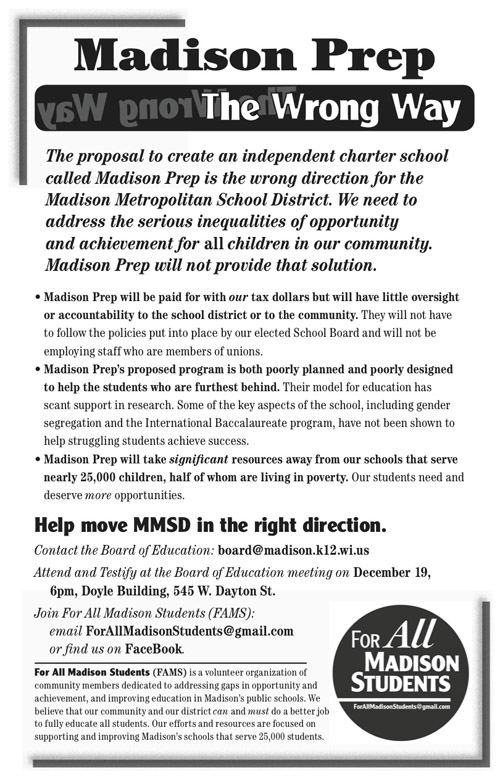
Much more on the proposed Madison Preparatory Academy IB charter school, here.

Share

Madison School District Technology Acquisition Plan and iPad Learning Initiative


Bill Smojver, Director of Technical Services:

Madison Metropolitan School District was provided an award from the Microsoft Cy Pres settlement in the Fall of 2009. Since that time the district has utilized many of these funds to prorate projects across the district in order to free up budgeted funds and to provide for more flexibility. The plan and process for these funds liquidates the General Purpose portion of the Microsoft Cy Pres funds, provides an equitable allocation per pupil to each school, and is aimed at increasing the amount of technology within our schools.
The total allocation remaining from Cy Pres revenues totals $2,755,463.11, which was the target for the technology acquisition plan. Two things happened prior to allocating funds to schools: first was to hold back $442,000 for the future purchase of iPads for our schools (at $479 per iPad this equates to a 923 iPads), and second was to hold back $200,000 necessary for increased server capacity to deal with the increase in different types of technology.
The final step was to allocate the remaining funding ($2,113,463.11) out to the schools on a per pupil basis. This was calculated at $85.09 per pupil across all schools within the district.

I found the device distribution to be quite interesting. The iPad revolution is well underway. Technology’s role in schools continues to be a worthwhile discussion topic.

Share

Madison Teachers, Inc. on The Proposed Madison Preparatory Academy IB Charter School

John Matthews, Executive Director of Madison Teachers, Inc., via email:

The Urban League proposes that Madison Prep be operated as a non-instrumentality of the Madison Metropolitan School District. The Urban League’s proposal is unacceptable to Madison Teachers, because it would effectively eliminate supervision and accountability of the school to the Madison School Board regarding the expenditure of millions of dollars in taxpayer money, and because it would also violate long-standing terms and conditions of the Collective Bargaining Agreement between the Madison Metropolitan School District and MTI.
The Urban League proposes to use District funds to hire non-District teaching staff at lower salaries and benefits than called for in the Collective Bargaining Agreement. It was recently stated in a meeting between representatives of Madison Prep, the School District and MTI that the Urban League plans to hire young African-American males and asks that MTI and the District enable them to pay the teachers they hire less than their counterparts, who are employed by the District. MTI cannot agree to enable that. We believe that such is discriminatory, based both on race and gender. The MTI/MMSD Contract calls for teachers to be compensated based upon their educational achievement and their years of service. MTI and MMSD agreed in the early 1970’s that the District would not enable such undermining of employment standards. The costing of the Contract salary placement was explained by both Superintendent Nerad and John Matthews. Those explanations were ignored by the Urban League in their budgeting, causing a shortfall in the proposed operational budget, according to Superintendent Nerad.
It is also distasteful to MTI that the Urban League proposes to NOT ADDITIONALLY pay their proposed new hires for working a longer day and a longer school year. Most employees in the United States receive overtime pay when working longer hours. The Urban League proposes NO additional compensation for employees working longer hours, or for the 10 additional school days in their plan.
Finally, the Urban League is incorrect in asserting that MTI and the District could modify the MMSD/MTI Contract without triggering Act 10, Governor Walker’s draconian attack on teachers and other public employees. The Contract would be destroyed if MTI and the District agreed to amend it. Such is caused by Walker’s Law, Act 10. MTI is not willing to inflict the devastating effects of Act 10 on its members. The Urban League states that Walker’s Act 65 would enable the Contract to be amended without the horrible impact cause by Act 10. That claim is unfounded and in error.
The Madison Prep proposal could easily be implemented if it followed the Charter Plan of Wright School, Nuestro Mundo, and Badger Rock School, all of which operate as instrumentalities of the District, under its supervision and the MMSD/MTI Collective Bargaining Agreement.

Much more on the proposed Madison Preparatory Academy IB charter school, here.

Share

MTI responds on Madison Prep

Matthew DeFour:

Madison Preparatory Academy could easily open if it followed the same model as the district’s other charter schools, Madison Teachers Inc. Executive Director John Matthews said in response to yesterday’s Urban League press conference.
But the current proposal is “unacceptable” to Madison teachers because it would “effectively eliminate School Board oversight of the expenditure of millions of dollars in taxpayer money” and violate the district’s contract with its union, Matthews said.
Matthews initially declined to comment on Madison Prep when I contacted him yesterday, but later responded in an e-mail.
In his response, Matthews criticized Madison Prep’s plan to pay its teachers lower salaries and benefits than other district teachers, and not offer overtime for working longer days.
He also said the Urban League is incorrect in asserting that the current union contract can be modified without nullifying it under the state’s new collective bargaining law.

Related: Some Madison Teachers & Some Community Members (*) on the Proposed Madison Preparatory Academy IB Charter School.
Related: student learning has become focused instead on adult employment – Ripon Superintendent Richard Zimman.

Share

Urban League’s Caire rips school district over Madison Prep opposition

Matthew DeFour:

Supporters of a controversial, single-sex charter school Thursday blasted the Madison School District for its opposition to the proposal and said the teachers union is an impediment to improving student achievement.
At a news conference, the Urban League of Greater Madison’s president, Kaleem Caire, also said the proposed Madison Preparatory Academy, which would target low-income, minority students, isn’t dead and called on the School Board to put “learning before labor” when it votes Dec. 19 whether to approve the charter.
“Our children aren’t there to be subjects of teachers and teachers unions,” Caire said. “But the decisions that have been made in the Madison Metropolitan School District for a mighty long time have been determined by adults getting what they need first before kids.”
Madison Teachers Inc. executive director John Matthews declined comment Thursday.

Much more on the proposed Madison Preparatory Academy IB charter school, here.

Share

Most school employees vote to recertify unions under bargaining law

Steven Verberg:

School employees approved state certification for about 85 percent of the unions seeking the limited collective bargaining rights allowed under Wisconsin’s controversial new law governing public employees, officials said Thursday.
Members of 208 local bargaining units for teachers and school support staff voted by telephone over the last two weeks, according to the Wisconsin Employment Relations Commission, which oversaw the elections.
In November, all six state employee unions that sought official status won recertification elections.
Elections for municipal employee unions are scheduled to take place early in 2012.

Share

Kaleem Caire Video on Madison Prep


Much more on the proposed Madison Preparatory Academy IB charter school, here.

Share

Urban League/Madison Prep to Address Madison School District Report on Charter School

Kaleem Caire, via email:

Fails to address core issues impacting racial achievement gap and middle class flight
WHAT: The Urban League of Greater Madison and the founding Board of Madison Preparatory Academy will share their response to the Madison Metropolitan School District Administration’s recommendation that the Board of Education not Support Madison Prep, and will call for immediate and wider education reforms within the Madison Metropolitan School District to address the racial achievement gap and middle-class flight and crises.
WHEN: 12:00 pm, Thursday, December 8, 2011
WHERE: Urban League of Greater Madison, 2222 S. Park St., Suite 200, Madison, WI 53713
WHO: Kaleem Caire, Urban League President & CEO Urban League of Greater Madison Board of Directors Madison Preparatory Academy Board of Directors Community Leaders and Parents
For more information, contact Laura DeRoche Perez, Director of School Development, Urban League of Greater Madison, at lderoche@ulgm.org or 608-729-1235.

Related: “They’re all rich, white kids and they’ll do just fine” — NOT!.
Much more on the proposed Madison Preparatory Academy IB charter school, here.

Share

Our Enemy, the Book

Fellow members of the Electronic Educational Entertainment Association. My remarks will be brief, as I realize you all have texts to read, messages to tweet, and you will of course want to take photos of those around you to post on your blog.
I only want to remind you that the book is our enemy. Every minute a student spends reading a book is time taken away from purchasing and using the software and hardware the sale of which we depend on for our livelihoods.
You should keep in mind the story C.S. Lewis told of Wormwood, the sales rep for his uncle Screwtape, a district manager Below, who was panicked when his target client joined a church. What was he to do? Did this mean a lost account? Screwtape reassured him with a story from his own early days. One of his accounts went into a library, and Screwtape was not worried, but then the client picked up a book and began reading. However, then he began to think! And, in an instant, the Enemy Above was at his elbow. But Screwtape did not panic–fortunately it was lunchtime, and he managed to get his prospect up and at the door of the library. There was traffic and busyiness, and the client thought to himself, “This is real life!” And Screwtape was able to close the account.
In the early days, Progressive Educators would sometimes say to students, in effect, “step away from those books and no one gets hurt!” because they wanted students to put down their books, go out, work for social justice, and otherwise take part in “real life” rather than get into those dangerous books and start thinking for themselves, for goodness’ sake!
But now we have more effective means of keeping our children in school and at home away from those books. We have Grand Theft Auto and hundreds of other games for them to play at escaping all moral codes. We have smartphones, with which they can while away the hours and the days texting and talking about themselves with their friends.
We even have “educational software” and lots of gear, like video recorders, so that students can maintain their focus on themselves, and stay away from the risks posed by books, which could very possibly lead them to think about something besides themselves. And remember, people who read books and think about something besides themselves do not make good customers. And more than anything, we want and need good customers, young people who buy our hardware and software, and who can be encouraged to stay away from the books in libraries, which are not only free, for goodness’s sake, but may even lead them to think. And that will be no help at all to our bottom line. Andrew Carnegie may have been a philanthropist, but by providing free libraries he did nothing to help us sell electronic entertainment products. We must never let down our guard or reduce our advertising. Just remember every young person reading a book is a lost customer! Verbum Sap.
—————————–
“Teach by Example”
Will Fitzhugh [founder]
The Concord Review [1987]
Ralph Waldo Emerson Prizes [1995]
National Writing Board [1998]
TCR Institute [2002]
730 Boston Post Road, Suite 24
Sudbury, Massachusetts 01776-3371 USA
978-443-0022; 800-331-5007
www.tcr.org; fitzhugh@tcr.org
Varsity Academics®
www.tcr.org/blog

Share

Some Madison Teachers & Some Community Members (*) on the Proposed Madison Preparatory Academy IB Charter School


200K PDF File, via a kind reader.
Madison Teacher’s Inc. Twitter feed can be found here.
Much more on the proposed Madison Preparatory Academy IB charter school, here.
* Please see TJ Mertz’s comment below. A link to the document was forwarded to me via a kind reader from Madison Teachers, Inc. Twitter Feed (a “retweet” of Karen Vieth’s “tweet”). Note that I enjoyed visiting with Karen during several Madison School District strategic planning meetings.
A screenshot of the link:

The outcome of the Madison Prep “question” will surely reverberate for some time.
Finally, I suspect we’ll see more teacher unions thinking different, as The Minneapolis Federation of Teachers has done: Minneapolis teacher’s union approved to authorize charter schools.

Share

Chicago Public Schools enters into compact agreement with Gates Foundation

Joel Hood:

Chicago Public Schools on Tuesday became the latest large urban district to sign a compact agreement with the education-reform powerhouse Bill & Melinda Gates Foundation, pledging greater cooperation and collaboration between the city’s charter and traditional neighborhood schools.
The agreement allows Chicago to compete for a piece of a $40 million grant from the Gates Foundation, aimed at building relationships between charters and neighborhood schools and allow for the sharing of innovative ideas.

Share

Why Innovation Can’t Fix America’s Classrooms

Marc Tucker:

Most Atlantic readers know that, although the U.S. spends more per student on K-12 education than any other nation except Luxembourg, students in a growing number of nations outperform our own. But think about this: Among the consistent top performers are not only developed nations (Japan, Finland, Canada), but developing countries and mega-cities such as South Korea, Hong Kong, and Shanghai.
Even if we find a way to educate our future work force to the same standards as this latter group — and we are a very long way from that now — wages in the United States will continue to decline unless we outperform those countries enough to justify our higher wages. That is a very tall order.
You would think that, being far behind our competitors, we would be looking hard at how they are managing to outperform us. But many policymakers, business leaders, educators and advocates are not interested. Instead, they are confidently barreling down a path of American exceptionalism, insisting that America is so different from these other nations that we are better off embracing unique, unproven solutions that our foreign competitors find bizarre.

Share

The courage of Kaleem Caire

Dave Cieslewicz:

Kaleem Caire has only been back in Madison for less than two years, but he sure has grabbed our attention.
Caire didn’t waste any time after coming home from a successful private sector career on the East Coast to be the new president for the Urban League of Greater Madison, starting to shake up the local establishment more or less immediately upon arrival. He has been pushing a bold proposal to attack the long-standing issue of minority underachievement in the Madison public schools. His idea for the Madison Preparatory Academy was vetted well in Nathan Comp’s cover story for Isthmus last week.
For well over a year now, Caire has been shuttling between the district administration, Madison Teachers, Inc. (MTI) union leaders, school board members, parents, editorial boards and community meetings fighting for this idea.
In response to union and district administration concerns, he changed the proposal to make the school an “instrumentality” of the district, meaning it would be under school board control and be staffed by MTI member teachers. But that proposal came in at a cost for the district of $13 million over five years. Superintendent Dan Nerad, for whom I have a lot of respect, told the League that he couldn’t support anything over $5 million.

Share

Why School Choice Fails

Natalie Hopkinson:

IF you want to see the direction that education reform is taking the country, pay a visit to my leafy, majority-black neighborhood in Washington. While we have lived in the same house since our 11-year-old son was born, he’s been assigned to three different elementary schools as one after the other has been shuttered. Now it’s time for middle school, and there’s been no neighborhood option available.
Meanwhile, across Rock Creek Park in a wealthy, majority-white community, there is a sparkling new neighborhood middle school, with rugby, fencing, an international baccalaureate curriculum and all the other amenities that make people pay top dollar to live there.
Such inequities are the perverse result of a “reform” process intended to bring choice and accountability to the school system. Instead, it has destroyed community-based education for working-class families, even as it has funneled resources toward a few better-off, exclusive, institutions.

Share

A Degree of Practical Wisdom: The Ratio of Educational Debt to Income as a Basic Measurement of Law School Graduates’ Economic Viability

Jim Chen:

This article evaluates the economic viability of a student’s decision to borrow money in order to attend law school. For individuals, firms, and entire nations, the ratio of debt to income serves as a measure of economic stability. The ease with which a student can carry and retire educational debt after graduation may be the simplest measure of educational return on investment.
Mortgage lenders evaluate prospective borrowers’ debt-to-income ratios. The spread between the front-end and back-end ratios in mortgage lending provides a basis for extrapolating the maximum amount of educational debt that a student should incur. Any student whose debt service exceeds the maximum permissible spread between mortgage lenders’ front-end and back-end ratios will not be able to buy a house on credit.
These measures of affordability suggest that the maximum educational back-end ratio (EBER) should fall in a range between 8 and 12 percent of monthly gross income. Four percent would be even better. Other metrics of economic viability in servicing educational debt suggest that the ratio of total educational debt to annual income (EDAI) should range from an ideal 0.5 to a marginal 1.5.

Share

Oregon to seek powerful ‘chief education officer’ to revamp preschool, public schools, colleges

Betsy Hammond:

Oregon plans to recruit and hire a new “chief education officer” who will have unprecedented power over education, including control of the chancellor of higher education, the next superintendent of Oregon’s public schools and the state community college commissioner.
Gov. John Kitzhaber’s new overarching education board, with control over preschool through universities, unanimously endorsed the general job description for that education officer Thursday.
Kitzhaber said he hopes to have the right person in the job by April.
The chosen leader will need the vision to help Oregon streamline, improve and connect all the education programs and institutions that serve or should serve learners from birth through college, he said. He or she will also have to be an education expert, plus be able to motivate those who work in the current system to embrace change. The political challenges will be huge.

Share

The Power of Education Data

Anne Hyslop:

If policymakers (see Brown, Jerry) still aren’t convinced that education data matters, two reports released this week demonstrate that high quality, actionable information about schools and students is vital in efforts to improve education and student outcomes.
Bill summarized the important work of the Data Quality Campaign yesterday. More states than ever are collecting the information educators and policymakers need to make informed decisions about what’s working and what isn’t in schools. But just because the data can be collected, it doesn’t mean that states’ work is complete. Data for Action 2011 identifies four challenges – turf, trust, technical issues, and time – that continue to hinder states’ efforts to utilize the full potential of their data (shameless plug: you should read my report, Data That Matters, for another set of 4 Ts that all states should follow to make their data user-friendly and actionable for school leaders).

Share

Where Schools Fall Short

The New York Times:

Millions of students attend abysmally weak school systems that leave them unprepared for college, even as more jobs require some higher education. The states have an obligation to help these students retool.
More than 35 percent of students need remediation when they reach college, according to the federal government. A study by the organization that administers the ACT, the college entrance exam, finds that only a quarter of the 1.6 million 2011 high school graduates who took the exam met college-readiness benchmarks in English, reading, math and science.
Some students need one or two remedial courses before they can enroll in credit-bearing college classes. Others need so much remedial work that they will exhaust state and federal student aid without ever getting a degree. This is especially troubling because many of these students have passed state exams that are supposed to certify them as ready for college.

Share

Let’s get together on Madison Prep

Dave Zweifel:

The debate over whether the Madison School Board should give the final OK to the Madison Preparatory Academy is getting a bit nasty.
And that should not be.
While the passion on the part of the advocates for the school, led by the energetic Urban League CEO Kaleem Caire, is perfectly understandable given our schools’ dismal record on minority achievement, so is the questioning from those who aren’t convinced the prep idea will solve that problem.
Now, on the eve of a vote on that final approval, is not the time to point fingers and make accusations, but to come together and reasonably find ways to overcome the obstacles and reassure those who fret about giving up duly elected officials’ oversight of the school and the impact it will have on the entire district’s union contracts if not done correctly.
The union problem is not the fault of the union, but stems from Gov. Scott Walker and the Legislature’s action to dramatically change public employee collective bargaining in Wisconsin. If the union or the School Board makes concessions for Madison Prep, the collective bargaining agreement for the entire district, which is to expire in June 2013, could be negated.

Much more on the proposed Madison Preparatory IB charter school, here.

Share

Are Charter School Unions Worth the Bargain?

Mitch Price, via a kind Deb Britt email:

About 12 percent of all charter schools have bargaining agreements. Why do charter schools unionize? What is in these charter school contracts? Can they be considered innovative or models for union reform? And how do they compare to traditional district/union teacher contracts? Center on Reinventing Public Education legal analyst Mitch Price investigated those questions in his study of charter school collective bargaining agreements.
Price examined nine charter schools unionized either by management design or by teacher vote. For comparison, he examined traditional district contracts and analyzed data from non-unionized charter schools as well. He found that the new contracts can be crafted in ways that respect the unique missions and priorities of charter schools, provide teachers with basic protections, and maintain organizational flexibility. However, while these new contracts innovate in many ways, they could go much further given the opportunity to create contracts from scratch.

Share

Seattle Cluster (Spectrum) Grouping Discussion

Chris Cronas, Principal, Wedgwood Elementary

Prior to the Thanksgiving break, we administered a survey asking for feedback from families about their knowledge and thoughts on the changes we are making to the curriculum delivery model at Wedgwood. Thank you to the 259 families who responded to the survey. We have 449 students currently enrolled at Wedgwood, 185 of whom are siblings. If respondents only completed one survey per family, as requested, our sample is quite accurate.
Overall, families want more information about what cluster grouping is. This was expressed in a variety of ways by families of general education, spectrum and special education students. I will attempt to clarify what it is here and how Wedgwood staff is using this information to move forward.
For those who do not know, cluster grouping is a method of grouping gifted students (gifted being identified as students who score in the 98th – 99th percentile on a cognitive ability test) into clusters of 6 students in one classroom that also include high achievers and above average students. The remaining students would be clustered so that the highest achieving students and lowest achieving students are not in the same classroom. With that as a guide, Wedgwood is developing plans to move from having self-contained spectrum classrooms to integrated classrooms using an interpretation of this model. We are already doing this in 1st grade, albeit more heterogeneously than what the research we based our 1st grade model on suggests.

Charlie Mas has more:

Are you confused about what Wedgwood is doing with their Spectrum program? Join the club. Everyone is confused about what Wedgwood is doing with their Spectrum program. The president of the confusion club appears to be the school’s principal, Chris Cronas.

Share

Proposed Teacher Evaluation Law May Appear on Massachusetts’ November Ballot

Dan Ring:

In another issue, Sam Castaneda Holdren, a spokesman for Stand for Children, said the organization collected about 100,000 voter signatures for a ballot question that would codify into law new educator-evaluation regulations approved in June by the state Board of Elementary and Secondary Education.
The new state regulations call for evaluating teachers and administrators partly by the scores of their students on the MCAS statewide tests, feedback from students and parents, by state and local observations in classrooms and other measures.
The ballot question would go beyond the state regulations in some respects, said Jason Williams, executive director of Stand for Children in Massachusetts. For example, the question would mandate that the state Department of Elementary and Secondary Education approve evaluation plans developed through bargaining with unions in school districts if those local plans differ from a state model that will eventually be developed. Right now, the department could only review those local plans, not reject them, Williams said

Share

Still Another Madison Prep Update: After all this, Is a Non-Instrumentality Simply a Non-Starter?

Madison School Board Member Ed Hughes:

The Urban League’s Madison Prep proposal continues to garner attention as we draw closer to the School Board’s December 19 up-or-down vote on the proposal.
This weekend the news has been the school district administration’s analysis of the Urban League’s current proposal for a non-instrumentality charter school (i.e., one where the teachers and other school staff would be employees of the Urban League rather than the school district and the school would be free of most administrative oversight from the district).
The analysis recommends that the School Board reject the Madison Prep proposal, for two principal reasons.
The first is that, as a matter of policy, the administration is opposed to non-instrumentality charter schools because of the lack of day-to-day oversight of their operations. The second reason is that there does not seem to be a way the school district could enter into a contract for a non-instrumentality charter school without running afoul of our collective bargaining agreement (CBA) with Madison Teachers Inc. (MTI).

Much more on the proposed Madison Preparatory IB charter school, here.

Share

Study Tallies a District’s Return on Investment: Payoff is $1.53 for every $1 invested

Christina A. Samuels:

How much is a good school system worth?
The Virginia Beach, Va., school district believes its own system is worth about $1.53 for every $1 spent from the 70,000-student district’s operating fund.
Not content with making an argument that good schools have an economic value that is unmeasurable, the district asked a university economist to calculate just what it brings both to the city and the Hampton Roads region in southeastern Virginia.
The report generated for the district, the third-largest in the state, is more than an academic exercise for James G. Merrill, the Virginia Beach superintendent. The district is one of the few in the state that receive money from local taxpayers based on a revenue-sharing formula, which is currently under fire. As the city and the school district head into budget season, Mr. Merrill said he wanted to make an argument for school funding based on business principles.

Share

Are visits by parents to schools a threat to teaching?

Jay Matthews:

Paula Prosper worried that her son was not ready for the differences between his private Montessori school and the public Fairfax County seventh grade she planned to transfer him to next year.
Prosper, a teacher, asked if he and she could sit for a few hours at Longfellow Middle School “to see what happens in classes and to get a feel for the school in general.” The answer was no, with explanations that made little sense.
Prosper said Longfellow’s director of student services, Gail Bigio, told her “it had to do with privacy issues for the teachers — the public employees whose salaries are paid by my tax dollars. Then she brought up immunization and likened it to the students attending the school who wish to have a visiting cousin shadow them.” Longfellow Principal Carole Kihm told me Bigio did not mention teacher privacy.

Share

What’s the real graduation rate in our schools?

Ericka Mellon:

Roughly one-third of students in Harris County’s public schools leave without a diploma, according to a new analysis from Children at Risk.
The Houston-based research and advocacy nonprofit calculated for the first time a decade of average graduation rates for Harris County. It also calculated graduation rates for all the public high schools with available data in Harris, Brazoria, Chambers, Fort Bend, Galveston, Liberty, Montgomery and Waller counties for the ninth-grade class of 2004-05. The rate reflects students who graduated within six years.
As the graphic below shows, the percentage of students graduating high school has increased over the decade, but black and Hispanic students and those from low-income families graduate at much lower rates than their Anglo, Asian and more affluent classmates.

Share

Dropping cursive isn’t a capital idea

Jim Stingl:

There’s a debate brewing – mostly via keyboards – about whether schools still need to teach cursive writing to classrooms of digitally wired kids.
I’d be a better defender of beautifully flowing handwriting if my own hadn’t deteriorated over the years to a hybrid of cursive, printing, squiggles and shorthand. My wife nudges me out of the way every time we step up to sign a guest book. My lame defense is that I’m left-handed.
Still, I’m glad I learned cursive at Our Lady of Sorrows, my Catholic elementary school where every classroom came with a strip of capital and lowercase letters above the blackboard. Even if a person doesn’t write that way very often – thank-you notes and postcards come to mind – it’s nice to be able to decipher other people’s hen-scratching.
Wisconsin is one of more than 40 states that don’t require cursive in their core curriculum standards, though the state Department of Public Instruction doesn’t have any data on schools or districts that have actually dropped it in favor of spending more time on other subjects. Cursive may indeed fade away, but who wants to jump first?
What’s most important, said DPI spokesman Patrick Gasper, is learning the various types of writing – persuasive, storytelling, speeches and so forth – and not whether it’s written, printed or typed.

Share

Programming should take pride of place in our schools

John Naughton:

If we don’t change the way ICT is thought about and taught, we’re shutting the door on our children’s futures
So, in the immortal words of Rory Cellan-Jones, the BBC’s technology correspondent, coding (ie computer programming) is “the new Latin”. This was the headline on his blog post about the burgeoning campaign to boost the teaching of computer skills in UK schools.
Dedicated readers will recall that it is also a bee in the bonnet of this particular columnist. The ICT (information and communications technology) curriculum in our secondary schools has been a national disgrace for as long as I can remember. This is because it effectively conflates ICT with “office skills” and generally winds up training them to use Microsoft Office when what they really need is ICT education – that is to say preparation for a world in which Microsoft (and maybe even Google) will be little more than historical curiosities, and PowerPoint presentations will look like Dead Sea scrolls.
Rory Cellan-Jones’s blog post was prompted by signs that the campaign to rethink ICT education is gathering momentum. It was first given a boost by a report written by two elders of the computer games world, Ian Livingstone and Alex Hope, on the need to transform the UK into “the world’s leading talent hub for the video games and visual effects industries”. Their report recommended, among other things, that computer science should become part of the national curriculum.

Share

Missouri Education Commissioner Outlines Options for Kansas City Schools

infozine:

Citing a critical need to not underestimate the stakes at hand, Commissioner of Education Chris Nicastro presented to the State Board of Education today her analysis of ways the state could assist the Kansas City Public Schools in regaining accreditation.
The State Board met in Branson on Dec. 1-2, where discussion of the Kansas City Public Schools was part of the Department of Elementary and Secondary Education’s recommendation for revamping a statewide system of support. This system would identify risk factors and target limited resources to assist unaccredited school districts and those that are at risk of becoming unaccredited. Currently, nearly one dozen schools would receive focused attention.

Share

Sky isn’t falling on Wisconsin public schools

Wisconsin State Journal:

Here’s the bottom line on public schools in Wisconsin after a big cut in state aid to K-12 education:
• The kids are mostly all right.
• The teachers are smarting from smaller paychecks.
• The full impact of the two-year, $750 million cut won’t be known until next school year.
That’s what a recent survey of Wisconsin school administrators suggests.
The Wisconsin Association of School District Administrators surveyed more than 80 percent of districts across the state in early fall. The results are being cited — and exaggerated — in a variety of ways. The Democrats and unions suggest the sky is falling. Republican Gov. Scott Walker pretends all is well.
And the political spin will only speed and sharpen if Walker faces a recall election next year as expected.

Share

A testament to single-gender education

Carmyn Neely:

Moving from elementary school to middle school, or from middle school to high school, was simple once. A counselor, principal, or teacher informed the student which school she would attend when summer ended. And the parents got their children to the right school on a specified day at the end of August.
No choices.
No decisions.
Public education long ago parted ways with the one-size-fits-all approach, particularly in urban or suburban school districts large enough to design schools focused on particular areas of student interest. We have moved on to science magnets, liberal arts and fine arts academies, performing arts institutes, and single-gender schools.
The single-gender model for girls has been around for more than 100 years, mostly in parochial and private schools where they have done remarkable work educating young women. They are a novelty in public education. And an all-girls school is the new kid on the block in the Austin school district — and in other districts in Texas.

Share

Madison Schools’ Administration Opposes the Proposed Madison Preparatory IB Charter School

Superintendent Dan Nerad:

Recommendations:
We are in agreement that the achievement gaps for low-income students, students of color, students with disabilities, and English Language Learners must be eliminated. The Administration agrees that bolder steps must be taken to address these gaps. We also know that closing these gaps is not a simple task and change will not come overnight, but, the District’s commitment to doing so will not waiver. We also know that to be successful in the long run, we must employ multiple strategies both within our schools and within our community. This is why the District has held interest in many of the educational strategies included in the Madison Prep’s proposal like longer school days and a longer school year at an appropriately compensated level for staff, mentoring support, the proposed culture of the school and the International Baccalaureate Program.
While enthusiastic about these educational strategies, the Administration has also been clear throughout this conversation about its concern with a non-instrumentality model.
Autonomy is a notion inherent in all charter school proposals. Freedom and flexibility to do things differently are the very reasons charter schools exist. However, the non-instrumentality charter school model goes beyond freedom and flexibility to a level of separateness that the Administration cannot support.
In essence, Madison Prep’s current proposal calls for the exclusion of the elected Board of Education and the District’s Administration from the day-to-day operations of the school. It prevents the Board, and therefore the public, from having direct oversight of student learning conditions and teacher working conditions in a publicly-funded charter school. From our perspective, the use of public funds calls for a higher level of oversight than found in the Madison Prep proposal and for that matter in any non-instrumentality proposal.
In addition, based on the District’s analysis, there is significant legal risk in entering into a non- instrumentality charter contract under our collective bargaining agreement with our teachers.
In our analysis of Madison Prep’s initial instrumentality proposal, the Administration expressed concerns over the cost of the program to the District and ultimately could not recommend funding at the level proposed. Rather, the Administration proposed a funding formula tied to the District’s per pupil revenues. We also offered to continue to work with Madison Prep to find ways to lower these costs. Without having those conversations, the current proposal reduces Madison Prep’s costs by changing from an instrumentality to a non-instrumentality model. This means that the savings are realized directly through reductions in staff compensation and benefits to levels lower than MMSD employees. The Administration has been willing to have conversations to determine how to make an instrumentality proposal work.
In summary, this administrative analysis finds concerns with Madison Prep’s non-instrumentality proposal due to the level of governance autonomy called for in the plan and due to our collective bargaining agreement with our teachers. Based on these issues, we cannot recommend to the Board that Madison Prep be approved as a non-instrumentality charter school.
We know more needs to be done as a district and a community to eliminate our achievement gaps. We must continue to identify strategies both within our schools and our larger community to eliminate achievement gaps. These discussions, with the Urban League and with our entire community, need to continue on behalf of all of our students.

Matthew DeFour:

In anticipation of the recommendation, Caire sent out an email Friday night to School Board members with a letter responding to concerns about the union contract issue.
The problem concerns a “work preservation” clause in the Madison Teachers Inc. contract that requires all teaching duties in the district be performed by union teachers.
Exceptions to the clause have been made in the past, such as having private day-care centers offer 4-year-old kindergarten, but those resulted from agreements with the union. Such an agreement would nullify the current union contract under the state’s new collective bargaining law, according to the district.
Caire said a recent law signed by Gov. Scott Walker could allow the district to amend its union contract. However, School Board member Ed Hughes, who is a lawyer, disagreed with Caire’s interpretation.
Nerad said even if the union issue can be resolved, he still objects to the school seeking autonomy from all district policies except those related to health and safety of students.
…..
Caire said Madison Prep’s specific policies could be ironed out as part of the charter contract after the School Board approves the proposal. He plans to hold a press conference Tuesday to respond to the district’s review.
“The purpose of a charter school is to free you from red tape — not to adopt the same red tape that they have,” Caire said. “We hope the board will stop looking at all of those details and start looking at why we are doing this in the first place.”

Much more on the proposed Madison Preparatory IB charter school, here.
The fate of Madison Prep, yea or nea, will resonate locally for years. A decisive moment for our local $372M schools.

Share

More on How the NEA Spends $133 Million to Preserve Influence

RiShawn Biddle:

As Dropout Nation reported on Wednesday, the National Education Association reported in its recent U.S. Department of Labor filing that it spent $133 million in 2010-2011 on lobbying and contributions to groups whose agendas (in theory) dovetail with its own. And the list of organizations and players who have benefited from the union’s largesse grows even larger.
The National Council for Accreditation of Teacher Education, a longtime beneficiary of NEA funds, garnered $400,373 from the union during its last fiscal year. The Great Lakes Center for Education, which, like the Economic Policy Institute, always churns out studies that dovetail nicely with NEA positions, got $250,000 from the national union. (Three affiliates — Michigan Education Association, Education Minnesota, and the Illinois Education Association — chipped in another $30,000, according to each of their respective federal filings.) National Board for Professional Teaching Standards got $10,000 from the union last fiscal year. And the University of Colorado at Boulder also picked up $250,000 for a “sponsored project”, likely something being put together by one of the NEA’s longtime fellow-travelers, Kevin Welner’s National Education Policy Center that is based on the university’s campus.

More here.

Share

NJEA’s President Guilty of “Deliberate Misuse of the Data”

New Jersey Left Behind:

Over the last several months it’s been a pleasure to witness the easing of ill will between the leadership of NJ’s primary teachers’ union, NJEA, and members of Gov. Christie’s educational team. After several years of bitter recrimination from both sides of the table, everyone seems to have moved on from the trauma of our botched Race To The Top application and former Comm. Bret Schundler’s resignation. Sure, the sting of last Spring’s health and benefits reform bills, championed by Gov. Christie, must be a sore spot for union leadership, but there appears to be a shared recognition that we should recalibrate the balance between the needs of schoolchildren and the needs of teachers. Suddenly NJ’s 100-year old tenure law is on the table – a boon for both student and professionals – and Ed. Comm. Cerf ‘s speech at NJEA’s Annual Convention earlier this month and was courteously received (except for a few nasty tweets).
So we’ll hold onto the progress and roll our eyes at the retro and reactive press release just out from NJEA President Barbara Keshishian, in which she claims, in outraged tones, that NJ’s alleged achievement gap among black, white, Hispanic, and poor kids is a “classic strawman” on the part of Gov. Christie and “based on a deliberate misuse of the data.”

Share

Just 31% of California students pass P.E. test

Teresa Watanabe:

Fewer than one-third of California students who took a statewide physical fitness test this year managed to pass all six areas assessed, new results show.
State Supt. of Public Instruction Tom Torlakson, a longtime cross-country coach who has made physical fitness a signature issue, announced the results this week as he launched a program to improve children’s health. The campaign will use such celebrity athletes as NBA all-star Bill Walton and others to visit schools to urge students to drink more water, eat more fruits and vegetables and increase their exercise.
“When only 31% of children are physically fit, that’s a public health challenge we can’t wait to address,” Torlakson said in a statement.

Share

Minneapolis teacher’s union approved to authorize charter schools

Tom Weber:

The Minneapolis teachers’ union has become the first in the nation to win the right to authorize charter schools.
State officials have approved the Minneapolis Federation of Teachers as a charter school authorizer.
Authorizers don’t run charters; they oversee the administrators and school boards that handle day-to-day operations of a charter school. Authorizers are also primary decision makers on which schools to sponsor.
During the 20-year history of charter schools there have been examples of teachers starting schools, and some charters have unionized teachers.
MFT will be the first union to serve as a charter sponsor. Formally, it has created an organization called the Minnesota Guild of Charter Schools (informally ‘the Guild’) that will serve as authorizer.

This makes sense. I hope we see much more of this.
Perhaps someone will ask WEAC’s Mary Bell about this at the 12.6.2011 WisPolitics lunch.

Share

Madison School District Talented and Gifted Update

Madison Superintendent Dan Nerad:

Elementary Support & Services
National Novel Writing Month
Future Problem Solving
Math enrichment
GEMS
William & Mary Literature groups
M2 and M3 Math groups
American Math Competition 8
Science enrichment pilot College for Kids I (support)
Middle School Support & Services
WCATY courses
Future Problem Solving
Online courses
Advanced Math courses
Assistance with Science Symposium
American Math Competition 8
College for Kids II (support)
Great Books Pilot
Hybrid Geometry Pilot
High School Support & Services
College Matters at UW Madison
Math Meets (competitions)
Respectful Relationship days
Leadership Conference (pilot, grant application in progress)
Assistance with High School Science Symposium
Mentor Services
1. Falk- Working with students in a writing group
2. Stephens- Working with a group of students in math
3. Lapham-1’1/2″dgrade-Math
4. Schenk- Science/math enrichment
5. Crestwood- Math enrichment
6. Crestwood- Math enrichment
7. Crestwood-Math enrichment
8. Franklin- Math enrichment
9. Randall- Math enrichment
10. Randall – Math enrichment

Share

Contradictions & Confusion: Madison Prep Board Members in Their Own Words

TJ Mertz

Of course Madison Prep wants the media opportunity of children waiting in an auditorium, some advocates for the school have demonized teachers, the Madison Prep Board has decided that the only way to make the school happen is to employee non-union staff and not pay them for the extended day and year (that they are also seeking African American and Latino staff, makes this even worse). It should also be noted that school choice backers like the Kochs, the Waltons and (Bradley and Koch funded) ALEC aren’t all that keen on “the right to clean water” either.

Much more on the proposed Madison Preparatory IB charter school, here.

Share

Madison Prep IB Charter: Making sense of the controversial charter school

Nathan Comp:

On Dec. 19, the Madison school board is scheduled to vote on whether to approve Madison Preparatory Academy, a charter school that would target at-risk minority students.
For more than 18 months, the proposal — drawn up by the Urban League of Greater Madison as an ambitious step toward closing the district’s racial achievement gap — has polarized the community, with a broad range of critics taking aim on multiple fronts.
The proposal, at least by local standards, is a radical one, under which the Urban League would operate two largely taxpayer-funded, gender-specific secondary schools with an unprecedented level of autonomy. If approved, Madison Prep would open next fall with 120 sixth-graders and peak at 840 students in grades 6 through 12 by its seventh year.
Opponents say the Urban League’s proposal combines flawed educational models, discredited science, fuzzy budgeting and unrealistic projections of student success. While some applaud certain elements of the proposal, like longer school days and academic years, they maintain that Madison Prep won’t help enough students to justify the $17.5 million cost to the district over its first five years.

Share

Madison Schools for Whites Equivalent to Singapore, Finland (!); Troller Bids Adieu

Susan Troller, Via email:

Madison schools aren’t failing, by any stretch of the imagination, for many students.
In fact, if you’re a white, middle-class family sending your children to public school here, your kids are likely getting an education that’s on a par with Singapore or Finland — among the best in the world.
However, if you’re black or Latino and poor, it’s an unquestionable fact that Madison schools don’t as good a job helping you with your grade-point average, high school graduation, college readiness or test scores. By all these measures, the district’s achievement gap between white and minority students is awful.
These facts have informed the stern (and legitimate) criticisms leveled by Urban League President Kaleem Caire and Madison Prep backers.
But they doesn’t take into account some recent glimmers of hope that shouldn’t be discounted or overlooked. Programs like AVID/TOPS support first-generation college-bound students in Madison public schools and are showing some successes. Four-year-old kindergarten is likely to even the playing field for the district’s youngest students, giving them a leg up as they enter school. And, the data surrounding increasing numbers of kids of color participating in Advanced Placement classes is encouraging.
Stepping back from the local district and looking at education through a broader lens, it’s easy to see that No Child Left Behind and Race to the Top have aimed to legislate, bribe and punish their way toward an unrealistic Lake Wobegon world where all the students are above average.

Remarkable. Are there some excellent teachers in Madison? Certainly. Does Madison’s Administration seek best in the world results? A look at the math task force, seemingly on hold for years, is informative. The long one size fits all battle and the talented and gifted complaint are worth contemplating.
Could Madison be the best? Certainly. The infrastructure is present, from current spending of $14,963/student to the nearby UW-Madison, Madison College and Edgewood College backed by a supportive community.
Ideally, Madison (and Wisconsin) should have the courage to participate in global examinations (Florida Students Take Global Examinations, Wisconsin’s Don’t). Taxpayers and parents would then know if Troller’s assertions are fact based.

Share

How Madison Prep Can Be a Non-Instrumentality (Non-Union)?

Kaleem Caire, via email

December 2, 2011
Greetings Madison Prep.
Tomorrow afternoon, we are expecting to learn that MMSD’s Administration will inform the Madison Metropolitan School District Board of Education that Madison Prep should not be approved. A possible reason we expect will be MMSD’s concern that the current collective bargaining agreement between the District and Madison Teachers Inc. (MTI) has a “work preservation clause” which the teacher’s union advocated for long ago to ensure that it was the only game in town to represent public school teachers in Madison.
Below, is the cover note that I forwarded to Ed Hughes of the Board of Education and copied to a number of others, who had asked a thoughtful question about our proposal to establish Madison Prep as a non-instrumentality charter school, we hope, in fall 2012. Also see the letter attached to this email.
—————————————- ————————————————————————–
December 2, 2011
Greetings Ed.
Attached, please find a letter that contains the answer to your question referenced in your email below. The letter contains the explanation of a path to which Madison Prep could be established as a non-instrumentality public charter school, under Wisconsin law, and in a way that would not violate the current collective bargaining agreement between MMSD and Madison Teachers Inc.
We look forward to answering any questions you or other members of the Board of Education may have.
Thank you so much and Many blessings to you and your family this holiday season.
Onward.
cc: Daniel Nerad, MMSD Superintendent
Dylan Pauly, MMSD Legal Counsel
MMSD Board of Education Members
ULGM Board of Directors
Madison Prep Board of Directors
Godfrey & Kahn, S.C.
Steve Goldberg, CUNA Mutual Foundation

PDF letter:

This letter is intended to respond to your November 78,207I email and to suggest that there is a viable option for moving forward with Urban League’s proposal for the Madison Preparatory Academy (“Madison Prep”) that: [i) will reduce cost; and (ii) will not sacrifice the union security provisions of the Collective Bargaining Agreement “Agreement” or “Contract”) between the Madison Metropolitan School District (“MMSD” or “District”) and Madison Teachers, Inc. (“MTI”).
Your email asks for a response to a question concerning how the school district could authorize Madison Prep as a non-instrumentality charter without thereby violating the terms of the District’s Agreement with MTI. Your email references a provision in the MTI Agreement that provides “that instructional duties where the Wisconsin Department of Public Instruction requires that such be performed by a certifiÌ€cated teacher, shall be performed only by’teachers.”‘ .See Article I, Section 8.3.a. In addition you note that “the term ‘teacher’ refers to anyone in the collective bargaining unit.” See Article I, Section 8.2. You conclude your email by stating that “it appears that all teachers in MMSD schools — including non-instrumentality charter schools – must be members of the MTI bargaining unit.”
The Urban League is aware of the Agreement’s language and concedes that the language, if enforceable, poses an obstacle as we look for School Board approval of the plan to open and operate a “non-instrumentality” school. Under an instrumentality charter, the employees of the charter school must be employed by the school board. Under a non-instrumentality charter, the school board may not be the employer of the charter school’s staff. See S 118.40(7)(a). Thus, the statement in your email that all teachers, including those in a non-instrumentality charter school – “must be members of the MTI bargaining unit” and, presumably, employed by the school board is not permitted under Wisconsin law.
Under Wisconsin’s charter school law the School Board has the exclusive authority to determine whether a school is an instrumentality or not an instrumentality of the school district. .See S 118.40(7)(a). That decision is an important decision reserved to the School Board alone. The effect of that decision drives whether teachers and staff must be, or cannot be, employees of the School Board. The language of the Contract deprives the School Board of the decision reserved to it under the statute and that language cannot be harmonized to give effect to both the statute and the Agreement. Alternatively the Contract language creates a situation whereby the School Board may exercise its statutory authority to approve a non-instrumentality charter but it must staff the school with school district employees, a result clearly prohibited under the statute. In our view the law trumps the Contract in either of these situations.
The situation described above could likely only be resolved in a court of law. The Contract includes a “savings clause” that contemplates that where a court invalidates a provision in the Agreement, the invalid provision is deleted and the remainder of the contract remains intact. See Article VIII, Section E.
The Urban League is, however, mindful that litigation is both expensive and time consuming. Moreover it is clear that the Contract language will become a prohibited subject of bargaining in the near future when the current Agreement expires. Unfortunately, the children we seek to serve, do not have the time to wait for that day.
Our second purpose in writing is to make you aware of a possible solution to a major obstacle here. One of the major obstacles in moving forward has been the cost associated with an instrumentality school coupled with MTI’s reluctance to work with the District in modifying the Contract to reduce costs associated with staffing and certain essential features of Madison Prep, like an extended school day, As we understand it MTI does not want to modify the Contract because such a modification would result in an earlier application of 2077 Wisconsin Act L0 to the District, members of the bargaining unit and to MTI itself.
We understand MTI’s reluctance to do anything that would hasten the application of Act 10 in the school district, With the passage of 2011. Wisconsin Act 65, that concern is no longer an obstacle.
Act 65 allows the parties to a collective bargaining agreement to enter into a memorandum of understanding that would run for the remaining term of the collective bargaining agreement, for the purpose of reducing the cost of compensation or fringe benefits in the collective bargaining agreement,
The Act also provides that entering into such a memorandum would not be considered a “modification” of the collective bargaining agreement for the purposes of Act 10. Act 65 was published on November 23,2077 and took effect the following day. The law allows the parties to a collective bargaining agreement to enter into such a memorandum no later than 90 days after the effective date of the law.
The Urban League believes that Act 65 gives the Board and MTI the opportunity to make changes that will facilitate cost reductions, based in compensation and fringe benefits, to help Madison Prep move forward. And, the law allows the parties to do so in a way that does not adversely impact the teachers represented by MTI or the union security provisions of the Collective Bargaining Agreement.
For example, the parties could agree to reduce the staffing costs for Madison Prep, The parties could also agree that a longer school day would not have to cost more. And, the parties could agree that the work preservation clause referenced in the first part of this letter does not apply where the School Board has determined a charter school willbe a non-instrumentality of the District, a move that would also most certainly reduce costs. These changes would not be forced upon any existing MTI represented teacher as teachers would apply for vacancies in the school.
We hope that the School Board will give serious consideration to the opportunity presented by Act 65. 0n behalf of the Urban League of Greater Madison and Madison Preparatory Academy, we thank you for your support of Madison Prep.

Much more on the proposed Madison Preparatory IB charter school, here.

Share

What Value-Added Research Does And Does Not Show

Matthew DiCarlo:

Value-added and other types of growth models are probably the most controversial issue in education today. These methods, which use sophisticated statistical techniques to attempt to isolate a teacher’s effect on student test score growth, are rapidly assuming a central role in policy, particularly in the new teacher evaluation systems currently being designed and implemented. Proponents view them as a primary tool for differentiating teachers based on performance/effectiveness.
Opponents, on the other hand, including a great many teachers, argue that the models’ estimates are unstable over time, subject to bias and imprecision, and that they rely entirely on standardized test scores, which are, at best, an extremely partial measure of student performance. Many have come to view growth models as exemplifying all that’s wrong with the market-based approach to education policy.
It’s very easy to understand this frustration. But it’s also important to separate the research on value-added from the manner in which the estimates are being used. Virtually all of the contention pertains to the latter, not the former. Actually, you would be hard-pressed to find many solid findings in the value-added literature that wouldn’t ring true to most educators.

Much more on value added assessment, here.

Share

Is Suburbia Doomed?

Joel Kotkin:

This past weekend the New York Times devoted two big op-eds to the decline of the suburb. In one, new urban theorist Chris Leinberger said that Americans were increasingly abandoning “fringe suburbs” for dense, transit-oriented urban areas. In the other, UC Berkeley professor Louise Mozingo called for the demise of the “suburban office building” and the adoption of policies that will drive jobs away from the fringe and back to the urban core.
Perhaps no theology more grips the nation’s mainstream media — and the planning community — more than the notion of inevitable suburban decline. The Obama administration’s housing secretary, Shaun Donavan, recently claimed, “We’ve reached the limits of suburban development: People are beginning to vote with their feet and come back to the central cities.”
Yet repeating a mantra incessantly does not make it true. Indeed, any analysis of the 2010 U.S. Census would make perfectly clear that rather than heading for density, Americans are voting with their feet in the opposite direction: toward the outer sections of the metropolis and to smaller, less dense cities. During the 2000s, the Census shows, just 8.6% of the population growth in metropolitan areas with more than 1 million people took place in the core cities; the rest took place in the suburbs. That 8.6% represents a decline from the 1990s, when the figure was 15.4%.

Share

School Board members float alternatives to Madison Prep charter school

Susan Troller:

Two Madison School Board members who say they are likely to vote no on Dec. 19 when the Madison Preparatory Academy proposal comes before the board for final approval or denial have some ideas they believe would better serve all of Madison’s students.
Marj Passman, School Board vice president, says she hopes the local Urban League and its president, Kaleem Caire, will pursue funding for Madison Prep as a private school if the proposal fails to gain approval from a majority of board members. Passman says it’s likely she will vote against Madison Prep as a public charter school, although she will look at an administrative analysis due by Dec. 4 prior to making her final decision.
“There’s been a lot of community support and I’m sure he (Caire) can come up with the money for the school as a private academy,” Passman told me in a recent phone interview.
“Then he could pursue the school in its purest form, he won’t have to compromise his ideas, and he can showcase how all these elements are going to work to help eliminate the achievement gap, increase graduation rates and raise GPAs for minority students,” she says.

Board member Maya Cole also tells me she is a “pretty firm no vote” against the Madison Prep proposal. What Cole would like to see as an alternative is a charter school embedded within an existing district middle school like Wright or Toki, using district staff.
Read more: http://host.madison.com/ct/news/local/education/blog/chalkboard-school-board-members-float-alternatives-to-madison-prep-charter/article_9cdb35d8-1bdf-11e1-8845-001cc4c03286.html#ixzz1fLBMOiNx

Share

Low-income, minority students shine in Madison schools’ college prep program, analysis shows

Matthew DeFour:

Black and Hispanic students in a special Madison School District college preparatory program have higher grade point averages, attendance rates and test scores than their peers who aren’t in the program, according to a UW-Madison analysis.
The study of the AVID/TOPS program — geared toward preparing low-income, minority students for college — comes as the Madison School Board contemplates a proposal to create Madison Preparatory Academy, a controversial charter school with similar goals.
Some opponents of Madison Prep argue the AVID/TOPS program is a proven way of helping close the achievement gap between white and minority students.
Superintendent Dan Nerad said the district is pushing ahead with a proposal to expand the program in middle school. It currently serves 491 students at East, West, Memorial and La Follette high schools and Black Hawk Middle School.
“I would not tell you that AVID alone will make the difference,” Nerad said. “But it’s a very important piece for us.”

Share

School Choice?

Andrew Rotherham:

The new Brookings index on school choice is interesting and worth a look but as I go through it two things seem to jump out. First, despite the rhetoric in the public square there still isn’t a great deal of real choice in education. And second, the index seems to reward places (relatively speaking) that have limited choices but still do all the things you should do (information, transportation etc…nonetheless). That’s like having an incredible restaurant with easy valet parking, wonderful fresh food, great service, and lovely ambiance – but that can only seat four people a night. Nice but limited.

Share

We Must Do More Than Merely Avoid the NCLB Train Wreck

Pedro Noguera:

The Obama administration’s decision to allow states to request waivers from No Child Left Behind was a step in the right direction, but only a baby step. Four in five schools across the country will be deemed “failing” this coming year if nothing stops the “train wreck” that Secretary of Education Arne Duncan has said No Child Left Behind (NCLB) will inflict upon the nation’s schools. These include schools in which the vast majority of students are proficient in math and English, as well as schools in which students, teachers, and principals are making real progress in the face of formidable challenges: concentrated poverty, large numbers of students with special-needs, and state budget cuts that have severely reduced the resources needed to address the obstacles to learning.
Duncan’s characterization of NCLB is apt; a recent National Research Council study found that 10 years of test-based accountability “reform” has delivered no significant progress for students. Throughout the country, pressure to improve test scores has led to an increase in intense test preparation. In many cases, this has led to less time for actual learning and reduced the ability of schools to respond to the learning needs of the most disadvantaged students. Instead of focusing on how to deliver high quality instruction schools have become preoccupied with how to produce increases in test scores. Reports of widespread cheating on state exams appearing in city after city are increasingly viewed not as isolated instances of teacher misbehavior, but as a consequence of high-stakes testing.

Share

Proposed High School Angers Parents at Gifted and Talented School

Emily Canal:

Parents gathered in the auditorium of the Talented and Gifted School for Young Scholars on Tuesday morning were not happy.
Their school, one of only three citywide gifted and talented programs in Manhattan, shares space in an East Harlem building with three middle schools. They learned recently that one of the schools, Esperanza Preparatory Academy, wants to expand to a high school, and they are concerned that the expansion will cause overcrowding and bring other problems.
Tuesday’s meeting was called by the Education Department last week after parents flooded the office with calls and e-mails expressing concern about the addition of high school grades when their school has children as young as kindergarten.

Share

The Oakland School District’s rosy enrollment projections

Katy Murphy:

The Oakland school district is closing five elementary schools next year. Two of its other schools might be converted into independently run charters, taking 800 children with them. And at least one — quite possibly, two — brand new charter schools open next fall, with plans to admit more than 600 students, combined.
But OUSD’s leaders aren’t bracing for a big enrollment drop. They predict the school system’s enrollment will hold firm in September — and even grow slightly (by 125 students, to 38,166).
Will the numbers bear out? They didn’t this fall. Enrollment in the city’s district-run schools, though flat, came in 300 students shy of projections, creating a $1.6 million budget gap that needed to be closed immediately.

Share

Keys to college students’ success often overlooked, report says

Carla Rivera:

Colleges should examine a wider set of social, economic and personal characteristics to determine how they can help students remain in school and graduate, a new report has found (PDF report link).
Aside from SAT scores and high school grade point averages, students’ success in college relies on a number of other factors — often overlooked — that more accurately predict whether they will stay in school, according to the report scheduled for release Tuesday by the Higher Education Research Institute at UCLA.
Using information from a national survey of college freshmen in public and private institutions as well as graduation data, the report found, for example, that students who visit a college before enrolling, participate in clubs and other activities and those who have used the Internet for research and homework are more likely to complete a degree earlier than others. The costs of attending a college and the institution’s size also contribute to students’ success, the report found.

Share

Chicago Public Schools’ Unveils School Turnaround Targets

Rebecca Vevea:

Chicago Public Schools officials plan to overhaul 10 schools next year, six of which will be managed by a private organization in the latest move by Mayor Rahm Emanuel’s administration to turn to the private sector to aid poorly performing public schools.
The proposed overhauls–commonly called turnarounds–involve the firing of existing staff and improvements to school curriculum and culture. Turnarounds are the first step in a series of school actions that include consolidating and closing underperforming schools.
A new state law requires CPS to announce all school closings and turnarounds by Thursday. There was vociferous opposition to any proposed closings at recent public hearings, which were also required by the law, even though though the list of targeted schools had not yet been released.
The elementary schools slated for turnaround are: Pablo Casals, 3501 W. Potomac Ave.; Melville W. Fuller, 4214 S. Saint Lawrence Ave.; Theodore Herzl, 3711 W. Douglas Blvd.; Marquette, 6550 S Richmond St.; Brian Piccolo, 1040 N Keeler Ave.; Amos Alonzo Stagg, 7424 S Morgan St.; Wendell Smith, 744 E 103rd St. and Carter G. Woodson South Elementary Schools, 4414 S Evans. The Chicago Vocational Career Academy, at 2100 E 87th St., and Tilden Career Community Academy, 4747 S Union Ave., high schools also are targeted for turnaround.

Share

Can Unions Be Saved By Making Them Weaker?

Kevin Drum:

Reihan Salam directs us to an essay about labor unions by Alan Haus, an IP and employment law attorney in San Francisco. Haus thinks that conservatives ought to be more supportive of the power of labor unions in promoting higher wages:

There is much that could be said about the economic effects of promoting higher wages. For Republicans, the disadvantages should be trumped not only by the advantages but also by a vital consideration of political philosophy: the society of limited government to which most Republicans aspire will only come about in the real world if most Americans earn enough money to save for retirements and college educations, and provide for their long-term healthcare through substantially private markets. Achieving this requires some measure of support for a high wage economy.

But Haus is a lot less enthralled with every other aspect of organized labor:

Share

America’s Public Sector Union Dilemma

Lee Ohanian:

There is much less competition in the public sector than the private sector, and that has made all the difference.
Since the Great Recession began in 2008, there has been a growing criticism of public sector unions, reflecting taxpayer concerns about union compensation and unfunded pension liabilities. These concerns have led to proposals to change public sector union policy in very significant ways. Earlier this month, voters in Ohio defeated by a wide margin a law that would have restricted union powers, although polls showed broad support for portions of the law that would have reduced union benefits. In Wisconsin, a state with a long-standing pro-union stance, Governor Scott Walker advanced policy in February that would cut pay and substantially curtail collective bargaining rights of many public sector union workers. In Florida, State Senator John Thrasher introduced legislation that would prevent governments from collecting union dues from union worker state paychecks. And it is not just Ohio, Wisconsin, and Florida that are attempting to change the landscape of public unions. Cash-strapped governments in many states are considering ways to reduce the costs associated with public unions.

Share

Madison School District agrees to release teachers’ sick notes

Steve Verburg:

The Madison School District has agreed to terms for releasing more than 1,000 sick notes submitted by teachers who missed work in February during mass protests over collective bargaining.
The district will remove the teachers’ names and other identifying information from the notes, under an agreement reached Monday with the Wisconsin State Journal, which requested the records under the state’s Open Records Law.
“It’s essentially what we asked for in May,” State Journal Editor John Smalley said Tuesday. “It was never our intention to publish any names or individual situations, but to look at the collective situation of all of these sick notes and how the district as an institution handled it.”
School Board President James Howard said the agreement protects teachers while complying with the newspaper’s needs and a Nov. 21 court ruling ordering the district to turn over the notes. The newspaper sued the district for the records after the district denied requests for them.

Jack Craver:

Many friends of mine are upset with the legal battle the Wisconsin State Journal waged to obtain the 1,000 sick notes Madison teachers used to get off work during the union protests in February. My own radio host and boss, Kurt Baron, referred to the paper as the “Wisconsin State Urinal” in describing his decision to no longer have the paper as his home page online. Some called into the show and promised to cancel their subscriptions.
Teachers should have a right to individual privacy over their medical records. We shouldn’t know whether John Q. cited herpes or hemorrhoids on his doctor’s note.
I am less sympathetic, however, to the teachers’ right to collective privacy. As long as their names are redacted, the public has the right to know if 273 teachers cited malaria and 345 claimed to suffer from ebola.
Unfortunately the recent ruling will violate individual privacy by allowing the State Journal to see the names of the teachers on the sick notes.

Share

Keep KC’s school board, but get it plenty of help

The Kansas City Star

No one wants to see the Kansas City School District recover just enough to regain provisional accreditation and limp along in wounded form for another decade or so.
Kansas Citians are looking for an administrative structure capable of running schools that meet the state’s expectations and prepare students for college and jobs.
With the school district scheduled to become unaccredited on Jan. 1, the Missouri Board of Education is contemplating structural changes. Chris Nicastro, the education commissioner, has spent considerable time trying to figure out what to recommend to the board when it meets Thursday and Friday. At one point, she asked members of the Kansas City school board if they’d be willing to step aside in favor of an appointed board. Most would prefer to remain in charge.
School board governance has not served Kansas City well in recent decades. Candidate choices have mostly been weak. Voter participation in elections has been abysmal. Boards have been factious and meddlesome.

Money And School Performance:
Lessons from the Kansas City Desegregation Experiment by Paul Cioti:

For decades critics of the public schools have been saying, “You can’t solve educational problems by throwing money at them.” The education establishment and its supporters have replied, “No one’s ever tried.” In Kansas City they did try. To improve the education of black students and encourage desegregation, a federal judge invited the Kansas City, Missouri, School District to come up with a cost-is-no-object educational plan and ordered local and state taxpayers to find the money to pay for it.
Kansas City spent as much as $11,700 per pupil–more money per pupil, on a cost of living adjusted basis, than any other of the 280 largest districts in the country. The money bought higher teachers’ salaries, 15 new schools, and such amenities as an Olympic-sized swimming pool with an underwater viewing room, television and animation studios, a robotics lab, a 25-acre wildlife sanctuary, a zoo, a model United Nations with simultaneous translation capability, and field trips to Mexico and Senegal. The student-teacher ratio was 12 or 13 to 1, the lowest of any major school district in the country.
The results were dismal. Test scores did not rise; the black-white gap did not diminish; and there was less, not greater, integration.
The Kansas City experiment suggests that, indeed, educational problems can’t be solved by throwing money at them, that the structural problems of our current educational system are far more important than a lack of material resources, and that the focus on desegregation diverted attention from the real problem, low achievement.

Share

Taking healthcare to students

Anna Gorman:

As soon as the school day ended, the rush at the health clinic began.
Two high school seniors asked for sports physicals. A group of teenagers lined up for free condoms. A girl told a counselor she needed a pregnancy test.
The clinic, at Belmont High School near downtown Los Angeles, is part of a rapidly expanding network of school-based centers around the nation offering free or low-cost medical care to students and their families.
In California, there are 183 school health centers, up from 121 in 2004. Twelve more are expected to open by next summer, according to the California School Health Center Assn.
The centers have become a small but important part of the nation’s healthcare safety net, experts say, treating low-income patients who might otherwise not have regular medical care. Now, they add, campus clinics are serving as a model for health officials trying to reduce costs.

Share

English Teacher Reaches Through Student’s Haze

John Burnett:

Christine Eastus was a double major in English and chemistry with plans to go to medical school. Instead — to the chagrin of her parents — she became a teacher.
In the 1970s, she taught English at Greenhill School in Addison, Texas.
“Once I started teaching, it was a completely new world, sort of frightening in a sense, because you’re dealing with students who are so impressionable, but it’s heady stuff particularly when people like you, catch the bug and become writers and let you know about it,” she tells NPR’s John Burnett. “That is a real high, to hear from someone who’s your age still remembering me and I’m sure many of them curse me because I guess I was a bit demanding.”

Share

Reverse Mentoring Cracks Workplace

Leslie Kwoh:

Workplace mentors used to be older and higher up the ranks than their mentees. Not anymore.
In an effort to school senior executives in technology, social media and the latest workplace trends, many businesses are pairing upper management with younger employees in a practice known as reverse mentoring. The trend is taking off at a range of companies, from tech to advertising.
The idea is that managers can learn a thing or two about life outside the corner office. But companies say another outcome is reduced turnover among younger employees, who not only gain a sense of purpose but also a rare glimpse into the world of management and access to top-level brass.

Share

Rice makes plea for education in America

Lucy Madison:

Former Secretary of State Condoleezza Rice says she’s concerned about the economy, the deficit, and the “jaded” nature of American politics – but she says the country’s “biggest single problem” is with the public school system.
Rice, speaking to CBS’ Bob Schieffer on a special Thanksgiving edition of “Face the Nation,” argued that the nation’s educational system is failing crucial populations, and that “it’s gonna drive us into class warfare like we’ve never seen before.”
Responding to a question about the current state of American politics, Rice argued that “we’ve become a bit jaded as a country.”
But she said that wasn’t her biggest concern with the future of America right now.
“I think we’ve got a deeper problem,” she said. “It speaks to the way that, for instance, I and my family got ahead. I think the biggest single problem we’ve got is the K-12 education system.”

Share

Finland puts bar high for teachers, kids’ well-being

Erin Richards:

English class is about to start, and Taneli Nordberg introduces the day’s guests: a row of fresh-faced university students sitting in the back of the classroom. They’re training to be teachers at the University of Helsinki.
Nordberg, 31, wants the eighth-graders to become teachers for a moment.
“I want you to tell the teacher trainees something you would like them to do when teaching and something you want them to avoid doing,” he explains. “In English, please.”
The students tumble up to the chalkboards and start writing. Some of the advice is predictable – “not too much homework” – but much of it is insightful.
The exercise, though short and light, is something of a microcosm of the Finnish educational approach – engagement and collaboration between teacher and student, a comfortable atmosphere, and the expectation of quality in how students express themselves.
Over the past decade, students in Finland have soared on international measures of achievement. They’ve continued to post some of the best scores in the developed world in reading, math and science, according to a respected international exam. The country has one of the narrowest gaps in achievement between its highest and lowest-performing schools, and on average spends less per pupil than the United States.

Share

Madison Schools’ dual-language program prompts concerns

Matthew DeFour:

Students in the Madison School District’s dual-language immersion program are less likely than students in English-only classrooms to be black or Asian, come from low-income families, need special education services or have behavioral problems, according to a district analysis.
School Board members have raised concerns about the imbalance of diversity and other issues with the popular program.
As a result, Superintendent Dan Nerad wants to put on hold expansion plans at Hawthorne, Stephens and Thoreau elementaries and delay the decision to the spring on how to expand the program to La Follette High School in 2013.
“While the administration remains committed to the (dual-language) program and to the provision of bilingual programming options for district students, I believe there is substantial value in identifying, considering and responding to these concerns,” Nerad wrote in a memo to the board.
In Madison’s program, both native English and Spanish speakers receive 90 percent of their kindergarten instruction in Spanish, with the mix steadily increasing to 50-50 by fourth grade.

Share