School Information System

School Board Candidate Video Chat: Seat 3 Candidate Rick Thomas

Rick Thomas Rick Thomas Watch a video conversation with Madison School Board Seat 3 Candidate Rick Thomas [8MB]. Pam Cross Leone, Beth Moss and Thomas face off in the February 20, 2007 primary election.
Much more on the election, here. Rick’s literature has a handy Sudoku puzzle on the back.

Share

Comments on the 2006 Madison Edge School Referendum & Possible Closure of a “Downtown School”

Dan Sebald:

I’m somewhat incredulous about the comments from the Madison School Board President Johnny Winston Jr. in Susan Troller’s article about Monday’s meeting. Do I understand correctly? The School Board packaged the new west side elementary school with two other spending items to ensure its passage as a referendum on last November’s ballot, and now the School Board is reluctant to put forth a referendum to fully fund downtown schools? And they give no reassurance about seeking to keep the downtown school curriculums and class size intact?
And what of these comments about no public outcry? If the public is to do the political footwork to get rid of draconian state-imposed caps, we wouldn’t need a School Board.
From someone who has no vested interest in one’s own children’s education yet recognizes the importance of a solid education for everyone, I say Madison’s school system is in obvious decline.
My opinion is that if the modus operandi is school funding by referendums and we get a referendum for a new school on the edge of the city, then we get a referendum to fund downtown schools.
If that referendum fails, then it fails, which would be a good indication of where priorities in the community lie and also a sad disappointment.
Dan Sebald Madison

This is a fascinating issue, particularly given the folks that lined up to support last fall’s referendum.

Share

Spring 2007 Madison School Board Candidate Updates

Isthmus’s latest very useful school board candidate take home tests are now available. This week’s topics include volunteerism and the contents of an 8th grade graduation speech:

Much more on the election here.

Share

Seat 3 Madison School Board Candidate Pam Cross-Leone Nominated for the Athena Award

Debra Carr-Elsing:

The red carpet season is under way in Hollywood, and Madison has its own recognition programs this time of year. Among them is The Business Forum’s annual ATHENA Awards.
Ten nominees will be honored this year, and one will be named the 2007 ATHENA Award recipient when the business group presents its 10th annual fundraiser March 6 at the Monona Terrace Convention Center.
This year’s nominees are:
Pam Cross-Leone, team trainer, Madison Gas & Electric Co.

Beth Moss and Rick Thomas are also running for Seat 3. The primary is February 20, 2007.

Share

How Should We Fund Education?

Chris Lufter:

We are sure that this statement will shock this community: The Waukesha Taxpayers League agrees that we have an educational funding problem in Wisconsin.
While there may be widespread agreement with that statement, how we got into this predicament and, more importantly, how we resolve the funding issue is where disagreement exists. As the saying goes, “one must know history well or history is bound to repeat itself.” A brief review of school funding history is in order.
During the late ’80s and early ’90s, education spending was out of control. Double-digit property tax increases were common. The only way to control school taxes and spending was to oust local school board members – always a difficult feat. Fiscally responsible school boards were rendered helpless by state mediation/arbitration law which sent contract disputes to an arbitrator for resolution. The problem was, the arbitrator’s decision was heavily influenced by settlements in surrounding districts. If one district settled at a high level of salary and benefit increases, soon all districts were mandated to provide such settlements. Large settlements combined with increased hiring led to escalating school spending and taxes. Property taxes in particular rose at unbearable rates, angering taxpayers across Wisconsin.
In the early ’90s, responding to an angry electorate, the Legislature passed a “revenue cap” law limiting the amount of revenue a district could collect from property and state taxes, effectively limiting spending. This cap was formulated to allow for inflation and student enrollment changes. Some contend that districts are only allowed to increase spending by 2 percent annually, but Wisconsin Taxpayers Alliance figures show that school spending increases have averaged 4 percent yearly since 2001.
To make revenue caps workable, salary and benefits (80 percent of school budgets) also needed to be reined in. The Legislature passed what is commonly called the QEO: qualified economic offer. This law prohibits mediation/arbitration if a district offers the teachers union at least a 3.8 percent salary and benefit increase. However, huge loopholes developed in QEO law, resulting in average salary increases of more than 5 percent annually, not including the increasing cost of health and retirement benefits.
This legislation intentionally created a shortfall between the money generated by revenue caps and the QEO to force districts to prioritize spending within their budgets that had become padded with new programs and staff for years. To provide for some local control of spending, the Legislature included the referendum process for any spending over the revenue caps.
Also passed was “two-thirds funding.” This means that the state provides two-thirds of the cost of education in Wisconsin. This was a huge shift in taxes from the local to the state level. This two-thirds funding is actually a very complex formula that distributes this money unevenly. Property rich districts and big spending districts get less state money than property poor districts and lesser spending districts. Waukesha is considered a property rich district, so we receive less than twothirds funding.
The state of Wisconsin currently spends $5.89 billion on kindergarten through 12thgrade education. This represents 39.3 percent of the state’s general fund. Local property taxes (after all credits) increased 5.4 percent to $3.79 billion. These figures demonstrate how generous Wisconsin taxpayers are to our schools.

Christ Lufter is President of the Waukesha Taxpayers League.

Share

“No Need to Worry About Math Education”

From a reader involved in these issues, by Kerry Hill: Demystifying math: UW-Madison scholars maintain focus on effective teaching, learning

Tuesday, January 30, 2007 – By Kerry Hill
New generation of Math Ed
Many people still see mathematics as a difficult subject that only a select group of students with special abilities can master. Learning math, they believe, consists of memorizing facts and mastering the application of complicated concepts and procedures.
“That’s simply not true,” says Thomas Carpenter, who has plenty of research to justify his succinct rebuttal.
A pioneering cohort of education researchers at UW-Madison – led by Carpenter, Thomas Romberg, and Elizabeth Fennema, all emeriti professors in the Department of Curriculum and Instruction – have shown, for instance, that children of all abilities enter school with an informal base of mathematical knowledge that enables them to learn more substantive material than traditionally taught.

(more…)

Share

Spring 2007 Election Update: Cross-Leone, Moss and Thomas Discuss Volunteerism

Kristian Knutsen:

Let’s skip the issues this week and probe the Madison school board candidates on their community involvement and their advice for students moving up to high school. We’ve asked them to describe their most fulfilling volunteer experiences, as well as what they would say to a graduating class of eighth graders.

Here are the responses for the candidates for Seat 3: Pam Cross-Leone, Beth Moss, and Rick Thomas.

Much more on the election here.

Share

School Finance: K-12 Tax & Spending Climate

School spending has always been a puzzle, both from a state and federal government perspective as well as local property taxpayers. In an effort to shed some light on the vagaries of K-12 finance, I’ve summarized below a number of local, state and federal articles and links.
The 2007 Statistical Abstract offers a great deal of information about education and many other topics. A few tidbits:

1980 1990 2000 2001 2002 2003 2004
US K-12 Enrollment [.xls file] 40,878,000 41,216,000 47,203,000 47,671,000 48,183,000 48,540,000 NA
US K-12 Deflated Public K-12 Spending – Billions [.xls file] $230B 311.8B $419.7B $436.6B $454.6B $464.8B $475.5B
Avg. Per Student Spending $5,627 $7,565 $8,892 $9,159 $9,436 $9,576 NA
US Defense Spending (constant yr2000 billion dollars) [.xls file] $267.1B $382.7B $294.5B $297.2B $329.4B $365.3B $397.3B
US Health Care Spending (Billions of non-adjusted dollars) [.xls file] $255B $717B $1,359B $1,474B $1,608B $1,741B $1,878B
US Gross Domestic Product – Billions [.xls file] 5,161 7,112 9,817 9,890 10,048 10,320 10,755

(more…)

Share

Spring, 2007 Madison Referendum?

Susan Troller:

Is there another school referendum in Madison’s immediate future?
If it means saving small schools in the center of the city that face closings or consolidations in the path of this year’s $10.5 million budget-cutting juggernaut, some neighborhood advocates argue it would be well worthwhile.
Matt Calvert, a Lapham-Marquette elementary school parent, said he favored a referendum that would provide money to the district for the next several years so that it would not close schools, increase class sizes or cut programs in an effort to close its budget gap.

Share

Studies Find Benefits to Advanced Placement Courses

Jay Matthews:

In the midst of a national debate over whether Advanced Placement courses place too much pressure on U.S. high school students, a team of Texas researchers has concluded that the difficult courses and three-hour exams are worth it.
In the largest study ever of the impact of AP on college success, which looked at 222,289 students from all backgrounds attending a wide range of Texas universities, the researchers said they found “strong evidence of benefits to students who participate in both AP courses and exams in terms of higher GPAs, credit hours earned and four-year graduation rates.”
A separate University of Texas study of 24,941 students said those who used their AP credits to take more advanced courses in college had better grades in those courses than similar students who first took college introductory courses instead of AP in 10 subjects.

Madison United for Acadmic Excellence has a useful comparison of AP and other “advanced” course offerings across the four traditional Madison high schools. Much more on local AP classes here.
Wisconsin Advanced Placement Distance Learning Consortium.
Verona High School Course Prospectus, including AP.
Middleton High School Course List.
Monona Grove High School Course Catalog [320K PDF]
Sun Prairie High School Courses.
Waunakee High School Course Index.
McFarland High School Course Guide.
Edgewood High School.
Jay Matthews has more in a later article.

Share

The Declining Quality of Mathematics Education in the US

Leland McInnes:

Mathematics education seems to be very subject to passing trends – surprisingly more so than many other subjects. The most notorious are, of course, the rise of New Math in the 60s and 70s, and the corresponding backlash against it in the late 70s and 80s. It turns out that mathematics education, at least in the US, is now subject to a new trend, and it doesn’t appear to be a good one.
To be fair the current driving trend in mathematics education is largely an extension of an existing trend in education generally. The idea is that we need to cater more to the students to better engage them in the material. There is a focus on making things fun, on discovery, on group work, and on making things “relevant to the student”. These are often noble goals, and it is something that, in the past, education schemes have often lacked. There is definitely such a thing as “too much of a good thing” with regard to these aims, and as far as I can tell that point was passed some time ago in the case of mathematics.

Share

State Legislative Panel Supports Increased School Spending Limits & Property Tax Authority

Andy Hall:

Madison school officials were heartened Monday by a bipartisan state study panel’s backing of a measure that would allow the School Board to raise more than an additional $2 million a year.
That would cost the owner of an average city home about $25 a year.
If approved by the Legislature, the proposal would essentially allow school boards to boost their revenue limits by up to 1 percent, which in Madison would be $2.2 million next year. Boards would need to OK such moves by a two-thirds vote, and the spending would be in effect for just one year at a time.
Madison and some other districts with relatively high levels of spending and property values have strong financial disincentives against exceeding the revenue caps. Madison taxpayers, for example, pay $1.61 for every $1 the district exceeds the revenue cap due to the school funding formula, which works to equalize the tax burden between richer and poorer districts.
But the measure that advanced Monday wouldn’t subject Madison and similar districts to that financial penalty.
An additional tax of $2.2 million would mean the owner of an average Madison home valued at $239,400 would pay about $25 more per year, said Doug Johnson, a Madison School District budget analyst. The district’s property tax levy is $209.2 million.

The Madison School Board’s Communications Committee recently released a list of spending increase authority changes they would like to see the State enact. More on the School District’s $331M+ Budget.
David Callendar has more.

Share

Spring 2007 Madison School Board Election Update

Isthmus continues their useful weekly candidate take-home tests, this week’s questions include a look at Superintendent Art Rainwater:

Much more on the election here.

Share

Spring, 2007 Madison School Board Election Update

Some updates regarding the April 3, 2007 (and a Seat 3 primary February 20th, 2007) Spring school board elections:

Much more on the 2007 elections here.

Share

More School Board Candidate Tea Leaves

Former Madison Mayor Paul Soglin weighs in on Progessive Dane’s “Loyalty Oath” requirement:

PD basically demands a loyalty oath from all candidates seeking its endorsement. The absolutist position of PD in regards to candidates is one of the reasons that the present mayor, no longer needing them to establish his left credentials, is not renewing his membership.
And there have always been good progressives (yes, with a small ‘p’), comfortable with most of the Democratic Party and Progressive Dane agendas.
But all of this challenges Progressive Dane. It would seem that a political party that demands adherence to a strict platform would find meddling in the internal workings of another party morally and politically reprehensible.

Some current Madison School Board members along with several 2007 candidates have been endorsed by Progressive Dane. Brenda Konkel weighs in on the “PD spin“. Much more on the 2007 Madison School Board elections here. Progressive Dane has endorsed Beth Moss (Seat 3 candidates include Pam Cross-Leone, Moss and Rick Thomas) along with incumbent School Board President Johnny Winston, Jr. (Seat 4; Johnny’s opponent is Tom Brew).

Share

Friends of Johnny Winston, Jr. School Board Campaign -Seat 4

Dear Friends & Supporters of Education:
On Tuesday April 3rd, I am seeking to be re-elected to the fourth seat on the Madison School Board. I ran for election to the Board of Education in 2004, because I felt that public service is a wonderful opportunity to continue giving back to the community that helped educate me from childhood to adulthood. But, I’m not done … Tough times are ahead … More difficult decisions need to be made … Every student in the MMSD needs the opportunity for a quality education to be prepared for successful participation in our global economy.

(more…)

Share

Madison School Board Election: Take Home Test Week 1, Seat 5

Kristian Knutsen:

Here are the responses from the two candidates for Seat 5, Maya Cole and Marjorie Passman.

Much more on the April 3, 2007 election (and February 20, 2007 Seat 3 Primary) here.

Share

Notes and Links on the Madison K-12 Climate and Superintendent Hires Since 1992

Madison Superintendent Art Rainwater’s recent public announcement that he plans to retire in 2008 presents an opportunity to look back at previous searches as well as the K-12 climate during those events. Fortunately, thanks to Tim Berners-Lee’s World Wide Web, we can quickly lookup information from the recent past.
The Madison School District’s two most recent Superintendent hires were Cheryl Wilhoyte [Clusty] and Art Rainwater [Clusty]. Art came to Madison from Kansas City, a district which, under court order, dramatically increased spending by “throwing money at their schools”, according to Paul Ciotti:

In 1985 a federal district judge took partial control over the troubled Kansas City, Missouri, School District (KCMSD) on the grounds that it was an unconstitutionally segregated district with dilapidated facilities and students who performed poorly. In an effort to bring the district into compliance with his liberal interpretation of federal law, the judge ordered the state and district to spend nearly $2 billion over the next 12 years to build new schools, integrate classrooms, and bring student test scores up to national norms.
It didn’t work. When the judge, in March 1997, finally agreed to let the state stop making desegregation payments to the district after 1999, there was little to show for all the money spent. Although the students enjoyed perhaps the best school facilities in the country, the percentage of black students in the largely black district had continued to increase, black students’ achievement hadn’t improved at all, and the black-white achievement gap was unchanged.(1)
The situation in Kansas City was both a major embarrassment and an ideological setback for supporters of increased funding for public schools. From the beginning, the designers of the district’s desegregation and education plan openly touted it as a controlled experiment that, once and for all, would test two radically different philosophies of education. For decades critics of public schools had been saying, “You can’t solve educational problems by throwing money at them.” Educators and advocates of public schools, on the other hand, had always responded by saying, “No one’s ever tried.”

Cheryl Wilhoyte was hired, with the support of the two local dailies (Wisconsin State Journal, 9/30/1992: Search No Further & Cap Times Editorial, 9/21/1992: Wilhoyte Fits Madison) by a school board 4-3 vote. The District’s budget in 1992-1993 was $180,400,000 with local property taxes generating $151,200,00 of that amount. 14 years later, despite the 1993 imposition of state imposed annual school spending increase limits (“Revenue Caps“), the 2006 budget is $331,000,000. Dehli’s article mentions that the 1992-1993 School Board approved a 12.9% school property tax increase for that budget. An August, 1996 Capital Times editorial expressed puzzlement over terms of Cheryl Wilhoyte’s contract extension.
Art, the only applicant, was promoted from Acting Superintendent to Superintendent in January, 1999. Chris Murphy’s January, 1999 article includes this:

Since Wilhoyte’s departure, Rainwater has emerged as a popular interim successor. Late last year, School Board members received a set of surveys revealing broad support for a local superintendent as opposed to one hired from outside the district. More than 100 of the 661 respondents recommended hiring Rainwater.

Art was hired on a 7-0 vote but his contract was not as popular – approved on a 5-2 vote (Carol Carstensen, Calvin Williams, Deb Lawson, Joanne Elder and Juan Jose Lopez voted for it while Ray Allen and Ruth Robarts voted no). The contract was and is controversial, as Ruth Robarts wrote in September, 2004.
A February, 2004 Doug Erickson summary of Madison School Board member views of Art Rainwater’s tenure to date.
Quickly reading through a few of these articles, I found that the more things change, the more they stay the same:

Fascinating. Perhaps someone will conduct a much more detailed review of the record, which would be rather useful over the next year or two.

Share

Isthmus Take Home Test 2007: Week 1, Seat 4

Kristian Knutsen:

To help voters assess the candidates, Isthmus is conducting its second annual Take Home Test of the hopefuls.
Here are the responses from the two candidates for Seat 4, incumbent Johnny Winston, Jr. and challenger Tom Brew.

Much more on the April 3, 2007 (February 20, 2007 Seat 3 Primary) School Board election, here.

Share

A Call for an Honest State Budget

Wisconsin State Journal Editorial:

Wisconsin’s state government ended the past fiscal year with a giant deficit of $2.15 billion, according to the accounting methods used by most businesses.
But the state’s books show a cozy balance of $49.2 million.
The discrepancy results from years of Wisconsin governors and legislators manipulating the accounting process to hide irresponsible budget decisions.
Those accounting tricks must stop. Wisconsin should begin to hold itself to the more business-like accounting methods used by Wall Street and by 16 other states the Generally Accepted Accounting Principles, known as GAAP.

Wisconsin’s fiscal situation makes it unlikely that there will be substantial changes in state funding for K-12 schools, particularly for rich districts like Madison that spend 23% ($333,000,000 for 24,576 students) more per student than the state average. Current state law penalizes districts that increase local school spending (property taxes) via referendum via reduced state aids. This means that for every $1.00 of new local spending above state revenue growth caps, Madison taxpayers must pay $1.61.
The 2/20/2007 and 04/03/2007 school board election presents an interesting contrast between candidates who believe that the best interests of our children are served by advocating for larger state spending beyond the typical 3.5%+ annual increases in the District’s budget and those who view the likelihood of substantial state changes for rich districts, like Madison as remote and therefore advocate more efficient management of the extraordinary resources we currently have. Health care costs present a useful example of this issue: Inaction [What a Sham(e)] vs discussion and some changes (in this example, 85% of the health care cost savings went to salaries).]

Share

Madison School Board Seat 3 Candidates: Take Home Test, Week 1

Kristian Knutsen posts the very useful Isthmus Take Home Tests, starting with Seat 3 candidates (who have a February 20, 2007 primary) Pam Cross Leone, Beth Moss and Rick Thomas. Much more on the election here.

Share

Mayors and Public Schools

There’s been a great deal of activity vis a vis Mayoral control and influence over local public schools:

Locally, Mayor Dave has been, as far as I can tell, very quiet vis a vis substantive public school issues, other than periodically meeting with MTI’s John Matthews. I’m unaware of any similar parental meetings on what is a critical issue for any community: raising our next generation with the tools necessary to contribute productively to our society (and I might add, support a growing economic/tax base). Madison has long strongly supported it’s public schools with above average taxes and spending.
Former Madison Mayor (and parent) Paul Soglin weighs in on this topic:

For over thirty years I said, “There is nothing a mayor can do that has the impact on a city that is as great as the public school system.”
The mayor needs to be a partner, a protector, an advocate for the public school system. Any mayor who lets a week go by without having some contact, involvement or support with public education is not doing the job.

Perhaps the April, 2007 Mayor’s race will include some conversations about our $333,000,000; 24,576 student K-12 system.

Share

Wisconsin Governor Doyle Again Focuses on Teacher Pay

Steven Walters:

In what could be the biggest fight yet over repealing the controversial law limiting the pay raises of Wisconsin’s teachers, Gov. Jim Doyle and Democrats who run the state Senate once again are taking aim at it.
The so-called qualified economic offer law was passed in 1993 to control property taxes on homes.
It says that teachers unions and school boards at a collective bargaining impasse cannot request binding arbitration, if the unions have been offered wage and fringe benefit raises that total 3.8% a year. If increased fringe benefits costs eat up the 3.8%, school boards don’t have to offer teachers any pay raise.
Stoking the Capitol fire is the Wisconsin Education Association Council, the state’s largest teachers union, which says the entire school-aid formula is so broken it must be reinvented this year – a change the union says should include abolishing the qualified economic offer law.
Backing up Republicans such as Rhoades is Wisconsin Manufacturers & Commerce, the state’s largest business group and one of the most powerful Capitol lobbying groups.
“Any effort to repeal QEO is a non-starter with the business community because it’s going to lead to pressure to raise property taxes,” said Jim Pugh, the business group’s spokesman. “Wisconsin has the seventh-highest taxes in the nation.”
But the largest teachers union, an equally powerful Capitol force, says the school-aid formula is so broken a new one must be passed this year – a huge task that legislators might not have the time, will or cash to approve.
Wisconsin Education Association Council President Stan Johnson said the formula fails the poorest one-third of all public school students – the ones who need the most help.
Since 1993, Johnson says, the pay-raise limit has caused average salaries for Wisconsin’s teachers to fall to 24th nationally overall and to 30th nationally for starting teachers.
The law has meant that property taxes have been controlled “on our backs” for the past 13 years, Johnson said.
It “has been their property tax relief program,” Johnson said of Capitol officials.
Although the council spent $1.9 million to help re-elect Doyle, Johnson said he did not know whether the Democratic governor will include a complete new school-aid formula in his state budget proposal.

Related Links:

Share

West High School Small Learning Community Presentation 1/8/2007 @ 7:00p.m.

Madison West Small Learning Community Coordinator Heather Lott is giving a presentation at Monday evening’s PTSO meeting: “SLC Post-Grant Update and Discussion”. Location: Madison West High School LMC [Map] West’s implementation of Small Learning Communities has been controversial due to the move toward a one size fits all curriculum (English 9 and English 10).
Background Links:

Loading Clusty Cloud …

Parents with children potentially on their way to West High School should check out this Monday evening event.

Share

Local School Budget Tea Leaves

The Madison School Board Communication Committee’s upcoming meeting includes an interesting 2007-2009 legislative agenda for state education finance changes that would increase District annual spending (current budget is $333,000,000) at a higher than normal rate (typically in the 3.8% range):

4. 2007-09 Legislative Agenda
a. Work to create a school finance system that defines that resources are necessary to provide students with a “sound basic education.” Using Wisconsin’s Academic Standards (which is the standard of achievement set by the Legislature), coupled with proven research that lays out what is necessary to achieve those standards, will more clearly define what programs and services are required for students to attain success.
b. Support thorough legislative review of Wisconsin’s tax system; examining all taxing.
c. Provide revenue limit relief to school districts for uncontrollable costs (utilities, transportation). [ed: This shifts the risk to local property taxpayers, which has its pros and cons. The definition of “uncontrollable” would be interesting to read.]
d. Allow a local board of education to exceed the revenue limits by up to 2% of the district’s total budget without having to go to referendum. [ed: $6,660,000 above the typical 3.8% annual spending growth: $333,000,000 2006/2007 budget + 3.8% (12,654,000) + 2% (6,660,000) = $19,314,000 increase, or 5.8%]
e. Allow school districts to exceed the revenue limits for security-related expenses by up to $100 per pupil enrolled in the district. [ed: about $2,400,000]
f. Modify the school aid formula so negative tertiary school district (Madison) taxpayers aren’t penalized when the district borrows. (Madison Schools’ taxpayers have to pay $1.61 for every dollar borrowed.) [ed: This will cost other districts money]
g. Improve Medicaid reimbursement from state to school districts (current law allows the state to “skim” 40% of the federal Medicaid reimbursement dollars for school-based services).
h. Support state aid reimbursement for 4-year old kindergarten programs, similar to the reimbursement for 4-year old kindergarten in Milwaukee choice and charter schools.
i. Support increasing state aid for public school transportation costs.
j. Support allowing a declining enrollment school district to use the highest enrollment in a 5-year period for purposes of calculating its revenue limit. [ed: I wonder if the MMSD perceives itself as a growing or declining district, given the attendance projections used to support new schools over the past several years? Perhaps this item is the answer? The current state funding scheme rewards growing districts. Barb Schrank noted the enrollment changes in surrounding districts last fall.]
k. Support additional resources for mandated special education and English as a Second Language programs, currently reimbursed at 28% and 12%, respectively (when revenue limits began, the reimbursement was 45% and 33% respectively).
l. Maintain current law for disbursement of resources from the Common School Fund for public school libraries.
m. Support increase in per meal reimbursement for school breakfast programs.

There are some good ideas here, including a thorough review of Wisconsin’s tax system. Many of these items, if enabled by the state, would result in higher property taxes (Wisconsin is #1 in property taxes as a percentage of the home’s value) for those living in the Madison School District. Any of these changes would likely help address the District’s $5.9M structural deficit.
I trust that there are some additional budget scenarios in play rather than simply hoping the state will change school finance to help the Madison School District (unlikely, given several recent conversations with state political players). Madison already spends 23% more per student than the state average.
Related:

  • A 5 Year Approach to the Madison School District’s Budget Challenges; or what is the best quality of education that can be purchased for our district for $280 million a year?
  • 2007/2008 Madison School District Budget Outlook: Half Empty or Half Full?
  • Budget notes and links
  • Sarah Kidd’s historical charts on District staffing, attendance and spending.
  • Italian Minister of Economy & Finance Tommaso Padoa-Schioppa:

    I now come to the last and conclusive theme of my argument. Controlling expenditure always has to balance technical arguments and constraints, with the legitimate and competing claims (often drawing on very different ideological Weltanschauungen) on the resources managed, directly and indirectly, through the political processes. Balancing the two elements is a difficult exercise, as I experience on a daily basis.
    Political economists have blamed the difficulty on the fact that the time-horizon of a typical political cycle is shorter than the one relevant on average for the society as a whole, in turn leading the legislature to attribute a smaller weight to the long-run implications of public expenditure policies than it would be socially desirable. Empirical evidence shows that discretionary public expenditure tends to rise before the elections irrespective of the political orientation of the incumbent government, and also in spite of the weak evidence of a relation between the size of pre-election spending and the election outcomes. The politicians’ short horizons and the long lag between reforms and their beneficial effects gives rise to a pervasive tension in expenditure control.
    For Faust, the lure of Mephistopheles’ services is greatly enhanced by the fact that the price – albeit a terrible one – is to be paid later. For politicians, the lure of the support obtained through public expenditure is similarly enhanced by the fact that public debt will be paid (o reneged) by next generations, often well after the end of one’s political career. As to myself, having inherited a public debt larger than GDP, and having committed myself and my government to comply with sound fiscal principles, I scarcely can afford even to contemplate the possibility of accepting Mephistopheles’ services.

Tea Leaves.
Update: I recently learned that the MMSD’s Joe Quick wrote this list, which was not voted on by the Madison School Board.

Share

School Board head faces challenger

Susan Troller reports in the Cap Times:

When Tom Brew takes on incumbent School Board President Johnny Winston Jr. in the spring election for Seat 4, he, like Winston, will bring a lifetime of experience with Madison schools to the race.
Brew’s own children attended Huegel and Orchard Ridge schools and graduated in the late ’80s to mid-90s. A lifelong Madisonian, he attended the former Longfellow Elementary and Central High schools.
“I felt I had some different viewpoints to offer from Johnny’s,” Brew said this morning. “Basically, I think Johnny has had a go-along-to-get-along attitude.”

(more…)

Share

Reading Between the Lines: Madison Was Right to Reject Compromised Program

Jason Shephard:

From the beginning, Mary Watson Peterson had doubts about the motivations of those in charge of implementing federal education grants known as Reading First. As the Madison district’s coordinator of language arts and reading, she spent hundreds of hours working on Madison’s Reading First grant proposal.
“Right away,” she says, “I recognized a big philosophical difference” between Madison’s reading instruction and the prescriptive, commercially produced lessons advocated by Reading First officials. “The exchange of ideas with the technical adviser ran very counter to what we believe are best practices in teaching.”
The final straw was when the district was required to draft daily lesson plans to be followed by all teachers at the same time.
“We’ve got 25,000 kids who are in 25,000 different places,” says Superintendent Art Rainwater. The program’s insistence on uniformity “fundamentally violated everything we believe about teaching children.”
In October 2004, Rainwater withdrew Madison from the federal grant program, losing potentially $3.2 million even as the district was cutting personnel and programs to balance its budget. Rainwater’s decision, made without input from the school board, drew intense criticism and became an issue in last year’s board elections.

From a public policy perspective, the School Board should have discussed the $3.2M, particularly given the annual agony over very small changes in the District’s $333M+ budget.
The further concern over a one size fits all Reading First requirement (“We’ve got 25,000 kids who are in 25,000 different places,” says Superintendent Art Rainwater.) is ironic, given the push toward just that across the District (West’s English 10 [Bruce King’s English 9 report] and the recently proposed changes at East High School).
Barb Williams noted that other “blessed by the District” curriculum are as scripted as Reading First in a December, 2004 letter to Isthmus. More here via Ed Blume and here via Ruth Robarts.
It will be interesting to see what Diana Schemo has to say about Reading First.

Share

Parent Group Seeks Control of High School Repair Budget

Dion Haynes:

“We’re trying to see if a local school can do things that the present school system is too dysfunctional to handle,” said Chuck Samuels, chairman of Wilson’s local school restructuring team, the group of parents and teachers that advises the principal. “From this seed of a pilot project could grow more autonomy for Wilson and for other schools to do the same.”
Last year, Wilson parents and teachers explored the idea of becoming a charter school after becoming frustrated by the central office’s slow response to their maintenance problems and by its move to cut $400,000 from the school’s budget to cover a systemwide shortfall.
To avert the exodus of the highest-performing comprehensive high school from the system, Janey signed an agreement with the Wilson parents and teachers allowing them to devise a proposal for becoming independent of the central office by taking charge of areas such as the budget and teacher hiring.

Share

Property Tax Levies in Wisconsin #1 As a % of Home Values

Avram Lank:

Property taxes in Wisconsin are the nation’s highest in proportion to the value of owner-occupied homes, according to a recent national study.
hat is “nothing terribly new or earth-shaking,” said Todd A. Berry, president of the Wisconsin Taxpayers Alliance in Madison, who predicted the taxes still are too low to cause a fundamental change in state policy.
The study results are “a combination of two things,” Berry said. “We are a higher property tax state . . . (and) our median home value is lower. Put those together, and it is going to push us up.”

The Tax Foundation [Gerald Prante]:

No tax riles the American people more than property taxes, especially real estate taxes that are based on the value of their homes and land. According to a recent Tax Foundation poll, property taxes are thought to be the least “fair” of all state and local taxes.
Most likely, part of the reason for this loathing is that taxpayers are more acutely aware of what property taxes cost them than they are of income, payroll, corporate, or sales taxes. Sometimes, property taxes are paid into an escrow account without much personal attention from the taxpayer, but often property taxes involve the actual writing of a huge check to the local government.
Key Findings:

  • Property taxes highest in the Northeast, Texas, Illinois, and Wisconsin
  • New York and New Jersey dominate list of high-tax counties
  • About half of all property taxes go to public schools
  • Property taxes rose faster than incomes from 2002 to 2004
  • Housing market decline may force local governments to cut spending or raise property tax rates

Prante’s last point regarding the relationship between changes in the housing market, tax assessments and rates is an important factor to watch. Madison has experienced substantial housing growth (and therefore parcel quantity and values) over the past decade. If/when that changes, there will be some blowback with respect to assessments, millrates and the net taxes we pay.
Add the Madison School District’s recently revealed 7 year structural deficit, the subsequent need to reduce the annual school district spending increases in it’s current $333M+ budget by a larger than normal amount and we have a rather challenging school spending environment. Complete report: 409K PDF

Share

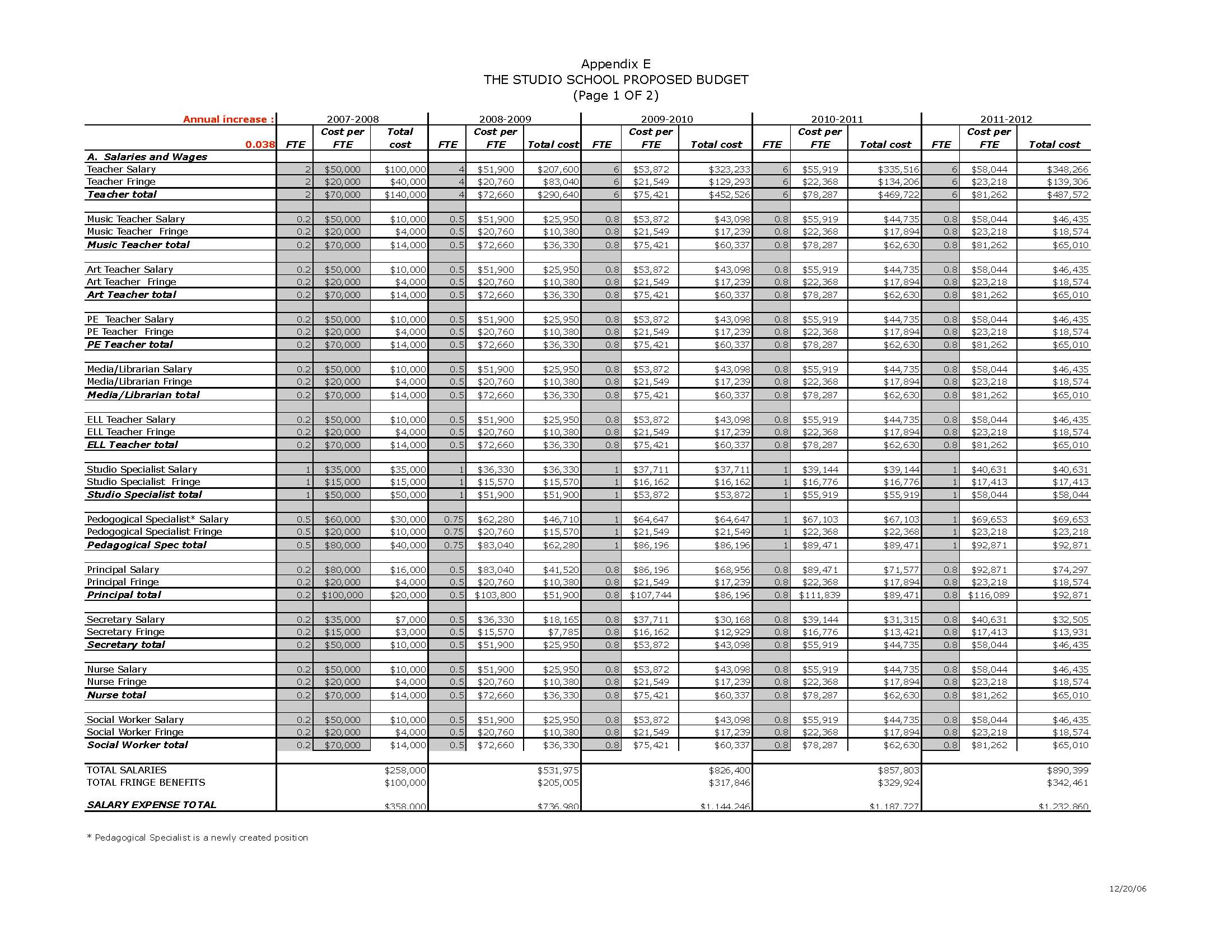
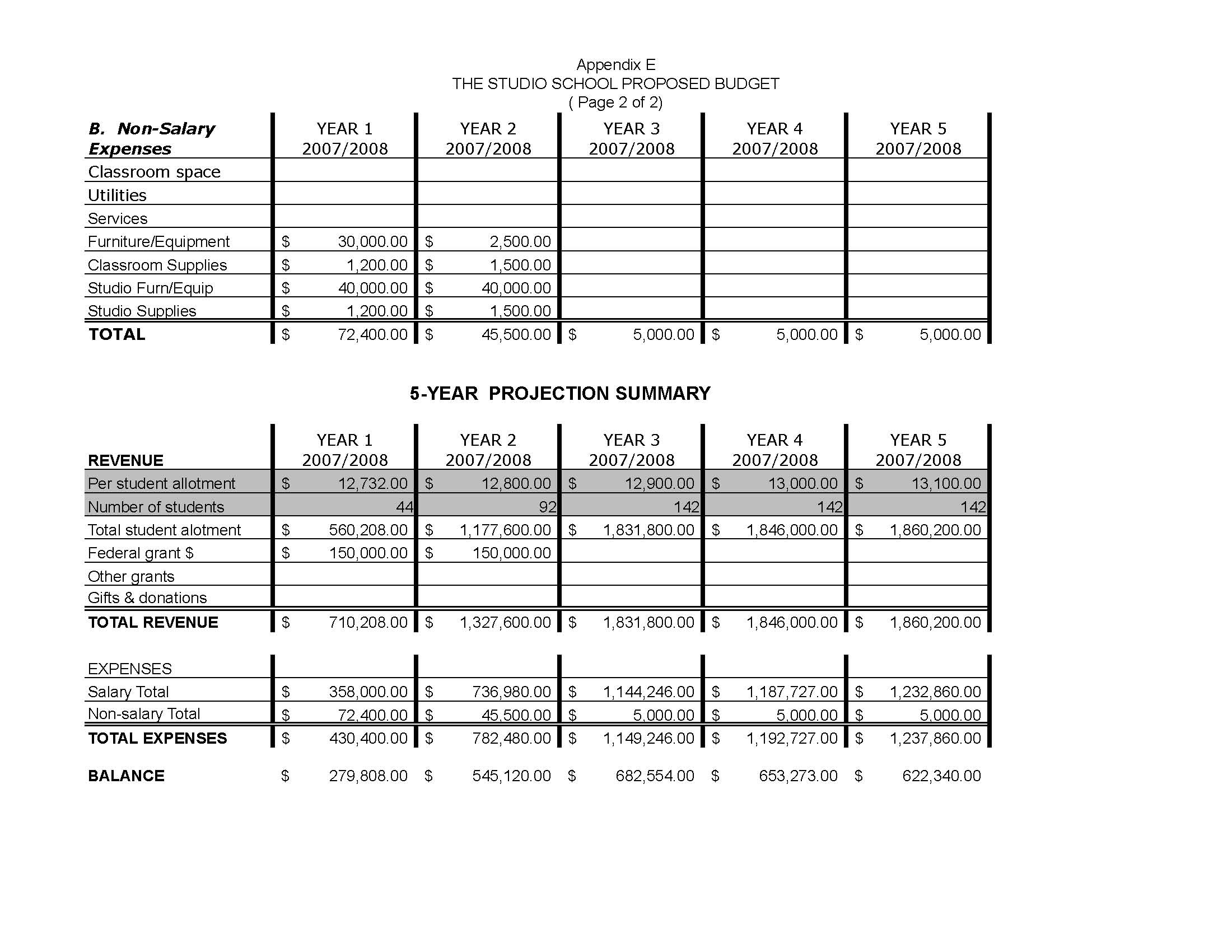
Local Politics: Zig and Zag with the Madison Studio School

Steven Elbow’s Tuesday article in The Capital Times on the proposed Madison Studio School included a rather tantalizing opening quote from organizer Nancy Donahue:

When Nancy Donahue began her effort for a charter school in Madison, she had no idea she would be wading into a world of politics.
“It’s a campaign,” said Donahue, who hopes to have her arts- and technology-oriented Studio School up and running next fall. “And before this I was very apolitical. But I’ve learned if you believe in something you do what you have to do.”

A couple of close observers of Madison’s political tea leaves emailed some additional context:

Former teacher and Progressive Dane education task force member Kristin Forde is a member of the Madison Studio School’s “core planning group”. In the past, Forde has participated in School Board candidate interviews and a Progressive Dane (PD) candidate Forum.
Madison School Board President Johnny Winston, Jr. has been and is supported by PD along with recently elected (in one of the closest local elections in memory – by 70 votes) board member Arlene Silveira.
PD reportedly requires any candidate they endorse to back all of their future candidates and initiatives. [ed: Shades of “with us or against us“. Evidently both Russ Feingold and Barack Obama have not read the memo.]

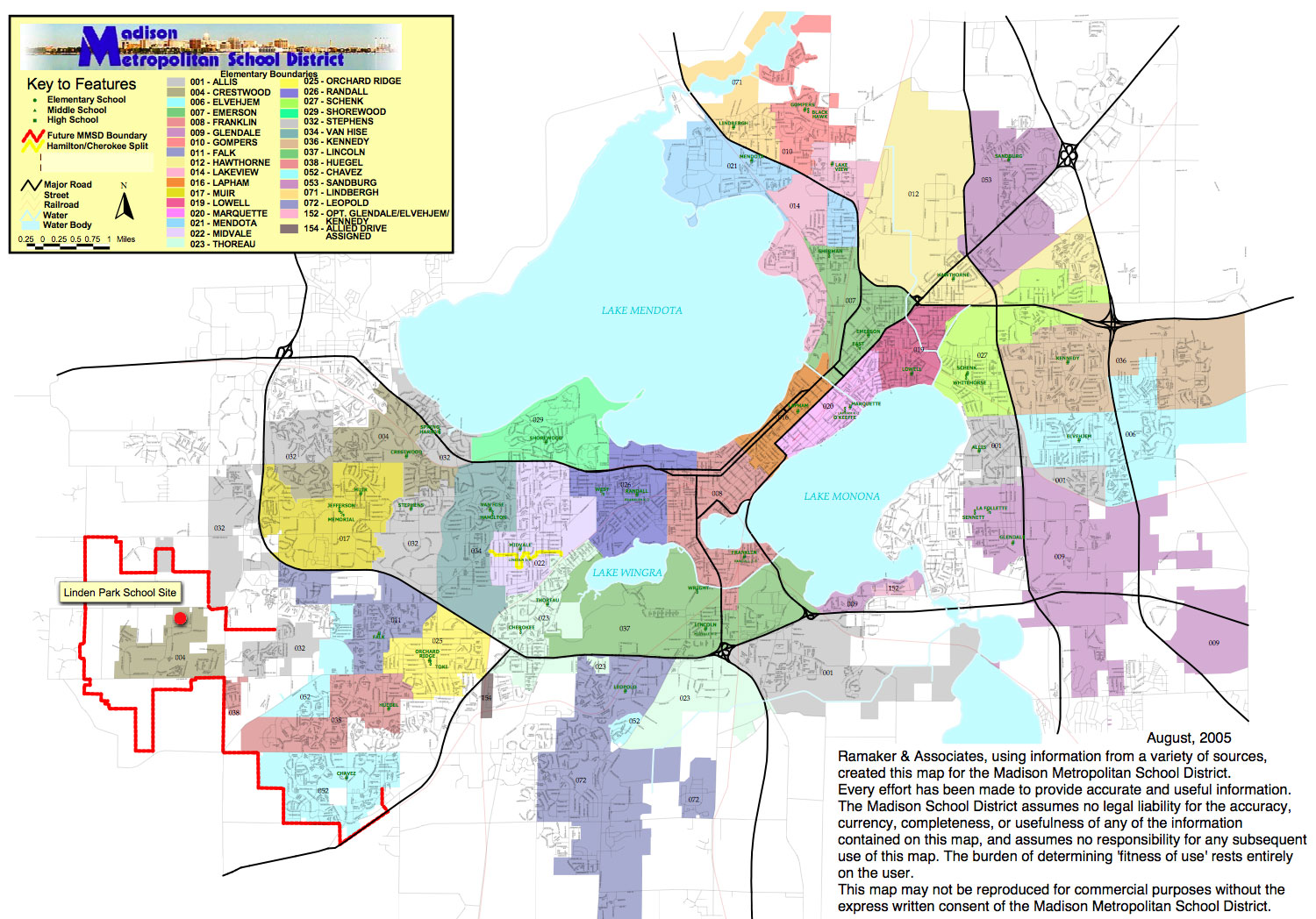
I find PD’s positions interesting. They recently strongly supported the Linden Park edge school [map] (opposed by a few locals who dislike the sprawl implications, though it handily passed in November, with 69% voting in favor). I do think Madison is behind the innovation curve with respect to online learning and possibly charters. Appleton has 12 charter schools, including an online school.
Background documents:

The timing and politics are a challenge, given the recently disclosed 7 year Madison School District structural deficit which will require larger than normal reductions in the 2007 / 2008 budget increases.
I have very fond memories of Madison’s Preschool of the Arts.
It will be interesting to see if the Studio School supporters endorse PD’s spring, 2007 candidates, which include Johnny Winston, Jr who is standing for re-election.

Share

2007 – 2008 Madison School District Budget Discussions Underway

Watch Monday evening’s school board discussion [Video | Download] of the upcoming larger than usual reductions in revenue cap limited increases in the District’s 2007 – 2008 budget (they are larger than normal due to the recently disclosed 7 year structural budget deficit). The 2006 / 2007 budget is $333M+ (it was $245M in 98/99 while enrollment has remained flat, though the student composition continues to change).

Related Links:

Share

07/08 Budget Discussions Begin

Superintendent Art Rainwater sent a memo to the School Board [550K PDF] outlining 10 categories that will be considered as the District prepares a balanced 2007/2008 budget in April, 2007. This budget will be more challenging due to the recently disclosed $6M structural deficit, which means that the reduction in the Distict’s revenue cap limited spending increases in its’ $333M+ budget will be larger than usual. The discussion categories include:

  1. Athletics/Extra Curricular
  2. Consolidate Schools
  3. Teacher/Staff Ratios
  4. Building/Facilities
  5. Reduce Administrative Staffing
  6. Services
  7. Student Services
  8. Curriculum Development and Support
  9. Decrease allocations for instructional supplies/materials/equipment by up to 20%
  10. Eliminate/Reduce District Student Programs/Services
Share

Cardozo High School AP English Teacher Video

olearydcap.jpg
John Poole 5:21 video:

Cardozo High School in Washington, DC, is a national pioneer in introducing Advanced Placement courses to disadvantaged students. It has found ways to build student skills so that they can begin to get passing grades on the AP exams. One of its star AP teachers, Frazier O’Leary, taught the school’s first AP class 10 years ago and, since then, has become a frequent speaker and adviser to school districts around the nation.

Well worth watching.

Share

More Notes on Re-Thinking K-12

Amanda Paulson:

What if the solution to American students’ stagnant performance levels and the wide achievement gap between white and minority students wasn’t more money, smaller schools, or any of the reforms proposed in recent years, but rather a new education system altogether?
That’s the conclusion of a bipartisan group of scholars and business leaders, school chancellors and education commissioners, and former cabinet secretaries and governors. They declare that America’s public education system, designed to meet the needs of 100 years ago when the workplace revolved around an assembly line, is unsuited to today’s global marketplace. Already, they warn, many Americans are in danger of falling behind and seeing their standard of living plummet.

Rotherham adds:

I think we need to think more daringly, yes, but I don’t think we tried everything or nearly hard enough to improve American schools within the current context. But I think that is sort of irrelevant today because the context has changed so much and consequently more of the same amounts to trying to make the current system work to do things we don’t want it to do anymore anyway.

Locally, dealing with the recently disclosed 7 year structural deficit in the Madison School District’s $332M+ budget will require strong leadership, open minds and the ideas contained in Peter Gascoyne’s words.
V. Dion Haynes has more.

Share

2007/2008 Madison School District Budget Outlook: Half Empty or Half Full?

Susan Troller’s piece today on the larger than usual reduction in “revenue cap limited” increases (say that quickly) in the Madison School District’s $332M+ 2007/2008 budget is interesting, from my perspective, due to what is left unsaid:

  • The District has been running a “structural deficit for years, revealed only recently after school board Vice President Lawrie Kobza spent considerable time seeking an answer to the question:

    “Why did our equity go down this past year since we, the board, passed a balanced budget in 2005/2006? Why did it go down by $2.8M (about a 1% variance in last year’s $319M+ budget)?

    Superintendent Art Rainwater responded:

    “The way we have attempted to deal with maintaining the quality of education as long as we could was to budget very, very aggressively, realizing that we had an out of fund balance ($5.9M in 2006/2007). We made the decision 7 years ago or so to budget aggressively and try to manage to that budget believing that we would use less fund equity over time than if we set aside a set amount. So that’s been our approach. That fund equity has now come down to the point that we believe we can’t do that any more and we will not bring you a balanced budget that is aggressive particularly where it gets into aggressive on the revenue side in how much efficiency we believe we can budget. So, what the effect of that is to increase the amount you have to pay.

  • I’ve not seen a published figure on how much the District’s equity has declined during this “7 year aggressive” budget posture. The District’s operating budget in 1998/1999 was approximately $245M. The current year’s budget is $332M. Enrollment has remained flat during this time.
  • Madison is a “rich” district, spending 23% more per student than the state average. Madison is also a property tax rich district, with an average property value per student of $775,000 (Appleton is $411K, Milwaukee $267K, Verona 526K and Middleton-Cross Plains $779K) – via SchoolFacts 2006. George Lighbourn’s recent WPRI school finance article is, in my view correct:

    Even the most vocal proponents of change understand the reality that big changes are not in the offing. They know that they are up against the most formidable impediment to change, the printout, that age-old tabulation showing how much money each school district will get out of Madison. Any change that shows dozens of school districts will see a decline in state aid has almost no chance of succeeding.

  • All of this points to the importance of managing the $332M+ budget well, choosing the most effective curriculum and building public confidence for future referendums. I wonder when the public might have learned of the structural deficits (and the District’s dwindling cash equity) had elections gone a different way the past few years (reformers vs old guard)? Learn more about the April, 2007 School Board election.
  • Notes/links:

School finance is a mess. However, the Madison School District’s $332M+ budget provides resources far beyond most public school systems. Throwing up our arms and blaming the state or feds, or ? will not solve anything and certainly does not put our children’s interests first. Transparency, responsibility, creativity, local control (be careful what we wish for with respect to state and federal school finance updates) and wise investments are key to maintaining the community’s remarkable financial and voluntary public education support.

Share

Spring elections for Madison School Board: reformers versus old guard

Writing in this week’s Isthmus newspaper, reporter Jason Shepard frames the issue in the spring school board elections for MMSD: Will Madison voters support the new direction of “tackling fiscal, managerial and achievement-related problems” or bring back an approach that blames all problems on the state legislature and is very light on oversight and accountability regarding finances and student achievement?
Spring elections could bring new directions

Share

A Study of Core-Plus Students Attending Michigan State University

Janet Mertz recently mentioned (along with UW Placement’s James Wollack recently) this paper by Richard Hill & Thomas Parker [750K PDF]:

The latest, December 2006 issue of the American Mathematical Monthly, an official publication of the Mathematical Association of America, contains an 18-page article entitled “A study of Core-Plus students attending Michigan State University” by Richard Hill and Thomas Parker, professors at MSU who teach pre-service high school math teachers.
They state that, “as the implementation progressed, from 1996 to 1999, Core-Plus students placed into, and enrolled in, increasingly lower level courses; this downward trend is statistically robust (p<.0005). The percentages of students who (eventually) passed a technical calculus course show a statistically significant (p<.005) decline averaging 27 percent a year; this trend is accompanied by an obvious and statistically significant increase in percentages of students who placed into low-level and remedial algebra courses. The grades the Core-Plus students earned in their university mathematics courses are also below average, except for a small group of top students. ACT scores suggest the existence but not the severity of these trends."

Core-Plus is used in some Madison High Schools. Much more on math here.

Share

Don’t like math? UW-O asks ‘why not?’

Ben Perlman & Pamela Buechel:

For many college students, high school math is but a distant memory of derivative functions and playing games on graphing calculators.
When a professor mentions that certain math skills are necessary for his class, it sends the lecture hall into a frenzy of questions and worry. It seems that math, more than any other subject, is lost in the student’s transition from high school to college.
With a $69,000 grant, University of Wisconsin-Oshkosh geology professor Jennifer Wenner intends to figure out why.
“There are a couple of hypotheses,” Wenner said. “From my own experience, some people get it in their head that they can’t do math, and they get this block about it.”

Share

DC Area High School Rankings, 2006

Jay Matthews:

The Challenge Index, my system for rating high schools based on college-level test participation, grew from watching a low-income school in East Los Angeles — Garfield High — find ways to challenge average students that most high-income schools never thought of. As The Washington Post unveils its 10th annual Challenge Index rankings of Washington area public schools this week, I want to see how low-income schools in this region are doing.
The Challenge Index rates each school by taking the number of Advanced Placement, International Baccalaureate or other college-level tests the school gave in 2006 and dividing by the number of seniors who graduated from the school this year. High school educators who have learned, as the teachers at Garfield did, that even average students benefit from AP and IB are more likely to have more students taking those exams and do better on The Post’s list. High school educators who stick with what is still the majority view about AP and IB in America — that the programs are suitable only for top students — do not do so well.
In many cases, the list defies the conventional wisdom that schools with lots of low-income students are bad and schools with few such students are good. That is not to say that most low-income schools do well on the list. Most do not. Many of their teachers and administrators accept the widespread assumption that their students can’t do AP or IB. But the few schools in poor neighborhoods that break out of this mindset are worth studying.

Share

Spring 2007 School Board Election Update

I’ve added 3 additional declared candidates to the election site, via the City Clerk’s office:

  • Seat 3 (Shwaw Vang’s seat): Pam Cross-Leone vs Beth Moss vs Rick Thomas.
  • Seat 4: Johnny Winston, Jr. (Incumbent)
  • Seat 5 (Ruth Robart’s seat): Maya Cole vs Marj Passman.

Links and notes on running for School Board can be found here. It’s great to see these active citizens participating in our democracy.

Share

Comments on BOE Progress Report for December

Madison School Board President Johnny Winston, Jr. (thanks!) posted a rather remarkable summary of recent activity today. I thought it would be useful to recall recent Board Majority inaction when reviewing Johnny’s words:
It’s remarkable to consider that just a few short years ago, substantive issues were simply not discussed by the School Board, such as the Superintendent’s rejection of the $2M in Federal Reading First Funds (regardless of the merits, $2M is material and there should have been a public discussion).
Reductions in the District’s annual ($332M+ this year) spending increases were thinly discussed (May, 2004).
Today, we know that the School District has been running a structural deficit for years, something previous Board Majority’s were apparently unaware of or certainly never discussed publicly.

(more…)

Share

Important new information about credit for non-MMSD courses issue.

“In preparation for the December 11, 2006 meeting of the BOE’s Performance and Achievement Committee, Assistant Superintendent Pam Nash prepared a memo dated December 5, 2006 along with 10 “exhibit” appendices for distribution to the BOE. “Exhibit 10” is a copy of the “Guidelines for Taking Coursework Outside the District” that she wrote in October, 2006, and I previously posted on SIS. In her memo she states “All the other nine procedures described herein, except this one, are governed by law or Board Policy. This process (her new Guidelines) was created by the MMSD to expand the opportunities for students to take courses outside the MMSD without increasing the costs to the MMSD and without undermining the integrity of the diploma a student receives from the MMSD. The “Guidelines for Taking Coursework Outside the MMSD” is the process and procedure currently used when, for example, a student who wants to take outside courses, but does not have any other option available to him/her. The cost for taking courses under this procedure is the responsibility of the student/parents. The procedure requires pre-approval by the principal and if the student wants credit for taking the course, he/she will receive elective credit if the District does not offer a comparable course. If the District offers a comparable course, the student will not receive credit. The student’s transcript will only include a description of the course, the institution, if any, the date the course was completed, the credit, if any, and the pass/fail grade.”
As I had stated previously on SIS I believe this is a new policy. It is definitely different from the one used in the recent past at Madison West HS in several crucial respects. It has never previously been brought before the BOE for formal approval. At the November 13, 2006 meeting of the Performance and Achievement Committee, I presented Superintendent Rainwater and members of the BOE with a copy of these “Guidelines”. Superintendent Rainwater responded by stating that these Guidelines only apply to “Independent Study” and do not represent a change in policy. I interpreted his comments to mean they are simply a restatement of Board Policy 3545 – Independent Study. However, Nash’s December 5th memo to the BOE quoted above seems to indicate that her “Guidelines” are to be interpreted as a catchall, meant to apply not just to independent study, but to ALL course work not specifically governed by State law or existing MMSD Board Policies, i.e., her exhibits 1-9. In other words, it is to apply as well to UW courses taken outside of the YOP, WCATY courses, online courses such as Stanford’s EPGY taken outside of the InSTEP Program, UW-Extension courses where the District claims to offer a comparable course (even though in a very different format), etc., i.e., a variety of different types of formal course work offered through certified, non-MMSD programs. If so, shouldn’t these “Guidelines” need formal BOE approval as a new Board Policy since, as Nash states in her memo, they are not currently covered under any existing Board Policies?

(more…)

Share

Credit for Non-MMSD Courses: Performance & Achievement Committee Discussion

Please take note that the MMSD BOE’s Performance and Achievement Committee
will be meeting at 5:45 pm on Monday, December 11th. [map]
One of their two agenda items scheduled for that meeting is “Credit for Non-MMSD Courses.”
This is a very important issue for academically gifted students who would like to be able to substitute higher-level, faster-paced, or more-readily-accessible-to-them (e.g., because of transportation problems) courses taken via WCATY, EPGY, APEX, UW, etc. for ones offered by their local middle or high school. It is an important issue for other types of alternative learners (e.g., special ed students, temporarily ill or disabled students) as well. It has taken years to get this topic placed on the BOE’s agenda. This coming Monday may well be our best opportunity to influence MMSD policy relating to this matter.
Thus, I urge ALL of you who are concerned about this issue either (i) to attend this BOE meeting prepared to give a 3-minute speech during the Public Comments period, or (ii) to send an email this week to Art Rainwater, Pam Nash, and all BOE members (via their comments email address) describing why it is important for their students to be permitted to receive credit toward fulfilling graduation requirements for qualified high school- and college-level courses taken at UW, MATC, TAG summer programs, online, or via correspondence.”

Share

High School Redesign Notes

As Arlene has reached out to the community for suggestions about the Redesign of the high schools, let me share a couple of thoughts:

  1. It’s too late. The students that are behind in 5th grade rarely catch up. The 2/3 combinations are by far the worst academic combination for elementary students, yet we continue this practice to save money, and to save SAGE. I understand the pull out combination system is a great way to deal with cost and transient students….but does it really help? Can’t we negotiate with the Union to allow 4 year kindergarten? This is really annoying that we have to bow to the Union for the sacrifice of the lower income students.
  2. The middle school years has a great resource of teachers. My children have had teachers that felt students are undergoing hormonal warfare and felt they should teach less so as not to upset the students. As I quote a teacher my child had in a “Charlie Brown teachers voice”, “Less is more and as long as they learn a couple of concepts during the year I feel I have done my job”. This fortunately is not the normal approach my children have received. Most of the Jr. High teachers have been focused on preparing the students for Memorial. I wonder if this is the model for most of the Jr. High Schools throughout the district?
  3. The district currently has the highest number of National Merit Scholar graduates in the state, I would assume we send hundred of students to college each year and those that are from higher income families do well. I wonder if the problem is less racial gap and not more economic gap. Please follow the link to the following Newsweek article released by the North Carolina Democratic Party….http://ncdp.org/node/1081. This is an article about how North Carolina kept their struggling students, drop out prone students and low income students engaged in high school by offering them an option to attend a local community college (MATC) and receive not only their HS diploma upon graduation but also an associate degree in an area of interest so that staying in school had meaning….and graduating means getting a real job. Currently all we can offer students that graduate from high school is they will have a diploma and they can essentially get the same jobs in this area with or without that diploma….with an associates degree they can make more than their teachers in computer repair, Xerox repair, IT, health associate degrees and others. Please think about raising the standards and the options for the struggling students, not lowering the standards for the top tier students. This IDEA and a proven method could benefit the entire community and raise the standard of living for lower income families. Please read this article.
Share

Former teacher runs for School Board

Susan Troller reports in The Capital Times on school board candidates:

A retired teacher has thrown her hat in the ring as a candidate for the Madison School Board.
Marj Passman, who was active in the recent successful referendum to approve funding for a new elementary school, has announced that she will be a candidate for Ruth Robarts’ open seat on the board. Robarts, who has served as a School Board member since 1997, will not be running again.

(more…)

Share

Tax Climate Notes & Links

The arrival of local property tax bills signal the onset of tax season. Accordingly, there has been a number of recent articles on Wisconsin’s tax climate:

  • Barbara Miner: More than 16,000 private properties in Wisconsin pay no property taxes. As a result, everyone else pays more. Why?

    In Milwaukee, for instance, almost 20 percent of the city’s non-governmental property value is exempt from taxes, a big jump from almost 10 percent six years ago. Add in government-owned property such as public schools, fire stations and parks, and the exempt total is more than 33 percent. Figures are similar for many other cities and suburbs in the area.
    Todd Berry has been president of the Wisconsin Taxpayers Alliance since 1994. Berry’s group has done many studies of Wisconsin’s taxes but has never looked at the impact of nonprofit tax exemptions.
    As Berry sheepishly admits, his group is itself exempt and doesn’t pay property taxes on the building it owns in Madison, valued at about $500,000 on its federal tax return. Thus, a group that often does studies exposing high taxes helps add to the tax level for others with its own exemption.

  • Institute for Wisconsin’s Future:

    Contrary to the claims of corporate lobbyists that the state has unreasonably high business taxes, Wisconsin is already a low-tax state for large firms.
    And this means the corporate sector is not making a fair contribution to the cost of maintaining public structures of state and local government, from schools to roads to public safety to the environment.
    To back up these statements, the Institute for Wisconsin’s Future released a mass of data on December 4, 2006, detailing that more than thirty states have higher taxes on corporations and that over 60% of the biggest companies operating in the state paid zero corporate income tax in 2003.

  • Wistax:

    After a drop of 0.5% in December 2005, school taxes this year will rise 5.4% to $3.79 billion. The increase is less than in 2003-04 (7.2%) but over the 1990-2005 median (4.9%) Increased property values helped drop the average tax rate from $8.62 per $1,000 to $8.31. Growth in another state tax credit will help offset the school tax hike.

Inevitably, tax favors are available for certain folks and are often inserted into bills late in the process. The Miller Park exemption is classic:

Restaurants pay taxes but not Friday’s Front Row Sports Grill at Miller Park because everything inside the stadium grounds is exempt.
The exemption for Friday’s particularly galls city officials, not only because another property leaves the tax rolls but because they see it as unfair to other competitors. While the Miller Park restaurant is tax-free, the TGIFriday’s in Greenfield pays property taxes of about $45,000.

Last fall, both Russ Feingold and Herb Kohl voted for a massive, one year large corporate tax giveaway: a 5% tax rate on offshore earnings. What a mess.

Share

Madison Partners for Inclusive Education Presentation to the School Board

The Madison Partners for Inclusive Education presented information to the School Board Monday evening. Watch the 38 minute video.

The clip begins about 5 minutes into the presentation (I missed the first few minutes).

Share

Spring 2007 Madison School Board Election Update

I’ve added two declared candidates to the April 3, 2007 election page:

  • Marj Passman for Seat 5 (Ruth Robarts is retiring)
  • Beth Moss for Seat 3 (Shwaw Vang’s seat)

Johnny Winston, Jr., in seat 4 has announced he is running again, but as of this afternoon, had not declared his candidacy according to the City Clerk’s office.
Check out the video interviews and links from the April, 2004 election; the last time these seats were contested.
Learn more about running for school board here. (updated to reflect the correct seats via Marj’s comments below).

Share

Do Math Topics Lead to Better Instruction?

Daniel de Vise:

It says the typical state math curriculum runs a mile wide and an inch deep, resulting in students being introduced to too many concepts but mastering too few, and urges educators to slim down those lessons.
Some scholars say the American approach to math instruction has allowed students to fall behind those in Singapore, Japan and a dozen other nations. In most states, they say, the math curriculum has swelled into a thick catalogue of skills that students are supposed to master to attain “proficiency” under the federal No Child Left Behind mandate.

Math Forum audio / video

Share

Swaying Seattle’s School Assignments (Boundaries)

Daniel Golden:

In 2004, after the district scrapped race as a factor in assignments because of the legal threat, another group of white parents from the same neighborhood got upset when their children were passed over at the same majority-white school, Ballard High. They were left out not because of race, but because they didn’t live near enough.
This time, the school district quietly backed down when the parents started sending their children to private or suburban schools instead of the struggling, majority-black school to which they’d been assigned. Ballard and other supposedly full schools together took about 100 extra students, most of them white.
Even as parents challenge a government action making room for minorities in highly-regarded schools, the later events in Seattle show another side of the picture: the ways that school-assignment practices can work to the benefit of whites. In Seattle as in other parts of the country, schools sometimes accommodate middle-class parents who push to get their children into coveted schools. When these middle-class parents are predominantly white, as in Seattle, the lobbying can tend to sort more white children into the most desirable schools.

Share

A Campaign for the Civics Curriculum

ABC’s This Week:

The teaching of civics presently in the United States is dismal and startling. It used to be, when I was a kid, that there were classes in civics and you learned not only the checks and balances, but hows and whys and wherefores. And you learned what was the reasoning behind the creation of the Constitution and the Bill of Rights. …
If you think that running a government like ours is, arguably, more complicated than running a pharmaceutical company or an auto company — and it is — then we should train people to the running of the country. …
We want to … define the necessity of civics: What is it and is it necessary? If it’s necessary, is it urgent? And, if it’s urgent, what do we do? And then [we should start] to proceed to literally design classes.
It is time that we simply revive the notion that we can learn how to run the country — and learn not for Republicans and not for Democrats, but learn how to learn the Constitution. The idea of people having power to pursue a notion of happiness or control of their own lives is a new thing and a miracle. America is a miracle.

Agreed. Howard French’s recent article on history illustrates the need for rigor, critical thinking and the ability to ask questions.

Share

Arlene Silveira Seeks Comments on The Madison School District’s Proposed High School Redesign Process

Arlene Silveira:

Good morning –
As you may have heard, the School Board and district are embarking on a major high school redesign initiative [Discussion & Presentation Audio / Video]. The Superintendent made a presentation at the board meeting last week, giving some background information and outlining the process by which we will gather feedback and evaluate future changes for our high schools. The scope is huge – it involves challenging curriculum, relationship development and development of the skills needed to succeed in a challenging world. What will the new design look like? We don’t know. We are starting with a blank slate. The process will be community-oriented. There will be time for more formal input as the process starts after the holidays. In the meantime, I would like to know your thoughts on the following questions:

  1. What do you think MMSD’s high schools are already doing well?
  2. What are the barriers that keep our high schools from meeting your expectations?
  3. What is your vision for the future of our high schools.

Thanks for your thoughts.
Arlene Silveira

One of the interesting questions discussed during Monday evening’s school board discussion on this issue was the need to address curriculum issues in elementary and middle school so that students arrive in high school prepared. In my view, this should be our first priority.
Paul Tough’s recent article on “What it takes to Make a Student” provides a great deal of useful background information for this discussion.

Share

Additional Notes on “What it Takes to Make a Student”

Joanne Jacobs:

Last night at the Hunt Institute retreat for North Carolina legislators, the former governor, Jim Hunt, handed out copies he’d underlined to everyone there, urging the legislators to “read every word.”
Schools like KIPP and Amistad [Clusty on Amistad] that succeed in educating low-income students tend to do three things well, Education Gadfly points out.

Students are required to be in school longer-much longer-than their peers in traditional public schools.
Pupils are tested, and re-tested, to measure achievement. Lesson plans, teaching strategies, even whole curricula are adjusted based on how well, or poorly, students are learning what they should. Moreover, teachers are closely monitored and constantly working to improve their skills.
Students’ behavior and values are aggressively shaped by school leaders and instructors.
What is complicated, however, is implementing these changes within today’s rule-bound, bureaucratic system, with its collective bargaining constraints, bureaucratic regulations, and the inertia of 100-plus years of public education. It’s no coincidence that all of Tough’s profiled schools are charters, and as such have the freedom to do things differently and take control of their own destinies. In turn, this greater autonomy allows them to attract many top-notch, talented, and energetic teachers who are willing to work long hours for mediocre pay because they yearn for a results-oriented, break-the-rules environment. Replicating this atmosphere in the traditional system would be hard-maybe even impossible. But expanding charter schools–and getting more good ones-is no easy feat, either.

Dennis Doyle adds a few thoughts.

Share

Revamping the high schools

Isthmus’ Jason Shepard covers the story:
Curriculum changes halted as district eyes study group
JStanding in front of a giant projection screen with his wireless remote control and clip-on microphone, Madison School Superintendent Art Rainwater on Monday unveiled his grand vision for Madison’s four major high schools. But the real backdrop for his presentation before the Madison school board was the criticism of changes implemented last year at West High and proposed this year at East. Both involved reducing course offerings in favor of a core curriculum for all students, from gifted to struggling.
Rainwater stressed his intention to start from scratch in overhauling all aspects of the education provided at West, East, Memorial and La Follette, whose combined enrollment tops 7,600 students. The move follows consolidation of practices in the city’s elementary and middle schools. But it may prove more challenging, since the high schools have a longstanding tradition of independence.
Over the next two years, Rainwater would like a steering committee of experts to study best practices in high school education. Everything, Rainwater stresses, is on the table: “It’s important we don’t have preconceived notions of what it should be.”
Heterogeneous classes, which until last week were the district’s preferred direction for high school changes, are, said Rainwater, “only one piece” of the redesign. But curriculum changes are clearly going to happen.
“It’s not acceptable anymore to lecture four days a week and give a test on Friday,” Rainwater declared. Teachers must learn how to teach students, rather than teach content.
The 50 parents and teachers in the audience reacted coolly, judging from the comments muttered among themselves during the presentation and the nearly two-hour discussion that followed.
Tellingly, the biggest applause came when board member Ruth Robarts said it was “high time we as a board start talking about high school curriculum.” Robarts chastised Rainwater for not including teachers and parents on the steering committee, which will “reinforce a perception that is not in our favor.” She said the district was giving critics only two options: accept the changes or “come down and protest.”
On Nov. 16, East Principal Alan Harris unveiled plans to eliminate several courses in favor of core classes in ninth and 10th grades. Attendees said the plan was presented as a “done deal.” In e-mails to the board, parents called the plan “short-sighted and misguided,” and one teacher warned: “Don’t do it.”
Rainwater, apparently recognizing the damage to parent and teacher relations, sent a memo to principals last week.
“I am asking you to cease any significant programmatic changes at each of your schools as this community dialogue progresses,” he wrote. “We need a tabula rasa mentality that will allow for a free flow of ideas, an opportunity to solidify trust in our expertise, and a chance at a solid, exciting product at the end.”
The four high schools will remain under their current programs until the steering committee gets to work. Chaired by Pam Nash, deputy superintendent of secondary schools, it will include several district administrators as well as experts from the UW-Madison, Edgewood College and MATC.
Rainwater sought to assure board and audience members that teachers and parents will have ample opportunity for input. His plan calls for three separate periods of public comment, after which subcommittees will make revisions. The school board will then vote on the recommendations after additional hearings and debate.
“You get better input if people have something to react to,” Rainwater said, adding that involving teachers in all stages would be impractical, because it would be difficult to cover their teaching assignments. That comment drew a collective groan from teachers in the audience.
Rainwater’s call for a revamping of the city’s high schools suggests the current approach isn’t working. And that poses a dilemma for school officials. The district likes to tout its record number of National Merit semifinalists and state-leading ACT scores as proof that its high schools are successful. Many parents worry that those high-end benchmarks are under attack.
But Madison’s schools continue to fail countless kids — mostly low-income and minority students. This is a profound challenge hardly unique to Madison, but one that deserves more attention from policymakers.
Research in education, the starting point for Rainwater’s steering committee, offers promising solutions. But the district risks much in excluding teachers from the start, since inevitably they will be on the front lines of any change. And excluding parents could heighten the alienation that has already prompted some middle- and upper-class families to abandon the public schools.
While struggling over details, most board members conceptually support the study. During their discussion Monday, Lawrie Kobza cut to the chase.
“What is the problem we’re trying to solve?” she asked. “And is this how we solve this problem?” Kobza professed not to know the answer. But these are the right questions to ask.
http://www.thedailypage.com/isthmus/article.php?article=4919

Share

11/27/2006 High School Redesign Presentation Materials

Here is a copy of Monday night’s presentation. I amended it to include the listening sessions with the individual schools as the first step in the process. [354K PDF Version] Video here.

Share

15 Wisconsin Fall Referendums Pass

Amy Rinard:

Fifteen school districts around Wisconsin won building project referendums worth $290 million on Nov. 7, and voters in several districts also voted to raise their tax levies a collective $51 million beyond the state spending caps.
Those results pleased a top state school board official, but he said it only shows how desperate times have become for many local districts, and that school advocates will be urging a re-examination of Wisconsin’s school funding formula.
John Ashley, executive director of the Wisconsin Association of School Boards, said the number of districts that succeeded in getting approval of referendums showed voters value education and are willing to invest in future generations.
“I’m very, very happy for these districts because it’s a matter of life and death for many of them,” he said. “But I’m saddened at the number who didn’t get their referendums passed.”

Share

A bit of Sunshine on the Madison School District’s Budget Process: 2006/2007 Madison School District Budget & $6M “Structural Deficit” Discussions

video here There’s been a fascinating school board discussion over the past few weeks as the 2006/2007 $332M+ Madison schools budget is finalized.

(about 41 minutes into this 61 minute video clip) Lawrie Kobza:

“Why did our equity go down this past year since we, the board, passed a balanced budget in 2005/2006? Why did it go down by $2.8M (about a 1% variance in last year’s $319M+ budget)?

Answer: “Negative expenditure of $6M in salaries (tuition income was down, special ed high incidence aid was down) $5.9M “structural deficit in place”.”

Art Rainwater:

“The way we have attempted to deal with maintaining the quality of education as long as we could was to budget very, very aggressively, realizing that we had an out of fund balance ($5.9M in 2006/2007). We made the decision 7 years ago or so to budget aggressively and try to manage to that budget believing that we would use less fund equity over time than if we set aside a set amount. So that’s been our approach. That fund equity has now come down to the point that we believe we can’t do that any more and we will not bring you a balanced budget that is aggressive particularly where it gets into aggressive on the revenue side in how much efficiency we believe we can budget. So, what the effect of that is to increase the amount you have to pay.

Lawrie Kobza:

We budgeted under this CFO/COO account, we budgeted that we were going to find $6.1M somewhere without saying where, and we didn’t. We found all but 2.7M of that. In this year’s budget, we have the same type of thing. We have budgeted that we’re going to find $5.9M somewhere. So, while we can look at all of our budget items, oh, we’re doing great we’re right on budget for salaries, transportation, for whatever. We can’t just meet our budget, we have to do $5.9M better than our budget. We’re going to take this up in the Finance committee to see if there is a different way we can present some of this, to be able to track it.

Roger Price mentioned that this was not a new item, but was in place when he arrived in the mid 1990’s.

Ruth Robarts asked about a February 2006 consultant’s forecast of the District’s equity versus Roger Price’s Numbers (52 minutes). Ruth also asked about the financial implications of the District’s retirement buyout commitments through 2009. “I’ve been on the Board a long time and did not see in the documents I’ve seen that kind of structural deficit”.
Watch the video here or listen to the mp3 audio.

Bottom Line: Thanks to Lawrie Kobza’s digging, the public knows about the Madison School District’s $6M “structural deficit”. This also means that next year’s balanced budget will require significantly greater reductions in spending increases, or “cost to continue approach” than we’ve seen in the past. It would also be interesting to see how our District’s “equity” or cash reserves have declined over the years.
The good news regarding the budget’s “Fuzzy Math, or the balanced budget that isn’t” (there must be some)? The discussion happened publicly, on MMSDTV, and the community is now aware of looming larger budget changes than we’ve seen in the past. Unfortunately, I’ve seen no mention of this in the traditional media.
Run for school board!

Share

11/7/2006 School Referendum Passes

Susan Troller:

It was a very good night for the Madison schools Tuesday.
By the time all the votes were counted, 69 percent of district voters said yes to three referendums that totaled $23 million in projects: building a new elementary school at Linden Park, shifting the cost of an addition at Leopold from the operating budget to borrowed cash and refinancing existing debt at a more favorable rate.

Share

A Few More 11/7/2006 Referendum Links

  • Support Smart Management: Wisconsin State Journal Editorial Board:

    Taxpayers in the Madison School District should demand that the School Board be smarter about managing the district’s money and resources.
    On Tuesday’s ballot is a school referendum containing three smart proposals.
    That’s why the referendum deserves voters’ support.
    More important than the referendum, however, is what happens next. The School Board is confronting difficult choices, including how to respond to rapid growth in areas where there are no schools while in other parts of the city, schools have excess space.
    A pivotal question in upcoming months will be: Does the board have the courage to close a school? While the rapidly growing Far West Side merits a new school, other parts of Madison are experiencing declining student populations.
    Taxpayers can’t afford to build schools where the children are while maintaining schools where the children aren’t.
    At least one school should eventually be closed and sold, with boundary changes to distribute children to other schools.

  • Another Referendum: WKOW-TV:

    This referendum is different from the last – it has one question, with three parts. In 2005, just one issue of a three-part question passed. Voters passed a plan for building renovations, but they said voted down a second school on the Leopold Elementary site, and to exceeding the revenue cap
    Monday night, spokesperson Ken Syke pointed out that since at 1993 no MMSD referendum has fully failed-at least one issue has always passed.

  • Don Severson & Vicki McKenna discuss the referendum question and a District email to MSCR users [mp3 audio]

Many more links here.

Share

Latest Forum: Rafael Gomez on Elections and Education


Mp3 Audio | Video
Rafael Gomez discusses his recent experience with the Mexican election in light of our approaching vote. He also discusses our two national education systems.
Share

Poor Management Compels “No” Vote

After being decisively defeated in two spending referendums last year, the administration and a majority of the Madison School Board haven’t learned that the voters are sick and tired of runaway spending and poor management.
In a demonstration of true arrogance, after being told in May 2005 that flat enrollment did not justify a new school in the Leopold School area of Arbor Hills, in June this year, the administration began construction of a major addition to Leopold School.
In so doing they put forth no plan to pay for the addition while gambiling on voters reversing themselves in a new referendum.
Madison spends significantly more per student than other Wisconsin districts. Over the past 10 years, while student enrollment has declined, full-time equivalent staff has increased by more than 600. At the same time, operating budgets have increased 58 percent, the cost per pupil is up 59, and there are 325 more non-teaching staff and administrators.
Clearly, the administration does not seem to be able to prudently manage district finances.

(more…)

Share

THOROUGH ANALYSIS SUPPORTS “YES” VOTE ON SCHOOL REFERENDUM

On November 7th, voters will be asked to approve a referendum allowing the Madison Metropolitan School District to build a new school and exceed its revenue cap. After very careful consideration, the Board of Education unanimously decided to ask the question. I fully support this referendum and urge you to vote yes.
Our community is committed to our children and our public schools. We want our children to be well-educated and prepared for the future. We engage in passionate discussions over how best to educate our students, and how to ensure that the community’s investment in education is sound. We are not satisfied with the status quo, and we are continually looking for our schools to do better. The Board of Education shares this commitment. We take very seriously our responsibility to gather information, ask questions, and initiate actions to accomplish these goals.
We need to build a new elementary school on the far west side of Madison because there is simply not be enough room in our schools to accommodate the dramatic growth there. Projections, confirmed by student count information, are that elementary schools in the Memorial attendance in total will exceed capacity by 2007 and will be at 111% of capacity by 2010. Linden Park, a fast growing residential area about three miles from the nearest elementary school, is an excellent location for that school. It will service a large attendance area where many students will be able to walk to school, helping to control bussing costs.

(more…)

Share

11/7/2006 Referendum: “Vote No To Stop Sprawl”

Dan Sebald:

The Nov. 7 school referendum is about more than the question of whether Madison needs a new elementary school. It’s about the placement of the proposed site and its associated inefficient land use.
I see a “yes” vote as a vote for the same poor growth model of civic design that has been going on for the past 10 years in Dane County, where sprawling developments are constructed for quick revenue and services like the new elementary school come as an afterthought.
Why did the city and county not plan for an eventual site that doesn’t slowly encroach on environmentally sensitive areas like Shoveler’s Sink and its nearby prairies? One not so dependent on the automobile? One that doesn’t consume even more farmland?

(more…)

Share

More on “More Madison Building Referendums on the Way?”

Susan Troller’s article on Madison School Superintendent Art Rainwater’s comments regarding the “eventual need for five new elementary schools” sparked a few comments here, as well as several reader emails, one of which included the March June, 2006 School Board minutes:

It appears that the ‘plan’ was referred to Long Range Planning for additional articulation. The minutes at least put the discussion in context. Note also that Ruth voted against bundling the 3 questions into 1.

Share

Severson / McKenna on Negative Aid, Local Media Coverage of Schools and the Referendum

There were some interesting items in today’s conversation between Don Severson and Vicki Mckenna [13.7MB mp3 audio file]:

  • A caller (29 minutes): “Why does the rest of the media have such complacency with the Schools?” Don noted the lack of negative aids discussion in Monday’s “very long” Wisconsin State Journal article. The caller raised a good question.
  • $10.95 of the 29.21 annual average property tax payment for the referendum is “negative aid”, ie money local property taxpayers must pay over and above the referendum cost due to the MMSD’s spending above state revenue caps. In other words, the more the MMSD spends above the revenue caps, the more state aid it loses and therefore local property taxes have to make up the difference. Some states refer to this as a “Robin Hood” Act.

More on the referendum here.

Share

Candidate training for women

Fact: Women make up 51% of the US population, but only 14% of the US Congress. Fair representation is the way to fair policies; we’re not there yet, and we can do better.
Studies show that women win just as frequently as men. Conclusion: more women need to run for office. Studies also show that women need to be asked to run for office three times before they will do it. Conclusion: consider yourself asked, and tell your girl friends to run.
Emerge Wisconsin is a groups that recruits and trains women to run for office. Their training program is 1 weekend/month for seven months, and is the most comprehensive candidate training program that I know of. The deadline for applying for the program is November 15th, and I’m hoping that you (if you are female) will consider applying, or pass this on to women who you think should run for office.
Emerge’s website: www.emergewi.org
The application can be downloaded and viewed at: http://www.emergewi.org/template.php?page=application
Sincerely,
Melissa Malott, Attorney
Water Program Director
Clean Wisconsin
122 State St., Suite 200
Madison, WI 53703
tel. (608) 251-7020 x13
fax (608) 251-1655
www.cleanwisconsin.org

Share

More Madison Building Referendums on the Way?

Susan Troller:

On Tuesday, voters will make a decision on a $23.5 million school referendum that would include giving the green light to an elementary school on Madison’s far west side, but school district officials see it as just the first of several in the near future.
Based on current residential growth patterns, as many as five new elementary schools may eventually be needed to accommodate new generations of children in and around Madison, according to Madison Metropolitan School District Superintendent Art Rainwater.

Interesting timing.

Share

Madison School District Healthcare Cost Savings

The Madison School District Board of Education approved a collective bargaining contract with the custodial units last night in which the custodians agreed to move from their current health care plans (GHC and the Alliance PPO) to a 3 HMO plan which is GHC, Dean Care and Physicans Plus. MMSD continues to pay 100% of the premium, but there are cost savings associated with this change. 85% of those costs savings was passed on to employees in salary and 15% went to MMSD.
This change is effective 1/1/2007. A big benefit of this change is that Administrators will also move to the 3 HMO option.
I’ve not seen an MMSD press on this important issue, but this is what I understand is happening.
Health care expense links.
This is a very positive development, particularly given the inaction on this topic in the recent past and one I believe helps support the 11/7/2006 referendum.
MMSD Press Release.

Share

More on the 11/7/2006 Madison Schools Referendum

Andy Hall:

The outcomes of previous ballot measures have varied.
Voters approved six of seven referendums offered from 1995 to 2003.
In May 2005, district voters approved a referendum exempting $29.2 million in maintenance and equipment expenses from state revenue limits through 2010.
Voters rejected two other measures, though, that would have exempted $7.4 million in operating costs from revenue limits and would have approved $14.5 million for renovations and a second school on the Leopold site.
The School Board then decided to press ahead with a scaled-down project at Leopold, paying for it — at least for now — out of the operating budget.

More on the referendum here. Meanwhile, Janesville has a $70M question for voters.

Share

11/7/2006 Referendum Update

I’ve added a number of links to the election page including:

  • Marisue Horton’s letter to the editor: “Yes Moves Schools Ahead”.
  • One Question Wraps Up $23.5M Referendum – Channel3000
  • Where’s the Beef? – WKOW-TV
  • CAST Pro Referendum Internet Advertising, appearing Thursday the first day of no school during the fall WEAC convention. (TJ Mertz notes in a comment that the ads started running Wednesday.)
Share

Latest on the Madison School District’s Policy Change Regarding Credit for Non-MMSD Courses

Here is the official wording of the new MMSD policy regarding students taking non-MMSD courses. 78K PDF. See my earlier post on this unpublished change:

A. Taking outside courses (other than Youth Options) if a student wishes to receive credit toward graduation.

  1. The course must be pre-approved by the principal.
  2. The course may only be an elective.
  3. A student may only receive elective credit toward graduation provided the District does not offer a comparable course, if a student receives credit it will be reflected as pass/fail.
  4. Elective credits toward graduation shall be granted in the following manner:

    No more than 1 elective credit per year. No more than 1 elective credit in the same subject. more than 2 elective credits may be applied to the total graduation requirement.

  5. The student’s transcript shall only include a description of the course, the institution, if any, the date the course was completed, the credit, if any, and the pass/fail grade.
  6. No grades will be included as part of a student’s GPA.
  7. All costs related to taking the course shall be the responsibility of the guardian of the student or student.

(more…)

Share

Vang won’t run for re-election

Now, six years later, we were alone as we discussed Vang’s reasons for not seeking reelection to the school board in April 2007. While I had heard rumors of his decision, our discussion made it public and official. Vang’s life had changed in six years. His job at Kajsiab House as the resource development director was taking up more and more of his time. And his children were growing older and needing more and more of his time, whether they realized it or not. His oldest son was now in high school.

Continued at The Capital City Hues.

Share

To Voting Madison Citizens

I didn’t vote for the Leopold referendum last spring, and I still believe that was the correct vote. If the community had voted to build a second school on Leopold then we would not have the opportunity for the community to vote “Yes” on this referendum, which I believe is a better financial and long term solution for our growth. When I was asked to participate on the Westside Long Range Planning Task Force, I was determined to find a better solution for our district than building another school.
I approached this job with study and concentration, as did many of the Task Force participants. In my effort to not build a new school I looked at shifting students East, shifting South, moving 5th graders to middle school, and moving neighborhoods to other schools and in the end I found it was more than just filling seats. The shifts made equity uneven. One shift created a school with less than 5 % low income while others were closer to 70%. Other shifts still left some schools too full because the seats were not where the growth is coming from. Some shifts worked but only for two years. After many hours of discussion and shifting, it became clear that we could shift students if we wanted to; split neighborhoods, shift them again in two years, create schools of inequity, provide 100’s of students with a bus ride of 45 minutes or more each way, and change our classroom quality so that teachers no longer had classrooms but carts that they moved from room to room (Art and Music Teachers). When we thought about those options, none of us wanted it for our own children or grandchildren and we believed that for $30 a year, others in the community would prefer that their children and grandchildren not be handed one of these options either. There are other options, but none with the long term solutions that the current referendum provides.

(more…)

Share

11/7/2006 Referendum Conversation: Mitch Henck, Johnny Winston, Jr and Don Severson

Listen to the conversation, along with call-in questions: 17MB mp3 audio (about 50 minutes). Mitch Henck’s website. Much more on the referendum here.

Share

Facts & Questions about the 2006 Madison School District Referendum

Questions:

What is the anticipated cost of equipping the Leopold addition and the elementary school at Linden Park? Are those projected costs included in the referendum authorization or not?
What is the anticipated cost of operating the Leopold addition and the elementary school at Linden Park? How will those costs be appropriated/budgeted (and in what years?) given that the Board expects to have to cut $6-8 million per year?
What are the “shared revenue” total costs for each of three parts of the referendum question? Are these costs included in the $29.20 estimated cost for a median assessed home-owner? Please provide the ‘working papers’ or calculations arriving at these costs. How can a home-owner figure the annual cost of this referendum for the assessed value of their home?
What information about the Ridgewood complex and projected enrollment was used to calculate the need for the Leopold addition?
Construction has already begun for the Leopold addition without voter/taxpayer approval. What is the current impact on the operations budget? What would be the future impact on the operations budget if the referendum fails?

(more…)

Share

Wisconsin Tax Climate Update & Local Property Tax Levy Changes

tax2006.jpg
Wisconsin State Journal Editorial:

The first step toward improving the state’s tax climate must be for lawmakers to control spending. The state cannot afford to cut taxes and thus forgo revenue unless the next governor and Legislature do a better job of paring, consolidating and conserving.
Even the promise that lower taxes will generate more business development in the future will not address the immediate strains created by rising costs for Medicaid and other programs.

Tax Foundation’s report.

WISTAX has more:

  • Municipal Property Taxes Outpace “Freeze”, Rise 4.1% in Large Cities:

    Despite a “freeze” designed to slow property tax growth, Wisconsin’s 230 largest cities and villages increased levies at the same rate as in prior years. According to the Wisconsin Taxpayers Alliance (WISTAX), municipal-purpose property tax levies rose 4.1% in these municipalities in 2005-06 (2006), the same as the average increase from 2002 to 2005.

  • State Budget Increasingly on Autopilot:

    In recent years, most state spending growth has been in two areas: school aids and Medical Assistance (MA). The inescapable link between state aid and school revenue limits on the one hand and property taxes on the other virtually assures that, when combined with accelerating MA costs, most new state revenue is already “spoken for.” Funds for state agencies, higher education, and other state programs are likely to grow little, if at all, thus continuing a long trend..
    State law gives the governor and legislators the power to enact budgets. Yet, through various actions and commitments from both over the past decade, they have increasingly put the state budget on autopilot.

  • Election 2006 Issues and Questions.

The Milwaukee Journal-Sentinel:

Globally, American companies already are at a disadvantage because the benchmark federal corporate tax rate is 35%, which the Tax Foundation notes is “one of the highest corporate tax rates of any of the industrialized economies” – even after the successive rounds of tax reductions under President Bush.
The foundation’s report, however, only added to a bewildering array of national tax rankings, each using different methodologies that have sparked a lively debate among policy-makers.
The foundation’s annual State Business Tax Climate Index is based on a weighted index that ranks each state’s corporate taxes, individual income taxes, sales taxes, unemployment taxes and property taxes. While it relies on U.S. census data for each state’s property tax, it compares state tax rates and tax laws to measure the other four. It employs a matrix of 10 subindexes and 113 variables.
The Madison-based Wisconsin Taxpayers Alliance, using the latest available census numbers, put Wisconsin at No. 6 when measured as a percentage of personal income. That figure represents years of incremental improvements after Wisconsin registered No. 3 in the nation under the same measures in 1994.

Taxes, particularly the much discussed property tax “Freeze” will certainly be on voter’s minds November 7, 2006. The Madison School District’s 06/07 budget will grow local property taxes by 11,626,677 to $211,989,932 (5.8%) [See 2006/2007 Budget Executive Summary – PDF]. Gotta love politics, 5.8% is certainly not a freeze :). The Madison School District’s property tax levy changes over the past 6 years. The mill rate has not changed at the same rate as the levy increases because local assessed values have been increasing. That will probably change now as the housing market takes a breather.

Share

A New School on Madison’s Far West Side: A Long Term Perspective

On November 7, Madison area residents will be asked to vote on a referendum concerning our local schools. While the referendum has three parts, this paper will focus on the first part – the construction of a new school on the far west side, representing over 75% of the total cost of the referendum.

This report will argue that the most important determinant of whether or not a new school should be built on the far west side (or anywhere else in the district), is whether the long-term outlook clearly indicates it is appropriate. Otherwise, the problem should be considered temporary, with temporary measures pursued to address it. However, the situation here suggests strongly that the problem is a more permanent one, requiring a “permanent solution”, the building of a new school.

This report will not attempt to forecast specific enrollment figures for the Madison Metropolitan School District (MMSD) – such an effort would take several months to do properly. Instead, it will focus on the TRENDS that support the conclusion a new school is warranted.

(more…)

Share

The State of the City’s Schools

Superintendent Art Rainwater and Madison School Board President Johnny Winston, Jr. discuss the state of Madison’s public schools with Stuart Levitan.

Watch the video | MP3 Audio

Topics discussed include:

  • School Safety
  • The November 7, 2006 Referendum
  • School funding
  • “Education is not one size fits all” – Johnny during a discussion of the initiatives underway within the school district (the last 12 minutes) such as online learning, the Studio School and differentiation.
  • Levitan asked Art Rainwater if, during his 8 years as Superintendent, the education our children receive is better than it was in 1998? Art said it was and cited a number of examples.

Interesting.

Share

Drumroll Starts for a Yes Vote

Susan Troller:

With Election Day just a month off, the discussion over Madison’s $23.5 million dollar school referendum has been remarkably quiet.
But that changes today and referendum supporters say they are optimistic that this time voters will give a thumbs-up to district building projects.
A grassroots citizen group will start today to assemble and distribute yard signs supporting the referendum. In the next two weeks, the school district will hold four informational sessions at Sennett, Cherokee, Sherman and Jefferson middle schools.
At issue is the three-part question that school district voters will be asked to approve or reject Nov. 7.

Much more, here.

Share

Better Luck this Time?

Jason Shephard:

On Nov. 7, residents in the Madison Metropolitan School District will vote on a referendum that includes building a new school on the far west side. The total package would hike taxes on an average home by about $29.
Although a similar referendum was defeated in May 2005, this year’s ballot initiative may be the best solution to the growth and school-boundary issues that have dogged the district for more than five years.
Already, several Madison schools, notably Leopold elementary, are severely overcrowded. And city planners expect west-side growth to add 13,000 new dwelling units, twice as many as in the city of Middleton, over the next two decades.
…..
“The referendum is not only about the space issue. It’s sort of about how this community supports the school district,” he says. “The district needs to know from a planning perspective whether the community will help the district meet its bottom line.”
There’s no question that boundary and growth issues have consumed Madison school officials, at the expense of issues regarding achievement, accountability and curriculum. November’s referendum gives citizens the chance to move forward the agenda.

Interesting comments from Carol regarding substantive changes in the Madison School Board’s discussions. Much more on the 11/7/2006 referendum here.
Shephard’s last paragraph succinctly sums up my views on the November question.

Share

11/7/2006 Referendum Notes & Links

We’re closing in on the 11/7/2006 election, including the Madison School District’s Referendum. Kristian Knutsen notes that a petition was circulated at Tuesday evening’s Madison City Council meeting regarding the referendum. Johnny Winston, Jr. posted a few words on the referendum over at the daily page forum.
This will be an interesting election. Nancy and I support the referendum question (and hope that we see progress on some curriculum issues such as math and West’s one size fits all English 10, among others). However, as Phil M points out, there are a number of good questions that taxpayers will ask as they prepare to vote. I previously outlined what might be on voter’s minds this November.

Share

“Anyone Being Educated on the Upcoming Referendum?”

The Daily Page Forum, where Stuart Levitan announced that Art Rainwater and Johnny Winston, Jr. will be on Madison City Cable Channel 12 October 11 from 7 to 8:00p.m.:

It’s not a debate on the referendum, it’s a report on the state of the school system. The referendum will be one of the topics. So, no, not planning on inviting any referendum opponents. But they are welcome, nay, encouraged, to call.

I asked what “Might be on voter’s minds” a few months ago as they consider the 11/7/2006 referendum. Inevitably, voters will take their views on our $332M+ 24,490 student school district with them to the ballot “box”. These views, I think, are generally positive but for math , report cards and some of the other issues I mentioned in August.

More on Stuart Levitan.

Share

Boulder’s $296.8M Maintenance Referendum

Amy Bounds:

Supporters of Boulder Valley’s measure say the hefty price tag is the result of cuts to the district’s maintenance budget, along with an average building age of 43 years. The combination, they say, has led to schools that are in bad shape.
“We have a lot of old buildings,” school board member Ken Roberge said. “We’ve put our money into the classrooms. We’ve made the trade-off. At some point, you have to do renovation.”
But opponents are skeptical.
Fred Gluck, a school volunteer whose children went through Boulder Valley schools, said he’s campaigning against the measure because he no longer trusts the district to keep its promises.
“I support the schools, the teachers and the kids, but I do not support the district administration,” he said. “It’s a lack of accountability, lack of clear oversight and a lot of money.”
The last Boulder Valley bond issue totaled $63.7 million and was approved in 1998. Voters also approved an $89 million bond issue in 1994 and a $45 million bond issue in 1989.
In the past few years, voters also have said “yes” to a $15 million-a-year tax increase to boost the district’s operating revenue and a transportation tax increase that frees up money for new computers.

Boulder Valley School District links & information.

Share

Wanted: Strong Crop of School Candidates

Wisconsin State Journal Editorial:

Madison was treated to two lively and competitive races for School Board last spring.
Voters deserve more of the same next spring.
But that will require another strong group of candidates to step forward.
At least one seat on the board will be open because board member Ruth Robarts is retiring after a decade of service. Board president Johnny Winston Jr. has announced he’ll seek re-election. Member Shwaw Vang has not yet said if he’ll seek another term.

Share

MMSD Referendum Info

The attached document is copied from Vicki McKenna’s web site. Her comments are accurate from the conversations she and I have had and information she has reviewed. There still is a lot more critical information, questions and concerns about the referendum that needs exploration, analysis and ‘airing.’
Here is what I think is some significant additional data:
The District continues to refuse to tell the public (taxpayers) about the TRUE costs of the referendum. The District is only telling us to consider a $23.1 million referendum without telling us the FULL tax burden that includes the approximate 60% (Sixty) additional cost to taxpayers to satisfy the State Equalization (negative aids) obligation. That $23.1 million actually becomes an estimated $37.67 million. The three parts to the referendum question break out as follows:

  1. Linden Park Elementary: Basic of $17.7 million, plus 60% or $10.6 million equals $28.3 million total actual tax burden
  2. Leopold Elementary School Addition: Basic of $2.76 million, plus 60% or $1.65 million equals $4.41 million total actual tax burden
  3. Debt Refinance: Basic of $3.1 million, plus 60% or $1.86 million equals $4.96 million total actual tax burden

Items 2 and 3 are, in effect (back door approach), a referendum to raise the revenue cap by releasing over $800,000 per year from debt obligations in the operations budget to spend in whatever ways the Board of Education chooses. The Board has done no planning as to if, let alone how, this money will be spent on priorities for classroom, instruction and programs and services toward directly affecting student achievement.
I encourage you to share your insights, questions and suggestions.
An Active Citizens for Education (ACE) meeting is scheduled for Thursday, October 5, 7:00 pm, Oakwood Village West. More details to follow. McKenna’s website.

Share

Dissecting the Dollars: MMSD Referendum Nears

WKOW-TV:

The five-minute video, available on MMSD’s Web site, explains why there is a referendum, and how a yes-vote impacts taxpayers’ wallets. Board member Carol Carstensen said it’s intended to be shown at various meetings. “In parent groups, neighborhood groups, service organizations, anyone who wants to find out the facts about the referendum question,” she said.
Since tax dollars produced it, Carstensen said the video is simply factual, not promotional. In places, she said the numbers are quite exact. For instance, Carstensen said when it shows the impact on the average home, the dollar amounts include an extra 60-percent the district has pay to help fund poor school districts in the state. “That includes the negative aid, the way in which the state finances work,” she said.
Watching the district’s finances, and the video closely, will be Don Severson. He heads the group Active Citizens for Education, which doesn’t take a position on the referendum, but seeks to clarify information for voters. Severson will questions other dollar amounts, like the lump sum $23 million being advertised on the district’s Web site. “What they aren’t saying is the other extra 60-percent which amounts then to $37 million,” he said.
Severson said he’ll spend the next six weeks dissecting similar numbers in this video. “Trying to make sure it’s as complete as possible and as accurate as possible.” He said voters should still watch out for the district’s official enrollement numbers for the year, which were taken last Friday. Severson said voters will need that information, since two of the three parts of the question concern overcrowding.

Much more here.

Share

“Robarts Served a Valuable Role”

Wisconsin State Journal Editorial:


The taxpayers of Madison owe Ruth Robarts a big thank you.
Robarts has served on the Madison School Board for a decade, asking pesky questions about how tax dollars are spent and how Madison children are educated.
What she lacked in tact she made up for in candor and an unflinching commitment to changing a school system that, while strong, is too often thin-skinned and resistant to scrutiny.

Perhaps a bit early for the eulogy, but well said. Much more on Ruth here and here

Share

Pro November 7 Referendum Madison CAST website is live.

www.madisoncast.org. I’ve also added it to the election page.

Share

PUTTING FUNDS FROM LEOPOLD REFINANCING INTO THE DISTRICT’S CONTINGENCY FUND IS A WISE MOVE

I would like to address the issue of how the $276,000 from the Leopold refinancing would be handled in the 06-07 school year if the referendum is passed.
The money for the debt service related to the Leopold construction is currently in the Business Services Budget for the District. If the referendum passes, the Board has committed to moving that $276,000 to the District’s contingency fund. Questions have been raised about the wisdom of moving the money to the contingency fund. I believe that is a wise move.
The Board has three options for the funds if the referendum is passed. It can either leave that money in the Business Services budget, it can decide to spend that money in another way, or it can decide to move the money to the contingency fund and potentially use it to soften the budget cuts that will be required for the 2007-08 budget period.
I believe the best course is to put the money in the contingency fund and use it to soften the budget cuts needed for 2007-08 if possible. I don’t believe it is wise to put something back into the 2006-07 budget now – after it was already cut – especially if it is likely that it would need to be cut again in 2007-08.
Putting money in the contingency fund does give the Board discretion on how to spend or not spend the money. Therefore, if 5 out of the 7 Board members believe that the contingency fund is needed in 2006-07 for some unexpected or unbudgeted item, the money could be used for that item. However, and I believe most importantly, the Board could decide not to spend that money at all and use it to address the cuts needed in the 2007-08 budget. If the Board instead determines now to spend that money in 2006-07, that money would not be available to cushion the blow in 2007-08.

Share

Baraboo Referendum Loss (2nd Round) Notes

Christina Beam:

Supporters of a five-year, $7.5 million school referendum — who appeared to have made no headway in their campaign since the same referendum question failed six months ago — were devastated by Tuesday night’s defeat.
When the same referendum was on the ballot April 4, voters rejected it by 64 votes, or 1 percent. Last week, with only 11 fewer voters weighing in, the measure failed by about 2 percent, or 135 votes.
“Obviously, we need to be doing something different than what we are because we’re not connecting with people we need to connect with,” School Board President Kevin Vodak said.

Links:

The Madison School District has a three part (one question) referendum on this November’s ballot (11/7).

Share

Robarts Confirms She Won’t Seek Re-Election

Andy Hall (who’s been busy this week):

Madison School Board member Ruth Robarts confirmed Friday that she won’t seek re-election, ending her sometimes-stormy tenure that over the past decade earned her praise for being a watchdog but also the label of “public enemy No. 1.”
“It is primarily for personal reasons. A decade is a long time to meet every single Monday night,” Robarts said.
Also, she said, governments benefit from the energy of newcomers.

Ruth announced her intention to not seek re-election in Jason Shephard’s spring 2006 article: “The Fate of the Schools“. Ruth has done a tremendous service for the community via her strong, independent voice on the Board. She will be missed. Ruth was instrumental in getting this site rolling.
Johnny Winston, Jr. confirmed that “he’ll be in their swinging” next April. Check out these video interviews of Ruth, Johnny and others in the April, 2004 election.

Share

Madison School District Fall Referendum Video

Watch this brief video.

Much more on the November 7 election and referendum here.

Share

Madison Schools Equity Task Force Discussion [audio / video]

Watch or listen to most of the discussion: Video | 32MB mp3 audio

Susan Troller has more.

Share

November 7, 2006 Referendum & Election Page Update

I’ve updated the election page with information and links regarding the November 7, 2006 selection.
Links include the Madison School District’s information page, boundary changes and the open government complaint documents (and District Attorney Brian Blanchard’s recent response) related to the School Board’s closed meetings over the Linden Park land purchase. A motion to make the deal public (before the final Board vote) failed on a 3-3 vote – Shwaw Vang was absent (Shwaw’s seat is up for election in April, 2007). Supporting open government were Carol Carstensen, Lawrie Kobza and Ruth Robarts (Ruth’s seat is up for election in April, 2007. She is not seeking re-election).
Supporting a closed approach (and prevailing) were Bill Keys (did not seek re-election, replaced by Arlene Silveira who defeated Maya Cole by 70 out of 33,000+ votes in one of the closest local elections in years – having said that, Arlene, in the words of a friend “has been a good addition to the board”), Juan Jose Lopez (defeated by Lucy Mathiak) and Johnny Winston, Jr. (Johnny’s seat is up in April, 2007. I assume he’s running, but if Mayor Dave seeks the County Executive seat, perhaps Johnny will give that position a run and face former School Board member Ray Allen?). Art Rainwater is correct when he said that education is inherently political.

Share

Private School Parents Control Board

Destroying Public Schools
New York Times
September 16, 2006
At Odds Over Schools
By BRUCE LAMBERT
LAWRENCE, N.Y.
[This] school district has been changing, house by house, as Orthodox Jewish families have flocked here over the last two decades, gradually at first and then in growing numbers.
While not yet a majority, the Orthodox have nonetheless emerged as the dominant force in a clash of cultures. And the front line in this battle is Lawrence’s once highly regarded public school system.
In each of the last four years, Orthodox voters mobilized to defeat the school budget — one of the longest losing streaks on Long Island. Then in July, they took charge of the school board, though few of the Orthodox send their children to public schools. Out of seven seats, the new majority consists of four Orthodox members and one ally.
[M]any of this district’s Orthodox residents object to paying school taxes that average about $6,000 per home for a system they do not use. Their leaders also complain that more public money should be channeled to the Orthodox day schools, which by law are limited to tax-financed busing, books and special education services.
“We feel invaded,” said an Atlantic Beach delicatessen customer, a self-described non-Orthodox Jew and activist parent who declined to give her name. “We don’t mind them being here, but taking over and shutting down the school system is not the right thing.” (Atlantic Beach is part of the Lawrence school district.)
Experts who track expanding Orthodox neighborhoods around the nation say the conflict in Lawrence has far-reaching implications.
“Other communities are watching Lawrence very closely, for fear they may be next,” said Prof. William B. Helmreich, the director of the Center for Jewish Studies at Queens College. Orthodox adherents “are cohesive, they marshal forces and vote as a bloc,” he said. “It could happen anywhere.”
It has already happened in Rockland County, where Orthodox residents control the East Ramapo school board. Similar strains have arisen over the schools and other services in Lakewood, N.J., home to a large Orthodox population.
“It’s ominous,” said Steven Sanders, a former New York City assemblyman who was chairman of the State Assembly’s Education Committee. “This is not going to be an isolated situation. This is a worrisome trend. The common thread is not religion. The common thread is people who don’t feel invested in educating other people’s children. What do you do when a community is significantly comprised of individuals who don’t have a stake in public schools when they’re already spending for private schools? It’s a fracturing of the social compact.”

Share

Enrollment projection errors create school turmoil

Susan Troller:

But because the projected enrollment numbers don’t match the actual numbers of students at Stephens this year, one grades 2-3 classroom is being dropped, with students assigned to other classrooms and Bazan’s job at Stephens eliminated.
The same scenario is playing out at five other elementary schools where teachers and sections are being eliminated due to smaller than expected student populations, district spokesman Ken Syke said. Meanwhile, nine elementary schools are over projected enrollments and will be adding sections to address bursting-at-the-seams populations.
The district will add 10 classes at these schools to add capacity. Four teachers will be hired, in addition to shifting teachers from the under-enrolled schools.
Schools where classes are being eliminated include Crestwood, Falk, Kennedy, Randall, Schenk and Stephens. Schools that are adding teachers include Glendale, Hawthorne, Lake View, Mendota, Marquette, Muir, Sandburg, Thoreau and Leopold. Two teachers will be added at Leopold, which had a particularly large increase in students.

Share

Elections, Referendums, School Boards and Administrators

Aaron Bensonhaver:

Phil Hartley, legal counsel for the school boards association, said one area that school board members and superintendents often get into trouble is in supporting a referendum or candidate.
Hartley said either can support such situations on their own time, but must be careful not to use tax money, including being on the clock while campaigning, while working for the cause.
He said using tax money to encourage people to vote is OK, but doing so to encourage people to vote a certain way can get systems into trouble, which usually amounts to fines of $1,000-$10,000, depending on the number of violations of the Ethics and Government Act, which is also the law that requires candidates to disclose contributions they have received.

(more…)

Share

Return to Basics in Teaching Math

Critics of “Fuzzy” Methods Cheer Educators’ Findings; Drills Without Calculators. Taking Cues from Singapore.
John Hechinger:

The nation’s math teachers, on the front lines of a 17-year curriculum war, are getting some new marching orders: Make sure students learn the basics.
In a report to be released today, the National Council of Teachers of Mathematics, which represents 100,000 educators from prekindergarten through college, will give ammunition to traditionalists who believe schools should focus heavily and early on teaching such fundamentals as multiplication tables and long division.
The council’s advice is striking because in 1989 it touched off the so-called math wars by promoting open-ended problem solving over drilling. Back then, it recommended that students as young as those in kindergarten use calculators in class.
Those recommendations horrified many educators, especially college math professors alarmed by a rising tide of freshmen needing remediation. The council’s 1989 report influenced textbooks and led to what are commonly called “reform math” programs, which are used in school systems across the country.
Francis Fennell, the council’s president, says the latest guidelines move closer to the curriculum of Asian countries such as Singapore, whose students tend to perform better on international tests. There, children focus intensely on a relative handful of topics, such as multiplication, division and algebra, then practice by solving increasingly difficult word and other problems. That contrasts sharply with the U.S. approach, which the report noted has long been described as “a mile wide and an inch deep.”
If school systems adopt the math council’s new approach, their classes might resemble those at Garfield Elementary School in Revere, Mass., just north of Boston. Three-quarters of Garfield’s students receive free and reduced lunches, and many are the children of recent immigrants from such countries as Brazil, Cambodia and El Salvador.
Three years ago, Garfield started using Singapore Math, a curriculum modeled on that country’s official program and now used in about 300 school systems in the U.S. Many school systems and parents regard Singapore Math as an antidote for “reform math” programs that arose from the math council’s earlier recommendations.
The Singapore Math curriculum differs sharply from reform math programs, which often ask students to “discover” on their own the way to perform multiplication and division and other operations, and have come to be known as “constructivist” math.

Links:

Strong parent and teacher views on the MMSD’s math strategy may well spill over to non-support for referendums and incumbent board members, particularly in light of increasing UW Math Department activism on this vital matter.

Share

Fall Referendum Climate: Local Property Taxes & Income Growth

Voters evaluating the Madison School District’s November referendum (construct a new far west side elementary school, expand Leopold Elementary and refinance District debt) have much to consider. Phil Brinkman added to the mix Sunday noting that “total property taxes paid have grown at a faster pace than income”.
A few days later, the US Census Bureau notes that Wisconsin’s median household income declined by $2,226 to $45,956 in 2004/2005. [Dane County data can be viewed here: 2005 | 2004 ] Bill Glauber, Katherine Skiba and Mike Johnson:

Some said it was a statistical blip in the way the census came up with the new figures of income averaged over two years.
“These numbers are always noisy, and you can get big changes from year to year,” said Laura Dresser of the Center on Wisconsin Strategy.
David Newby, head of the state’s AFL-CIO, didn’t make much of the new numbers, either.
“My hunch is (wages) have been pretty stagnant,” he said. “We have not seen major swings.”
Others, though, seized on the data as significant. This is, after all, a big election year, with big stakes, including control of Congress and control of the governor’s mansion in Madison.
U.S. Rep. Mark Green of Green Bay, the Republican candidate for governor, said in a statement that the data showed that “Wisconsin’s families saw just about the biggest drop in their income in the entire country.”
However, Matt Canter, a spokesman for Democratic Gov. Jim Doyle, said the census information “is totally inconsistent with other current indicators,” adding that the Bureau of Labor Statistics shows an increase in average wages.

The complete census report can be found here 3.1MB PDF:

This report presents data on income, poverty, and health insurance coverage in the United States based on information collected in the 2006 and earlier Annual Social and Economic Supplements (ASEC) to the Current Population Survey (CPS) conducted by the U.S. Census Bureau.
Real median household income increased between 2004 and 2005.2 Both the number of people in poverty and the poverty rate were not statistically different between 2004 and 2005. The number of people with health insurance coverage increased, while the percentage of people with health insurance coverage decreased between 2004 and 2005. Both the number and the percentage of people without health insurance coverage increased between 2004 and 2005. These results were not uniform across demographic groups. For example, the poverty rate for non-Hispanic Whites decreased, while the overall rate was statistically unchanged.
This report has three main sections – income, poverty, and health insurance coverage. Each one presents estimates by characteristics such as race, Hispanic origin, nativity, and region. Other topics include earnings of year round, full-time workers; poverty among families; and health insurance coverage of children. This report also contains data by metropolitan area status, which were not included last year due to the transition from a 1990-based sample design to a 2000-based sample design.

I’m certain there will be plenty of discussion on the state household income decline.
Links:

Share

Fall Referendum: Madison School District Boundary Changes

WKOW-TV:

Regardless how people in Madison vote this November the school board will make boundary changes, forcing some students into new schools. Two options were chosen Monday night to deal with overcrowding. The first option reflects what the district would look like if the referendum passes. The second option on the table is in case it doesn’t pass

Susan Troller:

bout 510 students will move if the new school, located west of County M in a rapidly developing area of new homes, is approved and built. If the referendum fails, over 225 students will move and program changes, including converting art and music rooms to classrooms and increasing class size, will be necessary to gain capacity, said Mary Gulbrandsen, the district’s chief of staff.
School Board members also voted unanimously on Monday to return over $291,000 to the School District’s contingency fund if the referendum passes. That amount represents money already approved to construct the addition at Leopold, which came out of the district’s operating budget.
Board member Lawrie Kobza said she felt the public was asking good questions about the referendum, and that it was the board’s responsibility to work hard to develop good answers.
An area of concern for Kobza is that the proposed new school does little to change the substantial discrepancy between schools with high and low concentrations of low-income students.

Share