School Information System

The Dictionary of Old English explores the brutality and elegance of our ancestral tongue.

Ammon Shea:

“Dictionaries are like watches, the worst is better than none, and the best cannot be expected to go quite true.” So said Samuel Johnson, according to James Boswell–and if any man can get away with making a pithy, slightly nonsensical, yet somehow illuminating statement about the merits of dictionaries, repositories of our language, it is Johnson.
Watches and other kinds of clocks may not “go quite true” yet, but they have managed to attain such a degree of exactness that the point is largely moot. The most accurate form of timekeeper available today, a cesium fountain atomic clock, is expected to become inaccurate by no more than a single second over the next fifty-plus million years (although it is by no means clear what other clock might be used to judge the world’s most accurate timekeeper).
What of dictionaries? Have they been improved to the same extent as clocks? Is there somewhere a dictionary that is expected to be wrong by only one word in the next fifty million years?

Share

Digital Dilettantism

Will Fitzhugh
The Concord Review
26 February 2010
The Kaiser Foundation, in its January 2010 report on the use of electronic entertainment media by U.S. students, aged 8-18, found that, on average, these young people are spending more than seven hours a day (53 hours a week) with such (digital) amusements.
For some, this would call into question whether students have time to read the nonfiction books and to write the research papers they will need to work on to get themselves ready for college and careers, not to mention the homework for their other courses.
For the John D. and Catherine T. MacArthur Foundation, however, the problem appears to be that we are not paying enough attention to the possible present and future connections between digital media and learning, so they have decided to invest $50,000,000 in grants to explore that relationship.
One recent two-year grant, “for $650,000 to study the effect of digital media on young people’s ethical development and to develop curricula for parents and teachers,” went to the Harvard Education School, which has distinguished itself for, among other things, seeming to have no one on its faculty with any research or teaching interest in the actual academic work of high school students, for example in chemistry, history, economics, physics, foreign languages, calculus, and the like.
The Harvard Ed School faculty do show real interest in poverty, disability, psychological problems, race, gender, ethnicity, and the development of moral character, so they may take to this idea of studying the relation between electronic media and student ethics. A visit to the Harvard Ed School website, and a review of the research interests of the faculty would prove enlightening to anyone who thought, for some odd reason, that they might be paying attention to the academic work of students in the schools.
Whether Harvard will conclude that seven hours a day doesn’t help much with the ethical development of students or not, one could certainly wish that they would discover that spending a lot of their time on digital media does very little for student preparation for college academic work that is at all demanding, not to mention the actual work of their careers, unless they are in the digital entertainment fields, of course.
The National Writing Project, which regularly has received $26,000,000 each year in federal grants for many years to help thousands of teachers feel more comfortable writing about themselves, has now received $1.1 million in grants from the MacArthur Foundation, presumably so that they may now direct some of their efforts to helping students use digital media to write about themselves as well.
Perhaps someone should point out, to MacArthur, the National Writing Project, the Harvard Ed School, and anyone else involved in this egregious folly and waste of money, that our students already spend a great deal of their time each and every day writing and talking about themselves with their friends, using a variety of electronic media.
In fact, it is generally the case that the students (without any grants) are already instructing any of their teachers who are interested in the use of a variety of electronic media.
But like folks in any other self-sustaining educational enterprise, those conversing on the uses of digital media in learning about digital media need a chance to talk about what they are doing, whether it is harmful to serious academic progress for our students or not, so MacArthur has also granted to “the Monterey Institute for Technology and Education (in Monterey, California) $2,140,000 to build the field of Digital Media and Learning through a new journal, conferences, and convenings (over five years).”
The MacArthur Foundation website has a list of scores more large grants for these projects in digital media studies and digital learning (it is not clear, of course, what “digital learning” actually means, if anything).
This very expensive and time-consuming distraction from any effort to advance respectable common standards for the actual academic work of students in our nation’s schools must be enjoyable, both for those giving out the $50 million, and, I suppose, for those receiving it, but the chances are good that their efforts will only help to make the college and career readiness of our high school students an even more distant goal.
“Teach by Example”
Will Fitzhugh [founder]
Consortium for Varsity Academics® [2007]
The Concord Review [1987]
Ralph Waldo Emerson Prizes [1995]
National Writing Board [1998]
TCR Institute [2002]
730 Boston Post Road, Suite 24
Sudbury, Massachusetts 01776-3371 USA
978-443-0022; 800-331-5007
www.tcr.org; fitzhugh@tcr.org
Varsity Academics®
www.tcr.org/blog

Share

How Corrupted Language Moved from Campus to the Real World

Harvey Silvergate:

In some quarters I’m viewed as a lawyer with a professional identity problem: I’ve spent half of my time representing students and professors struggling with administrators over issues like free speech, academic freedom, due process and fair disciplinary procedures. The other half I’ve spent representing individuals (and on occasion organizations and companies) in the criminal justice system.
These two seemingly disparate halves of my professional life are, in fact, quite closely related: The respective cultures of the college campus and of the federal government have each thrived on the notion that language is meant not to express one’s true thoughts, intentions and expectations, but, instead, to cover them up. As a result, the tyrannies that I began to encounter in the mid-1980s in both academia and the federal criminal courts shared this major characteristic: It was impossible to know when one was transgressing the rules, because the rules were suddenly being expressed in language that no one could understand.
In his 1946 linguistic critique, Politics and the English Language, George Orwell wrote that one must “let meaning choose the word, not the other way around.” By largely ignoring this truism, administrators and legislators who craft imprecise regulations have given their particular enforcement arms—campus disciplinary staff and federal government prosecutors—enormous and grotesquely unfair power.

Share

Ten rules for writing fiction

Elmore Leonard, Diana Athill, Margaret Atwood, Roddy Doyle, Helen Dunmore, Geoff Dyer, Anne Enright, Richard Ford, Jonathan Franzen, Esther Freud, Neil Gaiman, David Hare, PD James, AL Kennedy:

Get an accountant, abstain from sex and similes, cut, rewrite, then cut and rewrite again – if all else fails, pray. Inspired by Elmore Leonard’s 10 Rules of Writing, we asked authors for their personal dos and don’ts
Elmore Leonard: Using adverbs is a mortal sin
1 Never open a book with weather. If it’s only to create atmosphere, and not a charac ter’s reaction to the weather, you don’t want to go on too long. The reader is apt to leaf ahead look ing for people. There are exceptions. If you happen to be Barry Lopez, who has more ways than an Eskimo to describe ice and snow in his book Arctic Dreams, you can do all the weather reporting you want.
2 Avoid prologues: they can be annoying, especially a prologue ­following an introduction that comes after a foreword. But these are ordinarily found in non-fiction. A prologue in a novel is backstory, and you can drop it in anywhere you want. There is a prologue in John Steinbeck’s Sweet Thursday, but it’s OK because a character in the book makes the point of what my rules are all about. He says: “I like a lot of talk in a book and I don’t like to have nobody tell me what the guy that’s talking looks like. I want to figure out what he looks like from the way he talks.”

Share

Will Fitzhugh…has been fighting for more non-fiction for years: Help pick non-fiction for schools

Jay Matthews:

It wasn’t until I was in my fifties that I realized how restricted my high school reading lists had been, and how little they had changed for my three children. They were enthusiastic readers, as my wife and I were. But all, or almost all, of the required books for either generation were fiction.
I am not dismissing the delights of Twain, Crane, Buck, Saroyan and Wilder, all of which I read in high school. But I think I would also have enjoyed Theodore H. White, John Hersey, Barbara Tuchman and Bruce Catton if they had been assigned.
Maybe that’s changing. Maybe rebellious teens these days are fleeing Faulkner, Hemingway, Austen, and Baldwin, or whoever is on the 12th grade English list, and furtively reading Malcolm Gladwell, David McCullough, Doris Kearns Goodwin and other non-fiction stars.
Sadly, no.
The Renaissance Learning company released a list of what 4.6 million students read in the 2008-2009 school year, based on its Accelerated Reader program that encourages children to choose their own books. J.K. Rowling’s Harry Potter has given way to the hormonal allure of Stephenie Meyer’s teen vampire books, but both school and non-school books are still almost all fiction.
When I ask local school districts why this is, some get defensive and insist they do require non-fiction. But the only title that comes up with any frequency is Night, Elie Wiesel’s story of his boyhood in the Holocaust. It is one of only two nonfiction works to appear in the top 20 of Accelerated Reader’s list of books read by high schoolers. The other is ‘A Child Called ‘It,’ Dave Pelzer’s account of his alleged abuse as a child by his alcoholic mother.
Will Fitzhugh, whose Concord Review quarterly publishes research papers by high school students, has been fighting for more non-fiction for years. I agree with him that high school English departments’ allegiance to novels leads impressionable students to think, incorrectly, that non-fiction is a bore. That in turn makes them prefer fiction writing assignments to anything that could be described by that dreaded word “research.”
A relatively new trend in student writing is called “creative nonfiction.” It makes Fitzhugh shudder. “It allows high school students (mostly girls) to complete writing assignments and participate in ‘essay contests’ by writing about their hopes, experiences, doubts, relationships, worries, victimization (if any), and parents, as well as more existential questions such as ‘How do I look?’ and ‘What should I wear to school?'” he said in a 2008 essay for EducationNews.org.
Educators say non-fiction is more difficult than fiction for students to comprehend. It requires more factual knowledge, beyond fiction’s simple truths of love, hate, passion and remorse. So we have a pathetic cycle. Students don’t know enough about the real world because they don’t read non-fiction and they can’t read non-fiction because they don’t know enough about the real world.
Educational theorist E.D. Hirsch Jr. insists this is what keeps many students from acquiring the communication skills they need for successful lives. “Language mastery is not some abstract skill,” he said in his latest book, The Making of Americans. “It depends on possessing broad general knowledge shared by other competent people within the language community.”
I think we can help. Post comments here, or send an email to mathewsj@washpost.com, with non-fiction titles that would appeal to teens. I will discuss your choices in a future column. I can see why students hate writing research papers when their history and science reading has been confined to the flaccid prose of their textbooks. But what if they first read Longitude by Dava Sobel or A Beautiful Mind by Sylvia Nasar? What magical exploration of reality would you add to your favorite teenager’s reading list?

Share

Give students a reality check: Assign more nonfiction books.

Jay Matthews:

It wasn’t until I was in my 50s that I realized how restricted my high school reading lists had been and how little they had changed for my three children. They were enthusiastic readers, as my wife and I were. But all, or almost all, of the required books for both generations were fiction.
I am not dismissing the delights of Twain, Crane, Buck, Saroyan and Wilder, all of which I read in high school. But I think I also would have enjoyed Theodore H. White, John Hersey, Barbara Tuchman and Bruce Catton if they had been assigned.
Could that be changing? Maybe rebellious teens these days are fleeing Faulkner, Hemingway, Austen and Baldwin, or whoever is on the 12th grade English list, and furtively reading Malcolm Gladwell, David McCullough, Doris Kearns Goodwin and other nonfiction stars.
Sadly, no. The Renaissance Learning company released a list of what 4.6 million students read in the 2008-09 school year, based on its Accelerated Reader program, which encourages children to choose their own books. J.K. Rowling’s Harry Potter has given way to the hormonal allure of Stephenie Meyer’s teen vampire books, but both school and non-school books are still almost all fiction.

Share

In English-Crazy China, 8D World Teaches Kids To Speak In Virtual Worlds; Lands A Deal With CCTV

Erick Schonfeld:

In China, learning spoken English is giving rise to a huge and growing market. For instance, in addition to English classes in public schools, parents send their children to about 50,000 for-profit training schools around the country, where English is the most popular subject. Instead of American Idol, on CCTV, the national government-owned TV network, they have the Star of Outlook English Talent Competition. This is possibly the largest nationwide competition in China. Last year, 400,000 students between the ages of 6 and 14 took part in it.
This year, the competition is adding a virtual twist, and a startup based in Massachusetts called 8D World is at the center of it. 8D World runs a virtual world called Wiz World Online for Chinese-speaking kids who want to learn English. In what is a huge coup for the startup, this year’s CCTV English competition will use Wiz World Online as its official training and competition platform. Wiz World will be used to screen contestants and will be promoted to millions of Chinese viewers.

Share

Writing Instruction in Massachusetts: Commonwealth’s Students Making Gains, Still Need Improvement

BOSTON – Writing Instruction in Massachusetts [1.3MB PDF], published today by Pioneer Institute, underscores the fact that despite 17 years of education reform and first-in-the-nation performance on standardized tests, many Massachusetts middle school students are still not on the trajectory to be prepared for writing in a work or post-secondary education environment.
The study is authored by Alison L. Fraser, president of Practical Policy, with a foreword by Will Fitzhugh of The Concord Review, who, since 1987, has published over 800 history research papers by high school students from around the world.
Writing Instruction finds that Massachusetts’ students have improved, with 45 percent of eighth graders writing at or above the ‘Proficient’ level on the 2007 National Assessment of Educational Progress test. In comparison, only 31 percent of eighth graders scored at or above ‘Proficient’ in 1998. The paper ascribes Massachusetts’ success in improving writing skills to adherence to MCAS standards and the state’s nation-leading state curriculum frameworks. It also suggests that strengthening the standards will help the state address the 55 percent of eighth graders who still score in the “needs improvement” or below categories.
According to a report on a 2004 survey of 120 major American businesses affiliated with the Business Roundtable, remedying writing deficiencies on the job costs corporations nearly $3.1 billion annually. Writing, according to the National Writing Commission’s report Writing: A Ticket to Work…Or a Ticket Out, is a “threshold skill” in the modern world. Being able to write effectively and coherently is a pathway to both hiring and promotion in today’s job market.
“While we should be pleased that trends show Massachusetts students have improved their writing skills, the data shows that we need renewed focus to complete the task of readying them for this important skill,” says Jim Stergios, executive director of Pioneer Institute. “Before we even think about altering academic standards, whether through state or federal efforts, we need to recommit to such basics.”
The study notes that if the failure to learn to write well is pervasive in Massachusetts, one should look first to the Massachusetts Curriculum Frameworks and the Massachusetts Comprehensive Assessment System (MCAS) designed to measure mastery of those frameworks. Analysis completed in December 2009 by a member of the Board of Elementary and Secondary Education found that nearly all of the skills that the 21st Century Skills Task Force identified as important, such as effective written communication, are already embedded in the state’s academic standards guiding principles.

(more…)

Share

Shylock, My Students, and Me: What I’ve learned from 30 years of teaching The Merchant of Venice

Paula Marantz Cohen:

I have been teaching literature for 30 years, and the longer I teach, the more I enjoy teaching Shakespeare. As I grow older and wearier, his plays seem to deliver greater matter and art in a more condensed and lively way than any other text I could choose. To be clichéd about it: Shakespeare offers more bang for the buck.
While Shakespeare now draws me more than ever before, one work in particular draws me most. This is The Merchant of Venice. For me, this extraordinary play grows increasingly subtle and supple with time. It continues to excite me with its language, its depth of character, and its philosophical, political, spiritual, and pedagogical implications. Looking back over my years of teaching the play, I see that the way it has been received by my students is an index to how our society has changed. I also see how much the play continues to push against established readings and to challenge even the most seemingly enlightened perspectives. The Merchant of Venice is both a mirror of our times and a means of transcending the bias of our times. It teaches how to teach.
My response to the play may be connected to the nature of my career in literature. I was exposed to highbrow literary criticism in the 1970s at elite undergraduate and graduate institutions. This was a time when multi­culturalism was making inroads in academia but when progressive thinking coexisted with an ingrained snobbism regarding how literature should be taught and who should teach it.

Share

If you really want to hear about it …

Nikola Krastev:

The seminal coming-of-age novel, The Catcher in the Rye, came out in 1951 during a time of anxious, Cold War conformity. The book by J D Salinger, the reclusive American author who died last week at the age of 91, featured its immortal teenage protagonist – the anguished, rebellious Holden Caulfield.
The book struck a chord with American teenagers who identified with the novel’s themes of alienation, innocence and rebellion.
But when the novel was translated into Russian during the “Khrushchev thaw”, its anti-hero’s tormented soul-searching also reverberated among admirers throughout the Soviet bloc.
Nad propastyu vo rzhi was first published in the Soviet Union in the November 1960 issue of the popular literary magazine Inostrannaya Literatura (Overseas Literature). The translation became an instant sensation, and dog-eared copies of the magazine were passed from reader to reader.
Boris Paramonov, a Russian philosopher and contributor to RFE/RL’s Russian Service, says he and his Russian friends and colleagues instantly recognized that it was a book that would endure.

Share

Relevant to Them

North Carolina has dropped the teaching of United States History before 1877 for its public high school students. Quite a number of U.S. History teachers have argued for years that they should have two years for the subject, but North Carolina has just dropped year one.
One argument they advance for doing this is that it will make our history “more relevant” to their students because it will be “closer” to their own lives.
The logical end of this approach will be, I suppose, to constrict the teaching of U.S. History to the latest results for American Idol.
This is just one more egregious consequence of the flight from academic knowledge in our schools.
One of the authors published in The Concord Review wrote more than 13,000 words on Anne Hutchinson, who not only lived before the student did, but even lived and died more than two centuries before 1877. How was this possible? The public high school student (who later graduated summa cum laude from Yale and won a Rhodes Scholarship) read enough about Anne Hutchinson so that her life became relevant enough to the student to let her write a long serious term paper about her.
For students who don’t read history, and don’t know any history from any other source, of course anything that happened “back then” seems not too relevant to their own lives, whether it is or not.
It is the job of the history teacher to encourage and require students to learn enough history so that what happened in the past is understood to be relevant, whether it is Roman Law, or Greek Philosophy, or the Han Dynasty, or the Glorious Revolution or our own.
If the student (and the teacher) has never read The Federalist Papers, then the whole process by which we formed a strong constitutional government will remain something of a mystery to them, and may indeed seem to be irrelevant to their own lives.
Kieran Egan quotes Bertrand Russell as saying: “the first task of education is to destroy the tyranny of the local and immediate over the child’s imagination.”
Now, the folks in North Carolina have not completely abandoned their high school history students to American Idol or to only those things that are local and immediate in North Carolina. After all, President Rutherford B. Hayes rarely appears on either local tv or MTV, so it will be a job for teachers to make Rutherfraud seem relevant to their lives. Students will indeed have to learn something about the 1870s and even the 1860s, perhaps, before that time will come to seem at all connected to their own.
But the task of academic work is not to appeal to a student’s comfortable confinement to his or her own town, friends, school, and historical time.
Academic work, most especially history, opens the student to the wonderful and terrible events and the notable human beings of the ages. To confine them to what is relevant to them before they do academic work is to attempt to shrink their awareness of the world to an unforgivable degree.
North Carolina has not done that, of course. If they had made an effort to teach United States history in two years, or perhaps, if they decided to allow only one year, many will feel that they should have chosen Year One, instead of starting with Rutherford B. Hayes. These are curricular arguments worth having.
But in no case should educators be justified in supporting academic work that requires less effort on the part of students to understand what is different from them, whether it is Cepheid variable stars, or Chinese characters, or the basics of molecular biology, or calculus, or the proceedings of an American meeting in Philadelphia in 1787.
Our job as educators is to open the whole world of learning to them, to see that they make serious efforts in it, and not to allow them to confine themselves to the ignorance with which they arrive into our care.

Share

New Critiques on the Proposed “Common Core” English & Math Standards

via a kind reader. Math 627K PDF:

This document provides grade level standards for mathematics in grades K-8, and high school standards organized under the headings of the College and Career Readiness Standards in Mathematics. Students reaching the readiness level described in that document (adjusted in response to feedback) will be prepared for non-remedial college mathematics courses and for training programs for career-level jobs. Recognizing that most students and parents have higher aspirations, and that ready for college is not the same as ready for mathematics-intensive majors and careers, we have included in this document standards going beyond the readiness level. Most students will cover these additional standards. Students who want the option of entering STEM fields will reach the readiness level by grade 10 or 11 and take precalculus or calculus before graduating from high school. Other students will go beyond readiness through statistics to college. Other pathways can be designed and available as long as they include the readiness level. The final draft of the K-12 standards will indicate which concepts and skills are needed to reach the readiness level and which go beyond. We welcome feedback from states on where that line should be drawn.
English Language Learners in Mathematics Classrooms
English language learners (ELLs) must be held to the same high standards expected of students who are already proficient in English. However, because these students are acquiring English language proficiency and content area knowledge concurrently, some students will require additional time and all will require appropriate instructional support and aligned assessments.
ELLs are a heterogeneous group with differences in ethnic background, first language, socio-economic status, quality of prior schooling, and levels of English language proficiency. Effectively educating these students requires adjusting instruction and assessment in ways that consider these factors. For example ELLs who are literate in a first language that shares cognates with English can apply first-language vocabulary knowledge when reading in English; likewise ELLs with high levels of schooling can bring to bear conceptual knowledge developed in their first language when reading in a second language. On the other hand, ELLs with limited or interrupted schooling will need to acquire background knowledge prerequisite to educational tasks at hand. As they become acculturated to US schools, ELLs who are newcomers will need sufficiently scaffolded instruction and assessments to make sense of content delivered in a second language and display this content knowledge.

English Language Arts 3.6MB PDF
Catherine Gewertz:

A draft of grade-by-grade common standards is undergoing significant revisions in response to feedback that the outline of what students should master is confusing and insufficiently user-friendly.
Writing groups convened by the Council of Chief State School Officers and the National Governors Association are at work on what they say will be a leaner, better-organized, and easier-to-understand version than the 200-plus-page set that has been circulating among governors, scholars, education groups, teams of state education officials, and others for review in recent weeks. The first public draft of the standards, which was originally intended for a December release but was postponed until January, is now expected by mid-February.

Share

A “Value Added” Report for the Madison School District

Kurt Kiefer:

Attached are the most recent results from our MMSD value added analysis project, and effort in which we are collaborating with the Wisconsin center for Educational Research Value Added Research Center (WCERVARC). These data include the two-year models for both the 2006-2008 and 2005-2007 school year spans.
This allows us in a single report to view value added performance for consecutive intervals of time and thereby begin to identify trends. Obviously, it is a trend pattern that will provide the greatest insights into best practices in our schools.
As it relates to results, there do seem to be some patterns emerging among elementary schools especially in regard to mathematics. As for middle schools, the variation across schools is once again – as it was last year with the first set of value added results – remarkably narrow, i.e., schools perform very similar to each other, statistically speaking.
Also included in this report are attachments that show the type of information used with our school principals and staff in their professional development sessions focused on how to interpret and use the data meaningfully. The feedback from the sessions has been very positive.

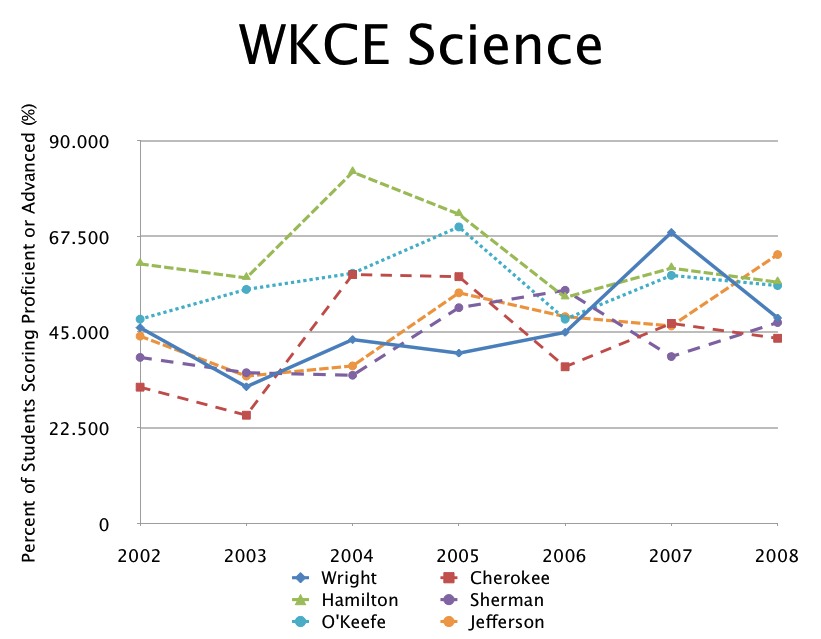
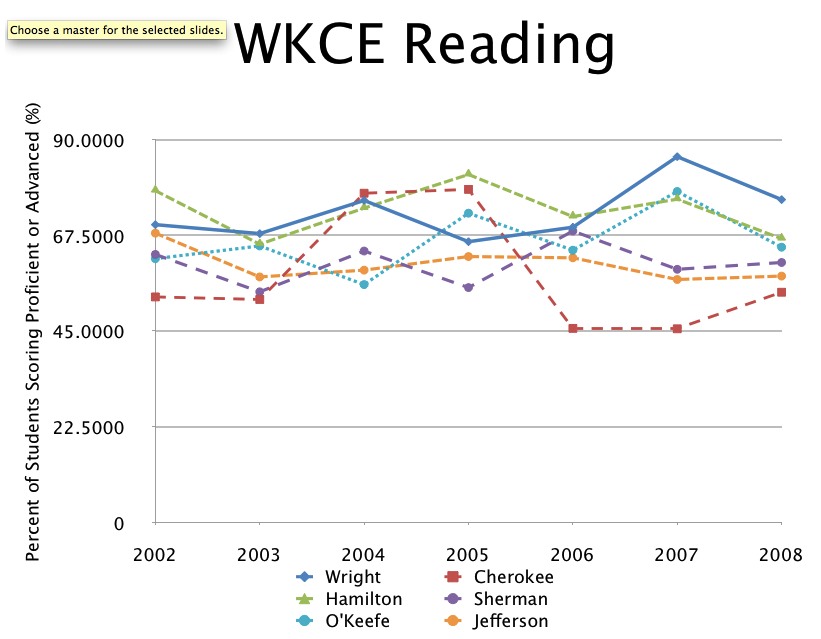
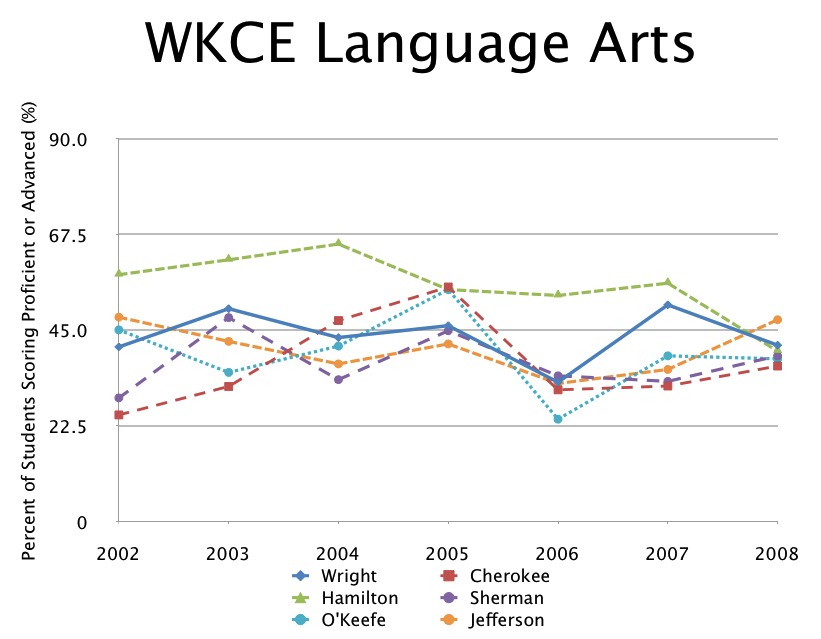
Much more on the Madison School District’s Value Added Assessment program here. The “value added assessment” data is based on Wisconsin’s oft-criticized WKCE.


Table E1 presents value added at the school level for 28 elementary schools in Madison Metropolitan School District. Values added are presented for two overlapping time periods; the period between the November 2005 to November 2007 WKCE administrations, and the more recent period between the November 2006 and November 2008 WKCE. This presents value added as a two-year moving average to increase precision and avoid overinterpretation of trends. Value added is measured in reading and math.
VA is equal to the school’s value added. It is equal to the number ofextra points students at a school scored on the WKCE relative to observationally similar students across the district A school with a zero value added is an average school in terms of value added. Students at a school with a value added of 3 scored 3 points higher on the WKCE on average than observationally similar students at other schools.
Std. Err. is the standard error ofthe school’s value added. Because schools have only a finite number of students, value added (and any other school-level statistic) is measured with some error. Although it is impossible to ascertain the sign of measurement error, we can measure its likely magnitude by using its standard error. This makes it possible to create a plausible range for a school’s true value added. In particular, a school’s measured value added plus or minus 1.96 standard errors provides a 95 percent confidence interval for a school’s true value added.
N is the number of students used to measure value added. It covers students whose WKCE scores can be matched from one year to the next.

Share

Madison School District Infinite Campus Usage Report

Kurt Kiefer & Lisa Wachtel [1.4MB PDF]:

This report summarizes data on the use of Infinite Campus teacher tools and the Parent and Student Portal. Data come from a survey conducted among all teachers responsible for students within the Infinite Campus system and an analysis of the Infinite Campus data base. Below are highlights from the report.

  • About half of all middle and high school teachers responsible for providing grades to students are using the grade book tool.
  • Grade book use has declined over the past year at the middle school level due to the introduction of standards- based grading. In addition to the change in grading approach, the grade book tool in Infinite Campus does not handle standards-based grading as efficiently as traditional grading.
  • Lesson Planner and Grade book use is most common among World Languages, Physical Education, and Science teachers and less common among fine arts and language arts/reading teachers.
  • Grade book and other tool use is most common among teachers with less than three years of teaching experience.
  • Seventy percent of teachers responding to the survey within these years of experience category report using the tools compared with about half of all other experience categories.
  • Most of the other teacher tools within Infinite Campus, e.g., Messenger, Newsletters, reports, etc., are not being used due to a lack o!familiarity with them.
  • Many teachers expressed interest in learning about how they can use other digital tools such as the Moodie leaming management system, blogs, wikis, and Drupal web pages.
  • About one third of parents with high school stUdents use the Infinite Campus Parent Portal. Slightly less than 30 percent of parents of middle school students use the Portal. Having just been introduced to elementary schools this fall, slightly more that ten percent of parents of students at this level use the Portal.
  • Parents of white students are more likely to use the Portal than are parents of students within other racial/ethnic subgroups.
  • About half of all high school students have used the Portal at one time this school year. About one in five middle school students have used the Portal this year.
  • Variation in student portal use is wide across the middle and high schools.

Follow up is planned during January 2010 with staff on how we can address some of the issues related to enhancing the use olthese tools among staff, parents, and stUdents. This report is scheduled to be provided to the Board of Education in February 2010.

Much more on Infinite Campus and the Madison School District here.

Share

A Few Comments on Monday’s State of the Madison School District Presentation

Madison School District Superintendent Dan Nerad will present the “State of the Madison School District 2010” tomorrow night @ 5:30p.m. CST.
The timing and content are interesting, from my perspective because:

  • The nearby Verona School District just approved a Mandarin immersion charter school on a 4-3 vote. (Watch the discussion here). Madison lags in such expanded “adult to student” learning opportunities. Madison seems to be expanding “adult to adult” spending on “coaches” and “professional development”. I’d rather see an emphasis on hiring great teachers and eliminating the administrative overhead associated with growing “adult to adult” expenditures.
  • I read with interest Alec Russell’s recent lunch with FW de Klerk. de Klerk opened the door to South Africa’s governance revolution by freeing Nelson Mandela in 1990:

    History is moving rather fast in South Africa. In June the country hosts football’s World Cup, as if in ultimate endorsement of its post-apartheid progress. Yet on February 2 1990, when the recently inaugurated state President de Klerk stood up to deliver the annual opening address to the white-dominated parliament, such a prospect was unthinkable. The townships were in ferment; many apartheid laws were still on the books; and expectations of the balding, supposedly cautious Afrikaner were low.
    How wrong conventional wisdom was. De Klerk’s address drew a line under 350 years of white rule in Africa, a narrative that began in the 17th century with the arrival of the first settlers in the Cape. Yet only a handful of senior party members knew of his intentions.

    I sense that the Madison School Board and the Community are ready for new, substantive adult to student initiatives, while eliminating those that simply consume cash in the District’s $418,415,780 2009-2010 budget ($17,222 per student).

  • The “State of the District” document [566K PDF] includes only the “instructional” portion of the District’s budget. There are no references to the $418,415,780 total budget number provided in the October 26, 2009 “Budget Amendment and Tax Levy Adoption document [1.1MB PDF]. Given the organization’s mission and the fact that it is a taxpayer supported and governed entity, the document should include a simple “citizen’s budget” financial summary. The budget numbers remind me of current Madison School Board member Ed Hughes’ very useful 2005 quote:

    This points up one of the frustrating aspects of trying to follow school issues in Madison: the recurring feeling that a quoted speaker – and it can be someone from the administration, or MTI, or the occasional school board member – believes that the audience for an assertion is composed entirely of idiots.

    In my view, while some things within our local public schools have become a bit more transparent (open enrollment, fine arts, math, TAG), others, unfortunately, like the budget, have become much less. This is not good.

  • A new financial reality. I don’t see significant new funds for K-12 given the exploding federal deficit, state spending and debt issues and Madison’s property tax climate. Ideally, the District will operate like many organizations, families and individuals and try to most effectively use the resources it has. The recent Reading Recovery report is informative.

I think Dan Nerad sits on a wonderful opportunity. The community is incredibly supportive of our schools, spending far more per student than most school Districts (quite a bit more than his former Green Bay home) and providing a large base of volunteers. Madison enjoys access to an academic powerhouse: the University of Wisconsin and proximity to MATC and Edgewood College. Yet, District has long been quite insular (see Janet Mertz’s never ending efforts to address this issue), taking a “we know best approach” to many topics via close ties to the UW-Madison School of Education and its own curriculum creation business, the Department of Teaching and Learning.
In summary, I’m hoping for a “de Klerk” moment Monday evening. What are the odds?

Share

Three Quick Steps to Clear Writing

Brian Clark:

“Few appreciate brilliance, but everyone appreciates clarity.”
I came up with that line on Twitter, and thought . . .
Why waste it there?
Here’s the quick and clear guide to clarity in writing:
Short
Short words are the rule that makes your exceptional words sing.
Short sentences make powerful points faster.

Share

The Elements of Style

Bartleby.com:

William Strunk, Jr.
Asserting that one must first know the rules to break them, this classic reference book is a must-have for any student and conscientious writer. Intended for use in which the practice of composition is combined with the study of literature, it gives in brief space the principal requirements of plain English style and concentrates attention on the rules of usage and principles of composition most commonly violated.

Share

Foreign Languages Fade in Class — Except Chinese

Sam Dillon:

Thousands of public schools stopped teaching foreign languages in the last decade, according to a government-financed survey — dismal news for a nation that needs more linguists to conduct its global business and diplomacy.
But another contrary trend has educators and policy makers abuzz: a rush by schools in all parts of America to offer instruction in Chinese.
Some schools are paying for Chinese classes on their own, but hundreds are getting some help. The Chinese government is sending teachers from China to schools all over the world — and paying part of their salaries.
At a time of tight budgets, many American schools are finding that offer too good to refuse.
In Massillon, Ohio, south of Cleveland, Jackson High School started its Chinese program in the fall of 2007 with 20 students and now has 80, said Parthena Draggett, who directs Jackson’s world languages department.

National K-12 Foreign Language Survey. Verona recently approved a Mandarin charter school.

Share

Tackling the Term Paper

Kristy (Christiane) Henrich, Marblehead High School Class of 2010
“Civil War Medicine” paper published in the Winter 2009 Issue of The Concord Review

Before crafting my research paper on U.S. Civil War Medicine, I had never composed a piece of non-fiction literature beyond six or seven pages. Twenty pages seemed to be an unconquerable length. I remember the dread that filled me as my A.P. United States History teacher, Mrs. Melissa Humphrey, handed out the assignment for the twenty-page research paper. She also passed around copies of The Concord Review as examples of research papers done well. For us, the first deadline was only a few weeks away. We had to have a thesis. It was then that I truly realized the depth of this academic adventure. My job was not to simply report on some topic in U.S. history; I had to prove something. I had to create an arguable thesis and defend it. I was overwhelmed.
I put the assignment in the back of my mind for about a week. Then, I began to think seriously about what I could possibly want to write about. I brainstormed a list of all times in U.S. history that fascinate me, ranging from World War II to the Civil Rights Movement. Finally, I settled on Civil War medicine because of my plans to pursue a career in medicine. I figured this would be a great opportunity to gather more knowledge on my potential future profession.
Simply choosing a topic was not enough, though. I needed a thesis. So I began to search through books and online databases for any information about Civil War medicine. I gathered so much information that my head was spinning. I realized I had to narrow down my topic, and that this would be done by creating a specific, arguable thesis. Sifting through all the data and historical articles, I noticed that Civil War medicine was not as atrocious as I had always believed it to be. I had my thesis. I wanted to defend Civil War medicine by placing it in its own historical context, something many fail to do when evaluating it with a modern eye.
A few weeks later, approved thesis in hand, I stepped into the Tufts University library, the alma mater of my mother. The battle plan: gather enough materials, particularly primary sources, to prove my thesis. The enemy: the massive amounts of possibly valuable literature. I had never previously encountered the problem of finding books so specialized that they didn’t end up being helpful for my thesis nor had I ever been presented with so many options that I had to narrow down from thirty to a mere fifteen books. Actually, I had never left a library before with so many books.
For the next few months, the books populated the floor of my room. Every weekend, I methodically tackled the volumes, plastering them with Post-it notes. The deadline for the detailed outline and annotated bibliography loomed. I continued reading and researching, fascinated by all I was learning. In fact, I was so fascinated that I felt justified using it as my excuse to delay synthesizing all of my information into an outline. With thousands of pages of reading under my belt, I finally tackled the seven-page map for my twenty-page journey. That was easily the hardest part of the entire process. Once the course was charted, all I had to do was follow it. Of course, it was under construction the entire way, and detours were taken, but the course of the trip turned out much like the map.
I thought printing out the twenty-page academic undertaking, binding it, and handing it in was the greatest feeling I had ever experienced from a scholastic endeavor. I remember being overjoyed that day. I remember sleeping so soundly. I remember the day as sunny. I’m not sure if it actually was…
Clearly, I was thinking small. I had no idea what my grade would be. At that point, I did not even care. I had finished the paper. I considered that a tremendous accomplishment. Eventually, the graded research papers were handed back. What had previously been my greatest academic feeling was surpassed. The grade on my paper was a 99%. I was overjoyed and thrilled that I had not only completed such a tremendous task but had completed it pretty darn well. I thought that was the greatest feeling.
I still needed to think bigger. I submitted my paper to The Concord Review on a whim this summer. I remember Mrs. Humphrey showing us the journals and praising their quality. She is a tough teacher, and I thought since she had liked my paper so much I should give The Concord Review a go. I was not counting on being published. I knew my chances were slim, and I knew I was competing with students from around the world.

This November, I received a letter in the mail from Will Fitzhugh, the founder of The Concord Review. My paper was selected to be published in the Winter 2009 issue. That was the greatest feeling. I am a seventeen-year-old public high school student. I am also a seventeen-year-old published author. People work their whole lives to make it to this point. I feel so honored to have this recognition at my age. My hard work paid off far beyond where I thought it would. Thank you, Mr. Fitzhugh, for recognizing the true value of academic achievement and for reminding me why I love to learn.

Evaluating the Legacy of Civil War Medicine; Amputations, Anesthesia, and Administration

Share

National Writing Board Score Distribution: January, 2000 to January, 2010


The National Writing Board.

Share

Verona School Board Approves Mandarin Chinese Charter School: 4 to 3

channel3000, via a kind reader:

A new Mandarin Chinese immersion charter school will open this fall in Verona.
The Verona school board voted 4-3 on Monday night to approve the school, making it the first of its kind in the state.
The school will be called the Verona Area International School. It will have two halftime teachers, one who teaches only in English and the other who teaches only in Mandarin. Math, science and some social-science classes would be taught in the Chinese language. Students will spend half the day learning in English and half in Mandarin Chinese.

Smart and timely. Much more, here.

Share

Writing English as a Second Language

William Zinsser:

Five years ago one of your deans at the journalism school, Elizabeth Fishman, asked me if I would be interested in tutoring international students who might need some extra help with their writing. She knew I had done a lot of traveling in Asia and Africa and other parts of the world where many of you come from.
I knew I would enjoy that, and I have–I’ve been doing it ever since. I’m the doctor that students get sent to see if they have a writing problem that their professor thinks I can fix. As a bonus, I’ve made many friends–from Uganda, Uzbekhistan, India, Ethiopia, Thailand, Iraq, Nigeria, Poland, China, Colombia and many other countries. Several young Asian women, when they went back home, sent me invitations to their weddings. I never made it to Bhutan or Korea, but I did see the wedding pictures. Such beautiful brides!

Share

Verona, WI School Board Considers Chinese Immersion Charter School

Smart and timely. The Verona School Board will vote on the proposed Chinese immersion charter school Monday evening, 1/18/2010 – via a kind reader.
Documents:

Share

Exit Interviews

Will Fitzhugh
The Concord Review
14 January 2010
In the early 1960s, I was fortunate enough to work for a while at the Space and Information Systems Division of North American Aviation in Downey, California, which was building the command modules for the Apollo Program. I was quite impressed by the fact that, although I was basically a glorified clerk, when I left the company to work for Pan American World Airways, they invited me in for an exit interview.
The interviewer asked me about the details of my job–what I liked and didn’t like about it. He asked me if the pay and benefits were satisfactory, and whether my immediate boss had done a good job in supervising me or not (he was an Annapolis graduate and had done a first-rate job). The general goal of the interview seemed to be to find out why I was leaving and if there was anything they could do to keep an employee like me in the future. This took place in the middle of a very high-pressure and a multi-billion dollar effort to get to the moon before the end of the decade. North American Aviation also had the contract for the Saturn 5 rocket at their Rocketdyne division. But they made the time to talk to me when I left.
Tony Wagner of Harvard, in his book, The Global Achievement Gap (2008), reports on a focus group he held for recent graduates “of one of the most highly-regarded public high schools,” to ask them about their recollections of their experience of the school. This was a kind of exit interview two or three years later. When he asked them what they wished they had received, but didn’t, in school, they said:

“More time on writing!” came an immediate reply. I asked how many agreed with this, and all twelve hands shot up into the air. And this was a high school nationally known for its excellent writing program! “Research skills,” another student offered and went on to explain: “In high school, I mostly did ‘cut and paste’ for my research projects. When I got to college, I had no idea how to formulate a good research question and then really go through a lot of material.”

This was of particular interest to me, because of my conviction that the majority of U.S. public high school students now graduate without ever having read a complete nonfiction book or written a serious research paper. When I asked Mr. Wagner if he knew of other high schools which conducted focus groups or interviews with recent graduates, he said he only knew of three.
I would suggest that this is a practice which could be of great benefit to all our public high schools. Without too much extra time and effort, they could both interview each Senior, after she/he had finished all their exams, and ask what they thought of their academic experience, their teachers, and so forth. In addition, schools could hold at least one focus group each year with perhaps a dozen recent graduates who could compare their college demands with the preparation they had received in their high schools.
Lack of curiosity inevitably leads to lack of knowledge, and it is to be lamented that our high schools seem, in practice, not to wonder what their graduates actually think of the education they have provided, and to what extent and in what ways their high school academic work prepared or did not prepare them for their work in college. Mr. Wagner points out that:

Forty percent of all students who enter college must take remedial courses…and perhaps one of every two students who start college never complete any kind of postsecondary degree.

The Great Schools Project, in its report Diploma to Nowhere in the Summer of 2008, said that more than one million of our high school graduates are in remedial classes each year when they get to college, and the California State Colleges reported in November of 2009 that 47% of their freshmen are now in remedial English classes.
As national concern slowly grows beyond high school dropouts to include college “flameouts” as well, it might be time to consider the benefits of the ample knowledge available from students if they are allowed to participate in exit interviews and focus groups at the high school which was responsible for getting them ready to succeed academically in college and at work.
==============
“Teach by Example”
Will Fitzhugh [founder]
Consortium for Varsity Academics® [2007]
The Concord Review [1987]
Ralph Waldo Emerson Prizes [1995]
National Writing Board [1998]
TCR Institute [2002]
730 Boston Post Road, Suite 24
Sudbury, Massachusetts 01776-3371 USA
978-443-0022; 800-331-5007
www.tcr.org; fitzhugh@tcr.org
Varsity Academics®

Share

The zeitgeist of reading instruction

Daniel Willingham:

By Daniel Willingham
I have written (on this blog and elsewhere) about the importance of background knowledge and about the limited value of instructing students in reading comprehension strategies.

To be clear, I don’t think that such instruction is worthless. It has a significant impact, but it seems to be a one-time effect and the strategies are quickly learned. More practice of these strategies pays little or no return. You can read more about that here.

Knowledge of the topic you’re reading about, in contrast, has an enormous impact and more important, there is no ceiling–the more knowledge you gain, the more your reading improves.

In a recent email conversation an experienced educator asked me why, if that’s true, there has been such emphasis on reading strategies and skills in teacher’s professional development.

Share

Vicki McKenna and Don Severson Discuss Madison’s 4K Plans

Click to listen or download this 27MB mp3 audio file. Much more on the Madison School District’s 4K plans here.

Share

Pre-K Can Work: Needy kids could benefit, but only if we use proven pedagogy and hold programs accountable.

Shephard Barbash:

The one approach that Follow Through found had worked, Direct Instruction, was created by Siegfried Engelmann, who has written more than 100 curricula for reading, spelling, math, science, and other subjects. Engelmann dates DI’s inception to an experiment he performed at the University of Illinois at Champaign-Urbana in the summer of 1964. He took two groups of three- to five-year-olds–one white and affluent, one black and poor–and tried to teach them “sophisticated patterns of reasoning. . . . things that Piaget said couldn’t be taught before the age of formal operations–around 11 or 12.” These things included concepts like relative direction (A is north of B but south of C) and the behavior of light entering and leaving a mirror. Both groups learned what Piaget said they couldn’t at their age. But to Engelmann’s consternation, the affluent kids learned faster. He traced the difference to a severe language deficit in the African-American group (the deficit that Hart and Risley later quantified) and resolved to figure out how to overcome it.
Engelmann and two colleagues, Carl Bereiter and Jean Osborn, went on to open a half-day preschool for poor children in Champaign-Urbana that dramatically accelerated learning even in the most verbally deprived four-year-olds. Children who entered the preschool not knowing the meaning of “under,” “over,” or “Stand up!” went into kindergarten reading and doing math at a second-grade level. Engelmann found (and others later confirmed) that the mean IQ for the group jumped from 96 to 121. In effect, the Bereiter-Engelmann preschool proved that efforts to close the achievement gap could begin years earlier than most educators had thought possible. The effects lasted, at a minimum, until second grade–and likely longer, though studies on the longer-term effects weren’t performed.

Share

Making College ‘Relevant’

Kate Zernike:

THOMAS COLLEGE, a liberal arts school in Maine, advertises itself as Home of the Guaranteed Job! Students who can’t find work in their fields within six months of graduation can come back to take classes free, or have the college pay their student loans for a year.
The University of Louisiana, Lafayette, is eliminating its philosophy major, while Michigan State University is doing away with American studies and classics, after years of declining enrollments in those majors.
And in a class called “The English Major in the Workplace,” at the University of Texas, Austin, students read “Death of a Salesman” but also learn to network, write a résumé and come off well in an interview.
Even before they arrive on campus, students — and their parents — are increasingly focused on what comes after college. What’s the return on investment, especially as the cost of that investment keeps rising? How will that major translate into a job?

Share

What inspired the founder of Room To Read

David Pilling:

John Wood’s epiphany, almost to his own embarrassment, took place in a Nepalese monastery. As he describes it in his book, Leaving Microsoft to Change the World, the then high-flying computer executive plucked up the courage to leave corporate life and start an educational charity over a brass bowl of piping hot yak-butter tea surrounded by 30 chanting monks. “Oh, no, this is going to sound like a terrible cliché,” he wrote. “Western guy walks into monastery and changes the course of his life.”
In truth, Wood’s life had begun to change several months before. Aged 35, on a trekking holiday to Nepal, he had been appalled at the near-absence of books in the mountain schools. That, plus a growing disenchantment with his life as a corporate warrior-cum-slave, persuaded him to return to Nepal the following year with thousands of books. Books for Nepal, as Room to Read was called before its rapid international expansion forced a change of name, started out small. But as soon as Wood had broken from Microsoft, he began to apply the lessons he had learnt in business to his fledgling charity.

Share

Foreign Language Teaching in U.S. Schools: Results of a National Survey

Nancy Rhodes & Ingrid Pufahl:

CAL has completed a comprehensive survey of K-12 foreign language programs nationwide, describing how our schools are meeting the need for language instruction to prepare global citizens. For comparative purposes, the survey has collected statistical data in 1987, 1997, and 2008. Elementary and secondary schools from a nationally representative sample of more the 5,000 public and private schools completed a questionnaire during the 2007-2008 school year. The 2008 survey results complement and enhance the field’s existing knowledge base regarding foreign language instruction and enrollment in the United States.
The report of the survey, Foreign Language Teaching in U.S. Schools: Results of a National Survey, provides detailed information on current patterns and shifts over the past 20 years in languages and programs offered, enrollment in language programs, curricula, assessment, and teaching materials, qualifications, and trainings, as well as reactions to national reform issues such as the national foreign language standards and the No Child Left Behind (NCLB) legislation. The survey results revealed that foreign language instruction remained relatively stable at the high school level over the past decade but decreased substantially in elementary and middle schools. Moreover, only a small percentage of the elementary and middle schools not teaching languages planned to implement a language program within the next two years. The findings indicate a serious disconnect between the national call to educate world citizens with high-level language skills and the current state of foreign language instruction in schools across the country. This report contains complete survey results, along with recommendations on developing rigorous long sequence (K-12 programs whose goals are for students to achieve high levels of language proficiency, and are of interest to anyone interested in increasing language capacity in the United States. 2009.

Jay Matthews comments.

Share

YC-Funded Lingt Uses Games To Turn You Into A Language Learning Addict

Jason Kincaid:

If there’s one thing that 2009 proved, it’s that there’s nothing like an addictive game to keep people coming back to your service for more. Over the last year, we’ve seen Foursquare and Gowalla tap into this with their colorful badges, and Zynga is making a killing off games like Farmville. But what if you could turn that habit into something that might actually be helpful to school or your career? That’s the premise behind Lingt, a new startup that’s looking to leverage gameplay elements to help with the mother of all repetitive tasks: learning a new language.
The Y Combinator funded company is launching today in public beta, offering a suite of matching games to help English speakers learn Chinese. Using the app is quite straightforward. First, you choose a set of words that you need to learn. You can use a one of Lingt’s suggested lists, a list of vocabulary words drawn from one of thirty US/Chinese textbooks, or you can manually enter your own words. From there, the site will quiz you on the meaning of the words. You can either input your answers via text, by saying them aloud, or as a matching game (click on one of five choices).

Share

Reading Recovery: Effectiveness & Program Description

US Department of Education, Institute of Education Sciences, via a kind reader’s email:

No studies of Reading Recovery® that fall within the scope of the English Language Learners (ELL) review protocol meet What Works Clearinghouse (WWC) evidence standards. The lack of studies meeting WWC evidence standards means that, at this time, the WWC is unable to draw any conclusions based on research about the effectiveness or ineffectiveness of Reading Recovery® on ELL.
Reading Recovery® is a short-term tutoring intervention designed to serve the lowest-achieving (bottom 20%) first-grade students. The goals of Reading Recovery® include: promoting literacy skills; reducing the number of first-grade students who are struggling to read; and preventing long-term reading difficulties. Reading Recovery® supplements classroom teaching with one-to-one tutoring sessions, generally conducted as pull-out sessions during the school day. The tutoring, which is conducted by trained Reading Recovery® teachers, takes place for 30 minutes a day over a period of 12 to 20 weeks.

Related: 60% to 42%: Madison School District’s Reading Recovery Effectiveness Lags “National Average”: Administration seeks to continue its use.

Share

Redefining Definition

Erin McKean:

If anything is guaranteed to annoy a lexicographer, it is the journalistic habit of starting a story with a dictionary definition. “According to Webster’s,” begins a piece, blithely, and the lexicographer shudders, because she knows that a dictionary is about to be invoked as an incontrovertible authority. Although we may profess to believe, as the linguist Dwight Bolinger once put it, that dictionaries “do not exist to define but to help people grasp meanings,” we don’t often act on that belief. Typically we treat a definition as the final arbiter of meaning, a scientific pronouncement of a word’s essence.
But the traditional dictionary definition, although it bears all the trappings of authority, is in fact a highly stylized, overly compressed and often tentative stab at capturing the consensus on what a particular word “means.” A good dictionary derives its reputation from careful analysis of examples of words in use, in the form of sentences, also called citations. The lexicographer looks at as many citations for each word as she can find (or, more likely, can review in the time allotted) and then creates what is, in effect, a dense abstract, collapsing into a few general statements all the ways in which the word behaves. A definition is as convention-bound as a sonnet and usually more compact. Writing one is considered, at least by anyone who has ever tried it, something of an art.

Share

“A Throwback” Review keeps light shining on high school scholars

Adam Sell:

The Concord Review is a one-man outfit run from a cluttered office on Route 20 in Sudbury.
Back issues of the academic journal featuring research by high school history students sit in stacks, and editor Will Fitzhugh keeps his computer in the corner so he can leave even more room for books.
Fitzhugh, 73, has been running the quarterly publication for 22 years in an effort to keep old-fashioned term papers alive and well. He thinks scholarly research at the high school level has declined, and students are arriving at college unprepared.
“I think we’re doing the majority of public high school students a disservice,” said Fitzhugh. “They get to college and are assigned these nonfiction books and term papers, and they flame out. The equivalent is sending kids to college math classes with only fractions and decimals.”
Yet Fitzhugh, who started the journal while on sabbatical from his teaching job in Concord (hence the name), can’t find anybody to take over when he retires. He took no salary from the journal for 14 years, and even now averages only $10,000 a year.
“It’s going to be really hard, there’s no job security. But most people don’t want to work for nothing, and they don’t want to leave the classroom,” Fitzhugh said. “I don’t know how long I can keep going.”
Despite a perpetual lack of funding for his project–Fitzhugh said he’s been turned down by 154 foundations–The Concord Review has persevered.

(more…)

Share

The GMAT Sentence Correction Challenge

Nick Saint:

What does mastery of the finer points of English grammar have to do with succeeding in business?
Nothing.
But if you want to get into a top business school, you need to do well on the GMAT. And that means tangling with some very ugly verbal questions.
Specifically, it means psychoanalyzing the folks who put the test together, who sometimes don’t include a correct English answer as one of the options.
When there’s no right answer to a question (which there often isn’t in business), you have to figure out the least-wrong answer–without being driven insane by rage at the stupidity of your questioner. Thus, the GMAT tests your aptitude for all sorts of things you WILL need in business.

Share

Give diligencing its due in the lexicon of 2010

Michael Skapinker:

The New Oxford American Dictionary has announced its 2009 word of the year. It is “unfriend”, as in “I decided to unfriend my roommate on Facebook after we had a fight”.
Unfriend has “currency and potential longevity”, says Christine Lindberg, senior lexicographer for Oxford’s US dictionary programme. It is true, she says, that most words with the prefix “un-” are adjectives (unacceptable, unpleasant) but there are some “un-” verbs, such as unpack and uncap. “Unfriend has real lex-appeal,” she says.
“Unfriend” will irritate those who oppose the nasty habit of turning nouns into verbs. But nouns have been turning into verbs for ages. In his book The Language Instinct, Steven Pinker estimates that a fifth of English verbs started as nouns, including “to progress”, “to contact” and “to host”.
Also, many supposedly new words are not new at all. “Unfriend” has an ancient past, according to the Oxford English Dictionary. In 1659, Thomas Fuller wrote in The Appeal of Injured Innocence: “I hope, Sir, that we are not mutually Unfriended by this Difference which hath happened betwixt us.”
I am interested in the words that did not make word of the year. They included “paywall” (admitting only paying subscribers to part of a website) and “birther” (someone who believes Barack Obama was not born in the US).

Share

A holiday guide to books for kids

Jay Matthews:

I share this secret only with recluses like myself who lack the imagination to conceive of any gift better than a book. If you are buying for a child — particularly if you are in a last-minute Christmas shopping panic — scan this list compiled by a company called Renaissance Learning.
It is an amazing document. Parents who keep track of what their children are doing in school, particularly in this area, might be vaguely aware of Renaissance Learning and its famous product, Accelerated Reader, the most influential reading program in the country. It was started 23 years ago by Judi Paul and her husband, Terry, after she invented on her kitchen table a quizzing system to motivate their children to read.
Students read books, some assigned but many chosen on their own, and then take computer quizzes, either online or with Accelerated Reader software, to see whether they understood what they read. Students compile points based in part on the difficulty and length of each book and sometimes earn prizes from their schools.

Share

Book Whisperer: Are good readers born or made?

Donalyn Miller via Valerie Strauss:

My guest today is Donalyn Miller, a sixth-grade language arts teacher in Texas and literacy expert. She is the author of “The Book Whisperer: Awakening the Inner Reader in Every Child,” and writes about literacy for teachermagazine.org.
By Donalyn Miller
A recent Carnegie Mellon University research study indicates that children engaged in a 100-hour intensive reading remediation program improved both their reading ability and the white matter connections in their brains.
While the study shows promise for educators and clinicians who work with developing readers, one casual mention in the study stood out for me– the 25 children designated as “excellent readers” in the control group still outperformed the 35 third and fifth graders who participated in the remediation program.
The widespread belief that some readers possess an innate gift, like artists or athletes, sells many children short. I often hear parents claim, “Well, my child is just not a reader,” as if the reading fairy passed over their child while handing out the good stuff.

Share

Academic Writing

“More time on writing!” came an immediate reply. I asked how many agreed with this, and all twelve hands shot up into the air. And this was a high school nationally known for its excellent writing program! “Research skills,” another student offered and went on to explain: “In high school, I mostly did ‘cut and paste’ for my research projects. When I got to college, I had no idea how to formulate a good research question and then really go through a lot of material.”
Tony Wagner
The Global Achievement Gap
New York: Basic Books 2008, p. 101-102
College Ready?

A few years ago, I was asked by the leaders of one of the most highly regarded public high schools in New England to help them with a project. They wanted to start a program to combine the teaching of English and history because they thought that such a program would give their graduates an edge in college–and more than 90 percent of their students went on to college. They thought that teaching the two subjects together would help students gain a deeper understanding of both the history and literature of an era. Yet when I asked them how they knew that this would be the most important improvement they might make in their academic program, they were stumped. They’d just assumed that this innovation would be helpful to students.
Personally, I think interdisciplinary studies make a great deal of sense, but I also know that schools have very limited time and resources for change and so must choose their school and curriculum improvement priorities with great care. I proposed that we conduct a focus group with students who’d graduated from the high school three to five years prior, in which I would ask alums what might have helped them be better prepared for college–a question rarely asked by either private or public high schools. The group readily agreed, though, and worked to identify and invite a representative sample population of former students who would be willing to meet for a couple of hours when they were back at home during their winter break.
The group included students who attended state colleges and elite universities. My first question to them was this: “Looking back, what about your high school experience did you find most engaging or helpful to you?” (I would ask the question differently today: “In what ways were you most well prepared by high school?”) At any rate, they found
the topic quite engaging and talked enthusiastically and at length about their high school experiences.
Extracurricular activities such as clubs, school yearbooks, and so on topped the list of what they had found most engaging in high school. Next came friends–there were no cliques in this small school, they claimed, and so everyone got along well. Sports were high on the list as well: Because the school was small, nearly everyone got a good deal of playing time.
“What about academics?” I asked.
“Most of our teachers were usually available after school to help us when we needed it,” one young man replied. Several nodded in agreement, and the the room fell silent.
“But what about classes?” I pressed.
“You have to understand, ” a student who was in his last year at an elite university explained to me somewhat impatiently. “Except for math, you start over in all your courses in college–we didn’t need any of the stuff we’d studied in high school.”
There was a buzz of agreement around the table. Then another students said, with a smile: “Which is a good thing because you’d forgotten all the stuff you’d memorized for the test a week later anyway!” The room erupted in laughter.
I was dumbfounded, not sure what to say next. Finally, I asked: “So, how might your class time have been better spent–what would have better prepared you for college?”
“More time on writing!” came an immediate reply. I asked how many agreed with this, and all twelve hands shot up into the air. And this was a high school nationally known for its excellent writing program! “Research skills,” another student offered and went on to explain: “In high school, I mostly did ‘cut and paste’ for my research projects. When I got to college, I had no idea how to formulate a good research question and then really go through a lot of material.”

============
“Teach by Example”
Will Fitzhugh [founder]
Consortium for Varsity Academics® [2007]
The Concord Review [1987]
Ralph Waldo Emerson Prizes [1995]
National Writing Board [1998]
TCR Institute [2002]
730 Boston Post Road, Suite 24
Sudbury, Massachusetts 01776-3371 USA
978-443-0022; 800-331-5007
www.tcr.org; fitzhugh@tcr.org
Varsity Academics®

Share

Years Of Schooling Leaves Some Students Illiterate

Scott Simon:

Author Beth Fertig says that as many as 20 percent of American adults may be functionally illiterate. They may recognize letters and words, but can’t read directions on a bus sign or a medicine bottle, read or write a letter, or hold most any job. Her new book, Why cant U teach me 2 read, follows three young New Yorkers who legally challenged the New York City public schools for failing to teach them how to read — and won. Host Scott Simon talks to Fertig about her book.
….
SIMON: The No Child Left Behind Act is often criticized. But you suggest in this book that it perhaps did force teachers to not just let a certain percentage of students slip through the cracks.
Ms. FERTIG: That is the one thing that I do hear from a lot of different people is, by not just looking at how a whole school did and saying, you know, 60 or 70 percent of our kids passed the test, they now have to look at how did our Hispanic kids do, how did our black students do, how did our special ed students do, how did English language learners do – students who aren’t born to parent who speak English.
And this way, by just aggregating the data, they’re able to see which kids are falling behind and hopefully target them and give them more interventions, more help with their reading. And the ideal is that a child like Umilka isn’t going to be caught, you know, in high school and they’re going to figure out then that they weren’t reading.
SIMON: You make a point in the book you can’t get a job cracking rocks these days without having to probably fill out a computer form as to how many rocks you cracked.
Ms. FERTIG: Exactly. Antonio is now working at UPS as a loader. He had to take a basic orientation test. And because he had improved his reading skills to a fourth or fifth grade level, he was able to pass that. But he feels stuck now.

Related: Madison School District Reading Recovery Review & Discussion.

Share

Reading Recovery Discussed at the 12/7/2009 Madison School Board Meeting and Administration Followup


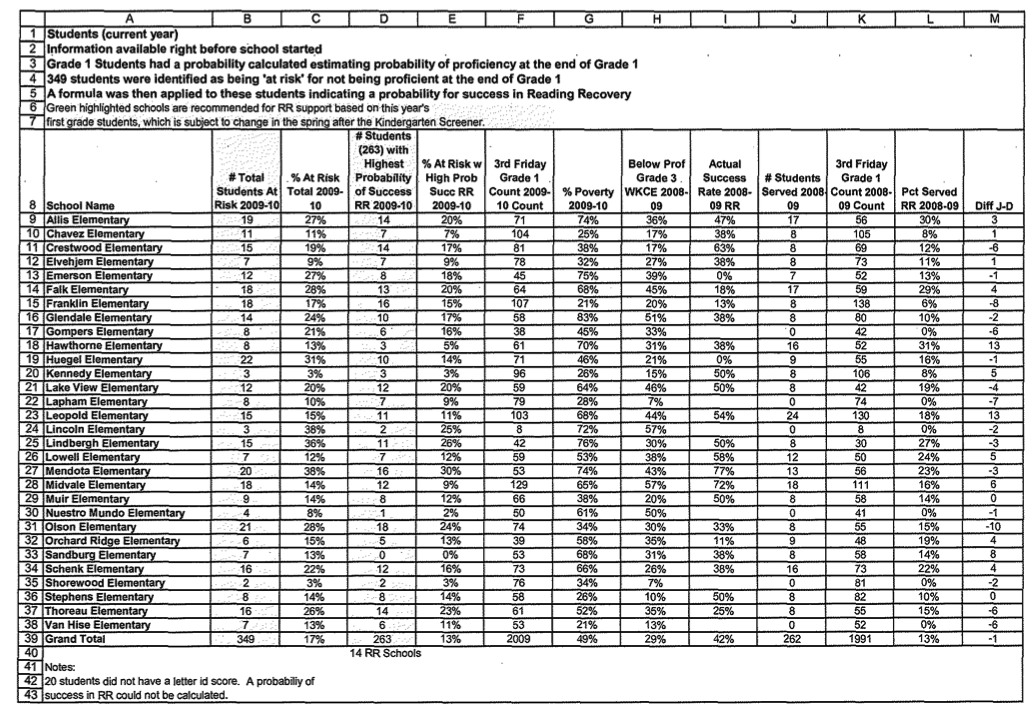
Click for a Reading Recovery Data Summary from Madison’s Elementary Schools. December 2009

Madison School Board 24MB mp3 audio file. Madison Superintendent Dan Nerad’s December 10, 2009 memorandum [311K PDF] to the board in response to the 12/7/2009 meeting:

Attached to this memo are several items related to further explanation of the reason why full implementation is more effective for Reading Recovery and what will happen to the schools who would no longer receive Reading Recovery as part of the administrative recommendation. There are three options for your review:

  • Option I: Continue serving the 23 schools with modifications.
  • Option II: Reading Recovery Full Implementation at Title I schools and Non-Title I Schools.
  • Option III: Serving some students in all or a majority of schools, not just the 23 schools who are currently served.

The first attachment is a one-page overview summary ofthe MMSD Comprehensive Literacy Model. It explains the Balanced Literacy Model used in all MMSD elementary schools. It also provides an explanation of the wrap around services to support each school through the use of an Instructional Resource Teacher as well as Tier II and Tier III interventions common in all schools.
The second attachment shows the detailed K-5 Title I Reading Curriculum Description in which MMSD uses four programs in Title I schools: Rock and Read, Reading Recovery, Apprenticeship, and Soar to Success. As part of our recommendation, professional development will be provided in all elementary schools to enable all teachers to use these programs. Beginning in Kindergarten, the four instructional interventions support and develop students’ reading and writing skills in order to meet grade level proficiency with a focus on the most intensive and individualized wrap around support in Kindergarten and I” Grade with follow up support through fifth grade.
Currently these interventions are almost solely used in Title I schools.
The third attachment contains three sheets – the frrst for Reading Recovery Full Implementation at Title I schools, the second for No Reading Recovery – at Title I Schools, and the third for No Reading Recovery and No Title I eligibility. In this model we would intensify Reading Recovery in a limited number of schools (14 schools) and provide professional development to support teachers in providing small group interventions to struggling students.
The fourth attachment is a chart of all schools, students at risk and students with the highest probability of success in Reading Recovery for the 2009-10 school year. This chart may be used if Reading Recovery would be distributed based on student eligibility (districtwide lowest 20% of students in f rst grade) and school eligibility (based on the highest number of students in need per school).
Option I: Leave Reading Recovery as it currently is, in the 23 schools, but target students more strategically and make sure readiness is in place before the Reading Recovery intervention.

Related: 60% to 42%: Madison School District’s Reading Recovery Effectiveness Lags “National Average”: Administration seeks to continue its use.
Props to the Madison School Board for asking excellent, pointed questions on the most important matter: making sure students can read.

Share

Verona, WI School Board Discussion of the New Century Charter School

via a kind reader’s email, who notes that Verona’s video archives include very helpful topic based navigation!

At the most recent meeting on Dec. 7, the school board heard a final presentation from New Century School’s site council. Developments with New Century’s charter renewal are reaching a critical point, since we need approval from the school board by early January to participate in kindergarten recruitment. New Century is one of Wisconsin’s oldest charter schools (established in May 1995), and our school community is fighting for the charter’s continued existence. It’s been a challenging journey.

Click “video” for the December 7, 2009 meeting and look for “D”, the New Century Presentation. Interestingly, “E” is a presentation on a proposed Chinese immersion charter school.
Unfortunately, Madison lacks significant charter activity, something which, in my view, would be very beneficial to the community, students and parents.

Share

Announcing our January Reading Day

Wisconsin First Lady Jessica Doyle, via email:

Warm wishes this winter season!
Thank you for your continued participation in the Read On Wisconsin! book club. We had a fantastic semester traveling to classrooms across Wisconsin and inviting numerous classes and authors to the Executive Residence for Reading Days.
Throughout the fall, we spoke to elementary, middle, and high school students about the importance of reading and suggesting the excellent books chosen by the Literacy Advisory Committee. Three Cups of Tea: The Young Reader’s Edition by Greg Mortenson has been one of our most popular choices and has connected so many students and staff with community service. (You can learn more at: www.penniesforpeace.org.)
We have held very successful Reading Days at the Residence. In November, we welcomed three authors: Rachna Gilmore (Group of One), Sylviane Diouf (Bintou’s Braids), and James Rumford (Silent Music). Each of these authors shared their enthusiasm for writing and answered many student questions about their international experiences.
Our next Reading Day will be: Thursday, January 21, 2010 from 9:00 – 2:30. At our January Reading Day, we will welcome John Coy, the author of our high school selection, Box Out. This book shares a courageous story of a high school basketball player who speaks up against an unconstitutional act occurring at his school. Box Out reaches all students. We are seeking five middle or high school classes for this Reading Day.
Please e-mail Ashley Huibregtse at ashley.huibregtse@wisconsin.gov or call 608-575-5608 to reserve your middle or high school group a spot in the schedule. Each class will be scheduled for one hour. Please share your time preference when you call or e-mail. Remember we offer bus reimbursement up to $100 to help with transportation costs if needed.
E-mail or call today! This will be an exciting Reading Day to start 2010! All the best for a happy holiday season, and Read On!
Sincerely,
Jessica and Ashley

Share

60% to 42%: Madison School District’s Reading Recovery Effectiveness Lags “National Average”: Administration seeks to continue its use

via a kind reader’s email: Sue Abplanalp, Assistant Superintendent for Elementary Education, Lisa Wachtel, Executive Director, Teaching & Learning, Mary Jo Ziegler, Language Arts/Reading Coordinator, Teaching & Learning, Jennie Allen, Title I, Ellie Schneider, Reading Recovery Teacher Leader [2.6MB PDF]:

Background The Board of Education requested a thorough and neutral review of the Madison Metropolitan School District’s (MMSD) Reading Recovery program, In response to the Board request, this packet contains a review of Reading Recovery and related research, Madison Metropolitan School District (MMSD) Reading Recovery student data analysis, and a matrix summarizing three options for improving early literacy intervention. Below please find a summary of the comprehensive research contained in the Board of Education packet. It is our intent to provide the Board of Education with the research and data analysis in order to facilitate discussion and action toward improved effectiveness of early literacy instruction in MMSD.
Reading Recovery Program Description The Reading Recovery Program is an intensive literacy intervention program based on the work of Dr. Marie Clay in New Zealand in the 1970’s, Reading Recovery is a short-term, intensive literacy intervention for the lowest performing first grade students. Reading Recovery serves two purposes, First, it accelerates the literacy learning of our most at-risk first graders, thus narrowing the achievement gap. Second, it identifies children who may need a long-term intervention, offering systematic observation and analysis to support recommendations for further action.
The Reading Recovery program consists of an approximately 20-week intervention period of one-to-one support from a highly trained Reading Recovery teacher. This Reading Recovery instruction is in addition to classroom literacy instruction delivered by the classroom teacher during the 90-minute literacy block. The program goal is to provide the lowest performing first grade students with effective reading and writing strategies allowing the child to perform within the average range of a typical first grade classroom after a successful intervention period. A successful intervention period allows the child to be “discontinued” from the Reading Recovery program and to function proficiently in regular classroom literacy instruction.
Reading Recovery Program Improvement Efforts The national Reading Recovery data reports the discontinued rate for first grade students at 60%. In 2008-09, the discontinued rate for MMSD students was 42% of the students who received Reading Recovery. The Madison Metropolitan School District has conducted extensive reviews of Reading Recovery every three to four years. In an effort to increase the discontinued rate of Reading Recovery students, MMSD worked to improve the program’s success through three phases.

Reading recovery will be discussed at Monday evening’s Madison School Board meeting.
Related:

  • University of Wisconsin-Madison Psychology Professor Mark Seidenberg: Madison schools distort reading data:

    In her column, Belmore also emphasized the 80 percent of the children who are doing well, but she provided additional statistics indicating that test scores are improving at the five target schools. Thus she argued that the best thing is to stick with the current program rather than use the Reading First money.
    Belmore has provided a lesson in the selective use of statistics. It’s true that third grade reading scores improved at the schools between 1998 and 2004. However, at Hawthorne, scores have been flat (not improving) since 2000; at Glendale, flat since 2001; at Midvale/ Lincoln, flat since 2002; and at Orchard Ridge they have improved since 2002 – bringing them back to slightly higher than where they were in 2001.
    In short, these schools are not making steady upward progress, at least as measured by this test.
    Belmore’s attitude is that the current program is working at these schools and that the percentage of advanced/proficient readers will eventually reach the districtwide success level. But what happens to the children who have reading problems now? The school district seems to be writing them off.
    So why did the school district give the money back? Belmore provided a clue when she said that continuing to take part in the program would mean incrementally ceding control over how reading is taught in Madison’s schools (Capital Times, Oct 16). In other words, Reading First is a push down the slippery slope toward federal control over public education.

    also, Seidenberg on the Reading First controversy.

  • Jeff Henriques references a Seidenberg paper on the importance of phonics, published in Psychology Review.
  • Ruth Robarts letter to Isthmus on the Madison School District’s reading progress:

    Thanks to Jason Shepard for highlighting comments of UW Psychology Professor Mark Seidenberg at the Dec. 13 Madison School Board meeting in his article, Not all good news on reading. Dr. Seidenberg asked important questions following the administrations presentation on the reading program. One question was whether the district should measure the effectiveness of its reading program by the percentages of third-graders scoring at proficient or advanced on the Wisconsin Reading Comprehension Test (WRCT). He suggested that the scores may be improving because the tests arent that rigorous.
    I have reflected on his comment and decided that he is correct.
    Using success on the WRCT as our measurement of student achievement likely overstates the reading skills of our students. The WRCT—like the Wisconsin Knowledge and Concepts Examination (WKCE) given in major subject areas in fourth, eighth and tenth grades— measures student performance against standards developed in Wisconsin. The more teaching in Wisconsin schools aims at success on the WRCT or WKCE, the more likely it is that student scores will improve. If the tests provide an accurate, objective assessment of reading skills, then rising percentages of students who score at the proficient and advanced levels would mean that more children are reaching desirable reading competence.

  • Madison teacher Barb Williams letter to Isthmus on Madison School District reading scores:

    I’m glad Jason Shepard questions MMSD’s public display of self-congratulation over third grade reading test scores. It isn’t that MMSD ought not be proud of progress made as measured by fewer African American students testing at the basic and minimal levels. But there is still a sigificant gap between white students and students of color–a fact easily lost in the headlines. Balanced Literacy, the district’s preferred approach to reading instruction, works well for most kids. Yet there are kids who would do a lot better in a program that emphasizes explicit phonics instruction, like the one offered at Lapham and in some special education classrooms. Kids (arguably too many) are referred to special education because they have not learned to read with balanced literacy and are not lucky enough to land in the extraordinarily expensive Reading Recovery program that serves a very small number of students in one-on-on instruction. (I have witnessed Reading Recovery teachers reject children from their program because they would not receive the necessary support from home.)
    Though the scripted lessons typical of most direct instruction programs are offensive to many teachers (and is one reason given that the district rejected the Reading First grant) the irony is that an elementary science program (Foss) that the district is now pushing is also scripted as is Reading Recovery and Everyday Math, all elementary curricula blessed by the district.
    I wonder if we might close the achievement gap further if teachers in the district were encouraged to use an approach to reading that emphasizes explicit and systematic phonics instruction for those kids who need it. Maybe we’d have fewer kids in special education and more children of color scoring in the proficient and advanced levels of the third grade reading test.

Share

The Day: Future Writers of America

Tina Kelley:

late start today, but well worth the wait: we have tantalizing tidbits of student writing from the high schools, for your reading pleasure.
Thanks, Judy Levy, communications coordinator for the South Orange Maplewood school district, for sending out three choice pieces from Columbia High School’s student newspaper, The Columbian (click on the “more” button at the end of each excerpt for the full piece). And congratulations again to Millburn High School’s literary magazine, Word, for its Gold Medal in the Columbia Scholastic Press Association. We’re including an excerpt from the magazine as well.
Enjoy.
Push for Perfection: Has the pressure to be the ideal applicant gone too far?
by Olivia Karten, Columbia High School Senior, The Columbian Co-Editor in Chief

Share

Why English Is One of the Most Difficult Languages to Learn…

Appleseeds:

We polish Polish furniture.
He could lead if he got the lead out.
A farm can produce produce.
The dump was so full, it had to refuse refuse.

Share

The march of English yields surprising losers

Michael Skapinker:

Anthony Bolton, veteran star stock-picker at Fidelity International, is moving to Hong Kong to set up a China fund. He is following Michael Geoghegan, HSBC’s chief executive, who has already announced he is moving from London to Hong Kong. “The centre of gravity is clearly shifting,” Mr Bolton says.
It certainly looks that way, although it is worth recalling that it was not that long ago that Japan was tipped to be the new number one. Economies have their ups and downs – look at Dubai.
What we can forecast with some confidence is that English will remain the world’s leading language for as long as anyone reading these words is alive. Economies can tip into crisis, fund managers can switch their investments at the click of a button and executives can relocate to the other side of the world, but it takes a lot more to topple the global language.
If Mandarin – or Spanish, or Arabic – is to replace English as the world’s lingua franca, children in São Paulo, St Petersburg and Auckland had better start learning it now. Forget all those advertisements promising you can learn a language in three months. You can’t. You may be able to summon up a few phrases. Perhaps you could engage a taxi driver in a minute of conversation before you seize up.

Share

Through Letters, a Family History Unveiled

Bob Davis:

A reporter’s seven-year correspondence with his 93-year-old cousin, illustrator Sam Fink, reveals a family’s past and the beauty in old-fashioned letter writing
Shortly before Christmas 2002, I received my first letter from Sam Fink. On the envelope, he had drawn an elephant and colored it with orange, yellow, brown and blue crayons. “Good to remember. Happy New Year,” he wrote above the address.
The letter was equally charming. He wrote about his son, David, who lived in Israel with a brood of grandchildren and great grandchildren. “When I visit my family in Jerusalem twice a year for a two-week stay, instead of asking about their lives, I share mine,” Sam wrote. “In most instances, young people do not know how to share with old people.” He signed it, “Your cousin, somehow, once removed, second, or whatever the term…Sam Fink.”
That letter marked the start of a seven-year correspondence I have had with Sam, who is a family success story — a noted illustrator who has drawn popular books about the Constitution and the Bill of Rights. He was my father’s first cousin, and though I hadn’t seen him more than a dozen times in my life, a family photo my wife had mailed as a holiday card caught his interest and prompted him to write me.

Share

All sitting comfortably?

David Pilling & Lionel Barber:

From a distance it sounds like the chanting of monks. Only as one approaches the building, set in the lush fields of a school playground, does it become apparent who is making the sound: dozens of girls quietly reading books.
Sat on rows of wooden chairs laid out in the library, they mouth the words as they trace a finger slowly along the text, breaking off only to admire the colourful pictures. Though each child is reading a different story, their words mingle to form a gentle hum, lending an almost sacred air to the bright little room.
In Laos, a school library is indeed sacred. Books are rare in the isolated villages where four-fifths of the landlocked nation’s 7m people eke out the slenderest of livings. The communist government has been slow in implementing its theoretical commitment to free education. Literacy rates have risen, though many people who have learnt to read soon forget because they lack reading materials. According to Room to Read, the charity that helped build and stock this library and hundreds of others like it, still only 60 per cent of women and 77 per cent of men can read and write.
Many schools, often ramshackle thatched structures with leaking roofs, cannot offer a full range of tuition. Sometimes teachers instruct two or three years of classes simultaneously – if they have not ditched their class to earn supplementary income elsewhere. Student dropout rates are high, especially for girls, who typically quit at around 13. Many parents would prefer a helping hand at home or in the paddy fields.

Share

NCTE Presentation: College Readiness & The Research Paper

nctepa2009actual From the presentation

Preparation: John Robert Wooden, revered and very successful basketball coach at UCLA, used to tell his players: “If you fail to prepare, you are preparing to fail.”
and,
Premise: The majority of U.S. public high school students now graduate without ever having read a single (1) complete nonfiction book, or written one (1) serious (e.g. 4,000+ words, with endnotes and bibliography) research paper.
and,
Elitism” is making the best form of education available to only a few. The democratic ideal of education is to make the best form of education available to all. The democratic ideal is not achieved, and elitism is not defeated, by making the best form of education available to almost nobody.
Kieran Egan, Simon Fraser University, Vancouver, British Columbia

Download the 200K presentation PDF here.

Share

High school research papers: a dying breed

Jay Matthews:

Doris Burton taught U.S. history in Prince George’s County for 27 years. She had her students write 3,000-word term papers. She guided them step by step: first an outline, then note cards, a bibliography, a draft and then the final paper. They were graded at each stage.
A typical paper was often little more than what Burton describes as “a regurgitated version of the encyclopedia.” She stopped requiring them for her regular history students and assigned them just to seniors heading for college. The social studies and English departments tried to organize coordinated term paper assignments for all, but state and district course requirements left no room. “As time went by,” Burton said, “even the better seniors’ writing skills deteriorated, and the assignment was frustrating for them to write and torture for me to read.” Before her retirement in 1998, she said, “I dropped the long-paper assignment and went to shorter and shorter and, eventually, no paper at all.”
Rigorous research and writing instruction have never reached most high-schoolers. I thought I had terrific English and history teachers in the 1960s, but I just realized, counting up their writing assignments, that they, too, avoided anything very challenging. Only a few students, in public and private schools, ever get a chance to go deep and write long on a subject that intrigues them.
We are beginning to see, in the howls of exasperation from college introductory course professors and their students, how high a price we are paying for this. It isn’t just college students who are hurt. Studies show research skills are vital for high school graduates looking for good jobs or trade school slots.

(more…)

Share

All sitting comfortably?


David Pilling:

From a distance it sounds like the chanting of monks. Only as one approaches the building, set in the lush fields of a school playground, does it become apparent who is making the sound: dozens of girls quietly reading books.
Sat on rows of wooden chairs laid out in the library, they mouth the words as they trace a finger slowly along the text, breaking off only to admire the colourful pictures. Though each child is reading a different story, their words mingle to form a gentle hum, lending an almost sacred air to the bright little room.
In Laos, a school library is indeed sacred. Books are rare in the isolated villages where four-fifths of the landlocked nation’s 7m people eke out the slenderest of livings. The communist government has been slow in implementing its theoretical commitment to free education. Literacy rates have risen, though many people who have learnt to read soon forget because they lack reading materials. According to Room to Read, the charity that helped build and stock this library and hundreds of others like it, still only 60 per cent of women and 77 per cent of men can read and write.
Many schools, often ramshackle thatched structures with leaking roofs, cannot offer a full range of tuition. Sometimes teachers instruct two or three years of classes simultaneously – if they have not ditched their class to earn supplementary income elsewhere. Student dropout rates are high, especially for girls, who typically quit at around 13. Many parents would prefer a helping hand at home or in the paddy fields.

Share

A Writing Routine

Peg Boyle Single:

Recently I was talking with a group of master’s and doctoral students about writing. A colleague asked me to talk with his students and I gladly agreed. We were sitting in a round circle in a nice tan-colored classroom with lots of windows on the west side. There were about 30 of us in the room. After I spoke about writing and read excerpts from my book, I fielded a bunch of questions that came in quick succession. Then after a pause in the question and answer session, one student across from and to the right of me asked a question. From his voice, I could tell that he had been hesitating. He said he really appreciated my presentation on prewriting and on developing a regular writing routine. Then he admitted that he struggles with writing and that my experience with procrastination resonated with him. But this was his dilemma. He had a deadline for his master’s thesis in a few months and how does he go about trying to employ these new writing techniques while also getting a thesis written? Isn’t that too much to take on?
Oh boy, it brought me back to when I was a doctoral student, who was struggling with writing to the extent that I was at risk for being ABD. I too had to learn habits of fluent writing while working on my dissertation. For this reason, I readily talk with any group about developing a regular writing routine, I wrote my book, and I am writing this column. If I can prevent one person from experiencing the struggles I had with writing, I would consider it worth it.
To his question, I replied: “You will eventually have to complete your master’s thesis, and you will. You could probably gut it out without trying anything new, and it would be miserable, but you could do it.” He nodded in agreement. Then I added, “But, why not try these techniques? Yes, it will take additional effort as you will be changing habits and writing a thesis at the same time. But your deadline is going to arrive whether you try new techniques or not. So why not work on some of these techniques and see how it goes.” After talking a little more I concluded by saying: “I did it, and so can you.”

Share

They Don’t Read!

Rob Weir:

Over the years I’ve often taught Edward Bellamy’s classic 19th century utopian novel Looking Backward. It’s a blistering critique of Gilded Age America and a creative imagining of a future in which work, social class, gender relations, and the political economy have been radically reconfigured. The novel is provocative and rich in ideas, and its premises spark great debate. What it’s not is a page-turner. Most of the book is an extended lecture interspersed with occasional questions and a contrived (and mawkish) romance. Students sometimes complain that the book is “boring.” I’ll take that — they have to have read it to render such a judgment.
Any book we assign is useful only insofar as students actually crack the cover and consume its contents. One of the biggest complaints one hears in the hallways and faculty lounges of American colleges concerns literary dieting. The professorial mantra of the 21st century is: “They just don’t read.” All manner of villains emerge to explain students’ repulsion toward reading: Internet surfing, video games, cell phone obsession, campus partying, over-caffeination, lack of intellectual curiosity…. When all else fails, professors whet their knives to slaughter tried-and-true scapegoats: television and inadequate high school preparation. Here’s a tip about why they don’t read: they never did! In previous articles I’ve noted that instructors often mistakenly assume that all students share their zest for learning. Alas, often we are but credit-accumulation obstacles that students must dodge.
There’s been no Golden Age of student reading in my lifetime — not when I was a student, a high school teacher, a community college instructor, a lecturer at an elite institution, or a prof at a state university. Move on. Think like Edward Bellamy; he was a utopian, but he was no fool. His ideal world did not rely upon people’s good natures; it was structured to remove choice from the equation. Everyone had to work — not a bad way to approach reading in your classrooms. If you want students to read, make it hard (or impossible) to avoid.

Share

An Alabama High School Makes Literacy a Schoolwide Job
An Alabama school that is seen as a national model shows how to teach reading and writing in every subject.

[and the wordless picture books have been a big hit, too!!…Will Fitzhugh]
“The staff cobbled together an approach that incorporates methods and materials used with younger children, such as art projects and wordless picture books, into high-school-level instruction. The idea is to use engaging activities and easy-to-access materials as door-openers to more complex subject matter.
The result is a high school that ‘looks more like an elementary school,’ Mr. Ledbetter said, because teachers find that letting students sketch, cut out, or fold their ideas seems to work well.”

Catherine Gewertz:

The sheep’s-brain dissections are going rather well. Scalpels in hand, high school students are slicing away at the preserved organs and buzzing about what they find. It’s obvious that this lesson has riveted their interest. What’s not so obvious is that it has been as much about literacy as about science.
In preparing for her class in human anatomy and physiology to perform the dissections, Karen Stewart had the students read articles on the brain’s structure and use computer-presentation software to share what they learned. She used “guided notetaking” strategies, explicitly teaching the teenagers how to read the materials and take notes on key scientific concepts. She reinforced those ideas with more articles chosen to grab their interest, such as one on how chocolate affects the brain.
The class also watched and discussed a recent episode of the hit television show “Grey’s Anatomy,” about a patient with an injury to one side of the brain. The students’ work is graded not just on their grasp of the science, but also on the quality of their research and writing about it.
Ms. Stewart isn’t the only teacher who weaves literacy instruction into classes here at Buckhorn High School. It pops up on every corridor. A teacher of Spanish shows his students a self-portrait of the Mexican painter Frida Kahlo and asks what cues it conveys about her culture. A physical education teacher brings his class to the school library to study body mass. And a mathematics teacher burrows into the Latin roots of that discipline’s vocabulary to help students see their related meanings, and uses “concept maps”–visual depictions of ideas–to help them grasp an idea’s steps or parts.
Literacy is shot through everything at this 1,350-student Alabama school in a former cotton field 10 miles south of the Tennessee state line. It’s been an obsession for a decade, ever since school leaders tested their students and found that one-third of the entering freshmen were reading at or below the 7th grade level, many at the 4th or 5th grade level.
“Those numbers completely changed my professional life,” said Sarah Fanning, who oversees curriculum and instruction at Buckhorn High. “I couldn’t eat. I couldn’t sleep. Each of those numbers had a face, and that face went to bed with me at night.”
‘Relentless From the Beginning’
The Buckhorn staff immersed itself in figuring out how to improve student learning by boosting literacy skills in all subjects, something few high schools do now, and even fewer were doing then. That work has made the school a national model. Hosting visitors and making presentations–including at a White House conference in 2006–have become routine parts of its staff members’ schedules.
Adolescent-literacy work such as that at Buckhorn High is taking on a rising profile nationally, as educators search for ways to improve student achievement. Increasingly, scholars urge teachers to abandon the “inoculation” model of literacy, which holds that K-3 students “learn to read,” and older students “read to learn.” Older students are in dire need of sophisticated reading and writing instruction tailored to each discipline, those scholars say, and without it, they risk being unable to access more-complex material. The Carnegie Corporation of New York recently released a report urging that adolescent literacy become a national priority. (“Literacy Woes Put in Focus,” Sept. 23, 2009.)
Selected literacy resources at Buckhorn High School:
Professional Reading
Reading Reminders, Jim Burke
Deeper Reading, Kelly Gallagher
Content Area Reading, Richard R. Vacca and Jo Anne L. Vacca
I Read It, But I Don’t Get It, Cris Tovani
Do I Really Have to Teach Reading? Cris Tovani
Wordless Picture Books
Anno’s Journey, Mitsumasa Anno
Free Fall, David Wiesner
Tuesday, David Wiesner
Freight Train, Donald Crews
Zoom, Istvan Banyai

Content-Area Picture Books and Graphic Novels
Chester Comix series, Bentley Boyd
Just Plain Fancy, Patricia Polacco
Harlem, Walter Dean Myers
The Greedy Triangle, Marilyn Burns
High-Interest, Easy-to-Understand Books for Adolescents
A Child Called “It,” Dave Pelzer
Hole in My Life, Jack Gantos
Crank, Ellen Hopkins
Burned, Ellen Hopkins
The “Twilight Saga” collection, Stephenie Meyer
The “Soundings” and “Currents” series, Orca Publishing
The Bluford High series, Townsend Press
Source: Buckhorn High School

(more…)

Share

How Do Students at Wright Compare to Their Peers at Other MMSD Middle Schools?

Via Jeff Henriques:

Examining the performance of only economically disadvantaged students in 8th grade, after two years and a quarter at Wright Middle School, compared with other MMSD middle schools.

Click for a larger view:


Share

Learning English

La Opinion:

Fluency in English is part of the foundation necessary for a good quality of life in the United States. The school system must be set up so that students who are in an English language learning [ELL] programs are able to master the language and transition out of the program, as soon as possible, to join the rest of the student body to continue their studies.
An analysis by the Tomás Rivera Policy Institute, appropriately entitled “¿Qué Pasa? Are ELL Students Remaining in English Learning Classes Too Long?” points to delays in reclassifying as “fluent English proficient” students who began school as English language learners so that they can transition into regular academic programs. The detailed study shows that 30% of students who started First Grade as English language learners were still in the same classification eight years later. This situation puts students at greater risk of academic failure, as Ninth Grade is seen as critical for success in High School.
The problem is that students who are not reclassified by school authorities as fluent English proficient are at a disadvantage even when they get to the California High School exit exam.

Share

Many L.A. students not moving out of English language classes

Anna Gorman:

Nearly 30% of Los Angeles Unified School District students placed in English language learning classes in early primary grades were still in the program when they started high school, increasing their chances of dropping out, according to a new study released Wednesday.
More than half of those students were born in the United States and three-quarters had been in the school district since first grade, according to the report by the Tomás Rivera Policy Institute at USC.
The findings raise questions about the teaching in the district’s English language classes, whether students are staying in the program too long and what more educators should do for students who start school unable to speak English fluently.
“If you start LAUSD at kindergarten and are still in ELL classes at ninth grade, that’s too long,” said Wendy Chavira, assistant director of the policy institute. “There is something wrong with the curriculum if there are still a very large number of students being stuck in the system.”

Share

Encouraging kids to read with the author of Horrid Henry. Make stories together….

Sarah Ebner:

There’s more depressing news on the education front today. In The Times, Joanna Sugden reports that children are struggling with language skills in schools and that it’s vital for parents to speak to, and read to, their children. Meanwhile in the Daily Mail, it’s reported that boys are falling ever behind, even at a really young age. Many can’t write their name by the end of Reception year; they’re falling behind girls in vital aspects of the curriculum – and life.
As regular readers of the blog will know, I am convinced that it’s incredibly important to do something about boys and their under-achievement in schools. I am often asked to recommend books for boys (and there are loads), for my views on their disinterest in writing or how they won’t settle at school. I’ve written about this a number of times (please see below) and am saddened not only that it’s still an issue, but that not much seems to be taking place to address it.
There seems little point in my writing about the issues again, so I’m going to mention an initiative which hopes to get children reading again. Innocent and Francesca Simon (author of the Horrid Henry books, which are incredibly popular amongst girls and boys) have teamed up to inspire parents to tell stories.

Share

Schools a battleground over dueling Chinese scripts

Raja Abdulrahim:

For nine years, Sutoyo Lim’s son studied Chinese with private tutors and at language schools. He learned to write in “simplified script,” characters with thinly spread strokes commonly used in mainland China.
But that all changed when Lim’s 15-year-old son began taking Chinese classes at Arcadia High School this year. He was given two months to make the transition from “simplified” to the more intricate “traditional” script used in Taiwan.
Once the grace period is over, homework and exam answers written in simplified script will be disqualified — regardless of accuracy. “To me, it does not seem right,” Lim said. “I’m not happy with being forced to choose the language that’s going to be obsolete.”
When Chinese classes were introduced at Arcadia in the mid-1990s, Taiwanese parents pushed administrators to adopt the use of traditional script used in Taiwan and pre-communist China. The traditional form is distinguished by a series of complex and intersecting strokes.

Share

Cross Purposes

Will Fitzhugh
The Concord Review
A recent survey of college professors by the Chronicle of Higher Education found that nearly 90% thought that the students they teach were not very well prepared in reading, doing research and academic writing by their high schools.
At the same time, many college admissions officers ask students for 500-word “personal statements,” which have become known as “college essays,” and many high school English department spend a lot of their writing instruction on this sort of effort.
History departments and English departments are assigning fewer and fewer term papers, so it is not surprising that lots of students are arriving in college not knowing how to do research or write academic papers.
Why is it that college admissions officers and college professors seem to be working at cross purposes when it comes to student writing? College professors want students to be able to write serious research papers when they are assigned in their history, economics, political science, etc., classes, but that is not the message that is going out to high school applicants from the college admissions offices.
Most of the attention, if not all, in the college counseling offices at the secondary level is on what it will take to gain students admission to colleges, not on whether, for example, they have the academic knowledge and skills to graduate from college. That is someone else’s concern. Recently the Gates Foundation has taken up the challenge of trying to find out why students drop out of community colleges in such large numbers.

(more…)

Share

Madison Country Day School Host Japanese Students

Pamela Cotant:

Fabian Fernandez, a junior at Madison Country Day School, said hosting a student from Japan forces you to look at your own culture, and to consider the differences and similarities.
“You kind of get to re-experience your own culture,” said Fernandez, whose family has hosted a number of students from other countries. “Even the small things.”
Recently, eight Japanese 10th-graders and one teacher were here for nine days and stayed with host families from Madison Country Day School, which they also attended.
Every other year, the students from Hakuoh High School visit Madison Country Day, a private school for pre-kindergarten through 12th-grade students, through a sister-school relationship.
During alternate years, Madison Country Day students visit the school in Ashikaga City, Japan, about 90 miles from Tokyo. This year, five juniors and seniors are considering the trip.

Share

Herta Müller Wins Literature Nobel

AP:

Herta Müller, a member of Romania’s ethnic German minority who was persecuted for her critical depictions of life behind the Iron Curtain, won the 2009 Nobel Prize in literature Thursday in an award seen as a nod to the 20th anniversary of communism’s collapse.
Ms. Müller, born in Romania’s Transylvania Banat region, was honored for work that “with the concentration of poetry and the frankness of prose, depicts the landscape of the dispossessed,” the Swedish Academy said.
“I am very surprised and still can not believe it,” Ms. Müller said in a statement released by her publisher in Germany. “I can’t say anything more at the moment.”
The decision was expected to keep alive the controversy surrounding the academy’s pattern of awarding the prize to European writers.

Share

Crusader for Syntactic Disambiguation Exprobrates Banks’ Labored Locutions

Sara Schaefer Munoz:

A few months ago, 71-year-old Chrissie Maher got a mailing from her bank titled “Personal and Private Banking — Keeping You Informed.” Baffled by its blizzard of terms such as “account facility limit,” Ms. Maher replied in simpler language.
“The leaflet needs much more thought if it is to be understood by your customers,” she said in a letter to Royal Bank of Scotland Group PLC. “As it stands, it should be renamed ‘Keeping You Confused.’ ”
After critiquing the pamphlet’s “tortuous and ambiguous sentences,” she redrafted it, changing terms like “maximum debit balance” to “the most that can be owed.”
RBS may have picked the wrong woman to target with financial mumbo jumbo. Ms. Maher is the founder of the Plain English Campaign, a 30-year-old group whose stated goal is to stem “the ever-growing tide of confusing and pompous language” that “takes away our democratic rights.”
Over the years, Ms. Maher and her group have battled police agencies, expansion planners at Heathrow Airport, and the “frequently bizarre language” of the European Union. (At issue: phrases such as “unlock clusters,” “subsidiarity” and “sector-specific benchmarking.”) She has blasted local government on the use of “worklessness” to refer to unemployment and once attacked the president of the U.K. Spelling Society over his claim that the apostrophe is “a waste of time.”

Share

Hungry for China business, Singapore is busily making Mandarin its first language

Nopporn Wong-Anan:

A cacophony of Mandarin and English echoes through the streets of Singapore’s Chinatown as crowds of shoppers buy mooncakes and other seasonal delicacies to mark the Mid-Autumn Festival.
English has long united the ethnically diverse city state, but Singapore’s leaders now foresee a time when Mandarin will be its dominant language and they are aggressively encouraging their citizens to become fluent in Chinese.
“Both English and Mandarin are important because in different situations you use either language. But Mandarin has become more important,” says Chinatown shopkeeper Eng Yee Lay.
Hit hard by the global slowdown, Singapore is seeking to leverage the language skills of its ethnic Chinese majority to secure a larger slice of the mainland’s rapidly expanding economic pie.

Share

The Decline of the English Department

William Chace:

During the last four decades, a well-publicized shift in what undergraduate students prefer to study has taken place in American higher education. The number of young men and women majoring in English has dropped dramatically; the same is true of philosophy, foreign languages, art history, and kindred fields, including history. As someone who has taught in four university English departments over the last 40 years, I am dismayed by this shift, as are my colleagues here and there across the land. And because it is probably irreversible, it is important to attempt to sort out the reasons–the many reasons–for what has happened.
First the facts: while the study of English has become less popular among undergraduates, the study of business has risen to become the most popular major in the nation’s colleges and universities. With more than twice the majors of any other course of study, business has become the concentration of more than one in five American undergraduates. Here is how the numbers have changed from 1970/71 to 2003/04 (the last academic year with available figures):

Share

Read the Whole Book

The Concord Review
22 September 2009
For the last seven or eight years, I have been trying to get funding for a study of the assignment of complete nonfiction (i.e. history) books in U.S. public high schools. No one seems to be interested in such a study, but I have come to believe, from anecdotes and interviews, that the majority of our public high school students now graduate without ever having read a single complete nonfiction book, which would seem to be a handicap for them as they encounter college reading lists in subjects other than literature.
I am told that students in history classes do read excerpts, but those are a pale shadow of the complete work, and they do not discover, unless they read on their own, the difference between an excerpt and the sweep of an entire book.
For example, if high school students hear anything about Harry Truman, they are usually asked to decide whether his decision to drop the atomic bomb was right or wrong.
They miss anything about what he did when he was their age or younger. David McCullough worked on his Pulitzer-Prize-winning Truman for ten years, and here is an excerpt about HST when he was ten:
“For his tenth birthday, in the spring of 1894, his mother presented him with a set of large illustrated volumes grandly titled in gold leaf Great Men and Famous Women. He would later count the moment as one of life’s turning points.” p. 43
and in high school: “He grew dutifully, conspicuously studious, spending long afternoons in the town library, watched over by a white plaster bust of Ben Franklin. Housed in two rooms adjacent to the high school, the library contained perhaps two thousand volumes. Harry and Charlie Ross vowed to read all of them, encyclopedias included, and both later claimed to have succeeded…History became a passion, as he worked his way through a shelf of standard works on ancient Egypt, Greece, and Rome…’Reading history, to me, was far more than a romantic adventure. It was solid instruction and wise teaching which I somehow felt I wanted and needed.’ He decided, he said, that men make history, otherwise there would be no history. History did not make the man, he was quite certain.” p. 58
Most of our high school students would have no idea that Harry Truman worked on the small family farm from 1906 to 1914:
“Harry learned to drive an Emerson gang plow, two plows on a three-wheeled frame pulled by four horses. The trick was to see that each horse pulled his part of the load. With an early start, he found, he could do five acres in a ten-hour day”….”Every day was work, never-ending work, and Harry did ‘everything there was to do’–hoeing corn and potatoes in the burning heat of summer, haying, doctoring horses, repairing equipment, sharpening hoes and scythes, mending fences…Harry’s ‘real love’ was the hogs, which he gave such names as ‘Mud,’ ‘Rats,’ and ‘Carrie Nation.’ Harry also kept the books….” pp. 74, 75
Perhaps this time on the farm toughed him for his job as commander of artillery Battery ‘D’ in World War I: “Harry called in the other noncommissioned officers and told them it was up to them to straighten things out. ‘I didn’t come here to get along with you,’ he said. ‘You’ve got to get along with me. And if there of you who can’t, speak up right now, and I’ll bust you right back now.’ There was no mistaking his tone. No one doubted he meant exactly what he said. After that, as Harry remembered, ‘We got along.’ But a private named Floyd Ricketts also remembered the food improving noticeably and that Captain Truman took a personal interest in the men and would talk to them in a way most officers wouldn’t.” pp. 117-118
And in the United States Senate, investigating waste, fraud and abuse: “Its formal title was the Senate Special Committee to Investigate the National Defense Program, but from the start it was spoken of almost exclusively as the Truman Committee…’Looks like I’ll get something done,’ Harry wrote to Bess.”…”His proposal, as even his critics acknowledged, was a masterstroke. He had set himself a task fraught with risk–since inevitably it would lead to conflict with some of the most powerful, willful people in the capital, including the President–but again as in France, as so often in his life, the great thing was to prove equal to the task.” p. 259
All of these quotes are from David McCullough’s Truman, New York: Simon & Schuster, 1992. The book is 992 pages long and there are some other great ‘excerpts’ in it, of course. My point is to show a bit of how much our high school students might miss in trying to understand the man who made the decision to drop the atomic bomb if they don’t read the whole book. Some will say 992 pages is too much for high school students, who have work and sports and extracurricular activities as well as 5-6 hours a day of electronic entertainment already. I would just argue that if students now can take calculus and chemistry, and in some cases, even Chinese, they ought to be able to spend as much time on a complete nonfiction book as they do at football or basketball practice, even if their reading of a complete book is spread out over several weeks. Reading a complete nonfiction (history) book will not only help to prepare them for college (nonfiction) reading lists, it will also give them a more complete glimpse into one of our Presidents, and after reading, for example, Truman, they should have a better understanding of why someone like David McCullough thought writing it was worth ten years of his life, and why the Pulitzer committee thought it should receive their prize.
“Teach by Example”
Will Fitzhugh [founder]
Consortium for Varsity Academics® [2007]
The Concord Review [1987]
Ralph Waldo Emerson Prizes [1995]
National Writing Board [1998]
TCR Institute [2002]
730 Boston Post Road, Suite 24
Sudbury, Massachusetts 01776 USA
978-443-0022; 800-331-5007
www.tcr.org; fitzhugh@tcr.org
Varsity Academics®
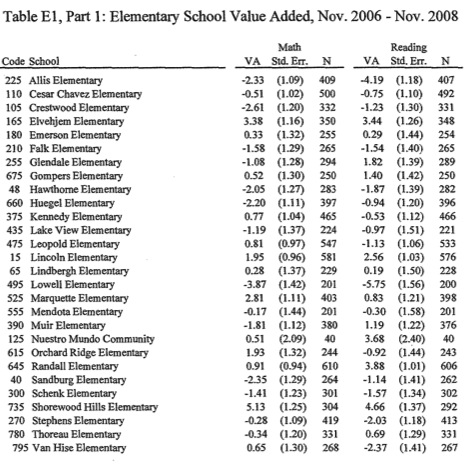
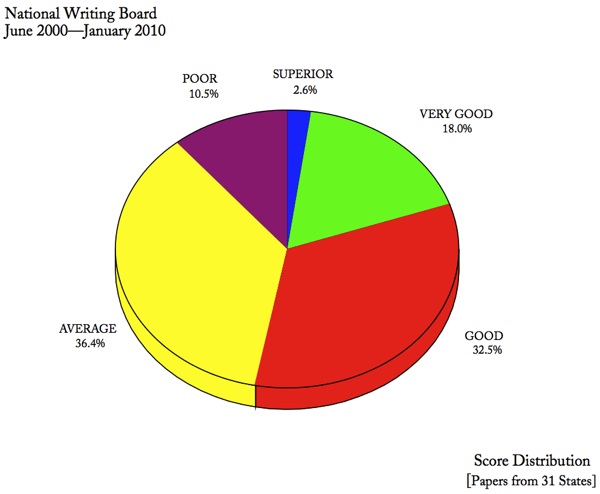
Share

When Less Is More

Scott Jaschik:

For years now, applicants to highly competitive colleges have complained that they feel that they must do more and more to demonstrate why they should be admitted.
This year, following a pattern that had already taken hold among less competitive institutions (for different reasons), some institutions are asking a little less of applicants, at least when it comes to how much they have to write. The Massachusetts Institute of Technology is replacing a longer essay (500 words) with several short questions of about 200 words. The University of Pennsylvania has decided to combine two essay questions about the student’s fit into the institution into one, saving students maybe 200 words.
For book-writing academics, 200 words here or there may seem irrelevant. But the admissions officers behind the decisions say that they are asking for less out of the view that they may learn more about applicants by not overwhelming them with so many questions. They also said that it may be time for admissions deans to balance more carefully what they would like to know about applicants — and the demands on applicants’ time.

Share

PARENTS’ NIGHT SPEECH

Don Regina, via hard copy (The text is “OCR‘d):

Good evening, everyone. I did not mean to burden you with more paper; after all, in life there is so much paperwork, but my administrators urged all teachers to present such a document to you. In my career I have observed that teachers feel somewhat anxious about tonight, but I don’t know why.
Tonight we are together for the first of three meetings, the other two being parent-teacher conferences. It seems we are here for different purposes. You care enough to hurry from work, forego a leisurely dinner, and spend a few hours here. Perhaps you are curious about what I look like, or how I dress (by the way, I am out of uniform-I rarely wear a coat and only don a tie once a week), the way I have decorated my room, what this course is about, and if I am knowledgeable, intelligent, and articulate enough to teach effectively. In other words, is it safe for you to turn your child over to me for forty-five minutes every day. But in Twenty-first Century America two lesser but very powerful gods, named “Things to Do” and “Hurry Up” harry us mercilessly, so you must base your first impressions on these brief encounters. Wouldn’t it be more relaxing if we could sit around a table over coffee and share ideas and concerns? I am here to tell you who I am and my teaching goals and philosophy. In short, I want not to make myself look good but to speak truly and simply, not to put my best foot forward but my real foot forward. Despite our seemingly different purposes, you and I are here for the same reason: we are involved in the education and development of your child and my student. Whether we agree or disagree and regardless of your reactions to what I do or don’t do, let us always remember we are the most influential allies in that essential and crucial process, and permit our alliance to set the tone for our relationship.
My name is Don Regina, and I am ( ) years old. I, and my son . . attended this school, so like you I believe in a private, values oriented education. I hold a Bachelor of Arts degree from St. Michael’s College in Vermont, a Masters Degree in British and American literature from the UW-Madison, and a Lifetime License from the Department of Public Instruction. Yes, I am a lifer. I have taught English here at Edgewood High School for ( ) years-this is my only post-and advise the school newspaper and coach the boys cross country team.
My profession has changed somewhat in the last thirty years. When you and I were in high school, we read and wrote about the classics-A Tale of Two Cities, Crime and Punishment, and Silas Marner. During the Seventies in college I argued with my fellow student teachers about the relative or apparent merits of something called independent study. And now my subject is called Language Arts. Despite all the superficial changes and glitsy gimmicks, and the history of education is loaded with gimmicks, we are and always will be studying the two Rs-reading and writing. So, unlike math or foreign language teachers, we English teachers must fight on two fronts.
It is not surprising, then, that I have two major goals. First, I must teach students to read carefully and perceptively. They must know what happened and what the author said in the text, and use that knowledge to understand characters such as Macbeth, John Proctor from The Crucible, or Elizabeth Bennett from Pride and Prejudice. They should interpret symbols such as Robinson Crusoe’s island, James Joyce’s Dublin, or Mark Twain’s river town, Dawson’s Landing, in Puddn Head Wilson. And, most importantly, they should understand the theme or message the author is conveying. What is Jonathan Swift saying about humanity in Gulliver’s Travels? How is F. Scott Fitzgerald portraying his generation in The Great Gatsby? What is Alice Walker expressing about the plight of women in The Color Purple?
My second goal is multi-faceted: to teach students to write competently. They should organize and clearly express their ideas in fully developed paragraphs and complete sentences using appropriate words. And they should 3 master writing’s nuts and bolts: correct spelling, grammar, usage, and punctuation. As you can see, this is a daunting task.

(more…)

Share

Literacy in Schools: Writing in Trouble

Surely if we can raise our academic standards for math and science, then, with a little attention and effort, we can restore the importance of literacy in our public high schools. Reading is the path to knowledge and writing is the way to make knowledge one’s own.
Education.com
17 September 2009
by Will Fitzhugh
Source: Education.com Member Contribution
Topics: Writing Conventions
[originally published in the New Mexico Journal of Reading, Spring 2009]
For many years, Lucy Calkins, described once in Education Week as “the Moses of reading and writing in American education” has made her major contributions to the dumbing down of writing in our schools. She once wrote to me that: “I teach writing, I don’t get into content that much.” This dedication to contentless writing has spread, in part through her influence, into thousands and thousands of classrooms, where “personal” writing has been blended with images, photos, and emails to become one of the very most anti-academic and anti-intellectual elements of the education we now offer our children, K-12.
In 2004, the College Board’s National Commission on Writing in the Schools issued a call for more attention to writing in the schools, and it offered an example of the sort of high school writing “that shows how powerfully our students can express their emotions”:
“The time has come to fight back and we are. By supporting our leaders and each other, we are stronger than ever. We will never forget those who died, nor will we forgive those who took them from us.”
Or look at the National Assessment of Educational Progress (NAEP), the supposed gold standard for evaluating academic achievement in U.S. schools, as measured and reported by the National Center for Education Statistics. In its 2002 writing assessment, in which 77 percent of 12th graders scored “Basic” or “Below Basic,” NAEP scored the following student response “Excellent.” The prompt called for a brief review of a book worth preserving. In a discussion of Herman Hesse’s Demian, in which the main character grows up, the student wrote,

“High school is a wonderful time of self-discovery, where teens bond with several groups of friends, try different foods, fashions, classes and experiences, both good and bad. The end result in May of senior year is a mature and confident adult, ready to enter the next stage of life.”

It is obvious that this “Excellent” high school writer is expressing more of his views on his own high school experience than on anything Herman Hesse might have had in mind, but that still allows this American student writer to score very high on the NAEP assessment of writing.
This year, the National Council of Teachers of English (NCTE) has released a breakthrough report on writing called “Writing in the 21st Century,” which informs us, among other things, that:

(more…)

Share

ESL Students to Use iPods for Reading

Kate Cerve:

At most Beaufort County public schools, iPods and other portable music players are banned from classrooms and hallways.
But at Hilton Head Island Middle School and others with high numbers of students with limited English skills, teachers use the devices to help students learn to read.
Five county schools will use iPods in their English for Speakers of Other Languages (ESOL) classes this year to tailor instruction to students with different levels of English proficiency.
Hilton Head Island Middle School bought a set of 30 iPods last year, and Bluffton High, H.E. McCracken Middle in Bluffton, Red Cedar Elementary in Bluffton and Hilton Head Island School for the Creative Arts elementary school will receive sets this year.
The school district paid about $200 for each iPod Touch using federal money earmarked for ESOL students, said Sarah Owen, the district’s ESOL coordinator. The district’s contract with Apple Computer Inc., iPod manufacturer, includes training for teachers and a device that can charge and sync about 20 iPods to one computer at the same time.

Share

Foreign Languages Fall as Schools Look for Cuts

Winnie Hu:

IN Edgemont, a high-performing Westchester school district, children as young as 7 could recite colors and days of the week in Spanish, but few if any learned to really converse, read or write. So this fall, the district canceled the Spanish lessons offered twice weekly at its two elementary schools since 2003, deciding the time and resources — an estimated $175,000 a year — could be better spent on other subjects.
The software replaced three teachers.
Class consolidation in Yonkers resulted in the loss of four foreign-language teaching positions, and budget cuts have cost Arlington, N.Y., its seventh-grade German program, and Danbury, Conn., several sections of middle school French and Spanish.
And in New Jersey, the Ridgewood district is replacing its three elementary school Spanish teachers with Rosetta Stone, an interactive computer program that cost $70,000, less than half their combined salaries.
“There’s never a replacement for a teacher in the classroom,” said Debra Anderson, a Ridgewood spokeswoman. “But this was a good solution in view of the financial constraints.”

Share

South Korea’s Latest Export: Its Alphabet

Choe Sang-Hun:

South Korea has long felt under-recognized for its many achievements: it built an economic powerhouse from the ruins of a vicious war in just decades and, after years of authoritarian rule, has created one of Asia’s most vibrant democracies.
Now, one South Korean woman, Lee Ki-nam, is determined to wring more recognition from the world with an unusual export: the Korean alphabet. Ms. Lee is using a fortune she made in real estate to try to take the alphabet to places where native peoples lack indigenous written systems to record their languages.
Her project had its first success — and generated headlines — in July, when children from an Indonesian tribe began learning the Korean alphabet, called Hangul.
“I am doing for the world’s nonwritten languages what Doctors Without Borders is doing in medicine,” Ms. Lee, 75, said in an interview. “There are thousands of such languages. I aim to bring Hangul to all of them.”

Share

High School Research Paper Lightens Up

Denise Smith Amos:

The more students are able to do in research and writing in high school, the more they’ve got a nice leg up.”
At the mere mention of research papers, Kelly Cronin’s usually highly motivated Summit Country Day Upper School students turn listless. Some groan. The Hyde Park Catholic school requires all high school students to write lengthy research papers each year on history, religion or literature.
Cronin’s sophomores write history papers. They pick a topic in late September and by May they’ll have visited libraries, pawed through card catalogs, and plumbed non-fiction books and scholarly articles.
They’ll turn in 200 or so index cards of notes. They’ll write and revise about 15 pages.
Cronin gladly grades 35 or more papers with such titles as “The Role of the Catholic Church in European Witchcraft Trials” and “Star Trek Reflected in President Johnson’s Great Society.”
“It’s time-consuming,” she says. “It takes over your life. But I’m not married, and I don’t have any kids.”
But most high school teachers aren’t like Cronin and most schools aren’t like Summit. At many high schools across the country, the in-depth research paper is dying or dead, education experts say, victims of testing and time constraints.
Juniors and seniors still get English papers, says Anne Flick, a specialist in gifted education in Springfield Township. “But in my day, that was 15 or 20 pages. Nowadays, it’s five.”
High school teachers, averaging 150 to 180 students, can’t take an hour to grade each long paper, Cronin said.
The assignment may not be necessary, says Tiffany Coy, an assistant principal at Oak Hills High in Bridgetown. “Research tells you it’s not necessarily the length; it’s the skills you develop,” she said.
But some educators disagree.
“Students come to college with no experience in writing papers, to the continual frustration of their professors,” said William Fitzhugh, a former high school teacher who publishes The Concord Review, a quarterly in Massachusetts that selects and publishes some of the nation’s best high school papers. [from 36 countries so far]
“If we want students to be able to read and understand college books and to write research papers there, then we must give students a chance to learn how to do that in a rigorous college preparatory program. That is not happening,” he said.
Teachers see the problem. Fitzhugh’s organization commissioned a national study of 400 randomly selected high school teachers in 2002 that showed:
-95% believe research papers, especially history papers, are important.
-62% said they no longer assign even 12-page papers.
-81% never assign 5,000-word or more papers.

(more…)

Share

Lesson Plans, 2009

Timothy Egan:

You’re in third grade, back to school in Texas. Shoes are too tight. Your new shirt is scratchy. And the strange kid sitting next to you — how’s he going to get that pencil out of his nose?
The teachers tell you to file into the gym. They turn on a television. Here comes President Obama. Boorrrrrring. Do you have to listen to this? Is there some kinda test afterward?
Some people in your part of the country didn’t want you to hear the president of the United States. It’s indoctrination. Socialism. Cult of personality. Stuff you’ll learn about on cable news shows.
“This is something you’d expect to see in North Korea or Saddam Hussein’s Iraq,” says Oklahoma State Senator Steve Russell.
Obama starts talking. He says, “If you quit on school, you’re not just quitting on yourself, you’re quitting on your country.”
And then he says, “No one is born being good at things, you become good at things through hard work.”

Share

National Standards

The Concord Review & The National Writing Board
8 September 2009
Specific, detailed, universally-accepted national standards in education are so vital that we have now had them for many decades–in high school sports. Athletics are so important in our systems of secondary education that it is no surprise that we have never settled for the kind of vague general-ability standards that have prevailed for so long in high school academic aptitude tests. If athletic standards were evaluated in the way the SAT measures general academic ability, for example, there would be tests of “general physical fitness” rather than the impressive suite of detailed measures we now use in high school sports.
The tests that we require in football, basketball, track and other sports are not called assessments, but rather games and meets, but they test the participants’ ability to “do” sports in great detail–detail which can be duly communicated to college coaches interested in whether the athletes can perform in a particular sport.
These two different worlds of standards and assessment–athletics and academics–live comfortably side-by-side in our schools, usually without anyone questioning their very different sets of expectations, measures, and rewards.
The things our students have to know when they participate in various athletic activities are universally known and accepted. The things they have to do to be successful in various sports are also universally known and accepted across the country.
The fact that this is not the case for our academic expectations, standards, and rewards for students is the reason there has been so much attention drawn to the problem, at least since the Nation at Risk Report of 1983.
At the moment there are large efforts and expenditures being brought to bear, by the Department of Education, the Education Commission of the States, the Council of Chief State School Officers, many state governments, and others, for the development of academic National Standards for the United States.
There has been, and will continue to be, a lot of controversy over what novels students of English should read, what names, dates and issues history students should be familiar with, what languages, if any, our students should know, and what levels of math and science we can expect of our high school graduates.
The Diploma to Nowhere Report, released by the Strong American Schools Project in the summer of 2008, pointed out that more than one million of our high school graduates are enrolled in remedial courses each year when they get to the colleges which have accepted them. It seems reasonable to assume that the colleges that accepted them had some way of assessing whether those students were ready for the academic work at college, but perhaps the tools for such assessment were not up to the universal standards available for measuring athletic competence.
One area in which academic assessment is especially weak, in my view, is in determining high school students’ readiness for college research papers. The Concord Review did a national study of the assignment of research papers in U.S. public high schools which found that, while 95% of teachers surveyed said research papers were important, or very important, 81% did not assign the kind that would help students get ready for college work. Most of the teachers said they just didn’t have the time to spend on that with students.
Imagine the shock if we discovered that our student football players were not able to block or tackle, in spite of general agreement on their importance, or that our basketball players could not dribble, pass, or shoot baskets with any degree of competence, and, if, when surveyed, our high school coaches said that they were sorry that they just didn’t have time to work on that with their athletes.
Whatever is decided about National Standards for the particular knowledge which all our students should have when they leave school, I hope that there is some realization that learning to do one research paper, of the kind required for every International Baccalaureate Diploma now, should be an essential part of the new standards.
If so, then we come to the problem of assessing, not just the ability of students to write a 500-word “personal essay” for college admissions officers, or to perform the 25-minute display of “writing-on-demand” featured in the SAT writing test and the NAEP assessment of writing, but their work on an actual term paper.
As with our serious assessments in sports, there are no easy shortcuts to an independent assessment of the research papers of our secondary students. Since 1998, the National Writing Board, on a small scale, has produced three-page reports on research papers by high school students from 31 states and two Canadian provinces. Each report has two Readers, and each Reader spends, on average, one hour to read and write their evaluation of each paper. Contrast this with the 30 papers-an-hour assessments of the SAT writing test. The National Writing Board process is time-consuming, but it is, in my biased view, one serious way to assess performance on this basic task that every student will encounter in college.

Share

Are Dictionaries Becoming Obsolete?

Julia Angwin:

Do we still need dictionaries in the age of Google?
Dictionaries are, after all, giant databases of words compiled by lexicographers who investigate word usages and meanings.
These days, however, Google is our database of meaning. Want to know how to spell assiduous? Type it incorrectly and Google will reply, in its kind-hearted way: “Did you mean: assiduous”? Why yes, Google, I did.
Google then spits out a bunch of links to Web definitions for assiduous. Without clicking on any of them, the two-sentence summaries below each link give me enough to get a sense of the word: “hard working,” and “diligent.”
Still not satisfied? Fine, click on the Google “News” tab – and you will be directed to a page of links where the word assiduous appears in news stories. Presto, sample sentences and usage examples.

Share

Who Controls the Reading List?

Letters to the New York Times:

To the Editor:
As a university literature instructor, I found the idea of allowing middle-school students to choose their own reading lists disturbing.
Would we be so eager to embrace a “choose your own math” or “choose your own history” class?
The answer is no. We expect that students learn the curriculum in those courses whether or not they are “into it.” Literature is no different, and literature courses shouldn’t be treated as glorified book clubs.
By allowing students to bypass difficult texts or texts that don’t seem to relate to their contemporary lives in favor of “Captain Underpants,” teachers miss a valuable opportunity to teach them that real scholastic and intellectual growth often comes when we are most challenged and least comfortable.
Lisa Dunick
Champaign, Ill., Aug. 30, 2009

Share

Bad Student Writing? Not So Fast!

Laurie Fendrich:

It would be good for the blood pressure of everyone involved in criticizing education–state legislators, education policy professionals, professors, school administrators, parents–to take a deep breath. Put aside the statistics, the studies, the anecdotes, and take a look at the big picture.
Here’s what Edith Hamilton had to say about education, in The Echo of Greece (1957), one of her many trenchant books on the subject of the ancient Greeks:
“If people feel that things are going from bad to worse and look at the new generation to see if they can be trusted to take charge among such dangers, they invariably conclude that they cannot and that these irresponsible young people have not been trained properly. Then the cry goes up, ‘What is wrong with our education?’ and many answers are always forthcoming.”
Note the droll and ironic, “and many answers are always forthcoming.” Perhaps studying people who lived so long ago–people who invented the very idea of education as a route to genuine freedom, and understood freedom to be worthwhile only when coupled with self-control–gave Hamilton one of those calm, stoical uber-minds that comprehends competing pronouncements about education never to be more than opinion.

Share

Why Gen-Y Johnny Can’t Read Nonverbal Cues

Mark Bauerlein:

In September 2008, when Nielsen Mobile announced that teenagers with cellphones each sent and received, on average, 1,742 text messages a month, the number sounded high, but just a few months later Nielsen raised the tally to 2,272. A year earlier, the National School Boards Association estimated that middle- and high-school students devoted an average of nine hours to social networking each week. Add email, blogging, IM, tweets and other digital customs and you realize what kind of hurried, 24/7 communications system young people experience today.
Unfortunately, nearly all of their communication tools involve the exchange of written words alone. At least phones, cellular and otherwise, allow the transmission of tone of voice, pauses and the like. But even these clues are absent in the text-dependent world. Users insert smiley-faces into emails, but they don’t see each others’ actual faces. They read comments on Facebook, but they don’t “read” each others’ posture, hand gestures, eye movements, shifts in personal space and other nonverbal–and expressive–behaviors.
Back in 1959, anthropologist Edward T. Hall labeled these expressive human attributes “the Silent Language.” Hall passed away last month in Santa Fe at age 95, but his writings on nonverbal communication deserve continued attention. He argued that body language, facial expressions and stock mannerisms function “in juxtaposition to words,” imparting feelings, attitudes, reactions and judgments in a different register.

Share

Good Books Don’t Have to Be Hard

Lev Grossman:

A good story is a dirty secret that we all share. It’s what makes guilty pleasures so pleasurable, but it’s also what makes them so guilty. A juicy tale reeks of crass commercialism and cheap thrills. We crave such entertainments, but we despise them. Plot makes perverts of us all.
It’s not easy to put your finger on what exactly is so disgraceful about our attachment to storyline. Sure, it’s something to do with high and low and genres and the canon and such. But what exactly? Part of the problem is that to find the reason you have to dig down a ways, down into the murky history of the novel. There was once a reason for turning away from plot, but that rationale has outlived its usefulness. If there’s a key to what the 21st-century novel is going to look like, this is it: the ongoing exoneration and rehabilitation of plot.
Where did this conspiracy come from in the first place–the plot against plot? I blame the Modernists. Who were, I grant you, the single greatest crop of writers the novel has ever seen. In the 1920s alone they gave us “The Age of Innocence,” “Ulysses,” “A Passage to India,” “Mrs. Dalloway,” “To the Lighthouse,” “Lady Chatterley’s Lover,” “The Sun Also Rises,” “A Farewell to Arms” and “The Sound and the Fury.” Not to mention most of “In Search of Lost Time” and all of Kafka’s novels. Pity the poor Pulitzer judge for 1926, who had to choose between “The Professor’s House,” “The Great Gatsby,” “Arrowsmith” and “An American Tragedy.” (It went to “Arrowsmith.” Sinclair Lewis prissily declined the prize.) The 20th century had a full century’s worth of masterpieces before it was half over.

Share

Can Poor Spelling Derail a Career?

Toddi Gutner:

I’m mentoring a young, ambitious engineer in our company. He’s competent and demonstrates his energetic drive every day. However, he constantly makes spelling and grammatical errors in his writings. I’ve asked him to utilize spell-checking and re-read his emails. But mistakes such as confusing “our” with “are” and “there” and “their” aren’t picked up with the computer tools. It’s been over a year and he’s still making these mistakes. What would you suggest as an appropriate next course of action? I am not sure if there are any additional classes he can take to improve his grammar/spell-checking skills.
A: While it is clear you have casually mentioned to your mentee about his spelling and grammatical errors, it sounds like it is time you have a more formal, direct discussion with him about his mistakes. It may be that he doesn’t fully understand the gravity of the problem and the impact it can have on his career. “He needs to know that these mistakes are getting in the way of his success and that his lack of professionalism and inaccuracy is unacceptable,” says Brad Karsh, president of JobBound, a career consulting firm.

Share

Pledge Allegiance to Core Knowledge

Jay Matthews:

THE MAKING OF AMERICANS
Democracy and Our Schools
By E.D. Hirsch, Jr.
Yale Univ. 261 pp. $25
It’s not easy being E. D. Hirsch, Jr. If the inventive 81-year-old had been a business leader or politician or even a school superintendent, his fight to give U.S. children rich lessons in their shared history and culture would have made him a hero among his peers. Instead, he chose to be an English professor, at the unlucky moment when academic fashion declared the American common heritage to be bunk and made people like Hirsch into pariahs.
In this intriguing, irresistible book, Hirsch tells of life as the odd man out at the University of Virginia. Twelve years ago, for instance, he decided to give a course at the university’s education school. As a bestselling author and leader of a national movement to improve elementary school teaching, he thought students would flock to hear him. Instead, he rarely got more than 10 a year. Be grateful for that many, one student told him. They had all been warned by the education faculty not to have anything to do with someone demanding that all students take prescribed courses in world and American history.

Share

The “Future of Reading”: Students Get New Assignment: Pick Books You Like

Motoko Rich:

For years Lorrie McNeill loved teaching “To Kill a Mockingbird,” the Harper Lee classic that many Americans regard as a literary rite of passage.
But last fall, for the first time in 15 years, Ms. McNeill, 42, did not assign “Mockingbird” — or any novel. Instead she turned over all the decisions about which books to read to the students in her seventh- and eighth-grade English classes at Jonesboro Middle School in this south Atlanta suburb.
Among their choices: James Patterson’s adrenaline-fueled “Maximum Ride” books, plenty of young-adult chick-lit novels and even the “Captain Underpants” series of comic-book-style novels.
But then there were students like Jennae Arnold, a soft-spoken eighth grader who picked challenging titles like “A Lesson Before Dying” by Ernest J. Gaines and “The Bluest Eye” by Toni Morrison, of which she wrote, partly in text-message speak: “I would have N3V3R thought of or about something like that on my own.”
The approach Ms. McNeill uses, in which students choose their own books, discuss them individually with their teacher and one another, and keep detailed journals about their reading, is part of a movement to revolutionize the way literature is taught in America’s schools. While there is no clear consensus among English teachers, variations on the approach, known as reading workshop, are catching on.

Share

Dissertations Are Long and Boring

Macy Halford:

This indisputable fact is the impetus behind the genius blog Dissertation Haiku, which explains itself thus:

Dissertations are long and boring. By contrast, everybody likes haiku. So why not write your dissertation as a haiku?

aI guess that graduate-student writers are just like any other kind of writer in that they do want someone, anyone, to enjoy their work, regardless of how specialized or mind-numbingly dull the subject might be–hence the hundreds who have posted to the blog. So far, my favorite comes from one Mary O’Connor, who is studying ecology at the University of North Carolina, Chapel Hill. She writes that her dissertation deals with “the effects of temperature on food webs using coastal marine plants and animals. In general, as water warms by small amounts, fish and crustaceans eat more seaweed. Thus, warming predictably changes energy flow in food webs and the abundance of marine plants and animals.” I appreciate the importance of this research (and even find it intriguing), but for the sake of this post, I’ll give it a big yawn. Now for the haiku:

Hungry herbivores,
It’s warm; feel your tummies growl?
Graze down hot seaweed.

Share

Second language changes the way bilinguals read in their native tongue

Research Digest Blog:

Do bilinguals have an internal switch that stops their two languages from interfering with each other, or are both languages always “on”? The fact that bilinguals aren’t forever spurting out words from the wrong language implies there’s some kind of switch. Moreover, in 2007, brain surgeons reported evidence for a language switch when their cortical prodding with an electrode caused two bilingual patients to switch languages suddenly and involuntarily.
On the other hand, there’s good evidence that languages are integrated in the bilingual mind. For example, bilinguals are faster at naming an object when the word for that object is similar or the same in the two languages they speak (e.g. ship/schip in English and Dutch).
Now Eva Van Assche and colleagues have provided further evidence for the idea of bilingual language integration by showing that a person’s second language affects the way that they read in their native language.

Share

On the New Literacy

Clive Thompson:

As the school year begins, be ready to hear pundits fretting once again about how kids today can’t write–and technology is to blame. Facebook encourages narcissistic blabbering, video and PowerPoint have replaced carefully crafted essays, and texting has dehydrated language into “bleak, bald, sad shorthand” (as University College of London English professor John Sutherland has moaned). An age of illiteracy is at hand, right?
Andrea Lunsford isn’t so sure. Lunsford is a professor of writing and rhetoric at Stanford University, where she has organized a mammoth project called the Stanford Study of Writing to scrutinize college students’ prose. From 2001 to 2006, she collected 14,672 student writing samples–everything from in-class assignments, formal essays, and journal entries to emails, blog posts, and chat sessions. Her conclusions are stirring.
“I think we’re in the midst of a literacy revolution the likes of which we haven’t seen since Greek civilization,” she says. For Lunsford, technology isn’t killing our ability to write. It’s reviving it–and pushing our literacy in bold new directions.
The first thing she found is that young people today write far more than any generation before them. That’s because so much socializing takes place online, and it almost always involves text. Of all the writing that the Stanford students did, a stunning 38 percent of it took place out of the classroom–life writing, as Lunsford calls it. Those Twitter updates and lists of 25 things about yourself add up.
It’s almost hard to remember how big a paradigm shift this is. Before the Internet came along, most Americans never wrote anything, ever, that wasn’t a school assignment. Unless they got a job that required producing text (like in law, advertising, or media), they’d leave school and virtually never construct a paragraph again.

Share

What Should Colleges Teach? Or, becoming Alarmed at College Students Inability to Write a Clean English Sentence

Stanley Fish:

A few years ago, when I was grading papers for a graduate literature course, I became alarmed at the inability of my students to write a clean English sentence. They could manage for about six words and then, almost invariably, the syntax (and everything else) fell apart. I became even more alarmed when I remembered that these same students were instructors in the college’s composition program. What, I wondered, could possibly be going on in their courses?
I decided to find out, and asked to see the lesson plans of the 104 sections. I read them and found that only four emphasized training in the craft of writing. Although the other 100 sections fulfilled the composition requirement, instruction in composition was not their focus. Instead, the students spent much of their time discussing novels, movies, TV shows and essays on a variety of hot-button issues — racism, sexism, immigration, globalization. These artifacts and topics are surely worthy of serious study, but they should have received it in courses that bore their name, if only as a matter of truth-in-advertising.
As I learned more about the world of composition studies, I came to the conclusion that unless writing courses focus exclusively on writing they are a sham, and I advised administrators to insist that all courses listed as courses in composition teach grammar and rhetoric and nothing else. This advice was contemptuously dismissed by the composition establishment, and I was accused of being a reactionary who knew nothing about current trends in research. Now I have received (indirect) support from a source that makes me slightly uncomfortable, the American Council of Trustees and Alumni, which last week issued its latest white paper, “What Will They Learn? A Report on General Education Requirements at 100 of the Nation’s Leading Colleges and Universities.”

Share

The lost baggage of modern literature

Rosie Blau:

When Alain de Botton became the writer-in-residence at Heathrow airport this week, he claimed to be producing “a new kind of literature” to engage with the modern world. BAA, which owns Heathrow, has paid the novelist and philosopher £30,000 ($50,000, €34,800) for his seven-day residency at Terminal Five and to write a 20,000-word book. The “literary flow chart” of life among the baggage handlers and sniffer dogs will be published next month.
This is not the first time a company has appointed a literary figure and sought publicity for its cultural largesse. In 2003, Australian novelist Kathy Lette spent three months as writer-in- residence at the £1,200-a-night Savoy hotel in London. Marks and Spencer, Tottenham Hotspur football club, London Zoo and Toni & Guy hairdressers have all taken in authors to produce great works – or just great publicity.
There’s nothing wrong with patronage, of course – its history is as long as the history of art itself. Titian got his big break in 1511, paid to paint three frescoes in Padua. Michelangelo actually lived with Lorenzo de’ Medici, his benefactor.
In literature, arguably the earliest writer in residence was Britain’s poet laureate: in 1668, Charles II appointed John Dryden to spin his verse for the Restoration years. In The Bulgari Connection in 2001, Fay Weldon became the first known novelist to accept payment to mention a company – the Italian jeweller features more than a dozen times.

Share

Dream of a Common Language. Sueño de un Idioma Común.

Nate Blakeslee:

The graduates of a radical bilingual education program at Alicia R. Chacón International, in El Paso, would have no trouble reading either of these headlines. What can they teach the rest of us about the future of Texas?
On (En) a warm spring morning in east El Paso, I watched a science teacher named Yvette Garcia wrap duct tape around the wrists of one of her best students. We were in a tidy lab room on the first floor of Del Valle High School, in the Ysleta Independent School District, about two miles from the border in a valley once covered with cotton and onion fields but long since swallowed up by the sprawl of El Paso. Garcia taped a second student around the ankles, bound a third around the elbows, and so on, until she had temporarily handicapped a half-dozen giggling teenagers, whom she then cheerfully goaded into a footrace followed by a peanut-eating contest. It was a demonstration of the scientific concept of genetic mutation–or at least I think it was. The lab was taught entirely in Spanish, and my limited skills didn’t allow me to follow a discussion of an advanced academic concept. But these kids could grasp the lesson equally well in Spanish or in English, because they had been taught–most of them since elementary school–using a cutting-edge bilingual education program known as dual language.
In traditional bilingual classes, learning English is the top priority. The ultimate aim is to move kids out of non-English-speaking classrooms as quickly as possible. Students in dual language classes, on the other hand, are encouraged to keep their first language as they learn a second. And Ysleta’s program, called two-way dual language, is even more radical, because kids who speak only English are also encouraged to enroll. Everyone sits in the same classroom. Spanish-speaking kids are expected to help the English speakers in the early grades, which are taught mostly in Spanish. As more and more English is introduced into the classes, the roles are reversed. Even the teachers admit it can look like chaos to an outsider. “Dual language classes are very loud,” said Steven Vizcaino, who was an early student in the program and who graduated from Del Valle High in June. “Everyone is talking to everyone.”

Share

2009-2010 Read On Wisconsin Book Club Reading List

Via email:

Dear Read On Wisconsin! Book Club Members,
Welcome to the 2009-2010 school year!
We are pleased to announce that we have finalized the book selections! Thanks to the hard work of our Literacy Advisory Committee (LAC), we have decided on wonderful collections for all age groups. Each submission was carefully considered, and we feel that our assortment features inspiring books that will both enrich and entertain students. We think that you will all be very pleased with these engaging and inspiring choices!
We look forward to hosting Reading Days at the Residence this upcoming school year. Please check this website often for dates and details. We remind you that for each book, the LAC has developed discussion questions. Please encourage your students to be active participants in the student web log. As always, we welcome any questions or feedback regarding the book club or Reading Days.
On Wisconsin!
Jessica Doyle
First Lady of Wisconsin
Ashley Huibregtse
Assistant to the First Lady

(more…)

Share

Lost in Immersion: Speaking French on the Web

Katherine Boehret:

If you’ve ever learned a foreign language, you know the vast difference between completing workbook activities and speaking with others. The latter experience can involve sounding out unfamiliar accents or guttural pronunciations and, though intimidating, is ultimately more rewarding. By immersing yourself in a language and navigating through situations, you learn how to speak and eventually think in that language.
Rosetta Stone has long used visual learning without translations by pairing words with images –one of the ways a baby learns to speak. For the past week, I’ve been testing its newest offering: Rosetta Stone Totale (pronounced toe-tall-A), which is the company’s first fully Web-based language-learning program. It aims to immerse you in a language using three parts: online coursework that can take up to 150 hours; live sessions in which you can converse over the Web with a native-speaking coach and other students; and access to Rosetta World, a Web-based community where you can play language games by yourself or with other students to improve your skills.
Totale costs a whopping $999, so if you aren’t serious about learning a language it’s a tough sell. Rosetta Stone says this program is comparable to an in-country language-immersion school. The company’s most expensive offering before Totale was a set of CDs (lessons one, two and three) that cost $549, included about 120 hours of course work and had no online components.

Share

Quick! Tell Us What KUTGW Means

Stephanie Raposo:

Kate Washburn didn’t know what to make of the email a friend sent to her office with the abbreviation “NSFW” written at the bottom. Then she clicked through the attached sideshow, titled “Awkward Family Photos.” It included shots of a family in furry “nude” suits and of another family alongside a male walrus in a revealing pose.
After looking up NSFW on NetLingo.com–a Web site that provides definitions of Internet and texting terms–she discovered what it stood for: “Not safe for work.”
“If I would have known it wasn’t safe for work, I wouldn’t have taken the chance of being inappropriate,” says Ms. Washburn, 37 years old, a media consultant in Grand Rapids, Mich.
As text-messaging shorthand becomes increasingly widespread in emails, text messages and Tweets, people like Ms. Washburn are scrambling to decode it. In many offices, a working knowledge of text-speak is becoming de rigueur. And at home, parents need to know the lingo in order to keep up with–and sometimes police–their children.

Share

Milwaukee Public Schools targeted in complaint over instruction of English as second language

Georgia Pabst:

Milwaukee Public Schools is not complying with civil rights law in effectively teaching English to Spanish-speaking students, according to a federal complaint filed by the League of United Latin American Citizens of Wisconsin.
The complaint, filed at the Office of Civil Rights in the U. S. Department of Education office in Chicago, claims MPS and the Milwaukee School Board are not complying with the Civil Rights Act.
The district receives federal funds for teaching English to students who speak another language, and the U.S. Supreme Court has ruled that school districts must help such students overcome language barriers so they can succeed in all of their classes, said Darryl Morin, state director of LULAC.
“LULAC of Wisconsin has serious concerns regarding the education theory, programming and resources allocated to these efforts at MPS,” he said.
Morin said MPS has used uncertified and unqualified teachers in the program.
The U.S. Department of Education confirmed that its Office of Civil Rights has received the complaint. Jim Bradshaw, a spokesman for the department in Washington, D.C., said the office is evaluating the complaint to determine whether an investigation is appropriate. The evaluation process should take about a month, he said.
MPS spokeswoman Roseann St. Aubin said district officials can’t comment because they just received the complaint Tuesday and have not reviewed it.

Share

Cramming a Lot Into a Youthful Literary Life

Charles McGrath:

Nick McDonell ought to be an easy person to dislike. He is young, smart, good looking and ridiculously well connected. His father is Terry McDonell, the editor of Sports Illustrated, and he grew up in the kind of gilded New York household where Joan Didion, Jay McInerney and George Plimpton were drop-in guests. His godfather is Morgan Entrekin, the publisher of Grove/Atlantic, who bought Mr. McDonell’s first novel, “Twelve,” when Mr. McDonell was just 18. He heard news of its acceptance while cruising home in the carpool from Riverdale Country School, where he was president of the student body. Hunter S. Thompson, another family friend, came through with a timely blurb, saying, “I’m afraid he will do for his generation what I did for mine.”
Nick McDonell on the New York set of “Twelve,” the movie based on his first novel.
If that weren’t insufferable enough, Mr. McDonell, now 25, has a third novel, “An Expensive Education,” being published on Wednesday by Atlantic Monthly, and “Twelve,” meanwhile, is being made into a movie starring Kiefer Sutherland, Chace Crawford and 50 Cent. On your way to meet Mr. McDonell you can find yourself half-hoping that he might be dinged by a pedicab — not seriously, but enough to give him a limp, say, or an embarrassing facial tic.
As it happens, though, he is the kind 0f overly well-behaved person who waits for the light to change even when there is no traffic. He is also shy, earnest, a little naïve, disarmingly modest, polite almost to a fault. And he writes so well that his connections are beside the point. In The New York Times the book critic Michiko Kakutani said that “Twelve,” which is about the downward-spiraling adventures of some druggy New York private-school students over Christmas break, was “as fast as speed, as relentless as acid.” “An Expensive Education” ingeniously combines elements of a le Carré or Graham Greene-like international thriller with a campus novel set at Harvard, from which Mr. McDonell graduated in 2007. There are scenes of double-crossing C.I.A. activities in Somalia, as well as of campus rush parties and two cocktail-swilling guys who are famous on campus for ironically wearing tuxedos all the time — the college-age versions, perhaps, of two adolescent stoners in “Twelve” who are always saying things like “Shiz fo a niz!”

Share

Grabbers – first sentences from new books

San Francisco Chronicle:

I enter the lobby of Claire Nightingale’s apartment building, here to tell her I have murdered her only son.
“In This Way I Was Saved,” a novel by Brian DeLeeuw
My mother says she can’t listen to love songs anymore.
“Not That Kind of Girl,” a memoir by Carlene Bauer
One evening, as Shahid Hasan came out of the communal hall toilet, resecured the door with a piece of looped string, and stood buttoning himself under a dim bulb, the door of the room next to his opened and a man emerged, carrying a briefcase.
“The Black Album, a novel (republished with “My Son the Fanatic”) by Hanif Kureishi

Share

Three-Minute Fiction: Our Winner Is…

NPR:

In June, we appealed to your inner author, asking you to send us original works of fiction that could be read in three minutes or less. And, man, did your inner authors respond! We received more than 5,000 submissions to our Three-Minute Fiction writing contest.
Now, series guide and literary critic James Wood of The New Yorker has picked our first winner: Molly Reid of Fort Collins, Colo. Reid is waiting tables this summer, but during the school year, she teaches freshman composition and literature at Colorado State University.
Wood says that Reid was an early entrant whose work held strong against the hundreds of stories that followed. The narrator of her piece, “Not That I Care,” observes a neighbor repeatedly snatching ducks from the street. The missing ducks become part of the narrator’s own reflections on loss.

Share

“What if it has all been a huge mistake?”

The Chronicle Review
July 27, 2009
A Rescue Plan for College Composition and High-School English
By Michael B. Prince:

The new administration in Washington promises fresh resources for our failing school systems. The need is great. Yet at a time when every penny counts, we had better be sure that new investments in education don’t chase after bad pedagogical ideas.
I propose a rescue plan for high-school English and college composition that costs little, apart from a shift in dominant ideas. For the sake of convenience and discussion, the rescue plan reduces complex matters to three concrete steps.
First, don’t trust the SAT Reasoning Test, especially the writing section of that test, as a college diagnostic, and don’t allow the writing test to influence the goals of high-school English.
The news last year that Baylor University paid its already admitted students to retake the SAT in order to raise the school’s ranking in U.S. News and World Report would be funny if it weren’t so sad. The test is a failure.
Even the manufacturer of the SAT admits that the new test, which includes writing, is no better than the old test, which didn’t. As The Boston Globe reported on June 18, 2008: “The New York-based College Board, which owns the test, released the study yesterday showing that the current SAT rated 0.53 on a measure of predictive ability, compared with 0.52 for the previous version. A result of 1 would mean the test perfectly predicts college performance. Revising the SAT ‘did not substantially change’ its capacity to foretell first-year college grades, the research found.”
How could this happen? College professors frequently ask their students to write. Shouldn’t a test that includes actual writing tell us more about scholastic aptitude than a test that doesn’t? Yes, unless the test asks students to do something categorically different from what college professors generally ask their students to do. Is that the problem with the SAT? You be the judge.
The following essay question appeared on the December 2007 SAT. It was reprinted on the College Board’s Web site as a model for high-school students to practice; it was subsequently disseminated by high schools and SAT-prep Web sites. The question runs as follows:
“Think carefully about the issue presented in the following excerpt and the assignment below.
“‘Our determination to pursue truth by setting up a fight between two sides leads us to believe that every issue has two sides–no more, no less. If we know both sides of an issue, all of the relevant information will emerge, and the best case will be made for each side. But this process does not always lead to the truth. Often the truth is somewhere in the complex middle, not the oversimplified extremes.’
“[Adapted from Deborah Tannen, The Argument Culture]

(more…)

Share

Diminishing Returns in Humanities Research

Mark Bauerlein:

It was sometime in the 1980s, I think, that a basic transformation of the aims of literary criticism was complete. Not the spread of political themes and identity preoccupations, which struck outsiders and off-campus critics like William Bennett, a former secretary of education turned radio host, as the obvious change, but a deeper adjustment in the basic conception of what criticism does. It was, namely, the shift from criticism-as-explanation to criticism-as-performance. Instead of thinking of scholarship as the explication of the object–what a poem means or a painting represents–humanists cast criticism as an interpretative act, an analytical eye in process.
The old model of the critic as secondary, derivative, even parasitical gave way to the critic as creative and adventuresome. Wlad Godzich’s introduction to the second edition of Paul de Man’s Blindness and Insight (1983) nicely caught the mood in its title: “Caution! Reader at Work!” People spoke of “doing a reading,” applying a theory, taking an approach, and they regarded the principle of fidelity to the object as tyranny. In a 1973 essay in New Literary History titled “The Interpreter: A Self-Analysis,” Geoffrey H. Hartman chastised the traditional critic for being “methodologically humble” by “subduing himself to commentary on work or writer”; then he declared, “We have entered an era that can challenge even the priority of literary to literary-critical texts.” A writer has a persona, he stated. “Should the interpreter not have personae?”
Older modes of criticism were a species of performance as well. But they claimed validity to the extent to which the object they regarded gave up to them its mystery. The result, the clarified meaning of the work, counted more than the execution that yielded it. By the late 1980s, though, the question “What does it mean?” lost out to “How can we read it?” The interpretation didn’t have to be right. It had to be nimble.

Share

Within you, without you

Harry Eyres:

Michel de Montaigne, inventor of the essay, could also be seen as the begetter of the contemporary curse of self-absorption. Montaigne (1533-1592) made a move, nearly five hundred years ago, that still seems modern and revolutionary. He reversed the whole direction of study, research, investigation; he turned the lens from the observed to the observer. “For many years now the target of my thoughts has been myself alone; I examine nothing, I study nothing, but me; and if I do study anything else, it is so as to apply it at once to myself, or more correctly, within myself.”
Now you could see this (like other French revolutions) as profoundly dangerous. You could blame Montaigne for the culture of narcissism, the world of endlessly proliferating self-help books, whose sheer number betrays a sense of desperation. Montaigne is indeed the patron saint of self-help books: “You should not blame me for publishing; what helps me can perhaps help someone else.”
Now go back to that first quotation, and pause on the subtle but all-important distinction Montaigne makes at the end of it. What is the difference between applying something to yourself and applying it within yourself? When you apply something to yourself, the two entities involved, the something and yourself, don’t really change; they may work in tandem for a while, but they can be decoupled. But when you apply something within yourself, that implies a profound transformation from within – a more organic, less violent and more permanent process, a silent but momentous shift in the whole machinery of the self.

Share