School Information System

Another brand of Bush school reform: Jeb’s

Nick Anderson:

The president who turned No Child Left Behind from slogan into statute is gone from Washington, and the influence of his signature education law is fading. But another brand of Bush school reform is on the rise.
The salesman is not the 43rd president, George W. Bush, but the 43rd governor of Florida, his brother Jeb.
At the core of the Jeb Bush agenda are ideas drawn from his Florida playbook: Give every public school a grade from A to F. Offer students vouchers to help pay for private school. Don’t let them move into fourth grade unless they know how to read.
Through two foundations he leads in Florida and his vast political connections, Jeb Bush is advancing such policies in states where Republicans have sought his advice on improving schools. His stature in the party and widening role in state-level legislation make him one of the foremost GOP voices on education.

Share

Seven Stumbling Blocks for Madison Prep

Madison School Board Member Ed Hughes:

The Madison School Board’s recent consideration of the Urban League’s application for a planning grant from DPI for the Madison Preparatory Academy for Young Men prompted me to dig deeper into the issues the charter school proposal raises. I have several concerns – some old and some new – that are described below.
I apologize for the length of this post. It kind of turned into a data dump of all things Madison Prep.
Here are the seven areas of concern I have today about the Madison school district agreeing to sponsor Madison Prep as a non-instrumentality charter school.
1. The Expense.
As I have written, it looks like the roughly $14,500 per student that Madison Prep is seeking from the school district for its first year of operations is per nearly twice the per-student funding that other independent and non-instrumentality charter schools in the state now receive.
Independent charter schools, for example, receive $7,750 per-student annually in state funding and nothing from the local school district. As far as I can tell, non-instrumentality charter schools tend to receive less than $7,750 from their sponsoring school districts.
It seems that the Madison Prep proposal seeks to pioneer a whole new approach to charter schools in this state. The Urban League is requesting a much higher than typical per-student payment from the school district in the service of an ambitious undertaking that could develop into what amounts to a shadow Madison school district that operates at least a couple of schools, one for boys and one for girls. (If the Urban League eventually operates a girl’s school of the same size as projected for Madison Prep, it would be responsible for a total of 840 students, which is a larger total enrollment than about 180 school districts in Wisconsin can claim.)
What about the argument that Madison Prep does not propose to spend any more on a per-student basis than the Madison school district already spends? There are a couple of responses. First, MMSD does not spend $14,500 per student on in-school operations – i.e., teachers, classroom support, instructional materials. The figure is more like $11,000. But this is not the appropriate comparison.

Much more on the proposed IB Charter school: Madison Preparatory Academy, here.

Share

Milwaukee Public Schools agree to close, merge, move schools

The Milwaukee School Board on Thursday night closed, merged or relocated about seven schools for next year to address space and facility issues in a district facing an upcoming $74 million budget shortfall.
At the same time, board members considered plans to open a handful of public charter schools next year. By late Thursday, they had approved an education management company to restart North Division High School as a charter school, and they had approved a voucher-school operator to open a public K-12 charter school with a residential element for high schoolers.
The board approved a proposal from Milwaukee College Prep, one of the city’s highest-performing charter schools, to lease with an option to buy the vacant Thirty-Eighth Street School building. The deed restriction on the school, which keeps it from being used as a school that would compete with MPS, would be lifted after five years.
Robert Rauh, leader of Milwaukee College Prep, said College Prep proposed expanding into the Thirty-Eighth Street building as an MPS non-unionized charter school for kindergarten through fourth grade. Middle schoolers in grades five through eight would make up the population at Milwaukee College Prep’s main campus in Metcalfe Park.

Share

What is a Charter School? And what does it have to do with you?

Kathleen Vinehout:

“I’ve heard of charter schools,” the woman told me. “But I really don’t know understand them.” People are not familiar with schools often run by a private group but using taxpayer dollars.
Imagine a school created with a business-like contact or “charter”. This charter sets it own rules for the school and exempts it from the usual rules about classes, staff, budgeting and administration.
Many charter schools are created and run by local school districts but some are independent charters. Cost to local school districts for these independent schools this year was almost $60 million statewide. In our Senate District, school districts will pay an estimated $1.3 million in the next two years for these independent charter schools.

Share

Green Bay Catholic & Public School Test Scores

Patty Zarling:

Many families choose to enroll their children in Catholic schools for religious reasons, but educators say kids also get academic benefits.
The Green Bay Area Catholic Education system for the first time compared test scores from 10 local Catholic schools with scores from area public schools. Catholic educators say the comparison showed students at the parochial schools are generally more proficient or advanced in math, reading and language arts than their peers at public schools.
Catholic school advocates say the scores highlight the strong quality of education at those schools at a time when they’re working hard to attract students. That effort ramps up this week, which is National Catholic Schools Week.
GRACE president Carol Conway-Gerhardt said bringing together 10 local Catholic schools into one system allowed administrators to compare test scores from those students with those at public schools.

Share

Kroger’s $3.8M promise of books, arts, help to Indianapolis school children

Robert King:

Kroger announced a new $3.8-million investment in local schools and education programs today, including a plan to collect book donations at every store and to redistribute them to children across the city.
The grocery store chain’s three-year “K-12 education strategy” will support youth programs through 10 organizations ranging from the United Way to the Children’s Museum of Indianapolis to the Indianapolis Opera.
It will also extend Kroger’s long-term support of Indianapolis Public School 46, a Near Westside school who has received more than $1 million from Kroger during the past 25 years.

Share

New study on KIPP: Higher attrition and lots more money per pupil

Maureen Downey:

There are a few dissenters who have remained leery of the great success story of the KIPP schools, questioning the turnover of students in the acclaimed program. KIPP operates three schools in the metro area and a high school, KIPP Atlanta Collegiate, opens this summer.
Now skeptics are about to get some data on attrition and funding that may confirm their suspicions.
In a study bound to raise the hackles of KIPP supporters, researchers at the College of Education and Human Development at Western Michigan University and Teachers College at Columbia University found that KIPP has a high attrition rate among African-American boys.
While the study does not challenge the academic success of KIPP graduates, it raises questions about the funding and whether the high level of private dollars is sustainable. The study found that KIPP schools benefit tremendously by donations and private funding, earning an extra $6,500 on average per pupil.
KIPP sent me a comment and fact sheet rebuttal of the study: Go to the link to see the back sheet.

Share

Detroit Considers 45 Charter School

Matthew Dolan:

The state-appointed manager of Detroit Public Schools identified 45 schools in the struggling district that could be turned over to private charter operators in a bid to improve student performance.
Wednesday’s release of the target list comes as the manager, Robert Bobb, heads into a new round of talks with unions, armed with broad new authority to reopen labor contracts, cut costs and dictate curriculum.
Since his appointment more than two years ago, Mr. Bobb’s efforts to stabilize the district’s finances and bolster its academics have faced resistance from teachers unions and the school board. Michigan Republican Gov. Rick Snyder changed all of that earlier this month, when he signed into law expanded powers for Mr. Bobb and other financial managers appointed to take over struggling cities and schools.
A Wayne County judge who earlier ruled that Mr. Bobb had improperly exerted control over academics stayed her order in light of the new legislation.
“This is one-man rule,” said George Washington, an attorney for the school board. “He doesn’t even have to meet with the school board.”

Share

Return of the One-Room Schoolhouse

RiShawn Biddle

Even among the nation’s woeful traditional big-city school districts, Detroit Public Schools is a particular abomination. Between falling into state receivership for the second time in the past 12 years, facing $327 million in budget deficits for the next four years, wrangling with scandals such as the travails of literacy-bereft now-former school board president Otis Mathis (who resigned last year after the district’s superintendent complained that he had engaged in lewd acts during meetings), and constant news about its failure to educate its students, the Motor City district has secured its place as the Superfund site of education.
So it wasn’t a surprise when Detroit’s state-appointed czar, Robert Bobb, announced on March 12 that the district would slash its deficit — and eliminate as much as $99 million in costs from operating its bureaucracy — by getting rid of 29 percent of the 142 dropout factories and failure mills. But instead of just shutting down the 41 schools (as the district originally planned to do) it would convert them into charter schools, handing off instruction, curriculum, and operations to nonprofits, parents groups, and others interested in running schools.

Share

Pushout

Several decades ago, the Canadian Army was having a problem with its male recruits. Far too many of them were going Absent WithOut Leave, for various reasons, to various places, for varying amounts of time.
The Army tried giving them punishment laps, kitchen duty, latrine duty, even time in the stockade, but nothing worked–they were still going AWOL.
Finally, someone thought of trying something completely new. They sent the recruit home to his mother, with a note saying he was too immature for Army duty, and would she keep him at home for another year, and then perhaps he could try again. The AWOL problem disappeared.
Something like 50% of new teachers leave the profession within five years, and they don’t, for the most part, go home to mother, but they do leave a hole and a problem in filling their shoes back in the schools.
My guess is that no one conducts serious exit interviews with these teachers, who are perfectly free to leave the profession, for personal reasons, to start a different career, or whatever. But I would argue that a significant portion of them, it would be found if there were serious exit interviews conducted, have been virtually pushed out.
People go back and forth arguing whether teaching is a profession or a civil service job like firefighters and police, paid out of municipal taxes.
In general, professionals don’t have clients delivered to them, as students are delivered to teachers, and if a client leaves a lawyer for another lawyer the first lawyer does not call his union representative.
For me, one test of whether a teacher is a professional or not is whether she/he can refuse service to someone. Lawyers who are about to try a case in court before a jury can interview potential jurors and they have, I think, two peremptory challenges, which allow them to say: “This potential juror and that potential juror are excused.” They can exercise this privilege if there are a couple of people they think would prejudice their case or make it harder to win. They don’t have to give any reasons.
A “professional” teacher, on the other hand, is not allowed to look over a class, and say, “This one and that one, I can’t teach.” Even if what it means is if those students stay in their class they may have to give 60% of their time to controlling them, and have only 40% of their time for the other 27 students. And it is worse than that, because the effort to control disruptive students does not come at one time in the class, but is needed to interrupt the rest of the class any number of times.
Teachers are trained and expected not to think about stuff like that. They are taught and expected to believe that it is their job to accept all comers and exercise their “classroom management skills” without being relieved of the burden of any disruptive student, no matter how much damage that student may do to the education of the other students in the class.
So teachers, for the most part, take all students, and their teaching suffers as a result. They are frustrated in their efforts to offer the best that they have to the majority of their students. And, by the way, it is no secret to the students that the school administration doesn’t have enough respect for the teacher’s professional work to remove such a student. And we wonder why people don’t want to be teachers and don’t want their children to be teachers.
Theodore Roosevelt had a guest in the oval office one day, when his daughter Alice came charging through the room screaming. The guest asked the President if he couldn’t control her. TR responded that he could control Alice, or he could be President of the United States, but not both. He was a professional and was treated as such.
I blame teachers for not having the courage to say that if I have to keep this student or that student in my class, the education I am able to offer to the other students will be damaged by 60%. If they did say that, of course they would be judged incompetent in classroom management and probably encouraged to leave the profession.
Many too many do leave the profession, and I believe that many of them were literally pushed out through being prevented from doing their best by the unchecked and disregarded misbehavior of some students. I know that every Nobel Prize winner was once a high school student, but so was every rapist and murderer, and students who cannot conduct themselves as they should must not be allowed to ruin the careers of our teachers. Perhaps such students should be sent home to their mothers, but they don’t belong in classrooms where important professional academic work is going on.
———————-
“Teach by Example”
Will Fitzhugh [founder]
The Concord Review [1987]
Ralph Waldo Emerson Prizes [1995]
National Writing Board [1998]
TCR Institute [2002]
730 Boston Post Road, Suite 24
Sudbury, Massachusetts 01776-3371 USA
978-443-0022; 800-331-5007
www.tcr.org; fitzhugh@tcr.org
Varsity AcademicsĀ®
www.tcr.org/blog

Share

Transparency: Are the Richest Americans Also the Best Educated?

GOOD and Greg Hubacek:

The latest data from the U.S. Census’s American Community Survey paints a fascinating picture of the United States at the county level. We’ve looked the educational achievement and the median income of the entire nation, to see where people are going to school, where they’re earning money, and if there is any correlation.

Share

Caire, Nerad & Passman Wisconsin Senate Bill 22 (SB 22) Testimony Regarding Charter School Governance Changes

Madison Urban League President Kaleem Caire 13mb .mp3 audio file. Notes and links on the Urban League’s proposed IB Charter school: Madison Preparatory Academy. Caire spoke in favor of SB 22.
Madison School District Superintendent Dan Nerad 5mb .mp3 audio file. Nerad spoke in opposition to SB 22.
Madison School Board Member Marj Passman 5mb .mp3 audio file. Passman spoke in opposition to SB 22.
Much more on SB 22 here.
Well worth listening to. Watch the hearing here.

Share

What cuts? Madison schools OK

Wisconsin State Journal Editorial:

Alarmists in Madison suggest Gov. Scott Walker’s state budget proposal will decimate public education.
But Superintendent Dan Nerad’s proposed 2011-2012 budget for Madison School District tells a different story.
Under Nerad’s plan, unveiled late last week, the Madison district would:

That’s not to suggest Madison schools are flush with money. Gov. Walker, after all, is trying to balance a giant state budget deficit without raising taxes or pushing the problem further down the road. Walker has proposed cuts to most state programs, including aid to public schools.

Share

Milwaukee Voucher School WKCE Headlines: “Students in Milwaukee voucher program didn’t perform better in state tests”, “Test results show choice schools perform worse than public schools”, “Choice schools not outperforming MPS”; Spend 50% Less Per Student

Erin Richards and Amy Hetzner

Latest tests show voucher scores about same or worse in math and reading.
Students in Milwaukee’s school choice program performed worse than or about the same as students in Milwaukee Public Schools in math and reading on the latest statewide test, according to results released Tuesday that provided the first apples-to-apples achievement comparison between public and individual voucher schools.
The scores released by the state Department of Public Instruction cast a shadow on the overall quality of the 21-year-old Milwaukee Parental Choice Program, which was intended to improve results for poor city children in failing public schools by allowing them to attend higher-performing private schools with publicly funded vouchers. The scores also raise concerns about Gov. Scott Walker’s proposal to roll back the mandate that voucher schools participate in the current state test.
Voucher-school advocates counter that legislation that required administration of the state test should have been applied only once the new version of the test that’s in the works was rolled out. They also say that the latest test scores are an incomplete measure of voucher-school performance because they don’t show the progress those schools are making with a difficult population of students over time.
Statewide, results from the Wisconsin Knowledge and Concepts Exam show that scores didn’t vary much from last year. The percentage of students who scored proficient or better was higher in reading, science and social studies but lower in mathematics and language arts from the year before.

Susan Troller:

Great. Now Milwaukee has TWO failing taxpayer-financed school systems when it comes to educating low income kids (and that’s 89 per cent of the total population of Milwaukee Public Schools).
Statewide test results released Tuesday by the Wisconsin Department of Public Instruction include for the first time performance data from the Milwaukee Parental Choice Program, which involves about 110 schools serving around 10,000 students. There’s a total population of around 80,000 students in Milwaukee’s school district.
The numbers for the voucher schools don’t look good. But the numbers for the conventional public schools in Milwaukee are very poor, as well.
In a bit of good news, around the rest of the state student test scores in every demographic group have improved over the last six years, and the achievment gap is narrowing.
But the picture in Milwaukee remains bleak.

Matthew DeFour:

The test results show the percentage of students participating in the Milwaukee Parental Choice Program who scored proficient or advanced was 34.4 percent for math and 55.2 percent for reading.
Among Milwaukee Public Schools students, it was 47.8 percent in math and 59 percent in reading. Among Milwaukee Public Schools students coming from families making 185 percent of the federal poverty level — a slightly better comparison because voucher students come from families making no more than 175 percent — it was 43.9 percent in math and 55.3 percent in reading.
Statewide, the figures were 77.2 percent in math and 83 percent in reading. Among all low-income students in the state, it was 63.2 percent in math and 71.7 percent in reading.
Democrats said the results are evidence that the voucher program is not working. Rep. Sondy Pope-Roberts, D-Middleton, the top Democrat on the Assembly Education Committee, said voucher students, parents and taxpayers are being “bamboozled.”
“The fact that we’ve spent well over $1 billion on a failed experiment leads me to believe we have no business spending $22 million to expand it with these kinds of results,” Pope-Roberts said. “It’s irresponsible use of taxpayer dollars and a disservice to Milwaukee students.”
Rep. Robin Vos, R-Rochester, who is developing a proposal to expand the voucher program to other cities, took a more optimistic view of the results.
“Obviously opponents see the glass half-empty,” Vos said. “I see the glass half-full. Children in the school choice program do the same as the children in public school but at half the cost.”

Only DeFour’s article noted that voucher schools spend roughly half the amount per student compared to traditional public schools. Per student spending was discussed extensively during last evening’s planning grant approval (The vote was 6-1 with Marj Passman voting No while Maya Cole, James Howard, Ed Hughes, Lucy Mathiak, Beth Moss and Arlene Silveira voted yes) for the Urban League’s proposed Charter IB School: The Madison Preparatory Academy.
The Wisconsin Knowledge & Concepts Examination (WKCE) has long been criticized for its lack of rigor. Wisconsin DPI WKCE data.
Yin and Yang: Jay Bullock and Christian D’Andrea.
Related: “Schools should not rely on only WKCE data to gauge progress of individual students or to determine effectiveness of programs or curriculum”.

Share

Philadelphia School Violence Searchable Database

The Philadelphia Inquirer. Related: Police calls near local Madison High Schools: 1996-2006.

Share

Madison School District Proposes a 3.2% Property Tax Increase for the 2011-2012 Budget

Matthew DeFour:

Madison teachers wouldn’t pay anything toward their health insurance premiums next year and property taxes would decline $2 million under Superintendent Dan Nerad’s 2011-12 budget proposal.
The $359 million proposal, a 0.01 percent increase over this year, required the closing of a $24.5 million gap between district’s estimated expenses from January and the expenditures allowed under Gov. Scott Walker’s proposed state budget, Nerad said.
Nerad proposes collecting $243 million in property taxes, down from $245 million this year. Because of an estimated drop in property value, the budget would mean a $90 increase on an average Madison home, down from $170 this year. That amount may decrease once the city releases an updated average home estimate for next year.

Related taxbase articles:

Share

PLEASE JOIN US MONDAY! Madison Board of Education to Vote on Madison Prep; costs clarified


March 25, 2011
Dear Friends & Colleagues,
On Monday evening, March 28, 2011 at 6pm, the Madison Metropolitan School District’s (MMSD) Board of Education will meet to vote on whether or not to support the Urban League’s submission of a $225,000 charter school planning grant to the Wisconsin Department of Public Instruction. This grant is essential to the development of Madison Preparatory Academy for Young Men, an all-male 6th – 12th grade public charter school.
Given the promise of our proposal, the magnitude of longstanding achievement gaps in MMSD, and the need for adequate time to prepare our final proposal for Madison Prep, we have requested full support from the school board.
Monday’s Board meeting will take place at the Doyle Administration Building (545 West Dayton Street) next to the Kohl Center. We hope you will come out to support Madison Prep as this will be a critical vote to keep the Madison Prep proposal moving forward. Please let us know if you’ll be attending by clicking here. If you wish to speak, please arrive at 5:45pm to register.
Prior to you attending, we want to clarify misconceptions about the costs of Madison Prep.
The REAL Costs versus the Perceived Costs of Madison Prep
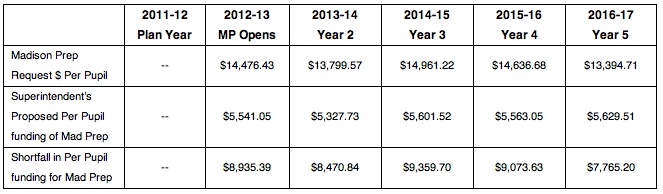
Recent headlines in the Wisconsin State Journal (WSJ) reported that Madison Prep is “less likely” to be approved because of the size of the school’s projected budget. The article implied that Madison Prep will somehow cost the district more than it currently spends to educate children. This, in fact, is not accurate. We are requesting $14,476 per student for Madison Prep’s first year of operation, 2012-2013, which is less than the $14,802 per pupil that MMSD informed us it spends now. During its fifth year of operation, Madison Prep’s requested payment from MMSD drops to $13,395, which is $1,500 less per student than what the district says it spends now. Madison Prep will likely be even more of a savings to the school district by the fifth year of operation given that the district’s spending increases every year.
A March 14, 2011 memo prepared by MMSD Superintendent Daniel Nerad and submitted to the Board reflects the Urban League’s funding requests noted above. This memo also shows that the administration would transfer just $5,541 per student – $664,925 in total for all 120 students – to Madison Prep in 2012-2013, despite the fact that the district is currently spending $14,802 per pupil. Even though it will not be educating the 120 young men Madison Prep will serve, MMSD is proposing that it needs to keep $8,935 per Madison Prep student.


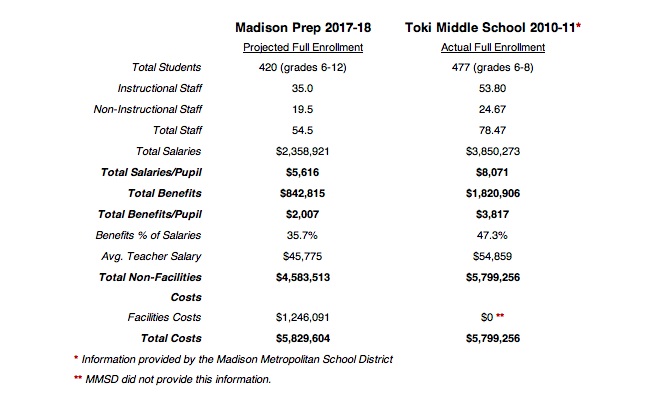
Therefore, the Urban League stands by its request for equitable and fair funding of $14,476 per student, which is less than the $14,802 MMSD’s administration have told us they spend on each student now. As Madison Prep achieves economies of scale, reaches its full enrollment of 420 sixth through twelfth graders, and graduates its first class of seniors in 2017-18, it will cost MMSD much less than what it spends now. A cost comparison between Madison Prep, which will enroll both middle and high school students at full enrollment, and MMSD’s Toki Middle School illustrates this point.


We have also attached four one-page documents that we prepared for the Board of Education. These documents summarize key points on several issues about which they have expressed questions.
We look forward to seeing you!
Onward!
Kaleem Caire
President & CEO
Urban League of Greater Madison
Main: 608-729-1200
Assistant: 608-729-1249
Fax: 608-729-1205
Website: www.ulgm.org


Kaleem Caire, via email.
Madison Preparatory Academy Brochure (PDF): English & Spanish.
DPI Planning Grant Application: Key Points and Modifications.
Update: Madison School Board Member Ed Hughes: What To Do About Madison Prep:

In order to maintain Madison Prep, the school district would have to find these amounts somewhere in our budget or else raise property taxes to cover the expenditures. I am not willing to take money away from our other schools in order to fund Madison Prep. I have been willing to consider raising property taxes to come up with the requested amounts, if that seemed to be the will of the community. However, the draconian spending limits the governor seeks to impose on school districts through the budget bill may render that approach impossible. Even if we wanted to, we likely would be barred from increasing property taxes in order to raise an amount equal to the net cost to the school district of the Madison Prep proposal.
This certainly wouldn’t be the first time that budgetary considerations prevent us from investing in promising approaches to increasing student achievement. For example, one component of the Madison Prep proposal is a longer school year. I’m in favor. One way the school district has pursued this concept has been by looking at our summer school model and considering improvements. A good, promising plan has been developed. Sadly, we likely will not be in a position to implement its recommendations because they cost money we don’t have and can’t raise under the Governor’s budget proposal.
Similarly, Madison Prep proposes matching students with mentors from the community who will help the students dream bigger dreams. Effective use of mentors is also a key component of the AVID program, which is now in all our high schools. We would very much like to expand the program to our middle schools, but again we do not have the funds to do so.

Mr. Hughes largely references redistributed state tax dollars for charter/virtual schools – a portion of total District per student spending – the total (including property taxes) that Madison Prep’s request mentions. I find Madison Prep’s fully loaded school based cost comparisons useful. Ideally, all public schools would publish their individual budgets along with total District spending.

Share

“Raise the Curtain!” – A project to renovate the theater at East High

Learn more here, via a Kathy Esposito email.

Share

GOP seeks to expand school voucher program

Matthew DeFour:

A Republican Assembly leader plans to add to the state budget bill an expansion of Milwaukee’s voucher program to other school districts, potentially giving more families in cities such as Madison access to private and religious schools.
Voucher advocates say the time is ripe to expand the program to other cities, especially with Republicans in control of state government and a recent study suggesting students in the 20-year-old Milwaukee program are testing as well or better than their public school counterparts, with a lower cost per pupil.
They also argue that vouchers would level the playing field for private schools, which have seen enrollment decline as public charter schools have gained popularity.
But voucher opponents say expansion would further cripple public schools, which already face an $834 million cut in state funding over the next two years.
And state test scores to be released Tuesday, which for the first time include 10,600 Milwaukee voucher students, could suggest they are testing no better than poor students in the Milwaukee Public Schools.
“Given the proposed unprecedented cuts to public education as well as results from our statewide assessments, I question plans in the 2011-13 state budget for expanding the choice program in Milwaukee or anywhere else in Wisconsin,” State Superintendent Tony Evers said.

Share

Video, Notes & Links: Wisconsin Senate Bill 22 Hearing

via a kind reader’s email:

Clusty Search: Wisconsin Senate Bill 22.

Share

Seattle’s Strategic Plan Refresh

Charlie Mas

The District is preparing a “Strategic Plan Refresh“. They will review the Strategic Plan and decide which projects to continue, alter, defer, or remove. The refresh will have to include goals, timelines, status, and budgets for each of the projects.
I spoke with Mark Teoh last night and asked if he could include two items in the Refresh program:
1) A record of the various projects in the Strategic Plan, including those that were originally in it, those that were added, those that were completed, and those that were simply dropped without notice. Remember how there was supposed to be an APP Review in the plan? Remember how there was going to be an alternative education review? These projects just silently faded away. At the same time, Capacity Management and World Language curricular alignment, which were not part of the original plan, have been added.
2) A review of the community engagement protocols and some table that shows which of the projects are meeting the requirements of the protocol (it’s easy – none of them).

Share

A Nation of Dropouts Shakes Europe

Charles Forelle:

Isabel Fernandes, a cheery 22-year-old with a constellation of stars tattooed around her right eye, isn’t sure how many times she repeated fifth grade. Two, she says with a laugh. Or maybe three. She redid seventh grade as well. She quit school with an eighth-grade education at age 20.
Ms. Fernandes lives in a poor suburb near the airport. She doesn’t work. Employers, she says, “are asking for higher education.” Even cleaning jobs are hard to find.
Portugal is the poorest country in Western Europe. It is also the least educated, and that has emerged as a painful liability in its gathering economic crisis.
Wednesday night, the economic crisis became a political crisis. Portugal’s parliament rejected Prime Minister JosĆ© Sócrates’s plan for spending cuts and tax increases. Mr. Sócrates handed in his resignation. He will hang on as a caretaker until a new government is formed.

Share

Why One Innovator is Leaving the Public Sector

Andrew Rotherham:

Lately you can’t turn around in education without bumping into someone talking about innovation. The President is asking Congress for more federal support for educational innovation in this year’s budget, more and more school districts are naming “innovation officers,” and just last week a group of Silicon Valley start-up veterans launched a new incubator for innovative education companies. But while innovation is a catchy buzzword, on the ground conditions are often anything but innovative. This week, the resignation of a school administrator in New York City who most readers have probably never heard of vividly illustrates that disconnect.
Joel Rose, 40, got his start teaching in Houston with Teach For America. After law school and a stint at Edison Schools, he landed at the New York City Department of Education leading a personnel strategy for that massive 1.1. million student system. Rose was struck, as many observers are, by how little technology had changed education relative to most other fields during the past few decades. So he started a program within the New York City Public Schools called “School of One” that uses technology to offer a completely customized schooling experience for each student.

Share

Why He Did It: For good reason, the Capitol exploded when Gov. Walker struck at collective bargaining: The Rise of Teacher Unions


Christian Schneider, via a kind reader’s email

By now, the political lore is familiar: A major political party, cast aside by Wisconsin voters due to a lengthy recession, comes roaring back, winning a number of major state offices.
The 43-year-old new governor, carrying out a mandate he believes the voters have granted him, boldly begins restructuring the state’s tax system. His reform package contains a major change in the way state and local governments bargain with their employees, leading to charges that the governor is paying back his campaign contributors.
Only the year wasn’t 2011 — it was 1959, and Gov. Gaylord Nelson had just resurrected the Democratic Party of Wisconsin. Certain of his path, Nelson embarked on an ambitious agenda that included introduction of a withholding tax, which brought hundreds of protesters to the Capitol. Nelson also signed the nation’s first public-sector collective bargaining law — the same law that 52 years later Gov. Scott Walker targeted for fundamental revision.
Two different governors, two different parties, and two different positions.
Ironically, their assertive gubernatorial actions may produce the same disruptive outcome. By empowering the unions, Nelson’s legislation led to public-sector strikes and work stoppages. By disempowering the unions, Walker’s actions might lead to public-sector strikes and work stoppages.
In Walker’s case, union members reluctantly agreed to his pension and health-care demands, but have fought desperately to preserve their leverage in negotiating contracts. That raises the basic question of the Madison showdown: Why is Scott Walker so afraid of collective bargaining?
The answer can be found in the rise of the state’s teachers unions.

Ripon Superintendent Richard Zimman:

Beware of legacy practices (most of what we do every day is the maintenance of the status quo), @12:40 minutes into the talk – the very public institutions intended for student learning has become focused instead on adult employment. I say that as an employee. Adult practices and attitudes have become embedded in organizational culture governed by strict regulations and union contracts that dictate most of what occurs inside schools today. Any impetus to change direction or structure is met with swift and stiff resistance. It’s as if we are stuck in a time warp keeping a 19th century school model on life support in an attempt to meet 21st century demands.”

Share

Not-so-public education: A Colorado school voucher program seems likely to benefit mostly middle-class students and religious schools.

Los Angeles Times

Supporters of school vouchers like to say that their goal is to provide a higher-quality education for the children who need it most. The latest events in Colorado say otherwise. A voucher program there seems more likely to benefit middle-class children and religious schools than low-income public school students, and to worsen inequities in education.
Last week, the board of the Douglas County School District voted for a pilot program that will give the parents of 500 of its 60,000-students about $4,500 each — 75% of what the district receives in per-pupil funding — to use toward tuition at participating private schools of their choice. Many of the private schools in the area are religiously based.
Even in Colorado, where a dollar stretches a lot further than in Southern California, $4,500 falls significantly short of private school tuition. Most schools there range from about $7,000 up to $14,000. Clearly, the parents poised to benefit most from this taxpayer-sponsored perk are those with a few thousand to spare to fill in the price gap. There might be scholarships for some of the needier students — about 10% of the Douglas County students qualify for free or reduced-price school lunches — but no one is promising anything.

Share

Hundreds attend, testify at legislative hearing on charter school changes

Susan Troller:

Testimony at the Capitol over a controversial bill that would strip control over charter schools from locally elected officials and place it in the hands of a politically appointed state-wide authorizing board drew hundreds on Wednesday to a standing-room-only Senate education committee hearing.
Senate Bill 22, authored by state Sen. Alberta Darling (R-River Hills) would also fund independent charter schools ahead of traditional public schools. I wrote about the bill on Tuesday and it’s generated a robust conversation.
Madison Superintendent Daniel Nerad testified in opposition to the bill, and so did local school board member Marjorie Passman. Kaleem Caire, president and CEO of the Urban League of Greater Madison and a strong proponent of the proposed boys-only Madison Preparatory Academy for minority students, testified in support of the bill. Madison Prep, if approved, will be a publicly funded charter school in Madison.

Share

A Win-Win Solution: The Empirical Evidence on School Vouchers

Greg Forster, Ph.D.

This report collects the results of all available empirical studies using the best available scientific methods to measure how school vouchers affect academic outcomes for participants, and all available studies on how vouchers affect outcomes in public schools. Contrary to the widespread claim that vouchers do not benefit participants and hurt public schools, the empirical evidence consistently shows that vouchers improve outcomes for both participants and public schools. In addition to helping the participants by giving them more options, there are a variety of explanations for why vouchers might improve public schools as well. The most important is that competition from vouchers introduces healthy incentives for public schools to improve.
Key findings include:

Share

Liberty School Board Candidate Profile

Kim Marie-Graham:

Fiscal Responsibility-The District has had the luxury of having sufficient resources to fund many non-essential expenditures. Our economy and funding levels have changed and will continue to do so going forward. The district must re-evaluate priorities. Significant cuts have been made to large ticket items but there is now work to do to improve the culture of fiscal responsibility. All decisions need to be made with an interest in doing what is best for the education of our children. If we can change the culture, we will be in a better position to afford the things we need to do, like pay our employees fairly.
Educating Our Children-The Liberty Public Schools have a long and proud history of excellence in education. It is essential that we continue to focus on our primary mission, the education of our children. We must ensure our financial resources are spent on classrooms, proven curriculum, books and employees. We must continue our high academic achievement by maintaining and re-establishing, where possible, the essential programs we have lost. As popular culture continues to call for school reform, we must ensure we are making decisions that will always lead to the right end goal, an excellent education for all of our children.

Share

Separate and Unequal

Bob Herbert:

One of the most powerful tools for improving the educational achievement of poor black and Hispanic public school students is, regrettably, seldom even considered. It has become a political no-no.
Educators know that it is very difficult to get consistently good results in schools characterized by high concentrations of poverty. The best teachers tend to avoid such schools. Expectations regarding student achievement are frequently much lower, and there are lower levels of parental involvement. These, of course, are the very schools in which so many black and Hispanic children are enrolled.

Share

Newark teachers protest charter schools’ use of public school buildings

Daniel Ulloa:

The Newark Teachers Union sent an email to its 4,800 members urging them to protest against the placement of charter school in underutilized public school buildings at an Advisory board meeting held tonight at Barringer High School.
According to the Wall St. Journal, Union President Joseph Del Grosso strongly objects to the placement of charter schools in public school buildings, claiming that some of the private funding that the Charter schools will make obvious the stark differences between the two types of schools.
The meeting will begin at 6 P.M. Tuesday, and staff, students, and parents are all being invited to voice their concerns.

Share

Georgia charter school ruling to reverberate across nation

A state Supreme Court opinion that will decide who has the power to fund and open public charter schools is expected by March 31, ending a constitutional challenge that threatens to derail the education of thousands of students.
The two-year legal battle launched by seven local districts over power, money and the exclusive right to open neighborhood schools has threatened Georgia’s reputation as a national leader in education reform.
The feud began in 2009 when the Georgia Charter Schools Commission, a state board, got into the business of approving and funding neighborhood schools such as Cherokee Charter Academy.
The school, which plans to open in the fall as Cherokee County’s first charter campus, received more than 1,300 applications for about 700 spots. It was denied twice by the Cherokee Board of Education.

Share

Republican bill calls for a board of political appointees to authorize charter schools

Susan Troller:

Under a Republican-sponsored bill, nine political appointees would get to authorize public charter schools while local school districts foot the bill. The creation of this state-wide charter school authorizing board — with members appointed by the governor and the leaders of the state Senate and Assembly — is a key provision of legislation authored by Sen. Alberta Darling of River Hills that will get a hearing on Wednesday at 10 a.m. at the Capitol before the Senate Education Committee.
Senate Bill 22 not only de-emphasizes local control, but also creates changes in how teachers are certified and removes caps from the numbers of students who may enroll in virtual schools. A companion bill is also pending in the state Assembly.
Opponents say the proposed changes would not only eliminate local control in favor of a new, politically motivated bureaucracy but would also siphon general aid away from all of Wisconsin’s 424 public school districts in favor of charters. But backers say it will remove current barriers that prevent charter schools from realizing their full potential.
“This bill would get rid of the charter school lite culture we currently have in Wisconsin and allow these schools’ full potential for autonomy, flexibility and innovation to be fully realized,” says John Gee, executive director of the Wisconsin Association for Charter Schools.

Related:
School Choice Wisconsin: Milwaukee residents favor school choice expansion

Share

Seattle School Board Policy: Criticize Privately, Praise Publicly

Charlie Mas:

At the recent School Board Retreat, the Board discussed a Governance and Oversight Policy that would define the Board’s job.
On page 18 of this 21 page document, is a section titled “Board-Superintendent Communications”. Under this section is this set of guidelines for communication between the Board and the superintendent:
Communications between the Board and the Superintendent will be governed by the following practices:

a. Exercise honesty in all written and interpersonal interaction, avoiding misleading information
b. Demonstrate respect for the opinions and comments of each other
c. Focus on issues rather than on personalities
d. Maintain focus on common goals
e. Communicate with each other in a timely manner to avoid surprises
f. Criticize privately, praise publicly
g. Maintain appropriate confidentiality
h. Openly share personal concerns, information knowledge and agendas
i. Make every reasonable effort to protect the integrity and promote the positive image of the district and each other
j. Respond in a timely manner to request and inquired from each other.

Share

Parent organizing meeting set in Dane County

TJ Mertz, via email:

Parents in Dane County have scheduled an event to update the public on Governor Scott Walkers’ devastating cuts to their children’s educational opportunities and to plan what they can do, together, to form advocacy groups and work for a better way. The event follows closely on the heels of a similar meeting in Greenfield, March 5, that saw over 400 people come together to plan the next step.
March 27, members of the Dane County School Board Consortium and WAES (http://www.excellentschools.org) will host a community meeting — “The Future of Public Education and A Call to Action” — at the Monona Grove High School Commons (http://www.mononagrove.org/mghs/), 4400 Monona Drive, Monona. The hoped-for outcomes of the event, which runs from 3 to 4:40 p.m., include an increased understanding of school funding in Wisconsin, alternatives to cuts in funding, and formation of community advocacy groups. For more information, call 608-217-5938 or go to http://www.excellentschools.org/events/2011/budget/dane_county_flier.pdf.

Share

A Teachers Education

Jerrianne Hayslett:

I can’t get that electrician out of my mind. He was so incensed at last week’s School Board meeting.
Shameful, he said, that South Milwaukee teachers, on average, make more than the average income of South Milwaukeeans. Shameful that the School Board had signed a new contract with teachers.
I don’t remember all the stats he reeled off, backed up with proof, he said, as he waved a sheaf of papers of god knows what along with his assertions. But the upshot was that the School District was paying its teachers way too much in relation to other school districts in the the state. Nevermind that South Milwaukee students’ high achievement rates reflect the high quality of teachers the district hires. Or maybe the electrician puts no value on high-achieving students. Warehousing kids to keep them out of parents’ hair during the day is OK?
Now, I really, really respect the work electricians do. They and plumbers and roofers do stuff I could and would never, never do or be able to do.
Neither would I be able to do what a teacher does. Even a kindergarten teacher. Or make that, most especially a kindergarten teacher. I’ve spend time in a kindergarten classroom–as a visitor. Believe me, I would last about 10 minutes if I had to be in charge of just wrangling a classroom of those children–adorable as they are–let alone actually have to teach them something.

Share

As Thomas Jefferson High School adds help for poor English skills, some Va. parents fume

Kevin Sieff:

As Northern Virginia became home to more immigrant families in recent decades, Fairfax County officials say they started programs to teach English as a second language at every school – about 200 of them. Except one.
The holdout was the region’s hallowed magnet school, Thomas Jefferson High School for Science and Technology, where many assumed that steep admissions standards rendered such a program for English language learners unnecessary.
But next year, at the behest of the school’s teachers, Thomas Jefferson – often called TJ – plans to hire its first instructor to cater to a growing number of students who thrive in math and science classes but sometimes struggle with English.
The decision to hire the half-time teacher has reinvigorated a debate about TJ’s mission – namely, how heavily the school’s admissions policy should favor math and science standouts over well-rounded applicants with superior reading and writing abilities.

Share

U.S. Is Urged to Raise Teachers’ Status

Sam Dillon via a Kris Olds’ email:

To improve its public schools, the United States should raise the status of the teaching profession by recruiting more qualified candidates, training them better and paying them more, according to a new report on comparative educational systems.
Andreas Schleicher, who oversees the international achievement test known by its acronym Pisa, says in his report that top-scoring countries like Korea, Singapore and Finland recruit only high-performing college graduates for teaching positions, support them with mentoring and other help in the classroom, and take steps to raise respect for the profession.
“Teaching in the U.S. is unfortunately no longer a high-status occupation,” Mr. Schleicher says in the report, prepared in advance of an educational conference that opens in New York on Wednesday. “Despite the characterization of some that teaching is an easy job, with short hours and summers off, the fact is that successful, dedicated teachers in the U.S. work long hours for little pay and, in many cases, insufficient support from their leadership.”

Share

Write About Why You are an Educator and a Proud Union Member

WJ Levay:

Those of you who are excellent teachers and who stand in solidarity with our unions are probably no stranger to the question, “Well, why are you involved with the union if you’re a good teacher?” It’s time for educators to stand up and answer that question loudly and clearly.
EDUSolidarity, a group of progressive educators, encourages you to explain how being a union member supports and enables you to be the kind of teacher that you are. Include personal stories if possible. Focus not only on your rights, but also on what it takes to be a great teacher for students and how unions support that.

Share

The Inevitable Wisconsin

Hans Moleman:

In the words of Young Frankenstein’s Inspector Kemp, “A riot iss an ogly think.” So is the Wisconsin shootout; ugly – but inevitable.
The unions had to be expecting a tough time with their new Governor Walker. No doubt they anticipated a difficult negotiation – “hard bargaining”, as the governor cut labor costs to balance the budget. Instead, they found themselves facing political forces who actually intend to put an end to them.
Unions have always decried every effort to rollback labor costs or union power as “union-busting.” Now their past rhetorical excesses have caught up with them, as they confront the real thing. (Cf “Wolf, the Boy who Cried…”)
At first it looked as if Walker was indeed bargaining hard. Rolling back pensions, increasing employee contributions, and making labor accept it as a compromise by agreeing not to end collective bargaining outright. And there would be the peace, as Don Barzini would say.
Well, gentlemen may cry “peace, peace,” but there is no peace. Before it could be seen if Walker was a “let’s make a deal” type, Democrats abandoned the state and the unions seized the Capitol to bully the governor and Republicans. They in turn found a parliamentary bypass and passed the bill to strip bargaining rights. The budget, with its real benefit reductions and budget cuts is still pending. But the unions appear to have used up most of their ammo, so their hopes cannot be high.

Share

Teachers must be evaluated by what students learn

Doug Lasken & Bill Evers:

Students in California public schools are not achieving at the levels they should. Too many students are unprepared for jobs or have to take remedial courses when they start college. In California, we judge student achievement through student scores on statewide tests. These tests assess how much students know about subject-matter content that is specified in an official set of state academic-content standards. Research has long shown that effective teachers are among the best ways to bring up student achievement. But in order to improve teaching effectiveness, it is helpful to know where the challenges are.
We’ve heard a lot in California recently about the move to factor student test scores from statewide standards-based tests into teacher evaluations. Yet did you know that for more than a decade, it has been the law in California to do just that?

Share

Teacher says debate has ignored a crucial issue: parents

Robert King:

Evan Camp’s frustration had built up to the point where he couldn’t shed it even by feverishly cleaning his house.
To him, all the talk about education reform seemed to be about punishing teachers, especially the part about tying teacher pay to test scores.
So Camp, a middle school science teacher in Greenwood, started jotting down thoughts as he cleaned one Saturday afternoon. Soon, he had enough material to write a tome for beleaguered teachers that would become an open letter to Gov. Mitch Daniels and state Superintendent of Public Instruction Tony Bennett.

Share

Vouchers advance in Pennsylvania and Washington, D.C.

The Wall Street Journal:

The U.S. is enjoying a new spring of education reform, with challenges to teacher tenure and “parent-trigger” for charter schools. So it’s natural that the mother of all school choice reforms–vouchers–is also making a comeback.
Last week a House committee voted to restore Washington, D.C.’s opportunity scholarship program, which lets kids in persistently failing schools attend a private school of the family’s choosing. Joe Lieberman is pushing similar legislation in the Senate, where it enjoys bipartisan support. The White House and teachers unions killed the program in 2009, despite clear evidence of academic gains.
Meanwhile, more states are realizing that true educational choice extends beyond charter schools. The most promising development is occurring in Pennsylvania, where a state-wide voucher bill supported by new Governor Tom Corbett is moving through the Republican-controlled legislature.

Share

Randi Weingarten scolds KIPP

Jay Matthews:

Yesterday afternoon I got a call from Randi Weingarten, president of the American Federation of Teachers. She was responding to my request for her union’s view of the charge that union rules might force KIPP to close its high-performing schools in Baltimore.
Weingarten was not happy. She unloaded the harshest assessment of KIPP, the nation’s best-known charter school network, and its dealings with her and her union I have ever heard from her.
She said KIPP is playing by its own set of rules. She said the network, with 99 schools in 20 states and the District, has undermined her repeated attempts to establish a relationship that would allow them to work together for the greater good of children and public schools.

Share

Proposed budget makes all-male charter school in Madison less likely

Matthew DeFour:

The chances the Madison School Board will approve an Urban League proposal for an all-male charter school geared toward low-income minorities are dwindling.
Madison Preparatory Academy would cost the district $1.1 million in 2012-13, its first year of operation. That would increase to $2.8 million by its fifth year, Superintendent Dan Nerad told the board last week.
“For each of these years, (the district) would be obligated to reduce programs and services to our existing schools to transfer this amount of money to Madison Prep,” Nerad wrote in a memo.
Some school board members said last week that Gov. Scott Walker’s budget proposal makes it less likely they will be able to support cutting other programs to find money for Madison Prep.

Share

Detroit Considers Turning 41 Schools Into Charters

Matthew Dolan:

The emergency financial manager of the Detroit Public Schools presented a plan Saturday to turn nearly one in every three schools into charter schools as part of a bid to save the district millions of dollars and prevent massive school closings.
The 41 schools selected for independent control currently enroll about 16,000 of the district’s 73,000 students and would operate as public school academies starting as soon as this fall. The district expects to release a list of the schools this week and solicit proposals for their transfer.
Recently the district led by a state-appointed manager overseeing a total of 142 schools has explored modeling Detroit on post-Katrina New Orleans, where a shrunken district was remade with mostly charter schools.
Robert Bobb, the emergency financial manager, said in a news release Saturday that the charter-school plan would reduce operating costs by $75 million to $99 million, but did not say over what period of time any cost savings would be realized.

Share

Just say no to voucher expansion

Barbara Miner:

Memo to all Wisconsin legislators. There is an easy way to prove you care about public education in Wisconsin. And it won’t cost a penny.
Just say no to Gov. Scott Walker’s proposed expansion of the Milwaukee voucher program providing tax dollars to private schools.
This may seem merely like a Milwaukee issue. It’s not. Voucher advocates have made clear for more than 20 years that their goal is to replace public education with a system of universal vouchers that includes private and religious schools.
The heartbreaking drama currently playing in Milwaukee – millions of dollars cut from the public schools while vouchers are expanded so wealthy families can attend private schools in the suburbs – may be coming soon to a school district near you.

Share

Judge Bars School Tax Increase in Kansas

Stephanie Simon:

A federal judge in Kansas on Friday ruled against a group of suburban parents who sought to put a property-tax increase on the ballot in order to raise funds for their public schools.
Kansas, like a handful of other states, caps the amount of money that local school districts can raise from property taxes, in an effort to enforce a rough parity in spending across the state. Parents in the Shawnee Mission School District, which serves mostly affluent suburbs of Kansas City, sued to lift that cap. They were opposed in court by Gov. Sam Brownback’s administration and a coalition of superintendents representing mostly poor and rural districts.
U.S. District Judge John W. Lungstrum dismissed the case on the grounds that the cap was a crucial and integral part of the state’s complex formula for distributing education funds in a manner meant to ensure that wealthy school districts don’t pull far ahead of poorer districts. “If the plaintiffs were to prevail on their claim that the cap is unconstitutional, the entire [school funding] scheme would be struck down,” Judge Lungstrum wrote.

Share

Emanuel: City (Chicago) needs more single-gender public high schools

Fran Spielman:

Chicago needs more public high schools in general — and more single-gender high schools in particular — to bolster student performance and stem an exodus of middle class families, Mayor-elect Rahm Emanuel said Friday.
During a town-hall meeting with Chicago high-school students, Emanuel blamed a “severe shortage” of high schools, in part, for an alarming, 200,000-person decline in the city’s population in the 2010 U.S. Census.
The mayor-elect said that nine out of ten students who apply for admission to Lane Tech High School are turned away. On the West Side, there are 14,000 students “ready to go to high school and only 7,000 slots,” he said.

Share

Will an expanded Wisconsin voucher program cost more or less?

Public Policy Forum:

Gov. Walker’s proposed 2011-2013 biennial budget calls for an expansion of the Milwaukee Parental Choice Program by repealing the enrollment cap, allowing private schools anywhere within Milwaukee County to participate, and expanding eligibility to all City of Milwaukee families by eliminating income limits.
During tough budget deliberations, it would be good to know whether the expanded choice program is likely to save or cost state taxpayers over the long run. Either is possible – taxpayers save if the students who join the expanded program otherwise would have been students at more costly public or charter schools and taxpayers lose if the new voucher users would have otherwise been free to the state as tuition-paying private school students.
There is a debate over the likelihood that the program will be able expand considerably, as capacity for new students in the county’s existing private schools appears constrained at this time. However, the debate so far has overlooked the fact that the proposed budget would allow new voucher users to be existing private school students starting in the 2012-13 school year. There is a real concern that the expanded program may, in fact, increase costs for the state over the long run by increasing the total number of Wisconsin K-12 students who receive state support for their education.

Share

A teacher weeps for the future of Wisconsin schools

Vikki Kratz:

The morning after the Republicans stripped me of my rights, I stood in the hallway of my school, watching my four-year-olds stream in. They gave me hugs. They ran up to show me things: a new shirt, an extra pretty hair ribbon, a silly band. They wanted to know if it was chocolate milk day. They pointed out that one of their classmates, who had been out sick for a few days, had come finally come back!
And for a little while, normalcy returned to our world. I had spent the evening before at the Capitol, in the crowd of thousands that pushed against the locked doors, demanding to be let in. I think I spent most of the night in shock – not only at how suddenly I could be deprived of everything I had worked for, but of how suddenly the country I thought I knew could become unrecognizable. I was standing with a crowd on the steps in front of the Capitol door when a police officer slammed it shut in our faces. I walked around the building until I found a spot where protesters had lowered a bathroom window. And I watched in disbelief as people began hoisting each other in through the open window, while dozens milled around them. “Ssssh,” they warned each other. Don’t make any noises that might attract the police.

Share

Memphis Suburbs Vow to Fight Schools Merger

Cameron McWhirter & Timothy Martin:

Officials in the suburbs of Memphis, Tenn., said Wednesday they would fight what they see as a shotgun marriage that joins its school system with that of the city, claiming the move will harm academic standards and increase bureaucracy.
City residents voted overwhelmingly Tuesday to merge its school system–the largest in Tennessee–with the system run by surrounding Shelby County. The two systems operate as separate entities and administrations, but draw money from the same county-wide tax-revenue base–rare for school districts.
The move by the Memphis schools, which still faces a federal lawsuit, has drawn the ire of suburban politicians.
“We will proceed, whether through legislative or judicial channels, to try to undo what we believe has been an ill-conceived and poorly executed plan to take over the Shelby County school system,” said David Pickler, chairman of the Shelby County school board.

Share

‘Insanity,’ ‘stupidity’ drive education reform efforts

Susan Troller:

A big crowd packed into the University of Wisconsin’s Memorial Union Theater on Tuesday night to hear education historian Diane Ravitch, considered one of the most influential scholars in the nation on schools.
In her talk, she ripped into Gov. Scott Walker’s budget, U.S. Secretary of Education Arne Duncan’s Race to the Top, the obsession with measuring student progress through high stakes testing, privatization of education through charters and vouchers and No Child Left Behind legislation that is closing schools and punishing teachers.
Her gloomy assessment of the current passion for “fixing” education and vilifying teachers is particularly striking because Ravitch herself is a former proponent of school testing and accountability and an early supporter of the No Child Left Behind legislation.

Share

Math Night a chance for kids, parents to learn, have fun

Pamela Cotant:

The teacher-run Math Night at Madison’s Olson Elementary was a chance for parents and children to play math games together, but there’s more to the event.
“The real reason behind it is to have families and kids think a little differently about math,” said Dawn Weigel Stiegert, instructional resource teacher at Olson.
At the recent second annual event, the activities focused on geometry, measurement and math facts/number work. Each area had games designed for different grade levels and chosen by the teachers to fit with math standards for the various grades. The games allow parents, who learned math differently when they were in school, to see the expectations at the different grade levels and how their children are learning math, Weigel Stiegert said.

Share

Who’s Trusting Who?

Charlie Mas:

This whole obsession with public trust had me perplexed.
Why would the District suddenly be all concerned about public trust? The District, at least for the ten years that I have been active at the District level, has never shown any interest in public trust. In fact, the District has shown a gleeful contempt for the public trust. Their trust message to the public was the line from Animal House: “You fxxxed messed up. You trusted us.”
Why, after successfully demonstrating for the past ten years that the District had no regard for the public trust, that the District didn’t need the public trust, and that the District didn’t particularly want the public trust, is the District suddenly interested in winning the public’s trust?

Share

Private-School Strivers Increase by 10%

Shelly Banjo:

In another sign that the city’s economic recovery is flourishing, demand for the city’s private schools increased by nearly 10% this year, according to new data to be released Monday.
The number of parents willing to spend upwards of $30,000 a year for elite private schools increased sharply last year, as the number of children who took the admission tests jumped to 4,668, according the Educational Records Bureau, which administers the tests.
The last time private schools saw this kind of increase was between 2006 and 2007, when the city’s real-estate market was in a frenzy, the stock market was at an all-time high and the number of students taking the admissions tests shot up by 12%. When the financial crisis hit in 2008, test takers dipped by nearly 2%; they fell by 5% in 2009.
“We had a banner year in 2007 with a surge in test takers, but where we are now even surpasses that jump,” ERB’s executive director, Antoinette DeLuca, said.

Share

Miami’s Education Success Story

Greg Allen

As the White House seized that job news yesterday, President Obama went to Miami. He was there to talk about an issue that has bipartisan support: Education reform. The president visited a Miami high school with an inspiring comeback story. NPR’s Greg Allen reports he was joined by a well-known Florida Republican: The former governor, Jeb Bush.
GREG ALLEN: There are many lessons to be learned from Miami’s Central High School: The first is that when there’s a president visiting, 600 students can make a lot of noise.
President BARACK OBAMA: It is good to be here today.
(Soundbite of cheering)
Mr. OBAMA: I’m excited.
ALLEN: Miami-Dade is the nation’s fourth-largest school district, and for many years Central was one of its worst high schools. A perennial underachiever, for years it consistently ranked as a failing F school. President Obama noted that in one survey only a third of students said they felt safe at school.

Share

Requiem for Multiculturalism

Noel Williams:

Stop the presses! The British, French and German heads of state agree on something: Cameron, Sarkozy and Merkel have all recently declared multiculturalism a failure.
Like the related dogma of diversity, multiculturalism is so deeply embedded in the lexicon of liberalism that it has become axiomatic. Proponents hold it so dear that the faintest doubt poses an existential threat.
With the stakes so high, agnostics face sanctimonious wrath: if you don’t believe in multiculturalism there is simply something wrong with you; maybe you’re even nuts. While I have reservations I think I’m basically sane, and I sure as heck hope the aforementioned world leaders are operating with a full deck.
It’s important to distinguish between diversity and multiculturalism, which are often lumped together in liberal orthodoxy. Diversity is inherently good; but multiculturalism too often leads to separation and resentment that foments extremism.

Share

Wisconsin School choice programs get boost in Walker budget

Matthew DeFour:

Gov. Scott Walker’s budget proposal calls for deep cuts in most areas of public education with one notable exception – public school choice programs.
In addition to steep reductions in school district funding, Walker’s budget calls for a 10 percent cut to grants for programs such as bilingual-bicultural education and 4-year-old kindergarten. It also retains current grant funding for special education and low-income students, despite projected growth in those populations.
Meanwhile, Milwaukee’s 20-year-old voucher program would receive $22.5 million more to accommodate 1,300 additional students. The growth would result from Walker’s proposal to remove the program’s income requirements and enrollment caps.
And independent charter schools would receive $18.4 million more over the biennium. Walker is projecting 600 additional students as his proposal would lift the state enrollment cap on virtual charter schools, allow the UW System’s 13 four-year universities to establish charter schools, and allow independent charter schools in any district in the state.

Share

Don’t forget the students when mulling what’s next for the Milwaukee Public Schools

Alan Borsuk:

So what will things look like the day after the Milwaukee Public Schools system collapses?
Or, if you prefer, what needs to be done to avoid finding out the answer to that question?
Are these serious questions or is all this the-MPS-world-is-ending talk exaggerated?
I only have a firm sense of the answer to one of those questions, and it’s No. 3: It probably won’t be this fall (although it might be). But, best as I can see, the system as we know it stands at the brink of a momentous functional breakdown.
There have been people in recent years who thought the best solution to the problems of MPS was to blow up the system and build something better.
OK, big talkers: Time to put up. What’s next?

Share

The Elephant in Portland’s Room

Caroline Fenn, Charles McGee and Doug Wells:

Monday evening, the Portland School Board will vote on a teacher contract that, once again, ignores the elephant in the room — Portland Public Schools’ failure to adequately educate low-income children and children of color. We encourage all Portland residents to read the contract and see what some would have us celebrate. School board members should explain what they’ve gained and what they’ve given up with this negotiation. The public deserves answers.
The district’s budget woes are real. But the bigger problem is that PPS time and again puts adult jobs and politics ahead of students’ learning and graduating. Our community and state pay a hefty price. With an overall graduation rate of 53 percent (31 percent for Hispanic, 44 percent for African American and 45 percent for poor children), our quality of life is being redefined right before our eyes.
On Dec. 20, the Black Parent Initiative, the Coalition of Black Men, Community & Parents for Public Schools, and Stand for Children asked the school district, school board and teacher association to eliminate barriers to recruiting and retaining excellent teachers and principals, and to better serve our students, in particular our students of color. Barriers exist in both the teacher contract and district policy. The Native American Youth and Family Center, Latino Network, the Asian Pacific American Network of Oregon, the Hispanic Chamber and a number of civic leaders soon joined with us.

Share

On School Choice

Patrick McIlheran:

Take the school John Norquist sent his son to when he was mayor of Milwaukee. It’s private because it bought into the decidedly non-mainstream Waldorf movement. The Norquist family obviously felt it was worth the tuition, which the mayor could afford.
The school also accepted children via Milwaukee’s school choice program, so poor children could attend. Who was left out? Children from families neither poor nor well-off, including children whose parents worked for Norquist as firefighters and cops.
This is one reason Norquist says Gov. Scott Walker is right to expand school choice. By letting in the middle class, said Norquist, Walker makes better options available to middle-income parents in Milwaukee.
Norquist swiftly adds that he agrees with nothing else Walker has proposed lately. The ex-mayor goes on at length that he believes Walker wrong to limit public-union bargaining power.
That said, he vigorously favors more school choice. Milwaukee has school choice for the middle class, only it amounts to moving out to somewhere that the public schools are good. “One of the reasons people leave the city is because they feel they don’t have good choices for their kids,” Norquist said. “This bill changes that.”

Share

n L.A. school board races, outside spending surpasses $2 million [Updated]

Howard Blume:

Outside political action committees continue to dominate the contests over four seats on the Los Angeles Board of Education, spending more than $2 million combined, according to city records.
[Updated at 2:45 p.m.: The candidate attracting the most independent spending is Luis Sanchez, who is running for the one open seat, in District 5, which spans Los Feliz, Silver Lake, Eagle Rock and the southeastern portions of L.A. Unified, including the cities of Huntington Park, Bell and South Gate.
Outside groups have spent more than $727,000 for or against Sanchez. Nearly $500,000 has come in to support Sanchez. The source of this money is fund-raising led by Los Angeles Mayor Antonio Villaraigosa and, separately, spending by Local 99 of the Service Employees International Union, which represents many non-teaching school district workers. The local teachers union, United Teachers Los Angeles, has spent about $260,000 for a campaign opposing Sanchez. It’s also spent more than $127,000 in support of Bennett Kayser, who is running against Sanchez.]

Share

Midwest union battles highlight debate over improving schools

Nick Anderson

The Republican faceoff with labor unions in the Midwest and elsewhere marks not just a fight over money and collective bargaining but also a test of wills over how to improve the nation’s schools.
Various GOP proposals to narrow labor rights, dismantle teacher tenure and channel public money toward private schools raise a question: Should states work with teacher unions to overhaul education or try to roll over them?
Like many Democrats, President Obama wants collaboration. He has preached teamwork with unions even as he pushes harder than any of his predecessors to get bad teachers out of schools and pay more to those who excel.
Here in Indiana, Gov. Mitch Daniels (R) shares many of Obama’s education goals. But Daniels, a possible 2012 presidential contender, and several of his Republican peers are pursuing reform through confrontation.

Share

Teachers Wonder, Why the Scorn?

Trip Gabriel:

The jabs Erin Parker has heard about her job have stunned her. Oh you pathetic teachers, read the online comments and placards of counterdemonstrators. You are glorified baby sitters who leave work at 3 p.m. You deserve minimum wage.
“You feel punched in the stomach,” said Ms. Parker, a high school science teacher in Madison, Wis., where public employees’ two-week occupation of the State Capitol has stalled but not deterred the governor’s plan to try to strip them of bargaining rights.
Ms. Parker, a second-year teacher making $36,000, fears that under the proposed legislation class sizes would rise and higher contributions to her benefits would knock her out of the middle class.
“I love teaching, but I have $26,000 of student debt,” she said. “I’m 30 years old, and I can’t save up enough for a down payment” for a house. Nor does she own a car. She is making plans to move to Colorado, where she could afford to keep teaching by living with her parents.

Whitney Tilson, via email:

This front page story in today’s NYT annoys the heck out of me because it’s missing one word in its title – it should read: “Teachers UNIONS Wonder, Why the Scorn?” The author presents NO evidence that Americans don’t cherish teachers other than a random placard and online comment. What Americans DO object to are unions using their enormous political influence to benefit their members while throwing kids under the bus – two great examples are the impossibility of firing even the most horrific teachers and doing layoffs purely by seniority. Checker Finn has it exactly right:

Chester E. Finn Jr., president of the Thomas B. Fordham Institute, a conservative-leaning education policy group, said the decline in teachers’ status traced to the success of unions in paying teachers and granting job security based on their years of service, not ability.
“They are reaping a bitter harvest that they didn’t individually plant but their profession has planted over 50 years, going from a respected profession to a mass work force in which everyone is treated as if they are interchangeable, as in the steel mills of yesteryear,” Mr. Finn said.

And why did the author quote the only young teacher in America who thinks it’s fair that he’s being laid off because he lacks seniority rather than doing it based on which teachers are best for kids? He could have easily quoted one of the Educators 4 Excellence teachers, for example:

Last month Mr. Tougher was notified that because of his lack of seniority, he will be laid off, or “excessed,” this year under the state’s proposed cuts to school aid. A union activist, he believes seniority-based layoffs are fair.
“The seniority part, I get that,” said Mr. Tougher, who is single. “While it would be a bummer if I were excessed for next year, that’s just how things go sometimes.”

Share

Madison Teachers, Inc. 2011 Candidate Questionnaire

1MB PDF, via a kind reader’s email:. Mayoral Candidate Paul Soglin participated and I found this question and response interesting:


What strategies will you introduce to reduce the 6000+ families who move in and out of Madison Public School classrooms each year?
In the last three years more children opted out of the district than all previous years in the history of the district. That contributed to the increase of children from households below the poverty line rising to over 48% of the kids enrolled.
To stabilize our enrollment we need stable families and stable neighborhoods. This will require a collaborate effort between governments, like the city, the county and the school district, as well as the private sector and the non-profits. It means opening Madison’s economy to all families, providing stable housing, and building on the assets of our neighborhoods.
One decades old problem is the significant poverty in the Town of Madison. I would work with town officials, and city of Fitchburg officials to see if we could accelerate the annexation of the town so we could provide better services to area residents.

Ed Hughes and Marj Passman, both running unopposed responded to MTI’s questions via this pdf document.

MTIVOTERS 2011 School Board Election Questionnaire
Please respond to each ofthe following questions. If you wish to add/clarifY your response, please attach a separate sheet and designate your responses with the same number which appears in the questionnaire. Please deliver your responses to MTI Headquarters (821 Williamson Street) by, February 17, 2011.
General:
If the School Board finds it necessary to change school boundaries due to enrollment, what criteria would you, as a Board member, use to make such a judgement?
Ifthe School Board finds it necessary to close a school/schools due to economic reasons, what criteria would you, as a Board member, use to make such a judgement?
If the School Board finds it necessary, due to the State-imposed revenue controls, to make further budget cuts to the 2011-12 budget, what criteria would you, as a Board member, use to make such a judgement?
IdentifY specific MMSD programs and/or policies which you believe should to be modified, re-prioritized, or eliminated, and explain why.
What should the District do to reduce violence/assure that proper discipline and safety (of the learning and working environment) is maintained in our schools?
Do you agree that the health insurance provided to District employees should be mutually selected through collective bargaining?
_ _ YES _ _ NO Explain your concerns/proposed solutions relative to the District’s efforts to reduce the “achievement gap”.
Should planning time for teachers be increased? If yes, how could this be accomplished?
Given that the Wisconsin Association of School Boards rarely supports the interests of the Madison Metropolitan School District, do you support the District withdrawing from the W ASB? Please explain your rationale.
From what sources do you believe that public schools should be funded?
a. Do you support further increasing student fees? _ _ YES _ _ _ NO
Do you support the Wisconsin Alliance for Excellent Schools’ (WAES) initiative to raise sales tax by 1% to help fund schools?
_ _ YES _ _ NO
Do you support class sizes of 15 or less for all primary grades? _ _ YES _ _ NO
Do you support:
a. The use of public funds (vouchers) to enable parents to pay tuition with tax payers’ money for religious and private schools?
_ _ YES _ _ NO
b. The expansion of Charter schools within the Madison Metropolitan School District? _ _ YES _ _ NO
c. The Urban League’s proposed “Madison Preparatory Academy for Young Men” as a charter school which would not be an instrumentality of the District?
_ _ YES _ _ _ NO
Do you agree that the usual and customary work ofteachers, i.e. work ofthose in MTI’s teacher bargaining unit, should not be performed by others (sub-contracted)?
_ _ YES _ _ NO List MMSD staff and Board member(s) from whom you do or would seek advice.
Is your candidacy being promoted by any organization? _ _ YES _ _ NO
If yes, please name such organization(s). Have you ever been employed as a teacher? If yes, please describe why you left the teaching profession.
Do you support the inclusion model for including Title 1, EEN and ESL students in the regular education classroom? Why/why not?
What grouping practices do you advocate for talented and gifted (TAG) students?
Aside from limitations from lack ofadequate financial resources, what problems to you feel exist in meeting TAG students’ needs at present, and how would you propose to solve these problems?
The Board ofEducation has moved from the development ofpolicy to becoming involved in implementation of policy; i.e. matters usually reserved to administration. Some examples are when it:
a. Decided to hear parents’ complaints about a teacher’s tests and grading. b. Decided to modifY the administration’s decision about how a State Statute should be implemented.
Do you believe that the Board should delegate to administrators the implementation of policy which the Board has created?
_ _ YES _ _ NO
Do you believe that the Board should delegate to administrators the implementation of State Statutes? _ _ YES _ _ NO
Do you support the Board exploring further means to make their meetings more efficient? _ _ YES _ _ _ NO
Do you support a merit pay scheme being added to the Collective Bargaining Agreement _ _ YES _ _ _ NO
If yes, based on which performance indicators?
Do/did/will your children attend private or parochial schools during their K-12 years? Ifno, and ifyou have children, what schools have/will they attend(ed)?
_ _ YES _ _ NO If you responded “yes”, please explain why your child/children attended private parochial schools.
Legislation
Will you introduce and vote for a motion which would direct the Wisconsin Association of School Boards to request the introduction and promote the passage oflegislation to eliminate the revenue controls on public schools and return full budgeting authority to the School Board?
_ _ YES _ _ _ NO
Will you introduce and vote for a motion to direct the Wisconsin Association of School Boards to request the introduction and promote the passage oflegislation to prohibit the privatization ofpublic schools via the use oftuition tax credits (vouchers) to pay tuition with taxpayers’ money to private or religious schools?
_ _ YES _ _ NO
Will you introduce and vote for a motion to direct the Wisconsin Association of School Boards to request the introduction and promote the passage of legislation which will maintain or expand the benefit level of the Wisconsin Family and Medical Leave Act?
_ _ YES _ _ _ NO
Will you introduce and vote for a motion to direct the Wisconsin Association of School Boards to request the introduction and promote the passage oflegislation which will increase the retirement formula multiplier from 1.6% to 2% for teachers and general employees, i.e. equal that of protective employees?
_ _ YES _ _ NO
Will you introduce and vote for a motion to direct the Wisconsin Association of School Boards to request the introduction and promote the passage of legislation which will forbid restrictions to free and open collective bargaining for the selection ofinsurance for public employees (under Wis. Stat. 111.70), including the naming ofthe insurance carrier?
_ _ YES
_ _ NO
Will you introduce and vote for a motion to direct the Wisconsin Association of School Boards to request the introduction and promote the passage of legislation which will guarantee free and open collective bargaining regarding the establishment of the school calendar/school year, including when the school year begins?
_ _ YES _ _ NO
Will you introduce and vote for a motion to direct the Wisconsiu Association of School Boards to request the introduction and promote the passage of legislation to forbid the work of employees organized under Wis. Stat. 111.70 (collective bargaining statute) to be subcontracted?
_ _ YES _ _ NO
Will you introduce and vote for a motion to direct the Wisconsin Association of School Boards to seek passage of legislation which will require full State funding of any State-mandated program?
_ _ YES _ _ NO
Will you introduce and vote for a motion to direct the Wisconsin Association of School Boards to seek passage oflegislation which will provide adequate State funding of public education?
_ _ YES _ _ NO
Do you support a specific school finance reform plan (e.g., School Finance Network (SFN), Wisconsin Alliance for Excellent Schools (WAES), Andrews/Matthews Plan)?
Why/why not? Your Campaign:
Are you, or any of your campaign committee members, active in or supportive (past or present) of the “Get Real”, “ACE”, “Vote No for Change” or similar organizations?
Name ofCampaign Committee/Address/Phone #/Treasurer. List the members ofyour campaign committee.

Share

Op-Ed: Rage Simmering Among American Teachers

NPR:

Education historian Diane Ravitch says the teachers on the front lines of labor rallies in Wisconsin reflect growing anger among educators nationwide. Teachers are sick and tired, she says, of being blamed for the ills of America’s public schools.
MARY LOUISE KELLY, host:
Now, as teachers started standing up in union protests in Wisconsin, Diane Ravitch sat down and wrote an opinion piece for CNN’s website titled “Why America’s Teachers are Enraged.” When Diane Ravitch looked at the teachers camping out at Wisconsin’s capital, she connected their demonstrations to what she says is a simmering rage felt among teachers across the country, an anger among educators who feel they’ve been unfairly blamed for everything that’s wrong with schools today. Within a few days, Ravitch’s article was a sensation on social media sites. She got 8,000 comments on Facebook.
We want to hear from teachers and parents, also students out there, about this issue. Do you feel that teachers are unfairly under attack, or do teachers need to rethink the way they do their jobs?

Share

Charter school effort stirs fight in N.Y. district

Fernanda Santos

The guests sipped wine and nibbled sushi, guacamole and Gruyere – lawyers, bankers, preschool teachers, managers and consultants of various kinds, bound together by the anxious decision they must confront in the months ahead: where their 4-year-olds will go to school in the fall.
Downstairs, a flyer by the doorman’s desk had greeted them with a provocative question: “Why should you have to spend college tuition on kindergarten?” Back upstairs, in the stylish apartment on West 99th Street, Eva S. Moskowitz, a former City Council member who runs a network of charter schools in Harlem and the Bronx, delivered a tantalizing sales talk.
“Middle-class families need options too,” she said.
But Moskowitz is trying to expand her chain into a whole new precinct of the city, the relatively well-off Upper West Side. And outside the parties she has organized to drum up interest, the reaction has been anything but warm from the neighborhood’s stridently anti-charter political establishment.

Share

Give public employees a stake in economic revival

Tom Still:

During his Tuesday night “fireside chat” about Wisconsin’s budget woes and his plan to dramatically curb the influence of public-sector unions, Gov. Scott Walker aptly referred to public employees as the state’s “partners in economic development.”
“We need them to help us put 250,000 people to work in the private sector over the next four years,” Walker told a statewide audience.
It was an important point, and it suggests a path out of Wisconsin’s nationally watched showdown between Walker, the Republican-led Legislature and the public-employee unions. Simply put, could public employees become fuller “partners” in Wisconsin’s economic revival if they had more skin in the game?
That question should be asked as the budget-repair bill moves to the Senate, where majority Republicans and boycotting Democrats should aspire to find at least a toehold of common ground.
The dominant private-sector view about unionized public employees is that they’re disconnected from the reality of the state and national economy. When times are good, public employees generally do well. When times are bad, most public employees still do pretty well, even if private-sector workers are taking pay cuts, benefit reductions or layoffs.
That view of insulated public employees isn’t limited to employers and non-unionized private workers. It is sometimes shared by the 7% of private workers who still belong to unions. It’s not uncommon to hear from workers in the auto industry or the construction trades who wonder why their fortunes ebb and flow with the economy, yet public-sector employees seem largely immune.

Share

Why America’s unions are not working any more

Christopher Caldwell:

During the holiday break this winter, a woman in my neighbourhood was at the supermarket with her son when they ran into the son’s teacher. “See you Monday,” the mother said. The teacher gaily informed her she would not be back until mid-month, as she had planned a vacation in Central America. Teachers used to content themselves with the months off they enjoy in summers and at holidays, but they have got used to more. One can understand why American public employees ardently defend their unions, and the benefits they win. But one can also understand why, in a time of straitened budgets, union-negotiated contracts might be among the first places to make savings.
A fierce budget battle has been running for more than a week in Madison, Wisconsin. It goes far beyond salaries and benefits, to touch on the deeper question of whether collective bargaining has any place in government employment. Governor Scott Walker, a Republican elected last autumn with support from the Tea Party movement, believes it does not. His “budget repair” bill not only requires state employees to contribute to their pension and health plans. It would also end collective bargaining for benefits. Democratic senators, lacking the votes to defeat the bill, fled the state, denying the quorum necessary to bring it to a vote.
Mr Walker is not making a mountain out of a molehill. Wisconsin has a $137m budget gap to fill this year and a $3.6bn deficit over the next two. The big year-on-year leap reflects, in part, the expiration of federal stimulus spending, much of which was used to avoid laying off government workers. Citizens of other advanced countries sometimes make the mistake of assuming that the US has a skeletal bureaucracy. That is wrong. Once you include state, county and city employees, it is a formidable workforce and an expensive one. State employees account for up to $6,000bn in coming pension costs. Wisconsin’s difficulties are milder than those elsewhere, which means that similar clashes are arising in other states, especially where Republicans rule.

Share

Former D.C. Schools Chief Aims To Put ‘StudentsFirst’

NPR:

It’s not only Republicans like Wisconsin Gov. Scott Walker and New Jersey Gov. Chris Christie who are challenging unions. When it comes to teachers unions, increasingly it’s Democrats like Michelle Rhee, the former chancellor of the public school system in Washington, D.C.
Rhee led the school district for almost three years. While she was there, she tied pay increases to merit rather than tenure and fired hundreds of teachers who she said were underperforming.
Those moves angered teachers unions across the country and made Rhee one of the most controversial figures in education reform. Now, she’s heading up an education advocacy group based out of Sacramento, Calif., called StudentsFirst. With it, she tells Weekend All Things Considered host Guy Raz, she hopes to create a powerful lobby to push for education reform.

Share

A Simple Approach to Ending the State Budget Standoff

Madison School Board Member Ed Hughes:

Here’s an idea for resolving the state’s budget repair bill crisis. Governor Walker’s budget repair bill is designed to eviscerate public employee unions. But with a few changes it could actually lead to an innovative and productive way of addressing the legitimate concerns with the collective bargaining process, while preserving the most important rights of teachers and other public employees.
Background: A Tale of Two Unions
First, some background that highlights the two sides of the issue for me as a member of the Madison School Board. Early on Friday morning, February 25, our board approved a contract extension with our AFSCME bargaining units, which include our custodians and food service workers. The agreement equips the school district with the flexibility to require the AFSCME workers to make the contributions toward their retirement accounts and any additional contributions toward their health care costs that are required by the budget repair bill, and also does not provide for any raises. But the agreement does preserve the other collective bargaining terms that we have arrived at over the years and that have generally worked well for us.
AFSCME has stated that its opposition to the Governor’s bill is not about the money, and our AFSCME bargaining units have walked that talk.
Our recent dealings with MTI, the union representing our teachers and some other bargaining units, have been less satisfying. Because of teacher walk outs, we have to make up the equivalent of four days of school. An obvious way to get started on this task would be to declare Friday, February 25, which has been scheduled as a no-instruction day so that teachers can attend the Southern Wisconsin Educational Inservice Organization (SWEIO) convention, as a regular school day.

Through a variety of circumstances, I’ve had an opportunity to recently visit with several Dane County (and Madison) businesses with significant blue collar manufacturing/distribution employment. In all cases, these firms face global price/cost challenges, things that affect their compensation & benefits. Likely reductions in redistributed State of Wisconsin tax dollars could lead to significantly higher property taxes during challenging economic times, if that’s the route our local school boards take.

Share

Unions brought this on themselves

David Blaska:

Let’s face it: Teachers union president John Matthews decides when to open and when to close Madison schools; the superintendent can’t even get a court order to stop him. East High teachers marched half the student body up East Washington Avenue Tuesday last week. Indoctrination, anyone?
This Tuesday, those students began their first day back in class with the rhyming cadences of professional protester Jesse Jackson, fresh from exhorting unionists at the Capitol, blaring over the school’s loudspeakers. Indoctrination, anyone?
Madison Teachers Inc. has been behind every local referendum to blow apart spending restraints. Resist, as did elected school board member Ruth Robarts, and Matthews will brand you “Public Enemy Number One.”
When then-school board member Juan Jose Lopez would not feed out of the union’s hand, Matthews sent picketers to his place of business, which happened to be Briarpatch, a haven for troubled kids. Cross that line, kid!
The teachers union is the playground bully of state government. Wisconsin Education Association Council spent $1.5 million lobbying the Legislature in 2009, more than any other entity and three times the amount spent by WMC, the business lobby.
Under Gov. Doyle, teachers were allowed to blow apart measures to restrain spending and legislate the union message into the curriculum. Student test scores could be used to determine teacher pay — but only if the unions agreed.
The most liberal president since FDR came to a school in Madison to announce “Race to the Top” grants for education reform. How many millions of dollars did we lose when the statewide teachers union sandbagged the state’s application?

Share

Chicago’s Urban Prep Academies Visits Madison: Photos & a Panorama

.
Students from Chicago’s Urban Prep Academies visited Madison Saturday, 2/26/2011 in support of the proposed Madison Preparatory IB Charter school. A few photos can be viewed here.
David Blaska:

I have not seen the Madison business community step up to the plate like this since getting Monona Terrace built 20 years ago.
CUNA Mutual Foundation is backing Kaleem Caire’s proposal for a Madison Prep charter school. Steve Goldberg, president of the CUNA Foundation, made that announcement this Saturday morning. The occasion was a forum held at CUNA to rally support for the project. CUNA’s support will take the form of in-kind contributions, Goldberg said.
Madison Preparatory Academy for Young Men would open in August 2012 — if the Madison school board agrees. School board president Maya Cole told me that she knows there is one vote opposed. That would be Marj Passman, a Madison teachers union-first absolutist.
The school board is scheduled to decide at its meeting on March 28. Mark that date on your calendars.
CUNA is a much-respected corporate citizen. We’ll see if that is enough to overcome the teachers union, which opposes Madison Prep because the charter school would be non-union.

Share

Seattle Times Fights Back Against Citizen Journalist

Melissa Westbrook:

Below is an e-mail from David Boardman of the Times. (I had not written to him; he sent this on his own.)
My take on this issue of whether the Times held this story back – I think it’s possible. I say that because of the issues that Charlie has raised, namely, that embedded in the Times’ story of the internal auditor’s resignation were many possible questions about Silas Potter.
That they were trying to get their facts right is good and admirable but it certainly took them a longer time than I might of thought given their resources. I’m a just one person, a citizen journalist so it is harder for me to press people I call for information. (However, that doesn’t stop me from calling. Hey, I just left Fred Stephens a message to give me a ring. I won’t hold my breath but it never hurts to ask.)
Here is my take on the issue of a conspiracy at the Times to cover the district and in particular, Dr. Goodloe-Johnson. Do I think the Times and the Alliance and Stand and the district all sat down in a room and said, “Here’s what each of needs to do to move forward what we believe is best for public education in Seattle.” No, I don’t think that ever happened. I don’t think even two of those groups got together in a room and said that.

Share

On teachers unions, the devil is in the details

Robert Maranto
:

Here are the fiscal facts. Unlike most employees, few Wisconsin teachers have to contribute more than marginally to their retirement and health care costs. My colleague Bob Costrell, who has done substantial work in Milwaukee, calculates that the city’s public school teachers get a remarkable package of benefits equal to 74% of salary, roughly double the normal benefits for workers calculated by the Bureau of Labor Statistics but in line with other Wisconsin teachers.
And that’s not all. By collective bargaining agreement, the Wisconsin Education Association Council has a lock on health insurance coverage for members, not necessarily a great service for teachers but a wonderful profit center for the union.
What explains this? As one who has served in government and taught public personnel management, the answers are three-fold, and in combination explain why allowing a broad scope for collective bargaining undermines transparency and, ultimately, democracy.
First, teachers unions play a big role in politics, meaning that, as Terry Moe writes in “Teacher Unions and School Board Elections” (published in a Brookings Institution book on school boards), “the fact that school boards are elected means that the teacher unions can actually participate in choosing – or even literally choose – the management they will be bargaining with.”
In the California school districts Moe studies, unions fund candidates and mobilize voters in (low-turnout) school board elections and often recruit the candidates. Unions thus control both sides of the collective bargaining table. Surveys of school board members suggest that business interests, in contrast, have little power.
I have not seen comparable research on Wisconsin, but I suspect similar dynamics.

Share

In Wisconsin’s long shadow, unions and tea partyers face off across US

Patrick Jonsson:

Protests sparked by a push from Wisconsin Republicans to gut collective bargaining for unions – in order to balance the state budget – continue to spread, with several state capitals witnessing vitriolic faceoffs between union protesters and tea party activists this week.
About 300 union protesters and about 100 tea party activists taunted one another in front of the gold-domed Georgia Capitol in Atlanta on Wednesday, in a scene echoing similar standoffs earlier in the week in Columbus, Ohio; Des Moines, Iowa; and Denver, Colo.
Meanwhile, deadlock continues in Madison, Wis., ground zero of the debate over public-sector union benefits and their impact on deficit-burdened state coffers. Democratic senators there have decamped for Illinois in protest – and to thwart a quorum for a vote on the union-targeting legislation. A similar episode is playing out in Indiana, where the state legislature is also controlled by Republicans.

Share

A Fund-Raiser Grown Wild

Shirene Saad:

The word “fund-raiser” evokes an image of endless speeches, bland evening gowns and even blander buffets, but Edible Schoolyard’s yearly benefit should veer a little more toward the wild side. With three fabulous hostesses (the food artist Jennifer Rubell, the fashion buyer Julie Gilhart and the 303 gallerist Lisa Spellman) and a storied downtown locale (the Odeon), the event promises to be more Studio 54 than Cipriani Ballroom. “It’s the kind of fund-raiser that I would love to attend, a fund-raiser that is not boring” says Rubell, just back from the opening of her “Engagement” show at the Stephen Friedman gallery in London. “My favorite women in the city will be there, including Lynn Wagenknecht” — the restaurant’s owner — “who came up with the idea.”
The $50 cover charge goes toward supporting Edible Schoolyard, the Alice Waters-founded organization that creates small farms in public schoolyards to reconnect children with the food-growing cycle. “I think kids should be exposed to the aesthetics of food from a very young age,” Rubell says. “And growing food is so exciting.”

Share

Madison School District preparing hundreds of teacher layoff notices

Matthew DeFour & Gena Kittner:

The Madison School District and others across the state are scrambling to issue preliminary layoff notices to teachers by Monday due to confusion over Gov. Scott Walker’s budget repair bill and the delay of the state budget.
Madison may issue hundreds of preliminary layoff notices to teachers Monday if an agreement with its union can’t be reached to extend a state deadline, school officials said Thursday.
The School Board plans to meet at 7 a.m. Friday in closed session to discuss the matter.
The Wisconsin Association of School Boards this week urged local school officials to decide on staff cuts by Monday or risk having potential layoffs challenged later in court.
“It’s hugely important and hugely upsetting to everyone,” said Craig Bender, superintendent of the Sauk Prairie School District, which will issue preliminary notices to 63 of its roughly 220 teachers. “It has a huge effect on how schools can function and how well we can continue to educate all kids.”
Bender said the preliminary notices reflected “a guess” about the number of teachers who could lose their jobs because the state budget has not been released.

Related: Providence plans to pink slip all teachers Due to Budget Deficit
Amy Hetzner & Erin Richards:

The first tremors of what could be coming when Gov. Scott Walker releases his 2011-’13 budget proposal next week are rippling through Wisconsin school districts, where officials are preparing for the worst possibilities and girding for fiscal fallouts.
“I’m completely nervous,” Cudahy School District Superintendent Jim Heiden said. “Walking into buildings and seeing teachers break into tears when they see you – I mean, that’s the level of anxiety that’s out there.”
For the past two weeks, protests in Madison have been the focus of a nation, as angry public-sector workers have descended on the Capitol to try to stop Walker’s proposal to roll back most of their collective bargaining rights, leaving them with the ability to negotiate only limited wage increases.
Next week, the demonstrations could move to many of the state’s 425 school districts, the first local entities that will have to hash out budgets for a fiscal year that starts July 1.

Susan Troller:

Gov. Scott Walker’s secrecy and rhetoric regarding his budget plans are fueling rumors and anxiety as well as a flurry of preliminary teacher layoff notices in school districts around the state.
In Dane County, the Belleville school board voted to send layoff notices to 19 staff members at a meeting on Monday. Both the Madison and Middleton Boards of Education will meet Friday to determine their options and if they will also need to send out layoff notices, given the dire predictions of the governor’s budget which will be announced March 1.
In Madison, hundreds of teachers could receive layoff notices, district officials confirmed. Superintendent Daniel Nerad called it an option that would provide “maximum flexibility under the worst case scenario” in an e-mail sent to board members Thursday evening.
Most districts are bracing, and planning, for that worst case scenario.

Share

Oakland teachers, shaping school reforms

Katy Murphy:

These days, it sure seems like a radical idea: asking teachers, rather than telling them, what’s needed to improve their schools.
It’s happening in Oakland, though. You can read more about the purpose and the early work of a largely teacher-led project, the Effective Teaching Task Force, here. The story ran over the weekend.
HOW TO GET INVOLVED: The task force makes a stop tomorrow (Wednesday) on its “Teachers Talking to Teachers” listening tour. This one is for high school and adult education teachers, and it takes place at 2 p.m. Wednesday in the gym of United for Success Academy (Calvin Simmons campus), 2101 35th Avenue. Another event, for pre-k through eighth-grade teachers, is scheduled on March 23, at the same time and place.
Want to represent your school at an Oakland teacher convention in Emeryville April 7-9? Delegate elections — two for each school — are scheduled to take place at faculty meetings the week of March 7-11.

Share

Pennsylvania’s Unaccountable Voucher Bill

Lawrence Feinberg:

In support of Pennsylvania’s Senate Bill 1, which would provide taxpayer-funded vouchers to private schools, voucher evangelists have been citing a report by the Foundation for Educational Choice, “A Win-Win Solution: The Empirical Evidence on How Vouchers Affect Public Schools.” However, a review of the report by the National Education Policy Center finds no credible evidence that vouchers have improved student achievement.
Located at the University of Colorado at Boulder, the National Education Policy Center aims to provide high-quality information on education policy. Its review found that the “Win-Win” report, “based on a review of 17 studies, selectively reads the evidence in some of those studies, the majority of which were produced by voucher advocacy organizations.
“Moreover, the report can’t decide whether or not to acknowledge the impact of factors other than vouchers on public schools. It attempts to show that public school gains were caused by the presence of vouchers alone, but then argues that the lack of overall gains for districts with vouchers should be ignored because too many other factors are at play.” The review goes on to note that “existing research provides little reliable information about the competitive effects of vouchers, and this report does little to help answer the question.”

Share

Detroit Schools’ Cuts Plan Approved

Matthew Dolan:

The state of Michigan approved a plan for Detroit to close about half of its public schools and increase the average size of high-school classrooms to 60 students over the next four years to eliminate a $327 million deficit.
The plan was submitted in January by Robert Bobb, Detroit Public Schools’ emergency financial manager, as a last-ditch scenario if the district couldn’t find new revenue sources, which it hasn’t so far. Final approval came after Mike Flanagan, the state superintendent of public instruction, cleared Mr. Bobb’s initial plan with some new requirements, including that the district not file for bankruptcy protection during Mr. Bobb’s remaining months in office.
The state approved the plan in a Feb. 8 letter, which the Detroit public-schools district released Monday.
Mr. Bobb said the deep cuts were necessary if the district hoped to be solvent again without additional state aid. But he said the strategy was ultimately ill-advised because it will likely drive even more students away, depriving the district of needed state funds, which Michigan apportions on the basis of enrollment.

Share

Back to school for kids, teachers — But back to normal? Not quite

Matthew DeFour & Gena Kittner:

Madison schools will open Tuesday for the first time in a week, but it won’t be just any other school day.
Civil rights icon the Rev. Jesse Jackson will greet East High School students over the loudspeaker in the morning. Students have made posters in support of their teachers. And classrooms likely will be buzzing with discussion over the four-day teacher walkout prompted by Gov. Scott Walker’s proposal to limit collective bargaining.
With that backdrop, district officials have been preparing principals and staff for what could be a dramatic day.
“We know that there’s a lot of emotion here and we need to recognize that there’s a lot of upset and upset in the parent community as well,” Madison Superintendent Dan Nerad said.

Meanwhile: Jesse Jackson to Address Madison East High School Students Tuesday.

Share

State Workers in Wisconsin See a Fraying of Union Bonds

AG Sulzberger & Monica Davey:

Among the top five employers here are the county, the schools and the city. And that was enough to make Mr. Hahan, a union man from a union town, a supporter of Gov. Scott Walker’s sweeping proposal to cut the benefits and collective-bargaining rights of public workers in Wisconsin, a plan that has set off a firestorm of debate and protests at the state Capitol. He says he still believes in unions, but thinks those in the public sector lead to wasteful spending because of what he sees as lavish benefits and endless negotiations.
“Something needs to be done,” he said, “and quickly.”
Across Wisconsin, residents like Mr. Hahan have fumed in recent years as tens of thousands of manufacturing jobs have vanished, and as some of the state’s best-known corporations have pressured workers to accept benefit cuts.
Wisconsin’s financial problems are not as dire as those of many other states. But a simmering resentment over those lost jobs and lost benefits in private industry — combined with the state’s history of highly polarized politics — may explain why Wisconsin, once a pioneer in supporting organized labor, has set off a debate that is spreading to other states over public workers, unions and budget woes.

Share

Ed Hughes on Madison Teacher Absences & Protest

Madison School Board Member Ed Hughes, via email:

It’s been a non-quiet week here in Madison. Everyone has his or her own take on the events. Since I’m a member of the Madison School Board, mine is necessarily a management perspective. Here’s what the week’s been like for me.
Nearly as soon as the governor’s budget repair bill was released last Friday, I had a chance to look at a summary and saw what it did to collective bargaining rights. Basically, the bill is designed to gut public employee unions, including teacher unions. While it does not outlaw such unions outright, it eliminates just about all their functions.
Our collective bargaining agreement with MTI is currently about 165 pages, which I think is way too long. If the bill passes, our next collective bargaining agreement can be one paragraph — way, way, way too short.
On Monday, Board members collaborated on a statement condemning the legislation and the rush to push it through. All Board members signed the statement on Monday evening and it was distributed to all MMSD staff on Tuesday.

Share

Unions vs. The Common Good

The Chicago Tribune via The Milwaukee Drum:

America’s labor movement can claim historic victories that have served the common good. Safer workplaces. Laws to protect children from workplace exploitation. The eight-hour workday. Those who are in unions can justifiably be proud of those and other accomplishments.
But how proud are they that the children of Madison, Wis., have missed school the last two days because so many of their teachers abandoned their classrooms and joined a mass demonstration? Joined a mass demonstration to intimidate the members of the Wisconsin Legislature, who are trying to close a $3 billion deficit they face over the next two years?
Wisconsin Gov. Scott Walker has demanded that state workers contribute roughly 5.8 percent of their wages toward their retirement. He wants them to pay for 12 percent of their health-care premiums. Those modest employee contributions would be the envy of many workers in the private sector.
Walker wants government officials to have authority to reshape public-employee benefits without collective bargaining. Walker wouldn’t remove the right of unions to bargain for wages.

Share

Former Monona School Board Member Mary Possin on Teacher Unions

Mary Possin

To the Monona Grove School Board,
The group of people in this school district who have sat across the bargaining table from the MGEA is rather small, and I am one of them. Bargaining with the MGEA was, hands down, the most bizarre and surreal trip through the looking glass I have ever experienced. I could drone on about a myriad of frustrations, but all else aside, I could never understand their complete and utter failure to realize the MG school board was not only not their enemy, but we also lacked the statutory power to improve their wages and benefits. While we could partake in rearranging the deck chairs on our own little Titanic, purchasing additional life boats was not within our power. Simply put, they directed a whole lot of energy toward a group who was essentially powerless all the while engaging in job actions that did little but harm students, demoralize many of their own members and generate ill will among the public. At times my own children were targeted, so please understand what I say next comes within this context.

Share

Why do great school systems fear charters?

Jay Matthews:

I admire the erudite and public-spirited members of the Montgomery County Board of Education. Their superintendent, Jerry D. Weast, is one of the best in the business, a national leader with a smart staff.
So why are they so frightened of two little charter schools?
The Maryland State Department of Education shares my puzzlement. It looked carefully at the two most recent Montgomery charter applicants, Global Garden Public Charter School and Crossway Montessori Charter School, and promised them a $550,000 grant each once they got their charter approved. The charter groups had fresh ideas, energetic supporters and experienced educators, including two members of the Global Garden board who worked in Montgomery schools.
That was not enough to quell the fears of Weast’s staff and an assortment of internal and external advisers. Weast’s nine-page summary of their worries reads like a neurotic mother’s letter to her son at summer camp, bemoaning all the terrible things that might happen to him.

Share

Milwaukee & Madison Public Schools to be Closed Monday, 2/21/2011 Due to Teacher Absences

Tom Kertscher:

Milwaukee Public Schools is closed Monday for Presidents Day, according to a statement on the home page of the district’s website.
Superintendent Gregory Thornton said in the statement he wants to “assure families that we intend to have classes on Tuesday as scheduled.”
The home page also includes a “fact sheet for families” about the demonstrations in Madison. It says MPS closed schools Friday because more than 1,000 MPS teachers attended the demonstrations. Another day of school will be added to make up for Friday, and teachers who were absent without leave face possible disciplinary action ranging from pay deductions to termination, according the fact sheet.
Members of the Milwaukee Teachers’ Education Association union plan to participate in demonstrations in Madison on Monday.
The Madison Metropolitan School District, which was scheduled to be open for Presidents Day, will close because of “substantial concerns about significant staff absences,” according to a statement issues Sunday evening by the district.
However, classes are scheduled to resume Tuesday because the district “received assurances” that teachers would return then, the statement said.

Share

The standoff in Madison and the fallout for 2012

Craig Gilbert:

The explosive budget debate in Madison, like the explosive budget debate in Washington, is setting the table for 2012.
Part of the same struggle, the two battles are now feeding off each other, defining the parties and a broader political argument that both sides hope to somehow “settle” in the next election.
Some political consequences of the stand-off in Wisconsin are hard to predict, such as which side will win the fight for public opinion and where else the battle will “spread.”
Others are more immediate. One obvious consequence of Gov. Scott Walker’s push to curtail bargaining rights for public employees is the fire he has lighted under Democrats, labor and the left. While there are many ways the issue could play out over the coming months, this fact alone has significance for 2012, since by any measure Democratic voters were less motivated in 2010 than their GOP counterparts.
“Gov. Walker has done more to galvanize progressives and working people than anyone possibly could have done … By going at people’s throats and trying to destroy their rights, he has not only galvanized people in Wisconsin but across the country,” former Democratic Sen. Russ Feingold said in an interview Thursday, a day after launching a new political action committee.

Share

Grand jury: We would abolish inept School Board

Megan O’Matz:

A statewide grand jury investigating the Broward School District issued a scathing final report Friday evening, saying there was evidence of such widespread “malfeasance, misfeasance and nonfeasance” by school board members and senior managers alike that only “corruption of our officials by contractors, vendors and their lobbyists” could explain it.
Leadership in the district is so lacking, the jurors said, they would move to abolish the whole School Board if only the state constitution would allow it.
The panel met in secret for a year, reviewed hundreds of documents and took widespread testimony reaching from past and current School Board members to school principals and secretaries. The conclusion: The district suffers from “gross mismanagement and apparent ineptitude” on a grand scale.

Share

Panoramas from Pro-union, Tea Party rallies at the Wisconsin Capitol


Click on the images above to view the full screen panoramas on mac/pc/iPhone/iPad and Android devices. Look for one or two more panoramas tomorrow.


I’ve posted a number of still images, here.
Many Madison residents went about their weekend as always, including the ice fisherman captured in this scene (look closely for the eagle):

Share

Average Milwaukee Public Schools Teacher Salary Plus Benefits Tops $100,000; Ramifications

MacIver Institute:

For the first time in history, the average annual compensation for a teacher in the Milwaukee Public School system will exceed $100,000.
That staggering figure was revealed last night at a meeting of the MPS School Board.
The average salary for an MPS teacher is $56,500. When fringe benefits are factored in, the annual compensation will be $100,005 in 2011.
MacIver’s Bill Osmulski has more in this video report.

Related Links:

Finally, the economic and political issue in a nutshell: Wisconsin’s taxbase is not keeping up with other states:

Share

The Wisconsin Teachers’ Crisis: Who’s Really to Blame?

Andy Rotherham:

On Tuesday, Feb. 15, Secretary of Education Arne Duncan convened hundreds of teachers’-union leaders and school-district leaders in Denver to discuss ways management and labor could work together better. Kumbaya!
Two days later, all hell broke loose in Madison, Wis. The flash point was Republican Governor Scott Walker’s plan to address the state’s budget gap by making public employees contribute more to health care coverage, coupled with a proposal to eliminate collective bargaining for most public employees — including teachers. Democratic state legislators went into hiding to thwart a vote on the measure, and schools closed as thousands of teachers left their classrooms to descend on the state capital.
The two episodes vividly illustrate the hope — and the reality — of labor-management issues in education today. As Madison becomes ground zero for the debate over government spending and public-sector reform, some hard questions are getting lost in political theatrics and overwrought rhetoric. Here are questions Wisconsin’s governor, labor leaders and President Obama should have good answers for but so far don’t:

Share

Reno’s IB High School

Wooster IB High School: Reno, NV

# Design and implement strategies to meet high expectations while providing the support necessary to maintain student engaegment. (RIGOR)
# Embrace the teaching and learning of the core academic skills that build on foundations, connect to real-world applications, and ensure success beyond the classroom. (RELEVANCE)
# Encourage individuals to be self-advocating and responsible by promoting a positive, safe and accepting environment. (RELATIONSHIPS)
# Act with integrity and honesty, with a strong sense of fairness and high expectations for the diginty of the individual, group and community. (RESPECT).

Wooster’s website includes a course syllabus.

Share

Nampa police: Idaho Superintendent of Public Instruction Tom Luna threatened, vehicle vandalized

Idaho Press Tribune:

Idaho Superintendent of Public Instruction Tom Luna’s vehicle was vandalized overnight at his Nampa home and he and his family have received threats, he told police.
“Yes, he has made us aware of threats to him and family members and we are looking into those, and we are aware of those, and we are doing what we can to provide protection,” Nampa Police Deputy Chief Craig Kingsbury said.
On Saturday night, a man who identified himself as a teacher reportedly showed up at Luna’s mother’s home in Nampa in order to speak with her about the superintendent’s contentious education reform plan. Luna happened to be at his mother’s house at the time, Department of Education spokeswoman Melissa McGrath said.
“The man was very angry… the superintendent did feel threatened,” she said. The man eventually left after Luna spoke to him for several minutes. Luna told the man it was an inappropriate place and time, and later filed a police report, McGrath said.

Share

Madison Superintendent Nerad calls on teachers to return to classroom

Gena Kittner:

Madison School District superintendent Dan Nerad called on teachers late Thursday to end their protest and return to the classroom.
“These job actions need to end,” Nerad said in an e-mail to families of students. “I want to assure you that we continue to examine our options to more quickly move back to normal school days.”
Madison schools are closed Friday for a third straight day. Nerad also apologized for the closures.
On Thursday, state and Madison teachers union leaders urged their members to report to the Capitol on Friday and Saturday for continued protests against Gov. Scott Walker’s collective bargaining proposal.
“Even though the Madison School District can only react to the group decisions of our teachers, I apologize to you for not being able to provide learning for the last three days to your students,” Nerad said.

Related: Judge denies Madison School District request to stop teacher sick-out and “Who Runs the Madison Schools?

Share

On The Recent Madison Events

Jackie Woodruff, via email:

For the last five years Community and Schools Together (CAST) has worked hard to assure that students in Madison and around the state have access to excellent educational opportunities. With you, we have been amazed by the events at the Capitol this week. The massive outcry is justified. The radical changes contained in Governor Walker’s so-called budget repair bill will harm education and the future of our state.
The bill takes several unnecessary steps, such as limiting a union’s ability to collect dues. These steps have no relevance to budget repair, but are instead about damaging union effectiveness.
Making public education work relies on trust and partnership. Despite Wisconsin’s strong record on public education and despite all the benefits our communities receive from public education, Gov. Walker has decided to break trust and partnership with WEAC and other unions. In so doing, he has unnecessarily broken the state’s relationship with teachers. The outcry has been mobilized by the broad assaults to organized labor, but they are marked most visibly by the many teachers, parents, and students who have provided the core and bulk numbers to the strong protests.
We support the protests and are against the bill. The bill damages our ability as a community to improve our schools. The bill takes an existing, deficient educational policy regarding school funding, leaving caps and constraints on school boards to raise revenues locally, but denies collective bargaining – one of the key measures that was needed to form the original policy. We believe the net effect is extremely damaging to education – destroying a climate of trust and good will that has served as a cornerstone of the collective bargaining process. We may pay less in taxes, but teachers, classrooms and students will suffer.
Quality teachers are essential to quality education, removing their right to bargain collectively demonstrates great disrespect for their contributions and will make it more difficult to attract and retain the quality teachers our children need.
CAST, instead, welcomes reasonable and rational debate on educational funding and policy. We believe that policy should allow collective bargaining, equity, and the opportunity for community involvement to answer critical funding needs schools may have – given the likelihood that the state is unable to fund them appropriately.
CAST also calls for the safety of protesters and for those working to protect public safety at the Capitol. We ask Governor Walker and others responsible for state leadership to open debate, to seek to find rational budget policies that best represent the communities they serve. We look forward to our teachers and students returning to the classrooms, where together they create the foundation for Wisconsin’s future.
Submitted by Jackie Woodruff
Treasurer of CAST
Education is not the filling of a pail, but the lighting of a fire — William Butler Yeats

Share

DNC/Organizing for America playing role in Wisconsin protests

Ben Smith:

The Democratic National Committee’s Organizing for America arm — the remnant of the 2008 Obama campaign — is playing an active role in organizing protests against Wisconsin Governor Scott Walker’s attempt to strip most public employees of collective bargaining rights.
OfA, as the campaign group is known, has been criticized at times for staying out of local issues like same-sex marriage, but it’s riding to the aide of the public sector unions who hoping to persuade some Republican legislators to oppose Walker’s plan. And while Obama may have his difference with teachers unions, OfA’s engagement with the fight — and Obama’s own clear stance against Walker — mean that he’s remaining loyal to key Democratic Party allies at what is, for them, a very dangerous moment.
OfA Wisconsin’s field efforts include filling buses and building turnout for the rallies this week in Madison, organizing 15 rapid response phone banks urging supporters to call their state legislators, and working on planning and producing rallies, a Democratic Party official in Washington said.

Share

An Email From Russ Feingold’s New PAC

Russ Feingold’s Progressive’s United, via email:

Jim,
You’ve probably seen it all over the news this week: Your neighbors across Wisconsin are standing up and speaking out against the outrageous push by Governor Walker and Republican legislators – backed by big business — to strip public workers of their collective bargaining rights.
I went on the Rachel Maddow Show Wednesday night to talk about what the protests this week in Wisconsin mean for our state and our country – and how our new grassroots organization, Progressives United, is joining the fight.

Watch the video of my appearance with Rachel Maddow now
— and get information about joining a Wisconsin rally in your neck of the woods:

(more…)

Share

NJ education chief: Overhaul teacher tenure, pay

Geoff Mulvihill:

New Jersey’s acting education commissioner on Wednesday unveiled a plan to overhaul the way teachers are evaluated — and the consequences of poor evaluations.
Under the concept unveiled by Christopher Cerf, many key decisions about teachers — including whether they receive lifetime tenure protections, how big their raises are and which ones are laid off when budgets are slashed — would be based largely on how much their students progress.
Cerf said making the changes are essential to improving schools in New Jersey, where the public education system by many measures is among the best in the nation — but with a serious caveat. Schools in the state’s impoverished cities generally perform poorly — and at great expense.

Share