School Information System

Ruth Robarts: Cole is just what the School Board needs

Dear Editor: My ten years on the Madison School Board have convinced me that the board’s highest priorities must be new ideas and new community partnerships. Maya Cole gets my vote for Seat 5 because innovation is her top priority and she has the energy to bring the community together to plan for the future.
As a community and school activist, Maya has learned to listen and build consensus. She is an independent and original thinker at a time when the board needs exactly that.
Inadequate state and federal funding for public schools and overreliance on residential property tax revenues are very significant problems. However, we cannot postpone innovation until those problems are solved.
We must start today by encouraging innovative programs, including charter schools, and enlisting business and community allies in new funding partnerships. We must evaluate curriculum in ways that are understandable and be willing to change when the student results are not as promising as we had hoped.
Together we must envision a high-achieving, stable school system in 2020. A shared vision of the future of our schools will help us agree on the changes necessary at the state and federal level as well as the changes necessary here and now.
Maya Cole understands innovation and can provide critical leadership during these difficult times. Please join me in voting for her.
Ruth Robarts, Member, Board of Education, Madison
A letter to the editor

Share

Hasty Vote Wisely Avoided

“If we’re going to do it, we’re going to do it right,” board member Lucy Mathiak argued for the majority of the board in rejecting longtime board member Carol Carstensen’s push for the referendum.
School Board Member Mathiak has also detailed a number of options other than closing near eastside schools, which she does not support.
WI State Journal Editorial

Share

An open letter to the Superintendent of Madison Metropolitan Schools

Dear Mr. Rainwater:
I just found out from the principal at my school that you cut the allocations for SAGE teachers and Strings teachers, but the budget hasn’t even been approved. Will you please stop playing politics with our children education? It?s time to think about your legacy.
As you step up to the chopping block for your last whack at the budget, please think carefully about how your tenure as our superintendent will be viewed a little more than a year from now when your position is filled by a forward-thinking problem-solver. (Our district will settle for no less.)
Do you want to be remembered as the Superintendent who increased class size as a first step when the budget got tight? Small class size repeatedly rises to the top as the best way to enhance student achievement at the elementary level. Why would you take away one of best protections against federal funding cuts mandated by the No Child Left Behind Act? Rather than increase pupil to teacher ratios, have you checked to see if the pupil to administrative staff ratio has been brought closer to the state-wide average? (In 2002, Madison Metropolitan schools were at 195 children per administrator; the rest of the state averaged 242 children per administrator.) Have the few administrative openings you?ve left unfilled over the past few years actually brought us into line with the rest of the state?

(more…)

Share

Some interesting insight into another district’s budgeting process, knowledge, and challenges.

Shane Samuels:

There are those who like to work with numbers, and then there are those who figure school budgets. They’re not necessarily the same person.
School finance consists of a labyrinth of property values, student enrollment totals, federal aid, and state aid. Only two people in Chetek claim to understand the funding formula from top to bottom: Superintendent Al Brown and business manager Tammy Lenbom.
A couple times of year their budgetary work catches the public’s eye – once in September when it comes time to pass the budget at the annual meeting, and once about this time of year when Brown and Lenbom propose that budget for next fall.
The budget proposal period is more visible, because that is when we find out how those financial decisions will affect people’s lives – teachers who may be forced to look for new jobs, or students who might have their favorite class offering taken away from them.
While it takes a professional to explain a school budget line item by line item, this article is an attempt to at least summarize how school administrators and the school board reach their budgetary decisions, as well as detailing some of the struggles they face.
The timetable

(more…)

Share

Linda Martin Files Suit Against the MMSD

COMPLAINT [67K PDF] HAS BEEN FILED AGAINST MADISON METROPOLITAN SCHOOL DISTRICT IN THE UNITED STATES DISTRICT COURT FOR THE WESTERN DISTRICT OF WISCONSIN
Linda Martin, Plaintiff v. Madison Metropolitan School District and District officials Roger Price, Renee Bremer, Mary Teppo and Donna Williams, Defendants.
The District was Ms. Martin’s employer. Ms. Martin received a right to sue letter from the Equal Employment Opportunities Commission. Allegations include “bid rigging;” discrimination during a hiring process; denial of free speech rights; harassment; wrongful discharge; and intentional violation of federal law.
Susan Troller: School District Sued for Harrassment.

(more…)

Share

Cole endorsement was right on money

The Cap Times carried the following letter to the editor:

Dear Editor: I am supporting Maya Cole for Seat 5 of the Madison School Board.
The Capital Times was right in endorsing her candidacy. Her work ethic, thoroughness and openness to new ideas make her an ideal candidate. The school district is facing many tough issues, the most pressing being whether the elected School Board actually sets policy for the district or whether it merely acts as a rubber stamp for the administration and the teachers union.
Maya has shown a willingness to consider all points of view before making a decision and will be a thoughtful addition to the board.
While Maya and I probably do not agree on much regarding partisan politics, I feel confortable with her being on the School Board. Decisions regarding our children cannot be made based on political considerations and I believe that Maya Cole will leave politics at the door when making decisions about our schools.
Maya is giving us an opportunity to take back our schools and I urge everyone to vote for her on Tuesday.
John S. Pinto
Madison

Share

MMSD, MTI and Health Insurance – A Clarification

There seems to be some confusion about the negotiations between MTI and the school district. The Board WILL be negotiating health insurance with MTI; the Board has NOT taken health insurance off the table. The Voluntary Impasse Agreement (VIA) does NOT eliminate this as a subject of negotiation. The VIA DOES set up a structure for negotiations: a schedule, agreement by MTI that teachers will not engage in job actions, dates for the start of mediation if a settlement hasn’t been reached, name of the mediator, a date for binding arbitration if mediation is not successful and name of the arbitrator. IF no voluntary settlement is reached and we go to binding arbitration, MTI agrees that it will not propose a change to the salary schedule and the Board agrees not to change health insurance. Those agreements are meant to make binding arbitration less attractive to both sides – and to put the emphasis on reaching a voluntary agreement.
Because the Board has not yet provided MTI with our proposals I cannot discuss them in public. I can however talk about the settlement we have reached with our custodians who are represented by AFSCME. The custodians agreed to change their health insurance to a choice of 3 HMO’s (Group Health, Physicians Plus and DeanCare). The savings from this change allowed a greater salary increase (2.5%). A small amount of the savings ($15,000) went back to the budget. These savings are realized only in the first year – thereafter, the base for figuring future costs uses the lower health insurance costs.
One of the most dramatic changes of the last 5 years (and one that has been little noted) is the movement of teachers from WPS to Group Health. This year more than 50% of the teacher’s unit take Group Health Insurance – the lowest priced HMO in the community.
A more complete discussion of this issue can be found at: http://www.madisonamps.org/component/option,com_jd-wp/Itemid,31/p,51/
Carol Carstensen

Share

Board needs Cole and Thomas

Our schools need a new School Board majority, one committed to open government, including transparent budgeting and decision-making, and accountability to the community.
The next board will also hire the new superintendent and handle his or her performance evaluation, something Superintendent Art Rainwater has had little of from the current majority.
We stand at a crossroads with this election. Will it be more of the same top-down, teachers union-directed governance, or independent, open-minded, responsive representation?
There are many good issues-based reasons to vote for Maya Cole and Rick Thomas, but concerns for fair process and superintendent selection stand out for me.
It will take electing them both to gain that new majority.
– Joan Knoebel, Madison
http://www.madison.com/wsj/home/opinion/readersviews/index.php?ntid=127085&ntpid=1

Share

Unions pump funds to Passman

According to the last campaign finance report available on this blog, these teachers’ unions contributed to Marj Passman’s campaign:

$1,560 – MTI Voters
$250 – United Northeast Educators, Green Bay
$250 – Green Bay PAC (Green Bay Education Association)
$500 – Wi Ed. Assoc. Council Fox Valley PAC
$200 – Children’s Great School Fund (WEAC’s conduit)

Share

Can Reading Recover?

A consultant to the National Reading Panel blogs about “…the perfect storm in reading.”

Share

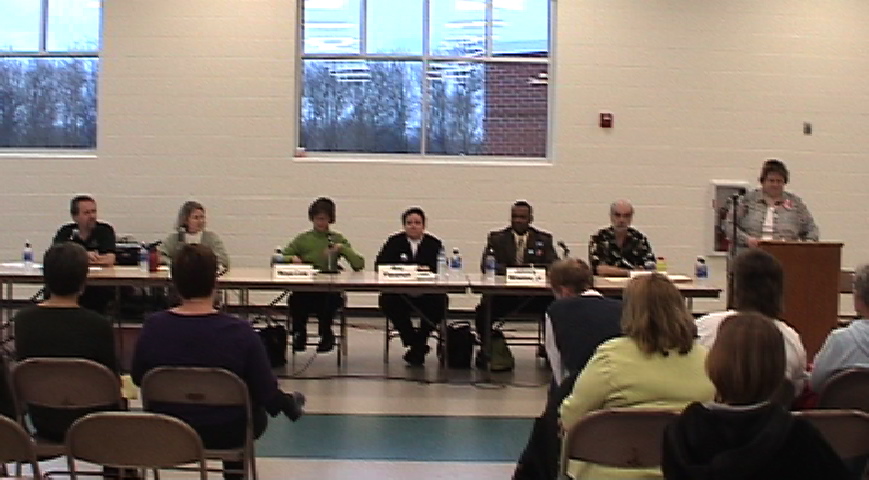
Board of Education Candidate Forum of March 27, 2007

Board of Education Candidate Forum of March 27, 2007 was held in the cafeteria of Leopold School.

QT Video
The video of the meeting is 160MB, and 1 hour and 50 minutes long. Click on the image at left to watch the video.
The video contains chapter headings which allow quick navigation to sections of the meeting. The video will play immediately, while the file continues to download.
Moderator: Laura Croft of the Middleton League of Women Voters
Panelists: (from left to right)
       Rick Thomas and Beth Moss,        vying for Seat 3
       Maya Cole and Marj Passman,      vying for Seat 5
       Johnny Winston and Tom Brew,      vying for Seat 4
The topics and questions covered are

  • Opening statements
  • Given that funding for TAG is again being cut, how would you raise money to support such programs?
  • How would you help coordinate the various PTO’s and other community groups to improve school effectiveness?
  • How would you reduce the educational gap between poorer performing kids and more the successful without holding back the more successful kids?
  • The MMSD Administration is proposing to cut SAGE, how would you vote on this proposal and why?
  • Should community service be required of students before graduation?
  • More and more families are leaving the school district because their children are not being academically challenged. How would you deal with this issue?
  • What is your plan to handle the growth in the Leopold-Thoreau area?
  • Shorewood and Fitchburg parent coalitions are being formed to discuss creating their own school districts. Why are these parents so upset?
  • Since the average employee costs the district $50 per hour, shouldn’t the budget gap remedy include employee wage and benefit sacrifices?
  • If you do not want to close schools, where else would you cut, and would that include school athletics?
  • Closing statements.
Share

MMSD School Board Communications Committee Meeeting Tonight – Information and Advocacy Session

I’m passing along the following information I received:
The Governor’s 2007-09 biennial budget provides some assistance for Madison Schools in the areas of SAGE (Student Achievement Guarantee in Education), the 15:1 K-3 class size reduction program, special education/bilingual-bicultura l aid and allowing some expenditures for safety/security to be outside the revenue caps.
We would like to hold an information and advocacy session related to the state budget on Thursday, March 29, at 6:30 p.m. in the McDaniels Auditorium of the Doyle Administration Building . The meeting will provide you with information about the budget and advocacy “talking points” to contact legislators and gain support for some of the budget’s provisions.
At this meeting, we would also like to begin preliminary discussion of ways to link Madison parents to parents in school districts in counties surrounding Dane – a neighbor-to- neighbor outreach effort to talk to legislators about the devastating affect of revenue limits to our communities’ schools.
We share your frustration as we annually watch more programs and services to students slowly dismantled by the state-imposed revenue limits. Together, we can work to educate legislators and bring about school finance reform. We look forward to seeing you on March 29.
Sincerely,
Johnny Winston, Jr.
Board President
Arlene Silveira
Communications Committee Chairwoman

Share

The difference between Maya and Marj

Isthmus gave the candidates a chance to make one last pitch for votes before next Tuesday’s election.
The statements of Maya and Marj say a lot about them as people and potential board members.
Marj repeated her line on all of her experience and said:

I have developed a finely honed instinct for what works and what doesn’t.

By contrast Maya said:

The community will be a welcomed partner with our public schools.


In other words, Marj said, “I KNOW what’s right and wrong.” That’s the board majority’s persistent response to outside input. “We know what’s right and wrong. Thank you very much. You can go away now.”
While Maya says, “I welcome a partnership,” which reflects an openness to the community.
I’m voting for Maya.

Share

Yes to strategic planning, no to last minute referendums and school closings

On March 26, I voted no on Carol Carstensen’s proposed three-year referendum for several reasons.
First, a referendum requires careful planning. Two weeks notice did not allow the Madison School Board to do the necessary analysis or planning. Ms. Carstensen—not the administration—provided the only budget analysis for her proposal. The board has not set priorities because the board it is just beginning the budget process.
Second, the referendum is not part of a strategic long-range plan. The district needs a ten-year strategic plan, and such a plan must address the structural deficit created by state revenue limits. It must also bring businesses, community organizations and the City of Madison into the solution. While referendums for operating dollars will be necessary, without planning they are of limited use.
Third, relief from the state revenue limits is not on the horizon. Governor Doyle has no proposal for eliminating the revenue limits. Madison’s state representatives recommend that we focus our lobbying efforts on small scale, stop-gap funding issues. Only Ms. Carstensen and the teachers union seem to think that change is coming soon.
There are some steps that the school board can take to increase public confidence and pass operating budget referendums in the future.
1. Direct the administration to find the best ways to use the Doyle Building to generate revenue for the district. In 2006, the board defeated this proposal (Kobza and Robarts voting yes, Carstensen, Keys, Lopez, Vang and Winston voting no). Using the building as a revenue-generating asset could also move administrators to school buildings and help keep the schools open.
2. Negotiate changes in health insurance coverage for teachers to minimize future costs. Administrators and other unions have recently made such changes without losing quality of health care. Dane County has a competitive health insurance market that can help use save dollars and protect quality of care.
3. Take the closing/consolidation options presented by the Long Range Planning Committee off the table. Look for more focused approaches to saving money, such as moving the Park Street Work and Learn Center into an under-enrolled elementary school as we did in the past when we housed WLC at Allis School.
4. Invite the community to join in a strategic planning process as soon as possible. As long as the state and federal governments shirk their responsibilities and the state over-relies on residential property taxes to pay for essential local services, there will be a gap between the tax funds available and the cost of the high quality, comprehensive k-12 school system that we want. We need a plan as badly as we need the elimination of the revenue limits and a progressive tax to adequately fund our schools.
I am ready to support operating budget referendums based on a strategic plan and best use of the revenues that we have.

Share

School vacations create run on absentee ballots

Anita Clark, Wisconsin State Journal, writes: Thousands more voters than usual are seeking absentee ballots from the Madison city clerk’s office as Tuesday’s election approaches.

Share

Parents make case for keeping schools

“Please don’t ruin our east side schools,” said parent Sue Arneson at Wednesday night’s hearing on closing east side schools.

Share

Chad Vader meets Mayor Dave and Maya Cole

Maya Cole met Chad Vader last weekend at Indie Coffee.

Share

Madison School District Changes School Closing Plan

Channel 3000 reports on changes to School closing plans. “The Madison Metropolitan School District has changed its plans for school closings and consolidation, and some north side parents said they were caught off guard by the new plan.”

Share

Nancy Donahue: Cole not “beholden”

Nancy Donahue, one of the organizers of The Studio School, sent this message to SIS:

I have had the opportunity to talk with Maya Cole twice in the past two weeks and I am convinced that she would be an excellent addition to our school board …someone who can see the big picture and incorporate it into a vision for our schools and our community. A change agent? Moreover, Maya is unfettered by the MTI machinery and political agenda so I can trust that her votes are guided by her own judgment. I am also supporting Rick Thomas for many of the same reasons.
I think that it is imperative that we make every effort to ensure that the people we elect are not “beholden” to any large organization to support their campaigns. MTI’s questionnaire flagrantly and publicly advertises that candidates must comply with the MTI agenda if they want MTI political support (which would be difficult to pass up). But the campaigns are just the beginning of an insidious political relationship. Along with MTI support comes the continual threat of repercussions (i.e., public criticism and withdrawal of support) if, once elected, a candidate should muster the personal integrity to cast a vote that runs counter to the MTI position. I prefer that our school board members feel free to cast votes based on information rather than intimidation.

(more…)

Share

Strange, strange budget process

I’ve never seen a budget process like that being followed by the MMSD and board.
Without having a budget, the board appears poised to close schools and lay off teachers. Who or why would anyone make these types of decisions out of context, that is, without a budget, with out even looking at options other than those recommended by an administration hell bent on preserving as much power and as many positions as possible in the Doyle Building?
It’s just insane, and supposedly rational people on the board think that it makes sense! Do they check their brains at the door when they walk into a board meeting?

Share

Maintain and Grow Madison’s Art Programs: Support Elementary Strings

Parents and Students distributed to attendees of the recent Spring 2007 Strings Festival the following information in a flier:
Madison Community Asks the MMSD School Board:
Don’t Cut, Work with the Community to Strengthen and Grow
Madison’s Elementary String Program

Superintendent Rainwater has proposed cutting Grade 5 strings, which would eliminate the nearly 40-year old elementary strings program. This does not have to happen and you can help:
1) Email the School Board (comments@madison.k12.wi.us), letting the School Board know:
a. You support elementary strings and a vibrant, strong fine arts academic education for all Madison’s school children as important for and fundamental to a student’s personal and academic growth, and
b. You support and want the newly formed School Board Community Fine Arts Task Force to have a chance and time to explore ways to continue and to sustain elementary strings, and all arts education, in Madison’s schools, without further cuts to programs.

Share

Tutor center for reading, math, and more

When parents need a tutor for their children, they can find a wide variety in Madison. Several have been pleased with the progress their children made at the Madison Reading and Learning Center.

Share

Out-of-Favor Reading Plan Rated Highly

Education Week
Reading Recovery, a popular one-to-one tutoring program that Bush administration officials sought to shut out of a high-profile federal reading program, has gotten a rare thumbs-up from the federal What Works Clearinghouse.
“I think this is good news for all the school superintendents who kept Reading Recovery alive in their schools,” said Jady Johnson, the executive director of the Reading Recovery Council of North America, a nonprofit group based in Worthington, Ohio. “I’m hoping this report will signal a change in direction for the [U.S. Education] Department.”
In the What Works review, posted online March 20, the clearinghouse said the program had “positive” effects—the highest evidence rating possible—on students’ alphabetic skills and general reading achievement. The reviewers also determined that the program had “potentially positive” effects, its next-highest rating, on reading fluency and comprehension.
That’s high praise from the clearinghouse, which the Department of Education’s Institute of Education Sciences created in 2002 to vet research on “what works” in education. So few education studies meet the clearinghouse’s tough research-quality criteria that some critics have dubbed it the “nothing works” clearinghouse.
On the clearinghouse’s “improvement index,” a measure used to provide a common metric on program effects, researchers found that the average 1st grader who completed Reading Recovery could be expected to score 32 percentile points higher in general reading achievement than similar students not in the program.
Yet some of the program’s early critics said in interviews last week that many of their original concerns remained.
“I never said Reading Recovery is ineffective,” said Jack M. Fletcher, one of 32 researchers who signed a widely circulated 2002 letter critiquing the program. “The real issue with Reading Recovery is the idea that it has to be done individually, when there’s a substantial research base on small-group interventions that shows there’s no drop-off in effectiveness.”

What Works Reading Recovery Report

Share

2007 Wisconsin Charter Schools Conference

From the Wisconsin Charter Schools Association:

The 7th annual Wisconsin Charter Schools Conference, co-sponsored by the WCSA and DPI, will be attended by educators, parents, students, school officials, university people, community leaders, state officials, and many other charter friends. Conference Flyer (PDF).
Dates: April 15-17, 2007 (Sunday afternoon through Tuesday)
The Sunday afternoon (4/15) Wisconsin Charter Schools FAIR is open and FREE to the public. Conference sessions on Monday and Tuesday (4/16-17) will focus on planning, authorizing, implementing and operating high-performance charter schools.

Share

I have a few comments on separate courses for students of different abilities

I think that it is important to have opportunities for advanced students to obtain seperate instruction is subjects they excel in. It is my belief that by doing this we don’t sacrifice diversity, we actually increase it.
My logic is as follows. If gifted students are not given the challenge they need in school, they will not achieve as much as they can. If the public schools are not able to provide for these childern, then parents of gifted kids will pull them out of school. Unfortunately, only involved parents with money will have the ability to give their kids the alternative education like private school. Thus, the public schools will be left with few children at the top end of the education spectrum since it can’t provide for them.
My belief that this is true comes from my home town in California. We have one elementary school in a wealthy area that is known to have much better educational opportunities for students. Parents in other districts constantly try to move their children to this school. Due to declining enrollment, other school districts have stopped letting students switch schools. To still provide for the children, the school in the wealthy area became a charter school. Now, parents can move their children there without incident. But, the other public schools are left without their brightest students. If the other public schools could provide for their brightest, the public schools would include all of the students.

(more…)

Share

School Board rejects referendum

From a story by Deborah Ziff in the Wisconsin State Journal:

The Madison School Board voted against asking taxpayers to help stave off budget cuts as Madison public schools face a projected $10.5 million budget shortfall.
The board voted 5-2 against holding a June referendum, a measure proposed by School Board Treasurer Carol Carstensen. Outgoing board member Shwaw Vang joined Carstensen in voting for the proposal that would have asked taxpayers for an additional $34 million over the next three years.
Board members who voted against the referendum said it was too hastily drawn up, without enough time to refine a referendum question or engage in a campaign to drum up support. Board member Lucy Mathiak said the board has known since October that it would need to make tough budget decisions.


Susan Troller’s story in The Capital Times is here.

Share

Petition to Save Our East and North Side Schools

A District-wide petition drive has been started to keep open all of the east and north side schools that are currently being discussed as possible closures and consolidations. To learn more and to sign the petition go to:
http://www.thepetitionsite.com/takeaction/879512194

Share

New revenue for schools

Governor Jim Doyle’s budget proposal includes language that would allow Wisconsin school districts to:

Construct or acquire, borrow funds to construct or acquire, operate and maintain a wind electricity generation facility, and use or sell the electricity generated by the facility, if the school board’s share of the installed capacity of the facility does not exceed 5 megawatts and the school boar incorporates information about the facility in its curriculum. (120.13(18m) WIND ELECTRICITY GENERATORS)

People should contact members of the Joint Committee on Finance to express support for the measure.

Share

They’ll Do It Themselves, Thanks

By MICHAEL WINERIP
Published: March 11, 2007
The New York Times
I LIKE it!” said Yaniv Gorodischer. “What a night!”
It was a big, big night at the group home. The three residents ­ Mr.
Gorodischer, 29, Jason Kingsley, 32, and Raymond Frost Jr., 28 ­ along with an entourage that included their group home supervisor, Ernest Daniels, and their parents, were going to the Town Board meeting to present a petition to get a sidewalk for their busy street, Chatterton Parkway.
All three had put on neckties. “For Town Hall I want to look decent,” Mr.Frost said. “Handsome and decent.” He’d practiced his speech six times. “I’m going to say, ‘My name is Raymond Frost Jr.’ And I’ll say that we got our neighbors to sign the petition, and 28 signed and 2 didn’t want to.”
And Mr. Gorodischer said: “First off, I’ll say, ‘My name is Yaniv
Gorodischer.’ And I can remember, I remember … shoot, I forgot.”
For that reason, Emily Kingsley, Jason’s mother, had written a speech for them to read. “Just in case,” she said, handing it to her son.
“We won’t need it,” he said. “We know how to say it.”
Several weeks before, Ms. Kingsley had drawn up the petition and
accompanied her son and his two roommates door to door. All three men have Down syndrome and cannot drive, but they are striving to be as independent as possible, and that means walking to their jobs along this street with its steep hill, its blind curve and cars that whiz by.
Ms. Kingsley, 67, had stood in the driveways while the three men knocked on doors, collecting signatures. “Most people were very nice,” she said. “When one man refused, they got confused. They couldn’t understand someone would say no to them. He was an old guy and said if he had a sidewalk he’d have to shovel snow. They said, ‘We’ll shovel it for you.’ And he says, ‘No, you won’t.’ And they say, ‘Yes, we will.’ ”
Since the group home opened in September 2002, the three have worked hard to be good neighbors. “Tell the story how you called me about baking a cake for your new neighbors,” Ms. Kingsley said.
“I don’t know that story,” her son said.
“Yes, you do.”
“It’s coming back,” the son said. “We asked to bake a cake for the new neighbors across the street. That was nice of us, to give them a little treat.” “And you called me for help with the cake,” the mother said. “And I said, “All three of you are on a diet.’ ”
“Not for us,” her son said. “For the neighbors.”
“Chocolate cake,” Mr. Frost said.
“We all helped,” Mr. Gorodischer said.
“Three Musketeers,” Mr. Frost said. “Now four beautiful years living in this house.” “Almost five beautiful years,” Mr. Kingsley said.
“A very big environment,” Mr. Gorodischer said.
“Because we all three guys looked out for each other,” Mr. Frost said.
“And what is the meaning of brotherhood?” Mr. Gorodischer said. “We can stand tall and be united. Meaning we can win over Town Hall!”
Then someone said it was time, and the three piled out the door and down the stairs and squeezed into Ms. Kingsley’s sedan, heading for Town Hall to see if they could get themselves a sidewalk.
WHEN Jason Kingsley was born, on June 27, 1974, the doctors told Ms.
Kingsley and her husband, Charles, to put him in an institution. “They told me he wouldn’t be able to distinguish us from other adults,” she recalled.
“They said, ‘Never see him again, and tell your friends and family that he died in childbirth.’ They were so sure I would institutionalize him, they gave me pills to dry up my milk.’ ”
Ms. Kingsley couldn’t have known it then, but her son was born right at the great divide between the dark years, when the mentally retarded were hidden away in state institutions, and modern times, when most of those institutions have been shuttered and the developmentally disabled live among us, in supervised group homes and apartment programs.
Two years before Jason’s birth, in January 1972,
Geraldo Rivera had sneaked into Willowbrook, a snake pit of an institution on Staten Island that was home to 5,400 mentally retarded people. He filmed a ward of 60 emaciated children, many naked, some in straitjackets, surrounded by walls smeared with feces and supervised by a single attendant. His televised exposé led to a federal class-action lawsuit, which Gov. Hugh L. Carey could have settled by promising to improve Willowbrook. Instead, Mr. Carey set off a social revolution. In a 1975 consent decree, he pledged to move the residents out of Willowbrook and
into state-financed community housing. Decades later, Mr. Carey would say it was the one thing he’d done as governor that he could really hold on to.
At the time, there were 26,000 people living in 20 state institutions for the retarded in New York and just 1,570 in state-financed group homes.
Today there are 32,722 developmentally disabled New Yorkers in community residences, and fewer than a thousand ­ the most severely disabled ­ in a handful of institutions. In 1980, New Jersey had just 471 community beds; Connecticut had 963. Today New Jersey has 7,173, Connecticut 5,313. They are paid for by the states, and most are run by nonprofit agencies.
In 1974, the Kingsleys started on what was then a new parenting approach for children with disabilities called early intervention, which today has become standard practice. The infant is exposed to high levels of stimulus and physical therapy. Ms. Kingsley did Jason’s room in bright colors; she made a quilt for him with every patch a different material. “We surrounded him with motion and music, and we’d talk and talk to him,” she says. To “wake up his senses,” she filled a tub with Jell-O, and plopped him in.
“I had people tell me that he wouldn’t be able to read,” she recalled. “He started reading at age 4. It was so exciting. Everything they said he wouldn’t do, he was doing.”
Jason’s parents would take him to Broadway musicals, and he would memorize all the songs. To this day, if Ms. Kingsley challenges her son to adapt a show tune for his roommates, he’ll burst into a verse of “Singing in the Raymond” or “Some Enchanted Yaniving.”
The Kingsleys lectured at medical schools about the untapped potential of children with Down syndrome. “Doctors needed to see the old stereotypes didn’t apply,” she said. Ms. Kingsley is a veteran writer for “Sesame Street” ­ she has won 17 Emmys ­ and she pushed to have Jason on the air, so the public, too, would see. Jason appeared a dozen times, starting at 15 months (sitting on Buffy Sainte-Marie’s lap as she sang). At age 6 he did skits with Ernie, at 8 with Forgetful Jones.
Being pioneers, Ms. Kingsley and her husband (who died nine years ago) had no sense where the limits were, and it was hard when they learned. “I thought he was so smart, I thought I had fixed it,” she said. “But between 6 and 8 all the typical kids caught up and passed by. Typical kids got sophisticated and streetwise, picked up nuances about relationships that he could not.
“Jason was great at parlor tricks, he could count to 10 in 12 languages,” she said. But when she put him in a youth soccer league, he too often ran the wrong way. He mastered the mechanics of reading but struggled with comprehension. “He learned, but took longer than regular kids.” Regular kids would say, “Do we have to have him on our team?”
“I realized this was in fact a child with D.S.,” she said, “and as hard as I worked, it would not go away.”
Thanks to his mother’s background in television, the son had opportunitiesmost never get. At 10 he appeared on the TV show “The Fall Guy”; at 19, on “touched by an Angel.” With his mother’s help, he and his friend Mitchell Levitz wrote a book about Down syndrome, “Count Us In,” published by Harcourt in 1994.
But when Mr. Kingsley was no longer young and cuddly, things were harder. Having mingled with the stars, he grew impatient with mundane work. He had a job shelving videos at a library, and came up with his own system for reorganizing the collection. “It made perfect sense to him,” his mother says, “but nobody could find anything.” He now delivers mail in an office building, though he still lists his career goal as “directing animated feature films for the Disney corporation.” His roommate Mr. Gorodischer works in the mailroom of a law office. Mr. Frost is a clerk at Petco, specializing in fish and small animals.
The Kingsleys set their son up in his own apartment in the late 1990s, but over time, he became isolated, the apartment grew messy, and he stopped shaving and bathing regularly. “We were too optimistic,” Ms. Kingsley said. “He needed more structure.” The group home, which is run by Westchester Arc, a nonprofit agency, has counselors on duty from 4 p.m. to 8 a.m. to provide both oversight and routine. It’s a comfort for the mother, who will not live forever.
AS they walked into Town Hall, Mr. Gorodischer lagged behind, and Mr. Frost yelled, “Yaniv, move up, you’re with us.”
Inside, Channel 12 was waiting. “How long have you been fighting for this?” the reporter asked.
“This is our first time,” Mr. Frost said.
“But you have petitions?” the reporter said.
“We hope to win over Town Hall,” Mr. Frost said.
They launched into a “Three Musketeers” cheer ­ all for one and one for all! ­ that caught Channel 12 off guard. “Hold on, we missed that,” the reporter said. “Let’s do it again. Quiet … action.”
Before the meeting, Paul J. Feiner, the town supervisor, told the men he supported the sidewalk and credited them with forcing the Town Board to develop a sidewalk policy, but said it could be two years before there was any action.
They were first on the agenda, and it must have been more nerve-racking than they had expected, because, after a few hems and haws, Mr. Kingsley pulled out the speech his mother had written, and each of them read a few sentences.
“You should go home tonight feeling very, very proud,” Mr. Feiner said. “You’ve already accomplished a lot, and I’ll work hard to make your dream of sidewalks a reality.”
The whole thing took about three minutes, and soon the entourage was back at the group home with everyone gathered around the dining room table eating cake. While the guests chatted away, Mr. Frost and Mr. Kingsley slipped upstairs. It was getting late, and they had work in the morning.
Share

Important meetings about possible east side school closings

Forward from a friend:
The MMSD administration will hold public meetings on the following dates to detail their plans to close Lindbergh and Blackhawk. PLEASE ATTEND BOTH MEETINGS!
SUNDAY MARCH 25th 4-6pm @Warner Park
TUESDAY MARCH 27th 6:30pm @ Black Hawk

Share

How can we help poor students achieve more?

Jason Shephard:

As a teacher-centered lesson ended the other morning at Midvale Elementary School, about 15 first-graders jumped up from their places on the carpeted rug and dashed to their personal bins of books.
Most students quickly settled into two assigned groups. One read a story about a fox in a henhouse with the classroom teacher, and another group, headed by a UW-Madison student teacher, read a more challenging nonfiction book about a grandmother who, as one child excitedly noted, lived to be 101.
In addition to this guided reading lesson, one boy sat at a computer wearing headphones, clicking on the screen that displayed the words as a story was read aloud to him, to build word recognition and reading stamina. Two other boys read silently from more advanced books. Another boy received one-on-one help from a literacy coach conducting a Reading Recovery lesson with him.
“I think what’s so important is that this program truly meets the needs of a variety of students, from those who are struggling to those who are accelerated,” says Principal John Burkholder.

(more…)

Share

Closing Marquette: A preposterous idea

A letter to the editor that appeared in the Cap Times:

Dear Editor: As leaders in the Marquette neighborhood, we are extremely disappointed with the discussion of possibly closing Marquette Elementary School.
The Marquette neighborhood is an incredible success story. The economic upswing of this neighborhood has been tied directly to the positive programs being presented at Marquette and Lapham schools.
The $3.5 million addition and improvements made to the O’Keeffe/Marquette complex a few years ago brought incredible stability to this neighborhood. The voters and taxpayers citywide realized the importance of the improvements in keeping families in the downtown area and overwhelmingly approved this expenditure. It would be an egregious slight to abandon this elementary school as throngs of young families have moved into the Marquette neighborhood and greatly improved the housing stock and precipitated a building boom.
It is unprecedented that a diverse neighborhood that could walk in close to 300 students to fill their re-modeled school in a kindergarten through fifth grade configuration would be threatened with closing. It would be beyond belief that a School Board would ask a neighborhood to send five busloads of students to a crowded Lapham building at a cost of $36,000 per bus or $180,000 for the upcoming school year. We support the continuing elementary programs at Marquette and Lapham and keeping O’Keeffe Middle School at its current size.
We realize the school funding dilemma that the whole state faces has led to this situation. We are hoping that these inequities will change and that the option to de-stabilize our community is taken off the table.
Judy Olson
6th District alderperson
Anya Firszt
president,Greater Williamson Area Business Association
Gary Kallas
director, Wil-Mar Neighborhood Center
Published: March 22, 2007

Share

Fight and arrests at LaFollette

According to a report from the Madison Police Department:

On 3/22/07 at 10:02 a.m. there was a large disturbance at LaFollette H.S. A school administrator had noticed a large gathering of students and hostilities between some wanting to fight. It was later learned that the disturbance was caused by three females confronting three other females to fight. The Madison Police Department Education Resource Officer (ERO) noted that upon arriving to the scene several hundred students were watching the disturbance, clogging the hallway, and that 10-15 school officials had to restore order. A total of six Madison Police Officers were present in the school to help calm this disturbance. Eventually some students were detained and separated. In one separation, two students went to an office and began fighting again. Police had to respond to that office as well to break up the secondary fight. The above-listed juveniles were arrested and placed in Juvenile Reception until parents were notified.

Share

“No, My Son Doesn’t ‘Act Black.’ There’s No Such Thing.”

This powerful first-person account by Aleta Payne first appeared in the Washington Post earlier this month. It brought tears to my eyes as I read it in our own Cap Times last night. The piece drives home the multifaceted nature of the achievement gap, underscoring the fact that the search for a single solution is seriously misguided and that we must each do our part.

Sam came home from the overnighter visibly crushed. He curled around his hurt as though he’d been punched in the gut, and he refused to say what had happened. My husband and I fought panic as all the horrible things that might happen to a 14-year-old away from home pounded through our brains. We cajoled and interrogated as he tried to disappear into the living room sofa, until finally, enough of the story emerged to reassure us that our oldest son hadn’t been physically injured. But his suffering was still real.
His friends had asked him why he didn’t act black.

(more…)

Share

Cole wins Cap Times endorsement

The Capital Times said:

The Madison School Board’s makeup will change with the April 3 election. Its chief dissident, Ruth Robarts, is stepping down. So, too, is a quietly thoughtful member, Shwaw Vang, who has more generally sided with the board majority and the district’s administrators.
There are those who suggest that the entire direction of the board and the school district is at stake. That’s a stretch. Chances are that the next board will have a majority that is generally deferent to the administration and a potent minority that tends to challenge the administration to do better.That’s about as it should be.
Madison schools are essentially sound. But they are not improving at the rate that they should. And they are facing increasingly challenging budget shortfalls. Thus, a board that mixes those who want to maintain what is good about the schools and those who will be pushing for more accountability and progressive innovation holds the most promise.
Our endorsements in this year’s three contests for school board seats will look to achieve that mix.
We begin today with a strong endorsement of Maya Cole, who is seeking the District 5 seat being vacated by Robarts. Backed by Robarts, Cole is a solid progressive who has shown a willingness to spar with the district establishment. That upsets some defenders of the status quo, but our sense is that she strikes a mature balance between supporting sound schools and understanding the need to try new approaches in order to meet funding, staffing and curriculum challenges.

(more…)

Share

More school closings in next budget

The board might as well start planning for the next budget’s $10 million deficit.
Making a decision on closing more schools now will allow for a more orderly transition in the years to come.

Share

Winston supports school closings

At last night’s candidate forum at the Warner Park neighborhood center, Winston was the only candidate who said he’d vote yes to closing schools.
He proudly listed his connections to the Northside, while missing the irony of being the only one who would close the Northside’s Sherman Middle School.

Share

East Side school plan opposed

East Side school plan opposed
DEBORAH ZIFF
608-252-6120
March 19, 2007
Waving bright signs and chanting, dozens of parents, kids, and teachers converged at a School Board meeting Monday night to protest proposed budget cuts that could consolidate elementary and middle schools on the East Side.
Earlier this month, Madison school officials proposed addressing a projected $10.5 million shortfall in next year’s budget by moving Marquette Elementary students to Lapham Elementary and splitting Sherman Middle School students between O’Keeffe and Black Hawk middle school. The move would save about $800,000.
School Board members are still wrangling with at least five options to deal with the budget deficit and were presented with an alternative consolidation plan at Monday’s meeting.
But many affected students, parents and teachers came to the meeting angry about the administration’s recommendation to take students out of Marquette and Sherman, arguing it would eliminate neighborhood schools, force kids who currently walk to school to take buses, and increase class sizes.
“I really don’t want to go to Lapham,” said Kalley Rittman, a Marquette fourth-grader who was at the rally with her parents. “All the kids are going to be squished in one place.”
Currently, Kalley and her sister in third grade, Hannah, walk to Marquette, said their mother, Kit. They would have to be bused to Lapham.
Kalley was also clutching an envelope with letters from other students and teachers at Marquette, and later spoke in front of the board, telling them she created a video on the school for them to watch.
Faye Kubly said her 11-year-old son had trouble in elementary schools before he transferred to Marquette, where teachers developed a system for him to learn successfully. She and other parents called the middle school proposal a “mega middle school” and called on the state to change its funding guidelines.

(more…)

Share

Testimony asks for three commitments

Thank you for your service and thank you for your request to hear from the community.
My name is Shari Entenmann and I’m here as a parent of 3 young children entrusting you with their school experience.
As you move forward with the budget process there are three things I’d like you to commit to:

1. Our downtown schools need to be vital, they are the heart of our city and why many of us moved here – myself included. Let’s not unravel what’s been built and what we can accomplish in the future. We want our schools to be vibrant and attractive so others choose to live here like I did.
2. Consider the details carefully – often it’s the details that matter:

a. What about the TEP program. My understanding from parents directly involved in bringing TEP to Lapham that part of what’s needed to make the program a success is the SAGE class sizes.

• Will Lapham still have TEP
• If TEP then SAGE, if SAGE is there room to consolidate?
• If not TEP, where will it go, back to Emerson – but wasn’t there concern about it being too much for one school?
• When making these decisions you have to consider this vulnerable population in this TEP program.

b. What about the alternatives program. Steve Hartley gave a very inspiring presentation last year at Marquette (when we were going through this exercise) and it was clear to me and others that the keystone to the success of the program is separating the kids from their age-group peers. Are you sure the proposal to move the program to Sherman has considered this, I didn’t see that consideration in the presentation to the board a few weeks ago.
c. Is the proposed larger middle school too big? I hear the comparison to Hamilton as a reference that it’s not. However, I don’t believe that’s an appropriate comparison. This is a very different population and I’ve heard concern from many teachers, and educators that’s it’s too big for this population, particularly with our resource restrictions.

3. An open process that allows all things to be discussed and considered with community involvement. We’ve heard several times that there’s nothing else to cut but things that effect the classroom and so everything must be on the table, even this drastic change that saves less than 700,000. However in all the discussion that’s lead to this point I haven’t heard any discussion on the following:

a. I’ve heard there may be more funds coming in the next few months – is this the time to propose such drastic changes – especially when these changes aren’t part of an overall plan but are part of the annual ad hoc widdling away process.
b. Extra-curriculars
c. Sports

Please consider what I’ve said. I believe it’s necessary to be successful because we live in a passionate community that strongly supports public education. Everyone needs to be involved.
Very sincerely, again, thank you for your service.
Shari Entemann

Share

What was the MMSD Budget in 2004/05?

Help! I’m getting a major headache. I’ve been trying to track some changes in the MMSD budget over the last 5-10 years, and I have noticed that the numbers aren’t always the same in the different places that I have been looking. At first, I figured it just me and that definitions for budget categories change from year to year. However, I decided to look at something simple and straightforward: What was the total MMSD budget for 2004/2005? I have included the sources of this information for anyone who wants to check my work, but I tell you it’s driving me nuts.

  • $370,226,157 – This number comes from an April 2006 Executive Summary
  • $363,366,630 – This is from a 10/24/05 Budget Amendments and Tax Levy document and this budget number includes interfund transfers.
  • $320,039,617 – If we remove interfund transfers from the budget, the above document lists this number as our total budget.
  • $316,822,781 – I found this budget amount listed twice: in a five year budget forecast from 2/14/05 and a preliminary budget forecast dated 3/7/05
  • $317,695,011 – On 5/3/05, the 2005-06 Budget and Financial Summaries document listed this amount for the 2004/05 budget.
  • $317,163,034 – this amount is similar but not identical; it comes from page 233 of the 2005-06 Budget Book released on 5/17/05
  • $318,789,509 – this is the MMSD 2004/05 budget according to DPI’s website
  • $334,626,013.5 – this is a final guess at a budget number and it comes from the Five Year Financial Forecast document that the District had prepared by PMA Financial Network. This number is based on FY2004 and FY2005 data for Fund 10 ($265,678,423; $272,015,465) and Fund 27 ($66,148,621; $65,409,518). I just added the amounts for each fund for each FY (2004: $331827044; 2005: $337424983) and then averaged them as I wasn’t sure what the relation was of a FY (fiscal year) to a school budget year. I should also state the obvious that I know the MMSD budget includes expenses beyond these two funds, but that was all that was in the document.

I realize that some variability can be the result of numbers computed before the end of the school year, but shouldn’t all of the numbers computed after the end of the 2004/05 school year be the same? I have to be honest, this doesn’t make me feel very confident about the District’s money management abilities.

Share

Sheboygan Oks 7 Charter Schools — DPI grants info webcast on Friday

(more…)

Share

Budget Impacts at Franklin-Randall–Don’t Get Mad, Get Active!!

(This letter is being distributed to parents of Franklin-Randall students, but should concern everyone in the MMSD and Regent Neighborhood)
SCHOOL FUNDING CRISIS:
Don’t get mad, get active!!
March 16, 2007
The School Board recently announced sweeping budget cuts for the coming school year that will have a severe impact on Franklin-Randall, as well as other schools in the district. Following Tuesday’s PTO meeting, parents in attendance agreed that we must act QUICKLY to address this crisis. Below, we have summarized the funding crisis, and how cuts to our and other schools will affect our children’s education and safety. Most importantly, we conclude with specific ideas that we can all implement, to positively address this crisis.
Brief overview of the FUNDING CRISIS: Wisconsin has placed an indefinite “Budget Cap” on all additional funding towards schools. Every year there are increased costs to our schools to cover teacher salaries, increased student numbers, and increased maintenance costs. Without intervention and change, Madison’s reputation for excellence in education is going to change significantly, and with that, so will the diversity, appeal, and attraction of our city.
How will current district recommendations directly affect the education and safety of your children in the Franklin-Randall community?
*As a result of the “SAGE” program being cut from our schools, Franklin-Randall class sizes will rise from 15 to 22 for Kindergarten and First grade, and from 15 to 24 for Second and Third grades this Fall.
*Franklin will lose 5.1 teacher allocations; this most likely means that 3 classroom teachers will be laid-off, and there will be reductions throughout Art, Music, PE, and Reach.
*Randall will lose 1.6 teacher allocations.
*Randall will lose the 5th grade strings program (last year 4th grade strings was cut).
How will cuts at OTHER schools affect the education and safety of your children?
All of our city’s elementary school children come together in middle and high schools; sub-standard education in any one of these schools will therefore affect all students eventually: a loss for one school will become a loss for all.
What can I do NOW?
1. Talk to people at your bus stop, in your neighborhood, and in the hallways at school when you’re there– work together to come up with at least one idea to present at the Rescue Our Schools brainstorm session. This meeting will follow the monthly PTO meeting (Tuesday, April 10th at 6:30) in the Randall Library.
2. Talk to grandparents, aunts, uncles, and neighbors who DON’T have children about how these changes to our schools will affect them. One key point to address is that our city is only as appealing as its future, and our children are the future. Everyone, with or without kids, will be affected. Wisconsin has a history of valuing education and performance; if this changes, we are giving up a source of identity and pride!
3. Attend the Information and Advocacy Session at the Doyle Administration Building, Thursday, March 29th at 6:30pm
4. Form shared child-care groups with friends and neighbors to allow for more parental presence in the schools. Make it a goal to do this in some capacity weekly. These cooperatives will allow you to watch or volunteer at more school functions, participate in school trips, or attend school board meetings. Education research definitively shows, that the more YOU are involved, the more success your child will have in school!
5. As you are able, contribute with time or money to the PTO! $100 can buy a violin that will last 10 years! Commit to a half-hour stint helping on the playground weekly — this equates to invaluable community-building, camaraderie, injury prevention, as well as much-needed breaks for our teachers.
6. Attend the MMSD School Board Meetings, held on Mondays at the Doyle Administration Bldg at 545 W. Dayton St, next door to the Kohl Center. Beginning at 7:15, any person or group can make a “Public Appearance” (up to three minutes each) to deliver opinions / make arguments about any school-related topic. To find out more, go to www.madison.k12.wi.us : under “District Information” click on “Board of Education”, then under “Meetings”, click on “Board of Education Calendar”.
7. Become active in the you school PTO!!! Sign up to be on the Franklin-Randall List-Serve — This is a fast, easy and inexpensive way for people to notify each other about F-R events and news. Simply send an email to: F-R_pto-subscribe@yahoogroups.com, with “subscribe” in the subject line. To find out about all the up-coming meetings and events, go to the F-R PTO website. Site address is www.franklinrandallpto.org
8. Don’t forget to VOTE on Tues, April 3rd, during Spring break–And if you’re not in town, vote ABSENTEE! To vote absentee, go anytime within one week before the election, to the City-County Building at 210 Martin Luther King Jr. Blvd, Rm. 103. 8-4:30pm. Alternatively, by calling 266-4601, you may ask the city to mail you a ballot (English, Spanish or Hmong), or simply go online: www.cityofmadison.com/clerk/voterabsentee.cfm (also downloadable in English, Spanish or Hmong)
What can I do long-term?
Ultimately, we have to address long-term changes to school funding at the State and National level. Through grassroots organizing directed at raising awareness of the issues, we can make a change. We must reach out to like-minded groups (other PTO’s, PTA etc.), and legislators around the state. To this end, following April’s PTO meeting, we will meet to collect ideas, and organize our strategies —
*PLEASE come to the PTO Meeting, April 10th at 6:30pm (Randall Library)!! *
Thank you for taking the time to read this, and for taking action in whatever way you can!
Concerned Franklin-Randall Parents
For further information, please contact any of us:
Sari Judge 233-1754, Megan Brown 250-0552, Kate Zirbel 661-9090,
Mollie Kane 232-1809, Erika Kluetmeier, 238-6209

Share

WSJ Endorses Rick Thomas

WSJ Endorse Thomas for Seat 3
Rick Thomas has run a successful business.
He understands the importance of serving customers. He has made decisions about which employees, equipment and services he can afford and which he can’t afford.
He also understands and appreciates schools. He has been a substitute teacher and a volunteer tutor. He is a father with a son in elementary school.
His concern for Madison schools, enlightened by his business sense, would make him a valuable addition to the School Board.
He proposes more cost-benefit analyses to weed out unsuccessful programs.
He also proposes to improve discipline in the classrooms to create an environment more conducive to learning.
In addition, he wants the School Board and administration to be more open to parents’ ideas and to more partnerships with parents, businesses and community organizations, as well as more involvement by the schools in the community, particularly through student public service projects.

Share

State Journal endorses Cole for school board

In an editorial on Saturday, the Wisconsin State Journal endorsed Maya Cole for school board:

Maya Cole likes to say that the Madison School Board needs to look outside the box.
She is right.
To solve budget shortfalls, address the district’s shifting demographics and narrow the achievement gap between minority and white students, the board cannot afford a business-as-usual approach. To push the board toward bolder action, voters should elect Cole.

(more…)

Share

MPIE and MUAE Update

As some of you may recall, back in December, I posted a few questions to the members of Madison Partners for Inclusive Education. As a result of that posting, several members of each group have met a couple of times in order to try and make personal connections and identify areas of shared concern and potential joint advocacy. It is too early to say how that effort is going. I, personally, am ever hopeful that we can find the patience and persistence needed to build a foundation of mutual understanding and trust, a foundation upon which we can ultimately work together for all children.
I would like to share a recent exchange from the MUAE list serve (where MPIE members have been welcome since the get-go — in fact, more than one are longtime MUAE list serve members). In response to a post about one of the BOE candidates, an MPIE member wrote the following:
I would like to clarify something that was misstated in a recent post. Madison Partners for Inclusive Education (MPIE) does NOT promote or endorse COMPLETELY heterogeneous classrooms ALL the time. The group does not think completely heterogeneous classrooms all of the time is in the best interest of children with disabilities. Their website goes on to explain their philosophy: http://www.madisonpartnersforinclusion.org/whatisinclusion.html Thank you for understanding this and clarifying in future posts.

I then replied:
Thanks for the clarification, though I really think we are in agreement on this point. Certainly the inclusion decision for students with disabilities should be a flexible one, based on the specific nature of the disabilities, the specific educational needs, and the family’s preference for their child. Most of us know, for example, about IDEA and the K-12 IEP process. We know, too, that our high schools offer alternative classes and other learning options for those students with disabilities for whom the “regular” classes are not appropriate.
I am sure we get sloppy with our language, at times; but our language errors are surely inadvertent, mostly because — like all parents — we are simply thinking about our own children, whether or not they are thriving, and whether or not their needs are being well met by our schools. We are guilty of being good parents. Nevertheless, we apologize.
The fact is, we do not want much of anything to change for students with disabilities. (We would like to see the state and federal governments pay a larger portion of the tab for special education — can we encourage your group to take the lead on that issue at the local level?). We support all of the flexibility, all of the options, and all of the tailoring of educational programming that goes on for them during their years in the MMSD. MUAE stands absolutely with MPIE on that, as I see it (though obviously I really can’t speak for everyone). We are your partners there.
We ask the same of you.
I wonder, will you be our partners in getting our children’s educational needs met in the same way that the needs of students with disabilities are met? Just as you do not think placement in completely heterogeneous classrooms all of the time is in the best interest of children with disabilities, so do we think such placement is inappropriate for our children. Full days spent in “regular” classrooms does not necessarily meet our children’s educational needs any better than it does your children’s needs. We are told the District is committed to giving each student the appropriate “next level of challenge.” And yet too many of us know (or have) “formerly bright” students who have become turned off to school as a result of too many years of insufficient challenge and chronic boredom. They are miserable. They are in pain. They are not growing well at all. Meanwhile, our advocacy efforts on our children’s behalf are too often met with disdain, deception and complete stonewalling. We do not yet have the same legal foundation on which to stand as you do.
We at MUAE are simply asking for the same flexibility — in thinking, in approach, in educational opportunity and in classroom placement — for the District’s highest potential, highest performing students that students with disabilities experience. Nothing more; nothing less.
Can you and the other MPIE members support us in that position as wholeheartedly as MUAE members support you in yours? (That’s really the question I was asking of you in my SIS post a while back.)
I hope so.

Share

Live Chat: Reaching Gifted Children

Join Education Week on Monday, March 19, from noon to 1 p.m., Eastern time, for a live Web chat with Karen Isaacson and Tamara Fisher, the co-authors of “Intelligent Life in the Classroom—Smart Kids & Their Teachers,” a new book from Great Potential Press of Scottsdale, Ariz. This is the second in a regular series of chats on education books.
http://www.edweek-chat.org
Isaacson and Fisher make a unique writing pair: Isaacson is the mother of five gifted children, while Fisher is the K-12 gifted education specialist for a school district located on an Indian reservation in northwestern Montana.

(more…)

Share

Music Lessons Affect Brain Development

As the district considers the total elimination of strings education in our elementary schools, a recently published study provides yet more evidence of the benefits of musical training.
Music Training ‘Tunes’ Human Auditory System
Science Daily — A newly published study by Northwestern University researchers suggests that Mom was right when she insisted that you continue music lessons — even after it was clear that a professional music career was not in your future.
The study, which will appear in the April issue of Nature Neuroscience, is the first to provide concrete evidence that playing a musical instrument significantly enhances the brainstem’s sensitivity to speech sounds. This finding has broad implications because it applies to sound encoding skills involved not only in music but also in language.
The findings indicate that experience with music at a young age in effect can “fine-tune” the brain’s auditory system. “Increasing music experience appears to benefit all children — whether musically exceptional or not — in a wide range of learning activities,” says Nina Kraus, director of Northwestern’s Auditory Neuroscience Laboratory and senior author of the study.
“Our findings underscore the pervasive impact of musical training on neurological development. Yet music classes are often among the first to be cut when school budgets get tight. That’s a mistake,” says Kraus, Hugh Knowles Professor of Neurobiology and Physiology and professor of communication sciences and disorders.
For further information about how music instruction impacts intellectual development, readers are encouraged to explore the work of psychologist Glenn Schellenberg:
Schellenberg, E.G. (2005). Music and cognitive ability, Current Directions in Psychological Science, 14, 322-325.
Schellenberg, E.G. (2004). Music lessons enhance IQ. Psychological Science, 15, 511-514.

Share

Reading Recovery: More chipping and shredding in Fargo!

What makes this article from Fargo interesting is how it almost exactly mirrors the findings in my home district, Hortonville, and the recent analysis of Reading Recovery done in Madison. That being, a 50% success rate for RR students. From the article:

“However, West Fargo student data over time, as presented by Director of Knowledge Management Holly Budzinski Monday night, show that while this is happening in the short term, it?s not something the students sustain in the long run. The Administration has been scrutinizing the Reading Recovery program since two days after Budzinski arrived in West Fargo last January, and she has found that the majority of students served by Reading Recovery gradually lose their abilities to meet the class average by the time they reach sixth grade.”

(more…)

Share

Phonics is necessary but not sufficient

This post came from a listserve on reading:

This is in response to the NY Times article about Madison’s reading program. Of course a quick response is often inadequate. But here goes.
The simple fact is that correct decoding is necessary but not sufficient to comprehend what one is reading. Necessary but not sufficient appears to be a concept that escapes most of the field of education. What’s so hard about it, I wonder? You have to have water to stay alive, but that’s not sufficient to keep you alive. You have to have air to stay alive, but that’s not sufficient to keep you alive. Look at that dead person there. We gave him water and he still died. That must prove that water kills you!

(more…)

Share

Upcoming BOE Candidate Forums

March 15 Thursday, 7:00-8:30 p.m., Dane County United Candidate Action Assembly, Covenant Presbyterian Church, 326 Segoe Rd. (Mineral Point and Segoe). Plenty of Parking and free child care available. [Source: Candidate websites (Maya Cole, Rick Thomas, Johnny Winston Jr)]
March 20 Tuesday, 7:00-8/9 p.m., Northside Planning Council Forum, Warner Park Building. [Source: Candidate websites (Marj Passman website, Rick Thomas)]
March 21 Wednesday, noon, Rotary Club of Madison, the Concourse Hotel. [Source: Rotary website, Candidate websites (Maya Cole, Rick Thomas, Johnny Winston Jr)]
March 22 Thursday, 7:00 p.m., Madison United for Academic Excellence 2nd Annual Forum, Room 209 Doyle Administration Building, 545 W. Dayton Street. [Source: MUAE website, AMPs website, School Info System website, candidate websites (Maya Cole, Marj Passman, Rick Thomas, Johnny Winston Jr)]
March 27 Tuesday, 6:30-8:30 p.m., PTO candidate forum sponsored by PTO’s at Thoreau, Midvale-Lincoln, Cherokee, and Leopold schools, Leopold Elementary School, 2602 Post Road. [Source: Cherokee PTO website, AMPS website, School Info System website, candidate website (Rick Thomas)] [Note: March 20th is listed as the date for this forum on the AMPs website and two candidate websites (Maya Cole, Johnny Winston Jr). This is listed here as the 27th as the Cherokee PTO is a primary source.]
March 28 Wednesday, 7:00-9:00 a.m., Dane County Public Affairs Council Debate/Forum, U.S. Bank building, downtown. [Source: Candidate websites (Maya Cole, Rick Thomas)]

Share

MTI spending will likely top $10,000 for Moss & Passman

The Madison Teachers Union political action committee spent a little more than $7,500 in “independent expenditures” in support of for Juan Lopez and Arlene Silveira in last year’s school board races. The money paid for production and air time for radio and newspaper ads, but the figure does not include the newspapers’ charges for running the ad.
This year, MTI Voters (the official name for the union’s PAC) contributed the legal maximum – $1,560 – to each campaign committee of Marj Passman and Beth Moss.
We can surely expect MTI Voters to make independent expenditures for Passman and Moss equal to what the PAC spent last year.

Share

Q: Wisconsin Reading Comprehension Test Changes

Does anyone have solid information about how and when the Wisconsin Reading Comprehension Test has been revised over the years?
One obvious question in comparing scores from 1998 to those in 2005 is how the tests were changed. [NYT Article on Madison’s Reading Program]

Share

Carstensen opposes consolidation, seeks referendum

Carol Carstensen circulated the e-mail below and gave permission to post it here:

I am opposed to the proposal to close/consolidate schools on the east side – I am also opposed to increasing class size (eliminating SAGE classes) in the lower poverty elementary schools (which includes Lapham and Marquette) and I am opposed to increasing the class size for specials (art, music, phy ed and REACH). Those proposals account for about $3.1M of the $7.1M proposed cuts.
I do not think there are other areas to cut that I could support, therefore, I believe it is time to talk about a referendum to maintain schools and programs that enrich our community. I am working on a proposal that for a referendum that would:
1) provide 15:1 class sizes at the 7 schools where SAGE is to be cut and the 3 schools that don’t have SAGE;
2) retain the class sizes for specials
3) keep existing schools open
4) restore strings for 4th and 5th graders
5) a number of other items that I am still working on.
This would come to about $6 M – which would cost about $100 in increased taxes on a $250,000 house.
Honesty compels me to say that, as of this moment, I do not have support from other Board members on this.

Share

Marj still mum – 10 days and counting

It’s been 10 days since I e-mailed Marj Passman to get clarification on her inaccurate statement on starting teacher salaries and clarification on what she would do to raise those salaries after she cited them as a problem in recruiting teachers to the MMSD during an interview on WORT. Here’s her response:

Thank you Ed for pointing this mistake out to me. I went back to my source and discovered it was dated (another reason not to be depend on internet research). I will post this correction on my web site the first chance I get. Marj

Here’s my response to her:

Marj, Correcting the error on your Web site is good. Thank you. But how will you correct your mistake in the interview with Tony on WORT?
And, would you please answer my questions?
1. What would you do to correct low starting salaries for Madison teacher if you’re elected to the board?
2. Will you vote against any Temporary Impasse Agreement that cedes to the union’s demand to preserve the salary schedule that keeps starting salaries low?
3. In negotiations with the union, will you push for higher salaries for starting teachers? Ed Blume

You’d think that a candidate with years of insider experience would be able to provide some answers.

Share

Science, math deficit holds back state

Shirley Dang
CONTRA COSTA TIMES
Amid the whir of an overhead projector, Concord High School biology teacher Ellen Fasman sketched out the long, chubby legs of an X-shaped chromosome with her erasable marker.
“What do you remember from seventh grade about mitosis?” she asked the class.
Her question on cell division met with blank stares. From underneath his baseball cap in the back of the room, sophomore Vincent Thomas muttered in confusion.
“Wait, I don’t get this,” Thomas said. “We learned this in seventh grade?”
Even in her college prep biology class, students come less and less prepared each year, Fasman said.
“They’re every bit as bright as they’ve ever been,” said Fasman, who has taught for 16 years. However, they increasingly come hampered by smaller vocabularies, lacking knowledge of basic cell biology and unable to deal with fractions, she said.
“Their math skills are rather poor,” Fasman said. “When we do the metric system at the beginning of the year, it’s a killer for them. When we get into genetics, sometimes it’s hard for them, understanding ratios.”
American students — particularly those in California — come up short in math and science.

Share

Superintendent’s March Message

Smart and successful
March, 2007
By Superintendent Art Rainwater
For children growing up today, becoming a successful adult requires much more than mastering reading, writing and arithmetic. The requirements for success are very different in an era when work on a single project may involve several countries, languages and cultures. Success requires much more than “book learning.” Success means having the “basic skills” to interact productively and have positive relationships with people who come from many different backgrounds.
The ability of today’s students to play a vital role in this changing world requires us to think differently about what constitutes a “basic” education. For many years we lived by the credo that students must primarily have the basic skills of reading, writing and arithmetic. No one disputes the essential nature of these skills. There are people who still believe that these are the only essential skills needed for success. In a world that brings together a truly diverse group of people every day in the workplace and society, being successful means much more than the advanced application of reading, writing and arithmetic.

(more…)

Share

Wisconsin Charter School News

Appleton’s Odyssey – Magellan Charter School captures state MathCounts championship
Environment-Focused Charter School Meetings at Stevens Point (March 30), Madison (May 2) and Oshkosh (May 10)
Appleton Superintendent & WCSA President TOM SCULLEN Honored
Lake Country Academy Wants Charter School Status
Portage Charter School & Aldo Leopold
Green Lake Charters Course for School
Coulee Montessori Charter School in La Crosse
D.C. Everest Exploring Charter School Options
Learn more about public charter schools at the 2007 WISCONSIN CHARTER SCHOOLS CONFERENCE, co-sponsored by WCSA & DPI, on April 15-17 at Waukesha.
See conference program: WCSA Conference Schedule & Sessions (PDF) Speakers
Learn about planning, authorizing and operating public charter schools. Why Charter Schools?
Conference Registration Info. Join the WCSA now for member registration rate.

Share

East siders angered by school plan

From a story by Susan Troller in The Capital Times:

Recommended Madison school district changes that involve closing a middle school and joining a pair of elementary schools on the near east side are causing heated reaction in the Lapham-Marquette neighborhood.
“Do we know what we’re doing here and does this actually reflect best practices?” Marquette parent and district teacher Kit Rittman asked, reacting to a boundary change scenario that would include closing Sherman Middle School and consolidating students at Black Hawk and O’Keeffe middle schools.
Both schools feed into East High.
Changes would also involve combining students from Lapham, a K-2 school, and Marquette, which houses grades 3, 4 and 5, at the Lapham building on East Dayton Street. Space at Sherman would be filled by moving an existing high school alternative program there.

Share

We Energies offers great scholarships to CA energy conferences

The We Energies Renewable Energy Development Program
“2007 Wind and Solar Scholarship Program”
Request for Applications
March 5, 2007
Program Description
We Energies supports the development of renewable energy technologies as part of a long-term strategy for providing low-cost, environmentally sound energy options to its customers. To help in furthering this objective, the “2007 Wind and Solar Scholarship Program” will provide grant funds to faculty members at secondary schools, colleges, technical colleges, and universities located within the We Energies electric service territory for purposes of attending one of two conferences. The conferences include:
1. Windpower 2007, Los Angeles, June 3 – 6, 2007
The Windpower conference will include over 200 speakers, 150 poster presentations, and 50 sessions on leading wind energy topics organized into tracks with policy, business, and technical focuses. The conference anticipates 6,000 visitors. www.eshow2000.com/awea/
2. Solar Power 2007, Long Beach, Sept. 24 – 27, 2007
This annual conference has become America’s largest solar energy event. Solar Power will feature 175 exhibitors, 125 speakers and networking opportunities. The conference anticipates 10,000 visitors. www.solarpowerconference.com

(more…)

Share

Help Increase Support for Wisconsin Students of Poverty to Take AP Exams

Below you will find a forward from the Wisconsin Gifted Education listserv. A brief communication from each of us to our state legislators could release money to cover AP exam registration fees for Wisconsin students who qualify for free and reduced lunch. A small change is needed in the wording of a specific state statute in order to release federal dollars for that purpose. Thanks for your help. –LAF

As you know, students are beginning to pay registration fees for the Advanced Placement Exams they are planning to take in May.
In Chapter 120 of “School District Government,” Wisconsin statute 120.12 — “School Board Duties”, item (22) — reads as follows:
ADVANCED PLACEMENT EXAMINATIONS. Pay the costs of advanced placement examinations taken by pupils enrolled in the school district who are eligible for free or reduced – price lunches in the federal school lunch program under 42 USC 1758.
While no one objects to these students having the exam fee paid, the district common funds that are used for this purpose are constantly being reduced. As there are no state aids connected to this legislative requirement, districts are following the statute as an “unfunded mandate”.
The Department of Public Instruction has written a federal grant which would allow a variety of other funds (not just local common funds) to be used for the payment of AP exam fees. The federal grant is on hold pending some immediate action by our legislature to change the wording of the above quoted statute that would allow federal grant money to be awarded to the Department of Public Instruction for the express purpose of reimbursing districts for the AP exam fees of students qualifying for free or reduced lunches. With the current language in the statute, the federal government will not release grant funds for this purpose because thy see it as “supplanting” other resources.
Action is needed immediately since students are NOW registering for those exams and district are required to cover these fees NOW.
Let your legislators know that their immediate action to change the wording of the statute would result in the release of federal grant money to the State of Wisconsin. If no action is taken, the grant money will be lost. The decision is currently on hold, pending legislative action.
Go to http://waml.legis.state.wi.us/ “Who are my Legislators?” to find out who represents you. You will see their email and snail mail addresses. You are advised to send both and always remember to include your home street address so that the legislator realizes that you do live and vote in their district.
Ruth Robinson
Coordinator of Talented & Gifted Education & District Assessment
527 South Franklin Street
Janesville, WI 53548
608-743-5035
608-743-5130 fax

Share

Another gem from Bill Keys and AMPS

Since Advocates for Madison Public Schools doesn’t allow access to the archived posts of its listserve, I post the following to illustrate the contempt these people feel toward anyone who isn’t in lock-step with their point of view:

To: advocatesformadisonpublicschools@yahoogroups.com
Subject: [advocatesformadisonpublicschools] Summer Exercise for “Advocates”
Date: Mon, 24 Jul 2006 23:51:45 -0000
Here’s an interesting post from a local blog:

I wil be moving to the madison area soon and need to find schools that
realize “gifted” children do have special needs. I can not waist anymore time trying to get this point accross to educators because meanwhile my cildren suffer. Where is the the best public school for gifted children in the Madison area? I will purchase a home right next door and hopfully I can stop fighting to get my children a proper education

And so “advocates”…how would you answer if she ran into you at the
grocery store?

(more…)

Share

Keys and Casteneda sing same song

After listening to Phony Tony Casteneda’s ludicruous charaterizations of those who post on this blog, I remembered a post by Bill Keys on a listserve sponsored by Advocates for Madison Public Schools. Bill and Phony Tony used nearly the same language and divisiveness. Here’s Bill’s rant:

FACTS? FACTS? FACTS?
Do you really believe that those who criticize public education are the least bit interested in INFORMATION?????
You shoulda been with us while campaigning for the referenda in 2005.
You’d know by now.
They are the Neo-cons and fascists who got us into Iraq, who support
amendments banning same sex marriage, who are opposed to sick leave for workers and living wages and health benefits as well, and who want to stop Mexican immigration even while eating the food that Mexican-Americans grow and harvest?
FACT?
They are not at all interested. A FACT never changed any of these folks’ minds.
‘Course that’s assuming they have any.
Bill

Not a single one of the Advocates for Madison Public Schools called Bill on this abrasiveness or questioned his assertions.
Remember, these are the people who advise and support Marj Passman. Do the comments of Bill and Phony Tony reflect Marj’s feelings? Apparently, we’ll never know. She’s mum to e-mails and requests for her to explain her positions.

Share

Confirmation of MMSD’s bargaining give aways

Roger Price provided a copy of the 2007 Voluntary Impasse Resolution Procedure agreement between the MMSD and MTI.
As reported earlier, if the MMSD and MTI go to arbitration, the MMSD agrees not make a final offer that would modify health insurance benefits for teachers or change the salary structure, which offers new teachers a starting salary of $23,000, a salary lamented by Marj Passman in her interview on WORT.
The agreement duplicates the 2005 agreement, as discussed here.

Share

March Madison BOE Progress Report

March Madness is approaching! On the board level, madness can be characterized by the large assortments of topics and decisions that have been or will need to be made such as the superintendent search, budget, and other serious issues that require time, analysis and public discussion. I would like to give you a brief report on some of those topics.

(more…)

Share

Financing Quality Education, March 12

Financing Quality Education: A Five-Year Look
March 12, 12:00 noon to 1:00 p.m.
Lower Conference Room
222 South Hamilton Street, Madison
Bring your brown-bag lunch and join others concerned about Madison schools to discuss long-range plans to help the district meet the financial challenges created by the state-imposed revenue limits.
The meeting and discussion will help identify the stakeholders and possible steps needed to begin and shape long-term view of the MMSD and its budget.
Some ideas were laid out on schoolinfosystem.org:
https://www.schoolinfosystem.org/archives/2006/03/a_5_year_approa.php:
“[Ask] what is the best quality of education that can be purchased for our district for $280 million a year. Start with a completely clean slate. Identify your primary goals and values and priorities. Determine how best to achieve those goals to the highest possible level, given a budget that happens to be $40 million smaller than today’s. Consider everything – school-based budgeting, class sizes, after-school sports, everything.”
Everyone and all ideas are welcome at this brown-bag discussion in the lower level conference room at 222 S. Hamilton Street.
For more information, contact Ed Blume at edblume@mailbag.com or by phone at 225.6591.

Share

The MMSD five years from now

Financing Quality Education: A Five-Year Look
March 12, 12:00 noon to 1:00 p.m.
Lower Conference Room
222 South Hamilton Street, Madison
Bring your brown-bag lunch and join others concerned about Madison schools to discuss long-range plans to help the district meet the financial challenges created by the state-imposed revenue limits.
The meeting and discussion will help identify the stakeholders and possible steps needed to begin and shape long-term view of the MMSD and its budget.
Some ideas were laid out on schoolinfosystem.org:
https://www.schoolinfosystem.org/archives/2006/03/a_5_year_approa.php:
“[Ask] what is the best quality of education that can be purchased for our district for $280 million a year. Start with a completely clean slate. Identify your primary goals and values and priorities. Determine how best to achieve those goals to the highest possible level, given a budget that happens to be $40 million smaller than today’s. Consider everything – school-based budgeting, class sizes, after-school sports, everything.”
Everyone and all ideas are welcome at this brown-bag discussion in the lower level conference room at 222 S. Hamilton Street.
For more information, contact Ed Blume at edblume@mailbag.com or by phone after March 1 at 225.6591.

Share

School Board Vote on the Studio School Tonight

In the context of the Madison School District’s financial challenges, it’s easy to understand why creating a new program may seem unthinkable. Yet creativity can prove a strong ally in times of adversity. Take the prospect of the latest charter school idea to come before the Madison School Board, and consider these points:
As a charter school, the Studio School can bring in $550,000 in federal grants over its first four years. These grants, earmarked for charter schools, are designed to help districts cover start-up costs. The Studio School can be implemented in a way that keeps operating costs in line with other elementary schools district-wide; yet as a charter with an arts and technology emphasis, it would have the ability to seek additional grants and sources of financial support.
The Studio School would be in an existing public school, just as the district’s bilingual charter school operates. This school-within-a- school model is a cost- efficient way to foster innovation. As a taxpayer and a parent, I see the Studio School as an excellent use of underused space. While its location has yet to be determined by the district and School Board, the idea poses interesting possibilities. Could a charter school draw some students from a nearby overcrowded school? Over the long term, might an innovative option help attract new families to a neighborhood where parents had once worried about the future of an under-enrolled school? And how might such an effort dovetail with our city’s development plans?

(more…)

Share

Better Serving Gifted Students of Poverty

The National Association for Gifted Children (NAGC) has just published the proceedings of their recent conference on high potential learners of poverty. The book is called “Overlooked Gems: A National Perspective on Low-Income Promising Learners” and includes chapters by Donna Ford, Alexinia Baldwin and Paula Olszewski-Kibilius.
To download or order a free copy of “Overlooked Gems,” go to www.nagc.org and click on “New at NAGC: Conference Proceedings.”
Also on the NAGC website, a brief article by Paul Slocumb and Ruby Payne entitled “Identifying and Nurturing the Gifted Poor”. Slocumb and Payne are the authors of “Removing the Mask: Giftedness in Poverty.”
Previous post on academically talented MMSD students of color and poverty: https://www.schoolinfosystem.org/archives/2006/01/theyre_all_rich.php
Article on the negative effects of detracking, especially for high achieving students of color and poverty (cited by U.W. Professor of Sociology and Educational Policy Studies Adam Gamoran, Ph.D., in his chapter “Classroom Organization and Instructional Quality“): “If Tracking is Bad, Is Detracking Better?” by J. E. Rosenbaum (American Educator, 1999).

Share

Sports and Fine Arts – Planning for the Future

I pulled my blog from yesterday, because I think my main point got lost in too much unnecessary rhetoric. Basically, I would like to see the School Board support efforts to develop multi-year education funding plans for Fine Arts Education and extracurricular competitive sports. I would like to see the School Board be equitable in their cuts and help transition to a mix of public/private financing if that is needed in the future. I don’t see any reason to whack at or eliminate one program vs. another – it’s disruptive and unnecessary and plans cannot be made.

Share

Teachers Reclaiming Assessment Through Rethinking Accountability

Chris Gallagher
THE EDUCATION report card for my home state of Nebraska in the spring of 1999 was mixed, according to Education Week. While children in the state ranked among the top 10 nationally in most academic categories, Nebraska nonetheless garnered only a C. Why? Largely because it does not administer statewide, standardized assessments and so is “lagging behind” in accountability. Both those reporting this verdict and most of the state and local officials receiving it seem to be resigned to it as a sure but unsurprising sign that we have more work to do to “catch up” with the rest of the country. It does not seem to strike most observers as odd that, although students’ performance is high, the state’s marks are only average. Until Nebraska develops statewide tests, it will continue to receive low grades, irrespective of what our students are doing. This kind of press may well propel the state to abandon its long-held commitment to local assessment and fall in line with the national movement toward state standardized tests.
This report and its handling demonstrate the extent to which educational tests have become “common sense.” To use a term proposed by Italian philosopher Antonio Gramsci, educational testing is “hegemonic” — that is, it manufactures consent by presenting itself (or being represented as) “obvious.” Although standardized tests came under intense fire for a short time in the 1970s, we have returned to this practice with a fervor perhaps greater than at any other time since schools in the United States began making extensive use of standardized tests in the 1930s. Even many educators who have long understood the limitations and outright injustices of standardized testing and the testing industry claim that the time has passed when resistance to testing is useful.
I think it is dangerous to be too sanguine about the prospects for reforming the assessment community and disrupting the commonsense script for education reform, in which schools are cast as damsels in distress, remote experts are cast as heroic saviors, and teachers are written out of the production altogether. We need to confront the fact that, finally, the persistence of the “crisis in education” is attributable in large part to two factors: the profit margins of the testing industry that maintains the crisis and the cultural distrust of teachers that the testing industry, along with the political and education establishments, endorses.
But the testing industry has been able to secure a spot in our cultural imagination and our stock exchanges not only because of the business acumen of its leaders (though that is part of it), but also because it plays to and plays up our cultural distrust of teachers. The corporate establishment, led by the political Right, works hard to create a “public” of concerned taxpayers: those who want to be sure that their “investments” in children pay off. Neoconservative columnists play to this audience constantly, stoking the fires of educational crisis and inspiring suspicions about the competence of our public school teachers…. This distrust is carefully nurtured to keep the present educational power structure intact: remote “experts” (the capitalists) develop educational tests and prepackaged curricula and send them off to school administrators (the managers), who then ensure that teachers (the workers) faithfully execute those plans. Students (the products) are thus shaped to the specifications of experts whom they will never meet and who may never have set foot in a classroom.
In other words, whatever the gains of movements like the one for authentic assessment, the prevailing wisdom about education reform has it that reform must be top down, not inside out. Underlying our embrace of the assessment industry and our cultural distrust of teachers is a fundamental belief that what’s missing in education today is “efficiency” and that the best way to ensure efficiency is to set up a corporate structure in which teachers are held accountable to corporate CEOs. What’s good for General Motors . . .

Share

Campaign funnies

If nothing else, politics provides a never-ending source of entertainment.
Take Marj Passman’s Web site.
The site greets visitors with the headline “Marj answers 38 school issue questions received from Madison Teachers Inc. and the Madison Board of Education.” Finally! Proof that MTI and the Madison Board of Education are one in the same.
Then, a visitor gets the opportunity to click on the highlighted link to the Madison Board of Education. Only it goes the Madison Board of Education in Madison, Connecticut (http://www.madison.k12.ct.us/boepg.htmscreen shot.)

Share

Pam Cross-Leone Seat 3 Madison Board of Education

Since 1992, Pam Cross-Leone has quietly, effectively and tirelessly worked as a parent volunteer in the Madison schools. Pam welcomed the homeless children at Emerson Elementary, working to make them part of the school in every way. When Sherman Middle School and East High School experienced the problems that come with rapid changes in students and too frequent changes in principals, Pam did her part to help steady the schools and keep expectations high for all children. She should have a life-time service award from East High for unending service to its Booster Club for athletics.
Problem-solving and concern for workable, inclusive decisions are the hallmarks of Pam’s years of service to her union at MGE. The same is true of her work with United Way of Dane County as a “loaned executive.” Always on task, always open to better ideas, always focused on ways to increase support for the group’s decision.
The representatives elected to the Madison School Board in 2007 will make decisions that will affect the future of our schools in critical ways. The next board will choose a new superintendent. It will determine whether parents and public should have a greater role in evaluating the curriculum for our children. It must develop new financial partnerships between the schools and local businesses. It must address the legitimate desire of employees for high quality health insurance by making competition among insurance providers work to reduce future costs.
I support Pam Cross-Leone because I know that I can trust her judgment. I can expect openness to all ideas. I can expect concern for every child. I can expect her to work toward solutions that merit wide community support. Pam has done the work that makes her the best choice in her race since 1992.

Share

Dozens of resource teachers work out of Doyle

According to the MMSD staff directory, 29 resource teachers in Educational Services, seven instructional resource teachers in Language Art/Reading and eight in Math work out of the Doyle building.
Why are those teachers located at Doyle? They work in schools, so they could be relocated in any number of buildings, freeing space at Doyle to house the Brearly Street programs.

Share

Long Range Planning Meetings on possible school closing

I received this notice from a listserve:
Please Attend
Monday February 12th
8:00pm
Doyle Admin. Building
545 W. Dayton
Long Range Planning Commission
MMSD administrative staff will be discussing possible closing of Lapham
+++++++++++++++++
TUESDAY-February 13th
6:30pm
Marquette SCHOOL LIBRARY
LAPHAM/MARQUETTE PTG MEETING
FREE CHILCARE AVAILABLE

Share

Mentors needed

Would you be willing to serve as an academic mentor for a highly able student who needs the expertise of a trained adult? Mentorships may provide a student with an opportunity to independently research a topic in depth, or to explore and experiment within an academic area of passionate interest. Mentors are needed in math, the visual and performing arts, science, social studies, technology, and writing. We would work with the student’s classroom teachers to find a time each week for you and the student to meet.
If you are interested in serving as a mentor, please email Kerry Berns, MMSD TAG resource teacher, at kberns@madison.k12.wi.us.

Share

School Closings & the Long-Term Outlook

School closings need to be considered in light of the long-term (5-10 years or more) outlook – a 3-5 year outlook, yet alone 1-2 years, is not nearly long enough when considering a measure whose impact lasts for many years, at a student/family level, as well as financial.
What muddies this school closing picture is the outlook for continued enrollment increases on the east side of town, not just the far west and southwest sides. I’ve heard the district is considering purchase of land not far from the interstate with an eye to building an elementary school there one day. It’s hard to imagine building a new school for $10+ million, when other schools less than five miles away have recently been closed. I believe the combination of continued growth on the east side, combined with the continuing increasing birth rate (births have been up every year here for the past ten years, which is a significant explanatory factor for why there is increasing enrollment pressures on almost all our city schools) will render school closures quite unnecessary.
However, the picture gets further complicated when we recognize that the MMSD budget will be $40 million smaller (in real terms) over the next five years (give or take). The only way to find that kind of money is to increase class sizes. The only questions are how, where, when, and by how much. (Which again is why I think a 5-year plan is needed, to ensure these painful adjustments are done in a way that least harms the quality of education.)
Ultimately, the appropriateness and wisdom of closing any school, from a strictly financial perspective, rests on what the long-term picture looks like. This picture needs to combine long-term enrollment projections (at a neighborhood/school level) with a variety of realistic scenarios as to how class sizes may change as the long-term budget situation continues to deteriorate. Without such projections, the district runs a serious risk of doing the wrong thing: by either closing schools when it later proves unnecessary, or by leaving them open when it later proves we would have done better to close them.
Peter Gascoyne
GascoyneP@aol.com
608-256-9680

Share

My Thoughts on Lapham-Marquette

Over the past week, I have had several heartfelt e-mails from residents of the Lapham-Marquette neighborhood, urging me and other board members to oppose closing Lapham School. To put the e-mails in context, let us all remember that there are MANY proposals out there because EVERYTHING is on the table thanks to the $10 million structural deficit that the district faces.
For those of you who are unaware of my background, let me share with you that I have lived in the Marquette neighborhood since 1978, first as a renter and now as a home owner. My membership # at Willy St. is 10. Yes, ten. My roots go deep, as does my memory of community history. After all, I chose to live there when we had to step over drunks to get to the laundromat, and anyone could get a good dose of grease and indigestion at Dolly’s. I moved in when there were crack houses around the corner, and stayed because it was a values choice.
So where do I stand on “don’t close Lapham?” This is the gist of what I am replying to the e-mails:
I have lived in the Marquette neighborhood since 1978 and was engaged in the vigorous and divisive neighborhood debate over whether to reopen Lapham. Having opposed reopening Lapham at the time because the optimistic demographic projections seemed unsupportable, and having predicted that we would end up at exactly this point, I am now disinterested in closing it so that we can debate the issue once more in ten years. I would note that the majority of children in Lapham are still being bused from the Marquette side of the isthmus; after all these years, the school as family magnet argument has not lived up to predictions.
That said, there is a brutal bugetary reality before the district. $10 million in structural – ongoing – deficit is going to mean change for all of our schools. For that reason, I will be supporting a review of staffing levels for the current population and demographics. (I urge everyone considering the debate to look at the demographics http://www.madison.k12.wi.us/topics/stats/2006/byincome.htm for ALL of our elementary schools and understand that as a progressive I must be concerned for the schools that are functioning with high levels of poverty and inadequate staffing.)
I urge the people who are so passionate about not closing Lapham or combining the pair to be proactive about proposals that can make keeping the school open easier to support. This means finding ways to use the space for some segment of district administration or renting space to community groups or finding some other use that goes beyond the current structure. E.g., the district used to rent space to the Tenney Lapham nursery school.
This time around, it is going to take a lot more than rhetoric or advocacy for referenda to address the very real shortage of resources that we face.

Share

School board candidates: What do you think of closing schools?

David Cohen suggested that I ask candidates their positions on closing a school on the isthmus or east side.
So, candidates, if you’re elected to the board, will you vote to support closing a school? A simple yes or no will suffice; however, if you’d like to elaborate, feel free.

Share

Isthmus school targetted for closing

From all appearances, the MMSD administration desperately wants to close Lapham Elementary without giving serious consideration to other cost-saving options.
The 2006 East Area Task Force concluded that closing a school would be harmful.
Weigh in on whether to close a school by contacting board members and administators with this e-mail address: comments@madison.k12.wi.us

Share

This Bush Education Reform Really Works

A story by Sol Stern posted on City Journal highlights the success of Reading First and includes striking parallels to our superintendent’s response to the program:

Reading First, though much maligned, succeeds in teaching kids to read. . . .
A comprehensive study by an outside evaluator will appear in 2007, measuring Reading First’s influence on student achievement nationally. But some states and districts are already seeing significant improvement. When the relevant congressional committees hold hearings on NCLB reauthorization, they might start by looking to neighboring Virginia, where they’ll discover a dramatic example of Reading First’s power. With apologies to Dickens, we might call it a tale of two school districts—one welcoming Reading First, the other disdaining it.

(more…)

Share

Outline of math task force

I believe that the school board voted to move forward on the superintendent’s recommendation to form a math task force. The board asked the administration to:
Initiate and complete a comprehensive, independent and neutral review and assessment of the District’s K-12 math curriculum.

· The review and assessment shall be undertaken by a task force whose members are appointed by the Superintendent and approved by the BOE. Members of the task force shall have math and math education expertise and represent a variety of perspectives regarding math education.
· The task force shall prepare and present to the BOE a preliminary outline of the review and assessment to be undertaken by the task force. The outline shall, at a minimum, include: (1) analysis of math achievement data for MMSD K-12 students, including analysis of all math sub-tests scores disaggregated by student characteristics and schools; (2) analysis of performance expectations for MMSD K-12 students; (3) an overview of math curricula, including MMSD’s math curriculum; (4) a discussion of how to improve MMSD student achievement; and (5) recommendations on measures to evaluate the effectiveness of MMSD’s math curriculum. The task force is to present the preliminary outline and a timeline to the BOE for comment and approval.
· The task force is to prepare a written draft of the review and assessment, consistent with the approved preliminary outline. The draft is to be presented to the BOE for review and comment.
· The task force is to prepare the final report on the review and assessment.

More details of the superintendent’s plans are here.

Share

‘Virtual’ courses rile teachers union

Non-union teachers could be used online
By Susan Troller
The prospect of a virtual school program in Madison is causing a confrontation in the real world between the Madison school district and John Matthews, executive director of Madison Teachers Inc., the teachers’ union.
At issue is whether the Madison district will be violating its collective bargaining contract with local teachers if it develops a virtual school learning program that includes courses taught online by instructors who are not members of MTI.
A virtual learning proposal, under development by the district for over a year, will be presented to the school board for consideration within the next month or so.
“Our position is that only MTI teachers can instruct kids,” Matthews said in an interview. “If someone providing the online instruction is not a licensed teacher in our district, I can’t tell you what the quality of the education will be.”
Matthews wrote a letter this week chastising Board President Johnny Winston Jr. for his advocacy of the online school proposal.

(more…)

Share

Bill Cosby talks about what teachers need to do better.

Teacher Magazine:
Published: January 1, 2007
Tough Love
Bill Cosby talks about what teachers need to do better.
By Denise Kersten Wills
Bill Cosby made headlines in October when he urged teachers to do a better job of explaining to students the importance of the subjects they teach.
—Erinn
The comedian, best known as the beloved Dr. Huxtable from TV’s long-running hit The Cosby Show, has been outspoken in recent years about what the black community needs to do to close the racial achievement gap.
The Cos isn’t a classroom veteran, but neither is he a stranger to education—he holds master’s and doctorate degrees in the field.
We followed up with Cosby and asked him to explain his remarks.
Recent newspaper accounts said you had attacked teachers for not doing enough to help kids.
They heard me, but they didn’t print what I did. What came out was, ‘Well, he’s at it again, and now he’s after the teachers.’
Subscription Required

Share

Talented Students On Hold

Kristen Stephens and Jan Riggsbee
DURHAM – In his State of the Union address last week, President Bush called on Congress to reauthorize the No Child Left Behind Act (NCLB), saying “We must increase funds for students who struggle…and make sure these children get the special help they need.” But NCLB, as it is currently implemented, largely ignores another important group that is struggling — gifted and talented students.
Our society typically views struggling students as those who are disadvantaged by ability or demonstrated achievement level — those students not meeting proficiency levels for their respective grade.
However, gifted and talented students struggle because they sit in our classrooms and wait. They wait for rigorous curriculum. They wait for opportunities to be challenged. They wait for engaging, relevant instruction that nurtures their potential.
And, as they wait, these students lose interest in their passions, become frustrated and unmotivated from the lack of challenge their schools’ curricula provide them. As a result, they become our lost talent.

Share

Gifted student feels Left Behind

Dave Toplikar
January 30, 2007
Lawrence ninth grader to speak up for high achievers during Capitol visit.
As No Child Left Behind policy is reviewed this year, there is one group of students some think may have been left behind — those who are high achievers.
“Most of the time I’m stuck in regular classes,” said Dravid Joseph, a ninth-grader at West Junior High. “Sometimes I’m bored with what I’m doing there.”
Partially for that reason, Dravid will join a contingent of some of Kansas’ most gifted students who will travel Wednesday to Topeka to advocate for specialized classes for more than 15,000 of their peers across the state.
Similar stories from Wisconsin and beyond:

Share

Why are school boards choosing to charter?

You’ll find the answer in the ATTACHED article from the “Wisconsin School News,” monthly journal of the Wisconsin School Boards Association. Appleton Embraces Charter Schools by Annette Talis. [650K PDF]

Share

Elementary String Education for Nine and Ten Year Olds: Private Funding Required

According to a meeting I had with the Superintendent, he says MMSD will require $300,000 to fund elementary string instruction and that private funding and/or grants will be needed to continue Elementary String Education in the Madison public schools. Without this funding, he is likely to again propose cutting this Madison public school tradition of nearly 40 years.
I’m exploring setting up a specific fund for string education at either the Foundation for Madison Public Schools or the Madison Community Foundation, so tax deductible contributions can be made in support of the curriculum. Madisonians United for String Education for Students (MUSEs) is a working title for a group of parents who want to keep elementary string instruction in our public schools for our young children. We welcome your ideas on next steps. Personally, we feel if this is the route we have to take, an endowment fund will be needed to ensure the course continues into the future.
I met last week with the Superintendent who said he a) supports elementary string curriculum instruction during the school day, b) would accept proposals for privately funding elementary string education. I also said the support and/or leadership of the Fine Arts Coordinator was important to such an effort, and he agreed, saying the Fine Arts Coordinator would be supportive.
Public schools surrounding Madison have strong, growing elementary string courses, because the community values the course and this is the foundation course for more advanced instrumental training/experiences in middle and high school. Plus, elementary string courses make their school districts attractive to parents deciding where to live and to send their children to school. Many parents want their children to have the experience of learning to play an instrument and to make music with other students. Private lessons can cost $2,000 or more per year – few families can afford this, especially low income families. That’s what’s special about Madison’s elementary strings program. In Madison, in previous years, Grade 4 and 5 strings taught about 500+ low-income students annually.
String instrument instruction offers a number of benefits for children – they can be sized to a small child, they are “easy” to take home to practice, all types of cultural and popular music can be played on the string instruments, and these instruments lend themselves to ensemble playing. Furthermore, learning how to play an instrument prepares you for playing a string or band instrument in middle school or for chorus, because you learn how to read music. Through the one- to two-year elementary course, children experience the joy of making music and performing through discipline and practice. Also, by offering this course Madison’s public schools stand shoulder to shoulder with what the surrounding school districts value and offer their children.
Lastly, I’m also be looking at various financial information to develop some proposals for the School Board’s consideration. I welcome your support and ideas.

Share

The Declining Quality of Mathematics Education in the US

Leland McInnes:

Mathematics education seems to be very subject to passing trends – surprisingly more so than many other subjects. The most notorious are, of course, the rise of New Math in the 60s and 70s, and the corresponding backlash against it in the late 70s and 80s. It turns out that mathematics education, at least in the US, is now subject to a new trend, and it doesn’t appear to be a good one.
To be fair the current driving trend in mathematics education is largely an extension of an existing trend in education generally. The idea is that we need to cater more to the students to better engage them in the material. There is a focus on making things fun, on discovery, on group work, and on making things “relevant to the student”. These are often noble goals, and it is something that, in the past, education schemes have often lacked. There is definitely such a thing as “too much of a good thing” with regard to these aims, and as far as I can tell that point was passed some time ago in the case of mathematics.

Share

Teacher Excellence and the Reality of Teaching

Message from the Vice President, AERA
November 14, 2006
Christine Sleeter
California State University, Monterey Bay
christine_sleeter@csumb.edu
Being a teacher educator these days can be a strange experience. Over the past several months, I have given numerous presentations depicting teaching as intellectually challenging, complex work. Using case studies of teachers in diverse classrooms, I have argued that learning to teach well is complicated, partly because excellent teachers know how to engage their students in thinking deeply about things that matter, while embedding the teaching of skills and basic content in broader ideas and problems that have relevance to their students. Ron Berger’s descriptions of teaching and learning in An Ethic of Excellence are not only brilliant and inspiring, but helpful illustrations of what classroom teaching and learning can be.
As teacher educators, this is the kind of teaching we try to promote. Linda Darling-Hammond’s most recent book Powerful Teacher Education develops excellent portraits of the best in preservice teacher education. [Highlights Alverno College in Milwaukee – LJW]. In New Zealand, the Ministry of Education has been sponsoring an Iterative Best Evidence Syntheses program, connecting research on teaching to diverse students’ learning, and to teacher professional development. For example, professional development linked to enhanced children’s learning incorporates teachers’ knowledge and skills, provides theoretical content knowledge related to practice, involves teachers in analyzing data from their own settings, and engages them in critical reflection that stretches their thinking and challenges their assumptions most recent issue of Harvard Educational Review, Betty Achinstein and Rod Ogawa examine two cases of beginning teachers whose students were out-scoring those of their peers on state tests, but who were pushed out of their teaching positions because of their refusal to follow the script.
What is going on here? It is true that teacher education as a whole has not done nearly as well as it could in preparing teachers to teach all students well. At the same time, reducing learning to teach to learning to follow a script greatly shortchanges what teaching and learning could be. It is ironic that teaching has become exceedingly prescribed and determined at a time when the U.S. is aggressively exporting its version of democracy and personal liberty. Not only is tolerance for diverse perspectives currently the lowest it has been in my lifetime, but support for intellectual inquiry and creativity in education seems to have disappeared.
To prompt consciousness-raising, curriculum theorist Thomas Poetter wrote a novel, The Education of Sam Sanders. Set in about 2030, it tells the story of a student who rebelled against rote learning and test preparation because he wanted to read whole books of his own choosing. His rebellion awakened some teachers’ memories of a time when teaching and learning involved harnessing reading, writing, and math skills to explore interdisciplinary themes of significance to the lives of students. Books that had been banned were brought out of a locked vault. Teachers began working collaboratively to design engaging curricula. You’ll have to read the book to find out what happened.
I believe it is essential that we demand more for students. In part, this means demanding more from our own teacher education programs. Our work as teacher educators needs to be grounded in the realities of the diverse students who populate classrooms today. But rather than acquiescing to formulas and scripts, we must re-invigorate a vision of, in the words of Maria de la Luz Reyes and John Halcón, The Best for our Children.

Share

What’s the MTI political endorsement about?

In 2006-07 the Madison School district will spend $43.5M on health insurance for its employees, the majority of the money paying for insurance for teachers represented by Madison Teachers, Inc. (MTI) That is 17% of the operating budget under the revenue limits.
In June of 2007, the two-year contract between the district and MTI ends. The parties are now beginning negotiations for the 2007-09 contract.
The Sun Prairie School district and its teachers union recently saved substantial dollars on health insurance. They used the savings to improve teacher wages. The parties joined together openly and publicly to produce a statement of the employees health needs. Then they negotiated a health insurance package with a local HMO that met their needs.
The Madison School district has no choice but to look for ways to reduce future health insurance costs, while keeping a high quality of care. What we pay our teachers in the future depends on it–both in wages and in post-retirement benefits. What we can offer to our children in programs depends on it.
We have made some progress in reducing future health insurance costs for some of the union-represented employees and for our administrators. I hope that board members elected in April will continue down this path. It’s not an easy path.
MTI plays hard ball in its election endorsements. It is looking for candidates that will continue coverage by Wisconsin Physicians Services (WPS)—no matter what else is available. It is also telling the incumbents what kind of treatment to expect from executive director John Matthews if the incumbent takes his or her board role seriously enough to represent the kids’ interest at the negotiating table. For an example, see MTI’s newsletter for late January:
http://www.madisonteachers.org/Solidarity/Solidarity%2006-07/solid012207.pdf [65K PDF]

Share

Madison’s Mendota Elementary School beats the odds

What does it take to truly create a school where no child is left behind?
That question defines what is probably the most pressing issue facing American public education, and a high-poverty school on Madison’s north side west of Warner Park seems to have figured out some of the answers.
Mendota Elementary is among a small handful of schools in Madison where the percentage of children from low-income families hovers above 70 percent. But contrary to what most research would predict, Mendota’s standardized test scores meet or beat Madison’s generally high district averages, as well as test scores from throughout the state, on the annual Wisconsin Knowledge and Concepts Exam.
In fact, Mendota’s test scores even exceed those of many other local schools where the majority of students come from more affluent homes with a wealth of resources to devote to child raising, including both time and money.
From “Successful schools, successful students” by reporter Susan Troller, The Capital Times, January 26, 2007.

(more…)

Share

Late January School Board Progress Report

The Madison Board of Education is faced with several great challenges over the next few months. One of the biggest is the announcement that Superintendent Art Rainwater will retire at the end of the June 2008. The board will be working with a consultant to assist in hiring the next superintendent. Another board challenge is the budget shortfall of $10.5 million dollars. Lack of state and federal funding, unfunded and under funded mandates, revenue limits and the qualified economic offer, all contribute to the annual budget woes. While addressing these issues the Board continues its discussion and analysis on positive student behavior in our schools. These changes will lead from a punitive approach to a preventive and restorative justice methodology. This model will increase school safety and lead to changes in the student Code of Conduct and Board policy that can be applied fairly to all students.

(more…)

Share

Math Education: An Inconvenient Truth

Watch an excellent explanation of current math instruction and alternatives to it. I’ve never before seen such clear demonstrations of current math education. It really helps make the current math controversies much more concrete. Go to You Tube.

Share

1989-2006 Math Comparison: Are Students Better Now?

math8906.jpg
W. Stephen Wilson [75K PDF]:

Professors are constantly asked if their students are better or worse today than in the past. This paper answers that question for one group of students.
For my fall 2006 Calculus I for the Biological and Social Sciences course I administered the same final exam used for the course in the fall of 1989. The SAT mathematics (SATM) scores of the two classes were nearly identical and the classes were approximately the same percentage of the Arts and Sciences freshmen. The 2006 class had significantly lower exam scores.
This is not a traditional research study in mathematics education. The value of this study is probably in the rarity of the data, which compares one generation to another.
….
Nineteen eighty-nine is, in mathematics education, indelibly tied to the National Council of Teachers of Mathematics’ publication, Curriculum and Evaluation Standards for School Mathematics (1989), which downplayed pencil and paper computations and strongly suggested that calculators play an important role in K-12 mathematics education. My 2006 students would have been about two years old at the time of this very influential publication, and it could easily have affected the mathematical education many of them received. Certainly, one possibility is that mathematics preparation is down across the country, thus limiting the pool of well prepared college applicants.

Wilson is a Professor of Mathematics at Johns Hopkins University.

Share

Elementary Strings: Update and Community Appeal

Action and Help Needed: I am beginning to work with some parents and others in the community to raise awareness and possibly financial support for all fine arts education. If you are interested in learning more, or would like to help, let me know (schrank4@charter.net or 231-3954). I will be posting on the blog more of what we are doing, including surveys and petitions of support.
Due to the proposed budget gap for next year and the Superintendent’s preliminary discussion idea to cut up to $300,000 from elementary strings, our focus will be on this course in the short-term. Elementary strings is only one piece of Fine Arts Education, but there is no other organization that teaches so many low income children how to play an instrument for about $200 per child vs. $2,000 per child in private instruction. We would like to resolve this issue this spring, working collaboratively with the administration and the school board.
The School Board would like proposals from the community re supporting elementary strings. I have begun working with parents and others on this topic, and I welcome ideas and support from readers of this blog. In addition to various proposals for School Board consideration, which I’m being encouraged to submit, we feel there is a need to raise awareness of the importance of a strong, vibrant standards-based, academic fine arts education. For an instrumental curriculum that meets national and state standards, course instruction begins in Grade 4 and classes are held at least twice weekly during the day.
The demand for elementary strings from parents and students has been and continues to be strong; but sadly, I feel the administration (not the School Board) has been a barrier to moving forward in partnership with the community, preferring each year to cut and to whittle away the course each year rather than gather the community together to bring ideas and solutions to the table. Last November, I asked District Administration for the following basic information: number of elementary string students, number of FTEs, number of middle and high school band and string students, number of FTEs, and revenue collected. I have not received this information, which I need to work on proposals, even though I have asked for the information repeatedly. The administration may have a lot on their plate, but I was only asking for basic information needed to develop some proposals for board consideration. I thought, perhaps the administration is working on their own proposals to continue this course, but that is not the case.
Up until a few years ago, there were nearly 2,000 4th and 5th grade students taking elementary strings, 30-40% of these children were low income (600+ children). During the 1990s, as the district’s low income population increased, enrollment in elementary strings doubled from about 1,000 students in 1991 to more than 1,900 in after the year 2000.
Elementary strings has been part of the Madison schools for more than 40 years. Growing school districts around Madison offer this course, and the enrollment is growing. Grandparents and parents who live in Madison took this course when they were in elementary school. The large string festival is one of other opportunities that make our elementary schools unique. If we want to keep parents sending their children to Madison, and to keep the needed diversity in our schools, I think this course is important and unique to Madison.
I hope some of you will join me in supporting a vibrant fine arts education for our children and working on proposals for elementary strings. Thank you for reading this blog item,
Barb

(more…)

Share

Innovation in the Madison Public Schools

Scott Milfred:

The Madison School District just went through a successful school building referendum. Yet a key argument by opponents resonated with the public. The critics asked: Why not close an East Side school with falling enrollment to help pay for construction of a school on the far West Side where the number of students is increasing?
Enter a core of enthusiastic East Side parents pitching an idea they believe could fill Emerson at little cost and ease the pressure to construct yet another school elsewhere. If the parents are right, their proposal for turning Emerson into a charter school just might be the only way to save it from closing.
Charter schools are free from certain state rules and strive to innovate. The Emerson parents are proposing a “Studio School” that would emphasize the arts and technology. The charter school would start with two combined kindergarten-first grades next fall. It would feature more hands-on group projects driven by student interests. Yet core subjects such as reading, writing and arithmetic would still be incorporated throughout school activities.
Madison’s stubborn teachers union has long been suspicious of charter schools. The union has taken a defensive position that presumes the very suggestion of a charter school implies that traditional schools are somehow inadequate.
The union shouldn’t feel insecure. Our traditional Wisconsin public schools do many great things in the face of daunting challenges. Yet public education can and must get better and try new things — even if some attempts fail.

Share

Education and Educational Research in an Era of Accountability: Insights and Blind Spots

I am pleased to invite you to a conference on “Education and Educational Research in an Era of Accountability: Insights and Blind Spots“, to be held on February 7-8, 2007, at the Pyle Center [map], near the University of Wisconsin-Madison campus. Attendance is free, and we very much hope that members of the local educational community will be able to attend. The conference is sponsored by the Department of Educational Policy Studies at the University of Wisconsin-Madison. A schedule detailing the presentations is attached.
The conference will examine the impact on schools of the increased accountability, rationalization, and standardization of education symbolized and accelerated by the No Child Left Behind Act. It will also look at recent shifts in educational research that are associated with these trends, out of which a new emphasis on, and a new definition of, “scientific research” have emerged.
The conference will start Wednesday evening, February 7th, with a keynote address by Professor Richard F. Elmore, who is the Gregory R. Anrig Professor of Educational Leadership at the Harvard Graduate School of Education, and Co-Director of the Consortium of Policy Research in Education. Professor Elmore will be introduced by Dean Julie Underwood of the UW School of Education. He is particularly interested in complex efforts at the school level to improve the quality of instruction. He seeks to understand how current state and federal accountability systems can work to support those efforts, as well as how these systems may unintentionally work at cross purposes with school and district level efforts. His recent works include School Reform from the Inside Out and the co-edited Redesigning Accountability Systems for Education.

(more…)

Share

Madison United for Academic Excellence Meeting on Our High Schools

Madison United for Academic Excellence (MUAE — www.madisonunited.org) will hold its next monthly meeting on Tuesday, January 23, at 7:00 p.m. in Room 209 of the Doyle Administration Building. The topic for the evening will be our high schools. An informal panel of students and parents from each of our four high schools will be joining us for the evening. They will provide us with an insider’s view of their school communities and update us on recent events at their schools. We also hope to have a representative from the MMSD Student Senate at the meeting.
Here is the complete list of topics that we will be discussing that evening:
1) A comparison of the four high schools, in terms of course offerings — especially in terms of high-end course offerings, especially at the 9th and 10th grade levels.
2) An update on Superintendent Rainwater’s December 4 “High Schools of the Future” presentation, including his plans for a two-year high school “study” and the freeze he has put on any further changes in our high schools while the study is going on.
3) The difference between TAG, honors, accelerated, advanced, AP (Advanced Placement) and IB (International Baccalaureate) classes; the evidence regarding AP courses and tests and later success in college; and the AP audit that is going to be conducted this year.
4) An update on the current situation at each high school.
5) A report on the MMSD Student Senate’s recent discussion of embedded honors and complete heterogeneity in the high school classroom.
6) An update on the Youth Options Program and the general issue of receiving MMSD credit for non-MMSD courses.

Share

Wisconsin Charter School Update

Green Charter Schools” in Wisconsin Trails Magazine
2007 Wisconsin Charter Schools Conference Co-Sponsored by WCSA & DPI.

Why Public Charter Schools [PDF]?
Links to 34 “green” charter schools

Share

“Do you want innovative public school options in Madison?

If you do, then your support of The Studio School charter school proposal is critical. Please let the school board know. Write letters. Email them [comments@madison.k12.wi.us]. Call them. Attend the meeting on January 22nd! I have heard from a board member that if the “pressure” to vote for opening this school in the fall isn’t strong enough, board members will not vote in favor of this proposal January 29th.
The opportunity to offer this innovative educational option with the possibility of up to $450,000.00 of federal funding over the next two years will not be available to MMSD again.
For more information to find out how to help, community members are invited to join us for our planning group’s general meeting on January 17th (this Wednesday) at 6:30 PM at the Sequoya Branch of the Public Library [Map]. You can also go to our website for more information.

Share