“Our hope is….”: Notes on Madison’s K-12 Tax & $pending plans
In setting a $609 million preliminary plan for this school year’s budget, the Madison school district is counting on lawmakers to fulfill their promise to boost how much the state reimburses school districts for providing special education. ### Note that total spending is far higher: $989,102,432 for 25,003 students or $39,559 per student.
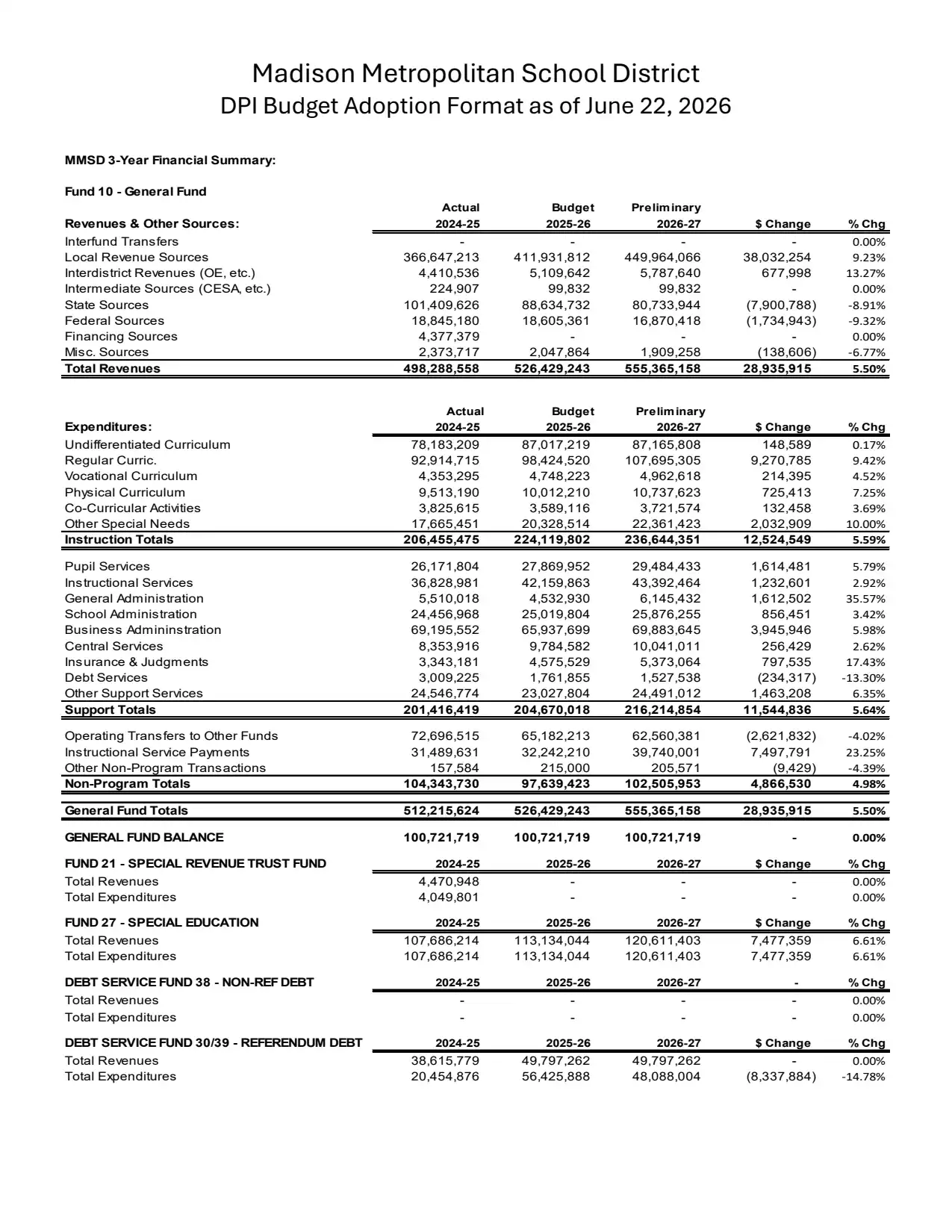
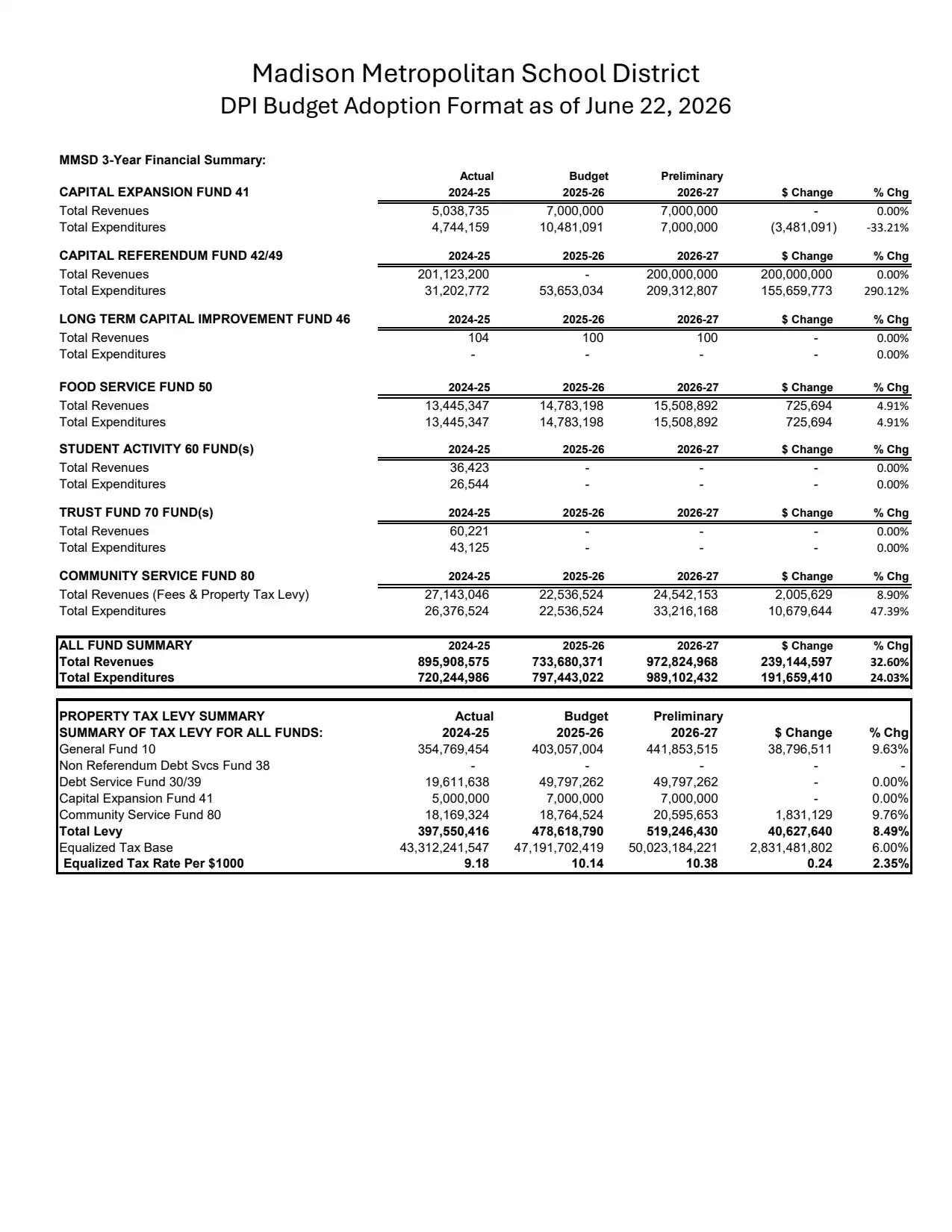
June, 2026 Madison School District Budget Book.
In the current state budget, lawmakers pledged to up the reimbursement rate from 38% to 45% by this school year. But the state has fallen short of fully funding that increase because lawmakers set aside a pot of money that’s too small to keep up with all the costs schools are reporting.
Public schools are required by law to provide special education services to all students who need them, meaning schools must divert money from other places if needed to pay for special education costs not covered by the state and federal government. Over the past 25 years, state aid for special education increased by about 82%, but the costs reported by schools grew by about 103%, according to the nonpartisan Legislative Fiscal Bureau.
Last school year, the Madison school district set aside about $62 million from its general fund — which is fueled by local property taxes — to pay for special education services. About 4,260 Madison students, or 17% of the district, had a disability last school year, according to state enrollment figures.
This year, the stalled boost in state aid for special education has created unpredictability for Madison schools and others trying to craft balanced budgets, said Bob Soldner, the district’s assistant superintendent of financial services. Fulfilling the boost would provide more than $5 million for the district, he said. That amount of money could cover scheduled pay raises for all staff, for example.
“Our hope is … the new Legislature and the new governor are going to live up to the commitments and fully fund what they said they’re going to fund,” Soldner said. “That’s a big uncertainty, and it’ll continue to be an uncertainty until the spring of 2027 when we get a sense of, is there going to be some legislation to come through, and is the state going to meet its commitment to reimburse special education costs?”
f higher state aid levels don’t come to fruition by the end of the school year, Soldner said the School Board could tap the district’s budget reserves meant for emergencies to cover the pay raises, but that move would have “immediate negative consequences.”
“Once we use that one-time safeguard, it’s gone,” he said. “The way the state has backed away from its commitment to share in the cost of local public schools has put our district in a bind anywhere more than this past this school year.
…..
Last year, the district raised its property tax levy by 20.4% — the largest hike in more than three decades — after voters approved$607 million for two referendums.
……
Over the last decade, the district’s staff levels have risen faster than enrollment, according to the Wisconsin Policy Forum. Budgeted positions for non-union professional staff made up the bulk of the increase, while budgeted positions for teachers and student support staff slightly decreased.
———
Madison’s district, despite an elite university pipeline, hypereducated leadership, and a shiny, new strategic plan, suffers the same frailties as Milwaukee’s: basement performance, backbreaking spending. But while Milwaukee is pulling out of its tailspin due to courageouschoices from the top, Madison is ponderously ambling to nowhere. Just ask the locals. “You need the marketing, and you need the product,” as a parent told a reporter. “I’m missing the product.”
2025-2026 Madison 4k-3rd grade Early Literacy Screener report: The bar moves faster than the kids.
Joe Gothard, Becky Kundert and Sonia Spencer Remarks on Madison’s K-12 Literacy Crisis.
2026-2027 Madison K-12 $pending continues to grow, fueled by a 9.7% (!) property tax increase. Total spending will be at least $706,000,000 for 25,003 students, or $28,236 per student.
May 2026 Madison School District Presentation: 7,095 adults for 25,003 students (3.52 students per adult!)
2024-2025 Early Literacy Screener Map.
Map: Foundations of Reading Results: 2015–2024
Where have all the students gone?
3,887 Madison 4 year old to third grade students scored lower than 75% of the students in the national comparison group.
Madison taxpayers have long supported far above average k-12 tax & $pending. This despite our long term, disastrous reading results. May, 2026: 7,095 Staff for 25,003 students; $pending > $26k per student!
Madison Schools: More $, No Accountability
The taxpayer funded Madison School District long used Reading Recovery…
The data clearly indicate that being able to read is not a requirement for graduation at (Madison) East, especially if you are black or Hispanic.
My Question to Wisconsin Governor Tony Evers on Teacher Mulligans and our Disastrous Reading Results
2017: West High Reading Interventionist Teacher’s Remarks to the School Board on Madison’s Disastrous Reading Results
Madison’s taxpayer supported K-12 school district, despite spending far more than most, has long tolerated disastrous reading results.
“An emphasis on adult employment”
Wisconsin Public Policy Forum Madison School District Report[PDF]
WEAC: $1.57 million for Four Wisconsin Senators
Friday Afternoon Veto: Governor Evers Rejects AB446/SB454; an effort to address our long term, disastrous reading results
Booked, but can’t read (Madison): functional literacy, National citizenship and the new face of Dred Scott in the age of mass incarceration.
When A Stands for Average: Students at the UW-Madison School of Education Receive Sky-High Grades. How Smart is That?
China’s PhD Glut Drives Top Graduates to High School Teaching Jobs