School Information System

Civics and the legacy media: “Headline could read: two humans arrested after human found unalive”

Associated Press:

2 men arrested in strangulation of 12-year-old Houston girl whose body was found in a creek

——-

Commentary.

Share

Speaking of growing debt: “Throughout history, nations that blithely piled up their obligations have eventually met unhappy ends”

Gerald Seib:

America is cruising into an uncharted sea of federal debt, with a public seemingly untroubled by the stark numbers and a government seemingly incapable of turning them around.

In the presidential race, there’s not much partisan difference or advantage on this subject. Donald Trump and President Biden have overseen similar additions to the nation’s accumulated debt—in the range of $7 trillion in each case—during their terms. The national response to both has been, by and large, to look the other way.

History, however, offers some cautionary notes about the consequences of swimming in debt. Over the centuries and across the globe, nations and empires that blithely piled up debt have, sooner or later, met unhappy ends.

Historian Niall Ferguson recently invoked what he calls his own personal law of history: “Any great power that spends more on debt service (interest payments on the national debt) than on defense will not stay great for very long. True of Habsburg Spain, true of ancien régime France, true of the Ottoman Empire, true of the British Empire, this law is about to be put to the test by the U.S. beginning this very year.” Indeed, the Congressional Budget Office projects that, in part because of rising interest rates, the federal government will spend $892 billion during the current fiscal year for interest payments on the accumulated national debt of $28 trillion—meaning that interest payments now surpass the amount spent on defense and nearly match spending on Medicare.

——

Commentary.

——

Substantial Madison K-12 tax and $pending increase plans

Share

Virginia Hislop receives a master’s degree in the 2024 diploma ceremony at the age of 105.

By Olivia Peterkin

It’s been a minute since Virginia “Ginger” Hislop was a student at Stanford Graduate School of Education (GSE).

When she started at the GSE in 1936 — then the Stanford University School of Education — her plan was to get her bachelor’s of education, which she did in 1940, and obtain her master’s of education so she could teach, which she started directly after.

The goal: to help grow and provide opportunities for young minds by following in the footsteps of her grandmother, who taught in Kansas before the Civil War, and her Aunt Nora, who was the principal of a school in West Los Angeles, and pursue the field of education.

However, just after completing her coursework and just before turning in her final thesis, her then-boyfriend George Hislop AB ’41, a GSE student in Reserve Officers’ Training Corps (ROTC), got called in to serve during World War II, prompting the pair to get married and Virginia Hislop to leave campus before graduating.

Share

The New York congressman appears to have plagiarized parts of his Ed.D. dissertation.

Christopher Rufo and Luke Rosiak:

Jamaal Bowman, the controversial New York congressman, often appeals to his work as a former school principal and his Ed.D. in education as the basis for his policy positions.

But, according to our analysis, Bowman’s primary academic work—his 2019 dissertation, “Community Schools: The Perceptions and Practices that Foster Broad-Based Collaboration amongst leaders with the Community School Ecosystem”—is riddled with basic errors, failures of logic, and multiple instances of plagiarism. (Bowman did not return a request for comment.)

Bowman has boasted about the paper on social media and considers it formative to his political orientation. When asked recently his political views, Bowman said, “I identify as an educator, and as a Black man in America. But my policies align with those of a socialist, so I guess that makes me a socialist.”

The dissertation, which Bowman completed at Manhattanville College, says that “Black, Latinx, and poor White children have been historically oppressed throughout American history,” and as recompense makes an argument for “community schools,” a concept developed by the Brazilian Marxist pedagogist Paulo Freire, in which schools would be expanded to provide full-time government services for every aspect of society, including for adults.

His research consisted primarily of the “qualitative” variety, with Bowman interviewing 13 school administrators, activists, and parents. Each was immediately placed in a demographic box and assigned the role of oppressor or oppressed. For example, Bowman wrote that “Ms. Melendez, a parent leader at Manny Ramirez High School, was born in the Dominican Republican [sic]” and is a true member of the New York community, while “Ms. Warren, who identified racially as White, discussed being very aware of being ‘a visitor in someone else [sic] community all the time.’”

Share

Censorship and Amazon books

Rep Jim Jordan:

We knew that @Amazon censored books because of pressure from the Biden @WhiteHouse.

Now we know which books:

–Children’s Books
–Books for Parents
–Books critical of Big Pharma

Share

Hired Milwaukee K-12 financial consultant says two key problems led to financial crisis

By: A.J. Bayatpour:

In an interview Thursday with CBS 58, Gray said his review of what went wrong begins with the district’s use of financial reporting software that doesn’t fit with the system used by the state Department of Financial Instruction (DPI). 

While other districts have transitioned to newer software that allows those districts to feed financial data directly to the DPI, Gray said MPS’ software requires financial staffers to plug numbers into a spreadsheet, then re-enter them into the DPI’s system.

“When information goes on a spreadsheet, all it takes is one calculation to throw the whole thing off,” Gray said.

Gray said one of his final suggestions for MPS will be updating its internal software to a system that better aligns with what the state uses. Even then, Gray said that transition could take two years to complete, and it’ll be especially arduous for MPS because those updates will affect the more than 100 schools across Wisconsin’s biggest district.

Beyond the reporting system, Gray said staffing is the other major challenge. MPS’ corrective action plan noted the district hopes to have another 12 staffers in its finance office than it currently has.

——

More:

Share

Lab wars: Inside one Democrat’s 20-year crusade to save the world from Anthony Fauci — Part 1: 2001-2014

Leon Wolf:

What most people did not know, though, was that for years, Fauci had been dogged by a very different sort of doctor — a researcher from Rutgers University who shunned the camera and preferred to keep his opinions in print. A man who made it clear with his appearance and his mannerisms that he never wanted to be an activist. A registered Democrat who supported Biden to the point of putting a Biden sign in his front yard, Ebright had always been convinced of one simple thing that he viewed to be above the petty fray of partisan politics: the government should not be spending our tax dollars to fund dangerous research on making viruses more deadly. 

For years, Ebright and Fauci carried out a silent war, waged in print, visible mostly only to members of the small community of research scientists who conduct serious chemical and biological research. Over and over again the same refrain played out: Ebright warned the public that this research was making the public less safe, and Fauci insisted it was making the public more safe. 

As we know now, Ebright was almost certainly right. However, it has taken four years — thanks to the concerted efforts of Fauci and his team — for the public to slowly come around to that realization. 

But to understand where we are, it is first necessary to understand how we got here. 

++++++++++++++++++++++++

Countless ink, both real and digital, has been spent examining Fauci’s every move taken since those fateful early days in 2020. Relatively little has been spent examining Fauci’s actions priorto 2020.

“[Dick Cheney] found one agency and one person willing to take that role… he found Anthony Fauci.”

Those actions, which are still largely shrouded in obscurity, may turn out to have been far more consequential than anything Fauci has done since he first appeared at the infamous press conference with former President Trump. You see, for the last two decades, Fauci has been by far the most important defender of what might be fairly called a bioweapons research program that the public now knows — albeit imperfectly — as “gain-of-function” research.

The U.S. government started the ball rolling on this dangerous research in the waning days of 2001. As you may recall, the al-Qaeda attacks of 9/11 were followed almost immediately by a series of high-profile anthrax attacks, in which prominent individuals in the U.S. were mailed envelopes with suspicious white powder that later tested positive for anthrax.

Share

Tiny beauty: how I make scientific art from behind the microscope

Steve Gschmeissner:

Cheese fungus, head lice, human sperm, a bee eye, a microplastic bobble: scientific photographer Steve Gschmeissner has imaged them all under the probing lens of a scanning electron microscope (SEM). In his colourized electron micrographs, faecal bacteria resemble thin spaghetti, silica-walled diatoms look like cubes of breakfast cereal and a segmented tardigrade resembles a curled-up, tubby piglet. 

Gschmeissner, who has been imaging microbes, cancer cells and invertebrates for about 50 years, has crafted an extraordinary array of more than 10,000 SEM images, some of which have been featured in Nature.

He spoke to Nature about the importance of scientific images, looking at imploding cancer cells and the miniature world he found on a rotten rasp

Share

Arvind, longtime MIT professor and prolific computer scientist, dies at 77

Adam Zewe:

Arvind Mithal, the Charles W. and Jennifer C. Johnson Professor in Computer Science and Engineering at MIT, head of the faculty of computer science in the Department of Electrical Engineering and Computer Science (EECS), and a pillar of the MIT community, died on June 17. Arvind, who went by the mononym, was 77 years old.

A prolific researcher who led the Computation Structures Group in the Computer Science and Artificial Intelligence Laboratory (CSAIL), Arvind served on the MIT faculty for nearly five decades.

“He was beloved by countless people across the MIT community and around the world who were inspired by his intellectual brilliance and zest for life,” President Sally Kornbluth wrote in a letter to the MIT community today.

As a scientist, Arvind was well known for important contributions to dataflow computing, which seeks to optimize the flow of data to take advantage of parallelism, achieving faster and more efficient computation.

In the last 25 years, his research interests broadened to include developing techniques and tools for formal modeling, high-level synthesis, and formal verification of complex digital devices like microprocessors and hardware accelerators, as well as memory models and cache coherence protocols for parallel computing architectures and programming languages.

Share

Who’s responsible for our accountability problem?

Tim Harford:

I was recently scheduled to present my Cautionary Tales podcast live on stage as a curtainraiser for a podcast conference. Talented voice actors, live sound effects and even a trombone would weave a dramatic soundscape for a full house. There was only one problem. Nobody seemed to have the authority to let me in.

The people issuing conference passes wouldn’t give me one — not unreasonably, since I wasn’t attending the conference proper and hadn’t registered to do so. They advised that I speak to “that lady there”. That lady there seemed puzzled: the conference wouldn’t officially open until tomorrow, so I didn’t need a pass. Just walk in, she said. The security guard had a different view. He had been given strict instructions that nobody gets in without a pass. Talk to the conference team, he told me. Nothing to do with us, they said — talk to security.

I realised I was facing what the writer Dan Davies has named an “accountability sink”, in which it was somehow nobody’s fault. In his recent book The Unaccountability Machine, Davies explains the basic logic of an accountability sink: decision-making power is removed from individuals you might want to shout at, and made instead by an algorithm or some distant committee both ignorant of and immune to your

Rick Esenberg:

Bureaucrats may want to do good things, but, like everyone else, they will tend to put their own interests first. Since they don’t face the same market discipline as private actors, things like this happen and they just say “sorry.”

Share

Wisconsin School districts must use screener in 4K through third grade under Act 20

DPI:

The Wisconsin Department of Public Instruction is announcing NCS Pearson was selected to supply the statewide reading readiness screener under the requirements of 2023 Wisconsin Act 20.

Bids for the universal screener were evaluated by Department of Administration experts following state procurement rules. The DPI will need to negotiate a final contract before July 15, 2024, with NCS Pearson that will include details about assessment administration, accommodations and accessibility options, trainings for teachers and administrators, and testing windows. These details will be announced before the beginning of the 2024-2025 school year.

“Having an equitable universal screener in place is another important step forward in addressing the unique needs of Wisconsin’s youngest learners,” DPI Office of Literacy Director Dr. Barb Novak said. “As the department continues working with schools and districts across the state on implementing the requirements of Act 20, this screener will help educators in understanding each student’s literacy-related strengths and needs. It is critical that we continue coming together to achieve our goal of ensuring every child can read effectively and successfully.”

——

More.

Share

Civics & Covid: Review of DoD Funds Provided to the People’s Republic of China and Associated Affiliates for Research Activities or Any Foreign Countries for the Enhancement of Pathogens of Pandemic Potential (Report No. DODIG‑2024‑099)

Dept of Defense Inspector General:

The purpose of this management advisory is to inform Congress and DoD leadership of the results of our review required in response to Public Law 118‑31, “National Defense Authorization Act for Fiscal Year 2024,” section 252, “Audit to Identify Diversion of Department of Defense Funding to China’s Research Labs.

Section 252 of the FY 2024 NDAA requires that the DoD Inspector General submit a report to the congressional defense committees within 180 days of December 22, 2023. The legislation requires a report on the amount of Federal funds awarded by the DoD, directly or indirectly, through grants, contracts, subgrants, subcontracts, or any other type of agreement or collaboration, to Chinese research labs or to fund research or experiments in China or other foreign countries that could have reasonably resulted in the enhancement of pathogens of pandemic potential, from 2014 through 2023. In addition, the legislation specifically named Chinese government entities, affiliates, and one government contractor, as being part of the study.

——

Commentary.

Share

Substantial Madison K-12 tax and $pending increase plans

Kayla Huynh

One question on the ballot would ask voters for $100 million over the next four school years to increase spending on staff salaries and education programs. The second would ask for $507 million to renovate or replace seven aging elementary and middle schools.

The two referendums would be “unprecedented in size and scope in district history,” according to an analysis from the nonpartisan Wisconsin Policy Forum released today.

As school district leaders consider the referendums, Madison city leaders also are weighing a property tax referendum of their own on the same ballot.

That would mark the first time Madison voters are asked to consider property tax referendums from both the school district and the city.

If voters approve of the school district’s two measures, MMSD officials estimate an owner of an average-value home in Madison would see a $1,376 increase on their property tax bills by 2028. That could be on top of hundreds of dollars annually for a city property tax increase.

——

Wisconsin Policy Forum (achievement?)

Another set of points for referendum voters to consider is how MMSD funding compares to other districts in Dane County and around Wisconsin. In short, the district’s revenue limit and related aid of $15,435 per student is already relatively high compared to other districts, and the referendum would accentuate that.

….

However, the middle schools in particular have low rates of utilization because of declining enrollment, with Sennett, Sherman, Toki, and Black Hawk middle schools all operating at or between 45% and 56% of their capacity. With enrollment currently projected to fall further in the next several years, MMSD officials and voters may wish to consider whether all of these schools will be used for many years to come or whether it makes sense to explore consolidating two middle school buildings to avoid at least one of the construction projects.

They may wish to engage in a similar discussion about elementary schools as well, though those facilities generally have at least somewhat higher utilization rates.

That would be the largest number of MMSD staff since at least 2013 despite the fact that enrollment is essentially at its lowest point over that period.

Sarah Lehr:

But Stein said the latest proposals are historic in size.

“This would be both from the capital and the operating side, the largest referendum questions that have ever been put to (MMSD) voters,” he said. “So certainly, this is a bigger ask than voters have ever had from the district in the past.”

Stein says Madison is contending with financial headwinds, including state-imposed limits on fundraising and waning pandemic aid. 

He also noted that money from a tax referendum approved by MMSD voters in 2020 is drying up.

Last year, Madison’s school board approved employee raises between 5.5 and 10 percent, which cost an extra $12 million in the current fiscal year. MMSD’s proposed budget for 2025 would add more than 100 full-time equivalent staff positions, and could also include additional raises.

It remains to be seen how many of those positions will be filled in a hot labor market, and Stein noted that vacancies could help patch up the budget shortfall.

“All school districts have been facing challenges from employee turnover (and) from rising inflation costs that have put pressure on their labor costs,” he said.

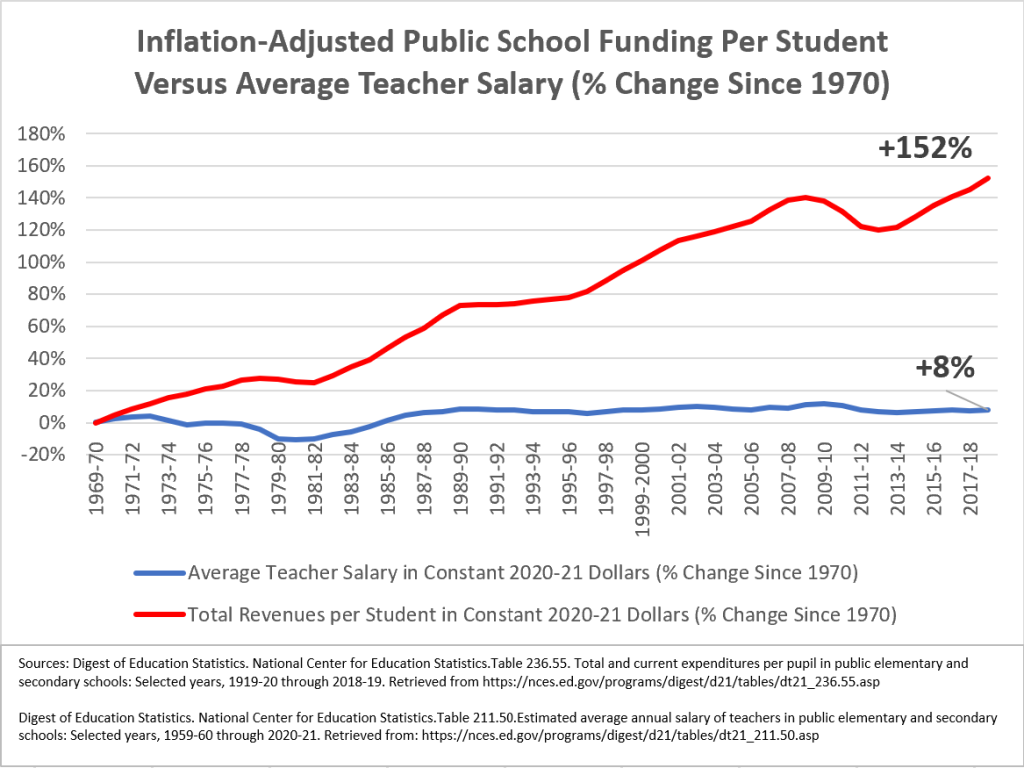
Madison taxpayers have long supported far above average K – 12 spending. Per student spending ranges from $22,633 to $29,827 depending on the spending number used (!)

Enrollment notes.

The data clearly indicate that being able to read is not a requirement for graduation at (Madison) East, especially if you are black or Hispanic”

My Question to Wisconsin Governor Tony Evers on Teacher Mulligans and our Disastrous Reading Results

2017: West High Reading Interventionist Teacher’s Remarks to the School Board on Madison’s Disastrous Reading Results 

Madison’s taxpayer supported K-12 school district, despite spending far more than most, has long tolerated disastrous reading results.

“An emphasis on adult employment”

Wisconsin Public Policy Forum Madison School District Report[PDF]

WEAC: $1.57 million for Four Wisconsin Senators

Friday Afternoon Veto: Governor Evers Rejects AB446/SB454; an effort to address our long term, disastrous reading results

Booked, but can’t read (Madison): functional literacy, National citizenship and the new face of Dred Scott in the age of mass incarceration.

When A Stands for Average: Students at the UW-Madison School of Education Receive Sky-High Grades. How Smart is That?

Share

“The (Stanford) research center, which is shutting its doors, was supposed to tackle “misinformation.” Instead, they hired a bunch of interns to flag social media posts”

By Julia Steinberg

The Stanford Internet Observatory—a research center tasked with rooting out “misinformation” on social media—is shutting its doors. Chances are if you’ve heard of the SIO it was in a scathing piece from Michael Shellenberger or Matt Taibbi, who have accused the center of being a key node in the censorship-industrial complex.

It was also my first employer. Like a zillion other bright-eyed Stanford undergrads, I was drawn to work at a place that promisedto “learn about the abuse of the internet in real time, to develop a novel curriculum on trust and safety that is a first in computer science, and to translate our research discoveries into training and policy innovations for the public good.” To me, that meant ending internet abuse like the glamorization of anorexia on social media or financial scams that steal billions every year. But mostly I worked on the Election Integrity Partnership (EIP), which SIO ran during the 2020 and 2022 elections. The purpose of that project was to identify so-called “fake news” spreading on social media. 

In actuality, SIO hired a load of interns to scan social media for posts deemed to be mis- and disinformation. It turns out that the posts we students flagged were often sent along to moderators at Twitter (now X), Facebook, Instagram, and TikTok, which took them down in order to quash dissenting viewpoints—viewpoints that sometimes ended up being right, as in the case of Covid likely being the result of a lab leak, or Hunter Biden’s hard drive being his actual hard drive—not Russian disinformation. 

——-

Curious NPR reporting.

Share

Notes on teacher staffing

Dale Chu:

WATCH: “The inconvenient fact is that we need 4 million men & women to staff America’s public school classrooms. A number that large means that they will be ordinary people—not saints, not superstars.”

Share

Civics: What Executive Orders Tell Us About Biden, Trump

Beth Brelje

Executive orders are one of the clearest pictures of a president’s priorities.

When politicians make campaign promises, the public can only wonder if those promises will be kept. In the repeat race between President Joe Biden and former President Donald Trump, discerning voters can now look back at their executive orders and consider what each candidate has already accomplished.

Executive orders are one of the clearest pictures of presidential priorities.

Working outside the legislative branches, the executive order allows presidents (and state governors) to change government policy. It can be wielded as a useful tool to advance administration goals or as an overstep of authority.

President Abraham Lincoln’s 1863 Emancipation Proclamation, which freed millions of slaves, is one of the most well-known executive orders.

President Franklin Roosevelt signed an executive order in 1941 establishing the Office of Scientific Research and Development, which facilitated the Manhattan Project and the development of the atomic bomb.

In another executive order, President Roosevelt created internment camps in 1942 and forced 100,000 Japanese Americans to live in them under the umbrella of national security after the Japanese attack on Pearl Harbor.

Share

Civics: Wisconsin Supreme Court Rules Sidewalks are not “Pedestrian Ways”—thus Allowing Local Governments to Use Eminent Domain to Take Property to Build Them

Ilya Somin:

Courts sometimes adopt highly counterintuitive interpretations of words. In 2022, a California court notoriously ruled that bees qualify as fish. Today, in Sojenhomer v. Village of Egg Harbor, the Supreme Court of Wisconsin ruled that a sidewalk is not a “pedestrian way.” They thereby enabled local governments to use eminent domain to condemn property to build sidewalks, despite a state law forbidding the use of eminent domain to take property for “pedestrian way[s].” The close 4-3 decision might become a staple of law school textbooks.

Labour: Conservatives have utterly let renters down

It may seem obvious that a sidewalk is, in fact, a pedestrian way. Indeed, as the court notes, the relevant statute defines a “pedestrian way” as “a walk designated for the use of
pedestrian travel.” That seems to pretty obviously include sidewalks! You don’t have to be a property scholar like me to see that.

Share

Differentiation. Inclusion. Call it what you will – it is a complete and utter failure.

Reddit:

It has made it impossible for me to do my job.
It is the reason we are failing kids. It is the reasons we are burning out. 

Nobody is benefitting under this model. Not our low kids, not our average kids, not our high kids. And definitely not our teachers. 

We are running teachers into the ground and expecting good results. 

I am secondary trained. I was hired to teach junior high. I am currently teaching grade eight English class. 

In theory. 

Somehow planning for one class has turned into planning multiple different lessons to be delivered simultaneously. 

Because you see, I teach grade 8 on paper, because are all thirteen years old, and therefore in grade eight. But the reality is that I am teaching kids who are working at grade level. I am teaching kids who are reading and writing at a high school level. I am teaching kids who are working below grade level because they may have a learning disability or developmental delays. I’m teaching kids who are brand new to the country and who cannot speak English, and who may not even have literacy skills in their native language. 

WHY ARE THEY IN THE SAME ROOM?

You will hear all sorts of crap from admin, the intelligentsia, and consultants. 

“It’s for the kids.”

“It’s good for their self esteem.”

“It’s about learning to cater to their strengths and abilities.”

Is it really? Is it good to have Johnny and Timmy in the same grade 8 class when Johnny is writing essays and Timmy does not yet know what letters are? Are they actually getting what they need to be successful? Will Timmy actually feel empowered being in a class where he feasibly cannot keep up?

Share

“I’ve Got Nothing to Hide” and Other Misunderstandings of Privacy

Daniel Solove:

n May 2006, USA Today broke the story that the NSA had obtained customer records from several major phone companies and was analyzing them to identify potential terrorists. 6 The telephone call database is reported to be the “largest database ever assembled in the world.” 7 In June 2006, the New York Times stated that the U.S. government had been accessing bank records from the Society for Worldwide Interbank Financial Transactions (SWIFT), which handles financial transactions for thousands of banks around the world. 8 Many people responded with outrage at these announcements, but many others did not perceive much of a problem. The reason for their lack of concern, they explained, was because: “I’ve got nothing to hide.”9

The argument that no privacy problem exists if a person has nothing to hide is frequently made in connection with many privacy issues. When the government engages in surveillance, many people believe that there is no threat to privacy unless the government uncovers unlawful activity, in which case a person has no legitimate justification to claim that it remain private. Thus, if an individual engages only in legal activity, she has nothing to worry about. When it comes to the government collecting and analyzing personal information, many people contend that a privacy harm exists only if skeletons in the closet are revealed. For example, suppose the government examines one’s telephone records and finds out that a person made calls to her parents, a friend in Canada, a video store, and a pizza delivery place. “So what?,” that person might say. “I’m not embarrassed or humiliated by this information. If anybody asks me, I’ll gladly tell them where I shop. I have nothing to hide.”

The “nothing to hide” argument and its variants are quite prevalent in popular discourse about privacy. Data security expert Bruce Schneier calls it the “most common retort against privacy advocates.” 10 Legal scholar Geoffrey Stone refers to it as “all-too-common refrain.” 11 The nothing to hide argument is one of the primary arguments made when balancing privacy against security. In its most compelling form, it is an argument that the privacy interest is generally minimal to trivial, thus making the balance against security concerns a foreordained victory for security. Sometimes the nothing to hide argument is posed as a question: “If you have nothing to hide, then what do you have to fear?” Others ask: “If you aren’t doing anything wrong, then what do you have to hide?”

Share

Nature retracts highly cited 2002 paper that claimed adult stem cells could become any type of cell

Retraction Watch:

Nature has retracted a 2002 paper from the lab of Catherine Verfaillie purporting to show a type of adult stem cell could, under certain circumstances, “contribute to most, if not all, somatic cell types.” 

The retracted article, “Pluripotency of mesenchymal stem cells derived from adult marrow,” has been controversial since its publication. Still, it has been cited nearly 4,500 times, according to Clarivate’s Web of Science – making it by far the most-cited retracted paper ever.

In 2007, New Scientist reported on questions about data in the Nature paper and another of Verfaille’s articles in BloodNature published a correction that year. 

The errors the authors corrected “do not alter the conclusions of the Article,” they wrote in the notice. 

Share

Notes on Harvard

By Samuel J. Abrams & Steven McGuire:


Harvard’s year has been one for the history books. It ranked last in the Foundation for Individual Rights and Expression’s annual college free speech survey, earning its own category of “abysmal.” It had quite possibly the worst response to Hamas’s October 7th terrorist attack on Israel in all American higher education. Its former president, Claudine Gay, rightly resigned after a disastrous appearance before Congress and plagiarism revelations in her weak academic record. It has lost major donors. It is facing lawsuits and Department of Education investigations for anti-Semitism. Many of its own faculty, including a former president, have publicly declared the need for significant reforms.

All of this might have been enough to convince the people who run Harvard that they needed to make some changes, and, in fairness, they have made a few small ones. The Faculty of Arts and Sciences did away with mandatory diversity statements in faculty hiring but replaced them with a service statement that could easily be used to weed out candidates on the same grounds. And it partially adopted institutional neutrality, leaving out a key and currently essential part: that political divestment to get the university to take sides is off the table—National Association of Scholars President Peter Wood saw this coming.

Share

What Is ChatGPT Doing … and Why Does It Work?

Stephen Wolfram:

That ChatGPT can automatically generate something that reads even superficially like human-written text is remarkable, and unexpected. But how does it do it? And why does it work? My purpose here is to give a rough outline of what’s going on inside ChatGPT—and then to explore why it is that it can do so well in producing what we might consider to be meaningful text. I should say at the outset that I’m going to focus on the big picture of what’s going on—and while I’ll mention some engineering details, I won’t get deeply into them. (And the essence of what I’ll say applies just as well to other current “large language models” [LLMs] as to ChatGPT.)

The first thing to explain is that what ChatGPT is always fundamentally trying to do is to produce a “reasonable continuation” of whatever text it’s got so far, where by “reasonable” we mean “what one might expect someone to write after seeing what people have written on billions of webpages, etc.”

So let’s say we’ve got the text “The best thing about AI is its ability to”. Imagine scanning billions of pages of human-written text (say on the web and in digitized books) and finding all instances of this text—then seeing what word comes next what fraction of the time. ChatGPT effectively does something like this, except that (as I’ll explain) it doesn’t look at literal text; it looks for things that in a certain sense “match in meaning”. But the end result is that it produces a ranked list of words that might follow, together with “probabilities”:

Share

Why Property Taxes Are Going Up—and How to Cope

Michele Lerner:

It’s hard enough to purchase a home today with mortgage rates near 7% and, apologies for being the bearer of worse news, there’s another housing cost that’s also spiking: property taxes

Mortgage rates have been above 6.5% for over a year, and median home sale prices keep climbing as well. Property taxes get considerably less attention, but are important to factor in affordability.

Total property taxes for homes rose 6.9% in 2023 compared with 2022, according to a recent report by ATTOM, a real-estate data analytics company based in Irvine, Calif. That was the largest jump in five years and nearly double the increase in 2022.

On an individual basis, the average tax on a single-family home increased 4.1% to $4,062 in 2023—following a 3% jump the previous year.

If your property tax bill is higher than expected, however, you have options.

Share

A collection of 2,299 blogs about every topic

ooh:

Share

A Record Number of Kids Are in Special Education—and It’s Getting Harder to Help Them All

Sara Randazzo and Matt Barnum:

More American children than ever are qualifying for special education, but schools are struggling to find enough teachers to meet their needs.

A record 7.5 million students accessed special-education services in U.S. schools as of 2022-2023, including children with autism, speech impairments and attention-deficit hyperactivity disorder. That is 15.2% of the public-school student population, up from less than 13% a decade earlier, the most recent federal data shows.

Several factors are driving the increase. Pandemic disruptions left kids with lingering learning and behavioral challenges. Parents have become more assertive about asking for services, as the stigma around special education has lessened. Autism diagnoses have also risen in recent decades, and the state of Texas has seen a boom in special education after changing an approach that had limited access.

Students with disabilities benefit from services like speech therapy, specialized reading lessons or personal classroom aides. Yet many schools report being understaffed in special education. And now, districts face growing pressure on their budgets as federal Covid relief aid is set to expire this fall.

“We are in a situation right now that is not sustainable,” said Kevin Rubenstein, who oversees special education for an 8,000-student suburban Chicago district. “We continue to struggle to make sure that we have enough teachers in place.”

Georgia parent Joshua Caines appreciated the special-education services his local public elementary school provided for his now 12-year-old son, whose autism and ADHD affect his attention and ability to hand-write, among other things.

Share

Always mediocre, teacher prep is now politicized too

Joanne Jacobs:

Future elementary teachers get a lot of training in “equity pedagogy” at the University of Florida, writes Scott Yenor in City Journal. They may not learn much about how to teach.

He is co-author of a Claremont Institute report, Making Kindergarten Teachers into Radicals, on how the University of Florida’s education school changed training for elementary education majors in 2020.

“Core Teaching Strategies,” “Mathematics Content for Elementary Teachers,” “Art Education for Elementary Schools,” and “Music for the Elementary Child,” among others, were replaced with a new four-course sequence “centered on equity pedagogy.” Suffused with critical race theory, equity pedagogy makes raising consciousness and eliminating racial gaps — not subject matter mastery or effective teaching strategies — the moral imperatives of the teaching profession.

“At least ten required courses in the University of Florida’s new elementary education major have critical pedagogy embedded in their course descriptions, readings, and assignments,” writes Yenor. Nearly all course assignments now “focus on self-reflection about a teacher’s own biases.”

Share

Dude, where’s my privacy?: How a Hollywood star lobbies the EU for more surveillance

Alexander Fanta:

A controversial new law proposed by the European Commission could oblige popular apps such as Instagram, WhatsApp or Signal to screen all private messages of their users for possible child abuse material.

The draft law, unveiled yesterday in Brussels, does not specify which technology must be used. Privacy advocates fear that in practice, the law could mean that most services will have to use client-side scanning, an intrusive technology that circumvents end-to-end encryption.

While opposition to the new law is led by privacy organisations and members of the European Parliament, a leading voice in lobbying in its favour is Thorn, a non-profit founded by Hollywood actor Ashton Kutcher and his then-wife Demi Moore. While the organisation has little public profile in Brussels, its advocacy has reached the highest levels of the European Commission.

Share

Advocating Social Media limits

Jon Haidt & Zach Rausch

1. The adolescent mental health crisis is real

From the 1990s through the mid-2000s, there was little sign of any youth mental health problem in the U.S. in any of the long-running nationally representative datasets. But by 2015, adolescent mental health was a 5 alarm fire, with steeply risingrates of loneliness, anxiety, depression, self-harm, and suicide. 

The trends are not plausibly explainable by changing diagnostic criteria or by a greater willingness of Gen Z to report mental illness as the stigma around it declined. No explanation has been given as to why de-stigmatization proceeded suddenly and rapidly around 2012 onward and affected only the young,and no evidence of such rapid de-stigmatization has been provided. If there has been de-stigmatization, it seems likely it’s been going on for decades. Yet teen depressive symptoms barely budged between 1991 and 2011 and then suddenly shot upward. Behavioral data also show significant rises in ER admissionsand hospitalizations for self-harm episodes among adolescent girls, as well as a rise in actual suicidesfor both boys and girls since 2010.

2. The crisis is international, happening across most of the developed world

We have done an extensive study of 10 nations (Anglo and Nordic) and found rates of depression, anxiety, and other measures of ill-being have been rising since 2010 in all of them. We have also published a study of Europe using the Health Behavior in School-Age Children Survey, which found that high psychological distress is rising across nearly all Western European nations (with the exception of Spain), and many Eastern European nations. (Note that we have worked to address where and why cultural variation exists, including some Eastern European nations and within more religious communities in the United States).

—-

More.

Share

Notes on the Omega School

Seth Nelson:

For 52 years, Omega, an independent educational program, has helped students of all ages secure GEDs or HSEDs, replacement diplomas for those who for some reason never finished high school.

For many of this year’s graduates like Payton, a GED is a gateway to a new life, said Omega School Executive Director Oscar Mireles.

“Omega is giving people a second chance,” Mireles told the Wisconsin State Journal last year. “When you’re 16 or 17, sometimes you make decisions that you don’t think are going to impact your life as much as it does. Having a high school credential really does make a difference.”

Share

The rise of MEI: merit, excellence and intelligence

Joanne Jacobs:

MEI — merit, excellence, and intelligence — will determine hiring at Scale AI, declares CEO Alexandr Wang in a statement. “That means we hire only the best person for the job, we seek out and demand excellence, and we unapologetically prefer people who are very smart.”

Share

Civics: “net federal subsidies in 2024 for insured people are $2.0 trillion”

CBO:

2034, that annual amount is projected to reach $3.5 trillion (or 8.5 percent of gross domestic product). Over the 2025–2034 period, subsidies are projected to total $27.5 trillion—with Medicare accounting for 46 percent; Medicaid and the Children’s Health Insurance Program (CHIP), 25 percent; employment-based coverage, 21 percent; subsidies for coverage obtained through the Affordable Care Act’s marketplaces or the Basic Health Program, 5 percent; and other subsidies, 2 percent.

By CBO’s estimates, the share of people without health insurance reached an all-time low of 7.2 percent in 2023. The rate in 2034 is projected to be 8.9 percent—higher than it was during the 2021–2023 period but lower than the rate of 10.0 percent in 2019, before the coronavirus pandemic. CBO attributes much of the increase over the next 10 years to the end of Medicaid’s continuous eligibility provisions in 2023 and 2024 and the expiration of enhanced marketplace subsidies after 2025. (Both of those policies were put in place during the pandemic.) The surge in immigration that began in 2021 (and that CBO projects will continue through 2026) will contribute to the increase as well, as those newly arrived immigrants will, the agency expects, be substantially less likely to have health insurance coverage than the overall population. The largest increase in the uninsured population between 2024 and 2034 will be among adults who are 19 to 44 years old.

Share

Beyond Academic Sectarianism

Steven M. Teles

More conspicuously than at any time in living memory, elite higher education has found itself in the political crosshairs. Who could have predicted a year ago that the presidents of the University of Pennsylvania and Harvard would, in quick succession, be thrown out of a job after less than two years in office between them? Or that presidents of other elite universities would be holding on by the skin of their teeth?

While these and other university leaders’ responses to the Hamas attack on Israel lit the fire, the dry tinder for a political assault on our most prestigious universities has been sitting around for some time. What started in Philadelphia and Cambridge will not stop there.

Those who sense more than a whiff of political opportunism and anti-intellectualism in this assault are not mistaken. But the public’s impression that American higher education has grown increasingly closed minded is undeniably correct. Indeed, concerns about the ideological drift of the university are no longer limited to conservatives, but now include some left-leaning faculty who worry that higher education has become, in the words of Princeton professor Gregory Conti, “sectarian.”

Share

Harvard. Enrollment and final exam for railroad practice. Daggett, 1906-1907

Irwin Collier:

Stuart Daggett was born March 2, 1881 in Milwaukee, Wisconsin and graduated from Roxbury Latin School (Boston, Massachusetts) in 1899. He received all three of his degrees, the A.B. in 1903, the A.M. in 1904, and the Ph.D in 1906, from Harvard University. The title of his thesis was “Railroad Reorganization”, published as vol. 4 of  Harvard Economic Studies (Houghton Mifflin, 1908). During 1906 to 1909 he was Instructor at Harvard, and in 1909 he accepted appointment to the University of California as Assistant Professor of Railway Economics. He was appointed full professor in 1917 and from 1920-1927 he was dean of the College of Commerce, retiring in 1951 as Flood Foundation professor emeritus of transportation. Stuart Daggett died December 22 1954 in Oakland, California.

__________________________

Railroad Practice
1906-07

Course Enrollment

Economics 17 2hf. Dr. Daggett. — Railroad Practice.

Total 37: 4 Graduates, 14 Seniors, 12 Juniors, 5 Sophomores, 2 Others.

Source: Harvard University. Report of the President of Harvard College, 1906-1907, p. 71.

*  *  *  *  *  *  *  *  *  *  *  *  *  *  *  *

ECONOMICS 17
Year-end Examination, 1906-07

Answer 1, 2, 3, and five other questions.

  1. Distinguish between
  1. departmental railroad organization, and
  2. divisional railroad organization.
    Show the lines of responsibility under each system.
Share

Civics: Scotland follows England, Wales and Northern Ireland in exonerating wrongfully convicted subpostmasters en masseCivics:

Karl Flinders

    Former subpostmasters and Post Office branch staff who were wrongfully convicted of crimes based on flawed computer evidence in Scotland have had their convictions quashed.

    Emergency legislation to exonerate wrongfully convicted Post Office workers has completed its journey through Scottish Parliament and each will now receive initial compensation of £600,000, with the ability to claim more as financial redress for their suffering.

    This mirrors legislation in Westminster, which covers England, Wales and Northern Ireland. In Westminster, emergency legislation was pushed through last month to overturn the convictions of hundreds of former subpostmasters and their staff. Prime minister Rishi Sunak promised the blanket exoneration after an ITV drama and documentary about the scandal angered the public.

    Share

    Notes on taxpayer subsidized federal student loans

    CBO:

    Under the William D. Ford Direct Loan Program, the federal government provides education loans to undergraduate and graduate students and to the parents of undergraduate students. The federal government serves as the lender for all borrowers in the direct loan program but contracts with private entities to service those loans. Before July 1, 2010, the federal government also provided loan guarantees to financial institutions to provide federal student loans through the Federal Family Education Loan Program. The current program offers four types of loans:

    • Subsidized loans are need-based loans for undergraduate students. No interest accrues while a borrower is enrolled or
      during other deferment periods, and borrowing is limited by a student’s class level and dependency status.
    • Unsubsidized loans are non-need-based loans for undergraduate and graduate students. Interest accrues from
      origination, and borrowing is limited by a student’s class level and dependency status.
    • Parent PLUS loans are non-need-based loans for parents of dependent undergraduates. Interest accrues from
      origination, and borrowing is limited only by the cost of attendance.
    • GradPLUS loans are non-need-based loans for graduate students. Interest accrues from origination, and borrowing is
      limited only by the cost of attendance.
      The seven tables for federal student loan programs detail costs, loan volume, and subsidy rates as follows:
    • Table 1 shows cost projections for each budget account associated with the federal student loan programs, estimated
      according to procedures established in the Federal Credit Reform Act of 1990 (FCRA).
    • Table 2 shows the credit reestimates and modifications that the Office of Management and Budget announced that it
      would record in fiscal year 2024. Additionally, it shows 50 percent of the assumed modification needed for the costs
      to outstanding loans related to the notice of a proposed rulemaking on loan cancellation.
    • Table 3 shows projections of loan volume for new direct student loans.
    • Table 4 shows projections of subsidy rates for new direct student loans, by repayment plan, estimated using FCRA procedures.
    • Table 5 shows interest rate projections for federal student loans.
    • Table 6 shows cost projections for the federal student loan programs, estimated using fair-value procedures.
    • Table 7 shows projections of subsidy rates for new direct student loans, by repayment plan, estimated using fair-valu
    Share

    Understanding the misunderstood Kessler Syndrome

    Nation-states are blowing up satellites. Companies are launching megaconstellations of thousands of satellites. Dead rocket stages whiz around the planet for years. And yet, the International Space Station hasn’t been destroyed, payloads reach deep space unharmed, and we’re not trapped on Earth — at least not by debris. Either calamity is not upon us or we just don’t recognize it. Jon Kelvey takes the measure of Kessler Syndrome.

    Jon Kelvey

    Share

    Taxpayer funded Censorship: the latest from CISA

    CISA

    A lack of public understanding about elections (!) can undermine confidence in election security, increase risks to cybersecurity and physical security of election infrastructure, and potentially lead to disruption of election operations. As the official source of information about their jurisdiction’s elections, election officials can mitigate these risks through regular and consistent public communication, especially during incident response when there is often increased interest and sometimes confusion among the public. By demonstrating transparency and communicating effectively, officials can provide voters with the information necessary to have confidence that an election has been administered securely.

    An effective communications plan will include multiple communication activities that engage a variety of voters. These could include hosting town halls, sending an email newsletter, and maintaining an up-to-date and easy-to-use website. (It is recommended that the website uses a .gov web domain to help the public recognize it as an official state or local government site). Each communication activity should be defined by specific, measurable, attainable, relevant, and timebound (SMART) objectives. For example, SMART objectives could include increasing the number of visits to the election office’s website during a defined timeframe or seeing a decrease in the number of questions received about a particular topic after the office has provided publicly available information about the topic.

    The following guidance and supporting worksheets are created to help election officials design communication activities that achieve their objectives. Each section helps answer a different question about the plan, including what to communicate, who their audience is, and how to reach them through effective methods, partners, and timing, as well as provides additional guidance for incident response communications where clear and transparent communication is especially important.

    ——

    CISA and censorship.

    Share

    Notes on “voucher” schools; accountability?

    Dave Zweifel

    Many educators complained at the time that the entire voucher program would serve as a foot in the door to eventually undermine the public school system — a system that had served the country since colonial days and was credited with representing the true melting pot among children from different cultures, races and incomes. Besides, experiments comparing public and private schools in other places hadn’t resulted in any significant improvements in student outcomes.

    The ACLU filed suit against the religious school expansion and in 1998, the State Supreme Court declared it unconstitutional. But, three years later the U.S. Supreme Court okayed the concept, agreeing with voucher proponents that taxpayer money actually went to parents who then could use the money as they saw fit for their children’s education. Therefore, states weren’t directly sending funds to religious schools, the court found.

    From those beginnings here in Wisconsin, that seemingly modest little program has blossomed into a colossus that is rapidly creating a complete second school system funded by the American taxpayer.

    “Billions in taxpayer dollars are being used to pay tuition at religious schools throughout the country, as state voucher programs expand dramatically and the line separating public education and religion fades,” a report in the Washington Post read earlier this month.

    ——-

    Madison taxpayers have long supported far above average K – 12 spending. Per student spending ranges from $22,633 to $29,827 depending on the spending number used (!)

    Enrollment notes.

    The data clearly indicate that being able to read is not a requirement for graduation at (Madison) East, especially if you are black or Hispanic”

    My Question to Wisconsin Governor Tony Evers on Teacher Mulligans and our Disastrous Reading Results

    2017: West High Reading Interventionist Teacher’s Remarks to the School Board on Madison’s Disastrous Reading Results 

    Madison’s taxpayer supported K-12 school district, despite spending far more than most, has long tolerated disastrous reading results.

    “An emphasis on adult employment”

    Wisconsin Public Policy Forum Madison School District Report[PDF]

    WEAC: $1.57 million for Four Wisconsin Senators

    Friday Afternoon Veto: Governor Evers Rejects AB446/SB454; an effort to address our long term, disastrous reading results

    Booked, but can’t read (Madison): functional literacy, National citizenship and the new face of Dred Scott in the age of mass incarceration.

    When A Stands for Average: Students at the UW-Madison School of Education Receive Sky-High Grades. How Smart is That?

    Share

    The Fauci Conspiracy

    James B. Meigs

    In other words, our public health officials, abetted by a politicized media, manufactured an airtight consensus on both Covid science and policy. This consensus was largely immune to scientific evidence or concerns about the real-world impacts of draconian policies.

    But not everyone joined the lockstep march on Covid. Stanford University’s Jay Bhattacharya, along with two other public health experts, issued the Great Barrington Declaration. It sensibly argued that the social costs of extended lockdowns far exceeded their mostly hypothetical benefits. The Great Barrington argument was derided in the press and secretly censored on social media at the behest of government officials.

    Similarly, at a time when the CDC and WHO both asserted the disease was transmitted primarily through “close contact,” Virginia Tech’s Lynsey Marr and several other scientists found abundant evidence that Covid was, in fact, airborne. This meant the key to saving lives was improving indoor ventilation, not displays of hygiene theater. Both health organizations largely ignored the new findings for more than a year, instead sticking to the “six-feet-apart” mantra and other dubious protocols. The astonishingly early arrival of vaccines was one of the pandemic’s key medical breakthroughs. But, as University of California, San Francisco, oncologist and epidemiologist Vinay Prasad argued, health officials confused and angered the public by exaggerating the vaccine’s benefits, ignoring its small but real risks (for young men, the danger of myocarditis arguably outweighs the vaccine’s upsides), and insisting that everyone—even children or people who’d gained immunity from previous Covid infections—keep taking booster after booster. Fauci’s vaccine mandates were a massive overreach.

    ——-

    Nicole Shanahan:

    Oh yes, it must be so “terribly frustrating” that Americans don’t “appreciate” having their: children masked, schools closed, businesses shuttered, family gatherings restricted, vaccines mandated, etc. In Fauci’s world, the citizen should just say “please and thank you” and do as they’re told. Science be damned.

    Waiting for an analysis of the long term costs of taxpayer supported Dane County Madison Public Health “mandates”

    Share

    Mathematics higher education preparation

    University of California

    The faculty Workgroup on Mathematics (Area C) Preparation, convened by UC’s Board of Admissions and Relations with Schools (BOARS) in fall 2023, has concluded their work and issued their Stage 2 report. The report focuses on which mathematical coursework is most appropriate and necessary to prepare students for success at UC, including courses recommended as the fourth year of math.
     
    The Stage 2 conclusions are as follows:

    • There are no changes to the Area C requirement. UC will continue to require the three lower-level (i.e., foundational) math courses covering the topics found in elementary algebra, geometry and advanced algebra (typically Algebra I-Geometry-Algebra II or Math I-II-III) as the best preparation for a diverse range of interests. This sequence allows maximum flexibility for students to explore various majors in their postsecondary studies, including STEM, social science and humanities majors. Nearly all California applicants to UC already meet this minimum requirement.
    • UC recommends a fourth year of math that substantially builds upon the knowledge and skills acquired in the foundational sequence. Such courses should be appropriate for 12th-grade students who have already completed the lower-level coursework.
    • Area C courses will fall under one of the following four categories:
    Share

    The Murky Business of Transgender Medicine

    Christopher Rufo:

    The practice made Sivadge recoil. “In the cardiac clinic, we were taking sick kids and making them better,” she says. “In the transgender clinic, it was the opposite. We were harming these kids.”

    Then, the following year, she breathed a sigh of relief. Under pressure from the state attorney general, Ken Paxton, Texas Children’s CEO Mark Wallace said that he was shutting down the child gender clinic. But it wasn’t true. Mere days later, it had secretly reopened for business.

    And business was booming. Doctors, including Roberts, Paul, and Kristy Rialon, were managing dozens of pediatric sex-change cases, performing surgeries, blocking puberty, implanting hormone devices, and making specialty referrals. They were motivated not only by ideology, but by hope for prestige: they were saviors of the oppressed, the vanguard of gender medicine.

    Sivadge soon had seen enough. She read my investigative report exposing Texas Children’s sex-change program, which relied on testimony from Haim, and reached out to share her own observations.

    “I work very closely with this provider, Dr. Richard Roberts. I’ve been in the room with him when he speaks with these patients,” she told me in an interview. “Dr. Roberts is extremely encouraging of their transition and will essentially do whatever he can to make sure that they are happy, at least externally happy. Because I am absolutely certain that they are not internally happy. He is very accommodating. He does whatever they want. Essentially, there is no critical analysis of the process.”

    In Sivadge’s view, Roberts and other providers were manipulating patients into accepting “gender-affirming care.” When parents objected, the doctors bulldozed them, she claims. Some families, she believed, feared that the hospital would call Child Protective Services if they dissented.

    Then, two months after I spoke with her for that story, Sivadge called me in a panic. The FBI had sent two special agents, Paul Nixon and David McBride, to her home. The agents knocked on the door, asked her about “some of the things that have been going on at [her] work lately,” and then asked to enter her home. She was terrified. (The FBI declined to comment.)

    The agents told Sivadge that she was a “person of interest” in an investigation targeting the whistleblower who had exposed the child sex-change program. They told her that the whistleblower had broken federal privacy laws. “They threatened me,” Sivadge said. “They promised they would make life difficult for me if I was trying to protect the leaker. They said I was ‘not safe’ at work and claimed that someone at my workplace had given my name to the FBI.”

    The authorities—the FBI, the hospital, and, as Sivadge would later discover, federal prosecutors—were all circling the story. Both the Department of Justice and the hospital leadership were ideologically committed to “transgender medicine.” They had been embarrassed by the investigation that had exposed their actions, and they were looking for revenge.

    Things went quiet for a while afterward. Sivadge resumed her work as a nurse, and the FBI did not reappear.

    ——

    Commentary.

    Share

    “The Gaslighting of Experts.”

    Eric Weinstein:

    Let’s say you are an economist who believes that higher taxes spent on infrastructure would be good for the nation. The right may fight you. They may call you a name like “Libtard” or “Commie”. And that is absolutely awful behavior to me. Truly. But they aren’t nearly as likely to coordinate behind the scenes in emails to be discovered later and all agree to pretend, seemingly independently, that as a former expert you have committed some unclear moral crime that means you can never be empaneled or invited onto a commission. They aren’t immediately going to treat you like a mental patient, a con-artist, or threat to society. They are just going to be asses. That’s the dopey game they love: “Happy Warriors” is what they call it.

    And the subjects I focus on most tend to be the places where I think dissenting experts are being gaslit:

    COVID ORIGINS

    SOUTHERN BORDER

    STRING THEORY

    POTUS COGNITIVE STATE AND AGE

    EPSTEIN’S INTELLIGENCE CONNECTION

    COVID MANAGEMENT

    QUESTIONING UKRAINE NATO STRATEGY

    INFLATION/GROWTH MEASUREMENT

    MONETARY AGGREGATES AND FED INTERVENTION

    VP COMPETENCY

    Share

    K-12 tax & $pending climate: Wisconsin’s economy

    Kurt Bauer

    1of2: It’s been a rough two months for Wisconsin in several economic measurement studies/rankings.

    WI’s population grew just 0.31% per year between 2008-2023, according to PEW.

    WI ranks 40th in Best & Worst State Economies from Wallethub.

    Share

    Harvard Faculty Slam Social Science Dean’s Proposal to Limit Faculty Speech

    Tilly Robinson;

    Several Harvard faculty members blasted Dean of Social Science Lawrence D. Bobo for suggesting certain faculty speech should face “sanctionable limits” and argued that his proposals would restrict academic freedom.

    Bobo argued in a Friday op-ed that some faculty members should face penalties from Harvard’s administration for issuing statements that incite external intervention into the University, singling out former Harvard President Lawrence H. Summers for his fierce condemnation of Claudine Gay’s initial response to the Oct. 7 attack on Israel.

    Bobo’s op-ed comes as Harvard weathers political attacks, including a monthslong congressional investigation and threats to its federal funding — a campaign which has seized on criticisms lodged by the University’s own faculty, including Summers. Meanwhile, the end of the semester was marked by student protests over the war in Gaza, culminating in a pro-Palestine encampment in Harvard Yard and a walkout at Commencement.

    Bobo took aim at Summers — who has charged Harvard with allowing rampant antisemitism and accused its top brass of mishandling the leadership crisis last winter — for his role as one of the University’s highest-profile critics.

    Share

    Milwaukee scandal hurts all Wisconsin students

    Barbara Dittrich

    Representative Barbara Dittrich (R – Oconomowoc) issued the following statement regarding the MPS fiscal scandal and its impact on local school districts:

    “Aside from the fact that the Department of Public Instruction (DPI) and Milwaukee Public Schools (MPS) leadership have deceived the public and hurt some of Wisconsin’s most underprivileged students, there is an enormous ripple effect this scandal has on every one of the state’s students. 

    “As a result of the MPS referendum, the school districts in the area I serve see reductions in annual state aid as follows:

    ——

    Matt Smith:

    Wisconsin’s state superintendent — Sunday morning on UPFRONT

    ——-

    AJ Bayatpour:

    State Supt. Jill Underly says she first learned of MPS’ financial problems in late April.

    She says the state wasn’t worried then since MPS was about that late with its reports last year. I asked why DPI was so lenient, knowing the state’s biggest district could affect everyone:

    Much more on Jill Underly, here (and her efforts to abort our elementary teacher literacy test: the Foundations of Reading).

    Share

    The Miseducation of America’s Teachers

    Daniel Buck

    If medical professionals spoke about early career doctors the way school administrators talk about early career teachers, no one would enter a hospital again. “Oh, everyone kills a few patients early on,” a caring mentor assures an internist who prescribed the wrong medication. “The only way to learn is to dive in and poke around,” says a veteran surgeon to a young resident about to perform his first tracheotomy.

    Unfortunately, these are common sentiments among educators in America. No novice teacher is armed with the knowledge or skills to run a classroom; it’s simply assumed that they’ll fail early on. In fact, making it through the blistering first year — the classroom chaos, the unforgiving workloads, the confusing curricula, the daily student insolence — is something of a rite of passage. Veterans clap rookies on the back and assure them they’ll make it through, knowing that the first few years will be rough — for both the teacher and his students.

    The reason for this reality is simple: Our nation’s teacher-preparation system is broken. Our educators enter the profession woefully unprepared for their jobs. The large majority attend programs at university schools of education, where they read and discuss esoteric academic literature that contains no references to classroom-management techniques, lesson pacing, learning assessments, or other practical knowledge. These schools are boxing academies that don’t teach their students how to duck and weave.

    I experienced the consequences during my first year of teaching. Lectures on tort law and transgender literacies didn’t equip me to handle a student who slugged another in the face during class. Nor did a few mock lessons equip me to fill 50 minutes of class time for several different classes five days a week.

    Share

    Civics: ‘Progressivism That Doesn’t Result in Progress’

    James Freeman:

    Today’s headline nicely sums up the problem afflicting the modern Democratic Party, and it comes to us courtesy of the New York Times of all places. The newspaper’s Nicholas Kristof writes:

    As Democrats make their case to voters around the country this fall, one challenge is that some of the bluest parts of the country — cities on the West Coast — are a mess.

    Centrist voters can reasonably ask: Why put liberals in charge nationally when the places where they have greatest control are plagued by homelessness, crime and dysfunction?

    Mr. Kristof writes that “the truth is that too often we offer a version of progressivism that doesn’t result in progress” and adds:

    Share

    The Encyclopedia Project, or How to Know in the Age of AI

    Janet Vertesi:

    Our kids aren’t allowed to just look things up online themselves. Like many parents, we guide them through trying to find something trustworthy, so as to avoid online sludge. We have an especially draconian approach to YouTube. We search through multiple layers of proxies, private browsers, and peer sites, so that Google can’t infer who we are or our preferences. So when my husband typed in a few search terms and scrubbed through several clips before settling on one, we had some confidence in our due diligence. It certainly looked like a comprehensive introduction to kung fu.

    At first, a male voice droned over a flurry of images. Thirty seconds in, my husband whispered, “I think this text is AI generated.” Fifteen seconds later, I whispered back, puzzled, “I think the voice is AI generated too.” Then, in the foreground, we spotted six fingers on a character. As we rushed to the controls, a picture filled the screen; it looked to all the world like a painting of a temple (just like the one in Kung Fu Panda). But this temple was going up in flames, while monastic fighters paraded unperturbed before the inferno. “Why is the building on fire?” our youngest panicked.

    “Because,” my husband said calmly as he turned the machine off, “it’s not a real building. It’s something a computer made up, what it thought we wanted to see.”

    I shook my head. This was a deep game. There was, as of yet, no single button to AI-generate an entire video. We had hoped the length and variation of our selection might offer some respite. Instead, somebody assembled the pieces, generating each in turn and stitching them together by hand, aware of their ruse as they chased clicks. I drew a long breath.

    “That’s it,” I announced. “We’re getting an encyclopedia.”

    Share

    Civics: taxpayer funded election censorship

    Judicial Watch:

    Judicial Watch announced today it received 110 pages of heavily redacted records from the U.S. Department of Homeland Security (DHS) in a Freedom of Information Act (FOIA) lawsuit that show state election officials in the days before and after the 2020 election flagging online content deemed “misinformation” and sending it to the Center for Internet Security (CIS), a DHS-funded nonprofit, the Cybersecurity and Infrastructure Security Agency (CISA), the Election Integrity Partnership (EIP), and others.

    The records were obtained in response to a November 2022 Freedom of Information Act (FOIA) lawsuit for records of communications between the Cybersecurity and Infrastructure Security Agency (CISA), a division of DHS, and the Election Integrity Partnership (EIP), which was created to suppress online election content for censorship and suppression(Judicial Watch Inc. vs. U.S. Department of Homeland Security (No. 1:22-cv-03560 )). Judicial Watch filed suit in the U.S. District Court for the District of Columbia after DHS failed to respond to an October 2022, FOIA request.

    The newly obtained records include a November 4, 2020, email report from CIS “Misinformation Reports” to Brian Scully, head of the Cybersecurity and Infrastructure Security Agency (CISA) Mis-, Dis-, Malinformation (MDM) branch, a division of DHS. The report originated in the Washington State secretary of state’s office and states:

    Share

    A Frightening View of Free Speech and Academic Freedom at Harvard

    Jonathan Adler:

    Professor Lawrence Bobo, Dean of Social Science and the W. E. B. Du Bois Professor of the Social Sciences at Harvard University, has an article in the Harvard Crimson on the proper limits of faculty speech that has to be read to be believed.

    He writes:

    Is it outside the bounds of acceptable professional conduct for a faculty member to excoriate University leadership, faculty, staff, or students with the intent to arouse external intervention into University business? And does the broad publication of such views cross a line into sanctionable violations of professional conduct?

    Yes it is and yes it does.

    Vigorous debate is to be expected and encouraged at any University interested in promoting freedom of expression. But here is the rub: As the events of the past year evidence, sharply critical speech from faculty, prominent ones especially, can attract outside attention that directly impedes the University’s function.

    A faculty member’s right to free speech does not amount to a blank check to engage in behaviors that plainly incite external actors — be it the media, alumni, donors, federal agencies, or the government — to intervene in Harvard’s affairs. Along with freedom of expression and the protection of tenure comes a responsibility to exercise good professional judgment and to refrain from conscious action that would seriously harm the University and its independence.

    In support of this position, he even notes “you can’t escape sanction for shouting ‘fire’ in a crowded theater.”

    Share

    Topological Problems in Voting

    Back in college, I developed an interest in unexpected impossibility proofs applied to real world systems. The fact that certain abstract mathematical structures inherently have limitations which profoundly impact actual applications is both captivating and sobering. Here’s a cute instance of topological properties applied to voting systems a friend shared with me through this video (we’ll take a slightly different approach).

    Background: Arrow’s Theorem

    Arrow’s Theorem1 is the most famous impossibility theorem applied to voting systems – lots of articles and papers have spent time introducing and discussing its implications. In essence, Arrow’s Theorem states that a voting process which ranks candidates in an absolute total order cannot simultaneously satisfy:

    Share

    Alverno College declares financial emergency, plans to cut majors and graduate programs

    Kathryn Muchnick
    :

    Alverno College’s Board of Trustees has declared a financial emergency and is cutting one-third of its majors and one-quarter of its graduate programs, the school announced Friday.

    Kathy Hudson, chair of the board, said the moves would “ultimately position Alverno College for a more financially sustainable future.” She added: “We remain dedicated to providing students a transformational education experience.”

    As part of the restructuring, the south-side Milwaukee college, which traces its history back 137 years, will cut 25 full-time faculty positions and 12 full-time staff positions.

    Share

    Notes on the taxpayer funded Milwaukee School District Superintendent Search

    Corrinne Hess:

    Since mismanagement and financial failures were uncovered over the last several weeks, several key positions, including the CFO, have either resigned or retired. 

    Steven Enoch worked as a superintendent for 18 years in California and Washington State, including the San Ramon Valley Unified School District in the San Francisco Bay Area. He said if the Milwaukee school board wants to change the direction of the district, it will need to hire a superintendent from outside of MPS.

    Keith Posley worked for MPS for 40 years. Galvan is a 30-year veteran of the district. 

    Enoch said internal candidates — even if they are great — represent a status quo. But he cautioned that finding a qualified superintendent is challenging because the pool is smaller than it used to be. 

    “If a school board is viewed as dysfunctional, the number of interested candidates will decrease significantly,” Enoch said. “Public education has always been difficult because it has been political. But it has gotten more political now that it has become a target of certain groups.” 

    But former MPS Superintendent Howard Fuller said the job might not be as hard to fill as some people might guess.

    Share

    Fast Crimes at Lambda School

    Benjamin Sandofsky:

    Two days after his company’s downfall, Austen Allred wrote:

    I wish people could see how ugly it is to be envious, and how obvious it is to those around you when that’s what’s happening.

    There’s no much uglier than trying to tear someone down because they achieved what you wish you had.

    Austen co-founded Lambda School, one of the largest educational startups of all time. It promised to teach you to code in a matter of months, a common claim in 2017, a time when code bootcamps were commodities you could find in any strip mall. But you don’t score $120 million in funding from the biggest names in venture capital by building a better boot camp. He took on college.

    An underdog with a story as fascinating as his company, Austen went from Mormon missionary to college dropout— at one point homeless and living out of his Honda Civic— to the founder of the hottest startup in the valley.

    What set his boot camp apart from the others were “Income Share Agreements.” Instead of paying up-front for tuition, students agreed to pay a portion of future income. If you don’t get a job, you pay nothing. It was an idea so clever it became a breakout hit of Y Combinator, the same tech incubator that birthed Stripe, AirBnb, and countless other unicorns.

    When Lambda School launched in 2017, critics likened ISAs to indentured servitude, but by 2019 it was Silicon Valley’s golden child. Every day, Austen tweeted jaw-dropping results.

    Share

    A government with a permanent deficit and a bloated military. A bogus ideology pushed by elites. Poor health among ordinary people. Senescent leaders. Sound familiar?

    By Niall Ferguson

    But it only recently struck me that in this new Cold War, we—and not the Chinese—might be the Soviets. It’s a bit like that moment when the British comedians David Mitchell and Robert Webb, playing Waffen-SS officers toward the end of World War II, ask the immortal question: “Are we the baddies?

    I imagine two American sailors asking themselves one day—perhaps as their aircraft carrier is sinking beneath their feet somewhere near the Taiwan Strait: Are we the Soviets?

    Yes, I know what you are going to say. 

    There is a world of difference between the dysfunctional planned economy that Stalin built and bequeathed his heirs, which collapsed as soon as Mikhail Gorbachev tried to reform it, and the dynamic market economy that we Americans take pride in. 

    The Soviet system squandered resources and all but guaranteed shortages of consumer goods. The Soviet healthcare system was crippled by dilapidated hospitals and chronic shortages of equipment. There was grinding poverty, hunger, and child labor. 

    ——

    Total public cynicism about nearly all institutions.

    Share

    A Long Guide to Giving a Short Academic Talk

    Benjamin Noble:

    For the first year grad student, reading is life. Every professor is unaware, it seems, that you are taking other classes. In fact, I used to look forward to my statistics homework simply because it was a break from reading.

    As I have progressed through my program, I find myself reading less and less. At this point, I’d actually like to do some reading—but between R&Rs, writing, and collecting data, reading is one thing that can always be safely put off until tomorrow.

    I once asked a junior professor how—given the need to publish, teach, and meet with students—he had time to keep up with all of the new scholarship coming out each month. His response: he didn’t. He said he kept up with new work primarily by attending talks, workshops, and conferences.

    I share this long-winded windup that has little do with talks for a reason—because this was the moment I realized that if you want others to read your work, you cannot simply publish it and assume others will find (and cite) it. You need to sell it.

    Share

    Dismissive literature reviews reduce understanding – so why do academics keep making them?

    Richard Phelps:

    How many times have you read an article that confidently states there are few other studies in this area? And how confident are you that this is the case? Richard Phelps argues outside of the sciences there is rarely a lack of pre-existing literature, but claiming so is a rhetorical move to give priority to one’s own research.

    Doesn’t all scholarship add to our storehouse of knowledge, you ask? Well, yes, in an absolute sense. Isaac Newton’s generous acknowledgement of his predecessors seeing farther by standing on the shoulders of giants comes to mind.

    In a relative sense, however, a new piece of scholarship may subtract from our collective understanding with a most un-Newtonian device: the dismissive literature review. With a dismissive review, a scholar assures an audience that little or no previous research exists on a topic or, if it does, it is so poorly done it is not worth citing.

    With a dismissive review, a scholar assures an audience that little or no previous research exists on a topic or, if it does, it is so poorly done it is not worth citing.

    Share

    Remedial education in college

    William Biagini:

    In a desperate attempt to catch high school graduates up to speed, many universities are providing remedial writing classes to college students. 

    About 68% of those starting at two-year public institutions and 40% of students enrolled in public four-year universities took at least one remedial writing class between 2003 to 2009, according to an original report from the Department of Education.

    Average math and reading test scores dropped significantly from 2019 to 2021, according to a 2022 study by two Northwest Evaluation Association (NWEA). It seems likely that the 2016 figures would be much worse if they were resampled in 2023, after the COVID-19 pandemic. 

    Dr. Megan Kuhfeld, one of three NWEA study researchers, told Campus Reform Aug. 30 that “It seems likely but with two caveats: (a) the students in our study have not reached college yet so it is hard to extrapolate from middle school test results and (b) colleges may have changed their criteria for routing students into remedial courses as a results of the pandemic, which would also change the proportion.”

    And:

    In the 90’s Camille Paglia told us anti-western radical leftists were taking over and politicizing the Univerisites.

    Share

    In the name of the law: scholar He Weifang argues his case for remembering China’s past

    Yuanyue Dang

    He Weifang is a retired professor from Peking University Law School. Named one of Foreign Policy’s top 100 global thinkers in 2011, He has long advocated for judicial independence. 

    You retired last July, bidding farewell to your fruitful career as a legal scholar. How is life after retirement and do you still have some work to do?

    It’s quite good. I still have three PhD students under my supervision who have not yet graduated.

    Share

    Why Structure and Interpretation of Computer Programs matters

    Brian Harvey

    In 2011, to celebrate the 150th anniversary of MIT, the Boston Globe made a list of the most important innovations developed there. They asked me to explain the importance of SICP,and this is what I sent them:

    SICP was revolutionary in many different ways. Most importantly, it dramatically raised the bar for the intellectual content of introductory computer science. Before SICP, the first CS course was almost always entirely filled with learning the details of some programming language. SICP is about standing back from the details to learn big-picture ways to think about the programming process. It focused attention on the central idea of abstraction — finding general patterns from specific problems and building software tools that embody each pattern. It made heavy use of the idea of functions as data, an idea that’s hard to learn initially, but immensely powerful once learned. (This is the same idea, in a different form, that makes freshman calculus so notoriously hard even for students who’ve done well in earlier math classes.) It fit into the first CS course three different programming paradigms(functional, object oriented, and declarative), when most other courses didn’t even really discuss even one paradigm.

    Another revolution was the choice of Scheme as the programming language. To this day, most introductions to computer science use whatever is the “hot” language of the moment: from Pascal to C to C++ to Java to Python. Scheme has never been widely used in industry, but it’s the perfect language for an introduction to CS. For one thing, it has a very simple, uniform notation for everything. Other languages have one notation for variable assignment, another notation for conditional execution, two or three more for looping, and yet another for function calls. Courses that teach those languages spend at least half their time just on learning the notation. In my SICP-based course at Berkeley, we spend the first hour on notation and that’s all we need; for the rest of the semester we’re learning ideas, not syntax. Also, despite (or because of) its simplicity, Scheme is a very versatile language, making it possible for us to examine those three programming paradigms and, in particular, letting us see how object oriented programming is implemented, so OOP languages don’t seem like magic to our students. Scheme is a dialect of Lisp, so it’s great at handling functions as data, but it’s a stripped-down version compared to the ones more commonly used for professional programming, with a minimum of bells and whistles. It was very brave of Abelson and Sussman to teach their introductory course in the best possible language for teaching, paying no attention to complaints that all the jobs were in some other language. Once you learned the big ideas, they thought, and this is my experience also, learning another programming language isn’t a big deal; it’s a chore for a weekend. I tell my students, “the language in which you’ll spend most of your working life hasn’t been invented yet, so we can’t teach it to you. Instead we have to give you the skills you need to learn new languages as they appear.”

    Share

    “Thinking for us”

    Jesus Diaz:

    With every new AI feature announced, my heart sank a little more. There was the Lensa-style AI-image generation engine that guarantees that everyone with an Apple device will be sharing the same trite images in the style of 2022 DALL-E. There was the ChatGPT-powered tools that can summarize web pages, write emails, and compose bedtime stories to read to your child complete with AI-generated illustrations. There was even an AI tool to automatically “clean up and correct” your iPad handwriting, making it “more uniform and pretty.”

    Apple has the reach to shape how millions of people will experience AI for the first time, and it has chosen to take the technology in the wrongest of directions, eating and regurgitating every artificial intelligence idea already out there, rebranding it to Apple Intelligence, and turning its operating systems into engines designed to normalize your personality.

    Share

    China’s Good Will(a) Hunting, Vocational Fashion Student and Improbable Math Genius

    Rui Ma:

    17-year old vocational high school student Jiang Ping, who spends her days studying fashion design and literally making clothes, places 12th out of 801 finalists for the global Alibaba Math Contest. Unlike most of the other contestants, who hail from the top educational institutions in the world — plenty from MIT, Carnegie Mellon, and of course Tsinghua and Peking University — she was one of the roughly 50% of kids in China who didn’t even go to a regular high school and ended up at this vocational high school, where the primary purpose is to prepare them for a skilled, hands-on vocation. In her case, that is fashion design.

    She seems to have had just a super high aptitude for Math since she was young, and always found all the math problems in class very trivial. When she aced her first math exam at the vocational school, her Math teacher gave her a few advanced math books for self study. Armed with just a Chinese-English dictionary and translation app, she began to study in her spare time and found a lot of joy in exploring the beautiful universe that is Math.

    Share

    Milwaukee K-12 District officials knew about state aid reductions before referendum vote

    By: A.J. Bayatpour

    State education officials said Friday administrators for Milwaukee Public Schools (MPS) knew the district was facing a reduction in state aid as early as late March. 

    Those adjustments from the Department of Public Instruction (DPI), now estimated to be somewhere between $35 million and $50 million, will make up for overpayments MPS previously received as a result of bad data it provided the state.

    Chris Bucher, a DPI spokesperson, told CBS 58 Friday the state first became aware in late March MPS may have submitted incorrect data that led to the state giving more money than it should have.

    On April 2, Milwaukee voters narrowly approved a $252 million referendum for the district. 

    Friday’s release is the first public confirmation at least some officials at the highest levels of MPS knew they were facing a state aid reduction because of past mistakes, but voters were never informed of that before the April vote.

    “The subject of an impact to aid first came up during a discussion in late March, although we cannot confirm an exact date,” Bucher said in an email. “Because of problems with MPS data, we have been working since then to drill down and put more clarity on this number.”

    We wanted to ask two top district administrators what they knew at the time.

    Share

    “Second, the latest revelation underscores the incompetence of the board”

    John Schlifske:

    The recent news that Milwaukee Public Schools failed to file a required financial report to the state Department of Public Instruction, that its past reports were missing data or inaccurate, and that it might have to payback millions in funds to the state is just another proof point underscoring the need for substantial governance reform. This lays open two serious deficiencies with the MPS board

    First, is the lack of transparency and outright deceit on the part of the board. Do we really believe all this was “discovered” after the district led a push for $252 million in new property taxes? Do we really believe that no one on the board was aware of what was going on? For an elected body to misrepresent and hide the true situation at MPS immediately preceding the spring ballot initiative is outrageous and unacceptable. The board operates in star-chamber proceedings with absolutely no oversight. It no longer holds the public’s trust.

    Second, the latest revelation underscores the incompetence of the board. Why weren’t they asking the tough questions? Why weren’t they seeking information as to the delay? Were they so oblivious to good governance that they didn’t even think to ask for this kind of data? No well-governed organization should ever find itself in the situation the MPS board is in right now. Moreover, this incompetence extends to the performance of the school system itself.

    Milwaukee schools near bottom in national academic performance

    As a city, our K-12 educational performance is near dead last, well below the national averages (based on the National Assessment of Educational Progress) in both reading and math. Think about it, we are below virtually every other major city in America. Worse, only 15.9%, and 9.9% of MPS students are on grade level on the state assessment in reading and math, respectively.

    ——-

    Commentary.

    Meanwhile, Madison!

    Madison taxpayers have long supported far above average K – 12 spending. Per student spending ranges from $22,633 to $29,827 depending on the spending number used (!)

    Enrollment notes.

    The data clearly indicate that being able to read is not a requirement for graduation at (Madison) East, especially if you are black or Hispanic”

    My Question to Wisconsin Governor Tony Evers on Teacher Mulligans and our Disastrous Reading Results

    2017: West High Reading Interventionist Teacher’s Remarks to the School Board on Madison’s Disastrous Reading Results 

    Madison’s taxpayer supported K-12 school district, despite spending far more than most, has long tolerated disastrous reading results.

    “An emphasis on adult employment”

    Wisconsin Public Policy Forum Madison School District Report[PDF]

    WEAC: $1.57 million for Four Wisconsin Senators

    Friday Afternoon Veto: Governor Evers Rejects AB446/SB454; an effort to address our long term, disastrous reading results

    Booked, but can’t read (Madison): functional literacy, National citizenship and the new face of Dred Scott in the age of mass incarceration.

    When A Stands for Average: Students at the UW-Madison School of Education Receive Sky-High Grades. How Smart is That?

    Share

    in 1971 when The New York Times and The Washington Post published excerpts of what would be known as “The Pentagon Papers.”

    Michael Shellenberger:

    Daniel Ellsberg, a Defense Department analyst working for the RAND Corporation, had given the two newspapers top-secret documents. They showed not only that the US was losing the war in Vietnam but that the Pentagon had known the US couldn’t win the war for many years and kept fighting it anyway.

    The Pentagon had tried to prevent the publication of the documents, but the Supreme Court ruled that the First Amendment protected newspapers’ right to publish them, even though Ellsberg had broken the law by leaking them.

    Thanks to the Twitter Files, we learned that individuals with links to US military and intelligence organizations have tried for years to convince reporters that they should no longer follow the Pentagon Papers principle, ostensibly since doing so could help foreign adversaries. They used this argument at the same moment that they were attempting to “pre-bunk” the Hunter Biden laptop, months before The New York Post published articles about its existence.

    Now, a judge in Tennesse may violate the Supreme Court’s famous Pentagon Papers ruling and order a reporter in Nashville named @michaelpleahy to reveal the source of documents leaked to him. The leaked documents in question came from a trans-identified woman named Audrey Hale, who killed six people at a Christian school last year.

    Share

    Faculty Censorship

    Lawrence Bobo:

    After this historic year of endless controversy, I — like many faculty members — look forward to calmer times on campus. But before any semblance of normalcy can be achieved, we must come together to resolve two lingering questions about our role in the University community.

    Having witnessed the appallingly rough manner in which prominent affiliates, including one former University president, publicly denounced Harvard’s students and present leadership, this first question must be answered: Is it outside the bounds of acceptable professional conduct for a faculty member to excoriate University leadership, faculty, staff, or students with the intent to arouse external intervention into University business? And does the broad publication of such views cross a line into sanctionable violations of professional conduct?

    Yes it is and yes it does.

    Vigorous debate is to be expected and encouraged at any University interested in promoting freedom of expression. But here is the rub: As the events of the past year evidence, sharply critical speech from faculty, prominent ones especially, can attract outside attention that directly impedes the University’s function.

    A faculty member’s right to free speech does not amount to a blank check to engage in behaviors that plainly incite external actors — be it the media, alumni, donors, federal agencies, or the government — to intervene in Harvard’s affairs. Along with freedom of expression and the protection of tenure comes a responsibility to exercise good professional judgment and to refrain from conscious action that would seriously harm the University and its independence.

    More.

    Share

    The March of Dimes Syndrome

    John Tierney:

    The better things get, the more desperately activists struggle to stay in business.

    In the spring of 1979, a few weeks after the partial meltdown of a nuclear reactor at Three Mile Island in Pennsylvania, more than 65,000 people marched on the United States Capitol chanting “No Nukes, No Nukes.” As a young reporter at the Washington Star assigned to cover this new movement, I interviewed march organizers and noticed that all of them had previously organized protests against the Vietnam War. This struck me as curious: How had they suddenly become so passionate and knowledgeable about nuclear power?

    I later learned that a term exists for this phenomenon—the March of Dimes syndrome—and that the tendency affects many other movements, too. Why, last year, did the Human Rights Campaign declare a “national state of emergency” for LGBT people? Why was the election of the first black American president followed by the Black Lives Matter movement? Why have reports of “hate groups” risen during the same decades that racial prejudice has been plummeting? Why, during a long and steep decline in the incidence of sexual violence in America, did academics, federal officials, and the #MeToo movement discover a new “epidemic of sexual assault”?

    These supposed crises are all examples of the March of Dimes syndrome, named after the organization founded in the 1930s to combat polio. The March helped fund the vaccines that eventually ended the polio epidemics—but not the organization, which, after polio’s eradication, changed its mission to preventing birth defects. Its leaders kept their group going by finding a new cause, just as antiwar activists did after achieving their goal of ending the Vietnam War. The Three Mile Island accident offered new fund-raising opportunities and a new platform for veterans of the antiwar movement such as Jane Fonda and her husband Tom Hayden, who both addressed the crowd at that first antinuke rally.

    For career activists, success is a threat. They can never declare mission accomplished.

    Share

    Columbia Task Force Reveals Full Extent of Antisemitism on Campus Since Oct. 7, by Students and by Faculty

    Lee Yaron:

    One professor encountering a Jewish-sounding surname while reading names before an exam asked the student to explain their views on the Israeli government’s actions in Gaza. Another told their class to avoid reading mainstream media, declaring that “it is owned by Jews.” A third revealed a student’s complaint about an offensive comment regarding Jews by publicly displaying their email to fellow 

    Share

    We Should Worry about What Columbia Is Teaching Teachers, Too

    Daniel Buck:

    The campus tantrum at Columbia University exposed for all to see the institution’s commitment to the fringe political philosophies of postcolonial theory and of DEI more broadly.

    Perhaps lesser known to the general public is that Columbia’s education department — aptly named Teachers College — is the oldest and arguably most prestigious education school in the country. It is the Yale Law or Julliard of teacher-prep programs. The ideas that students imbibe there and the content that the school’s professors promulgate reflect the elite consensus in American education. Unfortunately, and perhaps unsurprisingly, a review of courses offered exposes an obsession with …

    Share

    Civics: Public records and the covenant shooting

    Deborah Fisher

    It’s been a dizzying week in the public records case before Davidson County Chancellor I’Ashea Myles.

    For more than a year now, Myles has been considering whether the public records law requires the Nashville Police Department to release files from its investigation into the Covenant School shooting. Six people were killed in the shooting, including three children.

    Now, however, as everyone has been awaiting a long-overdue ruling, the chancellor has turned her attention to a leak of police records to a local conservative news website, The Tennessee Star. She is clearly hot about it.

    On Monday, she ordered Tennessee Star Editor Michael Patrick Leahy, the editor and owner of Star News Digital Media, one of the four plaintiffs in the case, to appear personally in court on June 17 and show in a “show cause hearing” why his “publication” of articles based on leaked documents “does not” subject him to contempt proceedings and sanctions.

    Today, a Nashville police lieutenant delivered a declaration to the court suggesting the leaker is former lieutenant Garet Davidson, who also just happened to file a big complaint against his former employer

    Share

    NH House nixes school voucher expansion

    Rick Green:

    State representatives rejected legislation Thursday to expand a program that uses taxpayer dollars to help parents pay for their kids’ private school tuition or home-schooling expenses.

    House Bill 1665 would have increased financial eligibility for the Education Freedom Accounts program from the current 350 percent of the federal poverty level to 425 percent, or $133,000 a year for a family of four.

    It passed the Senate, 14-10, on Thursday in a party-line vote, with Republicans in favor and Democrats against.

    Share

    Why China takes young Tibetans from their families

    The Economist:

    An air of quiet piety hangs over Rongwo Monastery in the western province of Qinghai. The streets near this ancient complex draw pilgrims and Tibetan Buddhist monks in dark red robes. Local believers make circuits around the monastery’s yellow walls, turning a line of wooden prayer-wheels as they walk.

    On a recent Monday afternoon, though, chattering schoolchildren thronged this sacred neighbourhood in the heart of Tongren, a small mountain city known to Tibetans as Rebkong. Youngsters in red scarves and uniform tracksuits bought fruit and snacks from market stalls, most without a parent in sight. Teenage high-schoolers and pupils half their age hauled small suitcases or sat in weary groups beside piles of schoolbags, bringing the bustle of a railway station to streets around the monastery.

    Share

    Love Spreadsheets? Meet Their Inventor

    Curt Schleier:

    Prior to VisiCalc, personal computers were basically novelties kids played games on. But the electronic spreadsheet, which let non-mathematicians manipulate hundreds of numbers with a single keystroke, showed how a computer was invaluable. Businesses raced to buy them.

    Even Apple (AAPL) co-founder Steve Jobs said that VisiCalc software, originally written for the Apple II computer, “propelled the company’s success more than any other single event.” Jobs said that “If VisiCalc had been written for some other computer, you’d be interviewing someone else right now.”

    Share

    An update on One City Schools (Monona, WI)

    Kaleem Caire

    One City Preschool continues to attract far more children than we can enroll, and is ready to grow and expand. Our two public charter schools, One City Elementary School and One City Preparatory Academy, are making notable progress as well:

    • Our benchmark assessments show our Scholars growing academically across grade levels.
    • Our Scholars are earning recognition for modeling our 5 Habits of Character (compassion, integrity, persistence, risk, and self-respect) at home, at school, and in the community.
    • 97% of our 456 seats in grades 4K to 8 are already filled for the 2024-25 school year, with 94% of our current Scholars returning in the fall.
    • 95 of our 98 staff members said they want to return next year: a 97% retention rate.
    • Our staff and Parent Council are doing a beautiful job of engaging families in our schools, and our volunteers and partners are helping our children reach for their North Star and grow. Nearly 600 family members attended our first Winter Wonderland Family Ball and trained volunteers are tutoring our Scholars in reading.
    • Our advocacy efforts helped inspire, facilitate, and secure the largest increase in state spending on K-12 education ($1.3B) in Wisconsin history.

    In July 2025, we will host our 10th anniversary celebration and first 8th grade graduation. This will be just the second time we have hosted a large community gathering to promote and support our Scholars and schools: the first time was our coming out event that TruStage Foundation (formerly CUNA Mutual Foundation) hosted at its headquarters in Madison in March 2015.

    ——-

    Kaleem Caire and One City.

    Share

    Former head of NSA joins OpenAI board

    Jay Peters:

    OpenAI’s board of directors now includes Nakasone, Altman, Adam D’Angelo, Larry Summers, Bret Taylor, Dr. Sue Desmond-Hellmann, Nicole Seligman, and Fidji Simo. Microsoft’s Dee Templeton also has a non-voting observer seat.

    Share

    Why Government Unions—Unlike Trade Unions—Corrupt Democracy

    Philip Howard:

    Today, in a runoff election for mayor, Chicago voters will choose either former teacher Brandon Johnson or former schools CEO Paul Vallas. What’s raising eyebrows is the funding of Johnson’s campaign: Over 90 percent has come from teachers unions and other public employee unions. Vallas has the endorsement of the police union, but his funding is more diverse, including business leaders and industrial unions. Just looking at the money, the race comes down to this: Public employees vs everyone else plus cops.

    What is wrong with this picture? The new mayor is supposed to manage Chicago for all the citizens, not to benefit public employees. Chicago is not in good shape. In 37 of its schools, not one student is proficient in reading or math. Its transit system is stuck with schedules that serve no one at great expense. The crime rate in Chicago is among the highest in the country. But no recent Chicago mayor has been able to fix these and other endemic problems because the public unions have collective bargaining powers that give them a veto on how the city is run. Frustrated by the inability to get teachers back to the classroom during Covid, Chicago mayor Lori Lightfoot observedthat the teachers union wanted “to take over not only Chicago Public Schools, but take over running the city government.”

    This is not just a Chicago problem. Los Angeles teachers walked out of class rooms last month supposedly to support striking service personnel, but Los Angeles lacks the resources to help the service employees because of the indebted inefficiencies in the teachers union contract.

    American government has a fatal flaw hiding in plain sight. Public employee unions in most states have a stranglehold on public operations. Voters elect governors and mayors who have been disempowered from fixing lousy schools, firing rogue cops, or eliminating notorious inefficiencies.

    ——

    WEAC: $1.57 million for Four Wisconsin Senators (2010)

    Act 10

    Share

    Simple sabotage

    Erik Bernhardsson

    CIA produced a fantastic book during the peak of World War 2 called Simple Sabotage. It laid out various ways for infiltrators to ruin productivity of a company. Some of the advice is timeless, for instance the section about “General interference with Organizations and Production”:

    1. Insist on doing everything through “channels”. Never permit short-cuts to be taken in order to expedite decisions.
    2. Make “speeches”. Talk as frequently as possible and at lengths. Illustrate your “points” by long anecdotes and accounts of personal experience. Never hesitate to make a few “patriotic” comments.
    3. When possible, refer all matters to committees for “further study and consideration”. Attempt to make committees as large as possible — never less than five.
    4. Bring up irrelevant issues as frequently as possible.
    5. Haggle over precise wordings of communications, minutes, resolutions.
    6. Refer back to matters decided upon at the last meeting and attempt to re-open the question of the advisability of that decision.
    7. Advicate “caution”. Be “reasonable” and urge your fellow conferees to be “reasonable” and avoid haste which might result in embarrassments or difficulties later on.
    8. Be worried about the propriety of any decision — raise the question of whether such action as is contemplated lies within the jurisdiction of the group or whether it might conflict with the policy of some higher echelon.

    I guess I’ve always been fascinated with how well this has stood the test of time? I even got this particular section framed and hung up at our office:

    ——

    The data clearly indicate that being able to read is not a requirement for graduation at (Madison) East, especially if you are black or Hispanic”

    My Question to Wisconsin Governor Tony Evers on Teacher Mulligans and our Disastrous Reading Results

    2017: West High Reading Interventionist Teacher’s Remarks to the School Board on Madison’s Disastrous Reading Results 

    Share

    Scores of actresses turn down roles in play critical of JK Rowling’s gender views

    Craig Simpson:

    A play that criticises JK Rowling’s views on gender is struggling to cast women with 90 actresses so far rejecting parts.

    The stage production, which is set to debut at the Edinburgh Fringe, has already caused outrage over a working title which labelled the gender-critical Harry Potter author a c—-.

    The production is yet to cast any of the female roles, including that of Rowling herself.

    The part of Harry Potter film star Emma Watson has also been repeatedly turned down, and around 90 actresses have refused to take part in the project amid concerns over its critique of Rowling.

    The author has become a figure of hate online among some activists, and received death threats after publicly sharing concerns about the encroachment of transgender campaigning on women’s rights.

    Actors have been found for male leads, who will portray Harry Potter cast members Rupert Grint and Daniel Radcliffe.

    Share

    Some schools dole out funds for students who can trace their lineage to specific individuals—or just happen to have the same name; good news for Zolps and Scarpinatos

    Melissa Korn:

    Descendants of major donors or graduates have long enjoyed an edge in admissions at many colleges. But legacy preference reaches even further at some schools, with money available for people who can trace their lineage directly to specific individuals, or who just happen to have the same last name.

    Loyola University Chicago offers scholarships to Catholic students with the last name Zolp. A University of California scholarship gives preference to graduate students from Colombia and direct descendants from the family of the benefactor, Miguel Velez. Among more than a half-dozen “ancestry-based scholarships,” as Harvard University labels them, is one for descendants of Thomas Dudley, who served as governor of the Massachusetts Bay colony in the 1600s.

    If the donors want to claim charitable deductions on their taxes, university fundraisers say, they have to make clear that lineage is just a preference, not an outright requirement. That way, the money will still be used when no namesakes are selected, and donors steer clear of what the IRS calls “private benefit.”

    The University of Maine currently has 38 scholarships with stated preferences for descendants of a particular individual or family.

    Share

    Civics and taxpayer supported NPR “No Evidence for Those Claims” !

    Shannon Bonds hourly news plug 15 June 2024 16:00ET: [short audio clip]

    Academic group studying disinformation is facing an uncertain future after political attacks. A campaign by Republicans is targeting research. NPRs Shannon Bond reports the Stanford Internet Observatory studies how social media platforms are abused. Its investigated thorny issues including child exploitation and the spread of false and misleading information about voting and vaccines.

    Now its top leaders are out and future funding is uncertain. The group is among a slew of researchers who have come under attack by conservatives who allege they’re colluding with the government and tech companies to censor political speech. There’s no evidence for those claims, but they fueled online harassment campaigns and conspiracy theories.

    Stanford University says The work of the internet observatory will continue under new leadership. Shannon Bond, NPR News, this.

    Another NPR publication.

    I wonder how much research Ms. Bond conducted for this article?

    Thomas Adamo, Josiah Joner:

    Matt Taibbi’s two latest “Twitter Files” drops revealed that Stanford played a direct role in this gross violation of online free speech. Emails revealed that the Stanford Internet Observatory (SIO) actively collaborated with Twitter to suppress information they knew was factually true. Taibbi’s investigation revealed that Stanford’s Virality Project “recommends that multiple platforms take action even against ‘stories of true vaccine side effects’ and ‘true posts which could fuel hesitancy.’”

    The project succeeded in getting big tech companies to take down about 35% of the content they flagged. They reviewed content en masse from almost every major social media company: Twitter, Google, YouTube, Facebook, Instagram, Medium, TikTok, and Pinterest were all monitored by SIO. The questionable censorship decisions by the group all seemed to go in one direction—shutting down the now-vindicated Dr. Scott Atlas and Dr. Jay Bhattacharya, while taking direct guidance from Anthony Fauci about the supposed falsehood of the lab leak theory.

    Deep dive on the twitter files, here.

    Ann Althouse:

    So this “collapse” is occurring just before the Supreme Court case comes out. Odd.

    What’s the answer to my original question, how much of a struggle was it for the experts in monitoring disinformation to handle attacks from conservatives? Were the attacks well grounded, or were the attacks disinformation?

    IN THE COMMENTS: Kate said:

    I salute the name, “Stanford Internet Observatory.” I think of astronomy and the clean pursuit of star systems, with the telescope instead focused on something infinite and microscopic: the galaxies of the internet.

    However, it was just a run-of-the-mill political op, small and grubby, gussied up to sound fancy.

    Share

    Little transparency throughout Milwaukee K-12 District financial crisis

    Adam Rife

    Our only goal is to get answers about what happened within the district & what’s next. It’s not about us reporters. Thousands of people in the community voted for these leaders & thousands in the community is impacted by their actions. That community deserves accountability.

    Share

    School starts fundraiser for family of 9-year-old Jonael Zambrano-Cardona, who was fatally shot while playing in his bedroom in Milwaukee

    Drake Bentley

    Greater Holy Temple Christian Academy started a fundraiser for the family of 9-year-old Jonael Zambrano-Cardona, who was shot and killed in Milwaukee by a stray bullet while playing in his room following a barrage of gunfire outside his home.

    Jonael just finished third grade at his school that same day. “He had a bright future ahead of him,” wrote Edward DeShazer, executive director of the academy, on the GoFundMe page.

    “We want to rally around his family in their time of need and help them with whatever costs that are to come,” he said.

    Milwaukee police said the shooting took place just after midnight Thursday in a condominium complex on the 9000 block of North Swan Road. Jonael would later die at a hospital. Attempts to reach his family have been unsuccessful.

    Jonael’s cousin, Maynor Antunez, started a separate GoFundMe page for the family to help cover funeral expenses.

    Share

    “Amends the Military Selective Service Act to require the registration of women for Selective Service.”

    armed services @ Senate

    I am thankful that some folks are keeping an eye on the ebb and flow of legislation.

    Meanwhile;

    America’s assassination attempt on Huawei is backfiring

    Our mulligan policy….

    Share

    “I just wanted to point out that the idea of substituting tariffs for taxes does have much historical support”

    Balaji:

    For most of American history, tariffs dominated taxes as a source of federal government revenue:

    This was also the time when the US rose to become a manufacturing powerhouse. And as you can see from the graph, the income tax (and the Federal Reserve and much of the federal government as we know it) really only dates back to the 1910-1930s period. For most of US history the economy was set up in a completely different way.

    MERCANTILISM VS FREE TRADE
    The term for what the US used to be is “mercantilist”. The founders thought of the US as like a giant merchant that needed to make more money than it spent.

    As such, their rationale for tariffs was simple. A tariff is an incentive to build rather than buy. In theory, it encourages domestic manufacturing and is a tax on foreigners rather than citizens. We don’t need to buy foreign goods; we have goods at home!

    This is distinct from the last few decades of free trade. The idea was: you’re good at making apples and I’m good at making oranges, so why not just specialize and trade? Comparative advantage proves it’s a win/win!

    This is a good argument until you make military robots and I make pieces of paper, which is the relationship between China and the US now. At that point it’s no longer a win/win. With your military robots you can perhaps take my paper — and my oranges. And there is no need to trade.

    ——-

    “America’s assassination attempt on Huawei is backfiring”

    Share

    “By using available federal databases, the [Selective Service] agency will be able to register all of the individuals required and thus help ensure that any future military draft is fair and equitable.”

    Mario Nawful:

    The House passed a measure automatically registering men aged 18 to 26 for selective service as part of the FY25 National Defense Authorization Act.

    Previously, male U.S. citizens aged 18 to 25 had to manually register for Selective Service.

    The new proposal does not alter the existing requirements for immigrants, who must register within 30 days of arrival unless they are on valid visas.

    This new measure uses federal databases for automatic registration, streamlining the process and reducing legal issues for non-compliance.

    Share

    “repackage failure as democratic progress”

    Riva-Melissa Tez:

    Las Vegas is not selling you a fake morality. You can care or not, and no one will judge you. I grew tired of California’s virtue signaling, the self-flagellation and the demands that we apologize for our own success. We are taught to tone down our splendor, to be ashamed of our successes, to live in mediocrity as a symbol of equality with our neighbors. The billionaires are fasting in their minimalist houses, worried about the potential resentment of their employees and customers. We’re all self-censoring, nervous that the wrong word, phrase or pronoun will destroy our careers and livelihood.

    The psychological weight of this tip-toeing forces us to look for joy in little things: the yoga classes, the mindfulness podcasts, the $22 custom gluten-free, dairy-free salads. When I first ordered the giant fruit sherbet sundae at the Peppermill, a 24-hour neon-lit Las Vegas diner, I felt relieved of California’s judgement. A huge mold of pink frozen sherbet dripped out of a supersize pineapple, like a soft volcanic ooze. The splendor was mine for only $13.

    The elites in Silicon Valley are ashamed of their elitism. In their false apologies, they promote narratives that intend to show how much they care for the rest of society. This messaging, the worst form of pity, only belittles their neighbors. The irony is lost on them. For not once did they feel a moment of true greatness, the power to shape the world around them, more than picking the color of their new Tesla. The people who rose to the top of Las Vegas recognized the power in enjoying it all, for that skill was what allowed them to package it to the rest of society. Give me the surrealist grandiose dreams of Las Vegas over San Francisco any day. I’ll take a gondola from the Venetian and meet you outside of Cheesecake Factory.

    Share

    Civics: notes on “opposition research”

    Mark Judge

    It’s good that the justices are speaking out. But conservatives need to understand that there is nothing to all the media stories concocting ethics complaints about the justices —they are simply being targeted by coordinated “oppo research” campaigns.

    Oppo or “opposition research” is used in politics to destroy political enemies. Genuine ethical questions usually involve things like bribes and the abuse of power. Opposition researchers, on the other hand, find people you dated when you were 16 years old and get them to say nasty things about you. They then try and use those things to stir up controversy. They feed it to the media then try and personally destroy the targeted person to get them to step down from public life.

    It baffles me that by now conservatives are still fooled by this tactic. They assume that where there is smoke, there must be fire—when the left makes the smoke up out of thin air.

    I have been warning about the left’s plan to do this to the conservatives on the Court for more than five years. I first brought it up in 2018 while talking to an old friend over lunch in Georgetown. I had been oppo researched, almost to death, to prevent Supreme Court nominee Brett Kavanaugh, a high school friend of mine, from taking his seat on the Court. I told my friend that even though Brett made it, the oppo was just getting started. She laughed in my face. (She did not laugh when she read my account of the Kavanaugh hit in my book The Devil’s Triangle.)

    Since then, I have spent hours, days, weeks, and months trying to warn the political right. They are going to go after the friends and family of the justices. They are going to dig up all kinds of nonsense. They are going to secretly record them.

    ——

    I often ask, when reading articles, how the writer chose and expanded on the topic, particularly when they have no expertise in said area. Seeding and fertilizing is common.

    ——-

    More.

    “Like most legacy newspapers, we have an editorial voice and it happens to be center-left, and we have a robust nonpartisan opinion section that includes views of conservatives on a number of local issues,” he said. “Our commentary is pro-democracy, pro-transparency, and clearly labeled as opinion. Like legacy newspapers, our opinion section is completely separate from our news reporting.”

    —-via

    Also, Wisconsin Watch.

    Share

    Taboos and Self-Censorship Among U.S. Psychology Professors

    Cory J. Clark, Matias Fjeldmark, […], and Philip E. Tetlock+10:

    We identify points of conflict and consensus regarding (a) controversial empirical claims and (b) normative preferences for how controversial scholarship—and scholars—should be treated. In 2021, we conducted qualitative interviews (n = 41) to generate a quantitative survey (N = 470) of U.S. psychology professors’ beliefs and values. Professors strongly disagreed on the truth status of 10 candidate taboo conclusions: For each conclusion, some professors reported 100% certainty in its veracity and others 100% certainty in its falsehood. Professors more confident in the truth of the taboo conclusions reported more self-censorship, a pattern that could bias perceived scientific consensus regarding the inaccuracy of controversial conclusions. Almost all professors worried about social sanctions if they were to express their own empirical beliefs. Tenured professors reported as much self-censorship and as much fear of consequences as untenured professors, including fear of getting fired.

    Share

    Merrick Garland on Speech and Institutions

    Writing in the Bezos Washington Post:

    Unfounded attacks on the Justice Department must end

    Last week, a California man was convicted of threatening to bomb an FBI field office where hundreds of agents and other employees work. In one of his threats to the FBI, the man wrote: “I can go on a mass murder spree. In fact, it would be very explainable by your actions.”

    More: + Commentary:

    DOJ officials “do not investigate people because of their last name, their political affiliation, the size of their bank account, where they come from or what they look like. We investigate and prosecute violations of federal law — nothing more, nothing less,” Garland wrote.

    CLICK HERE TO GET THE DAILYWIRE+ APP

    “We will not be intimidated by these attacks,” he said. “But it is absurd and dangerous that public servants, many of whom risk their lives every day, are being threatened for simply doing their jobs and adhering to the principles that have long guided the Justice Department’s work.”

    The op-ed comes as House Republicans are moving toward holding Garland in contempt of Congress for defying a subpoena to hand over recordings from special counsel Robert Hur’s investigation into President Joe Biden’s handling of classified documents.

    On the same day Garland similarly defended the DOJ before a House panel last week, Speaker Mike Johnson (R-LA) announced a “three-pronged” response to what Republicans have described as a “weaponized” justice system using investigations, legislation, and power of the purse.

    Garland insisted in his op-ed the DOJ does not make political decisions in criminal investigations, a charge GOP critics have made in regard to the Trump cases and others, and warned “democracy cannot survive” without a justice system that guarantees equal treatment of all its citizens.

    “Disagreements about politics are good for our democracy. They are normal,” Garland wrote. “But using conspiracy theories, falsehoods, violence and threats of violence to affect political outcomes is not normal.”

    “The short-term political benefits of those tactics will never make up for the long-term cost to our country,” he added. “Continued unfounded attacks against the Justice Department’s employees are dangerous for people’s safety. They are dangerous for our democracy. This must stop.”

    Katelynn Richardson:

    Garland ignores the differences in the prosecution of Trump and Biden for similar behavior with classified documents.

    For instance, Trump’s case involved an armed raid on Mar-a-Lago, while in Biden’s case his personal lawyers searched his papers.

    The DOJ has spent over $23 million on the two investigations into former President Donald Trump, while spending only around $6.4 million on the probe into Biden’s handling of classified documents, according to numbers released in January.

    The Biden DOJ also opposed efforts to limit its “settlement slush fund,” which enables it to direct funds toward left-wing nonprofits.

    Jonathan Turley:

    This week, Attorney General Merrick Garland took to the pages of the Washington Post to lash out at critics who are spreading what he considers “conspiracy theories crafted and spread for the purpose of undermining public trust in the judicial process itself.” His column, titled “Unfounded attacks on the Justice Department must end,” missed the point.

    Share

    Caitlin Clark Won’t Be at the Olympics. For Basketball, It’s a Total Brick.

    Jason Gay:

    Leaving Clark off Team USA is a comical blunder of industrial self-sabotage—but also not that surprising. Let’s start with the unsurprising part. Team USA women’s basketball is a formidable juggernaut. Since Atlanta 1996, they have won the gold medal at seven straight Summer Games, and they will be heavy favorites again in France. This is a program with a legacy and a system—and though they have snubbed stars before (Candace Parker, Nneka Ogwumike) they’re not used to this sort of furious blowback from the public. They’re used to winning, and from a winning standpoint, it’s hard to argue: Team USA’s chances are going to be fine without Caitlin Clark. They are also going to be fine if they start a pinball machine at point guard.

    But if Olympic basketball is also a business—and it is a business, like any element of the Olympics—then passing over a player who’s become a stadium-filling sensation is a strange and stubborn choice. Here was a low-risk opportunity to add a talented, already-on-the-roster-bubble rookie who would introduce a massive wave of new fans to the Olympic theater. These fans might not have followed prior U.S. teams, but so what? Clark’s inclusion would have lifted attention around the U.S. team in an extremely crowded Olympic calendar.

    Think about it. Even if she seldom played a minute, Clark’s presence in Paris would have increased attention, coverage, eyeballs, merchandise, sponsorship opportunities…please stop when you think any of this is bad. By not including her, Team USA is fumbling an opportunity to ride a genuine grassroots phenomenon and raise the profile of its entire program. It’s daffy.

    Share

    “Who’s responsible for our accountability problem?“

    Tim Harford:

    I realised I was facing what the writer Dan Davies has named an “accountability sink”, in which it was somehow nobody’s fault. In his recent book The Unaccountability Machine, Davies explains the basic logic of an accountability sink: decision-making power is removed from individuals you might want to shout at, and made instead by an algorithm or some distant committee both ignorant of and immune to your objections. 

    Everyone I spoke to insisted that they were powerless to act. And if you cannot change a decision, you cannot be held accountable for it. That’s the accountability sink at work. 

    “Computer says no” first became a comedy catchphrase 20 years ago, so although the accountability sink is a useful new term it describes an older problem. Just ask 440 luckless squirrels who in 1999 arrived at Schiphol airport in the Netherlands, en route from Beijing to Athens. Unfortunately, particularly for the squirrels, they had been shipped without the right paperwork.

    What to do? It wasn’t legal to send them on to Athens. It wasn’t possible, apparently, to send them back to Beijing or to fix the paperwork. So the airport ground staff started up an industrial shredder normally used in poultry farms for killing male chicks and threw all 440 of the squirrels into it.

    Share

    Notes on recent teacher turnover analysis

    Ari Brown:

    Rural and town districts didn’t see a drop in leaves, while cities and suburbs did. Trends differed across district sizes as well

    Share

    Milwaukee k-12 officials knew about state aid reductions before referendum vote

    By: A.J. Bayatpour

    State education officials said Friday administrators for Milwaukee Public Schools (MPS) knew the district was facing a reduction in state aid as early as late March. 

    Those adjustments from the Department of Public Instruction (DPI), now estimated to be somewhere between $35 million and $50 million, will make up for overpayments MPS previously received as a result of bad data it provided the state.

    Chris Bucher, a DPI spokesperson, told CBS 58 Friday the state first became aware in late March MPS may have submitted incorrect data that led to the state giving more money than it should have.

    On April 2, Milwaukee voters narrowly approved a $252 million referendum for the district. 

    Friday’s release is the first public confirmation at least some officials at the highest levels of MPS knew they were facing a state aid reduction because of past mistakes, but voters were never informed of that before the April vote.

    “The subject of an impact to aid first came up during a discussion in late March, although we cannot confirm an exact date,” Bucher said in an email. “Because of problems with MPS data, we have been working since then to drill down and put more clarity on this number.”

    Share

    “enrollment has declined by nearly 67% over the past 10 years”

    Wispolitics:

    Oshkosh Chancellor Andrew Leavitt announced the university’s Fox Cities campus will close in June 2025 due to low enrollment — the sixth two-year campus in two years to either end in-person instruction or shut completely.

    Leavitt confirmed the news Thursday after Outagamie County Exec Tom Nelson blasted him and UW President Jay Rothman for the decision this morning. 

    “We reach this decision after spending a year analyzing UWO Fox Cities enrollment, the region’s and state’s changing demographics, student participation rates, the regional higher-education landscape, potential for new and unique academic offerings and economic trends in the competitive Fox Valley marketplace,” Leavitt said. “In the end, we made a difficult but responsible decision.” 

    The decision comes as enrollment has declined by nearly 67% over the past 10 years, with a five-year average decline of nearly 19%. The campus had just 454 full-time equivalent students in the fall.

    And with the number of high school graduates in the state expected to go down 13% over the next 10 years, a UW-Oshkosh analysis projected the possibility of fewer than 100 students at the Fox Cities campus by 2032.

    ——

    Wisconsin abortion data.

    Live births:

    • In 2022, there were 60,032 births, 2,054 of which were multiples (for example, twins, triplets, etc.).
    • The Wisconsin state birth rate continued to slowly decline over the past 20 years, dropping from 12.7 live births per 1,000 people in 2003 to 10.2 in 2022. This decline has been slower than the downward U.S. trend, narrowing the gap between the state and the national birth rate.
    Share

    Stanford Shuts Down Censorship Operation

    Michael Shellenberger:

    The Stanford Internet Observatory, which led mass censorship efforts for the US government, has dismissed its leaders, Renée DiResta and Alex Stamos

    Over the last 18 months, Public has extensively documented the mass censorship effort led by the Stanford Internet Observatory (SIO) for the United States government. Accounts vary, but either the US Department of Homeland Security (DHS) asked SIO to lead the effort or SIO’s ostensible leader, Alex Stamos, proposed the idea.

    The brains of the SIO operation was Renée DiResta, an ostensibly “former” CIA employee. Senate Democrats, the New York Times, and other news media close to the Intelligence Community (IC) heavily promoted DiResta starting in 2018, when she spread disinformation exaggerating the influence of Russian efforts to interfere in the 2016 election. In 2020 and 2021, DiResta and SIO led a DHS effort that successfully pressured social media platforms to censor disfavored views of Covid and interfere in the 2020 elections.

    Share

    “You shouldn’t expect to know how to read, do math, or make a life for yourself”

    Luther Ray Abel:

    once you’re auto-graduated from one of the area’s failed schools. But if you’re a Marquette-educated city planner who grew up in Whitefish Bay and now has a place, a goldendoodle, and a job in the Third Ward, Milwaukee is everything a man could ever want. Ride the white-collar novelty streetcar that cost tens of millions to build and bask in how good it is to be anywhere that isn’t steeped in crime-and-grift-maintained poverty.

    It just so happens that those moaning about Trump’s assessment of Milwaukee are the latter. Everyone else is fighting for their lives.

    ——-

    If @MilwaukeeMPS accounting is this bad, can the initial figures it presented when it first pushed for the $252M referendum even be trusted? @WISN12News

    ——-

    Commentary

    ——

    Meanwhile:

    Madison taxpayers have long supported far above average K – 12 spending. Per student spending ranges from $22,633 to $29,827 depending on the spending number used (!)

    Enrollment notes.

    The data clearly indicate that being able to read is not a requirement for graduation at (Madison) East, especially if you are black or Hispanic”

    My Question to Wisconsin Governor Tony Evers on Teacher Mulligans and our Disastrous Reading Results

    2017: West High Reading Interventionist Teacher’s Remarks to the School Board on Madison’s Disastrous Reading Results 

    Madison’s taxpayer supported K-12 school district, despite spending far more than most, has long tolerated disastrous reading results.

    “An emphasis on adult employment”

    Wisconsin Public Policy Forum Madison School District Report[PDF]

    WEAC: $1.57 million for Four Wisconsin Senators

    Friday Afternoon Veto: Governor Evers Rejects AB446/SB454; an effort to address our long term, disastrous reading results

    Booked, but can’t read (Madison): functional literacy, National citizenship and the new face of Dred Scott in the age of mass incarceration.

    When A Stands for Average: Students at the UW-Madison School of Education Receive Sky-High Grades. How Smart is That?

    Share

    Milwaukee’s redistributed state taxpayer “aid” increase sets off a redistribution of $87.9 million, leaving 357 of the state’s 421 districts with less “aid”

    Mark Lisheron:

    It would then be up to people in those districts to make up for those losses through property tax increases.

    “Racine Unified is aware of the potential loss of revenue,” Jeffrey Serak, chief financial officer for the district, told the Badger Institute. “Any loss of revenue digs our deficit a little deeper, resulting in more cost reductions across the district.”

    And while its total state aid is much less than the bigger districts, the School District of Tomahawk stands to lose the largest percentage of aid because of the referendum, a drop from $1.8 million to $1.5 million, or 17.4%, according to the report.

    Bill Andrekopoulos, a retired MPS superintendent who was an outspoken opponent of the referendum, said it was “beyond startling” to realize not only what a big impact it would have on education in the state, but that such important information is only now getting to the taxpaying and voting public.

    “Guess what: All of these districts, whether small or large, are going to have to ask their local taxpayers for more in property taxes,” Andrekopoulos told the Badger Institute. “The more stuff like this gets out, the more people are going to see the need to make a change.”

    Share

    Civics: Taxpaying Residents vs the Uniparty

    Paul Fanlund:

    That blowback has been the most pronounced and personally directed as on any topic in all those years of writing. I am cast as a selfish, out-of-touch elitist, even as a racist. Whatever I have written or done before, the critics see themselves as the true progressives, and malcontents like me deserve scorn.

    My sin has been pushing back against zoning changes designed to take rights from residents, mostly longtime homeowners, and make it easier for developers to build more and larger apartment buildings on sites that heretofore would be less accessible to them.

    Proponents of the zoning changes, including Mayor Satya Rhodes-Conway and her allies on the Madison City Council, contend that changing zoning limits is imperative to accommodating population growth. And, in their view, so is bus rapid transit, whose fundamental disruption to automobile movement on major arteries is only now becoming fully understood.

    The mayor, council, and outspoken advocates for that vision possess the bully pulpit these days, and woe unto skeptics like me … and Paul Soglin, the former longtime mayor.

    I spoke with Soglin recently at a retirement party — Rhodes-Conway was there as well — and Soglin said he had drafted an essay framing the issue. I asked him to share it with me.

    ——

    Madison taxpayers have long supported far above average K – 12 spending. Per student spending ranges from $22,633 to $29,827 depending on the spending number used (!) despite long term, disastrous reading results.

    ——

    2018: Madison’s Property Tax Base Growth; $38B+ Federal Taxpayer EMR Subsidy

    This topic reminds me of a long ago Madison School Board member who noted that the administrative state uses redistributed federal taxpayer (and borrowed) funds to circumvent local governance. The local BRT scheme was partially funded by federal taxpayers (and borrowing – note the US Debt position)…..
    Share

    Study confirms the rotation of Earth’s inner core has slowed

    Will Kwong:

    University of Southern California scientists have proven that the Earth’s inner core is backtracking—slowing down—in relation to the planet’s surface, as shown in new research published in Nature.

    Movement of the inner core has been debated by the scientific community for two decades, with some research indicating that the inner core rotates faster than the planet’s surface. The new USC study provides unambiguous evidence that the inner core began to decrease its speed around 2010, moving slower than the Earth’s surface.

    “When I first saw the seismograms that hinted at this change, I was stumped,” said John Vidale, Dean’s Professor of Earth Sciences at the USC Dornsife College of Letters, Arts and Sciences. “But when we found two dozen more observations signaling the same pattern, the result was inescapable. The inner core had slowed down for the first time in many decades. Other scientists have recently argued for similar and different models, but our latest study provides the most convincing resolution.”

    Share

    Civics: “One suspect crossed the border using the CBP One app”

    Austin Bay:

    On June 11, the federal government announced Immigration and Customs Enforcement agents arrested eight illegal aliens from Tajikistan. Tajikistan is a predominantly Muslim Asian state bordering Afghanistan and a former Soviet Socialist Republic.

    The feds believe the Tajik men have ties to the Islamist terrorist group Islamic State in Iraq and Syria. ISIS has a presence in Afghanistan and probably a base.

    ICE arrested the suspects in three urban areas: New York, Philadelphia and Los Angeles. According to two media reports, the men entered the U.S. via the U.S.-Mexico border. L.A. is near Mexico. Philly and New York? No.

    Share