School Information System
RSS
Newsletter·2024 Referendum·Gell-Man Amnesia Effect

Notes on Accountability and the Milwaukee k-12 system

Alec Johnson:

The DPI doesn’t seem worried. After raising the alarm in May with a letter to MPS saying it was “incredibly late” in submitting required financial reports, the DPI is now urging patience. Bucher said the department is working with the district on a daily basis and “stands with MPS every step of the way.”

Quinton Klabon:

Based on their flowchart, I think these are the MPS SCHOOLS THEY MAY RECOMMEND CLOSING: Douglas, Assata, Auer, Banner, Brown, Clarke, Groppi, Hampton, Hi-Mount, Holmes, Hopkins-Lloyd, Jackson, Keefe, King Mid, Lincoln Mid, Roosevelt, Sherman, Siefert, Starms Discovery, Westside.

Share

Background on Amy Wax and Penn Governance

Aaron Sibarium

NEW: Penn tried to buy Amy Wax’s silence by offering her a deal: it would water down the sanctions against her—and take a pay cut off the table—provided she kept quiet about the case and stopped accusing the university of censoring her.

As you might guess, Wax refused.🧵

Share

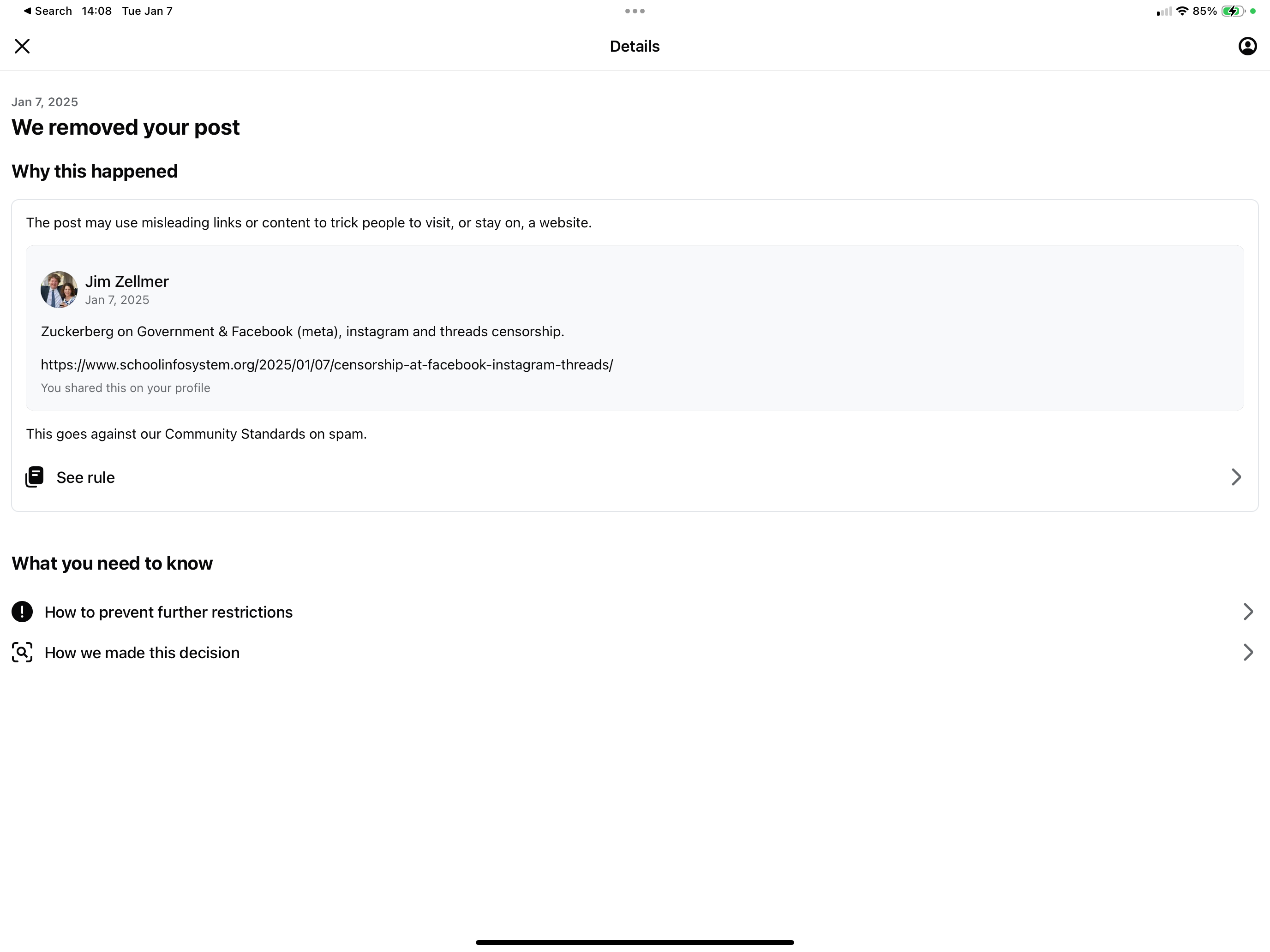
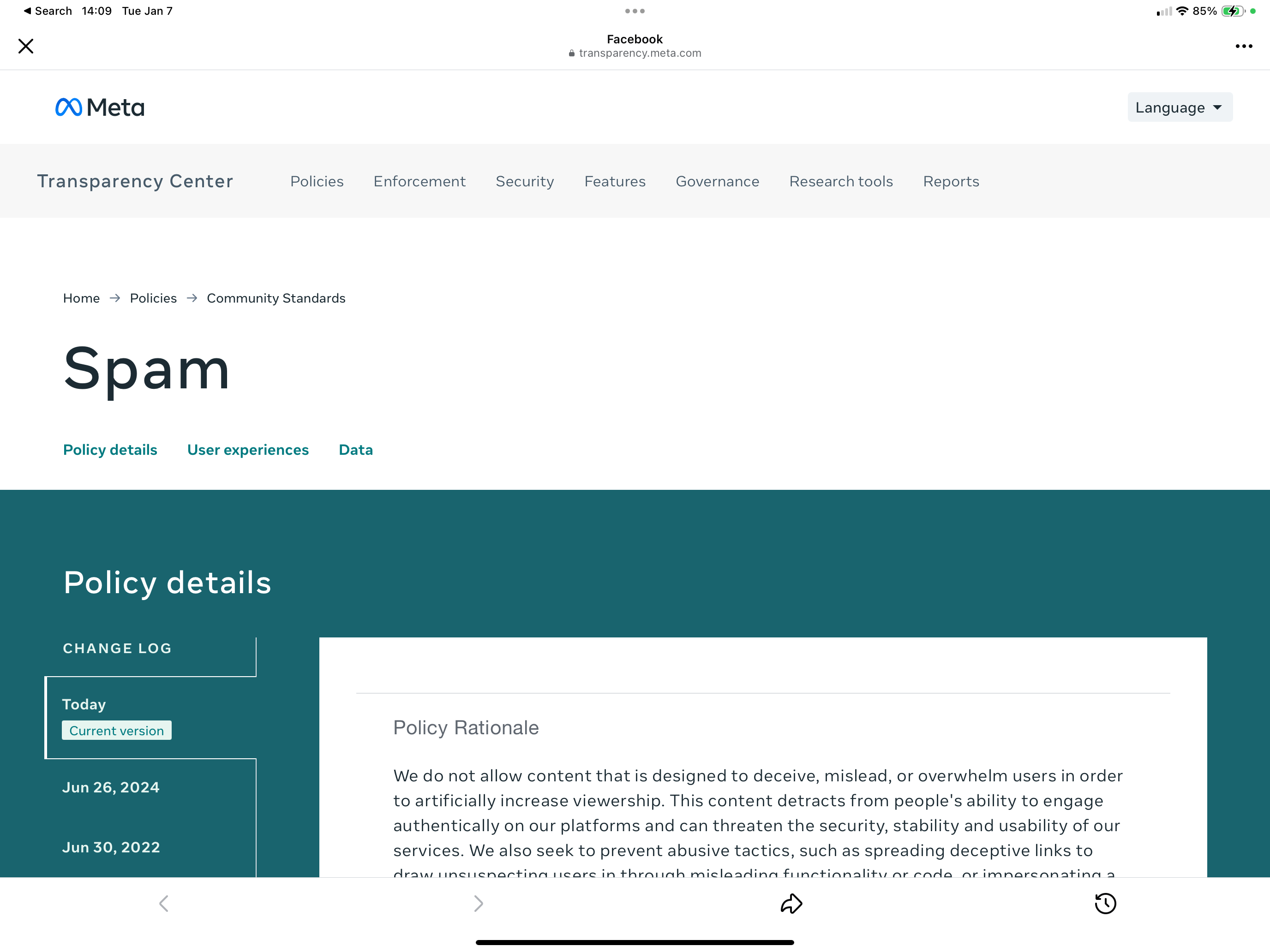
The Taxpayer Funded Censorship Regime and Facebook

America First Legal:

/10 Only “government issued or law enforcement email address[es]” were allowed to use this system.

Share

Civics: Trial Scheduled for the murder of Ashli Babbit

Paul Bedard:

A federal judge scheduled a trial date for a wrongful death lawsuit brought by the family of Jan. 6 protester Ashli Babbitt, who died after being shot by U.S. Capitol Police officer Michael Byrd.

The watchdog group Judicial Watch, which is helping in the lawsuit filed by Babbitt’s husband, Aaron, revealed that Judge Ana C. Reyes of the U.S. District Court for the District of Columbia scheduled a trial date of July 20, 2026, for the $30 million wrongful death suit.

Following a Friday hearing on the case, Judicial Watch also said Reyes is considering a request to move the case to California, where Ashli Babbitt’s family lives.

Share

The High-Tax State Brain Drain

Wall Street Journal:

More bad news for California, Illinois and New York. A recent analysis finds that their most upwardly mobile millennials are fleeing for lower-tax states. Call it a high-tax state brain drain. The flight of the young and newly affluent promises to compound the states’ budget and economic problems.

Using IRS data, the fintech company SmartAsset ranked states based on net migration of young households (ages 26 to 35) in 2022 that earned at least $200,000 a year. The biggest losers: California (-3,226), Illinois (-1,323), Massachusetts (-1,102), New York (-345) and Pennsylvania (-320).

Michigan, Louisiana, Delaware, Minnesota and Missouri round the top 10 losers. Delaware (6.4%) and Illinois (4%) lost the largest share of their young, higher-earning households.

The biggest gainers were Florida (1,786) and Texas (1,660), which have no income tax. They attracted more than twice as many such households as any other state. “Half of states attracting the most young and rich households don’t charge state income tax,” the study notes. The other big gainers without an income tax are Tennessee (347) and Nevada (162).

Share

What did redistributed federal taxpayer Covid funds accomplish?

Will Flanders:

During the COVID-19 pandemic, the federal government shelled out $189.5 billion to school districts across the country via Elementary and Secondary School Emergency Relief (ESSER) funding. Wisconsin was no exception. Across three rounds of ESSER funding, the state and school districts received more than $2.4 billion dollars. Despite federal requirements that ESSER money be used to supplement rather than replace existing spending, many school districts are clamoring to keep programs in place that were largely funded with ESSER money. Indeed, DPI has said that they will “be advocating to increase funding for schools to make up for the loss in ESSER funds.” The end of ESSER funds is also being blamed for a record number of school districts going to referendum this Fall.

But a critical question remains: Is there evidence that ESSER funding achieved its intended goal of addressing learning loss? With the deadline for spending ESSER dollars approaching at the end of September, now is an opportune time to assess whether the funding effectively mitigated and reversed the educational setbacks caused by the pandemic. Combining data from the state report card with data on district funding allocations from the Edunomics Lab at Georgetown University, we find that only one area of spending bears a strong relationship to learning loss improvement.

More.

Share

Civics: Duplicate ballots in Madison

Scott Bauer:

Up to 2,000 voters in Wisconsin’s heavily Democratic capital of Madison were sent duplicate absentee ballots, but a city spokesperson said Tuesday that none had been returned, all affected voters were being contacted and there were multiple safeguards in place to ensure only one ballot is counted.

“This was a mistake,” city spokesperson Dylan Brogan said. “The clerk’s office moved to rectify it as quickly as possible.”

The error in a Democratic stronghold in the battleground state led to a demand for more information from U.S. Rep. Tom Tiffany, a Republican backer of former President Donald Trump whose northern Wisconsin district does not include Madison.

“Voters deserve clear answers regarding the full scope of this blunder, how the city plans to restore public confidence in its ability to accurately administer the election, and assurances that those responsible are held accountable,” Tiffany wrote.

Liam Beran

The problem? Barcodes — also known as certificates — are not printed on ballots themselves. They’re printed on ballot envelopes, and poll workers are required to scan the barcodes prior to even opening the envelope. A ballot won’t be accepted if it’s not in a completed envelope, said Rachel Rodriguez, Dane County Clerk’s Office elections management specialist, meaning that there would be no way for the voter to submit the ballots separately. 

Andrew Bahl:

A press release from the clerk’s office said the mistake happened due to a “data processing error.” Dylan Brogan, communications manager for the city of Madison, said the issue occurred when workers effectively merged two of the same data files into one document, doubling up the names and addresses there.

“1% of voters in the bluest county in a swing state got duplicate ballots”

Maribeth Witzel-Behl, City of Madison Clerk

Letter to duplicate ballot recipients.

Commentary.

Share

Despite (Underly lead DPI) Forward Exam (rigor reduction), Madison students still score poorly

Kayla Huynh

Among the changes are lower scoring standards for each performance level and different labels categorizing students. In an interview with CBS 58, state Superintendent Jill Underly said students “appeared to be doing worse than they really were” under the previous system. 

Madison Metropolitan School District leaders this month offered the School Board a sneak peak at the district’s Forward Exam resultsusing the new bars for success. Less than half of third through eighth graders and 14% of Black students were considered proficient in literacy, according to the results.

School Board President Nichelle Nichols said she had a “visceral reaction” seeing the results. The scores show less than 20% of tested students with disabilities and about a quarter of English learners scored proficient in literacy. 

Students fared worse on math portions of the test, with 45% of third through fifth graders and 41% of sixth through eighth graders scoring proficient in math. Among Black students, 8% of sixth through eighth graders and 12% of third through fifth graders scored proficient.

“These percentages look pretty much the same” as previous years despite state Department of Public Instruction officials lowering scoring standards and warning against comparisons, Nichols said in the board meeting.

Marc Andreessen:

If you want to fix a broken system, you have to pull money OUT, not put more money IN.
If you put more money IN, the system interprets it as a reward and uses the money to become even more broken.
We get this for businesses. We forget it for nonprofits and governments. 🤔

Madison’s well funded k-12 system and city government are seeking substantial 607M+ tax and spending increases via referendum this fall.

Madison taxpayers of long supported far above average K – 12 spending.

The data clearly indicate that being able to read is not a requirement for graduation at (Madison) East, especially if you are black or Hispanic”

My Question to Wisconsin Governor Tony Evers on Teacher Mulligans and our Disastrous Reading Results

2017: West High Reading Interventionist Teacher’s Remarks to the School Board on Madison’s Disastrous Reading Results 

Madison’s taxpayer supported K-12 school district, despite spending far more than most, has long tolerated disastrous reading results.

“An emphasis on adult employment”

Wisconsin Public Policy Forum Madison School District Report[PDF]

WEAC: $1.57 million for Four Wisconsin Senators

Friday Afternoon Veto: Governor Evers Rejects AB446/SB454; an effort to address our long term, disastrous reading results

Booked, but can’t read (Madison): functional literacy, National citizenship and the new face of Dred Scott in the age of mass incarceration.

When A Stands for Average: Students at the UW-Madison School of Education Receive Sky-High Grades. How Smart is That?

Share

In 2021-2022, Philadelphia switched all schools to a unified lottery system, and the school’s focus on excellence was systematically dismantled.

Masterman:

The recommendations in the report were developed by the HSA Board and also were informed by conversations with administration in an effort to gain consensus around some of the main recommendations. One primary recommendation (see page 48) is to end the randomized admissions process and restore human judgment to admissions, preferably with a designated admissions officer and/or committee following best practices to improve diversity, and student choice and fit. The current randomized admissions process failed in its objectives regarding diversity at Masterman (see page 11-15) and failed our children, those leaving Masterman and those newly accepted,  in placing many of them in schools that are not the right fit for them. It should be ended. The District should return admission decisions to the schools and hire a dedicated, full-time Admissions Officer to systematically court the most able students of every demographic from across the city.

We have done our best to represent the array of views in our community about topics that are nuanced and complex. We welcome all comments and suggestions on the report and the process.

More.

Share

“A cute new approach to the fight for life”

Peachy Keenan:

What if the best way to change her mind was not by focusing on votes, elections, candidates, the legality of a 6- or 8-week ban, or technicalities like viability? What if instead of “abortions are bad,” the argument was: “Babies are awesome!” Imagine connecting the clinical concept of “embryo” and “fetus” to “a little human being who will look like you and have the same hair color as you.” 

A friend sent me a link to a disturbing study that involved grafting the harvested scalps of late-term aborted babies onto rats. These “scientists” are literally implanting pieces of human baby scalp onto living rats and regrowing the dead child’s own hair on the rat. Presumably this is some kind of test for curing baldness for men who think they’d look sexier wearing a dead baby’s scalp. (The study also involves fetal thyroid tissues and liver cells, which must be why fully-formed aborted newborns fetch such high prices for livers and thyroids on the market.)

The web page for the study includes nightmarish photos of a baby’s light brown hair growing on a rat’s body. Imagine seeing these images and wondering, “Is that my baby?” Imagine a billboard campaign of these images with the tagline “Is this your baby?” Maybe, just maybe, that message could help connect an inchoate positive pregnancy test to the finished product: an adorable newborn.

Maybe it’s worth a try. Maybe it’s time for babies to get a rebrand. 

Choose life.

Share

“Changes in states like Wisconsin have renewed criticism of a testing”

Linda Jacobson:

Changing standards and proficiency targets is a routine process for states that some say offers a more accurate reflection of what students know. But given the cataclysmic effects of COVID on student learning, experts say now is not the time to tweak how we measure performance. 

“Many parents are already underestimating the degree to which their children are lagging behind,” said Tom Kane, a Harvard researcher who has been tracking students’ recovery from COVID learning loss. “Lowering the proficiency cuts now will mislead them further.”  

Even Jill Underly, Wisconsins’s education chief, confessed to some bewilderment about the process last year.

“The crummy thing is, I am an educator and I don’t understand it — so how are parents supposed to understand this too?” she wrote in a June 2023 email. “For example, what does Proficient mean vs. Advanced? That they are at grade level vs. the next grade level? I just hate this stuff so much.”

Madison taxpayers of long supported far above average K – 12 spending.

The data clearly indicate that being able to read is not a requirement for graduation at (Madison) East, especially if you are black or Hispanic”

My Question to Wisconsin Governor Tony Evers on Teacher Mulligans and our Disastrous Reading Results

2017: West High Reading Interventionist Teacher’s Remarks to the School Board on Madison’s Disastrous Reading Results 

Madison’s taxpayer supported K-12 school district, despite spending far more than most, has long tolerated disastrous reading results.

“An emphasis on adult employment”

Wisconsin Public Policy Forum Madison School District Report[PDF]

WEAC: $1.57 million for Four Wisconsin Senators

Friday Afternoon Veto: Governor Evers Rejects AB446/SB454; an effort to address our long term, disastrous reading results

Booked, but can’t read (Madison): functional literacy, National citizenship and the new face of Dred Scott in the age of mass incarceration.

When A Stands for Average: Students at the UW-Madison School of Education Receive Sky-High Grades. How Smart is That?

Share

A look at Wikipedia…

Robert Schmad:

We leverage a unique two-stage experiment that randomized access to private school vouchers across markets as well as students to estimate the revealed preference value of school choice. To do this, we estimate several choice models on data only from control markets before turning to the treatment data for model validation. This exercise reveals that a model where school choice is constrained by ability-to-pay achieves better out-of-sample fit but still underpredicts experimental take-up of the voucher offer. We then present evidence from treatment markets that: a) the voucher offer also induced search; and b) private schools used program surplus to incentivize enrollment. Further, we show that a unified model incorporating these features can explain both the control and treatment data patterns. Estimates from that model imply that a targeted voucher program would have a marginal value of public funds (MVPF) of at least 3.

Share

A new study by CU Denver’s Center for Education Policy Analysis looks at DPS’s controversial reform policies

Www summary:

The article discusses the controversial education reforms implemented by Denver Public Schools over a decade ago. The study found that these reforms positively impacted students’ academic outcomes, increasing their likelihood of graduating. However, the improvements were not consistent across all student groups, with students of color experiencing mixed results in their math and literacy test scores and graduation chances.

Share

Tech Jobs Have Dried Up—and Aren’t Coming Back Soon

Katherine Bindley and Joseph Pisani:

Postings for software development jobs are down more than 30% since February 2020, according to Indeed.com. Industry layoffs have continued this year with tech companies shedding around 137,000 jobs since January, according to Layoffs.fyi. Many tech workers, too young to have endured the dot-com bubble burst in the early 2000s, now face for the first time what it’s like to hustle to find work.

Company strategies are also shifting. Instead of growth at all costs and investment in moonshot projects, tech firms have become laser focused on revenue-generating products and services. They have pulled back on entry-level hires, cut recruiting teams and jettisoned projects and jobs in areas that weren’t huge moneymakers, including virtual reality and devices.

At the same time, they started putting enormous resources into AI. The release of ChatGPT in late 2022 offered a glimpse into generative AI’s ability to create humanlike content and potentially transform industries. It ignited a frenzy of investment and a race to build the most advanced AI systems. Workers with expertise in the field are among the few strong categories.

Share

Against Censorship and Its Academic Supporters

A number of professors:

No one should prize the free exchange of ideas more than academics, whose entire purpose is to develop, challenge, and improve ideas. Endorsing state control of pub- lic discourse through the censorship of political opponents should be anathema to any defender of democracy. We are thus dismayed by the public letter “Against Big Tech’s Attack on Digital Sovereignties,” signed by many notable academics, including Daron Acemoglu and Thomas Piketty.

Although the letter mentions “Big Techs” in general, it singles out Elon Musk’s X as an “instance in a wider effort to restrict” Brazil’s (and other nations’) “digital developmental agenda”. We attempt to understand what this means, but first it is worth reviewing the facts.

Brazil’s law establishes that any judicial order to remove content from a social platform must specify what content is to be removed (Law 12.965, Art. 19, §1). The law also affirms the constitutional protection of free speech (Art. 5, IV, IX, and Art. 220
§2). Nevertheless, Justice Alexandre de Moraes ordered the suspension of the accounts of influencers, journalists and even members of Congress, all of whom were critics of the current president. X complied with these orders until April 2024, when Elon Musk stated this would violate laws in Brazil. Moraes’s threats of fines and the jailing of X’s legal representative lead X to close its office in Brazil. Moraes ordered the suspension of X for all Brazilians along with the seizure of Starlink’s assets to cover the fines he imposed. Note that Starlink is a separate company, with no connection to X besides the fact that Elon Musk is a shareholder in both. A report by the U.S. Congress found that “Moraes ordered the censorship of a Brazilian citizen for criticizing Moraes for censoring Brazilians” (p. 5).

However, instead of siding with X, the law, and Brazilians’ freedom of expression, the academics’ letter condemns Elon Musk for providing the only digital platform in Brazil that refused to censor speech deemed undesirable by some public officials. It seems the signatories believe that governments should be able to decide what their citizens can and cannot hear, and use all their might to silence criticism — essentially endorsing
authoritarianism.

More.

Share

“highlighting the significant fiscal impact that eliminating Act 10 could have on Wisconsin municipalities”

WILL:

WILL’s new report Back to the Past: The Fiscal Threat of Reversing Act 10 for Local Governments,estimates the fiscal impact for local and county governments to be at least $480 million annually.

The Quotes: WILL Research Director, Will Flanders, stated, “Ending Act 10 would bring about $480 million in new costs for local governments statewide.  Localities would be forced to do one of two things, cut crucial services or dramatically increase funding by raising property taxes. Either way, Wisconsinites would be at a loss.”

Washington County Executive Josh Schoemann stated, “Local governments have been granted greater flexibility from Act 10, which has resulted in more efficient delivery of services, pay increases for hard-working public servants, and lower property taxes for residents. I cannot imagine going back.”

About Act 10: In 2011, Wisconsin became a leader in public sector union reform with the passage of the Budget Repair Bill—better known nationally as “Act 10.” The law signed by Governor Scott Walker strongly limited the power of public sector unions to extract more and more money from state taxpayers. Today, likely based on the liberal composition of the Wisconsin Supreme Court, a lawsuit was recently filed that seeks to reverse the landmark legislation.

Report’s Key Findings: The impact of overturning Act 10 on Wisconsin would be quite dramatic. In education, the law allowed school districts to move away from a ‘steps and ladders’ pay system to systems where teachers can be rewarded for their impact on academics. Terminating Act 10 would likely restore the old system where quality played no role in teacher pay.

More.

Much more on Wisconsin Act 10, here.

The Milwaukee pension scandal lead to the rise of Scott Walker and ultimately Act 10.

And:

Chicago public schools: “already the nation’s largest junk-bond issuer”

Share

“Doing this will be all but impossible in the short run in academia”

Dave Cieslewicz:

And, again, on that score school districts like Madison, which obsess over race, have made zero progress in closing the racial achievement gap. Why do liberals cling so tightly to a system that delivers no results? 

A color blind society was once, not so long ago, the liberal position on the matter. But somewhere over the past decade or two we lost our way. It became fashionable, especially in academia, to employ discrimination as a means of correcting past discrimination. That was a classic example of destroying the village in order to save it.

Because the enemy is discrimination itself. And the answer isn’t to rig the system, but to do a much better job of preparing all students to compete successfully within it.

Madison’s well funded k-12 system and city government are seeking substantial 607M+ tax and spending increases via referendum this fall.

Madison taxpayers of long supported far above average K – 12 spending.

The data clearly indicate that being able to read is not a requirement for graduation at (Madison) East, especially if you are black or Hispanic”

My Question to Wisconsin Governor Tony Evers on Teacher Mulligans and our Disastrous Reading Results

2017: West High Reading Interventionist Teacher’s Remarks to the School Board on Madison’s Disastrous Reading Results 

Madison’s taxpayer supported K-12 school district, despite spending far more than most, has long tolerated disastrous reading results.

“An emphasis on adult employment”

Wisconsin Public Policy Forum Madison School District Report[PDF]

WEAC: $1.57 million for Four Wisconsin Senators

Friday Afternoon Veto: Governor Evers Rejects AB446/SB454; an effort to address our long term, disastrous reading results

Booked, but can’t read (Madison): functional literacy, National citizenship and the new face of Dred Scott in the age of mass incarceration.

When A Stands for Average: Students at the UW-Madison School of Education Receive Sky-High Grades. How Smart is That?

Share

The Great AP Score Recalibration

Richard Phelps:

A less publicized goal of the recentering synchronized the verbal and math score distributions. Over time, the SAT’s math and verbal scales had developed quite different shapes, and College Board worried that that lack of symmetry threatened the SAT’s face validity among its vast non-technical customer base. Despite these explanations, however, critics accused College Board of score inflation and watering down the content of the SAT.

Now, College Board is “recalibrating” some Advanced Placement (AP) exam scales and eliciting similar reactions from critics. College Board invokes a desire to make score distributions similar across AP exams, just as they crafted similar distributions for the verbal and math SAT subtests in 1995-96.

In all, three changes currently transpire. Standards for all AP exams are being set by a new “evidence-based standard setting” (EBSS) method. Score distributions across all AP exams will have similar shapes. And score distributions for a minority of AP exams have been or soon will be adjusted—all upwards thus far.

Does the recalibration really matter for AP exam users—students, schools, teachers, and colleges? To counteract AP exam score inflation, all a college need do is raise the threshold at which it awards course credit. That’s not hard.

Not hard for independent, private colleges, that is. Indeed, some of them no longer award course credit for exam scores of three, four, or five. Public colleges, however, may not be so flexible. According to College Board,

Share

K-12 Litigation Climate: Act 10 +

Cap Times:

It is a victory, indeed, and we celebrate it with a great guardian of the Constitution, the rule of law and justice: Lester Pines.

Much more on Lester Pines, here.

Share

Experimentally Validating Welfare Evaluation of School Vouchers

Peter Arcidiacono, Karthik Muralidharan & John D. Singleton:

We leverage a unique two-stage experiment that randomized access to private school vouchers across markets as well as students to estimate the revealed preference value of school choice. To do this, we estimate several choice models on data only from control markets before turning to the treatment data for model validation. This exercise reveals that a model where school choice is constrained by ability-to-pay achieves better out-of-sample fit but still underpredicts experimental take-up of the voucher offer. We then present evidence from treatment markets that: a) the voucher offer also induced search; and b) private schools used program surplus to incentivize enrollment. Further, we show that a unified model incorporating these features can explain both the control and treatment data patterns. Estimates from that model imply that a targeted voucher program would have a marginal value of public funds (MVPF) of at least 3.

Commentary…

Sometimes, though, the public’s views aren’t all that clear.

That’s been the case in staunch Donald Trump territory with the movement to force religion, the Bible and the Ten Commandments into the public education system.

One would guess that in ultra-conservative states that gave Trump 20-to-30-point margins in the last election, requiring school kids to take Bible lessons would be a slam dunk. But Ryan Walters — Oklahoma’s Republican school chief who decreed a few weeks ago that all public schools in his state must incorporate Bible teachings in school curricula — is probably surprised.

His edict, after all, has spawned similar moves in other conservative states. Louisiana, for instance, is requiring its schools to display the Ten Commandments, and others are poised to follow suit.

Share

Newspaper Plans To Revive Acerbic Art Critic Brian Sewell In AI Form As It Stops Daily Presses & Fires Journalists

By Jake Kanter

Deadline understands that London’s historic Evening Standard newspaper has been making plans to revive its former writer using artificial intelligence.

Two sources said AI Sewell has been assigned to review The National Gallery’s new Vincent van Gogh exhibition, titled Van Gogh: Poets and Lovers.

One person said the plans were discussed at the highest level of the Standard and in consultation with Lord Lebedev, the newspaper’s proprietor. Dylan Jones, editor-in-chief of the Standard, did not respond to requests for comment.

Share

He said the “district’s (Madison) academic results don’t justify giving the board and administration more money”

Abbey Machtig:

Plus, the combined tax impact of the city’s operational referendum and the two measures from the School District means will likely have to increase monthly rent for tenants living in his rental property. 

“This will mean about $1,500 a year, best-case scenario, which means rent for everybody will go up at least 150 bucks a month,” Freihoefer said.

If the operating referendum is approved by voters, owners of an average Madison home would see a $1,049 increase in their tax bills by 2028. If both the operating and facilities referendums are successful, taxes would increase by $1,376 by 2028.

Former district employee Sherry Barnsley wants more details: She said it’s still unclear what exactly the school district is asking for and worries voters won’t fully understand the questions on the ballot.

She said the $100 million operating referendum — which ramps up over four years but then authorizes the school district to levy taxes above the state caps in perpetuity — is particularly fuzzy. 

The $507 million facilities referendum would pay for updates to 10 schools: Five new buildings, some of which house more than one school, would be built, and two others would be renovated.

——-

In its informational materials about the referendums, the district emphasizes how much more the average homeowner would pay in taxes per month, despite the fact that property taxes are billed annually.

Marc Andreessen:

If you want to fix a broken system, you have to pull money OUT, not put more money IN.
If you put more money IN, the system interprets it as a reward and uses the money to become even more broken.
We get this for businesses. We forget it for nonprofits and governments. 🤔

Madison’s well funded k-12 system and city government are seeking substantial 607M+ tax and spending increases via referendum this fall.

Madison taxpayers of long supported far above average K – 12 spending.

The data clearly indicate that being able to read is not a requirement for graduation at (Madison) East, especially if you are black or Hispanic”

My Question to Wisconsin Governor Tony Evers on Teacher Mulligans and our Disastrous Reading Results

2017: West High Reading Interventionist Teacher’s Remarks to the School Board on Madison’s Disastrous Reading Results 

Madison’s taxpayer supported K-12 school district, despite spending far more than most, has long tolerated disastrous reading results.

“An emphasis on adult employment”

Wisconsin Public Policy Forum Madison School District Report[PDF]

WEAC: $1.57 million for Four Wisconsin Senators

Friday Afternoon Veto: Governor Evers Rejects AB446/SB454; an effort to address our long term, disastrous reading results

Booked, but can’t read (Madison): functional literacy, National citizenship and the new face of Dred Scott in the age of mass incarceration.

When A Stands for Average: Students at the UW-Madison School of Education Receive Sky-High Grades. How Smart is That?

Share

“more than 40 percent of school-aged children and adolescents have at least one chronic health condition”

Robert Redfield:

Parents reported around 41 percent of children under 18 had “current or lifelong health conditions” when asked about 25 health conditions.

For instance, obesity in American children has increased dramatically since John F. Kennedy’s presidency, from around 4 percent in the 1960s to almost 20 percent in 2024. The causes of childhood obesity are complex, but a primary origin is clearly the modern American diet of highly processed foods.

But our food problem goes well beyond obesity: Pesticides are proven risk factors for neurodevelopmental outcomes in kids, causing maladies like ADHD. If the next president prioritizes the National Institutes of Health (NIH) to identify which exposures are contributing to the spike in chronic disease in children, we will finally find out and end what is slowly destroying our children.

More.

Share

Specialized schools call the cops on kids with emotional disabilities. Critics say it’s proof they’re failing

Lily Altavena

Twice in the same week in May 2023, Oakland County Sheriff’s deputies restrained and put 10-year-old Caleb Killingsworth in the back of a patrol car.

The second time, Caleb, an autistic child who weighed less than 90 pounds and stood less than 5 feet tall, according to his mother, was restrained on the ground and then handcuffed. The fifth grader came away with scrapes on his face.

Both times school staff called law enforcement after Caleb walked away from the Pine Tree Center, a specialized school in Lake Orion with a program for “emotionally impaired” students, a state designation that applies to roughly 10,000 Michigan students with behavioral disabilities.

Share

“We are thrilled to move beyond the era of PowerPoint advanced reactors”

US DoD:

“Our tight partnership with INL and the Department of Energy Idaho Operations Office is leading the way forward not just for manufacturing advanced reactors, but also for regulating them in an efficient and safe manner.”

The prototype reactor facility is designed to be transported within four 20-foot shipping containers, and tested at INL. The Project Pele team will construct a concrete shield structure at the test site next year in order to be ready for reactor placement in 2026.

Upon arriving at INL, the reactor will be transported by truck to the test site and positioned within the concrete shield structure. Piping and electrical wiring will tie the reactor to INL’s specialized electric microgrid. Once the reactor’s final safety review is completed, the Pele project team will then proceed with the initial Test and Evaluation plan. If successful, transportable nuclear power could meet the increasing demand for a resilient, carbon-free energy source capable of delivering reliable 24/7 power to mission-critical DoD operations in remote and austere environments.

Share

“Martinez has argued that such demands could bankrupt the (Chicago k-12) system”

Paris Schultz:

Davis Gates also claimed that Martinez wants to close or consolidate schools, though CPS sources countered that he has no such plans, saying the school board requested a contingency list of potential closures.

Last spring, Martinez joined CTU members in Springfield to advocate for an additional $1 billion in state funding. However, Gov. J.B. Pritzker and state lawmakers said those funds were not available.

Davis Gates pointed to Minnesota Governor-turned-Vice Presidential candidate Tim Walz as a model for Gov. Pritzker to follow.

“He figured a lot of stuff out with this. He made sure that there was a social worker that was funded from the state. He figured out how to meet the needs of special education students, so these things can be done,” said Davis Gates. 

Austin Berg:

MUST WATCH: Maybe the best opening line in public comment history. Former Chicago Public Schools Board Member Dwayne Truss goes off on the Chicago Teachers Union and Mayor Brandon Johnson for their fight to oust CPS CEO Pedro Martinez and issue a $300M payday loan to fund the union’s contract demands.

Reminder that these are the actual new revenue ideas from the Chicago Teachers Union. The CTU claims Chicago Public Schools CEO Pedro Martinez should be fired for not doing enough to lobby Springfield for more money.

Chicago public schools: “already the nation’s largest junk-bond issuer”

The Chicago Teachers Union and its state and national affiliates spent nearly $6.5 million on Chicago political candidates between Feb. 28, 2022, and May 4, 2023.

This year’s Democratic National Convention takes place in America’s first city to fall under the control of a teachers union.

Stacy Davis Gates is a powerful union leader of public school teachers and sends her kids to private school. These are facts.

More.

——

WEAC: $1.57 million for Four Wisconsin Senators (2010)

Share

Notes on book ban rhetoric

Nicki Neily

They smear and demonize parents who want their children to learn age appropriate material rather than graphic sexual content.

As a society, we don’t put Playboy in kindergartens; this isn’t considered a “book ban,” but merely common sense.

Share

Literacy Network and Omega School merger brings more opportunities for all, leaders say

Abbey Machtig:

Omega School serves mostly Madison youth and young adults looking to earn a high school diploma, while Literacy Network offers a wide variety of tutoring opportunities to adults, especially in English language instruction.

Share

Civics: Declining Institutional Trust

Megan Brenan:

Americans’ rating of the Secret Service’s job performance has deteriorated sharply to a new low in Gallup’s 10-year trend. The latest poll was completed almost entirely before the Sept. 15 apparent assassination attempt on Donald Trump, the second in nine weeks. About one in three U.S. adults now rate the Secret Service’s performance as “excellent” (8%) or “good” (24%), while 25% say it is “only fair” and 36% “poor.”

The Sept. 3-15 poll was conducted as various government entities continue to investigate the Secret Service’s reported lapses in the July 13 assassination attempt on Trump in Butler, Pennsylvania. Amid these highly publicized investigations, the percentage of Americans rating the Secret Service as excellent or good plunged 23 percentage points, while the share of those rating it as poor rose by the same margin.

The current findings are in marked contrast with four of the five previous readings over the past decade. The Secret Service — the federal law enforcement agency charged with keeping political leaders safe — has typically enjoyed broadly positive ratings from the public, with majorities offering an excellent or good assessment of its performance.

Since 2014, an average of 53% of Americans have rated the Secret Service positively. Yet, this year is not the first time the agency has failed to receive a majority-level excellent or good rating. The initial 43% positive rating in 2014 followed several security lapses, including one in which an intruder jumped a fence and entered the White House.

Share

Notes on College Admissions

Daniel Schmidt:

First, you must discover what you’re passionate about and only focus on that. For me, it was public speaking and writing. You cannot be a “jack-of-all-trades.” These colleges want young people who are excellent at just one or two things. They want Math Olympiad winners, international debate champions, chess prodigies, etc. If you spread yourself thin, admission officers cannot picture where you will be 20 years from now. Remember: all that these universities ultimately care about is producing future leaders in their respective industries.

Fortunately, you do not need to be on the extreme level of “Math Olympiad winner.” I was president of two clubs (Model UN and Debate) and ran a blog and that was it. But you must orient your application around just one or two passions and excel in related extracurriculars to demonstrate your competence. That is crucial.

Share

Notes on University of Wisconsin Administrative Bloat

Dave Cieslewicz:

  • And here’s the real kicker. Teaching staff is actually down. Madison has lost 75 tenured faculty positions since 1992, despite growing by thousands of students and adding nearly 8,000 academic staff. But that’s actually not so bad compared to most UW system schools. They have between 25% and 30% fewer faculty positions than they did 30 years ago. 

So you want to find a culprit for fast-growing tuition? Look to three things: declining taxpayer support, bloated staff and building binges. The last issue was not addressed in the Fiscal Bureau report, but it’s a real problem.

Share

Notes on k-12 taxpayer $pending and outcomes

Marilyn Muller:

The more that is spent, the more illiterate students get, because the money doesn’t go to the students, it goes to the hundreds in management and administration that then treat the students as sources of revenue.

The more illiterate students are, the more money the system gets, so their incentive is to increase, not decrease, illiteracy!

More.

Share

The Missing Girls: How China’s One-Child Policy Tore Families Apart

Liyan Qi:

Ricki Mudd was born in 1993 in China during the one-child policy era. She remembers her early childhood only in fragments, but has been told she had spent some of it hidden in a bag.

At age 5, she was adopted from a Chinese orphanage, one of the more than 150,000 children China sent overseas. Most were girls. In the West, they were one of the most visible consequences of the one-child policy, which ended in 2016. This month, Beijing put an end to foreign adoptions.

China is grappling with a demographic crisis, with dropping birthrates and a rapidly aging population. The policies to control the population have given way to new ones in the opposite direction. But a legacy of the one-child policy is a dearth of women of childbearing age.

Because of a government decree that led to forced abortions and sterilizations, millions of girls were never born or were hidden from authorities. In the process, China’s gender ratio became increasingly skewed, with 117 boys born for every 100 girls in 2004, compared with 106 in 1980, United Nations data showed.

Share

Civics: The view from Italy

Full Speech by Prime Minister of Italy, @GiorgiaMeloni, after receiving The Atlantic Council’s Global Citizen Award in New York City. pic.twitter.com/aDpSr3IeI8

— ALX 🇺🇸 (@alx) September 24, 2024

Share

Gen Z is Quiet Quitting Higher Education for Trade Schools

Leslie Eastman:

Early last year, The Independent Review published an intriguing article: Hyperpoliticization of Higher Ed Trends in Faculty Political Ideology, 1969–Present.

The authors, Phillip W. Magness (senior research faculty and director of research and education at the American Institute for Economic Research) and David Waugh (managing editor at the American Institute for Economic Research), assessed complex data obtained from surveys that evaluated the political views of higher education faculty [e.g., Carnegie Commission on Higher Education Faculty Survey (1969–1984), UCLA-Higher Education Research Institute Faculty Survey (1989–2016)]. The information confirms trends that Legal Insurrection has long noted: Since 2001, 2001 higher education faculty positions have taken a hard, and “professors on the political left are now approaching a supermajority.”

While their findings are interesting, a question they pose about the future consequences of this development is prescient.

Share

Diplomas behind bars provide opportunities for rethinking incarceration

Patrick Conway:

As thousands of students settle into the fall semester at colleges and universities around Boston, another group is preparing for an important milestone at a medium-security prison in Shirley. On Sept. 23 the first cohort of students from the Boston College Prison Education Program will don their caps and gowns and be greeted by a brass band playing the familiar refrains of “Pomp and Circumstance” before crossing the stage to receive their bachelor of arts degrees.

The ceremony marks a significant achievement, not only for students but also for Boston College. Our initial graduating class is small: Three students will be earning their diplomas. But the ceremony will start an annual tradition. Soon, our program will see groups of 10 to 15 students graduate.

Having worked within the criminal justice system for nearly two decades, and within college-in-prison programs for the past 10 years, I believe initiatives like ours do more than provide access to high-quality education — they also provide a pathway for reimagining more effective, meaningful, and humane responses to crime and incarceration.

Booked, but can’t read (Madison): functional literacy, National citizenship and the new face of Dred Scott in the age of mass incarceration.

Share

Civics: Litigation over Racism and Federal taxpayer funds

Dan Lennington

NEW: WILL secures historic victory against $37B Biden-Harris’s infrastructure program. This was the granddaddy of all affirmative action programs-dictating how nearly all roads, bridges, & highways are built. No more DEI highways! Details to follow from @WILawLiberty

More:

“The noble aspirations of our founding documents represent the most successful experiment in representative democracy the world has even known. But by no means has our American experiment been perfect. No one could argue, for example, that our Nation has always treated men and women of all backgrounds in this country equally.

Share

San Francisco supervisors fly to Japan to learn about math

Josh Koehn:

Two San Francisco supervisors will miss key meetings this week to attend a taxpayer-funded junket in Japan to learn how an institute in the country teaches math. 

The details of that word salad of a sentence might seem a bit mystifying for those who realize:

  • San Francisco supervisors have no role in deciding how math is taught in the city’s public schools.
  • The mayor just announced last month that the city could be facing a half-billion dollar deficit, and trips to Japan wouldn’t seem to rate on the priority scale.
  • Algebra hasn’t even been taught to San Francisco’s eighth graders in almost a decade.
  • Cherry blossom season doesn’t start until the end of March.

Adding a bit more complexity to the situation, the absences of Supervisors Hillary Ronen and Myrna Melgar from this week’s Board of Supervisors meeting could create hiccups in getting measures on the March 2024 ballot, especially if the return leg of their 5,180-mile trip runs long. Recent history shows it wouldn’t be the first time a supervisor was overly optimistic about returning home in time for an important meeting.

In a phone call last week, Melgar defended the trip, which will include training at Tokyo Gakugei University, by noting that the city gives millions every year to fund the San Francisco Unified School District. After Proposition G passed with 64% of the vote last year, the city will be contributing tens of millions more in the years to come.

Share

More Bad Management From Madison Schools

Dave Cieslewicz:

This week there’s more. It turns out that the district is running a $3 million deficit in its food service program, which is double the $1.5 million gap it had last year. And the district’s response? They’ve got a plan to get back to even — by 2033. 

Really? This is an organization that plans to take a decade to solve a $3 million problem? And can anybody realistically expect to solve a problem over ten years? You really think you can make accurate estimates over a period that long? 

Even worse is the quote from school board President Nichelle Nichols, who said, “Those are dollars we don’t get to dream with.”

Madison’s well funded k-12 system and city government are seeking substantial 607M+ tax and spending increases via referendum this fall.

Madison taxpayers of long supported far above average K – 12 spending.

The data clearly indicate that being able to read is not a requirement for graduation at (Madison) East, especially if you are black or Hispanic”

My Question to Wisconsin Governor Tony Evers on Teacher Mulligans and our Disastrous Reading Results

2017: West High Reading Interventionist Teacher’s Remarks to the School Board on Madison’s Disastrous Reading Results 

Madison’s taxpayer supported K-12 school district, despite spending far more than most, has long tolerated disastrous reading results.

“An emphasis on adult employment”

Wisconsin Public Policy Forum Madison School District Report[PDF]

WEAC: $1.57 million for Four Wisconsin Senators

Friday Afternoon Veto: Governor Evers Rejects AB446/SB454; an effort to address our long term, disastrous reading results

Booked, but can’t read (Madison): functional literacy, National citizenship and the new face of Dred Scott in the age of mass incarceration.

When A Stands for Average: Students at the UW-Madison School of Education Receive Sky-High Grades. How Smart is That?

Share

Penn will sanction Amy Wax, the law prof who invited a white nationalist to speak to her class

Susan Snyder

Wax — who has called into question the academic ability of Black students, invited white nationalist Jared Taylor to her classroom, and said the country would be better off with fewer Asians and less Asian immigration — will be suspended for one year at half pay with benefits intact. She also will face a public reprimand issued by university leadership, the loss of her named chair and summer pay, and a requirement to note in her public appearances that she is not speaking for or as a member of the Penn Carey Law school or Penn.

But she will not be fired or lose her tenure.

“These findings are now final…,” Penn said in a statement, noting the five-member hearing board’s determination that Wax “violated the university’s behavioral standards by engaging in years of flagrantly unprofessional conduct within and outside of the classroom that breached her responsibilities as a teacher to offer an equal learning opportunity to all students.”

Penn intends to publish the announcement of the decision in Tuesday’s Penn Almanac.

Share

The Work From Home Free-for-All Is Coming to an End

Vanessa Fuhrmans, Katherine Bindley and Chip Cutter:

It’s hard to overstate how much remote and hybrid work have reshaped the postpandemic labor market. It has enabled moves to lower-cost areas, let working parents better coordinate child care and brought millions of people into the workforce—including those with disabilities. And it made it easier for mothers of young children to stay on the job, helping drive a sharp increase in the number of women working.

Tech-industry workers especially took advantage of the ability to work remotely, flocking from high-cost coast cities to cheaper locales such as Salt Lake City, Utah, and Boise, Idaho. High in demand, many commanded the same pay they made in San Francisco and Seattle. “Work from anywhere” became a favorite recruiting tactic, with some workers being told they’d never need to come back to the office.

Remote work also fueled a digital commerce boom that let online retail giants like Amazon reap record profits, and hire hundreds of thousands of people, many in far-flung places. Over 2020 and 2021, Amazon’s head count roughly doubled to more than 1.6 million employees. Then the company laid off 27,000 workers starting in late 2022.

Share

Rethinking US News & World Report College Rankings

Anand Sanwal:

In the grand theater of American higher education, few performances are as anticipated—or as controversial—as the annual unveiling of the U.S. News & World Report college rankings. 

Like a high-stakes beauty pageant for academia, these rankings have become a cultural touchstone, influencing the decisions of countless students, parents, and even the very institutions they aim to evaluate. 

But beneath the glossy veneer of numerical precision lies a system rife with flaws, manipulations and unintended consequences.

I’ll propose a better way below but first, why are the US News Best Colleges rankings so useless?

Share

Proposed federal guidance on recordkeeping in online classes is bringing out the worst in universities.

Graham Hillard:

Are the men and women who staff America’s colleges rugged individualists determined to swat away the overweening hand of the state? Or are they simply greedy? An ongoing dispute over attendance-related recordkeeping and compliance has brought the question newly to the fore.

As reported by Inside Higher Ed last month, the conflict began when the federal Department of Education released proposed guidance intended to “clarify, update, and consolidate certain provisions that apply to distance education.” Nestled among the new rules was a requirement that universities take and report student attendance in virtual classes, lest (to borrow IHE’s paraphrase) “students drop out of online courses while the institution continues to collect federal Title IV financial aid funds.”

The federal government wishes not to pay colleges to educate students who no longer exist.In describing its proposal, the education department noted that “institutions can often easily determine when students stop attending a distance education course.” Because “institutional systems are already monitoring when students submit assignments,” noting that an enrollee has failed to do so in a timely manner is typically as simple as consulting one’s learning-management software (e.g., Blackboard).

As standard practice dictates, the feds conceded that “the proposed regulatory change would add a burden for institutions.” Nevertheless, this hardship was expected to be minimal:

Share

The Top U.S. Colleges That Make New Graduates Rich

Kevin McAllister:

Prestigious private colleges and universities occupy the upper tier of the list, with Stanford University placing No. 2 and Princeton University, which topped the overall rankings, coming in at No. 3. In total, private universities claimed 36 of the top 50 spots on the salary list.

Beyond MIT, other colleges with robust STEM programs also finished strong: Georgia Tech landed fourth, the California Institute of Technology sixth and Harvey Mudd College seventh. The Missouri University of Science and Technology, the Milwaukee School of Engineering and Michigan Technological University also landed in the top 15.

Share

University of Wisconsin-Madison enrollment statistics

Dan Lennington:

Enrollment figures from @UWMadison show racially discriminatory admission policy WAS hurting Asian, white, & int’l students. First, consider UW’s targets: black admission rate ballooned to over 63%, exceeding overall admit rate.

Will Flanders:

Admitting students to college based on merit shouldn’t be controversial. New data from UW Madison make it clear that wasn’t happening prior to SCOTUS decision last year. In some universities, Asian students have benefitted. Here, Asian & white students benefit.

Share

Minnesota k-12 absentee data

Matt Shaver:

Fascinating new data on the severity of chronic absenteeism in MN schools from MDE.

Interesting that while the number of chronically absent students doubled from 18/19 to 21/22 the slices of absenteeism have been pretty stable.

How does this compare to other states?

Share

“every single week we lose 22 teens between the ages of 14 and 18”

Bill Whitaker:

problem as this is, it’s also not a whodunit. We know who’s responsible. It’s the Sinaloa Cartel and the Jalisco Cartel that are based in Mexico. They dominate and control the entire global fentanyl supply chain, starting in China, going to Mexico, coming into the United States.

Milgram told us this crisis began 10 years ago… when the cartels started to wrestle control of the supply chain from China and began making fentanyl in clandestine labs in Mexico.

Bill Whitaker: So these two drug cartels from our neighbor, from Mexico, are responsible for almost 70,000 American deaths a year?

Anne Milgram: Yes.

Share

Chicago public schools: “already the nation’s largest junk-bond issuer”

Chicago Tribune:

Johnson has demanded that CPS — already the nation’s largest junk-bond issuer, paying more than $800 million annually just to service its mountain of ongoing debt — add another $300 million in high-cost debt to cover teacher raises and to make a $175 million pension payment whose responsibility has ping-ponged in recent years between the city government and CPS. A new schools boss hired specifically to strike a deal with a militant and unreasonable union presumably would need to add far more than $300 million to the maxed-out CPS credit card in order to buy labor peace.

The strategy pursued by the unholy alliance of Johnson and CTU is becoming clearer by the day. Gov. JB Pritzker and state legislative leaders, all Democrats and supporters of organized labor, have refused the Johnson-CTU demands for hundreds of millions more in state funds to finance CTU’s membership growth. They’ve done so despite CTU president Stacy Davis Gates’ racially charged attacks on them when she didn’t get what she wanted from Springfield.

So now Johnson and Davis Gates’ seeming gambit is to deliberately sink CPS into insolvency so that the state has “no choice” but to bail out Chicago’s schools, nearly 40% of which are enrolled with half or fewer of the students they were designed to serve. That’s unconscionable, and is why this school board has a fiduciary responsibility to taxpayers to continue to display the courage it’s shown so far. A new CEO piling more debt on CPS only will make the inevitable job of right-sizing this district all the more painful.

More.

Chicago Public Schools is in dire financial straits, yet Chicago Teachers Union blocks closing of near-empty, failing schools. – Wirepoints

More than two years ago, we sounded the alarm on this issue by highlighting CPS’ 20 most empty schools. Like Douglass High School, capacity 912, with just 35 students enrolled. Or Austin High School, capacity 1,776, with just 172 students enrolled. The kicker? Not a single kid in either of those schools could read at grade level based on 2023 testing.

The problem is far bigger than those 20 schools. CPS has more than 163 schools – about one-third of the district’s traditional schools – that are less than half full. 

Below we lay out the 100 most empty traditional schools in Chicago. This is not Martinez’s list – that has not been released – but these schools certainly do deserve closure/consolidation.

Share

Arguments that Wisconsin schools are underfunded fall flat. Data shows otherwise.

Will Flanders & Shannon Whitworth:

In a recent op-ed published in the Milwaukee Journal Sentinel, Secretary of Education Miguel Cardona articulated a series of criticisms about school choice in Wisconsin, opting instead to defend a failed status quo of one-size-fits-all education. His arguments lean heavily on national talking points commonly used by opponents of school choice, revealing a significant misunderstanding of the realities of Wisconsin’s education landscape, including both school choice options and public education.

Recent polling shows that 68% of Wisconsin voters support school choice, including 47% of Democrats and 69% of independents. Furthermore, the liberal-leaning Wisconsin Supreme Court declined to hear a legal challenge to the program, and Gov. Tony Evers agreed to direct more funds towards the program in the last state budget.

Here’s a closer look at the misconceptions in the Secretary’s column and why they warrant reconsideration. His first claim is that Wisconsin schools are underfunded. However, data from the Department of Education —under Cardona’s own administration—paints a different picture. Wisconsin’s spending on education is among the highest in its history. The reality is that we are spending more on education per student in Wisconsin today than we were in 2000—and have more than doubled education spending over the past fifty years after adjusting for inflation, and ranks among the top half of states in spending.

More:

Please stop using 2010 as the magic year that all education spending must be compared to. 2010 is the highest level of spending in WI history. Advocates for more spending point you there for a reason. We are spending more today than at almost any other point.

And.

Madison’s well funded k-12 system and city government are seeking substantial 607M+ tax and spending increases via referendum this fall.

Madison taxpayers of long supported far above average K – 12 spending.

The data clearly indicate that being able to read is not a requirement for graduation at (Madison) East, especially if you are black or Hispanic”

My Question to Wisconsin Governor Tony Evers on Teacher Mulligans and our Disastrous Reading Results

2017: West High Reading Interventionist Teacher’s Remarks to the School Board on Madison’s Disastrous Reading Results 

Madison’s taxpayer supported K-12 school district, despite spending far more than most, has long tolerated disastrous reading results.

“An emphasis on adult employment”

Wisconsin Public Policy Forum Madison School District Report[PDF]

WEAC: $1.57 million for Four Wisconsin Senators

Friday Afternoon Veto: Governor Evers Rejects AB446/SB454; an effort to address our long term, disastrous reading results

Booked, but can’t read (Madison): functional literacy, National citizenship and the new face of Dred Scott in the age of mass incarceration.

When A Stands for Average: Students at the UW-Madison School of Education Receive Sky-High Grades. How Smart is That?

Share

56% of those without children would have some if they could go back.

Frank Newport and Joy Wilke:

The U.S. Centers for Disease Control and Prevention report that the U.S. general fertility rate reached an all-time low in 2011, at 63.2 births per 1,000 women aged 15 to 44. The fertility rate has dropped 11% from 1990, when there were 70.9 births per 1,000 women aged 15 to 44.

The finding from Gallup’s Aug. 22-31 survey suggests that the changes in the U.S. birthrate in the last few decades apparently are not related to a change in Americans’ underlying attitudes toward children. It may be that fewer women are having children or that women, on average, are having fewer children, but the data show that the general interest in having children has remained constant — and high.

Younger Americans Want Children; Those With Kids Would Repeat Decision

More than half of Americans between the ages of 18 and 40 have children, and another 40% do not currently, but hope to have children someday. Only six percent of Americans aged 18 to 40 do not have, and do not want to have, children.

Choose life.

Share

Why minority languages are disappearing from some classrooms in Xinjiang but not Tibet

Barry Sautman

What drew you to ethnic minority issues in China?

I’d been to Xinjiang perhaps three or four times many years ago. I was concentrating on a particular subject, which was preferential policies. At that time I was studying them broadly, going to different minority areas including Tibet, Xinjiang, Guizhou, Sichuan, Inner Mongolia. That was in the late 1990s and the beginning of the 2000s.

From that I got interested in ethnic minority policies more generally because there was a debate in China about them.

Some said preferential policies and ethnic policies were not broad enough and they weren’t directed sufficiently to closing the socioeconomic gaps that existed between Han people and minority people.

The other side was people who said that basically ethnic regional autonomy had created a vested interest on the part of minority officials particularly.

Share

Teaching

Www

Near the end of the period, shortly before the bell rang, the door opened and Granny sauntered in with her usual Granny Holloway attitude. “How did they do?,” she asked. “Marvelous,” said Mrs. Abels. “They were completely in my hands.”
Granny then faced us and said “And that, my students, is how a dictator takes over a nation. Not with guns or tanks or laws or mandates. They do it using false promises and gifts”
I can’t remember a lesson all through 12 years of public school that made such an impression on me and has stayed with me.

Share

Reducing the Number of Foreign Students

Jay Greene:

Foreign students can make important contributions to every college campus but there are downsides as well. My alma mater the University of Pennsylvania is now 25% international and over 35% if you include the optional practical training programs. Should we reserve more spots for American citizens for our best universities and our medical school residency programs. Does turning American universities into global educational centers undermine its critical function to inculcate American values in our future American elite. 

Share

Chicago k-12 finance notes

Austin Berg:

NEW: Chicago Teachers Union President Stacy Davis Gates is calling attention to Chicago Public Schools borrowing during Pedro Martinez’s tenure as CFO.

But Jill Jaworski, Chicago Mayor Brandon Johnson’s hand-picked CFO, served as a financial advisor on $7.6B in CPS borrowing across 19 deals from 2011-2019. You can find the full list of deals in the table below.

So why is Gates calling attention to borrowing under Martinez, but not Jaworski?

Because she’s trying to draw attention away from her reckless demand for the schools to issue a $300M payday loan to pay for the union’s contract demands. It would cost $700M+ over the life of the deal.

The misdirection isn’t working.

Share

Gangs Are Making Millions Helping Indians Cheat on Exams

Vibhuti Agarwal:

Earlier this year, hundreds of students were bused in for an overnight stay at the Nature Valley Resort, a mid-budget hotel just outside India’s capital.

There wasn’t much partying or communing with nature. Instead, the students pored over an exam paper that they had each paid about $15,000 to $20,000 to have an advance peek at.

Now, many of the people who planned and hosted that cheating holiday have been arrested. Police have filed a 900-page indictment against at least half a dozen suspects—including a police officer with advance access to the exam paper—for gaming an exam to recruit thousands of officers.

India is facing an epidemic of cheating in college-entrance and job-recruitment exams, as the sheer number of people competing for a tiny pool of opportunities creates a lucrative opportunity for people to help students gain an advantage, often at an enormous cost to their families.

Share

“The public schools prepare Chicago schoolchildren only for prison, not success in life”

John Kass:

The mayor of Chicago would rather protect the violent over his citizens. He’d rather embrace repeat gang offenders than the people who need his protection.  As the corrupt corporate media becomes anxious and defensive about Johnson’s self-destructive reasoning, like the clownish leftist fools mocked by Matt Walsh in “Am I a Racist?” a great city is dying.

Now Johnson’s approval rating is an abysmal 27 percent makes him the most unpopular mayor of a Democrat Convention city in decades.

He has lost allies in the Chicago City Council by not paying attention to what is important: The people of his city. They want to be safe as possible. But he wants to get rid of the ShotSpotter technology that helps police make quick arrests. Johnson apparently doesn’t like that and his political inexperience and buffoonery allowed the City Council to organize against him.

And obviously the schools don’t educate the children. They can’t even read or do math at grade level, a national disgrace, but now more panic attack news for the mayor: News reports that the schoolteachers were told to give passing grades to illegal migrant children who are squeezing the native born out of classrooms.

Violent crime on the increase—not decreasing as the liars of corporate media keep prattling on about. Crime is up 40 percent over 2019 levels. And we already know that Chicago is the murder capital of America.

Some of you may have noticed something about this column written by a longtime Chicago newspaper man. I’ve put in links to Wirepoints.org and the Illinois Policy Institute, but not the Chicago Sun Times or my old paper the Tribune. Why not? The Trib went woke and broke and neither paper covers crime as they used to.

Share

K-12 Tax & $pending climate: taxing the future – maybe…

Tyler Cowen Summary:

Taylor would owe 25% tax on this gain or between 50-100M which would be greater than her additional earnings of 20M.

Property taxes where assessed values are aggressively increased is a close to home, small version of the crazy unrealized capital gains tax scheme.

Share

The Collapse of Self-Worth in the Digital Age

Thea Lim:

But the most essential quality that makes a job a job is that when we are at work, we surrender the power to decide the worth of what we do. At-job is where our labour is appraised by an external meter: the market. At-job, our labour is never a means to itself but a means to money; its value can be expressed only as a number—relative, fluctuating, out of our control. At-job, because an outside eye measures us, the workplace is a place of surveillance. It’s painful to have your sense of worth extracted. For Marx, the poet of economics, when a person’s innate value is replaced with exchange value, it is as if we’ve been reduced to “a mere jelly.” 

Not-job, or whatever name you prefer—“quitting time,” “off duty,” “downtime”—is where we restore ourselves from a mere jelly, precisely by using our internal meter to determine the criteria for success or failure. Find the best route home—not the one that optimizes cost per minute but the one that offers time enough to hear an album from start to finish. Plant a window garden, and if the plants are half dead, try again. My brother-in-law found a toy loom in his neighbour’s garbage, and nightly he weaves tiny technicolour rugs. We do these activities for the sake of doing them, and their value can’t be arrived at through an outside, top-down measure. It would be nonsensical to treat them as comparable and rank them from one to five. We can assess them only by privately and carefully attending to what they contain and, on our own, concluding their merit. 

And so artmaking—the cultural industries—occupies the middle of an uneasy Venn diagram. First, the value of an artwork is internal—how well does it fulfill the vision that inspired it? Second, a piece of art is its own end. Third, a piece of art is, by definition, rare, one of a kind, nonfungible.

Share

Why Literacy is not just for English Teachers

www

All too often whole school approaches to literacy are bolt-ons or blanket strategies. These are implemented with the best of intentions, but lack the nuance needed to meet subject, phase or student needs. Often these are linked to an approach that expects the English department to teach literacy. 

In my talk at ResearchEd, and here, I’m going to talk about why effective literacy isn’t just delivered by English teachers. And posing the question- how can we ‘do literacy’ better?

Effective literacy considers three domains; reading, writing and spoken language. These three domains have common sets of knowledge and skills, which overlap, interact and support one another (Breadmore et al., 2019). The three domains of literacy benefit from lots of instruction, lots of practice and lots offeedback. 

It’s unlikely that the instruction, practice and feedback can be provided in English lessons, literacy lessons, or interventions alone. One solution to this, is to equip all of our teachers to contribute to pupils’ literacy development through consistently high quality literacy instruction. 

Share

$pending crisis solutions in the Seattle k-12 System

Danny Westneat:

That’s a start but would mean more cuts elsewhere. Nobody is talking about this, but buried in a budget presentation recently was the fact that each 1% of salary reduction across the district produces $7 million in savings. So to avoid closing any schools (which was estimated to save about $25 million to $30 million), the school workforce, including administrators, could take a 4% salary cut.

If you were a teacher or principal, would you take 4% less to save your own school?

I don’t put this idea out there lightly — I’m the son of two teachers — or without bitter experience. In the last big recession, after the Seattle P-I shut down, my own union was asked to freeze our pensions. We agreed to the unthinkable, on the thought that it was preferable to have at least one daily newspaper left standing in Seattle. And for us to have jobs at all.

That schools labor contract didn’t pencil from the day it was signed. Going back on it a bit to forestall a spiraling crisis in Seattle public education ought to at least be on the table. Plus it’s easier to reverse, if the state ponies up more money, than emptying 20 schools.

Share

“My French Teacher Was Beloved for 25 Years. Then She Was Asked About Hijabs”

MJ Koch:

But in February, she was fired. Unable to find another teaching job, she is suing the school, its trustees, and its two top officials, Head of School Felicia Wilks and Director of Teaching and Learning Eric Zahler. In the lawsuit, filed earlier this month in New York State Supreme Court, Protopappas and her attorney, Sean Dweck, claim she was the victim of “employment discrimination based upon age, race/national origin” and “retaliation after lodging complaints about the discriminatory practices at the school.” What’s more, they argue, after a student took issue with the way Protopappas, 62, conducted a class, Spence deprived her of the due process that would have allowed her to defend herself.

“I never thought that I would pay such a high price for practicing and teaching the skill of free and responsible expression and independence of mind at a school that I picked for its open-mindedness twenty-five years ago,” Protopappas told me. “I have done nothing but serve this school.”

Protopappas’s firing stems from a May 2023 incident that took place in her Advanced French class, which was being taken by eight Spence seniors. Out of the blue, according to the complaint, one student asked, “Why did France ban the hijab?”

Share

Educational leadership: Improving math and literacywith Scott Hill 

Anna Stokke:

And I think this will be of interest to listeners no matter where you live. For example, they adopted structured literacy programs shortly after learning about the outcomes of the Right to Read reports from other regions. This initiative recently earned them a national award from Dyslexia Canada. Now, as listeners know, I love discussing math and Evergreen has also taken steps to address low math scores, so stay tuned to hear all about that.


Scott and I also touch on broader pedagogical narratives, the role of schools in  society, and the importance of setting high expectations for students. We wrap up by discussing the significant progress Evergreen has made in early literacy instruction. A key takeaway from this episode is that strong leadership and a commitment to addressing weaknesses can significantly impact student learning.

Share

“disinformation deluxe”

Walter Kirn:

The “science of”

That’s disinformation deluxe right there

Share

Why is education at Columbia so dull, despite the prestige of the degree—while learning in a yeshiva felt richly rewarding?

Shai Goldman:

An unexpected realization dawned on me toward the end of my first semester at Columbia University. For months, I had been noticing certain oddities in seminar discussions, especially in my core literature class. Sporadically, a fellow student would make a stray, weird comment—confusing one central character with another, or misunderstanding key moments in the plot. They might mistake Hector for Agamemnon, or casually forget that Dulcinea del Toboso was of less noble lineage than Don Quixote claimed. These comments would be followed by awkward pauses, before the discussion resumed as normal.

In some classes, professors started having us read key passages of the text together, either aloud or during quiet in-class reading time. I joined them, at first imagining that a second read was a deeper read. Asked to analyze together, I might notice that my group partner had no understanding of Descartes’ ontological argument. I tried to ignore it, so as not to seem unkind.

As our final exam neared, my classmates’ study habits came into sharp relief: They seemed to be learning the material from scratch, scrambling to flip through entire swaths of the Western literary canon in a single week. It was then that I understood that, for the past few months, I had been participating in a show class, in which I was one of the only students who actually bothered to read any of the books. Apparently, the opportunity to explore the supposedly foundational texts of Western civilization didn’t matter as deeply to my peers as I had expected.

Share

The Case for Clinical Humanities.

Ronald Dworkin:

The changing work environment in which many doctors practice medicine leads to such moments of uncertainty—and all but guarantees that they will occur more frequently. As more doctors work for large companies, they have bosses they must answer to. Rules for how to practice medicine have multiplied exponentially, and their bureaucratic enforcement makes doctors afraid to violate them. With science forming the bulk of their medical and post-graduate education, doctors also feel bewildered when faced with questions that touch on the moral, the political, and the philosophical.  

Share

K-12 tax & $pending climate: a comparison of the states

Wyatt Eicholz:

According to the Tax Policy Center, the average for all states for combined state and local direct general government expenditures was $11,087 per capita in 2021.iii Wisconsin spent $10,340, less than the U.S. average and, again, less than the average of $10,527 for the Great Lakes states.

Looking again at combined state and local expenditures, the average of all states without income taxes is $11,123 compared to Wisconsin at $10,340. In this comparison, only Alaska and Wyoming spend more, an average of $17,947. In this comparison, South Dakota joins New Hampshire, Florida, Tennessee, Texas and Nevada as states that spend less, an average of $9,173.

Share

Chicago Public Schools teachers say they were told by administrators to give migrant students passing grades

Sylvia Snowden:

Since 2022, nearly 50,000 migrants have been bused to Chicago from the Texas border. While not all of these new arrivals have opted to stay in Chicago, many who have chosen to make the city their new home have been resettled in predominantly Black neighborhoods on the South and West Sides. Now, WGN News can exclusively report that several Chicago Public Schools (CPS) teachers who work in these communities say they were told by school administrators to give migrant students passing grades last school year.

Share

Milwaukee school administrators face backlash over $200K salary proposal

Kendall Keys:

“MPS cannot continue to give administrators big raises while at the same time laying off teachers,” Beverly Hamilton-Williams said. 

The proposed budget the school board approved this summer cut 149 teacher jobs. Still, interim superintendent Eduardo Galvan penned $200,000 salary adjustments for four administrators under an agenda item.

The salary increases would have affected Chief of Staff Paulette Chambers, Interim Chief School Administration Officer Michael Harris, Chief Human Resources Officer Adria Maddaleni and Chief Academic Officer Jennifer Mims-Howell.

The recommended adjustments were crossed off before Tuesday’s meeting started. 

“My constituents in the seventh district let me have it,” MPS school board director Henry Leonard said.

Share

A look at Government Commission on Efficiency

Wall Street Journal:

“I will create a government efficiency commission tasked with conducting a complete financial and performance audit of the entire federal government,” Mr. Trump said in his speech to the Economic Club of New York.

He added that “as a first order of business, this commission will develop an action plan to totally eliminate fraud and improper payments within six months. This will save trillions of dollars. Trillions.” That’s typical Trump hyperbole, but there’s no doubt a huge amount that could be saved merely by fixing loopholes in programs that invite fraud.

The government paid tens of billions in fraudulent unemployment benefits and Paycheck Protection grants during the pandemic. According to the Internal Revenue Service, a California prison inmate allegedly claimed more than $550 million in Covid-era Employee Retention Tax Credits. The ERTC is one of the great Beltway boondoggles and will continue to add to the deficit with dubious payouts.

But there are countless other programs that run on autopilot with little evidence that they yield any results. Does anyone think federal job training works? Or the Jobs Corps? Or for that matter, Pentagon procurement?

Share

UW system has added 6,000 staff in past 30 years; enrollment is about the same

Kimberly Wethal 

“Only in government would you witness a 6,000 person staffing increase in an organization with no new customers,” Steffen said in a statement. “If the UW system wants the Legislature and taxpayers to take their massive $855 million budget increase seriously, they’ll need to provide much more than flowery talking points.”

Share

So here it is: A Vaccnated VS Unvaccnated Study done by yours truly, the CDC..

Sarah Fields:

For some, it is difficult to see the text on the slides. Here is the link to the article by Children’s Health Defense and @RobertfKennedJr.

  1. childrenshealthdefense.org/child-health-t…
  2. childrenshealthdefense.org/wp-content/upl…

And the second link with the full slide show.

More.

I read the article linked. The slides are NOT the summary of CDC in house researcher Thomas Verstraeten from 1999, (though he did find problems.) The slides summarise several other studies done by who RFK calls independent experts.
It’s best to be completely factual.

Share

Opting out of Standardized Testing in Los Angeles

Mallika Seshadri:

Ten Los Angeles Unified School District (LAUSD) community schools will be given an opportunity to pilot new approaches to assessments in the 2025-26 academic year. 

And once the schools adopt alternative assessments, they won’t have to participate in standardized tests, other than those mandated by state and federal governments, the district school board decided in a 4-3 vote on Tuesday. 

The policy, which comes as part of the Supporting Meaningful Teaching and Learning in the LAUSD Community Schools Initiative, was authored by LAUSD school board President Jackie Goldberg and board members Rocio Rivas and Kelly Gonez. 

Goldberg said that over the past several decades, corporate entities have turned education’s focus away from cultivating a love for learning — and toward test taking, which she believes has become the “be-all and judge-all of schools.” 

She emphasized that multiple choice, standardized assessments are not the only way to gauge students’ learning. 

Share

The scary truth about how far behind American kids have fallen

Anna North:

Even now, according to a new report released this week by the Center on Reinventing Public Education (CRPE), a research group at Arizona State University that has studied the impact of Covid on education since 2020, the average American student is “less than halfway to a full academic recovery” from the effects of the pandemic. 

The report — the group’s third annual analysis of the “state of the American student” — combines test scores and academic research with parent interviews to paint a picture of the challenges facing public schools and the families they serve. That picture is sobering: In spring 2023, just 56 percent of American fourth-graders were performing on grade level in math, down from 69 percent in 2019, according to just one example of test score data cited in the report. 

Declines in reading were less stark but still concerning, and concentrated in earlier grades, with 65 percent of third-graders performing on grade level, compared with 72 percent in 2019. Recovery in reading has also been slower, with some researchers finding essentially no rebound since students returned to the classroom.

The report mirrors what many teachers say they are seeing in their classrooms, as some sound the alarm publicly about kids who they say can’t write a sentence or pay attention to a three-minute video.

Share

This is the best college for graduate salaries in Wisconsin

Claire Reid

In collaboration with research partners College Pulse and Statista, WSJ determined the nation’s top 500 colleges and universities. Rankings were based on numerous factors, including student outcomes and graduate salaries, career preparation, learning facilities and opportunities, and multiple diversity measures.

WSJ’s salaries rankings are based on salary impact — the extent to which a college boosts its graduates’ salaries beyond what they would be expected to earn regardless of which college they attended — and how long it takes to pay back attending.

Share

Notes on Racism and Governance

Dan Lennington:

This woman’s statement here (about classifications) is 100% correct, AND it demonstrates the harm, irrationality & unconstitutionality of our laws. Biden-Harris Admin says that only certain racial groups are “disadvantaged” & worthy of “priority” or “preference.” Everyone from the Middle East is “white” according to federal law. This includes Gazans, Israelis, Egyptians, Moroccans, Iranians, Saudis, & Turks. The Biden-Harris Admin’s discrimination also targets Asians, calling them “overrepresented,” which is the subject of our latest lawsuit.
The answer to this outrageous policy is not to include new groups as “disadvantaged” or “marginalized,” but to treat all people as individuals & not as members of groups. That’s stereotyping and bigotry.

Share

Students Are Reading Fewer Books in English Class

Associated Press:

In many English classrooms across America, assignments to read full-length novels are becoming less common. Some teachers focus instead on selected passages — a concession to perceptions of shorter attention spans, pressure to prepare for standardized tests and a sense that short-form content will prepare students for the modern, digital world. 

The National Council of Teachers of English acknowledged the shift in a 2022 statement on media education, saying: “The time has come to decenter book reading and essay-writing as the pinnacles of English language arts education.” 

The idea is not to remove books but to teach media literacy and add other texts that feel relevant to students, said Seth French, one of the statement’s co-authors. In the English class he taught before becoming a dean last year at Bentonville High School in Arkansas, students engaged with plays, poetry and articles but read just one book together as a class.

“At the end of the day, a lot of our students are not interested in some of these texts that they didn’t have a choice in,” he said.

The emphasis on shorter, digital texts does not sit well with everyone.

Share

Inside the deepfake porn crisis engulfing Korean schools

Jean Mackenzie and Leehyun Choi

Last Saturday, a Telegram message popped up on Heejin’s phone from an anonymous sender. “Your pictures and personal information have been leaked. Let’s discuss.”

As the university student entered the chatroom to read the message, she received a photo of herself taken a few years ago while she was still at school. It was followed by a second image using the same photo, only this one was sexually explicit, and fake.

Terrified, Heejin, which is not her real name, did not respond, but the images kept coming. In all of them, her face had been attached to a body engaged in a sex act, using sophisticated deepfake technology.

Deepfakes, the majority of which combine a real person’s face with a fake, sexually explicit body, are increasingly being generated using artificial intelligence.

Share

K-12 Tax & Spending Climate: Here Comes the $2 Trillion Deficit

Wall Street Journal:

CBO’s update for August, out Tuesday, says revenues in the first 11 months of fiscal 2024 were running 11% above a year ago. Total receipts were $4.4 trillion, including $2.2 trillion in individual income taxes (up 11%), $1.6 trillion in payroll taxes (up 6%), and $420 billion in corporate income taxes (up 29%). That kind of growth should push the budget toward balance.

Yet outlays so far this year were $6.3 trillion, up 7% once CBO excludes the Education Department’s “2023 savings” after President Biden’s student-loan forgiveness lost in court. Social Security benefits were $1.3 trillion, up 8% with cost-of-living adjustments and new enrollees. Medicare was $847 billion, up 10% after new beneficiaries and higher service costs.

Net interest on the public debt was $870 billion, up 35% thanks to higher borrowing rates. That exceeded military spending of $753 billion. Pentagon spending was up 7%, nowhere near enough to match the rising global threats facing the U.S.

The end of Covid paid fiscal dividends. Medicaid spending of $561 billion was down 1%, as those who no longer qualify were disenrolled. Other savings included $51 billion “attributable in part to the IRS’s moratorium on processing claims for the Employee Retention Tax Credit,” as well as $24 billion in decreased food assistance.

Share

The Colleges Falling Behind on Black Student Enrollment

Melissa Korn:

Diversity is down at some of the nation’s most selective colleges this fall.

The share of Black students entering Amherst College fell to 3%, from 11% last school year. At the University of North Carolina at Chapel Hill, where students could identify themselves racially in more than one category, the percentage dropped to 7.8% from 10.5%. And at Brown University, the share of first-year domestic students who are Black fell to 9%, from 15%.

The Wall Street Journal examined first-year classes at more than 20 colleges to see how class makeup is starting to change after last summer’s Supreme Court ruling barring schools from explicitly considering race in their admissions decisions. While some schools reported steady numbers, several posted sharp declines among racial minorities, including Black students in particular.

Leaders of those institutions, a group that includes Washington University in St. Louis and some Ivy League schools, are now trying to figure out why their numbers shook out the way they did. They argue that diversity helps all students encounter new ideas and prepares them to succeed in a multicultural society. They also say previous growth didn’t come at the cost of academic talent.

Share

Your Kid’s Classroom Now Has Better Decor Than Your Living Room

Chavie Lieber:

Kayleigh Sloan’s students are years from drinking coffee. But every day, when the first and second-graders burst into class, they get a taste of cafe culture: Sloan has meticulously renovated the room to channel a 1970s coffee shop.

Her classroom in Northern Idaho is now bathed in brown, cream and beige, for a “homey, cozy feeling,” as the 27-year-old teacher puts it. Thrifted bohemian rugs, groovy flower pillows, wicker baskets and a mod green armchair round out the ambience.

“I have been in a boring classroom where you can’t wait to leave,” she says, “but a decorated classroom that’s outside the norm is fun and inspiring.” And, “It can affect the way they learn.”

Teachers have long poured energy into enhancing their learning spaces. But now, some are crafting spaces that could grace Architectural Digest.

Share

In a video, Fukaya said Chinese students reminded him of Japanese students’ strong focus and dedication to studying mathematics

Ling Xin:

Award-winning Japanese mathematician Kenji Fukaya has left Stony Brook University in the US to join China’s Tsinghua University as a full-time professor.

Fukaya, previously a permanent member of the Simons Centre for Geometry and Physics at Stony Brook, delivered his first lecture at Tsinghua on September 11, according to the university’s Yau Mathematical Sciences Centre.

Share

The widely-used wordfreq database of English word frequencies will no longer be updated

Daniel Feldman:

Share

The traditional single, small classroom where children learn together is making a comeback, and it might just be the catalyst for a revolutionary change in education

Francesca Block

Another microschool owner, Shiren Rattigan, referring to the absenteeism, low pay, and culture wars in public schools, told me, “We see all these different things in societies and how it comes into the school. We’re so done with it.”

“Teachers are really wanting a space where they can express themselves,” added Rattigan, whose company, Colossal Academy, operates four microschools in the Sunshine State. “And in Florida, it’s really about being able to run a sustainable business that can be out of the red in three years, so you can make a good living for yourself doing your calling.” 

The four microschool owners and handful of microschool teachers I spoke to told me parents like the fact they can be more involved in their children’s education. “Families want to understand what’s going on,” Rattigan said. “They might not understand all the education stuff, but they want to be a part of the education of their child.” 

Share

Notes on the $2,400,000,000 in redistributed federal taxpayer funds sent to Wisconsin K-12 systems

Corrinne Hess:

Bookmobiles. Online mental health. Reading coaches. Robots. Therapy dogs. 

These are all things Wisconsin school districts have been able to bring to students because of the $2.4 billion in federal Elementary and Secondary School Emergency Relief, or ESSER, funding.

ESSER dollars were meant to help students make up for learning loss brought on by the COVID-19 pandemic. Whether that’s been accomplished is hard to measure. But there’s no question the millions of dollars that went to schools over the last three years provided educators with an opportunity to hire staff and create programs they wouldn’t have been able to otherwise.

Share

Civics: policing and “ai”

Benj Edwards:

“Citizens will be on their best behavior because we are constantly recording and reporting everything that’s going on,” Ellison said, describing what he sees as the benefits from automated oversight from AI and automated alerts for when crime takes place. “We’re going to have supervision,” he continued. “Every police officer is going to be supervised at all times, and if there’s a problem, AI will report the problem and report it to the appropriate person.”

Share

Notes on State Department domestic censorship

Matt Taibbi:

The issue wasn’t the size of the award, but rather what that money funded. GDI puts out a product called a “Dynamic Exclusion List” — a blacklist— designed to help firms like Google “eliminate digital advertising as a revenue source” for disfavored outlets. Nearly all GDI’s blacklisted outlets were conservative, while NPR (rated “neutral, fact-based content”) and The Atlantic (a perfect 100/100) topped trust lists.

In efforts to investigate GEC, Kaminsky and I ran into the same problem: almost no other records of GEC contractors were public. An April 2020 audit of GEC by the State Department Inspector General showed a list of 39 agency contractors. As noted here before, 36 were redacted. If GEC was funding one contractor like GDI that impacted domestic news in defiance of State’s explicit legal mandate to keep its eyes overseas, how many other such contractors were there? What mischief was under these black boxes?

…..

For that reason, I raised an eyebrow at the new Committee report, which contains an entry about GEC briefing employees at Zoom. “Zoom staff asked about ‘lists’ that could be shared around ‘malign actors,’” the Committee wrote, “to which the GEC recommended the GDI and the Hamilton 2.0 dashboard”:

Share

Open records litigation: University Governance

Daniel Libit:

NEWS: I’ve filed a public records lawsuit against @UofIllinois for its refusal to provide communications its chancellor exchanged with other @BigTen chancellors and presidents via conference’s BoardVantage portal.

Share

Civics: Political Warfare and the Supreme Court

Wall Street Journal:

As political attacks on the Supreme Court become more heated, the institution could use more defenders. Most of the press and the professoriate are hostile. So it’s welcome that a leading member of the appellate bar is speaking up to defend the Court and urging his colleagues to do the same.

“I believe that the criticisms of the Court’s legitimacy are unfounded,” said Kannon Shanmugam in a notable speech Monday at Duke Law School. “But more than that, I believe that attacks on the Court’s legitimacy are dangerous, undermining public confidence in the Court and imperiling the rule of law.”

Share

Scholars supporting censorship

Tyler Cowen:

We, the undersigned, wish to express our deep concern about the ongoing attacks by Big Tech companies and their allies against Brazil’s digital sovereignty. The Brazilian judiciary’s dispute with Elon Musk is just the latest example of a broader effort to restrict the ability of sovereign nations to define a digital development agenda free from the control of mega-corporations based in the United States. At the end of August, the Brazilian Supreme Federal Court banned the X platform from Brazilian cyberspace for failing to comply with court decisions that required the suspension of accounts that instigated right-wing extremists to participate in riots and occupy the Legislative, Judicial, and Governmental palaces on January 8, 2023. Subsequently, President Lula da Silva made clear the Brazilian government’s intention to seek digital independence: to reduce the country’s dependence on foreign entities for data, AI capabilities, and digital infrastructure, as well as to promote the development of local technological ecosystems. In line with these objectives, the Brazilian state also intends to force Big Tech to pay fair taxes, comply with local laws, and be held accountable for the social externalities of their business models, which often promote violence and inequality.

Signed by Acemoglu, Zucman, Varoufakis, Cory Doctorow, Morozov, Mazzucato, Piketty, and many others.  Somehow no one is talking about this petition and its embrace of censorship?

———

Civics: an update on taxpayer funded censorship

Share

Did Hard Grading Spur UNC Greensboro’s Cuts?

Graham Hillard:

Earlier this year, the Martin Center’s Ashlynn Warta wrote convincingly that faculty opposition to academic cuts at UNC Greensboro was best understood as an act of self-preservation. We stand by that analysis. Nevertheless, the Martin Center has since learned that the cuts in question may well have been unethical in part. If that is the case, UNCG should reconsider whether all of its announced retrenchments are indeed in students’ and taxpayers’ best interests.

Among the motives governing program retrenchments were concerns that professors were holding students to too high a standard.As the Chronicle of Higher Education recalled in its own investigative feature last month, UNCG’s “academic-portfolio review” (APR) was conceived in late 2022 as a collaboration between university administrators and the consulting firm RPK Group. Intended to rescue the institution’s finances in the wake of a 10-percent enrollment decline since 2017, the APR took place alongside attempts to outsource custodial operations, right-size the secretarial pool, and merge redundant campus-police processes.

Yet, predictably, cuts with the potential to affect faculty assignments received the most pushback. In January of this year, the UNCG faculty senate voted to censure both Chancellor Frank Gilliam and then-Provost Debbie Storrs, asserting that the pair had “not initiat[ed] consultation with the Senate at the start of the APR process [or provided] a clear rationale of the choice of program closures.” When, on February 1, Gilliam announced his approval of 20 program discontinuations proposed by Storrs, the faculty responded with a vote of “no confidence” in the latter. (Storrs resigned in April, citing health reasons.)

Share

DEI statements for hiring faculty evolve to “Plans for Enhancing Diverse Perspectives”

John Sailer:

1/ Harvard and MIT ended mandatory DEI statements for hiring faculty. Yet a mirror image of the policy is gaining traction in federal grant applications.

The NIH, perhaps most notably, has begun rolling out mandatory “Plans for Enhancing Diverse Perspectives.”

Share

Nobel prize-winner tallies two more retractions, bringing total to 13

Greg Semenza:

A Nobel prize-winning genetics researcher has retracted two more papers, bringing his total to 13.

Gregg Semenza, a professor of genetic medicine and director of the vascular program at Johns Hopkins’ Institute for Cell Engineering in Baltimore, shared the 2019 Nobel prize in physiology or medicine for “discoveries of how cells sense and adapt to oxygen availability.”

Since pseudonymous sleuth Claire Francis and others began using PubPeer to point out potential duplicated or manipulated images in Semenza’s work in 2019, the researcher has retracted 12 papers. A previous retraction from 2011 for a paper co-authored with Naoki Mori – who with 31 retractions sits at No. 25 on our leaderboard – brings the total to 13.

Share

Civics: Press Failure Inflates the Debate

William McGurn:

Presidential debates typically don’t determine the outcomes of elections, notwithstanding the large television audiences they draw and the dramatic moments they produce. But Tuesday night’s dustup between Donald Trump and Kamala Harris may be different.

Press failure has inflated it into the seminal event of the Trump-Harris race. Because reporters haven’t insisted that Ms. Harris answer basic questions, the debate, moderated by ABC News, may provide the only moment in the 2024 election when Americans get to see how Ms. Harris performs under pressure.

This failure would be appalling at any time, but the circumstances of Ms. Harris’s campaign turn simple media bias into journalistic malpractice. The vice president secured the top slot on the Democratic ticket without having to contest a single primary—and therefore without having to lay out and defend her record. This leaves her largely unknown to American voters, a situation Ms. Harris is now exploiting to reinvent herself as a moderate challenger rather than a woke incumbent.

In addition, Ms. Harris is a mother lode of unanswered questions on most of the issues that once defined her. This includes her previous support for everything from defunding the police and banning plastic straws to getting rid of Immigration and Customs Enforcement and starting from “scratch,” stances she now apparently disavows.

Share

Evanston/Skokie District 65 school board ‘s budget deficits (spending up 9.75% annually since 2021)

Duncan Agnew:

“As the district’s financial adviser, I cannot stress enough the magnitude of the financial challenges facing this district. Status quo will lead the district into either financial or academic bankruptcy,” said financial consultant Robert Grossi.

“I’ve been appointed twice by the Illinois State Board of Education in my career to oversee school districts that have been taken over by the state due to fiscal insolvency. Unless decisions are made that are bold and immediate, it is my assessment that the district is heading in that direction.”

Grossi was referring to the imminent risk, if the status quo continues, of the state taking over the district, which happens periodically with Illinois school districts that repeatedly fail to pay their bills.

The district’s spending over the last several years, which has gone up by an average of 9.75% per year since the 2021 fiscal year, was the elephant in the room. Cash on hand for District 65 was at $90 million to start this year, but Grossi and Chief Financial Officer Tamara Mitchell are projecting that number to fall to $54.96 million by the end of the year. That means the district is expecting to have 72 days’ worth of reserve funds when the 2024-25 year wraps up.

More.

Share

Call for papers: remote work conference 

www

We will run a two-day conference on remote work, including hybrid arrangements that involve a mix of onsite and offsite work. The conference is open to papers on remote-work measurement, the drivers of remote work, managing remote and hybrid workforces, performance outcomes with remote work, and the implications of remote work for workers, organizations, and society.

Share

Notes on rigor and changing the test in Minnesota

Minnesota parents alliance:

Everyone should listen to this Rochester Public Schools board meeting presentation. Start at the 10 min mark. Minnesotans are paying $1 BILLION dollars on MCA testing only to be told that the results don’t really tell us much and they’ll just change the test to stop measuring whether students retain facts. 😳😳😳

Share

Notes on “ai” and education

Paris Martineau:

In early January, Marty Sharpe thought he’d get a few dozen teachers to show up to his professional development course on using generative artificial intelligence in the classroom. After all, it was an optional workday after the two-week winter break at the Catawba County Schools in North Carolina.

Instead, Sharpe—the Catawba school district’s chief technology officer—was stunned that nearly a hundred educators signed up for the course, and that it had a waitlist. “We were maxed out,” said Sharpe, who afterward was flooded with emails from teachers who had missed the session asking him to schedule another. “It blew my mind.”

Over the last nine months, Catawba County Schools has gone all in on AI, propelled by a surge in demand from educators. Many teachers across the district’s 28 schools now regularly use generative AI tools to develop lesson plans, generate multiple choice quizzes and create customized chatbots to explain topics to students, said Sharpe.

The district recently got a six-figure, multiyear grant from the North Carolina State Board of Education to further those AI efforts. Sharpe says the district intends to use the money—up to $95,000 annually for three years—to roll out mandatory AI literacy courses for students and develop new generative AI tools for teachers.

Share

Enrollment -8%, staff +14.5%

Paul Vallas:

CTU is not only destroying the schools financial health but the city’s as well as the city picks up more of the schools costs forcing city to raise taxes & cut services including police. Schools already spend $30K per student & CTU contract demands cost $10 billion. READ ON.

    •    Since 2019 before COVID, despite enrollment loss, 8% loss, school district staff grew by 14.5%

    •    School district has ONE employee for every 7.1 students and ONE teacher for every 14.5.

    •    The district has more NON teaching staff than teachers, for every 13.8 students.

    •    Despite 8% loss in enrollment since 2019 the district hired 3% more teachers and 28% more non teacher employees.

    •    The city last year provided $900 million in additional subsidies on top of the 56% of all property taxes schools receive.

    •    Meanwhile CTU blocks closing near empty schools, improvements to schools that impact its members and wants to get rid of public charter and magnet schools to eliminate competition.

The CTU under its present leadership and their supporters pose a clear and present danger to the health of the cities finances and the welfare of its residents.

Share

K-12 Tax & Spending Climate: Federal Debt Is Soaring. Here’s Why Trump and Harris Aren’t Talking About It

Richard Rubin:

This year’s budget deficit is on track to top $1.9 trillion, or more than 6% of economic output, a threshold reached only around World War II, the 2008 financial crisis and the Covid-19 pandemic. Publicly held federal debt—the sum of all deficits—just passed $28 trillion or almost 100% of GDP.

If Congress does nothing, the total debt will climb by another $22 trillion through 2034. Interest costs alone are poised to exceed annual defense spending.

Publicly held debt as a share of GDP

Madison’s well funded k-12 system and city government are seeking substantial 607M+ tax and spending increases via referendum this fall.

Share

“The NIH and a few other federal grantmakers inevitably set the tone at universities and medical schools around the country”

John Sailer:

1/ The country’s largest private funder of medical research is the Howard Hughes Medical Institute, which boasts a $24.2 billion endowment. It’s America’s second wealthiest foundation.

The NIH, meanwhile, has an annual budget of $47.5 billion.

More:

Ryan McNeil, a professor at Yale School of Medicine who advises policymakers on “harm reduction and addiction treatment interventions,” conducts his research thanks to a $2.5 million R01 grant, the gold standard of National Institutes of Health (NIH) funding.

In July, as a part of his project, McNeil interviewedShawn Hill, cofounder of an organization that objects to concentrating addiction-related harm reduction services (e.g. safe injection sites) in neighborhoods like Harlem. Unsurprisingly, the two disagree, though the depth of philosophical disagreement only became explicit after the interview, when McNeil unintentionally broadcasted his unvarnished thoughts, revealing the political orientation of his taxpayer-funded project.

“That dude sucked,” McNeil groaned to his research assistant after Hill logged off, unaware that their transcription software would email all participants a recording of the entire call. “His primary concerns were basically around, frankly, white discomfort,” he later added. “Let’s try to get some more interviews with people who suck,” he said while wrapping up his unintentionally public debrief, “I want to find someone who we can give enough rope to hang themself with.”

KEY FINDINGS:
1. Ivy League payments and entitlements cost taxpayers $41.59 billion over a six-year period (FY2010-FY2015). This is equivalent to $120,000 in government monies, subsidies, & special tax treatment per undergraduate student, or $6.93 billion per year.

Share

Posts pagination

← Newer 1 … 57 58 59 … 589 Older →
QR code for School Info System schoolinfosystem.org