School Information System

Innovative Math: But Can You Count?

Samuel Freedman:

LAST spring, when he was only a sophomore, Jim Munch received a plaque honoring him as top scorer on the high school math team here. He went on to earn the highest mark possible, a 5, on an Advanced Placement exam in calculus. His ambition is to become a theoretical mathematician.
So Jim might have seemed the veritable symbol for the new math curriculum installed over the last seven years in this ambitious, educated suburb of Rochester. Since seventh grade, he had been taking the “constructivist” or “inquiry” program, so named because it emphasizes pupils’ constructing their own knowledge through a process of reasoning.
Jim, however, placed the credit elsewhere. His parents, an engineer and an educator, covertly tutored him in traditional math. Several teachers, in the privacy of their own classrooms, contravened the official curriculum to teach the problem-solving formulas that constructivist math denigrates as mindless memorization.
“My whole experience in math the last few years has been a struggle against the program,” Jim said recently. “Whatever I’ve achieved, I’ve achieved in spite of it. Kids do not do better learning math themselves. There’s a reason we go to school, which is that there’s someone smarter than us with something to teach us.”

This sort of thing is happening in Madison as well. Much more here.

Share

1 Of 7 City Children Needs Mental Help

Our school staff certainly cannot meet the needs of children with mental illness. As a society we need to staff schools with mental health experts or examine new alternatives for educating children who pose challenges beyond our schools’ capabilities.
Read Andy Hall’s troubling story in the Wisconsin State Journal from October 25, 2005.

Share

West’s Core Program: Enrichment, or Deprivation?

This anonymous entry is from a current 9th grader at West who shares their thoughts about the proposed changes in 10th grade English as well as lets us know how the current 9th grade core is experienced by students.

I am writing from the viewpoint of a gifted and talented 9th grader at West High who is stuck in the core program of English and History 9. “Stuck” is the perfect word for my situation. I am stuck in classes where brilliance is not only limited, but discouraged. I have been reprimanded by teachers for exceeding their expectations. Does West want to be a school known for restricting its gifted students?

(more…)

Share

More on Taser Report

Angela Bettis:

The Madison school district may have violated some of its’ policies, according to the report.
The incident involved Dalarence Goodwin, then 14, who was arrested at school and later shot by police with a Taser gun.
The independent report by lawyer Eileen Brownlee was posted on the Isthmus Website.
Brownlee was hired by the school district to sift through exactly what happened on Jan. 21 when Goodwin was tasered by Officer Tim Harder.
News 3’s Dawn Stevens talked exclusively with Dalarence and his mother when charges of resisting arrest were dropped last month.

Share

Academic gap shrinks; both levels drop

By Michele Munz
ST. LOUIS POST-DISPATCH
Sunday, Oct. 30 2005
The gap in academic achievement between black and white students in the St. Louis area has decreased in the past five years, according to findings released Sunday of the first comprehensive study of school districts’ efforts to reduce the gap – but only because the academic performance of white students dropped more than that of black students.
The study concluded: “An alarming fact came forth: the decrease in the gap was not due to an increase in achievement by black students, but, instead, resulted largely from a decrease in achievement levels by both black and white students.”

(more…)

Share

Report from West High PTSO Meeting

Some 70 parents were in attendance at Monday evening’s PTSO meeting to hear about West High School’s plans for 10th grade English. This was the largest turnout for a PTSO meeting in recent history. Approximately one-third of those there were parents of elementary and middle school students who will be attending West at some point in the future.
The consensus from parents was that they want more discussion of these planned changes, and given the school’s timeline for formalizing next year’s course offerings, these meeetings have to happen soon.
Parents heard from Principal Ed Holmes, English department chair Keesia Hyzer, and from teacher Mark Nepper. What follows is a brief summary of the presentation.

(more…)

Share

Far West Land Purchase – Approved

WKOW-TV:

The board voted four to two to spend 525-thousand dollars for the land.
The purchase was almost tabled by two school board members, which included Lawrie Kobza.
Lawrie Kobza said, ‘I believed the negotiations were finished we should of been talking about these things in the public really for the last month in a half.”
“It’s the process the board goes through and developing public trust on decisions that were made, I was really trying to focus on that and it’s disappointing the majority of the board didn’t go with me,” said Kobza.
“This isn’t a secret, our community knows it’s growing and we’re going to have to build new schools in the future and we’re going to have to purchase the land first,” said Madison School Board Member Johnny Winston.

Share

Every State Left Behind

Diane Ravitch:

WHILE in office, Presidents George H. W. Bush and Bill Clinton both called for national academic standards and national tests in the public schools. In both cases, the proposals were rejected by a Congress dominated by the opposing party. The current President Bush, with a friendly Congress in hand, did not pursue that goal because it is contrary to the Republican Party philosophy of localism. Instead he adopted a strategy of “50 states, 50 standards, 50 tests” – and the evidence is growing that this approach has not improved student achievement. Americans must recognize that we need national standards, national tests and a national curriculum.
The release last month of test results by the National Assessment of Educational Progress, which is part of the Department of Education, vividly demonstrated why varying state standards and tests are inadequate. Almost all states report that, based on their own tests, incredibly large proportions of their students meet high standards. Yet the scores on the federal test (which was given to a representative sample of fourth and eighth graders) were far lower. Basically, the states have embraced low standards and grade inflation.
Idaho claims that 90 percent of its fourth-grade students are proficient in mathematics, but on the federal test only 41 percent reached the Education Department’s standard of proficiency. Similarly, New York reports that nearly 85 percent of its fourth graders meet state standards in mathematics, yet only 36 percent tested as proficient on the national assessment. North Carolina boasts an impressive 92 percent pass rate on the state test, but only 40 percent meet the federal standard.

Share

Carol Carstensen to speak Thursday night, Nov. 10

From Schenk-Atwood-Starkweather-Yahara Neighborhood Association council:

Long time Madison Board of Education member Carol Carstensen has agreed to be at our neighborhood association meeting next Thursday November 10 – 7:15 PM – at the Atwood Community Center – to talk about the future of east side schools, particularly Lowell and Lapham-Marquette elementary schools.
A school board task force is looking into underenrollment at some east side elementary schools – crowding at others – and what to do about it. Adjusting school attendance area boundary lines and / or closing schools are some of the options on the table. Emerson, Lapham and Lowell elementary schools — all under capacity — are said to be at risk if closings are considered.
In January the east side task force will recommend up to 3 options to the school board’s Long-Range Planning Committee.

Share

The Shocking Truth

Jason Shepherd:

A series of institutional failures – by court employees, police officers and school officials – led to a Madison student being shot with a Taser stun gun in a school parking lot early this year, according to an independent investigator whose report the school district has tried to keep secret.
No one comes off unscathed in the report, issued last month by attorney Eileen Brownlee, whom the district hired to investigate the incident.
Some background: On Jan. 21, Madison Police Officer Tim Harder shot Dalarence Goodwin, a 14-year-old freshman, in the back with a Taser in the parking lot of Memorial High School. Goodwin had broken free from Harder’s grip while Harder was attempting to handcuff him after arresting him inside the school. The arrest itself was based on a warrant apparently issued in error by a juvenile court.
Brownlee’s eight-page report concludes in no uncertain terms that in the hours before and after the shooting, Harder and school officials violated district procedures.
“It is clear,” Brownlee notes after recounting various versions of the events, “that the policy was violated.”

Brownlee’s Report on the Taser incident [PDF]. Ed Blume’s notes.

Share

Public Information and Tonight’s Land Purchase Vote

Tonight the Board of Education will vote on approving the purchase of land in the proposed plat of Linden Park located along Redan Road on the west side of Madison. The Board will vote on approving the purchase of 8.234 acres for the price of $535,258.83. One provision of the agreement requires the District to offer to sell the property back to the developer at the District’s original purchase price plus the cost of improvements plus 5% interest compounded daily, if the District determines not to build a school on the site and instead to sell the property.
The Offer to Purchase this property was signed by the developer on September 23, 2005, and was signed by Roger Price for the School District on September 26, 2005. The Offer is contingent upon Board approval.
Despite the fact that negotiations over this contract were completed at the end of September, this signed contract was not available for public review until last Friday, November 4, 2005. In fact, the signed contract was deliberately kept from public review before then. A Board meeting to discuss the signed contract was held in closed session on October 10, 2005 (Ruth Robarts and I voted against going into closed session on this matter), and an open records request by Jim Zellmer for a copy of the signed document was denied.

(more…)

Share

$293,000 Unspent in Library Aids; Mystery #2 Deepens

In our unrelently effort to unravel the mysteries of the MMSD budget, our loyal fans may remember the Case of the Disappearing Library Aids – Budget Mystery #2.
It all began with an innocuous inquiry from a schoolmarm and inquisitive assistant who claimed that their library did not receive library aids for the last school year.
After more than a month of pointed proding, Assistant Superintendent Roger Price responded with a most mystifying missive which includes the alarming admission that the MMSD did not expend $293,055 in library aids received from the DPI last year!

(more…)

Share

Survey: Ohio Residents Attitutude Toward Public Schools

Fordham Institute:

This is a problem. Serious education reform demands strong, competent leadership for two reasons. First, kids don’t have lobbyists to look after their interests. The inertia and resistance to change manifested by the education system and its myriad adult interest groups are so powerful that, absent first-rate leadership, one must expect nothing much to change. This is particularly dangerous for a state with weak job growth, anemic economic growth, and signs of a brain drain.
Second, while Ohioans substantially agree about many of the problems facing public education and the reforms needed to address those problems, they are split down the middle on others. Effective leadership is mandatory, else nothing will change.
This would be okay if nothing needed to change, but Ohioans surely don’t think so—and plenty of objective evidence says they are correct. Only a third of survey respondents—and fewer than one in five African Americans—believe their local public schools are “doing pretty well and need little change.” Virtually all others want “major change” or “a whole new system.” This is no surprise in a state where close to half of respondents also see the economy as a serious issue. Ohioans know that education and economic opportunity are connected, and they’re worried about both
But there’s good news in the survey, too. On many important education issues and reform ideas, Ohioans manifest broad agreement as to what’s wrong, what’s important, and what ought to happen.
Here are five key education topics where we see something akin to consensus:

  1. Money alone won’t accomplish much. Respondents believe it would “get lost along the way” to classroom improvement (69 percent).
  2. Stop social promotion and automatic graduation. Teachers should pass kids to the next grade “only if they learn what they are supposed to know” (87 percent) and high school students should pass tests “in each of the major subjects before they can graduate” (83 percent).
  3. Free-up the front-line educators. Local schools ought to have considerably greater freedom and control over curriculum, budgets, and, especially, firing “teachers that aren’t performing” (89 percent).
  4. Reward good teachers. Good teachers should be rewarded with higher pay (84 percent) and paid more if they “work in tough neighborhoods with hard-to-reach students” (77 percent).
  5. Enforce discipline. Schools should enforce strict discipline with regard to student behavior, dress, and speech (91 percent).

Joanne’s site has links to Ohio’s NAEP numbers.

Share

Questions about task force data

In surfing through the information posted for the task forces, I have two questions about some of it.
First, I don’t know why the MMSD staff presented the chart on Transportation_Students_Special Ed_ELL. However, the district does more busing and cabbing than just special ed and ELL students. Most children, I believe, in early childhood programs get bused or cabbed, but they may be included in the special ed students. In addition, children in TEP (Temporary Education Program) for homeless kids get bussed or cabbed (sometimes from Verona, Middleton, and Sun Prairie). If the chart were to include all kids who are bussed, the TEP kids definitely need to be added.

(more…)

Share

Madison Leaders Discuss Gang Issue Saturday

Channel3000:

“In the 80s, we had African-American gangs really hit the scene here in Madison,” said Madison Police Chief Noble Wray. “But what we’re looking at today is that we have more young ladies involved in gangs, we have Asian gangs, and a real increase in Latino gangs.”
Dane County Executive Assistant Ken Haynes said gang members are coming from diverse backgrounds, not just low-income neighborhoods.
“Problems … challenges don’t stop at geographic boundaries,” Haynes said.
Community leaders said that to reduce gang activity, everyone needs to work together.
“Our strategies need to be connected to all the strategies with other service providers, strategies in the schools and the strategies with parents,” Wray said

Video clips and archives from the recent Gangs and School Violence Forum.

Share

East Options & West/Memorial Plans

The MMSD Web site lists eight options for further review by the task force. Rather than try to list them here, you can link to the meeting minutes with the options.
The minutes from the West/Memorial task force include the following:

Seven Task Force members indicated that they had ideas for options to begin the discussion. Jane noted that we would have members bring up their ideas and then determine how to proceed in refining the ideas. She also noted that District staff would analyze the options further before the next meeting of the Task Force.

Share

Local School News Roundup

Local media posted a number of K-12 articles this morning:

Share

Music and Art Improve Student Achievement, Especially for English Language Learners and Low Income Students In Tucson Unified School District

The Tucson Unified School District’s Opening Minds through the Arts , also known as OMA, was recently awarded a federal grant totaling over one million dollars to continue research on its music and art model and how it positively effects student achievement.
Independent research has shown that OMA participant’s especially English language learners and students from disadvantaged communities, have significantly improved their standardized test scores in reading, language, and math. Furthermore, research indicates that students at OMA schools demonstrate fewer behavioral problems, improve their classroom focus, and show greater respect for themselves and fellow students and teachers.
Now in its fifth year at TUSD, OMA integrates the fine arts into traditional and arts curriculum for kindergarten through sixth-grade students. The OMA model is based on extensive research on the neurological development of children. Using opera, dance, costume design and music, students learn new ways to view and understand complex math and language problems. In Grade 3 students learn to play the recorder. In Grade 4 all students learn to play a stringed instrument and in Grade 5 all students learn to play an instrument in a band or orchestra.
OMA was one of 23 programs selected nationally to receive the U.S. Department of Education grant. Titled Professional Development for Arts Educators, the grant will provide the district with $1,001,700 over the next three years for additional research on past student achievement results and specific OMA components that help increase student success.
It’s amazing what can be accomplished when minds are open to changes and a focus on what contributes positively to student achievement and what improves learning and closing the achievement gap. Federal funding for approaches similar to OMA have been available for several years. But, the first step is support for what supports children’s learning and achievement and a willingness to work together under current constraints on new ideas. This past summer the director of OMA conducted workshops throughout the US, one in Minneapolis. Perhaps School Board will put together a working group to get started on something similar for our children.

Share

From Gunpowder to the Next Big Bang by Thomas L. Friedman

There is a techie adage that goes like this: In China or Japan the nail that stands up gets hammered, while in Silicon Valley the nail that stands up drives a Ferrari and has stock options. Underlying that adage is a certain American confidence that whatever we lack in preparing our kids with strong fundamentals in math and science, we make up for by encouraging our best students to be independent, creative thinkers.

(more…)

Share

Board of Education’s 2005-06 evaluation of superintendent: next steps

On October 31, the Human Resources Committee of the Madison Board of Education reviewed a memo from Juan Jose Lopez, the chair of the committee. According to the memo, the Board developed goals for the 2005-06 evaluation of the superintendent during its recent closed sessions to evaluate his performance between 2002 and now.
If so, I believe that the Board violated the requirements of the Wisconsin Open Meetings law in those sessions. The Open Meetings law permits the Board to meet in closed sessions to consider “performance evaluation data”. That is, the Board may discuss how the superintendent’s performance measures up under the performance standards. The law does not permit the Board to develop the standards for future evaluations behind closed doors. That’s why the October 10 meeting was scheduled as an open meeting. The Board must hold its discussion of future standards for this evaluation in public.
The memo also refers to a still secret document, “the Superintendent’s evaluation”, and recommends that the next evaluation of Superintendent Art Rainwater focus on four categories. Did the Board evaluate the superintendent in just four categories? We can’t say, because the sessions were closed. Were there other ideas about where improvement is needed? We can’t say, because the sessions were closed. Is this memo an accurate summary of Board discussions? We can’t say, because the sessions were closed.
The next step is another Human Resource Committee meeting. Board members are encouraged to submit recommendations for the next evaluation before this meeting.
The memo follows:

(more…)

Share

Equity and School Board – Hard Work Needed by School Board AND Equity Task Force

I’ve attended many of the School Board meetings where equity issues came up. I listened to parents and representatives from the Northside Coalition talk about their concerns about equity issues over the past several years, including concerns about the application of the equity formula over the past several years frustrated, in part, that the School Board was not implementing and overseeing the established, Board approved equity policy.
My daughter does not attend any of the schools represented by these parents, but my husband has taught in some of these schools, so I’m familiar with some but certainly not all of issues, and I’ve worked as a PTO Board member in support of many similar issues. I wholeheartedly support parent and community members’ concerns, and I wholeheartedly believe we need to take steps to do the right thing for all our students, especially helping those who are in the greatest need of support to be successful learners.
I wasn’t at Monday night’s meeting, but I’ve heard Lawrie Kobza testify and speak on the need for the School Board to take steps to insure that the Equity Policy is implemented and to monitor the implementation of that policy as required. I agree with her recommendation that a first step for the Task Force would be to examine the existing equity policy, even though I believe this motion was defeated. I hope the Equity Task Force, when formed, will go ahead and begin their work by looking at the existing policy and keep the big picture in mind.

(more…)

Share

Questions About West’s Proposed One 10th Grade English Class

Below is the list of questions about 10th grade English that were sent to West Principal Ed Holmes, West English Chair Keesia Hyzer, and Assistant Superintendent Pam Nash (who will be attending the meeting).  We explained — again — that our goals in sending them questions before the meeting are to give them time to prepare answers, minimize “surprises” at the meeting, and insure that all of our questions are answered.  They are aware that we are posting the questions to this list serve and that many parents in attendance next Monday night will know that these questions have been asked of them.  We have asked Mr. Holmes to consider publishing our questions and the school’s answers to them in the next issue of the Regent Reporter (much as Mr. Rathert did with my questions about the SLC initiative a year-and-a-half ago), in order that parents who are not able to attend the meeting next week can nevertheless be fully informed.  We also included a few questions about the research on ability grouping and the SLC initiative, more generally, but made it clear that we did not necessarily expect them to be addressed next week.
We hope to see a lot of you at the meeting (7:00 p.m. in the West LMC).  Feel free to bring along any additional questions you feel we have overlooked.

(more…)

Share

Equity and the School Board – No Easy Answers

The district’s equity policy was originally adopted in 1994. Shortly after, the East Area Success Team came to the Board with a proposal that we adopt a more equitable approach to distributing resources. This became the Equity Resource Allocation formula; it was used, and is still used, to distribute additional resources (supplemental) to the neediest schools at the elementary level. The Board allocated a number of the supplemental positions to support SAGE programming at 16 schools in 2000-01. Since most schools used the supplemental resources to decrease class size this appeared to be a reasonable way to reduce class sizes and gain a bit more in state funding.
Last spring the Northside PTO Coalition, which has been very concerned about the equity policy, put this question before the school board: “If further cuts are required, will you commit to working with the community to try to protect smaller class sizes at the neediest schools, even if that means raising class sizes at schools with lower poverty levels?”
The Board discussion reported in the Capital Times earlier this week was about the questions and issues such an approach raises. My questions are:
How much do we take away from some schools and some programs to maintain resources at other schools?

  • Just to clarify, the first step the Task Force on Equity is directed to take is to review the district’s current policy and the equity resource allocation formula.
  • Is the income of students to be the overriding criteria in funding discussions?
  • Do we end SAGE at those schools with poverty levels significantly below the district average (say less than 30%)?
  • Do we take away the .5 supplemental allocated to schools with lower poverty rates?
  • How do we handle programs that serve a lower percentage of low-income students?
  • Do we eliminate advanced courses at the high school or foreign language at the middle school in order to give additional resources to the secondary schools with the highest proportion of low-income students?

I do not have a ready answer to these questions – but they are ones that the Equity Task Force will discuss in considering their recommendations to the Board. The Equity Task Force was specifically requested by a number of parents and the Northside PTO Coalition.

Share

New Study on Inequality in School Readiness and Public Funding

New Fall 2005 study from the UW-Madison Institute for Research on Poverty:
“Inequality in children’s school readiness and public funding” was authored by a team that includes local assistant professor of social work Katherine Magnuson. It asks:

There are still many questions about children’s preschool experiences and the rise in public preschool funding. Has the substantial expansion of public funding made inroads into the disparities in preschool enrollment? How good are the various types of programs—are some forms of preschool higher in quality than others? How effective are they in remedying disadvantage—do poor children who attend preschool programs really enter school better prepared to learn? Do any advantages of preschool expe-rience fade over time?

The full document is available online in PDF format at:
http://www.irp.wisc.edu/publications/focus/pdfs/foc241c.pdf

Share

One English Program for West’s Sophomores

Matt Pommer:

Under the new program targeted for fall 2006, all sophomores will take the same English program in the first semester focusing on the American Dream. In the second semester, students will be able to select from the themes of justice or identity, according to Keesia Hyzer, chair of the school’s English department.
In the past, 10th-grade students have had more than 20 options, but 85 percent have selected among five or six choices, she indicated. Current plans call for the curriculum to be taught next year in 18 sections.
Principal Ed Holmes said the core curriculum “will meet the needs of the struggling learner as well as those of our gifted and talented students.” He indicated that there is concern among some parents, but he urged them to see what the core curriculum will mean to their students. The core curriculum is still “a work in progress,” he said, but it will be explained at Monday’s PTO meeting.
“The parents’ concern is that we are going to give up the rigor and challenge for our most talented students. By no means!” he said in a Capital Times interview.

Background:

Share

The shocking truth

From Jason Shepard’s column Talking Out of School in Isthmus, Madison’s only media outlet to give the public in-depth coverage of the MMSD:

A series of institutional failures — by court employees, police officers, and school officials — led to a Madison student being shot with a Taser stun gun in a school parking lot early this year, according to an independent investigator whose report the school district has tried to keep secret. . . .
[The report] is a remarkable indictment of the ways in which police and school officials handled the Taser incident. But perhaps the case’s most distrubing aspect concerns what appear to be ongoing efforts to cover up what transpired.

(more…)

Share

MMSD Equity Policy Exists – Board Not Overseeing Policy

On Monday, October 31st, the Madison School Board voted to establish an equity policy task force even though a board equity policy exists – http://www.madison.k12.wi.us/policies/9001.htm. The existing equity policy goals are twofold: (1) that all students will be provided an equitable educational opportunity in a diverse setting and (2) that all students will achieve in accordance with the 100% success objectives. MMSD School Board members are not taking the necessary steps to ensure that the existing School Board Equity Policy is being implemented as stated in the policy requirements. Why not? It seems to be easier for the Board majority to punt to another new task force and confuse the situation, further delaying action.
There are serious flaws and confusion in the ‘reasoning’ and applications of the ‘equity policy’ by the majority of the Board: equity and equal are NOT the same; nor do the equity policy and the equity formula mean, nor do the same things. The Board majority and the Administration conveniently hide behind the confusion and lack of accountability they create to ‘assure’ everyone they are doing everything they can given financial constraints that prevent them from doing more. The lack of prior board oversight, work and actions simply do not support the board majority’s statements on Monday night.
For example, as Chair of the Performance and Achievement Committee last year, Board member Juan Jose Lopez had both the power and the authority to set the agenda for his committee. Did his committee make closing the achievement gap a priority? No. Did his committee examine curriculum, identify where resources are being allocated and what support resources are needed, review test results, budgets and make recommendations for changes to improve the achievement gap? No. I attended all the Performance and Achievement Committee meetings. What was done? District administrators made “seminar type” information presentations on various subjects and curricula, but no data on MMSD’s students were presented.

(more…)

Share

Gates Foundation & LA’s Small Learning Communities

Naush Boghossian:

But the grant, the foundation’s first sizable sum to the Los Angeles Unified School District, falls far short of investments the foundation has made across the country to smaller districts – a disparity some officials blame on the LAUSD’s lack of a comprehensive plan.
And critics said Wednesday that, despite years of discussions with the Gates Foundation, the district superintendent, Roy Romer, has been unwilling to relinquish any control and create a partnership with the foundation to build the smaller learning environments that require autonomy to succeed – a charge Romer strongly denies.

Share

School Districts Sharing Services

Reason Foundation:

in many parts of the country 40 to 50 percent of education funding never makes it to the classroom. A new report by Reason and Deloitte finds that saving just a quarter of the tax dollars spent by school districts on non-instructional operations could save $9 billion. To put this number in perspective, it is equivalent to 900 new schools or more than 150,000 additional teachers. “School funding and per pupil spending are always hot-button issues,” said Lisa Snell, co-author of the report. “Sharing services gives schools and districts a great opportunity to send a lot more money straight to classrooms, where it belongs. With much of the education world facing tough budget decisions, sharing services is a dramatically under-used option that can yield significant results.”

Full Report [PDF] Obviously a good idea, however like many such initiatives (city / county consolidation is another example), execution is generally non-trivial. Reason has a number of education oriented publications posted here.

Share

Baltimore Schools Offer Algebra to Parents

Allison Keyes:

In Maryland, the current class of 9th graders will be the first to have to pass an algebra test to graduate from high school. That’s putting pressure on some parents to brush up on their math skills so that they can help their children. Baltimore County’s school system has recognized this potential problem and is now offering classes to bring parents up to speed on algebra.
The school system is offering its algebra awareness class for parents in a three-session format. Each session is two hours long.
The idea came from discussions of the new algebra requirement at Parent-Teacher Association meetings last year.

Share

More Studies Document Benefits of Early Childhood Education

Researchers Say Early Education Programs Pay Off

From Channel3000.com.
PDFs of Studies at:
http://www.apa.org/releases/dev416-gormley.pdf
http://www.apa.org/releases/dev416-love.pdf
POSTED: 1:38 pm CST November 2, 2005
UPDATED: 2:10 pm CST November 2, 2005
Two new studies suggest pre-K and Early Head Start programs benefit children — especially those from low-income families — in a variety of ways, including increased cognitive and language skills.
The first study looked at children who took part in pre-K programs — programs run by public schools and serving 4-year-olds.
Researchers said they documented benefits in several aspects of school readiness, including improvements in reading, writing and spelling abilities.
The study, conducted by Georgetown University researchers, found that disadvantaged children and Hispanic children benefited the most from pre-K programs.
Researchers studied 1, 567 pre-K 4-year-olds and 1, 461 children who had just completed one of the pre-K programs in Tulsa, Okla.
The second study, conducted by researchers at Princeton and Columbia University, looked at the benefits of Early Head Start programs that serve infants, toddlers and their families.
Full story at: http://www.channel3000.com/education/5234261/detail.html

Share

Charter School Bills Advance

The state Assembly Committee on Education Reform acted today (11/2/05) to recommend passage of three bills to expand charter school authorizing in Wisconsin. The bills may be scheduled for a vote next week by the entire State Assembly.
On a vote of 7-Ayes (Reps. Vukmir, Nass, Towns, Wood, Nischke, Pridemore & A. Williams) and 2-Noes (Reps. Sinicki & Lehman), the committee recommended Assembly Bill 730 (AB 730) which proposes to allow five UW System 4-year universities, in addition to UW-Milwaukee and UW-Racine, to each authorize (i.e. sponsor) up to 5 charter schools.
AB 698, which would raise the student enrollment cap from 400 to 480 on a charter elementary school sponsored by UW-Parkside, was recommended on a vote of 8-Ayes and 1-No (Rep. Sinicki). Two Democrats, Rep. Lehman and A. Williams, joined all Republicans in supporting the bill.

(more…)

Share

Catholic Schoolgirls Unravel DNA

Michael D. O’Neill:

There were many big-league DNA scientists at the annual genome sequencing conference held here last month, but no one stood out more than a slight high school teacher in religious habit towing five of her students through the imposing crowd of genetics pioneers with a quiet grace.
The unlikely delegate was Sister Mary Jane Paolella, of Sacred Heart Academy, an all-girls Roman Catholic high school in Hamden, Connecticut. She wasn’t here on a sightseeing trip. Paolella showed up with her students to make an official presentation of DNA sequencing data that her honors biotechnology class generated from genes associated with osteoporosis.
Paolella’s been bringing her students here for eight years. The point, she says, is to give her class the opportunity to rub elbows with top scientists working at the cutting edge of research — luminaries like Craig Venter, who led the private effort to sequence the human genome, and Dr. Hamilton Smith, who won the 1978 Nobel Prize for his work on DNA-cutting enzymes. She credits the experience for inspiring more and more of her students to pursue careers in traditionally male-dominated scientific fields.

Share

NPR: Hispanic Students Most Ill-Served in US

Claudio Sanchez:

New reports from the Pew Hispanic Center conclude that low-income Latino students are the most segregated, ill-served group in the country’s public high schools. The reports detail high school conditions for Hispanic students in the United States.

Read the full report here.

Share

TABOR foes encouraged by Colorado

Sponsors of a proposed constitutional amendment to limit state and local tax increases today sought to put a positive spin on a key vote in Colorado to exceed similar limits there.
“I think this shows that TABOR is working,” said Rep. Frank Lasee, R-Bellevue, using the acronym for the Taxpayers’ Bill of Rights. “The voters there had their say. When the people decide to tax themselves, that’s how government should work.”
But opponents of the proposal called it a death knell for Wisconsin’s proposal.
By David Callender and Anita Weier
November 2, 2005 in The Capital Times

(more…)

Share

West PTSO Meeting to Discuss Changes in English Curriculum

The November 7 meeting of the West High PTSO will feature a presentation by members of the West English department on the administration’s plan to create a uniform 10th grade English curriculum beginning in the fall of 2006-07. This change will mean that — beginning with the current 9th grade class — West 10th graders will no longer be allowed to choose from the wide array of electives offered by the English faculty, a list of courses that vary by both content and degree of difficulty. Instead, under the proposed plan, all 10th graders will take the same English curriculum,
delivered in heterogeneously composed classes, much as West 9th graders do currently. 11th and 12th graders will continue to choose from the list of electives. If you are a current or future West parent and would like to know more about this plan or have concerns about its implementation, you are encouraged to attend the 11/7 meeting. West PTSO meetings are held in the West LMC and begin at 7:00 p.m.
Note: Parents of all age children within the West HS attendance area are welcome at this meeting. Background links.

Share

The Seven Options of the West/Memorial Task Force

The MMSD Web site says that the West/Memorial task force “identified seven options for additional analysis” by MMSD staff. I asked Superintendent Rainwater’s Chief of Staff Mary Gulbrandsen for a list of the seven options, and here is her reply:

The West Memorial task force has not even seen the seven ideas that
were put forth by the seven small work groups, as they were the last
thing that we did at the meeting on Thursday night. We are just pulling the ideas together and are going to work with some of the members to actually create options. As soon as we have something that is in a form to send out to the task force, it will be posted on the MMSD website for reviewing. Mary

Share

Teacher Talk: Plainview, NY Teacher’s Union President

Morty Rosenfeld:

If the United States is to preserve our system of free public schools, teacher unions are going to have to stop accepting the status quo and making excuses for the poor performance of our students. Most of us know that contrary to all of the talk about how we are raising our standards, in most of our schools they continue to decline. The low scores on the so-called high stakes tests are testimony to the fact that large numbers of students leave school knowing next to nothing and ill equipped for any but the most menial of jobs. While many of our most talented young people spend their days in so-called accelerated courses with curricula once thought more appropriate to the college level, too many of them have whizzed right by basic skills and cannot string together three coherent sentences or know to any degree of certainty if they have received the correct change in a store. We must face the fact that some of the right-wing critique of public education, particularly their criticism of the ever inflating costs of public education, resonates with the American public because it is true, or at least truer than some of the blather put out by the people who run the schools and the unions who represent the people who work in them. If it is true that our freedom is ultimately tied to our being an enlightened and educated citizenry, we are in terrible trouble.
Excuse number one – We don’t have enough money to meet the educational needs of our students. While too many of our school districts do need more financial resources, resources that many find impossible to raise trough the regressive property tax, the fact of the matter is too many of them also waste a substantial portion of what they have, a good piece of the waste mandated by state and federal law. I’ve written elsewhere about the administrative bloat in school districts where level upon level of bureaucracy insures that teachers and educational support staff are over scrutinized and under supervised to the point where teaching innovation and imagination are increasingly giving way to the routines of educational programs, particularly in math and English, that are intended to make teaching thinking-free.

Via Joanne and EIA Communique.

Share

Board Votes to Create Equity Task Force

Schools to take closer look at equity
Task force could lead to budget war

By Matt Pommer, The Capital Times
November 1, 2005
The Madison School Board created an “equity” task force Monday, setting the stage for a possible budget war over programs like elementary school strings and foreign language instruction in middle schools.
President Carol Carstensen said the board had been “skirting difficult issues” in budget preparations.
The board has been in favor of equality and directing resources to the neediest population, but “we have not used our power to allocate resources to our neediest children,” she said.
The citizens task force was given a March 31 target date for a report, time enough to influence the development of the School Board’s 2006-07 budget. Twelve people – three from each high school attendance area – will be named to the task force.
In light of state budget controls, it becomes more difficult to fund program like strings and foreign language in middle school, Carstensen said.
Board member Juan Lopez said the School Board has been “responsive” to organized groups rather than focused on equity. For example, the strings program is important, but he asked, “Is it equitable? No.”
Groups may come to the board with a plea for an additional charter school, Lopez noted. That may not be equitable, but the board responds to a political push, he suggested.
Abha Thakkar, a member of the Northside Planning Council and the East Attendance Area PTO Coalition, urged the board to appoint the task force. She said in a “time of prosperity” it is easy to continue programs that help just some of the students in the district.
Helping the pupils from poor families is not just an east side or north side issue, she indicated. “It’s a districtwide issue,” she said, in urging adoption of the task force.
After the meeting, she told The Capital Times she was pleased by the creation of the task force. But she was most pleased at the lengthy board discussion before the vote.
“They finally fessed up to the issue,” she said.
Board member Lawrie Kobza said the equity issue was the reason she ran for the board. “Maybe it’s difficult to define equity,” she said.

Share

Run for School Board

It’s not too early to think about running, even though school board elections are “spring elections,” because it takes time to learn the issues and organize a campaign.
A lively debate during school board elections will help shape better policies and improve programs for Madison’s children. A lively debate, of course, requires more than one candidate in a race. You can be one of those candidates!
You won’t be alone. A strong network of experienced activists from all across the city will help with research, organizing, fundraising, and all the other necessities of running a campaign.
As a candidate, you would run city-wide for one of two numbered seats currently held by Bill Keys and Juan Lopez, both of whom I have encouraged to run again.
Learn more by visiting this web page.
If you’d like to know more about how to run, feel free to contact Jim Zellmer, Webmaster of schoolinfosystem.org, (608) 213-0434, zellmer at mac dot com; Don Severson, Active Citizens for Education, (608) 238-8300, don at activecitizensforeducation dot org; Ed Blume, (608) 225-6591, edblume at mailbag dot com.

Share

West Task Force Survey (Cherokee)

A task force created by the Board of Education is evaluating options to address overcrowding in the West and Memorial attendance areas. The task force is expected to recommend three options to the Board in early January; the option chosen will be implemented in fall, 2006. Please help the Cherokee task force members accurately represent your views by answering the questions below.

Survey: English | Spanish

Share

Referenda: Elmbrook’s Poll on $100M High Schools

Lisa Sink:

But he said that Elmbrook’s results likely wouldn’t stop other districts from moving forward with referendum plans because the cost of Elmbrook’s plans was more than double what others typically seek.
“The size of the amounts are just so out of line with what everybody else has done that I’d be leery to generalize (Elmbrook’s results) to someone who’s going to ask for $25 million to build a school,” Knapp said.
Spread across the district’s tax base, the five building improvement plans presented in Elmbrook’s survey would have a tax impact on an average $300,000 home of $288 to $363 per year for 20 years.

Share

DPI Forum on Special Ed

From Lauren Mikol:

The Department of Educational Services would like to advise staff, parents and community members of a public forum on November 9 sponsored by the State Superintendent’s Council on Special Education.
The purpose of the forum is to gather public input on significant topics related to special education in Wisconsin including IDEA 2004 and state special education law and disproportionality issues in special education.
Open to anyone interested to attend and give input.

Share

Middle School Focus Group – Parents

Pam Nash (Assistant Superintendent for Secondary Schools) emailed this notice:

Many of you have expressed an interest in participating and discussing the changes to our middle schools. There will be a middle school focus group meeting for parents on Thursday, November 10, 2005, 7:00-8:30 p.m. at the Doyle Building, 545 W. Dayton Street in Room 103. [Map]
At this meeting, we will be gathering thoughts of what parents would like to see in the middle schools in Madison. There will also be an on-line survey available for parents to complete if they were unable to attend the meeting.

Share

Denver to Vote on Teacher Pay for Performance

Andrea Dukakis:

Denver residents will vote Tuesday on whether to approve a far-reaching plan to pay teachers extra based on their students’ performance. School districts across the country are under pressure to raise test scores, and they are watching the vote closely.

audio

Share

Barbara Golden: Is Art Rainwater Doing a Good Job?

Barbara Golden:

The Madison Metropolitan School District HAS NOT CLOSED THE ACHIEVEMENT GAP. Black third graders are still not reading at the same level as white students, most school arrests involve African Americans and the graduation gap is as wide as ever. Black students are disproportionately referred to special education (and once in, rarely get out), and are overly represented in remedial classes that do not prepare them for higher education, or meaningful employment after high school.

Share

Testing Time and Parent Power

See “Will Testing Be Right Answer for Schools?” in today’s Milwaukee Journal Sentinel . The interesting story is about NCLB and testing time throughout Wisconsin. Coming Monday in the Journal Sentinel is a follow-up story about testing special ed students.
You may be interested, also, in reading “Cheating Our Kids — How Politics and Greed Ruin Education,” by Joe Williams, who writes about education for “The New York Daily News.” Joe is a former education writer for the Milwaukee Journal Sentinel . According to a reviewer, Joe Williams shows how parents can use consumer power to put children first, shining light on the special interests controlling our schools, where politics and pork infuse everything and our children’s education is compromised, . He argues that increased accountability and choice are necessary, and shows how the people can take back the education system, enhancing responsibility inherent in democracy. The solution is a new brand of hardball politics that demands competence from school leaders and shifts the power away from bureaucrats and union leaders to the people who have a the greatest reason to put kids first: concerned parents. With practical steps and uplifting examples of success, this is a manifesto to action.

Share

Bob & Jan Davidson: Child Geniuses Find A Home

CBS News:

Finally it meant I wasn’t the crazy mom who was pushing her kid to do things. I was a mom of a kid who had extraordinary abilities,” Alicja says.
Jacob Komar was the epitome of what the Davidsons were looking for and the Davidson Institute was just what the Komars needed. First, the Davidsons helped pay Jacob’s tuition to a private middle school for gifted math and science students.

More on Jan Davidson, here. Her low cost ideas for improving schools

Share

What are the Task Force options?

The newsletters posted on the MMSD’s Long Range Planning page say that the East task force narrowed its considerations to eight options, and the West/Memorial narrowed its considerations to seven.
Could someone please post a list of the options for each task force?

Share

I am Greatly Distressed About La Follette High School’s Four Block System

Dear La Follette Parents & Taxpayers,
I am writing because I am greatly distressed about conditions at La Follette High School under the 4-block system. I strongly believe that as parents and taxpayers you have the right to be included in the debate about your child’s education. Because I believe the future of the 4-block will be decided in the near future I am compelled to provide you with some information.

  1. Students in the traditional MMSD high schools are required to spend 50% of the credits required for graduation in academic areas. La Follette students are required to spend only 42% of their time in academic areas. Why does the district believe that La Follette students need less time in academic areas? Do the taxpayers support this decision? I understand that this is a debatable question. What I do not understand is why there is a different answer for La Follette students.

    (more…)

Share

Obama on No Child Left Behind

Barack Obama:

But we don’t make much progress for our kids when we constrain ourselves like this. It appeared for a brief moment that the President, working with leaders like Senator Kennedy understood this, and many of us were initially encouraged by the passage of No Child Left Behind. It may not be popular to say in Democratic circles, but there were good elements to this bill – its emphasis on the achievement gap, raising standards, and accountability. Unfortunately, because of failures in implementation, particularly its failure to provide adequate funding and a failure to design better assessment tests that provide a clearer path for schools to raise achievement, the bill’s promise is not yet fulfilled.
The shortcomings of NCLB shouldn’t end the conversation, however. They should be the start of a conversation about how we can do better. Yes, it’s a moral outrage that this Administration hasn’t come through with the funding for what it claims has been its number one domestic priority. But to wage war against the entire law for that reason is not an education policy, and Democrats need to realize that.

[PDF Verision]

Share

Massachusetts Schools Try a Longer School Day

Anthony Brooks:

Massachusetts is the first state giving out grants to school districts to pursue a longer school day — and 20 districts have applied for the money. Murphy Middle School in Boston is already experimenting with a longer day, offering help with homework and extra curriculum until late in the evening.

Share

Organized Athletics Taking Away from Kids Childhood?

Rob Zaleski:

A group of kids in the 8- to 10-year-old range would gather in a small park just across the street and engage in pickup baseball games, much like Richter, the recently retired University of Wisconsin athletic director, did while growing up on Madison’s east side a half-century ago.
“They actually took a hammer and nails and some old plywood they must have found and tried to make a dugout,” Richter laughs. “And they put a pole out in left field, with a tennis ball on top, as a foul line. I was just amazed.”

Share

MMSD Legislative Committee Recommends Joining Statewide Coalition

On October 17, the Legislative Committee of the Madison School Board voted unanimously to recommend that the district join the Wisconsin Alliance for Excellent Schools (WAES) The organization is a diverse, statewide coalition working for comprehensive school-funding reform.
Partners in the coalition believe in the following core principles that serve as “membership criteria” and the rationale for a school-finance reform proposal based on the Adequacy model, the Wisconsin Adequacy
Plan.

(more…)

Share

Colorado Referendum Targets Revenue Cap

To some Colorado residents, Referendum C is the best chance to spare the state’s schools from deep budget cuts. To others, the ballot measure—which will go before voters Nov. 1—represents a steep tax increase and gives lawmakers too much power over how state revenues are spent.
Referendum C is a proposed five-year suspension of Colorado’s Taxpayer Bill of Rights, or TABOR. TABOR is a voter-approved 1992 constitutional amendment that imposed a formula-driven cap on state spending and required the state and local jurisdictions, including school districts, to give back to taxpayers any revenues in excess of the cap.
“It is by far and away the most restrictive tax and spending limitation in the country,” said Wade Buchanan, the president of the Bell Policy Center, a think tank in Denver. “It really is a measure that gives fiscal decisionmaking powers almost exclusively to the voters.”
From “Colorado Referendum Targets Revenue Cap: Easing restrictions would free up more tax dollars for schools and colleges”, by Linda Jacobson in Education Week, October 19, 2005.

(more…)

Share

Poverty and Education Forum: Audio and Video Archive

Rafael Gomez organized an excellent Forum Wednesday evening on Poverty and Education. Participants include:

  • Tom Kaplan: Associate Director of the Institute for Research on Poverty kaplan at ssc.wisc.edu
  • Ray Allen, Former Madison Board of Education Member, Publisher – Madison Times
  • Maria Covarrubias: A Teacher at Chavez Elementary mcovarrubias at madison.k12.wi.us
  • Mary Kay Baum: Executive Director; Madison-Area Urban Ministry mkb at emum.org
  • Bob Howard: Madison School District rhoward at madison.k12.wi.us

Listen to the entire event (70 minutes) via a mp3 file on your ipod/mp3 player or watch the entire video here. Individual presentations are available below:

Maria Covarrubias: A Teacher at Chavez Elementary describes her journey from a California migrant worker to a UW Educated Madison Teacher. Video

(more…)

Share

Amazing solution to Mystery #3: Unknown Authorization

Try your decoder ring on this cryptic missive to solve Mystery #3, Case of the Unknown Authorization:

Major Division Highlights and Anticipated Challenges [for the Department of Educational Services]:
– Expand programming and placement options for elementary age students with severe Emotional Behavioral Disability (EBD) and significant mental health needs. Budget & District Profile, page 79


When you break the MMSD’s crypt it means:

Create two new classrooms at Marquette Elementary for students with EBD;
Put two teachers, two aids, and a school psychologist in the two classrooms;
Spend a minimum of $350,000 on the classrooms.

(more…)

Share

Arts & Technology Charter School

The Capital Times:

The initial steps toward creation of an arts and technology charter public school in Madison will be held Thursday at 6 p.m. at the Madison Gas and Electric Co. Innovation Center in Research Park.
The target date to begin such a program is the fall of 2007, according to Nancy Donahue, a leader in the Preschool of the Arts. The Madison School District now has two charter schools – the Wright Middle School and Nuestro Mundo, a kindergarten/first-grade unit operating in the Allis Elementary School. Board of Education approval would be required to add a third school.
Donahue said the charter school could be built on encouraging the exploration by pupils much like what occurs in the private preschool of the arts. A downtown location would enable pupils to tap into existing resources there, she said.

Share

Madison Country Day School Budget Challenges

Doug Erickson:

Part of the operating budget for the private school was covered each year by John Frautschi of Maple Bluff, father of school founder Christopher Frautschi, according to Dan Stewart, newly elected chairman of the school’s board of trustees.
The elder Frautschi will no longer fill that role, Stewart said.
Stewart would not reveal the size of Frautschi’s annual subsidy, other than to say it was sizable. School officials are discussing the matter with other potential donors who have the capacity to give “six-figure gifts,” he said.
“We do face a fundraising challenge this year of significant proportion,” Stewart said. “The initial responses we’re receiving are very encouraging and point toward a significant opportunity for success.”

Share

Jan Davidson’s Presentation: How to Stop Wasting Our Brightest Young Minds

Jan Davidson’s recent Madison visit was (very nicely) recorded by MMSD-TV.

Watch the video here, or download an mp3 of her presentation for your ipod/mp3 player.

More on Jan Davidson.

Share

Parents question school safety at Memorial

The Wisconsin State Journal (October 26) carries a story on violence at Madison’s Memorial High School:

After a tumultuous two weeks at Madison Memorial High School marked by four weapons incidents, a student hit by a car and a gang fight, about 250 parents gathered to question Principal Bruce Dahmen about school security Tuesday night.

Share

Language Learning Through Podcasts

Alex Williams:

It’s evident that podcasting is changing how educators view how they teach. Language learning services are picking up on the trend and in the process, showing the first examples of podcasting as a premium service.
I ran across an article in Asia Times Online about ALC Press Inc., a company in Japan that is teaching conversational english to students by using podcatching services. The cost comes to about $86 per year.
In ALC’s new service, the student will pay a monthly study fee. The student will also purchase a study book that includes the necessary software for “podcatching”, the process used to download new podcast feed files.
Here’s how it works.

Share

300 Turn Out for Memorial Violence Meeting

Channel3000:

There have been six incidents of violence at the school in the past week.
“It’s pretty obvious that there is some gang issues related to what happened at school yesterday,” said Lt. Tony Peterson.
Peterson said there have now been 40 arrests and citations at Memorial this school year.
Following a freedom of information request, the district released surveillance tape to News 3 showing a student waving a knife following an open gym night. Later, two others got into a fight.
Weapons, including a box cutter and a 9 mm handgun have also been seized from Memorial students.

Share

Public’s Right To Know: Madison School District Land Purchases

Two weeks ago, I emailed this Open Records request to Madison School District Attorney Clarence Sherrod:

Good Afternoon, Clarence:
I hope this note finds you well.
I am writing to make an open records request under sec. 19.35 of the Wisconsin Statutes. I would like copies of any agreements signed this year by the Madison Metropolitan School District or its representatives to purchase land for a school site. I believe the issue of purchasing land for a school site was discussed by the Madison Board of Education on 10/10/2005.
I believe that these sort of land/facilities discussions should be public knowledge, particularly in light of the East / West task force activity.
Thank you very much and best wishes.

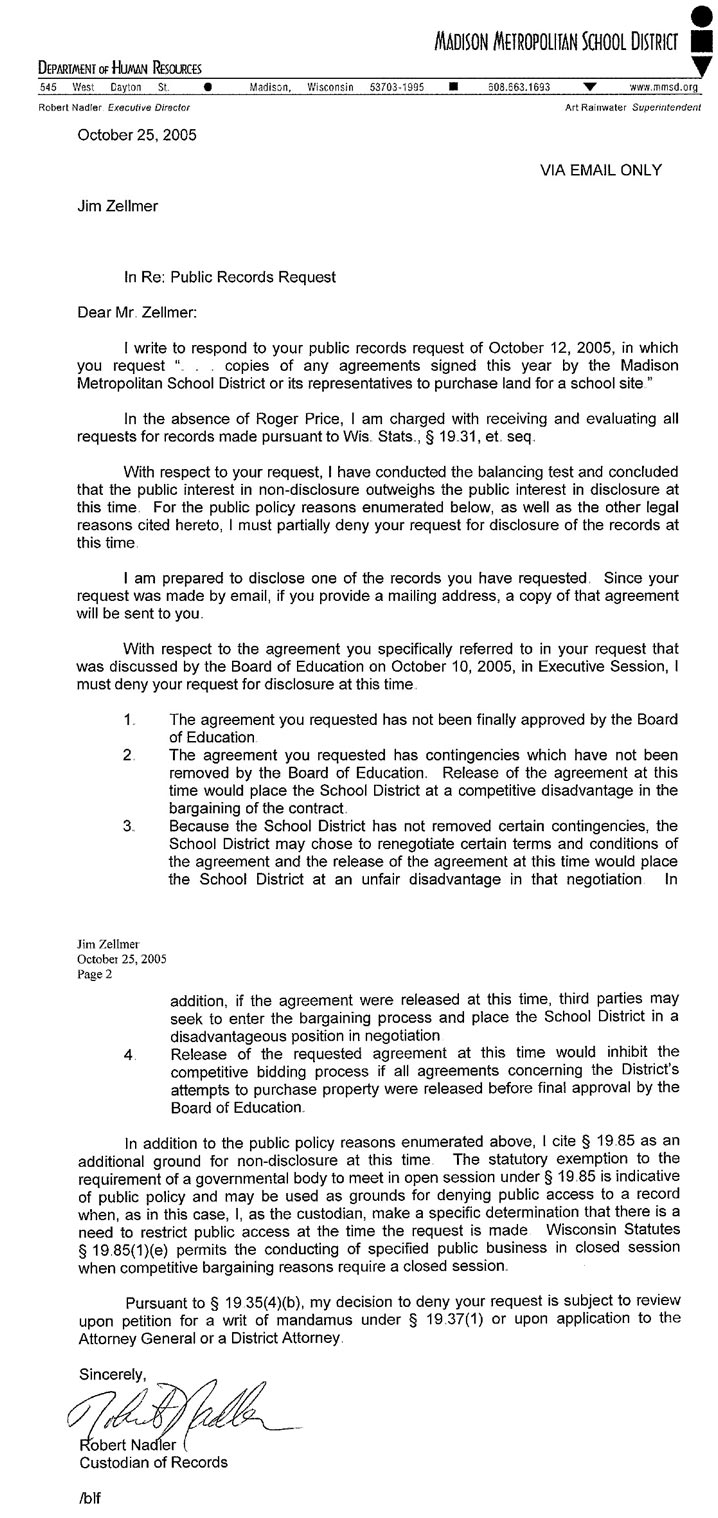
I received a response today from Bob Nadler, the District’s Custodian of Records. Essentially, this response means that the public has no right to know about the District’s purchase of land for a new school site until after the Board agrees to purchase. Read Bob’s letter here. I will post the document he referenced upon receipt.

Share

Fights break out, staffer hit in face at Memorial

The Capital Times reports in a story by Lee Sensenbrenner:

A staff member at Memorial High School was struck in the face and a fire alarm went off after several fights broke out at once in a crowded hallway of Madison’s largest high school.
According to a report by Madison Police Lt. Pat Malloy, eight to 10 students were involved in a disturbance Monday morning that “turned into three to five physical fights in the hallway.” At some point during this, “an officer inadvertently touched a fire alarm,” Malloy said.
“A short time later, a staff member asked a student to remove a hat,” Malloy wrote in a release. “The student responded by striking the staff member in the face.”


Has the MMSD or any other agency followed up on the suggestions to convene a task force on gangs and student violence, as proposed at the forum sponsored by the schoolinfosystem.org? Seems like some follow up would be a good idea.

Share

Monday’s Madison School Board Meeting: Buses and Taxes

The Madison School Board met Monday evening. Here are a few items from that meeting:

Share

Beaver Dam School Wins National Award

Channel3000:

Statistics show half the students at South Beaver Dam Elementary fall into the disadvantaged category.
Yet the school scored 100 percent on reading, knowledge and concept exams and more than 96 percent in attendance.
The school received a National Blue Ribbon Award from the U.S. Department of Education.
“There is no child left behind,” said parent Amy Grunst. “No child who can’t go. Everybody goes.”
“Our expectations are high,” said Principal Dan Rikli. “We are sensitive where they came from, but we expect just as much from every kid who walks into this school.”

Share

Making Schools Work: Hedrick Smith

Hedrick Smith:

This web site follows our production team into classrooms from coast to coast to see how some American communities are creating a small revolution in our schools. Don’t expect one magic formula. You’ll see different strategies. The common denominator is results – lifting scores and closing achievement gaps, not just for a few hundred children but for nearly two million, from our inner cities to rural America.

Transcript here.

Share

Ken Lonnquist @ Thoreau School


Local musician Ken Lonnquist was recently in residence at Thoreau School. Ken worked with each grade to compose a song. The resulting music, ultimately destined for a CD, was performed on a recent evening. Here’s a brief video clip from the event.
UPDATE: Thoreau’s Rhonda Schilling emailed the funding details:

Dane County Cultural Affairs ($1450 grant)
Wisconsin School Music Association ($500 grant)
Thoreau PTO ($1750 Cultural Arts Budget and Barnes & Noble Fundraiser)

Share

Mystery #3: Case of the Unknown Authorization

So far, undaunted detectives, Mysteries #1 and #2 remain largely unsolved, and I’ll shortly update the faithful followers on those.
In the meantime, train your magnifying glasses on Mystery #3, The Case of the Unknown Authorization.
The Unknown Authorization took place in the MMSD budget approved by the Board of Education. It created two new classrooms at Marquette Elementary for a cost of at least $350,000.
Find the authorization and the funds in the MMSD budget documents . . . if you can.
Hint: You’ll need your secret decoder ring!
Good sleuthing!

Share

Mary Gulbrandsen: MMSD Power Broker

No one appreciates Mary Gulbrandsen’s contributions to the Madison Metropolitan School District (MMSD) more than her boss, superintendent Art Rainwater. When we included Gulbrandsen in Madison Magazine’s 2004 People You Should Know list, Rainwater was the first to let us know we’d made an inspired choice. As MMSD chief of staff for the last two years, Gulbrandsen’s influence on all aspects of Madison’s K-12 schools is undeniable. From long-range planning to finance and operations to performance and achievement, district administration minutes suggest Gulbrandsen has spent the last two years in meetings. But seeing her in action on some of the most difficult issues, like the school environment for kids and families of color, proves what a skilled administrator she’s become. Add on top of all that her striking warmth and good sense, and Gulbrandsen seems a perfect fit for her behind-the-scenes position of power.

From “Power Influence & Anonymity: The Seven Women Power Brokers You Need to Know” by Robert Chappell, Neil Heinen and Brennan Nardi
Madison Magazine, November 2005

Share

Fascinating: Novel Way to Assess School Competition Creates a Stir

Jon E. Hilsenrath:

The unusual spat has put a prominent economist in the awkward position of having to defend one of her most influential studies. Along the way, it has spotlighted the challenges economists face as they study possible solutions to one of the nation’s most pressing problems: the poor performance of some public schools. Despite a vast array of statistical tools, economists have had a very hard time coming up with clear answers.
“They’re fighting over streams,” marvels John Witte, a University of Wisconsin-Madison professor of political science and veteran of a brawl over school vouchers in Milwaukee in the 1990s. “It’s almost to the point where you can’t really determine what’s going on.”
Milton Friedman, the Nobel Prize-winning economist known for his free-market views, proposed 50 years ago that to improve schools, parents could be given vouchers — tickets they could spend to shop for a better education for their kids. He theorized that the resulting competition among schools would spark improvements in the system. Free-market advocates loved the idea. Teachers’ unions hated it, arguing that it could drain resources from some public schools and direct resources to religious institutions.

(more…)

Share

The Budget: Same Service = Cost to Continue = Baseline

Jim Zellmer, and others have taken the district to task for having a “same service” budget – alledging that nothing changes as a consequence.
But let’s clarify the use of some terms. The district uses the term “same service” to estimate the next year’s costs – the city and county do the same thing, but use the term “cost to continue.” This is not the entire process, but merely the starting place. The district and Board then make changes – both to comply with the state revenue caps and to improve our programs. We can figure what the changes will cost (or amount saved) by the difference from the same service budget.
Change and how to achieve it in a large system such as the school district is a major concern. Some changes have significant budgetary impacts, e.g. equipping schools with adequate computers (and the infrastructure to support this), reducing class sizes in the primary grades.
However, the one of the most far-reaching changes needed is to change what is occurring in the classroom. This change is brought about through intensive staff development – and is aided by smaller class sizes, but once the district budget includes funding for staff development and for smaller classes the critical factor is not the budget for these but how the funds are used.

Share

Student Brings Weapons into Memorial High School

Channel3000.com:

Another Memorial High School student was arrested Thursday, when school officials say a teen brought in a handgun magazine and 12 9-mm rounds to school.
News 3 reported a teacher noticed them when they fell out of the student’s pocket. A search of his car turned up two more boxes of ammo and a 12½ inch “Rambo Style” knife.
The student was taken to Dane County jail and arrested for carrying a concealed weapon and having a dangerous weapon on school grounds. Police said this is the third weapons incident at Memorial in a week.

Share

Media – The Next Generation

Lookout Sandy Cullen, Matt Pommer, Jason Shepard, and Mitch Henck! Professor Jack Mitchell’s Journalism 335 class at the University of Wisconsin-Madison is teaching the next generation of media. For several weeks these students learn about the Madison School Board and the City Council. I asked Professor Mitchell if I could share the stories with all of you. Enjoy.
http://www.journalism.wisc.edu/j335/mitchell/fall05/gov.html

Share

Michigan Universities Offer More Remedial Math Courses

Lori Higgins:

What’s the price of leaving high school unprepared? Ask Chelsea Stephanoff, a Wayne State University student who is spending nearly $600 this semester for a class that won’t count toward graduation.
Why? Her math skills were poor enough that even after four years of high school math, she was placed in a remedial class.
“Math is not my strong point at all. I’m horrible at it. I have a hard time focusing on it,” said Stephanoff, a fourth-year student from Shelby Township who wants to be an elementary school teacher.

Via Joanne.

Share

UW Freshman Class Scores High in Smarts – 52% Studied Performance Music

Karen Rivedale in the WI State Journal article, “Creamier Crop at UW Madison,” writes that “This year’s freshman class posted high scores on college entrance exams, beating the average national scores on the tests and continuing UW-Madison’s increasing selectivity among the state’s top students. Freshmen this year posted high class ranks, with more than half graduating from high school in the top 10 percent.”
In a sidebar in the article, the Freshamn enrolled is a record high (6,142), 62% earned a varsity letter, 52% performed with a school musical group, 23% won an award for community service.
Meanwhile, closer to home, MMSD’s administrator’s proposed a competitive athletic budget that continued to grow from the previous school year for this school year (parents do pay a fee of $115 per sport, extra for more expensive sports) – that’s good. However, MMSD’s administrators continued their cuts to music education with proposals to eliminate elementary performance music and increase general music class size. The School Board restored half the elementary stringed course in elementary schools and did not increase general music class size. There were also reductions in middle school performance music that were not restored.
Performance music improves academic performance, especially for lower income children who have no other access to performance music except through their public school. It is sad that MMSD is moving in the opposite direction of what the research shows benefits children’s academic performance by cutting performance music.
Performance music directly benefits reading and mathematical skills for young children. There is more research and results that show that today and the information and data showing the positive effects of instrumental music on children’s education are growing not shrinking. In future blogs I will post additional information on this research and results.

Share

Mr. Mom’s Transport Service Press Conference

Mr. Mom’s Transport held a news conference Friday. Pat Schneider was there:

Peter Munoz, executive director of Centro Hispano, fought back tears as he recounted the company’s generous support of his nonprofit agency.
The Smiths’ predicament, he said, “embodies some of the most intransigent problems we face in economic disparity and injustice.
“This business cannot be allowed to fail. It is too important,” he said.
Richard Harris, executive director of the south side Genesis Enterprise Center where the news conference was held, said he doubted that state officials were giving other transportation providers “scrutiny as intent as Mr. Mom’s.”
“Ask yourself: Is the playing field equal?” he said.

More on the Madison School District’s transportion contracts.

Share

Numbers on Arrests at MMSD School

Document Feed on the Isthmus web site has posted Jason Shepard’s recent column and data supplied by the school district:
Police and schools: By the numbers
Spreadsheets compiled from raw data showing police calls and arrests at Madison schools, 2004-2005

In the 2004-05 school year, police were summoned to Madison schools more than 1,500 times and made nearly 400 arrests, mostly of students. Recently Isthmus writer Jason Shepard went through raw data of police reports to compile spreadsheets of police calls and arrests, arranged by school. One resulting finding — that students of color account for a sharply disproportionate percentage of arrests — has stirred particular concern, a topic explored in Shepard’s column for the Oct. 21 edition of Isthmus. Included here is that column and three spreadsheets that provide cumulative data.
http://www.isthmus.com/features/docfeed/docs/document.php?intdocid=154

Share

Stanford on iTunes

Interesting stuff: Stanford posts lectures, interviews, music and sports via itunes. One of the interesting lectures appears to be Denise Clark Pope’s “Getting Ahead in School: How we are creating a Generation of Stress-Out, Materialistic and Miseducated Students”. Perhaps the UW will follow suit (and the MMSD?)
UPDATE: Jeff Henriques points out in the comments that the UW has a resource page up here.

Share

Poverty & Education, Wednesday, October 26, Overture Center

The volunteers of the schoolinfosystem blog invite everyone in the community to our second forum “Poverty and Education,” Wednesday, October 26, 2005 7:00p.m. in the 3rd floor Wisconsin Studio of the Overture Center, 201 State St.
Presenters will be:
– Tom Kaplan: Associate Director of the Institute for Research on Poverty;
– Mary Kay Baum: Executive Director; Madison-Area Urban Ministry
– Hemant Shah: Professor of Journalism and Mass Communication and Asian America Studies
– A representative from the City of Madison
See all the details here.

Share

In the classroom, easy doesn’t do it

A recent posting from the Tomorrow’s Professor listserve looks at the importance of being a demanding teacher, and while the author is reflecting on his experience in the college classroom, the message is just as relevant for students at all grades.

(more…)

Share

Child Enticement Near Emerson

Channel3000:

Madison police are warning parents about another child enticement. This one happened near Emerson School on Johnson Street. Two sisters say a man in a 4-door dark sedan told them to get in his car last Thursday morning. The suspect was a white male with a gray beard. He took off when the girls ran away. Similar cases have been reported in the Madison-metro area since September.

Share

Police and Madison Schools

Bill Lueders and Jason Shepherd:

In the 2004-05 school year, police were summoned to Madison schools more than 1,500 times and made nearly 400 arrests, mostly of students. Recently Isthmus writer Jason Shepard went through raw data of police reports to compile spreadsheets of police calls and arrests, arranged by school. One resulting finding — that students of color account for a sharply disproportionate percentage of arrests — has stirred particular concern, a topic explored in Shepard’s column for the Oct. 21 edition of Isthmus. Included here is that column and three spreadsheets that provide cumulative data

Share

Message from Mr. Mom’s Attorney

This message was posted on the Communities United list serve by Yolanda Woodard, attorney for Mr. Mom’s Transportation Service.
Dear Concerned Community & Business Leaders:
Recently the local newspapers and electronic media have reported on the Mr. Mom’s Transportation Service. This coverage has been in the most unfavorable light possible. While some missteps have been made with the current operation of the business, the sensational, negative media coverage far exceeds the true nature of the situation.
Corrective actions have already begun, long before it became fashionable for the local media to “bash” Mr, Mom’s.
Accordingly, we respectfully request that those of good conscience support Jeff and Cathy Smith and their company Mr. Mom’s. We are asking the community to support this company’s long standing presence in our community and its efforts to address the public concerns by attending a Press Conference to be held on Wednesday, October 21st at 10 am at the Genesis Economic Development Center, 313 W. Beltline Hwy. (Next to Nedrebo’s).

UNITED WE STAND!
Yolanda S. Woodard
Attorney for Cathy and Jeff Smith
608-277-1950

Share

Eyewitness Report: School Board Decisions on Bus Contracts

A recent editorial in the Wisconsin State Journal claims that the Madison school board rejected Superintendent Art Rainwater’s “painstaking” analysis of known problems with local bus companies when it granted long-term contracts to transport our students to locally owned companies. According to the editorial, the administration informed the Board about safety and reliability problems with some of the companies, but—safety and reliability be damned— the Board rushed ahead. The administration, having taken its stand, then meekly agreed to commit the districts to contracts likely to fail our students and their families.
Time for a fact check. I was there for the administration’s presentation, for the votes on the contracts and for recent Board discussions about the problems that have developed with one of the local companies, Mr. Mom’s.
This is my eyewitness report.

(more…)

Share

State’s learning gap still vast

Wisconsin students stayed above national averages in test results released Wednesday, but a Journal Sentinel analysis of the data shows that the gap between black and white students was among the largest in the nation. In eighth-grade reading and in fourth-grade math, the gaps were larger than in any other state in the country.
By SARAH CARR
scarr@journalsentinel.com
Oct. 19, 2005

(more…)

Share

2005 NAEP Results

2005 National and State Mathematics and Reading Assessments for grades 4 and 8 are now available.
Robert Tomsho takes a look at the reading results:

Observers say boosting reading scores isn’t likely to get any easier, given the rapidly changing demographics in the nation’s schools where, for many students, English is a second language. Indeed, English was a second language for 10% of the fourth graders who took the NAEP reading test this year, up from 3% in 1992.
The lack of progress may also reflect divisions in the philosophy of how reading should be taught. Educators and political partisans have waged a long and sometimes bitter battle over how to handle the subject, as conservatives championing basic phonics-based teaching have clashed with liberal backers of “whole language,” which revolves around making English instruction exciting by reading stories.

Share

Study Shows Few Gains Since NCLB

Lois Romano:

Despite a new federal educational testing law championed by the Bush administration, scores among fourth and eighth graders failed to show any improvements in reading, and showed only slow gains in math nationally during the past two years, according to a study released today.
Most troubling for educators are the sluggish reading skills among middle school students, which have remained flat for 13 years, according to the National Assessment of Educational Progress (NAEP), which has been testing students for three decades and bills itself as the “nation’s report card.”
“There is no rationale on eighth-grade reading other than we are not making progress,” said Darvin M. Winick, chairman of the National Assessment Governing Board, which oversees the testing. Yet, he added, “I think educators and parents of elementary schools students should feel pretty good about this report. There is progress.”

interesting quote NPR has more.

Share

Minority Overrepresentation in Special Ed. Targeted

From Education Week, October 12, 2005
By Christina A. Samuels
A new provision of federal law taking effect this school year allows, and in some cases requires, school districts to focus some of their federal special education money on reducing the enrollment of minority students in such programs.
The provision, contained in the 2004 reauthorization of the Individuals with Disabilities Education Act, requires some districts to spend as much as 15 percent of that federal aid on what are called “early intervening” services, which are meant to bolster the achievement of students before they are officially referred for special education.

(more…)

Share

UW Center Established To Promote Reading Recovery

A gift of nearly $3 million is being used to boost teacher training at the UW-Madison in a special, reading program.
But that program, Reading Recovery, has critics, who say it’s not worth the necessary investment.
Training at a new UW-Madison Reading Recovery Center will involve videotaping teachers, as they instruct young children, in a one-on-one process between student and teacher that costs more than group programs.
Student progress with Reading Recovery in the Madison School District and across the country has been questioned.

(more…)

Share

A History of Changes at West

Last spring a longtime parent at West HS was asked to write a description — content area by content area — of the curriculum changes that have occurred at West HS in recent years that have affected the academic opportunities of West’s “high end” students. Below you will find what she wrote. It includes changes that have actually occurred; changes that may and probably will occur; and important questions about what else may happen in the future.
This summary was then forwarded to two other longtime West parents for their comments. Excerpts from those comments may be found just after the original description. Next, the description of each content area was sent to the appropriate department head at West, for their comment with the goal being to produce a brief, descriptive document that everyone would agree was factually accurate, for educational and advocacy purposes. Unfortunately, none of the department heads responded.
Here is the original description:

(more…)

Share

Wisconsin AB 618 and SB 305: Protect Child Passengers

Denny Lund emailed this information on two bills that address requirements for child passenger booster seats:

On Wednesday, October 19, the Joint Finance Committee of the Wisconsin State Legislature will be voting on both AB 618 and SB 305. Because there is no public hearing for this bill, it is imperative that these committee members hear from you.
Please call and/or email your representatives and urge them to support AB 618 and SB 305. If they are not on the Joint Finance Committee, urge them to contact committee members.
Find your legislator’s phone number here: www.legis.state.wi.us
List of Joint Finance Committee members

(more…)

Share

Non-Traditional School Finance Discussion

Props to Johnny Winston, Jr. for organizing today’s Madison Board of Education Finance & Operations Subcommittee on Advertising meeting. I think a discussion of alternative funding sources is vital in light of Madison’s generally high property taxes, sluggish economic growth and the biennial state funding battles. A number of possibilities were discussed including:

  • The District leading the implementation of local fibre optic networks, via it’s many facilities (with, perhaps wifi servicing the last mile). I think this is quite interesting. Madison lags in true broadband service.
  • Naming Rights
  • Curriculum Program Underwriting
  • Sponsorships for district cable channels, website(s) and other parental communications

Participants included: Johnny, Roger Price, Barb Lehman, Ken Syke, Vince Sweeney (UW Athletic Department), Melanie Schmidt (President of the Timpano Group) Jodi Bender Sweeney, President of the Foundation for Madison Public Schools and the writer (me).

Finally, A representative of local cell providers discussed the type of fees they would pay for very small antennas placed on District facilities (no towers). The Capital Times’ Matt Pommer attended as well and will, I’m sure write about it.
UPDATE: Pommer’s article is here. I have some corrections:

  • I did not hear the word tower used in connection with the cell service discussions. I heard the word antenna used. Obviously, we’ll have to see what the actual plans include to make an aesthetic determination on this question.
  • I’m quoted as saying “Madison is way behind on this issue,” related to sponsorship and advertising. I said this when Roger Price was discussing the District’s fibre optic network options vis a vis community broadband.
Share

Ridgewood building razed

FITCHBURG – A demolition crew on Monday began tearing down a fire-ruined apartment building at 2001 Post Road in the Ridgewood Country Club Apartments complex.
Though the work was the first visible activity in the 52-acre, 832 apartment subdivision since Madison developers E.J. Plesko & Associates bought the troubled property this summer, a spokesman said taking down the structure “is not a precursor to other actions” being planned there.
By Cliff Miller
Correspondent for The Capital Times
October 18, 2005

(more…)

Share

Could virtual education courses help with TAG and AP?

I believe that virtual education initiatives could help with some of the concerns raised by parents and community members regarding Advanced Placement courses. Please check out this website http://www.digitaldistricts.org/ and let me know what you think.

(more…)

Share

Get Involved at West NOW

I said it in the comments section attached to Marcia’s original post. Now is the time for pre-high school families to get involved at West. Don’t wait.
This will be like turning around the Titanic, however–there is a great deal of momentum to disassemble much of what was strong about West for high achievers. And what the district seems to be ignoring is that many of these families make up the backbone of support for the school, from PTO, to athletic and drama boosters, etc, both in terms of hands-on involvement and financial contributions.
The safety valve of attending UW classes is also being shut off, too. If a course is offered ANYWHERE in the district, MMSD won’t pay for a West student to take it at UW. In addition, there is a “residency” requirement, i.e., to be considered a full-time student, a certain number of credit hours have to be taken at West or be approved to be taken elsewhere. So even if your family can afford to pay for UW courses and can get approval from UW for your student to take more than one class per semester, your student might still run afoul of the residency requirement.
Of course, home schooling is an option. Some families have quilted together classes at West, UW and home or on-line. One of the “West” national merit scholars this year has done just that.

Share

Curriculum Changes Proposed at West High

As discussion continues over the lack of AP courses at West High School relative to the other three Madison high schools, West prepares to further reduce the course opportunities for students.
Many West parents wrote this past spring and summer to Principal Ed Holmes, Science Chair Mike Lipp, and District Science Coordinator Lisa Wachtel advocating for more not fewer sections of Accelerated Biology. Parents have also written to express concern about plans to homogenize the 10th grade English curriuculum, eliminating the options currently available to 10th graders, and requiring students to wait until 11th grade before they can take elective courses in English.
There had been no response to these concerns until a recent letter went out at the end of September from Principal Ed Holmes.
Dear Interested Parent:
As we continue to improve and expand our curricular program to meet the needs of a very diverse student population, I want to assure you that we are working with best practice models and some of the most informed professionals in the field to make sure we offer a quality academic program for your child. Our goal is to do our absolute best to provide a challenging rigorous curriculum that meets the needs of every student that we serve at West High School.
The following information represents the work that has been done over the summer and at the outset of the 2005/06 school year in the areas of science and English. The people involved in the work in biology have been Welda Simousek, Talented and Gifted Coordinator for MMSD, Lisa Wachtel MMSD science coordinator, Mike Lipp, West High, science Department Chairperson, and members of the West High biology teaching team. Work in the area of English has been done by Keesia Hyzer, West High English Department Chairperson, Ed Holmes, Principal, West High School and members of the West High English teaching team.
Science

  • There was over 25 hours of district-supported science professional development this summer focusing on quality instruction and differentiation at the high school level. Members of the West biology staff participated in this professional development opportunity along with high school science teachers from all the other MMSD high schools.
  • There are eight professional development days scheduled during the 05-06 academic year to continue the work begun over the summer and further develop the honors designation in science.
  • While there has been initial work over the summer on the honors designation in science there remains a lot of work to be done by the West science staff
  • We are keeping in mind the following critical components as we plan:
    • More work is not the goal. Qualitatively different work is what will be expected.
    • Not all of the work can be done inside of class. There will be homework assignments just as always, but again, the work expected will be qualitatively, not quantitatively different.
    • We are looking for ways to enable students working toward the honors designation to spend some time together as a group as well as to work with other groups of students.

English
Over the summer, members of the English Department worked to create an English 10 curriculum. We will continue to fine-tune this curriculum over the school year. During the summer of 2006, English 10 teachers will meet to plan and differentiate particular units. Criteria for an honors designation in English 10 as well as additional attention for struggling students are both specified in the curriculum.

  • All students have the option to elect or drop the honors designation.
  • Honors designation does not guarantee an A.
  • One English teacher, as part of her allocation, will be assigned as Skills and Enrichment Coordinator. This teacher will meet with those students who have elected honors twice weekly during lunch to lead discussion of the enrichment literature. This person will also grade honors exams and papers.
  • The Skills and Enrichment Coordinator will meet twice weekly during lunch with students needing additional help. Books on tape, as well as reading and writing assistance will be provided.

The English Department meets at least once monthly; professional development days will also be used to continue our work on planning English 10. We plan to present information regarding grade 10 English curriculum at the November 7 PTSO meeting. All parents are invited to come to hear about the work the English Department has been doing over the last few months. We will continue to keep parents involved in the process as we determine the future of curricular and academic programming at West.
Sincerely,
Ed Holmes
Principal

Share

AP Courses Taught in Four Madison Public High Schools

Here is a listing of the AP courses taught at each Madison high school:
East (8 AP courses) — Calculus I, Calculus II, French, Macro Economics, Micro Economics, Music Theory, Psychology, Spanish
LaFollette (13 AP courses) — Calculus I, Calculus II, Chemistry, Computer Science, European History, French, Literature and Composition, Macro Economics, Micro Economics, Psychology, Spanish, Statistics, U.S. History
Memorial (16 AP courses) — Biology, Calculus I, Calculus II, Chemistry, Computer Science, Environmental Science, European History, French, Language and Composition, Literature and Composition, Macro Economics, Micro Economics, Physics, Psychology, Spanish, World History
West (8 AP courses) — Calculus I, Calculus II, Computer Science, French, Latin, Music Theory, Spanish, Statistics

Share

Ridgewood Apartment Building Demolished

Channel 3000:

Demolishing the structure was the last step necessary for previous managers, CMS, to collect on the insurance claim.
New owners, EJ Plesko & Associates, are now in the early stags of conducting a market analysis.
“You want to look at surrounding areas,” said Plesko official Brandon Scholz. “You want to know what apartments are like, what condos are like, what businesses are like and be able to look at what you have and how much more development you want to put into it.”
EJ Plesko & Associates hopes to have a redevelopment plan to Fitchburg officials by early 2006.

Share