School Information System

Duking it out over teacher pension

Scott Elliott:

The DDN’s editorial board weighed in Saturday on the war of words between the Fordham Institute (the research arm of the Thomas B. Fordham Foundation) and the State Teachers Retirement System over the health of the state’s teacher pension program.
Fordham, a frequent critic of the public education status quo, fired the first shot last month in a report that sounded alarms, saying the pension program was in serious danger.
What was unusual was the tough talk in reply from the state agency. STRS ripped Fordham’s study and the researchers methods, aruging that the pension program is solid.

Share

Preparing STEM Teachers: The Key to Global Competitiveness

Sean Cavanaugh 884K PDF:

The document, produced by the Washington-based American Association of Colleges for Teacher Education, provides descriptions of 50 teacher-education programs around the country. Although the report does not identify any single program or approach as most effective in swelling the ranks of math and science teachers, it says that more institutions are establishing stronger ties between colleges of education, which focus on teacher preparation, and academic programs, which are devoted to training undergraduates in specific academic subjects.
Barriers between those academic departments sometimes prevent talented math and science undergraduates from considering teaching careers, advocates for improved teaching have argued. Those intrauniversity divides also make it more difficult for aspiring teachers to obtain vital content knowl-edge in math and science before entering the classroom, some say.

Share

Idaho Evaluating Math Ed

Joshua Palmer:

In an effort to prepare students for the rigors of increasing math requirements, the Idaho State Department of Education is re-evaluating the way schools teach and assess student proficiency in mathematics.
The Idaho Legislature approved $350,000 in research funding earlier this year, which paid for the development of a task force to examine issues such as various assessment methods, teacher training and remedial opportunities for students who struggle in mathematics.
The department will ask lawmakers in the 2008 legislative session to approve funding for the changes it will likely propose in math education and assessment.
Cindy Johnstone, mathematics coordinator for the state department, said the changes are part of the state’s math initiative, which was implemented to improve student proficiency in mathematics.
In Idaho and throughout the nation, math scores are steadily falling in elementary and middle schools – a problem that has forced high schools to devote more resources to math remediation.

Much more on math, here.

Share

“Candidates vying to be teachers’ pet”: Obama Endorses Merit Pay

Thomas Fitzgerald:

Fifteen minutes before Illinois Sen. Barack Obama was scheduled to speak yesterday, teachers in the audience were crawling across the floor, trying to get closer to the lectern for a better camera angle.
When the Democratic presidential candidate finally took the stage, cheers from the delegates to the National Education Association were deafening, and nobody booed or hissed when, near the end of a 40-minute appearance, Obama endorsed the idea of merit pay for teachers.
Merit pay is a no-go for most in the teachers union – members say they are concerned it would not be implemented fairly – but Obama softened the blow by promising he would not propose “arbitrary measures” to link pay to performance.
“I want to work with teachers. I’m not going to do it to you, I’m going to do it with you,” the Illinois Democrat told the crowd of 9,000 at the Convention Center. As he spoke, cameras flashed around the hall.

Joanne has more.

Share

Tutor Vista

www.tutorvista.com:

Our mission is to provide world-class tutoring and high-quality content to students around the world. TutorVista.com is the premier online destination for affordable education – anytime, anywhere and in any subject. Students can access our service from the convenience of their home or school. They use our comprehensive and thorough lessons and question bank to master any subject and have access to a live tutor around the clock. TutorVista helps students excel in school and in competitive examinations.

The Economist:

but TutorVista, an online tuition service, is aimed squarely at customers in the developed world. Mr Ganesh founded the company in late 2005 after spotting that personal tutoring for American schoolchildren was unaffordable for most parents. His solution is to use tutors in India to teach Western students over the internet. The teachers all work from home, which means that the company is better able to avoid India’s high-wage employment hotspots. TutorVista further hammers home its labour-cost advantage through its pricing model. It offers unlimited tuition in a range of subjects for a subscription fee of $100 per month in America (and £50 a month in Britain, where the service launched earlier this year) rather than charging by the hour. Tutors are available around the clock; appointments can be made with only 12 hours’ notice.
It is too early to gauge the impact of the service on educational outcomes, says Mr Ganesh, but take-up is brisk. TutorVista has 2,200 paying subscribers at the moment (most of them in America) and hopes to boost that figure to 10,000 by the end of the year. The company is expected to become profitable in 2008. Even cheaper pricing packages are on the way. Launches of the service are planned for Australia and Canada. Mr Ganesh is also investigating the potential of offering tuition in English as a second language to students in South Korea, where high rates of broadband penetration make the market attractive. Get that right, and China looms as an even bigger prize.

TutorVista, along with Rosetta Stone and other online tools offer practical options for families who seek new learning opportunities unavailable via traditional models. The nearby Oregon school district may add languages to their elementary programs. CyraKnow offers handy “phrase books” for the iPod.

Share

Review Finds Nutrition Education Failing

Martha Mendoza:

– The federal government will spend more than $1 billion this year on nutrition education – fresh carrot and celery snacks, videos of dancing fruit, hundreds of hours of lively lessons about how great you will feel if you eat well.
But an Associated Press review of scientific studies examining 57 such programs found mostly failure. Just four showed any real success in changing the way kids eat – or any promise as weapons against the growing epidemic of childhood obesity.

Share

Extending what schools do risks diluting their core purpose

The Economist:

REJIGGING government departments is an easy way for a new leader to signal a break with the past. And this is exactly what Gordon Brown has done in his first week as prime minister, with a good deal of reshuffling of ministerial duties and two departmental eviscerations.
The most eyecatching of these divided the education department down the middle. The Department for Children, Schools and Families (DCSF) inherits most responsibilities for under-19s, including some taken over from other departments, such as youth justice and the “Respect agenda” (cracking down on anti-social behaviour) from the Home Office. The Department for Innovation, Universities and Skills (DIUS) takes up where DCSF leaves off, overseeing further and higher education and doling out research funding, much of which previously came from Mr Brown’s other main casualty, the now-deceased Department of Trade and Industry.

Share

Many school libraries open so… Beat the Heat – Read!

Madison Metropolitan School District:

This summer the Madison School District is again running a summer library access project. The project’s primary goal is to ensure that Madison elementary-age school children, from both public and private schools, have easy access to library materials during their summer break.
By providing such access, the district hopes to minimize reading achievement loss during the summer months for students who might not otherwise have ready access to reading materials. Some studies suggest that 80% of the achievement difference between high income and low income students may be attributable to summer reading loss.

Share

Northfield has a heroin problem

MPR:

Police in this upscale college town say they’re fighting an unusual heroin epidemic among high school kids.
More than 150 kids are hooked on the drug, Northfield Police Chief Gary Smith said Tuesday. He decided to publicize the problem with a news conference, where he said that as many as 250 current and former Northfield High School students could be involved – some feeding heroin habits of as much as $800 a day.
The epidemic has increased crime and caused consternation in Northfield, one of the most educated and affluent cities in Minnesota, and home to both Carleton and St. Olaf colleges.
“This is affecting our ability to deal with other community concerns,” Smith said. “We find ourselves more often reacting to crimes than preventing them.”
Smith said investigators first caught wind of the problem when crime started spiking, including a doubling in burglaries and tripling in thefts from autos from 2005 to 2006. It led them to the informal heroin ring at the high school of about 1,300 students.

Share

With rise in autism, programs strained

Carey Goldberg:

A decade ago, it took a few months to get a child into Melmark New England, a special school largely for children with autism. Now, the wait can be five years
Boston-area parents, worried their child may be autistic, routinely face delays as long as nine months to confirm the diagnosis — even though current wisdom holds that treatment should begin as early as possible.
And LADDERS, a Wellesley autism clinic, has all but closed its doors to new patients: “We’re backed up well over a year here, and other clinics are struggling the same way,” said Dr. Margaret Bauman, its director.
Statewide, the number of schoolchildren diagnosed with autism has nearly doubled over the last five years, from 4,080 to 7,521, according to soon-to-be-published data from the Department of Education.

Share

Hoping to Retain Graduates, Maine Helps With Loan Costs

Katie Zezima:

Seeking to discourage Maine college graduates from leaving the state, Gov. John Baldacci signed a bill Monday giving tax credits to lower the cost of student loans for those who stay in the state.
The program, called Opportunity Maine, starts in January and will apply only to new loans. The tax credit will last 10 years, or until the recipient moves out of state.
“This is about our generation helping the next one,” Mr. Baldacci, a Democrat, said in a statement. “We’re telling our students, If you live, work and pay taxes in Maine, you’re not going to have this student debt hanging around your neck.”
The tax credits will be capped at $2,100 a year, about the cost of taking 10 credits at the Orono campus of the University of Maine, not including fees.

Share

In School Takeover, Newark Union Tries to Prove It’s Part of the Solution

Winnie Hu:

When teachers are removed from their schools here, their first phone call is often to the powerful Newark Teachers Union. But now the union is telling as many as a dozen teachers at the troubled Newton Street School that they have to leave because they do not fit in with a plan to improve the school.
“It was probably the hardest thing that I’ve had to do,” said Joseph Del Grosso, the longtime union president, who helped push through raises for teachers this spring during a state budget crisis, and went to jail for nearly three months in 1971 for taking part in a teachers’ strike.
The 5,000-member teachers’ union, the largest in New Jersey, is part of a takeover team at Newton, one of the city’s worst-performing public schools. For the past six years, it has failed to demonstrate “adequate yearly progress” on state achievement tests, the standard required by the federal No Child Left Behind law.

Share

Oregon may teach foreign languages in grade school

Gena Kittner:

Even as they are first taught to read, kindergartners here could be learning to say hello, goodbye and much more in Japanese, German, Spanish, Arabic or another foreign language.
The Oregon School District is considering teaching a different language at each of the district’s three elementary schools, starting in kindergarten and continuing through fourth grade.
It’s an idea that has been tried in the Menasha School District for about 14 years and one that’s getting more interest from districts around the state.
“Our hope is that in fall of 2008 we will get this up and running,” said Courtney Odorico, Oregon School Board member. “The idea is the kids don’t learn to be (just) Spanish speakers; they learn to be language learners. Kids are going to need to learn a second language.”
The program, which needs board approval, integrates the foreign language into lessons on science, math and language arts — in addition to a dedicated class just for language instruction every other day. It could be phased in over several years, continuing to the middle school and high school.

Smart. Great to see some public districts increasing academic opportunities (Virtual language learning is also on offer in some local schools).

Share

So Much Paperwork, So Little Time to Teach

Samuel Freedman:

Allison Rabenau celebrated an inauspicious milestone on the otherwise unremarkable day of Oct. 18, 2004. Six weeks into her first year as a teacher, she finally taught a class.
Ms. Rabenau had left a long career as a stage manager in the commercial theater to learn how to teach English as a second language to immigrant children in New York’s public schools. The only problem, she quickly discovered, was that the avalanche of paperwork and other assignments meant she actually got to teach only sporadically.
In a perfect, if dispiriting bit of symmetry, her initial year at Public School 123 in Harlem ended the same way it began. Ms. Rabenau lost the last six weeks of the spring term to prepare, administer, then score a standardized test for English fluency.
Essentially, her teaching year, and her students’ learning year, had run only from mid-October to mid-April, with numerous interruptions even then. During the time when the students were entitled to instruction in English, they were sitting in other courses that they may or may not have understood.

Share

Jefferson on Public Education: Defying Conventional Wisdom

Tom Shuford:

“If a nation expects to be ignorant and free, in a state of civilization, it expects what never was and never will be.” Thomas Jefferson
The Fourth of July is fireworks, festivities and images of a gathering of remarkable men determined “to dissolve the political bands which have connected them with another and to assume among the powers of the earth, the separate and equal station to which the Laws of Nature and of Nature’s God entitle them.”
For me the Fourth of July is those things and a question: What sort of education produced these men? What schools might produce their like again? There are clues. The author of the Declaration of Independence had much to say about educating the very young.
Thomas Jefferson lobbied the Virginia General Assembly to implement a system of publicly-funded schools. He failed. It would be sixty years before Horace Mann traveled the state of Massachusetts on horseback advocating a system of “common schools” and decades more before most states would follow Massachusetts’ lead.
Jefferson’s vision for public education is, nonetheless, illuminating and provocative. The main source is his Notes on the State of Virginia, first published in 1785. Here are some of the key features of his plan — in the original spelling, where quoted:

  1. Attendance is voluntary. “It is better to tolerate that rare instance of a parent’s refusing to let his child be educated, than to shock the common feelings by a forcible transportation and education of the infant against the will of his father.” (1)
  2. Every child is entitled to three years of instruction in reading, writing, and arithmetic.
  3. The reading for the primary school years is mainly history. “The first stage of this education . . . wherein the great mass of the people will receive their instruction, the principal foundations of future order will be laid here. Instead therefore of putting the Bible and Testament into the hands of the children, at an age when their judgments are not sufficiently matured for religious enquiries, their memories may here be stored with the most useful facts from Grecian, Roman, European, and American history.”
    And later in the text, Jefferson writes that “of all the views of this law, none is more important, none more legitimate, than that of rendering the people the safe, as they are the ultimate, guardians of their own liberty. For this purpose the reading in the first stage, where they will receive their whole education, is proposed, as has been said, to be chiefly historical. History by apprising them of the past will enable them to judge of the future; it will avail them of the experience of other times and other nations; it will qualify them as judges of the actions and designs of men; it will enable them to know ambition under every disguise it may assume; and knowing it, to defeat its views.”

  4. The “best genius in the school of those whose parents are too poor to give them further education” is entitled to a fourth and fifth year at a “grammar school.”
  5. Students at grammar schools study “Greek, Latin, geography, and the higher branches of numerical arithmetic.”
  6. After a trial period of one or two years, the best student at each grammar school is selected for six years of further instruction. “By this means . . . the best geniusses will be raked from the rubbish annually, and be instructed, at the public expense, so far as the grammar schools go.”
  7. After the sixth year, the best half of these go to college. “At the end of six years instruction, one half are to be discontinued (from among whom the grammar schools will probably be supplied with future masters); and the other half, who are to be chosen for the superiority of their parts and disposition, are to be sent and continued three years in the study of such sciences as they shall chuse, at William and Mary college.

Jefferson believed in selection by merit from an early age: “By that part of our plan which prescribes the selection of youths of genius from the classes of the poor, we hope to avail the state of those talents which nature has sown as liberally among the poor as the rich, but which perish without use, if not sought and cultivated.”

Related: Jefferson’s last letter, written on the 50th anniversary of the Declaration of Independence.

Share

Superintendent Credentials

The Doyle Report:

Announced two days ago by Mayor Adrian Fenty, Michelle’s appointment is part of two trends. The first is mayoral control of schools; the second is appointing “uncredentialed” or “unlicensed” leaders to fill the post of superintendent (or in the case of DC and NYC, chancellor).
The nightmare of credentialing is ordinarily thought of in terms of teachers, a challenge that reformers like Michelle and Wendy Kopp have taken on in their respective spheres; in their earliest incarnation, credentials were meant to be a floor beneath which teachers would not fall. In their modern incarnation they have become a ceiling through which they may not pass. For example, the head of the Sidwell Friends math program, a trained mathematician with 30 years experience of superlative high school teaching couldn’t get a job in a public school. Nor could Einstein.
By way of contrast, the most ordinary time-server could muddle through a college of teacher education and “earn” a credential. So too administrative credentials. Most important, the credentialitis that afflicts public K-12 education, while originally well intentioned, is not linked to performance.

Share

How about private funding for public education? How about private funding for public education?

Milwaukee Teacher Thomas Biel:

The 2008 budget for a cash-strapped Milwaukee Public Schools comes in at $1.2 billion. What is so staggering about that amount is that the amount turns out to be minimal operating cost.
Throwing more money into the pot does not guarantee improved cooking. As long as a reasonable amount of money is made available, good management, excellent leadership, skillful workers and societal support are still the keys to success.
However, if we are in the business of improving the product, more financial resources are essential.
If the public is tapped out, then public education needs to tap into the private sector. The private sector of society should be asked to kick in more money. Basically, public education needs to do more to build bridges to private business and the private sector needs to do more to fund public education.
Why? Because it’s good business.

Share

Milwaukee Public School’s Spending Rush Questioned

Alan Borsuk:

As the end of its budget year approached last week, Milwaukee Public Schools had not spent more than $50 million slated to be used for the 2006-’07 school year.
Administrators say that if they hadn’t spent the money by June 30, it would have hurt MPS in the future because of state school aid rules – with Milwaukee property taxes rising as a result. So they unloaded some big payments at the last moment, including $37.8 million to prepay costs such as debt service expected in 2007-’08.
This was routine – and good – practice in the eyes of Superintendent William Andrekopoulos and Chief Financial Officer Michelle Nate.
But it set off alarms with others, particularly Michael Bonds, chairman of the School Board’s Finance Committee, who said board members were not given straight information from administrators and did not have a chance to deal with the issue effectively. Bonds wondered if there were ways the money could have been used to increase programs for children.
He said he met Sunday afternoon with Andrekopoulos and Nate to talk about the issue, but he refused to accept what he called “a party line document” that suggested to board members what they should say to anyone who asked them about what was going on.

Share

Ten Ways to Reduce College Application Stress

Jay Matthews:

Three of America’s smartest and most experienced college admissions officers, Sarah D. Donahue, William R. Fitzsimmons and Marlyn McGrath Lewis of Harvard, had a piece in the Harvard Crimson recently saying, among other things, that they planned to “work with secondary schools in a renewed effort to make applying to college less complicated and stressful than it is today.”
I am not certain how that is going to happen in their case. They rejected a record 91.03 percent of applicants to Harvard this year. It seems to me the only way to reduce stress in their process is to franchise the brand name so we can have McHarvards in Beltsville, Md., Kankakee, Ill., Pismo Beach, Calif., and other deserving locales.

Share

Race in Schools

Tom Ashbrook, Luke Massie, Michael Steel, ,Gary Orfield and Lani Gunier:

Across the country today, American schools and educators are still trying to figure out the full implications of last week’s big Supreme Court ruling on race and school assignments.
A half century after the court declared that “separate but equal” does not work in education, the Roberts court seemed to point straight back to separate but equal. Or maybe forward to some new effort at colorblind equality.
This is bedrock stuff. Critics are shouting “resegregation.” Supporters say “So what?”
This hour On Point: the surprising range of response to the court’s big new message on race and schools.

20mb mp3 audio.

Share

“No Child Left Behind” in the Crosshairs

Washington Post Editorial:

Nor can some of his arguments about the unintended consequences of No Child Left Behind be denied. For example, the law’s requirement that states test students annually and show progress toward proficiency has caused some states to lower standards and water down assessments. It’s difficult, though, to see how giving states even more flexibility will solve this problem. Wasn’t the trouble caused by letting states decide what’s good enough?
We’ve been unequivocal in our support of standards that have rigor and meaning. It’s encouraging that Sen. Edward M. Kennedy (D-Mass.), a proponent of No Child Left Behind who chairs the education committee, has identified this as one of his priorities. Some promising ideas come from the nonprofit advocacy group Education Trust. One is to encourage states to raise their standards to a “college-and-career-ready level” with the trade-off of getting more time to reach more realistic goals of proficiency. The law’s original goal of 100 percent proficiency by 2014, while laudatory, may be unrealistic.

Share

N.Y. Schools to Offer Cash for Good Grades

Talk of the Nation:

New York City schools plan to offer dutiful seventh graders up to $500 a year in incentives for attendance and good grades. In an op-ed that appeared in Sunday’s New York Times, a psychology professor argues that the logic behind this new plan is based on flawed assumptions.

Audio.

Share

NY Governor Spitzer on School Choice

Eliot Spitzer:

In a 30-minute presentation entitled “Unfinished Business,” given to more than 400 of the state’s most powerful and influential television and radio professionals, Gov. Spitzer made the case his administration has much to be proud of since he took office in January.
Among the educational accomplishments touted in his talk was the doubling of charter school choices across New York. “The more you get alternative models out there, the better,” he remarked. “Even if charter schools never have more than a small piece of the market share, they nonetheless provide an alternative example people can look to for learning.”

Share

The New Age of Ignorance

Tim Adams:

Fifty years on, and exponential scientific advance later, it seems unlikely that the response of dinner guests would be much different. I was reminded of Snow’s test when reading the new book by Natalie Angier, science editor of the New York Times. Angier’s book is called The Canon, and subtitled ‘A Whirligig Tour of the Beautiful Basics of Science’. It is not a long book and it contains, as the title suggests, a breathless Baedeker of the fundamental scientific knowledge Angier believes is the minimum requirement of an educated person.
In many places, I found myself cringeing all over again. I’ve read a fair amount of popular science, tried to follow the technical arguments that underpin debates about global warming, say, or bird flu, listened religiously to Melvyn Bragg’s In Our Time, but still I discovered large black holes in my elementary understanding of how our world works. Angier divides her book into basic disciplines – biology, chemistry, geology, physics and so on – and each chapter offers an animated essay on the current established thinking.
The result is the kind of science book you wish someone had placed in front of you at school – full of aphorisms that help everything fall into place. For geology: ‘This is what our world is about: there is heat inside and it wants to get out.’ For physics: ‘Almost everything we’ve come to understand about the universe we have learned by studying light.’ Along the way there are all sorts of facts that stick: ‘You would have to fly on a commercial aircraft every day for 18,000 years before your chances of being in a crash exceeded 50 per cent’, for example; or, if you imagined the history of our planet as a single 75-year human life span: ‘The first ape did not arrive until May or June of the final year… and Neil Armstrong muddied up the Moon at 20 seconds to midnight.’

Excerpt: The Two Cultures by CP Snow.

Share

New Hampshire Begins to Define an “Adequate Education”

Norma Love:

New Hampshire will be responsible to pay for more than the three Rs under a new law defining a constitutionally adequate education but taxpayers won’t get the bill for months.
Gov. John Lynch signed the law yesterday, the first step in the state’s effort to answer a court ruling that it define its responsibility for education and pay for it.
“With this new law, we are fulfilling our responsibility to define an adequate education,” said Lynch. “The broad educational opportunities outlined in this law will ensure our children have the skills and knowledge they need to compete in today’s world.”
Lynch noted that the definition includes kindergarten — not currently mandated in New Hampshire.
The next step facing lawmakers is to put a price to the broadly worded definition, then craft a new aid distribution system. Lawmakers have insisted for months they won’t wait to do that.

Text of HB 0927-FN:

AN ACT relative to the specific criteria and substantive educational program that define an adequate education, the resources required to provide an adequate education, and the establishment of a timetable for costing an adequate education.

Share

A More Global Approach to Education

Jon Boone:

Two of the world’s most buccaneering education entrepreneurs have teamed up to build 60 multimillion-dollar schools in big cities across the world.
The network of high-end international schools will cater to the children of bankers, diplomats and executives who have to regularly uproot their families.
With annual fees between $15,000 and $40,000, depending on the city, the plan marks a serious departure for Chris Whittle, famous for starting the Edison Schools company, which runs facilities in some of America’s most deprived areas.
His new venture, Nations Academy, has been set up with Sunny Varkey, chairman of Dubai-based Global Education Management Systems, which runs private schools around the world.

Share

Schools Banning iPods to Curtail “Widespread” Cheating

Christian:

Mmm. Seems that before we had iPods, we had tiny sheets of paper that were folded up and hidden in shirt sleeves full of answers. And easily chewable after-the-fact. And we also had kids collecting tests over years and passing them down when teachers were predictable about their tests.
What’s really changed? Has iPod really brought the boogey-man into the school? Or are we forgetting simple things? Forgetting the past? The paper version of the past?
Leaves me to wonder something else. Why are the MP3s allowed to be ON and/or the earphones/buds IN the students ears or near their vision?

Share

LEADING THE LOCAL: TEACHERS UNION PRESIDENTS SPEAK ON CHANGE, CHALLENGES

Susan Moore Johnson:

Presidents of 30 local teachers unions in six states speak candidly about their views on a number of education issues, revealing that they are focused on far more than the traditional union priorities of wages, hours, working conditions, and due process for their members.

Share

Don’t Mourn Brown v. Board of Education

Juan Williams:

LET us now praise the Brown decision. Let us now bury the Brown decision.
With yesterday’s Supreme Court ruling ending the use of voluntary schemes to create racial balance among students, it is time to acknowledge that Brown’s time has passed. It is worthy of a send-off with fanfare for setting off the civil rights movement and inspiring social progress for women, gays and the poor. But the decision in Brown v. Board of Education that focused on outlawing segregated schools as unconstitutional is now out of step with American political and social realities.
Desegregation does not speak to dropout rates that hover near 50 percent for black and Hispanic high school students. It does not equip society to address the so-called achievement gap between black and white students that mocks Brown’s promise of equal educational opportunity.
And the fact is, during the last 20 years, with Brown in full force, America’s public schools have been growing more segregated — even as the nation has become more racially diverse. In 2001, the National Center for Education Statistics reported that the average white student attends a school that is 80 percent white, while 70 percent of black students attend schools where nearly two-thirds of students are black and Hispanic.

Juan Williams, a senior correspondent for NPR and a political analyst for Fox News Channel, is the author of “Enough: The Phony Leaders, Dead-End Movements and Culture of Failure That Are Undermining Black America.”

Share

College seems out of reach to most Latinos

Tyche Hendricks:

San Leandro High School senior Veronica Santana strode across the stage in a scarlet cap and gown to receive her high school diploma at a graduation ceremony earlier this month on the hillside campus of Cal State East Bay.
Come September, Veronica, 17, will join her older sister Erika at the Hayward campus overlooking San Francisco Bay and become part of the first generation of college students in her family. It’s a point of pride for the girls’ parents, a retired factory worker and a hair stylist, both Mexican immigrants who studied no further than middle school.
Attending college sets Veronica and her 20-year-old sister apart from most of the state’s Latinos, who are expected to become a majority of California’s population in another generation, according to state estimates, but who currently have the lowest levels of education of any racial or ethnic group in California.

Share

Patrons’ Sway Leads to Friction in Charter School

David Herszenhorn:

The Beginning With Children Charter School, housed in a former factory in Brooklyn, landed on the state’s list of high-performing schools this year, thanks to rising English and math test scores among black and Hispanic students.
But its founders and wealthy patrons, Joseph H. and Carol F. Reich, who have poured hundreds of thousands of dollars into the school, think it could be better. “It’s above average,” said Mr. Reich, 72, “but considering the effort and the capability and the resources, we don’t feel we’re getting the best we can.”
So last month, the couple — threatening to cut ties, including financial support — forced most of the school’s trustees to resign in a push for wide management changes, and better student achievement.

Share

‘Time of healing’ needed in Palo Alto school district

Consultants warn of ‘escalated hostility’ if Board of Education, superintendent don’t address dysfunctional management practices

Susan Hong:

New Palo Alto schools’ Superintendent Kevin Skelly and the Palo Alto Board of Education ought to spearhead a “time of healing” in the school district, consultants Geoff Ball and Associates advised the school board Tuesday night.
The recommendation — and numerous others — were outlined in a report commissioned to assess allegations from the Palo Alto Management Association (PAMA) that outgoing Superintendent Mary Frances Callan and her senior cabinet members treated employees unfairly.
Overall, the report found, the district lacks clarity on decision making, meeting management and purposes and is confused about the relative roles of the school board, superintendent and managers, consultants said.

Palo Alto School District. Interestingly, Palo Alto has a High School Task Force underway. The 17 member task force includes a student, 4 teachers and 4 parents among others. There are no University level Ed school folks present, unlike Madison’s.

Share

MG considers a block schedule: Proposal eyes 4 periods a day

Karyn Saemann:

A decade after dismissing the idea, Monona Grove High School is once again eyeing a block schedule.
The Monona Grove School Board may be asked next month to consider an alternating block schedule beginning in the fall of 2008 in which each day has four 95-minute periods. The school currently has eight 47-minute periods.
Under the proposal, students would still take eight classes per semester because each class would meet every other day. Over two weeks, students would see each teacher five times.
The board will meet July 12 at 7 p.m. at the district office, 5301 Monona Drive.
Such a schedule is a bit different from a straight block used at Madison La Follette. In a straight block, students typically take four classes per term, meeting every day for 90 minutes.

Share

Cyber-bullying gathers pace in US

BBC:

One third of US online teenagers have been victims of cyber-bullying according to research by the Pew Internet Project.
The most common complaint from teens was about private information being shared rather than direct threats.
Girls were more likely than boys to be targets and teens who share their identities online are the most vulnerable, the survey found.
But teenagers still think that the majority of bullying happens offline.

Share

Union to Help Charter Firm Start School in the Bronx

Jennifer Medina:

Green Dot Public Schools, a charter school operator from Los Angeles, is seeking to expand into New York with the cooperation of the teachers’ union.
Under the proposal, Green Dot, which is heavily financed by the billionaire philanthropist Eli Broad, would open a high school in the South Bronx. The school, which must be approved by the state, would become one of only a handful of charter schools in the city to use a union contract.

Share

Special Ed Students in NYC Lag in Entering Mainstream

Jennifer Medina:

New York City lags behind the rest of the state in placing special education students into mainstream classrooms, the state said yesterday.
While other school systems across the state have significantly increased the number of students who attend classes in schools with mainstream students, the number of students in separate schools — spending all their time with other special education students — has been mostly stagnant in the city, according to a report released by the state’s Board of Regents.
The report, issued annually, cited modest gains in test scores and graduation rates for special education students statewide, though officials acknowledged that the results were “disturbing.”

Share

Supreme Court Limits Use of Race to Achieve Diversity in Schools

Robert Barnes [PDF Opinion]:

A splintered Supreme Court today threw out school desegregation plans from Seattle and Louisville, but without a majority holding that race can never be considered as school districts try to ensure racially diverse populations.
Chief Justice John G. Roberts Jr. authored the most important opinion of his two terms leading the court. He held that both plans, which categorize students on the basis of race and use that in making school assignments, violate the constitution’s promise of equal protection, even if the goal is integration of the schools.
“The way to stop discrimination on the basis of race is to stop discriminating on the basis of race,” Roberts wrote.
He was joined by Justices Antonin Scalia, Clarence Thomas and Samuel A. Alito Jr. But Justice Anthony M. Kennedy, who agreed with the four in striking down the desegregation plans, would not go as far as Roberts in ruling out racial considerations.
“Parts of the opinion by the Chief Justice imply an all-too-unyielding insistence that race cannot be a factor in instances when, in my view, it may be taken into account,” Kennedy wrote. “The plurality opinion is too dismissive of the legitimate interest government has in ensuring all people have equal opportunity regardless of their race.”
The court’s four liberals delivered a scathing dissent — twice as long as Roberts’s opinion. It said the plurality’s decision was, in the words of Justice Stephen G. Breyer, who read his opposition from the bench, a “cruel distortion” of the court’s landmark decision more than 50 years ago in Brown v. Board of Education, which demanded an end to segregated schools.

Links & Commentary:

  • David Stout:

    n the hours after the ruling, reaction varied greatly, with some groups denouncing it as virtually inviting a return to the days of segregation, and others asserting that it need not be seen that way, in view of Justice Kennedy’s unwillingness to fully embrace Chief Justice Roberts’s opinion.
    The rationale of the chief justice’s opinion relied in part on the historic 1954 decision in Brown v. Board of Education that outlawed segregation in public schools — a factor that the dissenters on the court found to be a cruel irony, and which they objected to in emotional terms.
    Chief Justice Roberts said the officials in Seattle and in Jefferson County, Ky., which includes Louisville, had failed to show that their plans considered race in the context of a larger educational concept, and therefore did not pass muster.
    “In the present cases,” Chief Justice Roberts wrote, recalling words from an earlier Supreme Court ruling, “race is not considered as part of a broader effort to achieve ‘exposure to widely diverse people, cultures, ideas, and viewpoints.’ ”

  • Robert Tomsho: More Schools Likely to Spur
    Diversity via Income.

    By a 5-4 vote, the Supreme Court struck down voluntary school desegregation efforts in Louisville, Ky., and Seattle. The vote “will encourage districts now using race to shift to income,” says Richard Kahlenberg, a senior fellow at the Century Foundation, a New York-based think tank. (See related article.)
    Income-based plans began spreading in the 1990s as race-based policies came under growing pressure in the federal courts. Most seek to limit the percentage of low-income students in any one school by dispersing them beyond their neighborhood schools and assigning higher-income students to schools with a lower-income profile. The programs generally identify low-income students as those qualifying for the federal free- and reduced-price lunch program.

  • Sherrilyn Ifill: Supreme Disappointment
  • TJ Mertz: “Sad Day, the End of an Era”
  • Joanne Jacobs
  • Andy Hall notes some local commentary:

    Art Rainwater, superintendent of Madison’s public schools, said none of the district’s school-assignment policies would be directly affected by Thursday’s decision, because the district relies upon criteria other than race — particularly poverty — when drawing school boundaries. And it uses poverty and concentrations of special-education students and students with limited English proficiency when staffing the schools.
    “In general, we don’t do anything based on race in our district,” Rainwater said.

  • Nina Totenberg:

    In a decision with profound implications for the nation’s public schools, the U.S. Supreme Court invalidated two voluntary desegregation plans because they used race in some students’ school assignments in an effort to end racial isolation or prevent re-segregation.

  • Wall Street Journal Opinion
  • Cato:

    “Racial integration advocates will be frustrated and discouraged by today’s Supreme Court ruling striking down the racial assignment programs of Louisville and Seattle. They shouldn’t be. These were not only the right rulings constitutionally, they were also right educationally and socially. The belief that involuntary, race-based student assignment promotes socially and educationally valuable interaction among white and minority students finds little empirical support.”

Q & A on the decision.

Share

Study: Federal Tutoring Helping Students

Nancy Zuckerbrod:

Taxpayer-funded tutoring for poor children is paying off in some city schools, a federal study has found. Students who received the tutoring under the federal No Child Left Behind law improved on reading and math tests, according to the study conducted by independent researchers for the Department of Education and released Wednesday.
Students in schools that fail to hit academic targets for three years in a row are given free tutoring under the 2002 education law.

Share

The new school year

Madison School Board President Arlene Silveira:

This is the first in a series of articles focusing on the Madison School Board. The purpose is to familiarize you with who we are, how we do our work, and how we can work together to keep the Madison Metropolitan School District strong.

July 1 marks the start of the 2007-08 fiscal school year. For the Madison School Board, this will be a year filled with many challenges and tremendous opportunities. We are coming off several rocky months.
State-imposed revenue caps forced us to make budget cuts that will affect every school and student in the District. Special interest groups lobbied for specific schools and programs for their children and sometimes found themselves pitted against other groups. Decisions had to be made where there were no good choices. In addition, the public was divided on the naming of a new school. As a community we were fragmented in actions yet united in our belief that quality schools are vital for the future of our children and society.
A new year provides us with an opportunity to look ahead and make plans to move the District forward. As a Board, we are committed to working hard to make this happen. We have set our Board priorities for the year, all integral to the success of our District and our community.
Our single most important priority is to hire a new Superintendent to lead our District. This will be an exciting process, directed by the Board, that will involve staff and the community in developing a leadership profile for the new Superintendent and the future of our District. Ways in which you can participate in this effort will soon be announced.
In other priorities, we will evaluate the need and weigh the options for going to another referendum in order to eliminate painful budget cuts again next year. We will consider revisions to the Board’s equity policy and the development of guidelines to implement this policy. We will develop specific, measurable goals to evaluate student progress and success. We will study and address the issues that affect educational environment and student achievement such as attendance, dropouts, truancy, expulsions and bullying.

(more…)

Share

Montgomery, MD Superintendent Says NCLB is Lowering Standards: “Shooting Way too Low”

Daniel de Vise:

Thanks, Montgomery County School Superintendent Jerry D. Weast said yesterday that the federal No Child Left Behind law has created a culture that has education leaders nationwide “shooting way too low” and that it has spawned a generation of statewide tests that are too easy to pass.
In a meeting with Washington Post editors and reporters, Weast said the federal mandate, with its push for 100 percent proficiency on state tests, has driven states toward lower standards that don’t prepare most students for college or careers.
“I think we’ve got to adjust up,” he said. “Or at least give some flexibility for those who would like to adjust up.”
Although some states, including Maryland, have been praised for holding children to comparatively high standards, Weast said the state curriculum, the statewide Maryland School Assessment and the High School Assessment all measure a minimal level of academic proficiency. The reason, he said, is that Maryland and most other states have leaders who want their kids “to look good” on such assessments.

Share

Blacks in Fairfax, Montgomery Outdo U.S. Peers in AP

Daniel de Vise:

Black students in Montgomery and Fairfax high schools are far more successful in Advanced Placement testing than their peers in nine of the 10 school systems in the nation with the largest black populations, according to a Washington Post analysis.
Participation in the AP program has more than doubled in 10 years. But this surge in college-preparatory testing has not reached most African American students, according to a review of 2006 exam results in 30 school systems with about 5,000 or more black high school students.
Still, black students in both Montgomery and Fairfax counties passed AP tests in spring 2006 at the rate of more than eight tests for every 100 black students enrolled in the high school grades, the analysis found.
That is far greater than the success rate of African Americans nationwide, who produced about one passing AP test for every 100 students. None of the other school systems studied produced successful AP tests at even half the rate of Maryland’s and Virginia’s largest school systems.

Share

Wisconsin “Languishing” on Policies Affecting Teachers

National Council on Teacher Quality: [864K PDF Report]

Area 1 – Meeting NCLB Teacher Quality Objectives: Grade C

Wisconsin has better data policies than many states, which can help it ameliorate inequities in teacher assignments. The state’s subject matter preparation policies for future elementary teachers need improvement. Its requirements for future high school teachers are adequate, but its expectations for middle school teachers are insufficient. The state also needs to define a subject matter major. Wisconsin is phasing out the use of its HOUSSE route.

Area 2 – Teacher Licensure Grade F

Wisconsin’s teaching standards do not clearly refer to the knowledge and skills that new teachers must have before entering the classroom. State policies do not ensure that teachers are prepared in the science of reading instruction. New teachers are allowed to teach for up to two years before passing state licensure tests. The state needs to reduce its obstacles to licensure for out of state teachers. Wisconsin does not recognize distinct levels of academic caliber at the time of initial certification for new teachers.

Area 3 – Teacher Evaluation and Compensation Grade D

While Wisconsin’s minimal teacher evaluation guidelines require subjective observations, they do not ensure that evaluations are based primarily on a preponderance of evidence of classroom effectiveness that includes objective measures. Teacher accountability is further undermined by only requiring evaluations once every three years, by a lack of value-added data, and by not ensuring districts wait five years prior to granting teachers tenure. The state does not burden districts with a minimum salary schedule.

Area 4 – State Approval of Teacher Preparation Programs Grade D

Wisconsin does not do enough to hold its programs accountable for the quality of their preparation. It has failed to address their tendency to require excessive amounts of professional coursework. Wisconsin does require applicants to pass a basic skills test and has a sensible accreditation policy.

Area 5 – Alternate Routes to Certification Grade F

Wisconsin does not currently provide a genuine alternate route into the teaching profession. The alternate routes the state offers have serious structural flaws combined with low and inflexible admissions standards. Wisconsin does not ensure that programs do not require excessive coursework, and it does not ensure adequate support is provided to new teachers. In addition, the state collects little objective performance data from alternate route programs and does not use the data to hold programs accountable for the quality of their teachers. Wisconsin has a restrictive policy regarding licensure reciprocity for teachers from out of state who were prepared in an alternate route program, making it difficult for some teachers to transfer their licenses.

Area 6 – Preparation of Special Education Teachers Grade D

Wisconsin’s standards for special education teachers do not ensure that teachers will be well prepared to teach students with disabilities. The state places no limit on the amount of professional education coursework that its teacher preparation programs can require of special education candidates, resulting in program excesses. While elementary special education teachers are required to pass a subject matter test, this policy does not sufficiently ensure that candidates will have the knowledge relevant to all of the topics they will have to teach. The state’s secondary special education candidates are likely to finish their preparation program highly qualified in at least one subject area, but the state has not developed a streamlined HOUSSE route to help them meet additional subject matter requirements once they are in the classroom.

Wisconsin DPI’s Tony Evers comments via Channel3000.com:

Deputy state superintendent Tony Evers attributes the state’s low marks to a difference in philosophy over teacher education. The state believes in a mixture of subject matter, such as English and science, and courses on how to teach, while the council wants more of an emphasis on content.
Evers also said that the report represented only a superficial view and he took particular issue with a D grade for Wisconsin’s preparation of special education teachers.
He said that teachers in that area are so well-trained that there is a problem with other states recruiting them away.

Share

Reshaping the Portland, Oregon Public Schools Summit

Portland Public Schools:

On May 16 and 17, Portland Public Schools, in partnership with the American Institute of Architects along with our sponsors, Innovation Partnership, Comcast, the City of Portland, the Portland Schools Foundation and PGE, held a community summit to identify ideas, explore possibilities and develop a set of guiding principles regarding the nature of Portland Schools Facilities.
Over 200 Portland citizens attended the two-day summit representing a cross section of the community including creatives, teachers, community activists, students, administrators, parents, business leaders, architects, contractors, developers and governmental leaders. They were engaged by speakers from the United Kingdom, New Orleans, Palo Alto, Cincinnati, and Washington D.C. with cutting edge thinking.

Christian has more:

In my opinion? Probably the most impressive effort of a city trying to re-imagine the entire concept of ‘school’ across its entire urban complex. And even more impressive that what started as a consideration of building a few new schools has become a re-imagination of ‘learning’ and communities on a much deeper level.

Share

Students Map Bus Routes with GPS – and Eliminate one Route

John Lyon:

A project by three Harrisburg High School students to map school bus routes using satellite technology drew accolades Tuesday from state lawmakers who said the project could serve as a model for the rest of Arkansas.
In testimony before the legislative Academic Facilities Oversight Committee, students Ryan Murphy, Jon Thompson and Morgan Reddmann described their project to use Global Positioning System, or GPS, satellite images to map the bus routes in the Harrisburg School District.
The maps will help the district maximize efficiency, minimize students’ travel time and promote safety, the students said.
The students are enrolled in the Environmental And Spatial Technology, or EAST, program, in which students create projects that combine math, science and technology.
Because of the students’ work, the school district expects to eliminate one bus route in the coming school year. The students said they compared bus routes and the locations of students’ homes and found ways to shorten and consolidate trips.

Classic “Cathedral and Bazaar” approach. Clusty GPS search.

Share

East student injured; principal pushed

RELEASE DETAILS FOR CASE# 2007-72110: Arrested Juvenile
Case Date:06/25/07 Case Time:12:19 PM
Release Date:06/26/07 Release Time: 9:55 AM
Released By: PIO Joel DeSpain
Address 2222 E. Washington Ave. (East High School)
Arrested person/suspect Male, Age 14, Madison
Tentative Charges: Batter to a School Official, Battery, and Disorderly Conduct
Male, Age 16, Madison
Tentative Charges: Substantial Battery, Disorderly Conduct
Male, Age 16, Madison
Tentative Charges: Substantial Battery, Disorderly Conduct
Male, Age 15, Madison
Tentative Charges: Violation of a Restraining Order, Disorderly Conduct
Victim/Injuries Male, Age 15, Madison
Taken to a local hospital with multiple cuts/bruises and possible broken arm
Details On June 25th, starting at 12:20 p.m., 7 Madison Police Officers were sent to Madison East High School for a fight. Four teens were arrested. They had teamed up against a 15 year old. One suspect indicated the victim had said something about his mother. He did not like the comment. In the course of the scuffle a Principal was pushed to the ground, and a security guard was jostled. At one point some of the teens rolled down a staircase and the victim’s arm was injured.

Share

One class, many incredible journeys

Erin Einhorn:

The Daily News spent two months tracking down the 23 kindergarteners who enrolled at Harlem’s PS 36 in 1994. Their journeys illuminate hardships students face in earning their high school degree.
They were smart children who tested into a gifted kindergarten at Harlem’s Public School 36 in 1994, but Lance Patterson and Ronnie Rodriguez would each fall in with the wrong crowd.
Lance would be arrested. Ronnie would join a gang.
Their challenges were similar, but they’ve ended up in very different places. One has a mother who will watch him don a cap and gown this week. The other has a mom who blames herself.
“I should have kept a closer eye on him,” Sandra Lugo said of her son, Ronnie. “I should have been on him maybe a little harder, been a little stricter.”

Share

KIPP’s Mysterious Tale of Three Cities

Jay Matthews:

Houston, where KIPP was born in 1994, and New Orleans, the site of a preliminary KIPP program before Katrina hit in September 2005, have been welcoming KIPP’s attempts to find more space for families who want a challenging public education for their children. The children who enrolled in KIPP NOW, all of them low-income and 99 percent of them African American, showed what good teaching and longer days could do, even in less than ideal conditions.
I am going to cite scores from nationally standardized tests, many of them given by KIPP teachers to diagnose students’ learning problems without oversight from state officials. These results have to be treated cautiously, but they are similar to KIPP results in dozens of other schools around the country and look legitimate to me. In their first year in Houston, KIPP NOW students did very well. For instance, first graders jumped from the 18th to the 43rd percentile in reading, sixth graders from the 19th to the 66th percentile in math and eighth graders from the 21st to the 40th percentile in reading.

Share

Organizational Life Cycles

Tom Peters:

Extract “lessons learned” or “best practices.”
Thicken the Book of Rules.
Become evermore serious.
Enforce the rules to increasingly tight tolerances.
Go on defense.
Install walls.
Protect-at-all-costs today’s franchise.
Centralize.
Calcify.
Install taller walls.
Write more rules.
Become irrelevant and-or die.

Peters has a useful quote from Eleanor Roosevelt contained within the above link.

Share

Florida’s “Flawed Special Ed Vouchers”

Sara Mead:

Students with disabilities have long had the right, under the federal Individuals with Disabilities Education Act (IDEA), to attend private schools at public expense if the public schools in their community are unable to provide them with appropriate special educational services. But less than 1 percent of students with disabilities have such private placements, in part because these placements can be costly, complicated, and time-consuming to obtain under the existing law.
Florida’s popular McKay Scholarships for Students with Disabilities Program seeks to tilt the balance in these students’ favor. The program provides parents with an alternative to expensive legal proceedings and complicated bureaucracy—a voucher that they can use at a public or private school of their choice. Florida’s legislature approved the program in 1999 and named it after a then-state senator, John McKay, who is also the father of a special-needs child.

Share

Educators react strongly to study citing Milwaukee in high turnover of young teachers

Alan Borsuk:

Nicole Campeau is heading to Arizona after a year teaching in Milwaukee Public Schools for which, she says, no education program could have prepared her.
Jenni Gavin is staying as an MPS teacher after “the most rewarding and exhausting 2 1/2 years of my life.”
The national study listed leadership of a school as a key factor in making or breaking new teachers, and Campeau said her experience fit that.
In an interview, she said that in the classroom, “I was a referee. I was breaking up fights constantly. I was doing little to no teaching.”

Share

Key Special Education Legislation & School Climate


Click for a larger version

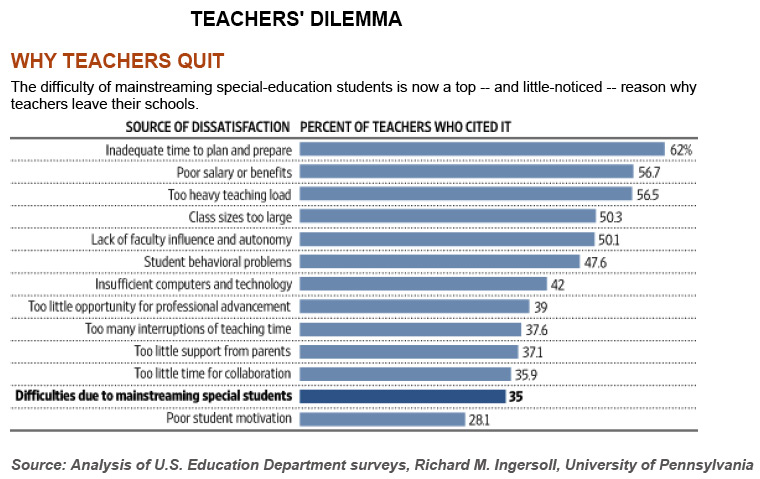
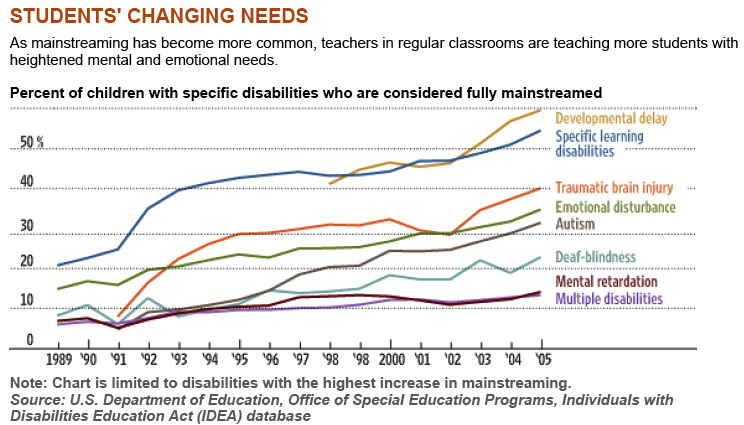
The recent Wall Street Journal article “Mainstreaming Trend Tests Classroom Goals” by John Hechinger included some useful charts along with a look at Key US Special Education Legislation:

  • 1966—Elementary and Secondary Education Act (Amendments): Creates Bureau of Education of the Handicapped. Establishes federal grants to help educate special-needs students with disabilities in local schools rather than state institutions. At left, President Lyndon Johnson with the first lady at the signing.
  • 1975—Education for All Handicapped Children Act: Requires school districts receiving federal funds to provide a free and appropriate public education in the least restrictive environment to special-needs children.
    Mandates creation of an individualized education program (IEP) for such students. Establishes procedures for parents to challenge related decisions about their children.
  • 1990—Individuals with Disabilities Education Act: Revised and renamed version of 1975 law adds autism and traumatic brain injury to categories of special education. Calls for transition services to help older students prepare for post-secondary education, employment and independent living.

  • 1997—IDEA reauthorization: Expands school administrators authority to discipline special education students in certain situations to include removal to alternative education settings for up to 45 days. Prohibits cutting off educational services to special-education students who are expelled.
  • 2002—No Child Left Behind Act: Requires all students to take annual assessment tests although states can make reasonable accommodations for those with disabilities. Special-education teachers must be “highly qualified” in core subjects they teach. At left, President Bush talking up the law at an Arkansas school.
  • 2002—No Child Left Behind Act: Requires all students to take annual assessment tests although states can make reasonable accommodations for those with disabilities. Special-education teachers must be “highly qualified” in core subjects they teach. At left, President Bush talking up the law at an Arkansas school.
  • 2004—IDEA reauthorization: Requires all special education teachers to hold at least a bachelors degree and full state certification. Places a two-year statute of limitations on parents ability file a complaint or request a hearing regarding childs treatment.
    Requires review of relevant records by parents and school officials within 10 days of a childs change of placement for disciplinary reasons.


Share

Challenging the High School “Challenge Index”

Sara Mead and Andrew Rotherham:

Until a few years ago, America’s elementary and secondary schools generally escaped our national obsession with lists. Almost every week another ranking of best communities, most beautiful people or top hospitals is published.
But in 1998 Newsweek, which is owned by The Washington Post, began publishing a list of “The 100 Best High Schools in America.” The ranking is based on “The Challenge Index,” a measure developed by Washington Post education reporter Jay Mathews. The list, published annually the past few years, has become increasingly influential. Other media outlets now cover it like a horserace, and high schools all over the country are reacting to the scrutiny.
Unfortunately, the Challenge Index is a flawed proxy for America’s “best” high schools. Using publicly available student performance data, we have found that many schools in Newsweek’s ranking have high dropout rates or glaring achievement gaps between racial and ethnic groups. At the same time, many schools that fail to make the Newsweek list may be doing a better job educating all of their students.
The Challenge Index is a simple measure: It’s the number of Advanced Placement (AP), International Baccalaureate (IB), and Cambridge tests a high school’s students take, divided by its number of graduating seniors. This simplicity is both its primary virtue and fatal flaw.

Share

Birth Order and Intelligence

Petter Kristensen and Tor Bjerkedal:

Negative associations between birth order and intelligence level have been found in numerous studies. The explanation for this relation is not clear, and several hypotheses have been suggested. One family of hypotheses suggests that the relation is due to more-favorable family interaction and stimulation of low-birth-order children, whereas others claim that the effect is caused by prenatal gestational factors. We show that intelligence quotient (IQ) score levels among nearly 250,000 military conscripts were dependent on social rank in the family and not on birth order as such, providing support for a family interaction explanation.

Benedict Carey:

The average difference in I.Q. was slight — three points higher in the eldest child than in the closest sibling — but significant, the researchers said. And they said the results made it clear that it was due to family dynamics, not to biological factors like prenatal environment.
Researchers have long had evidence that firstborns tended to be more dutiful and cautious than their siblings, and some previous studies found significant I.Q. differences. But critics said those reports were not conclusive, because they did not take into account the vast differences in upbringing among families.
Three points on an I.Q. test may not sound like much. But experts say it can be a tipping point for some people — the difference between a high B average and a low A, for instance. That, in turn, can have a cumulative effect that could mean the difference between admission to an elite private liberal-arts college and a less exclusive public one.

Carey’s followup article:

Dr. Trapnell compared this process to the so-called jigsaw approach used in classrooms, in which complex projects are divided up and each child becomes an expert in a particular task and instructs the others.
Younger siblings often have something more to pass on than the tricks of their favorite hobby, or the philosophy behind their social charm. Evidence suggests that younger siblings are more likely than older ones to take risks based on their knowledge and instincts.

Share

Mandarin 2.0: How Skype, podcasts and broadband are transforming language teaching

The Economist Technology & Education:

IT IS early evening in Berkeley, California, and Chrissy Schwinn, a sinophile environmentalist, walks ten feet from her kitchen to her home office for her Chinese lesson. She has already listened to that day’s dialogue, which arrived as a free podcast, on her iPod. She has also printed out the day’s Chinese characters, which arrived along with the podcast. Now her computer’s Skype software—which makes possible free phone calls via the internet—rings and “Vera”, sitting in Shanghai where it is late morning, says Ni hao to begin the lesson.
One might call it “language-learning 2.0,” says Ken Carroll, an Irishman who in 2005 co-founded Praxis, the company that provides Ms Schwinn’s service, after hearing about these “Web 2.0” technologies from his slightly geekier co-founders, Hank Horkoff, a Canadian, and Steve Williams, a Briton. The penny dropped at once.

Praxis Language www sites and rss feeds: Chinese | Spanish.

Share

Prepare for the SAT Test, or Play With Your iPod? Have It Both Ways

Maria Aspan:

Three interactive programs from Kaplan Test Prep and Admissions are for sale at iTunes for downloading to iPods with video screens. The programs were released last week, giving vacationing students plenty of time for practice quizzes before the next test date in October.
The three programs, in critical reading, mathematics and writing, correspond to the three graded sections of the exam. The programs cost $4.99 each and are available in the iPod games section of the iTunes store alongside slightly more entertaining, if less educational, options like Tetris, Pac-Man and Lost: The Game.
“Learning styles have changed a lot since Stanley Kaplan founded Kaplan in 1938,” said Kristen Campbell, the national director of SAT and ACT programs for Kaplan. “Students take their iPods with them all the time, whether they’re in a car driving to baseball practice, or at home, or sitting at school waiting for their parents to come and pick them up.”

Share

Mainstreaming” Trend Tests Classroom Goals

John Hechinger:

The strategy backfired. One morning, Andrea swept an arm along the teacher’s desk, scattering framed photos of Ms. McDermott’s family across the classroom. A glass frame shattered, and another hit a student in the arm. Though no one was hurt, Ms. McDermott says she lost hours of instruction time getting the children to settle down after the disruption.
From the first weeks of school, Ms. McDermott found Andrea’s plight heartbreaking. “No! No! No!” she remembers her student screaming at times. “Want Mommy! Want Mommy!”
“She looked at me, like she was saying, ‘Help me,’ and I couldn’t. How could I possibly give Andrea what she needs?”
Years ago, students like Andrea would have been taught in separate classrooms. Today, a national movement to “mainstream” special-education students has integrated many of them into the general student body. As a result, regular teachers are instructing more children with severe disabilities — often without extra training or support.
This year, Ms. McDermott counted 19 students in her class at Whittier Elementary School. Five had disabilities, including attention deficit disorder and delays in reading and math. The teacher worried that she was failing all her students — especially Andrea. “It used to be a joy to go to work,” she says. “Now all I want to do is run away.”
In Scranton and elsewhere, the rush to mainstream disabled students is alienating teachers and driving some of the best from the profession. It has become a little-noticed but key factor behind teacher turnover, which experts say largely accounts for a shortage of qualified teachers in the U.S.

More on mainstreaming.
Background: Special Education Legal history and a few charts/graphs.

Share

More city children get extra help for kindergarten

Andy Hall:


Record numbers of Madison children — and their parents — this summer are enrolled in programs aiming to make sure children are ready when they begin kindergarten.
The significant rise in publicly and privately funded kindergarten-readiness efforts is an investment that will pay off, educators and parents say, in students’ higher rates of success in school and as adults.
“My daughter needs to learn lots of things,” said Claudia Diaz, who has signed up for a new privately funded program called KinderReady with her daughter, Michelle Villegas-Diaz, 3.
“And if I learn these, in the future Michelle is going to be a better person.”
While Diaz and her daughter are receiving help at home and at a day-care center, record numbers of incoming kindergartners are heading off to summer school across Madison.

Share

School co-founder, teacher wins scholarship

Erica Perez:

Just before Owen started ninth grade in Texas, she testified against her father, sending him to prison after years of sexual abuse.
She took a risk and wrote that story for an assignment in ninth-grade English class. But her teacher gave her an “F,” telling her not to talk about it.
“Ironically, I ended up teaching ninth-grade English,” Owen said. “I wanted to be different as a teacher. I wanted to be someone that students could talk to.”
Owen went on to do just that, co-founding a school in Milwaukee as a haven for bullied and harassed students. And now, she has won a national scholarship for her efforts, paving the way for her to help others form similar schools across the country.
Owen, who helped start The Alliance School on W. Galena St. in 2005, is one of 38 undergraduate and graduate students in the nation to win scholarships this year from the Point Foundation. The Los Angeles-based non-profit has honored outstanding lesbian, gay, bisexual and transgender students for six years.
While the majority of the students who attend The Alliance School are lesbian, gay, bisexual or transgender, the campus serves any student who struggled in the traditional high school environment because of harassment, intimidation or abuse.

Share

New Jersey has become the new front in the fight for school vouchers

The Economist:

Now some supporters of school vouchers, frustrated with state legislators, are testing a new tactic: going to court. Last July a group of parents in New Jersey filed a lawsuit against the state and 25 poorly performing districts. In Crawford v Davy they are arguing that since public schools deny students their constitutional right to a proper education, the court should refund their money so they can spend it at any school they choose. This is not the first attempt to use courts to permit the use of vouchers: similar efforts failed in Illinois and California, for example. But in New Jersey, such a suit might actually succeed. New Jersey’s courts have no qualms about meddling in education—they have been doing so for decades.
In 1973 the New Jersey Supreme Court said the government was failing to provide poor children with the “thorough and efficient” education guaranteed by the state constitution, and that the school-funding formula must change. Since a 1985 case, Abbott v Burke, the court has issued rulings laying out its remedy in detail: the state must send more money to poor school-districts, so that their budgets match those of the state’s highest-spending areas.

Share

Small Companies That Try to Bring New Technology to Teaching

James Flanigan:

Those three companies along with 27 others are members of the Northwest Education Cluster, a four-year-old organization in the Portland area that holds quarterly meetings at which these entrepreneurial companies can share ideas on directing sales efforts to school districts and teachers’ conventions, or on the intricacies of staffing, finances and other routines of managing a company.
Most Cluster members are relatively small. Vernier Software has $30 million in revenue and 75 employees; Learning.com has under $20 million in revenue and 50 employees; and Saltire has $1 million in revenue and nine employees.
Saltire, which often works on grants from the National Science Foundation, wants to expand use of its geometry program in high schools across the nation. “That’s where the big market for scientific calculators is today,” said Philip Todd, Saltire’s founder.

Share

MMSD student/teacher assaults/injuries 2006-2007

Madison Parent:

Details of the data behind the “School assaults, by the numbers” item (thank you, Bill Lueders) in this week’s Isthmus are posted here (sorted by school name), and here (subtotals of incidents by school type). The reports included incidents through June 4, 2007, so any incidents that occurred during the final fortnight of the school year aren’t included. There are a couple of entries whose dates predate the school year and may be typos, but they are replicated as is.

Student-on-student assault/injury information is not included in these reports, nor do these reports include incidents of verbal threats of violence against staff (even those serious enough to result in the issuance of a restraining order). Police were called in only 13 of the 224 incidents. We don’t know whether there is a district-wide policy that requires that all such incidents be reported, and, if there is, whether the policy is followed consistently from school to school. I concur with the commenters at School Information System that this is only a part of the picture, that we need to know more, and that we need to do more.

Share

Governor’s Graduation Speeches

Pauline Vu:

Most Popular: Virginia Gov. Tim Kaine (D), who — with eight commencement speeches — far out-orated his fellow governors.
Most Unique: Montana Gov. Brian Schweitzer (D), who delivered an address to a graduating class of one.
Class Clown: Utah Gov. Jon Huntsman Jr. (R), who drew laughs from Southern Utah University students for his frank talk about the bottom line: “Cost of tuition for a semester at SUU: $1,800. Cost of textbooks for that semester: $400. The looks on your family members’ faces when you’ve finally reached today: priceless.”
This year at least 22 governors — 15 Democrats and seven Republicans — made the commencement rounds to laud graduates.

Share

Insurance coverage teachers’ top priority

John Matthews:

The union is obligated to represent its members interests. The union surveyed its members prior to entering bargaining and the members spoke loudly and clearly: Retain our health insurance options.
MTI members value Wisconsin Physicians Service because it enables freedom of choice in medical providers. And MTI members value the services of Group Health Cooperative. However, both GHC and WPS coverage would be in jeopardy under the district’s proposal.
GHC has the option of increasing its premium by 2 percent for each additional HMO offered by the district. Adding other HMOs would undercut the financial base of employees necessary to maintain the foundation of the WPS option.
Insurance is supposed to assure economic stability. Revenue controls undercut this basic principal of employment benefits, as it causes even the best intentioned individuals to think about reducing the quality of insurance to provide wages. MTI members have not been willing to take that risk.

Lawrie Kobza’s statement. Madison School Board discussion & vote on the recent MTI Teacher contract. Matthews is Executive Director of Madison Teachers, Inc. and sits on the Board of Wisconsin Physicians Service.

Share

Schools Pinched in Hiring

Michael Alison Chandler:

“It’s not that you don’t have some terrifically talented people going into teaching. You do,” said Richard J. Murnane, an economist at Harvard University’s Graduate School of Education. “The issue is that you don’t have enough. And many are the most likely to leave teaching, because they have lots of other opportunities.”
A study co-written by Murnane and published this year reports that minorities and poor children are most likely to be taught by teachers with weak academic backgrounds or little preparation. Overall, the proportion of women who pursue teaching after college, as well as the caliber of recruits, has declined significantly since the 1960s.

Share

The High School Kinship of Cristal and Queen

Sara Rimer:

The Dominican boys in the back of the freshman English class at the high school in Washington Heights were making fun of the timid African-American girl, Queen Bond. One of the boys got down on one knee in front of her as if he were Romeo — they had been studying “Romeo and Juliet” — and delivered the final crushing insult.
“He was saying something about that I smelled,” recalled Queen, now 17. “I just put my head down. I started crying.”
Then something remarkable happened, she said: “Cristal stood up.” Cool, streetwise, 4-foot-11-inch Cristal Pimentel.
“This short, like, two-foot-tall person is standing up to these guys who are up to the ceiling,” Queen said. “She’s screaming, getting angry, waving her arms. She stood up, she defended me. No one ever stood up for me in that way.
“I’m, like, ‘Wow, this girl is the most beautiful person.’ ”
For four years now, Queen and Cristal have been a team: two teenage girls who are striving to make something of themselves in the face of tremendous adversity.

Share

Cut Costs for Teacher Health Insurance (Or Not)

Wisconsin State Journal Editorial:

The district proposed to add two more HMO options for teachers. If a teacher chose any of the three HMO options, the district would pay the full premium. But if a teacher chose the high-cost WPS option, the district would pay only up to the cost of the highest-priced HMO plan. The teacher would be responsible for the remainder.
The change would have saved the district enough money to permit salaries to increase 2.8 percent, rather than 1 percent.
Madison Teachers Inc., however, resisted. Although bargaining units for food service workers, custodians and other district employees had accepted similar changes to their health insurance plans, the teachers union preferred to sacrifice higher pay to maintain the WPS health insurance option.
The School Board’s mistake was to cave in to the union’s position. While the cost to taxpayers was the same whether money was devoted to health insurance or salaries, it was in the district’s long-term interest to control health insurance costs and shift more money to salaries.

Audio / Video and links of the Madison School Board’s discussion and vote on this matter.
Lawrie Kobza’s statement.
MTI’s John Matthews offers a different perspective:

he union is obligated to represent its members interests. The union surveyed its members prior to entering bargaining and the members spoke loudly and clearly: Retain our health insurance options.
MTI members value Wisconsin Physicians Service because it enables freedom of choice in medical providers. And MTI members value the services of Group Health Cooperative. However, both GHC and WPS coverage would be in jeopardy under the district’s proposal.
GHC has the option of increasing its premium by 2 percent for each additional HMO offered by the district. Adding other HMOs would undercut the financial base of employees necessary to maintain the foundation of the WPS option.
Insurance is supposed to assure economic stability. Revenue controls undercut this basic principal of employment benefits, as it causes even the best intentioned individuals to think about reducing the quality of insurance to provide wages. MTI members have not been willing to take that risk.

Share

More on WKCE scores – Missing Students

Chan Stroman posted a valuable and in-depth examination of the District’s WKCE scores, and is it in the spirit of that posting that I would like to share my own little examination of our most recent test results. Rather than focusing on the scores of our students, this is an investigation of the numbers of MMSD students who took the WKCE exams. My intention is to simply present the data and let the reader draw their own conclusions.
This journey began with a question: How did students at West High School do on the WKCE exams now that the school has completed their three year Small Learning Communities grant. A relatively straightforward question that can be addressed by a visit to the DPI web site. However, in the process of looking at West High School’s test data from the Fall of 2006, it was surprising to see that only 39 African American students had been tested. Certainly there had to be more than 39 African American 10th graders at West this year, and if we want WKCE scores to provide an accurate assessment of the
“success” of a school, it is important that there isn’t any bias in which groups of students provide the assessment data.
The District makes available a number of breakdowns of student enrollment data by grade, by school, by ethnicity, by income status, and combinations thereof. However, there is not a breakdown that provides enrollment numbers by school by grade by ethnicity. Thus, if we want to know the number of African American 10th graders at a particular school we have to make an educated guess. We can do that by taking the percentage of African American students enrolled in the school and multiplying that by the number of students in the 10th grade. This gives us a rough estimate of the number of students enrolled. We can then compare that to the number of students who took the WKCE test to estimate the percentage of missing students.
West High School had 517 10th graders enrolled this past year, and 14% of the student body was African American. This suggests that there should be approximately 73 African American 10th graders at West which means that 34 students or 46.6% were not tested. This is very different from the overall proportion of West 10th graders not tested: 14.5% (DPI data show that 442 of the 517 students in the 10th grade were tested this past year). However, this is only one year’s data at one of our high schools. We need to put this data in context if we are to draw any conclusions. So here is the data for the four high schools for the past five years.

High School Year MMSD Enrollment Proportion African American Enrolled Predicted AA 10th Graders African American Tested Total 10th Grade Tested % AA Missing % Total Missing Discrepancy (AA% – Total %)
West 2002/03
624
14%
85.86
73
529
14.99%
15.22%
-0.24%
  2003/04
591
14%
79.45
54
484
32.04%
18.10%
13.93%
  2004/05
523
15%
77.09
68
457
11.78%
12.62%
-0.83%
  2005/06
563
14%
77.91
75
489
3.74%
13.14%
-9.41%
  2006/07
517
14%
72.98
39
442
46.56%
14.51%
32.05%
East 2002/03
598
21%
125.91
85
481
32.49%
19.57%
12.93%
  2003/04
538
22%
116.39
91
437
21.81%
18.77%
3.04%
  2004/05
538
21%
113.54
94
444
17.21%
17.47%
-0.26%
  2005/06
501
23%
114.15
93
443
18.53%
11.58%
6.95%
  2006/07
472
22%
105.64
81
385
23.32%
18.43%
4.90%
La Follette 2002/03
416
12%
50.23
42
373
16.38%
10.34%
6.05%
  2003/04
464
14%
63.72
41
385
35.66%
17.03%
18.63%
  2004/05
427
16%
67.40
50
355
25.81%
16.86%
8.95%
  2005/06
456
17%
79.57
53
389
33.39%
14.69%
18.69%
  2006/07
466
21%
96.88
76
413
21.55%
11.37%
10.18%
Memorial 2002/03
577
14%
80.75
74
502
8.36%
13.00%
-4.64%
  2003/04
612
13%
87.55
74
528
15.47%
13.73%
1.75%
  2004/05
592
15%
92.74
59
491
36.38%
17.06%
19.32%
  2005/06
552
14%
96.48
77
471
20.19%
14.67%
5.52%
  2006/07
542
14%
94.01
94
488
0.01%
9.96%
-9.95%

What about other ways to look at the number of high school students who took the WKCE’s?

(more…)

Share

School assaults, by the numbers

Bill Lueders:

In the 2006-07 school year, there were 224 instances in which staff members in Madison schools were assaulted or injured by students, according to records provided to Isthmus. (This represents a significant increase from 2005-06, when the district tallied 173 such incidents.)
Most occurred in elementary schools, and eight out of nine involved special education students. The incidents are mostly minor — kicks, bites, scratches and such — although 43 required some medical attention. Police were called on nine occasions.
Luis Yudice, the district’s safety coordinator, says the most serious incidents were the two reported recently in Isthmus (Watchdog, 6/8/07), both involving injuries to staff members trying to break up fights.
The most startling revelation is the extent to which a handful of students drive these numbers upward. A single fourth-grader at Chavez Elementary accounted for 41 of this year’s incidents. At the middle school level, a seventh-grader at Sennett and eighth-grader at Cherokee had 19 and 12, respectively. And a ninth-grader at East had 10.
Together, these four students generated 37% of the total assaults for the 24,576-student district. (In 2005-06, a single student at Lowell logged 36 incidents; no one else had more than seven.)

Share

No Child Left Behind setting below-average goals

Mary Wolf-Francis
When Margaret Spellings visited the Southeast Valley this spring, she was asked to respond to the question about the effects of No Child Left Behind on the average and above-average students.
Her response was frightening.
Spellings declared that No Child Left Behind is about the “vast, vast number of young Americans who lack the ability to be successful in our country. That is our prime directive, our highest priority.”
The highest public education official in our country essentially stated that public schools should be dedicated to below-average students. This may be seen as a call for all parents of average to above-average students to run, don’t walk, to their nearest private school.
Spellings takes it a step further by defining the problem as related to race, saying, “We’re only graduating half of our Hispanic and half our African-American students on time.”
Did I hear you say public education is dedicated to underachieving students of color? Political correctness aside, these are not the only students who lack the ability to be successful. Would you be surprised if we told you that many of our best and brightest students fit this category?
As many as 40 percent of all gifted students are underachievers, according to the Davidson Institute for Talent Development, and between 10 and 20 percent of all high school dropouts test in the gifted range.
Consider, then, that many other populations of students are being left behind, especially as funds are diverted into meeting the mandates of this narrow legislation.

Share

Evaluating the 50 States on Students with Disabilities

Christina Samuels:

The U.S. Department of Education released evaluations this week of each state’s efforts to teach children with disabilities, from infants to secondary school students, giving most midding grades.
The evaluation process is based on data submitted by the states as mandated by the 2004 reauthorization of the federal Individuals with Disabilities Education Act. The law attempts to move states away from monitoring compliance with the complex legislation, and toward a focus on educational outcomes for students with disabilities.

Share

Allan Odden on Teacher Merit Pay

Joy Cardin talks with UW-Madison Professor of Education Administration Allan Odden about teacher merit pay and why this idea is gaining momentum.
19MB mp3 audio. More on teacher merit pay.

Share

LIttle Tolerance for Zero-Tolerance

Joy Cardin interviews Cecil Reynolds, professor of education psychology and neuroscience at Texas A&M University, and chair of the American Psychological Association’s Zero Tolerance Taskforce. 19MB mp3. Support Wisconsin Public Radio.

Share

New Berlin School Board & The City Discuss Park & Recreation Costs

Erin Richards:

The disagreement raises questions about how communities, in times of tight budgets, find the dollars to provide recreation and enrichment programs for their residents.
School Board President Keith Heun said he expects the ad hoc committee to make some headway on a new agreement before the School Board’s next meeting July 9. Members have not yet been chosen, but likely will include representatives from the School Board and Common Council.
The board also voted this week to rework its classification of school facility users. Since 1968, the city’s Parks, Recreation and Forestry Department has been classified as a group two user along with other non-profit civil and service organizations that don’t have to pay rental fees, Heun said.

Locally, spending growth in the Madison School District’s Fund 80 (property taxes outside the state’s school revenue growth limits, or “caps”) has been controversial.

Share

Schools Have No Handle on $7 Billion Cost of Teacher Turnover, Study Finds

Vaishali Honawar:

Teacher turnover is “spiraling out of control” and is estimated to have cost the nation more than $7 billion in the 2003-04 school year alone, asserts a report released today.
The study from the Washington-based National Commission on Teaching and America’s Future says that despite the staggering expense, virtually no school district now has systems in place to track or control such turnover.
The last attempt to put a price tag on teacher attrition, long acknowledged as a resource drain, was a 2005 report from the Washington-based Alliance for Excellent Education, which came up with the more modest but still hefty estimate of $4.9 billion.
NCTAF officials say their figure of $7.3 billion is higher because it is based on an increased teacher workforce and a slightly higher attrition rate.

Alan Borsuk looks at Milwaukee’s teacher turnover:

Our education system is losing half of all teachers before they reach their peak effectiveness,” the report from the National Commission on Teaching and America’s Future says. “Students, especially those in at-risk schools, are too often left with a passing parade of inexperienced teachers who leave before they become accomplished educators.”
In the Milwaukee Public Schools, the report says, “low-performing schools have double the teacher turnover of high-performing schools.”
Teacher turnover rates in MPS went up as the percentage of students in poverty went up, according to the report, which may be the most elaborate analysis of teacher movement in MPS. The same was true as the percentage of students from minority groups increased and the overall achievement of students decreased.

Nelson Hernandez has more.

Share

A Graduate of Stanford by Way of a Transfer

Samuel Freedman:

The bridge between past and present, the ligament connecting her five years as an undergraduate, was a scholarship from the Jack Kent Cooke Foundation, one specifically intended for students like Ms. Alcazar who make the leap from a community college to an elite university. In its seven years of operation, the foundation has given $10 million to 249 such recipients.
These students are often immigrants or the children of immigrants, and the first in their families to attend college. Most have gone to community college not because they lack the academic talent for a four-year institution, but because they lack the money. And by the time they would enter a college or university, generally as a junior, much of the available financial-aid money would have been spent enticing incoming freshman to enroll.

Share

Recruited to Rescue Washington’s Schools

Diana Jean Schemo:

Fresh out of college, Michelle A. Rhee joined Teach for America, the fast-track teacher training program, landing at Harlem Park Community School in Baltimore. The public school ranked near the bottom in city reading and math scores, and as a new teacher, Ms. Rhee got a classroom of 35 children achieving the worst and behaving the worst.
“They ran right over me,” Ms. Rhee recalled. She ended that first year “convinced that I was not going to let 8-year-olds ruin my life.”
The next fall she combined classes with another teacher, and together they taught the same children for two years. By the end of the second year, she said, the class that had been testing in the 13th percentile was on grade level, with some children soaring to the 90th percentile.
Now, Ms. Rhee is betting she can replicate that success on a citywide scale as the newly named chancellor of schools in Washington, arguably the nation’s most dysfunctional school system. Though it is one of the country’s highest-spending districts, most of the money goes to central administration, not to classrooms, according to a recent series of articles in The Washington Post. Its 55,000 mostly poor students score far worse than comparable children anywhere else in reading and math, with nearly 74 percent of the district’s low-income eighth graders lacking basic math skills, compared with the national average of 49 percent.

Share

Naming our newest elementary school

In the interest of transparency, I am posting one of the e-mails received in relation to the decision to restart the naming process for the new school on Madison’s far West side. I also am posting my response, which shares the reason for my apology to the Hmong community on Monday night, and also for advocating that the board go back to square one on the naming process.
It is my expectation/understanding that the board will establish a time line for the nomination and selection process at our July 9 meeting. People who nominated names the first time can resubmit the materials without revision. People who want to submit new or alternate names must follow the process (e.g., commentary on public forums does not constitute a nomination or formal objection).

Dear Board members:
Thank you for doing the right thing and removing Vang Pao*s name from the new west side elementary school. I know it was a difficult decision for you, although I*m not sure why. I was a bit disconcerted about the *regret* and apologies issued to the Hmong community about your votes. How much controversy does a person need before he is unacceptable as a name for an elementary school? You would have never considered General Westmoorland*But, I digress. I really do appreciate the political situation you felt yourself to be in and appreciate your vote for what is best for the children of Madison. You are to be commended!
On another note, I*d like to encourage you to amend your policy to proceed with naming by using the three names left on the original list. My concerns are that the community is not going to heal properly if we have to go through all this again. Naming a school shouldn*t be this difficult. You have an opportunity here to take the best way out and allow the community to move on and give yourselves the chance to deal with more pressing issues*like budget!
Please*take the high road and go back to the list of three and let*s be done with this.
Thanks again, for removing Vang Pao*s name. Your courage is greatly appreciated.
Heidi Reynolds

=============
MY RESPONSE:
Dear Ms. Reynolds,
Thank you for taking the time to write. I am not sure that I understand your response, since you so often said – and have gone to great lengths to present yourself to the media as someone who wants to compromise, have nothing against the Hmong, and want to heal the rift between communities.
I cannot speak for my fellow board members, but state for the record that my apologize comes from compassion for the pain and suffering that the Hmong community have experienced in their lives and have been experiencing again since Vang Pao’s arrest. My comments are sincere, just as are my comments that there are no winners in this unfortunate set of events.
As for reopening the process, it seems to me that we have been subjected to repeated allegations that we did not follow board policy the first time around. I cannot speak for my colleagues, but it is my personal hope that by going back to square one we can ensure that the process is followed to the fullest. (There is no policy that mandates going back to the list of finalists in a case such as this, so we are in fact following board policy by starting over.)
Sincerely,
Lucy Mathiak
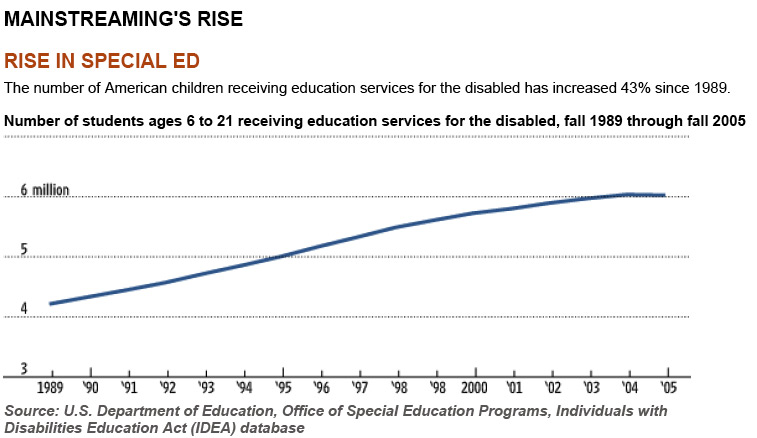
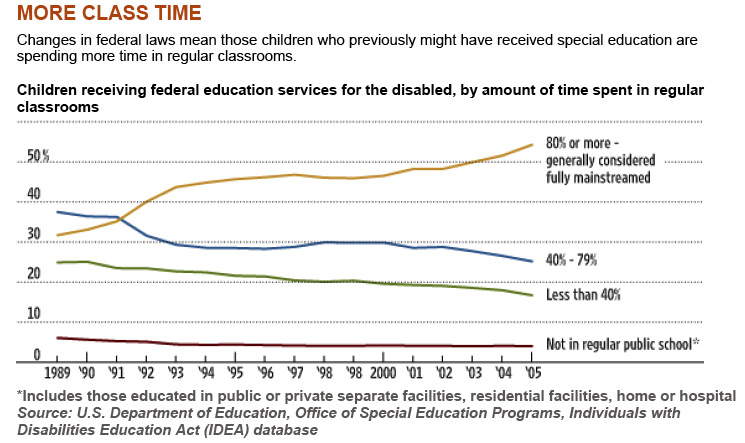
Share

School Basics: Reading, Writing, Arithmetic, Real Estate

CJ Hughes:

Not surprisingly, then, towns with blue-ribbon public school systems — like Greenwich, Fairfield and West Hartford — have consistently commanded some of the higher home prices in the state.
But prices within a town can fluctuate, even by neighborhood, based on the strength of the local elementary school, according to a new study by seven professors and students at Trinity College.
The study examined the relationship between grade-school test scores and home prices in West Hartford’s 11 elementary school districts, and found that as one climbed, so did the other, in specific and predictable increments.

Share

Troubled Schools Getting Their Own Test Tutors

NPR:

Test scores in low-performing schools rose last year in the wake of the No Child Left Behind Act passed more than five years ago. It requires testing and quantifiable goals to reform the country’s schools. Merrill Vargo, consultant and director of Springboard Schools, talks with Steve Inskeep about what she advises schools to do to raise their test scores.

Share

Building effective partnerships – advice from coalitions

Brett:

In our new survey, “Business Coalition Leaders Speak Out on Education,” we asked survey respondents to comment on the lessons they’ve learned from working with schools and districts and to offer advice on becoming attractive partners and on building effective partnerships. Due to space considerations, we weren’t able to include all of the responses in the survey report, so I wanted to share them all here on the blog.
This is the third of three posts, and provides responses to the open-ended question:
“What other advice would you give to schools in general on developing stakeholder relationships?”

Share

Audio / Video: Madison School Board Vote on the MTI 2007 – 2009 Agreement

The Madison School Board voted 4-3 (for: Carstensen, Moss, Silveira and Winston; no: Cole, Kobza and Mathiak) Monday evening to approve the proposed MMSD / MTI 2007 – 2009 agreement. The new arrangement, which does not include substantial health care changes, was set in motion by the “Voluntary Impasse Resolution Document” – also approved by a 4-3 vote (Carol Carstensen’s alt view). This document, approved before negotiations began, took health care changes off the table if the discussions resulted in arbitration.

  • 30 Minute Video Clip
  • 34MB MP3 audio recording of the entire board meeting (MTI Agreement vote discussion begins at about 6 minutes
  • MTI’s useful synopsis of the Agreement: 150K PDF, including the extension of the TERP (Teacher Retirement Extension Program) through 2011
  • Going to the Mat for WPS by Jason Shephard
  • Lawrie Kobza notes that changes in health care would have increased salaries by 2.8%, rather than the current 1%.
  • KJ Jakobson’s health care cost/benefit analysis
  • A teacher noted the recent MTI vote.
  • Susan Troller: Board approves teachers contract deal on 4-3 vote.
  • TJ Mertz:

    Three Board of Education members voted against the MTI contract on Monday, June 18, 2007. My initial reaction was that it was a ‘free” vote, a vote without consequences. When elected officials know that there are sufficient votes to pass or defeat a measure they can use their votes to make a statement without taking responsibility for what would happen were they to prevail. This is what happened on Monday, those who voted against the contract knew that it would pass and that they would not be held responsible for the serious consequences that would ensue had they been in the majority. Upon reflection, I realized that in fact the vote has the consequences of exacerbating divisions among our teachers that are hard to justify based on their stated rationales for opposing the contract.

Share

Statement on MMSD/MTI Tentative Collective Bargaining Agreement Vote

After much consideration, I have decided to vote against the tentative agreement negotiated by the District and the MTI teachers union. I will do so because the agreement fails to include significant health insurance changes, and as a result, unreasonably depresses the salary increases that can be provided to our teachers.
While the total salary and benefit increase to our teachers under the proposed agreement is 4.02%, our teachers will only receive a 1% increase in their salaries in each of the next two years. This is so even though we ask our teachers to do more and more each year given budget cuts and changes in our student demographics. The rest of the increase is eaten up by benefits, the vast majority of which is for health insurance.
I would like to see our teachers’ salaries increase by more than 1% per year. I believe a greater increase is well-deserved, and is needed to continue to keep and retain excellent teachers. I also believe a greater increase is needed so that the District’s starting salary for new teachers is competitive.
While money is obviously very tight, we could provide teachers with higher salaries if the District and the MTI teachers union – working together – would negotiate health insurance changes. The District’s initial proposal regarding health care insurance was to offer teachers the choice of three different HMO options or WPS. If a teacher chose one of the HMO options – Group Health Cooperative, Physicians Plus, or Dean Care– the District would pay the full cost of that HMO. If however a teacher chose coverage under WPS, which would still be available, the District would only pay the cost of the most expensive HMO, and the teacher would pay the rest of the cost of WPS. This proposal would have provided for a 2.81% salary increase for teachers for 2007-2008 – as opposed to a 1% increase.
The District and other employees groups have successfully worked together to revise health insurance coverages during this past year with the result that more money was available for employee wages to these groups. I was hopeful that similar results could be achieved for our teachers.
When I have raised this concern about how teacher salaries have been unreasonably depressed by the increasing cost of WPS, I have been told by some that it is none of the District’s business how MTI decides to split the negotiated salary and benefit package. I just cannot agree with this view.
While it is true that the total dollar impact to the District is the same regardless of how MTI splits the money between salary and benefits, I believe it is very important to the District how the money is spent. It is essential to the District that we have good, competitive teacher salaries and that our health insurance costs not drain money away from those salaries. It is essential that our teachers are paid fairly and equitably. It is not fair that a teacher who takes WPS insurance should receive $7,500 more in salary and benefits than a teacher who takes Group Health Cooperative. It is not fair that a majority of our teachers take Group Health Cooperative, yet they continue to have their compensation reduced to fund the benefits of others.
I am extremely disappointed that the District and MTI, working together, could not reach an agreement that puts more money into teachers salaries and less into health insurance costs. I truly believe that if the interests of the whole had been put first, this could have been done. Because we failed to take advantage of this opportunity, I feel I have no choice but to vote against the tentative agreement.

Share

Bring Back Geography!

Jerome Dobson:

Quiz after quiz has shown that kids today don’t know where any place is. How often have you heard this lament about “geographic ignorance” or “geographic illiteracy,” as it is commonly called?
Now, take that complaint and turn it around. What does it say about geography? It says geography means knowing where places are. That’s what geographers call “place-name geography.” It’s vital, but it’s the least of what we expect budding geographers to learn.
Geography is more than you think. Geography is to space what history is to time. It is a spatial way of thinking, a science with distinctive methods and tools, a body of knowledge about places, and a set of information technologies that have been around for centuries. Geography is about understanding people and places and how real-world places function in a viscerally organic sense. It’s about understanding spatial distributions and interpreting what they mean. It’s about using technology to study, in the words of the late professor J. Rowland Illick, “why people do what they do where they do it.” Geography is a dimensional science and humanity based on spatial logic in which locations, flows, and spatial associations are considered to be primary evidence of earth processes, both physical and cultural. Its hallmarks are spatial analysis, place-based research (e.g., regional studies, area studies, urban studies), and scientific integration.

More about Jerome Dobson.

Share

Autism Debate Strains a Family and Its Charity

Jane Gross & Stephanie Strom:

The Wrights’ venture was also an effort to end the internecine warfare in the world of autism — where some are convinced that the disorder is genetic and best treated with intensive therapy, and others blame preservatives in vaccinations and swear by supplements and diet to cleanse the body of heavy metals.
With its high-powered board, world-class scientific advisers and celebrity fund-raisers like Jerry Seinfeld and Paul Simon, the charity was a powerful voice, especially in Washington. It also made strides toward its goal of unity by merging with three existing autism organizations and raising millions of dollars for research into all potential causes and treatments. The Wrights call it the “big tent” approach.
But now the fissures in the autism community have made their way into the Wright family, where father and daughter are not speaking after a public battle over themes familiar to thousands of families with autistic children.

Autism Speaks

Share

Madison School Board Drops Vang Pao Elementary’s Name

Channel3000.com:

Originally named for Hmong Gen. Vang Pao, the board reconsidered the name because of Pao’s arrest on charges that he was part of an effort to overthrow the Laotian government.
School Board President Arlene Silviera said before the meeting that she doesn’t think the board will make any final decision on a name on Monday night, but would vote on whether to change the current name and how they might select a new one, WISC-TV reported.

SIS links and notes on Vang Pao Elementary.

Share

Madison School Board’s “Final Exam”

Susan Troller:

Even smart, hardworking students sometimes blow an exam or forget to do their homework, and the results usually show up on their report cards. The same perhaps could be said for the Madison School Board, which essentially finishes its term tonight.
The board has one more big test as it closes out the school year with a bang. Members will be discussing whether to remove the controversial name of Gen. Vang Pao from the district’s newest elementary school now being built on the far west side. In addition, they will be voting on a new two-year contract between the teachers union and the distict. The tentative contract was ratified by the union late last week.
Those two issues represent opposite ends of the broad spectrum of board business. The school naming is primarily symbolic, but it packs a huge emotional wallop; the contract vote gets less general attention, but holds the details critically important to the district’s financial health.

Share

Violin students traveling to Costa Rica

Jacob Stockinger:

Nineteen middle school and high school violin students from the Madison area will tour Costa Rica, where they will perform for a week, starting Monday.
The Sonora Strings, an advanced touring group of a private Suzuki string school in the city, will be led by Maria Rosa Germain, a classically trained violinist who earned a master’s degree from the University of Wisconsin-Madison with Vartan Manoogian and Tyrone Greive, who is also the concertmaster of the Madison Symphony Orchestra.
The MSO is a major co-sponsor of the tour and, according to orchestra officials, will continue to collaborate with the National Orchestra in Costa Rica’s capital San Juan, perhaps with the goal of one day becoming a “sister” orchestra. Later this summer, MSO maestro John DeMain will conduct the National Orchestra in San Juan and will waive his fee to help the National Institute of Music.

Share

La Follette grads set off on life’s roads

Kristin Czubkowski:

While a packed house at the Kohl Center was a far way off, more than a thousand friends and family were in attendance as 370 seniors graduated from La Follette High School Friday night.
La Follette’s ceremony was one of four being held for Madison high schools this weekend, with East High School’s preceding it Friday evening, and Memorial and West’s graduation ceremonies scheduled for Sunday afternoon.
After Kelly Lynaugh, the principal for La Follette’s senior class, gave an introductory speech, two class speakers spoke on the challenges and opportunities their class has been through and will face.
“Today, amidst the celebrations, I am reminded that the world we inherit is a dynamic place, replete with challenges and rewards, and it would be wrong of us to grasp the latter without reflecting on the former,” said class speaker Emily Latorraca.

Share

Long Reviled, Merit Pay Gains Among Teachers

Sam Dillon:

For years, the unionized teaching profession opposed few ideas more vehemently than merit pay, but those objections appear to be eroding as school districts in dozens of states experiment with plans that compensate teachers partly based on classroom performance.
Here in Minneapolis, for instance, the teachers’ union is cooperating with Minnesota’s Republican governor on a plan in which teachers in some schools work with mentors to improve their instruction and get bonuses for raising student achievement. John Roper-Batker, a science teacher here, said his first reaction was dismay when he heard his school was considering participating in the plan in 2004.
“I wanted to get involved just to make sure it wouldn’t happen,” he said.
But after learning more, Mr. Roper-Batker said, “I became a salesman for it.” He and his colleagues have voted in favor of the plan twice by large margins.

The Madison School Board votes on the proposed Madison Teachers, Inc. agreement this evening.

Share

Madison Superintendent Art Rainwater’s Presentation on the Proposed High School Redesign and Small Learning Community Grant

hs6112007.jpg

hsrdv.jpg

June 11, 2007

35 Minute Video | MP3 Audio

Background Links:

A few general questions about this initiative:

  1. Does it make sense to spend any time on this now, given that the MMSD will have a new Superintendent in 2008?
  2. If the problem is preparation, then should the focus not be on elementary and middle schools?
  3. The committee’s composition (this link includes quite a bit of discussion) does not inspire much confidence with respect to community, teacher and student involvement.

Two page MMSD “feedback worksheet” 259K PDF.

Share

The Power of Teaching

Kathleen Murphy:

I had a history teacher in high school who thought I should be on a different track. He got together with a couple of other teachers and put me in all advanced-placement classes. As a result, I graduated first in my high school class and was able to graduate from college in three years and save a year’s tuition.
A few years ago, he sent a note through the general e-mail of our company’s Web site. He had seen my name and wanted to know if I was the Kathleen Murphy he had taught 20 years ago. He just wanted to say hello and know how I was doing. He had taken such a personal interest in me. Teachers can change the face of a nation.

Share

Commencement Advice: Read and Travel

Alice Furlaud:

Radio reporter Alice Furlaud recounts her experience giving the commencement address to the graduating class of 2007 at Massachusetts’ Chatham High School.

audio

Share

Beware a “Broader Definition of Rigor”

Debra Saunders:

WHEN educrats call for “a broader definition of rigor,” beware. What they really want is to broaden the definition of rigor until it includes dumbed-down drivel.
National Education Association President Reg Weaver used those words in March when he spoke to Congress as it sets out to reauthorize President Bush’s No Child Left Behind legislation. The NEA’s idea of rigor, of course, is to make it harder to tell if schools are failing students. How? By going after standardized tests, because Weaver regurgitated, their scores “reflect little more than a student’s ability to regurgitate facts.”
As Don Soifer, education analyst for the Lexington Institute noted, such talk harbors “a worse case scenario for the American public — all of the money for NCLB and none of the accountability.”

Share

Assessment of the Madison School District’s TAG Program in 1992

A look at the MMSD’s TAG program in 1992.
Dr. Susanne Richert (Consultant) [9.5MB PDF]:

I was requested to conduct an evaluation. However, very little quantitative data on student outcomes were available and, given the time-frame, none could be gathered. I, therefore prefer to call this a qualitative criterion-referenced assessment. However, more than sufficient quantitative formative (as opposed to summative) data and extensive qualitative data were gathered. This qualitative criterion-referenced assessment is based on criteria generated by the literature on the education of the gifted. These are included in the appended list of references; most especially, in this order of priority: Richert, Cox, Van Tassel-Baska, Renzulli, Roeper, Kaplan and Tannenbaurn.

Clusty Search: Dr. Susan Richert.

Share

The Regrets of a School Dropout: Half of Black Males Fail to Graduate With Their Class

Avis Thomas-Lester:

Just walking into Largo High School left Larue Campbell feeling the most profound loss.
Fliers about the school’s upcoming prom reminded him that he never attended his own. Posters announcing commencement ceremonies left him wondering what it would have been like to stroll across the stage in a cap and gown as his loved ones cheered.
But instead of taking part in prom and graduation, Campbell was at Largo for night school classes to prepare for the GED exam. Last spring, he dropped out of high school, one of hundreds of Washington area African American males to do so each year.
“If I hadn’t dropped out, I wouldn’t have to go through this now,” said Campbell of his attempt to earn a high school equivalency diploma. “I thought about going back after I left” school, “but I thought I would be too old. I was kind of embarrassed.”

Share

School Choice Strategy

Howard Rich:

The flattened borders of the 21st century have made networking faster, global trade freer and competition more rigorous — meaning the premium we place on educating future generations is higher than ever before. Yet the nation’s monopolistic approach to education remains a millstone around our children’s necks, with America consistently lagging behind its industrialized peers in academic achievement.
The late Nobel Prize-winning economist Milton Friedman understood the central role school choice must play in revitalizing American education. “Empowering parents would generate a competitive education market, which would lead to a burst of innovation and improvement, as competition has done in so many other areas,” he said in December 2005. “There’s nothing that would do so much to ensure a skilled and educated work force.”
By any objective measure, Friedman was right. The success of school choice as a method of empowering parents, raising student achievement and improving public education systems in those markets where it has been implemented is indisputable. The question now becomes how to achieve meaningful school choice for the benefit of all parents, not just a select few?
After this year’s compelling school-choice victory in Utah, the methodology for successfully advancing parental options against the well-funded phalanxes of institutional opposition is crystallizing. Specifically, Utah’s success has proven the efficacy of advocating universal choice initiatives as opposed to limited, means-tested pilot program

Parents in Charge Foundation.

Share

Madison Schools MTI Teacher Contract Roundup

Conversation regarding the recent MMSD / MTI collective bargaining agreement continues:

  • Andy Hall wrote a useful summary, along with some budget numbers (this agreementi s56% of the MMSD’s $339.6M budget):

    District negotiators headed by Superintendent Art Rainwater had sought to free up money for starting teachers’ salaries by persuading the union to drop Wisconsin Physicians Service, a health-care provider that offers open access to medical treatment with no need for referrals.
    The district wanted MTI members to choose from among three health-maintenance organizations that limit coverage to specific providers in return for lower costs.
    But the union kept the current mix — WPS plus one HMO, Group Health Cooperative — after members in a survey indicated support for maintaining those options.
    Matthews is a paid member of the Wisconsin Physicians Service board of directors — an arrangement he defends as a means of advocating for members and the district. Critics contend it represents a conflict of interest.
    “Our plan is cheaper than almost any in town,” said Matthews, referring to a union comparison of Wisconsin Physicians Service coverage, used by half of the members, to coverage offered to employees of state and local governments.
    “The teachers were willing to pay more, they were willing to move money from wages to health insurance, in order to preserve those kinds of rights.”
    Among the new costs facing teachers: A $75 co-pay for emergency room visits and a $10 co-pay for office visits.
    Premiums for WPS, which is favored by many members with a serious illness in the family, will cost 10.4 percent more beginning July 1. But the premiums will decrease slightly beginning Jan. 1 as the co-pays take effect. For example, the WPS family premium will cost the district $1,711 per month while the employee’s share will be $190, falling to $187 on Jan. 1.
    The GHC premium will increase by 5.7 percent — to $974 monthly for family coverage, paid entirely by the district — beginning July 1. That amount will decrease to $955 on Jan. 1.

  • Don Severson & Brian Schimming discuss the agreement and the school board: 5MB mp3 audio file.
  • 2005 / 2007 Agreement 528K PDF.
  • The Madison School Board will vote on the Agreement Monday evening, June 18, 2007.
  • Additional links and notes.
  • Don Severson: 3 Simple Things.
  • MMSD / MTI contract negotations beginCarol Carstensen: An alt view on Concessions Before Negotiations.
  • Going to the Mat for WPS
  • What’s the MTI Political Endorsement About?
  • Some MMSD unions have addressed health care costs.
Share

How to Measure Class Gap in Reading?

Carl Bialik:

The potential benefits to citing the questionable numbers are clear: Raise awareness and rally support. The downsides are more subtle. Boiling down research into misleading soundbites risks credibility of the larger argument advocating early reading, and it obscures other indicators that have equal or greater impact on a child’s intellectual development.
Todd Risley, professor emeritus of psychology at the University of Alaska and longtime children’s development researcher, argues that the amount and quality of parents’ talking to their young children is more significant.
“In even the ‘best’ of families, ‘shared reading time’ occupies very little of a child’s time,” he says. And income is a weak predictor of parental-child chatter, he adds, “so any statements about middle class and low income might be a little too glib.”

Share

Local students follow different paths to diploma

Susan Troller:

Two years ago, these were the students who didn’t look like they were going to make it.
But Thursday night, 14 graduates of the Madison school district’s Work and Learn program at Brearly Street walked down the aisle at little Bolz Auditorium to the strains of “Pomp and Circumstance,” and the applause from family, friends and supporters was deafening. The students’ smiles could have lit up the evening sky.
Some are married. Some are parents. Some were chronically truant from high school because of family illnesses or crisis, or because they just didn’t care. Some had been expelled or suspended from school, or were in trouble with the law.

Share

An Open Letter from Shwaw Vang on the Vang Pao Elementary School

Former Madison School Board Member Shwaw Vang, via Kristian Knutsen:

The Board of Education will discuss reconsidering its decision to name the new elementary school after General Vang Pao because Vang Pao has been charged with a plot to overthrow a foreign country. Since the fall of the Laos monarchy and democracy in 1975, the government of Laos, one of the most oppressive communist regimes in the world, killed the King of Laos and has murdered and continues to murder thousands of Hmong people and use chemical weapons on them.
Yet the United States government and the United Nations have ignored these murders of former American allies 32 years. While not condoning the charges as stated in the indictment, I want this community to know and to understand the horrors those thousands of Hmong people trapped in Laos face even while we debate this name issue. Hmong Americans cannot leave those who were left behind in Laos to be hunted, murdered, and killed by chemical warfare.
Although Vang Pao has not been convicted, those who opposed the Vang Pao name because of dubious allegations claim they have been vindicated. But the indictment has nothing to do with their original objections. However, now that the Board has been convinced that it needs to reconsider the name, I believe this is a good time to invite the broader community to also consider other MMSD schools named after people who have tainted history.

Shwaw makes some excellent points. Much more on the Vang Pao Elementary School here. Clusty search on Vang Pao. Andrew Burke on Laos “eco-tourism” and a recent abduction. Monica Davey takes a look at Vang Pao’s arrest:

Cy Thao, 35, a Minnesota state representative, one of the few Hmong-Americans serving in a state legislature, said many of the older generation felt confused, even betrayed.
“For them, too, his arrest signals the end of an opportunity for them to ever go home to a free Laos,” Mr. Thao said. “He was their best hope of ever going back so this is sort of the closing of a book.”
Yuepheng Xiong, who owns Hmong ABC, a bookstore on University Avenue in the heart of this city’s Hmong community, which is one of the largest in the country, fought tears as he described the turmoil Gen. Vang Pao’s arrest had stirred.
“He was arrested by the very people that he trusted and who he had been so loyal to — the Americans,” Mr. Xiong said.

Share