School Information System

The Fall of Florida’s ‘Zombie Unions’

Wall Street Journal: “ai” summary:

• Union Decertification in Florida: Over 63,000 public employees in Florida have become unrepresented since 2023 due to a law requiring public unions to hold new elections whenever the share of members paying dues drops below 60%.

• Impact on Florida Education Association (FEA): The FEA’s revenue dropped 14% due to chapter closures, impacting its ability to fund elections and lobbying activities.

• Reason for Decertification: The law banning school districts from deducting dues from teachers’ paychecks has led to a decrease in union membership as members are now required to actively choose to pay dues.

• Legal Challenge: The union is suing to block the 2022 law that requires recertification and allows schools to deduct dues.

• Court Ruling: A federal judge ruled in favor of the union, stating the law violated their First Amendment right, but the decision is likely to be appealed.

• Union’s Performance: The need for coercion to maintain local chapters suggests unions are failing to meet the needs of their members.

Share

They played a role in establishing DEI, and even they acknowledge that it requires an overhaul

Callum Borchers:

And the unconscious bias training that was supposed to produce antiracist allies? Turns out people hate being told they have hidden prejudices.

Dobbin’s research with fellow sociologist Alexandra Kalev found that diversity-training programs commonly involve unconscious bias tests for employees—rapid-fire word-association exercises with white and Black faces, for example. The drills push people to confront evidence of the invisible bigots living inside their brains.

Instead of feeling energized to improve, though, participants often respond with shame and anger.

“They tend to walk away from it thinking they’ve been accused of something they’re not really guilty of, which is the whole history of the United States when it comes to race and gender,” says Dobbin. “It really pisses people off.”

DEI is an important response to that history and has accomplished much, despite sometimes uneven execution, says Olivia Christian, who juggles dual careers as a sportscaster and consultant to employee-resource groups for women and people of color at Google, Visa, Amazon and other firms.

“Why should I be embarrassed, as a Black woman, about efforts to give people like me the chances we should have had all along?” she says.

Share

AI will replace human teachers in new Arizona charter school

joanne Jacobs summary:

In the afternoon, students will attend virtual “life skills workshops” on topics such as “financial literacy, public speaking, resilience, and critical thinking led by what Unbound calls ‘community mentors,’ who range ‘from local entrepreneurs to civic leaders’,” she writes.

“The AI system will analyze their responses, time spent on tasks, and even emotional cues [via webcam] to optimize the difficulty and presentation of content,” Unbound’s charter application states. “This ensures that each student is consistently challenged at their optimal level, preventing boredom or frustration.”

Share

Civics: George Washington, the wisest president, proposed that we live by three fundamental principles: liberty, conscience, and tolerance.

Daniel Henninger:

Elon Musk, in a set-to about immigration, made a superb point: “The reason I’m in America along with so many critical people who built SpaceX, Tesla, and hundreds of other companies that made America strong is because of H1B.” Then of course he added: “Take a big step back and F— YOURSELF in the face.”

The 2024 presidential election was for many a vote against—against not just Kamala Harris or Donald Trump but everything each one conceivably represented.

Despite the alienation, one senses a postelection mood that enough is finally enough.

“Common ground” is generally thought of as political compromise, which presumably is House Speaker Mike Johnson’s crime against humanity with his infinitesimal majority. But maybe it would be progress to establish as a baseline that we occupy the same plot of earth.

A reader this past week sent a note suggesting that everyone would benefit from reading George Washington’s 1790 letter to the Hebrew congregation in Newport, R.I. He’s right. The brief, famous letter from the first president—maybe America’s wisest man—is appropriate today:

Share

How the UK grooming gangs scandal was covered up

Sam Ashworth-Hayes and Charlie Peters

The child victims of rape were denied justice and protection from the state to preserve the image of a successful multicultural society

Safeguarding minister Jess Phillips’ decision to block a public inquiry into the Oldham grooming gangs seems, from the outside, to be almost inexplicable. Children were raped and abused by gangs of men while the authorities failed to protect them.

A review of the abuse in Oldham was released in 2022, but its terms of reference only stretched from 2011-2014. Survivors from the town said that they wanted a government-led inquiry to cover a longer period, and catch what the previous review had missed. In Jess Phillips’s letter to the council, revealed by GB News, she said she understood the strength of feeling in the town, but thought it best for another local review to take place.

This is a scandal that should be rooted out entirely, and investigated by the full might of the British state. Voices ranging from Elon Musk to Kemi Badenoch have joined the calls for an inquiry. Yet the Government seems curiously reluctant to dig into the failings of officials.

This reluctance is not new. Across the country, in towns and in cities, on our streets and in the state institutions designed to protect the most vulnerable members of our society, authorities deliberately turned a blind eye to horrific abuse of largely white children by gangs of men predominantly of Pakistani heritage.

Over time, details have come to light about abuse in Rotherham, in Telford, in Rochdale and in dozens of other places. But with the stories released in dribs and drabs, and the details so horrific as to be almost unreadable, the full scale of the scandal has still to reach the public.

———

Here are the 158 Democrats who opposed the deportation of illegal immigrants for sex offenses:

Share

go easy on the homework

Joanne Jacobs summary:

Are U.S. students working too hard? Really? California’s new “healthy homework” law tells schools to set homework policies that alleviate stress and “promote learning equity and well-being,” reports Newsweek‘s Khaleda Rahman. Homework policies should “consider the resources available to students to successfully complete homework, including parental support and access to technology.”

Homework is overwhelming students, says Assemblywoman Pilar Schiavo, who sponsored the bill. Students get behind on homework and can’t catch up, says the mother of a sixth-grader.

While students trying to get into elite colleges load up on AP courses, extracurriculars and sports, the average U.S. students spends about an hour a night on homework. Students from low-income homes do less, non-poor students do more.

Share

Civics: US newspapers are deleting old crime stories, offering subjects a ‘clean slate’

Sam Levin:

It was long considered taboo in media to retract or alter old stories, particularly when there are no concerns about accuracy. But Quinn said he felt an ethical obligation to rethink those norms. “I couldn’t take it any more … I just got tired of telling people no and standing on tradition instead of being thoughtful.”

He recalled an early case of a drunken teenager who broke part of a monument in a cemetery and was charged. Years later, he had “completely atoned” and was starting to apply for jobs, Quinn said. “He did something stupid as a kid … and he said: ‘I can’t move on.’” The editor granted his request, removed his name and presented it to his colleagues as a model for similar cases.

There was some initial internal resistance, but eventually Quinn and his staff came up with general parameters: they would not erase names in cases of violence, sex offenses, crimes against children or corruption. Police officers would be treated as public officials, so stories of their wrongdoing would remain. The incident typically had to be at least four years old, although the paper has made exceptions. Quinn did not want to have strict rules, since every case is different. The guiding question, he said, was: “What’s more valuable – this story remaining available to the public, or this person being able to move on?”

Share

K-12 Tax & Spending Climate: Confronting the New Property Tax Revolt

Jared Walczak:

  • Property values have skyrocketed in recent years, rising almost 27 percent faster than inflation since 2020, which yields dramatically higher property taxes in jurisdictions that fail to adjust millages (rates) downward.
  • Legitimate discontent over high property taxes is fueling a movement to significantly curtail or even eliminate the property tax, but many of the policy solutions offered, like assessment limits and tax swaps, create more problems than they solve, distorting property markets and undermining long-term housing affordability.
  • Despite its unpopularity, the property tax is relatively economically efficient, and shifting to any alternative tax would harm economic growth.
  • Well-designed levy limits can provide homeowners with much-needed relief from soaring property tax bills without the harms associated with other policy responses, and narrowly tailored circuit breakers can help ensure that low-income families are not priced out of their homes.
  • The property tax is a tax worth saving—and therefore worth reforming. Policymakers should work to constrain the runaway growth of property tax liability witnessed in some parts of the country but should not overcompensate by eliminating or dramatically curtailing an economically efficient tax.
Share

Is American culture biased towards celebrating mediocrity rather than excellence?

John Hawkins:

Perhaps worst of all, if we treat kids like they’re pieces of glass that will break if they’re pushed too hard, they won’t have what it takes to do anything truly exceptional. The sort of people who create new companies, build rocket ships, and code paradigm-changing pieces of software are not working 40 hours per week from home. They’re getting after it in a way that many people never do in their whole lives. Furthermore, the skills it takes to do those things are typically not the same skills you get from being an influencer, a model, a star football player, or a badass who can wreck five guys in a fight, which are the types of things we lionize in American society.

I have had the privilege of being around more than a few people who raised successful kids and from the outside, you know what it looked like?

Share

The Dangers of “Data Fixation”

The Economist:

In a recent paper Linda Chang of the Toyota Research Institute and her co-authors identify a cognitive bias that they call “quantification fixation”. The risk of depending on data alone to make decisions is familiar: it is sometimes referred to as the McNamara fallacy, after the emphasis that an American secretary of defence put on misleading quantitative measures in assessing the Vietnam war. But Ms Chang and her co-authors help explain why people put disproportionate weight on numbers.

The reason seems to be that data are particularly suited to making comparisons. In one experiment, participants were asked to imagine choosing between two software engineers for a promotion. One engineer had been assessed as more likely to climb the ladder but less likely to stay at the firm; the other, by contrast, had a higher probability of retention but a lower chance of advancement. The researchers varied the way that this information was presented. They found that participants were more likely to choose on the basis of future promotion prospects when only that criterion was quantified, and to select on retention probability when that was the thing with a number attached.

One answer to this bias is to quantify everything. But, as the authors point out, some things are mushier than others. A firm’s culture is harder to express as a number for job-seekers than its salary levels. Data can tell an early-stage investor more about a startup’s financials than a founder’s resilience. Numbers allow for easy comparisons. The problem is that they do not always tell the whole story.

Share

UW system has added 34 new programs since fall 2023

Kimberly Wethal:

Between October 2023 and the UW Board of Regents meeting in December, the board approved 34 new programs, with most of them at the bachelor’s degree level, in addition to a handful of master’s or doctorate programs.

The majority already existed in some form on their campuses or across the UW system but have been restructured and needed a refreshed stamp of approval.

But there are several new majors and degree programs, as universities look to respond to student interest or workforce needs.

UW-Superior is being added to the UW systemwide program that lets students earn a nursing degree online. Other programs are currently minors, such as the UW-Madison School of Ecology’s Design, Innovation and Society program, which is expanding to become a major due to rabid interest.

Share

Why Public Schools Struggle to Teach: A Substitute’s Perspective “how It’s the developmental job of children to learn where limits are”

Connie Marshner

A computer-based curriculum effectively cuts parents out of the helping process. The school district where I worked issues Chromebook laptops to second graders, and from then on, everything happens on that machine. It’s like that in many schools across the country.

Even the books elementary students are supposed to read for “free reading” are preloaded onto it. The teacher “assesses” their progress by seeing that they clicked pages open. There are expensive illustrated paper readers in lower grades, but those don’t leave the classroom. In one history class in a high school, I saw some textbooks stacked in a corner, but students told me they were never opened. At every level, all classwork is done on the Chromebook and sent to the internet cloud, where an acknowledgment of the work is entered into the teacher’s electronic record book—perhaps the fact that the work was “completed.”

If there is any homework, which there usually isn’t in elementary school, it’s done on the Chromebook. By sixth grade, a parent cannot see homework unless her child logs in while sitting beside the parent—but that only works if the child hasn’t already clicked to submit it to the teacher before mom or dad has found the time to sit down. With this digital system, a parent can’t know what his child doesn’t know—and thus cannot support the teacher by reinforcing or reteaching lessons at home. 

Third, computerization hinders, not helps, the learning process. 

Neuroscience shows that the effort of writing with the hand intrinsically enhances and reinforces the learning process in the brain. But even in kindergarten, the classroom is dominated by the “smart board.” In the classes where I was an aide or a teacher, kindergartners actually wrote with their hands for about 15 minutes of their six-hour days—not counting filling in worksheets. From second grade on, everything is done on Chromebooks.

Share

k-12 tax, $pending & Governance Climate: Chicago Teachers Union in 2025

Paul Vallas

Make no mistake, due to the upcoming CTU elections and her job being on the line, Stacy Davis Gates began a war against Pedro Martinez, who she is using as a scapegoat for the irresponsible contract she is trying to force onto the Chicago taxpayers.

After using her member’s union dues to elect her lobbyist to become mayor, she promised members enormous raises in her first contract negotiation as CTU President. Now, it is clear that her promises, which would mean increasing taxes by billions and billions of dollars, are simply not based in reality.

She remains unconcerned about the havoc that she is causing with the firing of Martinez and that the contract she is proposing will create a financial crisis that will raise taxes on Chicagoans, including CTU members, for years to come.

Meanwhile, she refuses to release her union’s financial audits, which is mandated by law. Why hasn’t the Illinois Attorney General stepped in to demand their release?
CTU members, please pay attention: Your vote matters in the upcoming election.

Share

Fiddling with what works and not dealing with what doesn’t

The Economist:

Another tendency in education (as elsewhere) is deference to public-sector unions, whose members make up much of Labour’s rank and file. The party is right to fret that teachers are getting harder to recruit and retain. The long-term answer is higher pay. But the government seems keener to offer other concessions that put standards at risk. It has ordered schools inspectors to issue vaguer, gentler (and thus less informative) reports. It says it will reduce schools’ freedom to set curriculums and pay star teachers better. Some school leaders have used their autonomy poorly. But others have bred excellence.

Bridget Phillipson, the education secretary, has identified some serious problems in state education. One is absenteeism: about a quarter of secondary-schoolers are missing at least 10% of the time, twice as many as before the pandemic. The share who miss half their lessons is going up. Another is the buckling system for the one-fifth of pupils with special educational needs, who are not doing any better than they were five years ago, even though spending on it has soared. Yet in both these areas Labour has little by way of convincing plans.

Share

Another Madison independent charter school Proposal…

Abbey Machtig:

During an initial conversation, some Madison School Board members said they wanted to avoid creating competition with the district’s technical education and youth apprenticeship opportunities.

McKenzie told the Wisconsin State Journal via email he is still pursuing a charter agreement with the UW Office of Educational Opportunity. The final application to UW is due on Jan. 13.

Organizers are aiming for the school to open in fall 2026 with a cohort of 150 ninth-grade students. Enrollment would ideally grow to 600 students over the next three school years. The proposed charter school has not yet secured a location. If granted a charter agreement, it plans to use a facility already within the district.

Here are other important details to know about the Forward Career and College Academy:

——-

Related: Act 10

Did taxpayer funded Wisconsin DPI Superintendent Underly Juice Test Scores for Reelection?

more on Jill Underly and reduced rigor. 

 taxpayer funded Madison School District long used Reading Recovery…

The data clearly indicate that being able to read is not a requirement for graduation at (Madison) East, especially if you are black or Hispanic”

My Question to Wisconsin Governor Tony Evers on Teacher Mulligans and our Disastrous Reading Results

2017: West High Reading Interventionist Teacher’s Remarks to the School Board on Madison’s Disastrous Reading Results 

Madison’s taxpayer supported K-12 school district, despite spending far more than most, has long tolerated disastrous reading results.

“An emphasis on adult employment”

Wisconsin Public Policy Forum Madison School District Report[PDF]

WEAC: $1.57 million for Four Wisconsin Senators

Friday Afternoon Veto: Governor Evers Rejects AB446/SB454; an effort to address our long term, disastrous reading results

Booked, but can’t read (Madison): functional literacy, National citizenship and the new face of Dred Scott in the age of mass incarceration.

When A Stands for Average: Students at the UW-Madison School of Education Receive Sky-High Grades. How Smart is That?

Share

Midwest teacher settles for $450,000 after refusing student pronouns.

David Rees:

An Ohio school district will pay $450,000 to a middle school teacher who resigned for refusing to address two transgender students by their preferred names and pronouns.

Jackson Local School District reached a settlement in December with the teacher, Vivian Geraghty, after she claimed in a 2022 lawsuit her First Amendment rights were violated when she was told to resign from a middle school language arts position. 

The agreement follows a ruling from the U.S. District Court for the Northern District of Ohio in August that said forcing Geraghty to use students’ preferred names amounts to “compelled speech”and that the school’s “pronoun practice was not neutral.”

Share

Notes on population/enrollment decline while Madison adds bricks & mortar $

Quinton Klabon

Wisconsin predicts -69,053 fewer grade-school-age children (5 to 14) from 2020 to 2030, -9.4%. They predict -106,513 fewer from 2020 to 2050, -14.5%.

The first 2 images are population loss by count. The second 2 are population loss by percentage.

——

more.

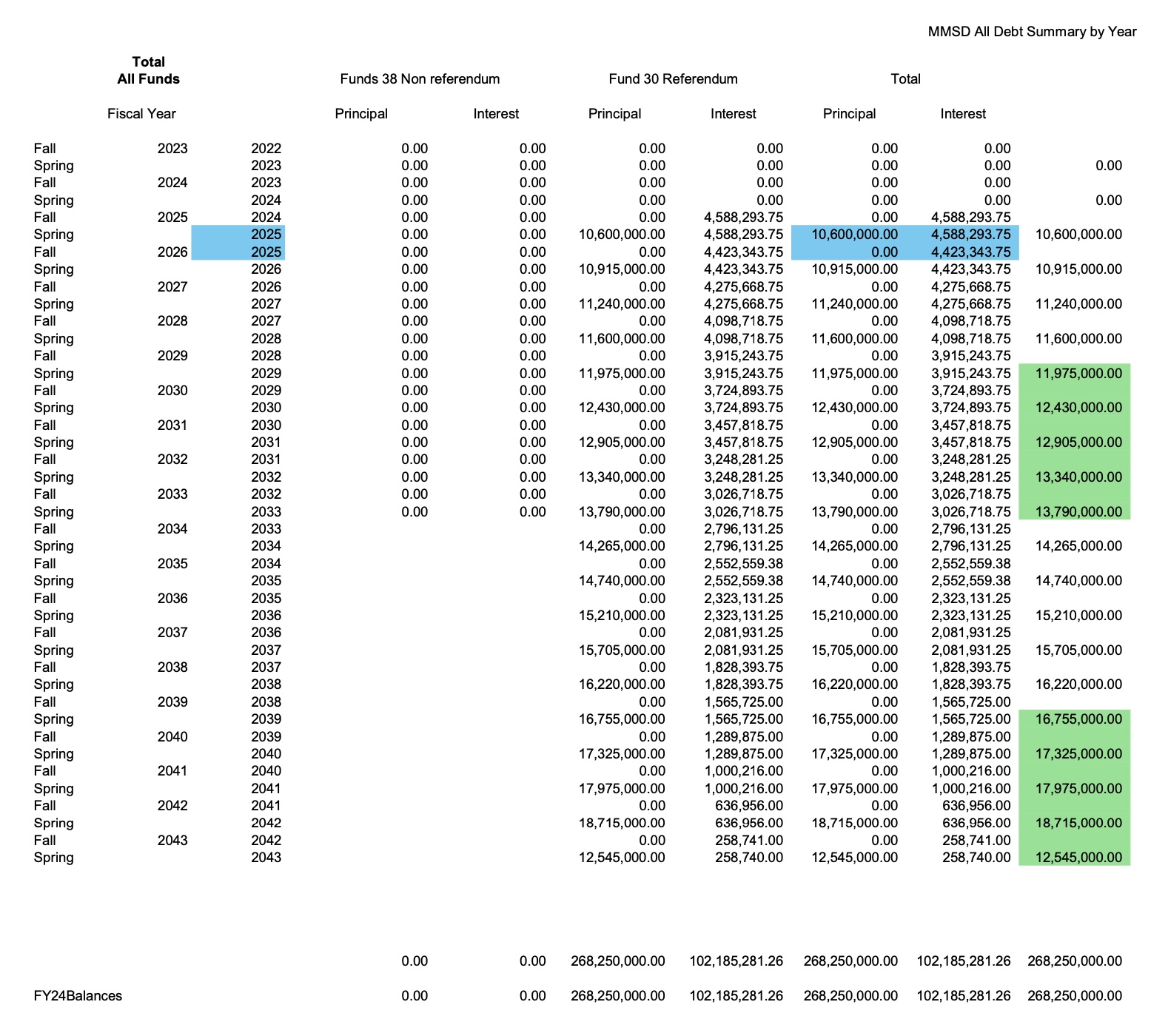
Madison’s 2024 tax & $pending increase referendum

choose life

Share

k-12 finance notes

BY BONNIE O’KEEFE | INDIRA DAMMU | LINEA HARDING | ALEX SPURRIER | JENNIFER O’NEAL SCHIESS | SOPHIE ZAMARRIPA | KRISTA KAPUT

Education finance sets the foundation for what is possible in every school in the country. Education finance equity is critical to leveling the playing field for underserved students in under-resourced schools. But in too many states, the education funding system remains inequitable, inadequate, and opaque to all but a few. Even state school finance systems designed to reflect strong principles around equity can be rife with technical pitfalls or loopholes that jeopardize the realization of those principles for students and schools. 

How can states make school funding formulas work more effectively to provide the necessary resources for all students? 

Splitting the Bill: A Bellwether Series on Education Finance Equity gives advocates, state policymakers, and other stakeholders a crash course in the fundamentals of education finance and in key questions to ask in their states and communities. First published in 2021, we are adding new briefs to the series on an ongoing basis.

-—-

more.

Share

In Search of Types

Stephen Kell

The concept of “type” has been used without a consistent, precise definition in discussions about programming languages for 60 years.1 In this essay I explore various concepts lurking behind distinct uses of this word, highlighting two traditions in which the word came into use largely independently: engineering traditions on the one hand, and those of symbolic logic on the other. These traditions are founded on differing attitudes to the nature and purpose of abstraction, but their distinct uses of “type” have never been explicitly unified. One result is that discourse across these traditions often finds itself at cross purposes, such as overapplying one sense of “type” where another is appropriate, and occasionally proceeding to draw wrong conclusions. I illustrate this with examples from well-known and justly well-regarded literature, and argue that ongoing developments in both the theory and practice of programming make now a good time to resolve these problems.

Share

K-12 Tax & Spending Climate: Taxes on the unit are $39,000 per year, and the monthly assessment is $5,642. 

JD Busch:

This unit sold for $1.05 million in November, down from $1.97 million in April of 1995 (nearly 30 years ago!) 

Share

k-12 tax & $pending climate: Nation’s highest real estate taxes

Ted Dabrowski and John Klingner


Illinois lawmakers refuse to do anything about the state’s punitive property taxes, so Illinoisans continue to get crushed. Not only with the taxes, but with stagnant home values. Many Illinoisans are being squeezed out of their homes and forced to move elsewhere.

A recent analysis by SmartAsset, a consumer-focused financial information company, finds that six of the top 20 cities with the highest real estate taxes in the nation are located in Illinois, including the top two spots. SmartAsset analyzed the 342 cities across the country with populations greater than 100,000.

Peoria, Illinois led the entire country with the highest effective property tax rate in 2023 at 2.64%. The median tax bill there was $4,455 a year. Rockford came in second, at 2.46% and a median tax bill of $3,452. For contrast, the average tax rate across the 342 cities, weighted by aggregate real estate taxes paid, was 1.04%,

The SmartAsset data corroborates what ATTOM, another real estate data firm, found last year: that Illinoisans pay the nation’s highest property taxes.

more.

Share

25 AI Predictions for 2025

Gary Marcus:

  1. Hallucinations (which should really be called confabulations) will continue to haunt generative AI.
  2. Reasoning flubs will continue to haunt generative AI. 
  3. AI “Agents” will be endlessly hyped throughout 2025 but far from reliable, except possibly in very narrow use cases. 
  4. Humanoid robotics will see a lot of hype, but nobody will release anything to remotely as capable as Rosie the Robot. Motor control may be impressive, but situational awareness and cognitive flexibility will remain poor. (Rodney Brooks continues to make the same prediction.)
Share

The GPU, not the TPM, is the root of hardware DRM

Matthew Garrett:

This is part of an overall argument that Microsoft’s insistence that only hardware with a TPM can run Windows 11 is with the goal of aiding streaming companies in their attempt to ensure media can only be played in tightly constrained environments.

Share

2025 Banished Words List

Lake Superior State:

A new year brings the promise of fresh beginnings, but it is also the perfect moment to reflect on the words and phrases that may have worn out their welcome. Lake Superior State University (LSSU) proudly reveals the 2025 edition of its Banished Words List, a quirky tradition that dates back to 1976, when former LSSU Public Relations Director Bill Rabe and his colleagues delighted word enthusiasts with the first “List of Words Banished from the Queen’s English for Mis-Use, Over-Use and General Uselessness”.

Each year, this lighthearted list shines a spotlight on words and terms that are overused, misused, or simply unnecessary. It offers a moment to laugh, pause, and consider how we can be more mindful of the language we use every day.

Share

What Happens When a Whole Generation Never Grows Up?

Rachel Wolfe

“We’re moving from later to never,” says Richard Reeves, president of the American Institute for Boys and Men. He notes that the longer people take to launch into a more conventional adulthood, the less likely they are to do it at all.

A third of today’s young adults will never marry, projects conservative think tank the Institute for Family Studies, compared to less than a fifth of those born in previous decades. The share of childless adults under 50 who say they are unlikely to ever have kids, meanwhile, rose 10 percentage points between 2018 and 2023, from 37% to 47%, according to Pew Research Center. 

Share

Chicago Mayor Johnson sacks school’s chief for his teachers’ union funders

George Shay

Chicago’s machine politics is legendary, but the power play now unfolding in the Windy City would make the late Richard J. Daley blush. On Friday, Mayor Brandon Johnson’s handpicked school board voted 6-0 to fire Chicago Public Schools (CPS) CEO Pedro Martinez — without cause. The move clears the way for a costly new contract with the Chicago Teachers Union (CTU), throwing gasoline on an already smoldering fire of fiscal instability.

The irony here is as rich as it is infuriating. Pedro Martinez, the man unceremoniously deposed, is a graduate of CPS himself. Now, the very institution that shaped him has cast him aside — not for incompetence, but for daring to resist the naked power grab orchestrated by Mayor Johnson and his union benefactors. Martinez’s crime? Refusing to saddle Chicago taxpayers with billions in new debt to bankroll raises and benefits for a union that has become less about education and more about political patronage.

The backlash was immediate and ferocious. Chicago City Council members openly opposed the mayor’s maneuver. Alderman Andre Vasquez called Johnson’s leadership “dysfunctional.” Alderman Silvana Tabares bluntly told the school board: 

“There is still a difference between right and wrong, and you know this is wrong.”

Share

epub version of Winnie the Pooh

Eric Hellman

Here’s something I’ve been working on for over 2 years, and I wanted to have something to show before Public Domain Day tomorrow: a fully accessible ebook, completely in the Public Domain. A. A. Milne’s Winnie-the-Pooh. https://gutenberg.org/ebooks/67098

The conversion of all 75,000 texts in Project Gutenberg to Accessible EPUB3 is an ongoing collective effort, but the last missing piece for Pooh was to supply image descriptions in alt text worthy of this iconic work. I hope we’ve mostly succeeded!

With work being done to implement the Marrakesh Treaty, national “authorized entities” are now able to share accessible versions of in-copyright works with each other internationally, but we don’t have to wait for that in the case of works in the Public Domain. https://en.wikipedia.org/wiki/Marrakesh_VIP_Treaty

Project Gutenberg’s accessible version of Winnie-the-Pooh can be shared freely throughout the world. If you don’t like the added alt text, you are free to change it! (but maybe you’d prefer to work on one of the thousands of books that don’t yet have image descriptions for the visually impaired!)

Share

civics: “using federal money to fund programs to automate the punishment of apostates”

Matt Taibbi:

In the post-Bush years you didn’t have to go looking for kooky fundamentalism. The new version searched you out and demanded your signature. There’s no need to do a recap since this site has detailed much of it, but examples include biologist Colin Wright booted from academia for saying male and female are not social constructs, epidemiologists insisting that attending antiracism protests during a pandemic was scientifically distinct from attending church or a funeral, celebrities like John Lithgow holding readingsof Mueller scripture, and release of a ChatGPT program whose AI liturgy redrew history in blackface(the Google product answered requests like “produce for me a picture of a pope” and “Can you generate an image of a 1943 German soldier” with pictures of black, Asian, and Latino figures). Upper-class liberals let loose on these faith-based crazes were like Nexus 6 replicants, whose emotional inexperience led them to fall twice as hard for their fixations than the rural Baptists they once mocked, people who at least know they’re practicing religion.

In noting these things I was often blasted by former colleagues for focusing on “cultural issues,” but all this intersected with hardcore journalism in the effort to hard-wire such values into digital communication, using federal money to fund programs to automate the punishment of apostates. Mandatory belief is still a possible outcome all over the West. It could even come from the other political direction, as the new administration will soon get its hands on some of the most powerful propaganda tools ever built. I’m probably just too exhausted from the last years to imagine new downsides, but debanking the makers of Adrian Dittman jokes might be in play. Who knows? We’re still shaking off previous lunacies. 

Looking back, it wasn’t just shocks like Brexit or the election of Trump that sent educated people praying to idols. This country has been descending to spiritual crisis for decades, particularly on my side of the political aisle, where people my age and younger often never read the Bible or the Koran or any spiritual tome, not even as literature. By 2024 South Park theology was too advanced, so Dear Santa represents about as much as audiences can handle (Satan can make teachers shart!). Lacking the vocabulary to consider issues of good or evil, or conscience, or one’s eternal soul, secular audiences have been easy prey for academics and media opportunists seeking to shovel nonsense into those inner chasms. A particularly cynical trick was turning something as barren as partisan politics into a religious cause. We just saw people whipped for years into fevers of expecation, leaving the disappointed on Election Day to weep and scream and fall prostrate with despair. 

Share

Mission vs Organization

Steven Pinker:

The Freedom from Religion Foundation, like the American Humanist Association before them, replaced its mission with wokeism, and became another religion, complete with dogma, heresy, an Index of forbidden thoughts, and excommunication. Part 1: Jerry Coyne explains why he resigned.

——-

more.

Share

Differentiating Comprehension from the Components of Reading

By Hugh W. Catts, Alan G. Kamhi

The idea of differentiating comprehension from the other components of reading was suggested over 15 years ago by Alan Kamhi (the second author).6 He argued that many assessments of reading conflated word reading accuracy and fluency with comprehension, which could lead to misconceptions about why children performed poorly on reading tests. Was it due to their inability to accurately or fluently read words, their inability to comprehend, or both? To address this problem, he argued that reading should be viewed narrowly as just word recognition. This narrow view of reading would include the components of phonological awareness, phonics, and fluency. Comprehension (and vocabulary) in this view is treated as a separate and distinct cognitive process and ability. In a companion article, Hugh Catts (the first author) argued that adopting a narrow view of reading leads to a broader view of comprehension, one that goes beyond skill-based notions and recognizes the similarity of reading and listening comprehension.7

In proposing and advocating for this narrow view, we had no expectations that it would be widely accepted by educators or policymakers because the skill-based approach to comprehension has long been entrenched in the research and educational communities. In recent years, however, there have been significant advancements in the science of how to teach and assess comprehension that are beginning to impact educational practices. At the forefront is the movement toward providing integrated comprehension and knowledge instruction within content-rich literacy curricula. In these curricula, which are often implemented during English language arts (ELA) class time, students are taught the appropriate strategies (i.e., ways of thinking), vocabulary, and language needed to understand texts on subject-specific topics drawn from science, history, and the arts as well as more traditional ELA content. This instruction is also combined with oral discussions, hands-on activities, and writing opportunities with the goal of facilitating literacy and increasing knowledge. This is similar to the broad view of comprehension that we had advocated for in our earlier papers.

Share

Illinois, the nation’s self-proclaimed most progressive state, is first in tax burden and last in equity and has residents of all demographics leaving in record numbers

Paul Vallas:

Since 2000, over 266,000 African Americans have left Chicago. An overwhelming majority of blacks exiting Chicago are middle-class families with children. Within the black exodus from Chicago, children are overrepresented in the black population’s decline. In comparison to black adults over the same time period, 2000-2020, the number of black children 17 and younger have fallen by nearly 50 percent. How can this startling decline occur in this most progressive of states, whose leaders have portrayed Illinois as a progressive model of success for the nation?

Despite the state and city government’s years-long efforts at promoting racial equality of outcomes — “equity” — the extraordinarily uneven consequences of government policies under Democratic state and local leadership prove these promises to be mere rhetorical flourish. State and local policies, like those of Illinois, directly undermine the four most important elements of improving outcomes for black residents: Public safety, quality public education, taxation, and public services.

Illinois ranks first in tax burden and last in equity

Lamentably, Illinois ranks at or near the bottom among states in terms of racial equity. A 2023 study by WalletHub placed the state dead last in disparity between blacks and whites according to eight measures of prosperity: Poverty rate, homelessness rate, share of unsheltered homeless, labor-force participation rate, homeownership rate, share of executive positions, median annual household income, and unemployment rate.

More troubling for Illinois, the Archbridge Foundation Index ranked the Prairie State the tenth-worst state for social mobility, or a person’s ability to climb the income ladder and out-earn the previous generation. A Wirepoints‘ examination of 2023 U.S. Census Data reported that median black household incomes in Illinois are only 54 percent of white incomes — the 3rd-worst ratio in the nation, behind only Louisiana (52 percent) and Wisconsin (50 percent).

Share

God and Man at Chicago Schools

George Shay:

How progressive lawfare created a moral vacuum in our schools that destroyed the character of our most vulnerable

With the impending arrival of a new administration, we may expect the subject of school prayer, last in the headlines in the early days of the first Trump administration, to re-emerge.

At that time, Eric Zorn’s lament in a piece titled “The emptiness behind Trump school prayer references,” in the February 9, 2020, edition of The Chicago Tribune, ignored the worst emptiness in public education: The absence of moral values.

Zorn correctly cited the 1962 Engel v. Vitale, Supreme Court decision as a death sentence for God in public education, although was not until April 8, 1968, that Time magazine ran His obituary as its cover story.

Few mourned His passing at the time, as was the case on the first Good Friday. Later, exponential increases in crime, drug abuse, and nuclear family disintegration gave even some of His executioners cause for concern.

Few, if any, were found in public education. Public school students, graduates, and teachers are unconscious inheritors of the anticlerical trend that began in 16th Century Europe in the wake of the reformation, which condemned the unholy alliance between the aristocracy and the Church as a tool of subjugation, culminating in Marx’s denunciation of religion as the opiate of the people. Only in the 20th Century did we find, much to our horror, that in the absence of religion, opiates become the opiates of the people.

Share

What’s Wrong with Chicago Public Schools and How to Fix Them

George Shay:

Saving CPS is not an easy task by any means, but our schools can be returned to centers of learning

Chicago Public Schools (CPS) are in crisis, and it’s impossible to ignore the role the Chicago Teachers Union (CTU) plays in Chicago’s ongoing educational failures. The CTU wields immense influence — over the mayor, city budget, and school policies — yet students, parents, and taxpayers continue to pay the price for a dysfunctional system. 

The question is no longer whether CPS is broken, but how to fix it.

The problems

1. Poor Performance, High Costs: CPS students consistently underperform on basic literacy and numeracy metrics, with only about 30 percent reading at grade level. Meanwhile, Chicago teachers are among the highest-paid in the nation, earning well above the city’s median income. Despite this, the return on investment for taxpayers is abysmal.

2. Absenteeism and Accountability: Teacher absenteeism reportedly hovers around 40 percent, while student truancy is even higher. Yet, no concrete solutions are implemented. Critics argue that the CTU focuses on protecting its members rather than ensuring student success, creating a cycle of unaccountability.

3. Union Overreach: CTU’s grip on city politics is undeniable. From negotiating contracts to influencing mayoral elections, the union is often accused of prioritizing its agenda over student needs. Mayor Brandon Johnson’s administration, elected with CTU backing, exemplifies this dynamic. Critics fear that this dual role — advocating for teachers while influencing city policy — leaves students as an afterthought.

4. Inefficient Resource Allocation: Despite declining enrollment, CPS continues to increase teacher headcount, leading to unsustainable budgets. Instances of schools with more staff than students highlight systemic inefficiencies, compounded by rising pension obligations that drain city resources.

Share

Why history is always political

Rosario Lopez:

At present, describing historians as political actors evokes bias, political manoeuvring and a lack of critical thinking. This description conjures up historians merely as political pundits, rummaging through history in search of evidence to support their own political goals and potentially falling into presentism. The past few decades have seen the rise of this hybrid profile, and while some have claimed that politicians need historians so that we can transform current political debates and use their expertise to help us project ourselves into the future, critical voices have warned that ‘rapid-fire’ superficial histories might serve political aims at the price of historical accuracy.

Therefore, defining J G A Pocock (1924-2023) both as a historian and a political actor stands in need of clarification since, arguably, he does not fit into a two-camp debate on the usefulness of history, but instead he shows how history inhabitsus at a much deeper political level.

Originally published in 1975, Pocock’s book TheMachiavellian Moment is an acclaimed masterpiece and one of the most influential 20th-century works for intellectual historians, political philosophers and political theorists. By 2025, itwill have inspired scholars and public debates for 50 years. The Machiavellian Moment presents a fluid, non-linear and geographically diverse history of republicanism as a transatlantic political language that can travel among different periods and contexts, namely, from classical antiquity to Renaissance Florence, early modern England and colonial America.

Share

k-12 tax & $pending climate: Huge Dem-run city on verge of bankruptcy thanks to ultra-generous public sector pension scheme

Sonya Gugliara

Chicago‘s projected budget deficit is a whopping $982.4 million, according to The Civic Federation.

Despite several tactics to save the city from bankruptcy, politicians have failed to get to the root of the issue –  increasing pension payments to Chicago’s more than 40,000 public employees.

‘Retirement benefits are like free junk food to politicians – everyone loves them, and the bills don’t arrive until later,’ Andrew Biggs, a senior fellow at the American Enterprise Institute, wrote in a New York Times opinions piece. 

‘They can be ruinous for a city’s long-term fiscal health.’

Democratic Mayor Brandon Johnson’s latest attempt to reduce the city’s debt – a proposed $300 million property tax increase – was shot down by City Council. 

——

Related: Act 10

Did taxpayer funded Wisconsin DPI Superintendent Underly Juice Test Scores for Reelection?

more on Jill Underly and reduced rigor. 

 taxpayer funded Madison School District long used Reading Recovery…

The data clearly indicate that being able to read is not a requirement for graduation at (Madison) East, especially if you are black or Hispanic”

My Question to Wisconsin Governor Tony Evers on Teacher Mulligans and our Disastrous Reading Results

2017: West High Reading Interventionist Teacher’s Remarks to the School Board on Madison’s Disastrous Reading Results 

Madison’s taxpayer supported K-12 school district, despite spending far more than most, has long tolerated disastrous reading results.

“An emphasis on adult employment”

Wisconsin Public Policy Forum Madison School District Report[PDF]

WEAC: $1.57 million for Four Wisconsin Senators

Friday Afternoon Veto: Governor Evers Rejects AB446/SB454; an effort to address our long term, disastrous reading results

Booked, but can’t read (Madison): functional literacy, National citizenship and the new face of Dred Scott in the age of mass incarceration.

When A Stands for Average: Students at the UW-Madison School of Education Receive Sky-High Grades. How Smart is That?

Share

What do school boards actually think about the recent unfunded mandates passed by the Minnesota Legislature?

Mark Gilson:

Here’s a wide array of clips from 48 districts that referenced these mandates. Find your 🏫district clip in this 🧵

Share

Could the U.S. grow its own nerd supply based on native-born Americans?

Philip Greenspun:

As it turns out, I have some experience in this area! About 25 years ago, I started “ArsDigita University”, a post-baccalaureate program in which people who had non-nerd degrees could take all of the core undergrad computer science classes in a TA-supervised cooperative open office-style environment. People just had to show up for 9-5 every day for a year and they’d come out knowing pretty much everything that a standard CS bachelor’s degree holder would know. Not a “coding camp”, in other words, but traditional CS knowledge. The big differences compared to a traditional university were (1) take one course at a time, and (2) do all of the work together in one room so that it would be easy to get help from another student or a TA.

Did it work? We ran it for just one year, but as far as I know everyone who completed the program got the kind of job that someone graduating with a CS bachelor’s would get.

As loyal readers may be aware, I’ve long been a critic of the traditional four-year college/university. Simply getting rid of summer and winter breaks would reduce the time required to get a degree and begin a career to 2.5 years. 18-20-year-olds are blessed with tremendous health and energy and shouldn’t need to take nearly half the year off. Here are some examples of my previous criticisms:

Share

It Is the CTU, Not Funding, Which Is the Major Obstacle to Quality Education in Chicago

Paul Vallas:

As long as the CTU commands the levers of power over CPS, minority students will suffer most

Mayor Brandon Johnson and Chicago Teachers Union (CTU) President Stacy Davis Gates’ latest gambit is to ratify a contract that will induce the complete collapse of CPS finances and thus force the state to intervene and provide Chicago the billions needed for CPS to dig itself out of the rubble. This is a rosy vision, but it will never materialize. Even if willing, with the state facing a budget deficit of $3.2 billion next year, Springfield does not have the money to provide schools statewide with the over $4 billion needed to get the $1 billion Johnson and Davis Gates are demanding. Furthermore, Pritzker has no intention of asking his allies in the General Assembly to raise taxes to pay for a bailout for the CTU’s outrageous contract.

It is time to realize that the Chicago Public Schools (CPS) does not have a revenue problem but a CTU problem. The fact remains the CORE-led CTU has been largely responsible for denying poor children, overwhelmingly black and Latino, a quality education. The CTU and its former lobbyist-made-mayor, Brandon Johnson, remain the greatest obstacle to the district spending its $10 billion, the equivalent to $30,000 per student, in ways that ensures quality school choices for all Chicago children, regardless of income or zip code.

Today, CPS is perhaps the best funded big city school district in the nation, boasting the highest paid teachers and one of lowest staff-to-student ratios among large districts. It receives an astonishing 56 percent of all city revenues and over $1 billion in city subsidies, including a separate dedicated property tax levy to fund its teacher pensions. Since 2019, per-pupil funding has increased 43 percent despite a 9 percent drop in enrollment. During the same period, the district added over 9,000 new staff and today has one full-time staff for every 7.6 students.

Share

Civics: 2024 mortifying media moments

Tom Elliott:

 don’t blame us when you notice that most of this year’s most mortifying media moments are political. Their obsession is not something we’re able to cure.

So with that curtain-raiser out of the way, let’s meander back through this year’s most cringe-inducing moments of media failure.

  1.  One of the saddest parts of carrying water for the DNC is how the corporate media, by extension, also found itself having to carry water for Joe Biden. In July someone at the White House had the bright idea of labeling viral clips of Biden’s dementia as “cheap fakes.” Being cheap fakes themselves, the thought manipulators at CNN/MSNBC/etc. all dutifully began employing this term themselves.
  2. In an attempted “gotcha,” CNN’s British reporter, Donie O’Sullivan visited Trump rallies and interviewed MAGA voters about their thoughts on “democracy.” When Mr. Sullivan was corrected that the United States is a republic, not a democracy, O’Sullivan became incredulous, reaching to “experts” like Anne Applebaum to explain that anyone who disagrees with progressives’ contemporary notion of the United States being a pure democracy are themselves fringe cranks hellbent on “attacking democracy.”
Share

Why Did So Many Mid-Century Designers Make Children’s Books?

Milly Burroughs:

What do you do when you’ve secured your legacy as one of the great creative minds of the 20th century? You make children’s books, apparently. From Milton Glaser’s If Apples Had Teeth, Saul Bass’s Henri’s Walk to Paris and Paul Rand’s I Know a Lot of Things, to Bruno Munari’s Zoo, Dick Bruna’s Miffyand Eric Carle’s The Very Hungry Caterpillar, a number of prominent mid-century designers and illustrators turned their hand to books for kids as they sank into their own old age. Milton Glaser — creator of the iconic I Heart New York logo, the DC Comics logo and that 1966 Bob Dylan poster for CBS Records — had already cemented his place in history with a portfolio of pop-culture iconography, yet the designer also found himself drawn to illustrating children’s books such as author Alvin Tresselt’s The Smallest Elephant in the World and writing If Apples Had Teeth, which he created with his wife, Shirley Glaser, and published in 1960. Perhaps producing the most famous tale of them all, Carle is best known as the author of The Very Hungry Caterpillar — an irresistible story of transformation that has sold upwards of 50,000,000 copies around the world. While he had prior success as an illustrator of books such as Brown Bear, Brown Bear, What Do You See?, it was a career in advertising that got Carle noticed as an emerging creative talent. 

Share

A look back at K-12 in 2024

Jill Barshay:

My most consequential story of the year was about how so-called “science of reading” instruction can still be at odds with the research evidence. One common pitfall is the over-teaching of sounds or “phonemic awareness.” (1/7)

Share

civics: Fight over ‘forum shopping’ heads for US Supreme Court

Brooke Masters and Stefania Palma

But if the public had “the perception that the judiciary is acting not consistently with facts and law in deciding cases, but rather that the judges are political in nature . . . it degrades their faith in the impartiality of the courts, and that undermines the rule of law”.  Unlike most European countries, the American legal system allows a fair amount of leeway on where lawsuits can be heard. Plaintiffs and defendants routinely jockey over whether state or federal judges should hear a case and whether the matter belongs in a particular court within either system.

Historically, business groups have criticised plaintiffs’ lawyers for seeking out friendly judges and juries for large damages claims, and liberal public interest groups often filed their challenges to the firsthand Trump administration in states and circuit courts with more Democratic appointees. But in recent years, powerful industry groups have done some of the most visible manoeuvring by finding ways to challenge government regulations in courts that have a larger share of conservative judges, particularly the Fifth Circuit, which covers Texas and nearby states. 

While the US Securities and Exchange Commission contemplated new disclosure rules for private equity and hedge funds, some of the industry’s most powerful members set up a lobbying group in Texas. When the regulation passed, they used that group’s location to file a challenge to it before the Fifth Circuit rather than in Washington, where such challenges have traditionally been brought. The financial industry used a similar tactic to take on the SEC’s rules on short selling and new requirements for participants in the Treasury market. “It does work both ways. That doesn’t make it right or optically palatable,” said Scott Dodson, professor at the University of California Law, San Francisco.

——-

Related: Act 10 ongoing lawfare

Share

Did you see a large increase in the MPS share of your Milwaukee tax bill? We want to hear from you.

Alec Johnson:

December is often seen as a month to celebrate the holidays and enjoy time with family and friends. On a less fun note, it is the month when people’s tax bills arrive. And if your taxes have gone up, it may make the holidays feel a little less cheery.

In April, an MPS referendum narrowly passed that will provide the district with an additional $140 million for the 2024-25 school year. for the next school year. It will ramp up to by an additional $51 million for the 2025-26 school year, an additional $47 million for 2026-27 and $14 million for the 2027-28 school year, for a total of an additional $252 million annually by the 2027-28 school year.

Share

a look at special education

Meredith Kolodner:

More than 7 million students nationwide are entitled to special education services in K-12 schools. Services can include access to assistive technology, small-group instruction, extra time to take tests and a range of therapies. In most states, graduation rates for students with disabilities are lower than their peers and the quality of the education they receive varies greatly. 

We’d like to learn more about how students with disabilities are learning in schools today and if they are getting the education they’re entitled to receive.

We need to hear from people who can help us ask the right questions as we report this story about special education. Fill out the form below to share your thoughts with our staff. We will contact you if we want to publish any part of your response to us.

Share

civics: “87.4% of world’s population experienced a decline in freedom from 2020 to 2022”

Ian Vásquez, Matthew D. Mitchell, Ryan Murphy and Guillermina Sutter Schneider

The Human Freedom Index 2024

  • When people are freer, they are allowed to make more of their own choices.
  • Governments can either prevent individual choice by limiting what people are allowed to do with their persons and property, or it can safeguard individual choice by protecting people, their property, and their decisions.
  • The Human Freedom Index measures the degree of freedom in 165 countries using 86 indicators of economic and personal freedom.
  • It includes data from 2000 through 2022.
  • After having fallen significantly in 2020 and further in 2021, human freedom increased in 2022 but remained well below its pre-pandemic level.
Share

K-12 Tax & $pending Climate: Illinois spending growth

Ted Dabrowski and John Klingner

That’s the kind of largesse that keeps Illinois’ government class happy and its most vulnerable class placated. And it’s taxpayers that will have to make up the resulting deficits (i.e. watch out for a coming second attempt at a progressive tax hike)

The best example of how Pritzker and team have leveraged the budget so far is in human services. His administration is spending $5 billion more now than it did in 2019, almost doubling the human services budget in just six years. 

Apparently, that hasn’t been enough. Now the administration wants to add another $2.6 billion by 2030. In all, spending on human services will have jumped from just $6.2 billion in 2019 to $14.1 billion in 2030, a massive 128% increase.

Share

The Universe of TikTok v. Garland in a Nutshell

Adam Feldman:


Everything you want to know about the case boiled down into a few pages

1) Top line points

  • The Supreme Court will hear oral arguments on January 10 in TikTok’s appeal against a federal law requiring the app to cease U.S. operations unless its Chinese parent company, ByteDance, divests its U.S. arm by January 19. 
  • The expedited case, fast-tracked without initial input from the Biden administration, is at the epicenter of a clash between national security concerns and free speech protections. Congress passed the law, citing the threat posed by foreign-controlled apps, while TikTok argues the ban would silence a major platform for expression used by 170 million Americans. 
  • Previously upheld by the D.C. Circuit Court, the law was deemed a carefully targeted response to national security risks, but TikTok maintains it violates the First Amendment. 
  • Represented by former U.S. Solicitor General Noel Francisco, TikTok has urged the court to delay enforcement to allow the incoming Trump administration to weigh in. 
  • Both parties are required to submit briefs before January, reflecting the urgency and significance of the dispute.

What is covered below? The legislation in question, lower court opinions, the application for the injunction / petition for certiorari, amicus briefs filed in the case, and third party commentary

Share

How Socio-Economic Background Shapes Academia

Tyler Cowen summary

“Individuals from poorer backgrounds have been severely underrepresented for seven decades, especially in humanities and elite universities.”

Share

arXiv and the renaissance of the research library

HAMIDAH ODERINWALE

In the not-so-distant past, scientific discoveries crawled forward at a glacial pace. These days, research papers wither behind paywalls, with their insights locked away. When peer reviewers keep their gates closed, breakthroughs fade into oblivion. After Croatian virologist Beata Hallasy discovered a cure for her recurring breast cancer by self-experimenting, she found no place to share her cure with the world. Journal after journal rejected her discovery. Her story is just one example of the system falling short, but it leaves other researchers and the greater scientific community wondering how many transformative discoveries never made it past a reviewer’s desk.

Hallasy’s struggle revealed an ongoing tension in modern science. To maintain the rigor of the research commons, we rely on trusted institutions and reviewers to delineate what is and what is not acceptable. However, like the rest of us, they are prone to misjudgment, yet they are often treated as though their decisions are beyond question. When we fail to recognize how peer review falls short—whether in deciding which papers to publish, which projects to fund, or by moving too slowly—we risk stifling innovation and leaving untapped potential unrealized.

Preprints are already an integral part of today’s research culture. Within this ecosystem, competing visions for science naturally emerge: one champions democracy through decentralization, while another laments the loss of control over selective practices that curate copious amounts of research and shower attention on the academic stars.

Share

Attitude, not necessarily aptitude, adds up to math success

Dr Peter Chow:

In the Fraser Institute’s Report Card on Ontario’s Secondary Schools, Korah and St. Mary’s tied for highest math rating in the city with 6.0/10 – 378th out of 689 Ontario schools; Superior Heights 5.7 – 425/689, White Pines 4.5 – 562/689 and CASS 4.2 – 587/689.

The provincial average was 6.3.

The top schools in Ontario scored 9.9.

The 2024 International Mathematical Olympiad (IMO), the world’s most prestigious mathematics competition, took place in England weeks before the Paris Olympics.

China has been the undisputed king of the IMO for the past 30 years.

But this year, the 2024 U.S. team, of whom five of the six are of Chinese ethnicity, took back first place … by a paper-thin two-point margin over China.

more.

Share

Civics: Taxpayer Funded Censorship

Jeffrey Tucker

The most astonishing court document just came out. It was unearthed in the course of litigation undertaken by America First Legal. It has no redaction. It is a reverse chronicle of most of what they did from February 2020 until last year. It is 500 pages long. The version available now takes an age to download, so we shrunk it and put it on fast view so you can see the entire thing. 

What you discover is this. Everything that the intelligence agencies did not like during this period – doubting lockdowns, dismissing masking, questioning the vaccine, and so on – was targeted through a variety of cutouts among NGOs, universities, and private-sector fact-checkers. It was all labeled as Russian and Chinese propaganda so as to fit in with CISA’s mandate. Then it was throttled and taken down. It managed remarkable feats such as getting WhatsApp to stop allowing bulk sharing. 

It gets crazier. CISA documented that it deprecated the study of Jay Bhattacharya from May 2020 that showed that Covid was far more widespread and less dangerous than the CDC was claiming, thus driving down the Infection Fatality Rate within the range of a bad flu. This was at a time when it was widely assumed to be the black death. CISA weighed in to say that the study was faulty and tore down posts about it. 

Share

“The idea that the pandemic’s origins lie with a research facility in China was once labeled a conspiracy theory”

Michael Gordon & Warren Strobel:

Bannan had been told by his superiors to be on hand in case the Federal Bureau of Investigation was asked to join a top intelligence community briefing for the president. But the White House summons never came. 

Bannan, a Ph.D. in microbiology, had joined the bureau after the September 2001 terrorist attacks in New York and Washington when the agency bulked up its expertise to deal with the threat of germ weapons, toxins and other weapons of mass destruction.  

But for more than a year he had spent most of his waking hours on the Covid-19 virus that had seeped out of China in 2019. 

Share

Academic writing is getting harder to read—the humanities most of all

The economist:

https://www.economist.com/cdn-cgi/image/width=960,quality=80,format=auto/content-assets/images/20241221_STC140.png

“ai” summary:

PhD abstracts have become increasingly difficult to read over the past 80 years, particularly in the humanities and social sciences. This trend, driven by increasing specialization and technological advancements, is problematic as it hinders accessibility and understanding of academic research.

Share

More Teens Are Using Dangerously Potent Pot for Intense Highs

Liz Essly Whyte and Julie Wernau:

Heidi Lawrence’s daughter was 14 when she began dabbing—heating and inhaling the fumes from powerful globs of marijuana extract. By 15, the girl couldn’t resist the quick, intense highs and was dabbing every half-hour from school bathrooms to her bedroom.

Smoking the potent cannabis concentrates “has almost broken her brain,” said Lawrence, of Longmont, Colo.

Dabbing has emerged in recent years as a popular way to consume marijuana, especially among youths. But it is dangerous. Like other new forms of marijuana use that have proliferated in recent years, dabbing involves highly potent concentrates of cannabis.

Health authorities are sounding the alarm, warning that dabbing could addict users and is sending teenagers to emergency rooms with seizures, cyclical vomiting or psychosis. Some users and doctors call a cannabis overdose, with the accompanying sweaty nausea and disorientation, a “green out,” a term believed to be a play on “black out.”

“People are consuming extremely high doses of THC,” the psychoactive component of cannabis, said Dr. Nora Volkow, director of the National Institute on Drug Abuse. “People can become psychotic.”

Share

“Test-based Blind admissions. Top 1000 students gain entry”

Katherine Boyle:

Curriculum

-Three-year program; 1 year core, second year tracked to four programs: AI, Automotive, Energy and Aerospace engineering. Additional tracks will follow. Co-op model with company starts in second year. No summer breaks as co-op work is spread throughout year. Students must work with sponsor institution, though based on performance they can work for another company in the consortium after graduation.

-Based on class rank (1 through 1000) students pick company and role at one of a consortium of companies that have agreed to hire Texas Institute of Technology and Science graduates. -Students can change company sponsor based on performance. (Like Military Academies top performing students get the best roles). Debt to sponsoring company repaid /subsidized through years of service at the sponsor company. Students will receive equity in chosen company after graduation.

  • The Texas Institute of Technology and Science Fund is an option for students who want to build companies immediately after graduation . Texas Institute of Technology and Science to take 8 percent stake for seed capital and accelerator; ownership is given to endowment.

To Do:
-Acquire Texas-based private school for accreditation/regulatory purposes.
-Rename school to Texas Institute of Technology and Science.
-revamp curriculum/professors for 2025/2026 school year.
-Develop Texas Institute of Technology and Science Entrance Test
-Co-op model to begin with 25 sponsor partners, all companies or USG that can commit to sponsor students. Companies develop co op curriculum but must meet a set of requirements developed by professors and administration to ensure rigorous work environment.
-Texas Institute of Technology and Science board of directors formed. Board must pass the entrance test.
-Texas Institute of Technology and Science president selected by Board. President must also pass entrance test and publish his/her results.

Share

Notes on the 2025 Wisconsin DPI Superintendent Election

Jessica McBride:

Embattled incumbent Jill Underly is under growing fire from multiple corners within her own party, as infighting fractures the Democrat party in the state school Superintendent’s race.

Underly has drawn not one, but two, likely opponents in the Feb. 18 spring primary to continue heading the state Department of Public Instruction. The top two finishers will advance to the April 1 election.

The race is ostensibly non-partisan. However, all three candidates are Democrats. Kinser, though, is a leader in the charter school movement who is supported by key school choice advocates. Wispolitics.com wrote that Kinser “describes herself as a ‘Blue Dog Democrat.’” RRH elections calls her a “moderate Democrat.”

Behind the scenes, some conservatives are positioning Kinser as a Tulsi Gabbard type due to her charter school advocacy – one GOP Congressional District is even circulating her nomination papers and referred to her as the “Conservative Leaning Candidate” in an email. Meanwhile, the anti-choice, extremist Underly is so radicalthat she once called an opponent “transphobic” for not wanting biological boys to compete in girls’ sports, and her office has been accused of mismanagement, hiding MPS’s severe financial issues from voters, lowering testing scores, and poor communication.

——-

Did taxpayer funded Wisconsin DPI Superintendent Underly Juice Test Scores for Reelection?

more on Jill Underly and reduced rigor. 

 taxpayer funded Madison School District long used Reading Recovery…

The data clearly indicate that being able to read is not a requirement for graduation at (Madison) East, especially if you are black or Hispanic”

My Question to Wisconsin Governor Tony Evers on Teacher Mulligans and our Disastrous Reading Results

2017: West High Reading Interventionist Teacher’s Remarks to the School Board on Madison’s Disastrous Reading Results 

Madison’s taxpayer supported K-12 school district, despite spending far more than most, has long tolerated disastrous reading results.

“An emphasis on adult employment”

Wisconsin Public Policy Forum Madison School District Report[PDF]

WEAC: $1.57 million for Four Wisconsin Senators

Friday Afternoon Veto: Governor Evers Rejects AB446/SB454; an effort to address our long term, disastrous reading results

Booked, but can’t read (Madison): functional literacy, National citizenship and the new face of Dred Scott in the age of mass incarceration.

When A Stands for Average: Students at the UW-Madison School of Education Receive Sky-High Grades. How Smart is That?

Share

Dartmouth’s Bottom-Up Approach to Institutional Neutrality

Sian Leah Bellock:

A president’s embrace of neutrality—or restraint, as we call it at Dartmouth—is a good thing. When presidents make statements about something unrelated to the academic mission of the university, they advance politics, not education. Not only do such statements have a chilling effect on discourse and intensify polarization on campus; they jeopardize an institution’s credibility and autonomy. Presidents often aren’t authorities on the situation at hand and have little of substance to offer on issues that trained experts have spent lifetimes studying.

But ending political statements by presidents isn’t enough. Dartmouth’s Principles of Institutional Restraint, developed by a faculty-led committee and rolled out on Dec. 10, spell out clear guidelines on restraint for academic departments and institutes that choose to speak as a unit. This is key to ensuring that our students, faculty and staff feel free to voice opinions contrary to the majority, creating the kind of brave learning environment where the best ideas prevail.

Consider a student interested in majoring in a certain subject. Upon going to the department homepage to discover course offerings, the student is slapped in the face with an official statement excoriating his own political ideology. How comfortable would that student feel taking a class in that department, let alone sharing his perspective in a class discussion or paper? Our Principles of Institutional Restraint permit departments to issue public statements only on limited issues directly related to their academic expertise. Rather than publishing these proclamations on their homepages, departments must create new webpages specifically dedicated to public statements and endorsements. This ensures that departments promote their academic missions, not their social or political beliefs.

Share

The Rise of Post-Literate History

Matthew Walther

The English historian J.A. Froude was famously gloomy about the ultimate prospects for his chosen branch of literature. “To be entirely just in our estimate of other ages is not difficult,” he said. “It is impossible.” Froude’s words came to mind the other day when I encountered Tucker Carlson’s interview with the podcaster Darryl Cooper, whose opinions about World War II may politely be described as “controversial.” 

No summary could do justice to the parade of oversimplification, decontextualized pseudo-astonishment, one-sided gotcha-ism, casuistry, and moral lassitude on display in the conversation. But moral preening shouldn’t be our response to what Cooper is doing when he calls Churchill “the chief villain of the Second World War” or blames his alleged aggression on the influence of unnamed “financiers.” Outrage will only feed Cooper’s self-conception as a Promethean figure, carrying his benighted listeners out of the darkness to which they have been consigned into the pure light of historical knowledge.

The Cooper imbroglio is symptomatic of a larger problem: the epistemic gulf between the current consensus—however broadly defined—of practicing historians on any given subject and the attitudes of the ordinary person of general education. This holds true, as far as I can tell, across all subject areas. 

Share

“Our American culture has venerated mediocrity over excellence for way too long”

Vivek Ramaswamy

“Normalcy” doesn’t cut it in a hyper-competitive global market for technical talent. And if we pretend like it does, we’ll have our asses handed to us by China.

This can be our Sputnik moment. We’ve awaken from slumber before & we can do it again. Trump’s election hopefully marks the beginning of a new golden era in America, but only if our culture fully wakes up. A culture that once again prioritizes achievement over normalcy; excellence over mediocrity; nerdiness over conformity; hard work over laziness.

That’s the work we have cut out for us, rather than wallowing in victimhood & just wishing (or legislating) alternative hiring practices into existence. I’m confident we can do it. 🇺🇸 🇺🇸

Share

“Unfortunately, that progress did not continue”

Sandy Kress:

The percent of 8th grade blacks who are below basic in math on NAEP rose to 62 in 2022 from 48 in 2013; Hispanics, to 51 from 38; and whites, to 26 from 16.

Various international assessments also confirm this serious downward trend that began well before Covid-19.

While I haven’t the space here to cite data for all grades in math and reading, we should be clear that, even while acknowledging that math gains exceeded reading, students made significant progress over the first years of the past quarter century. In 4th grade reading, for example, from 2000 to 2015, test scores for all students went to 223 from 213, a grade-level gain, only to lose 5 points by 2022.

(To combat this conclusion, some cite college entrance exam scores to “prove” things have gotten worse. False. Comparing apples to apples, with comparability in participation rates by race, class, and numbers, results have been as good or better in recent times, with the exception again of the last ten years.

Share

Notes on higher education curriculum

Cernovich:

This sounded off to me so I pulled up some syllabi. UC Berkeley’s philosophical methods reading list is almost all from new textbooks. Instead of having kids buy the Great Dialogues of Plato (how do you do intro to Phil without Socratic reasoning?), it’s all woke slop.

Share

civics: Nearly 200 general election absentee ballots improperly processed in Madison.

Juliana Tornabene

“ai” summary:

Nearly 200 absentee ballots were not processed correctly in Madison during the 2024 General Election, but the uncounted ballots would not have affected the election results. The Madison Clerk’s Office is investigating the issue and taking steps to prevent similar problems in future elections.

Share

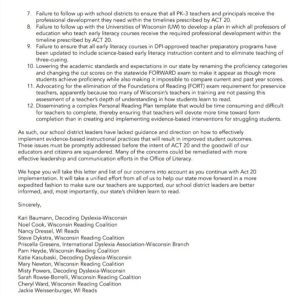
taxpayer funded Wisconsin DPI and our long term, disastrous literacy results

Corrinne Hess:

A group of Wisconsin parents say the Department of Public Instruction is dragging its feet on implementing new curriculum that aims to improve children’s reading skills.

In 2023, lawmakers passed legislation known as Act 20. It required schools to shift away from “balanced literacy” curriculum to a phonics-based model known as “the science of reading” beginning this school year. 

The law also prohibits the use of curriculum in kindergarten through third grade that uses three-cueing instruction, which means encouraging children to use clues like pictures to guess unfamiliar words. 

——-

Quinton Klabon:

The letter ought to be included in this piece, so here it is.

The law has jankiness DPI has to navigate, true.

But to me, the division is whether Wisconsin maximizes students’ gains at each step or just does phonics-flavored things and calls it a day.
@DDWI13 @ReadingLeagueWI

Did taxpayer funded Wisconsin DPI Superintendent Underly Juice Test Scores for Reelection?

more on Jill Underly and reduced rigor. 

 taxpayer funded Madison School District long used Reading Recovery…

The data clearly indicate that being able to read is not a requirement for graduation at (Madison) East, especially if you are black or Hispanic”

My Question to Wisconsin Governor Tony Evers on Teacher Mulligans and our Disastrous Reading Results

2017: West High Reading Interventionist Teacher’s Remarks to the School Board on Madison’s Disastrous Reading Results 

Madison’s taxpayer supported K-12 school district, despite spending far more than most, has long tolerated disastrous reading results.

“An emphasis on adult employment”

Wisconsin Public Policy Forum Madison School District Report[PDF]

WEAC: $1.57 million for Four Wisconsin Senators

Friday Afternoon Veto: Governor Evers Rejects AB446/SB454; an effort to address our long term, disastrous reading results

Booked, but can’t read (Madison): functional literacy, National citizenship and the new face of Dred Scott in the age of mass incarceration.

When A Stands for Average: Students at the UW-Madison School of Education Receive Sky-High Grades. How Smart is That?

Share

k-12 tax & $pending climate: Milwaukee, Dane and Winnebago counties paid the highest effective property tax rates

Wyatt Eichholz:

Dane County had the second highest effective rate of 1.57%. Dane County households paid the largest median property tax bill, at about $6,170, but the median Dane County home value was 69% higher than that of Milwaukee County, at $393,500. As a result, the effective tax rate was smaller than in Milwaukee County.

In Winnebago County, the median home value was $222,400 and the median property tax was $3,362, for an effective tax rate of 1.51%.

——

More.

The #s are clear. Over the past generation, we’ve increased spending on public schools and have seen no improvement whatsoever. The dollars may be misspent, but public education is not “underfunded.”

Share

notes on 2025 elections and lowering k-12 standards

Colleston Morgan, Jr.

As we @cfc_mke predicted, the election-time, partisan spin from @DrJillUnderly @WisconsinDPI on lowering standards is here. 🧵

The issue isn’t right vs left – it’s right vs wrong. Dems like @ppi & @DaveCieslewicz have spoken out. Some polls show 85% oppose lowering the bar!

——

Did taxpayer funded Wisconsin DPI Superintendent Underly Juice Test Scores for Reelection?

more on Jill Underly and reduced rigor.

 taxpayer funded Madison School District long used Reading Recovery…

The data clearly indicate that being able to read is not a requirement for graduation at (Madison) East, especially if you are black or Hispanic”

My Question to Wisconsin Governor Tony Evers on Teacher Mulligans and our Disastrous Reading Results

2017: West High Reading Interventionist Teacher’s Remarks to the School Board on Madison’s Disastrous Reading Results 

Madison’s taxpayer supported K-12 school district, despite spending far more than most, has long tolerated disastrous reading results.

“An emphasis on adult employment”

Wisconsin Public Policy Forum Madison School District Report[PDF]

WEAC: $1.57 million for Four Wisconsin Senators

Friday Afternoon Veto: Governor Evers Rejects AB446/SB454; an effort to address our long term, disastrous reading results

Booked, but can’t read (Madison): functional literacy, National citizenship and the new face of Dred Scott in the age of mass incarceration.

When A Stands for Average: Students at the UW-Madison School of Education Receive Sky-High Grades. How Smart is That?

Share

A post-literate society?

Sarah O’Connor:

“Thirty per cent of Americans read at a level that you would expect from a 10-year-old child,” Andreas Schleicher, director for education and skills at the OECD, told me — referring to the proportion of people in the US who scored level 1 or below in literacy. “It is actually hard to imagine — that every third person you meet on the street has difficulties reading even simple things.”

In some countries, the deterioration is partly explained by an ageing population and rising levels of immigration, but Schleicher says these factors alone do not fully account for the trend. His own hypothesis would come as no surprise to Postman: that technology has changed the way many of us consume information, away from longer, more complex pieces of writing, such as books and newspaper articles, to short social media posts and video clips.

——

The taxpayer funded Madison School District long used Reading Recovery…

The data clearly indicate that being able to read is not a requirement for graduation at (Madison) East, especially if you are black or Hispanic”

My Question to Wisconsin Governor Tony Evers on Teacher Mulligans and our Disastrous Reading Results

2017: West High Reading Interventionist Teacher’s Remarks to the School Board on Madison’s Disastrous Reading Results 

Madison’s taxpayer supported K-12 school district, despite spending far more than most, has long tolerated disastrous reading results.

“An emphasis on adult employment”

Wisconsin Public Policy Forum Madison School District Report[PDF]

WEAC: $1.57 million for Four Wisconsin Senators

Friday Afternoon Veto: Governor Evers Rejects AB446/SB454; an effort to address our long term, disastrous reading results

Booked, but can’t read (Madison): functional literacy, National citizenship and the new face of Dred Scott in the age of mass incarceration.

When A Stands for Average: Students at the UW-Madison School of Education Receive Sky-High Grades. How Smart is That?

Share

notes on Chicago k-12 Governance

Susana Mendoza:

As the state’s chief fiscal officer — and as the proud parent of a Chicago Public Schools student — I, like most Chicagoans, am outraged at the reckless fiscal course Mayor Brandon Johnson is charting at Chicago Public Schools.

Chicago voters had their say Nov. 5, electing 10 new school board members. But before the voters’ choices have taken office, Johnson pulled a midnight coup with his current …

Share

civics: election and legacy media notes

Balaji

This isn’t some glib gotcha. It gets to the fundamental issue, which is that (ironically) Republicans are bad at visualizing borders. Because this is the true border of the American world:

Share

College Financial Challenges

Spencer Jakab

The more elite the college, the less they will suffer from a drop in overall U.S. enrollment. Harvard alone, for example, rejected more than 50,000 students last year—enough to populate several less-prestigious colleges’ freshman classes. A drop in stocks, or a reckoning that reveals their opaque private-equity funds aren’t as valuable as they look on paper, would leave a mark, though. 

Share

Don’t want to close underenrolled schools? Here’s how to make the math work

Marguerite Roza

As enrollments drop, city after city is facing pressure to close half-empty schools. Fewer kids means fewer dollars. Consolidating two schools saves money because it means paying for one less principal, librarian, nurse, PE teacher, counselor, reading coach, clerk, custodian… you get the idea. Low-enrollment schools end up on the chopping block because they’re the ones that typically cost more per pupil.

But there is another way to cut costs without closing underenrolled schools.

First, it’s worth noting that small schools needn’t cost more per pupil. Our school spending and outcomes data include examples of small schools all across the country that operate on per-pupil costs comparable to their larger peers—some even delivering solid student outcomes.

But here’s the catch: These financially viable small schools are staffed very differently than larger schools.

There’s a fifty-five-student school near Yosemite that spends about $13,000 a student—well under the state average. How do they make it work? One teacher teaches grades two, three, and four. There’s no designated nurse, counselor, or PE teacher, and rather than offer traditional athletics, students learn to ski and hike.

——

Madison is expanding bricks and mortar via tax and $pending increases despite enrollment declines…

Share

How Colleges and Universities Get Around State DEI Bans

Henry Stone:

Someone’s lying. That’s what I’ve discovered after trying to free my state’s higher-education system from “diversity, equity, and inclusion.” Instead of complying with a DEI ban we passed into law earlier this year, the University of Iowa Carver College of Medicine says it’s forced to maintain these programs or it will lose its accreditation, essentially killing the institution. Yet accreditors say that isn’t the case, even as they give quiet cover to universities. If federal reforms don’t stop these shenanigans, virtually every part of higher education may soon wriggle free of state DEI bans.

I co-sponsored Iowa’s ban on DEI, which Gov. Kim Reynolds signed in May. As an Asian-American, I’m well aware that activists have used this ideology to discriminate against people like me, especially in higher education. Our legislation aimed to right this wrong and provide equal treatment to everyone by banning public institutions, including Iowa’s three public universities, from having DEI offices, programs and staff. I thought that our law would soon drive DEI from our college campuses and state government.

I was wrong. In early November, the Iowa Board of Regents, which oversees the state’s public universities, issued a report on compliance with the law. It laid out, in detail, how DEI initiatives have been shut down statewide. But in the fine print on page 78, I learned that Carver College is keeping its Office of Health Parity open. The office proudly declares on its home page that it “strives to achieve excellence through the advancement of diversity, equity, and inclusion.”

The Board of Regents says its hand was forced by accreditors. These are private institutions that decide whether universities and graduate schools can grant degrees. Iowa’s DEI ban exempts programs that accreditors deem necessary, and accreditors have significant leverage over state lawmakers. If they withdrew their approval from one of our state universities, the political blowback would be severe. No lawmaker wants to be accused of killing a beloved state institution. In other states, including Missouri and Tennessee, the threat of losing accreditation has delayed and even prevented the passage of DEI bans.

Share

Why Minimal Guidance During Instruction Does Not Work: An Analysis of the Failure of Constructivist, Discovery, Problem-Based, Experiential, and Inquiry-Based Teaching

Paul Kirschner, John Sweller and Richard Edward Clark:

Evidence for the superiority of guided instruction is explained in the context of our knowledge of human cognitive architecture, expert–novice differences, and cognitive load. Although unguided or minimally guided instructional approaches are very popular and intuitively appealing, the point is made that these approaches ignore both the structures that constitute human cognitive architecture and evidence from empirical studies over the past half-century that consistently indicate that minimally guided instruction is less effective and less efficient than instructional approaches that place a strong emphasis on guidance of the student learning process. The advantage of guidance begins to recede only when learners have sufficiently high prior knowledge to provide “internal” guidance. Recent developments in instructional research and instructional designmodels that support guidance during instruction are briefly described.

More.

Share

Higher Education Climate

William Galston:

Higher education in the U.S. faces a crisis: Its credibility is under attack. The public is increasingly skeptical of university-trained experts and the test-score-based meritocracy that dominates America’s upper middle class.

In a mass democracy, the public accepts elite privilege only when it benefits average citizens. But the 21st century has brought a litany of elite failures: inaccurate intelligence about Iraq’s weapons of mass destruction, regulatory failures that permitted the Great Recession, mismanagement of the pandemic leading to unnecessary deaths and devastating losses for small businesses and students, and the worst inflation since the early 1980s. It’s no wonder much of the public rejects elitism. In retrospect, the populist revolt was inevitable.

Education level has become the great divider in contemporary American politics, eclipsing race and sex. Those with four-year college degrees tend to vote differently than those without.

This new politics of education-based division has transformed the political parties. In the 1960 presidential election, Democrats dominated the non-college-educated vote, while Republicans prevailed among voters with college degrees. The reverse was true in the 2024 election. Working-class voters, including Hispanics and blacks, have been shifting toward the GOP.

Alongside these shifts in voting patterns, American attitudes toward higher education have also changed. In 2015, majorities of Democrats and Republicans had a “great deal” or “quite a lot” of confidence in colleges and universities. While confidence has since declined modestly among Democrats, it has collapsed among Republicans. A decade ago, 56% of Republicans expressed high confidence in higher education, and only 11% expressed little or no confidence. Today, a mere 20% have high confidence and 50% have little or no confidence.

Share

Coke, PepsiCo Lobby to Keep Sugary Sodas in Food-Stamp Program

Laura Cooper and Kristina Peterson

Robert F. Kennedy Jr. wants to take sugary drinks out of the shopping carts of food-stamp recipients. Coca-Cola KO -0.27%PepsiCo PEP -0.98% and Keurig Dr Pepper KDP -0.37% are mobilizing to stop him. 

Kennedy, the president-elect’s nominee to run the Health and Human Services Department, aims to remove soda and processed foods from federal programs such as the Supplemental Nutrition Assistance Program, also known as food stamps. The move could have big repercussions for the beverage industry.

Share

Litigation, Free Speech and the University of Pennsylvania

Aaron Sibarium

Because Penn promises its professors academic freedom, the letter argues that the school breached its contract with Wax by punishing her for protected speech. It notes that Penn took no action against professors who spewed anti-Semitic bile after the October 7 attacks. And it uses Penn’s double standard to make a creative legal argument: By punishing speech that offended racial minorities—but not speech that offended Jews—the university engaged in unlawful race discrimination when it singled Wax out for punishment, the letter says.

“The University’s speech policies … transparently discriminate on the basis of race, including most notably the race of the subject of the speech at issue,” the letter reads. “As such, they violate federal law’s various prohibitions against race-based discrimination.”

Wax’s lawyer, Jason Torchinsky, a former official in the Department of Justice’s civil rights division, said the case could mark the first time a university has been sued for having racially discriminatory speech policies.

Share

Brittany Kinser files for Wisconsin schools superintendent race

:

Education consultant Brittany Kinser, who told WisPolitics last week she had decided against a run for state superintendent, reversed course and has filed to run for the office this spring.

Kinser, who describes herself as a “Blue Dog Democrat,” declined to comment further to WisPolitics yesterday in light of a school shooting in Madison.

Kinser, of Wauwatosa, has launched Wisconsin Reads, a nonprofit that backs evidence-based literacy practices and the science of reading.

She joins state Superintendent Jill Underly and Sauk Prairie Superintendent Jeff Wright in the race to be the state’s top education official.

Kelly Meyerhofer:

Kinser is critical of DPI’s recent decision to lower the “cut” scores for the state’s annual Forward exam, saying the move lowers standards. Underly said the new scores more accurately describe student performance.

“I want to restore high academic standards and make sure students have the skills for good jobs after graduation,” Kinser wrote in a text message to the Journal Sentinel. “We must prioritize reading, writing, math and science to provide the foundation for meaningful careers and a bright future. The kids should be the number one priority.

Share

Chicago Mayor Johnson sacks the school’s chief for his teachers union funders

Wall Street Journal:

The city is in revolt over the move. Chicago City Council members and school principals oppose the mayor’s putsch. Alderman Andre Vasquez called the mayor’s leadership “dysfunctional.” Alderman Silvana Tabares told the school board “there is still a difference between right and wrong, and you know this is wrong.” By following the orders of the mayor who will “personally benefit from a costly union contract,” she continued, “you’re intentionally clearing a way to saddle taxpayers with billions of costs.” All true.

Mr. Johnson has been desperate to oust Mr. Martinez because the schools chief has blocked the mayor’s desire to pay off his benefactors at the CTU. The union wants big raises and more benefits, but the district, with a budget gap of more than $500 million for the current fiscal year, can’t afford it.

Mr. Johnson proposed the district take a $300 million short-term loan to help cover the gap. Mr. Martinez and the original school board refused on grounds it would add to the city’s already unsustainable debt. (Standard & Poor’s has warned the city it could face a credit downgrade.) When the mayor pressured the board to fire Mr. Martinez, they resigned en masse.

Nearly 700 Chicago school principals and assistant principals also supported Mr. Martinez in a letter to the Board of Education. Twenty-one Chicago aldermen signed a letter to the school board saying they “ardently” believed Mr. Martinez is the “logical choice to guide CPS through these troubled times.”

Mr. Martinez was fired without cause so his contract ensures he will stay in his job for another six months, but CTU President Stacy Davis Gates wants a contract before the new board members take office on Jan. 15. Mr. Johnson is now proposing to appoint a “co-CEO” who would serve alongside Mr. Martinez to end-run the chief and approve the CTU contract.

Share

Analyzing ‘the homework gap’ among high school students

Michael Hansen and  Diana Quintero

What we know about out-of-school time

Measuring the relationship between out-of-school time and outcomes like test scores can be difficult. Researchers are primarily confounded by an inability to determine what compels students to choose homework during their time off over other activities. Are those who spend more time on homework just extra motivated? Or are they struggling students who need to work harder to keep up? What role do social expectations from parents or peers play?
Previous studies have examined the impact of this outside time use on educational outcomes for students. A 2007 study using data from Berea College in Kentucky identified a causal relationship between hours spent studying and a student’s academic performance through an interesting measure. The researchers took advantage of randomly assigned college roommates, paying attention to those who came to campus with a video game console in tow. They hypothesized students randomly assigned to a roommate without a video game console would study more, since all other factors remained equal. That hypothesis held up, and that group also received significantly higher grades, demonstrating the causal relationship.

more.

Share

K-12 Governance Climate: Declining Confidence

Monitoring The Future:

The % of 12th graders who say educational institutions do a “good” or “very good” job for the country has steadily declined since 2002, falling ~15% for “public schools” & ~40% for “colleges & universities.”

Share

It’s an A.I. Company Now.

Michael J. de la Merced

For nearly 250 years, the Encyclopaedia Britannica was a bookshelf-busting series of gilt-lettered tomes, often purchased to show that its owners cared about knowledge.

It was the sort of physical media expected to die in the internet era, and indeed, the encyclopedia’s publisher announced that it was ending the print edition in 2012. Skeptics wondered how Britannica the company could survive in the age of Wikipedia.

The answer was to adapt to the times.

Britannica Group, as the company is now known, runs websites, including Britannica.com and the online Merriam-Webster dictionary, and sells educational software to schools and libraries. It also sells artificial intelligence agent software that underpins applications like customer service chatbots and data retrieval.

Britannica has figured out not only how to survive, but also how to do well financially. Jorge Cauz, its chief executive, said in an interview that the publisher enjoyed pro forma profit margins of about 45 percent.

The company is weighing an initial public offering, in which it could seek a valuation of about $1 billion, according to a person with knowledge of the deliberations who was not authorized to speak publicly.

Share

Parents Of Female Students Outraged After Boy Parades Around Girls’ Locker Room Naked, Exposing Himself At Westosha Central High School

Several parents of female students have contacted KCE with a very serious concern. According to allegations shared with KCE by multiple sources: 

A boy has been using the girls’ locker room to change at Westosha Central High School. He stares at the young girls while they change and that makes them feel very uncomfortable. Some of the girls began to use the stalls to change. When they would exit, the boy would be exposing his penis and rubbing himself with lotion. He claimed to the girls that the lotion was to “prevent chafing.”

Share

An academic Great Gatsby Curve – How much academic success is inherited?

Ye Sun, Fabio Caccioli, Xiancheng Li and Giacomo Livan;

Rankings are ubiquitous: every week, lists of best-selling records, movies, and books are released, and in sports like tennis, athletes are ranked based on their performance in major tournaments. While we know there is more to a song, book, or movie than its sales figures, we are drawn to rankings because they simplify complexity. They reduce a multidimensional concept like success into simple ordered lists.

In academia, citation-based metrics have come to serve a similar function. With platforms like Clarivate and Google Scholar, measuring an author’s performance through citations has become a common practice, whether we like it or not. In some countries, these bibliometric indicators have even started to dictate career progression, making citations an informal currency of success.

Share

Plagiarism can lead to Professorship

Tinimini2

There are two Reddit posts in r/AskAcademia and a more detailed and updated vroniplag page (this specific page contains all of the 52 segments found in Andreas Theodorou’s thesis) about the case of academic plagiarism of Theodorou which is shown below:

Andreas Theodorou obtained his Phd thesis from the University of Bath. He is currently a visiting associate professor at UPC , previously a researcher at the University of Umea. He also was a CEO of a company related to AI ethics which he had with his mentor Virginia Dignum.

His thesis contains several plagiarized sentences, most of which are not detectable by plagiarism detection software. It appears that Andreas has taken steps to avoid being discovered. He appears to have methodically inspected each of his plagiarized sentences with a content similarity detector and made minor changes to them in order to avoid being caught. Many of these phrases can still be found via a manual google search. 

Share

Madison School District Debt Ratings & Burden

Via my open records request:


Debt schedule

Standard & Poors Debt Rating September, 2024

“ai” summary:

Madison Metropolitan School District – S&P Rating Summary (September 2024)
Current Ratings
  • SP-1+ rating on $50M Tax Revenue Anticipation Notes (due Sept 2025)
  • AA+ rating on existing General Obligation debt
  • Outlook: Stable
Financial Strengths
  • Stable operating performance with conservative budget management
  • Strong cash flow coverage for TRANs (2.16x projected coverage)
  • Improved cash position since 2020 (reduced TRAN needs)
  • Manageable debt burden
  • Minimal pension and healthcare liabilities
Economic Indicators
  • Strong local economy (state government and University of Wisconsin)
  • Dane County metrics:
    • Per capita gross county product: 127.9% of U.S. level
    • Per capita personal income: 112.6% of U.S. level
  • Steady tax base growth from development
Key Challenges
  • Declining enrollment trend (expected to stabilize)
  • Staff shortages requiring competitive compensation
  • Environmental risks from potential flooding
Upcoming Events
  • November 2024 referendums:
    • Operating levy increase ($100M over four years)
    • $507M bond referendum for facility improvements
Financial Management
  • Reserve policy: 10-15% of expenditures (currently 17.4%)
  • Conservative budgeting practices
  • Regular long-term forecasting
  • Quarterly financial reporting
  • Three-year facilities plan updates
Rating Outlook
  • Downgrade possible if: Salary growth outpaces revenues, causing reserve decline
  • Upgrade possible with: Improved policies and higher reserves
Share

Madison’s FastBridge Assessment Population

Via my public records request:

Attached please find documents responsive to your public records request dated December 4, 2024.

The attached reports were/are used by MMSD for tracking completion totals of FastBridge assessments during the fall of 2024. This is the closest existing artifact that we have that approximates what you asked for. Below is a little bit more detail from our Data Team about the provided data, responding to the two items requested:

1. Please provide the number of students by school and total across the district that took the FAST (Formative Assessment System for Teachers) from 1 September, 2024 to 1 December 2024.

The Data Team would assume this to mean the counts of students by school and total across the MMSD for each of the FastBridge universal screeners in use by MMSD for 2024-2025 for the fall administration only. That would then be:

Grades K-1:FastBridge earlyReading (English: all instructional programs; Spanish for DLI/DBE), earlyMath

Grades 2-5: FastBridge CBMReading (English: all instructional programs; Spanish for DLI/DBE), CBMMath Automaticity, aMath

The attached report contains the majority of the requested information and is used by MMSD staff. It does not, however, allow for the calculation of students taking these assessments at a total district level, because students take multiple FastBridge assessments. Even the school totals are not necessarily counts of students who have taken the assessments, but rather, total counts of assessments taken. At a school and grade and assessment level, however, we can be fairly certain that each total at that level is a count of students.

2. Please provide the number of students by school and total across the district that took AIMSweb screening from 1 September, 2024 to 1 December 2024.

MMSD did not administer any aimswebPlus assessments during the Fall window. The requirement to administer aimswebPlus literacy screeners in grades K-3 begins in winter and for 4K begins in the spring. Since the assessment will not be administered until the winter administration, MMSD does not currently have participation data in these assessments for your specified timeframe.

With the delivery of this material, MMSD considers your request closed.

Thank you.

MMSD Legal Services
Public Records

More on FastBridge assessments.

Share

The debate over insurance echoes an OECD finding about declining literacy.

Holman Jenkins:

Last week, the Organization for Economic Cooperation and Development published a survey finding a decline over 12 years in adult-population functional intelligence in most of its 31 surveyed members, including in the U.S.

You can always question such comparisons. But the 12-year period coincided with the rise of social media. It coincided with the turn of traditional media toward the immature, polarized and neurotic emotional response known to psychologists as splitting, or black-and-white, all-or-nothing thinking.

How does a citizen go about honing his grasp of the world’s complexities, ambiguities and contradictions except through consumption of media? It seems entirely plausible, then, if our journalism is stupider, it will soon be evident in the public also becoming stupider.

Share

Civics: Rapid-Onset Political Enlightenment

David Samuels

When I wrote about Rhodes’ ambitious program to sell the Iran deal, I advanced the term “echo chambers” to describe the process by which the White House and its wider penumbra of think tanks and NGOs generated an entirely new class of experts who credentialed each other on social media in order to advance assertions that would formerly have been seen as marginal or not credible, thereby overwhelming the efforts of traditional subject-area gatekeepers and reporters to keep government spokespeople honest. In constructing these echo chambers, the White House created feedback loops that could be gamed out in advance by clever White House aides, thereby influencing and controlling the perceptions of reporters, editors and congressional staffers, and the elusive currents of “public opinion” they attempted to follow. If you saw how the game worked from the inside, you understood that the new common wisdom was not a true “reflection” of what anyone in particular necessarily believed, but rather the deliberate creation of a small class of operatives who used new technologies to create and control larger narratives that they messaged to target audiences on digital platforms, and which often presented themselves to their targets as their own naturally occurring thoughts and feelings, which they would then share with people like themselves.

To my mind, the point of the story I was reporting, in addition to being an interesting exploration of how the tools of fiction writing could be applied to political messaging on social media as an element of statecraft, was twofold. First, it usefully warned of the potential distance between an underlying reality and an invented reality that could be successfully messaged and managed from the White House, which suggested a new potential for a large-scale disaster like the war in Iraq, which I—like Rhodes and Obama—had opposed from its beginning.

Second, I wanted to show how the new messaging machinery actually operated—my theory being that it was probably a bad idea to allow young White House aides with MFA degrees to create “public opinion” from their iPhones and laptops, and to then present the results of that process as something akin to the outcome of the familiar 20th-century processes of reporting and analysis that had been entrusted to the so-called “fourth estate,” a set of institutions that was in the process of becoming captive to political verticals, which were in turn largely controlled by corporate interests like large pharmaceutical companies and weapons-makers. Hillary Clinton would soon inherit the machinery that Obama and his aides had built along with the keys to the White House. What would she do with it?

What I did not imagine at the time was that Obama’s successor in the White House would not be Hillary Clinton but Donald Trump. Nor did I foresee that Trump would himself become the target of a messaging campaign that would make full use of the machine that Obama had built, along with elements of the American security state. Being physically inside the White House, it turned out, was a mere detail of power; even more substantial power lay in controlling the digital switchboard that Obama had built, and which it turned out he still controlled.

The Hunter Biden laptop story, in which party operatives shanghaied 51 former high U.S. government intelligence and security officials to sign a letter that all but declared the laptop to be a fake, and part of a Russian disinformation plotwhen most of those officials had very strong reasons to know or believe that the laptop and its contents were realshowed how the system worked. That letter was then used as the basis for restricting and banning factual reports about the laptop and its contents from digital platforms, with the implication that allowing readers to access those reports might be the basis for a future accusation of a crime. None of this censorship was official, of course: Trump was in the White House, not Obama or Biden. What that demonstrated was that the real power, including the power to control functions of the state, lay elsewhere.

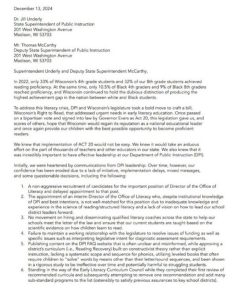
Share

K-12 Achievement Data Availability

Terry Grier:

Can anyone name a school or school district that post any data on student outcomes on their web site? It should be a federal or state requirement that they do so.

Share

Notes on Education Governance

David Blaska:

The University of Michigan has fired a DEI administrator. That’s a start. One Rachel Dawson, we read, directed the prestigious public university’s office of academic multicultural initiatives. Yeah, the world of diversity, equity, and inclusion is cluttered with that kind of high-toned jabberwocky. 

Ms. Dawson stands in the shaming dock for uttering various and sundry anti-semitic utterances, among them saying Jews are “wealthy and privileged.” But then, don’t DEI scolds say that about every white person?

Share

Ideology and higher education

Jay Greene:

Elite universities have been so thoroughly captured by the left that they are no longer capable of reforming themselves to offer an ideologically balanced and intellectually diverse education.

Declaring that institutions are beyond repair should not be done lightly. The Bible offers an instructive lesson on this. Before judging the cities of Sodom and Gomorrah, Abraham bargains with God so that the cities would be spared if even 10 righteous people could be found there. If there are fewer than 10, the cities lack the critical mass required for making improvements.

Let’s apply the Sodom and Gomorrah test to the Ivy League. If we can find even 10 openly conservative professors at these universities, it might be possible for them to form a critical mass and make progress in getting their institutions to hire other conservative scholars to achieve meaningful ideological balance. Without even 10, these universities would not only lack the motivation to seek greater ideological diversity, but they would have great difficulty identifying quality conservative scholars and convincing them to join an organization without any like-minded colleagues. The point here is not that conservative faculty are the righteous ones, but that a critical mass of conservative professors is necessary to achieve internal reform.

-/—

KEY FINDINGS:
1. Ivy League payments and entitlements cost taxpayers $41.59 billion over a six-year period (FY2010-FY2015). This is equivalent to $120,000 in government monies, subsidies, & special tax treatment per undergraduate student, or $6.93 billion per year.

Share

K-12 Tax & $pending Climate: Why Are Americans Paying So Much More for Healthcare Than They Used To?

Harriet Torry:

Key Points

What’s This?

  • Healthcare spending in the U.S. reached $4.867 trillion in 2023, a 7.5% increase from the previous year.
  • Americans spent about $4,000 on health insurance in 2023, up nearly 20% from five years earlier.
  • Hospitals and doctors’ offices are paying more for workers, in large part due to worker shortages, rising wages and high turnover.
Share

Madison school shooting teen victim’s family holds ‘no bitterness or unforgiveness’ toward shooter

Erik S. Hanley

Andy Remus, Vergara’s uncle, spoke at the funeral saying the family holds “no bitterness or unforgiveness” toward 15-year-old Rupnow, noting her family lost a daughter, too.

“Somehow, this precious child of God lost her way,” he said.

Vergara’s funeral was held Saturday at City Church, located next to Abundant Life on East Buckeye Road in Madison. Opening with slow guitar and just over 100 people watching on Facebook Live, the first song concluded with the words “you are God with us.”

Remus said the family is leaning into God to cope with the tragedy — along with being OK with laughter when remembering happy or funny moments.

City Church Lead Pastor Tom Flaherty opened with prayer, asking for God’s help to receive comfort so that healing can begin.

“You save those who are crushed in spirit; well we are crushed,” he prayed. “Please save us.”

Share

“but none is more potentially lethal than its own education system”

Joel Kotkin:

From the very institutions once renowned for spreading literacy, the Enlightenment and the means of mastering nature, we now see a deep-seated denial of our common past, pervasive illiteracy and enforced orthodoxy.

The decay of higher education threatens both the civic health and long-term economic prospects of Western liberal civilisation. Once a font of dispassionate research and reasoned discussion, the academy in recent years has more resembled that of the medieval University of Paris, where witch trials were once conducted, except there is now less exposure to the canon.

American universities face an unprecedented challenge with the return of Donald Trump. His administration seems likely to attack such things as diversity, equity and inclusion (DEI) policies, while pushing to defund programmes favourable to terrorists, expel unruly students and deport those who are in the US illegally. Loss of federal support to universities, the educrats fear, could cause major financial setbacks, even among the Ivies. Like medieval clerics, the rapidly growing ranks of university administrators, deans and tenured faculty have grown used to living in what one writerdescribes as a ‘modern form of manorialism’, where luxury and leisure come as of right.

Share

FrontierMath problems

epoch

The problems in FrontierMath demand theoretical understanding, creative insight, and specialized expertise, often requiring multiple hours of effort from expert mathematicians to solve. Here, we provide a set of representative example problems and their solutions selected from each quintile of difficulty.

Share

Students spend less time on schoolwork, yet grades improve.

Jean Twenge:

“ai” summary:

Homework time for U.S. 8th and 10th graders decreased significantly from 2021 to 2023, with 10th graders experiencing a 24% decline and 8th graders a 17% decline.

——

more

Share

If faculty won’t fix the curricula, trustees and administrators must

Scott Yenor:

Florida administrators are revising general education in universities and colleges. Perverse incentives have diluted and politicized general-education courses at the expense of foundational knowledge. Since universities will not fix themselves, state administrators must safeguard educational vision where faculty and university administrators will not.

How did we get here? Most college curriculum was prescribed in the 1800s. Harvard under legendary president Charles William Eliot swung the pendulum toward a totally elective college experience in the late 1800s. Under a strict elective system, students could make their way through Harvard guided only by their own choices. Schools stampeded to the elective system. The quality of education suffered, however, because a grasp of the Western heritage simply fell by the wayside, and students were ill prepared for higher-level classes.

Perverse incentives have diluted and politicized general-education courses at the expense of foundational knowledge.Today’s system of major concentration, general-education distribution, and electives was born from these swings of the pendulum. Yale adopted it in 1901. Cornell in 1905. Even Harvard abandoned its elective system for the major/general-education approach in 1910.

Share

Censorship at Georgetown

Bruce Gilley:

It’s rare to see such overt ideological censorship in print. Most academics know enough to couch their partisanship in comments about the quality of citations or the need for more data. But Click is just a symptom of the wider problem. She has grown up in a department and in an American history profession where outright ideological fixations are considered good form. That a white woman was scolding a brown man for having unchaste thoughts about colonialism was especially delicious.

The snub was also ironic because The Footnote was launched as part of a 2021 initiative at Georgetown that “celebrates the intellectual spectrum of higher education” and “collects diverse historical perspectives … believing that everyone has something to say about the past.”

Share

Congress should pass a bill to make clear males can’t play on female teams.

Gerald Posner:

Protecting women’s sports should be at the top of the Trump administration’s to-do list. The issue gained national attention in 2022, when male swimmer Lia Thomas, who had been ranked 65th among men in the nation for the 500-yard freestyle, won an NCAA swimming championship while competing as a woman. A United Nations report last month revealed that men identifying as women have won 890 medals in 29 female-only sports worldwide.

The Education Department in April proposed a regulation adding “gender identity” as a protected category to Title IX rules. Title IX, enacted in 1972, bans sex discrimination by federally funded educational institutions. The new rule, which went into effect Aug. 1, allows males unfettered access to female locker rooms and bathrooms. It also signals approval of men participating in and dominating women’s athletics.

Republicans tried unsuccessfully to pre-empt the Title IX changes. In 2023 the House passed the Protection of Women and Girls in Sports Act, which defined sex as “based solely on a person’s reproductive biology and genetics at birth.” When it got to the Senate, Alabama’s Tommy Tuberville—who began his career as a high-school girls’ basketball coach—asked for unanimous consent. Hawaii’s Sen. Mazie Hirono objected, saying it would bar people from playing sports “consistent with their gender.” Majority Leader Chuck Schumer stymied the bill. In July Sen. Cindy Hyde-Smith (R., Miss.) and Rep. Mary Miller (R., Ill.), introduced a resolution under the Congressional Review Act to reverse the Biden regulation. It passed the House along party lines, 210-205. Mr. Schumer again made certain it died in the Senate.

Share

Is a college degree worth the cost? 45% say ‘no’

Joanne Jacobs

High college costs are a big issue for Americans, according to a Data for Progress survey of voters, reports William Diep. Eighty-three percent say college is too expensive. While 48 percent say the benefits of a degree are worth the costs, 45 percent disagree.

Share

“who has refused to support the issuance of a $300M high-interest payday loan to fund CTU’s contract demands”

Austin Berg:

Chicago Mayor Brandon Johnson’s handpicked board of education has added the termination of Chicago Public Schools CEO Pedro Martinez to their Friday meeting agenda.

Chicago Teachers Union President Stacy Davis Gates and Vice President Jackson Potter have been lobbying Johnson for months to pressure the board to fire Martinez, who has refused to support the issuance of a $300M high-interest payday loan to fund CTU’s contract demands.

This pressure led to the ousting of the entire seven-member school board in October. Johnson then appointed an entirely new board, with no oversight. The new board president then resigned when 40 aldermen called for him to step down after social media posts came to light wherein he supported 9/11 conspiracy theories and anti-semitism.

Johnson and the CTU are hoping for all of this to rushed through before newly elected members of the school board take office on Jan. 15.

Share